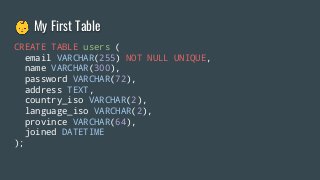
👶 My FirstTable
CREATE TABLE users (
email VARCHAR(255) NOT NULL UNIQUE,
name VARCHAR(300),
password VARCHAR(72),
address TEXT,
country_iso VARCHAR(2),
language_iso VARCHAR(2),
province VARCHAR(64),
joined DATETIME
);
8.
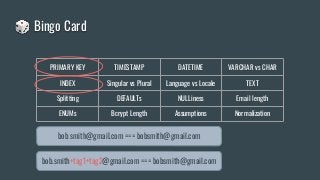
PRIMARY KEY TIMESTAMPDATETIME VARCHAR vs CHAR
INDEX Singular vs Plural Language vs Locale TEXT
Splitting DEFAULTs NULLiness Email length
ENUMs Bcrypt Length Assumptions Normalization
🎲 Bingo Card
bob.smith+tag1+tag2@gmail.com === bobsmith@gmail.com
bob.smith@gmail.com === bobsmith@gmail.com
9.
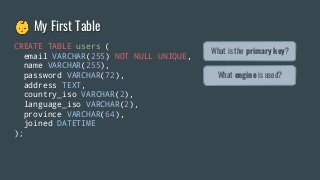
👶 My FirstTable
CREATE TABLE users (
email VARCHAR(255) NOT NULL UNIQUE,
name VARCHAR(255),
password VARCHAR(72),
address TEXT,
country_iso VARCHAR(2),
language_iso VARCHAR(2),
province VARCHAR(64),
joined DATETIME
);
What engine is used?
What is the primary key?
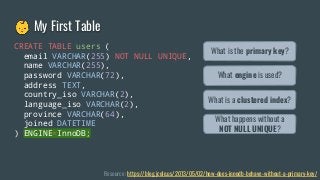
👶 My FirstTable
CREATE TABLE users (
email VARCHAR(255) NOT NULL UNIQUE,
name VARCHAR(255),
password VARCHAR(72),
address TEXT,
country_iso VARCHAR(2),
language_iso VARCHAR(2),
province VARCHAR(64),
joined DATETIME
) ENGINE=InnoDB;
What engine is used?
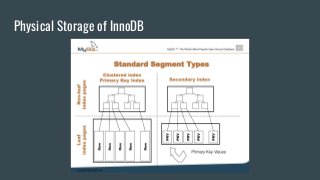
What is a clustered index?
What happens without a
NOT NULL UNIQUE?
Resource: https://blog.jcole.us/2013/05/02/how-does-innodb-behave-without-a-primary-key/
What is the primary key?
Is there aneed?
● User complaints?
● Personal experience and frustrations?
● Resource hogging?
● Slow running processes
● Treat optimizing queries like you’d optimize anything
30.
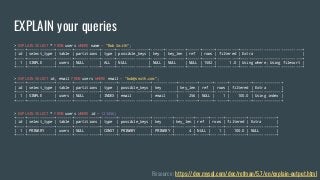
> EXPLAIN SELECT* FROM users WHERE name = "Bob Smith";
+----+-------------+-------+------------+------+---------------+------+---------+------+------+----------+-----------------------------+
| id | select_type | table | partitions | type | possible_keys | key | key_len | ref | rows | filtered | Extra |
+----+-------------+-------+------------+------+---------------+------+---------+------+------+----------+-----------------------------+
| 1 | SIMPLE | users | NULL | ALL | NULL | NULL | NULL | NULL | 1582 | 1.0 | Using where; Using filesort |
+----+-------------+-------+------------+------+---------------+------+---------+------+------+----------+-----------------------------+
> EXPLAIN SELECT id, email FROM users WHERE email = "bob@smith.com";
+----+-------------+-------+------------+-------+---------------+-----------+---------+------+------+----------+-------------+
| id | select_type | table | partitions | type | possible_keys | key | key_len | ref | rows | filtered | Extra |
+----+-------------+-------+------------+-------+---------------+-----------+---------+------+------+----------+-------------+
| 1 | SIMPLE | users | NULL | INDEX | email | email | 256 | NULL | 1 | 100.0 | Using index |
+----+-------------+-------+------------+-------+---------------+-----------+---------+------+------+----------+-------------+
> EXPLAIN SELECT * FROM users WHERE id = 123456;
+----+-------------+-------+------------+-------+---------------+---------+---------+------+------+----------+-------------+
| id | select_type | table | partitions | type | possible_keys | key | key_len | ref | rows | filtered | Extra |
+----+-------------+-------+------------+-------+---------------+---------+---------+------+------+----------+-------------+
| 1 | PRIMARY | users | NULL | CONST | PRIMARY | PRIMARY | 4 | NULL | 1 | 100.0 | NULL |
+----+-------------+-------+------------+-------+---------------+---------+---------+------+------+----------+-------------+
EXPLAIN your queries
Resource: https://dev.mysql.com/doc/refman/5.7/en/explain-output.html
31.
# Hints touse one of the following indexes
SELECT * FROM table USE INDEX (index_name,...) WHERE ...;
# Same as above but assumes a full table scan is very expensive
SELECT * FROM table FORCE INDEX (index_name,...) WHERE ...;
# Ensures that certain indexes aren’t being used
SELECT * FROM table IGNORE INDEX (index_name,...) WHERE ...;
Resource: https://dev.mysql.com/doc/refman/8.0/en/index-hints.html
Use the FORCE INDEX
32.
SHOW [GLOBAL |SESSION] VARIABLES
[LIKE 'pattern' | WHERE expr]
SET variable = expr [, variable = expr] ...
> SET slow_query_log = 1;
> SET long_query_time = 10; # Default
> SET min_examined_row_limit = 100;
> SET log_queries_not_using_indexes = 'ON';
> SET slow_query_log_file = 'host_name-slow.log'; # Default
Enable Logging
Resource: https://dev.mysql.com/doc/refman/5.6/en/slow-query-log.html
33.
$ vim /etc/mysql/conf.d/mysql.cnf# depends on distro
[mysqld]
performance_schema=ON
$ service mysqld restart # depends on distro too!
$ mysql
> SHOW VARIABLES WHERE Variable_name = 'performance_schema';
+--------------------+-------+
| Variable_name | Value |
+--------------------+-------+
| performance_schema | ON |
+--------------------+-------+
Performance Schema
Resource: https://dev.mysql.com/doc/refman/5.7/en/performance-schema.html
34.
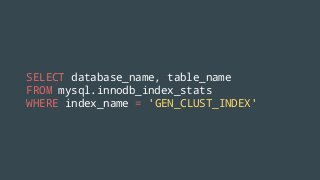
> SELECT DIGEST_TEXT,SUM_SELECT_SCAN
FROM performance_schema.events_statements_summary_by_digest
WHERE SUM_SELECT_SCAN > 0 AND SCHEMA_NAME = [schema] ORDER BY SUM_SELECT_SCAN DESC;
+----------------------------------------------+-----------------+
| DIGEST_TEXT | SUM_SELECT_SCAN |
+----------------------------------------------+-----------------+
| SELECT `*` FROM `users` WHERE ( `name` = ? ) | 700 |
+----------------------------------------------+-----------------+
> SELECT DIGEST_TEXT, SUM_ROWS_EXAMINED / SUM_ROWS_SENT AS RATIO
FROM performance_schema.events_statements_summary_by_digest
WHERE SCHEMA_NAME = [schema] ORDER BY RATIO DESC;
+---------------------------------------------------------------+-------+
| DIGEST_TEXT | RATIO |
+---------------------------------------------------------------+-------+
| SELECT `*` FROM `users` WHERE ( `name` = ? AND `joined` > ? ) | 10730 |
+---------------------------------------------------------------+-------+
events_statements_summary_by_digest
Resource: https://dev.mysql.com/doc/refman/5.7/en/performance-schema.html
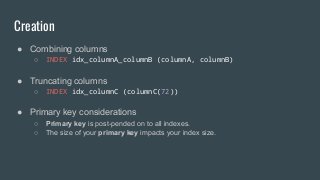
Creation
● Combining columns
○INDEX idx_columnA_columnB (columnA, columnB)
● Truncating columns
○ INDEX idx_columnC (columnC(72))
● Primary key considerations
○ Primary key is post-pended on to all indexes.
○ The size of your primary key impacts your index size.
37.
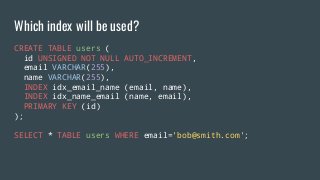
CREATE TABLE users(
id UNSIGNED NOT NULL AUTO_INCREMENT,
email VARCHAR(255),
name VARCHAR(255),
INDEX idx_email_name (email, name),
INDEX idx_name_email (name, email),
PRIMARY KEY (id)
);
SELECT * TABLE users WHERE email='bob@smith.com';
Which index will be used?
38.
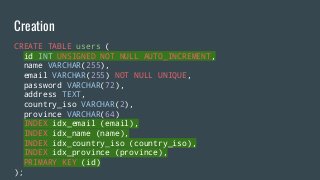
Creation
CREATE TABLE users(
id INT UNSIGNED NOT NULL AUTO_INCREMENT,
name VARCHAR(255),
email VARCHAR(255) NOT NULL UNIQUE,
password VARCHAR(72),
address TEXT,
country_iso VARCHAR(2),
province VARCHAR(64)
INDEX idx_email (email),
INDEX idx_name (name),
INDEX idx_country_iso (country_iso),
INDEX idx_province (province),
PRIMARY KEY (id)
);
39.
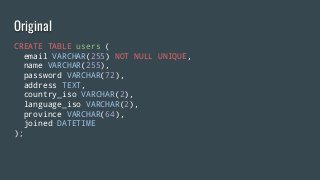
Original
CREATE TABLE users(
email VARCHAR(255) NOT NULL UNIQUE,
name VARCHAR(255),
password VARCHAR(72),
address TEXT,
country_iso VARCHAR(2),
language_iso VARCHAR(2),
province VARCHAR(64),
joined DATETIME
);
40.
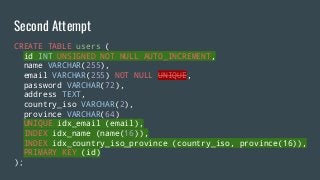
Second Attempt
CREATE TABLEusers (
id INT UNSIGNED NOT NULL AUTO_INCREMENT,
name VARCHAR(255),
email VARCHAR(255) NOT NULL UNIQUE,
password VARCHAR(72),
address TEXT,
country_iso VARCHAR(2),
province VARCHAR(64)
UNIQUE idx_email (email),
INDEX idx_name (name(16)),
INDEX idx_country_iso_province (country_iso, province(16)),
PRIMARY KEY (id)
);
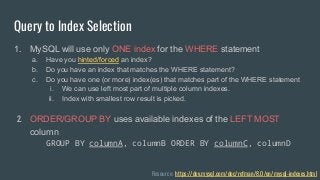
Query to IndexSelection
1. MySQL will use only ONE index for the WHERE statement
a. Have you hinted/forced an index?
b. Do you have an index that matches the WHERE statement?
c. Do you have one (or more) index(es) that matches part of the WHERE statement
i. We can use left most part of multiple column indexes.
ii. Index with smallest row result is picked.
2. ORDER/GROUP BY uses available indexes of the LEFT MOST
column
GROUP BY columnA, columnB ORDER BY columnC, columnD
Resource: https://dev.mysql.com/doc/refman/8.0/en/mysql-indexes.html
Evaluating Indexes
● Sametools as the Identification process
● Is the index redundant?
SELECT table_name, redundant_index_name, dominant_index_name
FROM sys.schema_redundant_indexes
WHERE table_schema = [schema]
● Is the index even used?
SELECT object_schema, object_name, index_name
FROM performance_schema.table_io_waits_summary_by_index_usage
WHERE index_name IS NOT NULL
AND index_name != 'PRIMARY'
AND count_star = 0
AND object_schema = [schema]
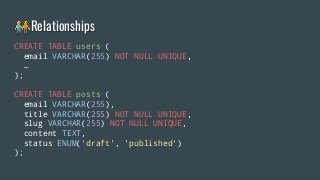
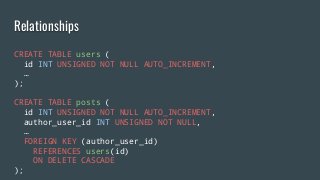
Relationships
CREATE TABLE users(
id INT UNSIGNED NOT NULL AUTO_INCREMENT,
…
);
CREATE TABLE posts (
id INT UNSIGNED NOT NULL AUTO_INCREMENT,
author_user_id INT UNSIGNED NOT NULL,
…
FOREIGN KEY (author_user_id)
REFERENCES users(id)
ON DELETE CASCADE
);
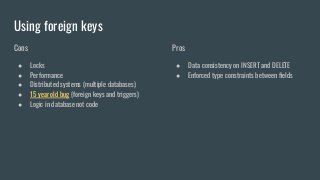
Using foreign keys
Cons
●Locks
● Performance
● Distributed systems (multiple databases)
● 15 year old bug (foreign keys and triggers)
● Logic in database not code
Pros
● Data consistency on INSERT and DELETE
● Enforced type constraints between fields
🗃 mysqldump
Resource: https://dev.mysql.com/doc/refman/8.0/en/mysqldump.html
$vim backup_database.sh
# Quick and dirty MySQL backup solution
DATETIME=$(date +%Y%m%d-%H%M%S)
# Which database to backup automatically
DATABASE=db_name
# Use file based password handling
mysqldump [options] $(DATABASE) | tar cvzf > db_name.$(DATETIME).sql.tar.gz
$ crontab -e
# Every day at 4am
0 4 * * * backup_database.sh
55.
🕵 Cadfael
Resource: https://github.com/xsist10/cadfael
$composer global require cadfael/cadfael # or get the phar
$ ./vendor/bin/cadfael run
--host [host] # Where is the database host?
--username [username] # MySQL username
--performance_schema # Run performance schema checks
[schema1] [...schema2] # Which schemas to check?
+----------------------+-------------------------------+---------+--------------------------------------------------------------------------------------+
| Check | Entity | Status | Message |
+----------------------+-------------------------------+---------+--------------------------------------------------------------------------------------+
| SaneInnoDbPrimaryKey | table_with_insane_primary_key | Warning | In InnoDB tables, the PRIMARY KEY is appended to other indexes. |
| | | | If the PRIMARY KEY is big, other indexes will use more space. |
| | | | Maybe turn your PRIMARY KEY into UNIQUE and add an auto_increment PRIMARY KEY. |
| | | | Reference: https://dev.mysql.com/doc/refman/5.7/en/innodb-index-types.html |
| EmptyTable | empty_table | Warning | Table contains no records. |
| RedundantIndexes | table_with_insane_primary_key | Concern | Redundant index `full_name` (superseded by `full_name_height_in_cm`). |
| | | | A redundant index can probably drop it (unless it's a UNIQUE, in which case the |
| | | | dominant index might be a better candidate for reworking). |
| | | | Reference: https://dev.mysql.com/doc/refman/8.0/en/sys-schema-redundant-indexes.html |
+----------------------+-------------------------------+---------+--------------------------------------------------------------------------------------+
56.
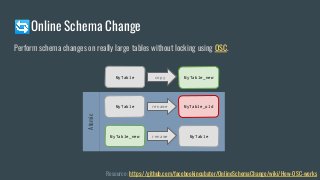
🔄Online Schema Change
Performschema changes on really large tables without locking using OSC.
Resource: https://github.com/facebookincubator/OnlineSchemaChange/wiki/How-OSC-works
MyTable MyTable_new
copy
MyTable MyTable_old
rename
MyTable
MyTable_new rename
Atomic



















![SHOW [GLOBAL | SESSION] VARIABLES
[LIKE 'pattern' | WHERE expr]
SET variable = expr [, variable = expr] ...
> SET slow_query_log = 1;
> SET long_query_time = 10; # Default
> SET min_examined_row_limit = 100;
> SET log_queries_not_using_indexes = 'ON';
> SET slow_query_log_file = 'host_name-slow.log'; # Default
Enable Logging
Resource: https://dev.mysql.com/doc/refman/5.6/en/slow-query-log.html](https://image.slidesharecdn.com/mysqlwith-211023093332/85/MySQL-with-32-320.jpg?cb=1634988370)
![$ vim /etc/mysql/conf.d/mysql.cnf # depends on distro
[mysqld]
performance_schema=ON
$ service mysqld restart # depends on distro too!
$ mysql
> SHOW VARIABLES WHERE Variable_name = 'performance_schema';
+--------------------+-------+
| Variable_name | Value |
+--------------------+-------+
| performance_schema | ON |
+--------------------+-------+
Performance Schema
Resource: https://dev.mysql.com/doc/refman/5.7/en/performance-schema.html](https://image.slidesharecdn.com/mysqlwith-211023093332/85/MySQL-with-33-320.jpg?cb=1634988370)
![> SELECT DIGEST_TEXT, SUM_SELECT_SCAN
FROM performance_schema.events_statements_summary_by_digest
WHERE SUM_SELECT_SCAN > 0 AND SCHEMA_NAME = [schema] ORDER BY SUM_SELECT_SCAN DESC;
+----------------------------------------------+-----------------+
| DIGEST_TEXT | SUM_SELECT_SCAN |
+----------------------------------------------+-----------------+
| SELECT `*` FROM `users` WHERE ( `name` = ? ) | 700 |
+----------------------------------------------+-----------------+
> SELECT DIGEST_TEXT, SUM_ROWS_EXAMINED / SUM_ROWS_SENT AS RATIO
FROM performance_schema.events_statements_summary_by_digest
WHERE SCHEMA_NAME = [schema] ORDER BY RATIO DESC;
+---------------------------------------------------------------+-------+
| DIGEST_TEXT | RATIO |
+---------------------------------------------------------------+-------+
| SELECT `*` FROM `users` WHERE ( `name` = ? AND `joined` > ? ) | 10730 |
+---------------------------------------------------------------+-------+
events_statements_summary_by_digest
Resource: https://dev.mysql.com/doc/refman/5.7/en/performance-schema.html](https://image.slidesharecdn.com/mysqlwith-211023093332/85/MySQL-with-34-320.jpg?cb=1634988370)



![Evaluating Indexes
● Same tools as the Identification process
● Is the index redundant?
SELECT table_name, redundant_index_name, dominant_index_name
FROM sys.schema_redundant_indexes
WHERE table_schema = [schema]
● Is the index even used?
SELECT object_schema, object_name, index_name
FROM performance_schema.table_io_waits_summary_by_index_usage
WHERE index_name IS NOT NULL
AND index_name != 'PRIMARY'
AND count_star = 0
AND object_schema = [schema]](https://image.slidesharecdn.com/mysqlwith-211023093332/85/MySQL-with-44-320.jpg?cb=1634988370)




![🗃 mysqldump
Resource: https://dev.mysql.com/doc/refman/8.0/en/mysqldump.html
$ vim backup_database.sh
# Quick and dirty MySQL backup solution
DATETIME=$(date +%Y%m%d-%H%M%S)
# Which database to backup automatically
DATABASE=db_name
# Use file based password handling
mysqldump [options] $(DATABASE) | tar cvzf > db_name.$(DATETIME).sql.tar.gz
$ crontab -e
# Every day at 4am
0 4 * * * backup_database.sh](https://image.slidesharecdn.com/mysqlwith-211023093332/85/MySQL-with-54-320.jpg?cb=1634988370)
![🕵 Cadfael
Resource: https://github.com/xsist10/cadfael
$ composer global require cadfael/cadfael # or get the phar
$ ./vendor/bin/cadfael run
--host [host] # Where is the database host?
--username [username] # MySQL username
--performance_schema # Run performance schema checks
[schema1] [...schema2] # Which schemas to check?
+----------------------+-------------------------------+---------+--------------------------------------------------------------------------------------+
| Check | Entity | Status | Message |
+----------------------+-------------------------------+---------+--------------------------------------------------------------------------------------+
| SaneInnoDbPrimaryKey | table_with_insane_primary_key | Warning | In InnoDB tables, the PRIMARY KEY is appended to other indexes. |
| | | | If the PRIMARY KEY is big, other indexes will use more space. |
| | | | Maybe turn your PRIMARY KEY into UNIQUE and add an auto_increment PRIMARY KEY. |
| | | | Reference: https://dev.mysql.com/doc/refman/5.7/en/innodb-index-types.html |
| EmptyTable | empty_table | Warning | Table contains no records. |
| RedundantIndexes | table_with_insane_primary_key | Concern | Redundant index `full_name` (superseded by `full_name_height_in_cm`). |
| | | | A redundant index can probably drop it (unless it's a UNIQUE, in which case the |
| | | | dominant index might be a better candidate for reworking). |
| | | | Reference: https://dev.mysql.com/doc/refman/8.0/en/sys-schema-redundant-indexes.html |
+----------------------+-------------------------------+---------+--------------------------------------------------------------------------------------+](https://image.slidesharecdn.com/mysqlwith-211023093332/85/MySQL-with-55-320.jpg?cb=1634988370)