Building together
after crisis in Nepali
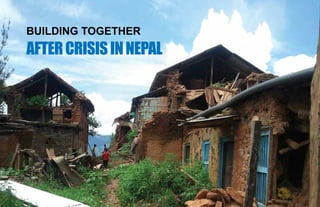
BUILDING TOGETHER
AFTERCRISISINNEPAL
Building together
after crisis in Nepal ii
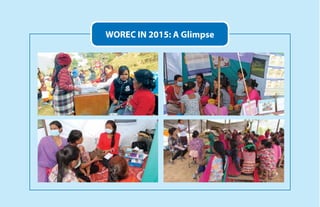
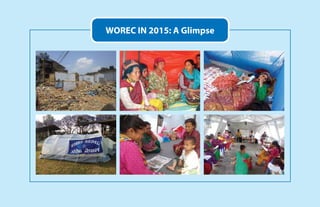
WOREC IN 2015: A Glimpse
Building together
after crisis in Nepal1
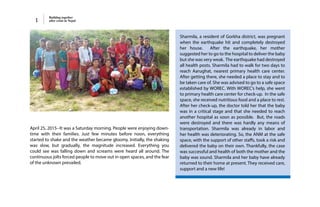
Sharmila, a resident of Gorkha district, was pregnant
when the earthquake hit and completely destroyed
her house. After the earthquake, her mother
suggested her to go to the hospital to deliver the baby
but she was very weak. The earthquake had destroyed
all health posts. Sharmila had to walk for two days to
reach Aarughat, nearest primary health care center.
After getting there, she needed a place to stay and to
be taken care of. She was advised to go to a safe space
established by WOREC. With WOREC’s help, she went
to primary health care center for check-up. In the safe
space, she received nutritious food and a place to rest.
After her check-up, the doctor told her that the baby
was in a critical stage and that she needed to reach
another hospital as soon as possible. But, the roads
were destroyed and there was hardly any means of
transportation. Sharmila was already in labor and
her health was deteriorating. So, the ANM at the safe
space, with the support of other staffs, took a risk and
delivered the baby on their own. Thankfully, the case
was successful and health of both the mother and the
baby was sound. Sharmila and her baby have already
returned to their home at present. They received care,
support and a new life!
April 25, 2015--It was a Saturday morning. People were enjoying down-
time with their families. Just few minutes before noon, everything
started to shake and the weather became gloomy. Initially, the shaking
was slow, but gradually, the magnitude increased. Everything you
could see was falling down and screams were heard all around. The
continuous jolts forced people to move out in open spaces, and the fear
of the unknown prevailed.
Building together
after crisis in Nepal 2
The earthquake of 7.8 Richter scale hit Nepal, with Barpak Village in
Gorkha as an epicenter. Everything including walls, houses and temples,
started falling down and the death toll reached nearly 9,000 within a few
weeks, leaving thousands of people homeless and injured.
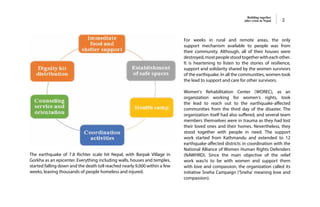
For weeks in rural and remote areas, the only
support mechanism available to people was from
their community. Although, all of their houses were
destroyed,mostpeoplestoodtogetherwitheachother.
It is heartening to listen to the stories of resilience,
support and solidarity shared by the women survivors
of the earthquake. In all the communities, women took
the lead to support and care for other survivors.
Women's Rehabilitation Center (WOREC), as an
organization working for women's rights, took
the lead to reach out to the earthquake-affected
communities from the third day of the disaster. The
organization itself had also suffered, and several team
members themselves were in trauma as they had lost
their loved ones and their homes. Nevertheless, they
stood together with people in need. The support
work started from Kathmandu and extended to 12
earthquake-affected districts in coordination with the
National Alliance of Women Human Rights Defenders
(NAWHRD). Since the main objective of the relief
work was/is to be with women and support them
with love and compassion, the organization called its
initiative Sneha Campaign ('Sneha' meaning love and
compassion).
Building together
after crisis in Nepal3
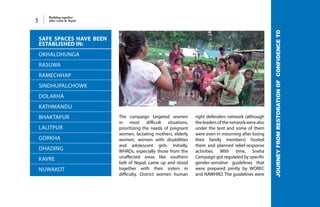
The campaign targeted women
in most difficult situations,
prioritizing the needs of pregnant
women, lactating mothers, elderly
women, women with disabilities
and adolescent girls. Initially,
WHRDs, especially those from the
unaffected areas like southern
belt of Nepal, came up and stood
together with their sisters in
difficulty. District women human
right defenders network (although
theleadersofthenetworkwerealso
under the tent and some of them
were even in mourning after losing
their family members) hosted
them and planned relief-response
activities. With time, Sneha
Campaign got regulated by specific
gender-sensitive guidelines that
were prepared jointly by WOREC
and NAWHRD. The guidelines were
SAFE SPACES HAVE BEEN
ESTABLISHED IN:
OKHALDHUNGA
RASUWA
RAMECHHAP
SINDHUPALCHOWK
DOLAKHA
KATHMANDU
BHAKTAPUR
LALITPUR
GORKHA
DHADING
KAVRE
NUWAKOT
JOURNEYFROMRESTORATIONOFCONFIDENCETO
Building together
after crisis in Nepal 4
also forwarded to the Chief Secretary of
the country with a request to adopt those
within government relief program. These
guidelines were shared with the media,
non-government organizations (NGOs)
and international non-government
organizations as well so that they
could provide support from a feminist
perspective. Women rights activists from
all over the world extended support love
and compassion to the women survivors
of the earthquake. Organizations such
as MADRE, GFW, AEI, MISEREOR, ISIS-
WICCE, JAGSN, FJS, Urgent Action Fund
and APWLD, among many others, joined
hands to reach out to the people in need.
This became a real example of solidarity
from a global to a national level, where
women from different parts of the world
stood together with compassion for one
another.
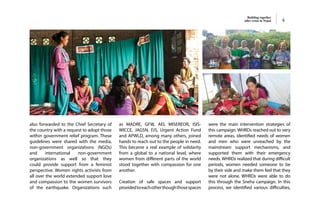
Creation of safe spaces and support
providedtoeachotherthoughthosespaces
were the main intervention strategies of
this campaign. WHRDs reached out to very
remote areas, identified needs of women
and men who were unreached by the
mainstream support mechanisms, and
supported them with their emergency
needs. WHRDs realized that during difficult
periods, women needed someone to be
by their side and make them feel that they
were not alone. WHRDs were able to do
this through the Sneha campaign. In this
process, we identified various difficulties,
Building together
after crisis in Nepal5
including gender-based violence (GBV),
that women were facing while under the
tents.
LIVELIHOOD SUPPORT: 273
PSYCHOSOCIAL COUNSELLING: 14457
DIGNITY KITS SUPPORT: 20211
NON-FOOD ITEM DISTRIBUTION: 5239
GBV CASE MANAGEMENT: 1227
In this regard, WOREC planned and
established Sneha Kendra (female-
friendly spaces) in twelve out of fourteen
most Earthquake-affected districts
declared by Nepal government with the
sole motive to ensure safety and security
of women and adolescent girls. Inside safe
spaces, women and adolescent girls could
breastfeed their babies, change their
clothes, share their feelings and emotions,
get entertained, and find a way forward
from trauma of earthquake and other kind
of GBV through case management and
recreational services. The relief activities
were mostly carried out while keeping
four aspects in mind.We provided services
to women and adolescent girls through
safe spaces, provided psycho-social
counseling to the survivors, supported
the survivors on need-based approach
and provided capacity building to
women through orientations, developed
feminist leadership and human resources
on different issues like GBV, health and
hygiene during menstruation, sexual
and reproductive health, among others.
Similarly, there were health camps
conducted to provide support to pregnant
women and lactating mothers, who
were the most vulnerable groups during
the calamity. Working at the grassroots
level, WOREC realized that psycho-social
wellbeing is essential for all women to
actively participate in their communities.
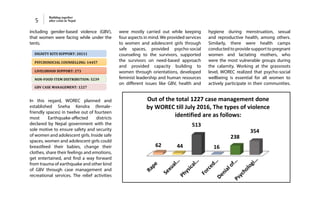
62 44
513
16
238
354
Out of the total 1227 case management done
by WOREC till July 2016, The types of violence
identified are as follows:
Building together
after crisis in Nepal 6
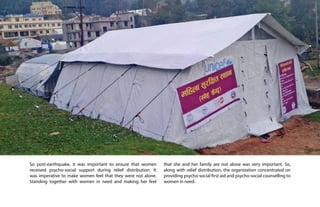
So post-earthquake, it was important to ensure that women
received psycho-social support during relief distribution. It
was imperative to make women feel that they were not alone.
Standing together with women in need and making her feel
that she and her family are not alone was very important. So,
along with relief distribution, the organization concentrated on
providing psycho-social first aid and psycho-social counselling to
women in need.
Building together
after crisis in Nepal7
WOREC IN 2015: A Glimpse
Building together
after crisis in Nepal 8
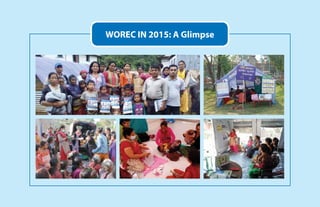
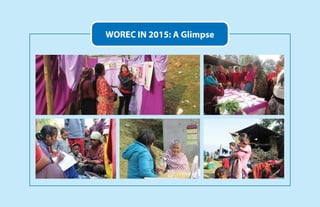
WOREC IN 2015: A Glimpse
Building together
after crisis in Nepal 10
WOREC’s relief activities supported by:
were health camps conducted to provide support to pregnant women and lactating mothers,
who were the most vulnerable groups during the calamity.
Working at the grassroots level, WOREC realized that psycho-social wellbeing is essential for
all women to actively participate in their communities. So post-earthquake, it was important to
ensure that women received psycho-social support during relief distribution. It was imperative
to make women feel that they were not alone. Standing together with women in need and
making her feel that she and her family are not alone was very important. So, along with relief
distribution, the organization concentrated on providing psycho-social first aid and psycho-
social counselling to women in need.
WOREC's relief activities supported by:
Women’s Rehabilitation Center (WOREC)
Balkumari, Lalitpur, PO Box: 13233,
Phone no: 977-1-2123124, 1-5006373, 1-5006374
Fax: 977- 1-5006271, E-mail: ics@worecnepal.org
Web: www.worecnepal.org
Women’s Rehabilitation Center (WOREC)
Balkumari, Lalitpur, PO Box: 13233,
Phone no: 977-1-2123124, 1-5006373, 1-5006374
Fax: 977- 1-500627, E-mail: ics@worecnepal.org
Web: www.worecnepal.org
Women's World
Day of Prayer

Building together after crisis

  • 1.
    Building together after crisisin Nepali BUILDING TOGETHER AFTERCRISISINNEPAL
  • 2.
    Building together after crisisin Nepal ii WOREC IN 2015: A Glimpse
  • 3.
    Building together after crisisin Nepal1 Sharmila, a resident of Gorkha district, was pregnant when the earthquake hit and completely destroyed her house. After the earthquake, her mother suggested her to go to the hospital to deliver the baby but she was very weak. The earthquake had destroyed all health posts. Sharmila had to walk for two days to reach Aarughat, nearest primary health care center. After getting there, she needed a place to stay and to be taken care of. She was advised to go to a safe space established by WOREC. With WOREC’s help, she went to primary health care center for check-up. In the safe space, she received nutritious food and a place to rest. After her check-up, the doctor told her that the baby was in a critical stage and that she needed to reach another hospital as soon as possible. But, the roads were destroyed and there was hardly any means of transportation. Sharmila was already in labor and her health was deteriorating. So, the ANM at the safe space, with the support of other staffs, took a risk and delivered the baby on their own. Thankfully, the case was successful and health of both the mother and the baby was sound. Sharmila and her baby have already returned to their home at present. They received care, support and a new life! April 25, 2015--It was a Saturday morning. People were enjoying down- time with their families. Just few minutes before noon, everything started to shake and the weather became gloomy. Initially, the shaking was slow, but gradually, the magnitude increased. Everything you could see was falling down and screams were heard all around. The continuous jolts forced people to move out in open spaces, and the fear of the unknown prevailed.
  • 4.
    Building together after crisisin Nepal 2 The earthquake of 7.8 Richter scale hit Nepal, with Barpak Village in Gorkha as an epicenter. Everything including walls, houses and temples, started falling down and the death toll reached nearly 9,000 within a few weeks, leaving thousands of people homeless and injured. For weeks in rural and remote areas, the only support mechanism available to people was from their community. Although, all of their houses were destroyed,mostpeoplestoodtogetherwitheachother. It is heartening to listen to the stories of resilience, support and solidarity shared by the women survivors of the earthquake. In all the communities, women took the lead to support and care for other survivors. Women's Rehabilitation Center (WOREC), as an organization working for women's rights, took the lead to reach out to the earthquake-affected communities from the third day of the disaster. The organization itself had also suffered, and several team members themselves were in trauma as they had lost their loved ones and their homes. Nevertheless, they stood together with people in need. The support work started from Kathmandu and extended to 12 earthquake-affected districts in coordination with the National Alliance of Women Human Rights Defenders (NAWHRD). Since the main objective of the relief work was/is to be with women and support them with love and compassion, the organization called its initiative Sneha Campaign ('Sneha' meaning love and compassion).
  • 5.
    Building together after crisisin Nepal3 The campaign targeted women in most difficult situations, prioritizing the needs of pregnant women, lactating mothers, elderly women, women with disabilities and adolescent girls. Initially, WHRDs, especially those from the unaffected areas like southern belt of Nepal, came up and stood together with their sisters in difficulty. District women human right defenders network (although theleadersofthenetworkwerealso under the tent and some of them were even in mourning after losing their family members) hosted them and planned relief-response activities. With time, Sneha Campaign got regulated by specific gender-sensitive guidelines that were prepared jointly by WOREC and NAWHRD. The guidelines were SAFE SPACES HAVE BEEN ESTABLISHED IN: OKHALDHUNGA RASUWA RAMECHHAP SINDHUPALCHOWK DOLAKHA KATHMANDU BHAKTAPUR LALITPUR GORKHA DHADING KAVRE NUWAKOT JOURNEYFROMRESTORATIONOFCONFIDENCETO
  • 6.
    Building together after crisisin Nepal 4 also forwarded to the Chief Secretary of the country with a request to adopt those within government relief program. These guidelines were shared with the media, non-government organizations (NGOs) and international non-government organizations as well so that they could provide support from a feminist perspective. Women rights activists from all over the world extended support love and compassion to the women survivors of the earthquake. Organizations such as MADRE, GFW, AEI, MISEREOR, ISIS- WICCE, JAGSN, FJS, Urgent Action Fund and APWLD, among many others, joined hands to reach out to the people in need. This became a real example of solidarity from a global to a national level, where women from different parts of the world stood together with compassion for one another. Creation of safe spaces and support providedtoeachotherthoughthosespaces were the main intervention strategies of this campaign. WHRDs reached out to very remote areas, identified needs of women and men who were unreached by the mainstream support mechanisms, and supported them with their emergency needs. WHRDs realized that during difficult periods, women needed someone to be by their side and make them feel that they were not alone. WHRDs were able to do this through the Sneha campaign. In this process, we identified various difficulties,
  • 7.
    Building together after crisisin Nepal5 including gender-based violence (GBV), that women were facing while under the tents. LIVELIHOOD SUPPORT: 273 PSYCHOSOCIAL COUNSELLING: 14457 DIGNITY KITS SUPPORT: 20211 NON-FOOD ITEM DISTRIBUTION: 5239 GBV CASE MANAGEMENT: 1227 In this regard, WOREC planned and established Sneha Kendra (female- friendly spaces) in twelve out of fourteen most Earthquake-affected districts declared by Nepal government with the sole motive to ensure safety and security of women and adolescent girls. Inside safe spaces, women and adolescent girls could breastfeed their babies, change their clothes, share their feelings and emotions, get entertained, and find a way forward from trauma of earthquake and other kind of GBV through case management and recreational services. The relief activities were mostly carried out while keeping four aspects in mind.We provided services to women and adolescent girls through safe spaces, provided psycho-social counseling to the survivors, supported the survivors on need-based approach and provided capacity building to women through orientations, developed feminist leadership and human resources on different issues like GBV, health and hygiene during menstruation, sexual and reproductive health, among others. Similarly, there were health camps conducted to provide support to pregnant women and lactating mothers, who were the most vulnerable groups during the calamity. Working at the grassroots level, WOREC realized that psycho-social wellbeing is essential for all women to actively participate in their communities. 62 44 513 16 238 354 Out of the total 1227 case management done by WOREC till July 2016, The types of violence identified are as follows:
  • 8.
    Building together after crisisin Nepal 6 So post-earthquake, it was important to ensure that women received psycho-social support during relief distribution. It was imperative to make women feel that they were not alone. Standing together with women in need and making her feel that she and her family are not alone was very important. So, along with relief distribution, the organization concentrated on providing psycho-social first aid and psycho-social counselling to women in need.
  • 9.
    Building together after crisisin Nepal7 WOREC IN 2015: A Glimpse
  • 10.
    Building together after crisisin Nepal 8 WOREC IN 2015: A Glimpse
  • 11.
    WOREC IN 2015:A Glimpse
  • 12.
    Building together after crisisin Nepal 10 WOREC’s relief activities supported by: were health camps conducted to provide support to pregnant women and lactating mothers, who were the most vulnerable groups during the calamity. Working at the grassroots level, WOREC realized that psycho-social wellbeing is essential for all women to actively participate in their communities. So post-earthquake, it was important to ensure that women received psycho-social support during relief distribution. It was imperative to make women feel that they were not alone. Standing together with women in need and making her feel that she and her family are not alone was very important. So, along with relief distribution, the organization concentrated on providing psycho-social first aid and psycho- social counselling to women in need. WOREC's relief activities supported by: Women’s Rehabilitation Center (WOREC) Balkumari, Lalitpur, PO Box: 13233, Phone no: 977-1-2123124, 1-5006373, 1-5006374 Fax: 977- 1-5006271, E-mail: ics@worecnepal.org Web: www.worecnepal.org Women’s Rehabilitation Center (WOREC) Balkumari, Lalitpur, PO Box: 13233, Phone no: 977-1-2123124, 1-5006373, 1-5006374 Fax: 977- 1-500627, E-mail: ics@worecnepal.org Web: www.worecnepal.org Women's World Day of Prayer