Download free for 30 days
Sign in
Upload
Language (EN)
Support
Business
Mobile
Social Media
Marketing
Technology
Art & Photos
Career
Design
Education
Presentations & Public Speaking
Government & Nonprofit
Healthcare
Internet
Law
Leadership & Management
Automotive
Engineering
Software
Recruiting & HR
Retail
Sales
Services
Science
Small Business & Entrepreneurship
Food
Environment
Economy & Finance
Data & Analytics
Investor Relations
Sports
Spiritual
News & Politics
Travel
Self Improvement
Real Estate
Entertainment & Humor
Health & Medicine
Devices & Hardware
Lifestyle
Change Language
Language
English
Español
Português
Français
Deutsche
Cancel
Save
Submit search
EN
Uploaded by
wellmaker786
1,167 views
Laboratory notebook & reports 10 11
Read more
2
Save
Share
Embed
Embed presentation
Download
Downloaded 21 times
1
/ 2
2
/ 2
More Related Content
PPT
Laboratory Notebook Lieu Final
by
FITT
PPTX
Eureka Research Workbench: A Semantic Approach to an Open Source Electroni...
by
Stuart Chalk
PPTX
Lab notebook set up fritts
by
Jenny Dixon
PPTX
Analyzing data notes
by
wellmaker786
PDF
Bloom's taxonomy
by
wellmaker786
PDF
Contract rubric
by
wellmaker786
PDF
Suggested product list
by
wellmaker786
PDF
Ds overview, rules, and requirements
by
wellmaker786
Laboratory Notebook Lieu Final
by
FITT
Eureka Research Workbench: A Semantic Approach to an Open Source Electroni...
by
Stuart Chalk
Lab notebook set up fritts
by
Jenny Dixon
Analyzing data notes
by
wellmaker786
Bloom's taxonomy
by
wellmaker786
Contract rubric
by
wellmaker786
Suggested product list
by
wellmaker786
Ds overview, rules, and requirements
by
wellmaker786
More from wellmaker786
PDF
Human anatomyandphysiology approved2006
by
wellmaker786
DOCX
Generic syllabus
by
wellmaker786
DOCX
Generic syllabus
by
wellmaker786
DOC
HBio syllabus Wellmaker
by
wellmaker786
PDF
Biology safety contract
by
wellmaker786
DOC
Level 3 bm hypothesis and experimental design
by
wellmaker786
DOC
Level 2 bm problem and objective
by
wellmaker786
DOC
Level 1 bm topic
by
wellmaker786
DOC
H bio research proposal rubric
by
wellmaker786
DOC
H bio research proposal
by
wellmaker786
DOC
H bio syllabus signature sheet
by
wellmaker786
Human anatomyandphysiology approved2006
by
wellmaker786
Generic syllabus
by
wellmaker786
Generic syllabus
by
wellmaker786
HBio syllabus Wellmaker
by
wellmaker786
Biology safety contract
by
wellmaker786
Level 3 bm hypothesis and experimental design
by
wellmaker786
Level 2 bm problem and objective
by
wellmaker786
Level 1 bm topic
by
wellmaker786
H bio research proposal rubric
by
wellmaker786
H bio research proposal
by
wellmaker786
H bio syllabus signature sheet
by
wellmaker786
Laboratory notebook & reports 10 11
1.
Laboratory Notebook and
Reports Lab Notebook Type Standard size (9 3/4" x 7 1/2") Quadrille graph paper composition book. You can buy these at Staples, Office Depot and possibly other stores. These are very popular notebooks with science teachers so I would call the store before you drive all that way to get one! Lab Notebook Guidelines Use only your official science lab notebook to record your work. Laboratory reports not completed in your lab notebook will NOT be graded. The first 2 pages are for the table of contents which should include the Date, Laboratory Title and Page numbers All pages after the table of contents should be numbered in the upper right hand corner before entering any information. Do not number the backs of pages. Make all entries legible in permanent dark blue or black ink only, NO PENCIL! Write impersonally and scientifically. Use passive voice [ex. 10 mL of water was (will be) added to the beaker.]. Do not use pronouns (I, me, we, he/she, they, it, etc.) or possessives (my, your/yours, his/her, our/ours, theirs, etc.) Do NOT write on the back of the pages in your lab notebook. Do NOT use White out or ink-overs to correct mistakes. If you make a mistake, simply draw one line through it and continue. Do NOT have loose papers in your notebook. Credit will NOT be given for loose papers in your notebook. Do NOT attach anything to pages in your notebook unless I have instructed you to. Do NOT copy information from the lab sheet, resources (books, internet, etc.) and lab partners because that is plagiarism. Each section of your lab report should be your own unique work. If you plagiarize, you will not receive credit! Laboratory Report Components Pre Lab (due the day before lab day) Title, date and lab partners: The 1st line on the 1st page of each new Lab activity should have the title of the lab and the date below it and the name of your LAB PARTNER(s) below that. Background: Provide 1 thorough paragraph (4 or more complete sentences) of information on the topic of investigation. What knowledge already exists about this subject that could be useful to the reader of your report? Purpose: Clearly state the overall purpose(s) of the lab. Example: To observe…. Materials and Hypothesis: Materials: In column format, list all materials to be used in the lab; give specific amounts when possible. Hypothesis (when applicable): This needs to be in “If…then…because…” format and should address an educated guess as to the outcome of the experiment. If there is a CONTROL in the lab, the hypothesis should address this. Example: If crickets are placed in a temperature of 10°C then the length that they jump will be less than that of the control by 5 cm because… JCHS Honors Biology © 2010 by Ms. Felicia Brown Page 1 of 2
2.
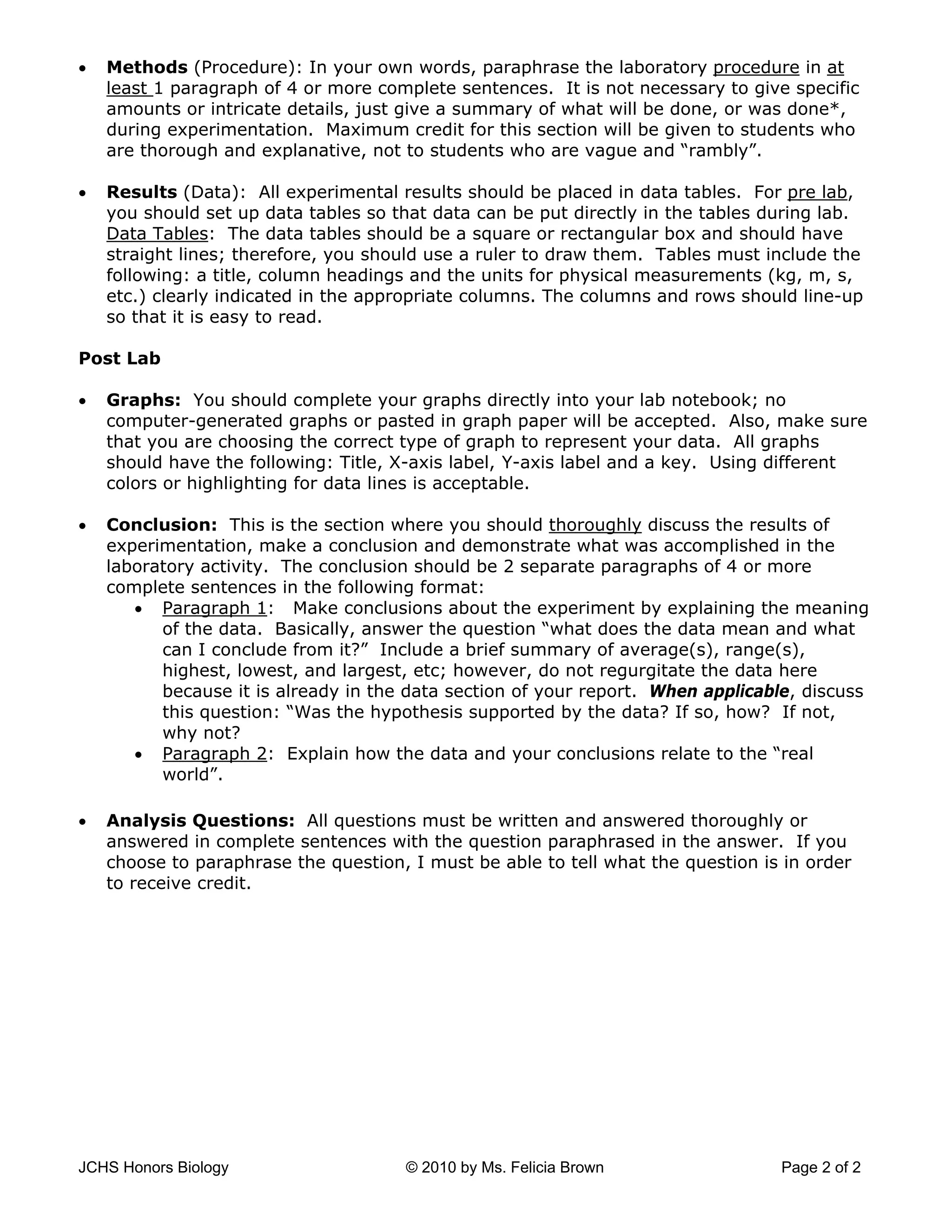
Methods (Procedure): In your own words, paraphrase the laboratory procedure in at least 1 paragraph of 4 or more complete sentences. It is not necessary to give specific amounts or intricate details, just give a summary of what will be done, or was done*, during experimentation. Maximum credit for this section will be given to students who are thorough and explanative, not to students who are vague and “rambly”. Results (Data): All experimental results should be placed in data tables. For pre lab, you should set up data tables so that data can be put directly in the tables during lab. Data Tables: The data tables should be a square or rectangular box and should have straight lines; therefore, you should use a ruler to draw them. Tables must include the following: a title, column headings and the units for physical measurements (kg, m, s, etc.) clearly indicated in the appropriate columns. The columns and rows should line-up so that it is easy to read. Post Lab Graphs: You should complete your graphs directly into your lab notebook; no computer-generated graphs or pasted in graph paper will be accepted. Also, make sure that you are choosing the correct type of graph to represent your data. All graphs should have the following: Title, X-axis label, Y-axis label and a key. Using different colors or highlighting for data lines is acceptable. Conclusion: This is the section where you should thoroughly discuss the results of experimentation, make a conclusion and demonstrate what was accomplished in the laboratory activity. The conclusion should be 2 separate paragraphs of 4 or more complete sentences in the following format: Paragraph 1: Make conclusions about the experiment by explaining the meaning of the data. Basically, answer the question “what does the data mean and what can I conclude from it?” Include a brief summary of average(s), range(s), highest, lowest, and largest, etc; however, do not regurgitate the data here because it is already in the data section of your report. When applicable, discuss this question: “Was the hypothesis supported by the data? If so, how? If not, why not? Paragraph 2: Explain how the data and your conclusions relate to the “real world”. Analysis Questions: All questions must be written and answered thoroughly or answered in complete sentences with the question paraphrased in the answer. If you choose to paraphrase the question, I must be able to tell what the question is in order to receive credit. JCHS Honors Biology © 2010 by Ms. Felicia Brown Page 2 of 2
Download
![Laboratory Notebook and Reports
Lab Notebook Type
Standard size (9 3/4" x 7 1/2") Quadrille graph paper composition book.
You can buy these at Staples, Office Depot and possibly other stores. These are very popular
notebooks with science teachers so I would call the store before you drive all that way to get one!
Lab Notebook Guidelines
Use only your official science lab notebook to record your work. Laboratory reports not
completed in your lab notebook will NOT be graded.
The first 2 pages are for the table of contents which should include the Date,
Laboratory Title and Page numbers
All pages after the table of contents should be numbered in the upper right hand corner
before entering any information. Do not number the backs of pages.
Make all entries legible in permanent dark blue or black ink only, NO PENCIL!
Write impersonally and scientifically. Use passive voice [ex. 10 mL of water was (will
be) added to the beaker.]. Do not use pronouns (I, me, we, he/she, they, it, etc.) or
possessives (my, your/yours, his/her, our/ours, theirs, etc.)
Do NOT write on the back of the pages in your lab notebook.
Do NOT use White out or ink-overs to correct mistakes. If you make a mistake, simply
draw one line through it and continue.
Do NOT have loose papers in your notebook. Credit will NOT be given for loose papers
in your notebook.
Do NOT attach anything to pages in your notebook unless I have instructed you to.
Do NOT copy information from the lab sheet, resources (books, internet, etc.) and lab
partners because that is plagiarism. Each section of your lab report should be your own
unique work. If you plagiarize, you will not receive credit!
Laboratory Report Components
Pre Lab (due the day before lab day)
Title, date and lab partners: The 1st line on the 1st page of each new Lab activity
should have the title of the lab and the date below it and the name of your LAB
PARTNER(s) below that.
Background: Provide 1 thorough paragraph (4 or more complete sentences) of
information on the topic of investigation. What knowledge already exists about this
subject that could be useful to the reader of your report?
Purpose: Clearly state the overall purpose(s) of the lab. Example: To observe….
Materials and Hypothesis:
Materials: In column format, list all materials to be used in the lab; give specific
amounts when possible.
Hypothesis (when applicable): This needs to be in “If…then…because…” format and
should address an educated guess as to the outcome of the experiment. If there is a
CONTROL in the lab, the hypothesis should address this. Example: If crickets are
placed in a temperature of 10°C then the length that they jump will be less than that
of the control by 5 cm because…
JCHS Honors Biology © 2010 by Ms. Felicia Brown Page 1 of 2](https://image.slidesharecdn.com/laboratorynotebookreports10-11-100819132703-phpapp02/75/Laboratory-notebook-reports-10-11-1-2048.jpg)