

TYPES OF CORPORATIONS
&
PURCHASE PRICE ALLOCATION
• “C-corporation”
• “S-corporation”
• LLC
Types of Corporations?
• The standard corporation, or ”C-corporation”, is a separate legal
entity owned by shareholders.
• You form the corporation by filing incorporation documents with a
state and paying the related filing fees.
• The corporate structure limits each owner’s (shareholder's)
personal liability for the corporation’s business debts to the amount
invested in the company by the shareholder.
C-Corporation
A “C corporation” might be the right business type for you if you:
• May need venture capital for financing.
• Want flexible profit-sharing among owners.
• Want company earnings to stay in your business so that it can grow.
• Want flexibility to spread the business earnings between the corporation and shareholders
for tax-planning purposes.
• Want flexibility to set salaries for employees/owners to minimize Social Security and
Medicare taxes.
• Want flexibility to provide (through the corporation) substantial health and medical benefits
and other fringe benefit programs for things like education, life insurance, and transportation
costs.
• Want to be able to easily sell your business.
• Want to provide an accountable plan for travel & entertainment.
• Want to be able to offer stock options to employees.
• Expect your business to own real estate.
• Prefer to lower your risk of IRS audit exposure, since there is a higher audit rate for business
income that is reported solely on Schedule C of Form 1040 (U.S. Individual Income Tax
Return).
Who should consider a “C-corporation” ?
• An ”S-corporation” is a standard corporation that has elected a special tax status
with the IRS.
• The formation requirements are the same as those for “C-corporations” :
incorporation documents must be filed with the state and appropriate filing fees
paid.
• The “S-corporation's” special tax status eliminates the double-taxation that can
occur with a “C-corporation’s” income.
• A corporate income tax return is filed, but no tax is paid at the corporate level.
Instead, business profits or losses "pass-through" to shareholders and are then
reported on their individual tax returns. Any tax due is paid by shareholders at
their individual tax rates.
S-Corporation
A “S-corporation” might be the right business type for you if:
• You want to take advantage of benefits that the corporate business type holds, but
you want to take advantage of pass-through taxation.
• You want flexibility to set salaries for employee/owners to minimize Social Security
and Medicare taxes.
• Flexibility of accounting methods is desired, because corporations must use the
accrual method of accounting unless they are considered to be a small corporation
(with gross receipts of $5,000,000 or less) and S corporations typically don’t have
to use the accrual method unless they have inventory.
• Lower risk of IRS audit exposure is desired, because “S-corporations” file an
informational tax return (Form 1120 S U.S. Income Tax Return for an “S-
Corporation”) and there is a higher audit rate for business income that is reported
solely on Schedule C of Form 1040 (U.S. Individual Income Tax Return).
Who should consider a “S-corporation” ?
Key differences between “C-corporations”
and “S-corporations”
While C corporations and S corporations may seem very similar, there are big differences:
• Taxation. C corporations are separately taxable entities and file a corporate tax return,
reporting profits or losses. Any profits are taxed at the corporate level, and losses don't pass
through for use by the shareholders to offset other taxable income. The profits of C
corporations face possible double taxation when corporate income is distributed to
shareholders as dividends. First, the corporation pays tax on its corporate income; then, the
shareholders pay personal income tax on the same income when it is distributed to them as
dividends. S corporations, however, are pass-through tax entities so there is no tax paid at
the corporate level. Profits and losses are passed-through the corporation and reported on
the shareholders individual tax returns. Any tax due is then paid by the shareholders at their
individual tax rates.
• Corporate ownership. ”C-corporations” can have an unlimited number of shareholders, while
“S-corporations” are restricted to no more than 100 shareholders. Also, “C-corporations” can
have non-US citizens/ residents as shareholders, but “S-corporations” cannot. “S-
corporations” cannot be owned by “C-corporations”, other “S-corporations”, LLCs,
partnerships, or many trusts. “C-corporations” are not subject to those same restrictions. “S-
corporations” can have only one class of stock (disregarding voting rights), while C
corporations can have multiple classes.
• “S-corporation” election. A corporation must elect to become an “S-corporation” by making
a timely filing of Form 2553 with the IRS, and all shareholders of the corporation must agree
in writing to the S corporation election.
What is a limited liability
Company?
• The limited liability company (LLC) offers an alternative to corporations and
partnerships by combining the corporate advantage of limited liability
protection with the partnership advantage of pass-through taxation. With this
tax status, the LLC's income is not taxed at the entity level; however, the LLC
typically completes a partnership return if the LLC has more than one owner.
The LLC’s income or loss is passed through the LLC and reported on owners'
individual tax returns. Tax is then paid at the individual level.
• You form an LLC by filing incorporation (organizational) documents with a state
and paying the related filing fees. LLCs also have fewer ongoing formalities and
obligations than corporations.
Who Should Consider an LLC?
A “LLC” might be the right type of business for you if:
• Your startup company anticipates losses for at least two years and you want to be
able to pass the losses through to yourself and the other owners.
• Flexibility for accounting methods is desired, because LLCs are not required to use
the accrual method of accounting as C corporations typically are.
• Your business may own real estate.
• You want management flexibility, since LLCs offer more flexibility than corporations
in terms of how the management of the business is structured.
• You wish to minimize ongoing formalities. Unlike corporations, which are required
to hold annual meetings of directors and shareholders and keep detailed
documents and records for all corporate meetings and major business decisions,
LLCs do not face strict ongoing meeting and documentation requirements.
• You want flexibility for sharing profits among owners.
PPA- Purchase Price Allocation
• A purchase price allocation (PPA) categorizes the purchase price into the various
assets and liabilities acquired.
• A large component of the PPA is the identification and assignment of the fair
market value of all tangible and intangible assets and liabilities assumed in a
business acquisition as at the date of closing.
• The difference between the purchase price and the sum of assets and liabilities is
then recognized as goodwill. This exercise is a requirement for various widely
recognized accounting reporting standards
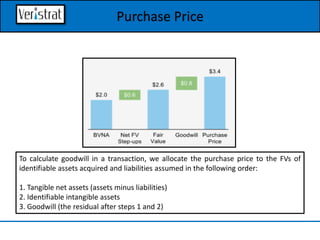
Purchase Price
To calculate goodwill in a transaction, we allocate the purchase price to the FVs of
identifiable assets acquired and liabilities assumed in the following order:
1. Tangible net assets (assets minus liabilities)
2. Identifiable intangible assets
3. Goodwill (the residual after steps 1 and 2)
Identifiable Intangible Assets
Definition:
An intangible asset is recognized separately from goodwill if it either
1) arises from contractual or other legal rights,
or
2) is separable, that is, capable of being divided from the acquired entity and sold,
transferred, licensed, rented, exchanged, etc.
*Note that: As much we value our employees, assembled workforces are not
considered identifiable intangible asst.
Assembled workforce is calculated for WARA only.
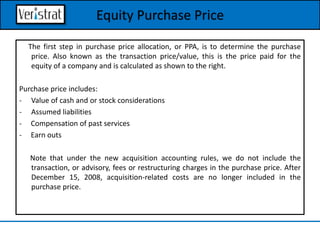
Equity Purchase Price
The first step in purchase price allocation, or PPA, is to determine the purchase
price. Also known as the transaction price/value, this is the price paid for the
equity of a company and is calculated as shown to the right.
Purchase price includes:
- Value of cash and or stock considerations
- Assumed liabilities
- Compensation of past services
- Earn outs
Note that under the new acquisition accounting rules, we do not include the
transaction, or advisory, fees or restructuring charges in the purchase price. After
December 15, 2008, acquisition-related costs are no longer included in the
purchase price.
Valuation Approaches
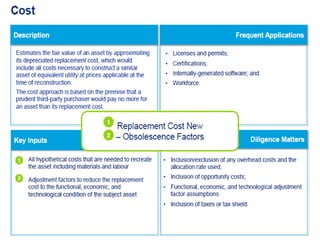
• The Cost Approach: A valuation technique that reflects the amount
that would be required currently to replace the service capacity of
an asset (often referred to as current replacement cost).
• The Market Approach: A valuation technique that uses prices and
other relevant information generated by market transactions
involving identical or comparable (that is, similar) assets, liabilities,
or a group of assets and liabilities, such as a business.
• The Income Approach: Valuation techniques that convert future
amounts (for example, cash flows or income and expenses) into a
single current (that is, discounted) amount. The fair value
measurement is determined based on the value indicated by
current market expectations about those future amounts.
Cost Approach for
Intangible Assets
• While occasionally appropriate for intangible assets, the cost to create many
intangibles has little relationship to the value of the intangible asset.
• The AICPA Practice Aid, “Assets Acquired in a Business Combination to be Used in
Research and Development Activities,” discusses that relationship for IPR&D.
“By its very nature, the relationship between cost incurred and value created is
tenuous at best for IPR&D projects.
- Certain R&D projects may go on for years at great expense without ever producing
a commercially viable product. In that case, the cost of reproducing the historical
development steps may overstate the value of the technology.
- Conversely, creation of intangible assets with substantial value may be made for
little cost. In this case, the cost of reproducing the historical development steps
would be low compared with the value of the resulting asset/technology.
Cost Approach for
Intangible Assets
As a result, the Cost Approach is typically only used to value relatively minor
intangible assets, such as:
• Assembled workforce (which is not recognized separately from goodwill, but is
often valued because it is necessary to apply the Multi-Period Excess Earnings
Method)
• Internally developed and used software
Market Approach for
Intangible Assets
Since the Market Approach, by its nature requires available data on
transactions involving the same or similar assets, it is seldom
applied to value intangible assets.
- Intangible assets are typically unique (patents, trade names, and so
forth are, by definition, unique)
- There is limited guideline transaction data for intangible assets
- When intangibles are sold, they are typically sold with other
components of a business enterprise
- If sold individually, transactions are not often subject to public
disclosure
As a result, the Market Approach is typically only used to value a small
number of assets for which market data is sometimes available:
• Domain Names (generally, domain names owned but not used and unrelated
to the core trade name/brand)
• Valuation of Operating Rights
- FCC Licenses
- Telecom Operating Spectrum
Market Approach for
Intangible Assets
Income Approach for
Intangible Assets
Because the Cost Approach and the Market Approach are often either not
appropriate or not feasible, estimating the value of intangible assets is most
commonly done through an Income Approach.
Valuing multiple assets under an income approach typically involves selecting an
appropriate valuation method for each asset based on its characteristics and
importance to the business.
The methodologies most commonly used are:
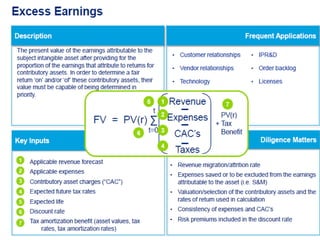
-Multi-Period Excess Earnings Method (MPEEM)
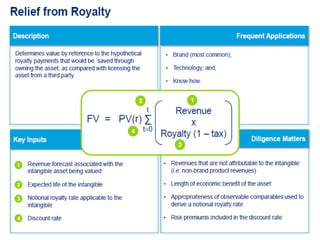
-Relief from Royalty Method (RFR)
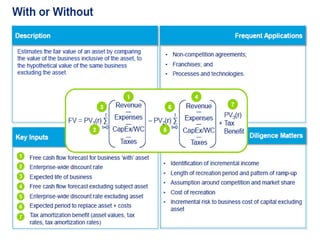
-“With and Without” Method (WWM)
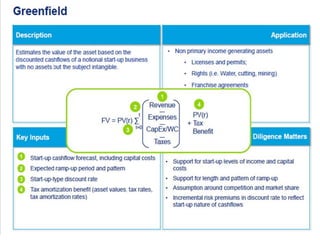
-Greenfield Method
Typically, a business’ primary asset is valued under the MPEEM, while any
secondary intangible assets are valued using one of the other methods.
PURCHASE PRICE ALLOCATION

PURCHASE PRICE ALLOCATION

  • 1.
  • 2.
  • 3.
    • The standardcorporation, or ”C-corporation”, is a separate legal entity owned by shareholders. • You form the corporation by filing incorporation documents with a state and paying the related filing fees. • The corporate structure limits each owner’s (shareholder's) personal liability for the corporation’s business debts to the amount invested in the company by the shareholder. C-Corporation
  • 4.
    A “C corporation”might be the right business type for you if you: • May need venture capital for financing. • Want flexible profit-sharing among owners. • Want company earnings to stay in your business so that it can grow. • Want flexibility to spread the business earnings between the corporation and shareholders for tax-planning purposes. • Want flexibility to set salaries for employees/owners to minimize Social Security and Medicare taxes. • Want flexibility to provide (through the corporation) substantial health and medical benefits and other fringe benefit programs for things like education, life insurance, and transportation costs. • Want to be able to easily sell your business. • Want to provide an accountable plan for travel & entertainment. • Want to be able to offer stock options to employees. • Expect your business to own real estate. • Prefer to lower your risk of IRS audit exposure, since there is a higher audit rate for business income that is reported solely on Schedule C of Form 1040 (U.S. Individual Income Tax Return). Who should consider a “C-corporation” ?
  • 5.
    • An ”S-corporation”is a standard corporation that has elected a special tax status with the IRS. • The formation requirements are the same as those for “C-corporations” : incorporation documents must be filed with the state and appropriate filing fees paid. • The “S-corporation's” special tax status eliminates the double-taxation that can occur with a “C-corporation’s” income. • A corporate income tax return is filed, but no tax is paid at the corporate level. Instead, business profits or losses "pass-through" to shareholders and are then reported on their individual tax returns. Any tax due is paid by shareholders at their individual tax rates. S-Corporation
  • 6.
    A “S-corporation” mightbe the right business type for you if: • You want to take advantage of benefits that the corporate business type holds, but you want to take advantage of pass-through taxation. • You want flexibility to set salaries for employee/owners to minimize Social Security and Medicare taxes. • Flexibility of accounting methods is desired, because corporations must use the accrual method of accounting unless they are considered to be a small corporation (with gross receipts of $5,000,000 or less) and S corporations typically don’t have to use the accrual method unless they have inventory. • Lower risk of IRS audit exposure is desired, because “S-corporations” file an informational tax return (Form 1120 S U.S. Income Tax Return for an “S- Corporation”) and there is a higher audit rate for business income that is reported solely on Schedule C of Form 1040 (U.S. Individual Income Tax Return). Who should consider a “S-corporation” ?
  • 7.
    Key differences between“C-corporations” and “S-corporations” While C corporations and S corporations may seem very similar, there are big differences: • Taxation. C corporations are separately taxable entities and file a corporate tax return, reporting profits or losses. Any profits are taxed at the corporate level, and losses don't pass through for use by the shareholders to offset other taxable income. The profits of C corporations face possible double taxation when corporate income is distributed to shareholders as dividends. First, the corporation pays tax on its corporate income; then, the shareholders pay personal income tax on the same income when it is distributed to them as dividends. S corporations, however, are pass-through tax entities so there is no tax paid at the corporate level. Profits and losses are passed-through the corporation and reported on the shareholders individual tax returns. Any tax due is then paid by the shareholders at their individual tax rates. • Corporate ownership. ”C-corporations” can have an unlimited number of shareholders, while “S-corporations” are restricted to no more than 100 shareholders. Also, “C-corporations” can have non-US citizens/ residents as shareholders, but “S-corporations” cannot. “S- corporations” cannot be owned by “C-corporations”, other “S-corporations”, LLCs, partnerships, or many trusts. “C-corporations” are not subject to those same restrictions. “S- corporations” can have only one class of stock (disregarding voting rights), while C corporations can have multiple classes. • “S-corporation” election. A corporation must elect to become an “S-corporation” by making a timely filing of Form 2553 with the IRS, and all shareholders of the corporation must agree in writing to the S corporation election.
  • 8.
    What is alimited liability Company? • The limited liability company (LLC) offers an alternative to corporations and partnerships by combining the corporate advantage of limited liability protection with the partnership advantage of pass-through taxation. With this tax status, the LLC's income is not taxed at the entity level; however, the LLC typically completes a partnership return if the LLC has more than one owner. The LLC’s income or loss is passed through the LLC and reported on owners' individual tax returns. Tax is then paid at the individual level. • You form an LLC by filing incorporation (organizational) documents with a state and paying the related filing fees. LLCs also have fewer ongoing formalities and obligations than corporations.
  • 9.
    Who Should Consideran LLC? A “LLC” might be the right type of business for you if: • Your startup company anticipates losses for at least two years and you want to be able to pass the losses through to yourself and the other owners. • Flexibility for accounting methods is desired, because LLCs are not required to use the accrual method of accounting as C corporations typically are. • Your business may own real estate. • You want management flexibility, since LLCs offer more flexibility than corporations in terms of how the management of the business is structured. • You wish to minimize ongoing formalities. Unlike corporations, which are required to hold annual meetings of directors and shareholders and keep detailed documents and records for all corporate meetings and major business decisions, LLCs do not face strict ongoing meeting and documentation requirements. • You want flexibility for sharing profits among owners.
  • 10.
    PPA- Purchase PriceAllocation • A purchase price allocation (PPA) categorizes the purchase price into the various assets and liabilities acquired. • A large component of the PPA is the identification and assignment of the fair market value of all tangible and intangible assets and liabilities assumed in a business acquisition as at the date of closing. • The difference between the purchase price and the sum of assets and liabilities is then recognized as goodwill. This exercise is a requirement for various widely recognized accounting reporting standards
  • 11.
    Purchase Price To calculategoodwill in a transaction, we allocate the purchase price to the FVs of identifiable assets acquired and liabilities assumed in the following order: 1. Tangible net assets (assets minus liabilities) 2. Identifiable intangible assets 3. Goodwill (the residual after steps 1 and 2)
  • 12.
    Identifiable Intangible Assets Definition: Anintangible asset is recognized separately from goodwill if it either 1) arises from contractual or other legal rights, or 2) is separable, that is, capable of being divided from the acquired entity and sold, transferred, licensed, rented, exchanged, etc. *Note that: As much we value our employees, assembled workforces are not considered identifiable intangible asst. Assembled workforce is calculated for WARA only.
  • 14.
    Equity Purchase Price Thefirst step in purchase price allocation, or PPA, is to determine the purchase price. Also known as the transaction price/value, this is the price paid for the equity of a company and is calculated as shown to the right. Purchase price includes: - Value of cash and or stock considerations - Assumed liabilities - Compensation of past services - Earn outs Note that under the new acquisition accounting rules, we do not include the transaction, or advisory, fees or restructuring charges in the purchase price. After December 15, 2008, acquisition-related costs are no longer included in the purchase price.
  • 15.
    Valuation Approaches • TheCost Approach: A valuation technique that reflects the amount that would be required currently to replace the service capacity of an asset (often referred to as current replacement cost). • The Market Approach: A valuation technique that uses prices and other relevant information generated by market transactions involving identical or comparable (that is, similar) assets, liabilities, or a group of assets and liabilities, such as a business. • The Income Approach: Valuation techniques that convert future amounts (for example, cash flows or income and expenses) into a single current (that is, discounted) amount. The fair value measurement is determined based on the value indicated by current market expectations about those future amounts.
  • 16.
    Cost Approach for IntangibleAssets • While occasionally appropriate for intangible assets, the cost to create many intangibles has little relationship to the value of the intangible asset. • The AICPA Practice Aid, “Assets Acquired in a Business Combination to be Used in Research and Development Activities,” discusses that relationship for IPR&D. “By its very nature, the relationship between cost incurred and value created is tenuous at best for IPR&D projects. - Certain R&D projects may go on for years at great expense without ever producing a commercially viable product. In that case, the cost of reproducing the historical development steps may overstate the value of the technology. - Conversely, creation of intangible assets with substantial value may be made for little cost. In this case, the cost of reproducing the historical development steps would be low compared with the value of the resulting asset/technology.
  • 17.
    Cost Approach for IntangibleAssets As a result, the Cost Approach is typically only used to value relatively minor intangible assets, such as: • Assembled workforce (which is not recognized separately from goodwill, but is often valued because it is necessary to apply the Multi-Period Excess Earnings Method) • Internally developed and used software
  • 18.
    Market Approach for IntangibleAssets Since the Market Approach, by its nature requires available data on transactions involving the same or similar assets, it is seldom applied to value intangible assets. - Intangible assets are typically unique (patents, trade names, and so forth are, by definition, unique) - There is limited guideline transaction data for intangible assets - When intangibles are sold, they are typically sold with other components of a business enterprise - If sold individually, transactions are not often subject to public disclosure
  • 19.
    As a result,the Market Approach is typically only used to value a small number of assets for which market data is sometimes available: • Domain Names (generally, domain names owned but not used and unrelated to the core trade name/brand) • Valuation of Operating Rights - FCC Licenses - Telecom Operating Spectrum Market Approach for Intangible Assets
  • 20.
    Income Approach for IntangibleAssets Because the Cost Approach and the Market Approach are often either not appropriate or not feasible, estimating the value of intangible assets is most commonly done through an Income Approach. Valuing multiple assets under an income approach typically involves selecting an appropriate valuation method for each asset based on its characteristics and importance to the business. The methodologies most commonly used are: -Multi-Period Excess Earnings Method (MPEEM) -Relief from Royalty Method (RFR) -“With and Without” Method (WWM) -Greenfield Method Typically, a business’ primary asset is valued under the MPEEM, while any secondary intangible assets are valued using one of the other methods.