Are the risk management tools at your law firm working?
Risk and quality management are essential for the good governance of your law firm. LAW 9000 international best legal practice standard provides the framework for managing quality and risk in law firms.
Are the risk management tools at your law firm working?
1.
Are your riskmanagement
tools at your law firm
working?
LAW 9000 is a quality management standard for
law firms
2.
Disclaimer
The material inthis presentation does not constitute legal
advice.
This presentation has been produced by Val Antoff and has
been prepared as general information about LAW 9000. It is
not intended to provide legal advice and, as such, the content
does not constitute legal advice. Use of this presentation does
not create any solicitor-client relationship between the user
and the author.
3.
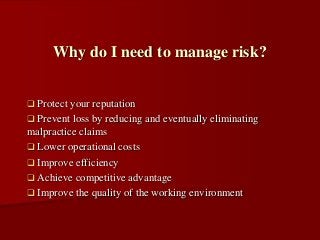
Protect yourreputation
Prevent loss by reducing and eventually eliminating
malpractice claims
Lower operational costs
Improve efficiency
Achieve competitive advantage
Improve the quality of the working environment
Why do I need to manage risk?
4.
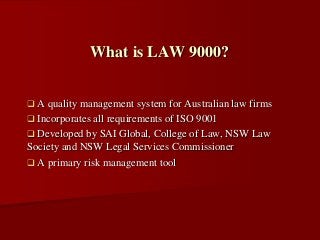
A qualitymanagement system for Australian law firms
Incorporates all requirements of ISO 9001
Developed by SAI Global, College of Law, NSW Law
Society and NSW Legal Services Commissioner
A primary risk management tool
What is LAW 9000?
5.
Launched in2004
Reviewed in 2010
Maintained by SAI Global
Courses in LAW 9000 – College of Law
History of LAW 9000
6.
Internationally recognisedquality framework
Identifies and encourages more efficient and time saving
processes
Improved consistency in service delivery
Transparency ensures improved risk management
Improved customer communication and less customer
complaints
Highlights deficiencies
What are the benefits of LAW 9000
for my law firm?
7.
Marketing opportunities
Turnkey solution for your expansion plans
Helps to attract and retain high calibre talent
Results in documented policies, procedures and working
instructions
Benefits continued
8.
The LegalProfession Act requires legal practitioner
directors of incorporated legal practices to ensure that
“appropriate management system” are implemented and
maintained.
Failure to comply can amount to professional misconduct
E.g. see s 2.7.10(3) of the Legal Profession Act 2004 (VIC)
, s 140(3) of the Legal Profession Act 2004 (NSW), s 105(3)
of Legal Profession Act 2008 (WA), s 125(3) of the Legal
Profession Act 2006 (NT), s 117(3) of Legal Profession Act
2007 (QLD), s 107(3) Legal Profession Act 2006 (ACT)
Requirements under the Legal
Profession Act
9.
Mitigate potentiallosses
Reduced insurance premiums
Reduced errors
Increased client’s confidence and loyalty
A requirement for some government tenders
Are there any financial incentives for
implementing LAW 9000?
10.
Management systemrequirements
Management responsibility
Resource management
Realisation of legal services
Measurement analysis and improvement
What are the key requirements?
11.
Define qualitysystem documentation structure and its
management
Mandatory documentation required:
Quality policy and quality objectives
A quality manual
Documented procedures
Records management
An engagement policy
A business plan
A risk management plan
Quality management system
requirements?
12.
Management commitment
Customer focus
Quality policy
Engagement policy
Undertakings – see example
Planning – objectives, business and risk management plan,
financial systems and insurance
Responsibility, authorities and communications
Management review
Management Responsibility
13.
Provision ofresources
Human resources
Infrastructure
Work environment
Resource Management
14.
Planning ofproduct realisation
Conflict of interest
Customer related processes
Customer communication
Terms of engagement contract
Working plan
Customer property – see example
Termination of retainer
Control of equipment
Realisation of legal services
15.
Customer satisfaction
Internal audits
Measurement of processes and product
Control of nonconforming product
Analysis of data
Improvement
Corrective action – see example
Preventive action
Measurement, analysis and
improvement
16.
Stage 1audit – a desktop audit to review and assess
documentation and readiness of your management system for
Stage 2 audit.
Stage 2 audit – certification audit of approximately two
days depending on the seize of the law firm.
Certification valid for 3 years.
Annual surveillance audits for evaluation of compliance.
Re-certification before certificate expiration.
Certification