Java gets a closure
Tomasz Kowalczewski
Agenda
•   Lambdas and closures
•   Java syntax
•   Functional interfaces
•   Implementation notes
•   Defender methods and interface evolution
•   Library changes
•   Lambda related language changes
Lambda expression
• First class function that closes over free variables in
  its lexical context.
• Lambda exprssion is another name for an
  anonymous function e.g. function not bound to an
  identifier.
• In Java it includes an optional list of type
  parameters, a list of formal parameters, and an
  expression or block expressed in terms of those
  parameters.
Examples
• Haskell:                            free variables
x -> x + x
x -> x * y


• Scala:
val isBelow = ( y : Int ) => y < threshold


• C#:
Predicate<string> p = it => it.Length < maxLength;

• C++:
[&count](int n){ return n * (++count); }
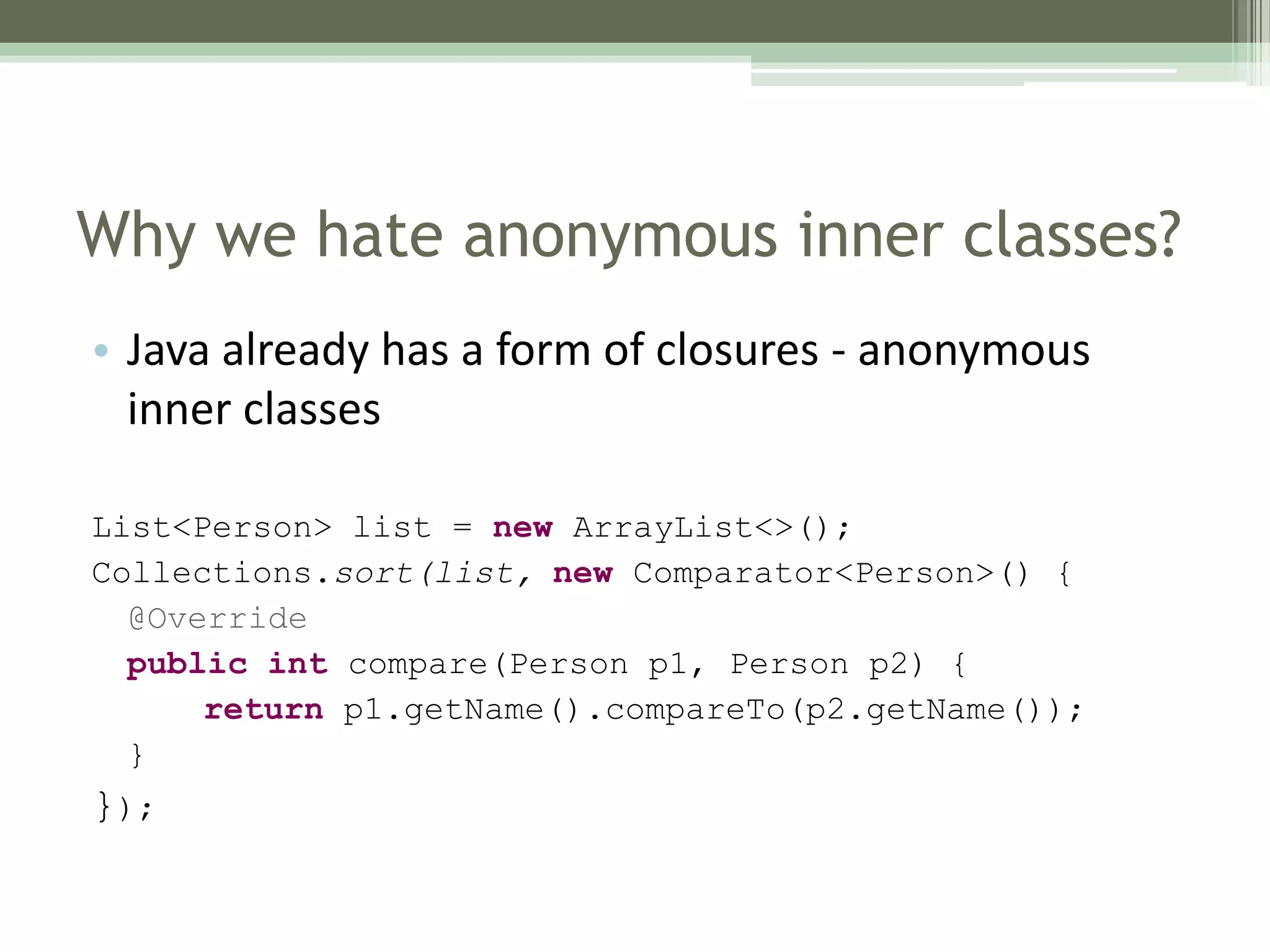
Why we hate anonymous inner classes?
• Java already has a form of closures - anonymous
  inner classes

List<Person> list = new ArrayList<>();
Collections.sort(list, new Comparator<Person>() {
  @Override
  public int compare(Person p1, Person p2) {
      return p1.getName().compareTo(p2.getName());
  }
});
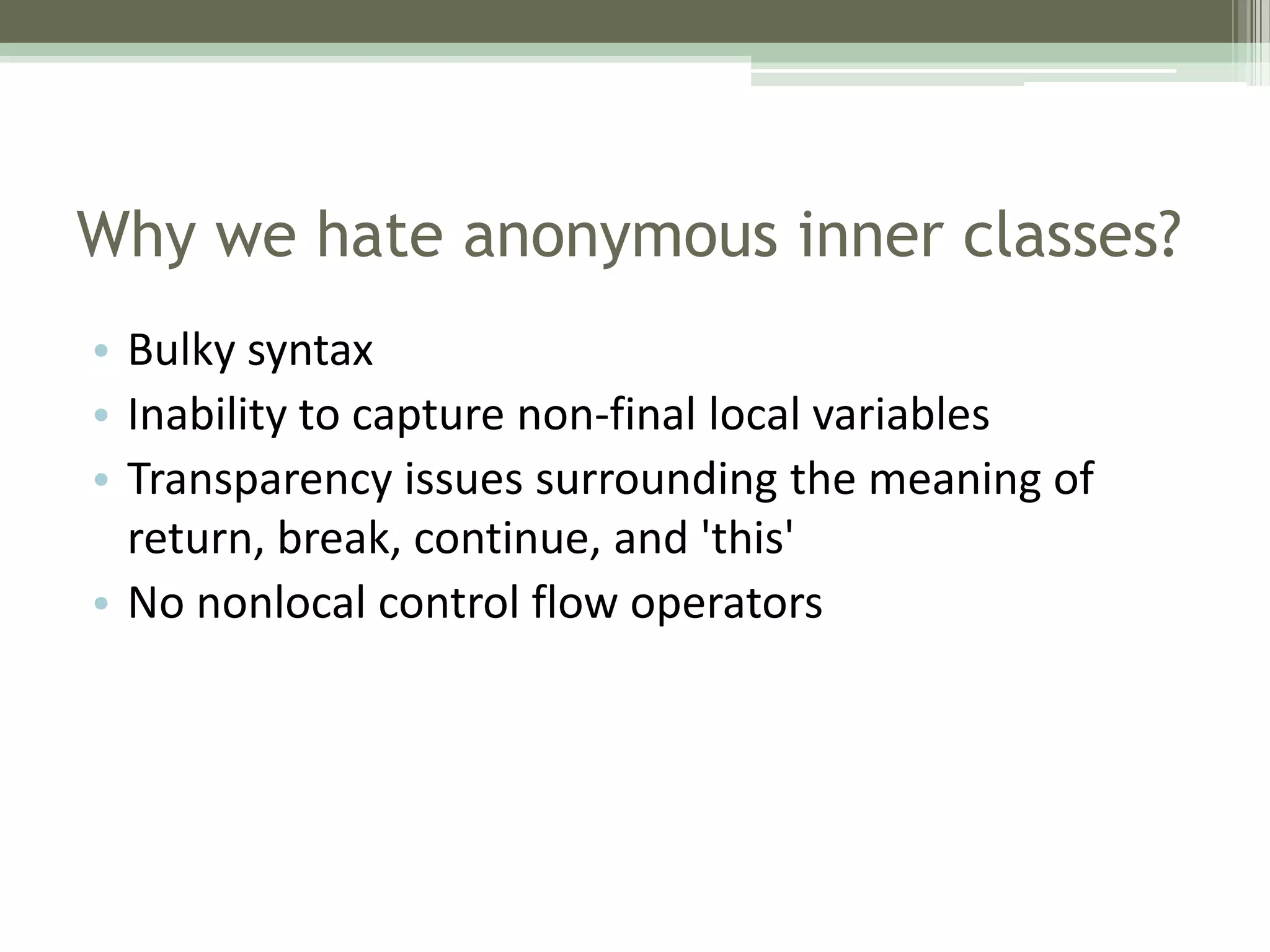
Why we hate anonymous inner classes?
• Bulky syntax
• Inability to capture non-final local variables
• Transparency issues surrounding the meaning of
  return, break, continue, and 'this'
• No nonlocal control flow operators
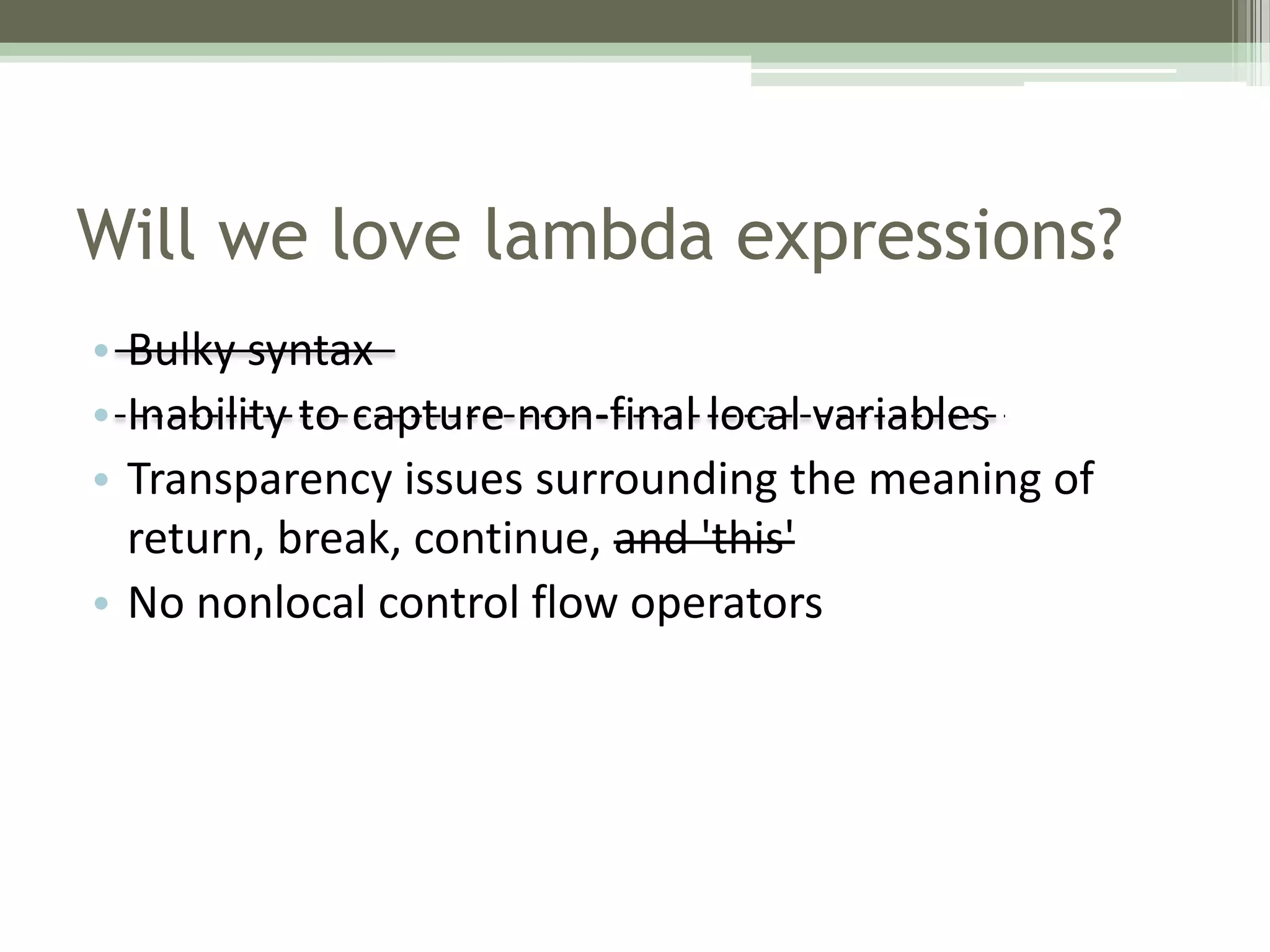
Will we love lambda expressions?
• Bulky syntax
• Inability to capture non-final local variables
• Transparency issues surrounding the meaning of
  return, break, continue, and 'this'
• No nonlocal control flow operators
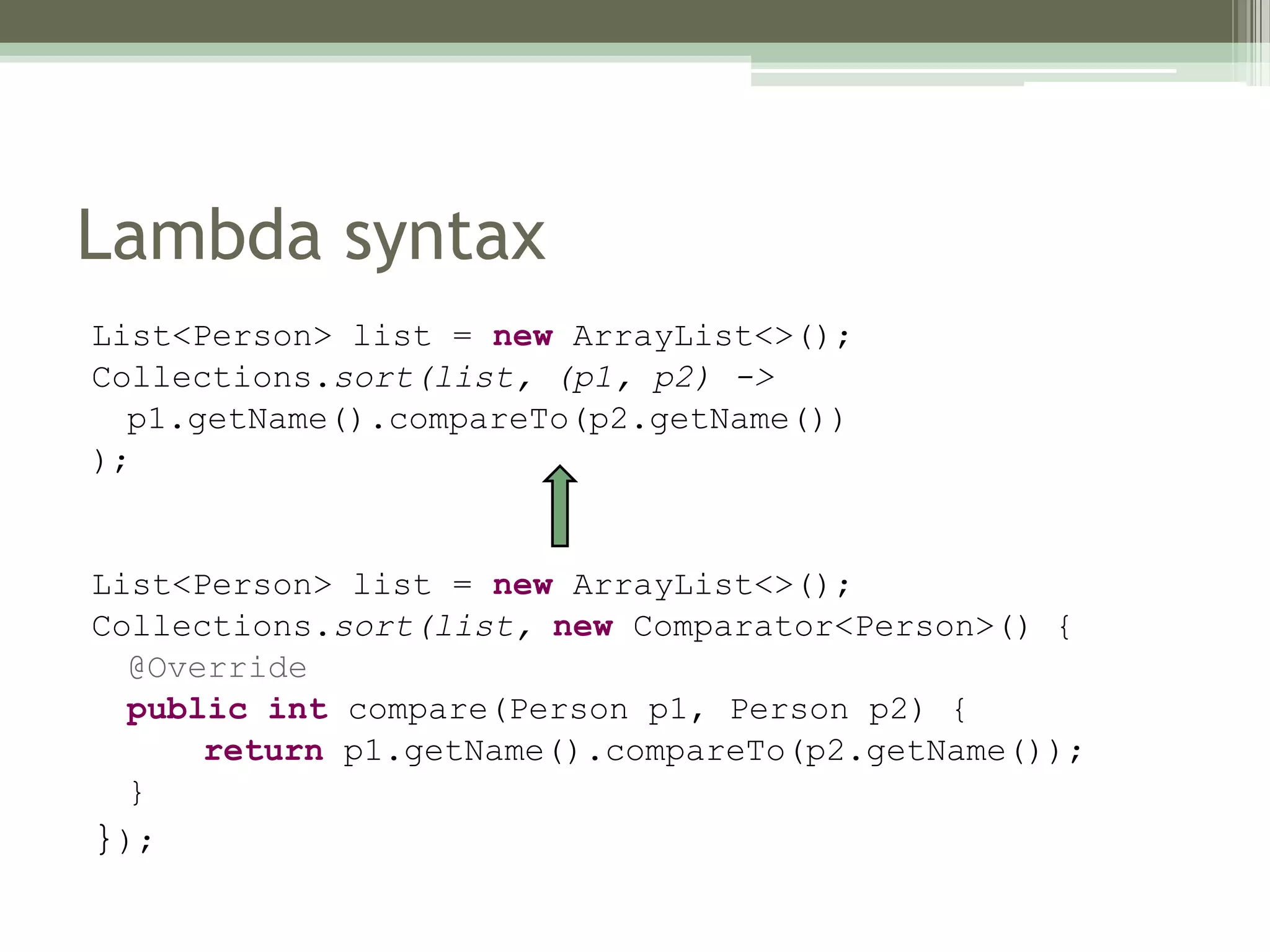
Lambda syntax
List<Person> list = new ArrayList<>();
Collections.sort(list, (p1, p2) ->
  p1.getName().compareTo(p2.getName())
);


List<Person> list = new ArrayList<>();
Collections.sort(list, new Comparator<Person>() {
  @Override
  public int compare(Person p1, Person p2) {
      return p1.getName().compareTo(p2.getName());
  }
});
Lambda syntax
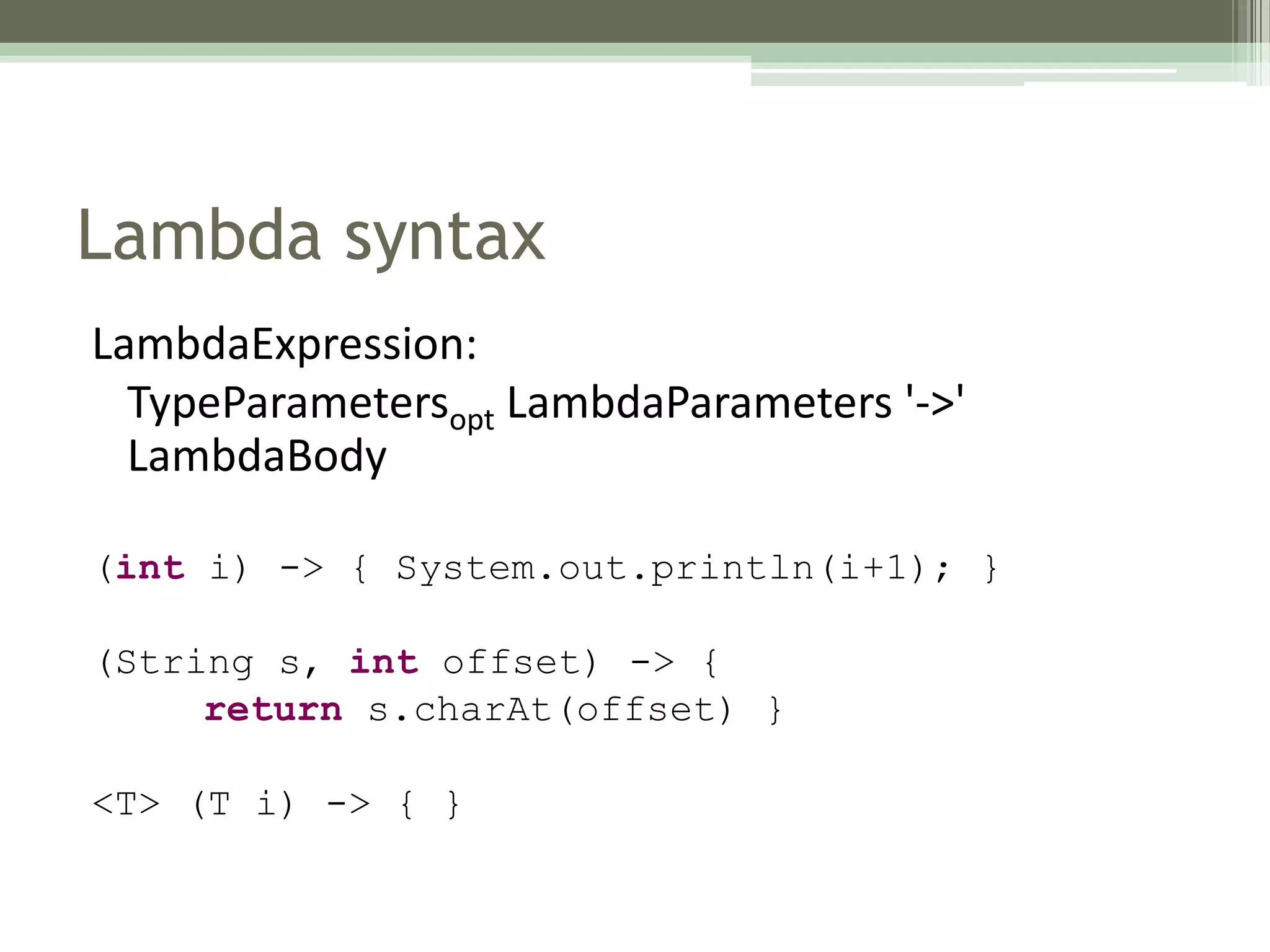
LambdaExpression:
  TypeParametersopt LambdaParameters '->'
  LambdaBody

(int i) -> { System.out.println(i+1); }

(String s, int offset) -> {
     return s.charAt(offset) }

<T> (T i) -> { }
Lambda syntax
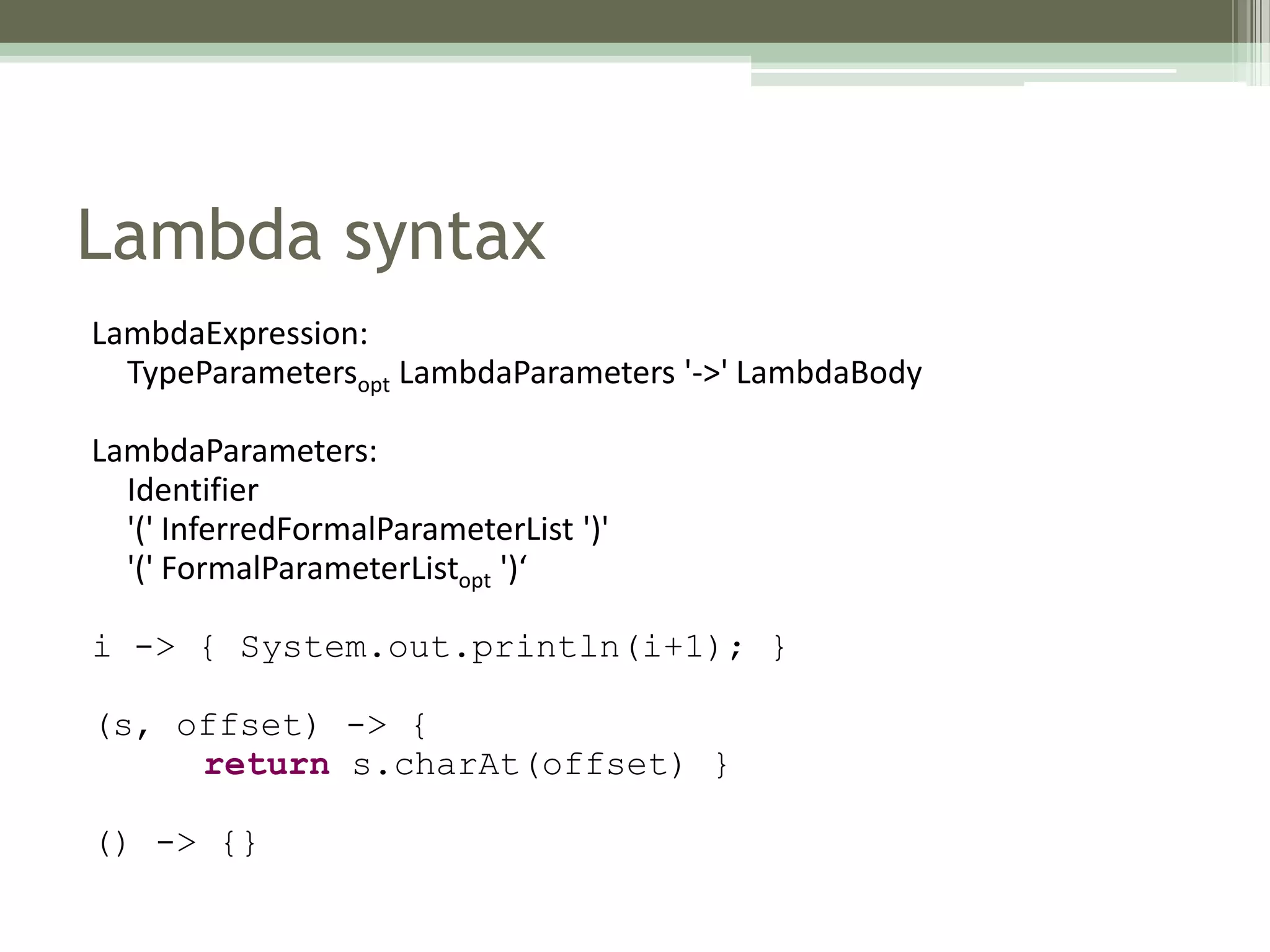
LambdaExpression:
  TypeParametersopt LambdaParameters '->' LambdaBody

LambdaParameters:
  Identifier
  '(' InferredFormalParameterList ')'
  '(' FormalParameterListopt ')‘

i -> { System.out.println(i+1); }

(s, offset) -> {
     return s.charAt(offset) }

() -> {}
Lambda syntax
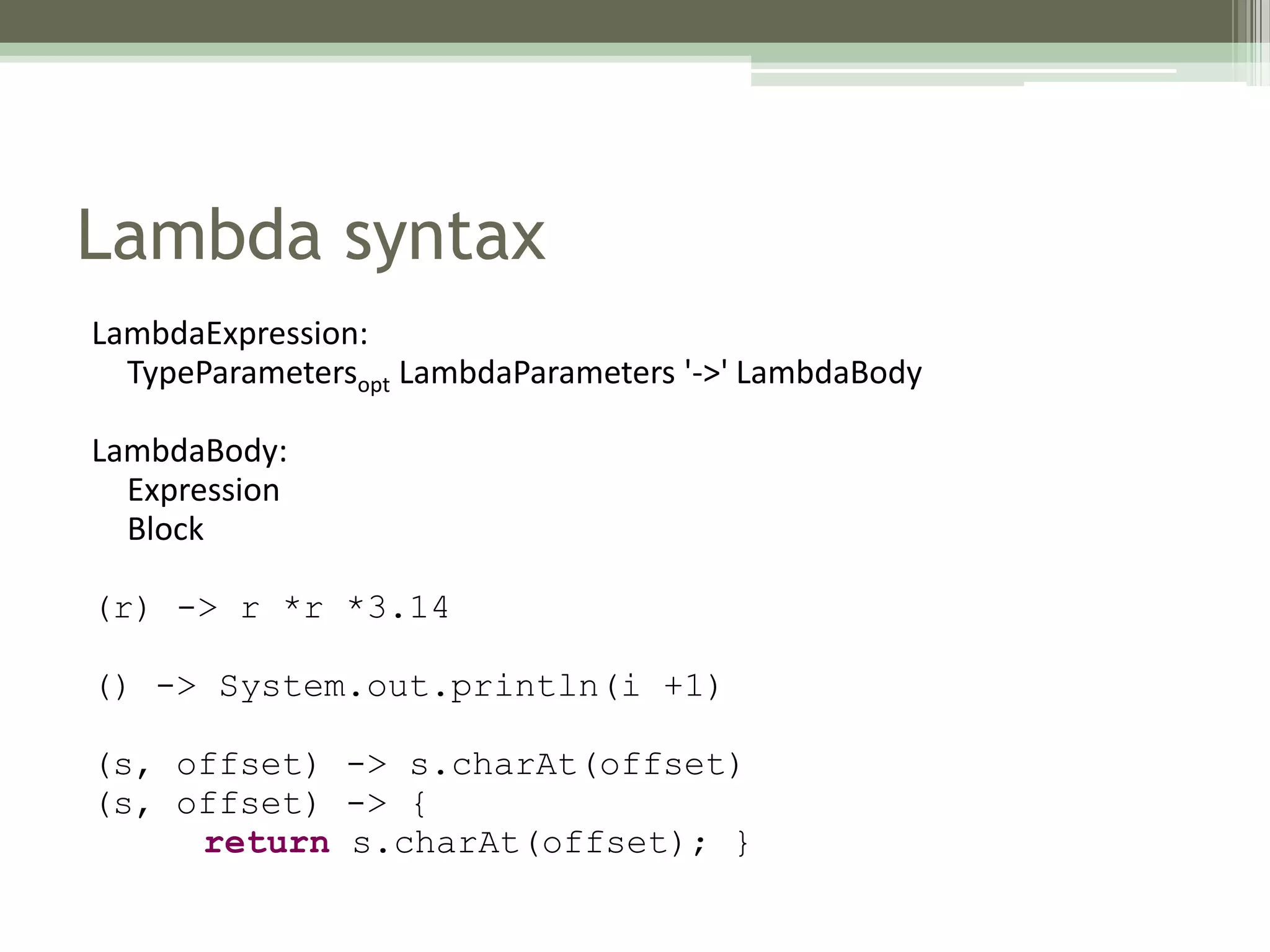
LambdaExpression:
  TypeParametersopt LambdaParameters '->' LambdaBody

LambdaBody:
  Expression
  Block

(r) -> r *r *3.14

() -> System.out.println(i +1)

(s, offset) -> s.charAt(offset)
(s, offset) -> {
     return s.charAt(offset); }
Invalid syntax examples
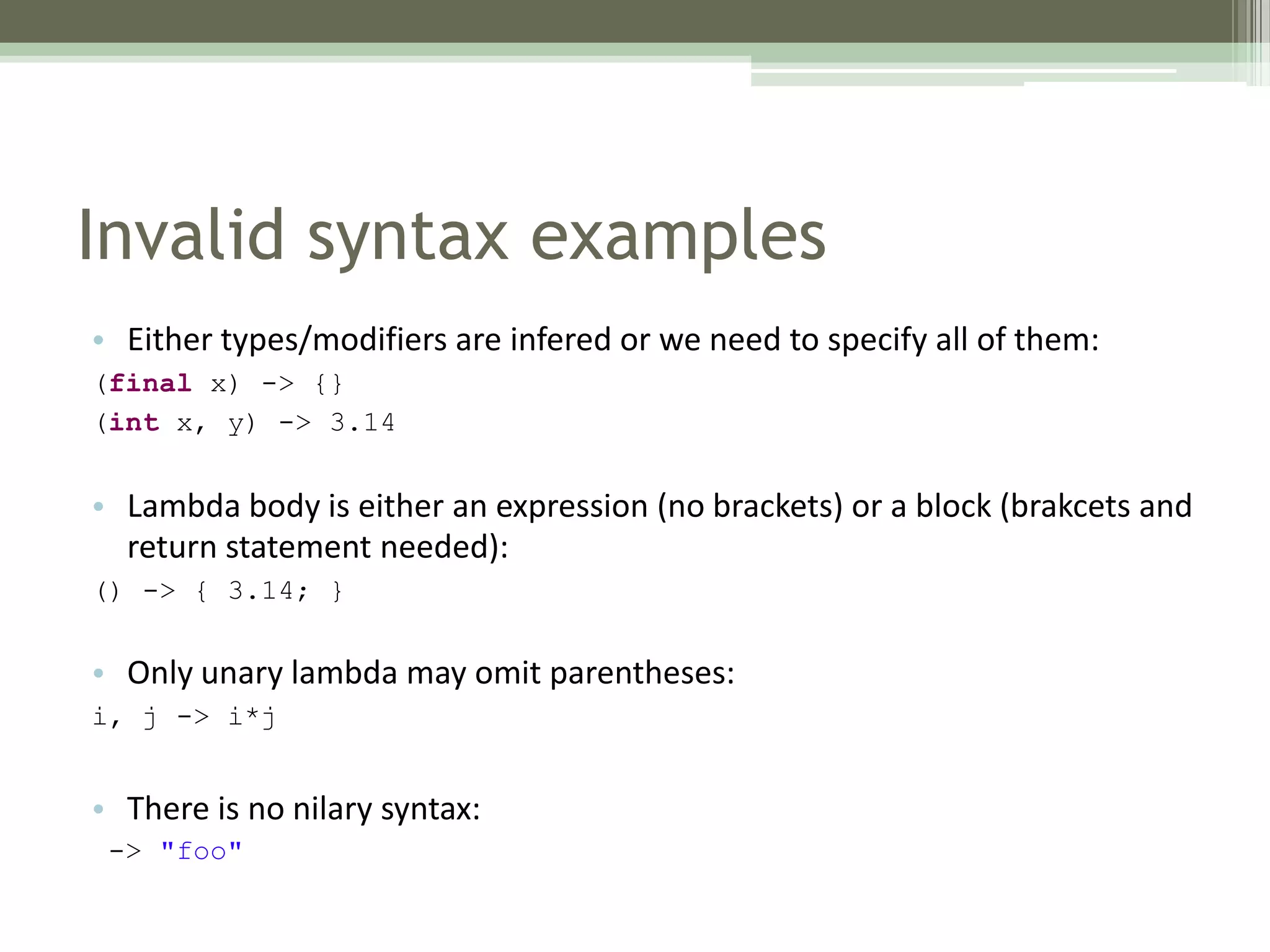
• Either types/modifiers are infered or we need to specify all of them:
(final x) -> {}
(int x, y) -> 3.14


• Lambda body is either an expression (no brackets) or a block (brakcets and
  return statement needed):
() -> { 3.14; }


• Only unary lambda may omit parentheses:
i, j -> i*j


• There is no nilary syntax:
 -> "foo"
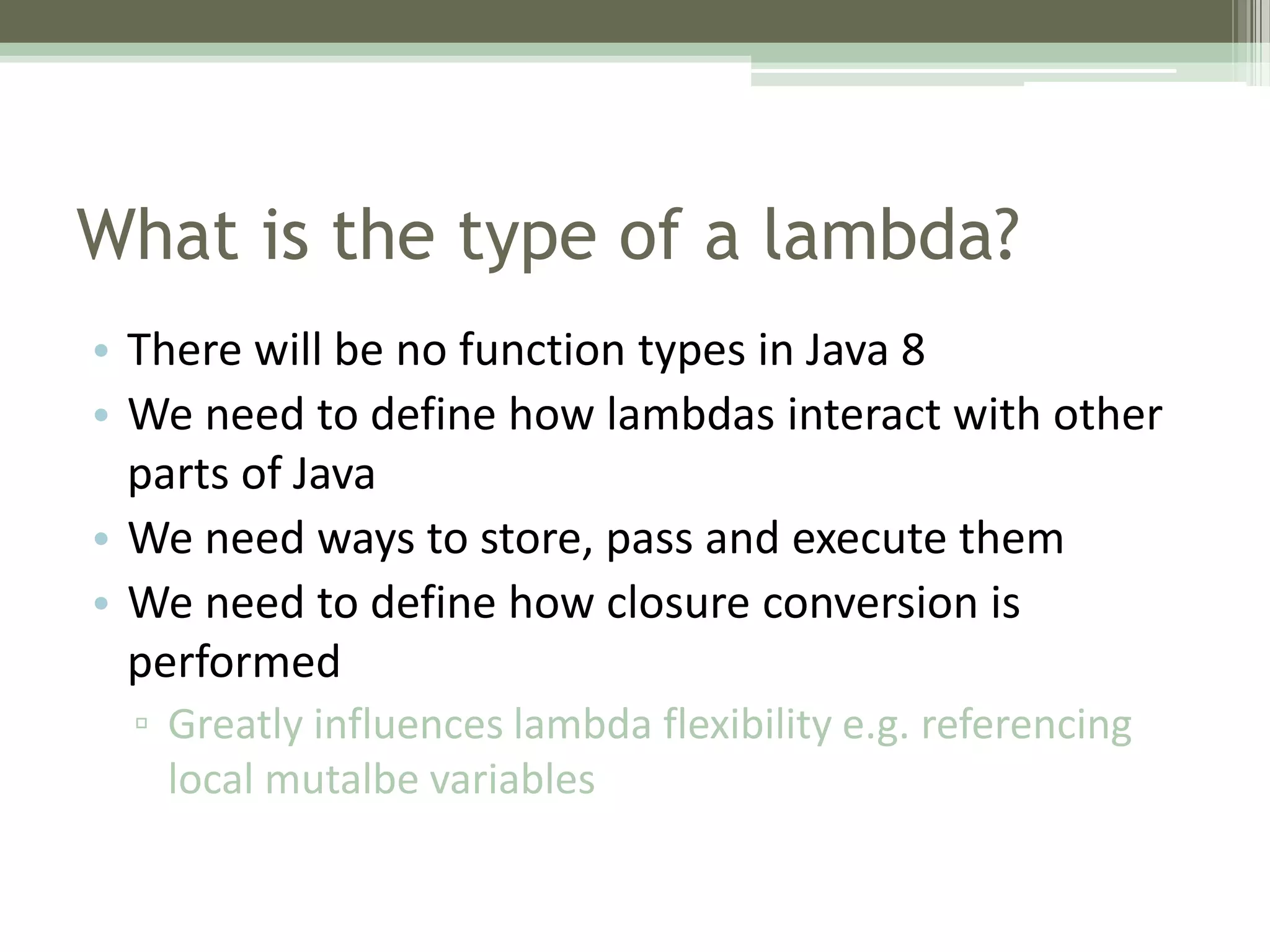
What is the type of a lambda?
• There will be no function types in Java 8
• We need to define how lambdas interact with other
  parts of Java
• We need ways to store, pass and execute them
• We need to define how closure conversion is
  performed
 ▫ Greatly influences lambda flexibility e.g. referencing
   local mutalbe variables
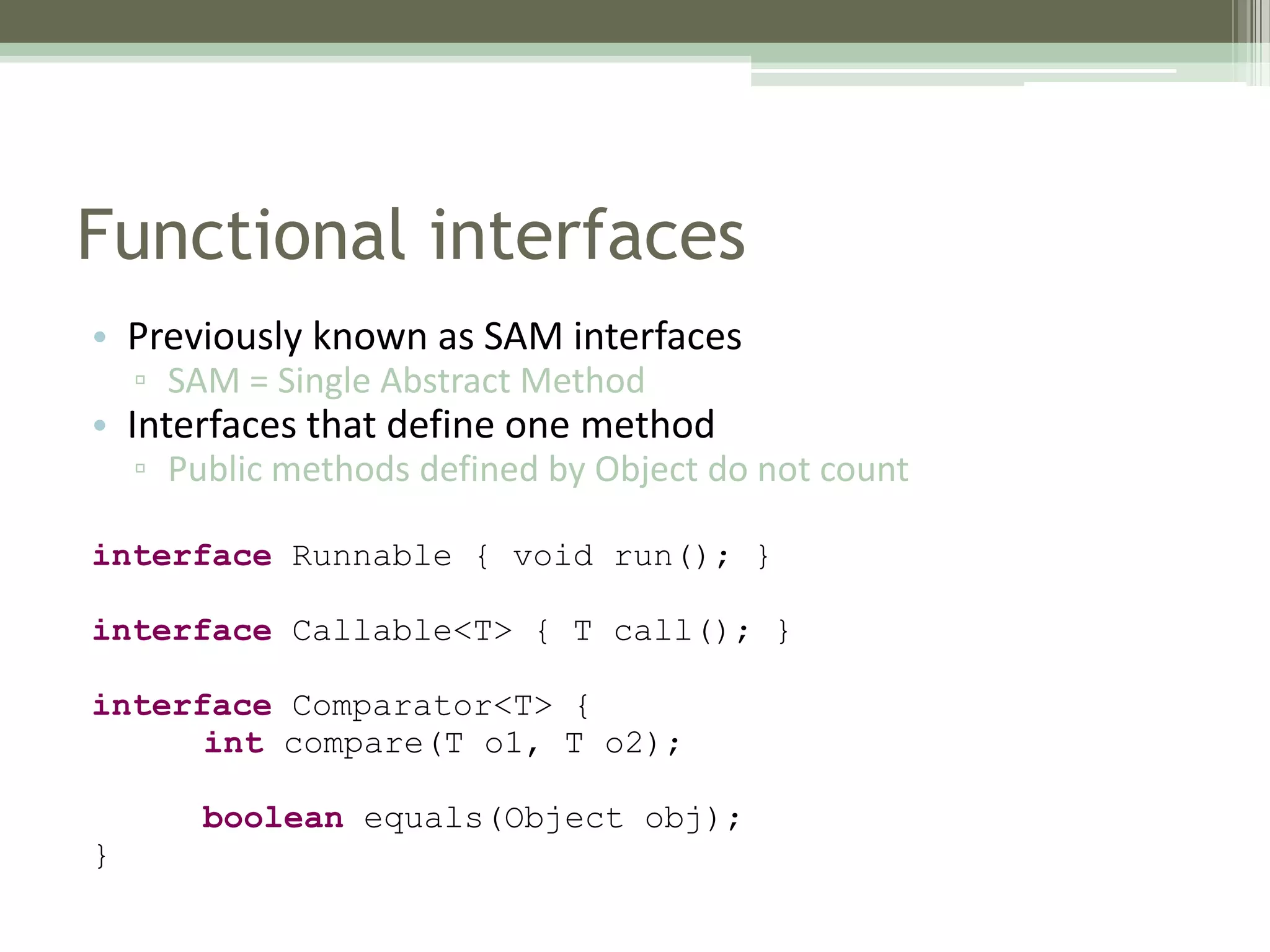
Functional interfaces
• Previously known as SAM interfaces
    ▫ SAM = Single Abstract Method
• Interfaces that define one method
    ▫ Public methods defined by Object do not count

interface Runnable { void run(); }

interface Callable<T> { T call(); }

interface Comparator<T> {
      int compare(T o1, T o2);

        boolean equals(Object obj);
}
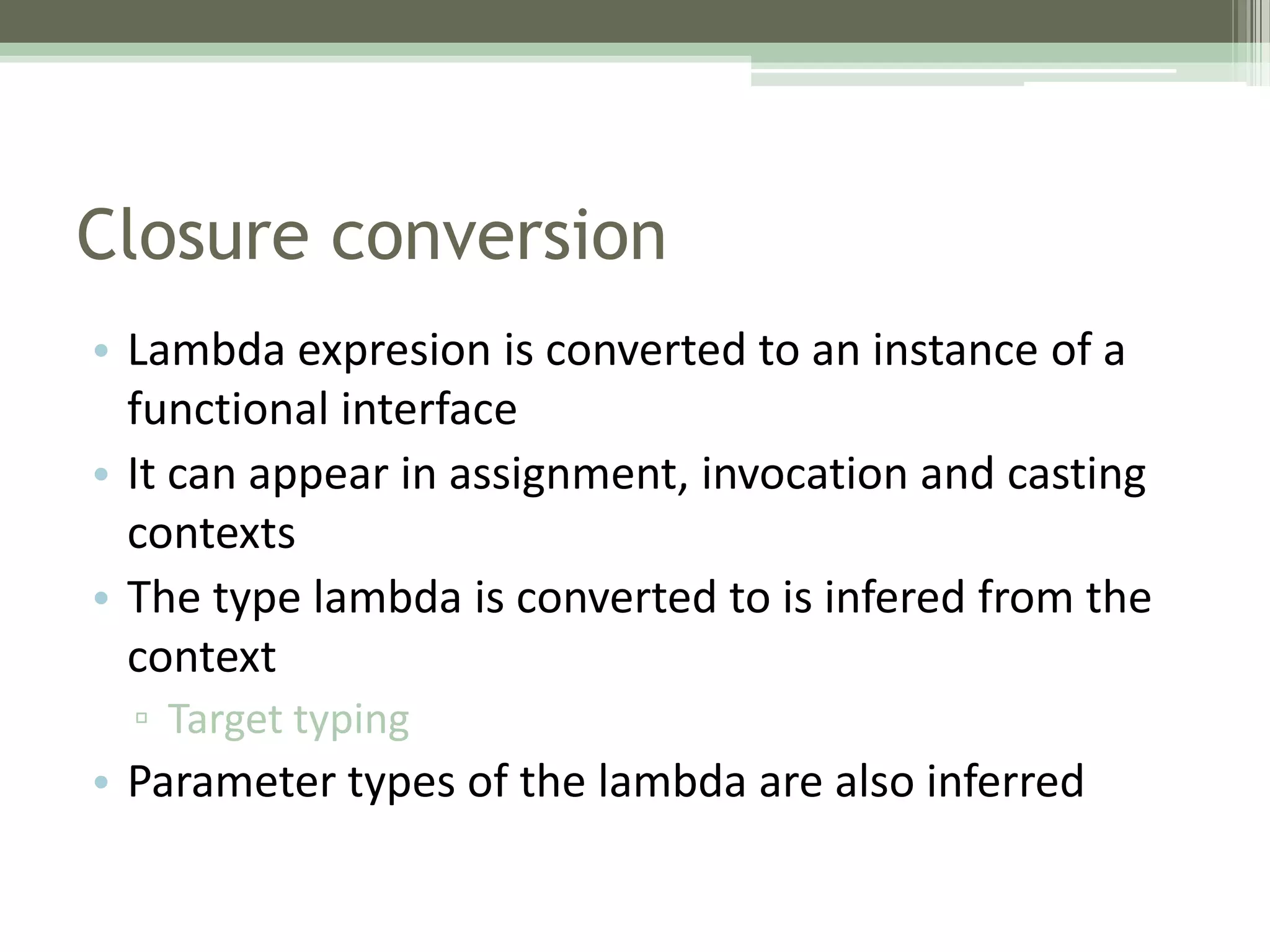
Closure conversion
• Lambda expresion is converted to an instance of a
  functional interface
• It can appear in assignment, invocation and casting
  contexts
• The type lambda is converted to is infered from the
  context
  ▫ Target typing
• Parameter types of the lambda are also inferred
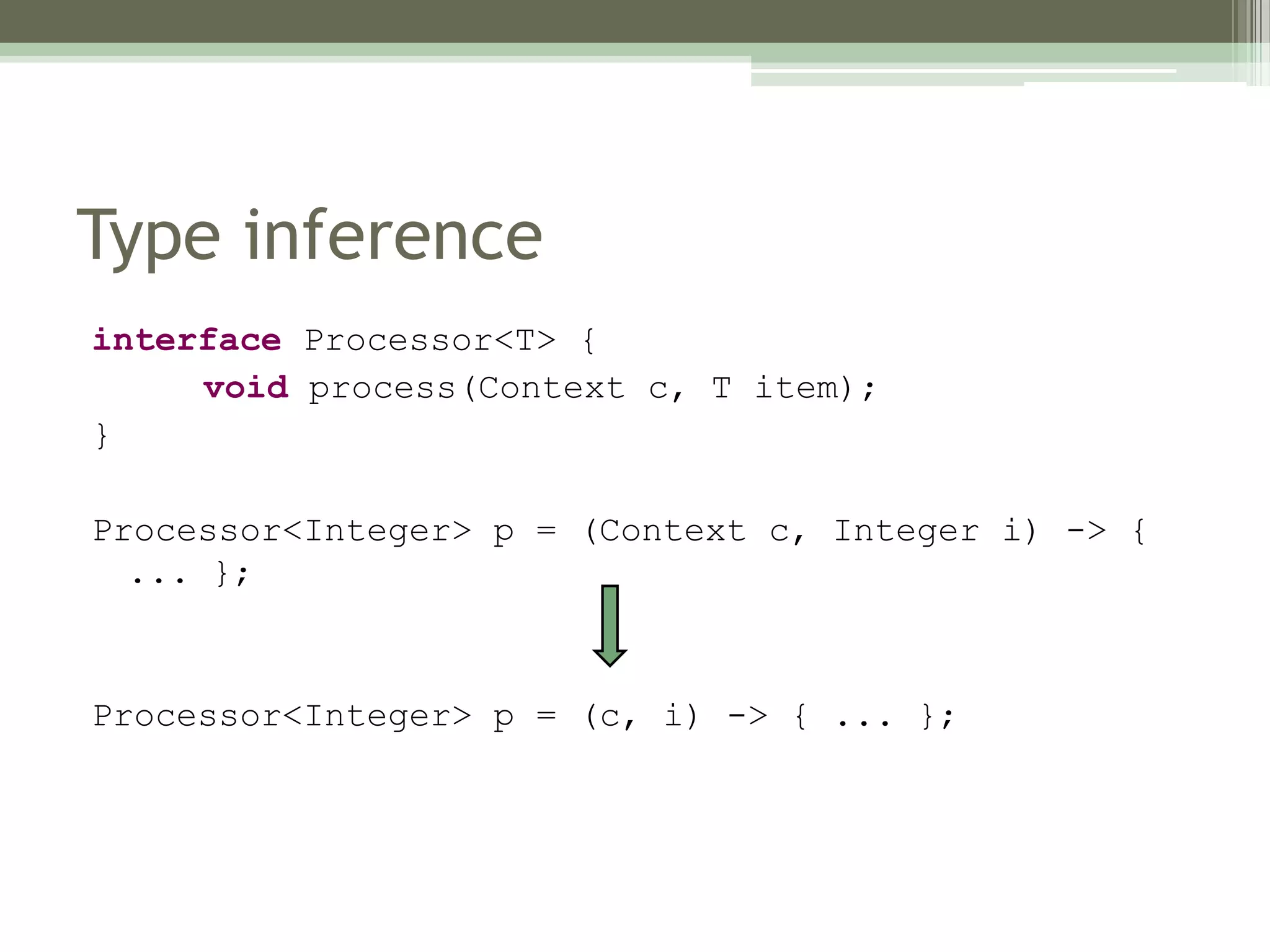
Type inference
interface Processor<T> {
     void process(Context c, T item);
}

Processor<Integer> p = (Context c, Integer i) -> {
  ... };


Processor<Integer> p = (c, i) -> { ... };
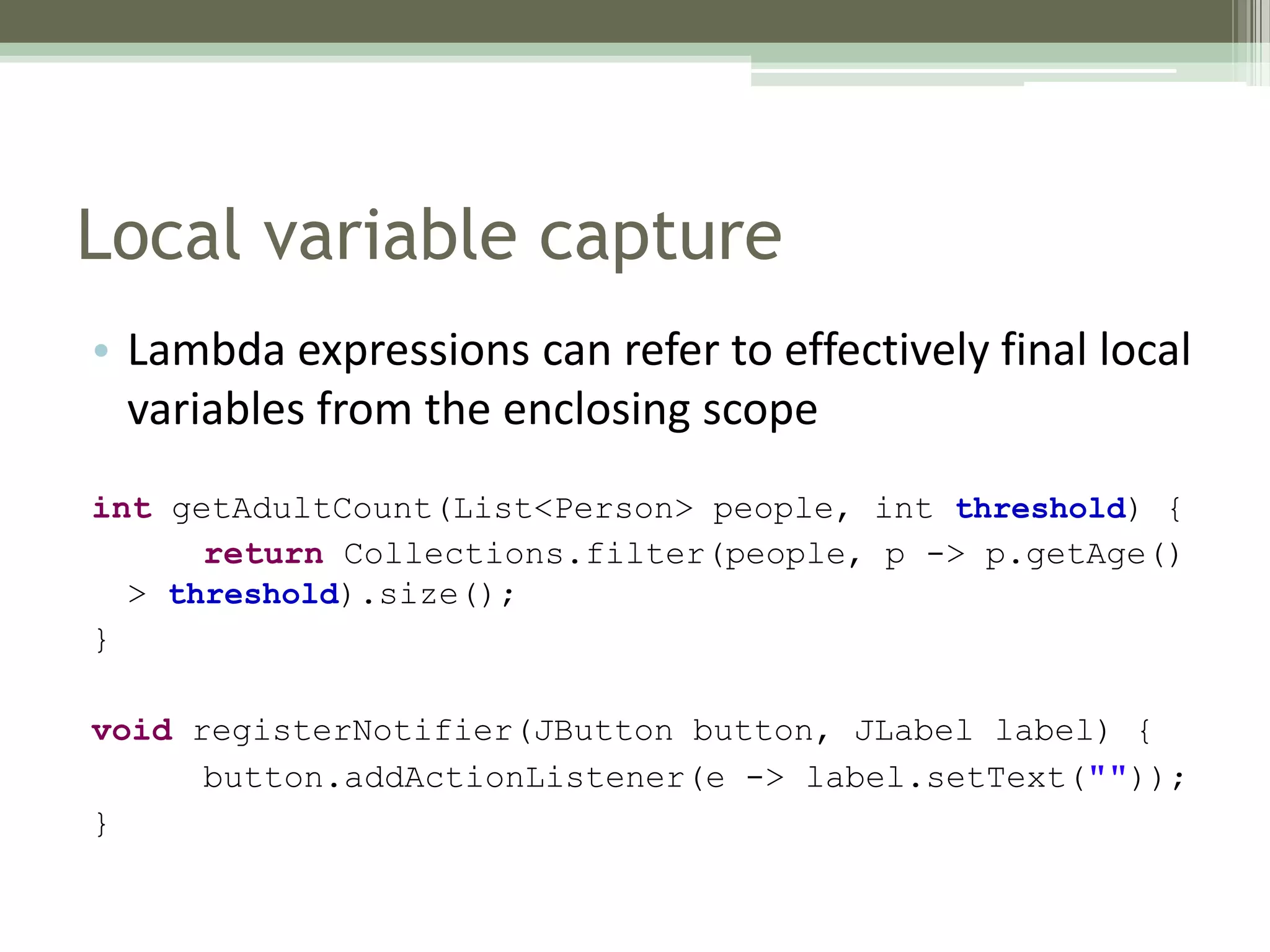
Local variable capture
• Lambda expressions can refer to effectively final local
  variables from the enclosing scope
int getAdultCount(List<Person> people, int threshold) {
      return Collections.filter(people, p -> p.getAge()
  > threshold).size();
}

void registerNotifier(JButton button, JLabel label) {
      button.addActionListener(e -> label.setText(""));
}
Local variable capture
• Cannot do this:
int accumulatedExperience = 0;
people.forEach(p -> accumulatedExperience += p.getEmploymentYears());

• Don’t even try this:
/* final */ int[] accumulatedExperience = { 0 };
people.forEach(p -> accumulatedExperience[0] += p.getEmploymentYears());

• Try this:
/* final */ AtomicInteger accumulatedExperience = new AtomicInteger();
people.forEach(p -> accumulatedExperience.addAndGet(p.getEmploymentYears()));

• Best solution:
people.reduce(0, (value, p) -> value +p.getEmploymentYears());
people.reduce(0, Math::add);
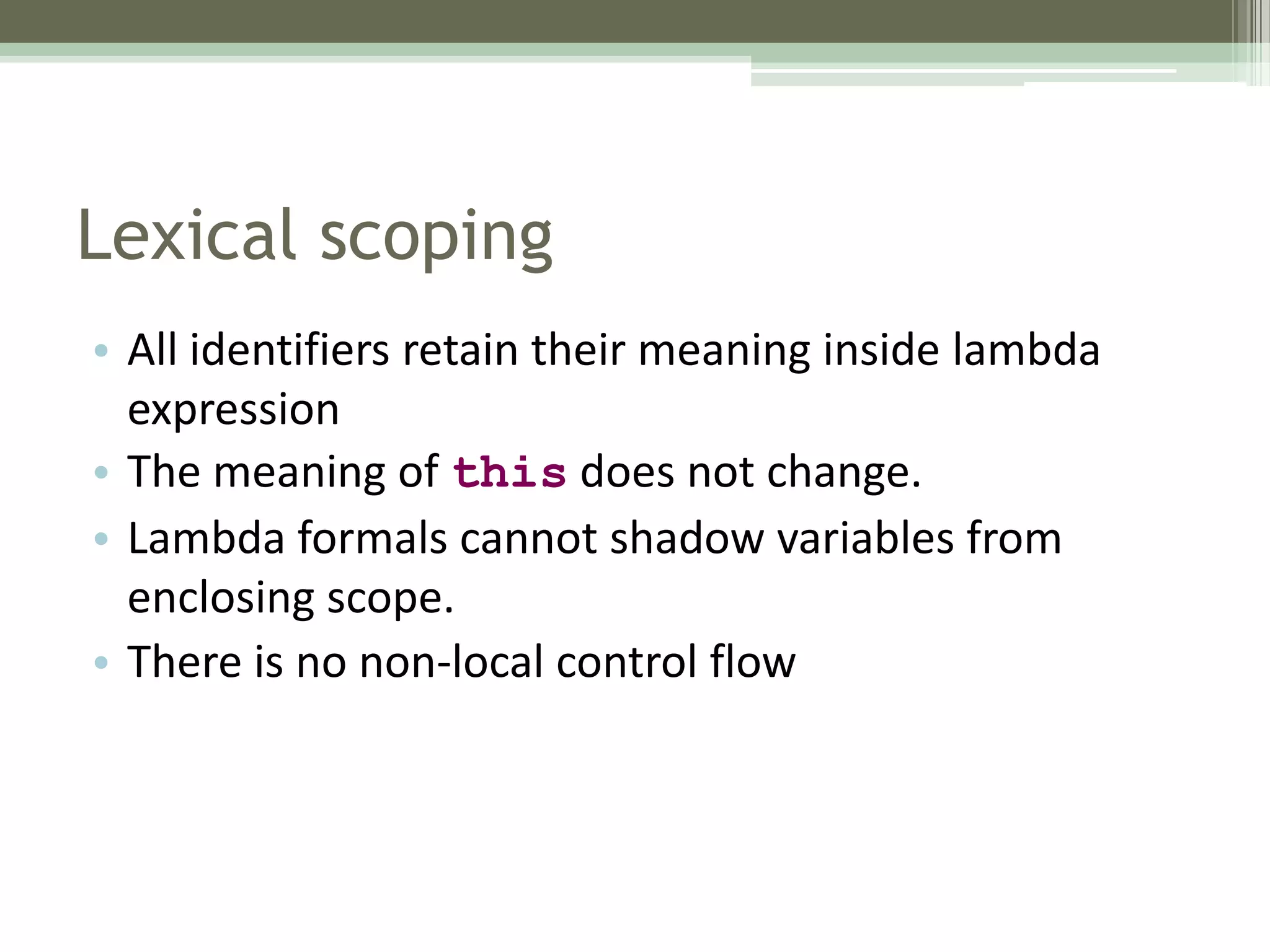
Lexical scoping
• All identifiers retain their meaning inside lambda
  expression
• The meaning of this does not change.
• Lambda formals cannot shadow variables from
  enclosing scope.
• There is no non-local control flow
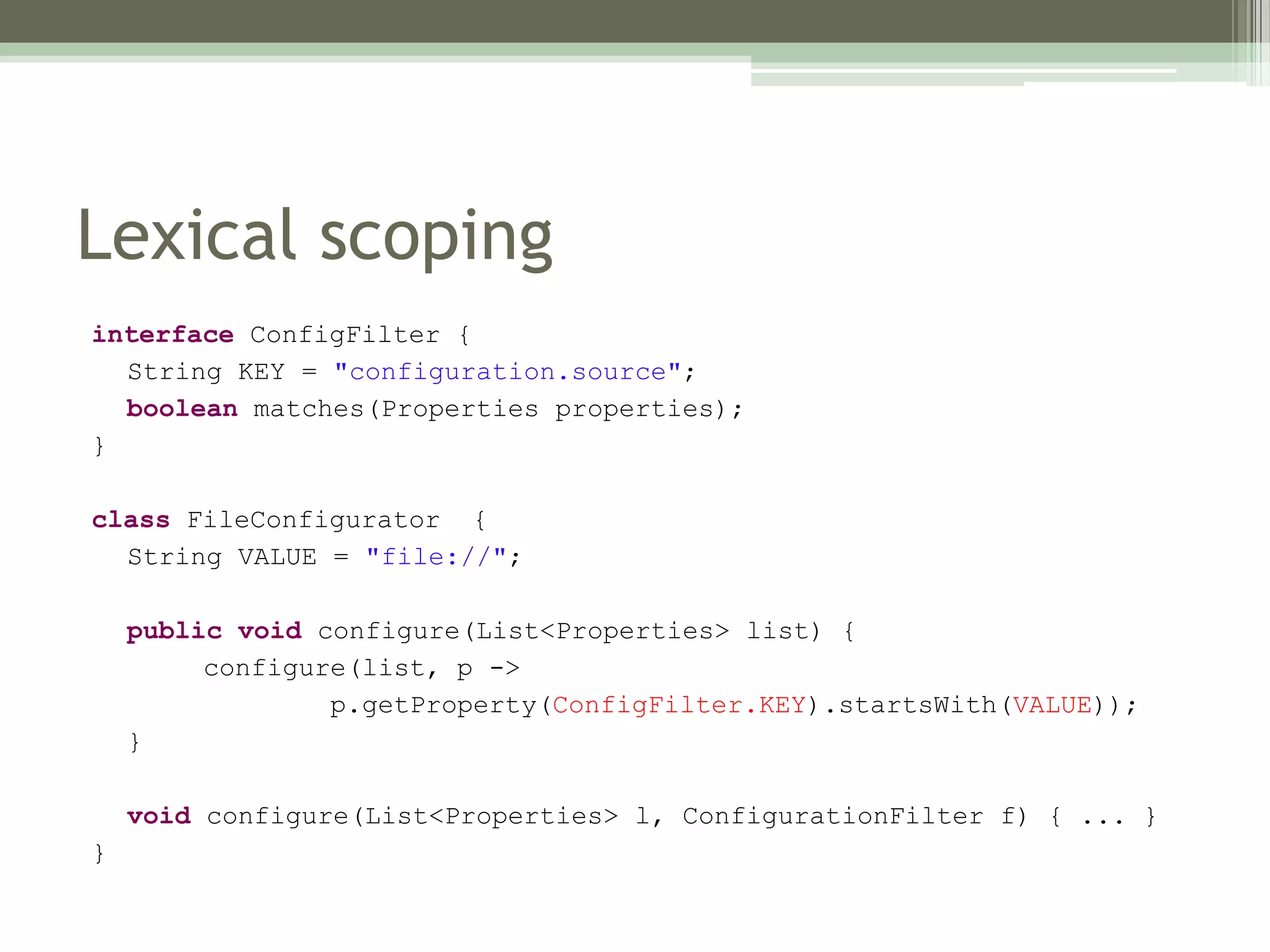
Lexical scoping
interface ConfigFilter {
  String KEY = "configuration.source";
  boolean matches(Properties properties);
}

class FileConfigurator {
  String VALUE = "file://";

    public void configure(List<Properties> list) {
         configure(list, p ->
                 p.getProperty(ConfigFilter.KEY).startsWith(VALUE));
    }

    void configure(List<Properties> l, ConfigurationFilter f) { ... }
}
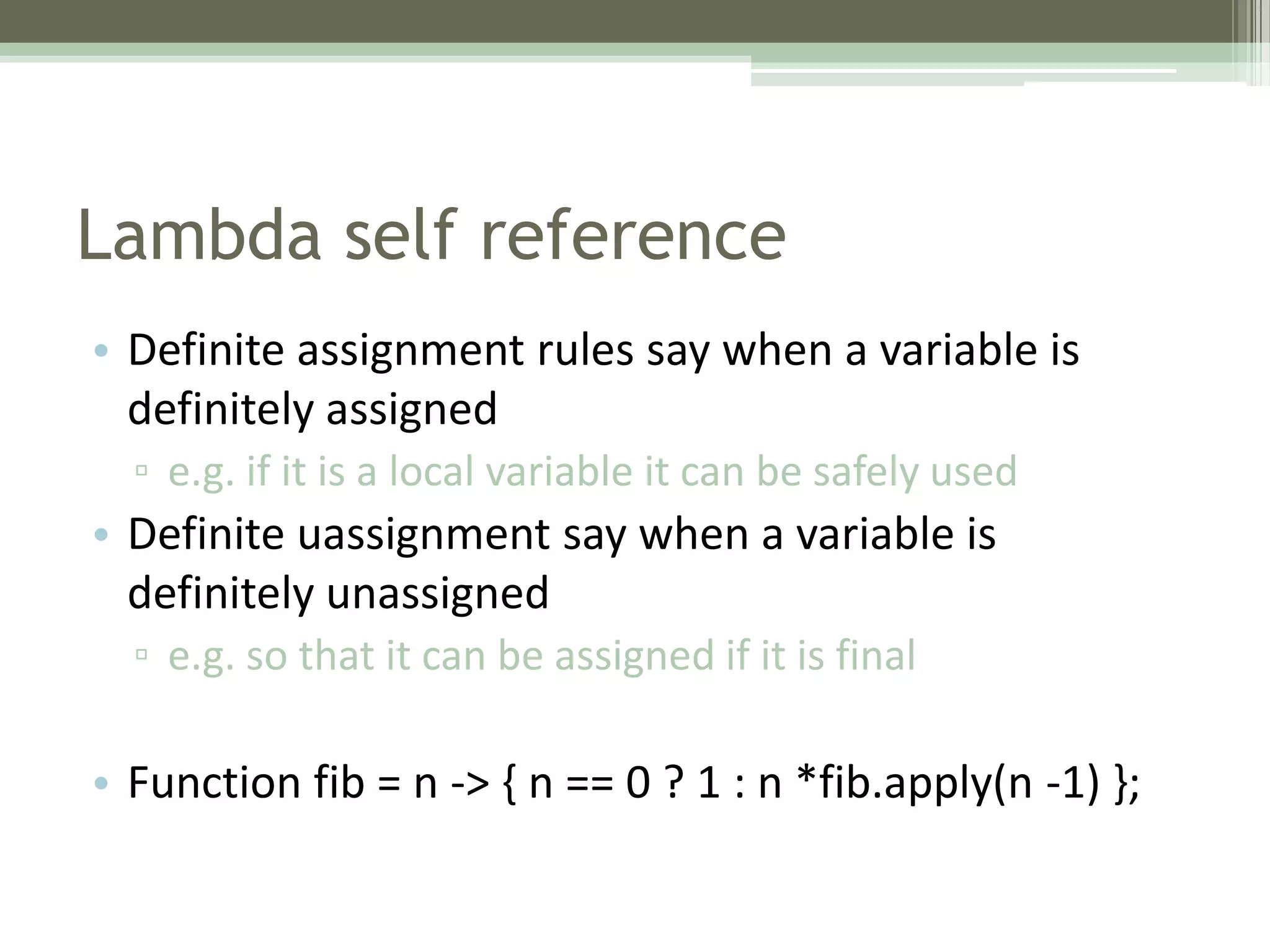
Lambda self reference
• Definite assignment rules say when a variable is
  definitely assigned
  ▫ e.g. if it is a local variable it can be safely used
• Definite uassignment say when a variable is
  definitely unassigned
  ▫ e.g. so that it can be assigned if it is final

• Function fib = n -> { n == 0 ? 1 : n *fib.apply(n -1) };
Method references
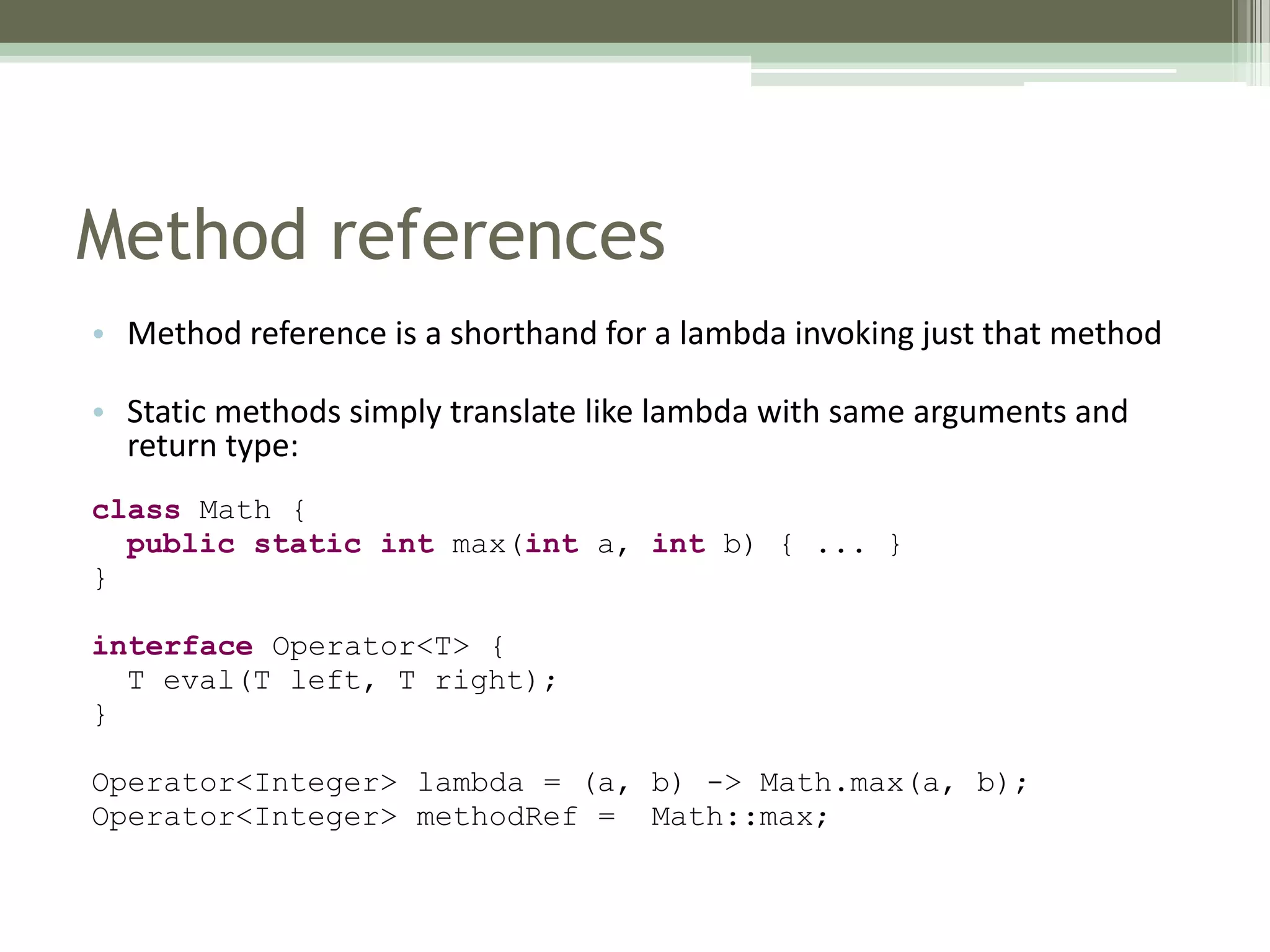
• Method reference is a shorthand for a lambda invoking just that method

• Static methods simply translate like lambda with same arguments and
  return type:
class Math {
  public static int max(int a, int b) { ... }
}

interface Operator<T> {
  T eval(T left, T right);
}

Operator<Integer> lambda = (a, b) -> Math.max(a, b);
Operator<Integer> methodRef = Math::max;
Method references
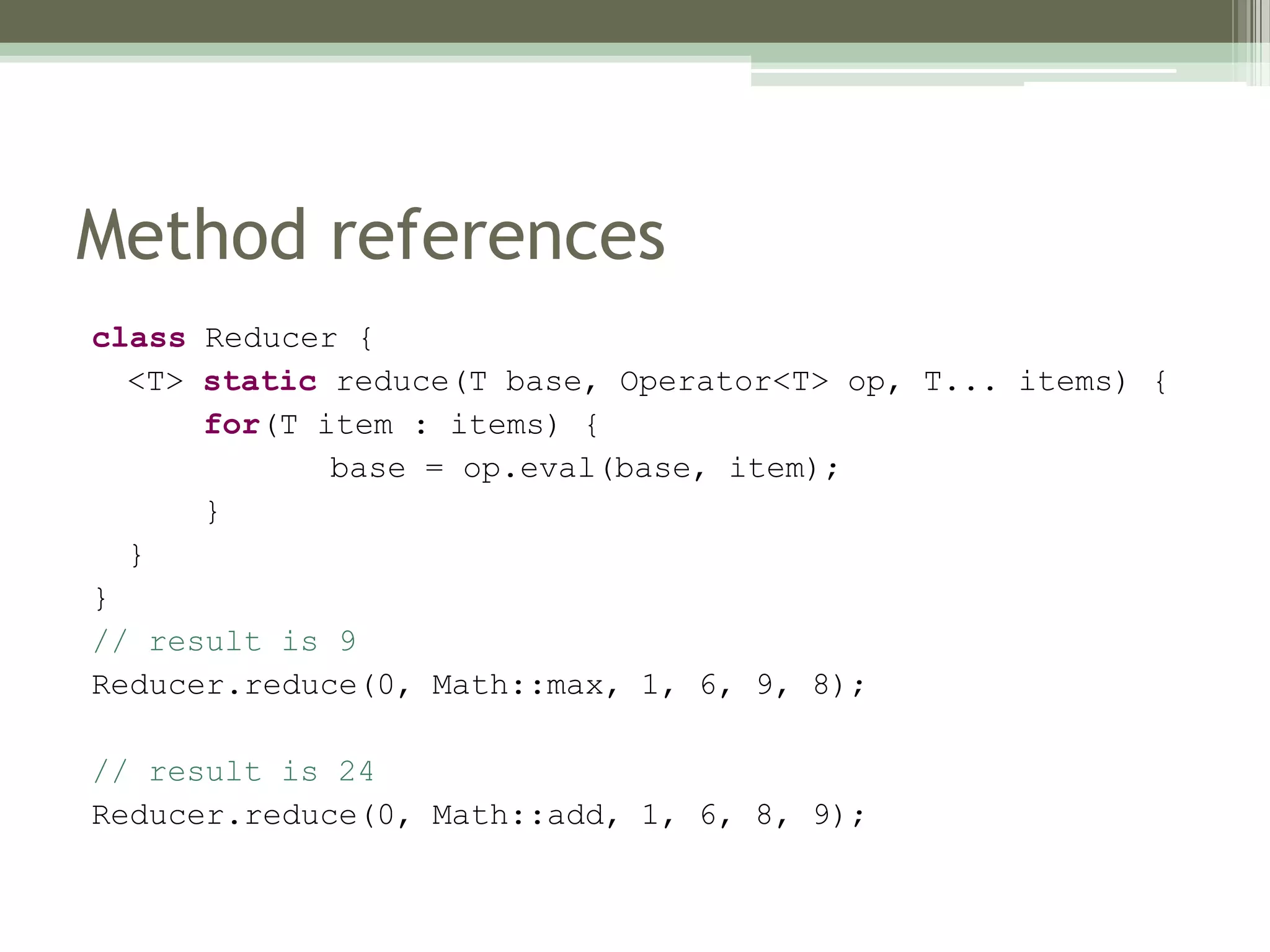
class Reducer {
  <T> static reduce(T base, Operator<T> op, T... items) {
      for(T item : items) {
             base = op.eval(base, item);
      }
  }
}
// result is 9
Reducer.reduce(0, Math::max, 1, 6, 9, 8);

// result is 24
Reducer.reduce(0, Math::add, 1, 6, 8, 9);
Method references
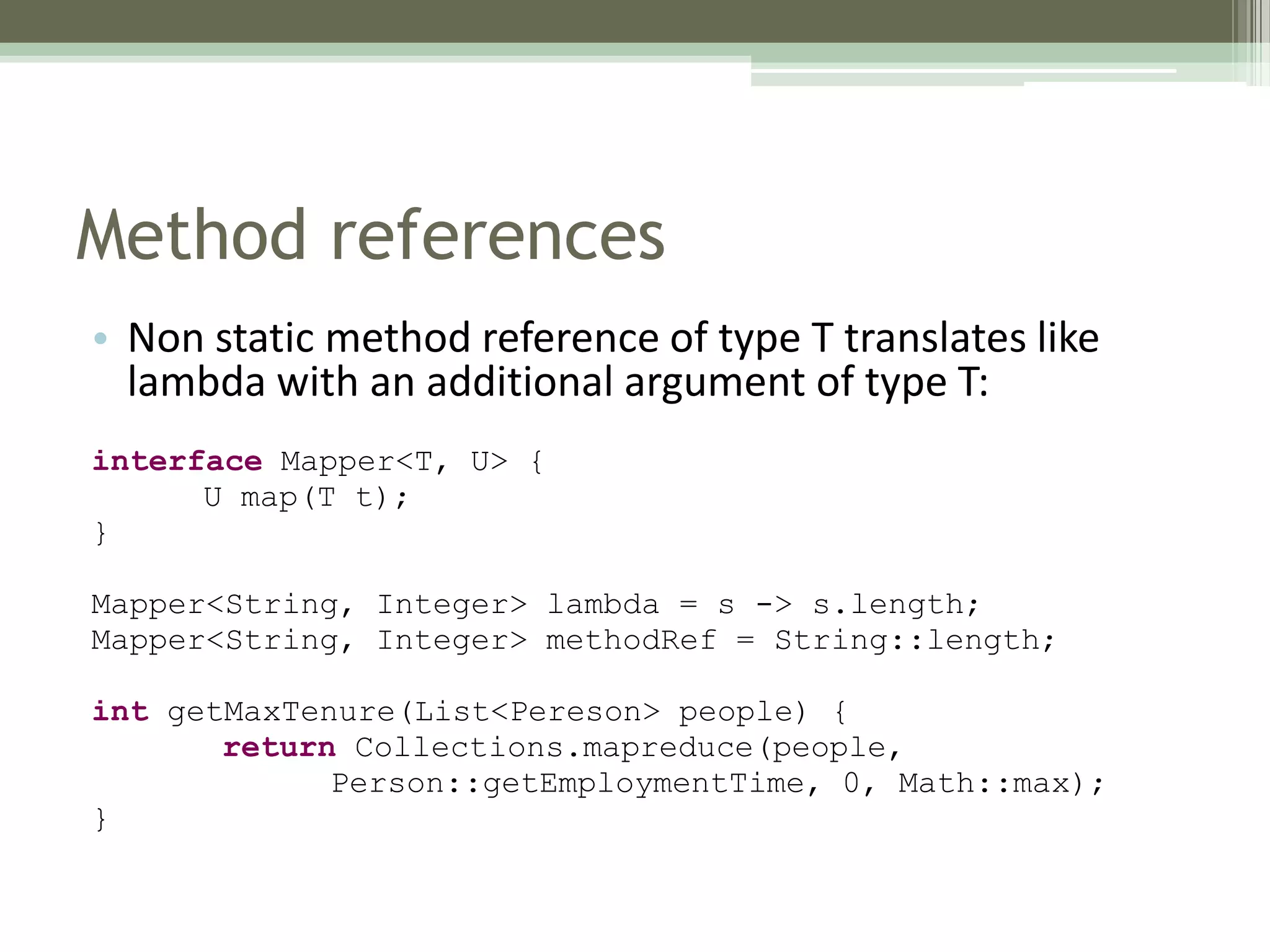
• Non static method reference of type T translates like
  lambda with an additional argument of type T:
interface Mapper<T, U> {
      U map(T t);
}

Mapper<String, Integer> lambda = s -> s.length;
Mapper<String, Integer> methodRef = String::length;

int getMaxTenure(List<Pereson> people) {
       return Collections.mapreduce(people,
             Person::getEmploymentTime, 0, Math::max);
}
Method references
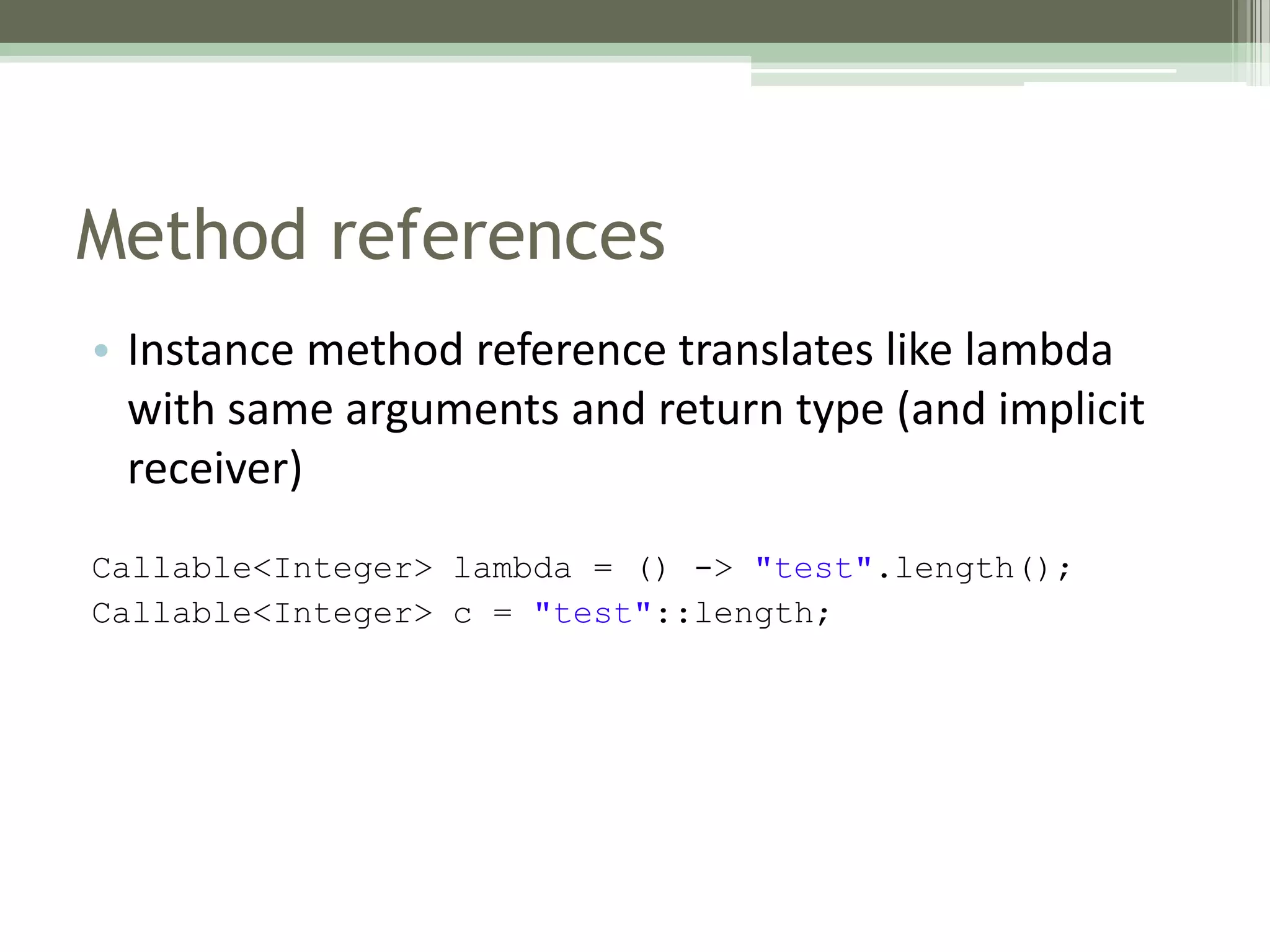
• Instance method reference translates like lambda
  with same arguments and return type (and implicit
  receiver)
Callable<Integer> lambda = () -> "test".length();
Callable<Integer> c = "test"::length;
Method references
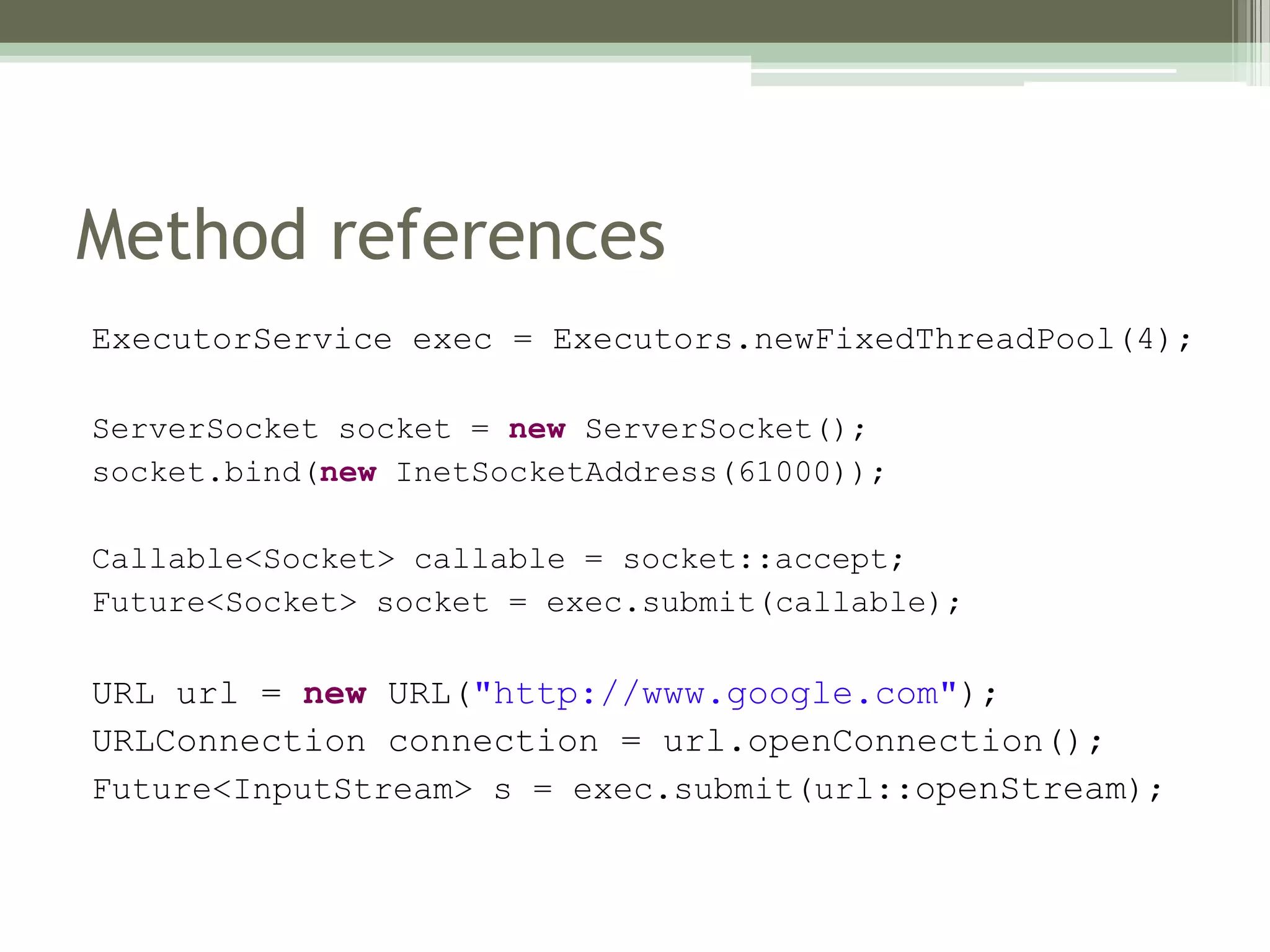
ExecutorService exec = Executors.newFixedThreadPool(4);

ServerSocket socket = new ServerSocket();
socket.bind(new InetSocketAddress(61000));

Callable<Socket> callable = socket::accept;
Future<Socket> socket = exec.submit(callable);

URL url = new URL("http://www.google.com");
URLConnection connection = url.openConnection();
Future<InputStream> s = exec.submit(url::openStream);
Constructor references
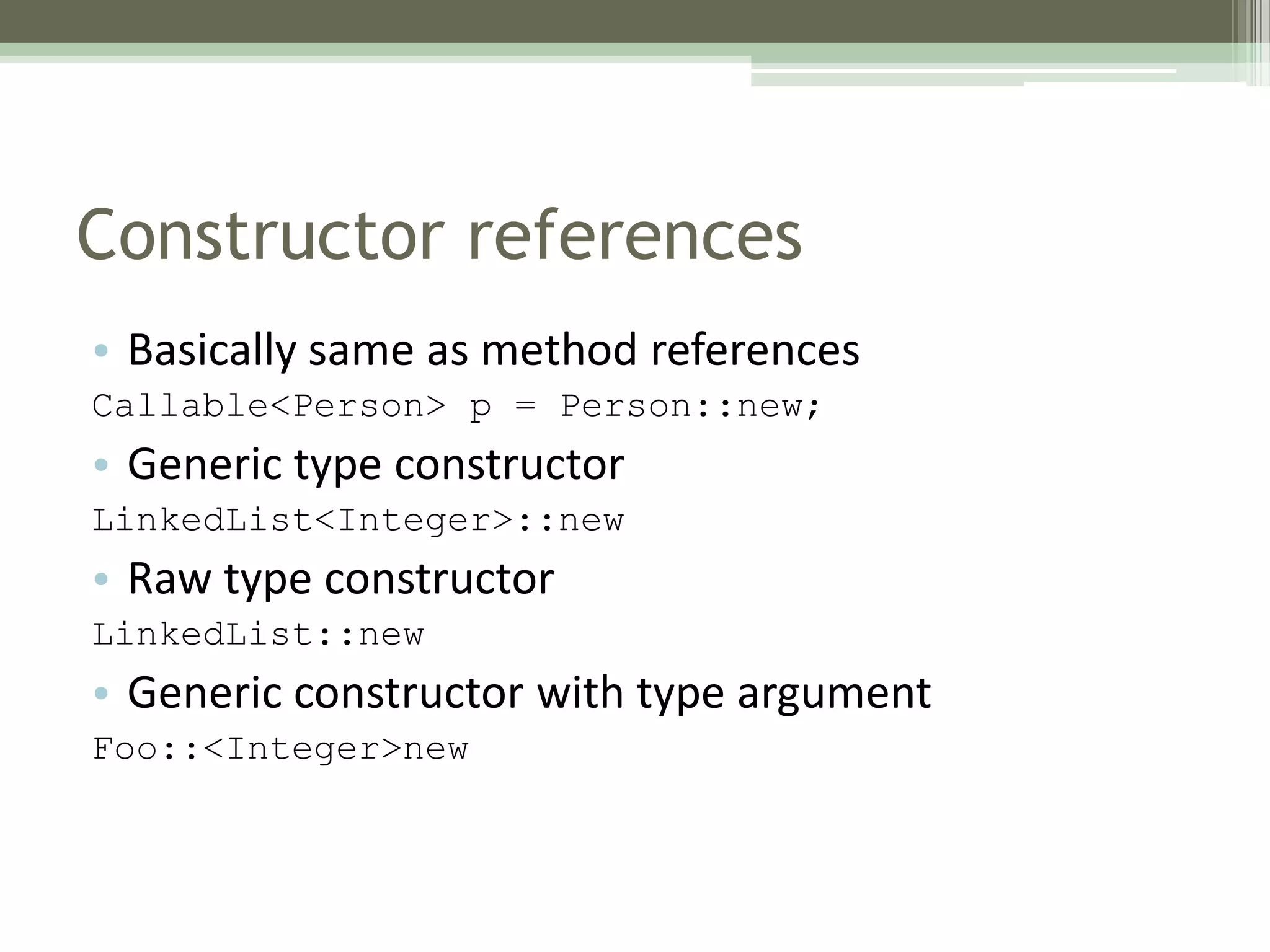
• Basically same as method references
Callable<Person> p = Person::new;
• Generic type constructor
LinkedList<Integer>::new
• Raw type constructor
LinkedList::new
• Generic constructor with type argument
Foo::<Integer>new
Constructor references
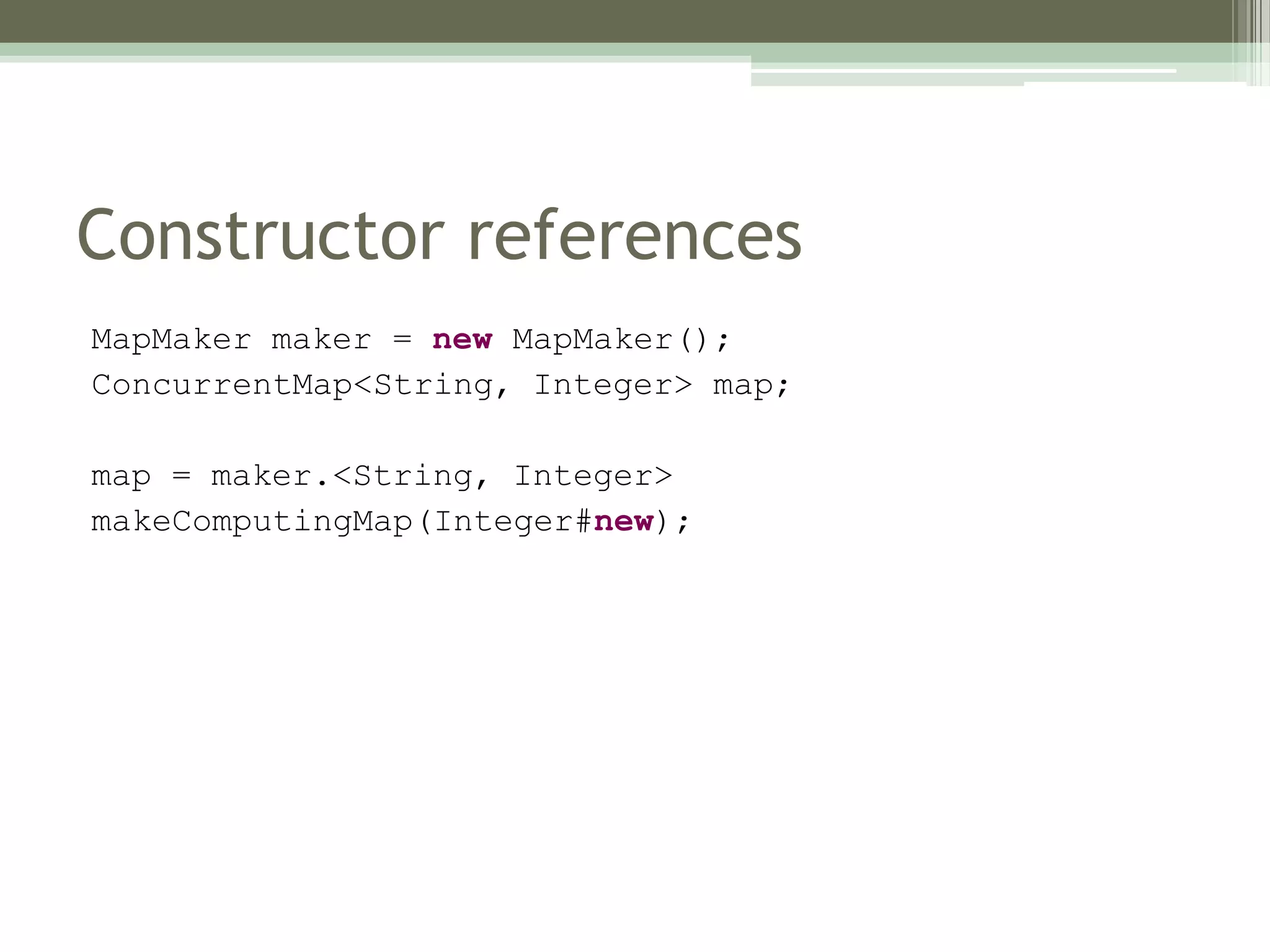
MapMaker maker = new MapMaker();
ConcurrentMap<String, Integer> map;

map = maker.<String, Integer>
makeComputingMap(Integer#new);
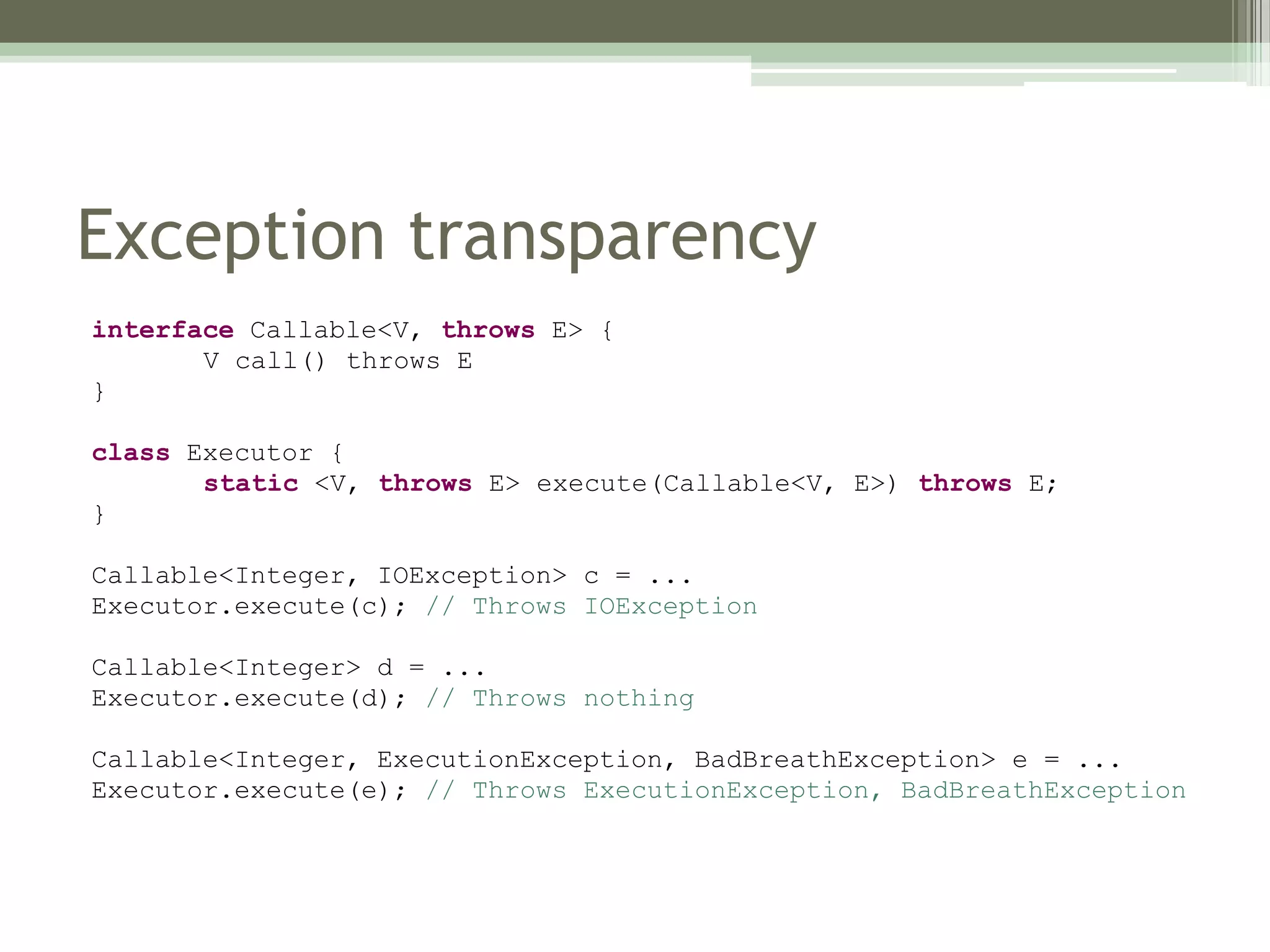
Exception transparency
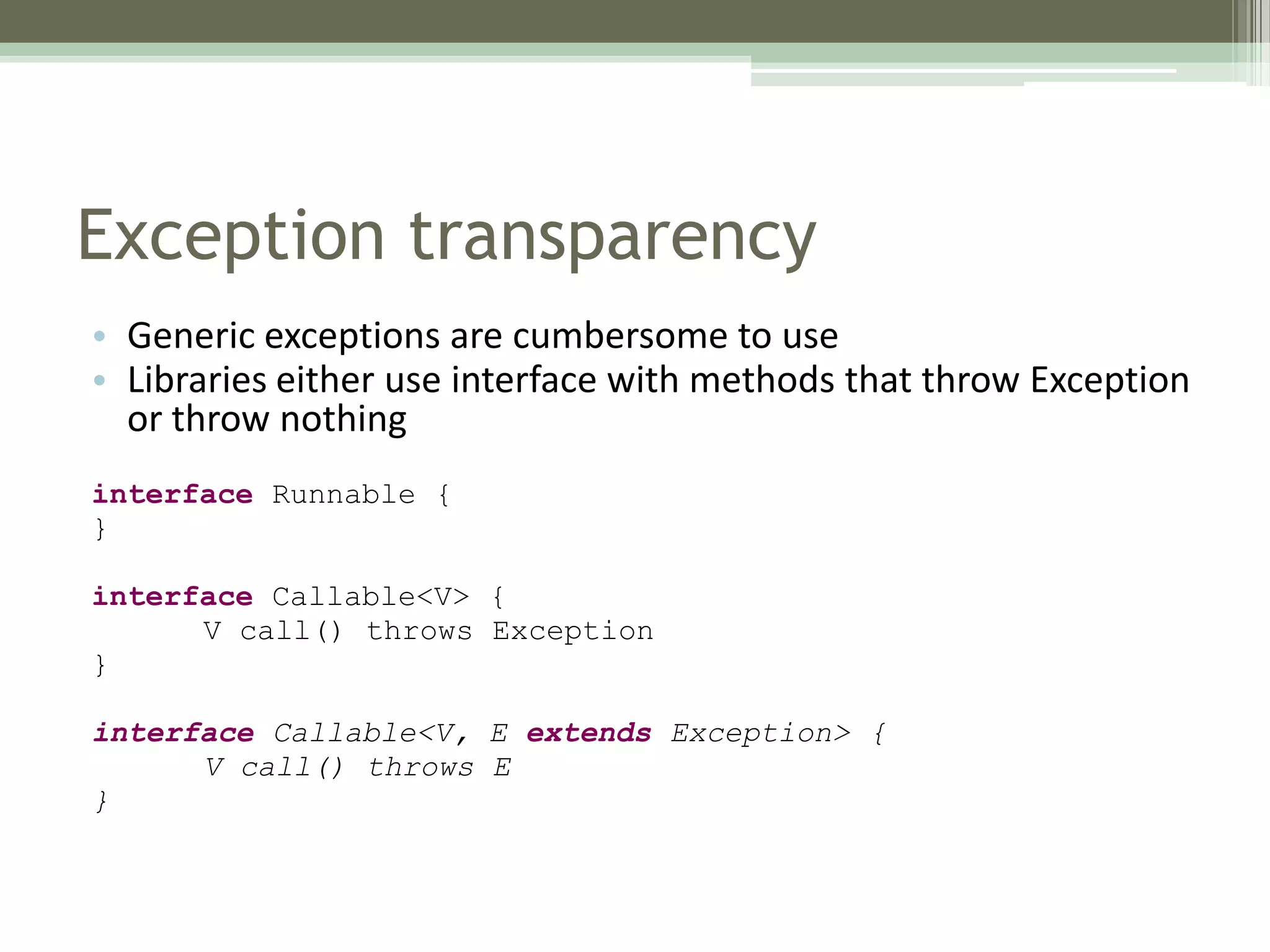
• Generic exceptions are cumbersome to use
• Libraries either use interface with methods that throw Exception
  or throw nothing
interface Runnable {
}

interface Callable<V> {
      V call() throws Exception
}

interface Callable<V, E extends Exception> {
      V call() throws E
}
Exception transparency
interface Callable<V, throws E> {
       V call() throws E
}

class Executor {
       static <V, throws E> execute(Callable<V, E>) throws E;
}

Callable<Integer, IOException> c = ...
Executor.execute(c); // Throws IOException

Callable<Integer> d = ...
Executor.execute(d); // Throws nothing

Callable<Integer, ExecutionException, BadBreathException> e = ...
Executor.execute(e); // Throws ExecutionException, BadBreathException
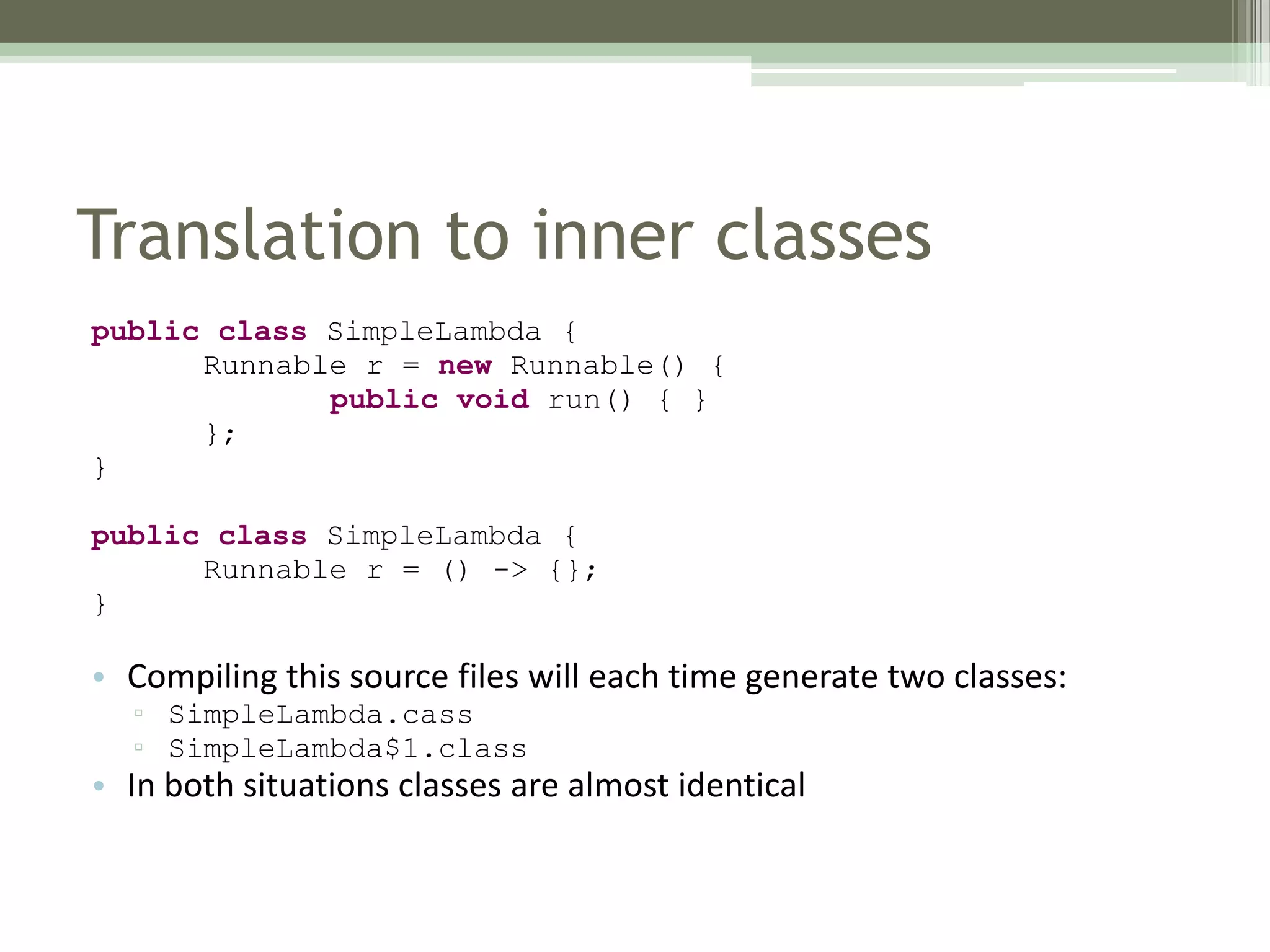
Translation to inner classes
public class SimpleLambda {
      Runnable r = new Runnable() {
             public void run() { }
      };
}

public class SimpleLambda {
      Runnable r = () -> {};
}

• Compiling this source files will each time generate two classes:
  ▫ SimpleLambda.cass
  ▫ SimpleLambda$1.class
• In both situations classes are almost identical
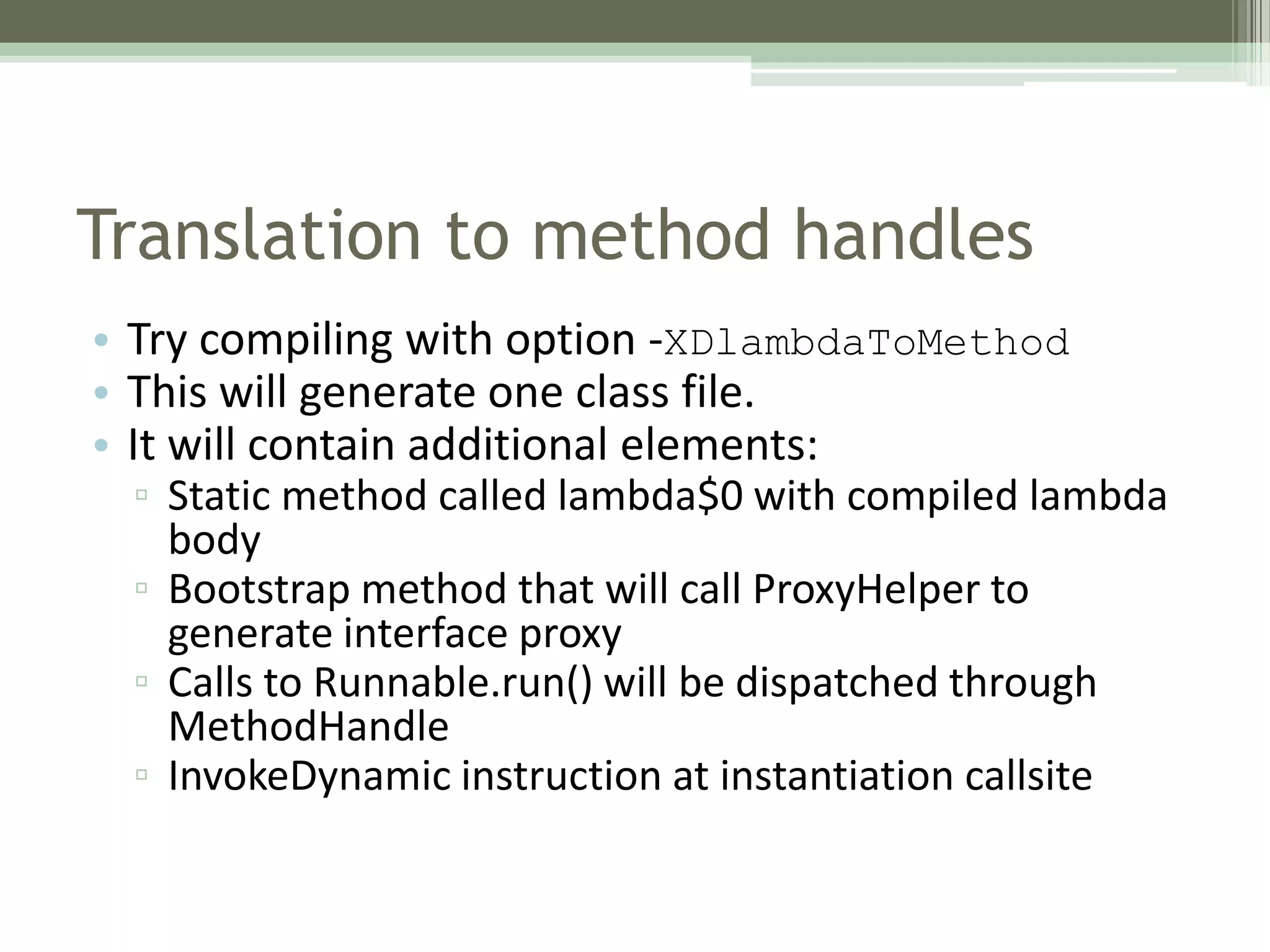
Translation to method handles
• Try compiling with option -XDlambdaToMethod
• This will generate one class file.
• It will contain additional elements:
 ▫ Static method called lambda$0 with compiled lambda
   body
 ▫ Bootstrap method that will call ProxyHelper to
   generate interface proxy
 ▫ Calls to Runnable.run() will be dispatched through
   MethodHandle
 ▫ InvokeDynamic instruction at instantiation callsite
Extension Methods
Extension methods
• Programming style would be different if Java had
  closures from day one
• Different library designs, different collection classes
• Adding closures without library support would be
  dissapointing
• When interface is published it is effectively freezed –
  adding new methods will break existing
  implementations
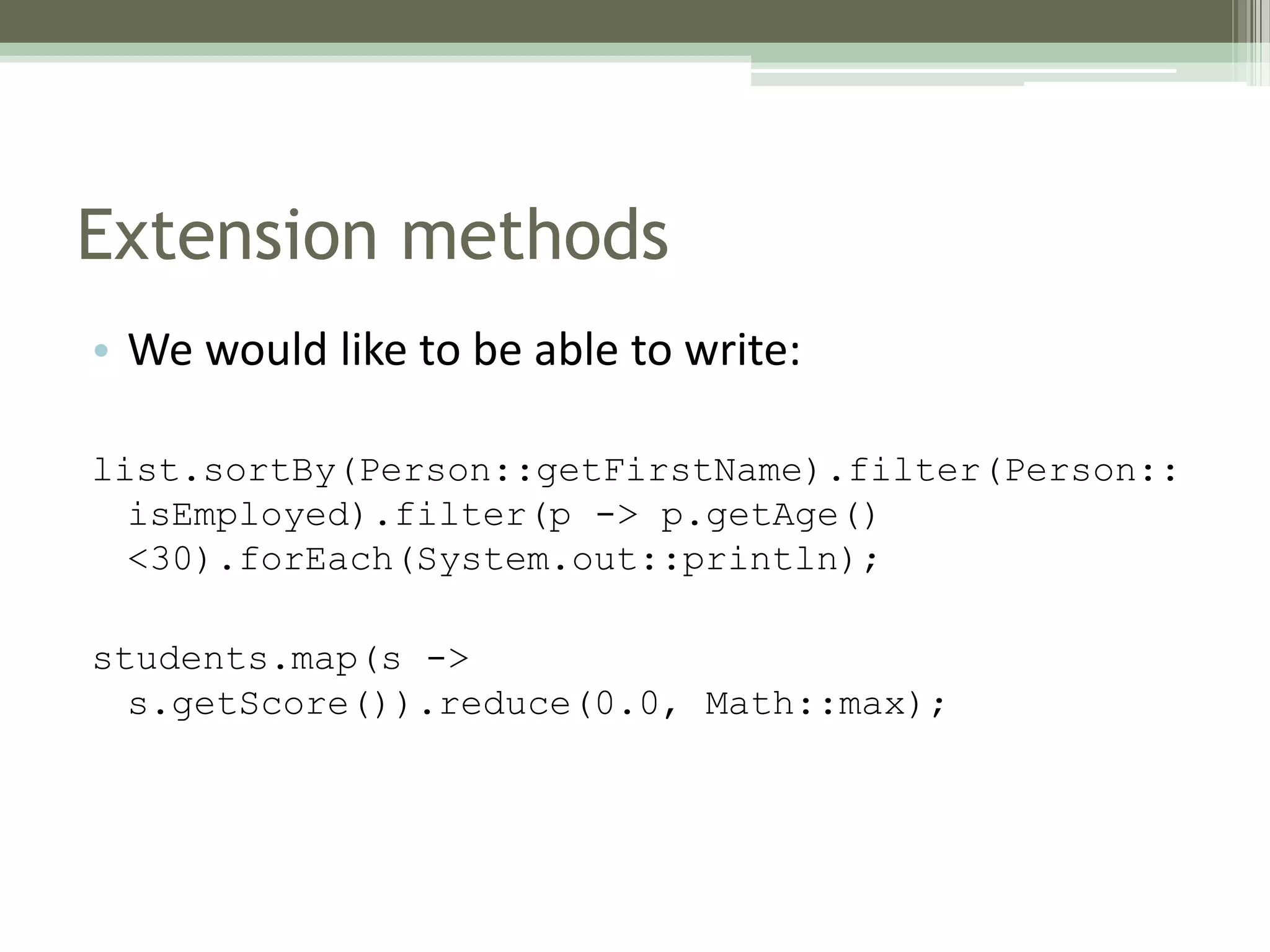
Extension methods
• We would like to be able to write:

list.sortBy(Person::getFirstName).filter(Person::
  isEmployed).filter(p -> p.getAge()
  <30).forEach(System.out::println);

students.map(s ->
  s.getScore()).reduce(0.0, Math::max);
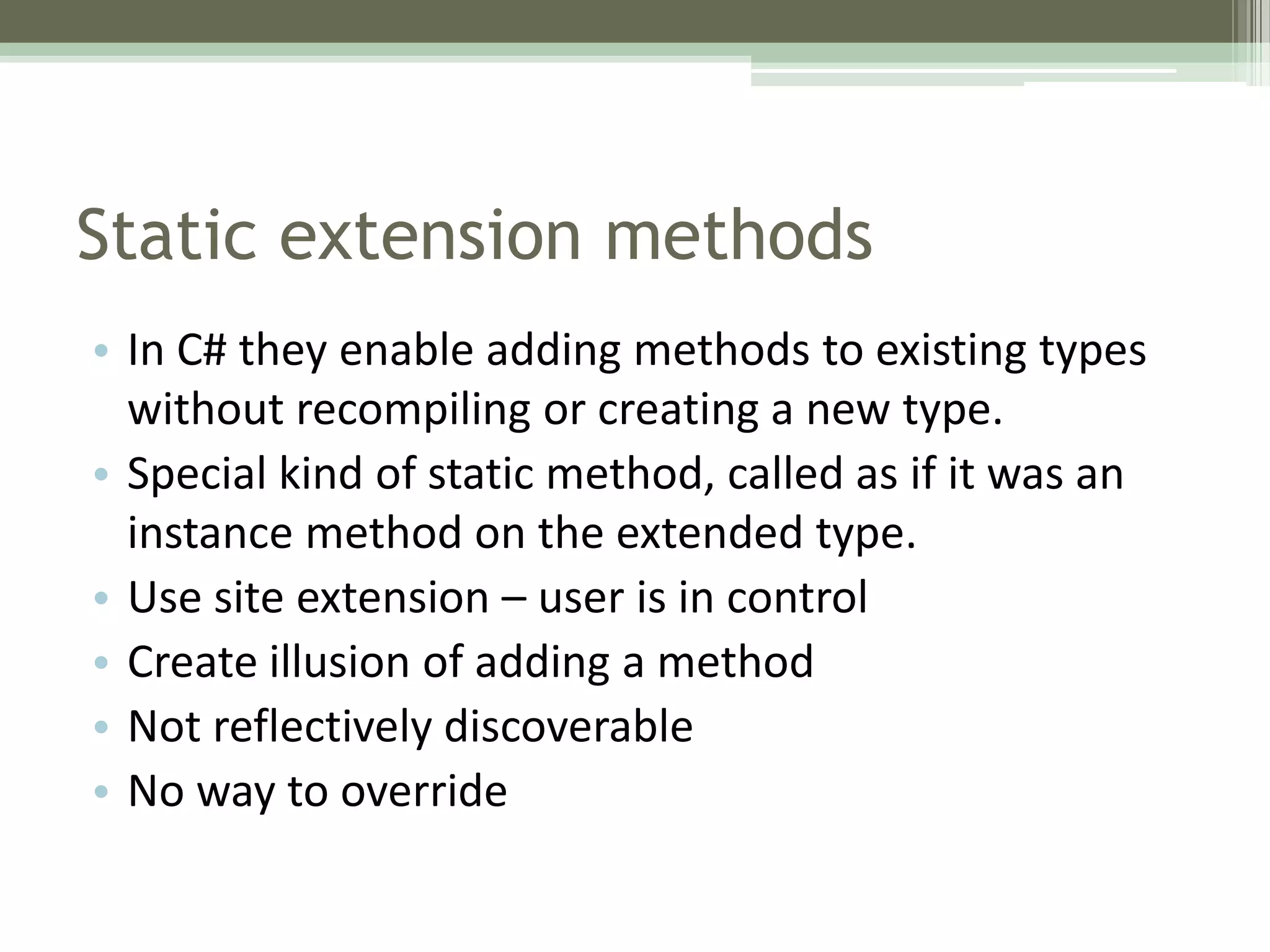
Static extension methods
• In C# they enable adding methods to existing types
  without recompiling or creating a new type.
• Special kind of static method, called as if it was an
  instance method on the extended type.
• Use site extension – user is in control
• Create illusion of adding a method
• Not reflectively discoverable
• No way to override
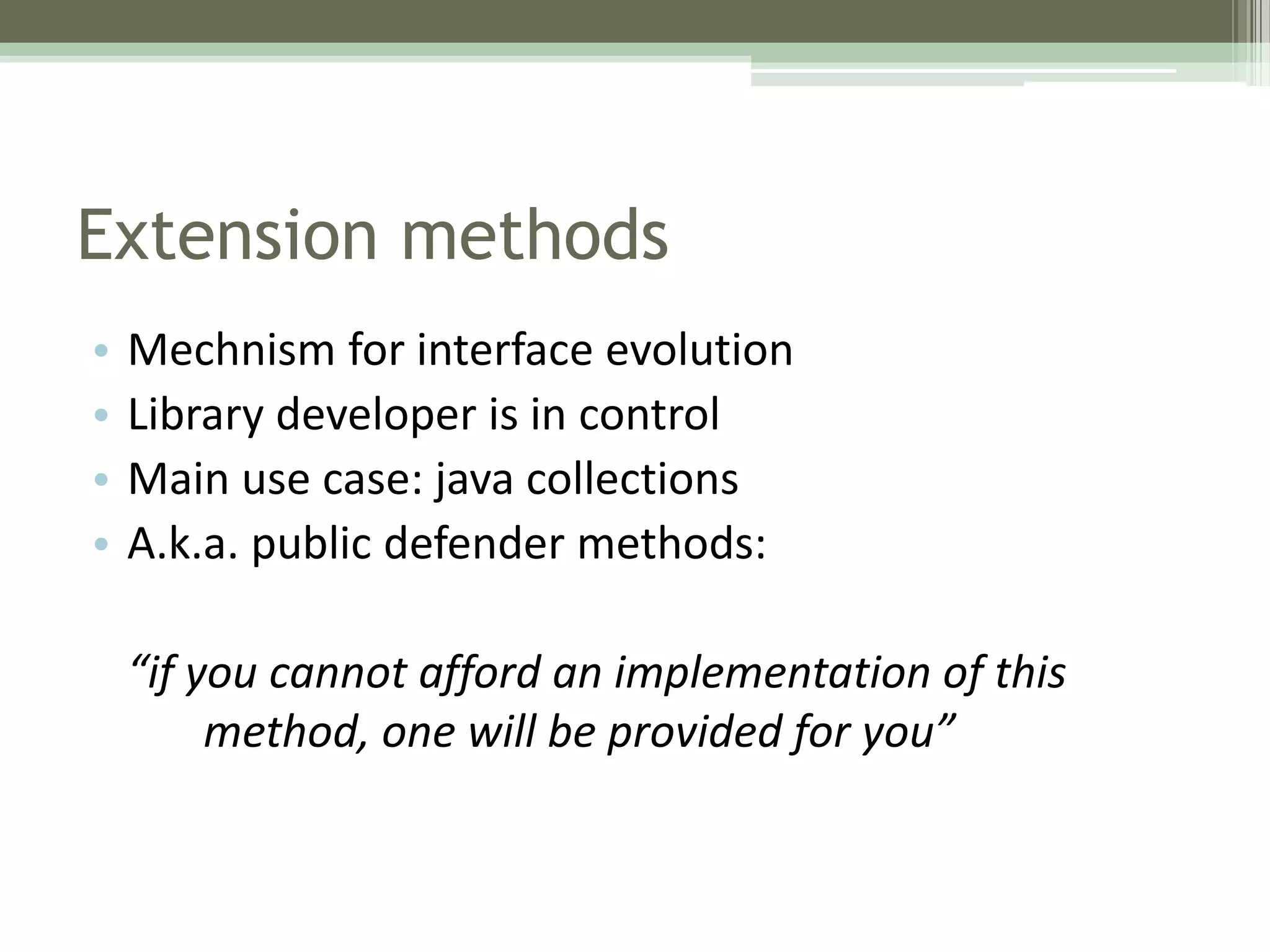
Extension methods
•   Mechnism for interface evolution
•   Library developer is in control
•   Main use case: java collections
•   A.k.a. public defender methods:

    “if you cannot afford an implementation of this
         method, one will be provided for you”
Virtual extension methods
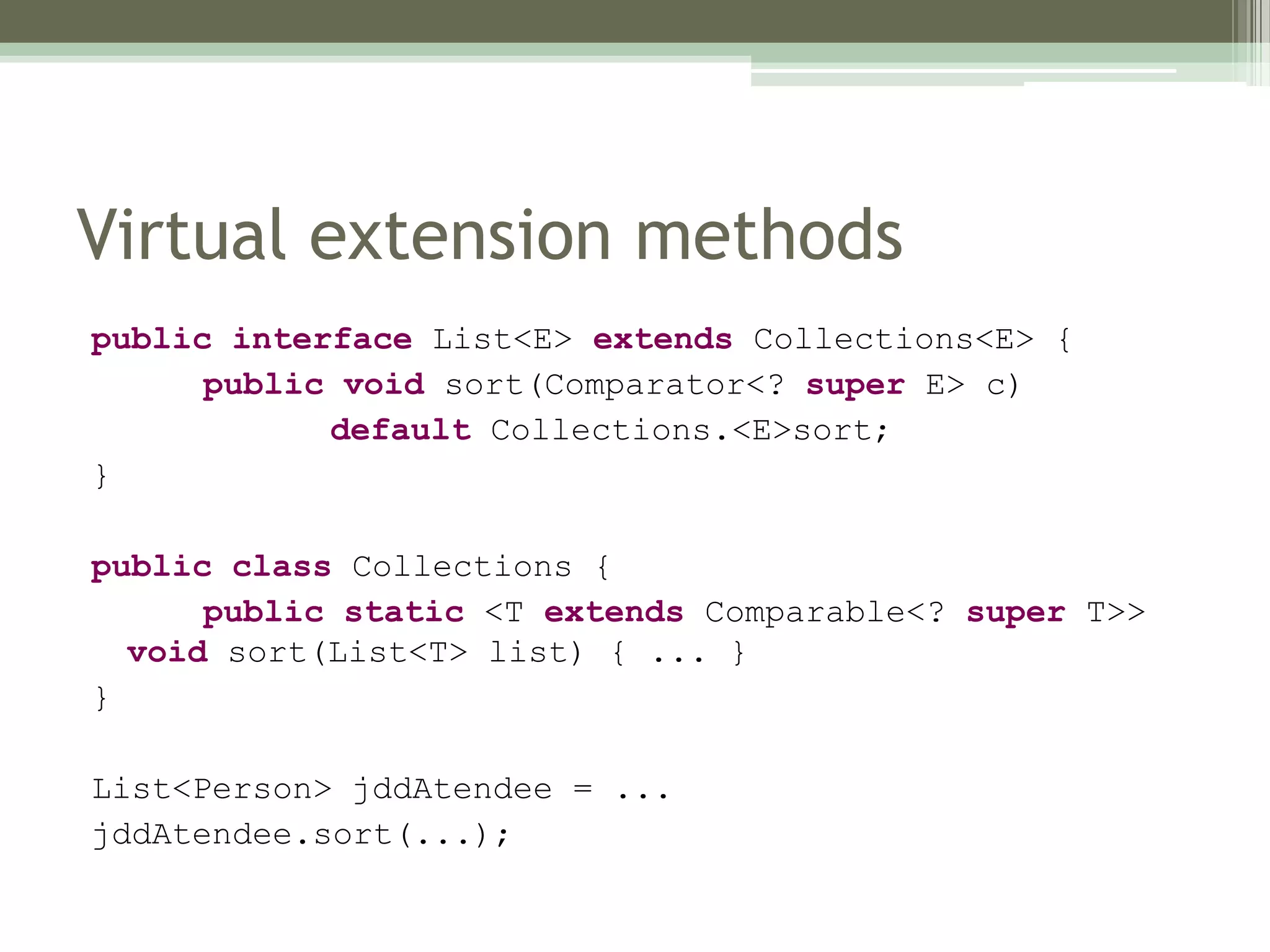
public interface List<E> extends Collections<E> {
      public void sort(Comparator<? super E> c)
            default Collections.<E>sort;
}

public class Collections {
      public static <T extends Comparable<? super T>>
  void sort(List<T> list) { ... }
}

List<Person> jddAtendee = ...
jddAtendee.sort(...);
Virtual extension methods
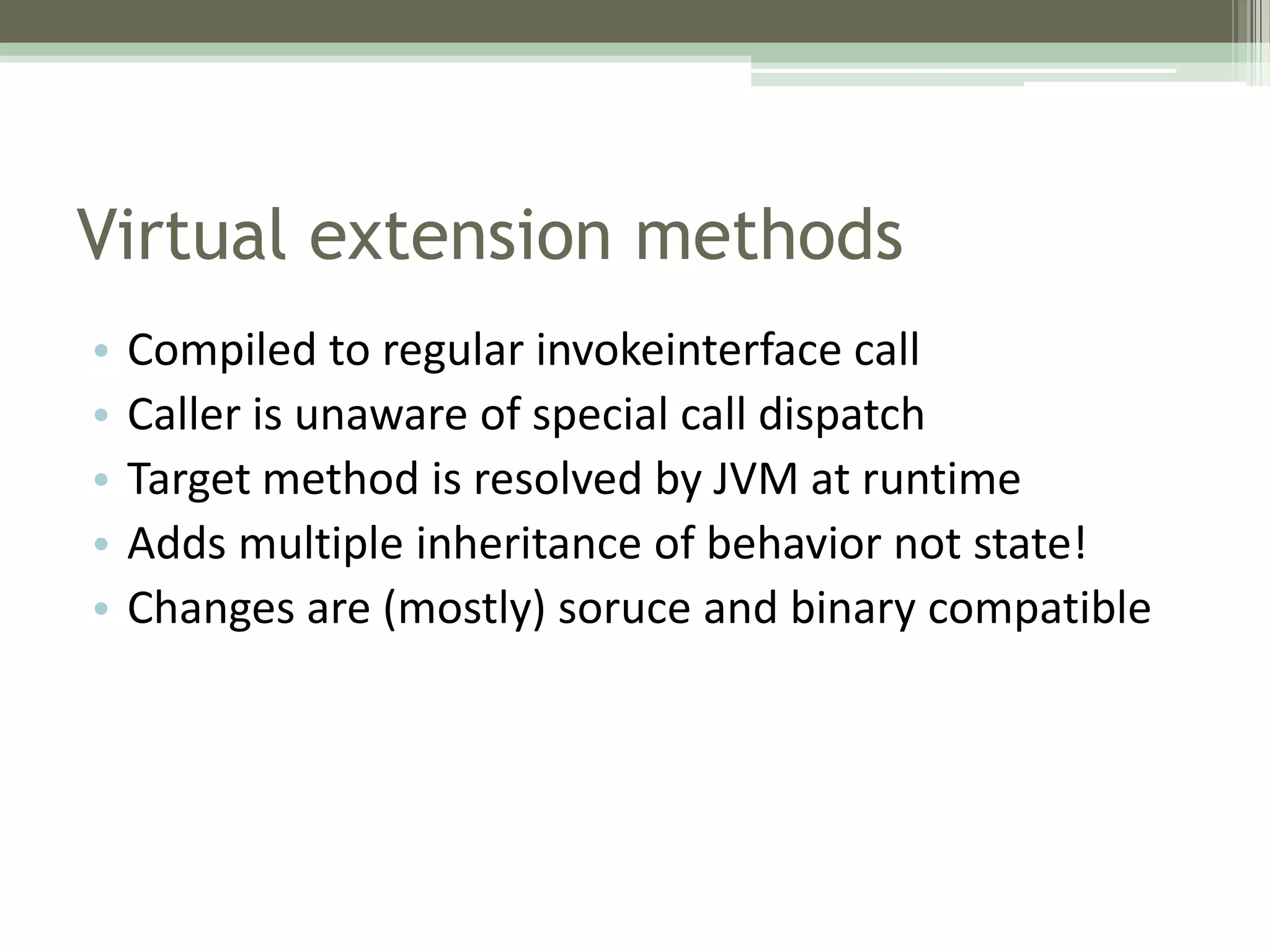
•   Compiled to regular invokeinterface call
•   Caller is unaware of special call dispatch
•   Target method is resolved by JVM at runtime
•   Adds multiple inheritance of behavior not state!
•   Changes are (mostly) soruce and binary compatible
Method resolution
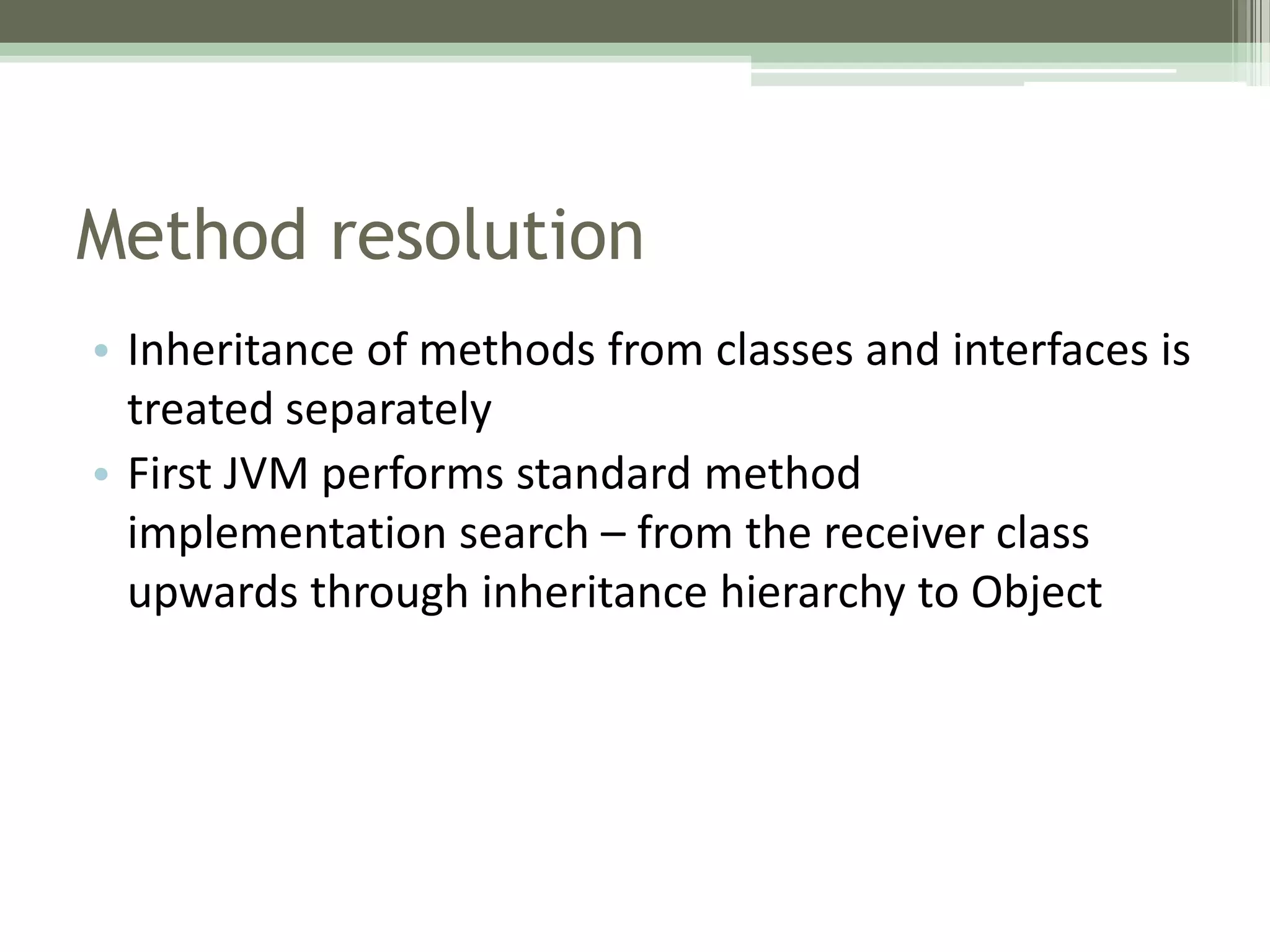
• Inheritance of methods from classes and interfaces is
  treated separately
• First JVM performs standard method
  implementation search – from the receiver class
  upwards through inheritance hierarchy to Object
Method resolution
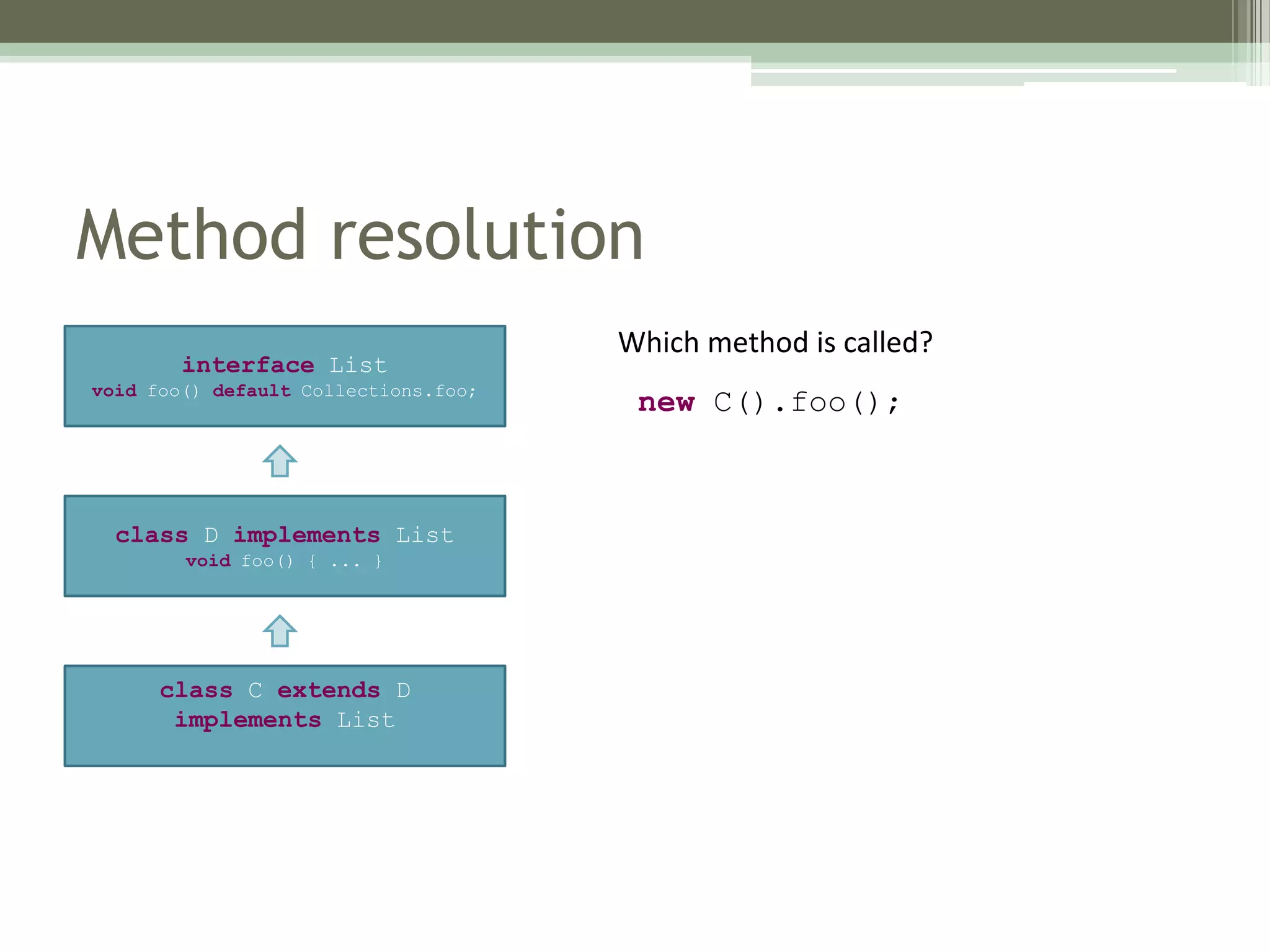
                                      Which method is called?
        interface List
void foo() default Collections.foo;
                                       new C().foo();


  class D implements List
        void foo() { ... }


      class C extends D
       implements List
Method resolution
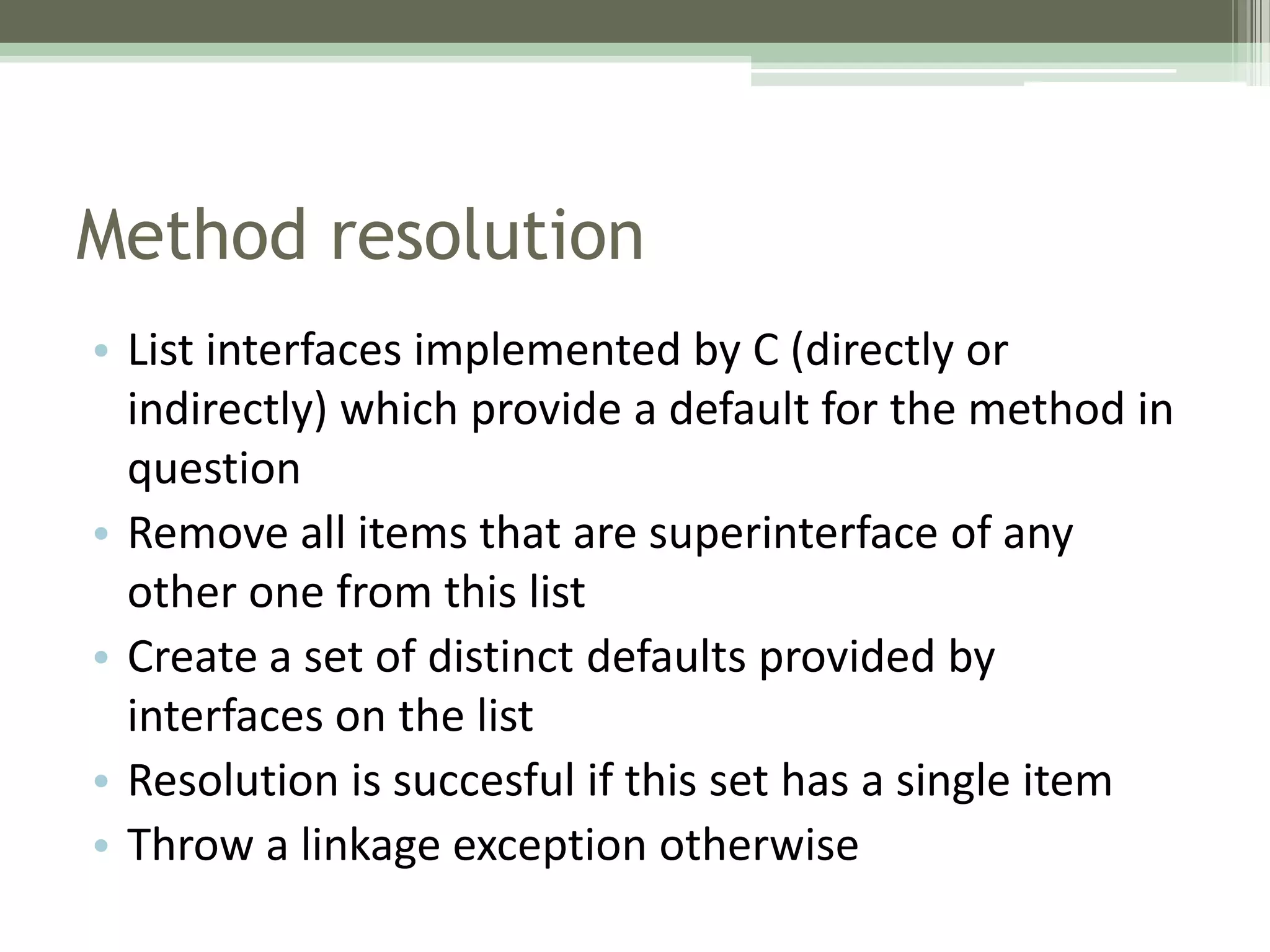
• List interfaces implemented by C (directly or
  indirectly) which provide a default for the method in
  question
• Remove all items that are superinterface of any
  other one from this list
• Create a set of distinct defaults provided by
  interfaces on the list
• Resolution is succesful if this set has a single item
• Throw a linkage exception otherwise
Method resolution
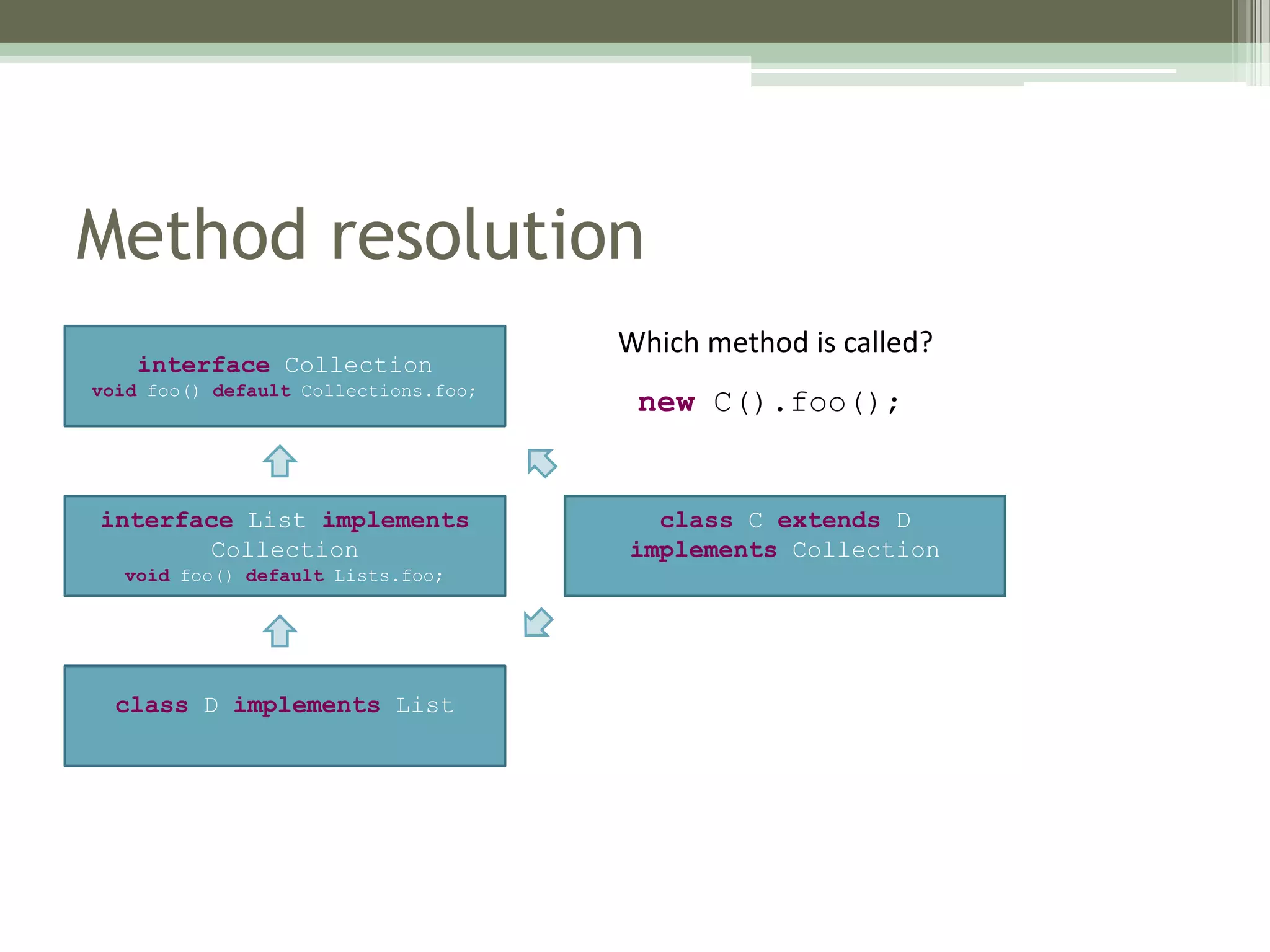
                                      Which method is called?
    interface Collection
void foo() default Collections.foo;
                                       new C().foo();


interface List implements               class C extends D
       Collection                     implements Collection
  void foo() default Lists.foo;


  class D implements List
Method resolution
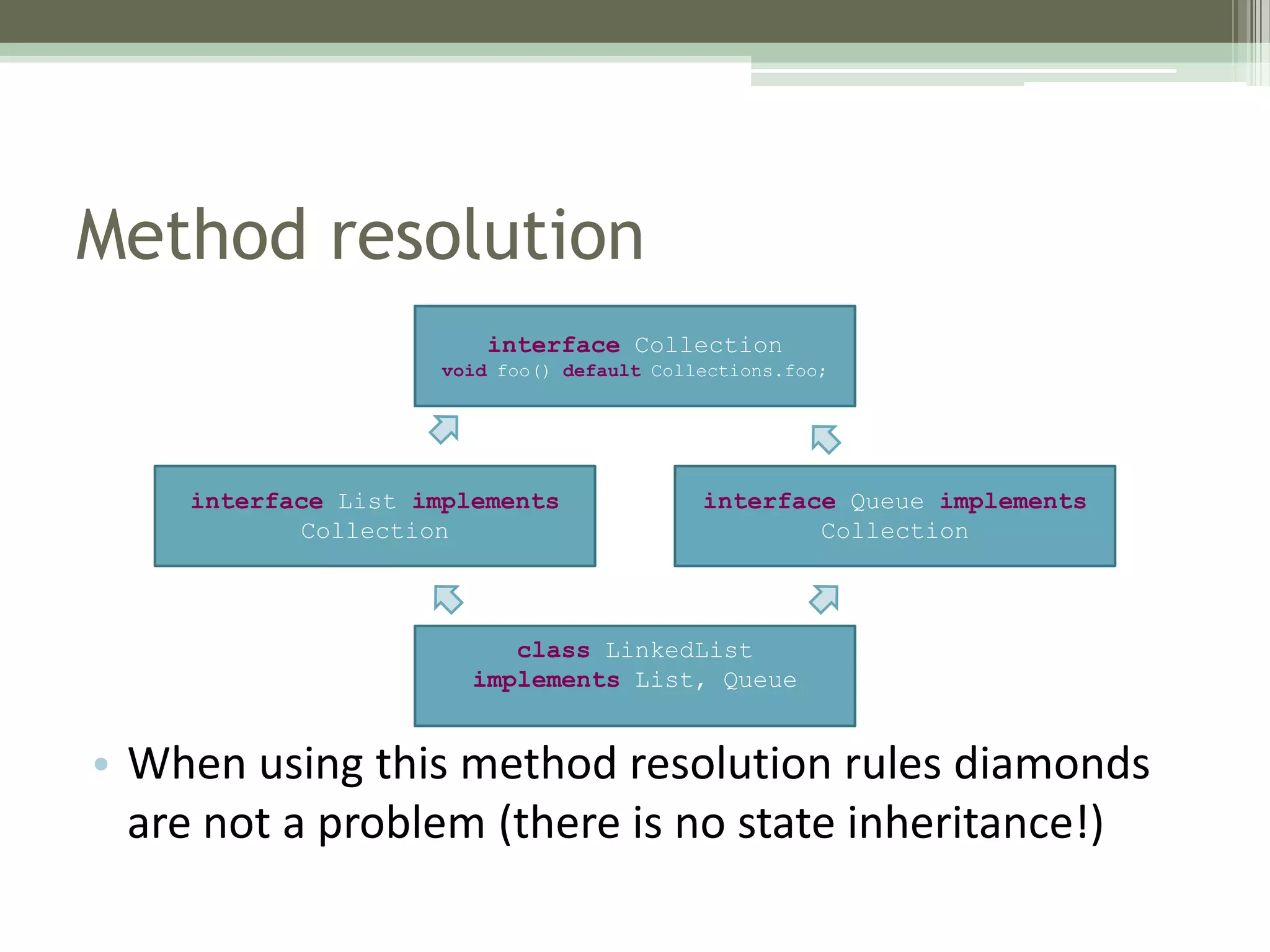
                         interface Collection
                     void foo() default Collections.foo;


    interface List implements               interface Queue implements
           Collection                               Collection


                          class LinkedList
                       implements List, Queue


• When using this method resolution rules diamonds
  are not a problem (there is no state inheritance!)
Manual method disambiguation
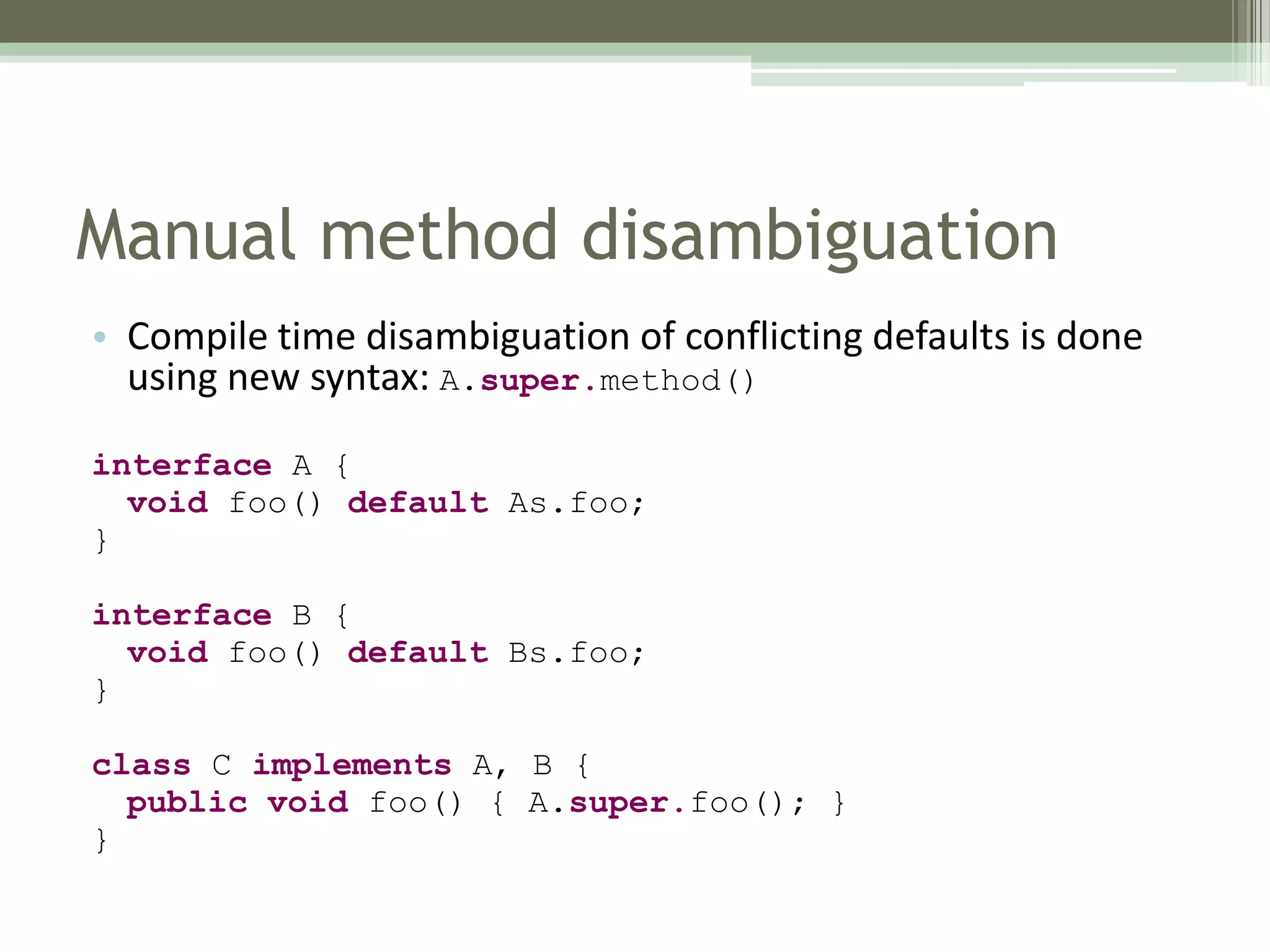
• Compile time disambiguation of conflicting defaults is done
  using new syntax: A.super.method()

interface A {
  void foo() default As.foo;
}

interface B {
  void foo() default Bs.foo;
}

class C implements A, B {
  public void foo() { A.super.foo(); }
}
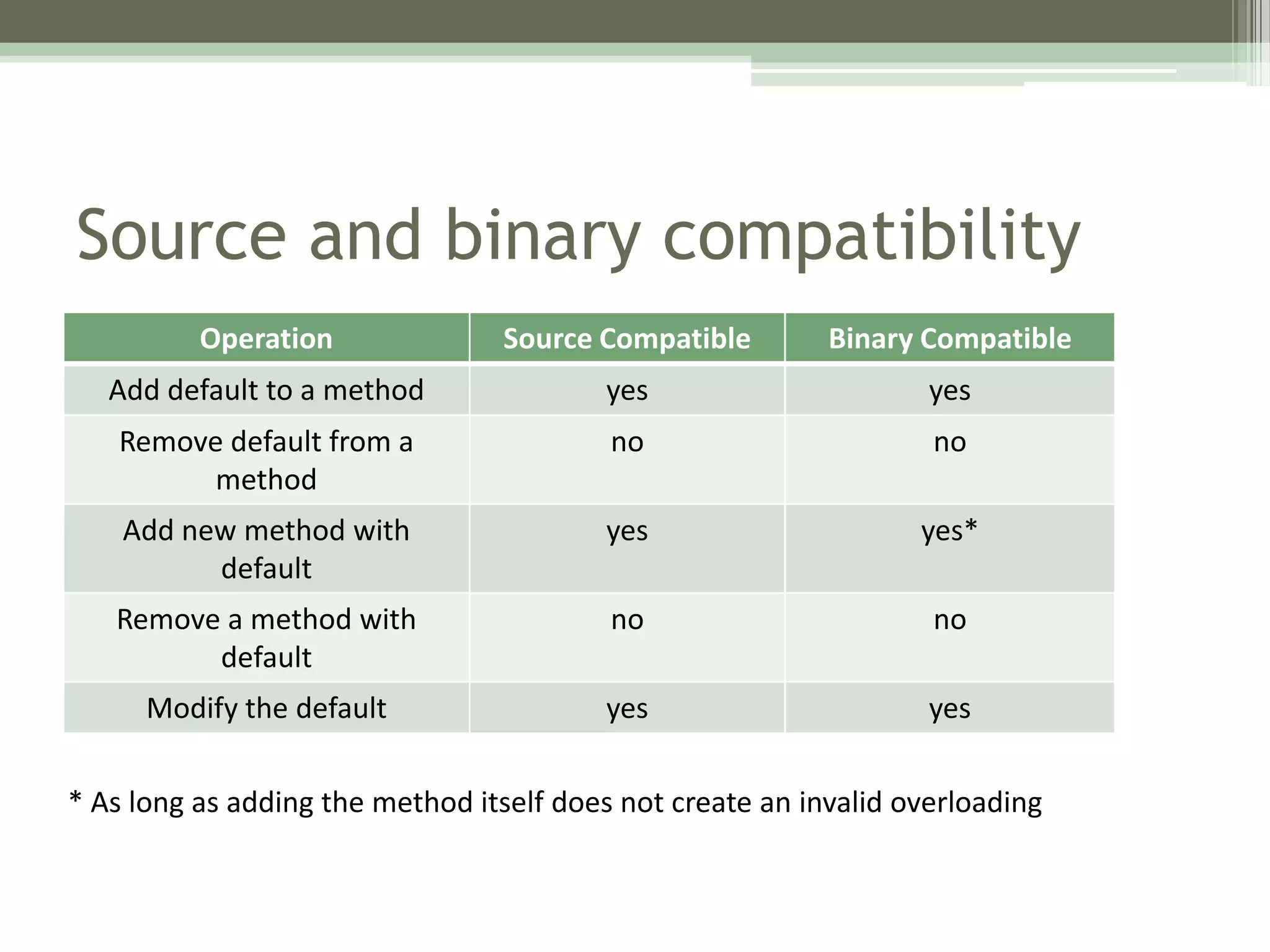
Source and binary compatibility
          Operation              Source Compatible         Binary Compatible
   Add default to a method               yes                       yes
    Remove default from a                 no                       no
          method
    Add new method with                  yes                      yes*
          default
   Remove a method with                   no                       no
         default
      Modify the default                 yes                       yes

* As long as adding the method itself does not create an invalid overloading
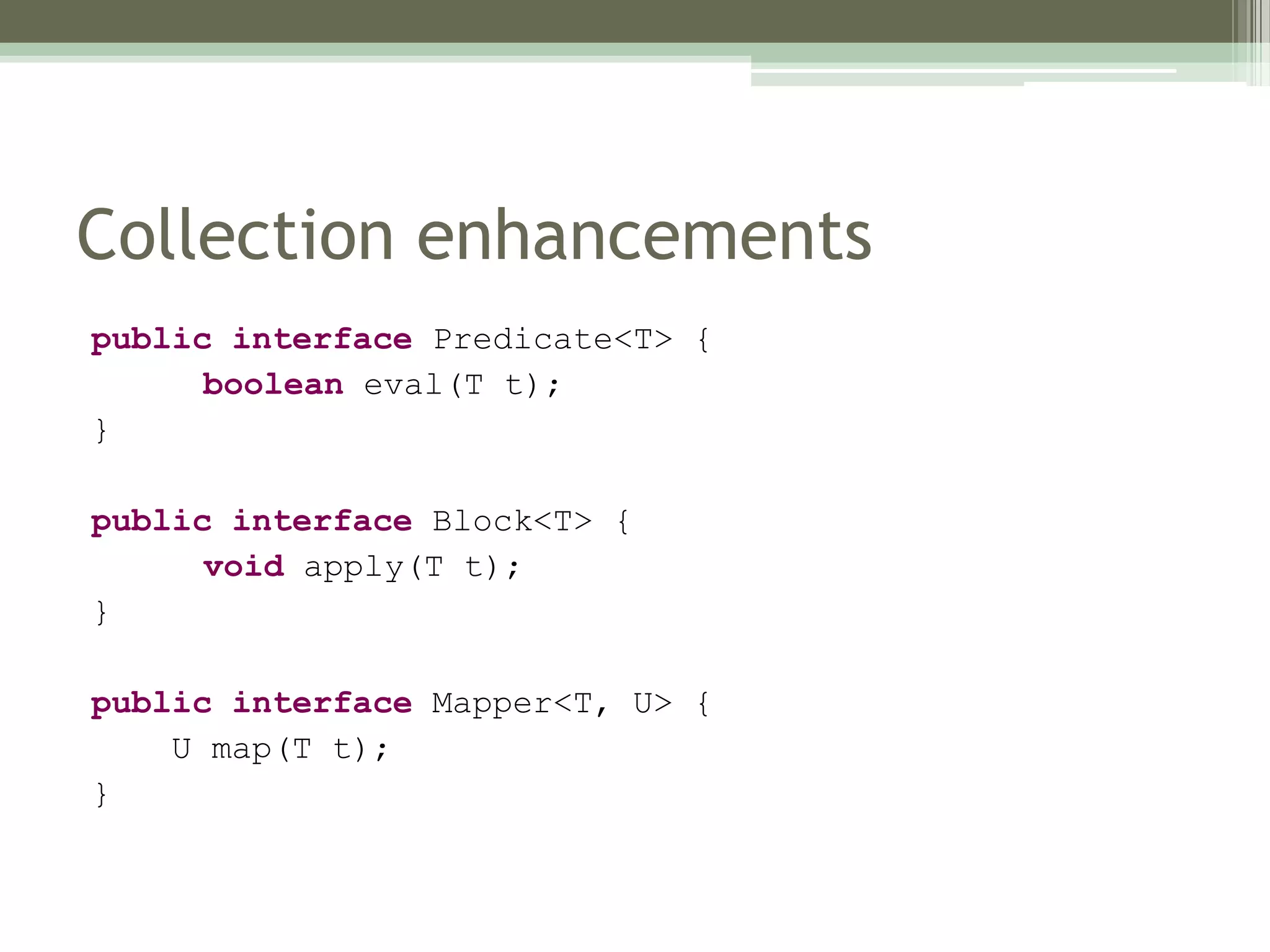
Collection enhancements
public interface Predicate<T> {
      boolean eval(T t);
}

public interface Block<T> {
      void apply(T t);
}

public interface Mapper<T, U> {
    U map(T t);
}
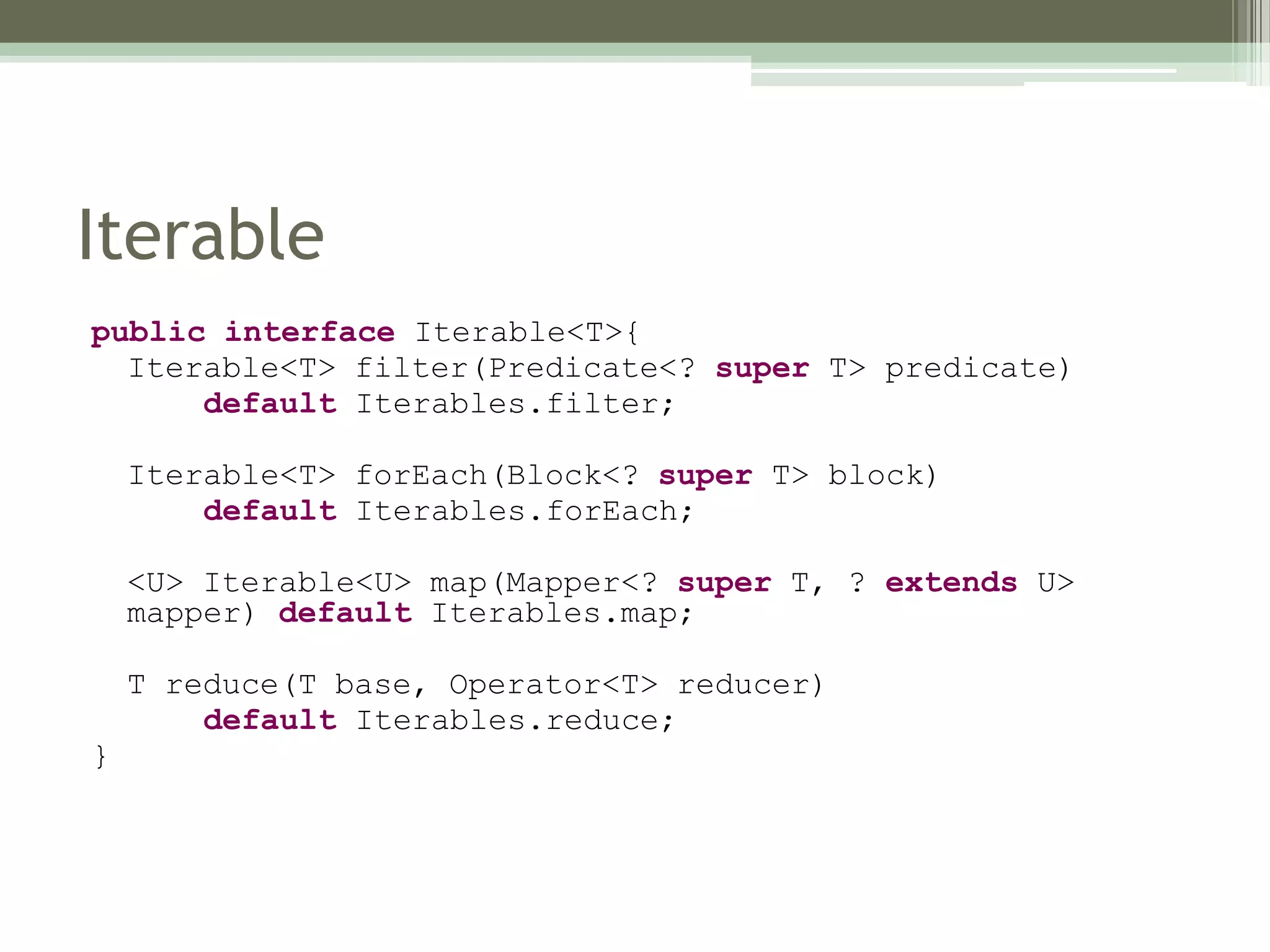
Iterable
public interface Iterable<T>{
  Iterable<T> filter(Predicate<? super T> predicate)
      default Iterables.filter;

    Iterable<T> forEach(Block<? super T> block)
        default Iterables.forEach;

    <U> Iterable<U> map(Mapper<? super T, ? extends U>
    mapper) default Iterables.map;

    T reduce(T base, Operator<T> reducer)
        default Iterables.reduce;
}
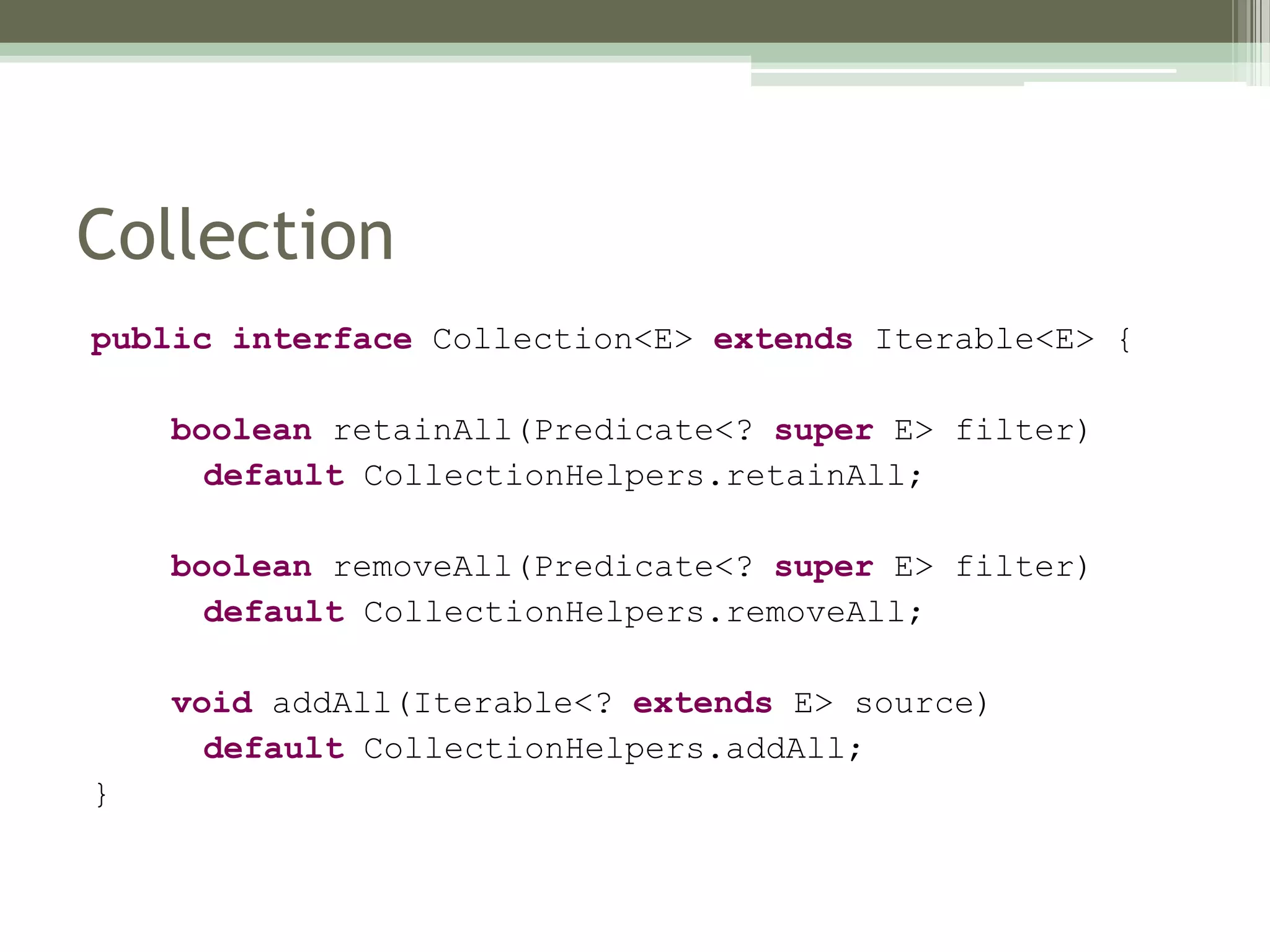
Collection
public interface Collection<E> extends Iterable<E> {

    boolean retainAll(Predicate<? super E> filter)
      default CollectionHelpers.retainAll;

    boolean removeAll(Predicate<? super E> filter)
      default CollectionHelpers.removeAll;

    void addAll(Iterable<? extends E> source)
      default CollectionHelpers.addAll;
}
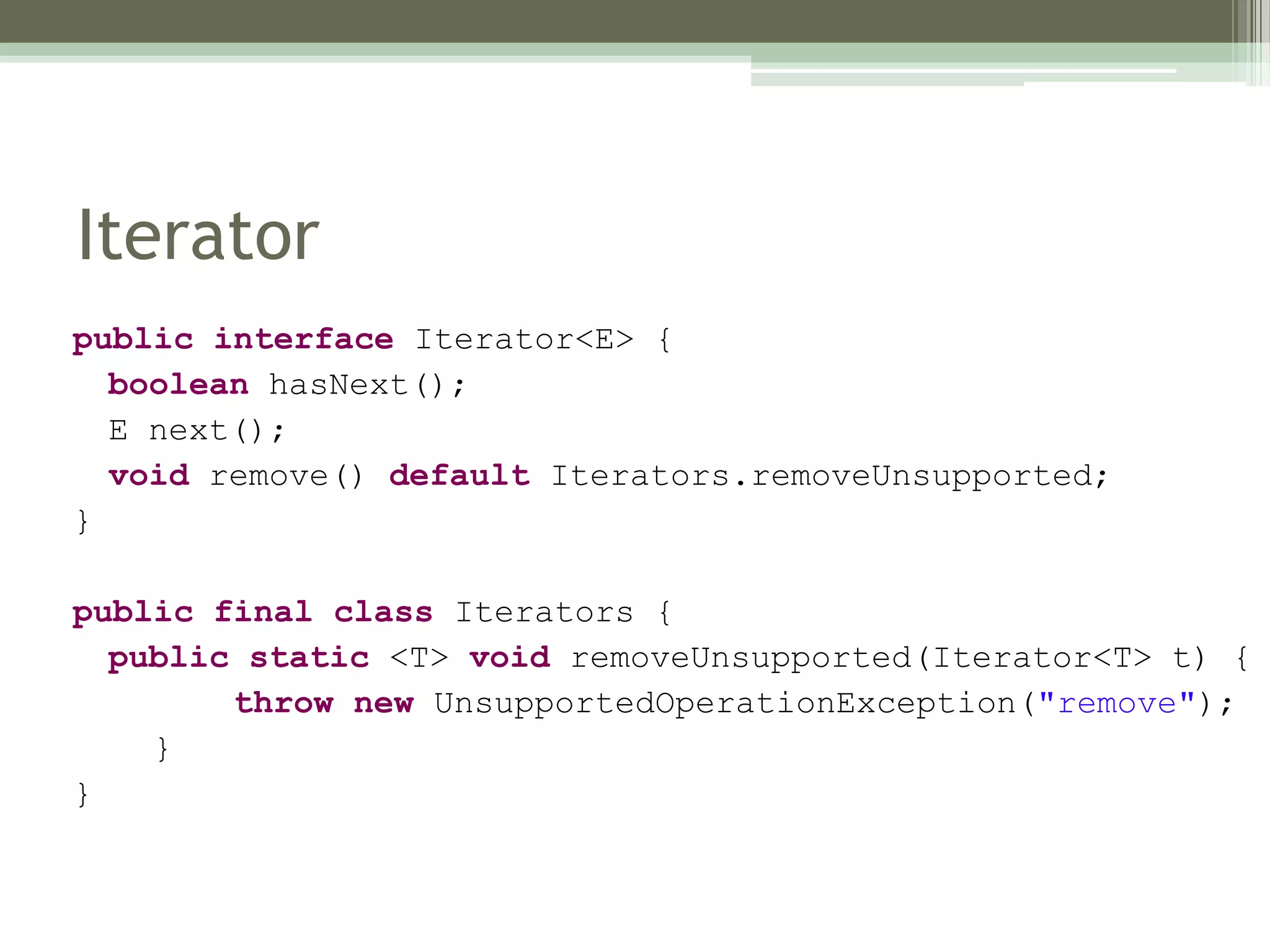
Iterator
public interface Iterator<E> {
  boolean hasNext();
  E next();
  void remove() default Iterators.removeUnsupported;
}

public final class Iterators {
  public static <T> void removeUnsupported(Iterator<T> t) {
        throw new UnsupportedOperationException("remove");
    }
}
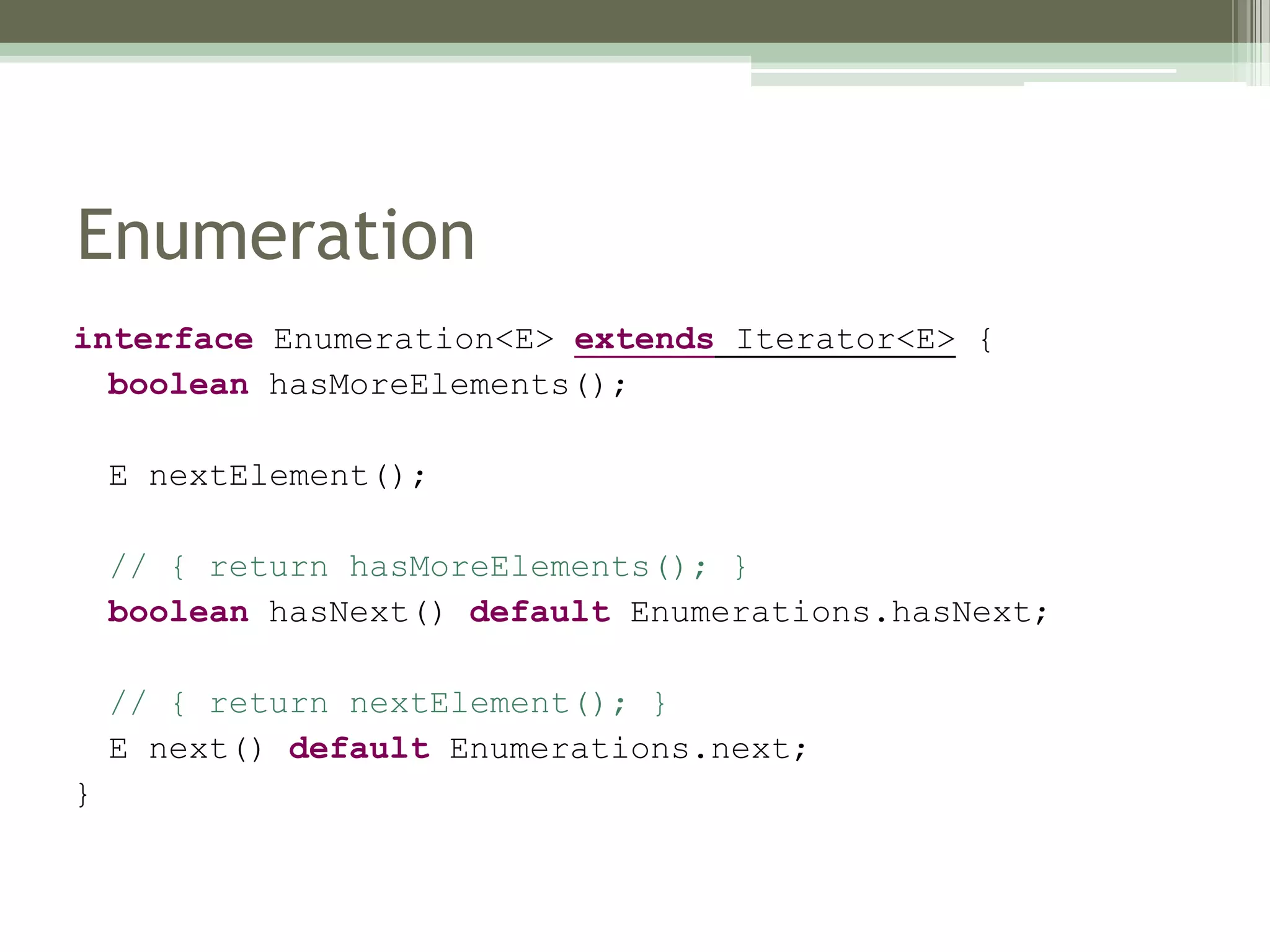
Enumeration
interface Enumeration<E> extends Iterator<E> {
  boolean hasMoreElements();

    E nextElement();

    // { return hasMoreElements(); }
    boolean hasNext() default Enumerations.hasNext;

    // { return nextElement(); }
    E next() default Enumerations.next;
}
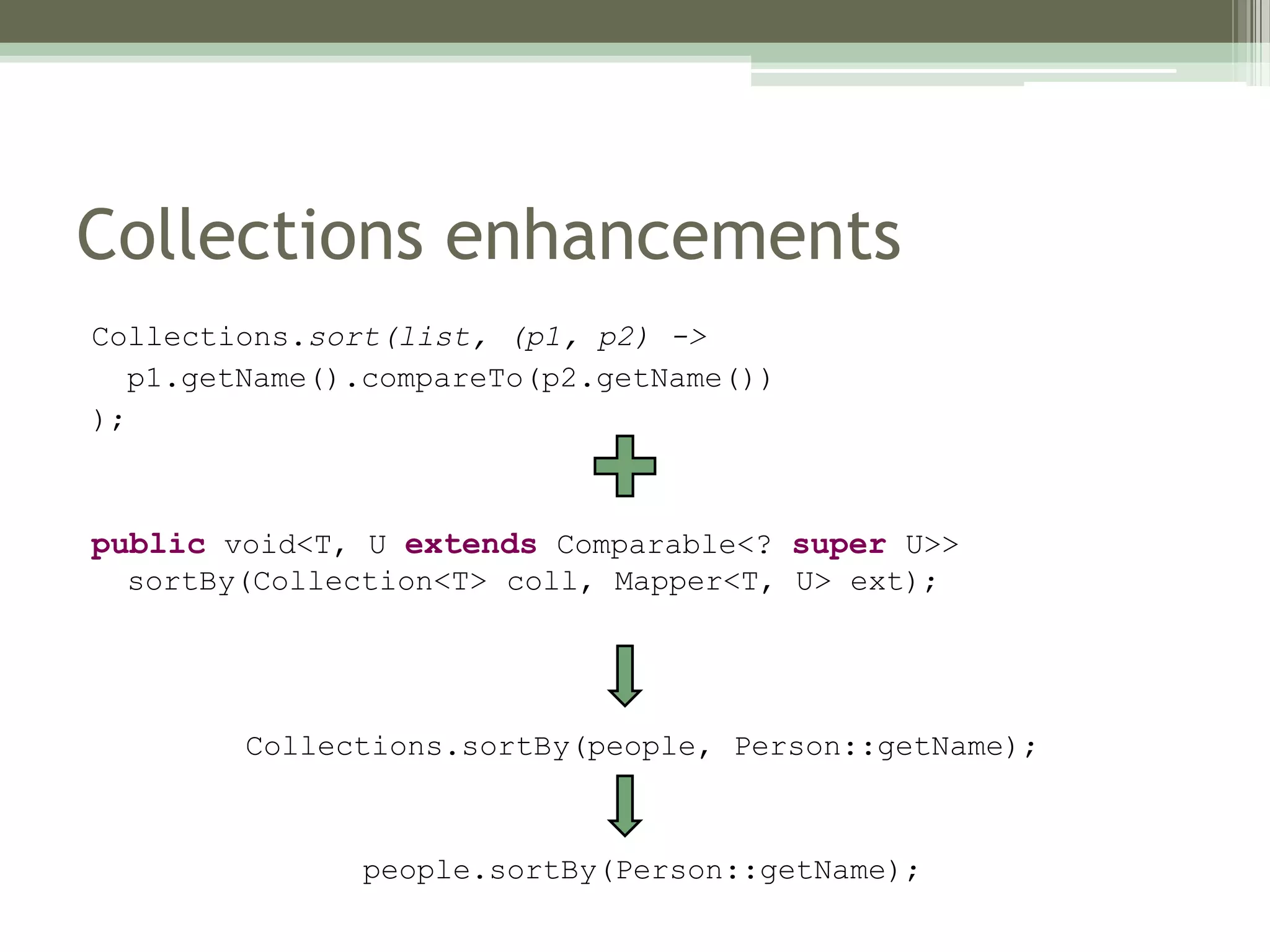
Collections enhancements
Collections.sort(list, (p1, p2) ->
  p1.getName().compareTo(p2.getName())
);


public void<T, U extends Comparable<? super U>>
 sortBy(Collection<T> coll, Mapper<T, U> ext);


        Collections.sortBy(people, Person::getName);


               people.sortBy(Person::getName);
Development status
• Started in december 2009
• Compiler implemented as part of an OpenJDK
• Early Draft Review recently published
 ▫ http://www.jcp.org/en/jsr/summary?id=335
• No VM support for extension methods yet
Resources
• Compiler prototype binaries available at:
  ▫ http://jdk8.java.net/lambda/
• State of the lambda document:
  ▫ http://cr.openjdk.java.net/~briangoetz/lambda/lambd
    a-state-3.html
• Extension methods draft:
  ▫ http://cr.openjdk.java.net/~briangoetz/lambda/Defend
    er%20Methods%20v3.pdf
• Extension methods weaving agent availbale at:
  ▫ hg.openjdk.java.net/lambda/defender-prototype/
Resources
• JDK Enchancement Proposals:
  ▫ http://openjdk.java.net/jeps/0
• Brian Goetz’s Oracle Blog
  ▫ http://blogs.oracle.com/briangoetz
• Neal Gafter’s blog (interesting for historical purposes)
  ▫ http://gafter.blogspot.com
• lambda-dev discussion list
  ▫ http://mail.openjdk.java.net/pipermail/lambda-dev

Java gets a closure

  • 1.
    Java gets aclosure Tomasz Kowalczewski
  • 2.
    Agenda • Lambdas and closures • Java syntax • Functional interfaces • Implementation notes • Defender methods and interface evolution • Library changes • Lambda related language changes
  • 3.
    Lambda expression • Firstclass function that closes over free variables in its lexical context. • Lambda exprssion is another name for an anonymous function e.g. function not bound to an identifier. • In Java it includes an optional list of type parameters, a list of formal parameters, and an expression or block expressed in terms of those parameters.
  • 4.
    Examples • Haskell: free variables x -> x + x x -> x * y • Scala: val isBelow = ( y : Int ) => y < threshold • C#: Predicate<string> p = it => it.Length < maxLength; • C++: [&count](int n){ return n * (++count); }
  • 5.
    Why we hateanonymous inner classes? • Java already has a form of closures - anonymous inner classes List<Person> list = new ArrayList<>(); Collections.sort(list, new Comparator<Person>() { @Override public int compare(Person p1, Person p2) { return p1.getName().compareTo(p2.getName()); } });
  • 6.
    Why we hateanonymous inner classes? • Bulky syntax • Inability to capture non-final local variables • Transparency issues surrounding the meaning of return, break, continue, and 'this' • No nonlocal control flow operators
  • 7.
    Will we lovelambda expressions? • Bulky syntax • Inability to capture non-final local variables • Transparency issues surrounding the meaning of return, break, continue, and 'this' • No nonlocal control flow operators
  • 8.
    Lambda syntax List<Person> list= new ArrayList<>(); Collections.sort(list, (p1, p2) -> p1.getName().compareTo(p2.getName()) ); List<Person> list = new ArrayList<>(); Collections.sort(list, new Comparator<Person>() { @Override public int compare(Person p1, Person p2) { return p1.getName().compareTo(p2.getName()); } });
  • 9.
    Lambda syntax LambdaExpression: TypeParametersopt LambdaParameters '->' LambdaBody (int i) -> { System.out.println(i+1); } (String s, int offset) -> { return s.charAt(offset) } <T> (T i) -> { }
  • 10.
    Lambda syntax LambdaExpression: TypeParametersopt LambdaParameters '->' LambdaBody LambdaParameters: Identifier '(' InferredFormalParameterList ')' '(' FormalParameterListopt ')‘ i -> { System.out.println(i+1); } (s, offset) -> { return s.charAt(offset) } () -> {}
  • 11.
    Lambda syntax LambdaExpression: TypeParametersopt LambdaParameters '->' LambdaBody LambdaBody: Expression Block (r) -> r *r *3.14 () -> System.out.println(i +1) (s, offset) -> s.charAt(offset) (s, offset) -> { return s.charAt(offset); }
  • 12.
    Invalid syntax examples •Either types/modifiers are infered or we need to specify all of them: (final x) -> {} (int x, y) -> 3.14 • Lambda body is either an expression (no brackets) or a block (brakcets and return statement needed): () -> { 3.14; } • Only unary lambda may omit parentheses: i, j -> i*j • There is no nilary syntax: -> "foo"
  • 13.
    What is thetype of a lambda? • There will be no function types in Java 8 • We need to define how lambdas interact with other parts of Java • We need ways to store, pass and execute them • We need to define how closure conversion is performed ▫ Greatly influences lambda flexibility e.g. referencing local mutalbe variables
  • 14.
    Functional interfaces • Previouslyknown as SAM interfaces ▫ SAM = Single Abstract Method • Interfaces that define one method ▫ Public methods defined by Object do not count interface Runnable { void run(); } interface Callable<T> { T call(); } interface Comparator<T> { int compare(T o1, T o2); boolean equals(Object obj); }
  • 15.
    Closure conversion • Lambdaexpresion is converted to an instance of a functional interface • It can appear in assignment, invocation and casting contexts • The type lambda is converted to is infered from the context ▫ Target typing • Parameter types of the lambda are also inferred
  • 16.
    Type inference interface Processor<T>{ void process(Context c, T item); } Processor<Integer> p = (Context c, Integer i) -> { ... }; Processor<Integer> p = (c, i) -> { ... };
  • 17.
    Local variable capture •Lambda expressions can refer to effectively final local variables from the enclosing scope int getAdultCount(List<Person> people, int threshold) { return Collections.filter(people, p -> p.getAge() > threshold).size(); } void registerNotifier(JButton button, JLabel label) { button.addActionListener(e -> label.setText("")); }
  • 18.
    Local variable capture •Cannot do this: int accumulatedExperience = 0; people.forEach(p -> accumulatedExperience += p.getEmploymentYears()); • Don’t even try this: /* final */ int[] accumulatedExperience = { 0 }; people.forEach(p -> accumulatedExperience[0] += p.getEmploymentYears()); • Try this: /* final */ AtomicInteger accumulatedExperience = new AtomicInteger(); people.forEach(p -> accumulatedExperience.addAndGet(p.getEmploymentYears())); • Best solution: people.reduce(0, (value, p) -> value +p.getEmploymentYears()); people.reduce(0, Math::add);
  • 19.
    Lexical scoping • Allidentifiers retain their meaning inside lambda expression • The meaning of this does not change. • Lambda formals cannot shadow variables from enclosing scope. • There is no non-local control flow
  • 20.
    Lexical scoping interface ConfigFilter{ String KEY = "configuration.source"; boolean matches(Properties properties); } class FileConfigurator { String VALUE = "file://"; public void configure(List<Properties> list) { configure(list, p -> p.getProperty(ConfigFilter.KEY).startsWith(VALUE)); } void configure(List<Properties> l, ConfigurationFilter f) { ... } }
  • 21.
    Lambda self reference •Definite assignment rules say when a variable is definitely assigned ▫ e.g. if it is a local variable it can be safely used • Definite uassignment say when a variable is definitely unassigned ▫ e.g. so that it can be assigned if it is final • Function fib = n -> { n == 0 ? 1 : n *fib.apply(n -1) };
  • 22.
    Method references • Methodreference is a shorthand for a lambda invoking just that method • Static methods simply translate like lambda with same arguments and return type: class Math { public static int max(int a, int b) { ... } } interface Operator<T> { T eval(T left, T right); } Operator<Integer> lambda = (a, b) -> Math.max(a, b); Operator<Integer> methodRef = Math::max;
  • 23.
    Method references class Reducer{ <T> static reduce(T base, Operator<T> op, T... items) { for(T item : items) { base = op.eval(base, item); } } } // result is 9 Reducer.reduce(0, Math::max, 1, 6, 9, 8); // result is 24 Reducer.reduce(0, Math::add, 1, 6, 8, 9);
  • 24.
    Method references • Nonstatic method reference of type T translates like lambda with an additional argument of type T: interface Mapper<T, U> { U map(T t); } Mapper<String, Integer> lambda = s -> s.length; Mapper<String, Integer> methodRef = String::length; int getMaxTenure(List<Pereson> people) { return Collections.mapreduce(people, Person::getEmploymentTime, 0, Math::max); }
  • 25.
    Method references • Instancemethod reference translates like lambda with same arguments and return type (and implicit receiver) Callable<Integer> lambda = () -> "test".length(); Callable<Integer> c = "test"::length;
  • 26.
    Method references ExecutorService exec= Executors.newFixedThreadPool(4); ServerSocket socket = new ServerSocket(); socket.bind(new InetSocketAddress(61000)); Callable<Socket> callable = socket::accept; Future<Socket> socket = exec.submit(callable); URL url = new URL("http://www.google.com"); URLConnection connection = url.openConnection(); Future<InputStream> s = exec.submit(url::openStream);
  • 27.
    Constructor references • Basicallysame as method references Callable<Person> p = Person::new; • Generic type constructor LinkedList<Integer>::new • Raw type constructor LinkedList::new • Generic constructor with type argument Foo::<Integer>new
  • 28.
    Constructor references MapMaker maker= new MapMaker(); ConcurrentMap<String, Integer> map; map = maker.<String, Integer> makeComputingMap(Integer#new);
  • 29.
    Exception transparency • Genericexceptions are cumbersome to use • Libraries either use interface with methods that throw Exception or throw nothing interface Runnable { } interface Callable<V> { V call() throws Exception } interface Callable<V, E extends Exception> { V call() throws E }
  • 30.
    Exception transparency interface Callable<V,throws E> { V call() throws E } class Executor { static <V, throws E> execute(Callable<V, E>) throws E; } Callable<Integer, IOException> c = ... Executor.execute(c); // Throws IOException Callable<Integer> d = ... Executor.execute(d); // Throws nothing Callable<Integer, ExecutionException, BadBreathException> e = ... Executor.execute(e); // Throws ExecutionException, BadBreathException
  • 31.
    Translation to innerclasses public class SimpleLambda { Runnable r = new Runnable() { public void run() { } }; } public class SimpleLambda { Runnable r = () -> {}; } • Compiling this source files will each time generate two classes: ▫ SimpleLambda.cass ▫ SimpleLambda$1.class • In both situations classes are almost identical
  • 32.
    Translation to methodhandles • Try compiling with option -XDlambdaToMethod • This will generate one class file. • It will contain additional elements: ▫ Static method called lambda$0 with compiled lambda body ▫ Bootstrap method that will call ProxyHelper to generate interface proxy ▫ Calls to Runnable.run() will be dispatched through MethodHandle ▫ InvokeDynamic instruction at instantiation callsite
  • 33.
  • 34.
    Extension methods • Programmingstyle would be different if Java had closures from day one • Different library designs, different collection classes • Adding closures without library support would be dissapointing • When interface is published it is effectively freezed – adding new methods will break existing implementations
  • 35.
    Extension methods • Wewould like to be able to write: list.sortBy(Person::getFirstName).filter(Person:: isEmployed).filter(p -> p.getAge() <30).forEach(System.out::println); students.map(s -> s.getScore()).reduce(0.0, Math::max);
  • 36.
    Static extension methods •In C# they enable adding methods to existing types without recompiling or creating a new type. • Special kind of static method, called as if it was an instance method on the extended type. • Use site extension – user is in control • Create illusion of adding a method • Not reflectively discoverable • No way to override
  • 37.
    Extension methods • Mechnism for interface evolution • Library developer is in control • Main use case: java collections • A.k.a. public defender methods: “if you cannot afford an implementation of this method, one will be provided for you”
  • 38.
    Virtual extension methods publicinterface List<E> extends Collections<E> { public void sort(Comparator<? super E> c) default Collections.<E>sort; } public class Collections { public static <T extends Comparable<? super T>> void sort(List<T> list) { ... } } List<Person> jddAtendee = ... jddAtendee.sort(...);
  • 39.
    Virtual extension methods • Compiled to regular invokeinterface call • Caller is unaware of special call dispatch • Target method is resolved by JVM at runtime • Adds multiple inheritance of behavior not state! • Changes are (mostly) soruce and binary compatible
  • 40.
    Method resolution • Inheritanceof methods from classes and interfaces is treated separately • First JVM performs standard method implementation search – from the receiver class upwards through inheritance hierarchy to Object
  • 41.
    Method resolution Which method is called? interface List void foo() default Collections.foo; new C().foo(); class D implements List void foo() { ... } class C extends D implements List
  • 42.
    Method resolution • Listinterfaces implemented by C (directly or indirectly) which provide a default for the method in question • Remove all items that are superinterface of any other one from this list • Create a set of distinct defaults provided by interfaces on the list • Resolution is succesful if this set has a single item • Throw a linkage exception otherwise
  • 43.
    Method resolution Which method is called? interface Collection void foo() default Collections.foo; new C().foo(); interface List implements class C extends D Collection implements Collection void foo() default Lists.foo; class D implements List
  • 44.
    Method resolution interface Collection void foo() default Collections.foo; interface List implements interface Queue implements Collection Collection class LinkedList implements List, Queue • When using this method resolution rules diamonds are not a problem (there is no state inheritance!)
  • 45.
    Manual method disambiguation •Compile time disambiguation of conflicting defaults is done using new syntax: A.super.method() interface A { void foo() default As.foo; } interface B { void foo() default Bs.foo; } class C implements A, B { public void foo() { A.super.foo(); } }
  • 46.
    Source and binarycompatibility Operation Source Compatible Binary Compatible Add default to a method yes yes Remove default from a no no method Add new method with yes yes* default Remove a method with no no default Modify the default yes yes * As long as adding the method itself does not create an invalid overloading
  • 47.
  • 48.
    Collection enhancements public interfacePredicate<T> { boolean eval(T t); } public interface Block<T> { void apply(T t); } public interface Mapper<T, U> { U map(T t); }
  • 49.
    Iterable public interface Iterable<T>{ Iterable<T> filter(Predicate<? super T> predicate) default Iterables.filter; Iterable<T> forEach(Block<? super T> block) default Iterables.forEach; <U> Iterable<U> map(Mapper<? super T, ? extends U> mapper) default Iterables.map; T reduce(T base, Operator<T> reducer) default Iterables.reduce; }
  • 50.
    Collection public interface Collection<E>extends Iterable<E> { boolean retainAll(Predicate<? super E> filter) default CollectionHelpers.retainAll; boolean removeAll(Predicate<? super E> filter) default CollectionHelpers.removeAll; void addAll(Iterable<? extends E> source) default CollectionHelpers.addAll; }
  • 51.
    Iterator public interface Iterator<E>{ boolean hasNext(); E next(); void remove() default Iterators.removeUnsupported; } public final class Iterators { public static <T> void removeUnsupported(Iterator<T> t) { throw new UnsupportedOperationException("remove"); } }
  • 52.
    Enumeration interface Enumeration<E> extendsIterator<E> { boolean hasMoreElements(); E nextElement(); // { return hasMoreElements(); } boolean hasNext() default Enumerations.hasNext; // { return nextElement(); } E next() default Enumerations.next; }
  • 53.
    Collections enhancements Collections.sort(list, (p1,p2) -> p1.getName().compareTo(p2.getName()) ); public void<T, U extends Comparable<? super U>> sortBy(Collection<T> coll, Mapper<T, U> ext); Collections.sortBy(people, Person::getName); people.sortBy(Person::getName);
  • 54.
    Development status • Startedin december 2009 • Compiler implemented as part of an OpenJDK • Early Draft Review recently published ▫ http://www.jcp.org/en/jsr/summary?id=335 • No VM support for extension methods yet
  • 55.
    Resources • Compiler prototypebinaries available at: ▫ http://jdk8.java.net/lambda/ • State of the lambda document: ▫ http://cr.openjdk.java.net/~briangoetz/lambda/lambd a-state-3.html • Extension methods draft: ▫ http://cr.openjdk.java.net/~briangoetz/lambda/Defend er%20Methods%20v3.pdf • Extension methods weaving agent availbale at: ▫ hg.openjdk.java.net/lambda/defender-prototype/
  • 56.
    Resources • JDK EnchancementProposals: ▫ http://openjdk.java.net/jeps/0 • Brian Goetz’s Oracle Blog ▫ http://blogs.oracle.com/briangoetz • Neal Gafter’s blog (interesting for historical purposes) ▫ http://gafter.blogspot.com • lambda-dev discussion list ▫ http://mail.openjdk.java.net/pipermail/lambda-dev

Editor's Notes

  • #13 It would be ambiguous with a cast (is this a lambda with on argument or cast of a nilary lambda to x?):(x)-&gt;{ 3.14; }
  • #16 Closure is a function together with referencing environment for the free variables of that function.
  • #18 Promotes side effect free programming modelNo wunderbars
  • #23 interface Converter { int convert(String s); }classInteger { publicstaticString toString(inti) { ... }}Converter lambda = i -&gt; Integer.toString(i);Converter methodRef = Integer::toString;