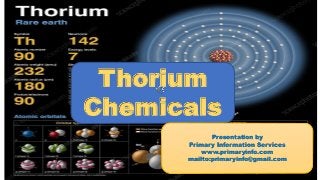
Thorium
Chemicals
Presentation by
Primary Information Services
www.primaryinfo.com
mailto:primaryinfo@gmail.com
Thorium
Thorium resources are found
throughout the world, most
notably in Australia, Brazil,
India, and the United States.
India has the largest
resources (850,000 tons),
followed by Brazil (630,000
tons) and Australia and the
United States (600,000 tons
each).
Thorium’s use in
most products
was generally
limited because
of concerns
over its naturally
occurring
radioactivity
The world’s
primary source of
thorium is the rare-
earth and thorium
phosphate mineral
monazite.
Commercial uses of thorium include catalysts,
high-temperature ceramics, magnetrons in
microwave ovens, metal-halide lamps, nuclear
medicine, optical coatings, tungsten filaments,
and welding electrodes.
• Thorium is used to
make ceramics, lantern
mantles, welding rods,
camera and telescope lenses,
and metals used in the
aerospace industry.
• Thorium is more abundant in
nature than uranium.
• It is fertile rather than fissile, and
can only be used as a fuel in
conjunction with a fissile
material such as recycled
plutonium.
• Thorium fuels can breed fissile
uranium-233 to be used in
various kinds of nuclear
reactors.
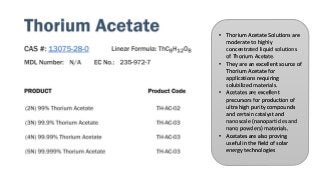
• Thorium Acetate Solutions are
moderate to highly
concentrated liquid solutions
of Thorium Acetate.
• They are an excellent source of
Thorium Acetate for
applications requiring
solubilized materials.
• Acetates are excellent
precursors for production of
ultra high purity compounds
and certain catalyst and
nanoscale (nanoparticles and
nano powders) materials.
• Acetates are also proving
useful in the field of solar
energy technologies
Thorium Bromide, ThBr4
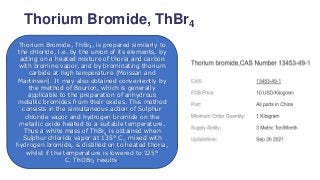
Thorium Bromide, ThBr4, is prepared similarly to
the chloride, i.e. by the union of its elements, by
acting on a heated mixture of thoria and carbon
with bromine vapor, and by brominating thorium
carbide at high temperature (Moissan and
Martinsen). It may also obtained conveniently by
the method of Bourion, which is generally
applicable to the preparation of anhydrous
metallic bromides from their oxides. This method
consists in the simultaneous action of Sulphur
chloride vapor and hydrogen bromide on the
metallic oxide heated to a suitable temperature.
Thus a white mass of ThBr4 is obtained when
Sulphur chloride vapor at 135° C., mixed with
hydrogen bromide, is distilled on to heated thoria,
whilst if the temperature is lowered to 125°
C. ThOBr2 results.
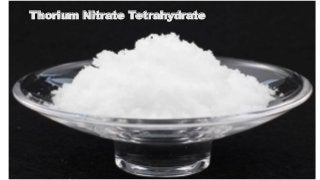
Thorium Nitrate Tetrahydrate
Thorium chemicals
Thorium chemicals

Thorium chemicals

  • 1.
    Thorium Chemicals Presentation by Primary InformationServices www.primaryinfo.com mailto:primaryinfo@gmail.com
  • 2.
    Thorium Thorium resources arefound throughout the world, most notably in Australia, Brazil, India, and the United States. India has the largest resources (850,000 tons), followed by Brazil (630,000 tons) and Australia and the United States (600,000 tons each). Thorium’s use in most products was generally limited because of concerns over its naturally occurring radioactivity The world’s primary source of thorium is the rare- earth and thorium phosphate mineral monazite. Commercial uses of thorium include catalysts, high-temperature ceramics, magnetrons in microwave ovens, metal-halide lamps, nuclear medicine, optical coatings, tungsten filaments, and welding electrodes.
  • 3.
    • Thorium isused to make ceramics, lantern mantles, welding rods, camera and telescope lenses, and metals used in the aerospace industry. • Thorium is more abundant in nature than uranium. • It is fertile rather than fissile, and can only be used as a fuel in conjunction with a fissile material such as recycled plutonium. • Thorium fuels can breed fissile uranium-233 to be used in various kinds of nuclear reactors.
  • 5.
    • Thorium AcetateSolutions are moderate to highly concentrated liquid solutions of Thorium Acetate. • They are an excellent source of Thorium Acetate for applications requiring solubilized materials. • Acetates are excellent precursors for production of ultra high purity compounds and certain catalyst and nanoscale (nanoparticles and nano powders) materials. • Acetates are also proving useful in the field of solar energy technologies
  • 6.
    Thorium Bromide, ThBr4 ThoriumBromide, ThBr4, is prepared similarly to the chloride, i.e. by the union of its elements, by acting on a heated mixture of thoria and carbon with bromine vapor, and by brominating thorium carbide at high temperature (Moissan and Martinsen). It may also obtained conveniently by the method of Bourion, which is generally applicable to the preparation of anhydrous metallic bromides from their oxides. This method consists in the simultaneous action of Sulphur chloride vapor and hydrogen bromide on the metallic oxide heated to a suitable temperature. Thus a white mass of ThBr4 is obtained when Sulphur chloride vapor at 135° C., mixed with hydrogen bromide, is distilled on to heated thoria, whilst if the temperature is lowered to 125° C. ThOBr2 results.
  • 10.