Project Brief
Optical brighteners, optical brightening agents (OBAs),
fluorescent brightening agents (FBAs), or fluorescent whitening
agents (FWAs), are chemical compounds that absorb light in
the ultraviolet and violet region (usually 340-370 nm) of the
electromagnetic spectrum, and re-emit light in the blue region
(typically 420-470 nm) by fluorescence.
Names Raw Materials
required
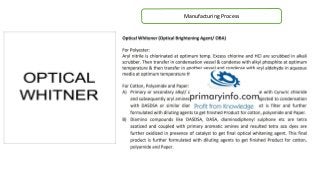
Manufacturing Process
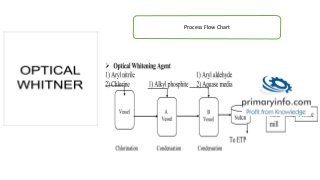
Process Flow Chart
How are optical brighteners used in
the plastics industry?
Optical brighteners are often used in
conjunction with other colorants to achieve
the specific shade as required by the
application. Brighteners have high melting
point and show good dissolution in molten
plastics. Bis-benzoxazolyl-stilbene and bis-
benzoxazolyl-thiophene are the two
common optical brighteners used in
plastics industry.
What kind of light absorbs
an optical brightener?
Optical brighteners, optical brightening
agents (OBAs), fluorescent brightening
agents (FBAs), or fluorescent whitening
agents (FWAs) are dyes that absorb
light in the UV and violet region (usually
340–370 nm) of the electromagnetic
spectrum, and reemit light in the blue
region (typically 420–470 nm).
Market Scenario
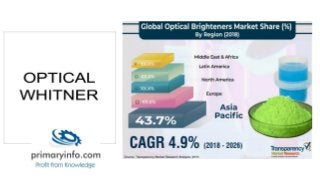
• The Global Optical Whitening Agent Market is projected
to grow at a CAGR of 5.6% during the forecast period of
2021-2027.
• Key Players:
BASF, RPM International, Huntsman, Clariant, Keystone
Aniline, Brilliant Group, Aron Universal, 3V, TEH Fong Min
International, AR Chroma and others.
• Based on product type, the Optical Whitening Agent
market is segmented as follow:
Stilbene Type, Coumarin Type, Pyrazoline Type
O-phthalimide Type, Benzene Nitrogen and Oxygen Type
• Based on application. The Optical Whitening Agent
market is segmented as follow:
Paper, Fabrics, Detergents & Soaps
Synthetics & Plastics, Other

Optical whitener

  • 2.
    Project Brief Optical brighteners,optical brightening agents (OBAs), fluorescent brightening agents (FBAs), or fluorescent whitening agents (FWAs), are chemical compounds that absorb light in the ultraviolet and violet region (usually 340-370 nm) of the electromagnetic spectrum, and re-emit light in the blue region (typically 420-470 nm) by fluorescence.
  • 3.
  • 4.
  • 5.
  • 8.
    How are opticalbrighteners used in the plastics industry? Optical brighteners are often used in conjunction with other colorants to achieve the specific shade as required by the application. Brighteners have high melting point and show good dissolution in molten plastics. Bis-benzoxazolyl-stilbene and bis- benzoxazolyl-thiophene are the two common optical brighteners used in plastics industry.
  • 9.
    What kind oflight absorbs an optical brightener? Optical brighteners, optical brightening agents (OBAs), fluorescent brightening agents (FBAs), or fluorescent whitening agents (FWAs) are dyes that absorb light in the UV and violet region (usually 340–370 nm) of the electromagnetic spectrum, and reemit light in the blue region (typically 420–470 nm).
  • 12.
    Market Scenario • TheGlobal Optical Whitening Agent Market is projected to grow at a CAGR of 5.6% during the forecast period of 2021-2027. • Key Players: BASF, RPM International, Huntsman, Clariant, Keystone Aniline, Brilliant Group, Aron Universal, 3V, TEH Fong Min International, AR Chroma and others. • Based on product type, the Optical Whitening Agent market is segmented as follow: Stilbene Type, Coumarin Type, Pyrazoline Type O-phthalimide Type, Benzene Nitrogen and Oxygen Type • Based on application. The Optical Whitening Agent market is segmented as follow: Paper, Fabrics, Detergents & Soaps Synthetics & Plastics, Other