MOOCS Tutorials #1
Course Name: B.Sc.(Economics Hons.) Semester: One
Session: 2018-19
Paper- ECO-A-CC-1-1-TH
Introductory Microeconomics
Heramba Chandra College
University of Calcutta
Dr. Subir Maitra
MOOCS by Dr. Subir Maitra, Associate Professor of Economics, HCC, Guest Faculty, Department of Commerce, University of Calcutta, subirmaitra.wixsite.com/moocs 1
Question 1: State whether the following are primarily microeconomic or
macroeconomic policy issues.
a. Should interest rates in India be lowered to decrease the amount of
unemployment?
b. Will the fact that more and more doctors are selling their practices to
private hospitals increase the efficiency of medical providers?
c. Should the current income tax be lowered to reduce unemployment?
d. Should the minimum wage be raised?
e. Should Airtel and Vodafone both be allowed to build local phone
networks?
f. Should commercial banks be required to provide loans in all areas of
the territory from which they accept deposits?
Question 2: Consider the following concepts.
Need
Want
Desire
Differentiate among the concepts with two examples each. You may watch
this video on Youtube before you start thinking:
https://www.youtube.com/watch?v=g-pzlT08kQw
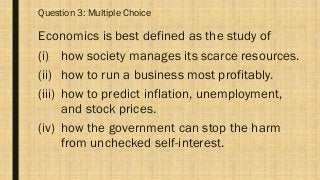
Question 3: Multiple Choice
Economics is best defined as the study of
(i) how society manages its scarce resources.
(ii) how to run a business most profitably.
(iii) how to predict inflation, unemployment,
and stock prices.
(iv) how the government can stop the harm
from unchecked self-interest.
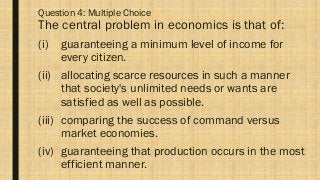
Question 4: Multiple Choice
The central problem in economics is that of:
(i) guaranteeing a minimum level of income for
every citizen.
(ii) allocating scarce resources in such a manner
that society's unlimited needs or wants are
satisfied as well as possible.
(iii) comparing the success of command versus
market economies.
(iv) guaranteeing that production occurs in the most
efficient manner.
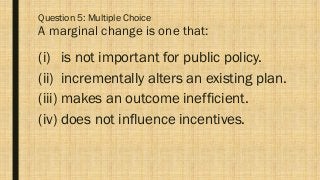
Question 5: Multiple Choice
A marginal change is one that:
(i) is not important for public policy.
(ii) incrementally alters an existing plan.
(iii) makes an outcome inefficient.
(iv) does not influence incentives.
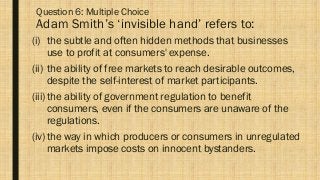
Question 6: Multiple Choice
Adam Smith’s ‘invisible hand’ refers to:
(i) the subtle and often hidden methods that businesses
use to profit at consumers' expense.
(ii) the ability of free markets to reach desirable outcomes,
despite the self-interest of market participants.
(iii)the ability of government regulation to benefit
consumers, even if the consumers are unaware of the
regulations.
(iv)the way in which producers or consumers in unregulated
markets impose costs on innocent bystanders.
Question 7: Presentation (Current Economic Affairs)
Falling price is normally welcomed in a market
economy.
But falling price of rupee over the last few
months is being considered as bad news.
Prepare your brief presentation (10 minutes/5
slides) on the theme: ‘Should India worry at the
falling price of rupee?’
Read more for preparing your presentation:
https://www.businesstoday.in/current/economy-politics/rupee-vs-dollar-67-mark-usd-crude-oil-prices-indian-rs-
value/story/276422.html
https://www.livemint.com/Money/A6wwE3YgadzSyYdflzxtRL/Five-ways-in-which-a-falling-rupee-affects-you.html
https://www.livemint.com/Money/BSfOxh5a4ZBO0poSyVsvCK/How-a-low-rupee-impacts-India-and-India-Inc.html
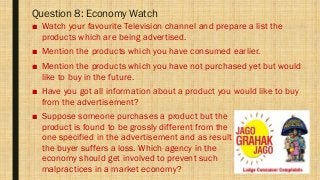
Question 8: Economy Watch
■ Watch your favourite Television channel and prepare a list the
products which are being advertised.
■ Mention the products which you have consumed earlier.
■ Mention the products which you have not purchased yet but would
like to buy in the future.
■ Have you got all information about a product you would like to buy
from the advertisement?
■ Suppose someone purchases a product but the
product is found to be grossly different from the
one specified in the advertisement and as result
the buyer suffers a loss. Which agency in the
economy should get involved to prevent such
malpractices in a market economy?
END of Tutorial #1

B.Sc Economics(Honours) Paper C-1, Tutorial #1

  • 1.
    MOOCS Tutorials #1 CourseName: B.Sc.(Economics Hons.) Semester: One Session: 2018-19 Paper- ECO-A-CC-1-1-TH Introductory Microeconomics Heramba Chandra College University of Calcutta Dr. Subir Maitra MOOCS by Dr. Subir Maitra, Associate Professor of Economics, HCC, Guest Faculty, Department of Commerce, University of Calcutta, subirmaitra.wixsite.com/moocs 1
  • 2.
    Question 1: Statewhether the following are primarily microeconomic or macroeconomic policy issues. a. Should interest rates in India be lowered to decrease the amount of unemployment? b. Will the fact that more and more doctors are selling their practices to private hospitals increase the efficiency of medical providers? c. Should the current income tax be lowered to reduce unemployment? d. Should the minimum wage be raised? e. Should Airtel and Vodafone both be allowed to build local phone networks? f. Should commercial banks be required to provide loans in all areas of the territory from which they accept deposits?
  • 3.
    Question 2: Considerthe following concepts. Need Want Desire Differentiate among the concepts with two examples each. You may watch this video on Youtube before you start thinking: https://www.youtube.com/watch?v=g-pzlT08kQw
  • 4.
    Question 3: MultipleChoice Economics is best defined as the study of (i) how society manages its scarce resources. (ii) how to run a business most profitably. (iii) how to predict inflation, unemployment, and stock prices. (iv) how the government can stop the harm from unchecked self-interest.
  • 5.
    Question 4: MultipleChoice The central problem in economics is that of: (i) guaranteeing a minimum level of income for every citizen. (ii) allocating scarce resources in such a manner that society's unlimited needs or wants are satisfied as well as possible. (iii) comparing the success of command versus market economies. (iv) guaranteeing that production occurs in the most efficient manner.
  • 6.
    Question 5: MultipleChoice A marginal change is one that: (i) is not important for public policy. (ii) incrementally alters an existing plan. (iii) makes an outcome inefficient. (iv) does not influence incentives.
  • 7.
    Question 6: MultipleChoice Adam Smith’s ‘invisible hand’ refers to: (i) the subtle and often hidden methods that businesses use to profit at consumers' expense. (ii) the ability of free markets to reach desirable outcomes, despite the self-interest of market participants. (iii)the ability of government regulation to benefit consumers, even if the consumers are unaware of the regulations. (iv)the way in which producers or consumers in unregulated markets impose costs on innocent bystanders.
  • 8.
    Question 7: Presentation(Current Economic Affairs) Falling price is normally welcomed in a market economy. But falling price of rupee over the last few months is being considered as bad news. Prepare your brief presentation (10 minutes/5 slides) on the theme: ‘Should India worry at the falling price of rupee?’ Read more for preparing your presentation: https://www.businesstoday.in/current/economy-politics/rupee-vs-dollar-67-mark-usd-crude-oil-prices-indian-rs- value/story/276422.html https://www.livemint.com/Money/A6wwE3YgadzSyYdflzxtRL/Five-ways-in-which-a-falling-rupee-affects-you.html https://www.livemint.com/Money/BSfOxh5a4ZBO0poSyVsvCK/How-a-low-rupee-impacts-India-and-India-Inc.html
  • 9.
    Question 8: EconomyWatch ■ Watch your favourite Television channel and prepare a list the products which are being advertised. ■ Mention the products which you have consumed earlier. ■ Mention the products which you have not purchased yet but would like to buy in the future. ■ Have you got all information about a product you would like to buy from the advertisement? ■ Suppose someone purchases a product but the product is found to be grossly different from the one specified in the advertisement and as result the buyer suffers a loss. Which agency in the economy should get involved to prevent such malpractices in a market economy?
  • 10.