Finding	the	worst	tested	methods	
in	a	test	suite
Oscar	L.	Vera	
DiverSE	–	Inria	Rennes	
Mutation	Testing	Workshop	
April	12th,	2019
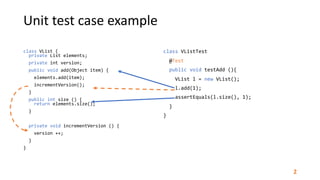
Unit	test	case	example
class	VList	{

		private	List	elements;		
		private	int	version;	
		public	void	add(Object	item)	{		
				elements.add(item);	
				incrementVersion();		
		}	
		public	int	size	()	{

				return	elements.size();		
		}		
			
		private	void	incrementVersion	()	{		
				version	++;		
		}		
}		
class	VListTest		
		@Test		
		public	void	testAdd	(){	
				VList	l	=	new	VList();	
				l.add(1);	
				assertEquals(l.size(),	1);	
		}	
}
2
Developers
• Do	our	tests	assess	the	behavior	of	the	program?	
• Concrete	improvements
3
Introduced	in	2016	
R.	Niedermayr,	E.	Juergens,	and	S.	Wagner	
Will	my	tests	tell	me	if	I	break	this	code?		
Proceedings	of	the	International	Workshop	on	Continuous	Software	Evolution	and	Delivery,	2016,	pp.	23–29.	
Pseudo-tested	methods
4
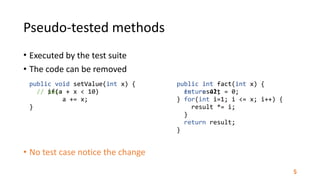
• Executed	by	the	test	suite	
• The	code	can	be	removed	
• No	test	case	notice	the	change
public	void	setValue(int	x)	{	
		//	pass						
}
public	void	setValue(int	x)	{	
					if(a	+	x	<	10)							
									a	+=	x;	
}
public	int	fact(int	x)	{	
		int	result	=	0;			
		for(int	i=1;	i	<=	x;	i++)	{	
				result	*=	i;	
		}	
		return	result;	
}
public	int	fact(int	x)	{	
		return	42;	
}
Pseudo-tested	methods
5
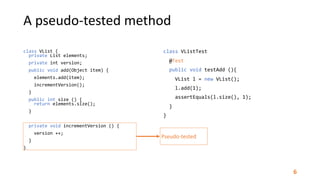
A	pseudo-tested	method
class	VList	{

		private	List	elements;		
		private	int	version;	
		public	void	add(Object	item)	{		
				elements.add(item);	
				incrementVersion();		
		}	
		public	int	size	()	{

				return	elements.size();		
		}		
			
		private	void	incrementVersion	()	{		
				version	++;		
		}		
}		
class	VListTest		
		@Test		
		public	void	testAdd	(){	
				VList	l	=	new	VList();	
				l.add(1);	
				assertEquals(l.size(),	1);	
		}	
}
Pseudo-tested
6
Can	pseudo-tested	methods	provide	concrete	hints	to	
improve	a	test	suite?
7
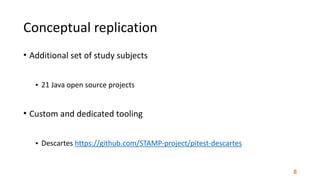
Conceptual	replication
• Additional	set	of	study	subjects	
• 21	Java	open	source	projects	
• Custom	and	dedicated	tooling	
• Descartes	https://github.com/STAMP-project/pitest-descartes
8
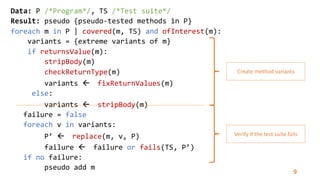
Data:	P	/*Program*/,	TS	/*Test	suite*/	
Result:	pseudo	{pseudo-tested	methods	in	P}	
foreach	m	in	P	|	covered(m,	TS)	and	ofInterest(m):	
				variants	=	{extreme	variants	of	m}	
				if	returnsValue(m):	
								stripBody(m)	
								checkReturnType(m)	
								variants	! fixReturnValues(m)	
					else:	
								variants	! stripBody(m)	
			failure	=	false	
			foreach	v	in	variants:	
								P’	! replace(m,	v,	P)	
								failure	! failure	or	fails(TS,	P’)	
			if	no	failure:	
								pseudo	add	m
Create	method	variants
Verify	if	the	test	suite	fails
9
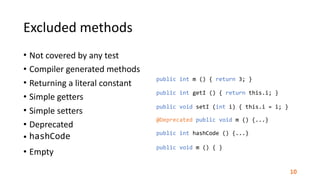
Excluded	methods
• Not	covered	by	any	test	
• Compiler	generated	methods	
• Returning	a	literal	constant	
• Simple	getters	
• Simple	setters	
• Deprecated	
• hashCode	
• Empty
10
public	int	m	()	{	return	3;	}
public	int	getI	()	{	return	this.i;	}
public	void	setI	(int	i)	{	this.i	=	i;	}
public	void	m	()	{	}
@Deprecated	public	void	m	()	{...}
public	int	hashCode	()	{...}
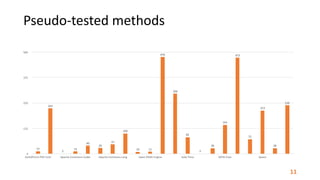
Pseudo-tested	methods
0
125
250
375
500
AuthZForce	PDP	Core										 Apache	Commons	Codec									 Apache	Commons	Lang										 Jaxen	XPath	Engine											 Joda-Time																				 SAT4J	Core																			 Spoon																								
239
28
213
72
473
143
28
2
82
296
476
1110
100
47
29
40
12
2
224
13
11
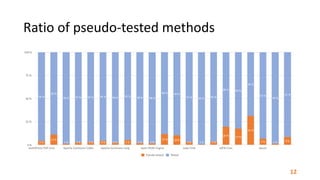
Ratio	of	pseudo-tested	methods
12
0	%
25	%
50	%
75	%
100	%
AuthZForce	PDP	Core										 Apache	Commons	Codec									 Apache	Commons	Lang										 Jaxen	XPath	Engine											 Joda-Time																				 SAT4J	Core																			 Spoon																								
91	%
99	%
93	%
69	%
83	%80	%
96	%99	%97	%
90	%88	%
98	%98	%95	%98	%96	%97	%97	%99	%
89	%
96	%
9	%1	%7	%
31	%
17	%20	%
4	%1	%3	%
10	%12	%
2	%2	%5	%2	%4	%3	%3	%1	%
11	%
4	%
Pseudo-tested Tested
Real-life	examples
Apache	Commons	Codec
public	void	testIsEncodeEquals()	{		
		final	String[][]	data	=	{	
				{"Meyer",	"Mu00fcller"},		
				{"Meyer",	"Mayr"},	
				...	
				{"Miyagi",	"Miyako"}	
		};	
		for	(final	String[]	element	:	data)	{		
				final	boolean	encodeEqual	=		
						this.getStringEncoder().isEncodeEqual(element[1],	element[0]);		
		}		
}	
No	assertion
Pseudo-tested
14
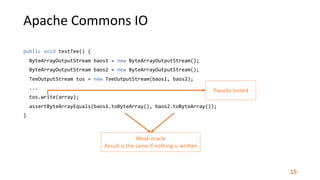
Apache	Commons	IO
Weak	oracle	
Result	is	the	same	if	nothing	is	written
Pseudo-tested
public	void	testTee()	{		
		ByteArrayOutputStream	baos1	=	new	ByteArrayOutputStream();	
		ByteArrayOutputStream	baos2	=	new	ByteArrayOutputStream();	
		TeeOutputStream	tos	=	new	TeeOutputStream(baos1,	baos2);		
		...		
		tos.write(array);		
		assertByteArrayEquals(baos1.toByteArray(),	baos2.toByteArray());	
}	
15
Apache	Commons	Collection
abstract	class	AbstractHashedMap<K,	V>	{	
		protected	void	ensureCapacity(final	int	newCapacity)	{	
				final	int	oldCapacity	=	data.length;	
				if	(newCapacity	<=	oldCapacity)	{	
						return;	
				}	
				if	(size	==	0)	{	
						threshold	=	calculateThreshold(newCapacity,	loadFactor);	
						data	=	new	HashEntry[newCapacity];	
				}		
				else	{	
					//Rehash	code	
					...	
					threshold	=	calculateThreshold(newCapacity,	loadFactor);	
					data	=	newEntries;	
				}	
		}	
...	
}	
Covered	by	38	test	cases
Executed	11593	times
16
Pseudo-tested
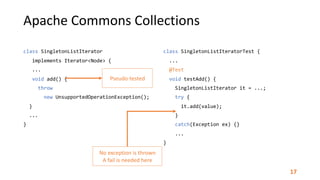
Apache	Commons	Collections
class	SingletonListIterator		
			implements	Iterator<Node>	{	
			...	
			void	add()	{	
					throw		
							new	UnsupportedOperationException();	
		}	
		...	
}	
class	SingletonListIteratorTest	{	
		...	
		@Test	
		void	testAdd()	{	
				SingletonListIterator	it	=	...;	
				try	{	
						it.add(value);		
				}		
				catch(Exception	ex)	{}	
				...	
}	
No	exception	is	thrown	
A	fail	is	needed	here
Pseudo-tested
17
Amazon	Web	Services	SDK
class	SdkTLSSocketFactory	{	
		protected	void	prepareSocket(SSLSocket	s){	
				...	
				s.setEnabledProtocols(protocols);	
				...	
		}	
}
@Test	
void	typical()	{	
		SdkTLSSocketFactory	f	=	...;	
		f.prepareSocket(new	TestSSLSocket()	{	
				@Override	
				public	void	setEnabledProtocols	
						(String[]	protocols)	{	
						assertTrue(	
								Arrays.equals(protocols,	expected));	
				}	
				...	
		});	
}	
Pseudo-tested
No	assertion	is	verified	if	
the	method	is	emptied
18
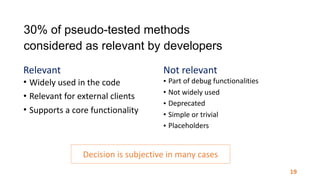
Relevant
• Widely	used	in	the	code	
• Relevant	for	external	clients	
• Supports	a	core	functionality	
Not	relevant
• Part	of	debug	functionalities	
• Not	widely	used	
• Deprecated	
• Simple	or	trivial	
• Placeholders	
30% of pseudo-tested methods
considered as relevant by developers
Decision	is	subjective	in	many	cases
19
Eight	selected	issues
• 4	communicated	directly	
• 1	issue	created	in	the	tracker	but	no	action	
• 2	direct	commits	with	fixes	
• 4	pull	requests	fixing	the	issues	
• All	accepted
20
Conclusions
• Pseudo-tested	methods	may	uncover	real	testing	flaws	
• The	testing	issues	are	easy	to	understand	
• These	flaws	can	be	relevant	
• Room	for	automation
21
Current	work
Can	these	issues	be	automatically	solved?	
• State-of-the-art	test	generation	tools	
• Test	improvement	tools
22

Mutation Testing Workshop at Ericsson, Kista, Sweden