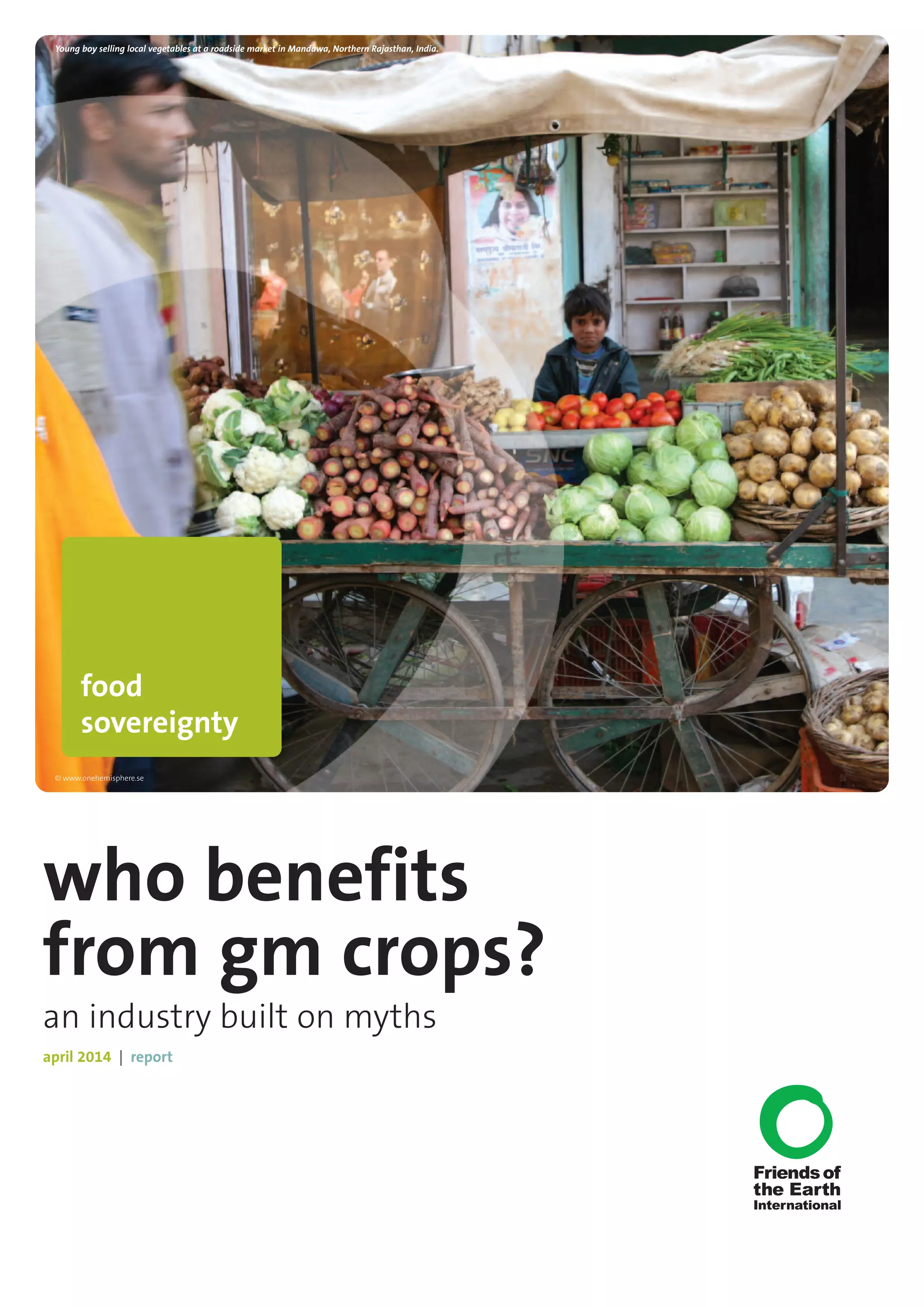
Young boy selling local vegetables at a roadside market in Mandawa, Northern Rajasthan, India. 
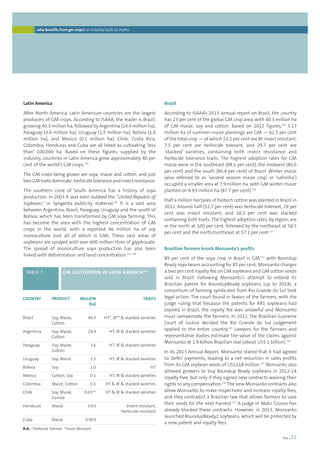
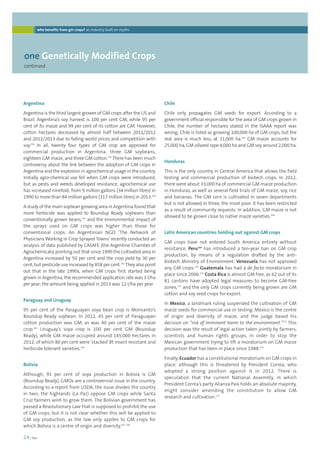
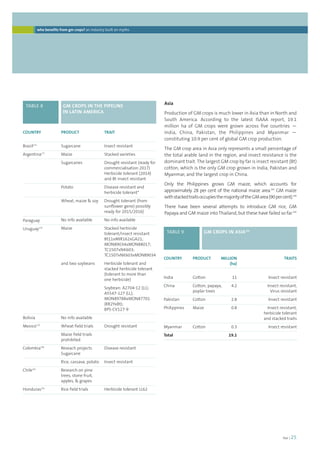
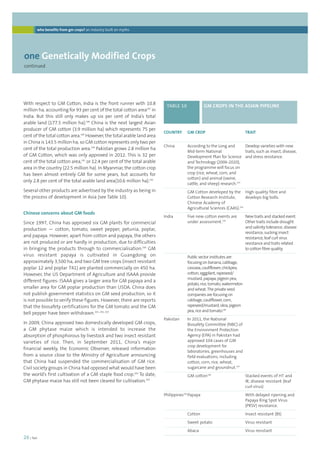
food 
sovereignty 
© www.onehemisphere.se 
who benefits 
from gm crops? 
an industry built on myths 
april 2014 | report
who benefits from gm crops? an industry built on myths 
who benefits from gm crops? 
an industry built on myths 
april | 2014 
Friends of the Earth International is the world’s largest grassroots environmental network 
with 74 member groups and over two million members and supporters around the world. 
Our vision is of a peaceful and sustainable world based on societies living in harmony 
with nature. We envision a society of interdependent people living in dignity, wholeness 
and fulfilment in which equity and human and peoples’ rights are realised. 
Friends of the Earth International has groups in 
Africa Cameroon, Ghana, Liberia, Mali, Mauritius, Mozambique, Nigeria, Sierra Leone, 
South Africa, Swaziland, Tanzania, Togo, Tunisia, Uganda 
Asia - Pacific Australia, Bangladesh, Indonesia, Japan, Malaysia, Nepal, New Zealand, Palestine, 
Papua New Guinea, Philippines, South Korea, Sri Lanka, Timor-Leste 
Europe Austria, Belgium (Wallonia & Brussels), Belgium (Flanders), Bulgaria, Croatia, Cyprus, 
Czech Republic, Denmark, England, Wales and Northern Ireland, Estonia, Finland, France, 
Georgia, Germany, Hungary, Ireland, Italy, Latvia, Lithuania, Luxembourg, Macedonia (former 
Yugoslav Republic of), Malta, Netherlands, Norway, Poland, Scotland, Slovakia, Spain, Sweden, 
Switzerland, Ukraine 
Latin America and Caribbean Argentina, Brazil, Chile, Colombia, Costa Rica, Curaçao (Antilles), 
El Salvador, Grenada (West Indies), Guatemala, Haiti, Honduras, Mexico, Paraguay, Uruguay 
North America Canada, United States 
Available for download at www.foei.org 
AuthorsMyrto Pispini with contributions from Mute Schimpf, Juan Lopez and Kirtana Chandrasekaran. 
Editing team E. Collins, Helen Burley, Ronnie Hall, Mute Schimpf, Kirtana Chandrasekaran 
Design our@onehemisphere.se, www.onehemisphere.se 
This report was produced as part of the project “Development Fields: Using land to reduce poverty” 
with the financial support of the European Commission. The content of the report is the exclusive 
responsibility of the producers and does not reflect the position of the European Commission. 
International 
Friends of the Earth 
International 
P.O. Box 19199 
1000 GD Amsterdam 
The Netherlands 
Tel: 31 20 622 1369 
Fax: 31 20 639 2181 
info@foei.org 
www.foei.org 
© www.onehemisphere.se 
A Woman selling eggplant at a 
roadside stall in Mandawa, Northern 
Rajasthan, India.
introduction 12 
deconstructing biotech industry statistics 12 
europe 14 
africa 17 
north america 21 
latin america 23 
asia 25 
australia 27 
foei | 3 
who benefits from gm crops? an industry built on myths 
Contents 
who benefits from gm crops? 
an industry built on myths 
april | 2014 
executive summary 4 
one genetically modified crops – the myth of global success 12 
two what the GM industry won’t tell you 32 
herbicide goes up, not down 32 
GM crops, pesticides and people’s health 35 
sooner or later, insect resistance develops 36 
prices of GM seeds and farmers’ choice 37 
GM crops and promised benefits for smallholder farmers 38 
high costs 38 
WEMA (Water Efficient Maize for Africa project) 39 
losing control and building debt? 40 
improving nutrition through GM crops – Golden Rice 41 
conclusion 46 
figures 
1 GM production of top six countries 4 
2,8 global area of GM crops 5/14 
3 GMO-free european union 6 
4,9 reports of glyphosate resistant weed populations in the USA 7/33 
5 share of GM crops that are herbicide tolerant (HT) and insect resistant (IR) 8 
6,7 biotech companies monopolize global seed market 8/13 
boxes 
1 food sovereignty 9 
2 feeding the world 18 
3 GM drought tolerant maize 20 
4 catastrophe for monarch butterflies 34 
5 push-pull: an effective, ecological alternative to herbicide tolerant and insect resistant maize 36 
6 a farmer developed alternative: the system of rice intensification 39 
tables 
1 GMO cultivation in european countries in 2008-13 15 
2 hectares of GM maize cultivation in andalucia according to different sources 16 
3 GM crop production in africa 17 
4 cotton production in burkina faso 19 
5 summary of field trials of GM crops in african countries (2010) 20 
6 GM crops in the US pipeline 21 
7 GM cultivation in latin america 23 
8 GM crops in the pipeline in latin america 25 
9 GM crops in asia 25 
10 GM crops in the asian pipeline 26 
11 glyphosate resistant species 34
executive summary 
executive summary: who benefits? 
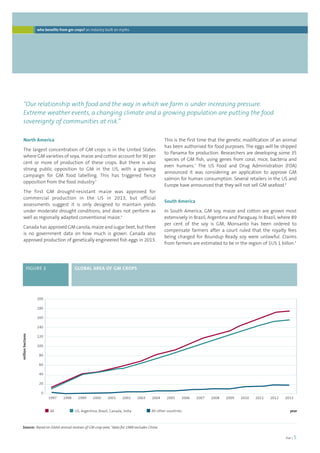
Where is GM grown? 
There is a shortage of independent data on GM crops, with 
many of the figures only available from the industry bodies. 
These figures from 2013 show that 18 million farmers grow GM 
crops in 27 countries worldwide. This figure represents less than 
one per cent of the world farming population.3 GM crops are 
predominantly found in six countries (92 per cent of GM crops) 
and these countries mainly grow just four GM crops: soya, 
maize, oilseed rape and cotton. Eighty eight per cent of arable 
land remains GM-free.4 
Our relationship with food and the way in which we farm is 
under increasing pressure. Extreme weather events, a changing 
climate and a growing population are putting the food 
sovereignty of communities at risk. At the same time health 
experts have raised serious questions about our modern diet. 
The World Health Organization (WHO) has warned of a ‘global 
obesity epidemic’1 yet an estimated 868 million people are 
suffering from chronic hunger.2 It is perhaps no wonder that 
there are calls for a fundamental change to the ways in which 
we farm and feed the world. 
The biotech industry has placed itself at the heart of this debate. 
Biotech corporations are working alongside governments and 
the aid community on initiatives they claim will improve yield 
and nutrition. Advocates argue that genetically modified (GM) 
crops can help to feed a climate-constrained world. 
This report examines the reality of GM crop production 
worldwide. It differentiates the claims from the reality, drawing 
evidence from the experiences of small farmers and the 
communities who live with GM. It finds: 
• There is significant resistance to GM crops on all continents. 
• Evidence from the cultivation of GM crops in North and South 
America, going back over two decades, shows increased levels 
of pesticide use due to weed and insect resistance – herbicide 
tolerant and insect tolerant (BT) GM crops do not provide an 
effective solution to the problem of agricultural pests. 
• Emerging evidence of the negative impacts of pesticides on 
the environment and people’s health suggest that these GM 
crops are not sustainable. 
• There is no scientific consensus on the safety of GM crops – 
with many doubts and questions unanswered. 
• Bio-fortified GM Golden Rice is not the best solution for 
vitamin A deficiency. 
• Despite hype around new GM varieties for improved nutrition 
and climate adaptation industry figures show about 99 per 
cent of the GM crops grown are still herbicide tolerant, insect 
resistant or a combination of both.* 
4 | foei 
who benefits from gm crops? an industry built on myths 
© www.onehemisphere.se 
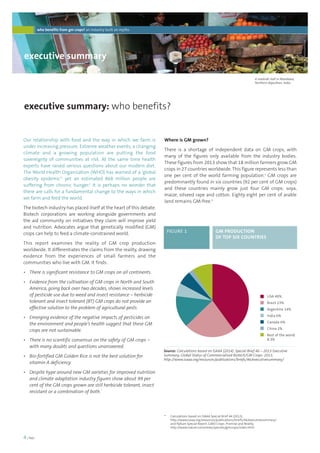
A roadside stall in Mandawa, 
Northern Rajasthan, India. 
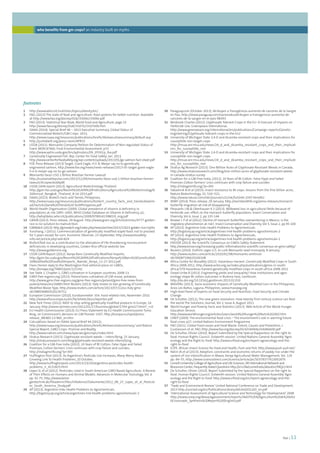
FIGURE 1 GM PRODUCTION 
OF TOP SIX COUNTRIES 
USA 40% 
Brazil 23% 
Argentina 14% 
India 6% 
Canada 6% 
China 2% 
Rest of the world 
8.3% 
Source: Calculations based on ISAAA (2014). Special Brief 46 – 2013 Executive 
Summary, Global Status of Commercialised Biotech/GM Crops: 2013, 
http://www.isaaa.org/resources/publications/briefs/46/executivesummary/ 
* Calculations based on ISAAA Special Brief 44 (2012), 
http://www.isaaa.org/resources/publications/briefs/44/executivesummary/ 
and Nature Special Report, GMO Crops: Promise and Reality, 
http://www.nature.com/news/specials/gmcrops/index.html
1997 1998 1999 2000 2001 2002 2003 2004 2005 2006 2007 2008 2009 2010 2011 2012 2013 
foei | 5 
who benefits from gm crops? an industry built on myths 
“Our relationship with food and the way in which we farm is under increasing pressure. 
Extreme weather events, a changing climate and a growing population are putting the food 
sovereignty of communities at risk.” 
This is the first time that the genetic modification of an animal 
has been authorised for food purposes. The eggs will be shipped 
to Panama for production. Researchers are developing some 35 
species of GM fish, using genes from coral, mice, bacteria and 
even humans.7 The US Food and Drug Administration (FDA) 
announced it was considering an application to approve GM 
salmon for human consumption. Several retailers in the US and 
Europe have announced that they will not sell GM seafood.8 
South America 
In South America, GM soy, maize and cotton are grown most 
extensively in Brazil, Argentina and Paraguay. In Brazil, where 89 
per cent of the soy is GM, Monsanto has been ordered to 
compensate farmers after a court ruled that the royalty fees 
being charged for Roundup Ready soy were unlawful. Claims 
from farmers are estimated to be in the region of $US 1 billon.9 
North America 
The largest concentration of GM crops is in the United States 
where GM varieties of soya, maize and cotton account for 90 per 
cent or more of production of these crops. But there is also 
strong public opposition to GM in the US, with a growing 
campaign for GM food labelling. This has triggered fierce 
opposition from the food industry.5 
The first GM drought-resistant maize was approved for 
commercial production in the US in 2013, but official 
assessments suggest it is only designed to maintain yields 
under moderate drought conditions, and does not perform as 
well as regionally adapted conventional maize.6 
Canada has approved GM canola, maize and sugar beet, but there 
is no government data on how much is grown. Canada also 
approved production of genetically engineered fish eggs in 2013. 
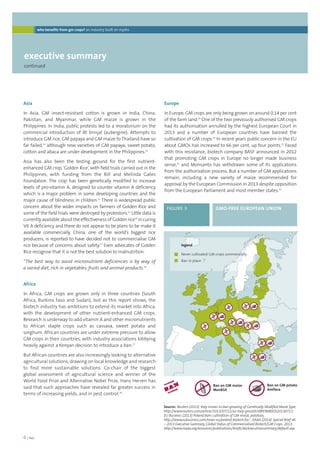
FIGURE 2 GLOBAL AREA OF GM CROPS 
All US, Argentina, Brazil, Canada, India All other countries 
200 
180 
160 
140 
120 
100 
80 
60 
40 
20 
0 
million hectares 
Source: Based on ISAAA annual reviews of GM crop area. *data for 1988 excludes China. 
year
executive summary 
continued 
6 | foei 
who benefits from gm crops? an industry built on myths 
Europe 
In Europe, GM crops are only being grown on around 0.14 per cent 
of the farm land.19 One of the two previously authorised GM crops 
had its authorisation annulled by the highest European Court in 
2013 and a number of European countries have banned the 
cultivation of GM crops.20 In recent years public concern in the EU 
about GMOs has increased to 66 per cent, up four points.21 Faced 
with this resistance, biotech company BASF announced in 2012 
that promoting GM crops in Europe no longer made business 
sense,22 and Monsanto has withdrawn some of its applications 
from the authorisation process. But a number of GM applications 
remain, including a new variety of maize recommended for 
approval by the European Commission in 2013 despite opposition 
from the European Parliament and most member states.23 
FIGURE 3 GMO-FREE EUROPEAN UNION 
legend 
Never cultivated GM crops commercially 
Ban in place 
Ban on GM maize 
Mon810 
Ban on GM potato 
Amflora 
ban 
__ 
Source: Reuters (2013). Italy moves to ban growing of Genetically Modified Maize Type, 
http://www.reuters.com/article/2013/07/12/us-italy-gmoidUSBRE96B0OS20130712; 
EU Business (2013) Poland bans cultivation of GM maize, potatoes, 
http://www.eubusiness.com/news-eu/poland-biotech.llx/ ; ISAAA (2014). Special Brief 46 
– 2013 Executive Summary, Global Status of Commercialised Biotech/GM Crops: 2013, 
http://www.isaaa.org/resources/publications/briefs/46/executivesummary/default.asp 
Asia 
In Asia, GM insect-resistant cotton is grown in India, China, 
Pakistan, and Myanmar, while GM maize is grown in the 
Philippines. In India, public protests led to a moratorium on the 
commercial introduction of Bt brinjal (aubergine). Attempts to 
introduce GM rice, GM papaya and GM maize to Thailand have so 
far failed,10 although new varieties of GM papaya, sweet potato, 
cotton and abaca are under development in the Philippines.11 
Asia has also been the testing ground for the first nutrient-enhanced 
GM crop, ‘Golden Rice’, with field trials carried out in the 
Philippines, with funding from the Bill and Melinda Gates 
Foundation. The crop has been genetically modified to increase 
levels of pro-vitamin A, designed to counter vitamin A deficiency 
which is a major problem in some developing countries and the 
major cause of blindness in children.12 There is widespread public 
concern about the wider impacts on farmers of Golden Rice and 
some of the field trials were destroyed by protestors.13 Little data is 
currently available about the effectiveness of Golden rice14 in curing 
Vit A deficiency and there do not appear to be plans to be make it 
available commercially. China, one of the world’s biggest rice 
producers, is reported to have decided not to commercialise GM 
rice because of concerns about safety.15 Even advocates of Golden 
Rice recognise that it is not the best solution to malnutrition. 
“The best way to avoid micronutrient deficiencies is by way of 
a varied diet, rich in vegetables, fruits and animal products.16 
Africa 
In Africa, GM crops are grown only in three countries (South 
Africa, Burkina Faso and Sudan), but as this report shows, the 
biotech industry has ambitions to extend its market into Africa, 
with the development of other nutrient-enhanced GM crops. 
Research is underway to add vitamin A and other micronutrients 
to African staple crops such as cassava, sweet potato and 
sorghum. African countries are under extreme pressure to allow 
GM crops in their countries, with industry associations lobbying 
heavily against a Kenyan decision to introduce a ban.17 
But African countries are also increasingly looking to alternative 
agricultural solutions, drawing on local knowledge and research 
to find more sustainable solutions. Co-chair of the biggest 
global assessment of agricultural science and winner of the 
World Food Prize and Alternative Nobel Prize, Hans Herren has 
said that such approaches have revealed far greater success in 
terms of increasing yields, and in pest control.18
foei | 7 
who benefits from gm crops? an industry built on myths 
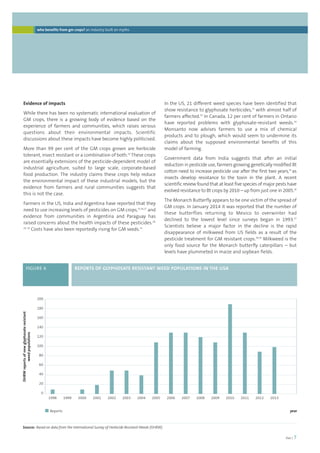
In the US, 21 different weed species have been identified that 
show resistance to glyphosate herbicides,32 with almost half of 
farmers affected.33 In Canada, 12 per cent of farmers in Ontario 
have reported problems with glyphosate-resistant weeds.34 
Monsanto now advises farmers to use a mix of chemical 
products and to plough, which would seem to undermine its 
claims about the supposed environmental benefits of this 
model of farming. 
Government data from India suggests that after an initial 
reduction in pesticide use, farmers growing genetically modified Bt 
cotton need to increase pesticide use after the first two years,35 as 
insects develop resistance to the toxin in the plant. A recent 
scientific review found that at least five species of major pests have 
evolved resistance to Bt crops by 2010 – up from just one in 2005.36 
The Monarch Butterfly appears to be one victim of the spread of 
GM crops. In January 2014 it was reported that the number of 
these butterflies returning to Mexico to overwinter had 
declined to the lowest level since surveys began in 1993.37 
Scientists believe a major factor in the decline is the rapid 
disappearance of milkweed from US fields as a result of the 
pesticide treatment for GM resistant crops.38,39 Milkweed is the 
only food source for the Monarch butterfly caterpillars – but 
levels have plummeted in maize and soybean fields. 
Evidence of impacts 
While there has been no systematic international evaluation of 
GM crops, there is a growing body of evidence based on the 
experience of farmers and communities, which raises serious 
questions about their environmental impacts. Scientific 
discussions about these impacts have become highly politicised. 
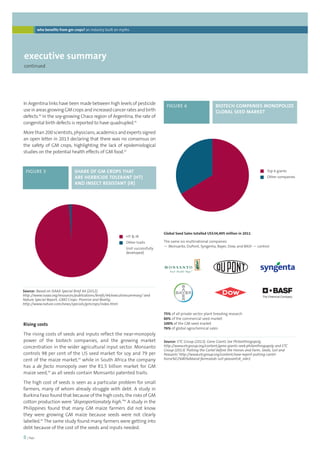
More than 99 per cent of the GM crops grown are herbicide 
tolerant, insect resistant or a combination of both.24 These crops 
are essentially extensions of the pesticide-dependent model of 
industrial agriculture, suited to large scale, corporate-based 
food production. The industry claims these crops help reduce 
the environmental impact of these industrial models, but the 
evidence from farmers and rural communities suggests that 
this is not the case. 
Farmers in the US, India and Argentina have reported that they 
need to use increasing levels of pesticides on GM crops,25,26,27 and 
evidence from communities in Argentina and Paraguay has 
raised concerns about the health impacts of these pesticides.28, 
29, 30 Costs have also been reportedly rising for GM seeds.31 
FIGURE 4 REPORTS OF GLYPHOSATE RESISTANT WEED POPULATIONS IN THE USA 
1998 1999 2000 2001 2002 2003 2004 2005 2006 2007 2008 2009 2010 2011 2012 2013 
Reports 
200 
180 
160 
140 
120 
100 
80 
60 
40 
20 
0 
ISHRW reports of new glyphosate resistant 
weed populations 
Source: Based on data from the International Survey of Herbicide Resistant Weeds (ISHRW). 
year
executive summary 
continued 
FIGURE 5 SHARE OF GM CROPS THAT 
HT  IR 
Other traits 
(not successfully 
developed) 
Source: Based on ISAAA Special Brief 44 (2012), 
http://www.isaaa.org/resources/publications/briefs/44/executivesummary/ and 
Nature Special Report, GMO Crops: Promise and Reality, 
http://www.nature.com/news/specials/gmcrops/index.html 
8 | foei 
who benefits from gm crops? an industry built on myths 
In Argentina links have been made between high levels of pesticide 
use in areas growing GM crops and increased cancer rates and birth 
defects.40 In the soy-growing Chaco region of Argentina, the rate of 
congenital birth defects is reported to have quadrupled.41 
More than 200 scientists, physicians, academics and experts signed 
an open letter in 2013 declaring that there was no consensus on 
the safety of GM crops, highlighting the lack of epidemiological 
studies on the potential health effects of GM food.42 
ARE HERBICIDE TOLERANT (HT) 
AND INSECT RESISTANT (IR) 
Rising costs 
The rising costs of seeds and inputs reflect the near-monopoly 
power of the biotech companies, and the growing market 
concentration in the wider agricultural input sector. Monsanto 
controls 98 per cent of the US seed market for soy and 79 per 
cent of the maize market,43 while in South Africa the company 
has a de facto monopoly over the R1.5 billion market for GM 
maize seed,44 as all seeds contain Monsanto patented traits. 
The high cost of seeds is seen as a particular problem for small 
farmers, many of whom already struggle with debt. A study in 
Burkina Faso found that because of the high costs, the risks of GM 
cotton production were “disproportionately high.”45 A study in the 
Philippines found that many GM maize farmers did not know 
they were growing GM maize because seeds were not clearly 
labelled.46 The same study found many farmers were getting into 
debt because of the cost of the seeds and inputs needed. 
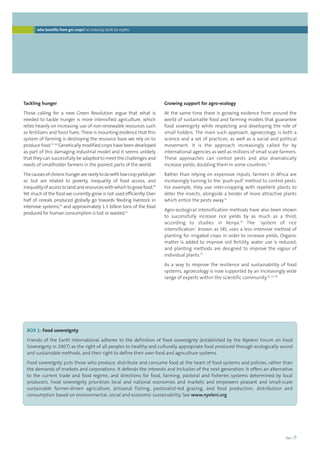
FIGURE 6 BIOTECH COMPANIES MONOPOLIZE 
GLOBAL SEED MARKET 
Global Seed Sales totalled US$34,495 million in 2011 
The same six multinational companies 
— Monsanto, DuPont, Syngenta, Bayer, Dow, and BASF — control: 
Source: ETC Group (2013). Gene Giants See Philanthrogopoly, 
http://www.etcgroup.org/content/gene-giants-seek-philanthrogopoly and ETC 
Group (2013) ‘Putting the Cartel before the Horses and Farm, Seeds, Soil and 
Peasants’ http://www.etcgroup.org/content/new-report-putting-cartel-horse% 
E2%80%A6and-farmseeds-soil-peasants#_edn1 
Top 6 giants 
Other companies 
75% of all private sector plant breeding research 
60% of the commercial seed market 
100% of the GM seed market 
76% of global agrochemical sales
foei | 9 
who benefits from gm crops? an industry built on myths 
Tackling hunger 
Those calling for a new Green Revolution argue that what is 
needed to tackle hunger is more intensified agriculture, which 
relies heavily on increasing use of non-renewable resources such 
as fertilizers and fossil fuels. There is mounting evidence that this 
system of farming is destroying the resource base we rely on to 
produce food.47, 48 Genetically modified crops have been developed 
as part of this damaging industrial model and it seems unlikely 
that they can successfully be adapted to meet the challenges and 
needs of smallholder farmers in the poorest parts of the world. 
The causes of chronic hunger are rarely to do with low crop yields per 
se, but are related to poverty, inequality of food access, and 
inequality of access to land and resources with which to grow food.49 
Yet much of the food we currently grow is not used efficiently. Over 
half of cereals produced globally go towards feeding livestock in 
intensive systems,50 and approximately 1.3 billion tons of the food 
produced for human consumption is lost or wasted.51 
Growing support for agro-ecology 
At the same time there is growing evidence from around the 
world of sustainable food and farming models that guarantee 
food sovereignty while respecting and developing the role of 
small holders. The main such approach, agroecology, is both a 
science and a set of practices, as well as a social and political 
movement. It is the approach increasingly called for by 
international agencies as well as millions of small scale farmers. 
These approaches can control pests and also dramatically 
increase yields, doubling them in some countries.52 
Rather than relying on expensive inputs, farmers in Africa are 
increasingly turning to the ‘push-pull’ method to control pests. 
For example, they use inter-cropping with repellent plants to 
deter the insects, alongside a border of more attractive plants 
which entice the pests away.53 
Agro-ecological intensification methods have also been shown 
to successfully increase rice yields by as much as a third, 
according to studies in Kenya.54 The ´system of rice 
intensification´ known as SRI, uses a less intensive method of 
planting for irrigated crops in order to increase yields. Organic 
matter is added to improve soil fertility, water use is reduced, 
and planting methods are designed to improve the vigour of 
individual plants.55 
As a way to improve the resilience and sustainability of food 
systems, agroecology is now supported by an increasingly wide 
range of experts within the scientific community.56, 57, 58 
BOX 1: Food sovereignty 
Friends of the Earth International adheres to the definition of food sovereignty (established by the Nyeleni Forum on Food 
Sovereignty in 2007) as the right of all peoples to healthy and culturally appropriate food produced through ecologically sound 
and sustainable methods, and their right to define their own food and agriculture systems. 
Food sovereignty puts those who produce, distribute and consume food at the heart of food systems and policies, rather than 
the demands of markets and corporations. It defends the interests and inclusion of the next generation. It offers an alternative 
to the current trade and food regime, and directions for food, farming, pastoral and fisheries systems determined by local 
producers. Food sovereignty prioritises local and national economies and markets and empowers peasant and small-scale 
sustainable farmer-driven agriculture, artisanal fishing, pastoralist-led grazing, and food production, distribution and 
consumption based on environmental, social and economic sustainability. See www.nyeleni.org
who benefits from gm crops? an industry built on myths 
executive summary 
continued 
There are cheaper, better and more readily available solutions 
than GM crops to address hunger and malnutrition. 
Governments, policy advisors, donors and international 
agencies should: 
• Build capacity to produce food for local consumption rather 
than for export, with an emphasis on small-scale farmers 
• Increase investment in agro-ecology to support small farmers 
including: 
• Participatory research that uses small holders’ traditional 
knowledge combined with modern approaches 
• Research into enabling development and access to low 
cost traditional varieties of seeds and livestock breeds, 
led by local communities 
• Provision of agricultural extension services so farmers can 
access and implement knowledge that will enable them to 
farm more sustainably, and which can ensure that farmers 
are involved in developing research programmes 
• Support for the establishment of farmers’ cooperatives and 
other producer organizations for small holders ensuring 
local and national markets can work for smallholders 
• End the large amounts of crops and land diverted from food 
to agrofuel production 
• Introduce measures to reduce high levels of consumption of 
livestock products in rich countries that are eating up global 
grain supplies 
• Reduce high levels of retail and household waste in rich 
countries, and prevent post-harvest loss in the developing world 
“There are cheaper, better and more readily available solutions than GM crops 
to address hunger and malnutrition.” 
10 | foei
foei | 11 
who benefits from gm crops? an industry built on myths 
footnotes 
1 http://www.who.int/nutrition/topics/obesity/en/ 
2 FAO, (2013) The state of food and agriculture: food systems for better nutrition. Available 
at http://www.fao.org/docrep/018/i3300e/i3300e.pdf 
3 FAO (2013). Statistical Year Book, World Food and Agriculture, page 22 
http://www.fao.org/docrep/018/i3107e/i3107e00.htm 
4 ISAAA (2014). Special Brief 46 – 2013 Executive Summary, Global Status of 
Commercialised Biotech/GM Crops: 2013, 
http://www.isaaa.org/resources/publications/briefs/46/executivesummary/default.asp 
5 http://justlabelit.org/press-room/#PR33 
6 USDA (2011). Monsanto Company Petition for Determination of Non-regulated Status of 
Event MON 87460, Final Environmental Assessment, p33 
http://www.aphis.usda.gov/brs/aphisdocs/09_05501p_fea.pdf 
7 Genetically Engineered Fish. Rep. Center for Food Safety, Jan. 2013. 
http://www.centerforfoodsafety.org/wp-content/uploads/2013/01/ge-salmon-fact-sheet.pdf 
8 FOE Press Release (2013) Target, Giant Eagle, H-E-B, Meijer say no to genetically 
engineered salmon, http://www.foe.org/news/news-releases/2013-05-target-giant-eagle-h- 
e-b-meijer-say-no-to-ge-salmon 
9 Monsanto Faces USD 1 Billion Brazilian Farmer Lawsuit 
http://sustainablepulse.com/2013/12/09/monsanto-faces-usd-1-billion-brazilian-farmer-lawsuit/#. 
Uqow3eJdApM 
10 USDA GAIN report (2013). Agricultural Biotechnology Thailand 
http://gain.fas.usda.gov/Recent%20GAIN%20Publications/Agricultural%20Biotechnology% 
20Annual_Bangkok_Thailand_8-16-2013.pdf 
11 ISAAA (2013). Biotech Facts and Trends, Philippines, 
http://www.isaaa.org/resources/publications/biotech_country_facts_and_trends/downlo 
ad/Facts%20and%20Trends%20-%20Philippines.pdf 
12 World Health Organization (2009). Global prevalence of vitamin A deficiency in 
populations at risk 1995–2005, WHO Global Database on Vitamin A Deficiency, p1, 
http://whqlibdoc.who.int/publications/2009/9789241598019_eng.pdf 
13 GRAIN (2013). Press release, 29 August. http://www.grain.org/article/entries/4777-golden-rice- 
is-no-solution-to-malnutrition 
14 GMWatch (2013). http://gmwatch.org/index.php/news/archive/2013/15023-golden-rice-myths 
15 Yunzhang, J (2011). Commercialization of genetically modified staple food: not to proceed 
for 5 years except for corn. Economic Observer, 23 September, http://www.biosafety-info. 
net/article.php?aid=829 
16 Biofortified rice as a contribution to the alleviation of life-threatening micronutrient 
deficiencies in developing countries, Golden Rice official website See 
http://www.goldenrice.org 
17 USDA GAIN Report (2012). Kenya Bans Genetically Modified Imports, 
http://gain.fas.usda.gov/Recent%20GAIN%20Publications/Kenya%20Bans%20Genetically% 
20Modified%20Food%20Imports_Nairobi_Kenya_11-27-2012.pdf 
18 Hans Herren reply to the Washington Post editorial piece on GMOs, 
http://envaya.org/TABIO/post/121542 
19 See Table 1, Chapter 1, GMO cultivation in European countries, 2008-13. 
20 GMO-free-regions.org (2013). Poland bans cultivation of GM maize, potatoes. 
http://www.gmo-free-regions.org/gmo-free-regions/poland/gmo-free-news-from-poland/ 
news/en/26883.html Reuters (2013). Italy moves to ban growing of Genetically 
Modified Maize Type, http://www.reuters.com/article/2013/07/12/us-italy-gmo-idUSBRE96B0OS20130712 
21 European Commission (2010), Eurobarometer 354: Food-related risks, November 2010. 
http://www.efsa.europa.eu/en/factsheet/docs/reporten.pdf 
22 New York Times (2012). BASF to stop selling genetically modified products in Europe, 16 
January, http://www.nytimes.com/2012/01/17/business/global/17iht-gmo17.html?_r=0 
23 EU Health Commissioner (2013). EU Press Statement by EU Health Commissioner Tonio 
Borg, on Commission’s decision on GM Pioneer 1507, http://europa.eu/rapid/press-release_ 
MEMO-13-960_en.htm 
24 Calculations based on ISAAA Special Brief 44 (2012), 
http://www.isaaa.org/resources/publications/briefs/44/executivesummary/ and Nature 
Special Report, GMO Crops: Promise and Reality, 
http://www.nature.com/news/specials/gmcrops/index.html 
25 Stratus Research (2013). Glyphosate resistant weeds – intensifying, 25 January, 
http://stratusresearch.com/blog/glyphosate-resistant-weeds-intensifying 
26 Coalition for a GM-Free India (2012). 10 Years of Bt Cotton: False Hype and Failed 
Promises, Cotton farmers’ crisis continues with crop failure and suicides, 
http://indiagminfo.org/?p=393 
27 Huffington Post (2013). As Argentina’s Pesticide Use Increases, Many Worry About 
Growing Link To Health Problems, 20 October, 
http://www.huffingtonpost.com/2013/10/20/argentina-pesticides-health-problems_ 
n_4131825.html 
28 López SL et al (2012). Pesticides Used in South American GMO-Based Agriculture: A Review 
of Their Effects on Humans and Animal Models. Advances in Molecular Toxicology, Vol. 6 
pp. 41-75, http://www.keine-gentechnik. 
de/fileadmin/files/Infodienst/Dokumente/2012_08_27_Lopez_et_al_Pesticid 
es_South_America_Study.pdf 
29 AP (2013). Argentine links Health Problems to Agrochemicals, 
http://bigstory.ap.org/article/argentines-link-health-problems-agrochemicals-2 
footnotes 
30 Paraguay.com (October 2013), Atribuyen a Transgénicos aumento de canceres de la Sangre 
en Pais, http://www.paraguay.com/nacionales/atribuyen-a-transgenicos-aumento-de-canceres- 
de-la-sangre-en-el-pais-98393 
31 Benbrook Charles (2012). Glyphosate Tolerant Crops in the EU- A Forecast of Impacts on 
Herbicide Use, Greenpeace International, 
http://www.greenpeace.org/international/en/publications/Campaign-reports/Genetic-engineering/ 
Glyphosate-tolerant-crops-in-the-EU/ 
32 University of Michigan State 2,4-D and dicamba-resistant crops and their implications for 
susceptible non-target crops 
http://msue.anr.msu.edu/news/24_d_and_dicamba_resistant_crops_and_their_implicati 
ons_for_susceptible_non 
33 University of Michigan State 2,4-D and dicamba-resistant crops and their implications for 
susceptible non-target crops 
http://msue.anr.msu.edu/news/24_d_and_dicamba_resistant_crops_and_their_implicati 
ons_for_susceptible_non 
34 Stratus Ag Research (2013). One Million Acres of Glyphosate Resistant Weeds in Canada, 
http://www.stratusresearch.com/blog/one-million-acres-of-glyphosate-resistant-weeds-in- 
canada-stratus-survey 
35 Coalition for a GM-Free India, (2012), 10 Years of Bt Cotton: False Hype and Failed 
Promises Cotton farmers’ crisis continues with crop failure and suicides 
http://indiagminfo.org/?p=393 
36 Tabashnik B et al (2013). Insect resistance to Bt crops: lessons from the first billion acres, 
Nature Biotechnology, 31, 510–521, 
http://www.nature.com/nbt/journal/v31/n6/full/nbt.2597.html#t2 
37 WWF (2014). Press release, 29 January, http://worldwildlife.org/press-releases/monarch-butterfly- 
migration-at-risk-of-disappearing 
38 Pleasants J M  Oberhauser K S (2013). Milkweed loss in agricultural fields because of 
herbicide use: effect on the monarch butterfly population, Insect Conservation and 
Diversity, Vol 6, Issue 2, pp 135-144 
39 Brower L P et al (2012). Decline of monarch butterflies overwintering in Mexico: is the 
migratory phenomenon at risk?, Insect Conservation and Diversity, Vol 5, Issue 2, pp 95-100 
40 AP (2013). Argentine links Health Problems to Agrochemicals 
http://bigstory.ap.org/article/argentines-link-health-problems-agrochemicals-2 
41 AP (2013). Argentine links Health Problems to Agrochemicals, 
http://bigstory.ap.org/article/argentines-link-health-problems-agrochemicals-2 
42 ENSSER (2013). No Scientific Consensus on GMOs Safety Statement 
http://www.ensser.org/increasing-public-information/no-scientific-consensus-on-gmo-safety/ 
43 Reuters (2010). DuPont urges U.S. to curb Monsanto seed monopoly, 8 January, 
http://www.reuters.com/article/2010/01/08/monsanto-antitrust-idUSN087196620100108 
44 Africa Centre for Biosafety (2012). Hazardous Harvest: Genetically Modified Crops in South 
Africa 2008-2012, http://www.acbio.org.za/index.php/publications/gmos-in-south-africa/ 
379-hazardous-harvest-genetically-modified-crops-in-south-africa-2008-2012 
45 Dowd-Uribe B (2013). Engineering yields and inequality? How institutions and agro-ecology 
shape Bt cotton outcomes in Burkina Faso, Geoforum, 
http://dx.doi.org/10.1016/j.geoforum.2013.02.010 
46 MASIPAG (2013). Socio-economic Impacts of Genetically Modified Corn in the Philippines, 
Anos Los Baños, Laguna, Philippines, www.masipag.org 
47 High-level Panel of Experts on Food Security and Nutrition, Food Security and Climate 
Change 
48 De Schutter, (2011), The new green revolution: How twenty-first-century science can feed 
the world The Solutions, Journal, Vol 2, Issue 4, August 2011 
49 World Hunger and Poverty Facts and Statistics (2013). Web Article of the World Hunger 
Education Service. 
http://www.worldhunger.org/articles/Learn/world%20hunger%20facts%202002.htm 
50 UNEP (2009). The environmental food crisis – The environment’s role in averting future 
food crises p27, United Nations Environment Programme 
51 FAO (2011). Global Food Losses and Food Waste: Extent, Causes and Prevention, J. 
Gustavsson et al, FAO, http://www.fao.org/docrep/014/mb060e/mb060e00.pdf 
52 De Schutter, Olivier (2010). Report Submitted by the Special Rapporteur on the right to 
food. Human Rights Council, Sixteenth session. United Nations General Assembly ‘Agro-ecology 
and the Right to Food’ http://www.srfood.org/en/report-agroecology-and-the-right- 
to-food 
53 ICIPE. African Insect Science for Food and Health, Push and Pull, http://www.push-pull.net/ 
54 Ndiiri JA et al (2013). Adoption, constraints and economic returns of paddy rice under the 
system of rice intensification in Mwea, Kenya Agricultural Water Management, Vol. 129 
pp. 44–55, http://www.sciencedirect.com/science/article/pii/S037837741300187X 
55 Cornell University College of Agriculture and Life Sciences, SRI International Network and 
Resources Center, Frequently Asked Questions http://sri.ciifad.cornell.edu/aboutsri/FAQs1.html 
56 De Schutter, Olivier (2010). Report Submitted by the Special Rapporteur on the right to 
food. Human Rights Council, Sixteenth session. United Nations General Assembly ‘Agro-ecology 
and the Right to Food’ http://www.srfood.org/en/report-agroecology-and-the-right- 
to-food 
57 ‘Trade and Environment Review’ United National Conference on Trade and Development, 
2013 http://unctad.org/en/PublicationsLibrary/ditcted2012d3_en.pdf 
58 ‘International Assessment of Agricultural Science and Technology for Development’ 2008 
http://www.unep.org/dewa/agassessment/reports/IAASTD/EN/Agriculture%20at%20a%2 
0Crossroads_Synthesis%20Report%20(English).pdf
who benefits from gm crops? an industry built on myths 
one Genetically Modified Crops 
Genetically Modified Crops: 
the myth of global success 
12 | foei 
As a result of the impacts of agricultural production on the 
natural world and farmers’ livelihoods, civil society groups around 
the world are calling for moves away from industrial monoculture 
farming systems towards more sustainable, ecologically diverse 
models of agriculture. It is time to listen to these calls. As the 
United Nations Conference on Trade and Development stated in 
2013, it is time to wake up, before it is too late: 
“World hunger is a multifaceted problem that cannot be solved 
by technological changes alone. Industrial agriculture is 
unsustainable, and technological adjustments based on genetic 
engineering have not been able to achieve the relevant 
Millennium Development Goals; instead, they have introduced 
products that restrict farmer-based innovation, in situ 
conservation and access to the locally adapted germplasm.” 
“Alternative agricultural models, such as agroecology, 
demonstrate potential to reduce poverty, increase food security 
and reduce agriculture’s environmental footprint because they 
increase agro-ecosystem resilience, lower external inputs, boost 
farmers’ incomes and are based on technologies that, for the 
most part can be understood, implemented and further modified 
by poor and subsistence farmers.”6 
Deconstructing Biotech Industry Statistics 
Almost 20 years after the commercial release of the first GM 
crops, and despite widespread public concern about this 
technology, there is still no independent source for global data on 
GM crop adoption. Many countries do not have public registers of 
GM crop production, or do not publish data, or provide little by 
way of explanation about how figures are calculated. 
The International Service for the Acquisition of Agri-Biotech 
Applications (ISAAA) does collect and publish figures on global GM 
crop production. However, Friends of the Earth International does 
not consider ISAAA to be a disinterested provider of information. 
ISAAA does not publish its accounts, and on its website its list of 
donors includes the biotech companies Monsanto, Bayer 
CropScience and Mahyco,7 as well as Crop Life International. The 
latter is a global federation body representing the interests of the 
biotechnology and agro-chemicals industry.8 Its company 
members are BASF, Bayer Cropscience, Dow Agrosciences, DuPont, 
FMC, Monsanto, Sumitomo and Syngenta,9 all of whom are 
involved in selling GM seeds and associated products. 
Introduction 
As we head into the second decade of the century, our 
relationship with food and agricultural production is 
characterised by a number of significant challenges. In 
particular, farming and food security are highly vulnerable to 
weather-related natural disasters, such as the recent typhoon in 
the Philippines. Agriculture is affected by the impacts of climate 
change, but it is also a key driver of greenhouse gas emissions. 
On another front, the World Health Organization has called for 
action on the ‘global obesity epidemic,’1 even while an 
estimated 868 million people, around one in eight of the world’s 
population, are suffering from chronic hunger.2 A series of global 
food price crises have exacerbated hunger by affecting people’s 
access to food, and food and agricultural market deregulation 
has also been linked to rising obesity.3 
Facing the prospect of world population continuing to grow 
until it peaks in 2050, there are increasing calls from scientists 
around the world for a paradigm shift in the way agricultural 
research is funded.4,5 
The biotech industry and its proponents often promote genetically 
modified (GM) crops in the context of these challenges. Profound 
claims have been made: GM crops will feed the world, allow us to 
adapt food production to climate change and increasingly harsh 
environments, and enable us to tackle malnutrition. Even though 
many of these claims relate to future or unproven GM crops, those 
raising concerns about GMOs are still portrayed as being opposed 
to solving global problems — even to the extent that opposition to 
GM crops was recently called “wicked” by a UK government 
minister.* Concerns raised by people in developing and emerging 
nations are treated with equal disdain. In 2013, public concern 
about GM crops in Africa was dismissed as “fear of the unknown” 
by AGRA, an organisation that promotes GM crop production.** 
This report sets out to examine the reality of GM crop 
production worldwide, investigate specific claims made for GM 
crops, and reveal the agenda of those promoting them. In 
particular, it shows that concerns about GM crops are 
legitimate and based on growing experience with industrial GM 
crop production, not fear or ignorance. 
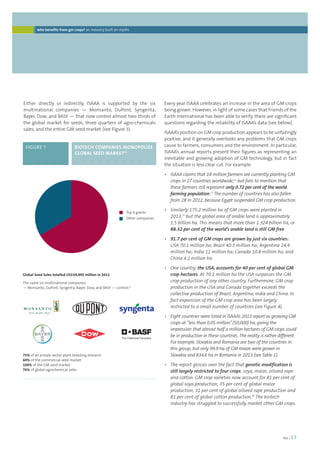
© www.onehemisphere.se 
Bt Corn field, Nebraska. 
* Independent, 13th October 2013 
http://www.independent.co.uk/news/uk/politics/opponents-of-third-world-gm-crops-are-wicked- 
says-environment-secretary-owen-paterson-8877634.html 
** Alliance for the Green Revolution in Africa, 2013 ‘African Agriculture Status Report’ 
http://reliefweb.int/report/world/african-agriculture-status-report-2013
foei | 13 
who benefits from gm crops? an industry built on myths 
Every year ISAAA celebrates an increase in the area of GM crops 
being grown. However, in light of some cases that Friends of the 
Earth International has been able to verify, there are significant 
questions regarding the reliability of ISAAA’s data (see below). 
ISAAA’s position on GM crop production appears to be unfailingly 
positive, and it generally overlooks any problems that GM crops 
cause to farmers, consumers and the environment. In particular, 
ISAAA’s annual reports present their figures as representing an 
inevitable and growing adoption of GM technology, but in fact 
the situation is less clear cut. For example: 
• ISAAA claims that 18 million farmers are currently planting GM 
crops in 27 countries worldwide,12 but fails to mention that 
these farmers still represent only 0.72 per cent of the world 
farming population.13 The number of countries has also fallen 
from 28 in 2012, because Egypt suspended GM crop production. 
• Similarly 175.2 million ha of GM crops were planted in 
2013,14 but the global area of arable land is approximately 
1.5 billion ha. This means that more than 1.324 billion ha, or 
88.32 per cent of the world’s arable land is still GM free. 
• 91.7 per cent of GM crops are grown by just six countries: 
USA 70.1 million ha; Brazil 40.3 million ha; Argentina 24.4 
million ha; India 11 million ha; Canada 10.8 million ha; and 
China 4.2 million ha. 
• One country, the USA, accounts for 40 per cent of global GM 
crop hectares. At 70.1 million ha the USA surpasses the GM 
crop production of any other country. Furthermore, GM crop 
production in the USA and Canada together exceeds the 
collective production of Brazil, Argentina, India and China. In 
fact expansion of the GM crop area has been largely 
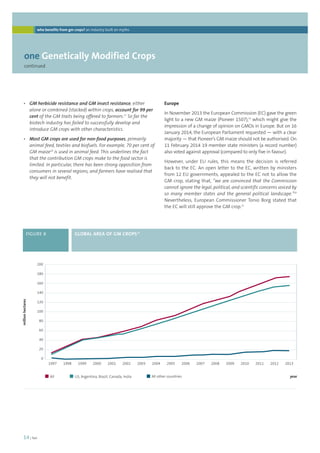
restricted to a small number of countries (see Figure 4). 
• Eight countries were listed in ISAAA’s 2013 report as growing GM 
crops at “less than 0.05 million” (50,000) ha, giving the 
impression that almost half a million hectares of GM crops could 
be in production in these countries. The reality is rather different. 
For example, Slovakia and Romania are two of the countries in 
this group; but only 99.9 ha of GM maize were grown in 
Slovakia and 834.6 ha in Romania in 2013 (see Table 1). 
• The report glosses over the fact that genetic modification is 
still largely restricted to four crops; soya, maize, oilseed rape 
and cotton. GM crop varieties now account for 81 per cent of 
global soya production, 35 per cent of global maize 
production, 31 per cent of global oilseed rape production and 
81 per cent of global cotton production.16 The biotech 
industry has struggled to successfully market other GM crops. 
Either directly or indirectly, ISAAA is supported by the six 
multinational companies — Monsanto, DuPont, Syngenta, 
Bayer, Dow, and BASF — that now control almost two thirds of 
the global market for seeds, three quarters of agro-chemicals 
sales, and the entire GM seed market (see Figure 3). 
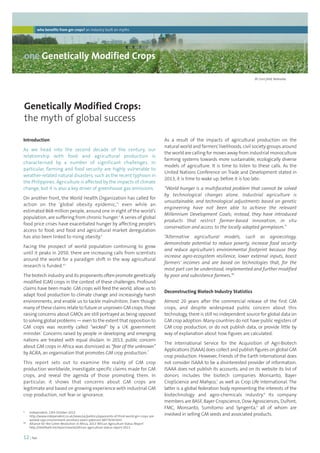
FIGURE 7 BIOTECH COMPANIES MONOPOLIZE 
GLOBAL SEED MARKET10 
Top 6 giants 
Other companies 
Global Seed Sales totalled US$34,495 million in 2011 
The same six multinational companies 
— Monsanto, DuPont, Syngenta, Bayer, Dow, and BASF — control:11 
75% of all private sector plant breeding research 
60% of the commercial seed market 
100% of the GM seed market 
76% of global agrochemical sales
who benefits from gm crops? an industry built on myths 
one Genetically Modified Crops 
continued 
14 | foei 
Europe 
In November 2013 the European Commission (EC) gave the green 
light to a new GM maize (Pioneer 1507),19 which might give the 
impression of a change of opinion on GMOs in Europe. But on 16 
January 2014, the European Parliament requested — with a clear 
majority — that Pioneer’s GM maize should not be authorised. On 
11 February 2014 19 member state ministers (a record number) 
also voted against approval (compared to only five in favour). 
However, under EU rules, this means the decision is referred 
back to the EC. An open letter to the EC, written by ministers 
from 12 EU governments, appealed to the EC not to allow the 
GM crop, stating that, “we are convinced that the Commission 
cannot ignore the legal, political, and scientific concerns voiced by 
so many member states and the general political landscape.”20 
Nevertheless, European Commissioner Tonio Borg stated that 
the EC will still approve the GM crop.21 
• GM herbicide resistance and GM insect resistance, either 
alone or combined (stacked) within crops, account for 99 per 
cent of the GM traits being offered to farmers.17 So far the 
biotech industry has failed to successfully develop and 
introduce GM crops with other characteristics. 
• Most GM crops are used for non-food purposes, primarily 
animal feed, textiles and biofuels. For example, 70 per cent of 
GM maize18 is used in animal feed. This underlines the fact 
that the contribution GM crops make to the food sector is 
limited. In particular, there has been strong opposition from 
consumers in several regions, and farmers have realised that 
they will not benefit. 
FIGURE 8 GLOBAL AREA OF GM CROPS15 
All US, Argentina, Brazil, Canada, India All other countries 
200 
180 
160 
140 
120 
100 
80 
60 
40 
20 
0 
1997 1998 1999 2000 2001 2002 2003 2004 2005 2006 2007 2008 2009 2010 2011 2012 2013 
million hectares 
year
COUNTRY 
 CROPS 
Cultivation 
of Maize Mon810 
Spain33 
Portugal34 
Czech Republic35 
Romania36 
Slovakia37 
Poland38 
Germany39 
Cultivation 
of Amflora potato 
Sweden40 
Germany41 
Total 
2008 
(ha) 
79,269 
4,856 
8,380 
6,130 
1,931 
3,000 
3,173 
0 
0 
106,739 
2009 
(ha) 
76,057 
5,202 
6,480 
3,244 
875 
3,000 
0 
0 
0 
94,858 
2010 
(ha) 
67,726 
4,869 
4,830 
823 
1,248 
3,000 
0 
103 
15 
82,614 
2011 
(ha) 
97,346 
7,723 
5,090 
588 
760 
3,000 
0 
16 
2 
114,525 
2012 
(ha) 
116,306 
9,278 
3,052 
217 
216 
3,000 
0 
0 
0 
132,041 
2013 
(ha) 
136,962 
8,171 
2,561 
835 
100 
- 
0 
0 
0 
148,628 
foei | 15 
who benefits from gm crops? an industry built on myths 
GM crops in Spain: no transparency and inflated numbers 
Based on data from EU member state governments, it appears 
that Spain cultivates 92 per cent of the total area given over to 
GM crop production in the EU, leading the ISAAA to refer to it as 
a “biotech mega-country.”42 However, the Spanish Ministry of 
Agriculture, Food and Environment (MAGRAMA) has been 
criticised by Spanish farmers, and environmental and consumer 
organisations for using data supplied by the industry, without 
verifying what is actually happening on the ground.43 
MAGRAMA calculations are based on GM seed sales data 
provided by seed merchants in each region, resulting in a 
theoretical estimation of the area that could be sown. 
The ministry has confirmed that it does not verify the sales data 
provided by the seed industry, nor does it check whether GM 
seeds that have been sold in a particular region are actually 
being grown there;44 in other words, GM seeds bought in one 
region may be cultivated in a different one, adding further 
confusion to the data. 
In recent years public concern in the EU about GMOs has 
increased to 66 per cent, up four points.22Whether or not the EC 
heeds such concerns, it does appear, ironically, that the biotech 
industry is listening. In 2012, BASF announced that continuing 
to promote GM crops for cultivation in the EU “does not make 
business sense,”23 and the company withdrew its applications for 
the GM Amflora potato, and two other GM potato applications. 
In December 2013 the European Court of Justice annulled the 
EC’s decision concerning authorisation of this GM potato.24 
In July 2013, Monsanto followed BASF, announcing that it 
would be pulling out of GM crop production in Europe, and 
would withdraw its applications for approval of commercial 
cultivation for several GM crop varieties.25 Monsanto’s true 
intentions with respect to the EU are still unclear however; 
although the company has withdrawn five applications for the 
cultivation of maize and one for sugar beet, applications are still 
within the EU approvals process for the cultivation of 
Monsanto’s GM maize NK603 and its Round Up Ready 
soybean.26,27,28,29 Nor has Monsanto withdrawn its GM MON810 
maize from sale in the EU. This GM maize already has EU 
approval, and is cultivated in a small number of EU countries. 
Furthermore, the number of EU countries growing authorised 
GM crops— such as Monsanto’s Mon810 maize— is declining. 
Early in 2013 Poland joined the seven other EU member states30 
that have already banned GM crop production, by prohibiting 
the cultivation of Monsanto´s maize MON810 and the Amflora 
GM potato.31 The Italian government also banned the 
cultivation of Monsanto’s MON810 GM maize in 2013.32 
Overall, official figures for 2013 showed that GM crops were 
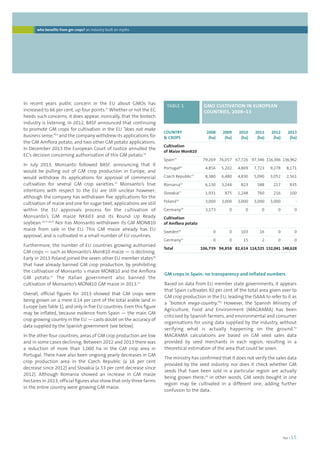
being grown on a mere 0.14 per cent of the total arable land in 
Europe (see Table 1), and only in five EU countries. Even this figure 
may be inflated, because evidence from Spain — the main GM 
crop growing country in the EU — casts doubt on the accuracy of 
data supplied by the Spanish government (see below). 
In the other four countries, areas of GM crop production are low 
and in some cases declining. Between 2012 and 2013 there was 
a reduction of more than 1,000 ha in the GM crop area in 
Portugal. There have also been ongoing yearly decreases in GM 
crop production area in the Czech Republic (a 16 per cent 
decrease since 2012) and Slovakia (a 53 per cent decrease since 
2012). Although Romania showed an increase in GM maize 
hectares in 2013, official figures also show that only three farms 
in the entire country were growing GM maize. 
TABLE 1 GMO CULTIVATION IN EUROPEAN 
COUNTRIES, 2008–13
who benefits from gm crops? an industry built on myths 
one Genetically Modified Crops 
continued 
However, Spanish non-governmental organisations,45 using 
various legal routes, have managed to collect data on GM crop 
cultivation themselves, from some of the regional governments 
in Spain, and have compared this data with the agricultural 
ministry’s figures. Regional government data is collected 
through applications for agricultural subsidies, in which 
farmers must specify whether they are growing conventional or 
GM maize. The information obtained reveals large differences 
between national and regional government data. For example, 
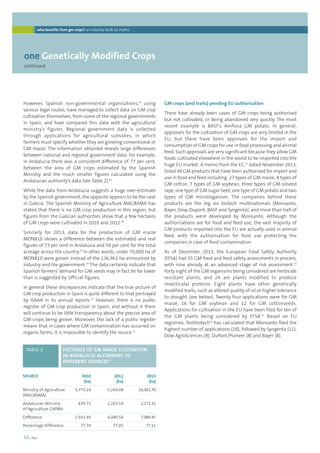
in Andalucia there was a consistent difference of 77 per cent, 
between the area of GM crops estimated by the Spanish 
Ministry and the much smaller figures calculated using the 
Andalucian authority’s data (see Table 2).46 
While the data from Andalucia suggests a huge over-estimate 
by the Spanish government, the opposite appears to be the case 
in Galicia. The Spanish Ministry of Agriculture MAGRAMA has 
stated that there is no GM crop production in this region, but 
figures from the Galician authorities show that a few hectares 
of GM crops were cultivated in 2010 and 2012.48 
Similarly for 2013, data for the production of GM maize 
MON810 shows a difference between the estimated and real 
figures of 73 per cent in Andalusia and 50 per cent for the total 
acreage across the country.49 In other words, under 70,000 ha of 
MON810 were grown instead of the 136,962 ha announced by 
industry and the government.50 The data certainly indicate that 
Spanish farmers’ demand for GM seeds may in fact be far lower 
than is suggested by ‘official’ figures. 
In general these discrepancies indicate that the true picture of 
GM crop production in Spain is quite different to that portrayed 
by ISAAA in its annual reports.51 However, there is no public 
register of GM crop production in Spain, and without it there 
will continue to be little transparency about the precise area of 
GM crops being grown. Moreover, the lack of a public register 
means that in cases where GM contamination has occurred on 
organic farms, it is impossible to identify the source.52 
TABLE 2 HECTARES OF GM MAIZE CULTIVATION 
16 | foei 
GM crops (and traits) pending EU authorisation 
There have already been cases of GM crops being authorised 
but not cultivated, or being abandoned very quickly. The most 
recent example is BASF’s Amflora GM potato. In general, 
approvals for the cultivation of GM crops are very limited in the 
EU, but there have been approvals for the import and 
consumption of GM crops for use in food processing and animal 
feed. Such approvals are very significant because they allow GM 
foods cultivated elsewhere in the world to be imported into the 
huge EU market. A memo from the EC,53 dated November 2013, 
listed 49 GM products that have been authorised for import and 
use in food and feed including: 27 types of GM maize; 8 types of 
GM cotton, 7 types of GM soybean, three types of GM oilseed 
rape, one type of GM sugar beet, one type of GM potato and two 
types of GM microorganism. The companies behind these 
products are the big six biotech multinationals (Monsanto, 
Bayer, Dow, Dupont, BASF and Syngenta), and more than half of 
the products were developed by Monsanto. Although the 
authorisations are for food and feed use, the vast majority of 
GM products imported into the EU are actually used in animal 
feed, with the authorisation for food use protecting the 
companies in case of food contamination. 
As of December 2013, the European Food Safety Authority 
(EFSA) had 55 GM food and feed safety assessments in process, 
with nine already at an advanced stage of risk assessment.54 
Forty eight of the GM organisms being considered are herbicide 
resistant plants, and 24 are plants modified to produce 
insecticidal proteins. Eight plants have other genetically 
modified traits, such as altered quality of oil or higher tolerance 
to drought (see below). Twenty four applications were for GM 
maize, 16 for GM soybean and 12 for GM cottonseeds. 
Applications for cultivation in the EU have been filed for ten of 
the GM plants being considered by EFSA.55 Based on EU 
registries, Testbiotech56 has calculated that Monsanto filed the 
highest number of applications (18), followed by Syngenta (11), 
Dow AgroSciences (9), DuPont/Pioneer (8) and Bayer (8). 
SOURCE 
Ministry of Agriculture 
(MAGRAMA) 
Andalusian Ministry 
of Agriculture CAPMA 
Difference 
Percentage Difference 
2010 
(ha) 
3,773.24 
839.75 
2,933.49 
77.74 
2011 
(ha) 
5,244.09 
1,203.59 
4,040.50 
77.05 
2013 
(ha) 
10,361.76 
2,372.31 
7,989.45 
77.11 
IN ANDALUCIA ACCORDING TO 
DIFFERENT SOURCES47
foei | 17 
who benefits from gm crops? an industry built on myths 
Africa 
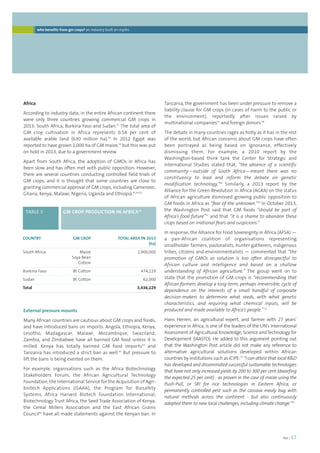
According to industry data, in the entire African continent there 
were only three countries growing commercial GM crops in 
2013: South Africa, Burkina Faso and Sudan.57 The total area of 
GM crop cultivation in Africa represents 0.54 per cent of 
available arable land (630 million ha).58 In 2012 Egypt was 
reported to have grown 1,000 ha of GM maize,59 but this was put 
on hold in 2013, due to a government review. 
Apart from South Africa, the adoption of GMOs in Africa has 
been slow and has often met with public opposition. However, 
there are several countries conducting controlled field trials of 
GM crops, and it is thought that some countries are close to 
granting commercial approval of GM crops, including Cameroon, 
Ghana, Kenya, Malawi, Nigeria, Uganda and Ethiopia.61,62,63 
TABLE 3 GM CROP PRODUCTION IN AFRICA60 
COUNTRY 
South Africa 
Burkina Faso 
Sudan 
Total 
GM CROP 
Maize 
Soya Bean 
Cotton 
Bt Cotton 
Bt Cotton 
TOTAL AREA IN 2013 
(ha) 
2,900,000 
474,229 
62,000 
3,436,229 
External pressure mounts 
Many African countries are cautious about GM crops and foods, 
and have introduced bans on imports. Angola, Ethiopia, Kenya, 
Lesotho, Madagascar, Malawi, Mozambique, Swaziland, 
Zambia, and Zimbabwe have all banned GM food unless it is 
milled. Kenya has totally banned GM food imports64 and 
Tanzania has introduced a strict ban as well.65 But pressure to 
lift the bans is being exerted on them. 
For example, organisations such as the Africa Biotechnology 
Stakeholders Forum, the African Agricultural Technology 
Foundation, the International Service for the Acquisition of Agri-biotech 
Applications (ISAAA), the Program for Biosafety 
Systems, Africa Harvest Biotech Foundation International, 
Biotechnology Trust Africa, the Seed Trade Association of Kenya, 
the Cereal Millers Association and the East African Grains 
Council66 have all made statements against the Kenyan ban. In 
Tanzania, the government has been under pressure to remove a 
liability clause for GM crops (in cases of harm to the public or 
the environment), reportedly after issues raised by 
multinational companies67 and foreign donors.68 
The debate in many countries rages as hotly as it has in the rest 
of the world, but African concerns about GM crops have often 
been portrayed as being based on ignorance, effectively 
dismissing them. For example, a 2010 report by the 
Washington-based think tank the Center for Strategic and 
International Studies stated that, “the absence of a scientific 
community—outside of South Africa—meant there was no 
constituency to lead and inform the debate on genetic 
modification technology.”69 Similarly, a 2013 report by the 
Alliance for the Green Revolution in Africa (AGRA) on the status 
of African agriculture dismissed growing public opposition to 
GM foods in Africa as “fear of the unknown.”70 In October 2013, 
the Washington Post said that GM foods “should be part of 
Africa’s food future”71 and that “it is a shame to abandon these 
crops based on irrational fears and suspicions.” 
In response, the Alliance for Food Sovereignty in Africa (AFSA) — 
a pan-African coalition of organisations representing 
smallholder farmers, pastoralists, hunter gatherers, indigenous 
tribes, citizens and environmentalists — commented that “the 
promotion of GMOs as solution is too often disrespectful to 
African culture and intelligence and based on a shallow 
understanding of African agriculture.” The group went on to 
state that the promotion of GM crops is “recommending that 
African farmers develop a long-term, perhaps irreversible, cycle of 
dependence on the interests of a small handful of corporate 
decision-makers to determine what seeds, with what genetic 
characteristics, and requiring what chemical inputs, will be 
produced and made available to Africa’s people.” 72 
Hans Herren, an agricultural expert, and farmer with 27 years’ 
experience in Africa, is one of the leaders of the UN’s International 
Assessment of Agricultural Knowledge, Science and Technology for 
Development (IAASTD). He added to this argument pointing out 
that the Washington Post article did not make any reference to 
alternative agricultural solutions developed within African 
countries by institutions such as ICIPE:73 “I can attest that local RD 
has developed and disseminated successful sustainable technologies 
that have not only increased yields by 200 to 300 per cent (dwarfing 
the expected 25 per cent) - as proven in the case of maize using the 
Push-Pull, or SRI for rice technologies in Eastern Africa, or 
permanently controlled pest such as the cassava mealy bug with 
natural methods across the continent - but also continuously 
adapted them to new local challenges, including climate change.”74
who benefits from gm crops? an industry built on myths 
18 | foei 
South Africa 
South Africa was the first country on the continent to cultivate 
GM crops. More than 95 per cent of maize production in South 
Africa is by large commercial farmers. There are no official 
records, but a survey based on commercial sales data estimated 
that in 2007/8 small holder plantings of GM maize amounted 
to 33,700 ha,80 or two per cent of the national GM maize crop.81 
It is worth noting that GM maize in South Africa is a staple food, 
meaning that it is part of the daily diet. 60 per cent of South 
African white maize production is destined for human 
consumption, and currently 80 per cent of that white maize is 
GM. This means that GM maize ends up in the South African 
food chain and may be eaten daily in an unprocessed form, such 
as milled and boiled into porridge.82 In many other countries, 
even the United States and Canada, GM crops largely go to non-food 
uses such as animal feed or biofuels, leaving the South 
African population as one of the few eating GM foods directly. 
According to a recent report from the African Centre for 
Biosafety83 which focuses on South Africa, the early adoption of 
GM technology meant that it arrived before the introduction of 
appropriate legislation and administrative procedures, which 
led in turn to a lack of proper monitoring and safety assessment 
in the country: “the decision to approve Monsanto’s product as 
early as 1997 allowed Monsanto to colonise the production of 
South Africa’s staple food through aggressive acquisitions of the 
South African seed industry and patent laws protecting 
Monsanto’s GM technology.”84 
A further consequence is that farmers in South Africa are 
already facing maize pests (stem borers) that have developed 
resistance to the Bt toxin in Monsanto’s GM maize MON810.85 
Monsanto has had to compensate South African farmers who 
have experienced damage to more than 10 per cent of their 
genetically modified (GM) insect resistant crops. Some farmers 
experienced as much as 50 per cent of their crop being affected 
by insect infestation.86 MON810 GM maize has now been 
withdrawn in South Africa and Monsanto has replaced it with 
MON8903 GM maize, which expresses two different forms of 
the insecticidal Bt protein (known as a ‘stacked’ variety) in an 
attempt to overcome the insect resistance problem. 
However, despite its failure in South Africa, Mon810 GM maize 
is still being pushed in other African countries such as Kenya, 
Tanzania, Mozambique and Uganda for field trials and 
eventual commercialisation.87 
one Genetically Modified Crops 
continued 
BOX 2: Feeding the world 
It is often claimed that GM crops are needed to meet the 
demands of a growing population. But the causes of chronic 
hunger are rarely to do with low crop yields per se. Rather 
they tend to be related to poverty, inequality of access to 
food, and inequality of access to land and resources with 
which to grow food.75 
For example, South Africa has been growing GM maize since 
the late 1990s. A study by the World Health Organization did 
find a significant reduction in food insecurity between 1999 
and 2008, but pointed out that this was due to government 
nutrition programmes and improvements in social welfare. 
Furthermore it found that even by 2008, “the nutrient 
density of the diet consumed by South African children is 
insufficient to meet their nutrient requirements. Similarly, 
they have shown alarmingly low food variety and household 
dietary diversity scores.”76 Income and access to food were 
found to be the crucial factors affecting households, and the 
report recommended the promotion of subsistence farming. 
More than 70 per cent of food insecure people live in rural 
areas of Africa, Asia, Latin America and the Near East.77 A high 
proportion are family farmers and smallholders, often unable 
to afford the high-input technologies associated with 
intensive monoculture farming and GM crops. For such 
farmers, sustainable farming systems offer genuine hope. A 
report by the United Nations Special Rapporteur on the Right 
to Food, based on an extensive review of existing projects and 
scientific literature, concluded that, “to date, agro-ecological 
projects have shown an average crop yield increase of 80 per 
cent in 57 developing countries, with an average increase of 
116 per cent for all African projects,”78 and that “recent projects 
conducted in 20 African countries demonstrated a doubling of 
crop yields over a period of 3-10 years.”79
note that “from the perspective of financially resource-poor 
farmers, this increase implies greater financial risk because the 
expense is incurred early in the season and cannot be adjusted.” 
The second country to introduce GM cotton was Burkina Faso in 
2008. This was the first country in Western Africa to allow 
commercial GM production. Burkina Faso has been hailed as a 
biotech success story, with claims that large increases in 
national production are due to the introduction of GM cotton.94 
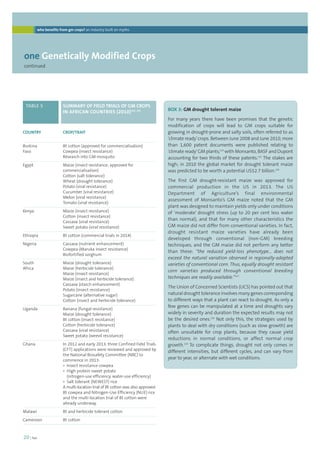
But according to data from the pro-GM Burkina Biotech 
Association,95 while GM cotton production grew significantly 
between 2011 and 2012 non-GM production grew even more 
(see Table 4), and the percentage of GM cotton in terms of total 
output actually decreased. There are also claims from NGOs in 
the country that small farmers have reported lower yields and 
reduced profit with GM cotton, and that overblown predictions 
in the media led to high early adoption rates.96,97 
A study of Bt cotton in Burkina Faso, published in 2013, found 
that high seed costs were a problem for small farmers and the 
risks of GM cotton production were “disproportionately high” for 
resource-poor farmers.99 A 2010 survey of cotton farmers, 
conducted by Traidcraft UK, reported that while conventional 
and organic cotton seed cost 3000-3,500 CFA per hectare, the 
price for Bt cotton seed was 27,000 CFA per hectare – up to nine 
times more expensive.100 They also reported local concerns that 
Bt cotton seed was being “unduly promoted without sufficient 
regard to the concerns and needs of most farmers.”101 
It was not possible to obtain evidence about the situation in Sudan. 
foei | 19 
who benefits from gm crops? an industry built on myths 
Insect resistant maize for Africa 
One particular African GM maize project that has been dogged 
by problems (relating to intellectual property rights) is the 
Insect Resistant Maize for Africa project (IRMA), which is funded 
by the Syngenta Foundation.88,89 The stated aim of this project 
was “increasing maize production and food security through the 
development and deployment of insect resistant maize to reduce 
losses due to stem borers,” and that it would act “as a model of 
how major scientific and development projects will be carried out 
in future, through innovative partnerships and through 
institutional and disciplinary collaborations.”90 
Despite these aims, it eventually became evident that it was 
going to be very difficult to find Bt genes to fight the stem borer 
that were not already patented by biotechnology corporations. 
At the beginning of the project, Bt genes for insertion into GM 
maize plants were sourced from Ottawa University, on the basis 
that they would be used for “research purposes only.” Ottawa 
University was chosen as the source of the Bt genes, because as 
a public institution it was believed this would build trust in the 
project. Then, in 2006, the management of the IRMA project 
asked Ottawa University to license the Bt genes for use in 
commercial varieties, so these could be sold to farmers. At this 
point, it was found that the intellectual property rights relating 
to the Bt genes were in fact held by a number of different 
private companies. Ottawa University would not risk an 
agreement for the commercial development of the IRMA Bt 
maize varieties, because it feared lawsuits from the companies 
that ‘owned’ the Bt genes.91 As a result, the GM maize varieties 
developed by IRMA could not be used by farmers. 
BT cotton 
In 2013, three African countries cultivated GM cotton: South 
Africa, Burkina Faso and Sudan. In 2014, the Ethiopian government 
announced plans to start growing GM cotton as well. 
South Africa was the first country to adopt Bt cotton, beginning 
in 1998, but this did not halt the continuous decline in South 
African cotton production, which has been going on since the 
late 1980s. This decline is mainly due to the decrease in cotton 
prices relative to other crops such as maize, sugar cane and 
sunflowers. GM cotton in South Africa represents less than one 
per cent of total biotech crops planted in the country.92 
Large farmers dominate South African cotton production, but 
smallholders also adopted Bt cotton. An analysis of studies 
examining their experiences found that although yields did rise 
(from a very low base), the reduction in pesticide applications was 
“hardly substantial” and, due to the technology fee, buying GM 
seeds represented 70-80 per cent of smallholders’ costs for GM 
cotton (up from 40-50 per cent for non-GM seeds).93 The authors 
YEAR 
2011 
2012 
GM COTTON 
PRODUCTION 
(tonnes) 
260,680 
313,781 
NON-GM COTTON 
PRODUCTION 
(tonnes) 
156,447 
302,016 
% GM 
62.49 
50.96 
TOTAL 
417,127 
615,796 
TABLE 4 COTTON PRODUCTION 
IN BURKINA FASO98 
Future products 
Besides maize, cotton and soya, research projects in Africa are 
working towards the commercial cultivation of genetically 
modified cassava, bananas, and sweet potato crops that are 
resistant to viruses that affect these crops.102 It has also been 
reported that GM cassava with enhanced vitamin A content 
was tested in Nigerian fields in 2013.103
who benefits from gm crops? an industry built on myths 
one Genetically Modified Crops 
continued 
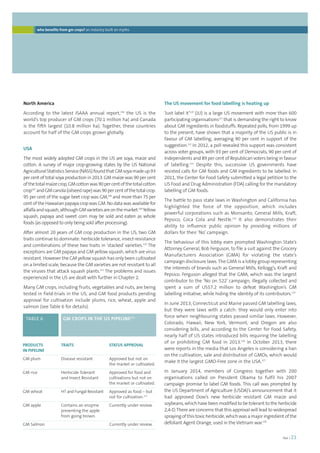
TABLE 5 SUMMARY OF FIELD TRIALS OF GM CROPS 
20 | foei 
BOX 3: GM drought tolerant maize 
For many years there have been promises that the genetic 
modification of crops will lead to GM crops suitable for 
growing in drought-prone and salty soils, often referred to as 
‘climate ready’ crops. Between June 2008 and June 2010, more 
than 1,600 patent documents were published relating to 
‘climate ready’ GM plants,114with Monsanto, BASF and Dupont 
accounting for two thirds of these patents.115 The stakes are 
high; in 2010 the global market for drought tolerant maize 
was predicted to be worth a potential US$2.7 billion.116 
The first GM drought-resistant maize was approved for 
commercial production in the US in 2013. The US 
Department of Agriculture’s final environmental 
assessment of Monsanto’s GM maize noted that the GM 
plant was designed to maintain yields only under conditions 
of ‘moderate’ drought stress (up to 20 per cent less water 
than normal), and that for many other characteristics the 
GM maize did not differ from conventional varieties. In fact, 
drought resistant maize varieties have already been 
developed through conventional (non-GM) breeding 
techniques, and the GM maize did not perform any better 
than these: “the reduced yield-loss phenotype… does not 
exceed the natural variation observed in regionally-adapted 
varieties of conventional corn. Thus, equally drought resistant 
corn varieties produced through conventional breeding 
techniques are readily available.”117 
The Union of Concerned Scientists (UCS) has pointed out that 
natural drought tolerance involves many genes corresponding 
to different ways that a plant can react to drought. As only a 
few genes can be manipulated at a time and droughts vary 
widely in severity and duration the expected results may not 
be the desired ones.118 Not only this, the strategies used by 
plants to deal with dry conditions (such as slow growth) are 
often unsuitable for crop plants, because they cause yield 
reductions in normal conditions, or affect normal crop 
growth.119 To complicate things, drought not only comes in 
different intensities, but different cycles, and can vary from 
year to year, or alternate with wet conditions. 
COUNTRY 
Burkina 
Faso 
Egypt 
Kenya 
Ethiopia 
Nigeria 
South 
Africa 
Uganda 
Ghana 
Malawi 
Cameroon 
IN AFRICAN COUNTRIES (2010)104, 105 
CROP/TRAIT 
Bt cotton (approved for commercialisation) 
Cowpea (insect resistance) 
Research into GM mosquito 
Maize (insect resistance; approved for 
commercialisation) 
Cotton (salt tolerance) 
Wheat (drought tolerance) 
Potato (viral resistance) 
Cucumber (viral resistance) 
Melon (viral resistance) 
Tomato (viral resistance) 
Maize (insect resistance) 
Cotton (insect resistance) 
Cassava (viral resistance) 
Sweet potato (viral resistance) 
Bt cotton (commercial trials in 2014) 
Cassava (nutrient enhancement) 
Cowpea (Maruka insect resistance) 
Biofortified sorghum 
Maize (drought tolerance) 
Maize (herbicide tolerance) 
Maize (insect resistance) 
Maize (insect and herbicide tolerance) 
Cassava (starch enhancement) 
Potato (insect resistance) 
Sugarcane (alternative sugar) 
Cotton (insect and herbicide tolerance) 
Banana (fungal resistance) 
Maize (drought tolerance) 
Bt cotton (insect resistance) 
Cotton (herbicide tolerance) 
Cassava (viral resistance) 
Sweet potato (weevil resistance) 
In 2012 and early 2013, three Confined Field Trials 
(CFT) applications were reviewed and approved by 
the National Biosafety Committee (NBC) to 
commence in 2013: 
• Insect resistance cowpea 
• High protein sweet potato 
(nitrogen-use efficiency, water-use efficiency) 
• Salt tolerant (NEWEST) rice 
A multi-location trial of Bt cotton was also approved. 
Bt cowpea and Nitrogen-Use Efficiency (NUE) rice 
and the multi-location trial of Bt cotton were 
already underway. 
Bt and herbicide tolerant cotton 
Bt cotton
The US movement for food labelling is heating up 
‘Just label it’120 (JLI) is a large US movement with more than 600 
participating organisations121 that is demanding the right to know 
about GM ingredients in foodstuffs. Repeated polls, from 1999 up 
to the present, have shown that a majority of the US public is in 
favour of GM labelling, averaging 90 per cent in support of the 
suggestion.122 In 2012, a poll revealed this support was consistent 
across voter groups, with 93 per cent of Democrats, 90 per cent of 
Independents and 89 per cent of Republican voters being in favour 
of labelling.123 Despite this, successive US governments have 
resisted calls for GM foods and GM ingredients to be labelled. In 
2011, the Center for Food Safety submitted a legal petition to the 
US Food and Drug Administration (FDA) calling for the mandatory 
labelling of GM foods. 
The battle to pass state laws in Washington and California has 
highlighted the force of the opposition, which includes 
powerful corporations such as Monsanto, General Mills, Kraft, 
Pepsico, Coca Cola and Nestle.124 It also demonstrates their 
ability to influence public opinion by providing millions of 
dollars for their ‘No’ campaign. 
The behaviour of this lobby even prompted Washington State’s 
Attorney General, Bob Ferguson, to file a suit against the Grocery 
Manufacturers Association (GMA) for violating the state’s 
campaign disclosure laws. The GMA is a lobby group representing 
the interests of brands such as General Mills, Kellogg’s, Kraft and 
Pepsico. Ferguson alleged that the GMA, which was the largest 
contributor to the ‘No on 522’ campaign, illegally collected and 
spent a sum of US$7.2 million to defeat Washington’s GM 
labelling initiative, while hiding the identity of its contributors.125 
In June 2013, Connecticut and Maine passed GM labelling laws, 
but they were laws with a catch: they would only enter into 
force when neighbouring states passed similar laws. However, 
Colorado, Hawaii, New York, Vermont, and Oregon are also 
considering bills, and according to the Center for Food Safety, 
nearly half of US states introduced bills requiring the labelling 
of or prohibiting GM food in 2013.126 In October 2013, there 
were reports in the media that Los Angeles is considering a ban 
on the cultivation, sale and distribution of GMOs, which would 
make it the largest GMO-Free zone in the USA.127 
In January 2014, members of Congress together with 200 
organisations called on President Obama to fulfil his 2007 
campaign promise to label GM foods. This call was prompted by 
the US Department of Agriculture (USDA)’s announcement that it 
had approved Dow’s new herbicide resistant GM maize and 
soybeans, which have been modified to be tolerant to the herbicide 
2,4-D. There are concerns that this approval will lead to widespread 
spraying of this toxic herbicide, which was a major ingredient of the 
defoliant Agent Orange, used in the Vietnam war.128 
foei | 21 
who benefits from gm crops? an industry built on myths 
North America 
According to the latest ISAAA annual report,106 the US is the 
world’s top producer of GM crops (70.1 million ha) and Canada 
is the fifth largest (10.8 million ha). Together, these countries 
account for half of the GM crops grown globally. 
USA 
The most widely adopted GM crops in the US are soya, maize and 
cotton. A survey of major crop-growing states by the US National 
Agricultural Statistics Service (NASS) found that GM soya made up 93 
per cent of total soya production in 2013. GM maize was 90 per cent 
of the total maize crop, GM cotton was 90 per cent of the total cotton 
crop107 and GM canola (oilseed rape) was 90 per cent of the total crop. 
95 per cent of the sugar beet crop was GM,108 and more than 75 per 
cent of the Hawaiian papaya crop was GM. No data was available for 
alfalfa and squash, although GM varieties are on the market.109Yellow 
squash, papaya and sweet corn may be sold and eaten as whole 
foods (as opposed to only being sold after processing). 
After almost 20 years of GM crop production in the US, two GM 
traits continue to dominate: herbicide tolerance, insect-resistance 
and combinations of these two traits in ‘stacked’ varieties.110 The 
exceptions are GM papaya and GM yellow squash, which are virus 
resistant. However the GM yellow squash has only been cultivated 
on a limited scale, because the GM varieties are not resistant to all 
the viruses that attack squash plants.111 The problems and issues 
experienced in the US are dealt with further in Chapter 2. 
Many GM crops, including fruits, vegetables and nuts, are being 
tested in field-trials in the US, and GM food products pending 
approval for cultivation include plums, rice, wheat, apple and 
salmon (see Table 6 for details). 
TABLE 6 GM CROPS IN THE US PIPELINE112 
PRODUCTS 
IN PIPELINE 
GM plum 
GM rice 
GM wheat 
GM apple 
GM Salmon 
TRAITS 
Disease resistant 
Herbicide Tolerant 
and Insect Resistant 
HT and Fungal Resistant 
Contains an enzyme 
preventing the apple 
from going brown. 
STATUS APPROVAL 
Approved but not on 
the market or cultivated. 
Approved for food and 
cultivations but not on 
the market or cultivated. 
Approved as food – but 
not for cultivation.113 
Currently under review. 
Currently under review.
who benefits from gm crops? an industry built on myths 
one Genetically Modified Crops 
continued 
22 | foei 
The Panamanian National Environmental Authority (Centro de 
Incidencia Ambiental de Panama-CIAM) has identified major 
problems with AquaBounty’s experimental production of GM 
salmon and the Panamanian government’s oversight of this 
production.135 Furthermore in January 2014 environmental groups 
in Canada took legal action against the Canadian government, on 
the basis that it had not assessed the environmental impacts of 
the GM salmon in ecosystems and on wild salmon species.136 In 
particular, there are concerns that if fast growing GM fish were to 
escape from captivity they might outcompete wild species for 
resources, or cross breed with wild stocks. Once escaped into the 
wild it would be very difficult to retrieve GM salmon. 
AquaBounty claims that it will only produce sterile females, in 
order to mitigate the risks from escaped GM salmon. However, in 
the project specifications submitted to the US FDA, the company 
stated that 95 per cent of the eggs produced would be sterile, 
meaning that up to five per cent of the GM salmon in each batch 
could be fertile.137 Research published in the Proceedings of the 
National Academy of Sciences138 concluded that a release of just 
60 fertile GM fish into a wild population of 60,000 could lead to 
the extinction of the wild population in less than 40 generations. 
The Canadian Department of Fisheries conducted research on 
Coho salmon that were treated with an engineered growth 
hormone similar to the one produced in AquAdvantage GM 
Salmon. The study found the treated salmon were more 
aggressive when searching for food (the growth hormone made 
them hungrier), and in some instances resorted to cannibalism.139 
AquaBounty’s record does not inspire confidence either. In 2009, 
AquaBounty’s egg production facility on Prince Edward Island 
was infected with Infectious Salmon Anaemia (ISA),140 which it 
failed to report to the FDA.141 ISA is a deadly salmon virus that 
decimated the Chilean and Scottish salmon farming industries. 
In the USA, several retailers have already announced they will 
not sell any GM seafood, with European supermarkets making 
similar statements.142 
Canada 
Canada has approved varieties of GM canola (oilseed rape), 
maize (including sweetcorn), soya and sugar beet. The Canadian 
government does not produce any statistics on GM crop 
production area, although it is thought that 100 per cent of the 
Canadian oilseed crop is GM.129 
The Canadian government publishes a list of pending GM 
products. However, the list is voluntary. Furthermore, there is no 
requirement to list GM animals, while novel products that are a 
product of conventional breeding are also included.130 Recently 
published submissions for GM crops include: ‘stacked’ insect 
resistant soybean; alfalfa modified for reduced lignin content; 
cotton tolerant to two herbicides; and apple modified to be 
non-browning.131 
GM Salmon 
‘AquAdvantage Salmon’ is a GM Atlantic salmon, which is claimed 
to be faster growing than other farmed salmon. If approved, this 
would be the first GM animal allowed to enter the food supply by 
any regulatory agency in the world. At least 35 other species of 
genetically modified fish are currently under development, 
including trout, tilapia, striped bass, flounder and other salmon 
species — all modified with genes from a variety of organisms, 
including other fish, coral, mice, bacteria and even humans.132 
AquaBounty Technologies applied for approval of the GM 
Atlantic salmon for human consumption in the US, but intends 
to produce GM fish eggs in Prince Edward Island in Canada and 
then ship them to Panama for growing and processing. In 
November 2013, Canada gave the green light for the production 
of the GE fish eggs,133 the process having been conducted in 
secret and without any public consultation.134 
In 2013, the US Food and Drug Administration (FDA) announced 
that it was considering the application to approve GM salmon 
for human consumption. The FDA’s decision would set a 
precedent, with approval opening the floodgates for other 
genetically engineered fish and animals (including cows, pigs 
and chickens) to potentially enter the US market. Currently 
there are no US laws specifically governing the production and 
sale of GM animals. Instead, the FDA regulates them as ‘new 
animal drugs,’ even though animal drug laws were not intended 
to regulate living organisms, that can reproduce and move 
independently. In addition, the animal drug approval process is 
confidential and mostly closed to the public, due to 
confidentiality laws for drug products. This severely limits public 
participation in the regulatory process.
Brazil 
According to ISAAA’s 2013 annual report on Brazil, the country 
has 23 per cent of the global GM crop area, with 40.3 million ha 
of GM maize, soy and cotton. Based on 2012 figures,149 5.17 
million ha of summer maize plantings are GM — 62.5 per cent 
of the total crop — of which 53.2 per cent are Bt insect resistant, 
7.5 per cent are herbicide tolerant, and 29.7 per cent are 
‘stacked’ varieties, containing both insect resistance and 
herbicide tolerance traits. The highest adoption rates for GM 
maize were in the southeast (88.1 per cent), the midwest (86.6 
per cent) and the south (86.4 per cent) of Brazil. Winter maize 
(also referred to as ‘second season maize crop’ or ‘safrinha’) 
occupied a smaller area at 7.9 million ha, with GM winter maize 
planted on 6.93 million ha (87.7 per cent).150 
Half a million hectares of biotech cotton was planted in Brazil in 
2012. Around half (52.7 per cent) was herbicide tolerant, 29 per 
cent was insect resistant, and 18.2 per cent was stacked 
containing both traits. The highest adoption rates, by region, are 
in the north at 100 per cent, followed by the northeast at 58.5 
per cent and the north/northeast at 57.1 per cent.151 
Brazilian farmers knock Monsanto’s profits 
89 per cent of the soya crop in Brazil is GM,152 with Roundup 
Ready soya beans accounting for 85 per cent. Monsanto charges 
a two per cent royalty fee on GM soybeans and GM cotton seeds 
sold in Brazil. Following Monsanto’s attempt to extend its 
Brazilian patent for RoundupReady soybeans (up to 2014), a 
consortium of farming syndicates from Rio Grande do Sul took 
legal action. The court found in favour of the farmers, with the 
judge ruling that because the patents for RR1 soybeans had 
expired in Brazil, the royalty fee was unlawful and Monsanto 
must compensate the farmers. In 2012, the Brazilian Supreme 
Court of Justice decided the Rio Grande do Sul judgement 
applied to the entire country.153 Lawyers for the farmers and 
representative bodies estimate the value of the claims against 
Monsanto at 1.9 billion Brazilian real (about US$ 1 billion).154 
In its 2013 Annual Report, Monsanto stated that it had agreed 
to ‘defer’ payments, leading to a net reduction in sales profits 
from its GM soybean seeds of US$118 million.155 Monsanto also 
allowed growers to buy Roundup Ready soybeans in 2012-14 
royalty free, but only if they signed new contracts waiving their 
rights to any compensation.156 The new Monsanto contracts also 
allow Monsanto to make inspections and increase royalty fees, 
and they contradict a Brazilian law that allows farmers to save 
their seeds for the next harvest.157 A judge in Mato Grosso has 
already blocked these contracts. However, in 2013, Monsanto 
launched RoundupReady2 soybeans, which will be protected by 
a new patent and royalty fees. 
foei | 23 
who benefits from gm crops? an industry built on myths 
Latin America 
After North America, Latin American countries are the largest 
producers of GM crops. According to ISAAA, the leader is Brazil, 
growing 40.3 million ha, followed by Argentina (24.4 million ha), 
Paraguay (3.6 million ha), Uruguay (1.5 million ha), Bolivia (1.0 
million ha), and Mexico (0.1 million ha). Chile, Costa Rica, 
Colombia, Honduras and Cuba are all listed as cultivating ‘less 
than’ 100,000 ha. Based on these figures, supplied by the 
industry, countries in Latin America grow approximately 40 per 
cent of the world’s GM crops.143 
The GM crops being grown are soya, maize and cotton, and just 
two GM traits dominate: herbicide tolerance and insect resistance. 
The southern cone of South America has a history of soya 
production. In 2003 it was even dubbed the “United Republic of 
Soybeans” in Syngenta publicity material.146 It is a vast area 
between Argentina, Brazil, Paraguay, Uruguay and the south of 
Bolivia, which has been transformed by GM soya farming. This 
has become the area with the highest concentration of GM 
crops in the world, with a reported 46 million ha of soy 
monoculture (not all of which is GM). These vast areas of 
soybeans are sprayed with over 600 million litres of glyphosate. 
The spread of monoculture soya production has also been 
linked with deforestation and land concentration.147, 148 
TABLE 7 GM CULTIVATION IN LATIN AMERICA144 
COUNTRY 
Brazil 
Argentina 
Paraguay 
Uruguay 
Bolivia 
Mexico 
Colombia 
Chile 
Honduras 
Cuba 
PRODUCT 
Soy, Maize, 
Cotton 
Soy, Maize, 
Cotton 
Soy, Maize, 
Cotton 
Soy, Maize 
Soy 
Cotton, Soy 
Maize, Cotton 
Soy, Maize, 
Canola 
Maize 
Maize 
TRAITS 
HT*, IR**  stacked varieties 
HT, IR  stacked varieties 
HT 
HT, IR  stacked varieties 
HT  IR  stacked varieties 
Insect resistant, 
Herbicide resistant 
MILLION 
(ha) 
40.3 
24.4 
3.6 
1.5 
1.0 
0.1 
0.1 
0.03145 
0.03 
0.003 
N.B.: *Herbicide Tolerant. **Insect Resistant.
who benefits from gm crops? an industry built on myths 
one Genetically Modified Crops 
continued 
24 | foei 
Chile 
Chile only propagates GM seeds for export. According to a 
government official responsible for the area of GM crops grown in 
Chile, the number of hectares stated in the ISAAA report was 
wrong; Chile is listed as growing 100,000 ha of GM crops, but the 
real area is much less, at 31,000 ha.167 GM maize accounts for 
25,000 ha, GM oilseed rape 4,000 ha and GM soy around 2,000 ha. 
Honduras 
This is the only country in Central America that allows the field 
testing and commercial production of biotech crops. In 2012, 
there were about 33,000 ha of commercial GM maize production 
in Honduras, as well as several field trials of GM maize, soy, rice 
and bananas. The GM corn is cultivated in seven departments 
but is not allowed in three, the most poor. It has been restricted 
as a result of community requests. In addition, GM maize is not 
allowed to be grown close to native maize varieties.168 
Latin American countries holding out against GM crops 
GM crops have not entered South America entirely without 
resistance. Peru169 has introduced a ten-year ban on GM crop 
production, by means of a regulation drafted by the anti-biotech 
Ministry of Environment. Venezuela has not approved 
any GM crops.170 Guatemala has had a de facto moratorium in 
place since 2006.171 Costa Rica is almost GM free, as 62 out of its 
81 cantons have adopted legal measures to become GM-free 
zones,172 and the only GM crops currently being grown are GM 
cotton and soy seed crops for export. 
In Mexico, a landmark ruling suspended the cultivation of GM 
maize seeds for commercial use or testing. Mexico is the centre 
of origin and diversity of maize, and the judge based his 
decision on “risk of imminent harm to the environment.”173 This 
decision was the result of legal action taken jointly by farmers, 
scientists and human rights groups, in order to stop the 
Mexican government trying to lift a moratorium on GM maize 
production that has been in place since 1988.174 
Finally, Ecuador has a constitutional moratorium on GM crops in 
place, although this is threatened by President Correa, who 
adopted a strong position against it in 2012. There is 
speculation that the current National Assembly, in which 
President Correa’s party Alianza País holds an absolute majority, 
might consider amending the constitution to allow GM 
research and cultivation.175 
Argentina 
Argentina is the third largest grower of GM crops after the US and 
Brazil. Argentina’s soy harvest is 100 per cent GM, while 95 per 
cent of its maize and 99 per cent of its cotton are GM. However, 
cotton hectares decreased by almost half between 2011/2012 
and 2012/2013 due to falling world prices and competition with 
soy.158 In all, twenty four types of GM crop are approved for 
commercial production in Argentina: three GM soybeans, 
eighteen GM maize, and three GM cotton.159 There has been much 
controversy about the link between the adoption of GM crops in 
Argentina and the explosion in agrochemical usage in the country. 
Initially agro-chemical use fell when GM crops were introduced, 
but as pests and weeds developed resistance, agrochemical use 
has increased ninefold; from 9 million gallons (34 million litres) in 
1990 to more than 84 million gallons (317 million litres) in 2013.160 
A study of the main soybean growing area in Argentina found that 
more herbicide was applied to Roundup Ready soybeans than 
conventionally grown beans,161 and the environmental impact of 
the sprays used on GM crops was higher than those for 
conventional crops. An Argentinian NGO ‘The Network of 
Physicians Working in Crop Sprayed Towns’ recently conducted an 
analysis of data published by CASAFE (the Argentine Chamber of 
Agrochemicals) pointing out that since 1990 the cultivated area in 
Argentina increased by 50 per cent and the crop yield by 30 per 
cent, but pesticide use increased by 858 per cent.162 They also point 
out that in the late 1990s, when GM crops first started being 
grown in Argentina, the recommended application rate was 3 l/ha 
per year; the amount being applied in 2013 was 12 l/ha per year. 
Paraguay and Uruguay 
95 per cent of the Paraguayan soya bean crop is Monsanto’s 
Roundup Ready soybean. In 2012, 45 per cent of Paraguayan 
cotton production was GM, as was 40 per cent of the maize 
crop.163 Uruguay’s soya crop is 100 per cent GM (Roundup 
Ready), while GM maize occupied around 145,000 hectares in 
2012, of which 80 per cent were ‘stacked’ Bt insect resistant and 
herbicide tolerant varieties.164 
Bolivia 
Although, 91 per cent of soya production in Bolivia is GM 
(Roundup Ready), GMOs are a controversial issue in the country. 
According to a report from USDA, the issue divides the country 
in two; the highlands (La Paz) oppose GM crops while Santa 
Cruz farmers wish to grow them. The Bolivian government has 
passed a Revolutionary Law that is supposed to prohibit the use 
of GM crops, but it is not clear whether this will be applied to 
GM soy production, as the law only applies to GM crops for 
which Bolivia is a centre of origin and diversity.165, 166
Asia 
Production of GM crops is much lower in Asia than in North and 
South America. According to the latest ISAAA report, 19.1 
million ha of GM crops were grown across five countries — 
India, China, Pakistan, the Philippines and Myanmar — 
constituting 10.9 per cent of global GM crop production. 
The GM crop area in Asia only represents a small percentage of 
the total arable land in the region, and insect resistance is the 
dominant trait. The largest GM crop by far is insect resistant (Bt) 
cotton, which is the only GM crop grown in India, Pakistan and 
Myanmar, and the largest crop in China. 
Only the Philippines grows GM maize, which accounts for 
approximately 28 per cent of the national maize area.183 GM maize 
with stacked traits occupies the majority of the GM area (90 per cent).184 
There have been several attempts to introduce GM rice, GM 
Papaya and GM maize into Thailand, but these have failed so far.185 
foei | 25 
who benefits from gm crops? an industry built on myths 
TABLE 8 GM CROPS IN THE PIPELINE 
COUNTRY 
Brazil176 
Argentina177 
Paraguay 
Uruguay178 
Bolivia 
Mexico179 
Colombia180 
Chile181 
Honduras182 
PRODUCT 
Sugarcane 
Maize 
Sugarcanes 
Potato 
Wheat, maize  soy 
No info available 
Maize 
and two soybeans 
No info available 
Wheat field trials 
Maize field trials 
prohibited 
Reseach projects 
Sugarcane 
Rice, cassava, potato 
Research on pine 
trees, stone fruit, 
apples,  grapes 
Rice field trials 
TRAIT 
Insect resistant 
Stacked varieties 
Drought resistant (ready for 
commercialisation 2017) 
Herbicide tolerant (2014) 
and Bt insect resistant 
Disease resistant and 
herbicide tolerant* 
Drought tolerant (from 
sunflower gene) possibly 
ready for 2015/2016) 
No info available 
Stacked herbicide 
tolerant/insect resistant 
Bt11xMIR162xGA21; 
MON89034xMON88017; 
TC1507xNK603; 
TC1507xNK603xMON89034 
Herbicide tolerant and 
stacked herbicide tolerant 
(tolerant to more than 
one herbicide) 
Soybean: A2704-12 (LL); 
A5547-127 (LL); 
MON89788xMON87701 
(RR2YxBt); 
BPS-CV127-9 
Drought resistant 
Disease resistant 
Insect resistant 
Herbicide tolerant LL62 
IN LATIN AMERICA 
COUNTRY 
India 
China 
Pakistan 
Philippines 
Myanmar 
Total 
PRODUCT 
Cotton 
Cotton, papaya, 
poplar trees 
Cotton 
Maize 
Cotton 
TRAITS 
Insect resistant 
Insect resistant, 
Virus resistant 
Insect resistant 
Insect resistant, 
herbicide tolerant 
and stacked traits 
Insect resistant 
TABLE 9 GM CROPS IN ASIA186 
MILLION 
(ha) 
11 
4.2 
2.8 
0.8 
0.3 
19.1
who benefits from gm crops? an industry built on myths 
one Genetically Modified Crops 
continued 
With respect to GM Cotton, India is the front runner with 10.8 
million ha, accounting for 93 per cent of the total cotton area187 in 
India. But this still only makes up six per cent of India’s total 
arable land (177.5 million ha).188 China is the next largest Asian 
producer of GM cotton (3.9 million ha) which represents 75 per 
cent of the total cotton area.189However, the total arable land area 
in China is 143.5 million ha, so GM cotton represents only two per 
cent of the total production area.190 Pakistan grows 2.8 million ha 
of GM Cotton, which was only approved in 2012. This is 32 per 
cent of the total cotton area,191 or 12.4 per cent of the total arable 
area in the country (22.5 million ha). In Myanmar, the cotton crop 
has been almost entirely GM for some years, but accounts for 
only 2.8 per cent of the total arable land area(10.6 million ha).192 
Several other products are advertised by the industry as being in 
the process of development in Asia (see Table 10). 
Chinese concerns about GM foods 
Since 1997, China has approved six GM plants for commercial 
production — cotton, tomato, sweet pepper, petunia, poplar, 
and papaya. However, apart from cotton and papaya, the others 
are not produced or are hardly in production, due to difficulties 
in bringing the products through to commercialisation.200 GM 
virus resistant papaya is cultivated in Guangdong on 
approximately 3,500 ha, and two GM tree crops (insect resistant 
poplar 12 and poplar 741) are planted commercially on 450 ha. 
However, the US Department of Agriculture and ISAAA provide 
different figures: ISAAA gives a larger area for GM papaya and a 
smaller area for GM poplar production than USDA. China does 
not publish government statistics on GM seed production, so it 
is not possible to verify these figures. However, there are reports 
that the biosafety certifications for the GM tomato and the GM 
bell pepper have been withdrawn.201, 202, 203 
In 2009, China approved two domestically developed GM crops, 
a GM phytase maize which is intended to increase the 
absorption of phosphorous by livestock and two insect resistant 
varieties of rice. Then, in September 2011, China’s major 
financial weekly, the Economic Observer, released information 
from a source close to the Ministry of Agriculture announcing 
that China had suspended the commercialisation of GM rice. 
Civil society groups in China had opposed what would have been 
the world’s first cultivation of a GM staple food crop.204 To date, 
GM phytase maize has still not been cleared for cultivation.205 
26 | foei 
TABLE 10 GM CROPS IN THE ASIAN PIPELINE 
COUNTRY 
China 
India 
Pakistan 
Philippines199 
GM CROP 
According to the Long and 
Mid-term National 
Development Plan for Science 
and Technology (2006-2020), 
the programme will focus on 
crop (rice, wheat, corn, and 
cotton) and animal (swine, 
cattle, and sheep) research.193 
GM Cotton developed by the 
Cotton Research Institute, 
Chinese Academy of 
Agricultural Sciences (CAAS).194 
Five new cotton events are 
under assessment.195 
Public sector institutes are 
focusing on banana, cabbage, 
cassava, cauliflower, chickpea, 
cotton, eggplant, rapeseed/ 
mustard, papaya, pigeon pea, 
potato, rice, tomato, watermelon 
and wheat. The private seed 
companies are focusing on 
cabbage, cauliflower, corn, 
rapeseed/mustard, okra, pigeon 
pea, rice and tomato.196 
In 2011, the National 
Biosafety Committee (NBC) of 
the Environment Protection 
Agency (EPA) in Pakistan had 
approved 104 cases of GM 
crop development for 
laboratories, greenhouses and 
field evaluations, including 
cotton, corn, rice, wheat, 
sugarcane and groundnut.197 
GM cotton198 
Papaya 
Cotton 
Sweet potato 
Abaca 
TRAIT 
Develop varieties with new 
traits, such as insect, disease, 
and stress resistance. 
High quality fibre and 
develops big bolls. 
New traits and stacked event. 
Other traits include drought 
and salinity tolerance, disease 
resistance, sucking insect 
resistance, leaf curl virus 
resistance and traits related 
to cotton fibre quality. 
Stacked events of HT and 
IR, disease resistant (leaf 
curl virus) 
With delayed ripening and 
Papaya Ring Spot Virus 
(PRSV) resistance. 
Insect resistant (Bt) 
Virus resistant 
Virus resistant
Bt brinjal was also heavily promoted in the Philippines, and has met 
with similar public opposition there. A court decision ordering the 
halting of field trials of Bt brinjal led regulators to postpone its final 
approval and imminent commercialisation.216 In October 2013, Bt 
Brinjal was approved in Bangladesh, just before government 
elections.217 The GM plant is not on sale in the country, but the 
Bangladesh Agricultural Research Institute has distributed plants 
to 20 farmers.218 The action has been criticised both inside and 
outside Bangladesh, being seen as a de facto commercial 
introduction without proper assessment, and evidence of the weak 
regulatory regime for GM crops in that country.219, 220 
Australia 
Australia cultivates three GM crops: cotton, canola and 
carnation flowers.221 There is no public register, so the only 
statistics for crop production are based on industry data, which 
states that 90 per cent of cotton grown in Australia is GM. GM 
Canola (oilseed rape) varieties were first introduced in Australia 
in 2008,222 and GM now accounts for 10 per cent of total 
production.223 According to USDA, the uptake of GM canola is 
slow because non-GM varieties receive a premium, especially 
from the European market. In addition, there are few facilities 
that will accept GM oilseed rape for storage and export. 
South Australia and Tasmania maintain a total ban on GM crops. 
South Australia recently extended the ban until at least 2019, and 
according to the Minister of Tourism, GM free status gives the 
state’s food and wine producers a competitive advantage in the 
global market place.224 Tasmania has also just extended its 
moratorium indefinitely, with its Industry Minister stating “that 
the indefinite moratorium was needed to maintain the integrity of 
Tasmania’s brand and maximise future marketing opportunities.”225 
A court case is currently running in Western Australia between 
an organic farmer (Steve Marsh) and his neighbour (Michael 
Baxter) who cultivates GM. Mr Marsh accuses Mr Baxter of 
contaminating his canola crop back in 2010. As a consequence, 
that year Marsh lost his organic certification from the National 
Association for Sustainable Agriculture, Australia (NASAA) for 
approximately 70 per cent of his property, on which he grows 
oats and rye and keeps sheep. Marsh is seeking damages of 
AU$85,000 for lost income and a permanent injunction 
preventing Baxter from planting GMOs within one kilometre of 
his farm. The case challenges the concept of coexistence 
between GM and non-GM and organic crops.226 According to the 
Australian Associated Press, Marsh’s legal costs have been partly 
funded from an online crowd-funding appeal, while the 
biotechnology giant Monsanto backed Baxter.227 
foei | 27 
who benefits from gm crops? an industry built on myths 
Chinese consumers are not convinced about GM foods, and the 
GM debate is building in the country. Concerns have been fuelled 
by high profile scandals, such as a 2008 feeding trial of GM 
‘Golden Rice’ by US researchers, who fed the rice to schoolchildren 
in Hengnan county, allegedly without informed consent from 
their parents. In 2012, 25 families were each granted 80,000 yuan 
(US$12,800) compensation.206 An online survey conducted by 
Sina.com in 2013 found that 85 per cent of 30,000 voters would 
not buy GM foods, and 78 per cent were concerned about the 
health impacts of GM.207 From 2014, the food and drug authority 
of Gansu in northwest China is requiring food markets to sell GM 
foodstuffs separately from non-GM foods.208 There have been calls 
for GM labelling to be tightened, and there have even been GM 
protests outside the central government agricultural ministry.209 
In 2013/14 China rejected 887,000 tonnes of US maize imports 
because they contained Syngenta’s GM maize MIR 162, for which 
China has not granted food approval.210 
India and the Bt brinjal 
Cultivation of Bt Brinjal, or the GM eggplant/aubergine, has been 
highly controversial in India and has had wider consequences for 
the production of GM foods in the country. In 2009, the Indian 
authorities approved this GM crop, but after public protest and a 
consultation the environment ministry announced a 
moratorium on commercial introduction until the fulfilment of 
various conditions, including the setting up of an independent 
regulator for GM organisms, further studies into the health and 
environmental safety of Bt brinjal, and a requirement for consent 
from state governments for field trials of GM crops.211 As state 
governments are almost universally opposed to GM crop trials, 
there have been no GM field trials in India since 2009.212 
Following this moratorium, the Supreme Court appointed a Technical 
Expert Committee to examine the moratorium and the introduction 
of GM food crops. The final report was published in 2013 (with one 
member abstaining), and it recommended that the moratorium be 
continued until such time as the regulatory regime in India had been 
strengthened and a system of safety assessment put in place.213 As of 
early 2014, the issue of the moratorium on field trials was still going 
through the process of legal challenge and counter challenge, even 
leading to the resignation of an environment minister.214 Monsanto, 
Bayer and BASF all have field trial applications pending. 
With respect to Bt brinjal, the Technical Expert Committee 
commented that, “Nowhere are Bt-transgenics being widely 
consumed in large amounts for any major food crop that is 
directly used for human consumption” and they “could not find 
any compelling reason for India to be the first to do so.”215 Further, 
the committee recommended that the introduction of GM 
crops for which India is the centre of diversity (such as rice and 
brinjal) should not be allowed.
who benefits from gm crops? an industry built on myths 
one Genetically Modified Crops 
continued 
28 | foei 
footnotes 
38 EC memo (2013). In January 2013, the Polish government announced its ban of GM Maize 
Mon810 as well as of the Amflora GM potato. http://europa.eu/rapid/press-release_ 
MEMO-13-952_en.htm 
39 BVL. Official government figures (2012). numbers in the year 2008 cover only the 
cultivation of Maize Mon810 
http://apps2.bvl.bund.de/stareg_web/search.do?year=2011d-16544-p=3 
40 Swedish Board of Agriculture figures (2012). 
http://www.jordbruksverket.se/amnesomraden/odling/genteknikgmo/kommersiellanvand 
ning/kommersiellodlingochhandel/kommersiellodlingiar.4.7e1323431288aff3334800019 
01.html 
41 Official government figures (2012). Numbers in the year 2008 cover only the cultivation of 
Maize Mon810. http://app3. s2.bvl.bund.de/stareg_web/search.do?year=2011d-16544-p=3 
42 ISAAA (2012). ISAAA Brief 44-2012. Global Status of Commercialized Biotech/GM Crops 
2012, Executive Summary. available at 
http://www.isaaa.org/resources/publications/briefs/44/executivesummary/default.asp 
43 Amigos de la Tierra (2013). El Ministerio da datos irreales sobre la superficie cultivada con 
transgenicos. https://www.tierra.org/spip/spip.php?article1880 
44 FoE Spain (2013). Press Release, Friends of the Earth Spain 
https://www.tierra.org/spip/spip.php?article1880 
45 Greenpeace comparative data on GMOs acres in Spain. Data was obtained via the Aarhus 
convention and by a Spanish NGO using a request under freedom of information 
legislation (27/2006). 
46 PALT (AndalusianPlatformagainstGMOs). Documento de Reflexión para una Moratoria de 
Trasngénicos en Andalucía (chapter on figures and maps), 
http://www.redandaluzadesemillas.org/IMG/pdf/mapeo2.pdf 
47 PALT (AndalusianPlatformagainstGMOs). Documento de Reflexión para una Moratoria de 
Trasngénicos en Andalucía (chapter on figures and maps), 
http://www.redandaluzadesemillas.org/IMG/pdf/mapeo2.pdf 
48 Greenpeace comparative data on GMO acres in Spain. Data was obtained via the Aarhus 
convention and by a Spanish NGO using a request under freedom of information 
legislation (27/2006). http://www.greenpeace.org/espana/es/reports/diferencia-entre-la-superficies- 
estimadas-por-el-Ministerio-y-la-real/ 
49 Greenpeace (2013). 
http://www.greenpeace.org/espana/community_images/97/113297/94803_152714.jpg 
50 COAG (2014). Agricultores, consumidores y ecologistas advierten que en España podría 
haber unas 70.000 hectáreas de maíz transgénico frente a las 136.962 que indican el 
Gobierno y la industria, 
http://www.coag.org/index.php?app=noticiasid=169a412a687ea5f11c0d53a9e71ce669 
51 ISAAA (2012). ISAAA Brief 44 
http://www.isaaa.org/resources/publications/briefs/44/executivesummary/ 
52 Binimelis R (2008). Coexistence of plants and coexistence of farmers: is an individual 
choice possible?, http://philpapers.org/rec/BINCOP 
53 European Commission Memo (2013). Questions and Answers on EU’s policies on 
cultivation and imports of GMOs, http://europa.eu/rapid/press-release_MEMO-13- 
952_en.htm 
54 Testbiotech (2014). Free Trade for High-Risk Biotech report, January, 
http://www.testbiotech.org/en/node/1008 
55 EFSA. http://registerofquestions.efsa.europa.eu/roqFrontend/questionsListLoader?panel= 
GMOquestiontype=2 and www.bfr.bund.de/cm/343/antraege-gvo-lm-fm-vo-1829.pdf 
56 Testbiotech (2014). Free Trade for High-Risk Biotech report, January, 
http://www.testbiotech.org/en/node/1008 
57 ISAAA (2014). Special Brief 46 – 2013 Executive Summary, Global Status of 
Commercialised Biotech/GM Crops: 2013, 
http://www.isaaa.org/resources/publications/briefs/46/executivesummary/default.asp 
58 UNEP (2008). http://www.eoearth.org/view/article/154145/ 
59 ISAAA (2014). Special Brief 46 – 2013 Executive Summary, Global Status of 
Commercialised Biotech/GM Crops: 2013, 
http://www.isaaa.org/resources/publications/briefs/46/executivesummary/default.asp 
60 ISAAA (2014). Special Brief 46 – 2013 Executive Summary. Global Status of 
Commercialised Biotech/GM Crops: 2013, 
http://www.isaaa.org/resources/publications/briefs/46/executivesummary/default.asp 
61 Alliance for Green Revolution in Africa (2013). Africa Agriculture Status Report, pp.64-65, 
http://www.agra.org/news-events/news/africa-agriculture-status-report-launched/ 
62 Business Day Live (2013). Most of Africa not Positive about Growing Genetically Modified 
Crops, http://www.bdlive.co.za/africa/africannews/2013/08/12/most-of-africa-not-positive- 
about-growing-genetically-modified-crops 
63 Ghanaweb (2013). Ghana Begins GM Seeds Field Trials, 
http://www.ghanaweb.com/GhanaHomePage/NewsArchive/artikel.php?ID=284889 
64 USDA GAIN Report (2012). Kenya Bans Genetically Modified Imports, 
http://gain.fas.usda.gov/Recent%20GAIN%20Publications/Kenya%20Bans%20Genetically% 
20Modified%20Food%20Imports_Nairobi_Kenya_11-27-2012.pdf 
65 Chambers JA (2013). Biosafety of GM crops in Kenya, Tanzania and Uganda, An Evolving 
Landscape of Regulatory Progress, p22-23, http://tinyurl.com/lvhz597Center of Strategic 
and International Studies 
66 USDA GAIN Report (2012). Kenya Bans Genetically Modified Imports, 
http://gain.fas.usda.gov/Recent%20GAIN%20Publications/Kenya%20Bans%20Genetically% 
20Modified%20Food%20Imports_Nairobi_Kenya_11-27-2012.pdf 
67 Tanzania Daily News (2014). 8 February, http://allafrica.com/stories/201402102214.html 
68 East Africa Business Week (2014). Liability clause hurts farming research, 16 February, 
http://www.busiweek.com/index1.php?Ctp=2pI=578pLv=3srI=85spI=464cI=25 
69 Cooke JG  Downie R (2010). African Perspectives on Genetically Modified Crops, p1, 
Center for Strategic and International Studies, Washington D.C. www.csis.org 
footnotes 
1 http://www.who.int/nutrition/topics/obesity/en/ 
2 FAO (2013). The state of food and agriculture: food systems for better nutrition, available 
at http://www.fao.org/docrep/018/i3300e/i3300e00.htm 
3 De Vogli R, Kouvonen A  Gimeno D (2014). The influence of market deregulation on fast 
food consumption and body mass index: a cross-national time series analysis, Bulletin of 
the World Health Organization, doi: http://www.who.int/bulletin/volumes/92/2/13- 
120287/en/ 
4 International Assessment of Agricultural Knowledge, Science and Technology report (2009). 
http://www.unep.org/dewa/Assessments/Ecosystems/IAASTD/tabid/105853/Default.aspx 
5 UNCTAD (2013). Wake up before it is too late: Make agriculture truly sustainable now for 
food security in a changing climate, Trade and Environment Review, 
http://unctad.org/en/pages/PublicationWebflyer.aspx?publicationid=666 
6 UNCTAD (2013). Wake up before it is too late: Make agriculture truly sustainable now for 
food security in a changing climate, Commentary VI Genetic Engineering and 
biotechnology for food security and for climate change mitigation and adaptation: 
Potential Risks, p.203, Jack A Heinemann, Abstract, Trade and Environment Review 2013, 
http://unctad.org/en/pages/PublicationWebflyer.aspx?publicationid=666 
7 ISAAA Donor Support Groups, http://www.isaaa.org/inbrief/donors/default.asp 
8 http://www.croplife.org/about_us 
9 http://www.croplife.org/our_members 
10 ETC report (2013). Gene Giants See Philanthrogopoly, 
http://www.etcgroup.org/content/gene-giants-seek-philanthrogopoly 
11 ETC report (2013). Putting the Cartel before the Horses and Farm, Seeds, Soil and Peasants, 
http://www.etcgroup.org/content/new-report-putting-cartel-horse%E2%80%A6and-farm-seeds- 
soil-peasants#_edn1 
12 ISAAA (2014). Special Brief 46 – 2013 Executive Summary, Global Status of 
Commercialised Biotech/GM Crops: 2013, 
http://www.isaaa.org/resources/publications/briefs/46/executivesummary/default.asp 
13 FAO (2013). Statistical Year Book, World Food and Agriculture, 
http://www.fao.org/docrep/018/i3107e/i3107e00.htm 
14 ISAAA (2014). Special Brief 46 – 2013 Executive Summary, Global Status of 
Commercialised Biotech/GM Crops: 2013, 
http://www.isaaa.org/resources/publications/briefs/46/executivesummary/default.asp 
15 Based on ISAAA annual reviews of GM crop area. *data for 1988 excludes China 
16 Nature Special (2013). GMOs Promises and Reality, 
http://www.nature.com/news/specials/gmcrops/index.html and 
http://www.nature.com/news/gm-crops-a-story-in-numbers-1.12893 
17 Calculations based on ISAAA Special Brief 44 (2012) and Nature Special report. 
18 ISAAA. Pocket K No.11: Contribution of GM Technology to the Livestock Sector, 
http://www.isaaa.org/resources/publications/pocketk/11/default.asp 
19 EU Health Commissioner (2013). EU Press Statement by EU Health Commissioner Tonio 
Borg, on Commission’s decision on GM Pioneer 1507, http://europa.eu/rapid/press-release_ 
MEMO-13-960_en.htm 
20 EurActive.com (2014). http://www.euractiv.com/cap/eu-ministers-ask-commission-with-news- 
533486 
21 EurActive.com (2014). http://www.euractiv.com/video/eu-set-allow-cultivation-gm-crop- 
533470 
22 European Commission (2010). Eurobarometer 354: Food-related risks, November 2010. 
http://www.efsa.europa.eu/en/factsheet/docs/reporten.pdf 
23 New York Times (2012). BASF to stop selling genetically modified products in Europe, 16 
January, http://www.nytimes.com/2012/01/17/business/global/17iht-gmo17.html?_r=0 
24 European Commission Press Release (2013). The General Court has annulled the 
Commission’s decisions concerning authorisation to place on the market the genetically 
modified potato Amflora, http://europa.eu/rapid/press-release_CJE-13-160_en.htm 
25 Nature (2013). Monsanto Drops GM in Europe, Nature, 23 July, 
http://www.nature.com/news/monsanto-drops-gm-in-europe-1.13432 
26 Testbiotech (2014). Free Trade for High-Risk Biotech report, January, 
http://www.testbiotech.org/en/node/1008 
27 Monsanto Blog (2013). Monsanto’s Business in Europe, 
http://monsantoblog.com/2013/07/18/monsantos-business-in-europe/ 
28 Monsanto Blog (2013). Monsanto Position on GM cultivation in Europe, 
http://monsantoblog.com/2013/05/31/monsanto-position-on-gm-cultivation-in-europe/ 
29 EFSA registry: 
http://registerofquestions.efsa.europa.eu/roqFrontend/questionsListLoader?panel=GMO 
questiontype=2 
30 Poland joined Austria, Bulgaria, France, Greece, Germany, Hungary, and Luxembourg. 
France´s ban has been challenged in court. 
31 GMO-free-regions.org (2013). Poland bans cultivation of GM maize, potatoes. 
http://www.gmo-free-regions.org/gmo-free-regions/poland/gmo-free-news-from-poland/ 
news/en/26883.html 
32 Reuters (2013). Italy moves to ban growing of Genetically Modified Maize Type, 
http://www.reuters.com/article/2013/07/12/us-italy-gmo-idUSBRE96B0OS20130712 
33 Official government figures (2013). Official government figures based on industry 
information due to lack of any public register in Spain, 
http://www.magrama.gob.es/es/calidad-y-evaluacion-ambiental/ 
temas/biotecnologia/Superficie_cultivada_Espa%C3%B1a_2013_tcm7- 
297620.pdf 
34 Official government figures (2013). http://www.dgv.min-agricultura. 
pt/portal/page/portal/DGV/genericos?generico=4247354cboui=4247354 
35 Official government figures (2013). 
http://www.mzp.cz/C1257458002F0DC7/cz/aktualni_informace/$FILE/oeres-mista_ 
kukurice_MON810-20130830.pdf 
36 Official government figures (2013). http://www.anpm.ro/articole/registre-64 
37 Official government figures (2013). 
http://www.mpsr.sk/index.php?navID=764navID2=764sID=40id=7688
foei | 29 
footnotes 
99 Dowd-Uribe B (2013). Engineering yields and inequality? How institutions and agro-ecology 
shape Bt cotton outcomes in Burkina Faso, Geoforum, 
http://dx.doi.org/10.1016/j.geoforum.2013.02.010 
100 Traidcraft UK (2012). Cottonseed supply for planting in Africa: A study into the functioning 
of current structures for research, breeding, multiplication and distribution and their 
impacts on cotton farmers, 
http://www.organiccotton.org/oc/Library/library_detail.php?ID=482 
101 Traidcraft UK (2012). Cottonseed supply for planting in Africa: A study into the functioning 
of current structures for research, breeding, multiplication and distribution and their 
impacts on cotton farmers, 
http://www.organiccotton.org/oc/Library/library_detail.php?ID=482 
102 NEPAD. Status of crop Biotechnology in Africa, 
http://www.nepadbiosafety.net/subjects/biotechnology/status-of-crop-biotechnology-in-africa 
103 ISAAA (2013). Vitamin A cassava launched in Nigeria, ISAAA, 
http://www.isaaa.org/kc/cropbiotechupdate/article/default.asp?ID=11311 
104 NEPAD-ABNE (2010). Environmental Biosafety Policy Brief no2, 
http://www.nepadbiosafety.net/policy-briefs 
105 NEPAD (2014). Towards Building Functional Biosafety Systems in Africa, 
http://www.nepadbiosafety.net/abne/wp-content/uploads/2014/01/ABNE-in-Africa- 
2014.pdf 
106 ISAAA Special Brief 46 (2014). Global Status of Commercialised Biotech/GM Crops-2013, 
Executive Summary, 
http://www.isaaa.org/resources/publications/briefs/46/executivesummary/default.asp 
107 USDA NAAS data (2013). http://www.ers.usda.gov/data-products/adoption-of-genetically-engineered- 
crops-in-the-us.aspx#.Uqbzl-JdApM 
108 http://www.ers.usda.gov/topics/crops/sugar-sweeteners/background.aspx#.UydRt4VTo1I 
109 Huffington Post (2012). Top7 Genetically Modified Crops, 
http://www.huffingtonpost.com/margie-kelly/genetically-modified-food_b_2039455.html 
110 USDA. USDA Adoption of GE corn in the US, by trait, 2000-13, http://www.ers.usda.gov/data-products/ 
chart-gallery/detail.aspx?chartId=11043#.Uqb3tuJdApM 
USDA Economic Research Service (2014) Genetically Engineered Crops in the United States 
http://www.ers.usda.gov/publications/err-economic-research-report/err162.asp x#.U0rAUlfpZHQ 
111 USBiotech.org. How many Foods are Genetically Engineered?, 
http://ucbiotech.org/answer.php?question=15http://ucbiotech.org/answer.php?question= 
15http://ucbiotech.org/answer.php?question=15 
112 Center for Food Safety. GE Food Crops in the Pipeline, 
http://www.centerforfoodsafety.org/issues/311/ge-foods/crops-in-the-pipeline# 
113 GMOCompass. Wheat. http://www.gmo-compass. 
org/eng/database/plants/78.wheat.html 
114 ETC Group (2010). Capturing ‘climate genes’, http://www.etcgroup.org/content/gene-giants- 
stockpile-patents-“climate-ready”-crops-bid-become-biomassters-0 
115 ETC Group (2010). Capturing ‘climate genes’, http://www.etcgroup.org/content/gene-giants- 
stockpile-patents-“climate-ready”-crops-bid-become-biomassters-0 
116 Bloomberg News, 2010. Monsanto, DuPont Fight On Parched Kansas Battlefield, 21 April, 
http://www.bloomberg.com/news/2010-04-21/parched-kansas-is-battlefield-in-2-7- 
billion-monsanto-dupont-corn-fight.html 
117 USDA (2011). Monsanto Company Petition for Determination of Non-regulated Status of 
Event MON 87460, Final Environmental Assessment, p33 
http://www.aphis.usda.gov/brs/aphisdocs/09_05501p_fea.pdf 
118 Union Of Concerned Scientists (2012). Why High and Dry: Why Genetic Engineering does 
not solve Agriculture’s Drought Problem in a Thirsty World, 
http://www.ucsusa.org/assets/documents/food_and_agriculture/high-and-dry-report.pdf 
119 Union Of Concerned Scientists, (2012). Why High and Dry: Why Genetic Engineering does 
not solve Agriculture’s Drought Problem in a Thirsty World 
http://www.ucsusa.org/assets/documents/food_and_agriculture/high-and-dry-report.pdf 
120 Just Label It!, http://justlabelit.org/ 
121 Just Label It! (2013), We Have the Right to Know About Our Food, 
http://justlabelit.org/wp-content/uploads/2011/12/Right_To_Know.pdf 
122 Economist (2013). Warning Labels for Safe Stuff, 
http://www.economist.com/news/united-states/21588898-one-way-or-another-labelling-gm- 
food-may-be-coming-america-warning-labels-safe 
123 See more at http://justlabelit.org/faqs/ 
124 Truth-out (2013). Food Companies and Monsanto Spend Millions to Defeat Washington 
GMO Labeling Initiative, 30 October, http://www.truth-out.org/news/item/19698- 
revealed-big-processed-food-companies-spend-millions-to-defeat-washington-gmo-labeling- 
initiative 
125 Just Label It! (2013). Grocery Manufacturers Association Dumps $5 Million into Defeating 
GE Labeling in Washington State, 1 October, http://justlabelit.org/press-room/#PR31 
126 CFS. State Labeling Initiatives, http://www.centerforfoodsafety.org/issues/976/ge-food-labeling/ 
state-labeling-initiatives# 
127 RT (2013). Los Angeles may become largest GMO-free area in the US, 24 October, 
http://rt.com/usa/los-angeles-gmo-ban-643/ 
128 The Huffington Post (2014). Members of Congress, Farmers and Businesses Call on Obama 
to Fulfill Campaign Promise on GMO Labeling, http://www.huffingtonpost.com/elizabeth-kucinich/ 
post_6676_b_4612219.html 
129 Canadian Biotechnology Action Network. GE Crops and Food (On the Market), 
http://www.cban.ca/Resources/Topics/GE-Crops-and-Foods-On-the-Market 
130 Canadian Food Inspection Agency. Plants with Novel Traits, 
http://www.inspection.gc.ca/plants/plants-with-novel-traits/ 
eng/1300137887237/1300137939635 
131 Canadian Food Inspection Agency. CFIA Biotechnology Notices of Submission. Accessed 
01/03/2014 http://www.inspection.gc.ca, http://www.inspection.gc.ca/plants/plants-with- 
novel-traits/notices-of-submission/eng/1300143491851/1300143550790 
who benefits from gm crops? an industry built on myths 
footnotes 
70 Alliance for the Green Revolution in Africa, 2013 ‘African Agriculture Status Report’ 
http://reliefweb.int/report/world/african-agriculture-status-report-2013 
71 Washington Post (2013). Genetically Modified Crops should be part of Africa’s food future, 
by the Editorial Board, http://www.washingtonpost.com/opinions/genetically-modified-crops- 
should-be-part-of-africas-food-future/2013/10/22/e9b35488-37f5-11e3-ae46- 
e4248e75c8ea_story.html 
72 Truth-out (2013). Why African farmers do not want GMOs http://truth-out. 
org/news/item/20058-why-african-farmers-do-not-want-gmos 
73 ICIPE. http://www.icipe.org/index.php/news.html 
74 Hans Herren reply to the Washington Post editorial piece on GMOs, 
http://envaya.org/TABIO/post/121542 
75 World Hunger and Poverty Facts and Statistics (2013). Web Article of the World Hunger 
Education Service, 
http://www.worldhunger.org/articles/Learn/world%20hunger%20facts%202002.htm 
76 Labadarios D et al (2011). Food security in South Africa: a review of national surveys, 
Bulletin of the World Health Organization Vol 89 pp 891-899. doi: 10.2471/BLT.11.089243, 
http://www.ncbi.nlm.nih.gov/pmc/articles/PMC3260897/ 
77 FAO (2014), International Year of Family Farming: main messages, 
http://www.fao.org/family-farming-2014/about/main-messages/en/#c241694 
78 UNHRC (2010). Report submitted by the Special Rapporteur on the right to food, Olivier 
De Schutter, to the United Nations Human Rights Council, 20 December 2010. Document 
reference A/HRC/16/49. Available at 
http://www.srfood.org/images/stories/pdf/officialreports/20110308_a-hrc-16- 
49_agroecology_en.pdf and http://www.srfood.org/en/agroecology 
79 UNHR (2011). Eco-farming can double food production in 10 years, says new UN report, 
http://www.srfood.org/images/stories/pdf/press_releases/20110308_agroecology-report-pr_ 
en.pdf 
80 Gouse M (2012). GM Maize as Subsistence Crop: The South African Smallholder 
Experience, AgBioForum Vol 15(2) Article 5, http://www.agbioforum.org/v15n2/v15n2a05- 
gouse.htm 
81 According to ISAAA annual reports, 1,617,000 ha of GM maize was planted in South Africa 
in 2008. 
82 Africa Center for Biosafety (2013). Africa bullied to grow defective GM maize: the failures 
of Monsanto’s Mon810 maize in South Africa. 
http://www.acbio.org.za/index.php/publications/rest-of-africa/447 
83 Africa Center for Biosafety (2013). Africa bullied to grow defective GM maize: the failures 
of Monsanto’s Mon810 maize in South Africa. 
http://www.acbio.org.za/index.php/publications/rest-of-africa/447 
84 Africa Center for Biosafety (2013). Africa bullied to grow defective GM maize: the failures 
of Monsanto’s Mon810 maize in South Africa. 
http://www.acbio.org.za/index.php/publications/rest-of-africa/447 
85 Van Den Bergh J. et al (2013). Pest resistance to Cry1Ab Bt maize: Field resistance, 
contributing factors and lessons from South Africa. Crop Protection, Vol 54, October. 
http://www.sciencedirect.com/science/article/pii/S0261219413002093 
86 Van den Berg J (2013). Evolution in action: field-evolved resistance of African stem borer to 
Bt maize, Outlooks on Pest Management, 24(5):236-239, October, 
http://en.ustc.findplus.cn/articles.html?db=edselcan=edselc.2-52.0-84883806999 
87 CIMMYT WEMA Partnership, http://www.cimmyt.org/en/projects/water-efficient-maize-for- 
africa-wema-phase-ii 
88 Mabeya and Ezeika (2012). Unfulfilled farmer expectations: the case of the Insect 
Resistant Maize for Africa (IRMA) project in Kenya, Agriculture and Food Security, (Suppl1): 
S6, http://www.agricultureandfoodsecurity.com/content/1/S1/S6 
89 The Syngenta Foundation is a non-profit organization established by Syngenta under 
Swiss law. The Foundation can access company expertise, but is legally independent and 
has its own board. It focuses on what it calls “pre-commercial farmers”. 
http://www.syngentafoundation.org/index.cfm?pageID=30 
90 Mugo S et al (2002). Insect Resistant Maize for Africa (IRMA) Project: An overview 
CIMMYT- Kenya1, CIMMYT-Mexico2 and KARI 3, presented to the symposium on 
“Perspectives on the Evolving Role of Private/Public Collaborations in Agricultural 
Research” organised by the Syngenta Foundation for Sustainable Agriculture, Washington, 
D.C., USA, http://www.syngentafoundation.org/view/element_href.cfm?src=1/176.pdf 
91 Mabeya and Ezeika (2012). Unfulfilled farmer expectations: the case of the Insect 
Resistant Maize for Africa (IRMA) project in Kenya, Agriculture and Food Security, (Suppl1): 
S6, http://www.agricultureandfoodsecurity.com/content/1/S1/S6 
92 USDA GAIN Report (2013). Agricultural Biotechnology, South Africa, 
http://gain.fas.usda.gov/Recent%20GAIN%20Publications/Agricultural%20Biotechnology% 
20Annual_Pretoria_South%20Africa%20-%20Republic%20of_8-12-2013.pdf 
93 Fok M et al (2007). Contextual appraisal of GM cotton diffusion in South Africa, Life 
Science International Journal, Vol. 1, No. 4, Page 468-482 
94 GMOpundit (2013). http://gmopundit.blogspot.co.uk/2013/04/bt-cotton-helps-burkina-faso- 
fetches.html 
95 Zangre R (2013). History of modern biotechnology in Burkina Faso and experience of BBA 
Presentation to ISAAA network meeting, the Philippines, April 2013, 
http://www.isaaa.org/bicmtg/2013/ppts/RZangre- 
History%20of%20Modern%20Biotechnology%20in%20Burkina%20Faso.pdf 
96 AFSA (2013). Association Nourrir Sans Détruire, Burkina Faso, comments in Alliance for 
Food Sovereignty in Africa (AFSA) press release, 18 August 2013. 
97 Interview with Ousmane Tiendrébéogo, Secretary General of the National Union of 
Agropastoral Workers (Syntapa), Le Journal des Alternatives, Vol 2 No 3, June 2011, 
http://journal.alternatives.ca, and available at http://www.gmwatch.org/latest-listing/50- 
2011/13342-burkina-faso-is-a-trojan-horse-for-gmos-in-africa 
98 Africa Center for Biosafety (2013). Africa Bullied to grow defective GM maize: the failures 
of Monsanto’s Mon810 maize in South Africa. 
http://www.acbio.org.za/index.php/publications/rest-of-africa/447
who benefits from gm crops? an industry built on myths 
one Genetically Modified Crops 
continued 
30 | foei 
165 Bolpress (2011). Extranjerización de la tierra y transgénicos, 
http://www.bolpress.com/art.php?Cod=2011080102 
166 ISAAA (2013). Facts and Trends Bolivia, 
http://www.isaaa.org/resources/publications/biotech_country_facts_and_trends/downlo 
ad/Facts%20and%20Trends%20-%20Bolivia.pdf 
167 Elciudadano.cl (2012). Brazilian Farmers Cautious About Adopting Intacta RR2 Technology, 
http://www.elciudadano.cl/2012/05/26/53173/de-norte-a-sur-de-chile-regiones-mas-contaminadas- 
por-transgenicos-y-plaguicidas/ 
168 USDA GAIN Report (2013). Agriculture Biotechnology Annual, Honduras, 
http://gain.fas.usda.gov/Recent%20GAIN%20Publications/Agricultural%20Biotechnology% 
20Annual_Tegucigalpa_Honduras_7-15-2013.pdf 
169 USDA GAIN Report (2012). Peru Enacts Implementation of Biotech Moratorium, 
http://gain.fas.usda.gov/Recent%20GAIN%20Publications/Peru%20Enacts%20Implementa 
tion%20of%20Biotech%20Moratorium_Lima_Peru_11-14-2012.pdf 
170 USDA GAIN Report (2012). Venezuela, 
http://gain.fas.usda.gov/Recent%20GAIN%20Publications/Agricultural%20Biotechnology% 
20Annual_Caracas_Venezuela_7-23-2012.pdf, 
171 USDA GAIN Report (2013). Guatemala, 
http://gain.fas.usda.gov/Recent%20GAIN%20Publications/Agricultural%20Biotechnology% 
20Annual_Guatemala%20City_Guatemala_7-24-2013.pdf 
172 GMWatch (2013). Stay out Monsanto, Costa Rica is Almost 100% Transgenic-Free, 
http://www.gmwatch.org/index.php/news/archive/2013/15014-stay-out-monsanto-costa- 
rica-is-almost-100-gmo-free 
173 Stop the Crop (2013). http://stopthecrop.org/news/sin-maiz-no-hay-paiz-without-corn-there- 
no-country 
174 GRIST (2013). GMO corn crop trials suspended in Mexico, http://grist.org/news/gmo-corn-crop- 
trials-suspended-in-mexico/ 
175 USDA GAIN Report (2013). Agricultural Biotechnology, Ecuador, 
http://gain.fas.usda.gov/Recent%20GAIN%20Publications/Agricultural%20Biotechnology% 
20Annual_Quito_Ecuador_10-21-2013.pdf 
176 ISAAA Biotech Facts and Trends (2013). Brazil 
https://www.isaaa.org/resources/publications/biotech_country_facts_and_trends/downl 
oad/Facts%20and%20Trends%20-%20Brazil.pdf 
177 ISAAA (2013). Facts and Trends, Argentina, 
http://www.isaaa.org/resources/publications/biotech_country_facts_and_trends/downlo 
ad/Facts%20and%20Trends%20-%20Argentina.pdf 
178 ISAAA (2013). Facts and Trends Uruguay, 
http://www.isaaa.org/resources/publications/biotech_country_facts_and_trends/downlo 
ad/Facts%20and%20Trends%20-%20Uruguay.pdf 
179 USDA GAIN report (2013). 
http://gain.fas.usda.gov/Recent%20GAIN%20Publications/Agricultural%20Biotechnology% 
20Annual_Mexico%20City_Mexico_8-5-2013.pdf 
180 USDA GAIN Report (2012). Agricultural Biotechnology, Colombia 
http://gain.fas.usda.gov/Recent%20GAIN%20Publications/Agricultural%20Biotechnology% 
20Annual_Bogota_Colombia_6-7-2012.pdf 
181 USDA GAIN Report (2013). Agricultural Biotechnology, Chile, 
http://gain.fas.usda.gov/Recent%20GAIN%20Publications/Agricultural%20Biotechnology% 
20Annual_Santiago_Chile_8-13-2013.pdf 
182 USDA GAIN Report (2012). Agricultural Biotechnology, Honduras, 
http://gain.fas.usda.gov/Recent%20GAIN%20Publications/Agricultural%20Biotechnology% 
20Annual_Tegucigalpa_Honduras_7-16-2012.pdf 
183 USDA GAIN Report (2013). Agricultural Biotechnology, Philippines, 
http://gain.fas.usda.gov/Recent%20GAIN%20Publications/Agricultural%20Biotechnology% 
20Annual_Manila_Philippines_7-17-2013.pdf 
184 ISAAA (2013). Biotech Facts and Trends, Philippines, 
http://www.isaaa.org/resources/publications/biotech_country_facts_and_trends/downlo 
ad/Facts%20and%20Trends%20-%20Philippines.pdf 
185 USDA GAIN Report (2013). Agriculture Biotechnology, Thailand, 
http://gain.fas.usda.gov/Recent%20GAIN%20Publications/Agricultural%20Biotechnology% 
20Annual_Bangkok_Thailand_8-16-2013.pdf 
186 ISAAA (2014). Special Brief 46, Global Status of Commercialised Biotech/GM Crops-2013, 
Executive Summary, 
http://www.isaaa.org/resources/publications/briefs/46/executivesummary/default.asp 
187 USDA GAIN Report (2013). Agricultural Biotechnology, India, 
http://gain.fas.usda.gov/Recent%20GAIN%20Publications/Agricultural%20Biotechnology% 
20Annual_New%20Delhi_India_7-15-2013.pdf 
188 tradingeconomics.com. http://www.tradingeconomics.com/india/agricultural-irrigated-land- 
percent-of-total-agricultural-land-wb-data.html 
189 USDA GAIN Report (2013). Agricultural Biotechnology, China, 
http://gain.fas.usda.gov/Recent%20GAIN%20Publications/Agricultural%20Biotechnology% 
20Annual_Beijing_China%20-%20Peoples%20Republic%20of_8-12-2013.pdf 
190 ISAAA (2013). Facts and Trends, China, 
http://www.isaaa.org/resources/publications/biotech_country_facts_and_trends/downlo 
ad/Facts%20and%20Trends%20-%20China.pdf 
191 USDA GAIN Report (2012). Agricultural Biotechnology, Pakistan, 
http://gain.fas.usda.gov/Recent%20GAIN%20Publications/Agricultural%20Biotechnology% 
20Annual_Islamabad_Pakistan_7-24-2012.pdf 
192 ISAAA (2013). Biotech Facts and Trends, Myanmar, 
http://www.isaaa.org/resources/publications/biotech_country_facts_and_trends/downlo 
ad/Facts%20and%20Trends%20-%20Myanmar.pdf 
193 USDA GAIN Report (2013). Agricultural Biotechnology, China, 
http://gain.fas.usda.gov/Recent%20GAIN%20Publications/Agricultural%20Biotechnology% 
20Annual_Beijing_China%20-%20Peoples%20Republic%20of_8-12-2013.pdf 
194 ISAAA (2013). Biotech Facts and Trends, China. 
http://www.isaaa.org/resources/publications/biotech_country_facts_and_trends/downlo 
ad/Facts%20and%20Trends%20-%20China.pdf 
132 CFS (2013). Genetically Engineered Fish, Food Safety Fact Sheet, January, 
http://www.centerforfoodsafety.org/files/ge-salmon-fact-sheet_56203.pdf 
133 CBAN (2013). http://www.cban.ca/Press/Press-Releases/Canada-s-Approval-of-GM-Fish- 
Eggs-Threatens-Environment-Groups-Say 
134 CBAN (2013). http://www.cban.ca/Press/Press-Releases/Canada-s-Approval-of-GM-Fish- 
Eggs-Threatens-Environment-Groups-Say 
135 CBAN (2013). http://www.cban.ca/Resources/Topics/GE-Fish/Letter-of-Support-CIAM-Filing- 
in-Panama 
136 Ecojustice Press Release (2014). Environmental groups take federal government to court 
for permitting manufacture of genetically modified salmon in Canada, January, 
http://www.ecojustice.ca/media-centre/press-releases/environmental-groups-take-federal- 
government-to-court-for-permitting-manufacture-of-genetically-modified-salmon- 
in-canada 
137 US FDA (2010). Food and Drug Administration-VMAC Briefing Packet, 2010, p.128, 
http://www.fda.gov/AdvisoryCommittees/CommitteesMeetingMaterials/VeterinaryMedici 
neAdvisoryCommittee/ucm201810.htm 
138 Devlin, R. H., Mark D’Andrade, Mitchell Uh, and Carlo A. Biagi (2004). Population Effects of 
Growth Hormone Transgenic Coho Salmon Depend on Food Availability and Genotype by 
Environment Interactions. Proceedings of the National Academy of Sciences, 101.25 
(2004): 9303-308, http://adsabs.harvard.edu/abs/2004PNAS..101.9303D 
139 Devlin, R. H., Mark D’Andrade, Mitchell Uh, and Carlo A. Biagi (2004). Population Effects of 
Growth Hormone Transgenic Coho Salmon Depend on Food Availability and Genotype by 
Environment Interactions. Proceedings of the National Academy of Sciences, 101.25 
(2004): 9303-308, http://adsabs.harvard.edu/abs/2004PNAS..101.9303D 
140 US FDA (2012). AquaAdvantage® Salmon Draft Environmental Assessment, p43, 
http://www.fda.gov/downloads/AnimalVeterinary/DevelopmentApprovalProcess/GeneticE 
ngineering/GeneticallyEngineeredAnimals/UCM333102.pdf 
141 Entine, John (2012). Genetically Modified Salmon: AquAdvantage FDA Assessment Is 
Delayed Possibly by the White House, Slate, 19 Dec, 
http://gmopundit.blogspot.co.uk/2012/12/aquadisadvantage-genetically-modified.html 
142 FOE Press Release (2013). Target, Giant Eagle, H-E-B, Meijer say no to genetically 
engineered salmon, http://www.foe.org/news/news-releases/2013-05-target-giant-eagle-h- 
e-b-meijer-say-no-to-ge-salmon 
143 ISAAA (2014). Special Brief 46 – 2013 Executive Summary, Global Status of 
Commercialised Biotech/GM Crops: 2013, 
http://www.isaaa.org/resources/publications/briefs/46/executivesummary/default.asp 
144 Most of the data are based on ISAAA and USDA GAIN reports by country — except Chile. 
145 Elciudadano.cl (2012). http://www.elciudadano.cl/2012/05/26/53173/de-norte-a-sur-de-chile- 
regiones-mas-contaminadas-por-transgenicos-y-plaguicidas/ 
146 GRAIN (2013). The United Republic of Soybeans, 
http://www.grain.org/article/entries/4749-the-united-republic-of-soybeans-take-two 
147 Catacora-Vargas G (2012). Soybean production in the Southern Cone of the Americas, 
http://genok.no/radgiving/rapporter/soybean-production-in-the-southern-cone-of-the-americas- 
update-on-land-and-pesticide-use/ 
148 GRAIN (2013). The United Republic of Soybeans, 
http://www.grain.org/article/entries/4749-the-united-republic-of-soybeans-take-two 
149 ISAAA Facts and Trends,Brazil http://tinyurl.com/ob924v3 
150 ISAAA (2013). Biotech Facts and Trends, Brazil, http://tinyurl.com/ob924v3 
151 ISAAA (2013). Biotech Facts and Trends, Brazil, http://tinyurl.com/ob924v3 
152 The Progressive Farmer (2013). Brazilian Farmers Cautious About Adopting Intacta RR2 
Technology, http://www.dtnprogressivefarmer.com/dtnag/common/link.do;jsessionid=71 
FE473201E6D61FAEC454F765D3D1B5.agfreejvm2?symbolicName=/ag/blogs/template1 
blogHandle=southamericablogEntryId=8a82c0bc42728153014276b208b10038 
153 Nature (2012). Monsanto may lose GM soya royalties throughout Brazil, 
http://www.nature.com/news/monsanto-may-lose-gm-soya-royalties-throughout-brazil- 
1.10837 
154 Sustainablepulse.com (2013). Monsanto Faces USD 1 Billion Brazilian Farmer Lawsuit 
http://sustainablepulse.com/2013/12/09/monsanto-faces-usd-1-billion-brazilian-farmer-lawsuit/#. 
Uqow3eJdApM 
155 Monsanto (2013). Monsanto Annual Report, Form 10-K. p21 
http://www.monsanto.com/investors/Documents/Annual%20Report/2013/monsanto- 
2013-annual-report.pdf 
156 Monsanto (2013). Monsanto Annual Report, Form 10-K. p29 
http://www.monsanto.com/investors/Documents/Annual%20Report/2013/monsanto- 
2013-annual-report.pdf 
157 In Portuguese the draft Monsanto agreement with comments from the judge: 
http://www.sistemafamato.org.br/site/arquivos/05022013043646.pdf 
158 USDA GAIN report (2012). Argentina Cotton Report 2012, 
http://www.thecropsite.com/reports/?id=751 
159 USDA GAIN report (2013). Argentina, 
http://gain.fas.usda.gov/Recent%20GAIN%20Publications/Agricultural%20Biotechnology% 
20Annual_Buenos%20Aires_Argentina_7-22-2013.pdf 
160 AP (2013). Argentine links Health Problems to Agrochemicals, 
http://bigstory.ap.org/article/argentines-link-health-problems-agrochemicals-2 
161 Bindraban PS et al (2009). GM-related sustainability: agro-ecological impacts, risks and 
opportunities of soy production in Argentina and Brazil. Plant Research International, 
Wageningen University, Report No 259, http://edepot.wur.nl/7954 
162 Red Universitaria de Ambiente y Salud (2013). The use of Toxic Agrochemicals in Argentina 
is Continuously Increasing, December, http://www.reduas.fcm.unc.edu.ar/the-use-of-toxic- 
agrochemicals-in-argentina-is-continuously-increasing/ 
163 ISAAA (2013). Facts and Trends Paraguay, 
http://www.isaaa.org/resources/publications/biotech_country_facts_and_trends/downlo 
ad/Facts%20and%20Trends%20-%20Paraguay.pdf 
164 ISAAA (2013). Facts and Trends Uruguay, 
http://www.isaaa.org/resources/publications/biotech_country_facts_and_trends/downlo 
ad/Facts%20and%20Trends%20-%20Uruguay.pdf
225 ABC (2014). Indefinite GMO Ban for Tasmania, http://www.abc.net.au/news/2014-01- 
foei | 31 
09/tasmania-gmo-ban-indefinite/5192788 
226 Science Insider (2014). 14 February, http://news.sciencemag.org/people-events/ 
2014/02/organic-farmer-sues-gm-farming-neighbor 
227 Science Insider (2014). 14 February, http://news.sciencemag.org/people-events/ 
2014/02/organic-farmer-sues-gm-farming-neighbor 
who benefits from gm crops? an industry built on myths 
195 ISAAA (2013). Biotech Facts and Trends, India, 
http://www.isaaa.org/resources/publications/biotech_country_facts_and_trends/downlo 
ad/Facts%20and%20Trends%20-%20India.pdf 
196 USDA GAIN Report (2013). Agricultural Biotechnology, India, 
http://gain.fas.usda.gov/Recent%20GAIN%20Publications/Agricultural%20Biotechnology% 
20Annual_New%20Delhi_India_7-15-2013.pdf 
197 USDA GAIN Report (2012). Agricultural Biotechnology, Pakistan, 
http://gain.fas.usda.gov/Recent%20GAIN%20Publications/Agricultural%20Biotechnology% 
20Annual_Islamabad_Pakistan_7-24-2012.pdf 
198 ISAAA (2013). Biotech Facts and Trends, Pakistan, 
http://www.isaaa.org/resources/publications/biotech_country_facts_and_trends/downlo 
ad/Facts%20and%20Trends%20-%20Pakistan.pdf 
199 ISAAA (2013). Biotech Facts and Trends, Philippines, 
http://www.isaaa.org/resources/publications/biotech_country_facts_and_trends/downlo 
ad/Facts%20and%20Trends%20-%20Philippines.pdf 
200 USDA GAIN Report (2013). Agricultural Biotechnology, China, 
http://gain.fas.usda.gov/Recent%20GAIN%20Publications/Agricultural%20Biotechnology% 
20Annual_Beijing_China%20-%20Peoples%20Republic%20of_8-12-2013.pdf 
201 GMO-safety.eu (2011). Plant Genetic Engineering: China hesitates on the brink, 
http://www.gmo-safety.eu/news/1347.genetic-engineering-china.html 
202 Biosafety Scanner. Report for China, 
http://en.biosafetyscanner.org/algoritmo.php?nazione=Chinacoltura=Tomato 
203 USDA GAIN Report (2013). Agricultural Biotechnology, China, 
http://gain.fas.usda.gov/Recent%20GAIN%20Publications/Agricultural%20Biotechnology% 
20Annual_Beijing_China%20-%20Peoples%20Republic%20of_8-12-2013.pdf 
204 Greenpeace (2012). China Says No to Genetically Engineered Rice, 
http://www.greenpeace.org/international/en/news/features/China-says-no-to-genetically- 
engineered-rice/ 
205 Biosafety Scanner. China and GM Maize Report http://en.biosafetyscanner.org/ GM Maize 
has received a biosafety certificate but there is still a registration process to be completed 
which may take five years in total. See USDA GAIN Report (2013). Agricultural 
Biotechnology, China, 
http://gain.fas.usda.gov/Recent%20GAIN%20Publications/Agricultural%20Biotechnology% 
20Annual_Beijing_China%20-%20Peoples%20Republic%20of_8-12-2013.pdf 
206 China Daily (2012). Parents of students in GM rice test win payout, 8 December, 
http://www.chinadaily.com.cn/china/2012-12/08/content_15996929.htm 
207 China Daily (2013). GM influx a dilemma for consumers, farmers, 6 June, 
http://www.chinadaily.com.cn/china/2013-06/19/content_16638573.htm 
208 China Daily (2013). Chinese province orders separate GM food sales, 31 December, 
http://www.chinadaily.com.cn/food/2013-12/31/content_17207542.htm 
209 The Economist (2013). 14 December, http://www.economist.com/news/china/21591577- 
fierce-public-debate-over-gm-food-exposes-concerns-about-america-food-fight 
210 China Daily (2014). China rejects another 286,000 tons of US corn, 24 February, 
http://www.chinadaily.com.cn/china/2014-02/28/content_17314169.htm 
211 USDA GAIN Report (2013). Agricultural Biotechnology, India, 
http://gain.fas.usda.gov/Recent%20GAIN%20Publications/Agricultural%20Biotechnology% 
20Annual_New%20Delhi_India_7-15-2013.pdf 
212 The Economic Times (2013). 27 December, 
http://economictimes.indiatimes.com/news/economy/agriculture/veerappa-moily-to-seed- 
a-change-likely-to-approve-gm-food-crops-in-india/articleshow/27987488.cms 
213 The Economic Times, India Supreme Court Panel: GM Crop Trials On Hold For Now, 23 July, 
http://economictimes.indiatimes.com/news/economy/agriculture/put-genetically-modified- 
crop-trials-on-hold-for-now-supreme-court-panel/articleshow/21259129.cms 
214 The Economic Times (2013). 27 December, 
http://economictimes.indiatimes.com/news/economy/agriculture/veerappa-moily-to-seed- 
a-change-likely-to-approve-gm-food-crops-in-india/articleshow/27987488.cms 
215 India Supreme Court Panel: GM Crop Trials On Hold For Now The Economic Times, 23 July 
2013http://articles.economictimes.indiatimes.com/2013-07-23/news/40749288_1_open-field- 
trials-bt-food-crops-interim-report 
216 Inquirer.net (2013), Stop modified eggplant trials, gov’t ordered, 29 September, 
http://newsinfo.inquirer.net/497279/stop-modified-eggplant-trials-govt-ordered 
217 jargranjosh.com (2013). http://www.jagranjosh.com/current-affairs/bangladesh-became-the- 
first-south-asian-country-to-approve-commercial-cultivation-of-bt-brinjal- 
1383563661-1 
218 The Daily Star (2014). 22 January, http://www.thedailystar.net/online/cultivation-of-bt-brinjal- 
begins-7971 
219 Dhaka Tribune (2014). 17 January, http://www.dhakatribune.com/long-form/ 
2014/jan/16/approval-bt-brinjal-india-bangladesh 
220 thehindubusinessline.com (2013). 
http://www.thehindubusinessline.com/opinion/beware-of-bangladeshs-bt-brinjal/ 
article5326425.ece 
221 OGTR. Table of applications and authorisations for dealings involving international release 
(DIR) into the environment, 
http://www.ogtr.gov.au/internet/ogtr/publishing.nsf/Content/ir-1 
222 NSW DPI. Gene technology (GM Crop Moratorium) Act 2003. 
http://www.dpi.nsw.gov.au/agriculture/broadacre/winter-crops/oilseeds/canola/gm 
223 USDA GAIN Report (2012). Canola Voluntary Report, Australia, 
http://agriexchange.apeda.gov.in/ir_standards/Import_Regulation/CanolaVoluntaryReport 
December2012CanberraAustralia12112012.pdf 
224 Government of South Australia PIRSA (2013). 7 November, 
http://www.pir.sa.gov.au/pirsa/media_list/pirsa/south_australia_to_maintain_moratoriu 
m_on_genetically_modified_crops
who benefits from gm crops? an industry built on myths 
twoWhat the GM industry won’t tell you 
What the GM industry 
won’t tell you 
32 | foei 
As a consequence of such pressures, it is difficult to find any 
independent, peer-reviewed research for several areas of 
concern about GM crops — although some questions, such as 
economic comparisons between GM, conventional and organic 
maize production, do appear to be investigated, with the aim of 
underlining the benefits of the GM crop. However, after ten 
years of publicly-funded research in the European Union, not a 
single official study has been launched evaluating the costs and 
additional burdens that GM crop production presents for the 
conventional and organic food sector.8,9,10 
This chapter will therefore include examples from around the 
world to try and uncover what is actually happening, especially 
where peer-reviewed literature is not available. This alternative 
evidence presents the experiences of people living with the 
reality of industrial GM crop production, and their voices 
deserve to be heard. 
Herbicide use goes up, not down 
When Monsanto’s glyphosate tolerant ‘Roundup Ready’ crops 
were first introduced in the United States, Monsanto made 
claims that farmers would be able to “use less herbicides.”11 They 
emphasised the environmental benefits of using glyphosate 
compared to other herbicides available at the time, and said 
farmers would be able to grow crops without ploughing, so 
protecting soils. But in the United States, some experts have 
now begun calling glyphosate “agricultural heroin,”12 because 
farmers became hooked on GM herbicide tolerant crops, using 
glyphosate continually in the same fields, year after year.13 Even 
very early on in the use of GM crops, there were warnings about 
the rapid development of weeds resistant to the herbicide, but 
at the time Monsanto’s own adverts claimed this wouldn’t 
happen: “we know that dead weeds will not become resistant.”14 
In fact, in less than two decades glyphosate resistant plant 
species have become a serious problem for US farmers and 
others around the world. 
Almost 20 years after GM crops were first planted in the United 
States, Canada and Argentina,1 there is a growing body of evidence 
about the impacts that the industrial-scale production of GM crops 
is having on the environment and the livelihoods of small farmers. 
While the benefits promised by the industry always seem to lie 
a little way into the future, current evidence — based on 
existing scientific evidence and the experiences of people 
around the world — paints a rather different picture. Without 
doubt, there have been winners from this technology, but the 
key questions are who, and at what cost? 
Two GM traits still overwhelmingly dominate GM crop 
production. More than 99 per cent are herbicide tolerant, insect 
resistant or a combination of both.2 Such crops are essentially 
extensions of pesticide dependent industrial agriculture, and 
suit this large scale, corporate based and unsustainable form of 
food production. But industry claims that GM crops reduce the 
environmental impact of industrial agriculture and help farmers: 
“There is one principal and overwhelming reason that underpins 
the trust and confidence of risk-averse farmers in biotechnology – 
biotech crops deliver substantial, and sustainable, socio-economic 
and environmental benefits.”3 
After twenty years, what is the evidence? There have not been 
any systematic international evaluations of GM crops, and it is 
important to note that the scientific discussion about the 
impacts of GM crops on human health, and the sustainable 
development of societies, rural areas and ecosystems has 
become highly politicised. 
Scientists whose research indicates potential risks for human 
health or the environment can find themselves facing well-orchestrated 
campaigns of criticism. The latest instance of this 
was the publication by Professor Seralini and his team 
concerning their findings about the negative health impacts of 
GM maize and the related herbicide on rats, which was 
subsequently withdrawn by Elsevier, the journal that published 
it.4 Many scientists subsequently objected to this development, 
fearing pressure from the industry had influenced Elsevier’s 
decision, undermining the neutrality of peer-reviewed science.5,6,7 
© india community media trust/ 
deccan development society 
Cotton farmer, India.
foei | 33 
who benefits from gm crops? an industry built on myths 
An agricultural research team from Pennsylvania State 
University, the University of New Hampshire and Montana 
State University recently rang alarm bells about the dramatic 
rise in herbicide tolerant weeds in the United States. “Although 
herbicide resistance has most commonly occurred in the 
[southern states] in cotton and soybeans, it is increasing in other 
regions as well.” According to the research team, “despite 
company-sponsored research that indicated resistance would not 
occur, 21 different weed species have evolved resistance to several 
glyphosate herbicides, 75 percent of which have been 
documented since 2005.”15 
It seems that weed species are evolving rapidly in the face of 
GM herbicide tolerant crops. According to data from the 
International Survey of Herbicide Resistant Weeds (ISHRW),16 85 
per cent of new reports of resistant weed populations in the 
United States have come in since 2005. In 2010, glyphosate 
tolerant weeds were estimated to affect 32.6 million acres in 
the US; by 2012 the area had almost doubled to 60.2 million 
acres.17 Nearly half of all US farmers surveyed by Stratus Ag- 
Research in 2012 reported that glyphosate resistant weeds 
were present on their farm, up from 34 per cent of farmers in 
2011.18 The survey also indicated that the rate at which 
glyphosate resistant weeds are spreading is gaining 
momentum, increasing by 25 per cent in 2011 and by 51 per 
cent in 2012. The number of resistant species on farms is also 
increasing. In 2010 just 12 per cent of surveyed farmers 
reported two glyphosate resistant plant species in their fields; 
by 2012 this had jumped to 27 per cent. 
This is not just a problem for the US. Other countries with large 
acreages of Roundup Ready GM crops are also showing the 
evolution of glyphosate resistant weeds. According to the 
ISHRW, glyphosate resistant weeds have now been found in 18 
countries worldwide. 
For example, Canada is following US trends. An extensive survey 
of 2,028 farmers across Canada revealed that 1.1 million acres 
of crop land had glyphosate resistant weed populations, 
representing 10 per cent of the GM crop area. Saskatchewan 
had the most acres of glyphosate resistant weeds (620,000), 
while Ontario had the highest percentage of affected farms 
(12.5 per cent).20 
FIGURE 9 REPORTS OF GLYPHOSATE RESISTANT WEED POPULATIONS IN THE USA19 
Reports 
200 
180 
160 
140 
120 
100 
80 
60 
40 
20 
0 
1998 1999 2000 2001 2002 2003 2004 2005 2006 2007 2008 2009 2010 2011 2012 2013 
ISHRW reports of new glyphosate resistant 
weed populations 
year
who benefits from gm crops? an industry built on myths 
twoWhat the GM industry won’t tell you 
continued 
34 | foei 
Monsanto has now changed its stance on glyphosate use, 
recommending that farmers use a mix of chemical products and 
also ploughing. In doing so, the company has completely overturned 
its earlier claims for the environmental benefits of herbicide tolerant 
crops, but the company stops short of acknowledging its role in 
creating the problem: “Over-confidence in the system combined with 
economic drivers led to reduced diversity in herbicide use,” is what Rick 
Cole, Monsanto’s technical lead for weed management, has told 
Nature.27 In other words, blame the farmers. 
Perhaps the reason that biotech companies refuse to accept 
herbicide tolerance as a problem integral to the whole concept of 
herbicide resistant GM crops is because they are also pesticide 
manufacturers. Their response has thus been to start creating 
GM crops resistant to other herbicides — often older, more toxic 
ones, such as dicamba and 2,4-D.28 The team of scientists from US 
universities stressed that “the continual insertion of more genes 
into crops is not a sustainable solution to herbicide resistance.”29 
This will simply create a GM treadmill, no different to the 
pesticide treadmill of the twentieth century. The biotech 
companies appear to be set on locking farmers into a losing battle 
against evolution. As the agricultural scientists point out “weeds 
will eventually evolve combined resistance to dicamba, 2,4-D and 
glyphosate herbicides. Globally, there are already many examples 
of weeds simultaneously resistant to two or more herbicides.”30 
It is also reported that stronger glyphosate formulations are 
now being sold in Argentina, as the herbicide becomes less 
effective,21 and farmers are increasingly applying mixtures of 
pesticides on GM crops.22 A study by Wageningen University 
found that more herbicide was applied to Roundup Ready 
soybeans in Argentina than conventionally grown beans,23 and 
the environmental impact of the sprays used on the GM crops 
was higher than those for conventional crops. Data produced by 
CASAFE (the Argentine Chamber of Agrochemicals), covering 
Argentina’s massive period of GM crop expansion, is highly 
revealing. Between 2004 and 2010 the cultivated area in 
Argentina increased by 11 per cent, but the total applied 
pesticides increased by 22 per cent.24 
In India, the Coalition for a GM-Free India examined 
government data on pesticide use and concluded that, “while Bt 
cotton came in with the promise of drastically reducing the use of 
pesticides in cotton, the experience of these 10 years shows that 
there is no sustained reduction in pesticide usage. The experience 
of farmers clearly shows that while a lower number of pesticide 
sprays was required in the first two years of Bt cotton adoption, 
thereafter the pesticide requirement has increased, and now the 
number of pesticide sprays required is equal to or more than that 
in the pre-Bt cotton period.”25 
COUNTRY 
US 
Canada 
Brazil 
Argentina 
GLYPHOSATE RESISTANT SPECIES 
Amaranthuspalmeri, Amaranthusspinosus, 
Amaranthustuberculatus, Ambrosia 
artemisiifolia, Ambrosia trifida, 
Conyzabonariensis, Conyza Canadensis, 
Echinochloacolona, Eleusineindica, 
Kochiascoparia, Loliumperenne ssp. 
Multiflorum, Loliumrigidum, Poaannua, 
Sorghum halepense, 
Ambrosia artemisiifolia, Ambrosia trifida, 
Conyza Canadensis, Kochiascoparia 
Conyzabonariensis, Conyza Canadensis, 
Conyzasumatrensis, Digitariusinsularis, 
Loliumperenne ssp. multiflorum 
Cynodonhirsutus, 
Echinochloacolona,Eleusineindica, 
Loliumperenne, Loliumperenne ssp. 
Multiflorum, Sorghum halepense 
TOTAL 
14 
4 
5 
6 
TABLE 11 GLYPHOSATE RESISTANT SPECIES26 
BOX 4: Catastrophe for Monarch Butterflies 
The Monarch Butterfly (Danaus plexippus) is a unique species 
with a complex pattern of migration between Mexico, the US 
and Canada, taking several generations to complete it. 
Monarch caterpillars only feed on the milkweed plant 
(Asclepias syriaca). In 1999, a survey in Iowa found that 
milkweed plants were present in 50 per cent of maize and 
soybean fields. In 2009, following the massive adoption of 
GM herbicide tolerant crops in the US, milkweed was present 
in only 8 per cent of fields, and the area of milkweed had 
declined by 90 per cent.31 In January 2014, it was reported by 
WWF-Telcel Alliance and Mexico’s Commission for Protected 
Areas that numbers of butterflies returning to Mexico from 
the USA and Canada had fallen to the lowest level since 
surveys began in 1993.32 In 1996, overwintering butterflies 
covered 18.6 ha of forest, but by 2013 this had crashed to just 
0.67 ha. Although factors including climate change and 
deforestation have also been blamed for the crash in 
populations, scientists who have studied the 
phenomenon33,34 have made it clear that the loss of the 
milkweed plants due to the expansion of the GM herbicide 
resistant crops in the USA is a major factor.
foei | 35 
• Internet claims that there are several hundred studies 
showing the safety of GMOs, which are incorrect. In fact, 
“some of the studies give serious cause for concern and 
should be followed up by more detailed investigations over 
an extended period of time.” 
• The fact that there is no consensus among scientists about 
the environmental risks of GM crops, and such opinions have 
even been shown, in a peer-reviewed study, to be linked to 
whether a scientist is industry-funded or publicly-funded.37 
• Widespread recognition of the risks posed by GM foods and 
crops in international agreements, such as the Cartagena 
Protocol on Biosafety, and UN Codex Alimentarius regulations. 
In particular, there is growing concern in Latin America that GM 
cropping and its high use of pesticides is having serious impacts 
on health, especially for people living in rural areas. It is reported 
that safety precautions for pesticide spraying in Argentina are 
rarely heeded, including with respect to safety equipment for 
workers and exclusions intended to prevent spraying near to 
homes and schools.38 Reports39 reveal links between high 
pesticide use in GM crop growing areas and human health 
impacts, such as increases in cancer rates and birth defects: 
“Dr. Maria del Carmen Seveso, who has spent 33 years running 
intensive care wards and ethics committees in Chaco province, 
became alarmed at regional birth reports showing a quadrupling 
of congenital defects, from 19.1 per 10,000 to 85.3 per 10,000 in 
the decade after genetically modified crops and their 
agrochemicals were approved in Argentina. Determined to find 
out why, she and her colleagues surveyed 2,051 people in six 
towns in Chaco, and found significantly more diseases and 
defects in villages surrounded by industrial agriculture than in 
those surrounded by cattle ranches. In AviaTerai, 31 percent said a 
family member had cancer in the past 10 years, compared with 3 
percent in the ranching village of Charadai.”40 
A survey of 65,000 people in the Santa Fe region of Argentina also 
found cancer rates two to four times the national average, as well 
as higher than average rates of respiratory disease and thyroid 
disorders.41 There have also been reports of increased cancer rates 
in Paraguay. A recent clinical study found that lymphomas and 
leukaemia rates had tripled between 2007-2012,42 and that the 
majority of patients came from GM cultivation areas, where there 
is high spraying with agrochemicals. 
who benefits from gm crops? an industry built on myths 
The biotech companies only seem to be able to offer farmers 
one approach to weed control — one that seems set to increase 
rather than reduce pesticide use and its impacts. This is the view 
of David Mortensen, Professor of Weed Ecology at Penn State 
University: “I’m deeply concerned when I see figures that 
herbicide use could double in the next decade… What is [more] 
troubling is that 2,4-D and dicamba are older and less 
environmentally friendly [than glyphosate].”35 
GM crops, pesticides and people’s health 
One of the most controversial aspects of GM crop production 
and consumption is the potential impacts on animal and human 
health. This controversy is well reflected in a 2013 statement 
from the European Network of Scientists for Social and 
Environmental Responsibility (ENSSER), which has been signed 
by more than 200 scientists, physicians, academics and experts 
on GM-related issues.36 This statement is a response to reports of 
agreement among scientists about the safety of GMOS. The 
ENSSER group clearly states that, “the claimed consensus on GMO 
safety does not exist.” And they go on to say that, “The claim that 
it does exist is misleading and misrepresents the currently 
available scientific evidence and the broad diversity of opinion 
among scientists on this issue. Moreover, the claim encourages a 
climate of complacency that could lead to a lack of regulatory and 
scientific rigour and appropriate caution, potentially endangering 
the health of humans, animals, and the environment.” 
They add, “Science and society do not proceed on the basis of a 
constructed consensus, as current knowledge is always open to well-founded 
challenge and disagreement. We endorse the need for 
further independent scientific inquiry and informed public discussion 
on GM product safety and urge GM proponents to do the same.” 
The statement highlights areas where there are gaps in data or 
differing scientific opinion, including: 
• A lack of scientific consensus on the safety of GM foods. 
• A lack of any epidemiological studies on the potential health 
effects of eating GMOs. 
• Claims that government bodies endorse GMO safety which 
are exaggerated or inaccurate. 
• The widely cited European Union research project entitled A 
Decade of EU-Funded GMO Research, which “was not 
designed to test the safety of any single GM” but only 
examined the development of testing methodologies.
who benefits from gm crops? an industry built on myths 
twoWhat the GM industry won’t tell you 
continued 
36 | foei 
order to fight the resistance, but a study conducted in 
experimental plots at the University of Agricultural Sciences 
in Raichur found that the bollworm could survive on 
commercial Bt-cotton hybrids producing single (Cry1Ac) and 
double (Cry1Ac and Cry2Ab) toxins.53 
As a result of this growing problem of resistance, farmers in the 
US are beginning to use soil insecticides on Bt crops because of 
concerns about resistance, and as a ‘cheap insurance’ against the 
pests the Bt crops are meant to resist. An informal poll at farmer 
events in Illinois found that almost half of maize farmers (47 per 
cent) were planning to use soil insecticides on Bt crops.54 And as 
noted by the same entomologist from the University of Illinois55 
when talking about the western corn rootworm, farmers in the 
US are “applying enormous selection pressure to this insect 
species. The pressure comes in multiple forms - increasing use of Bt 
hybrids, neonicotinoid insecticidal seed treatments, and broadcast 
treatments to corn and soybean fields of pyrethroid insecticides 
that are frequently tank-mixed with fungicides.” This comment 
also shows the reality of Bt crop production in industrial farming 
systems, which is far from being insecticide free. 
Sooner or later, insect resistance develops 
“Insect resistance to Bt proteins is natural and expected.” 
Monsanto43 
The environmental and farmer benefit claimed for Bt crops is 
that they help reduce pesticide use, because the crops 
themselves produce insecticidal toxins through the expression 
of genes from Bacillus thuringiensis bacteria. However, in terms 
of the crop system, this is only a modification of applying 
insecticide sprays, and as has been found time and again with 
insecticides, pests can evolve resistance to the Bt toxins 
expressed within the GM crops. When this happens, farmers 
rapidly return to using insecticides. 
A recent analysis by scientists from the University of Arizona, 
which examined 77 studies of 13 pest species from around the 
world, confirmed five cases of field-evolved resistance to Bt 
crops in major pests as of 2010. There was only one such case in 
2005. Three of the five cases are in the United States.44 
According to Bruce Tabashnik, Professor of Entomology at the 
University of Arizona, “You’re always expecting the pest to adapt. 
It’s almost a given that preventing the evolution of resistance is 
not possible.”45 Examples from around the world bear this out: 
• In Puerto Rico, field resistance of the fall armyworm 
caterpillar (Spodoptera frugiperda) to Bt maize evolved 
within two to three years.46 Despite the maize being 
withdrawn from the market, the resistance persisted, even 
after four years. 
• In March 2012, 22 entomologists in the USA addressed a 
letter to the US Environmental Protection Agency raising 
their concerns with regards to the “greater than expected” 
western rootworm damage to Bt corn.47 
• In summer 2013, it was reported by Illinois state 
entomologists that western corn rootworm (Diabrotica 
virgifera virgifera) was showing resistance to Bt maize crops 
expressing the Cry3Bb1 Bt toxin.48 
• In a 2013 report for Third World Network,49 a South African 
entomologist reviewed insect resistance development to Bt 
crops in South Africa. In 2007, there was the first official 
report of stem borer insects (Busseola fusca) showing some 
resistance to Bt maize.50 The following year, stem borers fully 
resistant to the Bt maize had been reported, and by 2011 a 
survey found resistant populations all across the maize 
growing region of South Africa.51 
• In 2010, Monsanto admitted that the Indian pink bollworm 
(Helicoverpa armigera) had developed resistance to its Bt 
cotton.52 Monsanto introduced its next type of Bt Cotton in 
BOX 5: Push-Pull: An effective, ecological alternative 
to herbicide tolerant and insect resistant maize56 
A conservation agricultural approach known as ‘Push-Pull’ 
technology has been developed for the integrated 
management of maize stem borers, striga weed and soil 
fertility. Push-pull was developed by scientists at the 
International Centre of Insect Physiology and Ecology (ICIPE), 
in Kenya, and Rothamsted Research, in the United Kingdom, 
in collaboration with other national partners. The 
technology is based on locally available plants, not 
expensive external inputs, and fits well with traditional 
mixed cropping systems in Africa, making it appropriate and 
economical for resource-poor smallholder farmers. By 2013 
it had been adopted by over 75,297 smallholder farmers in 
East Africa where maize yields have increased from about 1 
t/ha to 3.5 t/ha, achieved with minimal inputs. 
The technology involves intercropping maize with a plant 
that is repellent to stem borer pests, such as desmodium, 
and planting a pest-attracting trap plant, such as Napier 
grass, as a border crop around this intercrop. Desmodium 
has the double benefit of suppressing Striga, a highly 
invasive weed of the region. The project aims to extend the 
technique to one million sub-Saharan farmers by 2020.
In South Africa, Monsanto, DuPont’s Pioneer Hi-Bred and Pannar 
Seed control the local commercial market for GM seeds. In the 
case of GM maize, for example, they collectively own 84 per cent 
of all registered varieties. In addition, all GM seeds sold in South 
Africa contain Monsanto’s patented traits, so it would appear 
that the company holds a de facto monopoly over this market, 
which is worth more than R1.5 billion.70 In 2013, after a three-year 
legal battle, DuPont bought a majority share in Pannar 
Seed, which was South Africa’s largest seed company.71 
In early 2013 it was reported that the Indian seed company 
Mahyco was close to buying a 49 per cent share of Quton – a 
company which supplies seed across southern Africa, and has 
secured deals into Tanzania, which is a major producer of 
cotton.72 In India, Mahyco is a leading supplier of GM seeds. The 
Indian seed market is one of the biggest in the world and Bt 
cotton now represents 40 per cent of the market’s total value.73 
Bt cotton accounts for 96 per cent of the total cotton production 
and most of the Bt Cotton contains genetic material patented 
by Monsanto, which has a 50:50 partnership with Mahyco.74 
So what is the impact of the market concentration that seems 
to go hand in hand with GM seeds? A recent study compared 
the availability of seeds in European countries that had adopted 
GM technology (Spain) and European countries that had not 
(Austria, Germany, and Switzerland). It concluded that, despite 
excluding GM seeds, there was no evidence that farmers in non- 
GM countries had less choice. On the contrary, in Spain, the only 
country in Europe that cultivates GMOs on a large scale, the 
maize market was more concentrated and there were fewer 
maize cultivars available to farmers.75 
In India, the GM-Free coalition argues that the seed monopoly 
has led to increased prices. For example, in 2004 Bt cotton seeds 
cost Rs 1,650-1,800 for 450 gms, as against Rs 350 for hybrid 
seeds and less than Rs 100 for desi cotton seeds.76 According to 
the director of one Indian seed company “much of this price of 
cotton seed goes towards paying royalty to Monsanto.”77 In 2006 
the Indian government imposed a price ceiling on the Bt seeds78 
for fear of monopolistic tactics. Bt cotton seed prices have fallen 
in the last year due to over-supply as farmers have switched to 
other, more profitable crops.79 
In the US, GM seeds are much more expensive than the 
conventional ones. According to one analysis of USDA data, the 
cost of a bushel of non-GM soybean seed was US$ 33.70 in 2010, 
compared to US$ 49.60 for a bushel of GM soybean seed,80 
making it 47 per cent more expensive. In the case of maize, non- 
GM seed prices were US$ 58.13 per acre planted in 2010, but the 
average cost of GM maize seed per acre was US$ 108.50, with 
some GM cultivars selling for over US$ 120 per planted acre. 
foei | 37 
who benefits from gm crops? an industry built on myths 
Increasing pest problems and insecticide use is not confined to 
the target insects of Bt crops, but also secondary pests. In China, 
a ten-year study57 found that mirid bugs (insects of the Miridae 
family) had increased 12-fold since the introduction of Bt cotton, 
causing up to 50 per cent reduction in cotton yields, as well as 
infesting other crops. According to the researchers “Their rise in 
abundance is associated with the scale of Bt cotton cultivation.”58 
In India, there have been similar increases in a previously 
insignificant pest, the mealy bug.59 Recent research has 
suggested that Bt crops may have lower levels of other plant 
defence chemicals, such as terpenoids, due to reduced attack by 
their target pest, and that this might make them more 
attractive to pests unaffected by the Bt toxins.60 
Whether from growing resistance or secondary pests, there are 
now reports that in India, China and the US farmers are using 
more insecticides on Bt crops. In India it has been reported that 
pesticide use returned to pre-Bt cotton levels within three years.61 
In China, researchers predict that farmers will soon be spraying as 
much insecticide as they did before the introduction of Bt cotton.62 
Prices of GM seeds and farmers’ choice 
“Another indication the seed market has become monopolized is 
the escalating prices for GE seed. [Diana Moss, Vice President of 
the American Antitrust Institute] points out that in competitive 
markets, technologies that enjoy widespread and rapid adoption 
— such as GE crops — typically experience steep declines in prices. 
The opposite has occurred with GE crops.”63 
There is a growing market concentration in the agricultural 
inputs sector, leaving farmers with fewer choices. A study by the 
US Department of Agriculture (USDA) found that in most of the 
agricultural input industries, market concentration increased 
from 1994 to 2009, with the greatest concentration observed in 
the animal breeding and crop seed sectors. In the USA, a review 
of a number of studies showed that market concentration can 
lead to an increase in seed prices.64 Just four companies now 
account for 54 per cent of the global seed market,65 and six 
companies (Syngenta, Bayer, BASF, Dow, Monsanto and DuPont) 
sell 76.1 per cent of agrochemicals.66 
One company, Monsanto, dominates the US GM seed market. In 
2010, it was estimated, by Dupont, that Monsanto had a 98 per 
cent share of the United States’ soybean seed market,67 a 79 per 
cent share of the US maize seed market, and 60 per cent control 
of all licensed soy and maize germplasm. In Brazil, Monsanto 
owns 89 per cent of herbicide tolerant soybeans.68 In 2010 
Dupont began action in the US courts, accusing Monsanto of 
anti-competitive behaviour. But this legal action was dropped in 
2013 when the two companies reached a deal to share GM 
technologies under licensing agreements.69
who benefits from gm crops? an industry built on myths 
twoWhat the GM industry won’t tell you 
continued 
38 | foei 
GM crops and promised benefits for smallholder farmers 
The report of the United Nation’s International Assessment of 
Agricultural Knowledge, Science and Technology for Development 
(IAASTD) estimates that 40 per cent of the world’s population 
relies on small farms of less than 2 ha of land for their 
livelihoods.90 There are more than 500 million of these small 
farms, occupying about 60 per cent of the arable land worldwide, 
and they contribute substantially to global farm production. In 
Africa, 90 per cent of agricultural production comes from small 
farms.91 The UN’s Food and Agriculture Organization (FAO) states 
that half of the world’s hungry people live in farming households, 
while another 20 per cent are landless families depending on 
farming.92 Biotech companies and the ISAAA have both promoted 
GM crops as the solution for small holders,93, 94 but the real impact 
of GM crops on small farmers is hotly contested. 
There are growing concerns that GM crops may contribute to small 
farmers’ problems of debt and inequality. The high cost of the seeds, 
and requirements to protect the intellectual property within GM 
crops, can put them out of reach for small farmers in the first place. 
Furthermore, the reasons for hunger include poverty, lack of 
necessary infrastructure (such as food storage facilities) leading to 
losses of harvests and food, environmental and soil degradation, 
wars, weather problems, and problems relating to market access 
and access to land.95 But GM crop technology cannot address any 
of these problems. Originally designed for industrial farms in 
North and South America, it is highly questionable whether (and 
how) small farmers, with their great diversity of food production 
systems, could actually benefit from them. 
High Costs 
In South Africa, GM maize appears to have bypassed the majority 
of small farmers, going instead to the large farmers. A study in 
2008, using industry sales data, estimated that around 10,500 
South African smallholder farmers bought GM maize seeds.96 But 
there are 240,000 smallholder farmers who produce maize for sale 
in South Africa, and more than two million subsistence farmers. 
A detailed study of GM crop adoption by small holders in 
KwaZulu Natal97 even had some trouble getting a large enough 
sample because so few farmers had actually adopted GM crops 
in the area. 80 per cent of farmers who did not buy Bt maize said 
it was because the seed was too expensive, and some farmers 
who had tried out GM herbicide tolerant maize couldn’t then 
afford the associated herbicide. Those who could afford the GM 
crops ended up increasing their pesticide use. By the end of the 
study in 2010, it was found that all the farmers who adopted 
GM crops were growing herbicide tolerant maize, even though 
they had previously been using non-chemical weeding methods 
and this did not require their crop to be herbicide tolerant. 
The impact of GM crops on seed prices is illustrated by the fact 
that from 1975 to 2000, the ‘all soya bean’ seed price rose about 
63 per cent in the US, but in the next 12 years, following the 
introduction of GM soybeans, the price of seed rose by 211 per 
cent.81 This price rise was not reflected in a corresponding 
increase in the value of crops. Between 1994 and 2010, the rate of 
increase in seed prices was more than double the rate of increase 
in prices that farmers received for their agricultural produce.82 
Whether US farmers are able to buy cheaper non-GM seeds is 
another matter. It is reported that non-GM seeds are sold by 
GM-dominated dealerships well above their real cost, to 
dissuade farmers from switching. “We don’t want our farmers to 
buy it,” one Pioneer dealer is reported to have admitted.83 
Despite this, an independent non-GM seed company has 
reported annual growth in sales of 30 per cent.84 
In 2013, the US NGO Centre for Food Safety produced a report 
called ‘Seed Giants vs Farmers,’ which analysed how patent 
protection for GM seeds — in combination with technology 
agreements — had drastically reduced US farmers’ rights to save 
seed from their harvest to replant the following year. The report 
details the way the biotech companies use lawsuits against 
farmers for alleged infringements of patent rights.85 Monsanto 
has a very clear view on the age-old farmer practice of saving 
seed: “the practice of some farmers of saving seed from non-hybrid 
crops (such as soybeans, canola and cotton) containing our 
biotechnology traits has prevented and may continue to prevent 
us from realizing the full value of our intellectual property.”86 
According to Ricardo Tatesuzi de Sousa, executive director of 
ABRANGE (the Brazilian association for producers of non-GE 
grains), “In Brazil, it’s getting harder for farmers to obtain non-GE 
soybean seeds.” He says that about 20 per cent of Brazil’s soy 
production is still non-GM, and claims that the biotech 
companies are dictating what seed growers produce and what 
seed distributors sell to farmers.87 In the face of this, the 
Brazilian agricultural research body EMBRAPA launched the 
‘Soybean Free’ program in 2009, to support farmers to grow 
non-GM varieties, releasing 35 non-GM soybean varieties.88 In 
2012, EMPRABA calculated that, based on a 1,000 ha soybean 
crop, non-GM soybeans would save $R 110,000 over GM beans, 
simply because of not having to pay the technology fee.89
Many smallholder farmers in the target countries are unable to 
afford certified seed and do not buy seed through seed 
companies. In Kenya, 80 per cent of farmers save their own seed 
or get it informally; in Tanzania it is reported that 90 per cent of 
farmers save seed or acquire it informally;108 and in Uganda seed 
companies account for only 15 per cent of seeds planted by 
farmers.109 So here again, and because of the desire to protect 
the intellectual property of the biotech companies, the WEMA 
project may end up bypassing the small farmers it aims to help. 
The introduction of Monsanto’s Mon810 insect resistant maize 
into the project also raises the question of whether WEMA 
represents another route for Monsanto to build markets for its 
existing GM crops. 
foei | 39 
who benefits from gm crops? an industry built on myths 
In 2010, a report by Traidcraft UK,98 concerning the use of Bt 
cotton in Burkina Faso, reported local farmers’ concerns that Bt 
cotton seed was being “unduly promoted without sufficient 
regard to the concerns and needs of most farmers.”99 A 2013 
study found that high seed costs were a problem for small 
farmers in the country, and the risks of GM cotton production 
were “disproportionately high” for resource-poor farmers.100 
A study examining the potential impact of GM crops in Ethiopia 
concluded that the technology was likely to be used only by the 
large, state-owned farms. Small farmers in Ethiopia wouldn’t be 
able to afford the seeds and inputs required for GM seeds, and 
“those with big farms will benefit much more than the peasants 
from GM crops.”101 It was also noted that small farmers in 
Ethiopia are concerned about the loss of agricultural biodiversity 
because of GM crops replacing locally adapted ones. 
WEMA (Water Efficient Maize for Africa project) 
One of the flagship GM projects aimed at small farmers is Water 
Efficient Maize for Africa (WEMA). It is a collaboration between 
Monsanto, BASF and the African Agricultural Technology 
Foundation (AATF),102 and is funded by the Gates Foundation. 
The aim of the project is to create drought tolerant hybrid maize 
lines, both through genetic modification, conventional breeding 
and marker assisted breeding. Monsanto and BASF donated 
licenses for their GM drought tolerance maize lines to AATF for 
breeding into African varieties,103 and according to a report by 
the African Centre for Biosafety, the project is now incorporating 
MON810 maize into the program, also on a royalty free basis.104 
The first drought tolerant varieties, developed through 
conventional breeding, were made available in 2013.105 
WEMA incorporates strong protection for both patented genes 
and traits developed by conventional breeding. Its intellectual 
property policy states that “the technology used in the Project is 
expected to have considerable commercial value to larger scale 
farmers in and outside Africa, and the parties also intend to 
manage Intellectual Property so as to preserve and participate in 
that commercial value.”106 Small-farmers will not pay the royalty 
normally required by biotech companies, but the seed will still 
be sold under strict licensing conditions, including the use of 
formal seed distribution networks, ‘stewardship’ and quality 
control terms within sub-licenses.107 
BOX 6: A farmer developed alternative: the System 
of Rice Intensification 
The system of rice intensification (SRI) is a production system 
for rice based on agro-ecological principles. Planting intensity 
is significantly reduced, irrigation and planting methods aim 
to increase the vigour of individual plants, and organic matter 
is added to improve soil condition. SRI originated in 
Madagascar in the 1980s, and spread initially farmer to 
farmer. It is credited with improving yields for smallholder 
farmers across a range of climatic and environmental 
conditions, and including traditional rice varieties.110 
A detailed assessment of SRI adoption was undertaken in 
Mwea, Kenya from 2010 to 2012.111 Forty of the 50 SRI farmers 
from 18 sample units showed increases in yields, averaging 
1.6 t/ha (33 per cent) while seed requirements were reduced 
by 87 per cent and water savings averaged 28 per cent. While 
SRI required 9 per cent more labour costs on average, results 
were variable, and, in three units, labour costs were reduced 
by an average of 13 per cent. SRI gave a higher benefit-cost 
ratio of 1.76 and 1.88 in the first and second seasons, 
respectively, compared to 1.3 and 1.35 for existing farm 
practice. The authors also concluded that the net benefits 
could increase with availability of mechanical weeders and 
use of organic fertilisation. Finally, they concluded that up-scaling 
of SRI in Mwea can be expected to help achieve greater 
national and household food security.
who benefits from gm crops? an industry built on myths 
twoWhat the GM industry won’t tell you 
continued 
Farmers in the MASIPAG survey also reported that the increased 
use of herbicides was having an impact on the local 
environment (such as increasing vulnerability to soil erosion) 
and also on farmer’s abilities to grow other foods. Herbicide 
sprayed onto GM crops damaged adjacent vegetable and fruit 
crops, as well as eliminating the possibility of traditional forms 
of intercropping. It was also suggested that herbicide tolerant 
crops are encouraging the expansion of cultivated areas onto 
previously uncultivated uplands, contributing further to erosion 
and habitat loss. 
GM crop technology presents a top down, one-size-fits-all 
approach for the hugely diverse economic, cultural and 
environmental situations in which smallholder farmers operate. 
It is not scale neutral, but appears to favour larger farmers and 
those with greater capital resources, with the main benefits 
going to the companies who sell the GM seeds. 
What is needed are farmer led, participatory and diverse 
solutions adapted to local environments, as has been called for 
by a range of agencies, including the United Nations. A report by 
the United Nations Special Rapporteur on the Right to Food, 
based on an extensive review of recent scientific literature, 
demonstrated that agro-ecological farming systems, if 
sufficiently supported, can double food production in entire 
regions within ten years, while mitigating climate change 
impacts and alleviating rural poverty. Small farmers can double 
their food production in critical regions by using resource 
conserving, low external-input techniques. The report calls for a 
fundamental shift towards agroecology as a way to boost food 
production and improve the situation of the poorest.115 
Losing control and building debt? 
In some cases it is not lack of access that is the problem with GM 
technology for small farmers, but lack of power to make 
decisions. From the farmer’s point of view, the Indian Bt cotton 
seed market is confusing and unclear, with more than a thousand 
authorised GM cotton seeds, containing six GM traits often 
‘stacked’ together.112 Researchers studying villages in Warangal, 
India, over an 11 year period found that farmers were effectively 
unable to make informed or evidence-based seed choices.113 
Interviews conducted in 2013 revealed that many village farmers 
were unaware they were growing Bt cotton seeds, or didn’t know 
if they were or not, even though the only seeds available in the 
area were Bt varieties. Nor did farmers always know what Bt 
means, believing it to be a company or brand name. 
The researchers pointed out that in the villages they studied, Bt 
cotton as a technology is “poorly understood, rapidly changing 
and difficult to trial.” As a result, meaningful evaluation of Bt 
cotton seed by local farmers was “virtually impossible.” Farmers 
were trapped in a situation where they were unable to make 
clear judgements on the technology they were being presented 
with, and in fact the researchers found that much adoption of 
new GM seed varieties followed local fads, often followed by 
rapid de-adoption. 
In the Philippines, a study of GM maize production was 
undertaken in 2012 by MASIPAG, a farmer-led network of 
scientists and NGOs. Covering seven GM maize producing 
provinces, the study used detailed focus group discussions with 
GM maize farmers, and ‘key informant interviews’ with local 
officials, peasant leaders, agricultural officials, agencies and 
private companies involved with GM maize.114 According to the 
survey, farmers in some areas were unaware that the seeds they 
were growing were GM maize, and the labelling on seed bags did 
not make this clear. Farmers stated that they were only told the 
maize seed was certified hybrid seed, not that it was GM. 
A key conclusion of the study was that the weak position of 
small farmers relative to seed suppliers, traders and financiers, 
when combined with the higher costs of GM maize production 
(seed price and herbicides), meant that farmers were more likely 
to end up in debt to trader-suppliers. Once in debt, they lost 
control of planting decisions, including whether or not to grow 
GM maize, potentially driving them further into debt. According 
to the report, “GM corn planting is a debt trap for farmers.” 
40 | foei
Golden Rice has been genetically modified to biosynthesise beta-carotene, 
a precursor of Vitamin A, in the edible parts of the grain. 
The modification also leads to a colour change in the grains, 
hence the name Golden Rice. The original developers of Golden 
Rice transferred intellectual property rights to the biotech 
company Syngenta, which then donated all legal rights to the 
Humanitarian Board of the Golden Rice Project with the aim that 
seeds would be made freely available to farmers earning below 
US$10,000 per year. Syngenta retained the rights to the GM rice 
in developed countries, but stopped commercial development in 
2006, reportedly due to low returns on investment.125 
Some of the main donors to the Golden Rice project include the 
Rockefeller Foundation, the Bill  Melinda Gates Foundation 
(through their Grand Challenges in Global Health Initiative), 
USAID, HarvestPlus, the European Commission, Swiss Federal 
Funding, and the Syngenta Foundation.126 Members of the 
project’s ‘Humanitarian Board’ include representatives from 
USAID, the Rockefeller Foundation, the International Rice 
Research Institute (IRRI) and former employees of Syngenta. 
USAID was one of the donor countries most supportive of the 
use of Vitamin A supplementation to tackle Vitamin A 
deficiencies in developing countries. 
The Golden Rice Project does not claim to be the magic 
bullet against malnutrition, and very importantly, they 
themselves recognise that their approach is not the best means 
of tackling malnutrition: 
“The best way to avoid micronutrient deficiencies is by way of a 
varied diet, rich in vegetables, fruits and animal products. The 
second best approach, especially for those who cannot afford a 
balanced diet, is by way of nutrient-dense staple crops.”127 
But they go on to state that: 
“Biofortified crops, like Golden Rice offer a long-term sustainable 
solution [to Vitamin A deficiency], because they do not require 
recurrent and complicated logistic arrangements once they have 
been deployed.”128 
However, IRRI has recognised that “it has not yet been 
determined whether daily consumption of Golden Rice does 
improve the vitamin A status of people who are Vitamin A 
deficient and could therefore reduce related conditions such as 
night blindness.”129 In order to determine this, and if approved by 
national regulators, the initiative will cooperate with Helen 
Keller International and other partners to conduct “a controlled 
community study to ascertain if eating Golden Rice every day 
improves vitamin A status.”130 
foei | 41 
who benefits from gm crops? an industry built on myths 
Improving nutrition through GM crops – Golden Rice 
Vitamin A deficiency 
In 2007, Vitamin A deficiency was estimated to affect 163 million 
children under five.116 It is the leading cause of blindness in 
children, and also impacts on immune function, reproduction 
and growth, making it a major public health problem for 
developing countries. The prevalence of Vitamin A deficiency is 
highly variable,117 with India having the largest population of 
Vitamin A deficient children in the world.118 According to the 
World Health Organization (WHO), Vitamin A deficiency “usually 
… develops in an environment of ecological, social and economical 
deprivation,”119 and, in terms of addressing this problem, WHO 
states that “increasing dietary diversity is generally regarded as the 
most desirable and sustainable option” because “it has the 
potential to improve the intake of many food constituents – not 
just micronutrients – simultaneously.”120 
As long ago as 1992, the UN International Conference on 
Nutrition recognised that Vitamin A deficiency and its 
consequences were fully preventable if poor diets could be 
addressed. The conference recommended that all stakeholders 
“ensure that sustainable food-based strategies [diet 
diversification] are given first priority particularly for populations 
deficient in Vitamin A.”121 Supplementation using Vitamin A 
capsules was considered to be a short term option that should 
be “progressively phased out as soon as micronutrient-rich food-based 
strategies enable adequate consumption of 
micronutrients.”122 In 2013, this view was still in force, with the 
Food and Agriculture Organization (FAO) stating that “diets that 
are diverse and environmentally sustainable are the foundation 
for better nutritional outcomes for everyone and should be a long-term 
goal for all food systems.”123 
Golden Rice 
It is against this background that GM rice came onto the world 
stage. In 2000, Professor Ingo Poytrickus found himself in the 
spotlight because of his work on a new genetically modified rice 
with enhanced pro-vitamin A content. Ingo Potrykus’s aim was 
to produce biofortified rice as an aid to combatting Vitamin A 
deficiencies in areas where rice is the staple food. Time 
Magazine reported that the new GM rice — dubbed ‘Golden 
Rice’ — ‘could save a million kids a year.’124
who benefits from gm crops? an industry built on myths 
twoWhat the GM industry won’t tell you 
continued 
42 | foei 
There is public concern about Golden Rice in Asia. Opposition to 
the authorisation of any GM food crops has been expressed by 
the governments of at least seven Indian states.138 In China, 
Golden Rice has been the subject of public scandal after a US 
university admitted that it had conducted feeding trials on 
schoolchildren without their parents’ informed consent.139 
Golden Rice is also an issue of hot debate in the Philippines,140 
and in 2013 Golden Rice field trials in the Philippines were 
destroyed by the Peasant Movement of Bicol and the Sikwal- 
GMO alliance.141 Although this was an act of criminal damage, a 
statement in support was signed by farming and civil society 
groups from Thailand, India, South Korea, Vietnam, Japan, 
Nepal, Sri Lanka, Mongolia, Indonesia, Cambodia, Bangladesh, 
Iran, Malaysia, Ghana and the United States.142 They 
commented that “local communities have the legitimacy and the 
right to say no to GE crops like Golden Rice and defend their 
health, environment, territories and livelihoods.” 
No to commercial GM rice 
GM rice has not gone into commercial production in any of the 
major rice producing countries, including China143 and Thailand.144 
In 2011, it was reported in Chinese media that “the government 
will not promote the commercialization of genetically modified rice 
and wheat for five to ten years”145 because of concerns about the 
safety of genetic modification, and that the relevant research, 
promotion, and regulatory protections were not sufficiently 
developed for GM rice to be put into commercial production.146 
In fact, Iran is the only country to have cultivated GM rice on a 
commercial basis. But in 2006, after only one year of production, 
cultivation was suspended on the grounds that there had been 
insufficient consultation with other government ministries.147 In 
the same year, genetic material from a GM herbicide tolerant 
rice, which was being grown in field trials in the United States 
(LibertyLink rice LLRICE62), was detected in US rice exports to 
several continents.148 The rice was subsequently approved for 
food purposes in the USA, but not for cultivation. 
Moves to introduce Golden Rice 
In 2011, the International Rice Research Institute (IRRI) received 
a US$10.3 million grant from the Bill  Melinda Gates 
Foundation to develop Golden Rice varieties in the Philippines 
and Bangladesh.131 Possible commercial introduction of Golden 
Rice by IRRI in the Philippines was originally estimated to be 
around 2011,132 but this has not yet happened. However, in 
February 2013 it was announced that the Philippine Rice 
Research Institute had just finished two seasons of field trials of 
Golden Rice. 
The prioritisation of this costly research in the Philippines is 
surprising, given that there have already been successful 
programmes to reduce Vitamin A deficiency in that country. 
According to the Filipino Food and Nutrition Research Institute 
(FNRI) of the Philippines’ Department of Science and Technology, 
the prevalence of Vitamin A deficiency among children declined 
from 40.1 per cent in 2003 to 15.2 per cent in 2008, and there 
was a reduction to mild deficiency among pregnant and 
lactating women.133 However, the Philippines is one of the few 
countries in Asia which already has GM crop production. 
Public concerns about Golden Rice 
A number of concerns have been raised about the potential 
health impacts and effectiveness of Golden Rice, mainly by civil 
society organisations.134 There is also a high risk of GM 
contamination of non-GM rice varieties, because most rice is 
produced by small-scale farmers, who often share seeds.135 In 
addition, according to NGOs in the region, most of the work on 
Golden Rice to date has been done on japonica rice varieties, 
which do not grow well in Asian fields, while the people that are 
being targeted by the project mainly eat indica rice varieties.136 
There is also a lack of basic data, such as content of beta-carotene 
at harvest, after storage and cooking.137
foei | 43 
who benefits from gm crops? an industry built on myths 
footnotes 
1 GMOCompass. Soybean webpage, http://www.gmo-compass. 
org/eng/agri_biotechnology/gmo_planting/342.genetically_modified_soybean_ 
global_area_under_cultivation.html 
2 Calculations based on ISAAA Special Brief 44 (2012), 
http://www.isaaa.org/resources/publications/briefs/44/executivesummary/ and Nature 
Special Report, GMO Crops: Promise and Reality, 
http://www.nature.com/news/specials/gmcrops/index.html 
3 ISAAA (2013). Brief 46 – Executive Summary, 
http://www.isaaa.org/resources/publications/briefs/46/executivesummary/default.asp 
4 Séralini GE et al (2012). Long term toxicity of a Roundup herbicide and a Roundup-tolerant 
genetically modified maize. Food and Chemical Toxicology, 50(11): 4221-4231. Available at 
http://www.gmoseralini.org/wp-content/uploads/2012/11/GES-final-study-19.9.121.pdf 
5 Tages Woche (2012). Hier geht es um viel Geld, 
http://www.tageswoche.ch/de/2012_44/leben/476326/hier-geht-es-um-viel-geld.htm 
6 ENSSER (2013). http://www.ensser.org/democratising-science-decision-making/ensser-comments- 
on-the-retraction-of-the-seralini-et-al-2012-study/ 
7 endsciencesponsorhsip.com. Reaction of scientists to journal retraction, 
http://www.endsciencecensorship.org/en/page/Statement#signed-by 
8 Co-Extra (2009). Outcomes of Co.Extra. http://www.coextra.eu/pdf/report1472.pdf 
9 Sigmea research project, Sustainable introduction of GM crops into European Agriculture, 
http://www6.inra.fr/sigmea/Outcomes/8.-Economic-impact-of-GM-crops-in-Europe and 
http://www6.inra.fr/sigmea/Deliverables 
10 EC Joint Research Centre (2013). European Coexistence Bureau (ECoB). Best Practice 
Documents for coexistence of genetically modified crops with conventional and organic 
farming. 3.Coexistence of genetically modified maize and honey production, Rizov I et al 
(2013), http://ipts.jrc.ec.europa.eu/publications/pub.cfm?id=6619 
Lusser M et al (2012). International workshop on socio-economic impacts of genetically 
modified crops co-organised by JRC-IPTS and FAO - Workshop proceedings, 
http://ipts.jrc.ec.europa.eu/publications/pub.cfm?id=5019 
Stein AJ et al (2009). The global pipeline of new GM crops: implications of asynchronous 
approval for international trade, 
http://ipts.jrc.ec.europa.eu/publications/pub.cfm?id=2420 
Gómez-Barbero M et al (2006). Economic Impact of Dominant GM Crops Worldwide: A 
Review, http://ipts.jrc.ec.europa.eu/publications/pub.cfm?id=1458 
Gómez-Barbero M (2006). Adoption and impact of the first GM crop introduced in EU 
agriculture: Bt maize in Spain, http://ipts.jrc.ec.europa.eu/publications/pub.cfm?id=1580 
Messean A et al (2006). New case studies on the co-existence of GM and non-GM crops in 
European agriculture, http://ipts.jrc.ec.europa.eu/publications/pub.cfm?id=1044 
A. K. Bock et al (2002). Scenarios for co-existence of genetically modified, conventional and 
organic crops in European agriculture, 
http://ipts.jrc.ec.europa.eu/publications/pub.cfm?id=1044 
11 Bruno K (1997). Say it ain’t soy, Monsanto, Multinational Monitor, Vol 18 nos 12 
12 Seattle Times (2013). Track record mixed for GE crops, 19 October, 
http://seattletimes.com/html/localnews/2022084803_gmoecoxml.html 
13 National Research Council (2010). The Impact of Genetically Engineered Crops on Farm 
Sustainability in the United States, Committee on the Impact of Biotechnology on Farm 
Level Economics and Sustainability, National Academies Press, 
http://www.nap.edu/openbook.php?record_id=12804 
14 Iowa State University (2004). Weed Science online, 17 December, 
www.weeds.iastate.edu/mgmt/2004/twoforone.shtml 
15 University of Michigan State (2013). 2,4-D and dicamba-resistant crops and their 
implications for susceptible non-target crops, 
http://msue.anr.msu.edu/news/24_d_and_dicamba_resistant_crops_and_their_implicati 
ons_for_susceptible_non 
16 The International Survey of Herbicide Resistant Weeds, glyphosate resistant weed reports, 
accessed 16 February 2014, http://www.weedscience.org/summary/ResistByActive.aspx 
17 Stratus Research (2013). Glyphosate resistant weeds – intensifying, 25 January, 
http://stratusresearch.com/blog/glyphosate-resistant-weeds-intensifying 
18 Stratus Research (2013). Glyphosate resistant weeds – intensifying, 25 January, 
http://stratusresearch.com/blog/glyphosate-resistant-weeds-intensifying 
19 The International Survey of Herbicide Resistant Weeds, glyphosate resistant weed reports, 
accessed 16 February 2014, http://www.weedscience.org/summary/ResistByActive.aspx 
20 Stratus Ag Research (2013). One Million Acres of Glyphosate Resistant Weeds in Canada, 
http://www.stratusresearch.com/blog/one-million-acres-of-glyphosate-resistant-weeds-in- 
canada-stratus-survey 
21 Red Universitaria de Ambiente y Salud (December 2013). The use of Toxic Agrochemicals 
in Argentina is Continuously Increasing, http://www.reduas.fcm.unc.edu.ar/the-use-of-toxic- 
agrochemicals-in-argentina-is-continuously-increasing/ 
22 Huffington Post (2013). As Argentina’s Pesticide Use Increases, Many Worry About 
Growing Link To Health Problems, 20 October, 
http://www.huffingtonpost.com/2013/10/20/argentina-pesticides-health-problems_ 
n_4131825.html 
23 Bindraban PS et al (2009). GM-related sustainability: agro-ecological impacts, risks and 
opportunities of soy production in Argentina and Brazil, Plant Research International, 
Wageningen University, Report No 259, http://edepot.wur.nl/7954 
24 Calculation based on figures set out in Red Universitaria de Ambiente y Salud (December 
2013). The use of Toxic Agrochemicals in Argentina is continuously Increasing, 
http://www.reduas.fcm.unc.edu.ar/the-use-of-toxic-agrochemicals-in-argentina-is-continuously- 
increasing/ 
25 Coalition for a GM-Free India (2012). 10 Years of Bt Cotton: False Hype and Failed 
Promises, Cotton farmers’ crisis continues with crop failure and suicides, 
http://indiagminfo.org/?p=393 
26 The International Survey of Herbicide Resistant Weeds, glyphosate resistant weed reports, 
accessed 16 February 2014, http://www.weedscience.org/summary/ResistByActive.aspx 
footnotes 
27 Nature (2013). Case Studies, a hard look at GM Crops, http://www.nature.com/news/case-studies- 
a-hard-look-at-gm-crops-1.12907 
28 AGProfesional (September 2013). http://www.agprofessional.com/news/New-herbicide-resistant- 
crops-under-development-223171151.html 
29 University of Michigan State (2013). 2,4-D and dicamba-resistant crops and their 
implications for susceptible non-target crops, 
http://msue.anr.msu.edu/news/24_d_and_dicamba_resistant_crops_and_their_implicati 
ons_for_susceptible_non 
30 University of Michigan State (2013). 2,4-D and dicamba-resistant crops and their 
implications for susceptible non-target crops, 
http://msue.anr.msu.edu/news/24_d_and_dicamba_resistant_crops_and_their_implicati 
ons_for_susceptible_non 
31 Hartzler RG (2010). Reduction in common milkweed (Asclepias syriaca) occurrence in Iowa 
cropland from 1999 to 2009, Crop Protection, Volume 29, Issue 12 pp 1542–1544 
32 WWF (2014). Press release, 29 January, http://worldwildlife.org/press-releases/monarch-butterfly- 
migration-at-risk-of-disappearing 
33 Pleasants J M  Oberhauser K S (2013). Milkweed loss in agricultural fields because of 
herbicide use: effect on the monarch butterfly population, Insect Conservation and 
Diversity, Vol 6, Issue 2, pp 135-144 
34 Brower L P et al (2012). Decline of monarch butterflies overwintering in Mexico: is the 
migratory phenomenon at risk?, Insect Conservation and Diversity, Vol 5, Issue 2, pp 95-100 
35 University of Michigan State (2013). 2,4-D and dicamba-resistant crops and their 
implications for susceptible non-target crops, 
http://msue.anr.msu.edu/news/24_d_and_dicamba_resistant_crops_and_their_implicati 
ons_for_susceptible_non 
36 ENSSER (2013). No Scientific Consensus on GMOs Safety Statement, 
http://www.ensser.org/increasing-public-information/no-scientific-consensus-on-gmo-safety/ 
37 Kvakkestad V, et al (2007). Scientists’ perspectives on the deliberate release of GM crops, 
Environmental Values, 16(1): 79–104, 
http://www.sourcewatch.org/images/4/4b/Scientists_Perspectives_on_the_Deliberate_R 
elease_of_GM_Crops.pdf 
38 Huffington Post (2013). As Argentina’s Pesticide Use Increases, Many Worry About 
Growing Link To Health Problems, 20 October, 
http://www.huffingtonpost.com/2013/10/20/argentina-pesticides-health-problems_ 
n_4131825.html 
39 López SL et al (2012). Pesticides Used in South American GMO-Based Agriculture: A Review 
of Their Effects on Humans and Animal Models. Advances in Molecular Toxicology, Vol. 6 
pp. 41-75, http://www.keine-gentechnik. 
de/fileadmin/files/Infodienst/Dokumente/2012_08_27_Lopez_et_al_Pesticid 
es_South_America_Study.pdf 
40 AP (2013). Argentine links Health Problems to Agrochemicals, 
http://bigstory.ap.org/article/argentines-link-health-problems-agrochemicals-2 
41 AP (2013). Argentine links Health Problems to Agrochemicals, 
http://bigstory.ap.org/article/argentines-link-health-problems-agrochemicals-2 
42 Paraguay.com (October 2013), Atribuyen a Transgénicos aumento de canceres de la Sangre 
en Pais, http://www.paraguay.com/nacionales/atribuyen-a-transgenicos-aumento-de-canceres- 
de-la-sangre-en-el-pais-98393 
43 Monsanto. Insect Resistance to GM corn and Cotton, Bt crops with Insect Protection, 
http://www.monsanto.com/newsviews/pages/insect-resistance-to-gmo-and-bt-crops.aspx 
44 Tabashnik B et al (2013). Insect resistance to Bt crops: lessons from the first billion acres, 
Nature Biotechnology, 31, 510–521, 
http://www.nature.com/nbt/journal/v31/n6/full/nbt.2597.html#t2 
45 University of Arizona News (2013). Biotech Crops vs. Pests: Successes, Failures From the 
First Billion Acres, http://uanews.org/story/biotech-crops-vs-pests-successes-failures-from- 
the-first-billion-acres 
46 Tabashnik B et al (2013). Box 2 Field Resistance to Bt Corn with reduced efficacy reported, 
Nature Biotechnology, 
http://www.nature.com/nbt/journal/v31/n6/box/nbt.2597_BX2.html 
47 http://www.biosicherheit.de/pdf/aktuell/12-03_comment_porter_epa.pdf and Reuters 
(2012). Scientists warn EPA on Monsanto corn rootworm, 
http://www.reuters.com/article/2012/03/09/us-monsanto-corn-idUSBRE82815Z20120309 
48 http://bulletin.ipm.illinois.edu/?p=1629 and Reuters (2013). GMO corn failing to protect 
fields from pest damage: report, http://www.reuters.com/article/2013/08/28/us-usa-gmo- 
corn-rootworm-idUSBRE97R12R20130828 
49 Johnnie van den Berg (2013). Field-resistance of the African maize stem borer to Bt maize: 
What did we learn? Biosafety Briefing, TWN, http://www.biosafety-info. 
net/file_dir/126251010152663138b17e6.pdf 
50 Van Rensburg JBJ (2007). First report of field resist¬ance by the stem borer, Busseolafusca 
(Fuller) to Bt-transgenic maize. S. Afr. J. Plant Soil, 24: 147-151, 
http://onlinelibrary.wiley.com/doi/10.1111/j.1570-7458.2006.00492.x/abstract  
51 Kruger M, Van Rensburg JBJ  Van den Berg J (2012). Transgenic Bt maize: farmers’ 
perceptions, refuge compliance and reports of stem borer resistance in South Africa. J. 
Appl. Entomol. 136: 38-50, 
http://www.researchgate.net/publication/229921893_Transgenic_Bt_maize_farmers_per 
ceptions_refuge_compliance_and_reports_of_stem_borer_resistance_in_South_Africa 
52 Coalition for a GM-Free India, (2012). 10 Years of Bt Cotton: False Hype and Failed 
Promises, Cotton farmers’ crisis continues with crop failure and suicides, 
http://indiagminfo.org/?p=393 
53 Ranjith MT, Prabhuraj A,  Srinivasa YB (2010). Survival and reproduction of natural 
populations of Helicoverpa armigera on Bt-cotton hybrids in Raichur, India, Current 
Science, 99, (11) 1602-1606, http://www.biosafety-info.net/article.php?aid=753 
54 Gray M (2013). Soil Insecticide Use on Bt Corn Expected to Increase this Spring Across 
Much of Illinois, The Bulletin, http://bulletin.ipm.illinois.edu/?p=129
who benefits from gm crops? an industry built on myths 
twoWhat the GM industry won’t tell you 
continued 
55 Agriview News, 2011. Western corn rootworm resistance turns up in Iowa, 25 August, 
http://www.agriview.com/news/crop/western-corn-rootworm-resistance-turns-up-in-iowa/ 
44 | foei 
article_d0d74504-cf2f-11e0-ad2a-001cc4c002e0.html 
56 ICIPE. African Insect Science for Food and Health, Push and Pull, http://www.push-pull.net/ 
57 Lu Y et el (2010). Mirid Bug Outbreaks in Multiple Crops Correlated with Wide-Scale 
Adoption of Bt Cotton in China, Science Vol. 328 no. 5982 pp. 1151-1154, 
http://www.sciencemag.org/content/328/5982/1151 
58 Nature (2010). GM crop use makes minor pests major problem, 
http://www.nature.com/news/2010/100513/full/news.2010.242.html 
59 Coalition for a GM-Free India (2012). 10 Years of Bt Cotton: False Hype and Failed 
Promises, Cotton farmers’ crisis continues with crop failure and suicides, 
http://indiagminfo.org/?p=393 
60 Hagenbucher S et al (2013). Pest trade-offs in technology: reduced damage by caterpillars 
in Bt cotton benefits aphids, Proceedings of Royal Society Vol 280 No 1758, 
http://rspb.royalsocietypublishing.org/content/280/1758/20130042.abstract 
61 Coalition for a GM-Free India (2012). 10 Years of Bt Cotton: False Hype and Failed 
Promises, Cotton farmers’ crisis continues with crop failure and suicides, 
http://indiagminfo.org/?p=393 
62 Nature, (2010). GM crop use makes minor pests major problem, 
http://www.nature.com/news/2010/100513/full/news.2010.242.html 
63 PCC Natural Markets (2013). GE Seed Monopoly, September, 
http://www.pccnaturalmarkets.com/sc/1309/ge_seed_monopoly.html 
64 Stiegert et al (2010). Innovation, Integration, and the Biotechnology Revolution in U.S. 
Seed Markets, Choices, 25, 2: 5-16, 
http://www.choicesmagazine.org/magazine/article.php?article=119 
65 Fuglie OK (2011). Research Investments and Market Structure in the Food Processing, 
Agricultural Input, and Biofuel Industries Worldwide, USDA, 
http://www.ers.usda.gov/media/199879/err130_1_.pdf 
66 ETC report (2013). Gene Giants See Philanthrogopoly, 
http://www.etcgroup.org/sites/www.etcgroup.org/files/ETCCommCharityCartel_March20 
13_final.pdf 
67 Reuters (2010). DuPont urges U.S. to curb Monsanto seed monopoly, 8 January, 
http://www.reuters.com/article/2010/01/08/monsanto-antitrust-idUSN087196620100108 
68 Monsanto (2013). Brazil Overview, April 10, 
http://www.monsanto.com/investors/Documents/2013/2013.04.10_Brazil_MS_Stern.pdf 
69 Reuters (2013). Monsanto, DuPont strike $1.75 billion licensing deal, end lawsuits, 26 
March, http://uk.reuters.com/article/2013/03/26/us-monsanto-dupont-gmo-idUSBRE92P0IK20130326 
70 Africa Centre for Biosafety (2012). Hazardous Harvest: Genetically Modified Crops in South 
Africa 2008-2012, http://www.acbio.org.za/index.php/publications/gmos-in-south-africa/ 
379-hazardous-harvest-genetically-modified-crops-in-south-africa-2008-2012 
71 Reuters (2013). DuPont gains hard-fought majority stake in South Africa seed company, 31 
July, http://uk.reuters.com/article/2013/07/31/dupont-africa-idUSL1N0G013520130731 
72 AllAfrica.com (2014). Zimbabwe: Seed Co to Offload 49 Percent of Quton, The Zimbabwe 
Herald, 6 February, http://allafrica.com/stories/201402060604.html 
73 Business Standard (2012). Seed companies reap rich harvest on Bt cotton wave, 
http://www.business-standard.com/article/companies/seed-companies-reap-rich-harvest-on- 
bt-cotton-wave-112022300038_1.html 
74 USDA GAIN report (2013). Agricultural Biotechnology, India, 
http://gain.fas.usda.gov/Recent%20GAIN%20Publications/Agricultural%20Biotechnology% 
20Annual_New%20Delhi_India_7-15-2013.pdf 
75 Hilbeck et al, (2013). Farmer’s choice of seeds in four EU countries under different levels of 
GM crop adoption, Environmental Sciences Europe 2013, 25:12 doi:10.1186/2190-4715- 
25-12 http://www.enveurope.com/content/25/1/12/abstract 
76 Sainath P (2009). Counter-Punch, February 12, 
http://www.counterpunch.org/2009/02/12/the-largest-wave-of-suicides-in-history/ 
77 Business Standard (2012). Seed companies reap rich harvest on Bt cotton wave, 23 
February, http://www.business-standard.com/article/companies/seed-companies-reap-rich- 
harvest-on-bt-cotton-wave-112022300038_1.html 
78 Herring RJ (2014). Illicit Seeds: Epistemic Brokers and the Politics of Property in Genetic 
Engineering, 
http://blogs.discovermagazine.com/collideascape/files/2014/01/IllicitSeeds.pdf 
79 Hindu Business Line (2013). Glut triggers price war among Bt hybrid cotton seed makers, 5 
May, http://www.thehindubusinessline.com/industry-and-economy/agri-biz/glut-triggers-price- 
war-among-bt-hybrid-cotton-seed-makers/article4686541.ece 
80 Benbrook Charles (2012). Impacts of genetically engineered crops on pesticide use in the 
U.S. -- the first sixteen years, Environmental Sciences Europe 2012, 24:24, 
http://www.enveurope.com/content/24/1/24/abstract 
81 Benbrook Charles (2012). Glyphosate Tolerant Crops in the EU- A Forecast of Impacts on 
Herbicide Use, Greenpeace International, 
http://www.greenpeace.org/international/en/publications/Campaign-reports/Genetic-engineering/ 
Glyphosate-tolerant-crops-in-the-EU/ 
82 Fuglie OK (2011), Research Investments and Market Structure in the Food Processing, 
Agricultural Input, and Biofuel Industries Worldwide, p13, USDA, 
http://www.ers.usda.gov/media/199879/err130_1_.pdf 
83 Modern Farmer (2013). The post GMO economy, 6 December, 
http://modernfarmer.com/2013/12/post-gmo-economy/ 
84 Modern Farmer (2013). The post GMO economy, 6 December, 
http://modernfarmer.com/2013/12/post-gmo-economy/ 
85 Center for Food Safety (2013). Seed Giants vs Farmers, 
http://www.centerforfoodsafety.org/files/seed-giants_final_04424.pdf 
86 Monsanto (2013). Annual Report, p9, 
http://www.monsanto.com/investors/documents/annual%20report/2013/monsanto- 
2013-annual-report.pdf 
87 Roseboro Ken (2013). Fewer Choices - Higher Prices, Sound Consumer, 
http://www.pccnaturalmarkets.com/sc/1309/ge_seed_monopoly.html 
88 Soybean and Corn Advisor (2013). Embrapa Stresses Conventional (non-GMO) Soy 
Program in Brazil, 15 October, http://cornandsoybean.com/news/Oct15_13-Embapa- 
Stresses-Conventional-non-GMO-Soy-Program-in-Brazil 
89 Soybean and Corn Advisor (2012). Brazil Farmers Encouraged to Plant non-GMO Soybeans, 
20 January, http://www.soybeansandcorn.com/news/Jan20_12-Brazil-Farmers- 
Encouraged-to-Plant-non-GMO-Soybeans 
90 IAASTD (2008). Agriculture at a crossroads, Global Report, 
http://www.unep.org/dewa/assessments/ecosystems/iaastd/tabid/105853/default.aspx 
91 IAASTD (2008). Agriculture at a crossroads, Global Report, 
http://www.unep.org/dewa/assessments/ecosystems/iaastd/tabid/105853/default.aspx 
92 World Food Programme. Who are the hungry ?, http://www.wfp.org/hunger/who-are 
93 Anthony VM  Ferroni M (2011). Agricultural biotechnology and smallholder farmers in 
developing countries, CurrOpinBiotechnol (2011),doi:10.1016/j.copbio.2011.11.020 
http://www.syngentafoundation.org/__temp/Agricultural_biotechnology_and_smallhold 
er_farmers__curr_op_in_biotech_.pdf 
94 ISAAA (2014). Biotech crops improve Asian small farmers’ lives study reveals, Crop Biotech 
Update, 29 January, 
http://www.isaaa.org/kc/cropbiotechupdate/article/default.asp?ID=11979 
95 World Food Programme. What causes hunger? http://www.wfp.org/hunger/causes 
96 Gouse M, Kirsten JF  Van Der Walt WJ (2008). Bt cotton and Bt maize: An evaluation of 
direct and indirect impact on the cotton and maize farming sectors in South Africa, 
Directorate BioSafety, Department of Agriculture, Forestry and Fisheries, South Africa. 
97 Gouse M (2012). GM Maize as Subsistence Crop: The South African Smallholder 
Experience, AgBioForum Vol 15(2) Article 5, http://www.agbioforum.org/v15n2/v15n2a05- 
gouse.htm 
98 Traidcraft UK (2012). Cottonseed Supply for Planting in Africa, p44, 
http://www.organiccotton.org/oc/Library/library_detail.php?ID=482 
99 Traidcraft UK (2012). Cottonseed Supply for Planting in Africa, p44, 
http://www.organiccotton.org/oc/Library/library_detail.php?ID=482 
100 Dowd-Uribe B (2013). Engineering yields and inequality? How institutions and agro-ecology 
shape Bt cotton outcomes in Burkina Faso, Geoforum, 
http://dx.doi.org/10.1016/j.geoforum.2013.02.010 
101 Azadi H et al (2011). GM crops in Ethiopia: a realistic way to increase agricultural 
production? Trends in Biotechnology, Vol 29(1) pp6-9, 
http://biotechbenefits.croplife.org/paper/gm-crops-in-ethiopia-a-realistic-way-to-increase- 
agricultural-performance/ 
102 The Water Efficient Maize for Africa project (WEMA) is a public/private partnership, led by 
the African Agricultural Technology Foundation (AATF) and funded by the Bill and Melinda 
Gates Foundation, the Howard G Buffet Foundation, and US Aid. 
http://www.monsanto.com/improvingagriculture/pages/water-efficient-maize-for-africa.aspx 
103 AATF (undated). Water Efficient Maize for Africa (WEMA). Project Collaboration, 
Intellectual Property  Licensing Background, http://www.aatf-africa.org/userfiles/Wema- 
Summary-Collaboration.pdf 
104 Africa Centre for Biosafety (2013). Africa Bullied to grow defective GM maize: the failures 
of Monsanto’s Mon810 maize in South Africa, 
http://www.acbio.org.za/index.php/publications/rest-of-africa/447 
105 WEMA. http://wema.aatf-africa.org/stewardship/products-commercialisation-and-licensing- 
program 
106 AATF. WEMA Intellectual Property Policy, http://www.aatf-africa.org/userfiles/wema-ip-policy. 
pdf 
107 AATF (undated). Water Efficient Maize for Africa (WEMA) Project Collaboration, Intellectual 
Property  Licensing Background, www.aatf-africa.org/userfiles/Wema-Summary- 
Collaboration.pdf 
108 East Africa Business Week (2014). Tanzania seeds in deficit, 19 January, 
http://www.busiweek.com/index1.php?Ctp=2pI=411pLv=3srI=49spI=27cI=10 
109 Joughin J (2013). The political economy of seed reform in Uganda, Paper to the Fourth 
International Conference of African Agricultural Economists, 22-24 September 2013, 
http://www.icaaae.org/ 
110 Uphoff N (2012). Raising smallholder food crop yields using climate-smart agroecological 
practices. Booklet in support of presentation to the World Bank. Available at 
http://sri.ciifad.cornell.edu/aboutsri/othercrops/Other_Crops_Brochure_Uphoff101012.pdf 
111 Ndiiri JA et al (2013). Adoption, constraints and economic returns of paddy rice under the 
system of rice intensification in Mwea, Kenya Agricultural Water Management, Vol. 129 
pp. 44–55, http://www.sciencedirect.com/science/article/pii/S037837741300187X 
112 Stone GD (2007). Agricultural deskilling and the spread of genetically modified cotton in 
Warangal, Current Anthropology 2007;48:67–103, 
http://artsci.wustl.edu/~anthro/research/stone/stone480102.web.pdf 
113 Stone GD (2007). Agricultural deskilling and the spread of genetically modified cotton in 
Warangal, Current Anthropology, 2007;48:67–103, 
http://artsci.wustl.edu/~anthro/research/stone/stone480102.web.pdf 
114 MASIPAG (2013). Socio-economic Impacts of Genetically Modified Corn in the Philippines, 
Anos Los Baños, Laguna, Philippines, www.masipag.org 
115 De Schutter (2010). Report submitted by the Special Rapporteur on the right to food, 
Olivier De Schutter, to the United Nations Human Rights Council, 20 December 2010. 
Document reference A/HRC/16/49. Available at http://www.srfood.org/en/agroecology 
116 FAO (2013). The State of Food and Agriculture: Food Systems for Better Nutrition FAO, p15, 
http://www.fao.org/docrep/018/i3300e/i3300e.pdf 
117 FAO (2013). The State of Food and Agriculture: Food Systems for Better Nutrition FAO. Data 
from Annex Table, http://www.fao.org/docrep/018/i3300e/i3300e.pdf 
118 Akhtar S et al (2013). Micronutrient deficiencies in South Asia – current status and 
strategies, Trends in Food Science and Technology, Vol 31 pp 55-62, 
http://www.sciencedirect.com/science/article/pii/S0924224413000472 
119 World Health Organization (2009). Global prevalence of vitamin A deficiency in 
populations at risk 1995–2005, WHO Global Database on Vitamin A Deficiency, p1, 
http://whqlibdoc.who.int/publications/2009/9789241598019_eng.pdf
foei | 45 
who benefits from gm crops? an industry built on myths 
120 Allen L et al (eds) (2006). Guidelines on food fortification with micronutrients, WHO/FAO p12, 
http://www.who.int/nutrition/publications/guide_food_fortification_micronutrients.pdf 
121 FAO and WHO (1992). Plan of Action from the UN International Conference on Nutrition, 
http://www.fao.org/docrep/u9920t/u9920t0b.htm 
122 FAO and WHO (1992). Plan of Action from the UN International Conference on Nutrition, 
http://www.fao.org/docrep/u9920t/u9920t0b.htm 
123 FAO (2013). The State of Food and Agriculture: Food Systems for Better Nutrition FAO, p9, 
http://www.fao.org/docrep/018/i3300e/i3300e00.htm 
124 Time (2000). This rice could save a million kids a year, 31 July, 
http://content.time.com/time/magazine/article/0,9171,997586-1,00.html 
125 Potrykus I (2010). Lessons from the ‘Humanitarian Golden Rice’ project: regulation 
prevents development of public good genetically engineered crop products, New 
Biotechnology Vol 27(5) pp466-472, 
http://www.sciencedirect.com/science/article/pii/S187167841000539X 
126 See Golden Rice Project webpage: http://www.goldenrice.org/ 
127 See http://www.goldenrice.org/ 
128 See http://www.goldenrice.org/Content3-Why/why1_vad.php 
129 IRRI (2013). Clarifying recent news about Golden Rice, October, 
http://irri.org/blogs/item/clarifying-recent-news-about-golden-rice 
130 IRRI (2013). Clarifying recent news about Golden Rice, October, 
http://irri.org/blogs/item/clarifying-recent-news-about-golden-rice 
131 Bill and Melinda Gates Foundation (2011). Press Release April 13, 
http://www.gatesfoundation.org/Media-Center/Press-Releases/2011/04/Nutritious-Rice-and- 
Cassava-Aim-to-Help-Millions-Fight-Malnutrition 
132 Stein et al (2009). The global pipeline of new GM crops: implications of asynchronous 
approval for international trade, JRC European Commission, 
http://ftp.jrc.es/EURdoc/JRC51799.pdf 
133 Food and Nutrition Research Institute (2008). Biochemical Survey Component, Accessed in 
October 2013, 
http://www.fnri.dost.gov.ph/images/stories/7thNNS/biochemical/biochemical_vad.pdf 
134 Testbiotech (2012). Golden lies: the seed industry’s questionable Golden Rice Project, 
http://www.testbiotech.de/en/node/605 
135 Testbiotech (2012). Golden lies: the seed industry’s questionable Golden Rice Project, 
http://www.testbiotech.de/en/node/605 
136 Enserink, M. Foundation for Biotechnology Awareness and Education, 
http://fbae.org/2009/FBAE/website/news_tough-lessons-from-golden-rice.html 
137 GMWatch (2013). http://gmwatch.org/index.php/news/archive/2013/15023-golden-rice-myths 
138 SciDevNet (2014). http://www.scidev.net/south-asia/gm/scidev-net-at-large/the-gm-crop-debate- 
it-s-like-railway-lines-not-meeting.html 
139 Tufts Daily (2013). http://www.tuftsdaily.com/news/university-admits-golden-rice-ethics-violation- 
1.2838537#.UxTrp_l_tbo 
140 The Philippine Star (2013). ‘Green Moms’ vs entry of Golden Rice in Philippines, 6 June, 
http://www.philstar.com/headlines/2013/06/05/950482/green-moms-vs-entry-golden-rice- 
philippines 
141 GRAIN (2013). Press release, 29 August. http://www.grain.org/article/entries/4777-golden-rice- 
is-no-solution-to-malnutrition 
142 GRAIN (2013). Press release, 29 August. http://www.grain.org/article/entries/4777-golden-rice- 
is-no-solution-to-malnutrition 
143 Greenpeace (2012). http://www.greenpeace.org/international/en/news/features/China-says- 
no-to-genetically-engineered-rice/ 
144 The Manila Bulletin (2011).World’s biggest rice exporter sets GE-free rice policy, 2 June, 
http://www.highbeam.com/doc/1G1-257898468.html 
145 Yunzhang, J (2011). Commercialization of genetically modified staple food: not to proceed 
for 5 years except for corn. Economic Observer, 23 September, http://www.biosafety-info. 
net/article.php?aid=829 
146 Yunzhang, J (2011). Commercialization of genetically modified staple food: not to proceed 
for 5 years except for corn. Economic Observer, 23 September, http://www.biosafety-info. 
net/article.php?aid=829 
147 Stein et al (2009). The global pipeline of new GM crops: implications of asynchronous 
approval for international trade, JRC European Commission, 
http://ftp.jrc.es/EURdoc/JRC51799.pdf 
148 Stein et al (2009). The global pipeline of new GM crops: implications of asynchronous 
approval for international trade, JRC European Commission, 
http://ftp.jrc.es/EURdoc/JRC51799.pdf
who benefits from gm crops? an industry built on myths 
conclusion 
conclusion: Sustainable 
solutions to tackle hunger 
46 | foei 
complex including a lack of varied diets, and inadequate 
consumption of nutrient-rich foods such as meat, eggs, fish, milk, 
legumes, fruits and vegetables. Moreover, the problem is made 
worse by inadequate health care and sanitation, disease, and a lack 
of education in infant- and child-care.7 Some of the most influential 
actors in the malnutrition debate like USAID and World Bank, 
Global Alliance for Improved Nutrition and the Micronutrient 
Initiative recognised in 2009 that the main avenue towards 
tackling hidden hunger was diet diversification, however this was 
considered by them a “complex and long-term undertaking.” 
“Quality, varied diets would resolve most vitamin and mineral 
deficiencies. However, improving the diets of the world’s poor is a 
complex and long-term undertaking that is largely dependent on rising 
incomes, improved access to food, better health and nutrition services 
delivery, and changing infant and young child feeding practices”.8 
It is important to acknowledge that nobody disagrees that diet 
diversification is the long-term and most sustainable strategy to 
tackle malnutrition. It is far from proven that GM crops gives results 
faster and more effectively than diet diversification strategies – 
with all publicity and reports continuing to discuss the potential of 
these crops rather than any available and proven solutions.9 
At the same time there is growing evidence from around the 
world of techniques and experiences that show how agriculture 
can be developed sustainably, guaranteeing food sovereignty or 
safe, healthy, varied and culturally appropriate food for everyone 
while respecting and developing the role of small holders. The 
main such approach, agroecology, is both a science and a set of 
practices, as well as a social and political movement.10 
As a science, agroecology is the “application of ecological science 
to the study, design and management of sustainable 
agroecosystems.”11 As a set of agricultural practices, agroecology 
seeks ways to enhance agricultural systems by mimicking 
natural processes, thus creating beneficial biological interactions 
and synergies among the components of the agroecosystem.12 
It is based on practices such as recycling biomass, improving 
soils with green manures, and bio-fertilisers, minimizing water, 
nutrient and solar radiation losses, intercropping, mixed 
farming with a variety of crops and farm animals, and 
minimising the use of chemical fertilisers, herbicides and 
pesticides. Agroecology is highly knowledge-intensive, based on 
techniques that are not delivered top-down but developed on 
the basis of farmers’ knowledge and experimentation. 
Agro-ecology has moved beyond the field to agroecosystem 
scales where its defining feature is dramatic improvements in 
productivity over space and time in agricultural systems as a 
whole rather than in just one species. This tends to also provide 
other benefits such as diversified income streams, risk 
management for crop failures and varied produce that can 
Those calling for a new Green Revolution argue that what is needed 
to tackle hunger is more intensified agriculture, which relies heavily 
on increasing use of non-renewable resources such as fertilisers and 
fossil fuels. This is despite mounting evidence that industrial 
agriculture is destroying the resource base on which we rely to 
produce food. It has degraded soils, contributed to greenhouse gas 
emissions1 and decreased agricultural biodiversity.2 Genetically 
modified crops are still a model developed for use in industrial 
agriculture systems. Nearly 100 per cent of the GM crops in use 
today are designed to simplify and reduce the need for careful 
monitoring of pesticide application. Evidence from a few decades of 
the use of these crops in North and South America show that they 
have increased pesticide use due to weed and insect resistance – 
and therefore HT and BT GM crops are not a solution to dealing with 
pests. In addition, given emerging evidence of the negative impacts 
of pesticides on the environment and health, these GM crops are no 
longer fit for purpose. As this report shows, despite a great deal of 
publicity about the success of GM crops across the globe, there is 
significant resistance to them in all continents. GM crops are 
planted on a small area of global arable land, and have been taken 
up by less than one per cent of the world farming population. In 
addition, claims that there is scientific concensus on the safety of 
GM crops is not true — on the contrary there is growing evidence of 
harm, especially due to the use of pesticides on GM crops. 
In the last few years, the focus of publicity for GM crops has once 
again turned to Africa, where we are promised they will solve 
nutritional deficiencies by adding nutrients to crops and solve 
hunger by increasing yields. Yet these approaches are questionable 
for a number of reasons. Tackling hunger has more to do with 
improving access to and redistribution of food than simply 
producing more food, as evidenced by the fact that we already 
consistently produce enough calories to feed an estimated nine 
billion people.3 However over half of cereals produced globally go 
towards feeding livestock in intensive systems rather than humans. 
The United Nations Environmental Programme (UNEP) estimates 
that, even accounting for the energy value of the meat produced, 
the loss of calories that result from feeding cereals to animals 
instead of using cereals directly as human food represents the 
annual calorie need for more than 3.5 billion people.4 In addition 
approximately 1.3 billion tons of food produced for human 
consumption – about one third of the total – is lost or wasted.5 Of 
the remaining, increasingly food crops are being diverted to produce 
biofuels which is raising food prices and taking over precious land.6 
As regards malnutrition, as with most problems that GM methods 
are trying to fix, the causes of malnutrition are multiple and 
© Dave Stamboulis, 
pedallerdave@hotmail.com
• Build capacity to produce food for local consumption rather than 
for export, with an emphasis on small-scale food producers. 
foei | 47 
Scale up investment in agro-ecology including: 
• In participatory research that uses traditional knowledge 
of small holders and combines it with modern approaches 
• In enabling development and access to low cost 
traditional varieties of seeds led by local communities and 
livestock breeds and increases agricultural biodiversity 
• By providing agricultural extension services so farmers can 
access and implement knowledge that will enable them to 
farm more sustainably, and ensure that farmers are 
involved in developing research programmes 
• By supporting the establishment of farmers’ cooperatives and 
other producer organisations for small holders and ensuring 
local and national markets can work for smallholders 
who benefits from gm crops? an industry built on myths 
improve diets. It has also moved towards a larger focus on the 
whole food system, defined as a global network of food 
production, distribution and consumption.13 Academics 
understand agroecology as an interdisciplinary approach, that 
includes the social and human sciences as well as the ecological 
and agricultural sciences, using methods and approaches from 
various disciplines, and taking into account local knowledge.14, 15 
As a way to improve the resilience and sustainability of food 
systems, agroecology is now supported by an increasingly wide 
range of experts within the scientific community.16, 17, 18 
For instance, yields of rice, one of the most important staple 
foods globally, have been transformed in many developing 
countries through the use of the System of Rice Intensification, 
(SRI). This is an agroecological farming method19 which increases 
the productivity of irrigated rice by managing the relationship 
between plants, the soil, water and nutrients. It was devised in 
the 1980s and has been demonstrated in over 50 countries, 
where results have seen from between 20-100 per cent or more 
in increased yields, a reduction of up to a 90 per cent in required 
seed, and up to a 50 per cent reduction in water use.20 
The UN Special Raporteur on the Right to Food has reported 
that it has the potential to double food production in critical 
regions in ten years.21 The United Nations Trade and 
Environment Review 2013 has said, [the world needs] 
“a rapid and significant shift from conventional and monoculture 
based and high external input dependent industrial production 
towards mosaics of sustainable and regenerative production systems 
that also considerably improve the productivity of small scale farmers. 
We need to move from a linear to holistic agricultural management.”22 
Agro-ecologists question the dominant agronomic model based on 
the intensive use of external inputs and criticise the impacts of 
agricultural industrialisation.23 On these grounds they also question 
the wisdom of the so-called Second Green Revolution proposed for 
Africa. Despite hundreds of successful examples of agroecology 
worldwide the best options are simply not being promoted sufficiently 
by leaders at the highest political levels.24, 25 There are cheaper, better 
and readily available solutions to address hunger and malnutrition 
than GM crops. Most of these can be implemented immediately by 
governments around the world with political will, and they include: 
• Stopping the large amounts of crops and land diverted from 
food to agrofuels production 
• Introducing measures to reduce high levels of consumption of 
livestock products in industrialised countries that are sucking 
up global grain supplies 
• Reducing high levels of retail and household waste in 
industrialised countries and post-harvest loss in the 
developing world 
footnotes 
1 High-level Panel of Experts on Food Security and Nutrition, Food Security and Climate Change 
2 De Schutter, (2011) , The new green revolution: How twenty-first-century science can feed 
the world The Solutions, Journal, Vol 2, Issue 4, August 2011 
3 FAO statistical yearbook 2012 http://www.fao.org/docrep/015/i2490e/i2490e03a.pdf 
4 United Nations Environment Programme (UNEP), The environmental food crisis – The 
environment’s role in averting future food crises, 2009, p. 27. 
5 J. Gustavsson et all, Global Food Losses and Food Waste: Extent, Causes and Prevention (FAO, 2011) 
6 ‘Biofuels and Food security’ A report by The High Level Panel of Experts on Food Security 
and Nutrition June 2013 http://www.fao.org/fileadmin/user_upload/hlpe/hlpe_docu 
ments/HLPE_Reports/HLPE-Report-5_Biofuels_and_food_security.pdf 
7 USAID et al. 2009. Investing in the future: A united call to action on vitamin and mineral deficiencies 
http://www.unitedcalltoaction.org/documents/Investing_in_the_future_Summary.pdf 
8 USAID et al. 2009. Investing in the future: A united call to action on vitamin and mineral deficiencies 
http://www.unitedcalltoaction.org/documents/Investing_in_the_future_Summary.pdf 
9 See for example THE STATE OF FOOD AND AGRICULTURE 2013, FAO page 50 on biofortified crops 
10 Wezel et al., 2009. Agroecology as a science, a movement and a practive. A review. Agron 
Sustain. Dev. 29 (2009) 503-515 http://dx.doi.org/10.1051/agro/2009004 
11 Altieri, M.A. (1995). Agroecology: The Science of Sustainable Agriculture, 2nd ed., Boulder, 
Colorado, Westview Press 
12 De Schutter, Olivier (2010). Report Submitted by the Special Rapporteur on the right to 
food. Human Rights Council, Sixteenth session. United Nations General Assembly. 
13 Gliessman, 2007. Agroecology: The Ecology of Sustainable Food Systems. CRC Press. 
14 Ruíz-Rosado, Octavio, 2006. Agroecología: una disciplina que tiende a la transdisciplina. INCI [online]. 
2006, vol.31, n.2, pp. 140-145 . http://www.scielo.org.ve/scielo.php?script=sci_arttextpid=S0378- 
18442006000200011lng=ennrm=iso. ISSN 0378-1844. 
15 Buttel, 2007. Envisioning the Future Development of Farming in the USA: Agroecology 
Between Extinction and Multifunctionality. New Directions in Agroecology Research and 
Education. http://www.agroecology.wisc.edu/downloads/buttel.pdf 
16 De Schutter, Olivier (2010). Report Submitted by the Special Rapporteur on the right to food. 
Human Rights Council, Sixteenth session. United Nations General Assembly ‘Agro-ecology 
and the Right to Food’ http://www.srfood.org/en/report-agroecology-and-the-right-to-food 
17 http://unctad.org/en/PublicationsLibrary/ditcted2012d3_en.pdf 
18 IAASTD 2008 
19 http://sri.ciifad.cornell.edu/aboutsri/methods/index.html 
20 See SRI International Network managed by Cornell University at: http://sri.ciifad.cornell.edu/. 
See also OXFAM. 2010. More water for the planet: system of rice intensification (SRI). 
21 De Schutter, Olivier (2010). Report Submitted by the Special Rapporteur on the right to 
food. Human Rights Council, Sixteenth session. United Nations General Assembly ‘Agro-ecology 
and the Right to Food’ 
22 http://unctad.org/en/PublicationsLibrary/ditcted2012d3_en.pdf 
23 ibid 
24 ‘Time to Act’ Civil Society Statement for Rio+20 conference http://www.timetoactrio20.org/en/ 
25 Examples cited in ‘Fed up - now's the time to invest in agro-ecology’ Action Aid 2012 
http://www.actionaid.org/sites/files/actionaid/ifsn_fed_up.pdf and UNEP-UNCTAD (2008), 
New York and Geneva: UNEP/UNCTAD http://unctad.org/en/docs/ditcted200715_en.pdf
www.foei.org

Who Benefits from Genetic Modified Crops

  • 1.
    Young boy sellinglocal vegetables at a roadside market in Mandawa, Northern Rajasthan, India. food sovereignty © www.onehemisphere.se who benefits from gm crops? an industry built on myths april 2014 | report
  • 2.
    who benefits fromgm crops? an industry built on myths who benefits from gm crops? an industry built on myths april | 2014 Friends of the Earth International is the world’s largest grassroots environmental network with 74 member groups and over two million members and supporters around the world. Our vision is of a peaceful and sustainable world based on societies living in harmony with nature. We envision a society of interdependent people living in dignity, wholeness and fulfilment in which equity and human and peoples’ rights are realised. Friends of the Earth International has groups in Africa Cameroon, Ghana, Liberia, Mali, Mauritius, Mozambique, Nigeria, Sierra Leone, South Africa, Swaziland, Tanzania, Togo, Tunisia, Uganda Asia - Pacific Australia, Bangladesh, Indonesia, Japan, Malaysia, Nepal, New Zealand, Palestine, Papua New Guinea, Philippines, South Korea, Sri Lanka, Timor-Leste Europe Austria, Belgium (Wallonia & Brussels), Belgium (Flanders), Bulgaria, Croatia, Cyprus, Czech Republic, Denmark, England, Wales and Northern Ireland, Estonia, Finland, France, Georgia, Germany, Hungary, Ireland, Italy, Latvia, Lithuania, Luxembourg, Macedonia (former Yugoslav Republic of), Malta, Netherlands, Norway, Poland, Scotland, Slovakia, Spain, Sweden, Switzerland, Ukraine Latin America and Caribbean Argentina, Brazil, Chile, Colombia, Costa Rica, Curaçao (Antilles), El Salvador, Grenada (West Indies), Guatemala, Haiti, Honduras, Mexico, Paraguay, Uruguay North America Canada, United States Available for download at www.foei.org AuthorsMyrto Pispini with contributions from Mute Schimpf, Juan Lopez and Kirtana Chandrasekaran. Editing team E. Collins, Helen Burley, Ronnie Hall, Mute Schimpf, Kirtana Chandrasekaran Design our@onehemisphere.se, www.onehemisphere.se This report was produced as part of the project “Development Fields: Using land to reduce poverty” with the financial support of the European Commission. The content of the report is the exclusive responsibility of the producers and does not reflect the position of the European Commission. International Friends of the Earth International P.O. Box 19199 1000 GD Amsterdam The Netherlands Tel: 31 20 622 1369 Fax: 31 20 639 2181 info@foei.org www.foei.org © www.onehemisphere.se A Woman selling eggplant at a roadside stall in Mandawa, Northern Rajasthan, India.
  • 3.
    introduction 12 deconstructingbiotech industry statistics 12 europe 14 africa 17 north america 21 latin america 23 asia 25 australia 27 foei | 3 who benefits from gm crops? an industry built on myths Contents who benefits from gm crops? an industry built on myths april | 2014 executive summary 4 one genetically modified crops – the myth of global success 12 two what the GM industry won’t tell you 32 herbicide goes up, not down 32 GM crops, pesticides and people’s health 35 sooner or later, insect resistance develops 36 prices of GM seeds and farmers’ choice 37 GM crops and promised benefits for smallholder farmers 38 high costs 38 WEMA (Water Efficient Maize for Africa project) 39 losing control and building debt? 40 improving nutrition through GM crops – Golden Rice 41 conclusion 46 figures 1 GM production of top six countries 4 2,8 global area of GM crops 5/14 3 GMO-free european union 6 4,9 reports of glyphosate resistant weed populations in the USA 7/33 5 share of GM crops that are herbicide tolerant (HT) and insect resistant (IR) 8 6,7 biotech companies monopolize global seed market 8/13 boxes 1 food sovereignty 9 2 feeding the world 18 3 GM drought tolerant maize 20 4 catastrophe for monarch butterflies 34 5 push-pull: an effective, ecological alternative to herbicide tolerant and insect resistant maize 36 6 a farmer developed alternative: the system of rice intensification 39 tables 1 GMO cultivation in european countries in 2008-13 15 2 hectares of GM maize cultivation in andalucia according to different sources 16 3 GM crop production in africa 17 4 cotton production in burkina faso 19 5 summary of field trials of GM crops in african countries (2010) 20 6 GM crops in the US pipeline 21 7 GM cultivation in latin america 23 8 GM crops in the pipeline in latin america 25 9 GM crops in asia 25 10 GM crops in the asian pipeline 26 11 glyphosate resistant species 34
  • 4.
    executive summary executivesummary: who benefits? Where is GM grown? There is a shortage of independent data on GM crops, with many of the figures only available from the industry bodies. These figures from 2013 show that 18 million farmers grow GM crops in 27 countries worldwide. This figure represents less than one per cent of the world farming population.3 GM crops are predominantly found in six countries (92 per cent of GM crops) and these countries mainly grow just four GM crops: soya, maize, oilseed rape and cotton. Eighty eight per cent of arable land remains GM-free.4 Our relationship with food and the way in which we farm is under increasing pressure. Extreme weather events, a changing climate and a growing population are putting the food sovereignty of communities at risk. At the same time health experts have raised serious questions about our modern diet. The World Health Organization (WHO) has warned of a ‘global obesity epidemic’1 yet an estimated 868 million people are suffering from chronic hunger.2 It is perhaps no wonder that there are calls for a fundamental change to the ways in which we farm and feed the world. The biotech industry has placed itself at the heart of this debate. Biotech corporations are working alongside governments and the aid community on initiatives they claim will improve yield and nutrition. Advocates argue that genetically modified (GM) crops can help to feed a climate-constrained world. This report examines the reality of GM crop production worldwide. It differentiates the claims from the reality, drawing evidence from the experiences of small farmers and the communities who live with GM. It finds: • There is significant resistance to GM crops on all continents. • Evidence from the cultivation of GM crops in North and South America, going back over two decades, shows increased levels of pesticide use due to weed and insect resistance – herbicide tolerant and insect tolerant (BT) GM crops do not provide an effective solution to the problem of agricultural pests. • Emerging evidence of the negative impacts of pesticides on the environment and people’s health suggest that these GM crops are not sustainable. • There is no scientific consensus on the safety of GM crops – with many doubts and questions unanswered. • Bio-fortified GM Golden Rice is not the best solution for vitamin A deficiency. • Despite hype around new GM varieties for improved nutrition and climate adaptation industry figures show about 99 per cent of the GM crops grown are still herbicide tolerant, insect resistant or a combination of both.* 4 | foei who benefits from gm crops? an industry built on myths © www.onehemisphere.se A roadside stall in Mandawa, Northern Rajasthan, India. FIGURE 1 GM PRODUCTION OF TOP SIX COUNTRIES USA 40% Brazil 23% Argentina 14% India 6% Canada 6% China 2% Rest of the world 8.3% Source: Calculations based on ISAAA (2014). Special Brief 46 – 2013 Executive Summary, Global Status of Commercialised Biotech/GM Crops: 2013, http://www.isaaa.org/resources/publications/briefs/46/executivesummary/ * Calculations based on ISAAA Special Brief 44 (2012), http://www.isaaa.org/resources/publications/briefs/44/executivesummary/ and Nature Special Report, GMO Crops: Promise and Reality, http://www.nature.com/news/specials/gmcrops/index.html
  • 5.
    1997 1998 19992000 2001 2002 2003 2004 2005 2006 2007 2008 2009 2010 2011 2012 2013 foei | 5 who benefits from gm crops? an industry built on myths “Our relationship with food and the way in which we farm is under increasing pressure. Extreme weather events, a changing climate and a growing population are putting the food sovereignty of communities at risk.” This is the first time that the genetic modification of an animal has been authorised for food purposes. The eggs will be shipped to Panama for production. Researchers are developing some 35 species of GM fish, using genes from coral, mice, bacteria and even humans.7 The US Food and Drug Administration (FDA) announced it was considering an application to approve GM salmon for human consumption. Several retailers in the US and Europe have announced that they will not sell GM seafood.8 South America In South America, GM soy, maize and cotton are grown most extensively in Brazil, Argentina and Paraguay. In Brazil, where 89 per cent of the soy is GM, Monsanto has been ordered to compensate farmers after a court ruled that the royalty fees being charged for Roundup Ready soy were unlawful. Claims from farmers are estimated to be in the region of $US 1 billon.9 North America The largest concentration of GM crops is in the United States where GM varieties of soya, maize and cotton account for 90 per cent or more of production of these crops. But there is also strong public opposition to GM in the US, with a growing campaign for GM food labelling. This has triggered fierce opposition from the food industry.5 The first GM drought-resistant maize was approved for commercial production in the US in 2013, but official assessments suggest it is only designed to maintain yields under moderate drought conditions, and does not perform as well as regionally adapted conventional maize.6 Canada has approved GM canola, maize and sugar beet, but there is no government data on how much is grown. Canada also approved production of genetically engineered fish eggs in 2013. FIGURE 2 GLOBAL AREA OF GM CROPS All US, Argentina, Brazil, Canada, India All other countries 200 180 160 140 120 100 80 60 40 20 0 million hectares Source: Based on ISAAA annual reviews of GM crop area. *data for 1988 excludes China. year
  • 6.
    executive summary continued 6 | foei who benefits from gm crops? an industry built on myths Europe In Europe, GM crops are only being grown on around 0.14 per cent of the farm land.19 One of the two previously authorised GM crops had its authorisation annulled by the highest European Court in 2013 and a number of European countries have banned the cultivation of GM crops.20 In recent years public concern in the EU about GMOs has increased to 66 per cent, up four points.21 Faced with this resistance, biotech company BASF announced in 2012 that promoting GM crops in Europe no longer made business sense,22 and Monsanto has withdrawn some of its applications from the authorisation process. But a number of GM applications remain, including a new variety of maize recommended for approval by the European Commission in 2013 despite opposition from the European Parliament and most member states.23 FIGURE 3 GMO-FREE EUROPEAN UNION legend Never cultivated GM crops commercially Ban in place Ban on GM maize Mon810 Ban on GM potato Amflora ban __ Source: Reuters (2013). Italy moves to ban growing of Genetically Modified Maize Type, http://www.reuters.com/article/2013/07/12/us-italy-gmoidUSBRE96B0OS20130712; EU Business (2013) Poland bans cultivation of GM maize, potatoes, http://www.eubusiness.com/news-eu/poland-biotech.llx/ ; ISAAA (2014). Special Brief 46 – 2013 Executive Summary, Global Status of Commercialised Biotech/GM Crops: 2013, http://www.isaaa.org/resources/publications/briefs/46/executivesummary/default.asp Asia In Asia, GM insect-resistant cotton is grown in India, China, Pakistan, and Myanmar, while GM maize is grown in the Philippines. In India, public protests led to a moratorium on the commercial introduction of Bt brinjal (aubergine). Attempts to introduce GM rice, GM papaya and GM maize to Thailand have so far failed,10 although new varieties of GM papaya, sweet potato, cotton and abaca are under development in the Philippines.11 Asia has also been the testing ground for the first nutrient-enhanced GM crop, ‘Golden Rice’, with field trials carried out in the Philippines, with funding from the Bill and Melinda Gates Foundation. The crop has been genetically modified to increase levels of pro-vitamin A, designed to counter vitamin A deficiency which is a major problem in some developing countries and the major cause of blindness in children.12 There is widespread public concern about the wider impacts on farmers of Golden Rice and some of the field trials were destroyed by protestors.13 Little data is currently available about the effectiveness of Golden rice14 in curing Vit A deficiency and there do not appear to be plans to be make it available commercially. China, one of the world’s biggest rice producers, is reported to have decided not to commercialise GM rice because of concerns about safety.15 Even advocates of Golden Rice recognise that it is not the best solution to malnutrition. “The best way to avoid micronutrient deficiencies is by way of a varied diet, rich in vegetables, fruits and animal products.16 Africa In Africa, GM crops are grown only in three countries (South Africa, Burkina Faso and Sudan), but as this report shows, the biotech industry has ambitions to extend its market into Africa, with the development of other nutrient-enhanced GM crops. Research is underway to add vitamin A and other micronutrients to African staple crops such as cassava, sweet potato and sorghum. African countries are under extreme pressure to allow GM crops in their countries, with industry associations lobbying heavily against a Kenyan decision to introduce a ban.17 But African countries are also increasingly looking to alternative agricultural solutions, drawing on local knowledge and research to find more sustainable solutions. Co-chair of the biggest global assessment of agricultural science and winner of the World Food Prize and Alternative Nobel Prize, Hans Herren has said that such approaches have revealed far greater success in terms of increasing yields, and in pest control.18
  • 7.
    foei | 7 who benefits from gm crops? an industry built on myths In the US, 21 different weed species have been identified that show resistance to glyphosate herbicides,32 with almost half of farmers affected.33 In Canada, 12 per cent of farmers in Ontario have reported problems with glyphosate-resistant weeds.34 Monsanto now advises farmers to use a mix of chemical products and to plough, which would seem to undermine its claims about the supposed environmental benefits of this model of farming. Government data from India suggests that after an initial reduction in pesticide use, farmers growing genetically modified Bt cotton need to increase pesticide use after the first two years,35 as insects develop resistance to the toxin in the plant. A recent scientific review found that at least five species of major pests have evolved resistance to Bt crops by 2010 – up from just one in 2005.36 The Monarch Butterfly appears to be one victim of the spread of GM crops. In January 2014 it was reported that the number of these butterflies returning to Mexico to overwinter had declined to the lowest level since surveys began in 1993.37 Scientists believe a major factor in the decline is the rapid disappearance of milkweed from US fields as a result of the pesticide treatment for GM resistant crops.38,39 Milkweed is the only food source for the Monarch butterfly caterpillars – but levels have plummeted in maize and soybean fields. Evidence of impacts While there has been no systematic international evaluation of GM crops, there is a growing body of evidence based on the experience of farmers and communities, which raises serious questions about their environmental impacts. Scientific discussions about these impacts have become highly politicised. More than 99 per cent of the GM crops grown are herbicide tolerant, insect resistant or a combination of both.24 These crops are essentially extensions of the pesticide-dependent model of industrial agriculture, suited to large scale, corporate-based food production. The industry claims these crops help reduce the environmental impact of these industrial models, but the evidence from farmers and rural communities suggests that this is not the case. Farmers in the US, India and Argentina have reported that they need to use increasing levels of pesticides on GM crops,25,26,27 and evidence from communities in Argentina and Paraguay has raised concerns about the health impacts of these pesticides.28, 29, 30 Costs have also been reportedly rising for GM seeds.31 FIGURE 4 REPORTS OF GLYPHOSATE RESISTANT WEED POPULATIONS IN THE USA 1998 1999 2000 2001 2002 2003 2004 2005 2006 2007 2008 2009 2010 2011 2012 2013 Reports 200 180 160 140 120 100 80 60 40 20 0 ISHRW reports of new glyphosate resistant weed populations Source: Based on data from the International Survey of Herbicide Resistant Weeds (ISHRW). year
  • 8.
    executive summary continued FIGURE 5 SHARE OF GM CROPS THAT HT IR Other traits (not successfully developed) Source: Based on ISAAA Special Brief 44 (2012), http://www.isaaa.org/resources/publications/briefs/44/executivesummary/ and Nature Special Report, GMO Crops: Promise and Reality, http://www.nature.com/news/specials/gmcrops/index.html 8 | foei who benefits from gm crops? an industry built on myths In Argentina links have been made between high levels of pesticide use in areas growing GM crops and increased cancer rates and birth defects.40 In the soy-growing Chaco region of Argentina, the rate of congenital birth defects is reported to have quadrupled.41 More than 200 scientists, physicians, academics and experts signed an open letter in 2013 declaring that there was no consensus on the safety of GM crops, highlighting the lack of epidemiological studies on the potential health effects of GM food.42 ARE HERBICIDE TOLERANT (HT) AND INSECT RESISTANT (IR) Rising costs The rising costs of seeds and inputs reflect the near-monopoly power of the biotech companies, and the growing market concentration in the wider agricultural input sector. Monsanto controls 98 per cent of the US seed market for soy and 79 per cent of the maize market,43 while in South Africa the company has a de facto monopoly over the R1.5 billion market for GM maize seed,44 as all seeds contain Monsanto patented traits. The high cost of seeds is seen as a particular problem for small farmers, many of whom already struggle with debt. A study in Burkina Faso found that because of the high costs, the risks of GM cotton production were “disproportionately high.”45 A study in the Philippines found that many GM maize farmers did not know they were growing GM maize because seeds were not clearly labelled.46 The same study found many farmers were getting into debt because of the cost of the seeds and inputs needed. FIGURE 6 BIOTECH COMPANIES MONOPOLIZE GLOBAL SEED MARKET Global Seed Sales totalled US$34,495 million in 2011 The same six multinational companies — Monsanto, DuPont, Syngenta, Bayer, Dow, and BASF — control: Source: ETC Group (2013). Gene Giants See Philanthrogopoly, http://www.etcgroup.org/content/gene-giants-seek-philanthrogopoly and ETC Group (2013) ‘Putting the Cartel before the Horses and Farm, Seeds, Soil and Peasants’ http://www.etcgroup.org/content/new-report-putting-cartel-horse% E2%80%A6and-farmseeds-soil-peasants#_edn1 Top 6 giants Other companies 75% of all private sector plant breeding research 60% of the commercial seed market 100% of the GM seed market 76% of global agrochemical sales
  • 9.
    foei | 9 who benefits from gm crops? an industry built on myths Tackling hunger Those calling for a new Green Revolution argue that what is needed to tackle hunger is more intensified agriculture, which relies heavily on increasing use of non-renewable resources such as fertilizers and fossil fuels. There is mounting evidence that this system of farming is destroying the resource base we rely on to produce food.47, 48 Genetically modified crops have been developed as part of this damaging industrial model and it seems unlikely that they can successfully be adapted to meet the challenges and needs of smallholder farmers in the poorest parts of the world. The causes of chronic hunger are rarely to do with low crop yields per se, but are related to poverty, inequality of food access, and inequality of access to land and resources with which to grow food.49 Yet much of the food we currently grow is not used efficiently. Over half of cereals produced globally go towards feeding livestock in intensive systems,50 and approximately 1.3 billion tons of the food produced for human consumption is lost or wasted.51 Growing support for agro-ecology At the same time there is growing evidence from around the world of sustainable food and farming models that guarantee food sovereignty while respecting and developing the role of small holders. The main such approach, agroecology, is both a science and a set of practices, as well as a social and political movement. It is the approach increasingly called for by international agencies as well as millions of small scale farmers. These approaches can control pests and also dramatically increase yields, doubling them in some countries.52 Rather than relying on expensive inputs, farmers in Africa are increasingly turning to the ‘push-pull’ method to control pests. For example, they use inter-cropping with repellent plants to deter the insects, alongside a border of more attractive plants which entice the pests away.53 Agro-ecological intensification methods have also been shown to successfully increase rice yields by as much as a third, according to studies in Kenya.54 The ´system of rice intensification´ known as SRI, uses a less intensive method of planting for irrigated crops in order to increase yields. Organic matter is added to improve soil fertility, water use is reduced, and planting methods are designed to improve the vigour of individual plants.55 As a way to improve the resilience and sustainability of food systems, agroecology is now supported by an increasingly wide range of experts within the scientific community.56, 57, 58 BOX 1: Food sovereignty Friends of the Earth International adheres to the definition of food sovereignty (established by the Nyeleni Forum on Food Sovereignty in 2007) as the right of all peoples to healthy and culturally appropriate food produced through ecologically sound and sustainable methods, and their right to define their own food and agriculture systems. Food sovereignty puts those who produce, distribute and consume food at the heart of food systems and policies, rather than the demands of markets and corporations. It defends the interests and inclusion of the next generation. It offers an alternative to the current trade and food regime, and directions for food, farming, pastoral and fisheries systems determined by local producers. Food sovereignty prioritises local and national economies and markets and empowers peasant and small-scale sustainable farmer-driven agriculture, artisanal fishing, pastoralist-led grazing, and food production, distribution and consumption based on environmental, social and economic sustainability. See www.nyeleni.org
  • 10.
    who benefits fromgm crops? an industry built on myths executive summary continued There are cheaper, better and more readily available solutions than GM crops to address hunger and malnutrition. Governments, policy advisors, donors and international agencies should: • Build capacity to produce food for local consumption rather than for export, with an emphasis on small-scale farmers • Increase investment in agro-ecology to support small farmers including: • Participatory research that uses small holders’ traditional knowledge combined with modern approaches • Research into enabling development and access to low cost traditional varieties of seeds and livestock breeds, led by local communities • Provision of agricultural extension services so farmers can access and implement knowledge that will enable them to farm more sustainably, and which can ensure that farmers are involved in developing research programmes • Support for the establishment of farmers’ cooperatives and other producer organizations for small holders ensuring local and national markets can work for smallholders • End the large amounts of crops and land diverted from food to agrofuel production • Introduce measures to reduce high levels of consumption of livestock products in rich countries that are eating up global grain supplies • Reduce high levels of retail and household waste in rich countries, and prevent post-harvest loss in the developing world “There are cheaper, better and more readily available solutions than GM crops to address hunger and malnutrition.” 10 | foei
  • 11.
    foei | 11 who benefits from gm crops? an industry built on myths footnotes 1 http://www.who.int/nutrition/topics/obesity/en/ 2 FAO, (2013) The state of food and agriculture: food systems for better nutrition. Available at http://www.fao.org/docrep/018/i3300e/i3300e.pdf 3 FAO (2013). Statistical Year Book, World Food and Agriculture, page 22 http://www.fao.org/docrep/018/i3107e/i3107e00.htm 4 ISAAA (2014). Special Brief 46 – 2013 Executive Summary, Global Status of Commercialised Biotech/GM Crops: 2013, http://www.isaaa.org/resources/publications/briefs/46/executivesummary/default.asp 5 http://justlabelit.org/press-room/#PR33 6 USDA (2011). Monsanto Company Petition for Determination of Non-regulated Status of Event MON 87460, Final Environmental Assessment, p33 http://www.aphis.usda.gov/brs/aphisdocs/09_05501p_fea.pdf 7 Genetically Engineered Fish. Rep. Center for Food Safety, Jan. 2013. http://www.centerforfoodsafety.org/wp-content/uploads/2013/01/ge-salmon-fact-sheet.pdf 8 FOE Press Release (2013) Target, Giant Eagle, H-E-B, Meijer say no to genetically engineered salmon, http://www.foe.org/news/news-releases/2013-05-target-giant-eagle-h- e-b-meijer-say-no-to-ge-salmon 9 Monsanto Faces USD 1 Billion Brazilian Farmer Lawsuit http://sustainablepulse.com/2013/12/09/monsanto-faces-usd-1-billion-brazilian-farmer-lawsuit/#. Uqow3eJdApM 10 USDA GAIN report (2013). Agricultural Biotechnology Thailand http://gain.fas.usda.gov/Recent%20GAIN%20Publications/Agricultural%20Biotechnology% 20Annual_Bangkok_Thailand_8-16-2013.pdf 11 ISAAA (2013). Biotech Facts and Trends, Philippines, http://www.isaaa.org/resources/publications/biotech_country_facts_and_trends/downlo ad/Facts%20and%20Trends%20-%20Philippines.pdf 12 World Health Organization (2009). Global prevalence of vitamin A deficiency in populations at risk 1995–2005, WHO Global Database on Vitamin A Deficiency, p1, http://whqlibdoc.who.int/publications/2009/9789241598019_eng.pdf 13 GRAIN (2013). Press release, 29 August. http://www.grain.org/article/entries/4777-golden-rice- is-no-solution-to-malnutrition 14 GMWatch (2013). http://gmwatch.org/index.php/news/archive/2013/15023-golden-rice-myths 15 Yunzhang, J (2011). Commercialization of genetically modified staple food: not to proceed for 5 years except for corn. Economic Observer, 23 September, http://www.biosafety-info. net/article.php?aid=829 16 Biofortified rice as a contribution to the alleviation of life-threatening micronutrient deficiencies in developing countries, Golden Rice official website See http://www.goldenrice.org 17 USDA GAIN Report (2012). Kenya Bans Genetically Modified Imports, http://gain.fas.usda.gov/Recent%20GAIN%20Publications/Kenya%20Bans%20Genetically% 20Modified%20Food%20Imports_Nairobi_Kenya_11-27-2012.pdf 18 Hans Herren reply to the Washington Post editorial piece on GMOs, http://envaya.org/TABIO/post/121542 19 See Table 1, Chapter 1, GMO cultivation in European countries, 2008-13. 20 GMO-free-regions.org (2013). Poland bans cultivation of GM maize, potatoes. http://www.gmo-free-regions.org/gmo-free-regions/poland/gmo-free-news-from-poland/ news/en/26883.html Reuters (2013). Italy moves to ban growing of Genetically Modified Maize Type, http://www.reuters.com/article/2013/07/12/us-italy-gmo-idUSBRE96B0OS20130712 21 European Commission (2010), Eurobarometer 354: Food-related risks, November 2010. http://www.efsa.europa.eu/en/factsheet/docs/reporten.pdf 22 New York Times (2012). BASF to stop selling genetically modified products in Europe, 16 January, http://www.nytimes.com/2012/01/17/business/global/17iht-gmo17.html?_r=0 23 EU Health Commissioner (2013). EU Press Statement by EU Health Commissioner Tonio Borg, on Commission’s decision on GM Pioneer 1507, http://europa.eu/rapid/press-release_ MEMO-13-960_en.htm 24 Calculations based on ISAAA Special Brief 44 (2012), http://www.isaaa.org/resources/publications/briefs/44/executivesummary/ and Nature Special Report, GMO Crops: Promise and Reality, http://www.nature.com/news/specials/gmcrops/index.html 25 Stratus Research (2013). Glyphosate resistant weeds – intensifying, 25 January, http://stratusresearch.com/blog/glyphosate-resistant-weeds-intensifying 26 Coalition for a GM-Free India (2012). 10 Years of Bt Cotton: False Hype and Failed Promises, Cotton farmers’ crisis continues with crop failure and suicides, http://indiagminfo.org/?p=393 27 Huffington Post (2013). As Argentina’s Pesticide Use Increases, Many Worry About Growing Link To Health Problems, 20 October, http://www.huffingtonpost.com/2013/10/20/argentina-pesticides-health-problems_ n_4131825.html 28 López SL et al (2012). Pesticides Used in South American GMO-Based Agriculture: A Review of Their Effects on Humans and Animal Models. Advances in Molecular Toxicology, Vol. 6 pp. 41-75, http://www.keine-gentechnik. de/fileadmin/files/Infodienst/Dokumente/2012_08_27_Lopez_et_al_Pesticid es_South_America_Study.pdf 29 AP (2013). Argentine links Health Problems to Agrochemicals, http://bigstory.ap.org/article/argentines-link-health-problems-agrochemicals-2 footnotes 30 Paraguay.com (October 2013), Atribuyen a Transgénicos aumento de canceres de la Sangre en Pais, http://www.paraguay.com/nacionales/atribuyen-a-transgenicos-aumento-de-canceres- de-la-sangre-en-el-pais-98393 31 Benbrook Charles (2012). Glyphosate Tolerant Crops in the EU- A Forecast of Impacts on Herbicide Use, Greenpeace International, http://www.greenpeace.org/international/en/publications/Campaign-reports/Genetic-engineering/ Glyphosate-tolerant-crops-in-the-EU/ 32 University of Michigan State 2,4-D and dicamba-resistant crops and their implications for susceptible non-target crops http://msue.anr.msu.edu/news/24_d_and_dicamba_resistant_crops_and_their_implicati ons_for_susceptible_non 33 University of Michigan State 2,4-D and dicamba-resistant crops and their implications for susceptible non-target crops http://msue.anr.msu.edu/news/24_d_and_dicamba_resistant_crops_and_their_implicati ons_for_susceptible_non 34 Stratus Ag Research (2013). One Million Acres of Glyphosate Resistant Weeds in Canada, http://www.stratusresearch.com/blog/one-million-acres-of-glyphosate-resistant-weeds-in- canada-stratus-survey 35 Coalition for a GM-Free India, (2012), 10 Years of Bt Cotton: False Hype and Failed Promises Cotton farmers’ crisis continues with crop failure and suicides http://indiagminfo.org/?p=393 36 Tabashnik B et al (2013). Insect resistance to Bt crops: lessons from the first billion acres, Nature Biotechnology, 31, 510–521, http://www.nature.com/nbt/journal/v31/n6/full/nbt.2597.html#t2 37 WWF (2014). Press release, 29 January, http://worldwildlife.org/press-releases/monarch-butterfly- migration-at-risk-of-disappearing 38 Pleasants J M Oberhauser K S (2013). Milkweed loss in agricultural fields because of herbicide use: effect on the monarch butterfly population, Insect Conservation and Diversity, Vol 6, Issue 2, pp 135-144 39 Brower L P et al (2012). Decline of monarch butterflies overwintering in Mexico: is the migratory phenomenon at risk?, Insect Conservation and Diversity, Vol 5, Issue 2, pp 95-100 40 AP (2013). Argentine links Health Problems to Agrochemicals http://bigstory.ap.org/article/argentines-link-health-problems-agrochemicals-2 41 AP (2013). Argentine links Health Problems to Agrochemicals, http://bigstory.ap.org/article/argentines-link-health-problems-agrochemicals-2 42 ENSSER (2013). No Scientific Consensus on GMOs Safety Statement http://www.ensser.org/increasing-public-information/no-scientific-consensus-on-gmo-safety/ 43 Reuters (2010). DuPont urges U.S. to curb Monsanto seed monopoly, 8 January, http://www.reuters.com/article/2010/01/08/monsanto-antitrust-idUSN087196620100108 44 Africa Centre for Biosafety (2012). Hazardous Harvest: Genetically Modified Crops in South Africa 2008-2012, http://www.acbio.org.za/index.php/publications/gmos-in-south-africa/ 379-hazardous-harvest-genetically-modified-crops-in-south-africa-2008-2012 45 Dowd-Uribe B (2013). Engineering yields and inequality? How institutions and agro-ecology shape Bt cotton outcomes in Burkina Faso, Geoforum, http://dx.doi.org/10.1016/j.geoforum.2013.02.010 46 MASIPAG (2013). Socio-economic Impacts of Genetically Modified Corn in the Philippines, Anos Los Baños, Laguna, Philippines, www.masipag.org 47 High-level Panel of Experts on Food Security and Nutrition, Food Security and Climate Change 48 De Schutter, (2011), The new green revolution: How twenty-first-century science can feed the world The Solutions, Journal, Vol 2, Issue 4, August 2011 49 World Hunger and Poverty Facts and Statistics (2013). Web Article of the World Hunger Education Service. http://www.worldhunger.org/articles/Learn/world%20hunger%20facts%202002.htm 50 UNEP (2009). The environmental food crisis – The environment’s role in averting future food crises p27, United Nations Environment Programme 51 FAO (2011). Global Food Losses and Food Waste: Extent, Causes and Prevention, J. Gustavsson et al, FAO, http://www.fao.org/docrep/014/mb060e/mb060e00.pdf 52 De Schutter, Olivier (2010). Report Submitted by the Special Rapporteur on the right to food. Human Rights Council, Sixteenth session. United Nations General Assembly ‘Agro-ecology and the Right to Food’ http://www.srfood.org/en/report-agroecology-and-the-right- to-food 53 ICIPE. African Insect Science for Food and Health, Push and Pull, http://www.push-pull.net/ 54 Ndiiri JA et al (2013). Adoption, constraints and economic returns of paddy rice under the system of rice intensification in Mwea, Kenya Agricultural Water Management, Vol. 129 pp. 44–55, http://www.sciencedirect.com/science/article/pii/S037837741300187X 55 Cornell University College of Agriculture and Life Sciences, SRI International Network and Resources Center, Frequently Asked Questions http://sri.ciifad.cornell.edu/aboutsri/FAQs1.html 56 De Schutter, Olivier (2010). Report Submitted by the Special Rapporteur on the right to food. Human Rights Council, Sixteenth session. United Nations General Assembly ‘Agro-ecology and the Right to Food’ http://www.srfood.org/en/report-agroecology-and-the-right- to-food 57 ‘Trade and Environment Review’ United National Conference on Trade and Development, 2013 http://unctad.org/en/PublicationsLibrary/ditcted2012d3_en.pdf 58 ‘International Assessment of Agricultural Science and Technology for Development’ 2008 http://www.unep.org/dewa/agassessment/reports/IAASTD/EN/Agriculture%20at%20a%2 0Crossroads_Synthesis%20Report%20(English).pdf
  • 12.
    who benefits fromgm crops? an industry built on myths one Genetically Modified Crops Genetically Modified Crops: the myth of global success 12 | foei As a result of the impacts of agricultural production on the natural world and farmers’ livelihoods, civil society groups around the world are calling for moves away from industrial monoculture farming systems towards more sustainable, ecologically diverse models of agriculture. It is time to listen to these calls. As the United Nations Conference on Trade and Development stated in 2013, it is time to wake up, before it is too late: “World hunger is a multifaceted problem that cannot be solved by technological changes alone. Industrial agriculture is unsustainable, and technological adjustments based on genetic engineering have not been able to achieve the relevant Millennium Development Goals; instead, they have introduced products that restrict farmer-based innovation, in situ conservation and access to the locally adapted germplasm.” “Alternative agricultural models, such as agroecology, demonstrate potential to reduce poverty, increase food security and reduce agriculture’s environmental footprint because they increase agro-ecosystem resilience, lower external inputs, boost farmers’ incomes and are based on technologies that, for the most part can be understood, implemented and further modified by poor and subsistence farmers.”6 Deconstructing Biotech Industry Statistics Almost 20 years after the commercial release of the first GM crops, and despite widespread public concern about this technology, there is still no independent source for global data on GM crop adoption. Many countries do not have public registers of GM crop production, or do not publish data, or provide little by way of explanation about how figures are calculated. The International Service for the Acquisition of Agri-Biotech Applications (ISAAA) does collect and publish figures on global GM crop production. However, Friends of the Earth International does not consider ISAAA to be a disinterested provider of information. ISAAA does not publish its accounts, and on its website its list of donors includes the biotech companies Monsanto, Bayer CropScience and Mahyco,7 as well as Crop Life International. The latter is a global federation body representing the interests of the biotechnology and agro-chemicals industry.8 Its company members are BASF, Bayer Cropscience, Dow Agrosciences, DuPont, FMC, Monsanto, Sumitomo and Syngenta,9 all of whom are involved in selling GM seeds and associated products. Introduction As we head into the second decade of the century, our relationship with food and agricultural production is characterised by a number of significant challenges. In particular, farming and food security are highly vulnerable to weather-related natural disasters, such as the recent typhoon in the Philippines. Agriculture is affected by the impacts of climate change, but it is also a key driver of greenhouse gas emissions. On another front, the World Health Organization has called for action on the ‘global obesity epidemic,’1 even while an estimated 868 million people, around one in eight of the world’s population, are suffering from chronic hunger.2 A series of global food price crises have exacerbated hunger by affecting people’s access to food, and food and agricultural market deregulation has also been linked to rising obesity.3 Facing the prospect of world population continuing to grow until it peaks in 2050, there are increasing calls from scientists around the world for a paradigm shift in the way agricultural research is funded.4,5 The biotech industry and its proponents often promote genetically modified (GM) crops in the context of these challenges. Profound claims have been made: GM crops will feed the world, allow us to adapt food production to climate change and increasingly harsh environments, and enable us to tackle malnutrition. Even though many of these claims relate to future or unproven GM crops, those raising concerns about GMOs are still portrayed as being opposed to solving global problems — even to the extent that opposition to GM crops was recently called “wicked” by a UK government minister.* Concerns raised by people in developing and emerging nations are treated with equal disdain. In 2013, public concern about GM crops in Africa was dismissed as “fear of the unknown” by AGRA, an organisation that promotes GM crop production.** This report sets out to examine the reality of GM crop production worldwide, investigate specific claims made for GM crops, and reveal the agenda of those promoting them. In particular, it shows that concerns about GM crops are legitimate and based on growing experience with industrial GM crop production, not fear or ignorance. © www.onehemisphere.se Bt Corn field, Nebraska. * Independent, 13th October 2013 http://www.independent.co.uk/news/uk/politics/opponents-of-third-world-gm-crops-are-wicked- says-environment-secretary-owen-paterson-8877634.html ** Alliance for the Green Revolution in Africa, 2013 ‘African Agriculture Status Report’ http://reliefweb.int/report/world/african-agriculture-status-report-2013
  • 13.
    foei | 13 who benefits from gm crops? an industry built on myths Every year ISAAA celebrates an increase in the area of GM crops being grown. However, in light of some cases that Friends of the Earth International has been able to verify, there are significant questions regarding the reliability of ISAAA’s data (see below). ISAAA’s position on GM crop production appears to be unfailingly positive, and it generally overlooks any problems that GM crops cause to farmers, consumers and the environment. In particular, ISAAA’s annual reports present their figures as representing an inevitable and growing adoption of GM technology, but in fact the situation is less clear cut. For example: • ISAAA claims that 18 million farmers are currently planting GM crops in 27 countries worldwide,12 but fails to mention that these farmers still represent only 0.72 per cent of the world farming population.13 The number of countries has also fallen from 28 in 2012, because Egypt suspended GM crop production. • Similarly 175.2 million ha of GM crops were planted in 2013,14 but the global area of arable land is approximately 1.5 billion ha. This means that more than 1.324 billion ha, or 88.32 per cent of the world’s arable land is still GM free. • 91.7 per cent of GM crops are grown by just six countries: USA 70.1 million ha; Brazil 40.3 million ha; Argentina 24.4 million ha; India 11 million ha; Canada 10.8 million ha; and China 4.2 million ha. • One country, the USA, accounts for 40 per cent of global GM crop hectares. At 70.1 million ha the USA surpasses the GM crop production of any other country. Furthermore, GM crop production in the USA and Canada together exceeds the collective production of Brazil, Argentina, India and China. In fact expansion of the GM crop area has been largely restricted to a small number of countries (see Figure 4). • Eight countries were listed in ISAAA’s 2013 report as growing GM crops at “less than 0.05 million” (50,000) ha, giving the impression that almost half a million hectares of GM crops could be in production in these countries. The reality is rather different. For example, Slovakia and Romania are two of the countries in this group; but only 99.9 ha of GM maize were grown in Slovakia and 834.6 ha in Romania in 2013 (see Table 1). • The report glosses over the fact that genetic modification is still largely restricted to four crops; soya, maize, oilseed rape and cotton. GM crop varieties now account for 81 per cent of global soya production, 35 per cent of global maize production, 31 per cent of global oilseed rape production and 81 per cent of global cotton production.16 The biotech industry has struggled to successfully market other GM crops. Either directly or indirectly, ISAAA is supported by the six multinational companies — Monsanto, DuPont, Syngenta, Bayer, Dow, and BASF — that now control almost two thirds of the global market for seeds, three quarters of agro-chemicals sales, and the entire GM seed market (see Figure 3). FIGURE 7 BIOTECH COMPANIES MONOPOLIZE GLOBAL SEED MARKET10 Top 6 giants Other companies Global Seed Sales totalled US$34,495 million in 2011 The same six multinational companies — Monsanto, DuPont, Syngenta, Bayer, Dow, and BASF — control:11 75% of all private sector plant breeding research 60% of the commercial seed market 100% of the GM seed market 76% of global agrochemical sales
  • 14.
    who benefits fromgm crops? an industry built on myths one Genetically Modified Crops continued 14 | foei Europe In November 2013 the European Commission (EC) gave the green light to a new GM maize (Pioneer 1507),19 which might give the impression of a change of opinion on GMOs in Europe. But on 16 January 2014, the European Parliament requested — with a clear majority — that Pioneer’s GM maize should not be authorised. On 11 February 2014 19 member state ministers (a record number) also voted against approval (compared to only five in favour). However, under EU rules, this means the decision is referred back to the EC. An open letter to the EC, written by ministers from 12 EU governments, appealed to the EC not to allow the GM crop, stating that, “we are convinced that the Commission cannot ignore the legal, political, and scientific concerns voiced by so many member states and the general political landscape.”20 Nevertheless, European Commissioner Tonio Borg stated that the EC will still approve the GM crop.21 • GM herbicide resistance and GM insect resistance, either alone or combined (stacked) within crops, account for 99 per cent of the GM traits being offered to farmers.17 So far the biotech industry has failed to successfully develop and introduce GM crops with other characteristics. • Most GM crops are used for non-food purposes, primarily animal feed, textiles and biofuels. For example, 70 per cent of GM maize18 is used in animal feed. This underlines the fact that the contribution GM crops make to the food sector is limited. In particular, there has been strong opposition from consumers in several regions, and farmers have realised that they will not benefit. FIGURE 8 GLOBAL AREA OF GM CROPS15 All US, Argentina, Brazil, Canada, India All other countries 200 180 160 140 120 100 80 60 40 20 0 1997 1998 1999 2000 2001 2002 2003 2004 2005 2006 2007 2008 2009 2010 2011 2012 2013 million hectares year
  • 15.
    COUNTRY CROPS Cultivation of Maize Mon810 Spain33 Portugal34 Czech Republic35 Romania36 Slovakia37 Poland38 Germany39 Cultivation of Amflora potato Sweden40 Germany41 Total 2008 (ha) 79,269 4,856 8,380 6,130 1,931 3,000 3,173 0 0 106,739 2009 (ha) 76,057 5,202 6,480 3,244 875 3,000 0 0 0 94,858 2010 (ha) 67,726 4,869 4,830 823 1,248 3,000 0 103 15 82,614 2011 (ha) 97,346 7,723 5,090 588 760 3,000 0 16 2 114,525 2012 (ha) 116,306 9,278 3,052 217 216 3,000 0 0 0 132,041 2013 (ha) 136,962 8,171 2,561 835 100 - 0 0 0 148,628 foei | 15 who benefits from gm crops? an industry built on myths GM crops in Spain: no transparency and inflated numbers Based on data from EU member state governments, it appears that Spain cultivates 92 per cent of the total area given over to GM crop production in the EU, leading the ISAAA to refer to it as a “biotech mega-country.”42 However, the Spanish Ministry of Agriculture, Food and Environment (MAGRAMA) has been criticised by Spanish farmers, and environmental and consumer organisations for using data supplied by the industry, without verifying what is actually happening on the ground.43 MAGRAMA calculations are based on GM seed sales data provided by seed merchants in each region, resulting in a theoretical estimation of the area that could be sown. The ministry has confirmed that it does not verify the sales data provided by the seed industry, nor does it check whether GM seeds that have been sold in a particular region are actually being grown there;44 in other words, GM seeds bought in one region may be cultivated in a different one, adding further confusion to the data. In recent years public concern in the EU about GMOs has increased to 66 per cent, up four points.22Whether or not the EC heeds such concerns, it does appear, ironically, that the biotech industry is listening. In 2012, BASF announced that continuing to promote GM crops for cultivation in the EU “does not make business sense,”23 and the company withdrew its applications for the GM Amflora potato, and two other GM potato applications. In December 2013 the European Court of Justice annulled the EC’s decision concerning authorisation of this GM potato.24 In July 2013, Monsanto followed BASF, announcing that it would be pulling out of GM crop production in Europe, and would withdraw its applications for approval of commercial cultivation for several GM crop varieties.25 Monsanto’s true intentions with respect to the EU are still unclear however; although the company has withdrawn five applications for the cultivation of maize and one for sugar beet, applications are still within the EU approvals process for the cultivation of Monsanto’s GM maize NK603 and its Round Up Ready soybean.26,27,28,29 Nor has Monsanto withdrawn its GM MON810 maize from sale in the EU. This GM maize already has EU approval, and is cultivated in a small number of EU countries. Furthermore, the number of EU countries growing authorised GM crops— such as Monsanto’s Mon810 maize— is declining. Early in 2013 Poland joined the seven other EU member states30 that have already banned GM crop production, by prohibiting the cultivation of Monsanto´s maize MON810 and the Amflora GM potato.31 The Italian government also banned the cultivation of Monsanto’s MON810 GM maize in 2013.32 Overall, official figures for 2013 showed that GM crops were being grown on a mere 0.14 per cent of the total arable land in Europe (see Table 1), and only in five EU countries. Even this figure may be inflated, because evidence from Spain — the main GM crop growing country in the EU — casts doubt on the accuracy of data supplied by the Spanish government (see below). In the other four countries, areas of GM crop production are low and in some cases declining. Between 2012 and 2013 there was a reduction of more than 1,000 ha in the GM crop area in Portugal. There have also been ongoing yearly decreases in GM crop production area in the Czech Republic (a 16 per cent decrease since 2012) and Slovakia (a 53 per cent decrease since 2012). Although Romania showed an increase in GM maize hectares in 2013, official figures also show that only three farms in the entire country were growing GM maize. TABLE 1 GMO CULTIVATION IN EUROPEAN COUNTRIES, 2008–13
  • 16.
    who benefits fromgm crops? an industry built on myths one Genetically Modified Crops continued However, Spanish non-governmental organisations,45 using various legal routes, have managed to collect data on GM crop cultivation themselves, from some of the regional governments in Spain, and have compared this data with the agricultural ministry’s figures. Regional government data is collected through applications for agricultural subsidies, in which farmers must specify whether they are growing conventional or GM maize. The information obtained reveals large differences between national and regional government data. For example, in Andalucia there was a consistent difference of 77 per cent, between the area of GM crops estimated by the Spanish Ministry and the much smaller figures calculated using the Andalucian authority’s data (see Table 2).46 While the data from Andalucia suggests a huge over-estimate by the Spanish government, the opposite appears to be the case in Galicia. The Spanish Ministry of Agriculture MAGRAMA has stated that there is no GM crop production in this region, but figures from the Galician authorities show that a few hectares of GM crops were cultivated in 2010 and 2012.48 Similarly for 2013, data for the production of GM maize MON810 shows a difference between the estimated and real figures of 73 per cent in Andalusia and 50 per cent for the total acreage across the country.49 In other words, under 70,000 ha of MON810 were grown instead of the 136,962 ha announced by industry and the government.50 The data certainly indicate that Spanish farmers’ demand for GM seeds may in fact be far lower than is suggested by ‘official’ figures. In general these discrepancies indicate that the true picture of GM crop production in Spain is quite different to that portrayed by ISAAA in its annual reports.51 However, there is no public register of GM crop production in Spain, and without it there will continue to be little transparency about the precise area of GM crops being grown. Moreover, the lack of a public register means that in cases where GM contamination has occurred on organic farms, it is impossible to identify the source.52 TABLE 2 HECTARES OF GM MAIZE CULTIVATION 16 | foei GM crops (and traits) pending EU authorisation There have already been cases of GM crops being authorised but not cultivated, or being abandoned very quickly. The most recent example is BASF’s Amflora GM potato. In general, approvals for the cultivation of GM crops are very limited in the EU, but there have been approvals for the import and consumption of GM crops for use in food processing and animal feed. Such approvals are very significant because they allow GM foods cultivated elsewhere in the world to be imported into the huge EU market. A memo from the EC,53 dated November 2013, listed 49 GM products that have been authorised for import and use in food and feed including: 27 types of GM maize; 8 types of GM cotton, 7 types of GM soybean, three types of GM oilseed rape, one type of GM sugar beet, one type of GM potato and two types of GM microorganism. The companies behind these products are the big six biotech multinationals (Monsanto, Bayer, Dow, Dupont, BASF and Syngenta), and more than half of the products were developed by Monsanto. Although the authorisations are for food and feed use, the vast majority of GM products imported into the EU are actually used in animal feed, with the authorisation for food use protecting the companies in case of food contamination. As of December 2013, the European Food Safety Authority (EFSA) had 55 GM food and feed safety assessments in process, with nine already at an advanced stage of risk assessment.54 Forty eight of the GM organisms being considered are herbicide resistant plants, and 24 are plants modified to produce insecticidal proteins. Eight plants have other genetically modified traits, such as altered quality of oil or higher tolerance to drought (see below). Twenty four applications were for GM maize, 16 for GM soybean and 12 for GM cottonseeds. Applications for cultivation in the EU have been filed for ten of the GM plants being considered by EFSA.55 Based on EU registries, Testbiotech56 has calculated that Monsanto filed the highest number of applications (18), followed by Syngenta (11), Dow AgroSciences (9), DuPont/Pioneer (8) and Bayer (8). SOURCE Ministry of Agriculture (MAGRAMA) Andalusian Ministry of Agriculture CAPMA Difference Percentage Difference 2010 (ha) 3,773.24 839.75 2,933.49 77.74 2011 (ha) 5,244.09 1,203.59 4,040.50 77.05 2013 (ha) 10,361.76 2,372.31 7,989.45 77.11 IN ANDALUCIA ACCORDING TO DIFFERENT SOURCES47
  • 17.
    foei | 17 who benefits from gm crops? an industry built on myths Africa According to industry data, in the entire African continent there were only three countries growing commercial GM crops in 2013: South Africa, Burkina Faso and Sudan.57 The total area of GM crop cultivation in Africa represents 0.54 per cent of available arable land (630 million ha).58 In 2012 Egypt was reported to have grown 1,000 ha of GM maize,59 but this was put on hold in 2013, due to a government review. Apart from South Africa, the adoption of GMOs in Africa has been slow and has often met with public opposition. However, there are several countries conducting controlled field trials of GM crops, and it is thought that some countries are close to granting commercial approval of GM crops, including Cameroon, Ghana, Kenya, Malawi, Nigeria, Uganda and Ethiopia.61,62,63 TABLE 3 GM CROP PRODUCTION IN AFRICA60 COUNTRY South Africa Burkina Faso Sudan Total GM CROP Maize Soya Bean Cotton Bt Cotton Bt Cotton TOTAL AREA IN 2013 (ha) 2,900,000 474,229 62,000 3,436,229 External pressure mounts Many African countries are cautious about GM crops and foods, and have introduced bans on imports. Angola, Ethiopia, Kenya, Lesotho, Madagascar, Malawi, Mozambique, Swaziland, Zambia, and Zimbabwe have all banned GM food unless it is milled. Kenya has totally banned GM food imports64 and Tanzania has introduced a strict ban as well.65 But pressure to lift the bans is being exerted on them. For example, organisations such as the Africa Biotechnology Stakeholders Forum, the African Agricultural Technology Foundation, the International Service for the Acquisition of Agri-biotech Applications (ISAAA), the Program for Biosafety Systems, Africa Harvest Biotech Foundation International, Biotechnology Trust Africa, the Seed Trade Association of Kenya, the Cereal Millers Association and the East African Grains Council66 have all made statements against the Kenyan ban. In Tanzania, the government has been under pressure to remove a liability clause for GM crops (in cases of harm to the public or the environment), reportedly after issues raised by multinational companies67 and foreign donors.68 The debate in many countries rages as hotly as it has in the rest of the world, but African concerns about GM crops have often been portrayed as being based on ignorance, effectively dismissing them. For example, a 2010 report by the Washington-based think tank the Center for Strategic and International Studies stated that, “the absence of a scientific community—outside of South Africa—meant there was no constituency to lead and inform the debate on genetic modification technology.”69 Similarly, a 2013 report by the Alliance for the Green Revolution in Africa (AGRA) on the status of African agriculture dismissed growing public opposition to GM foods in Africa as “fear of the unknown.”70 In October 2013, the Washington Post said that GM foods “should be part of Africa’s food future”71 and that “it is a shame to abandon these crops based on irrational fears and suspicions.” In response, the Alliance for Food Sovereignty in Africa (AFSA) — a pan-African coalition of organisations representing smallholder farmers, pastoralists, hunter gatherers, indigenous tribes, citizens and environmentalists — commented that “the promotion of GMOs as solution is too often disrespectful to African culture and intelligence and based on a shallow understanding of African agriculture.” The group went on to state that the promotion of GM crops is “recommending that African farmers develop a long-term, perhaps irreversible, cycle of dependence on the interests of a small handful of corporate decision-makers to determine what seeds, with what genetic characteristics, and requiring what chemical inputs, will be produced and made available to Africa’s people.” 72 Hans Herren, an agricultural expert, and farmer with 27 years’ experience in Africa, is one of the leaders of the UN’s International Assessment of Agricultural Knowledge, Science and Technology for Development (IAASTD). He added to this argument pointing out that the Washington Post article did not make any reference to alternative agricultural solutions developed within African countries by institutions such as ICIPE:73 “I can attest that local RD has developed and disseminated successful sustainable technologies that have not only increased yields by 200 to 300 per cent (dwarfing the expected 25 per cent) - as proven in the case of maize using the Push-Pull, or SRI for rice technologies in Eastern Africa, or permanently controlled pest such as the cassava mealy bug with natural methods across the continent - but also continuously adapted them to new local challenges, including climate change.”74
  • 18.
    who benefits fromgm crops? an industry built on myths 18 | foei South Africa South Africa was the first country on the continent to cultivate GM crops. More than 95 per cent of maize production in South Africa is by large commercial farmers. There are no official records, but a survey based on commercial sales data estimated that in 2007/8 small holder plantings of GM maize amounted to 33,700 ha,80 or two per cent of the national GM maize crop.81 It is worth noting that GM maize in South Africa is a staple food, meaning that it is part of the daily diet. 60 per cent of South African white maize production is destined for human consumption, and currently 80 per cent of that white maize is GM. This means that GM maize ends up in the South African food chain and may be eaten daily in an unprocessed form, such as milled and boiled into porridge.82 In many other countries, even the United States and Canada, GM crops largely go to non-food uses such as animal feed or biofuels, leaving the South African population as one of the few eating GM foods directly. According to a recent report from the African Centre for Biosafety83 which focuses on South Africa, the early adoption of GM technology meant that it arrived before the introduction of appropriate legislation and administrative procedures, which led in turn to a lack of proper monitoring and safety assessment in the country: “the decision to approve Monsanto’s product as early as 1997 allowed Monsanto to colonise the production of South Africa’s staple food through aggressive acquisitions of the South African seed industry and patent laws protecting Monsanto’s GM technology.”84 A further consequence is that farmers in South Africa are already facing maize pests (stem borers) that have developed resistance to the Bt toxin in Monsanto’s GM maize MON810.85 Monsanto has had to compensate South African farmers who have experienced damage to more than 10 per cent of their genetically modified (GM) insect resistant crops. Some farmers experienced as much as 50 per cent of their crop being affected by insect infestation.86 MON810 GM maize has now been withdrawn in South Africa and Monsanto has replaced it with MON8903 GM maize, which expresses two different forms of the insecticidal Bt protein (known as a ‘stacked’ variety) in an attempt to overcome the insect resistance problem. However, despite its failure in South Africa, Mon810 GM maize is still being pushed in other African countries such as Kenya, Tanzania, Mozambique and Uganda for field trials and eventual commercialisation.87 one Genetically Modified Crops continued BOX 2: Feeding the world It is often claimed that GM crops are needed to meet the demands of a growing population. But the causes of chronic hunger are rarely to do with low crop yields per se. Rather they tend to be related to poverty, inequality of access to food, and inequality of access to land and resources with which to grow food.75 For example, South Africa has been growing GM maize since the late 1990s. A study by the World Health Organization did find a significant reduction in food insecurity between 1999 and 2008, but pointed out that this was due to government nutrition programmes and improvements in social welfare. Furthermore it found that even by 2008, “the nutrient density of the diet consumed by South African children is insufficient to meet their nutrient requirements. Similarly, they have shown alarmingly low food variety and household dietary diversity scores.”76 Income and access to food were found to be the crucial factors affecting households, and the report recommended the promotion of subsistence farming. More than 70 per cent of food insecure people live in rural areas of Africa, Asia, Latin America and the Near East.77 A high proportion are family farmers and smallholders, often unable to afford the high-input technologies associated with intensive monoculture farming and GM crops. For such farmers, sustainable farming systems offer genuine hope. A report by the United Nations Special Rapporteur on the Right to Food, based on an extensive review of existing projects and scientific literature, concluded that, “to date, agro-ecological projects have shown an average crop yield increase of 80 per cent in 57 developing countries, with an average increase of 116 per cent for all African projects,”78 and that “recent projects conducted in 20 African countries demonstrated a doubling of crop yields over a period of 3-10 years.”79
  • 19.
    note that “fromthe perspective of financially resource-poor farmers, this increase implies greater financial risk because the expense is incurred early in the season and cannot be adjusted.” The second country to introduce GM cotton was Burkina Faso in 2008. This was the first country in Western Africa to allow commercial GM production. Burkina Faso has been hailed as a biotech success story, with claims that large increases in national production are due to the introduction of GM cotton.94 But according to data from the pro-GM Burkina Biotech Association,95 while GM cotton production grew significantly between 2011 and 2012 non-GM production grew even more (see Table 4), and the percentage of GM cotton in terms of total output actually decreased. There are also claims from NGOs in the country that small farmers have reported lower yields and reduced profit with GM cotton, and that overblown predictions in the media led to high early adoption rates.96,97 A study of Bt cotton in Burkina Faso, published in 2013, found that high seed costs were a problem for small farmers and the risks of GM cotton production were “disproportionately high” for resource-poor farmers.99 A 2010 survey of cotton farmers, conducted by Traidcraft UK, reported that while conventional and organic cotton seed cost 3000-3,500 CFA per hectare, the price for Bt cotton seed was 27,000 CFA per hectare – up to nine times more expensive.100 They also reported local concerns that Bt cotton seed was being “unduly promoted without sufficient regard to the concerns and needs of most farmers.”101 It was not possible to obtain evidence about the situation in Sudan. foei | 19 who benefits from gm crops? an industry built on myths Insect resistant maize for Africa One particular African GM maize project that has been dogged by problems (relating to intellectual property rights) is the Insect Resistant Maize for Africa project (IRMA), which is funded by the Syngenta Foundation.88,89 The stated aim of this project was “increasing maize production and food security through the development and deployment of insect resistant maize to reduce losses due to stem borers,” and that it would act “as a model of how major scientific and development projects will be carried out in future, through innovative partnerships and through institutional and disciplinary collaborations.”90 Despite these aims, it eventually became evident that it was going to be very difficult to find Bt genes to fight the stem borer that were not already patented by biotechnology corporations. At the beginning of the project, Bt genes for insertion into GM maize plants were sourced from Ottawa University, on the basis that they would be used for “research purposes only.” Ottawa University was chosen as the source of the Bt genes, because as a public institution it was believed this would build trust in the project. Then, in 2006, the management of the IRMA project asked Ottawa University to license the Bt genes for use in commercial varieties, so these could be sold to farmers. At this point, it was found that the intellectual property rights relating to the Bt genes were in fact held by a number of different private companies. Ottawa University would not risk an agreement for the commercial development of the IRMA Bt maize varieties, because it feared lawsuits from the companies that ‘owned’ the Bt genes.91 As a result, the GM maize varieties developed by IRMA could not be used by farmers. BT cotton In 2013, three African countries cultivated GM cotton: South Africa, Burkina Faso and Sudan. In 2014, the Ethiopian government announced plans to start growing GM cotton as well. South Africa was the first country to adopt Bt cotton, beginning in 1998, but this did not halt the continuous decline in South African cotton production, which has been going on since the late 1980s. This decline is mainly due to the decrease in cotton prices relative to other crops such as maize, sugar cane and sunflowers. GM cotton in South Africa represents less than one per cent of total biotech crops planted in the country.92 Large farmers dominate South African cotton production, but smallholders also adopted Bt cotton. An analysis of studies examining their experiences found that although yields did rise (from a very low base), the reduction in pesticide applications was “hardly substantial” and, due to the technology fee, buying GM seeds represented 70-80 per cent of smallholders’ costs for GM cotton (up from 40-50 per cent for non-GM seeds).93 The authors YEAR 2011 2012 GM COTTON PRODUCTION (tonnes) 260,680 313,781 NON-GM COTTON PRODUCTION (tonnes) 156,447 302,016 % GM 62.49 50.96 TOTAL 417,127 615,796 TABLE 4 COTTON PRODUCTION IN BURKINA FASO98 Future products Besides maize, cotton and soya, research projects in Africa are working towards the commercial cultivation of genetically modified cassava, bananas, and sweet potato crops that are resistant to viruses that affect these crops.102 It has also been reported that GM cassava with enhanced vitamin A content was tested in Nigerian fields in 2013.103
  • 20.
    who benefits fromgm crops? an industry built on myths one Genetically Modified Crops continued TABLE 5 SUMMARY OF FIELD TRIALS OF GM CROPS 20 | foei BOX 3: GM drought tolerant maize For many years there have been promises that the genetic modification of crops will lead to GM crops suitable for growing in drought-prone and salty soils, often referred to as ‘climate ready’ crops. Between June 2008 and June 2010, more than 1,600 patent documents were published relating to ‘climate ready’ GM plants,114with Monsanto, BASF and Dupont accounting for two thirds of these patents.115 The stakes are high; in 2010 the global market for drought tolerant maize was predicted to be worth a potential US$2.7 billion.116 The first GM drought-resistant maize was approved for commercial production in the US in 2013. The US Department of Agriculture’s final environmental assessment of Monsanto’s GM maize noted that the GM plant was designed to maintain yields only under conditions of ‘moderate’ drought stress (up to 20 per cent less water than normal), and that for many other characteristics the GM maize did not differ from conventional varieties. In fact, drought resistant maize varieties have already been developed through conventional (non-GM) breeding techniques, and the GM maize did not perform any better than these: “the reduced yield-loss phenotype… does not exceed the natural variation observed in regionally-adapted varieties of conventional corn. Thus, equally drought resistant corn varieties produced through conventional breeding techniques are readily available.”117 The Union of Concerned Scientists (UCS) has pointed out that natural drought tolerance involves many genes corresponding to different ways that a plant can react to drought. As only a few genes can be manipulated at a time and droughts vary widely in severity and duration the expected results may not be the desired ones.118 Not only this, the strategies used by plants to deal with dry conditions (such as slow growth) are often unsuitable for crop plants, because they cause yield reductions in normal conditions, or affect normal crop growth.119 To complicate things, drought not only comes in different intensities, but different cycles, and can vary from year to year, or alternate with wet conditions. COUNTRY Burkina Faso Egypt Kenya Ethiopia Nigeria South Africa Uganda Ghana Malawi Cameroon IN AFRICAN COUNTRIES (2010)104, 105 CROP/TRAIT Bt cotton (approved for commercialisation) Cowpea (insect resistance) Research into GM mosquito Maize (insect resistance; approved for commercialisation) Cotton (salt tolerance) Wheat (drought tolerance) Potato (viral resistance) Cucumber (viral resistance) Melon (viral resistance) Tomato (viral resistance) Maize (insect resistance) Cotton (insect resistance) Cassava (viral resistance) Sweet potato (viral resistance) Bt cotton (commercial trials in 2014) Cassava (nutrient enhancement) Cowpea (Maruka insect resistance) Biofortified sorghum Maize (drought tolerance) Maize (herbicide tolerance) Maize (insect resistance) Maize (insect and herbicide tolerance) Cassava (starch enhancement) Potato (insect resistance) Sugarcane (alternative sugar) Cotton (insect and herbicide tolerance) Banana (fungal resistance) Maize (drought tolerance) Bt cotton (insect resistance) Cotton (herbicide tolerance) Cassava (viral resistance) Sweet potato (weevil resistance) In 2012 and early 2013, three Confined Field Trials (CFT) applications were reviewed and approved by the National Biosafety Committee (NBC) to commence in 2013: • Insect resistance cowpea • High protein sweet potato (nitrogen-use efficiency, water-use efficiency) • Salt tolerant (NEWEST) rice A multi-location trial of Bt cotton was also approved. Bt cowpea and Nitrogen-Use Efficiency (NUE) rice and the multi-location trial of Bt cotton were already underway. Bt and herbicide tolerant cotton Bt cotton
  • 21.
    The US movementfor food labelling is heating up ‘Just label it’120 (JLI) is a large US movement with more than 600 participating organisations121 that is demanding the right to know about GM ingredients in foodstuffs. Repeated polls, from 1999 up to the present, have shown that a majority of the US public is in favour of GM labelling, averaging 90 per cent in support of the suggestion.122 In 2012, a poll revealed this support was consistent across voter groups, with 93 per cent of Democrats, 90 per cent of Independents and 89 per cent of Republican voters being in favour of labelling.123 Despite this, successive US governments have resisted calls for GM foods and GM ingredients to be labelled. In 2011, the Center for Food Safety submitted a legal petition to the US Food and Drug Administration (FDA) calling for the mandatory labelling of GM foods. The battle to pass state laws in Washington and California has highlighted the force of the opposition, which includes powerful corporations such as Monsanto, General Mills, Kraft, Pepsico, Coca Cola and Nestle.124 It also demonstrates their ability to influence public opinion by providing millions of dollars for their ‘No’ campaign. The behaviour of this lobby even prompted Washington State’s Attorney General, Bob Ferguson, to file a suit against the Grocery Manufacturers Association (GMA) for violating the state’s campaign disclosure laws. The GMA is a lobby group representing the interests of brands such as General Mills, Kellogg’s, Kraft and Pepsico. Ferguson alleged that the GMA, which was the largest contributor to the ‘No on 522’ campaign, illegally collected and spent a sum of US$7.2 million to defeat Washington’s GM labelling initiative, while hiding the identity of its contributors.125 In June 2013, Connecticut and Maine passed GM labelling laws, but they were laws with a catch: they would only enter into force when neighbouring states passed similar laws. However, Colorado, Hawaii, New York, Vermont, and Oregon are also considering bills, and according to the Center for Food Safety, nearly half of US states introduced bills requiring the labelling of or prohibiting GM food in 2013.126 In October 2013, there were reports in the media that Los Angeles is considering a ban on the cultivation, sale and distribution of GMOs, which would make it the largest GMO-Free zone in the USA.127 In January 2014, members of Congress together with 200 organisations called on President Obama to fulfil his 2007 campaign promise to label GM foods. This call was prompted by the US Department of Agriculture (USDA)’s announcement that it had approved Dow’s new herbicide resistant GM maize and soybeans, which have been modified to be tolerant to the herbicide 2,4-D. There are concerns that this approval will lead to widespread spraying of this toxic herbicide, which was a major ingredient of the defoliant Agent Orange, used in the Vietnam war.128 foei | 21 who benefits from gm crops? an industry built on myths North America According to the latest ISAAA annual report,106 the US is the world’s top producer of GM crops (70.1 million ha) and Canada is the fifth largest (10.8 million ha). Together, these countries account for half of the GM crops grown globally. USA The most widely adopted GM crops in the US are soya, maize and cotton. A survey of major crop-growing states by the US National Agricultural Statistics Service (NASS) found that GM soya made up 93 per cent of total soya production in 2013. GM maize was 90 per cent of the total maize crop, GM cotton was 90 per cent of the total cotton crop107 and GM canola (oilseed rape) was 90 per cent of the total crop. 95 per cent of the sugar beet crop was GM,108 and more than 75 per cent of the Hawaiian papaya crop was GM. No data was available for alfalfa and squash, although GM varieties are on the market.109Yellow squash, papaya and sweet corn may be sold and eaten as whole foods (as opposed to only being sold after processing). After almost 20 years of GM crop production in the US, two GM traits continue to dominate: herbicide tolerance, insect-resistance and combinations of these two traits in ‘stacked’ varieties.110 The exceptions are GM papaya and GM yellow squash, which are virus resistant. However the GM yellow squash has only been cultivated on a limited scale, because the GM varieties are not resistant to all the viruses that attack squash plants.111 The problems and issues experienced in the US are dealt with further in Chapter 2. Many GM crops, including fruits, vegetables and nuts, are being tested in field-trials in the US, and GM food products pending approval for cultivation include plums, rice, wheat, apple and salmon (see Table 6 for details). TABLE 6 GM CROPS IN THE US PIPELINE112 PRODUCTS IN PIPELINE GM plum GM rice GM wheat GM apple GM Salmon TRAITS Disease resistant Herbicide Tolerant and Insect Resistant HT and Fungal Resistant Contains an enzyme preventing the apple from going brown. STATUS APPROVAL Approved but not on the market or cultivated. Approved for food and cultivations but not on the market or cultivated. Approved as food – but not for cultivation.113 Currently under review. Currently under review.
  • 22.
    who benefits fromgm crops? an industry built on myths one Genetically Modified Crops continued 22 | foei The Panamanian National Environmental Authority (Centro de Incidencia Ambiental de Panama-CIAM) has identified major problems with AquaBounty’s experimental production of GM salmon and the Panamanian government’s oversight of this production.135 Furthermore in January 2014 environmental groups in Canada took legal action against the Canadian government, on the basis that it had not assessed the environmental impacts of the GM salmon in ecosystems and on wild salmon species.136 In particular, there are concerns that if fast growing GM fish were to escape from captivity they might outcompete wild species for resources, or cross breed with wild stocks. Once escaped into the wild it would be very difficult to retrieve GM salmon. AquaBounty claims that it will only produce sterile females, in order to mitigate the risks from escaped GM salmon. However, in the project specifications submitted to the US FDA, the company stated that 95 per cent of the eggs produced would be sterile, meaning that up to five per cent of the GM salmon in each batch could be fertile.137 Research published in the Proceedings of the National Academy of Sciences138 concluded that a release of just 60 fertile GM fish into a wild population of 60,000 could lead to the extinction of the wild population in less than 40 generations. The Canadian Department of Fisheries conducted research on Coho salmon that were treated with an engineered growth hormone similar to the one produced in AquAdvantage GM Salmon. The study found the treated salmon were more aggressive when searching for food (the growth hormone made them hungrier), and in some instances resorted to cannibalism.139 AquaBounty’s record does not inspire confidence either. In 2009, AquaBounty’s egg production facility on Prince Edward Island was infected with Infectious Salmon Anaemia (ISA),140 which it failed to report to the FDA.141 ISA is a deadly salmon virus that decimated the Chilean and Scottish salmon farming industries. In the USA, several retailers have already announced they will not sell any GM seafood, with European supermarkets making similar statements.142 Canada Canada has approved varieties of GM canola (oilseed rape), maize (including sweetcorn), soya and sugar beet. The Canadian government does not produce any statistics on GM crop production area, although it is thought that 100 per cent of the Canadian oilseed crop is GM.129 The Canadian government publishes a list of pending GM products. However, the list is voluntary. Furthermore, there is no requirement to list GM animals, while novel products that are a product of conventional breeding are also included.130 Recently published submissions for GM crops include: ‘stacked’ insect resistant soybean; alfalfa modified for reduced lignin content; cotton tolerant to two herbicides; and apple modified to be non-browning.131 GM Salmon ‘AquAdvantage Salmon’ is a GM Atlantic salmon, which is claimed to be faster growing than other farmed salmon. If approved, this would be the first GM animal allowed to enter the food supply by any regulatory agency in the world. At least 35 other species of genetically modified fish are currently under development, including trout, tilapia, striped bass, flounder and other salmon species — all modified with genes from a variety of organisms, including other fish, coral, mice, bacteria and even humans.132 AquaBounty Technologies applied for approval of the GM Atlantic salmon for human consumption in the US, but intends to produce GM fish eggs in Prince Edward Island in Canada and then ship them to Panama for growing and processing. In November 2013, Canada gave the green light for the production of the GE fish eggs,133 the process having been conducted in secret and without any public consultation.134 In 2013, the US Food and Drug Administration (FDA) announced that it was considering the application to approve GM salmon for human consumption. The FDA’s decision would set a precedent, with approval opening the floodgates for other genetically engineered fish and animals (including cows, pigs and chickens) to potentially enter the US market. Currently there are no US laws specifically governing the production and sale of GM animals. Instead, the FDA regulates them as ‘new animal drugs,’ even though animal drug laws were not intended to regulate living organisms, that can reproduce and move independently. In addition, the animal drug approval process is confidential and mostly closed to the public, due to confidentiality laws for drug products. This severely limits public participation in the regulatory process.
  • 23.
    Brazil According toISAAA’s 2013 annual report on Brazil, the country has 23 per cent of the global GM crop area, with 40.3 million ha of GM maize, soy and cotton. Based on 2012 figures,149 5.17 million ha of summer maize plantings are GM — 62.5 per cent of the total crop — of which 53.2 per cent are Bt insect resistant, 7.5 per cent are herbicide tolerant, and 29.7 per cent are ‘stacked’ varieties, containing both insect resistance and herbicide tolerance traits. The highest adoption rates for GM maize were in the southeast (88.1 per cent), the midwest (86.6 per cent) and the south (86.4 per cent) of Brazil. Winter maize (also referred to as ‘second season maize crop’ or ‘safrinha’) occupied a smaller area at 7.9 million ha, with GM winter maize planted on 6.93 million ha (87.7 per cent).150 Half a million hectares of biotech cotton was planted in Brazil in 2012. Around half (52.7 per cent) was herbicide tolerant, 29 per cent was insect resistant, and 18.2 per cent was stacked containing both traits. The highest adoption rates, by region, are in the north at 100 per cent, followed by the northeast at 58.5 per cent and the north/northeast at 57.1 per cent.151 Brazilian farmers knock Monsanto’s profits 89 per cent of the soya crop in Brazil is GM,152 with Roundup Ready soya beans accounting for 85 per cent. Monsanto charges a two per cent royalty fee on GM soybeans and GM cotton seeds sold in Brazil. Following Monsanto’s attempt to extend its Brazilian patent for RoundupReady soybeans (up to 2014), a consortium of farming syndicates from Rio Grande do Sul took legal action. The court found in favour of the farmers, with the judge ruling that because the patents for RR1 soybeans had expired in Brazil, the royalty fee was unlawful and Monsanto must compensate the farmers. In 2012, the Brazilian Supreme Court of Justice decided the Rio Grande do Sul judgement applied to the entire country.153 Lawyers for the farmers and representative bodies estimate the value of the claims against Monsanto at 1.9 billion Brazilian real (about US$ 1 billion).154 In its 2013 Annual Report, Monsanto stated that it had agreed to ‘defer’ payments, leading to a net reduction in sales profits from its GM soybean seeds of US$118 million.155 Monsanto also allowed growers to buy Roundup Ready soybeans in 2012-14 royalty free, but only if they signed new contracts waiving their rights to any compensation.156 The new Monsanto contracts also allow Monsanto to make inspections and increase royalty fees, and they contradict a Brazilian law that allows farmers to save their seeds for the next harvest.157 A judge in Mato Grosso has already blocked these contracts. However, in 2013, Monsanto launched RoundupReady2 soybeans, which will be protected by a new patent and royalty fees. foei | 23 who benefits from gm crops? an industry built on myths Latin America After North America, Latin American countries are the largest producers of GM crops. According to ISAAA, the leader is Brazil, growing 40.3 million ha, followed by Argentina (24.4 million ha), Paraguay (3.6 million ha), Uruguay (1.5 million ha), Bolivia (1.0 million ha), and Mexico (0.1 million ha). Chile, Costa Rica, Colombia, Honduras and Cuba are all listed as cultivating ‘less than’ 100,000 ha. Based on these figures, supplied by the industry, countries in Latin America grow approximately 40 per cent of the world’s GM crops.143 The GM crops being grown are soya, maize and cotton, and just two GM traits dominate: herbicide tolerance and insect resistance. The southern cone of South America has a history of soya production. In 2003 it was even dubbed the “United Republic of Soybeans” in Syngenta publicity material.146 It is a vast area between Argentina, Brazil, Paraguay, Uruguay and the south of Bolivia, which has been transformed by GM soya farming. This has become the area with the highest concentration of GM crops in the world, with a reported 46 million ha of soy monoculture (not all of which is GM). These vast areas of soybeans are sprayed with over 600 million litres of glyphosate. The spread of monoculture soya production has also been linked with deforestation and land concentration.147, 148 TABLE 7 GM CULTIVATION IN LATIN AMERICA144 COUNTRY Brazil Argentina Paraguay Uruguay Bolivia Mexico Colombia Chile Honduras Cuba PRODUCT Soy, Maize, Cotton Soy, Maize, Cotton Soy, Maize, Cotton Soy, Maize Soy Cotton, Soy Maize, Cotton Soy, Maize, Canola Maize Maize TRAITS HT*, IR** stacked varieties HT, IR stacked varieties HT, IR stacked varieties HT, IR stacked varieties HT HT, IR stacked varieties HT IR stacked varieties HT IR stacked varieties Insect resistant, Herbicide resistant MILLION (ha) 40.3 24.4 3.6 1.5 1.0 0.1 0.1 0.03145 0.03 0.003 N.B.: *Herbicide Tolerant. **Insect Resistant.
  • 24.
    who benefits fromgm crops? an industry built on myths one Genetically Modified Crops continued 24 | foei Chile Chile only propagates GM seeds for export. According to a government official responsible for the area of GM crops grown in Chile, the number of hectares stated in the ISAAA report was wrong; Chile is listed as growing 100,000 ha of GM crops, but the real area is much less, at 31,000 ha.167 GM maize accounts for 25,000 ha, GM oilseed rape 4,000 ha and GM soy around 2,000 ha. Honduras This is the only country in Central America that allows the field testing and commercial production of biotech crops. In 2012, there were about 33,000 ha of commercial GM maize production in Honduras, as well as several field trials of GM maize, soy, rice and bananas. The GM corn is cultivated in seven departments but is not allowed in three, the most poor. It has been restricted as a result of community requests. In addition, GM maize is not allowed to be grown close to native maize varieties.168 Latin American countries holding out against GM crops GM crops have not entered South America entirely without resistance. Peru169 has introduced a ten-year ban on GM crop production, by means of a regulation drafted by the anti-biotech Ministry of Environment. Venezuela has not approved any GM crops.170 Guatemala has had a de facto moratorium in place since 2006.171 Costa Rica is almost GM free, as 62 out of its 81 cantons have adopted legal measures to become GM-free zones,172 and the only GM crops currently being grown are GM cotton and soy seed crops for export. In Mexico, a landmark ruling suspended the cultivation of GM maize seeds for commercial use or testing. Mexico is the centre of origin and diversity of maize, and the judge based his decision on “risk of imminent harm to the environment.”173 This decision was the result of legal action taken jointly by farmers, scientists and human rights groups, in order to stop the Mexican government trying to lift a moratorium on GM maize production that has been in place since 1988.174 Finally, Ecuador has a constitutional moratorium on GM crops in place, although this is threatened by President Correa, who adopted a strong position against it in 2012. There is speculation that the current National Assembly, in which President Correa’s party Alianza País holds an absolute majority, might consider amending the constitution to allow GM research and cultivation.175 Argentina Argentina is the third largest grower of GM crops after the US and Brazil. Argentina’s soy harvest is 100 per cent GM, while 95 per cent of its maize and 99 per cent of its cotton are GM. However, cotton hectares decreased by almost half between 2011/2012 and 2012/2013 due to falling world prices and competition with soy.158 In all, twenty four types of GM crop are approved for commercial production in Argentina: three GM soybeans, eighteen GM maize, and three GM cotton.159 There has been much controversy about the link between the adoption of GM crops in Argentina and the explosion in agrochemical usage in the country. Initially agro-chemical use fell when GM crops were introduced, but as pests and weeds developed resistance, agrochemical use has increased ninefold; from 9 million gallons (34 million litres) in 1990 to more than 84 million gallons (317 million litres) in 2013.160 A study of the main soybean growing area in Argentina found that more herbicide was applied to Roundup Ready soybeans than conventionally grown beans,161 and the environmental impact of the sprays used on GM crops was higher than those for conventional crops. An Argentinian NGO ‘The Network of Physicians Working in Crop Sprayed Towns’ recently conducted an analysis of data published by CASAFE (the Argentine Chamber of Agrochemicals) pointing out that since 1990 the cultivated area in Argentina increased by 50 per cent and the crop yield by 30 per cent, but pesticide use increased by 858 per cent.162 They also point out that in the late 1990s, when GM crops first started being grown in Argentina, the recommended application rate was 3 l/ha per year; the amount being applied in 2013 was 12 l/ha per year. Paraguay and Uruguay 95 per cent of the Paraguayan soya bean crop is Monsanto’s Roundup Ready soybean. In 2012, 45 per cent of Paraguayan cotton production was GM, as was 40 per cent of the maize crop.163 Uruguay’s soya crop is 100 per cent GM (Roundup Ready), while GM maize occupied around 145,000 hectares in 2012, of which 80 per cent were ‘stacked’ Bt insect resistant and herbicide tolerant varieties.164 Bolivia Although, 91 per cent of soya production in Bolivia is GM (Roundup Ready), GMOs are a controversial issue in the country. According to a report from USDA, the issue divides the country in two; the highlands (La Paz) oppose GM crops while Santa Cruz farmers wish to grow them. The Bolivian government has passed a Revolutionary Law that is supposed to prohibit the use of GM crops, but it is not clear whether this will be applied to GM soy production, as the law only applies to GM crops for which Bolivia is a centre of origin and diversity.165, 166
  • 25.
    Asia Production ofGM crops is much lower in Asia than in North and South America. According to the latest ISAAA report, 19.1 million ha of GM crops were grown across five countries — India, China, Pakistan, the Philippines and Myanmar — constituting 10.9 per cent of global GM crop production. The GM crop area in Asia only represents a small percentage of the total arable land in the region, and insect resistance is the dominant trait. The largest GM crop by far is insect resistant (Bt) cotton, which is the only GM crop grown in India, Pakistan and Myanmar, and the largest crop in China. Only the Philippines grows GM maize, which accounts for approximately 28 per cent of the national maize area.183 GM maize with stacked traits occupies the majority of the GM area (90 per cent).184 There have been several attempts to introduce GM rice, GM Papaya and GM maize into Thailand, but these have failed so far.185 foei | 25 who benefits from gm crops? an industry built on myths TABLE 8 GM CROPS IN THE PIPELINE COUNTRY Brazil176 Argentina177 Paraguay Uruguay178 Bolivia Mexico179 Colombia180 Chile181 Honduras182 PRODUCT Sugarcane Maize Sugarcanes Potato Wheat, maize soy No info available Maize and two soybeans No info available Wheat field trials Maize field trials prohibited Reseach projects Sugarcane Rice, cassava, potato Research on pine trees, stone fruit, apples, grapes Rice field trials TRAIT Insect resistant Stacked varieties Drought resistant (ready for commercialisation 2017) Herbicide tolerant (2014) and Bt insect resistant Disease resistant and herbicide tolerant* Drought tolerant (from sunflower gene) possibly ready for 2015/2016) No info available Stacked herbicide tolerant/insect resistant Bt11xMIR162xGA21; MON89034xMON88017; TC1507xNK603; TC1507xNK603xMON89034 Herbicide tolerant and stacked herbicide tolerant (tolerant to more than one herbicide) Soybean: A2704-12 (LL); A5547-127 (LL); MON89788xMON87701 (RR2YxBt); BPS-CV127-9 Drought resistant Disease resistant Insect resistant Herbicide tolerant LL62 IN LATIN AMERICA COUNTRY India China Pakistan Philippines Myanmar Total PRODUCT Cotton Cotton, papaya, poplar trees Cotton Maize Cotton TRAITS Insect resistant Insect resistant, Virus resistant Insect resistant Insect resistant, herbicide tolerant and stacked traits Insect resistant TABLE 9 GM CROPS IN ASIA186 MILLION (ha) 11 4.2 2.8 0.8 0.3 19.1
  • 26.
    who benefits fromgm crops? an industry built on myths one Genetically Modified Crops continued With respect to GM Cotton, India is the front runner with 10.8 million ha, accounting for 93 per cent of the total cotton area187 in India. But this still only makes up six per cent of India’s total arable land (177.5 million ha).188 China is the next largest Asian producer of GM cotton (3.9 million ha) which represents 75 per cent of the total cotton area.189However, the total arable land area in China is 143.5 million ha, so GM cotton represents only two per cent of the total production area.190 Pakistan grows 2.8 million ha of GM Cotton, which was only approved in 2012. This is 32 per cent of the total cotton area,191 or 12.4 per cent of the total arable area in the country (22.5 million ha). In Myanmar, the cotton crop has been almost entirely GM for some years, but accounts for only 2.8 per cent of the total arable land area(10.6 million ha).192 Several other products are advertised by the industry as being in the process of development in Asia (see Table 10). Chinese concerns about GM foods Since 1997, China has approved six GM plants for commercial production — cotton, tomato, sweet pepper, petunia, poplar, and papaya. However, apart from cotton and papaya, the others are not produced or are hardly in production, due to difficulties in bringing the products through to commercialisation.200 GM virus resistant papaya is cultivated in Guangdong on approximately 3,500 ha, and two GM tree crops (insect resistant poplar 12 and poplar 741) are planted commercially on 450 ha. However, the US Department of Agriculture and ISAAA provide different figures: ISAAA gives a larger area for GM papaya and a smaller area for GM poplar production than USDA. China does not publish government statistics on GM seed production, so it is not possible to verify these figures. However, there are reports that the biosafety certifications for the GM tomato and the GM bell pepper have been withdrawn.201, 202, 203 In 2009, China approved two domestically developed GM crops, a GM phytase maize which is intended to increase the absorption of phosphorous by livestock and two insect resistant varieties of rice. Then, in September 2011, China’s major financial weekly, the Economic Observer, released information from a source close to the Ministry of Agriculture announcing that China had suspended the commercialisation of GM rice. Civil society groups in China had opposed what would have been the world’s first cultivation of a GM staple food crop.204 To date, GM phytase maize has still not been cleared for cultivation.205 26 | foei TABLE 10 GM CROPS IN THE ASIAN PIPELINE COUNTRY China India Pakistan Philippines199 GM CROP According to the Long and Mid-term National Development Plan for Science and Technology (2006-2020), the programme will focus on crop (rice, wheat, corn, and cotton) and animal (swine, cattle, and sheep) research.193 GM Cotton developed by the Cotton Research Institute, Chinese Academy of Agricultural Sciences (CAAS).194 Five new cotton events are under assessment.195 Public sector institutes are focusing on banana, cabbage, cassava, cauliflower, chickpea, cotton, eggplant, rapeseed/ mustard, papaya, pigeon pea, potato, rice, tomato, watermelon and wheat. The private seed companies are focusing on cabbage, cauliflower, corn, rapeseed/mustard, okra, pigeon pea, rice and tomato.196 In 2011, the National Biosafety Committee (NBC) of the Environment Protection Agency (EPA) in Pakistan had approved 104 cases of GM crop development for laboratories, greenhouses and field evaluations, including cotton, corn, rice, wheat, sugarcane and groundnut.197 GM cotton198 Papaya Cotton Sweet potato Abaca TRAIT Develop varieties with new traits, such as insect, disease, and stress resistance. High quality fibre and develops big bolls. New traits and stacked event. Other traits include drought and salinity tolerance, disease resistance, sucking insect resistance, leaf curl virus resistance and traits related to cotton fibre quality. Stacked events of HT and IR, disease resistant (leaf curl virus) With delayed ripening and Papaya Ring Spot Virus (PRSV) resistance. Insect resistant (Bt) Virus resistant Virus resistant
  • 27.
    Bt brinjal wasalso heavily promoted in the Philippines, and has met with similar public opposition there. A court decision ordering the halting of field trials of Bt brinjal led regulators to postpone its final approval and imminent commercialisation.216 In October 2013, Bt Brinjal was approved in Bangladesh, just before government elections.217 The GM plant is not on sale in the country, but the Bangladesh Agricultural Research Institute has distributed plants to 20 farmers.218 The action has been criticised both inside and outside Bangladesh, being seen as a de facto commercial introduction without proper assessment, and evidence of the weak regulatory regime for GM crops in that country.219, 220 Australia Australia cultivates three GM crops: cotton, canola and carnation flowers.221 There is no public register, so the only statistics for crop production are based on industry data, which states that 90 per cent of cotton grown in Australia is GM. GM Canola (oilseed rape) varieties were first introduced in Australia in 2008,222 and GM now accounts for 10 per cent of total production.223 According to USDA, the uptake of GM canola is slow because non-GM varieties receive a premium, especially from the European market. In addition, there are few facilities that will accept GM oilseed rape for storage and export. South Australia and Tasmania maintain a total ban on GM crops. South Australia recently extended the ban until at least 2019, and according to the Minister of Tourism, GM free status gives the state’s food and wine producers a competitive advantage in the global market place.224 Tasmania has also just extended its moratorium indefinitely, with its Industry Minister stating “that the indefinite moratorium was needed to maintain the integrity of Tasmania’s brand and maximise future marketing opportunities.”225 A court case is currently running in Western Australia between an organic farmer (Steve Marsh) and his neighbour (Michael Baxter) who cultivates GM. Mr Marsh accuses Mr Baxter of contaminating his canola crop back in 2010. As a consequence, that year Marsh lost his organic certification from the National Association for Sustainable Agriculture, Australia (NASAA) for approximately 70 per cent of his property, on which he grows oats and rye and keeps sheep. Marsh is seeking damages of AU$85,000 for lost income and a permanent injunction preventing Baxter from planting GMOs within one kilometre of his farm. The case challenges the concept of coexistence between GM and non-GM and organic crops.226 According to the Australian Associated Press, Marsh’s legal costs have been partly funded from an online crowd-funding appeal, while the biotechnology giant Monsanto backed Baxter.227 foei | 27 who benefits from gm crops? an industry built on myths Chinese consumers are not convinced about GM foods, and the GM debate is building in the country. Concerns have been fuelled by high profile scandals, such as a 2008 feeding trial of GM ‘Golden Rice’ by US researchers, who fed the rice to schoolchildren in Hengnan county, allegedly without informed consent from their parents. In 2012, 25 families were each granted 80,000 yuan (US$12,800) compensation.206 An online survey conducted by Sina.com in 2013 found that 85 per cent of 30,000 voters would not buy GM foods, and 78 per cent were concerned about the health impacts of GM.207 From 2014, the food and drug authority of Gansu in northwest China is requiring food markets to sell GM foodstuffs separately from non-GM foods.208 There have been calls for GM labelling to be tightened, and there have even been GM protests outside the central government agricultural ministry.209 In 2013/14 China rejected 887,000 tonnes of US maize imports because they contained Syngenta’s GM maize MIR 162, for which China has not granted food approval.210 India and the Bt brinjal Cultivation of Bt Brinjal, or the GM eggplant/aubergine, has been highly controversial in India and has had wider consequences for the production of GM foods in the country. In 2009, the Indian authorities approved this GM crop, but after public protest and a consultation the environment ministry announced a moratorium on commercial introduction until the fulfilment of various conditions, including the setting up of an independent regulator for GM organisms, further studies into the health and environmental safety of Bt brinjal, and a requirement for consent from state governments for field trials of GM crops.211 As state governments are almost universally opposed to GM crop trials, there have been no GM field trials in India since 2009.212 Following this moratorium, the Supreme Court appointed a Technical Expert Committee to examine the moratorium and the introduction of GM food crops. The final report was published in 2013 (with one member abstaining), and it recommended that the moratorium be continued until such time as the regulatory regime in India had been strengthened and a system of safety assessment put in place.213 As of early 2014, the issue of the moratorium on field trials was still going through the process of legal challenge and counter challenge, even leading to the resignation of an environment minister.214 Monsanto, Bayer and BASF all have field trial applications pending. With respect to Bt brinjal, the Technical Expert Committee commented that, “Nowhere are Bt-transgenics being widely consumed in large amounts for any major food crop that is directly used for human consumption” and they “could not find any compelling reason for India to be the first to do so.”215 Further, the committee recommended that the introduction of GM crops for which India is the centre of diversity (such as rice and brinjal) should not be allowed.
  • 28.
    who benefits fromgm crops? an industry built on myths one Genetically Modified Crops continued 28 | foei footnotes 38 EC memo (2013). In January 2013, the Polish government announced its ban of GM Maize Mon810 as well as of the Amflora GM potato. http://europa.eu/rapid/press-release_ MEMO-13-952_en.htm 39 BVL. Official government figures (2012). numbers in the year 2008 cover only the cultivation of Maize Mon810 http://apps2.bvl.bund.de/stareg_web/search.do?year=2011d-16544-p=3 40 Swedish Board of Agriculture figures (2012). http://www.jordbruksverket.se/amnesomraden/odling/genteknikgmo/kommersiellanvand ning/kommersiellodlingochhandel/kommersiellodlingiar.4.7e1323431288aff3334800019 01.html 41 Official government figures (2012). Numbers in the year 2008 cover only the cultivation of Maize Mon810. http://app3. s2.bvl.bund.de/stareg_web/search.do?year=2011d-16544-p=3 42 ISAAA (2012). ISAAA Brief 44-2012. Global Status of Commercialized Biotech/GM Crops 2012, Executive Summary. available at http://www.isaaa.org/resources/publications/briefs/44/executivesummary/default.asp 43 Amigos de la Tierra (2013). El Ministerio da datos irreales sobre la superficie cultivada con transgenicos. https://www.tierra.org/spip/spip.php?article1880 44 FoE Spain (2013). Press Release, Friends of the Earth Spain https://www.tierra.org/spip/spip.php?article1880 45 Greenpeace comparative data on GMOs acres in Spain. Data was obtained via the Aarhus convention and by a Spanish NGO using a request under freedom of information legislation (27/2006). 46 PALT (AndalusianPlatformagainstGMOs). Documento de Reflexión para una Moratoria de Trasngénicos en Andalucía (chapter on figures and maps), http://www.redandaluzadesemillas.org/IMG/pdf/mapeo2.pdf 47 PALT (AndalusianPlatformagainstGMOs). Documento de Reflexión para una Moratoria de Trasngénicos en Andalucía (chapter on figures and maps), http://www.redandaluzadesemillas.org/IMG/pdf/mapeo2.pdf 48 Greenpeace comparative data on GMO acres in Spain. Data was obtained via the Aarhus convention and by a Spanish NGO using a request under freedom of information legislation (27/2006). http://www.greenpeace.org/espana/es/reports/diferencia-entre-la-superficies- estimadas-por-el-Ministerio-y-la-real/ 49 Greenpeace (2013). http://www.greenpeace.org/espana/community_images/97/113297/94803_152714.jpg 50 COAG (2014). Agricultores, consumidores y ecologistas advierten que en España podría haber unas 70.000 hectáreas de maíz transgénico frente a las 136.962 que indican el Gobierno y la industria, http://www.coag.org/index.php?app=noticiasid=169a412a687ea5f11c0d53a9e71ce669 51 ISAAA (2012). ISAAA Brief 44 http://www.isaaa.org/resources/publications/briefs/44/executivesummary/ 52 Binimelis R (2008). Coexistence of plants and coexistence of farmers: is an individual choice possible?, http://philpapers.org/rec/BINCOP 53 European Commission Memo (2013). Questions and Answers on EU’s policies on cultivation and imports of GMOs, http://europa.eu/rapid/press-release_MEMO-13- 952_en.htm 54 Testbiotech (2014). Free Trade for High-Risk Biotech report, January, http://www.testbiotech.org/en/node/1008 55 EFSA. http://registerofquestions.efsa.europa.eu/roqFrontend/questionsListLoader?panel= GMOquestiontype=2 and www.bfr.bund.de/cm/343/antraege-gvo-lm-fm-vo-1829.pdf 56 Testbiotech (2014). Free Trade for High-Risk Biotech report, January, http://www.testbiotech.org/en/node/1008 57 ISAAA (2014). Special Brief 46 – 2013 Executive Summary, Global Status of Commercialised Biotech/GM Crops: 2013, http://www.isaaa.org/resources/publications/briefs/46/executivesummary/default.asp 58 UNEP (2008). http://www.eoearth.org/view/article/154145/ 59 ISAAA (2014). Special Brief 46 – 2013 Executive Summary, Global Status of Commercialised Biotech/GM Crops: 2013, http://www.isaaa.org/resources/publications/briefs/46/executivesummary/default.asp 60 ISAAA (2014). Special Brief 46 – 2013 Executive Summary. Global Status of Commercialised Biotech/GM Crops: 2013, http://www.isaaa.org/resources/publications/briefs/46/executivesummary/default.asp 61 Alliance for Green Revolution in Africa (2013). Africa Agriculture Status Report, pp.64-65, http://www.agra.org/news-events/news/africa-agriculture-status-report-launched/ 62 Business Day Live (2013). Most of Africa not Positive about Growing Genetically Modified Crops, http://www.bdlive.co.za/africa/africannews/2013/08/12/most-of-africa-not-positive- about-growing-genetically-modified-crops 63 Ghanaweb (2013). Ghana Begins GM Seeds Field Trials, http://www.ghanaweb.com/GhanaHomePage/NewsArchive/artikel.php?ID=284889 64 USDA GAIN Report (2012). Kenya Bans Genetically Modified Imports, http://gain.fas.usda.gov/Recent%20GAIN%20Publications/Kenya%20Bans%20Genetically% 20Modified%20Food%20Imports_Nairobi_Kenya_11-27-2012.pdf 65 Chambers JA (2013). Biosafety of GM crops in Kenya, Tanzania and Uganda, An Evolving Landscape of Regulatory Progress, p22-23, http://tinyurl.com/lvhz597Center of Strategic and International Studies 66 USDA GAIN Report (2012). Kenya Bans Genetically Modified Imports, http://gain.fas.usda.gov/Recent%20GAIN%20Publications/Kenya%20Bans%20Genetically% 20Modified%20Food%20Imports_Nairobi_Kenya_11-27-2012.pdf 67 Tanzania Daily News (2014). 8 February, http://allafrica.com/stories/201402102214.html 68 East Africa Business Week (2014). Liability clause hurts farming research, 16 February, http://www.busiweek.com/index1.php?Ctp=2pI=578pLv=3srI=85spI=464cI=25 69 Cooke JG Downie R (2010). African Perspectives on Genetically Modified Crops, p1, Center for Strategic and International Studies, Washington D.C. www.csis.org footnotes 1 http://www.who.int/nutrition/topics/obesity/en/ 2 FAO (2013). The state of food and agriculture: food systems for better nutrition, available at http://www.fao.org/docrep/018/i3300e/i3300e00.htm 3 De Vogli R, Kouvonen A Gimeno D (2014). The influence of market deregulation on fast food consumption and body mass index: a cross-national time series analysis, Bulletin of the World Health Organization, doi: http://www.who.int/bulletin/volumes/92/2/13- 120287/en/ 4 International Assessment of Agricultural Knowledge, Science and Technology report (2009). http://www.unep.org/dewa/Assessments/Ecosystems/IAASTD/tabid/105853/Default.aspx 5 UNCTAD (2013). Wake up before it is too late: Make agriculture truly sustainable now for food security in a changing climate, Trade and Environment Review, http://unctad.org/en/pages/PublicationWebflyer.aspx?publicationid=666 6 UNCTAD (2013). Wake up before it is too late: Make agriculture truly sustainable now for food security in a changing climate, Commentary VI Genetic Engineering and biotechnology for food security and for climate change mitigation and adaptation: Potential Risks, p.203, Jack A Heinemann, Abstract, Trade and Environment Review 2013, http://unctad.org/en/pages/PublicationWebflyer.aspx?publicationid=666 7 ISAAA Donor Support Groups, http://www.isaaa.org/inbrief/donors/default.asp 8 http://www.croplife.org/about_us 9 http://www.croplife.org/our_members 10 ETC report (2013). Gene Giants See Philanthrogopoly, http://www.etcgroup.org/content/gene-giants-seek-philanthrogopoly 11 ETC report (2013). Putting the Cartel before the Horses and Farm, Seeds, Soil and Peasants, http://www.etcgroup.org/content/new-report-putting-cartel-horse%E2%80%A6and-farm-seeds- soil-peasants#_edn1 12 ISAAA (2014). Special Brief 46 – 2013 Executive Summary, Global Status of Commercialised Biotech/GM Crops: 2013, http://www.isaaa.org/resources/publications/briefs/46/executivesummary/default.asp 13 FAO (2013). Statistical Year Book, World Food and Agriculture, http://www.fao.org/docrep/018/i3107e/i3107e00.htm 14 ISAAA (2014). Special Brief 46 – 2013 Executive Summary, Global Status of Commercialised Biotech/GM Crops: 2013, http://www.isaaa.org/resources/publications/briefs/46/executivesummary/default.asp 15 Based on ISAAA annual reviews of GM crop area. *data for 1988 excludes China 16 Nature Special (2013). GMOs Promises and Reality, http://www.nature.com/news/specials/gmcrops/index.html and http://www.nature.com/news/gm-crops-a-story-in-numbers-1.12893 17 Calculations based on ISAAA Special Brief 44 (2012) and Nature Special report. 18 ISAAA. Pocket K No.11: Contribution of GM Technology to the Livestock Sector, http://www.isaaa.org/resources/publications/pocketk/11/default.asp 19 EU Health Commissioner (2013). EU Press Statement by EU Health Commissioner Tonio Borg, on Commission’s decision on GM Pioneer 1507, http://europa.eu/rapid/press-release_ MEMO-13-960_en.htm 20 EurActive.com (2014). http://www.euractiv.com/cap/eu-ministers-ask-commission-with-news- 533486 21 EurActive.com (2014). http://www.euractiv.com/video/eu-set-allow-cultivation-gm-crop- 533470 22 European Commission (2010). Eurobarometer 354: Food-related risks, November 2010. http://www.efsa.europa.eu/en/factsheet/docs/reporten.pdf 23 New York Times (2012). BASF to stop selling genetically modified products in Europe, 16 January, http://www.nytimes.com/2012/01/17/business/global/17iht-gmo17.html?_r=0 24 European Commission Press Release (2013). The General Court has annulled the Commission’s decisions concerning authorisation to place on the market the genetically modified potato Amflora, http://europa.eu/rapid/press-release_CJE-13-160_en.htm 25 Nature (2013). Monsanto Drops GM in Europe, Nature, 23 July, http://www.nature.com/news/monsanto-drops-gm-in-europe-1.13432 26 Testbiotech (2014). Free Trade for High-Risk Biotech report, January, http://www.testbiotech.org/en/node/1008 27 Monsanto Blog (2013). Monsanto’s Business in Europe, http://monsantoblog.com/2013/07/18/monsantos-business-in-europe/ 28 Monsanto Blog (2013). Monsanto Position on GM cultivation in Europe, http://monsantoblog.com/2013/05/31/monsanto-position-on-gm-cultivation-in-europe/ 29 EFSA registry: http://registerofquestions.efsa.europa.eu/roqFrontend/questionsListLoader?panel=GMO questiontype=2 30 Poland joined Austria, Bulgaria, France, Greece, Germany, Hungary, and Luxembourg. France´s ban has been challenged in court. 31 GMO-free-regions.org (2013). Poland bans cultivation of GM maize, potatoes. http://www.gmo-free-regions.org/gmo-free-regions/poland/gmo-free-news-from-poland/ news/en/26883.html 32 Reuters (2013). Italy moves to ban growing of Genetically Modified Maize Type, http://www.reuters.com/article/2013/07/12/us-italy-gmo-idUSBRE96B0OS20130712 33 Official government figures (2013). Official government figures based on industry information due to lack of any public register in Spain, http://www.magrama.gob.es/es/calidad-y-evaluacion-ambiental/ temas/biotecnologia/Superficie_cultivada_Espa%C3%B1a_2013_tcm7- 297620.pdf 34 Official government figures (2013). http://www.dgv.min-agricultura. pt/portal/page/portal/DGV/genericos?generico=4247354cboui=4247354 35 Official government figures (2013). http://www.mzp.cz/C1257458002F0DC7/cz/aktualni_informace/$FILE/oeres-mista_ kukurice_MON810-20130830.pdf 36 Official government figures (2013). http://www.anpm.ro/articole/registre-64 37 Official government figures (2013). http://www.mpsr.sk/index.php?navID=764navID2=764sID=40id=7688
  • 29.
    foei | 29 footnotes 99 Dowd-Uribe B (2013). Engineering yields and inequality? How institutions and agro-ecology shape Bt cotton outcomes in Burkina Faso, Geoforum, http://dx.doi.org/10.1016/j.geoforum.2013.02.010 100 Traidcraft UK (2012). Cottonseed supply for planting in Africa: A study into the functioning of current structures for research, breeding, multiplication and distribution and their impacts on cotton farmers, http://www.organiccotton.org/oc/Library/library_detail.php?ID=482 101 Traidcraft UK (2012). Cottonseed supply for planting in Africa: A study into the functioning of current structures for research, breeding, multiplication and distribution and their impacts on cotton farmers, http://www.organiccotton.org/oc/Library/library_detail.php?ID=482 102 NEPAD. Status of crop Biotechnology in Africa, http://www.nepadbiosafety.net/subjects/biotechnology/status-of-crop-biotechnology-in-africa 103 ISAAA (2013). Vitamin A cassava launched in Nigeria, ISAAA, http://www.isaaa.org/kc/cropbiotechupdate/article/default.asp?ID=11311 104 NEPAD-ABNE (2010). Environmental Biosafety Policy Brief no2, http://www.nepadbiosafety.net/policy-briefs 105 NEPAD (2014). Towards Building Functional Biosafety Systems in Africa, http://www.nepadbiosafety.net/abne/wp-content/uploads/2014/01/ABNE-in-Africa- 2014.pdf 106 ISAAA Special Brief 46 (2014). Global Status of Commercialised Biotech/GM Crops-2013, Executive Summary, http://www.isaaa.org/resources/publications/briefs/46/executivesummary/default.asp 107 USDA NAAS data (2013). http://www.ers.usda.gov/data-products/adoption-of-genetically-engineered- crops-in-the-us.aspx#.Uqbzl-JdApM 108 http://www.ers.usda.gov/topics/crops/sugar-sweeteners/background.aspx#.UydRt4VTo1I 109 Huffington Post (2012). Top7 Genetically Modified Crops, http://www.huffingtonpost.com/margie-kelly/genetically-modified-food_b_2039455.html 110 USDA. USDA Adoption of GE corn in the US, by trait, 2000-13, http://www.ers.usda.gov/data-products/ chart-gallery/detail.aspx?chartId=11043#.Uqb3tuJdApM USDA Economic Research Service (2014) Genetically Engineered Crops in the United States http://www.ers.usda.gov/publications/err-economic-research-report/err162.asp x#.U0rAUlfpZHQ 111 USBiotech.org. How many Foods are Genetically Engineered?, http://ucbiotech.org/answer.php?question=15http://ucbiotech.org/answer.php?question= 15http://ucbiotech.org/answer.php?question=15 112 Center for Food Safety. GE Food Crops in the Pipeline, http://www.centerforfoodsafety.org/issues/311/ge-foods/crops-in-the-pipeline# 113 GMOCompass. Wheat. http://www.gmo-compass. org/eng/database/plants/78.wheat.html 114 ETC Group (2010). Capturing ‘climate genes’, http://www.etcgroup.org/content/gene-giants- stockpile-patents-“climate-ready”-crops-bid-become-biomassters-0 115 ETC Group (2010). Capturing ‘climate genes’, http://www.etcgroup.org/content/gene-giants- stockpile-patents-“climate-ready”-crops-bid-become-biomassters-0 116 Bloomberg News, 2010. Monsanto, DuPont Fight On Parched Kansas Battlefield, 21 April, http://www.bloomberg.com/news/2010-04-21/parched-kansas-is-battlefield-in-2-7- billion-monsanto-dupont-corn-fight.html 117 USDA (2011). Monsanto Company Petition for Determination of Non-regulated Status of Event MON 87460, Final Environmental Assessment, p33 http://www.aphis.usda.gov/brs/aphisdocs/09_05501p_fea.pdf 118 Union Of Concerned Scientists (2012). Why High and Dry: Why Genetic Engineering does not solve Agriculture’s Drought Problem in a Thirsty World, http://www.ucsusa.org/assets/documents/food_and_agriculture/high-and-dry-report.pdf 119 Union Of Concerned Scientists, (2012). Why High and Dry: Why Genetic Engineering does not solve Agriculture’s Drought Problem in a Thirsty World http://www.ucsusa.org/assets/documents/food_and_agriculture/high-and-dry-report.pdf 120 Just Label It!, http://justlabelit.org/ 121 Just Label It! (2013), We Have the Right to Know About Our Food, http://justlabelit.org/wp-content/uploads/2011/12/Right_To_Know.pdf 122 Economist (2013). Warning Labels for Safe Stuff, http://www.economist.com/news/united-states/21588898-one-way-or-another-labelling-gm- food-may-be-coming-america-warning-labels-safe 123 See more at http://justlabelit.org/faqs/ 124 Truth-out (2013). Food Companies and Monsanto Spend Millions to Defeat Washington GMO Labeling Initiative, 30 October, http://www.truth-out.org/news/item/19698- revealed-big-processed-food-companies-spend-millions-to-defeat-washington-gmo-labeling- initiative 125 Just Label It! (2013). Grocery Manufacturers Association Dumps $5 Million into Defeating GE Labeling in Washington State, 1 October, http://justlabelit.org/press-room/#PR31 126 CFS. State Labeling Initiatives, http://www.centerforfoodsafety.org/issues/976/ge-food-labeling/ state-labeling-initiatives# 127 RT (2013). Los Angeles may become largest GMO-free area in the US, 24 October, http://rt.com/usa/los-angeles-gmo-ban-643/ 128 The Huffington Post (2014). Members of Congress, Farmers and Businesses Call on Obama to Fulfill Campaign Promise on GMO Labeling, http://www.huffingtonpost.com/elizabeth-kucinich/ post_6676_b_4612219.html 129 Canadian Biotechnology Action Network. GE Crops and Food (On the Market), http://www.cban.ca/Resources/Topics/GE-Crops-and-Foods-On-the-Market 130 Canadian Food Inspection Agency. Plants with Novel Traits, http://www.inspection.gc.ca/plants/plants-with-novel-traits/ eng/1300137887237/1300137939635 131 Canadian Food Inspection Agency. CFIA Biotechnology Notices of Submission. Accessed 01/03/2014 http://www.inspection.gc.ca, http://www.inspection.gc.ca/plants/plants-with- novel-traits/notices-of-submission/eng/1300143491851/1300143550790 who benefits from gm crops? an industry built on myths footnotes 70 Alliance for the Green Revolution in Africa, 2013 ‘African Agriculture Status Report’ http://reliefweb.int/report/world/african-agriculture-status-report-2013 71 Washington Post (2013). Genetically Modified Crops should be part of Africa’s food future, by the Editorial Board, http://www.washingtonpost.com/opinions/genetically-modified-crops- should-be-part-of-africas-food-future/2013/10/22/e9b35488-37f5-11e3-ae46- e4248e75c8ea_story.html 72 Truth-out (2013). Why African farmers do not want GMOs http://truth-out. org/news/item/20058-why-african-farmers-do-not-want-gmos 73 ICIPE. http://www.icipe.org/index.php/news.html 74 Hans Herren reply to the Washington Post editorial piece on GMOs, http://envaya.org/TABIO/post/121542 75 World Hunger and Poverty Facts and Statistics (2013). Web Article of the World Hunger Education Service, http://www.worldhunger.org/articles/Learn/world%20hunger%20facts%202002.htm 76 Labadarios D et al (2011). Food security in South Africa: a review of national surveys, Bulletin of the World Health Organization Vol 89 pp 891-899. doi: 10.2471/BLT.11.089243, http://www.ncbi.nlm.nih.gov/pmc/articles/PMC3260897/ 77 FAO (2014), International Year of Family Farming: main messages, http://www.fao.org/family-farming-2014/about/main-messages/en/#c241694 78 UNHRC (2010). Report submitted by the Special Rapporteur on the right to food, Olivier De Schutter, to the United Nations Human Rights Council, 20 December 2010. Document reference A/HRC/16/49. Available at http://www.srfood.org/images/stories/pdf/officialreports/20110308_a-hrc-16- 49_agroecology_en.pdf and http://www.srfood.org/en/agroecology 79 UNHR (2011). Eco-farming can double food production in 10 years, says new UN report, http://www.srfood.org/images/stories/pdf/press_releases/20110308_agroecology-report-pr_ en.pdf 80 Gouse M (2012). GM Maize as Subsistence Crop: The South African Smallholder Experience, AgBioForum Vol 15(2) Article 5, http://www.agbioforum.org/v15n2/v15n2a05- gouse.htm 81 According to ISAAA annual reports, 1,617,000 ha of GM maize was planted in South Africa in 2008. 82 Africa Center for Biosafety (2013). Africa bullied to grow defective GM maize: the failures of Monsanto’s Mon810 maize in South Africa. http://www.acbio.org.za/index.php/publications/rest-of-africa/447 83 Africa Center for Biosafety (2013). Africa bullied to grow defective GM maize: the failures of Monsanto’s Mon810 maize in South Africa. http://www.acbio.org.za/index.php/publications/rest-of-africa/447 84 Africa Center for Biosafety (2013). Africa bullied to grow defective GM maize: the failures of Monsanto’s Mon810 maize in South Africa. http://www.acbio.org.za/index.php/publications/rest-of-africa/447 85 Van Den Bergh J. et al (2013). Pest resistance to Cry1Ab Bt maize: Field resistance, contributing factors and lessons from South Africa. Crop Protection, Vol 54, October. http://www.sciencedirect.com/science/article/pii/S0261219413002093 86 Van den Berg J (2013). Evolution in action: field-evolved resistance of African stem borer to Bt maize, Outlooks on Pest Management, 24(5):236-239, October, http://en.ustc.findplus.cn/articles.html?db=edselcan=edselc.2-52.0-84883806999 87 CIMMYT WEMA Partnership, http://www.cimmyt.org/en/projects/water-efficient-maize-for- africa-wema-phase-ii 88 Mabeya and Ezeika (2012). Unfulfilled farmer expectations: the case of the Insect Resistant Maize for Africa (IRMA) project in Kenya, Agriculture and Food Security, (Suppl1): S6, http://www.agricultureandfoodsecurity.com/content/1/S1/S6 89 The Syngenta Foundation is a non-profit organization established by Syngenta under Swiss law. The Foundation can access company expertise, but is legally independent and has its own board. It focuses on what it calls “pre-commercial farmers”. http://www.syngentafoundation.org/index.cfm?pageID=30 90 Mugo S et al (2002). Insect Resistant Maize for Africa (IRMA) Project: An overview CIMMYT- Kenya1, CIMMYT-Mexico2 and KARI 3, presented to the symposium on “Perspectives on the Evolving Role of Private/Public Collaborations in Agricultural Research” organised by the Syngenta Foundation for Sustainable Agriculture, Washington, D.C., USA, http://www.syngentafoundation.org/view/element_href.cfm?src=1/176.pdf 91 Mabeya and Ezeika (2012). Unfulfilled farmer expectations: the case of the Insect Resistant Maize for Africa (IRMA) project in Kenya, Agriculture and Food Security, (Suppl1): S6, http://www.agricultureandfoodsecurity.com/content/1/S1/S6 92 USDA GAIN Report (2013). Agricultural Biotechnology, South Africa, http://gain.fas.usda.gov/Recent%20GAIN%20Publications/Agricultural%20Biotechnology% 20Annual_Pretoria_South%20Africa%20-%20Republic%20of_8-12-2013.pdf 93 Fok M et al (2007). Contextual appraisal of GM cotton diffusion in South Africa, Life Science International Journal, Vol. 1, No. 4, Page 468-482 94 GMOpundit (2013). http://gmopundit.blogspot.co.uk/2013/04/bt-cotton-helps-burkina-faso- fetches.html 95 Zangre R (2013). History of modern biotechnology in Burkina Faso and experience of BBA Presentation to ISAAA network meeting, the Philippines, April 2013, http://www.isaaa.org/bicmtg/2013/ppts/RZangre- History%20of%20Modern%20Biotechnology%20in%20Burkina%20Faso.pdf 96 AFSA (2013). Association Nourrir Sans Détruire, Burkina Faso, comments in Alliance for Food Sovereignty in Africa (AFSA) press release, 18 August 2013. 97 Interview with Ousmane Tiendrébéogo, Secretary General of the National Union of Agropastoral Workers (Syntapa), Le Journal des Alternatives, Vol 2 No 3, June 2011, http://journal.alternatives.ca, and available at http://www.gmwatch.org/latest-listing/50- 2011/13342-burkina-faso-is-a-trojan-horse-for-gmos-in-africa 98 Africa Center for Biosafety (2013). Africa Bullied to grow defective GM maize: the failures of Monsanto’s Mon810 maize in South Africa. http://www.acbio.org.za/index.php/publications/rest-of-africa/447
  • 30.
    who benefits fromgm crops? an industry built on myths one Genetically Modified Crops continued 30 | foei 165 Bolpress (2011). Extranjerización de la tierra y transgénicos, http://www.bolpress.com/art.php?Cod=2011080102 166 ISAAA (2013). Facts and Trends Bolivia, http://www.isaaa.org/resources/publications/biotech_country_facts_and_trends/downlo ad/Facts%20and%20Trends%20-%20Bolivia.pdf 167 Elciudadano.cl (2012). Brazilian Farmers Cautious About Adopting Intacta RR2 Technology, http://www.elciudadano.cl/2012/05/26/53173/de-norte-a-sur-de-chile-regiones-mas-contaminadas- por-transgenicos-y-plaguicidas/ 168 USDA GAIN Report (2013). Agriculture Biotechnology Annual, Honduras, http://gain.fas.usda.gov/Recent%20GAIN%20Publications/Agricultural%20Biotechnology% 20Annual_Tegucigalpa_Honduras_7-15-2013.pdf 169 USDA GAIN Report (2012). Peru Enacts Implementation of Biotech Moratorium, http://gain.fas.usda.gov/Recent%20GAIN%20Publications/Peru%20Enacts%20Implementa tion%20of%20Biotech%20Moratorium_Lima_Peru_11-14-2012.pdf 170 USDA GAIN Report (2012). Venezuela, http://gain.fas.usda.gov/Recent%20GAIN%20Publications/Agricultural%20Biotechnology% 20Annual_Caracas_Venezuela_7-23-2012.pdf, 171 USDA GAIN Report (2013). Guatemala, http://gain.fas.usda.gov/Recent%20GAIN%20Publications/Agricultural%20Biotechnology% 20Annual_Guatemala%20City_Guatemala_7-24-2013.pdf 172 GMWatch (2013). Stay out Monsanto, Costa Rica is Almost 100% Transgenic-Free, http://www.gmwatch.org/index.php/news/archive/2013/15014-stay-out-monsanto-costa- rica-is-almost-100-gmo-free 173 Stop the Crop (2013). http://stopthecrop.org/news/sin-maiz-no-hay-paiz-without-corn-there- no-country 174 GRIST (2013). GMO corn crop trials suspended in Mexico, http://grist.org/news/gmo-corn-crop- trials-suspended-in-mexico/ 175 USDA GAIN Report (2013). Agricultural Biotechnology, Ecuador, http://gain.fas.usda.gov/Recent%20GAIN%20Publications/Agricultural%20Biotechnology% 20Annual_Quito_Ecuador_10-21-2013.pdf 176 ISAAA Biotech Facts and Trends (2013). Brazil https://www.isaaa.org/resources/publications/biotech_country_facts_and_trends/downl oad/Facts%20and%20Trends%20-%20Brazil.pdf 177 ISAAA (2013). Facts and Trends, Argentina, http://www.isaaa.org/resources/publications/biotech_country_facts_and_trends/downlo ad/Facts%20and%20Trends%20-%20Argentina.pdf 178 ISAAA (2013). Facts and Trends Uruguay, http://www.isaaa.org/resources/publications/biotech_country_facts_and_trends/downlo ad/Facts%20and%20Trends%20-%20Uruguay.pdf 179 USDA GAIN report (2013). http://gain.fas.usda.gov/Recent%20GAIN%20Publications/Agricultural%20Biotechnology% 20Annual_Mexico%20City_Mexico_8-5-2013.pdf 180 USDA GAIN Report (2012). Agricultural Biotechnology, Colombia http://gain.fas.usda.gov/Recent%20GAIN%20Publications/Agricultural%20Biotechnology% 20Annual_Bogota_Colombia_6-7-2012.pdf 181 USDA GAIN Report (2013). Agricultural Biotechnology, Chile, http://gain.fas.usda.gov/Recent%20GAIN%20Publications/Agricultural%20Biotechnology% 20Annual_Santiago_Chile_8-13-2013.pdf 182 USDA GAIN Report (2012). Agricultural Biotechnology, Honduras, http://gain.fas.usda.gov/Recent%20GAIN%20Publications/Agricultural%20Biotechnology% 20Annual_Tegucigalpa_Honduras_7-16-2012.pdf 183 USDA GAIN Report (2013). Agricultural Biotechnology, Philippines, http://gain.fas.usda.gov/Recent%20GAIN%20Publications/Agricultural%20Biotechnology% 20Annual_Manila_Philippines_7-17-2013.pdf 184 ISAAA (2013). Biotech Facts and Trends, Philippines, http://www.isaaa.org/resources/publications/biotech_country_facts_and_trends/downlo ad/Facts%20and%20Trends%20-%20Philippines.pdf 185 USDA GAIN Report (2013). Agriculture Biotechnology, Thailand, http://gain.fas.usda.gov/Recent%20GAIN%20Publications/Agricultural%20Biotechnology% 20Annual_Bangkok_Thailand_8-16-2013.pdf 186 ISAAA (2014). Special Brief 46, Global Status of Commercialised Biotech/GM Crops-2013, Executive Summary, http://www.isaaa.org/resources/publications/briefs/46/executivesummary/default.asp 187 USDA GAIN Report (2013). Agricultural Biotechnology, India, http://gain.fas.usda.gov/Recent%20GAIN%20Publications/Agricultural%20Biotechnology% 20Annual_New%20Delhi_India_7-15-2013.pdf 188 tradingeconomics.com. http://www.tradingeconomics.com/india/agricultural-irrigated-land- percent-of-total-agricultural-land-wb-data.html 189 USDA GAIN Report (2013). Agricultural Biotechnology, China, http://gain.fas.usda.gov/Recent%20GAIN%20Publications/Agricultural%20Biotechnology% 20Annual_Beijing_China%20-%20Peoples%20Republic%20of_8-12-2013.pdf 190 ISAAA (2013). Facts and Trends, China, http://www.isaaa.org/resources/publications/biotech_country_facts_and_trends/downlo ad/Facts%20and%20Trends%20-%20China.pdf 191 USDA GAIN Report (2012). Agricultural Biotechnology, Pakistan, http://gain.fas.usda.gov/Recent%20GAIN%20Publications/Agricultural%20Biotechnology% 20Annual_Islamabad_Pakistan_7-24-2012.pdf 192 ISAAA (2013). Biotech Facts and Trends, Myanmar, http://www.isaaa.org/resources/publications/biotech_country_facts_and_trends/downlo ad/Facts%20and%20Trends%20-%20Myanmar.pdf 193 USDA GAIN Report (2013). Agricultural Biotechnology, China, http://gain.fas.usda.gov/Recent%20GAIN%20Publications/Agricultural%20Biotechnology% 20Annual_Beijing_China%20-%20Peoples%20Republic%20of_8-12-2013.pdf 194 ISAAA (2013). Biotech Facts and Trends, China. http://www.isaaa.org/resources/publications/biotech_country_facts_and_trends/downlo ad/Facts%20and%20Trends%20-%20China.pdf 132 CFS (2013). Genetically Engineered Fish, Food Safety Fact Sheet, January, http://www.centerforfoodsafety.org/files/ge-salmon-fact-sheet_56203.pdf 133 CBAN (2013). http://www.cban.ca/Press/Press-Releases/Canada-s-Approval-of-GM-Fish- Eggs-Threatens-Environment-Groups-Say 134 CBAN (2013). http://www.cban.ca/Press/Press-Releases/Canada-s-Approval-of-GM-Fish- Eggs-Threatens-Environment-Groups-Say 135 CBAN (2013). http://www.cban.ca/Resources/Topics/GE-Fish/Letter-of-Support-CIAM-Filing- in-Panama 136 Ecojustice Press Release (2014). Environmental groups take federal government to court for permitting manufacture of genetically modified salmon in Canada, January, http://www.ecojustice.ca/media-centre/press-releases/environmental-groups-take-federal- government-to-court-for-permitting-manufacture-of-genetically-modified-salmon- in-canada 137 US FDA (2010). Food and Drug Administration-VMAC Briefing Packet, 2010, p.128, http://www.fda.gov/AdvisoryCommittees/CommitteesMeetingMaterials/VeterinaryMedici neAdvisoryCommittee/ucm201810.htm 138 Devlin, R. H., Mark D’Andrade, Mitchell Uh, and Carlo A. Biagi (2004). Population Effects of Growth Hormone Transgenic Coho Salmon Depend on Food Availability and Genotype by Environment Interactions. Proceedings of the National Academy of Sciences, 101.25 (2004): 9303-308, http://adsabs.harvard.edu/abs/2004PNAS..101.9303D 139 Devlin, R. H., Mark D’Andrade, Mitchell Uh, and Carlo A. Biagi (2004). Population Effects of Growth Hormone Transgenic Coho Salmon Depend on Food Availability and Genotype by Environment Interactions. Proceedings of the National Academy of Sciences, 101.25 (2004): 9303-308, http://adsabs.harvard.edu/abs/2004PNAS..101.9303D 140 US FDA (2012). AquaAdvantage® Salmon Draft Environmental Assessment, p43, http://www.fda.gov/downloads/AnimalVeterinary/DevelopmentApprovalProcess/GeneticE ngineering/GeneticallyEngineeredAnimals/UCM333102.pdf 141 Entine, John (2012). Genetically Modified Salmon: AquAdvantage FDA Assessment Is Delayed Possibly by the White House, Slate, 19 Dec, http://gmopundit.blogspot.co.uk/2012/12/aquadisadvantage-genetically-modified.html 142 FOE Press Release (2013). Target, Giant Eagle, H-E-B, Meijer say no to genetically engineered salmon, http://www.foe.org/news/news-releases/2013-05-target-giant-eagle-h- e-b-meijer-say-no-to-ge-salmon 143 ISAAA (2014). Special Brief 46 – 2013 Executive Summary, Global Status of Commercialised Biotech/GM Crops: 2013, http://www.isaaa.org/resources/publications/briefs/46/executivesummary/default.asp 144 Most of the data are based on ISAAA and USDA GAIN reports by country — except Chile. 145 Elciudadano.cl (2012). http://www.elciudadano.cl/2012/05/26/53173/de-norte-a-sur-de-chile- regiones-mas-contaminadas-por-transgenicos-y-plaguicidas/ 146 GRAIN (2013). The United Republic of Soybeans, http://www.grain.org/article/entries/4749-the-united-republic-of-soybeans-take-two 147 Catacora-Vargas G (2012). Soybean production in the Southern Cone of the Americas, http://genok.no/radgiving/rapporter/soybean-production-in-the-southern-cone-of-the-americas- update-on-land-and-pesticide-use/ 148 GRAIN (2013). The United Republic of Soybeans, http://www.grain.org/article/entries/4749-the-united-republic-of-soybeans-take-two 149 ISAAA Facts and Trends,Brazil http://tinyurl.com/ob924v3 150 ISAAA (2013). Biotech Facts and Trends, Brazil, http://tinyurl.com/ob924v3 151 ISAAA (2013). Biotech Facts and Trends, Brazil, http://tinyurl.com/ob924v3 152 The Progressive Farmer (2013). Brazilian Farmers Cautious About Adopting Intacta RR2 Technology, http://www.dtnprogressivefarmer.com/dtnag/common/link.do;jsessionid=71 FE473201E6D61FAEC454F765D3D1B5.agfreejvm2?symbolicName=/ag/blogs/template1 blogHandle=southamericablogEntryId=8a82c0bc42728153014276b208b10038 153 Nature (2012). Monsanto may lose GM soya royalties throughout Brazil, http://www.nature.com/news/monsanto-may-lose-gm-soya-royalties-throughout-brazil- 1.10837 154 Sustainablepulse.com (2013). Monsanto Faces USD 1 Billion Brazilian Farmer Lawsuit http://sustainablepulse.com/2013/12/09/monsanto-faces-usd-1-billion-brazilian-farmer-lawsuit/#. Uqow3eJdApM 155 Monsanto (2013). Monsanto Annual Report, Form 10-K. p21 http://www.monsanto.com/investors/Documents/Annual%20Report/2013/monsanto- 2013-annual-report.pdf 156 Monsanto (2013). Monsanto Annual Report, Form 10-K. p29 http://www.monsanto.com/investors/Documents/Annual%20Report/2013/monsanto- 2013-annual-report.pdf 157 In Portuguese the draft Monsanto agreement with comments from the judge: http://www.sistemafamato.org.br/site/arquivos/05022013043646.pdf 158 USDA GAIN report (2012). Argentina Cotton Report 2012, http://www.thecropsite.com/reports/?id=751 159 USDA GAIN report (2013). Argentina, http://gain.fas.usda.gov/Recent%20GAIN%20Publications/Agricultural%20Biotechnology% 20Annual_Buenos%20Aires_Argentina_7-22-2013.pdf 160 AP (2013). Argentine links Health Problems to Agrochemicals, http://bigstory.ap.org/article/argentines-link-health-problems-agrochemicals-2 161 Bindraban PS et al (2009). GM-related sustainability: agro-ecological impacts, risks and opportunities of soy production in Argentina and Brazil. Plant Research International, Wageningen University, Report No 259, http://edepot.wur.nl/7954 162 Red Universitaria de Ambiente y Salud (2013). The use of Toxic Agrochemicals in Argentina is Continuously Increasing, December, http://www.reduas.fcm.unc.edu.ar/the-use-of-toxic- agrochemicals-in-argentina-is-continuously-increasing/ 163 ISAAA (2013). Facts and Trends Paraguay, http://www.isaaa.org/resources/publications/biotech_country_facts_and_trends/downlo ad/Facts%20and%20Trends%20-%20Paraguay.pdf 164 ISAAA (2013). Facts and Trends Uruguay, http://www.isaaa.org/resources/publications/biotech_country_facts_and_trends/downlo ad/Facts%20and%20Trends%20-%20Uruguay.pdf
  • 31.
    225 ABC (2014).Indefinite GMO Ban for Tasmania, http://www.abc.net.au/news/2014-01- foei | 31 09/tasmania-gmo-ban-indefinite/5192788 226 Science Insider (2014). 14 February, http://news.sciencemag.org/people-events/ 2014/02/organic-farmer-sues-gm-farming-neighbor 227 Science Insider (2014). 14 February, http://news.sciencemag.org/people-events/ 2014/02/organic-farmer-sues-gm-farming-neighbor who benefits from gm crops? an industry built on myths 195 ISAAA (2013). Biotech Facts and Trends, India, http://www.isaaa.org/resources/publications/biotech_country_facts_and_trends/downlo ad/Facts%20and%20Trends%20-%20India.pdf 196 USDA GAIN Report (2013). Agricultural Biotechnology, India, http://gain.fas.usda.gov/Recent%20GAIN%20Publications/Agricultural%20Biotechnology% 20Annual_New%20Delhi_India_7-15-2013.pdf 197 USDA GAIN Report (2012). Agricultural Biotechnology, Pakistan, http://gain.fas.usda.gov/Recent%20GAIN%20Publications/Agricultural%20Biotechnology% 20Annual_Islamabad_Pakistan_7-24-2012.pdf 198 ISAAA (2013). Biotech Facts and Trends, Pakistan, http://www.isaaa.org/resources/publications/biotech_country_facts_and_trends/downlo ad/Facts%20and%20Trends%20-%20Pakistan.pdf 199 ISAAA (2013). Biotech Facts and Trends, Philippines, http://www.isaaa.org/resources/publications/biotech_country_facts_and_trends/downlo ad/Facts%20and%20Trends%20-%20Philippines.pdf 200 USDA GAIN Report (2013). Agricultural Biotechnology, China, http://gain.fas.usda.gov/Recent%20GAIN%20Publications/Agricultural%20Biotechnology% 20Annual_Beijing_China%20-%20Peoples%20Republic%20of_8-12-2013.pdf 201 GMO-safety.eu (2011). Plant Genetic Engineering: China hesitates on the brink, http://www.gmo-safety.eu/news/1347.genetic-engineering-china.html 202 Biosafety Scanner. Report for China, http://en.biosafetyscanner.org/algoritmo.php?nazione=Chinacoltura=Tomato 203 USDA GAIN Report (2013). Agricultural Biotechnology, China, http://gain.fas.usda.gov/Recent%20GAIN%20Publications/Agricultural%20Biotechnology% 20Annual_Beijing_China%20-%20Peoples%20Republic%20of_8-12-2013.pdf 204 Greenpeace (2012). China Says No to Genetically Engineered Rice, http://www.greenpeace.org/international/en/news/features/China-says-no-to-genetically- engineered-rice/ 205 Biosafety Scanner. China and GM Maize Report http://en.biosafetyscanner.org/ GM Maize has received a biosafety certificate but there is still a registration process to be completed which may take five years in total. See USDA GAIN Report (2013). Agricultural Biotechnology, China, http://gain.fas.usda.gov/Recent%20GAIN%20Publications/Agricultural%20Biotechnology% 20Annual_Beijing_China%20-%20Peoples%20Republic%20of_8-12-2013.pdf 206 China Daily (2012). Parents of students in GM rice test win payout, 8 December, http://www.chinadaily.com.cn/china/2012-12/08/content_15996929.htm 207 China Daily (2013). GM influx a dilemma for consumers, farmers, 6 June, http://www.chinadaily.com.cn/china/2013-06/19/content_16638573.htm 208 China Daily (2013). Chinese province orders separate GM food sales, 31 December, http://www.chinadaily.com.cn/food/2013-12/31/content_17207542.htm 209 The Economist (2013). 14 December, http://www.economist.com/news/china/21591577- fierce-public-debate-over-gm-food-exposes-concerns-about-america-food-fight 210 China Daily (2014). China rejects another 286,000 tons of US corn, 24 February, http://www.chinadaily.com.cn/china/2014-02/28/content_17314169.htm 211 USDA GAIN Report (2013). Agricultural Biotechnology, India, http://gain.fas.usda.gov/Recent%20GAIN%20Publications/Agricultural%20Biotechnology% 20Annual_New%20Delhi_India_7-15-2013.pdf 212 The Economic Times (2013). 27 December, http://economictimes.indiatimes.com/news/economy/agriculture/veerappa-moily-to-seed- a-change-likely-to-approve-gm-food-crops-in-india/articleshow/27987488.cms 213 The Economic Times, India Supreme Court Panel: GM Crop Trials On Hold For Now, 23 July, http://economictimes.indiatimes.com/news/economy/agriculture/put-genetically-modified- crop-trials-on-hold-for-now-supreme-court-panel/articleshow/21259129.cms 214 The Economic Times (2013). 27 December, http://economictimes.indiatimes.com/news/economy/agriculture/veerappa-moily-to-seed- a-change-likely-to-approve-gm-food-crops-in-india/articleshow/27987488.cms 215 India Supreme Court Panel: GM Crop Trials On Hold For Now The Economic Times, 23 July 2013http://articles.economictimes.indiatimes.com/2013-07-23/news/40749288_1_open-field- trials-bt-food-crops-interim-report 216 Inquirer.net (2013), Stop modified eggplant trials, gov’t ordered, 29 September, http://newsinfo.inquirer.net/497279/stop-modified-eggplant-trials-govt-ordered 217 jargranjosh.com (2013). http://www.jagranjosh.com/current-affairs/bangladesh-became-the- first-south-asian-country-to-approve-commercial-cultivation-of-bt-brinjal- 1383563661-1 218 The Daily Star (2014). 22 January, http://www.thedailystar.net/online/cultivation-of-bt-brinjal- begins-7971 219 Dhaka Tribune (2014). 17 January, http://www.dhakatribune.com/long-form/ 2014/jan/16/approval-bt-brinjal-india-bangladesh 220 thehindubusinessline.com (2013). http://www.thehindubusinessline.com/opinion/beware-of-bangladeshs-bt-brinjal/ article5326425.ece 221 OGTR. Table of applications and authorisations for dealings involving international release (DIR) into the environment, http://www.ogtr.gov.au/internet/ogtr/publishing.nsf/Content/ir-1 222 NSW DPI. Gene technology (GM Crop Moratorium) Act 2003. http://www.dpi.nsw.gov.au/agriculture/broadacre/winter-crops/oilseeds/canola/gm 223 USDA GAIN Report (2012). Canola Voluntary Report, Australia, http://agriexchange.apeda.gov.in/ir_standards/Import_Regulation/CanolaVoluntaryReport December2012CanberraAustralia12112012.pdf 224 Government of South Australia PIRSA (2013). 7 November, http://www.pir.sa.gov.au/pirsa/media_list/pirsa/south_australia_to_maintain_moratoriu m_on_genetically_modified_crops
  • 32.
    who benefits fromgm crops? an industry built on myths twoWhat the GM industry won’t tell you What the GM industry won’t tell you 32 | foei As a consequence of such pressures, it is difficult to find any independent, peer-reviewed research for several areas of concern about GM crops — although some questions, such as economic comparisons between GM, conventional and organic maize production, do appear to be investigated, with the aim of underlining the benefits of the GM crop. However, after ten years of publicly-funded research in the European Union, not a single official study has been launched evaluating the costs and additional burdens that GM crop production presents for the conventional and organic food sector.8,9,10 This chapter will therefore include examples from around the world to try and uncover what is actually happening, especially where peer-reviewed literature is not available. This alternative evidence presents the experiences of people living with the reality of industrial GM crop production, and their voices deserve to be heard. Herbicide use goes up, not down When Monsanto’s glyphosate tolerant ‘Roundup Ready’ crops were first introduced in the United States, Monsanto made claims that farmers would be able to “use less herbicides.”11 They emphasised the environmental benefits of using glyphosate compared to other herbicides available at the time, and said farmers would be able to grow crops without ploughing, so protecting soils. But in the United States, some experts have now begun calling glyphosate “agricultural heroin,”12 because farmers became hooked on GM herbicide tolerant crops, using glyphosate continually in the same fields, year after year.13 Even very early on in the use of GM crops, there were warnings about the rapid development of weeds resistant to the herbicide, but at the time Monsanto’s own adverts claimed this wouldn’t happen: “we know that dead weeds will not become resistant.”14 In fact, in less than two decades glyphosate resistant plant species have become a serious problem for US farmers and others around the world. Almost 20 years after GM crops were first planted in the United States, Canada and Argentina,1 there is a growing body of evidence about the impacts that the industrial-scale production of GM crops is having on the environment and the livelihoods of small farmers. While the benefits promised by the industry always seem to lie a little way into the future, current evidence — based on existing scientific evidence and the experiences of people around the world — paints a rather different picture. Without doubt, there have been winners from this technology, but the key questions are who, and at what cost? Two GM traits still overwhelmingly dominate GM crop production. More than 99 per cent are herbicide tolerant, insect resistant or a combination of both.2 Such crops are essentially extensions of pesticide dependent industrial agriculture, and suit this large scale, corporate based and unsustainable form of food production. But industry claims that GM crops reduce the environmental impact of industrial agriculture and help farmers: “There is one principal and overwhelming reason that underpins the trust and confidence of risk-averse farmers in biotechnology – biotech crops deliver substantial, and sustainable, socio-economic and environmental benefits.”3 After twenty years, what is the evidence? There have not been any systematic international evaluations of GM crops, and it is important to note that the scientific discussion about the impacts of GM crops on human health, and the sustainable development of societies, rural areas and ecosystems has become highly politicised. Scientists whose research indicates potential risks for human health or the environment can find themselves facing well-orchestrated campaigns of criticism. The latest instance of this was the publication by Professor Seralini and his team concerning their findings about the negative health impacts of GM maize and the related herbicide on rats, which was subsequently withdrawn by Elsevier, the journal that published it.4 Many scientists subsequently objected to this development, fearing pressure from the industry had influenced Elsevier’s decision, undermining the neutrality of peer-reviewed science.5,6,7 © india community media trust/ deccan development society Cotton farmer, India.
  • 33.
    foei | 33 who benefits from gm crops? an industry built on myths An agricultural research team from Pennsylvania State University, the University of New Hampshire and Montana State University recently rang alarm bells about the dramatic rise in herbicide tolerant weeds in the United States. “Although herbicide resistance has most commonly occurred in the [southern states] in cotton and soybeans, it is increasing in other regions as well.” According to the research team, “despite company-sponsored research that indicated resistance would not occur, 21 different weed species have evolved resistance to several glyphosate herbicides, 75 percent of which have been documented since 2005.”15 It seems that weed species are evolving rapidly in the face of GM herbicide tolerant crops. According to data from the International Survey of Herbicide Resistant Weeds (ISHRW),16 85 per cent of new reports of resistant weed populations in the United States have come in since 2005. In 2010, glyphosate tolerant weeds were estimated to affect 32.6 million acres in the US; by 2012 the area had almost doubled to 60.2 million acres.17 Nearly half of all US farmers surveyed by Stratus Ag- Research in 2012 reported that glyphosate resistant weeds were present on their farm, up from 34 per cent of farmers in 2011.18 The survey also indicated that the rate at which glyphosate resistant weeds are spreading is gaining momentum, increasing by 25 per cent in 2011 and by 51 per cent in 2012. The number of resistant species on farms is also increasing. In 2010 just 12 per cent of surveyed farmers reported two glyphosate resistant plant species in their fields; by 2012 this had jumped to 27 per cent. This is not just a problem for the US. Other countries with large acreages of Roundup Ready GM crops are also showing the evolution of glyphosate resistant weeds. According to the ISHRW, glyphosate resistant weeds have now been found in 18 countries worldwide. For example, Canada is following US trends. An extensive survey of 2,028 farmers across Canada revealed that 1.1 million acres of crop land had glyphosate resistant weed populations, representing 10 per cent of the GM crop area. Saskatchewan had the most acres of glyphosate resistant weeds (620,000), while Ontario had the highest percentage of affected farms (12.5 per cent).20 FIGURE 9 REPORTS OF GLYPHOSATE RESISTANT WEED POPULATIONS IN THE USA19 Reports 200 180 160 140 120 100 80 60 40 20 0 1998 1999 2000 2001 2002 2003 2004 2005 2006 2007 2008 2009 2010 2011 2012 2013 ISHRW reports of new glyphosate resistant weed populations year
  • 34.
    who benefits fromgm crops? an industry built on myths twoWhat the GM industry won’t tell you continued 34 | foei Monsanto has now changed its stance on glyphosate use, recommending that farmers use a mix of chemical products and also ploughing. In doing so, the company has completely overturned its earlier claims for the environmental benefits of herbicide tolerant crops, but the company stops short of acknowledging its role in creating the problem: “Over-confidence in the system combined with economic drivers led to reduced diversity in herbicide use,” is what Rick Cole, Monsanto’s technical lead for weed management, has told Nature.27 In other words, blame the farmers. Perhaps the reason that biotech companies refuse to accept herbicide tolerance as a problem integral to the whole concept of herbicide resistant GM crops is because they are also pesticide manufacturers. Their response has thus been to start creating GM crops resistant to other herbicides — often older, more toxic ones, such as dicamba and 2,4-D.28 The team of scientists from US universities stressed that “the continual insertion of more genes into crops is not a sustainable solution to herbicide resistance.”29 This will simply create a GM treadmill, no different to the pesticide treadmill of the twentieth century. The biotech companies appear to be set on locking farmers into a losing battle against evolution. As the agricultural scientists point out “weeds will eventually evolve combined resistance to dicamba, 2,4-D and glyphosate herbicides. Globally, there are already many examples of weeds simultaneously resistant to two or more herbicides.”30 It is also reported that stronger glyphosate formulations are now being sold in Argentina, as the herbicide becomes less effective,21 and farmers are increasingly applying mixtures of pesticides on GM crops.22 A study by Wageningen University found that more herbicide was applied to Roundup Ready soybeans in Argentina than conventionally grown beans,23 and the environmental impact of the sprays used on the GM crops was higher than those for conventional crops. Data produced by CASAFE (the Argentine Chamber of Agrochemicals), covering Argentina’s massive period of GM crop expansion, is highly revealing. Between 2004 and 2010 the cultivated area in Argentina increased by 11 per cent, but the total applied pesticides increased by 22 per cent.24 In India, the Coalition for a GM-Free India examined government data on pesticide use and concluded that, “while Bt cotton came in with the promise of drastically reducing the use of pesticides in cotton, the experience of these 10 years shows that there is no sustained reduction in pesticide usage. The experience of farmers clearly shows that while a lower number of pesticide sprays was required in the first two years of Bt cotton adoption, thereafter the pesticide requirement has increased, and now the number of pesticide sprays required is equal to or more than that in the pre-Bt cotton period.”25 COUNTRY US Canada Brazil Argentina GLYPHOSATE RESISTANT SPECIES Amaranthuspalmeri, Amaranthusspinosus, Amaranthustuberculatus, Ambrosia artemisiifolia, Ambrosia trifida, Conyzabonariensis, Conyza Canadensis, Echinochloacolona, Eleusineindica, Kochiascoparia, Loliumperenne ssp. Multiflorum, Loliumrigidum, Poaannua, Sorghum halepense, Ambrosia artemisiifolia, Ambrosia trifida, Conyza Canadensis, Kochiascoparia Conyzabonariensis, Conyza Canadensis, Conyzasumatrensis, Digitariusinsularis, Loliumperenne ssp. multiflorum Cynodonhirsutus, Echinochloacolona,Eleusineindica, Loliumperenne, Loliumperenne ssp. Multiflorum, Sorghum halepense TOTAL 14 4 5 6 TABLE 11 GLYPHOSATE RESISTANT SPECIES26 BOX 4: Catastrophe for Monarch Butterflies The Monarch Butterfly (Danaus plexippus) is a unique species with a complex pattern of migration between Mexico, the US and Canada, taking several generations to complete it. Monarch caterpillars only feed on the milkweed plant (Asclepias syriaca). In 1999, a survey in Iowa found that milkweed plants were present in 50 per cent of maize and soybean fields. In 2009, following the massive adoption of GM herbicide tolerant crops in the US, milkweed was present in only 8 per cent of fields, and the area of milkweed had declined by 90 per cent.31 In January 2014, it was reported by WWF-Telcel Alliance and Mexico’s Commission for Protected Areas that numbers of butterflies returning to Mexico from the USA and Canada had fallen to the lowest level since surveys began in 1993.32 In 1996, overwintering butterflies covered 18.6 ha of forest, but by 2013 this had crashed to just 0.67 ha. Although factors including climate change and deforestation have also been blamed for the crash in populations, scientists who have studied the phenomenon33,34 have made it clear that the loss of the milkweed plants due to the expansion of the GM herbicide resistant crops in the USA is a major factor.
  • 35.
    foei | 35 • Internet claims that there are several hundred studies showing the safety of GMOs, which are incorrect. In fact, “some of the studies give serious cause for concern and should be followed up by more detailed investigations over an extended period of time.” • The fact that there is no consensus among scientists about the environmental risks of GM crops, and such opinions have even been shown, in a peer-reviewed study, to be linked to whether a scientist is industry-funded or publicly-funded.37 • Widespread recognition of the risks posed by GM foods and crops in international agreements, such as the Cartagena Protocol on Biosafety, and UN Codex Alimentarius regulations. In particular, there is growing concern in Latin America that GM cropping and its high use of pesticides is having serious impacts on health, especially for people living in rural areas. It is reported that safety precautions for pesticide spraying in Argentina are rarely heeded, including with respect to safety equipment for workers and exclusions intended to prevent spraying near to homes and schools.38 Reports39 reveal links between high pesticide use in GM crop growing areas and human health impacts, such as increases in cancer rates and birth defects: “Dr. Maria del Carmen Seveso, who has spent 33 years running intensive care wards and ethics committees in Chaco province, became alarmed at regional birth reports showing a quadrupling of congenital defects, from 19.1 per 10,000 to 85.3 per 10,000 in the decade after genetically modified crops and their agrochemicals were approved in Argentina. Determined to find out why, she and her colleagues surveyed 2,051 people in six towns in Chaco, and found significantly more diseases and defects in villages surrounded by industrial agriculture than in those surrounded by cattle ranches. In AviaTerai, 31 percent said a family member had cancer in the past 10 years, compared with 3 percent in the ranching village of Charadai.”40 A survey of 65,000 people in the Santa Fe region of Argentina also found cancer rates two to four times the national average, as well as higher than average rates of respiratory disease and thyroid disorders.41 There have also been reports of increased cancer rates in Paraguay. A recent clinical study found that lymphomas and leukaemia rates had tripled between 2007-2012,42 and that the majority of patients came from GM cultivation areas, where there is high spraying with agrochemicals. who benefits from gm crops? an industry built on myths The biotech companies only seem to be able to offer farmers one approach to weed control — one that seems set to increase rather than reduce pesticide use and its impacts. This is the view of David Mortensen, Professor of Weed Ecology at Penn State University: “I’m deeply concerned when I see figures that herbicide use could double in the next decade… What is [more] troubling is that 2,4-D and dicamba are older and less environmentally friendly [than glyphosate].”35 GM crops, pesticides and people’s health One of the most controversial aspects of GM crop production and consumption is the potential impacts on animal and human health. This controversy is well reflected in a 2013 statement from the European Network of Scientists for Social and Environmental Responsibility (ENSSER), which has been signed by more than 200 scientists, physicians, academics and experts on GM-related issues.36 This statement is a response to reports of agreement among scientists about the safety of GMOS. The ENSSER group clearly states that, “the claimed consensus on GMO safety does not exist.” And they go on to say that, “The claim that it does exist is misleading and misrepresents the currently available scientific evidence and the broad diversity of opinion among scientists on this issue. Moreover, the claim encourages a climate of complacency that could lead to a lack of regulatory and scientific rigour and appropriate caution, potentially endangering the health of humans, animals, and the environment.” They add, “Science and society do not proceed on the basis of a constructed consensus, as current knowledge is always open to well-founded challenge and disagreement. We endorse the need for further independent scientific inquiry and informed public discussion on GM product safety and urge GM proponents to do the same.” The statement highlights areas where there are gaps in data or differing scientific opinion, including: • A lack of scientific consensus on the safety of GM foods. • A lack of any epidemiological studies on the potential health effects of eating GMOs. • Claims that government bodies endorse GMO safety which are exaggerated or inaccurate. • The widely cited European Union research project entitled A Decade of EU-Funded GMO Research, which “was not designed to test the safety of any single GM” but only examined the development of testing methodologies.
  • 36.
    who benefits fromgm crops? an industry built on myths twoWhat the GM industry won’t tell you continued 36 | foei order to fight the resistance, but a study conducted in experimental plots at the University of Agricultural Sciences in Raichur found that the bollworm could survive on commercial Bt-cotton hybrids producing single (Cry1Ac) and double (Cry1Ac and Cry2Ab) toxins.53 As a result of this growing problem of resistance, farmers in the US are beginning to use soil insecticides on Bt crops because of concerns about resistance, and as a ‘cheap insurance’ against the pests the Bt crops are meant to resist. An informal poll at farmer events in Illinois found that almost half of maize farmers (47 per cent) were planning to use soil insecticides on Bt crops.54 And as noted by the same entomologist from the University of Illinois55 when talking about the western corn rootworm, farmers in the US are “applying enormous selection pressure to this insect species. The pressure comes in multiple forms - increasing use of Bt hybrids, neonicotinoid insecticidal seed treatments, and broadcast treatments to corn and soybean fields of pyrethroid insecticides that are frequently tank-mixed with fungicides.” This comment also shows the reality of Bt crop production in industrial farming systems, which is far from being insecticide free. Sooner or later, insect resistance develops “Insect resistance to Bt proteins is natural and expected.” Monsanto43 The environmental and farmer benefit claimed for Bt crops is that they help reduce pesticide use, because the crops themselves produce insecticidal toxins through the expression of genes from Bacillus thuringiensis bacteria. However, in terms of the crop system, this is only a modification of applying insecticide sprays, and as has been found time and again with insecticides, pests can evolve resistance to the Bt toxins expressed within the GM crops. When this happens, farmers rapidly return to using insecticides. A recent analysis by scientists from the University of Arizona, which examined 77 studies of 13 pest species from around the world, confirmed five cases of field-evolved resistance to Bt crops in major pests as of 2010. There was only one such case in 2005. Three of the five cases are in the United States.44 According to Bruce Tabashnik, Professor of Entomology at the University of Arizona, “You’re always expecting the pest to adapt. It’s almost a given that preventing the evolution of resistance is not possible.”45 Examples from around the world bear this out: • In Puerto Rico, field resistance of the fall armyworm caterpillar (Spodoptera frugiperda) to Bt maize evolved within two to three years.46 Despite the maize being withdrawn from the market, the resistance persisted, even after four years. • In March 2012, 22 entomologists in the USA addressed a letter to the US Environmental Protection Agency raising their concerns with regards to the “greater than expected” western rootworm damage to Bt corn.47 • In summer 2013, it was reported by Illinois state entomologists that western corn rootworm (Diabrotica virgifera virgifera) was showing resistance to Bt maize crops expressing the Cry3Bb1 Bt toxin.48 • In a 2013 report for Third World Network,49 a South African entomologist reviewed insect resistance development to Bt crops in South Africa. In 2007, there was the first official report of stem borer insects (Busseola fusca) showing some resistance to Bt maize.50 The following year, stem borers fully resistant to the Bt maize had been reported, and by 2011 a survey found resistant populations all across the maize growing region of South Africa.51 • In 2010, Monsanto admitted that the Indian pink bollworm (Helicoverpa armigera) had developed resistance to its Bt cotton.52 Monsanto introduced its next type of Bt Cotton in BOX 5: Push-Pull: An effective, ecological alternative to herbicide tolerant and insect resistant maize56 A conservation agricultural approach known as ‘Push-Pull’ technology has been developed for the integrated management of maize stem borers, striga weed and soil fertility. Push-pull was developed by scientists at the International Centre of Insect Physiology and Ecology (ICIPE), in Kenya, and Rothamsted Research, in the United Kingdom, in collaboration with other national partners. The technology is based on locally available plants, not expensive external inputs, and fits well with traditional mixed cropping systems in Africa, making it appropriate and economical for resource-poor smallholder farmers. By 2013 it had been adopted by over 75,297 smallholder farmers in East Africa where maize yields have increased from about 1 t/ha to 3.5 t/ha, achieved with minimal inputs. The technology involves intercropping maize with a plant that is repellent to stem borer pests, such as desmodium, and planting a pest-attracting trap plant, such as Napier grass, as a border crop around this intercrop. Desmodium has the double benefit of suppressing Striga, a highly invasive weed of the region. The project aims to extend the technique to one million sub-Saharan farmers by 2020.
  • 37.
    In South Africa,Monsanto, DuPont’s Pioneer Hi-Bred and Pannar Seed control the local commercial market for GM seeds. In the case of GM maize, for example, they collectively own 84 per cent of all registered varieties. In addition, all GM seeds sold in South Africa contain Monsanto’s patented traits, so it would appear that the company holds a de facto monopoly over this market, which is worth more than R1.5 billion.70 In 2013, after a three-year legal battle, DuPont bought a majority share in Pannar Seed, which was South Africa’s largest seed company.71 In early 2013 it was reported that the Indian seed company Mahyco was close to buying a 49 per cent share of Quton – a company which supplies seed across southern Africa, and has secured deals into Tanzania, which is a major producer of cotton.72 In India, Mahyco is a leading supplier of GM seeds. The Indian seed market is one of the biggest in the world and Bt cotton now represents 40 per cent of the market’s total value.73 Bt cotton accounts for 96 per cent of the total cotton production and most of the Bt Cotton contains genetic material patented by Monsanto, which has a 50:50 partnership with Mahyco.74 So what is the impact of the market concentration that seems to go hand in hand with GM seeds? A recent study compared the availability of seeds in European countries that had adopted GM technology (Spain) and European countries that had not (Austria, Germany, and Switzerland). It concluded that, despite excluding GM seeds, there was no evidence that farmers in non- GM countries had less choice. On the contrary, in Spain, the only country in Europe that cultivates GMOs on a large scale, the maize market was more concentrated and there were fewer maize cultivars available to farmers.75 In India, the GM-Free coalition argues that the seed monopoly has led to increased prices. For example, in 2004 Bt cotton seeds cost Rs 1,650-1,800 for 450 gms, as against Rs 350 for hybrid seeds and less than Rs 100 for desi cotton seeds.76 According to the director of one Indian seed company “much of this price of cotton seed goes towards paying royalty to Monsanto.”77 In 2006 the Indian government imposed a price ceiling on the Bt seeds78 for fear of monopolistic tactics. Bt cotton seed prices have fallen in the last year due to over-supply as farmers have switched to other, more profitable crops.79 In the US, GM seeds are much more expensive than the conventional ones. According to one analysis of USDA data, the cost of a bushel of non-GM soybean seed was US$ 33.70 in 2010, compared to US$ 49.60 for a bushel of GM soybean seed,80 making it 47 per cent more expensive. In the case of maize, non- GM seed prices were US$ 58.13 per acre planted in 2010, but the average cost of GM maize seed per acre was US$ 108.50, with some GM cultivars selling for over US$ 120 per planted acre. foei | 37 who benefits from gm crops? an industry built on myths Increasing pest problems and insecticide use is not confined to the target insects of Bt crops, but also secondary pests. In China, a ten-year study57 found that mirid bugs (insects of the Miridae family) had increased 12-fold since the introduction of Bt cotton, causing up to 50 per cent reduction in cotton yields, as well as infesting other crops. According to the researchers “Their rise in abundance is associated with the scale of Bt cotton cultivation.”58 In India, there have been similar increases in a previously insignificant pest, the mealy bug.59 Recent research has suggested that Bt crops may have lower levels of other plant defence chemicals, such as terpenoids, due to reduced attack by their target pest, and that this might make them more attractive to pests unaffected by the Bt toxins.60 Whether from growing resistance or secondary pests, there are now reports that in India, China and the US farmers are using more insecticides on Bt crops. In India it has been reported that pesticide use returned to pre-Bt cotton levels within three years.61 In China, researchers predict that farmers will soon be spraying as much insecticide as they did before the introduction of Bt cotton.62 Prices of GM seeds and farmers’ choice “Another indication the seed market has become monopolized is the escalating prices for GE seed. [Diana Moss, Vice President of the American Antitrust Institute] points out that in competitive markets, technologies that enjoy widespread and rapid adoption — such as GE crops — typically experience steep declines in prices. The opposite has occurred with GE crops.”63 There is a growing market concentration in the agricultural inputs sector, leaving farmers with fewer choices. A study by the US Department of Agriculture (USDA) found that in most of the agricultural input industries, market concentration increased from 1994 to 2009, with the greatest concentration observed in the animal breeding and crop seed sectors. In the USA, a review of a number of studies showed that market concentration can lead to an increase in seed prices.64 Just four companies now account for 54 per cent of the global seed market,65 and six companies (Syngenta, Bayer, BASF, Dow, Monsanto and DuPont) sell 76.1 per cent of agrochemicals.66 One company, Monsanto, dominates the US GM seed market. In 2010, it was estimated, by Dupont, that Monsanto had a 98 per cent share of the United States’ soybean seed market,67 a 79 per cent share of the US maize seed market, and 60 per cent control of all licensed soy and maize germplasm. In Brazil, Monsanto owns 89 per cent of herbicide tolerant soybeans.68 In 2010 Dupont began action in the US courts, accusing Monsanto of anti-competitive behaviour. But this legal action was dropped in 2013 when the two companies reached a deal to share GM technologies under licensing agreements.69
  • 38.
    who benefits fromgm crops? an industry built on myths twoWhat the GM industry won’t tell you continued 38 | foei GM crops and promised benefits for smallholder farmers The report of the United Nation’s International Assessment of Agricultural Knowledge, Science and Technology for Development (IAASTD) estimates that 40 per cent of the world’s population relies on small farms of less than 2 ha of land for their livelihoods.90 There are more than 500 million of these small farms, occupying about 60 per cent of the arable land worldwide, and they contribute substantially to global farm production. In Africa, 90 per cent of agricultural production comes from small farms.91 The UN’s Food and Agriculture Organization (FAO) states that half of the world’s hungry people live in farming households, while another 20 per cent are landless families depending on farming.92 Biotech companies and the ISAAA have both promoted GM crops as the solution for small holders,93, 94 but the real impact of GM crops on small farmers is hotly contested. There are growing concerns that GM crops may contribute to small farmers’ problems of debt and inequality. The high cost of the seeds, and requirements to protect the intellectual property within GM crops, can put them out of reach for small farmers in the first place. Furthermore, the reasons for hunger include poverty, lack of necessary infrastructure (such as food storage facilities) leading to losses of harvests and food, environmental and soil degradation, wars, weather problems, and problems relating to market access and access to land.95 But GM crop technology cannot address any of these problems. Originally designed for industrial farms in North and South America, it is highly questionable whether (and how) small farmers, with their great diversity of food production systems, could actually benefit from them. High Costs In South Africa, GM maize appears to have bypassed the majority of small farmers, going instead to the large farmers. A study in 2008, using industry sales data, estimated that around 10,500 South African smallholder farmers bought GM maize seeds.96 But there are 240,000 smallholder farmers who produce maize for sale in South Africa, and more than two million subsistence farmers. A detailed study of GM crop adoption by small holders in KwaZulu Natal97 even had some trouble getting a large enough sample because so few farmers had actually adopted GM crops in the area. 80 per cent of farmers who did not buy Bt maize said it was because the seed was too expensive, and some farmers who had tried out GM herbicide tolerant maize couldn’t then afford the associated herbicide. Those who could afford the GM crops ended up increasing their pesticide use. By the end of the study in 2010, it was found that all the farmers who adopted GM crops were growing herbicide tolerant maize, even though they had previously been using non-chemical weeding methods and this did not require their crop to be herbicide tolerant. The impact of GM crops on seed prices is illustrated by the fact that from 1975 to 2000, the ‘all soya bean’ seed price rose about 63 per cent in the US, but in the next 12 years, following the introduction of GM soybeans, the price of seed rose by 211 per cent.81 This price rise was not reflected in a corresponding increase in the value of crops. Between 1994 and 2010, the rate of increase in seed prices was more than double the rate of increase in prices that farmers received for their agricultural produce.82 Whether US farmers are able to buy cheaper non-GM seeds is another matter. It is reported that non-GM seeds are sold by GM-dominated dealerships well above their real cost, to dissuade farmers from switching. “We don’t want our farmers to buy it,” one Pioneer dealer is reported to have admitted.83 Despite this, an independent non-GM seed company has reported annual growth in sales of 30 per cent.84 In 2013, the US NGO Centre for Food Safety produced a report called ‘Seed Giants vs Farmers,’ which analysed how patent protection for GM seeds — in combination with technology agreements — had drastically reduced US farmers’ rights to save seed from their harvest to replant the following year. The report details the way the biotech companies use lawsuits against farmers for alleged infringements of patent rights.85 Monsanto has a very clear view on the age-old farmer practice of saving seed: “the practice of some farmers of saving seed from non-hybrid crops (such as soybeans, canola and cotton) containing our biotechnology traits has prevented and may continue to prevent us from realizing the full value of our intellectual property.”86 According to Ricardo Tatesuzi de Sousa, executive director of ABRANGE (the Brazilian association for producers of non-GE grains), “In Brazil, it’s getting harder for farmers to obtain non-GE soybean seeds.” He says that about 20 per cent of Brazil’s soy production is still non-GM, and claims that the biotech companies are dictating what seed growers produce and what seed distributors sell to farmers.87 In the face of this, the Brazilian agricultural research body EMBRAPA launched the ‘Soybean Free’ program in 2009, to support farmers to grow non-GM varieties, releasing 35 non-GM soybean varieties.88 In 2012, EMPRABA calculated that, based on a 1,000 ha soybean crop, non-GM soybeans would save $R 110,000 over GM beans, simply because of not having to pay the technology fee.89
  • 39.
    Many smallholder farmersin the target countries are unable to afford certified seed and do not buy seed through seed companies. In Kenya, 80 per cent of farmers save their own seed or get it informally; in Tanzania it is reported that 90 per cent of farmers save seed or acquire it informally;108 and in Uganda seed companies account for only 15 per cent of seeds planted by farmers.109 So here again, and because of the desire to protect the intellectual property of the biotech companies, the WEMA project may end up bypassing the small farmers it aims to help. The introduction of Monsanto’s Mon810 insect resistant maize into the project also raises the question of whether WEMA represents another route for Monsanto to build markets for its existing GM crops. foei | 39 who benefits from gm crops? an industry built on myths In 2010, a report by Traidcraft UK,98 concerning the use of Bt cotton in Burkina Faso, reported local farmers’ concerns that Bt cotton seed was being “unduly promoted without sufficient regard to the concerns and needs of most farmers.”99 A 2013 study found that high seed costs were a problem for small farmers in the country, and the risks of GM cotton production were “disproportionately high” for resource-poor farmers.100 A study examining the potential impact of GM crops in Ethiopia concluded that the technology was likely to be used only by the large, state-owned farms. Small farmers in Ethiopia wouldn’t be able to afford the seeds and inputs required for GM seeds, and “those with big farms will benefit much more than the peasants from GM crops.”101 It was also noted that small farmers in Ethiopia are concerned about the loss of agricultural biodiversity because of GM crops replacing locally adapted ones. WEMA (Water Efficient Maize for Africa project) One of the flagship GM projects aimed at small farmers is Water Efficient Maize for Africa (WEMA). It is a collaboration between Monsanto, BASF and the African Agricultural Technology Foundation (AATF),102 and is funded by the Gates Foundation. The aim of the project is to create drought tolerant hybrid maize lines, both through genetic modification, conventional breeding and marker assisted breeding. Monsanto and BASF donated licenses for their GM drought tolerance maize lines to AATF for breeding into African varieties,103 and according to a report by the African Centre for Biosafety, the project is now incorporating MON810 maize into the program, also on a royalty free basis.104 The first drought tolerant varieties, developed through conventional breeding, were made available in 2013.105 WEMA incorporates strong protection for both patented genes and traits developed by conventional breeding. Its intellectual property policy states that “the technology used in the Project is expected to have considerable commercial value to larger scale farmers in and outside Africa, and the parties also intend to manage Intellectual Property so as to preserve and participate in that commercial value.”106 Small-farmers will not pay the royalty normally required by biotech companies, but the seed will still be sold under strict licensing conditions, including the use of formal seed distribution networks, ‘stewardship’ and quality control terms within sub-licenses.107 BOX 6: A farmer developed alternative: the System of Rice Intensification The system of rice intensification (SRI) is a production system for rice based on agro-ecological principles. Planting intensity is significantly reduced, irrigation and planting methods aim to increase the vigour of individual plants, and organic matter is added to improve soil condition. SRI originated in Madagascar in the 1980s, and spread initially farmer to farmer. It is credited with improving yields for smallholder farmers across a range of climatic and environmental conditions, and including traditional rice varieties.110 A detailed assessment of SRI adoption was undertaken in Mwea, Kenya from 2010 to 2012.111 Forty of the 50 SRI farmers from 18 sample units showed increases in yields, averaging 1.6 t/ha (33 per cent) while seed requirements were reduced by 87 per cent and water savings averaged 28 per cent. While SRI required 9 per cent more labour costs on average, results were variable, and, in three units, labour costs were reduced by an average of 13 per cent. SRI gave a higher benefit-cost ratio of 1.76 and 1.88 in the first and second seasons, respectively, compared to 1.3 and 1.35 for existing farm practice. The authors also concluded that the net benefits could increase with availability of mechanical weeders and use of organic fertilisation. Finally, they concluded that up-scaling of SRI in Mwea can be expected to help achieve greater national and household food security.
  • 40.
    who benefits fromgm crops? an industry built on myths twoWhat the GM industry won’t tell you continued Farmers in the MASIPAG survey also reported that the increased use of herbicides was having an impact on the local environment (such as increasing vulnerability to soil erosion) and also on farmer’s abilities to grow other foods. Herbicide sprayed onto GM crops damaged adjacent vegetable and fruit crops, as well as eliminating the possibility of traditional forms of intercropping. It was also suggested that herbicide tolerant crops are encouraging the expansion of cultivated areas onto previously uncultivated uplands, contributing further to erosion and habitat loss. GM crop technology presents a top down, one-size-fits-all approach for the hugely diverse economic, cultural and environmental situations in which smallholder farmers operate. It is not scale neutral, but appears to favour larger farmers and those with greater capital resources, with the main benefits going to the companies who sell the GM seeds. What is needed are farmer led, participatory and diverse solutions adapted to local environments, as has been called for by a range of agencies, including the United Nations. A report by the United Nations Special Rapporteur on the Right to Food, based on an extensive review of recent scientific literature, demonstrated that agro-ecological farming systems, if sufficiently supported, can double food production in entire regions within ten years, while mitigating climate change impacts and alleviating rural poverty. Small farmers can double their food production in critical regions by using resource conserving, low external-input techniques. The report calls for a fundamental shift towards agroecology as a way to boost food production and improve the situation of the poorest.115 Losing control and building debt? In some cases it is not lack of access that is the problem with GM technology for small farmers, but lack of power to make decisions. From the farmer’s point of view, the Indian Bt cotton seed market is confusing and unclear, with more than a thousand authorised GM cotton seeds, containing six GM traits often ‘stacked’ together.112 Researchers studying villages in Warangal, India, over an 11 year period found that farmers were effectively unable to make informed or evidence-based seed choices.113 Interviews conducted in 2013 revealed that many village farmers were unaware they were growing Bt cotton seeds, or didn’t know if they were or not, even though the only seeds available in the area were Bt varieties. Nor did farmers always know what Bt means, believing it to be a company or brand name. The researchers pointed out that in the villages they studied, Bt cotton as a technology is “poorly understood, rapidly changing and difficult to trial.” As a result, meaningful evaluation of Bt cotton seed by local farmers was “virtually impossible.” Farmers were trapped in a situation where they were unable to make clear judgements on the technology they were being presented with, and in fact the researchers found that much adoption of new GM seed varieties followed local fads, often followed by rapid de-adoption. In the Philippines, a study of GM maize production was undertaken in 2012 by MASIPAG, a farmer-led network of scientists and NGOs. Covering seven GM maize producing provinces, the study used detailed focus group discussions with GM maize farmers, and ‘key informant interviews’ with local officials, peasant leaders, agricultural officials, agencies and private companies involved with GM maize.114 According to the survey, farmers in some areas were unaware that the seeds they were growing were GM maize, and the labelling on seed bags did not make this clear. Farmers stated that they were only told the maize seed was certified hybrid seed, not that it was GM. A key conclusion of the study was that the weak position of small farmers relative to seed suppliers, traders and financiers, when combined with the higher costs of GM maize production (seed price and herbicides), meant that farmers were more likely to end up in debt to trader-suppliers. Once in debt, they lost control of planting decisions, including whether or not to grow GM maize, potentially driving them further into debt. According to the report, “GM corn planting is a debt trap for farmers.” 40 | foei
  • 41.
    Golden Rice hasbeen genetically modified to biosynthesise beta-carotene, a precursor of Vitamin A, in the edible parts of the grain. The modification also leads to a colour change in the grains, hence the name Golden Rice. The original developers of Golden Rice transferred intellectual property rights to the biotech company Syngenta, which then donated all legal rights to the Humanitarian Board of the Golden Rice Project with the aim that seeds would be made freely available to farmers earning below US$10,000 per year. Syngenta retained the rights to the GM rice in developed countries, but stopped commercial development in 2006, reportedly due to low returns on investment.125 Some of the main donors to the Golden Rice project include the Rockefeller Foundation, the Bill Melinda Gates Foundation (through their Grand Challenges in Global Health Initiative), USAID, HarvestPlus, the European Commission, Swiss Federal Funding, and the Syngenta Foundation.126 Members of the project’s ‘Humanitarian Board’ include representatives from USAID, the Rockefeller Foundation, the International Rice Research Institute (IRRI) and former employees of Syngenta. USAID was one of the donor countries most supportive of the use of Vitamin A supplementation to tackle Vitamin A deficiencies in developing countries. The Golden Rice Project does not claim to be the magic bullet against malnutrition, and very importantly, they themselves recognise that their approach is not the best means of tackling malnutrition: “The best way to avoid micronutrient deficiencies is by way of a varied diet, rich in vegetables, fruits and animal products. The second best approach, especially for those who cannot afford a balanced diet, is by way of nutrient-dense staple crops.”127 But they go on to state that: “Biofortified crops, like Golden Rice offer a long-term sustainable solution [to Vitamin A deficiency], because they do not require recurrent and complicated logistic arrangements once they have been deployed.”128 However, IRRI has recognised that “it has not yet been determined whether daily consumption of Golden Rice does improve the vitamin A status of people who are Vitamin A deficient and could therefore reduce related conditions such as night blindness.”129 In order to determine this, and if approved by national regulators, the initiative will cooperate with Helen Keller International and other partners to conduct “a controlled community study to ascertain if eating Golden Rice every day improves vitamin A status.”130 foei | 41 who benefits from gm crops? an industry built on myths Improving nutrition through GM crops – Golden Rice Vitamin A deficiency In 2007, Vitamin A deficiency was estimated to affect 163 million children under five.116 It is the leading cause of blindness in children, and also impacts on immune function, reproduction and growth, making it a major public health problem for developing countries. The prevalence of Vitamin A deficiency is highly variable,117 with India having the largest population of Vitamin A deficient children in the world.118 According to the World Health Organization (WHO), Vitamin A deficiency “usually … develops in an environment of ecological, social and economical deprivation,”119 and, in terms of addressing this problem, WHO states that “increasing dietary diversity is generally regarded as the most desirable and sustainable option” because “it has the potential to improve the intake of many food constituents – not just micronutrients – simultaneously.”120 As long ago as 1992, the UN International Conference on Nutrition recognised that Vitamin A deficiency and its consequences were fully preventable if poor diets could be addressed. The conference recommended that all stakeholders “ensure that sustainable food-based strategies [diet diversification] are given first priority particularly for populations deficient in Vitamin A.”121 Supplementation using Vitamin A capsules was considered to be a short term option that should be “progressively phased out as soon as micronutrient-rich food-based strategies enable adequate consumption of micronutrients.”122 In 2013, this view was still in force, with the Food and Agriculture Organization (FAO) stating that “diets that are diverse and environmentally sustainable are the foundation for better nutritional outcomes for everyone and should be a long-term goal for all food systems.”123 Golden Rice It is against this background that GM rice came onto the world stage. In 2000, Professor Ingo Poytrickus found himself in the spotlight because of his work on a new genetically modified rice with enhanced pro-vitamin A content. Ingo Potrykus’s aim was to produce biofortified rice as an aid to combatting Vitamin A deficiencies in areas where rice is the staple food. Time Magazine reported that the new GM rice — dubbed ‘Golden Rice’ — ‘could save a million kids a year.’124
  • 42.
    who benefits fromgm crops? an industry built on myths twoWhat the GM industry won’t tell you continued 42 | foei There is public concern about Golden Rice in Asia. Opposition to the authorisation of any GM food crops has been expressed by the governments of at least seven Indian states.138 In China, Golden Rice has been the subject of public scandal after a US university admitted that it had conducted feeding trials on schoolchildren without their parents’ informed consent.139 Golden Rice is also an issue of hot debate in the Philippines,140 and in 2013 Golden Rice field trials in the Philippines were destroyed by the Peasant Movement of Bicol and the Sikwal- GMO alliance.141 Although this was an act of criminal damage, a statement in support was signed by farming and civil society groups from Thailand, India, South Korea, Vietnam, Japan, Nepal, Sri Lanka, Mongolia, Indonesia, Cambodia, Bangladesh, Iran, Malaysia, Ghana and the United States.142 They commented that “local communities have the legitimacy and the right to say no to GE crops like Golden Rice and defend their health, environment, territories and livelihoods.” No to commercial GM rice GM rice has not gone into commercial production in any of the major rice producing countries, including China143 and Thailand.144 In 2011, it was reported in Chinese media that “the government will not promote the commercialization of genetically modified rice and wheat for five to ten years”145 because of concerns about the safety of genetic modification, and that the relevant research, promotion, and regulatory protections were not sufficiently developed for GM rice to be put into commercial production.146 In fact, Iran is the only country to have cultivated GM rice on a commercial basis. But in 2006, after only one year of production, cultivation was suspended on the grounds that there had been insufficient consultation with other government ministries.147 In the same year, genetic material from a GM herbicide tolerant rice, which was being grown in field trials in the United States (LibertyLink rice LLRICE62), was detected in US rice exports to several continents.148 The rice was subsequently approved for food purposes in the USA, but not for cultivation. Moves to introduce Golden Rice In 2011, the International Rice Research Institute (IRRI) received a US$10.3 million grant from the Bill Melinda Gates Foundation to develop Golden Rice varieties in the Philippines and Bangladesh.131 Possible commercial introduction of Golden Rice by IRRI in the Philippines was originally estimated to be around 2011,132 but this has not yet happened. However, in February 2013 it was announced that the Philippine Rice Research Institute had just finished two seasons of field trials of Golden Rice. The prioritisation of this costly research in the Philippines is surprising, given that there have already been successful programmes to reduce Vitamin A deficiency in that country. According to the Filipino Food and Nutrition Research Institute (FNRI) of the Philippines’ Department of Science and Technology, the prevalence of Vitamin A deficiency among children declined from 40.1 per cent in 2003 to 15.2 per cent in 2008, and there was a reduction to mild deficiency among pregnant and lactating women.133 However, the Philippines is one of the few countries in Asia which already has GM crop production. Public concerns about Golden Rice A number of concerns have been raised about the potential health impacts and effectiveness of Golden Rice, mainly by civil society organisations.134 There is also a high risk of GM contamination of non-GM rice varieties, because most rice is produced by small-scale farmers, who often share seeds.135 In addition, according to NGOs in the region, most of the work on Golden Rice to date has been done on japonica rice varieties, which do not grow well in Asian fields, while the people that are being targeted by the project mainly eat indica rice varieties.136 There is also a lack of basic data, such as content of beta-carotene at harvest, after storage and cooking.137
  • 43.
    foei | 43 who benefits from gm crops? an industry built on myths footnotes 1 GMOCompass. Soybean webpage, http://www.gmo-compass. org/eng/agri_biotechnology/gmo_planting/342.genetically_modified_soybean_ global_area_under_cultivation.html 2 Calculations based on ISAAA Special Brief 44 (2012), http://www.isaaa.org/resources/publications/briefs/44/executivesummary/ and Nature Special Report, GMO Crops: Promise and Reality, http://www.nature.com/news/specials/gmcrops/index.html 3 ISAAA (2013). Brief 46 – Executive Summary, http://www.isaaa.org/resources/publications/briefs/46/executivesummary/default.asp 4 Séralini GE et al (2012). Long term toxicity of a Roundup herbicide and a Roundup-tolerant genetically modified maize. Food and Chemical Toxicology, 50(11): 4221-4231. Available at http://www.gmoseralini.org/wp-content/uploads/2012/11/GES-final-study-19.9.121.pdf 5 Tages Woche (2012). Hier geht es um viel Geld, http://www.tageswoche.ch/de/2012_44/leben/476326/hier-geht-es-um-viel-geld.htm 6 ENSSER (2013). http://www.ensser.org/democratising-science-decision-making/ensser-comments- on-the-retraction-of-the-seralini-et-al-2012-study/ 7 endsciencesponsorhsip.com. Reaction of scientists to journal retraction, http://www.endsciencecensorship.org/en/page/Statement#signed-by 8 Co-Extra (2009). Outcomes of Co.Extra. http://www.coextra.eu/pdf/report1472.pdf 9 Sigmea research project, Sustainable introduction of GM crops into European Agriculture, http://www6.inra.fr/sigmea/Outcomes/8.-Economic-impact-of-GM-crops-in-Europe and http://www6.inra.fr/sigmea/Deliverables 10 EC Joint Research Centre (2013). European Coexistence Bureau (ECoB). Best Practice Documents for coexistence of genetically modified crops with conventional and organic farming. 3.Coexistence of genetically modified maize and honey production, Rizov I et al (2013), http://ipts.jrc.ec.europa.eu/publications/pub.cfm?id=6619 Lusser M et al (2012). International workshop on socio-economic impacts of genetically modified crops co-organised by JRC-IPTS and FAO - Workshop proceedings, http://ipts.jrc.ec.europa.eu/publications/pub.cfm?id=5019 Stein AJ et al (2009). The global pipeline of new GM crops: implications of asynchronous approval for international trade, http://ipts.jrc.ec.europa.eu/publications/pub.cfm?id=2420 Gómez-Barbero M et al (2006). Economic Impact of Dominant GM Crops Worldwide: A Review, http://ipts.jrc.ec.europa.eu/publications/pub.cfm?id=1458 Gómez-Barbero M (2006). Adoption and impact of the first GM crop introduced in EU agriculture: Bt maize in Spain, http://ipts.jrc.ec.europa.eu/publications/pub.cfm?id=1580 Messean A et al (2006). New case studies on the co-existence of GM and non-GM crops in European agriculture, http://ipts.jrc.ec.europa.eu/publications/pub.cfm?id=1044 A. K. Bock et al (2002). Scenarios for co-existence of genetically modified, conventional and organic crops in European agriculture, http://ipts.jrc.ec.europa.eu/publications/pub.cfm?id=1044 11 Bruno K (1997). Say it ain’t soy, Monsanto, Multinational Monitor, Vol 18 nos 12 12 Seattle Times (2013). Track record mixed for GE crops, 19 October, http://seattletimes.com/html/localnews/2022084803_gmoecoxml.html 13 National Research Council (2010). The Impact of Genetically Engineered Crops on Farm Sustainability in the United States, Committee on the Impact of Biotechnology on Farm Level Economics and Sustainability, National Academies Press, http://www.nap.edu/openbook.php?record_id=12804 14 Iowa State University (2004). Weed Science online, 17 December, www.weeds.iastate.edu/mgmt/2004/twoforone.shtml 15 University of Michigan State (2013). 2,4-D and dicamba-resistant crops and their implications for susceptible non-target crops, http://msue.anr.msu.edu/news/24_d_and_dicamba_resistant_crops_and_their_implicati ons_for_susceptible_non 16 The International Survey of Herbicide Resistant Weeds, glyphosate resistant weed reports, accessed 16 February 2014, http://www.weedscience.org/summary/ResistByActive.aspx 17 Stratus Research (2013). Glyphosate resistant weeds – intensifying, 25 January, http://stratusresearch.com/blog/glyphosate-resistant-weeds-intensifying 18 Stratus Research (2013). Glyphosate resistant weeds – intensifying, 25 January, http://stratusresearch.com/blog/glyphosate-resistant-weeds-intensifying 19 The International Survey of Herbicide Resistant Weeds, glyphosate resistant weed reports, accessed 16 February 2014, http://www.weedscience.org/summary/ResistByActive.aspx 20 Stratus Ag Research (2013). One Million Acres of Glyphosate Resistant Weeds in Canada, http://www.stratusresearch.com/blog/one-million-acres-of-glyphosate-resistant-weeds-in- canada-stratus-survey 21 Red Universitaria de Ambiente y Salud (December 2013). The use of Toxic Agrochemicals in Argentina is Continuously Increasing, http://www.reduas.fcm.unc.edu.ar/the-use-of-toxic- agrochemicals-in-argentina-is-continuously-increasing/ 22 Huffington Post (2013). As Argentina’s Pesticide Use Increases, Many Worry About Growing Link To Health Problems, 20 October, http://www.huffingtonpost.com/2013/10/20/argentina-pesticides-health-problems_ n_4131825.html 23 Bindraban PS et al (2009). GM-related sustainability: agro-ecological impacts, risks and opportunities of soy production in Argentina and Brazil, Plant Research International, Wageningen University, Report No 259, http://edepot.wur.nl/7954 24 Calculation based on figures set out in Red Universitaria de Ambiente y Salud (December 2013). The use of Toxic Agrochemicals in Argentina is continuously Increasing, http://www.reduas.fcm.unc.edu.ar/the-use-of-toxic-agrochemicals-in-argentina-is-continuously- increasing/ 25 Coalition for a GM-Free India (2012). 10 Years of Bt Cotton: False Hype and Failed Promises, Cotton farmers’ crisis continues with crop failure and suicides, http://indiagminfo.org/?p=393 26 The International Survey of Herbicide Resistant Weeds, glyphosate resistant weed reports, accessed 16 February 2014, http://www.weedscience.org/summary/ResistByActive.aspx footnotes 27 Nature (2013). Case Studies, a hard look at GM Crops, http://www.nature.com/news/case-studies- a-hard-look-at-gm-crops-1.12907 28 AGProfesional (September 2013). http://www.agprofessional.com/news/New-herbicide-resistant- crops-under-development-223171151.html 29 University of Michigan State (2013). 2,4-D and dicamba-resistant crops and their implications for susceptible non-target crops, http://msue.anr.msu.edu/news/24_d_and_dicamba_resistant_crops_and_their_implicati ons_for_susceptible_non 30 University of Michigan State (2013). 2,4-D and dicamba-resistant crops and their implications for susceptible non-target crops, http://msue.anr.msu.edu/news/24_d_and_dicamba_resistant_crops_and_their_implicati ons_for_susceptible_non 31 Hartzler RG (2010). Reduction in common milkweed (Asclepias syriaca) occurrence in Iowa cropland from 1999 to 2009, Crop Protection, Volume 29, Issue 12 pp 1542–1544 32 WWF (2014). Press release, 29 January, http://worldwildlife.org/press-releases/monarch-butterfly- migration-at-risk-of-disappearing 33 Pleasants J M Oberhauser K S (2013). Milkweed loss in agricultural fields because of herbicide use: effect on the monarch butterfly population, Insect Conservation and Diversity, Vol 6, Issue 2, pp 135-144 34 Brower L P et al (2012). Decline of monarch butterflies overwintering in Mexico: is the migratory phenomenon at risk?, Insect Conservation and Diversity, Vol 5, Issue 2, pp 95-100 35 University of Michigan State (2013). 2,4-D and dicamba-resistant crops and their implications for susceptible non-target crops, http://msue.anr.msu.edu/news/24_d_and_dicamba_resistant_crops_and_their_implicati ons_for_susceptible_non 36 ENSSER (2013). No Scientific Consensus on GMOs Safety Statement, http://www.ensser.org/increasing-public-information/no-scientific-consensus-on-gmo-safety/ 37 Kvakkestad V, et al (2007). Scientists’ perspectives on the deliberate release of GM crops, Environmental Values, 16(1): 79–104, http://www.sourcewatch.org/images/4/4b/Scientists_Perspectives_on_the_Deliberate_R elease_of_GM_Crops.pdf 38 Huffington Post (2013). As Argentina’s Pesticide Use Increases, Many Worry About Growing Link To Health Problems, 20 October, http://www.huffingtonpost.com/2013/10/20/argentina-pesticides-health-problems_ n_4131825.html 39 López SL et al (2012). Pesticides Used in South American GMO-Based Agriculture: A Review of Their Effects on Humans and Animal Models. Advances in Molecular Toxicology, Vol. 6 pp. 41-75, http://www.keine-gentechnik. de/fileadmin/files/Infodienst/Dokumente/2012_08_27_Lopez_et_al_Pesticid es_South_America_Study.pdf 40 AP (2013). Argentine links Health Problems to Agrochemicals, http://bigstory.ap.org/article/argentines-link-health-problems-agrochemicals-2 41 AP (2013). Argentine links Health Problems to Agrochemicals, http://bigstory.ap.org/article/argentines-link-health-problems-agrochemicals-2 42 Paraguay.com (October 2013), Atribuyen a Transgénicos aumento de canceres de la Sangre en Pais, http://www.paraguay.com/nacionales/atribuyen-a-transgenicos-aumento-de-canceres- de-la-sangre-en-el-pais-98393 43 Monsanto. Insect Resistance to GM corn and Cotton, Bt crops with Insect Protection, http://www.monsanto.com/newsviews/pages/insect-resistance-to-gmo-and-bt-crops.aspx 44 Tabashnik B et al (2013). Insect resistance to Bt crops: lessons from the first billion acres, Nature Biotechnology, 31, 510–521, http://www.nature.com/nbt/journal/v31/n6/full/nbt.2597.html#t2 45 University of Arizona News (2013). Biotech Crops vs. Pests: Successes, Failures From the First Billion Acres, http://uanews.org/story/biotech-crops-vs-pests-successes-failures-from- the-first-billion-acres 46 Tabashnik B et al (2013). Box 2 Field Resistance to Bt Corn with reduced efficacy reported, Nature Biotechnology, http://www.nature.com/nbt/journal/v31/n6/box/nbt.2597_BX2.html 47 http://www.biosicherheit.de/pdf/aktuell/12-03_comment_porter_epa.pdf and Reuters (2012). Scientists warn EPA on Monsanto corn rootworm, http://www.reuters.com/article/2012/03/09/us-monsanto-corn-idUSBRE82815Z20120309 48 http://bulletin.ipm.illinois.edu/?p=1629 and Reuters (2013). GMO corn failing to protect fields from pest damage: report, http://www.reuters.com/article/2013/08/28/us-usa-gmo- corn-rootworm-idUSBRE97R12R20130828 49 Johnnie van den Berg (2013). Field-resistance of the African maize stem borer to Bt maize: What did we learn? Biosafety Briefing, TWN, http://www.biosafety-info. net/file_dir/126251010152663138b17e6.pdf 50 Van Rensburg JBJ (2007). First report of field resist¬ance by the stem borer, Busseolafusca (Fuller) to Bt-transgenic maize. S. Afr. J. Plant Soil, 24: 147-151, http://onlinelibrary.wiley.com/doi/10.1111/j.1570-7458.2006.00492.x/abstract 51 Kruger M, Van Rensburg JBJ Van den Berg J (2012). Transgenic Bt maize: farmers’ perceptions, refuge compliance and reports of stem borer resistance in South Africa. J. Appl. Entomol. 136: 38-50, http://www.researchgate.net/publication/229921893_Transgenic_Bt_maize_farmers_per ceptions_refuge_compliance_and_reports_of_stem_borer_resistance_in_South_Africa 52 Coalition for a GM-Free India, (2012). 10 Years of Bt Cotton: False Hype and Failed Promises, Cotton farmers’ crisis continues with crop failure and suicides, http://indiagminfo.org/?p=393 53 Ranjith MT, Prabhuraj A, Srinivasa YB (2010). Survival and reproduction of natural populations of Helicoverpa armigera on Bt-cotton hybrids in Raichur, India, Current Science, 99, (11) 1602-1606, http://www.biosafety-info.net/article.php?aid=753 54 Gray M (2013). Soil Insecticide Use on Bt Corn Expected to Increase this Spring Across Much of Illinois, The Bulletin, http://bulletin.ipm.illinois.edu/?p=129
  • 44.
    who benefits fromgm crops? an industry built on myths twoWhat the GM industry won’t tell you continued 55 Agriview News, 2011. Western corn rootworm resistance turns up in Iowa, 25 August, http://www.agriview.com/news/crop/western-corn-rootworm-resistance-turns-up-in-iowa/ 44 | foei article_d0d74504-cf2f-11e0-ad2a-001cc4c002e0.html 56 ICIPE. African Insect Science for Food and Health, Push and Pull, http://www.push-pull.net/ 57 Lu Y et el (2010). Mirid Bug Outbreaks in Multiple Crops Correlated with Wide-Scale Adoption of Bt Cotton in China, Science Vol. 328 no. 5982 pp. 1151-1154, http://www.sciencemag.org/content/328/5982/1151 58 Nature (2010). GM crop use makes minor pests major problem, http://www.nature.com/news/2010/100513/full/news.2010.242.html 59 Coalition for a GM-Free India (2012). 10 Years of Bt Cotton: False Hype and Failed Promises, Cotton farmers’ crisis continues with crop failure and suicides, http://indiagminfo.org/?p=393 60 Hagenbucher S et al (2013). Pest trade-offs in technology: reduced damage by caterpillars in Bt cotton benefits aphids, Proceedings of Royal Society Vol 280 No 1758, http://rspb.royalsocietypublishing.org/content/280/1758/20130042.abstract 61 Coalition for a GM-Free India (2012). 10 Years of Bt Cotton: False Hype and Failed Promises, Cotton farmers’ crisis continues with crop failure and suicides, http://indiagminfo.org/?p=393 62 Nature, (2010). GM crop use makes minor pests major problem, http://www.nature.com/news/2010/100513/full/news.2010.242.html 63 PCC Natural Markets (2013). GE Seed Monopoly, September, http://www.pccnaturalmarkets.com/sc/1309/ge_seed_monopoly.html 64 Stiegert et al (2010). Innovation, Integration, and the Biotechnology Revolution in U.S. Seed Markets, Choices, 25, 2: 5-16, http://www.choicesmagazine.org/magazine/article.php?article=119 65 Fuglie OK (2011). Research Investments and Market Structure in the Food Processing, Agricultural Input, and Biofuel Industries Worldwide, USDA, http://www.ers.usda.gov/media/199879/err130_1_.pdf 66 ETC report (2013). Gene Giants See Philanthrogopoly, http://www.etcgroup.org/sites/www.etcgroup.org/files/ETCCommCharityCartel_March20 13_final.pdf 67 Reuters (2010). DuPont urges U.S. to curb Monsanto seed monopoly, 8 January, http://www.reuters.com/article/2010/01/08/monsanto-antitrust-idUSN087196620100108 68 Monsanto (2013). Brazil Overview, April 10, http://www.monsanto.com/investors/Documents/2013/2013.04.10_Brazil_MS_Stern.pdf 69 Reuters (2013). Monsanto, DuPont strike $1.75 billion licensing deal, end lawsuits, 26 March, http://uk.reuters.com/article/2013/03/26/us-monsanto-dupont-gmo-idUSBRE92P0IK20130326 70 Africa Centre for Biosafety (2012). Hazardous Harvest: Genetically Modified Crops in South Africa 2008-2012, http://www.acbio.org.za/index.php/publications/gmos-in-south-africa/ 379-hazardous-harvest-genetically-modified-crops-in-south-africa-2008-2012 71 Reuters (2013). DuPont gains hard-fought majority stake in South Africa seed company, 31 July, http://uk.reuters.com/article/2013/07/31/dupont-africa-idUSL1N0G013520130731 72 AllAfrica.com (2014). Zimbabwe: Seed Co to Offload 49 Percent of Quton, The Zimbabwe Herald, 6 February, http://allafrica.com/stories/201402060604.html 73 Business Standard (2012). Seed companies reap rich harvest on Bt cotton wave, http://www.business-standard.com/article/companies/seed-companies-reap-rich-harvest-on- bt-cotton-wave-112022300038_1.html 74 USDA GAIN report (2013). Agricultural Biotechnology, India, http://gain.fas.usda.gov/Recent%20GAIN%20Publications/Agricultural%20Biotechnology% 20Annual_New%20Delhi_India_7-15-2013.pdf 75 Hilbeck et al, (2013). Farmer’s choice of seeds in four EU countries under different levels of GM crop adoption, Environmental Sciences Europe 2013, 25:12 doi:10.1186/2190-4715- 25-12 http://www.enveurope.com/content/25/1/12/abstract 76 Sainath P (2009). Counter-Punch, February 12, http://www.counterpunch.org/2009/02/12/the-largest-wave-of-suicides-in-history/ 77 Business Standard (2012). Seed companies reap rich harvest on Bt cotton wave, 23 February, http://www.business-standard.com/article/companies/seed-companies-reap-rich- harvest-on-bt-cotton-wave-112022300038_1.html 78 Herring RJ (2014). Illicit Seeds: Epistemic Brokers and the Politics of Property in Genetic Engineering, http://blogs.discovermagazine.com/collideascape/files/2014/01/IllicitSeeds.pdf 79 Hindu Business Line (2013). Glut triggers price war among Bt hybrid cotton seed makers, 5 May, http://www.thehindubusinessline.com/industry-and-economy/agri-biz/glut-triggers-price- war-among-bt-hybrid-cotton-seed-makers/article4686541.ece 80 Benbrook Charles (2012). Impacts of genetically engineered crops on pesticide use in the U.S. -- the first sixteen years, Environmental Sciences Europe 2012, 24:24, http://www.enveurope.com/content/24/1/24/abstract 81 Benbrook Charles (2012). Glyphosate Tolerant Crops in the EU- A Forecast of Impacts on Herbicide Use, Greenpeace International, http://www.greenpeace.org/international/en/publications/Campaign-reports/Genetic-engineering/ Glyphosate-tolerant-crops-in-the-EU/ 82 Fuglie OK (2011), Research Investments and Market Structure in the Food Processing, Agricultural Input, and Biofuel Industries Worldwide, p13, USDA, http://www.ers.usda.gov/media/199879/err130_1_.pdf 83 Modern Farmer (2013). The post GMO economy, 6 December, http://modernfarmer.com/2013/12/post-gmo-economy/ 84 Modern Farmer (2013). The post GMO economy, 6 December, http://modernfarmer.com/2013/12/post-gmo-economy/ 85 Center for Food Safety (2013). Seed Giants vs Farmers, http://www.centerforfoodsafety.org/files/seed-giants_final_04424.pdf 86 Monsanto (2013). Annual Report, p9, http://www.monsanto.com/investors/documents/annual%20report/2013/monsanto- 2013-annual-report.pdf 87 Roseboro Ken (2013). Fewer Choices - Higher Prices, Sound Consumer, http://www.pccnaturalmarkets.com/sc/1309/ge_seed_monopoly.html 88 Soybean and Corn Advisor (2013). Embrapa Stresses Conventional (non-GMO) Soy Program in Brazil, 15 October, http://cornandsoybean.com/news/Oct15_13-Embapa- Stresses-Conventional-non-GMO-Soy-Program-in-Brazil 89 Soybean and Corn Advisor (2012). Brazil Farmers Encouraged to Plant non-GMO Soybeans, 20 January, http://www.soybeansandcorn.com/news/Jan20_12-Brazil-Farmers- Encouraged-to-Plant-non-GMO-Soybeans 90 IAASTD (2008). Agriculture at a crossroads, Global Report, http://www.unep.org/dewa/assessments/ecosystems/iaastd/tabid/105853/default.aspx 91 IAASTD (2008). Agriculture at a crossroads, Global Report, http://www.unep.org/dewa/assessments/ecosystems/iaastd/tabid/105853/default.aspx 92 World Food Programme. Who are the hungry ?, http://www.wfp.org/hunger/who-are 93 Anthony VM Ferroni M (2011). Agricultural biotechnology and smallholder farmers in developing countries, CurrOpinBiotechnol (2011),doi:10.1016/j.copbio.2011.11.020 http://www.syngentafoundation.org/__temp/Agricultural_biotechnology_and_smallhold er_farmers__curr_op_in_biotech_.pdf 94 ISAAA (2014). Biotech crops improve Asian small farmers’ lives study reveals, Crop Biotech Update, 29 January, http://www.isaaa.org/kc/cropbiotechupdate/article/default.asp?ID=11979 95 World Food Programme. What causes hunger? http://www.wfp.org/hunger/causes 96 Gouse M, Kirsten JF Van Der Walt WJ (2008). Bt cotton and Bt maize: An evaluation of direct and indirect impact on the cotton and maize farming sectors in South Africa, Directorate BioSafety, Department of Agriculture, Forestry and Fisheries, South Africa. 97 Gouse M (2012). GM Maize as Subsistence Crop: The South African Smallholder Experience, AgBioForum Vol 15(2) Article 5, http://www.agbioforum.org/v15n2/v15n2a05- gouse.htm 98 Traidcraft UK (2012). Cottonseed Supply for Planting in Africa, p44, http://www.organiccotton.org/oc/Library/library_detail.php?ID=482 99 Traidcraft UK (2012). Cottonseed Supply for Planting in Africa, p44, http://www.organiccotton.org/oc/Library/library_detail.php?ID=482 100 Dowd-Uribe B (2013). Engineering yields and inequality? How institutions and agro-ecology shape Bt cotton outcomes in Burkina Faso, Geoforum, http://dx.doi.org/10.1016/j.geoforum.2013.02.010 101 Azadi H et al (2011). GM crops in Ethiopia: a realistic way to increase agricultural production? Trends in Biotechnology, Vol 29(1) pp6-9, http://biotechbenefits.croplife.org/paper/gm-crops-in-ethiopia-a-realistic-way-to-increase- agricultural-performance/ 102 The Water Efficient Maize for Africa project (WEMA) is a public/private partnership, led by the African Agricultural Technology Foundation (AATF) and funded by the Bill and Melinda Gates Foundation, the Howard G Buffet Foundation, and US Aid. http://www.monsanto.com/improvingagriculture/pages/water-efficient-maize-for-africa.aspx 103 AATF (undated). Water Efficient Maize for Africa (WEMA). Project Collaboration, Intellectual Property Licensing Background, http://www.aatf-africa.org/userfiles/Wema- Summary-Collaboration.pdf 104 Africa Centre for Biosafety (2013). Africa Bullied to grow defective GM maize: the failures of Monsanto’s Mon810 maize in South Africa, http://www.acbio.org.za/index.php/publications/rest-of-africa/447 105 WEMA. http://wema.aatf-africa.org/stewardship/products-commercialisation-and-licensing- program 106 AATF. WEMA Intellectual Property Policy, http://www.aatf-africa.org/userfiles/wema-ip-policy. pdf 107 AATF (undated). Water Efficient Maize for Africa (WEMA) Project Collaboration, Intellectual Property Licensing Background, www.aatf-africa.org/userfiles/Wema-Summary- Collaboration.pdf 108 East Africa Business Week (2014). Tanzania seeds in deficit, 19 January, http://www.busiweek.com/index1.php?Ctp=2pI=411pLv=3srI=49spI=27cI=10 109 Joughin J (2013). The political economy of seed reform in Uganda, Paper to the Fourth International Conference of African Agricultural Economists, 22-24 September 2013, http://www.icaaae.org/ 110 Uphoff N (2012). Raising smallholder food crop yields using climate-smart agroecological practices. Booklet in support of presentation to the World Bank. Available at http://sri.ciifad.cornell.edu/aboutsri/othercrops/Other_Crops_Brochure_Uphoff101012.pdf 111 Ndiiri JA et al (2013). Adoption, constraints and economic returns of paddy rice under the system of rice intensification in Mwea, Kenya Agricultural Water Management, Vol. 129 pp. 44–55, http://www.sciencedirect.com/science/article/pii/S037837741300187X 112 Stone GD (2007). Agricultural deskilling and the spread of genetically modified cotton in Warangal, Current Anthropology 2007;48:67–103, http://artsci.wustl.edu/~anthro/research/stone/stone480102.web.pdf 113 Stone GD (2007). Agricultural deskilling and the spread of genetically modified cotton in Warangal, Current Anthropology, 2007;48:67–103, http://artsci.wustl.edu/~anthro/research/stone/stone480102.web.pdf 114 MASIPAG (2013). Socio-economic Impacts of Genetically Modified Corn in the Philippines, Anos Los Baños, Laguna, Philippines, www.masipag.org 115 De Schutter (2010). Report submitted by the Special Rapporteur on the right to food, Olivier De Schutter, to the United Nations Human Rights Council, 20 December 2010. Document reference A/HRC/16/49. Available at http://www.srfood.org/en/agroecology 116 FAO (2013). The State of Food and Agriculture: Food Systems for Better Nutrition FAO, p15, http://www.fao.org/docrep/018/i3300e/i3300e.pdf 117 FAO (2013). The State of Food and Agriculture: Food Systems for Better Nutrition FAO. Data from Annex Table, http://www.fao.org/docrep/018/i3300e/i3300e.pdf 118 Akhtar S et al (2013). Micronutrient deficiencies in South Asia – current status and strategies, Trends in Food Science and Technology, Vol 31 pp 55-62, http://www.sciencedirect.com/science/article/pii/S0924224413000472 119 World Health Organization (2009). Global prevalence of vitamin A deficiency in populations at risk 1995–2005, WHO Global Database on Vitamin A Deficiency, p1, http://whqlibdoc.who.int/publications/2009/9789241598019_eng.pdf
  • 45.
    foei | 45 who benefits from gm crops? an industry built on myths 120 Allen L et al (eds) (2006). Guidelines on food fortification with micronutrients, WHO/FAO p12, http://www.who.int/nutrition/publications/guide_food_fortification_micronutrients.pdf 121 FAO and WHO (1992). Plan of Action from the UN International Conference on Nutrition, http://www.fao.org/docrep/u9920t/u9920t0b.htm 122 FAO and WHO (1992). Plan of Action from the UN International Conference on Nutrition, http://www.fao.org/docrep/u9920t/u9920t0b.htm 123 FAO (2013). The State of Food and Agriculture: Food Systems for Better Nutrition FAO, p9, http://www.fao.org/docrep/018/i3300e/i3300e00.htm 124 Time (2000). This rice could save a million kids a year, 31 July, http://content.time.com/time/magazine/article/0,9171,997586-1,00.html 125 Potrykus I (2010). Lessons from the ‘Humanitarian Golden Rice’ project: regulation prevents development of public good genetically engineered crop products, New Biotechnology Vol 27(5) pp466-472, http://www.sciencedirect.com/science/article/pii/S187167841000539X 126 See Golden Rice Project webpage: http://www.goldenrice.org/ 127 See http://www.goldenrice.org/ 128 See http://www.goldenrice.org/Content3-Why/why1_vad.php 129 IRRI (2013). Clarifying recent news about Golden Rice, October, http://irri.org/blogs/item/clarifying-recent-news-about-golden-rice 130 IRRI (2013). Clarifying recent news about Golden Rice, October, http://irri.org/blogs/item/clarifying-recent-news-about-golden-rice 131 Bill and Melinda Gates Foundation (2011). Press Release April 13, http://www.gatesfoundation.org/Media-Center/Press-Releases/2011/04/Nutritious-Rice-and- Cassava-Aim-to-Help-Millions-Fight-Malnutrition 132 Stein et al (2009). The global pipeline of new GM crops: implications of asynchronous approval for international trade, JRC European Commission, http://ftp.jrc.es/EURdoc/JRC51799.pdf 133 Food and Nutrition Research Institute (2008). Biochemical Survey Component, Accessed in October 2013, http://www.fnri.dost.gov.ph/images/stories/7thNNS/biochemical/biochemical_vad.pdf 134 Testbiotech (2012). Golden lies: the seed industry’s questionable Golden Rice Project, http://www.testbiotech.de/en/node/605 135 Testbiotech (2012). Golden lies: the seed industry’s questionable Golden Rice Project, http://www.testbiotech.de/en/node/605 136 Enserink, M. Foundation for Biotechnology Awareness and Education, http://fbae.org/2009/FBAE/website/news_tough-lessons-from-golden-rice.html 137 GMWatch (2013). http://gmwatch.org/index.php/news/archive/2013/15023-golden-rice-myths 138 SciDevNet (2014). http://www.scidev.net/south-asia/gm/scidev-net-at-large/the-gm-crop-debate- it-s-like-railway-lines-not-meeting.html 139 Tufts Daily (2013). http://www.tuftsdaily.com/news/university-admits-golden-rice-ethics-violation- 1.2838537#.UxTrp_l_tbo 140 The Philippine Star (2013). ‘Green Moms’ vs entry of Golden Rice in Philippines, 6 June, http://www.philstar.com/headlines/2013/06/05/950482/green-moms-vs-entry-golden-rice- philippines 141 GRAIN (2013). Press release, 29 August. http://www.grain.org/article/entries/4777-golden-rice- is-no-solution-to-malnutrition 142 GRAIN (2013). Press release, 29 August. http://www.grain.org/article/entries/4777-golden-rice- is-no-solution-to-malnutrition 143 Greenpeace (2012). http://www.greenpeace.org/international/en/news/features/China-says- no-to-genetically-engineered-rice/ 144 The Manila Bulletin (2011).World’s biggest rice exporter sets GE-free rice policy, 2 June, http://www.highbeam.com/doc/1G1-257898468.html 145 Yunzhang, J (2011). Commercialization of genetically modified staple food: not to proceed for 5 years except for corn. Economic Observer, 23 September, http://www.biosafety-info. net/article.php?aid=829 146 Yunzhang, J (2011). Commercialization of genetically modified staple food: not to proceed for 5 years except for corn. Economic Observer, 23 September, http://www.biosafety-info. net/article.php?aid=829 147 Stein et al (2009). The global pipeline of new GM crops: implications of asynchronous approval for international trade, JRC European Commission, http://ftp.jrc.es/EURdoc/JRC51799.pdf 148 Stein et al (2009). The global pipeline of new GM crops: implications of asynchronous approval for international trade, JRC European Commission, http://ftp.jrc.es/EURdoc/JRC51799.pdf
  • 46.
    who benefits fromgm crops? an industry built on myths conclusion conclusion: Sustainable solutions to tackle hunger 46 | foei complex including a lack of varied diets, and inadequate consumption of nutrient-rich foods such as meat, eggs, fish, milk, legumes, fruits and vegetables. Moreover, the problem is made worse by inadequate health care and sanitation, disease, and a lack of education in infant- and child-care.7 Some of the most influential actors in the malnutrition debate like USAID and World Bank, Global Alliance for Improved Nutrition and the Micronutrient Initiative recognised in 2009 that the main avenue towards tackling hidden hunger was diet diversification, however this was considered by them a “complex and long-term undertaking.” “Quality, varied diets would resolve most vitamin and mineral deficiencies. However, improving the diets of the world’s poor is a complex and long-term undertaking that is largely dependent on rising incomes, improved access to food, better health and nutrition services delivery, and changing infant and young child feeding practices”.8 It is important to acknowledge that nobody disagrees that diet diversification is the long-term and most sustainable strategy to tackle malnutrition. It is far from proven that GM crops gives results faster and more effectively than diet diversification strategies – with all publicity and reports continuing to discuss the potential of these crops rather than any available and proven solutions.9 At the same time there is growing evidence from around the world of techniques and experiences that show how agriculture can be developed sustainably, guaranteeing food sovereignty or safe, healthy, varied and culturally appropriate food for everyone while respecting and developing the role of small holders. The main such approach, agroecology, is both a science and a set of practices, as well as a social and political movement.10 As a science, agroecology is the “application of ecological science to the study, design and management of sustainable agroecosystems.”11 As a set of agricultural practices, agroecology seeks ways to enhance agricultural systems by mimicking natural processes, thus creating beneficial biological interactions and synergies among the components of the agroecosystem.12 It is based on practices such as recycling biomass, improving soils with green manures, and bio-fertilisers, minimizing water, nutrient and solar radiation losses, intercropping, mixed farming with a variety of crops and farm animals, and minimising the use of chemical fertilisers, herbicides and pesticides. Agroecology is highly knowledge-intensive, based on techniques that are not delivered top-down but developed on the basis of farmers’ knowledge and experimentation. Agro-ecology has moved beyond the field to agroecosystem scales where its defining feature is dramatic improvements in productivity over space and time in agricultural systems as a whole rather than in just one species. This tends to also provide other benefits such as diversified income streams, risk management for crop failures and varied produce that can Those calling for a new Green Revolution argue that what is needed to tackle hunger is more intensified agriculture, which relies heavily on increasing use of non-renewable resources such as fertilisers and fossil fuels. This is despite mounting evidence that industrial agriculture is destroying the resource base on which we rely to produce food. It has degraded soils, contributed to greenhouse gas emissions1 and decreased agricultural biodiversity.2 Genetically modified crops are still a model developed for use in industrial agriculture systems. Nearly 100 per cent of the GM crops in use today are designed to simplify and reduce the need for careful monitoring of pesticide application. Evidence from a few decades of the use of these crops in North and South America show that they have increased pesticide use due to weed and insect resistance – and therefore HT and BT GM crops are not a solution to dealing with pests. In addition, given emerging evidence of the negative impacts of pesticides on the environment and health, these GM crops are no longer fit for purpose. As this report shows, despite a great deal of publicity about the success of GM crops across the globe, there is significant resistance to them in all continents. GM crops are planted on a small area of global arable land, and have been taken up by less than one per cent of the world farming population. In addition, claims that there is scientific concensus on the safety of GM crops is not true — on the contrary there is growing evidence of harm, especially due to the use of pesticides on GM crops. In the last few years, the focus of publicity for GM crops has once again turned to Africa, where we are promised they will solve nutritional deficiencies by adding nutrients to crops and solve hunger by increasing yields. Yet these approaches are questionable for a number of reasons. Tackling hunger has more to do with improving access to and redistribution of food than simply producing more food, as evidenced by the fact that we already consistently produce enough calories to feed an estimated nine billion people.3 However over half of cereals produced globally go towards feeding livestock in intensive systems rather than humans. The United Nations Environmental Programme (UNEP) estimates that, even accounting for the energy value of the meat produced, the loss of calories that result from feeding cereals to animals instead of using cereals directly as human food represents the annual calorie need for more than 3.5 billion people.4 In addition approximately 1.3 billion tons of food produced for human consumption – about one third of the total – is lost or wasted.5 Of the remaining, increasingly food crops are being diverted to produce biofuels which is raising food prices and taking over precious land.6 As regards malnutrition, as with most problems that GM methods are trying to fix, the causes of malnutrition are multiple and © Dave Stamboulis, pedallerdave@hotmail.com
  • 47.
    • Build capacityto produce food for local consumption rather than for export, with an emphasis on small-scale food producers. foei | 47 Scale up investment in agro-ecology including: • In participatory research that uses traditional knowledge of small holders and combines it with modern approaches • In enabling development and access to low cost traditional varieties of seeds led by local communities and livestock breeds and increases agricultural biodiversity • By providing agricultural extension services so farmers can access and implement knowledge that will enable them to farm more sustainably, and ensure that farmers are involved in developing research programmes • By supporting the establishment of farmers’ cooperatives and other producer organisations for small holders and ensuring local and national markets can work for smallholders who benefits from gm crops? an industry built on myths improve diets. It has also moved towards a larger focus on the whole food system, defined as a global network of food production, distribution and consumption.13 Academics understand agroecology as an interdisciplinary approach, that includes the social and human sciences as well as the ecological and agricultural sciences, using methods and approaches from various disciplines, and taking into account local knowledge.14, 15 As a way to improve the resilience and sustainability of food systems, agroecology is now supported by an increasingly wide range of experts within the scientific community.16, 17, 18 For instance, yields of rice, one of the most important staple foods globally, have been transformed in many developing countries through the use of the System of Rice Intensification, (SRI). This is an agroecological farming method19 which increases the productivity of irrigated rice by managing the relationship between plants, the soil, water and nutrients. It was devised in the 1980s and has been demonstrated in over 50 countries, where results have seen from between 20-100 per cent or more in increased yields, a reduction of up to a 90 per cent in required seed, and up to a 50 per cent reduction in water use.20 The UN Special Raporteur on the Right to Food has reported that it has the potential to double food production in critical regions in ten years.21 The United Nations Trade and Environment Review 2013 has said, [the world needs] “a rapid and significant shift from conventional and monoculture based and high external input dependent industrial production towards mosaics of sustainable and regenerative production systems that also considerably improve the productivity of small scale farmers. We need to move from a linear to holistic agricultural management.”22 Agro-ecologists question the dominant agronomic model based on the intensive use of external inputs and criticise the impacts of agricultural industrialisation.23 On these grounds they also question the wisdom of the so-called Second Green Revolution proposed for Africa. Despite hundreds of successful examples of agroecology worldwide the best options are simply not being promoted sufficiently by leaders at the highest political levels.24, 25 There are cheaper, better and readily available solutions to address hunger and malnutrition than GM crops. Most of these can be implemented immediately by governments around the world with political will, and they include: • Stopping the large amounts of crops and land diverted from food to agrofuels production • Introducing measures to reduce high levels of consumption of livestock products in industrialised countries that are sucking up global grain supplies • Reducing high levels of retail and household waste in industrialised countries and post-harvest loss in the developing world footnotes 1 High-level Panel of Experts on Food Security and Nutrition, Food Security and Climate Change 2 De Schutter, (2011) , The new green revolution: How twenty-first-century science can feed the world The Solutions, Journal, Vol 2, Issue 4, August 2011 3 FAO statistical yearbook 2012 http://www.fao.org/docrep/015/i2490e/i2490e03a.pdf 4 United Nations Environment Programme (UNEP), The environmental food crisis – The environment’s role in averting future food crises, 2009, p. 27. 5 J. Gustavsson et all, Global Food Losses and Food Waste: Extent, Causes and Prevention (FAO, 2011) 6 ‘Biofuels and Food security’ A report by The High Level Panel of Experts on Food Security and Nutrition June 2013 http://www.fao.org/fileadmin/user_upload/hlpe/hlpe_docu ments/HLPE_Reports/HLPE-Report-5_Biofuels_and_food_security.pdf 7 USAID et al. 2009. Investing in the future: A united call to action on vitamin and mineral deficiencies http://www.unitedcalltoaction.org/documents/Investing_in_the_future_Summary.pdf 8 USAID et al. 2009. Investing in the future: A united call to action on vitamin and mineral deficiencies http://www.unitedcalltoaction.org/documents/Investing_in_the_future_Summary.pdf 9 See for example THE STATE OF FOOD AND AGRICULTURE 2013, FAO page 50 on biofortified crops 10 Wezel et al., 2009. Agroecology as a science, a movement and a practive. A review. Agron Sustain. Dev. 29 (2009) 503-515 http://dx.doi.org/10.1051/agro/2009004 11 Altieri, M.A. (1995). Agroecology: The Science of Sustainable Agriculture, 2nd ed., Boulder, Colorado, Westview Press 12 De Schutter, Olivier (2010). Report Submitted by the Special Rapporteur on the right to food. Human Rights Council, Sixteenth session. United Nations General Assembly. 13 Gliessman, 2007. Agroecology: The Ecology of Sustainable Food Systems. CRC Press. 14 Ruíz-Rosado, Octavio, 2006. Agroecología: una disciplina que tiende a la transdisciplina. INCI [online]. 2006, vol.31, n.2, pp. 140-145 . http://www.scielo.org.ve/scielo.php?script=sci_arttextpid=S0378- 18442006000200011lng=ennrm=iso. ISSN 0378-1844. 15 Buttel, 2007. Envisioning the Future Development of Farming in the USA: Agroecology Between Extinction and Multifunctionality. New Directions in Agroecology Research and Education. http://www.agroecology.wisc.edu/downloads/buttel.pdf 16 De Schutter, Olivier (2010). Report Submitted by the Special Rapporteur on the right to food. Human Rights Council, Sixteenth session. United Nations General Assembly ‘Agro-ecology and the Right to Food’ http://www.srfood.org/en/report-agroecology-and-the-right-to-food 17 http://unctad.org/en/PublicationsLibrary/ditcted2012d3_en.pdf 18 IAASTD 2008 19 http://sri.ciifad.cornell.edu/aboutsri/methods/index.html 20 See SRI International Network managed by Cornell University at: http://sri.ciifad.cornell.edu/. See also OXFAM. 2010. More water for the planet: system of rice intensification (SRI). 21 De Schutter, Olivier (2010). Report Submitted by the Special Rapporteur on the right to food. Human Rights Council, Sixteenth session. United Nations General Assembly ‘Agro-ecology and the Right to Food’ 22 http://unctad.org/en/PublicationsLibrary/ditcted2012d3_en.pdf 23 ibid 24 ‘Time to Act’ Civil Society Statement for Rio+20 conference http://www.timetoactrio20.org/en/ 25 Examples cited in ‘Fed up - now's the time to invest in agro-ecology’ Action Aid 2012 http://www.actionaid.org/sites/files/actionaid/ifsn_fed_up.pdf and UNEP-UNCTAD (2008), New York and Geneva: UNEP/UNCTAD http://unctad.org/en/docs/ditcted200715_en.pdf
  • 48.