State of Organic Seed Report 2010: 
Organic Seed Survey Results 
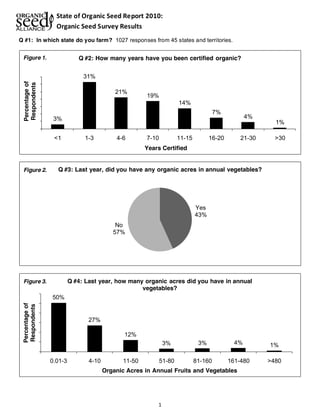
Q #1: In which state do you farm? 1027 responses from 45 states and territories. 
Q #2: How many Figure 1. years have you been certified organic? 
Figure 2. Q #3: Last year, did you have any organic acres in annual vegetables? 
Q #4: Last year, how many organic acres did you have in annual 
vegetables? 
1 
3% 
31% 
21% 19% 
14% 
7% 
4% 
1% 
<1 1-3 4-6 7-10 11-15 16-20 21-30 >30 
Percentage of 
Respondents 
Years Certified 
Yes 
43% 
No 
57% 
50% 
27% 
12% 
3% 3% 4% 1% 
0.01-3 4-10 11-50 51-80 81-160 161-480 >480 
Percentage of 
Respondents 
Organic Acres in Annual Fruits and Vegetables 
Figure 3.
State of Organic Seed Report 2010: 
Organic Seed Survey Results 
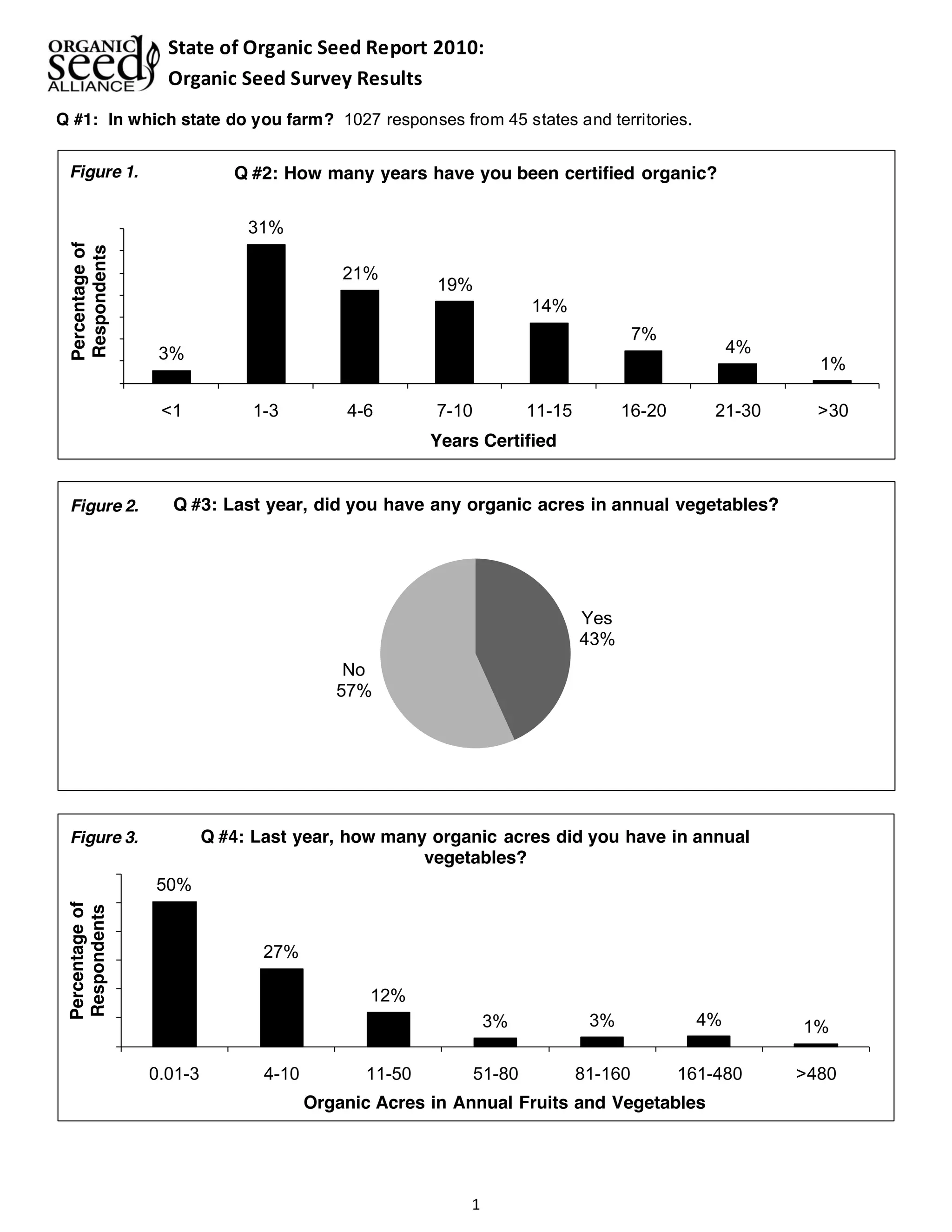
Q #5: Last year, what approximate percentage of total acreage of annual 
vegetables was planted with certified organic seed? 
Q #6: Percent organic seed Figure 5. used for TOMATOES - the #1 vegetable 
Q #6: Percent organic seed used for SUMMER / WINTER SQUASH - the #2 
vegetable 
2 
7% 
18% 
5% 6% 
4% 
8% 
4% 2% 
12% 
8% 7% 
19% 
0 1-10 11-20 21-30 31-40 41-50 51-60 61-70 71-80 81-90 91-99 100 
Percentage of 
Respondents 
Percentage of vegetable acreage planted with organic seed 
Figure 4. 
Q #6: Last year, what were your top three annual vegetable crops by acreage, and what percentage of 
certified organic seed did you use for each? 
9% 
5% 4% 5% 3% 5% 4% 4% 
12% 
6% 6% 
38% 
0 1-10 11-20 21-30 31-40 41-50 51-60 61-70 71-80 81-90 91-99 100 
Percentage of 
Respondents 
Percentage of organic seed used for tomatoes 
10% 12% 
6% 7% 
4% 
8% 
1% 1% 
7% 6% 4% 
34% 
0 1-10 11-20 21-30 31-40 41-50 51-60 61-70 71-80 81-90 91-99 100 
Percentage of 
Respondents 
Percentage of organic seed used for squash 
Figure 6.
State of Organic Seed Report 2010: 
Organic Seed Survey Results 
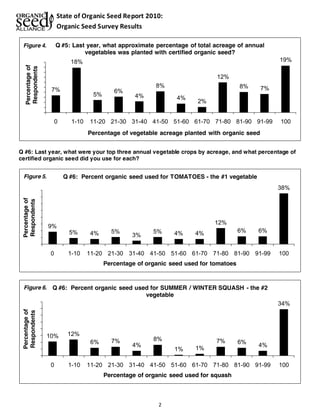
Q #6: Percent organic Figure 7. seed used for GREENS - the #3 vegetable 
Figure 8. Q #7: Last year, did you have any organic acres in field crops? 
Figure 9. Q #8: Last year how many organic acres did you have in field crops? 
3 
1% 
6% 
2% 4% 3% 5% 3% 1% 
18% 
4% 6% 
49% 
0 1-10 11-20 21-30 31-40 41-50 51-60 61-70 71-80 81-90 91-99 100 
Percentage of 
Respondents 
Percentage of organic seed used for greens 
Yes 
60% 
No 
40% 
9% 7% 
26% 
15% 17% 18% 
9% 
0.01-3 4-10 11-50 51-80 81-160 161-480 >480 
Percentage of 
Respondents 
Organic Acres in Field Crops
State of Organic Seed Report 2010: 
Organic Seed Survey Results 
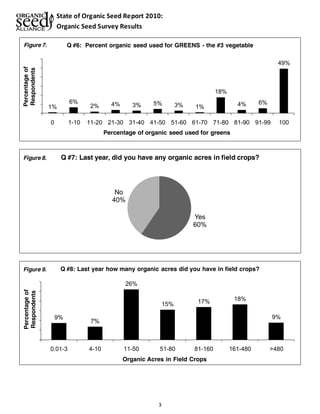
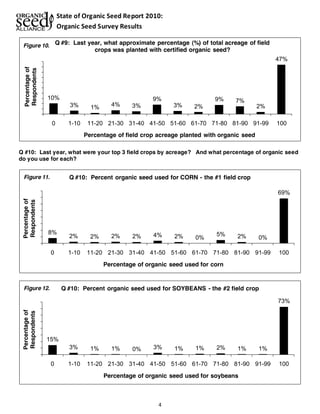
Q #9: Last year, what approximate percentage (%) of total acreage of field 
crops was planted with certified organic seed? 
Q #10: Percent organic Figure 11. seed used for CORN - the #1 field crop 
Figure 12. Q #10: Percent organic seed used for SOYBEANS - the #2 field crop 
4 
10% 
3% 1% 4% 3% 
9% 
3% 2% 
9% 7% 
2% 
47% 
0 1-10 11-20 21-30 31-40 41-50 51-60 61-70 71-80 81-90 91-99 100 
Percentage of 
Respondents 
Percentage of field crop acreage planted with organic seed 
Figure 10. 
Q #10: Last year, what were your top 3 field crops by acreage? And what percentage of organic seed 
do you use for each? 
8% 2% 2% 2% 2% 4% 2% 0% 5% 2% 0% 
69% 
0 1-10 11-20 21-30 31-40 41-50 51-60 61-70 71-80 81-90 91-99 100 
Percentage of 
Respondents 
Percentage of organic seed used for corn 
15% 
3% 1% 1% 0% 3% 1% 1% 2% 1% 1% 
73% 
0 1-10 11-20 21-30 31-40 41-50 51-60 61-70 71-80 81-90 91-99 100 
Percentage of 
Respondents 
Percentage of organic seed used for soybeans
State of Organic Seed Report 2010: 
Organic Seed Survey Results 
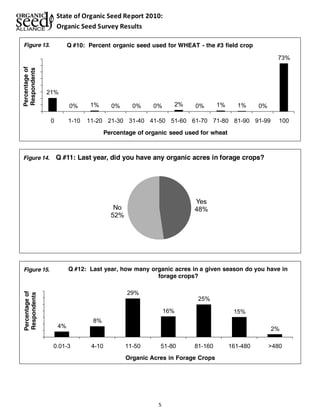
Q #10: Percent organic Figure 13. seed used for WHEAT - the #3 field crop 
Figure 14. Q #11: Last year, did you have any organic acres in forage crops? 
Q #12: Last year, how many organic acres in a given season do you have in 
forage crops? 
5 
21% 
0% 1% 0% 0% 0% 2% 0% 1% 1% 0% 
73% 
0 1-10 11-20 21-30 31-40 41-50 51-60 61-70 71-80 81-90 91-99 100 
Percentage of 
Respondents 
Percentage of organic seed used for wheat 
Yes 
No 48% 
52% 
4% 
8% 
29% 
16% 
25% 
15% 
2% 
0.01-3 4-10 11-50 51-80 81-160 161-480 >480 
Percentage of 
Respondents 
Organic Acres in Forage Crops 
Figure 15.
State of Organic Seed Report 2010: 
Organic Seed Survey Results 
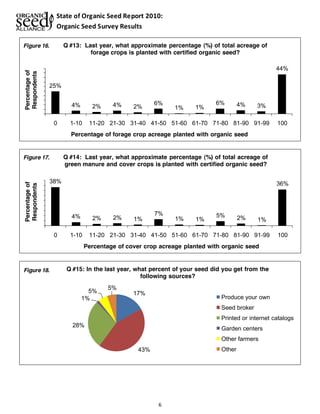
Q #13: Last year, what approximate percentage (%) of total acreage of 
forage crops is planted with certified organic seed? 
Q #14: Last year, what approximate percentage (%) of total acreage of 
green manure and cover crops is planted with certified organic seed? 
Q #15: In the last year, what percent of your seed did you get from the 
6 
25% 
4% 2% 4% 2% 6% 
1% 1% 
6% 4% 3% 
44% 
0 1-10 11-20 21-30 31-40 41-50 51-60 61-70 71-80 81-90 91-99 100 
Percentage of 
Respondents 
Percentage of forage crop acreage planted with organic seed 
Figure 16. 
38% 
4% 2% 2% 1% 
7% 
1% 1% 5% 2% 1% 
36% 
0 1-10 11-20 21-30 31-40 41-50 51-60 61-70 71-80 81-90 91-99 100 
Percentage of 
Respondents 
Percentage of cover crop acreage planted with organic seed 
Figure 17. 
17% 
43% 
1% 
28% 
5% 5% 
following sources? 
Produce your own 
Seed broker 
Printed or internet catalogs 
Garden centers 
Other farmers 
Other 
Figure 18.
State of Organic Seed Report 2010: 
Organic Seed Survey Results 
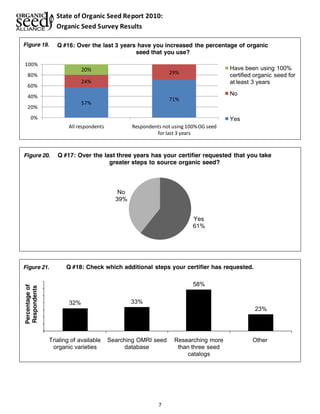
Q #16: Over the last 3 years have you increased the percentage of organic 
seed that you use? 
Q #17: Over the last three years has your certifier requested that you take 
greater steps to source organic seed? 
Q #18: Check which Figure 21. additional steps your certifier has requested. 
7 
57% 
71% 
24% 
29% 
100% 
80% 
60% 
40% 
20% 
0% 
All respondents Respondents not using 100% OG seed 
for last 3 years 
Have been using 100% 
certified organic seed for 
at least 3 years 
No 
Yes 
Figure 19. 
20% 
Yes 
61% 
No 
39% 
Figure 20. 
32% 33% 
58% 
23% 
Trialing of available 
organic varieties 
Searching OMRI seed 
database 
Researching more 
than three seed 
catalogs 
Other 
Percentage of 
Respondents
State of Organic Seed Report 2010: 
Organic Seed Survey Results 
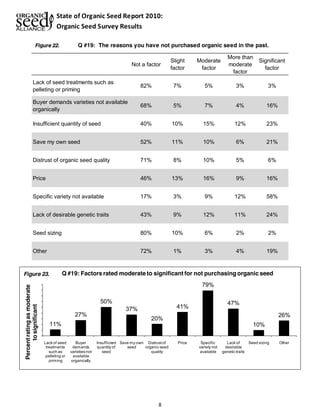
Figure 2 2 . Q #19: The reasons you have not purchased organic seed in the past. 
Not a factor Slight 
Figure 23. Q #19: Factors rated moderate to significant for not purchasing organic seed 
8 
factor 
Moderate 
factor 
More than 
moderate 
factor 
Significant 
factor 
Lack of seed treatments such as 
pelleting or priming 
82% 7% 5% 3% 3% 
Buyer demands varieties not available 
organically 68% 5% 7% 4% 16% 
Insufficient quantity of seed 40% 10% 15% 12% 23% 
Save my own seed 52% 11% 10% 6% 21% 
Distrust of organic seed quality 71% 8% 10% 5% 6% 
Price 46% 13% 16% 9% 16% 
Specific variety not available 17% 3% 9% 12% 58% 
Lack of desirable genetic traits 43% 9% 12% 11% 24% 
Seed sizing 80% 10% 6% 2% 2% 
Other 72% 1% 3% 4% 19% 
11% 
27% 
50% 
37% 
20% 
41% 
79% 
47% 
10% 
26% 
Lack of seed 
treatments 
such as 
pelleting or 
priming 
Buyer 
demands 
varieties not 
available 
organically 
Insufficient 
quantity of 
seed 
Save my own 
seed 
Distrust of 
organic seed 
quality 
Price Specific 
variety not 
available 
Lack of 
desirable 
genetic traits 
Seed sizing Other 
Percent rating as moderate 
to significant
State of Organic Seed Report 2010: 
Organic Seed Survey Results 
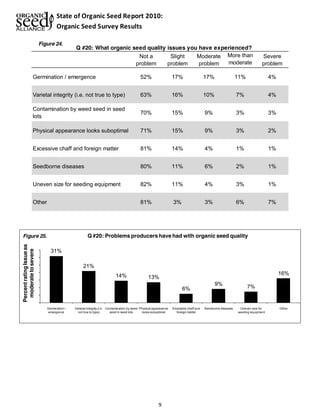
Q #20: What organic seed quality issues you have experienced? 
Figure 25. Q #20: Problems producers have had with organic seed quality 
9 
Not a 
problem 
Slight 
problem 
Moderate 
problem 
More than 
moderate 
problem 
Severe 
problem 
Figure 24. 
Germination / emergence 52% 17% 17% 11% 4% 
Varietal integrity (i.e. not true to type) 63% 16% 10% 7% 4% 
Contamination by weed seed in seed 
lots 70% 15% 9% 3% 3% 
Physical appearance looks suboptimal 71% 15% 9% 3% 2% 
Excessive chaff and foreign matter 81% 14% 4% 1% 1% 
Seedborne diseases 80% 11% 6% 2% 1% 
Uneven size for seeding equipment 82% 11% 4% 3% 1% 
Other 81% 3% 3% 6% 7% 
31% 
21% 
14% 13% 
6% 
9% 7% 
16% 
Germination / 
emergence 
Varietal integrity (i.e. 
not true to type) 
Contamination by weed 
seed in seed lots 
Physical appearance 
looks suboptimal 
Excessive chaff and 
foreign matter 
Seedborne diseases Uneven size for 
seeding equipment 
Other 
Percent rating Issue as 
moderate to severe
State of Organic Seed Report 2010: 
Organic Seed Survey Results 
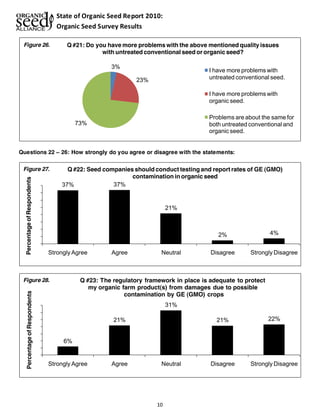
Q #21: Do you have more problems with the above mentioned quality issues 
Figure 28. Q #23: The regulatory framework in place is adequate to protect 
10 
3% 
23% 
73% 
with untreated conventional seed or organic seed? 
I have more problems with 
untreated conventional seed. 
I have more problems with 
organic seed. 
Problems are about the same for 
both untreated conventional and 
organic seed. 
Figure 26. 
Questions 22 ± 26: How strongly do you agree or disagree with the statements: 
37% 37% 
21% 
2% 4% 
Strongly Agree Agree Neutral Disagree Strongly Disagree 
Percentage of Respondents 
Q #22: Seed companies should conduct testing and report rates of GE (GMO) 
contamination in organic seed 
Figure 27. 
6% 
21% 
31% 
21% 22% 
Strongly Agree Agree Neutral Disagree Strongly Disagree 
Percentage of Respondents 
my organic farm product(s) from damages due to possible 
contamination by GE (GMO) crops
State of Organic Seed Report 2010: 
Organic Seed Survey Results 
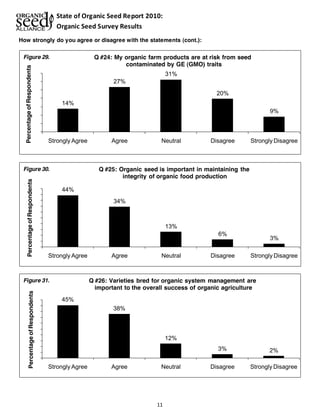
How strongly do you agree or disagree with the statements (cont.): 
Figure 29. Q #24: My organic farm products are at risk from seed 
Figure 30. Q #25: Organic seed is important in maintaining the 
Figure 31. Q #26: Varieties bred for organic system management are 
11 
14% 
27% 
31% 
20% 
9% 
Strongly Agree Agree Neutral Disagree Strongly Disagree 
Percentage of Respondents 
contaminated by GE (GMO) traits 
44% 
34% 
13% 
6% 
3% 
Strongly Agree Agree Neutral Disagree Strongly Disagree 
Percentage of Respondents 
integrity of organic food production 
45% 
38% 
12% 
3% 2% 
Strongly Agree Agree Neutral Disagree Strongly Disagree 
Percentage of Respondents 
important to the overall success of organic agriculture
State of Organic Seed Report 2010: 
Organic Seed Survey Results 
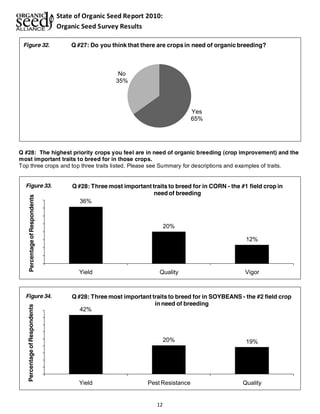
Q #27: Do you Figure 32. think that there are crops in need of organic breeding? 
Q #28: Three most important traits to breed for in SOYBEANS - the #2 field crop 
in need of breeding 
Yield Pest Resistance Quality Percentage of Respondents 
12 
Yes 
65% 
No 
35% 
Q #28: The highest priority crops you feel are in need of organic breeding (crop improvement) and the 
most important traits to breed for in those crops. 
Top three crops and top three traits listed. Please see Summary for descriptions and examples of traits. 
36% 
20% 
12% 
Yield Quality Vigor 
Percentage of Respondents 
Q #28: Three most important traits to breed for in CORN - the #1 field crop in 
need of breeding 
Figure 33. 
42% 
20% 19% 
Figure 34.
State of Organic Seed Report 2010: 
Organic Seed Survey Results 
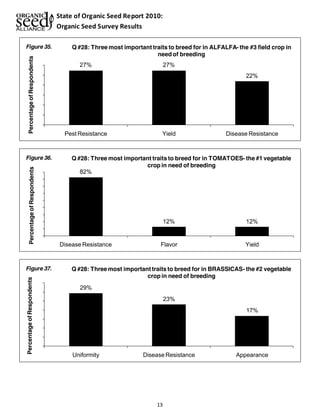
27% 27% 
13 
22% 
Pest Resistance Yield Disease Resistance 
Percentage of Respondents 
Q #28: Three most important traits to breed for in ALFALFA- the #3 field crop in 
need of breeding 
Figure 35. 
82% 
12% 12% 
Disease Resistance Flavor Yield 
Percentage of Respondents 
Q #28: Three most important traits to breed for in TOMATOES- the #1 vegetable 
crop in need of breeding 
Figure 36. 
29% 
23% 
17% 
Uniformity Disease Resistance Appearance 
Percentage of Respondents 
Q #28: Three most important traits to breed for in BRASSICAS- the #2 vegetable 
crop in need of breeding 
Figure 37.
State of Organic Seed Report 2010: 
Organic Seed Survey Results 
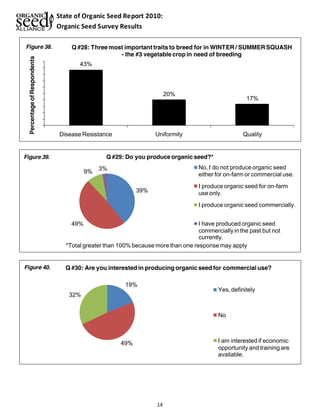
Q #29: Do you produce organic seed?* 
Q #30: Are you interested in producing organic seed for commercial use? 
14 
43% 
20% 
17% 
Disease Resistance Uniformity Quality 
Percentage of Respondents 
Q #28: Three most important traits to breed for in WINTER / SUMMER SQUASH 
- the #3 vegetable crop in need of breeding 
Figure 38. 
39% 
49% 
9% 3% 
No, I do not produce organic seed 
either for on-farm or commercial use. 
I produce organic seed for on-farm 
use only. 
I produce organic seed commercially. 
I have produced organic seed 
commercially in the past but not 
currently. 
*Total greater than 100% because more than one response may apply 
Figure 39. 
19% 
49% 
32% 
Yes, definitely 
No 
I am interested if economic 
opportunity and training are 
available. 
Figure 40.
State of Organic Seed Report 2010: 
Organic Seed Survey Results 
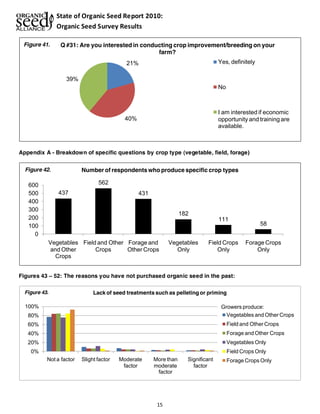
Q #31: Are you interested in conducting crop improvement/breeding on your 
Lack of seed treatments such as pelleting or priming 
15 
21% 
40% 
39% 
farm? 
Yes, definitely 
No 
I am interested if economic 
opportunity and training are 
available. 
Figure 41. 
Appendix A - Breakdown of specific questions by crop type (vegetable, field, forage) 
437 
562 
431 
182 
111 
58 
600 
500 
400 
300 
200 
100 
0 
Vegetables 
and Other 
Crops 
Field and Other 
Crops 
Forage and 
Other Crops 
Vegetables 
Only 
Field Crops 
Only 
Forage Crops 
Only 
Figure 42. Number of respondents who produce specific crop types 
Figures 43 ± 52: The reasons you have not purchased organic seed in the past: 
100% 
80% 
60% 
40% 
20% 
0% 
Not a factor Slight factor Moderate 
factor 
More than 
moderate 
factor 
Significant 
factor 
Growers produce: 
Vegetables and Other Crops 
Field and Other Crops 
Forage and Other Crops 
Vegetables Only 
Field Crops Only 
Forage Crops Only 
Figure 43.
State of Organic Seed Report 2010: 
Organic Seed Survey Results 
The reasons you have not purchased organic seed in the past (cont.): 
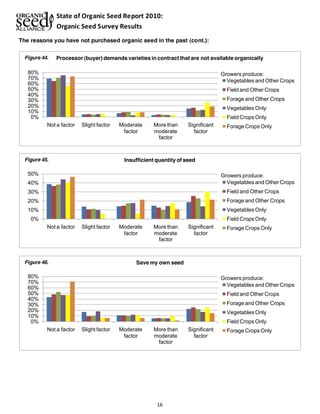
Processor (buyer) demands varieties in contract that are not available organically 
Insufficient quantity of seed 
16 
80% 
70% 
60% 
50% 
40% 
30% 
20% 
10% 
0% 
Not a factor Slight factor Moderate 
factor 
More than 
moderate 
factor 
Significant 
factor 
Growers produce: 
Vegetables and Other Crops 
Field and Other Crops 
Forage and Other Crops 
Vegetables Only 
Field Crops Only 
Forage Crops Only 
Figure 44. 
50% 
40% 
30% 
20% 
10% 
0% 
Not a factor Slight factor Moderate 
factor 
More than 
moderate 
factor 
Significant 
factor 
Growers produce: 
Vegetables and Other Crops 
Field and Other Crops 
Forage and Other Crops 
Vegetables Only 
Field Crops Only 
Forage Crops Only 
Figure 45. 
80% 
70% 
60% 
50% 
40% 
30% 
20% 
10% 
0% 
Not a factor Slight factor Moderate 
factor 
More than 
moderate 
factor 
Significant 
factor 
Save my own seed 
Growers produce: 
Vegetables and Other Crops 
Field and Other Crops 
Forage and Other Crops 
Vegetables Only 
Field Crops Only 
Forage Crops Only 
Figure 46.
State of Organic Seed Report 2010: 
Organic Seed Survey Results 
The reasons you have not purchased organic seed in the past (cont.): 
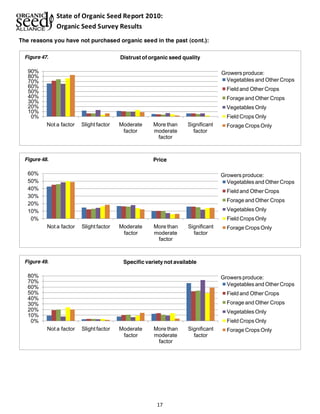
Distrust of organic seed quality 
Specific variety not available 
17 
90% 
80% 
70% 
60% 
50% 
40% 
30% 
20% 
10% 
0% 
Not a factor Slight factor Moderate 
factor 
More than 
moderate 
factor 
Significant 
factor 
Growers produce: 
Vegetables and Other Crops 
Field and Other Crops 
Forage and Other Crops 
Vegetables Only 
Field Crops Only 
Forage Crops Only 
Figure 47. 
60% 
50% 
40% 
30% 
20% 
10% 
0% 
Not a factor Slight factor Moderate 
factor 
More than 
moderate 
factor 
Significant 
factor 
Price 
Growers produce: 
Vegetables and Other Crops 
Field and Other Crops 
Forage and Other Crops 
Vegetables Only 
Field Crops Only 
Forage Crops Only 
Figure 48. 
80% 
70% 
60% 
50% 
40% 
30% 
20% 
10% 
0% 
Not a factor Slight factor Moderate 
factor 
More than 
moderate 
factor 
Significant 
factor 
Growers produce: 
Vegetables and Other Crops 
Field and Other Crops 
Forage and Other Crops 
Vegetables Only 
Field Crops Only 
Forage Crops Only 
Figure 49.
State of Organic Seed Report 2010: 
Organic Seed Survey Results 
The reasons you have not purchased organic seed in the past (cont.): 
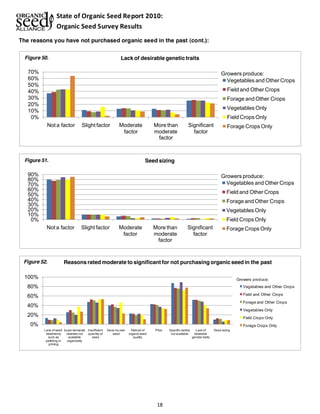
Lack of desirable genetic traits 
Reasons rated moderate to significant for not purchasing organic seed in the past 
18 
70% 
60% 
50% 
40% 
30% 
20% 
10% 
0% 
Not a factor Slight factor Moderate 
factor 
More than 
moderate 
factor 
Significant 
factor 
Growers produce: 
Vegetables and Other Crops 
Field and Other Crops 
Forage and Other Crops 
Vegetables Only 
Field Crops Only 
Forage Crops Only 
Figure 50. 
90% 
80% 
70% 
60% 
50% 
40% 
30% 
20% 
10% 
0% 
Not a factor Slight factor Moderate 
factor 
More than 
moderate 
factor 
Significant 
factor 
Seed sizing 
Growers produce: 
Vegetables and Other Crops 
Field and Other Crops 
Forage and Other Crops 
Vegetables Only 
Field Crops Only 
Forage Crops Only 
Figure 51. 
100% 
80% 
60% 
40% 
20% 
0% 
Lack of seed 
treatments 
such as 
pelleting or 
priming 
buyer demands 
varieties not 
available 
organically 
Insufficient 
quantity of 
seed 
Save my own 
seed 
Distrust of 
organic seed 
quality 
Price Specific variety 
not available 
Lack of 
desirable 
genetic traits 
Seed sizing 
Growers produce: 
Vegetables and Other Crops 
Field and Other Crops 
Forage and Other Crops 
Vegetables Only 
Field Crops Only 
Forage Crops Only 
Figure 52.
State of Organic Seed Report 2010: 
Organic Seed Survey Results 
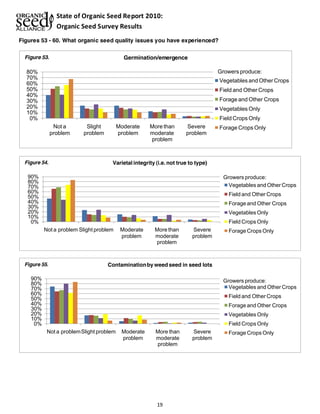
Figures 53 - 60. What organic seed quality issues you have experienced? 
Germination/emergence 
Varietal integrity (i.e. not true to type) 
Contamination by weed seed in seed lots 
19 
80% 
70% 
60% 
50% 
40% 
30% 
20% 
10% 
0% 
Not a 
problem 
Slight 
problem 
Moderate 
problem 
More than 
moderate 
problem 
Severe 
problem 
Growers produce: 
Vegetables and Other Crops 
Field and Other Crops 
Forage and Other Crops 
Vegetables Only 
Field Crops Only 
Forage Crops Only 
Figure 53. 
90% 
80% 
70% 
60% 
50% 
40% 
30% 
20% 
10% 
0% 
Not a problem Slight problem Moderate 
problem 
More than 
moderate 
problem 
Severe 
problem 
Growers produce: 
Vegetables and Other Crops 
Field and Other Crops 
Forage and Other Crops 
Vegetables Only 
Field Crops Only 
Forage Crops Only 
Figure 54. 
90% 
80% 
70% 
60% 
50% 
40% 
30% 
20% 
10% 
0% 
Not a problemSlight problem Moderate 
problem 
More than 
moderate 
problem 
Severe 
problem 
Growers produce: 
Vegetables and Other Crops 
Field and Other Crops 
Forage and Other Crops 
Vegetables Only 
Field Crops Only 
Forage Crops Only 
Figure 55.
State of Organic Seed Report 2010: 
Organic Seed Survey Results 
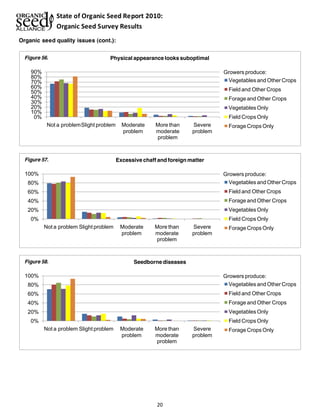
Physical appearance looks suboptimal 
Excessive chaff and foreign matter 
20 
Organic seed quality issues (cont.): 
90% 
80% 
70% 
60% 
50% 
40% 
30% 
20% 
10% 
0% 
Not a problemSlight problem Moderate 
problem 
More than 
moderate 
problem 
Severe 
problem 
Growers produce: 
Vegetables and Other Crops 
Field and Other Crops 
Forage and Other Crops 
Vegetables Only 
Field Crops Only 
Forage Crops Only 
Figure 56. 
100% 
80% 
60% 
40% 
20% 
0% 
Not a problem Slight problem Moderate 
problem 
More than 
moderate 
problem 
Severe 
problem 
Growers produce: 
Vegetables and Other Crops 
Field and Other Crops 
Forage and Other Crops 
Vegetables Only 
Field Crops Only 
Forage Crops Only 
Figure 57. 
100% 
80% 
60% 
40% 
20% 
0% 
Not a problem Slight problem Moderate 
problem 
More than 
moderate 
problem 
Severe 
problem 
Seedborne diseases 
Growers produce: 
Vegetables and Other Crops 
Field and Other Crops 
Forage and Other Crops 
Vegetables Only 
Field Crops Only 
Forage Crops Only 
Figure 58.
State of Organic Seed Report 2010: 
Organic Seed Survey Results 
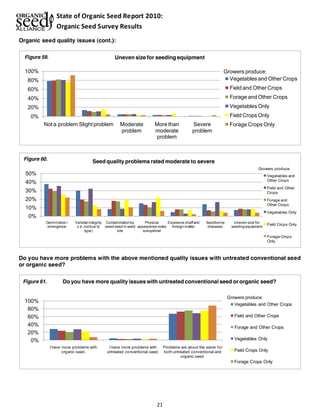
Uneven size for seeding equipment 
Do you have more quality issues with untreated conventional seed or organic seed? 
21 
Organic seed quality issues (cont.): 
100% 
80% 
60% 
40% 
20% 
0% 
Not a problem Slight problem Moderate 
problem 
More than 
moderate 
problem 
Severe 
problem 
Growers produce: 
Vegetables and Other Crops 
Field and Other Crops 
Forage and Other Crops 
Vegetables Only 
Field Crops Only 
Forage Crops Only 
Figure 59. 
50% 
40% 
30% 
20% 
10% 
0% 
Germination / 
emergence 
Varietal integrity 
(i.e. not true to 
type) 
Contamination by 
weed seed in seed 
lots 
Physical 
appearance looks 
suboptimal 
Excessive chaff and 
foreign matter 
Seedborne 
diseases 
Growers produce: 
Uneven size for 
seeding equipment 
Seed quality problems rated moderate to severe 
Vegetables and 
Other Crops 
Field and Other 
Crops 
Forage and 
Other Crops 
Vegetables Only 
Field Crops Only 
Forage Crops 
Only 
Figure 60. 
Do you have more problems with the above mentioned quality issues with untreated conventional seed 
or organic seed? 
100% 
80% 
60% 
40% 
20% 
0% 
I have more problems with 
organic seed. 
I have more problems with 
untreated conventional seed. 
Problems are about the same for 
both untreated conventional and 
organic seed. 
Growers produce: 
Vegetables and Other Crops 
Field and Other Crops 
Forage and Other Crops 
Vegetables Only 
Field Crops Only 
Forage Crops Only 
Figure 61.
State of Organic Seed Report 2010: 
Organic Seed Survey Results 
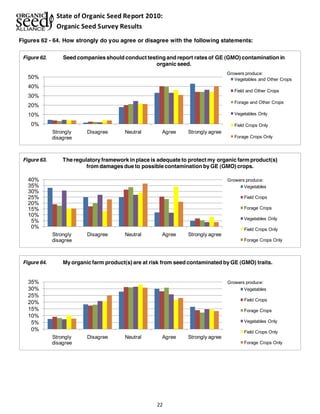
Figures 62 - 64. How strongly do you agree or disagree with the following statements: 
Seed companies should conduct testing and report rates of GE (GMO) contamination in 
organic seed. 
The regulatory framework in place is adequate to protect my organic farm product(s) 
from damages due to possible contamination by GE (GMO) crops. 
My organic farm product(s) are at risk from seed contaminated by GE (GMO) traits. 
22 
50% 
40% 
30% 
20% 
10% 
0% 
Strongly 
disagree 
Disagree Neutral Agree Strongly agree 
Growers produce: 
Vegetables and Other Crops 
Field and Other Crops 
Forage and Other Crops 
Vegetables Only 
Field Crops Only 
Forage Crops Only 
Figure 62. 
40% 
35% 
30% 
25% 
20% 
15% 
10% 
5% 
0% 
Strongly 
disagree 
Disagree Neutral Agree Strongly agree 
Growers produce: 
Vegetables 
Field Crops 
Forage Crops 
Vegetables Only 
Field Crops Only 
Forage Crops Only 
Figure 63. 
35% 
30% 
25% 
20% 
15% 
10% 
5% 
0% 
Strongly 
disagree 
Disagree Neutral Agree Strongly agree 
Growers produce: 
Vegetables 
Field Crops 
Forage Crops 
Vegetables Only 
Field Crops Only 
Forage Crops Only 
Figure 64.
State of Organic Seed Report 2010: 
Organic Seed Survey Results 
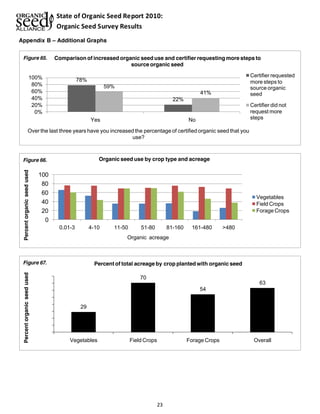
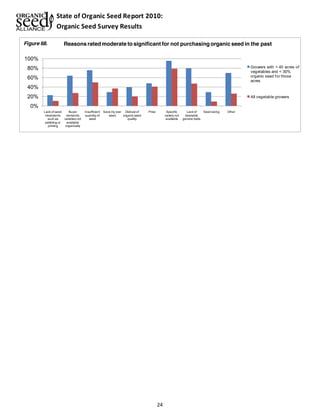
Comparison of increased organic seed use and certifier requesting more steps to 
source organic seed 
Organic seed use by crop type and acreage 
Percent of total acreage by Figure 67. crop planted with organic seed 
23 
Appendix B ± Additional Graphs 
78% 
22% 
59% 
41% 
100% 
80% 
60% 
40% 
20% 
0% 
Yes No 
Over the last three years have you increased the percentage of certified organic seed that you 
use? 
Certifier requested 
more steps to 
source organic 
seed 
Certifier did not 
request more 
steps 
Figure 65. 
100 
80 
60 
40 
20 
0 
0.01-3 4-10 11-50 51-80 81-160 161-480 >480 
Percent organic seed used 
Organic acreage 
Vegetables 
Field Crops 
Forage Crops 
Figure 66. 
29 
70 
54 
63 
Vegetables Field Crops Forage Crops Overall 
Percent organic seed used
State of Organic Seed Report 2010: 
Organic Seed Survey Results 
Reasons rated moderate to significant for not purchasing organic seed in the past 
24 
100% 
80% 
60% 
40% 
20% 
0% 
Lack of seed 
treatments 
such as 
pelleting or 
priming 
Buyer 
demands 
varieties not 
available 
organically 
Insufficient 
quantity of 
seed 
Save my own 
seed 
Distrust of 
organic seed 
quality 
Price Specific 
variety not 
available 
Lack of 
desirable 
genetic traits 
Seed sizing Other 
Growers with > 40 acres of 
vegetables and < 30% 
organic seed for those 
acres 
All vegetable growers 
Figure 68.

State of Organic Seed (SOS) Report Part 3

  • 1.
    State of OrganicSeed Report 2010: Organic Seed Survey Results Q #1: In which state do you farm? 1027 responses from 45 states and territories. Q #2: How many Figure 1. years have you been certified organic? Figure 2. Q #3: Last year, did you have any organic acres in annual vegetables? Q #4: Last year, how many organic acres did you have in annual vegetables? 1 3% 31% 21% 19% 14% 7% 4% 1% <1 1-3 4-6 7-10 11-15 16-20 21-30 >30 Percentage of Respondents Years Certified Yes 43% No 57% 50% 27% 12% 3% 3% 4% 1% 0.01-3 4-10 11-50 51-80 81-160 161-480 >480 Percentage of Respondents Organic Acres in Annual Fruits and Vegetables Figure 3.
  • 2.
    State of OrganicSeed Report 2010: Organic Seed Survey Results Q #5: Last year, what approximate percentage of total acreage of annual vegetables was planted with certified organic seed? Q #6: Percent organic seed Figure 5. used for TOMATOES - the #1 vegetable Q #6: Percent organic seed used for SUMMER / WINTER SQUASH - the #2 vegetable 2 7% 18% 5% 6% 4% 8% 4% 2% 12% 8% 7% 19% 0 1-10 11-20 21-30 31-40 41-50 51-60 61-70 71-80 81-90 91-99 100 Percentage of Respondents Percentage of vegetable acreage planted with organic seed Figure 4. Q #6: Last year, what were your top three annual vegetable crops by acreage, and what percentage of certified organic seed did you use for each? 9% 5% 4% 5% 3% 5% 4% 4% 12% 6% 6% 38% 0 1-10 11-20 21-30 31-40 41-50 51-60 61-70 71-80 81-90 91-99 100 Percentage of Respondents Percentage of organic seed used for tomatoes 10% 12% 6% 7% 4% 8% 1% 1% 7% 6% 4% 34% 0 1-10 11-20 21-30 31-40 41-50 51-60 61-70 71-80 81-90 91-99 100 Percentage of Respondents Percentage of organic seed used for squash Figure 6.
  • 3.
    State of OrganicSeed Report 2010: Organic Seed Survey Results Q #6: Percent organic Figure 7. seed used for GREENS - the #3 vegetable Figure 8. Q #7: Last year, did you have any organic acres in field crops? Figure 9. Q #8: Last year how many organic acres did you have in field crops? 3 1% 6% 2% 4% 3% 5% 3% 1% 18% 4% 6% 49% 0 1-10 11-20 21-30 31-40 41-50 51-60 61-70 71-80 81-90 91-99 100 Percentage of Respondents Percentage of organic seed used for greens Yes 60% No 40% 9% 7% 26% 15% 17% 18% 9% 0.01-3 4-10 11-50 51-80 81-160 161-480 >480 Percentage of Respondents Organic Acres in Field Crops
  • 4.
    State of OrganicSeed Report 2010: Organic Seed Survey Results Q #9: Last year, what approximate percentage (%) of total acreage of field crops was planted with certified organic seed? Q #10: Percent organic Figure 11. seed used for CORN - the #1 field crop Figure 12. Q #10: Percent organic seed used for SOYBEANS - the #2 field crop 4 10% 3% 1% 4% 3% 9% 3% 2% 9% 7% 2% 47% 0 1-10 11-20 21-30 31-40 41-50 51-60 61-70 71-80 81-90 91-99 100 Percentage of Respondents Percentage of field crop acreage planted with organic seed Figure 10. Q #10: Last year, what were your top 3 field crops by acreage? And what percentage of organic seed do you use for each? 8% 2% 2% 2% 2% 4% 2% 0% 5% 2% 0% 69% 0 1-10 11-20 21-30 31-40 41-50 51-60 61-70 71-80 81-90 91-99 100 Percentage of Respondents Percentage of organic seed used for corn 15% 3% 1% 1% 0% 3% 1% 1% 2% 1% 1% 73% 0 1-10 11-20 21-30 31-40 41-50 51-60 61-70 71-80 81-90 91-99 100 Percentage of Respondents Percentage of organic seed used for soybeans
  • 5.
    State of OrganicSeed Report 2010: Organic Seed Survey Results Q #10: Percent organic Figure 13. seed used for WHEAT - the #3 field crop Figure 14. Q #11: Last year, did you have any organic acres in forage crops? Q #12: Last year, how many organic acres in a given season do you have in forage crops? 5 21% 0% 1% 0% 0% 0% 2% 0% 1% 1% 0% 73% 0 1-10 11-20 21-30 31-40 41-50 51-60 61-70 71-80 81-90 91-99 100 Percentage of Respondents Percentage of organic seed used for wheat Yes No 48% 52% 4% 8% 29% 16% 25% 15% 2% 0.01-3 4-10 11-50 51-80 81-160 161-480 >480 Percentage of Respondents Organic Acres in Forage Crops Figure 15.
  • 6.
    State of OrganicSeed Report 2010: Organic Seed Survey Results Q #13: Last year, what approximate percentage (%) of total acreage of forage crops is planted with certified organic seed? Q #14: Last year, what approximate percentage (%) of total acreage of green manure and cover crops is planted with certified organic seed? Q #15: In the last year, what percent of your seed did you get from the 6 25% 4% 2% 4% 2% 6% 1% 1% 6% 4% 3% 44% 0 1-10 11-20 21-30 31-40 41-50 51-60 61-70 71-80 81-90 91-99 100 Percentage of Respondents Percentage of forage crop acreage planted with organic seed Figure 16. 38% 4% 2% 2% 1% 7% 1% 1% 5% 2% 1% 36% 0 1-10 11-20 21-30 31-40 41-50 51-60 61-70 71-80 81-90 91-99 100 Percentage of Respondents Percentage of cover crop acreage planted with organic seed Figure 17. 17% 43% 1% 28% 5% 5% following sources? Produce your own Seed broker Printed or internet catalogs Garden centers Other farmers Other Figure 18.
  • 7.
    State of OrganicSeed Report 2010: Organic Seed Survey Results Q #16: Over the last 3 years have you increased the percentage of organic seed that you use? Q #17: Over the last three years has your certifier requested that you take greater steps to source organic seed? Q #18: Check which Figure 21. additional steps your certifier has requested. 7 57% 71% 24% 29% 100% 80% 60% 40% 20% 0% All respondents Respondents not using 100% OG seed for last 3 years Have been using 100% certified organic seed for at least 3 years No Yes Figure 19. 20% Yes 61% No 39% Figure 20. 32% 33% 58% 23% Trialing of available organic varieties Searching OMRI seed database Researching more than three seed catalogs Other Percentage of Respondents
  • 8.
    State of OrganicSeed Report 2010: Organic Seed Survey Results Figure 2 2 . Q #19: The reasons you have not purchased organic seed in the past. Not a factor Slight Figure 23. Q #19: Factors rated moderate to significant for not purchasing organic seed 8 factor Moderate factor More than moderate factor Significant factor Lack of seed treatments such as pelleting or priming 82% 7% 5% 3% 3% Buyer demands varieties not available organically 68% 5% 7% 4% 16% Insufficient quantity of seed 40% 10% 15% 12% 23% Save my own seed 52% 11% 10% 6% 21% Distrust of organic seed quality 71% 8% 10% 5% 6% Price 46% 13% 16% 9% 16% Specific variety not available 17% 3% 9% 12% 58% Lack of desirable genetic traits 43% 9% 12% 11% 24% Seed sizing 80% 10% 6% 2% 2% Other 72% 1% 3% 4% 19% 11% 27% 50% 37% 20% 41% 79% 47% 10% 26% Lack of seed treatments such as pelleting or priming Buyer demands varieties not available organically Insufficient quantity of seed Save my own seed Distrust of organic seed quality Price Specific variety not available Lack of desirable genetic traits Seed sizing Other Percent rating as moderate to significant
  • 9.
    State of OrganicSeed Report 2010: Organic Seed Survey Results Q #20: What organic seed quality issues you have experienced? Figure 25. Q #20: Problems producers have had with organic seed quality 9 Not a problem Slight problem Moderate problem More than moderate problem Severe problem Figure 24. Germination / emergence 52% 17% 17% 11% 4% Varietal integrity (i.e. not true to type) 63% 16% 10% 7% 4% Contamination by weed seed in seed lots 70% 15% 9% 3% 3% Physical appearance looks suboptimal 71% 15% 9% 3% 2% Excessive chaff and foreign matter 81% 14% 4% 1% 1% Seedborne diseases 80% 11% 6% 2% 1% Uneven size for seeding equipment 82% 11% 4% 3% 1% Other 81% 3% 3% 6% 7% 31% 21% 14% 13% 6% 9% 7% 16% Germination / emergence Varietal integrity (i.e. not true to type) Contamination by weed seed in seed lots Physical appearance looks suboptimal Excessive chaff and foreign matter Seedborne diseases Uneven size for seeding equipment Other Percent rating Issue as moderate to severe
  • 10.
    State of OrganicSeed Report 2010: Organic Seed Survey Results Q #21: Do you have more problems with the above mentioned quality issues Figure 28. Q #23: The regulatory framework in place is adequate to protect 10 3% 23% 73% with untreated conventional seed or organic seed? I have more problems with untreated conventional seed. I have more problems with organic seed. Problems are about the same for both untreated conventional and organic seed. Figure 26. Questions 22 ± 26: How strongly do you agree or disagree with the statements: 37% 37% 21% 2% 4% Strongly Agree Agree Neutral Disagree Strongly Disagree Percentage of Respondents Q #22: Seed companies should conduct testing and report rates of GE (GMO) contamination in organic seed Figure 27. 6% 21% 31% 21% 22% Strongly Agree Agree Neutral Disagree Strongly Disagree Percentage of Respondents my organic farm product(s) from damages due to possible contamination by GE (GMO) crops
  • 11.
    State of OrganicSeed Report 2010: Organic Seed Survey Results How strongly do you agree or disagree with the statements (cont.): Figure 29. Q #24: My organic farm products are at risk from seed Figure 30. Q #25: Organic seed is important in maintaining the Figure 31. Q #26: Varieties bred for organic system management are 11 14% 27% 31% 20% 9% Strongly Agree Agree Neutral Disagree Strongly Disagree Percentage of Respondents contaminated by GE (GMO) traits 44% 34% 13% 6% 3% Strongly Agree Agree Neutral Disagree Strongly Disagree Percentage of Respondents integrity of organic food production 45% 38% 12% 3% 2% Strongly Agree Agree Neutral Disagree Strongly Disagree Percentage of Respondents important to the overall success of organic agriculture
  • 12.
    State of OrganicSeed Report 2010: Organic Seed Survey Results Q #27: Do you Figure 32. think that there are crops in need of organic breeding? Q #28: Three most important traits to breed for in SOYBEANS - the #2 field crop in need of breeding Yield Pest Resistance Quality Percentage of Respondents 12 Yes 65% No 35% Q #28: The highest priority crops you feel are in need of organic breeding (crop improvement) and the most important traits to breed for in those crops. Top three crops and top three traits listed. Please see Summary for descriptions and examples of traits. 36% 20% 12% Yield Quality Vigor Percentage of Respondents Q #28: Three most important traits to breed for in CORN - the #1 field crop in need of breeding Figure 33. 42% 20% 19% Figure 34.
  • 13.
    State of OrganicSeed Report 2010: Organic Seed Survey Results 27% 27% 13 22% Pest Resistance Yield Disease Resistance Percentage of Respondents Q #28: Three most important traits to breed for in ALFALFA- the #3 field crop in need of breeding Figure 35. 82% 12% 12% Disease Resistance Flavor Yield Percentage of Respondents Q #28: Three most important traits to breed for in TOMATOES- the #1 vegetable crop in need of breeding Figure 36. 29% 23% 17% Uniformity Disease Resistance Appearance Percentage of Respondents Q #28: Three most important traits to breed for in BRASSICAS- the #2 vegetable crop in need of breeding Figure 37.
  • 14.
    State of OrganicSeed Report 2010: Organic Seed Survey Results Q #29: Do you produce organic seed?* Q #30: Are you interested in producing organic seed for commercial use? 14 43% 20% 17% Disease Resistance Uniformity Quality Percentage of Respondents Q #28: Three most important traits to breed for in WINTER / SUMMER SQUASH - the #3 vegetable crop in need of breeding Figure 38. 39% 49% 9% 3% No, I do not produce organic seed either for on-farm or commercial use. I produce organic seed for on-farm use only. I produce organic seed commercially. I have produced organic seed commercially in the past but not currently. *Total greater than 100% because more than one response may apply Figure 39. 19% 49% 32% Yes, definitely No I am interested if economic opportunity and training are available. Figure 40.
  • 15.
    State of OrganicSeed Report 2010: Organic Seed Survey Results Q #31: Are you interested in conducting crop improvement/breeding on your Lack of seed treatments such as pelleting or priming 15 21% 40% 39% farm? Yes, definitely No I am interested if economic opportunity and training are available. Figure 41. Appendix A - Breakdown of specific questions by crop type (vegetable, field, forage) 437 562 431 182 111 58 600 500 400 300 200 100 0 Vegetables and Other Crops Field and Other Crops Forage and Other Crops Vegetables Only Field Crops Only Forage Crops Only Figure 42. Number of respondents who produce specific crop types Figures 43 ± 52: The reasons you have not purchased organic seed in the past: 100% 80% 60% 40% 20% 0% Not a factor Slight factor Moderate factor More than moderate factor Significant factor Growers produce: Vegetables and Other Crops Field and Other Crops Forage and Other Crops Vegetables Only Field Crops Only Forage Crops Only Figure 43.
  • 16.
    State of OrganicSeed Report 2010: Organic Seed Survey Results The reasons you have not purchased organic seed in the past (cont.): Processor (buyer) demands varieties in contract that are not available organically Insufficient quantity of seed 16 80% 70% 60% 50% 40% 30% 20% 10% 0% Not a factor Slight factor Moderate factor More than moderate factor Significant factor Growers produce: Vegetables and Other Crops Field and Other Crops Forage and Other Crops Vegetables Only Field Crops Only Forage Crops Only Figure 44. 50% 40% 30% 20% 10% 0% Not a factor Slight factor Moderate factor More than moderate factor Significant factor Growers produce: Vegetables and Other Crops Field and Other Crops Forage and Other Crops Vegetables Only Field Crops Only Forage Crops Only Figure 45. 80% 70% 60% 50% 40% 30% 20% 10% 0% Not a factor Slight factor Moderate factor More than moderate factor Significant factor Save my own seed Growers produce: Vegetables and Other Crops Field and Other Crops Forage and Other Crops Vegetables Only Field Crops Only Forage Crops Only Figure 46.
  • 17.
    State of OrganicSeed Report 2010: Organic Seed Survey Results The reasons you have not purchased organic seed in the past (cont.): Distrust of organic seed quality Specific variety not available 17 90% 80% 70% 60% 50% 40% 30% 20% 10% 0% Not a factor Slight factor Moderate factor More than moderate factor Significant factor Growers produce: Vegetables and Other Crops Field and Other Crops Forage and Other Crops Vegetables Only Field Crops Only Forage Crops Only Figure 47. 60% 50% 40% 30% 20% 10% 0% Not a factor Slight factor Moderate factor More than moderate factor Significant factor Price Growers produce: Vegetables and Other Crops Field and Other Crops Forage and Other Crops Vegetables Only Field Crops Only Forage Crops Only Figure 48. 80% 70% 60% 50% 40% 30% 20% 10% 0% Not a factor Slight factor Moderate factor More than moderate factor Significant factor Growers produce: Vegetables and Other Crops Field and Other Crops Forage and Other Crops Vegetables Only Field Crops Only Forage Crops Only Figure 49.
  • 18.
    State of OrganicSeed Report 2010: Organic Seed Survey Results The reasons you have not purchased organic seed in the past (cont.): Lack of desirable genetic traits Reasons rated moderate to significant for not purchasing organic seed in the past 18 70% 60% 50% 40% 30% 20% 10% 0% Not a factor Slight factor Moderate factor More than moderate factor Significant factor Growers produce: Vegetables and Other Crops Field and Other Crops Forage and Other Crops Vegetables Only Field Crops Only Forage Crops Only Figure 50. 90% 80% 70% 60% 50% 40% 30% 20% 10% 0% Not a factor Slight factor Moderate factor More than moderate factor Significant factor Seed sizing Growers produce: Vegetables and Other Crops Field and Other Crops Forage and Other Crops Vegetables Only Field Crops Only Forage Crops Only Figure 51. 100% 80% 60% 40% 20% 0% Lack of seed treatments such as pelleting or priming buyer demands varieties not available organically Insufficient quantity of seed Save my own seed Distrust of organic seed quality Price Specific variety not available Lack of desirable genetic traits Seed sizing Growers produce: Vegetables and Other Crops Field and Other Crops Forage and Other Crops Vegetables Only Field Crops Only Forage Crops Only Figure 52.
  • 19.
    State of OrganicSeed Report 2010: Organic Seed Survey Results Figures 53 - 60. What organic seed quality issues you have experienced? Germination/emergence Varietal integrity (i.e. not true to type) Contamination by weed seed in seed lots 19 80% 70% 60% 50% 40% 30% 20% 10% 0% Not a problem Slight problem Moderate problem More than moderate problem Severe problem Growers produce: Vegetables and Other Crops Field and Other Crops Forage and Other Crops Vegetables Only Field Crops Only Forage Crops Only Figure 53. 90% 80% 70% 60% 50% 40% 30% 20% 10% 0% Not a problem Slight problem Moderate problem More than moderate problem Severe problem Growers produce: Vegetables and Other Crops Field and Other Crops Forage and Other Crops Vegetables Only Field Crops Only Forage Crops Only Figure 54. 90% 80% 70% 60% 50% 40% 30% 20% 10% 0% Not a problemSlight problem Moderate problem More than moderate problem Severe problem Growers produce: Vegetables and Other Crops Field and Other Crops Forage and Other Crops Vegetables Only Field Crops Only Forage Crops Only Figure 55.
  • 20.
    State of OrganicSeed Report 2010: Organic Seed Survey Results Physical appearance looks suboptimal Excessive chaff and foreign matter 20 Organic seed quality issues (cont.): 90% 80% 70% 60% 50% 40% 30% 20% 10% 0% Not a problemSlight problem Moderate problem More than moderate problem Severe problem Growers produce: Vegetables and Other Crops Field and Other Crops Forage and Other Crops Vegetables Only Field Crops Only Forage Crops Only Figure 56. 100% 80% 60% 40% 20% 0% Not a problem Slight problem Moderate problem More than moderate problem Severe problem Growers produce: Vegetables and Other Crops Field and Other Crops Forage and Other Crops Vegetables Only Field Crops Only Forage Crops Only Figure 57. 100% 80% 60% 40% 20% 0% Not a problem Slight problem Moderate problem More than moderate problem Severe problem Seedborne diseases Growers produce: Vegetables and Other Crops Field and Other Crops Forage and Other Crops Vegetables Only Field Crops Only Forage Crops Only Figure 58.
  • 21.
    State of OrganicSeed Report 2010: Organic Seed Survey Results Uneven size for seeding equipment Do you have more quality issues with untreated conventional seed or organic seed? 21 Organic seed quality issues (cont.): 100% 80% 60% 40% 20% 0% Not a problem Slight problem Moderate problem More than moderate problem Severe problem Growers produce: Vegetables and Other Crops Field and Other Crops Forage and Other Crops Vegetables Only Field Crops Only Forage Crops Only Figure 59. 50% 40% 30% 20% 10% 0% Germination / emergence Varietal integrity (i.e. not true to type) Contamination by weed seed in seed lots Physical appearance looks suboptimal Excessive chaff and foreign matter Seedborne diseases Growers produce: Uneven size for seeding equipment Seed quality problems rated moderate to severe Vegetables and Other Crops Field and Other Crops Forage and Other Crops Vegetables Only Field Crops Only Forage Crops Only Figure 60. Do you have more problems with the above mentioned quality issues with untreated conventional seed or organic seed? 100% 80% 60% 40% 20% 0% I have more problems with organic seed. I have more problems with untreated conventional seed. Problems are about the same for both untreated conventional and organic seed. Growers produce: Vegetables and Other Crops Field and Other Crops Forage and Other Crops Vegetables Only Field Crops Only Forage Crops Only Figure 61.
  • 22.
    State of OrganicSeed Report 2010: Organic Seed Survey Results Figures 62 - 64. How strongly do you agree or disagree with the following statements: Seed companies should conduct testing and report rates of GE (GMO) contamination in organic seed. The regulatory framework in place is adequate to protect my organic farm product(s) from damages due to possible contamination by GE (GMO) crops. My organic farm product(s) are at risk from seed contaminated by GE (GMO) traits. 22 50% 40% 30% 20% 10% 0% Strongly disagree Disagree Neutral Agree Strongly agree Growers produce: Vegetables and Other Crops Field and Other Crops Forage and Other Crops Vegetables Only Field Crops Only Forage Crops Only Figure 62. 40% 35% 30% 25% 20% 15% 10% 5% 0% Strongly disagree Disagree Neutral Agree Strongly agree Growers produce: Vegetables Field Crops Forage Crops Vegetables Only Field Crops Only Forage Crops Only Figure 63. 35% 30% 25% 20% 15% 10% 5% 0% Strongly disagree Disagree Neutral Agree Strongly agree Growers produce: Vegetables Field Crops Forage Crops Vegetables Only Field Crops Only Forage Crops Only Figure 64.
  • 23.
    State of OrganicSeed Report 2010: Organic Seed Survey Results Comparison of increased organic seed use and certifier requesting more steps to source organic seed Organic seed use by crop type and acreage Percent of total acreage by Figure 67. crop planted with organic seed 23 Appendix B ± Additional Graphs 78% 22% 59% 41% 100% 80% 60% 40% 20% 0% Yes No Over the last three years have you increased the percentage of certified organic seed that you use? Certifier requested more steps to source organic seed Certifier did not request more steps Figure 65. 100 80 60 40 20 0 0.01-3 4-10 11-50 51-80 81-160 161-480 >480 Percent organic seed used Organic acreage Vegetables Field Crops Forage Crops Figure 66. 29 70 54 63 Vegetables Field Crops Forage Crops Overall Percent organic seed used
  • 24.
    State of OrganicSeed Report 2010: Organic Seed Survey Results Reasons rated moderate to significant for not purchasing organic seed in the past 24 100% 80% 60% 40% 20% 0% Lack of seed treatments such as pelleting or priming Buyer demands varieties not available organically Insufficient quantity of seed Save my own seed Distrust of organic seed quality Price Specific variety not available Lack of desirable genetic traits Seed sizing Other Growers with > 40 acres of vegetables and < 30% organic seed for those acres All vegetable growers Figure 68.