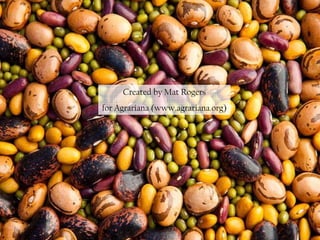
Saving Seeds 
Photo: Stephen Loewinsohn (stephenloewinsohn.com)
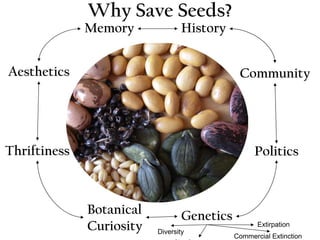
Why Save Seeds? 
Diversity 
Landrace crops 
Extirpation 
Commercial Extinction 
History 
Thriftiness 
Community 
Genetics 
Memory 
Aesthetics 
Politics 
Botanical 
Curiosity
Relax!
Angiosperms 
ƒ Flowering plants 
ƒ Most diverse group of land plants 
ƒ Together with gymnosperms are the seed- producing 
plants 
ƒ Began separating from gymnosperms 200 million y/a, 
first flowering 140 million y/a, widespread 100 
million y/a, dominant trees 60 million y/a 
ƒ Distinguished from gymnosperms by flowers, 
endosperm within seed, production of fruit
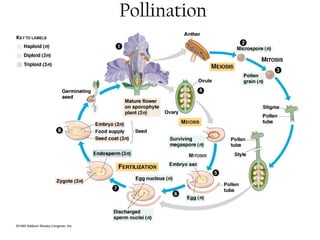
Pollination
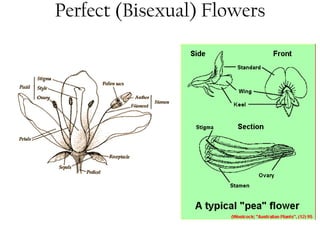
Perfect (Bisexual) Flowers
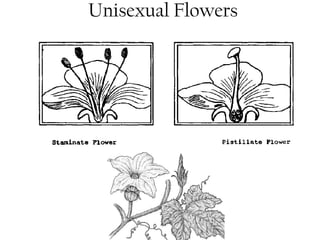
Unisexual Flowers
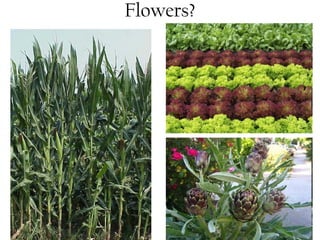
Flowers?
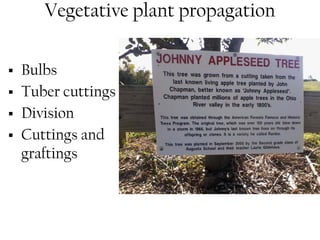
Vegetative plant propagation 
ƒ Bulbs 
ƒ Tuber cuttings 
ƒ Division 
ƒ Cuttings and 
graftings
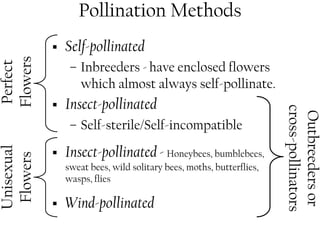
Pollination Methods 
ƒ Self-pollinated 
– Inbreeders - have enclosed flowers 
which almost always self-pollinate. 
ƒ Insect-pollinated 
– Self-sterile/Self-incompatible 
ƒ Insect-pollinated - Honeybees, bumblebees, 
sweat bees, wild solitary bees, moths, butterflies, 
wasps, flies 
ƒ Wind-pollinated 
Outbreeders or 
cross-pollinators 
Perfect 
Flowers 
Unisexual 
Flowers
Break 
Find examples of perfect and unisexual flowers. 
Find examples of crops without readily visible 
flowers. 
Are there any non-angiosperms in the garden?
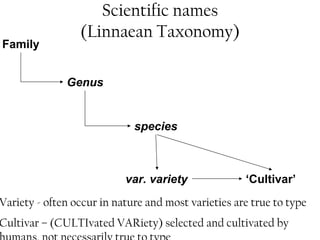
Scientific names 
(Linnaean Taxonomy) 
Family 
Genus 
species 
var. variety ‘Cultivar’ 
Variety - often occur in nature and most varieties are true to type 
Cultivar – (CULTIvated VARiety) selected and cultivated by 
humans, not necessarily true to type
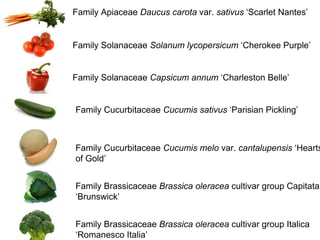
Family Apiaceae Daucus carota var. sativus ‘Scarlet Nantes’ 
Family Solanaceae Solanum lycopersicum ‘Cherokee Purple’ 
Family Solanaceae Capsicum annum ‘Charleston Belle’ 
Family Cucurbitaceae Cucumis sativus ‘Parisian Pickling’ 
Family Cucurbitaceae Cucumis melo var. cantalupensis ‘Hearts 
of Gold’ 
Family Brassicaceae Brassica oleracea cultivar group Capitata 
‘Brunswick’ 
Family Brassicaceae Brassica oleracea cultivar group Italica 
‘Romanesco Italia’
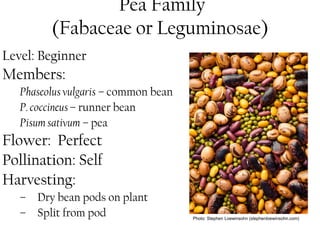
Pea Family 
(Fabaceae or Leguminosae) 
Level: Beginner 
Members: 
Phaseolus vulgaris – common bean 
P. coccineus – runner bean 
Pisum sativum – pea 
Flower: Perfect 
Pollination: Self 
Harvesting: 
– Dry bean pods on plant 
– Split from pod Photo: Stephen Loewinsohn (stephenloewinsohn.com)
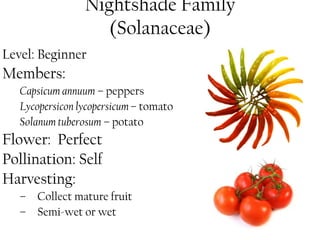
Nightshade Family 
(Solanaceae) 
Level: Beginner 
Members: 
Capsicum annuum – peppers 
Lycopersicon lycopersicum – tomato 
Solanum tuberosum – potato 
Flower: Perfect 
Pollination: Self 
Harvesting: 
– Collect mature fruit 
– Semi-wet or wet
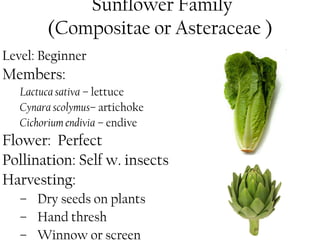
Sunflower Family 
(Compositae or Asteraceae ) 
Level: Beginner 
Members: 
Lactuca sativa – lettuce 
Cynara scolymus– artichoke 
Cichorium endivia – endive 
Flower: Perfect 
Pollination: Self w. insects 
Harvesting: 
– Dry seeds on plants 
– Hand thresh 
– Winnow or screen
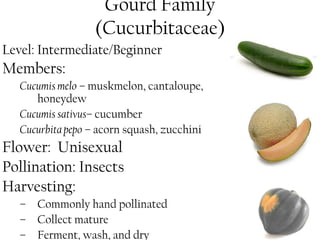
Gourd Family 
(Cucurbitaceae) 
Level: Intermediate/Beginner 
Members: 
Cucumis melo – muskmelon, cantaloupe, 
honeydew 
Cucumis sativus– cucumber 
Cucurbita pepo – acorn squash, zucchini 
Flower: Unisexual 
Pollination: Insects 
Harvesting: 
– Commonly hand pollinated 
– Collect mature 
– Ferment, wash, and dry
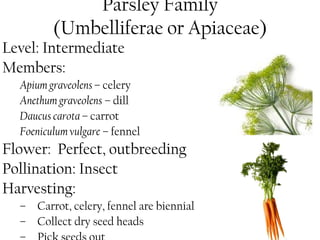
Parsley Family 
(Umbelliferae or Apiaceae) 
Level: Intermediate 
Members: 
Apium graveolens – celery 
Anethum graveolens – dill 
Daucus carota – carrot 
Foeniculum vulgare – fennel 
Flower: Perfect, outbreeding 
Pollination: Insect 
Harvesting: 
– Carrot, celery, fennel are biennial 
– Collect dry seed heads 
– Pick seeds out
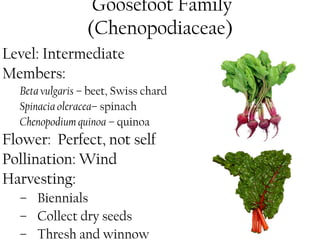
Goosefoot Family 
(Chenopodiaceae) 
Level: Intermediate 
Members: 
Beta vulgaris – beet, Swiss chard 
Spinacia oleracea– spinach 
Chenopodium quinoa – quinoa 
Flower: Perfect, not self 
Pollination: Wind 
Harvesting: 
– Biennials 
– Collect dry seeds 
– Thresh and winnow
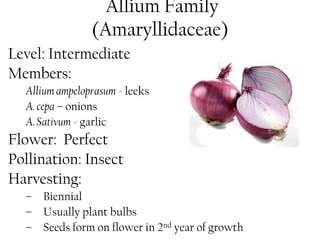
Allium Family 
(Amaryllidaceae) 
Level: Intermediate 
Members: 
Allium ampeloprasum - leeks 
A. cepa – onions 
A. Sativum - garlic 
Flower: Perfect 
Pollination: Insect 
Harvesting: 
– Biennial 
– Usually plant bulbs 
– Seeds form on flower in 2nd year of growth
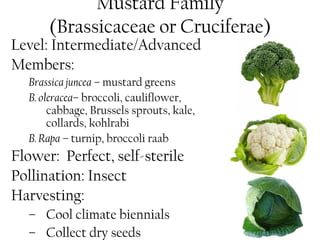
Mustard Family 
(Brassicaceae or Cruciferae) 
Level: Intermediate/Advanced 
Members: 
Brassica juncea – mustard greens 
B. oleracea– broccoli, cauliflower, 
cabbage, Brussels sprouts, kale, 
collards, kohlrabi 
B. Rapa – turnip, broccoli raab 
Flower: Perfect, self-sterile 
Pollination: Insect 
Harvesting: 
– Cool climate biennials 
– Collect dry seeds
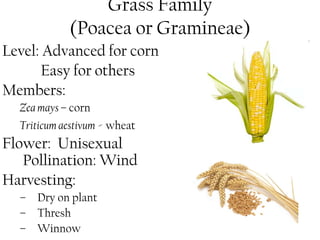
Grass Family 
(Poacea or Gramineae) 
Level: Advanced for corn 
Easy for others 
Members: 
Zea mays– corn 
Triticum aestivum - wheat 
Flower: Unisexual 
Pollination: Wind 
Harvesting: 
– Dry on plant 
– Thresh 
– Winnow
Other Families 
ƒ Amaranthaceae – amaranth 
ƒ Basellaceae – malabar spinach 
ƒ Convolvulaceae – sweet potato 
ƒ Liliaceae – asparagus 
ƒ Malvaceae – okra 
ƒ Polygonaceae – Rhubarb, sorrel 
ƒ Portulacaceae – miner’s lettuce
Break 
Find examples of as many crop families as 
possible. 
Find examples of crops that look different but 
are of the same genus or same species.
Heirlooms 
ƒ A variety/cultivar developed and commonly 
grown earlier in history 
– how long? 
– may or may not have a story 
– not used in industrial agriculture? 
ƒ Open-Pollinated - The pollination of outbreeding 
plants by insects, birds, wind, or other natural 
processes. 
– self pollination of inbreeders 
– controlled pollination to maintain a variety
Hybrids 
ƒ F1 hybrid - the offspring of a cross between two parent plants 
of different varieties 
– 'first filial' generation 
– creates new desired traits, most notably hybrid vigor 
– done under controlled conditions, often by hand, which makes F1 
hybrid seed more expensive to produce 
– cross the F1 generation with itself you get an F2 
– accused of being a form of biotechnology to control seed savers 
ƒ Hybrid vigor (heterosis) - If you cross two different varieties of an 
outbreeding plant, the offspring may well turn out bigger, 
faster-growing, or more productive than either of the parents. 
Hybrid vigor may not be passed on to the F2 generation. 
ƒ F2s can be saved - you are staring a breeding trial
Isolation by Distance 
ƒ Isolation Distances – The minimum planting 
separation required between two or more 
varieties of the same species for the purpose of 
keeping seed pure. 
ƒ Consult tables 
ƒ Isolation distances often for open farmland, 
high humidity – may be modified for arid 
West and heterogeneous urban locales
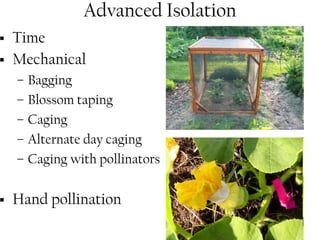
Advanced Isolation 
ƒ Time 
ƒ Mechanical 
– Bagging 
– Blossom taping 
– Caging 
– Alternate day caging 
– Caging with pollinators 
ƒ Hand pollination
Population Size 
ƒ Never < 6 individuals 
ƒ Recommended: 
– Inbreeders – 20 individuals 
– Outbreeders – 100 individuals 
ƒ Inbreeding depression - If an outbreeding plant 
self-pollinates, the offspring can turn out 
weaker and slower-growing than either 
parent, and it gets worse with each 
subsequent generation.
Selection 
Trueness-to-type Roguing 
Characteristics 
ƒ Taste 
ƒ Physical characteristics: Color, Size, Shape 
ƒ Disease resistance: blight, rust, wilt, … 
ƒ Drought tolerance 
ƒ Vigor/Performance 
ƒ Market concerns: easy harvest, shipability
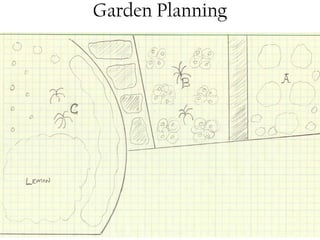
Garden Planning
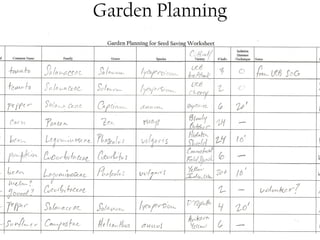
Garden Planning
Break 
Catalog your current garden or plan a future 
plot. 
Catalog or plan a section of the student garden.
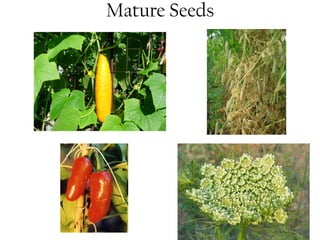
Mature Seeds
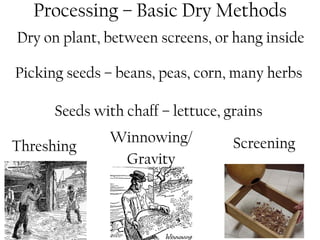
Processing – Basic Dry Methods 
Dry on plant, between screens, or hang inside 
Picking seeds – beans, peas, corn, many herbs 
Seeds with chaff – lettuce, grains 
Winnowing/ 
Gravity 
Threshing Screening
Processing – Basic Wet Methods 
Pick fully mature specimens 
ƒ Semi-wet – peppers 
– pick seeds, rinse, and dry 
ƒ Wet – tomatoes, melons, squash, cucumber 
– ferment, wash, then dry
Seed Processing: Part 1 
http://www.youtube.com/watch?v=g0Uq9E7qruc 
By South Bay seed saver Bill Merrill (www.greengardenservice.net)
Seed Processing: Part 2 
http://www.youtube.com/watch?v=gbLpIQrAa_8
Seed Processing: Part 3 
http://www.youtube.com/watch?v=YnpWSfzWCxk
Storage 
ƒ Store seed at maximum dry weight ≈ 8% seed 
moisture. Check for breaking or shattering. 
ƒ General rule: sum of temperature and relative 
humidity < 100 
ƒ Paper envelopes are great to hold and sort seeds 
ƒ Containers must be air tight – glass jars, paint cans, 
plastic containers w. gaskets. Some people add silica 
dessicant. 
ƒ Store in a cool, dry, dark location, such as a closet 
ƒ Newbie mistake: seed that molds was not sufficiently 
dry before storage. 
ƒ Consult tables for storage times for viable seed. 
Germination rates must remain above 70%.
Advanced Storage 
ƒ Long term frozen storage at low moisture. 
– At home 
– Germplasm collections 
– Seed vaults 
ƒ Overwintering biennials
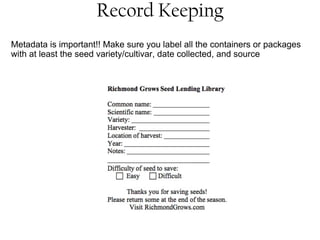
Record Keeping 
Metadata is important!! Make sure you label all the containers or packages 
with at least the seed variety/cultivar, date collected, and source
Bay Area Seed Interchange 
Library (BASIL) 
BASIL is a free, community-based, urban seed project committed to 
disseminating and celebrating local varieties of seed stock and raising 
awareness about the importance and relationship between biological and 
cultural diversity. 
Located in the Ecology Center 
2530 San Pablo Ave (near Dwight) 
Berkeley, CA 94702 
Tuesday - Saturday, 11:00 a.m. - 6:00 p.m. 
www.ecologycenter.org/basil
Seed Sources We Like 
Richmond Grows 
www.richmondgrows.org 
Richmond Public Library 
325 Civic Center Plaza 
Richmond, CA 94804 
Pocket Seed Library 
www.pocketseedlibrary.com 
Hosts picnics and seed swaps 
Baker Creek 
Heirloom Seeds 
www.rareseeds.com 
Seed Bank in Petaluma 
Seed Savers 
Exchange 
www.seedsavers.org
Further Reading 
Free Resources: 
McCormack, Jeffrey. (2004). Isolation Distances. Saving Our Seeds. 
http://www.savingourseed.org/Survey/IsolationGuideSurvey.html 
McCormack, Jeffrey. (2004). Seed Processing and Storage. Saving Our Seeds. 
http://www.savingourseed.org/Survey/SeedProcessingandStorageSurvey.h 
tml 
McDorman, Bill. (1994). Basic Seed Saving. International Seed Saving Institute 
http://www.seedsave.org/issi/issi_904.html 
Native Seeds|SEARCH. Seed Saving How To. 
http://www.nativeseeds.org/how_to/seedsave 
If you read one book on seed saving: 
Ashworth, Suzanne. (2002). Seed to Seed: Seed Saving and Growing 
Techniques for Vegetable Gardeners. Seed Savers Exchange. Decorah, Iowa.
Created by Mat Rogers 
for Agrariana (www.agrariana.org)

Saving Seeds ~ agrariana

  • 1.
    Saving Seeds Photo:Stephen Loewinsohn (stephenloewinsohn.com)
  • 2.
    Why Save Seeds? Diversity Landrace crops Extirpation Commercial Extinction History Thriftiness Community Genetics Memory Aesthetics Politics Botanical Curiosity
  • 3.
  • 4.
    Angiosperms ƒ Floweringplants ƒ Most diverse group of land plants ƒ Together with gymnosperms are the seed- producing plants ƒ Began separating from gymnosperms 200 million y/a, first flowering 140 million y/a, widespread 100 million y/a, dominant trees 60 million y/a ƒ Distinguished from gymnosperms by flowers, endosperm within seed, production of fruit
  • 5.
  • 6.
  • 7.
  • 8.
  • 9.
    Vegetative plant propagation ƒ Bulbs ƒ Tuber cuttings ƒ Division ƒ Cuttings and graftings
  • 10.
    Pollination Methods ƒSelf-pollinated – Inbreeders - have enclosed flowers which almost always self-pollinate. ƒ Insect-pollinated – Self-sterile/Self-incompatible ƒ Insect-pollinated - Honeybees, bumblebees, sweat bees, wild solitary bees, moths, butterflies, wasps, flies ƒ Wind-pollinated Outbreeders or cross-pollinators Perfect Flowers Unisexual Flowers
  • 11.
    Break Find examplesof perfect and unisexual flowers. Find examples of crops without readily visible flowers. Are there any non-angiosperms in the garden?
  • 12.
    Scientific names (LinnaeanTaxonomy) Family Genus species var. variety ‘Cultivar’ Variety - often occur in nature and most varieties are true to type Cultivar – (CULTIvated VARiety) selected and cultivated by humans, not necessarily true to type
  • 13.
    Family Apiaceae Daucuscarota var. sativus ‘Scarlet Nantes’ Family Solanaceae Solanum lycopersicum ‘Cherokee Purple’ Family Solanaceae Capsicum annum ‘Charleston Belle’ Family Cucurbitaceae Cucumis sativus ‘Parisian Pickling’ Family Cucurbitaceae Cucumis melo var. cantalupensis ‘Hearts of Gold’ Family Brassicaceae Brassica oleracea cultivar group Capitata ‘Brunswick’ Family Brassicaceae Brassica oleracea cultivar group Italica ‘Romanesco Italia’
  • 14.
    Pea Family (Fabaceaeor Leguminosae) Level: Beginner Members: Phaseolus vulgaris – common bean P. coccineus – runner bean Pisum sativum – pea Flower: Perfect Pollination: Self Harvesting: – Dry bean pods on plant – Split from pod Photo: Stephen Loewinsohn (stephenloewinsohn.com)
  • 15.
    Nightshade Family (Solanaceae) Level: Beginner Members: Capsicum annuum – peppers Lycopersicon lycopersicum – tomato Solanum tuberosum – potato Flower: Perfect Pollination: Self Harvesting: – Collect mature fruit – Semi-wet or wet
  • 16.
    Sunflower Family (Compositaeor Asteraceae ) Level: Beginner Members: Lactuca sativa – lettuce Cynara scolymus– artichoke Cichorium endivia – endive Flower: Perfect Pollination: Self w. insects Harvesting: – Dry seeds on plants – Hand thresh – Winnow or screen
  • 17.
    Gourd Family (Cucurbitaceae) Level: Intermediate/Beginner Members: Cucumis melo – muskmelon, cantaloupe, honeydew Cucumis sativus– cucumber Cucurbita pepo – acorn squash, zucchini Flower: Unisexual Pollination: Insects Harvesting: – Commonly hand pollinated – Collect mature – Ferment, wash, and dry
  • 18.
    Parsley Family (Umbelliferaeor Apiaceae) Level: Intermediate Members: Apium graveolens – celery Anethum graveolens – dill Daucus carota – carrot Foeniculum vulgare – fennel Flower: Perfect, outbreeding Pollination: Insect Harvesting: – Carrot, celery, fennel are biennial – Collect dry seed heads – Pick seeds out
  • 19.
    Goosefoot Family (Chenopodiaceae) Level: Intermediate Members: Beta vulgaris – beet, Swiss chard Spinacia oleracea– spinach Chenopodium quinoa – quinoa Flower: Perfect, not self Pollination: Wind Harvesting: – Biennials – Collect dry seeds – Thresh and winnow
  • 20.
    Allium Family (Amaryllidaceae) Level: Intermediate Members: Allium ampeloprasum - leeks A. cepa – onions A. Sativum - garlic Flower: Perfect Pollination: Insect Harvesting: – Biennial – Usually plant bulbs – Seeds form on flower in 2nd year of growth
  • 21.
    Mustard Family (Brassicaceaeor Cruciferae) Level: Intermediate/Advanced Members: Brassica juncea – mustard greens B. oleracea– broccoli, cauliflower, cabbage, Brussels sprouts, kale, collards, kohlrabi B. Rapa – turnip, broccoli raab Flower: Perfect, self-sterile Pollination: Insect Harvesting: – Cool climate biennials – Collect dry seeds
  • 22.
    Grass Family (Poaceaor Gramineae) Level: Advanced for corn Easy for others Members: Zea mays– corn Triticum aestivum - wheat Flower: Unisexual Pollination: Wind Harvesting: – Dry on plant – Thresh – Winnow
  • 23.
    Other Families ƒAmaranthaceae – amaranth ƒ Basellaceae – malabar spinach ƒ Convolvulaceae – sweet potato ƒ Liliaceae – asparagus ƒ Malvaceae – okra ƒ Polygonaceae – Rhubarb, sorrel ƒ Portulacaceae – miner’s lettuce
  • 24.
    Break Find examplesof as many crop families as possible. Find examples of crops that look different but are of the same genus or same species.
  • 25.
    Heirlooms ƒ Avariety/cultivar developed and commonly grown earlier in history – how long? – may or may not have a story – not used in industrial agriculture? ƒ Open-Pollinated - The pollination of outbreeding plants by insects, birds, wind, or other natural processes. – self pollination of inbreeders – controlled pollination to maintain a variety
  • 26.
    Hybrids ƒ F1hybrid - the offspring of a cross between two parent plants of different varieties – 'first filial' generation – creates new desired traits, most notably hybrid vigor – done under controlled conditions, often by hand, which makes F1 hybrid seed more expensive to produce – cross the F1 generation with itself you get an F2 – accused of being a form of biotechnology to control seed savers ƒ Hybrid vigor (heterosis) - If you cross two different varieties of an outbreeding plant, the offspring may well turn out bigger, faster-growing, or more productive than either of the parents. Hybrid vigor may not be passed on to the F2 generation. ƒ F2s can be saved - you are staring a breeding trial
  • 27.
    Isolation by Distance ƒ Isolation Distances – The minimum planting separation required between two or more varieties of the same species for the purpose of keeping seed pure. ƒ Consult tables ƒ Isolation distances often for open farmland, high humidity – may be modified for arid West and heterogeneous urban locales
  • 28.
    Advanced Isolation ƒTime ƒ Mechanical – Bagging – Blossom taping – Caging – Alternate day caging – Caging with pollinators ƒ Hand pollination
  • 29.
    Population Size ƒNever < 6 individuals ƒ Recommended: – Inbreeders – 20 individuals – Outbreeders – 100 individuals ƒ Inbreeding depression - If an outbreeding plant self-pollinates, the offspring can turn out weaker and slower-growing than either parent, and it gets worse with each subsequent generation.
  • 30.
    Selection Trueness-to-type Roguing Characteristics ƒ Taste ƒ Physical characteristics: Color, Size, Shape ƒ Disease resistance: blight, rust, wilt, … ƒ Drought tolerance ƒ Vigor/Performance ƒ Market concerns: easy harvest, shipability
  • 31.
  • 32.
  • 33.
    Break Catalog yourcurrent garden or plan a future plot. Catalog or plan a section of the student garden.
  • 34.
  • 35.
    Processing – BasicDry Methods Dry on plant, between screens, or hang inside Picking seeds – beans, peas, corn, many herbs Seeds with chaff – lettuce, grains Winnowing/ Gravity Threshing Screening
  • 36.
    Processing – BasicWet Methods Pick fully mature specimens ƒ Semi-wet – peppers – pick seeds, rinse, and dry ƒ Wet – tomatoes, melons, squash, cucumber – ferment, wash, then dry
  • 37.
    Seed Processing: Part1 http://www.youtube.com/watch?v=g0Uq9E7qruc By South Bay seed saver Bill Merrill (www.greengardenservice.net)
  • 38.
    Seed Processing: Part2 http://www.youtube.com/watch?v=gbLpIQrAa_8
  • 39.
    Seed Processing: Part3 http://www.youtube.com/watch?v=YnpWSfzWCxk
  • 40.
    Storage ƒ Storeseed at maximum dry weight ≈ 8% seed moisture. Check for breaking or shattering. ƒ General rule: sum of temperature and relative humidity < 100 ƒ Paper envelopes are great to hold and sort seeds ƒ Containers must be air tight – glass jars, paint cans, plastic containers w. gaskets. Some people add silica dessicant. ƒ Store in a cool, dry, dark location, such as a closet ƒ Newbie mistake: seed that molds was not sufficiently dry before storage. ƒ Consult tables for storage times for viable seed. Germination rates must remain above 70%.
  • 41.
    Advanced Storage ƒLong term frozen storage at low moisture. – At home – Germplasm collections – Seed vaults ƒ Overwintering biennials
  • 42.
    Record Keeping Metadatais important!! Make sure you label all the containers or packages with at least the seed variety/cultivar, date collected, and source
  • 43.
    Bay Area SeedInterchange Library (BASIL) BASIL is a free, community-based, urban seed project committed to disseminating and celebrating local varieties of seed stock and raising awareness about the importance and relationship between biological and cultural diversity. Located in the Ecology Center 2530 San Pablo Ave (near Dwight) Berkeley, CA 94702 Tuesday - Saturday, 11:00 a.m. - 6:00 p.m. www.ecologycenter.org/basil
  • 44.
    Seed Sources WeLike Richmond Grows www.richmondgrows.org Richmond Public Library 325 Civic Center Plaza Richmond, CA 94804 Pocket Seed Library www.pocketseedlibrary.com Hosts picnics and seed swaps Baker Creek Heirloom Seeds www.rareseeds.com Seed Bank in Petaluma Seed Savers Exchange www.seedsavers.org
  • 45.
    Further Reading FreeResources: McCormack, Jeffrey. (2004). Isolation Distances. Saving Our Seeds. http://www.savingourseed.org/Survey/IsolationGuideSurvey.html McCormack, Jeffrey. (2004). Seed Processing and Storage. Saving Our Seeds. http://www.savingourseed.org/Survey/SeedProcessingandStorageSurvey.h tml McDorman, Bill. (1994). Basic Seed Saving. International Seed Saving Institute http://www.seedsave.org/issi/issi_904.html Native Seeds|SEARCH. Seed Saving How To. http://www.nativeseeds.org/how_to/seedsave If you read one book on seed saving: Ashworth, Suzanne. (2002). Seed to Seed: Seed Saving and Growing Techniques for Vegetable Gardeners. Seed Savers Exchange. Decorah, Iowa.
  • 46.
    Created by MatRogers for Agrariana (www.agrariana.org)