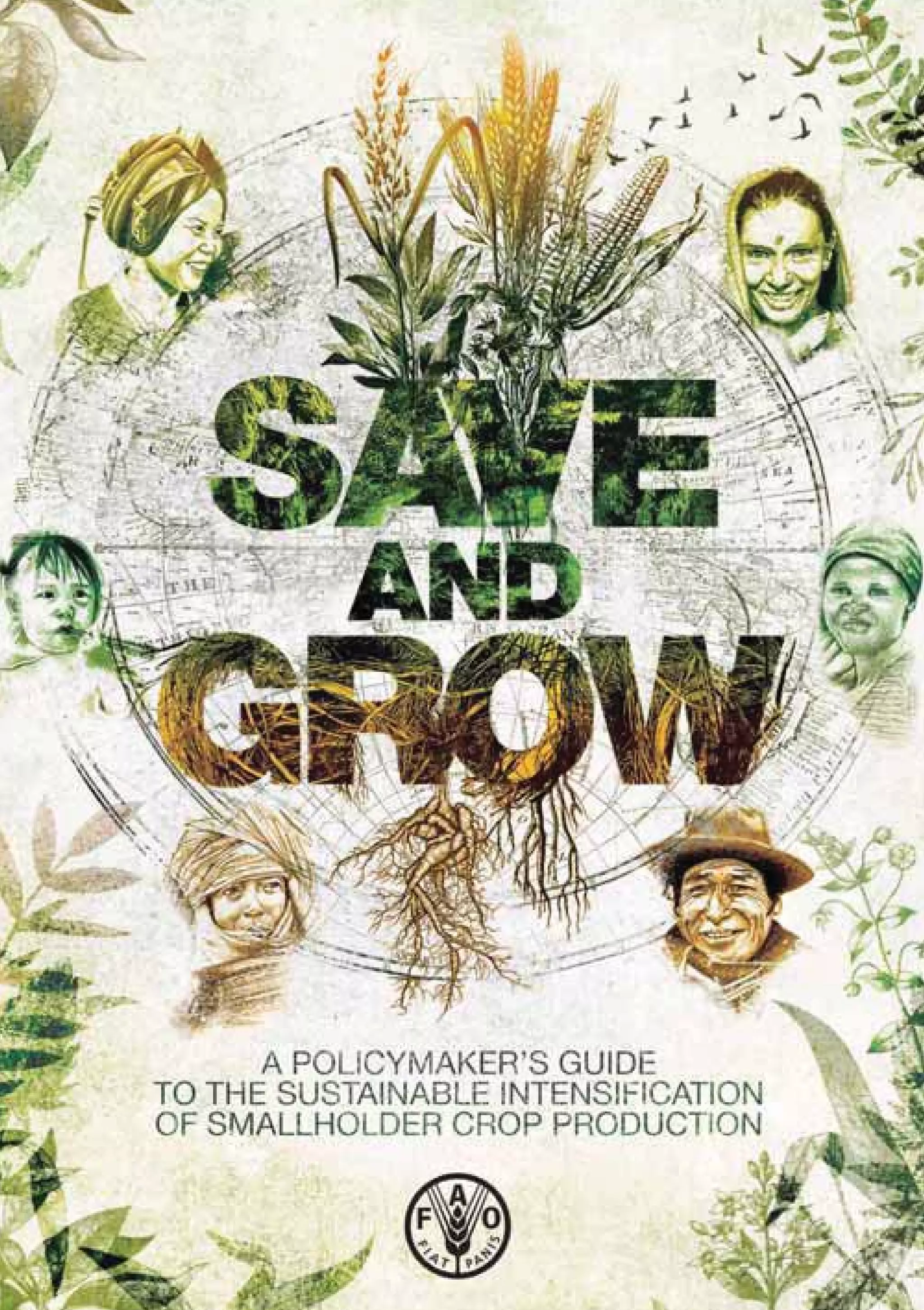
Save and grow 
A policymaker’s guide 
to the sustainable intensification 
of smallholder crop production 
FOOD AND AGRICULTURE ORGANIZATION OF THE UNITED NATIONS 
Rome, 2011
Reprinted 2011, 2012, 2013 
The designations employed and the presentation of material in this information 
product do not imply the expression of any opinion whatsoever on the part of the 
Food and Agriculture Organization of the United Nations (FAO) concerning the 
legal or development status of any country, territory, city or area or of its authorities, 
or concerning the delimitation of its frontiers or boundaries. The mention of 
specific companies or products of manufacturers, whether or not these have been 
patented, does not imply that these have been endorsed or recommended by FAO in 
preference to others of a similar nature that are not mentioned. 
ISBN 978-92-5-106871-7 
All rights reserved. FAO encourages reproduction and dissemination of material in 
this information product. Non-commercial uses will be authorized free of charge, 
upon request. Reproduction for resale or other commercial purposes, including 
educational purposes, may incur fees. Applications for permission to reproduce or 
disseminate FAO copyright materials, and all queries concerning rights and licences, 
should be addressed by e-mail to copyright@fao.org or to the Chief, Publishing Policy 
and Support Branch, Office of Knowledge Exchange, Research and Extension, FAO, 
Viale delle Terme di Caracalla, 00153 Rome, Italy. 
© FAO 2011
Foreword 
With the publication of Save and Grow in 2011, FAO proposed a 
new paradigm of intensive crop production, one that is both 
highly productive and environmentally sustainable. FAO recognized 
that, over the past half-century, agriculture based on the intensive use 
of inputs has increased global food production and average per capita 
food consumption. In the process, however, it has depleted the natural 
resources of many agro-ecosystems, jeopardizing future productivity, 
and added to the greenhouse gases responsible for climate change. 
Moreover, it has not significantly reduced the number of chronically 
hungry, which is currently estimated at 870 million people. 
The challenge is to place food production and consumption on a 
truly sustainable footing. Between now and 2050, the global popula-tion 
is projected to rise from about 7 billion to 9.2 billion, demanding 
– if current trends continue – a 60 percent increase in global food 
production. Given the diminishing area of unused land with good 
agricultural potential, meeting that demand will require ever higher 
crop yields. Those increases, in turn, need to be achieved in the face 
of heightened competition for land and water, rising fuel and fertilizer 
prices, and the impact of climate change. 
Save and Grow addresses the crop production dimension of sustain-able 
food management. In essence, it calls for “greening” the Green 
Revolution through an ecosystem approach that draws on nature’s 
contributions to crop growth, such as soil organic matter, water flow 
regulation, pollination and bio-control of insect pests and diseases. It 
offers a rich toolkit of relevant, adoptable and adaptable ecosystem-based 
practices that can help the world’s 500 million smallholder farm 
families to achieve higher productivity, profitability and resource use 
efficiency, while enhancing natural capital. 
This eco-friendly farming often combines traditional knowledge 
with modern technologies that are adapted to the needs of small-scale 
producers. It also encourages the use of conservation agriculture, 
which boosts yields while restoring soil health. It controls insect pests 
by protecting their natural enemies rather than by spraying crops 
indiscriminately with pesticides. Through judicious use of mineral 
fertilizer, it avoids “collateral damage” to water quality. It uses preci-sion 
irrigation to deliver the right amount of water when and where 
it is needed. The Save and Grow approach is fully consistent with
iv Save and Grow 
the principles of climate-smart agriculture – it builds resilience to 
climate change and reduces greenhouse gas emissions through, for 
example, increased sequestration of carbon in soil. 
For such a holistic approach to be adopted, environmental virtue 
alone is not enough: farmers must see tangible advantages in terms 
of higher incomes, reduced costs and sustainable livelihoods, as 
well as compensation for the environmental benefits they generate. 
Policymakers need to provide incentives, such as rewarding good 
management of agro-ecosystems and expanding the scale of pub-licly 
funded and managed research. Action is needed to establish 
and protect rights to resources, especially for the most vulnerable. 
Developed countries can support sustainable intensification with 
relevant external assistance to the developing world. And there are 
huge opportunities for sharing experiences among developing coun-tries 
through South-South Cooperation. 
We also need to recognize that producing food sustainably is only 
part of the challenge. On the consumption side, there needs to be a 
shift to nutritious diets with a smaller environmental footprint, and 
a reduction in food losses and waste, currently estimated at almost 
1.3 billion tonnes annually. Ultimately, success in ending hunger and 
making the transition to sustainable patterns of production and 
consumption requires transparent, participatory, results-focused 
and accountable systems of governance of food and agriculture, from 
global to local levels. 
This third reprint of Save and Grow comes following the Rio+20 
Conference in June 2012 and the launch of the Zero Hunger Chal-lenge 
by the United Nations Secretary-General, Ban Ki-moon. The 
challenge has five elements: guarantee year-round access to adequate 
food, end stunting in children, double small farmer productivity, fos-ter 
sustainable food production systems, and reduce food waste and 
loss to zero. In assisting countries to adopt Save and Grow policies 
and approaches, FAO is responding to that challenge and helping to 
build the hunger-free world we all want. 
José Graziano da Silva 
Director-General 
Food and Agriculture Organization 
of the United Nations
Contents 
Foreword iii 
Acknowledgements vi 
Overview vii 
Chapter 1: The challenge 1 
Chapter 2: Farming systems 15 
Chapter 3: Soil health 27 
Chapter 4: Crops and varieties 39 
Chapter 5: Water management 51 
Chapter 6: Plant protection 65 
Chapter 7: Policies and institutions 77 
Sources 95 
Abbreviations 102
vi Save and Grow 
This book was produced under the 
direction of Shivaji Pandey, Director of 
FAO’s Plant Production and Protection 
Division. Guidance was provided by 
a steering committee and a technical 
advisory group. Final technical editing 
was done by Mangala Rai (President of 
the National Academy of Agricultural 
Sciences, India), Timothy Reeves (former 
Director-General of the International 
Maize and Wheat Improvement Center), 
and Shivaji Pandey. 
Authors 
Lead authors: 
Linda Collette (FAO), Toby Hodgkin 
(Bioversity International), Amir Kassam 
(University of Reading, UK), Peter 
Kenmore (FAO), Leslie Lipper (FAO), 
Christian Nolte (FAO), Kostas Stamoulis 
(FAO), Pasquale Steduto (FAO) 
Collaborators: 
Manuela Allara (FAO), Doyle Baker 
(FAO), Hasan Bolkan (Campbell 
Soup Co., USA), Jacob Burke (FAO), 
Romina Cavatassi (FAO), Mark L. Davis 
(FAO), Hartwig De Haen (University of 
Göttingen, Germany), João Carlos de 
Moraes Sá (Universidade Estadual de 
Ponta Grossa, Brazil), Marjon Fredrix 
(FAO), Theodor Friedrich (FAO), Kakoli 
Ghosh (FAO), Jorge Hendrichs (FAO/ 
IAEA), Barbara Herren (FAO), Francesca 
Mancini (FAO), Philip Mikos (EC), 
Thomas Osborn (FAO), Jules Pretty 
(University of Essex, UK), David Radcliffe 
(EC), Timothy Reeves (Timothy G. 
Reeves and Associates P/L, Australia), 
Mike Robson (FAO), Amit Roy (IFDC), 
Francis Shaxson (Tropical Agriculture 
Association, UK), Hugh Turral (RPF P/L, 
Australia), Harry Van der Wulp (FAO) 
Steering committee 
Chair: Shivaji Pandey (FAO) 
Rodney Cooke (IFAD), Dennis Garrity 
(ICRAF), Toby Hodgkin (Bioversity 
International), Philip Mikos (EC), 
Mohammad Saeid Noori Naeini (Iran), 
Timothy Reeves (Timothy G. Reeves 
and Associates P/L, Australia), Amit 
Roy (IFDC), M. S. Swaminathan (M. 
S. Swaminathan Research Foundation, 
India) 
Technical advisory group 
Hasan Bolkan (Campbell Soup Co., 
USA), Anne-Marie Izac (Future Harvest 
Alliance, France), Louise Jackson 
(University of California, Davis, USA), 
Janice Jiggins (Wageningen University 
and Research Centre, the Netherlands), 
Patrick Mulvany (Intermediate 
Technology Development Group, UK), 
Wayne Powell (Aberystwyth University, 
UK), Jessie Sainz Binamira (Department 
of Agriculture, the Philippines), Bob 
Watson (University of East Anglia, UK) 
Acknowledgements
Overview 
1. The challenge 
To feed a growing world population, we have no option but 
to intensify crop production. But farmers face unprecedented 
constraints. In order to grow, agriculture must learn to save. 
The Green Revolution led to a quantum leap in food 
production and bolstered world food security. In many 
countries, however, intensive crop production has depleted 
agriculture’s natural resource base, jeopardizing future 
productivity. In order to meet projected demand over the 
next 40 years, farmers in the developing world must double 
food production, a challenge made even more daunting by the 
combined effects of climate change and growing competition 
for land, water and energy. This book presents a new paradigm: 
sustainable crop production intensification (SCPI), which 
produces more from the same area of land while conserving 
resources, reducing negative impacts on the environment and 
enhancing natural capital and the flow of ecosystem services. 
2. Farming systems 
Crop production intensification will be built on farming 
systems that offer a range of productivity, socio-economic and 
environmental benefits to producers and to society at large. 
The ecosystem approach to crop production regenerates and 
sustains the health of farmland. Farming systems for SCPI 
will be based on conservation agriculture practices, the use of 
good seed of high-yielding adapted varieties, integrated pest 
management, plant nutrition based on healthy soils, efficient 
water management, and the integration of crops, pastures, trees 
and livestock. The very nature of sustainable production systems 
is dynamic: they should offer farmers many possible combina-tions 
of practices to choose from and adapt, according to their 
local production conditions and constraints. Such systems are 
knowledge-intensive. Policies for SCPI should build capacity 
through extension approaches such as farmer field schools, and 
facilitate local production of specialized farm tools.
viii Save and Grow 
3. Soil health 
Agriculture must, literally, return to its roots by rediscovering 
the importance of healthy soil, drawing on natural sources 
of plant nutrition, and using mineral fertilizer wisely. 
Soils rich in biota and organic matter are the foundation of 
increased crop productivity. The best yields are achieved 
when nutrients come from a mix of mineral fertilizers and 
natural sources, such as manure and nitrogen-fixing crops 
and trees. Judicious use of mineral fertilizers saves money and 
ensures that nutrients reach the plant and do not pollute air, soil 
and waterways. Policies to promote soil health should encourage 
conservation agriculture and mixed crop-livestock and agro-forestry 
systems that enhance soil fertility. They should remove 
incentives that encourage mechanical tillage and the wasteful 
use of fertilizers, and transfer to farmers precision approaches 
such as urea deep placement and site-specific nutrient 
management. 
4. Crops and varieties 
Farmers will need a genetically diverse portfolio of improved 
crop varieties that are suited to a range of agro-ecosystems 
and farming practices, and resilient to climate change. 
Genetically improved cereal varieties accounted for some 
50 percent of the increase in yields over the past few 
decades. Plant breeders must achieve similar results in the 
future. However, timely delivery to farmers of high-yielding 
varieties requires big improvements in the system that connects 
plant germplasm collections, plant breeding and seed delivery. 
Over the past century, about 75 percent of plant genetic 
resources (PGR) has been lost and a third of today’s diversity 
could disappear by 2050. Increased support to PGR collection, 
conservation and utilization is crucial. Funding is also needed 
to revitalize public plant breeding programmes. Policies should 
help to link formal and farmer-saved seed systems, and foster 
the emergence of local seed enterprises.
Overview ix 
5. Water management 
Sustainable intensification requires smarter, precision 
technologies for irrigation and farming practices that use 
ecosystem approaches to conserve water. 
Cities and industries are competing intensely with agriculture 
for the use of water. Despite its high productivity, irrigation 
is under growing pressure to reduce its environmental impact, 
including soil salinization and nitrate contamination of aquifers. 
Knowledge-based precision irrigation that provides reliable 
and flexible water application, along with deficit irrigation 
and wastewater-reuse, will be a major platform for sustainable 
intensification. Policies will need to eliminate perverse subsidies 
that encourage farmers to waste water. In rainfed areas, climate 
change threatens millions of small farms. Increasing rainfed 
productivity will depend on the use of improved, drought 
tolerant varieties and management practices that save water. 
6. Plant protection 
Pesticides kill pests, but also pests’ natural enemies, and their 
overuse can harm farmers, consumers and the environment. 
The first line of defence is a healthy agro-ecosystem. 
In well managed farming systems, crop losses to insects 
can often be kept to an acceptable minimum by deploying 
resistant varieties, conserving predators and managing crop 
nutrient levels to reduce insect reproduction. Recommended 
measures against diseases include use of clean planting material, 
crop rotations to suppress pathogens, and eliminating infected 
host plants. Effective weed management entails timely manual 
weeding, minimized tillage and the use of surface residues. 
When necessary, lower risk synthetic pesticides should be 
used for targeted control, in the right quantity and at the right 
time. Integrated pest management can be promoted through 
farmer field schools, local production of biocontrol agents, strict 
pesticide regulations, and removal of pesticide subsidies.
x Save and Grow 
7. Policies and institutions 
To encourage smallholders to adopt sustainable crop 
production intensification, fundamental changes are needed 
in agricultural development policies and institutions. 
First, farming needs to be profitable: smallholders must be able 
to afford inputs and be sure of earning a reasonable price for 
their crops. Some countries protect income by fixing minimum 
prices for commodities; others are exploring “smart subsidies” 
on inputs, targeted to low-income producers. Policymakers 
also need to devise incentives for small-scale farmers to use 
natural resources wisely – for example, through payments for 
environmental services and land tenure that entitles them to 
benefit from increases in the value of natural capital – and 
reduce the transaction costs of access to credit, which is urgently 
needed for investment. In many countries, regulations are 
needed to protect farmers from unscrupulous dealers selling 
bogus seed and other inputs. Major investment will be needed to 
rebuild research and technology transfer capacity in developing 
countries in order to provide farmers with appropriate 
technologies and to enhance their skills through farmer field 
schools.
Chapter 1 
The challenge 
To feed a growing world population, 
we have no option but to intensify 
crop production. But farmers face 
unprecedented constraints. In order 
to grow, agriculture must learn to save
The history of agriculture can be seen as a long process of 
intensification1, as society sought to meet its ever growing 
needs for food, feed and fibre by raising crop productivity. 
Over millennia, farmers selected for cultivation plants that 
were higher yielding and more resistant to drought and disease, built 
terraces to conserve soil and canals to distribute water to their fields, 
replaced simple hoes with oxen-drawn ploughs, and used animal 
manure as fertilizer and sulphur against pests. 
Agricultural intensification in the twentieth century represented 
a paradigm shift from traditional farming systems, based largely on 
the management of natural resources and ecosystem services, to 
the application of biochemistry and engineering to crop production. 
Following the same model that had revolutionized manufacturing, 
agriculture in the industrialized world adopted mechanization, stan-dardization, 
labour-saving technologies and the use of chemicals to 
feed and protect crops. Great increases in productivity have been 
achieved through the use of heavy farm equipment and machinery 
powered by fossil fuel, intensive tillage, high-yielding crop varieties, 
irrigation, manufactured inputs, and ever increasing capital intensity2. 
The intensification of crop production in the developing world 
began in earnest with the Green Revolution. Beginning in the 1950s 
and expanding through the 1960s, changes were seen in crop varieties 
and agricultural practices worldwide3. The production model, which 
focused initially on the introduction of improved, higher-yielding va-rieties 
of wheat, rice and maize in high potential areas4, 5 relied upon 
and promoted homogeneity: genetically uniform varieties grown with 
high levels of complementary inputs, such as irrigation, fertilizers and 
pesticides, which often replaced natural capital. Fertilizers replaced 
soil quality management, while herbicides provided an alternative to 
crop rotations as a means of controlling weeds6. 
The Green Revolution is credited, especially in Asia, with having 
jump-started economies, alleviated rural poverty, saved large areas 
of fragile land from conversion to extensive farming, and helped to 
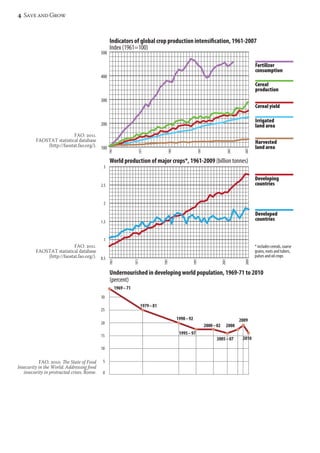
avoid a Malthusian outcome to growth in world population. Between 
1975 and 2000, cereal yields in South Asia increased by more than 
50 percent, while poverty declined by 30 percent7. Over the past 
half-century, since the advent of the Green Revolution, world annual 
production of cereals, coarse grains, roots and tubers, pulses and oil 
crops has grown from 1.8 billion tonnes to 4.6 billion tonnes8. Growth 
Chapter 1: The Challenge 3
4 Save and Grow 
Indicators of global crop production intensification, 1961-2007 
Index (1961=100) 
World production of major crops*, 1961-2009 (billion tonnes) 
Cereal 
production 
Cereal yield 
Undernourished in developing world population, 1969-71 to 2010 
(percent) 
500 
400 
300 
200 
3 
2.5 
2 
1.5 
1 
30 
25 
20 
15 
10 
5 
0 
1969–71 
1979–81 
1990–92 
1995–97 
2008 
2009 
2000–02 
2005–07 2010 
0.5 
Developing 
countries 
Developed 
countries 
* includes cereals, coarse 
grains, roots and tubers, 
pulses and oil crops 
100 
2007 
2001 
1991 
1981 
1971 
1961 
Fertilizer 
consumption 
Irrigated 
land area 
Harvested 
land area 
FAO. 2011. 
FAOSTAT statistical database 
(http://faostat.fao.org/). 
FAO. 2011. 
FAOSTAT statistical database 
(http://faostat.fao.org/). 
FAO. 2010. The State of Food 
Insecurity in the World: Addressing food 
insecurity in protracted crises. Rome.
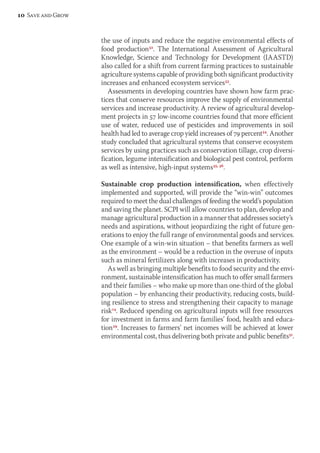
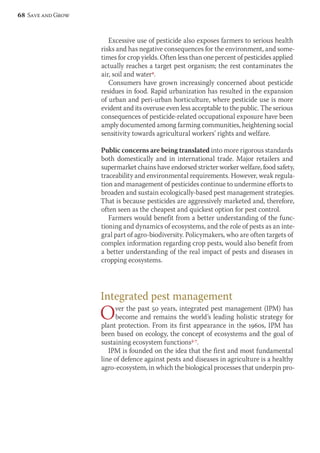
in cereal yields and lower cereal prices significantly reduced food in-security 
in the 1970s and 1980s, when the number of undernourished 
actually fell, despite relatively rapid population growth. Overall, the 
proportion of undernourished in the world population declined from 
26 percent to 14 percent between 1969-1971 and 2000-20029. 
A gathering storm 
It is now recognized that those enormous gains in agricultural 
pro duction and productivity were often accompanied by negative 
effects on agriculture’s natural resource base, so serious that they 
jeopardize its productive potential in the future. “Negative exter-nalities” 
of intensification include land degradation, salinization of 
irrigated areas, over-extraction of groundwater, the buildup of pest 
resistance and the erosion of biodiversity. Agriculture has also dam-aged 
the wider environment through, for example, deforestation, the 
emission of greenhouse gases and nitrate pollution of water bodies10, 11. 
It is also clear that current food production and distribution 
systems are failing to feed the world. The total number of under-nourished 
people in 2010 was estimated at 925 million, higher than 
it was 40 years ago, and in the developing world the prevalence 
of undernourishment stands at 16 percent12. About 75 percent of 
those worst affected live in rural areas of developing countries, with 
liveli hoods that depend directly or indirectly on agriculture13. They 
include many of the world’s half a billion low-income smallholder 
farmers and their families who produce 80 percent of the food sup-ply 
in developing countries. Together, smallholders use and manage 
more than 80 percent of farmland – and similar proportions of other 
natural resources – in Asia and Africa14. 
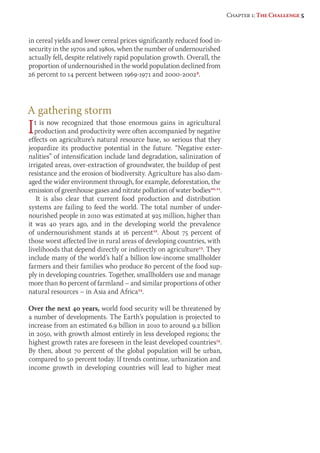
Over the next 40 years, world food security will be threatened by 
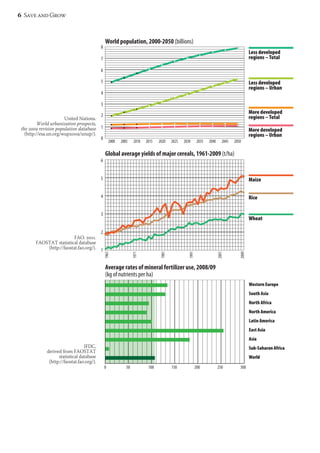
a number of developments. The Earth’s population is projected to 
increase from an estimated 6.9 billion in 2010 to around 9.2 billion 
in 2050, with growth almost entirely in less developed regions; the 
highest growth rates are foreseen in the least developed countries15. 
By then, about 70 percent of the global population will be urban, 
compared to 50 percent today. If trends continue, urbanization and 
income growth in developing countries will lead to higher meat 
Chapter 1: The Challenge 5
6 Save and Grow 
World population, 2000-2050 (billions) 
Average rates of mineral fertilizer use, 2008/09 
(kg of nutrients per ha) 
0 50 100 150 200 250 300 
Western Europe 
South Asia 
North Africa 
North America 
Latin America 
East Asia 
Asia 
Sub-Saharan Africa 
World 
Global average yields of major cereals, 1961-2009 (t/ha) 
8 
7 
6 
5 
4 
3 
2 
1 
6 
5 
4 
3 
2 
1 
Maize 
Rice 
Wheat 
0 
Less developed 
regions – Total 
Less developed 
regions – Urban 
More developed 
regions – Total 
More developed 
regions – Urban 
2000 2005 2010 2015 2020 2025 2030 2035 2040 2045 2050 
United Nations. 
World urbanization prospects, 
the 2009 revision population database 
(http://esa.un.org/wup2009/unup/). 
FAO. 2011. 
FAOSTAT statistical database 
(http://faostat.fao.org/). 
IFDC, 
derived from FAOSTAT 
statistical database 
(http://faostat.fao.org/).
consumption, which will drive increased demand for cereals to feed 
livestock. The use of agricultural commodities in the production of 
biofuels will also con tinue to grow. By 2020, industrialized countries 
may be consuming 150 kg of maize per head per year in the form of 
ethanol – similar to rates of cereal food consumption in developing 
countries16. 
Those changes in demand will drive the need for significant in-creases 
in production of all major food and feed crops. FAO projec-tions 
suggest that by 2050 agricultural production must increase by 70 
percent globally – and by almost 100 percent in developing countries 
– in order to meet food demand alone, excluding additional demand 
for agricultural products used as feedstock in biofuel pro duction. 
That is equivalent to an extra billion tonnes of cereals and 200 mil-lion 
tonnes of meat to be produced annually by 2050, compared with 
production between 2005 and 200710. 
In most developing countries, there is little room for expansion of 
arable land. Virtually no spare land is available in South Asia and 
the Near East/North Africa. Where land is available, in sub-Saharan 
Africa and Latin America, more than 70 percent suffers from soil and 
terrain constraints. Between 2015 and 2030, therefore, an estimated 
80 percent of the required food production increases will have to 
come from intensification in the form of yield increases and higher 
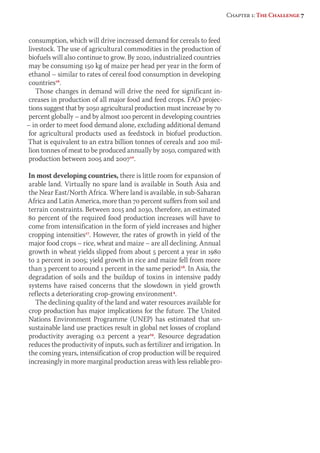
cropping intensities17. However, the rates of growth in yield of the 
major food crops – rice, wheat and maize – are all declining. Annual 
growth in wheat yields slipped from about 5 percent a year in 1980 
to 2 percent in 2005; yield growth in rice and maize fell from more 
than 3 percent to around 1 percent in the same period18. In Asia, the 
degradation of soils and the buildup of toxins in intensive paddy 
systems have raised concerns that the slowdown in yield growth 
reflects a deteriorating crop-growing environment4. 
The declining quality of the land and water resources available for 
crop production has major implications for the future. The United 
Nations Environment Programme (UNEP) has estimated that un-sustainable 
land use practices result in global net losses of cropland 
productivity averaging 0.2 percent a year19. Resource degradation 
reduces the productivity of inputs, such as fertilizer and irrigation. In 
the coming years, intensification of crop production will be required 
increasingly in more marginal production areas with less reliable pro- 
Chapter 1: The Challenge 7
duction conditions, including lower soil quality, more limited access 
to water, and less favourable climates. 
Efforts to increase crop production will take place under rapidly 
changing, often unpredictable, environmental and socio-economic 
conditions. One of the most crucial challenges is the need to adapt 
to climate change, which – through alterations in temperature, pre-cipitation 
and pest incidence – will affect which crops can be grown 
and when, as well as their potential yields13. In the near term, climate 
variability and extreme weather shocks are projected to increase, 
affecting all regions20-23, with negative impacts on yield growth and 
food security particularly in sub-Saharan Africa and South Asia in the 
period up to 203024. Agriculture (including deforestation) accounts 
for about one third of greenhouse gas emissions; for this reason it 
must contribute significantly to climate change mitigation21. While 
crops can be adapted to changing environments, the need to reduce 
emissions will increasingly challenge conventional, resource-intensive 
agricultural systems3. 
Another significant source of future uncertainty is the price and 
availability of energy, needed to power farm operations and for the 
production of key inputs, principally fertilizer. As the supply of fossil 
fuels declines, their prices rise, driving up input prices, and conse-quently 
agricultural production costs. Fossil fuels can no longer be 
the sole source of energy for increasing productivity. Energy sources 
will have to be considerably diversified to reduce the cost of fuel for 
further agricultural intensification. 
The challenge of meeting future demand for food in a sustainable 
manner is made even more daunting, therefore, by the combined 
effects of climate change, energy scarcity and resource degrada-tion. 
The food price spike of 2008 and the surge in food prices to 
record levels early in 2011 portend rising and more frequent threats 
to world food security25. After examining a wide range of plausible 
futures – economic, demographic and climate – the International 
Food Policy Research Institute (IFPRI) estimated that the period 
2010 to 2050 could see real price increases of 59 percent for wheat, 
78 percent for rice and 106 percent for maize. The study concluded 
that rising prices reflect the “relentless underlying pressures on the 
world food system”, driven by population and income growth and by 
reduced productivity26. 
8 Save and Grow
The risk of persistent, long-term food insecurity remains most 
acute in low-income developing countries. The rate at which pres-sures 
are mounting on resources and the broader environment from 
the expansion and intensification of agriculture will be concentrated 
increasingly in countries with low levels of food consumption, high 
population growth rates and often poor agricultural resource endow-ments27. 
There, smallholders, who are highly dependent on ecosystem 
goods and services to provide food, fuel and fibre for their families 
and the market, are inherently more vulnerable to the declining qual-ity 
and quantity of natural resources and changes in climate14. With-out 
action to improve the productivity of smallholder agriculture in 
these countries, it is unlikely that the first Millennium Development 
Goal – with its targets of reducing by half the proportion of people 
living in hunger and poverty by 2015 – can be achieved. 
Another paradigm shift 
Given the current and burgeoning future challenges to our food 
supply and to the environment, sustainable intensification of 
agricultural production is emerging as a major priority for policy-makers28 
and international development partners7, 14. Sustainable 
intensification has been defined as producing more from the same 
area of land while reducing negative environmental impacts and 
increasing contributions to natural capital and the flow of environ-mental 
services29. 
Sustainable crop production intensification (or SCPI) is FAO’s 
first strategic objective. In order to achieve that objective, FAO has 
endorsed the “ecosystem approach” in agricultural management30. 
Essentially, the ecosystem approach uses inputs, such as land, water, 
seed and fertilizer, to complement the natural processes that support 
plant growth, including pollination, natural predation for pest control, 
and the action of soil biota that allows plants to access nutrients31. 
There is now widespread awareness that an ecosystem approach 
must underpin intensification of crop production. A major study of 
the future of food and farming up to 2050 has called for substantial 
changes throughout the world’s food system, including sustainable 
intensification to simultaneously raise yields, increase efficiency in 
Chapter 1: The Challenge 9
the use of inputs and reduce the negative environmental effects of 
food production32. The International Assessment of Agricultural 
Knowledge, Science and Technology for Development (IAASTD) 
also called for a shift from current farming practices to sustainable 
agriculture systems capable of providing both significant productivity 
increases and enhanced ecosystem services33. 
Assessments in developing countries have shown how farm prac-tices 
that conserve resources improve the supply of environmental 
services and increase productivity. A review of agricultural develop-ment 
projects in 57 low-income countries found that more efficient 
use of water, reduced use of pesticides and improvements in soil 
health had led to average crop yield increases of 79 percent34. Another 
study concluded that agricultural systems that conserve ecosystem 
services by using practices such as conservation tillage, crop diversi-fication, 
legume intensification and biological pest control, perform 
as well as intensive, high-input systems35, 36. 
Sustainable crop production intensification, when effectively 
implemented and supported, will provide the “win-win” outcomes 
required to meet the dual challenges of feeding the world’s population 
and saving the planet. SCPI will allow countries to plan, develop and 
manage agricultural production in a manner that addresses society’s 
needs and aspirations, without jeopardizing the right of future gen-erations 
to enjoy the full range of environmental goods and services. 
One example of a win-win situation – that benefits farmers as well 
as the environment – would be a reduction in the overuse of inputs 
such as mineral fertilizers along with increases in productivity. 
As well as bringing multiple benefits to food security and the envi-ronment, 
sustainable intensification has much to offer small farmers 
and their families – who make up more than one-third of the global 
population – by enhancing their productivity, reducing costs, build-ing 
resilience to stress and strengthening their capacity to manage 
risk14. Reduced spending on agricultural inputs will free resources 
for investment in farms and farm families’ food, health and educa-tion29. 
Increases to farmers’ net incomes will be achieved at lower 
environmental cost, thus delivering both private and public benefits31. 
10 Save and Grow
Key principles 
Ecosystem approaches to agricultural intensification have emerged 
over the past two decades as farmers began to adopt sustainable 
practices, such as integrated pest management and conservation 
agriculture, often building on traditional techniques. Sustainable 
crop production intensification is characterized by a more systemic 
approach to managing natural resources, and is founded on a set 
of science-based environmental, institutional and social principles. 
Environmental principles 
The ecosystem approach needs to be applied throughout the food 
chain in order to increase efficiencies and strengthen the global food 
system. At the scale of cropping systems, management should be 
based on biological processes and integration of a range of plant spe-cies, 
as well as the judicious use of external inputs such as fertilizers 
and pesticides. SCPI is based on agricultural production systems and 
management practices that are described in the following chapters. 
They include: 
Ì maintaining healthy soil to enhance crop nutrition; 
Ì cultivating a wider range of species and varieties in associations, 
rotations and sequences; 
Ì using well adapted, high-yielding varieties and good quality seeds; 
Ì integrated management of insect pests, diseases and weeds; 
Ì efficient water management. 
For optimal impact on productivity and sustainability, SCPI will 
need to be applicable to a wide variety of farming systems, and 
adaptable to specific agro-ecological and socio-economic contexts. 
It is recognized that appropriate management practices are critical 
to realizing the benefits of ecosystem services while reducing dis-services 
from agricultural activities36. 
Institutional principles 
It is unrealistic to hope that farmers will adopt sustainable practices 
only because they are more environmentally friendly. Translating the 
environmental principles into large-scale, coordinated programmes 
of action will require institutional support at both national and local 
levels. For governments, the challenge is to improve coordination and 
communication across all subsectors of agriculture, from production 
Chapter 1: The Challenge 11
to processing and marketing. Mechanisms must be developed to 
strengthen institutional linkages in order to improve the formulation 
of policies and strategies for SCPI, and to sustain the scaling up of pi-lot 
studies, farmers’ experiences, and local and traditional knowledge. 
At the local level, farmer organizations have an important role to 
play in facilitating access to resources – especially land, water, credit 
and knowledge – and ensuring that the voice of farmers is heard37. 
Smallholder farmers also need access to efficient and equitable mar-kets, 
and incentives that encourage them to manage other ecosystem 
services besides food production. Farmer uptake of SCPI will depend 
on concrete benefits, such as increased income and reduced labour 
requirements. If the economic system reflects costs appropriately 
– including the high environmental cost of unsustainable practices – 
the equation will shift in favour of the adoption of SCPI. 
Social principles 
Sustainable intensification has been described as a process of “social 
learning”, since the knowledge required is generally greater than that 
used in most conventional farming approaches14. SCPI will require, 
therefore, significant strengthening of extension services, from both 
traditional and non-traditional sources, to support its adoption by 
farmers. One of the most successful approaches for training farmers 
to incorporate sustainable natural resource management practices 
into their farming systems is the extension methodology known as 
farmer field schools38 (FFS)*. 
Mobilizing social capital for SCPI will require people’s participa-tion 
in local decision-making, ensuring decent and fair working 
conditions in agriculture, and – above all – the recognition of the 
critical role of women in agriculture. Studies in sub-Saharan Africa 
overwhelmingly support the conclusion that differences in farm 
yields between men and women are caused primarily by differences 
in access to resources and extension services. Closing the gender gap 
in agriculture can improve productivity, with important additional 
benefits, such as raising the incomes of female farmers and increasing 
the availability of food39. 
12 Save and Grow 
* Pioneered in Southeast Asia in 
the late 1980s as part of an FAO 
regional programme on integrat-ed 
pest management for rice, the 
FFS approach has been adopted 
in more than 75 countries and 
now covers a wide and growing 
range of crops and crop produc-tion 
issues.
The way forward 
With policy support and adequate funding, sustainable crop 
production intensification could be implemented over large 
production areas, in a relatively short period of time. The challenge 
facing policymakers is to find effective ways of scaling up sustainable 
intensification so that eventually hundreds of millions of people can 
benefit32. In practical terms, the key implementation stages include: 
Ì Assessing potential negative impacts on the agro-ecosystem of 
current agricultural practices. This might involve quantitative 
assessment for specific indicators, and reviewing plans with stake-holders 
at the district or provincial levels. 
Ì Deciding at national level which production systems are potentially 
unsustainable and therefore require priority attention, and which 
areas of ecosystem sustainability (e.g. soil health, water quality, 
conservation of biodiversity) are priorities for intervention. 
Ì Working with farmers to validate and adapt technologies that 
address those priorities in an integrated way, and use the experi-ence 
to prepare plans for investment and to develop appropriate 
institutions and policies. 
Ì Rolling out programmes (with technical assistance and enabling 
policies) based on the approaches and technologies described in 
this book. 
Ì Monitoring, evaluating and reviewing progress, and making on-course 
adjustments where required. 
This process can be iterative, and in any case relies on managing 
the interplay between national policy and institutions, on the one 
hand, and the local experience of farmers and consumers on the 
other. Monitoring of key ecosystem variables can help adjust and 
fine-tune SCPI initiatives. 
In preparing programmes, policymakers may need to consider is-sues 
that affect both SCPI and the development of the agricultural 
sector as a whole. There is a risk, for example, that policies that seek 
to achieve economies of scale through value chain development and 
consolidation of land holdings may exclude smallholders from the 
process, or reduce their access to productive resources. Improving 
transport infrastructure will facilitate farmers’ access to supplies of 
fertilizer and seed, both critical for SCPI, and to markets. Given the 
Chapter 1: The Challenge 13
high rate of losses in the food chain – an estimated 30 to 40 percent of 
food is lost to waste and spoilage worldwide – investment in process-ing, 
storage and cold chain facilities will enable farmers to capture 
more value from their production. Policymakers can also promote 
small farmers’ participation in SCPI by improving their access to 
production and market information through modern information 
and communication technology. 
International instruments, conventions, and treaties relevant to 
SCPI may need to be harmonized, improved and implemented more 
effectively. That will require collaboration between international or-ganizations 
concerned with rural development and natural resources* 
as well as governments, civil society organizations and farmer associa-tions. 
Capacity is urgently needed to implement, at regional, national 
and local levels, internationally agreed governance arrangements**. 
In addition, a number of non-legally binding international instru-ments 
embody cooperation for the enhancement and sustain able use 
of natural resources. They include guidelines and codes – such as 
the International Code of Conduct on the Distribution and Use of 
Pesticides – which aim at improving management of transboundary 
threats to production, the environment and human health. Finally, 
the United Nations Special Rapporteur on the Right to Food has 
produced guiding principles on land leasing and speculation in food 
commodity markets, and called for the scaling-up of ecological ap-proaches 
in agriculture. 
There is no single blueprint for an ecosystem approach to crop 
production intensification. However, a range of farming practices and 
technologies, often location specific, have been developed. Chapters 
2, 3, 4, 5 and 6 describe this rich toolkit of relevant, adoptable and 
adaptable ecosystem-based practices that enhance crop productiv-ity 
and can serve as the cornerstone of national and regional pro-grammes. 
Chapter 7 provides details of the policy environment and 
the institutional arrangements that will facilitate the adoption and 
implementation of SCPI on a large scale. 
14 Save and Grow 
* Such as: FAO, the International 
Fund for Agricultural Develop-ment 
(IFAD), the United Na-tions 
Development Programme 
(UNDP), UNEP, the World 
Trade Organization (WTO) and 
the Consultative Group on Inter-national 
Agricultural Research 
(CGIAR). 
** Such as: the International Trea-ty 
on Plant Genetic Resources for 
Food and Agriculture (ITPGRFA), 
the International Plant Protec-tion 
Convention, the Convention 
on Biological Diversity (CBD), 
Codex Alimentarius, the United 
Nations Framework Convention 
on Climate Change (UNFCCC), 
the United Nations Convention 
to Combat Desertification and 
biodiversity related agreements.
Chapter 2 
Farming systems 
Crop production intensification 
will be built on farming systems that offer 
a range of productivity, socio-economic 
and environmental benefits to producers 
and to society at large
Chapter 2: Farming Systems 17 
Crops are grown under a wide range of production systems. 
At one end of the continuum is an interventionist approach, 
in which most aspects of production are controlled by 
technological interventions such as soil tilling, protective 
or curative pest and weed control with agrochemicals, and the ap-plication 
of mineral fertilizers for plant nutrition. At the other end are 
production systems that take a predominantly ecosystem approach 
and are both productive and more sustainable. These agro-ecological 
systems are generally characterized by minimal disturbance of the 
natural environment, plant nutrition from organic and non-organic 
sources, and the use of both natural and managed biodiversity to 
produce food, raw materials and other ecosystem services. Crop 
production based on an ecosystem approach sustains the health of 
farmland already in use, and can regenerate land left in poor condi-tion 
by past misuse1. 
Farming systems for sustainable crop production intensification 
will offer a range of productivity, socio-economic and environmental 
benefits to producers and to society at large, including high and stable 
production and profitability; adaptation and reduced vulnerabil ity to 
climate change; enhanced ecosystem functioning and services; and 
reductions in agriculture’s greenhouse gas emissions and “carbon 
footprint”. 
These farming systems will be based on three technical principles: 
Ì simultaneous achievement of increased agricultural productivity 
and enhancement of natural capital and ecosystem services; 
Ì higher rates of efficiency in the use of key inputs, including water, 
nutrients, pesticides, energy, land and labour; 
Ì use of managed and natural biodiversity to build system resilience 
to abiotic, biotic and economic stresses. 
The farming practices required to implement those principles will 
differ according to local conditions and needs. However, in all cases 
they will need to: 
Ì minimize soil disturbance by minimizing mechanical tillage in 
order to maintain soil organic matter, soil structure and overall 
soil health; 
Ì enhance and maintain a protective organic cover on the soil 
surface, using crops, cover crops or crop residues, in order to 
protect the soil surface, conserve water and nutrients, promote
18 Save and Grow 
Friedrich, T., Kassam, A.H. & 
Shaxson, F. 2009. Conservation 
agriculture. In: Agriculture 
for developing countries. 
Science and technology options 
assessment (STOA) project. 
European Parliament. Karlsruhe, 
Germany, European Technology 
Assessment Group. 
Contribution of sustainable intensification farming system practices 
to important ecosystem services
Chapter 2: Farming Systems 19 
soil biological activity and contribute to integrated weed and pest 
management; 
Ì cultivate a wider range of plant species – both annuals and per en-nials 
– in associations, sequences and rotations that can include 
trees, shrubs, pastures and crops, in order to enhance crop nu tri-tion 
and improve system resilience. 
Those three key practices are generally associated with conservation 
agriculture (CA), which has been widely adopted in both developed 
and developing regions*. However, in order to achieve the sustainable 
intensification necessary for increased food production, they need to 
be supported by four additional management practices: 
Ì the use of well adapted, high-yielding varieties with resistance to 
biotic and abiotic stresses and improved nutritional quality; 
Ì enhanced crop nutrition based on healthy soils, through crop 
rotations and judicious use of organic and inorganic fertilizer; 
Ì integrated management of pests, diseases and weeds using ap-propriate 
practices, biodiversity and selective, low risk pesticides 
when needed; 
Ì efficient water management, by obtaining “more crops from fewer 
drops” while maintaining soil health and minimizing off-farm 
externalities. 
Ideally, SCPI is the combination of all seven of those practices 
applied simultaneously in a timely and efficient manner. However, 
the very nature of sustainable production systems is dynamic: they 
should offer farmers many combinations of practices to choose 
from and adapt, according to their local production conditions and 
constraints2-5. 
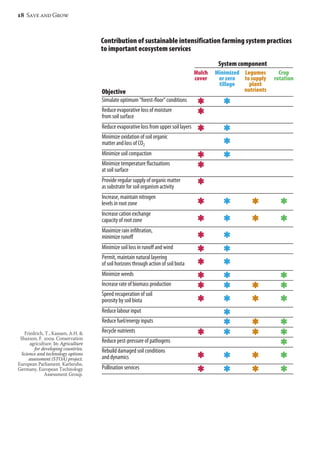
Applied together, or in various combinations, the recommended 
practices contribute to important ecosystems services and work 
synergistically to produce positive outcomes in terms of factor and 
overall productivity. For example, for a given amount of rainfall, soil 
moisture availability to plants depends on how the soil surface, soil 
organic matter and plant root systems are managed. Water produc-tivity 
under good soil moisture supply is enhanced when soils are 
healthy and plant nutrition is adequate. Good water infiltration and 
soil cover also minimize surface evaporation and maximize water 
* Conservation agriculture is now 
practised on about 117 million ha 
worldwide, or about 8 percent of 
total crop land. Highest adop-tion 
levels (above 50 percent of 
crop land) are found in Australia, 
Canada and the southern cone 
of South America. Adoption is 
increasing in Africa, Central Asia 
and China.
use efficiency and productivity, in which the plants’ own capacity to 
absorb and use water also plays a role. 
One of the main requirements for ecologically sustainable produc-tion 
is healthy soil, creating an environment in the root zone that 
optimizes soil biota activity and permits root functioning to the 
maximum possible extent. Roots are able to capture plant nutrients 
and water and interact with a range of soil micro-organisms beneficial 
to soil health and crop performance2, 6, 7. Maintenance or improve-ment 
of soil organic matter content, soil structure and associated 
porosity are critical indicators of sustainable production and other 
ecosystem services. 
To be sustainable in the long term, the loss of organic matter in any 
agricultural system must never exceed the rate of soil formation. In 
most agro-ecosystems, that is not possible if the soil is mechanically 
disturbed8. Therefore, a key starting point for sustainable production 
intensification – and a major building block of SCPI – is maintain-ing 
soil structure and organic matter content by limiting the use of 
mechanical soil disturbance in the process of crop establishment and 
subsequent crop management. 
Minimized or zero tillage production methods – as practised in 
conservation agriculture – have significantly improved soil conditions, 
reduced degradation and enhanced productivity in many parts of the 
world. Most agricultural land continues to be ploughed, harrowed 
or hoed before every crop and during crop growth. The aim is to 
destroy weeds and facilitate water infiltration and crop establishment. 
However, recurring disturbance of topsoil buries soil cover and may 
destabilize soil structure. An additional effect is compaction of the 
soil, which reduces productivity9. 
One contribution of conservation agriculture to sustainable pro-duction 
intensification is minimizing soil disturbance and retaining 
the integrity of crop residues on the soil surface. CA approaches 
include minimized (or strip) tillage, which disturbs only the portion 
of the soil that is to contain the seed row, and zero tillage (also called 
no-tillage or direct seeding), in which mechanical disturbance of the 
soil is eliminated and crops are planted directly into a seedbed that 
has not been tilled since the previous crop3. 
Another management consideration relevant to SCPI is the role 
of farm power and mechanization. In many countries, the lack of 
farm power is a major constraint to intensification of production10. 
20 Save and Grow
Chapter 2: Farming Systems 21 
Using manual labour only, a farmer can grow enough food to feed, 
on average, three other people. With animal traction, the number 
doubles, and with a tractor increases to 50 or more11. Appropriate 
mechanization can lead to improved energy efficiency in crop pro-duction, 
which enhances sustainability and productive capacity and 
reduces harmful effects on the environment12, 13. 
At the same time, uncertainty about the price and availability of 
energy in the future suggests the need for measures to reduce overall 
requirements for farm power and energy. Conservation agriculture 
can lower those requirements by up to 60 percent, compared to 
conventional farming. The saving is due to the fact that most power 
intensive field operations, such as tillage, are eliminated or minimized, 
which eases labour and power bottlenecks particularly during land 
preparation. Investment in equipment, notably the number and size 
of tractors, is significantly reduced (although CA requires investment 
in new and appropriate farm implements). The savings also apply to 
small-scale farmers using hand labour or animal traction. Studies in 
the United Republic of Tanzania indicate that in the fourth year of 
implementing zero-tillage maize with cover crops, labour require-ments 
fell by more than half14. 
Potential constraints 
Some farming regions present special challenges to the introduc-tion 
of specific SCPI practices. For example, under conservation 
agriculture, the lack of rainfall in subhumid and semi-arid climatic 
zones may limit production of biomass, which limits both the quan-tity 
of harvestable crops and the amount of residues available for use 
as soil cover, fodder or fuel. However, the water savings achieved by 
not tilling the soil generally lead to yield increases in the first years 
of adoption, despite the lack of residues. Scarcity of plant nutrients 
may prove to be a limiting factor in more humid areas, but the higher 
levels of soil biological activity achieved can enhance the long term 
availability of phosphorus and other nutrients7, 15. 
Low soil disturbance or zero tillage systems are often seen as un-suitable 
for farming on badly drained or compacted soils, or on heavy 
clay soils in cold and moist climates. In the first case, if bad drainage
is caused by an impermeable soil horizon beyond the reach of tillage 
equipment, only biological means – such as tap roots, earthworms 
and termites – can break up such deep barriers to water percolation. 
Over time, these biological solutions are facilitated by minimal soil 
disturbance. In the second case, mulch-covered soils do take longer 
to warm up and dry, compared to ploughed land. However, zero till-age 
is practised successfully by farmers under very cold conditions in 
Canada and Finland, where studies have found that the temperature 
of covered soils does not fall as much in winter13, 16. 
Another misperception of minimized or zero tillage systems is that 
they increase the use of insecticides and herbicides. In some intensive 
systems, the integrated use of zero tillage, mulching and crop diversi-fication 
has led to reductions in the use of insecticides and herbicides, 
in terms of both absolute amounts and active ingredient applied per 
tonne of output, compared with tillage-based agriculture12, 13. 
In manual smallholder systems, herbicides can be replaced by 
integrated weed management. For example, since conservation 
agri culture was introduced in 2005 in Karatu district, the United 
Republic of Tanzania, farmers have stopped ploughing and hoeing 
and are growing mixed crops of direct-seeded maize, hyacinth bean 
and pigeon pea. This system produces good surface mulch, so that 
weed management can be done by hand without need for herbicides. 
In some years, fields are rotated into wheat. The overall results have 
been positive, with average per hectare maize yields increasing from 
1 tonne to 6 tonnes. This dramatic yield increase was achieved with-out 
agrochemicals and using livestock manure as a soil amend ment 
and fertilizer17. 
Another potential bottleneck for wide adoption of conservation 
agriculture is the lack of suitable equipment, such as zero till seeders 
and planters, which are unavailable to small farmers in many devel-oping 
countries. Even where this equipment is sold, it is often more 
expensive than conventional equipment and requires consider able 
initial investment. Such bottlenecks can be overcome by facil itating 
input supply chains and local manufacturing of equip ment, and 
by promoting contractor services or equipment sharing schemes 
among farmers in order to reduce costs. Excellent examples of these 
approaches can be found on the Indo-Gangetic Plain. In most small 
farm scenarios, zero-till planters that use animal traction would meet 
and exceed the needs of a single farmer. 
22 Save and Grow
Chapter 2: Farming Systems 23 
Farming systems that save and grow 
An ecosystem approach to the 
intensification of crop production is 
most effective when the appropriate, 
mutually reinforcing practices are applied 
together. Even where it is not possible to 
implement all recommended practices 
at the same time, improvement towards 
that goal should be encouraged. The 
principles of SCPI can be readily integrated 
into farming systems that either have 
features in common with ecosystem-based 
approaches or can be improved 
by underpinning them with similar 
principles. 
 Integrated crop-livestock 
production 
Integrated crop-livestock production 
systems are practised by most 
smallholders in developing countries. 
Pastureland has important ecological 
functions: it contains a high 
percentage of perennial 
grasses, which sequester 
and safely store large 
amounts of carbon in 
the soil at rates far 
exceeding those 
of annual crops. 
That capacity can 
be further enhanced with 
appropriate management – for 
example, by replacing exported 
nutrients, maintaining diversity 
in plant species, and allowing for 
sufficient recovery periods between 
use of land for grazing or cutting. 
In conventional farming systems, 
there is a clear distinction between 
arable crops and pastureland. With SCPI, 
this distinction no longer exists, since 
annual crops may be rotated with pasture 
without the destructive intervention of 
soil tillage. This “pasture cropping” is an 
exciting development in a number of 
countries. In Australia, pasture cropping 
involves direct-drilling winter crops, such 
as oats, into predominantly summer-growing 
pastures of mainly native species. 
Benefits suggested by field experiments 
include reduced risk of waterlogging, 
nitrate leaching and soil erosion18. 
Practical innovations have harnessed 
synergies between crop, livestock and 
agroforestry production to enhance 
economic and ecological sustainability 
while providing a flow of valued 
ecosystem services. Through 
increased biological diversity, 
efficient nutrient 
recycling, improved 
soil health and 
forest conservation, 
these systems increase 
environmental resilience, 
and contribute to climate 
change adaptation and 
mitigation. They also enhance 
livelihood diversification and efficiency 
by optimizing production inputs, 
including labour, and increase 
resilience to economic stresses19. 
alfalfa
24 Save and Grow 
 Sustainable rice-wheat 
production 
Sustainable productivity in rice-wheat 
farming systems was pioneered on the 
Indo-Gangetic Plain of Bangladesh, India, 
Nepal and Pakistan by the Rice-Wheat 
Consortium, an initiative of the CGIAR and 
national agriculture research centres. It 
was launched in the 1990s in response to 
evidence of a plateau in crop productivity, 
loss of soil organic matter and receding 
groundwater tables20. 
The system involves the planting of 
wheat after rice using a tractor-drawn 
seed drill, which seeds directly into 
unploughed fields with a single pass. As 
this specialized agricultural machinery 
was originally not available in South Asia, 
the key to diffusion of the technology was 
creating a local manufacturing capacity 
to supply affordable zero tillage drills. 
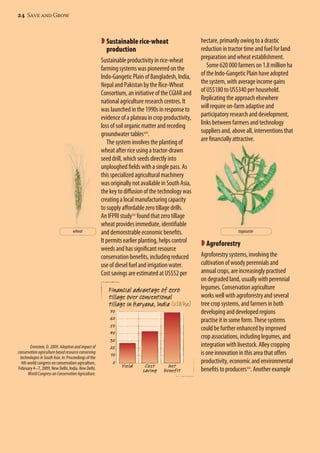
An IFPRI study21 found that zero tillage 
wheat provides immediate, identifiable 
and demonstrable economic benefits. 
It permits earlier planting, helps control 
weeds and has significant resource 
conservation benefits, including reduced 
use of diesel fuel and irrigation water. 
Cost savings are estimated at US$52 per 
hectare, primarily owing to a drastic 
reduction in tractor time and fuel for land 
preparation and wheat establishment. 
Some 620 000 farmers on 1.8 million ha 
of the Indo-Gangetic Plain have adopted 
the system, with average income gains 
of US$180 to US$340 per household. 
Replicating the approach elsewhere 
will require on-farm adaptive and 
participatory research and development, 
links between farmers and technology 
suppliers and, above all, interventions that 
are financially attractive. 
tagasaste 
Financial advantage of zero 
tillage over conventional 
tillage in Haryana, India (US$/ha) 
70 
60 
50 
40 
30 
20 
10 
0 
Net 
benefit 
Cost 
saving 
Yield 
wheat 
Erenstein, O. 2009. Adoption and impact of 
conservation agriculture based resource conserving 
technologies in South Asia. In: Proceedings of the 
4th world congress on conservation agriculture, 
February 4−7, 2009, New Delhi, India. New Delhi, 
World Congress on Conservation Agriculture. 
 Agroforestry 
Agroforestry systems, involving the 
cultivation of woody perennials and 
annual crops, are increasingly practised 
on degraded land, usually with perennial 
legumes. Conservation agriculture 
works well with agroforestry and several 
tree crop systems, and farmers in both 
developing and developed regions 
practise it in some form. These systems 
could be further enhanced by improved 
crop associations, including legumes, and 
integration with livestock. Alley cropping 
is one innovation in this area that offers 
productivity, economic and environmental 
benefits to producers22. Another example
serves mainly niche markets and is 
practised in parts of Brazil, Germany 
and the United States of America, and 
by some subsistence farmers in Africa. 
Shifting cultivation entails the clearing 
for crop production of forest land that 
is subsequently abandoned, allowing 
natural reforestation and the recovery 
of depleted plant nutrients. Although 
shifting cultivation is often viewed 
negatively, it can be adapted to follow 
SCPI principles. In place of slash-and-burn, 
shifting cultivators could adopt 
Chapter 2: Farming Systems 25 
slash-and-mulch systems, in which 
diversified cropping (including legumes 
and perennials) reduces the need for 
land clearing. Other ecosystem-based 
approaches, such as the System of Rice 
Intensification, have also proven, in 
specific circumstances, to be successful as 
a basis for sustainable intensification23. 
is the use of varying densities of “fertilizer 
trees” that enhance biological nitrogen 
fixation, conserve moisture and increase 
production of biomass for use as surface 
residues (see Chapter 3, Soil health). 
 Ripper-furrower system 
in Namibia 
Farmers in the north of Namibia are using 
conservation agriculture practices to grow 
drought tolerant crops, including millet, 
sorghum and maize. The farming system 
uses a tractor-drawn ripper-furrower to rip 
the hard pan to a depth of 60 cm and form 
furrows for in-field rainfall harvesting. 
The harvested water is concentrated in 
the root zone of crops, which are planted 
in the rip lines together with a mixture of 
fertilizer and manure. Tractors are used 
in the first year to establish the system. 
From the second year, farmers plant crops 
directly into the rip lines using an animal-drawn 
direct seeder. 
Crop residues are consumed mainly 
by livestock, but the increased biomass 
produced by the system also provides 
some residues for soil cover. Farmers are 
encouraged to practise crop rotation with 
legumes. Those techniques lengthen 
the growing season and improve soil 
structure, fertility and moisture retention. 
Average maize yields have increased from 
300 kg/ha to more than 1.5 tonnes. 
Other production systems 
Organic farming, when practised 
in combination with conservation 
agriculture, can lead to improved soil 
health and productivity, increased 
efficiency in the use of organic matter 
and energy savings. Organic CA farming 
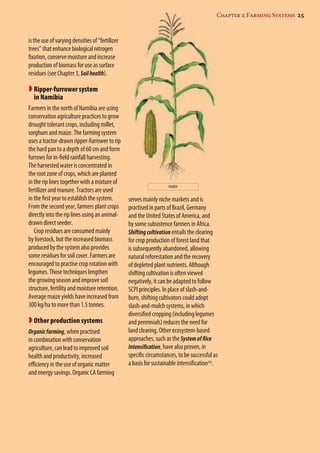
maize
The way forward 
Farming systems for sustainable crop production intensification 
will be built on the three core technical principles outlined in this 
chapter, and implemented using the seven recommended manage-ment 
practices: minimum soil disturbance, permanent organic soil 
cover, species diversification, use of high-yielding adapted varieties 
from good seed, integrated pest management, plant nutrition based 
on healthy soils, and efficient water management. The integration 
of pastures, trees and livestock into the production system, and the 
use of adequate and appropriate farm power and equipment, are also 
key parts of SCPI. 
The shift to SCPI systems can occur rapidly when there is a suit-able 
enabling environment, or gradually in areas where farmers face 
particular agro-ecological, socio-economic or policy constraints, 
including a lack of the necessary equipment. While some economic 
and environmental benefits will be achieved in the short term, a 
longer term commitment from all stakeholders is necessary in order 
to achieve the full benefits of such systems. 
Monitoring of progress in production system practices and their 
outcomes will be essential. Relevant socio-economic indicators 
include farm profit, factor productivity, the amount of external 
inputs applied per unit of output, the number of farmers practising 
sustainable intensified systems, the area covered, and the stability 
of production. Relevant ecosystem service indicators are: satisfac-tory 
levels of soil organic matter, clean water provisioning from an 
intensive agriculture area, reduced erosion, increased biodiversity 
and wildlife within agricultural landscapes, and reductions in both 
carbon footprint and greenhouse gas emissions. 
Production systems for SCPI are knowledge-intensive and relatively 
complex to learn and implement. For most farmers, extensionists, 
researchers and policymakers, they are a new way of doing business. 
Consequently, there is an urgent need to build capacity and provide 
learning opportunities (for example, through farmer field schools) 
and technical support in order to improve the skills all stakehold-ers. 
That will require coordinated support at the international and 
regional levels to strengthen national and local institutions. Formal 
education and training at tertiary and secondary levels will need to 
upgrade their curricula to include the teaching of SCPI principles 
and practices. 
26 Save and Grow
Chapter 3 
Soil health 
Agriculture must, literally, 
return to its roots by rediscovering 
the importance of healthy soil, 
drawing on natural sources 
of plant nutrition, and using 
mineral fertilizer wisely
Soil is fundamental to crop production. Without soil, no food 
could be produced on a large scale, nor would livestock be 
fed. Because it is finite and fragile, soil is a precious resource 
that requires special care from its users. Many of today’s soil 
and crop management systems are unsustainable. At one extreme, 
overuse of fertilizer has led, in the European Union, to nitrogen (N) 
deposition that threatens the sustainability of an estimated 70 per-cent 
of nature1. At the other extreme, in most parts of sub-Saharan 
Africa, the under-use of fertilizer means that soil nutrients exported 
with crops are not being replenished, leading to soil degradation and 
declining yields. 
How did the current situation arise? The main driver was the 
quadrupling of world population over the past 100 years, which 
demanded a fundamental change in soil and crop management in 
order to produce more food. That was achieved thanks partly to the 
development and massive use of mineral fertilizers, especially of 
nitrogen, since N availability is the most important determinant of 
yield in all major crops2-5. 
Before the discovery of mineral N fertilizers, it took centuries to 
build up nitrogen stocks in the soil6. By contrast, the explosion in 
food production in Asia during the Green Revolution was due largely 
to the intensive use of mineral fertilization, along with improved 
germplasm and irrigation. World production of mineral fertilizers 
increased almost 350 percent between 1961 and 2002, from 33 mil-lion 
tonnes to 146 million tonnes7. Over the past 40 years, mineral 
fertilizers accounted for an estimated 40 percent of the increase in 
food production8. 
The contribution of fertilizers to food production has also carried 
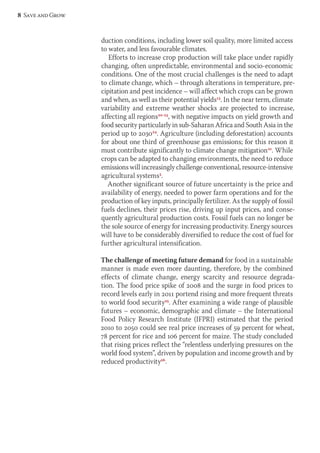
significant costs to the environment. Today, Asia and Europe have 
the world’s highest rates of mineral fertilizer use per hectare. They 
also face the greatest problems of environmental pollution resulting 
from excessive fertilizer use, including soil and water acidification, 
contamination of surface and groundwater resources, and increased 
emissions of potent greenhouse gases. The N-uptake efficiency in 
China is only about 26-28 percent for rice, wheat and maize and less 
than 20 percent for vegetable crops9. The remainder is simply lost 
to the environment. 
The impact of mineral fertilizers on the environment is a question 
of management – for example, how much is applied compared to the 
Chapter 3: Soil Health 29
amount exported with crops, or the method and timing of applica-tions. 
In other words, it is the efficiency of fertilizer use, especially 
of N and phosphorus (P), which determines if this aspect of soil 
management is a boon for crops, or a negative for the environment. 
The challenge, therefore, is to abandon current unsustainable 
practices and move to land husbandry that can provide a sound foun-dation 
for sustainable crop production intensification. Far-reaching 
changes in soil management are called for in many countries. The 
new approaches advocated here build on work undertaken by both 
FAO10-12 and many other institutions13-20, and focus on the manage-ment 
of soil health. 
Principles of soil health management 
Soil health has been defined as: “the capacity of soil to function as a 
living system. Healthy soils maintain a diverse community of soil 
organisms that help to control plant disease, insect and weed pests, 
form beneficial symbiotic associations with plant roots, recycle essen-tial 
plant nutrients, improve soil structure with positive repercussions 
for soil water and nutrient holding capacity, and ultimately improve 
crop production”21. To that definition, an ecosystem perspective can 
be added: A healthy soil does not pollute the environment; rather, it 
contributes to mitigating climate change by maintaining or increas-ing 
its carbon content. 
Soil contains one of the Earth’s most diverse assemblages of living 
organisms, intimately linked via a complex food web. It can be either 
sick or healthy, depending on how it is managed. Two crucial char-acteristics 
of a healthy soil are the rich diversity of its biota and the 
high content of non-living soil organic matter. If the organic matter 
is increased or maintained at a satisfactory level for productive crop 
growth, it can be reasonably assumed that a soil is healthy. Healthy 
soil is resilient to outbreaks of soil-borne pests. For example, the 
parasitic weed, Striga, is far less of a problem in healthy soils22. Even 
the damage caused by pests not found in the soil, such as maize stem 
borers, is reduced in fertile soils23. 
The diversity of soil biota is greater in the tropics than in temperate 
zones24. Because the rate of agricultural intensification in the future 
will generally be greater in the tropics, agro-ecosystems there are 
30 Save and Grow
under particular threat of soil degradation. Any losses of biodiversity 
and, ultimately, ecosystem functioning, will affect subsistence farm-ers 
in the tropics more than in other regions, because they rely to a 
larger extent on these processes and their services. 
Functional interactions of soil biota with organic and inorganic 
components, air and water determine a soil’s potential to store and 
release nutrients and water to plants, and to promote and sustain plant 
growth. Large reserves of stored nutrients are, in themselves, no guar-antee 
of high soil fertility or high crop production. As plants take up 
most of their nutrients in a water soluble form, nutrient transformation 
and cycling – through processes that may be biological, chemical or 
physical in nature – are essential. The nutrients need to be transported 
to plant roots through free-flowing water. Soil structure is, therefore, 
another key component of a healthy soil because it determines a soil’s 
water-holding capacity and rooting depth. The rooting depth may be 
restricted by physical constraints, such as a high water table, bedrock 
or other impenetrable layers, as well as by chemical problems such as 
soil acidity, salinity, sodality or toxic substances. 
A shortage of any one of the 15 nutrients required for plant growth 
can limit crop yield. To achieve the higher productivity needed to 
meet current and future food demand, it is imperative to ensure their 
availability in soils and to apply a balanced amount of nutrients from 
organic sources and from mineral fertilizers, if required. The timely 
provision of micronutrients in “fortified” fertilizers is a potential 
source of enhanced crop nutrition where deficiencies occur. 
Nitrogen can also be added to soil by integrating N-fixing legumes 
and trees into cropping systems (see also Chapter 2, Farming sys-tems). 
Because they have deep roots, trees and some soil-improving 
legumes have the capacity to pump up from the subsoil nutrients that 
would otherwise never reach crops. Crop nutrition can be enhanced 
by other biological associations – for example, between crop roots 
and soil mycorrhizae, which help cassava to capture phosphorus in 
depleted soils. Where these ecosystem processes fail to supply suf-ficient 
nutrients for high yields, intensive production will depend on 
the judicious and efficient application of mineral fertilizers. 
A combination of ecosystem processes and wise use of mineral 
fertilizers forms the basis of a sustainable soil health management 
system that has the capacity to produce higher yields while using 
fewer external inputs. 
Chapter 3: Soil Health 31
32 Save and Grow 
Technologies that save and grow 
No single technology is likely to address 
the specific soil health and soil fertility 
constraints that prevail in different 
locations. However, the basic principles of 
good soil health management, outlined 
above, have been successfully applied in 
a wide range of agro-ecologies and under 
diverse socio-economic conditions. 
Building on soil health management 
principles, research in different regions of 
the world has identified some “best-bet” 
technologies. The following examples 
describe crop management systems that 
have high potential for intensification 
and sustainable production. They address 
specific soil fertility problems in different 
agro-ecological zones and have been 
widely adopted by farmers. They may 
serve as templates for national partners in 
devising policies that encourage farmers 
to adopt these technologies as part of 
sustainable intensification. 
30 
25 
20 
15 
10 
5 
de Moraes Sá, J.C. 2010. No-till cropping system in Brazil: Its perspectives and new 
technologies to improve and develop. Presentation prepared for the International 
Conference on Agricultural Engineering, 6-8 September 2010, Clermont-Ferrand, France 
(http://www.ageng2010.com/files/file-inline/J-C-M-SA.pdf). 
 Increasing soil organic matter 
in soils in Latin America 
Oxisols and ultisols are the dominant soil 
types in Brazil’s Cerrado tropical savanna 
and Amazon rainforest regions, and they 
are also widespread in Africa’s humid 
forest zone. Among the oldest on earth, 
these soils are poor in nutrients and very 
acidic, owing to their low capacity to 
hold nutrients – and cations in particular 
– in their surface and subsoil layers. In 
addition, being located in regions with 
high rainfall, they are prone to erosion if 
the surface is not protected by vegetative 
cover. 
Upon conversion of the land from 
natural vegetation to agricultural use, 
special care has to be taken to minimize 
losses of soil organic matter. Management 
systems for these soils have been designed 
to conserve or even increase organic matter 
by providing permanent soil cover, using 
a mulching material rich in carbon, and 
ensuring minimized or zero tillage of the 
soil surface. These practices are all key 
components of the SCPI approach. 
Such systems are being rapidly adopted 
by farmers in many parts of Latin America, 
and particularly in humid and subhumid 
zones, because they control soil erosion 
and generate savings by reducing labour 
inputs. Adoption has been facilitated by 
close collaboration between government 
research and extension services, farmer 
associations and private companies 
that produce agrochemicals, seed and 
0 
Expansion of zero tillage area in Brazil 
(millions of ha)
Chapter 3: Soil Health 33 
machinery. Zero-till farming has spread 
rapidly and now covers 26 million hectares 
on oxisols and ultisols in Brazil. 
 Biological nitrogen fixation 
to enrich N-poor soils in African 
savannas 
Crop production in the savanna regions 
of western, eastern and southern 
Africa is severely constrained by N- and 
P-deficiency in soils17, 25, as well as the 
lack of micronutrients such as zinc and 
molybdenum. The use of leguminous 
crops and trees that are able to fix 
atmospheric nitrogen, in combination 
with applications of mineral P-fertilizers, 
has shown very promising results in 
on-farm evaluations conducted by 
the Tropical Soil Biology and Fertility 
Institute, the World Agroforestry Centre 
and the International Institute of Tropical 
Agriculture (IITA). 
The combination of mineral fertilizer 
application and a dual-purpose grain 
legume, such as soybean, intercropped or 
relay-cropped with maize, increased maize 
yields in Kenya by 140 to 300 percent17 
and resulted in a positive N-balance 
in the cropping system. Dual-purpose 
grain legumes produce a large amount 
of biomass with their haulms and roots, 
as well as an acceptable grain yield. 
Several farming communities in eastern 
and southern Africa have adopted this 
system26. It has the additional advantage 
of helping farmers to combat Striga – some 
soybean cultivars act as “trap crops”, which 
force Striga seeds to germinate when the 
weed’s usual hosts, maize or sorghum, are 
not present10, 27. 
In eastern and southern Africa, 
FAO. 1984. Legume inoculants 
and their use. Rome. 
N-deficient maize cropping systems 
have become more productive thanks to 
improved fallows using leguminous trees 
and shrubs. Per hectare, species such 
as Sesbania sesban, Tephrosia vogelii and 
Crotalaria ochroleuca accumulate in their 
leaves and roots around 100 to 200 
kg of nitrogen – two-thirds of it 
from nitrogen fixation – over a 
period of six months to two years. 
Along with subsequent applications 
of mineral fertilizer, these improved 
fallows provide sufficient N for up to three 
subsequent maize crops, resulting in 
yields as much as four times higher than 
those obtained in non-fallow systems. 
Research indicates that a full 
agroforestry system with crop-fallow 
rotations and high value trees can triple 
a farm’s carbon stocks in 20 years28. 
The system has been so successful that 
tens of thousands of farmers in Kenya, 
Malawi, Mozambique, Uganda, the 
United Republic of Tanzania, Zambia 
and Zimbabwe are now adapting the 
component technologies to their local 
conditions. 
Average amounts of nitrogen 
fixed by various legumes 
(kg N/ha/yr) 
350 
300 
250 
200 
150 
100 
50 
0 
Leucaena 
Alfalfa 
Stylo 
Pigeon pea 
Cowpea 
Mung bean 
Sesbania sesban
34 Save and Grow 
 Evergreen agriculture 
in Africa’s Sahel 
The African acacia, Faidherbia albida, is a 
natural component of farming systems 
in the Sahel. It is highly compatible with 
food crops because it does not compete 
with them for light, nutrients or water. 
In fact, the tree loses its nitrogen-rich 
leaves during the rainy season, thus 
providing a protective mulch which 
also serves as natural fertilizer for crops. 
Zambia’s Conservation Farming Unit 
has reported unfertilized maize yields of 
4.1 tonnes per hectare in the vicinity of 
Faidherbia trees, compared to 1.3 tonnes 
Faidherbia albida 
Crop yields under and outside Faidherbia albida canopy 
(t/ha) 
3.5 
3.0 
2.5 
2.0 
1.5 
1.0 
0.5 
Under 
Outside 
FAO. 1999. Agroforestry parklands in sub-Saharan Africa, by J.-M. Boffa. Rome. 
from maize grown nearby, but outside 
of the tree canopy29. Today, more than 
160 000 farmers in Zambia are growing 
food crops on 300 000 ha with Faidherbia. 
Similarly promising results have been 
observed in Malawi, where maize yields 
near Faidherbia trees are almost three 
times higher than yields outside their 
range. In Niger, there are now more than 
4.8 million hectares under Faidherbia-based 
agroforesty, resulting in enhanced 
millet and sorghum production. 
Thousands of rainfed smallholdings 
in Burkina Faso are also shifting to these 
“evergreen” farming systems. 
 “Urea deep placement” 
for rice in Bangladesh 
Throughout Asia, farmers apply nitrogen 
fertilizer to rice before transplanting 
by broadcasting a basal application 
of urea onto wet soil, or into standing 
water, and then broadcasting one or 
more top-dressings of urea in the weeks 
after transplanting up to the flowering 
stage. Such practices are agronomically 
and economically inefficient and 
environmentally harmful. The rice plants 
use only about a third of the fertilizer 
applied30, while much of the remainder 
is lost to the air through volatilization and 
surface water run-off. Only a small amount 
remains in the soil and is available to 
subsequent crops. 
One way of reducing N losses is to 
compress prilled urea to form urea super 
granules (USG) which are inserted 7 to 
10 cm deep in the soil between plants. This 
“urea deep placement” (UDP) doubles the 
percentage of nitrogen taken up by 
0 plants31-35, reduces N lost to the air and to 
Millet Sorghum Maize Groundnut
Chapter 3: Soil Health 35 
7 
6 
5 
4 
3 
2 
1 
0 
Average rice yields using 
prilled urea and urea deep 
placement (UDP)*, 
Bangladesh, 2010 (t/ha) 
With prilled urea 
With UDP 
Demonstration 
plots 
With prilled urea 
With UDP 
Farmers' 
fields 
* Data from 301 farmers’ plots 
and 76 demonstration plots 
IFDC. 2010. Improved livelihood for Sidr-affected rice 
farmers (ILSAFARM). Quarterly report submitted to USAID-Bangladesh, 
No. 388-A-00-09-00004-00. Muscle Shoals, 
USA. 
surface water run-off, and has produced 
average yield increases of 18 percent in 
farmers’ fields. The International Fertilizer 
Development Center and the United States 
Agency for International Development are 
helping smallholder farmers to upscale 
UDP technology throughout Bangladesh. 
The goal is to reach two million farmers in 
five years36. The technology is spreading 
fast in Bangladesh and is being 
investigated by 15 other countries, most of 
them in sub-Saharan Africa. The machines 
used to produce USG in Bangladesh are 
manufactured locally and cost between 
US$1 500 and US$2 000. 
 Site-specific nutrient 
management in intensive rice 
The International Rice Research Institute 
(IRRI) and its national partners have 
developed the site-specific nutrient 
management (SSNM) system for highly 
intensive rice production. SSNM is a 
sophisticated knowledge system focused 
on double and triple rice mono-cropping. 
Tests at 180 sites in eight key irrigated rice 
domains of Asia found that the system 
led to a 30 to 40 percent increase in N-use 
efficiency, mainly thanks to improved N 
management. Across all sites and four 
successive rice crops, profitability increased 
by an average of 12 percent. 
In several provinces of China, SSNM 
reduced farmers’ use of N-fertilizer 
by one third, while increasing 
yields by 5 percent37. A site-specific 
N-management strategy was able to 
increase uptake efficiency by almost 
370 percent on the North China Plain9. 
Since the average plant recovery efficiency 
of nitrogen fertilizer in intensive rice 
systems is only about 30 percent, those are 
remarkable achievements that contribute 
substantially to reducing the negative 
environmental effects of rice production. 
The complex SSNM technology is being 
simplified in order to facilitate its wider 
adoption by farmers. rice
The way forward 
The following actions are required to improve current land hus-bandry 
practices and provide a sound basis for the successful 
adoption of sustainable crop production intensification. Responsibility 
for implementation rests with national partners, assisted by FAO and 
other international agencies. 
Establish national regulations for sound land husbandry. A sup-portive 
policy framework should aim at encouraging farmers to 
adopt sustainable farming systems based on healthy soils. Leadership 
is required to establish and monitor best practices, with the active 
participation of smallholder farmers and their communities. Govern-ments 
must be prepared to regulate farming practices that cause soil 
degradation or pose serious threats to the environment. 
Monitor soil health. Policymakers and national institutions respon-sible 
for the environment are demanding methods and tools to verify 
the impact of farming practices. While monitoring soil health is a 
very challenging task, efforts are under way to implement it at global38, 
regional and national scales39. Monitoring the impact of agricultural 
production has advanced in developed countries, but is just beginning 
in many developing countries. FAO and its partners have developed a 
list of methods and tools for undertaking assessments and mon itoring 
tasks40. Core land quality indicators requiring immediate and longer 
term development should be distinguished41. Priority indicators are 
soil organic matter content, nutrient balance, yield gap, land use 
intensity and diversity, and land cover. Indicators that still need to 
be developed are soil quality, land degradation and agrobiodiversity. 
Build capacity. Soil health management is knowledge-intensive and 
its wide adoption will require capacity building through training pro-grammes 
for extension workers and farmers. The skills of research-ers 
will also need to be upgraded at both national and international 
levels, in order to provide the enhanced knowledge necessary to 
support soil management under SCPI. Policymakers should explore 
new approaches, such as support groups for adaptive research coop-eration42, 
which provide technical support and on-the-job training 
for national research institutions and translate research results into 
practical guidelines for small farmers. National capacity to undertake 
on-farm research must also be strengthened, and focused on address- 
36 Save and Grow
ing spatial and temporal variability through, for example, better use 
of ecosystems modelling. 
Disseminate information and communicate benefits. Any large-scale 
implementation of soil health management requires that sup-porting 
information is made widely available, particularly through 
channels familiar to farmers and extension workers. Given the very 
high priority attached to soil health in SCPI, media outlets should 
include not only national newspapers and radio programmes, but 
also modern information and communication technologies, such as 
cellular phones and the Internet, which can be much more effective 
in reaching younger farmers. 
Chapter 3: Soil Health 37
Chapter 4 
Crops and varieties 
Farmers will need a genetically diverse 
portfolio of improved crop varieties, 
suited to a range of agro-ecosystems 
and farming practices, and resilient 
to climate change
Sustainable crop production intensification will use crops and 
varieties that are better adapted to ecologically based produc-tion 
practices than those currently available, which were bred 
for high-input agriculture. The targeted use of external inputs 
will require plants that are more productive, use nutrients and water 
more efficiently, have greater resistance to insect pests and diseases, 
and are more tolerant to drought, flood, frost and higher tempera-tures. 
SCPI varieties will need to be adapted to less favoured areas 
and production systems, produce food with higher nutritional value 
and desirable organoleptic properties, and help improve the provision 
of ecosystem services. 
Those new crops and varieties will be deployed in increasingly 
diverse production systems where associated agricultural biodiver-sity 
– such as livestock, pollinators, predators of pests, soil organisms 
and nitrogen fixing trees – is also important. Varieties suitable for 
SCPI will need to be adapted to changing production practices and 
farming systems (see Chapter 2) and to integrated pest management 
(see Chapter 6). 
SCPI will be undertaken in combination with adaptation to climate 
change, which is expected to lead to alterations in timing, frequency 
and amounts of rainfall, with serious droughts in some areas and 
floods in others. Increased occurrence of extreme weather events 
is probable, along with soil erosion, land degradation and loss of 
biodiversity. Many of the characteristics required for adaptation 
to climate change are similar to those needed for SCPI. Increased 
genetic diversity will improve adaptability, while greater resistance 
to biotic and abiotic stresses will improve cropping system resilience. 
Achieving SCPI means developing not only a new range of varieties, 
but also an increasingly diverse portfolio of varieties of an extended 
range of crops, many of which currently receive little attention from 
public or private plant breeders. Farmers will also need the means 
and opportunity to deploy these materials in their different produc-tion 
systems. That is why the management of plant genetic resources 
(PGR), development of crops and varieties, and the delivery of ap-propriate, 
high quality seeds and planting materials to farmers are 
fundamental contributions to SCPI. 
Chapter 4: Crops and Varieties 41
Principles, concepts and constraints 
The system that will provide high-yielding and adapted varieties 
to farmers has three parts: PGR conservation and distribution, 
variety development and seed production and delivery. The stronger 
the links among these different parts, the better the whole system 
will function. Conserved and improved materials will need to be 
available for variety development, and new varieties will have to be 
generated at a pace that meets changing demands and requirements. 
Timely delivery to farmers of suitably adapted materials, of the right 
quality and quantity, at an acceptable cost, is essential. To work well, 
the system needs an appropriate institutional framework, as well as 
policies and practices that support its component parts and the links 
between them. 
The improved conservation of PGR – ex situ, in situ and on-farm – 
and the enhanced delivery of germplasm to different users depend on 
coordinated efforts at international, national and local levels1. Today 
genebanks around the world conserve some 7.4 million accessions. 
These are complemented by the in situ conservation of traditional 
varieties and crop wild relatives by national programmes and farm-ers, 
and by the materials maintained in public and private sector 
breeding programmes2. Strong national conservation programmes, 
combined with the improved availability and increased distribution 
of a wider range of inter- and intra-specific diversity, will be critical 
to successful implementation of SCPI. 
Technical, policy and institutional issues influence the effective-ness 
of programmes for crop improvement. A wide range of diverse 
materials is needed for the pre-breeding of varieties. Molecular genet-ics 
and other biotechnologies are now widely used by both national 
and private sector breeding programmes and can make an essential 
contribution to meeting SCPI breeding objectives3. The policy and 
regulatory dimension needs to include not only variety release, but 
also provisions for intellectual property protection, seed laws and 
the use of restriction technologies. 
The benefits of PGR conservation and plant breeding will not be 
realized unless quality seeds of improved varieties reach farmers 
through an effective seed multiplication and delivery system. Variety 
testing of promising materials from breeding programmes needs 
to be followed by the prompt release of the best varieties for early 
42 Save and Grow
Chapter 4: Crops and Varieties 43 
generation seed multiplication. Certified seed production, along with 
quality assurance provided by the national seed service, are essential 
next steps before seed is sold to farmers. Both the public and private 
sectors should support this value chain and, where possible, local seed 
enterprises should produce certified seed and market it to farmers. 
Smallholder farmers around the world still rely heavily on farmer-saved 
seed and have little access to commercial seed systems. In 
some countries, well over 70 percent of seed, even of major crops, 
is managed within the farmer seed system. Both formal and saved 
seed systems will be essential in the distribution of SCPI-adapted 
materials. The various practices and procedures adopted to support 
SCPI will need to take account of how farmer seed systems operate, 
and strengthen them in order to increase the supply of new materials. 
Ensuring that the different parts of the PGR and seed supply 
system are able to meet the challenges of SCPI requires an effective 
policy and regulatory framework, appropriate institutions, a con-tinuing 
programme of capacity development and, above all, farmer 
participation. A strong programme of research, aimed at providing 
information, new techniques and materials, is also important. Ide-ally, 
the programme will reflect farmers’ knowledge and experience, 
strengthen the linkages between farmers and research workers from 
different areas, and serve dynamic and changing needs.
44 Save and Grow 
Approaches that save and grow 
 Improving the conservation 
and use of plant genetic 
resources 
Plant genetic resources – the inter-and 
intra-specific diversity of crops, 
varieties and related wild species – are 
central to agricultural development and 
improvements in both the quantity and 
quality of food and other agricultural 
products. Genes from traditional varieties 
and crop wild relatives were at the heart 
of the Green Revolution, providing the 
semi-dwarfing characters of modern 
wheat and rice varieties, as well as crop 
resistance to major insect pests and 
diseases. 
The success of SCPI will depend on 
the use of PGR in new and better ways. 
However, the crucial importance of 
genes from local varieties and crop wild 
relatives in development of new varieties 
is matched by rising concern over the loss 
of diversity worldwide, and the need for 
its effective conservation. International 
recognition of PGR is reflected in the 
conclusions of the World Summit on Food 
Security4, held in 2009, the ratification 
30000 
25000 
20000 
15000 
10000 
5000 
0 
Number of accessions collected each year 
since 1960 and stored in major genebanks 
by more than 120 countries of the 
International Treaty on Plant Genetic 
Resources for Food and Agriculture 
(ITPGRFA)5, and the strategic goals of the 
Convention on Biological Diversity (CBD)6. 
In mobilizing plant genetic resources 
for sustainable intensification, the 
international dimension will play a 
fundamental role. The international 
framework for conservation and 
sustainable use of PGR has been greatly 
strengthened by the International Treaty, 
the Global Crop Diversity Trust and the 
programme of work on agricultural 
biodiversity of the CBD. A global system 
that can provide support for SCPI is 
emerging. Since much of the diversity 
that will be needed may be conserved in 
other countries, or in the international 
genebanks of the CGIAR, national 
participation in international programmes 
will be indispensable. 
Developing countries need to 
strengthen their national PGR 
programmes by enacting legislation to 
implement fully the provisions of the 
ITPGRFA. Guidelines on implementation 
have been prepared7 and the Treaty 
Secretariat, Bioversity International and 
FAO are working on implementation 
issues in collaboration with some 
15 countries. Implementing the revised 
Global Plan of Action on Plant Genetic 
Resources for Food and Agriculture and 
Article 9 of the ITPGRFA on Farmers’ Rights 
will make an important contribution to 
the creation of the national operating 
FAO. 2010. The Second Report on the State 
of the World’s Plant Genetic Resources for Food 
and Agriculture. Rome.
Chapter 4: Crops and Varieties 45 
framework for implementing sustainable 
intensification. 
In order to adopt sustainable 
intensification strategies, countries will 
need to know the extent and distribution 
of the diversity of crop species and 
their wild relatives. Technologies for 
mapping diversity and locating diversity 
threatened by climate change have 
improved8. A major project supported 
by the Global Environment Facility in 
Armenia, Bolivia, Madagascar, Sri Lanka 
and Uzbekistan has established and tested 
ways of improving the conservation and 
use of crop wild relatives. The project 
developed and implemented area and 
species conservation management plans, 
identified climate change management 
actions to conserve useful diversity, and 
initiated plant breeding programmes 
using new materials identified thanks to 
the conservation and prioritization work9. 
Intensification will require an increased 
flow into breeding programmes of 
germplasm and promising varieties. The 
multilateral system of access and benefit 
sharing under the ITPGRFA provides 
the necessary international framework, 
although – given the increased 
importance of diversity to SCPI 
– it may need to be extended 
to a greater number of crops 
than those currently covered 
in Annex 1 of the Treaty. On 
the technical side, a number 
of procedures are available 
to identify useful materials 
in large collections, such as 
the Focused Identification 
of Germplasm Strategy 
now under development10. 
banana 
Moving genetic material will also require 
improvements in the phytosanitary 
capacity and practices, as well as the 
distribution capacities, of genebanks. 
The comprehensive characterization 
and evaluation of genebank collections 
at national and local levels, with farmers 
participating in the evaluation of 
potentially useful material, will make a 
key contribution to improving the use of 
PGR. Effective use also requires strong 
research and pre-breeding programmes. 
The Global Initiative on Plant Breeding is 
preparing a manual on pre-breeding to 
help develop that capacity. Ultimately, 
however, countries and the private 
breeding sector will need to support the 
strengthening of national agricultural 
research capacity, with the introduction 
of university courses on conservation 
and plant breeding for sustainable 
intensification. 
wild wheat
46 Save and Grow 
 Developing improved 
and adapted varieties 
Sustainable intensification requires crop 
varieties that are suited to different 
agronomic practices, to farmers’ needs in 
locally diverse agro-ecosystems and to the 
effects of climate change. Important traits 
will include greater tolerance to heat, 
drought and frost, increased input-use 
efficiency, and enhanced pest and disease 
resistance. It will involve the development 
of a larger number of varieties drawn from 
a greater diversity of breeding material. 
Because new varieties take many years 
to produce, breeding programmes need 
to be stable, competently staffed and 
adequately funded. Both the public sector 
and private breeding companies will play 
an important part in developing those 
varieties, with the public sector often 
focusing on major staple crops, while 
the private sector would be concerned 
more with cash crops. The more open and 
vigorous the system, the more likely it is 
that the required new materials will be 
generated. 
An important step forward will be 
a significant increase in public support 
to pre-breeding and 
breeding research. SCPI 
requires new materials, a 
redefinition of breeding 
objectives and practices, 
and the adoption of 
population breeding 
approaches. Properties 
such as production 
resilience and stability 
will need to be inherent, 
and not dependent on 
external inputs. 
It is unlikely that traditional public or 
private breeding programmes will be 
able to provide all the new plant material 
needed or produce the most appropriate 
varieties, especially of minor crops which 
command limited resources. Participatory 
plant breeding can help fill this gap. 
For example, the International Centre 
for Agricultural Research in the Dry Areas 
(ICARDA), together with the Syrian Arab 
Republic and other Middle East and 
North African countries, has undertaken 
a programme for participatory breeding 
of barley which maintains high levels of 
diversity and produces improved material 
capable of good yields in conditions of 
very limited rainfall (less than 300 mm 
per year). Farmers participate in the 
selection of parent materials and in 
on-farm evaluations. In Syria, the 
procedure has produced significant 
barley yield improvements and increased 
the resistance of the barley varieties to 
drought stress11. 
Policies and regulations are needed to 
support the production of new varieties 
and ensure adequate returns to both 
public and private sector plant breeding. 
However, they may need to be more open 
and flexible than current patent-based 
procedures or arrangements under the 
International Union for the Protection 
of New Varieties of Plants (UPOV). The 
uniformity and stability properties of 
varieties adapted to SCPI may be different 
from those currently envisaged under 
UPOV, and Farmers’ Rights, as identified 
in the ITPGRFA, need to be recognized. 
Most of all, policies and regulations must 
support the rapid release of SCPI adapted 
materials; in many countries far too much 
barley
time is spent on the approval stage for 
new varieties. 
The institutional framework that 
supports variety development and 
release is weak in a number of countries. 
University and other training programmes 
will need to be adjusted to furnish a 
greater number of plant breeders and 
breeding researchers trained in using crop 
improvement practices for SCPI. Farmers 
should be involved more fully both in the 
identification of breeding objectives and 
in the selection process. Extension services 
will need to be strengthened in order to 
respond to farmers’ expressed needs and 
to provide sound practical guidance on the 
cultivation of new varieties. 
 Improving seed production 
and distribution 
A key issue when planning SCPI 
programmes is to determine the status of 
the national seed system and its capacity 
to improve the provision of high quality 
seed of adapted varieties to farmers. An 
initial step should be the development, in 
consultation with all key stakeholders, of 
an appropriate seed policy and regulations 
for variety release. 
The policy should provide a framework 
for better coordination of the public and 
private sectors, as well as an action plan 
for development of a seed industry that 
is capable of meeting farmers’ needs for 
high quality seed. In many developing 
countries, the policy will also need to 
recognize farmer-saved seed as a major 
source of propagation material. Since local 
seed enterprises will play an important 
role in SCPI, creating an enabling 
environment for them is essential. The 
Chapter 4: Crops and Varieties 47 
action plan should identify gaps and 
weaknesses in the sector and the main 
measures that are needed to resolve them. 
An improved framework may also 
be needed for seed production and 
movement. Because regulations and 
legislation should favour the rapid 
deployment of new planting material, 
and the transfer of new varieties from 
one area to another, harmonization of 
legislation among countries is important. 
For example, 12 member countries of the 
Economic Community of West African 
States have adopted harmonized seed 
laws. The maintenance and use of a larger 
number of varieties may strain seed 
quality management systems; therefore, 
the development of a quality-declared 
seed system will help ensure that, in the 
process of adapting seed practices to 
sustainable intensification, quality does 
not suffer. 
One likely consequence of sustainable 
intensification will be the increased 
importance of local seed producers and 
local markets in supplying farmers. The 
role of markets in maintaining diversity 
is increasingly recognized12. Markets can 
be supported through initiatives such 
as local diversity fairs, local seed banks 
and community biodiversity registers, 
which encourage the maintenance and 
distribution of local materials and favour 
improvements in their quality8. 
beans
The way forward 
Actions in the technical, policy and institutional arenas can help 
ensure that plant genetic resources and seed delivery systems 
function effectively to support sustainable crop production intensifi-cation. 
Although they will involve diverse institutions and take place 
at various scales, the required actions will have their greatest impact 
if they are coordinated. Recommended measures include: 
Ì Strengthening linkages between the conservation of PGR and the 
use of diversity in plant breeding, particularly through improved 
characterization and evaluation of traits relevant to SCPI in a wider 
range of crops, increased support for pre-breeding and population 
improvement, and much closer collaboration among institutions 
concerned with conservation and breeding. 
Ì Increasing the participation of farmers in conservation, crop im-provement 
and seed supply in order to support work on a wider 
diversity of materials, to ensure that new varieties are appropriate 
to farmer practices and experiences, and to strengthen on-farm 
conservation of PGR and farmer seed supply systems. 
Ì Improving policies and legislation for variety development and 
release, and seed supply, including national implementation of the 
provisions of the ITPGRFA, enactment of flexible variety release 
legislation, and the development or revision of seed policies and 
seed legislation. 
Ì Strengthening capacity by creating a new generation of skilled 
practitioners to support enhanced breeding, work with farmers 
and explore the ways in which crops and varieties contribute to 
successful intensification. 
Ì Revitalizing the public sector and expanding its role in developing 
new crop varieties, by creating an enabling environment for seed 
sector development and ensuring that farmers have the knowledge 
needed to deploy new materials. 
Ì Supporting the emergence of local, private sector seed enterprises 
through an integrated approach involving producer organizations, 
linkages to markets and value addition. 
Ì Coordinating linkages with other essential components of SCPI, 
such as appropriate agronomic practices, soil and water manage-ment, 
integrated pest management, credit and marketing. 
48 Save and Grow
Chapter 4: Crops and Varieties 49 
Many of those actions are already being taken in various countries 
and by various institutions. The challenge is to share experiences, 
build on the best practices that have been identified and tested, and 
focus on ways to adapt them to meet the specific objectives and prac-tices 
of SCPI. That will ensure that the diversity required for sustain-able 
intensification, and already available in genebanks and farmers’ 
fields, is mobilized efficiently, effectively and in a timely manner.
Chapter 5 
Water management 
Sustainable intensification requires 
smarter, precision technologies 
for irrigation, and farming practices 
that use ecosystem approaches 
to conserve water
Chapter 5: Water Management 53 
Crops are grown under a range of water management regimes, 
from simple soil tillage aimed at increasing the infiltra-tion 
of rainfall, to sophisticated irrigation technologies 
and management. Of the estimated 1.4 billion ha of crop 
land worldwide, around 80 percent is rainfed and accounts for about 
60 percent of global agricultural output1. Under rainfed conditions, 
water management attempts to control the amount of water available 
to a crop through the opportunistic deviation of the rainwater path-way 
towards enhanced moisture storage in the root zone. However, 
the timing of the water application is still dictated by rainfall patterns, 
not by the farmer. 
Some 20 percent of the world’s cropped area is irrigated, and 
produces around 40 percent of total agricultural output1. Higher 
cropping intensities and higher average yields account for this level 
of productivity. By controlling both the amount and timing of water 
applied to crops, irrigation facilitates the concentration of inputs to 
boost land productivity. Farmers apply water to crops to stabilize 
and raise yields and to increase the number of crops grown per year. 
Globally, irrigated yields are two to three times greater than rainfed 
yields. Thus, a reliable and flexible supply of water is vital for high 
value, high-input cropping systems. However, the economic risk is 
also much greater than under lower input rainfed cropping. Irrigation 
can also produce negative consequences for the environment, includ-ing 
soil salinization and nitrate contamination of aquifers. 
Growing pressure from competing demands for water, along with 
environmental imperatives, mean that agriculture must obtain “more 
crops from fewer drops” and with less environmental impact. That 
is a significant challenge, and implies that water management for 
sustainable crop production intensification will need to anticipate 
smarter, precision agriculture. It will also require water management 
in agriculture to become much more adept at accounting for its water 
use in economic, social and environmental terms. 
Prospects for sustainable intensification vary considerably across 
different production systems, with different external drivers of 
demand. In general, however, the sustainability of intensified crop 
production, whether rainfed or irrigated, will depend on the adoption 
of ecosystem approaches such as conservation agriculture, along with 
other key practices, including use of high-yielding varieties and good 
quality seeds, and integrated pest management.
Rainfed cropping systems 
Many crop varieties grown in rainfed systems are adapted to 
exploit moisture stored in the root zone. Rainfed systems can 
be further improved by, for example, using deep-rooting crops in rota-tion, 
adapting crops to develop a deeper rooting habit, increasing soil 
water storage capacity, improving water infiltration and minimizing 
evaporation through organic mulching. Capture of runoff from adja-cent 
lands can also lengthen the duration of soil moisture availability. 
Improving the productivity of rainfed agriculture depends largely on 
improving husbandry across all aspects of crop management. Fac-tors 
such as pests and limited availability of soil nutrients can limit 
yield more than water availability per se2, 3. The principles of reduced 
tillage, organic mulching and use of natural and managed biodiver-sity 
(described in Chapter 2, Farming systems) are fundamental to 
improved husbandry. 
The scope for implementing SCPI under rainfed conditions will 
depend, therefore, on the use of ecosystem-based approaches that 
maximize moisture storage in the root zone. While these approaches 
can facilitate intensification, the system is still subject to the vagaries 
of rainfall. Climate change will increase the risks to crop production. 
Nowhere is the challenge of developing effective strategies for climate 
change adaptation more pressing than in rainfed agriculture4. 
Other measures are needed, therefore, to allay farmers’ risk aver-sion. 
They include better seasonal and annual forecasting of rainfall 
and water availability and flood management, both to mitigate 
climate change and to improve the resilience of production systems. 
More elaborate water management interventions are possible to 
reduce the production risk, but not necessarily to further intensify 
rainfed production. For instance, there is scope to transition some 
rainfed cropping systems to low-input supplementary irrigation sys-tems, 
in order to bridge short dry spells during critical growth stages5, 
but these are still reliant upon the timing and intensity of rainfall. 
On-farm runoff management, including the use of water retaining 
bunds in cultivated areas, has been applied successfully in transi-tional 
climates, including the Mediterranean and parts of the Sahel, 
to extend soil moisture availability after each rain event. Off-farm 
runoff management, including the concentration of overland flow 
into shallow groundwater or farmer-managed storage, can allow for 
54 Save and Grow
Chapter 5: Water Management 55 
limited supplementary irrigation. However, when expanded over large 
areas, these interventions impact downstream users and overall river 
basin water budgets. 
Extending the positive environmental and soil moisture conser-vation 
benefits of ecosystem approaches will often depend upon the 
level of farm mechanization, which is needed to take advantage of 
rainfall events. Simpler technologies, including opportunistic runoff 
farming, will remain inherently risky, particularly under more erratic 
rainfall regimes. They will also remain labour intensive. 
Policymakers will need to assess accurately the relative contribu-tions 
of rainfed and irrigated production at national level. If rainfed 
pro duction can be stabilized by enhanced soil moisture storage, the 
physical and socio-economic circumstances under which this can 
occur need to be well identified and defined. The respective merits 
of low-intensity investments in SCPI across extensive rainfed systems 
and high intensity localized investments in full irrigation need careful 
socio-economic appraisal against development objectives. 
With regard to institutions, there is a need for re-organization 
and reinforcement of advisory services to farmers dependent on 
rainfed agriculture, and renewed efforts to promote crop insurance 
for small-scale producers. A sharper analysis of rainfall patterns and 
soil moisture deficits will be needed to stabilize production from 
existing rainfed systems under climate change impacts. 
Irrigated cropping systems 
The total area equipped for irrigation worldwide is now in excess of 
300 million ha6, and the actual area harvested is estimated to be 
larger due to double and triple cropping. Most irrigation development 
has taken place in Asia, where rice production is practised on about 
80 million ha, with yields averaging 5 tonnes per ha (compared to 
2.3 tonnes per ha from the 54 million ha of rainfed lowland rice). In 
contrast, irrigated agriculture in Africa is practised on just 4 percent 
of cropped land, owing mainly to the lack of financial investment. 
Irrigation is a commonly used platform for intensification because 
it offers a point at which to concentrate inputs. Making this sustain-able 
intensification, however, depends on the location of water with-drawal 
and the adoption of ecosystem based approaches – such as
soil conservation, use of improved varieties and integrated pest man-agement 
– that are the basis of SCPI. The uniformity of distribution 
and the application efficiency of irrigation vary with the technology 
used to deliver water, the soil type and slope (most importantly its 
infiltration characteristic), and the quality of management. 
Surface irrigation by border strip, basin or furrow is often less ef-ficient 
and less uniform than overhead irrigation (e.g. sprinkler, drip, 
drip tape). Micro irrigation has been seen as a technological fix for the 
poor performance of field irrigation, and as a means of saving water. 
It is being adopted increasingly by commercial horticulturalists in 
both developed and developing countries, despite high capital costs. 
Deficit irrigation and variants such as regulated deficit irrigation 
(RDI) are gaining hold in the commercial production of fruit trees 
and some field crops that respond positively to controlled water stress 
at critical growth stages. RDI is often practised in conjunction with 
micro-irrigation and “fertigation”, in which fertilizers are applied 
directly to the region where most of the plant’s roots develop. The 
practice has been adapted to simpler furrow irrigation in China. The 
benefits, in terms of reduced water inputs, are apparent but they will 
only be realized if the supply of water is highly reliable. 
Knowledge-based precision irrigation that offers farmers reliable 
and flexible water application will be a major platform for SCPI. Auto-mated 
systems have been tested using both solid set sprinklers and 
micro-irrigation, which involve using soil moisture sensing and crop 
canopy temperature to define the irrigation depths to be applied in 
different parts of the field. Precision irrigation and precision fertilizer 
application through irrigation water are both future possibilities for 
field crops and horticulture, but there are potential pitfalls. Recent 
computer simulations indicate that, in horticulture, salt management 
is a critical factor in sustainability. 
The economics of irrigated agriculture are significant. The use of 
sprinkler and micro-irrigation technologies, as well as the automation 
of surface irrigation layouts, involve long term capital expenditure and 
operational budgets. Rain guns provide one of the cheapest capital 
options for large area overhead irrigation coverage, but tend to incur 
high operating costs. Other overhead irrigation systems have high 
capital costs and, without the support of production subsidies, are 
unsuited to smallholder cropping systems. 
56 Save and Grow
Chapter 5: Water Management 57 
The service delivery of many public irrigation systems is less than 
optimal, owing to deficiencies in design, maintenance and manage-ment. 
There is considerable scope for modernizing systems and their 
management, through both institutional reform and the separation 
of irrigation service provision from broader oversight and the regula-tion 
of water resources. 
Drainage is an essential, but often overlooked, complement to ir-rigation, 
especially where water tables are high and soil salinity is a 
constraint. Investment will be required in drainage to enhance the 
productivity and sustainability of irrigation systems and to ensure 
good management of farm inputs. However, enhanced drainage in-creases 
the risks of pollutants being exported, causing degradation 
in waterways and connected aquatic ecosystems. 
Protected cropping, mostly in shade houses, is enjoying increasing 
popularity in many countries, including China and India, mainly 
for fruit, vegetable and flower production. In the long term, highly 
intensive closed cycle production systems, using conventional irriga-tion 
or hydroponic and aeroponic cultures, will become progressively 
more common, especially in peri-urban areas with strong markets 
and increasing water scarcity. 
Using water for irrigation reduces instream flows, alters their 
timing, and creates conditions for shocks, such as toxic algal blooms. 
Secondary impacts include salinization and nutrient and pesticide 
pollution of water courses and water bodies. There are other envi-ronmental 
trade-offs from irrigated systems; rice paddies sequester 
higher levels of organic matter than dry land soils, and contribute less 
nitrate runoff and generate lower emissions of nitrous oxide (N2O). 
Offset against this are relatively large emissions of methane (from 
3 to 10 percent of global emissions) and ammonia. 
Crops normally use less than 50 percent of the irrigation water they 
receive, and irrigation systems that lie within a fully or over-allocated 
river basin have low efficiency. In accounting terms, it is necessary 
to distinguish how much water is depleted, both beneficially and 
unproductively. Beneficial depletion by crops – evapotranspiration 
– is the intent of irrigation: ideally, transpiration would account for 
all depletion, with zero evaporation from soil and water surfaces. 
There is some potential to improve water productivity by reducing 
non-productive evaporative losses. 
Basin level improvements in water productivity focus on minimiz-ing 
non-beneficial depletion7. However, the downstream impacts of
increased water depletion for agriculture are not neutral: there is 
evidence of big reductions in annual runoff from “improved” upper 
catchments that have adopted extensive water harvesting in parts 
of peninsular India8. 
Water management is a key factor in minimizing nitrogen losses 
and export from farms. In freely drained soils, nitrification is partially 
interrupted, resulting in the emission of N2O, whereas in saturated 
(anoxic) conditions, ammonium compounds and urea are partially 
converted to ammonia, typically in rice cultivation. Atmospheric 
losses from urea can occur, therefore, as both ammonia and N2O 
are released during wetting and drying cycles in irrigation. N is 
required in nitrate form for uptake at the root, but can easily move 
elsewhere in solution. A number of protected and slow release fertil-izer 
compounds are under development for different situations (see 
Chapter 3, Soil health). 
The dynamics of phosphate mobilization and movement in drains 
and waterways are complex. Phosphate export from agriculture can 
occur in irrigated systems if erosive flow rates are used in furrow ir-rigation, 
or if sodic soils disperse. Phosphate, and to a lesser extent 
nitrate, can be trapped by buffer strips located at the ends of fields and 
along rivers, which prevents them from reaching waterways. Hence, 
a combination of good irrigation management, recycling of tailwater 
and the incorporation of phosphate in the soil can reduce phosphate 
export from irrigated lands to close to zero. 
The sustainability of intensified irrigated agriculture depends on 
minimizing off-farm externalities, such as salinization and export of 
pollutants, and the maintenance of soil health and growing conditions. 
That should be the primary focus of farm level practice, technology 
and decision-making, and reinforces the need for depletion water 
accounting and wiser water allocation at basin and catchment scales, 
and a better understanding of the hydrological interactions between 
different production systems. 
58 Save and Grow
Chapter 5: Water Management 59 
Technologies that save and grow 
 Rainwater harvesting 
in Africa’s Sahel9 
A wide variety of traditional and 
innovative rainwater harvesting systems is 
found in Africa’s Sahel zone. In semi-arid 
areas of Niger, small-scale farmers use 
planting pits to harvest rainwater and 
rehabilitate degraded land for cultivation 
of millet and sorghum. The 
technology improves infiltration 
and increases nutrient 
availability on sandy and loamy 
soils, leading to significant 
increases in yields, improved soil 
cover and reduced downstream 
flooding. Planting pits are hand-dug 
holes 20-30 cm in diameter 
and 20-25 cm deep, spaced 
about 1 m apart. Excavated soil 
is shaped into a small ridge to 
maximize capture of rainfall and 
run-off. When available, manure 
is added to each pit every second year. 
Seeds are sown directly into the pits at 
the start of the rainy season, and silt and 
sand are removed annually. Normally, 
the highest crop production is during the 
second year after manure application. 
In eastern Ethiopia, farmers capture 
floodwater and runoff from ephemeral 
rivers, roads and hillsides using temporary 
stone and earth embankments. Captured 
water is distributed through a system of 
hand-dug canals up to 2 000 m long to 
fields of high value vegetables and fruit 
crops. Benefits include a 400 percent 
increase in gross production value from 
the fourth year of operation, improved 
soil moisture and fertility, and reduced 
downstream flooding. 
 Deficit irrigation for high yield 
and maximum net profits10 
The highest crop productivity is achieved 
using high-yielding varieties with 
optimal water supply, soil fertility and 
crop protection. However, crops can also 
produce well with limited water supply. 
In deficit irrigation, water supply is less 
than the crop’s full requirements, and 
mild stress is allowed during growth 
stages that are less sensitive to moisture 
deficiency. The expectation is that any 
yield reduction will be limited, and 
additional benefits are gained by diverting 
the saved water to irrigate other crops. 
However, use of deficit irrigation requires 
a clear understanding of soil-water and 
salt budgeting, as well as an intimate 
knowledge of crop behaviour, since 
crop response to water stress varies 
considerably. 
A six-year study of winter wheat 
production on the North China Plain 
showed water savings of 25 percent 
or more through application of deficit 
irrigation at various growth stages. In 
normal years, two irrigations (instead of 
the usual four) of 60 mm were enough 
to achieve acceptably high yields and 
maximize net profits. In Punjab, Pakistan, 
a study of the long-term impacts of 
pearl millet
60 Save and Grow 
deficit irrigation on wheat 
and cotton reported 
yield reductions of 
up to 15 percent 
when irrigation was 
applied to satisfy only 
60 percent of total 
crop evapotranspiration. 
The study highlighted 
the importance of 
maintaining leaching 
practices in order to 
avoid the long-term risk 
of soil salinization. In studies carried out in 
India on irrigated groundnuts, production 
and water productivity were increased by 
imposing transient soil moisture-deficit 
stress during the vegetative phase, 20 to 
45 days after sowing. Water stress applied 
during the vegetative growth phase may 
have had a favourable effect on root 
growth, contributing to more effective 
water use from deeper soil horizons. 
Higher water savings are possible in fruit 
trees, compared to herbaceous crops. In 
Australia, regulated deficit irrigation of 
fruit trees increased water productivity by 
approximately 60 percent, with a gain in 
fruit quality and no loss in yield. 
 Supplemental irrigation 
on rainfed dryland11, 12 
In dry areas, farmers dependent on rainfall 
for cereal production can increase yields 
using supplemental irrigation (SI), which 
entails harvesting rainwater run-off, 
storing it in ponds, tanks or small dams, 
and applying it during critical crop growth 
stages. One of the main benefits of SI is 
that it permits earlier planting – while 
the planting date in rainfed agriculture 
is determined by the onset of rains, 
supplemental irrigation allows the date 
to be chosen precisely, which can improve 
productivity significantly. For example, 
in Mediterranean countries, a wheat crop 
sown in November has consistently higher 
yield and shows better response to water 
and nitrogen fertilizer than a crop sown in 
January. 
The average water productivity of rain 
in dry areas of North Africa and West 
Asia ranges from about 0.35 to 1 kg of 
wheat grain for every cubic metre of 
water. ICARDA has found that, applied as 
supplemental irrigation and along with 
good management practices, the same 
amount of water can produce 2.5 kg 
of grain. The improvement is mainly 
attributed to the effectiveness of a small 
amount of water in alleviating severe 
moisture stress. 
In the Syrian Arab Republic, SI 
helped boost the average grain yield 
from 1.2 tonnes to 3 tonnes per 
hectare. In Morocco, applying 50 mm 
of supplemental irrigation increased 
average yields of early planted wheat 
Productivity of water 
in wheat production 
(kg of grain/m3) 
2.5 
2.0 
1.5 
1.0 
0.5 
0 
Supplemental 
irrigation 
of rainfed 
production 
Full 
irrigation 
Rainfed 
production 
ICARDA. 2006. AARINENA water use efficiency 
network - Proceedings of the expert consultation 
meeting, 26-27 November 2006. Aleppo, Syria. 
cotton
from 4.6 tonnes to 5.8 tonnes, with a 
50 percent increase in water productivity. 
In Iran, a single SI application increased 
barley yields from 2.2 to 3.4 t/ha. 
When integrated with improved 
varieties and good soil and nutrition 
management, supplemental irrigation 
can be optimized by deliberately allowing 
crops to sustain a degree of water deficit. 
In northern Syria, farmers applied half the 
amount of full SI water requirements to 
their wheat fields, which allowed them 
to double the cropped area, maximize 
productivity per unit of water and increase 
total production by one third. 
 Multiple uses of water systems13 
In addition to water for crop production, 
irrigation systems and infrastructure 
can provide multiple services, including 
supplying water for domestic use, animal 
production and electricity generation, and 
channels for transport. Analysis by FAO of 
20 irrigation schemes revealed that non-crop 
water uses and multiple functions 
of irrigation schemes are more the norm 
than the exception. 
For example, in the Fenhe irrigation 
district of Shaanxi Province, China, values 
derived from conventional irrigation 
were found to be lower than those from 
related services, such as aquaculture, 
timber plantations and flood protection. 
The district’s infrastructure, which consists 
of two reservoirs, three diversion dams 
and five main canals, was built in 1950. 
In recent years, Shanxi province has 
suffered increasing drought, flooding 
and water pollution, and competition for 
water from industrial and domestic users 
is growing. Owing to water shortages, 
Chapter 5: Water Management 61 
FAO. 2010. Mapping systems and service 
for multiple uses in Fenhe irrigation 
district, Shanxi Province, China. Rome. 
surface irrigation is now limited 
essentially to winter wheat 
and maize crops. As a result, 
many farmers have diversified 
production away from staple 
crops toward intensive cash 
crop production using mainly 
groundwater, and the original 
command area of 86 000 ha has been 
reduced by about 50 percent. 
Within this smaller area, many more 
functions are serviced by the district’s 
water allocations from the Yellow River: 
productive services, such as crop irrigation, 
aquaculture, hydropower generation, 
timber plantations and industrial water 
supply, and amenities, including flood 
protection, groundwater recharge and 
forest parkland. In this way, intensification 
of water use has been accompanied by 
conservation of environmental services. 
Use of irrigation water, 
Fenhe district, China 
(percent) 
47% Crop 
irrigation 
1% Flood 
protection 
1% Small 
industry 
37% Groundwater 
recharge 
11% Large 
industry 
3% Parks, 
recreation
The way forward 
Sustainable agriculture on irrigated land – and also across the range 
of rainfed and improved rainfed production systems – involves 
trade-offs in land use, water sharing in the broadest sense, and the 
maintenance of supporting ecosystem services. These trade-offs are 
becoming more complex and have significant social, economic and 
political importance. 
The overall governance of land and water allocations will strongly 
influence the scale of longer term investment in irrigated SCPI, 
particularly given the higher capital and input costs associated with 
irrigated production. Competing demands for water from other eco-nomic 
sectors and from environmental services and amenities will 
continue to grow. Water management in agriculture will need to cope 
with less water per hectare of land and will also have to internalize 
the cost of pollution from agricultural land. 
With regard to policy, the nature of agriculture is changing in 
many countries, as the pace of rural outmigration and urbanization 
accelerates. Policy incentives that focus on the most pressing envi-ronmental 
externalities, while leveraging individual farmer’s profit 
motives, have a greater chance of success. 
For example, where agrochemical pollution of rivers and aquatic 
ecosystems has reached crisis point, a ban on dangerous chemicals 
could be accompanied by measures to raise fertilizer prices, provide 
farmers with objective advice on dosage rates, and remove perverse 
incentives to apply fertilizer excessively. Follow-up measures might 
promote management at “required or recommended” levels, and seek 
alternative approaches to higher productivity with more modest use 
of external inputs. In that case, more public investment would be 
needed to improve the monitoring of ecosystem conditions. 
In the future, fertigation technology (including use of liquid 
fertilizers), deficit irrigation and wastewater-reuse will be better in-tegrated 
within irrigation systems. While the introduction of a new 
technology into irrigated cropping systems has high entry costs and 
requires institutional arrangements for operation and maintenance, 
the use of precision irrigation is now global. Farmers in developing 
countries are already adopting low-head drip kits for niche markets, 
such as horticulture. In addition, the availability of cheap, plastic 
moulded products and plastic sheeting for plasticulture is likely to 
expand. However, the broad-scale adoption of alternatives, such as 
62 Save and Grow
Chapter 5: Water Management 63 
solar technologies, or the avoidance of polluting technologies, will 
need the support of regulatory measures and effective policing of 
compliance. 
Shortcomings in governance of some irrigation investments have 
led to financial irregularities in capital funding, rent-seeking in 
management and operation, and poor co-ordination among agencies 
responsible for providing irrigation services to the farmer. Innova-tive 
approaches are required to create institutional frameworks that 
promote agricultural and water development, and at the same time 
safeguard the environment. There remains considerable potential to 
harness and learn from local initiatives in institutional development, 
to manage the externalities of intensification, and to reduce or avoid 
transaction costs. Solutions are more likely to be knowledge-rich than 
technology-intensive.
Chapter 6 
Plant protection 
Pesticides kill pests, but also pests’ 
natural enemies, and their overuse 
can harm farmers, consumers 
and the environment. The first line 
of defence is a healthy agro-ecosystem
Chapter 6: Plant Protection 67 
Plant pests are often regarded as an external, introduced fac-tor 
in crop production. That is a misperception, as in most 
cases pest species occur naturally within the agro-ecosystem. 
Pests and accompanying species – such as predators, parasites, 
pollinators, competitors and decomposers – are components of crop-associated 
agro-biodiversity that perform a wide range of ecosystem 
functions. Pest upsurges or outbreaks usually occur following the 
breakdown of natural processes of pest regulation. 
Because intensification of agricultural production will lead to an 
increase in the supply of food available to crop pests, pest manage-ment 
strategies must be an integral part of SCPI. However, they will 
also need to respond to concerns about the risks posed by pesticides 
to health and the environment. It is important, therefore, that poten-tial 
pest problems associated with the implementation of SCPI are 
addressed through an ecosystem approach. 
Although populations of potential pests are present in every crop 
field, every day, regular practices, such as crop monitoring and spot 
control measures, usually keep them in check. In fact, the total eradi-cation 
of an insect pest would reduce the food supply of the pest’s 
natural enemies, undermining a key element in system resilience. The 
aim, therefore, should be to manage insect pest populations to the 
point where natural predation operates in a balanced way and crop 
losses to pests are kept to an acceptable minimum. 
When that approach does not seem sufficient, farmers often 
respond by seeking additional protection for their crops against 
perceived threats. The pest management decisions taken by each 
farmer are based on his or her individual objectives and experiences. 
While some may apply labour-intensive control measures, the ma-jority 
turn to pesticides. In 2010, worldwide sales of pesticides were 
expected to exceed US$40 billion. Herbicides represent the largest 
market segment, while the share of insecticides has shrunk and that 
of fungicides has grown over the past ten years1. 
As a control tactic, over-reliance on pesticides impairs the natural 
crop ecosystem balance. It disrupts parasitoid and predator popula-tions, 
thereby causing outbreaks of secondary pests. It also contrib-utes 
to a vicious cycle of resistance in pests, which leads to further 
investment in pesticide development but little change in crop losses 
to pests, which are estimated today at 30 to 40 percent, similar to 
those of 50 years ago2. As a result, induced pest outbreaks, caused by 
inappropriate pesticide use, have increased3.
Excessive use of pesticide also exposes farmers to serious health 
risks and has negative consequences for the environment, and some-times 
for crop yields. Often less than one percent of pesticides applied 
actually reaches a target pest organism; the rest contaminates the 
air, soil and water4. 
Consumers have grown increasingly concerned about pesticide 
residues in food. Rapid urbanization has resulted in the expansion 
of urban and peri-urban horticulture, where pesticide use is more 
evident and its overuse even less acceptable to the public. The serious 
consequences of pesticide-related occupational exposure have been 
amply documented among farming communities, heightening social 
sensitivity towards agricultural workers’ rights and welfare. 
Public concerns are being translated into more rigorous standards 
both domestically and in international trade. Major retailers and 
supermarket chains have endorsed stricter worker welfare, food safety, 
traceability and environmental requirements. However, weak regula-tion 
and management of pesticides continue to undermine efforts to 
broaden and sustain ecologically-based pest management strategies. 
That is because pesticides are aggressively marketed and, therefore, 
often seen as the cheapest and quickest option for pest control. 
Farmers would benefit from a better understanding of the func-tioning 
and dynamics of ecosystems, and the role of pests as an inte-gral 
part of agro-biodiversity. Policymakers, who are often targets of 
complex information regarding crop pests, would also benefit from 
a better understanding of the real impact of pests and diseases in 
cropping ecosystems. 
Integrated pest management 
Over the past 50 years, integrated pest management (IPM) has 
become and remains the world’s leading holistic strategy for 
plant protection. From its first appearance in the 1960s, IPM has 
been based on ecology, the concept of ecosystems and the goal of 
sustaining ecosystem functions5-7. 
IPM is founded on the idea that the first and most fundamental 
line of defence against pests and diseases in agriculture is a healthy 
agro-ecosystem, in which the biological processes that underpin pro- 
68 Save and Grow
Chapter 6: Plant Protection 69 
duction are protected, encouraged and enhanced. Enhancing those 
processes can increase yields and sustainability, while reducing input 
costs. In intensified systems, environmental factors of production 
affect the prospects for the effective management of pests: 
Ì Soil management that applies an ecosystem approach, such as 
mulching, can provide refuges for natural enemies of pests. Build-ing 
soil organic matter provides alternate food sources for general-ist 
natural enemies and antagonists of plant disease and increases 
pest-regulating populations early in the cropping cycle. Addressing 
particular soil problems, such as salt water incursion, can render 
crops less susceptible to pests such as the rice stem borer. 
Ì Water stress can increase the susceptibility of crops to disease. 
Some pests, notably weeds in rice, can be controlled by better 
management of water in the production system. 
Ì Crop varietal resistance is essential for managing plant diseases 
and many insect pests. Vulnerability can arise if the genetic base 
of host plant resistance is too narrow. 
Ì Timing and spatial arrangement of crops influence the dynamics of 
pest and natural enemy populations, as well as levels of pollination 
services for pollinator-dependent horticultural crops. As with other 
beneficial insects, reducing pesticide applications and increasing 
diversity within farms can increase the level of pollination service. 
As an ecosystem-based strategy, IPM has achieved some notable 
successes in world agriculture. Today, large-scale government IPM 
programmes are operational in more than 60 countries, including 
Brazil, China, India and most developed countries. There is general 
scientific consensus – underscored by the recent International As-sessment 
of Agricultural Science and Technology for Development8 
– that IPM works and provides the basis for protecting SCPI. The fol-lowing 
are general principles for using integrated pest management 
in the design of programmes for sustainable intensification. 
Ì Use an ecosystem approach to anticipate potential pest problems 
associated with intensified crop production. The production sys-tem 
should use, for example, a diverse range of pest-resistant crop 
varieties, crop rotations, intercropping, optimized planting time 
and weed management. To reduce losses, control strategies should 
take advantage of beneficial species of pest predators, parasites 
and competitors, along with biopesticides and selective, low risk
synthetic pesticides. Investment will be needed in strengthening 
farmers’ knowledge and skills. 
Ì Undertake contingency planning for when credible evidence of a 
significant pest threat emerges. That will require investment in 
seed systems to support deployment of resistant varieties, and 
crop-free periods to prevent the carryover of pest populations to 
the following season. Selective pesticides with adequate regulatory 
supervision will need to be identified, and specific communication 
campaigns prepared. 
Ì Analyse the nature of the cause of pest outbreaks when problems 
occur, and develop strategies accordingly. Problems may be caused 
by a combination of factors. Where the origin lies in intensification 
practices – for example, inappropriate plant density or ploughing 
that disperses weed seeds – the practices will need to be modi-fied. 
In the case of invasions by pests such as locusts, methods of 
biological control or disease suppression used in the place of origin 
can be useful. 
Ì Determine how much production is at risk, in order to establish 
the appropriate scale of pest control campaigns or activities. In-festation 
(not loss) of more than 10 percent of a crop area is an 
outbreak that demands a rapid policy response. However, risks 
from pests are often over-estimated, and crops can to some extent 
compensate physiologically for pest damage. The response should 
not be disproportionate. 
Ì Undertake surveillance to track pest patterns in real time, and 
adjust response. Georeferenced systems for plant pest surveillance 
use data from fixed plots, along with roving survey data and map-ping 
and analysis tools. 
70 Save and Grow
Chapter 6: Plant Protection 71 
Approaches that save and grow 
Ecosystem approaches have contributed to the success of many large-scale pest 
management strategies in a variety of cropping systems. For example: 
 Reduced insecticide use 
in rice 
Most tropical rice crops require no 
insecticide use under intensification9. 
Yields have increased from 3 tonnes 
per ha to 6 tonnes through the use 
of improved varieties, fertilizer and 
irrigation. Indonesia drastically reduced 
spending on pesticide in rice production 
between 1988 and 200510. However, 
in the past five years, the availability of 
low-cost pesticides, and shrinking support 
for farmers’ education and field-based 
ecological research, have led to renewed 
high levels of use of pesticides and 
large-scale pest outbreaks, particularly in 
Southeast Asia11. 
Changes in rice production 
and spending on pesticides in Indonesia 
180 
160 
120 
80 
 Biocontrol of cassava pests 
In Latin America, the centre of origin of 
the cassava, pest insects are normally 
kept under good natural population 
regulation. However, pests cause heavy 
damage when inappropriately treated 
with insecticides or when the crop and 
its pests are moved to another region, 
such as Africa or Asia, where effective 
natural enemies are absent. A biocontrol 
initiative led by IITA successfully brought 
under control the cassava green mite and 
60 
50 
40 
30 
20 
10 
1973 
1983 
1993 
2003 
0 
40 
0 
Paddy production 
Rice pesticide 
million tonnes 
US$ millions 
Gallagher, K.D., Kenmore, P.E.  
Sogawa, K. 1994. Judicial use of 
insecticides deter planthopper 
outbreaks and extend the life of 
resistant varieties in Southeast 
Asian rice. In R.F. Denno  T.J. 
Perfect, eds. Planthoppers: 
Their ecology and 
management, pp. 599-614. 
Oudejans, J.H.M. 1999. Studies 
on IPM policy in SE Asia: Two 
centuries of plant protection 
in Indonesia, Malaysia, 
and Thailand. Wageningen 
Agricultural University Papers 
99.1. Wageningen, the 
Netherlands. 
Watkins, S. 2003. The world 
market for crop protection 
products in rice. Agrow Report. 
London, PJB Publications. 
the cassava mealybug throughout most 
of sub-Saharan Africa. This control was 
provided by natural enemies from Latin 
America, which were widely established 
in Africa in the 1980s and are now being 
introduced to Asia12, 13. 
cassava
72 Save and Grow 
Impact of IPM and improved agronomic practices 
on seed cotton production, in four districts 
of eastern Uganda (percent) 
 Natural enemies of cotton pests 
Cotton systems have a diverse natural 
enemy fauna, consisting of general 
predators that keep sucking pests, such 
as white flies and leaf hoppers, under 
adequate natural control. Cotton’s 
tolerance for these pests changes during 
the crop cycle and treatment thresholds 
vary according to crop stage and the 
extent of natural enemy presence. The 
mosaic of crops near cotton plays an 
important role in IPM systems, because 
neighbouring crops – such as melons, 
and tomatoes – can serve as sources 
of pests or, as in the case of 
fodder crops such as alfalfa, of 
natural enemies. In addition, 
effective host plant resistance 
conferred by transgenic Bt cotton 
has reduced insecticide use 
significantly14. 
200 
150 
100 
50 
Hillocks, R., Orr, A., Riches, C.  
Russell, D. 2006. Promotion of IPM 
for smallholder cotton in Uganda. 
DFID Crop Protection Programme, 
Final Technical Report, Project 
R8403. Kent, UK, Natural Resources 
Institute, University of Greenwich. 
 Ecosystem approach 
to citrus diseases 
Traditionally, growers in China and 
Viet Nam relied on manipulating ants 
to defend citrus trees from a wide range 
of insect pests. Recent pest outbreaks 
on citrus in Australia, Eritrea, Israel 
and the United States of America have 
followed excessive insecticide spraying, 
which disrupted naturally occurring 
biocontrol. While Huanglongbing disease 
(HLB) has not been resolved, several 
ecosystem approaches have slowed 
the impact of infection. They include 
certification programmes for mother trees 
and geographical isolation of nursery 
production, which is conducted in secure 
insect proof screen houses. In commercial 
plantations, insect vectors are controlled 
using chemical insecticides and, where 
applicable, biocontrol or intercropping 
with repellent plants such as guava. 
Infected trees are removed to reduce HLB 
inoculum sources15, 16. 
oranges 
0 
Mbale Palissa Lira Kassese 
Control plots IPM demonstration plots
 Control of viral 
diseases 
in tomatoes 
Over the past 10 to 
15 years, epidemics of 
viral diseases associated 
with high populations 
of whiteflies have plagued tomato 
production in West Africa, severely 
reducing yields. In some cases, tomato 
growing is no longer economically viable. 
A multipartner international public-private 
research collaboration helped 
establish in Mali an IPM programme 
which included an area-wide campaign to 
eliminate infected host plants, followed by 
planting of high-yielding early maturing 
varieties and extensive sanitation efforts 
that removed and destroyed tomato 
and pepper plants after harvest. The 
programme screened and evaluated new, 
early maturing disease-tolerant varieties, 
and used monthly monitoring of whitefly 
populations and virus incidence to assess 
the impact of control practices. As a result, 
recent tomato production was the highest 
in 15 years17. 
Chapter 6: Plant Protection 73 
tomatoes 
The examples above suggest various 
tactics that can be employed to counter or 
avoid plant pests in intensified production 
systems: 
Ì Insect pests. It is important to conserve 
predators, parasitoids and beneficial 
pathogens to avoid secondary pest 
release, manage crop nutrient levels 
to reduce insect reproduction, deploy 
resistant varieties and make selective 
use of insecticides. 
Ì Plant diseases. Organize seed systems 
that can deliver clean planting material, 
and deploy varieties with durable pest 
resistance. Use of clean irrigation water 
will help ensure that pathogens are 
not spread, while crop rotations will 
help suppress pathogens and support 
soil and root health. Farmers need to 
manage antagonists of plant pests to 
enhance biological control. 
Ì Weeds. Management of weeds requires 
selective and timely manual weed 
control, crop rotation, cover crops, 
minimum tillage, intercropping and 
fertility management, including organic 
amendments. Herbicides should be 
used for targeted, selective control and 
managed so as to avoid the evolution of 
herbicide resistance.
The way forward 
The “business as usual” approach to pest management, still 
followed in many countries and by many farmers, limits 
their potential for imple menting sustainable crop production 
intensification. Improve ments in agro-ecosystem management 
can help avoid indigenous pest outbreaks, respond better to pest 
invasions and reduce risks from pesticides to both human health 
and the environment. Entry points for improved ecosystem-based 
pest control include: 
Ì a major pest or disease outbreak that threatens food security; 
Ì food safety concerns arising from high levels of pesticide residues 
in farm produce; 
Ì incidences of environmental pollution or human poisoning; 
Ì striking losses of beneficial species, such as pollinators or birds; 
Ì pesticide mismanagement, such as the proliferation of obsolete 
pesticide stockpiles. 
In each of these cases, there is need for a pest control strategy that 
can be sustained and does not produce adverse side effects. After a 
nationally or regionally recognized pest problem has been brought 
under control with IPM, policymakers and technical staff are usually 
much more receptive to the approach, and also more willing to make 
the necessary policy and institutional changes to support it in the 
long term. The changes may include removal of pesticide subsidies, 
tighter enforcement of pesticide regulations, and incentives for local 
production of IPM inputs, such as insectaries for natural predators. 
Countries should give preference to less hazardous pesticides in 
registration processes. They should also ensure that they apply eco-logically 
informed decision-making to determine which pesticides 
may be sold and used, by whom and in what situations. Eventually, 
pesticide-use fees or pesticide taxes, which were pioneered in India 
in 1994, may be used to finance the development of alternative pest 
management practices and subsidize their adoption. 
Policymakers can support SCPI through IPM programmes at a 
local, regional or national scale. They should be aware, however, 
that the success of effective pest management using IPM techniques 
depends ultimately on farmers. It is they who make key management 
decisions on the control of pests and diseases. Policy instruments 
include: 
74 Save and Grow
Chapter 6: Plant Protection 75 
Changing perceptions of emergencies that involve pest 
or disease outbreaks 
Perceptions “Business as usual” Ecosystems approach 
Emergency `Sudden and severe pest 
outbreaks 
`Loss of agro-ecosystem functions 
resulting in severe pest outbreaks 
Indicators `High presence of pests 
`Visual crop damage 
`Yield losses and reduced 
farmer incomes 
`Changes in pest population age 
structure 
`Emergence of pesticide resistance and 
abnormal outbreaks of secondary pests 
`Upward spiralling of pesticide use 
`Yield losses and diminished farmer 
incomes 
Causes `Pesticide resistance 
`Appearance of new pests 
`Insufficient availability 
of pesticides 
`Weather conditions 
`Pesticide overuse 
`Poor crop management 
`Weather conditions 
`Emergence of new pests 
Response `Supply more or different 
pesticides 
`Analysis of causes of pest problem 
and development of strategy for recovery 
of agro-ecosystem functions and 
rehabilitation of institutional capacity 
to guide recovery 
`Avoid solutions that perpetuate 
the problem 
`Strengthen IPM capacity through 
investment in human capital 
Ì Technical assistance and extension support to farmers in apply-ing 
ecologically based management practices and developing and 
adapting technologies, taking into account their local knowledge, 
social learning networks and conditions. 
Ì Targeted research in areas such as host plant resistance to pests 
and diseases, practical monitoring and surveillance methods, in-novative 
approaches to field pest management, the use of selective 
pesticides (including biopesticides) and biocontrol. 
Ì Private sector regulation, including effective systems of governance 
for the registration and distribution of pesticides (specifically cov-
ered by the International Code of Conduct on the Distribution and 
Use of Pesticides). 
Ì Removal of perverse incentives such as pesticide price or transport 
subsidies, the unnecessary maintenance of pesticide stocks, which 
encourages their use, and preferential tariffs for pesticides. 
Large-scale adoption of ecosystem approaches would provide oppor-tunities 
for small local industries. The scaling up of ecological pest 
management practices can be expected to increase demand for 
com mercial monitoring tools, biocontrol agents such as predators, 
par a sitoids or sterile organisms, pollination services, micro-organisms 
and biopesticides. Today, private companies produce 
more than 1000 bio-products, worth some US$590 million in 2003, 
based on bacteria, viruses, fungi, protozoa and nematodes18. This 
local industry would expand significantly with a shift to a more 
ecosystem-centric approach. 
From the perspective of the food processing industry, more stable 
and sustainable agro-ecosystems will result in a more consistent 
and reliable supply of agricultural produce free of pesticide residues. 
Additionally, labelling food products with an IPM or similar label 
can help ensure access to new markets for producers. 
Sustaining IPM strategies requires effective advisory services, 
links to research that respond to farmers’ needs, support to the 
provision of IPM inputs, and effective regulatory control of chemical 
pesticide distribution and sale. One of the most effective means of 
promoting IPM at local level is the farmer field school, an approach 
that supports local learning and encourages farmers to adapt IPM 
tech nologies by drawing upon indigenous knowledge. Farmers 
need ready access to information on appropriate IPM inputs. The 
adoption of IPM can be accelerated by using, for example, cellular 
phones to sup plement traditional methods of outreach, such as 
extension, media campaigns and local inputs dealers. 
76 Save and Grow
Chapter 7 
Policies and 
institutions 
To encourage smallholders to 
adopt sustainable crop production 
intensification, fundamental changes 
are needed in agricultural development 
policies and institutions
Chapter 7: Policies and Institutions 79 
Unprecedented challenges to agriculture – including popu-lation 
growth, climate change, energy scarcity, natural 
resources degradation and market globalization – un-derscore 
the need to rethink policies and institutions for 
crop production intensification. Models used for intensification in 
the past have often led to costly environmental damage, and need to 
be revised in order to achieve greater sustainability. While “business 
as usual” is clearly not an option, what alternatives are available? 
The focus here is on defining the conditions, policies and institu-tions 
that will enable smallholder farmers – in low-income develop-ing 
economies in particular – to adopt sustainable crop production 
intensification. It also considers overarching issues that affect not 
only SCPI, but are important for the development of an agricultural 
sector in which SCPI is facilitated and supported. It recognizes that 
programmes to promote SCPI may need to go beyond “agricultural” 
institutions and involve other centres of policymaking. 
Past experience, future scenarios 
The Green Revolution was supported largely by public sector in-vestment, 
with almost all of the research and development (RD) 
on modern varieties being carried out in international and national 
research centres. Seed and agrochemicals were disseminated through 
government-sponsored programmes at subsidized prices. 
Since the mid-1980s, the locus of agricultural research and de-velopment 
has shifted dramatically from the public to the private 
multinational sector1. Greater protection of intellectual property in 
plant innovations, rapid progress in molecular biology and the global 
integration of agricultural input and output markets have generated 
strong incentives for the private sector to invest in agricultural re-search 
and development2. So far, investments have targeted agricul-ture 
mainly in developed countries. Meanwhile, overall growth in 
public sector investment in agricultural research and development 
in developing countries has declined significantly. In sub-Saharan 
Africa, investment actually decreased during the 1990s3. 
Throughout the 1980s and until the mid-1990s, many developing 
countries implemented structural adjustment programmes aimed at 
eliminating inefficient public sector activities and allowing a dynamic
private sector to reinvigorate agriculture. The results have been 
mixed: in many cases a dynamic private sector failed to materialize, 
or developed only in high potential and commercialized production, 
while access to agricultural services and inputs declined in more mar-ginal 
areas4. More recently, there has been a shift towards redefining 
the role of the public sector to support the development of the private 
sector, and to provide the public goods required for development5. 
Growth in organized and globalized food value chains is another 
major transformation with important implications for SCPI. These 
chains create new income opportunities for smallholders but also 
generate barriers to market access. There are concerns that the con-centration 
of market power at specific points in the chain reduces 
the incomes of other actors in the chain, particularly small farmers6, 7. 
Considerable potential exists for improving the economic returns 
to farming systems while also reducing environmental and social 
impacts. However, that will require alternative models of agricultural 
technology and marketing development. Although productivity in-creases 
may be achieved faster in high-input, large-scale, specialized 
farming systems, the greatest scope for improving livelihood and 
equity exists in small-scale, diversified production systems8. 
Given the uncertainty of future demand and supply conditions, 
a range of scenarios for sustainable intensification in developing 
countries is possible. Important factors that could constitute major 
deviations from the baseline growth path are: 
Ì Climate change. The impact of climate change on global agricul-ture 
is potentially enormous. Assessments are complex, involving 
projections of potential changes in climate and their impacts on 
production, interacting with demographic growth and dietary 
patterns, and market, trade and price developments9. A recent 
IFPRI analysis10 of climate change impacts on agriculture up to 
2050 indi cated dramatic negative effects on productivity, with 
reduced food availability and human well-being in all develop-ing 
regions. Together with increased demand owing to income 
and population growth, this was likely to contribute to a more or 
less significant increase in real agricultural prices between 2010 
and 2050, depending on the scenario. The report estimates that 
public funding of at least US$7 billion annually is needed on three 
categories of productivity-enhancing investments – biological 
research, expansion of rural roads, and irrigation expansion and 
80 Save and Grow
Chapter 7: Policies and Institutions 81 
efficiency improvements – to compensate for the productivity 
losses associated with climate change by 2050. Other studies show 
less dramatic outcomes, with the overall impact of climate change 
on global food prices ranging between 7 percent and 20 percent 
in 205011. Since agriculture is also a major source of greenhouse 
gas emissions, financial support and incentives to promote the 
adoption of low emission agricultural growth paths will become 
increasingly important. Reducing emissions per unit of production 
will be a key aspect of SCPI12, 13. 
Ì Natural resources degradation. The quality of land and water 
resources available for crop intensification has major implica-tions 
for the design of SCPI in many areas. In the past, favourable 
production areas were given priority for crop intensification14. 
Increasingly, intensification will be required in more marginal 
areas with more variable production conditions, including soil 
and water quality, access to water, topography and climate. In 
this context, an important issue is ecosystem degradation, which 
reduces the availability and productivity of natural resources for 
SCPI. Restoration of degraded ecosystems can involve considerable 
expense and time, and will need long-term financing. 
Ì Reduction of food losses and changes in food consumption patterns. 
FAO has reported post-harvest food losses of as high as 50 percent. 
Because action to prevent those losses would reduce the need for 
productivity increases, reduce costs throughout the supply chain 
and improve product quality, it should be part of SCPI policies and 
strategies. An alternative scenario, which favours environmental 
sustainability as well as human health, is a slowdown in growth in 
demand for animal products, which would reduce demand growth 
for feed and forage. 
Ì Market integration. To be attractive to farmers, SCPI must lead to 
remunerative market prices. A rising trend in agricultural prices, 
stimulated in part by the resource constraints that are driving 
the move to SCPI, will enhance the profitability of investments in 
intensification. On the other hand, rapid productivity growth at 
local levels and under conditions of closed markets could gener-ate 
market surpluses, driving down local prices. Price effects will 
also be mediated by the state of the value chain. The development 
of agricultural value chains must aim at enhancing smallholders’ 
capacity for SCPI adoption and provide incentives.
Policies that save and grow 
A successful strategy for sustainable intensification of crop produc-tion 
requires a fundamental change in the management of tra-ditional 
and modern knowledge, institutions, rural investment and 
capacity development. Policies in all of those domains will need to 
provide incentives to various stakeholders and actors, especially the 
rural population, to participate in SCPI development. 
Input and output pricing 
To be profitable, SCPI requires a dynamic and efficient market for 
inputs and services as well as for the final produce. The prices farm-ers 
pay for inputs and are paid for agricultural outputs are perhaps 
the main determinant of the level, type and sustainability of crop 
intensification they adopt. Input prices are of particular importance 
for SCPI strategies, and creative policies will be needed to promote 
efficiency and influence technology choices. One example is the 
reintroduction of “market smart” subsidies, aimed at supporting the 
development of demand and participation in input markets using 
vouchers and grants. The approach seeks to avoid past problems with 
subsidies, such as inefficiency, negative effects on the environment, 
and the waste of financial resources that are needed for investments 
in other key public goods, such as research and rural infrastructure5. 
In contrast, environmentally harmful (or “perverse”) subsidies, 
which encourage the use of natural resources in ways that destroy 
biodiversity15, need to be carefully evaluated and, when appropriate, 
reformulated or removed. Perverse subsidies worldwide have been 
valued at from US$500 billion to US$1.5 trillion a year, and represent a 
powerful force for environmental damage and economic inefficiency16. 
Of course, most incentives are not designed to be “perverse” but 
rather to benefit a particular social or economic sector. When plan-ning 
their removal, it is important, therefore, to consider the multiple 
objectives of incentives and to take into account the complexity 
of interactions among the different sectors affected positively and 
negatively by them17. Some countries have done so successfully: New 
Zealand abolished agricultural subsidies, starting in the 1980s18; Brazil 
has reduced livestock farming in the Amazon basin; and the Philip-pines 
has abolished fertilizer subsidies17, 19. 
Stabilization of agricultural output prices is an increasingly im-portant 
condition for sustainable intensification of crop production, 
82 Save and Grow
Chapter 7: Policies and Institutions 83 
given the volatility experienced in commodity markets in the past few 
years. For farmers dependent on agricultural income, price volatility 
means large income fluctuations and greater risk. It reduces their 
capacity to invest in sustainable systems and increases the incentives 
to liquidate natural capital as a source of insurance. 
Short-term, micro-level policies to address price volatility have 
frequently failed. Greater coherence at the macro policy level – for 
example, transparency over export availabilities and import demands 
– is likely to provide much more effective solutions. Reform of existing 
instruments, such as the Compensatory Financing Facility and the 
Exogenous Shock Facility of the International Monetary Fund is also 
needed. Through the provision of import financing or guarantees 
with limited conditionality, they could serve as global safety nets18. 
Seed sector regulation 
Achievement of SCPI will also depend on the effective regulation of 
the seed sector in order to ensure farmers’ access to quality seeds 
of varieties that meet their production, consumption and market-ing 
conditions. Access implies affordability, availability of a range 
of appropriate varietal material, and having information about the 
adap tation of the variety21. 
Most small farmers in developing countries obtain seed from the 
informal seed sector, which provides traditional farmer-bred varieties 
and saved seeds of improved varieties. One of the main reasons farm-ers 
rely on the informal seed sector is the availability of germplasm 
adapted to their production conditions. Some local varieties may out-perform 
improved varieties in marginal agricultural environments22. 
Supporting the informal sector is, therefore, one way of improving 
farmer access to planting material suitable for SCPI. 
However, the informal seed sector lacks a viable means of inform-ing 
farmers about the adaptation and production characteristics of 
the variety embodied in seeds, as well as their genetic purity and 
physical quality23. In some cases, the necessary information is sup-plied 
simply by observing the performance of crops in a neighbour’s 
field. But that is not a viable option in exchanges involving strangers 
and non-local seed sources. Seed in formal systems is genetically 
uniform, is produced using scientific plant-breeding techniques, and 
must meet certification standards. Seed from this sector tends to be 
sold through specialized agro-dealers, agri-businesses or government 
outlets, which are subject to regulation. Any comprehensive strategy
for improving farmers’ access to new varieties and quality seed needs 
to support and expand the formal seed sector, and improve its links 
with the informal sector. 
Payments for environmental services 
The lack of market prices for ecosystem services and biodiversity 
means that the benefits derived from those goods are neglected or 
undervalued in decision-making24. In the agriculture sector, food 
prices do not incorporate all the associated costs to the environment 
of food production. No agencies exist to collect charges for reduced 
water quality or soil erosion. If farmgate prices reflected the full cost 
of production – with farmers effectively paying for any environmental 
damage they caused – food prices would probably rise. In addition 
to charging for agricultural disservices, policies could reward those 
farmers who farm sustainably through, for example, payments for 
environmental services (PES) schemes. 
Support is growing for the use of payments for environmental 
services as part of the enabling policy environment for sustainable 
agricultural and rural development. The World Bank recommends 
that PES programmes be pursued by local and national governments 
as well as the international community5. PES are being integrated 
increasingly as a source of sustainable financing in wider rural devel-opment 
and conservation projects in Global Environment Facility and 
World Bank portfolios25. FAO says that demand for environmental 
services from agricultural landscapes will increase and PES could be 
an important means of stimulating their supply. However, effective 
deployment will depend on enabling policies and institutions at lo-cal 
and international levels which, in most cases, are not in place26. 
Currently, the role of PES programmes in support of sustainable 
agriculture is rather limited. PES initiatives have focused mainly on 
land diversion programmes, and there is relatively little experience 
with their application to agricultural production systems. To realize 
their benefits, PES programmes will need to cover large numbers 
of producers and areas, which would achieve economies of scale in 
transaction costs and risk management. Better integration of PES 
with agricultural development programmes is an important way of 
reducing transaction costs. 
Given the limits on public finance, creative forms of alternative or 
additional funding from private sources will need to be developed, 
especially where private beneficiaries of PES can be identified. For 
84 Save and Grow
Chapter 7: Policies and Institutions 85 
example, a recent FAO feasibility assessment of PES in Bhutan found 
that the government’s support for forest protection and reforestation 
amounted to about a third of the Ministry of Agriculture’s budget27. 
Half of the funding for watershed management was assigned to 
plantations28. Were more of this investment responsibility shifted 
to the companies that benefit from forest protection, additional 
public funding could be released for under-funded activities – such 
as crop diversification, livestock improvement and sustainable land 
management – which would improve farm productivity and increase 
resilience to climate change29, 30. 
Agricultural investment 
To engage in SCPI, the private sector – including farmers, processors 
and retailers – needs adequate public infrastructure and services. 
These are essential not only to ensure that local farming and market-ing 
can compete with imports, but also to ensure that consumers have 
access to affordable, locally produced food. It is particularly important 
that governments ensure low transaction costs for input acquisition, 
produce marketing, and access to natural resources, information, 
training, education and social services. That will require adequate 
funding for both maintenance and net investment. 
The agricultural sector in developing countries will need sub-stantial 
and sustained investment in human, natural, financial and 
social capital in order to achieve SCPI. According to FAO estimates, 
total average annual gross investment of US$209 billion, at constant 
2009 prices, is needed in primary agriculture (such as soil fertility, 
farm machinery and livestock) and in downstream sectors (stor-age, 
marketing and processing) in order to achieve the production 
increases needed by 2050. Public investment would also be needed 
in agricultural research and development, rural infrastructure and 
social safety nets21. 
Current investment in the agriculture of developing countries is 
clearly insufficient. Inadequate levels of domestic funding have been 
exacerbated by the reduction in Official Development Assistance to 
agriculture since the late 1980s. Together, these shortfalls have led 
over the last two decades to a drastic decline in capital for agricultural 
development. If SCPI is to succeed, agricultural investment must be 
significantly increased. 
Funding for climate change adaptation and mitigation is highly 
relevant to SCPI. For example, one key means of adapting to climate
change – increasing resilience in agricultural production systems 
through the use of new varieties generated by expanded plant breed-ing 
and seed systems – is an essential component of sustainable 
intensification. SCPI could thus benefit from funding allocated to 
climate change adaptation. Sustainable intensification could also play 
an important role in climate change mitigation, through increased 
carbon sequestration in sustainably managed soils and reduction 
of emissions owing to more efficient use of fertilizer and irrigation. 
At present, there is no international agreement or framework for 
channelling mitigation funding on a significant scale to agriculture 
in developing countries. However, it is one area of discussion in the 
UNFCCC negotiations within the context of developing countries’ 
Nationally Appropriate Mitigation Actions12, 21. 
Enabling institutions 
A lack of institutional capacity and functioning is a common con-straint 
on agriculture in developing countries, and limits the 
effectiveness of policies at local level. Institutions for SCPI will have 
two basic functions: to ensure the necessary quantity and quality of 
key resources – natural resources, inputs, knowledge and finance 
– and to ensure that small farmers have access to those resources. 
In the following, institutions are divided into two main categories: 
those related to key resources for SCPI, and those that influence the 
functioning of agricultural product markets, including value chains. 
Access to key resources 
Land. The shift to SCPI requires improvements in soil fertility, ero-sion 
control and water management. Farmers will undertake them 
only if they are entitled to benefit, for a sufficiently long period, from 
the increase in the value of natural capital. Often, however, their 
rights are poorly defined, overlapping or not formalized. Improving 
the land and water rights of farmers – especially those of women, 
who are increasingly the ones making production decisions – is a 
key incentive to adoption of sustainable intensification. 
Land tenure programmes in many developing countries have 
focused on formalizing and privatizing rights to land, with little re-gard 
for customary and collective systems of tenure. Governments 
86 Save and Grow
Chapter 7: Policies and Institutions 87 
should give greater recognition to such systems, as growing evidence 
indicates that, where they provide a degree of security, they can also 
provide effective incentives for investments31. However, customary 
systems that are built on traditional social hierarchies may be inequi-table 
and fail to provide the access needed for sustainable intensifica-tion. 
While there is no single “best practice” model for recognizing 
customary land tenure, recent research has outlined a typology for 
selecting alternative policy responses based on the capacity of the 
customary tenure system32. 
Plant genetic resources. Crop improvement is fundamental to SCPI. 
During the Green Revolution, the international system that gener-ated 
new crop varieties was based on open access to plant genetic 
resources. Today, national and international policies increasingly 
support the privatization of PGR and plant breeding through the 
use of intellectual property rights (IPRs). The number of countries 
that provide legal protection to plant varieties has grown rapidly 
in response to the WTO Agreement on Trade Related Aspects of 
Intellectual Property Rights, which stipulates that members must 
offer protection through “patents or an effective sui generis system”33. 
Plant variety protection systems typically grant a temporary ex-clusive 
right to the breeders of a new variety to prevent others from 
reproducing and selling seed of that variety. They range from patent 
systems with rather restrictive rules to the more open system under 
the International Union for the Protection of New Varieties of Plants, 
which contains the so-called “breeders’ exemption”, whereby “acts 
done for the purpose of breeding other varieties are not subject to 
any restriction”. 
IPRs have stimulated rapid growth in private sector funding of agri-cultural 
research and development. Only 20 years ago, most RD was 
carried out by universities and public laboratories in industrialized 
countries and generally available in the public domain. Investment 
is now concentrated in six major companies34. There is evidence of a 
growing divide between a small group of countries with high levels of 
RD investments and a large number with very low levels3, 35. More 
importantly, technology spillovers from industrialized to developing 
countries are driven by research agendas that are oriented towards 
commercial prospects rather than maximum public good. 
Increasing concentration in the private plant breeding and seed 
industry, and the high costs associated with developing and patenting
biotechnology innovations, raise further concerns that the introduc-tion 
of inappropriate IPRs will restrict access to the plant genetic 
resources needed for new plant breeding initiatives in the public 
sector34, 36. It has been argued that decentralized ownership of IPRs 
and high transactions costs can lead to an “anti-commons” phenom-enon 
in which innovations with fragmented IPRs are underused, thus 
impeding the development of new varieties37. 
Mechanisms are needed, therefore, to safeguard access to plant 
genetic resources for SCPI, at both global and national levels. The 
emerging global system for the conservation and use of plant genetic 
resources will provide the necessary international framework (see 
Chapter 4, Crops and varieties). There are several kinds of national 
IPR regime, with varying degrees of obligations and access38. Coun-tries 
should adopt IPR systems that ensure access of their national 
breeding programmes to the plant genetic resources needed for SCPI. 
Research. Applied agricultural research must become much more 
effective in facilitating major transformations in land use and crop-ping 
systems for SCPI. Many agricultural research systems are not 
sufficiently development-oriented, and have often failed to integrate 
the needs and priorities of the poor in their work. Research systems 
are often under-resourced, and even some that are well-funded are not 
sufficiently connected with the broader processes of development39. 
The following are the most important steps needed for strengthening 
research for SCPI: 
Ì Increase funding. The decline of public investment in agricultural 
RD needs to be reversed. Funding for the CGIAR Centers and 
national research systems must be substantially enhanced, and 
linkages between public and private sector research strengthened. 
Ì Strengthen research systems, starting at local levels. To gener-ate 
solutions that are relevant, acceptable and attractive to local 
populations, research on SCPI practices must start at the local and 
national levels, with support from the global level. While impor-tant, 
the research efforts of the CGIAR “can neither substitute, nor 
replace the complex and routine strategizing, planning, implement-ing, 
problem-solving and learning needed on multiple fronts, which 
only national institutions and actors can and must do”39. There is a 
huge, underutilized potential to link farmers’ traditional knowledge 
with science-based innovations, through favourable institutional 
arrangements. The same holds for the design, implementation and 
88 Save and Grow
Chapter 7: Policies and Institutions 89 
monitoring of improved natural resource management that links 
community initiatives to external expertise. 
Ì Focus research on SCPI in both high and low potential areas. 
High-potential areas will continue to be major providers of food 
in many countries. However, the productive capacity of land and 
water resources is reaching its limits in some areas, and will not 
be sufficient to guarantee food security. Therefore, much of future 
growth in food production will need to take place in so-called 
low potential or marginal areas, which are home to hundreds of 
millions of the poorest and most food insecure people. SCPI and 
related rural employment offer the most realistic prospects for 
improving those people’s nutrition and livelihoods. 
Ì Give priority to research that benefits smallholders. In low-income, 
food importing countries, small-scale producers, farm workers 
and consumers can benefit directly from SCPI research focused 
on staple food crops, which have a comparative advantage. Prior-ity 
should also go to agricultural productivity growth and natu-ral 
resources conservation in heavily populated marginal areas, 
diversification to higher value products in order to increase and 
stabilize farmers’ incomes, and improved practices that increase 
returns to labour of landless and near-landless rural workers40. 
Ì Learn from failures and successes. A recent IFPRI study of proven 
successes in agricultural development10 highlights the breeding 
of rust-resistant wheat and improved maize worldwide, improved 
cassava varieties in Africa, farmer-led “re-greening of the Sahel” 
in Burkina Faso (see Chapter 3, Soil health), and zero-tillage on 
the Indo-Gangetic Plain (see Chapter 2, Farming systems). Those 
successes were the result of a combination of factors, including 
sustained public investment, private incentives, experimentation, 
local evaluation, community involvement and dedicated leadership. 
In all cases, science and technology were a determinant. 
Ì Link research with extension. Solutions to the problems of low 
productivity and degradation of natural resources are needed at 
large scale, but replication of SCPI practices is constrained by the 
vast range and diversity of site-specific conditions. Linking local, 
national and international research and site-specific extension 
services is, therefore, particularly important. To be relevant for 
the advancement of SCPI, research and extension systems must 
work together with farmers in addressing multiple challenges.
Technologies and information. Successful adoption of SCPI will 
depend on the capacity of farmers to make wise technology choices, 
taking into account both short- and long-term implications. Farmers 
also need to have a good understanding of the role of agro-ecosystem 
functions. The wealth of traditional knowledge held by farmers and 
local communities all over the world has been widely documented, 
in particular by the report of the International Assessment of Agri-cultural 
Knowledge, Science and Technology for Development8. 
Institutions are needed to protect this knowledge and to facilitate 
its exchange and use in SCPI strategies. 
Institutions must also ensure farmers’ access to relevant external 
knowledge and help link it to traditional knowledge. Rural advisory 
and agricultural extension services were once the main channel for 
the flow of new knowledge to – and, in some cases, from – farmers. 
However, public extension systems in many developing countries 
have long been in decline, and the private sector has failed to meet 
the needs of low-income producers12. The standard, public sector and 
supply-driven model of agricultural extension, based on technology 
transfer and delivery, has all but disappeared in many countries, 
particularly in Latin America41. 
Extension has been privatized and decentralized, with activities 
now involving a wide array of actors, such as agribusiness companies, 
non-governmental organizations (NGOs), producer organizations and 
farmer-to-farmer exchanges, and new channels of communication, 
including mobile phones and the Internet42. One key lesson from this 
experience is that the high transactions costs of individual exten-sion 
contacts are a major barrier to reaching small and low-income 
producers. Advisory services to support SCPI will need to build upon 
farmer organizations and networks, and public-private partnerships12. 
FAO promotes farmer field schools as a participatory approach 
to farmer education and empowerment. The aim of the FFS is to 
build farmers’ capacity to analyse their production systems, identify 
problems, test possible solutions and adopt appropriate practices and 
technologies. Field schools have been very successful in Asia and 
sub-Saharan Africa, notably in Kenya and Sierra Leone, where they 
cover a broad range of farming activities, including marketing, and 
have proved to be sustainable even without donor funding. 
To make wise decisions about what to plant and where and when to 
sell, farmers need access to reliable information about market prices, 
including medium-term trends. Government market information 
90 Save and Grow
Chapter 7: Policies and Institutions 91 
services suffer many of the same weaknesses as extension services43. 
There is now renewed donor and commercial interest in market 
information, taking advantage of SMS messaging and the Internet. 
Financial resources for farmers. Credit will be essential for cre-ating 
the technical and operational capacities needed for SCPI. In 
particular, longer term loans are needed for investment in natural 
capital, such as soil fertility, that will increase efficiency, promote 
good agricultural practices and boost production. Although many 
new types of institutions – such as credit unions, savings coopera-tives 
and micro-finance institutions – have spread to the rural areas 
of developing countries in recent years, the majority of small farmers 
have limited or no access to them. The inability of local financial 
institutions to offer longer term loans, coupled with farmers’ lack of 
collateral, hampers sustainable crop intensification. 
Insurance would encourage farmers to adopt production sys-tems 
that are potentially more productive and more profitable, but 
involve greater financial risk. In recent years, pilot crop insurance 
programmes have been introduced as a risk management tool in 
many rural communities in developing countries. Index insurance 
products – where indemnities are triggered by a measurable weather 
event, such as drought or excess rain, rather than by an assessment 
of losses in the field – have found enthusiastic support among do-nors 
and gov ernments. Assessments by IFAD and the World Food 
Programme of 36 weather-based index insurance pilot programmes 
have demon strated their potential as a risk-management tool44. 
Alternatives to insurance, especially the accumulation of savings 
and other saleable assets, are often overlooked. Also, preventive, on-farm 
measures and instruments to reduce exposure to risk should 
be seriously considered. 
Productive social safety nets. Social safety net programmes in-clude 
cash transfers and distribution of food, seeds and tools45. They 
ensure access to a minimum amount of food and other vital social 
services. Recent initiatives include Ethiopia’s Productive Safety Net 
Programme and the Kenya Hunger Safety Net Programme. There is 
debate about whether such programmes risk creating dependency 
and weakening local markets. However, recent evidence indicates that 
trade-offs between protection and development are not pronounced46. 
Instead, safety net programmes can be a form of social investment in
human capital (for example, nutrition and education) and productive 
capital, allowing households to adopt higher risk strategies aimed at 
achieving higher productivity27. 
Policymakers need to understand the determinants of vulnerability 
at the household level and to design productive safety nets that offset 
the downward spiral of external shocks and coping strategies. The 
latter include selling assets, reducing investments in natural resources 
and taking children out of school, all of which undermine sustain-ability. 
Safety nets are also increasingly being linked to rights-based 
approaches to food security47. 
Agricultural marketing institutions and value chains 
Growth of the food marketing sector offers new opportunities for 
smallholder farmers by broadening their choice of input suppliers 
and of outlets for produce, as well as increasing their access to credit 
and training48, 49. However, access to both input and output markets 
has proved problematic for many smallholders, who remain at the 
margins of the new agricultural economy50-53. 
How smallholders fit into a specific agricultural value chain de-pends 
largely on the underlying cost structures of the chain and of 
their farm production processes54. The primary cost advantage of 
smallholders is their ability to supply low-cost labour for labour-intensive 
crops. When smallholders have no apparent comparative 
advantage, agribusinesses may seek alternative structures for organiz-ing 
production, such as vertical integration or buying directly from 
large holders. In those cases, the challenge is to create comparative 
advantages for smallholders or to reduce the transaction costs as-sociated 
with purchasing from large numbers of farmers producing 
small quantities. To forge links to high-value markets, small farmers 
need to be organized in institutions that reduce transaction costs, 
and given access to information on market requirements48, 49, 54, 55. 
Contract farming provides mechanisms of vertical coordination 
between farmers and buyers, which allows for an evident degree of 
assurance in some of the main negotiation parameters: price, qual-ity, 
quantity and time of delivery56. While farmers have benefited 
from contractual agreements, substantial evidence suggests that the 
smallest farmers are often unable to enter formal arrangements55. 
Improving the legal and institutional framework of contracts would 
dramatically reduce transaction costs55, 57. However, farm consolida- 
92 Save and Grow
Chapter 7: Policies and Institutions 93 
tion, resulting from increased off-farm rural employment or migra-tion 
to urban areas, appears inevitable. 
Small farmer access to markets can also be improved through 
better organization and greater cooperation, which may involve not 
only farmers but also a larger number of stakeholders, including 
agricultural support service providers, NGOs, researchers, universi-ties, 
local government and international donors. One example is the 
Plataforma de concertación in Ecuador, which has helped farmers 
to achieve higher yields and gross margins, while reducing the use 
of toxic pesticides. Nevertheless, its self-financing capability has still 
to be verified54. 
The way forward 
From the outset, policymakers should take a long, hard look at past 
and current experiences in order to identify clear options and 
steps that need to be taken now to foster sustainable crop production 
intensification. There is no “one-size-fits-all” set of recommendations 
for choosing the most appropriate policies and institutions. However, 
it is possible to identify the key features of a supporting policy and 
institutional environment for SCPI: 
Ì Linking public and private sector support. The private sector 
and civil society have an important role to play in increasing the 
availability of investment funds, promoting greater efficiency and 
accountability of institutions, and ensuring a participatory and 
transparent policy process. Resource mobilization should take into 
consideration the full range of services and products that SCPI 
can generate. Payments for environmental services generated by 
a sustainable production system may prove to be an important 
source of investment resources. 
Ì Incorporating the value of natural resources and ecosystem ser-vices 
into agricultural input and output price policies. That can 
be achieved by establishing realistic environmental standards, 
elimi nating perverse incentives, such as subsidies on fertilizer and 
pesticides, and by creating positive incentives, such as payments 
for environmental services, or environmental labelling in value 
chains.
Ì Increasing coordination and reducing transaction costs. Involving 
small farmers in SCPI development requires coordinated action to 
reduce the transaction costs of access to input and output markets, 
extension and payments for environmental services. Institutions 
and technologies that facilitate participation – including farmer 
groups, community organizations, customary forms of collective 
action, and modern communication technologies – are therefore 
a key requirement for SCPI. 
Ì Building regulatory, research and advisory systems for a very wide 
range of production and marketing conditions. SCPI represents 
a shift from a highly standardized and homogeneous model of 
agricultural production to regulatory frameworks that allow for 
and encourage heterogeneity – for example, by including informal 
seed systems in seed regulatory policies and integrating traditional 
knowledge into research and extension. 
Ì Recognizing and incorporating customary access and manage-ment 
practices into SCPI initiatives. Assessing and strengthening 
the current capacity of customary systems of access to the inputs 
needed for SCPI, and of indigenous systems of agricultural man-agement, 
will both be important. 
Policies and programmes for sustainable crop production inten-sification 
will cut across a number of sectors and involve a variety of 
stakeholders. Therefore, a strategy for achieving sustainable inten-sification 
needs to be a cross-cutting component of a national devel-opment 
strategy. An important step for policymakers in achieving 
SCPI adoption is to initiate a process of embedding or mainstreaming 
strategies for sustainable intensification in national development 
objectives. SCPI should be an integral part of country-owned devel-opment 
programmes, such as Poverty Reduction Strategy Processes 
and food security strategies and investments, including follow-ups 
to the commitments to support food security made at the Group of 8 
summit in L’Aquila, Italy, in 2009. 
The roll-out of SCPI agendas and plans in developing countries 
requires concerted action at international and national levels, with 
the participation of governments, the private sector and civil soci-ety. 
Multi-stakeholder processes are now considered the key to food 
security at all levels. At the global level, FAO and its development 
partners will play an important supporting role. 
94 Save and Grow
Chapter 1: The challenge 
1. FAO. 2004. The ethics 
of sustainable agricultural 
intensification. FAO Ethics 
Series, No. 3. pp. 3-5. Rome. 
2. Kassam, A.  Hodgkin, 
T. 2009. Rethinking 
agriculture: Agrobiodiversity 
for sustainable production 
intensification. Platform for 
Agrobiodiversity Research 
(http://agrobiodiversityplatform. 
org/climatechange/2009/05/14/ 
rethinking-agriculture-agrobiodiversity- 
for-sustainable-production- 
intensification/). 
3. Royal Society. 2009. Reaping 
the benefits: Science and the 
sustainable intensification of 
global agriculture. RS Policy 
document 11/09. London. 
4. Hazell, P.B.R. 2008. An 
assessment of the impact of 
agricultural research in South 
Asia since the green revolution. 
Rome, Science Council 
Secretariat. 
5. Gollin, D., Morris, M.  
Byerlee, D. 2005. Technology 
adoption in intensive post-green 
revolution systems. Amer. J. Agr. 
Econ., 87(5): 1310-1316. 
6. Tilman, D. 1998. The greening 
of the green revolution. Nature, 
396: 211-212. DOI: 10.1038/24254 
7. World Bank. 2007. World 
Development Report 2008. 
Washington, DC, International 
Bank for Reconstruction and 
Development and World Bank. 
8. FAO. 2011. FAOSTAT 
statistical database (http:// 
faostat.fao.org/). 
9. FAO. 2009. The State of 
Food Insecurity in the World: 
Economic crises – impacts and 
lessons learned. Rome. 
10. Bruinsma, J. 2009. The 
resource outlook to 2050: By how 
much do land, water and crop 
yields need to increase by 2050? 
Paper presented at the FAO 
Expert Meeting on How to Feed 
the World in 2050, 24–26 June 
2009. Rome, FAO. 
11. Tilman, D., Cassman, K.G., 
Matson, P.A., Naylor, R.  
Polasky, S. 2002. Agricultural 
sustainability and intensive 
production practices. Nature, 
418: 671–677. 
12. FAO. 2010. The State of 
Food Insecurity in the World: 
Addressing food insecurity in 
protracted crises. Rome. 
13. FAO. 2009. Food security 
and agricultural mitigation in 
developing countries: Options for 
capturing synergies. Rome. 
14. IFAD. 2010. Rural Poverty 
Report 2011. New realities, new 
challenges: New opportunities for 
tomorrow’s generation. Rome. 
15. United Nations. World 
urbanization prospects, the 2009 
revision population database 
(http://esa.un.org/wup2009/ 
unup/). 
16. Rosegrant, M.W., Ringler, C. 
 Msangi, S. 2008. International 
model for policy analysis of 
agricultural commodities 
and trade (IMPACT): Model 
description. Washington, DC, 
IFPRI. 
17. FAO. 2003. World agriculture: 
Towards 2015/2030, by J. 
Bruinsma, ed. UK, Earthscan 
Publications Ltd and Rome, FAO. 
18. FAO. 2009. Feeding the world, 
eradicating hunger. Background 
document for World Summit on 
Food Security, Rome, November 
2009. Rome. 
19. Nellemann, C., MacDevette, 
M., Manders, T., Eickhout, 
B., Svihus, B., Prins, A.G.  
Kaltenborn, B.P., eds. 2009. The 
environmental food crisis – The 
environment’s role in averting 
future food crises. A UNEP rapid 
response assessment. Norway, 
United Nations Environment 
Programme and GRID-Arendal. 
20. IPCC. 2001. Climate 
Change 2001: Synthesis report. 
A contribution of working 
groups I, II, and III to the 
Third Assessment Report of the 
Intergovernmental Panel on 
Climate Change, by R.T. Watson 
 the Core Writing Team, eds. 
UK, Cambridge and New York, 
NY, USA, Cambridge University 
Press. 
21. IPCC. 2007. Climate 
Change 2007: Synthesis 
Report. An assessment of 
the intergovernmental panel 
on climate change. Geneva, 
Switzerland. 
22. Rosenzweig, C.  Tubiello, 
F.N. 2006. Adaptation and 
mitigation strategies in 
agriculture: An analysis of 
potential synergies. Mitigation 
and adaptation strategies for 
global change, 12: 855-873. 
23. Jones, P.  Thornton, P. 2008. 
Croppers to livestock keepers: 
Livelihood transitions to 2050 
in Africa due to climate change. 
Environmental Science  Policy, 
12(4): 427-437. 
24. Burney, J.A., Davis, S.J.  
Lobell, D.B. 2010. Greenhouse 
gas mitigation by agricultural 
intensification. Proc. Natl. Acad. 
Sci., 107(26): 12052-12057. 
25. FAO. 2010. Price volatility in 
agricultural markets: Evidence, 
impact on food security and 
policy responses. Economic and 
Social Perspectives Policy Brief 
No. 12. Rome. 
26. Nelson, G.C., Rosegrant, 
M.W., Palazzo, A., Gray, I., 
Ingersoll, C., Robertson, R., 
Tokgoz, S., Zhu, T., Sulser, T.B., 
Ringler, C., Msangi, S.  You, 
L. 2010. Food security, farming, 
and climate change to 2050: 
Scenarios, results, policy options. 
Washington, DC, IFPRI. 
27. FAO. 2006. World 
agriculture: Towards 2030/2050. 
An FAO perspective. Rome. 
28. EC. 2007. Food security 
thematic programme: Thematic 
strategy paper and multiannual 
indicative programme 2007-2010. 
Brussels. 
Sources
29. Godfray, C., Beddington, 
J.R., Crute, I.R., Haddad, L., 
Lawrence, D., Muir, J.F., Pretty, 
J., Robinson, S., Thomas, S.M.  
Toulmin, C. 2010. Food security: 
The challenge of feeding 9 
billion people. Science, 327: 812- 
818. 
30. FAO. 2010. Report of the 
twenty-second session of the 
Committee on Agriculture, Rome, 
29 November – 3 December 2010. 
Rome. 
31. FAO. 2010. Sustainable 
crop production intensification 
through an ecosystem approach 
and an enabling environment: 
Capturing efficiency through 
ecosystem services and 
management. Rome. 
32. Foresight. 2011. The 
future of food and farming: 
Challenges and choices for 
global sustainability. Final 
Project Report. London, the 
Government Office for Science. 
33. IAASTD. 2009. Agriculture 
at the crossroads, by B.D. 
McIntyre, H.R. Herren, J. 
Wakhungu  R.T. Watson, eds. 
Washington, DC. 
34. Pretty, J.N., Noble, A.D., 
Bossio, D., Dixon, J., Hine, R.E., 
de Vries, F.  Morison, J.I.L. 
2006. Resource-conserving 
agriculture increases yields in 
developing countries. Environ. 
Sci. Technol., 40: 1114–1119. 
35. Badgley, C., Moghtader, 
J., Quintero, E., Zakem, E., 
Chappell, M., Aviles-Vazquez, K., 
Samulon, A.  Perfecto, I. 2007. 
Organic agriculture and the 
global food supply. Renew. Agric. 
Food Syst., 22: 86–108. 
36. Power, A.G. 2010. Ecosystem 
services and agriculture: 
Tradeoffs and synergies. Phil. 
Trans. R. Soc. B., 365(1554): 2959- 
2971. 
37. Warner, K.D. 2006. 
Extending agroecology: Grower 
participation in partnerships is 
key to social learning. Renewable 
Food Agric. Syst., 21(2): 84-94. 
38. Swanson, B.E.  Rajalahti, 
R. 2010. Strengthening 
agricultural extension and 
advisory systems: Procedures 
for assessing, transforming, 
and evaluating extension 
systems. Agriculture and Rural 
Development Discussion 
Paper 45. Washington, DC, 
The International Bank 
for Reconstruction and 
Development and World Bank. 
39. FAO. 2011. The State of Food 
and Agriculture: Women in 
agriculture – Closing the gender 
gap for development. Rome. 
Chapter 2: Farming 
systems 
1. Doran, J.W.  Zeiss, 
M.R. 2000. Soil health and 
sustainability: Managing the 
biotic component of soil quality. 
Applied Soil Ecology, 15: 3–11. 
2. Pretty, J. 2008. Agricultural 
sustainability: Concepts, 
principles and evidence. Phil 
Trans Royal Society of London, B 
363(1491): 447-466. 
3. Kassam, A.H., Friedrich, T., 
Shaxson, F.  Pretty, J. 2009. 
The spread of Conservation 
Agriculture: Justification, 
sustainability and uptake. Int. 
Journal of Agric. Sust., 7(4): 292- 
320. 
4. Godfray, C., Beddington, 
J.R., Crute, I.R., Haddad, L., 
Lawrence, D., Muir, J.F., Pretty, 
J., Robinson, S., Thomas, S.M.  
Toulmin, C. 2010. Food security: 
The challenge of feeding 9 
billion people. Science, 327: 812- 
818. 
5. Pretty, J., Toulmin, C.  
Williams, S. 2011. Sustainable 
intensification in African 
agriculture. Int. Journal of Agric. 
Sust., 9.1. (in press) 
6. Shaxson, F., Kassam, 
A., Friedrich, T., Boddey, 
R.  Adekunle, A. 2008. 
Underpinning the benefits 
conservation agriculture: 
Sustaining the fundamental of 
soil health and function. Main 
document for the Workshop on 
Investing in Sustainable Crop 
Intensification: The case of soil 
health, 24-27 July. Rome, FAO. 
7. Uphoff, N., Ball, A.S., 
Fernandes, E., Herren, H., 
Husson, O., Laing, M., Palm, 
C., Pretty, J., Sanchez, P., 
Sanginga, N.  Thies, J., eds. 
2006. Biological approaches to 
sustainable soil systems. Boca 
Raton, Florida, USA, CRC Press, 
Taylor  Francis Group. 
8. Montgomery, D. 2007. Dirt, 
the erosion of civilizations. 
Berkeley and Los Angeles, USA, 
University California Press. 
9. FAO. 2003. World agriculture: 
Towards 2015/2030, by J. 
Bruinsma, ed. UK, Earthscan 
Publications Ltd and Rome, FAO. 
10. Mrema, G.C. 1996. 
Agricultural development and 
the environment in Sub-Saharan 
Africa: An engineer’s perspective. 
Keynote paper presented at the 
First International Conference of 
SEASAE, Oct. 2-4, 1996, Arusha, 
Tanzania. 
11. Legg, B.J., Sutton, D.H. 
 Field, E.M. 1993. Feeding 
the world: Can engineering 
help? Fourth Erasmus Darwin 
Memorial Lecture, 17 November 
1993, Silsoe. 
12. Baig, M.N.  Gamache, P.M. 
2009. The economic, agronomic 
and environmental impact of 
no-till on the Canadian prairies. 
Canada, Alberta Reduced Tillage 
Linkages. 
13. Lindwall, C.W.  Sonntag, 
B., eds. 2010. Landscape 
transformed: The history of 
conservation tillage and direct 
seeding. Saskatoon, Canada, 
Knowledge Impact in Society. 
14. Friedrich, T.  Kienzle, J. 
2007. Conservation agriculture: 
Impact on farmers’ livelihoods, 
labour, mechanization and 
equipment. Rome, FAO. 
15. Giller, K.E., Murmiwa, M.S., 
Dhliwayo, D.K.C., Mafongoya, 
P.L.  Mpepereki, S. 2011. 
Soyabeans and sustainable 
agriculture in Southern Africa. 
Int. Journal of Agric. Sust., 9(1). 
(in press) 
16. Knuutila, O., Hautala, M., 
Palojarvi, A.  Alakukku, 
L. 2010. Instrumentation of 
automatic measurement and 
modelling of temperature in zero 
tilled soil during whole year. In: 
Proceedings of the International 
Conference on Agricultural 
Engineering AgEng 2010, Towards 
Environmental Technologies, 
Clermont Ferrand, France, Sept. 
6-8. France, Cemagref. 
17. Owenya, M.Z., Mariki, 
W.L., Kienzle, J., Friedrich, T.  
Kassam, A. 2011. Conservation 
agriculture (CA) in Tanzania: 
The case of Mwangaza B CA 
farmer field school (FFS), Rhotia 
Village, Karatu District, Arusha. 
Int. Journal of Agric. Sust., 9.1. 
(in press) 
18. Bruce, S.E., Howden, S.M., 
Graham, S., Seis, C., Ash, J.  
Nicholls, A.O. 2005. Pasture 
cropping: Effect on biomass, 
total cover, soil water  nitrogen. 
Farming Ahead. 
96 Save and Grow
19. Landers, J. 2007. Tropical 
crop-livestock systems in 
Conservation Agriculture: The 
Brazilian experience. Integrated 
Crop Management, 5. Rome, 
FAO. 
20. Joshi, P.K., Challa, J.  
Virmani, S.M., eds. 2010. 
Conservation agriculture: 
Innovations for improving 
efficiency, equity and 
environment. New Delhi, New 
Delhi National Academy of 
Agricultural Sciences. 
21. IFPRI. 2010. Zero tillage in 
the rice-wheat systems of the 
Indo-Gangetic Plains: A review 
of impacts and sustainability 
implications, by O. Erenstein. 
In D.J. Spielman  R. Pandya- 
Lorch, eds. Proven successes 
in agricultural development: 
A technical compendium to 
millions fed. Washington, DC. 
22. Sims, B., Friedrich, T., 
Kassam, A.H.  Kienzle, J. 2009. 
Agroforestry and conservation 
agriculture: Complementary 
practices for sustainable 
agriculture. Paper presented 
at the 2nd World Congress on 
Agroforestry, Nairobi, August 
2009. Rome. 
23. Kassam, A., Stoop, W.  
Uphoff, N. 2011. Review of SRI 
modifications in rice crop and 
water management and research 
issues for making further 
improvements in agricultural 
and water productivity. Paddy 
and water environment, 9. 
Chapter 3: Soil health 
1. Hettelingh, J.P., Slootweg, J. 
 Posch, M., eds. 2008. Critical 
load, dynamic modeling and 
impact assessment in Europe: 
CCE Status Report 2008. The 
Netherlands, Netherlands 
Environmental Assessment 
Agency. 
2. Cassman, K.G., Olk, D.C. 
 Dobermann, A., eds. 1997. 
Scientific evidence of yield and 
productivity declines in irrigated 
rice systems of tropical Asia. 
International Rice Commission 
Newsletter, 46. Rome, FAO. 
3. de Ridder, N., Breman, H., 
van Keulen, H.  Stomph, T.J. 
2004. Revisiting a “cure against 
land hunger”: Soil fertility 
management and farming 
systems dynamics in the West 
Africa Sahel. Agric. Syst., 80(2): 
109–131. 
4. Fermont, A.M., van Asten, 
P.J.A., Tittonell, P., van Wijk, 
M.T.  Giller, K.E. 2009. Closing 
the cassava yield gap: An analysis 
from smallholder farms in East 
Africa. Field Crops Research, 112: 
24-36. 
5. Howeler, R.H. 2002. 
Cassava mineral nutrition and 
fertilization. In R.J. Hillocks, 
M.J. Thresh  A.C. Bellotti, eds. 
Cassava: Biology, production 
and utilization, pp. 115-147. 
Wallingford, UK, CABI 
Publishing. 
6. Allen, R.C. 2008. The nitrogen 
hypothesis and the English 
agricultural revolution: A 
biological analysis. The Journal 
of Economic History, 68: 182-210. 
7. FAO. 2011. FAOSTAT 
statistical database (http:// 
faostat.fao.org/). 
8. Jenkinson, D.S. Department 
of Soil Science, Rothamsted 
Research. Interview with BBC 
World. 6 November 2010. 
9. Miao, Y., Stewart, B.A.  
Zhang, F.S. 2011. Long-term 
experiments for sustainable 
nutrient management in China. 
A review. Agron. Sustain. Dev. 
(in press) 
10. Bot, A.  Benites, J. 2005. 
The importance of soil organic 
matter: Key to drought-resistant 
soil and sustained food and 
production. FAO Soil Bulletin 
No. 80. Rome. 
11. Dudal, R.  Roy, R.N. 1995. 
Integrated plant nutrition 
systems. FAO Fertilizer and Plant 
Nutrition Bulletin No. 12. Rome. 
12. Roy, R.N., Finck, A., Blair, 
G.J.  Tandon, H.L.S. 2006. 
Plant nutrition for food security. 
A guide for integrated nutrient 
management. FAO Fertilizer 
and Plant Nutrition Bulletin 16. 
Rome. 
13. Karlen, D.L., Mausbach, M.J., 
Doran, J.W., Cline, R.G., Harris, 
R.F.  Schuman, G.E. 1997. Soil 
quality: A concept, definition 
and framework for evaluation. 
Soil Sci. Soc. Am. J., 61: 4-10. 
14. USDA-NRCS. 2010. Soil 
quality - Improving how your soil 
works (http://soils.usda.gov/sqi/). 
15. EU-JRC. 2006. 
Bio-Bio project: Biodiversity- 
Bioindication to evaluate soil 
health, by R.M. Cenci  F. Sena, 
eds. Institute for Environment 
and Sustainability. EUR, 22245. 
16. Kinyangi, J. 2007. Soil health 
and soil quality: A review. 
Ithaca, USA, Cornell University. 
(mimeo) 
17. Vanlauwe, B., Bationo, A., 
Chianu, J., Giller, K.E., Merckx, 
R., Mokwunye, U., Ohiokpehai, 
O., Pypers, P., Tabo, R., 
Shepherd, K.D., Smaling, E.M.A., 
Woomer, P.L.  Sanginga, N. 
2010. Integrated soil fertility 
management - Operational 
definition and consequences 
for implementation and 
dissemination. Outlook on 
Agriculture, 39:17-24. 
18. Bationo, A. 2009. Soil 
fertility – Paradigm shift 
through collective action. 
Knowledge for development 
– Observatory on science and 
technology (http://knowledge. 
cta.int/en/Dossiers/Demanding- 
Innovation/Soil-health/Articles/ 
Soil-Fertility-Paradigm-shift-through- 
collective-action). 
19. IFDC. 2011. Integrated soil 
fertility management (www.ifdc. 
org/getdoc/1644daf2-5b36-4191- 
9a88-ca8a4aab93cb/ISFM). 
20. Rodale Institute. Soils (http:// 
rodaleinstitute.org/course/M2/1). 
21. FAO. 2008. An international 
technical workshop Investing in 
sustainable crop intensification: 
The case for improving soil 
health, FAO, Rome: 22-24 
July 2008. Integrated Crop 
Management, 6(2008). Rome. 
22. Weber, G. 1996. Legume-based 
technologies for African 
savannas: Challenges for 
research and development. 
Biological Agriculture and 
Horticulture, 13: 309-333. 
23. Chabi-Olaye, A., Nolte, C., 
Schulthess, F.  Borgemeister, 
C. 2006. Relationships of soil 
fertility and stem borers damage 
to yield in maize-based cropping 
system in Cameroon. Ann. Soc. 
Entomol. (N.S.), 42 (3-4): 471-479. 
24. Giller, K.E., Beare, M.H., 
Lavelle, P., Izac, A.  Swift, 
M.J. 1997. Agricultural 
intensification, soil biodiversity 
and agroecosystem function. 
Applied Soil Ecology, 6: 3-16. 
Sources 97
25. Sanchez, P.A., Shepherd, 
K.D., Soule, M.J., Place, F.M., 
Buresh, R.J., Izac, A.-M.N., 
Mokwunye, A.U., Kwesiga, F.R., 
Ndiritu, C.G.  Woomer, P.L. 
1997. Soil fertility replenishment 
in Africa: An investment. In 
R.J. Buresh, P.A. Sanchez  F. 
Calhoun, eds. Replenishing soil 
fertility in Africa: Proceedings 
of an international symposium, 
6 November 1996, pp. 1-46. 
Madison and Indianapolis, USA, 
Soil Science Society of America 
Inc. 
26. Sanginga, N.  Woomer, 
P.L. 2009. Integrated soil 
fertility management in 
Africa: Principles, practices, 
and developmental processes. 
Nairobi, TSBF-CIAT. 
27. Sanginga, N., Dashiell, K.E., 
Diels, J., Vanlauwe, B., Lyasse, 
O., Carsky, R.J., Tarawali, S., 
Asafo-Adjei, B., Menkir, A., 
Schulz, S., Singh, B.B., Chikoye, 
D., Keatinge, D.  Ortiz, R. 
2003. Sustainable resource 
management coupled to resilient 
germplasm to provide new 
intensive cereal–grain–legume– 
livestock systems in the dry 
savanna. Agriculture, Ecosystems 
and Environment, 100: 305-314. 
28. Sanchez, P.A. 2000. Linking 
climate change research with 
food security and poverty 
reduction in the topics. 
Agriculture, Ecosystems and 
Environment, 82: 371-383. 
29. Garrity, D.P., Akinnifesi, 
F.K., Ajayi, O.C., Weldesemayat, 
S.G., Mowo, J.G., Kalinganire, A., 
Larwanou, M.  Bayala, J. 2010. 
Evergreen agriculture: A robust 
approach to sustainable food 
security in Africa. Food Security, 
2: 197-214. 
30. Dobermann, A. 2000. Future 
intensification of irrigated rice 
systems. In J.E. Sheehy, P.L. 
Mitchel,  B. Hardy, eds. Re-designing 
rice photosynthesis 
to increase yield, pp. 229-247. 
Makati City, Philippines and 
Amsterdam, IRRI / Elsevier. 
31. Byrnes, B.H., Vlek, P.L.C. 
 Craswell, E.T. 1979. The 
promise and problems of super 
granules for rice fertilization. 
In S. Ahmed, H.P.M. Gunasena 
 Y.H. Yang, eds. Proceedings: 
Final inputs review meeting, 
Honolulu, Hawaii, 20-24 August 
1979. Hawaii, East-West Center. 
32. Craswell, E.T., De Datta, S.K., 
Obcemea, W.N.  Hartantyo, M. 
1981. Time and mode of nitrogen 
fertilizer application. Fertilizer 
Research, 2: 247-259. 
33. Rong-Ye, C.  Zhu Zhao 
Liang. 1982. Characteristics 
of the fate and efficiency of 
nitrogen in supergranules of 
urea. Fertilizer Research, 3: 63-71. 
34. Roy, R.N.  Misra, R.V. 2003. 
Economic and environmental 
impact of improved nitrogen 
management in Asian rice. In 
FAO. Sustainable rice production 
for food security. Proceedings 
of the 20th Session of the 
International Rice Commission. 
Bangkok, 23-26 July 2002. Rome. 
35. Thomas, J.  Prasad, R. 1982. 
On the nature of mechanism 
responsible for the higher 
efficiency for urea super granules 
for rice. Plant and Soil, 69: 127- 
130. 
36. Visocky, M. 2010. Fertilizer 
system revolutionizes rice 
farming in Bangladesh. 
Frontlines, 12(2010). 
37. Peng, S., Buresh, R.J., Huang, 
J., Zhong, X., Zou, Y., Yang, 
J., Wang, G., Liu, Y., Hu, R., 
Tang, Q., Cui, K., Zhang, F.S.  
Dobermann, A. 2010. Improving 
nitrogen fertilization in rice by 
site-specific N management. 
A review. Agron. Sustain. Dev., 
30(2010): 649–656. 
38. Sachs, J., Remans, R., 
Smukler, S., Winowiecki, 
L., Sandy, J., Andelman, S.J., 
Cassman, K.G., Castle, L.D., 
DeFries, R., Denning, G., Fanzo, 
J., Jackson, L.E., Leemans, R., 
Lehmann, J., Milder, J.C., Naeem, 
S., Nziguheba, G., Palm, C.A., 
Pingali, P.L., Reganold, J.P., 
Richter, D.D., Scherr, S.J., Sircely, 
J., Sullivan, C., Tomich, T.P.  
Sanchez, P.A. 2010. Monitoring 
the world’s agriculture. Nature, 
466: 558-560. 
39. Steiner, K., Herweg, K.  
Dumanski, J. 2000. Practical 
and cost-effective indicators and 
procedures for monitoring the 
impacts of rural development 
projects on land quality and 
sustainable land management. 
Agriculture, Ecosystems and 
Environment, 81: 147-154. 
40. FAO. 2010. Climate-smart 
agriculture: Policies, practices 
and financing for food security, 
adaptation and mitigation. 
Rome. 
41. Dumanski, J.  Pieri, C. 
2000. Land quality indicators: 
Research plan. Agriculture, 
Ecosystems  Environment, 81: 
93-102. 
42. Mutsaers, H.J.W. 2007. 
Peasants, farmers and scientists. 
New York, USA, Springer Verlag. 
Chapter 4: Crops 
and varieties 
1. Fowler, C.  Hodgkin, T. 2004. 
Plant genetic resources for food 
and agriculture: Assessing global 
availability. Annu. Rev. Envirn. 
Resour., 29: 143-79. 
2. FAO. 2010. The Second Report 
on the State of the World’s Plant 
Genetic Resources for Food and 
Agriculture. Rome. 
3. Alexandrova, N.  
Atanassov, A. 2010. Agricultural 
biotechnologies in developing 
countries: Options and 
opportunities in crops, forestry, 
livestock, fisheries and agro-industry 
to face the challenges 
of food insecurity and climate 
change (ABDC-10). Issue paper 
for the Regional session for 
Europe and Central Asia – 
Agricultural biotechnologies in 
Europe and Central Asia: New 
challenges and opportunities in a 
view of recent crises and climate 
change, Guadalajara, Mexico, 1-4 
March 2010. 
4. FAO. 2009. Declaration of 
the World Summit on Food 
Security,16-18 November 2009. 
Rome. 
5. FAO. 2009. International 
Treaty on Plant Genetic 
Resources for Food and 
Agriculture: A global treaty for 
food security and sustainable 
agriculture. Rome. 
6. CBD. 2006. Global 
Biodiversity Outlook 2. Montreal, 
Canada. 
7. Moore, G.  Tymowski, W. 
2005. Explanatory guide to the 
International Treaty for Plant 
Genetic Resources for Food and 
Agriculture. Gland, Switzerland, 
Cambridge, UK and Bonn, 
Germany, IUCN. 
98 Save and Grow
8. Jarvis, D., Hodgkin, T., 
Bhuwon, S., Fadda, C.  Lopez 
Noriega, I. 2011. A heuristic 
framework for identifying 
multiple ways of supporting 
the conservation and use of 
traditional crop varieties within 
the agricultural production 
systems. Critical reviews in plant 
sciences. (in press) 
9. Hunter, D.  Heywood, V., 
eds. 2011. Crop wild relatives. A 
manual of in situ conservation. 
London, Bioversity International, 
Earthscan. 
10. Street, K., Mackay, M., Zeuv, 
E., Kaul, N., El Bouhssine, M., 
Konopka, J.  Mitrofanova, O. 
2008. Swimming in the gene 
pool – A rational approach to 
exploiting large genetic resource 
collections. Proceedings 11th 
International Wheat Genetics 
Symposium, Brisbane. Sydney, 
Sydney University Press. 
11. Ceccarelli, S., Grando, S., 
Shevstov, V., Vivar, H., Yayaoui, 
A., El-Bhoussini, M.  Baum, 
M. 2001. The ICARDA strategy 
for global barley improvement. 
Aleppo, Syria, ICARDA. 
12. Lipper, L., Anderson, C.L.  
Dalton, T.J., eds. 2010. Seed trade 
in rural markets: Implications for 
crop diversity and agricultural 
development. Rome, FAO and 
London, Earthscan. 
Chapter 5: Water 
management 
1. IIASA/FAO. 2010. Global 
agro-ecological zones (GAEZ 
v3.0). Laxenburg, Austria, IIASA 
and Rome, FAO. 
2. French, R.J.  Schultz, J.E. 
1984. Water use efficiency of 
wheat in a Mediterranean type 
environment. I: The relation 
between yield, water use and 
climate. Australian Journal of 
Agricultural Research, 35(6): 
743–764. 
3. Sadras, V.O.  Angus, J.F. 
2006. Benchmarking water use 
efficiency of rainfed wheat in 
dry environments. Australian 
Journal of Agricultural Research, 
57: 847–856. 
4. UNDP. 2006. Human 
Development Report 2006. New 
York, USA. 
5. Wani, S.P., Rockstrom, J.  
Oweis, T., eds. 2009. Rainfed 
agriculture: Unlocking the 
potential. Comprehensive 
Assessment of Water 
Management in Agriculture 
7. Wallingford, UK, CABI 
Publishing. 
6. FAO. 2011. AQUASTAT 
statistical database (www.fao. 
org/nr/water/aquastat/main/ 
index.stm). 
7. Perry, C., Steduto, P., Allen, 
R.  Burt, C. 2009. Increasing 
productivity in irrigated 
agriculture: Agronomic 
constraints and hydrological 
realities. Agricultural Water 
Management, 96(2009): 1517– 
1524. 
8. Batchelor, C., Singh, A., Rama 
Rao, M.S.  Butterworth, J. 
2005. Mitigating the potential 
unintended impacts of water 
harvesting. UK, Department for 
International Development. 
9. Liniger, H.P., Mekdaschi 
Studer, R., Hauert, C.  Gurtner, 
M. 2011. Sustainable land 
management in practice – 
Guidelines and best practices 
for Sub-Saharan Africa. Rome, 
TerrAfrica, WOCAT and FAO. 
10. FAO. 2002. Deficit irrigation 
practices. Water reports No. 32, 
51: 87-92. 
11. Oweis, T., Hachum, A.  
Kijne, J. 1999. Water harvesting 
and supplemental irrigation for 
improved water use efficiency 
in dry areas. SWIM Paper 7. 
Colombo, Sri Lanka, ICARDA/ 
IMWI. 
12. ICARDA. 2010. ICARDA 
Annual Report 2009. Aleppo, 
Syria. 
13. FAO. 2010. Mapping systems 
and service for multiple uses in 
Fenhe irrigation district, Shanxi 
Province, China. Rome. 
Chapter 6: Plant 
protection 
1. Rana, S. 2010. Global 
agrochemical market back in 
growth mode in 2010. Agrow 
(www.agrow.com). 
2. Lewis, W.J., van Lenteren, 
J.C., Phatak, S.C.  Tumlinson, 
III, J.H. 1997. A total system 
approach to sustainable pest 
management. Proc. Natl. Acad. 
Sci., 94(1997): 12243–12248. 
3. Wood, B.J. 2002. Pest control 
in Malaysia’s perennial crops: A 
half century perspective tracking 
the pathway to integrated pest 
management. Integrated Pest 
Management Reviews, 7: 173-190. 
4. Pimentel, D.  Levitan, L. 
1986. Pesticides: Amounts 
applied and amounts reaching 
pests. BioScience, 36(2): 86-91. 
5. Stern, V.M., Smith, R.F., van 
den Bosch, R.  Hagen, K.S. 1959. 
The integrated control concept. 
Hilgardia, 29: 81-101. 
6. FAO. 1966. Proceedings of the 
FAO Symposium on Integrated 
Pest Control, Rome, 1965. Rome, 
FAO. 
7. Smith, R.F.  Doutt, R.L. 
1971. The pesticide syndrome– 
diagnosis and suggested 
prophylaxis. In C.B. Huffaker, 
ed. Biological Control. AAAS 
Symposium Proceedings on 
Biological Control, Boston, 
December 1969, pp. 331-345. New 
York, Plenum Press. 
8. IAASTD. 2009. Agriculture at 
the crossroads, by B.D. McIntyre, 
H.R. Herren, J. Wakhungu  R.T. 
Watson, eds. Washington, DC. 
9. Way, M.J.  Heong, K.L. 1994. 
The role of biodiversity in the 
dynamics and management of 
insect pests of tropical irrigated 
rice: A review. Bulletin of 
Entomological Research, 84: 
567-587. 
10. Gallagher, K., Ooi, P., Mew 
T., Borromeo, E., Kenmore, P.E. 
 Ketelaar, J. 2005. Ecological 
basis for low-toxicity: Integrated 
pest management (IPM) in rice 
and vegetables. In J. Pretty, ed. 
The Pesticide Detox, pp. 116-134. 
London, Earthscan. 
11. Catindig, J.L.A., Arida, G.S., 
Baehaki, S.E., Bentur, J.S., Cuong, 
L.Q., Norowi, M., Rattanakarn, 
W., Sriratanasak, W., Xia, J.  
Lu, Z. 2009. In K.L. Heong  B. 
Hardy, eds. Planthoppers: New 
threats to the sustainability of 
intensive rice production systems 
in Asia, pp.191- 220, 221-231. Los 
Baños, Philippines, IRRI. 
12. Neuenschwander, P. 2001. 
Biological control of the cassava 
mealybug in Africa: A review. 
Biological Control, 21(3): 214-229. 
13. Bellotti, A.C., Braun, A.R., 
Arias, B., Castillo, J.A.  
Guerrero, J.M. 1994. Origin and 
management of neotropical 
cassava arthropod pests. African 
Crop Science Journal, 2(4): 407- 
417. 
Sources 99
14. Luttrell, R.G., Fitt, G.P., 
Ramalho, F.S.  Sugonyaev, E.S. 
1994. Cotton pest management: 
Part 1. A worldwide perspective. 
Annual Review of Entomology, 
39: 517-526. 
15. Bove, J.M. 2006. 
Huanglongbing: A destructive, 
newly-emerging, century-old 
disease of citrus. Journal of Plant 
Pathology, 88(1): 7-37. 
16. Gottwald, T.R. 2010. 
Current epidemiological 
understanding of Citrus 
Huanglongbing. Annual Review 
of Phytopathology, 48: 119-139. 
17. Gilbertson, R.L. 2006. 
Integrated pest management of 
tomato virus diseases in West 
Africa (www.intpdn.org/files/ 
IPM Tomato Bob Gilbertson UC 
Davis.pdf). 
18. Guillon, M. 2004. Current 
world situation on acceptance 
and marketing of biological 
control agents (BCAS). Pau, 
France, International Biocontrol 
Manufacturer’s Association. 
Chapter 7: Policies 
and institutions 
1. Pingali, P.  Raney, T. 2005. 
From the green revolution to the 
gene revolution: How will the 
poor fare? ESA Working Paper 
No. 05-09. Rome, FAO. 
2. Pingali, P.  Traxler, G. 2002. 
Changing locus of agricultural 
research: Will the poor benefit 
from biotechnology and 
privatization trends. Food Policy, 
27: 223-238. 
3. Beintema, N.M.  Stads, G.J. 
2010. Public agricultural RD 
investments and capacities in 
developing countries: Recent 
evidence for 2000 and beyond. 
Note prepared for GCARD 2010. 
4. Crawford, E., Kelley, V., Jayne, 
T.  Howard, J. 2003. Input use 
and market development in Sub- 
Saharan Africa: An overview. 
Food Policy, 28(4): 277-292. 
5. World Bank. 2007. World 
Development Report 2008. 
Washington, DC, International 
Bank for Reconstruction and 
Development and World Bank. 
6. De Schutter, O. 2010. 
Addressing concentration in 
food supply chains: The role of 
competition law in tackling the 
abuse of buyer power. UN Special 
Rapporteur on the right to food, 
Briefing note 03. New York, USA. 
7. Humphrey, J.  Memedovic, 
O. 2006. Global value chains 
in the agrifood sector. Vienna, 
UNIDO. 
8. IAASTD. 2009. Agriculture at 
the crossroads, by B.D. McIntyre, 
H.R. Herren, J. Wakhungu  R.T. 
Watson, eds. Washington, DC. 
9. Alexandratos, N. 2010. Expert 
meeting on “Feeding the World 
in 2050”. Critical evaluation of 
selected projections. Rome, FAO. 
(mimeo) 
10. IFPRI. 2010. Proven successes 
in agricultural development: 
A technical compendium to 
Millions Fed, by D.J. Spielman 
 R. Pandya-Lorch, eds. 
Washington, DC. 
11. Fischer, R.A., Byerlee, 
D.  Edmeades, G.O. 2009. 
Can technology deliver on the 
yield challenge to 2050? Paper 
presented at the FAO Expert 
Meeting: How to Feed the World 
in 2050, 24-26 June 2009. Rome, 
FAO. 
12. FAO. 2010. Climate smart 
agriculture: Policies, practices 
and financing for food security, 
adaptation and mitigation. 
Rome. 
13. FAO. 2009. Food security 
and agricultural mitigation in 
developing countries: Options for 
capturing synergies. Rome. 
14. Hazell, P.  Fan, S. 2003. 
Agricultural growth, poverty 
reduction and agro-ecological 
zones in India: An ecological 
fallacy? Food Policy, 28(5-6): 
433-436. 
15. CBD. 2010. Perverse 
incentives and their removal 
or mitigation (www.cbd.int/ 
incentives/perverse.shtml). 
16. UNEP/IISD. 2000. 
Environment and trade: A 
handbook. Canada, IISD. 
17. OECD. 2003. Perverse 
incentives in biodiversity loss. 
Paper prepared for the Ninth 
Meeting of the Subsidiary Body 
on Scientific, Technical and 
Technological Advice (SBSTTA 
9). Paris. 
18. Rhodes, D.  Novis, J. 2002. 
The impact of incentives on 
the development of plantation 
forest resources in New Zealand. 
Information Paper No. 45. New 
Zealand Ministry of Agriculture 
and Forestry. 
19. DNR. 2008. Environmental 
harmful subsidies - A threat to 
biodiversity. Munich, Germany. 
20. FAO. 2010. Price volatility in 
agricultural markets: Evidence, 
impact on food security and 
policy responses. Economic and 
Social Perspectives Policy Brief 
No. 12. Rome. 
21. FAO. 2009. Feeding the world, 
eradicating hunger. Background 
document for World Summit on 
Food Security, Rome, November 
2009. Rome. 
22. Ceccarelli, S. 1989. Wide 
adaptation. How wide? 
Euphytica, 40: 197-205. 
23. Lipper, L., Anderson, C.L.  
Dalton, T.J. 2009. Seed trade in 
rural markets: Implications for 
crop diversity and agricultural 
development. Rome, FAO and 
London, Earthscan. 
24. TEEB. 2010. The economics 
of ecosystems and biodiversity: 
Mainstreaming the economics 
of nature: A synthesis of the 
approach, conclusions and 
recommendations of TEEB. 
Malta, Progress Press. 
25. Wunder, S., Engel, S.Y.  
Pagiola, S. 2008. Payments 
for environmental services 
in developing and developed 
countries. Ecological economics, 
65(4): 663-852. 
26. FAO. 2007. The State of Food 
and Agriculture 2007: Paying 
farmers for environmental 
services. Rome. 
27. FAO. 2010. The State of 
Food Insecurity in the World: 
Addressing food insecurity in 
protracted crises. Rome. 
28. GNHC. 2009. 10th five year 
plan 2008-2013. Main document, 
vol. I. Royal Government of 
Bhutan. 
29. Wilkes, A., Tan, J.  
Mandula. 2010. The myth of 
community and sustainable 
grassland management in China. 
Frontiers of Earth Science in 
China, 4(1): 59–66. 
30. Lipper, L.  Neves, B. 2011. 
Pagos por servicios ambientales: 
¿qué papel ocupan en el 
desarrollo agrícola sostenible? 
Revista Española de Estudios 
Agrosociales y Pesqueros, 228(7- 
8): 55-86. 
31. Donnelly, T. 2010. A 
literature review on the 
relationship between property 
rights and investment incentives. 
Rome, FAO. (mimeo) 
100 Save and Grow
32. Fitzpatrick, D. 2005. Best 
practice: Options for the legal 
recognition of customary tenure. 
Development and Change, 36(3): 
449–475. DOI: 10.1111/j.0012- 
155X.2005.00419.x 
33. FAO. 2010. The Second 
Report on the State of the World’s 
Plant Genetic Resources for Food 
and Agriculture. Rome. 
34. Piesse, J.  Thirtle, C. 2010. 
Agricultural RD, technology 
and productivity. Phil. Trans. R. 
Soc. B., 365(1554): 3035-3047. 
35. Pardey, P.G., Beintema, N., 
Dehmer, S.  Wood, S. 2006. 
Agricultural research: A growing 
global divide? IFPRI Food Policy 
Report. Washington, DC, IFPRI. 
36. United Nations. 2009. 
Promotion and protection of 
human rights: Human rights 
questions, including alternative 
approaches for improving the 
effective enjoyment of human 
rights and fundamental freedoms 
(UN GA Doc A/64/170). New 
York, USA. 
37. Wright, B.D., Pardey, P.G., 
Nottenberg, C.  Koo, B. 
2007. Agricultural innovation: 
Investments and incentives. 
In R.E. Evenson  P. Pingali, 
eds. Handbook of agricultural 
economics, vol. 3. Amsterdam, 
Elsevier Science. 
38. Helfer, L.H. 2004. 
Intellectual property rights in 
plant varieties. Rome, FAO. 
39. GAT. 2010. Transforming 
agricultural research 
for development. Paper 
commissioned by the Global 
Forum on International 
Agricultural Research (GFAR) 
as an input into the Global 
Conference on Agricultural 
Research for Development 
(GCARD), Montpellier, 28-31 
March 2010. 
40. Hazell, P., Poulton, C., 
Wiggins, S.  Dorward, A. 2007. 
The future of small farms for 
poverty reduction and growth. 
2020 Discussion Paper No. 42. 
Washington, DC, International 
Food Policy Research Institute. 
41. IFAD. 2010. Rural Poverty 
Report 2011. New realities, new 
challenges: New opportunities for 
tomorrow’s generation. Rome. 
42. Scoones, I.  Thompson, 
J. 2009. Farmer first revisited: 
Innovation for agricultural 
research and development. 
Oxford, ITDG Publishing. 
43. Shepherd, A.W. 2000. 
Understanding and using 
market information. Marketing 
Extension Guide, No. 2. Rome, 
FAO. 
44. IFAD/WFP. 2010. The 
potential for scale and 
sustainability in weather index 
insurance for agriculture and 
rural livelihoods, by P. Hazell, J. 
Anderson, N. Balzer, A. Hastrup 
Clemmensen, U. Hess  F. 
Rispoli. Rome. 
45. Devereux, S. 2002. Can 
social safety nets reduce chronic 
poverty? Development Policy 
Review, 20(5): 657-675. 
46. Ravallion, M. 2009. Do 
poorer countries have less 
capacity for redistribution? 
Policy Research Working Paper 
No. 5046. Washington, DC, 
World Bank. 
47. FAO. 2006. The right to food 
guidelines: Information papers 
and case studies. Rome. 
48. Shepherd, A.W. 2007. 
Approaches to linking producers 
to markets. Agricultural 
Management, Marketing and 
Finance Occasional Paper, No. 
13. Rome, FAO. 
49. Winters, P., Simmons, P.  
Patrick, I. 2005. Evaluation of a 
hybrid seed contract between 
smallholders and a multinational 
company in East Java, Indonesia. 
The Journal of Development 
Studies, 41(1): 62–89. 
50. Little, P.D.  Watts, 
M.J., eds. 1994. Living under 
contract: Contract farming and 
agrarian transformation in Sub- 
Saharan Africa. Madison, USA, 
University of Wisconsin Press. 
51. Berdegué, J., Balsevich, F., 
Flores, L.  Reardon, T. 2003. 
Supermarkets and private 
standards for produce quality 
and safety in Central America: 
Development implications. 
Report to USAID under the 
RAISE/SPS project, Michigan 
State University and RIMISP. 
52. Reardon, T., Timmer, C.P., 
Barrett, C.B.  Berdegué, J. 2003. 
The rise of supermarkets in 
Africa, Asia, and Latin America. 
American Journal of Agricultural 
Economics, 85(5): 1140-1146. 
53. Johnson, N.  Berdegué, 
J.A. 2004. Collective action and 
property rights for sustainable 
development: Property 
rights, collective action, and 
agribusiness. IFPRI Policy Brief, 
2004. Washington, DC. 
54. Cavatassi, R., Gonzalez, M., 
Winters, P.C., Andrade-Piedra, 
J., Thiele, G.  Espinosa, P. 2010. 
Linking smallholders to the new 
agricultural economy: The case of 
the Plataformas de Concertación 
in Ecuador. ESA Working Paper, 
No. 09-06. Rome, FAO. 
55. McCullogh, E.B., Pingali, P.L. 
 Stamoulis, K.G., eds. 2008. 
The transformation of agri-food 
systems: Globalization, supply 
chains and smallholder farmers. 
Rome, FAO and London, 
Earthscan. 
56. Singh, S. 2002. Multi-national 
corporations and 
agricultural development: A 
study of contract farming in 
the Indian Punjab. Journal of 
International Development, 14: 
181–194. 
57. Dietrich, M. 1994. 
Transaction cost economics 
and beyond: Towards a new 
economics of the firm. London, 
Routledge. 
Sources 101
102 Save and Grow 
CA conservation agriculture 
CBD Convention on Biological Diversity 
CGIAR Consultative Group on International 
Agricultural Research 
DNR Deutscher Naturschutzring 
EC European Commission 
EU-JRC European Commission - Joint Research 
Centre 
FAO Food and Agriculture Organization 
of the United Nations 
FFS farmer field school 
GAT Global Authors’ Team 
GNHC Gross National Happiness Commission 
ha hectares 
HLB Huanglongbing disease 
IAASTD International Assessment 
of Agricultural Knowledge, Science 
and Technology for Development 
ICARDA International Centre for Agricultural 
Research in the Dry Areas 
ICRAF World Agroforestry Centre 
IFAD International Fund for Agricultural 
Development 
IFDC International Fertilizer Development Center 
IFPRI International Food Policy Research Institute 
IIASA International Institute 
for Applied Systems Analysis 
IISD International Institute 
for Sustainable Development 
IITA International Institute 
of Tropical Agriculture 
IPCC Intergovernmental Panel 
on Climate Change 
IPM integrated pest management 
IPR intellectual property right 
IRRI International Rice Research Institute 
ITPGRFA International Treaty 
on Plant Genetic Resources for Food 
and Agriculture 
N nitrogen 
N2O nitrous oxide 
NGOs non-governmental organizations 
OECD Organisation for Economic Co-operation 
and Development 
P phosphorus 
PES payments for environmental services 
PGR plant genetic resources 
PGRFA plant genetic resources 
for food and agriculture 
RDI regulated deficit irrigation 
RD research and development 
SCPI sustainable crop production intensification 
SI supplemental irrigation 
SMS short message service 
SSNM site-specific nutrient management 
t tonnes 
TEEB The Economics of Ecosystems 
and Biodiversity 
UDP urea deep placement 
UN United Nations 
UNDP United Nations Development Programme 
UNEP United Nations Environment Programme 
UNFCCC United Nations Framework Convention 
on Climate Change 
UPOV International Union for the Protection 
of New Varieties of Plants 
USDA-NRCS United States Department 
of Agriculture - Natural Resources Conservation 
Service 
USG urea super granules 
WFP World Food Programme 
WTO World Trade Organization 
Abbreviations
,6%1 
9 7 8 9 2 5 4 0 6 8 7 1 4 
,(

Save and Grow

  • 3.
    Save and grow A policymaker’s guide to the sustainable intensification of smallholder crop production FOOD AND AGRICULTURE ORGANIZATION OF THE UNITED NATIONS Rome, 2011
  • 4.
    Reprinted 2011, 2012,2013 The designations employed and the presentation of material in this information product do not imply the expression of any opinion whatsoever on the part of the Food and Agriculture Organization of the United Nations (FAO) concerning the legal or development status of any country, territory, city or area or of its authorities, or concerning the delimitation of its frontiers or boundaries. The mention of specific companies or products of manufacturers, whether or not these have been patented, does not imply that these have been endorsed or recommended by FAO in preference to others of a similar nature that are not mentioned. ISBN 978-92-5-106871-7 All rights reserved. FAO encourages reproduction and dissemination of material in this information product. Non-commercial uses will be authorized free of charge, upon request. Reproduction for resale or other commercial purposes, including educational purposes, may incur fees. Applications for permission to reproduce or disseminate FAO copyright materials, and all queries concerning rights and licences, should be addressed by e-mail to copyright@fao.org or to the Chief, Publishing Policy and Support Branch, Office of Knowledge Exchange, Research and Extension, FAO, Viale delle Terme di Caracalla, 00153 Rome, Italy. © FAO 2011
  • 5.
    Foreword With thepublication of Save and Grow in 2011, FAO proposed a new paradigm of intensive crop production, one that is both highly productive and environmentally sustainable. FAO recognized that, over the past half-century, agriculture based on the intensive use of inputs has increased global food production and average per capita food consumption. In the process, however, it has depleted the natural resources of many agro-ecosystems, jeopardizing future productivity, and added to the greenhouse gases responsible for climate change. Moreover, it has not significantly reduced the number of chronically hungry, which is currently estimated at 870 million people. The challenge is to place food production and consumption on a truly sustainable footing. Between now and 2050, the global popula-tion is projected to rise from about 7 billion to 9.2 billion, demanding – if current trends continue – a 60 percent increase in global food production. Given the diminishing area of unused land with good agricultural potential, meeting that demand will require ever higher crop yields. Those increases, in turn, need to be achieved in the face of heightened competition for land and water, rising fuel and fertilizer prices, and the impact of climate change. Save and Grow addresses the crop production dimension of sustain-able food management. In essence, it calls for “greening” the Green Revolution through an ecosystem approach that draws on nature’s contributions to crop growth, such as soil organic matter, water flow regulation, pollination and bio-control of insect pests and diseases. It offers a rich toolkit of relevant, adoptable and adaptable ecosystem-based practices that can help the world’s 500 million smallholder farm families to achieve higher productivity, profitability and resource use efficiency, while enhancing natural capital. This eco-friendly farming often combines traditional knowledge with modern technologies that are adapted to the needs of small-scale producers. It also encourages the use of conservation agriculture, which boosts yields while restoring soil health. It controls insect pests by protecting their natural enemies rather than by spraying crops indiscriminately with pesticides. Through judicious use of mineral fertilizer, it avoids “collateral damage” to water quality. It uses preci-sion irrigation to deliver the right amount of water when and where it is needed. The Save and Grow approach is fully consistent with
  • 6.
    iv Save andGrow the principles of climate-smart agriculture – it builds resilience to climate change and reduces greenhouse gas emissions through, for example, increased sequestration of carbon in soil. For such a holistic approach to be adopted, environmental virtue alone is not enough: farmers must see tangible advantages in terms of higher incomes, reduced costs and sustainable livelihoods, as well as compensation for the environmental benefits they generate. Policymakers need to provide incentives, such as rewarding good management of agro-ecosystems and expanding the scale of pub-licly funded and managed research. Action is needed to establish and protect rights to resources, especially for the most vulnerable. Developed countries can support sustainable intensification with relevant external assistance to the developing world. And there are huge opportunities for sharing experiences among developing coun-tries through South-South Cooperation. We also need to recognize that producing food sustainably is only part of the challenge. On the consumption side, there needs to be a shift to nutritious diets with a smaller environmental footprint, and a reduction in food losses and waste, currently estimated at almost 1.3 billion tonnes annually. Ultimately, success in ending hunger and making the transition to sustainable patterns of production and consumption requires transparent, participatory, results-focused and accountable systems of governance of food and agriculture, from global to local levels. This third reprint of Save and Grow comes following the Rio+20 Conference in June 2012 and the launch of the Zero Hunger Chal-lenge by the United Nations Secretary-General, Ban Ki-moon. The challenge has five elements: guarantee year-round access to adequate food, end stunting in children, double small farmer productivity, fos-ter sustainable food production systems, and reduce food waste and loss to zero. In assisting countries to adopt Save and Grow policies and approaches, FAO is responding to that challenge and helping to build the hunger-free world we all want. José Graziano da Silva Director-General Food and Agriculture Organization of the United Nations
  • 7.
    Contents Foreword iii Acknowledgements vi Overview vii Chapter 1: The challenge 1 Chapter 2: Farming systems 15 Chapter 3: Soil health 27 Chapter 4: Crops and varieties 39 Chapter 5: Water management 51 Chapter 6: Plant protection 65 Chapter 7: Policies and institutions 77 Sources 95 Abbreviations 102
  • 8.
    vi Save andGrow This book was produced under the direction of Shivaji Pandey, Director of FAO’s Plant Production and Protection Division. Guidance was provided by a steering committee and a technical advisory group. Final technical editing was done by Mangala Rai (President of the National Academy of Agricultural Sciences, India), Timothy Reeves (former Director-General of the International Maize and Wheat Improvement Center), and Shivaji Pandey. Authors Lead authors: Linda Collette (FAO), Toby Hodgkin (Bioversity International), Amir Kassam (University of Reading, UK), Peter Kenmore (FAO), Leslie Lipper (FAO), Christian Nolte (FAO), Kostas Stamoulis (FAO), Pasquale Steduto (FAO) Collaborators: Manuela Allara (FAO), Doyle Baker (FAO), Hasan Bolkan (Campbell Soup Co., USA), Jacob Burke (FAO), Romina Cavatassi (FAO), Mark L. Davis (FAO), Hartwig De Haen (University of Göttingen, Germany), João Carlos de Moraes Sá (Universidade Estadual de Ponta Grossa, Brazil), Marjon Fredrix (FAO), Theodor Friedrich (FAO), Kakoli Ghosh (FAO), Jorge Hendrichs (FAO/ IAEA), Barbara Herren (FAO), Francesca Mancini (FAO), Philip Mikos (EC), Thomas Osborn (FAO), Jules Pretty (University of Essex, UK), David Radcliffe (EC), Timothy Reeves (Timothy G. Reeves and Associates P/L, Australia), Mike Robson (FAO), Amit Roy (IFDC), Francis Shaxson (Tropical Agriculture Association, UK), Hugh Turral (RPF P/L, Australia), Harry Van der Wulp (FAO) Steering committee Chair: Shivaji Pandey (FAO) Rodney Cooke (IFAD), Dennis Garrity (ICRAF), Toby Hodgkin (Bioversity International), Philip Mikos (EC), Mohammad Saeid Noori Naeini (Iran), Timothy Reeves (Timothy G. Reeves and Associates P/L, Australia), Amit Roy (IFDC), M. S. Swaminathan (M. S. Swaminathan Research Foundation, India) Technical advisory group Hasan Bolkan (Campbell Soup Co., USA), Anne-Marie Izac (Future Harvest Alliance, France), Louise Jackson (University of California, Davis, USA), Janice Jiggins (Wageningen University and Research Centre, the Netherlands), Patrick Mulvany (Intermediate Technology Development Group, UK), Wayne Powell (Aberystwyth University, UK), Jessie Sainz Binamira (Department of Agriculture, the Philippines), Bob Watson (University of East Anglia, UK) Acknowledgements
  • 9.
    Overview 1. Thechallenge To feed a growing world population, we have no option but to intensify crop production. But farmers face unprecedented constraints. In order to grow, agriculture must learn to save. The Green Revolution led to a quantum leap in food production and bolstered world food security. In many countries, however, intensive crop production has depleted agriculture’s natural resource base, jeopardizing future productivity. In order to meet projected demand over the next 40 years, farmers in the developing world must double food production, a challenge made even more daunting by the combined effects of climate change and growing competition for land, water and energy. This book presents a new paradigm: sustainable crop production intensification (SCPI), which produces more from the same area of land while conserving resources, reducing negative impacts on the environment and enhancing natural capital and the flow of ecosystem services. 2. Farming systems Crop production intensification will be built on farming systems that offer a range of productivity, socio-economic and environmental benefits to producers and to society at large. The ecosystem approach to crop production regenerates and sustains the health of farmland. Farming systems for SCPI will be based on conservation agriculture practices, the use of good seed of high-yielding adapted varieties, integrated pest management, plant nutrition based on healthy soils, efficient water management, and the integration of crops, pastures, trees and livestock. The very nature of sustainable production systems is dynamic: they should offer farmers many possible combina-tions of practices to choose from and adapt, according to their local production conditions and constraints. Such systems are knowledge-intensive. Policies for SCPI should build capacity through extension approaches such as farmer field schools, and facilitate local production of specialized farm tools.
  • 10.
    viii Save andGrow 3. Soil health Agriculture must, literally, return to its roots by rediscovering the importance of healthy soil, drawing on natural sources of plant nutrition, and using mineral fertilizer wisely. Soils rich in biota and organic matter are the foundation of increased crop productivity. The best yields are achieved when nutrients come from a mix of mineral fertilizers and natural sources, such as manure and nitrogen-fixing crops and trees. Judicious use of mineral fertilizers saves money and ensures that nutrients reach the plant and do not pollute air, soil and waterways. Policies to promote soil health should encourage conservation agriculture and mixed crop-livestock and agro-forestry systems that enhance soil fertility. They should remove incentives that encourage mechanical tillage and the wasteful use of fertilizers, and transfer to farmers precision approaches such as urea deep placement and site-specific nutrient management. 4. Crops and varieties Farmers will need a genetically diverse portfolio of improved crop varieties that are suited to a range of agro-ecosystems and farming practices, and resilient to climate change. Genetically improved cereal varieties accounted for some 50 percent of the increase in yields over the past few decades. Plant breeders must achieve similar results in the future. However, timely delivery to farmers of high-yielding varieties requires big improvements in the system that connects plant germplasm collections, plant breeding and seed delivery. Over the past century, about 75 percent of plant genetic resources (PGR) has been lost and a third of today’s diversity could disappear by 2050. Increased support to PGR collection, conservation and utilization is crucial. Funding is also needed to revitalize public plant breeding programmes. Policies should help to link formal and farmer-saved seed systems, and foster the emergence of local seed enterprises.
  • 11.
    Overview ix 5.Water management Sustainable intensification requires smarter, precision technologies for irrigation and farming practices that use ecosystem approaches to conserve water. Cities and industries are competing intensely with agriculture for the use of water. Despite its high productivity, irrigation is under growing pressure to reduce its environmental impact, including soil salinization and nitrate contamination of aquifers. Knowledge-based precision irrigation that provides reliable and flexible water application, along with deficit irrigation and wastewater-reuse, will be a major platform for sustainable intensification. Policies will need to eliminate perverse subsidies that encourage farmers to waste water. In rainfed areas, climate change threatens millions of small farms. Increasing rainfed productivity will depend on the use of improved, drought tolerant varieties and management practices that save water. 6. Plant protection Pesticides kill pests, but also pests’ natural enemies, and their overuse can harm farmers, consumers and the environment. The first line of defence is a healthy agro-ecosystem. In well managed farming systems, crop losses to insects can often be kept to an acceptable minimum by deploying resistant varieties, conserving predators and managing crop nutrient levels to reduce insect reproduction. Recommended measures against diseases include use of clean planting material, crop rotations to suppress pathogens, and eliminating infected host plants. Effective weed management entails timely manual weeding, minimized tillage and the use of surface residues. When necessary, lower risk synthetic pesticides should be used for targeted control, in the right quantity and at the right time. Integrated pest management can be promoted through farmer field schools, local production of biocontrol agents, strict pesticide regulations, and removal of pesticide subsidies.
  • 12.
    x Save andGrow 7. Policies and institutions To encourage smallholders to adopt sustainable crop production intensification, fundamental changes are needed in agricultural development policies and institutions. First, farming needs to be profitable: smallholders must be able to afford inputs and be sure of earning a reasonable price for their crops. Some countries protect income by fixing minimum prices for commodities; others are exploring “smart subsidies” on inputs, targeted to low-income producers. Policymakers also need to devise incentives for small-scale farmers to use natural resources wisely – for example, through payments for environmental services and land tenure that entitles them to benefit from increases in the value of natural capital – and reduce the transaction costs of access to credit, which is urgently needed for investment. In many countries, regulations are needed to protect farmers from unscrupulous dealers selling bogus seed and other inputs. Major investment will be needed to rebuild research and technology transfer capacity in developing countries in order to provide farmers with appropriate technologies and to enhance their skills through farmer field schools.
  • 13.
    Chapter 1 Thechallenge To feed a growing world population, we have no option but to intensify crop production. But farmers face unprecedented constraints. In order to grow, agriculture must learn to save
  • 15.
    The history ofagriculture can be seen as a long process of intensification1, as society sought to meet its ever growing needs for food, feed and fibre by raising crop productivity. Over millennia, farmers selected for cultivation plants that were higher yielding and more resistant to drought and disease, built terraces to conserve soil and canals to distribute water to their fields, replaced simple hoes with oxen-drawn ploughs, and used animal manure as fertilizer and sulphur against pests. Agricultural intensification in the twentieth century represented a paradigm shift from traditional farming systems, based largely on the management of natural resources and ecosystem services, to the application of biochemistry and engineering to crop production. Following the same model that had revolutionized manufacturing, agriculture in the industrialized world adopted mechanization, stan-dardization, labour-saving technologies and the use of chemicals to feed and protect crops. Great increases in productivity have been achieved through the use of heavy farm equipment and machinery powered by fossil fuel, intensive tillage, high-yielding crop varieties, irrigation, manufactured inputs, and ever increasing capital intensity2. The intensification of crop production in the developing world began in earnest with the Green Revolution. Beginning in the 1950s and expanding through the 1960s, changes were seen in crop varieties and agricultural practices worldwide3. The production model, which focused initially on the introduction of improved, higher-yielding va-rieties of wheat, rice and maize in high potential areas4, 5 relied upon and promoted homogeneity: genetically uniform varieties grown with high levels of complementary inputs, such as irrigation, fertilizers and pesticides, which often replaced natural capital. Fertilizers replaced soil quality management, while herbicides provided an alternative to crop rotations as a means of controlling weeds6. The Green Revolution is credited, especially in Asia, with having jump-started economies, alleviated rural poverty, saved large areas of fragile land from conversion to extensive farming, and helped to avoid a Malthusian outcome to growth in world population. Between 1975 and 2000, cereal yields in South Asia increased by more than 50 percent, while poverty declined by 30 percent7. Over the past half-century, since the advent of the Green Revolution, world annual production of cereals, coarse grains, roots and tubers, pulses and oil crops has grown from 1.8 billion tonnes to 4.6 billion tonnes8. Growth Chapter 1: The Challenge 3
  • 16.
    4 Save andGrow Indicators of global crop production intensification, 1961-2007 Index (1961=100) World production of major crops*, 1961-2009 (billion tonnes) Cereal production Cereal yield Undernourished in developing world population, 1969-71 to 2010 (percent) 500 400 300 200 3 2.5 2 1.5 1 30 25 20 15 10 5 0 1969–71 1979–81 1990–92 1995–97 2008 2009 2000–02 2005–07 2010 0.5 Developing countries Developed countries * includes cereals, coarse grains, roots and tubers, pulses and oil crops 100 2007 2001 1991 1981 1971 1961 Fertilizer consumption Irrigated land area Harvested land area FAO. 2011. FAOSTAT statistical database (http://faostat.fao.org/). FAO. 2011. FAOSTAT statistical database (http://faostat.fao.org/). FAO. 2010. The State of Food Insecurity in the World: Addressing food insecurity in protracted crises. Rome.
  • 17.
    in cereal yieldsand lower cereal prices significantly reduced food in-security in the 1970s and 1980s, when the number of undernourished actually fell, despite relatively rapid population growth. Overall, the proportion of undernourished in the world population declined from 26 percent to 14 percent between 1969-1971 and 2000-20029. A gathering storm It is now recognized that those enormous gains in agricultural pro duction and productivity were often accompanied by negative effects on agriculture’s natural resource base, so serious that they jeopardize its productive potential in the future. “Negative exter-nalities” of intensification include land degradation, salinization of irrigated areas, over-extraction of groundwater, the buildup of pest resistance and the erosion of biodiversity. Agriculture has also dam-aged the wider environment through, for example, deforestation, the emission of greenhouse gases and nitrate pollution of water bodies10, 11. It is also clear that current food production and distribution systems are failing to feed the world. The total number of under-nourished people in 2010 was estimated at 925 million, higher than it was 40 years ago, and in the developing world the prevalence of undernourishment stands at 16 percent12. About 75 percent of those worst affected live in rural areas of developing countries, with liveli hoods that depend directly or indirectly on agriculture13. They include many of the world’s half a billion low-income smallholder farmers and their families who produce 80 percent of the food sup-ply in developing countries. Together, smallholders use and manage more than 80 percent of farmland – and similar proportions of other natural resources – in Asia and Africa14. Over the next 40 years, world food security will be threatened by a number of developments. The Earth’s population is projected to increase from an estimated 6.9 billion in 2010 to around 9.2 billion in 2050, with growth almost entirely in less developed regions; the highest growth rates are foreseen in the least developed countries15. By then, about 70 percent of the global population will be urban, compared to 50 percent today. If trends continue, urbanization and income growth in developing countries will lead to higher meat Chapter 1: The Challenge 5
  • 18.
    6 Save andGrow World population, 2000-2050 (billions) Average rates of mineral fertilizer use, 2008/09 (kg of nutrients per ha) 0 50 100 150 200 250 300 Western Europe South Asia North Africa North America Latin America East Asia Asia Sub-Saharan Africa World Global average yields of major cereals, 1961-2009 (t/ha) 8 7 6 5 4 3 2 1 6 5 4 3 2 1 Maize Rice Wheat 0 Less developed regions – Total Less developed regions – Urban More developed regions – Total More developed regions – Urban 2000 2005 2010 2015 2020 2025 2030 2035 2040 2045 2050 United Nations. World urbanization prospects, the 2009 revision population database (http://esa.un.org/wup2009/unup/). FAO. 2011. FAOSTAT statistical database (http://faostat.fao.org/). IFDC, derived from FAOSTAT statistical database (http://faostat.fao.org/).
  • 19.
    consumption, which willdrive increased demand for cereals to feed livestock. The use of agricultural commodities in the production of biofuels will also con tinue to grow. By 2020, industrialized countries may be consuming 150 kg of maize per head per year in the form of ethanol – similar to rates of cereal food consumption in developing countries16. Those changes in demand will drive the need for significant in-creases in production of all major food and feed crops. FAO projec-tions suggest that by 2050 agricultural production must increase by 70 percent globally – and by almost 100 percent in developing countries – in order to meet food demand alone, excluding additional demand for agricultural products used as feedstock in biofuel pro duction. That is equivalent to an extra billion tonnes of cereals and 200 mil-lion tonnes of meat to be produced annually by 2050, compared with production between 2005 and 200710. In most developing countries, there is little room for expansion of arable land. Virtually no spare land is available in South Asia and the Near East/North Africa. Where land is available, in sub-Saharan Africa and Latin America, more than 70 percent suffers from soil and terrain constraints. Between 2015 and 2030, therefore, an estimated 80 percent of the required food production increases will have to come from intensification in the form of yield increases and higher cropping intensities17. However, the rates of growth in yield of the major food crops – rice, wheat and maize – are all declining. Annual growth in wheat yields slipped from about 5 percent a year in 1980 to 2 percent in 2005; yield growth in rice and maize fell from more than 3 percent to around 1 percent in the same period18. In Asia, the degradation of soils and the buildup of toxins in intensive paddy systems have raised concerns that the slowdown in yield growth reflects a deteriorating crop-growing environment4. The declining quality of the land and water resources available for crop production has major implications for the future. The United Nations Environment Programme (UNEP) has estimated that un-sustainable land use practices result in global net losses of cropland productivity averaging 0.2 percent a year19. Resource degradation reduces the productivity of inputs, such as fertilizer and irrigation. In the coming years, intensification of crop production will be required increasingly in more marginal production areas with less reliable pro- Chapter 1: The Challenge 7
  • 20.
    duction conditions, includinglower soil quality, more limited access to water, and less favourable climates. Efforts to increase crop production will take place under rapidly changing, often unpredictable, environmental and socio-economic conditions. One of the most crucial challenges is the need to adapt to climate change, which – through alterations in temperature, pre-cipitation and pest incidence – will affect which crops can be grown and when, as well as their potential yields13. In the near term, climate variability and extreme weather shocks are projected to increase, affecting all regions20-23, with negative impacts on yield growth and food security particularly in sub-Saharan Africa and South Asia in the period up to 203024. Agriculture (including deforestation) accounts for about one third of greenhouse gas emissions; for this reason it must contribute significantly to climate change mitigation21. While crops can be adapted to changing environments, the need to reduce emissions will increasingly challenge conventional, resource-intensive agricultural systems3. Another significant source of future uncertainty is the price and availability of energy, needed to power farm operations and for the production of key inputs, principally fertilizer. As the supply of fossil fuels declines, their prices rise, driving up input prices, and conse-quently agricultural production costs. Fossil fuels can no longer be the sole source of energy for increasing productivity. Energy sources will have to be considerably diversified to reduce the cost of fuel for further agricultural intensification. The challenge of meeting future demand for food in a sustainable manner is made even more daunting, therefore, by the combined effects of climate change, energy scarcity and resource degrada-tion. The food price spike of 2008 and the surge in food prices to record levels early in 2011 portend rising and more frequent threats to world food security25. After examining a wide range of plausible futures – economic, demographic and climate – the International Food Policy Research Institute (IFPRI) estimated that the period 2010 to 2050 could see real price increases of 59 percent for wheat, 78 percent for rice and 106 percent for maize. The study concluded that rising prices reflect the “relentless underlying pressures on the world food system”, driven by population and income growth and by reduced productivity26. 8 Save and Grow
  • 21.
    The risk ofpersistent, long-term food insecurity remains most acute in low-income developing countries. The rate at which pres-sures are mounting on resources and the broader environment from the expansion and intensification of agriculture will be concentrated increasingly in countries with low levels of food consumption, high population growth rates and often poor agricultural resource endow-ments27. There, smallholders, who are highly dependent on ecosystem goods and services to provide food, fuel and fibre for their families and the market, are inherently more vulnerable to the declining qual-ity and quantity of natural resources and changes in climate14. With-out action to improve the productivity of smallholder agriculture in these countries, it is unlikely that the first Millennium Development Goal – with its targets of reducing by half the proportion of people living in hunger and poverty by 2015 – can be achieved. Another paradigm shift Given the current and burgeoning future challenges to our food supply and to the environment, sustainable intensification of agricultural production is emerging as a major priority for policy-makers28 and international development partners7, 14. Sustainable intensification has been defined as producing more from the same area of land while reducing negative environmental impacts and increasing contributions to natural capital and the flow of environ-mental services29. Sustainable crop production intensification (or SCPI) is FAO’s first strategic objective. In order to achieve that objective, FAO has endorsed the “ecosystem approach” in agricultural management30. Essentially, the ecosystem approach uses inputs, such as land, water, seed and fertilizer, to complement the natural processes that support plant growth, including pollination, natural predation for pest control, and the action of soil biota that allows plants to access nutrients31. There is now widespread awareness that an ecosystem approach must underpin intensification of crop production. A major study of the future of food and farming up to 2050 has called for substantial changes throughout the world’s food system, including sustainable intensification to simultaneously raise yields, increase efficiency in Chapter 1: The Challenge 9
  • 22.
    the use ofinputs and reduce the negative environmental effects of food production32. The International Assessment of Agricultural Knowledge, Science and Technology for Development (IAASTD) also called for a shift from current farming practices to sustainable agriculture systems capable of providing both significant productivity increases and enhanced ecosystem services33. Assessments in developing countries have shown how farm prac-tices that conserve resources improve the supply of environmental services and increase productivity. A review of agricultural develop-ment projects in 57 low-income countries found that more efficient use of water, reduced use of pesticides and improvements in soil health had led to average crop yield increases of 79 percent34. Another study concluded that agricultural systems that conserve ecosystem services by using practices such as conservation tillage, crop diversi-fication, legume intensification and biological pest control, perform as well as intensive, high-input systems35, 36. Sustainable crop production intensification, when effectively implemented and supported, will provide the “win-win” outcomes required to meet the dual challenges of feeding the world’s population and saving the planet. SCPI will allow countries to plan, develop and manage agricultural production in a manner that addresses society’s needs and aspirations, without jeopardizing the right of future gen-erations to enjoy the full range of environmental goods and services. One example of a win-win situation – that benefits farmers as well as the environment – would be a reduction in the overuse of inputs such as mineral fertilizers along with increases in productivity. As well as bringing multiple benefits to food security and the envi-ronment, sustainable intensification has much to offer small farmers and their families – who make up more than one-third of the global population – by enhancing their productivity, reducing costs, build-ing resilience to stress and strengthening their capacity to manage risk14. Reduced spending on agricultural inputs will free resources for investment in farms and farm families’ food, health and educa-tion29. Increases to farmers’ net incomes will be achieved at lower environmental cost, thus delivering both private and public benefits31. 10 Save and Grow
  • 23.
    Key principles Ecosystemapproaches to agricultural intensification have emerged over the past two decades as farmers began to adopt sustainable practices, such as integrated pest management and conservation agriculture, often building on traditional techniques. Sustainable crop production intensification is characterized by a more systemic approach to managing natural resources, and is founded on a set of science-based environmental, institutional and social principles. Environmental principles The ecosystem approach needs to be applied throughout the food chain in order to increase efficiencies and strengthen the global food system. At the scale of cropping systems, management should be based on biological processes and integration of a range of plant spe-cies, as well as the judicious use of external inputs such as fertilizers and pesticides. SCPI is based on agricultural production systems and management practices that are described in the following chapters. They include: Ì maintaining healthy soil to enhance crop nutrition; Ì cultivating a wider range of species and varieties in associations, rotations and sequences; Ì using well adapted, high-yielding varieties and good quality seeds; Ì integrated management of insect pests, diseases and weeds; Ì efficient water management. For optimal impact on productivity and sustainability, SCPI will need to be applicable to a wide variety of farming systems, and adaptable to specific agro-ecological and socio-economic contexts. It is recognized that appropriate management practices are critical to realizing the benefits of ecosystem services while reducing dis-services from agricultural activities36. Institutional principles It is unrealistic to hope that farmers will adopt sustainable practices only because they are more environmentally friendly. Translating the environmental principles into large-scale, coordinated programmes of action will require institutional support at both national and local levels. For governments, the challenge is to improve coordination and communication across all subsectors of agriculture, from production Chapter 1: The Challenge 11
  • 24.
    to processing andmarketing. Mechanisms must be developed to strengthen institutional linkages in order to improve the formulation of policies and strategies for SCPI, and to sustain the scaling up of pi-lot studies, farmers’ experiences, and local and traditional knowledge. At the local level, farmer organizations have an important role to play in facilitating access to resources – especially land, water, credit and knowledge – and ensuring that the voice of farmers is heard37. Smallholder farmers also need access to efficient and equitable mar-kets, and incentives that encourage them to manage other ecosystem services besides food production. Farmer uptake of SCPI will depend on concrete benefits, such as increased income and reduced labour requirements. If the economic system reflects costs appropriately – including the high environmental cost of unsustainable practices – the equation will shift in favour of the adoption of SCPI. Social principles Sustainable intensification has been described as a process of “social learning”, since the knowledge required is generally greater than that used in most conventional farming approaches14. SCPI will require, therefore, significant strengthening of extension services, from both traditional and non-traditional sources, to support its adoption by farmers. One of the most successful approaches for training farmers to incorporate sustainable natural resource management practices into their farming systems is the extension methodology known as farmer field schools38 (FFS)*. Mobilizing social capital for SCPI will require people’s participa-tion in local decision-making, ensuring decent and fair working conditions in agriculture, and – above all – the recognition of the critical role of women in agriculture. Studies in sub-Saharan Africa overwhelmingly support the conclusion that differences in farm yields between men and women are caused primarily by differences in access to resources and extension services. Closing the gender gap in agriculture can improve productivity, with important additional benefits, such as raising the incomes of female farmers and increasing the availability of food39. 12 Save and Grow * Pioneered in Southeast Asia in the late 1980s as part of an FAO regional programme on integrat-ed pest management for rice, the FFS approach has been adopted in more than 75 countries and now covers a wide and growing range of crops and crop produc-tion issues.
  • 25.
    The way forward With policy support and adequate funding, sustainable crop production intensification could be implemented over large production areas, in a relatively short period of time. The challenge facing policymakers is to find effective ways of scaling up sustainable intensification so that eventually hundreds of millions of people can benefit32. In practical terms, the key implementation stages include: Ì Assessing potential negative impacts on the agro-ecosystem of current agricultural practices. This might involve quantitative assessment for specific indicators, and reviewing plans with stake-holders at the district or provincial levels. Ì Deciding at national level which production systems are potentially unsustainable and therefore require priority attention, and which areas of ecosystem sustainability (e.g. soil health, water quality, conservation of biodiversity) are priorities for intervention. Ì Working with farmers to validate and adapt technologies that address those priorities in an integrated way, and use the experi-ence to prepare plans for investment and to develop appropriate institutions and policies. Ì Rolling out programmes (with technical assistance and enabling policies) based on the approaches and technologies described in this book. Ì Monitoring, evaluating and reviewing progress, and making on-course adjustments where required. This process can be iterative, and in any case relies on managing the interplay between national policy and institutions, on the one hand, and the local experience of farmers and consumers on the other. Monitoring of key ecosystem variables can help adjust and fine-tune SCPI initiatives. In preparing programmes, policymakers may need to consider is-sues that affect both SCPI and the development of the agricultural sector as a whole. There is a risk, for example, that policies that seek to achieve economies of scale through value chain development and consolidation of land holdings may exclude smallholders from the process, or reduce their access to productive resources. Improving transport infrastructure will facilitate farmers’ access to supplies of fertilizer and seed, both critical for SCPI, and to markets. Given the Chapter 1: The Challenge 13
  • 26.
    high rate oflosses in the food chain – an estimated 30 to 40 percent of food is lost to waste and spoilage worldwide – investment in process-ing, storage and cold chain facilities will enable farmers to capture more value from their production. Policymakers can also promote small farmers’ participation in SCPI by improving their access to production and market information through modern information and communication technology. International instruments, conventions, and treaties relevant to SCPI may need to be harmonized, improved and implemented more effectively. That will require collaboration between international or-ganizations concerned with rural development and natural resources* as well as governments, civil society organizations and farmer associa-tions. Capacity is urgently needed to implement, at regional, national and local levels, internationally agreed governance arrangements**. In addition, a number of non-legally binding international instru-ments embody cooperation for the enhancement and sustain able use of natural resources. They include guidelines and codes – such as the International Code of Conduct on the Distribution and Use of Pesticides – which aim at improving management of transboundary threats to production, the environment and human health. Finally, the United Nations Special Rapporteur on the Right to Food has produced guiding principles on land leasing and speculation in food commodity markets, and called for the scaling-up of ecological ap-proaches in agriculture. There is no single blueprint for an ecosystem approach to crop production intensification. However, a range of farming practices and technologies, often location specific, have been developed. Chapters 2, 3, 4, 5 and 6 describe this rich toolkit of relevant, adoptable and adaptable ecosystem-based practices that enhance crop productiv-ity and can serve as the cornerstone of national and regional pro-grammes. Chapter 7 provides details of the policy environment and the institutional arrangements that will facilitate the adoption and implementation of SCPI on a large scale. 14 Save and Grow * Such as: FAO, the International Fund for Agricultural Develop-ment (IFAD), the United Na-tions Development Programme (UNDP), UNEP, the World Trade Organization (WTO) and the Consultative Group on Inter-national Agricultural Research (CGIAR). ** Such as: the International Trea-ty on Plant Genetic Resources for Food and Agriculture (ITPGRFA), the International Plant Protec-tion Convention, the Convention on Biological Diversity (CBD), Codex Alimentarius, the United Nations Framework Convention on Climate Change (UNFCCC), the United Nations Convention to Combat Desertification and biodiversity related agreements.
  • 27.
    Chapter 2 Farmingsystems Crop production intensification will be built on farming systems that offer a range of productivity, socio-economic and environmental benefits to producers and to society at large
  • 29.
    Chapter 2: FarmingSystems 17 Crops are grown under a wide range of production systems. At one end of the continuum is an interventionist approach, in which most aspects of production are controlled by technological interventions such as soil tilling, protective or curative pest and weed control with agrochemicals, and the ap-plication of mineral fertilizers for plant nutrition. At the other end are production systems that take a predominantly ecosystem approach and are both productive and more sustainable. These agro-ecological systems are generally characterized by minimal disturbance of the natural environment, plant nutrition from organic and non-organic sources, and the use of both natural and managed biodiversity to produce food, raw materials and other ecosystem services. Crop production based on an ecosystem approach sustains the health of farmland already in use, and can regenerate land left in poor condi-tion by past misuse1. Farming systems for sustainable crop production intensification will offer a range of productivity, socio-economic and environmental benefits to producers and to society at large, including high and stable production and profitability; adaptation and reduced vulnerabil ity to climate change; enhanced ecosystem functioning and services; and reductions in agriculture’s greenhouse gas emissions and “carbon footprint”. These farming systems will be based on three technical principles: Ì simultaneous achievement of increased agricultural productivity and enhancement of natural capital and ecosystem services; Ì higher rates of efficiency in the use of key inputs, including water, nutrients, pesticides, energy, land and labour; Ì use of managed and natural biodiversity to build system resilience to abiotic, biotic and economic stresses. The farming practices required to implement those principles will differ according to local conditions and needs. However, in all cases they will need to: Ì minimize soil disturbance by minimizing mechanical tillage in order to maintain soil organic matter, soil structure and overall soil health; Ì enhance and maintain a protective organic cover on the soil surface, using crops, cover crops or crop residues, in order to protect the soil surface, conserve water and nutrients, promote
  • 30.
    18 Save andGrow Friedrich, T., Kassam, A.H. & Shaxson, F. 2009. Conservation agriculture. In: Agriculture for developing countries. Science and technology options assessment (STOA) project. European Parliament. Karlsruhe, Germany, European Technology Assessment Group. Contribution of sustainable intensification farming system practices to important ecosystem services
  • 31.
    Chapter 2: FarmingSystems 19 soil biological activity and contribute to integrated weed and pest management; Ì cultivate a wider range of plant species – both annuals and per en-nials – in associations, sequences and rotations that can include trees, shrubs, pastures and crops, in order to enhance crop nu tri-tion and improve system resilience. Those three key practices are generally associated with conservation agriculture (CA), which has been widely adopted in both developed and developing regions*. However, in order to achieve the sustainable intensification necessary for increased food production, they need to be supported by four additional management practices: Ì the use of well adapted, high-yielding varieties with resistance to biotic and abiotic stresses and improved nutritional quality; Ì enhanced crop nutrition based on healthy soils, through crop rotations and judicious use of organic and inorganic fertilizer; Ì integrated management of pests, diseases and weeds using ap-propriate practices, biodiversity and selective, low risk pesticides when needed; Ì efficient water management, by obtaining “more crops from fewer drops” while maintaining soil health and minimizing off-farm externalities. Ideally, SCPI is the combination of all seven of those practices applied simultaneously in a timely and efficient manner. However, the very nature of sustainable production systems is dynamic: they should offer farmers many combinations of practices to choose from and adapt, according to their local production conditions and constraints2-5. Applied together, or in various combinations, the recommended practices contribute to important ecosystems services and work synergistically to produce positive outcomes in terms of factor and overall productivity. For example, for a given amount of rainfall, soil moisture availability to plants depends on how the soil surface, soil organic matter and plant root systems are managed. Water produc-tivity under good soil moisture supply is enhanced when soils are healthy and plant nutrition is adequate. Good water infiltration and soil cover also minimize surface evaporation and maximize water * Conservation agriculture is now practised on about 117 million ha worldwide, or about 8 percent of total crop land. Highest adop-tion levels (above 50 percent of crop land) are found in Australia, Canada and the southern cone of South America. Adoption is increasing in Africa, Central Asia and China.
  • 32.
    use efficiency andproductivity, in which the plants’ own capacity to absorb and use water also plays a role. One of the main requirements for ecologically sustainable produc-tion is healthy soil, creating an environment in the root zone that optimizes soil biota activity and permits root functioning to the maximum possible extent. Roots are able to capture plant nutrients and water and interact with a range of soil micro-organisms beneficial to soil health and crop performance2, 6, 7. Maintenance or improve-ment of soil organic matter content, soil structure and associated porosity are critical indicators of sustainable production and other ecosystem services. To be sustainable in the long term, the loss of organic matter in any agricultural system must never exceed the rate of soil formation. In most agro-ecosystems, that is not possible if the soil is mechanically disturbed8. Therefore, a key starting point for sustainable production intensification – and a major building block of SCPI – is maintain-ing soil structure and organic matter content by limiting the use of mechanical soil disturbance in the process of crop establishment and subsequent crop management. Minimized or zero tillage production methods – as practised in conservation agriculture – have significantly improved soil conditions, reduced degradation and enhanced productivity in many parts of the world. Most agricultural land continues to be ploughed, harrowed or hoed before every crop and during crop growth. The aim is to destroy weeds and facilitate water infiltration and crop establishment. However, recurring disturbance of topsoil buries soil cover and may destabilize soil structure. An additional effect is compaction of the soil, which reduces productivity9. One contribution of conservation agriculture to sustainable pro-duction intensification is minimizing soil disturbance and retaining the integrity of crop residues on the soil surface. CA approaches include minimized (or strip) tillage, which disturbs only the portion of the soil that is to contain the seed row, and zero tillage (also called no-tillage or direct seeding), in which mechanical disturbance of the soil is eliminated and crops are planted directly into a seedbed that has not been tilled since the previous crop3. Another management consideration relevant to SCPI is the role of farm power and mechanization. In many countries, the lack of farm power is a major constraint to intensification of production10. 20 Save and Grow
  • 33.
    Chapter 2: FarmingSystems 21 Using manual labour only, a farmer can grow enough food to feed, on average, three other people. With animal traction, the number doubles, and with a tractor increases to 50 or more11. Appropriate mechanization can lead to improved energy efficiency in crop pro-duction, which enhances sustainability and productive capacity and reduces harmful effects on the environment12, 13. At the same time, uncertainty about the price and availability of energy in the future suggests the need for measures to reduce overall requirements for farm power and energy. Conservation agriculture can lower those requirements by up to 60 percent, compared to conventional farming. The saving is due to the fact that most power intensive field operations, such as tillage, are eliminated or minimized, which eases labour and power bottlenecks particularly during land preparation. Investment in equipment, notably the number and size of tractors, is significantly reduced (although CA requires investment in new and appropriate farm implements). The savings also apply to small-scale farmers using hand labour or animal traction. Studies in the United Republic of Tanzania indicate that in the fourth year of implementing zero-tillage maize with cover crops, labour require-ments fell by more than half14. Potential constraints Some farming regions present special challenges to the introduc-tion of specific SCPI practices. For example, under conservation agriculture, the lack of rainfall in subhumid and semi-arid climatic zones may limit production of biomass, which limits both the quan-tity of harvestable crops and the amount of residues available for use as soil cover, fodder or fuel. However, the water savings achieved by not tilling the soil generally lead to yield increases in the first years of adoption, despite the lack of residues. Scarcity of plant nutrients may prove to be a limiting factor in more humid areas, but the higher levels of soil biological activity achieved can enhance the long term availability of phosphorus and other nutrients7, 15. Low soil disturbance or zero tillage systems are often seen as un-suitable for farming on badly drained or compacted soils, or on heavy clay soils in cold and moist climates. In the first case, if bad drainage
  • 34.
    is caused byan impermeable soil horizon beyond the reach of tillage equipment, only biological means – such as tap roots, earthworms and termites – can break up such deep barriers to water percolation. Over time, these biological solutions are facilitated by minimal soil disturbance. In the second case, mulch-covered soils do take longer to warm up and dry, compared to ploughed land. However, zero till-age is practised successfully by farmers under very cold conditions in Canada and Finland, where studies have found that the temperature of covered soils does not fall as much in winter13, 16. Another misperception of minimized or zero tillage systems is that they increase the use of insecticides and herbicides. In some intensive systems, the integrated use of zero tillage, mulching and crop diversi-fication has led to reductions in the use of insecticides and herbicides, in terms of both absolute amounts and active ingredient applied per tonne of output, compared with tillage-based agriculture12, 13. In manual smallholder systems, herbicides can be replaced by integrated weed management. For example, since conservation agri culture was introduced in 2005 in Karatu district, the United Republic of Tanzania, farmers have stopped ploughing and hoeing and are growing mixed crops of direct-seeded maize, hyacinth bean and pigeon pea. This system produces good surface mulch, so that weed management can be done by hand without need for herbicides. In some years, fields are rotated into wheat. The overall results have been positive, with average per hectare maize yields increasing from 1 tonne to 6 tonnes. This dramatic yield increase was achieved with-out agrochemicals and using livestock manure as a soil amend ment and fertilizer17. Another potential bottleneck for wide adoption of conservation agriculture is the lack of suitable equipment, such as zero till seeders and planters, which are unavailable to small farmers in many devel-oping countries. Even where this equipment is sold, it is often more expensive than conventional equipment and requires consider able initial investment. Such bottlenecks can be overcome by facil itating input supply chains and local manufacturing of equip ment, and by promoting contractor services or equipment sharing schemes among farmers in order to reduce costs. Excellent examples of these approaches can be found on the Indo-Gangetic Plain. In most small farm scenarios, zero-till planters that use animal traction would meet and exceed the needs of a single farmer. 22 Save and Grow
  • 35.
    Chapter 2: FarmingSystems 23 Farming systems that save and grow An ecosystem approach to the intensification of crop production is most effective when the appropriate, mutually reinforcing practices are applied together. Even where it is not possible to implement all recommended practices at the same time, improvement towards that goal should be encouraged. The principles of SCPI can be readily integrated into farming systems that either have features in common with ecosystem-based approaches or can be improved by underpinning them with similar principles.  Integrated crop-livestock production Integrated crop-livestock production systems are practised by most smallholders in developing countries. Pastureland has important ecological functions: it contains a high percentage of perennial grasses, which sequester and safely store large amounts of carbon in the soil at rates far exceeding those of annual crops. That capacity can be further enhanced with appropriate management – for example, by replacing exported nutrients, maintaining diversity in plant species, and allowing for sufficient recovery periods between use of land for grazing or cutting. In conventional farming systems, there is a clear distinction between arable crops and pastureland. With SCPI, this distinction no longer exists, since annual crops may be rotated with pasture without the destructive intervention of soil tillage. This “pasture cropping” is an exciting development in a number of countries. In Australia, pasture cropping involves direct-drilling winter crops, such as oats, into predominantly summer-growing pastures of mainly native species. Benefits suggested by field experiments include reduced risk of waterlogging, nitrate leaching and soil erosion18. Practical innovations have harnessed synergies between crop, livestock and agroforestry production to enhance economic and ecological sustainability while providing a flow of valued ecosystem services. Through increased biological diversity, efficient nutrient recycling, improved soil health and forest conservation, these systems increase environmental resilience, and contribute to climate change adaptation and mitigation. They also enhance livelihood diversification and efficiency by optimizing production inputs, including labour, and increase resilience to economic stresses19. alfalfa
  • 36.
    24 Save andGrow  Sustainable rice-wheat production Sustainable productivity in rice-wheat farming systems was pioneered on the Indo-Gangetic Plain of Bangladesh, India, Nepal and Pakistan by the Rice-Wheat Consortium, an initiative of the CGIAR and national agriculture research centres. It was launched in the 1990s in response to evidence of a plateau in crop productivity, loss of soil organic matter and receding groundwater tables20. The system involves the planting of wheat after rice using a tractor-drawn seed drill, which seeds directly into unploughed fields with a single pass. As this specialized agricultural machinery was originally not available in South Asia, the key to diffusion of the technology was creating a local manufacturing capacity to supply affordable zero tillage drills. An IFPRI study21 found that zero tillage wheat provides immediate, identifiable and demonstrable economic benefits. It permits earlier planting, helps control weeds and has significant resource conservation benefits, including reduced use of diesel fuel and irrigation water. Cost savings are estimated at US$52 per hectare, primarily owing to a drastic reduction in tractor time and fuel for land preparation and wheat establishment. Some 620 000 farmers on 1.8 million ha of the Indo-Gangetic Plain have adopted the system, with average income gains of US$180 to US$340 per household. Replicating the approach elsewhere will require on-farm adaptive and participatory research and development, links between farmers and technology suppliers and, above all, interventions that are financially attractive. tagasaste Financial advantage of zero tillage over conventional tillage in Haryana, India (US$/ha) 70 60 50 40 30 20 10 0 Net benefit Cost saving Yield wheat Erenstein, O. 2009. Adoption and impact of conservation agriculture based resource conserving technologies in South Asia. In: Proceedings of the 4th world congress on conservation agriculture, February 4−7, 2009, New Delhi, India. New Delhi, World Congress on Conservation Agriculture.  Agroforestry Agroforestry systems, involving the cultivation of woody perennials and annual crops, are increasingly practised on degraded land, usually with perennial legumes. Conservation agriculture works well with agroforestry and several tree crop systems, and farmers in both developing and developed regions practise it in some form. These systems could be further enhanced by improved crop associations, including legumes, and integration with livestock. Alley cropping is one innovation in this area that offers productivity, economic and environmental benefits to producers22. Another example
  • 37.
    serves mainly nichemarkets and is practised in parts of Brazil, Germany and the United States of America, and by some subsistence farmers in Africa. Shifting cultivation entails the clearing for crop production of forest land that is subsequently abandoned, allowing natural reforestation and the recovery of depleted plant nutrients. Although shifting cultivation is often viewed negatively, it can be adapted to follow SCPI principles. In place of slash-and-burn, shifting cultivators could adopt Chapter 2: Farming Systems 25 slash-and-mulch systems, in which diversified cropping (including legumes and perennials) reduces the need for land clearing. Other ecosystem-based approaches, such as the System of Rice Intensification, have also proven, in specific circumstances, to be successful as a basis for sustainable intensification23. is the use of varying densities of “fertilizer trees” that enhance biological nitrogen fixation, conserve moisture and increase production of biomass for use as surface residues (see Chapter 3, Soil health).  Ripper-furrower system in Namibia Farmers in the north of Namibia are using conservation agriculture practices to grow drought tolerant crops, including millet, sorghum and maize. The farming system uses a tractor-drawn ripper-furrower to rip the hard pan to a depth of 60 cm and form furrows for in-field rainfall harvesting. The harvested water is concentrated in the root zone of crops, which are planted in the rip lines together with a mixture of fertilizer and manure. Tractors are used in the first year to establish the system. From the second year, farmers plant crops directly into the rip lines using an animal-drawn direct seeder. Crop residues are consumed mainly by livestock, but the increased biomass produced by the system also provides some residues for soil cover. Farmers are encouraged to practise crop rotation with legumes. Those techniques lengthen the growing season and improve soil structure, fertility and moisture retention. Average maize yields have increased from 300 kg/ha to more than 1.5 tonnes. Other production systems Organic farming, when practised in combination with conservation agriculture, can lead to improved soil health and productivity, increased efficiency in the use of organic matter and energy savings. Organic CA farming maize
  • 38.
    The way forward Farming systems for sustainable crop production intensification will be built on the three core technical principles outlined in this chapter, and implemented using the seven recommended manage-ment practices: minimum soil disturbance, permanent organic soil cover, species diversification, use of high-yielding adapted varieties from good seed, integrated pest management, plant nutrition based on healthy soils, and efficient water management. The integration of pastures, trees and livestock into the production system, and the use of adequate and appropriate farm power and equipment, are also key parts of SCPI. The shift to SCPI systems can occur rapidly when there is a suit-able enabling environment, or gradually in areas where farmers face particular agro-ecological, socio-economic or policy constraints, including a lack of the necessary equipment. While some economic and environmental benefits will be achieved in the short term, a longer term commitment from all stakeholders is necessary in order to achieve the full benefits of such systems. Monitoring of progress in production system practices and their outcomes will be essential. Relevant socio-economic indicators include farm profit, factor productivity, the amount of external inputs applied per unit of output, the number of farmers practising sustainable intensified systems, the area covered, and the stability of production. Relevant ecosystem service indicators are: satisfac-tory levels of soil organic matter, clean water provisioning from an intensive agriculture area, reduced erosion, increased biodiversity and wildlife within agricultural landscapes, and reductions in both carbon footprint and greenhouse gas emissions. Production systems for SCPI are knowledge-intensive and relatively complex to learn and implement. For most farmers, extensionists, researchers and policymakers, they are a new way of doing business. Consequently, there is an urgent need to build capacity and provide learning opportunities (for example, through farmer field schools) and technical support in order to improve the skills all stakehold-ers. That will require coordinated support at the international and regional levels to strengthen national and local institutions. Formal education and training at tertiary and secondary levels will need to upgrade their curricula to include the teaching of SCPI principles and practices. 26 Save and Grow
  • 39.
    Chapter 3 Soilhealth Agriculture must, literally, return to its roots by rediscovering the importance of healthy soil, drawing on natural sources of plant nutrition, and using mineral fertilizer wisely
  • 41.
    Soil is fundamentalto crop production. Without soil, no food could be produced on a large scale, nor would livestock be fed. Because it is finite and fragile, soil is a precious resource that requires special care from its users. Many of today’s soil and crop management systems are unsustainable. At one extreme, overuse of fertilizer has led, in the European Union, to nitrogen (N) deposition that threatens the sustainability of an estimated 70 per-cent of nature1. At the other extreme, in most parts of sub-Saharan Africa, the under-use of fertilizer means that soil nutrients exported with crops are not being replenished, leading to soil degradation and declining yields. How did the current situation arise? The main driver was the quadrupling of world population over the past 100 years, which demanded a fundamental change in soil and crop management in order to produce more food. That was achieved thanks partly to the development and massive use of mineral fertilizers, especially of nitrogen, since N availability is the most important determinant of yield in all major crops2-5. Before the discovery of mineral N fertilizers, it took centuries to build up nitrogen stocks in the soil6. By contrast, the explosion in food production in Asia during the Green Revolution was due largely to the intensive use of mineral fertilization, along with improved germplasm and irrigation. World production of mineral fertilizers increased almost 350 percent between 1961 and 2002, from 33 mil-lion tonnes to 146 million tonnes7. Over the past 40 years, mineral fertilizers accounted for an estimated 40 percent of the increase in food production8. The contribution of fertilizers to food production has also carried significant costs to the environment. Today, Asia and Europe have the world’s highest rates of mineral fertilizer use per hectare. They also face the greatest problems of environmental pollution resulting from excessive fertilizer use, including soil and water acidification, contamination of surface and groundwater resources, and increased emissions of potent greenhouse gases. The N-uptake efficiency in China is only about 26-28 percent for rice, wheat and maize and less than 20 percent for vegetable crops9. The remainder is simply lost to the environment. The impact of mineral fertilizers on the environment is a question of management – for example, how much is applied compared to the Chapter 3: Soil Health 29
  • 42.
    amount exported withcrops, or the method and timing of applica-tions. In other words, it is the efficiency of fertilizer use, especially of N and phosphorus (P), which determines if this aspect of soil management is a boon for crops, or a negative for the environment. The challenge, therefore, is to abandon current unsustainable practices and move to land husbandry that can provide a sound foun-dation for sustainable crop production intensification. Far-reaching changes in soil management are called for in many countries. The new approaches advocated here build on work undertaken by both FAO10-12 and many other institutions13-20, and focus on the manage-ment of soil health. Principles of soil health management Soil health has been defined as: “the capacity of soil to function as a living system. Healthy soils maintain a diverse community of soil organisms that help to control plant disease, insect and weed pests, form beneficial symbiotic associations with plant roots, recycle essen-tial plant nutrients, improve soil structure with positive repercussions for soil water and nutrient holding capacity, and ultimately improve crop production”21. To that definition, an ecosystem perspective can be added: A healthy soil does not pollute the environment; rather, it contributes to mitigating climate change by maintaining or increas-ing its carbon content. Soil contains one of the Earth’s most diverse assemblages of living organisms, intimately linked via a complex food web. It can be either sick or healthy, depending on how it is managed. Two crucial char-acteristics of a healthy soil are the rich diversity of its biota and the high content of non-living soil organic matter. If the organic matter is increased or maintained at a satisfactory level for productive crop growth, it can be reasonably assumed that a soil is healthy. Healthy soil is resilient to outbreaks of soil-borne pests. For example, the parasitic weed, Striga, is far less of a problem in healthy soils22. Even the damage caused by pests not found in the soil, such as maize stem borers, is reduced in fertile soils23. The diversity of soil biota is greater in the tropics than in temperate zones24. Because the rate of agricultural intensification in the future will generally be greater in the tropics, agro-ecosystems there are 30 Save and Grow
  • 43.
    under particular threatof soil degradation. Any losses of biodiversity and, ultimately, ecosystem functioning, will affect subsistence farm-ers in the tropics more than in other regions, because they rely to a larger extent on these processes and their services. Functional interactions of soil biota with organic and inorganic components, air and water determine a soil’s potential to store and release nutrients and water to plants, and to promote and sustain plant growth. Large reserves of stored nutrients are, in themselves, no guar-antee of high soil fertility or high crop production. As plants take up most of their nutrients in a water soluble form, nutrient transformation and cycling – through processes that may be biological, chemical or physical in nature – are essential. The nutrients need to be transported to plant roots through free-flowing water. Soil structure is, therefore, another key component of a healthy soil because it determines a soil’s water-holding capacity and rooting depth. The rooting depth may be restricted by physical constraints, such as a high water table, bedrock or other impenetrable layers, as well as by chemical problems such as soil acidity, salinity, sodality or toxic substances. A shortage of any one of the 15 nutrients required for plant growth can limit crop yield. To achieve the higher productivity needed to meet current and future food demand, it is imperative to ensure their availability in soils and to apply a balanced amount of nutrients from organic sources and from mineral fertilizers, if required. The timely provision of micronutrients in “fortified” fertilizers is a potential source of enhanced crop nutrition where deficiencies occur. Nitrogen can also be added to soil by integrating N-fixing legumes and trees into cropping systems (see also Chapter 2, Farming sys-tems). Because they have deep roots, trees and some soil-improving legumes have the capacity to pump up from the subsoil nutrients that would otherwise never reach crops. Crop nutrition can be enhanced by other biological associations – for example, between crop roots and soil mycorrhizae, which help cassava to capture phosphorus in depleted soils. Where these ecosystem processes fail to supply suf-ficient nutrients for high yields, intensive production will depend on the judicious and efficient application of mineral fertilizers. A combination of ecosystem processes and wise use of mineral fertilizers forms the basis of a sustainable soil health management system that has the capacity to produce higher yields while using fewer external inputs. Chapter 3: Soil Health 31
  • 44.
    32 Save andGrow Technologies that save and grow No single technology is likely to address the specific soil health and soil fertility constraints that prevail in different locations. However, the basic principles of good soil health management, outlined above, have been successfully applied in a wide range of agro-ecologies and under diverse socio-economic conditions. Building on soil health management principles, research in different regions of the world has identified some “best-bet” technologies. The following examples describe crop management systems that have high potential for intensification and sustainable production. They address specific soil fertility problems in different agro-ecological zones and have been widely adopted by farmers. They may serve as templates for national partners in devising policies that encourage farmers to adopt these technologies as part of sustainable intensification. 30 25 20 15 10 5 de Moraes Sá, J.C. 2010. No-till cropping system in Brazil: Its perspectives and new technologies to improve and develop. Presentation prepared for the International Conference on Agricultural Engineering, 6-8 September 2010, Clermont-Ferrand, France (http://www.ageng2010.com/files/file-inline/J-C-M-SA.pdf).  Increasing soil organic matter in soils in Latin America Oxisols and ultisols are the dominant soil types in Brazil’s Cerrado tropical savanna and Amazon rainforest regions, and they are also widespread in Africa’s humid forest zone. Among the oldest on earth, these soils are poor in nutrients and very acidic, owing to their low capacity to hold nutrients – and cations in particular – in their surface and subsoil layers. In addition, being located in regions with high rainfall, they are prone to erosion if the surface is not protected by vegetative cover. Upon conversion of the land from natural vegetation to agricultural use, special care has to be taken to minimize losses of soil organic matter. Management systems for these soils have been designed to conserve or even increase organic matter by providing permanent soil cover, using a mulching material rich in carbon, and ensuring minimized or zero tillage of the soil surface. These practices are all key components of the SCPI approach. Such systems are being rapidly adopted by farmers in many parts of Latin America, and particularly in humid and subhumid zones, because they control soil erosion and generate savings by reducing labour inputs. Adoption has been facilitated by close collaboration between government research and extension services, farmer associations and private companies that produce agrochemicals, seed and 0 Expansion of zero tillage area in Brazil (millions of ha)
  • 45.
    Chapter 3: SoilHealth 33 machinery. Zero-till farming has spread rapidly and now covers 26 million hectares on oxisols and ultisols in Brazil.  Biological nitrogen fixation to enrich N-poor soils in African savannas Crop production in the savanna regions of western, eastern and southern Africa is severely constrained by N- and P-deficiency in soils17, 25, as well as the lack of micronutrients such as zinc and molybdenum. The use of leguminous crops and trees that are able to fix atmospheric nitrogen, in combination with applications of mineral P-fertilizers, has shown very promising results in on-farm evaluations conducted by the Tropical Soil Biology and Fertility Institute, the World Agroforestry Centre and the International Institute of Tropical Agriculture (IITA). The combination of mineral fertilizer application and a dual-purpose grain legume, such as soybean, intercropped or relay-cropped with maize, increased maize yields in Kenya by 140 to 300 percent17 and resulted in a positive N-balance in the cropping system. Dual-purpose grain legumes produce a large amount of biomass with their haulms and roots, as well as an acceptable grain yield. Several farming communities in eastern and southern Africa have adopted this system26. It has the additional advantage of helping farmers to combat Striga – some soybean cultivars act as “trap crops”, which force Striga seeds to germinate when the weed’s usual hosts, maize or sorghum, are not present10, 27. In eastern and southern Africa, FAO. 1984. Legume inoculants and their use. Rome. N-deficient maize cropping systems have become more productive thanks to improved fallows using leguminous trees and shrubs. Per hectare, species such as Sesbania sesban, Tephrosia vogelii and Crotalaria ochroleuca accumulate in their leaves and roots around 100 to 200 kg of nitrogen – two-thirds of it from nitrogen fixation – over a period of six months to two years. Along with subsequent applications of mineral fertilizer, these improved fallows provide sufficient N for up to three subsequent maize crops, resulting in yields as much as four times higher than those obtained in non-fallow systems. Research indicates that a full agroforestry system with crop-fallow rotations and high value trees can triple a farm’s carbon stocks in 20 years28. The system has been so successful that tens of thousands of farmers in Kenya, Malawi, Mozambique, Uganda, the United Republic of Tanzania, Zambia and Zimbabwe are now adapting the component technologies to their local conditions. Average amounts of nitrogen fixed by various legumes (kg N/ha/yr) 350 300 250 200 150 100 50 0 Leucaena Alfalfa Stylo Pigeon pea Cowpea Mung bean Sesbania sesban
  • 46.
    34 Save andGrow  Evergreen agriculture in Africa’s Sahel The African acacia, Faidherbia albida, is a natural component of farming systems in the Sahel. It is highly compatible with food crops because it does not compete with them for light, nutrients or water. In fact, the tree loses its nitrogen-rich leaves during the rainy season, thus providing a protective mulch which also serves as natural fertilizer for crops. Zambia’s Conservation Farming Unit has reported unfertilized maize yields of 4.1 tonnes per hectare in the vicinity of Faidherbia trees, compared to 1.3 tonnes Faidherbia albida Crop yields under and outside Faidherbia albida canopy (t/ha) 3.5 3.0 2.5 2.0 1.5 1.0 0.5 Under Outside FAO. 1999. Agroforestry parklands in sub-Saharan Africa, by J.-M. Boffa. Rome. from maize grown nearby, but outside of the tree canopy29. Today, more than 160 000 farmers in Zambia are growing food crops on 300 000 ha with Faidherbia. Similarly promising results have been observed in Malawi, where maize yields near Faidherbia trees are almost three times higher than yields outside their range. In Niger, there are now more than 4.8 million hectares under Faidherbia-based agroforesty, resulting in enhanced millet and sorghum production. Thousands of rainfed smallholdings in Burkina Faso are also shifting to these “evergreen” farming systems.  “Urea deep placement” for rice in Bangladesh Throughout Asia, farmers apply nitrogen fertilizer to rice before transplanting by broadcasting a basal application of urea onto wet soil, or into standing water, and then broadcasting one or more top-dressings of urea in the weeks after transplanting up to the flowering stage. Such practices are agronomically and economically inefficient and environmentally harmful. The rice plants use only about a third of the fertilizer applied30, while much of the remainder is lost to the air through volatilization and surface water run-off. Only a small amount remains in the soil and is available to subsequent crops. One way of reducing N losses is to compress prilled urea to form urea super granules (USG) which are inserted 7 to 10 cm deep in the soil between plants. This “urea deep placement” (UDP) doubles the percentage of nitrogen taken up by 0 plants31-35, reduces N lost to the air and to Millet Sorghum Maize Groundnut
  • 47.
    Chapter 3: SoilHealth 35 7 6 5 4 3 2 1 0 Average rice yields using prilled urea and urea deep placement (UDP)*, Bangladesh, 2010 (t/ha) With prilled urea With UDP Demonstration plots With prilled urea With UDP Farmers' fields * Data from 301 farmers’ plots and 76 demonstration plots IFDC. 2010. Improved livelihood for Sidr-affected rice farmers (ILSAFARM). Quarterly report submitted to USAID-Bangladesh, No. 388-A-00-09-00004-00. Muscle Shoals, USA. surface water run-off, and has produced average yield increases of 18 percent in farmers’ fields. The International Fertilizer Development Center and the United States Agency for International Development are helping smallholder farmers to upscale UDP technology throughout Bangladesh. The goal is to reach two million farmers in five years36. The technology is spreading fast in Bangladesh and is being investigated by 15 other countries, most of them in sub-Saharan Africa. The machines used to produce USG in Bangladesh are manufactured locally and cost between US$1 500 and US$2 000.  Site-specific nutrient management in intensive rice The International Rice Research Institute (IRRI) and its national partners have developed the site-specific nutrient management (SSNM) system for highly intensive rice production. SSNM is a sophisticated knowledge system focused on double and triple rice mono-cropping. Tests at 180 sites in eight key irrigated rice domains of Asia found that the system led to a 30 to 40 percent increase in N-use efficiency, mainly thanks to improved N management. Across all sites and four successive rice crops, profitability increased by an average of 12 percent. In several provinces of China, SSNM reduced farmers’ use of N-fertilizer by one third, while increasing yields by 5 percent37. A site-specific N-management strategy was able to increase uptake efficiency by almost 370 percent on the North China Plain9. Since the average plant recovery efficiency of nitrogen fertilizer in intensive rice systems is only about 30 percent, those are remarkable achievements that contribute substantially to reducing the negative environmental effects of rice production. The complex SSNM technology is being simplified in order to facilitate its wider adoption by farmers. rice
  • 48.
    The way forward The following actions are required to improve current land hus-bandry practices and provide a sound basis for the successful adoption of sustainable crop production intensification. Responsibility for implementation rests with national partners, assisted by FAO and other international agencies. Establish national regulations for sound land husbandry. A sup-portive policy framework should aim at encouraging farmers to adopt sustainable farming systems based on healthy soils. Leadership is required to establish and monitor best practices, with the active participation of smallholder farmers and their communities. Govern-ments must be prepared to regulate farming practices that cause soil degradation or pose serious threats to the environment. Monitor soil health. Policymakers and national institutions respon-sible for the environment are demanding methods and tools to verify the impact of farming practices. While monitoring soil health is a very challenging task, efforts are under way to implement it at global38, regional and national scales39. Monitoring the impact of agricultural production has advanced in developed countries, but is just beginning in many developing countries. FAO and its partners have developed a list of methods and tools for undertaking assessments and mon itoring tasks40. Core land quality indicators requiring immediate and longer term development should be distinguished41. Priority indicators are soil organic matter content, nutrient balance, yield gap, land use intensity and diversity, and land cover. Indicators that still need to be developed are soil quality, land degradation and agrobiodiversity. Build capacity. Soil health management is knowledge-intensive and its wide adoption will require capacity building through training pro-grammes for extension workers and farmers. The skills of research-ers will also need to be upgraded at both national and international levels, in order to provide the enhanced knowledge necessary to support soil management under SCPI. Policymakers should explore new approaches, such as support groups for adaptive research coop-eration42, which provide technical support and on-the-job training for national research institutions and translate research results into practical guidelines for small farmers. National capacity to undertake on-farm research must also be strengthened, and focused on address- 36 Save and Grow
  • 49.
    ing spatial andtemporal variability through, for example, better use of ecosystems modelling. Disseminate information and communicate benefits. Any large-scale implementation of soil health management requires that sup-porting information is made widely available, particularly through channels familiar to farmers and extension workers. Given the very high priority attached to soil health in SCPI, media outlets should include not only national newspapers and radio programmes, but also modern information and communication technologies, such as cellular phones and the Internet, which can be much more effective in reaching younger farmers. Chapter 3: Soil Health 37
  • 51.
    Chapter 4 Cropsand varieties Farmers will need a genetically diverse portfolio of improved crop varieties, suited to a range of agro-ecosystems and farming practices, and resilient to climate change
  • 53.
    Sustainable crop productionintensification will use crops and varieties that are better adapted to ecologically based produc-tion practices than those currently available, which were bred for high-input agriculture. The targeted use of external inputs will require plants that are more productive, use nutrients and water more efficiently, have greater resistance to insect pests and diseases, and are more tolerant to drought, flood, frost and higher tempera-tures. SCPI varieties will need to be adapted to less favoured areas and production systems, produce food with higher nutritional value and desirable organoleptic properties, and help improve the provision of ecosystem services. Those new crops and varieties will be deployed in increasingly diverse production systems where associated agricultural biodiver-sity – such as livestock, pollinators, predators of pests, soil organisms and nitrogen fixing trees – is also important. Varieties suitable for SCPI will need to be adapted to changing production practices and farming systems (see Chapter 2) and to integrated pest management (see Chapter 6). SCPI will be undertaken in combination with adaptation to climate change, which is expected to lead to alterations in timing, frequency and amounts of rainfall, with serious droughts in some areas and floods in others. Increased occurrence of extreme weather events is probable, along with soil erosion, land degradation and loss of biodiversity. Many of the characteristics required for adaptation to climate change are similar to those needed for SCPI. Increased genetic diversity will improve adaptability, while greater resistance to biotic and abiotic stresses will improve cropping system resilience. Achieving SCPI means developing not only a new range of varieties, but also an increasingly diverse portfolio of varieties of an extended range of crops, many of which currently receive little attention from public or private plant breeders. Farmers will also need the means and opportunity to deploy these materials in their different produc-tion systems. That is why the management of plant genetic resources (PGR), development of crops and varieties, and the delivery of ap-propriate, high quality seeds and planting materials to farmers are fundamental contributions to SCPI. Chapter 4: Crops and Varieties 41
  • 54.
    Principles, concepts andconstraints The system that will provide high-yielding and adapted varieties to farmers has three parts: PGR conservation and distribution, variety development and seed production and delivery. The stronger the links among these different parts, the better the whole system will function. Conserved and improved materials will need to be available for variety development, and new varieties will have to be generated at a pace that meets changing demands and requirements. Timely delivery to farmers of suitably adapted materials, of the right quality and quantity, at an acceptable cost, is essential. To work well, the system needs an appropriate institutional framework, as well as policies and practices that support its component parts and the links between them. The improved conservation of PGR – ex situ, in situ and on-farm – and the enhanced delivery of germplasm to different users depend on coordinated efforts at international, national and local levels1. Today genebanks around the world conserve some 7.4 million accessions. These are complemented by the in situ conservation of traditional varieties and crop wild relatives by national programmes and farm-ers, and by the materials maintained in public and private sector breeding programmes2. Strong national conservation programmes, combined with the improved availability and increased distribution of a wider range of inter- and intra-specific diversity, will be critical to successful implementation of SCPI. Technical, policy and institutional issues influence the effective-ness of programmes for crop improvement. A wide range of diverse materials is needed for the pre-breeding of varieties. Molecular genet-ics and other biotechnologies are now widely used by both national and private sector breeding programmes and can make an essential contribution to meeting SCPI breeding objectives3. The policy and regulatory dimension needs to include not only variety release, but also provisions for intellectual property protection, seed laws and the use of restriction technologies. The benefits of PGR conservation and plant breeding will not be realized unless quality seeds of improved varieties reach farmers through an effective seed multiplication and delivery system. Variety testing of promising materials from breeding programmes needs to be followed by the prompt release of the best varieties for early 42 Save and Grow
  • 55.
    Chapter 4: Cropsand Varieties 43 generation seed multiplication. Certified seed production, along with quality assurance provided by the national seed service, are essential next steps before seed is sold to farmers. Both the public and private sectors should support this value chain and, where possible, local seed enterprises should produce certified seed and market it to farmers. Smallholder farmers around the world still rely heavily on farmer-saved seed and have little access to commercial seed systems. In some countries, well over 70 percent of seed, even of major crops, is managed within the farmer seed system. Both formal and saved seed systems will be essential in the distribution of SCPI-adapted materials. The various practices and procedures adopted to support SCPI will need to take account of how farmer seed systems operate, and strengthen them in order to increase the supply of new materials. Ensuring that the different parts of the PGR and seed supply system are able to meet the challenges of SCPI requires an effective policy and regulatory framework, appropriate institutions, a con-tinuing programme of capacity development and, above all, farmer participation. A strong programme of research, aimed at providing information, new techniques and materials, is also important. Ide-ally, the programme will reflect farmers’ knowledge and experience, strengthen the linkages between farmers and research workers from different areas, and serve dynamic and changing needs.
  • 56.
    44 Save andGrow Approaches that save and grow  Improving the conservation and use of plant genetic resources Plant genetic resources – the inter-and intra-specific diversity of crops, varieties and related wild species – are central to agricultural development and improvements in both the quantity and quality of food and other agricultural products. Genes from traditional varieties and crop wild relatives were at the heart of the Green Revolution, providing the semi-dwarfing characters of modern wheat and rice varieties, as well as crop resistance to major insect pests and diseases. The success of SCPI will depend on the use of PGR in new and better ways. However, the crucial importance of genes from local varieties and crop wild relatives in development of new varieties is matched by rising concern over the loss of diversity worldwide, and the need for its effective conservation. International recognition of PGR is reflected in the conclusions of the World Summit on Food Security4, held in 2009, the ratification 30000 25000 20000 15000 10000 5000 0 Number of accessions collected each year since 1960 and stored in major genebanks by more than 120 countries of the International Treaty on Plant Genetic Resources for Food and Agriculture (ITPGRFA)5, and the strategic goals of the Convention on Biological Diversity (CBD)6. In mobilizing plant genetic resources for sustainable intensification, the international dimension will play a fundamental role. The international framework for conservation and sustainable use of PGR has been greatly strengthened by the International Treaty, the Global Crop Diversity Trust and the programme of work on agricultural biodiversity of the CBD. A global system that can provide support for SCPI is emerging. Since much of the diversity that will be needed may be conserved in other countries, or in the international genebanks of the CGIAR, national participation in international programmes will be indispensable. Developing countries need to strengthen their national PGR programmes by enacting legislation to implement fully the provisions of the ITPGRFA. Guidelines on implementation have been prepared7 and the Treaty Secretariat, Bioversity International and FAO are working on implementation issues in collaboration with some 15 countries. Implementing the revised Global Plan of Action on Plant Genetic Resources for Food and Agriculture and Article 9 of the ITPGRFA on Farmers’ Rights will make an important contribution to the creation of the national operating FAO. 2010. The Second Report on the State of the World’s Plant Genetic Resources for Food and Agriculture. Rome.
  • 57.
    Chapter 4: Cropsand Varieties 45 framework for implementing sustainable intensification. In order to adopt sustainable intensification strategies, countries will need to know the extent and distribution of the diversity of crop species and their wild relatives. Technologies for mapping diversity and locating diversity threatened by climate change have improved8. A major project supported by the Global Environment Facility in Armenia, Bolivia, Madagascar, Sri Lanka and Uzbekistan has established and tested ways of improving the conservation and use of crop wild relatives. The project developed and implemented area and species conservation management plans, identified climate change management actions to conserve useful diversity, and initiated plant breeding programmes using new materials identified thanks to the conservation and prioritization work9. Intensification will require an increased flow into breeding programmes of germplasm and promising varieties. The multilateral system of access and benefit sharing under the ITPGRFA provides the necessary international framework, although – given the increased importance of diversity to SCPI – it may need to be extended to a greater number of crops than those currently covered in Annex 1 of the Treaty. On the technical side, a number of procedures are available to identify useful materials in large collections, such as the Focused Identification of Germplasm Strategy now under development10. banana Moving genetic material will also require improvements in the phytosanitary capacity and practices, as well as the distribution capacities, of genebanks. The comprehensive characterization and evaluation of genebank collections at national and local levels, with farmers participating in the evaluation of potentially useful material, will make a key contribution to improving the use of PGR. Effective use also requires strong research and pre-breeding programmes. The Global Initiative on Plant Breeding is preparing a manual on pre-breeding to help develop that capacity. Ultimately, however, countries and the private breeding sector will need to support the strengthening of national agricultural research capacity, with the introduction of university courses on conservation and plant breeding for sustainable intensification. wild wheat
  • 58.
    46 Save andGrow  Developing improved and adapted varieties Sustainable intensification requires crop varieties that are suited to different agronomic practices, to farmers’ needs in locally diverse agro-ecosystems and to the effects of climate change. Important traits will include greater tolerance to heat, drought and frost, increased input-use efficiency, and enhanced pest and disease resistance. It will involve the development of a larger number of varieties drawn from a greater diversity of breeding material. Because new varieties take many years to produce, breeding programmes need to be stable, competently staffed and adequately funded. Both the public sector and private breeding companies will play an important part in developing those varieties, with the public sector often focusing on major staple crops, while the private sector would be concerned more with cash crops. The more open and vigorous the system, the more likely it is that the required new materials will be generated. An important step forward will be a significant increase in public support to pre-breeding and breeding research. SCPI requires new materials, a redefinition of breeding objectives and practices, and the adoption of population breeding approaches. Properties such as production resilience and stability will need to be inherent, and not dependent on external inputs. It is unlikely that traditional public or private breeding programmes will be able to provide all the new plant material needed or produce the most appropriate varieties, especially of minor crops which command limited resources. Participatory plant breeding can help fill this gap. For example, the International Centre for Agricultural Research in the Dry Areas (ICARDA), together with the Syrian Arab Republic and other Middle East and North African countries, has undertaken a programme for participatory breeding of barley which maintains high levels of diversity and produces improved material capable of good yields in conditions of very limited rainfall (less than 300 mm per year). Farmers participate in the selection of parent materials and in on-farm evaluations. In Syria, the procedure has produced significant barley yield improvements and increased the resistance of the barley varieties to drought stress11. Policies and regulations are needed to support the production of new varieties and ensure adequate returns to both public and private sector plant breeding. However, they may need to be more open and flexible than current patent-based procedures or arrangements under the International Union for the Protection of New Varieties of Plants (UPOV). The uniformity and stability properties of varieties adapted to SCPI may be different from those currently envisaged under UPOV, and Farmers’ Rights, as identified in the ITPGRFA, need to be recognized. Most of all, policies and regulations must support the rapid release of SCPI adapted materials; in many countries far too much barley
  • 59.
    time is spenton the approval stage for new varieties. The institutional framework that supports variety development and release is weak in a number of countries. University and other training programmes will need to be adjusted to furnish a greater number of plant breeders and breeding researchers trained in using crop improvement practices for SCPI. Farmers should be involved more fully both in the identification of breeding objectives and in the selection process. Extension services will need to be strengthened in order to respond to farmers’ expressed needs and to provide sound practical guidance on the cultivation of new varieties.  Improving seed production and distribution A key issue when planning SCPI programmes is to determine the status of the national seed system and its capacity to improve the provision of high quality seed of adapted varieties to farmers. An initial step should be the development, in consultation with all key stakeholders, of an appropriate seed policy and regulations for variety release. The policy should provide a framework for better coordination of the public and private sectors, as well as an action plan for development of a seed industry that is capable of meeting farmers’ needs for high quality seed. In many developing countries, the policy will also need to recognize farmer-saved seed as a major source of propagation material. Since local seed enterprises will play an important role in SCPI, creating an enabling environment for them is essential. The Chapter 4: Crops and Varieties 47 action plan should identify gaps and weaknesses in the sector and the main measures that are needed to resolve them. An improved framework may also be needed for seed production and movement. Because regulations and legislation should favour the rapid deployment of new planting material, and the transfer of new varieties from one area to another, harmonization of legislation among countries is important. For example, 12 member countries of the Economic Community of West African States have adopted harmonized seed laws. The maintenance and use of a larger number of varieties may strain seed quality management systems; therefore, the development of a quality-declared seed system will help ensure that, in the process of adapting seed practices to sustainable intensification, quality does not suffer. One likely consequence of sustainable intensification will be the increased importance of local seed producers and local markets in supplying farmers. The role of markets in maintaining diversity is increasingly recognized12. Markets can be supported through initiatives such as local diversity fairs, local seed banks and community biodiversity registers, which encourage the maintenance and distribution of local materials and favour improvements in their quality8. beans
  • 60.
    The way forward Actions in the technical, policy and institutional arenas can help ensure that plant genetic resources and seed delivery systems function effectively to support sustainable crop production intensifi-cation. Although they will involve diverse institutions and take place at various scales, the required actions will have their greatest impact if they are coordinated. Recommended measures include: Ì Strengthening linkages between the conservation of PGR and the use of diversity in plant breeding, particularly through improved characterization and evaluation of traits relevant to SCPI in a wider range of crops, increased support for pre-breeding and population improvement, and much closer collaboration among institutions concerned with conservation and breeding. Ì Increasing the participation of farmers in conservation, crop im-provement and seed supply in order to support work on a wider diversity of materials, to ensure that new varieties are appropriate to farmer practices and experiences, and to strengthen on-farm conservation of PGR and farmer seed supply systems. Ì Improving policies and legislation for variety development and release, and seed supply, including national implementation of the provisions of the ITPGRFA, enactment of flexible variety release legislation, and the development or revision of seed policies and seed legislation. Ì Strengthening capacity by creating a new generation of skilled practitioners to support enhanced breeding, work with farmers and explore the ways in which crops and varieties contribute to successful intensification. Ì Revitalizing the public sector and expanding its role in developing new crop varieties, by creating an enabling environment for seed sector development and ensuring that farmers have the knowledge needed to deploy new materials. Ì Supporting the emergence of local, private sector seed enterprises through an integrated approach involving producer organizations, linkages to markets and value addition. Ì Coordinating linkages with other essential components of SCPI, such as appropriate agronomic practices, soil and water manage-ment, integrated pest management, credit and marketing. 48 Save and Grow
  • 61.
    Chapter 4: Cropsand Varieties 49 Many of those actions are already being taken in various countries and by various institutions. The challenge is to share experiences, build on the best practices that have been identified and tested, and focus on ways to adapt them to meet the specific objectives and prac-tices of SCPI. That will ensure that the diversity required for sustain-able intensification, and already available in genebanks and farmers’ fields, is mobilized efficiently, effectively and in a timely manner.
  • 63.
    Chapter 5 Watermanagement Sustainable intensification requires smarter, precision technologies for irrigation, and farming practices that use ecosystem approaches to conserve water
  • 65.
    Chapter 5: WaterManagement 53 Crops are grown under a range of water management regimes, from simple soil tillage aimed at increasing the infiltra-tion of rainfall, to sophisticated irrigation technologies and management. Of the estimated 1.4 billion ha of crop land worldwide, around 80 percent is rainfed and accounts for about 60 percent of global agricultural output1. Under rainfed conditions, water management attempts to control the amount of water available to a crop through the opportunistic deviation of the rainwater path-way towards enhanced moisture storage in the root zone. However, the timing of the water application is still dictated by rainfall patterns, not by the farmer. Some 20 percent of the world’s cropped area is irrigated, and produces around 40 percent of total agricultural output1. Higher cropping intensities and higher average yields account for this level of productivity. By controlling both the amount and timing of water applied to crops, irrigation facilitates the concentration of inputs to boost land productivity. Farmers apply water to crops to stabilize and raise yields and to increase the number of crops grown per year. Globally, irrigated yields are two to three times greater than rainfed yields. Thus, a reliable and flexible supply of water is vital for high value, high-input cropping systems. However, the economic risk is also much greater than under lower input rainfed cropping. Irrigation can also produce negative consequences for the environment, includ-ing soil salinization and nitrate contamination of aquifers. Growing pressure from competing demands for water, along with environmental imperatives, mean that agriculture must obtain “more crops from fewer drops” and with less environmental impact. That is a significant challenge, and implies that water management for sustainable crop production intensification will need to anticipate smarter, precision agriculture. It will also require water management in agriculture to become much more adept at accounting for its water use in economic, social and environmental terms. Prospects for sustainable intensification vary considerably across different production systems, with different external drivers of demand. In general, however, the sustainability of intensified crop production, whether rainfed or irrigated, will depend on the adoption of ecosystem approaches such as conservation agriculture, along with other key practices, including use of high-yielding varieties and good quality seeds, and integrated pest management.
  • 66.
    Rainfed cropping systems Many crop varieties grown in rainfed systems are adapted to exploit moisture stored in the root zone. Rainfed systems can be further improved by, for example, using deep-rooting crops in rota-tion, adapting crops to develop a deeper rooting habit, increasing soil water storage capacity, improving water infiltration and minimizing evaporation through organic mulching. Capture of runoff from adja-cent lands can also lengthen the duration of soil moisture availability. Improving the productivity of rainfed agriculture depends largely on improving husbandry across all aspects of crop management. Fac-tors such as pests and limited availability of soil nutrients can limit yield more than water availability per se2, 3. The principles of reduced tillage, organic mulching and use of natural and managed biodiver-sity (described in Chapter 2, Farming systems) are fundamental to improved husbandry. The scope for implementing SCPI under rainfed conditions will depend, therefore, on the use of ecosystem-based approaches that maximize moisture storage in the root zone. While these approaches can facilitate intensification, the system is still subject to the vagaries of rainfall. Climate change will increase the risks to crop production. Nowhere is the challenge of developing effective strategies for climate change adaptation more pressing than in rainfed agriculture4. Other measures are needed, therefore, to allay farmers’ risk aver-sion. They include better seasonal and annual forecasting of rainfall and water availability and flood management, both to mitigate climate change and to improve the resilience of production systems. More elaborate water management interventions are possible to reduce the production risk, but not necessarily to further intensify rainfed production. For instance, there is scope to transition some rainfed cropping systems to low-input supplementary irrigation sys-tems, in order to bridge short dry spells during critical growth stages5, but these are still reliant upon the timing and intensity of rainfall. On-farm runoff management, including the use of water retaining bunds in cultivated areas, has been applied successfully in transi-tional climates, including the Mediterranean and parts of the Sahel, to extend soil moisture availability after each rain event. Off-farm runoff management, including the concentration of overland flow into shallow groundwater or farmer-managed storage, can allow for 54 Save and Grow
  • 67.
    Chapter 5: WaterManagement 55 limited supplementary irrigation. However, when expanded over large areas, these interventions impact downstream users and overall river basin water budgets. Extending the positive environmental and soil moisture conser-vation benefits of ecosystem approaches will often depend upon the level of farm mechanization, which is needed to take advantage of rainfall events. Simpler technologies, including opportunistic runoff farming, will remain inherently risky, particularly under more erratic rainfall regimes. They will also remain labour intensive. Policymakers will need to assess accurately the relative contribu-tions of rainfed and irrigated production at national level. If rainfed pro duction can be stabilized by enhanced soil moisture storage, the physical and socio-economic circumstances under which this can occur need to be well identified and defined. The respective merits of low-intensity investments in SCPI across extensive rainfed systems and high intensity localized investments in full irrigation need careful socio-economic appraisal against development objectives. With regard to institutions, there is a need for re-organization and reinforcement of advisory services to farmers dependent on rainfed agriculture, and renewed efforts to promote crop insurance for small-scale producers. A sharper analysis of rainfall patterns and soil moisture deficits will be needed to stabilize production from existing rainfed systems under climate change impacts. Irrigated cropping systems The total area equipped for irrigation worldwide is now in excess of 300 million ha6, and the actual area harvested is estimated to be larger due to double and triple cropping. Most irrigation development has taken place in Asia, where rice production is practised on about 80 million ha, with yields averaging 5 tonnes per ha (compared to 2.3 tonnes per ha from the 54 million ha of rainfed lowland rice). In contrast, irrigated agriculture in Africa is practised on just 4 percent of cropped land, owing mainly to the lack of financial investment. Irrigation is a commonly used platform for intensification because it offers a point at which to concentrate inputs. Making this sustain-able intensification, however, depends on the location of water with-drawal and the adoption of ecosystem based approaches – such as
  • 68.
    soil conservation, useof improved varieties and integrated pest man-agement – that are the basis of SCPI. The uniformity of distribution and the application efficiency of irrigation vary with the technology used to deliver water, the soil type and slope (most importantly its infiltration characteristic), and the quality of management. Surface irrigation by border strip, basin or furrow is often less ef-ficient and less uniform than overhead irrigation (e.g. sprinkler, drip, drip tape). Micro irrigation has been seen as a technological fix for the poor performance of field irrigation, and as a means of saving water. It is being adopted increasingly by commercial horticulturalists in both developed and developing countries, despite high capital costs. Deficit irrigation and variants such as regulated deficit irrigation (RDI) are gaining hold in the commercial production of fruit trees and some field crops that respond positively to controlled water stress at critical growth stages. RDI is often practised in conjunction with micro-irrigation and “fertigation”, in which fertilizers are applied directly to the region where most of the plant’s roots develop. The practice has been adapted to simpler furrow irrigation in China. The benefits, in terms of reduced water inputs, are apparent but they will only be realized if the supply of water is highly reliable. Knowledge-based precision irrigation that offers farmers reliable and flexible water application will be a major platform for SCPI. Auto-mated systems have been tested using both solid set sprinklers and micro-irrigation, which involve using soil moisture sensing and crop canopy temperature to define the irrigation depths to be applied in different parts of the field. Precision irrigation and precision fertilizer application through irrigation water are both future possibilities for field crops and horticulture, but there are potential pitfalls. Recent computer simulations indicate that, in horticulture, salt management is a critical factor in sustainability. The economics of irrigated agriculture are significant. The use of sprinkler and micro-irrigation technologies, as well as the automation of surface irrigation layouts, involve long term capital expenditure and operational budgets. Rain guns provide one of the cheapest capital options for large area overhead irrigation coverage, but tend to incur high operating costs. Other overhead irrigation systems have high capital costs and, without the support of production subsidies, are unsuited to smallholder cropping systems. 56 Save and Grow
  • 69.
    Chapter 5: WaterManagement 57 The service delivery of many public irrigation systems is less than optimal, owing to deficiencies in design, maintenance and manage-ment. There is considerable scope for modernizing systems and their management, through both institutional reform and the separation of irrigation service provision from broader oversight and the regula-tion of water resources. Drainage is an essential, but often overlooked, complement to ir-rigation, especially where water tables are high and soil salinity is a constraint. Investment will be required in drainage to enhance the productivity and sustainability of irrigation systems and to ensure good management of farm inputs. However, enhanced drainage in-creases the risks of pollutants being exported, causing degradation in waterways and connected aquatic ecosystems. Protected cropping, mostly in shade houses, is enjoying increasing popularity in many countries, including China and India, mainly for fruit, vegetable and flower production. In the long term, highly intensive closed cycle production systems, using conventional irriga-tion or hydroponic and aeroponic cultures, will become progressively more common, especially in peri-urban areas with strong markets and increasing water scarcity. Using water for irrigation reduces instream flows, alters their timing, and creates conditions for shocks, such as toxic algal blooms. Secondary impacts include salinization and nutrient and pesticide pollution of water courses and water bodies. There are other envi-ronmental trade-offs from irrigated systems; rice paddies sequester higher levels of organic matter than dry land soils, and contribute less nitrate runoff and generate lower emissions of nitrous oxide (N2O). Offset against this are relatively large emissions of methane (from 3 to 10 percent of global emissions) and ammonia. Crops normally use less than 50 percent of the irrigation water they receive, and irrigation systems that lie within a fully or over-allocated river basin have low efficiency. In accounting terms, it is necessary to distinguish how much water is depleted, both beneficially and unproductively. Beneficial depletion by crops – evapotranspiration – is the intent of irrigation: ideally, transpiration would account for all depletion, with zero evaporation from soil and water surfaces. There is some potential to improve water productivity by reducing non-productive evaporative losses. Basin level improvements in water productivity focus on minimiz-ing non-beneficial depletion7. However, the downstream impacts of
  • 70.
    increased water depletionfor agriculture are not neutral: there is evidence of big reductions in annual runoff from “improved” upper catchments that have adopted extensive water harvesting in parts of peninsular India8. Water management is a key factor in minimizing nitrogen losses and export from farms. In freely drained soils, nitrification is partially interrupted, resulting in the emission of N2O, whereas in saturated (anoxic) conditions, ammonium compounds and urea are partially converted to ammonia, typically in rice cultivation. Atmospheric losses from urea can occur, therefore, as both ammonia and N2O are released during wetting and drying cycles in irrigation. N is required in nitrate form for uptake at the root, but can easily move elsewhere in solution. A number of protected and slow release fertil-izer compounds are under development for different situations (see Chapter 3, Soil health). The dynamics of phosphate mobilization and movement in drains and waterways are complex. Phosphate export from agriculture can occur in irrigated systems if erosive flow rates are used in furrow ir-rigation, or if sodic soils disperse. Phosphate, and to a lesser extent nitrate, can be trapped by buffer strips located at the ends of fields and along rivers, which prevents them from reaching waterways. Hence, a combination of good irrigation management, recycling of tailwater and the incorporation of phosphate in the soil can reduce phosphate export from irrigated lands to close to zero. The sustainability of intensified irrigated agriculture depends on minimizing off-farm externalities, such as salinization and export of pollutants, and the maintenance of soil health and growing conditions. That should be the primary focus of farm level practice, technology and decision-making, and reinforces the need for depletion water accounting and wiser water allocation at basin and catchment scales, and a better understanding of the hydrological interactions between different production systems. 58 Save and Grow
  • 71.
    Chapter 5: WaterManagement 59 Technologies that save and grow  Rainwater harvesting in Africa’s Sahel9 A wide variety of traditional and innovative rainwater harvesting systems is found in Africa’s Sahel zone. In semi-arid areas of Niger, small-scale farmers use planting pits to harvest rainwater and rehabilitate degraded land for cultivation of millet and sorghum. The technology improves infiltration and increases nutrient availability on sandy and loamy soils, leading to significant increases in yields, improved soil cover and reduced downstream flooding. Planting pits are hand-dug holes 20-30 cm in diameter and 20-25 cm deep, spaced about 1 m apart. Excavated soil is shaped into a small ridge to maximize capture of rainfall and run-off. When available, manure is added to each pit every second year. Seeds are sown directly into the pits at the start of the rainy season, and silt and sand are removed annually. Normally, the highest crop production is during the second year after manure application. In eastern Ethiopia, farmers capture floodwater and runoff from ephemeral rivers, roads and hillsides using temporary stone and earth embankments. Captured water is distributed through a system of hand-dug canals up to 2 000 m long to fields of high value vegetables and fruit crops. Benefits include a 400 percent increase in gross production value from the fourth year of operation, improved soil moisture and fertility, and reduced downstream flooding.  Deficit irrigation for high yield and maximum net profits10 The highest crop productivity is achieved using high-yielding varieties with optimal water supply, soil fertility and crop protection. However, crops can also produce well with limited water supply. In deficit irrigation, water supply is less than the crop’s full requirements, and mild stress is allowed during growth stages that are less sensitive to moisture deficiency. The expectation is that any yield reduction will be limited, and additional benefits are gained by diverting the saved water to irrigate other crops. However, use of deficit irrigation requires a clear understanding of soil-water and salt budgeting, as well as an intimate knowledge of crop behaviour, since crop response to water stress varies considerably. A six-year study of winter wheat production on the North China Plain showed water savings of 25 percent or more through application of deficit irrigation at various growth stages. In normal years, two irrigations (instead of the usual four) of 60 mm were enough to achieve acceptably high yields and maximize net profits. In Punjab, Pakistan, a study of the long-term impacts of pearl millet
  • 72.
    60 Save andGrow deficit irrigation on wheat and cotton reported yield reductions of up to 15 percent when irrigation was applied to satisfy only 60 percent of total crop evapotranspiration. The study highlighted the importance of maintaining leaching practices in order to avoid the long-term risk of soil salinization. In studies carried out in India on irrigated groundnuts, production and water productivity were increased by imposing transient soil moisture-deficit stress during the vegetative phase, 20 to 45 days after sowing. Water stress applied during the vegetative growth phase may have had a favourable effect on root growth, contributing to more effective water use from deeper soil horizons. Higher water savings are possible in fruit trees, compared to herbaceous crops. In Australia, regulated deficit irrigation of fruit trees increased water productivity by approximately 60 percent, with a gain in fruit quality and no loss in yield.  Supplemental irrigation on rainfed dryland11, 12 In dry areas, farmers dependent on rainfall for cereal production can increase yields using supplemental irrigation (SI), which entails harvesting rainwater run-off, storing it in ponds, tanks or small dams, and applying it during critical crop growth stages. One of the main benefits of SI is that it permits earlier planting – while the planting date in rainfed agriculture is determined by the onset of rains, supplemental irrigation allows the date to be chosen precisely, which can improve productivity significantly. For example, in Mediterranean countries, a wheat crop sown in November has consistently higher yield and shows better response to water and nitrogen fertilizer than a crop sown in January. The average water productivity of rain in dry areas of North Africa and West Asia ranges from about 0.35 to 1 kg of wheat grain for every cubic metre of water. ICARDA has found that, applied as supplemental irrigation and along with good management practices, the same amount of water can produce 2.5 kg of grain. The improvement is mainly attributed to the effectiveness of a small amount of water in alleviating severe moisture stress. In the Syrian Arab Republic, SI helped boost the average grain yield from 1.2 tonnes to 3 tonnes per hectare. In Morocco, applying 50 mm of supplemental irrigation increased average yields of early planted wheat Productivity of water in wheat production (kg of grain/m3) 2.5 2.0 1.5 1.0 0.5 0 Supplemental irrigation of rainfed production Full irrigation Rainfed production ICARDA. 2006. AARINENA water use efficiency network - Proceedings of the expert consultation meeting, 26-27 November 2006. Aleppo, Syria. cotton
  • 73.
    from 4.6 tonnesto 5.8 tonnes, with a 50 percent increase in water productivity. In Iran, a single SI application increased barley yields from 2.2 to 3.4 t/ha. When integrated with improved varieties and good soil and nutrition management, supplemental irrigation can be optimized by deliberately allowing crops to sustain a degree of water deficit. In northern Syria, farmers applied half the amount of full SI water requirements to their wheat fields, which allowed them to double the cropped area, maximize productivity per unit of water and increase total production by one third.  Multiple uses of water systems13 In addition to water for crop production, irrigation systems and infrastructure can provide multiple services, including supplying water for domestic use, animal production and electricity generation, and channels for transport. Analysis by FAO of 20 irrigation schemes revealed that non-crop water uses and multiple functions of irrigation schemes are more the norm than the exception. For example, in the Fenhe irrigation district of Shaanxi Province, China, values derived from conventional irrigation were found to be lower than those from related services, such as aquaculture, timber plantations and flood protection. The district’s infrastructure, which consists of two reservoirs, three diversion dams and five main canals, was built in 1950. In recent years, Shanxi province has suffered increasing drought, flooding and water pollution, and competition for water from industrial and domestic users is growing. Owing to water shortages, Chapter 5: Water Management 61 FAO. 2010. Mapping systems and service for multiple uses in Fenhe irrigation district, Shanxi Province, China. Rome. surface irrigation is now limited essentially to winter wheat and maize crops. As a result, many farmers have diversified production away from staple crops toward intensive cash crop production using mainly groundwater, and the original command area of 86 000 ha has been reduced by about 50 percent. Within this smaller area, many more functions are serviced by the district’s water allocations from the Yellow River: productive services, such as crop irrigation, aquaculture, hydropower generation, timber plantations and industrial water supply, and amenities, including flood protection, groundwater recharge and forest parkland. In this way, intensification of water use has been accompanied by conservation of environmental services. Use of irrigation water, Fenhe district, China (percent) 47% Crop irrigation 1% Flood protection 1% Small industry 37% Groundwater recharge 11% Large industry 3% Parks, recreation
  • 74.
    The way forward Sustainable agriculture on irrigated land – and also across the range of rainfed and improved rainfed production systems – involves trade-offs in land use, water sharing in the broadest sense, and the maintenance of supporting ecosystem services. These trade-offs are becoming more complex and have significant social, economic and political importance. The overall governance of land and water allocations will strongly influence the scale of longer term investment in irrigated SCPI, particularly given the higher capital and input costs associated with irrigated production. Competing demands for water from other eco-nomic sectors and from environmental services and amenities will continue to grow. Water management in agriculture will need to cope with less water per hectare of land and will also have to internalize the cost of pollution from agricultural land. With regard to policy, the nature of agriculture is changing in many countries, as the pace of rural outmigration and urbanization accelerates. Policy incentives that focus on the most pressing envi-ronmental externalities, while leveraging individual farmer’s profit motives, have a greater chance of success. For example, where agrochemical pollution of rivers and aquatic ecosystems has reached crisis point, a ban on dangerous chemicals could be accompanied by measures to raise fertilizer prices, provide farmers with objective advice on dosage rates, and remove perverse incentives to apply fertilizer excessively. Follow-up measures might promote management at “required or recommended” levels, and seek alternative approaches to higher productivity with more modest use of external inputs. In that case, more public investment would be needed to improve the monitoring of ecosystem conditions. In the future, fertigation technology (including use of liquid fertilizers), deficit irrigation and wastewater-reuse will be better in-tegrated within irrigation systems. While the introduction of a new technology into irrigated cropping systems has high entry costs and requires institutional arrangements for operation and maintenance, the use of precision irrigation is now global. Farmers in developing countries are already adopting low-head drip kits for niche markets, such as horticulture. In addition, the availability of cheap, plastic moulded products and plastic sheeting for plasticulture is likely to expand. However, the broad-scale adoption of alternatives, such as 62 Save and Grow
  • 75.
    Chapter 5: WaterManagement 63 solar technologies, or the avoidance of polluting technologies, will need the support of regulatory measures and effective policing of compliance. Shortcomings in governance of some irrigation investments have led to financial irregularities in capital funding, rent-seeking in management and operation, and poor co-ordination among agencies responsible for providing irrigation services to the farmer. Innova-tive approaches are required to create institutional frameworks that promote agricultural and water development, and at the same time safeguard the environment. There remains considerable potential to harness and learn from local initiatives in institutional development, to manage the externalities of intensification, and to reduce or avoid transaction costs. Solutions are more likely to be knowledge-rich than technology-intensive.
  • 77.
    Chapter 6 Plantprotection Pesticides kill pests, but also pests’ natural enemies, and their overuse can harm farmers, consumers and the environment. The first line of defence is a healthy agro-ecosystem
  • 79.
    Chapter 6: PlantProtection 67 Plant pests are often regarded as an external, introduced fac-tor in crop production. That is a misperception, as in most cases pest species occur naturally within the agro-ecosystem. Pests and accompanying species – such as predators, parasites, pollinators, competitors and decomposers – are components of crop-associated agro-biodiversity that perform a wide range of ecosystem functions. Pest upsurges or outbreaks usually occur following the breakdown of natural processes of pest regulation. Because intensification of agricultural production will lead to an increase in the supply of food available to crop pests, pest manage-ment strategies must be an integral part of SCPI. However, they will also need to respond to concerns about the risks posed by pesticides to health and the environment. It is important, therefore, that poten-tial pest problems associated with the implementation of SCPI are addressed through an ecosystem approach. Although populations of potential pests are present in every crop field, every day, regular practices, such as crop monitoring and spot control measures, usually keep them in check. In fact, the total eradi-cation of an insect pest would reduce the food supply of the pest’s natural enemies, undermining a key element in system resilience. The aim, therefore, should be to manage insect pest populations to the point where natural predation operates in a balanced way and crop losses to pests are kept to an acceptable minimum. When that approach does not seem sufficient, farmers often respond by seeking additional protection for their crops against perceived threats. The pest management decisions taken by each farmer are based on his or her individual objectives and experiences. While some may apply labour-intensive control measures, the ma-jority turn to pesticides. In 2010, worldwide sales of pesticides were expected to exceed US$40 billion. Herbicides represent the largest market segment, while the share of insecticides has shrunk and that of fungicides has grown over the past ten years1. As a control tactic, over-reliance on pesticides impairs the natural crop ecosystem balance. It disrupts parasitoid and predator popula-tions, thereby causing outbreaks of secondary pests. It also contrib-utes to a vicious cycle of resistance in pests, which leads to further investment in pesticide development but little change in crop losses to pests, which are estimated today at 30 to 40 percent, similar to those of 50 years ago2. As a result, induced pest outbreaks, caused by inappropriate pesticide use, have increased3.
  • 80.
    Excessive use ofpesticide also exposes farmers to serious health risks and has negative consequences for the environment, and some-times for crop yields. Often less than one percent of pesticides applied actually reaches a target pest organism; the rest contaminates the air, soil and water4. Consumers have grown increasingly concerned about pesticide residues in food. Rapid urbanization has resulted in the expansion of urban and peri-urban horticulture, where pesticide use is more evident and its overuse even less acceptable to the public. The serious consequences of pesticide-related occupational exposure have been amply documented among farming communities, heightening social sensitivity towards agricultural workers’ rights and welfare. Public concerns are being translated into more rigorous standards both domestically and in international trade. Major retailers and supermarket chains have endorsed stricter worker welfare, food safety, traceability and environmental requirements. However, weak regula-tion and management of pesticides continue to undermine efforts to broaden and sustain ecologically-based pest management strategies. That is because pesticides are aggressively marketed and, therefore, often seen as the cheapest and quickest option for pest control. Farmers would benefit from a better understanding of the func-tioning and dynamics of ecosystems, and the role of pests as an inte-gral part of agro-biodiversity. Policymakers, who are often targets of complex information regarding crop pests, would also benefit from a better understanding of the real impact of pests and diseases in cropping ecosystems. Integrated pest management Over the past 50 years, integrated pest management (IPM) has become and remains the world’s leading holistic strategy for plant protection. From its first appearance in the 1960s, IPM has been based on ecology, the concept of ecosystems and the goal of sustaining ecosystem functions5-7. IPM is founded on the idea that the first and most fundamental line of defence against pests and diseases in agriculture is a healthy agro-ecosystem, in which the biological processes that underpin pro- 68 Save and Grow
  • 81.
    Chapter 6: PlantProtection 69 duction are protected, encouraged and enhanced. Enhancing those processes can increase yields and sustainability, while reducing input costs. In intensified systems, environmental factors of production affect the prospects for the effective management of pests: Ì Soil management that applies an ecosystem approach, such as mulching, can provide refuges for natural enemies of pests. Build-ing soil organic matter provides alternate food sources for general-ist natural enemies and antagonists of plant disease and increases pest-regulating populations early in the cropping cycle. Addressing particular soil problems, such as salt water incursion, can render crops less susceptible to pests such as the rice stem borer. Ì Water stress can increase the susceptibility of crops to disease. Some pests, notably weeds in rice, can be controlled by better management of water in the production system. Ì Crop varietal resistance is essential for managing plant diseases and many insect pests. Vulnerability can arise if the genetic base of host plant resistance is too narrow. Ì Timing and spatial arrangement of crops influence the dynamics of pest and natural enemy populations, as well as levels of pollination services for pollinator-dependent horticultural crops. As with other beneficial insects, reducing pesticide applications and increasing diversity within farms can increase the level of pollination service. As an ecosystem-based strategy, IPM has achieved some notable successes in world agriculture. Today, large-scale government IPM programmes are operational in more than 60 countries, including Brazil, China, India and most developed countries. There is general scientific consensus – underscored by the recent International As-sessment of Agricultural Science and Technology for Development8 – that IPM works and provides the basis for protecting SCPI. The fol-lowing are general principles for using integrated pest management in the design of programmes for sustainable intensification. Ì Use an ecosystem approach to anticipate potential pest problems associated with intensified crop production. The production sys-tem should use, for example, a diverse range of pest-resistant crop varieties, crop rotations, intercropping, optimized planting time and weed management. To reduce losses, control strategies should take advantage of beneficial species of pest predators, parasites and competitors, along with biopesticides and selective, low risk
  • 82.
    synthetic pesticides. Investmentwill be needed in strengthening farmers’ knowledge and skills. Ì Undertake contingency planning for when credible evidence of a significant pest threat emerges. That will require investment in seed systems to support deployment of resistant varieties, and crop-free periods to prevent the carryover of pest populations to the following season. Selective pesticides with adequate regulatory supervision will need to be identified, and specific communication campaigns prepared. Ì Analyse the nature of the cause of pest outbreaks when problems occur, and develop strategies accordingly. Problems may be caused by a combination of factors. Where the origin lies in intensification practices – for example, inappropriate plant density or ploughing that disperses weed seeds – the practices will need to be modi-fied. In the case of invasions by pests such as locusts, methods of biological control or disease suppression used in the place of origin can be useful. Ì Determine how much production is at risk, in order to establish the appropriate scale of pest control campaigns or activities. In-festation (not loss) of more than 10 percent of a crop area is an outbreak that demands a rapid policy response. However, risks from pests are often over-estimated, and crops can to some extent compensate physiologically for pest damage. The response should not be disproportionate. Ì Undertake surveillance to track pest patterns in real time, and adjust response. Georeferenced systems for plant pest surveillance use data from fixed plots, along with roving survey data and map-ping and analysis tools. 70 Save and Grow
  • 83.
    Chapter 6: PlantProtection 71 Approaches that save and grow Ecosystem approaches have contributed to the success of many large-scale pest management strategies in a variety of cropping systems. For example:  Reduced insecticide use in rice Most tropical rice crops require no insecticide use under intensification9. Yields have increased from 3 tonnes per ha to 6 tonnes through the use of improved varieties, fertilizer and irrigation. Indonesia drastically reduced spending on pesticide in rice production between 1988 and 200510. However, in the past five years, the availability of low-cost pesticides, and shrinking support for farmers’ education and field-based ecological research, have led to renewed high levels of use of pesticides and large-scale pest outbreaks, particularly in Southeast Asia11. Changes in rice production and spending on pesticides in Indonesia 180 160 120 80  Biocontrol of cassava pests In Latin America, the centre of origin of the cassava, pest insects are normally kept under good natural population regulation. However, pests cause heavy damage when inappropriately treated with insecticides or when the crop and its pests are moved to another region, such as Africa or Asia, where effective natural enemies are absent. A biocontrol initiative led by IITA successfully brought under control the cassava green mite and 60 50 40 30 20 10 1973 1983 1993 2003 0 40 0 Paddy production Rice pesticide million tonnes US$ millions Gallagher, K.D., Kenmore, P.E. Sogawa, K. 1994. Judicial use of insecticides deter planthopper outbreaks and extend the life of resistant varieties in Southeast Asian rice. In R.F. Denno T.J. Perfect, eds. Planthoppers: Their ecology and management, pp. 599-614. Oudejans, J.H.M. 1999. Studies on IPM policy in SE Asia: Two centuries of plant protection in Indonesia, Malaysia, and Thailand. Wageningen Agricultural University Papers 99.1. Wageningen, the Netherlands. Watkins, S. 2003. The world market for crop protection products in rice. Agrow Report. London, PJB Publications. the cassava mealybug throughout most of sub-Saharan Africa. This control was provided by natural enemies from Latin America, which were widely established in Africa in the 1980s and are now being introduced to Asia12, 13. cassava
  • 84.
    72 Save andGrow Impact of IPM and improved agronomic practices on seed cotton production, in four districts of eastern Uganda (percent)  Natural enemies of cotton pests Cotton systems have a diverse natural enemy fauna, consisting of general predators that keep sucking pests, such as white flies and leaf hoppers, under adequate natural control. Cotton’s tolerance for these pests changes during the crop cycle and treatment thresholds vary according to crop stage and the extent of natural enemy presence. The mosaic of crops near cotton plays an important role in IPM systems, because neighbouring crops – such as melons, and tomatoes – can serve as sources of pests or, as in the case of fodder crops such as alfalfa, of natural enemies. In addition, effective host plant resistance conferred by transgenic Bt cotton has reduced insecticide use significantly14. 200 150 100 50 Hillocks, R., Orr, A., Riches, C. Russell, D. 2006. Promotion of IPM for smallholder cotton in Uganda. DFID Crop Protection Programme, Final Technical Report, Project R8403. Kent, UK, Natural Resources Institute, University of Greenwich.  Ecosystem approach to citrus diseases Traditionally, growers in China and Viet Nam relied on manipulating ants to defend citrus trees from a wide range of insect pests. Recent pest outbreaks on citrus in Australia, Eritrea, Israel and the United States of America have followed excessive insecticide spraying, which disrupted naturally occurring biocontrol. While Huanglongbing disease (HLB) has not been resolved, several ecosystem approaches have slowed the impact of infection. They include certification programmes for mother trees and geographical isolation of nursery production, which is conducted in secure insect proof screen houses. In commercial plantations, insect vectors are controlled using chemical insecticides and, where applicable, biocontrol or intercropping with repellent plants such as guava. Infected trees are removed to reduce HLB inoculum sources15, 16. oranges 0 Mbale Palissa Lira Kassese Control plots IPM demonstration plots
  • 85.
     Control ofviral diseases in tomatoes Over the past 10 to 15 years, epidemics of viral diseases associated with high populations of whiteflies have plagued tomato production in West Africa, severely reducing yields. In some cases, tomato growing is no longer economically viable. A multipartner international public-private research collaboration helped establish in Mali an IPM programme which included an area-wide campaign to eliminate infected host plants, followed by planting of high-yielding early maturing varieties and extensive sanitation efforts that removed and destroyed tomato and pepper plants after harvest. The programme screened and evaluated new, early maturing disease-tolerant varieties, and used monthly monitoring of whitefly populations and virus incidence to assess the impact of control practices. As a result, recent tomato production was the highest in 15 years17. Chapter 6: Plant Protection 73 tomatoes The examples above suggest various tactics that can be employed to counter or avoid plant pests in intensified production systems: Ì Insect pests. It is important to conserve predators, parasitoids and beneficial pathogens to avoid secondary pest release, manage crop nutrient levels to reduce insect reproduction, deploy resistant varieties and make selective use of insecticides. Ì Plant diseases. Organize seed systems that can deliver clean planting material, and deploy varieties with durable pest resistance. Use of clean irrigation water will help ensure that pathogens are not spread, while crop rotations will help suppress pathogens and support soil and root health. Farmers need to manage antagonists of plant pests to enhance biological control. Ì Weeds. Management of weeds requires selective and timely manual weed control, crop rotation, cover crops, minimum tillage, intercropping and fertility management, including organic amendments. Herbicides should be used for targeted, selective control and managed so as to avoid the evolution of herbicide resistance.
  • 86.
    The way forward The “business as usual” approach to pest management, still followed in many countries and by many farmers, limits their potential for imple menting sustainable crop production intensification. Improve ments in agro-ecosystem management can help avoid indigenous pest outbreaks, respond better to pest invasions and reduce risks from pesticides to both human health and the environment. Entry points for improved ecosystem-based pest control include: Ì a major pest or disease outbreak that threatens food security; Ì food safety concerns arising from high levels of pesticide residues in farm produce; Ì incidences of environmental pollution or human poisoning; Ì striking losses of beneficial species, such as pollinators or birds; Ì pesticide mismanagement, such as the proliferation of obsolete pesticide stockpiles. In each of these cases, there is need for a pest control strategy that can be sustained and does not produce adverse side effects. After a nationally or regionally recognized pest problem has been brought under control with IPM, policymakers and technical staff are usually much more receptive to the approach, and also more willing to make the necessary policy and institutional changes to support it in the long term. The changes may include removal of pesticide subsidies, tighter enforcement of pesticide regulations, and incentives for local production of IPM inputs, such as insectaries for natural predators. Countries should give preference to less hazardous pesticides in registration processes. They should also ensure that they apply eco-logically informed decision-making to determine which pesticides may be sold and used, by whom and in what situations. Eventually, pesticide-use fees or pesticide taxes, which were pioneered in India in 1994, may be used to finance the development of alternative pest management practices and subsidize their adoption. Policymakers can support SCPI through IPM programmes at a local, regional or national scale. They should be aware, however, that the success of effective pest management using IPM techniques depends ultimately on farmers. It is they who make key management decisions on the control of pests and diseases. Policy instruments include: 74 Save and Grow
  • 87.
    Chapter 6: PlantProtection 75 Changing perceptions of emergencies that involve pest or disease outbreaks Perceptions “Business as usual” Ecosystems approach Emergency `Sudden and severe pest outbreaks `Loss of agro-ecosystem functions resulting in severe pest outbreaks Indicators `High presence of pests `Visual crop damage `Yield losses and reduced farmer incomes `Changes in pest population age structure `Emergence of pesticide resistance and abnormal outbreaks of secondary pests `Upward spiralling of pesticide use `Yield losses and diminished farmer incomes Causes `Pesticide resistance `Appearance of new pests `Insufficient availability of pesticides `Weather conditions `Pesticide overuse `Poor crop management `Weather conditions `Emergence of new pests Response `Supply more or different pesticides `Analysis of causes of pest problem and development of strategy for recovery of agro-ecosystem functions and rehabilitation of institutional capacity to guide recovery `Avoid solutions that perpetuate the problem `Strengthen IPM capacity through investment in human capital Ì Technical assistance and extension support to farmers in apply-ing ecologically based management practices and developing and adapting technologies, taking into account their local knowledge, social learning networks and conditions. Ì Targeted research in areas such as host plant resistance to pests and diseases, practical monitoring and surveillance methods, in-novative approaches to field pest management, the use of selective pesticides (including biopesticides) and biocontrol. Ì Private sector regulation, including effective systems of governance for the registration and distribution of pesticides (specifically cov-
  • 88.
    ered by theInternational Code of Conduct on the Distribution and Use of Pesticides). Ì Removal of perverse incentives such as pesticide price or transport subsidies, the unnecessary maintenance of pesticide stocks, which encourages their use, and preferential tariffs for pesticides. Large-scale adoption of ecosystem approaches would provide oppor-tunities for small local industries. The scaling up of ecological pest management practices can be expected to increase demand for com mercial monitoring tools, biocontrol agents such as predators, par a sitoids or sterile organisms, pollination services, micro-organisms and biopesticides. Today, private companies produce more than 1000 bio-products, worth some US$590 million in 2003, based on bacteria, viruses, fungi, protozoa and nematodes18. This local industry would expand significantly with a shift to a more ecosystem-centric approach. From the perspective of the food processing industry, more stable and sustainable agro-ecosystems will result in a more consistent and reliable supply of agricultural produce free of pesticide residues. Additionally, labelling food products with an IPM or similar label can help ensure access to new markets for producers. Sustaining IPM strategies requires effective advisory services, links to research that respond to farmers’ needs, support to the provision of IPM inputs, and effective regulatory control of chemical pesticide distribution and sale. One of the most effective means of promoting IPM at local level is the farmer field school, an approach that supports local learning and encourages farmers to adapt IPM tech nologies by drawing upon indigenous knowledge. Farmers need ready access to information on appropriate IPM inputs. The adoption of IPM can be accelerated by using, for example, cellular phones to sup plement traditional methods of outreach, such as extension, media campaigns and local inputs dealers. 76 Save and Grow
  • 89.
    Chapter 7 Policiesand institutions To encourage smallholders to adopt sustainable crop production intensification, fundamental changes are needed in agricultural development policies and institutions
  • 91.
    Chapter 7: Policiesand Institutions 79 Unprecedented challenges to agriculture – including popu-lation growth, climate change, energy scarcity, natural resources degradation and market globalization – un-derscore the need to rethink policies and institutions for crop production intensification. Models used for intensification in the past have often led to costly environmental damage, and need to be revised in order to achieve greater sustainability. While “business as usual” is clearly not an option, what alternatives are available? The focus here is on defining the conditions, policies and institu-tions that will enable smallholder farmers – in low-income develop-ing economies in particular – to adopt sustainable crop production intensification. It also considers overarching issues that affect not only SCPI, but are important for the development of an agricultural sector in which SCPI is facilitated and supported. It recognizes that programmes to promote SCPI may need to go beyond “agricultural” institutions and involve other centres of policymaking. Past experience, future scenarios The Green Revolution was supported largely by public sector in-vestment, with almost all of the research and development (RD) on modern varieties being carried out in international and national research centres. Seed and agrochemicals were disseminated through government-sponsored programmes at subsidized prices. Since the mid-1980s, the locus of agricultural research and de-velopment has shifted dramatically from the public to the private multinational sector1. Greater protection of intellectual property in plant innovations, rapid progress in molecular biology and the global integration of agricultural input and output markets have generated strong incentives for the private sector to invest in agricultural re-search and development2. So far, investments have targeted agricul-ture mainly in developed countries. Meanwhile, overall growth in public sector investment in agricultural research and development in developing countries has declined significantly. In sub-Saharan Africa, investment actually decreased during the 1990s3. Throughout the 1980s and until the mid-1990s, many developing countries implemented structural adjustment programmes aimed at eliminating inefficient public sector activities and allowing a dynamic
  • 92.
    private sector toreinvigorate agriculture. The results have been mixed: in many cases a dynamic private sector failed to materialize, or developed only in high potential and commercialized production, while access to agricultural services and inputs declined in more mar-ginal areas4. More recently, there has been a shift towards redefining the role of the public sector to support the development of the private sector, and to provide the public goods required for development5. Growth in organized and globalized food value chains is another major transformation with important implications for SCPI. These chains create new income opportunities for smallholders but also generate barriers to market access. There are concerns that the con-centration of market power at specific points in the chain reduces the incomes of other actors in the chain, particularly small farmers6, 7. Considerable potential exists for improving the economic returns to farming systems while also reducing environmental and social impacts. However, that will require alternative models of agricultural technology and marketing development. Although productivity in-creases may be achieved faster in high-input, large-scale, specialized farming systems, the greatest scope for improving livelihood and equity exists in small-scale, diversified production systems8. Given the uncertainty of future demand and supply conditions, a range of scenarios for sustainable intensification in developing countries is possible. Important factors that could constitute major deviations from the baseline growth path are: Ì Climate change. The impact of climate change on global agricul-ture is potentially enormous. Assessments are complex, involving projections of potential changes in climate and their impacts on production, interacting with demographic growth and dietary patterns, and market, trade and price developments9. A recent IFPRI analysis10 of climate change impacts on agriculture up to 2050 indi cated dramatic negative effects on productivity, with reduced food availability and human well-being in all develop-ing regions. Together with increased demand owing to income and population growth, this was likely to contribute to a more or less significant increase in real agricultural prices between 2010 and 2050, depending on the scenario. The report estimates that public funding of at least US$7 billion annually is needed on three categories of productivity-enhancing investments – biological research, expansion of rural roads, and irrigation expansion and 80 Save and Grow
  • 93.
    Chapter 7: Policiesand Institutions 81 efficiency improvements – to compensate for the productivity losses associated with climate change by 2050. Other studies show less dramatic outcomes, with the overall impact of climate change on global food prices ranging between 7 percent and 20 percent in 205011. Since agriculture is also a major source of greenhouse gas emissions, financial support and incentives to promote the adoption of low emission agricultural growth paths will become increasingly important. Reducing emissions per unit of production will be a key aspect of SCPI12, 13. Ì Natural resources degradation. The quality of land and water resources available for crop intensification has major implica-tions for the design of SCPI in many areas. In the past, favourable production areas were given priority for crop intensification14. Increasingly, intensification will be required in more marginal areas with more variable production conditions, including soil and water quality, access to water, topography and climate. In this context, an important issue is ecosystem degradation, which reduces the availability and productivity of natural resources for SCPI. Restoration of degraded ecosystems can involve considerable expense and time, and will need long-term financing. Ì Reduction of food losses and changes in food consumption patterns. FAO has reported post-harvest food losses of as high as 50 percent. Because action to prevent those losses would reduce the need for productivity increases, reduce costs throughout the supply chain and improve product quality, it should be part of SCPI policies and strategies. An alternative scenario, which favours environmental sustainability as well as human health, is a slowdown in growth in demand for animal products, which would reduce demand growth for feed and forage. Ì Market integration. To be attractive to farmers, SCPI must lead to remunerative market prices. A rising trend in agricultural prices, stimulated in part by the resource constraints that are driving the move to SCPI, will enhance the profitability of investments in intensification. On the other hand, rapid productivity growth at local levels and under conditions of closed markets could gener-ate market surpluses, driving down local prices. Price effects will also be mediated by the state of the value chain. The development of agricultural value chains must aim at enhancing smallholders’ capacity for SCPI adoption and provide incentives.
  • 94.
    Policies that saveand grow A successful strategy for sustainable intensification of crop produc-tion requires a fundamental change in the management of tra-ditional and modern knowledge, institutions, rural investment and capacity development. Policies in all of those domains will need to provide incentives to various stakeholders and actors, especially the rural population, to participate in SCPI development. Input and output pricing To be profitable, SCPI requires a dynamic and efficient market for inputs and services as well as for the final produce. The prices farm-ers pay for inputs and are paid for agricultural outputs are perhaps the main determinant of the level, type and sustainability of crop intensification they adopt. Input prices are of particular importance for SCPI strategies, and creative policies will be needed to promote efficiency and influence technology choices. One example is the reintroduction of “market smart” subsidies, aimed at supporting the development of demand and participation in input markets using vouchers and grants. The approach seeks to avoid past problems with subsidies, such as inefficiency, negative effects on the environment, and the waste of financial resources that are needed for investments in other key public goods, such as research and rural infrastructure5. In contrast, environmentally harmful (or “perverse”) subsidies, which encourage the use of natural resources in ways that destroy biodiversity15, need to be carefully evaluated and, when appropriate, reformulated or removed. Perverse subsidies worldwide have been valued at from US$500 billion to US$1.5 trillion a year, and represent a powerful force for environmental damage and economic inefficiency16. Of course, most incentives are not designed to be “perverse” but rather to benefit a particular social or economic sector. When plan-ning their removal, it is important, therefore, to consider the multiple objectives of incentives and to take into account the complexity of interactions among the different sectors affected positively and negatively by them17. Some countries have done so successfully: New Zealand abolished agricultural subsidies, starting in the 1980s18; Brazil has reduced livestock farming in the Amazon basin; and the Philip-pines has abolished fertilizer subsidies17, 19. Stabilization of agricultural output prices is an increasingly im-portant condition for sustainable intensification of crop production, 82 Save and Grow
  • 95.
    Chapter 7: Policiesand Institutions 83 given the volatility experienced in commodity markets in the past few years. For farmers dependent on agricultural income, price volatility means large income fluctuations and greater risk. It reduces their capacity to invest in sustainable systems and increases the incentives to liquidate natural capital as a source of insurance. Short-term, micro-level policies to address price volatility have frequently failed. Greater coherence at the macro policy level – for example, transparency over export availabilities and import demands – is likely to provide much more effective solutions. Reform of existing instruments, such as the Compensatory Financing Facility and the Exogenous Shock Facility of the International Monetary Fund is also needed. Through the provision of import financing or guarantees with limited conditionality, they could serve as global safety nets18. Seed sector regulation Achievement of SCPI will also depend on the effective regulation of the seed sector in order to ensure farmers’ access to quality seeds of varieties that meet their production, consumption and market-ing conditions. Access implies affordability, availability of a range of appropriate varietal material, and having information about the adap tation of the variety21. Most small farmers in developing countries obtain seed from the informal seed sector, which provides traditional farmer-bred varieties and saved seeds of improved varieties. One of the main reasons farm-ers rely on the informal seed sector is the availability of germplasm adapted to their production conditions. Some local varieties may out-perform improved varieties in marginal agricultural environments22. Supporting the informal sector is, therefore, one way of improving farmer access to planting material suitable for SCPI. However, the informal seed sector lacks a viable means of inform-ing farmers about the adaptation and production characteristics of the variety embodied in seeds, as well as their genetic purity and physical quality23. In some cases, the necessary information is sup-plied simply by observing the performance of crops in a neighbour’s field. But that is not a viable option in exchanges involving strangers and non-local seed sources. Seed in formal systems is genetically uniform, is produced using scientific plant-breeding techniques, and must meet certification standards. Seed from this sector tends to be sold through specialized agro-dealers, agri-businesses or government outlets, which are subject to regulation. Any comprehensive strategy
  • 96.
    for improving farmers’access to new varieties and quality seed needs to support and expand the formal seed sector, and improve its links with the informal sector. Payments for environmental services The lack of market prices for ecosystem services and biodiversity means that the benefits derived from those goods are neglected or undervalued in decision-making24. In the agriculture sector, food prices do not incorporate all the associated costs to the environment of food production. No agencies exist to collect charges for reduced water quality or soil erosion. If farmgate prices reflected the full cost of production – with farmers effectively paying for any environmental damage they caused – food prices would probably rise. In addition to charging for agricultural disservices, policies could reward those farmers who farm sustainably through, for example, payments for environmental services (PES) schemes. Support is growing for the use of payments for environmental services as part of the enabling policy environment for sustainable agricultural and rural development. The World Bank recommends that PES programmes be pursued by local and national governments as well as the international community5. PES are being integrated increasingly as a source of sustainable financing in wider rural devel-opment and conservation projects in Global Environment Facility and World Bank portfolios25. FAO says that demand for environmental services from agricultural landscapes will increase and PES could be an important means of stimulating their supply. However, effective deployment will depend on enabling policies and institutions at lo-cal and international levels which, in most cases, are not in place26. Currently, the role of PES programmes in support of sustainable agriculture is rather limited. PES initiatives have focused mainly on land diversion programmes, and there is relatively little experience with their application to agricultural production systems. To realize their benefits, PES programmes will need to cover large numbers of producers and areas, which would achieve economies of scale in transaction costs and risk management. Better integration of PES with agricultural development programmes is an important way of reducing transaction costs. Given the limits on public finance, creative forms of alternative or additional funding from private sources will need to be developed, especially where private beneficiaries of PES can be identified. For 84 Save and Grow
  • 97.
    Chapter 7: Policiesand Institutions 85 example, a recent FAO feasibility assessment of PES in Bhutan found that the government’s support for forest protection and reforestation amounted to about a third of the Ministry of Agriculture’s budget27. Half of the funding for watershed management was assigned to plantations28. Were more of this investment responsibility shifted to the companies that benefit from forest protection, additional public funding could be released for under-funded activities – such as crop diversification, livestock improvement and sustainable land management – which would improve farm productivity and increase resilience to climate change29, 30. Agricultural investment To engage in SCPI, the private sector – including farmers, processors and retailers – needs adequate public infrastructure and services. These are essential not only to ensure that local farming and market-ing can compete with imports, but also to ensure that consumers have access to affordable, locally produced food. It is particularly important that governments ensure low transaction costs for input acquisition, produce marketing, and access to natural resources, information, training, education and social services. That will require adequate funding for both maintenance and net investment. The agricultural sector in developing countries will need sub-stantial and sustained investment in human, natural, financial and social capital in order to achieve SCPI. According to FAO estimates, total average annual gross investment of US$209 billion, at constant 2009 prices, is needed in primary agriculture (such as soil fertility, farm machinery and livestock) and in downstream sectors (stor-age, marketing and processing) in order to achieve the production increases needed by 2050. Public investment would also be needed in agricultural research and development, rural infrastructure and social safety nets21. Current investment in the agriculture of developing countries is clearly insufficient. Inadequate levels of domestic funding have been exacerbated by the reduction in Official Development Assistance to agriculture since the late 1980s. Together, these shortfalls have led over the last two decades to a drastic decline in capital for agricultural development. If SCPI is to succeed, agricultural investment must be significantly increased. Funding for climate change adaptation and mitigation is highly relevant to SCPI. For example, one key means of adapting to climate
  • 98.
    change – increasingresilience in agricultural production systems through the use of new varieties generated by expanded plant breed-ing and seed systems – is an essential component of sustainable intensification. SCPI could thus benefit from funding allocated to climate change adaptation. Sustainable intensification could also play an important role in climate change mitigation, through increased carbon sequestration in sustainably managed soils and reduction of emissions owing to more efficient use of fertilizer and irrigation. At present, there is no international agreement or framework for channelling mitigation funding on a significant scale to agriculture in developing countries. However, it is one area of discussion in the UNFCCC negotiations within the context of developing countries’ Nationally Appropriate Mitigation Actions12, 21. Enabling institutions A lack of institutional capacity and functioning is a common con-straint on agriculture in developing countries, and limits the effectiveness of policies at local level. Institutions for SCPI will have two basic functions: to ensure the necessary quantity and quality of key resources – natural resources, inputs, knowledge and finance – and to ensure that small farmers have access to those resources. In the following, institutions are divided into two main categories: those related to key resources for SCPI, and those that influence the functioning of agricultural product markets, including value chains. Access to key resources Land. The shift to SCPI requires improvements in soil fertility, ero-sion control and water management. Farmers will undertake them only if they are entitled to benefit, for a sufficiently long period, from the increase in the value of natural capital. Often, however, their rights are poorly defined, overlapping or not formalized. Improving the land and water rights of farmers – especially those of women, who are increasingly the ones making production decisions – is a key incentive to adoption of sustainable intensification. Land tenure programmes in many developing countries have focused on formalizing and privatizing rights to land, with little re-gard for customary and collective systems of tenure. Governments 86 Save and Grow
  • 99.
    Chapter 7: Policiesand Institutions 87 should give greater recognition to such systems, as growing evidence indicates that, where they provide a degree of security, they can also provide effective incentives for investments31. However, customary systems that are built on traditional social hierarchies may be inequi-table and fail to provide the access needed for sustainable intensifica-tion. While there is no single “best practice” model for recognizing customary land tenure, recent research has outlined a typology for selecting alternative policy responses based on the capacity of the customary tenure system32. Plant genetic resources. Crop improvement is fundamental to SCPI. During the Green Revolution, the international system that gener-ated new crop varieties was based on open access to plant genetic resources. Today, national and international policies increasingly support the privatization of PGR and plant breeding through the use of intellectual property rights (IPRs). The number of countries that provide legal protection to plant varieties has grown rapidly in response to the WTO Agreement on Trade Related Aspects of Intellectual Property Rights, which stipulates that members must offer protection through “patents or an effective sui generis system”33. Plant variety protection systems typically grant a temporary ex-clusive right to the breeders of a new variety to prevent others from reproducing and selling seed of that variety. They range from patent systems with rather restrictive rules to the more open system under the International Union for the Protection of New Varieties of Plants, which contains the so-called “breeders’ exemption”, whereby “acts done for the purpose of breeding other varieties are not subject to any restriction”. IPRs have stimulated rapid growth in private sector funding of agri-cultural research and development. Only 20 years ago, most RD was carried out by universities and public laboratories in industrialized countries and generally available in the public domain. Investment is now concentrated in six major companies34. There is evidence of a growing divide between a small group of countries with high levels of RD investments and a large number with very low levels3, 35. More importantly, technology spillovers from industrialized to developing countries are driven by research agendas that are oriented towards commercial prospects rather than maximum public good. Increasing concentration in the private plant breeding and seed industry, and the high costs associated with developing and patenting
  • 100.
    biotechnology innovations, raisefurther concerns that the introduc-tion of inappropriate IPRs will restrict access to the plant genetic resources needed for new plant breeding initiatives in the public sector34, 36. It has been argued that decentralized ownership of IPRs and high transactions costs can lead to an “anti-commons” phenom-enon in which innovations with fragmented IPRs are underused, thus impeding the development of new varieties37. Mechanisms are needed, therefore, to safeguard access to plant genetic resources for SCPI, at both global and national levels. The emerging global system for the conservation and use of plant genetic resources will provide the necessary international framework (see Chapter 4, Crops and varieties). There are several kinds of national IPR regime, with varying degrees of obligations and access38. Coun-tries should adopt IPR systems that ensure access of their national breeding programmes to the plant genetic resources needed for SCPI. Research. Applied agricultural research must become much more effective in facilitating major transformations in land use and crop-ping systems for SCPI. Many agricultural research systems are not sufficiently development-oriented, and have often failed to integrate the needs and priorities of the poor in their work. Research systems are often under-resourced, and even some that are well-funded are not sufficiently connected with the broader processes of development39. The following are the most important steps needed for strengthening research for SCPI: Ì Increase funding. The decline of public investment in agricultural RD needs to be reversed. Funding for the CGIAR Centers and national research systems must be substantially enhanced, and linkages between public and private sector research strengthened. Ì Strengthen research systems, starting at local levels. To gener-ate solutions that are relevant, acceptable and attractive to local populations, research on SCPI practices must start at the local and national levels, with support from the global level. While impor-tant, the research efforts of the CGIAR “can neither substitute, nor replace the complex and routine strategizing, planning, implement-ing, problem-solving and learning needed on multiple fronts, which only national institutions and actors can and must do”39. There is a huge, underutilized potential to link farmers’ traditional knowledge with science-based innovations, through favourable institutional arrangements. The same holds for the design, implementation and 88 Save and Grow
  • 101.
    Chapter 7: Policiesand Institutions 89 monitoring of improved natural resource management that links community initiatives to external expertise. Ì Focus research on SCPI in both high and low potential areas. High-potential areas will continue to be major providers of food in many countries. However, the productive capacity of land and water resources is reaching its limits in some areas, and will not be sufficient to guarantee food security. Therefore, much of future growth in food production will need to take place in so-called low potential or marginal areas, which are home to hundreds of millions of the poorest and most food insecure people. SCPI and related rural employment offer the most realistic prospects for improving those people’s nutrition and livelihoods. Ì Give priority to research that benefits smallholders. In low-income, food importing countries, small-scale producers, farm workers and consumers can benefit directly from SCPI research focused on staple food crops, which have a comparative advantage. Prior-ity should also go to agricultural productivity growth and natu-ral resources conservation in heavily populated marginal areas, diversification to higher value products in order to increase and stabilize farmers’ incomes, and improved practices that increase returns to labour of landless and near-landless rural workers40. Ì Learn from failures and successes. A recent IFPRI study of proven successes in agricultural development10 highlights the breeding of rust-resistant wheat and improved maize worldwide, improved cassava varieties in Africa, farmer-led “re-greening of the Sahel” in Burkina Faso (see Chapter 3, Soil health), and zero-tillage on the Indo-Gangetic Plain (see Chapter 2, Farming systems). Those successes were the result of a combination of factors, including sustained public investment, private incentives, experimentation, local evaluation, community involvement and dedicated leadership. In all cases, science and technology were a determinant. Ì Link research with extension. Solutions to the problems of low productivity and degradation of natural resources are needed at large scale, but replication of SCPI practices is constrained by the vast range and diversity of site-specific conditions. Linking local, national and international research and site-specific extension services is, therefore, particularly important. To be relevant for the advancement of SCPI, research and extension systems must work together with farmers in addressing multiple challenges.
  • 102.
    Technologies and information.Successful adoption of SCPI will depend on the capacity of farmers to make wise technology choices, taking into account both short- and long-term implications. Farmers also need to have a good understanding of the role of agro-ecosystem functions. The wealth of traditional knowledge held by farmers and local communities all over the world has been widely documented, in particular by the report of the International Assessment of Agri-cultural Knowledge, Science and Technology for Development8. Institutions are needed to protect this knowledge and to facilitate its exchange and use in SCPI strategies. Institutions must also ensure farmers’ access to relevant external knowledge and help link it to traditional knowledge. Rural advisory and agricultural extension services were once the main channel for the flow of new knowledge to – and, in some cases, from – farmers. However, public extension systems in many developing countries have long been in decline, and the private sector has failed to meet the needs of low-income producers12. The standard, public sector and supply-driven model of agricultural extension, based on technology transfer and delivery, has all but disappeared in many countries, particularly in Latin America41. Extension has been privatized and decentralized, with activities now involving a wide array of actors, such as agribusiness companies, non-governmental organizations (NGOs), producer organizations and farmer-to-farmer exchanges, and new channels of communication, including mobile phones and the Internet42. One key lesson from this experience is that the high transactions costs of individual exten-sion contacts are a major barrier to reaching small and low-income producers. Advisory services to support SCPI will need to build upon farmer organizations and networks, and public-private partnerships12. FAO promotes farmer field schools as a participatory approach to farmer education and empowerment. The aim of the FFS is to build farmers’ capacity to analyse their production systems, identify problems, test possible solutions and adopt appropriate practices and technologies. Field schools have been very successful in Asia and sub-Saharan Africa, notably in Kenya and Sierra Leone, where they cover a broad range of farming activities, including marketing, and have proved to be sustainable even without donor funding. To make wise decisions about what to plant and where and when to sell, farmers need access to reliable information about market prices, including medium-term trends. Government market information 90 Save and Grow
  • 103.
    Chapter 7: Policiesand Institutions 91 services suffer many of the same weaknesses as extension services43. There is now renewed donor and commercial interest in market information, taking advantage of SMS messaging and the Internet. Financial resources for farmers. Credit will be essential for cre-ating the technical and operational capacities needed for SCPI. In particular, longer term loans are needed for investment in natural capital, such as soil fertility, that will increase efficiency, promote good agricultural practices and boost production. Although many new types of institutions – such as credit unions, savings coopera-tives and micro-finance institutions – have spread to the rural areas of developing countries in recent years, the majority of small farmers have limited or no access to them. The inability of local financial institutions to offer longer term loans, coupled with farmers’ lack of collateral, hampers sustainable crop intensification. Insurance would encourage farmers to adopt production sys-tems that are potentially more productive and more profitable, but involve greater financial risk. In recent years, pilot crop insurance programmes have been introduced as a risk management tool in many rural communities in developing countries. Index insurance products – where indemnities are triggered by a measurable weather event, such as drought or excess rain, rather than by an assessment of losses in the field – have found enthusiastic support among do-nors and gov ernments. Assessments by IFAD and the World Food Programme of 36 weather-based index insurance pilot programmes have demon strated their potential as a risk-management tool44. Alternatives to insurance, especially the accumulation of savings and other saleable assets, are often overlooked. Also, preventive, on-farm measures and instruments to reduce exposure to risk should be seriously considered. Productive social safety nets. Social safety net programmes in-clude cash transfers and distribution of food, seeds and tools45. They ensure access to a minimum amount of food and other vital social services. Recent initiatives include Ethiopia’s Productive Safety Net Programme and the Kenya Hunger Safety Net Programme. There is debate about whether such programmes risk creating dependency and weakening local markets. However, recent evidence indicates that trade-offs between protection and development are not pronounced46. Instead, safety net programmes can be a form of social investment in
  • 104.
    human capital (forexample, nutrition and education) and productive capital, allowing households to adopt higher risk strategies aimed at achieving higher productivity27. Policymakers need to understand the determinants of vulnerability at the household level and to design productive safety nets that offset the downward spiral of external shocks and coping strategies. The latter include selling assets, reducing investments in natural resources and taking children out of school, all of which undermine sustain-ability. Safety nets are also increasingly being linked to rights-based approaches to food security47. Agricultural marketing institutions and value chains Growth of the food marketing sector offers new opportunities for smallholder farmers by broadening their choice of input suppliers and of outlets for produce, as well as increasing their access to credit and training48, 49. However, access to both input and output markets has proved problematic for many smallholders, who remain at the margins of the new agricultural economy50-53. How smallholders fit into a specific agricultural value chain de-pends largely on the underlying cost structures of the chain and of their farm production processes54. The primary cost advantage of smallholders is their ability to supply low-cost labour for labour-intensive crops. When smallholders have no apparent comparative advantage, agribusinesses may seek alternative structures for organiz-ing production, such as vertical integration or buying directly from large holders. In those cases, the challenge is to create comparative advantages for smallholders or to reduce the transaction costs as-sociated with purchasing from large numbers of farmers producing small quantities. To forge links to high-value markets, small farmers need to be organized in institutions that reduce transaction costs, and given access to information on market requirements48, 49, 54, 55. Contract farming provides mechanisms of vertical coordination between farmers and buyers, which allows for an evident degree of assurance in some of the main negotiation parameters: price, qual-ity, quantity and time of delivery56. While farmers have benefited from contractual agreements, substantial evidence suggests that the smallest farmers are often unable to enter formal arrangements55. Improving the legal and institutional framework of contracts would dramatically reduce transaction costs55, 57. However, farm consolida- 92 Save and Grow
  • 105.
    Chapter 7: Policiesand Institutions 93 tion, resulting from increased off-farm rural employment or migra-tion to urban areas, appears inevitable. Small farmer access to markets can also be improved through better organization and greater cooperation, which may involve not only farmers but also a larger number of stakeholders, including agricultural support service providers, NGOs, researchers, universi-ties, local government and international donors. One example is the Plataforma de concertación in Ecuador, which has helped farmers to achieve higher yields and gross margins, while reducing the use of toxic pesticides. Nevertheless, its self-financing capability has still to be verified54. The way forward From the outset, policymakers should take a long, hard look at past and current experiences in order to identify clear options and steps that need to be taken now to foster sustainable crop production intensification. There is no “one-size-fits-all” set of recommendations for choosing the most appropriate policies and institutions. However, it is possible to identify the key features of a supporting policy and institutional environment for SCPI: Ì Linking public and private sector support. The private sector and civil society have an important role to play in increasing the availability of investment funds, promoting greater efficiency and accountability of institutions, and ensuring a participatory and transparent policy process. Resource mobilization should take into consideration the full range of services and products that SCPI can generate. Payments for environmental services generated by a sustainable production system may prove to be an important source of investment resources. Ì Incorporating the value of natural resources and ecosystem ser-vices into agricultural input and output price policies. That can be achieved by establishing realistic environmental standards, elimi nating perverse incentives, such as subsidies on fertilizer and pesticides, and by creating positive incentives, such as payments for environmental services, or environmental labelling in value chains.
  • 106.
    Ì Increasing coordinationand reducing transaction costs. Involving small farmers in SCPI development requires coordinated action to reduce the transaction costs of access to input and output markets, extension and payments for environmental services. Institutions and technologies that facilitate participation – including farmer groups, community organizations, customary forms of collective action, and modern communication technologies – are therefore a key requirement for SCPI. Ì Building regulatory, research and advisory systems for a very wide range of production and marketing conditions. SCPI represents a shift from a highly standardized and homogeneous model of agricultural production to regulatory frameworks that allow for and encourage heterogeneity – for example, by including informal seed systems in seed regulatory policies and integrating traditional knowledge into research and extension. Ì Recognizing and incorporating customary access and manage-ment practices into SCPI initiatives. Assessing and strengthening the current capacity of customary systems of access to the inputs needed for SCPI, and of indigenous systems of agricultural man-agement, will both be important. Policies and programmes for sustainable crop production inten-sification will cut across a number of sectors and involve a variety of stakeholders. Therefore, a strategy for achieving sustainable inten-sification needs to be a cross-cutting component of a national devel-opment strategy. An important step for policymakers in achieving SCPI adoption is to initiate a process of embedding or mainstreaming strategies for sustainable intensification in national development objectives. SCPI should be an integral part of country-owned devel-opment programmes, such as Poverty Reduction Strategy Processes and food security strategies and investments, including follow-ups to the commitments to support food security made at the Group of 8 summit in L’Aquila, Italy, in 2009. The roll-out of SCPI agendas and plans in developing countries requires concerted action at international and national levels, with the participation of governments, the private sector and civil soci-ety. Multi-stakeholder processes are now considered the key to food security at all levels. At the global level, FAO and its development partners will play an important supporting role. 94 Save and Grow
  • 107.
    Chapter 1: Thechallenge 1. FAO. 2004. The ethics of sustainable agricultural intensification. FAO Ethics Series, No. 3. pp. 3-5. Rome. 2. Kassam, A. Hodgkin, T. 2009. Rethinking agriculture: Agrobiodiversity for sustainable production intensification. Platform for Agrobiodiversity Research (http://agrobiodiversityplatform. org/climatechange/2009/05/14/ rethinking-agriculture-agrobiodiversity- for-sustainable-production- intensification/). 3. Royal Society. 2009. Reaping the benefits: Science and the sustainable intensification of global agriculture. RS Policy document 11/09. London. 4. Hazell, P.B.R. 2008. An assessment of the impact of agricultural research in South Asia since the green revolution. Rome, Science Council Secretariat. 5. Gollin, D., Morris, M. Byerlee, D. 2005. Technology adoption in intensive post-green revolution systems. Amer. J. Agr. Econ., 87(5): 1310-1316. 6. Tilman, D. 1998. The greening of the green revolution. Nature, 396: 211-212. DOI: 10.1038/24254 7. World Bank. 2007. World Development Report 2008. Washington, DC, International Bank for Reconstruction and Development and World Bank. 8. FAO. 2011. FAOSTAT statistical database (http:// faostat.fao.org/). 9. FAO. 2009. The State of Food Insecurity in the World: Economic crises – impacts and lessons learned. Rome. 10. Bruinsma, J. 2009. The resource outlook to 2050: By how much do land, water and crop yields need to increase by 2050? Paper presented at the FAO Expert Meeting on How to Feed the World in 2050, 24–26 June 2009. Rome, FAO. 11. Tilman, D., Cassman, K.G., Matson, P.A., Naylor, R. Polasky, S. 2002. Agricultural sustainability and intensive production practices. Nature, 418: 671–677. 12. FAO. 2010. The State of Food Insecurity in the World: Addressing food insecurity in protracted crises. Rome. 13. FAO. 2009. Food security and agricultural mitigation in developing countries: Options for capturing synergies. Rome. 14. IFAD. 2010. Rural Poverty Report 2011. New realities, new challenges: New opportunities for tomorrow’s generation. Rome. 15. United Nations. World urbanization prospects, the 2009 revision population database (http://esa.un.org/wup2009/ unup/). 16. Rosegrant, M.W., Ringler, C. Msangi, S. 2008. International model for policy analysis of agricultural commodities and trade (IMPACT): Model description. Washington, DC, IFPRI. 17. FAO. 2003. World agriculture: Towards 2015/2030, by J. Bruinsma, ed. UK, Earthscan Publications Ltd and Rome, FAO. 18. FAO. 2009. Feeding the world, eradicating hunger. Background document for World Summit on Food Security, Rome, November 2009. Rome. 19. Nellemann, C., MacDevette, M., Manders, T., Eickhout, B., Svihus, B., Prins, A.G. Kaltenborn, B.P., eds. 2009. The environmental food crisis – The environment’s role in averting future food crises. A UNEP rapid response assessment. Norway, United Nations Environment Programme and GRID-Arendal. 20. IPCC. 2001. Climate Change 2001: Synthesis report. A contribution of working groups I, II, and III to the Third Assessment Report of the Intergovernmental Panel on Climate Change, by R.T. Watson the Core Writing Team, eds. UK, Cambridge and New York, NY, USA, Cambridge University Press. 21. IPCC. 2007. Climate Change 2007: Synthesis Report. An assessment of the intergovernmental panel on climate change. Geneva, Switzerland. 22. Rosenzweig, C. Tubiello, F.N. 2006. Adaptation and mitigation strategies in agriculture: An analysis of potential synergies. Mitigation and adaptation strategies for global change, 12: 855-873. 23. Jones, P. Thornton, P. 2008. Croppers to livestock keepers: Livelihood transitions to 2050 in Africa due to climate change. Environmental Science Policy, 12(4): 427-437. 24. Burney, J.A., Davis, S.J. Lobell, D.B. 2010. Greenhouse gas mitigation by agricultural intensification. Proc. Natl. Acad. Sci., 107(26): 12052-12057. 25. FAO. 2010. Price volatility in agricultural markets: Evidence, impact on food security and policy responses. Economic and Social Perspectives Policy Brief No. 12. Rome. 26. Nelson, G.C., Rosegrant, M.W., Palazzo, A., Gray, I., Ingersoll, C., Robertson, R., Tokgoz, S., Zhu, T., Sulser, T.B., Ringler, C., Msangi, S. You, L. 2010. Food security, farming, and climate change to 2050: Scenarios, results, policy options. Washington, DC, IFPRI. 27. FAO. 2006. World agriculture: Towards 2030/2050. An FAO perspective. Rome. 28. EC. 2007. Food security thematic programme: Thematic strategy paper and multiannual indicative programme 2007-2010. Brussels. Sources
  • 108.
    29. Godfray, C.,Beddington, J.R., Crute, I.R., Haddad, L., Lawrence, D., Muir, J.F., Pretty, J., Robinson, S., Thomas, S.M. Toulmin, C. 2010. Food security: The challenge of feeding 9 billion people. Science, 327: 812- 818. 30. FAO. 2010. Report of the twenty-second session of the Committee on Agriculture, Rome, 29 November – 3 December 2010. Rome. 31. FAO. 2010. Sustainable crop production intensification through an ecosystem approach and an enabling environment: Capturing efficiency through ecosystem services and management. Rome. 32. Foresight. 2011. The future of food and farming: Challenges and choices for global sustainability. Final Project Report. London, the Government Office for Science. 33. IAASTD. 2009. Agriculture at the crossroads, by B.D. McIntyre, H.R. Herren, J. Wakhungu R.T. Watson, eds. Washington, DC. 34. Pretty, J.N., Noble, A.D., Bossio, D., Dixon, J., Hine, R.E., de Vries, F. Morison, J.I.L. 2006. Resource-conserving agriculture increases yields in developing countries. Environ. Sci. Technol., 40: 1114–1119. 35. Badgley, C., Moghtader, J., Quintero, E., Zakem, E., Chappell, M., Aviles-Vazquez, K., Samulon, A. Perfecto, I. 2007. Organic agriculture and the global food supply. Renew. Agric. Food Syst., 22: 86–108. 36. Power, A.G. 2010. Ecosystem services and agriculture: Tradeoffs and synergies. Phil. Trans. R. Soc. B., 365(1554): 2959- 2971. 37. Warner, K.D. 2006. Extending agroecology: Grower participation in partnerships is key to social learning. Renewable Food Agric. Syst., 21(2): 84-94. 38. Swanson, B.E. Rajalahti, R. 2010. Strengthening agricultural extension and advisory systems: Procedures for assessing, transforming, and evaluating extension systems. Agriculture and Rural Development Discussion Paper 45. Washington, DC, The International Bank for Reconstruction and Development and World Bank. 39. FAO. 2011. The State of Food and Agriculture: Women in agriculture – Closing the gender gap for development. Rome. Chapter 2: Farming systems 1. Doran, J.W. Zeiss, M.R. 2000. Soil health and sustainability: Managing the biotic component of soil quality. Applied Soil Ecology, 15: 3–11. 2. Pretty, J. 2008. Agricultural sustainability: Concepts, principles and evidence. Phil Trans Royal Society of London, B 363(1491): 447-466. 3. Kassam, A.H., Friedrich, T., Shaxson, F. Pretty, J. 2009. The spread of Conservation Agriculture: Justification, sustainability and uptake. Int. Journal of Agric. Sust., 7(4): 292- 320. 4. Godfray, C., Beddington, J.R., Crute, I.R., Haddad, L., Lawrence, D., Muir, J.F., Pretty, J., Robinson, S., Thomas, S.M. Toulmin, C. 2010. Food security: The challenge of feeding 9 billion people. Science, 327: 812- 818. 5. Pretty, J., Toulmin, C. Williams, S. 2011. Sustainable intensification in African agriculture. Int. Journal of Agric. Sust., 9.1. (in press) 6. Shaxson, F., Kassam, A., Friedrich, T., Boddey, R. Adekunle, A. 2008. Underpinning the benefits conservation agriculture: Sustaining the fundamental of soil health and function. Main document for the Workshop on Investing in Sustainable Crop Intensification: The case of soil health, 24-27 July. Rome, FAO. 7. Uphoff, N., Ball, A.S., Fernandes, E., Herren, H., Husson, O., Laing, M., Palm, C., Pretty, J., Sanchez, P., Sanginga, N. Thies, J., eds. 2006. Biological approaches to sustainable soil systems. Boca Raton, Florida, USA, CRC Press, Taylor Francis Group. 8. Montgomery, D. 2007. Dirt, the erosion of civilizations. Berkeley and Los Angeles, USA, University California Press. 9. FAO. 2003. World agriculture: Towards 2015/2030, by J. Bruinsma, ed. UK, Earthscan Publications Ltd and Rome, FAO. 10. Mrema, G.C. 1996. Agricultural development and the environment in Sub-Saharan Africa: An engineer’s perspective. Keynote paper presented at the First International Conference of SEASAE, Oct. 2-4, 1996, Arusha, Tanzania. 11. Legg, B.J., Sutton, D.H. Field, E.M. 1993. Feeding the world: Can engineering help? Fourth Erasmus Darwin Memorial Lecture, 17 November 1993, Silsoe. 12. Baig, M.N. Gamache, P.M. 2009. The economic, agronomic and environmental impact of no-till on the Canadian prairies. Canada, Alberta Reduced Tillage Linkages. 13. Lindwall, C.W. Sonntag, B., eds. 2010. Landscape transformed: The history of conservation tillage and direct seeding. Saskatoon, Canada, Knowledge Impact in Society. 14. Friedrich, T. Kienzle, J. 2007. Conservation agriculture: Impact on farmers’ livelihoods, labour, mechanization and equipment. Rome, FAO. 15. Giller, K.E., Murmiwa, M.S., Dhliwayo, D.K.C., Mafongoya, P.L. Mpepereki, S. 2011. Soyabeans and sustainable agriculture in Southern Africa. Int. Journal of Agric. Sust., 9(1). (in press) 16. Knuutila, O., Hautala, M., Palojarvi, A. Alakukku, L. 2010. Instrumentation of automatic measurement and modelling of temperature in zero tilled soil during whole year. In: Proceedings of the International Conference on Agricultural Engineering AgEng 2010, Towards Environmental Technologies, Clermont Ferrand, France, Sept. 6-8. France, Cemagref. 17. Owenya, M.Z., Mariki, W.L., Kienzle, J., Friedrich, T. Kassam, A. 2011. Conservation agriculture (CA) in Tanzania: The case of Mwangaza B CA farmer field school (FFS), Rhotia Village, Karatu District, Arusha. Int. Journal of Agric. Sust., 9.1. (in press) 18. Bruce, S.E., Howden, S.M., Graham, S., Seis, C., Ash, J. Nicholls, A.O. 2005. Pasture cropping: Effect on biomass, total cover, soil water nitrogen. Farming Ahead. 96 Save and Grow
  • 109.
    19. Landers, J.2007. Tropical crop-livestock systems in Conservation Agriculture: The Brazilian experience. Integrated Crop Management, 5. Rome, FAO. 20. Joshi, P.K., Challa, J. Virmani, S.M., eds. 2010. Conservation agriculture: Innovations for improving efficiency, equity and environment. New Delhi, New Delhi National Academy of Agricultural Sciences. 21. IFPRI. 2010. Zero tillage in the rice-wheat systems of the Indo-Gangetic Plains: A review of impacts and sustainability implications, by O. Erenstein. In D.J. Spielman R. Pandya- Lorch, eds. Proven successes in agricultural development: A technical compendium to millions fed. Washington, DC. 22. Sims, B., Friedrich, T., Kassam, A.H. Kienzle, J. 2009. Agroforestry and conservation agriculture: Complementary practices for sustainable agriculture. Paper presented at the 2nd World Congress on Agroforestry, Nairobi, August 2009. Rome. 23. Kassam, A., Stoop, W. Uphoff, N. 2011. Review of SRI modifications in rice crop and water management and research issues for making further improvements in agricultural and water productivity. Paddy and water environment, 9. Chapter 3: Soil health 1. Hettelingh, J.P., Slootweg, J. Posch, M., eds. 2008. Critical load, dynamic modeling and impact assessment in Europe: CCE Status Report 2008. The Netherlands, Netherlands Environmental Assessment Agency. 2. Cassman, K.G., Olk, D.C. Dobermann, A., eds. 1997. Scientific evidence of yield and productivity declines in irrigated rice systems of tropical Asia. International Rice Commission Newsletter, 46. Rome, FAO. 3. de Ridder, N., Breman, H., van Keulen, H. Stomph, T.J. 2004. Revisiting a “cure against land hunger”: Soil fertility management and farming systems dynamics in the West Africa Sahel. Agric. Syst., 80(2): 109–131. 4. Fermont, A.M., van Asten, P.J.A., Tittonell, P., van Wijk, M.T. Giller, K.E. 2009. Closing the cassava yield gap: An analysis from smallholder farms in East Africa. Field Crops Research, 112: 24-36. 5. Howeler, R.H. 2002. Cassava mineral nutrition and fertilization. In R.J. Hillocks, M.J. Thresh A.C. Bellotti, eds. Cassava: Biology, production and utilization, pp. 115-147. Wallingford, UK, CABI Publishing. 6. Allen, R.C. 2008. The nitrogen hypothesis and the English agricultural revolution: A biological analysis. The Journal of Economic History, 68: 182-210. 7. FAO. 2011. FAOSTAT statistical database (http:// faostat.fao.org/). 8. Jenkinson, D.S. Department of Soil Science, Rothamsted Research. Interview with BBC World. 6 November 2010. 9. Miao, Y., Stewart, B.A. Zhang, F.S. 2011. Long-term experiments for sustainable nutrient management in China. A review. Agron. Sustain. Dev. (in press) 10. Bot, A. Benites, J. 2005. The importance of soil organic matter: Key to drought-resistant soil and sustained food and production. FAO Soil Bulletin No. 80. Rome. 11. Dudal, R. Roy, R.N. 1995. Integrated plant nutrition systems. FAO Fertilizer and Plant Nutrition Bulletin No. 12. Rome. 12. Roy, R.N., Finck, A., Blair, G.J. Tandon, H.L.S. 2006. Plant nutrition for food security. A guide for integrated nutrient management. FAO Fertilizer and Plant Nutrition Bulletin 16. Rome. 13. Karlen, D.L., Mausbach, M.J., Doran, J.W., Cline, R.G., Harris, R.F. Schuman, G.E. 1997. Soil quality: A concept, definition and framework for evaluation. Soil Sci. Soc. Am. J., 61: 4-10. 14. USDA-NRCS. 2010. Soil quality - Improving how your soil works (http://soils.usda.gov/sqi/). 15. EU-JRC. 2006. Bio-Bio project: Biodiversity- Bioindication to evaluate soil health, by R.M. Cenci F. Sena, eds. Institute for Environment and Sustainability. EUR, 22245. 16. Kinyangi, J. 2007. Soil health and soil quality: A review. Ithaca, USA, Cornell University. (mimeo) 17. Vanlauwe, B., Bationo, A., Chianu, J., Giller, K.E., Merckx, R., Mokwunye, U., Ohiokpehai, O., Pypers, P., Tabo, R., Shepherd, K.D., Smaling, E.M.A., Woomer, P.L. Sanginga, N. 2010. Integrated soil fertility management - Operational definition and consequences for implementation and dissemination. Outlook on Agriculture, 39:17-24. 18. Bationo, A. 2009. Soil fertility – Paradigm shift through collective action. Knowledge for development – Observatory on science and technology (http://knowledge. cta.int/en/Dossiers/Demanding- Innovation/Soil-health/Articles/ Soil-Fertility-Paradigm-shift-through- collective-action). 19. IFDC. 2011. Integrated soil fertility management (www.ifdc. org/getdoc/1644daf2-5b36-4191- 9a88-ca8a4aab93cb/ISFM). 20. Rodale Institute. Soils (http:// rodaleinstitute.org/course/M2/1). 21. FAO. 2008. An international technical workshop Investing in sustainable crop intensification: The case for improving soil health, FAO, Rome: 22-24 July 2008. Integrated Crop Management, 6(2008). Rome. 22. Weber, G. 1996. Legume-based technologies for African savannas: Challenges for research and development. Biological Agriculture and Horticulture, 13: 309-333. 23. Chabi-Olaye, A., Nolte, C., Schulthess, F. Borgemeister, C. 2006. Relationships of soil fertility and stem borers damage to yield in maize-based cropping system in Cameroon. Ann. Soc. Entomol. (N.S.), 42 (3-4): 471-479. 24. Giller, K.E., Beare, M.H., Lavelle, P., Izac, A. Swift, M.J. 1997. Agricultural intensification, soil biodiversity and agroecosystem function. Applied Soil Ecology, 6: 3-16. Sources 97
  • 110.
    25. Sanchez, P.A.,Shepherd, K.D., Soule, M.J., Place, F.M., Buresh, R.J., Izac, A.-M.N., Mokwunye, A.U., Kwesiga, F.R., Ndiritu, C.G. Woomer, P.L. 1997. Soil fertility replenishment in Africa: An investment. In R.J. Buresh, P.A. Sanchez F. Calhoun, eds. Replenishing soil fertility in Africa: Proceedings of an international symposium, 6 November 1996, pp. 1-46. Madison and Indianapolis, USA, Soil Science Society of America Inc. 26. Sanginga, N. Woomer, P.L. 2009. Integrated soil fertility management in Africa: Principles, practices, and developmental processes. Nairobi, TSBF-CIAT. 27. Sanginga, N., Dashiell, K.E., Diels, J., Vanlauwe, B., Lyasse, O., Carsky, R.J., Tarawali, S., Asafo-Adjei, B., Menkir, A., Schulz, S., Singh, B.B., Chikoye, D., Keatinge, D. Ortiz, R. 2003. Sustainable resource management coupled to resilient germplasm to provide new intensive cereal–grain–legume– livestock systems in the dry savanna. Agriculture, Ecosystems and Environment, 100: 305-314. 28. Sanchez, P.A. 2000. Linking climate change research with food security and poverty reduction in the topics. Agriculture, Ecosystems and Environment, 82: 371-383. 29. Garrity, D.P., Akinnifesi, F.K., Ajayi, O.C., Weldesemayat, S.G., Mowo, J.G., Kalinganire, A., Larwanou, M. Bayala, J. 2010. Evergreen agriculture: A robust approach to sustainable food security in Africa. Food Security, 2: 197-214. 30. Dobermann, A. 2000. Future intensification of irrigated rice systems. In J.E. Sheehy, P.L. Mitchel, B. Hardy, eds. Re-designing rice photosynthesis to increase yield, pp. 229-247. Makati City, Philippines and Amsterdam, IRRI / Elsevier. 31. Byrnes, B.H., Vlek, P.L.C. Craswell, E.T. 1979. The promise and problems of super granules for rice fertilization. In S. Ahmed, H.P.M. Gunasena Y.H. Yang, eds. Proceedings: Final inputs review meeting, Honolulu, Hawaii, 20-24 August 1979. Hawaii, East-West Center. 32. Craswell, E.T., De Datta, S.K., Obcemea, W.N. Hartantyo, M. 1981. Time and mode of nitrogen fertilizer application. Fertilizer Research, 2: 247-259. 33. Rong-Ye, C. Zhu Zhao Liang. 1982. Characteristics of the fate and efficiency of nitrogen in supergranules of urea. Fertilizer Research, 3: 63-71. 34. Roy, R.N. Misra, R.V. 2003. Economic and environmental impact of improved nitrogen management in Asian rice. In FAO. Sustainable rice production for food security. Proceedings of the 20th Session of the International Rice Commission. Bangkok, 23-26 July 2002. Rome. 35. Thomas, J. Prasad, R. 1982. On the nature of mechanism responsible for the higher efficiency for urea super granules for rice. Plant and Soil, 69: 127- 130. 36. Visocky, M. 2010. Fertilizer system revolutionizes rice farming in Bangladesh. Frontlines, 12(2010). 37. Peng, S., Buresh, R.J., Huang, J., Zhong, X., Zou, Y., Yang, J., Wang, G., Liu, Y., Hu, R., Tang, Q., Cui, K., Zhang, F.S. Dobermann, A. 2010. Improving nitrogen fertilization in rice by site-specific N management. A review. Agron. Sustain. Dev., 30(2010): 649–656. 38. Sachs, J., Remans, R., Smukler, S., Winowiecki, L., Sandy, J., Andelman, S.J., Cassman, K.G., Castle, L.D., DeFries, R., Denning, G., Fanzo, J., Jackson, L.E., Leemans, R., Lehmann, J., Milder, J.C., Naeem, S., Nziguheba, G., Palm, C.A., Pingali, P.L., Reganold, J.P., Richter, D.D., Scherr, S.J., Sircely, J., Sullivan, C., Tomich, T.P. Sanchez, P.A. 2010. Monitoring the world’s agriculture. Nature, 466: 558-560. 39. Steiner, K., Herweg, K. Dumanski, J. 2000. Practical and cost-effective indicators and procedures for monitoring the impacts of rural development projects on land quality and sustainable land management. Agriculture, Ecosystems and Environment, 81: 147-154. 40. FAO. 2010. Climate-smart agriculture: Policies, practices and financing for food security, adaptation and mitigation. Rome. 41. Dumanski, J. Pieri, C. 2000. Land quality indicators: Research plan. Agriculture, Ecosystems Environment, 81: 93-102. 42. Mutsaers, H.J.W. 2007. Peasants, farmers and scientists. New York, USA, Springer Verlag. Chapter 4: Crops and varieties 1. Fowler, C. Hodgkin, T. 2004. Plant genetic resources for food and agriculture: Assessing global availability. Annu. Rev. Envirn. Resour., 29: 143-79. 2. FAO. 2010. The Second Report on the State of the World’s Plant Genetic Resources for Food and Agriculture. Rome. 3. Alexandrova, N. Atanassov, A. 2010. Agricultural biotechnologies in developing countries: Options and opportunities in crops, forestry, livestock, fisheries and agro-industry to face the challenges of food insecurity and climate change (ABDC-10). Issue paper for the Regional session for Europe and Central Asia – Agricultural biotechnologies in Europe and Central Asia: New challenges and opportunities in a view of recent crises and climate change, Guadalajara, Mexico, 1-4 March 2010. 4. FAO. 2009. Declaration of the World Summit on Food Security,16-18 November 2009. Rome. 5. FAO. 2009. International Treaty on Plant Genetic Resources for Food and Agriculture: A global treaty for food security and sustainable agriculture. Rome. 6. CBD. 2006. Global Biodiversity Outlook 2. Montreal, Canada. 7. Moore, G. Tymowski, W. 2005. Explanatory guide to the International Treaty for Plant Genetic Resources for Food and Agriculture. Gland, Switzerland, Cambridge, UK and Bonn, Germany, IUCN. 98 Save and Grow
  • 111.
    8. Jarvis, D.,Hodgkin, T., Bhuwon, S., Fadda, C. Lopez Noriega, I. 2011. A heuristic framework for identifying multiple ways of supporting the conservation and use of traditional crop varieties within the agricultural production systems. Critical reviews in plant sciences. (in press) 9. Hunter, D. Heywood, V., eds. 2011. Crop wild relatives. A manual of in situ conservation. London, Bioversity International, Earthscan. 10. Street, K., Mackay, M., Zeuv, E., Kaul, N., El Bouhssine, M., Konopka, J. Mitrofanova, O. 2008. Swimming in the gene pool – A rational approach to exploiting large genetic resource collections. Proceedings 11th International Wheat Genetics Symposium, Brisbane. Sydney, Sydney University Press. 11. Ceccarelli, S., Grando, S., Shevstov, V., Vivar, H., Yayaoui, A., El-Bhoussini, M. Baum, M. 2001. The ICARDA strategy for global barley improvement. Aleppo, Syria, ICARDA. 12. Lipper, L., Anderson, C.L. Dalton, T.J., eds. 2010. Seed trade in rural markets: Implications for crop diversity and agricultural development. Rome, FAO and London, Earthscan. Chapter 5: Water management 1. IIASA/FAO. 2010. Global agro-ecological zones (GAEZ v3.0). Laxenburg, Austria, IIASA and Rome, FAO. 2. French, R.J. Schultz, J.E. 1984. Water use efficiency of wheat in a Mediterranean type environment. I: The relation between yield, water use and climate. Australian Journal of Agricultural Research, 35(6): 743–764. 3. Sadras, V.O. Angus, J.F. 2006. Benchmarking water use efficiency of rainfed wheat in dry environments. Australian Journal of Agricultural Research, 57: 847–856. 4. UNDP. 2006. Human Development Report 2006. New York, USA. 5. Wani, S.P., Rockstrom, J. Oweis, T., eds. 2009. Rainfed agriculture: Unlocking the potential. Comprehensive Assessment of Water Management in Agriculture 7. Wallingford, UK, CABI Publishing. 6. FAO. 2011. AQUASTAT statistical database (www.fao. org/nr/water/aquastat/main/ index.stm). 7. Perry, C., Steduto, P., Allen, R. Burt, C. 2009. Increasing productivity in irrigated agriculture: Agronomic constraints and hydrological realities. Agricultural Water Management, 96(2009): 1517– 1524. 8. Batchelor, C., Singh, A., Rama Rao, M.S. Butterworth, J. 2005. Mitigating the potential unintended impacts of water harvesting. UK, Department for International Development. 9. Liniger, H.P., Mekdaschi Studer, R., Hauert, C. Gurtner, M. 2011. Sustainable land management in practice – Guidelines and best practices for Sub-Saharan Africa. Rome, TerrAfrica, WOCAT and FAO. 10. FAO. 2002. Deficit irrigation practices. Water reports No. 32, 51: 87-92. 11. Oweis, T., Hachum, A. Kijne, J. 1999. Water harvesting and supplemental irrigation for improved water use efficiency in dry areas. SWIM Paper 7. Colombo, Sri Lanka, ICARDA/ IMWI. 12. ICARDA. 2010. ICARDA Annual Report 2009. Aleppo, Syria. 13. FAO. 2010. Mapping systems and service for multiple uses in Fenhe irrigation district, Shanxi Province, China. Rome. Chapter 6: Plant protection 1. Rana, S. 2010. Global agrochemical market back in growth mode in 2010. Agrow (www.agrow.com). 2. Lewis, W.J., van Lenteren, J.C., Phatak, S.C. Tumlinson, III, J.H. 1997. A total system approach to sustainable pest management. Proc. Natl. Acad. Sci., 94(1997): 12243–12248. 3. Wood, B.J. 2002. Pest control in Malaysia’s perennial crops: A half century perspective tracking the pathway to integrated pest management. Integrated Pest Management Reviews, 7: 173-190. 4. Pimentel, D. Levitan, L. 1986. Pesticides: Amounts applied and amounts reaching pests. BioScience, 36(2): 86-91. 5. Stern, V.M., Smith, R.F., van den Bosch, R. Hagen, K.S. 1959. The integrated control concept. Hilgardia, 29: 81-101. 6. FAO. 1966. Proceedings of the FAO Symposium on Integrated Pest Control, Rome, 1965. Rome, FAO. 7. Smith, R.F. Doutt, R.L. 1971. The pesticide syndrome– diagnosis and suggested prophylaxis. In C.B. Huffaker, ed. Biological Control. AAAS Symposium Proceedings on Biological Control, Boston, December 1969, pp. 331-345. New York, Plenum Press. 8. IAASTD. 2009. Agriculture at the crossroads, by B.D. McIntyre, H.R. Herren, J. Wakhungu R.T. Watson, eds. Washington, DC. 9. Way, M.J. Heong, K.L. 1994. The role of biodiversity in the dynamics and management of insect pests of tropical irrigated rice: A review. Bulletin of Entomological Research, 84: 567-587. 10. Gallagher, K., Ooi, P., Mew T., Borromeo, E., Kenmore, P.E. Ketelaar, J. 2005. Ecological basis for low-toxicity: Integrated pest management (IPM) in rice and vegetables. In J. Pretty, ed. The Pesticide Detox, pp. 116-134. London, Earthscan. 11. Catindig, J.L.A., Arida, G.S., Baehaki, S.E., Bentur, J.S., Cuong, L.Q., Norowi, M., Rattanakarn, W., Sriratanasak, W., Xia, J. Lu, Z. 2009. In K.L. Heong B. Hardy, eds. Planthoppers: New threats to the sustainability of intensive rice production systems in Asia, pp.191- 220, 221-231. Los Baños, Philippines, IRRI. 12. Neuenschwander, P. 2001. Biological control of the cassava mealybug in Africa: A review. Biological Control, 21(3): 214-229. 13. Bellotti, A.C., Braun, A.R., Arias, B., Castillo, J.A. Guerrero, J.M. 1994. Origin and management of neotropical cassava arthropod pests. African Crop Science Journal, 2(4): 407- 417. Sources 99
  • 112.
    14. Luttrell, R.G.,Fitt, G.P., Ramalho, F.S. Sugonyaev, E.S. 1994. Cotton pest management: Part 1. A worldwide perspective. Annual Review of Entomology, 39: 517-526. 15. Bove, J.M. 2006. Huanglongbing: A destructive, newly-emerging, century-old disease of citrus. Journal of Plant Pathology, 88(1): 7-37. 16. Gottwald, T.R. 2010. Current epidemiological understanding of Citrus Huanglongbing. Annual Review of Phytopathology, 48: 119-139. 17. Gilbertson, R.L. 2006. Integrated pest management of tomato virus diseases in West Africa (www.intpdn.org/files/ IPM Tomato Bob Gilbertson UC Davis.pdf). 18. Guillon, M. 2004. Current world situation on acceptance and marketing of biological control agents (BCAS). Pau, France, International Biocontrol Manufacturer’s Association. Chapter 7: Policies and institutions 1. Pingali, P. Raney, T. 2005. From the green revolution to the gene revolution: How will the poor fare? ESA Working Paper No. 05-09. Rome, FAO. 2. Pingali, P. Traxler, G. 2002. Changing locus of agricultural research: Will the poor benefit from biotechnology and privatization trends. Food Policy, 27: 223-238. 3. Beintema, N.M. Stads, G.J. 2010. Public agricultural RD investments and capacities in developing countries: Recent evidence for 2000 and beyond. Note prepared for GCARD 2010. 4. Crawford, E., Kelley, V., Jayne, T. Howard, J. 2003. Input use and market development in Sub- Saharan Africa: An overview. Food Policy, 28(4): 277-292. 5. World Bank. 2007. World Development Report 2008. Washington, DC, International Bank for Reconstruction and Development and World Bank. 6. De Schutter, O. 2010. Addressing concentration in food supply chains: The role of competition law in tackling the abuse of buyer power. UN Special Rapporteur on the right to food, Briefing note 03. New York, USA. 7. Humphrey, J. Memedovic, O. 2006. Global value chains in the agrifood sector. Vienna, UNIDO. 8. IAASTD. 2009. Agriculture at the crossroads, by B.D. McIntyre, H.R. Herren, J. Wakhungu R.T. Watson, eds. Washington, DC. 9. Alexandratos, N. 2010. Expert meeting on “Feeding the World in 2050”. Critical evaluation of selected projections. Rome, FAO. (mimeo) 10. IFPRI. 2010. Proven successes in agricultural development: A technical compendium to Millions Fed, by D.J. Spielman R. Pandya-Lorch, eds. Washington, DC. 11. Fischer, R.A., Byerlee, D. Edmeades, G.O. 2009. Can technology deliver on the yield challenge to 2050? Paper presented at the FAO Expert Meeting: How to Feed the World in 2050, 24-26 June 2009. Rome, FAO. 12. FAO. 2010. Climate smart agriculture: Policies, practices and financing for food security, adaptation and mitigation. Rome. 13. FAO. 2009. Food security and agricultural mitigation in developing countries: Options for capturing synergies. Rome. 14. Hazell, P. Fan, S. 2003. Agricultural growth, poverty reduction and agro-ecological zones in India: An ecological fallacy? Food Policy, 28(5-6): 433-436. 15. CBD. 2010. Perverse incentives and their removal or mitigation (www.cbd.int/ incentives/perverse.shtml). 16. UNEP/IISD. 2000. Environment and trade: A handbook. Canada, IISD. 17. OECD. 2003. Perverse incentives in biodiversity loss. Paper prepared for the Ninth Meeting of the Subsidiary Body on Scientific, Technical and Technological Advice (SBSTTA 9). Paris. 18. Rhodes, D. Novis, J. 2002. The impact of incentives on the development of plantation forest resources in New Zealand. Information Paper No. 45. New Zealand Ministry of Agriculture and Forestry. 19. DNR. 2008. Environmental harmful subsidies - A threat to biodiversity. Munich, Germany. 20. FAO. 2010. Price volatility in agricultural markets: Evidence, impact on food security and policy responses. Economic and Social Perspectives Policy Brief No. 12. Rome. 21. FAO. 2009. Feeding the world, eradicating hunger. Background document for World Summit on Food Security, Rome, November 2009. Rome. 22. Ceccarelli, S. 1989. Wide adaptation. How wide? Euphytica, 40: 197-205. 23. Lipper, L., Anderson, C.L. Dalton, T.J. 2009. Seed trade in rural markets: Implications for crop diversity and agricultural development. Rome, FAO and London, Earthscan. 24. TEEB. 2010. The economics of ecosystems and biodiversity: Mainstreaming the economics of nature: A synthesis of the approach, conclusions and recommendations of TEEB. Malta, Progress Press. 25. Wunder, S., Engel, S.Y. Pagiola, S. 2008. Payments for environmental services in developing and developed countries. Ecological economics, 65(4): 663-852. 26. FAO. 2007. The State of Food and Agriculture 2007: Paying farmers for environmental services. Rome. 27. FAO. 2010. The State of Food Insecurity in the World: Addressing food insecurity in protracted crises. Rome. 28. GNHC. 2009. 10th five year plan 2008-2013. Main document, vol. I. Royal Government of Bhutan. 29. Wilkes, A., Tan, J. Mandula. 2010. The myth of community and sustainable grassland management in China. Frontiers of Earth Science in China, 4(1): 59–66. 30. Lipper, L. Neves, B. 2011. Pagos por servicios ambientales: ¿qué papel ocupan en el desarrollo agrícola sostenible? Revista Española de Estudios Agrosociales y Pesqueros, 228(7- 8): 55-86. 31. Donnelly, T. 2010. A literature review on the relationship between property rights and investment incentives. Rome, FAO. (mimeo) 100 Save and Grow
  • 113.
    32. Fitzpatrick, D.2005. Best practice: Options for the legal recognition of customary tenure. Development and Change, 36(3): 449–475. DOI: 10.1111/j.0012- 155X.2005.00419.x 33. FAO. 2010. The Second Report on the State of the World’s Plant Genetic Resources for Food and Agriculture. Rome. 34. Piesse, J. Thirtle, C. 2010. Agricultural RD, technology and productivity. Phil. Trans. R. Soc. B., 365(1554): 3035-3047. 35. Pardey, P.G., Beintema, N., Dehmer, S. Wood, S. 2006. Agricultural research: A growing global divide? IFPRI Food Policy Report. Washington, DC, IFPRI. 36. United Nations. 2009. Promotion and protection of human rights: Human rights questions, including alternative approaches for improving the effective enjoyment of human rights and fundamental freedoms (UN GA Doc A/64/170). New York, USA. 37. Wright, B.D., Pardey, P.G., Nottenberg, C. Koo, B. 2007. Agricultural innovation: Investments and incentives. In R.E. Evenson P. Pingali, eds. Handbook of agricultural economics, vol. 3. Amsterdam, Elsevier Science. 38. Helfer, L.H. 2004. Intellectual property rights in plant varieties. Rome, FAO. 39. GAT. 2010. Transforming agricultural research for development. Paper commissioned by the Global Forum on International Agricultural Research (GFAR) as an input into the Global Conference on Agricultural Research for Development (GCARD), Montpellier, 28-31 March 2010. 40. Hazell, P., Poulton, C., Wiggins, S. Dorward, A. 2007. The future of small farms for poverty reduction and growth. 2020 Discussion Paper No. 42. Washington, DC, International Food Policy Research Institute. 41. IFAD. 2010. Rural Poverty Report 2011. New realities, new challenges: New opportunities for tomorrow’s generation. Rome. 42. Scoones, I. Thompson, J. 2009. Farmer first revisited: Innovation for agricultural research and development. Oxford, ITDG Publishing. 43. Shepherd, A.W. 2000. Understanding and using market information. Marketing Extension Guide, No. 2. Rome, FAO. 44. IFAD/WFP. 2010. The potential for scale and sustainability in weather index insurance for agriculture and rural livelihoods, by P. Hazell, J. Anderson, N. Balzer, A. Hastrup Clemmensen, U. Hess F. Rispoli. Rome. 45. Devereux, S. 2002. Can social safety nets reduce chronic poverty? Development Policy Review, 20(5): 657-675. 46. Ravallion, M. 2009. Do poorer countries have less capacity for redistribution? Policy Research Working Paper No. 5046. Washington, DC, World Bank. 47. FAO. 2006. The right to food guidelines: Information papers and case studies. Rome. 48. Shepherd, A.W. 2007. Approaches to linking producers to markets. Agricultural Management, Marketing and Finance Occasional Paper, No. 13. Rome, FAO. 49. Winters, P., Simmons, P. Patrick, I. 2005. Evaluation of a hybrid seed contract between smallholders and a multinational company in East Java, Indonesia. The Journal of Development Studies, 41(1): 62–89. 50. Little, P.D. Watts, M.J., eds. 1994. Living under contract: Contract farming and agrarian transformation in Sub- Saharan Africa. Madison, USA, University of Wisconsin Press. 51. Berdegué, J., Balsevich, F., Flores, L. Reardon, T. 2003. Supermarkets and private standards for produce quality and safety in Central America: Development implications. Report to USAID under the RAISE/SPS project, Michigan State University and RIMISP. 52. Reardon, T., Timmer, C.P., Barrett, C.B. Berdegué, J. 2003. The rise of supermarkets in Africa, Asia, and Latin America. American Journal of Agricultural Economics, 85(5): 1140-1146. 53. Johnson, N. Berdegué, J.A. 2004. Collective action and property rights for sustainable development: Property rights, collective action, and agribusiness. IFPRI Policy Brief, 2004. Washington, DC. 54. Cavatassi, R., Gonzalez, M., Winters, P.C., Andrade-Piedra, J., Thiele, G. Espinosa, P. 2010. Linking smallholders to the new agricultural economy: The case of the Plataformas de Concertación in Ecuador. ESA Working Paper, No. 09-06. Rome, FAO. 55. McCullogh, E.B., Pingali, P.L. Stamoulis, K.G., eds. 2008. The transformation of agri-food systems: Globalization, supply chains and smallholder farmers. Rome, FAO and London, Earthscan. 56. Singh, S. 2002. Multi-national corporations and agricultural development: A study of contract farming in the Indian Punjab. Journal of International Development, 14: 181–194. 57. Dietrich, M. 1994. Transaction cost economics and beyond: Towards a new economics of the firm. London, Routledge. Sources 101
  • 114.
    102 Save andGrow CA conservation agriculture CBD Convention on Biological Diversity CGIAR Consultative Group on International Agricultural Research DNR Deutscher Naturschutzring EC European Commission EU-JRC European Commission - Joint Research Centre FAO Food and Agriculture Organization of the United Nations FFS farmer field school GAT Global Authors’ Team GNHC Gross National Happiness Commission ha hectares HLB Huanglongbing disease IAASTD International Assessment of Agricultural Knowledge, Science and Technology for Development ICARDA International Centre for Agricultural Research in the Dry Areas ICRAF World Agroforestry Centre IFAD International Fund for Agricultural Development IFDC International Fertilizer Development Center IFPRI International Food Policy Research Institute IIASA International Institute for Applied Systems Analysis IISD International Institute for Sustainable Development IITA International Institute of Tropical Agriculture IPCC Intergovernmental Panel on Climate Change IPM integrated pest management IPR intellectual property right IRRI International Rice Research Institute ITPGRFA International Treaty on Plant Genetic Resources for Food and Agriculture N nitrogen N2O nitrous oxide NGOs non-governmental organizations OECD Organisation for Economic Co-operation and Development P phosphorus PES payments for environmental services PGR plant genetic resources PGRFA plant genetic resources for food and agriculture RDI regulated deficit irrigation RD research and development SCPI sustainable crop production intensification SI supplemental irrigation SMS short message service SSNM site-specific nutrient management t tonnes TEEB The Economics of Ecosystems and Biodiversity UDP urea deep placement UN United Nations UNDP United Nations Development Programme UNEP United Nations Environment Programme UNFCCC United Nations Framework Convention on Climate Change UPOV International Union for the Protection of New Varieties of Plants USDA-NRCS United States Department of Agriculture - Natural Resources Conservation Service USG urea super granules WFP World Food Programme WTO World Trade Organization Abbreviations
  • 116.
    ,6%1 9 78 9 2 5 4 0 6 8 7 1 4 ,(