JODY A. ROBERTS AND NANCY LANGSTON
Jody A. Roberts and Nancy Langston, “Toxic Bodies/Toxic Environments: An Interdisciplinary
Forum,” Environmental History 13 (October 2008): 629-635.
toxic bodies/toxic environments:
an interdisciplinary
NEW TECHNOLOGIES AND METHODS for the detection of toxins, particularly
endocrine disruptors, have drawn increasing attention to the pervasive and
persistent presence of synthetic chemicals in our lives. Some of these tests, such
asbiomonitoringandbody-burdenanalyses,highlightthatwenotonlyexperience
our environment in obvious ways, but that we also are united with it at the
molecular level. Trace chemicals found in the air, water, and soil are now being
detected within us. The very chemical composition of our bodies is being altered
in ways that reflect the transformations of our everyday environments.
Chemicals occupy a position along the border between the “natural” and
“cultural”worlds.Industrialchemicals,inparticular,provedifficulttocategorize.
They are artifacts of an industrial society brought into being within a highly
specific cultural infrastructure. And yet they increasingly occupy a part of the
natural world—and as persistent chemicals, many of them will continue to be a
partoftheworldfarintothefuture,beyondthepointofrememberingtheirorigins
as artificial or synthetic.
These landscapes, which now contain the various molecular traces of the
industrialized world, are not simply environments that can be avoided—as we
might once have tried with “contaminated” spaces like those around Chernobyl.
These spaces are occupied by people, among others. They are landscapes of life,
and therefore “landscapes of exposure.”1
Gregg Mitman, Michelle Murphy, and
Christopher Sellers’s collection, Landscapes of Exposure: Knowledge and Illness
in Modern Environment, brought together the disparate threads of knowledge-
FORUM
atUniversityofWisconsin-Madison,GeneralLibrarySystemonJanuary16,2013http://envhis.oxfordjournals.org/Downloadedfrom
6 3 0 | E N V I R O N M E N T A L H I S T O R Y 1 3 ( O C T O B E R 2 0 0 8 )
making practices; knowledge in and of environments; and perceptions of health,
illness, and disease. The collection emphasized the need to grapple with scale,
materiality, and uncertainty—concepts that provide the bedrock for much of what
follows in this forum.
InMarch2007,theAmericanSocietyforEnvironmentalHistory(withfunding
from the National Science Foundation) brought together environmental
scientists, historians of science, science studies scholars, and environmental
historians to discuss the new chemical bodies of the twenty-first century. The
workshop participants, many of whom contributed to Landscapes of Exposure,
addressed the uncertainty that surrounds the fact that organisms of all types,
kinds, and geographies—including but certainly not limited to humans—find
themselves composed of a cadre of chemicals heretofore unknown to the planet.
The problems of toxins in the environment are now inseparable from the issue of
toxins in us.
Thisspecialforumin EnvironmentalHistorycontinuesthatlivelydiscussion.
In these brief reflection essays, sciences studies scholars, historians of science,
and environmental historians provide perspective on the failures of existing
toxicological frameworks. While disciplines, topics, and actors differ, there is a
surprising amount of cohesion among these works. Four main themes emerge:
the uncertainty of knowledge, the place of knowledge production, the politics of
dealing with environments and bodies, and the historical roots of current
toxicologicalframeworks.Foratleastthelastthreedecades,historiansandsocial
scientists have worked to uncover the ways in which scientific knowledge is
constructed. But in dealing with the crisscrossing issues of environmental
pollution, human and nonhuman exposure, and toxicity, the problem is not
necessarilywithwhatweknow,butwithallthatremainsunknown.Wedon’toften
think about this shadow space to our collected knowledge—at least not in those
terms.Wespeak,instead,ofuncertainty.Uncertaintyimpliesanaspectoffailure:
we tried to understand, but certainty unfortunately eludes us. The concept of
uncertainty, then, raises questions about the politics of neutrality.
Sometimes the difference between what we know and don’t know is simply a
matter of asking the right questions. As Michael Egan recounts in his stories on
the presence of mercury in the environment and in bodies, mercury and its more
potent organic version, methylmercury, were already widespread in much of the
industrial world long before anyone ever bothered to look. While countries such
as the United States claimed that they did not have a mercury pollution problem,
authorities found themselves making an abrupt about-face after actually looking
for it in the nation’s waterways. What had seemed like an isolated incident in
Minamata, Japan, suddenly became one case in a larger, more widespread public
health dilemma.
When a regulatory agency identifies scientific uncertainty about the effects
of a particular chemical, the typical response is to call for “more research.” Yet as
Scott Frickel argues in his essay, that strategy has clear political outcomes. What
if we spoke not of uncertainty, but instead of “knowledge gaps” or “lost
knowledge,” as Scott Frickel does in his essay “On Missing New Orleans”—how
atUniversityofWisconsin-Madison,GeneralLibrarySystemonJanuary16,2013http://envhis.oxfordjournals.org/Downloadedfrom
T O X I C B O D I E S / T O X I C E N V I R O N M E N T S | 6 3 1
would this change our perspective on what it is we know and don’t know about
our environments, our bodies, and the transformations each are undergoing?
Frickel’s essay explores the ways in which ignorance and nonknowledge are
actively produced in post-Katrina New Orleans. Frickel highlights the ways in
which the tools used to examine the construction of knowledge also can be used
to probe the knowledge gaps that coexist alongside the vast expanses of what we
claim to know. By transitioning from uncertainty to the “institutionalization of
ignorance,”Frickelreinsertspoliticsbackintothepicture,andthecollective“we”
can no longer hide behind the veil of uncertainty. Making the nonproduction of
knowledge visible and hence political allows us to explore the ways in which
information is kept out of reach by the efforts made not to produce it in the first
place.2
Another important theme that highlights the ways in which land and bodies
are united echoes the work that historians of environments and sciences have
pursued for years: the transitions between labs and fields as sites for
investigation.3
Labs are neat, they are clean, and they are orderly. The field, the
lab’s antithesis, is messy, complicated, and chaotic. Understanding how the
cultivatedpracticalknowledgeofthelaboratoryinteractswiththedynamicspace
of the outside world requires an appreciation for the ways in which the artifacts
and knowledges that link these places circulate.4
In Linda Nash’s essay, the circulating artifacts are the bodies of the farm
workers. Moving across fields and spaces, their bodies resist the reduction that
lab-based science requires for understanding toxicity. Precisely because their
bodies circulate, they also accumulate—traces of the specific chemicals applied
in each field find their way into the farm workers’ bodies. As Fritz Davis points
out in his essay, modern toxicology has struggled with calculating effects of
multiplechemicalexposures.Experimentalresearchersfinditfarsimplertofocus
on the dose-response mechanism for one chemical at a time. But bodies in the
field don’t have just one chemical in them at a time; they are multiply exposed.
Accounting for the synergistic effects of these chemicals presents a challenge to
the lab, but mirrors reality in nature.
The Union Carbide methylisocyanate release in Bhopal, India, in 1984 that
killed thousands in the first few hours and potentially scores of thousands more
since then highlighted the ways in which bodies, environments, and the politics
of the local and global can merge at a single point in time and space. The event is
widely acknowledged as the worst industrial disaster in history. And yet, as the
residents of Institute, West Virginia—where Bhopal’s sister plant was located—as
well as those of fence line communities throughout the United States quickly
realized, releases don’t have to emerge out of a single moment to be catastrophic.
Aslowconstantpoisoningoftheair,water,andsoilcanleadtothesameoutcome,
butwithoutthedramaticeffect.Theserealizations led to the creation of so-called
“right to know” legislation—the right to know what’s being produced next door,
what’s being released, and what to do when the alarm at the plant sounds.
Right-to-know legislation is premised on the idea that indeed someone does
know, and ought to be required to share that knowledge. But as Barbara Allen
atUniversityofWisconsin-Madison,GeneralLibrarySystemonJanuary16,2013http://envhis.oxfordjournals.org/Downloadedfrom
6 3 2 | E N V I R O N M E N T A L H I S T O R Y 1 3 ( O C T O B E R 2 0 0 8 )
points out in her essay, it’s easy to subvert right to know by simply preventing
anyone from knowing at all. That is, the nonproduction of knowledge works to
disruptthefundamentalflowsofinformationthatprovidethebasisforregulatory
oversight (at least in the United States). She notes two ways in particular that
this occurs: through the active nonproduction of knowledge related to exposure
and health, and through the removal of archival sources, particularly the recent
attempt by the U.S. Environmental Protection Agency (EPA) to close libraries
containing several decades worth of environmental health information.5
The attempted closing of the EPA libraries presents a more obvious example
of the destruction of knowledge—one that should alarm historians and activists
alike. The libraries are an essential tool for understanding what we know as well
as what we don’t know and for motivating action on the part of communities and
governments alike (as Allen, Egan, Frickel, and Nash all highlight). Advocacy
efforts by the American Society for Environmental History, the Society for
Environmental Journalists, and the American Library Association helped
persuade Congress to order a halt to the library closures in December 2007. The
protection not only of right to know but the ability to know is what links
environmental history with ecology, public health workers, citizen groups, and
regulators alike. Increased public awareness of exposures has always been a
driving impetus in changing and modifying regulatory policies.
Perhaps the most important contribution, and one most intimately tied to
the readers of this journal, involves our efforts to tease out the origins of the
problems now emerging that have once again highlighted the intimate links
between bodies and their environments. Understanding the historical
contingencies that have made the present moment what it is allows us to think
creatively about how things could have been, and can be different. While all of
the contributors to this forum have historical roots, three in particular present
very different perspectives on the construction of the modern landscape of
exposure.
The chemical plasticizer bisphenol-A (or BPA) has begun to enter the common
vernacular. But as Sarah Vogel demonstrates in her essay, our knowledge of the
toxicityofthechemicalhasalong,ifunderappreciatedhistory.Chemistsworking
furiously in the wake of World War II sought to capitalize and profit from the
widespread acceptance of synthetics into our lives. Plastics would be the modern
marvel of the twentieth century. At the same time, the chemistry behind plastics
progressed with little understanding of the consequences. Drawing on the
reflections of the sixteenth century proto-toxicologist Paracelsus, plastics
chemists believed that the “dose makes the poison.” But the story of BPA is a
challenge to that notion, and to that history. Vogel notes that even in its early
years, BPA already exhibited the properties that have now made it the center of
scientific and regulatory controversy. Teasing apart these intertwined histories
is creating a space for moving from the “dose makes the poison” to the “timing
makes the poison,” which in turn is opening up possibilities for new mergers of
toxicology and regulation.
atUniversityofWisconsin-Madison,GeneralLibrarySystemonJanuary16,2013http://envhis.oxfordjournals.org/Downloadedfrom
T O X I C B O D I E S / T O X I C E N V I R O N M E N T S | 6 3 3
While Vogel’s essay traces the development of a specific compound through
the changing terrain of toxicology, Nash and Frederick Davis look back even
further, casting their gaze onto fields of study that have come to dominate the
toxicological terrain that unites bodies and environments. Nash argues that
modern concepts about health and environment emerged from the germ-theory
of health and bacteriology, while in his essay, Davis sees the history running
through pharmacology (which in any case would help us link back to Paracelsus).
Davis argues that toxicology developed from pharmacology and chemistry, newly
empowered in the wake of the world wars and armed with new understandings
about chemicals and their designed and accidental effects on organisms of all
types. Nash’s history offers us a narrative that helps to explain why causal
mechanisms have remained so important in current toxicology, despite the fact
thattheyarealmostalwayselusive.BothNashandDaviscontributetoagenealogy
of contemporary toxicological sciences, whether the focus is on cancer in mice
or cancer in humans; pesticides in plants or in the bodies of farm laborers.
While the essays in this forum cover much new territory, the overlap is not
always neat. Tensions exist, for instance, in the ways in which the authors view
thehistoricalrootsofourcurrentsituation.WhereDavisseesalinearprogression
from wartime chemistry to toxicology, Nash sees a convergence of theories and
practices giving rise to a situation where only certain types of knowledge are
possible. The differences may seem trivial at first, but they have serious
implicationsifweviewuntanglingthepastasanimportantprecursorforcreating
the future.
Indeed, understanding how these current problems will unfold into the future
leadstofurtherfriction.Take,forinstance,theessaysbyFrickel,MichelleMurphy,
and Arthur Daemmrich. All three discuss the possible implications of more
widespread use and adoption of biomonitoring data, but they see the possible
outcomes of the creation of this information in quite different ways. For Frickel,
concerned about nonknowledge production as much as knowledge production,
biomonitoring might potentially be used to further highlight environmental
injustices and the links among landscapes, exposures, and health. But this will
only happen if the tool is used properly: that is, if users ask the right questions
and ensure the flow of information to those who can use it.
Murphy explores the possible “molecularization of life” involved in
biomonitoring, questioning the individualization of risks that follow efforts to
detail synthetic chemicals inside individual bodies. With the emergence of what
she calls a chemical regime of living, what new molecular relations might be
formed? Biomonitoring has the potential to lead to social change, but it also has
the potential to further privatize risk and lead to “boutique” medicine for the
privileged.
Daemmrich has a radically different view of the future of biomonitoring. For
Daemmrich, as biomonitoring studies highlight the extent of chemical
contamination in the public writ large, risk will become a concept increasingly
associatedwiththemasses,generally,andwithaffluence,moreparticularly.That
atUniversityofWisconsin-Madison,GeneralLibrarySystemonJanuary16,2013http://envhis.oxfordjournals.org/Downloadedfrom
6 3 4 | E N V I R O N M E N T A L H I S T O R Y 1 3 ( O C T O B E R 2 0 0 8 )
is, if exposure increases with consumption of everyday products, then does it
follow that those who consume more are at greater risk? Daemmrich refers to
this as a democratization of risk since the chemical traces can now be found in
nearly everyone. If true, what will this situation mean for environmental justice
advocates whose primary argument has always been one of unevenly distributed
risk? Or, as Frickel responds, is this a red herring, distracting us from the lived
experience of those still positioned along the fence lines of the industrial
refineries? The outcome is unclear, but it is safe to say that the relationships
between environment, health, justice, and power are being redefined as we come
to a different understanding of our chemical selves in this chemical world.
THE ESSAYS IN THIS FORUM speak many languages, but with common voice
they call upon historians to provide their skills in uncovering a history of the
present. While the history itself needs to be told, there is a much larger, more
important need to bring these stories to light. Nash sums it up best in the
conclusion of her essay: “Rather than hoping that increased scientific knowledge
will—like some deus ex machina—reveal the solutions to contemporary problems,
we might instead insist upon the need to consider more critically the cultural
models and historical assumptions that guide contemporary regulatory policy.”
Ourhopeisthatthisforumwillhelpcatalyzesuchaneffortbyenrollinghistorians
in a project that at once elucidates the past while working to reconfigure the
future.
JJJJJododododody Ay Ay Ay Ay A. R. R. R. R. Rooooobertbertbertbertbertsssss is Environmental History and Policy program manager at the
Chemical Heritage Foundation’s Center for Contemporary History and Policy in
Philadelphia. NNNNNancy Lancy Lancy Lancy Lancy Lananananangsgsgsgsgstttttononononon is professor in the Nelson Institute for
Environmental Studies and the Department of Forest and Wildlife Ecology at the
University of Wisconsin-Madison. She has recently completed an environmental
history of endocrine disruptors, titled Toxic Bodies: Endocrine Disruptors and
the Lessons of History, which is forthcoming from Yale.
NOTES
The authors thank the National Science Foundation for its generous support of
both the workshop and this forum, the workshop participants and forum authors
for their hard work, ASEH Executive Director Lisa Mighetto, for her logistical
support, the editor of Environmental History, Mark Cioc, and the external
reviewers for their thoughtful comments.
1. See Gregg Mitman, Michelle Murphy, and Christopher Sellers, eds., Landscapes of
Exposure: Knowledge and Illness in Modern Environments, Osiris, vol. 19 (Chicago:
University of Chicago Press, 2004).
2. A similar call was made by Peter Rogers, a Harvard University professor of
environmental engineering, when a series of articles by the Associated Press drew
attention to the presence of pharmaceutical agents in the nation’s tap water. “I think
atUniversityofWisconsin-Madison,GeneralLibrarySystemonJanuary16,2013http://envhis.oxfordjournals.org/Downloadedfrom
T O X I C B O D I E S / T O X I C E N V I R O N M E N T S | 6 3 5
the government and utilities are quite right to be very skittish about telling people
theirresults.Peoplewillclaimit’scausingallsortsofproblems.IfIwereawaterutility,
I would stop those measurements right away because if you measure something, it
will get out, and people will overreact. I can just imagine a whole slew of law suits.”
See, for instance, “Water providers, researchers rarely release full test results,” USA
Today, March 10, 2008.
3. See, for example, Robert Kohler, Landscapes and Labscapes: Exploring the Lab-field
Border in Biology (Chicago: University of Chicago Press, 2002).
4. Bruno Latour, Pandora’s Hope: Essays on the Reality of Science Studies (Cambridge:
Harvard University Press, 1999), ch. 2.
5. For background on the EPA library closures and the ASEH resolution opposing these
closures, see http://www.aseh.net/resources/advocacy/epa_resolution. For updates on
Congressional action, see http://www.aseh.net/resources/advocacy/congress-epa.
atUniversityofWisconsin-Madison,GeneralLibrarySystemonJanuary16,2013http://envhis.oxfordjournals.org/Downloadedfrom
MICHAEL EGAN
toxic knowledge: a mercurial
fugue in three parts
IN A PROVOCATIVE DISCUSSION on the nature and historicity of scientific
knowledge, Bruno Latour asks: “Where were microbes before Pasteur?” He
concludes: “after 1864 airborne germs were there all along,” which presents the
historian with an interesting portal into the history of scientific knowledge and
its relationship with environmental politics. The history of toxic environments
is largely reactionary in nature: the framing of new environmental standards
comes in response to the discovery of hazards and those standards are frequently
revised as new information becomes available. Reactionary history and the
changing contexts of awareness of toxic hazards are suggestive of what Latour
called the “historicity” of scientific knowledge: “History not only passes but
transforms.”1
Scientific discoveries alter our reading of the past. Drawing on a
similar epistemological trope, this essay surveys the histories of knowing and
unknowingsurroundingaseriesofconfusionsrelatedtothediscoveryofmercury
contamination in rivers and lakes in the northern hemisphere between the 1960s
and 1980s. In so doing, it offers an index toward thinking historically about toxic
bodies and toxic environments.
Chemistry is the science of material change and the scientific knowledge
developed to understand these changes offers an opportunity for environmental
historianstotellstoriesaboutstoriesaboutnature.Chemicalknowledgehasbeen
pivotal in human interactions with nature, and the accounts that follow rely
Michael Egan, “Toxic Knowledge: A Mercurial Fugue in Three Parts,” Environmental History 13
(October 2008): 636-642.
FORUM
atUniversityofWisconsin-Madison,GeneralLibrarySystemonJanuary16,2013http://envhis.oxfordjournals.org/Downloadedfrom
T O X I C B O D I E S / T O X I C E N V I R O N M E N T S | 6 3 7
heavily on the polity of a constructed scientific knowledge. In addition to the
prospectofchemistryofferinginsightintoconstructionsofscienceastheyrelate
to environmental history, however, one might also recognize the material
significance of chemicals to environmental narratives. Studying landscapes in
which various natural and synthetic chemicals come together to form
insalubrious settings for organic beings also presents new opportunities for
considering nonhuman agency in our environmental histories. In all three
snapshots of toxic environments that I present in discussing mercury pollution,
mercury’s chemical make-up undergoes changes that are only partly influenced
by human activities. Weaving together narratives of chemical knowledge and
toxic environments, then, offers ways of complicating our environmental
histories.
The most common form of mercury poisoning involves methylmercury, an
organic mercury compound that accumulates in humans and animals and acts
as a highly dangerous neurotoxin. The issue that plagued the scientists from
Sweden,Canada,andtheUnitedStates,whoseresearchcomprisesthemainthrust
ofthiswork,wasthatmethylmercurywasappearinginfreshwatersystemswhere
it did not belong. The absence of a scientific rationale for methylmercury’s
presence in the places it was being discovered mystified researchers until a
number of breakthroughs in understanding resolved their confusion and painted
a troubling canvas of the complexity and severity of the global mercury pollution
problem.
In the early 1950s, Swedish conservationists observed a marked reduction in
the populations of seed-eating birds while also encountering more bird carcasses
around the countryside, which were found to contain staggering amounts of
mercury. By 1960, predatory birds also were found to have elevated levels of
mercury in their systems. The high mercury content ultimately was traced to the
useofmercuryinagriculturalfungicidesandthetreatmentofseedgrain.2
During
the investigations into the source of mercury in birds, scientists began
considering the repercussions if mercury used in agriculture should find its way
into freshwater systems. According to one account on the Swedish response to
mercury pollution, “not much imagination was needed to realize the potential
hazardtohumanhealthofthemercuryinfish.”3
In1964,teamsofscientistsbegan
taking samples of fish from several bodies of freshwater in Sweden.4
In short
order,theyfoundalarminglyhighlevelsofmethylmercury,thequantitiesofwhich
indicated that they could not be attributed solely to the mercury treatment of
seedgrain.5
In Sweden, scientists knew that mercury was emitted into rivers and lakes
from three industrial sources. The paper mills used phenylmercury to prohibit
the formation of mucus in the paper machines; the pulp industry also used
phenylmercury to protect wet mechanical wood pulp from mould fungi; and the
chloralkali industry emitted ionic mercury in its electrolysis wastewater. These
inorganic forms of mercury were relatively nontoxic, unlike the methylmercury
that had been discharged into the waters near Minamata in the early 1950s. And
yet, methylmercury—responsible for the devastating cases of mercury poisoning
atUniversityofWisconsin-Madison,GeneralLibrarySystemonJanuary16,2013http://envhis.oxfordjournals.org/Downloadedfrom
6 3 8 | E N V I R O N M E N T A L H I S T O R Y 1 3 ( O C T O B E R 2 0 0 8 )
in Japan—was prevalent throughout Swedish river systems. In 1966, acting on
suspicion rather than evidence, several different Swedish researchers proposed
that methylmercury was somehow created by bacterial action. Microbial activity
in the mud on lake bottoms, they posited, could methylate inorganic and metallic
mercury. The following year, Sören Jensen and Arne Jernelöv confirmed this
hypothesis,showingthatbacteriamethylatedmercuryinanaerobic(oxygen-free)
ecosystems, but they could not explain how.6
By 1968, another team of scientists
foundthatmicroorganismsinthesedimentofriverandlakebottomsmetabolized
inorganic and metallic mercury, and excreted them as methylmercury.7
While the
scientific work constituted an important breakthrough in understanding
mercury’s characteristics in the environment, the repercussions of the discovery
were devastating. No matter what its form—or however benign—when entering
the ecosystem, mercury now constituted a serious threat to human health. If
biologicalsystemscouldconvertlessharmfulmercurycompoundsintoaharmful,
lipid-soluble form—methylmercury—then mercury use in industry posed grave
and long-term health problems.
IN JUNE 1968, A CONFERENCE on the toxicity of persistent pesticides was
convened at the University of Rochester. Among those invited were several of the
scientists whose research had illuminated the severity of the mercury problem
in Sweden. As they presented their results on mercury contamination in Swedish
waters, American participants tried to identify the sources of Swedish
exceptionalism. Why had Sweden suffered from such a calamitous pollution
problem when other countries—and especially the United States—had not? When
one biologist, Thomas Clarkson of the University of Rochester, hypothesized that
mercury compounds might have been used in Sweden longer than they had in
other countries, Alf Johnels of the National Museum of Natural History in
Stockholm corrected him, stating that Sweden had copied American industrial
mercury practices. Mercury compounds in chloralkali production had been used
for longer and in significantly greater proportions in the United States.8
Indeed,
where Sweden lost almost 20,000 kgs of mercury to the environment in 1967,
American industry and agriculture lost an estimated 600,000-650,000 kgs.9
So
what was it, then? The northern climate, perhaps? The geography? Some
speculatedthatSweden’sarchipelagoeskeptwaterfromcirculating.Indeed,some
present made the connection between the Swedish incident and the massive
mercury poisoning at Minamata in Japan, also a geography of protected sea
waters. Gently, the Swedes and some of the more concerned American scientists
suggested the real distinction between Sweden and the United States stemmed
from the fact that Sweden actually was looking for mercury.10
Sure enough, in 1969, shortly after the Rochester conference, the Canadian
Department of Fisheries and Forestry banned commercial fishing catches from
a number of lakes and rivers in Manitoba. More than a million pounds of fish
that contained mercury in quantities of 5 to 10 ppm—ten to twenty times the
government-ordained action level—were confiscated and destroyed.11
Then, in
March 1970, Norvald Fimreite, a zoology student at the University of Western
atUniversityofWisconsin-Madison,GeneralLibrarySystemonJanuary16,2013http://envhis.oxfordjournals.org/Downloadedfrom
T O X I C B O D I E S / T O X I C E N V I R O N M E N T S | 6 3 9
Ontario, reported to the Canadian Department of Fisheries and Forestry that he
hadfound7.09ppmmercuryinpickerelfromwatersthatfedLakeErie.Fimreite’s
discoverypromptedrapidactionfromtheCanadiangovernment,whichidentified
chloralkali plants as the source and forced them to eliminate mercury from their
operations. In addition, the government banned the taking of fish—sport or
commercial—inthearea,andthreatenedpolluterswithlegalaction.Allthiswithin
a month of Fimreite’s letter. In The Closing Circle, the biologist Barry Commoner
remarked that Fimreite undoubtedly held “the world record … for the fastest, one-
man, large-scale ecological action.”12
Ultimately, the reason mercury contamination had not become a serious
ecological problem in the North American context had everything to do with the
fact that nobody was looking for it, which raises some interesting questions
surrounding the sociology of scientific knowledge and its role in defining toxic
knowledge and ecological problems. (“Where were microbes before Pasteur?”)
WhattheSwedishandCanadianlessonstaughtwasthatwhenorganicpollutants
enrichedriversystems,thenutrientsfedaquaticplantsandmicrobeswouldthrive
and methylate more mercury. One of the major environmental projects of the late
1960s and early 1970s was the reduction and—in many cases—elimination of
mercury from industrial production. While Canada and the United States set
mercury limits at 500 ppb in the aftermath of Swedish contamination and at the
outbreak of their own nightmares, by 1976, the World Health Organization had
determined that 200 ppb might serve as a better threshold for the concentration
of methylmercury required to yield the classic symptoms of Minamata disease.
That number was reduced by a factor of ten in 1990 to 20 ppb.13
IT WAS DURING AND AFTER THIS cleanup that another methylmercury mystery
presented itself. In 1975, a team headed by University of New Mexico biologist
Loren Potter sought to establish baseline levels of mercury in predatory fish in
the Lake Powell reservoir in order to predict the effects of future industrial and
recreationaldevelopments.LakePowellwasaBureauofReclamationstorageand
hydroelectric generation reservoir, initially impounded in 1963. It served as a
good test site, the subsequent article argued, because it was “a new reservoir
remote from major man-caused pollution sources.”14
Their findings revealed
disproportionately high levels of mercury at the top of the artificial lake’s food
chain. Walleye taken from Lake Powell averaged 427 ppb mercury in their axial
muscle, and bass averaged 314 ppb. In the aftermath of the Swedish alarm, both
Canada and the United States had set acceptable limits of 500 ppb mercury in
commercialandrecreationalfishconsumption.ThepredatoryfishinLakePowell
were just under that limit, but Potter and his colleagues were astonished to
discover that the mercury levels were that high; given the absence of industrial
pollutants, the mercury levels should have been substantially lower. “Due to
bioamplification, mercury concentrations of nonacceptable amounts by FDA
standards are being approached in the higher trophic levels,” they warned. “If a
mercury content above 500 ppb is confirmed as common to the muscle of large
game fish, mercury levels could become a significant factor in the management
atUniversityofWisconsin-Madison,GeneralLibrarySystemonJanuary16,2013http://envhis.oxfordjournals.org/Downloadedfrom
6 4 0 | E N V I R O N M E N T A L H I S T O R Y 1 3 ( O C T O B E R 2 0 0 8 )
of the Lake Powell fishery.”15
The mercury content in Lake Powell was not an isolated incident. In 1977,
environmental engineers identified high levels of methylmercury in largemouth
bass in three new reservoirs on the Savannah River and its tributaries in western
South Carolina.16
Similar discoveries were made in Finland and in northern
Quebec,Manitoba,andLabrador,allinsiteswithlittleornoindustrialpollution.17
Following on from the Swedish studies, Frank D’Itri, a water chemist at Michigan
State University, had proposed that the high volatility of mercury explained the
contamination of fish located far from industrial mercury emissions. Mercury’s
volatility—its tendency to pass into a gaseous state—suggested its ability to travel
significant distances by air.18
This is what made mercury such a serious
environmental hazard; its capacity to travel in the air and pollute not just local
waters, but distant waters as well. But while methylmercury was accumulating
indisproportionatequantitiesinhuman-madehydroelectricreservoirs,adjacent,
unimpoundedlakesdidnotshowconcomitantsignsofincreasedmercuryburden.
If distant sources of pollution—coal-fired power generators, pulp and paper mills,
and chloralkali manufacturers—were the cause of methylmercury deposits as
D’Itri had posited, then why were they concentrating in new reservoirs and not
elsewhere to the same extent?
In the early 1980s, Canadian researchers demonstrated that methylmercury
bioaccumulation in nonpolluted reservoirs was not the product of distant
industrial activity, but resulted from microbial activity on flooded, decaying
organic matter that contained inorganic mercury.19
Rising water levels in new
reservoirs enveloped naturally occurring mercury present in the terrestrial
environment and also flooded vegetation and soils rich in organic carbon. Their
decomposition created the conditions through which the microbial methylation
of inorganic mercury was fueled.20
Just as in the Swedish example, the discovery
of inorganic mercury in the environment stressed its hazardous potential when
methylated. But unlike the Swedish example, in the instance surrounding
impounded lakes, natural mercury deposits interacted with artificially flooded
reservoirsto introducemethylmercury;humanshadnotintroducedmercury into
the ecosystem. This discovery prompted the continuing study of mercury
methylation in shallow marshes and natural wetlands where the flooding of
vegetation occurs without human influence.
IN CONCLUSION, some comments or observations, which aim to situate the
history of toxic environments more firmly within the purview of environmental
historians and their historiographies. The short of it is this: beyond drawing on
themes like health, pollution, and the hubris of new and ambitious technologies,
histories of toxicological sciences and politics provide environmental historians
with an interesting opportunity to engage with themes of natural agency in
heretoforeunexaminedways.Aseductive,intellectualparadoxexistsinthenature
of the methylation of mercury in hydroelectric reservoirs; the containment of
water in the reservoirs resulted in the release of another natural phenomenon.
Mercury’s transition from elemental isolation to unwelcome ecological
atUniversityofWisconsin-Madison,GeneralLibrarySystemonJanuary16,2013http://envhis.oxfordjournals.org/Downloadedfrom
T O X I C B O D I E S / T O X I C E N V I R O N M E N T S | 6 4 1
integration offers an intriguing blend of human and natural partnerships of the
sort that make environmental history an important avenue for historical and
environmental inquiry. On the one hand, my accounts of the release of
methylmercury belong to a long and well-documented history of the tragedy of
unintended toxic consequences spurred by technology and visions of progress.
On the other, they offer an interesting opportunity to engage with themes of
natural agency in heretofore underexamined ways. Mercury has a nature. Its
transmutation into the toxic methylmercury when it “communicates” with
microbes in polluted water systems and in hydroelectric reservoirs occurs at a
curious intersection between human and nonhuman activity. The construction
of hydroelectric reservoirs provides the context for this communication, but the
creationofmethylmercuryisadistinctlynonhumanoccurrencethataltershuman
andecologicallandscapes.Inmercury’stransformationintoandreleaseasatoxic
vapor,naturesuggestsanagencythatpalpablyshapeshowmercuryandhumanity
mix.
MichMichMichMichMichaeaeaeaeael Egl Egl Egl Egl Egananananan is assistant professor in the Department of History at McMaster
University. He is the author of Barry Commoner and the Science of Survival: The
Remaking of American Environmentalism (MIT, 2007).
NOTES
1. Bruno Latour, Pandora’s Hope: Essays on the Reality of Science Studies (Cambridge:
Harvard University Press, 1999), 145, 173 (my emphasis), 306. See also Scott Kirsch,
“HaroldKnappandtheGeographyofNormalControversy:RadioiodineintheHistorical
Environment,” Osiris 19 (2004): 167-81.
2. For an overview, see Lennart J. Lundqvist, The Case of Mercury Pollution in Sweden:
Scientific Information and Public Response (Stockholm: Swedish Natural Science
Research Council, 1974), 12-25. See also Katherine and Peter Montague, Mercury (San
Francisco: Sierra Club Books, 1971), 34-37; and Patricia A. D’Itri and Frank M. D’Itri,
Mercury Contamination: A Human Tragedy (New York: John Wiley & Sons, 1977), 29-
34.
3. Lundqvist, The Case of Mercury Pollution in Sweden, 29.
4. Ibid., 26.
5. T.Westermark,KvicksilverfråganiSverige(Stockholm:MinistryofAgriculture,1965),
25. See also Gunnel Westöö, “Methylmercury Compounds in Fish: Identification and
Determination,” Acta Chemica Scandinavica 20 (1966): 2131-37.
6. Sören Jensen and Arne Jernelöv, “Biosyntes av Metylkvicksilver I,” Biocidinformation
10 (May 1967): 4-5. See also Jensen and Jernelöv, “Biosyntes av Metylkvicksilver II,”
Biocidinformation14(February1968):3-5.JensenandJernelövpublishedtheirfindings
in English in Nature in 1969. See Jensen and Jernelöv, “Biological Methylation of
Mercury in Aquatic Organisms,” Nature 223 (August 16, 1969): 753-54.
7. J. M. Wood et al., “Synthesis of Methyl-mercury Compounds by Extracts of a
Methanogenic Bacterium,” Nature 220 (October 12, 1968): 173-74.
8. Morton W. Miller and George G. Berg, eds., Chemical Fallout: Current Research on
Persistent Pesticides (Springfield, IL: Charles C. Thomas Publishers, 1969), 91.
9. A.Hanson,“Man-madeSource ofMercury,”in MercuryinMan’sEnvironment(Ottawa:
RoyalSocietyofCanada,1971);andR.L.Mitchell,“MercuryConsumptionSurvey,April
atUniversityofWisconsin-Madison,GeneralLibrarySystemonJanuary16,2013http://envhis.oxfordjournals.org/Downloadedfrom
6 4 2 | E N V I R O N M E N T A L H I S T O R Y 1 3 ( O C T O B E R 2 0 0 8 )
10, 1969,” The Chlorine Institute, 1969.
10. Miller and Berg, eds., Chemical Fallout, 90-93.
11. E. G. Bligh, “Mercury and the Contamination of Freshwater Fish” (Winnipeg: Fisheries
Research Board of Canada, Manuscript Report # 1088, 1970); and G. Wobeser et al.,
“Mercury Concentration in Tissues of Fish from the Saskatchewan River,” Journal of
the Fisheries Research Board of Canada 27 (1970): 830-34.
12. Barry Commoner, The Closing Circle (New York: Alfred A. Knopf, 1971), 202.
13. World Health Organization, Environmental Health Criteria 1: Mercury (Geneva: World
Health Organization, 1976).
14. Loren Potter et al., “Mercury Levels in Lake Powell: Bioamplification of Mercury in a
Man-madeDesertReservoir,”EnvironmentalScienceandTechnology9(January1975):
41-46, quotation on 41.
15. Potter et al., “Mercury Levels in Lake Powell,” 44.
16. A. R. Abernathy and P. M. Cumbie, “Mercury Accumulation by Largemouth Bass
(Micropterus salmoides) in Recently Impounded Reservoirs,” Bulletin of
Environmental Contamination and Toxicology 17 (1977): 595-602.
17. For Finland, see Martin Lodenius et al., “Accumulation of Mercury in Fish and Man
from Reservoirs in Northern Finland,” Water, Air, and Soil Pollution 19 (1983); 237-46;
M. Verta et al., “Causes of Increased Mercury Levels in Finnish Reservoirs,”
Publications of the Water Research Institute, National Board of Waters, Finland 65
(1986),44-58;andP.Porvari,“DevelopmentofFishMercuryConcentrationsinFinnish
Reservoirs from 1979–1994,” Science of the Total Environment 213 (1998): 279-90. For
Canada, see R. A. Bodaly et al., “Increases in Fish Mercury Levels in Lakes Flooded by
the Churchill River Diversion, Northern Manitoba,” The Canadian Journal of Fisheries
and Aquatic Sciences 41 (1984): 682-91; R. Boucher et al., “Teneur en mercure des
poissons des réservoirs La Grande 2 et Opinaca (Québec, Canada) avant et après la
mise en eau,” Revue Française des Sciences de l’Eau 4 (1985): 193-206; and W. J. Bruce
and K. D. Spencer, “Mercury Levels in Labrador Fish, 1977-78,” Canadian Industry
Report of Fisheries and Aquatic Sciences 111 (1979): 1-12.
18. Frank D’Itri, The Environmental Mercury Problem (Cleveland: The Chemical Rubber
Company Press, 1972), 89-90.
19. Bodaly et al., “Increases in Fish Mercury.” See also R. E. Hecky et al., “Increased
Methylmercury Contamination in Fish in Newly Formed Freshwater Reservoirs,” in
Advances in Mercury Toxicology, ed. T. Suzuki et al. (New York: Plenum Press, 1991),
33-52.
20. B.D.Halletal.,“ImpactsofReservoirCreationontheBiogeochemicalCyclingofMethyl
Mercury and Total Mercury in Boreal Upland Forests,” Ecosystems 8 (2005): 248-66.
atUniversityofWisconsin-Madison,GeneralLibrarySystemonJanuary16,2013http://envhis.oxfordjournals.org/Downloadedfrom
SCOTT FRICKEL
on missing new orleans: lost knowledge
and knowledge gaps in an urban hazardscape
Scott Frickel, “On Missing New Orleans: Lost Knowledge and Knowledge Gaps in an Urban
Hazardscape,” Environmental History 13 (October 2008): 643-650.
ASARULEhistorians,philosophers,andsociologistsofscientificknowledgestudy
knowledge making; seldom do scholars study the nonproduction of knowledge or
the creation of knowledge gaps. Yet scientific work involves the interplay of these
two countervailing processes, and answers to questions concerning what kinds of
scientific knowledge get made by who, where, and for what purposes hinge also on
“undonescience”andtheconsequentinstitutionalizationofignorance.1
Thisforum
on “Toxic Environments/Toxic Bodies” provides an opportunity to reflect on those
dynamics as they shape what we know and don’t know about environmental toxins
and public health, and what historians and others who study the past can do to
recover those missing pieces.
Rather than cast my comments in terms of what we know or are beginning to
know—concerning, for example, the effects of environmentally prevalent synthetic
compoundssuchasbisphenol-Aonhumanreproductivesystemsanddevelopment,
or the ways that biomonitoring and body burden studies are helping to mobilize
environmental health activists—I will focus on what we don’t know and why that
might be. My points of departure are two recently completed studies of the
hazardscapeinNewOrleanspriortoandfollowingthelandfallofhurricanesKatrina
and Rita in 2005.2
Both studies examine the problem of urban soil contamination,
but from different angles. The first investigates how knowledge about remnant
industrial contaminants in the city may have become hidden and effectively lost
over time; the second investigates knowledge gaps resulting from the U.S.
FORUM
atUniversityofWisconsin-Madison,GeneralLibrarySystemonJanuary16,2013http://envhis.oxfordjournals.org/Downloadedfrom
6 4 4 | E N V I R O N M E N T A L H I S T O R Y 1 3 ( O C T O B E R 2 0 0 8 )
Environmental Protection Agency’s (EPA) post-hurricane environmental hazard
assessment. I want to use the findings from these studies to consider how lost
knowledge and knowledge gaps are related spatially and how these two ways of
missing New Orleans can inform a deeper appreciation of—and concern for—the
historical nonproduction of environmental knowledge.
TAKING OUR CUE from research by environmental historians and historical
geographersontheaccumulationanddisposalof“relictindustrialwaste,”thefirst
study investigates the conversion of industrial lands to other commercial and
noncommercial uses between 1955 and 2006.3
Working with a total of 215 former
industrial sites that we identified from mid-twentieth century manufacturing
directories, we selected ninety-two at random and then conducted site surveys on
each of those lots to assess patterns of contemporary land use.4
Our goal was to
betterunderstandthenatureandspatialdistributionofformerindustrialfacilities
throughout the city and to learn what those sites had more recently become.
New Orleans is an old port city with a long history of manufacturing, but it has
never been a center for heavy industrial production. So it is not surprising that
most of the sites in our historical sample had been relatively small operations
averaging between ten and seventy employees that had clustered mainly, although
not exclusively, along the city’s water, road, and rail corridors. Still, these small
manufactories likely packed a hefty environmental punch. Much of the city’s
industry after mid-century was tied to the region’s oil and natural gas resources,
withthetimingofthatdevelopmentcomingontheheelsofanoilboomthatcrested
in the late 1970s. Over half of the facilities in our sample either refined petroleum
or processed petroleum into chemical or plastic products; the rest supplied the oil
fields with marine transportation equipment and pipeline hardware or furnished
the accompanying construction boom with concrete and other building materials.
Based on information contained in the Historical Hazardous Substance Data Base,
itisprobablethatdozensofpersistentenvironmentalcontaminantsmayhavebeen
usedfortheseandassociatedindustrialactivitiesduringthepastfiftyyears.5
Given
the vagaries of hazardous waste disposal regulation and enforcement in New
Orleans, many of those contaminants were likely to have been buried, dumped,
injected,spilled,rinsed,orotherwisecometoinhabitanunknownnumberofthese
sites.6
When we visited these former industrial sites in the summer of 2006, we found
more than a quarter (28.6 percent) to be occupied still by manufacturing
establishments and another 12 percent to be abandoned lots. Totaling just over 40
percent of our sample, currently operating industrial facilities and derelict
“brownfields” are the two endpoints that have attracted the most attention among
academics studying urban industrial hazards and environmental justice.7
Yet well
over half of our sample sites (59.4 percent) had converted to various nonindustrial
uses, be they commercial sites such as restaurants or grocery stores; public and
quasi-publicusessuchasparks,publichousing,orchurches;orprivateresidences.
Thesearenottheendpointsthatresearchonbrownfieldsandenvironmentaljustice
typically capture, in large part because places like playgrounds or restaurants tend
atUniversityofWisconsin-Madison,GeneralLibrarySystemonJanuary16,2013http://envhis.oxfordjournals.org/Downloadedfrom
T O X I C B O D I E S / T O X I C E N V I R O N M E N T S | 6 4 5
not to be listed on federal and state hazard inventories, nor do they tend to appear
hazardous to people living nearby. Yet nonindustrial uses together represent the
dominant conversion pattern among the sites in our sample.
These former industrial sites, and whatever contaminants that may remain
behind, represent lost knowledge of various sorts: community knowledge about
daily life in and around the facilities and about the people who worked inside or
played nearby; managerial knowledge about the social organization of industrial
production in those places; technical knowledge about the materials used there,
how they were transformed and where they went; geographic knowledge about the
spatial distribution of those now-relict wastes; and not least, chemical knowledge
about how substances change over time and in interaction with air, soil, water, and
living organisms (see Egan, pp. 636-642 in this forum).
While it is rarely missed, lost knowledge matters. Because people (and
bureaucracies) tend to make decisions on the basis of what they know, rather than
what they do not know, lost knowledge limits the possibilities of social action. It is
in this sense that lost knowledge can forestall even well-meaning efforts to
understand, for example, the relationship between environmental hazards and
public health in New Orleans, as our second study illustrates.
ON AUGUST 29, 2005, overtopping and breeches in levee walls produced by
hurricane Katrina’s storm surge inundated over 80 percent of the City of New
Orleans with an estimated 114 billion gallons of corrosive salt water containing a
complex mixture of chemicals, metals, and biological pathogens. The flood soaked
parts of the city for six weeks, creating a nightmarish risk scenario and inspiring
anunprecedentedresponsefromfederalagenciestaskedwithassessingthestorm’s
ecological and human impacts.
The official hazard assessment that followed the flood was an organizationally
massive undertaking. Led by the EPA, it spanned an entire year and involved
collaborations with a dozen or so other federal, state, and local agencies and
departments.InmetropolitanNewOrleansalone,assessmenteffortsproducedsome
400,000analyticaltests,examiningabouttwothousandsedimentandsoilsamples
for the presence of two hundred toxic substances.8
The final report based policy
recommendationsonthoseanalyticalresults,notingthat“thesedimentsleftbehind
by the flooding from the hurricanes are not expected to cause adverse health
impacts to individuals returning to New Orleans.”9
Inferring environmental risk—
or in this case its relative absence—from what is known about contaminants and
their spatial concentration, is standard regulatory procedure.
Wehavebeenabitlessorthodoxinourapproach,employingthesameEPAdata
to investigate what remains unknown. Using GIS mapping techniques to measure
thespatialdensityof951samplinglocations,weidentifiedseverallargecontiguous
areas within the New Orleans floodprint where no soil or sediment samples were
collected or tests conducted.10
We view these areas as “spatial knowledge gaps” to
indicate the formal nonproduction of spatially relevant knowledge. By linking city
blocks located within these gaps to socio-demographic data from the U.S. Census,
we found that nearly a fifth of the pre-storm population whose neighborhoods
atUniversityofWisconsin-Madison,GeneralLibrarySystemonJanuary16,2013http://envhis.oxfordjournals.org/Downloadedfrom
6 4 6 | E N V I R O N M E N T A L H I S T O R Y 1 3 ( O C T O B E R 2 0 0 8 )
floodedliveinthesegaps(n=65,962;18.5percent).WhilemostareAfricanAmerican
(n = 47,310; 71.7 percent), the racial/ethnic and socioeconomic characteristics of
knowledge gap populations are roughly proportionate to the composition of the
pre-Katrina population whose homes and neighborhoods flooded.11
Where the lost
knowledge described earlier resulted from a combination of general historical
processesincludingdeindustrialization,suburbanization,whiteout-migration,and
urbanredevelopment,thesespatialknowledgegapsaresocialproductsofadifferent
sort—the (presumably) unintended consequences of bureaucratized regulatory
science.
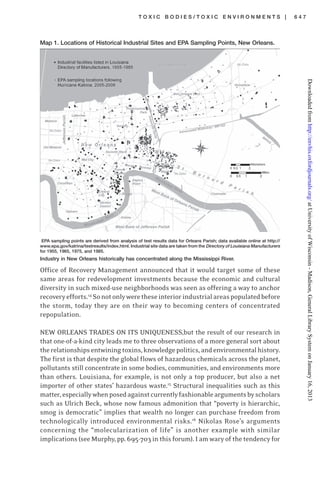
CREATED AT DIFFERENT TIMES and resulting from different processes, lost
knowledge and knowledge gaps are nevertheless related, at least in spatial terms.
Map 1 shows all 215 former industrial site locations from our first study and all 951
EPA sediment and soil sampling locations examined in our second study. While
thereareexceptions,thegenerallackofspatialcorrespondencebetweenpotentially
contaminated land and knowledge about contamination is clear: historical
industrial sites—those urban parcels most likely to contain legacy contaminants—
are located precisely where regulatory science undertaken in the name of public
health did not occur. By my rough but conservative estimate, hazards assessment
sampling occurred within several blocks of fewer than twenty historical industrial
sites, representing less than 10 percent of total.
This striking disconnect is explained in part by EPA’s institutional mandate
followingthehurricanestoassessenvironmentalriskinfloodedresidentialareas—
a mandate that ostensibly relieves the agency of the responsibility of assessing
neighborhoods outside the floodprint and nonresidential areas inside the
floodprint.Ourdatafromthesetwostudiesshowthattheorganizationofknowledge
production within EPA closely followed this framework. Whether that plan is in
the best interest of public health seems debatable, resting as it does on a logic that
only loosely conforms to recent history.
Industry in New Orleans historically has concentrated along the Mississippi
River and since the 1930s also along the industrial canal that links the river to
Lake Pontchartrain. Levees bordering both waterways were at elevations
sufficient to protect those facilities from Katrina’s flood. Even so, if one were
searching for relict wastes in New Orleans, these former and contemporary
industrial areas would be among the obvious places to look.12
At the same time,
now that the city’s relatively high ground has become prime real estate for
redevelopment, incentives to not find legacy contaminants may be easier to come
by.13
By contrast, industrial sites at lower elevations located along interstate and
rail lines in the city’s interior also were systematically avoided in the hazard
assessment process, even though these areas did experience catastrophic
flooding. And while these interior neighborhoods are industrial, they are not
exclusively so. As I noted earlier, prior to Katrina tens of thousands of New
Orleanians were living near existing or former industrial facilities in areas that
arebestcharacterizedbymixedresidential,commercial,andindustrialuse.These
neighborhoods gained new significance in the spring of 2007 when the Mayor’s
atUniversityofWisconsin-Madison,GeneralLibrarySystemonJanuary16,2013http://envhis.oxfordjournals.org/Downloadedfrom
T O X I C B O D I E S / T O X I C E N V I R O N M E N T S | 6 4 7
Office of Recovery Management announced that it would target some of these
same areas for redevelopment investments because the economic and cultural
diversity in such mixed-use neighborhoods was seen as offering a way to anchor
recoveryefforts.14
Sonotonlyweretheseinteriorindustrialareaspopulatedbefore
the storm, today they are on their way to becoming centers of concentrated
repopulation.
NEW ORLEANS TRADES ON ITS UNIQUENESS,but the result of our research in
that one-of-a-kind city leads me to three observations of a more general sort about
therelationshipsentwiningtoxins,knowledgepolitics,andenvironmentalhistory.
The first is that despite the global flows of hazardous chemicals across the planet,
pollutants still concentrate in some bodies, communities, and environments more
than others. Louisiana, for example, is not only a top producer, but also a net
importer of other states’ hazardous waste.15
Structural inequalities such as this
matter,especiallywhenposedagainstcurrentlyfashionableargumentsbyscholars
such as Ulrich Beck, whose now famous admonition that “poverty is hierarchic,
smog is democratic” implies that wealth no longer can purchase freedom from
technologically introduced environmental risks.16
Nikolas Rose’s arguments
concerning the “molecularization of life” is another example with similar
implications (see Murphy, pp. 695-703 in this forum). I am wary of the tendency for
Industry in New Orleans historically has concentrated along the Mississippi River.
Map 1. Locations of Historical Industrial Sites and EPA Sampling Points, New Orleans.
EPA sampling points are derived from analysis of test results data for Orleans Parish; data available online at http://
www.epa.gov/katrina/testresults/index.html. Industrial site data are taken from the Directory of Louisiana Manufacturers
for 1955, 1965, 1975, and 1985.
atUniversityofWisconsin-Madison,GeneralLibrarySystemonJanuary16,2013http://envhis.oxfordjournals.org/Downloadedfrom
6 4 8 | E N V I R O N M E N T A L H I S T O R Y 1 3 ( O C T O B E R 2 0 0 8 )
suchnarrativestouniversalizetechnoscientificpoweranditsconsequencesinways
that mask deepening environmental and social inequalities and that mystify the
politicalandeconomicforcesthatdrivetheglobalproductionandplanetaryspread
ofsyntheticchemicals.Theproductsoftechnoscienceareeverywhere,butnotevenly
or randomly so. Tragically evoking the wilderness that William Cronon has so
provocatively sought to humanize, the broken streets and abandoned houses of
New Orleans offer a muted plea for tying our stories about people, pollution, and
power to experienced moments and lived places.17
My second observation is that our knowledge about pollution—what it is, where
it is, and how it affects us when it becomes part of us—is also highly uneven. The
approximately two hundred chemicals tested in New Orleans sediment represents
less than a quarter of 1 percent of the more than 82,000 substances listed in EPA’s
chemical inventory—about the same proportion of chemicals for which EPA is
reported to possess “complete health data.”18
These ratios illustrate just how
“unworkable” traditional approaches to chemical assessment continue to be (see
Nash, pp. 651-658 in this forum) and should compound concern for the uneven
hazard assessment strategies that created spatial knowledge gaps in New Orleans.
While they may not be planned, knowledge voids like these do not simply just
happen.Lostknowledgeandknowledgegapsaretheresultsofhistoricalprocesses
and take particular social forms that historians of environmental knowledge are
particularly well positioned to recover but that will require protracted collective
political effort to repair.
Isuspectsuchdiscontinuitiesinthesystemsthatpreservehistoricalknowledge
and produce bureaucratic knowledge are common, so my third observation is that
mostly, it seems, we don’t know. As our research shows, ignorance overlaps,
entwines, and accumulates. The absences it creates are complex. We should
acknowledge that much at least. Doing so would mean acting on evidence that the
regulatory regimes we’ve entrusted to protect us and our communities ignore our
genuine ignorance about the dynamic states of our “toxic environments/toxic
bodies.”19
In this context Arthur Daemmrich’s suggestion that biomonitoring may
usher in newly democratized forms of risk assessment and chemical regulation
seems to me naively optimistic. Instead, as the work of several other contributors
tothisforumvariouslyattest,waysofnotknowinghavebecomedeeplyprogrammed
into the epistemic machinery that gives us conventional toxicology, analytical
chemistry, risk analysis, and public health.20
In New Orleans, political and civic
action—or inaction—propelled by these and other forms of institutionalized
ignorance may come at the high price of missing an unprecedented opportunity.
All cities are contaminated. But unlike most city dwellers elsewhere, citizens
and government officials in New Orleans are uniquely positioned to address soil
contamination problemson a scale and in a manner few can claim to have had. The
hurricanes and flooding of 2005 destroyed or severely damaged hundreds of
thousands of homes and businesses. These, along with tens of thousands of less
severelydamagedbuildingsandmostofthecity’spublicspaces—parks,golfcourses,
schools, and street medians—may eventually be renovated, rebuilt, redeveloped, or
converted into green space. In short, the recovery process now haltingly underway
atUniversityofWisconsin-Madison,GeneralLibrarySystemonJanuary16,2013http://envhis.oxfordjournals.org/Downloadedfrom
T O X I C B O D I E S / T O X I C E N V I R O N M E N T S | 6 4 9
presents the city, the state of Louisiana, and the nation with a historic opportunity
to enhance public health and environmental well-being by making an urban
ecosystem less toxic. Whether this opportunity is seized, missed, or muddled
through will depend on finding the resources, political will, and collective civic
effort to craft and implement more ecologically sustainable solutions. If we are
smart about it, those solutions will embody a healthy respect for what remains
unknown—not because more knowledge is inevitably better, but because it is
difficult to imagine how less ignorance would be worse.
ScScScScScotototototttttt FFFFFrickrickrickrickrickeeeeelllll is assistant professor of Sociology at Washington State University,
where he studies environmental hazards, expert knowledge, and politics. He is the
author of Chemical Consequences: Environmental Mutagens, Scientist Activism
and the Rise of Genetic Toxicology (Rutgers, 2004), which received the Robert K.
Merton Award from the Section on Science, Knowledge and Technology of the
American Sociological Association, and is coeditor (with Kelly Moore) of The New
PoliticalSociologyofScience:Institutions,Networks,andPower(Wisconsin,2006).
NOTES
Resources for this research were provided through Tulane/Xavier Center for
BioenvironmentalResearchinNewOrleansandbyagrantfromtheSocialSciences
Research Council. Richard Campanella, Jim Elliott, and Bess Vincent collaborated
ontheoriginalresearchsummarizedinthisessay.LaurenRichtercreatedthemap.
I thank them all for their contributions, and I thank the forum editors for helpful
comments.
1. Essays in this forum by Michael Egan (“Toxic Knowledge: A Mercurial Fugue in Three
Parts,”636-42),LindaNash(“PurityandDanger:HistoricalReflectionsontheRegulation
of Environmental Pollutants,” 651-58), and Barbara Allen ( “Environmental Health and
MissingInformation,” 659-66)pursuerelatedthemes.Ontheconceptofundonescience,
see David J. Hess, Alternative Pathways in Science and Industry: Activism, Innovation,
and the Environment in an Era of Globalization (Cambridge: MIT Press, 2007). On the
cultural production of ignorance, see Robert N. Proctor and Londa Schiebinger, eds.
Agnotology:TheMakingandUnmakingofIgnorance(PaloAlto,CA:StanfordUniversity
Press, 2008).
2. See Susan L. Cutter, American Hazardscapes: The Regionalization of Hazards and
Disasters (Washington, DC: Joseph Henry Press, 2001).
3. Scott Frickel and James R. Elliott, “Tracking Industrial Land Use Conversions: A New
Approach for Studying Relict Waste and Urban Development,” in Organization and
Environment (in press). On relict industrial waste, see Craig E. Colten, “Historical
Hazards:TheGeographyofRelictIndustrialWastes.”ProfessionalGeographer42(1990):
143-56.
4. The sample was drawn from a population of establishments in six major industrial
groups—chemicals, petroleum, plastics, primary metals, stone/glass/clay, and
transportation equipment. Detailed methodological information is provided in the
original study.
5. Craig E. Colten, Historical Hazardous Substance Data Base (Springfield: Illinois State
Museum, 1992).
atUniversityofWisconsin-Madison,GeneralLibrarySystemonJanuary16,2013http://envhis.oxfordjournals.org/Downloadedfrom
6 5 0 | E N V I R O N M E N T A L H I S T O R Y 1 3 ( O C T O B E R 2 0 0 8 )
6. SeeCraigE.Colten,AnUnnaturalMetropolis:WrestingNewOrleansfromNature(Baton
Rouge: Louisiana State University Press, 2005).
7. For overviews see, respectively, Nancy Green Leigh and Sarah L. Coffin, “How Many
Brownfields Are There? Building an Industrial Legacy Database,” Journal of Urban
Technology 7 (2000): 1-18; and Robert J. Brulle and David N. Pellow, “Environmental
Justice:HumanHealthandEnvironmentalInequalities,”AnnualReviewofPublicHealth
27 (2006): 103-24.
8. The EPA test data are available at http://www.epa.gov/katrina/testresults/index.html.
Metropolitan New Orleans includes contiguously populated portions of Jefferson,
Orleans,Plaquemines,andSt.Bernardparishes.Theanalysissummarizedhereisbased
on data from Orleans Parish (City of New Orleans) only.
9. “Summary Results of Sediment Sampling Conducted by the Environmental Protection
Agency in response to Hurricanes Katrina and Rita” Environmental Protection Agency
(August 17, 2006). Available at http://www.epa.gov/katrina/testresults/sediments/
summary.html.
10. Scott Frickel and M. Bess Vincent, “Katrina’s Contamination: Regulatory Knowledge
Gaps in the Making an Unmaking of Environmental Contention,” Chapter submitted for
inclusioninRisk,Recovery,andRepatriationafterKatrina,ed.RachelDowtyandBarbara
Allen.
11. On the socio-demographic characteristics of the Katrina flood victims in New Orleans,
see Richard Campanella, “An Ethnic Geography of New Orleans,” Journal of American
History (2007): 704-15.
12. The other types of places to look in New Orleans are Superfund sites and landfills See
chapter 4 in Colten, Historical Hazardous Substance Data Base, note 5.
13. RichardCampanella,“Geography,Philosophy,andtheBuild/NoBuildLine,” Technology
in Society 29 (2007): 169-72.
14. City of New Orleans, Mayors Officeof Communications, “City Announces First 17 Target
Recovery Zones: Areas Will Attract Investment, Residents to Key Resources.” Press
release, March 29, 2007. Available at: http://www.cityofno.com/portal.aspx?
portal=1&load=~/PortalModules/ViewPressRelease.ascx&itemid=3813.
15. See J. Timmons Roberts and Melissa M. Toffolon-Weiss, Chronicles from the
Environmental Justice Frontline (New York: Cambridge University Press, 2001), 16-22.
16. Ulrich Beck, Risk Society: Toward a New Modernity, (London: Sage, 1992), 36.
17. William Cronon, “The Trouble with Wilderness: Or, Getting Back to the Wrong Nature,”
Uncommon Ground: Rethinking the Human Place in Nature,ed. William Cronon (New
York, Norton, 1996), 69-90.
18. United States Government Accounting Office, Chemical Regulation: Options Exist to
Improve EPA’s Ability to Assess Health Risks and Manage its Chemical Review Program
(Washington, DC: United States Government Accounting Office, 2005). Available online
at http://www.gao.gov/new.items/d05458.pdf.
19. On the ignorance of ignorance, see Jerome R. Ravetz, “The Sin of Science: Ignorance of
Ignorance,” Knowledge: Creation, Diffusion, Utilization (December, 1993): 157-65.
20. On“epistemicmachinery,”seeKarenKnorrCetina,EpistemicCultures:HowtheSciences
Make Knowledge (Cambridge: Harvard University Press, 1999).
atUniversityofWisconsin-Madison,GeneralLibrarySystemonJanuary16,2013http://envhis.oxfordjournals.org/Downloadedfrom
LINDA NASH
Linda Nash, “Purity and Danger: Historical Reflections on the Regulation of Environmental
Pollutants,” Environmental History 13 (October 2008): 651-658.
purity and danger: historical reflections on
the regulation of environmental pollutants
FORUM
FOR THOSE WHO STUDY current environmental problems, it is easy to assume
that the history of those problems, however interesting, is not essential or even
relevant to their solution. Yet as we debate how to respond to contemporary
dilemmas, we might consider the knowledge and the vocabulary with which we
conduct the argument. Debates over chemicals and their regulation are, at root,
debatesabouttherelationshipbetweenbodiesandtheirenvironments.Embedded
within these arguments are assumptions about the nature of both bodies and the
spaces within which those bodies dwell: It is history that allows us to understand
howwecametoperceivehealth,disease, andenvironmentalpollutionintheways
that we do. So what are the contexts that gave rise to modern forms of
environmental regulation in the United States? And what historical assumptions
about bodies and disease do we reproduce in current discussions of regulation
and chemical pollutants?
Two different intellectual contexts underlie twentieth-century environmental
standards. The first is what we might call the germ-theory theory of the
environment.Inthisview,thenaturalenvironmentisintrinsicallyhealthful,while
the healthy body is a pure body, a body free from disease-causing agents.
Nonhuman landscapes are not harmful in themselves, though they may be
periodically traversed by dangerous pathogens and chemicals.1
This perspective
is widely familiar today, but it is, historically speaking, a relatively recent and
uneven development. It has its roots in the rise of bacteriology in the latter
atUniversityofWisconsin-Madison,GeneralLibrarySystemonJanuary16,2013http://envhis.oxfordjournals.org/Downloadedfrom
6 5 2 | E N V I R O N M E N T A L H I S T O R Y 1 3 ( O C T O B E R 2 0 0 8 )
nineteenth century, although it reached its apotheosis only in the early 1900s as
sanitarians and doctors undertook vigorous campaigns against germs, insects,
and unhygienic behaviors. What preceded those developments was something
quite different. In earlier periods, bodies were widely understood as porous and
open to their environment. For both physicians and lay people, “health” signified
not a pure body but a body that was in balance with its surroundings. Natural
environments could be either healthy or unhealthy; and a given locale might be
healthy for some bodies and dangerous for others, or healthy in some seasons
and sickly in others. Environments seeped into and shaped human bodies;
however, natural environments were not presumed to be healthful, and a healthy
place was not necessarily a clean or uncontaminated landscape. Health was not a
matterofkeepingpathogensoutofthebodybutofensuringtheproperinteraction
between a body and its surroundings.2
These earlier ideas gave way among public health professionals at the turn of
the last century as they came to understand the microbial sources of many major
illnesses.Germtheorylocatedthecauseofdiseasenotinthebroaderenvironment
but within specific pathogens. Disease became bounded, and environments far
less relevant. For a new generation of medical professionals the insights of
bacteriology were nothing less than revolutionary. As Hibbert Winslow Hill, one
of the leading popularizers of germ theory and the “New Public Health,” wrote in
1916: “We do not fear or dread anything from our skins out. Nothing outside can
hurt us until it gets into us. … Only from our skins in can anything harm us; and
this is why we have turned from regarding the environment and doctoring it, to
regarding ourselves and keeping ourselves diseaseless.”3
AtthesamemomentthatHillwaswriting,theU.S.PublicHealthService(PHS)
was struggling to devise the first national water quality standards. The PHS’s
principalconcernlaywithtyphoid,adiseaseoftenspreadthroughdrinkingwater,
and the agency responded by establishing a committee in 1913 to devise the
nation’s first water quality standards. Surgeon General Rupert Blue invoked the
languageofenvironmentalpuritywhenheannounced“thenecessityforafederal
standard of purity for drinking water” [emphasis added]. The need to keep
pathogenicorganismsoutofthebodynecessitatedkeepingthosesameorganisms
out of water supplies.4
Purity, however, proved an elusive concept. What emerged from the
deliberationsofthePHS’sDrinkingWaterCommitteewasaseriesofcompromises
reflecting the fact that natural water sources were unavoidably impure. And
moreover, even if a definitive line could be drawn between purity and impurity,
there were not sufficient technical tools to do so. Given the limited enforcement
powers of the PHS, committee members understood it would be at best useless
and at worst counterproductive to propose a quantitative standard that large
numbers of water suppliers could not meet; in the end their approach was highly
pragmatic. They recognized that their proposed standards were a compromise
and would require modification. Nonetheless, the assumption of environmental
purity had been institutionalized: waters that met the standards were deemed
“pure,” while those that did not were labeled “contaminated.”5
atUniversityofWisconsin-Madison,GeneralLibrarySystemonJanuary16,2013http://envhis.oxfordjournals.org/Downloadedfrom
T O X I C B O D I E S / T O X I C E N V I R O N M E N T S | 6 5 3
While the first water quality regulations turned on questions of infectious
disease and environmental purity, the first air quality regulations had a starkly
different history. Efforts to regulate air quality emerged at roughly the same
historical moment but from a different location. Unlike attempts to protect water
consumersfromenvironmentalimpurities,thefirstairqualitystandardsemerged
from the effort to limit occupational disease among factory workers. The
assumptionsthatgovernedbothbodiesandenvironmentsinsidethefactorywere
quitedifferentfromthosethatappliedoutside.Whereaswaterqualityregulations
sought to restore the natural environment to a presumed prior and benign
condition in order to maintain the integrity of the (pure) body, standards for air
quality began with the assumption that the factory environment was unhealthful
andthattheprocessesofindustriallaborinevitablylefttheirmarkuponworkers’
bodies.
Thatbodiessufferedunderconditionsoflaborwasaxiomaticinthenineteenth
century. Under the law of contract, the worker’s body was conceived as a form of
capitalthatcouldbeinvestedinreturnforwages.Underthislogic,adiminishment
in bodily capital was not a problem in itself; rather, it was a rational trade-off for
money capital. Although it was widely recognized that certain occupations had
high rates of injury or illness, the reigning legal assumption was that workers
werecapableofassessingthoserisksanddemandinghigher,compensatorywages
in return.6
In other words, whereas outside the factory walls disease signaled
abnormality and impurity, within those walls illness as well as injury were
conceptualized as more or less normal.
Workers did not passively accept this condition, but the prevailing legal and
cultural system worked strongly against any effort to de-normalize occupational
injury and disease at the time. In a labor-relations system that one historian has
characterizedasfeudal,Americanworkershadlittlepowertorectifypoorworking
conditions or to receive just compensation for their injuries: employer liability
was limited; the law held employees culpable for their own and others’ injuries;
andworkerswhoprotestedfacedtheveryrealprospectofdemotionordismissal.7
As the Progressive Movement brought public health to new prominence,
however, it also brought attention to the problem of occupational disease and
injury. In their effort to improve the lives of American workers, social reformers
marshaled medical science to bolster their case. In particular, both researchers
and reformers pointed to recent physiologic studies of fatigue as evidence that
injuries could be prevented and as justification for shorter working days.
Researchers pointed to quantitative measurements of muscular fatigue and
corresponding metabolic changes to argue that worker efficiency decreased
dramatically while injury rates increased after a certain point.8
When confronted
with the problem of hazardous substances in the workplace, both researchers
and managers would turn again to physiology to understand the response of
workers’bodies.Overthecourseofthe1920s,industrialhygienistswoulddevelop
a new set of techniques—what we know now as modern toxicology—to quantify
chemical exposures and to correlate those exposures with both physiologic
variables and obvious signs of disease. Growing out of a collaboration between
atUniversityofWisconsin-Madison,GeneralLibrarySystemonJanuary16,2013http://envhis.oxfordjournals.org/Downloadedfrom
6 5 4 | E N V I R O N M E N T A L H I S T O R Y 1 3 ( O C T O B E R 2 0 0 8 )
university scientists and corporations, the questions that shaped the field of
industrial physiology and toxicology revolved less around general ideas of
“health” than around questions of labor efficiency and worker productivity.
Understandings of the body’s relationship to its environment forged in this
occupational context shared a conceptual similarity with those developed in
bacteriology—that is, the new toxicologists reproduced the exceedingly narrow
definition of both causality and disease enshrined by the recent dominance of
germ theory. Chemicals were conceptualized as akin to microbes, as singular
agents that were capable of inducing a specific disease once they entered the
body. What mattered was not the broader environment but the specific chemical
exposure.9
Furthermore, assumptions about what constituted “disease” within the field
were subtly (and sometimes not so subtly) shaped by both the desire to make
labormoreefficientandtheassumptionthatworkerswereinherentlyrecalcitrant
and dissembling. In the toxicological model, only those conditions that could be
linked quantitatively to a specific chemical exposure (e.g., a measurable level of
airborne lead dust in the workplace) and a known physiological effect (e.g.,
elevated levels of lead in the bloodstream) could constitute chemically induced
disease. Felt conditions of illness that could not be diagnosed in the laboratory
were dismissed, while diagnosed conditions that could not be traced to a specific
chemical exposure were attributed to other causes.10
But assumptions about the body forged in experimental physiology and
occupational health differed from those common in bacteriology in at least one
important respect: physiologists viewed the human body less as a container
subjecttocontaminationthanasaself-regulatingsystemthatsought,inHarvard
physiologist’s Walter Cannon’s famed term, a condition of “homeostasis.”
Physiology emphasized the body’s ability to achieve a condition of stability and
balance,anechoofnineteenth-centuryenvironmentalmedicinebutwithacrucial
difference. In experimental physiology the focus was less on the external factors
thatmightpushabodyoutofbalancethanonthebody’sinherentabilitytobalance
itself. Drawing on the concept of self-regulation, the new industrial toxicologists
would develop the concept of biologic thresholds—that is, the assertion that there
is always a level of exposure below which the body can absorb and adjust to
pollutants without sustaining permanent harm. Derived from laboratory studies
of animals that had been dosed with measured amounts of chemicals, these
biologicthresholdsthenbecamethebasisfor“thresholdlimitvalues”(TLVs;later
“maximumcontaminantlevelgoals”)—thatis,thelevelofchemicalconcentration
below which no biological effects were believed to occur. By developing TLVs for
a variety of chemical compounds, modern toxicology normalized the problem of
low-level chemical exposures, at least within the factory. Consequently, for these
professionals (and their industrial patrons) the concept of environmental purity
had no role: that both environments and bodies absorbed industrial chemicals
was not, in itself, a problem.11
Regulators are seldom innovators. As industrial substances migrated out of
the factory and into the broader environment, policymakers drew on existing
atUniversityofWisconsin-Madison,GeneralLibrarySystemonJanuary16,2013http://envhis.oxfordjournals.org/Downloadedfrom
T O X I C B O D I E S / T O X I C E N V I R O N M E N T S | 6 5 5
regulatory frameworks. The two professions that held relevant knowledge and
experience were public health doctors and their sanitary engineering colleagues
on the one hand, and industrial toxicologists on the other.12
Both groups would
bring their professional techniques and assumptions to the new environmental
problems in the decades after World War II. The regulation of chemical pollution
still reflects this uneasy mixture. On the one hand, the emphasis of twentieth-
century bacteriologists and sanitarians on bodily purity and their belief that
disease could be localized in particular pathogens have cultivated an unrealistic
public expectation that environments are—or at least should be—external to
health. As a consequence, the prevailing assumption has been that environments
can be manipulated toward other ends without seriously considering how those
manipulations will ramify in bodies. By separating bodies from environments
and health from landscapes, germ theory helped underwrite ever greater
environmental change without consideration for possible health effects. In those
cases where environments do affect health, there is an expectation that the
offending environment can and should be purified. Yet as body-burden testing
has so clearly revealed, what is released into the environment—be it the typhoid
bacillus or PCBs—will find its way into the bodies that reside in that environment
(see Daemmrich, pp. 684-694 in this forum). Moreover, environmental
arrangements affect health in multiple and complex ways that the germ model
cannot account for. Chemicals interact with one another. A body’s past exposures
and history conditions its response to new exposures. Chemicals that are benign
underonesetofconditionsmaybehighlytoxicunderdifferentconditions.Health
and disease are affected not only by specific chemical and biological exposures
but by the arrangement of cities, the thickness of the ozone layer, and the larger
biological and social community within which an individual resides. Contrary to
the assumptions of early public health reformers, bodies cannot be walled off
from their surroundings.13
Whereas the bacteriological model of bodies and environments generated
expectations that were at once unrealistic and inadequate for the broader issue
of environmental regulation, the assumptions that have structured modern
toxicology have proven equally—though differently—problematic. Most obviously,
the assumption that workers are able to make rational assessments of risk and
demand appropriate compensation for risky labor has always been a shibboleth
for all but the most privileged, while it has not even theoretical applicability to
those outside the workplace who come into contact with industrial chemicals
(see also Daemmrich, pp. 684-694in this forum). Similarly, the insistence that
there exist clear lines between “safe” and “hazardous” levels of exposure was not
simply a “fact” established by scientific investigation; the concept of identifiable
thresholds included within it the assumptions of early twentieth-century
physiology as well as the social realities and relations of power that governed
industrial labor in that period. Not only were TLVs subject to corporate influence,
later research soon challenged the scientific basis for the concept of a no-effect
level, especially in the case of chemical mutagens.14
atUniversityofWisconsin-Madison,GeneralLibrarySystemonJanuary16,2013http://envhis.oxfordjournals.org/Downloadedfrom
6 5 6 | E N V I R O N M E N T A L H I S T O R Y 1 3 ( O C T O B E R 2 0 0 8 )
But the limits of the toxicological approach extend beyond the adequacy of
particular chemical standards. When toxicology moved outside the factory, it
brought with it the assumption that industrial chemicals are a normal part of
the environment and that the only relevant question to ask was at what level. In
the 1920s, the reliance on safe concentration levels and TLVs had absolved
researchers and regulators of the need to consider how the environment of the
factory should or should not be organized; that was left to corporate managers.15
Today, even though the task of assessing the effects of tens of thousands of
chemicals on large and highly diverse populations has proven unworkable (to
say the least), toxicology holds out the hope that it will be possible. In effect,
toxicology reproduces the world in the image of the early twentieth-century
factory.
CURRENT REGULATORY APPROACHES are a product of this history. They
assume that the broader environment is irrelevant to health unless proven
otherwise; and the mechanisms for provingthe relevance of the environment rely
onmodelsofdiseaseandexposurederivedfromearlybacteriologyandtoxicology.
Consequently, the only aspects of the environment that can be regulated in the
name of health are those that can approximate bacteria—in other words, specific
chemicals or pathogens that can be demonstrated to cause, in the narrowest of
senses, specific diseases. At the same time, the assumptions that underwrite our
reliance on chemical-by-chemical standards are derived from early twentieth-
century physiology and the power-laden environment of the early industrial
factory.
The historical contexts of environmental regulation should warn us against
the easy assumption that what we need most is “better science” or less
uncertainty. Science emerges in specific contexts and responds to a host of
historical and social factors: its perceived social utility, the interests of capital,
existing techniques and technologies, the needs and desires of practicing
scientists. And while particular disciplines may supersede and even challenge
thosecontexts,theyneverfullyescapethem.Scientistsandregulatorsnecessarily
build on what has come before.
How have these historical frameworks structured the response to subsequent
environmental health threats? When organic pesticides were introduced into
American agriculture during the late 1940s and 1950s and farmworkers began
falling ill in the fields, regulators turned to toxicology, hoping to link worker
illnesses to specific exposures of single chemicals. But they found that workers
fell ill even when toxicology predicted that they should not. Farmworkers who
traveled from field to field had far more complex and unknowable exposure
histories than factory workers, and their past exposures increased their
sensitivity to future exposures. Moreover, what mattered was not simply the
pesticides but the environmental conditions under which they were encountered.
In the agricultural environment—where weather and crop conditions were
changeable and multiple applications of multiple pesticides were the norm—it
was not practicable to monitor for safe levels and enforce TLVs. Thus regulators
atUniversityofWisconsin-Madison,GeneralLibrarySystemonJanuary16,2013http://envhis.oxfordjournals.org/Downloadedfrom
T O X I C B O D I E S / T O X I C E N V I R O N M E N T S | 6 5 7
were forced to make a host of assumptions about how application rates, weather
conditions, picking styles, and crop types might or might not affect the toxicity
of specific fields. Safe concentration levels could not be ascertained in this
environment,andyetthetoxicologicalapproachpushedregulatorstopromulgate
just such levels.16
Not surprisingly, the problem of pesticide poisoning among
farmworkers persists even today.
Or consider the more recent issue of food-borne illness. In one of the largest
outbreaks, consumers fell ill after eating bagged spinach tainted with a deadly
variant of the e. coli bacteria whose source was traced to feces from a nearby
dairy farm. If we define the cause of these illnesses narrowly, as emanating from
a single pathogen, then the solution is to rid environments of that pathogen. It
should come as no surprise that current proposals to control e. coli outbreaks
focus on sterilizing agricultural environments and increased testing of the food
supply.17
A different approach might consider the health effects of industrialized
cattle ranching, centralized food processing, or the marketing of bagged salad,
which fosters the growth of bacteria. How we understand the cause of e. coli
poisoning will determine how we respond to it.
In the wake of all we have learned about the ecology of infectious disease, the
complex factors that condition chemical toxicity, and the influence of social and
environmental conditions on health, does our best hope for regulating the
relationship between bodies and environments still lie in the chemical-by-
chemical, germ-by-germ approach? Perhaps, but it is a question worth asking.
Rather than calling somewhat blindly for more science, we might ask whether a
regulatorysystemcobbledtogetheroutoftwodistinctbranchesofearlytwentieth-
century medicine can still serve our needs in the twenty-first century. Rather
than wringing our hands over the problem of scientific “uncertainty,” we might
grant that the modernist hope for perfect knowledge will always be unfulfilled.
Rather than hoping that increased scientific knowledge will—like some deux ex
machina—revealthesolutionstocontemporaryenvironmentalproblems,wemight
instead insist upon the need to consider more critically the cultural models and
historical assumptions that guide contemporary regulatory policy.
LindLindLindLindLinda Na Na Na Na Nashashashashash is associate professor of history at the University of Washington.
She is the author of Inescapable Ecologies: A History of Environment, Disease,
and Knowledge (California, 2006). Her current project, Engineering a Modern
World,isaculturalandenvironmentalhistoryoftechnicalknowledgeproduction
and postwar development practice viewed through the experience of American
water engineers.
NOTES
1. MichaelWorboys,SpreadingGerms:DiseaseTheoriesandMedicalPracticeinBritain,
1865-1900 (Cambridge: Cambridge University Press, 2000), 285.
2. Conevery Bolton Valencius, The Health of the Country: How American Settlers
Understood Themselves and Their Land (New York: Basic Books, 2002).
atUniversityofWisconsin-Madison,GeneralLibrarySystemonJanuary16,2013http://envhis.oxfordjournals.org/Downloadedfrom
6 5 8 | E N V I R O N M E N T A L H I S T O R Y 1 3 ( O C T O B E R 2 0 0 8 )
3. Herbert Winslow Hill, The New Public Health (New York: MacMillan Company, 1916),
8.
4. Patrick Gurian, and Joel A. Tarr, “The First Federal Drinking Water Standards and
Their Evolution: A History from 1914 to 1974,” in Improving Regulation: Cases in
Environment, Health, and Safety, ed. Paul S. Fischbeck and R. Scott Farrow
(Washington, DC: Resources for the Future, 2001), 43-69, 53.
5. Ibid. A similar logic underlay the regulation of processed foods, which began with the
PureFoodandDrugActof1906.SuzanneRebeccaWhite,“ChemistryandControversy:
Regulating the Use of Chemicals in Foods, 1883-1959” (PhD diss., Emory University,
1994).
6. Steve Sturdy, “The Industrial Body,” in Medicine in the Twentieth Century, ed. Roger
Cooter and John Pickstone (Amsterdam: Harwood Academic Publishers, 2000), 217-
34.
7. Ibid.; Karen Orren, Belated Feudalism: Labor, the Law and Liberal Development in the
United States (New York: Cambridge University Press, 1991).
8. Alan Derickson, “Physiological Science and Scientific Management in the Progressive
Era:FredericS.LeeandtheCommitteeonIndustrialFatigue,”BusinessHistoryReview
68 (1994): 483-514; Richard Gillespie, “Industrial Fatigue and the Discipline of
Physiology,” in Physiology in the American Context, 1850-1940, ed. Gerald L. Geison
(Bethesda, MD: American Physiological Society, 1987), 237-62.
9. Christopher Sellers, Hazards of the Job: From Industrial Disease to Environmental
Health Science (Chapel Hill: University of North Carolina Press, 1997), 141-86.
10. Sellers, Hazards of the Job, 159-69. On the ways in which toxicology produces
invisibility, see also Michelle Murphy, Sick Building Syndrome and the Problem of
Uncertainty: Environmental Politics, Technoscience, and Women Workers (Durham,
NC: Duke University Press, 2006), esp. 84-92.
11. Steve Sturdy, “Biology as Social Theory: John Scott Haldane and Physiological
Regulation,”BritishJournaloftheHistoryofScience21(1988):315-40;Sellers,Hazards
of the Job, 175-83. Also Sarah A. Vogel, “From ‘The Dose Makes the Poison’ to ‘The
TimingMakesthePoison’:ConceptualizingRiskintheSyntheticAge,”Environmental
History 13 (October 2008): 667-73.
12. Infact,bythe1960s,bothgroupshadbeguntoidentifythemselvesas“environmental”
professionals—e.g., as environmental health specialists or environmental engineers.
13. See also Vogel, “From ‘The Dose Makes the Poison’ to ‘The Timing Makes the Poison.’”
Since the 1920s, the field of disease ecology has also challenged assumptions about
environmental purity with respect to infectious disease and has cast the successes of
twentieth-century disease prevention efforts in a more provisional light. A.J.
McMichael, Human Frontiers, Environments, and Disease: Past Patterns, Uncertain
Futures (Cambridge: Cambridge University Press, 2001).
14. S. A. Roach and S. M. Rappaport, “But They Are Not Thresholds: A Critical Analysis of
the Documentation of Threshold Limit Values,” American Journal of Industrial
Medicine 17 (199): 717-53; Barry Castleman and Grace Ziem,” Corporate Influence on
Threshold Limit Values,” American Journal of Industrial Medicine 13 (1988): 531-59.
15. Sellers, Hazards of the Job, 175-76.
16. LindaNash,InescapableEcologies:AHistoryofEnvironment,Disease,andKnowledge
(Berkeley and Los Angeles: University of California Press, 2006), 139-69.
17. Monterey County Resource Conservation District, Reconciling Food Safety and
Environmental Protection: A Literature Review, prepared by Diana Stuart, October
2006;MichaelPollan,“TheVegetableIndustrialComplex,”NewYorkTimesMagazine,
October 15, 2006.
atUniversityofWisconsin-Madison,GeneralLibrarySystemonJanuary16,2013http://envhis.oxfordjournals.org/Downloadedfrom
BARBARA ALLEN
Barbara Allen, “Environment, Health, and Missing Information,” Environmental History 13 (October
2008): 659-666.
FORUM
environment, health
and missing information
THE WORKSHOP ON “TOXIC BODIES” highlighted an emerging concern with
pervasive and persistent environmental toxins at low doses, such as endocrine
disruptors. While the study of these chemicals is relatively new, the study of the
effects of toxic chemicals on the human body is not. From lead exposure to
workplace carcinogens, historians have long documented the many health
hazards of increasing industrialization. This research has relied on a variety of
sources for information on public health, such as medical archives and
government data —all of them important to understanding the historic record of
the effects of industrial toxins. My concern for future historians is with the more
recent suppression of environmental health data, a trend that is growing in the
United States and possibly elsewhere. What data and information on today’s
chemical exposures will be available in archives and from government sources
in the future and what will be missing?
Mypastworkonenvironmentaljusticeandhumanhealthhasuncoveredsome
disturbing regional and national trends in the transparency of science and the
reliability and availability of public health data. These disturbing trends can be
broadly placed in two categories: undone science or knowledge gaps, and
suppression or secrecy in science. The first trend, undone science, is the
consequence of the framing of scientific studies to either intentionally avoid
specific areas or questions (see Frickel, pp. 643-650 in this forum) or to answer
only the questions of experts, government regulators, or corporate advisers. This
often results in not addressing and not answering the questions citizens have
related to their environment and health.1
For example, citizens who live near
atUniversityofWisconsin-Madison,GeneralLibrarySystemonJanuary16,2013http://envhis.oxfordjournals.org/Downloadedfrom
6 6 0 | E N V I R O N M E N T A L H I S T O R Y 1 3 ( O C T O B E R 2 0 0 8 )
numerous hazardous industries want to know the synergistic effect of a variety
of toxins on their bodies, over time, and in small doses. What these communities
actually get is quite different—at best, results based on animal laboratory studies
of one chemical at a time with regulations based on a chemical-by-chemical
standard(seeNash,pp.651-658inthisforum).Thusthescienceneededtoanswer
the complexity of their questions remains undone.
The notion of knowledge gaps is another way to frame the issue, as Scott
Frickel,inthisworkshophasdemonstrated.HequestionswhytheEnvironmental
Protection Agency (EPA) chose not to do soil samples in certain predominantly
African-American neighborhoods in post-Katrina New Orleans, leaving the dis-
placedresidentswithoutpotentiallyimportanthealthinformation.This“uneven”
science, whether due to intentional ignorance or the cost of producing citizen-
relevant science, does not bode well for environmental health in a time of in-
creasing global industrial production and concern about newer risks from endo-
crine disruptors, whose effects on the human body occur even at miniscule doses.
Suppression and secrecy is the second unfortunate trend in the creation and
circulation of environmental health information. It is this category of “missing
data”thatIwillfocuson.Thatenvironmentalhealthknowledge,data,andscience
exist (i.e., are collected for public health reasons or as part of occupational health
studies) but are buried for questionable reasons, will create a knowledge gap for
future researchers. Notably, the first advocacy position taken by the American
Society for Environmental History (ASEH) was a resolution opposing the closing
of many EPA libraries. In 2006, the EPA suddenly closed the Office of Prevention,
Pollution and Toxic Substances Library, the only one of its libraries specializing
in research on the health effects of toxic chemicals. Soon after that EPA libraries
in Chicago, Dallas, and Kansas City were closed, and more closures were sure to
follow. The EPA cited low usage of its libraries as the reason for their closure.
These libraries contained over 50,000 primary source documents not available
elsewhereandreceivedover134,000researchrequestsayearfromEPAstaffalone,
not including the public and outside scientists. Fortunately, in 2007 as a result
of pressure from Congress, the EPA placed a moratorium on further closures and
for fiscal year 2008, Congress included additional funding for reopening the
dormantlibraries.AccordingtothereasoningtheASEHadvancedforitsadvocacy
position, “the retention of historical memory—the archiving of knowledge and
documentsthatwouldotherwisebelostforever—isamongthedefiningattributes
of acivilizedcommunity.”Thesocietypositionbackgroundpaperconcludedthat,
“not everything should have to pass a cost-benefit test to be protected.”2
My work on the history of the chemical industry and expert-activists in
Louisiana uncovered another version of the problem of missing information. In
this case the hiding of scientific data appears to be prevalent, particularly with
research data that involves the effects of chemical hazards on human health and
residentialenvironments.Thisoccurswhenthereisafearofindustryregulation,
liability claims, or pressure for possible corporate responsibility. There are two
common ways that information is legally obscured. The first is the “homeland
security” excuse and the second is the use and misuse of the “right to privacy.”
atUniversityofWisconsin-Madison,GeneralLibrarySystemonJanuary16,2013http://envhis.oxfordjournals.org/Downloadedfrom
T O X I C B O D I E S / T O X I C E N V I R O N M E N T S | 6 6 1
PROBLEMS WITH THE RIGHT-TO-KNOW
WITHIN A YEAR after 9/11, the chemical companies together with the Bush
administration were busy instituting new security measures. In the name of
increased safety, thousands of pages of formerly public information disappeared
from websites, including data on chemical facilities, the hazards stored and
produced, as well as evacuation maps for accidents.3
For years, activists and
community members have used these “risk management plan” (RMP) websites,
alongwithTRIdata,toalertresidentstothechemicaldangersintheircommunity.
This information also has been used to pressure plants into adopting cleaner
practices, sometimes through lawsuits and regulatory changes. In addition, data
from these sites were important for community planning purposes, for activities
such as locating new schools and playgrounds as well as immediate information
for first responders, who, in some areas,are citizen-volunteers. Furthermore, this
tendency to hide information from the public has grown since 9/11. A few years
later in 2006, both houses of Congress finally passed an appropriations bill for
2007 requiring the Department of Homeland Security (DHS) to propose rules
requiring high-risk chemical facilities to perform security self-assessments and
remedies. The chemical companies fully embraced the new secrecy ethos but
lobbiedheavilytomakesurethattheregulationswouldbedeterminedbyindustry
and be voluntary.
In the meantime some states having many noxious facilities located near
urbanareas,suchasNewJersey,passedenforceableplantsecuritypractices.New
Jersey officials deemed that 43 of their 140 chemical plants were subject to the
state’s new Toxic Catastrophe Prevention Act, thus mandated to consider the
adoption of “inherently safer technologies” (ISTs). There had been numerous
attempts to pass national legislation on chemical security and safety,
predominantlybylegislatorsfromlargeurbanareas.Thetypesofprovisionsthey
were looking for included: 1) the use of ISTs where feasible; 2) enhanced site
security at plants; 3) workers having a voice in safety/security and whistleblower
protection; and, 4) allowing stronger state laws, if passed, to supercede federal
laws.4
Nowhere in these proposals is hiding information from the public ever
mentioned.
In late 2007 the House, following the Senate, passed an appropriations bill
for the DHS requiring the establishment of interim rules for high-risk facilities.
The bill had none of the provisions previously advocated in earlier attempts and
instead endorsed a “business as usual” approach. DHS was directed to ask that
chemical facilities assess their own security risks and propose solutions. Elected
officials from New Jersey were particularly dismayed because this weaker law
displaced the stronger regulations the state already had in place.
Another industry-driven effort to avert terrorism was to make sites more able
to “detect, deter, and delay” potential intruders.5
While, in principle, this appears
to be a sound idea, in practice, it has snared some unlikely people. While
“suspicious activity” around chemical plants was always reportable long before
9/11 under various local, state, and national statutes, after 9/11 new standards of
“suspiciousactivity”wereadoptedatsomeplants.InMarch2005,WillieFontenot,
atUniversityofWisconsin-Madison,GeneralLibrarySystemonJanuary16,2013http://envhis.oxfordjournals.org/Downloadedfrom
6 6 2 | E N V I R O N M E N T A L H I S T O R Y 1 3 ( O C T O B E R 2 0 0 8 )
a community liaison officer with the Louisiana state attorney general’s office,
was escorting a group of college students on a tour of “cancer alley,” the term
that many locals use for the chemical corridor between New Orleans and Baton
Rouge. They were interested in environmental justice issues facing communities
that shared the fence line with industry. While walking and photographing in a
community being bought out by ExxonMobile, the group was suddenly detained
by a group of plant security officers. Fontenot was removed from his position
and forced to take early retirement. From my own observations, the level of
harassment of student groups and researchers in “cancer alley” has increased
under the guise of national security regulations.6
Thisnewcloakofsecrecythatindustryadoptedrespondingtopost-9/11threats
has arguably decreased the safety of residents living and working near noxious
facilities.7
Conveniently, pesky environmental activists and concerned citizens
now have less knowledge with which to pressure plants into responsible, cleaner
practices. With the passage of the 2007 bill, it appears that DHS is willing to let
industries determine their own responses to security, even at the expense of
openness and the availability of public information.
Withtheguidanceofindustry,theright-to-knowisbecomingtheneed-to-know,
aproblemnotonlyforcurrentresidents,butalsoforfuturehistoriansofindustry,
the environment, and public health. That public information on locations and
types of hazards stored at chemical facilities was removed from websites and
thatacademicgroupsarenowforbiddentocloselyexaminesitesofenvironmental
justiceclaimsdiminishestheamountofarchivalanddocumentarymaterialsthat
will be available in the future. Repeating the argument that the ASEH made
opposing the closure of EPA libraries is instructive: “Trying to piece together
responsibility for PCB contamination at a Superfund site, for example would be
impossible without such records. For communities of color struggling to
understand asthma and air contamination, for epidemiologists searching for
patterns of mercury deposition and disease incidence, for historians seeking to
learn about restoration of streams after the Clean Water Act—the holdings of the
EPA libraries are quite simply irreplaceable.”8
PROBLEMS WITH THE RIGHT-TO-PRIVACY
THE RIGHT-TO-PRIVACY, to most Americans, is sacrosanct. In a country where
health insurance is expensive and/or difficult to obtain, the protection of one’s
records against corporate voyeurs could mean the difference between obtaining
coverageorgoingbankruptfromhospitalcosts.Fearsofemployerdiscrimination
or stigmas attached to certain illnesses reinforce people’s insistence on their
healthdatasecurity.In1996,theHealthInsurancePortabilityandAccountability
Act (HIPAA) was passed by Congress, primarily to address the “portability” of
electronic records by health care providers and insurers. Privacy legislation was
added in 2003, including strict guidelines for the use and disclosure of a person’s
medical record with legal ramifications, both civil and criminal, for
noncompliance.9
atUniversityofWisconsin-Madison,GeneralLibrarySystemonJanuary16,2013http://envhis.oxfordjournals.org/Downloadedfrom
T O X I C B O D I E S / T O X I C E N V I R O N M E N T S | 6 6 3
Whilestrongprivacylawsappeartoprotectindividualrights,theyformabarrier
to some public health research. Cancer surveillance, for example, began early in
the twentieth century, with Connecticut being the first state to establish a cancer
registry in the 1930s. As of 2006, cancer data are contributed by forty-three states
to a national cancer incidence report, which represents 92 percent of the U.S.
population.10
Cancer surveillance, however, is one area that has felt the unintended
consequences of HIPAA. Only a few sections of HIPAA are directed at research, and
thosetrytobalanceprivacyanddataaccess.Becausetheprivacyactrequireswritten
authorization for use of medical records from living persons, researchers must
obtainwaiversfromaprivacyboardtogainaccess.Exceptionstoobtainingwritten
authorization include: 1) if the health information is de-identified (name, address,
social security number, etc.); 2) if the research is about people who have died; or 3)
if information is required by law for public health activities.11
Despite attempts at balance, “early anecdotes suggest that IRBs are being
conservative in their interpretation of HIPAA, erring on the side of privacy ...
[and] HIPAAdoes not preempt state regulations so there is no national standard,”
making multi-state research difficult.12
For environmental health researchers,
including historians of public health, the application of privacy rules to cancer
and other types of health data can mean the inability to do both larger
epidemiological studies as well as analyze illness clusters and links between
illness and proximity to hazardous sites.13
Minnesota enacted strict medical
confidentialitystandardsin1997,requiringthatpatientsgivewrittenpermission
for each study for which their records are used, and the consequences are
instructive. In one multi-state federally sanctioned study on seizures induced by
pain medication, only 19 percent of Minnesotans gave permission, whereas
ascertainment in the other states was 93 percent.14
In my research on “cancer alley,” I discovered an astounding fact: neither the
citizens nor the state could say for sure if there really was a higher incidence of
cancerinpeoplelivingnearindustry.Thestateagencymandatedtocollectcancer
data, the Louisiana Tumor Registry (LTR) claimed that there was no evidence of
such a correlation: however, there was also no evidence that there was not a
correlation. The data had been collected and aggregated into large multiparish
areas (equivalent to several counties) over five-year periods rendering it useless
to show health effects in smaller locale-based frames.
A group of citizens and medical researchers sued the LTR in the late 1990s
asking for the release of cancer data in one-year intervals, by zip code, and
including rare cancers such as pediatric cancer. While the LTR eventually
compliedwiththerequesttopublishcancerdatainone-yearintervals,theyfought
the release of data by zip code and the release of data on some rare cancers. Their
argument against the release of zip code data was that it would be misused and
misinterpreted.Theyclaimed:“theentirescientificcommunityofcancerresearch
professionals regard zip code-specific cancer incidence data as statistically and
clinicallymeaningless.”15
Furthermore,theyassertedthatifthedatawasreleased
insuchsmallgeographicunits,forsomerarecancerstheincidencecouldbe“one,”
thus violating a person’s right-to-privacy.
atUniversityofWisconsin-Madison,GeneralLibrarySystemonJanuary16,2013http://envhis.oxfordjournals.org/Downloadedfrom
6 6 4 | E N V I R O N M E N T A L H I S T O R Y 1 3 ( O C T O B E R 2 0 0 8 )
The medical researchers in the lawsuit were particularly interested in
pediatriccancerasanecdotalevidencesuggesteditwasquitehighandpotentially
linked to environmental hazards. Because there are sixteen classification types
of pediatric cancer, to delete all instances of “one” could effectively miss sixteen
cancers in a year in a geographic area. In 2004, the citizens and researchers
eventually won a partial victory as the data was released to them by parish and
for all cancers, including rare cancers, but not by the smaller unit of zip code.16
The bottom line—the right-to-privacy had been used to deny access to medical
data that could show links between environmental pollutants and human health.
About a month after the Environmental History panel on “Toxic Bodies,” I
attended a conference on “New Chemical Bodies” at the Chemical Heritage
Foundation(CHF)inPhiladelphia.Theeventwasfocusedon“biomonitoring,body
burden, and the uncertain threat of endocrine disruptors” and featured some of
the top scientists and social scientists working in the field today.17
Interestingly,
themostoutspokenadvocateof strongerright-to-privacyregulationswithregard
to biomonitoring was one of the representatives of the chemical industry.
In 2004 a Cancer Surveillance and Information Summit was held to address
the concerns of professionals and allied groups regarding the future of cancer
dataandpublichealth.Theirrecommendationsincludedboththestandardization
ofdatacollectionandbetterlegalaccesstoindividuallyidentifiabledataforpublic
health purposes.18
This allows for easier retrospective research such as combing
a hospitals’ archive looking for patterns of illness or treatment.19
One of the primary themes of cancer surveillance literature is the balancing
of individual privacy with public health research needs. Among the
recommendations is the development of standards for protection of personal
information including policies regarding who can use the data and for what
purpose. There are eighteen personal identifiers in surveillance data, and not all
information is needed by researchers, depending on the scope and needs of their
investigations.Digitalrecordsenableregistriesandagenciestostripnonessential
datafrompatientrecordswhilecomplyingwithresearcherrequests.Thisrequires
bothstandardizationinreportingaswellasstandardizationoftechnicalsystems,
which, to date, has not happened because data collection and dissemination still
is driven predominantly by state standards. Improving standardization and
accessibility also would ensure that this kind of data would be available to
environmentalandpublichealthhistoriansinthefutureastheytrytounderstand
this period of rapid industrialization and expansion of chemical hazards.
CONCLUSION
THERE ARE THREE concluding issues that I would like to address regarding the
intersection of environmental history and missing information. The first is the
importance of protecting data currently held by government agencies and other
public organizations and ensuring open public access to that information. The
ASEH has taken an advocacy position about this in the past, and with regard to
the closing of the EPA’s libraries, continued vigilance may be necessary to ensure
these kinds of materials are available in the future.
atUniversityofWisconsin-Madison,GeneralLibrarySystemonJanuary16,2013http://envhis.oxfordjournals.org/Downloadedfrom
T O X I C B O D I E S / T O X I C E N V I R O N M E N T S | 6 6 5
The second issue is that environmental historians need to know what data is
absent, suppressed, or hidden as well as what is readily available in archives and
otherplaces.Twobookscometomindasexemplaryintheiruseofcreativesources
and/or hard-to-obtain materials. Craig Colten and Peter Skinner’s The Road to
Love Canal: Managing Industrial Waste Before EPA, is an excellent example of
scholarshiponenvironmentalhazards.Priortowritingthebook,Coltenhadspent
a decade investigating the historical geography of industrial waste for
government agencies and had served as an expert witness in over twenty-five
legal cases helping reconstruct the “state of knowledge” about hazardous
materials and contamination. According to the authors, the historical records to
whichtheyhadaccesshad:“frequentlybeenconfinedtocourtcasesaboutspecific
sites, and consequently there had been no overarching review of the testimony or
technical literature of the day. The fragmented delivery of countless witnesses
and the volumes of reports and articles collected created a unique opportunity to
consider the broad landscape of toxic waste management from a historian’s
perspective.”20
With unprotected corporate records, public documents, and
archival and library sources, Colten was (with Skinner, a scientist) able to
assemble enough information to produce the history of the United States’s toxic
legacy.
The other book, Gerald Markowitz and David Rosner’s Deceit and Denial: The
Deadly Politics of Industrial Pollution, focused specifically on the history of
environmental health in relation to the lead and chloro-chemical (plastics)
industries. As historical experts, they had been asked by a number of law firms
to review an enormous number of primary documents obtained though legal
discovery motions, including those of the Manufacturing Chemists’ Association
and its member companies, and the Lead Industries Association and its member
companies. They were given no restrictions onwhat they could later publish from
the materials and their findings of corporate environmental data suppression
and misinformation were shocking and revealing.21
According to Rosner and
Markowitz,occupationalhazardseventuallybecomeenvironmentalproblemsand
thusprovideagoodstartingpointforhistoriesexaminingtherelationshipamong
toxins, pollution, and industrial development. That it took numerous lawsuits
against corporations to uncover information about the industrial transgressions
that they write about is unfortunate. That it might take legal action for future
historians to uncover government-mandated chemical risk management plans,
taxpayer-funded public health data, or private health data on deceased citizens
will make such research projects enormously time-consuming and expensive.
Last, the third issue, and the one I would like to end with, is the need for
environmental historians to work with affected communities to determine what
kinds of records have been generated (from lay studies to corporate documents
made public via lawsuits) that are important to protect for future scholars and
futurecommunityleaders.Ihavenoeasyanswerforthesedilemmas,onlyadesire
to caution academic researchers about the possibility of these important past
and current knowledge gaps and to point to strategies that might help to ensure
a more robust archive of publically available information in the future.
atUniversityofWisconsin-Madison,GeneralLibrarySystemonJanuary16,2013http://envhis.oxfordjournals.org/Downloadedfrom
6 6 6 | E N V I R O N M E N T A L H I S T O R Y 1 3 ( O C T O B E R 2 0 0 8 )
BarBarBarBarBarbarbarbarbarbara Aa Aa Aa Aa Allllllllllenenenenen is associate professor and Director of the Graduate Program in
Science and Technology at Virginia Tech’s Northern Virginia Center. Her past
research and current book was on the dynamics of regulation, science, and
environmental justice in Louisiana’s chemical corridor.
NOTES
1. For a longer discussion of “undone science,” see David J. Hess, Alternative Pathways in
Science and Industry (Cambridge: MIT Press, 2007), 22-24.
2. See“EPABackgroundDocument”ontheASEHwebsiteathttp://www.aseh.net/resources/
advocacy/epa_background.Fulltextof“ASEHResolutionOpposingEPALibraryClosures,”
can be found at http://www.aseh.net/resources/advocacy/epa_resolution.
3. Alan Elsner, “Bush Expands Government Secrecy, Arouses Critics,” Reuters, September 3,
2002, from http://www.fas.org/sgp/news/2002/09/re090302.html.
4. Frank Lautenberg, “Senators Lautenberg, Obama and Menendez Introduce Sweeping Bill
to Tighten Security at Chemical Plants,” U.S. Senate, March 30, 2006.
5. Chris Schneidmiller, “Terrorist Threat to U.S. Chemical Facilities Can Be Lowered, Not
Eliminated, Officials Say,” Global Security Newswire, September 7, 2005, from http://
www.nti.org/d_newswire/issues/2005_9_7.html#16FC149B.
6. MarkSchliefstein,“Activists’AllySnaredinSecurityNet,”(NewOrleans) TimesPicayune,
April 5, 2005.
7. SeanMoulton,“DifferentOpiniononChemicalSecurity,”OMBWatch,September16,2002.
8. ASEH, “EPA Background Document.”
9. RobertA.Hiatt,“HIPAA:TheEndofEpidemiology,oraNewSocialContract?”Epidemiology
14 (November 2003): 637-39.
10. Dennis Deapen, “Cancer Surveillance and Information: Balancing Public Health with
Privacy and Confidentiality Concerns (United States),” Cancer Causes Control 17 (2006):
640.
11. Robert A. Hiatt, “The Future of Cancer Surveillance,” Cancer Causes Control 17 (2006):
638.
12. Ibid., 638
13. Deapen, “Cancer Surveillance and Information,” 633-37.
14. DavidL.Wheeler,“IstheLossofPersonalPrivacythePriceofMedicalProgress?”Chronicle
of Higher Education, September 17, 1999.
15. Taylor,Porter,Brooks&Phillips,L.L.P.,BriefFiledonBehalfofDefendant-Appellee,Board
ofSupervisorsofLouisianaStateUniversityandA&MCollege,DocketNo.2003-CA-0079,
14-15, 2003.
16. For a complete discussion of the lawsuit of the citizens vs. the LTR see B.L. Allen, “The
Problem with Epidemiology Data in Assessing Environmental Health Impacts of Toxic
Sites,” in Environmental Exposure and Health, M. M. Aral et al. (Billerica, MA:
Computational Mechanics, Inc., 2005), 467-75.
17. See Jody A. Roberts, “New Chemical Bodies,” in Studies in Sustainability (Philadelphia:
Chemical Heritage Foundation, 2008).
18.. Hiatt, “The Future of Cancer Surveillance,” 643-44.
19. David L. Wheeler, “Is the Loss of Personal Privacy the Price of Medical Progress?” The
Chronicle of Higher Education, September 17, 1999.
20. Craig E. Colten and Peter N. Skinner, TheRoadto LoveCanal:Managing IndustrialWaste
Before EPA (Austin: University of Texas Press, 1996), 4.
21. Gerald Markowitz and David Rosner, Deceit and Denial: The Deadly Politics of Industrial
Pollution (Berkeley and Los Angeles: University of California Press, 2002), xii-xviii.
atUniversityofWisconsin-Madison,GeneralLibrarySystemonJanuary16,2013http://envhis.oxfordjournals.org/Downloadedfrom
SARAH A. VOGEL
Sarah A. Vogel, “From ‘the Dose Makes the Poison’ to ‘the Timing Makes the Poison’: Conceptualizing
Risk in the Synthetic Age,” Environmental History 13 (October 2008): 667-673.
FORUM
from ‘the dose makes the poison’
to ‘the timing makes the poison’:
CONCEPTUALIZING RISK IN THE SYNTHETIC AGE
FOR SCIENTISTS AT GENERAL ELECTRIC in the late 1950s, the future was
plastics.TheGEscientistsdreamedthatscientificunderstandingofcarbon-based
(ororganic)compounds,specificallypolymerssuchascarbohydratesandproteins,
would one day culminate in the creation of the ultimate machine—the “synthetic
man.” Though at the time only a dream, the rapid development and commercial
success of synthetic polymers, notably plastics in the 1950s, fed such grandiose
visions of the future. Today General Electric’s dream of the “synthetic man,”
although not actualized as the science fictional character “The Terminator,” has
nonetheless become a reality. Traces of compounds used to make plastics, as well
as pesticides and other industrial chemicals, have been detected in human blood,
breast milk, placental tissue, amniotic fluid, and fat. We have literally merged
with our material environment to become synthetic humans, a reality discussed
and examined in this issue’s forum essays by Michelle Murphy and Linda Nash.
Determining the biological impact of our new synthetic bodies and the necessary
political response to such a transformation informs a contentious contemporary
debate about the meaning of chemical risk and toxicity.
This essay begins with a general overview of how chemical risks were
conceptualized in regulatory law and articulated within the discipline of
toxicology over the past half century. I then describe how research on endocrine
disruptorsbeginningintheearly1990schallengedthemeaningofriskandsafety
by providing empirical evidence of biological effects at extremely low doses of
exposure—levels often long presumed to be safe. By challenging the safety of low-
atUniversityofWisconsin-Madison,GeneralLibrarySystemonJanuary16,2013http://envhis.oxfordjournals.org/Downloadedfrom
6 6 8 | E N V I R O N M E N T A L H I S T O R Y 1 3 ( O C T O B E R 2 0 0 8 )
dose exposures, endocrine disruptor research undermined the long-standing
regulatory approach to protecting the public’s health, which upheld the notion
that above all else, the dose makes the poison, and exposure at low levels was
safe.
RISK AS RELATIVE
FROM THE DEBATES over the safety of leaded gasoline beginning in the 1920s
andpesticideresiduesonfoodsbeginninginthe1950stotheinstitutionalization
of risk assessment as the Environmental Protection Agency’s (EPA) regulatory
policyunderPresidentRonaldReagan,theprevailingassumptionaboutchemical
toxicity was that the risks of disease or injury were relative to the amount of
exposure. Put another way, any chemical would have some probability greater
than zero of causing an adverse health effect. Conversely, no risk is absolute. In
order to reduce risk, exposure to a given hazard must be minimized. A simple
equation resulted: risk = hazard x exposure. As Arthur Daemmrich describes in
his essay in this forum (pp. 685-695), the development of new methods and
technologiesforquantifyingexposureinsidethebody(i.e.biomonitoring),meant
risk equaled the hazard x presence.
In either equation, the logic only holds true given that the hazard remains
constant, and for the hazard to remain constant, it must be considered absolutely
necessaryandtherefore,exposuretoitdeemedunavoidable.Indeed,thisnarrative
onriskwasusedtolegitimizetheproliferationofindustrialchemicalsthroughout
the twentieth century. As Jerry Markowitz and David Rosner detail in Deceit and
Denial, in the mid-1920s the lead, oil, and automotive industries defended the
introduction of lead into gasoline by arguing that it was necessary for American
economic progress and that all technological development required some form
of risk.1
This trope of the inevitability of chemical risks and the necessity of hazards
for economic progress structured the central narrative of public relations
campaigns of the chemical industry throughout the twentieth century. In the
early 1970s, the Society of the Plastics Industry, the industry trade association,
launched the public relations campaign, “Plastics Not Pollution.” The campaign
extolledtheecologicalandsafetyfeaturesofplasticsattimewhentheirpollution
and toxicity were under considerable scrutiny.2
Thirty years later, in response to
a contemporary debate over the safety of endocrine-disrupting chemicals, such
as bisphenol A, phthalates and atrazine, the chemical trade association, the
American Chemistry Council, launched its “essential2
” campaign. This most
recentcampaignpromotedthechemicalindustryasanecessaryandfundamental
component to a healthy economy, society, and environment.3
The legal conceptualization of risk as relative to the amount of exposure to a
given chemical was formally articulated in the 1958 Federal Food, Drug, and
Cosmetics Act, which regulated the “safe” exposure to chemicals in foods,
including pesticides, color additives, and plastics (due to their ability to leach
into food when used as wraps and containers). Prior to this Act, the food laws of
1906 and 1938 considered dangerous products or poisons as hazards per se,
atUniversityofWisconsin-Madison,GeneralLibrarySystemonJanuary16,2013http://envhis.oxfordjournals.org/Downloadedfrom
T O X I C B O D I E S / T O X I C E N V I R O N M E N T S | 6 6 9
regardless of any evaluation of safety, and, theoretically, restricted any poison
from entering food. This per se standard was reversed in 1958 based on the logic
that many of the new industrial chemicals in use, in particular the pesticide DDT,
increasingly detected in cow’s milk, were “necessary in production or
unavoidable.”4
Such compounds, some lawmakers and FDA officials argued,
couldn’t be excluded per se; as such, safety standards were necessary to regulate
their use. With the passage of the 1958 law, the regulation of chemicals in foods
shifted from the per se rule to the de minimus standard that inscribed into law
the notion that chemical risks were a function not of the hazard itself, but
dependentupontheexposure.Safety,inturn,couldbeachievednotbyquestioning
the hazard per se, but by minimizing the exposure.
The exception to this rule was the Delaney Amendment to the 1958 law, which
established a zero tolerance standard for chemical carcinogens, effectively
upholding the per se standard.5
Industry trade groups and lawyers fought for
decades to shift the interpretation of the clause from a per se rule, which
effectively supported banning carcinogens, to the de minimus standard, which
provided for the setting of safety standards for such chemicals. In 1962, the
Delaney clause was effectively watered down by the DES Proviso, an amendment
to the 1958 food law, which permitted the use of a carcinogen, diethylstilbestrol
(DES), a drug used to increase livestock meat production, provided that no
detectable amount of the chemical was found in the edible tissue. Risk, according
to this proviso, was tied to quantifiable detection.6
During the mid-1970s, the Monsanto Chemical Company, with support from
the major industry trade associations, successfully blocked efforts by the FDA to
implement the Delaney clause for carcinogens in food by successful providing
evidence that the migration of suspected chemicals from plastics into food,
includingvinylchlorideandacrylonitrile,fellbelowthedetectionlimit.Additional
efforts to block the restriction of carcinogens involved linking risk to the
quantitative presence of a chemical and empirical evidence of adverse biological
effects at the detection limit. In 1980 the Supreme Court upheld this
interpretation of risk when it ruled in favor of the American Petroleum Institute
and overturned the Occupational Safety and Health Administration’s (OSHA) low
safety standard for benzene. The American Petroleum Institute successfully
argued that OSHA failed to provide quantitative evidence of adverse effects at
thenew,very lowstandard.7
In 1996, the Delaney clausewas finally removed from
the law as it affected the regulation of pesticides in food with the passage of the
Food Quality Protection Act that put in place a lowered tolerance limit for
pesticides.8
THE DOSE MAKES THE POISON
TOXICOLOGY AS A SCIENTIFIC DISCIPLINE evolved in response to rising
demands for regulations and litigation in the early part of the twentieth century.
Incontrasttoindustrialhygieneofthelatenineteenthcenturyandearlytwentieth
century, toxicology shifted the study of toxic chemicals from the workplace to
the laboratory where controlled experiments on animals were used to evaluate
atUniversityofWisconsin-Madison,GeneralLibrarySystemonJanuary16,2013http://envhis.oxfordjournals.org/Downloadedfrom
6 7 0 | E N V I R O N M E N T A L H I S T O R Y 1 3 ( O C T O B E R 2 0 0 8 )
the toxic effects of chemical exposure.9
Experimental, animal-based research
expanded to meet growing demands for safety standards in the workplace and
consumer products, particularly with the establishment of the Occupational
Safety and Health Administration and the Environmental Protection Agency in
1970. Safety standards such as permissible exposure levels, used in the
occupational setting, and reference doses or safety standards for food additives
or water pollutants, permit some small detectable levels of a hazard based on the
fundamental toxicological principle, the dose makes the poison.
This founding principle is most frequently attributed to Paracelsus, a
physicianandalchemistoftheeighteenthcentury.Paracelsusdescribedthestudy
of chemicals as a process of drawing distinctions between their therapeutic and
toxic properties through experimentation. He contended that the difference
between these two properties is often but not always “indistinguishable except
by dose.”10
Determining the exposure level where the toxic response begins and
ends represents the domain of regulatory toxicology.
Toxicological experiments used to derive regulatory safety standards
throughout the twentieth century typically exposed adult animals to very high
doses of a chemical to determine the lowest level at which a toxic effect occurs or
preferablythelevelatwhichnotoxiceffectisseen—what’sreferredtoasthelowest
observedadverseeffectlevel(LOAEL)ornoobservedadverseeffectlevel(NOAEL).
An additional “safety” or “uncertainty” factor of 100- or-1,000 fold is then added
totheLOAELorNOAELtoaccountfordifferencesinhumanresponses,vulnerable
populations, and general uncertainty about the relationship between the dose
and the response below this level. Exposures below the safety level are generally
considered safe for humans, although rather than using empirical evidence of
harmorlackofharmatlowlevels,varyingpredictivemodelsofthedose-response
relationshipatlevelsbelowtheLOAELorNOAELareemployedtoassesstherisks
of low-dose exposure.11
Over the past fifteen years, however, studies measuring
the effects of very low-dose exposures to pesticides, herbicides and industrial
chemicals—levels presumed to be safe—began filling in the black box of low-dose
effects.
CHALLENGES TO RISK AND TOXICOLOGY
IN 1991, AT THE INVITATION of Theo Colborn, an interdisciplinary group of
researchers—wildlife biologists, experimental endocrinologists and molecular
biologists—gathered together for several days at the Wingspread Conference
Center in Racine, Wisconsin. The objective of this meeting was to discuss an
inchoate body of research on the reproductive and developmental effects of
chemicalscapableofinteractingwiththehormonesystemsoflaboratoryanimals,
wildlife, and humans. The consensus statement produced from the workshop,
what became known as the Wingspread Statement, declared with certainty that
“a large number of man-made chemicals that have been released into the
environment, as well as a few natural ones, have the potential to disrupt the
endocrine system of animals, including humans.” The effects of developmental
exposure to such chemical compounds, collectively referred to as endocrine
atUniversityofWisconsin-Madison,GeneralLibrarySystemonJanuary16,2013http://envhis.oxfordjournals.org/Downloadedfrom
T O X I C B O D I E S / T O X I C E N V I R O N M E N T S | 6 7 1
disruptors, extended beyond cancer to include reproductive, immunological,
behavioral and neurological abnormalities and diseases.12
Endocrine disruption quickly became a controversial scientific theory and a
politically salient idea because it challenged the traditional boundaries of
toxicology and risk assessment—not to mention the presumed safety of dozens
of economically valuable chemicals. The theory argues that chemicals capable of
interacting with the hormone system can elicit long-term and multigenerational
effects at minute levels of exposure— levels detected in the ambient environment
and inside human bodies.13
This understanding challenged the presumption that
unavoidable environmental exposure, long considered to be a necessary trade-
off for the economic benefits chemicals afforded society, was safe.
Since the early 1990s, a growing number of studies have examined the long-
term effects of exposure to hormonally active pesticides, flame retardants,
plasticizers, and other industrial chemicals including bisphenol A and
polychlorinatedbiphenyls,duringcriticalperiodsofdevelopment—pregnancyand
early in post-natal life. As Howard Bern, a prominent DES researcher since the
1970s and participant at the Wingspread workshop, wrote in 1992, the “fetus is
fragile”becausethecommunicationsystemsdirectingdevelopmentarelaiddown
early in the organization of the living organism.14
As opposed to examining the
overt toxic effects of high doses, (i.e., death, malformation and/or cancer in adult
animals), researchers working with endocrine disruptors began to investigate
how low-dose, developmental exposures affect different hormonally sensitive
tissues and organs of the reproductive, immune, metabolic, or neurological
systems. Further, in the past five years, researchers have begun to examine how
these low-dose functional changes or disruptions to major communication
systems manifest as chronic disease (such as polycystic ovarian disease,
endometriosis, and breast and prostate cancer) as the exposed animal’s age.
Within this research framework, the timing of exposure and the timing of the
observation of effect are critical. Sincethe 1970s, epidemiological and laboratory
research on the reproductive effects of DES exposure during fetal development
supported the supposition that timing of exposure is essential in determining
the health effect. For example, the daughters of women who took DES during
theirpregnanciesfromthe1940stotheearly1970sdevelopedrarevaginalcancers
and reproductive problems in adult life, not the mothers themselves.15
By
emphasizing the importance of timing of exposure, the endocrine disruption
thesis reframes the “dose makes the poison” principle as the “timing makes the
poison.”16
Since the early 1990s efforts to undermine research on endocrine disruptors
as “junk science” or inappropriate for assessing human health risks has
effectively shrouded the emergent field in uncertainty so as to control and
minimize the political implications of this knowledge.17
But despite efforts to
block or undermine the endocrine disruptor thesis, research has snowballed over
the past fifteen years, opening up new understandings of the interaction among
geneticexpression,chemicalexposureanddiseasedevelopment.Recentresearch
onendocrinedisruptingchemicalssuggeststhatthesecompoundsalterheritable
atUniversityofWisconsin-Madison,GeneralLibrarySystemonJanuary16,2013http://envhis.oxfordjournals.org/Downloadedfrom
6 7 2 | E N V I R O N M E N T A L H I S T O R Y 1 3 ( O C T O B E R 2 0 0 8 )
gene expression through nonmutating, epigenetic mechanisms, such as DNA
methylation—chemical modification that alters the expression of DNA without
causing a change in the sequencing.18
If small amounts of chemicals—levels
presentinthebodyandenvironment—canaltergeneexpressionanddisrupttissue
organization, which leads to increase disease susceptibility later in life, how do
we begin to reframe the meaning of chemical risk and safety?
CONCLUSION
THE VAST PROLIFERATION of synthetic chemicals, particularly since the 1950s,
wasaccepted,politicallyandlegally,intheUnitedStatesbasedontheassumption
that chemical exposure was necessary for economic progress, but the risks of
pollutedbodies,water, air,andfoodcouldbeminimizedbyreducingtheexposure
level—dilution as the solution to pollution. As scientific researchers began
exploring the effects of endocrine-disrupting chemicals at very low,
environmentally relevant levels in the 1990s, new understandings about the
abilityofsyntheticcompoundstoturnonandoffgenesandalterthedevelopment
of tissues and communication systems in the body fundamentally undermined
the long held logic of safety and revealed that there is more to defining risk than
the dose.
Such low dose work does not suggest an endocrine disruptor is hazard per se,
as the Delaney clause sought to do for carcinogens, but rather is contingent on
dose level (with lower doses sometimes having greater effects than higher doses)
and the timing of exposure and effect.19
If the timing makes the poison and low-
dose exposure can manifest in long-term health problems then the discipline of
toxicology and regulatory safety standards have failed to protect the public’s
health and a new paradigm of risk is desperately needed. By tracing the political,
scientific, and physical construction of the synthetic human, historians of health
and environment contribute to this process of re-imaging risk. They do so not
simply by breaking down the straw man of the nature-culture or human-
environment dichotomy, but by offering critical insight into the production of
this binary, which informed the seeming inevitability of the petrochemical age
and the synthetic human.
SSSSSarararararah Aah Aah Aah Aah A. V. V. V. V. Vogeogeogeogeogelllll received her PhD from Columbia University. Her dissertation,
“The Politics of Plastics: The Political, Economic and Scientific History of
Bisphenol A,” examines the uneven development of legal and scientific
understanding s of what constitutes a “safe” industrial chemical and a health
risk from the 1950s to the present . She also holds a Master ofPublic Health and
MasterofEnvironmentalManagementfromYaleUniversity.Sheisthe2008-2009
Haas Fellow at the Chemical Heritage Foundation.
NOTES
1. JerryMarkowitzandDavidRosner, DeceitandDenial:TheDeadlyPoliticsofIndustrial
Pollution (Berkeley and Los Angeles: University of California Press), 26-27.
atUniversityofWisconsin-Madison,GeneralLibrarySystemonJanuary16,2013http://envhis.oxfordjournals.org/Downloadedfrom
T O X I C B O D I E S / T O X I C E N V I R O N M E N T S | 6 7 3
2. “Plastics Newsfront,” Plastics World, September 1976, 9.
3. American Chemistry Council’s “essential2” website: http://www.essential2.com/.
4. House Hearings before a Subcommittee of the Committee on Interstate and Foreign
Commerce House of Representatives, Federal Food, Drug, and Cosmetic Act (Chemical
Additives in Food) on H.R. 4475, H.R. 7605, 7606, 8748, 7607, 7764, 8271, 8275.84th
Congress, 2nd Session. Statement of George Larrick, February 14, 1956.
5. John Wargo, Our Children’s Toxic Legacy: How Science and Law Fail to Protect Us from
Pesticides (New Haven: Yale University Press, 1996), 106-07.
6. Ibid.
7. Ibid.; Markowitz and Rosner, Deceit and Denial, 225-26.
8. TheFoodQualityProtectionActputinplaceasinglestandardforallpesticideresidues
on food (raw or processed) and provided for an additional safety factor for infants and
children.
9. Chris Sellers refers to this transition as pax toxicologica in Christopher C. Sellers,
HazardsoftheJob:FromIndustrialDiseasetoEnvironmentalHealthScience(Durham:
University of North Carolina Press, 1997).
10. Mary O. Amdur and John Doull, eds., Casaret and Doull’s Toxicology: the Basic Science
of Poisons, 5th ed. (New York: McGraw-Hill Health Professions Division, 1996), 5.
11. Robert Proctor, Cancer Wars: How Politics Shapes What We Know and Don’t Know
about Cancer (New York: Basic Books, 1995), ch. 7, 171.
12. Theo Colborn and Coralie Clement, “Chemically-induced Alterations in Sexual and
Functional Development—The Wildlife/Human Connection,” Advances in Modern
Environmental Toxicology 21 (Princeton, N.J.: Princeton Scientific Publishing. Co.,
1992).
13. W. V. Welshons et al., “Large Effects from Small Exposures. I. Mechanisms for
Endocrine-Disrupting Chemicals with Estrogenic Activity,” Environmental Health
Perspectives 111 (2003).
14. Howard A. Bern, “The Fragile Fetus,” in Chemically-induced Alterations in Sexual and
Functional Development: The Human/Wildlife Connection, ed. Theo Colborn and
Coralie Clement, Advances in Modern Environmental Toxicology, vol. 21 (Princeton,
NJ: Princeton Scientific Publishing Co., 1992).
15. A. L. Herbst, H. Ulfelder, and D.C. Poskanzer, “Adenocarcinoma of the Vagina:
AssociationofMaternalStilbestrolTherapywithTumorAppearanceinYoungWomen,”
New England Journal of Medicine 284 (1971); Arthur L. Herbst and Howard Alan Bern,
Developmental Effects of Diethylstilbestrol (DES) in Pregnancy (New York: Thieme-
Stratton, 1981).
16. Philippe Grandjean et al., “The Faroes Statement: Human Health Effects of
Developmental Exposure to Chemicals in Our Environment,” Basic and Clinical
Pharmacology and Toxicology (2007).
17. Steve Milloy, publisher of the website “Junk Science,” “junkscience.com,” called
endocrine disruption as discussed in the popular book by Theo Colburn et al., Our
Stolen Future: Are We Threatening Our Fertility, Intelligence, and Survival?—A
Scientific Detective Story (New York: Plume, 1996), “junk science.” See, http://
www.junkscience.com/news/stolen.html.
18. D. Crews and J. A. McLachlan, “Epigenetics, Evolution, Endocrine Disruption, Health,
and Disease,” Endocrinology 147 (2006): S4-10.
19. This is referred to as a nonmonotonic dose response. See W. V. Welshons et al., “Large
EffectsfromSmallExposures.I.MechanismsforEndocrine-disruptingChemicalswith
Estrogenic Activity,” Endocrinology 111 (2003): S56-S69.
atUniversityofWisconsin-Madison,GeneralLibrarySystemonJanuary16,2013http://envhis.oxfordjournals.org/Downloadedfrom
FREDERICK ROWE DAVIS
Frederick Rowe Davis, “Unraveling the Complexities of Joint Toxicity of Multiple Chemicals at the
Tox Lab and the FDA,” Environmental History 13 (October 2008): 674-683.
FORUM
unraveling the complexities of joint toxicity
ofmultiplechemicalsatthetoxlabandthefda
Whenthepublicprotests,confrontedwithsomeobviousevidenceofdamaging
resultsofpesticideapplications,itisfedlittletranquilizingpillsofhalftruth.
We urgently need an end to these false assurances, to the sugar coating of
unpalatable facts. It is the public that is being asked to assume the risks that
the insect controllers calculate. The public must decide whether it wishes to
continue on the present road, and it can do so only when in full possession of
the facts. In the words of Jean Rostand, “The obligation to endure gives us the
right to know.”1
—Rachel Carson, Silent Spring, 1962
IN SILENT SPRING, Rachel Carson presented environmental risk to members of
thepublicandurgedthemtoconsidertheirrisktolerance.Inthestatementabove
and throughout Silent Spring, Carson called upon the public to evaluate evidence
and assess threats to environmental and public health. Carson’s argument drew
uponherexhaustivereviewofthescientificandmedicalliteraturethataddressed
ecological and human health effects of synthetic insecticides. To clarify her
indictment of the chemical industry and federal agricultural and public health
programs, Carson dramatized scientific and medical findings and personified
them. As much as Silent Spring was about toxicity and lethal doses, it was about
the victims of poisonings: American robins, bald eagles, Atlantic salmon, farm
workers, and children.
atUniversityofWisconsin-Madison,GeneralLibrarySystemonJanuary16,2013http://envhis.oxfordjournals.org/Downloadedfrom
T O X I C B O D I E S / T O X I C E N V I R O N M E N T S | 6 7 5
In part, Carson blamed the lack of knowledge regarding ecological and health
effects on overspecialization: “There is still very limited awareness of the nature
of the threat. This is an era of specialists, each of whom sees his own problem
and is unaware of or intolerant of the larger frame into which it fits.”2
Ironically,
it was a new specialization that provided the tools to assess the novel risks:
environmental toxicology. Despite her criticism of overspecialization, Carson
wrote and interpreted the language of toxicology and environmental risk: “acute
and chronic toxicity,” “LD50
,” “parts per million,” “carcinogenicity,” “reproductive
effects.” These phrases and the concepts they represent came to dominate the
study and regulation of environmental risks such as synthetic insecticides.
My research traces the genesis of environmental toxicology and
environmental risk in the United States. Since Silent Spring, toxicology and
environmental risk have become the dominant paradigms for how scientists
assess threats to the health of humans, wildlife, and ecosystems. Along with my
initial objective of tracing the development of environmental risk, ancillary
questions arose: Who were the scientists who developed the theory and
particularly the practice of toxicology? What were their institutional affiliations
and what groups supported their research? How did the methods of toxicology
develop? What was the role of laboratory animals in toxicity studies? When did
scientists become concerned with the impact of insecticides on wildlife? How
didtoxicologyevolveasadistinctdiscipline?Towhatextentdidscientistsinteract
and cooperate with scientists at other agencies, universities, and corporations?
How did toxicology and policy interact in the evolution of environmental laws?
Many of these questions are directly related to the expansion of federally
sponsored research at universities in the aftermath of World War II.
A growing group of scholars, some of whom contributed to this forum,
examines the historical roots of toxicology. Linda Nash identifies two sources of
environmental toxicology: bacteriology (broadly conceived) and industrial
toxicology,neitherofwhichprovidesacompleteunderstandingofenvironmental
risk. Nash argues: “Farm workers who traveled from field to field had far more
complex and unknowable exposure histories than factory workers, and their past
exposures increased their sensitivity to future exposures.” (See Nash, p. 656, in
this forum). In his foundational study, Our Children’s Toxic Legacy, John Wargo
broadens this claim: “In this study I have chosen to explore the significance of
childhood exposure to a complex mixture of compounds permitted to exist as
contaminants of human and animal foods and drinking water. We have been
regularly exposed to an ever-changing mixture of these compounds in our diets,
homes, schools, playgrounds and athletic fields, workplaces, and hospitals.”3
Sarah Vogel questions the dedication of toxicologists to dose response curves,
particularly with respect to low dose exposures. Research into endocrine
disruptorssuggeststhattimingofexposureisequallyifnotmoreimportantthan
the dose. Thus, Vogel suggests that “The timing makes the poison.” (See Vogel,
pp.667-673,inthisforum.)Inarecentstudyofdiethylstilbestrol,NancyLangston
noted that researchers were puzzled when they discovered that lower exposures
to DES seemed to have more toxic effects.4
Each of these scholars questions the
atUniversityofWisconsin-Madison,GeneralLibrarySystemonJanuary16,2013http://envhis.oxfordjournals.org/Downloadedfrom
6 7 6 | E N V I R O N M E N T A L H I S T O R Y 1 3 ( O C T O B E R 2 0 0 8 )
utilityoftoxicologyinunderstandingenvironmentalrisk,especiallywhenapplied
to multiple chemical exposures and low dose exposures. Early toxicologists
struggledtodevelopeffectivetoolstoassesstheriskspresentedbythesecomplex
(yet common) problems in toxicology.
Thehistoricaloriginsofenvironmentaltoxicologycanbetracedtothescience
of pharmacology. Toxicologists, many of whom initially studied pharmacology,
accepted the fundamental aphorism of toxicology, attributed to Paracelsus: “The
dose makes the poison.” This widely accepted translation of Paracelsus’s
statement has been questioned, and scholars have presented the following
statement as an alternative that is closer to Paracelsus’ original intent: “Solely
the dose determines that a thing is not a poison.” The dynamic between risk and
benefit inherent to pharmacology permeates the science of toxicology also.
Forevidenceoftheoriginsoftoxicologyinpharmacology,Ilooktotwosources:
the University of Chicago Toxicity Laboratory, which was formed with contracts
from the Chemical Warfare Service during World War II, and the Division of
Pharmacology at the Food and Drug Administration (FDA), which oversaw the
analysis of new chemical insecticides during and after the war. Both institutions
developed methodologies that came to define the science of toxicology, but in
light of issues raised at the workshop, I am particularly interested in the efforts
at Tox Lab to develop adequate measures of joint toxicity of multiple chemicals.
JOINT TOXICITY AND THE TOX LAB
WITH THE INTENSIFICATION of World War II, the National Defense Research
Council(NDRC)contractedtheUniversityofChicagotoestablishafacilitycapable
of evaluating the toxicity of chemical agents for the Chemical Warfare Research
Division of the Office of Scientific Research and Development. In doing so, the
military officials hoped to avoid the crippling injuries inflicted on American
troopsbychemicalwarfareduringWorldWarI.OneofthemainreasonstheNDRC
selected Chicago was that the university possessed an unused smokestack at an
old powerhouse which could be used to ventilate the laboratory. Along with
extensive laboratory space for researchers, the Toxicity Laboratory contained
facilities for animals ranging from monkeys and mice down to cockroaches and
silkworms. In addition, Chicago had emerged as a center for research on the
developmentoftheatomicbomb.Finally,E.M.K.Geiling,recognizedforhisresearch
on the toxicity of diethylene glycol, was an ideal unifying force for the project.5
Drawing on their roots in pharmacology, Geiling and his colleague Graham
Chen first explored the subject of joint toxicity in the examination of several
newantimalarialdrugs.Withtheconsiderabledevelopmentofantimalarialdrugs
during and immediately following World War II, some physicians began to
experiment with combinations of different drugs with the expectation that they
might be more effective than individual drugs in the cure of disease. Chen and
Geiling sought to determine the joint toxicity in the host as well as the efficacy
of various combinations of atabrine, quinine, hydroxyethylapocupreine,
pamaquine, and pentaquine in mice.
atUniversityofWisconsin-Madison,GeneralLibrarySystemonJanuary16,2013http://envhis.oxfordjournals.org/Downloadedfrom
T O X I C B O D I E S / T O X I C E N V I R O N M E N T S | 6 7 7
For guidance regarding dosage mortality relationships, they turned to the
research of Chester I. Bliss, a biologist and statistician who had developed for
individual drugs rigorous biostatistical approaches to dose mortality curves and
the LD50
(“Lethal Dose 50” or the dose that is lethal for 50 percent of an
experimental population). In addition, Bliss devised statistical methods for the
evaluation of joint toxicities. The subject was of interest to Bliss on theoretical
grounds and for practical reasons, particularly with respect to new insecticides:
“In the search for new insecticides combined poisons offer many possibilities,
butcriteriaareneededforseparatingmixturesinwhichthecombinedingredients
possess an enhanced toxicity from others in which they act independently since
the former group provides the more promising field of investigation.” Bliss cited
a study of the toxicity of rotenone-pyrethrin sprays in which the authors did not
find evidence of synergism while another researcher utilized the same original
data and discovered definite evidence of synergism.6
To resolve such confusion, Bliss defined three kinds of joint toxic action in
which the percentage mortality was employed as the measure of response. In the
case of “independent joint action,” the poisons or drugs acted independently and
haddifferentmodesofmortality.Susceptibilityofanorganismtoonecomponent
might or might not be correlated with susceptibility to the other. Quantitatively,
the toxicity of the mixture could be predicted from the dosage-mortality curve
for each constituent applied alone and the correlation in susceptibility to the
two poisons. Bliss employed the term “Similar Joint Action” for poisons or drugs
that produced similar but independent effects such that one component could be
substitutedataconstantproportionfortheother.Individualsusceptibilitywould
be completely correlated or parallel. Quantitative calculation of the toxicity of
compoundswithsimilarjointactioncouldbepredicteddirectlyfromthetoxicities
of the constituents as long as their relative proportion was known. Finally, and
perhaps most significantly, Bliss delineated “Synergistic Action” in which the
effectiveness or toxicity of a chemical mixture could not be assessed from that
of the individual components, but rather depended upon knowledge of the
chemicals’ joint toxicity when used in different proportions. Synergistic action
had the most serious implications for pharmacology and toxicology, because one
component exacerbated or diminished the effect of the other.7
As Bliss predicted,
his research and methodologies had wide application in the development and
applications of drugs, insecticides, and other chemical mixtures.
Fortheirpart,ChenandGeilingdirectlyappliedBliss’definitionsandmethods
toantimalarialdrugs.Atabrineandquinine,forexample,actedinanindependent
and similar manner, as did quinine and hydroxyethylapocupreine. However, the
combinations of quinine and pamaquine as well as quinine and pentaquine were
muchmoretoxicthanpredictedfromtheirindividualtoxicities,whichwasaclear
case of synergism in the two combinations. The dosage mortality curves looked
like those for different drugs, rather than the summation of the curves for the
individual drugs. Chen and Geiling explained the joint toxicity of atabrine and
quinine by suggesting a common site of action, but they were at a loss to explain
the synergism between quinine and pamaquine.8
Speculatively, Chen and Geiling
atUniversityofWisconsin-Madison,GeneralLibrarySystemonJanuary16,2013http://envhis.oxfordjournals.org/Downloadedfrom
6 7 8 | E N V I R O N M E N T A L H I S T O R Y 1 3 ( O C T O B E R 2 0 0 8 )
suggested that the joint toxicity might result from an effect on an enzymatic
process essential for life. Emphasizing acute toxicity, their paper mentioned
chronic toxicity only in passing, but this important distinction was often
overlooked in the early toxicology and pharmacological literature. Joint toxicity
would become an issue of central importance in the study and legislation of
pesticides, particularly the organophosphates.
JOINT TOXICITY, POTENTIATION, AND OP CHEMICALS
THE ORGANIC PHOSPHATE INSECTICIDES (now organophosphates or OPs),
demanded novel toxicological techniques and strategies, as had DDT and the
chlorinated hydrocarbons. The Tox Lab responded to this considerable need. In
particular, Kenneth DuBois recognized the major toxicological effects of the
organic phosphates: cholinesterase inhibition. DuBois and his research group
developed toxicological profiles for many of the new insecticides. In addition to
DuBois’s research, Arnold Lehman at the FDA compared the risks of the OPs to
other insecticides like the chlorinated hydrocarbons. Like DuBois, Lehman
constructed hierarchies of toxicity for the new chemicals. In general, the OP
insecticides had a greater acute toxicity (due to cholinesterase inhibition), but
considerably reduced chronic toxicity in comparison with the chlorinated
hydrocarbons. One possible exception to this developing rule was malathion, or
so American Cyanamid and scientists associated with it argued.
A team of FDA pharmacologists led by John P. Frawley analyzed the additive
toxicity resulting from simultaneous administration of two anticholinesterase
compounds, which was essentially a study of joint toxicity. After reviewing the
rather sparse literature on the toxicity of OP insecticides, Frawley and his
colleagues criticized previous studies for focusing on exposure to a single
compounds rather than exposures to multiple compounds.9
Individuals could be
exposedtotwoOPsinadvertentlythroughoccupationalexposureandevennormal
daily consumption patterns.10
Frawley and his team chose two OPs, EPN and malathion, because they were
each less toxic than other OPs. First they determined the acute toxicity (LD50
) of
each chemical for rats and dogs and then they established the toxicity of the two
chemicals in combination. In dogs, EPN and malathion administered
simultaneously caused up to 50 times the potentiation (additive toxic effects) of
separate exposures. And they noted potentiation in rats as well. From these
findings, Frawley and his team concluded that the hazard associated with
chemical and drug combinations could not necessarily be evaluated from the
toxicity of the individual compounds.11
The FDA group also investigated the joint
toxicity of malathion and EPN combined in several ratios, to house flies, using a
houseflybioassay,butfoundnoindicationofpotentiation.Thisfindingsuggested
that potentiation involved complex chemical reactions between the two OPs and
the biological system.
At the Tox Lab, Kenneth DuBois also addressed the potentiation of OPs. He
reasoned that the simplest method for detecting potentiation by acute toxicity
atUniversityofWisconsin-Madison,GeneralLibrarySystemonJanuary16,2013http://envhis.oxfordjournals.org/Downloadedfrom
T O X I C B O D I E S / T O X I C E N V I R O N M E N T S | 6 7 9
tests would be to administer half of the LD50
of each of two OPs. If mortality due
to the combination of the two compounds was additive (50 percent) or less than
additive, no potentiation had occurred. DuBois used this approach to test for
potentiation in several OPs and found that most showed additive or less than
additive acute toxic effects. This meant that the combination of half of the LD50
of the two chemicals produced a toxic effect that was equal to or less than the full
LD50
dose for either chemical. DuBois anticipated these results when the
compounds had the same mode of action, parallel dosage-mortality responses,
and a similar time of onset of toxic effects. From the results of the tests of acute
toxicity,itbecamecleartoDuBoisthathehadtoclarifythemechanismoftoxicity
for each OP involved in potentiation to fully explore subacute effects. Such
research revealed that some agents inhibited hydrolytic detoxification reactions.
DuBois thought this discovery was potentially valuable for basic research into
normal metabolism, but it left unresolved the implications for food residues and
occupational exposures.12
He noted, “Our present knowledge of the problem of
potentiation of the toxicity of organophosphates does not provide an answer to
the question of whether or not this effect constitutes a health hazard in
connection with consumption of contaminated food.”13
TOXICOLOGY FOR THE PUBLIC
AS THE 1950s PROGRESSED, scientists and regulators developed a deeper
understanding of the risks related to insecticides. To the known risks posed by
the heavy metal insecticides such as Paris Green and lead arsenate, scientists
addedcholinesteraseinhibition.Potentiationsignificantlycomplicatedthestudy
of toxicology of insecticides and other chemicals. By the end of the decade,
scientists and the public were raising questions regarding DDT and its long-term
effects on wildlife. Moreover, Rachel Carson had begun work on a book she
tentatively titled Man against Nature which would assess the threats posed by
the new insecticides, including the organic phosphates. At the same time,
scientists from the Tox Lab at the University of Chicago and the Division of
Pharmacology at FDA were beginning to organize a separate discipline of
toxicology.
The year 1958 marked several important new developments in evolution of
toxicology into an academic discipline, but consolidation of the field among
government and academic researchers had little impact on popular conceptions
ofchangesinthenaturalworld.Importantinsightscouldbegleanedfromcareful
studyofthetoxicologicalliterature,aswehaveseen.Nevertheless,severalscience
writers simultaneously took up the subject of environmental contamination by
pesticides,anditwastheseauthorswhoeducatedthepublic,mostnotablyRachel
Carson.
In Silent Spring, Carson established a hierarchy of insecticides. She first
addressed the chlorinated hydrocarbons, starting with DDT, and progressively
described other chemicals in the class, including chlordane, heptachlor, dieldrin,
aldrin, and endrin. Carson wove details about their toxicity to mammals, birds,
atUniversityofWisconsin-Madison,GeneralLibrarySystemonJanuary16,2013http://envhis.oxfordjournals.org/Downloadedfrom
6 8 0 | E N V I R O N M E N T A L H I S T O R Y 1 3 ( O C T O B E R 2 0 0 8 )
andfishintoherdescriptionsofthechlorinatedhydrocarbons.Injustafewpages,
Carson introduced concepts such as bioaccumulation, lipofelicity (the bonding
of chemicals to fats), passage of chemicals from mother to offspring via breast
milk, food residues, and liver toxicity even at the residual levels found in food.14
Nevertheless, Carson did not believe that chlorinated hydrocarbons posed the
greatest threat to humans and wildlife: she had yet to address the OPs.
Carson left no doubt where OPs stood in the hierarchy of insecticides: “The
second major group of insecticides, the alkyl or organic phosphates, are among
the most poisonous chemicals in the world. The chief and most obvious hazard
attending their use is that of acute poisoning of people applying the sprays or
accidentally coming in contact with drifting spray, with vegetation coated by it,
orwithadiscardedcontainer.”15
Carsonwentontodescribetheironicdevelopment
of the OPs as nerve gases during World War II and the incidental discovery of
insecticidal properties; but it is her powerful description of the major effect of
the OPs on organisms that sets her account apart from previous reports: “The
organic phosphorous insecticides act on the living organism in a peculiar way.
They have the ability to destroy enzymes—enzymes that perform necessary
functions in the body. Their target is the nervous system, whether the victim is
an insect or a warm-blooded animal.”16
Awarethathersubjectdemandedprecision,shedescribedthenormalfunction
of the central nervous system and the deleterious effects of excess acetylcholine,
including tremors, muscular spasms, convulsions, and death.17
But the body
provided for this contingency: “A protective enzyme called cholinesterase is at
hand to destroy the transmitting chemical once it is no longer needed. By this
means a precise balance is struck and the body never builds up a dangerous
amountofacetylcholine.Butoncontactwiththeorganicphosphorusinsecticides,
the protective enzyme is destroyed, and as the quantity of the enzyme is reduced
thatofthetransmittingchemicalbuildsup.Inthiseffect,theorganicphosphorus
compounds resemble the alkaloid poison muscarine found in a poisonous
mushroom, the fly amanita.”18
This elegant description of cholinesterase inhibition is both vivid and
technically precise. Carson elucidated the relation between the symptomology of
cholinesterase inhibition and the normal function of the nervous system, in a
way that made clear the risk OP insecticides such as parathion posed to humans:
“Repeated exposures may lower the cholinesterase level until an individual
reaches the brink of acute poisoning, a brink over which he may be pushed by a
verysmalladditionalexposure.Forthisreasonitisconsideredimportanttomake
periodic examinations of the blood of spray operators and others regularly
exposed.”19
But what was the risk to people who were not exposed on a regular basis?
Carson answered this question with additional data showing that seven million
pounds of parathion was applied in the United States and the amount used on
California farms alone could “provide a lethal dose for 5 to 10 times the whole
world’s population.”20
What saved the people of the world was the rate at which
the organic phosphorous chemicals decomposed. They broke down into harmless
atUniversityofWisconsin-Madison,GeneralLibrarySystemonJanuary16,2013http://envhis.oxfordjournals.org/Downloadedfrom
T O X I C B O D I E S / T O X I C E N V I R O N M E N T S | 6 8 1
components rapidly in comparison to the chlorinated hydrocarbons, and their
residues did not remain as long, yet even relatively small quantities remaining
posed a real threat: “The grove had been sprayed with parathion some two and a
half weeks earlier; the residues that reduced [eleven out of thirty men picking
oranges] to retching, half-blind, semi-conscious misery were sixteen to nineteen
days old.”21
Carson noted that similar residues had been found in orange peels six
months after the trees had been treated with standard doses.
Not even malathion, the OP insecticide with the lowest toxicity, escaped
Carson’s perceptive analysis. Malathion, according to Carson, was almost as
familiar to the public as DDT. It was used in gardens, household insecticides, and
mosquito spraying. Carson revealed that nearly a million acres of Florida
communities had been sprayed with malathion in an attempt to control the
Mediterranean fruit fly. She questioned the assumption of many people the they
could use malathion freely and without harm: “Malathion is ‘safe’ only because
the mammalian liver, an organ with extraordinary protective powers, renders it
relatively harmless. The detoxification is accomplished by one of the enzymes of
theliver.If,however,somethingdestroysthisenzymeorinterfereswithitsaction,
the person exposed to malathion receives the full force of the poison.”22
Citing
research on potentiation by the FDA and Kenneth DuBois, Carson explained that
the synergy between two OP chemicals could significantly exacerbate the effects
of either or both.23
Moreover, Carson cited evidence that potentiation was not
limited to the OPs. Parathion and malathion intensified the toxicity of certain
muscle relaxants and others (malathion included) dramatically increased the
effect of barbiturates.
Carson stressed that the advantages that OPs possessed over the chlorinated
hydrocarbons, such as rapid decomposition, were significantly offset by the
dangers of cholinesterase inhibition and potentiation. Her remarks on the acute
toxicity of the various pesticides were only a preamble to her larger case: namely
the long-term risks of pesticides (particularly the chlorinated hydrocarbons) to
landscapes, wildlife, and humans. In the remainder of Silent Spring, the organic
phosphate insecticides recede to the background. Although Carson thoroughly
documented and dramatized the lingering damage to soil, water, flora, and fauna
associated with chlorinated hydrocarbons, her research revealed few such
problems with the organic phosphates. Her one example of the effects of OPs on
wildlife was typically dramatic. In an attempt to control flocks of blackbirds that
fed on cornfields, a group of farmers engaged a spray plane to spray a river
bottomland with parathion. More than 65,000 Red-winged blackbirds (Agelaius
phoenicus)andEuropeanstarlings(Sturnusvulgaris)died,andCarsonwondered
how many other animals perished from the acute effects of this universally toxic
substance. Had rabbits, raccoons, and opossums succumbed as well? Carson was
most concerned, however, about unintended effects on humans, workers, and
children.24
MostofSilentSpringfocusedonthemoresubtlechroniceffectsofchlorinated
hydrocarbons. Were any such effects tied to organic phosphate insecticides? To
support her claim that there might be, Carson recounted the case of “ginger
atUniversityofWisconsin-Madison,GeneralLibrarySystemonJanuary16,2013http://envhis.oxfordjournals.org/Downloadedfrom
6 8 2 | E N V I R O N M E N T A L H I S T O R Y 1 3 ( O C T O B E R 2 0 0 8 )
paralysis,” a condition brought about when people consumed “Jamaican ginger”
as an alternative to the more expensive medicinal products substituted for liquor
during Prohibition. The fake ginger contained triorthocresyl phosphate, which
Carson noted destroyed cholinesterase in the same way that parathion did. More
than 15,000 people were permanently crippled by a paralysis of their legs
accompaniedbydestructionofnervesheathsandthedegenerationofspinalcord
cells. Carson compared the effects of OP poisonings to ginger paralysis. Even
malathion had induced muscular weakness in chickens and, just as in ginger
paralysis, the sheaths of the sciatic and spinal nerves were destroyed. Carson
even found evidence that regular exposure to organic phosphate insecticides
might induce mental disease.25
It is clear that Carson believed that the OPs posed
an equivalent, if not greater, risk to wildlife and humans than the chlorinated
hydrocarbons.
The current concern regarding joint toxicity of multiple insecticides has deep
roots. As toxicology emerged from pharmacology, scientists at the Tox Lab
determined the toxicities of antimalarial drugs in combination. Kenneth DuBois
extended these investigations to include the OP insecticides and the FDA
pharmacologists contributed to the understanding of potentiation. In Silent
Spring, Rachel Carson animated the research conducted at the Tox Lab and the
FDA to indicate the considerable risks posed by OP insecticides, while noting
their widespread use in the United States. Ironically, when DDT was banned in
1972, by all accounts a major victory in the American environmental movement,
many farmers turned increasingly to OPs to continue the never-ending battle
against agricultural pests. By studying the emergence of toxicology from
pharmacology, historians can disentangle the tightly woven strands of risk and
benefit.
FFFFFrrrrrededededederick Rerick Rerick Rerick Rerick Rooooowwwwwe De De De De DaaaaavisvisvisvisvisisassociateprofessorofhistoryatFloridaStateUniversity,
where he teaches the history of science and medicine and environmental history.
He is the author of The Man Who Saved Sea Turtles : Archie Carr and the Origins
of Conservation Biology (Oxford, 2007).
NOTES
1. Rachel Carson, Silent Spring (Boston: Houghton Mifflin Company, 1962), 13, emphasis
added.
2. Ibid.
3. John Wargo, Our Children’s Toxic Legacy: How Science and Law Fail to Protect Us from
Pesticides (New Haven: Yale University Press, 1996).
4. Nancy Langston, “The Retreat from Precaution: Diethylstilbestrol (DES), Endocrine
Distruptors, and Environmental Health,” Environmental History 13 (January 2008):
41-65.
5. See James Harvey Young, “Sulfanilamide and Diethylene Glycol,” in Chemistry and
Modern Society: Historical Essays in Honor of Aaron J. Ihde, ed. John Parascandola
and James C. Whorton (Washington, DC: American Chemical Society, 1983).
6. Cited in C. I. Bliss, “The Toxicity of Poisons Applied Jointly,” Annals of Applied Biology
26 (1939): 586.
atUniversityofWisconsin-Madison,GeneralLibrarySystemonJanuary16,2013http://envhis.oxfordjournals.org/Downloadedfrom
T O X I C B O D I E S / T O X I C E N V I R O N M E N T S | 6 8 3
7. C.I.Bliss,“TheToxicityofPoisonsAppliedJointly,”AnnalsofAppliedBiology26(1939):
585-587.
8. Graham Chen and E. M. K. Geiling, “The Acute Joint Toxicity of Atabrine, Quinine,
Hydroxyethylapocupreine, Pamaquine and Pentaquine,” Journal of Pharmacology and
Experimental Therapeutics 91 (1947): 138-39.
9. JohnP.Frawleyetal.,“MarkedPotentiationinMammalianToxicityfromSimultaneous
Administration of Two Anticholinesterase Aompounds,” Journal of Pharmacology and
Experimental Therapeutics 121 (1957): 96.
10. For examples, see Pete Daniel, Toxic Drift: Pesticides and Health in the Post-World
War II South (Baton Rouge: Louisiana State University Press in association with
SmithsonianInstitution,Washington,DC,2005);andLindaLorraineNash,Inescapable
Ecologies: A History of Environment, Disease, and Knowledge (Berkeley and Los
Angeles: University of California Press, 2006).
11. Ibid., 106.
12. Kenneth P. DuBois, “Potentiation of the Toxicity of Insecticidal Organic Phosphates,”
A.M.A. Archives of Industrial Health 18 (1958a): 490-96.
13. Ibid., 495.
14. Carson, Silent Spring, 26-27.
15. Ibid., 27-28.
16. Ibid., 28.
17. Ibid., 28-29.
18. Ibid., 29.
19. Ibid.
20. Ibid., 30.
21. Ibid.
22. Ibid., 31.
23. Ibid., 31-32.
24. Ibid., 126-27.
24. Ibid., 196-98.
atUniversityofWisconsin-Madison,GeneralLibrarySystemonJanuary16,2013http://envhis.oxfordjournals.org/Downloadedfrom
ARTHUR DAEMMRICH
Arthur Daemmrich, “Risk Frameworks and Biomonitoring: Distributed Regulation of Synthetic
Chemicals in Humans,” Environmental History 13 (October 2008): 684-694.
FORUM
risk frameworks and biomonitoring:
ENVISION BRIEFLY TWO hypothetical individuals. The first is a chemical
engineer who works directly in the synthesis of compounds added to plastics to
give them desired properties such as flexibility and hardness. By some analyses,
this person has taken on voluntary risks related to the workplace; furthermore
this person is protected by federal and state regulations governing chemical
exposure and worker safety.1
The second is a vegan environmentalist who works
in a natural foods store and enjoys hiking in national parks. This person makes
lifestyle choices to avoid exposure to synthetic chemicals and may reasonably
assume that federal laws regulating the introduction of new chemicals ensure
safety under normal conditions. Yet when their blood is tested, they have similar
levels—measuredatpartsperbillion—ofcompoundsknowntocauseharmatmuch
higher doses. How should they interpret this finding? Is it possible that people
with such different exposure to chemicals have similar “body burdens”?2
Because
of the minute quantities of materials that all of us absorb through regular
encounterswithsynthetics,thisscenarioofequivalentmeasuresintwootherwise
different people can occur. Whether drinking from plastic bottles while enjoying
remote vistas, working at a chemical plant, or engaged in one of thousands of
routinedailyactivities,weareexposedtotraceamountsofindustrialcompounds
that make their way into our bodies and environmental systems.
DISTRIBUTED REGULATION OF SYNTHETIC CHEMICALS IN HUMANS
atUniversityofWisconsin-Madison,GeneralLibrarySystemonJanuary16,2013http://envhis.oxfordjournals.org/Downloadedfrom
T O X I C B O D I E S / T O X I C E N V I R O N M E N T S | 6 8 5
Overthepastcentury,andatanacceleratedrateinrecentyears,newanalytical
tools have made it possible to identify substances at a part per million, billion, or
even trillion (the equivalent of finding a single grain of sand in an Olympic-sized
swimming pool). In the United States, the Centers for Disease Control and
Prevention (CDC) now regularly survey the population for the presence of 275
specific chemicals. In addition to the CDC surveys, biomonitoring studies carried
outbyacademicscientistsandbyavarietyofenvironmentalNGOsaregenerating
significant new data about the presence of chemicals in the U.S. population and
eventually will measure changes in chemical presence over time. These efforts to
measure and track chemicals pose a complex challenge to a regulatory system
that historically was focused on controlling the physical location of hazardous
compounds and measured risk based on a calculus of hazard and exposure.3
This essay argues that new technologies for measuring synthetic chemicals
in humans, innovations in the field of toxicology, and increased mobilization by
environmental nongovernment organizations (NGOs) regarding chemical
exposure are combining to undermine risk frameworks and regulatory systems
built up over the past quarter-century. In effect, the very definition of risk used
inregulatorydecisionsisatplayasaresultofbiomonitoring’semergingmeasures
of chemicals in bodies at parts per billion or below. I argue that a two-part shift is
underway associated with biomonitoring: first, from regulating chemicals by
physical location to regulating them by chemical reaction; second, from defining
risk as a function of exposure to chemicals to basing it on the presence of
compounds in the body. Regulating chemicals by location relied on clear
delineationsbetweenindustryandgovernment,withcentralcontrolandoversight
by federal agencies producing visible environmental and human health benefits.
Regulating chemicals by reaction will involve distributed controls and require
greater cooperation among interested parties to define standards, carry out
biomonitoring, and make policy decisions that draw on test results. Drawing on
the historical trajectory of changing regulatory methods, this essay advances a
regulatory framework that involves collaborative testing programs and
information sharing among industry, NGOs, and government agencies.
REGULATION BY LOCATION
EVER SINCE THE CHEMICAL INDUSTRY’S origins in mining and extraction,
though with greater intensity once synthetic dyes fostered international growth
in the late nineteenth century, efforts at controlling human and environmental
exposurehavefocusedonlocation.Materialsinthewrongplace,suchasleftovers
from potash and soda manufacture or synthetic dyes coloring rivers purple were
considered pollutants. Materials in the right place were productive elements of
an industrial age that promised greater prosperity and quality of life.4
Asthefirstlegalandregulatoryinterventionsemergedtocontrolthedisposal
ofbyproductsofmanufacturing,physicallocationprovedcritical.Overthecourse
of the latter third of the twentieth century, the EPA, industry, and academic
scientists developed sophisticated models for how pollutants travel in air and
water or migrate through soil. Disputes, such as over the Love Canal disaster,
atUniversityofWisconsin-Madison,GeneralLibrarySystemonJanuary16,2013http://envhis.oxfordjournals.org/Downloadedfrom
6 8 6 | E N V I R O N M E N T A L H I S T O R Y 1 3 ( O C T O B E R 2 0 0 8 )
havehingedinpartontestingforthephysicalpresenceofhazardouscompounds.
Resolution in cases of accidental releases or discovery of buried toxins involved
moving people or physically removing the pollutant, frequently at high costs.5
Beginning in the 1960s, however, a combination of new laboratory and field
studies shifted attention to the finding that chemicals in the environment could
harm wildlife and cause cancer in humans.6
Much of the subsequent political
mobilization around carcinogens sought to develop control measures on
pollution,whetherfromasmokestackorawastestream.Somestudiesalsobegan
tracking human health effects of chemicals found in consumer products and
packaging, including studies of toxicity an carcinogenicity.
The central legislative act for regulating chemical safety in the United States,
theToxicSubstancesControlAct(TSCA),waspassedbyCongressin1976.Written
at a time of concern with cancer and its relationship to environmental factors,
thelegislationlistedandbannedknownorsuspectedcarcinogens,includingvinyl
chloride, asbestos, and PCBs.7
Unlike other federal environmental regulatory
statutes, such as the Clean Air Act or Clean Water Act, TSCA required
manufacturerstocharacterizetherisksposedbynewchemicalsbeforetheycould
be introduced to commerce. As implemented, this provision required firms to
submit a pre-manufacture notification (PMN) ninety days before producing or
importing a new chemical substance. Yet in the period between 1979 and 2002,
some two-thirds of PMNs filed with the agency failed to provide complete data
on physical properties or environmental impacts. As a result, the agency largely
regulatedcompoundsbasedonstructure-activityrelationshipsinwhichpotential
effects of a new chemical are estimated based on the known characteristics and
effectsofstructurallysimilarmolecules.Morerecently,voluntaryinitiativessuch
as the high production volume testing program have begun to fill in gaps for
basic information on chemicals in commerce.8
TSCA’s sections concerning the regulation of existing chemicals called for
the EPA to balance the economic and social benefits derived from the use of a
chemical against its risks. The agency was to regulate those chemicals that
presented an “unreasonable” risk of harm to human health or the environment.9
Since Congress did not specifically define “unreasonable” risk, the agency found
itself caught in extensive and costly cycles of litigation and delay as
environmental groups and manufacturers interpreted the benefit-risk balance
differently.Since1976,onlysixexistingsubstancesorchemicalgroupshavebeen
banned. Other substances in widespread commercial use for decades, including
phthalates, bisphenol-A, and brominated fire retardants remain embroiled in
disputes over exposure, effects on humans and wildlife, and the economic
consequences of regulation.10
Facingamultidecadedilemmaofbothincompletedataonsyntheticmaterials
and scientific uncertainty about how to design risk assessments that did not
“unreasonably” take chemicals out of commerce, EPA’s regulatory approach
became dominated by exposure assessment. Officials focused on manufacturing
sites, transportation pathways, and (less frequently) people living in close
proximity to manufacturers. The combination of occupational health and safety
atUniversityofWisconsin-Madison,GeneralLibrarySystemonJanuary16,2013http://envhis.oxfordjournals.org/Downloadedfrom
T O X I C B O D I E S / T O X I C E N V I R O N M E N T S | 6 8 7
laws with TSCA meant that most monitoring for health impacts from exposure
was carried out on plant workers. As Michael Egan points out elsewhere in this
forum (pp. 636-642), once compounds are in the environment and interact with
biological systems, tracing their origins can become nearly impossible.
Identifying hazards through place-based analysis and regulating pollution
through end-of-pipe controls are fundamentally linked to defining risk as hazard
times exposure (see Sarah Vogel’s essay, pp. 667-673 in this forum, for more on
thedevelopmentoftheformula,risk=hazard xexposure).Withthehazardsposed
by pollution often visible or odorous, wealthier people physically separated
themselvesfrommanufacturingsites.11
Aprevailingassumption,seeminglyborne
out by public health surveys, was that avoiding direct contact with pollutants
would reduce cancer rates and extend healthy lifespan. Under this regulatory
framework, government agencies regulated “point-sources” of pollution and
forced environmental cleanups in order to ensure safe physical locations for
humans and wildlife.
REGULATION BY CHEMICAL REACTION
THE PROLIFERATION OF BIOMONITORING studies since the early-1990s is
challengingkeyaspectsofprevailingmethodsforcalculatingriskandcontrolling
chemicals. Two kinds of studies have emerged in recent years, with broad surveys
by the government tracking chemicals across the entire population and narrower
studies by academics and NGOs focusing on specific compounds or
subpopulations.12
Together, these tests are indicative of a shift underway from
pollutioninair,water,orsoiltomeasuringchemicalsinbodies.Theyalsosuggest
that regulatory systems based on central government control over the location
of chemicals will need reform to achieve human and environmental health goals
based on interactions among chemicals and body systems.
The origins of what today has become known as biomonitoring can be dated
back to public health studies of lead levels among inhabitants of Baltimore,
Boston, and other northeast cities starting in the 1890s.13
During the following
century, testing people’s blood, teeth, tissue, or fat for the presence of specific
compounds was undertaken in an episodic manner. Nevertheless, biomonitoring
studies affected policy debates in areas as diverse as nuclear testing and worker
safety.
Inthelate1950s,BarryCommonerandtheCommitteeforNuclearInformation
initiated a study that eventually collected over 60,000 children’s teeth and
measured strontium-90 absorption. Results suggested that background levels of
the radioactive material had increased one-hundred-fold after 1948, providing a
powerful rationale for the ban on atmospheric nuclear weapons testing passed
in 1963.14
In a second example, the publication of studies linking vinyl chloride (a
precursortoPVC)tocancerinlaboratoryanimalsandidentificationofVC-related
cancers in employees at a B.F. Goodrich plant in Louisville sparked a controversy
regardingthecompoundintheearly1970s.15
Inthewakeofacontentiousexposure
atUniversityofWisconsin-Madison,GeneralLibrarySystemonJanuary16,2013http://envhis.oxfordjournals.org/Downloadedfrom
6 8 8 | E N V I R O N M E N T A L H I S T O R Y 1 3 ( O C T O B E R 2 0 0 8 )
standard-setting process by the Occupational Safety and Health Administration
(OSHA), firms began to closely monitor workers exposed to vinyl chloride and
other compounds by collecting urine and blood samples.
As a result of these and other controversies, government agencies ranging
from the Nuclear Regulatory Commission to OSHA became aware of new
analytical techniques for identifying chemicals in humans. In the mid-1990s,the
CDC began to include data on lead and compounds found in cigarette smoke in
the National Health and Nutrition Examination Survey (NHANES) it had
administered since 1971. After 2001, the CDC NHANES report incorporated
biomonitoringstudies,initiallymeasuringtwenty-sevenchemicals.16
Phthalates—
compounds that act as plasticizers in many consumer products—were found at
unexpectedly high levels and sparked interest among NGOs in the United States
and Europe. Media reports soon drew attention to the fact that we all contain
these chemicals.17
CDCreleasedasecondNationalReportonHumanExposuretoEnvironmental
Chemicals, in February 2004.18
Covering 116 chemicals measured in blood and
urine from a sample of 3,500 people, the survey targeted a number of specific
populations, including African-Americans, whites of lower economic class,
pregnant women, and people over 60 years old. These populations were chosen
partly in response to concerns expressed by environmentalists and public health
experts that data available to EPA rarely includes populations other than plant
workers. Likewise, CDC’s selection of chemicals to monitor was based on several
criteria,includingsuspectedhealthconsequencesofexposureanddirectlobbying
by environmentalists and public health experts.
The2005CDCreportcovered148chemicalsbasedonasampleof2,400people
fromacrosstheUnitedStates.19
Thedatashowedbothencouragingandpotentially
alarming trends. Among the former, the pesticides aldrin, endrin, and dieldrin
were undetected or only present at very low levels and the percentage of children
with elevated blood lead levels declined significantly from previous surveys.
Phthalates were measured with greater sensitivity, though CDC noted that there
islittlebasisyettojudgehealtheffectsatthedetectedlevels,stating“justbecause
people have an environmental chemical in their blood or urine does not mean
that the chemical causes disease.”20
Other compounds present in people included
polycyclic aromatic hydrocarbons and a variety of dioxins and furans. A fourth
national report scheduled for release in late 2008 will cover 275 chemicals; CDC
also has begun issuing interim reports on specific compounds.
Largely independent of government-sponsored surveys, NGOs and academic
centers have collected data on synthetic chemicals in humans through their own
biomonitoring studies. Sampled populations and reporting styles have varied
considerably, ranging from politicians to babies, and from peer-reviewed
publication to interactive websites. A common thread to the NGO studies is the
goal of using results as the basis for mobilizing public concern and political
action.
Inperhapsthebest-knownseriesofnongovernmentalbiomonitoringsurveys,
the Environmental Working Group (EWG) began to test adults and children for
atUniversityofWisconsin-Madison,GeneralLibrarySystemonJanuary16,2013http://envhis.oxfordjournals.org/Downloadedfrom
T O X I C B O D I E S / T O X I C E N V I R O N M E N T S | 6 8 9
the presence of synthetic chemicals in 2002. An initial study carried out with
MountSinaiSchoolofMedicineincludedtwelvewell-knownscientistsandmedia
personalities. EWG found an average of 91 industrial compounds in each person,
with a total of 167 different chemicals across the group. Results were then
displayed on the web in an interactive format reminiscent of the periodic table
showing the variants of PCBs, furans, and other organic compounds in each
participant’s blood.21
More recently, EWG shifted attention to infants as an at-
risk population with a study measuring the transfer of industrial chemicals from
mothers to their daughters through the placenta or breast milk. Concerned that
“a substantial portion of the chemical burden inherited at birth by the daughters
in this study will last for decades; some will last a lifetime,” EWG recommended
Figure 1. Body Burden Profile.
Environmental Working Group. All rights reserved.
The EWG “Body Burden” website visually portrayed testing results for a small group of people in a
style similar to the periodic table of the elements. This image features chemicals found in Bill Moyers,
a journalist, commentator, and critic of the chemical industry.
atUniversityofWisconsin-Madison,GeneralLibrarySystemonJanuary16,2013http://envhis.oxfordjournals.org/Downloadedfrom
6 9 0 | E N V I R O N M E N T A L H I S T O R Y 1 3 ( O C T O B E R 2 0 0 8 )
that consumers should avoid
food, packaging, and household
items containing six specific
compounds, ranging from lead
to brominated flame re-
tardants.22
Similarly, the World Wide
Fund for Nature tested blood
samples from 156 Europeans in
2003, including fourteen
ministers of health and
environment. Findings showed
that all participants contained
polychlorinated biphenyls,
organochlorine pesticides, and
other compounds. Results were
published in a report titled “Bad
Blood.”23
Reporting the results,
Dr. Vyvyan Howard of the
University of Liverpool stated,
“exposure is universal.”24
A second type of NGO study
moreexplicitlyseekstopromote
an environment free from
chemicalexposure.Forexample,
the “Coming Clean Network”
website shifts the reader’s
attention from well-known
cancer sites such as a woman’s
breast to risks posed by
chemicals located elsewhere in
the body. The organization
presentscasestudiesofex-posureandmakessuggestionsforhowtoavoidcontact
with toxins.25
Likewise, a 2004 report by the Pesticide Action Network (PAN)
featuredcoverimageryofchildrenatplayandamotherandchildfacingthethreat
of unwelcome chemical exposure from industrialized agriculture.26
Third, a number of interactive websites give estimates of people’s exposure to
syntheticchemicalsandtheirconsequent“bodyburden”basedonquestionsabout
lifestyle, including the use of cosmetics and cleaning agents.27
Combining play
witheducation,theWorldWildlifeFundhostsanasteroids-typevideogamecalled
“Toxic Blaster” in which visitors pilot a spaceship that shoots toxins, first in a
polar bear, then a whale, and ultimately in a human. Screens pop up between
levels that invite participants to “take action now” by learning more about
chemicals and by contacting congressional representatives.28
Unlike the CDC’s population survey and high level of data aggregation, NGO-
Figure 2. Coming Clean.
Coming Clean Network. All rights reserved.
The Coming Clean Network’s portrayal of a body at risk
suggests that potential toxins are distributed widely,
not just concentrated in one place.
atUniversityofWisconsin-Madison,GeneralLibrarySystemonJanuary16,2013http://envhis.oxfordjournals.org/Downloadedfrom
T O X I C B O D I E S / T O X I C E N V I R O N M E N T S | 6 9 1
sponsored studies personalize biomonitoring data and couple results to
suggestions for how individuals can take action in the absence of government
regulation of compounds such as phthalates, bisphenol-A, and others. In a recent
example of their influence, Nalgene, the manufacturer of polycarbonate drinking
bottles popular with outdoor enthusiasts, announced the phase-out of bisphenol-
A, while expert commissions and regulators in the United States, Canada, and
European Union came to different conclusions about designating it a toxic
substance.29
Many of the biomonitoring studies are not comparable, making it difficult to
analyze a specific chemical across different tests. Likewise, at present no
coordinatedpriority-settingistakingplaceamongthegroupscarryingoutstudies
to select among the 15,000 chemicals in commerce or the 80,000 chemical
substances listed on the EPA’s complete inventory. Diverse national surveys,
population surveys, studies of specific sub-populations, and even tests of small
influential groups pose a significant challenge to traditional regulatory analysis.
As biomonitoring expands its reach, it will impact the risk calculus employed
in regulatory decision-making. From measuring risk as a product of hazard and
exposure,riskisshiftingtobedefinedashazardtimestheamountofacompound
measured in the body. Theoretically, large-scale testing programs underway to
collect and publish hazard data on chemicals in commerce could be coupled to
biomonitoring results to give far more detailed risk measures than were
previously possible. This will require both additional testing and a more
distributed and coordinated regulatory approach.
Figure 3. Toxic Blaster.
World Wildlife Fund. All rights reserved.
The toxic blaster site seeks to use a video game to mobilize political action regarding chemicals in
wildlife and humans.
atUniversityofWisconsin-Madison,GeneralLibrarySystemonJanuary16,2013http://envhis.oxfordjournals.org/Downloadedfrom
6 9 2 | E N V I R O N M E N T A L H I S T O R Y 1 3 ( O C T O B E R 2 0 0 8 )
DEMOCRATIZING RISK
ADVANCES IN ANALYTICAL CHEMISTRY, increased mobilization by
environmental NGOs, and the emergence of biomonitoring studies are
contributing to an emerging form of risk democratization. As we learn about the
ways in which trace amounts of chemicals enter our bodies, wealthier people no
longer escape exposure as they hoped to in the past by moving to less
industrialized landscapes. While workers in developing countries who
disassemble discarded electronics clearly are exposed to more flame retardants
and heavy metals than those who use computers in office buildings, there are no
obviousroutestoavoidanymeasurableexposure.Biomonitoringthuschallenges
the concept that specific, identifiable, and manageable parts of technical,
engineering,andindustrialsystemsarethekeylociofrisk.Nowconsumerculture
itself acts as an exposure pathway and risk conduit (a concept developed further
in Michelle Murphy’s essay in this volume).
We live in an era in which consumer products, electronic devices, food
packaging, and building materials are manufactured by the chemical industry.
NGOshaveendeavoredinrecentyearstomaketheunderlyingsubstances,supply
chains, and exposure pathways more visible to the public, in part through
biomonitoring studies. For regulators, this information poses challenges to ways
of calculating risk and ensuring the safety of chemicals.
At the same time, over the last two decades command-and-control regulation
reached its political limits and deregulatory initiatives were advanced in the
UnitedStates.Foravarietyoftestinginitiativesandreportingprograms,ranging
from high-production volume chemicals to the toxic release inventory, the EPA
acts less like a traditional regulator than as a forum hosting results that are then
debated and used by industry and NGOs. Effective regulation based on
biomonitoring studies will require industry, NGOs, and the EPA to resolve what
will count as appropriate tests in this area. Currently we are relying—for better or
worse—on industry to self-regulate under watchful and critical NGO observation.
Biomonitoring would benefit from a central data depository that would
standardizeandelectronicallypostresults.Inthisnewregulatorymodel,theEPA
would host data and ensure that test results meet basic standards. Unlike the
current division among agencies or divisions responsible for insecticides, food
packaging, cosmetics, and other products, a central biomonitoring data set is
needed to make meaningful comparisons, measure risk levels, and understand
exposure pathways. The initial data set could be built out of CDC and other
national surveys, but to be effective and inclusive, results from industry studies
and NGO surveys of targeted communities should also be included. Over time it
would become clear whether levels are declining or increasing, epidemiologists
and other public health scientists could draw on the data sets for research, and
the public could view results in a single location.
The social and political roles of government, citizen groups, and industry
shifted significantly over the past three decades. Government agencies used to
issue standards and rules; now they sometimes coordinate voluntary testing
programs. NGOs used to ask the government to regulate more; now they directly
atUniversityofWisconsin-Madison,GeneralLibrarySystemonJanuary16,2013http://envhis.oxfordjournals.org/Downloadedfrom
T O X I C B O D I E S / T O X I C E N V I R O N M E N T S | 6 9 3
negotiate with or confront the private sector, often with extensive scientific data
in hand.30
In the case of toxics release inventories, they largely rely on firms to
supply data to EPA. In biomonitoring studies, NGOs play an active role in
developing the data. Citizens used to assume certain relationships with the
government and industry, but consumers have a status based more on financial
power than voting. Corporations have taken on certain attributes previously
thought to belong to nation-states, but have not felt compelled to institute
structured forms of representation beyond shareholder (proxy) voting. Resolving
these dilemmas and stabilizing the shifting roles of industry, government, and
NGOs are critical to the future of chemicals regulation.
A distributed system for testing and hosting data holds the potential for
greater transparency and improved availability of information about chemicals
inconsumerproductsthanhasbeenpossibleunderclassicregulatorystructures.
Thisneoliberalmodelshouldnotprecludethepossibilityofmoretraditionalrule-
making or standard-setting in cases where concerns emerge under the new risk
model. But it does offer a means to overcome stasis in an area of high uncertainty
like biomonitoring at present.
ArtArtArtArtArthhhhhur Dur Dur Dur Dur DaemmrichaemmrichaemmrichaemmrichaemmrichisassistantprofessoratHarvardBusinessSchool.Theauthor
thanks Nancy Langston and Jody Roberts for their detailed review of an earlier
version of this paper and other forum participants and Alastair Iles for feedback
on the ideas presented here.
NOTES
1. ChaunceyStarr,“SocialBenefitversusTechnologicalRisk:WhatisOurSocietyWilling
to Pay for Safety?” Science 165 (1969): 1232-38; Baruch Fischoff et al., “How Safe is
Safe Enough? A Psychometric Study of Attitudes toward Technological Risks and
Benefits,” Policy Sciences 9 (1978): 127-52.
2. Environmental NGOs popularized the term “body burden” to signal a total synthetic
chemical load borne by humans. See: www.chemicalbodyburden.org.
3. Scholars have long noted the influence of values, ethics, and political culture on
regulatory definitions of risk. See: Mary Douglas and Aaron Wildavsky, Risk and
Culture: An Essay on the Selection of Technological and Environmental Dangers
(Berkeley and Los Angeles: University of California Press, 1982); Ronald Brickman et
al., Controlling Chemicals: The Politics of Regulation in Europe and the United States
(Ithaca,NY:CornellUniversityPress,1985),187-217;SheilaJasanoff,RiskManagement
and Political Culture (New York: Russell Sage Foundation, 1986), 25-32, 69-77.
4. John K. Smith, “Turning Silk Purses into Sows’ Ears: Environmental History and the
Chemical Industry,” Enterprise and Society 1 (2000): 785-812.
5. Adeline Levine, Love Canal: Science, Politics, and People (Lexington, MA: Lexington
Books, 1982); Marc Landy et al., The Environmental Protection Agency: Asking the
Wrong Questions (New York: Oxford University Press, 1990).
6. Rachel Carson, Silent Spring (Boston: Houghton Mifflin, 1962), 15-51.
7. H.R. Rep. No. 94-1241, at 4.
8. www.epa.gov/hpv/index.htm.
9. Library of Congress, Environment and Natural Resources Policy Division, Legislative
atUniversityofWisconsin-Madison,GeneralLibrarySystemonJanuary16,2013http://envhis.oxfordjournals.org/Downloadedfrom
6 9 4 | E N V I R O N M E N T A L H I S T O R Y 1 3 ( O C T O B E R 2 0 0 8 )
History of the Toxic Substances Control Act (Washington, DC: U.S. Government
Printing Office, 1976).
10. McKenna Long & Aldridge LLP, TSCA Handbook, 4th Ed. (Lanham, MD: Scarecrow
Press, 2005), 7-12; Theo Colborn et al., Our Stolen Future (New York: Penguin, 1997),
210-30.
11. This issue came to the fore in the environmental justice movement of the 1990s: see
Phil Brown, Toxic Exposures: Contested Illnesses and the Environmental Health
Movement(NewYork:ColumbiaUniversityPress,2007);andRobertBullard, Dumping
in Dixie: Race, Class, and Environmental Quality (Boulder, CO: Westview Press, 1990).
12. Ken Sexton et al., “Human Biomonitoring of Environmental Chemicals,” American
Scientist 92 (2004): 38-45; Alastair Iles, “Identifying Environmental Health Risks in
ConsumerProducts:Non-GovernmentalOrganizationsandCivicEpistemology,”Public
Understanding of Science 16 (2007): 371-91.
13. Christian Warren, Brush With Death: A Social History of Lead Poisoning (Baltimore:
Johns Hopkins University Press, 2000); Gerald Markovitz and David Rosner, Deceit
and Denial: The Deadly Politics of Industrial Pollution (Berkeley: University of
California Press, 2002).
14. Michael Egan, Barry Commoner and the Science of Survival (Cambridge: MIT Press,
2007).
15. JosephBadaracco,LoadingtheDice:AFive-CountryStudyofVinylChlorideRegulation
(Boston: HBS Press, 1985), 5-18.
16. CentersforDiseaseControlandPrevention, FirstNationalReportonHumanExposure
to Environmental Chemicals (Atlanta: CDC, 2001).
17. For representative examples, see Peter Waldman, “Common Industrial Chemicals in
Tiny Doses Raise Health Issue,” Wall Street Journal (25 July 2005): A1, A12; and David
Duncan, “Pollution Within,” National Geographic (October 2006): 116-43.
18. Centers for Disease Control and Prevention, Second National Report on Human
Exposure to Environmental Chemicals (Atlanta: CDC, 2004).
19. CentersforDiseaseControlandPrevention,ThirdNationalReportonHumanExposure
to Environmental Chemicals. (Atlanta: CDC, 2005).
20. CDC, Third National Report, Executive Summary, 2.
21. The site subsequently was taken down, although the EWG has extensive information
at www.ewg.org/sites/humantoxome.
22. Environmental Working Group, “Across Generations” (May 10, 2006), 2. See also Jane
Houlihanetal.,BodyBurden:ThePollutioninNewborns(Washington,DC:EWG,2005).
23. World Wildlife Fund, Bad Blood? A Survey of Chemicals in the Blood of European
Ministers (Brussels: WWF, 2004).
24. “EU Citizens are Walking Chemical Cocktails,” EUobserver.com (August 6, 2003).
25. See: www.chemicalbodyburden.org.
26. Kristin Schafer et al., Chemical Trespass: Chemicals in Our Bodies and Corporate
Responsibility (San Francisco: Pesticide Action Network, 2004).
27. See: Inside Bay Area, “A Body’s Burden: Our Chemical Legacy,” extras.inside
bayarea.com/bodyburden/bodyburden.html.
28. http://assets.panda.org/custom/games/toxicblaster.
29. Ian Austen, “Bottle Maker to Stop Using Plastic Linked to Health Concerns,” New York
Times online (18 April 2008).
30. SheilaJasanoff,“NGOsandtheEnvironment:FromKnowledgeto Action,”ThirdWorld
Quarterly 18 (1997): 579-94; Debora Spar, and Lane LaMure, “The Power of Activism:
Assessing the Impact of NGOs on Global Business,” California Management Review
45 (2003): 78-101.
atUniversityofWisconsin-Madison,GeneralLibrarySystemonJanuary16,2013http://envhis.oxfordjournals.org/Downloadedfrom
MICHELLE MURPHY
Michelle Murphy, “Chemical Regimes of Living,” Environmental History 13 (October 2008): 695-
703.
FORUM
chemical regimes of living
IN CANADA, THE COUNTRY in which I work and live, the increased price of oil,
itself linked to the war in Iraq, has recently made the extraction of oil from the
“Tar Sands” of Alberta economically profitable. At this same historical
conjuncture, Canada has elected its first prime minister from Alberta, a province
characterized by an almost Texan neoliberalism and minimal environmental
regulation. The extraction of oil from the Tar Sands is not only an energy and
water intensive process, it is also profoundly polluting.
Meanwhile, the residents of the small town of Fort Chipewyan, many of whom
are members of the Athabasca Chipewyan First Nation, recently have been
disturbed by the rise of rare cancers in their community. Their local doctor
responded with alarm and sent a report to Health Canada, a federal department,
requestinganinvestigation.Aftersomemediaattention,HealthCanada’sAlberta
arm complied, concluding there was no unusual incidence of cancer, and then
proceeded to file a formal complaint against the troublemaking doctor with the
Alberta College of Physicians and Surgeons. The charge was met with political
outrage and eventually dismissed. In the last few years, one can witness a
proliferation of nongovernmental organizations (NGOs) now investigating the
Tar Sands and rallying behind Fort Chipewyan.1
While Americans often have made a stereotype of their neighbor to the north
as a land of socialist compassion, Canada is also the United States’s largest
supplier of oil and a participant in a larger transnational political economy of
accumulation and dispossession. And not only the Canadian state, but the people
atUniversityofWisconsin-Madison,GeneralLibrarySystemonJanuary16,2013http://envhis.oxfordjournals.org/Downloadedfrom
6 9 6 | E N V I R O N M E N T A L H I S T O R Y 1 3 ( O C T O B E R 2 0 0 8 )
of Fort Chipewyan, who live downstream from the Tar Sands—whose chemical
byproducts most likely caused cancer in their community, as well as all the
molecularrelationsexternalizedandimperceptiblethatwedonotyetknowabout,
are caught in this larger political economy. Cars, militarization, water, laws, the
directionofariver,thepriceofoil,thepropertiesofsand,theriseofneoliberalism,
historiesofcolonialdispossession—areallpartofacomplexofmolecularrelations
that extend outward in place, and into the past, as well as forward to uncertain
futures.
It has become a truism that synthetic chemicals have traveled to distant
crevicesandnichesoftheglobe.Largelyproducedbyoveracenturyofpetroleum-
dependentindustrializedcapitalism,thesevariedmolecularmodificationsrange
in duration, mobility, and effect, offering us a world changed in ways both subtle
and overwhelming. The intensification of production and consumption in recent
decades has yielded a chemically recomposed planetary atmosphere to alarming
future effect, while it has penetrated the air, waters, and soils to accumulate into
the very flesh of organisms, from plankton to humans. Not only are we
experiencing new forms of chemical embodiment that molecularly tie us to local
andtransnationaleconomies,butsotooprocessedfood,hormonallyalteredmeat,
and pesticide-dependent crops become the material sustenance of humanity’s
molecular recomposition. We are further altered by the pharmaceuticals imbibed
at record-profit rates, which are then excreted half metabolized back into the
sewer to flow back to local bodies of water, and then again redispersed to the
populace en masse through the tap. In the twenty-first century, humans are
chemically transformed beings.
Historians are able to offer this grand claim—that humans are chemically
transformed—not only because the material world has indeed changed, but also
because the last fifty years have seen the rise of technoscientific practices and
modes of governmentality that together make the molecular realm newly legible
and politicizable. The British sociologist Nikolas Rose, in his work elaborating
on Michel Foucault’s notion of “biopolitics,” has argued that we are witnessing a
new politics of life within contemporary biomedicine, a central feature of which
is the molecularization of life, defined as the emergence of technoscientific
practices—such as within genomics, biotechnology, and neurochemistry— that
refocus health and life at a molecular register, thereby populating life with new
molecular-scale entities, processes, and relationships.2
The molecularization of
life, moreover, has been accompanied by a new “bioeconomy” encompassing
everything from from commodified organisms, to biotechnology, to biobanking,
to pharmaceutical development.3
For Rose, the molecularization of life in
biomedicine also is characterized by a new “style of thought” modeled on
genomics that emphasizes information, individualized risks and individualized
variations.4
The geographer Bruce Braun helpfully builds on Rose’s thinking to draw
attentionlesstoanepochalshifttowardmolecularization,andmoretoitslayering
onto other already existing forms of biopolitics that we inherited from the
nineteenth and twentieth centuries—from sewers to eugenics.5
Here we can also
atUniversityofWisconsin-Madison,GeneralLibrarySystemonJanuary16,2013http://envhis.oxfordjournals.org/Downloadedfrom
T O X I C B O D I E S / T O X I C E N V I R O N M E N T S | 6 9 7
include the history of infectious disease, as Nash argues in this forum (pp. 651-
658). Importantly, for Braun, our understanding of molecularization also needs
to widen to include the production of new ways of naming and managing
precarious lives unable to achieve the individualized monitoring of health and
hypervaluation of life that Rose discusses. Braun argues that molecularization
offers—through such disciplines as virology and immunology—a vision of a world
chaotically and dangerously interconnected by unpredictable viral exchanges.
While Braun and Rose both theorize the molecularization of life through
biomedicine and microorganic domains, I want to suggest that some of these
insights might fruitfully extend to questions about the nonorganic molecular
realm of pollution and toxicity.
That it is now possible to detect multiple, individualized, and low-level
accretions of synthetic chemicals in organisms can be understood as a symptom
of this molecularization of life. But when it comes to questions of pollution,
perhaps it is more appropriate to discuss the historical emergence of a chemical
regimeofliving,inwhichmolecularrelationsextendoutsideoftheorganicrealm
and create interconnections with landscapes, production, and consumption,
requiring us to tie the history of technoscience with political economy.6
Through
such practices as toxicology, gas spectrometry, and body burden testing, it is now
possible to render legible (and contestable) the molecular relations that
characterize the conditions of a factory floor, a body of water, food, or breast
milk.Evenwithoutdirectlyusingthesetechniques,itiscommonplacetopostulate
the existence of unwanted and unseeable molecular exposures in everyday life
linked to both processes of production and habits of consumption. We are in a
new chemical regime of living in which not just genomes but the atmosphere,
water, soil, nourishment, commodities and our very bodies are apprehendable as
caught in possibly toxic molecular relations.
Inquiring about the history of the molecular relations of life as understood
throughsyntheticchemicalsinvolvesexcavatingamorefraughtandcomplicated
relation to capitalism than Rose’s account provides.7
First, our current chemical
regime of living is not simply the result of new epistemological or technical
innovations, but rather the accumulated result of some two hundred years of
industrialized production, such as coal-based energy of the nineteenth century,
or petroleum and plastic processing of the twentieth century. While recent
decades have certainly seen new forms of production—such as those associated
with electronic and digital devices—the most important recent shifts in this
chemicalregimeoflivinghavebeentheintensificationofconsumptioncombined
withthegeographicalextensionofindustrializedconsumptiontomoreandmore
oftheworld’speople,therebyacceleratingtheratesandvarietyoftoxicpollutants
released. Second, while synthetic molecular relations are clearly the result of
activities which generate capital, they also tend to be “externalized” material
effects of production and consumption practices—that is, effects that are
purposively posited as existing outside the accountability of corporations, and
in the context of neoliberal governments, outside the scope of regulation. Our
chemical regime of living is characterized by the way it allows the fumes of
atUniversityofWisconsin-Madison,GeneralLibrarySystemonJanuary16,2013http://envhis.oxfordjournals.org/Downloadedfrom
6 9 8 | E N V I R O N M E N T A L H I S T O R Y 1 3 ( O C T O B E R 2 0 0 8 )
petrochemicals or the off-gassing of plastic commodities to be detectable but
nonethelessirrelevanttocorporateaccountability.Thecosts—inlivesanddollars—
of externalized molecular relations are distributed into proximate, peripheral,
orevendistantlandscapes.TheanthropologistSarahLochlannJainusestheterm
commodity violence to describe the kinds of injurious relations built into
commodities for which producers are unaccountable.8
Such commodity violence
istypicallystatistical,ratherthanspecific,inkind:thatis,itisexternalizedwhen
only predictable as a statistical probability in aggregate, and not in specific
individual—such as in the way breast cancer caused by pollution can happen to
anyone, but not necessarily anyone in particular.9
Of course, the criterion of harmful molecular relations is not always
externalized to production. When acknowledged, however, it tends to be posited
astheacceptablecontractualrisksoflaborers,orasthelegitimatecost-beneficial
risks to consumers. Despite the ubiquity of risk calculi, it is fair to say, (and many
scholars have documented, including Allen and Nash here) that much effort has
gone into obscuring, rather than revealing, synthetic molecular relations,
fostering a chemical regime of living in which it is commonplace and legally
acceptableforsuchmolecularrelationstoescapestateregulationorthespotlight
of research.
Since there is a regime of imperceptibility that has been purposively
assembled around synthetic molecular relations, efforts to render visible such
relations—by scientists, by bureaucrats, by community groups, or by NGOs—are
political acts.10
This chemical regime of living, then, is less about harnessing life
to profit as in the bioeconomy, than it is about contestations over making legible
the distributions of molecular harm and precarious life as effects of a complex
political economy. For example, chemical harm concentrates in zones of
dispossession, that is, zones in which life is rendered not just precarious to
chemical effects, but also more disenfranchised and devalued in the larger
political economy.11
In the case of the Tar Sands and Fort Chipewyan, chemical
exposures are built on histories of colonial dispossession. In other words, I want
to attend to the history of a chemical regime of living in which the
molecularization of life as an epistemologically contestable fact is interlinked
withcontestationsoverthephysicalproductionanddistributionofchemicalharm
and dispossession.
The economic and epistemological aspects of the chemical regime I have so
far sketched are joined by modes of governance that help to establish their
condition of possibility. In the case of the Tar Sands, we might note that while
chemical exposures are studied and contested more then ever before, Canada
nonetheless overwhelmingly encourages the intensification of Tar Sands
production in a neoliberal era in which the health of the economy tends to trump
the health of ecosystems or human populations as a goal of national governance.
Yet, at the same time, there has been a blossoming of nonstate grassroots efforts
to render chemical exposures legible, regulatable, or preventable as an aspect of
citizenship. The anthropologist Adriana Petryna has coined the term
biocitizenship to name the ways people in the Ukraine took the condition of their
atUniversityofWisconsin-Madison,GeneralLibrarySystemonJanuary16,2013http://envhis.oxfordjournals.org/Downloadedfrom
T O X I C B O D I E S / T O X I C E N V I R O N M E N T S | 6 9 9
bodies relative to radiation as a point of entry into demanding entitlements from
the state in the wake of the Chernobyl disaster.12
Biocitizenship, then, is a useful
term naming efforts that take life—from human bodies to ecosystems—as points
of entry into making demands to the state, and thereby articulating the terms of
citizenship via health and living-being. We can trace a century or more of
biocitizenshipprojectsrespondingtotheeffectsofpollutiononhumanwellbeing.
Sincethe1970sinparticular,scholarshavetrackedahistoryofsuchefforts,often
bycitizen-scientistalliancesmobilizingmappingandsurveytechniquestorender
legible and politicize the effects of specific chemicals on communities. In the
UnitedStates,thescholarshiponenvironmentalracism,onpopularepidemiology
in locations such as Love Canal, New York, Warren County, North Carolina,
Woburn, Massachusetts, or in the chemical corridor of Louisiana, has charted
the variety of places and projects that might fruitfully be grouped together as
biocitizenshipprojectsthattookchemicalexposureasanentryintorenegotiating
the terms of citizenship.13
Biocitizenship projects, by their very focus, tend to conjure a hopeful relation
to the state—an optimism about the possibilities of pollution regulation, or about
the state’s commitment to health, product testing, safe food, and so on.
Unfortunately, the story of the state’s accountability to the new molecular
relations of life has recently been largely a tale of deregulation and even
subsidization, in which corporations, from tobacco to oil, have developed
sophisticated tactics to obscure the chemical molecular relations of life, or to
promote the kinds of risk calculi that legitimate the violent effects of production
and consumption. All these features are at work in the case of the Tar Sands.
Thus, increasingly multisited political economies of research and contestation
have emerged.
Historically, the NGO has become the form that most engages and fosters
biocitizenship projects. Yet, as the chemical violence of production is unevenly
intensified in zones already shaped by other forms of dispossession (such as
incinerators in minority neighborhoods, or workplace exposures for
undocumentedworkers,orwastesentoff-shore),biocitizenshipprojectsthatturn
tothestatearenotavailablefornoncitizens;fordisenfranchised,illegalresidents;
forinformalorillegaleconomicsectors;forcommunitiesacrossnationalborders;
and so on. The question here is not whether biocitizenship projects, and NGOs
morebroadly,doabetterjobthanthestatedoesatmonitoringchemicalexposures
(a low bar indeed), but instead in which ways these nonstate, nonprofit forms of
governmentality are themselves constrained and productive in historically
specificways.Thus,nation-focusedbiocitizenshipprojects,asonedominantform
ofpoliticalgrassrootstactic,havefosterednewtacticsofgoverning,researching,
and contesting chemical exposure, while simultaneously reiterating a focus on
nation that can sometimes obscure the transnational scale of political economy
and leave unexamined contemporary forms of disenfranchisement.
As Daemmrich notes elsewhere in this forum (pp. 684-694), there has been a
historicalshiftfromwhatIamcallingbiocitizenshipprojectsdirectedatthestate
to NGOs more directly confronting, or even collaborating with, the private sector,
atUniversityofWisconsin-Madison,GeneralLibrarySystemonJanuary16,2013http://envhis.oxfordjournals.org/Downloadedfrom
7 0 0 | E N V I R O N M E N T A L H I S T O R Y 1 3 ( O C T O B E R 2 0 0 8 )
calling attention to the plurality of kinds of NGOs, both over time and in place.
Along with biocitizenship projects, then, we might also attend to what Partha
Chatterjee has called the “politics of the governed,” a term he uses to describe
the political, technical, and social strategies of dispossessed peoples, without
access to formal mechanisms of citizenship, who seek to organize themselves
into legible, governable, ethically charged communities amenable to the
attentionsofNGOs,developmentprograms,oreventhestate.14
Anexamplemight
bethespreadofbucketsampling—atechniquethatusesplasticbucketstocapture
the evidence of transient, night-time, or other hard to prove pollution episodes
developedbyenvironmentaljusticeactivistsintheLouisianapetroleumcorridor—
to communities in South Africa, India, Mexico, Canada, and other sites joined,
not by a common nation-state, but rather by common conditions of dispossession
created by mutual proximity to petrochemical processing.15
Ironically, bucket
sampling turns the very products of the chemical industry—cheap plastic
commodities—against them. Bucket sampling has traveled across national lines,
facilitated by collaborations between the San Francisco-based NGO Global
Community Monitoring and local “industrial communities” in diverse “chemical
corridors” tied together, not by shared identity, but by shared proximity to
multinational corporations Tactically, the evidence collected from bucket
samplingandthesharingoftacticsacrosssites,hasnotledtonationalregulation,
but instead to successful negotiations of local out-of-court settlements. Bucket
samplingevenlinksbacktotheTarSands,theoilofwhichissubsequentlyrefined
in Sarnia, Ontario. In both Sarnia and Alberta, it has been First Nation
communities, already politicized in relation to colonial dispossession, that have
initiated the resistance around which NGOs, including Global Community
Monitoring, have rallied.
The particular technical practice of biomonitoring that allows us to list the
diversity of synthetic chemicals accruing in ordinary humans has emerged, I
would argue, within this larger chemical regime of life composed by
molecularization, economic externalization, neoliberalism, diverse NGOs, and
the tactics of ethically charged communities. Within this regime, biomonitoring
can work on many levels. On the one hand, biomonitoring promises an
individualized enumeration of chemical injury and risk resonant with visions of
individualized genetics, holding open a promise of boutique medicine for the
bourgeois risk-calculating subject exposed to chemical injury through
consumption and the insidious spread of molecular relations even into the
domainsofrelativeprivilege.Ontheotherhand,biomonitoringcanrenderlegible
the sheer abundance of synthetic molecular relations that make up human life
and that exceed geographically bounded, racialized, or classed zones of
dispossession.
Unfortunately, awareness of multiplicity is not inherently contestatory (as
my own work on the history of Sick Building Syndrome has shown) because
chemical,pesticide,andtobaccoindustriesalreadyhavestrategicallyencouraged
awareness of the multiplicity of exposures, which subverts the ability to isolate
the harmful effects of any specific exposure in an era when chemical exposures
atUniversityofWisconsin-Madison,GeneralLibrarySystemonJanuary16,2013http://envhis.oxfordjournals.org/Downloadedfrom
T O X I C B O D I E S / T O X I C E N V I R O N M E N T S | 7 0 1
are only regulatable and litigable as specific entities.16
All of this is further
evidence of the claim that making synthetic molecular relations visible is a
complexly political act.
Often when historians of science and the environment have studied toxic
exposures, we tended to follow the chain from production to consumption in our
attempts to show the violence wrought by industrial processes. The emergence
of such techniques as biomonitoring and bucket sampling underline how, in this
chemical regime of living, effects and injuries are not chained in this way.
Molecular relations, as the Tar Sands show, not only move spatially across the
earth on currents and winds, and not only spread transnationally through the
proliferation and redistribution of industrial processes in global capital, but also
are part of transnational conjunctures of militarism, activism, research,
citizenship, and dispossession that exceed the chain metaphor.
In the Alberta Tar Sands, while the government has out-sourced monitoring
of environmental exposures to the very industry that creates those exposures,
environmentalNGOsareworkingtocreatecounterdocumentationoftheprocess.17
EnvironmentalDefence,forexample,oneofmanyCanadianNGOsconcernedwith
the Tar Sands, has compiled a report of this “giant slow-motion oil spill” that
extends the effects of the Tar Sands not only to Fort Chipewyan, but through
pipelines to refineries in Louisiana and Sarnia, Ontario, Canada’s chemical
corridor. Sarnia is home of the Aamjiwnaang First Nation, members of which
have in turn used bucket sampling to document their exposure to endocrine-
disrupting chemicals that may be linked to a decade-long halving of the number
of boys born.18
Ironically, Environmental Defence also performed a national
biomonitoring study called “Toxic Nation,” including not only the family of a
Aamjiwnaang environmental activist, but also a handful of high-ranking
politicians, who proved to have overall higher concentrations of tested chemicals
than the citizen volunteers.19
Add to this conjuncture of NGOs, communities, and
biomonitoringtheactivitiesofBritishPetroleum,oneofthecompaniesexploiting
the Tar Sands, which is in turn protested both in its home country of Britain, but
alsoinWhiting,Indiana,whereitwantstoexpandrefineryprocessingoftarsand
oil. Air pollution from the Tar Sands is transforming into acid rain and blowing
into neighboring Saskatchewan, while CO2 emission, for extraction alone, makes
the Tar Sands the largest source in Canada, contributing to global warming. We
historianstooarenowpartofthisconjuncture,trackingmolecularpathwaysthat
overflow the norms of social status and national borders, or even the time span
of a human life. We too are struggling to find conceptual tools through which to
capture this complex and uncertain set of phenomena. Instead of a chain, or a
focus on bodies, the notion of a chemical regime of living might better provoke
questions more adequate to the history of this entangled and enfolded political
economy of molecular relations.
MicheMicheMicheMicheMichelllllllllle Me Me Me Me Murphurphurphurphurphyyyyy is a professor of women and gender studies at the University
of Toronto. She is the author of Sick Building Syndrome and the Problem of
Uncertainty: Environmental Politics, Technoscience, and Women Workers(Duke,
2006).
atUniversityofWisconsin-Madison,GeneralLibrarySystemonJanuary16,2013http://envhis.oxfordjournals.org/Downloadedfrom
7 0 2 | E N V I R O N M E N T A L H I S T O R Y 1 3 ( O C T O B E R 2 0 0 8 )
NOTES
1. See, for example, To the Tar Sands(Sierra Youth Coalition Campaign); Oil Sands Truth;
Oil Sands Watch (Pembina Institute); Tar Sands Watch (Polaris Institute); Indigenous
Tar Sands Campaign
2. Nikolas Rose, “Molecular Biopolitics, Somatic Ethics and the Spirit of Biocapital,”
Social Theory and Health 5 (2007).
3. Sarah Franklin, Dolly Mixtures (Durham, NC: Duke University Press, 2006).
4. See also Carlos Novas and Nikolas Rose, “Genetic Risk and the Birth of the Somatic
Individual,” Economy and Society 29 (2000).
5. Bruce Braun, “Biopolitics and the Molecularization of Life,” Cultural Geographies
14(2007).
6. Collier and Lakoff develop a notion of “regime of living” as a “tentative and situated
configuration of normative, technical, and political elements” in which “how to live is
at stake,” emphasizing in their definition the questions of ethics and kinds of
reasoning. In this essay, my use of the term diverges from this definition in its
emphasis on an assemblage of political economy, governmentality, and epistemology.
Stephen Collier and Andrew Lakoff, “On Regimes of Living,” in Global Assemblages,
ed. Aihwa Ong and Stephen Collier (Oxford: Blackwell, 2004).
7. “Bioeconomy” is a term developed within the biotechnology industry sector, not by
academicians. See Kean Birch, “The Neoliberal Underpinnings of the Bioeconomy:
The Ideological Discourses and Practices of Economic Competitiveness,” Genetics,
Society, and Policy 2 (2006).
8. Sarah Lochlann Jain, Commodity Violence (Durham: Duke University Press,
forthcoming).
9. Sarah Lochlann Jain, “Living in Prognosis: Toward an Elegiac Politics,”
Representations 98 (2007).
10. On regimes of imperceptibility, see Michelle Murphy, Sick Building Syndrome and
the Problem of Uncertainty: Environmental Politics, Technoscience, and Women
Workers (Durham, NC: Duke University Press, 2006).
11. On the interrelationship between laborers considered disposable and distributions of
legitimated violence, see Melissa Wright, Disposable Women and Other Myths of
Global Capitalism (New York: Routledge, 2006).
12. Adriana Petryna, Life Exposed: Biological Citizens after Chernobyl (Princeton:
Princeton University Press, 2002). The concept is also developed in Vinh-Kim Nguyen,
“Antiretroviral Globalism, Biopolitics, and Therapeutic Citizenship,” in Global
Assemblages, ed. Aihwa Ong and Stephen Collier (Oxford: Blackwell, 2004); Nikolas
Rose and Carlos Novas, “Biological Citizenship,” in Global Assemblages, ed. Aihwa
Ong and Stephen Collier (Oxford: Blackwell, 2004).
13. The literature here is large. See, for example, Barbara Allen, Uneasy Alchemy: Citizens
and Experts in Louisiana’s Chemical Corridor Disputes (Cambridge: MIT Press, 2003);
Phil Brown and Edwin Mikkelsen, No Safe Place: Toxic Waste Leukemia, and
Community Action (Berkeley and Los Angeles: University of California Press, 1997);
Robert Bullard, “Anatomy of Environmental Racism and the Environmental Justice
Movement,” in Confronting Environmental Racism: Voices from the Grassroots, ed.
Robert Bullard (Boston: South End Press, 1993), 15-39; Giovanna Di Chiro, “Living Is
for Everyone: Border Crossings for Community Environment and Health,” in
Landscapes of Exposure: Knowledge and Illness in Modern Environments, ed. Gregg
Mitman, Michelle Murphy, and Christopher Sellers, Osiris (Chicago: University of
Chicago Press, 2004); and Eileen McGurty, Transforming Environmentalism: Warren
County,PcbsandtheOriginsofEnvironmentalJustice(RutgersUniversityPress,2007).
atUniversityofWisconsin-Madison,GeneralLibrarySystemonJanuary16,2013http://envhis.oxfordjournals.org/Downloadedfrom
T O X I C B O D I E S / T O X I C E N V I R O N M E N T S | 7 0 3
14. Partha Chatterjee, The Politics of the Governed: Reflections on Popular Politics in
Most of the World (New York: Columbia University Press, 2006).
15. Importantly, activists have been able to negotiate acceptance of bucket air sample
results by the U.S. EPA. See http://www.labucketbrigade.org/index.shtml.
16. Murphy, Sick Building Syndrome.
17. Christopher Hatch and Matt Price, “Canada’s Toxic Tar Sands: The Most Destructive
Project on Earth” (Toronto: Environmental Defence, 2008).
18. Constanze Mackenzie, Ada Lockridge, and Margaret Keith, “Declining Sex Ratio in a
First Nation Community,” Environmental Health Perspectives 113 (2005).
19. Environmental Defence, “Toxic Nation on Parliament Hill: A Report in Four Canadian
Politicians” (Toronto: 2007).
atUniversityofWisconsin-Madison,GeneralLibrarySystemonJanuary16,2013http://envhis.oxfordjournals.org/Downloadedfrom

Toxic Bodies - Toxic Environments

  • 1.
    JODY A. ROBERTSAND NANCY LANGSTON Jody A. Roberts and Nancy Langston, “Toxic Bodies/Toxic Environments: An Interdisciplinary Forum,” Environmental History 13 (October 2008): 629-635. toxic bodies/toxic environments: an interdisciplinary NEW TECHNOLOGIES AND METHODS for the detection of toxins, particularly endocrine disruptors, have drawn increasing attention to the pervasive and persistent presence of synthetic chemicals in our lives. Some of these tests, such asbiomonitoringandbody-burdenanalyses,highlightthatwenotonlyexperience our environment in obvious ways, but that we also are united with it at the molecular level. Trace chemicals found in the air, water, and soil are now being detected within us. The very chemical composition of our bodies is being altered in ways that reflect the transformations of our everyday environments. Chemicals occupy a position along the border between the “natural” and “cultural”worlds.Industrialchemicals,inparticular,provedifficulttocategorize. They are artifacts of an industrial society brought into being within a highly specific cultural infrastructure. And yet they increasingly occupy a part of the natural world—and as persistent chemicals, many of them will continue to be a partoftheworldfarintothefuture,beyondthepointofrememberingtheirorigins as artificial or synthetic. These landscapes, which now contain the various molecular traces of the industrialized world, are not simply environments that can be avoided—as we might once have tried with “contaminated” spaces like those around Chernobyl. These spaces are occupied by people, among others. They are landscapes of life, and therefore “landscapes of exposure.”1 Gregg Mitman, Michelle Murphy, and Christopher Sellers’s collection, Landscapes of Exposure: Knowledge and Illness in Modern Environment, brought together the disparate threads of knowledge- FORUM atUniversityofWisconsin-Madison,GeneralLibrarySystemonJanuary16,2013http://envhis.oxfordjournals.org/Downloadedfrom
  • 2.
    6 3 0| E N V I R O N M E N T A L H I S T O R Y 1 3 ( O C T O B E R 2 0 0 8 ) making practices; knowledge in and of environments; and perceptions of health, illness, and disease. The collection emphasized the need to grapple with scale, materiality, and uncertainty—concepts that provide the bedrock for much of what follows in this forum. InMarch2007,theAmericanSocietyforEnvironmentalHistory(withfunding from the National Science Foundation) brought together environmental scientists, historians of science, science studies scholars, and environmental historians to discuss the new chemical bodies of the twenty-first century. The workshop participants, many of whom contributed to Landscapes of Exposure, addressed the uncertainty that surrounds the fact that organisms of all types, kinds, and geographies—including but certainly not limited to humans—find themselves composed of a cadre of chemicals heretofore unknown to the planet. The problems of toxins in the environment are now inseparable from the issue of toxins in us. Thisspecialforumin EnvironmentalHistorycontinuesthatlivelydiscussion. In these brief reflection essays, sciences studies scholars, historians of science, and environmental historians provide perspective on the failures of existing toxicological frameworks. While disciplines, topics, and actors differ, there is a surprising amount of cohesion among these works. Four main themes emerge: the uncertainty of knowledge, the place of knowledge production, the politics of dealing with environments and bodies, and the historical roots of current toxicologicalframeworks.Foratleastthelastthreedecades,historiansandsocial scientists have worked to uncover the ways in which scientific knowledge is constructed. But in dealing with the crisscrossing issues of environmental pollution, human and nonhuman exposure, and toxicity, the problem is not necessarilywithwhatweknow,butwithallthatremainsunknown.Wedon’toften think about this shadow space to our collected knowledge—at least not in those terms.Wespeak,instead,ofuncertainty.Uncertaintyimpliesanaspectoffailure: we tried to understand, but certainty unfortunately eludes us. The concept of uncertainty, then, raises questions about the politics of neutrality. Sometimes the difference between what we know and don’t know is simply a matter of asking the right questions. As Michael Egan recounts in his stories on the presence of mercury in the environment and in bodies, mercury and its more potent organic version, methylmercury, were already widespread in much of the industrial world long before anyone ever bothered to look. While countries such as the United States claimed that they did not have a mercury pollution problem, authorities found themselves making an abrupt about-face after actually looking for it in the nation’s waterways. What had seemed like an isolated incident in Minamata, Japan, suddenly became one case in a larger, more widespread public health dilemma. When a regulatory agency identifies scientific uncertainty about the effects of a particular chemical, the typical response is to call for “more research.” Yet as Scott Frickel argues in his essay, that strategy has clear political outcomes. What if we spoke not of uncertainty, but instead of “knowledge gaps” or “lost knowledge,” as Scott Frickel does in his essay “On Missing New Orleans”—how atUniversityofWisconsin-Madison,GeneralLibrarySystemonJanuary16,2013http://envhis.oxfordjournals.org/Downloadedfrom
  • 3.
    T O XI C B O D I E S / T O X I C E N V I R O N M E N T S | 6 3 1 would this change our perspective on what it is we know and don’t know about our environments, our bodies, and the transformations each are undergoing? Frickel’s essay explores the ways in which ignorance and nonknowledge are actively produced in post-Katrina New Orleans. Frickel highlights the ways in which the tools used to examine the construction of knowledge also can be used to probe the knowledge gaps that coexist alongside the vast expanses of what we claim to know. By transitioning from uncertainty to the “institutionalization of ignorance,”Frickelreinsertspoliticsbackintothepicture,andthecollective“we” can no longer hide behind the veil of uncertainty. Making the nonproduction of knowledge visible and hence political allows us to explore the ways in which information is kept out of reach by the efforts made not to produce it in the first place.2 Another important theme that highlights the ways in which land and bodies are united echoes the work that historians of environments and sciences have pursued for years: the transitions between labs and fields as sites for investigation.3 Labs are neat, they are clean, and they are orderly. The field, the lab’s antithesis, is messy, complicated, and chaotic. Understanding how the cultivatedpracticalknowledgeofthelaboratoryinteractswiththedynamicspace of the outside world requires an appreciation for the ways in which the artifacts and knowledges that link these places circulate.4 In Linda Nash’s essay, the circulating artifacts are the bodies of the farm workers. Moving across fields and spaces, their bodies resist the reduction that lab-based science requires for understanding toxicity. Precisely because their bodies circulate, they also accumulate—traces of the specific chemicals applied in each field find their way into the farm workers’ bodies. As Fritz Davis points out in his essay, modern toxicology has struggled with calculating effects of multiplechemicalexposures.Experimentalresearchersfinditfarsimplertofocus on the dose-response mechanism for one chemical at a time. But bodies in the field don’t have just one chemical in them at a time; they are multiply exposed. Accounting for the synergistic effects of these chemicals presents a challenge to the lab, but mirrors reality in nature. The Union Carbide methylisocyanate release in Bhopal, India, in 1984 that killed thousands in the first few hours and potentially scores of thousands more since then highlighted the ways in which bodies, environments, and the politics of the local and global can merge at a single point in time and space. The event is widely acknowledged as the worst industrial disaster in history. And yet, as the residents of Institute, West Virginia—where Bhopal’s sister plant was located—as well as those of fence line communities throughout the United States quickly realized, releases don’t have to emerge out of a single moment to be catastrophic. Aslowconstantpoisoningoftheair,water,andsoilcanleadtothesameoutcome, butwithoutthedramaticeffect.Theserealizations led to the creation of so-called “right to know” legislation—the right to know what’s being produced next door, what’s being released, and what to do when the alarm at the plant sounds. Right-to-know legislation is premised on the idea that indeed someone does know, and ought to be required to share that knowledge. But as Barbara Allen atUniversityofWisconsin-Madison,GeneralLibrarySystemonJanuary16,2013http://envhis.oxfordjournals.org/Downloadedfrom
  • 4.
    6 3 2| E N V I R O N M E N T A L H I S T O R Y 1 3 ( O C T O B E R 2 0 0 8 ) points out in her essay, it’s easy to subvert right to know by simply preventing anyone from knowing at all. That is, the nonproduction of knowledge works to disruptthefundamentalflowsofinformationthatprovidethebasisforregulatory oversight (at least in the United States). She notes two ways in particular that this occurs: through the active nonproduction of knowledge related to exposure and health, and through the removal of archival sources, particularly the recent attempt by the U.S. Environmental Protection Agency (EPA) to close libraries containing several decades worth of environmental health information.5 The attempted closing of the EPA libraries presents a more obvious example of the destruction of knowledge—one that should alarm historians and activists alike. The libraries are an essential tool for understanding what we know as well as what we don’t know and for motivating action on the part of communities and governments alike (as Allen, Egan, Frickel, and Nash all highlight). Advocacy efforts by the American Society for Environmental History, the Society for Environmental Journalists, and the American Library Association helped persuade Congress to order a halt to the library closures in December 2007. The protection not only of right to know but the ability to know is what links environmental history with ecology, public health workers, citizen groups, and regulators alike. Increased public awareness of exposures has always been a driving impetus in changing and modifying regulatory policies. Perhaps the most important contribution, and one most intimately tied to the readers of this journal, involves our efforts to tease out the origins of the problems now emerging that have once again highlighted the intimate links between bodies and their environments. Understanding the historical contingencies that have made the present moment what it is allows us to think creatively about how things could have been, and can be different. While all of the contributors to this forum have historical roots, three in particular present very different perspectives on the construction of the modern landscape of exposure. The chemical plasticizer bisphenol-A (or BPA) has begun to enter the common vernacular. But as Sarah Vogel demonstrates in her essay, our knowledge of the toxicityofthechemicalhasalong,ifunderappreciatedhistory.Chemistsworking furiously in the wake of World War II sought to capitalize and profit from the widespread acceptance of synthetics into our lives. Plastics would be the modern marvel of the twentieth century. At the same time, the chemistry behind plastics progressed with little understanding of the consequences. Drawing on the reflections of the sixteenth century proto-toxicologist Paracelsus, plastics chemists believed that the “dose makes the poison.” But the story of BPA is a challenge to that notion, and to that history. Vogel notes that even in its early years, BPA already exhibited the properties that have now made it the center of scientific and regulatory controversy. Teasing apart these intertwined histories is creating a space for moving from the “dose makes the poison” to the “timing makes the poison,” which in turn is opening up possibilities for new mergers of toxicology and regulation. atUniversityofWisconsin-Madison,GeneralLibrarySystemonJanuary16,2013http://envhis.oxfordjournals.org/Downloadedfrom
  • 5.
    T O XI C B O D I E S / T O X I C E N V I R O N M E N T S | 6 3 3 While Vogel’s essay traces the development of a specific compound through the changing terrain of toxicology, Nash and Frederick Davis look back even further, casting their gaze onto fields of study that have come to dominate the toxicological terrain that unites bodies and environments. Nash argues that modern concepts about health and environment emerged from the germ-theory of health and bacteriology, while in his essay, Davis sees the history running through pharmacology (which in any case would help us link back to Paracelsus). Davis argues that toxicology developed from pharmacology and chemistry, newly empowered in the wake of the world wars and armed with new understandings about chemicals and their designed and accidental effects on organisms of all types. Nash’s history offers us a narrative that helps to explain why causal mechanisms have remained so important in current toxicology, despite the fact thattheyarealmostalwayselusive.BothNashandDaviscontributetoagenealogy of contemporary toxicological sciences, whether the focus is on cancer in mice or cancer in humans; pesticides in plants or in the bodies of farm laborers. While the essays in this forum cover much new territory, the overlap is not always neat. Tensions exist, for instance, in the ways in which the authors view thehistoricalrootsofourcurrentsituation.WhereDavisseesalinearprogression from wartime chemistry to toxicology, Nash sees a convergence of theories and practices giving rise to a situation where only certain types of knowledge are possible. The differences may seem trivial at first, but they have serious implicationsifweviewuntanglingthepastasanimportantprecursorforcreating the future. Indeed, understanding how these current problems will unfold into the future leadstofurtherfriction.Take,forinstance,theessaysbyFrickel,MichelleMurphy, and Arthur Daemmrich. All three discuss the possible implications of more widespread use and adoption of biomonitoring data, but they see the possible outcomes of the creation of this information in quite different ways. For Frickel, concerned about nonknowledge production as much as knowledge production, biomonitoring might potentially be used to further highlight environmental injustices and the links among landscapes, exposures, and health. But this will only happen if the tool is used properly: that is, if users ask the right questions and ensure the flow of information to those who can use it. Murphy explores the possible “molecularization of life” involved in biomonitoring, questioning the individualization of risks that follow efforts to detail synthetic chemicals inside individual bodies. With the emergence of what she calls a chemical regime of living, what new molecular relations might be formed? Biomonitoring has the potential to lead to social change, but it also has the potential to further privatize risk and lead to “boutique” medicine for the privileged. Daemmrich has a radically different view of the future of biomonitoring. For Daemmrich, as biomonitoring studies highlight the extent of chemical contamination in the public writ large, risk will become a concept increasingly associatedwiththemasses,generally,andwithaffluence,moreparticularly.That atUniversityofWisconsin-Madison,GeneralLibrarySystemonJanuary16,2013http://envhis.oxfordjournals.org/Downloadedfrom
  • 6.
    6 3 4| E N V I R O N M E N T A L H I S T O R Y 1 3 ( O C T O B E R 2 0 0 8 ) is, if exposure increases with consumption of everyday products, then does it follow that those who consume more are at greater risk? Daemmrich refers to this as a democratization of risk since the chemical traces can now be found in nearly everyone. If true, what will this situation mean for environmental justice advocates whose primary argument has always been one of unevenly distributed risk? Or, as Frickel responds, is this a red herring, distracting us from the lived experience of those still positioned along the fence lines of the industrial refineries? The outcome is unclear, but it is safe to say that the relationships between environment, health, justice, and power are being redefined as we come to a different understanding of our chemical selves in this chemical world. THE ESSAYS IN THIS FORUM speak many languages, but with common voice they call upon historians to provide their skills in uncovering a history of the present. While the history itself needs to be told, there is a much larger, more important need to bring these stories to light. Nash sums it up best in the conclusion of her essay: “Rather than hoping that increased scientific knowledge will—like some deus ex machina—reveal the solutions to contemporary problems, we might instead insist upon the need to consider more critically the cultural models and historical assumptions that guide contemporary regulatory policy.” Ourhopeisthatthisforumwillhelpcatalyzesuchaneffortbyenrollinghistorians in a project that at once elucidates the past while working to reconfigure the future. JJJJJododododody Ay Ay Ay Ay A. R. R. R. R. Rooooobertbertbertbertbertsssss is Environmental History and Policy program manager at the Chemical Heritage Foundation’s Center for Contemporary History and Policy in Philadelphia. NNNNNancy Lancy Lancy Lancy Lancy Lananananangsgsgsgsgstttttononononon is professor in the Nelson Institute for Environmental Studies and the Department of Forest and Wildlife Ecology at the University of Wisconsin-Madison. She has recently completed an environmental history of endocrine disruptors, titled Toxic Bodies: Endocrine Disruptors and the Lessons of History, which is forthcoming from Yale. NOTES The authors thank the National Science Foundation for its generous support of both the workshop and this forum, the workshop participants and forum authors for their hard work, ASEH Executive Director Lisa Mighetto, for her logistical support, the editor of Environmental History, Mark Cioc, and the external reviewers for their thoughtful comments. 1. See Gregg Mitman, Michelle Murphy, and Christopher Sellers, eds., Landscapes of Exposure: Knowledge and Illness in Modern Environments, Osiris, vol. 19 (Chicago: University of Chicago Press, 2004). 2. A similar call was made by Peter Rogers, a Harvard University professor of environmental engineering, when a series of articles by the Associated Press drew attention to the presence of pharmaceutical agents in the nation’s tap water. “I think atUniversityofWisconsin-Madison,GeneralLibrarySystemonJanuary16,2013http://envhis.oxfordjournals.org/Downloadedfrom
  • 7.
    T O XI C B O D I E S / T O X I C E N V I R O N M E N T S | 6 3 5 the government and utilities are quite right to be very skittish about telling people theirresults.Peoplewillclaimit’scausingallsortsofproblems.IfIwereawaterutility, I would stop those measurements right away because if you measure something, it will get out, and people will overreact. I can just imagine a whole slew of law suits.” See, for instance, “Water providers, researchers rarely release full test results,” USA Today, March 10, 2008. 3. See, for example, Robert Kohler, Landscapes and Labscapes: Exploring the Lab-field Border in Biology (Chicago: University of Chicago Press, 2002). 4. Bruno Latour, Pandora’s Hope: Essays on the Reality of Science Studies (Cambridge: Harvard University Press, 1999), ch. 2. 5. For background on the EPA library closures and the ASEH resolution opposing these closures, see http://www.aseh.net/resources/advocacy/epa_resolution. For updates on Congressional action, see http://www.aseh.net/resources/advocacy/congress-epa. atUniversityofWisconsin-Madison,GeneralLibrarySystemonJanuary16,2013http://envhis.oxfordjournals.org/Downloadedfrom
  • 8.
    MICHAEL EGAN toxic knowledge:a mercurial fugue in three parts IN A PROVOCATIVE DISCUSSION on the nature and historicity of scientific knowledge, Bruno Latour asks: “Where were microbes before Pasteur?” He concludes: “after 1864 airborne germs were there all along,” which presents the historian with an interesting portal into the history of scientific knowledge and its relationship with environmental politics. The history of toxic environments is largely reactionary in nature: the framing of new environmental standards comes in response to the discovery of hazards and those standards are frequently revised as new information becomes available. Reactionary history and the changing contexts of awareness of toxic hazards are suggestive of what Latour called the “historicity” of scientific knowledge: “History not only passes but transforms.”1 Scientific discoveries alter our reading of the past. Drawing on a similar epistemological trope, this essay surveys the histories of knowing and unknowingsurroundingaseriesofconfusionsrelatedtothediscoveryofmercury contamination in rivers and lakes in the northern hemisphere between the 1960s and 1980s. In so doing, it offers an index toward thinking historically about toxic bodies and toxic environments. Chemistry is the science of material change and the scientific knowledge developed to understand these changes offers an opportunity for environmental historianstotellstoriesaboutstoriesaboutnature.Chemicalknowledgehasbeen pivotal in human interactions with nature, and the accounts that follow rely Michael Egan, “Toxic Knowledge: A Mercurial Fugue in Three Parts,” Environmental History 13 (October 2008): 636-642. FORUM atUniversityofWisconsin-Madison,GeneralLibrarySystemonJanuary16,2013http://envhis.oxfordjournals.org/Downloadedfrom
  • 9.
    T O XI C B O D I E S / T O X I C E N V I R O N M E N T S | 6 3 7 heavily on the polity of a constructed scientific knowledge. In addition to the prospectofchemistryofferinginsightintoconstructionsofscienceastheyrelate to environmental history, however, one might also recognize the material significance of chemicals to environmental narratives. Studying landscapes in which various natural and synthetic chemicals come together to form insalubrious settings for organic beings also presents new opportunities for considering nonhuman agency in our environmental histories. In all three snapshots of toxic environments that I present in discussing mercury pollution, mercury’s chemical make-up undergoes changes that are only partly influenced by human activities. Weaving together narratives of chemical knowledge and toxic environments, then, offers ways of complicating our environmental histories. The most common form of mercury poisoning involves methylmercury, an organic mercury compound that accumulates in humans and animals and acts as a highly dangerous neurotoxin. The issue that plagued the scientists from Sweden,Canada,andtheUnitedStates,whoseresearchcomprisesthemainthrust ofthiswork,wasthatmethylmercurywasappearinginfreshwatersystemswhere it did not belong. The absence of a scientific rationale for methylmercury’s presence in the places it was being discovered mystified researchers until a number of breakthroughs in understanding resolved their confusion and painted a troubling canvas of the complexity and severity of the global mercury pollution problem. In the early 1950s, Swedish conservationists observed a marked reduction in the populations of seed-eating birds while also encountering more bird carcasses around the countryside, which were found to contain staggering amounts of mercury. By 1960, predatory birds also were found to have elevated levels of mercury in their systems. The high mercury content ultimately was traced to the useofmercuryinagriculturalfungicidesandthetreatmentofseedgrain.2 During the investigations into the source of mercury in birds, scientists began considering the repercussions if mercury used in agriculture should find its way into freshwater systems. According to one account on the Swedish response to mercury pollution, “not much imagination was needed to realize the potential hazardtohumanhealthofthemercuryinfish.”3 In1964,teamsofscientistsbegan taking samples of fish from several bodies of freshwater in Sweden.4 In short order,theyfoundalarminglyhighlevelsofmethylmercury,thequantitiesofwhich indicated that they could not be attributed solely to the mercury treatment of seedgrain.5 In Sweden, scientists knew that mercury was emitted into rivers and lakes from three industrial sources. The paper mills used phenylmercury to prohibit the formation of mucus in the paper machines; the pulp industry also used phenylmercury to protect wet mechanical wood pulp from mould fungi; and the chloralkali industry emitted ionic mercury in its electrolysis wastewater. These inorganic forms of mercury were relatively nontoxic, unlike the methylmercury that had been discharged into the waters near Minamata in the early 1950s. And yet, methylmercury—responsible for the devastating cases of mercury poisoning atUniversityofWisconsin-Madison,GeneralLibrarySystemonJanuary16,2013http://envhis.oxfordjournals.org/Downloadedfrom
  • 10.
    6 3 8| E N V I R O N M E N T A L H I S T O R Y 1 3 ( O C T O B E R 2 0 0 8 ) in Japan—was prevalent throughout Swedish river systems. In 1966, acting on suspicion rather than evidence, several different Swedish researchers proposed that methylmercury was somehow created by bacterial action. Microbial activity in the mud on lake bottoms, they posited, could methylate inorganic and metallic mercury. The following year, Sören Jensen and Arne Jernelöv confirmed this hypothesis,showingthatbacteriamethylatedmercuryinanaerobic(oxygen-free) ecosystems, but they could not explain how.6 By 1968, another team of scientists foundthatmicroorganismsinthesedimentofriverandlakebottomsmetabolized inorganic and metallic mercury, and excreted them as methylmercury.7 While the scientific work constituted an important breakthrough in understanding mercury’s characteristics in the environment, the repercussions of the discovery were devastating. No matter what its form—or however benign—when entering the ecosystem, mercury now constituted a serious threat to human health. If biologicalsystemscouldconvertlessharmfulmercurycompoundsintoaharmful, lipid-soluble form—methylmercury—then mercury use in industry posed grave and long-term health problems. IN JUNE 1968, A CONFERENCE on the toxicity of persistent pesticides was convened at the University of Rochester. Among those invited were several of the scientists whose research had illuminated the severity of the mercury problem in Sweden. As they presented their results on mercury contamination in Swedish waters, American participants tried to identify the sources of Swedish exceptionalism. Why had Sweden suffered from such a calamitous pollution problem when other countries—and especially the United States—had not? When one biologist, Thomas Clarkson of the University of Rochester, hypothesized that mercury compounds might have been used in Sweden longer than they had in other countries, Alf Johnels of the National Museum of Natural History in Stockholm corrected him, stating that Sweden had copied American industrial mercury practices. Mercury compounds in chloralkali production had been used for longer and in significantly greater proportions in the United States.8 Indeed, where Sweden lost almost 20,000 kgs of mercury to the environment in 1967, American industry and agriculture lost an estimated 600,000-650,000 kgs.9 So what was it, then? The northern climate, perhaps? The geography? Some speculatedthatSweden’sarchipelagoeskeptwaterfromcirculating.Indeed,some present made the connection between the Swedish incident and the massive mercury poisoning at Minamata in Japan, also a geography of protected sea waters. Gently, the Swedes and some of the more concerned American scientists suggested the real distinction between Sweden and the United States stemmed from the fact that Sweden actually was looking for mercury.10 Sure enough, in 1969, shortly after the Rochester conference, the Canadian Department of Fisheries and Forestry banned commercial fishing catches from a number of lakes and rivers in Manitoba. More than a million pounds of fish that contained mercury in quantities of 5 to 10 ppm—ten to twenty times the government-ordained action level—were confiscated and destroyed.11 Then, in March 1970, Norvald Fimreite, a zoology student at the University of Western atUniversityofWisconsin-Madison,GeneralLibrarySystemonJanuary16,2013http://envhis.oxfordjournals.org/Downloadedfrom
  • 11.
    T O XI C B O D I E S / T O X I C E N V I R O N M E N T S | 6 3 9 Ontario, reported to the Canadian Department of Fisheries and Forestry that he hadfound7.09ppmmercuryinpickerelfromwatersthatfedLakeErie.Fimreite’s discoverypromptedrapidactionfromtheCanadiangovernment,whichidentified chloralkali plants as the source and forced them to eliminate mercury from their operations. In addition, the government banned the taking of fish—sport or commercial—inthearea,andthreatenedpolluterswithlegalaction.Allthiswithin a month of Fimreite’s letter. In The Closing Circle, the biologist Barry Commoner remarked that Fimreite undoubtedly held “the world record … for the fastest, one- man, large-scale ecological action.”12 Ultimately, the reason mercury contamination had not become a serious ecological problem in the North American context had everything to do with the fact that nobody was looking for it, which raises some interesting questions surrounding the sociology of scientific knowledge and its role in defining toxic knowledge and ecological problems. (“Where were microbes before Pasteur?”) WhattheSwedishandCanadianlessonstaughtwasthatwhenorganicpollutants enrichedriversystems,thenutrientsfedaquaticplantsandmicrobeswouldthrive and methylate more mercury. One of the major environmental projects of the late 1960s and early 1970s was the reduction and—in many cases—elimination of mercury from industrial production. While Canada and the United States set mercury limits at 500 ppb in the aftermath of Swedish contamination and at the outbreak of their own nightmares, by 1976, the World Health Organization had determined that 200 ppb might serve as a better threshold for the concentration of methylmercury required to yield the classic symptoms of Minamata disease. That number was reduced by a factor of ten in 1990 to 20 ppb.13 IT WAS DURING AND AFTER THIS cleanup that another methylmercury mystery presented itself. In 1975, a team headed by University of New Mexico biologist Loren Potter sought to establish baseline levels of mercury in predatory fish in the Lake Powell reservoir in order to predict the effects of future industrial and recreationaldevelopments.LakePowellwasaBureauofReclamationstorageand hydroelectric generation reservoir, initially impounded in 1963. It served as a good test site, the subsequent article argued, because it was “a new reservoir remote from major man-caused pollution sources.”14 Their findings revealed disproportionately high levels of mercury at the top of the artificial lake’s food chain. Walleye taken from Lake Powell averaged 427 ppb mercury in their axial muscle, and bass averaged 314 ppb. In the aftermath of the Swedish alarm, both Canada and the United States had set acceptable limits of 500 ppb mercury in commercialandrecreationalfishconsumption.ThepredatoryfishinLakePowell were just under that limit, but Potter and his colleagues were astonished to discover that the mercury levels were that high; given the absence of industrial pollutants, the mercury levels should have been substantially lower. “Due to bioamplification, mercury concentrations of nonacceptable amounts by FDA standards are being approached in the higher trophic levels,” they warned. “If a mercury content above 500 ppb is confirmed as common to the muscle of large game fish, mercury levels could become a significant factor in the management atUniversityofWisconsin-Madison,GeneralLibrarySystemonJanuary16,2013http://envhis.oxfordjournals.org/Downloadedfrom
  • 12.
    6 4 0| E N V I R O N M E N T A L H I S T O R Y 1 3 ( O C T O B E R 2 0 0 8 ) of the Lake Powell fishery.”15 The mercury content in Lake Powell was not an isolated incident. In 1977, environmental engineers identified high levels of methylmercury in largemouth bass in three new reservoirs on the Savannah River and its tributaries in western South Carolina.16 Similar discoveries were made in Finland and in northern Quebec,Manitoba,andLabrador,allinsiteswithlittleornoindustrialpollution.17 Following on from the Swedish studies, Frank D’Itri, a water chemist at Michigan State University, had proposed that the high volatility of mercury explained the contamination of fish located far from industrial mercury emissions. Mercury’s volatility—its tendency to pass into a gaseous state—suggested its ability to travel significant distances by air.18 This is what made mercury such a serious environmental hazard; its capacity to travel in the air and pollute not just local waters, but distant waters as well. But while methylmercury was accumulating indisproportionatequantitiesinhuman-madehydroelectricreservoirs,adjacent, unimpoundedlakesdidnotshowconcomitantsignsofincreasedmercuryburden. If distant sources of pollution—coal-fired power generators, pulp and paper mills, and chloralkali manufacturers—were the cause of methylmercury deposits as D’Itri had posited, then why were they concentrating in new reservoirs and not elsewhere to the same extent? In the early 1980s, Canadian researchers demonstrated that methylmercury bioaccumulation in nonpolluted reservoirs was not the product of distant industrial activity, but resulted from microbial activity on flooded, decaying organic matter that contained inorganic mercury.19 Rising water levels in new reservoirs enveloped naturally occurring mercury present in the terrestrial environment and also flooded vegetation and soils rich in organic carbon. Their decomposition created the conditions through which the microbial methylation of inorganic mercury was fueled.20 Just as in the Swedish example, the discovery of inorganic mercury in the environment stressed its hazardous potential when methylated. But unlike the Swedish example, in the instance surrounding impounded lakes, natural mercury deposits interacted with artificially flooded reservoirsto introducemethylmercury;humanshadnotintroducedmercury into the ecosystem. This discovery prompted the continuing study of mercury methylation in shallow marshes and natural wetlands where the flooding of vegetation occurs without human influence. IN CONCLUSION, some comments or observations, which aim to situate the history of toxic environments more firmly within the purview of environmental historians and their historiographies. The short of it is this: beyond drawing on themes like health, pollution, and the hubris of new and ambitious technologies, histories of toxicological sciences and politics provide environmental historians with an interesting opportunity to engage with themes of natural agency in heretoforeunexaminedways.Aseductive,intellectualparadoxexistsinthenature of the methylation of mercury in hydroelectric reservoirs; the containment of water in the reservoirs resulted in the release of another natural phenomenon. Mercury’s transition from elemental isolation to unwelcome ecological atUniversityofWisconsin-Madison,GeneralLibrarySystemonJanuary16,2013http://envhis.oxfordjournals.org/Downloadedfrom
  • 13.
    T O XI C B O D I E S / T O X I C E N V I R O N M E N T S | 6 4 1 integration offers an intriguing blend of human and natural partnerships of the sort that make environmental history an important avenue for historical and environmental inquiry. On the one hand, my accounts of the release of methylmercury belong to a long and well-documented history of the tragedy of unintended toxic consequences spurred by technology and visions of progress. On the other, they offer an interesting opportunity to engage with themes of natural agency in heretofore underexamined ways. Mercury has a nature. Its transmutation into the toxic methylmercury when it “communicates” with microbes in polluted water systems and in hydroelectric reservoirs occurs at a curious intersection between human and nonhuman activity. The construction of hydroelectric reservoirs provides the context for this communication, but the creationofmethylmercuryisadistinctlynonhumanoccurrencethataltershuman andecologicallandscapes.Inmercury’stransformationintoandreleaseasatoxic vapor,naturesuggestsanagencythatpalpablyshapeshowmercuryandhumanity mix. MichMichMichMichMichaeaeaeaeael Egl Egl Egl Egl Egananananan is assistant professor in the Department of History at McMaster University. He is the author of Barry Commoner and the Science of Survival: The Remaking of American Environmentalism (MIT, 2007). NOTES 1. Bruno Latour, Pandora’s Hope: Essays on the Reality of Science Studies (Cambridge: Harvard University Press, 1999), 145, 173 (my emphasis), 306. See also Scott Kirsch, “HaroldKnappandtheGeographyofNormalControversy:RadioiodineintheHistorical Environment,” Osiris 19 (2004): 167-81. 2. For an overview, see Lennart J. Lundqvist, The Case of Mercury Pollution in Sweden: Scientific Information and Public Response (Stockholm: Swedish Natural Science Research Council, 1974), 12-25. See also Katherine and Peter Montague, Mercury (San Francisco: Sierra Club Books, 1971), 34-37; and Patricia A. D’Itri and Frank M. D’Itri, Mercury Contamination: A Human Tragedy (New York: John Wiley & Sons, 1977), 29- 34. 3. Lundqvist, The Case of Mercury Pollution in Sweden, 29. 4. Ibid., 26. 5. T.Westermark,KvicksilverfråganiSverige(Stockholm:MinistryofAgriculture,1965), 25. See also Gunnel Westöö, “Methylmercury Compounds in Fish: Identification and Determination,” Acta Chemica Scandinavica 20 (1966): 2131-37. 6. Sören Jensen and Arne Jernelöv, “Biosyntes av Metylkvicksilver I,” Biocidinformation 10 (May 1967): 4-5. See also Jensen and Jernelöv, “Biosyntes av Metylkvicksilver II,” Biocidinformation14(February1968):3-5.JensenandJernelövpublishedtheirfindings in English in Nature in 1969. See Jensen and Jernelöv, “Biological Methylation of Mercury in Aquatic Organisms,” Nature 223 (August 16, 1969): 753-54. 7. J. M. Wood et al., “Synthesis of Methyl-mercury Compounds by Extracts of a Methanogenic Bacterium,” Nature 220 (October 12, 1968): 173-74. 8. Morton W. Miller and George G. Berg, eds., Chemical Fallout: Current Research on Persistent Pesticides (Springfield, IL: Charles C. Thomas Publishers, 1969), 91. 9. A.Hanson,“Man-madeSource ofMercury,”in MercuryinMan’sEnvironment(Ottawa: RoyalSocietyofCanada,1971);andR.L.Mitchell,“MercuryConsumptionSurvey,April atUniversityofWisconsin-Madison,GeneralLibrarySystemonJanuary16,2013http://envhis.oxfordjournals.org/Downloadedfrom
  • 14.
    6 4 2| E N V I R O N M E N T A L H I S T O R Y 1 3 ( O C T O B E R 2 0 0 8 ) 10, 1969,” The Chlorine Institute, 1969. 10. Miller and Berg, eds., Chemical Fallout, 90-93. 11. E. G. Bligh, “Mercury and the Contamination of Freshwater Fish” (Winnipeg: Fisheries Research Board of Canada, Manuscript Report # 1088, 1970); and G. Wobeser et al., “Mercury Concentration in Tissues of Fish from the Saskatchewan River,” Journal of the Fisheries Research Board of Canada 27 (1970): 830-34. 12. Barry Commoner, The Closing Circle (New York: Alfred A. Knopf, 1971), 202. 13. World Health Organization, Environmental Health Criteria 1: Mercury (Geneva: World Health Organization, 1976). 14. Loren Potter et al., “Mercury Levels in Lake Powell: Bioamplification of Mercury in a Man-madeDesertReservoir,”EnvironmentalScienceandTechnology9(January1975): 41-46, quotation on 41. 15. Potter et al., “Mercury Levels in Lake Powell,” 44. 16. A. R. Abernathy and P. M. Cumbie, “Mercury Accumulation by Largemouth Bass (Micropterus salmoides) in Recently Impounded Reservoirs,” Bulletin of Environmental Contamination and Toxicology 17 (1977): 595-602. 17. For Finland, see Martin Lodenius et al., “Accumulation of Mercury in Fish and Man from Reservoirs in Northern Finland,” Water, Air, and Soil Pollution 19 (1983); 237-46; M. Verta et al., “Causes of Increased Mercury Levels in Finnish Reservoirs,” Publications of the Water Research Institute, National Board of Waters, Finland 65 (1986),44-58;andP.Porvari,“DevelopmentofFishMercuryConcentrationsinFinnish Reservoirs from 1979–1994,” Science of the Total Environment 213 (1998): 279-90. For Canada, see R. A. Bodaly et al., “Increases in Fish Mercury Levels in Lakes Flooded by the Churchill River Diversion, Northern Manitoba,” The Canadian Journal of Fisheries and Aquatic Sciences 41 (1984): 682-91; R. Boucher et al., “Teneur en mercure des poissons des réservoirs La Grande 2 et Opinaca (Québec, Canada) avant et après la mise en eau,” Revue Française des Sciences de l’Eau 4 (1985): 193-206; and W. J. Bruce and K. D. Spencer, “Mercury Levels in Labrador Fish, 1977-78,” Canadian Industry Report of Fisheries and Aquatic Sciences 111 (1979): 1-12. 18. Frank D’Itri, The Environmental Mercury Problem (Cleveland: The Chemical Rubber Company Press, 1972), 89-90. 19. Bodaly et al., “Increases in Fish Mercury.” See also R. E. Hecky et al., “Increased Methylmercury Contamination in Fish in Newly Formed Freshwater Reservoirs,” in Advances in Mercury Toxicology, ed. T. Suzuki et al. (New York: Plenum Press, 1991), 33-52. 20. B.D.Halletal.,“ImpactsofReservoirCreationontheBiogeochemicalCyclingofMethyl Mercury and Total Mercury in Boreal Upland Forests,” Ecosystems 8 (2005): 248-66. atUniversityofWisconsin-Madison,GeneralLibrarySystemonJanuary16,2013http://envhis.oxfordjournals.org/Downloadedfrom
  • 15.
    SCOTT FRICKEL on missingnew orleans: lost knowledge and knowledge gaps in an urban hazardscape Scott Frickel, “On Missing New Orleans: Lost Knowledge and Knowledge Gaps in an Urban Hazardscape,” Environmental History 13 (October 2008): 643-650. ASARULEhistorians,philosophers,andsociologistsofscientificknowledgestudy knowledge making; seldom do scholars study the nonproduction of knowledge or the creation of knowledge gaps. Yet scientific work involves the interplay of these two countervailing processes, and answers to questions concerning what kinds of scientific knowledge get made by who, where, and for what purposes hinge also on “undonescience”andtheconsequentinstitutionalizationofignorance.1 Thisforum on “Toxic Environments/Toxic Bodies” provides an opportunity to reflect on those dynamics as they shape what we know and don’t know about environmental toxins and public health, and what historians and others who study the past can do to recover those missing pieces. Rather than cast my comments in terms of what we know or are beginning to know—concerning, for example, the effects of environmentally prevalent synthetic compoundssuchasbisphenol-Aonhumanreproductivesystemsanddevelopment, or the ways that biomonitoring and body burden studies are helping to mobilize environmental health activists—I will focus on what we don’t know and why that might be. My points of departure are two recently completed studies of the hazardscapeinNewOrleanspriortoandfollowingthelandfallofhurricanesKatrina and Rita in 2005.2 Both studies examine the problem of urban soil contamination, but from different angles. The first investigates how knowledge about remnant industrial contaminants in the city may have become hidden and effectively lost over time; the second investigates knowledge gaps resulting from the U.S. FORUM atUniversityofWisconsin-Madison,GeneralLibrarySystemonJanuary16,2013http://envhis.oxfordjournals.org/Downloadedfrom
  • 16.
    6 4 4| E N V I R O N M E N T A L H I S T O R Y 1 3 ( O C T O B E R 2 0 0 8 ) Environmental Protection Agency’s (EPA) post-hurricane environmental hazard assessment. I want to use the findings from these studies to consider how lost knowledge and knowledge gaps are related spatially and how these two ways of missing New Orleans can inform a deeper appreciation of—and concern for—the historical nonproduction of environmental knowledge. TAKING OUR CUE from research by environmental historians and historical geographersontheaccumulationanddisposalof“relictindustrialwaste,”thefirst study investigates the conversion of industrial lands to other commercial and noncommercial uses between 1955 and 2006.3 Working with a total of 215 former industrial sites that we identified from mid-twentieth century manufacturing directories, we selected ninety-two at random and then conducted site surveys on each of those lots to assess patterns of contemporary land use.4 Our goal was to betterunderstandthenatureandspatialdistributionofformerindustrialfacilities throughout the city and to learn what those sites had more recently become. New Orleans is an old port city with a long history of manufacturing, but it has never been a center for heavy industrial production. So it is not surprising that most of the sites in our historical sample had been relatively small operations averaging between ten and seventy employees that had clustered mainly, although not exclusively, along the city’s water, road, and rail corridors. Still, these small manufactories likely packed a hefty environmental punch. Much of the city’s industry after mid-century was tied to the region’s oil and natural gas resources, withthetimingofthatdevelopmentcomingontheheelsofanoilboomthatcrested in the late 1970s. Over half of the facilities in our sample either refined petroleum or processed petroleum into chemical or plastic products; the rest supplied the oil fields with marine transportation equipment and pipeline hardware or furnished the accompanying construction boom with concrete and other building materials. Based on information contained in the Historical Hazardous Substance Data Base, itisprobablethatdozensofpersistentenvironmentalcontaminantsmayhavebeen usedfortheseandassociatedindustrialactivitiesduringthepastfiftyyears.5 Given the vagaries of hazardous waste disposal regulation and enforcement in New Orleans, many of those contaminants were likely to have been buried, dumped, injected,spilled,rinsed,orotherwisecometoinhabitanunknownnumberofthese sites.6 When we visited these former industrial sites in the summer of 2006, we found more than a quarter (28.6 percent) to be occupied still by manufacturing establishments and another 12 percent to be abandoned lots. Totaling just over 40 percent of our sample, currently operating industrial facilities and derelict “brownfields” are the two endpoints that have attracted the most attention among academics studying urban industrial hazards and environmental justice.7 Yet well over half of our sample sites (59.4 percent) had converted to various nonindustrial uses, be they commercial sites such as restaurants or grocery stores; public and quasi-publicusessuchasparks,publichousing,orchurches;orprivateresidences. Thesearenottheendpointsthatresearchonbrownfieldsandenvironmentaljustice typically capture, in large part because places like playgrounds or restaurants tend atUniversityofWisconsin-Madison,GeneralLibrarySystemonJanuary16,2013http://envhis.oxfordjournals.org/Downloadedfrom
  • 17.
    T O XI C B O D I E S / T O X I C E N V I R O N M E N T S | 6 4 5 not to be listed on federal and state hazard inventories, nor do they tend to appear hazardous to people living nearby. Yet nonindustrial uses together represent the dominant conversion pattern among the sites in our sample. These former industrial sites, and whatever contaminants that may remain behind, represent lost knowledge of various sorts: community knowledge about daily life in and around the facilities and about the people who worked inside or played nearby; managerial knowledge about the social organization of industrial production in those places; technical knowledge about the materials used there, how they were transformed and where they went; geographic knowledge about the spatial distribution of those now-relict wastes; and not least, chemical knowledge about how substances change over time and in interaction with air, soil, water, and living organisms (see Egan, pp. 636-642 in this forum). While it is rarely missed, lost knowledge matters. Because people (and bureaucracies) tend to make decisions on the basis of what they know, rather than what they do not know, lost knowledge limits the possibilities of social action. It is in this sense that lost knowledge can forestall even well-meaning efforts to understand, for example, the relationship between environmental hazards and public health in New Orleans, as our second study illustrates. ON AUGUST 29, 2005, overtopping and breeches in levee walls produced by hurricane Katrina’s storm surge inundated over 80 percent of the City of New Orleans with an estimated 114 billion gallons of corrosive salt water containing a complex mixture of chemicals, metals, and biological pathogens. The flood soaked parts of the city for six weeks, creating a nightmarish risk scenario and inspiring anunprecedentedresponsefromfederalagenciestaskedwithassessingthestorm’s ecological and human impacts. The official hazard assessment that followed the flood was an organizationally massive undertaking. Led by the EPA, it spanned an entire year and involved collaborations with a dozen or so other federal, state, and local agencies and departments.InmetropolitanNewOrleansalone,assessmenteffortsproducedsome 400,000analyticaltests,examiningabouttwothousandsedimentandsoilsamples for the presence of two hundred toxic substances.8 The final report based policy recommendationsonthoseanalyticalresults,notingthat“thesedimentsleftbehind by the flooding from the hurricanes are not expected to cause adverse health impacts to individuals returning to New Orleans.”9 Inferring environmental risk— or in this case its relative absence—from what is known about contaminants and their spatial concentration, is standard regulatory procedure. Wehavebeenabitlessorthodoxinourapproach,employingthesameEPAdata to investigate what remains unknown. Using GIS mapping techniques to measure thespatialdensityof951samplinglocations,weidentifiedseverallargecontiguous areas within the New Orleans floodprint where no soil or sediment samples were collected or tests conducted.10 We view these areas as “spatial knowledge gaps” to indicate the formal nonproduction of spatially relevant knowledge. By linking city blocks located within these gaps to socio-demographic data from the U.S. Census, we found that nearly a fifth of the pre-storm population whose neighborhoods atUniversityofWisconsin-Madison,GeneralLibrarySystemonJanuary16,2013http://envhis.oxfordjournals.org/Downloadedfrom
  • 18.
    6 4 6| E N V I R O N M E N T A L H I S T O R Y 1 3 ( O C T O B E R 2 0 0 8 ) floodedliveinthesegaps(n=65,962;18.5percent).WhilemostareAfricanAmerican (n = 47,310; 71.7 percent), the racial/ethnic and socioeconomic characteristics of knowledge gap populations are roughly proportionate to the composition of the pre-Katrina population whose homes and neighborhoods flooded.11 Where the lost knowledge described earlier resulted from a combination of general historical processesincludingdeindustrialization,suburbanization,whiteout-migration,and urbanredevelopment,thesespatialknowledgegapsaresocialproductsofadifferent sort—the (presumably) unintended consequences of bureaucratized regulatory science. CREATED AT DIFFERENT TIMES and resulting from different processes, lost knowledge and knowledge gaps are nevertheless related, at least in spatial terms. Map 1 shows all 215 former industrial site locations from our first study and all 951 EPA sediment and soil sampling locations examined in our second study. While thereareexceptions,thegenerallackofspatialcorrespondencebetweenpotentially contaminated land and knowledge about contamination is clear: historical industrial sites—those urban parcels most likely to contain legacy contaminants— are located precisely where regulatory science undertaken in the name of public health did not occur. By my rough but conservative estimate, hazards assessment sampling occurred within several blocks of fewer than twenty historical industrial sites, representing less than 10 percent of total. This striking disconnect is explained in part by EPA’s institutional mandate followingthehurricanestoassessenvironmentalriskinfloodedresidentialareas— a mandate that ostensibly relieves the agency of the responsibility of assessing neighborhoods outside the floodprint and nonresidential areas inside the floodprint.Ourdatafromthesetwostudiesshowthattheorganizationofknowledge production within EPA closely followed this framework. Whether that plan is in the best interest of public health seems debatable, resting as it does on a logic that only loosely conforms to recent history. Industry in New Orleans historically has concentrated along the Mississippi River and since the 1930s also along the industrial canal that links the river to Lake Pontchartrain. Levees bordering both waterways were at elevations sufficient to protect those facilities from Katrina’s flood. Even so, if one were searching for relict wastes in New Orleans, these former and contemporary industrial areas would be among the obvious places to look.12 At the same time, now that the city’s relatively high ground has become prime real estate for redevelopment, incentives to not find legacy contaminants may be easier to come by.13 By contrast, industrial sites at lower elevations located along interstate and rail lines in the city’s interior also were systematically avoided in the hazard assessment process, even though these areas did experience catastrophic flooding. And while these interior neighborhoods are industrial, they are not exclusively so. As I noted earlier, prior to Katrina tens of thousands of New Orleanians were living near existing or former industrial facilities in areas that arebestcharacterizedbymixedresidential,commercial,andindustrialuse.These neighborhoods gained new significance in the spring of 2007 when the Mayor’s atUniversityofWisconsin-Madison,GeneralLibrarySystemonJanuary16,2013http://envhis.oxfordjournals.org/Downloadedfrom
  • 19.
    T O XI C B O D I E S / T O X I C E N V I R O N M E N T S | 6 4 7 Office of Recovery Management announced that it would target some of these same areas for redevelopment investments because the economic and cultural diversity in such mixed-use neighborhoods was seen as offering a way to anchor recoveryefforts.14 Sonotonlyweretheseinteriorindustrialareaspopulatedbefore the storm, today they are on their way to becoming centers of concentrated repopulation. NEW ORLEANS TRADES ON ITS UNIQUENESS,but the result of our research in that one-of-a-kind city leads me to three observations of a more general sort about therelationshipsentwiningtoxins,knowledgepolitics,andenvironmentalhistory. The first is that despite the global flows of hazardous chemicals across the planet, pollutants still concentrate in some bodies, communities, and environments more than others. Louisiana, for example, is not only a top producer, but also a net importer of other states’ hazardous waste.15 Structural inequalities such as this matter,especiallywhenposedagainstcurrentlyfashionableargumentsbyscholars such as Ulrich Beck, whose now famous admonition that “poverty is hierarchic, smog is democratic” implies that wealth no longer can purchase freedom from technologically introduced environmental risks.16 Nikolas Rose’s arguments concerning the “molecularization of life” is another example with similar implications (see Murphy, pp. 695-703 in this forum). I am wary of the tendency for Industry in New Orleans historically has concentrated along the Mississippi River. Map 1. Locations of Historical Industrial Sites and EPA Sampling Points, New Orleans. EPA sampling points are derived from analysis of test results data for Orleans Parish; data available online at http:// www.epa.gov/katrina/testresults/index.html. Industrial site data are taken from the Directory of Louisiana Manufacturers for 1955, 1965, 1975, and 1985. atUniversityofWisconsin-Madison,GeneralLibrarySystemonJanuary16,2013http://envhis.oxfordjournals.org/Downloadedfrom
  • 20.
    6 4 8| E N V I R O N M E N T A L H I S T O R Y 1 3 ( O C T O B E R 2 0 0 8 ) suchnarrativestouniversalizetechnoscientificpoweranditsconsequencesinways that mask deepening environmental and social inequalities and that mystify the politicalandeconomicforcesthatdrivetheglobalproductionandplanetaryspread ofsyntheticchemicals.Theproductsoftechnoscienceareeverywhere,butnotevenly or randomly so. Tragically evoking the wilderness that William Cronon has so provocatively sought to humanize, the broken streets and abandoned houses of New Orleans offer a muted plea for tying our stories about people, pollution, and power to experienced moments and lived places.17 My second observation is that our knowledge about pollution—what it is, where it is, and how it affects us when it becomes part of us—is also highly uneven. The approximately two hundred chemicals tested in New Orleans sediment represents less than a quarter of 1 percent of the more than 82,000 substances listed in EPA’s chemical inventory—about the same proportion of chemicals for which EPA is reported to possess “complete health data.”18 These ratios illustrate just how “unworkable” traditional approaches to chemical assessment continue to be (see Nash, pp. 651-658 in this forum) and should compound concern for the uneven hazard assessment strategies that created spatial knowledge gaps in New Orleans. While they may not be planned, knowledge voids like these do not simply just happen.Lostknowledgeandknowledgegapsaretheresultsofhistoricalprocesses and take particular social forms that historians of environmental knowledge are particularly well positioned to recover but that will require protracted collective political effort to repair. Isuspectsuchdiscontinuitiesinthesystemsthatpreservehistoricalknowledge and produce bureaucratic knowledge are common, so my third observation is that mostly, it seems, we don’t know. As our research shows, ignorance overlaps, entwines, and accumulates. The absences it creates are complex. We should acknowledge that much at least. Doing so would mean acting on evidence that the regulatory regimes we’ve entrusted to protect us and our communities ignore our genuine ignorance about the dynamic states of our “toxic environments/toxic bodies.”19 In this context Arthur Daemmrich’s suggestion that biomonitoring may usher in newly democratized forms of risk assessment and chemical regulation seems to me naively optimistic. Instead, as the work of several other contributors tothisforumvariouslyattest,waysofnotknowinghavebecomedeeplyprogrammed into the epistemic machinery that gives us conventional toxicology, analytical chemistry, risk analysis, and public health.20 In New Orleans, political and civic action—or inaction—propelled by these and other forms of institutionalized ignorance may come at the high price of missing an unprecedented opportunity. All cities are contaminated. But unlike most city dwellers elsewhere, citizens and government officials in New Orleans are uniquely positioned to address soil contamination problemson a scale and in a manner few can claim to have had. The hurricanes and flooding of 2005 destroyed or severely damaged hundreds of thousands of homes and businesses. These, along with tens of thousands of less severelydamagedbuildingsandmostofthecity’spublicspaces—parks,golfcourses, schools, and street medians—may eventually be renovated, rebuilt, redeveloped, or converted into green space. In short, the recovery process now haltingly underway atUniversityofWisconsin-Madison,GeneralLibrarySystemonJanuary16,2013http://envhis.oxfordjournals.org/Downloadedfrom
  • 21.
    T O XI C B O D I E S / T O X I C E N V I R O N M E N T S | 6 4 9 presents the city, the state of Louisiana, and the nation with a historic opportunity to enhance public health and environmental well-being by making an urban ecosystem less toxic. Whether this opportunity is seized, missed, or muddled through will depend on finding the resources, political will, and collective civic effort to craft and implement more ecologically sustainable solutions. If we are smart about it, those solutions will embody a healthy respect for what remains unknown—not because more knowledge is inevitably better, but because it is difficult to imagine how less ignorance would be worse. ScScScScScotototototttttt FFFFFrickrickrickrickrickeeeeelllll is assistant professor of Sociology at Washington State University, where he studies environmental hazards, expert knowledge, and politics. He is the author of Chemical Consequences: Environmental Mutagens, Scientist Activism and the Rise of Genetic Toxicology (Rutgers, 2004), which received the Robert K. Merton Award from the Section on Science, Knowledge and Technology of the American Sociological Association, and is coeditor (with Kelly Moore) of The New PoliticalSociologyofScience:Institutions,Networks,andPower(Wisconsin,2006). NOTES Resources for this research were provided through Tulane/Xavier Center for BioenvironmentalResearchinNewOrleansandbyagrantfromtheSocialSciences Research Council. Richard Campanella, Jim Elliott, and Bess Vincent collaborated ontheoriginalresearchsummarizedinthisessay.LaurenRichtercreatedthemap. I thank them all for their contributions, and I thank the forum editors for helpful comments. 1. Essays in this forum by Michael Egan (“Toxic Knowledge: A Mercurial Fugue in Three Parts,”636-42),LindaNash(“PurityandDanger:HistoricalReflectionsontheRegulation of Environmental Pollutants,” 651-58), and Barbara Allen ( “Environmental Health and MissingInformation,” 659-66)pursuerelatedthemes.Ontheconceptofundonescience, see David J. Hess, Alternative Pathways in Science and Industry: Activism, Innovation, and the Environment in an Era of Globalization (Cambridge: MIT Press, 2007). On the cultural production of ignorance, see Robert N. Proctor and Londa Schiebinger, eds. Agnotology:TheMakingandUnmakingofIgnorance(PaloAlto,CA:StanfordUniversity Press, 2008). 2. See Susan L. Cutter, American Hazardscapes: The Regionalization of Hazards and Disasters (Washington, DC: Joseph Henry Press, 2001). 3. Scott Frickel and James R. Elliott, “Tracking Industrial Land Use Conversions: A New Approach for Studying Relict Waste and Urban Development,” in Organization and Environment (in press). On relict industrial waste, see Craig E. Colten, “Historical Hazards:TheGeographyofRelictIndustrialWastes.”ProfessionalGeographer42(1990): 143-56. 4. The sample was drawn from a population of establishments in six major industrial groups—chemicals, petroleum, plastics, primary metals, stone/glass/clay, and transportation equipment. Detailed methodological information is provided in the original study. 5. Craig E. Colten, Historical Hazardous Substance Data Base (Springfield: Illinois State Museum, 1992). atUniversityofWisconsin-Madison,GeneralLibrarySystemonJanuary16,2013http://envhis.oxfordjournals.org/Downloadedfrom
  • 22.
    6 5 0| E N V I R O N M E N T A L H I S T O R Y 1 3 ( O C T O B E R 2 0 0 8 ) 6. SeeCraigE.Colten,AnUnnaturalMetropolis:WrestingNewOrleansfromNature(Baton Rouge: Louisiana State University Press, 2005). 7. For overviews see, respectively, Nancy Green Leigh and Sarah L. Coffin, “How Many Brownfields Are There? Building an Industrial Legacy Database,” Journal of Urban Technology 7 (2000): 1-18; and Robert J. Brulle and David N. Pellow, “Environmental Justice:HumanHealthandEnvironmentalInequalities,”AnnualReviewofPublicHealth 27 (2006): 103-24. 8. The EPA test data are available at http://www.epa.gov/katrina/testresults/index.html. Metropolitan New Orleans includes contiguously populated portions of Jefferson, Orleans,Plaquemines,andSt.Bernardparishes.Theanalysissummarizedhereisbased on data from Orleans Parish (City of New Orleans) only. 9. “Summary Results of Sediment Sampling Conducted by the Environmental Protection Agency in response to Hurricanes Katrina and Rita” Environmental Protection Agency (August 17, 2006). Available at http://www.epa.gov/katrina/testresults/sediments/ summary.html. 10. Scott Frickel and M. Bess Vincent, “Katrina’s Contamination: Regulatory Knowledge Gaps in the Making an Unmaking of Environmental Contention,” Chapter submitted for inclusioninRisk,Recovery,andRepatriationafterKatrina,ed.RachelDowtyandBarbara Allen. 11. On the socio-demographic characteristics of the Katrina flood victims in New Orleans, see Richard Campanella, “An Ethnic Geography of New Orleans,” Journal of American History (2007): 704-15. 12. The other types of places to look in New Orleans are Superfund sites and landfills See chapter 4 in Colten, Historical Hazardous Substance Data Base, note 5. 13. RichardCampanella,“Geography,Philosophy,andtheBuild/NoBuildLine,” Technology in Society 29 (2007): 169-72. 14. City of New Orleans, Mayors Officeof Communications, “City Announces First 17 Target Recovery Zones: Areas Will Attract Investment, Residents to Key Resources.” Press release, March 29, 2007. Available at: http://www.cityofno.com/portal.aspx? portal=1&load=~/PortalModules/ViewPressRelease.ascx&itemid=3813. 15. See J. Timmons Roberts and Melissa M. Toffolon-Weiss, Chronicles from the Environmental Justice Frontline (New York: Cambridge University Press, 2001), 16-22. 16. Ulrich Beck, Risk Society: Toward a New Modernity, (London: Sage, 1992), 36. 17. William Cronon, “The Trouble with Wilderness: Or, Getting Back to the Wrong Nature,” Uncommon Ground: Rethinking the Human Place in Nature,ed. William Cronon (New York, Norton, 1996), 69-90. 18. United States Government Accounting Office, Chemical Regulation: Options Exist to Improve EPA’s Ability to Assess Health Risks and Manage its Chemical Review Program (Washington, DC: United States Government Accounting Office, 2005). Available online at http://www.gao.gov/new.items/d05458.pdf. 19. On the ignorance of ignorance, see Jerome R. Ravetz, “The Sin of Science: Ignorance of Ignorance,” Knowledge: Creation, Diffusion, Utilization (December, 1993): 157-65. 20. On“epistemicmachinery,”seeKarenKnorrCetina,EpistemicCultures:HowtheSciences Make Knowledge (Cambridge: Harvard University Press, 1999). atUniversityofWisconsin-Madison,GeneralLibrarySystemonJanuary16,2013http://envhis.oxfordjournals.org/Downloadedfrom
  • 23.
    LINDA NASH Linda Nash,“Purity and Danger: Historical Reflections on the Regulation of Environmental Pollutants,” Environmental History 13 (October 2008): 651-658. purity and danger: historical reflections on the regulation of environmental pollutants FORUM FOR THOSE WHO STUDY current environmental problems, it is easy to assume that the history of those problems, however interesting, is not essential or even relevant to their solution. Yet as we debate how to respond to contemporary dilemmas, we might consider the knowledge and the vocabulary with which we conduct the argument. Debates over chemicals and their regulation are, at root, debatesabouttherelationshipbetweenbodiesandtheirenvironments.Embedded within these arguments are assumptions about the nature of both bodies and the spaces within which those bodies dwell: It is history that allows us to understand howwecametoperceivehealth,disease, andenvironmentalpollutionintheways that we do. So what are the contexts that gave rise to modern forms of environmental regulation in the United States? And what historical assumptions about bodies and disease do we reproduce in current discussions of regulation and chemical pollutants? Two different intellectual contexts underlie twentieth-century environmental standards. The first is what we might call the germ-theory theory of the environment.Inthisview,thenaturalenvironmentisintrinsicallyhealthful,while the healthy body is a pure body, a body free from disease-causing agents. Nonhuman landscapes are not harmful in themselves, though they may be periodically traversed by dangerous pathogens and chemicals.1 This perspective is widely familiar today, but it is, historically speaking, a relatively recent and uneven development. It has its roots in the rise of bacteriology in the latter atUniversityofWisconsin-Madison,GeneralLibrarySystemonJanuary16,2013http://envhis.oxfordjournals.org/Downloadedfrom
  • 24.
    6 5 2| E N V I R O N M E N T A L H I S T O R Y 1 3 ( O C T O B E R 2 0 0 8 ) nineteenth century, although it reached its apotheosis only in the early 1900s as sanitarians and doctors undertook vigorous campaigns against germs, insects, and unhygienic behaviors. What preceded those developments was something quite different. In earlier periods, bodies were widely understood as porous and open to their environment. For both physicians and lay people, “health” signified not a pure body but a body that was in balance with its surroundings. Natural environments could be either healthy or unhealthy; and a given locale might be healthy for some bodies and dangerous for others, or healthy in some seasons and sickly in others. Environments seeped into and shaped human bodies; however, natural environments were not presumed to be healthful, and a healthy place was not necessarily a clean or uncontaminated landscape. Health was not a matterofkeepingpathogensoutofthebodybutofensuringtheproperinteraction between a body and its surroundings.2 These earlier ideas gave way among public health professionals at the turn of the last century as they came to understand the microbial sources of many major illnesses.Germtheorylocatedthecauseofdiseasenotinthebroaderenvironment but within specific pathogens. Disease became bounded, and environments far less relevant. For a new generation of medical professionals the insights of bacteriology were nothing less than revolutionary. As Hibbert Winslow Hill, one of the leading popularizers of germ theory and the “New Public Health,” wrote in 1916: “We do not fear or dread anything from our skins out. Nothing outside can hurt us until it gets into us. … Only from our skins in can anything harm us; and this is why we have turned from regarding the environment and doctoring it, to regarding ourselves and keeping ourselves diseaseless.”3 AtthesamemomentthatHillwaswriting,theU.S.PublicHealthService(PHS) was struggling to devise the first national water quality standards. The PHS’s principalconcernlaywithtyphoid,adiseaseoftenspreadthroughdrinkingwater, and the agency responded by establishing a committee in 1913 to devise the nation’s first water quality standards. Surgeon General Rupert Blue invoked the languageofenvironmentalpuritywhenheannounced“thenecessityforafederal standard of purity for drinking water” [emphasis added]. The need to keep pathogenicorganismsoutofthebodynecessitatedkeepingthosesameorganisms out of water supplies.4 Purity, however, proved an elusive concept. What emerged from the deliberationsofthePHS’sDrinkingWaterCommitteewasaseriesofcompromises reflecting the fact that natural water sources were unavoidably impure. And moreover, even if a definitive line could be drawn between purity and impurity, there were not sufficient technical tools to do so. Given the limited enforcement powers of the PHS, committee members understood it would be at best useless and at worst counterproductive to propose a quantitative standard that large numbers of water suppliers could not meet; in the end their approach was highly pragmatic. They recognized that their proposed standards were a compromise and would require modification. Nonetheless, the assumption of environmental purity had been institutionalized: waters that met the standards were deemed “pure,” while those that did not were labeled “contaminated.”5 atUniversityofWisconsin-Madison,GeneralLibrarySystemonJanuary16,2013http://envhis.oxfordjournals.org/Downloadedfrom
  • 25.
    T O XI C B O D I E S / T O X I C E N V I R O N M E N T S | 6 5 3 While the first water quality regulations turned on questions of infectious disease and environmental purity, the first air quality regulations had a starkly different history. Efforts to regulate air quality emerged at roughly the same historical moment but from a different location. Unlike attempts to protect water consumersfromenvironmentalimpurities,thefirstairqualitystandardsemerged from the effort to limit occupational disease among factory workers. The assumptionsthatgovernedbothbodiesandenvironmentsinsidethefactorywere quitedifferentfromthosethatappliedoutside.Whereaswaterqualityregulations sought to restore the natural environment to a presumed prior and benign condition in order to maintain the integrity of the (pure) body, standards for air quality began with the assumption that the factory environment was unhealthful andthattheprocessesofindustriallaborinevitablylefttheirmarkuponworkers’ bodies. Thatbodiessufferedunderconditionsoflaborwasaxiomaticinthenineteenth century. Under the law of contract, the worker’s body was conceived as a form of capitalthatcouldbeinvestedinreturnforwages.Underthislogic,adiminishment in bodily capital was not a problem in itself; rather, it was a rational trade-off for money capital. Although it was widely recognized that certain occupations had high rates of injury or illness, the reigning legal assumption was that workers werecapableofassessingthoserisksanddemandinghigher,compensatorywages in return.6 In other words, whereas outside the factory walls disease signaled abnormality and impurity, within those walls illness as well as injury were conceptualized as more or less normal. Workers did not passively accept this condition, but the prevailing legal and cultural system worked strongly against any effort to de-normalize occupational injury and disease at the time. In a labor-relations system that one historian has characterizedasfeudal,Americanworkershadlittlepowertorectifypoorworking conditions or to receive just compensation for their injuries: employer liability was limited; the law held employees culpable for their own and others’ injuries; andworkerswhoprotestedfacedtheveryrealprospectofdemotionordismissal.7 As the Progressive Movement brought public health to new prominence, however, it also brought attention to the problem of occupational disease and injury. In their effort to improve the lives of American workers, social reformers marshaled medical science to bolster their case. In particular, both researchers and reformers pointed to recent physiologic studies of fatigue as evidence that injuries could be prevented and as justification for shorter working days. Researchers pointed to quantitative measurements of muscular fatigue and corresponding metabolic changes to argue that worker efficiency decreased dramatically while injury rates increased after a certain point.8 When confronted with the problem of hazardous substances in the workplace, both researchers and managers would turn again to physiology to understand the response of workers’bodies.Overthecourseofthe1920s,industrialhygienistswoulddevelop a new set of techniques—what we know now as modern toxicology—to quantify chemical exposures and to correlate those exposures with both physiologic variables and obvious signs of disease. Growing out of a collaboration between atUniversityofWisconsin-Madison,GeneralLibrarySystemonJanuary16,2013http://envhis.oxfordjournals.org/Downloadedfrom
  • 26.
    6 5 4| E N V I R O N M E N T A L H I S T O R Y 1 3 ( O C T O B E R 2 0 0 8 ) university scientists and corporations, the questions that shaped the field of industrial physiology and toxicology revolved less around general ideas of “health” than around questions of labor efficiency and worker productivity. Understandings of the body’s relationship to its environment forged in this occupational context shared a conceptual similarity with those developed in bacteriology—that is, the new toxicologists reproduced the exceedingly narrow definition of both causality and disease enshrined by the recent dominance of germ theory. Chemicals were conceptualized as akin to microbes, as singular agents that were capable of inducing a specific disease once they entered the body. What mattered was not the broader environment but the specific chemical exposure.9 Furthermore, assumptions about what constituted “disease” within the field were subtly (and sometimes not so subtly) shaped by both the desire to make labormoreefficientandtheassumptionthatworkerswereinherentlyrecalcitrant and dissembling. In the toxicological model, only those conditions that could be linked quantitatively to a specific chemical exposure (e.g., a measurable level of airborne lead dust in the workplace) and a known physiological effect (e.g., elevated levels of lead in the bloodstream) could constitute chemically induced disease. Felt conditions of illness that could not be diagnosed in the laboratory were dismissed, while diagnosed conditions that could not be traced to a specific chemical exposure were attributed to other causes.10 But assumptions about the body forged in experimental physiology and occupational health differed from those common in bacteriology in at least one important respect: physiologists viewed the human body less as a container subjecttocontaminationthanasaself-regulatingsystemthatsought,inHarvard physiologist’s Walter Cannon’s famed term, a condition of “homeostasis.” Physiology emphasized the body’s ability to achieve a condition of stability and balance,anechoofnineteenth-centuryenvironmentalmedicinebutwithacrucial difference. In experimental physiology the focus was less on the external factors thatmightpushabodyoutofbalancethanonthebody’sinherentabilitytobalance itself. Drawing on the concept of self-regulation, the new industrial toxicologists would develop the concept of biologic thresholds—that is, the assertion that there is always a level of exposure below which the body can absorb and adjust to pollutants without sustaining permanent harm. Derived from laboratory studies of animals that had been dosed with measured amounts of chemicals, these biologicthresholdsthenbecamethebasisfor“thresholdlimitvalues”(TLVs;later “maximumcontaminantlevelgoals”)—thatis,thelevelofchemicalconcentration below which no biological effects were believed to occur. By developing TLVs for a variety of chemical compounds, modern toxicology normalized the problem of low-level chemical exposures, at least within the factory. Consequently, for these professionals (and their industrial patrons) the concept of environmental purity had no role: that both environments and bodies absorbed industrial chemicals was not, in itself, a problem.11 Regulators are seldom innovators. As industrial substances migrated out of the factory and into the broader environment, policymakers drew on existing atUniversityofWisconsin-Madison,GeneralLibrarySystemonJanuary16,2013http://envhis.oxfordjournals.org/Downloadedfrom
  • 27.
    T O XI C B O D I E S / T O X I C E N V I R O N M E N T S | 6 5 5 regulatory frameworks. The two professions that held relevant knowledge and experience were public health doctors and their sanitary engineering colleagues on the one hand, and industrial toxicologists on the other.12 Both groups would bring their professional techniques and assumptions to the new environmental problems in the decades after World War II. The regulation of chemical pollution still reflects this uneasy mixture. On the one hand, the emphasis of twentieth- century bacteriologists and sanitarians on bodily purity and their belief that disease could be localized in particular pathogens have cultivated an unrealistic public expectation that environments are—or at least should be—external to health. As a consequence, the prevailing assumption has been that environments can be manipulated toward other ends without seriously considering how those manipulations will ramify in bodies. By separating bodies from environments and health from landscapes, germ theory helped underwrite ever greater environmental change without consideration for possible health effects. In those cases where environments do affect health, there is an expectation that the offending environment can and should be purified. Yet as body-burden testing has so clearly revealed, what is released into the environment—be it the typhoid bacillus or PCBs—will find its way into the bodies that reside in that environment (see Daemmrich, pp. 684-694 in this forum). Moreover, environmental arrangements affect health in multiple and complex ways that the germ model cannot account for. Chemicals interact with one another. A body’s past exposures and history conditions its response to new exposures. Chemicals that are benign underonesetofconditionsmaybehighlytoxicunderdifferentconditions.Health and disease are affected not only by specific chemical and biological exposures but by the arrangement of cities, the thickness of the ozone layer, and the larger biological and social community within which an individual resides. Contrary to the assumptions of early public health reformers, bodies cannot be walled off from their surroundings.13 Whereas the bacteriological model of bodies and environments generated expectations that were at once unrealistic and inadequate for the broader issue of environmental regulation, the assumptions that have structured modern toxicology have proven equally—though differently—problematic. Most obviously, the assumption that workers are able to make rational assessments of risk and demand appropriate compensation for risky labor has always been a shibboleth for all but the most privileged, while it has not even theoretical applicability to those outside the workplace who come into contact with industrial chemicals (see also Daemmrich, pp. 684-694in this forum). Similarly, the insistence that there exist clear lines between “safe” and “hazardous” levels of exposure was not simply a “fact” established by scientific investigation; the concept of identifiable thresholds included within it the assumptions of early twentieth-century physiology as well as the social realities and relations of power that governed industrial labor in that period. Not only were TLVs subject to corporate influence, later research soon challenged the scientific basis for the concept of a no-effect level, especially in the case of chemical mutagens.14 atUniversityofWisconsin-Madison,GeneralLibrarySystemonJanuary16,2013http://envhis.oxfordjournals.org/Downloadedfrom
  • 28.
    6 5 6| E N V I R O N M E N T A L H I S T O R Y 1 3 ( O C T O B E R 2 0 0 8 ) But the limits of the toxicological approach extend beyond the adequacy of particular chemical standards. When toxicology moved outside the factory, it brought with it the assumption that industrial chemicals are a normal part of the environment and that the only relevant question to ask was at what level. In the 1920s, the reliance on safe concentration levels and TLVs had absolved researchers and regulators of the need to consider how the environment of the factory should or should not be organized; that was left to corporate managers.15 Today, even though the task of assessing the effects of tens of thousands of chemicals on large and highly diverse populations has proven unworkable (to say the least), toxicology holds out the hope that it will be possible. In effect, toxicology reproduces the world in the image of the early twentieth-century factory. CURRENT REGULATORY APPROACHES are a product of this history. They assume that the broader environment is irrelevant to health unless proven otherwise; and the mechanisms for provingthe relevance of the environment rely onmodelsofdiseaseandexposurederivedfromearlybacteriologyandtoxicology. Consequently, the only aspects of the environment that can be regulated in the name of health are those that can approximate bacteria—in other words, specific chemicals or pathogens that can be demonstrated to cause, in the narrowest of senses, specific diseases. At the same time, the assumptions that underwrite our reliance on chemical-by-chemical standards are derived from early twentieth- century physiology and the power-laden environment of the early industrial factory. The historical contexts of environmental regulation should warn us against the easy assumption that what we need most is “better science” or less uncertainty. Science emerges in specific contexts and responds to a host of historical and social factors: its perceived social utility, the interests of capital, existing techniques and technologies, the needs and desires of practicing scientists. And while particular disciplines may supersede and even challenge thosecontexts,theyneverfullyescapethem.Scientistsandregulatorsnecessarily build on what has come before. How have these historical frameworks structured the response to subsequent environmental health threats? When organic pesticides were introduced into American agriculture during the late 1940s and 1950s and farmworkers began falling ill in the fields, regulators turned to toxicology, hoping to link worker illnesses to specific exposures of single chemicals. But they found that workers fell ill even when toxicology predicted that they should not. Farmworkers who traveled from field to field had far more complex and unknowable exposure histories than factory workers, and their past exposures increased their sensitivity to future exposures. Moreover, what mattered was not simply the pesticides but the environmental conditions under which they were encountered. In the agricultural environment—where weather and crop conditions were changeable and multiple applications of multiple pesticides were the norm—it was not practicable to monitor for safe levels and enforce TLVs. Thus regulators atUniversityofWisconsin-Madison,GeneralLibrarySystemonJanuary16,2013http://envhis.oxfordjournals.org/Downloadedfrom
  • 29.
    T O XI C B O D I E S / T O X I C E N V I R O N M E N T S | 6 5 7 were forced to make a host of assumptions about how application rates, weather conditions, picking styles, and crop types might or might not affect the toxicity of specific fields. Safe concentration levels could not be ascertained in this environment,andyetthetoxicologicalapproachpushedregulatorstopromulgate just such levels.16 Not surprisingly, the problem of pesticide poisoning among farmworkers persists even today. Or consider the more recent issue of food-borne illness. In one of the largest outbreaks, consumers fell ill after eating bagged spinach tainted with a deadly variant of the e. coli bacteria whose source was traced to feces from a nearby dairy farm. If we define the cause of these illnesses narrowly, as emanating from a single pathogen, then the solution is to rid environments of that pathogen. It should come as no surprise that current proposals to control e. coli outbreaks focus on sterilizing agricultural environments and increased testing of the food supply.17 A different approach might consider the health effects of industrialized cattle ranching, centralized food processing, or the marketing of bagged salad, which fosters the growth of bacteria. How we understand the cause of e. coli poisoning will determine how we respond to it. In the wake of all we have learned about the ecology of infectious disease, the complex factors that condition chemical toxicity, and the influence of social and environmental conditions on health, does our best hope for regulating the relationship between bodies and environments still lie in the chemical-by- chemical, germ-by-germ approach? Perhaps, but it is a question worth asking. Rather than calling somewhat blindly for more science, we might ask whether a regulatorysystemcobbledtogetheroutoftwodistinctbranchesofearlytwentieth- century medicine can still serve our needs in the twenty-first century. Rather than wringing our hands over the problem of scientific “uncertainty,” we might grant that the modernist hope for perfect knowledge will always be unfulfilled. Rather than hoping that increased scientific knowledge will—like some deux ex machina—revealthesolutionstocontemporaryenvironmentalproblems,wemight instead insist upon the need to consider more critically the cultural models and historical assumptions that guide contemporary regulatory policy. LindLindLindLindLinda Na Na Na Na Nashashashashash is associate professor of history at the University of Washington. She is the author of Inescapable Ecologies: A History of Environment, Disease, and Knowledge (California, 2006). Her current project, Engineering a Modern World,isaculturalandenvironmentalhistoryoftechnicalknowledgeproduction and postwar development practice viewed through the experience of American water engineers. NOTES 1. MichaelWorboys,SpreadingGerms:DiseaseTheoriesandMedicalPracticeinBritain, 1865-1900 (Cambridge: Cambridge University Press, 2000), 285. 2. Conevery Bolton Valencius, The Health of the Country: How American Settlers Understood Themselves and Their Land (New York: Basic Books, 2002). atUniversityofWisconsin-Madison,GeneralLibrarySystemonJanuary16,2013http://envhis.oxfordjournals.org/Downloadedfrom
  • 30.
    6 5 8| E N V I R O N M E N T A L H I S T O R Y 1 3 ( O C T O B E R 2 0 0 8 ) 3. Herbert Winslow Hill, The New Public Health (New York: MacMillan Company, 1916), 8. 4. Patrick Gurian, and Joel A. Tarr, “The First Federal Drinking Water Standards and Their Evolution: A History from 1914 to 1974,” in Improving Regulation: Cases in Environment, Health, and Safety, ed. Paul S. Fischbeck and R. Scott Farrow (Washington, DC: Resources for the Future, 2001), 43-69, 53. 5. Ibid. A similar logic underlay the regulation of processed foods, which began with the PureFoodandDrugActof1906.SuzanneRebeccaWhite,“ChemistryandControversy: Regulating the Use of Chemicals in Foods, 1883-1959” (PhD diss., Emory University, 1994). 6. Steve Sturdy, “The Industrial Body,” in Medicine in the Twentieth Century, ed. Roger Cooter and John Pickstone (Amsterdam: Harwood Academic Publishers, 2000), 217- 34. 7. Ibid.; Karen Orren, Belated Feudalism: Labor, the Law and Liberal Development in the United States (New York: Cambridge University Press, 1991). 8. Alan Derickson, “Physiological Science and Scientific Management in the Progressive Era:FredericS.LeeandtheCommitteeonIndustrialFatigue,”BusinessHistoryReview 68 (1994): 483-514; Richard Gillespie, “Industrial Fatigue and the Discipline of Physiology,” in Physiology in the American Context, 1850-1940, ed. Gerald L. Geison (Bethesda, MD: American Physiological Society, 1987), 237-62. 9. Christopher Sellers, Hazards of the Job: From Industrial Disease to Environmental Health Science (Chapel Hill: University of North Carolina Press, 1997), 141-86. 10. Sellers, Hazards of the Job, 159-69. On the ways in which toxicology produces invisibility, see also Michelle Murphy, Sick Building Syndrome and the Problem of Uncertainty: Environmental Politics, Technoscience, and Women Workers (Durham, NC: Duke University Press, 2006), esp. 84-92. 11. Steve Sturdy, “Biology as Social Theory: John Scott Haldane and Physiological Regulation,”BritishJournaloftheHistoryofScience21(1988):315-40;Sellers,Hazards of the Job, 175-83. Also Sarah A. Vogel, “From ‘The Dose Makes the Poison’ to ‘The TimingMakesthePoison’:ConceptualizingRiskintheSyntheticAge,”Environmental History 13 (October 2008): 667-73. 12. Infact,bythe1960s,bothgroupshadbeguntoidentifythemselvesas“environmental” professionals—e.g., as environmental health specialists or environmental engineers. 13. See also Vogel, “From ‘The Dose Makes the Poison’ to ‘The Timing Makes the Poison.’” Since the 1920s, the field of disease ecology has also challenged assumptions about environmental purity with respect to infectious disease and has cast the successes of twentieth-century disease prevention efforts in a more provisional light. A.J. McMichael, Human Frontiers, Environments, and Disease: Past Patterns, Uncertain Futures (Cambridge: Cambridge University Press, 2001). 14. S. A. Roach and S. M. Rappaport, “But They Are Not Thresholds: A Critical Analysis of the Documentation of Threshold Limit Values,” American Journal of Industrial Medicine 17 (199): 717-53; Barry Castleman and Grace Ziem,” Corporate Influence on Threshold Limit Values,” American Journal of Industrial Medicine 13 (1988): 531-59. 15. Sellers, Hazards of the Job, 175-76. 16. LindaNash,InescapableEcologies:AHistoryofEnvironment,Disease,andKnowledge (Berkeley and Los Angeles: University of California Press, 2006), 139-69. 17. Monterey County Resource Conservation District, Reconciling Food Safety and Environmental Protection: A Literature Review, prepared by Diana Stuart, October 2006;MichaelPollan,“TheVegetableIndustrialComplex,”NewYorkTimesMagazine, October 15, 2006. atUniversityofWisconsin-Madison,GeneralLibrarySystemonJanuary16,2013http://envhis.oxfordjournals.org/Downloadedfrom
  • 31.
    BARBARA ALLEN Barbara Allen,“Environment, Health, and Missing Information,” Environmental History 13 (October 2008): 659-666. FORUM environment, health and missing information THE WORKSHOP ON “TOXIC BODIES” highlighted an emerging concern with pervasive and persistent environmental toxins at low doses, such as endocrine disruptors. While the study of these chemicals is relatively new, the study of the effects of toxic chemicals on the human body is not. From lead exposure to workplace carcinogens, historians have long documented the many health hazards of increasing industrialization. This research has relied on a variety of sources for information on public health, such as medical archives and government data —all of them important to understanding the historic record of the effects of industrial toxins. My concern for future historians is with the more recent suppression of environmental health data, a trend that is growing in the United States and possibly elsewhere. What data and information on today’s chemical exposures will be available in archives and from government sources in the future and what will be missing? Mypastworkonenvironmentaljusticeandhumanhealthhasuncoveredsome disturbing regional and national trends in the transparency of science and the reliability and availability of public health data. These disturbing trends can be broadly placed in two categories: undone science or knowledge gaps, and suppression or secrecy in science. The first trend, undone science, is the consequence of the framing of scientific studies to either intentionally avoid specific areas or questions (see Frickel, pp. 643-650 in this forum) or to answer only the questions of experts, government regulators, or corporate advisers. This often results in not addressing and not answering the questions citizens have related to their environment and health.1 For example, citizens who live near atUniversityofWisconsin-Madison,GeneralLibrarySystemonJanuary16,2013http://envhis.oxfordjournals.org/Downloadedfrom
  • 32.
    6 6 0| E N V I R O N M E N T A L H I S T O R Y 1 3 ( O C T O B E R 2 0 0 8 ) numerous hazardous industries want to know the synergistic effect of a variety of toxins on their bodies, over time, and in small doses. What these communities actually get is quite different—at best, results based on animal laboratory studies of one chemical at a time with regulations based on a chemical-by-chemical standard(seeNash,pp.651-658inthisforum).Thusthescienceneededtoanswer the complexity of their questions remains undone. The notion of knowledge gaps is another way to frame the issue, as Scott Frickel,inthisworkshophasdemonstrated.HequestionswhytheEnvironmental Protection Agency (EPA) chose not to do soil samples in certain predominantly African-American neighborhoods in post-Katrina New Orleans, leaving the dis- placedresidentswithoutpotentiallyimportanthealthinformation.This“uneven” science, whether due to intentional ignorance or the cost of producing citizen- relevant science, does not bode well for environmental health in a time of in- creasing global industrial production and concern about newer risks from endo- crine disruptors, whose effects on the human body occur even at miniscule doses. Suppression and secrecy is the second unfortunate trend in the creation and circulation of environmental health information. It is this category of “missing data”thatIwillfocuson.Thatenvironmentalhealthknowledge,data,andscience exist (i.e., are collected for public health reasons or as part of occupational health studies) but are buried for questionable reasons, will create a knowledge gap for future researchers. Notably, the first advocacy position taken by the American Society for Environmental History (ASEH) was a resolution opposing the closing of many EPA libraries. In 2006, the EPA suddenly closed the Office of Prevention, Pollution and Toxic Substances Library, the only one of its libraries specializing in research on the health effects of toxic chemicals. Soon after that EPA libraries in Chicago, Dallas, and Kansas City were closed, and more closures were sure to follow. The EPA cited low usage of its libraries as the reason for their closure. These libraries contained over 50,000 primary source documents not available elsewhereandreceivedover134,000researchrequestsayearfromEPAstaffalone, not including the public and outside scientists. Fortunately, in 2007 as a result of pressure from Congress, the EPA placed a moratorium on further closures and for fiscal year 2008, Congress included additional funding for reopening the dormantlibraries.AccordingtothereasoningtheASEHadvancedforitsadvocacy position, “the retention of historical memory—the archiving of knowledge and documentsthatwouldotherwisebelostforever—isamongthedefiningattributes of acivilizedcommunity.”Thesocietypositionbackgroundpaperconcludedthat, “not everything should have to pass a cost-benefit test to be protected.”2 My work on the history of the chemical industry and expert-activists in Louisiana uncovered another version of the problem of missing information. In this case the hiding of scientific data appears to be prevalent, particularly with research data that involves the effects of chemical hazards on human health and residentialenvironments.Thisoccurswhenthereisafearofindustryregulation, liability claims, or pressure for possible corporate responsibility. There are two common ways that information is legally obscured. The first is the “homeland security” excuse and the second is the use and misuse of the “right to privacy.” atUniversityofWisconsin-Madison,GeneralLibrarySystemonJanuary16,2013http://envhis.oxfordjournals.org/Downloadedfrom
  • 33.
    T O XI C B O D I E S / T O X I C E N V I R O N M E N T S | 6 6 1 PROBLEMS WITH THE RIGHT-TO-KNOW WITHIN A YEAR after 9/11, the chemical companies together with the Bush administration were busy instituting new security measures. In the name of increased safety, thousands of pages of formerly public information disappeared from websites, including data on chemical facilities, the hazards stored and produced, as well as evacuation maps for accidents.3 For years, activists and community members have used these “risk management plan” (RMP) websites, alongwithTRIdata,toalertresidentstothechemicaldangersintheircommunity. This information also has been used to pressure plants into adopting cleaner practices, sometimes through lawsuits and regulatory changes. In addition, data from these sites were important for community planning purposes, for activities such as locating new schools and playgrounds as well as immediate information for first responders, who, in some areas,are citizen-volunteers. Furthermore, this tendency to hide information from the public has grown since 9/11. A few years later in 2006, both houses of Congress finally passed an appropriations bill for 2007 requiring the Department of Homeland Security (DHS) to propose rules requiring high-risk chemical facilities to perform security self-assessments and remedies. The chemical companies fully embraced the new secrecy ethos but lobbiedheavilytomakesurethattheregulationswouldbedeterminedbyindustry and be voluntary. In the meantime some states having many noxious facilities located near urbanareas,suchasNewJersey,passedenforceableplantsecuritypractices.New Jersey officials deemed that 43 of their 140 chemical plants were subject to the state’s new Toxic Catastrophe Prevention Act, thus mandated to consider the adoption of “inherently safer technologies” (ISTs). There had been numerous attempts to pass national legislation on chemical security and safety, predominantlybylegislatorsfromlargeurbanareas.Thetypesofprovisionsthey were looking for included: 1) the use of ISTs where feasible; 2) enhanced site security at plants; 3) workers having a voice in safety/security and whistleblower protection; and, 4) allowing stronger state laws, if passed, to supercede federal laws.4 Nowhere in these proposals is hiding information from the public ever mentioned. In late 2007 the House, following the Senate, passed an appropriations bill for the DHS requiring the establishment of interim rules for high-risk facilities. The bill had none of the provisions previously advocated in earlier attempts and instead endorsed a “business as usual” approach. DHS was directed to ask that chemical facilities assess their own security risks and propose solutions. Elected officials from New Jersey were particularly dismayed because this weaker law displaced the stronger regulations the state already had in place. Another industry-driven effort to avert terrorism was to make sites more able to “detect, deter, and delay” potential intruders.5 While, in principle, this appears to be a sound idea, in practice, it has snared some unlikely people. While “suspicious activity” around chemical plants was always reportable long before 9/11 under various local, state, and national statutes, after 9/11 new standards of “suspiciousactivity”wereadoptedatsomeplants.InMarch2005,WillieFontenot, atUniversityofWisconsin-Madison,GeneralLibrarySystemonJanuary16,2013http://envhis.oxfordjournals.org/Downloadedfrom
  • 34.
    6 6 2| E N V I R O N M E N T A L H I S T O R Y 1 3 ( O C T O B E R 2 0 0 8 ) a community liaison officer with the Louisiana state attorney general’s office, was escorting a group of college students on a tour of “cancer alley,” the term that many locals use for the chemical corridor between New Orleans and Baton Rouge. They were interested in environmental justice issues facing communities that shared the fence line with industry. While walking and photographing in a community being bought out by ExxonMobile, the group was suddenly detained by a group of plant security officers. Fontenot was removed from his position and forced to take early retirement. From my own observations, the level of harassment of student groups and researchers in “cancer alley” has increased under the guise of national security regulations.6 Thisnewcloakofsecrecythatindustryadoptedrespondingtopost-9/11threats has arguably decreased the safety of residents living and working near noxious facilities.7 Conveniently, pesky environmental activists and concerned citizens now have less knowledge with which to pressure plants into responsible, cleaner practices. With the passage of the 2007 bill, it appears that DHS is willing to let industries determine their own responses to security, even at the expense of openness and the availability of public information. Withtheguidanceofindustry,theright-to-knowisbecomingtheneed-to-know, aproblemnotonlyforcurrentresidents,butalsoforfuturehistoriansofindustry, the environment, and public health. That public information on locations and types of hazards stored at chemical facilities was removed from websites and thatacademicgroupsarenowforbiddentocloselyexaminesitesofenvironmental justiceclaimsdiminishestheamountofarchivalanddocumentarymaterialsthat will be available in the future. Repeating the argument that the ASEH made opposing the closure of EPA libraries is instructive: “Trying to piece together responsibility for PCB contamination at a Superfund site, for example would be impossible without such records. For communities of color struggling to understand asthma and air contamination, for epidemiologists searching for patterns of mercury deposition and disease incidence, for historians seeking to learn about restoration of streams after the Clean Water Act—the holdings of the EPA libraries are quite simply irreplaceable.”8 PROBLEMS WITH THE RIGHT-TO-PRIVACY THE RIGHT-TO-PRIVACY, to most Americans, is sacrosanct. In a country where health insurance is expensive and/or difficult to obtain, the protection of one’s records against corporate voyeurs could mean the difference between obtaining coverageorgoingbankruptfromhospitalcosts.Fearsofemployerdiscrimination or stigmas attached to certain illnesses reinforce people’s insistence on their healthdatasecurity.In1996,theHealthInsurancePortabilityandAccountability Act (HIPAA) was passed by Congress, primarily to address the “portability” of electronic records by health care providers and insurers. Privacy legislation was added in 2003, including strict guidelines for the use and disclosure of a person’s medical record with legal ramifications, both civil and criminal, for noncompliance.9 atUniversityofWisconsin-Madison,GeneralLibrarySystemonJanuary16,2013http://envhis.oxfordjournals.org/Downloadedfrom
  • 35.
    T O XI C B O D I E S / T O X I C E N V I R O N M E N T S | 6 6 3 Whilestrongprivacylawsappeartoprotectindividualrights,theyformabarrier to some public health research. Cancer surveillance, for example, began early in the twentieth century, with Connecticut being the first state to establish a cancer registry in the 1930s. As of 2006, cancer data are contributed by forty-three states to a national cancer incidence report, which represents 92 percent of the U.S. population.10 Cancer surveillance, however, is one area that has felt the unintended consequences of HIPAA. Only a few sections of HIPAA are directed at research, and thosetrytobalanceprivacyanddataaccess.Becausetheprivacyactrequireswritten authorization for use of medical records from living persons, researchers must obtainwaiversfromaprivacyboardtogainaccess.Exceptionstoobtainingwritten authorization include: 1) if the health information is de-identified (name, address, social security number, etc.); 2) if the research is about people who have died; or 3) if information is required by law for public health activities.11 Despite attempts at balance, “early anecdotes suggest that IRBs are being conservative in their interpretation of HIPAA, erring on the side of privacy ... [and] HIPAAdoes not preempt state regulations so there is no national standard,” making multi-state research difficult.12 For environmental health researchers, including historians of public health, the application of privacy rules to cancer and other types of health data can mean the inability to do both larger epidemiological studies as well as analyze illness clusters and links between illness and proximity to hazardous sites.13 Minnesota enacted strict medical confidentialitystandardsin1997,requiringthatpatientsgivewrittenpermission for each study for which their records are used, and the consequences are instructive. In one multi-state federally sanctioned study on seizures induced by pain medication, only 19 percent of Minnesotans gave permission, whereas ascertainment in the other states was 93 percent.14 In my research on “cancer alley,” I discovered an astounding fact: neither the citizens nor the state could say for sure if there really was a higher incidence of cancerinpeoplelivingnearindustry.Thestateagencymandatedtocollectcancer data, the Louisiana Tumor Registry (LTR) claimed that there was no evidence of such a correlation: however, there was also no evidence that there was not a correlation. The data had been collected and aggregated into large multiparish areas (equivalent to several counties) over five-year periods rendering it useless to show health effects in smaller locale-based frames. A group of citizens and medical researchers sued the LTR in the late 1990s asking for the release of cancer data in one-year intervals, by zip code, and including rare cancers such as pediatric cancer. While the LTR eventually compliedwiththerequesttopublishcancerdatainone-yearintervals,theyfought the release of data by zip code and the release of data on some rare cancers. Their argument against the release of zip code data was that it would be misused and misinterpreted.Theyclaimed:“theentirescientificcommunityofcancerresearch professionals regard zip code-specific cancer incidence data as statistically and clinicallymeaningless.”15 Furthermore,theyassertedthatifthedatawasreleased insuchsmallgeographicunits,forsomerarecancerstheincidencecouldbe“one,” thus violating a person’s right-to-privacy. atUniversityofWisconsin-Madison,GeneralLibrarySystemonJanuary16,2013http://envhis.oxfordjournals.org/Downloadedfrom
  • 36.
    6 6 4| E N V I R O N M E N T A L H I S T O R Y 1 3 ( O C T O B E R 2 0 0 8 ) The medical researchers in the lawsuit were particularly interested in pediatriccancerasanecdotalevidencesuggesteditwasquitehighandpotentially linked to environmental hazards. Because there are sixteen classification types of pediatric cancer, to delete all instances of “one” could effectively miss sixteen cancers in a year in a geographic area. In 2004, the citizens and researchers eventually won a partial victory as the data was released to them by parish and for all cancers, including rare cancers, but not by the smaller unit of zip code.16 The bottom line—the right-to-privacy had been used to deny access to medical data that could show links between environmental pollutants and human health. About a month after the Environmental History panel on “Toxic Bodies,” I attended a conference on “New Chemical Bodies” at the Chemical Heritage Foundation(CHF)inPhiladelphia.Theeventwasfocusedon“biomonitoring,body burden, and the uncertain threat of endocrine disruptors” and featured some of the top scientists and social scientists working in the field today.17 Interestingly, themostoutspokenadvocateof strongerright-to-privacyregulationswithregard to biomonitoring was one of the representatives of the chemical industry. In 2004 a Cancer Surveillance and Information Summit was held to address the concerns of professionals and allied groups regarding the future of cancer dataandpublichealth.Theirrecommendationsincludedboththestandardization ofdatacollectionandbetterlegalaccesstoindividuallyidentifiabledataforpublic health purposes.18 This allows for easier retrospective research such as combing a hospitals’ archive looking for patterns of illness or treatment.19 One of the primary themes of cancer surveillance literature is the balancing of individual privacy with public health research needs. Among the recommendations is the development of standards for protection of personal information including policies regarding who can use the data and for what purpose. There are eighteen personal identifiers in surveillance data, and not all information is needed by researchers, depending on the scope and needs of their investigations.Digitalrecordsenableregistriesandagenciestostripnonessential datafrompatientrecordswhilecomplyingwithresearcherrequests.Thisrequires bothstandardizationinreportingaswellasstandardizationoftechnicalsystems, which, to date, has not happened because data collection and dissemination still is driven predominantly by state standards. Improving standardization and accessibility also would ensure that this kind of data would be available to environmentalandpublichealthhistoriansinthefutureastheytrytounderstand this period of rapid industrialization and expansion of chemical hazards. CONCLUSION THERE ARE THREE concluding issues that I would like to address regarding the intersection of environmental history and missing information. The first is the importance of protecting data currently held by government agencies and other public organizations and ensuring open public access to that information. The ASEH has taken an advocacy position about this in the past, and with regard to the closing of the EPA’s libraries, continued vigilance may be necessary to ensure these kinds of materials are available in the future. atUniversityofWisconsin-Madison,GeneralLibrarySystemonJanuary16,2013http://envhis.oxfordjournals.org/Downloadedfrom
  • 37.
    T O XI C B O D I E S / T O X I C E N V I R O N M E N T S | 6 6 5 The second issue is that environmental historians need to know what data is absent, suppressed, or hidden as well as what is readily available in archives and otherplaces.Twobookscometomindasexemplaryintheiruseofcreativesources and/or hard-to-obtain materials. Craig Colten and Peter Skinner’s The Road to Love Canal: Managing Industrial Waste Before EPA, is an excellent example of scholarshiponenvironmentalhazards.Priortowritingthebook,Coltenhadspent a decade investigating the historical geography of industrial waste for government agencies and had served as an expert witness in over twenty-five legal cases helping reconstruct the “state of knowledge” about hazardous materials and contamination. According to the authors, the historical records to whichtheyhadaccesshad:“frequentlybeenconfinedtocourtcasesaboutspecific sites, and consequently there had been no overarching review of the testimony or technical literature of the day. The fragmented delivery of countless witnesses and the volumes of reports and articles collected created a unique opportunity to consider the broad landscape of toxic waste management from a historian’s perspective.”20 With unprotected corporate records, public documents, and archival and library sources, Colten was (with Skinner, a scientist) able to assemble enough information to produce the history of the United States’s toxic legacy. The other book, Gerald Markowitz and David Rosner’s Deceit and Denial: The Deadly Politics of Industrial Pollution, focused specifically on the history of environmental health in relation to the lead and chloro-chemical (plastics) industries. As historical experts, they had been asked by a number of law firms to review an enormous number of primary documents obtained though legal discovery motions, including those of the Manufacturing Chemists’ Association and its member companies, and the Lead Industries Association and its member companies. They were given no restrictions onwhat they could later publish from the materials and their findings of corporate environmental data suppression and misinformation were shocking and revealing.21 According to Rosner and Markowitz,occupationalhazardseventuallybecomeenvironmentalproblemsand thusprovideagoodstartingpointforhistoriesexaminingtherelationshipamong toxins, pollution, and industrial development. That it took numerous lawsuits against corporations to uncover information about the industrial transgressions that they write about is unfortunate. That it might take legal action for future historians to uncover government-mandated chemical risk management plans, taxpayer-funded public health data, or private health data on deceased citizens will make such research projects enormously time-consuming and expensive. Last, the third issue, and the one I would like to end with, is the need for environmental historians to work with affected communities to determine what kinds of records have been generated (from lay studies to corporate documents made public via lawsuits) that are important to protect for future scholars and futurecommunityleaders.Ihavenoeasyanswerforthesedilemmas,onlyadesire to caution academic researchers about the possibility of these important past and current knowledge gaps and to point to strategies that might help to ensure a more robust archive of publically available information in the future. atUniversityofWisconsin-Madison,GeneralLibrarySystemonJanuary16,2013http://envhis.oxfordjournals.org/Downloadedfrom
  • 38.
    6 6 6| E N V I R O N M E N T A L H I S T O R Y 1 3 ( O C T O B E R 2 0 0 8 ) BarBarBarBarBarbarbarbarbarbara Aa Aa Aa Aa Allllllllllenenenenen is associate professor and Director of the Graduate Program in Science and Technology at Virginia Tech’s Northern Virginia Center. Her past research and current book was on the dynamics of regulation, science, and environmental justice in Louisiana’s chemical corridor. NOTES 1. For a longer discussion of “undone science,” see David J. Hess, Alternative Pathways in Science and Industry (Cambridge: MIT Press, 2007), 22-24. 2. See“EPABackgroundDocument”ontheASEHwebsiteathttp://www.aseh.net/resources/ advocacy/epa_background.Fulltextof“ASEHResolutionOpposingEPALibraryClosures,” can be found at http://www.aseh.net/resources/advocacy/epa_resolution. 3. Alan Elsner, “Bush Expands Government Secrecy, Arouses Critics,” Reuters, September 3, 2002, from http://www.fas.org/sgp/news/2002/09/re090302.html. 4. Frank Lautenberg, “Senators Lautenberg, Obama and Menendez Introduce Sweeping Bill to Tighten Security at Chemical Plants,” U.S. Senate, March 30, 2006. 5. Chris Schneidmiller, “Terrorist Threat to U.S. Chemical Facilities Can Be Lowered, Not Eliminated, Officials Say,” Global Security Newswire, September 7, 2005, from http:// www.nti.org/d_newswire/issues/2005_9_7.html#16FC149B. 6. MarkSchliefstein,“Activists’AllySnaredinSecurityNet,”(NewOrleans) TimesPicayune, April 5, 2005. 7. SeanMoulton,“DifferentOpiniononChemicalSecurity,”OMBWatch,September16,2002. 8. ASEH, “EPA Background Document.” 9. RobertA.Hiatt,“HIPAA:TheEndofEpidemiology,oraNewSocialContract?”Epidemiology 14 (November 2003): 637-39. 10. Dennis Deapen, “Cancer Surveillance and Information: Balancing Public Health with Privacy and Confidentiality Concerns (United States),” Cancer Causes Control 17 (2006): 640. 11. Robert A. Hiatt, “The Future of Cancer Surveillance,” Cancer Causes Control 17 (2006): 638. 12. Ibid., 638 13. Deapen, “Cancer Surveillance and Information,” 633-37. 14. DavidL.Wheeler,“IstheLossofPersonalPrivacythePriceofMedicalProgress?”Chronicle of Higher Education, September 17, 1999. 15. Taylor,Porter,Brooks&Phillips,L.L.P.,BriefFiledonBehalfofDefendant-Appellee,Board ofSupervisorsofLouisianaStateUniversityandA&MCollege,DocketNo.2003-CA-0079, 14-15, 2003. 16. For a complete discussion of the lawsuit of the citizens vs. the LTR see B.L. Allen, “The Problem with Epidemiology Data in Assessing Environmental Health Impacts of Toxic Sites,” in Environmental Exposure and Health, M. M. Aral et al. (Billerica, MA: Computational Mechanics, Inc., 2005), 467-75. 17. See Jody A. Roberts, “New Chemical Bodies,” in Studies in Sustainability (Philadelphia: Chemical Heritage Foundation, 2008). 18.. Hiatt, “The Future of Cancer Surveillance,” 643-44. 19. David L. Wheeler, “Is the Loss of Personal Privacy the Price of Medical Progress?” The Chronicle of Higher Education, September 17, 1999. 20. Craig E. Colten and Peter N. Skinner, TheRoadto LoveCanal:Managing IndustrialWaste Before EPA (Austin: University of Texas Press, 1996), 4. 21. Gerald Markowitz and David Rosner, Deceit and Denial: The Deadly Politics of Industrial Pollution (Berkeley and Los Angeles: University of California Press, 2002), xii-xviii. atUniversityofWisconsin-Madison,GeneralLibrarySystemonJanuary16,2013http://envhis.oxfordjournals.org/Downloadedfrom
  • 39.
    SARAH A. VOGEL SarahA. Vogel, “From ‘the Dose Makes the Poison’ to ‘the Timing Makes the Poison’: Conceptualizing Risk in the Synthetic Age,” Environmental History 13 (October 2008): 667-673. FORUM from ‘the dose makes the poison’ to ‘the timing makes the poison’: CONCEPTUALIZING RISK IN THE SYNTHETIC AGE FOR SCIENTISTS AT GENERAL ELECTRIC in the late 1950s, the future was plastics.TheGEscientistsdreamedthatscientificunderstandingofcarbon-based (ororganic)compounds,specificallypolymerssuchascarbohydratesandproteins, would one day culminate in the creation of the ultimate machine—the “synthetic man.” Though at the time only a dream, the rapid development and commercial success of synthetic polymers, notably plastics in the 1950s, fed such grandiose visions of the future. Today General Electric’s dream of the “synthetic man,” although not actualized as the science fictional character “The Terminator,” has nonetheless become a reality. Traces of compounds used to make plastics, as well as pesticides and other industrial chemicals, have been detected in human blood, breast milk, placental tissue, amniotic fluid, and fat. We have literally merged with our material environment to become synthetic humans, a reality discussed and examined in this issue’s forum essays by Michelle Murphy and Linda Nash. Determining the biological impact of our new synthetic bodies and the necessary political response to such a transformation informs a contentious contemporary debate about the meaning of chemical risk and toxicity. This essay begins with a general overview of how chemical risks were conceptualized in regulatory law and articulated within the discipline of toxicology over the past half century. I then describe how research on endocrine disruptorsbeginningintheearly1990schallengedthemeaningofriskandsafety by providing empirical evidence of biological effects at extremely low doses of exposure—levels often long presumed to be safe. By challenging the safety of low- atUniversityofWisconsin-Madison,GeneralLibrarySystemonJanuary16,2013http://envhis.oxfordjournals.org/Downloadedfrom
  • 40.
    6 6 8| E N V I R O N M E N T A L H I S T O R Y 1 3 ( O C T O B E R 2 0 0 8 ) dose exposures, endocrine disruptor research undermined the long-standing regulatory approach to protecting the public’s health, which upheld the notion that above all else, the dose makes the poison, and exposure at low levels was safe. RISK AS RELATIVE FROM THE DEBATES over the safety of leaded gasoline beginning in the 1920s andpesticideresiduesonfoodsbeginninginthe1950stotheinstitutionalization of risk assessment as the Environmental Protection Agency’s (EPA) regulatory policyunderPresidentRonaldReagan,theprevailingassumptionaboutchemical toxicity was that the risks of disease or injury were relative to the amount of exposure. Put another way, any chemical would have some probability greater than zero of causing an adverse health effect. Conversely, no risk is absolute. In order to reduce risk, exposure to a given hazard must be minimized. A simple equation resulted: risk = hazard x exposure. As Arthur Daemmrich describes in his essay in this forum (pp. 685-695), the development of new methods and technologiesforquantifyingexposureinsidethebody(i.e.biomonitoring),meant risk equaled the hazard x presence. In either equation, the logic only holds true given that the hazard remains constant, and for the hazard to remain constant, it must be considered absolutely necessaryandtherefore,exposuretoitdeemedunavoidable.Indeed,thisnarrative onriskwasusedtolegitimizetheproliferationofindustrialchemicalsthroughout the twentieth century. As Jerry Markowitz and David Rosner detail in Deceit and Denial, in the mid-1920s the lead, oil, and automotive industries defended the introduction of lead into gasoline by arguing that it was necessary for American economic progress and that all technological development required some form of risk.1 This trope of the inevitability of chemical risks and the necessity of hazards for economic progress structured the central narrative of public relations campaigns of the chemical industry throughout the twentieth century. In the early 1970s, the Society of the Plastics Industry, the industry trade association, launched the public relations campaign, “Plastics Not Pollution.” The campaign extolledtheecologicalandsafetyfeaturesofplasticsattimewhentheirpollution and toxicity were under considerable scrutiny.2 Thirty years later, in response to a contemporary debate over the safety of endocrine-disrupting chemicals, such as bisphenol A, phthalates and atrazine, the chemical trade association, the American Chemistry Council, launched its “essential2 ” campaign. This most recentcampaignpromotedthechemicalindustryasanecessaryandfundamental component to a healthy economy, society, and environment.3 The legal conceptualization of risk as relative to the amount of exposure to a given chemical was formally articulated in the 1958 Federal Food, Drug, and Cosmetics Act, which regulated the “safe” exposure to chemicals in foods, including pesticides, color additives, and plastics (due to their ability to leach into food when used as wraps and containers). Prior to this Act, the food laws of 1906 and 1938 considered dangerous products or poisons as hazards per se, atUniversityofWisconsin-Madison,GeneralLibrarySystemonJanuary16,2013http://envhis.oxfordjournals.org/Downloadedfrom
  • 41.
    T O XI C B O D I E S / T O X I C E N V I R O N M E N T S | 6 6 9 regardless of any evaluation of safety, and, theoretically, restricted any poison from entering food. This per se standard was reversed in 1958 based on the logic that many of the new industrial chemicals in use, in particular the pesticide DDT, increasingly detected in cow’s milk, were “necessary in production or unavoidable.”4 Such compounds, some lawmakers and FDA officials argued, couldn’t be excluded per se; as such, safety standards were necessary to regulate their use. With the passage of the 1958 law, the regulation of chemicals in foods shifted from the per se rule to the de minimus standard that inscribed into law the notion that chemical risks were a function not of the hazard itself, but dependentupontheexposure.Safety,inturn,couldbeachievednotbyquestioning the hazard per se, but by minimizing the exposure. The exception to this rule was the Delaney Amendment to the 1958 law, which established a zero tolerance standard for chemical carcinogens, effectively upholding the per se standard.5 Industry trade groups and lawyers fought for decades to shift the interpretation of the clause from a per se rule, which effectively supported banning carcinogens, to the de minimus standard, which provided for the setting of safety standards for such chemicals. In 1962, the Delaney clause was effectively watered down by the DES Proviso, an amendment to the 1958 food law, which permitted the use of a carcinogen, diethylstilbestrol (DES), a drug used to increase livestock meat production, provided that no detectable amount of the chemical was found in the edible tissue. Risk, according to this proviso, was tied to quantifiable detection.6 During the mid-1970s, the Monsanto Chemical Company, with support from the major industry trade associations, successfully blocked efforts by the FDA to implement the Delaney clause for carcinogens in food by successful providing evidence that the migration of suspected chemicals from plastics into food, includingvinylchlorideandacrylonitrile,fellbelowthedetectionlimit.Additional efforts to block the restriction of carcinogens involved linking risk to the quantitative presence of a chemical and empirical evidence of adverse biological effects at the detection limit. In 1980 the Supreme Court upheld this interpretation of risk when it ruled in favor of the American Petroleum Institute and overturned the Occupational Safety and Health Administration’s (OSHA) low safety standard for benzene. The American Petroleum Institute successfully argued that OSHA failed to provide quantitative evidence of adverse effects at thenew,very lowstandard.7 In 1996, the Delaney clausewas finally removed from the law as it affected the regulation of pesticides in food with the passage of the Food Quality Protection Act that put in place a lowered tolerance limit for pesticides.8 THE DOSE MAKES THE POISON TOXICOLOGY AS A SCIENTIFIC DISCIPLINE evolved in response to rising demands for regulations and litigation in the early part of the twentieth century. Incontrasttoindustrialhygieneofthelatenineteenthcenturyandearlytwentieth century, toxicology shifted the study of toxic chemicals from the workplace to the laboratory where controlled experiments on animals were used to evaluate atUniversityofWisconsin-Madison,GeneralLibrarySystemonJanuary16,2013http://envhis.oxfordjournals.org/Downloadedfrom
  • 42.
    6 7 0| E N V I R O N M E N T A L H I S T O R Y 1 3 ( O C T O B E R 2 0 0 8 ) the toxic effects of chemical exposure.9 Experimental, animal-based research expanded to meet growing demands for safety standards in the workplace and consumer products, particularly with the establishment of the Occupational Safety and Health Administration and the Environmental Protection Agency in 1970. Safety standards such as permissible exposure levels, used in the occupational setting, and reference doses or safety standards for food additives or water pollutants, permit some small detectable levels of a hazard based on the fundamental toxicological principle, the dose makes the poison. This founding principle is most frequently attributed to Paracelsus, a physicianandalchemistoftheeighteenthcentury.Paracelsusdescribedthestudy of chemicals as a process of drawing distinctions between their therapeutic and toxic properties through experimentation. He contended that the difference between these two properties is often but not always “indistinguishable except by dose.”10 Determining the exposure level where the toxic response begins and ends represents the domain of regulatory toxicology. Toxicological experiments used to derive regulatory safety standards throughout the twentieth century typically exposed adult animals to very high doses of a chemical to determine the lowest level at which a toxic effect occurs or preferablythelevelatwhichnotoxiceffectisseen—what’sreferredtoasthelowest observedadverseeffectlevel(LOAEL)ornoobservedadverseeffectlevel(NOAEL). An additional “safety” or “uncertainty” factor of 100- or-1,000 fold is then added totheLOAELorNOAELtoaccountfordifferencesinhumanresponses,vulnerable populations, and general uncertainty about the relationship between the dose and the response below this level. Exposures below the safety level are generally considered safe for humans, although rather than using empirical evidence of harmorlackofharmatlowlevels,varyingpredictivemodelsofthedose-response relationshipatlevelsbelowtheLOAELorNOAELareemployedtoassesstherisks of low-dose exposure.11 Over the past fifteen years, however, studies measuring the effects of very low-dose exposures to pesticides, herbicides and industrial chemicals—levels presumed to be safe—began filling in the black box of low-dose effects. CHALLENGES TO RISK AND TOXICOLOGY IN 1991, AT THE INVITATION of Theo Colborn, an interdisciplinary group of researchers—wildlife biologists, experimental endocrinologists and molecular biologists—gathered together for several days at the Wingspread Conference Center in Racine, Wisconsin. The objective of this meeting was to discuss an inchoate body of research on the reproductive and developmental effects of chemicalscapableofinteractingwiththehormonesystemsoflaboratoryanimals, wildlife, and humans. The consensus statement produced from the workshop, what became known as the Wingspread Statement, declared with certainty that “a large number of man-made chemicals that have been released into the environment, as well as a few natural ones, have the potential to disrupt the endocrine system of animals, including humans.” The effects of developmental exposure to such chemical compounds, collectively referred to as endocrine atUniversityofWisconsin-Madison,GeneralLibrarySystemonJanuary16,2013http://envhis.oxfordjournals.org/Downloadedfrom
  • 43.
    T O XI C B O D I E S / T O X I C E N V I R O N M E N T S | 6 7 1 disruptors, extended beyond cancer to include reproductive, immunological, behavioral and neurological abnormalities and diseases.12 Endocrine disruption quickly became a controversial scientific theory and a politically salient idea because it challenged the traditional boundaries of toxicology and risk assessment—not to mention the presumed safety of dozens of economically valuable chemicals. The theory argues that chemicals capable of interacting with the hormone system can elicit long-term and multigenerational effects at minute levels of exposure— levels detected in the ambient environment and inside human bodies.13 This understanding challenged the presumption that unavoidable environmental exposure, long considered to be a necessary trade- off for the economic benefits chemicals afforded society, was safe. Since the early 1990s, a growing number of studies have examined the long- term effects of exposure to hormonally active pesticides, flame retardants, plasticizers, and other industrial chemicals including bisphenol A and polychlorinatedbiphenyls,duringcriticalperiodsofdevelopment—pregnancyand early in post-natal life. As Howard Bern, a prominent DES researcher since the 1970s and participant at the Wingspread workshop, wrote in 1992, the “fetus is fragile”becausethecommunicationsystemsdirectingdevelopmentarelaiddown early in the organization of the living organism.14 As opposed to examining the overt toxic effects of high doses, (i.e., death, malformation and/or cancer in adult animals), researchers working with endocrine disruptors began to investigate how low-dose, developmental exposures affect different hormonally sensitive tissues and organs of the reproductive, immune, metabolic, or neurological systems. Further, in the past five years, researchers have begun to examine how these low-dose functional changes or disruptions to major communication systems manifest as chronic disease (such as polycystic ovarian disease, endometriosis, and breast and prostate cancer) as the exposed animal’s age. Within this research framework, the timing of exposure and the timing of the observation of effect are critical. Sincethe 1970s, epidemiological and laboratory research on the reproductive effects of DES exposure during fetal development supported the supposition that timing of exposure is essential in determining the health effect. For example, the daughters of women who took DES during theirpregnanciesfromthe1940stotheearly1970sdevelopedrarevaginalcancers and reproductive problems in adult life, not the mothers themselves.15 By emphasizing the importance of timing of exposure, the endocrine disruption thesis reframes the “dose makes the poison” principle as the “timing makes the poison.”16 Since the early 1990s efforts to undermine research on endocrine disruptors as “junk science” or inappropriate for assessing human health risks has effectively shrouded the emergent field in uncertainty so as to control and minimize the political implications of this knowledge.17 But despite efforts to block or undermine the endocrine disruptor thesis, research has snowballed over the past fifteen years, opening up new understandings of the interaction among geneticexpression,chemicalexposureanddiseasedevelopment.Recentresearch onendocrinedisruptingchemicalssuggeststhatthesecompoundsalterheritable atUniversityofWisconsin-Madison,GeneralLibrarySystemonJanuary16,2013http://envhis.oxfordjournals.org/Downloadedfrom
  • 44.
    6 7 2| E N V I R O N M E N T A L H I S T O R Y 1 3 ( O C T O B E R 2 0 0 8 ) gene expression through nonmutating, epigenetic mechanisms, such as DNA methylation—chemical modification that alters the expression of DNA without causing a change in the sequencing.18 If small amounts of chemicals—levels presentinthebodyandenvironment—canaltergeneexpressionanddisrupttissue organization, which leads to increase disease susceptibility later in life, how do we begin to reframe the meaning of chemical risk and safety? CONCLUSION THE VAST PROLIFERATION of synthetic chemicals, particularly since the 1950s, wasaccepted,politicallyandlegally,intheUnitedStatesbasedontheassumption that chemical exposure was necessary for economic progress, but the risks of pollutedbodies,water, air,andfoodcouldbeminimizedbyreducingtheexposure level—dilution as the solution to pollution. As scientific researchers began exploring the effects of endocrine-disrupting chemicals at very low, environmentally relevant levels in the 1990s, new understandings about the abilityofsyntheticcompoundstoturnonandoffgenesandalterthedevelopment of tissues and communication systems in the body fundamentally undermined the long held logic of safety and revealed that there is more to defining risk than the dose. Such low dose work does not suggest an endocrine disruptor is hazard per se, as the Delaney clause sought to do for carcinogens, but rather is contingent on dose level (with lower doses sometimes having greater effects than higher doses) and the timing of exposure and effect.19 If the timing makes the poison and low- dose exposure can manifest in long-term health problems then the discipline of toxicology and regulatory safety standards have failed to protect the public’s health and a new paradigm of risk is desperately needed. By tracing the political, scientific, and physical construction of the synthetic human, historians of health and environment contribute to this process of re-imaging risk. They do so not simply by breaking down the straw man of the nature-culture or human- environment dichotomy, but by offering critical insight into the production of this binary, which informed the seeming inevitability of the petrochemical age and the synthetic human. SSSSSarararararah Aah Aah Aah Aah A. V. V. V. V. Vogeogeogeogeogelllll received her PhD from Columbia University. Her dissertation, “The Politics of Plastics: The Political, Economic and Scientific History of Bisphenol A,” examines the uneven development of legal and scientific understanding s of what constitutes a “safe” industrial chemical and a health risk from the 1950s to the present . She also holds a Master ofPublic Health and MasterofEnvironmentalManagementfromYaleUniversity.Sheisthe2008-2009 Haas Fellow at the Chemical Heritage Foundation. NOTES 1. JerryMarkowitzandDavidRosner, DeceitandDenial:TheDeadlyPoliticsofIndustrial Pollution (Berkeley and Los Angeles: University of California Press), 26-27. atUniversityofWisconsin-Madison,GeneralLibrarySystemonJanuary16,2013http://envhis.oxfordjournals.org/Downloadedfrom
  • 45.
    T O XI C B O D I E S / T O X I C E N V I R O N M E N T S | 6 7 3 2. “Plastics Newsfront,” Plastics World, September 1976, 9. 3. American Chemistry Council’s “essential2” website: http://www.essential2.com/. 4. House Hearings before a Subcommittee of the Committee on Interstate and Foreign Commerce House of Representatives, Federal Food, Drug, and Cosmetic Act (Chemical Additives in Food) on H.R. 4475, H.R. 7605, 7606, 8748, 7607, 7764, 8271, 8275.84th Congress, 2nd Session. Statement of George Larrick, February 14, 1956. 5. John Wargo, Our Children’s Toxic Legacy: How Science and Law Fail to Protect Us from Pesticides (New Haven: Yale University Press, 1996), 106-07. 6. Ibid. 7. Ibid.; Markowitz and Rosner, Deceit and Denial, 225-26. 8. TheFoodQualityProtectionActputinplaceasinglestandardforallpesticideresidues on food (raw or processed) and provided for an additional safety factor for infants and children. 9. Chris Sellers refers to this transition as pax toxicologica in Christopher C. Sellers, HazardsoftheJob:FromIndustrialDiseasetoEnvironmentalHealthScience(Durham: University of North Carolina Press, 1997). 10. Mary O. Amdur and John Doull, eds., Casaret and Doull’s Toxicology: the Basic Science of Poisons, 5th ed. (New York: McGraw-Hill Health Professions Division, 1996), 5. 11. Robert Proctor, Cancer Wars: How Politics Shapes What We Know and Don’t Know about Cancer (New York: Basic Books, 1995), ch. 7, 171. 12. Theo Colborn and Coralie Clement, “Chemically-induced Alterations in Sexual and Functional Development—The Wildlife/Human Connection,” Advances in Modern Environmental Toxicology 21 (Princeton, N.J.: Princeton Scientific Publishing. Co., 1992). 13. W. V. Welshons et al., “Large Effects from Small Exposures. I. Mechanisms for Endocrine-Disrupting Chemicals with Estrogenic Activity,” Environmental Health Perspectives 111 (2003). 14. Howard A. Bern, “The Fragile Fetus,” in Chemically-induced Alterations in Sexual and Functional Development: The Human/Wildlife Connection, ed. Theo Colborn and Coralie Clement, Advances in Modern Environmental Toxicology, vol. 21 (Princeton, NJ: Princeton Scientific Publishing Co., 1992). 15. A. L. Herbst, H. Ulfelder, and D.C. Poskanzer, “Adenocarcinoma of the Vagina: AssociationofMaternalStilbestrolTherapywithTumorAppearanceinYoungWomen,” New England Journal of Medicine 284 (1971); Arthur L. Herbst and Howard Alan Bern, Developmental Effects of Diethylstilbestrol (DES) in Pregnancy (New York: Thieme- Stratton, 1981). 16. Philippe Grandjean et al., “The Faroes Statement: Human Health Effects of Developmental Exposure to Chemicals in Our Environment,” Basic and Clinical Pharmacology and Toxicology (2007). 17. Steve Milloy, publisher of the website “Junk Science,” “junkscience.com,” called endocrine disruption as discussed in the popular book by Theo Colburn et al., Our Stolen Future: Are We Threatening Our Fertility, Intelligence, and Survival?—A Scientific Detective Story (New York: Plume, 1996), “junk science.” See, http:// www.junkscience.com/news/stolen.html. 18. D. Crews and J. A. McLachlan, “Epigenetics, Evolution, Endocrine Disruption, Health, and Disease,” Endocrinology 147 (2006): S4-10. 19. This is referred to as a nonmonotonic dose response. See W. V. Welshons et al., “Large EffectsfromSmallExposures.I.MechanismsforEndocrine-disruptingChemicalswith Estrogenic Activity,” Endocrinology 111 (2003): S56-S69. atUniversityofWisconsin-Madison,GeneralLibrarySystemonJanuary16,2013http://envhis.oxfordjournals.org/Downloadedfrom
  • 46.
    FREDERICK ROWE DAVIS FrederickRowe Davis, “Unraveling the Complexities of Joint Toxicity of Multiple Chemicals at the Tox Lab and the FDA,” Environmental History 13 (October 2008): 674-683. FORUM unraveling the complexities of joint toxicity ofmultiplechemicalsatthetoxlabandthefda Whenthepublicprotests,confrontedwithsomeobviousevidenceofdamaging resultsofpesticideapplications,itisfedlittletranquilizingpillsofhalftruth. We urgently need an end to these false assurances, to the sugar coating of unpalatable facts. It is the public that is being asked to assume the risks that the insect controllers calculate. The public must decide whether it wishes to continue on the present road, and it can do so only when in full possession of the facts. In the words of Jean Rostand, “The obligation to endure gives us the right to know.”1 —Rachel Carson, Silent Spring, 1962 IN SILENT SPRING, Rachel Carson presented environmental risk to members of thepublicandurgedthemtoconsidertheirrisktolerance.Inthestatementabove and throughout Silent Spring, Carson called upon the public to evaluate evidence and assess threats to environmental and public health. Carson’s argument drew uponherexhaustivereviewofthescientificandmedicalliteraturethataddressed ecological and human health effects of synthetic insecticides. To clarify her indictment of the chemical industry and federal agricultural and public health programs, Carson dramatized scientific and medical findings and personified them. As much as Silent Spring was about toxicity and lethal doses, it was about the victims of poisonings: American robins, bald eagles, Atlantic salmon, farm workers, and children. atUniversityofWisconsin-Madison,GeneralLibrarySystemonJanuary16,2013http://envhis.oxfordjournals.org/Downloadedfrom
  • 47.
    T O XI C B O D I E S / T O X I C E N V I R O N M E N T S | 6 7 5 In part, Carson blamed the lack of knowledge regarding ecological and health effects on overspecialization: “There is still very limited awareness of the nature of the threat. This is an era of specialists, each of whom sees his own problem and is unaware of or intolerant of the larger frame into which it fits.”2 Ironically, it was a new specialization that provided the tools to assess the novel risks: environmental toxicology. Despite her criticism of overspecialization, Carson wrote and interpreted the language of toxicology and environmental risk: “acute and chronic toxicity,” “LD50 ,” “parts per million,” “carcinogenicity,” “reproductive effects.” These phrases and the concepts they represent came to dominate the study and regulation of environmental risks such as synthetic insecticides. My research traces the genesis of environmental toxicology and environmental risk in the United States. Since Silent Spring, toxicology and environmental risk have become the dominant paradigms for how scientists assess threats to the health of humans, wildlife, and ecosystems. Along with my initial objective of tracing the development of environmental risk, ancillary questions arose: Who were the scientists who developed the theory and particularly the practice of toxicology? What were their institutional affiliations and what groups supported their research? How did the methods of toxicology develop? What was the role of laboratory animals in toxicity studies? When did scientists become concerned with the impact of insecticides on wildlife? How didtoxicologyevolveasadistinctdiscipline?Towhatextentdidscientistsinteract and cooperate with scientists at other agencies, universities, and corporations? How did toxicology and policy interact in the evolution of environmental laws? Many of these questions are directly related to the expansion of federally sponsored research at universities in the aftermath of World War II. A growing group of scholars, some of whom contributed to this forum, examines the historical roots of toxicology. Linda Nash identifies two sources of environmental toxicology: bacteriology (broadly conceived) and industrial toxicology,neitherofwhichprovidesacompleteunderstandingofenvironmental risk. Nash argues: “Farm workers who traveled from field to field had far more complex and unknowable exposure histories than factory workers, and their past exposures increased their sensitivity to future exposures.” (See Nash, p. 656, in this forum). In his foundational study, Our Children’s Toxic Legacy, John Wargo broadens this claim: “In this study I have chosen to explore the significance of childhood exposure to a complex mixture of compounds permitted to exist as contaminants of human and animal foods and drinking water. We have been regularly exposed to an ever-changing mixture of these compounds in our diets, homes, schools, playgrounds and athletic fields, workplaces, and hospitals.”3 Sarah Vogel questions the dedication of toxicologists to dose response curves, particularly with respect to low dose exposures. Research into endocrine disruptorssuggeststhattimingofexposureisequallyifnotmoreimportantthan the dose. Thus, Vogel suggests that “The timing makes the poison.” (See Vogel, pp.667-673,inthisforum.)Inarecentstudyofdiethylstilbestrol,NancyLangston noted that researchers were puzzled when they discovered that lower exposures to DES seemed to have more toxic effects.4 Each of these scholars questions the atUniversityofWisconsin-Madison,GeneralLibrarySystemonJanuary16,2013http://envhis.oxfordjournals.org/Downloadedfrom
  • 48.
    6 7 6| E N V I R O N M E N T A L H I S T O R Y 1 3 ( O C T O B E R 2 0 0 8 ) utilityoftoxicologyinunderstandingenvironmentalrisk,especiallywhenapplied to multiple chemical exposures and low dose exposures. Early toxicologists struggledtodevelopeffectivetoolstoassesstheriskspresentedbythesecomplex (yet common) problems in toxicology. Thehistoricaloriginsofenvironmentaltoxicologycanbetracedtothescience of pharmacology. Toxicologists, many of whom initially studied pharmacology, accepted the fundamental aphorism of toxicology, attributed to Paracelsus: “The dose makes the poison.” This widely accepted translation of Paracelsus’s statement has been questioned, and scholars have presented the following statement as an alternative that is closer to Paracelsus’ original intent: “Solely the dose determines that a thing is not a poison.” The dynamic between risk and benefit inherent to pharmacology permeates the science of toxicology also. Forevidenceoftheoriginsoftoxicologyinpharmacology,Ilooktotwosources: the University of Chicago Toxicity Laboratory, which was formed with contracts from the Chemical Warfare Service during World War II, and the Division of Pharmacology at the Food and Drug Administration (FDA), which oversaw the analysis of new chemical insecticides during and after the war. Both institutions developed methodologies that came to define the science of toxicology, but in light of issues raised at the workshop, I am particularly interested in the efforts at Tox Lab to develop adequate measures of joint toxicity of multiple chemicals. JOINT TOXICITY AND THE TOX LAB WITH THE INTENSIFICATION of World War II, the National Defense Research Council(NDRC)contractedtheUniversityofChicagotoestablishafacilitycapable of evaluating the toxicity of chemical agents for the Chemical Warfare Research Division of the Office of Scientific Research and Development. In doing so, the military officials hoped to avoid the crippling injuries inflicted on American troopsbychemicalwarfareduringWorldWarI.OneofthemainreasonstheNDRC selected Chicago was that the university possessed an unused smokestack at an old powerhouse which could be used to ventilate the laboratory. Along with extensive laboratory space for researchers, the Toxicity Laboratory contained facilities for animals ranging from monkeys and mice down to cockroaches and silkworms. In addition, Chicago had emerged as a center for research on the developmentoftheatomicbomb.Finally,E.M.K.Geiling,recognizedforhisresearch on the toxicity of diethylene glycol, was an ideal unifying force for the project.5 Drawing on their roots in pharmacology, Geiling and his colleague Graham Chen first explored the subject of joint toxicity in the examination of several newantimalarialdrugs.Withtheconsiderabledevelopmentofantimalarialdrugs during and immediately following World War II, some physicians began to experiment with combinations of different drugs with the expectation that they might be more effective than individual drugs in the cure of disease. Chen and Geiling sought to determine the joint toxicity in the host as well as the efficacy of various combinations of atabrine, quinine, hydroxyethylapocupreine, pamaquine, and pentaquine in mice. atUniversityofWisconsin-Madison,GeneralLibrarySystemonJanuary16,2013http://envhis.oxfordjournals.org/Downloadedfrom
  • 49.
    T O XI C B O D I E S / T O X I C E N V I R O N M E N T S | 6 7 7 For guidance regarding dosage mortality relationships, they turned to the research of Chester I. Bliss, a biologist and statistician who had developed for individual drugs rigorous biostatistical approaches to dose mortality curves and the LD50 (“Lethal Dose 50” or the dose that is lethal for 50 percent of an experimental population). In addition, Bliss devised statistical methods for the evaluation of joint toxicities. The subject was of interest to Bliss on theoretical grounds and for practical reasons, particularly with respect to new insecticides: “In the search for new insecticides combined poisons offer many possibilities, butcriteriaareneededforseparatingmixturesinwhichthecombinedingredients possess an enhanced toxicity from others in which they act independently since the former group provides the more promising field of investigation.” Bliss cited a study of the toxicity of rotenone-pyrethrin sprays in which the authors did not find evidence of synergism while another researcher utilized the same original data and discovered definite evidence of synergism.6 To resolve such confusion, Bliss defined three kinds of joint toxic action in which the percentage mortality was employed as the measure of response. In the case of “independent joint action,” the poisons or drugs acted independently and haddifferentmodesofmortality.Susceptibilityofanorganismtoonecomponent might or might not be correlated with susceptibility to the other. Quantitatively, the toxicity of the mixture could be predicted from the dosage-mortality curve for each constituent applied alone and the correlation in susceptibility to the two poisons. Bliss employed the term “Similar Joint Action” for poisons or drugs that produced similar but independent effects such that one component could be substitutedataconstantproportionfortheother.Individualsusceptibilitywould be completely correlated or parallel. Quantitative calculation of the toxicity of compoundswithsimilarjointactioncouldbepredicteddirectlyfromthetoxicities of the constituents as long as their relative proportion was known. Finally, and perhaps most significantly, Bliss delineated “Synergistic Action” in which the effectiveness or toxicity of a chemical mixture could not be assessed from that of the individual components, but rather depended upon knowledge of the chemicals’ joint toxicity when used in different proportions. Synergistic action had the most serious implications for pharmacology and toxicology, because one component exacerbated or diminished the effect of the other.7 As Bliss predicted, his research and methodologies had wide application in the development and applications of drugs, insecticides, and other chemical mixtures. Fortheirpart,ChenandGeilingdirectlyappliedBliss’definitionsandmethods toantimalarialdrugs.Atabrineandquinine,forexample,actedinanindependent and similar manner, as did quinine and hydroxyethylapocupreine. However, the combinations of quinine and pamaquine as well as quinine and pentaquine were muchmoretoxicthanpredictedfromtheirindividualtoxicities,whichwasaclear case of synergism in the two combinations. The dosage mortality curves looked like those for different drugs, rather than the summation of the curves for the individual drugs. Chen and Geiling explained the joint toxicity of atabrine and quinine by suggesting a common site of action, but they were at a loss to explain the synergism between quinine and pamaquine.8 Speculatively, Chen and Geiling atUniversityofWisconsin-Madison,GeneralLibrarySystemonJanuary16,2013http://envhis.oxfordjournals.org/Downloadedfrom
  • 50.
    6 7 8| E N V I R O N M E N T A L H I S T O R Y 1 3 ( O C T O B E R 2 0 0 8 ) suggested that the joint toxicity might result from an effect on an enzymatic process essential for life. Emphasizing acute toxicity, their paper mentioned chronic toxicity only in passing, but this important distinction was often overlooked in the early toxicology and pharmacological literature. Joint toxicity would become an issue of central importance in the study and legislation of pesticides, particularly the organophosphates. JOINT TOXICITY, POTENTIATION, AND OP CHEMICALS THE ORGANIC PHOSPHATE INSECTICIDES (now organophosphates or OPs), demanded novel toxicological techniques and strategies, as had DDT and the chlorinated hydrocarbons. The Tox Lab responded to this considerable need. In particular, Kenneth DuBois recognized the major toxicological effects of the organic phosphates: cholinesterase inhibition. DuBois and his research group developed toxicological profiles for many of the new insecticides. In addition to DuBois’s research, Arnold Lehman at the FDA compared the risks of the OPs to other insecticides like the chlorinated hydrocarbons. Like DuBois, Lehman constructed hierarchies of toxicity for the new chemicals. In general, the OP insecticides had a greater acute toxicity (due to cholinesterase inhibition), but considerably reduced chronic toxicity in comparison with the chlorinated hydrocarbons. One possible exception to this developing rule was malathion, or so American Cyanamid and scientists associated with it argued. A team of FDA pharmacologists led by John P. Frawley analyzed the additive toxicity resulting from simultaneous administration of two anticholinesterase compounds, which was essentially a study of joint toxicity. After reviewing the rather sparse literature on the toxicity of OP insecticides, Frawley and his colleagues criticized previous studies for focusing on exposure to a single compounds rather than exposures to multiple compounds.9 Individuals could be exposedtotwoOPsinadvertentlythroughoccupationalexposureandevennormal daily consumption patterns.10 Frawley and his team chose two OPs, EPN and malathion, because they were each less toxic than other OPs. First they determined the acute toxicity (LD50 ) of each chemical for rats and dogs and then they established the toxicity of the two chemicals in combination. In dogs, EPN and malathion administered simultaneously caused up to 50 times the potentiation (additive toxic effects) of separate exposures. And they noted potentiation in rats as well. From these findings, Frawley and his team concluded that the hazard associated with chemical and drug combinations could not necessarily be evaluated from the toxicity of the individual compounds.11 The FDA group also investigated the joint toxicity of malathion and EPN combined in several ratios, to house flies, using a houseflybioassay,butfoundnoindicationofpotentiation.Thisfindingsuggested that potentiation involved complex chemical reactions between the two OPs and the biological system. At the Tox Lab, Kenneth DuBois also addressed the potentiation of OPs. He reasoned that the simplest method for detecting potentiation by acute toxicity atUniversityofWisconsin-Madison,GeneralLibrarySystemonJanuary16,2013http://envhis.oxfordjournals.org/Downloadedfrom
  • 51.
    T O XI C B O D I E S / T O X I C E N V I R O N M E N T S | 6 7 9 tests would be to administer half of the LD50 of each of two OPs. If mortality due to the combination of the two compounds was additive (50 percent) or less than additive, no potentiation had occurred. DuBois used this approach to test for potentiation in several OPs and found that most showed additive or less than additive acute toxic effects. This meant that the combination of half of the LD50 of the two chemicals produced a toxic effect that was equal to or less than the full LD50 dose for either chemical. DuBois anticipated these results when the compounds had the same mode of action, parallel dosage-mortality responses, and a similar time of onset of toxic effects. From the results of the tests of acute toxicity,itbecamecleartoDuBoisthathehadtoclarifythemechanismoftoxicity for each OP involved in potentiation to fully explore subacute effects. Such research revealed that some agents inhibited hydrolytic detoxification reactions. DuBois thought this discovery was potentially valuable for basic research into normal metabolism, but it left unresolved the implications for food residues and occupational exposures.12 He noted, “Our present knowledge of the problem of potentiation of the toxicity of organophosphates does not provide an answer to the question of whether or not this effect constitutes a health hazard in connection with consumption of contaminated food.”13 TOXICOLOGY FOR THE PUBLIC AS THE 1950s PROGRESSED, scientists and regulators developed a deeper understanding of the risks related to insecticides. To the known risks posed by the heavy metal insecticides such as Paris Green and lead arsenate, scientists addedcholinesteraseinhibition.Potentiationsignificantlycomplicatedthestudy of toxicology of insecticides and other chemicals. By the end of the decade, scientists and the public were raising questions regarding DDT and its long-term effects on wildlife. Moreover, Rachel Carson had begun work on a book she tentatively titled Man against Nature which would assess the threats posed by the new insecticides, including the organic phosphates. At the same time, scientists from the Tox Lab at the University of Chicago and the Division of Pharmacology at FDA were beginning to organize a separate discipline of toxicology. The year 1958 marked several important new developments in evolution of toxicology into an academic discipline, but consolidation of the field among government and academic researchers had little impact on popular conceptions ofchangesinthenaturalworld.Importantinsightscouldbegleanedfromcareful studyofthetoxicologicalliterature,aswehaveseen.Nevertheless,severalscience writers simultaneously took up the subject of environmental contamination by pesticides,anditwastheseauthorswhoeducatedthepublic,mostnotablyRachel Carson. In Silent Spring, Carson established a hierarchy of insecticides. She first addressed the chlorinated hydrocarbons, starting with DDT, and progressively described other chemicals in the class, including chlordane, heptachlor, dieldrin, aldrin, and endrin. Carson wove details about their toxicity to mammals, birds, atUniversityofWisconsin-Madison,GeneralLibrarySystemonJanuary16,2013http://envhis.oxfordjournals.org/Downloadedfrom
  • 52.
    6 8 0| E N V I R O N M E N T A L H I S T O R Y 1 3 ( O C T O B E R 2 0 0 8 ) andfishintoherdescriptionsofthechlorinatedhydrocarbons.Injustafewpages, Carson introduced concepts such as bioaccumulation, lipofelicity (the bonding of chemicals to fats), passage of chemicals from mother to offspring via breast milk, food residues, and liver toxicity even at the residual levels found in food.14 Nevertheless, Carson did not believe that chlorinated hydrocarbons posed the greatest threat to humans and wildlife: she had yet to address the OPs. Carson left no doubt where OPs stood in the hierarchy of insecticides: “The second major group of insecticides, the alkyl or organic phosphates, are among the most poisonous chemicals in the world. The chief and most obvious hazard attending their use is that of acute poisoning of people applying the sprays or accidentally coming in contact with drifting spray, with vegetation coated by it, orwithadiscardedcontainer.”15 Carsonwentontodescribetheironicdevelopment of the OPs as nerve gases during World War II and the incidental discovery of insecticidal properties; but it is her powerful description of the major effect of the OPs on organisms that sets her account apart from previous reports: “The organic phosphorous insecticides act on the living organism in a peculiar way. They have the ability to destroy enzymes—enzymes that perform necessary functions in the body. Their target is the nervous system, whether the victim is an insect or a warm-blooded animal.”16 Awarethathersubjectdemandedprecision,shedescribedthenormalfunction of the central nervous system and the deleterious effects of excess acetylcholine, including tremors, muscular spasms, convulsions, and death.17 But the body provided for this contingency: “A protective enzyme called cholinesterase is at hand to destroy the transmitting chemical once it is no longer needed. By this means a precise balance is struck and the body never builds up a dangerous amountofacetylcholine.Butoncontactwiththeorganicphosphorusinsecticides, the protective enzyme is destroyed, and as the quantity of the enzyme is reduced thatofthetransmittingchemicalbuildsup.Inthiseffect,theorganicphosphorus compounds resemble the alkaloid poison muscarine found in a poisonous mushroom, the fly amanita.”18 This elegant description of cholinesterase inhibition is both vivid and technically precise. Carson elucidated the relation between the symptomology of cholinesterase inhibition and the normal function of the nervous system, in a way that made clear the risk OP insecticides such as parathion posed to humans: “Repeated exposures may lower the cholinesterase level until an individual reaches the brink of acute poisoning, a brink over which he may be pushed by a verysmalladditionalexposure.Forthisreasonitisconsideredimportanttomake periodic examinations of the blood of spray operators and others regularly exposed.”19 But what was the risk to people who were not exposed on a regular basis? Carson answered this question with additional data showing that seven million pounds of parathion was applied in the United States and the amount used on California farms alone could “provide a lethal dose for 5 to 10 times the whole world’s population.”20 What saved the people of the world was the rate at which the organic phosphorous chemicals decomposed. They broke down into harmless atUniversityofWisconsin-Madison,GeneralLibrarySystemonJanuary16,2013http://envhis.oxfordjournals.org/Downloadedfrom
  • 53.
    T O XI C B O D I E S / T O X I C E N V I R O N M E N T S | 6 8 1 components rapidly in comparison to the chlorinated hydrocarbons, and their residues did not remain as long, yet even relatively small quantities remaining posed a real threat: “The grove had been sprayed with parathion some two and a half weeks earlier; the residues that reduced [eleven out of thirty men picking oranges] to retching, half-blind, semi-conscious misery were sixteen to nineteen days old.”21 Carson noted that similar residues had been found in orange peels six months after the trees had been treated with standard doses. Not even malathion, the OP insecticide with the lowest toxicity, escaped Carson’s perceptive analysis. Malathion, according to Carson, was almost as familiar to the public as DDT. It was used in gardens, household insecticides, and mosquito spraying. Carson revealed that nearly a million acres of Florida communities had been sprayed with malathion in an attempt to control the Mediterranean fruit fly. She questioned the assumption of many people the they could use malathion freely and without harm: “Malathion is ‘safe’ only because the mammalian liver, an organ with extraordinary protective powers, renders it relatively harmless. The detoxification is accomplished by one of the enzymes of theliver.If,however,somethingdestroysthisenzymeorinterfereswithitsaction, the person exposed to malathion receives the full force of the poison.”22 Citing research on potentiation by the FDA and Kenneth DuBois, Carson explained that the synergy between two OP chemicals could significantly exacerbate the effects of either or both.23 Moreover, Carson cited evidence that potentiation was not limited to the OPs. Parathion and malathion intensified the toxicity of certain muscle relaxants and others (malathion included) dramatically increased the effect of barbiturates. Carson stressed that the advantages that OPs possessed over the chlorinated hydrocarbons, such as rapid decomposition, were significantly offset by the dangers of cholinesterase inhibition and potentiation. Her remarks on the acute toxicity of the various pesticides were only a preamble to her larger case: namely the long-term risks of pesticides (particularly the chlorinated hydrocarbons) to landscapes, wildlife, and humans. In the remainder of Silent Spring, the organic phosphate insecticides recede to the background. Although Carson thoroughly documented and dramatized the lingering damage to soil, water, flora, and fauna associated with chlorinated hydrocarbons, her research revealed few such problems with the organic phosphates. Her one example of the effects of OPs on wildlife was typically dramatic. In an attempt to control flocks of blackbirds that fed on cornfields, a group of farmers engaged a spray plane to spray a river bottomland with parathion. More than 65,000 Red-winged blackbirds (Agelaius phoenicus)andEuropeanstarlings(Sturnusvulgaris)died,andCarsonwondered how many other animals perished from the acute effects of this universally toxic substance. Had rabbits, raccoons, and opossums succumbed as well? Carson was most concerned, however, about unintended effects on humans, workers, and children.24 MostofSilentSpringfocusedonthemoresubtlechroniceffectsofchlorinated hydrocarbons. Were any such effects tied to organic phosphate insecticides? To support her claim that there might be, Carson recounted the case of “ginger atUniversityofWisconsin-Madison,GeneralLibrarySystemonJanuary16,2013http://envhis.oxfordjournals.org/Downloadedfrom
  • 54.
    6 8 2| E N V I R O N M E N T A L H I S T O R Y 1 3 ( O C T O B E R 2 0 0 8 ) paralysis,” a condition brought about when people consumed “Jamaican ginger” as an alternative to the more expensive medicinal products substituted for liquor during Prohibition. The fake ginger contained triorthocresyl phosphate, which Carson noted destroyed cholinesterase in the same way that parathion did. More than 15,000 people were permanently crippled by a paralysis of their legs accompaniedbydestructionofnervesheathsandthedegenerationofspinalcord cells. Carson compared the effects of OP poisonings to ginger paralysis. Even malathion had induced muscular weakness in chickens and, just as in ginger paralysis, the sheaths of the sciatic and spinal nerves were destroyed. Carson even found evidence that regular exposure to organic phosphate insecticides might induce mental disease.25 It is clear that Carson believed that the OPs posed an equivalent, if not greater, risk to wildlife and humans than the chlorinated hydrocarbons. The current concern regarding joint toxicity of multiple insecticides has deep roots. As toxicology emerged from pharmacology, scientists at the Tox Lab determined the toxicities of antimalarial drugs in combination. Kenneth DuBois extended these investigations to include the OP insecticides and the FDA pharmacologists contributed to the understanding of potentiation. In Silent Spring, Rachel Carson animated the research conducted at the Tox Lab and the FDA to indicate the considerable risks posed by OP insecticides, while noting their widespread use in the United States. Ironically, when DDT was banned in 1972, by all accounts a major victory in the American environmental movement, many farmers turned increasingly to OPs to continue the never-ending battle against agricultural pests. By studying the emergence of toxicology from pharmacology, historians can disentangle the tightly woven strands of risk and benefit. FFFFFrrrrrededededederick Rerick Rerick Rerick Rerick Rooooowwwwwe De De De De DaaaaavisvisvisvisvisisassociateprofessorofhistoryatFloridaStateUniversity, where he teaches the history of science and medicine and environmental history. He is the author of The Man Who Saved Sea Turtles : Archie Carr and the Origins of Conservation Biology (Oxford, 2007). NOTES 1. Rachel Carson, Silent Spring (Boston: Houghton Mifflin Company, 1962), 13, emphasis added. 2. Ibid. 3. John Wargo, Our Children’s Toxic Legacy: How Science and Law Fail to Protect Us from Pesticides (New Haven: Yale University Press, 1996). 4. Nancy Langston, “The Retreat from Precaution: Diethylstilbestrol (DES), Endocrine Distruptors, and Environmental Health,” Environmental History 13 (January 2008): 41-65. 5. See James Harvey Young, “Sulfanilamide and Diethylene Glycol,” in Chemistry and Modern Society: Historical Essays in Honor of Aaron J. Ihde, ed. John Parascandola and James C. Whorton (Washington, DC: American Chemical Society, 1983). 6. Cited in C. I. Bliss, “The Toxicity of Poisons Applied Jointly,” Annals of Applied Biology 26 (1939): 586. atUniversityofWisconsin-Madison,GeneralLibrarySystemonJanuary16,2013http://envhis.oxfordjournals.org/Downloadedfrom
  • 55.
    T O XI C B O D I E S / T O X I C E N V I R O N M E N T S | 6 8 3 7. C.I.Bliss,“TheToxicityofPoisonsAppliedJointly,”AnnalsofAppliedBiology26(1939): 585-587. 8. Graham Chen and E. M. K. Geiling, “The Acute Joint Toxicity of Atabrine, Quinine, Hydroxyethylapocupreine, Pamaquine and Pentaquine,” Journal of Pharmacology and Experimental Therapeutics 91 (1947): 138-39. 9. JohnP.Frawleyetal.,“MarkedPotentiationinMammalianToxicityfromSimultaneous Administration of Two Anticholinesterase Aompounds,” Journal of Pharmacology and Experimental Therapeutics 121 (1957): 96. 10. For examples, see Pete Daniel, Toxic Drift: Pesticides and Health in the Post-World War II South (Baton Rouge: Louisiana State University Press in association with SmithsonianInstitution,Washington,DC,2005);andLindaLorraineNash,Inescapable Ecologies: A History of Environment, Disease, and Knowledge (Berkeley and Los Angeles: University of California Press, 2006). 11. Ibid., 106. 12. Kenneth P. DuBois, “Potentiation of the Toxicity of Insecticidal Organic Phosphates,” A.M.A. Archives of Industrial Health 18 (1958a): 490-96. 13. Ibid., 495. 14. Carson, Silent Spring, 26-27. 15. Ibid., 27-28. 16. Ibid., 28. 17. Ibid., 28-29. 18. Ibid., 29. 19. Ibid. 20. Ibid., 30. 21. Ibid. 22. Ibid., 31. 23. Ibid., 31-32. 24. Ibid., 126-27. 24. Ibid., 196-98. atUniversityofWisconsin-Madison,GeneralLibrarySystemonJanuary16,2013http://envhis.oxfordjournals.org/Downloadedfrom
  • 56.
    ARTHUR DAEMMRICH Arthur Daemmrich,“Risk Frameworks and Biomonitoring: Distributed Regulation of Synthetic Chemicals in Humans,” Environmental History 13 (October 2008): 684-694. FORUM risk frameworks and biomonitoring: ENVISION BRIEFLY TWO hypothetical individuals. The first is a chemical engineer who works directly in the synthesis of compounds added to plastics to give them desired properties such as flexibility and hardness. By some analyses, this person has taken on voluntary risks related to the workplace; furthermore this person is protected by federal and state regulations governing chemical exposure and worker safety.1 The second is a vegan environmentalist who works in a natural foods store and enjoys hiking in national parks. This person makes lifestyle choices to avoid exposure to synthetic chemicals and may reasonably assume that federal laws regulating the introduction of new chemicals ensure safety under normal conditions. Yet when their blood is tested, they have similar levels—measuredatpartsperbillion—ofcompoundsknowntocauseharmatmuch higher doses. How should they interpret this finding? Is it possible that people with such different exposure to chemicals have similar “body burdens”?2 Because of the minute quantities of materials that all of us absorb through regular encounterswithsynthetics,thisscenarioofequivalentmeasuresintwootherwise different people can occur. Whether drinking from plastic bottles while enjoying remote vistas, working at a chemical plant, or engaged in one of thousands of routinedailyactivities,weareexposedtotraceamountsofindustrialcompounds that make their way into our bodies and environmental systems. DISTRIBUTED REGULATION OF SYNTHETIC CHEMICALS IN HUMANS atUniversityofWisconsin-Madison,GeneralLibrarySystemonJanuary16,2013http://envhis.oxfordjournals.org/Downloadedfrom
  • 57.
    T O XI C B O D I E S / T O X I C E N V I R O N M E N T S | 6 8 5 Overthepastcentury,andatanacceleratedrateinrecentyears,newanalytical tools have made it possible to identify substances at a part per million, billion, or even trillion (the equivalent of finding a single grain of sand in an Olympic-sized swimming pool). In the United States, the Centers for Disease Control and Prevention (CDC) now regularly survey the population for the presence of 275 specific chemicals. In addition to the CDC surveys, biomonitoring studies carried outbyacademicscientistsandbyavarietyofenvironmentalNGOsaregenerating significant new data about the presence of chemicals in the U.S. population and eventually will measure changes in chemical presence over time. These efforts to measure and track chemicals pose a complex challenge to a regulatory system that historically was focused on controlling the physical location of hazardous compounds and measured risk based on a calculus of hazard and exposure.3 This essay argues that new technologies for measuring synthetic chemicals in humans, innovations in the field of toxicology, and increased mobilization by environmental nongovernment organizations (NGOs) regarding chemical exposure are combining to undermine risk frameworks and regulatory systems built up over the past quarter-century. In effect, the very definition of risk used inregulatorydecisionsisatplayasaresultofbiomonitoring’semergingmeasures of chemicals in bodies at parts per billion or below. I argue that a two-part shift is underway associated with biomonitoring: first, from regulating chemicals by physical location to regulating them by chemical reaction; second, from defining risk as a function of exposure to chemicals to basing it on the presence of compounds in the body. Regulating chemicals by location relied on clear delineationsbetweenindustryandgovernment,withcentralcontrolandoversight by federal agencies producing visible environmental and human health benefits. Regulating chemicals by reaction will involve distributed controls and require greater cooperation among interested parties to define standards, carry out biomonitoring, and make policy decisions that draw on test results. Drawing on the historical trajectory of changing regulatory methods, this essay advances a regulatory framework that involves collaborative testing programs and information sharing among industry, NGOs, and government agencies. REGULATION BY LOCATION EVER SINCE THE CHEMICAL INDUSTRY’S origins in mining and extraction, though with greater intensity once synthetic dyes fostered international growth in the late nineteenth century, efforts at controlling human and environmental exposurehavefocusedonlocation.Materialsinthewrongplace,suchasleftovers from potash and soda manufacture or synthetic dyes coloring rivers purple were considered pollutants. Materials in the right place were productive elements of an industrial age that promised greater prosperity and quality of life.4 Asthefirstlegalandregulatoryinterventionsemergedtocontrolthedisposal ofbyproductsofmanufacturing,physicallocationprovedcritical.Overthecourse of the latter third of the twentieth century, the EPA, industry, and academic scientists developed sophisticated models for how pollutants travel in air and water or migrate through soil. Disputes, such as over the Love Canal disaster, atUniversityofWisconsin-Madison,GeneralLibrarySystemonJanuary16,2013http://envhis.oxfordjournals.org/Downloadedfrom
  • 58.
    6 8 6| E N V I R O N M E N T A L H I S T O R Y 1 3 ( O C T O B E R 2 0 0 8 ) havehingedinpartontestingforthephysicalpresenceofhazardouscompounds. Resolution in cases of accidental releases or discovery of buried toxins involved moving people or physically removing the pollutant, frequently at high costs.5 Beginning in the 1960s, however, a combination of new laboratory and field studies shifted attention to the finding that chemicals in the environment could harm wildlife and cause cancer in humans.6 Much of the subsequent political mobilization around carcinogens sought to develop control measures on pollution,whetherfromasmokestackorawastestream.Somestudiesalsobegan tracking human health effects of chemicals found in consumer products and packaging, including studies of toxicity an carcinogenicity. The central legislative act for regulating chemical safety in the United States, theToxicSubstancesControlAct(TSCA),waspassedbyCongressin1976.Written at a time of concern with cancer and its relationship to environmental factors, thelegislationlistedandbannedknownorsuspectedcarcinogens,includingvinyl chloride, asbestos, and PCBs.7 Unlike other federal environmental regulatory statutes, such as the Clean Air Act or Clean Water Act, TSCA required manufacturerstocharacterizetherisksposedbynewchemicalsbeforetheycould be introduced to commerce. As implemented, this provision required firms to submit a pre-manufacture notification (PMN) ninety days before producing or importing a new chemical substance. Yet in the period between 1979 and 2002, some two-thirds of PMNs filed with the agency failed to provide complete data on physical properties or environmental impacts. As a result, the agency largely regulatedcompoundsbasedonstructure-activityrelationshipsinwhichpotential effects of a new chemical are estimated based on the known characteristics and effectsofstructurallysimilarmolecules.Morerecently,voluntaryinitiativessuch as the high production volume testing program have begun to fill in gaps for basic information on chemicals in commerce.8 TSCA’s sections concerning the regulation of existing chemicals called for the EPA to balance the economic and social benefits derived from the use of a chemical against its risks. The agency was to regulate those chemicals that presented an “unreasonable” risk of harm to human health or the environment.9 Since Congress did not specifically define “unreasonable” risk, the agency found itself caught in extensive and costly cycles of litigation and delay as environmental groups and manufacturers interpreted the benefit-risk balance differently.Since1976,onlysixexistingsubstancesorchemicalgroupshavebeen banned. Other substances in widespread commercial use for decades, including phthalates, bisphenol-A, and brominated fire retardants remain embroiled in disputes over exposure, effects on humans and wildlife, and the economic consequences of regulation.10 Facingamultidecadedilemmaofbothincompletedataonsyntheticmaterials and scientific uncertainty about how to design risk assessments that did not “unreasonably” take chemicals out of commerce, EPA’s regulatory approach became dominated by exposure assessment. Officials focused on manufacturing sites, transportation pathways, and (less frequently) people living in close proximity to manufacturers. The combination of occupational health and safety atUniversityofWisconsin-Madison,GeneralLibrarySystemonJanuary16,2013http://envhis.oxfordjournals.org/Downloadedfrom
  • 59.
    T O XI C B O D I E S / T O X I C E N V I R O N M E N T S | 6 8 7 laws with TSCA meant that most monitoring for health impacts from exposure was carried out on plant workers. As Michael Egan points out elsewhere in this forum (pp. 636-642), once compounds are in the environment and interact with biological systems, tracing their origins can become nearly impossible. Identifying hazards through place-based analysis and regulating pollution through end-of-pipe controls are fundamentally linked to defining risk as hazard times exposure (see Sarah Vogel’s essay, pp. 667-673 in this forum, for more on thedevelopmentoftheformula,risk=hazard xexposure).Withthehazardsposed by pollution often visible or odorous, wealthier people physically separated themselvesfrommanufacturingsites.11 Aprevailingassumption,seeminglyborne out by public health surveys, was that avoiding direct contact with pollutants would reduce cancer rates and extend healthy lifespan. Under this regulatory framework, government agencies regulated “point-sources” of pollution and forced environmental cleanups in order to ensure safe physical locations for humans and wildlife. REGULATION BY CHEMICAL REACTION THE PROLIFERATION OF BIOMONITORING studies since the early-1990s is challengingkeyaspectsofprevailingmethodsforcalculatingriskandcontrolling chemicals. Two kinds of studies have emerged in recent years, with broad surveys by the government tracking chemicals across the entire population and narrower studies by academics and NGOs focusing on specific compounds or subpopulations.12 Together, these tests are indicative of a shift underway from pollutioninair,water,orsoiltomeasuringchemicalsinbodies.Theyalsosuggest that regulatory systems based on central government control over the location of chemicals will need reform to achieve human and environmental health goals based on interactions among chemicals and body systems. The origins of what today has become known as biomonitoring can be dated back to public health studies of lead levels among inhabitants of Baltimore, Boston, and other northeast cities starting in the 1890s.13 During the following century, testing people’s blood, teeth, tissue, or fat for the presence of specific compounds was undertaken in an episodic manner. Nevertheless, biomonitoring studies affected policy debates in areas as diverse as nuclear testing and worker safety. Inthelate1950s,BarryCommonerandtheCommitteeforNuclearInformation initiated a study that eventually collected over 60,000 children’s teeth and measured strontium-90 absorption. Results suggested that background levels of the radioactive material had increased one-hundred-fold after 1948, providing a powerful rationale for the ban on atmospheric nuclear weapons testing passed in 1963.14 In a second example, the publication of studies linking vinyl chloride (a precursortoPVC)tocancerinlaboratoryanimalsandidentificationofVC-related cancers in employees at a B.F. Goodrich plant in Louisville sparked a controversy regardingthecompoundintheearly1970s.15 Inthewakeofacontentiousexposure atUniversityofWisconsin-Madison,GeneralLibrarySystemonJanuary16,2013http://envhis.oxfordjournals.org/Downloadedfrom
  • 60.
    6 8 8| E N V I R O N M E N T A L H I S T O R Y 1 3 ( O C T O B E R 2 0 0 8 ) standard-setting process by the Occupational Safety and Health Administration (OSHA), firms began to closely monitor workers exposed to vinyl chloride and other compounds by collecting urine and blood samples. As a result of these and other controversies, government agencies ranging from the Nuclear Regulatory Commission to OSHA became aware of new analytical techniques for identifying chemicals in humans. In the mid-1990s,the CDC began to include data on lead and compounds found in cigarette smoke in the National Health and Nutrition Examination Survey (NHANES) it had administered since 1971. After 2001, the CDC NHANES report incorporated biomonitoringstudies,initiallymeasuringtwenty-sevenchemicals.16 Phthalates— compounds that act as plasticizers in many consumer products—were found at unexpectedly high levels and sparked interest among NGOs in the United States and Europe. Media reports soon drew attention to the fact that we all contain these chemicals.17 CDCreleasedasecondNationalReportonHumanExposuretoEnvironmental Chemicals, in February 2004.18 Covering 116 chemicals measured in blood and urine from a sample of 3,500 people, the survey targeted a number of specific populations, including African-Americans, whites of lower economic class, pregnant women, and people over 60 years old. These populations were chosen partly in response to concerns expressed by environmentalists and public health experts that data available to EPA rarely includes populations other than plant workers. Likewise, CDC’s selection of chemicals to monitor was based on several criteria,includingsuspectedhealthconsequencesofexposureanddirectlobbying by environmentalists and public health experts. The2005CDCreportcovered148chemicalsbasedonasampleof2,400people fromacrosstheUnitedStates.19 Thedatashowedbothencouragingandpotentially alarming trends. Among the former, the pesticides aldrin, endrin, and dieldrin were undetected or only present at very low levels and the percentage of children with elevated blood lead levels declined significantly from previous surveys. Phthalates were measured with greater sensitivity, though CDC noted that there islittlebasisyettojudgehealtheffectsatthedetectedlevels,stating“justbecause people have an environmental chemical in their blood or urine does not mean that the chemical causes disease.”20 Other compounds present in people included polycyclic aromatic hydrocarbons and a variety of dioxins and furans. A fourth national report scheduled for release in late 2008 will cover 275 chemicals; CDC also has begun issuing interim reports on specific compounds. Largely independent of government-sponsored surveys, NGOs and academic centers have collected data on synthetic chemicals in humans through their own biomonitoring studies. Sampled populations and reporting styles have varied considerably, ranging from politicians to babies, and from peer-reviewed publication to interactive websites. A common thread to the NGO studies is the goal of using results as the basis for mobilizing public concern and political action. Inperhapsthebest-knownseriesofnongovernmentalbiomonitoringsurveys, the Environmental Working Group (EWG) began to test adults and children for atUniversityofWisconsin-Madison,GeneralLibrarySystemonJanuary16,2013http://envhis.oxfordjournals.org/Downloadedfrom
  • 61.
    T O XI C B O D I E S / T O X I C E N V I R O N M E N T S | 6 8 9 the presence of synthetic chemicals in 2002. An initial study carried out with MountSinaiSchoolofMedicineincludedtwelvewell-knownscientistsandmedia personalities. EWG found an average of 91 industrial compounds in each person, with a total of 167 different chemicals across the group. Results were then displayed on the web in an interactive format reminiscent of the periodic table showing the variants of PCBs, furans, and other organic compounds in each participant’s blood.21 More recently, EWG shifted attention to infants as an at- risk population with a study measuring the transfer of industrial chemicals from mothers to their daughters through the placenta or breast milk. Concerned that “a substantial portion of the chemical burden inherited at birth by the daughters in this study will last for decades; some will last a lifetime,” EWG recommended Figure 1. Body Burden Profile. Environmental Working Group. All rights reserved. The EWG “Body Burden” website visually portrayed testing results for a small group of people in a style similar to the periodic table of the elements. This image features chemicals found in Bill Moyers, a journalist, commentator, and critic of the chemical industry. atUniversityofWisconsin-Madison,GeneralLibrarySystemonJanuary16,2013http://envhis.oxfordjournals.org/Downloadedfrom
  • 62.
    6 9 0| E N V I R O N M E N T A L H I S T O R Y 1 3 ( O C T O B E R 2 0 0 8 ) that consumers should avoid food, packaging, and household items containing six specific compounds, ranging from lead to brominated flame re- tardants.22 Similarly, the World Wide Fund for Nature tested blood samples from 156 Europeans in 2003, including fourteen ministers of health and environment. Findings showed that all participants contained polychlorinated biphenyls, organochlorine pesticides, and other compounds. Results were published in a report titled “Bad Blood.”23 Reporting the results, Dr. Vyvyan Howard of the University of Liverpool stated, “exposure is universal.”24 A second type of NGO study moreexplicitlyseekstopromote an environment free from chemicalexposure.Forexample, the “Coming Clean Network” website shifts the reader’s attention from well-known cancer sites such as a woman’s breast to risks posed by chemicals located elsewhere in the body. The organization presentscasestudiesofex-posureandmakessuggestionsforhowtoavoidcontact with toxins.25 Likewise, a 2004 report by the Pesticide Action Network (PAN) featuredcoverimageryofchildrenatplayandamotherandchildfacingthethreat of unwelcome chemical exposure from industrialized agriculture.26 Third, a number of interactive websites give estimates of people’s exposure to syntheticchemicalsandtheirconsequent“bodyburden”basedonquestionsabout lifestyle, including the use of cosmetics and cleaning agents.27 Combining play witheducation,theWorldWildlifeFundhostsanasteroids-typevideogamecalled “Toxic Blaster” in which visitors pilot a spaceship that shoots toxins, first in a polar bear, then a whale, and ultimately in a human. Screens pop up between levels that invite participants to “take action now” by learning more about chemicals and by contacting congressional representatives.28 Unlike the CDC’s population survey and high level of data aggregation, NGO- Figure 2. Coming Clean. Coming Clean Network. All rights reserved. The Coming Clean Network’s portrayal of a body at risk suggests that potential toxins are distributed widely, not just concentrated in one place. atUniversityofWisconsin-Madison,GeneralLibrarySystemonJanuary16,2013http://envhis.oxfordjournals.org/Downloadedfrom
  • 63.
    T O XI C B O D I E S / T O X I C E N V I R O N M E N T S | 6 9 1 sponsored studies personalize biomonitoring data and couple results to suggestions for how individuals can take action in the absence of government regulation of compounds such as phthalates, bisphenol-A, and others. In a recent example of their influence, Nalgene, the manufacturer of polycarbonate drinking bottles popular with outdoor enthusiasts, announced the phase-out of bisphenol- A, while expert commissions and regulators in the United States, Canada, and European Union came to different conclusions about designating it a toxic substance.29 Many of the biomonitoring studies are not comparable, making it difficult to analyze a specific chemical across different tests. Likewise, at present no coordinatedpriority-settingistakingplaceamongthegroupscarryingoutstudies to select among the 15,000 chemicals in commerce or the 80,000 chemical substances listed on the EPA’s complete inventory. Diverse national surveys, population surveys, studies of specific sub-populations, and even tests of small influential groups pose a significant challenge to traditional regulatory analysis. As biomonitoring expands its reach, it will impact the risk calculus employed in regulatory decision-making. From measuring risk as a product of hazard and exposure,riskisshiftingtobedefinedashazardtimestheamountofacompound measured in the body. Theoretically, large-scale testing programs underway to collect and publish hazard data on chemicals in commerce could be coupled to biomonitoring results to give far more detailed risk measures than were previously possible. This will require both additional testing and a more distributed and coordinated regulatory approach. Figure 3. Toxic Blaster. World Wildlife Fund. All rights reserved. The toxic blaster site seeks to use a video game to mobilize political action regarding chemicals in wildlife and humans. atUniversityofWisconsin-Madison,GeneralLibrarySystemonJanuary16,2013http://envhis.oxfordjournals.org/Downloadedfrom
  • 64.
    6 9 2| E N V I R O N M E N T A L H I S T O R Y 1 3 ( O C T O B E R 2 0 0 8 ) DEMOCRATIZING RISK ADVANCES IN ANALYTICAL CHEMISTRY, increased mobilization by environmental NGOs, and the emergence of biomonitoring studies are contributing to an emerging form of risk democratization. As we learn about the ways in which trace amounts of chemicals enter our bodies, wealthier people no longer escape exposure as they hoped to in the past by moving to less industrialized landscapes. While workers in developing countries who disassemble discarded electronics clearly are exposed to more flame retardants and heavy metals than those who use computers in office buildings, there are no obviousroutestoavoidanymeasurableexposure.Biomonitoringthuschallenges the concept that specific, identifiable, and manageable parts of technical, engineering,andindustrialsystemsarethekeylociofrisk.Nowconsumerculture itself acts as an exposure pathway and risk conduit (a concept developed further in Michelle Murphy’s essay in this volume). We live in an era in which consumer products, electronic devices, food packaging, and building materials are manufactured by the chemical industry. NGOshaveendeavoredinrecentyearstomaketheunderlyingsubstances,supply chains, and exposure pathways more visible to the public, in part through biomonitoring studies. For regulators, this information poses challenges to ways of calculating risk and ensuring the safety of chemicals. At the same time, over the last two decades command-and-control regulation reached its political limits and deregulatory initiatives were advanced in the UnitedStates.Foravarietyoftestinginitiativesandreportingprograms,ranging from high-production volume chemicals to the toxic release inventory, the EPA acts less like a traditional regulator than as a forum hosting results that are then debated and used by industry and NGOs. Effective regulation based on biomonitoring studies will require industry, NGOs, and the EPA to resolve what will count as appropriate tests in this area. Currently we are relying—for better or worse—on industry to self-regulate under watchful and critical NGO observation. Biomonitoring would benefit from a central data depository that would standardizeandelectronicallypostresults.Inthisnewregulatorymodel,theEPA would host data and ensure that test results meet basic standards. Unlike the current division among agencies or divisions responsible for insecticides, food packaging, cosmetics, and other products, a central biomonitoring data set is needed to make meaningful comparisons, measure risk levels, and understand exposure pathways. The initial data set could be built out of CDC and other national surveys, but to be effective and inclusive, results from industry studies and NGO surveys of targeted communities should also be included. Over time it would become clear whether levels are declining or increasing, epidemiologists and other public health scientists could draw on the data sets for research, and the public could view results in a single location. The social and political roles of government, citizen groups, and industry shifted significantly over the past three decades. Government agencies used to issue standards and rules; now they sometimes coordinate voluntary testing programs. NGOs used to ask the government to regulate more; now they directly atUniversityofWisconsin-Madison,GeneralLibrarySystemonJanuary16,2013http://envhis.oxfordjournals.org/Downloadedfrom
  • 65.
    T O XI C B O D I E S / T O X I C E N V I R O N M E N T S | 6 9 3 negotiate with or confront the private sector, often with extensive scientific data in hand.30 In the case of toxics release inventories, they largely rely on firms to supply data to EPA. In biomonitoring studies, NGOs play an active role in developing the data. Citizens used to assume certain relationships with the government and industry, but consumers have a status based more on financial power than voting. Corporations have taken on certain attributes previously thought to belong to nation-states, but have not felt compelled to institute structured forms of representation beyond shareholder (proxy) voting. Resolving these dilemmas and stabilizing the shifting roles of industry, government, and NGOs are critical to the future of chemicals regulation. A distributed system for testing and hosting data holds the potential for greater transparency and improved availability of information about chemicals inconsumerproductsthanhasbeenpossibleunderclassicregulatorystructures. Thisneoliberalmodelshouldnotprecludethepossibilityofmoretraditionalrule- making or standard-setting in cases where concerns emerge under the new risk model. But it does offer a means to overcome stasis in an area of high uncertainty like biomonitoring at present. ArtArtArtArtArthhhhhur Dur Dur Dur Dur DaemmrichaemmrichaemmrichaemmrichaemmrichisassistantprofessoratHarvardBusinessSchool.Theauthor thanks Nancy Langston and Jody Roberts for their detailed review of an earlier version of this paper and other forum participants and Alastair Iles for feedback on the ideas presented here. NOTES 1. ChaunceyStarr,“SocialBenefitversusTechnologicalRisk:WhatisOurSocietyWilling to Pay for Safety?” Science 165 (1969): 1232-38; Baruch Fischoff et al., “How Safe is Safe Enough? A Psychometric Study of Attitudes toward Technological Risks and Benefits,” Policy Sciences 9 (1978): 127-52. 2. Environmental NGOs popularized the term “body burden” to signal a total synthetic chemical load borne by humans. See: www.chemicalbodyburden.org. 3. Scholars have long noted the influence of values, ethics, and political culture on regulatory definitions of risk. See: Mary Douglas and Aaron Wildavsky, Risk and Culture: An Essay on the Selection of Technological and Environmental Dangers (Berkeley and Los Angeles: University of California Press, 1982); Ronald Brickman et al., Controlling Chemicals: The Politics of Regulation in Europe and the United States (Ithaca,NY:CornellUniversityPress,1985),187-217;SheilaJasanoff,RiskManagement and Political Culture (New York: Russell Sage Foundation, 1986), 25-32, 69-77. 4. John K. Smith, “Turning Silk Purses into Sows’ Ears: Environmental History and the Chemical Industry,” Enterprise and Society 1 (2000): 785-812. 5. Adeline Levine, Love Canal: Science, Politics, and People (Lexington, MA: Lexington Books, 1982); Marc Landy et al., The Environmental Protection Agency: Asking the Wrong Questions (New York: Oxford University Press, 1990). 6. Rachel Carson, Silent Spring (Boston: Houghton Mifflin, 1962), 15-51. 7. H.R. Rep. No. 94-1241, at 4. 8. www.epa.gov/hpv/index.htm. 9. Library of Congress, Environment and Natural Resources Policy Division, Legislative atUniversityofWisconsin-Madison,GeneralLibrarySystemonJanuary16,2013http://envhis.oxfordjournals.org/Downloadedfrom
  • 66.
    6 9 4| E N V I R O N M E N T A L H I S T O R Y 1 3 ( O C T O B E R 2 0 0 8 ) History of the Toxic Substances Control Act (Washington, DC: U.S. Government Printing Office, 1976). 10. McKenna Long & Aldridge LLP, TSCA Handbook, 4th Ed. (Lanham, MD: Scarecrow Press, 2005), 7-12; Theo Colborn et al., Our Stolen Future (New York: Penguin, 1997), 210-30. 11. This issue came to the fore in the environmental justice movement of the 1990s: see Phil Brown, Toxic Exposures: Contested Illnesses and the Environmental Health Movement(NewYork:ColumbiaUniversityPress,2007);andRobertBullard, Dumping in Dixie: Race, Class, and Environmental Quality (Boulder, CO: Westview Press, 1990). 12. Ken Sexton et al., “Human Biomonitoring of Environmental Chemicals,” American Scientist 92 (2004): 38-45; Alastair Iles, “Identifying Environmental Health Risks in ConsumerProducts:Non-GovernmentalOrganizationsandCivicEpistemology,”Public Understanding of Science 16 (2007): 371-91. 13. Christian Warren, Brush With Death: A Social History of Lead Poisoning (Baltimore: Johns Hopkins University Press, 2000); Gerald Markovitz and David Rosner, Deceit and Denial: The Deadly Politics of Industrial Pollution (Berkeley: University of California Press, 2002). 14. Michael Egan, Barry Commoner and the Science of Survival (Cambridge: MIT Press, 2007). 15. JosephBadaracco,LoadingtheDice:AFive-CountryStudyofVinylChlorideRegulation (Boston: HBS Press, 1985), 5-18. 16. CentersforDiseaseControlandPrevention, FirstNationalReportonHumanExposure to Environmental Chemicals (Atlanta: CDC, 2001). 17. For representative examples, see Peter Waldman, “Common Industrial Chemicals in Tiny Doses Raise Health Issue,” Wall Street Journal (25 July 2005): A1, A12; and David Duncan, “Pollution Within,” National Geographic (October 2006): 116-43. 18. Centers for Disease Control and Prevention, Second National Report on Human Exposure to Environmental Chemicals (Atlanta: CDC, 2004). 19. CentersforDiseaseControlandPrevention,ThirdNationalReportonHumanExposure to Environmental Chemicals. (Atlanta: CDC, 2005). 20. CDC, Third National Report, Executive Summary, 2. 21. The site subsequently was taken down, although the EWG has extensive information at www.ewg.org/sites/humantoxome. 22. Environmental Working Group, “Across Generations” (May 10, 2006), 2. See also Jane Houlihanetal.,BodyBurden:ThePollutioninNewborns(Washington,DC:EWG,2005). 23. World Wildlife Fund, Bad Blood? A Survey of Chemicals in the Blood of European Ministers (Brussels: WWF, 2004). 24. “EU Citizens are Walking Chemical Cocktails,” EUobserver.com (August 6, 2003). 25. See: www.chemicalbodyburden.org. 26. Kristin Schafer et al., Chemical Trespass: Chemicals in Our Bodies and Corporate Responsibility (San Francisco: Pesticide Action Network, 2004). 27. See: Inside Bay Area, “A Body’s Burden: Our Chemical Legacy,” extras.inside bayarea.com/bodyburden/bodyburden.html. 28. http://assets.panda.org/custom/games/toxicblaster. 29. Ian Austen, “Bottle Maker to Stop Using Plastic Linked to Health Concerns,” New York Times online (18 April 2008). 30. SheilaJasanoff,“NGOsandtheEnvironment:FromKnowledgeto Action,”ThirdWorld Quarterly 18 (1997): 579-94; Debora Spar, and Lane LaMure, “The Power of Activism: Assessing the Impact of NGOs on Global Business,” California Management Review 45 (2003): 78-101. atUniversityofWisconsin-Madison,GeneralLibrarySystemonJanuary16,2013http://envhis.oxfordjournals.org/Downloadedfrom
  • 67.
    MICHELLE MURPHY Michelle Murphy,“Chemical Regimes of Living,” Environmental History 13 (October 2008): 695- 703. FORUM chemical regimes of living IN CANADA, THE COUNTRY in which I work and live, the increased price of oil, itself linked to the war in Iraq, has recently made the extraction of oil from the “Tar Sands” of Alberta economically profitable. At this same historical conjuncture, Canada has elected its first prime minister from Alberta, a province characterized by an almost Texan neoliberalism and minimal environmental regulation. The extraction of oil from the Tar Sands is not only an energy and water intensive process, it is also profoundly polluting. Meanwhile, the residents of the small town of Fort Chipewyan, many of whom are members of the Athabasca Chipewyan First Nation, recently have been disturbed by the rise of rare cancers in their community. Their local doctor responded with alarm and sent a report to Health Canada, a federal department, requestinganinvestigation.Aftersomemediaattention,HealthCanada’sAlberta arm complied, concluding there was no unusual incidence of cancer, and then proceeded to file a formal complaint against the troublemaking doctor with the Alberta College of Physicians and Surgeons. The charge was met with political outrage and eventually dismissed. In the last few years, one can witness a proliferation of nongovernmental organizations (NGOs) now investigating the Tar Sands and rallying behind Fort Chipewyan.1 While Americans often have made a stereotype of their neighbor to the north as a land of socialist compassion, Canada is also the United States’s largest supplier of oil and a participant in a larger transnational political economy of accumulation and dispossession. And not only the Canadian state, but the people atUniversityofWisconsin-Madison,GeneralLibrarySystemonJanuary16,2013http://envhis.oxfordjournals.org/Downloadedfrom
  • 68.
    6 9 6| E N V I R O N M E N T A L H I S T O R Y 1 3 ( O C T O B E R 2 0 0 8 ) of Fort Chipewyan, who live downstream from the Tar Sands—whose chemical byproducts most likely caused cancer in their community, as well as all the molecularrelationsexternalizedandimperceptiblethatwedonotyetknowabout, are caught in this larger political economy. Cars, militarization, water, laws, the directionofariver,thepriceofoil,thepropertiesofsand,theriseofneoliberalism, historiesofcolonialdispossession—areallpartofacomplexofmolecularrelations that extend outward in place, and into the past, as well as forward to uncertain futures. It has become a truism that synthetic chemicals have traveled to distant crevicesandnichesoftheglobe.Largelyproducedbyoveracenturyofpetroleum- dependentindustrializedcapitalism,thesevariedmolecularmodificationsrange in duration, mobility, and effect, offering us a world changed in ways both subtle and overwhelming. The intensification of production and consumption in recent decades has yielded a chemically recomposed planetary atmosphere to alarming future effect, while it has penetrated the air, waters, and soils to accumulate into the very flesh of organisms, from plankton to humans. Not only are we experiencing new forms of chemical embodiment that molecularly tie us to local andtransnationaleconomies,butsotooprocessedfood,hormonallyalteredmeat, and pesticide-dependent crops become the material sustenance of humanity’s molecular recomposition. We are further altered by the pharmaceuticals imbibed at record-profit rates, which are then excreted half metabolized back into the sewer to flow back to local bodies of water, and then again redispersed to the populace en masse through the tap. In the twenty-first century, humans are chemically transformed beings. Historians are able to offer this grand claim—that humans are chemically transformed—not only because the material world has indeed changed, but also because the last fifty years have seen the rise of technoscientific practices and modes of governmentality that together make the molecular realm newly legible and politicizable. The British sociologist Nikolas Rose, in his work elaborating on Michel Foucault’s notion of “biopolitics,” has argued that we are witnessing a new politics of life within contemporary biomedicine, a central feature of which is the molecularization of life, defined as the emergence of technoscientific practices—such as within genomics, biotechnology, and neurochemistry— that refocus health and life at a molecular register, thereby populating life with new molecular-scale entities, processes, and relationships.2 The molecularization of life, moreover, has been accompanied by a new “bioeconomy” encompassing everything from from commodified organisms, to biotechnology, to biobanking, to pharmaceutical development.3 For Rose, the molecularization of life in biomedicine also is characterized by a new “style of thought” modeled on genomics that emphasizes information, individualized risks and individualized variations.4 The geographer Bruce Braun helpfully builds on Rose’s thinking to draw attentionlesstoanepochalshifttowardmolecularization,andmoretoitslayering onto other already existing forms of biopolitics that we inherited from the nineteenth and twentieth centuries—from sewers to eugenics.5 Here we can also atUniversityofWisconsin-Madison,GeneralLibrarySystemonJanuary16,2013http://envhis.oxfordjournals.org/Downloadedfrom
  • 69.
    T O XI C B O D I E S / T O X I C E N V I R O N M E N T S | 6 9 7 include the history of infectious disease, as Nash argues in this forum (pp. 651- 658). Importantly, for Braun, our understanding of molecularization also needs to widen to include the production of new ways of naming and managing precarious lives unable to achieve the individualized monitoring of health and hypervaluation of life that Rose discusses. Braun argues that molecularization offers—through such disciplines as virology and immunology—a vision of a world chaotically and dangerously interconnected by unpredictable viral exchanges. While Braun and Rose both theorize the molecularization of life through biomedicine and microorganic domains, I want to suggest that some of these insights might fruitfully extend to questions about the nonorganic molecular realm of pollution and toxicity. That it is now possible to detect multiple, individualized, and low-level accretions of synthetic chemicals in organisms can be understood as a symptom of this molecularization of life. But when it comes to questions of pollution, perhaps it is more appropriate to discuss the historical emergence of a chemical regimeofliving,inwhichmolecularrelationsextendoutsideoftheorganicrealm and create interconnections with landscapes, production, and consumption, requiring us to tie the history of technoscience with political economy.6 Through such practices as toxicology, gas spectrometry, and body burden testing, it is now possible to render legible (and contestable) the molecular relations that characterize the conditions of a factory floor, a body of water, food, or breast milk.Evenwithoutdirectlyusingthesetechniques,itiscommonplacetopostulate the existence of unwanted and unseeable molecular exposures in everyday life linked to both processes of production and habits of consumption. We are in a new chemical regime of living in which not just genomes but the atmosphere, water, soil, nourishment, commodities and our very bodies are apprehendable as caught in possibly toxic molecular relations. Inquiring about the history of the molecular relations of life as understood throughsyntheticchemicalsinvolvesexcavatingamorefraughtandcomplicated relation to capitalism than Rose’s account provides.7 First, our current chemical regime of living is not simply the result of new epistemological or technical innovations, but rather the accumulated result of some two hundred years of industrialized production, such as coal-based energy of the nineteenth century, or petroleum and plastic processing of the twentieth century. While recent decades have certainly seen new forms of production—such as those associated with electronic and digital devices—the most important recent shifts in this chemicalregimeoflivinghavebeentheintensificationofconsumptioncombined withthegeographicalextensionofindustrializedconsumptiontomoreandmore oftheworld’speople,therebyacceleratingtheratesandvarietyoftoxicpollutants released. Second, while synthetic molecular relations are clearly the result of activities which generate capital, they also tend to be “externalized” material effects of production and consumption practices—that is, effects that are purposively posited as existing outside the accountability of corporations, and in the context of neoliberal governments, outside the scope of regulation. Our chemical regime of living is characterized by the way it allows the fumes of atUniversityofWisconsin-Madison,GeneralLibrarySystemonJanuary16,2013http://envhis.oxfordjournals.org/Downloadedfrom
  • 70.
    6 9 8| E N V I R O N M E N T A L H I S T O R Y 1 3 ( O C T O B E R 2 0 0 8 ) petrochemicals or the off-gassing of plastic commodities to be detectable but nonethelessirrelevanttocorporateaccountability.Thecosts—inlivesanddollars— of externalized molecular relations are distributed into proximate, peripheral, orevendistantlandscapes.TheanthropologistSarahLochlannJainusestheterm commodity violence to describe the kinds of injurious relations built into commodities for which producers are unaccountable.8 Such commodity violence istypicallystatistical,ratherthanspecific,inkind:thatis,itisexternalizedwhen only predictable as a statistical probability in aggregate, and not in specific individual—such as in the way breast cancer caused by pollution can happen to anyone, but not necessarily anyone in particular.9 Of course, the criterion of harmful molecular relations is not always externalized to production. When acknowledged, however, it tends to be posited astheacceptablecontractualrisksoflaborers,orasthelegitimatecost-beneficial risks to consumers. Despite the ubiquity of risk calculi, it is fair to say, (and many scholars have documented, including Allen and Nash here) that much effort has gone into obscuring, rather than revealing, synthetic molecular relations, fostering a chemical regime of living in which it is commonplace and legally acceptableforsuchmolecularrelationstoescapestateregulationorthespotlight of research. Since there is a regime of imperceptibility that has been purposively assembled around synthetic molecular relations, efforts to render visible such relations—by scientists, by bureaucrats, by community groups, or by NGOs—are political acts.10 This chemical regime of living, then, is less about harnessing life to profit as in the bioeconomy, than it is about contestations over making legible the distributions of molecular harm and precarious life as effects of a complex political economy. For example, chemical harm concentrates in zones of dispossession, that is, zones in which life is rendered not just precarious to chemical effects, but also more disenfranchised and devalued in the larger political economy.11 In the case of the Tar Sands and Fort Chipewyan, chemical exposures are built on histories of colonial dispossession. In other words, I want to attend to the history of a chemical regime of living in which the molecularization of life as an epistemologically contestable fact is interlinked withcontestationsoverthephysicalproductionanddistributionofchemicalharm and dispossession. The economic and epistemological aspects of the chemical regime I have so far sketched are joined by modes of governance that help to establish their condition of possibility. In the case of the Tar Sands, we might note that while chemical exposures are studied and contested more then ever before, Canada nonetheless overwhelmingly encourages the intensification of Tar Sands production in a neoliberal era in which the health of the economy tends to trump the health of ecosystems or human populations as a goal of national governance. Yet, at the same time, there has been a blossoming of nonstate grassroots efforts to render chemical exposures legible, regulatable, or preventable as an aspect of citizenship. The anthropologist Adriana Petryna has coined the term biocitizenship to name the ways people in the Ukraine took the condition of their atUniversityofWisconsin-Madison,GeneralLibrarySystemonJanuary16,2013http://envhis.oxfordjournals.org/Downloadedfrom
  • 71.
    T O XI C B O D I E S / T O X I C E N V I R O N M E N T S | 6 9 9 bodies relative to radiation as a point of entry into demanding entitlements from the state in the wake of the Chernobyl disaster.12 Biocitizenship, then, is a useful term naming efforts that take life—from human bodies to ecosystems—as points of entry into making demands to the state, and thereby articulating the terms of citizenship via health and living-being. We can trace a century or more of biocitizenshipprojectsrespondingtotheeffectsofpollutiononhumanwellbeing. Sincethe1970sinparticular,scholarshavetrackedahistoryofsuchefforts,often bycitizen-scientistalliancesmobilizingmappingandsurveytechniquestorender legible and politicize the effects of specific chemicals on communities. In the UnitedStates,thescholarshiponenvironmentalracism,onpopularepidemiology in locations such as Love Canal, New York, Warren County, North Carolina, Woburn, Massachusetts, or in the chemical corridor of Louisiana, has charted the variety of places and projects that might fruitfully be grouped together as biocitizenshipprojectsthattookchemicalexposureasanentryintorenegotiating the terms of citizenship.13 Biocitizenship projects, by their very focus, tend to conjure a hopeful relation to the state—an optimism about the possibilities of pollution regulation, or about the state’s commitment to health, product testing, safe food, and so on. Unfortunately, the story of the state’s accountability to the new molecular relations of life has recently been largely a tale of deregulation and even subsidization, in which corporations, from tobacco to oil, have developed sophisticated tactics to obscure the chemical molecular relations of life, or to promote the kinds of risk calculi that legitimate the violent effects of production and consumption. All these features are at work in the case of the Tar Sands. Thus, increasingly multisited political economies of research and contestation have emerged. Historically, the NGO has become the form that most engages and fosters biocitizenship projects. Yet, as the chemical violence of production is unevenly intensified in zones already shaped by other forms of dispossession (such as incinerators in minority neighborhoods, or workplace exposures for undocumentedworkers,orwastesentoff-shore),biocitizenshipprojectsthatturn tothestatearenotavailablefornoncitizens;fordisenfranchised,illegalresidents; forinformalorillegaleconomicsectors;forcommunitiesacrossnationalborders; and so on. The question here is not whether biocitizenship projects, and NGOs morebroadly,doabetterjobthanthestatedoesatmonitoringchemicalexposures (a low bar indeed), but instead in which ways these nonstate, nonprofit forms of governmentality are themselves constrained and productive in historically specificways.Thus,nation-focusedbiocitizenshipprojects,asonedominantform ofpoliticalgrassrootstactic,havefosterednewtacticsofgoverning,researching, and contesting chemical exposure, while simultaneously reiterating a focus on nation that can sometimes obscure the transnational scale of political economy and leave unexamined contemporary forms of disenfranchisement. As Daemmrich notes elsewhere in this forum (pp. 684-694), there has been a historicalshiftfromwhatIamcallingbiocitizenshipprojectsdirectedatthestate to NGOs more directly confronting, or even collaborating with, the private sector, atUniversityofWisconsin-Madison,GeneralLibrarySystemonJanuary16,2013http://envhis.oxfordjournals.org/Downloadedfrom
  • 72.
    7 0 0| E N V I R O N M E N T A L H I S T O R Y 1 3 ( O C T O B E R 2 0 0 8 ) calling attention to the plurality of kinds of NGOs, both over time and in place. Along with biocitizenship projects, then, we might also attend to what Partha Chatterjee has called the “politics of the governed,” a term he uses to describe the political, technical, and social strategies of dispossessed peoples, without access to formal mechanisms of citizenship, who seek to organize themselves into legible, governable, ethically charged communities amenable to the attentionsofNGOs,developmentprograms,oreventhestate.14 Anexamplemight bethespreadofbucketsampling—atechniquethatusesplasticbucketstocapture the evidence of transient, night-time, or other hard to prove pollution episodes developedbyenvironmentaljusticeactivistsintheLouisianapetroleumcorridor— to communities in South Africa, India, Mexico, Canada, and other sites joined, not by a common nation-state, but rather by common conditions of dispossession created by mutual proximity to petrochemical processing.15 Ironically, bucket sampling turns the very products of the chemical industry—cheap plastic commodities—against them. Bucket sampling has traveled across national lines, facilitated by collaborations between the San Francisco-based NGO Global Community Monitoring and local “industrial communities” in diverse “chemical corridors” tied together, not by shared identity, but by shared proximity to multinational corporations Tactically, the evidence collected from bucket samplingandthesharingoftacticsacrosssites,hasnotledtonationalregulation, but instead to successful negotiations of local out-of-court settlements. Bucket samplingevenlinksbacktotheTarSands,theoilofwhichissubsequentlyrefined in Sarnia, Ontario. In both Sarnia and Alberta, it has been First Nation communities, already politicized in relation to colonial dispossession, that have initiated the resistance around which NGOs, including Global Community Monitoring, have rallied. The particular technical practice of biomonitoring that allows us to list the diversity of synthetic chemicals accruing in ordinary humans has emerged, I would argue, within this larger chemical regime of life composed by molecularization, economic externalization, neoliberalism, diverse NGOs, and the tactics of ethically charged communities. Within this regime, biomonitoring can work on many levels. On the one hand, biomonitoring promises an individualized enumeration of chemical injury and risk resonant with visions of individualized genetics, holding open a promise of boutique medicine for the bourgeois risk-calculating subject exposed to chemical injury through consumption and the insidious spread of molecular relations even into the domainsofrelativeprivilege.Ontheotherhand,biomonitoringcanrenderlegible the sheer abundance of synthetic molecular relations that make up human life and that exceed geographically bounded, racialized, or classed zones of dispossession. Unfortunately, awareness of multiplicity is not inherently contestatory (as my own work on the history of Sick Building Syndrome has shown) because chemical,pesticide,andtobaccoindustriesalreadyhavestrategicallyencouraged awareness of the multiplicity of exposures, which subverts the ability to isolate the harmful effects of any specific exposure in an era when chemical exposures atUniversityofWisconsin-Madison,GeneralLibrarySystemonJanuary16,2013http://envhis.oxfordjournals.org/Downloadedfrom
  • 73.
    T O XI C B O D I E S / T O X I C E N V I R O N M E N T S | 7 0 1 are only regulatable and litigable as specific entities.16 All of this is further evidence of the claim that making synthetic molecular relations visible is a complexly political act. Often when historians of science and the environment have studied toxic exposures, we tended to follow the chain from production to consumption in our attempts to show the violence wrought by industrial processes. The emergence of such techniques as biomonitoring and bucket sampling underline how, in this chemical regime of living, effects and injuries are not chained in this way. Molecular relations, as the Tar Sands show, not only move spatially across the earth on currents and winds, and not only spread transnationally through the proliferation and redistribution of industrial processes in global capital, but also are part of transnational conjunctures of militarism, activism, research, citizenship, and dispossession that exceed the chain metaphor. In the Alberta Tar Sands, while the government has out-sourced monitoring of environmental exposures to the very industry that creates those exposures, environmentalNGOsareworkingtocreatecounterdocumentationoftheprocess.17 EnvironmentalDefence,forexample,oneofmanyCanadianNGOsconcernedwith the Tar Sands, has compiled a report of this “giant slow-motion oil spill” that extends the effects of the Tar Sands not only to Fort Chipewyan, but through pipelines to refineries in Louisiana and Sarnia, Ontario, Canada’s chemical corridor. Sarnia is home of the Aamjiwnaang First Nation, members of which have in turn used bucket sampling to document their exposure to endocrine- disrupting chemicals that may be linked to a decade-long halving of the number of boys born.18 Ironically, Environmental Defence also performed a national biomonitoring study called “Toxic Nation,” including not only the family of a Aamjiwnaang environmental activist, but also a handful of high-ranking politicians, who proved to have overall higher concentrations of tested chemicals than the citizen volunteers.19 Add to this conjuncture of NGOs, communities, and biomonitoringtheactivitiesofBritishPetroleum,oneofthecompaniesexploiting the Tar Sands, which is in turn protested both in its home country of Britain, but alsoinWhiting,Indiana,whereitwantstoexpandrefineryprocessingoftarsand oil. Air pollution from the Tar Sands is transforming into acid rain and blowing into neighboring Saskatchewan, while CO2 emission, for extraction alone, makes the Tar Sands the largest source in Canada, contributing to global warming. We historianstooarenowpartofthisconjuncture,trackingmolecularpathwaysthat overflow the norms of social status and national borders, or even the time span of a human life. We too are struggling to find conceptual tools through which to capture this complex and uncertain set of phenomena. Instead of a chain, or a focus on bodies, the notion of a chemical regime of living might better provoke questions more adequate to the history of this entangled and enfolded political economy of molecular relations. MicheMicheMicheMicheMichelllllllllle Me Me Me Me Murphurphurphurphurphyyyyy is a professor of women and gender studies at the University of Toronto. She is the author of Sick Building Syndrome and the Problem of Uncertainty: Environmental Politics, Technoscience, and Women Workers(Duke, 2006). atUniversityofWisconsin-Madison,GeneralLibrarySystemonJanuary16,2013http://envhis.oxfordjournals.org/Downloadedfrom
  • 74.
    7 0 2| E N V I R O N M E N T A L H I S T O R Y 1 3 ( O C T O B E R 2 0 0 8 ) NOTES 1. See, for example, To the Tar Sands(Sierra Youth Coalition Campaign); Oil Sands Truth; Oil Sands Watch (Pembina Institute); Tar Sands Watch (Polaris Institute); Indigenous Tar Sands Campaign 2. Nikolas Rose, “Molecular Biopolitics, Somatic Ethics and the Spirit of Biocapital,” Social Theory and Health 5 (2007). 3. Sarah Franklin, Dolly Mixtures (Durham, NC: Duke University Press, 2006). 4. See also Carlos Novas and Nikolas Rose, “Genetic Risk and the Birth of the Somatic Individual,” Economy and Society 29 (2000). 5. Bruce Braun, “Biopolitics and the Molecularization of Life,” Cultural Geographies 14(2007). 6. Collier and Lakoff develop a notion of “regime of living” as a “tentative and situated configuration of normative, technical, and political elements” in which “how to live is at stake,” emphasizing in their definition the questions of ethics and kinds of reasoning. In this essay, my use of the term diverges from this definition in its emphasis on an assemblage of political economy, governmentality, and epistemology. Stephen Collier and Andrew Lakoff, “On Regimes of Living,” in Global Assemblages, ed. Aihwa Ong and Stephen Collier (Oxford: Blackwell, 2004). 7. “Bioeconomy” is a term developed within the biotechnology industry sector, not by academicians. See Kean Birch, “The Neoliberal Underpinnings of the Bioeconomy: The Ideological Discourses and Practices of Economic Competitiveness,” Genetics, Society, and Policy 2 (2006). 8. Sarah Lochlann Jain, Commodity Violence (Durham: Duke University Press, forthcoming). 9. Sarah Lochlann Jain, “Living in Prognosis: Toward an Elegiac Politics,” Representations 98 (2007). 10. On regimes of imperceptibility, see Michelle Murphy, Sick Building Syndrome and the Problem of Uncertainty: Environmental Politics, Technoscience, and Women Workers (Durham, NC: Duke University Press, 2006). 11. On the interrelationship between laborers considered disposable and distributions of legitimated violence, see Melissa Wright, Disposable Women and Other Myths of Global Capitalism (New York: Routledge, 2006). 12. Adriana Petryna, Life Exposed: Biological Citizens after Chernobyl (Princeton: Princeton University Press, 2002). The concept is also developed in Vinh-Kim Nguyen, “Antiretroviral Globalism, Biopolitics, and Therapeutic Citizenship,” in Global Assemblages, ed. Aihwa Ong and Stephen Collier (Oxford: Blackwell, 2004); Nikolas Rose and Carlos Novas, “Biological Citizenship,” in Global Assemblages, ed. Aihwa Ong and Stephen Collier (Oxford: Blackwell, 2004). 13. The literature here is large. See, for example, Barbara Allen, Uneasy Alchemy: Citizens and Experts in Louisiana’s Chemical Corridor Disputes (Cambridge: MIT Press, 2003); Phil Brown and Edwin Mikkelsen, No Safe Place: Toxic Waste Leukemia, and Community Action (Berkeley and Los Angeles: University of California Press, 1997); Robert Bullard, “Anatomy of Environmental Racism and the Environmental Justice Movement,” in Confronting Environmental Racism: Voices from the Grassroots, ed. Robert Bullard (Boston: South End Press, 1993), 15-39; Giovanna Di Chiro, “Living Is for Everyone: Border Crossings for Community Environment and Health,” in Landscapes of Exposure: Knowledge and Illness in Modern Environments, ed. Gregg Mitman, Michelle Murphy, and Christopher Sellers, Osiris (Chicago: University of Chicago Press, 2004); and Eileen McGurty, Transforming Environmentalism: Warren County,PcbsandtheOriginsofEnvironmentalJustice(RutgersUniversityPress,2007). atUniversityofWisconsin-Madison,GeneralLibrarySystemonJanuary16,2013http://envhis.oxfordjournals.org/Downloadedfrom
  • 75.
    T O XI C B O D I E S / T O X I C E N V I R O N M E N T S | 7 0 3 14. Partha Chatterjee, The Politics of the Governed: Reflections on Popular Politics in Most of the World (New York: Columbia University Press, 2006). 15. Importantly, activists have been able to negotiate acceptance of bucket air sample results by the U.S. EPA. See http://www.labucketbrigade.org/index.shtml. 16. Murphy, Sick Building Syndrome. 17. Christopher Hatch and Matt Price, “Canada’s Toxic Tar Sands: The Most Destructive Project on Earth” (Toronto: Environmental Defence, 2008). 18. Constanze Mackenzie, Ada Lockridge, and Margaret Keith, “Declining Sex Ratio in a First Nation Community,” Environmental Health Perspectives 113 (2005). 19. Environmental Defence, “Toxic Nation on Parliament Hill: A Report in Four Canadian Politicians” (Toronto: 2007). atUniversityofWisconsin-Madison,GeneralLibrarySystemonJanuary16,2013http://envhis.oxfordjournals.org/Downloadedfrom