You’re Doing It Wrong

           Chad Pytel
     cpytel@thoughtbot.com
            @cpytel
You’re Doing It Wrong
      but I love you anyway


           Chad Pytel
     cpytel@thoughtbot.com
            @cpytel
Rake Tasks
Are you testing them?
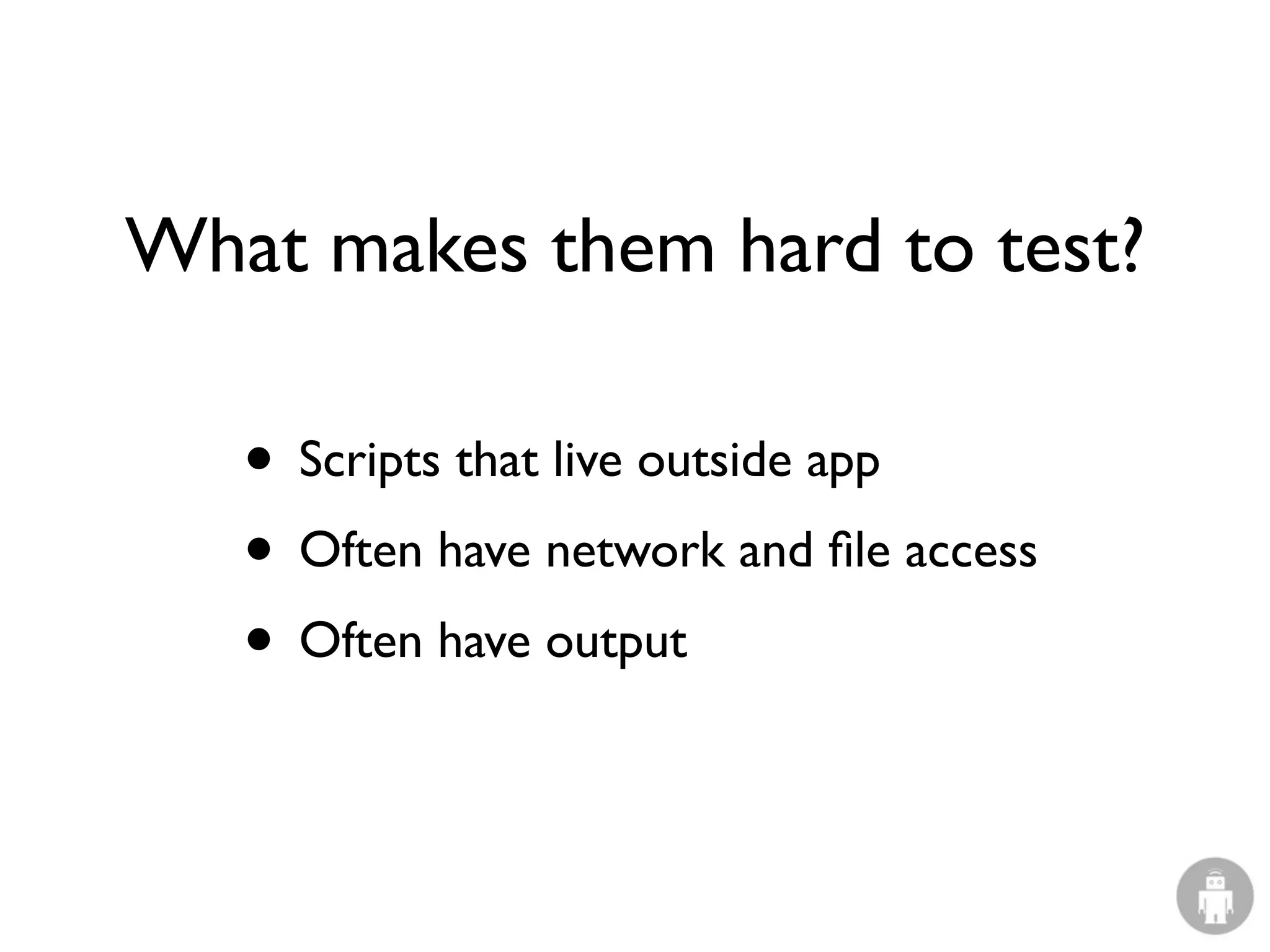
What makes them hard to test?

   • Scripts that live outside app
   • Often have network and file access
   • Often have output
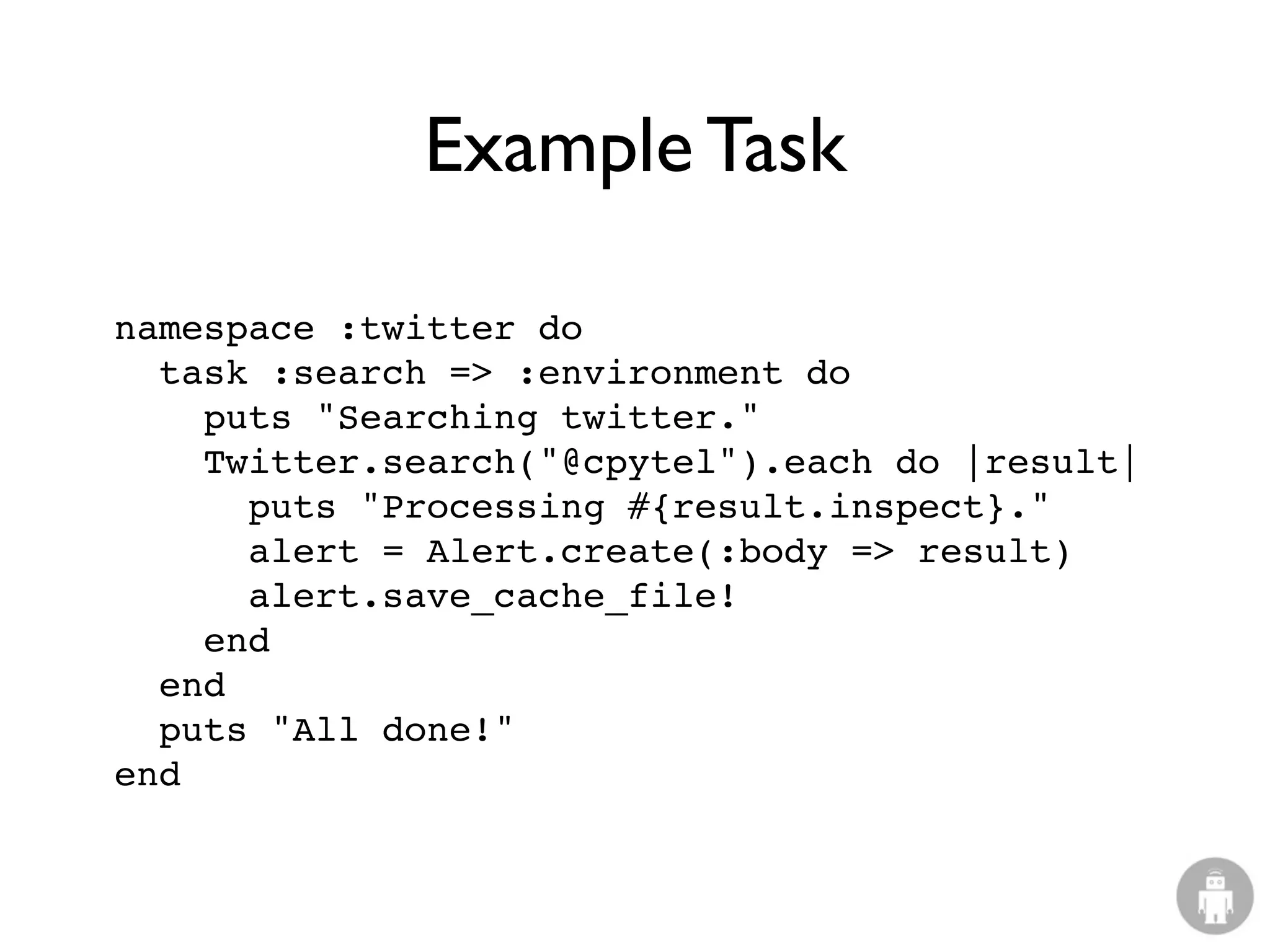
Example Task

namespace :twitter do
  task :search => :environment do
    puts "Searching twitter."
    Twitter.search("@cpytel").each do |result|
      puts "Processing #{result.inspect}."
      alert = Alert.create(:body => result)
      alert.save_cache_file!
    end
  end
  puts "All done!"
end
One possible way to test
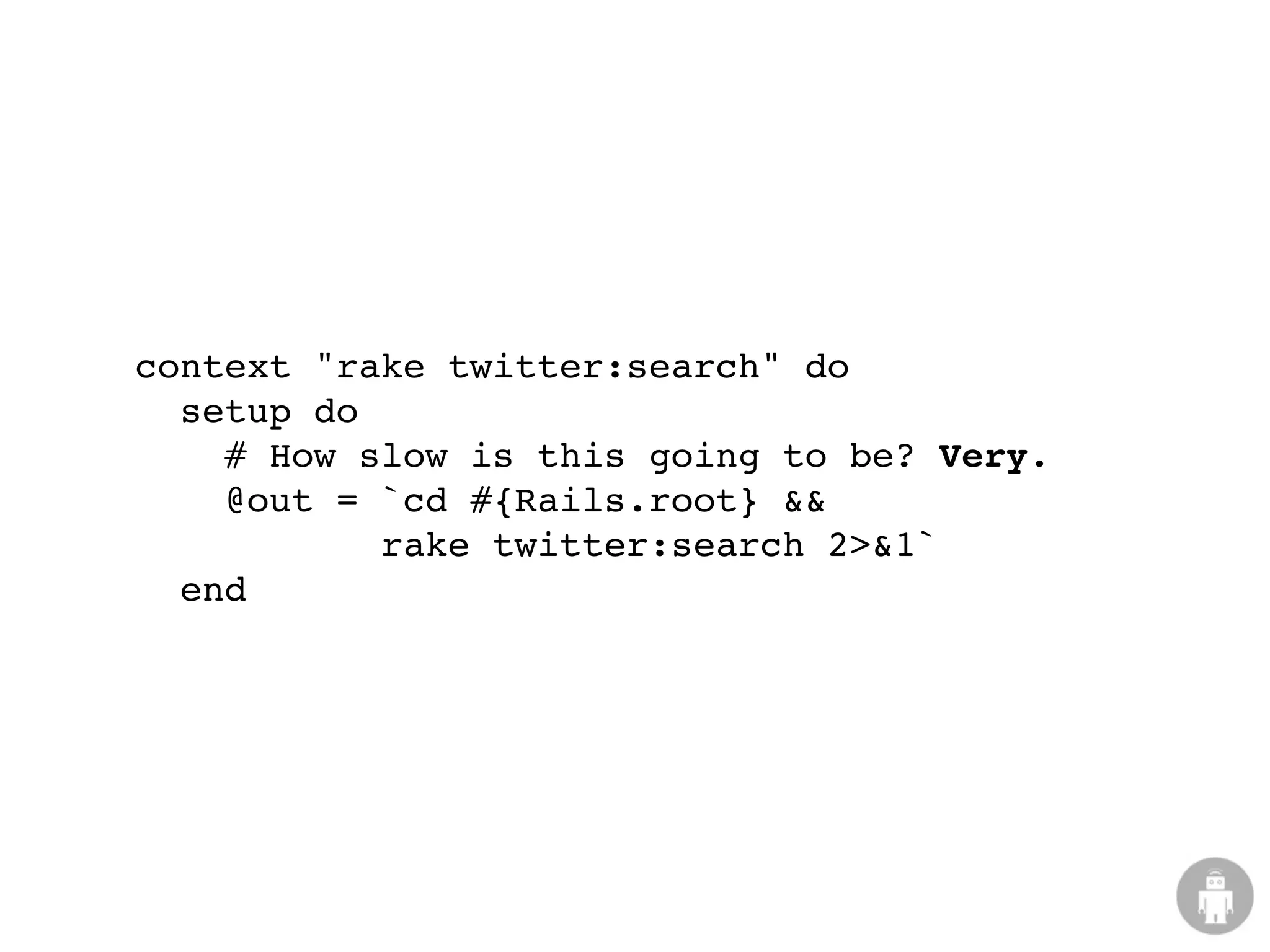
context "rake twitter:search" do
  setup do
    # How slow is this going to be? Very.
    @out = `cd #{Rails.root} &&
           rake twitter:search 2>&1`
  end
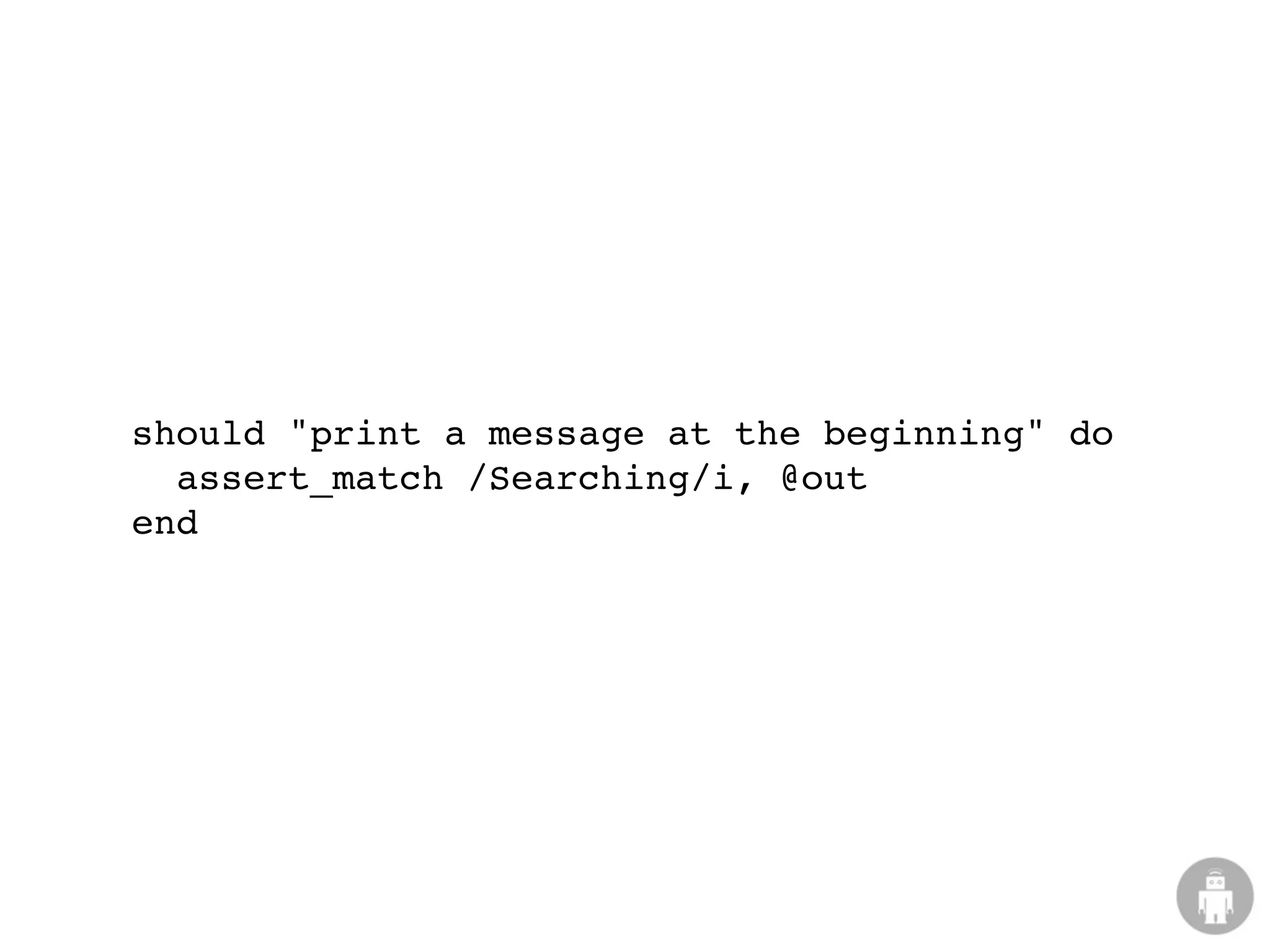
should "print a message at the beginning" do
  assert_match /Searching/i, @out
end
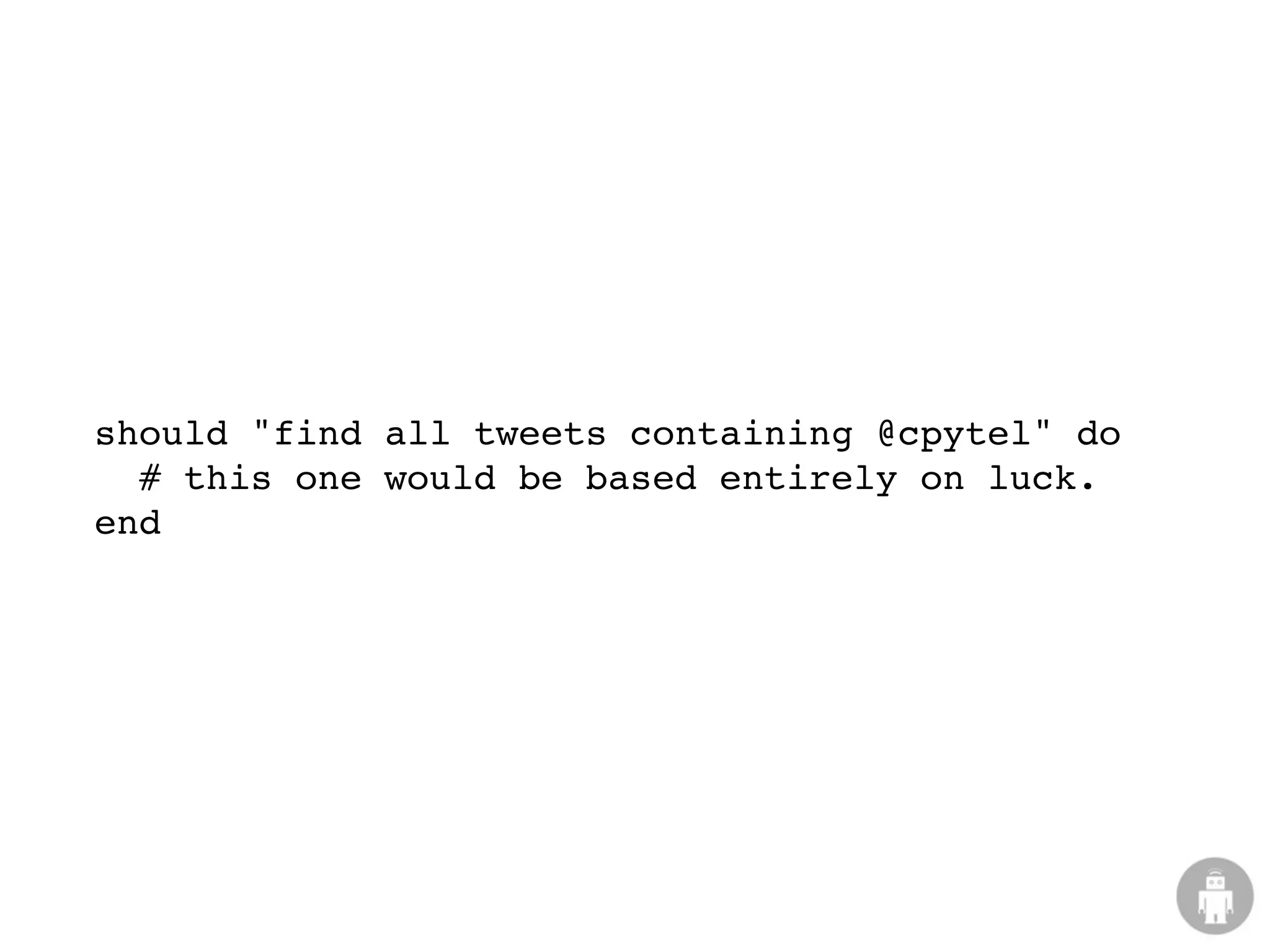
should "find all tweets containing @cpytel" do
  # this one would be based entirely on luck.
end
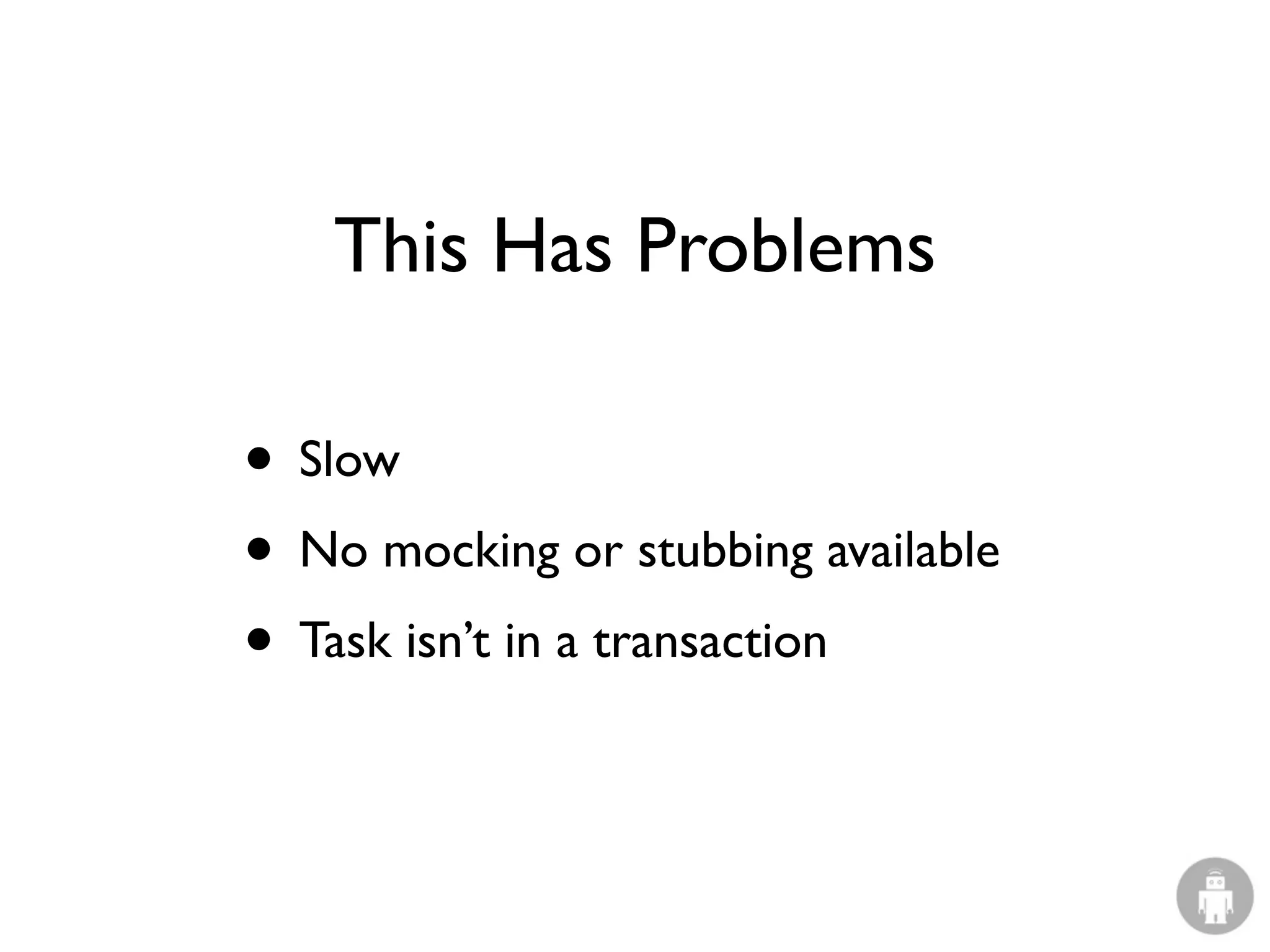
This Has Problems

• Slow
• No mocking or stubbing available
• Task isn’t in a transaction
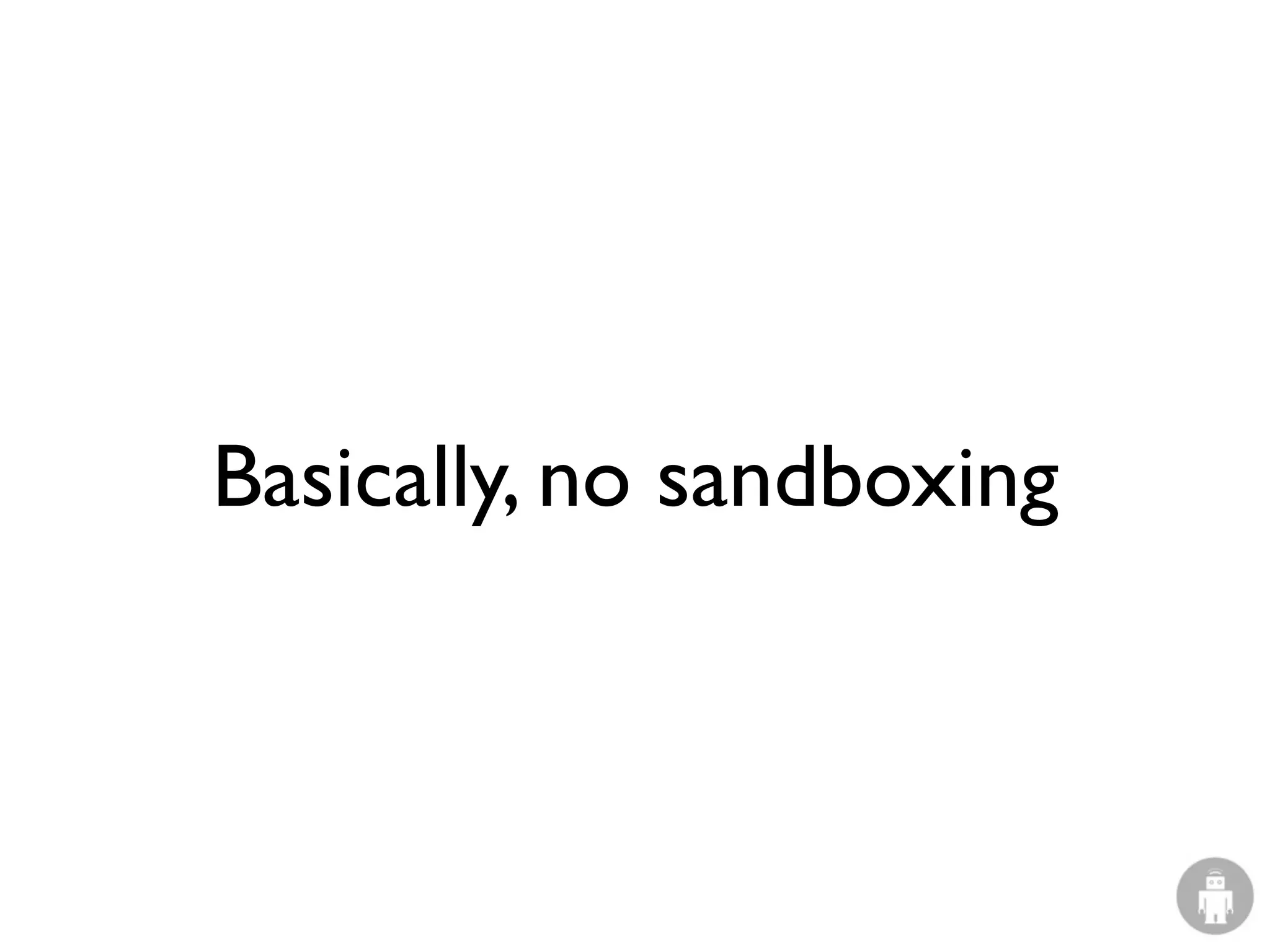
Basically, no sandboxing
How do we fix this?
Rake tasks are just Ruby
Move it all into the Model
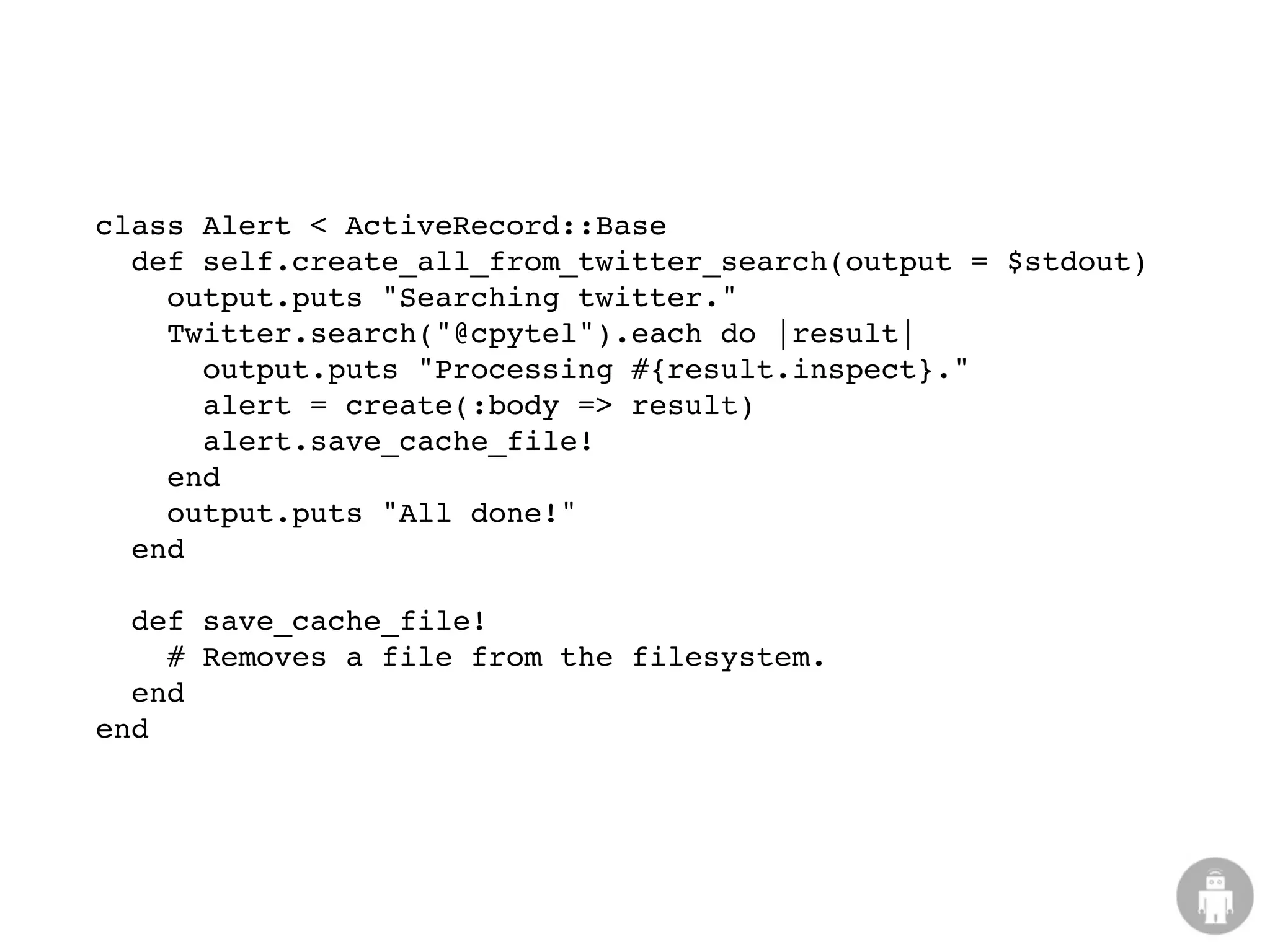
class Alert < ActiveRecord::Base
  def self.create_all_from_twitter_search(output = $stdout)
    output.puts "Searching twitter."
    Twitter.search("@cpytel").each do |result|
      output.puts "Processing #{result.inspect}."
      alert = create(:body => result)
      alert.save_cache_file!
    end
    output.puts "All done!"
  end

  def save_cache_file!
    # Removes a file from the filesystem.
  end
end
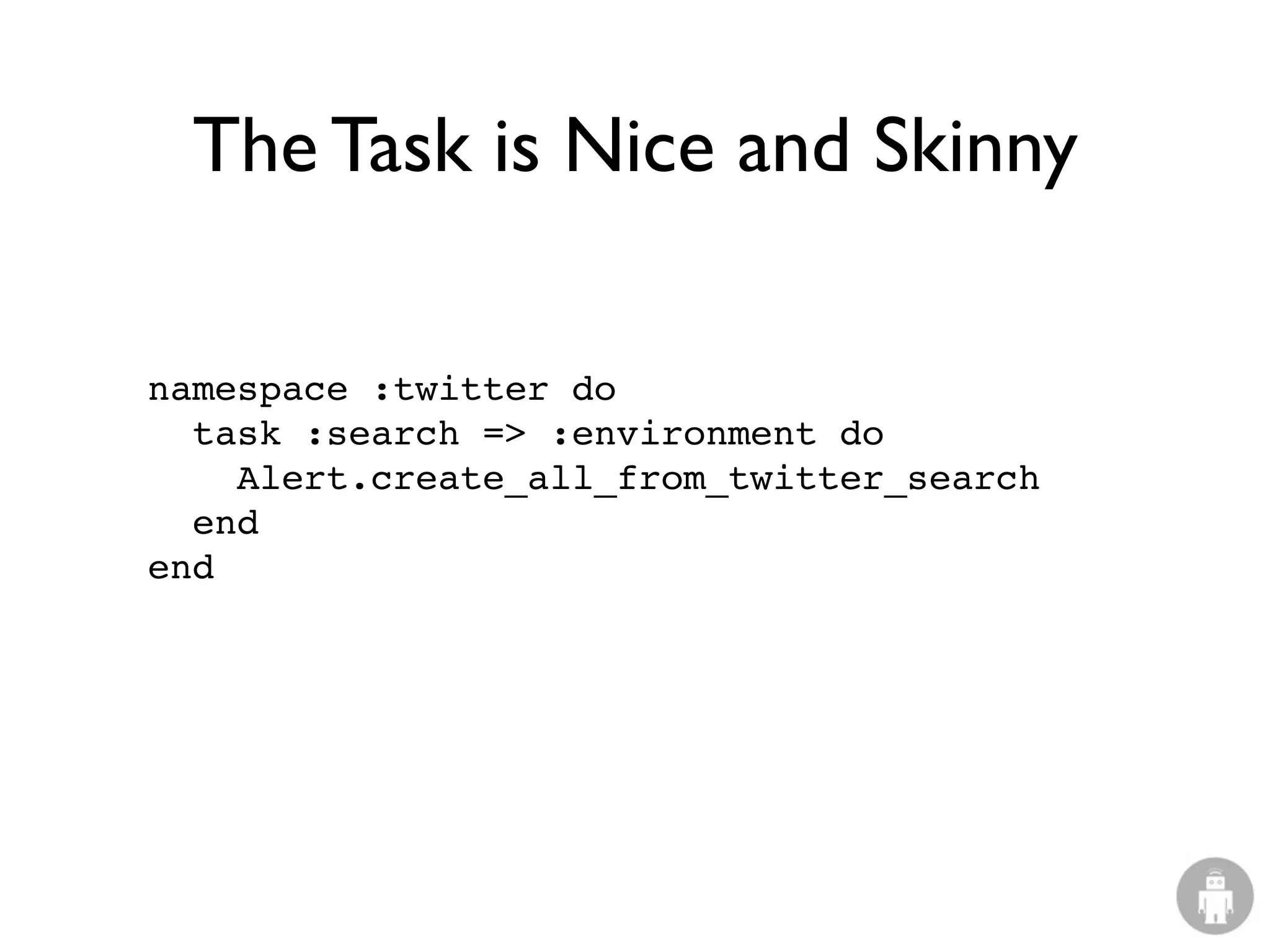
The Task is Nice and Skinny

namespace :twitter do
  task :search => :environment do
    Alert.create_all_from_twitter_search
  end
end
Testing is Pretty Normal

# test/unit/alert_test.rb
class AlertTest < ActiveSupport::TestCase
  context "create_all_from_twitter_search" do
    setup do
      # Make sure none of the tests below hit the
      # network or touch the filesystem.
      Alert.any_instance.stubs(:save_cache_file!)
      Twitter.stubs(:search).returns([])
      @output = StringIO.new
    end
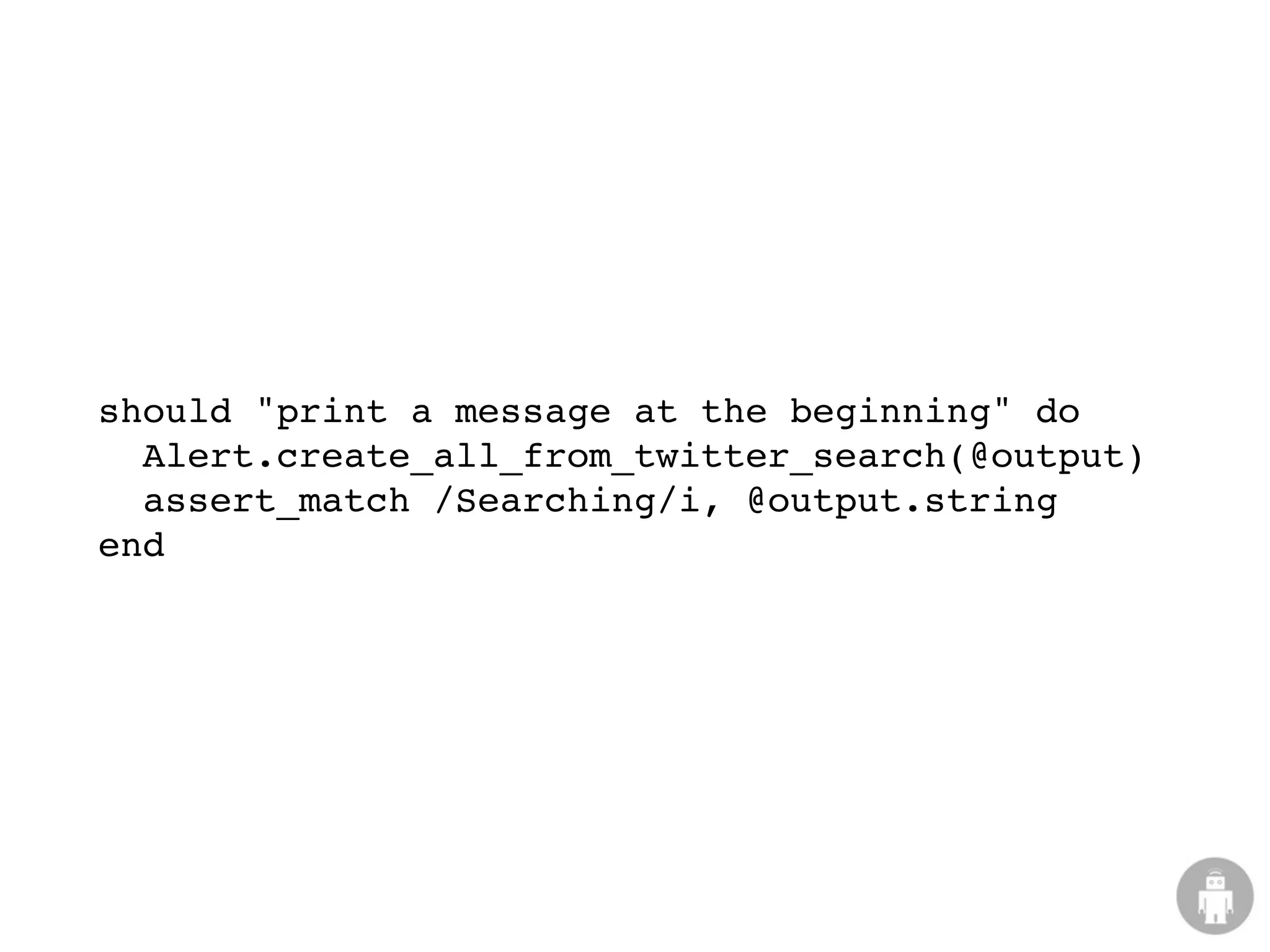
should "print a message at the beginning" do
  Alert.create_all_from_twitter_search(@output)
  assert_match /Searching/i, @output.string
end
should "save some cache files" do
  Twitter.stubs(:search).returns(["one"])
  alert = mock("alert")
  alert.expects(:save_cache_file!)
  Alert.stubs(:create).returns(alert)
  Alert.create_all_from_twitter_search(@output)
end
should "find all tweets containing @cpytel" do
  Twitter.expects(:search).
          with("@cpytel").
          returns(["body"])
  Alert.create_all_from_twitter_search(@output)
end
We can mock and stub!
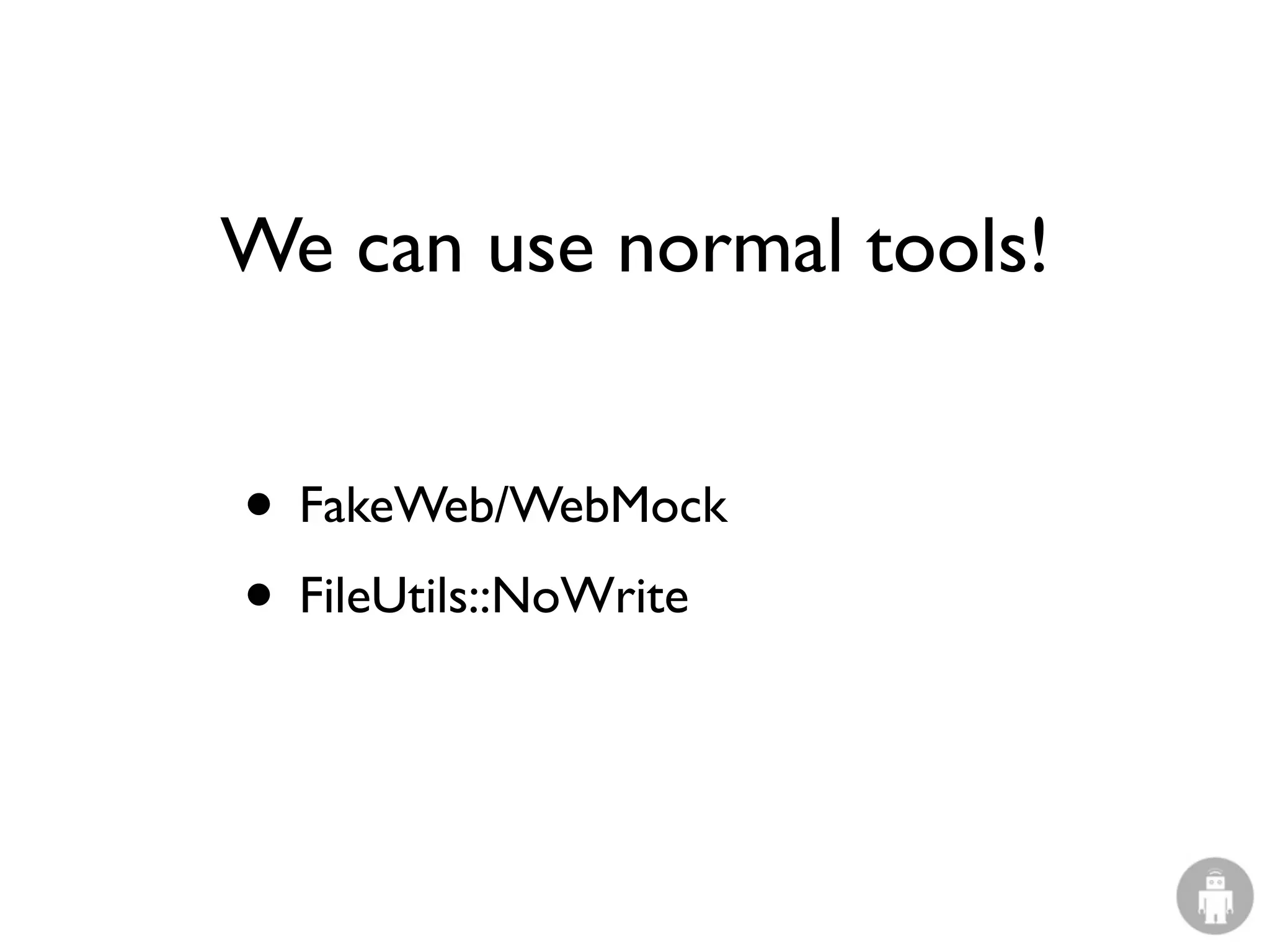
We can use normal tools!


• FakeWeb/WebMock
• FileUtils::NoWrite
In Summary

• You can test drive development of
  your rake tasks
• Rake tasks should live inside a
  model (or class)
Views
Know Your Helpers
Know How They Change
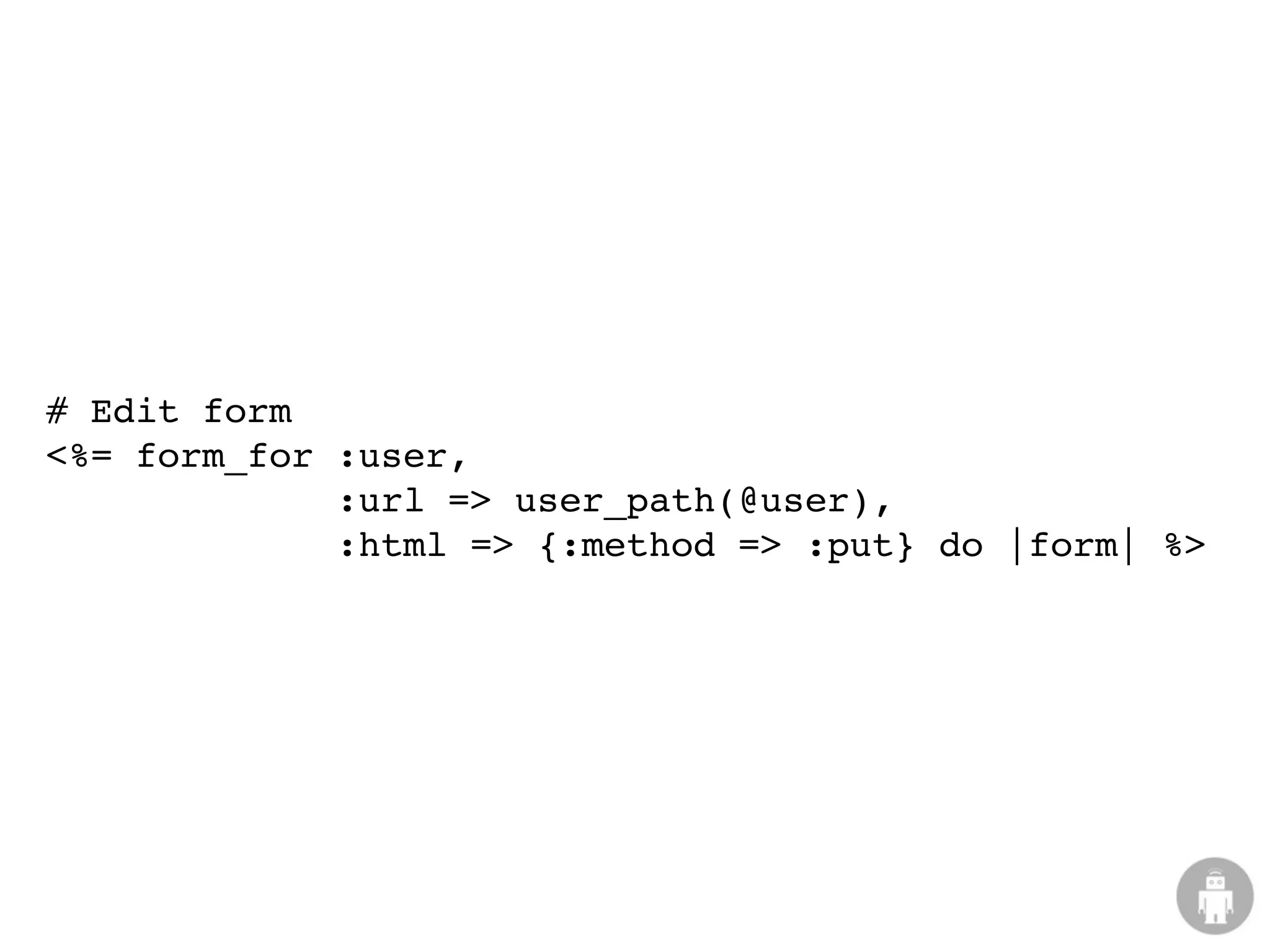
# Edit form
<%= form_for :user,
             :url => user_path(@user),
             :html => {:method => :put} do |form| %>
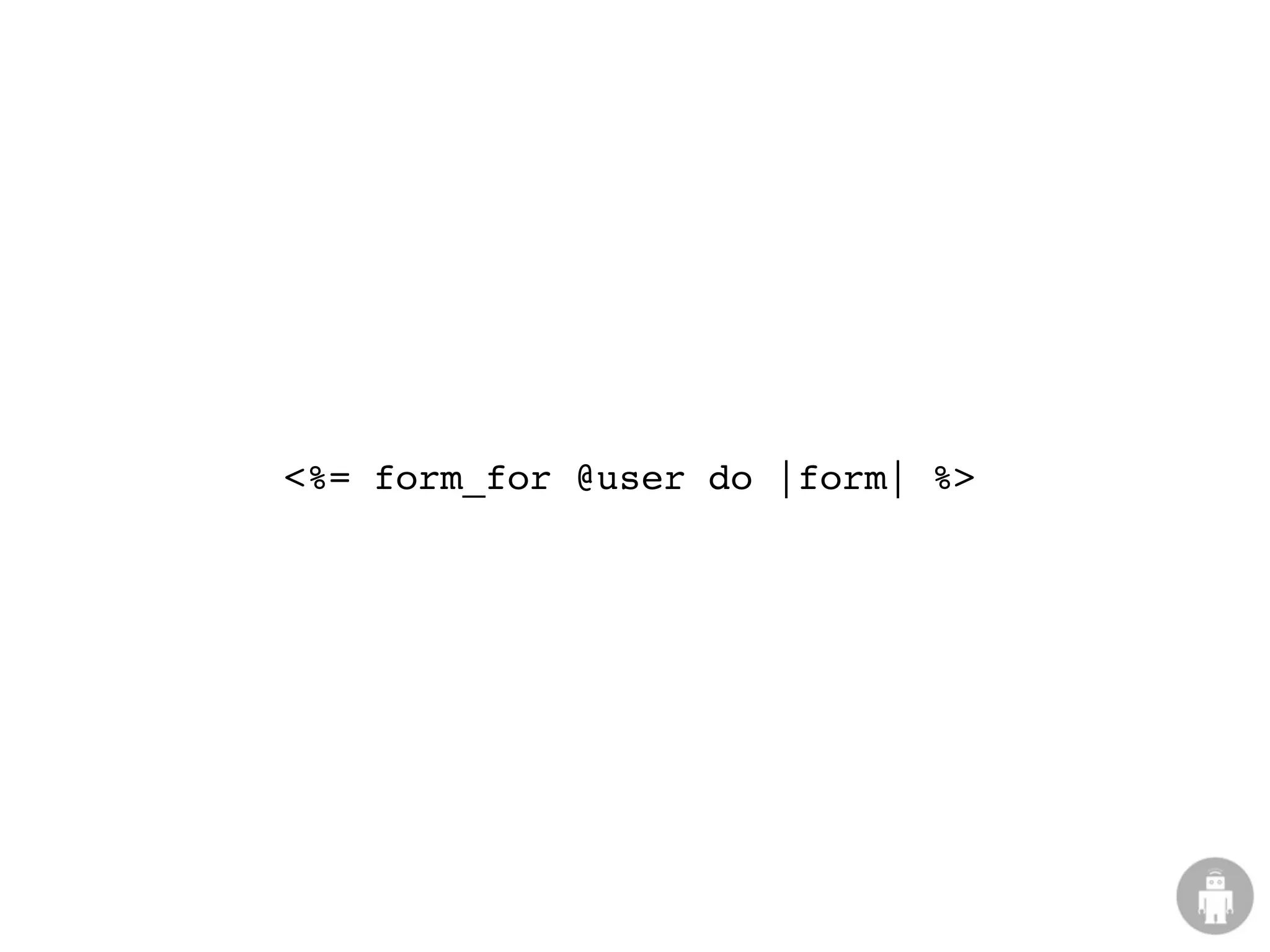
<%= form_for @user do |form| %>
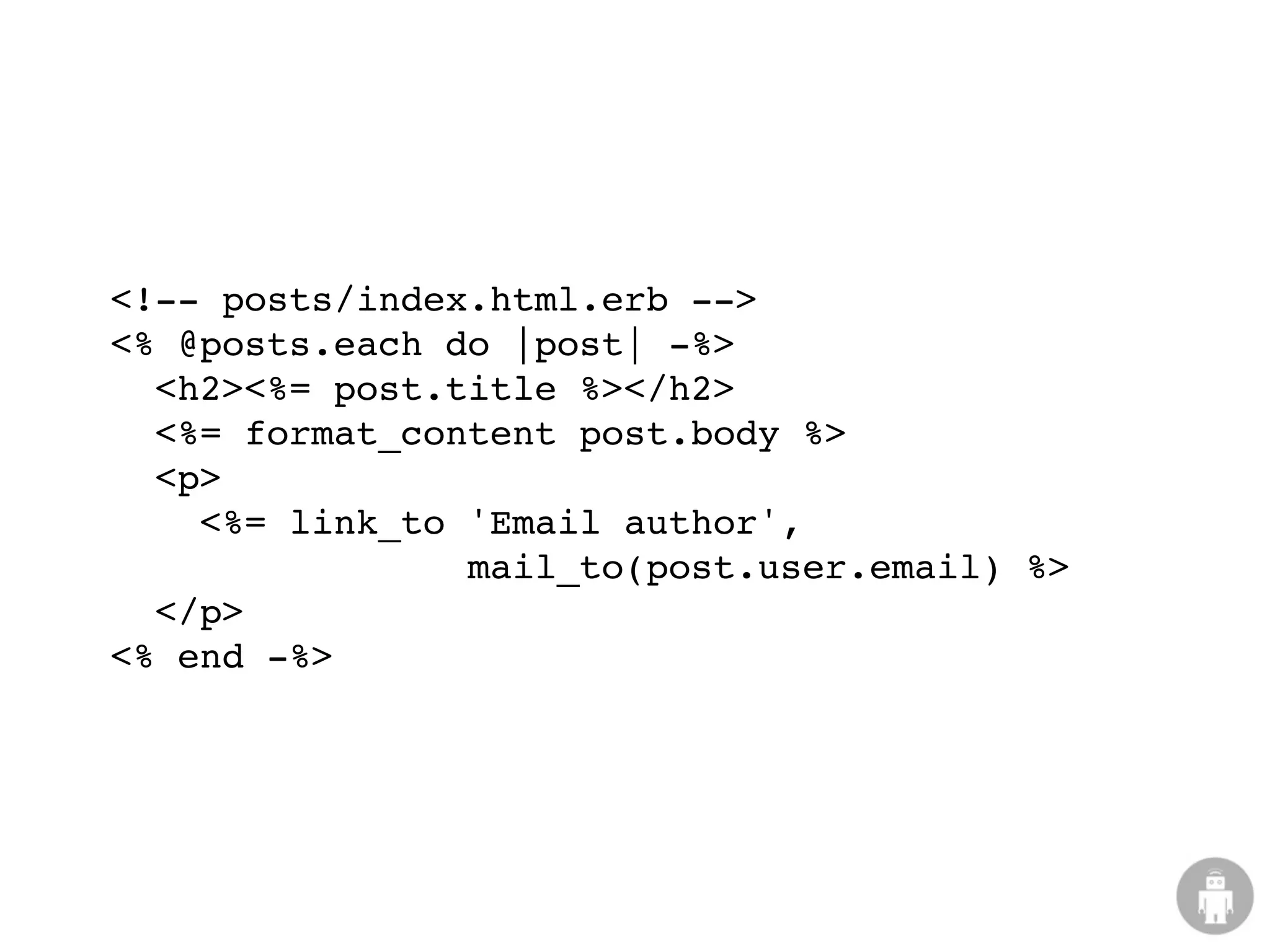
<!-- posts/index.html.erb -->
<% @posts.each do |post| -%>
  <h2><%= post.title %></h2>
  <%= format_content post.body %>
  <p>
    <%= link_to 'Email author',
                mail_to(post.user.email) %>
  </p>
<% end -%>
Move the post content
    into a partial
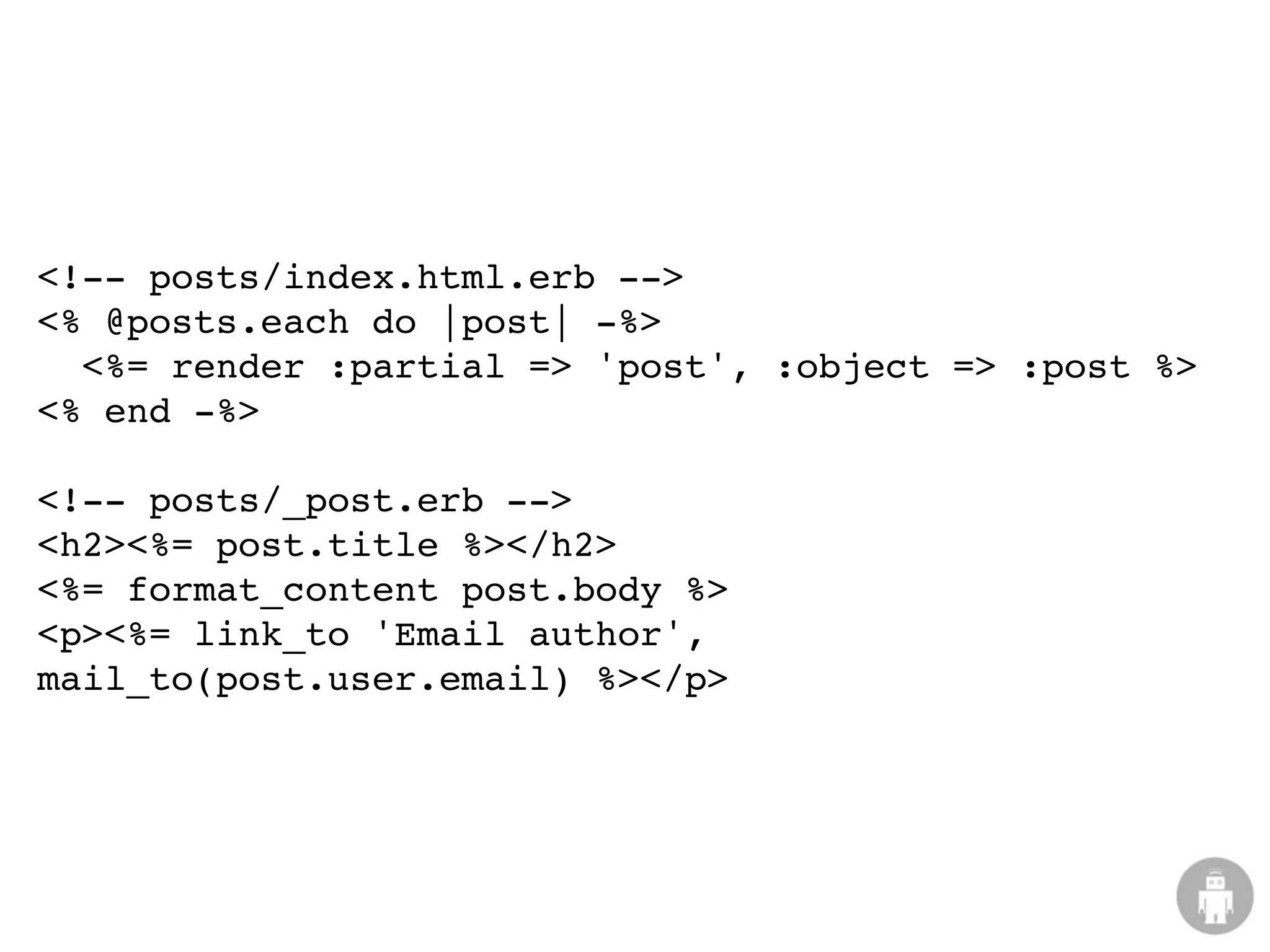
<!-- posts/index.html.erb -->
<% @posts.each do |post| -%>
  <%= render :partial => 'post', :object => :post %>
<% end -%>

<!-- posts/_post.erb -->
<h2><%= post.title %></h2>
<%= format_content post.body %>
<p><%= link_to 'Email author',
mail_to(post.user.email) %></p>
Looping was built
  into render
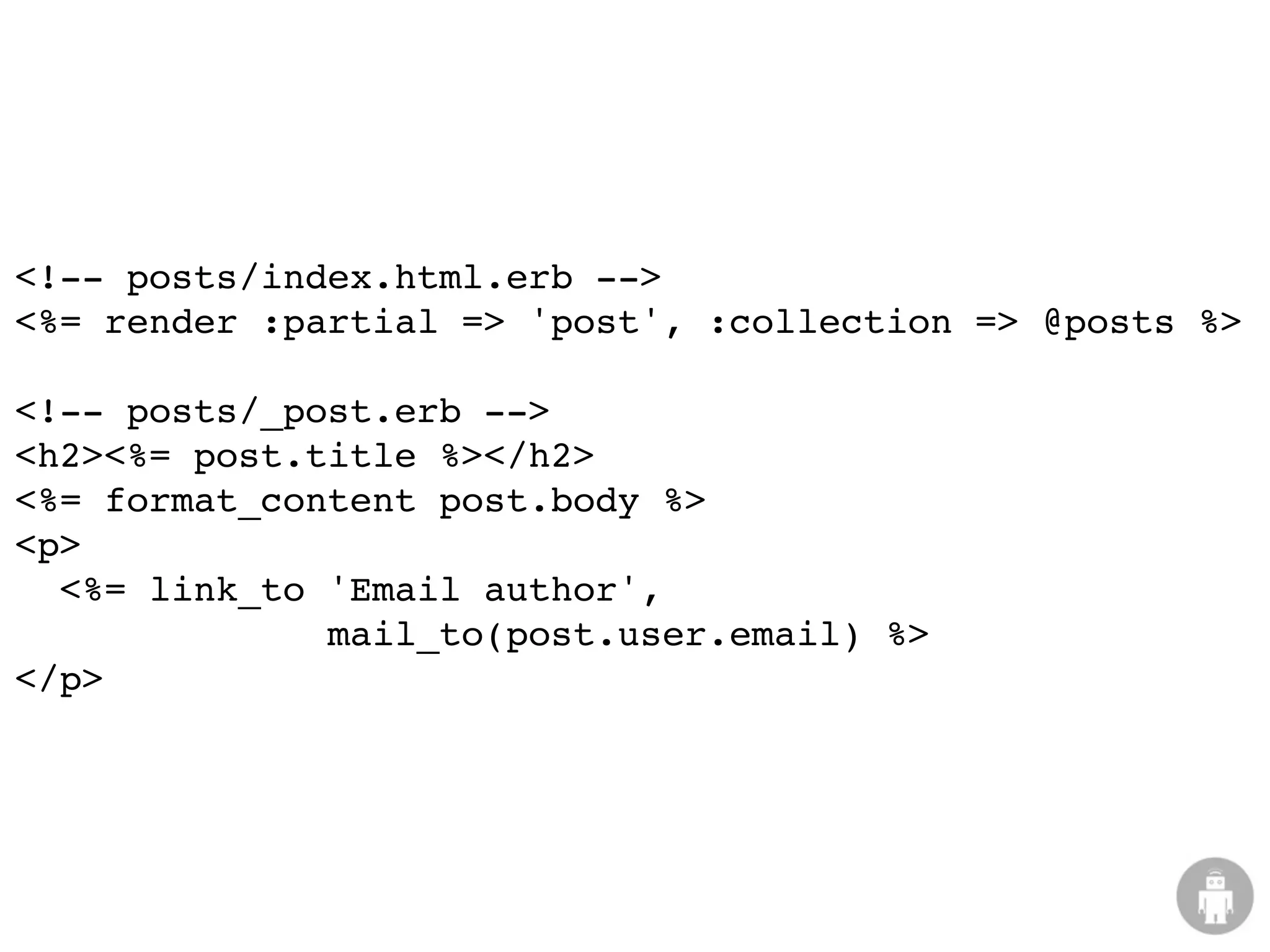
<!-- posts/index.html.erb -->
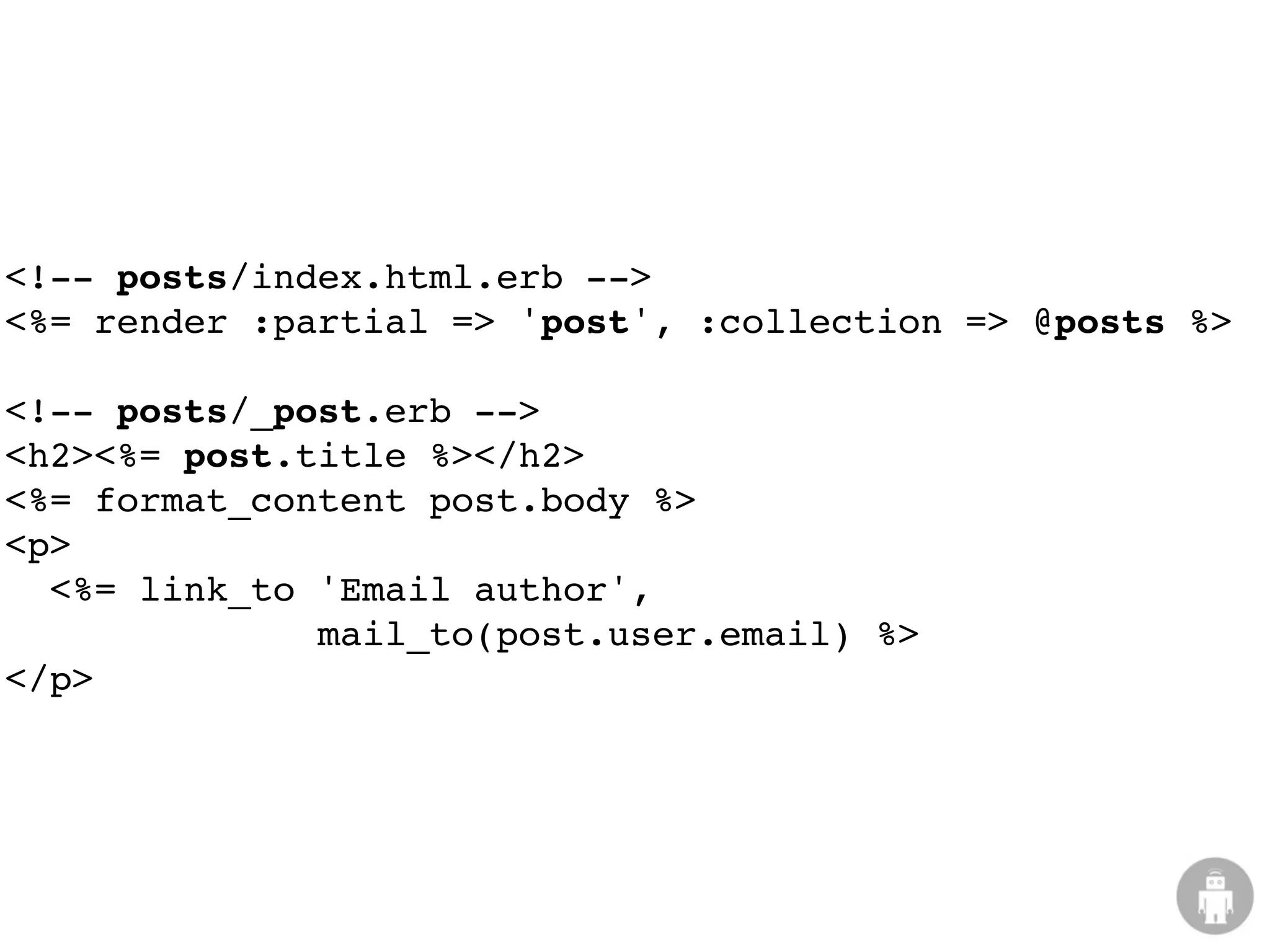
<%= render :partial => 'post', :collection => @posts %>

<!-- posts/_post.erb -->
<h2><%= post.title %></h2>
<%= format_content post.body %>
<p>
  <%= link_to 'Email author',
              mail_to(post.user.email) %>
</p>
<!-- posts/index.html.erb -->
<%= render :partial => 'post', :collection => @posts %>

<!-- posts/_post.erb -->
<h2><%= post.title %></h2>
<%= format_content post.body %>
<p>
  <%= link_to 'Email author',
              mail_to(post.user.email) %>
</p>
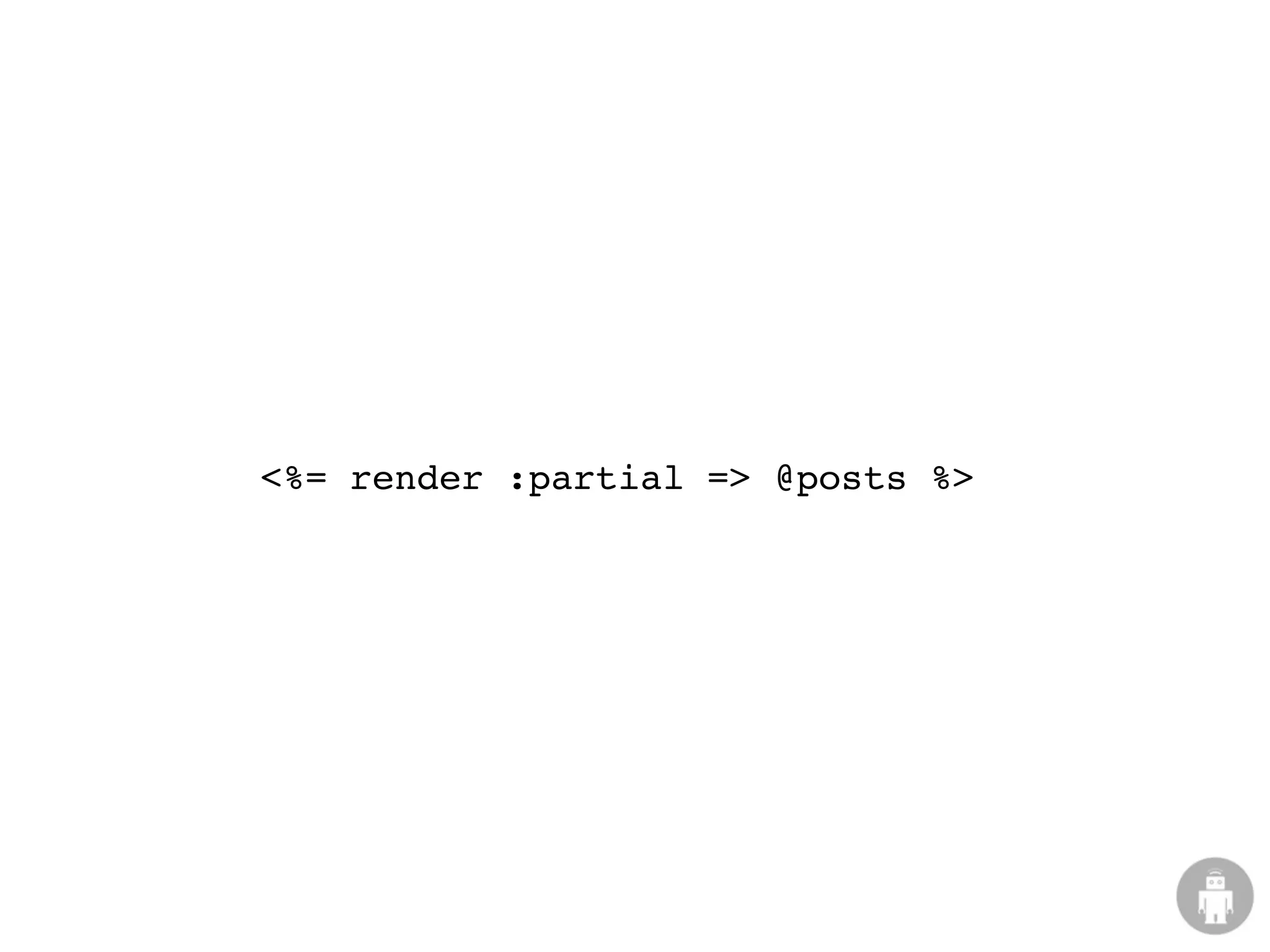
<%= render :partial => @posts %>
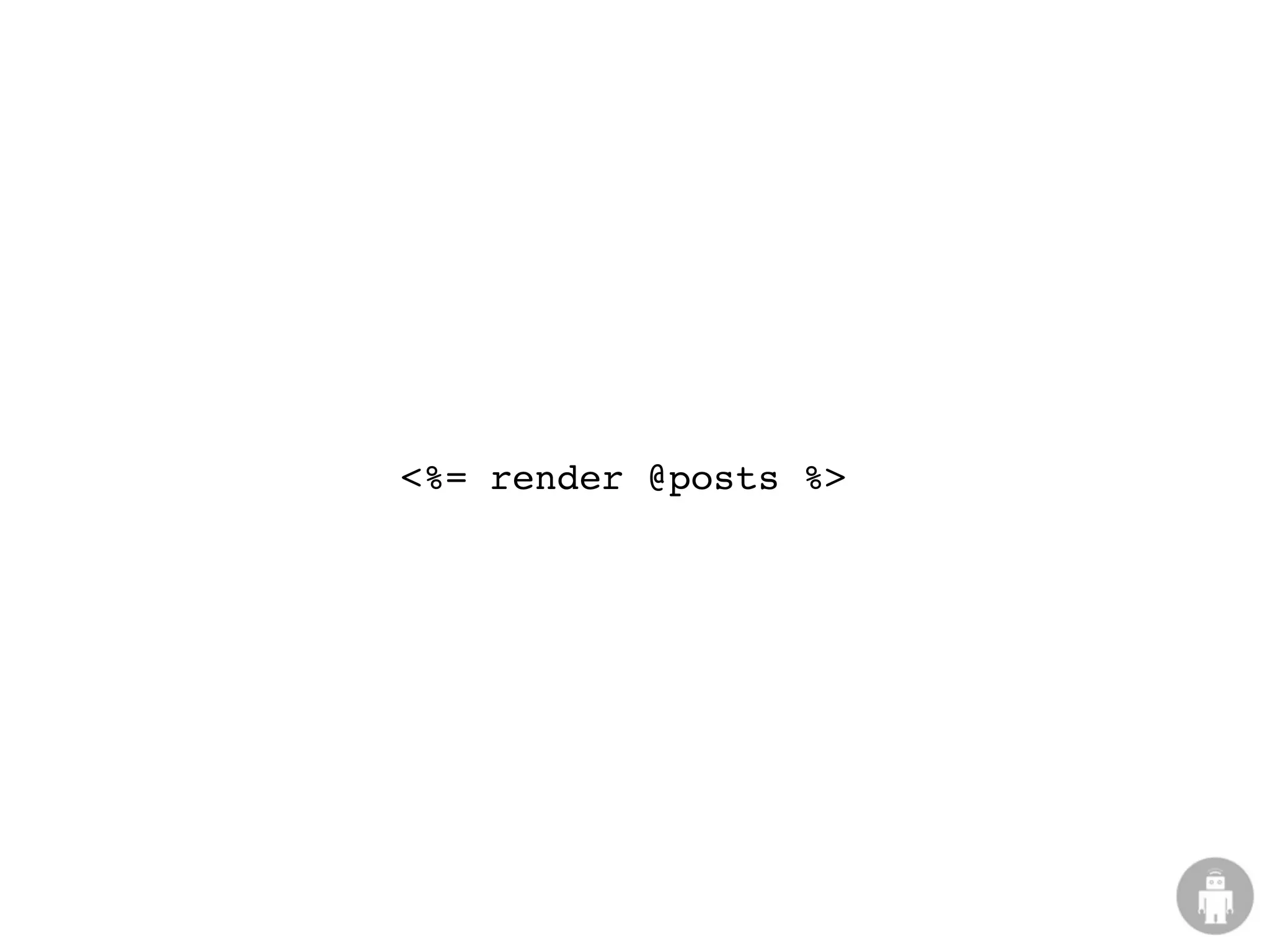
<%= render @posts %>
Dynamic Page Titles
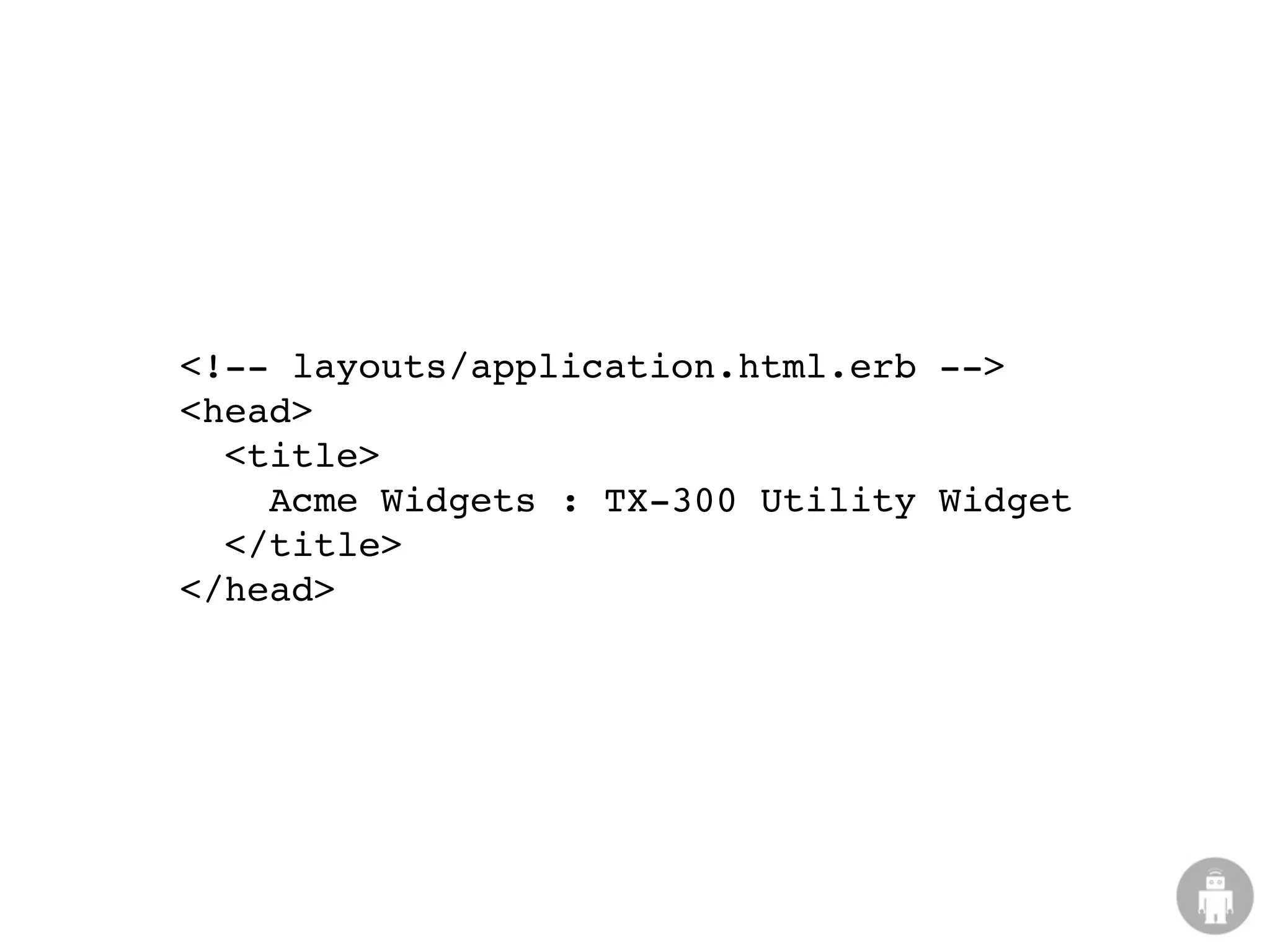
<!-- layouts/application.html.erb -->
<head>
  <title>
    Acme Widgets : TX-300 Utility Widget
  </title>
</head>
class PagesController < ApplicationController
  def show
    @widget = Widgets.find(params[:id])
    @title = @widget.name
  end
end

<!-- layouts/application.html.erb -->
<head>
  <title>Acme Widgets : <%= @title %></title>
</head>
This is all View
There is a Helper
<!-- layouts/application.html.erb -->
<head>
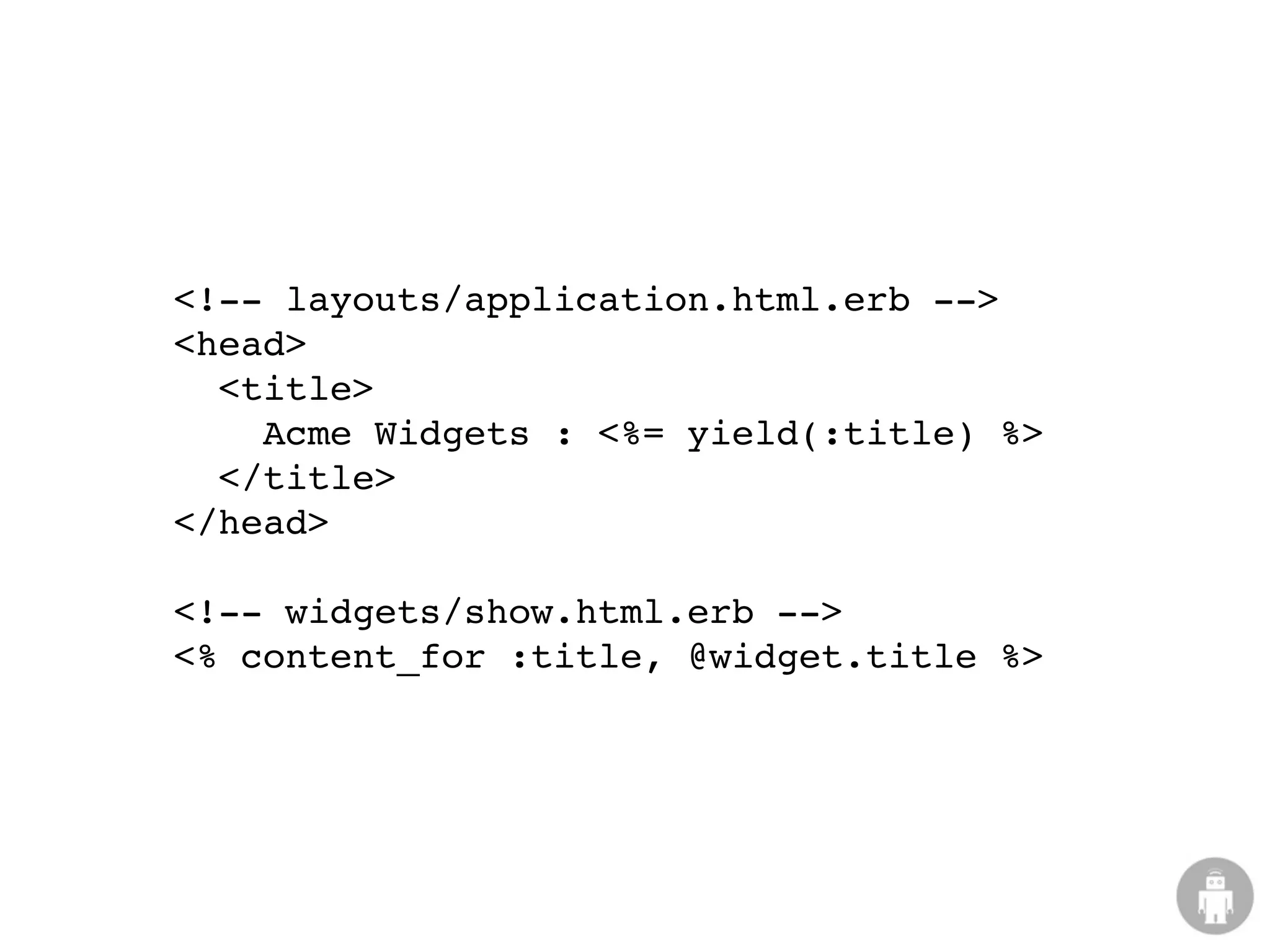
  <title>
    Acme Widgets : <%= yield(:title) %>
  </title>
</head>

<!-- widgets/show.html.erb -->
<% content_for :title, @widget.title %>
Default Title
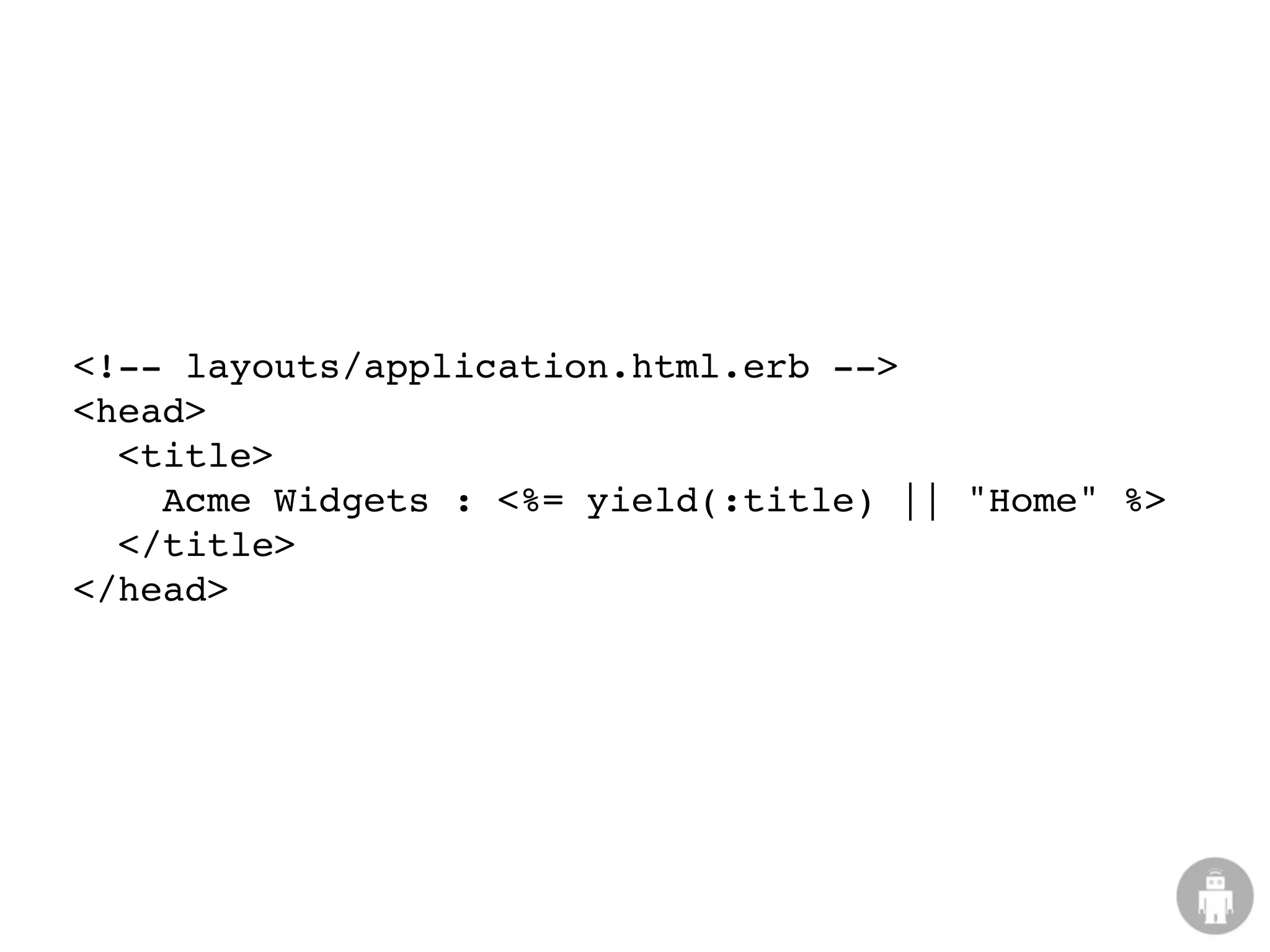
<!-- layouts/application.html.erb -->
<head>
  <title>
    Acme Widgets : <%= yield(:title) || "Home" %>
  </title>
</head>
What else can we use
      this for?
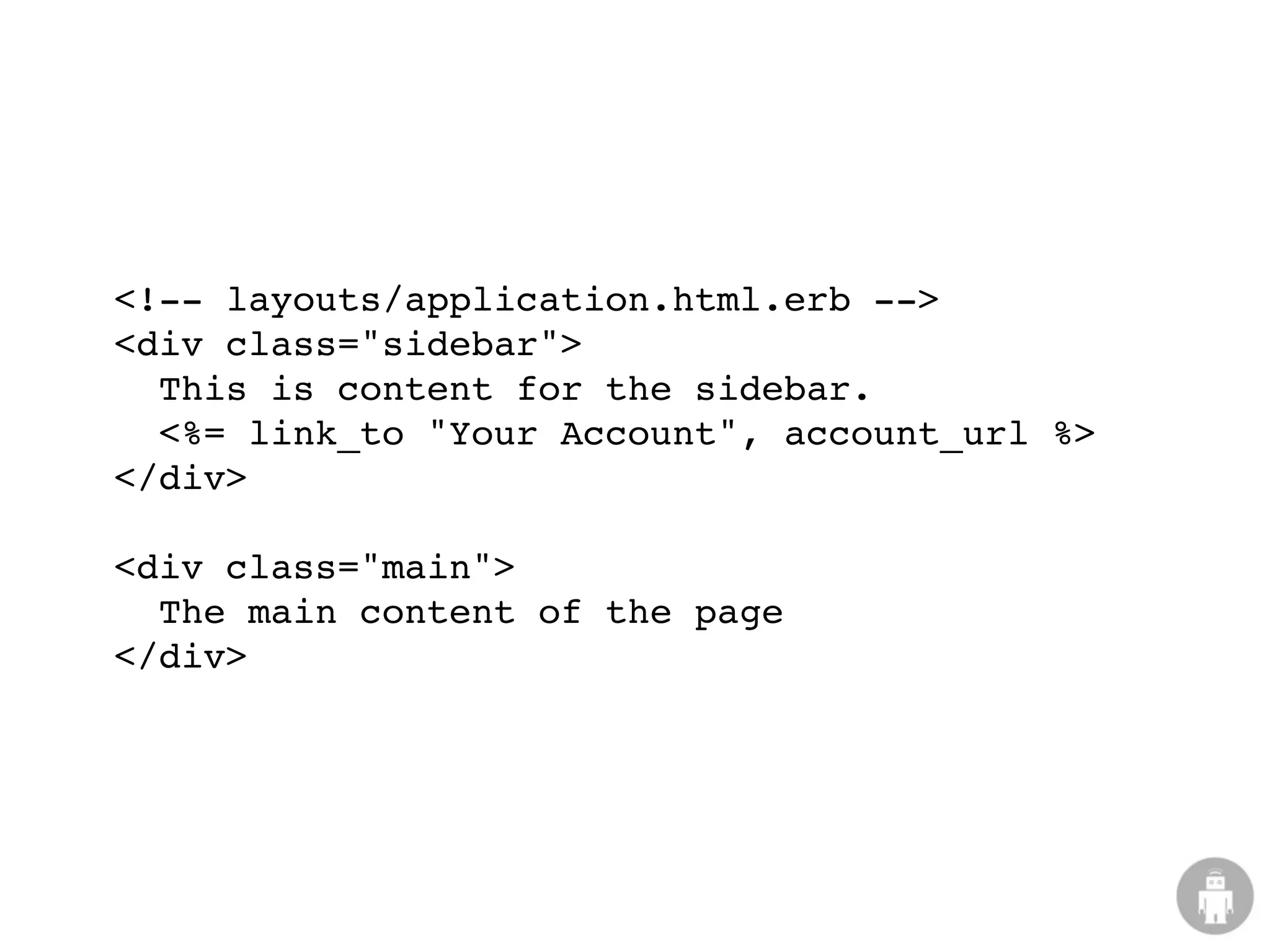
<!-- layouts/application.html.erb -->
<div class="sidebar">
  This is content for the sidebar.
  <%= link_to "Your Account", account_url %>
</div>

<div class="main">
  The main content of the page
</div>
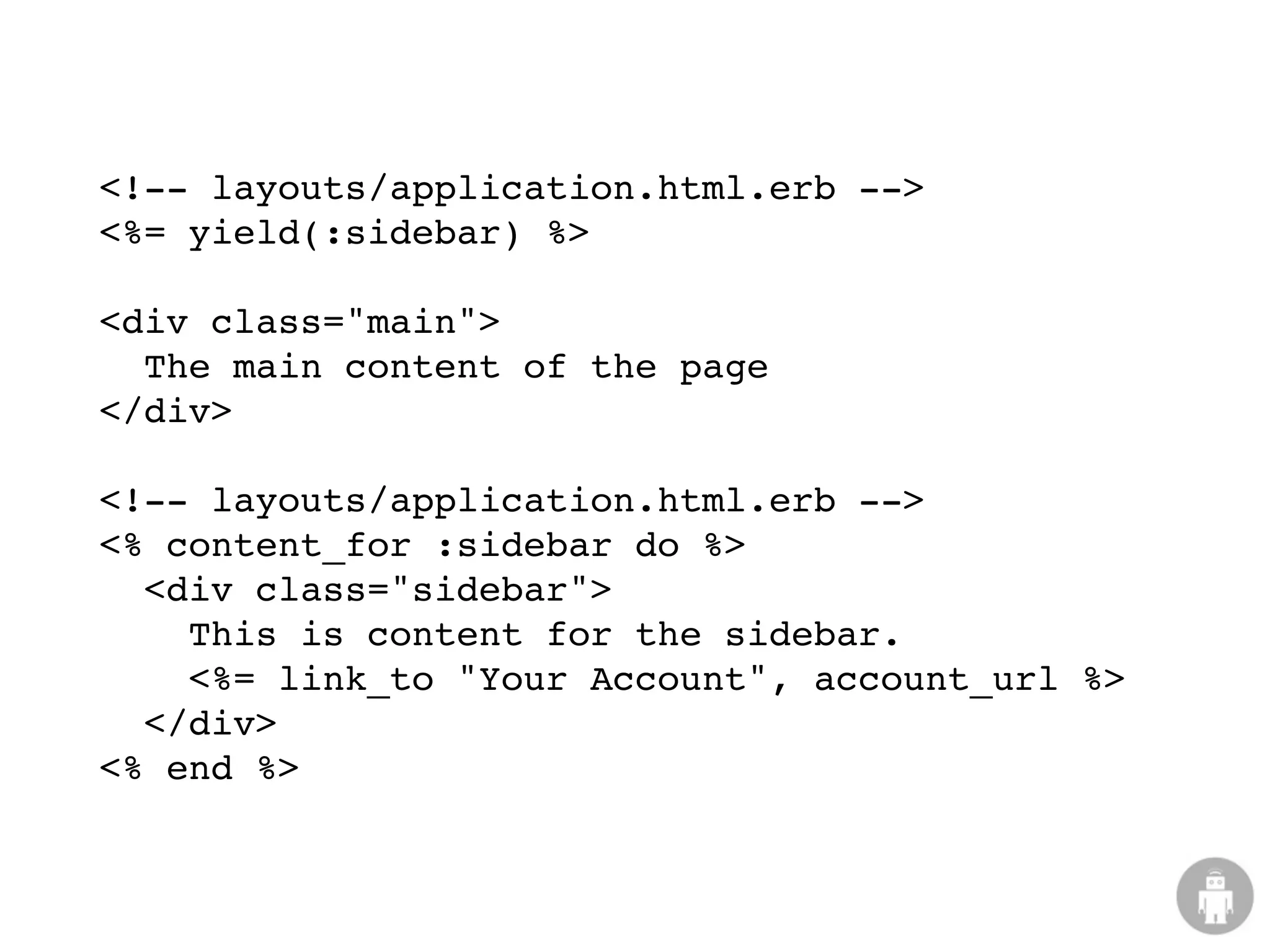
<!-- layouts/application.html.erb -->
<%= yield(:sidebar) %>

<div class="main">
  The main content of the page
</div>

<!-- layouts/application.html.erb -->
<% content_for :sidebar do %>
  <div class="sidebar">
    This is content for the sidebar.
    <%= link_to "Your Account", account_url %>
  </div>
<% end %>
Avoid Duplication
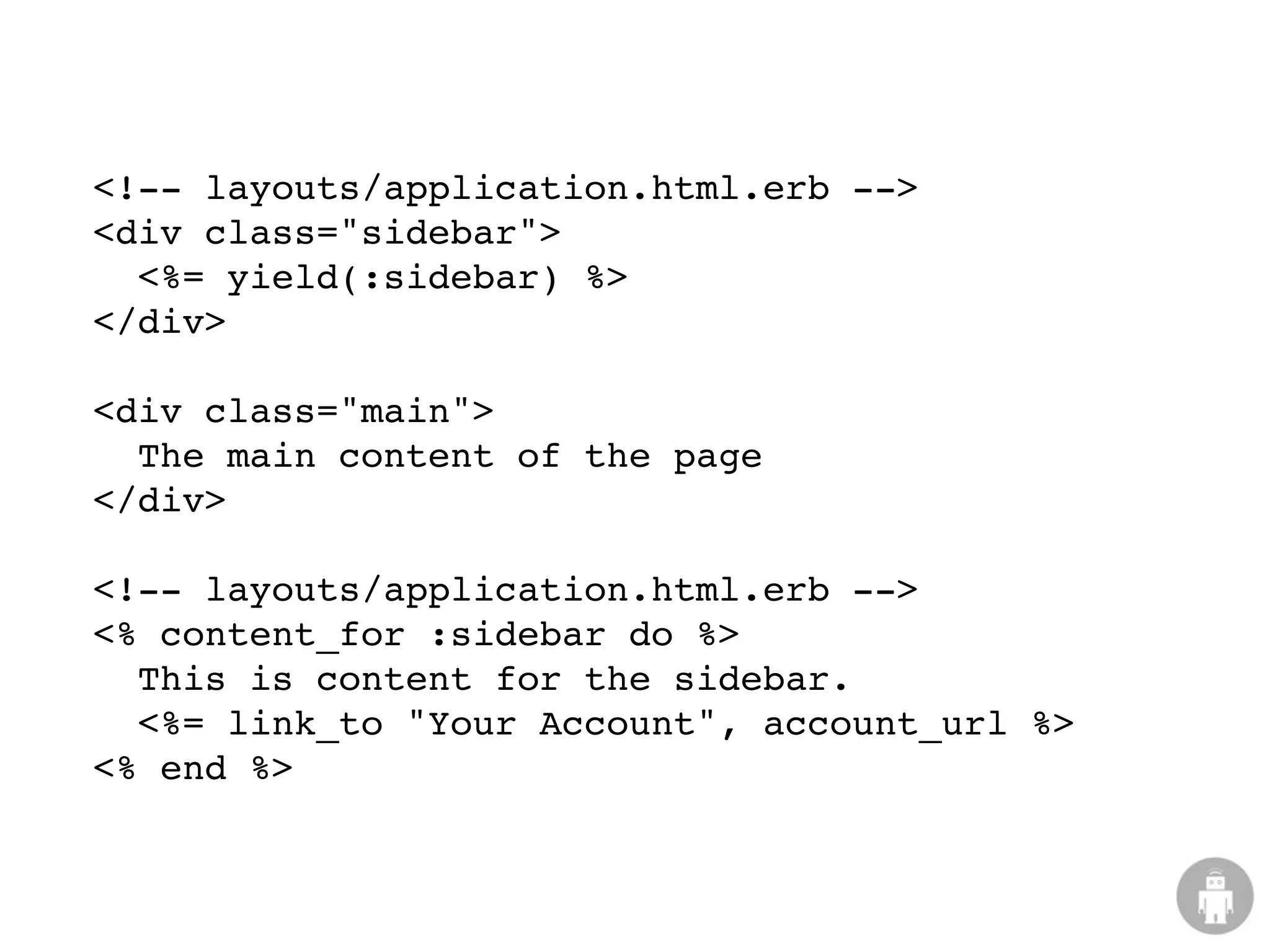
<!-- layouts/application.html.erb -->
<div class="sidebar">
  <%= yield(:sidebar) %>
</div>

<div class="main">
  The main content of the page
</div>

<!-- layouts/application.html.erb -->
<% content_for :sidebar do %>
  This is content for the sidebar.
  <%= link_to "Your Account", account_url %>
<% end %>
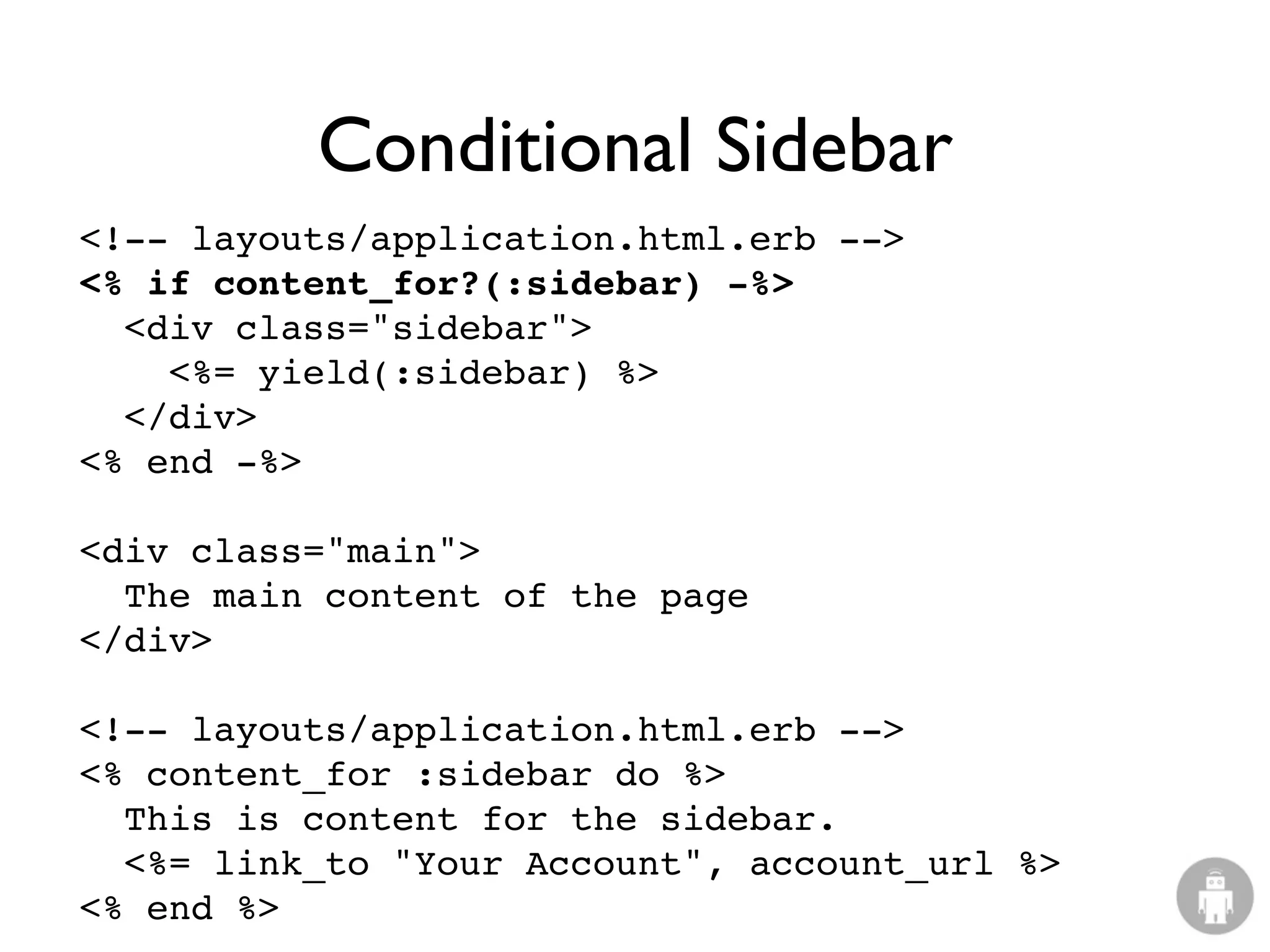
Conditional Sidebar
<!-- layouts/application.html.erb -->
<% if content_for?(:sidebar) -%>
  <div class="sidebar">
    <%= yield(:sidebar) %>
  </div>
<% end -%>

<div class="main">
  The main content of the page
</div>

<!-- layouts/application.html.erb -->
<% content_for :sidebar do %>
  This is content for the sidebar.
  <%= link_to "Your Account", account_url %>
<% end %>
Reviews/Refactoring

You're Doing It Wrong

  • 1.
    You’re Doing ItWrong Chad Pytel cpytel@thoughtbot.com @cpytel
  • 2.
    You’re Doing ItWrong but I love you anyway Chad Pytel cpytel@thoughtbot.com @cpytel
  • 3.
  • 4.
  • 5.
    What makes themhard to test? • Scripts that live outside app • Often have network and file access • Often have output
  • 6.
    Example Task namespace :twitterdo task :search => :environment do puts "Searching twitter." Twitter.search("@cpytel").each do |result| puts "Processing #{result.inspect}." alert = Alert.create(:body => result) alert.save_cache_file! end end puts "All done!" end
  • 7.
  • 8.
    context "rake twitter:search"do setup do # How slow is this going to be? Very. @out = `cd #{Rails.root} && rake twitter:search 2>&1` end
  • 9.
    should "print amessage at the beginning" do assert_match /Searching/i, @out end
  • 10.
    should "find alltweets containing @cpytel" do # this one would be based entirely on luck. end
  • 11.
    This Has Problems •Slow • No mocking or stubbing available • Task isn’t in a transaction
  • 12.
  • 13.
    How do wefix this?
  • 14.
    Rake tasks arejust Ruby
  • 15.
    Move it allinto the Model
  • 16.
    class Alert <ActiveRecord::Base def self.create_all_from_twitter_search(output = $stdout) output.puts "Searching twitter." Twitter.search("@cpytel").each do |result| output.puts "Processing #{result.inspect}." alert = create(:body => result) alert.save_cache_file! end output.puts "All done!" end def save_cache_file! # Removes a file from the filesystem. end end
  • 17.
    The Task isNice and Skinny namespace :twitter do task :search => :environment do Alert.create_all_from_twitter_search end end
  • 18.
    Testing is PrettyNormal # test/unit/alert_test.rb class AlertTest < ActiveSupport::TestCase context "create_all_from_twitter_search" do setup do # Make sure none of the tests below hit the # network or touch the filesystem. Alert.any_instance.stubs(:save_cache_file!) Twitter.stubs(:search).returns([]) @output = StringIO.new end
  • 19.
    should "print amessage at the beginning" do Alert.create_all_from_twitter_search(@output) assert_match /Searching/i, @output.string end
  • 20.
    should "save somecache files" do Twitter.stubs(:search).returns(["one"]) alert = mock("alert") alert.expects(:save_cache_file!) Alert.stubs(:create).returns(alert) Alert.create_all_from_twitter_search(@output) end
  • 21.
    should "find alltweets containing @cpytel" do Twitter.expects(:search). with("@cpytel"). returns(["body"]) Alert.create_all_from_twitter_search(@output) end
  • 22.
    We can mockand stub!
  • 23.
    We can usenormal tools! • FakeWeb/WebMock • FileUtils::NoWrite
  • 24.
    In Summary • Youcan test drive development of your rake tasks • Rake tasks should live inside a model (or class)
  • 25.
  • 26.
  • 27.
  • 28.
    # Edit form <%=form_for :user, :url => user_path(@user), :html => {:method => :put} do |form| %>
  • 29.
    <%= form_for @userdo |form| %>
  • 30.
    <!-- posts/index.html.erb --> <%@posts.each do |post| -%> <h2><%= post.title %></h2> <%= format_content post.body %> <p> <%= link_to 'Email author', mail_to(post.user.email) %> </p> <% end -%>
  • 31.
    Move the postcontent into a partial
  • 32.
    <!-- posts/index.html.erb --> <%@posts.each do |post| -%> <%= render :partial => 'post', :object => :post %> <% end -%> <!-- posts/_post.erb --> <h2><%= post.title %></h2> <%= format_content post.body %> <p><%= link_to 'Email author', mail_to(post.user.email) %></p>
  • 33.
    Looping was built into render
  • 34.
    <!-- posts/index.html.erb --> <%=render :partial => 'post', :collection => @posts %> <!-- posts/_post.erb --> <h2><%= post.title %></h2> <%= format_content post.body %> <p> <%= link_to 'Email author', mail_to(post.user.email) %> </p>
  • 35.
    <!-- posts/index.html.erb --> <%=render :partial => 'post', :collection => @posts %> <!-- posts/_post.erb --> <h2><%= post.title %></h2> <%= format_content post.body %> <p> <%= link_to 'Email author', mail_to(post.user.email) %> </p>
  • 36.
    <%= render :partial=> @posts %>
  • 37.
  • 38.
  • 39.
    <!-- layouts/application.html.erb --> <head> <title> Acme Widgets : TX-300 Utility Widget </title> </head>
  • 40.
    class PagesController <ApplicationController def show @widget = Widgets.find(params[:id]) @title = @widget.name end end <!-- layouts/application.html.erb --> <head> <title>Acme Widgets : <%= @title %></title> </head>
  • 41.
  • 42.
    There is aHelper
  • 43.
    <!-- layouts/application.html.erb --> <head> <title> Acme Widgets : <%= yield(:title) %> </title> </head> <!-- widgets/show.html.erb --> <% content_for :title, @widget.title %>
  • 44.
  • 45.
    <!-- layouts/application.html.erb --> <head> <title> Acme Widgets : <%= yield(:title) || "Home" %> </title> </head>
  • 46.
    What else canwe use this for?
  • 47.
    <!-- layouts/application.html.erb --> <divclass="sidebar"> This is content for the sidebar. <%= link_to "Your Account", account_url %> </div> <div class="main"> The main content of the page </div>
  • 48.
    <!-- layouts/application.html.erb --> <%=yield(:sidebar) %> <div class="main"> The main content of the page </div> <!-- layouts/application.html.erb --> <% content_for :sidebar do %> <div class="sidebar"> This is content for the sidebar. <%= link_to "Your Account", account_url %> </div> <% end %>
  • 49.
  • 50.
    <!-- layouts/application.html.erb --> <divclass="sidebar"> <%= yield(:sidebar) %> </div> <div class="main"> The main content of the page </div> <!-- layouts/application.html.erb --> <% content_for :sidebar do %> This is content for the sidebar. <%= link_to "Your Account", account_url %> <% end %>
  • 51.
    Conditional Sidebar <!-- layouts/application.html.erb--> <% if content_for?(:sidebar) -%> <div class="sidebar"> <%= yield(:sidebar) %> </div> <% end -%> <div class="main"> The main content of the page </div> <!-- layouts/application.html.erb --> <% content_for :sidebar do %> This is content for the sidebar. <%= link_to "Your Account", account_url %> <% end %>
  • 53.