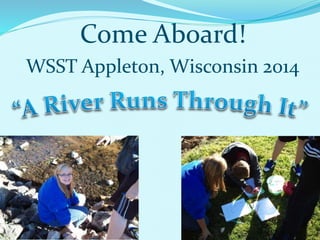
Come Aboard!
WSST Appleton, Wisconsin 2014
What is an acronym for the names of the
Great Lakes?
H – HURON
O - ONTARIO
M – MICHIGAN
E – ERIE
S - SUPERIOR
In which lake did the famous, “Edmund
Fitzgerald” sink?
Superior
Great Lakes Questions
Name the Great Lakes in
Order from West to East.
Superior – Michigan – Huron – Erie - Ontario
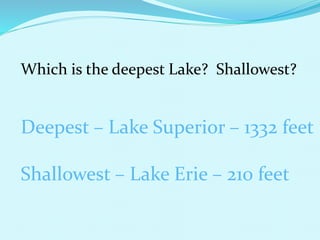
Which is the deepest Lake? Shallowest?
Deepest – Lake Superior – 1332 feet
Shallowest – Lake Erie – 210 feet
How much of the Earth’s fresh water in
in the Great Lakes?
20%
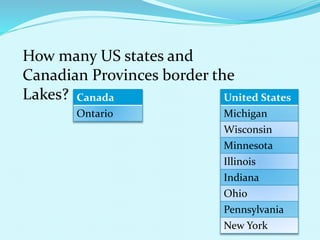
How many US states and
Canadian Provinces border the
Lakes? Canada
Ontario
United States
Michigan
Wisconsin
Minnesota
Illinois
Indiana
Ohio
Pennsylvania
New York
What percent of the Great Lakes was
covered in ice this season?
92.2%.
How many people visited the ice caves on
Lake Superior this season?
124,000
Climate change reports are noting that
the lakes are heating up, what changes
could this cause?
Less Ice Cover
Lower Water Levels
Increased evaporation rates
Heat waves
Algae growth
Impact of Invasive Species
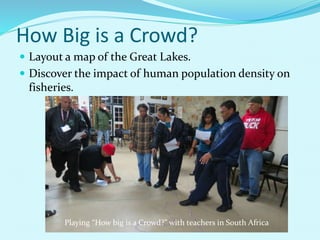
How Big is a Crowd?
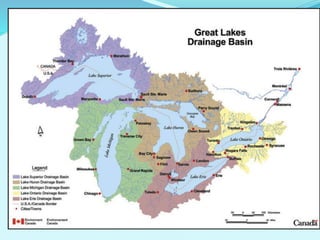
 Layout a map of the Great Lakes.
 Discover the impact of human population density on
fisheries.
Playing “How big is a Crowd?” with teachers in South Africa
Who is Sea Grant?
 Sea Grant's mission is to enhance the practical use and
conservation of coastal, marine and Great Lakes
resources in order to create a sustainable economy and
environment
 Environmental stewardship, long-term economic
development and responsible use of America’s coastal,
ocean and Great Lakes resources are at the heart of Sea
Grant’s mission.
 A network of 33 Sea Grant programs in the coastal US
States and territories carries out this mission through
research, extension and education activities.
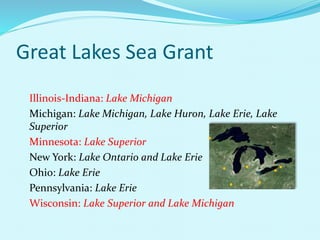
Great Lakes Sea Grant
Illinois-Indiana: Lake Michigan
Michigan: Lake Michigan, Lake Huron, Lake Erie, Lake
Superior
Minnesota: Lake Superior
New York: Lake Ontario and Lake Erie
Ohio: Lake Erie
Pennsylvania: Lake Erie
Wisconsin: Lake Superior and Lake Michigan
Great Lakes Literacy
A Great Lakes literate citizen:
• Understands the essential principles and
fundamental concepts about the
characteristics and functioning of the
Great Lakes
• Communicates accurately about the Great
Lakes’ influence on systems and people in and
beyond their watershed
• Can make informed and responsible
decisions regarding the Great Lakes and the
resources of their watershed
Great Lakes Literacy Principles
The Great Lakes, bodies of fresh water with many
features, are connected to each other and to the world
ocean.
Natural forces formed the Great Lakes; the lakes continue
to shape the features of their watershed.
The Great Lakes influence local and regional weather and
climate.
Water makes Earth habitable; fresh water sustains life on
land.
The Great Lakes support a broad diversity of life and
ecosystems.
The Great Lakes and humans in their watersheds are
inextricably interconnected.
Much remains to be learned about the Great Lakes.
The Great Lakes are socially, economically, and
environmentally significant to the region, the nation and
the planet.
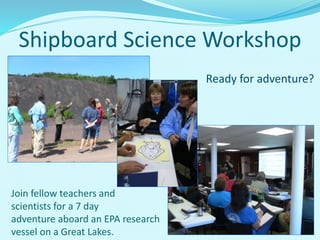
Shipboard Science Workshop
Ready for adventure?
Join fellow teachers and
scientists for a 7 day
adventure aboard an EPA research
vessel on a Great Lakes.
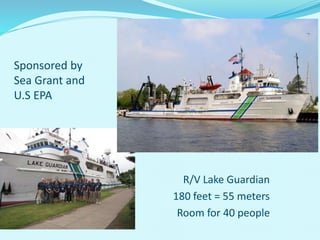
R/V Lake Guardian
180 feet = 55 meters
Room for 40 people
Sponsored by
Sea Grant and
U.S EPA
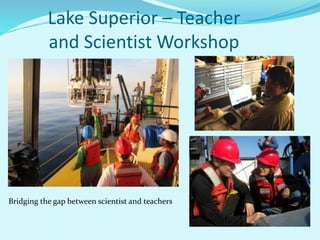
Lake Superior – Teacher
and Scientist Workshop
Bridging the gap between scientist and teachers
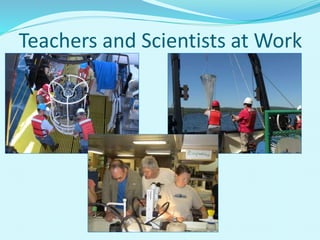
Teachers and Scientists at Work
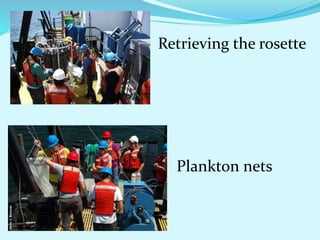
Retrieving the rosette
Plankton nets
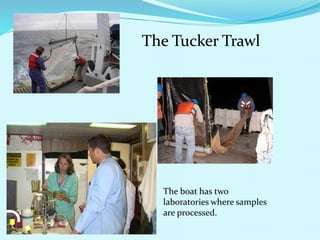
The Tucker Trawl
The boat has two
laboratories where samples
are processed.
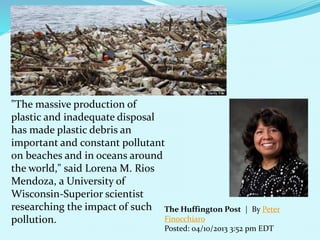
The Huffington Post | By Peter
Finocchiaro
Posted: 04/10/2013 3:52 pm EDT
"The massive production of
plastic and inadequate disposal
has made plastic debris an
important and constant pollutant
on beaches and in oceans around
the world," said Lorena M. Rios
Mendoza, a University of
Wisconsin-Superior scientist
researching the impact of such
pollution.
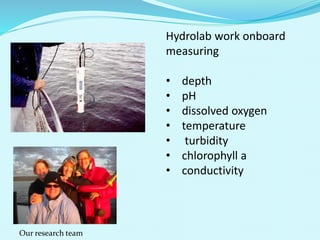
Hydrolab
Hydrolab work onboard
measuring
• depth
• pH
• dissolved oxygen
• temperature
• turbidity
• chlorophyll a
• conductivity
Our research team
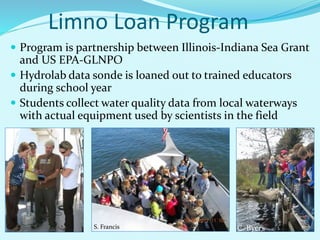
Limno Loan Program
 Program is partnership between Illinois-Indiana Sea Grant
and US EPA-GLNPO
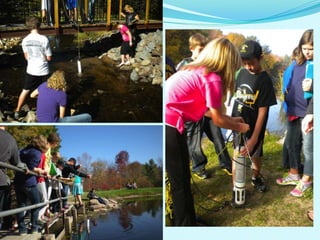
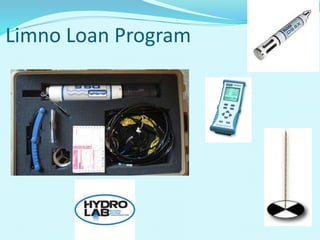
 Hydrolab data sonde is loaned out to trained educators
during school year
 Students collect water quality data from local waterways
with actual equipment used by scientists in the field
S. Francis C. Byers
Limno Loan Program
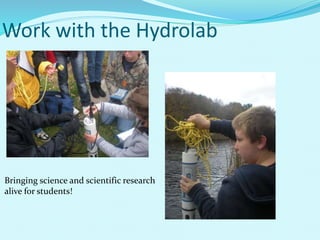
Work with the Hydrolab
Bringing science and scientific research
alive for students!
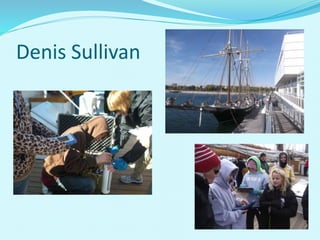
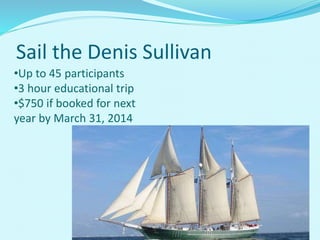
Denis Sullivan
Sail the Denis Sullivan
•Up to 45 participants
•3 hour educational trip
•$750 if booked for next
year by March 31, 2014
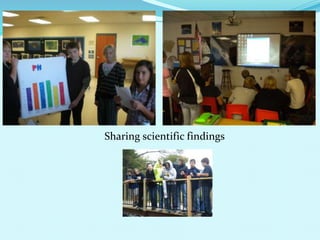
Sharing scientific findings
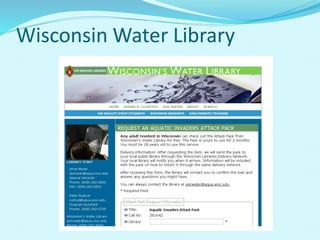
Attack Pack
The Aquatic Invaders Attack Pack is a backpack filled with
materials to help teach students about Great Lakes aquatic
invasive species
Each pack includes:
 preserved specimens of aquatic invasive species
 fact sheets
 a classroom guide and a USB flash drive containing 10 lesson
plans.
Wisconsin residents can borrow an Attack Pack for free
from Wisconsin's Water Library. The Pack will be delivered to
your local library via the Library Delivery Network of Wisconsin.
Wisconsin Water Library
Scientific & Engineering
Practices
Science and engineering require both knowledge
and practice. Science is not just a body of
knowledge that reflects current understanding of
the world; it is also a set of practices used to
establish, extend, and refine that knowledge.
When students actively engage in science
practices they deepen their understanding of core
science ideas.
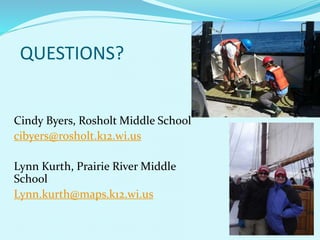
QUESTIONS?
Cindy Byers, Rosholt Middle School
cibyers@rosholt.k12.wi.us
Lynn Kurth, Prairie River Middle
School
Lynn.kurth@maps.k12.wi.us

WSST presentation 2014 Final

  • 1.
  • 2.
    What is anacronym for the names of the Great Lakes? H – HURON O - ONTARIO M – MICHIGAN E – ERIE S - SUPERIOR
  • 3.
    In which lakedid the famous, “Edmund Fitzgerald” sink? Superior
  • 4.
    Great Lakes Questions Namethe Great Lakes in Order from West to East. Superior – Michigan – Huron – Erie - Ontario
  • 5.
    Which is thedeepest Lake? Shallowest? Deepest – Lake Superior – 1332 feet Shallowest – Lake Erie – 210 feet
  • 6.
    How much ofthe Earth’s fresh water in in the Great Lakes? 20%
  • 7.
    How many USstates and Canadian Provinces border the Lakes? Canada Ontario United States Michigan Wisconsin Minnesota Illinois Indiana Ohio Pennsylvania New York
  • 8.
    What percent ofthe Great Lakes was covered in ice this season? 92.2%.
  • 9.
    How many peoplevisited the ice caves on Lake Superior this season? 124,000
  • 10.
    Climate change reportsare noting that the lakes are heating up, what changes could this cause? Less Ice Cover Lower Water Levels Increased evaporation rates Heat waves Algae growth Impact of Invasive Species
  • 11.
    How Big isa Crowd?  Layout a map of the Great Lakes.  Discover the impact of human population density on fisheries. Playing “How big is a Crowd?” with teachers in South Africa
  • 13.
    Who is SeaGrant?  Sea Grant's mission is to enhance the practical use and conservation of coastal, marine and Great Lakes resources in order to create a sustainable economy and environment  Environmental stewardship, long-term economic development and responsible use of America’s coastal, ocean and Great Lakes resources are at the heart of Sea Grant’s mission.  A network of 33 Sea Grant programs in the coastal US States and territories carries out this mission through research, extension and education activities.
  • 14.
    Great Lakes SeaGrant Illinois-Indiana: Lake Michigan Michigan: Lake Michigan, Lake Huron, Lake Erie, Lake Superior Minnesota: Lake Superior New York: Lake Ontario and Lake Erie Ohio: Lake Erie Pennsylvania: Lake Erie Wisconsin: Lake Superior and Lake Michigan
  • 15.
    Great Lakes Literacy AGreat Lakes literate citizen: • Understands the essential principles and fundamental concepts about the characteristics and functioning of the Great Lakes • Communicates accurately about the Great Lakes’ influence on systems and people in and beyond their watershed • Can make informed and responsible decisions regarding the Great Lakes and the resources of their watershed
  • 16.
    Great Lakes LiteracyPrinciples The Great Lakes, bodies of fresh water with many features, are connected to each other and to the world ocean. Natural forces formed the Great Lakes; the lakes continue to shape the features of their watershed. The Great Lakes influence local and regional weather and climate. Water makes Earth habitable; fresh water sustains life on land. The Great Lakes support a broad diversity of life and ecosystems. The Great Lakes and humans in their watersheds are inextricably interconnected. Much remains to be learned about the Great Lakes. The Great Lakes are socially, economically, and environmentally significant to the region, the nation and the planet.
  • 17.
    Shipboard Science Workshop Readyfor adventure? Join fellow teachers and scientists for a 7 day adventure aboard an EPA research vessel on a Great Lakes.
  • 18.
    R/V Lake Guardian 180feet = 55 meters Room for 40 people Sponsored by Sea Grant and U.S EPA
  • 19.
    Lake Superior –Teacher and Scientist Workshop Bridging the gap between scientist and teachers
  • 20.
  • 21.
  • 22.
    The Tucker Trawl Theboat has two laboratories where samples are processed.
  • 23.
    The Huffington Post| By Peter Finocchiaro Posted: 04/10/2013 3:52 pm EDT "The massive production of plastic and inadequate disposal has made plastic debris an important and constant pollutant on beaches and in oceans around the world," said Lorena M. Rios Mendoza, a University of Wisconsin-Superior scientist researching the impact of such pollution.
  • 24.
    Hydrolab Hydrolab work onboard measuring •depth • pH • dissolved oxygen • temperature • turbidity • chlorophyll a • conductivity Our research team
  • 25.
    Limno Loan Program Program is partnership between Illinois-Indiana Sea Grant and US EPA-GLNPO  Hydrolab data sonde is loaned out to trained educators during school year  Students collect water quality data from local waterways with actual equipment used by scientists in the field S. Francis C. Byers
  • 26.
  • 27.
    Work with theHydrolab Bringing science and scientific research alive for students!
  • 29.
  • 30.
    Sail the DenisSullivan •Up to 45 participants •3 hour educational trip •$750 if booked for next year by March 31, 2014
  • 31.
  • 33.
    Attack Pack The AquaticInvaders Attack Pack is a backpack filled with materials to help teach students about Great Lakes aquatic invasive species Each pack includes:  preserved specimens of aquatic invasive species  fact sheets  a classroom guide and a USB flash drive containing 10 lesson plans. Wisconsin residents can borrow an Attack Pack for free from Wisconsin's Water Library. The Pack will be delivered to your local library via the Library Delivery Network of Wisconsin.
  • 34.
  • 35.
    Scientific & Engineering Practices Scienceand engineering require both knowledge and practice. Science is not just a body of knowledge that reflects current understanding of the world; it is also a set of practices used to establish, extend, and refine that knowledge. When students actively engage in science practices they deepen their understanding of core science ideas.
  • 36.
    QUESTIONS? Cindy Byers, RosholtMiddle School cibyers@rosholt.k12.wi.us Lynn Kurth, Prairie River Middle School Lynn.kurth@maps.k12.wi.us