OVERVIEW OF WIRELESS
SENSOR NETWORKS:
 Key definitions of sensor networks.
 Advantages of sensor Networks.
 Unique constraints an challenges.
 Driving Applications.
 Enabling Technologies for Wireless
Sensor Networks.
Key Definitions of Sensor
Networks:
•Sensor
•Sensor node
•Network topology
•Routing
•Date-centric
•Geographic routing
•Geographic routing
•Collaborative processing
•In-network
 Uncertainty
 State
 Task
 Detection
 Classification
 Value of information or
information utility.
 Resource
 Sensor tasking
 Embedded operating system
(OS)
 Evaluation metric
 Node services
 Data storage
Advantages of Sensor Networks:
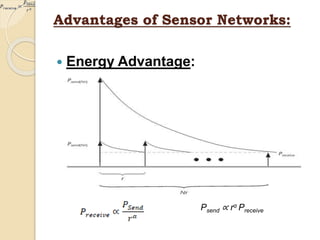
 Energy Advantage:
Psend ∝ rα Preceive
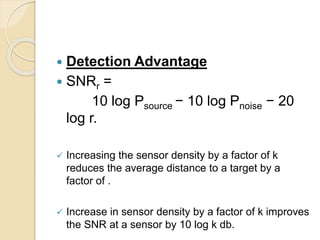
 Detection Advantage
 SNRr =
10 log Psource − 10 log Pnoise − 20
log r.
 Increasing the sensor density by a factor of k
reduces the average distance to a target by a
factor of .
 Increase in sensor density by a factor of k improves
the SNR at a sensor by 10 log k db.
Applications of wireless
sensor networks:
Military applications
 Monitoring inimical forces
 Monitoring friendly forces and
equipment
 Military-theater or battlefield
surveillance
 Targeting
 Battle damage assessment
 Nuclear, biological, and chemical
attack detection and more ...
Environmental applications
 Microclimates
 Forest fire detection
 Flood detection
 Precision agriculture and more ...
Health applications
 Remote monitoring of physiological
data
 Tracking and monitoring doctors and
patients inside a hospital
 Drug administration
 Elderly assistance and more ...
Home applications
 Home automation
 Instrumented environment
 Automated meter reading and more ...
Commercial applications
 Environmental control in industrial and
office buildings
 Inventory control
 Vehicle tracking and detection
 Traffic flow surveillance and more ...
Disaster relief applications
Precision agriculture
Enabling Technologies for
Wireless Sensor Networks:
 Hardware:
 Wireless Networking:
 Collaborative Signal Processing:
 Energy scavenging:
Challenges for WSNs
1.Characteristic requirements
2.Required mechanisms
1.Characteristic requirements:
 Type of service
 Quality of Service
 Fault tolerance
 Lifetime
 Scalability
 Wide range of densities
 Programmability
 Maintainability
2. Required mechanisms
 Multihop wireless communication
 Energy-efficient operation
 Auto-configuration
 Collaboration and in-network
processing.
 Data centric
 Locality
 Exploit trade-offs
ARCHITECTURES:
Single-Node Architecture –
 Hardware Components
 Energy Consumption of Sensor Nodes
 Operating Systems and Execution
Environments,
Network Architecture –
 Sensor Network Scenarios
 Optimization Goals and Figures of
Merit
 Gateway Concepts.
Hardware Components
 Controller.
 Memory
 Sencor and actuqtors.
 Communication.
 Power supply.
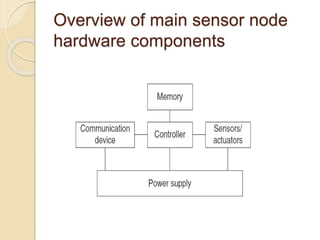
Overview of main sensor node
hardware components
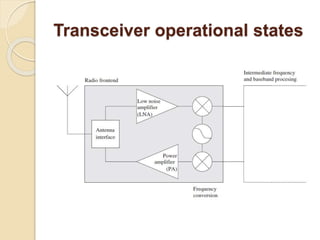
Transceiver operational states
Energy Consumption of
Sensor Nodes
 1. Operation states with
different power consumption.
 2. Microcontroller energy
consumption.
 3. Memory.
 4. Radio transceivers.
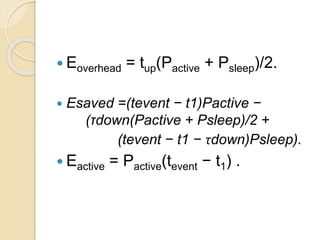
Operation states with different
power consumption:
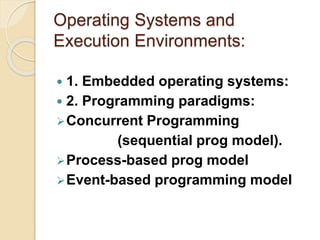
 Eoverhead = tup(Pactive + Psleep)/2.
 Esaved =(tevent − t1)Pactive −
(τdown(Pactive + Psleep)/2 +
(tevent − t1 − τdown)Psleep).
 Eactive = Pactive(tevent − t1) .
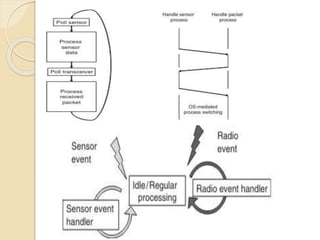
Operating Systems and
Execution Environments:
 1. Embedded operating systems:
 2. Programming paradigms:
Concurrent Programming
(sequential prog model).
Process-based prog model
Event-based programming model
Network Architecture –
 Sensor Network Scenarios:
1.Types of sources and sinks.
2.Single-hop versus multihop
networks.
3.Multiple sinks and sources.
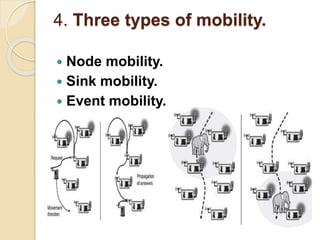
4. Three types of mobility.
 Source-a source is an entity in the
network that can provide information
 Sink- It is the entity where information
is required
 1.Neighbour node
 2.Hand held device (PDA)
 3.INTERNET
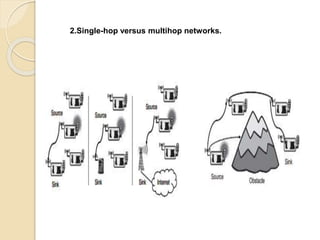
2.Single-hop versus multihop networks.
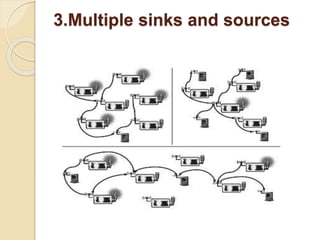
3.Multiple sinks and sources
4. Three types of mobility.
 Node mobility.
 Sink mobility.
 Event mobility.
Optimization Goals and
Figures of Merit:
 1.Quality of service.
 2. Energy efficiency.
 3. Scalability.
 4. Robustness .(QoS +scalability )
Quality of service
LOW LEVEL ATTRIBUTES
 DATA TRANSMISSION
 DETECTION OF EVENT
 MODULATION TECHNIQUES
 CHANNEL
HIGH LEVEL QOS
ATTRIBUTES
 EVENT DETECTION/REPORTING
PROBABILITY
 EVENT CLASSIFICATION-ERRORS
 EVENT DETECTION DELAY
 MISSING REPORTS
 TRACKING ACCURACY
Energy efficiency.
 Energy per correctly received bits
 Energy per reported event
 Delay/energy trade off
 Network life time
Payload –the energy required to
transfer I bit of information
DESIGN PRINCIPLES FOR
WSN
 Distributed organization
 In network processing
 Adaptive fideility and accuracy
 Data centricity (address data, not
nodes)
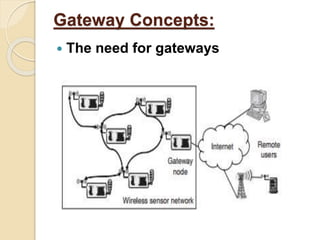
Gateway Concepts:
 The need for gateways
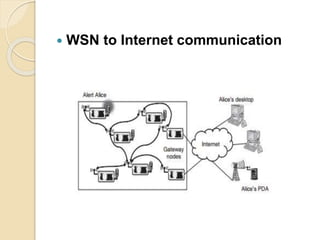
 WSN to Internet communication
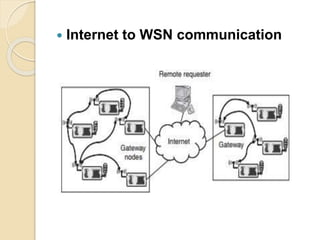
 Internet to WSN communication
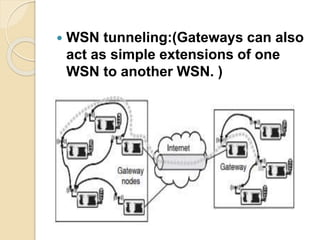
 WSN tunneling:(Gateways can also
act as simple extensions of one
WSN to another WSN. )
Wsn unit-1-ppt

Wsn unit-1-ppt

  • 1.
    OVERVIEW OF WIRELESS SENSORNETWORKS:  Key definitions of sensor networks.  Advantages of sensor Networks.  Unique constraints an challenges.  Driving Applications.  Enabling Technologies for Wireless Sensor Networks.
  • 2.
    Key Definitions ofSensor Networks: •Sensor •Sensor node •Network topology •Routing •Date-centric •Geographic routing •Geographic routing •Collaborative processing •In-network
  • 3.
     Uncertainty  State Task  Detection  Classification  Value of information or information utility.  Resource  Sensor tasking
  • 4.
     Embedded operatingsystem (OS)  Evaluation metric  Node services  Data storage
  • 5.
    Advantages of SensorNetworks:  Energy Advantage: Psend ∝ rα Preceive
  • 6.
     Detection Advantage SNRr = 10 log Psource − 10 log Pnoise − 20 log r.  Increasing the sensor density by a factor of k reduces the average distance to a target by a factor of .  Increase in sensor density by a factor of k improves the SNR at a sensor by 10 log k db.
  • 7.
    Applications of wireless sensornetworks: Military applications  Monitoring inimical forces  Monitoring friendly forces and equipment  Military-theater or battlefield surveillance  Targeting  Battle damage assessment  Nuclear, biological, and chemical attack detection and more ...
  • 8.
    Environmental applications  Microclimates Forest fire detection  Flood detection  Precision agriculture and more ... Health applications  Remote monitoring of physiological data  Tracking and monitoring doctors and patients inside a hospital  Drug administration  Elderly assistance and more ...
  • 9.
    Home applications  Homeautomation  Instrumented environment  Automated meter reading and more ... Commercial applications  Environmental control in industrial and office buildings  Inventory control  Vehicle tracking and detection  Traffic flow surveillance and more ... Disaster relief applications Precision agriculture
  • 10.
    Enabling Technologies for WirelessSensor Networks:  Hardware:  Wireless Networking:  Collaborative Signal Processing:  Energy scavenging:
  • 11.
    Challenges for WSNs 1.Characteristicrequirements 2.Required mechanisms 1.Characteristic requirements:  Type of service  Quality of Service  Fault tolerance  Lifetime  Scalability  Wide range of densities  Programmability  Maintainability
  • 12.
    2. Required mechanisms Multihop wireless communication  Energy-efficient operation  Auto-configuration  Collaboration and in-network processing.  Data centric  Locality  Exploit trade-offs
  • 13.
    ARCHITECTURES: Single-Node Architecture – Hardware Components  Energy Consumption of Sensor Nodes  Operating Systems and Execution Environments, Network Architecture –  Sensor Network Scenarios  Optimization Goals and Figures of Merit  Gateway Concepts.
  • 14.
    Hardware Components  Controller. Memory  Sencor and actuqtors.  Communication.  Power supply.
  • 15.
    Overview of mainsensor node hardware components
  • 16.
  • 17.
    Energy Consumption of SensorNodes  1. Operation states with different power consumption.  2. Microcontroller energy consumption.  3. Memory.  4. Radio transceivers.
  • 18.
    Operation states withdifferent power consumption:
  • 19.
     Eoverhead =tup(Pactive + Psleep)/2.  Esaved =(tevent − t1)Pactive − (τdown(Pactive + Psleep)/2 + (tevent − t1 − τdown)Psleep).  Eactive = Pactive(tevent − t1) .
  • 20.
    Operating Systems and ExecutionEnvironments:  1. Embedded operating systems:  2. Programming paradigms: Concurrent Programming (sequential prog model). Process-based prog model Event-based programming model
  • 22.
    Network Architecture – Sensor Network Scenarios: 1.Types of sources and sinks. 2.Single-hop versus multihop networks. 3.Multiple sinks and sources. 4. Three types of mobility.
  • 23.
     Source-a sourceis an entity in the network that can provide information  Sink- It is the entity where information is required  1.Neighbour node  2.Hand held device (PDA)  3.INTERNET
  • 24.
  • 25.
  • 26.
    4. Three typesof mobility.  Node mobility.  Sink mobility.  Event mobility.
  • 27.
    Optimization Goals and Figuresof Merit:  1.Quality of service.  2. Energy efficiency.  3. Scalability.  4. Robustness .(QoS +scalability )
  • 28.
    Quality of service LOWLEVEL ATTRIBUTES  DATA TRANSMISSION  DETECTION OF EVENT  MODULATION TECHNIQUES  CHANNEL
  • 29.
    HIGH LEVEL QOS ATTRIBUTES EVENT DETECTION/REPORTING PROBABILITY  EVENT CLASSIFICATION-ERRORS  EVENT DETECTION DELAY  MISSING REPORTS  TRACKING ACCURACY
  • 30.
    Energy efficiency.  Energyper correctly received bits  Energy per reported event  Delay/energy trade off  Network life time Payload –the energy required to transfer I bit of information
  • 31.
    DESIGN PRINCIPLES FOR WSN Distributed organization  In network processing  Adaptive fideility and accuracy  Data centricity (address data, not nodes)
  • 32.
    Gateway Concepts:  Theneed for gateways
  • 33.
     WSN toInternet communication
  • 34.
     Internet toWSN communication
  • 35.
     WSN tunneling:(Gatewayscan also act as simple extensions of one WSN to another WSN. )