PRE-ARGUMENT BENCH MEMORANDUM
2013 IL App (1st) 130584WC
No. 1-13-0740WC
Order filed ______________
NOTICE: This order was filed under Supreme Court Rule 23 and may not be cited as
precedent by any party except in the limited circumstances allowed under Rule 23(e)(1).
______________________________________________________________________________
IN THE
APPELLATE COURT OF ILLINOIS
FIRST DISTRICT
______________________________________________________________________________
PAULA MOHR, ) Appeal from the Circuit Court
) of Cook County.
)
Appellee, )
)
v. ) No. 12-L-50937
)
ILLINOIS WORKERS' COMPENSATION )
COMMISSION, et al., ) Honorable
) Thomas J. Difanis,
(Silgan Closures, Appellant). ) Judge, Presiding.
______________________________________________________________________________
DATE: January 9, 2014
TO: Hon. William E. Holdridge
Hon. Donald C. Hudson
Hon. Thomas M. Harris, Jr.
Hon. Bruce D. Stewart
FROM: Justice Thomas E. Hoffman
ORAL DATE:April 17, 2014, 9:00am, #5
PROCEDURAL HISTORY
¶ 1 On November 30, 2009, the claimant, Paula Mohr, filed an application for adjustment of
claim pursuant to the Workers' Compensation Act (Act) (820 ILCS 305/1 et seq. (West 2008)),
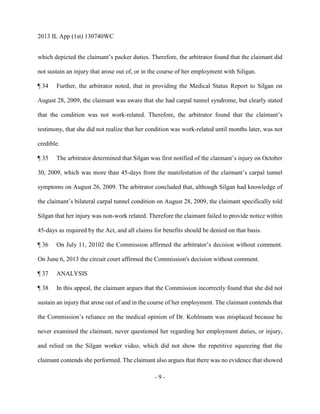
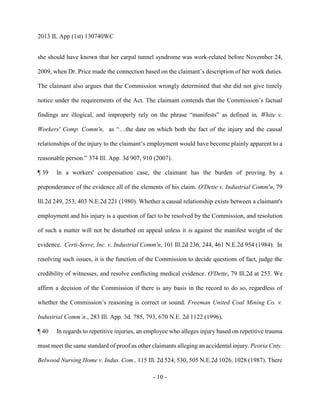
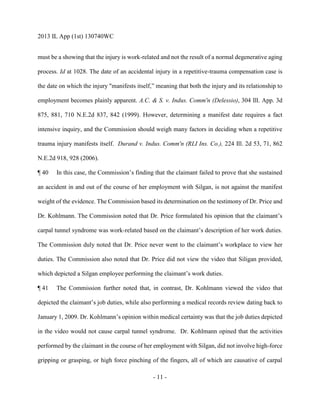
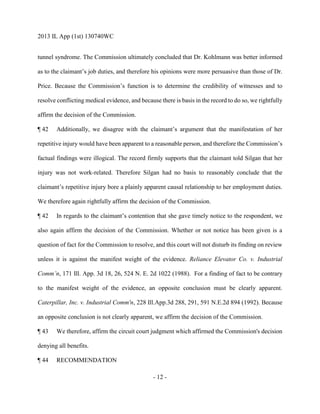
seeking in relevant part, temporary total disability (TTD), and repayment for all reasonable and
2013 IL App (1st) 130740WC
2
necessary charges for medical services after sustaining a left wrist injury while in the employ of
Silgan Closures (Silgan).
¶ 2 Following a hearing, the arbitrator found that the claimant was not entitled to TTD benefits
for the time period of January 6, 2010 thru August 6, 2010, pursuant to section 8(b) of the Act (820
ILCS 305/8(b) (West 2008)). The arbitrator further found that Silgan was entitled to a credit for
paid non-occupational Short Term Disability benefits in the amount of $9.345.64 pursuant to
section 8(j) of the Act (820 ILCS 305/8(j) (West 2008)).
¶ 3 In making its decision, the arbitrator found that the date of the manifestation of the
claimant’s carpal tunnel symptoms was August 26, 2009, and that notice was not provided to the
employer until October 30, 2009, and therefore, the claimant failed to provide notice within the
45- day time period as required by the Act. The arbitrator found that failure of an employee to give
timely notice will bar a claim. Ristow v. Industrial Commission, 39 Ill.2d 410, 235 N.E.2d 617
(1968). The arbitrator also found that, although Silgan had knowledge of the claimant’s bilateral
carpal tunnel condition on August 26, 2009, an employer’s mere knowledge of some type of injury
does not establish statutory notice Lowell White v. Illinois Workers’ Compensation Commission,
734 Ill. App. 3d 907, 873 N.E.2d 388 (4th Dist. 2007). In this case, in the process of informing her
employer about her carpal tunnel syndrome, and her need to wear splints at work, the claimant
specifically told her employer that her carpal tunnel symptoms were not work-related.
¶ 4 The claimant sought review before the Illinois Workers' Compensation Commission
(Commission), arguing that her current condition of ill-being was causally connected to her
2013 IL App (1st) 130740WC
3
employment duties. On July 11, 2012, the Commission affirmed the arbitrator’s decision without
comment.
¶ 5 The claimant sought judicial review of the Commission's decision in the circuit court of
Cook County. On June, 2013 the circuit court affirmed the Commission's decision without
comment. The claimant now timely appeals.
ISSUES ON APPEAL
¶ 6 1) Whether the Commission's finding that the claimant's bilateral carpal tunnel condition
was not causally connected to the November 24, 2009 workplace accident, is against the manifest
weight of the evidence?
¶ 7 2) Whether the Commission’s finding that the claimant failed to timely notify the employer
of her injury, is against the manifest weight of the evidence?
RELEVANT FACTS
¶ 9 The following factual recitation is taken from the evidence presented at the arbitration
hearing on August 18, 2010. The evidence included the claimant’s testimony, the claimant's
written medical records, and testimony from the claimant’s treating physician, Dr. William Price,
Silgan HR Director Julie Dockham, and Dr. James Kohlmann.
¶ 10 The claimant testified that beginning in 2007, she worked for Silgan as a box assembly line
packer for approximately three years. Her duties included folding plastic liners inside boxes and
then taping them shut. The claimant also engaged in a second box auditing process called a “100%
audit process.” This process involved squeezing the entire rim of a bottle cap to check for broken
2013 IL App (1st) 130740WC
- 4 -
bands. The claimant testified that she was in charge of auditing five boxes per three lines each
work shift. Each box contained 1,500 to 1,800 bottle caps. The claimant testified that she would
squeeze an estimated 22,500 bottle caps per day.
¶ 11 On cross examination, the claimant admitted that her estimated 22,500 bottle cap squeezing
duties varied in accordance to the activity of each line, and that she did not have to audit every box
that was in her line. Instead, each audited box was chosen at random, with some boxes going
unchecked. The claimant also testified that there were occasions where she had to audit less than
five boxes per line, and that the boxes were not manually packed.
¶ 12 Silgan presented a video exhibiting the claimant’s bottle cap auditing duties. The claimant
agreed that the video depicted the company’s process for auditing bottle caps, but argues that the
person acting as a box auditor only had to squeeze one side of the cap, whereas she was taught to
squeeze the entire rim to check for broken bands.
¶ 13 On February 26, 2009, the claimant saw Dr. Ming Wang, on referral from her family
physician, Dr. Alina Pual. Dr. Ming conducted an EMG/NCV study, and diagnosed the claimant
with mild-to-moderate chronic medical neuropathy at the wrist. These results were forwarded to
Dr. Paul.
¶ 14 The claimant testified that in March 2009, she saw Dr. Paul for the flu. The claimant
informed Dr. Paul that, along with her flu symptoms, she was having a lot of trouble with her
hands, and thought it might be arthritis. The claimant’s medical records indicate that Dr. Paul
referred the claimant to Dr. William Price for an evaluation for a possible carpal tunnel release
surgery.
2013 IL App (1st) 130740WC
- 5 -
¶ 15 On August 26, 2009 the claimant met with nurse practitioner, Patricia Finnegan, at Dr.
Price’s office at Provena Orthopedics. In her notes Finnegan states that she advised the claimant
of the risks and benefits of carpal tunnel release surgery, and also informed her that she could try
wearing wrist splints to alleviate her discomfort. Finnegan gave the claimant a Medical Status
Report to give to Silgan, which listed the claimant’s diagnoses as bilateral carpal tunnel syndrome
and stated that the claimant must wear splints while at work.
¶ 16 The claimant testified that she wore her splints at work, but that she had no memory of
giving Julie Dockham, Silgan’s HR director, the Medical Status Report from Provena on August
28, 2009. The claimant further testified that she had no memory of Dockham asking her if the
bilateral carpal tunnel listed on the report was work-related.
¶ 17 The claimant stated that she told coworkers that she suspected her job duties as a packer
might be related to her carpal tunnel problems. The claimant further indicated that she told
Dockham about her carpal tunnel syndrome sometime in October of 2009 and informed her that it
was work-related. The claimant testified that she filled out an accident report form on October 18,
2009, following informing Dockham about her carpal tunnel syndrome.
¶ 18 On November 24, 2009 the claimant began treatment with Dr. William Price at Provena
Orthopedics. Upon first meeting with Dr. Price, the claimant described her work duties. The
claimant testified that Dr. Price opined that her carpal tunnel was caused by her work duties.
¶ 19 On November 30, 2009, the claimant filed an application for adjustment of claim, which
was denied by Silgan.
¶ 20 The claimant continued working at Silgan until January 26, 2010. On January 27, 2010 the
claimant underwent open carpal tunnel release surgery on her left hand which was performed by
2013 IL App (1st) 130740WC
- 6 -
Dr. Price at Provena Covenant Medical Center. On March 31, 2010, the claimant underwent a
second carpal tunnel release surgery on her right hand, again performed by Dr. Price at Provena
Medical Center.
¶ 21 The claimant testified that she did not work from January 27, 2010 until August 7, 2010,
when she took a job at a bank. The claimant contends that she was not released to return to work
until after August 7, 2010.
¶ 22 Dr. Price testified that beginning with the claimant’s initial visit on November 24, 2009,
he diagnosed her with bilateral carpal syndrome after electrodiangnostic testing showed that both
hands were affected by the condition. Dr. Price noted that the claimant was a “packer” and “doing
repetitive stress.” Dr. Price opined that the claimant’s work duties were partly responsible for her
carpal tunnel syndrome. Dr. Price stated however, that he never went to the claimant’s job site to
view her duties, and that he did not view any video of her job duties. Dr. Price testified that he
relied solely on the claimant’s description of her work duties in reaching the determination that
her packer duties were partly responsible for her carpal tunnel syndrome.
¶ 23 Dr. Price further testified that he advised the claimant to avoid activities that could cause
increased discomfort. Dr. Price informed the claimant that she could wear a splint, or proceed with
open carpal tunnel release surgery. Dr. Price testified that the claimant wished to proceed with
open carpal tunnel release surgery.
¶ 24 Dr. Price testified that the claimant had been to his office on two prior occasions, but had
met with Dr. Price’s nurse practitioner, Patricia Finnegan. Dr. Price was then asked to review a
note in the claimant’s medical chart made by Finnegan on August 26, 2009. Finnegan’s note stated
that the claimant had been experiencing numbness in her hands for several months, and that when
2013 IL App (1st) 130740WC
- 7 -
she drove and went to sleep at night, her hands would go numb and start to tingle. Dr. Price lastly
testified that, along with the claimant’s work activities, as she described them, other activities
outside the workplace could have contributed to the claimant’s carpal tunnel syndrome.
¶ 25 Dockham testified that on August 28, 2009, the claimant came to her with a Medical Status
Report issued by Finnegan. Dockham correctly identified the handwritten note at the bottom of
the Medical Status Report as being authored by herself. The note was dated August 28, 2009, and
read “Stated not work-related, been treating for six months or more, and talking possible surgery
need to wear splints at work.”
¶ 26 Dockham explained that she was prompted to write the note after she specifically asked
the claimant if her bilateral carpal tunnel condition was caused, or aggravated by her work duties.
Dockham testified that the claimant told her that her condition was not work-related, and there was
no indication that any treating physician of the claimant stated it was work-related. Dockham
further testified that at no time after August 28, 2009, did the claimant inform her that she had a
work-related injury.
¶ 27 Regarding the claimant’s work duties, Dockham testified that it was seldom that employees
on the claimant’s shift got more than three boxes to audit. Further, Dockham stated that supervisors
rotate employees so that they run three lines of boxes one day, and two lines on another day.
¶ 28 Regarding the bottle cap inspection, Dockham stated that the force needed to grip the bottle
cap was maybe like the force it took to grip a pencil.
¶ 29 When asked whether she had submitted a first report injury form, Dockham stated that she
had not initially, but that she submitted one after receiving the application for adjustment of claim
from the claimant’s attorney on October 30, 2009. According to Dockham, the first report injury
2013 IL App (1st) 130740WC
- 8 -
form was put into Silgan’s system on October 30, 2009. Dockham testified that the Silgan had no
notice of any kind of work-related accident until that date. Lastly, Dockham stated that Silgan paid
short-term disability benefits to the claimant for the time period she was off work for an injury that
she had presented to the company as a non-work related injury.
¶ 30 Silgan’s independent medical examiner, Dr. James Kohlmann, an orthopedic surgeon from
Covenant, testified that he reviewed the claimant’s medical records and also viewed the video that
Siligan provided that depicted the claimant’s job duties. Dr. Kohlmann stated that that while he
reviewed medical records that dated back to January 2009, he never physically examined the
claimant.
¶ 31 Dr. Kohlmann stated that the activity depicted in the video would not cause or aggravate
carpal tunnel syndrome. He explained that activities that could cause carpal tunnel syndrome were
frequent high-force gripping and/or frequent high-force pinching, or constant keyboard use. Dr.
Kohlmann opined that the activities in the video were “minimal,” and did not involve “high force
gripping or grasping.” Dr. Kohlmann further testified that the video activities were not “overly
repetitive quick motions,” and that it did not look like an activity that would cause carpal tunnel
syndrome or aggravate it.
¶ 32 Dr. Kohlmann went on to explain other factors that could cause carpel tunnel syndrome,
such as diabetes, pregnancy, gender, and obesity. Dr. Kohlmann stated that the claimant could
have been predisposed to get carpal tunnel syndrome because of her gender.
¶ 33 In reaching its decision, the arbitrator found that Dr. Kohlmann’s opinion was more
persuasive than that of Dr. Price. According to the arbitrator, Dr. Kohlmann was better informed
than Dr. Price as to the claimant’s job duties because he viewed the video that Siligan provided
2013 IL App (1st) 130740WC
- 9 -
which depicted the claimant’s packer duties. Therefore, the arbitrator found that the claimant did
not sustain an injury that arose out of, or in the course of her employment with Siligan.
¶ 34 Further, the arbitrator noted, that in providing the Medical Status Report to Silgan on
August 28, 2009, the claimant was aware that she had carpal tunnel syndrome, but clearly stated
that the condition was not work-related. Therefore, the arbitrator found that the claimant’s
testimony, that she did not realize that her condition was work-related until months later, was not
credible.
¶ 35 The arbitrator determined that Silgan was first notified of the claimant’s injury on October
30, 2009, which was more than 45-days from the manifestation of the claimant’s carpal tunnel
symptoms on August 26, 2009. The arbitrator concluded that, although Silgan had knowledge of
the claimant’s bilateral carpal tunnel condition on August 28, 2009, the claimant specifically told
Silgan that her injury was non-work related. Therefore the claimant failed to provide notice within
45-days as required by the Act, and all claims for benefits should be denied on that basis.
¶ 36 On July 11, 20102 the Commission affirmed the arbitrator’s decision without comment.
On June 6, 2013 the circuit court affirmed the Commission's decision without comment.
¶ 37 ANALYSIS
¶ 38 In this appeal, the claimant argues that the Commission incorrectly found that she did not
sustain an injury that arose out of and in the course of her employment. The claimant contends that
the Commission’s reliance on the medical opinion of Dr. Kohlmann was misplaced because he
never examined the claimant, never questioned her regarding her employment duties, or injury,
and relied on the Silgan worker video, which did not show the repetitive squeezing that the
claimant contends she performed. The claimant also argues that there was no evidence that showed
2013 IL App (1st) 130740WC
- 10 -
she should have known that her carpal tunnel syndrome was work-related before November 24,
2009, when Dr. Price made the connection based on the claimant’s description of her work duties.
The claimant also argues that the Commission wrongly determined that she did not give timely
notice under the requirements of the Act. The claimant contends that the Commission’s factual
findings are illogical, and improperly rely on the phrase “manifests” as defined in, White v.
Workers' Comp. Comm'n, as “…the date on which both the fact of the injury and the causal
relationships of the injury to the claimant’s employment would have become plainly apparent to a
reasonable person.” 374 Ill. App. 3d 907, 910 (2007).
¶ 39 In a workers' compensation case, the claimant has the burden of proving by a
preponderance of the evidence all of the elements of his claim. O'Dette v. Industrial Comm'n, 79
Ill.2d 249, 253, 403 N.E.2d 221 (1980). Whether a causal relationship exists between a claimant's
employment and his injury is a question of fact to be resolved by the Commission, and resolution
of such a matter will not be disturbed on appeal unless it is against the manifest weight of the
evidence. Certi-Serve, Inc. v. Industrial Comm'n, 101 Ill.2d 236, 244, 461 N.E.2d 954 (1984). In
resolving such issues, it is the function of the Commission to decide questions of fact, judge the
credibility of witnesses, and resolve conflicting medical evidence. O'Dette, 79 Ill.2d at 253. We
affirm a decision of the Commission if there is any basis in the record to do so, regardless of
whether the Commission’s reasoning is correct or sound. Freeman United Coal Mining Co. v.
Industrial Comm’n., 283 Ill. App. 3d. 785, 793, 670 N.E. 2d 1122 (1996).
¶ 40 In regards to repetitive injuries, an employee who alleges injury based on repetitive trauma
must meet the same standard of proof as other claimants alleging an accidental injury. Peoria Cnty.
Belwood Nursing Home v. Indus. Com., 115 Ill. 2d 524, 530, 505 N.E.2d 1026, 1028 (1987). There
2013 IL App (1st) 130740WC
- 11 -
must be a showing that the injury is work-related and not the result of a normal degenerative aging
process. Id at 1028. The date of an accidental injury in a repetitive-trauma compensation case is
the date on which the injury "manifests itself,” meaning that both the injury and its relationship to
employment becomes plainly apparent. A.C. & S. v. Indus. Comm'n (Delessio), 304 Ill. App. 3d
875, 881, 710 N.E.2d 837, 842 (1999). However, determining a manifest date requires a fact
intensive inquiry, and the Commission should weigh many factors in deciding when a repetitive
trauma injury manifests itself. Durand v. Indus. Comm'n (RLI Ins. Co.), 224 Ill. 2d 53, 71, 862
N.E.2d 918, 928 (2006).
¶ 40 In this case, the Commission’s finding that the claimant failed to prove that she sustained
an accident in and out of the course of her employment with Silgan, is not against the manifest
weight of the evidence. The Commission based its determination on the testimony of Dr. Price and
Dr. Kohlmann. The Commission noted that Dr. Price formulated his opinion that the claimant’s
carpal tunnel syndrome was work-related based on the claimant’s description of her work duties.
The Commission duly noted that Dr. Price never went to the claimant’s workplace to view her
duties. The Commission also noted that Dr. Price did not view the video that Siligan provided,
which depicted a Silgan employee performing the claimant’s work duties.
¶ 41 The Commission further noted that, in contrast, Dr. Kohlmann viewed the video that
depicted the claimant’s job duties, while also performing a medical records review dating back to
January 1, 2009. Dr. Kohlmann’s opinion within medical certainty was that the job duties depicted
in the video would not cause carpal tunnel syndrome. Dr. Kohlmann opined that the activities
performed by the claimant in the course of her employment with Silgan, did not involve high-force
gripping or grasping, or high force pinching of the fingers, all of which are causative of carpal
2013 IL App (1st) 130740WC
- 12 -
tunnel syndrome. The Commission ultimately concluded that Dr. Kohlmann was better informed
as to the claimant’s job duties, and therefore his opinions were more persuasive than those of Dr.
Price. Because the Commission’s function is to determine the credibility of witnesses and to
resolve conflicting medical evidence, and because there is basis in the record to do so, we rightfully
affirm the decision of the Commission.
¶ 42 Additionally, we disagree with the claimant’s argument that the manifestation of her
repetitive injury would have been apparent to a reasonable person, and therefore the Commission’s
factual findings were illogical. The record firmly supports that the claimant told Silgan that her
injury was not work-related. Therefore Silgan had no basis to reasonably conclude that the
claimant’s repetitive injury bore a plainly apparent causal relationship to her employment duties.
We therefore again rightfully affirm the decision of the Commission.
¶ 42 In regards to the claimant’s contention that she gave timely notice to the respondent, we
also again affirm the decision of the Commission. Whether or not notice has been given is a
question of fact for the Commission to resolve, and this court will not disturb its finding on review
unless it is against the manifest weight of the evidence. Reliance Elevator Co. v. Industrial
Comm’n, 171 Ill. App. 3d 18, 26, 524 N. E. 2d 1022 (1988). For a finding of fact to be contrary
to the manifest weight of the evidence, an opposite conclusion must be clearly apparent.
Caterpillar, Inc. v. Industrial Comm'n, 228 Ill.App.3d 288, 291, 591 N.E.2d 894 (1992). Because
an opposite conclusion is not clearly apparent, we affirm the decision of the Commission.
¶ 43 We therefore, affirm the circuit court judgment which affirmed the Commission's decision
denying all benefits.
¶ 44 RECOMMENDATION
2013 IL App (1st) 130740WC
- 13 -
¶ 45 Affirm the judgment of the circuit court which (1) affirmed the decision of the Commission
that denied all benefits to the claimant, and (2) affirm the arbitrator's decision.

Writing Sample for Gennafer G. Garvin Workers' Comp.

  • 1.
    PRE-ARGUMENT BENCH MEMORANDUM 2013IL App (1st) 130584WC No. 1-13-0740WC Order filed ______________ NOTICE: This order was filed under Supreme Court Rule 23 and may not be cited as precedent by any party except in the limited circumstances allowed under Rule 23(e)(1). ______________________________________________________________________________ IN THE APPELLATE COURT OF ILLINOIS FIRST DISTRICT ______________________________________________________________________________ PAULA MOHR, ) Appeal from the Circuit Court ) of Cook County. ) Appellee, ) ) v. ) No. 12-L-50937 ) ILLINOIS WORKERS' COMPENSATION ) COMMISSION, et al., ) Honorable ) Thomas J. Difanis, (Silgan Closures, Appellant). ) Judge, Presiding. ______________________________________________________________________________ DATE: January 9, 2014 TO: Hon. William E. Holdridge Hon. Donald C. Hudson Hon. Thomas M. Harris, Jr. Hon. Bruce D. Stewart FROM: Justice Thomas E. Hoffman ORAL DATE:April 17, 2014, 9:00am, #5 PROCEDURAL HISTORY ¶ 1 On November 30, 2009, the claimant, Paula Mohr, filed an application for adjustment of claim pursuant to the Workers' Compensation Act (Act) (820 ILCS 305/1 et seq. (West 2008)), seeking in relevant part, temporary total disability (TTD), and repayment for all reasonable and
  • 2.
    2013 IL App(1st) 130740WC 2 necessary charges for medical services after sustaining a left wrist injury while in the employ of Silgan Closures (Silgan). ¶ 2 Following a hearing, the arbitrator found that the claimant was not entitled to TTD benefits for the time period of January 6, 2010 thru August 6, 2010, pursuant to section 8(b) of the Act (820 ILCS 305/8(b) (West 2008)). The arbitrator further found that Silgan was entitled to a credit for paid non-occupational Short Term Disability benefits in the amount of $9.345.64 pursuant to section 8(j) of the Act (820 ILCS 305/8(j) (West 2008)). ¶ 3 In making its decision, the arbitrator found that the date of the manifestation of the claimant’s carpal tunnel symptoms was August 26, 2009, and that notice was not provided to the employer until October 30, 2009, and therefore, the claimant failed to provide notice within the 45- day time period as required by the Act. The arbitrator found that failure of an employee to give timely notice will bar a claim. Ristow v. Industrial Commission, 39 Ill.2d 410, 235 N.E.2d 617 (1968). The arbitrator also found that, although Silgan had knowledge of the claimant’s bilateral carpal tunnel condition on August 26, 2009, an employer’s mere knowledge of some type of injury does not establish statutory notice Lowell White v. Illinois Workers’ Compensation Commission, 734 Ill. App. 3d 907, 873 N.E.2d 388 (4th Dist. 2007). In this case, in the process of informing her employer about her carpal tunnel syndrome, and her need to wear splints at work, the claimant specifically told her employer that her carpal tunnel symptoms were not work-related. ¶ 4 The claimant sought review before the Illinois Workers' Compensation Commission (Commission), arguing that her current condition of ill-being was causally connected to her
  • 3.
    2013 IL App(1st) 130740WC 3 employment duties. On July 11, 2012, the Commission affirmed the arbitrator’s decision without comment. ¶ 5 The claimant sought judicial review of the Commission's decision in the circuit court of Cook County. On June, 2013 the circuit court affirmed the Commission's decision without comment. The claimant now timely appeals. ISSUES ON APPEAL ¶ 6 1) Whether the Commission's finding that the claimant's bilateral carpal tunnel condition was not causally connected to the November 24, 2009 workplace accident, is against the manifest weight of the evidence? ¶ 7 2) Whether the Commission’s finding that the claimant failed to timely notify the employer of her injury, is against the manifest weight of the evidence? RELEVANT FACTS ¶ 9 The following factual recitation is taken from the evidence presented at the arbitration hearing on August 18, 2010. The evidence included the claimant’s testimony, the claimant's written medical records, and testimony from the claimant’s treating physician, Dr. William Price, Silgan HR Director Julie Dockham, and Dr. James Kohlmann. ¶ 10 The claimant testified that beginning in 2007, she worked for Silgan as a box assembly line packer for approximately three years. Her duties included folding plastic liners inside boxes and then taping them shut. The claimant also engaged in a second box auditing process called a “100% audit process.” This process involved squeezing the entire rim of a bottle cap to check for broken
  • 4.
    2013 IL App(1st) 130740WC - 4 - bands. The claimant testified that she was in charge of auditing five boxes per three lines each work shift. Each box contained 1,500 to 1,800 bottle caps. The claimant testified that she would squeeze an estimated 22,500 bottle caps per day. ¶ 11 On cross examination, the claimant admitted that her estimated 22,500 bottle cap squeezing duties varied in accordance to the activity of each line, and that she did not have to audit every box that was in her line. Instead, each audited box was chosen at random, with some boxes going unchecked. The claimant also testified that there were occasions where she had to audit less than five boxes per line, and that the boxes were not manually packed. ¶ 12 Silgan presented a video exhibiting the claimant’s bottle cap auditing duties. The claimant agreed that the video depicted the company’s process for auditing bottle caps, but argues that the person acting as a box auditor only had to squeeze one side of the cap, whereas she was taught to squeeze the entire rim to check for broken bands. ¶ 13 On February 26, 2009, the claimant saw Dr. Ming Wang, on referral from her family physician, Dr. Alina Pual. Dr. Ming conducted an EMG/NCV study, and diagnosed the claimant with mild-to-moderate chronic medical neuropathy at the wrist. These results were forwarded to Dr. Paul. ¶ 14 The claimant testified that in March 2009, she saw Dr. Paul for the flu. The claimant informed Dr. Paul that, along with her flu symptoms, she was having a lot of trouble with her hands, and thought it might be arthritis. The claimant’s medical records indicate that Dr. Paul referred the claimant to Dr. William Price for an evaluation for a possible carpal tunnel release surgery.
  • 5.
    2013 IL App(1st) 130740WC - 5 - ¶ 15 On August 26, 2009 the claimant met with nurse practitioner, Patricia Finnegan, at Dr. Price’s office at Provena Orthopedics. In her notes Finnegan states that she advised the claimant of the risks and benefits of carpal tunnel release surgery, and also informed her that she could try wearing wrist splints to alleviate her discomfort. Finnegan gave the claimant a Medical Status Report to give to Silgan, which listed the claimant’s diagnoses as bilateral carpal tunnel syndrome and stated that the claimant must wear splints while at work. ¶ 16 The claimant testified that she wore her splints at work, but that she had no memory of giving Julie Dockham, Silgan’s HR director, the Medical Status Report from Provena on August 28, 2009. The claimant further testified that she had no memory of Dockham asking her if the bilateral carpal tunnel listed on the report was work-related. ¶ 17 The claimant stated that she told coworkers that she suspected her job duties as a packer might be related to her carpal tunnel problems. The claimant further indicated that she told Dockham about her carpal tunnel syndrome sometime in October of 2009 and informed her that it was work-related. The claimant testified that she filled out an accident report form on October 18, 2009, following informing Dockham about her carpal tunnel syndrome. ¶ 18 On November 24, 2009 the claimant began treatment with Dr. William Price at Provena Orthopedics. Upon first meeting with Dr. Price, the claimant described her work duties. The claimant testified that Dr. Price opined that her carpal tunnel was caused by her work duties. ¶ 19 On November 30, 2009, the claimant filed an application for adjustment of claim, which was denied by Silgan. ¶ 20 The claimant continued working at Silgan until January 26, 2010. On January 27, 2010 the claimant underwent open carpal tunnel release surgery on her left hand which was performed by
  • 6.
    2013 IL App(1st) 130740WC - 6 - Dr. Price at Provena Covenant Medical Center. On March 31, 2010, the claimant underwent a second carpal tunnel release surgery on her right hand, again performed by Dr. Price at Provena Medical Center. ¶ 21 The claimant testified that she did not work from January 27, 2010 until August 7, 2010, when she took a job at a bank. The claimant contends that she was not released to return to work until after August 7, 2010. ¶ 22 Dr. Price testified that beginning with the claimant’s initial visit on November 24, 2009, he diagnosed her with bilateral carpal syndrome after electrodiangnostic testing showed that both hands were affected by the condition. Dr. Price noted that the claimant was a “packer” and “doing repetitive stress.” Dr. Price opined that the claimant’s work duties were partly responsible for her carpal tunnel syndrome. Dr. Price stated however, that he never went to the claimant’s job site to view her duties, and that he did not view any video of her job duties. Dr. Price testified that he relied solely on the claimant’s description of her work duties in reaching the determination that her packer duties were partly responsible for her carpal tunnel syndrome. ¶ 23 Dr. Price further testified that he advised the claimant to avoid activities that could cause increased discomfort. Dr. Price informed the claimant that she could wear a splint, or proceed with open carpal tunnel release surgery. Dr. Price testified that the claimant wished to proceed with open carpal tunnel release surgery. ¶ 24 Dr. Price testified that the claimant had been to his office on two prior occasions, but had met with Dr. Price’s nurse practitioner, Patricia Finnegan. Dr. Price was then asked to review a note in the claimant’s medical chart made by Finnegan on August 26, 2009. Finnegan’s note stated that the claimant had been experiencing numbness in her hands for several months, and that when
  • 7.
    2013 IL App(1st) 130740WC - 7 - she drove and went to sleep at night, her hands would go numb and start to tingle. Dr. Price lastly testified that, along with the claimant’s work activities, as she described them, other activities outside the workplace could have contributed to the claimant’s carpal tunnel syndrome. ¶ 25 Dockham testified that on August 28, 2009, the claimant came to her with a Medical Status Report issued by Finnegan. Dockham correctly identified the handwritten note at the bottom of the Medical Status Report as being authored by herself. The note was dated August 28, 2009, and read “Stated not work-related, been treating for six months or more, and talking possible surgery need to wear splints at work.” ¶ 26 Dockham explained that she was prompted to write the note after she specifically asked the claimant if her bilateral carpal tunnel condition was caused, or aggravated by her work duties. Dockham testified that the claimant told her that her condition was not work-related, and there was no indication that any treating physician of the claimant stated it was work-related. Dockham further testified that at no time after August 28, 2009, did the claimant inform her that she had a work-related injury. ¶ 27 Regarding the claimant’s work duties, Dockham testified that it was seldom that employees on the claimant’s shift got more than three boxes to audit. Further, Dockham stated that supervisors rotate employees so that they run three lines of boxes one day, and two lines on another day. ¶ 28 Regarding the bottle cap inspection, Dockham stated that the force needed to grip the bottle cap was maybe like the force it took to grip a pencil. ¶ 29 When asked whether she had submitted a first report injury form, Dockham stated that she had not initially, but that she submitted one after receiving the application for adjustment of claim from the claimant’s attorney on October 30, 2009. According to Dockham, the first report injury
  • 8.
    2013 IL App(1st) 130740WC - 8 - form was put into Silgan’s system on October 30, 2009. Dockham testified that the Silgan had no notice of any kind of work-related accident until that date. Lastly, Dockham stated that Silgan paid short-term disability benefits to the claimant for the time period she was off work for an injury that she had presented to the company as a non-work related injury. ¶ 30 Silgan’s independent medical examiner, Dr. James Kohlmann, an orthopedic surgeon from Covenant, testified that he reviewed the claimant’s medical records and also viewed the video that Siligan provided that depicted the claimant’s job duties. Dr. Kohlmann stated that that while he reviewed medical records that dated back to January 2009, he never physically examined the claimant. ¶ 31 Dr. Kohlmann stated that the activity depicted in the video would not cause or aggravate carpal tunnel syndrome. He explained that activities that could cause carpal tunnel syndrome were frequent high-force gripping and/or frequent high-force pinching, or constant keyboard use. Dr. Kohlmann opined that the activities in the video were “minimal,” and did not involve “high force gripping or grasping.” Dr. Kohlmann further testified that the video activities were not “overly repetitive quick motions,” and that it did not look like an activity that would cause carpal tunnel syndrome or aggravate it. ¶ 32 Dr. Kohlmann went on to explain other factors that could cause carpel tunnel syndrome, such as diabetes, pregnancy, gender, and obesity. Dr. Kohlmann stated that the claimant could have been predisposed to get carpal tunnel syndrome because of her gender. ¶ 33 In reaching its decision, the arbitrator found that Dr. Kohlmann’s opinion was more persuasive than that of Dr. Price. According to the arbitrator, Dr. Kohlmann was better informed than Dr. Price as to the claimant’s job duties because he viewed the video that Siligan provided
  • 9.
    2013 IL App(1st) 130740WC - 9 - which depicted the claimant’s packer duties. Therefore, the arbitrator found that the claimant did not sustain an injury that arose out of, or in the course of her employment with Siligan. ¶ 34 Further, the arbitrator noted, that in providing the Medical Status Report to Silgan on August 28, 2009, the claimant was aware that she had carpal tunnel syndrome, but clearly stated that the condition was not work-related. Therefore, the arbitrator found that the claimant’s testimony, that she did not realize that her condition was work-related until months later, was not credible. ¶ 35 The arbitrator determined that Silgan was first notified of the claimant’s injury on October 30, 2009, which was more than 45-days from the manifestation of the claimant’s carpal tunnel symptoms on August 26, 2009. The arbitrator concluded that, although Silgan had knowledge of the claimant’s bilateral carpal tunnel condition on August 28, 2009, the claimant specifically told Silgan that her injury was non-work related. Therefore the claimant failed to provide notice within 45-days as required by the Act, and all claims for benefits should be denied on that basis. ¶ 36 On July 11, 20102 the Commission affirmed the arbitrator’s decision without comment. On June 6, 2013 the circuit court affirmed the Commission's decision without comment. ¶ 37 ANALYSIS ¶ 38 In this appeal, the claimant argues that the Commission incorrectly found that she did not sustain an injury that arose out of and in the course of her employment. The claimant contends that the Commission’s reliance on the medical opinion of Dr. Kohlmann was misplaced because he never examined the claimant, never questioned her regarding her employment duties, or injury, and relied on the Silgan worker video, which did not show the repetitive squeezing that the claimant contends she performed. The claimant also argues that there was no evidence that showed
  • 10.
    2013 IL App(1st) 130740WC - 10 - she should have known that her carpal tunnel syndrome was work-related before November 24, 2009, when Dr. Price made the connection based on the claimant’s description of her work duties. The claimant also argues that the Commission wrongly determined that she did not give timely notice under the requirements of the Act. The claimant contends that the Commission’s factual findings are illogical, and improperly rely on the phrase “manifests” as defined in, White v. Workers' Comp. Comm'n, as “…the date on which both the fact of the injury and the causal relationships of the injury to the claimant’s employment would have become plainly apparent to a reasonable person.” 374 Ill. App. 3d 907, 910 (2007). ¶ 39 In a workers' compensation case, the claimant has the burden of proving by a preponderance of the evidence all of the elements of his claim. O'Dette v. Industrial Comm'n, 79 Ill.2d 249, 253, 403 N.E.2d 221 (1980). Whether a causal relationship exists between a claimant's employment and his injury is a question of fact to be resolved by the Commission, and resolution of such a matter will not be disturbed on appeal unless it is against the manifest weight of the evidence. Certi-Serve, Inc. v. Industrial Comm'n, 101 Ill.2d 236, 244, 461 N.E.2d 954 (1984). In resolving such issues, it is the function of the Commission to decide questions of fact, judge the credibility of witnesses, and resolve conflicting medical evidence. O'Dette, 79 Ill.2d at 253. We affirm a decision of the Commission if there is any basis in the record to do so, regardless of whether the Commission’s reasoning is correct or sound. Freeman United Coal Mining Co. v. Industrial Comm’n., 283 Ill. App. 3d. 785, 793, 670 N.E. 2d 1122 (1996). ¶ 40 In regards to repetitive injuries, an employee who alleges injury based on repetitive trauma must meet the same standard of proof as other claimants alleging an accidental injury. Peoria Cnty. Belwood Nursing Home v. Indus. Com., 115 Ill. 2d 524, 530, 505 N.E.2d 1026, 1028 (1987). There
  • 11.
    2013 IL App(1st) 130740WC - 11 - must be a showing that the injury is work-related and not the result of a normal degenerative aging process. Id at 1028. The date of an accidental injury in a repetitive-trauma compensation case is the date on which the injury "manifests itself,” meaning that both the injury and its relationship to employment becomes plainly apparent. A.C. & S. v. Indus. Comm'n (Delessio), 304 Ill. App. 3d 875, 881, 710 N.E.2d 837, 842 (1999). However, determining a manifest date requires a fact intensive inquiry, and the Commission should weigh many factors in deciding when a repetitive trauma injury manifests itself. Durand v. Indus. Comm'n (RLI Ins. Co.), 224 Ill. 2d 53, 71, 862 N.E.2d 918, 928 (2006). ¶ 40 In this case, the Commission’s finding that the claimant failed to prove that she sustained an accident in and out of the course of her employment with Silgan, is not against the manifest weight of the evidence. The Commission based its determination on the testimony of Dr. Price and Dr. Kohlmann. The Commission noted that Dr. Price formulated his opinion that the claimant’s carpal tunnel syndrome was work-related based on the claimant’s description of her work duties. The Commission duly noted that Dr. Price never went to the claimant’s workplace to view her duties. The Commission also noted that Dr. Price did not view the video that Siligan provided, which depicted a Silgan employee performing the claimant’s work duties. ¶ 41 The Commission further noted that, in contrast, Dr. Kohlmann viewed the video that depicted the claimant’s job duties, while also performing a medical records review dating back to January 1, 2009. Dr. Kohlmann’s opinion within medical certainty was that the job duties depicted in the video would not cause carpal tunnel syndrome. Dr. Kohlmann opined that the activities performed by the claimant in the course of her employment with Silgan, did not involve high-force gripping or grasping, or high force pinching of the fingers, all of which are causative of carpal
  • 12.
    2013 IL App(1st) 130740WC - 12 - tunnel syndrome. The Commission ultimately concluded that Dr. Kohlmann was better informed as to the claimant’s job duties, and therefore his opinions were more persuasive than those of Dr. Price. Because the Commission’s function is to determine the credibility of witnesses and to resolve conflicting medical evidence, and because there is basis in the record to do so, we rightfully affirm the decision of the Commission. ¶ 42 Additionally, we disagree with the claimant’s argument that the manifestation of her repetitive injury would have been apparent to a reasonable person, and therefore the Commission’s factual findings were illogical. The record firmly supports that the claimant told Silgan that her injury was not work-related. Therefore Silgan had no basis to reasonably conclude that the claimant’s repetitive injury bore a plainly apparent causal relationship to her employment duties. We therefore again rightfully affirm the decision of the Commission. ¶ 42 In regards to the claimant’s contention that she gave timely notice to the respondent, we also again affirm the decision of the Commission. Whether or not notice has been given is a question of fact for the Commission to resolve, and this court will not disturb its finding on review unless it is against the manifest weight of the evidence. Reliance Elevator Co. v. Industrial Comm’n, 171 Ill. App. 3d 18, 26, 524 N. E. 2d 1022 (1988). For a finding of fact to be contrary to the manifest weight of the evidence, an opposite conclusion must be clearly apparent. Caterpillar, Inc. v. Industrial Comm'n, 228 Ill.App.3d 288, 291, 591 N.E.2d 894 (1992). Because an opposite conclusion is not clearly apparent, we affirm the decision of the Commission. ¶ 43 We therefore, affirm the circuit court judgment which affirmed the Commission's decision denying all benefits. ¶ 44 RECOMMENDATION
  • 13.
    2013 IL App(1st) 130740WC - 13 - ¶ 45 Affirm the judgment of the circuit court which (1) affirmed the decision of the Commission that denied all benefits to the claimant, and (2) affirm the arbitrator's decision.