Is it hard to write?
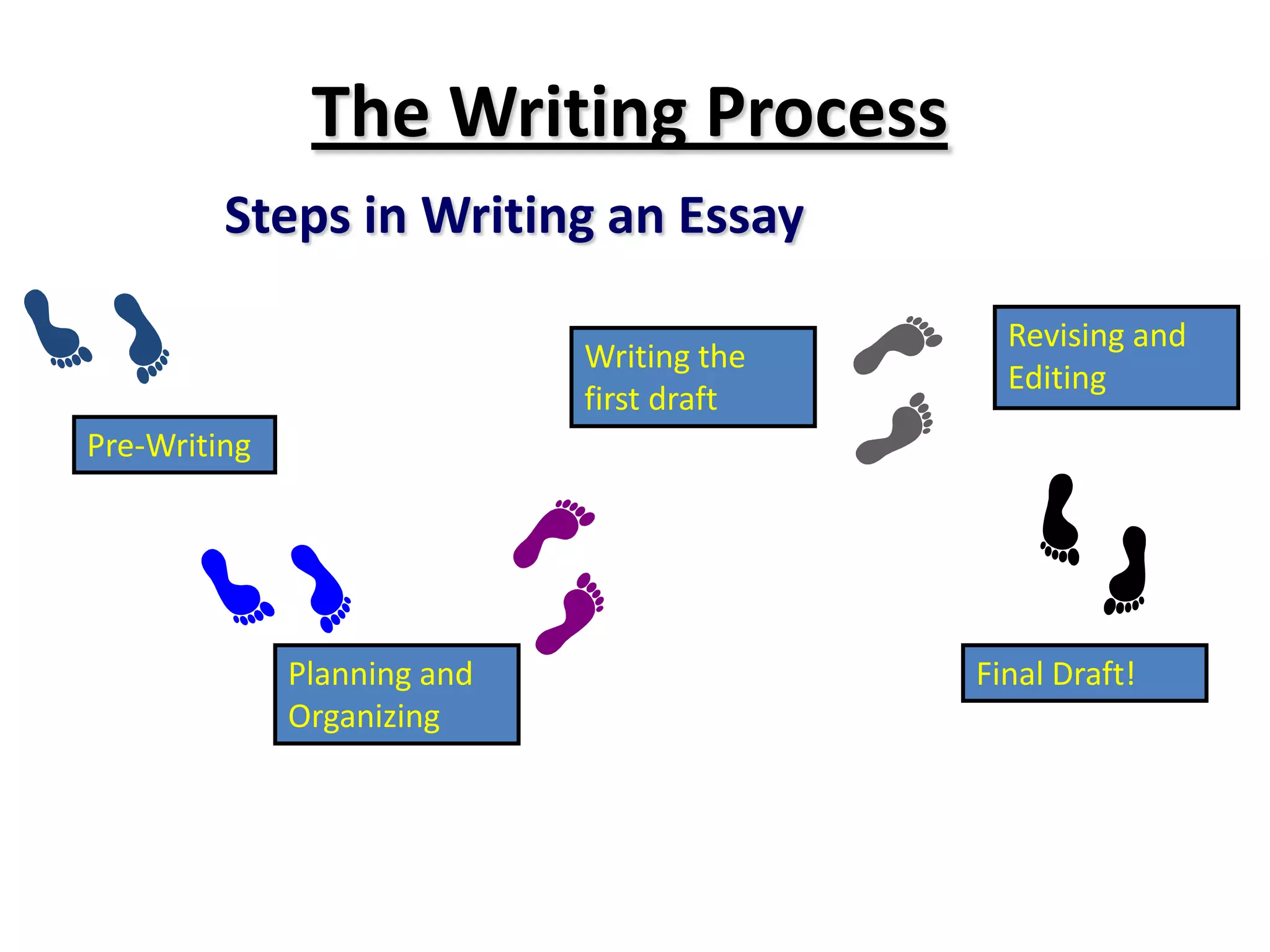
The Writing Process
         Steps in Writing an Essay

                                             Revising and
                             Writing the
                                             Editing
                             first draft
Pre-Writing


              Planning and                 Final Draft!
              Organizing
Introduction
     What is the writing process ?
   Writing an essay takes time. That’s why writing is often
referred to as a process. In other words, there are several
steps to go through before you have a complete essay ready
to turn in for a grade. In this lesson we will talk about those
steps. They are:  Pre-Writing

                       Organizing
                       Writing the First Draft
                       Revising and Editing
                       Final Copy
Pre-Writing
  Step One
    Pre-writing literally means, “before writing.” Before you
actually begin writing your essay, you will need to do the
following things:

            choose a topic to write on

          brainstorm or generate ideas for
          your topic

            focus in on central ideas
Organizing
    Step Two
   Making an outline can help you organize what you want to
write. This is a rough plan for your essay and can help make
the process of writing much easier.
             Essay Outline
             I.         Introduction         Thesis: _____________________
             II.        Body 1. Topic Sentence: _____________
                                                                - supporting idea
                                                                - supporting idea
                             2. Topic Sentence: ____________
                                                                - supporting idea
                                                                - supporting idea
                                             3. Topic Sentence: ____________
                                                                - supporting idea
                                                                - supporting idea
             III.       Conclusion
Writing the First Draft
   Step Three
    After getting ideas and making an outline of your essay,
it is time to start writing the essay. When you begin writing
your rough draft, try to remember the following guidelines.
             Don’t worry about writing the ‘perfect’ paper
            the first time.
            Your goal in writing a rough draft is to develop
            and support the ideas listed in your outline.
             Don’t focus on spelling and grammar as you
              write your rough draft. You can check this later
            in the writing process.
Revising and Editing
 Step Four
   After you write your first draft, go back over it and look for
 ways to improve your essay.


             Revision                   Editing


                                       Spelling,
             Content and               Grammar,
             Organization              Punctuation,
                                       etc.
The Final Copy
 Step Five
   The last step is turning in your essay to be graded. Look
at the guidelines below for turning in the final draft of your
essay.
          word-processed
          all new paragraphs indented five spaces
          8 ½ by 11 inch white paper
          double spaced, size 12 font
          one inch margins on all sides
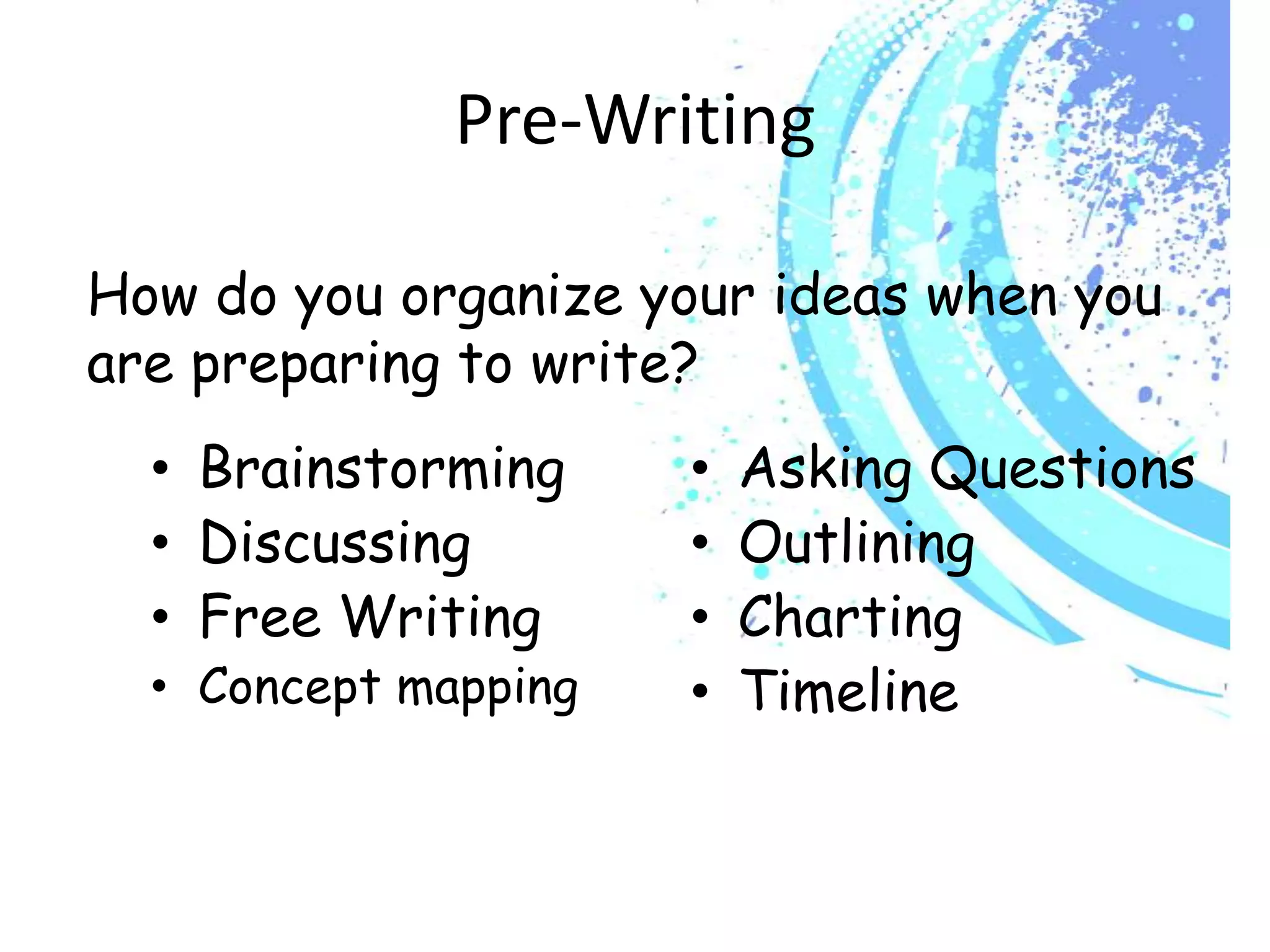
Pre-Writing

How do you organize your ideas when you
are preparing to write?
  • Brainstorming     •   Asking Questions
  • Discussing        •   Outlining
  • Free Writing      •   Charting
  • Concept mapping   •   Timeline
Homework (1 whole sheet)
 How does your school life
 influence your future?
 What is the importance of
 the school to your life?
 Why do you need to go to
 school?
 Why do you go to school?
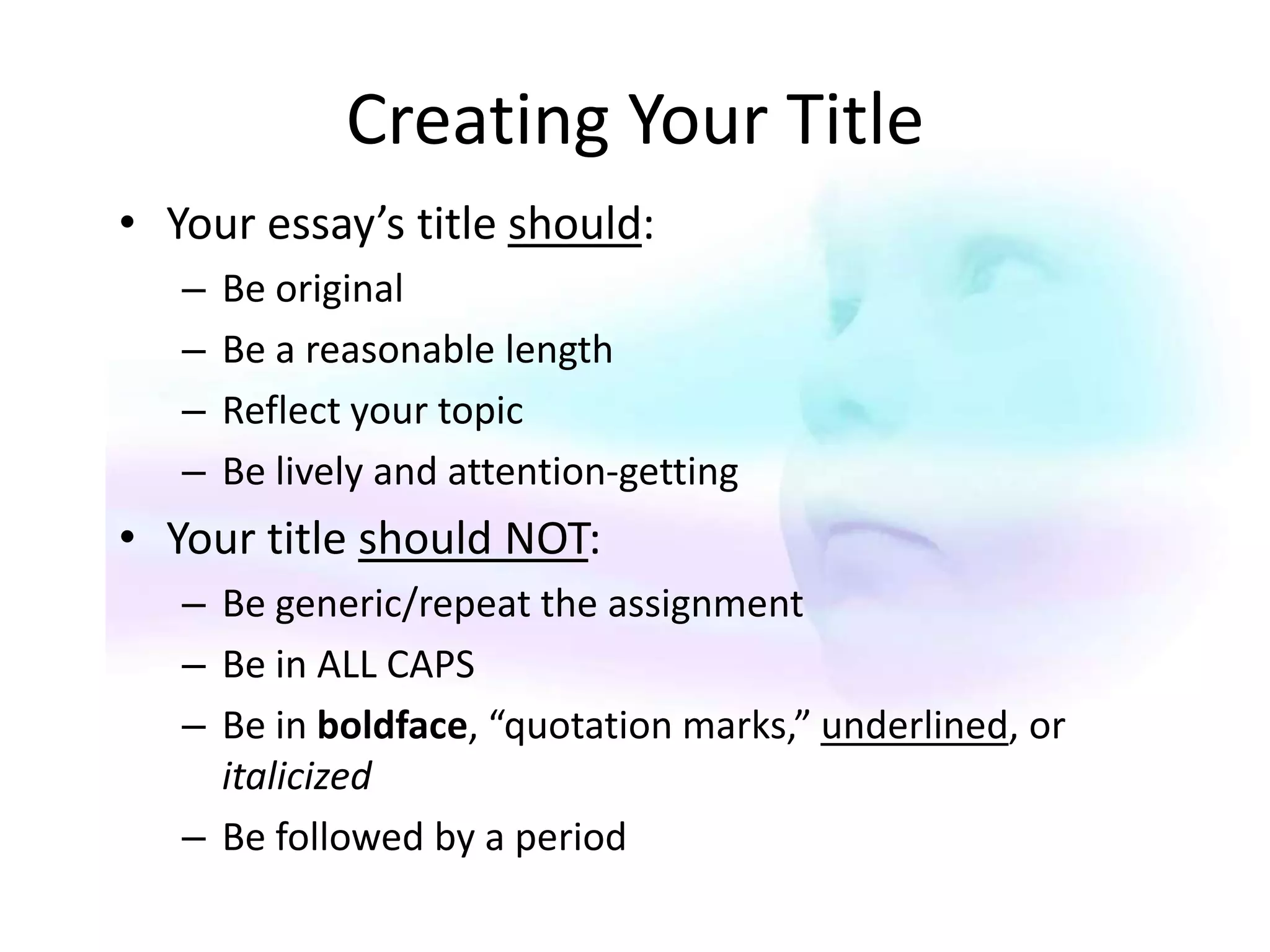
Creating Your Title
• Your essay’s title should:
   –   Be original
   –   Be a reasonable length
   –   Reflect your topic
   –   Be lively and attention-getting
• Your title should NOT:
   – Be generic/repeat the assignment
   – Be in ALL CAPS
   – Be in boldface, “quotation marks,” underlined, or
     italicized
   – Be followed by a period
Write Your Introduction
• Your introductory paragraph should do the
  following:
  – Be a minimum of 4-6 sentences
  – Move from general to specific, with the thesis as the
    last sentence in the intro
  – Get the reader’s attention
  – Set the tone for the rest of the essay
• Strategies for developing an Introduction include
   –   Providing background information
   –   Telling a personal anecdote
   –   Beginning with a quotation
   –   Using an opposite
   –   Asking a question
Thesis Statement

• The thesis statement expresses the MAIN
  IDEA of your essay, the central point that your
  essay develops/supports.

• Your thesis SHOULD:
   – Accurately predict your essay’s direction,
     emphasis, and scope
   – Make no promises that the essay will not fulfill
   – Be direct and straightforward.
Body Paragraphs: Topic Sentence

• A Topic Sentence expresses the main idea of the body
  paragraph.
• Begin each body paragraph with a Topic Sentence that
   – Narrows the focus of the paragraph
   – Accurately predicts the direction of the paragraph
   – Refers back to the Thesis statement
• Each BP should contain:
   – Topic Sentence—main idea of BP
   – Primary Support—explanation
   – Secondary Support—examples
Body Paragraphs continued
• Body paragraphs must have
  – Unity—everything refers back to main point
  – Support—examples and details
  – Coherence—all points connect to form a whole;
    one point leads to another
  – Concise - brief
Write Your Conclusion
• The concluding paragraph should
  – Contain a minimum of 4 sentences
  – Refer back to the main point, but not simply repeat
    the thesis (rephrase/restate)
  – NOT introduce any new ideas
  – Create a sense of closure
  – Call to action
Assignment
1. Bring your formal theme.


2. On a whole sheet of paper,
 front   - prewriting activity
 back    - first draft
First Draft
First paragraph:
    Introduction
    Thesis statement (last
sentence)
Second/Third/Forth Paragraph:
    Topic Sentence.
    Explain. Give examples
Fifth Paragraph:
    Conclusion
Writing process ppt and assignment

Writing process ppt and assignment

  • 1.
    Is it hardto write?
  • 2.
    The Writing Process Steps in Writing an Essay Revising and Writing the Editing first draft Pre-Writing Planning and Final Draft! Organizing
  • 3.
    Introduction What is the writing process ? Writing an essay takes time. That’s why writing is often referred to as a process. In other words, there are several steps to go through before you have a complete essay ready to turn in for a grade. In this lesson we will talk about those steps. They are:  Pre-Writing  Organizing  Writing the First Draft  Revising and Editing  Final Copy
  • 4.
    Pre-Writing StepOne Pre-writing literally means, “before writing.” Before you actually begin writing your essay, you will need to do the following things:  choose a topic to write on  brainstorm or generate ideas for your topic  focus in on central ideas
  • 5.
    Organizing Step Two Making an outline can help you organize what you want to write. This is a rough plan for your essay and can help make the process of writing much easier. Essay Outline I. Introduction Thesis: _____________________ II. Body 1. Topic Sentence: _____________ - supporting idea - supporting idea 2. Topic Sentence: ____________ - supporting idea - supporting idea 3. Topic Sentence: ____________ - supporting idea - supporting idea III. Conclusion
  • 6.
    Writing the FirstDraft Step Three After getting ideas and making an outline of your essay, it is time to start writing the essay. When you begin writing your rough draft, try to remember the following guidelines.  Don’t worry about writing the ‘perfect’ paper the first time.  Your goal in writing a rough draft is to develop and support the ideas listed in your outline.  Don’t focus on spelling and grammar as you write your rough draft. You can check this later in the writing process.
  • 7.
    Revising and Editing Step Four After you write your first draft, go back over it and look for ways to improve your essay. Revision Editing Spelling, Content and Grammar, Organization Punctuation, etc.
  • 8.
    The Final Copy Step Five The last step is turning in your essay to be graded. Look at the guidelines below for turning in the final draft of your essay.  word-processed  all new paragraphs indented five spaces  8 ½ by 11 inch white paper  double spaced, size 12 font  one inch margins on all sides
  • 9.
    Pre-Writing How do youorganize your ideas when you are preparing to write? • Brainstorming • Asking Questions • Discussing • Outlining • Free Writing • Charting • Concept mapping • Timeline
  • 10.
    Homework (1 wholesheet) How does your school life influence your future? What is the importance of the school to your life? Why do you need to go to school? Why do you go to school?
  • 11.
    Creating Your Title •Your essay’s title should: – Be original – Be a reasonable length – Reflect your topic – Be lively and attention-getting • Your title should NOT: – Be generic/repeat the assignment – Be in ALL CAPS – Be in boldface, “quotation marks,” underlined, or italicized – Be followed by a period
  • 12.
    Write Your Introduction •Your introductory paragraph should do the following: – Be a minimum of 4-6 sentences – Move from general to specific, with the thesis as the last sentence in the intro – Get the reader’s attention – Set the tone for the rest of the essay • Strategies for developing an Introduction include – Providing background information – Telling a personal anecdote – Beginning with a quotation – Using an opposite – Asking a question
  • 13.
    Thesis Statement • Thethesis statement expresses the MAIN IDEA of your essay, the central point that your essay develops/supports. • Your thesis SHOULD: – Accurately predict your essay’s direction, emphasis, and scope – Make no promises that the essay will not fulfill – Be direct and straightforward.
  • 14.
    Body Paragraphs: TopicSentence • A Topic Sentence expresses the main idea of the body paragraph. • Begin each body paragraph with a Topic Sentence that – Narrows the focus of the paragraph – Accurately predicts the direction of the paragraph – Refers back to the Thesis statement • Each BP should contain: – Topic Sentence—main idea of BP – Primary Support—explanation – Secondary Support—examples
  • 15.
    Body Paragraphs continued •Body paragraphs must have – Unity—everything refers back to main point – Support—examples and details – Coherence—all points connect to form a whole; one point leads to another – Concise - brief
  • 16.
    Write Your Conclusion •The concluding paragraph should – Contain a minimum of 4 sentences – Refer back to the main point, but not simply repeat the thesis (rephrase/restate) – NOT introduce any new ideas – Create a sense of closure – Call to action
  • 17.
    Assignment 1. Bring yourformal theme. 2. On a whole sheet of paper, front - prewriting activity back - first draft
  • 18.
    First Draft First paragraph: Introduction Thesis statement (last sentence) Second/Third/Forth Paragraph: Topic Sentence. Explain. Give examples Fifth Paragraph: Conclusion