Writing Your Grant
Proposal
Writing with Communities and Nonprofits
Spring 2016
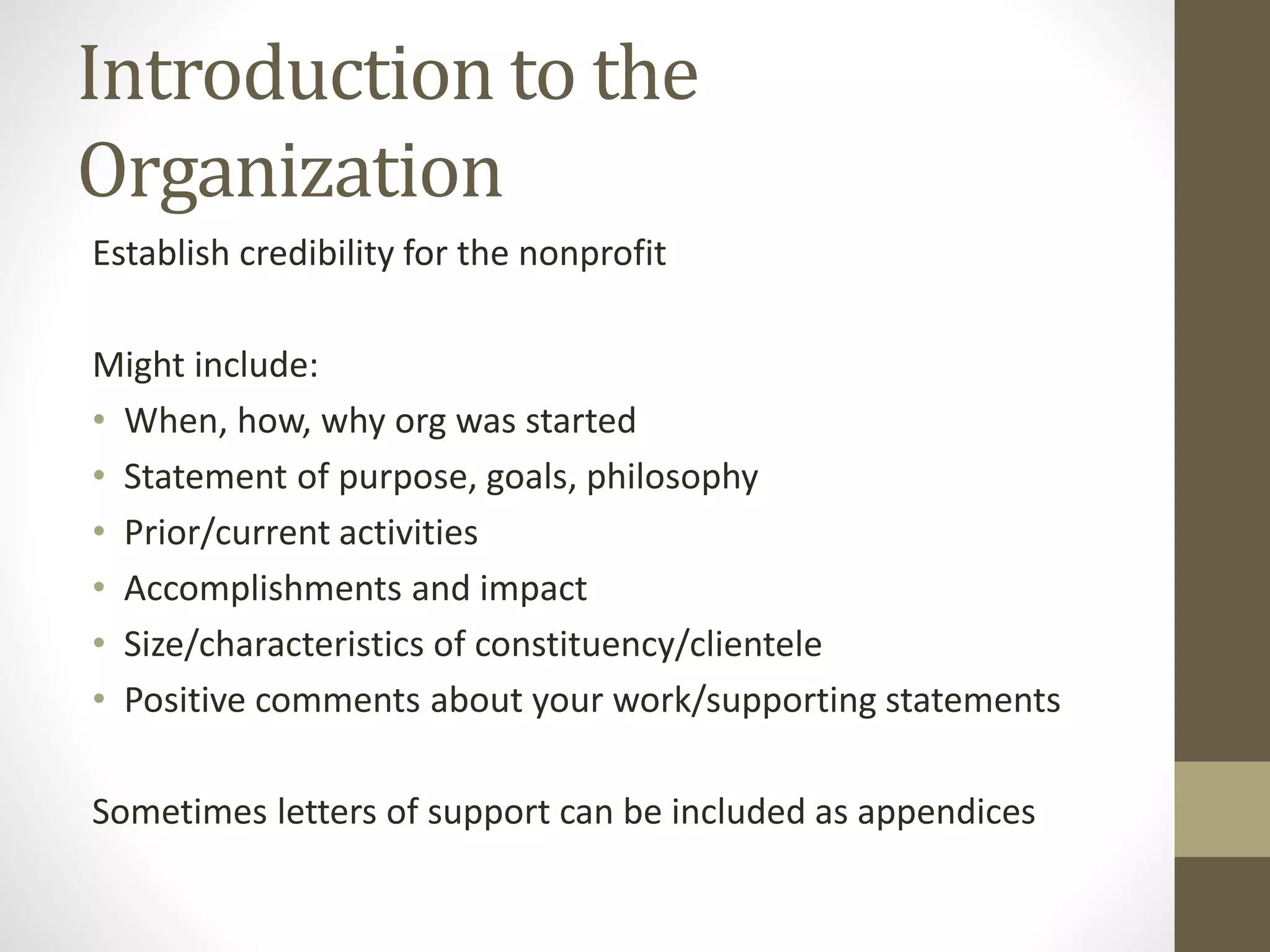
Introduction to the
Organization
Establish credibility for the nonprofit
Might include:
• When, how, why org was started
• Statement of purpose, goals, philosophy
• Prior/current activities
• Accomplishments and impact
• Size/characteristics of constituency/clientele
• Positive comments about your work/supporting statements
Sometimes letters of support can be included as appendices
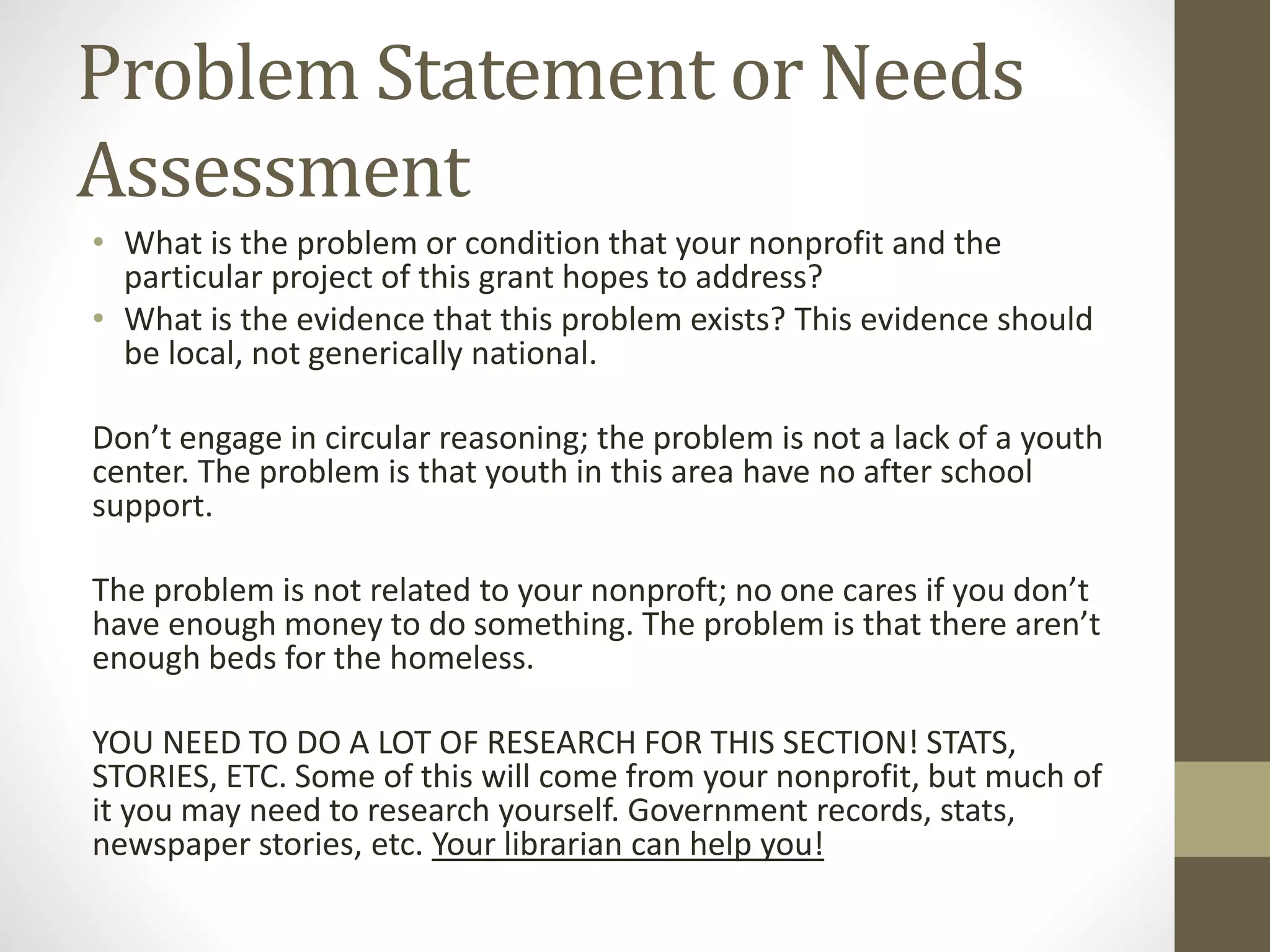
Problem Statement or Needs
Assessment
• What is the problem or condition that your nonprofit and the
particular project of this grant hopes to address?
• What is the evidence that this problem exists? This evidence should
be local, not generically national.
Don’t engage in circular reasoning; the problem is not a lack of a youth
center. The problem is that youth in this area have no after school
support.
The problem is not related to your nonproft; no one cares if you don’t
have enough money to do something. The problem is that there aren’t
enough beds for the homeless.
YOU NEED TO DO A LOT OF RESEARCH FOR THIS SECTION! STATS,
STORIES, ETC. Some of this will come from your nonprofit, but much of
it you may need to research yourself. Government records, stats,
newspaper stories, etc. Your librarian can help you!
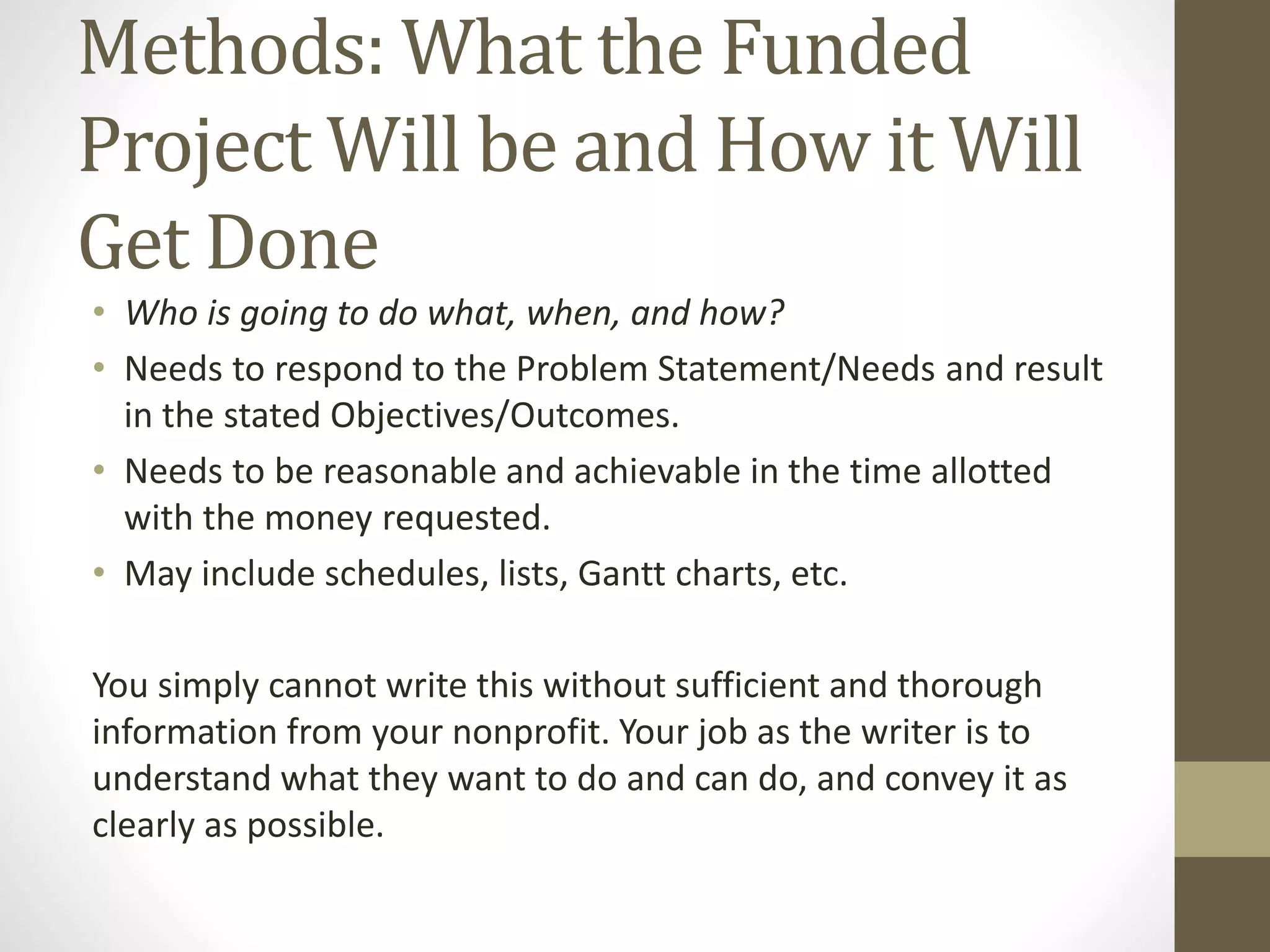
Methods: What the Funded
Project Will be and How it Will
Get Done
• Who is going to do what, when, and how?
• Needs to respond to the Problem Statement/Needs and result
in the stated Objectives/Outcomes.
• Needs to be reasonable and achievable in the time allotted
with the money requested.
• May include schedules, lists, Gantt charts, etc.
You simply cannot write this without sufficient and thorough
information from your nonprofit. Your job as the writer is to
understand what they want to do and can do, and convey it as
clearly as possible.
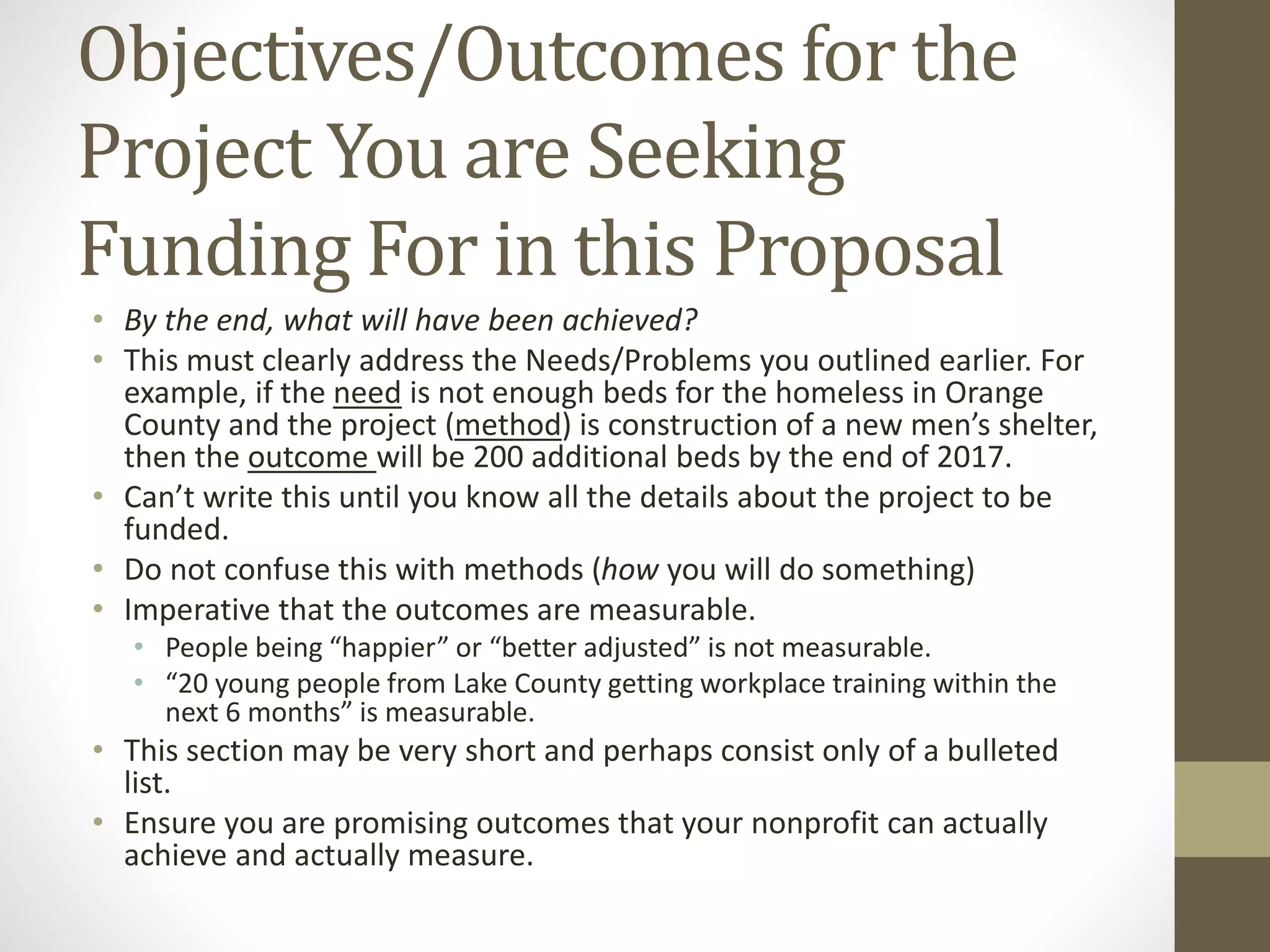
Objectives/Outcomes for the
Project You are Seeking
Funding For in this Proposal
• By the end, what will have been achieved?
• This must clearly address the Needs/Problems you outlined earlier. For
example, if the need is not enough beds for the homeless in Orange
County and the project (method) is construction of a new men’s shelter,
then the outcome will be 200 additional beds by the end of 2017.
• Can’t write this until you know all the details about the project to be
funded.
• Do not confuse this with methods (how you will do something)
• Imperative that the outcomes are measurable.
• People being “happier” or “better adjusted” is not measurable.
• “20 young people from Lake County getting workplace training within the
next 6 months” is measurable.
• This section may be very short and perhaps consist only of a bulleted
list.
• Ensure you are promising outcomes that your nonprofit can actually
achieve and actually measure.
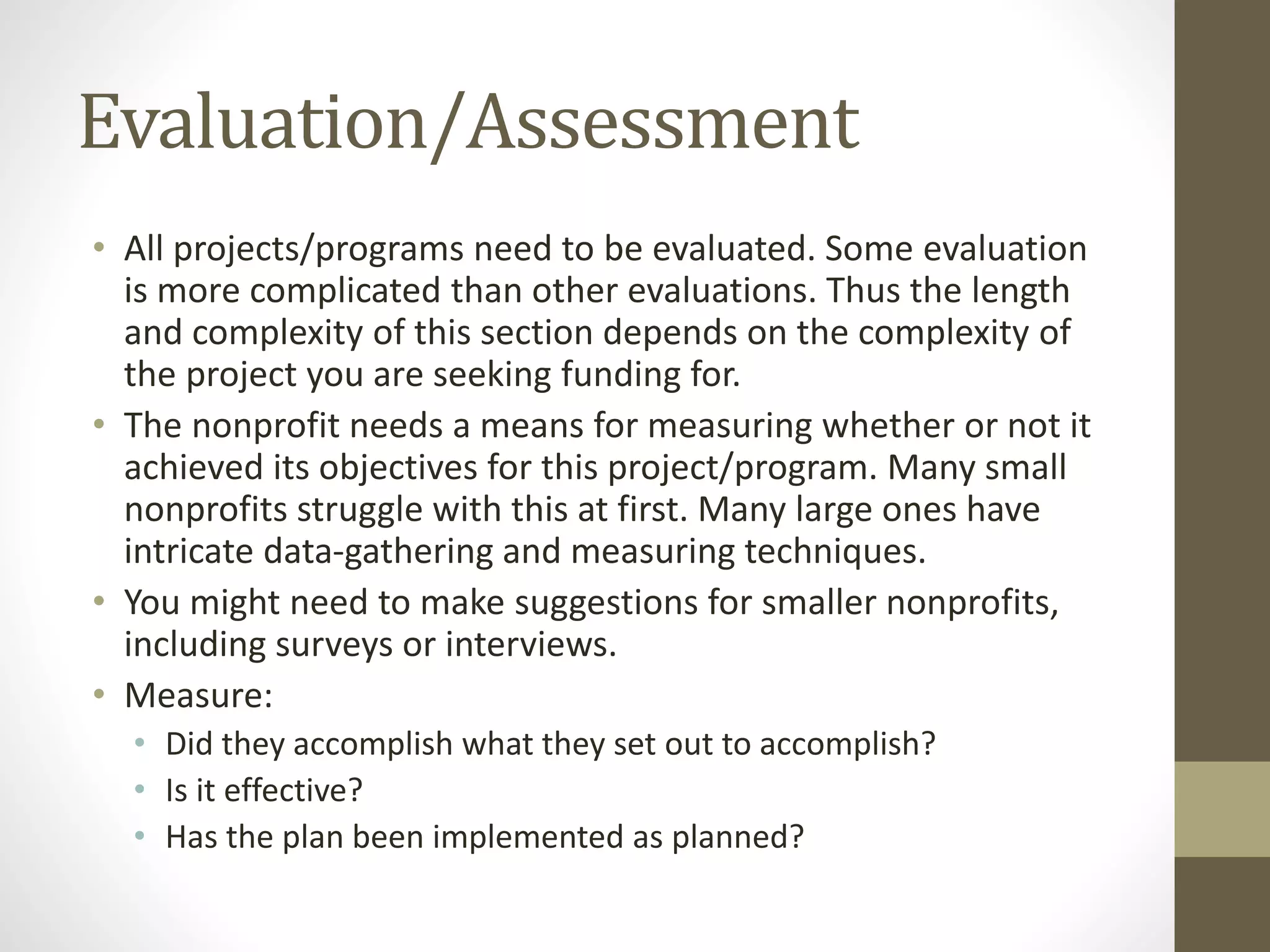
Evaluation/Assessment
• All projects/programs need to be evaluated. Some evaluation
is more complicated than other evaluations. Thus the length
and complexity of this section depends on the complexity of
the project you are seeking funding for.
• The nonprofit needs a means for measuring whether or not it
achieved its objectives for this project/program. Many small
nonprofits struggle with this at first. Many large ones have
intricate data-gathering and measuring techniques.
• You might need to make suggestions for smaller nonprofits,
including surveys or interviews.
• Measure:
• Did they accomplish what they set out to accomplish?
• Is it effective?
• Has the plan been implemented as planned?
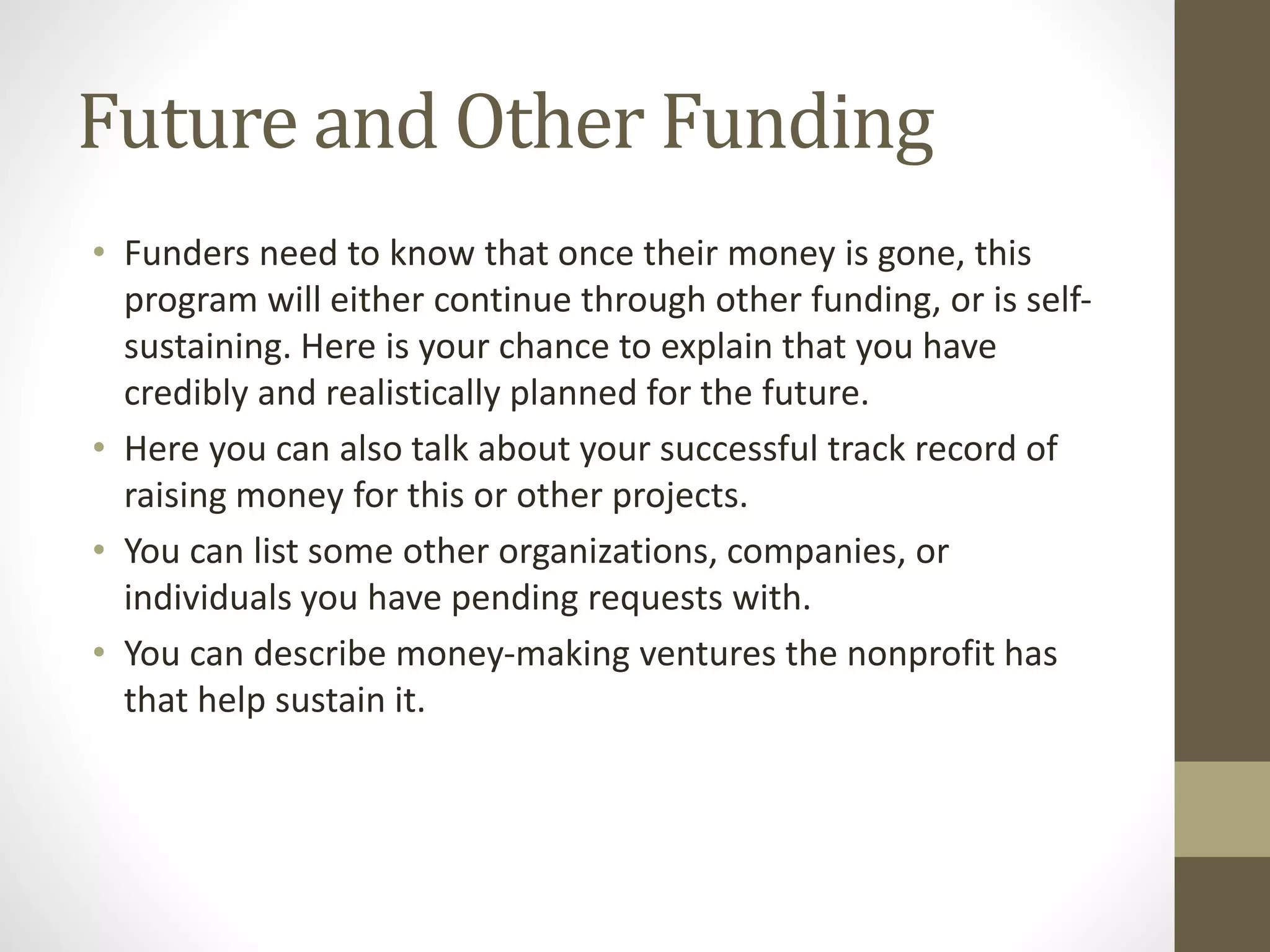
Future and Other Funding
• Funders need to know that once their money is gone, this
program will either continue through other funding, or is self-
sustaining. Here is your chance to explain that you have
credibly and realistically planned for the future.
• Here you can also talk about your successful track record of
raising money for this or other projects.
• You can list some other organizations, companies, or
individuals you have pending requests with.
• You can describe money-making ventures the nonprofit has
that help sustain it.
Budget
• You may not be able to complete this at all, or without
extensive help from the nonprofit.
• If you can’t complete it, then in your cover memo when you
submit to your nonprofit, let them know it needs to be added.
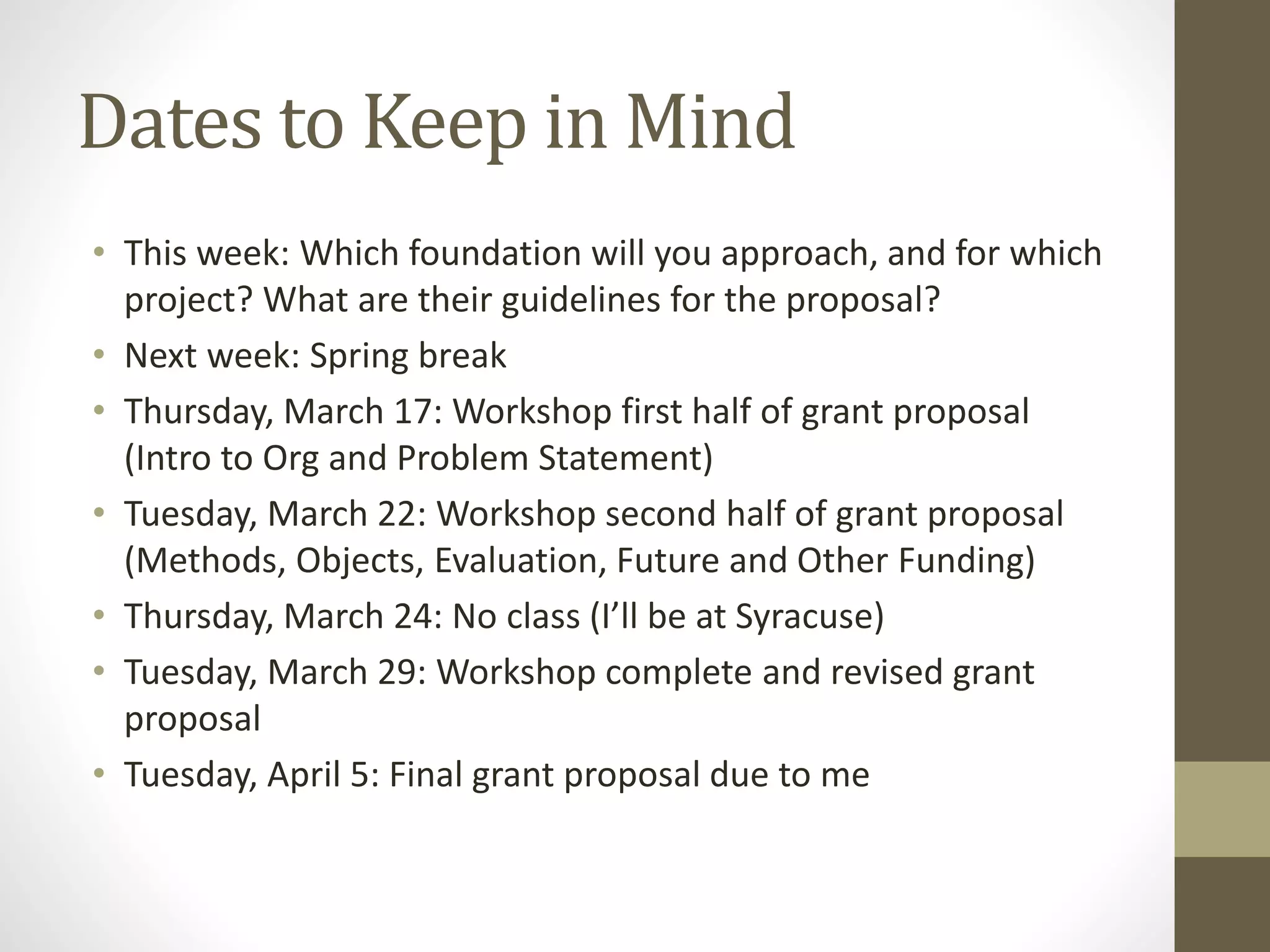
Dates to Keep in Mind
• This week: Which foundation will you approach, and for which
project? What are their guidelines for the proposal?
• Next week: Spring break
• Thursday, March 17: Workshop first half of grant proposal
(Intro to Org and Problem Statement)
• Tuesday, March 22: Workshop second half of grant proposal
(Methods, Objects, Evaluation, Future and Other Funding)
• Thursday, March 24: No class (I’ll be at Syracuse)
• Tuesday, March 29: Workshop complete and revised grant
proposal
• Tuesday, April 5: Final grant proposal due to me

Writing a grant proposal

  • 1.
    Writing Your Grant Proposal Writingwith Communities and Nonprofits Spring 2016
  • 2.
    Introduction to the Organization Establishcredibility for the nonprofit Might include: • When, how, why org was started • Statement of purpose, goals, philosophy • Prior/current activities • Accomplishments and impact • Size/characteristics of constituency/clientele • Positive comments about your work/supporting statements Sometimes letters of support can be included as appendices
  • 3.
    Problem Statement orNeeds Assessment • What is the problem or condition that your nonprofit and the particular project of this grant hopes to address? • What is the evidence that this problem exists? This evidence should be local, not generically national. Don’t engage in circular reasoning; the problem is not a lack of a youth center. The problem is that youth in this area have no after school support. The problem is not related to your nonproft; no one cares if you don’t have enough money to do something. The problem is that there aren’t enough beds for the homeless. YOU NEED TO DO A LOT OF RESEARCH FOR THIS SECTION! STATS, STORIES, ETC. Some of this will come from your nonprofit, but much of it you may need to research yourself. Government records, stats, newspaper stories, etc. Your librarian can help you!
  • 4.
    Methods: What theFunded Project Will be and How it Will Get Done • Who is going to do what, when, and how? • Needs to respond to the Problem Statement/Needs and result in the stated Objectives/Outcomes. • Needs to be reasonable and achievable in the time allotted with the money requested. • May include schedules, lists, Gantt charts, etc. You simply cannot write this without sufficient and thorough information from your nonprofit. Your job as the writer is to understand what they want to do and can do, and convey it as clearly as possible.
  • 5.
    Objectives/Outcomes for the ProjectYou are Seeking Funding For in this Proposal • By the end, what will have been achieved? • This must clearly address the Needs/Problems you outlined earlier. For example, if the need is not enough beds for the homeless in Orange County and the project (method) is construction of a new men’s shelter, then the outcome will be 200 additional beds by the end of 2017. • Can’t write this until you know all the details about the project to be funded. • Do not confuse this with methods (how you will do something) • Imperative that the outcomes are measurable. • People being “happier” or “better adjusted” is not measurable. • “20 young people from Lake County getting workplace training within the next 6 months” is measurable. • This section may be very short and perhaps consist only of a bulleted list. • Ensure you are promising outcomes that your nonprofit can actually achieve and actually measure.
  • 6.
    Evaluation/Assessment • All projects/programsneed to be evaluated. Some evaluation is more complicated than other evaluations. Thus the length and complexity of this section depends on the complexity of the project you are seeking funding for. • The nonprofit needs a means for measuring whether or not it achieved its objectives for this project/program. Many small nonprofits struggle with this at first. Many large ones have intricate data-gathering and measuring techniques. • You might need to make suggestions for smaller nonprofits, including surveys or interviews. • Measure: • Did they accomplish what they set out to accomplish? • Is it effective? • Has the plan been implemented as planned?
  • 7.
    Future and OtherFunding • Funders need to know that once their money is gone, this program will either continue through other funding, or is self- sustaining. Here is your chance to explain that you have credibly and realistically planned for the future. • Here you can also talk about your successful track record of raising money for this or other projects. • You can list some other organizations, companies, or individuals you have pending requests with. • You can describe money-making ventures the nonprofit has that help sustain it.
  • 8.
    Budget • You maynot be able to complete this at all, or without extensive help from the nonprofit. • If you can’t complete it, then in your cover memo when you submit to your nonprofit, let them know it needs to be added.
  • 9.
    Dates to Keepin Mind • This week: Which foundation will you approach, and for which project? What are their guidelines for the proposal? • Next week: Spring break • Thursday, March 17: Workshop first half of grant proposal (Intro to Org and Problem Statement) • Tuesday, March 22: Workshop second half of grant proposal (Methods, Objects, Evaluation, Future and Other Funding) • Thursday, March 24: No class (I’ll be at Syracuse) • Tuesday, March 29: Workshop complete and revised grant proposal • Tuesday, April 5: Final grant proposal due to me