
QUALITATIVE
DISSERTATION
CHAPTER 3
Components of a Qualitative Ch 3
◦ Introduction
◦ Research Design and Rationale
◦ Role of the Researcher
◦ Methodology
◦ Issues of Trustworthiness
◦ Ethical Considerations
◦ Summary
Introduction
◦Background to your study
◦Restate the problem and purpose
◦Preview the chapter
Research Design and Rationale
◦ Remind readers of the research
question
◦ Written exactly as they are elsewhere in
the dissertation
◦ Identify the phenomenon you are
studying
◦ Identify and justify your research
design
◦ Identify other possibilities and describe
why they were not appropriate for your
study
Common Qualitative Research Designs
◦ Case study
◦ One or more cases bounded by uniting factor
◦ Multiple data collection methods
◦ Phenomenology
◦ Explores lived experiences of participants and meaning assigned to those experiences
◦ Focused on commonalities of experience, the essence of the phenomenon
◦ Generic
◦ Useful when purpose and RQs do not fully align with other designs
◦ Can combine data collection and analysis approaches
◦ Offers methodological flexibility
Less Common Qualitative Research Designs for
the Advanced Researcher
◦ Grounded theory
◦ Generate theory
◦ Theory derived from data, or grounded in data, from vast number of
participants
◦ Explanatory
◦ Ethnography
◦ Explores phenomenon in cultural context
◦ Participant observation
Role of the Researcher
◦ Explain where you, as the researcher, fit into the
research process
◦ Identify your biases about your research topic,
participants, etc.
◦ Address any relationships you have with your
research participants and power
relationships/dynamics.
◦ Address any ethical issues related to power
relationships, how you will handle these.
Methodology
◦ The is the “recipe” for your research, so it should be in depth!
◦ Components:
◦ Participants and selection
◦ Instruments
◦ Pilot studies, when appropriate
◦ Procedures
◦ Data analysis
Participants and Selection
◦ Population
◦ Identify the population from which you will draw your sample.
◦ Sample strategy
◦ Usually purposeful in qualitative research
◦ Identify inclusion criteria and how you will screen participants for this
◦ How will you identify, contact, and recruit your participants?
Instruments
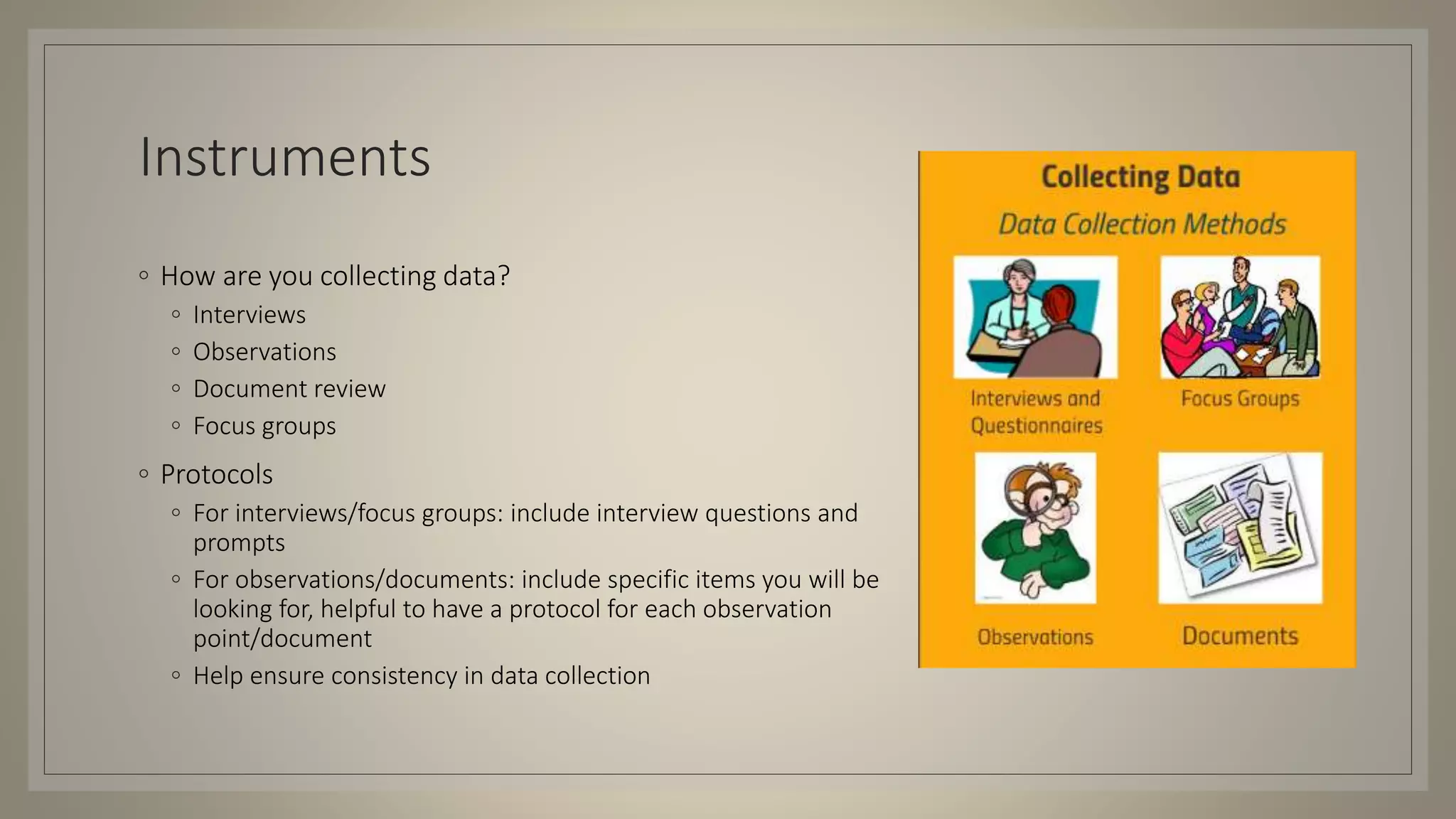
◦ How are you collecting data?
◦ Interviews
◦ Observations
◦ Document review
◦ Focus groups
◦ Protocols
◦ For interviews/focus groups: include interview questions and
prompts
◦ For observations/documents: include specific items you will be
looking for, helpful to have a protocol for each observation
point/document
◦ Help ensure consistency in data collection
Study Procedures
◦ Where will you collect data?
◦ Will you, or someone else collect data?
◦ How often will you collect data? Duration?
◦ How will you record your data?
◦ How will the study end?
◦ What are participants expected to do during and after data collection?
Data Analysis Plan
◦ How will you analyze your qualitative data?
◦ Think about data as they relate to your RQs.
◦ Will you use software? Why and how will this work?
◦ What will you do about cases that seem to disconfirm your findings, or participants whose experiences
are very different from other participants’ experiences?
Qualitative Data Analysis
Trustworthiness – Four Criteria
◦ Criteria
◦ Credibility – how true are the findings?
◦ Transferability – can the findings be generalized?
◦ Dependability – can the study and findings be replicated?
◦ Confirmability – how free are the results from researcher bias?
◦ Methods to establish criteria in your study
◦ Triangulation
◦ Transcript review
◦ Member checking
◦ Audit trail
◦ Descriptive, detailed methods
◦ Clear analysis procedures
Ethical Considerations
◦ Permission from research site
◦ Institutional Review Board (IRB) approval
◦ Informed consent
◦ Ensuring privacy and confidentiality
◦ Difference between confidential vs. anonymous
◦ Protection of participants and data
◦ Data storage
Summary
◦ Recap the highlights or major sections of your chapter
◦ Think about briefly tracing through the main components
◦ Purpose -> RQs -> method and design -> procedures
◦ Transition to next chapter

Qualitative Chapter 3

  • 1.
  • 2.
    Components of aQualitative Ch 3 ◦ Introduction ◦ Research Design and Rationale ◦ Role of the Researcher ◦ Methodology ◦ Issues of Trustworthiness ◦ Ethical Considerations ◦ Summary
  • 3.
    Introduction ◦Background to yourstudy ◦Restate the problem and purpose ◦Preview the chapter
  • 4.
    Research Design andRationale ◦ Remind readers of the research question ◦ Written exactly as they are elsewhere in the dissertation ◦ Identify the phenomenon you are studying ◦ Identify and justify your research design ◦ Identify other possibilities and describe why they were not appropriate for your study
  • 5.
    Common Qualitative ResearchDesigns ◦ Case study ◦ One or more cases bounded by uniting factor ◦ Multiple data collection methods ◦ Phenomenology ◦ Explores lived experiences of participants and meaning assigned to those experiences ◦ Focused on commonalities of experience, the essence of the phenomenon ◦ Generic ◦ Useful when purpose and RQs do not fully align with other designs ◦ Can combine data collection and analysis approaches ◦ Offers methodological flexibility
  • 6.
    Less Common QualitativeResearch Designs for the Advanced Researcher ◦ Grounded theory ◦ Generate theory ◦ Theory derived from data, or grounded in data, from vast number of participants ◦ Explanatory ◦ Ethnography ◦ Explores phenomenon in cultural context ◦ Participant observation
  • 7.
    Role of theResearcher ◦ Explain where you, as the researcher, fit into the research process ◦ Identify your biases about your research topic, participants, etc. ◦ Address any relationships you have with your research participants and power relationships/dynamics. ◦ Address any ethical issues related to power relationships, how you will handle these.
  • 8.
    Methodology ◦ The isthe “recipe” for your research, so it should be in depth! ◦ Components: ◦ Participants and selection ◦ Instruments ◦ Pilot studies, when appropriate ◦ Procedures ◦ Data analysis
  • 9.
    Participants and Selection ◦Population ◦ Identify the population from which you will draw your sample. ◦ Sample strategy ◦ Usually purposeful in qualitative research ◦ Identify inclusion criteria and how you will screen participants for this ◦ How will you identify, contact, and recruit your participants?
  • 10.
    Instruments ◦ How areyou collecting data? ◦ Interviews ◦ Observations ◦ Document review ◦ Focus groups ◦ Protocols ◦ For interviews/focus groups: include interview questions and prompts ◦ For observations/documents: include specific items you will be looking for, helpful to have a protocol for each observation point/document ◦ Help ensure consistency in data collection
  • 11.
    Study Procedures ◦ Wherewill you collect data? ◦ Will you, or someone else collect data? ◦ How often will you collect data? Duration? ◦ How will you record your data? ◦ How will the study end? ◦ What are participants expected to do during and after data collection?
  • 12.
    Data Analysis Plan ◦How will you analyze your qualitative data? ◦ Think about data as they relate to your RQs. ◦ Will you use software? Why and how will this work? ◦ What will you do about cases that seem to disconfirm your findings, or participants whose experiences are very different from other participants’ experiences?
  • 13.
  • 14.
    Trustworthiness – FourCriteria ◦ Criteria ◦ Credibility – how true are the findings? ◦ Transferability – can the findings be generalized? ◦ Dependability – can the study and findings be replicated? ◦ Confirmability – how free are the results from researcher bias? ◦ Methods to establish criteria in your study ◦ Triangulation ◦ Transcript review ◦ Member checking ◦ Audit trail ◦ Descriptive, detailed methods ◦ Clear analysis procedures
  • 15.
    Ethical Considerations ◦ Permissionfrom research site ◦ Institutional Review Board (IRB) approval ◦ Informed consent ◦ Ensuring privacy and confidentiality ◦ Difference between confidential vs. anonymous ◦ Protection of participants and data ◦ Data storage
  • 16.
    Summary ◦ Recap thehighlights or major sections of your chapter ◦ Think about briefly tracing through the main components ◦ Purpose -> RQs -> method and design -> procedures ◦ Transition to next chapter