THE EFFECTS VIDEO GAME VIOLENCE AND
 NARRATIVE HAVE ON REDUCING STRESS

           Casey Chadwick
            Brittany Bittner
VIDEO GAME USAGE
• 70% of children have at least 1 video game
  console in home
   • 33% have game systems in bedrooms (Thompson &
      Haninger, 2001)
• 31% daily basis
• 21% 3-5 days/week (Lenhart, Kahne, Middaugh, Macgill, Evans &
  Vitak, 2008)
DANGERS OF VIDEO GAMES
• Desensitization to violence
• Most popular games = most violent
   • Call of Duty: Black Ops, Mortal Kombat
   • Males attracted more than females
   • General Aggression Model (GAM) (Bushman &
     Anderson, 2011)
BENEFITS OF VIDEO GAMES
• Hand-eye coordination (Silvern, 1986)


• Visual spatial skills (Spence & Feng, 2010)


• Reducing negative emotions (e.g. anger, stress) (Olson,
  2010).
   • Mood Management Theory (Zillman, 2008)
HOW CAN VIDEO GAMES REDUCE STRESS?
• Theory of Flow
  (Payne, Jackson, Stine-Morrow & Noh, 2011)
   • May explain video game preference


• Narrative
  (Adams, Koenig, MacNamara, Mayer, & Wainess, 2011)
   • Makes game more complex
   • Adds challenge
CURRENT STUDY
• Examined whether video games can reduce stress
   • Stress reduction
   • Violent games vs. non-violent games
   • Narrative vs. no narrative
METHOD – PARTICIPANTS
• IRB Approved
• 53 undergraduate Penn State Behrend students
   • SONA system
                               VEQ            Males          Females
   • Informed consent    Play Often           84.6%           45.8%
• 47% female             0-5 hours            42.3%           91.7%
                         6 or more hours      57.7%            8.3%
• Ages 18-33             COD               11.5% (never)   62.5% (never)
                         Guilty Party      100% (never)    95.8% (never)
METHOD- PROCEDURES

                                Mood Survey 1


                           Stress Task (PASAT)

                                Mood Survey 2


                          Play video game for 20
                                  minutes

         Call of Duty                                  Guilty Party
  (Narrative or no narrative)                   (Narrative or no narrative)


                             Mood Survey 3
                        Serious Games Measure
                        Video Game Experience
                             Questionnaire
MOOD SURVEY
• Asks about current mood (happiness, stress, frustration)
    • On a scale of 1-5, how stressed are you?


•   Taken three times:
    •1st - coming into room
    •2nd – after stress task
    • 3rd – after playing game
Mood Survey 1


                         Stress Task (PASAT)

                              Mood Survey 2


                        Play video game for 20
                                minutes

       Call of Duty                                  Guilty Party
(Narrative or no narrative)                   (Narrative or no narrative)


                           Mood Survey 3
                      Serious Games Measure
                      Video Game Experience
                           Questionnaire
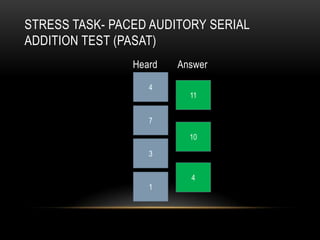
STRESS TASK- PACED AUDITORY SERIAL
ADDITION TEST (PASAT)
                Heard   Answer

                   4
                          11


                   7

                          10

                   3


                          4
                   1
Mood Survey 1


                         Stress Task (PASAT)

                              Mood Survey 2


                        Play video game for 20
                                minutes

       Call of Duty                                  Guilty Party
(Narrative or no narrative)                   (Narrative or no narrative)


                           Mood Survey 3
                      Serious Games Measure
                      Video Game Experience
                           Questionnaire
Mood Survey 1


                         Stress Task (PASAT)

                              Mood Survey 2


                        Play video game for 20
                                minutes

       Call of Duty                                  Guilty Party
(Narrative or no narrative)                   (Narrative or no narrative)


                           Mood Survey 3
                      Serious Games Measure
                      Video Game Experience
                           Questionnaire
CALL OF DUTY


Two settings:
   Campaign- narrative
   Combat training (zombies)-no narrative
GUILTY PARTY


Two settings:
  Story mode- narrative
  Party mode- no narrative
Mood Survey 1


                         Stress Task (PASAT)

                              Mood Survey 2


                        Play video game for 20
                                minutes

       Call of Duty                                  Guilty Party
(Narrative or no narrative)                   (Narrative or no narrative)


                           Mood Survey 3
                      Serious Games Measure
                      Video Game Experience
                           Questionnaire
SERIOUS GAME
   MEASURE (Blasko-Drabik, 2011)
• 35 items
• Asked about narrative and flow
  • Narrative:
       • I discovered the story as the game went on.
  • Flow:
       • I forgot about time while playing the game.
  • Enjoyment:
       • I enjoyed exploring the features by trial and
       error.
RESEARCH QUESTIONS
1) Did our stress task increase stress levels and did playing
the video game decrease stress levels?
2) What type of video game induces more flow (violent,
nonviolent)?
3) Does violence in a video game matter when reducing
stress?
4) Does narrative in a video game matter when reducing
stress?
RESULTS
Figure 1: Mean stress levels before task, after task, and after
playing. Covariate Mood Survey Time 1
                                            Females      Males
                4.5
                 4
                3.5
 Stress Means


                 3
                2.5
                 2
                1.5
                 1
                      Before Stress Task        After Stress Task             After Playing


Main effect of time                  Main effect of gender          Interaction of time and gender
F (1,39)= 4.62, p = 0.03             F (1,39)= 9.09, p = 0.004      F (1,39)= 2.91, p = 0.09
Figure 2: Mean flow levels based on game type.
                               Narrative   No Narrative
                    6
 Mean Flow Levels


                    5
                    4
                    3
                    2
                    1
                           Violence                No Violence
Main effect of violence                       Interaction of violence and narrative:
F (1,50)= 5.54, p = 0.01                      F (1,50)= 2.86, p = .09
Figure 3a: Means for stress levels based on game type and gender
Covariate Mood Survey Time 1
                                              Males
               4.5
                 4
               3.5
Stress Means


                 3
               2.5
                 2
               1.5                                                         After Stress Task
                 1                                                         After Playing Game
               0.5
                 0
                      Violent    Violent No   Nonviolent   Nonviolent No
                     Narrative   Narrative    Narrative      Narrative
                                       Game Type

Interaction of narrative and violence
F(1,49) = 1.95, p = .17
Figure 3b: Means for stress levels based on game type and gender
Covariate Mood Survey Time 1
                                               Females
                4.5
                  4
                3.5
 Stress Means


                  3
                2.5
                  2
                1.5                                                        After Stress Task
                  1                                                        After Playing
                0.5
                  0
                       Violent    Violent No    Nonviolent Nonviolent No
                      Narrative   Narrative     Narrative    Narrative
                                        Game Type

Interaction of narrative and violence
F(1,49) = 1.95, p = .17
DISCUSSION
• 1) Did our stress task increase stress levels and did playing the
  video game decrease stress levels?
   • Yes
• 2) What type of video game induces more flow
  (violent, nonviolent)?
   • Nonviolent, no narrative
• 3) Does violence in a video game matter when reducing stress?
   • No interaction, however were differences between games with
      reducing stress
• 4) Does narrative in a video game matter when reducing stress?
   • Mattered for violent games
IMPLICATIONS
• Design fun, nonviolent games
• If violent, include narrative
REFERENCES
Anderson, C. A., Ihori, N., Bushman, B. J., Rothstein, H. R., Shibuya, A., Swing, E. L., Sakamoto, A., & Saleem, M. (2010). V iolent
      video game effects on aggression, empathy, and prosocial behavior in eastern and western countries: A Meta -analytic review.
      Psychological Bulletin, 136(2), 151-173. doi:10.1037/a0018251
Bartholow, B. D., & Anderson, C. A. (2001). Effects of violent video games on aggressive behavior: Potential sex differences. Journal
       of Experimental Social Psychology, 38, 283-290. doi:10.1006/jesp.2001.1502
Engelhardt, C.R. Bartholow, B. D., & Saults, J. S. (2011). Violent and nonviolent video games differentially affect physical aggression
       for individuals high vs. low in dispositional behavior. Aggressive Behavior, 37, 539-546.
Inal, Y., & Cagiltay, K. (2007). Flow experiences of children in an interactive social games environment [Electronic version] . British
          Journal of Educational Technology, 38(3), 455-464. doi:10.1111/j.1467-8535.2007.00709.x
Payne, B. R., Jackson, J. J., Stine-Morrow, E. A., & Noh, S. R. (2011, March 28). In the zone: flow state and cognition in older adults
       [Electronic version]. Psychology and Aging, 26(3), 738-743. doi:10.1037/a0022359
Reinecke, L. (2009). The Use of video and computer games to recuperate from stress and strain. Journal of Media
       Psychology, 21(3), 126-142. doi:10.1027/1864-1105.21.3.126

Silvern, Steven B. (1986). "Classroom use of video games.". Educational research quarterly(0196 -
       5042), 10(1), p.10.
Spence, I., & Feng, J. (2010). Video games and spatial cognition. Review of General Psychology, 14(2), 92 -104.
      doi:10.1037/a0019491
Zillmann, D. (1988a). Mood management through communication choices. American Behavioral Scientist, 31, 327–340.
ACKNOWLEDGMENTS
We would like to acknowledge a special thank you to Dr. Dawn
Blasko for advising this research project as well as Holly
Blasko Drabik for providing consultation on the design and for
the use of her measure.


We would also like to thank Dr. Robert W. Light, Associate
Dean for research for providing financial support through the
grant program at Penn State Behrend.

WPUPC Talk

  • 1.
    THE EFFECTS VIDEOGAME VIOLENCE AND NARRATIVE HAVE ON REDUCING STRESS Casey Chadwick Brittany Bittner
  • 2.
    VIDEO GAME USAGE •70% of children have at least 1 video game console in home • 33% have game systems in bedrooms (Thompson & Haninger, 2001) • 31% daily basis • 21% 3-5 days/week (Lenhart, Kahne, Middaugh, Macgill, Evans & Vitak, 2008)
  • 3.
    DANGERS OF VIDEOGAMES • Desensitization to violence • Most popular games = most violent • Call of Duty: Black Ops, Mortal Kombat • Males attracted more than females • General Aggression Model (GAM) (Bushman & Anderson, 2011)
  • 4.
    BENEFITS OF VIDEOGAMES • Hand-eye coordination (Silvern, 1986) • Visual spatial skills (Spence & Feng, 2010) • Reducing negative emotions (e.g. anger, stress) (Olson, 2010). • Mood Management Theory (Zillman, 2008)
  • 5.
    HOW CAN VIDEOGAMES REDUCE STRESS? • Theory of Flow (Payne, Jackson, Stine-Morrow & Noh, 2011) • May explain video game preference • Narrative (Adams, Koenig, MacNamara, Mayer, & Wainess, 2011) • Makes game more complex • Adds challenge
  • 6.
    CURRENT STUDY • Examinedwhether video games can reduce stress • Stress reduction • Violent games vs. non-violent games • Narrative vs. no narrative
  • 7.
    METHOD – PARTICIPANTS •IRB Approved • 53 undergraduate Penn State Behrend students • SONA system VEQ Males Females • Informed consent Play Often 84.6% 45.8% • 47% female 0-5 hours 42.3% 91.7% 6 or more hours 57.7% 8.3% • Ages 18-33 COD 11.5% (never) 62.5% (never) Guilty Party 100% (never) 95.8% (never)
  • 8.
    METHOD- PROCEDURES Mood Survey 1 Stress Task (PASAT) Mood Survey 2 Play video game for 20 minutes Call of Duty Guilty Party (Narrative or no narrative) (Narrative or no narrative) Mood Survey 3 Serious Games Measure Video Game Experience Questionnaire
  • 9.
    MOOD SURVEY • Asksabout current mood (happiness, stress, frustration) • On a scale of 1-5, how stressed are you? • Taken three times: •1st - coming into room •2nd – after stress task • 3rd – after playing game
  • 10.
    Mood Survey 1 Stress Task (PASAT) Mood Survey 2 Play video game for 20 minutes Call of Duty Guilty Party (Narrative or no narrative) (Narrative or no narrative) Mood Survey 3 Serious Games Measure Video Game Experience Questionnaire
  • 11.
    STRESS TASK- PACEDAUDITORY SERIAL ADDITION TEST (PASAT) Heard Answer 4 11 7 10 3 4 1
  • 12.
    Mood Survey 1 Stress Task (PASAT) Mood Survey 2 Play video game for 20 minutes Call of Duty Guilty Party (Narrative or no narrative) (Narrative or no narrative) Mood Survey 3 Serious Games Measure Video Game Experience Questionnaire
  • 13.
    Mood Survey 1 Stress Task (PASAT) Mood Survey 2 Play video game for 20 minutes Call of Duty Guilty Party (Narrative or no narrative) (Narrative or no narrative) Mood Survey 3 Serious Games Measure Video Game Experience Questionnaire
  • 14.
    CALL OF DUTY Twosettings: Campaign- narrative Combat training (zombies)-no narrative
  • 15.
    GUILTY PARTY Two settings: Story mode- narrative Party mode- no narrative
  • 16.
    Mood Survey 1 Stress Task (PASAT) Mood Survey 2 Play video game for 20 minutes Call of Duty Guilty Party (Narrative or no narrative) (Narrative or no narrative) Mood Survey 3 Serious Games Measure Video Game Experience Questionnaire
  • 17.
    SERIOUS GAME MEASURE (Blasko-Drabik, 2011) • 35 items • Asked about narrative and flow • Narrative: • I discovered the story as the game went on. • Flow: • I forgot about time while playing the game. • Enjoyment: • I enjoyed exploring the features by trial and error.
  • 18.
    RESEARCH QUESTIONS 1) Didour stress task increase stress levels and did playing the video game decrease stress levels? 2) What type of video game induces more flow (violent, nonviolent)? 3) Does violence in a video game matter when reducing stress? 4) Does narrative in a video game matter when reducing stress?
  • 19.
    RESULTS Figure 1: Meanstress levels before task, after task, and after playing. Covariate Mood Survey Time 1 Females Males 4.5 4 3.5 Stress Means 3 2.5 2 1.5 1 Before Stress Task After Stress Task After Playing Main effect of time Main effect of gender Interaction of time and gender F (1,39)= 4.62, p = 0.03 F (1,39)= 9.09, p = 0.004 F (1,39)= 2.91, p = 0.09
  • 20.
    Figure 2: Meanflow levels based on game type. Narrative No Narrative 6 Mean Flow Levels 5 4 3 2 1 Violence No Violence Main effect of violence Interaction of violence and narrative: F (1,50)= 5.54, p = 0.01 F (1,50)= 2.86, p = .09
  • 21.
    Figure 3a: Meansfor stress levels based on game type and gender Covariate Mood Survey Time 1 Males 4.5 4 3.5 Stress Means 3 2.5 2 1.5 After Stress Task 1 After Playing Game 0.5 0 Violent Violent No Nonviolent Nonviolent No Narrative Narrative Narrative Narrative Game Type Interaction of narrative and violence F(1,49) = 1.95, p = .17
  • 22.
    Figure 3b: Meansfor stress levels based on game type and gender Covariate Mood Survey Time 1 Females 4.5 4 3.5 Stress Means 3 2.5 2 1.5 After Stress Task 1 After Playing 0.5 0 Violent Violent No Nonviolent Nonviolent No Narrative Narrative Narrative Narrative Game Type Interaction of narrative and violence F(1,49) = 1.95, p = .17
  • 23.
    DISCUSSION • 1) Didour stress task increase stress levels and did playing the video game decrease stress levels? • Yes • 2) What type of video game induces more flow (violent, nonviolent)? • Nonviolent, no narrative • 3) Does violence in a video game matter when reducing stress? • No interaction, however were differences between games with reducing stress • 4) Does narrative in a video game matter when reducing stress? • Mattered for violent games
  • 24.
    IMPLICATIONS • Design fun,nonviolent games • If violent, include narrative
  • 25.
    REFERENCES Anderson, C. A.,Ihori, N., Bushman, B. J., Rothstein, H. R., Shibuya, A., Swing, E. L., Sakamoto, A., & Saleem, M. (2010). V iolent video game effects on aggression, empathy, and prosocial behavior in eastern and western countries: A Meta -analytic review. Psychological Bulletin, 136(2), 151-173. doi:10.1037/a0018251 Bartholow, B. D., & Anderson, C. A. (2001). Effects of violent video games on aggressive behavior: Potential sex differences. Journal of Experimental Social Psychology, 38, 283-290. doi:10.1006/jesp.2001.1502 Engelhardt, C.R. Bartholow, B. D., & Saults, J. S. (2011). Violent and nonviolent video games differentially affect physical aggression for individuals high vs. low in dispositional behavior. Aggressive Behavior, 37, 539-546. Inal, Y., & Cagiltay, K. (2007). Flow experiences of children in an interactive social games environment [Electronic version] . British Journal of Educational Technology, 38(3), 455-464. doi:10.1111/j.1467-8535.2007.00709.x Payne, B. R., Jackson, J. J., Stine-Morrow, E. A., & Noh, S. R. (2011, March 28). In the zone: flow state and cognition in older adults [Electronic version]. Psychology and Aging, 26(3), 738-743. doi:10.1037/a0022359 Reinecke, L. (2009). The Use of video and computer games to recuperate from stress and strain. Journal of Media Psychology, 21(3), 126-142. doi:10.1027/1864-1105.21.3.126 Silvern, Steven B. (1986). "Classroom use of video games.". Educational research quarterly(0196 - 5042), 10(1), p.10. Spence, I., & Feng, J. (2010). Video games and spatial cognition. Review of General Psychology, 14(2), 92 -104. doi:10.1037/a0019491 Zillmann, D. (1988a). Mood management through communication choices. American Behavioral Scientist, 31, 327–340.
  • 26.
    ACKNOWLEDGMENTS We would liketo acknowledge a special thank you to Dr. Dawn Blasko for advising this research project as well as Holly Blasko Drabik for providing consultation on the design and for the use of her measure. We would also like to thank Dr. Robert W. Light, Associate Dean for research for providing financial support through the grant program at Penn State Behrend.