The Different Types of UPS Systems


White Paper 1
Revision 7


by Neil Rasmussen


                                                             Contents
    > Executive summary                                      Click on a section to jump to it

                                                             Introduction                       2
    There is much confusion in the marketplace about the
    different types of UPS systems and their characteris-    UPS types                          2
    tics. Each of these UPS types is defined, practical
    applications of each are discussed, and advantages and   Summary of UPS types               7
    disadvantages are listed. With this information, an
    educated decision can be made as to the appropriate      Use of UPS types in
                                                                                                7
                                                             the industry
    UPS topology for a given need.
                                                             Conclusion                         9

                                                             Resources                          10
The Different Types of UPS Systems


Introduction   The varied types of uninterruptible power supplies (UPS) and their attributes often cause
               confusion in the data center industry. For example, it is widely believed that there are only
               two types of UPS systems, namely standby UPS and on-line UPS. These two commonly
               used terms do not correctly describe many of the UPS systems available. Many misunder-
               standings about UPS systems are cleared up when the different types of UPS topologies are
               properly identified. UPS topology indicates the basic nature of the UPS design. Various
               vendors routinely produce models with similar designs, or topologies, but with very different
               performance characteristics.

               Common design approaches are reviewed here, including brief explanations about how each
               topology works. This will help you to properly identify and compare systems.


UPS types      A variety of design approaches are used to implement UPS systems, each with distinct
               performance characteristics. The most common design approaches are as follows:

                 • Standby
                 • Line interactive
                 • Standby-ferro
                 • Double conversion on-line
                 • Delta conversion on-line

               The standby UPS
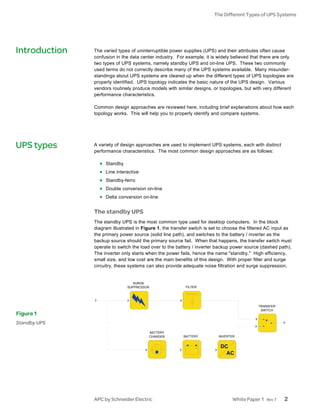
               The standby UPS is the most common type used for desktop computers. In the block
               diagram illustrated in Figure 1, the transfer switch is set to choose the filtered AC input as
               the primary power source (solid line path), and switches to the battery / inverter as the
               backup source should the primary source fail. When that happens, the transfer switch must
               operate to switch the load over to the battery / inverter backup power source (dashed path).
               The inverter only starts when the power fails, hence the name "standby." High efficiency,
               small size, and low cost are the main benefits of this design. With proper filter and surge
               circuitry, these systems can also provide adequate noise filtration and surge suppression.


                                 SURGE
                              SUPPRESSOR                  FILTER


                                                                                             TRANSFER
                                                                                              SWITCH
Figure 1
Standby UPS
                                         BATTERY
                                         CHARGER         BATTERY          INVERTER


                                                                           DC
                                                                             AC


               APC by Schneider Electric                                        White Paper 1    Rev 7   2
The Different Types of UPS Systems


                       The line interactive UPS
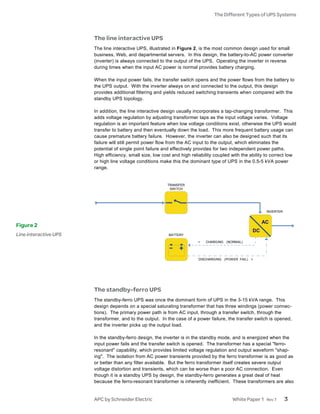
                       The line interactive UPS, illustrated in Figure 2, is the most common design used for small
                       business, Web, and departmental servers. In this design, the battery-to-AC power converter
                       (inverter) is always connected to the output of the UPS. Operating the inverter in reverse
                       during times when the input AC power is normal provides battery charging.

                       When the input power fails, the transfer switch opens and the power flows from the battery to
                       the UPS output. With the inverter always on and connected to the output, this design
                       provides additional filtering and yields reduced switching transients when compared with the
                       standby UPS topology.

                       In addition, the line interactive design usually incorporates a tap-changing transformer. This
                       adds voltage regulation by adjusting transformer taps as the input voltage varies. Voltage
                       regulation is an important feature when low voltage conditions exist, otherwise the UPS would
                       transfer to battery and then eventually down the load. This more frequent battery usage can
                       cause premature battery failure. However, the inverter can also be designed such that its
                       failure will still permit power flow from the AC input to the output, which eliminates the
                       potential of single point failure and effectively provides for two independent power paths.
                       High efficiency, small size, low cost and high reliability coupled with the ability to correct low
                       or high line voltage conditions make this the dominant type of UPS in the 0.5-5 kVA power
                       range.


                                                          TRANSFER
                                                           SWITCH


                                                                                                          INVERTER


                                                                                                        AC
Figure 2
                                                                                                   DC
Line interactive UPS                                       BATTERY

                                                                         <   CHARGING (NORMAL)


                                                                         DISCHARGING (POWER FAIL) >


                       The standby-ferro UPS
                       The standby-ferro UPS was once the dominant form of UPS in the 3-15 kVA range. This
                       design depends on a special saturating transformer that has three windings (power connec-
                       tions). The primary power path is from AC input, through a transfer switch, through the
                       transformer, and to the output. In the case of a power failure, the transfer switch is opened,
                       and the inverter picks up the output load.

                       In the standby-ferro design, the inverter is in the standby mode, and is energized when the
                       input power fails and the transfer switch is opened. The transformer has a special "ferro-
                       resonant" capability, which provides limited voltage regulation and output waveform "shap-
                       ing". The isolation from AC power transients provided by the ferro transformer is as good as
                       or better than any filter available. But the ferro transformer itself creates severe output
                       voltage distortion and transients, which can be worse than a poor AC connection. Even
                       though it is a standby UPS by design, the standby-ferro generates a great deal of heat
                       because the ferro-resonant transformer is inherently inefficient. These transformers are also


                       APC by Schneider Electric                                          White Paper 1   Rev 7      3
The Different Types of UPS Systems


                    large relative to regular isolation transformers; so standby-ferro UPS are generally quite large
                    and heavy.

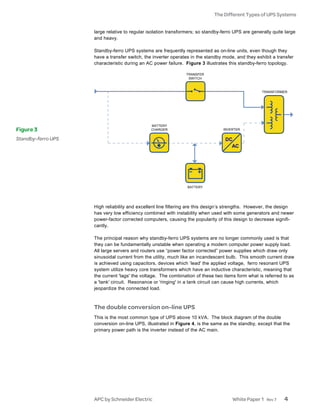
                    Standby-ferro UPS systems are frequently represented as on-line units, even though they
                    have a transfer switch, the inverter operates in the standby mode, and they exhibit a transfer
                    characteristic during an AC power failure. Figure 3 illustrates this standby-ferro topology.

                                                               TRANSFER
                                                                SWITCH


                                                                                                    TRANSFORMER


                                               BATTERY
Figure 3                                       CHARGER                           INVERTER

Standby-ferro UPS                                                                 DC
                                                                                    AC


                                                                BATTERY


                    High reliability and excellent line filtering are this design’s strengths. However, the design
                    has very low efficiency combined with instability when used with some generators and newer
                    power-factor corrected computers, causing the popularity of this design to decrease signifi-
                    cantly.

                    The principal reason why standby-ferro UPS systems are no longer commonly used is that
                    they can be fundamentally unstable when operating a modern computer power supply load.
                    All large servers and routers use “power factor corrected” power supplies which draw only
                    sinusoidal current from the utility, much like an incandescent bulb. This smooth current draw
                    is achieved using capacitors, devices which ‘lead' the applied voltage, ferro resonant UPS
                    system utilize heavy core transformers which have an inductive characteristic, meaning that
                    the current 'lags' the voltage. The combination of these two items form what is referred to as
                    a 'tank' circuit. Resonance or 'ringing' in a tank circuit can cause high currents, which
                    jeopardize the connected load.


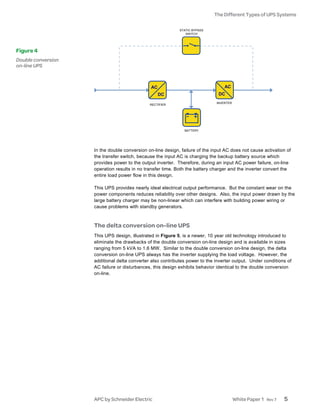
                    The double conversion on-line UPS
                    This is the most common type of UPS above 10 kVA. The block diagram of the double
                    conversion on-line UPS, illustrated in Figure 4, is the same as the standby, except that the
                    primary power path is the inverter instead of the AC main.


                    APC by Schneider Electric                                        White Paper 1    Rev 7   4
The Different Types of UPS Systems

                                                            STATIC BYPASS
                                                               SWITCH


Figure 4
Double conversion
on-line UPS


                                              AC                                 AC
                                                   DC                         DC
                                                                             INVERTER
                                              RECTIFIER


                                                              BATTERY


                    In the double conversion on-line design, failure of the input AC does not cause activation of
                    the transfer switch, because the input AC is charging the backup battery source which
                    provides power to the output inverter. Therefore, during an input AC power failure, on-line
                    operation results in no transfer time. Both the battery charger and the inverter convert the
                    entire load power flow in this design.

                    This UPS provides nearly ideal electrical output performance. But the constant wear on the
                    power components reduces reliability over other designs. Also, the input power drawn by the
                    large battery charger may be non-linear which can interfere with building power wiring or
                    cause problems with standby generators.


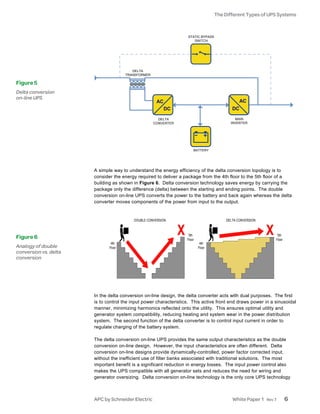
                    The delta conversion on-line UPS
                    This UPS design, illustrated in Figure 5, is a newer, 10 year old technology introduced to
                    eliminate the drawbacks of the double conversion on-line design and is available in sizes
                    ranging from 5 kVA to 1.6 MW. Similar to the double conversion on-line design, the delta
                    conversion on-line UPS always has the inverter supplying the load voltage. However, the
                    additional delta converter also contributes power to the inverter output. Under conditions of
                    AC failure or disturbances, this design exhibits behavior identical to the double conversion
                    on-line.


                    APC by Schneider Electric                                           White Paper 1   Rev 7   5
The Different Types of UPS Systems


                                                                    STATIC BYPASS
                                                                       SWITCH


                                         DELTA
                                      TRANSFORMER

Figure 5
Delta conversion
on-line UPS
                                                      AC                                        AC
                                                           DC                              DC

                                                      DELTA                                 MAIN
                                                    CONVERTER                             INVERTER


                                                                        BATTERY


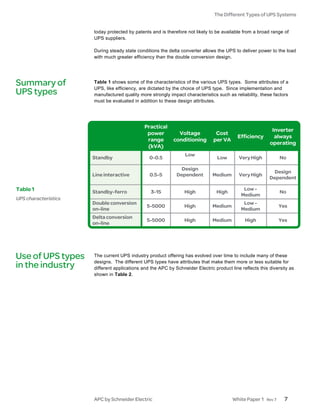
                       A simple way to understand the energy efficiency of the delta conversion topology is to
                       consider the energy required to deliver a package from the 4th floor to the 5th floor of a
                       building as shown in Figure 6. Delta conversion technology saves energy by carrying the
                       package only the difference (delta) between the starting and ending points. The double
                       conversion on-line UPS converts the power to the battery and back again whereas the delta
                       converter moves components of the power from input to the output.


                                          DOUBLE CONVERSION                             DELTA CONVERSION


Figure 6
                                                                X    5th
                                                                    Floor
                                                                                                           X    5th
                                                                                                               Floor
                               4th                                           4th
Analogy of double             Floor                                         Floor
conversion vs. delta
conversion


                       In the delta conversion on-line design, the delta converter acts with dual purposes. The first
                       is to control the input power characteristics. This active front end draws power in a sinusoidal
                       manner, minimizing harmonics reflected onto the utility. This ensures optimal utility and
                       generator system compatibility, reducing heating and system wear in the power distribution
                       system. The second function of the delta converter is to control input current in order to
                       regulate charging of the battery system.

                       The delta conversion on-line UPS provides the same output characteristics as the double
                       conversion on-line design. However, the input characteristics are often different. Delta
                       conversion on-line designs provide dynamically-controlled, power factor corrected input,
                       without the inefficient use of filter banks associated with traditional solutions. The most
                       important benefit is a significant reduction in energy losses. The input power control also
                       makes the UPS compatible with all generator sets and reduces the need for wiring and
                       generator oversizing. Delta conversion on-line technology is the only core UPS technology


                       APC by Schneider Electric                                           White Paper 1   Rev 7       6
The Different Types of UPS Systems


                      today protected by patents and is therefore not likely to be available from a broad range of
                      UPS suppliers.

                      During steady state conditions the delta converter allows the UPS to deliver power to the load
                      with much greater efficiency than the double conversion design.


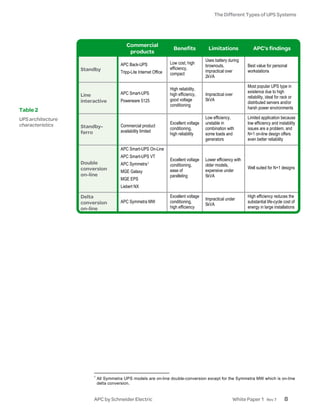
Summary of            Table 1 shows some of the characteristics of the various UPS types. Some attributes of a
                      UPS, like efficiency, are dictated by the choice of UPS type. Since implementation and
UPS types             manufactured quality more strongly impact characteristics such as reliability, these factors
                      must be evaluated in addition to these design attributes.


                                              Practical
                                                                                                           Inverter
                                               power          Voltage           Cost
                                                                                          Efficiency        always
                                               range        conditioning       per VA
                                                                                                          operating
                                               (kVA)
                                                                 Low
                      Standby                   0-0.5                            Low       Very High            No

                                                               Design
                                                                                                            Design
                      Line interactive          0.5-5        Dependent        Medium       Very High
                                                                                                          Dependent

Table 1                                                                                      Low -
                      Standby-ferro              3-15            High           High                            No
                                                                                            Medium
UPS characteristics
                      Double conversion                                                      Low -
                                               5-5000            High         Medium                            Yes
                      on-line                                                               Medium
                      Delta conversion
                                               5-5000            High         Medium          High              Yes
                      on-line


Use of UPS types      The current UPS industry product offering has evolved over time to include many of these
                      designs. The different UPS types have attributes that make them more or less suitable for
in the industry       different applications and the APC by Schneider Electric product line reflects this diversity as
                      shown in Table 2.


                      APC by Schneider Electric                                         White Paper 1   Rev 7    7
The Different Types of UPS Systems


                                          Commercial
                                                                      Benefits           Limitations               APC’s findings
                                           products
                                                                                        Uses battery during
                                       APC Back-UPS                 Low cost, high
                                                                                        brownouts,              Best value for personal
                   Standby                                          efficiency,
                                       Tripp-Lite Internet Office                       impractical over        workstations
                                                                    compact
                                                                                        2kVA

                                                                                                                Most popular UPS type in
                                                                    High reliability,
                                       APC Smart-UPS                                                            existence due to high
                   Line                                             high efficiency,    Impractical over
                                                                                                                reliability, ideal for rack or
                   interactive         Powerware 5125               good voltage        5kVA
                                                                                                                distributed servers and/or
                                                                    conditioning
                                                                                                                harsh power environments
Table 2
UPS architecture                                                                        Low efficiency,         Limited application because
                                                                    Excellent voltage   unstable in             low efficiency and instability
characteristics    Standby-            Commercial product
                                                                    conditioning,       combination with        issues are a problem, and
                   ferro               availability limited
                                                                    high reliability    some loads and          N+1 on-line design offers
                                                                                        generators              even better reliability

                                       APC Smart-UPS On-Line
                                       APC Smart-UPS VT
                                                                    Excellent voltage   Lower efficiency with
                   Double              APC Symmetra 1               conditioning,       older models,
                   conversion                                                                                   Well suited for N+1 designs
                                       MGE Galaxy                   ease of             expensive under
                   on-line                                          paralleling         5kVA
                                       MGE EPS
                                       Liebert NX

                   Delta                                            Excellent voltage                           High efficiency reduces the
                                                                                        Impractical under
                   conversion          APC Symmetra MW              conditioning,                               substantial life-cycle cost of
                                                                                        5kVA
                   on-line                                          high efficiency                             energy in large installations


                        1
                            All Symmetra UPS models are on-line double-conversion except for the Symmetra MW which is on-line
                            delta conversion.


                        APC by Schneider Electric                                                      White Paper 1        Rev 7       8
The Different Types of UPS Systems


Conclusion   Various UPS types are appropriate for different uses, and no single UPS type is ideal for all
             applications. The intent of this paper is to contrast the advantages and disadvantages of the
             various UPS topologies on the market today.

             Significant differences in UPS designs offer theoretical and practical advantages for different
             purposes. Nevertheless, the basic quality of design implementation and manufactured quality
             are often dominant in determining the ultimate performance achieved in the customer
             application.


                      About the author
                 Neil Rasmussen is the Senior VP of Innovation for APC, which is the IT Business Unit of
                 Schneider Electric. He establishes the technology direction for the world’s largest R&D
                 budget devoted to power, cooling, and rack infrastructure for critical networks.

                 Neil holds 14 patents related to high efficiency and high density data center power and
                 cooling infrastructure, and has published over 50 white papers related to power and cooling
                 systems, many published in more than 10 languages, most recently with a focus on the
                 improvement of energy efficiency. He is an internationally recognized keynote speaker on
                 the subject of high efficiency data centers. Neil is currently working to advance the science
                 of high-efficiency, high-density, scalable data center infrastructure solutions and is a principal
                 architect of the APC InfraStruXure system.

                 Prior to founding APC in 1981, Neil received his bachelors and masters degrees from MIT in
                 electrical engineering, where he did his thesis on the analysis of a 200MW power supply for
                 a tokamak fusion reactor. From 1979 to 1981 he worked at MIT Lincoln Laboratories on
                 flywheel energy storage systems and solar electric power systems.


             APC by Schneider Electric                                                 White Paper 1      Rev 7       9
The Different Types of UPS Systems


Resources
Click on icon to link to resource


                                        APC White Paper Library
                                        whitepapers.apc.com


                                        APC TradeOff Tools™
                                        tools.apc.com


                                             Contact us
                                       For feedback and comments about the content of this white paper:

                                           Data Center Science Center, APC by Schneider Electric
                                           DCSC@Schneider-Electric.com

                                       If you are a customer and have questions specific to your data center project:

                                             Contact your APC by Schneider Electric representative


                                    APC by Schneider Electric                                   White Paper 1   Rev 7   10

WP1 UPS Topologies

  • 1.
    The Different Typesof UPS Systems White Paper 1 Revision 7 by Neil Rasmussen Contents > Executive summary Click on a section to jump to it Introduction 2 There is much confusion in the marketplace about the different types of UPS systems and their characteris- UPS types 2 tics. Each of these UPS types is defined, practical applications of each are discussed, and advantages and Summary of UPS types 7 disadvantages are listed. With this information, an educated decision can be made as to the appropriate Use of UPS types in 7 the industry UPS topology for a given need. Conclusion 9 Resources 10
  • 2.
    The Different Typesof UPS Systems Introduction The varied types of uninterruptible power supplies (UPS) and their attributes often cause confusion in the data center industry. For example, it is widely believed that there are only two types of UPS systems, namely standby UPS and on-line UPS. These two commonly used terms do not correctly describe many of the UPS systems available. Many misunder- standings about UPS systems are cleared up when the different types of UPS topologies are properly identified. UPS topology indicates the basic nature of the UPS design. Various vendors routinely produce models with similar designs, or topologies, but with very different performance characteristics. Common design approaches are reviewed here, including brief explanations about how each topology works. This will help you to properly identify and compare systems. UPS types A variety of design approaches are used to implement UPS systems, each with distinct performance characteristics. The most common design approaches are as follows: • Standby • Line interactive • Standby-ferro • Double conversion on-line • Delta conversion on-line The standby UPS The standby UPS is the most common type used for desktop computers. In the block diagram illustrated in Figure 1, the transfer switch is set to choose the filtered AC input as the primary power source (solid line path), and switches to the battery / inverter as the backup source should the primary source fail. When that happens, the transfer switch must operate to switch the load over to the battery / inverter backup power source (dashed path). The inverter only starts when the power fails, hence the name "standby." High efficiency, small size, and low cost are the main benefits of this design. With proper filter and surge circuitry, these systems can also provide adequate noise filtration and surge suppression. SURGE SUPPRESSOR FILTER TRANSFER SWITCH Figure 1 Standby UPS BATTERY CHARGER BATTERY INVERTER DC AC APC by Schneider Electric White Paper 1 Rev 7 2
  • 3.
    The Different Typesof UPS Systems The line interactive UPS The line interactive UPS, illustrated in Figure 2, is the most common design used for small business, Web, and departmental servers. In this design, the battery-to-AC power converter (inverter) is always connected to the output of the UPS. Operating the inverter in reverse during times when the input AC power is normal provides battery charging. When the input power fails, the transfer switch opens and the power flows from the battery to the UPS output. With the inverter always on and connected to the output, this design provides additional filtering and yields reduced switching transients when compared with the standby UPS topology. In addition, the line interactive design usually incorporates a tap-changing transformer. This adds voltage regulation by adjusting transformer taps as the input voltage varies. Voltage regulation is an important feature when low voltage conditions exist, otherwise the UPS would transfer to battery and then eventually down the load. This more frequent battery usage can cause premature battery failure. However, the inverter can also be designed such that its failure will still permit power flow from the AC input to the output, which eliminates the potential of single point failure and effectively provides for two independent power paths. High efficiency, small size, low cost and high reliability coupled with the ability to correct low or high line voltage conditions make this the dominant type of UPS in the 0.5-5 kVA power range. TRANSFER SWITCH INVERTER AC Figure 2 DC Line interactive UPS BATTERY < CHARGING (NORMAL) DISCHARGING (POWER FAIL) > The standby-ferro UPS The standby-ferro UPS was once the dominant form of UPS in the 3-15 kVA range. This design depends on a special saturating transformer that has three windings (power connec- tions). The primary power path is from AC input, through a transfer switch, through the transformer, and to the output. In the case of a power failure, the transfer switch is opened, and the inverter picks up the output load. In the standby-ferro design, the inverter is in the standby mode, and is energized when the input power fails and the transfer switch is opened. The transformer has a special "ferro- resonant" capability, which provides limited voltage regulation and output waveform "shap- ing". The isolation from AC power transients provided by the ferro transformer is as good as or better than any filter available. But the ferro transformer itself creates severe output voltage distortion and transients, which can be worse than a poor AC connection. Even though it is a standby UPS by design, the standby-ferro generates a great deal of heat because the ferro-resonant transformer is inherently inefficient. These transformers are also APC by Schneider Electric White Paper 1 Rev 7 3
  • 4.
    The Different Typesof UPS Systems large relative to regular isolation transformers; so standby-ferro UPS are generally quite large and heavy. Standby-ferro UPS systems are frequently represented as on-line units, even though they have a transfer switch, the inverter operates in the standby mode, and they exhibit a transfer characteristic during an AC power failure. Figure 3 illustrates this standby-ferro topology. TRANSFER SWITCH TRANSFORMER BATTERY Figure 3 CHARGER INVERTER Standby-ferro UPS DC AC BATTERY High reliability and excellent line filtering are this design’s strengths. However, the design has very low efficiency combined with instability when used with some generators and newer power-factor corrected computers, causing the popularity of this design to decrease signifi- cantly. The principal reason why standby-ferro UPS systems are no longer commonly used is that they can be fundamentally unstable when operating a modern computer power supply load. All large servers and routers use “power factor corrected” power supplies which draw only sinusoidal current from the utility, much like an incandescent bulb. This smooth current draw is achieved using capacitors, devices which ‘lead' the applied voltage, ferro resonant UPS system utilize heavy core transformers which have an inductive characteristic, meaning that the current 'lags' the voltage. The combination of these two items form what is referred to as a 'tank' circuit. Resonance or 'ringing' in a tank circuit can cause high currents, which jeopardize the connected load. The double conversion on-line UPS This is the most common type of UPS above 10 kVA. The block diagram of the double conversion on-line UPS, illustrated in Figure 4, is the same as the standby, except that the primary power path is the inverter instead of the AC main. APC by Schneider Electric White Paper 1 Rev 7 4
  • 5.
    The Different Typesof UPS Systems STATIC BYPASS SWITCH Figure 4 Double conversion on-line UPS AC AC DC DC INVERTER RECTIFIER BATTERY In the double conversion on-line design, failure of the input AC does not cause activation of the transfer switch, because the input AC is charging the backup battery source which provides power to the output inverter. Therefore, during an input AC power failure, on-line operation results in no transfer time. Both the battery charger and the inverter convert the entire load power flow in this design. This UPS provides nearly ideal electrical output performance. But the constant wear on the power components reduces reliability over other designs. Also, the input power drawn by the large battery charger may be non-linear which can interfere with building power wiring or cause problems with standby generators. The delta conversion on-line UPS This UPS design, illustrated in Figure 5, is a newer, 10 year old technology introduced to eliminate the drawbacks of the double conversion on-line design and is available in sizes ranging from 5 kVA to 1.6 MW. Similar to the double conversion on-line design, the delta conversion on-line UPS always has the inverter supplying the load voltage. However, the additional delta converter also contributes power to the inverter output. Under conditions of AC failure or disturbances, this design exhibits behavior identical to the double conversion on-line. APC by Schneider Electric White Paper 1 Rev 7 5
  • 6.
    The Different Typesof UPS Systems STATIC BYPASS SWITCH DELTA TRANSFORMER Figure 5 Delta conversion on-line UPS AC AC DC DC DELTA MAIN CONVERTER INVERTER BATTERY A simple way to understand the energy efficiency of the delta conversion topology is to consider the energy required to deliver a package from the 4th floor to the 5th floor of a building as shown in Figure 6. Delta conversion technology saves energy by carrying the package only the difference (delta) between the starting and ending points. The double conversion on-line UPS converts the power to the battery and back again whereas the delta converter moves components of the power from input to the output. DOUBLE CONVERSION DELTA CONVERSION Figure 6 X 5th Floor X 5th Floor 4th 4th Analogy of double Floor Floor conversion vs. delta conversion In the delta conversion on-line design, the delta converter acts with dual purposes. The first is to control the input power characteristics. This active front end draws power in a sinusoidal manner, minimizing harmonics reflected onto the utility. This ensures optimal utility and generator system compatibility, reducing heating and system wear in the power distribution system. The second function of the delta converter is to control input current in order to regulate charging of the battery system. The delta conversion on-line UPS provides the same output characteristics as the double conversion on-line design. However, the input characteristics are often different. Delta conversion on-line designs provide dynamically-controlled, power factor corrected input, without the inefficient use of filter banks associated with traditional solutions. The most important benefit is a significant reduction in energy losses. The input power control also makes the UPS compatible with all generator sets and reduces the need for wiring and generator oversizing. Delta conversion on-line technology is the only core UPS technology APC by Schneider Electric White Paper 1 Rev 7 6
  • 7.
    The Different Typesof UPS Systems today protected by patents and is therefore not likely to be available from a broad range of UPS suppliers. During steady state conditions the delta converter allows the UPS to deliver power to the load with much greater efficiency than the double conversion design. Summary of Table 1 shows some of the characteristics of the various UPS types. Some attributes of a UPS, like efficiency, are dictated by the choice of UPS type. Since implementation and UPS types manufactured quality more strongly impact characteristics such as reliability, these factors must be evaluated in addition to these design attributes. Practical Inverter power Voltage Cost Efficiency always range conditioning per VA operating (kVA) Low Standby 0-0.5 Low Very High No Design Design Line interactive 0.5-5 Dependent Medium Very High Dependent Table 1 Low - Standby-ferro 3-15 High High No Medium UPS characteristics Double conversion Low - 5-5000 High Medium Yes on-line Medium Delta conversion 5-5000 High Medium High Yes on-line Use of UPS types The current UPS industry product offering has evolved over time to include many of these designs. The different UPS types have attributes that make them more or less suitable for in the industry different applications and the APC by Schneider Electric product line reflects this diversity as shown in Table 2. APC by Schneider Electric White Paper 1 Rev 7 7
  • 8.
    The Different Typesof UPS Systems Commercial Benefits Limitations APC’s findings products Uses battery during APC Back-UPS Low cost, high brownouts, Best value for personal Standby efficiency, Tripp-Lite Internet Office impractical over workstations compact 2kVA Most popular UPS type in High reliability, APC Smart-UPS existence due to high Line high efficiency, Impractical over reliability, ideal for rack or interactive Powerware 5125 good voltage 5kVA distributed servers and/or conditioning harsh power environments Table 2 UPS architecture Low efficiency, Limited application because Excellent voltage unstable in low efficiency and instability characteristics Standby- Commercial product conditioning, combination with issues are a problem, and ferro availability limited high reliability some loads and N+1 on-line design offers generators even better reliability APC Smart-UPS On-Line APC Smart-UPS VT Excellent voltage Lower efficiency with Double APC Symmetra 1 conditioning, older models, conversion Well suited for N+1 designs MGE Galaxy ease of expensive under on-line paralleling 5kVA MGE EPS Liebert NX Delta Excellent voltage High efficiency reduces the Impractical under conversion APC Symmetra MW conditioning, substantial life-cycle cost of 5kVA on-line high efficiency energy in large installations 1 All Symmetra UPS models are on-line double-conversion except for the Symmetra MW which is on-line delta conversion. APC by Schneider Electric White Paper 1 Rev 7 8
  • 9.
    The Different Typesof UPS Systems Conclusion Various UPS types are appropriate for different uses, and no single UPS type is ideal for all applications. The intent of this paper is to contrast the advantages and disadvantages of the various UPS topologies on the market today. Significant differences in UPS designs offer theoretical and practical advantages for different purposes. Nevertheless, the basic quality of design implementation and manufactured quality are often dominant in determining the ultimate performance achieved in the customer application. About the author Neil Rasmussen is the Senior VP of Innovation for APC, which is the IT Business Unit of Schneider Electric. He establishes the technology direction for the world’s largest R&D budget devoted to power, cooling, and rack infrastructure for critical networks. Neil holds 14 patents related to high efficiency and high density data center power and cooling infrastructure, and has published over 50 white papers related to power and cooling systems, many published in more than 10 languages, most recently with a focus on the improvement of energy efficiency. He is an internationally recognized keynote speaker on the subject of high efficiency data centers. Neil is currently working to advance the science of high-efficiency, high-density, scalable data center infrastructure solutions and is a principal architect of the APC InfraStruXure system. Prior to founding APC in 1981, Neil received his bachelors and masters degrees from MIT in electrical engineering, where he did his thesis on the analysis of a 200MW power supply for a tokamak fusion reactor. From 1979 to 1981 he worked at MIT Lincoln Laboratories on flywheel energy storage systems and solar electric power systems. APC by Schneider Electric White Paper 1 Rev 7 9
  • 10.
    The Different Typesof UPS Systems Resources Click on icon to link to resource APC White Paper Library whitepapers.apc.com APC TradeOff Tools™ tools.apc.com Contact us For feedback and comments about the content of this white paper: Data Center Science Center, APC by Schneider Electric DCSC@Schneider-Electric.com If you are a customer and have questions specific to your data center project: Contact your APC by Schneider Electric representative APC by Schneider Electric White Paper 1 Rev 7 10