DR. ANBAN
DEPT OF RADIATION ONCOLOGY
Chronic Inflammation
General features
⦿ Infilteration of mononuclear inflammatory cell like phagocytes and lymphoid
cell.
⦿ Tissue destruction or necrosis – brought about by activated macrophages which
releases biologically active substance like protease, elastase, collagenase, lipase
etc.
⦿ Proliferation of small blood vessels and fibroblast is stimulated resulting in formation
of granulation tissue and eventually healilng by fibrosis and collagen laying.
Systemic effect of chronic
inflammation
⦿ Anaemia
• Fever- mild fever with loss of weight and weakness.
⦿ Leucocytosis- relative lymphocytosis
⦿ ESR- raised
⦿ Amyloidosis- long term suppurative inflammation develops
secondary systemic amyloidosis
Types of chronic
inflammation
⦿ Non – specific inflammation – characterised by non specific
inflammatory cell infilteration eg. Chronic osteomyelitis, lung abscess
⦿ Granulomatous inflammation – characterised by formation of
granulomas eg. Tuberculosis, leprosy, syphilis, actinomycosis,
sarcoidosis.
Granulomatous inflammation
⦿ Granuloma:
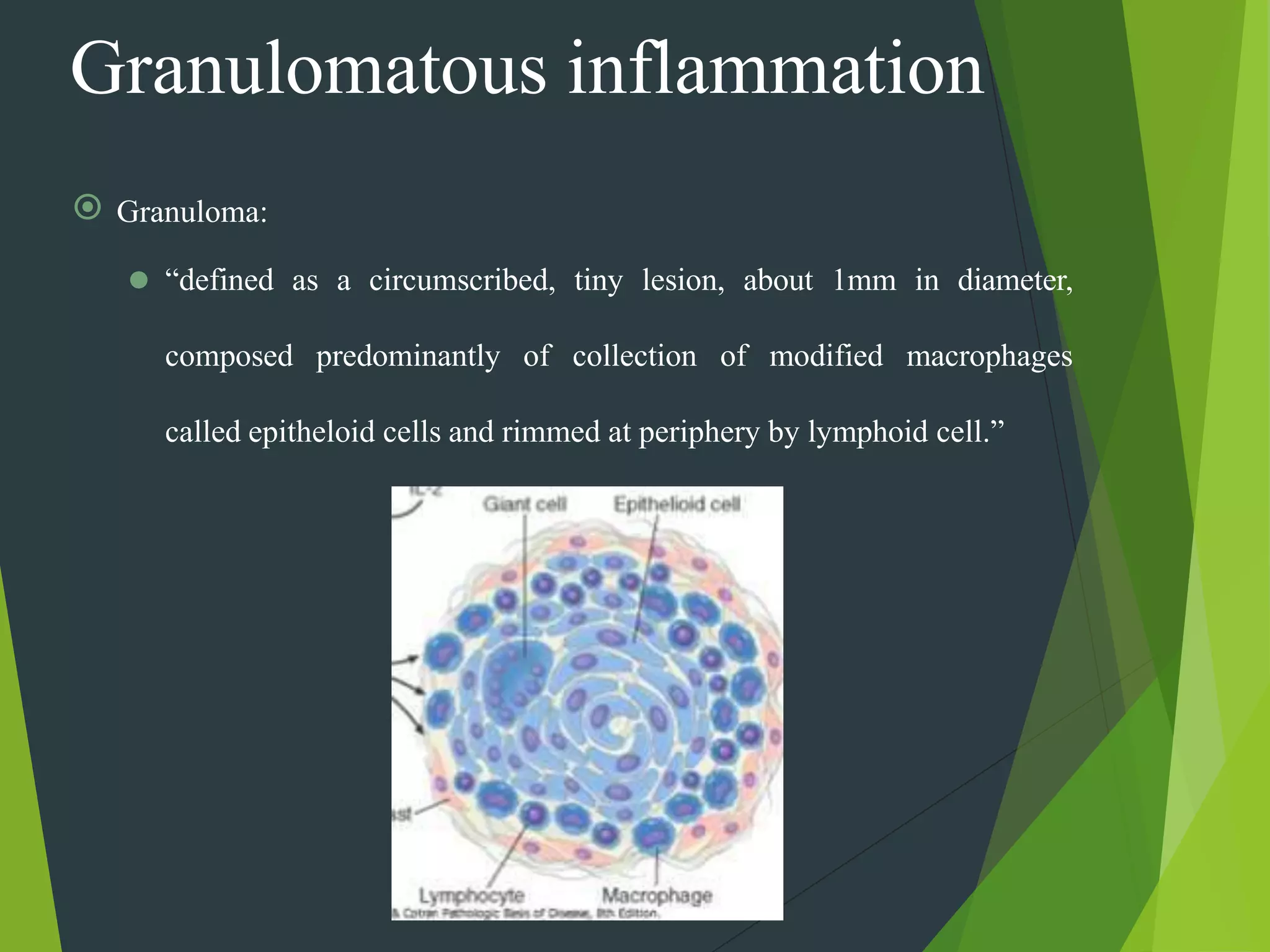
⚫ “defined as a circumscribed, tiny lesion, about 1mm in diameter,
composed predominantly of collection of modified macrophages
called epitheloid cells and rimmed at periphery by lymphoid cell.”
⚫ Formation of granuloma is a type IV granulomatous
hypersensitivity reaction
⚫ It is a protective defense reaction by the host but eventually causes
tissue destruction due to persistence of poorly digestible antigen eg
M.tuberculae, M.leprae,suture material etc.
Pathogenesis of granuloma
1. Engulfment by macrophages
⚫ Macrophages and monocytes engulf the antigen
⚫ Unable to destroy
⚫ Undergo morphologic changes to epitheloid cells
2. CD4+ T cells: macrophages present antigen to the CD4+ T
lymphocyes which elaborate lymphokines
⦿ IL-1, IL-2- proliferation of T cells
⦿ interferon ɣ
- activates macrophages
⦿ TNF-ἀ- promotes fibroblast proliferation and activates endothelium to
serete prostaglandlins – which have role in vascular response in
inflammation.
Composition of granuloma
⦿ Epithelioid cells: elongated macrophages
and histiocytes. Epitheloid cells are weakly
phagocytic.
⦿ Multinucleated giant cells: formed by fusion
od adjacent epitheloid cells having 20 or more
nuclei, arranged at periphery like horseshoe or
clustered at two poles ( langhan’s cell) or
centerally (foreign body giant cell).
⦿ Lymphoid cell:
⦿ Necrosis
⦿ Fibrosis: feature of healing by proliferating
fibroblast at the periphery of granuloma.
Healing
⦿ Healing is the body response to injury in an attempt to restore
normal structure and function
⦿ It involves two processes:
⚫ Regeneration – when healing takes place by proliferation of
parenchymal cells and usually results in complete restoration of the
original tissues.
⚫ Repair – when healing takes place by proliferation of connective
tissue elements resulting in fibrosis and scaring.
Regeneration
⦿ Regeneration of any type of parenchymal cells involves the
following two process:
⚫ Proliferation of original cells from margin of injury with migration
so as to cover the gap.
⚫ Proliferation of original cells with subsequent differentiation and
maturation so as to reconstitute the original tissue.
Repair
⦿ Two process involved in repair :
⚫ Granulation tissue formation.
⚫ Contraction of wounds.
Granulation tissue formation
3 phases are observed in the formation
⚫ Phase of inflammation: following trauma there is acute inflammatory
response with exudation plasma, neutrophils and some monocytes within
24 hrs.
⚫ Phase of clearance: combination of proteolytic enzymes liberated from
neutrophils, autolytic enzymes from dead tissues cells and phagocytic
activity of macrophages clear off the necrotic tissue, debris and red blood
cells.
⚫ Phase of ingrowth of granulation tissue:
Phase of ingrowth of granulation tissue:
⦿ Angiogenesis ( neovascularization):
⚫ Severed margins of blood vessels
⚫ Proliferation of endothelial cells
⚫ Formation of new blood vessels
⚫ These are solid initially
⚫ Within few hours develop lumen and start carrying blood
⚫ These new blood vessels are more leaky resulting in edematous
appearance of new granulation tissue
⚫ Angiogenesis takes place under the influence of
⚫ Vascular endothelial growth factor.
⚫ Platelet derived growth factor.
⦿ Fibrogenesis :
⚫ Newly formed blood vessels are present in an amorphous
ground substance
⚫ The fibroblast appears
⚫ Collagen fibres appear by about 6th day.
⚫ As maturation proceed more of the collagen fibres are formed
⚫ Number of active fibroblast and new blood vessels decreases
⚫ This result in formation of inactive looking scar called
cicatrisation
Contraction of wound
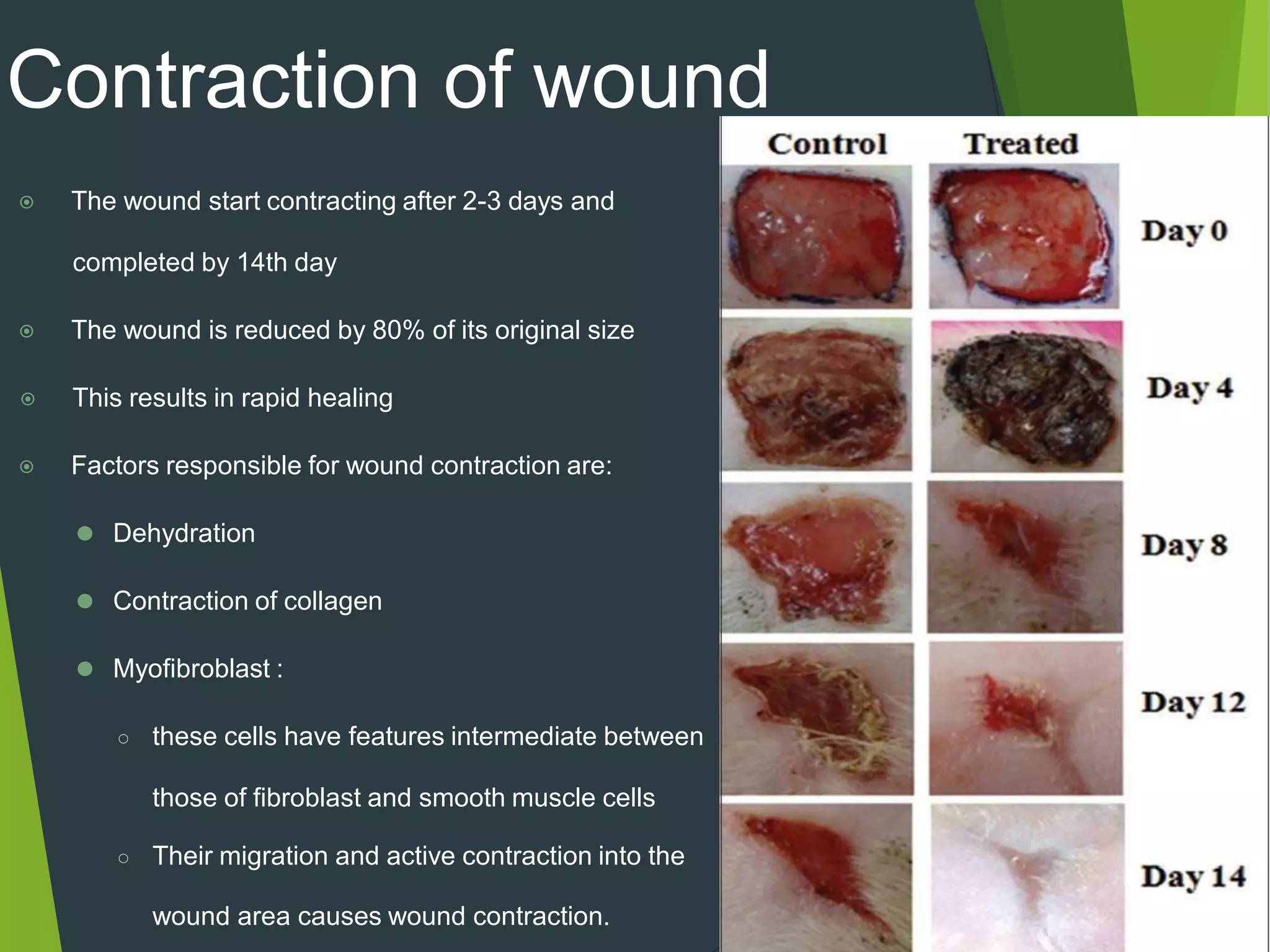
⦿ The wound start contracting after 2-3 days and
completed by 14th day
⦿ The wound is reduced by 80% of its original size
⦿ This results in rapid healing
⦿ Factors responsible for wound contraction are:
⚫ Dehydration
⚫ Contraction of collagen
⚫ Myofibroblast :
○ these cells have features intermediate between
those of fibroblast and smooth muscle cells
○ Their migration and active contraction into the
wound area causes wound contraction.
Wound healing
Healing by
first intention
Healing by
second
intention
Features Primary union Secondary union
Cleanliness of wound Clean Unclean
Infection Generally uninfected May be infected
Margins Surgical incised
Approximating each
other
Irregular
Sutures Used Not used
Healing
Outcome
Scanty granulation
tissue at incised gap
and along tracts
Neat linear scar
Exuberant granulation
tissue fill the gap
Contracted irregular
wound
Complication Infrequent, epidermal
inclusion cyst
formation
Suppuration, may
require debridement
Healing by first intension
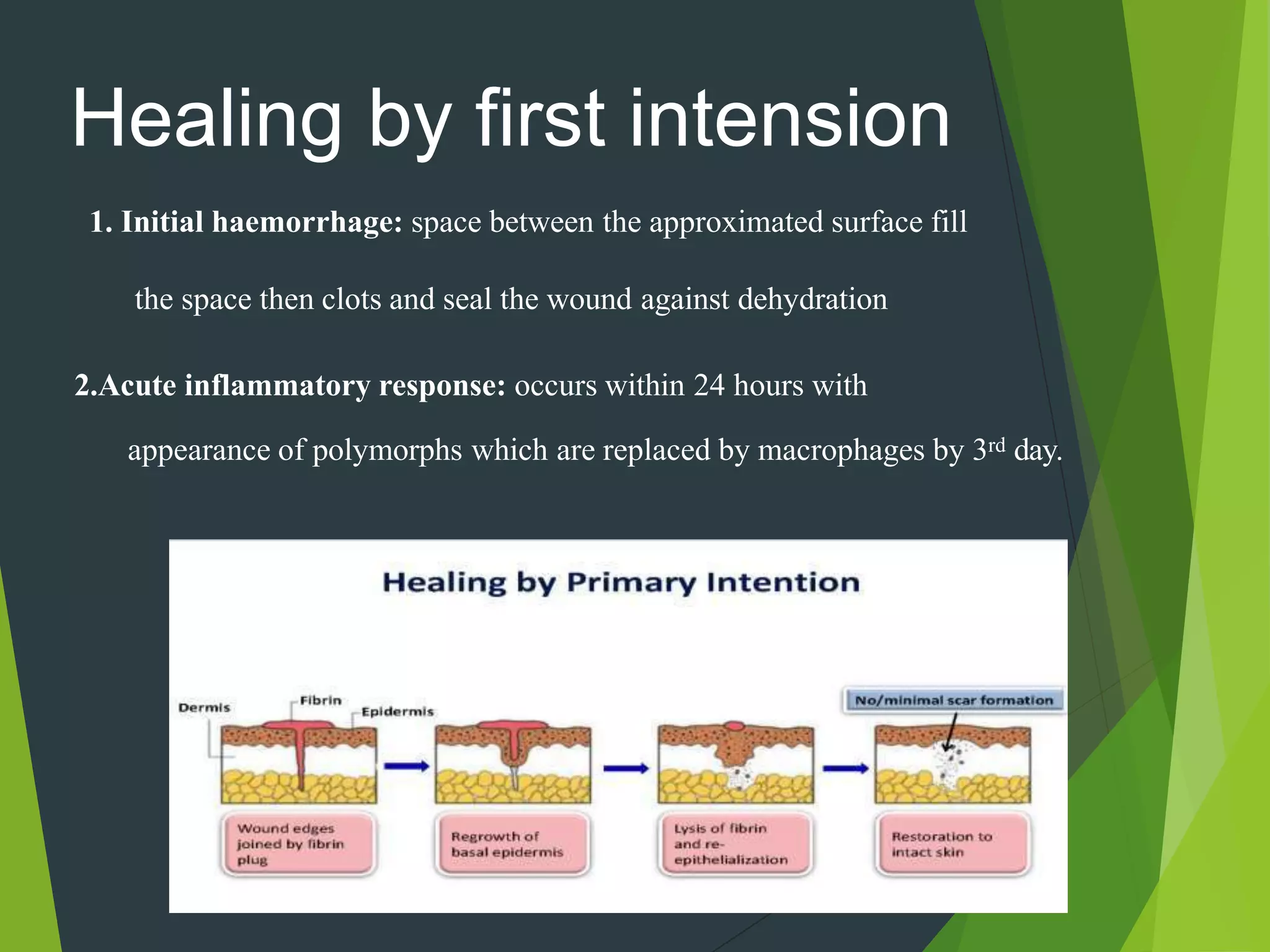
1. Initial haemorrhage: space between the approximated surface fill
the space then clots and seal the wound against dehydration
2.Acute inflammatory response: occurs within 24 hours with
appearance of polymorphs which are replaced by macrophages by 3rd day.
3.Epithelial changes: basal cells of epidermis from both margins
proliferate and migrate towards each other in form of epithelial
spurs.
⦿ Awell approximated wound is covered by a layer of epithelium within 48
hours.
⦿ This seperates the underlying dermis with overlying necrotic material and
clot forming scab, which is cast off
⦿ By 5th day a multilayered new epidermis is formed which is
differentiated into superficial and deeper layer.
4.Organisation:
⚫ by 3rd day fibroblast also invade the wound area.
⚫ By 5th day new collagen fibrils start forming which dominate till healing is
completed
⚫ In 4 weeks the scar tissue which is scanty cellular and vascular
elements, a few inflammatory cells and epithelialised surface is
formed.
5.Suture tracts:
⚫ each sututre tract is separate wound and incites same phenomenon.
⚫ By 7th day when suture are removed much of epithelialised tissue in the
tract is absorbed.
Healilng by second intention
⦿ Initial haemorrhage: gap is filled with blood
⦿ Inflammatory phase: there is initial acute inflammatory response
followed by macrophages invasion
⦿ Epithelial changes:
⚫ the epithelial cells do not cover the surface completely until
granulation tissue from base has started filling the wound space
seperating the viable CT
⚫ The necrotic material and clot form scab which is casted off
⦿ Granulation tissue: main bulk of secondary healing is by
granulation
⦿ Wound contraction: due to actionof myofibroblast cells
⦿ Presence of infection: due to presence of bacterial toxin healing is
delayed.
Complication of wound healing
⦿ Infection
⦿Implantation ( epidermal) cyst
⦿ Pigmentation
⦿ Deficient scar formation
⦿Incisional hernia ( wound dehiscence)
⦿ Hypertrophied scar and keloid formation
⦿ Excessive contraction
⦿ Neoplasia
Healing of specialised tissue
Fracture healing
⦿ Primary union: in cases where the ends are approximated
bony union takes place with formation of medullary callus without
periosteal callus formation
⦿ Secondary union:
⚫ Procallus formation
○ Haematoma
○ Local inflammatory response
○ Ingrowth of granulation tissue
○ Callus composed of woven bone and catilage.
⚫ Osseous callus formation
⚫ Remodelling
Procallus formation
⦿ Haematoma: from torn blood vessel , loose meshwork is formed by
blood and fibrin clot which act as framework fro subsequent
granulation tissue formation.
⦿ Local inflammatory response: polymorphs and macrophaes
⦿ Ingrowth of granulation tissue: neovascularisation and proliferation of
mesenchymal cells from periosteum and endosteum forming callus which joins the
two ends without much strength.
⦿ Callus composed of woven bone and cartilage:
⚫ The inner cells of periosteum have osteogenic potential and lay down collagen
and osteoid matrix in the granulation tisuse
⚫ The osteoid undergoes calcification called woven bone and bridge gap giving
spindle shaped fusiform appearance of the union
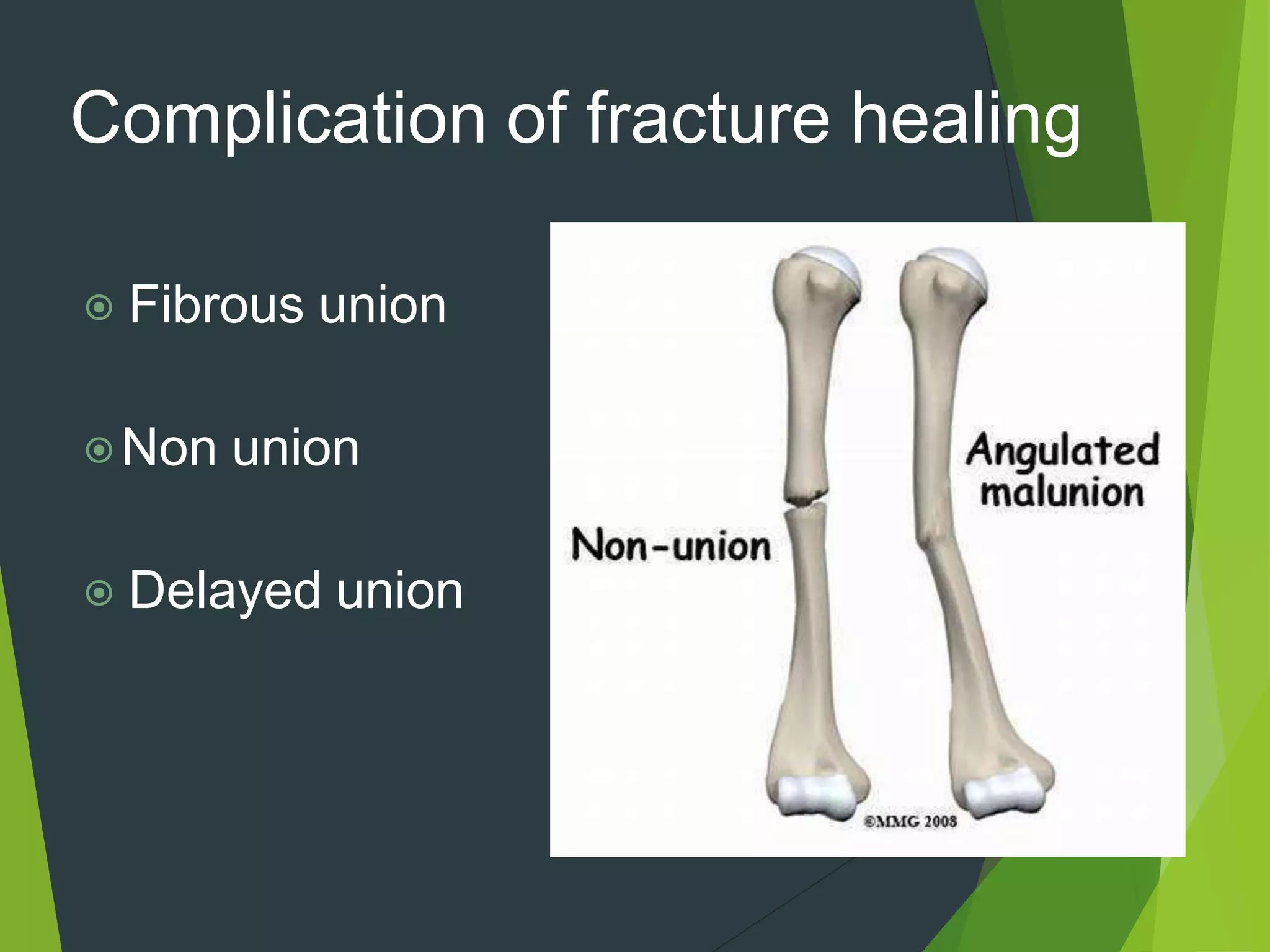
⦿ Osseous callus formation:
⚫ Procallus acts as scaffolding on which osseous
callus composed of lamellar bone is formed.
⚫ Woven bone is cleared away with osteoclast and
calcified cartilage disintegrates
⚫ In their place new blood vessel and osteoblast
invade laying osteoid and lamellar bone develops
by haversian system around blood vessel
⦿ Remodelling : during lamellar bone formation
osteoblastic and osteoclastic activity takes place.
Complication of fracture healing
⦿ Fibrous union
⦿Non union
⦿ Delayed union
Thank You !!!

woundhealingandinflammation-181226163636 (1).pptx

  • 1.
    DR. ANBAN DEPT OFRADIATION ONCOLOGY
  • 2.
  • 3.
    General features ⦿ Infilterationof mononuclear inflammatory cell like phagocytes and lymphoid cell. ⦿ Tissue destruction or necrosis – brought about by activated macrophages which releases biologically active substance like protease, elastase, collagenase, lipase etc. ⦿ Proliferation of small blood vessels and fibroblast is stimulated resulting in formation of granulation tissue and eventually healilng by fibrosis and collagen laying.
  • 4.
    Systemic effect ofchronic inflammation ⦿ Anaemia • Fever- mild fever with loss of weight and weakness. ⦿ Leucocytosis- relative lymphocytosis ⦿ ESR- raised ⦿ Amyloidosis- long term suppurative inflammation develops secondary systemic amyloidosis
  • 5.
    Types of chronic inflammation ⦿Non – specific inflammation – characterised by non specific inflammatory cell infilteration eg. Chronic osteomyelitis, lung abscess ⦿ Granulomatous inflammation – characterised by formation of granulomas eg. Tuberculosis, leprosy, syphilis, actinomycosis, sarcoidosis.
  • 6.
    Granulomatous inflammation ⦿ Granuloma: ⚫“defined as a circumscribed, tiny lesion, about 1mm in diameter, composed predominantly of collection of modified macrophages called epitheloid cells and rimmed at periphery by lymphoid cell.”
  • 7.
    ⚫ Formation ofgranuloma is a type IV granulomatous hypersensitivity reaction ⚫ It is a protective defense reaction by the host but eventually causes tissue destruction due to persistence of poorly digestible antigen eg M.tuberculae, M.leprae,suture material etc.
  • 8.
    Pathogenesis of granuloma 1.Engulfment by macrophages ⚫ Macrophages and monocytes engulf the antigen ⚫ Unable to destroy ⚫ Undergo morphologic changes to epitheloid cells 2. CD4+ T cells: macrophages present antigen to the CD4+ T lymphocyes which elaborate lymphokines ⦿ IL-1, IL-2- proliferation of T cells ⦿ interferon ɣ - activates macrophages ⦿ TNF-ἀ- promotes fibroblast proliferation and activates endothelium to serete prostaglandlins – which have role in vascular response in inflammation.
  • 10.
    Composition of granuloma ⦿Epithelioid cells: elongated macrophages and histiocytes. Epitheloid cells are weakly phagocytic. ⦿ Multinucleated giant cells: formed by fusion od adjacent epitheloid cells having 20 or more nuclei, arranged at periphery like horseshoe or clustered at two poles ( langhan’s cell) or centerally (foreign body giant cell). ⦿ Lymphoid cell: ⦿ Necrosis ⦿ Fibrosis: feature of healing by proliferating fibroblast at the periphery of granuloma.
  • 11.
    Healing ⦿ Healing isthe body response to injury in an attempt to restore normal structure and function ⦿ It involves two processes: ⚫ Regeneration – when healing takes place by proliferation of parenchymal cells and usually results in complete restoration of the original tissues. ⚫ Repair – when healing takes place by proliferation of connective tissue elements resulting in fibrosis and scaring.
  • 13.
    Regeneration ⦿ Regeneration ofany type of parenchymal cells involves the following two process: ⚫ Proliferation of original cells from margin of injury with migration so as to cover the gap. ⚫ Proliferation of original cells with subsequent differentiation and maturation so as to reconstitute the original tissue.
  • 14.
    Repair ⦿ Two processinvolved in repair : ⚫ Granulation tissue formation. ⚫ Contraction of wounds.
  • 15.
    Granulation tissue formation 3phases are observed in the formation ⚫ Phase of inflammation: following trauma there is acute inflammatory response with exudation plasma, neutrophils and some monocytes within 24 hrs. ⚫ Phase of clearance: combination of proteolytic enzymes liberated from neutrophils, autolytic enzymes from dead tissues cells and phagocytic activity of macrophages clear off the necrotic tissue, debris and red blood cells. ⚫ Phase of ingrowth of granulation tissue:
  • 16.
    Phase of ingrowthof granulation tissue: ⦿ Angiogenesis ( neovascularization): ⚫ Severed margins of blood vessels ⚫ Proliferation of endothelial cells ⚫ Formation of new blood vessels ⚫ These are solid initially ⚫ Within few hours develop lumen and start carrying blood ⚫ These new blood vessels are more leaky resulting in edematous appearance of new granulation tissue ⚫ Angiogenesis takes place under the influence of ⚫ Vascular endothelial growth factor. ⚫ Platelet derived growth factor.
  • 17.
    ⦿ Fibrogenesis : ⚫Newly formed blood vessels are present in an amorphous ground substance ⚫ The fibroblast appears ⚫ Collagen fibres appear by about 6th day. ⚫ As maturation proceed more of the collagen fibres are formed ⚫ Number of active fibroblast and new blood vessels decreases ⚫ This result in formation of inactive looking scar called cicatrisation
  • 18.
    Contraction of wound ⦿The wound start contracting after 2-3 days and completed by 14th day ⦿ The wound is reduced by 80% of its original size ⦿ This results in rapid healing ⦿ Factors responsible for wound contraction are: ⚫ Dehydration ⚫ Contraction of collagen ⚫ Myofibroblast : ○ these cells have features intermediate between those of fibroblast and smooth muscle cells ○ Their migration and active contraction into the wound area causes wound contraction.
  • 22.
    Wound healing Healing by firstintention Healing by second intention
  • 23.
    Features Primary unionSecondary union Cleanliness of wound Clean Unclean Infection Generally uninfected May be infected Margins Surgical incised Approximating each other Irregular Sutures Used Not used Healing Outcome Scanty granulation tissue at incised gap and along tracts Neat linear scar Exuberant granulation tissue fill the gap Contracted irregular wound Complication Infrequent, epidermal inclusion cyst formation Suppuration, may require debridement
  • 24.
    Healing by firstintension 1. Initial haemorrhage: space between the approximated surface fill the space then clots and seal the wound against dehydration 2.Acute inflammatory response: occurs within 24 hours with appearance of polymorphs which are replaced by macrophages by 3rd day.
  • 25.
    3.Epithelial changes: basalcells of epidermis from both margins proliferate and migrate towards each other in form of epithelial spurs. ⦿ Awell approximated wound is covered by a layer of epithelium within 48 hours. ⦿ This seperates the underlying dermis with overlying necrotic material and clot forming scab, which is cast off ⦿ By 5th day a multilayered new epidermis is formed which is differentiated into superficial and deeper layer.
  • 26.
    4.Organisation: ⚫ by 3rdday fibroblast also invade the wound area. ⚫ By 5th day new collagen fibrils start forming which dominate till healing is completed ⚫ In 4 weeks the scar tissue which is scanty cellular and vascular elements, a few inflammatory cells and epithelialised surface is formed. 5.Suture tracts: ⚫ each sututre tract is separate wound and incites same phenomenon. ⚫ By 7th day when suture are removed much of epithelialised tissue in the tract is absorbed.
  • 27.
    Healilng by secondintention ⦿ Initial haemorrhage: gap is filled with blood ⦿ Inflammatory phase: there is initial acute inflammatory response followed by macrophages invasion ⦿ Epithelial changes: ⚫ the epithelial cells do not cover the surface completely until granulation tissue from base has started filling the wound space seperating the viable CT ⚫ The necrotic material and clot form scab which is casted off
  • 28.
    ⦿ Granulation tissue:main bulk of secondary healing is by granulation ⦿ Wound contraction: due to actionof myofibroblast cells ⦿ Presence of infection: due to presence of bacterial toxin healing is delayed.
  • 29.
    Complication of woundhealing ⦿ Infection ⦿Implantation ( epidermal) cyst ⦿ Pigmentation ⦿ Deficient scar formation ⦿Incisional hernia ( wound dehiscence) ⦿ Hypertrophied scar and keloid formation ⦿ Excessive contraction ⦿ Neoplasia
  • 30.
  • 31.
    Fracture healing ⦿ Primaryunion: in cases where the ends are approximated bony union takes place with formation of medullary callus without periosteal callus formation
  • 32.
    ⦿ Secondary union: ⚫Procallus formation ○ Haematoma ○ Local inflammatory response ○ Ingrowth of granulation tissue ○ Callus composed of woven bone and catilage. ⚫ Osseous callus formation ⚫ Remodelling
  • 34.
    Procallus formation ⦿ Haematoma:from torn blood vessel , loose meshwork is formed by blood and fibrin clot which act as framework fro subsequent granulation tissue formation. ⦿ Local inflammatory response: polymorphs and macrophaes ⦿ Ingrowth of granulation tissue: neovascularisation and proliferation of mesenchymal cells from periosteum and endosteum forming callus which joins the two ends without much strength. ⦿ Callus composed of woven bone and cartilage: ⚫ The inner cells of periosteum have osteogenic potential and lay down collagen and osteoid matrix in the granulation tisuse ⚫ The osteoid undergoes calcification called woven bone and bridge gap giving spindle shaped fusiform appearance of the union
  • 35.
    ⦿ Osseous callusformation: ⚫ Procallus acts as scaffolding on which osseous callus composed of lamellar bone is formed. ⚫ Woven bone is cleared away with osteoclast and calcified cartilage disintegrates ⚫ In their place new blood vessel and osteoblast invade laying osteoid and lamellar bone develops by haversian system around blood vessel ⦿ Remodelling : during lamellar bone formation osteoblastic and osteoclastic activity takes place.
  • 38.
    Complication of fracturehealing ⦿ Fibrous union ⦿Non union ⦿ Delayed union
  • 39.