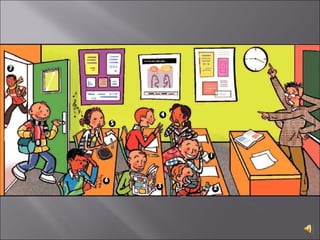
Location: Title I Public High School
Number of students: 3,700
Number of teachers and support staff: 400
School district contains:
2 High Schools
5 Middle
15 Elementary and Other Schools
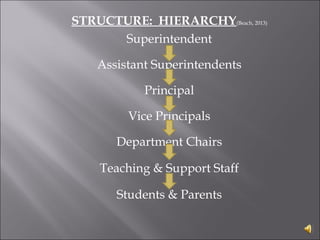
STRUCTURE: HIERARCHY(Beach, 2013)
Superintendent
Assistant Superintendents
Principal
Vice Principals
Department Chairs
Teaching & Support Staff
Students & Parents
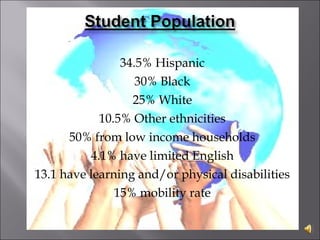
34.5% Hispanic
30% Black
25% White
10.5% Other ethnicities
50% from low income households
4.1% have limited English
13.1 have learning and/or physical disabilities
15% mobility rate
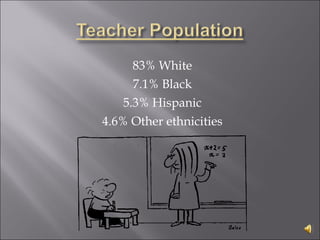
83% White
7.1% Black
5.3% Hispanic
4.6% Other ethnicities
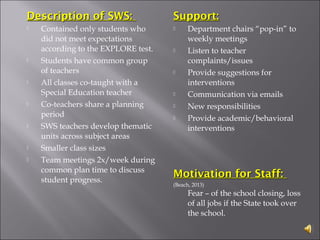
Description of SWS:Description of SWS:
๏‚จ Contained only students who
did not meet expectations
according to the EXPLORE test.
๏‚จ Students have common group
of teachers
๏‚จ All classes co-taught with a
Special Education teacher
๏‚จ Co-teachers share a planning
period
๏‚จ SWS teachers develop thematic
units across subject areas
๏‚จ Smaller class sizes
๏‚จ Team meetings 2x/week during
common plan time to discuss
student progress.
Support:Support:
๏‚จ Department chairs โ€œpop-inโ€ to
weekly meetings
๏‚จ Listen to teacher
complaints/issues
๏‚จ Provide suggestions for
interventions
๏‚จ Communication via emails
๏‚จ New responsibilities
๏‚จ Provide academic/behavioral
interventions
Motivation for Staff:Motivation for Staff:
(Beach, 2013)
Fear โ€“ of the school closing, loss
of all jobs if the State took over
the school.
๏‚จ Co-teachers not meeting regularly during common plan time
๏‚จ Poor teacher attendance for team meetings
๏‚จ Teachers limit time for before and after school hours to help
students
๏‚จ No attempt to develop thematic units
๏‚จ Department chairs stopped attending team meetings
๏‚จ No teacher accountability for performing new responsibilities
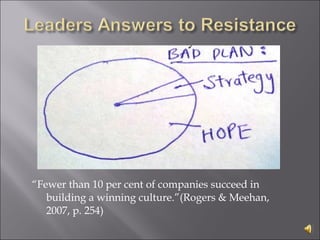
โ€œFewer than 10 per cent of companies succeed in
building a winning culture.โ€(Rogers & Meehan,
2007, p. 254)
๏‚จ Change leaders did recognize the external and
internal pressures to improve academic success
by attempting to address student difficulties as
they entered high school.
๏‚จ They correctly identified the need to make a
revolutionary change quickly in response to the
demands placed upon the school by the Illinois
State Board of Education to meet AYP. (Beach,
2013)
๏‚จ They also identified some of obstacles to student
academic success โ€“ behavioral and emotional
issues.
What leaders should have done differently is to follow the โ€œcomponents
of a sound process for change.โ€(McAllaster, 2004, p. 322)
๏‚จ They should have researched the problems further and found out that
academic failures were often a result of stressors they are continuously
exposed to, not being placed in appropriate academic classes, not having
support for education at home, and not being held accountable for their
academic success until high school.
๏‚จ They should have found a program that has been successful in the past, not
one that has been tried three years earlier and failed.
๏‚จ They should have executed the program with continuous attention to how it
was progressing.
๏‚จ They should have considered teachersโ€™ suggestions for change and made
modifications to the program. โ€œWeโ€™re all familiar with managers who pride
themselves on having an open door. But how many pride themselves on
keeping an open mind when an employee offers a process-improvement
suggestion?โ€(Lee, 2008, p. 28)
๏‚จ Finally, they should have provided some type of reward system that would
promote support for the program. .(McAllaster, 2004)
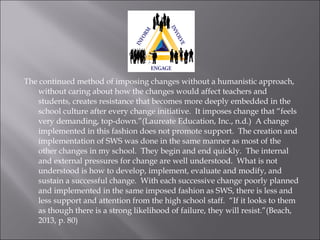
The continued method of imposing changes without a humanistic approach,
without caring about how the changes would affect teachers and
students, creates resistance that becomes more deeply embedded in the
school culture after every change initiative. It imposes change that โ€œfeels
very demanding, top-down.โ€(Laureate Education, Inc., n.d.) A change
implemented in this fashion does not promote support. The creation and
implementation of SWS was done in the same manner as most of the
other changes in my school. They begin and end quickly. The internal
and external pressures for change are well understood. What is not
understood is how to develop, implement, evaluate and modify, and
sustain a successful change. With each successive change poorly planned
and implemented in the same imposed fashion as SWS, there is less and
less support and attention from the high school staff. โ€œIf it looks to them
as though there is a strong likelihood of failure, they will resist.โ€(Beach,
2013, p. 80)
References
๏‚จ 2011 Illinois State Report Card. (2011). http://webprod.isbe.net/ereportcard/publicsite/getReport.aspx?
year=2011&code=S56099365U0007_E.pdf
๏‚จ Anderson, D. L. (2010). Organization development: the process of leading organizational change. : Sage Publications.
๏‚จ Beach, L. (2013). Leadership and the art of change: a practical guide to organizational transformation (custom ed.).
Thousand Oaks, CA: Sage Publications.
๏‚จ Bolman, L. G., & Deal, T. E. (2008). Reframing 0rganizations: Artistry, choice, and leadership (4th ed.). San
Francisco, CA: Jossey-Bass.
๏‚จ Hitt, M. A., Miller, C. C., & Colella, A. (2009). Organizational behavior: A strategic approach. : John Wiley & Sons.
๏‚จ Kotter, J. (2006). Leading change: why transformation efforts fail. In J. Gallos (Ed.), Organization developoment:
a jossey-bass reader (pp. 239-251). San Francisco, CA: Jossey-Bass.
๏‚จ Laureate Education, Inc. (n.d.). Transformational leadership [Video file]. Retrieved from
http://www.courseurl.com
๏‚จ Lee, T. J. (2008, July/August). Actions speak loudly. Communication World, 25(4), 24-28.
๏‚จ McAllaster, C. M. (2004). The 5 pโ€™s of change: Leading change by effectively utilizing leverage points within an
organization. Organizational Dynamics, 33(3), 318-328.
๏‚จ Rogers, P., & Meehan, P. (2007). Building a winning culture. Business Strategy Series, 8(4), 254-261.
๏‚จ Schermerhorn, J. R., & Osborn, R. N. (2008). Organizational behavior (10th ed.). Hoboken, NJ: John Wiley & Sons.
Wk7 assignoneilld

Wk7 assignoneilld

  • 1.
    Location: Title IPublic High School Number of students: 3,700 Number of teachers and support staff: 400 School district contains: 2 High Schools 5 Middle 15 Elementary and Other Schools
  • 2.
    STRUCTURE: HIERARCHY(Beach, 2013) Superintendent AssistantSuperintendents Principal Vice Principals Department Chairs Teaching & Support Staff Students & Parents
  • 3.
    34.5% Hispanic 30% Black 25%White 10.5% Other ethnicities 50% from low income households 4.1% have limited English 13.1 have learning and/or physical disabilities 15% mobility rate
  • 4.
    83% White 7.1% Black 5.3%Hispanic 4.6% Other ethnicities
  • 7.
    Description of SWS:Descriptionof SWS: ๏‚จ Contained only students who did not meet expectations according to the EXPLORE test. ๏‚จ Students have common group of teachers ๏‚จ All classes co-taught with a Special Education teacher ๏‚จ Co-teachers share a planning period ๏‚จ SWS teachers develop thematic units across subject areas ๏‚จ Smaller class sizes ๏‚จ Team meetings 2x/week during common plan time to discuss student progress. Support:Support: ๏‚จ Department chairs โ€œpop-inโ€ to weekly meetings ๏‚จ Listen to teacher complaints/issues ๏‚จ Provide suggestions for interventions ๏‚จ Communication via emails ๏‚จ New responsibilities ๏‚จ Provide academic/behavioral interventions Motivation for Staff:Motivation for Staff: (Beach, 2013) Fear โ€“ of the school closing, loss of all jobs if the State took over the school.
  • 9.
    ๏‚จ Co-teachers notmeeting regularly during common plan time ๏‚จ Poor teacher attendance for team meetings ๏‚จ Teachers limit time for before and after school hours to help students ๏‚จ No attempt to develop thematic units ๏‚จ Department chairs stopped attending team meetings ๏‚จ No teacher accountability for performing new responsibilities
  • 10.
    โ€œFewer than 10per cent of companies succeed in building a winning culture.โ€(Rogers & Meehan, 2007, p. 254)
  • 12.
    ๏‚จ Change leadersdid recognize the external and internal pressures to improve academic success by attempting to address student difficulties as they entered high school. ๏‚จ They correctly identified the need to make a revolutionary change quickly in response to the demands placed upon the school by the Illinois State Board of Education to meet AYP. (Beach, 2013) ๏‚จ They also identified some of obstacles to student academic success โ€“ behavioral and emotional issues.
  • 13.
    What leaders shouldhave done differently is to follow the โ€œcomponents of a sound process for change.โ€(McAllaster, 2004, p. 322) ๏‚จ They should have researched the problems further and found out that academic failures were often a result of stressors they are continuously exposed to, not being placed in appropriate academic classes, not having support for education at home, and not being held accountable for their academic success until high school. ๏‚จ They should have found a program that has been successful in the past, not one that has been tried three years earlier and failed. ๏‚จ They should have executed the program with continuous attention to how it was progressing. ๏‚จ They should have considered teachersโ€™ suggestions for change and made modifications to the program. โ€œWeโ€™re all familiar with managers who pride themselves on having an open door. But how many pride themselves on keeping an open mind when an employee offers a process-improvement suggestion?โ€(Lee, 2008, p. 28) ๏‚จ Finally, they should have provided some type of reward system that would promote support for the program. .(McAllaster, 2004)
  • 14.
    The continued methodof imposing changes without a humanistic approach, without caring about how the changes would affect teachers and students, creates resistance that becomes more deeply embedded in the school culture after every change initiative. It imposes change that โ€œfeels very demanding, top-down.โ€(Laureate Education, Inc., n.d.) A change implemented in this fashion does not promote support. The creation and implementation of SWS was done in the same manner as most of the other changes in my school. They begin and end quickly. The internal and external pressures for change are well understood. What is not understood is how to develop, implement, evaluate and modify, and sustain a successful change. With each successive change poorly planned and implemented in the same imposed fashion as SWS, there is less and less support and attention from the high school staff. โ€œIf it looks to them as though there is a strong likelihood of failure, they will resist.โ€(Beach, 2013, p. 80)
  • 15.
    References ๏‚จ 2011 IllinoisState Report Card. (2011). http://webprod.isbe.net/ereportcard/publicsite/getReport.aspx? year=2011&code=S56099365U0007_E.pdf ๏‚จ Anderson, D. L. (2010). Organization development: the process of leading organizational change. : Sage Publications. ๏‚จ Beach, L. (2013). Leadership and the art of change: a practical guide to organizational transformation (custom ed.). Thousand Oaks, CA: Sage Publications. ๏‚จ Bolman, L. G., & Deal, T. E. (2008). Reframing 0rganizations: Artistry, choice, and leadership (4th ed.). San Francisco, CA: Jossey-Bass. ๏‚จ Hitt, M. A., Miller, C. C., & Colella, A. (2009). Organizational behavior: A strategic approach. : John Wiley & Sons. ๏‚จ Kotter, J. (2006). Leading change: why transformation efforts fail. In J. Gallos (Ed.), Organization developoment: a jossey-bass reader (pp. 239-251). San Francisco, CA: Jossey-Bass. ๏‚จ Laureate Education, Inc. (n.d.). Transformational leadership [Video file]. Retrieved from http://www.courseurl.com ๏‚จ Lee, T. J. (2008, July/August). Actions speak loudly. Communication World, 25(4), 24-28. ๏‚จ McAllaster, C. M. (2004). The 5 pโ€™s of change: Leading change by effectively utilizing leverage points within an organization. Organizational Dynamics, 33(3), 318-328. ๏‚จ Rogers, P., & Meehan, P. (2007). Building a winning culture. Business Strategy Series, 8(4), 254-261. ๏‚จ Schermerhorn, J. R., & Osborn, R. N. (2008). Organizational behavior (10th ed.). Hoboken, NJ: John Wiley & Sons.