Senior, Alumnus Team Up for Research Project in Bermuda
Story by Eva Zielinski '15
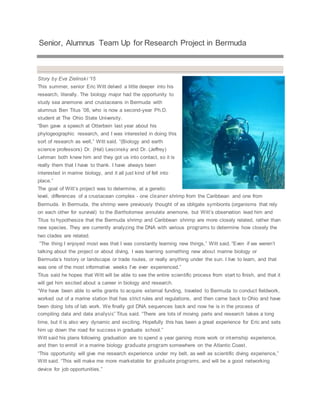
This summer, senior Eric Witt delved a little deeper into his
research, literally. The biology major had the opportunity to
study sea anemone and crustaceans in Bermuda with
alumnus Ben Titus ’08, who is now a second-year Ph.D.
student at The Ohio State University.
“Ben gave a speech at Otterbein last year about his
phylogeographic research, and I was interested in doing this
sort of research as well,” Witt said. “(Biology and earth
science professors) Dr. (Hal) Lescinsky and Dr. (Jeffrey)
Lehman both knew him and they got us into contact, so it is
really them that I have to thank. I have always been
interested in marine biology, and it all just kind of fell into
place.”
The goal of Witt’s project was to determine, at a genetic
level, differences of a crustacean complex - one cleaner shrimp from the Caribbean and one from
Bermuda. In Bermuda, the shrimp were previously thought of as obligate symbionts (organisms that rely
on each other for survival) to the Bartholomea annulata anemone, but Witt’s observation lead him and
Titus to hypothesize that the Bermuda shrimp and Caribbean shrimp are more closely related, rather than
new species. They are currently analyzing the DNA with various programs to determine how closely the
two clades are related.
“The thing I enjoyed most was that I was constantly learning new things,” Witt said. “Even if we weren’t
talking about the project or about diving, I was learning something new about marine biology or
Bermuda’s history or landscape or trade routes, or really anything under the sun. I live to learn, and that
was one of the most informative weeks I’ve ever experienced.”
Titus said he hopes that Witt will be able to see the entire scientific process from start to finish, and that it
will get him excited about a career in biology and research.
“We have been able to write grants to acquire external funding, traveled to Bermuda to conduct fieldwork,
worked out of a marine station that has strict rules and regulations, and then came back to Ohio and have
been doing lots of lab work. We finally got DNA sequences back and now he is in the process of
compiling data and data analysis” Titus said. “There are lots of moving parts and research takes a long
time, but it is also very dynamic and exciting. Hopefully this has been a great experience for Eric and sets
him up down the road for success in graduate school.”
Witt said his plans following graduation are to spend a year gaining more work or internship experience,
and then to enroll in a marine biology graduate program somewhere on the Atlantic Coast.
“This opportunity will give me research experience under my belt, as well as scientific diving experience,”
Witt said. “This will make me more marketable for graduate programs, and will be a good networking
device for job opportunities.”
WittStory

WittStory

  • 1.
    Senior, Alumnus TeamUp for Research Project in Bermuda Story by Eva Zielinski '15 This summer, senior Eric Witt delved a little deeper into his research, literally. The biology major had the opportunity to study sea anemone and crustaceans in Bermuda with alumnus Ben Titus ’08, who is now a second-year Ph.D. student at The Ohio State University. “Ben gave a speech at Otterbein last year about his phylogeographic research, and I was interested in doing this sort of research as well,” Witt said. “(Biology and earth science professors) Dr. (Hal) Lescinsky and Dr. (Jeffrey) Lehman both knew him and they got us into contact, so it is really them that I have to thank. I have always been interested in marine biology, and it all just kind of fell into place.” The goal of Witt’s project was to determine, at a genetic level, differences of a crustacean complex - one cleaner shrimp from the Caribbean and one from Bermuda. In Bermuda, the shrimp were previously thought of as obligate symbionts (organisms that rely on each other for survival) to the Bartholomea annulata anemone, but Witt’s observation lead him and Titus to hypothesize that the Bermuda shrimp and Caribbean shrimp are more closely related, rather than new species. They are currently analyzing the DNA with various programs to determine how closely the two clades are related. “The thing I enjoyed most was that I was constantly learning new things,” Witt said. “Even if we weren’t talking about the project or about diving, I was learning something new about marine biology or Bermuda’s history or landscape or trade routes, or really anything under the sun. I live to learn, and that was one of the most informative weeks I’ve ever experienced.” Titus said he hopes that Witt will be able to see the entire scientific process from start to finish, and that it will get him excited about a career in biology and research. “We have been able to write grants to acquire external funding, traveled to Bermuda to conduct fieldwork, worked out of a marine station that has strict rules and regulations, and then came back to Ohio and have been doing lots of lab work. We finally got DNA sequences back and now he is in the process of compiling data and data analysis” Titus said. “There are lots of moving parts and research takes a long time, but it is also very dynamic and exciting. Hopefully this has been a great experience for Eric and sets him up down the road for success in graduate school.” Witt said his plans following graduation are to spend a year gaining more work or internship experience, and then to enroll in a marine biology graduate program somewhere on the Atlantic Coast. “This opportunity will give me research experience under my belt, as well as scientific diving experience,” Witt said. “This will make me more marketable for graduate programs, and will be a good networking device for job opportunities.”