Wish / If only
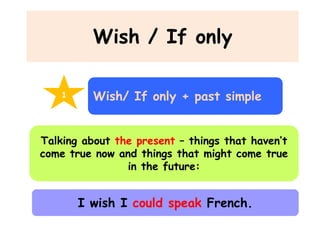
1

Wish/ If only + past simple

Talking about the present – things that haven’t
come true now and things that might come true
in the future:

I wish I could speak French.
Wish / If only

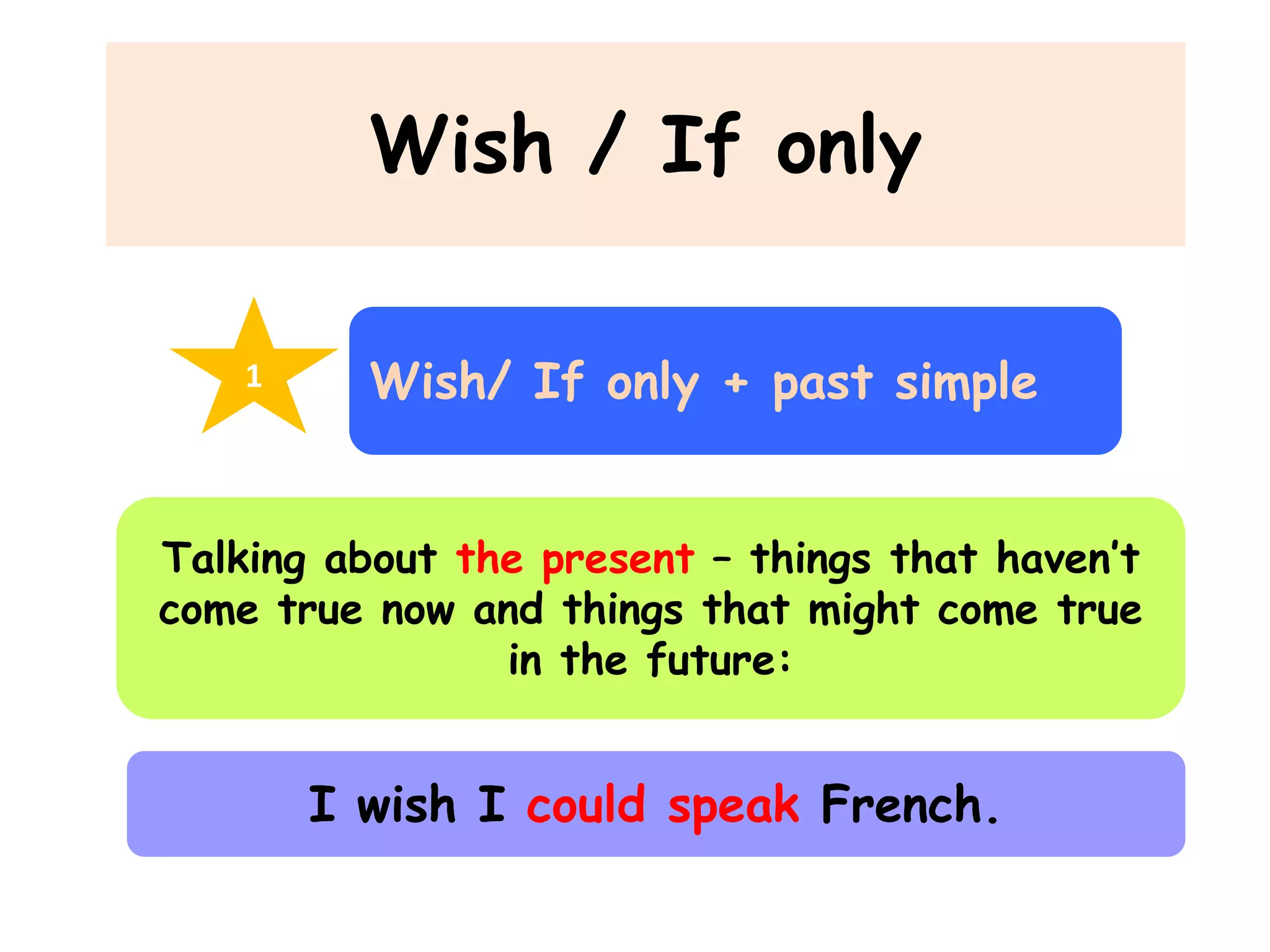
2

Wish/ If only + past perfect

Talking about the past – things you regret
doing/not doing:

I wish I hadn’t been so rude to my
mother last night.
Wish / If only
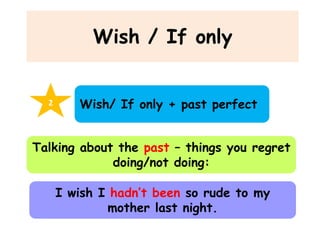
3

Wish/ If only + would

Talking about irritating habits – things which are
annoying you:
I wish it would rain. The garden really needs
some water.
Wish
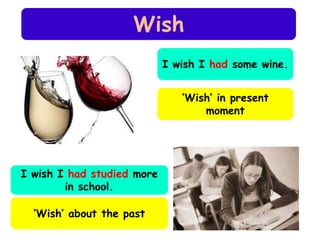
I wish I had some wine.
‘Wish’ in present
moment

I wish I had studied more
in school.
‘Wish’ about the past
Wish
4

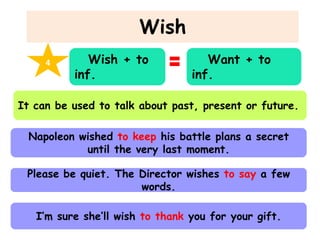
Wish + to
inf.

Want + to
inf.

It can be used to talk about past, present or future.

Napoleon wished to keep his battle plans a secret
until the very last moment.
Please be quiet. The Director wishes to say a few
words.
I’m sure she’ll wish to thank you for your gift.
Hope
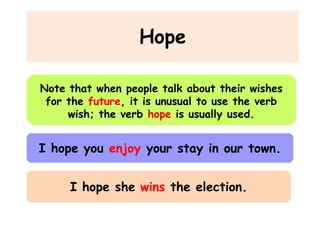
Note that when people talk about their wishes
for the future, it is unusual to use the verb
wish; the verb hope is usually used.

I hope you enjoy your stay in our town.

I hope she wins the election.
Hope Vs Wish
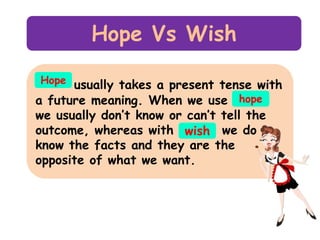
Hope usually takes a present tense with
a future meaning. When we use hope

we usually don’t know or can’t tell the
outcome, whereas with wish we do
know the facts and they are the
opposite of what we want.
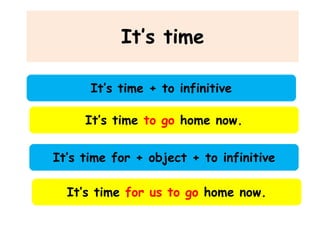
It’s time
It’s time + to infinitive
It’s time to go home now.
It’s time for + object + to infinitive

It’s time for us to go home now.
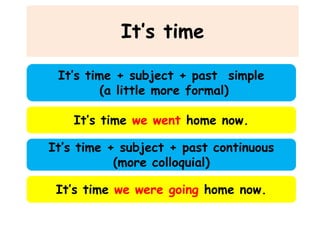
It’s time
It’s time + subject + past simple
(a little more formal)
It’s time we went home now.
It’s time + subject + past continuous
(more colloquial)

It’s time we were going home now.
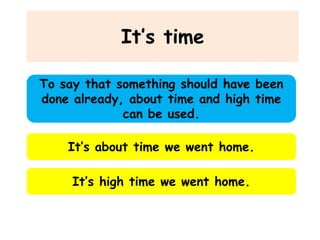
It’s time
To say that something should have been
done already, about time and high time
can be used.
It’s about time we went home.
It’s high time we went home.
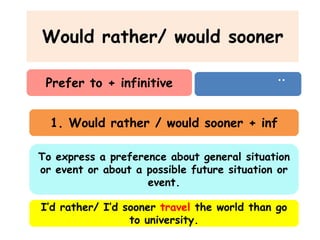
Would rather/ would sooner
Prefer to + infinitive

..

1. Would rather / would sooner + inf
To express a preference about general situation
or event or about a possible future situation or
event.
I’d rather/ I’d sooner travel the world than go
to university.
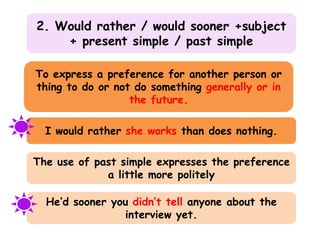
2. Would rather / would sooner +subject
+ present simple / past simple
To express a preference for another person or
thing to do or not do something generally or in
the future.

I would rather she works than does nothing.
The use of past simple expresses the preference
a little more politely
He’d sooner you didn’t tell anyone about the
interview yet.
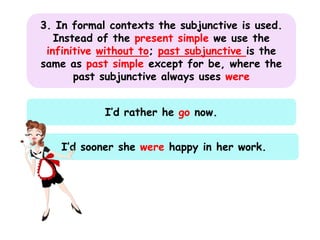
3. In formal contexts the subjunctive is used.
Instead of the present simple we use the
infinitive without to; past subjunctive is the
same as past simple except for be, where the
past subjunctive always uses were
I’d rather he go now.
I’d sooner she were happy in her work.
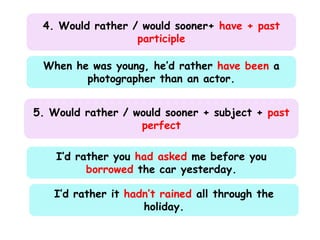
4. Would rather / would sooner+ have + past
participle
When he was young, he’d rather have been a
photographer than an actor.
5. Would rather / would sooner + subject + past
perfect
I’d rather you had asked me before you
borrowed the car yesterday.

I’d rather it hadn’t rained all through the
holiday.

Wish

  • 1.
    Wish / Ifonly 1 Wish/ If only + past simple Talking about the present – things that haven’t come true now and things that might come true in the future: I wish I could speak French.
  • 2.
    Wish / Ifonly 2 Wish/ If only + past perfect Talking about the past – things you regret doing/not doing: I wish I hadn’t been so rude to my mother last night.
  • 3.
    Wish / Ifonly 3 Wish/ If only + would Talking about irritating habits – things which are annoying you: I wish it would rain. The garden really needs some water.
  • 4.
    Wish I wish Ihad some wine. ‘Wish’ in present moment I wish I had studied more in school. ‘Wish’ about the past
  • 5.
    Wish 4 Wish + to inf. Want+ to inf. It can be used to talk about past, present or future. Napoleon wished to keep his battle plans a secret until the very last moment. Please be quiet. The Director wishes to say a few words. I’m sure she’ll wish to thank you for your gift.
  • 6.
    Hope Note that whenpeople talk about their wishes for the future, it is unusual to use the verb wish; the verb hope is usually used. I hope you enjoy your stay in our town. I hope she wins the election.
  • 7.
    Hope Vs Wish Hopeusually takes a present tense with a future meaning. When we use hope we usually don’t know or can’t tell the outcome, whereas with wish we do know the facts and they are the opposite of what we want.
  • 8.
    It’s time It’s time+ to infinitive It’s time to go home now. It’s time for + object + to infinitive It’s time for us to go home now.
  • 9.
    It’s time It’s time+ subject + past simple (a little more formal) It’s time we went home now. It’s time + subject + past continuous (more colloquial) It’s time we were going home now.
  • 10.
    It’s time To saythat something should have been done already, about time and high time can be used. It’s about time we went home. It’s high time we went home.
  • 11.
    Would rather/ wouldsooner Prefer to + infinitive .. 1. Would rather / would sooner + inf To express a preference about general situation or event or about a possible future situation or event. I’d rather/ I’d sooner travel the world than go to university.
  • 12.
    2. Would rather/ would sooner +subject + present simple / past simple To express a preference for another person or thing to do or not do something generally or in the future. I would rather she works than does nothing. The use of past simple expresses the preference a little more politely He’d sooner you didn’t tell anyone about the interview yet.
  • 13.
    3. In formalcontexts the subjunctive is used. Instead of the present simple we use the infinitive without to; past subjunctive is the same as past simple except for be, where the past subjunctive always uses were I’d rather he go now. I’d sooner she were happy in her work.
  • 14.
    4. Would rather/ would sooner+ have + past participle When he was young, he’d rather have been a photographer than an actor. 5. Would rather / would sooner + subject + past perfect I’d rather you had asked me before you borrowed the car yesterday. I’d rather it hadn’t rained all through the holiday.