Middle ware and Programming
Paradigms for WSN

        Budwell Tamuka Masaiti
               February 23, 2013
          JNTUCEH(CSE Department)
Agenda

              Wireless Sensor Networks :Introduction


                      Applications of WSNs


                        Main Issues in WSN


         Middleware and Programming Abstractions for WSN


         Goals for Middleware and Programming abstractions


                  OSM : Object State model (FSM)


                 Contiki: Event driven abstractions


                 TinyOs: Event driven abstractions


                            Conclusion
Wireless Sensor Networks :Introduction


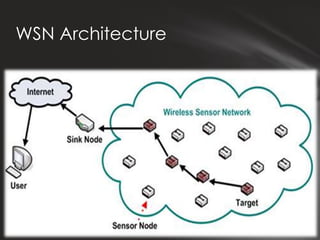
A wireless sensor network (WSN) consists of
spatially distributed autonomous sensors to
monitor physical or environmental conditions,
such as temperature, sound, pressure, etc. and
to cooperatively pass their data through the
network to a main location.
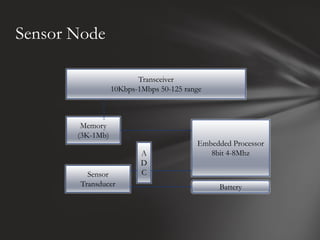
Sensor Node

                         Transceiver
                  10Kbps-1Mbps 50-125 range


        Memory
       (3K-1Mb)
                                         Embedded Processor
                          A                 8bit 4-8Mhz
                          D
         Sensor           C
       Transducer                             Battery
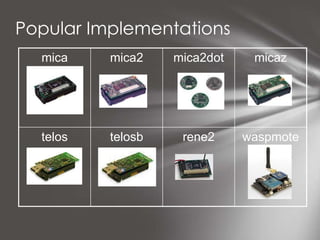
Popular Implementations
  mica    mica2    mica2dot    micaz


  telos   telosb    rene2     waspmote
WSN Architecture
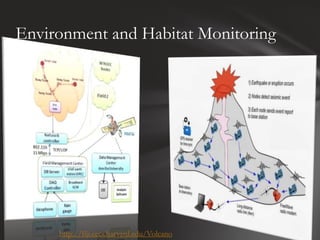
Environment and Habitat Monitoring


     http://fiji.eecs.harvard.edu/Volcano
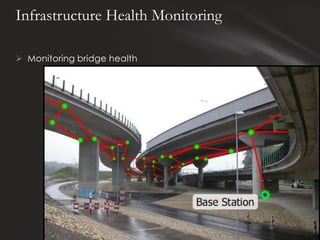
Infrastructure Health Monitoring

 Monitoring bridge health
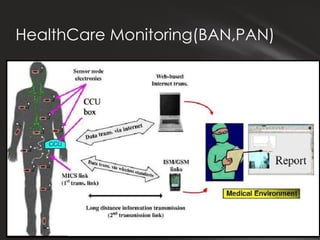
HealthCare Monitoring(BAN,PAN)
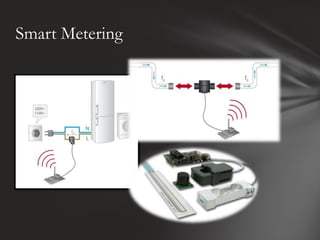
Smart Metering
WSN Middleware and
Programming Abstractions

 Middleware provides the software layer interfacing the
  hardware and the application programs in an OS less
  system
 Or the software layer between the OS and the
  application programs.
 Programming abstractions refer to the interfaces and
  data structures provided for a programming model and
  language
Goals for WSN Middle and
Programming Abstractions


 Automatic node management


 Concurrency management


 Resource management


 Developer friendly abstractions
Object State Model
Oliver Kasten n Kay Romer


 A programming model and language for programming
  sensor nodes, based on FSM


 Uses states and transitions such that the invocation of an
  event is now a function of both the event and the
  program state


 State attributes (infor sharing )
Object State Model(OSM)
 OSM goes beyond traditional event driven
  programming and draws inspiration from FSM state
  charts.


 OSM is a hybrid FSM implementation which tackles FSM
  problems such as:
    Memory Management(Global and local variables)
    Event hierarchies
    Manual flow control
OSM Main Features
 Uses Parallel State Machines


 Allows hierarchical composition of state(superstates)


 Explicit program state(not implied)


 State variables


 Event queues
Contiki
Background:
 Contiki – pioneering open source operating system for
  sensor networks


 Development started in 2001
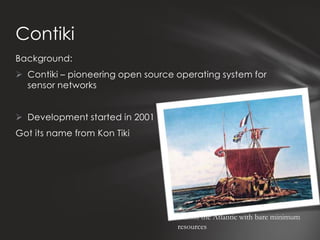
Got its name from Kon Tiki


                                   Across the Atlantic with bare minimum
                                   resources
Contiki Key Features
 Small memory footprint
 IP networking
 Hybrid threading model, protothreads
 Power profiling
  -measure power consumption at network scale
 Network shell
  - for easy command line interaction
 Designed for portability
 Dynamic loading
Contiki Communication Stack
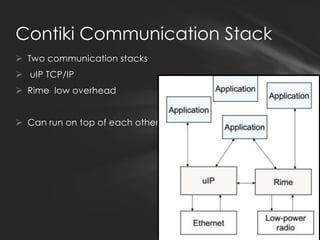
 Two communication stacks
 uIP TCP/IP
 Rime low overhead


 Can run on top of each other
Contik :Event Driven Paradigm
 The Contiki kernel is event-based
 Invokes processes whenever something happens
       Sensor events, processes starting,
 Process invocations must not block
 Protothreads provide sequential flow of control in
  Contiki processes
 Protothreads extremely lightweight and stackless
Contik :Event Driven
 Event-driven vs multithreaded
 Event-driven requires less memory
 Multithreading requires per-thread stacks
 Threads require per-thread stack memory
 Events require one stack
 Protothreads like events require one stack for as many
  as there are protothreads running
TinyOs:Event Driven
 An event driven OS specifically designed for WSN
 Completely non-blocking
 Programs are built out of softaware componets
 Tasks are non –preemptive and run in FIFO order
 Code is statically linked
TinyOS :Scheduling
 Two level scheduling: events and tasks
 Scheduler is simple FIFO
 A task cannot preempt another task
 Events preempt tasks (higher priority)
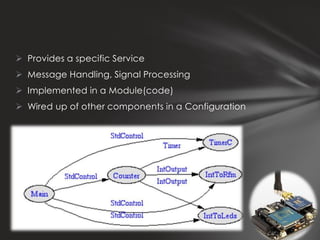
 Provides a specific Service
 Message Handling, Signal Processing
 Implemented in a Module(code)
 Wired up of other components in a Configuration
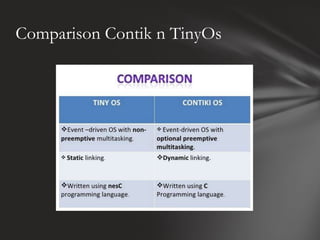
Comparison Contik n TinyOs
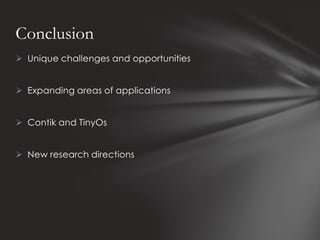
Conclusion
 Unique challenges and opportunities


 Expanding areas of applications


 Contik and TinyOs


 New research directions
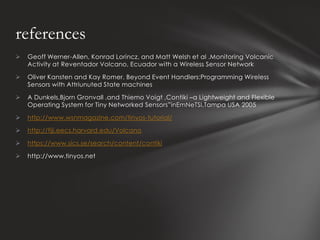
references
   Geoff Werner-Allen, Konrad Lorincz, and Matt Welsh et al .Monitoring Volcanic
    Activity at Reventador Volcano, Ecuador with a Wireless Sensor Network

   Oliver Kansten and Kay Romer. Beyond Event Handlers:Programming Wireless
    Sensors with Attriunuted State machines

   A Dunkels,Bjorn Gronvall ,and Thiemo Voigt ,Contiki –a Lightweight and Flexible
    Operating System for Tiny Networked Sensors”inEmNeTSI,Tampa USA 2005

   http://www.wsnmagazine.com/tinyos-tutorial/

   http://fiji.eecs.harvard.edu/Volcano

   https://www.sics.se/search/content/contiki

   http://www.tinyos.net

Wireless Sensor Networks ,Middleware and Programming abstractions

  • 1.
    Middle ware andProgramming Paradigms for WSN Budwell Tamuka Masaiti February 23, 2013 JNTUCEH(CSE Department)
  • 3.
    Agenda Wireless Sensor Networks :Introduction Applications of WSNs Main Issues in WSN Middleware and Programming Abstractions for WSN Goals for Middleware and Programming abstractions OSM : Object State model (FSM) Contiki: Event driven abstractions TinyOs: Event driven abstractions Conclusion
  • 4.
    Wireless Sensor Networks:Introduction A wireless sensor network (WSN) consists of spatially distributed autonomous sensors to monitor physical or environmental conditions, such as temperature, sound, pressure, etc. and to cooperatively pass their data through the network to a main location.
  • 5.
    Sensor Node Transceiver 10Kbps-1Mbps 50-125 range Memory (3K-1Mb) Embedded Processor A 8bit 4-8Mhz D Sensor C Transducer Battery
  • 6.
    Popular Implementations mica mica2 mica2dot micaz telos telosb rene2 waspmote
  • 7.
  • 8.
    Environment and HabitatMonitoring http://fiji.eecs.harvard.edu/Volcano
  • 9.
    Infrastructure Health Monitoring Monitoring bridge health
  • 10.
  • 11.
  • 12.
    WSN Middleware and ProgrammingAbstractions  Middleware provides the software layer interfacing the hardware and the application programs in an OS less system  Or the software layer between the OS and the application programs.  Programming abstractions refer to the interfaces and data structures provided for a programming model and language
  • 13.
    Goals for WSNMiddle and Programming Abstractions  Automatic node management  Concurrency management  Resource management  Developer friendly abstractions
  • 14.
    Object State Model OliverKasten n Kay Romer  A programming model and language for programming sensor nodes, based on FSM  Uses states and transitions such that the invocation of an event is now a function of both the event and the program state  State attributes (infor sharing )
  • 15.
    Object State Model(OSM) OSM goes beyond traditional event driven programming and draws inspiration from FSM state charts.  OSM is a hybrid FSM implementation which tackles FSM problems such as: Memory Management(Global and local variables) Event hierarchies Manual flow control
  • 16.
    OSM Main Features Uses Parallel State Machines  Allows hierarchical composition of state(superstates)  Explicit program state(not implied)  State variables  Event queues
  • 17.
    Contiki Background:  Contiki –pioneering open source operating system for sensor networks  Development started in 2001 Got its name from Kon Tiki Across the Atlantic with bare minimum resources
  • 18.
    Contiki Key Features Small memory footprint  IP networking  Hybrid threading model, protothreads  Power profiling -measure power consumption at network scale  Network shell - for easy command line interaction  Designed for portability  Dynamic loading
  • 19.
    Contiki Communication Stack Two communication stacks  uIP TCP/IP  Rime low overhead  Can run on top of each other
  • 20.
    Contik :Event DrivenParadigm  The Contiki kernel is event-based  Invokes processes whenever something happens Sensor events, processes starting,  Process invocations must not block  Protothreads provide sequential flow of control in Contiki processes  Protothreads extremely lightweight and stackless
  • 21.
    Contik :Event Driven Event-driven vs multithreaded  Event-driven requires less memory  Multithreading requires per-thread stacks  Threads require per-thread stack memory  Events require one stack  Protothreads like events require one stack for as many as there are protothreads running
  • 22.
    TinyOs:Event Driven  Anevent driven OS specifically designed for WSN  Completely non-blocking  Programs are built out of softaware componets  Tasks are non –preemptive and run in FIFO order  Code is statically linked
  • 23.
    TinyOS :Scheduling  Twolevel scheduling: events and tasks  Scheduler is simple FIFO  A task cannot preempt another task  Events preempt tasks (higher priority)
  • 24.
     Provides aspecific Service  Message Handling, Signal Processing  Implemented in a Module(code)  Wired up of other components in a Configuration
  • 25.
  • 26.
    Conclusion  Unique challengesand opportunities  Expanding areas of applications  Contik and TinyOs  New research directions
  • 27.
    references  Geoff Werner-Allen, Konrad Lorincz, and Matt Welsh et al .Monitoring Volcanic Activity at Reventador Volcano, Ecuador with a Wireless Sensor Network  Oliver Kansten and Kay Romer. Beyond Event Handlers:Programming Wireless Sensors with Attriunuted State machines  A Dunkels,Bjorn Gronvall ,and Thiemo Voigt ,Contiki –a Lightweight and Flexible Operating System for Tiny Networked Sensors”inEmNeTSI,Tampa USA 2005  http://www.wsnmagazine.com/tinyos-tutorial/  http://fiji.eecs.harvard.edu/Volcano  https://www.sics.se/search/content/contiki  http://www.tinyos.net

Editor's Notes

  • #4 Wireless Sensor Networks :IntroductionApplications of WSNsMain Issues in WSN Middleware and Programming Abstractions for WSNGoals for Middleware and Programming abstractionsOSM : Object State model (FSM)Contiki: Event driven abstractionsTinyOs: Event driven abstractionsConclusionReferences
  • #6 Check on the range and specs of components
  • #16 Local variables allocated on runtime stack, they r exited after an execution as such cn not be used for nested events Global variables lock up the lil available memory
  • #19 Command-line interaction with a network of Contiki nodes● Unix-style pipelines● File system interaction: ls, write, read● Repetition: repeat, randwait● Network commands: netcmd● sense | senseconv● sense | write file | send● repeat 0 20 { randwait 20 { sense | blink | se
  • #20 Rime: low-power, routing● Can run on top of each other
  • #22  n threads = n stacks , n events =1 stack