Wi Max
Technology
By
Vinay Krishna.S
Contents
• Wireless Technologies
• Types of Wireless Technologies
• What is Wi Max ?
• Wi Max Building Blocks
• MAC Layer in Wi Max Tower
• Types of Wi Max Services
• Security Functions
• Specifications of Wi Max
• Benefits of Wi Max
• Wi Max vs Wi-Fi
Wireless
Communication Technologies
• The term wireless refers to the communication or
transmission of information over a distance without
requiring wires, cables or any other electrical
conductors.
• Wireless communication is one of the important
mediums of transmission of data or information to
other devices.
• The Communication is set and the information is
transmitted through the air, without requiring any
cables, by using electromagnetic waves like radio
frequencies, infrared, satellite, etc.,
Types of Wireless Communication
Technologies
• Bluetooth
• Wi-Fi
• Zig – Bee
• Wi Max
What is Wi Max ?
• WIMAX stands for Worldwide Interoperability for Microwave
Access.
• WiMAX was formed in April 2001, in anticipation of the
publication of the original IEEE 802.16 specifications.
• WiMAX refers to broadband wireless networks that are based
on the IEEE 802.16 standard, which ensures compatibility and
interoperability between broadband wireless access
equipment.
Wi Max is
• It is based on Wireless MAN technology.
• A wireless technology optimized for the
delivery of IP centric services over a wide
area.
• A scalable wireless platform for constructing
alternative and complementary broadband
networks.
WiMAX - Building Blocks
• A WiMAX system consists of two
major parts −
1) A WiMAX base station.
2) A WiMAX receiver.
Wi MAX Base Station
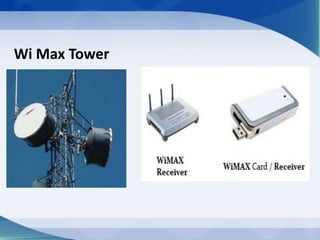
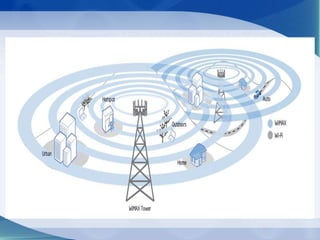
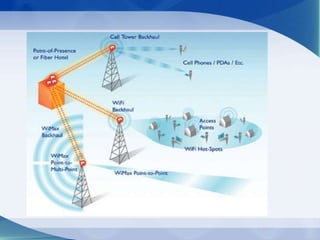
• A WiMAX base station consists of indoor
electronics and a WiMAX tower similar in
concept to a cell-phone tower.
• A WiMAX base station can provide coverage to
a very large area up to a radius of 6 miles.
• Any wireless device within the coverage area
would be able to access the Internet.
• The WiMAX base stations would use the MAC
layer defined in the standard, a common interface
that makes the networks interoperable and would
allocate uplink and downlink bandwidth to
subscribers according to their needs, on an
essentially real-time basis.
• Each base station provides wireless coverage over
an area called a cell. Theoretically, the maximum
radius of a cell is 50 km or 30 miles however,
practical considerations limit it to about 10 km or
6 miles.
WiMAX Receiver
• A WiMAX receiver may have a separate
antenna or could be a stand-alone box or a
PCMCIA card sitting in your laptop or
computer or any other device. This is also
referred as customer premise equipment
(CPE).
• WiMAX base station is similar to accessing a
wireless access point in a WiFi network, but
the coverage is greater.
Wi Max Tower
MAC layer
• MAC was designed for point-to-multipoint
broadband wireless access applications.
• The MAC layer is responsible for moving data
packets to and from one Network Interface Card
(NIC) to another across a shared channel.
• The primary task of the Wi MAX MAC layer is to
provide an interface between the higher
transport layers and the physical layer.
• The MAC layer takes packets from the upper
layer, these packets are called MAC service
data units (MSDUs) and organizes them into
MAC protocol data units (MPDUs) for
transmission over the air.
• For received transmissions, the MAC layer
does the reverse.
Type of Services by Wi Max
• Wi MAX can provide two forms of wireless
services,
Non-line-of-sight Service :-
• This is a WiFi sort of service. Here a small
antenna on your computer connects to the
WiMAX tower.
• In this mode, WiMAX uses a lower frequency
range -- 2 GHz to 11 GHz (similar to WiFi).
Line-of-sight Service:-
• In this, a fixed dish antenna points straight at
the WiMAX tower from a roof top or pole.
• The line-of-sight connection is stronger and
more stable, so it's able to send a lot of data
with fewer errors.
• Line-of-sight transmissions use higher
frequencies, with ranges reaching a possible
66 GHz.
WiMAX - Security Functions
• Security is handled by a privacy sublayer
within the WiMAX MAC. The key aspects of
WiMAX security are as follow −
1. Support for Privacy
2. Device/user Authentication
3. Flexible Key-management Protocol
Support for Privacy
• User data is encrypted using cryptographic
schemes of proven robustness to provide
privacy. Both AES (Advanced Encryption
Standard) and 3DES (Triple Data Encryption
Standard) are supported.
• The 128-bit or 256-bit key used for deriving
the cipher is generated during the
authentication phase and is periodically
refreshed for additional protection.
Device/user Authentication
• WiMAX provides a flexible means for
authenticating subscriber stations and users to
prevent unauthorized use.
• The authentication framework is based on the
Internet Engineering Task Force (IETF) EAP, which
supports a variety of credentials, such as
username/password, digital certificates, and
smart cards.
Flexible Key-management Protocol
• The Privacy and Key Management Protocol
Version 2 (PKMv2) is used for securely
transferring keying material from the base
station to the mobile station, periodically re-
authorizing and refreshing the keys.
Features of Wi Max
• Scalability - WiMAX has a scalable physical-layer architecture that
allows for the data rate to scale easily with available channel bandwidth.
• Quality of Service - WiMAX MAC is designed to support a large
number of users, with multiple connections per terminal, each with its
own QoS requirement.
• Support for Mobility - The mobile WiMAX variant of the
system has mechanisms to support secure seamless handovers for delay-
tolerant full-mobility applications.
Specifications of Wi Max
• Range - 30-mile (50-km) radius from base
station
• Speed - 70 megabits per second
• Frequency bands - 2 to 11 GHz and 10 to 66
GHz (licensed and unlicensed bands)
Benefits of Wi Max
• Speed
– Faster than broadband service.
• Wireless
– Not having to lay cables reduces cost.
– Easier to extend to suburban and rural areas.
• Broad Coverage
– Much wider coverage than WiFi hotspots.
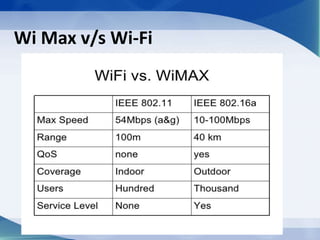
Wi Max v/s Wi-Fi
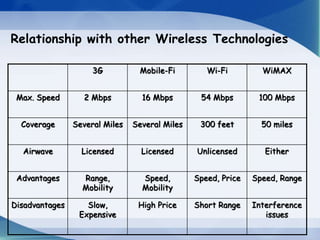
Relationship with other Wireless Technologies
3G Mobile-Fi Wi-Fi WiMAX
Max. Speed 2 Mbps 16 Mbps 54 Mbps 100 Mbps
Coverage Several Miles Several Miles 300 feet 50 miles
Airwave Licensed Licensed Unlicensed Either
Advantages Range,
Mobility
Speed,
Mobility
Speed, Price Speed, Range
Disadvantages Slow,
Expensive
High Price Short Range Interference
issues
Any Questions ?
Thank You.

Wi-max Technology PPT

  • 1.
  • 2.
    Contents • Wireless Technologies •Types of Wireless Technologies • What is Wi Max ? • Wi Max Building Blocks • MAC Layer in Wi Max Tower • Types of Wi Max Services • Security Functions • Specifications of Wi Max • Benefits of Wi Max • Wi Max vs Wi-Fi
  • 3.
    Wireless Communication Technologies • Theterm wireless refers to the communication or transmission of information over a distance without requiring wires, cables or any other electrical conductors. • Wireless communication is one of the important mediums of transmission of data or information to other devices. • The Communication is set and the information is transmitted through the air, without requiring any cables, by using electromagnetic waves like radio frequencies, infrared, satellite, etc.,
  • 4.
    Types of WirelessCommunication Technologies • Bluetooth • Wi-Fi • Zig – Bee • Wi Max
  • 5.
    What is WiMax ? • WIMAX stands for Worldwide Interoperability for Microwave Access. • WiMAX was formed in April 2001, in anticipation of the publication of the original IEEE 802.16 specifications. • WiMAX refers to broadband wireless networks that are based on the IEEE 802.16 standard, which ensures compatibility and interoperability between broadband wireless access equipment.
  • 6.
    Wi Max is •It is based on Wireless MAN technology. • A wireless technology optimized for the delivery of IP centric services over a wide area. • A scalable wireless platform for constructing alternative and complementary broadband networks.
  • 7.
    WiMAX - BuildingBlocks • A WiMAX system consists of two major parts − 1) A WiMAX base station. 2) A WiMAX receiver.
  • 8.
    Wi MAX BaseStation • A WiMAX base station consists of indoor electronics and a WiMAX tower similar in concept to a cell-phone tower. • A WiMAX base station can provide coverage to a very large area up to a radius of 6 miles. • Any wireless device within the coverage area would be able to access the Internet.
  • 9.
    • The WiMAXbase stations would use the MAC layer defined in the standard, a common interface that makes the networks interoperable and would allocate uplink and downlink bandwidth to subscribers according to their needs, on an essentially real-time basis. • Each base station provides wireless coverage over an area called a cell. Theoretically, the maximum radius of a cell is 50 km or 30 miles however, practical considerations limit it to about 10 km or 6 miles.
  • 10.
    WiMAX Receiver • AWiMAX receiver may have a separate antenna or could be a stand-alone box or a PCMCIA card sitting in your laptop or computer or any other device. This is also referred as customer premise equipment (CPE). • WiMAX base station is similar to accessing a wireless access point in a WiFi network, but the coverage is greater.
  • 11.
  • 12.
    MAC layer • MACwas designed for point-to-multipoint broadband wireless access applications. • The MAC layer is responsible for moving data packets to and from one Network Interface Card (NIC) to another across a shared channel. • The primary task of the Wi MAX MAC layer is to provide an interface between the higher transport layers and the physical layer.
  • 13.
    • The MAClayer takes packets from the upper layer, these packets are called MAC service data units (MSDUs) and organizes them into MAC protocol data units (MPDUs) for transmission over the air. • For received transmissions, the MAC layer does the reverse.
  • 15.
    Type of Servicesby Wi Max • Wi MAX can provide two forms of wireless services, Non-line-of-sight Service :- • This is a WiFi sort of service. Here a small antenna on your computer connects to the WiMAX tower. • In this mode, WiMAX uses a lower frequency range -- 2 GHz to 11 GHz (similar to WiFi).
  • 16.
    Line-of-sight Service:- • Inthis, a fixed dish antenna points straight at the WiMAX tower from a roof top or pole. • The line-of-sight connection is stronger and more stable, so it's able to send a lot of data with fewer errors. • Line-of-sight transmissions use higher frequencies, with ranges reaching a possible 66 GHz.
  • 17.
    WiMAX - SecurityFunctions • Security is handled by a privacy sublayer within the WiMAX MAC. The key aspects of WiMAX security are as follow − 1. Support for Privacy 2. Device/user Authentication 3. Flexible Key-management Protocol
  • 18.
    Support for Privacy •User data is encrypted using cryptographic schemes of proven robustness to provide privacy. Both AES (Advanced Encryption Standard) and 3DES (Triple Data Encryption Standard) are supported. • The 128-bit or 256-bit key used for deriving the cipher is generated during the authentication phase and is periodically refreshed for additional protection.
  • 19.
    Device/user Authentication • WiMAXprovides a flexible means for authenticating subscriber stations and users to prevent unauthorized use. • The authentication framework is based on the Internet Engineering Task Force (IETF) EAP, which supports a variety of credentials, such as username/password, digital certificates, and smart cards.
  • 20.
    Flexible Key-management Protocol •The Privacy and Key Management Protocol Version 2 (PKMv2) is used for securely transferring keying material from the base station to the mobile station, periodically re- authorizing and refreshing the keys.
  • 21.
    Features of WiMax • Scalability - WiMAX has a scalable physical-layer architecture that allows for the data rate to scale easily with available channel bandwidth. • Quality of Service - WiMAX MAC is designed to support a large number of users, with multiple connections per terminal, each with its own QoS requirement. • Support for Mobility - The mobile WiMAX variant of the system has mechanisms to support secure seamless handovers for delay- tolerant full-mobility applications.
  • 22.
    Specifications of WiMax • Range - 30-mile (50-km) radius from base station • Speed - 70 megabits per second • Frequency bands - 2 to 11 GHz and 10 to 66 GHz (licensed and unlicensed bands)
  • 23.
    Benefits of WiMax • Speed – Faster than broadband service. • Wireless – Not having to lay cables reduces cost. – Easier to extend to suburban and rural areas. • Broad Coverage – Much wider coverage than WiFi hotspots.
  • 24.
  • 26.
    Relationship with otherWireless Technologies 3G Mobile-Fi Wi-Fi WiMAX Max. Speed 2 Mbps 16 Mbps 54 Mbps 100 Mbps Coverage Several Miles Several Miles 300 feet 50 miles Airwave Licensed Licensed Unlicensed Either Advantages Range, Mobility Speed, Mobility Speed, Price Speed, Range Disadvantages Slow, Expensive High Price Short Range Interference issues
  • 27.