KI für alle
Barrieren für Unternehmensdaten und -analysen
abbauen
Wim Stoop | Senior Director, Product Marketing
Wim Stoop
Senior Director,
Product Marketing
Cloudera
CHANGE IS NOW
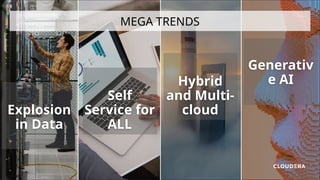
MEGA TRENDS
Explosion
in Data
Hybrid
and Multi-
cloud
Self
Service for
ALL
Generativ
e AI
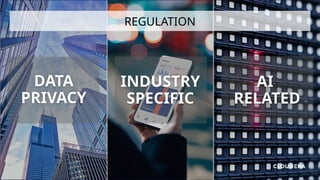
REGULATION
DATA
PRIVACY
INDUSTRY
SPECIFIC
AI
RELATED
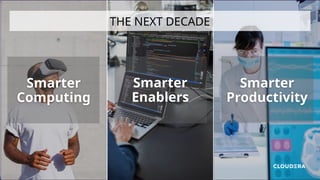
THE NEXT DECADE
Smarter
Computing
Smarter
Enablers
Smarter
Productivity
Analytics And AI Are Only
As Good As The Data
They Are Based On
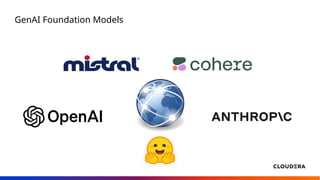
GenAI Foundation Models
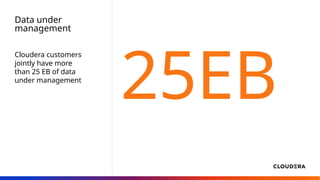
Cloudera customers
jointly have more
than 25 EB of data
under management
25EB
Data under
management
Task 0: Unlock Your Data
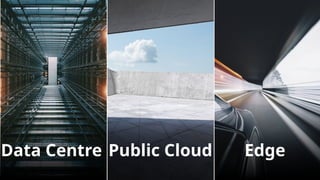
Public Cloud
Data Centre Edge
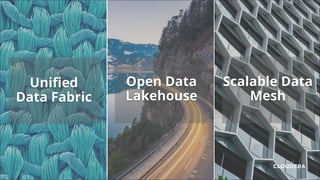
Scalable Data
Mesh
Open Data
Lakehouse
Unified
Data Fabric
13
© 2023 Cloudera, Inc. All rights reserved.
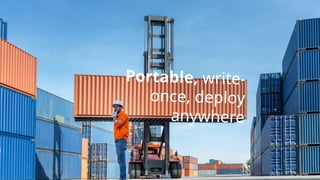
PORTABLE
Portable, write-
once, deploy
anywhere
Security and
Compliance
OPEN
Open
all ways
World-Class Customer Support
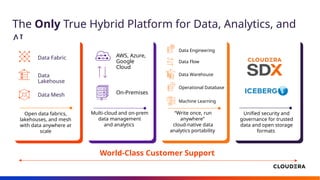
The Only True Hybrid Platform for Data, Analytics, and
AI
Data Fabric
Data
Lakehouse
Open data fabrics,
lakehouses, and mesh
with data anywhere at
scale
Data Mesh
Multi-cloud and on-prem
data management
and analytics
AWS, Azure,
Google
Cloud
On-Premises
“Write once, run
anywhere”
cloud-native data
analytics portability
Unified security and
governance for trusted
data and open storage
formats
Data Engineering
Data Warehouse
Operational Database
Machine Learning
Data Flow
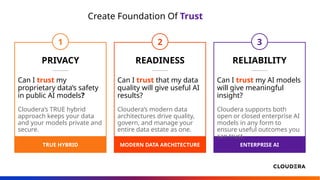
Create Foundation Of Trust
TRUE HYBRID
1
PRIVACY
Cloudera’s TRUE hybrid
approach keeps your data
and your models private and
secure.
Can I trust my
proprietary data’s safety
in public AI models?
MODERN DATA ARCHITECTURE
2
READINESS
Cloudera’s modern data
architectures drive quality,
govern, and manage your
entire data estate as one.
Can I trust that my data
quality will give useful AI
results?
ENTERPRISE AI
3
RELIABILITY
Cloudera supports both
open or closed enterprise AI
models in any form to
ensure useful outcomes you
can trust.
Can I trust my AI models
will give meaningful
insight?
93%
Multi-Cloud
& Hybrid Are Key
Multi-cloud and hybrid
capabilities for data and
analytics are key for an
organization to adapt
to change.
Moving Hybrid
to Cloud
90%
Data
Lifecycle Platform
IT leaders believe that
unifying the data
lifecycle on a single
platform is critical for
analytics and AI.
Adopting Modern
Data Architectures
76%
Using or Exploring
Use of AI
As AI technology evolves,
businesses are finding
new ways to implement
it into their operations.
Deploying
Enterprise AI
Source: CIO Whitepaper, IDG Communications, 2024 Source: CIO Whitepaper, IDG Communications, 2024 Source: IBM Global AI Adoption Index 2022
How Data-Driven Organizations are Handling Change
TRUE HYBRID
Massive energy resource provider
overcomes raw data complexity to:
• Lead enterprise change, with a
modern hybrid architecture, with
real-time
data pipeline
• Scale data-impact and innovation
with ML/AI
• Reduced time-to-detect
cybersecurity threats from minutes
to seconds: one incident can cost
billions
Achieving Measurable Business Results
MODERN DATA ARCHITECTURES
Leading bank delivers superior
customer experience with a central
data hub to:
• Improve customer experience
• Reduce operating costs by 80%
through a wide range of customer
service and operational
improvements
• Cut the cost to service customers
while increasing revenue through
better service
ENTERPRISE AI
Global clinical research org cures
performance and scale constraints to:
• Deliver 90% faster deployment of
healthcare-grade clouds and
datasets
• Speed the development of life-
saving drugs
• Improve human outcomes with
ML/AI
at massive scale
Tackle
Change
Learn, then try,
Cloudera
LEARN MORE
Try Cloudera for Free
2
READ NOW
Read the CIO Study
Take the
next step
1
Thank You

Wim Stoop, MSc. (Cloudera Data Platform)

  • 1.
    KI für alle Barrierenfür Unternehmensdaten und -analysen abbauen Wim Stoop | Senior Director, Product Marketing
  • 2.
  • 3.
  • 4.
    MEGA TRENDS Explosion in Data Hybrid andMulti- cloud Self Service for ALL Generativ e AI
  • 5.
  • 6.
  • 7.
    Analytics And AIAre Only As Good As The Data They Are Based On
  • 8.
  • 9.
    Cloudera customers jointly havemore than 25 EB of data under management 25EB Data under management
  • 10.
    Task 0: UnlockYour Data
  • 11.
  • 12.
  • 13.
    13 © 2023 Cloudera,Inc. All rights reserved. PORTABLE Portable, write- once, deploy anywhere
  • 14.
  • 15.
  • 16.
    World-Class Customer Support TheOnly True Hybrid Platform for Data, Analytics, and AI Data Fabric Data Lakehouse Open data fabrics, lakehouses, and mesh with data anywhere at scale Data Mesh Multi-cloud and on-prem data management and analytics AWS, Azure, Google Cloud On-Premises “Write once, run anywhere” cloud-native data analytics portability Unified security and governance for trusted data and open storage formats Data Engineering Data Warehouse Operational Database Machine Learning Data Flow
  • 17.
    Create Foundation OfTrust TRUE HYBRID 1 PRIVACY Cloudera’s TRUE hybrid approach keeps your data and your models private and secure. Can I trust my proprietary data’s safety in public AI models? MODERN DATA ARCHITECTURE 2 READINESS Cloudera’s modern data architectures drive quality, govern, and manage your entire data estate as one. Can I trust that my data quality will give useful AI results? ENTERPRISE AI 3 RELIABILITY Cloudera supports both open or closed enterprise AI models in any form to ensure useful outcomes you can trust. Can I trust my AI models will give meaningful insight?
  • 18.
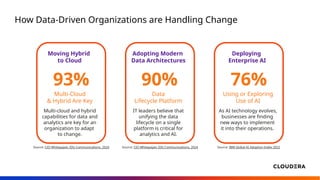
    93% Multi-Cloud & Hybrid AreKey Multi-cloud and hybrid capabilities for data and analytics are key for an organization to adapt to change. Moving Hybrid to Cloud 90% Data Lifecycle Platform IT leaders believe that unifying the data lifecycle on a single platform is critical for analytics and AI. Adopting Modern Data Architectures 76% Using or Exploring Use of AI As AI technology evolves, businesses are finding new ways to implement it into their operations. Deploying Enterprise AI Source: CIO Whitepaper, IDG Communications, 2024 Source: CIO Whitepaper, IDG Communications, 2024 Source: IBM Global AI Adoption Index 2022 How Data-Driven Organizations are Handling Change
  • 19.
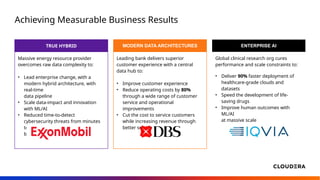
    TRUE HYBRID Massive energyresource provider overcomes raw data complexity to: • Lead enterprise change, with a modern hybrid architecture, with real-time data pipeline • Scale data-impact and innovation with ML/AI • Reduced time-to-detect cybersecurity threats from minutes to seconds: one incident can cost billions Achieving Measurable Business Results MODERN DATA ARCHITECTURES Leading bank delivers superior customer experience with a central data hub to: • Improve customer experience • Reduce operating costs by 80% through a wide range of customer service and operational improvements • Cut the cost to service customers while increasing revenue through better service ENTERPRISE AI Global clinical research org cures performance and scale constraints to: • Deliver 90% faster deployment of healthcare-grade clouds and datasets • Speed the development of life- saving drugs • Improve human outcomes with ML/AI at massive scale
  • 20.
  • 21.
    Learn, then try, Cloudera LEARNMORE Try Cloudera for Free 2 READ NOW Read the CIO Study Take the next step 1
  • 22.

Editor's Notes

  • #1 Hallo und herzlich willkommen zu diesem Vortrag, in welchem wir uns mit jenen Schlüsselfähigkeiten befassen werden, welche Unternehmen benötigen, um Zugang zu Unternehmensdaten und Analysen zu erhalten, um die Möglichkeiten der KI voll ausschöpfen zu können ENGLISH Hello and welcome to this session where we’ll delve into the key capabilities organizations need to unlock access to enterprise data and analytics so they can take full advantage of the AI opportunity
  • #2 Mein Name ist Wim Stoop Und ich leite das Produktmarketing für Cloudera ENGLISH My name is Wim Stoop And I lead product marketing for Cloudera
  • #3 Im Gegensatz zur gängigen Ansicht liegt Veränderung nicht in der Zukunft Veränderung ist eine Konstante. Für jeden von uns. Veränderung beschleunigt sich Und die Veränderung ist jetzt Heute Aber auch morgen und die Woche danach ENGLISH Contrary to popular belief, change is not tomorrow Change is a constant. For all of us. Change is accelerating And change is now Today But also tomorrow and the week after
  • #4 Wenn ich mit Kunden aus verschiedenen Branchen spreche, sehe ich immer wieder ein paar wichtige Themen. Mega-Trends. Erstens erleben wir eine explosionsartige Zunahme von Datenvolumen, -vielfalt und -geschwindigkeit. Angesichts der zunehmenden Menge an unstrukturierten Daten die von Unternehmen erfasst werden, war der Bedarf an robusten, skalierbaren Datenmanagementlösungen noch nie so hoch wie heute. Sie benötigen eine Plattform, die von Grund auf für die Bewältigung dieser Datenflut konzipiert ist. Blueprints und Beschleuniger wie eine Data Fabric ermöglichen es Unternehmen, Daten über verschiedene Quellen hinweg zu verwalten und zu analysieren, damit sie das volle Potenzial ihrer Datenbestände nutzen können. Der zweite Trend ist die wachsende Nachfrage nach Selbstbedienungsfunktionen. In der heutigen schnelllebigen Welt ist das Warten auf Ressourcen nicht nur frustrierend, sondern auch ein Hindernis für Innovationen. Unternehmen müssen den Nutzern die Möglichkeit geben, auf Daten und Anwendungen auf Abruf zuzugreifen. Sie brauchen eine Plattform, die Daten demokratisiert und es den Mitarbeitern im gesamten Unternehmen ermöglicht, schnell und ohne Engpässe auf Daten zuzugreifen, sie zu analysieren und Erkenntnisse zu gewinnen. Drittens ist der Wandel hin zu Hybrid- und Multi-Cloud-Strategien ausgeprägter denn je. Unternehmen wollen die Geschwindigkeit und Flexibilität von Cloud-Umgebungen nutzen, ohne dabei Kompromisse beim Datenschutz einzugehen oder sich an einen einzigen Anbieter zu binden. Benötigt wird eine Technologie, die für diese Realität ausgelegt ist und eine nahtlose Integration in öffentliche und private Clouds sowie in lokale Umgebungen bietet. Diese Flexibilität stellt sicher, dass Unternehmen auf der Grundlage von Kosten, Leistung und gesetzlichen Anforderungen den besten Standort für ihre Arbeitslasten wählen können. Schließlich ist die Begeisterung für generative KI unbestreitbar. Ob aufgrund von Aufträgen, Interesse oder beruflichem Aufstieg – Unternehmen sind begierig darauf zu erkunden, was KI für sie tun kann. Um innovativ zu sein und sich von der Konkurrenz abzuheben, müssen Sie von der reinen Datenverarbeitung zur KI bereit sein. Und das macht eine Infrastruktur erforderlich, die die Pipelines, Richtlinien, Engines und die Stränge, die für eine effektive KI-Implementierung erforderlich sind, einrichtet. Unternehmen müssen über das Experimentieren mit generativer KI hinausgehen und KI-Lösungen in großem Umfang einsetzen. Insgesamt ist es unverzichtbar Technologien in Betracht zu ziehen, die bei der Bewältigung der wichtigsten Trends, die die Unternehmensdatenlandschaft prägen, eine Vorreiterrolle spielen. Wenn Sie sich auf die Bewältigung der Datenflut, die Ermöglichung von Self-Service im gesamten Unternehmen, die Unterstützung von Hybrid- und Multi-Cloud-Strategien und die Erleichterung von generativen KI-Initiativen konzentrieren, sind Sie gut gerüstet, um Veränderungen zu bewältigen und die Herausforderungen und Chancen des digitalen Zeitalters zu meistern. ENGLISH But in speaking to customers across industries, I keep on seeing a few key trends. Mega trends. Firstly, we're witnessing an explosion in data volume, variety, and velocity. With an increasing amount of unstructured data being ingested by companies, the need for robust, scalable data management solutions has never been more critical. You need a platform that is designed from the ground up to handle this deluge of data. Blueprints and accelerators like a data fabric enable organizations to manage and analyze data across various sources, ensuring they can harness the full potential of their data assets. The second trend is the growing demand for self-service capabilities. In today's fast-paced world, waiting for resources isn't just frustrating—it's a barrier to innovation. Organizations must empower users by providing on-demand access to data and applications. They need a platform that democratizes data, allowing individuals across the organization to swiftly access, analyze, and gain insights without bottlenecks. Thirdly, the shift towards hybrid and multi-cloud strategies is more pronounced than ever. Enterprises are seeking the speed and agility offered by cloud environments without compromising on privacy or becoming locked into a single vendor. What’s needed is technology that is built for this reality, offering seamless integration across clouds, public `s well as private, and on-premises environments. This flexibility ensures that organizations can choose the best location for workloads based on cost, performance, and regulatory requirements. Lastly, the excitement around generative AI is undeniable. Whether driven by mandates, interest, or career advancement, companies are eager to explore what AI can do for them. For innovation and differentiation you need to move from just data-driven to being AI-ready. And that drives the need for infrastructure necessary for setting up the pipelines, policies, engines, as well as rigor required for effective AI implementation. Organizations need to move beyond experimenting with generative AI to deploying AI solutions at scale. Overall, you need to consider technology that is at the forefront of addressing the key trends shaping the enterprise data landscape. By focusing on managing the explosion of data, enabling self-service across organizations, supporting hybrid and multi-cloud strategies, and facilitating generative AI initiatives, you will be well-equipped to manage change and navigate the challenges and opportunities of the digital age.
  • #5 Als ob all dies nicht schon schwer genug wäre, geschieht dies auch noch vor dem Hintergrund der Regulierung. Und auch die Regulierung verändert sich. Zunächst einmal unterliegen wir alle der Datenschutzverordnung. Die europäische Datenschutz-Grundverordnung (GDPR), die sich in lokalen Vorschriften wie dem österreichischen DSG oder der deutschen DSGVO widerspiegelt. Aber wenn Sie ein multinationales Unternehmen sind, müssen Sie sich auch an die Vorschriften anderer Länder halten. CCPA in den USA, APPI in Japan, LGPD in Brasilien und eine ganze Reihe anderer Akronyme. Jedes Land unterscheidet sich auf subtile Weise vom anderen. Hinzu kommt, dass die einzelnen Branchen ihre eigenen Vorschriften haben. Stark regulierte Branchen, vom Gesundheitswesen über das Versicherungswesen bis hin zum Bankwesen, haben alle mit ihren eigenen Veränderungen der Vorschriften zu kämpfen. Das Baseler Regelwerk beispielsweise gibt die globalen Regulierungsstandards für Banken vor, aber man kann auch MiFiD II aufzählen. CCAR, Dodd-Frank oder DORA. Interessanterweise bezieht sich die vorgenannte Regulierung vor allem auf Daten, während DORA ein Element der Infrastruktur hinzufügt, da es sich auf die Widerstandsfähigkeit von Systemen konzentriert. Zu guter letzt: die sich abzeichnende Regulierung rund um KI, die vom EU-KI-Gesetz bis zur US-Exekutivverordnung reicht und noch viel mehr umfassen wird. Bei der Regulierung geht es darum, aufzuzeigen, wie KI entstanden ist, aber auch darum, welche Auswirkungen sie auf Verbraucher und Unternehmen hat. Da sich KI derzeit so schnell weiterentwickelt, ist es für viele ein bewegliches Ziel mit der Entwicklung Schritt zu halten und sich auf der richtigen Seite des Gesetzes zu bewegen. ENGLISH As if all of this wasn’t hard enough yet, it all is happening against a backdrop of regulation. And regulation too is changing. For starters, we’re all subject to data privacy regulation. Europe’s GDPR, represented in local regulation like Austria’s DSG or Germany’s DSGVO. But if you’re a multi-national organization, you need to equally adhere to any other country’s regulation. CCPA in the US, APPI in Japan, LGPD in Brazil and a whole raft of other acronyms. Each subtly different than the last. On top of that, industries have their own regulation. Highly regulated industries ranging from healthcare to insurance and banking, all have their own changing regulation to contend with. The Basel framework for example provides the global regulatory standards for banks, but you can equally rattle off MiFiD II. CCAR, Dodd-Frank or DORA. Interestingly, where previous mentioned regulations mostly relate to data, DORA adds an element of infrastructure as it focusses on resilience of systems. And finally, emerging regulation around AI ranging from the EU AI Act to the US Executive Order and a lot more to come. The regulation touches on demonstrating how AI was created but also the impact it has on consumers and businesses. As AI itself is evolving so fast right now, for many of it, it will somewhat like a moving target to try and keep abreast and on the right side of the law
  • #6 Wenn wir all dies aber tun, wird das nächste Jahrzehnt eine Menge Innovation und Intelligenz mit sich bringen. Das „Smarter Computing“ wird sich auf digitale Simulationen wie digitale Zwillinge konzentrieren. Vorrangig geht es darum, den Zeitaufwand für die fysische Umsetzung zu verringern und die simulierte Intelligenz parallel zum fysischen Produkt oder zur konzeptionellen Dienstleistung aufzubauen. Stellen Sie sich vor, Sie könnten eine Raffinerie in einer virtuellen Welt umrüsten und Rohre und Verbindungen passen auf Anhieb. Dadurch werden die Ausfallzeiten enorm reduziert. „Smarter Enablers“ werden sich auf die Automatisierung manueller oder alltäglicher Aufgaben konzentrieren, um Prozesse um den Faktor 100 zu beschleunigen. Wir sehen dies bereits in Form von large language models, die in großem Maßstab Inhalte in Marketing und Kommunikation generieren. Berichten zufolge hat die generative KI seit der Veröffentlichung von ChatGPT mehr Text erstellt als alle jemals geschriebenen Bücher, und das Volumen wird weiter wachsen. Ein Mensch bräuchte viele Lebenszeiten, um das zu erreichen, was in wenigen Monaten geschehen ist. „Smarter Productivity“ wird sich auf die Optimierung von Prozessen in der Fertigung, der Logistik und in Branchen wie der Pharmazie konzentrieren. Wir arbeiten bereits mit einer Organisation zusammen, die innerhalb von Stunden mehr als 800.000 Hypothesen für ein neues Medikament erstellen kann. Wenn nur 1% davon erfolgreich ist, verändert das das Leben von Zehntausenden von Menschen. ENGLISH But if we do all this, the next decade realizes a lot of innovation and smarts. “Smarter Computing” will focus on digital simulation such as digital twins. The priority being to reduce the time needed on physical implementation as well as building the simulated intelligence in parallel to the physical product or conceptual service. Imagine being able to perform a refinery refit in a virtual world and make things work first time. Pipes and connections fit first time. It tremendously reduces the amount of downtime. “Smarter Enablers” will focus on automating manual or mundane tasks in order to accelerate processes by a factor of 100x. We are already seeing this evolve as large language models generating content in marketing and communication at great scale. It is reported that since the release of ChatGPT, Generative AI has created more text than all books ever written and the volume will only keep on growing. It would take a human many lifetimes to achieve what has happened within months. “Smarter Productivity” will focus on optimising processes in manufacturing, logistics and industries such as Pharmaceuticals. We are already working with an organisation that can generate 800,000 hypotheses for a new medication within hours. If 1% of these are successful, it becomes life changing for 10s thousands of people.
  • #7 Das ist alles sehr aufregend, und es gibt viele Möglichkeiten für Innovation und Differenzierung. Aber unabhängig davon, ob Sie danach streben, ein KI-gesteuertes Unternehmen zu werden, oder ob Sie einfach nur mit fortschrittlichen Analysen bessere Einblicke und einen höheren Wert aus Ihren Daten ziehen wollen, hängt alles von einer Sache ab: Daten. Wir alle wissen, dass schlechte Daten zu schlechten Ergebnissen führen. Die Herausforderung lautet also: Wie komme ich zu besseren Daten? ENGLISH It’s all very exciting and the opportunity for innovation and differentiation is there. But regardless of whether you’re striving to become and AI-driven organization or you’re simply looking to get better insight and value from your data with advanced analytics, they all depend on one thing: data. We all know that if you put bad data in, you get bad insight out. The challenge then becomes: how do I get to better data?
  • #8 Also zurück zu Generatives KI und den grundlegenden Large Language Modelle Sie sind alle gut Sie liefern bemerkenswerte Ergebnisse Und sie basieren alle auf mehr oder weniger öffentlich zugänglichen Informationen Keines von ihnen basiert auf Ihren eigenen Geschäftsdaten Ihre privaten Daten. Aus diesem Grund sind die Modelle sehr gut darin, nach Strich und Faden zu lügen. Mit 100-prozentiger Sicherheit geben sie dir eine Antwort, selbst wenn sie keine Ahnung haben, wovon sie reden. Ihnen fehlt der Hintergrund Aber das Modell nimmt alles, was Sie ihm geben, um sich zu verbessern Jede Unterhaltung wird Teil des Modelles Einschließlich aller Daten, die Sie ihm gegeben haben. Deshalb hat zB Samsung die Verwendung des Tools schnell verboten Als man herausgefunden hatte, dass einer der Ingenieure ChatGPT um Hilfe bei der Verbesserung des sensiblen internen Codes gebeten hatte Hätte nun jeder, der Zugang zu ChatGPT hat, Zugang zu Samsungs IP? Was wären die Geschäftsmöglichkeiten, wenn Sie die Modelle mit Ihren eigenen Geschäftsdaten in Kontext bringen könnten? Ohne die Betriebsgeheimnisse zu verraten? Ohne mit den Vorschriften in Konflikt zu geraten? ENGLISH So thinking back to GenAi and the foundational large language models They’re all good They deliver remarkable results And they are all based on more or less publically accessible information None of them are based on your own business information Your private data Which is why the models are very good at lieing through their teeth. With 100% confidence they give you an answer even when they have no clue what they are talking about But they happily take whatever you give them to improve themselves Any conversation you have with the model It happily uses to improve itself Including all the data you gave it So Samsung quickly banned the use of the tool Once they discovered one of their engineers was asking ChatGPT to help improve their sensitive internal code Would everyone with access to ChatGPT now have access to Samsung’s IP? Wouldn't it be nice if you could contextualize the models with your own business data? Without giving away the company secrets? Without falling foul of regulation?
  • #9 Denn davon, von den Geschäftsdaten, davon hat jeder von uns sicherlich eine Menge Betrachten wir nur meine eigene Organisation Unsere Kunden haben zusammen mehr als 25 EB an Daten zu verwalten Geschäftsdaten! Das sind Daten in der gleichen Größenordnung wie ein Hyperscaler. Manche verwalten EB-grosse Datenmengen, mache kleinere Wenn Sie diese Daten für Ihre erweiterten Analysen und KI-Initiativen nutzen können Wenn Sie diese Daten freisetzen können dann können Sie die Herausforderungen von heute meistern Und mit den Veränderungen Schritt halten ENGLISH Because we certainly have a lot of that Looking just at my own organization Our customers collectively have more than 25 EB of data under management Business data! That’s data at the same scale as a hyperscaler If you can bring that to bear on your advanced analytics and AI initiatives If you can unlock that Then you can meet today’s challenges And roll with the changes
  • #10 Ihre erste Aufgabe sollte daher sein, genau das zu tun: Ihre Daten zu entsperren und sie auf sichere und konforme Weise zu nutzen Innovation und Veränderung vorantreiben Das datengesteuerte Unternehmen zu werden Schauen wir uns also die Schlüsselkompetenzen an, die Sie dafür benötigen Damit Sie die Hindernisse überwinden können, die Sie zurückhalten ENGLISH Your first task therefore should be to do just that: to unlock your data And use it in a safe and compliant manner To drive innovation and change To become that data-driven organization So lets look at key capilities you need to do that That let you overcome the barriers that hold you back
  • #11 Eine der Herausforderungen besteht darin, dass die Daten überall verstreut sind. Auch die Anwendungen, die Daten nutzen, sind oft verteilt. Zuerst das Rechenzentrum. Entgegen der landläufigen Meinung ist das Rechenzentrum für die meisten Unternehmen von Dauer. Hier werden geschäftskritische Anwendungen und Datensätze gehostet, die aus einer Reihe von Gründen (Risiko, Leistung, Kosten, Governance) nicht verlagert werden können. Natürlich wollen Sie die Daten so weit wie möglich optimieren. Nutzen Sie Software, um die Automatisierung und Orchestrierung voranzutreiben, Self-Service und andere Cloud-ähnliche Funktionen bereitzustellen. Aber natürlich hat auch das Rechenzentrum seine Grenzen. Seine Ressourcen sind begrenzt. Seine Skalierung erfordert Zeit und Planung. Daher ist es nicht verwunderlich, dass einige auch die Cloud ins Auge fassen: Dort können Sie Ressourcen nach anderen Regeln nutzen. Unbegrenzte Rechenleistung auf Abruf ermöglicht es Unternehmen, schneller und schneller als je zuvor zu innovieren. Aber es bringt auch Herausforderungen in Bezug auf Vorschriften, Fähigkeiten und Kosten mit sich. Nicht alle Daten können in der Cloud gespeichert werden, Cloud ist eine andere Art des Arbeitens, und auch wenn Pay as You Go eine gute Idee scheint, kann die Rechnung ein Schock sein, wenn man vergisst, ein Cluster abzuschalten. Aber es gibt auch Edge, und ich denke, dass dies in den kommenden Jahren die größte „Cloud“ sein wird, da wir eine explosionsartige Zunahme von Daten und vollständig dezentralisierten Berechnungen erleben werden. IPv6 und 5G sind wichtige Treiber dafür. Da immer mehr „Dinge“ miteinander verbunden werden, werden wir sehen, dass mehr und mehr Rechen- und Analysefunktionen in der Nähe der Quelle eingesetzt werden, um Daten zu verarbeiten und Erkenntnisse daraus zu gewinnen. Obwohl dies die neue Norm ist, bringt es eine Reihe von Herausforderungen mit sich, vor allem in Bezug auf Silos. Silos für alles: Daten, Fähigkeiten, Formate, Prozesse, Sicherheit und Governance. Das macht die Umsetzung Ihres Anwendungsfalls unglaublich schwierig, da Silos Sie bremsen und zusätzliche Ressourcen (Zeit, Personal, Geld) erfordern, um sie zu verbinden und die Dinge zum Laufen zu bringen. Wenn Sie sich also nach einer Technologie umsehen, achten Sie darauf, dass sie in allen Infrastrukturen funktioniert, die Sie jetzt oder in Zukunft benötigen. Und dass sie eine konsistente und einheitliche Betriebsebene hat. ENGLISH One of the challenges is that data is spread all over the place. Applications using data are the also often distributed. First the data center. Contrary to popular belief, for most organizations, the data center is here to stay. It hosts mission critical applications and data sets here that for a number of reasons (Risk, performance, Cost , Governance) and cannot be moved. Of course, you’ll want to optimize the data as much as possible. Use software to drive more automation and orchestration, deliver Self service and other Cloud like functionality. But of course, the data center has it’s limits. It has finite resources. Scaling it takes time and planning. So it is not surprising that some may also look at cloud: there you can use resources to a different set of rules. Unlimited compute on demand allows for organizations to innovate faster and quicker than ever. But it also brings challenges from a regulation, skills and cost perspective. Not all data can live on cloud, cloud is a different way of working, and although pay as you go may sound like a good idea, if you forget to switch something off, the bill will be a shock. But then there is also the Edge, and I think that will be the biggest “Cloud” in the years to come as we see an explosion of data and compute completely decentralized. IPv6 and 5G are big drivers for this. As more and more “things” becomes connected, we will see more and more Compute and Analytics being deployed near the source in order to process and gain insight from data. So apps and data will live across these locations, however whilst this IS the new norm, it presents a set of challenges, mainly around silos. Silos of everything: Data, Skills, Formats, Process, Security and Governance postures. This makes delivering your value use case incredibly hard as Silos Slow you down and require additional resources (Time , People , Money ) to connect them and make things work. So as you look for technology, make sure it works across all infrastructures you need, now or in the future. And that it has a consistent and single operating layer
  • #12 Als Nächstes geht es darum, Ihre Daten in den Griff zu bekommen. Und das immer schneller, je mehr Daten Sie haben. Dafür gibt es Blueprints und Accelerators. Mit einer Data Fabric können Sie Ihre Datenquellen überall erschließen, sie aus der Geschäftsperspektive kennen und verstehen und die darin enthaltenen Daten auf sichere und konforme Weise verfügbar machen Das ist auch ein Self-Service für diejenigen, die es brauchen: Entwickler, Geschäftsanwender, Datenwissenschafter Sie wollen auch sicherstellen, dass Sie nicht mit Datenkopien arbeiten. Oftmals werden verschiedene Technologien eingesetzt, die mit unterschiedlichen Datentypen agieren. Ein Data Lakehouse ist genau die richtige Architektur dafür Es kombiniert das Beste aus einem Data Warehouse und einem Data Lake Um eine einzige Datenquelle bereitzustellen Für jegliche Art von Analysen All dies hilft bereits dabei, aus Daten einen Mehrwert zu schaffen Aber wenn Sie dies auf eine unglaublich flexible und agile Weise tun wollen müssen Sie die gesamte Daten- und Analysewelt dezentralisieren Und den einzelnen Bereichen jene Autonomie geben: ihr eigenes Geschäft zu führen und ihre eigenen Daten als Produkt bereitzustellen Und das ist ein Data Mesh. Es ist keine Technologie als solche Es geht um Menschen und Prozesse, die durch Technologie unterstützt werden Der springende Punkt ist: Sie brauchen alle drei Ansätze Aber Sie wollen nicht, dass jedes System für sich allein steht. Das würde nur weitere Silos schaffen. Wenn Sie also eine Technologie auswählen, muss sie alle DREI Bereiche abdecken können. ENGLISH Next is being able to get to grips with your data. And doing that ever faster as you have ever more data. Blueprints and accelerators are available to do just that. A data fabric lets you unlock your data sources anywhere Know and understand them from a business perspective And make the data they contain available in a safe and compliant manner That’s also self service To those that need it: developers, business users, data scientists You also want to make sure you do not end up with copies of data Often driven by having different technologies that deal with different types of data A data lakehouse is just the architecture for that It combines the best of a data warehouse and a data lake To provide a single source of data For any and all analytics All this already helps getting value from data But if you want to do it in an incredibly flexible and agile manner You need to decentralize the whole data and analytics world And give individual domains the autonomy to manage their own business To provide their own data as a product And that’s a data mesh. It’s not a technology as such It’s people and process supported by technology The crux is: you need all three approaches Yet you don’t want disparate systems to do each That would just create more silos So when selecting technology, it needs to be able to be all three
  • #13 Wenn man nun die beiden vorangegangenen Herausforderungen zusammennimmt Die Fähigkeit, mit heterogenen Infrastrukturen zu arbeiten sowie die Möglichkeit, Blueprints und Accelerators zu nutzen Dann wird einem klar, dass es ideal wäre, wenn alles überall gleich aussehen, sich gleich anfühlen und genau gleich funktionieren würde Und das ist im Moment bei vielen Technologien eine Herausforderung Einige Data Warehouses sind möglicherweise nicht in einem Rechenzentrum verfügbar. Andere Analysen sind sehr spezifisch für eine bestimmte Cloud Das macht es für Sie als Unternehmen schwer: für jedes einzelne Tool, für jede einzelne Infrastruktur Brauchen Sie eine spezielle Gruppe von Experten, die das System bereitstellen und verwalten können. Das ist sowohl zeitaufwändig als auch kostspielig. Sie profitieren auch nicht von den Erkenntnissen, die Sie mit dem einen für den anderen gewonnen haben. Es ist daher wichtig für Sie nach einer Technologie suchen, die zwischen verschiedenen Infrastrukturen übertragbar ist Etwas, das Sie einmal entwickeln und dann anderswo einsetzen oder neu einsetzen können Und zwar ohne sie neu implementieren zu müssen. Sie sollte höchstens eine leichte Rekonfiguration erfordern. Sie benötigen jetzt weniger Ressourcen für die Verwaltung Ihrer Daten und Analysen Jetzt profitieren Sie von der Erfahrung ENGLISH Now if you pull the previous two challenges together Being able to work with heterogeneous infrastructures As well as being able to take advantage of accelerators and blueprints Then you also start to realize it would be ideal if everything looks, feel, and works exactly the same way everywhere And that right now is a challenge with many technologies Some data warehouses may not be available in a data center Other analytics are very specific to a particular cloud It makes it hard for you as an organization: for each and every tool, for each and every infrastructure You need a dedicated group of experts who can deploy and manage it That’s both time consuming as it is costly. You don’t benefit from insight learnt with one for another Therefore, you need to look for technology that’s portable between infrastructures Something that you can write once and then deploy or redeploy elsewhere And without having to reimplement it. At most, it should require light reconfiguration Now you need fewer resources to manage your data and analytics Now you benefit from experience
  • #14 Die nächste Herausforderung, die durch die verschiedenen Infrastrukturen und unterschiedlichen Systeme noch verschärft wird, betrifft die Sicherheit und die Einhaltung von Vorschriften. Jede Infrastruktur, jedes System hat ihre eigene Art, mit Datensicherheit und Governance umzugehen. Und das bedeutet hohe Investitionen in Fachwissen und betriebliche Auswirkungen Sie müssen ständig zwischen verschiedenen Ansätzen übersetzen. Und auch das birgt Risiken Das ist nicht das größte Problem Jede Art von Regulierung wird verschärft Immer mehr Länder und Regionen fordern sie Und das bedeutet, dass Sie als multinationales Unternehmen wissen müssen, welche Regeln wo gelten Und wie sich Veränderungen in der Gesetzgebung auf Ihre Datennutzung auswirken Sie müssen einen Schritt zurücktreten und die Daten im gesamten Unternehmen betrachten Sie müssen sie sichern und verwalten, unabhängig davon, wie und wo sie eingesetzt werden. Betrachten Sie die Einhaltung von Vorschriften ganzheitlich ALLES prüfen, verfolgen und nachverfolgen Es ist erforderlich das Sie in der Lage sind, dies zentral zu tun. ENGLISH The next challenge that is compounded by the multiple infrastructures and disparate systems is one of security and compliance. Each infra has its own way of handling data security and governance And that means heavy skill investment and operational impact You effectively need to continually translate between different approaches And that introduces risk too That’s not the biggest issue Regulation of any type is tightening More countries and regions demanding it And that means that as a multi-national you need to be conscious of what rules apply where And how changes to regulation impact your use of data You need to take a step back and look at data across the organization Secure and govern it independent of how and where deployed Look also at compliance holistically Audit, track and trace EVERYTHING And you have to be able to do that centrally
  • #15 Der letzte Aspekt, den Sie beachten müssen Oder den Sie als Auswahlkriterium verwenden sollten ist die Offenheit der verwendeten Technologie Natürlich ist eine Open-Source-Basis großartig Weil das die Innovation vorantreibt Aber vielleicht noch wichtiger ist, dass sie die Integration ermöglicht Zu integrieren und integriert zu werden Offene Standards und Frameworks sind der Schlüssel Denn das erleichtert die Fähigkeit zu Zusammenarbeit und stellt sicher, dass man nicht an einen bestimmten Anbieter gebunden ist ENGLISH The final aspect you need to be aware of Or that you need to use as a selection criterium Is the openness of the technology you use Of course, an open source basis is great Because that drives innovation But perhaps more important is that it allows for integration To integrate and be integrated with Open standard and frameworks are key Because that facilitates interoperability And ensures you are not locked in to any one vendor
  • #16 Dies sind die Schlüsselfunktionen, die Sie benötigen, um Ihre Daten und Analysen zu erschließen Sie müssen in der Lage sein, die Blueprints und Accelerators für die Nutzung Ihrer Daten zu unterstützen, und das alles von einer einzigen Plattform aus: Data Fabric, Lakehosue und Mesh Sie müssen in der Lage sein, eine hybride und Multi-Cloud-Landschaft zu unterstützen. Mit portierbaren Analysen, die Sie einmal entwickeln und ohne zusätzlichen Aufwand bereitstellen oder neu bereitstellen können Und Sie brauchen eine konsistente Sicherheit und Governance für Ihre Daten, überall In einer Plattform, die für die Integration offen ist Es wird Sie nicht überraschen, dass diese Plattform Cloudera ist und alles bietet, aber bitte nutzen Sie diese Maßstäbe auch, wenn Sie andere Technologien evaluieren. ENGLISH These are the key capabilities you need to unlock your data and analytics You need to be able to support the blueprints and accelerators for using your data, all from a single platform: data fabric, lakehosue and mesh You need to be able to support a hybrid and multi-cloud landscape With portable analytics that you write one and deploy or redeploy without additional effort And you need to have consistent security and governance for your data, anywhere In a platform that’s open for integration It won’t surprise you that that platform is Cloudera has it all, but please also use these measures as you evaluate other technologies to use.
  • #17 All diese Aspekte Ermöglichen es Ihnen, eine Vertrauensbasis für Ihre Daten zu schaffen bei der Verwendung durch Ihre Analytik und beim Übergang zu KI Sie können Ihre Anforderungen an den Datenschutz erfüllen: „Kann ich auf die Sicherheit meiner firmen internen Daten in öffentlichen KI-Modellen vertrauen?“ Sie können sicherstellen, dass Ihre Daten bereit für die Nutzung sind: „Kann ich darauf vertrauen, dass meine Datenqualität nützliche KI-Ergebnisse liefert?“ Und schließlich können Sie die Zuverlässigkeit sicherstellen: „Kann ich darauf vertrauen, dass meine KI-Modelle aussagekräftige Erkenntnisse liefern?“ ENGLISH All these aspects Allow you to create a foundation of trust for your data As it used by your analytics, and as you move to AI You can meet your needs for privacy: “Can I trust my proprietary data’s safety in public AI models?” - Cloudera’s TRUE Hybrid approach makes sure you can leverage any deployment, from virtual private cloud to on premises data centers, together to get the best use of AI You can ensure your data is ready to be used: “Can I trust that my data quality will give useful AI results?” - and using Cloudera’s modern data architectures, you can ensure your data has the quality, is well governed, and managed as a single data estate And finally, you can ensure reliability: “Can I trust my AI models will give meaningful insight?” - Cloudera’s support for both open and closed models for enterprise AI available to all form factors ensures you have the choice, flexibility and ability to cross-compare and ensure useful outcomes you can trust.
  • #18 Diese Vertrauensbasis ist entscheidend Und ist die Grundlage für drei wichtige Ansätze, die ich bei erfolgreichen datengesteuerten Unternehmen sehe Basierend auf Untersuchungen Dritter und einer Umfrage des CIO-Magazins unter 600 CIOs gibt es drei gängige Wege, mit Veränderungen umzugehen: 1. diese Firmen setzen auf Hybrid- und Multi-Cloud-Lösungen, um aus ihren Daten überall Einblicke und Mehrwert zu gewinnen 2. sie setzen moderne Datenarchitekturen ein: Blueprints und Accelerators wie Data Fabric, Lakehouse und Mesh, um den Prozess zu vereinfachen und zu rationalisieren 3. und sie nutzen die neuesten Innovationen im Bereich KI auf sichere, konforme und vertrauenswürdige Weise ENGLISH All these aspects are key And they are the basis of three key approaches I see successful data-driven organizations use Based on third-party research and a CIO magazine survey of 600 CIOs, there are three common ways to handle change: They embrace hybrid and multi-cloud as a means to drive insight and value from their data everywhere (source Cloudera CIO survey) They adopt modern data architectures: blueprints and accelerators like data fabric, lakehouse and mesh to simplify and streamline the process of doing so (getting insight and value from data) (source Cloudera CIO survey) And they deploy and evaluate, in a safe, compliant and trusted manner, take advantage of the latest innovations in AI (source https://www.ibm.com/watson/resources/ai-adoption)
  • #19 An und für sich bieten diese Dinge einen immensen geschäftlichen Nutzen ExxonMobil beispielsweise schöpft Hybrid Cloud komplett aus, um seine Anfälligkeit für Cybersecurity-Bedrohungen zu verringern Die Firma führt Protokoll- und Netzwerkdaten zusammen von mehr als 130,000 Maschinen, Computern und Geräten Daher verringert sich die Zeit bis zur Erkennung von Minuten auf Sekunden Für einen systemkritischen Betrieb wie eine Raffinerie oder eine Ölplattform bedeutet das eine schnellere Vorbeugung, wobei ein Vorfall möglicherweise Milliarden kosten kann. Die DBS ist in der Lage, alle Kundendaten und Erkenntnisse zusammenzuführen Schneller und einfacher mit einer Kombination aus Data Fabric, Lakehouse und Mesh Das senkt nicht nur die Betriebskosten um 80 %. sondern auch die Kosten für die Betreuung der einzelnen Kunden, ohne dass dies zu Lasten der Einnahmen geht. Und schließlich IQVIA Sie können ihre vertrauenswürdigen Daten ihren Wissenschaftlern zur Verfügung stellen und dabei die sehr strengen Industrie- und Datenschutzbestimmungen einhalten Um neue Medikamente und Behandlungen zu finden und zu entdecken aber auch bestehende Medikamente für neue Krankheiten zu nutzen Die Auswirkungen liegen nicht nur im geschäftlichen Nutzen sondern auch für den Menschen: Leben retten und Lebensqualität verbessern ENGLISH In and of themselves, these things deliver immense business value ExxonMobil for example leverages true hybrid in order to reduce their exposure to cybersecurity threats Brining together log and network insight from more than 130000 machines, computers and devices The time to detection goes from minutes to seconds For a systemic critical operation like a refinery or oil platform That means faster prevention, with one incident potentially costing billions For DBS, they are able to bring together all customer data and insight Faster and easier with a combination of data fabric, lakehouse and mesh Not only reducing their operating costs by 80% But also reducing the cost to service each customer but not at the expense of revenue And finally IQVIA They can make their trusted data available to their scientists While complying with very strict industry and data privacy regulation To find and discover both new medicines and treatments But also using existing ones for new diseases The impact here is not just in business benefit But also human impact: saving lives and improving life quality
  • #20 So können auch Sie die Hindernisse für KI in Ihrem Unternehmen beseitigen, indem Sie Daten- und Analyseblockaden aus dem Weg räumen Suchen Sie nach Technologien, die die wichtigsten Voraussetzungen für den Erfolg erfüllen die in den von Ihnen benötigten Infrastrukturen funktioniert die die Erschließung und Nutzung Ihrer Daten beschleunigt, indem sie Daten Fabric, Lakehouse und Mesh in einem ist die überall auf die gleiche Weisefunktioniert mit portablen Analysefunktionen die verfügt über konsistente Daten Sicherheit und Governance in allen Bereichen, um Compliance zu gewährleisten Und schließlich die offen ist für die Zusammenarbeit mit der Landschaft der Systeme und Anwendungen, die Sie bereits einsetzen Wenn Ihre Technologie diese Merkmale aufweist, sind Ihre Daten die Vertrauensgrundlage, die Ihnen den Übergang von datengesteuerten zu KI-gesteuerten Prozessen ermöglicht. Mit diesen Fähigkeiten sind Sie dann schon heute bereit, Veränderungen morgen zu bewältigen ENGLISH So, you too can remove the barriers to AI within your organizations by removing data and analytics barriers Look for technology that meets the key requirements for success Works across the infrastructures you need Accelerates unlocking and leveraging your data by being a data fabric, lakehouse and mesh all in one Works the same way everywhere with portable analytical capabilities Has consistent security and governance across all aspects to ensure compliance And finally is open to work with the landscape of systems and applications you already have in place If your technology has these characteristics, your data is the foundation of trust to let you move from data-driven to AI driven With these capabilities, you are ready to handle change today
  • #21 Um mehr zu erfahren, Lesen Sie unsere CIO-Studie zum Thema Datenarchitektur und -strategie für das KI-Zeitalter Und probieren Sie unsere Plattform kostenlos aus mit Projekten wie der Erstellung Ihres eigenen KI-Chatbots ENGLISH To find out more, Read our CIO study on the topic of data architecture and strategy for the AI era And get hands on with our platform for free
  • #22 Vielen Dank für Ihre Zeit und ich freue mich darauf, das Gespräch mit Ihnen fortzusetzen ENGLISH Thank you for your time