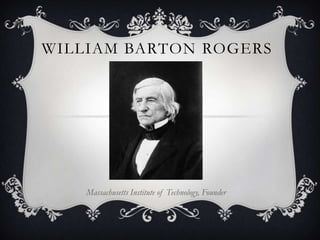
WILLIAM BARTON ROGERS


    Massachusetts Institute of Technology, Founder
WHO IS WILLIAM BARTON
          ROGERS

 December 7, 1804 – May 30, 1882) was a geologist, physicist and
educator. He is best known for setting down the founding principles
for, advocating for, and finally obtaining the incorporation of the
Massachusetts Institute of Technology (MIT) in 1861.The university
opened in 1865 after the American Civil War. Mount Rogers, the
highest peak in Virginia, is named after him.
PROFESSOR WILLIAM
          BARTON ROGERS

 In 1828 Patrick Kerr Rogers died and William Barton Rogers
succeeded him at the College of William and Mary as Professor of
Chemistry and Natural Philosophy. In 1835 Rogers was appointed
geologist of the Commonwealth of Virginia, and headed the state's
geological survey (as his brother Henry did in New Jersey and
Pennsylvania).
PROFESSOR WILLIAM
          BARTON ROGERS
            CONTINUED

 Also in 1835 he was appointed Professor of Natural Philosophy at
the University of Virginia and moved to Charlottesville. He served as
Chairman of the Faculty from 1844 to 1845, and in 1845 he was
elected a fellow of the American Academy of Arts and Sciences.
ROGERS IN BOSTON

While William held his faculty position at the University of Virginia in the 1840s he
frequently traveled north to the New England area. In New England he found an
intellectual and social culture more to his liking: people who valued education and
hard work along with financial enterprise.
 Fast growing urban centers filling with immigrants from Europe and
Canada, new railroads and mill towns,
 flourishing literary circles,
 a center of anti-slavery and other reform movements
THE MOVEMENT CLOSER
          TO MIT

 After speaking to Boston philanthropist John Lowell in
1846, Henry Rogers asked his brother William, who was still in
Virginia, to draft a plan for a scientific school. William outlined his
plan in a March 1846 letter to Henry.
LETTER FROM WILLIAM

     ―The true and only practicable object of a
polytechnic school is, as I conceive, the teaching, not
   of the minute details and manipulations of the
 arts, which can be done only in the workshop, but
 the inculcation of those scientific principles which
   form the basis and explanation of them, their
leading processes and operations in connection with
                    physical laws.‖
 - Life and Letters of William Barton Rogers 1:420
SETTING THE SCENE

 In Boston during those years the marshy lands in Back Bay were
gradually being filled in as a state project, and the governor of
Massachusetts proposed in 1859 that some of the new ground be set
aside for public educational improvements
ASSOCIATED
INSTITUTIONS OF SCIENCE
        AND ART

 ―Associated Institutions of Science and the Art‖ prepared a
―memorial‖ seeking some of that land for various educational
purposes, but their request was not successful—at least not at first.
The next year the same group enlisted William Barton Rogers to
spearhead a new land grant proposal, and as part of that campaign
Rogers produced a 30-page pamphlet titled Objects and Plan of an
Institute of Technology which was distributed widely.
ROGERS PROPOSAL OF MIT

 The plan was introduced to the state legislature in 1860. And a
year of support and defense of the plan ensued.

 This letter from Massachusetts Governor John Andrew urges
Rogers to speak before the Board of Education in defense of the
establishment of the Institute. "Be thou the advocate," states
Governor Andrew, as he extols Rogers's virtues as a persuasive
speaker. And persuasive he was…
MIT WAS BORN

 In April 1861, by an act of the Massachusetts legislature (chapter
183, acts of 1861), MIT was formally established. Governor Andrew
signed the act on April 10, 1861, just two days before Fort Sumter
was fired upon, marking the start of the Civil War.
RETIREMENT

 While president of MIT, Rogers also taught classes including
physics. Years of strenuous effort and resulting debilitating health
forced William Barton Rogers to relinquish his duties in 1868 and to
retire from the presidency of MIT in 1870. He spent the ensuing
decade recuperating.
DEATH

 During the 1870s, the Institute began to have financial difficulties and
enrollment decreased (partially due to outside influences such as the Great Boston
Fire and the Panic of 1873). In 1878 Rogers was asked to resume the presidency of
MIT. He agreed on the condition that he would only do so until a successor could
be found. Francis Amasa Walker was chosen to be the new president in 1880;
however, due to obligations regarding his work overseeing the U.S. Census, he could
not take office until the fall of 1881. Rogers continued his involvement, and
ultimately died while on the podium at commencement in 1882.
THE END
VIDEO


You will need internet connection to watch!

William barton rogers

  • 1.
    WILLIAM BARTON ROGERS Massachusetts Institute of Technology, Founder
  • 2.
    WHO IS WILLIAMBARTON ROGERS  December 7, 1804 – May 30, 1882) was a geologist, physicist and educator. He is best known for setting down the founding principles for, advocating for, and finally obtaining the incorporation of the Massachusetts Institute of Technology (MIT) in 1861.The university opened in 1865 after the American Civil War. Mount Rogers, the highest peak in Virginia, is named after him.
  • 3.
    PROFESSOR WILLIAM BARTON ROGERS  In 1828 Patrick Kerr Rogers died and William Barton Rogers succeeded him at the College of William and Mary as Professor of Chemistry and Natural Philosophy. In 1835 Rogers was appointed geologist of the Commonwealth of Virginia, and headed the state's geological survey (as his brother Henry did in New Jersey and Pennsylvania).
  • 4.
    PROFESSOR WILLIAM BARTON ROGERS CONTINUED  Also in 1835 he was appointed Professor of Natural Philosophy at the University of Virginia and moved to Charlottesville. He served as Chairman of the Faculty from 1844 to 1845, and in 1845 he was elected a fellow of the American Academy of Arts and Sciences.
  • 5.
    ROGERS IN BOSTON WhileWilliam held his faculty position at the University of Virginia in the 1840s he frequently traveled north to the New England area. In New England he found an intellectual and social culture more to his liking: people who valued education and hard work along with financial enterprise.  Fast growing urban centers filling with immigrants from Europe and Canada, new railroads and mill towns,  flourishing literary circles,  a center of anti-slavery and other reform movements
  • 6.
    THE MOVEMENT CLOSER TO MIT  After speaking to Boston philanthropist John Lowell in 1846, Henry Rogers asked his brother William, who was still in Virginia, to draft a plan for a scientific school. William outlined his plan in a March 1846 letter to Henry.
  • 7.
    LETTER FROM WILLIAM ―The true and only practicable object of a polytechnic school is, as I conceive, the teaching, not of the minute details and manipulations of the arts, which can be done only in the workshop, but the inculcation of those scientific principles which form the basis and explanation of them, their leading processes and operations in connection with physical laws.‖ - Life and Letters of William Barton Rogers 1:420
  • 8.
    SETTING THE SCENE In Boston during those years the marshy lands in Back Bay were gradually being filled in as a state project, and the governor of Massachusetts proposed in 1859 that some of the new ground be set aside for public educational improvements
  • 9.
    ASSOCIATED INSTITUTIONS OF SCIENCE AND ART  ―Associated Institutions of Science and the Art‖ prepared a ―memorial‖ seeking some of that land for various educational purposes, but their request was not successful—at least not at first. The next year the same group enlisted William Barton Rogers to spearhead a new land grant proposal, and as part of that campaign Rogers produced a 30-page pamphlet titled Objects and Plan of an Institute of Technology which was distributed widely.
  • 10.
    ROGERS PROPOSAL OFMIT  The plan was introduced to the state legislature in 1860. And a year of support and defense of the plan ensued.  This letter from Massachusetts Governor John Andrew urges Rogers to speak before the Board of Education in defense of the establishment of the Institute. "Be thou the advocate," states Governor Andrew, as he extols Rogers's virtues as a persuasive speaker. And persuasive he was…
  • 11.
    MIT WAS BORN In April 1861, by an act of the Massachusetts legislature (chapter 183, acts of 1861), MIT was formally established. Governor Andrew signed the act on April 10, 1861, just two days before Fort Sumter was fired upon, marking the start of the Civil War.
  • 12.
    RETIREMENT  While presidentof MIT, Rogers also taught classes including physics. Years of strenuous effort and resulting debilitating health forced William Barton Rogers to relinquish his duties in 1868 and to retire from the presidency of MIT in 1870. He spent the ensuing decade recuperating.
  • 13.
    DEATH  During the1870s, the Institute began to have financial difficulties and enrollment decreased (partially due to outside influences such as the Great Boston Fire and the Panic of 1873). In 1878 Rogers was asked to resume the presidency of MIT. He agreed on the condition that he would only do so until a successor could be found. Francis Amasa Walker was chosen to be the new president in 1880; however, due to obligations regarding his work overseeing the U.S. Census, he could not take office until the fall of 1881. Rogers continued his involvement, and ultimately died while on the podium at commencement in 1882.
  • 14.
  • 15.
    VIDEO You will needinternet connection to watch!