By:
Adrienne Hansen
   Kelly Livio
  Lynn Mayer

  Edited by:
 Nicole Benak
• works that reflect the multitude of cultural groups within the
  United States (Temple, Martinez, Yokota, & Naylor, 2011)

• literature that is not of the mainstream in the United States
  rather about groups who have been previously underrepresented
  and often marginalized by society as a whole, especially in
  depictions in children’s literature in the U.S. (Gopalakrishnan,
  2010)

• “Multicultural children’s literature is about the sociocultural
  experiences of previously underrepresented groups. It validates
  these groups’ experiences, including those occurring because of
  differences in language, race, gender, class, ethnicity, identity,
  and sexual orientation.” (Gopalakrishnan, 2010)
• children learned to read from books that presented
  primarily European American lifestyles and values
• early portrayals of nonmainstream characters tended to
  be highly stereotypical
• late 1960s increasing efforts have been made to include
  honest depictions of people from all cultural groups in
  children’s books
• The council on Interracial Books for Children was founded
  in 1966 to heighten public awareness of diversity issues
  related to children’s books.
• beginning of the 1990s largest surge to date in
  multicultural publishing in the children’s book field
• mid-1990s total number of multicultural books published
  declined
(Temple, Martinez, Yokota, & Naylor, 2011)
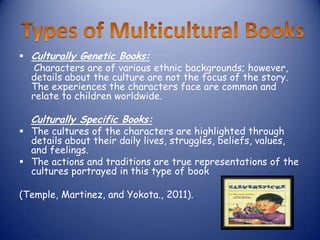
 Culturally Genetic Books:
   Characters are of various ethnic backgrounds; however,
  details about the culture are not the focus of the story.
  The experiences the characters face are common and
  relate to children worldwide.

  Culturally Specific Books:
 The cultures of the characters are highlighted through
  details about their daily lives, struggles, beliefs, values,
  and feelings.
 The actions and traditions are true representations of the
  cultures portrayed in this type of book

(Temple, Martinez, and Yokota., 2011).
According to Temple et al., (2011), “All multicultural books depict
people of diverse cultures, but the degree to which such books focus
       on cultural or social issues varies significantly”(p. 110).

   Gopalakrishnan (2011) described the following 4 levels in which
       multicultural education can be categorized (p. 27-28).

     Level 1: Multiculturalism books are introduced during special
   holidays, months, or celebrations. These books may not have been
evaluated to ensure that they are true representations of the particular
                     culture portrayed in the book.

Level 2: Books that fall under this level may have more details about a
  particular culture. This approach may include reading folktales, or
  having guestspeakers or authors from various cultural backgrounds
                             visit schools.
Level 3: Multicultural education at this approach provides
      students with opportunities to read and respond to
  multicultural literature that gives a genuine perspective of
 life events from the points of view of the characters in the
                             story.

Level 4: This approach allows students to read authentic
 multicultural literature as well involving the students “ in
 social action, in speaking out against injustice, in engaging
 with power structures to take active action to modify and
 transform society toward a more equitable and just life”
                    (Gopalakrishnan, 2011).
    *This is considered the “most desirable” level of
   multiculturalism. This is the level we want to get our
                         students to.*
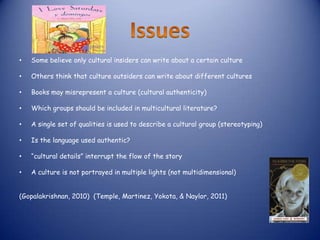
•   Some believe only cultural insiders can write about a certain culture

•   Others think that culture outsiders can write about different cultures

•   Books may misrepresent a culture (cultural authenticity)

•   Which groups should be included in multicultural literature?

•   A single set of qualities is used to describe a cultural group (stereotyping)

•   Is the language used authentic?

•   “cultural details” interrupt the flow of the story

•   A culture is not portrayed in multiple lights (not multidimensional)


(Gopalakrishnan, 2010) (Temple, Martinez, Yokota, & Naylor, 2011)
Temple et al., (2011) identified the various ways
          to assess multicultural books to ensure they
       are authentic. When selecting books, look for the
                      following attributes :


•   Language is authentic
•   Culture is presented without stereotyping
•   Author and illustrator depict authentic perspectives
•   Cultural details are naturally embedded into the story
•   Details such as historical events are accurate
•   Students should be presented with a variety of
    multicultural books
• Students feel welcome in school.

• Students need to understand and empathize with
  people who are different from them
(Temple, Martinez, Yokota, & Naylor, 2011)

• It can give children the ability to participate and
  function in the world.

• It gives equal representation to those who have
  once been silenced.
(Gopalakrishnan, 2010)
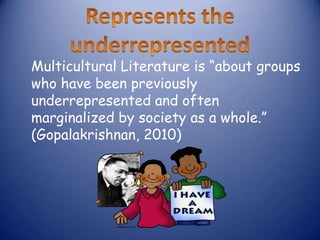
Multicultural Literature is “about groups
who have been previously
underrepresented and often
marginalized by society as a whole.”
(Gopalakrishnan, 2010)
Multicultural Literature provides all
 students with a “critical approach” when
 they are living within a population that
 is “more and more diverse.”
 (Gopalakrishnan, 2010)
• Critical literacy involves students questioning
  and taking action
• It is reading to find the message that is
  hidden within the story
• Reading through a critical approach allows
  students “the power to see the value of their
  readings and to help them believe that they
  can succeed and change the world to be a
  better place for themselves” (Gopalakrishnan,
  2011, p. 10).
This kind of literature encourages our
 students to form connections with the
 texts they are reading and their lives.
 Through the use of these texts, we help
 them “read the world through the
 word.” (Shor, 1999, p. 1)
With the incorporation of this
literature, underrepresented groups are
given respect and appreciation, as we
discover the many traditions and beliefs
beautifying each group.
With our world becoming a true “Melting
 Pot”, students are taught that we all
 have commonalities as people.
 Therefore, we must not discriminate
 “based on cultural and ethnic
 differences.” (Gopalakrishnan, 2010)
Multicultural Literature provides
“representation and validation” to the
“countless voices” that were not heard
before. Students can learn from their
stories, which are filled with obstacles
and triumph.
From their experiences, students can begin
  to understand and empathize with people
  who are different from them.

“If books do not portray differences,
  students cannot learn to transcend them.”
  (Temple, Martinez, Yokota, & Naylor, 2011)

• Students can see through a “window” what
  others’ lives are like (Bishop, 1990 as cited
  in Temple, Martinez, & Yokota, 2011)
Our literature must reflect our society because the
  differences are “tearing apart the fabric of society”
  (Temple, Martinez, Yokota, & Naylor, 2011).

The literature also serves as a “mirror” for students to
  see their own lives through the stories they are
  reading (Bishop, 1990 as cited in Temple, Martinez,
  Yokota, 2011).
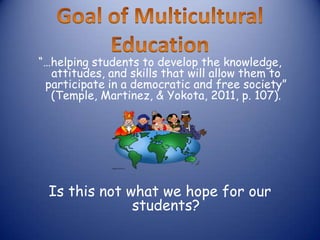
“…helping students to develop the knowledge,
  attitudes, and skills that will allow them to
 participate in a democratic and free society”
  (Temple, Martinez, & Yokota, 2011, p. 107).


 Is this not what we hope for our
              students?
Drucker, M. J. (2003). What reading teachers should know        about
  ESL learners. The Reading Teacher, 57(1), 22-29.

Elliott, J. B., & Dupuis, M. M. (2002). Young adult literature in the
    classroom. Newark, DE: International Reading Association, Inc.

Gopalakrishnan, A. (2011). Multicultural Children’s Literature: A
  critical issues approach. SAGE Publications.

Temple, C., Martinez, M., & Yokota, J. (2011). Children's books in
  children's hands: An introduction to their literature. (4 ed.).
  Boston, MA: Pearson.

Wiki 1 overview

  • 1.
    By: Adrienne Hansen Kelly Livio Lynn Mayer Edited by: Nicole Benak
  • 2.
    • works thatreflect the multitude of cultural groups within the United States (Temple, Martinez, Yokota, & Naylor, 2011) • literature that is not of the mainstream in the United States rather about groups who have been previously underrepresented and often marginalized by society as a whole, especially in depictions in children’s literature in the U.S. (Gopalakrishnan, 2010) • “Multicultural children’s literature is about the sociocultural experiences of previously underrepresented groups. It validates these groups’ experiences, including those occurring because of differences in language, race, gender, class, ethnicity, identity, and sexual orientation.” (Gopalakrishnan, 2010)
  • 3.
    • children learnedto read from books that presented primarily European American lifestyles and values • early portrayals of nonmainstream characters tended to be highly stereotypical • late 1960s increasing efforts have been made to include honest depictions of people from all cultural groups in children’s books • The council on Interracial Books for Children was founded in 1966 to heighten public awareness of diversity issues related to children’s books. • beginning of the 1990s largest surge to date in multicultural publishing in the children’s book field • mid-1990s total number of multicultural books published declined (Temple, Martinez, Yokota, & Naylor, 2011)
  • 4.
     Culturally GeneticBooks: Characters are of various ethnic backgrounds; however, details about the culture are not the focus of the story. The experiences the characters face are common and relate to children worldwide. Culturally Specific Books:  The cultures of the characters are highlighted through details about their daily lives, struggles, beliefs, values, and feelings.  The actions and traditions are true representations of the cultures portrayed in this type of book (Temple, Martinez, and Yokota., 2011).
  • 5.
    According to Templeet al., (2011), “All multicultural books depict people of diverse cultures, but the degree to which such books focus on cultural or social issues varies significantly”(p. 110). Gopalakrishnan (2011) described the following 4 levels in which multicultural education can be categorized (p. 27-28). Level 1: Multiculturalism books are introduced during special holidays, months, or celebrations. These books may not have been evaluated to ensure that they are true representations of the particular culture portrayed in the book. Level 2: Books that fall under this level may have more details about a particular culture. This approach may include reading folktales, or having guestspeakers or authors from various cultural backgrounds visit schools.
  • 6.
    Level 3: Multiculturaleducation at this approach provides students with opportunities to read and respond to multicultural literature that gives a genuine perspective of life events from the points of view of the characters in the story. Level 4: This approach allows students to read authentic multicultural literature as well involving the students “ in social action, in speaking out against injustice, in engaging with power structures to take active action to modify and transform society toward a more equitable and just life” (Gopalakrishnan, 2011). *This is considered the “most desirable” level of multiculturalism. This is the level we want to get our students to.*
  • 7.
    Some believe only cultural insiders can write about a certain culture • Others think that culture outsiders can write about different cultures • Books may misrepresent a culture (cultural authenticity) • Which groups should be included in multicultural literature? • A single set of qualities is used to describe a cultural group (stereotyping) • Is the language used authentic? • “cultural details” interrupt the flow of the story • A culture is not portrayed in multiple lights (not multidimensional) (Gopalakrishnan, 2010) (Temple, Martinez, Yokota, & Naylor, 2011)
  • 8.
    Temple et al.,(2011) identified the various ways to assess multicultural books to ensure they are authentic. When selecting books, look for the following attributes : • Language is authentic • Culture is presented without stereotyping • Author and illustrator depict authentic perspectives • Cultural details are naturally embedded into the story • Details such as historical events are accurate • Students should be presented with a variety of multicultural books
  • 10.
    • Students feelwelcome in school. • Students need to understand and empathize with people who are different from them (Temple, Martinez, Yokota, & Naylor, 2011) • It can give children the ability to participate and function in the world. • It gives equal representation to those who have once been silenced. (Gopalakrishnan, 2010)
  • 11.
    Multicultural Literature is“about groups who have been previously underrepresented and often marginalized by society as a whole.” (Gopalakrishnan, 2010)
  • 12.
    Multicultural Literature providesall students with a “critical approach” when they are living within a population that is “more and more diverse.” (Gopalakrishnan, 2010)
  • 13.
    • Critical literacyinvolves students questioning and taking action • It is reading to find the message that is hidden within the story • Reading through a critical approach allows students “the power to see the value of their readings and to help them believe that they can succeed and change the world to be a better place for themselves” (Gopalakrishnan, 2011, p. 10).
  • 14.
    This kind ofliterature encourages our students to form connections with the texts they are reading and their lives. Through the use of these texts, we help them “read the world through the word.” (Shor, 1999, p. 1)
  • 15.
    With the incorporationof this literature, underrepresented groups are given respect and appreciation, as we discover the many traditions and beliefs beautifying each group.
  • 16.
    With our worldbecoming a true “Melting Pot”, students are taught that we all have commonalities as people. Therefore, we must not discriminate “based on cultural and ethnic differences.” (Gopalakrishnan, 2010)
  • 17.
    Multicultural Literature provides “representationand validation” to the “countless voices” that were not heard before. Students can learn from their stories, which are filled with obstacles and triumph.
  • 18.
    From their experiences,students can begin to understand and empathize with people who are different from them. “If books do not portray differences, students cannot learn to transcend them.” (Temple, Martinez, Yokota, & Naylor, 2011) • Students can see through a “window” what others’ lives are like (Bishop, 1990 as cited in Temple, Martinez, & Yokota, 2011)
  • 19.
    Our literature mustreflect our society because the differences are “tearing apart the fabric of society” (Temple, Martinez, Yokota, & Naylor, 2011). The literature also serves as a “mirror” for students to see their own lives through the stories they are reading (Bishop, 1990 as cited in Temple, Martinez, Yokota, 2011).
  • 20.
    “…helping students todevelop the knowledge, attitudes, and skills that will allow them to participate in a democratic and free society” (Temple, Martinez, & Yokota, 2011, p. 107). Is this not what we hope for our students?
  • 22.
    Drucker, M. J.(2003). What reading teachers should know about ESL learners. The Reading Teacher, 57(1), 22-29. Elliott, J. B., & Dupuis, M. M. (2002). Young adult literature in the classroom. Newark, DE: International Reading Association, Inc. Gopalakrishnan, A. (2011). Multicultural Children’s Literature: A critical issues approach. SAGE Publications. Temple, C., Martinez, M., & Yokota, J. (2011). Children's books in children's hands: An introduction to their literature. (4 ed.). Boston, MA: Pearson.