Download as PDF, PPTX
![Jose Minaya
Managing Director of the Teachers Insurance &
Annuity Association – College Retirement Equities
Fund (TIAA-CREF)
"It's too risky for a company like TIAA–CREF to go into these areas [such as Africa] because
we're sure going to be in the headlines a year from the time we make the investment."](https://image.slidesharecdn.com/landgrabbers-121016083003-phpapp02/85/Who-s-behind-the-land-grabs-6-320.jpg)
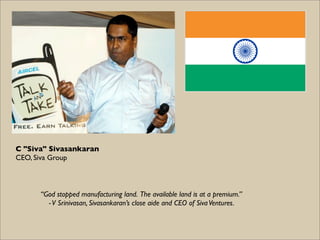
![C. Sivasankaran is one of India's richest men, with a net worth of more than US$4 billion. He made most of his fortune
pioneering sales of discounted PCs, mobile phone networks and broadband internet services in India. Sivasankaran keeps a low
public profile and rarely gives public interviews. He is said to hold a "big bang approach to life" and is known to travel the world
using his large fleet of private planes and yachts, staying in the most expensive presidential suites.
Lately, Sivasankaran has developed an interest in farmland. He started by taking major stakes in several Indian companies that have
been acquiring farmland overseas: a 12% stake in Ruchi Soya, which has 50,000 ha on long-term lease in Ethiopia; a 10% stake in KS
Oils, which has 56,000 ha for palm oil in Indonesia; and a 3% stake in Karuturi Global, which has a 300,000-ha land lease in
Ethiopia.
Palm oil appears to be Sivasankaran's favourite commodity. In 2010, he bought a minority stake in Feronia, a Canada-based
company that acquired 100,000 ha for palm-oil and soybean production in the DR Congo, and then set up a joint venture with
London's Equatorial Palm Oil, taking 50% control of the company's 170,000 ha in Liberia. Sivasankaran is now moving more directly
into the field. He set up Biopalm Energy, a subsidiary of his Singapore-based Siva Group, and quickly snatched up 200,000 ha in
Cameroon and 80,000 ha in Sierra Leone to produce palm oil for export to India, where it will be refined and sold.
"I’m a community land user, I live from farming," says one woman from the Pujehun district of Sierra Leone, where Siva has taken
land. "But now the investors, this Biopalm company [SIVA Group], has come and the Paramount Chief gives all the land away, even
the land I use for farming, for collecting firewood, for native herbs [medicines], for everything. Now it’s all gone. I have nothing."
All told, Siva has his hands on 756,000 ha of farmland, 670,000 ha of it in Africa.
C. Sivasankaran](https://image.slidesharecdn.com/landgrabbers-121016083003-phpapp02/85/Who-s-behind-the-land-grabs-16-320.jpg)


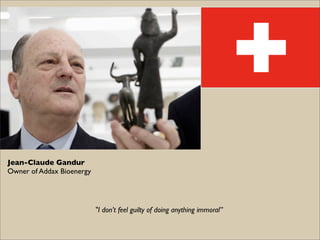
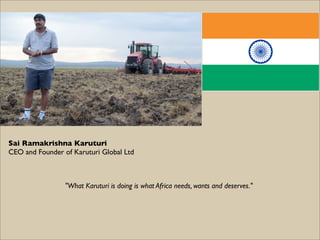
The document profiles individuals pursuing or supporting large-scale land acquisitions in developing countries. It examines Jean-Claude Gandur, owner of Addax Bioenergy, who acquired land in Sierra Leone for ethanol production, displacing local farmers. It also looks at Jose Minaya of TIAA-CREF who invested US teachers' retirement funds in Brazilian farmland converted to sugar cane plantations. Finally, it discusses Sai Ramakrishna Karuturi, founder of Karuturi Global Ltd., who aims to establish over 1 million hectares of agricultural land across Africa to produce crops like maize and rice.


