GOOD AND BAD
ARCHITECTURE
The difference between Good and Bad Architecture is the time
you spend on it – DAVID CHIPPERFIELD
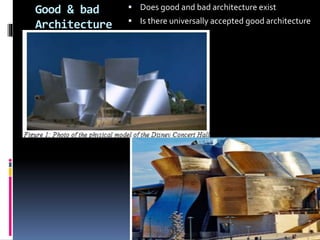
Good & bad
Architecture
 Does good and bad architecture exist
 Is there universally accepted good architecture
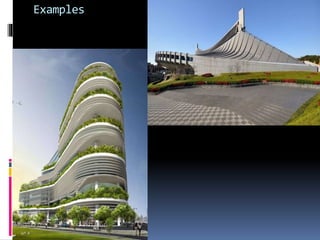
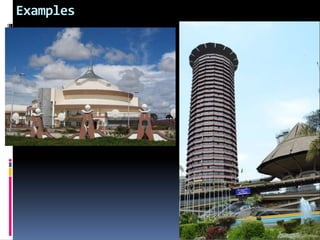
Examples
Examples
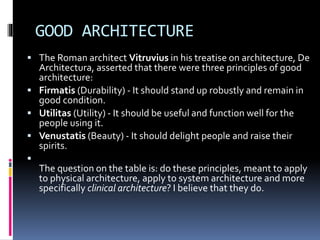
GOOD ARCHITECTURE
 The Roman architect Vitruvius in his treatise on architecture, De
Architectura, asserted that there were three principles of good
architecture:
 Firmatis (Durability) - It should stand up robustly and remain in
good condition.
 Utilitas (Utility) - It should be useful and function well for the
people using it.
 Venustatis (Beauty) - It should delight people and raise their
spirits.

The question on the table is: do these principles, meant to apply
to physical architecture, apply to system architecture and more
specifically clinical architecture? I believe that they do.
Any technologist "worth their salt" can easily see
the value of the first two principles when it
comes to architecture. Firmatis and Utilitas: It
will last and it will do the job. Some, however,
might scoff at the third principle of beauty.
 Before you riddle me with derisive laughter, consider that
architecture in the brick and mortar sense does not stop at the
foundation or the framing.
 Architecture is about the whole composition. You don't look at an
ugly building with great framing and good plumbing and admire
the architecture.
 By the same token, a beautiful building that caves in after a short
while due to bad internal architecture is not admired either, at
least not for very long.
Most technologists can easily believe that the first two principles
are our responsibility and the third is optional. I would argue that
the third principle, venustatis, is at as important as the first two.
what makes GOOD or BAD ARCHITECTURE (1).pptx

what makes GOOD or BAD ARCHITECTURE (1).pptx

  • 1.
    GOOD AND BAD ARCHITECTURE Thedifference between Good and Bad Architecture is the time you spend on it – DAVID CHIPPERFIELD
  • 2.
    Good & bad Architecture Does good and bad architecture exist  Is there universally accepted good architecture
  • 3.
  • 4.
  • 5.
    GOOD ARCHITECTURE  TheRoman architect Vitruvius in his treatise on architecture, De Architectura, asserted that there were three principles of good architecture:  Firmatis (Durability) - It should stand up robustly and remain in good condition.  Utilitas (Utility) - It should be useful and function well for the people using it.  Venustatis (Beauty) - It should delight people and raise their spirits.  The question on the table is: do these principles, meant to apply to physical architecture, apply to system architecture and more specifically clinical architecture? I believe that they do.
  • 6.
    Any technologist "worththeir salt" can easily see the value of the first two principles when it comes to architecture. Firmatis and Utilitas: It will last and it will do the job. Some, however, might scoff at the third principle of beauty.
  • 7.
     Before youriddle me with derisive laughter, consider that architecture in the brick and mortar sense does not stop at the foundation or the framing.  Architecture is about the whole composition. You don't look at an ugly building with great framing and good plumbing and admire the architecture.  By the same token, a beautiful building that caves in after a short while due to bad internal architecture is not admired either, at least not for very long. Most technologists can easily believe that the first two principles are our responsibility and the third is optional. I would argue that the third principle, venustatis, is at as important as the first two.