What is NODEMCU
NodeMCU is an open-source firmware platform that
includes open-source prototyping board designs. The
term "NodeMCU" is an abbreviation for the word "node"
and "microcontroller" (microcontroller unit). The term
"NodeMCU" strictly refers to the firmware rather than the
associated development kits. The firmware as well as the
prototyping board designs are open source.
The firmware employs the Lua scripting language. A circuit
board configured as a dual in-line package (DIP) that
integrates a USB controller with a smaller surface-mounted
board containing the MCU and antenna is commonly used for
prototyping. The DIP format allows for simple prototyping on
breadboards. The design was initially based on the
ESP8266's ESP-12 module, which is a Wi-Fi SoC integrated
and widely usedin IoT applications.
The below products shown are some of the examples of the
NodeMCU development board
ESP32 Node MCU Development Board with Wi-Fi and Bluetooth
NodeMCU ESP8266 (AMICA-CP2102driver)
Node MCU ESP8266 V3 (LOLIN CH340 chip)
ESP32 Camera Module
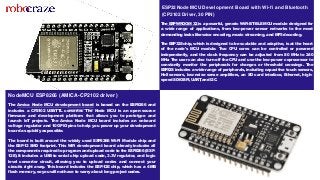
ESP32 Node MCU Development Board with Wi-fi and Bluetooth
(CP2102 Driver, 30 PIN)
The ESP WROOM 32 is a powerful, generic WiFi-BT-BLE MCU module designed for
a wide range of applications, from low-power sensor networks to the most
demanding tasks like voice encoding, music streaming, and MP3 decoding.
The ESP32S chip, which is designed to be scalable and adaptive, is at the heart
of the node's MCU module. Two CPU cores can be controlled or powered
independently, and the clock frequency can be adjusted from 80 MHz to 240
MHz. The user can also turn off the CPU and use the low-power coprocessor to
constantly monitor the peripherals for changes or threshold crossings. The
ESP32S includes a wide range of peripherals, including capacitive touch sensors,
Hall sensors, low-noise sense amplifiers, an SD card interface, Ethernet, high-
speed SDIO/SPI, UART
,and I2C.
NodeMCU ESP8266 (AMICA-CP2102driver)
The Amica Node MCU development board is based on the ESP8266 and
includes a CP2102 USB-TTL converter. The Node MCU is an open-source
firmware and development platform that allows you to prototype and
launch IoT projects. The Amica Node MCU board includes an onboard
voltage regulator and 10 GPIO pins to help you power up your development
board as quickly aspossible.
The board is built around the widely used ESP8266 Wi-Fi Module chip and
the ESP-12 SMD footprint. This WiFi development board already includes all
the components required to program and upload code to the ESP8266 (ESP-
12E). It includes a USB to serial chip upload code, 3.3V regulator, and logic
level converter circuit, allowing you to upload codes and connect your
circuits right away. This board includes the ESP-12E chip, which has a 4MB
flash memory, so you will not have to worry about long project codes.
The all-new Node MCU ESP8266 V3 CH340 Wi-fi Development Board is a cutting-
edge low-cost Wi-Fi technology that is fast and easy to use. Modern, mature LUA-
based technology of the highest level. It is a fully integrated unit with all available
resources. It is extremely simple to add to your existing Arduino projects or any
development board with I/O pins.
Modern Internet development tools, such as Node.js, can use Node MCU's built-in
API to get your idea up and running quickly. NodeMCU is based on the mature
ESP8266 technology and is designed to take advantage of the vast resources
available on theinternet.
The Node MCU is an open-source firmware and development kit that allows you to
quickly prototype your IoT product using a few lines of Lua code. The Development
Kitis built around an ESP8266 with integrated GPIO, PWM, IIC, 1-Wire, andADC.
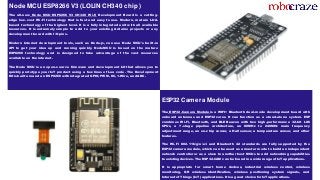
Node MCU ESP8266 V3 (LOLIN CH340 chip)
ESP32 Camera Module
The ESP32-Camera Module is a WIFI+ Bluetooth dual-mode development board with
onboard antennas and ESP32 cores. It can function as a stand-alone system. ESP
combines Wi-Fi, Bluetooth, and BLE Beacon with two high-performance 32-bit LX6
CPUs, a 7-stage pipeline architecture, an 80MHz to 240MHz main frequency
adjustment range, an on-chip sensor, a Hall sensor, a temperature sensor, and other
features.
The Wi-Fi 802.11b/g/n/e/i and Bluetooth 4.2 standards are fully supported by the
ESP32 camera module, which can be used as a master mode to build an independent
network controller or as a slave to another host MCUs to add networking capabilities
to existing devices. The ESP32-CAM can be found in a wide range of IoT applications.
It is appropriate for smart home devices, industrial wireless control, wireless
monitoring, QR wireless identification, wireless positioning system signals, and
Internet of Things (IoT) applications. It is a great choice for IoT applications.
What is NODE MCU - Robocraze .pptx

What is NODE MCU - Robocraze .pptx

  • 1.
  • 2.
    NodeMCU is anopen-source firmware platform that includes open-source prototyping board designs. The term "NodeMCU" is an abbreviation for the word "node" and "microcontroller" (microcontroller unit). The term "NodeMCU" strictly refers to the firmware rather than the associated development kits. The firmware as well as the prototyping board designs are open source. The firmware employs the Lua scripting language. A circuit board configured as a dual in-line package (DIP) that integrates a USB controller with a smaller surface-mounted board containing the MCU and antenna is commonly used for prototyping. The DIP format allows for simple prototyping on breadboards. The design was initially based on the ESP8266's ESP-12 module, which is a Wi-Fi SoC integrated and widely usedin IoT applications. The below products shown are some of the examples of the NodeMCU development board ESP32 Node MCU Development Board with Wi-Fi and Bluetooth NodeMCU ESP8266 (AMICA-CP2102driver) Node MCU ESP8266 V3 (LOLIN CH340 chip) ESP32 Camera Module
  • 3.
    ESP32 Node MCUDevelopment Board with Wi-fi and Bluetooth (CP2102 Driver, 30 PIN) The ESP WROOM 32 is a powerful, generic WiFi-BT-BLE MCU module designed for a wide range of applications, from low-power sensor networks to the most demanding tasks like voice encoding, music streaming, and MP3 decoding. The ESP32S chip, which is designed to be scalable and adaptive, is at the heart of the node's MCU module. Two CPU cores can be controlled or powered independently, and the clock frequency can be adjusted from 80 MHz to 240 MHz. The user can also turn off the CPU and use the low-power coprocessor to constantly monitor the peripherals for changes or threshold crossings. The ESP32S includes a wide range of peripherals, including capacitive touch sensors, Hall sensors, low-noise sense amplifiers, an SD card interface, Ethernet, high- speed SDIO/SPI, UART ,and I2C. NodeMCU ESP8266 (AMICA-CP2102driver) The Amica Node MCU development board is based on the ESP8266 and includes a CP2102 USB-TTL converter. The Node MCU is an open-source firmware and development platform that allows you to prototype and launch IoT projects. The Amica Node MCU board includes an onboard voltage regulator and 10 GPIO pins to help you power up your development board as quickly aspossible. The board is built around the widely used ESP8266 Wi-Fi Module chip and the ESP-12 SMD footprint. This WiFi development board already includes all the components required to program and upload code to the ESP8266 (ESP- 12E). It includes a USB to serial chip upload code, 3.3V regulator, and logic level converter circuit, allowing you to upload codes and connect your circuits right away. This board includes the ESP-12E chip, which has a 4MB flash memory, so you will not have to worry about long project codes.
  • 4.
    The all-new NodeMCU ESP8266 V3 CH340 Wi-fi Development Board is a cutting- edge low-cost Wi-Fi technology that is fast and easy to use. Modern, mature LUA- based technology of the highest level. It is a fully integrated unit with all available resources. It is extremely simple to add to your existing Arduino projects or any development board with I/O pins. Modern Internet development tools, such as Node.js, can use Node MCU's built-in API to get your idea up and running quickly. NodeMCU is based on the mature ESP8266 technology and is designed to take advantage of the vast resources available on theinternet. The Node MCU is an open-source firmware and development kit that allows you to quickly prototype your IoT product using a few lines of Lua code. The Development Kitis built around an ESP8266 with integrated GPIO, PWM, IIC, 1-Wire, andADC. Node MCU ESP8266 V3 (LOLIN CH340 chip) ESP32 Camera Module The ESP32-Camera Module is a WIFI+ Bluetooth dual-mode development board with onboard antennas and ESP32 cores. It can function as a stand-alone system. ESP combines Wi-Fi, Bluetooth, and BLE Beacon with two high-performance 32-bit LX6 CPUs, a 7-stage pipeline architecture, an 80MHz to 240MHz main frequency adjustment range, an on-chip sensor, a Hall sensor, a temperature sensor, and other features. The Wi-Fi 802.11b/g/n/e/i and Bluetooth 4.2 standards are fully supported by the ESP32 camera module, which can be used as a master mode to build an independent network controller or as a slave to another host MCUs to add networking capabilities to existing devices. The ESP32-CAM can be found in a wide range of IoT applications. It is appropriate for smart home devices, industrial wireless control, wireless monitoring, QR wireless identification, wireless positioning system signals, and Internet of Things (IoT) applications. It is a great choice for IoT applications.