What Is “Law”? 1 of 87
Copyright Sovereignty Education and Defense Ministry, http://sedm.org
Form #05.048, Rev. 4/5/2017 EXHIBIT:___________
WHAT IS “LAW”?
“Behold, I [God] will make My words in your mouth fire,
And this people wood,
And it shall devour them.
Behold, I will bring a [legislatively but not constitutionally foreign] nation [in the District of Columbia,
Washington D.C.] against you from afar,
O house of Israel [Form #17.014]," says the LORD.
"It is a mighty nation,
It is an ancient nation,
A nation whose language [legalese, Form #05.014] you do not know,
Nor can you understand what they say [in their deceitful franchise “codes”].
Their quiver is like an open tomb;
They are all mighty [deceitful] men.
And they [and the IRS, their henchmen, Form #11.302] shall eat up your harvest and your bread,
Which your sons and daughters should eat.
They shall eat up your flocks and your herds;
They shall eat up your vines and your fig trees;
They shall destroy your fortified cities [and businesses and families],
In which you trust, with the sword. “
[Jeremiah 5:14-17, Bible, NKJV]
“The power to create presumptions is not a means of escape from constitutional restrictions.”
[Bailey v. Alabama, 219 U.S. 219 , 238, et seq., 31 S.Ct. 145; Manley v. Georgia, 279 U.S. 1 , 5-6, 49 S.Ct. 215]
What Is “Law”? 2 of 87
Copyright Sovereignty Education and Defense Ministry, http://sedm.org
Form #05.048, Rev. 4/5/2017 EXHIBIT:___________
DEDICATION
The purpose of this document is to PREVENT:
(Lawyer) Word Crimes-by Weird Al Yankovic
https://youtu.be/8Gv0H-vPoDc?list=RD8Gv0H-vPoDc
______________________________________________________________________________________________
“Dishonest [unequal, Form #05.033] scales are an abomination to the Lord, but a just weight is His delight.”
[Prov. 11:1, Bible, NKJV]
______________________________________________________________________________________________
“The great enemy of clear language is insincerity. When there is a gap between one's real and one's declared aims, one turns
as it were instinctively to long words and exhausted idioms, like a cuttlefish spurting out ink. “
[George Orwell, "Politics and the English Language", 1946; English essayist, novelist, & satirist (1903 - 1950) ]
“Political chaos is connected with the decay of language... one can probably bring about some improvement by starting at
the verbal end.”
[George Orwell]
“Political language... is designed to make lies sound truthful and murder respectable, and to give an appearance of solidity
to pure wind.”
[George Orwell]
“Sometimes the first duty of intelligent men is the restatement of the obvious. “
[George Orwell ]
What Is “Law”? 3 of 87
Copyright Sovereignty Education and Defense Ministry, http://sedm.org
Form #05.048, Rev. 4/5/2017 EXHIBIT:___________
______________________________________________________________________________________________
“Judicial verbicide is calculated to convert the Constitution into a worthless scrap of paper and to replace our government
of laws with a judicial oligarchy.”
[Senator Sam Ervin, during Watergate hearing]
______________________________________________________________________________________________
“When words lose their meaning, people will lose their liberty.”
[Confucius, circa 500 B.C.]
______________________________________________________________________________________________
"If a word has an infinite number of meanings [or even a SUBJECTIVE meaning], it has no meaning, and our reasoning with
one another has been annihilated."
[Aristotle, Metaphysica Book IV]
______________________________________________________________________________________________
“Every nation, consequently, whose affairs betray a want of wisdom and stability, may calculate on every loss which can be
sustained from the more systematic policy of their wiser neighbors. But the best instruction on this subject is unhappily
conveyed to America by the example of her own situation. She finds that she is held in no respect by her friends; that she is
the derision of her enemies; and that she is a prey to every nation which has an interest in speculating on her fluctuating
councils and embarrassed affairs.
The internal effects of a mutable policy are still more calamitous. It poisons the blessing of liberty itself. It will be of little
avail to the people, that the laws are made by men of their own choice, if the laws be so voluminous that they cannot be
read, or so incoherent that they cannot be understood; if they be repealed or revised before they are promulgated, or
undergo such incessant changes that no man, who knows what the law is to-day, can guess what it will be to-morrow. Law
is defined to be a rule of action; but how can that be a rule, which is little known, and less fixed?
Another effect of public instability is the unreasonable advantage it gives to the sagacious, the enterprising, and the
moneyed few over the industrious and uniformed mass of the people. Every new regulation concerning commerce or
revenue, or in any way affecting the value of the different species of property, presents a new harvest to those who watch the
change, and can trace its consequences; a harvest, reared not by themselves, but by the toils and cares of the great body of
their fellow-citizens. This is a state of things in which it may be said with some truth that laws are made for [benefit of] the
FEW, not for the MANY.”
[Federalist Paper No. 62, James Madison]
______________________________________________________________________________________________
“It has been frequently remarked, with great propriety, that a voluminous code of laws is one of the inconveniences
necessarily connected with the advantages of a free government. To avoid an arbitrary discretion in the courts, it is
indispensable that they should be bound down by strict rules [of statutory construction and interpretation] and precedents,
which serve to define and point out their duty in every particular case that comes before them; and it will readily be
conceived from the variety of controversies which grow out of the folly and wickedness of mankind, that the records of those
precedents must unavoidably swell to a very considerable bulk, and must demand long and laborious study to acquire a
competent knowledge of them.”
[Federalist Paper No. 78, Alexander Hamilton]
__________________________________________________________________________________________________
Then Hilkiah the high priest said to Shaphan the scribe, “I have found the [lost or ignored] Book of the Law
[Deuteronomy in this case] in the house [temple/church] of the LORD.” And Hilkiah gave the [law] book to Shaphan,
and he read it. 9 So Shaphan the scribe went to the king, bringing the king word, saying, “Your servants have gathered the
money that was found in the house, and have delivered it into the hand of those who do the work, who oversee the house
What Is “Law”? 4 of 87
Copyright Sovereignty Education and Defense Ministry, http://sedm.org
Form #05.048, Rev. 4/5/2017 EXHIBIT:___________
of the LORD.” 10 Then Shaphan the scribe showed the king [Josiah], saying, “Hilkiah the priest has given me a book.”
And Shaphan read it before the king.
11
Now it happened, when the king heard the words of the Book of the Law [God’s law, Litigation Tool #09.001], that he
tore his clothes [humbled himself in DESPAIR]. 12
Then the king commanded Hilkiah the priest, Ahikam the son of Shaphan,
Achbor the son of Michaiah, Shaphan the scribe, and Asaiah a servant of the king, saying, 13
“Go, inquire of the Lord for
me, for the people and for all Judah, concerning the words of this book that has been found; for great is the wrath of the
Lord that is aroused against us, because our fathers have not obeyed the words of this book, to do according to all that is
written concerning us.”
[2 Kings 22:11-13, Bible, NKJV]
__________________________________________________________________________________________________
“What right have you [a government judge or legislator] to declare My [God’s] statutes [write man’s vain law or any
substitute for the common law], or take My covenant [the Bible, Form #13.007] in your mouth, seeing you hate instruction
and cast My words behind you? When you saw a thief, you consented with him, and have been a partaker with adulterers.
You give your mouth to evil, and your tongue frames deceit. You sit and speak against your brother; you slander your own
mother’s son. These things you have done, and I kept silent; you thought that I was altogether like you; but I will reprove
you, and set them in order before your eyes. Now consider this, you who forget God, lest I tear you in pieces, and there be
none to deliver: Whoever offers praise glorifies Me; and to him who orders his conduct aright [and bases it on God’s laws]
I will show the salvation of God.”
[Psalm 50:16-23, Bible, NKJV]
“The coming of the lawless one [government anarchy created with sovereign immunity] is according to the working of Satan,
with all power, signs, and lying wonders, and with all unrighteous deception among those who perish, because they did not
receive the love of the truth, that they might be saved. And for this reason God will send them strong delusion, that they
should believe the lie, that they all may be condemned who did not believe the truth but had pleasure in unrighteousness.”
[2 Thess. 2:9-12, Bible, NKJV]
“For the idols [civil rulers] speak delusion; The diviners envision lies, And tell false dreams; They comfort in vain. Therefore
the people wend their way like sheep; They are in trouble because there is no shepherd [GOD, or an wolf pretending to BE
a shepherd].”
[Zech. 10:2, Bible, NKJV]
“Your prophets [judges wearing black robes as priests of a civil religion] have seen for you
False and deceptive visions;
They have not uncovered your iniquity,
To bring back your captives,
But have envisioned for you false prophecies and delusions.”
[Lamentations 2:14, Bible, NKJV]
“He who kills a bull is as if he slays a man;
He who sacrifices a lamb, as if he breaks a dog’s neck;
He who offers a grain offering, as if he offers swine’s blood;
He who burns incense, as if he blesses an idol.
Just as they have chosen their own ways,
And their soul delights in their abominations,
So will I [GOD!] choose their delusions,
And bring their fears on them;
Because, when I called, no one answered,
When I spoke they did not hear;
But they did evil before My eyes,
And chose that in which I [GOD!] do not delight.”
[Isaiah 66:3-4, Bible, NKJV]
______________________________________________________________________________________________
What Is “Law”? 5 of 87
Copyright Sovereignty Education and Defense Ministry, http://sedm.org
Form #05.048, Rev. 4/5/2017 EXHIBIT:___________
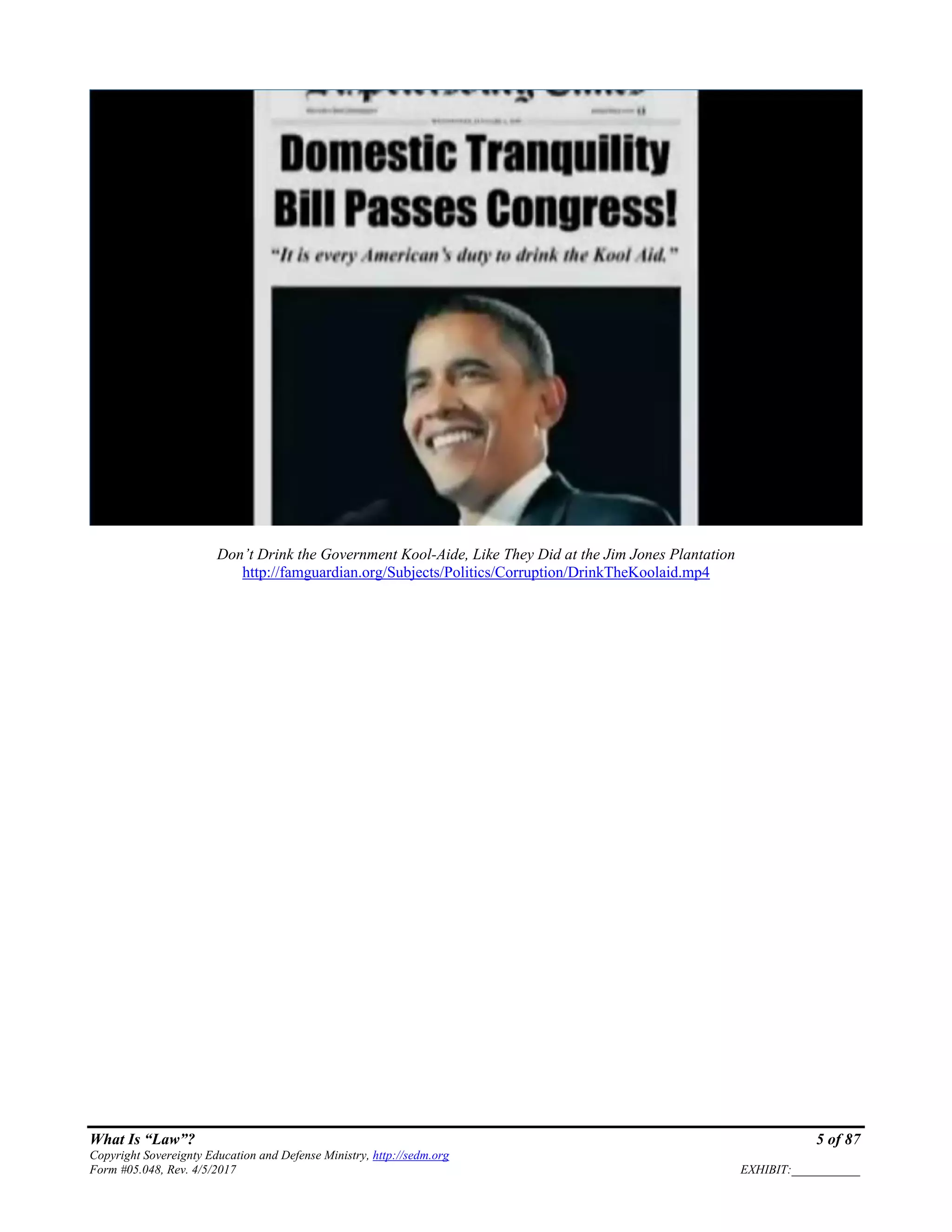
Don’t Drink the Government Kool-Aide, Like They Did at the Jim Jones Plantation
http://famguardian.org/Subjects/Politics/Corruption/DrinkTheKoolaid.mp4
What Is “Law”? 6 of 87
Copyright Sovereignty Education and Defense Ministry, http://sedm.org
Form #05.048, Rev. 4/5/2017 EXHIBIT:___________
TABLE OF CONTENTS
Page
TABLE OF CONTENTS .......................................................................................................................6
TABLE OF AUTHORITIES.................................................................................................................6
1. Introduction...................................................................................................................................16
2. Law is a Delegation of authority from the true sovereign: The People...................................18
3. How law protects the sovereign people: By limiting government power.................................22
4. Two methods of creating “obligations” clarify the definition of “law”....................................23
5. Authorities on “law” .....................................................................................................................28
6. CORRECTIVE (past) or PREVENTIVE (future) Remedy?....................................................31
7. Why all man-made law is religious in nature .............................................................................33
8. The result of violating God’s laws or putting man’s laws above God’s laws is slavery,
servitude, and captivity.................................................................................................................37
9. Abuse of Law as Religion .............................................................................................................38
10. Civil statutes are not “law” as defined in the Bible....................................................................44
11. Too much law causes crime!.........................................................................................................47
12. How judges unconstitutionally “make law” ...............................................................................52
13. How to Prevent Abuses or Misuses of the Word “Law” by Government Workers ...............61
14. Summary of Criteria for determining whether an enactment is “law” or merely a private
law franchise..................................................................................................................................65
15. What is “rule of law” in the context of the “law” defined here? ..............................................67
16. Conclusions and Summary...........................................................................................................73
17. Resources for Further Research..................................................................................................76
18. Questions that Readers, Grand Jurors, and Petit Jurors Should Be Asking the
Government ...................................................................................................................................77
______________________________________________________________________________________________
TABLE OF AUTHORITIES
Page
CONSTITUTIONAL PROVISIONS
Article 1, Section 9, Clause 8............................................................................................................................. 56, 58, 63, 72
Bill of Rights............................................................................................................................................................ 56, 58, 64
Declaration of Independence.............................................................................................................................. 66, 73, 81, 82
Declaration of Independence, Thomas Jefferson, 1776........................................................................................................51
Federalist #41. Saturday, January 19, 1788, James Madison ...............................................................................................68
Federalist Paper No. 62, James Madison................................................................................................................................3
What Is “Law”? 7 of 87
Copyright Sovereignty Education and Defense Ministry, http://sedm.org
Form #05.048, Rev. 4/5/2017 EXHIBIT:___________
Federalist Paper No. 78, Alexander Hamilton..................................................................................................................3, 48
Fifth Amendment .................................................................................................................................................................32
First Amendment............................................................................................................................................................51, 71
Fourteenth Amendment........................................................................................................................................................81
Fourth Amendment ..............................................................................................................................................................32
Thirteenth Amendment...................................................................................................................................................48, 66
Title of Nobility....................................................................................................................................................................72
STATUTES
1 U.S.C. §204.......................................................................................................................................................................42
18 U.S.C. § 211....................................................................................................................................................................84
18 U.S.C. §208.....................................................................................................................................................................58
18 U.S.C. §225.....................................................................................................................................................................22
26 U.S.C. §6065....................................................................................................................................................... 72, 77, 86
26 U.S.C. §6671...................................................................................................................................................................83
26 U.S.C. §7701(a)(14)........................................................................................................................................................65
26 U.S.C. §7701(a)(26)........................................................................................................................................................40
26 U.S.C. §7851...................................................................................................................................................................41
28 U.S.C. §§144, 455 ...........................................................................................................................................................58
50 U.S.C. §841......................................................................................................................................................... 56, 58, 63
53 Stat. 1, Section 4..............................................................................................................................................................44
Calif.Civil Code, §22 ...........................................................................................................................................................29
California Civil Code ...........................................................................................................................................................24
California Civil Code, Section 1427 ....................................................................................................................................23
California Civil Code, Section 1428 ........................................................................................................................ 24, 73, 74
California Civil Code, Section 1589 ....................................................................................................................................79
California Civil Code, Section 22.2 .....................................................................................................................................24
California Code, Section 1708 .............................................................................................................................................24
Code N. Y. § 462............................................................................................................................................................27, 49
Federal Investment in Real Property Transfer Act (FIRPTA)..............................................................................................66
Foreign Sovereign Immunities Act, 28 U.S.C. Chapter 97 ..................................................................................................26
Internal Revenue Code of 1939, Chapter 2, 53 Stat 1 ..........................................................................................................41
Internal Revenue Code of 1954............................................................................................................................................42
Internal Revenue Title..........................................................................................................................................................41
Public Law 591, 83d Congress, approved August 16, 1954.................................................................................................42
Revenue Act of 1939, 53 Stat. 1, Exhibit #05.027 ...............................................................................................................41
Revenue Act of 1939, 53 Stat. 1, Section 4..........................................................................................................................41
Revenue Code, Subtitle A ....................................................................................................................................................42
Statutes At Large..................................................................................................................................................................73
Title 26, the Internal Revenue Code.....................................................................................................................................42
U.C.C. §2-103(1)(a) .............................................................................................................................................................26
U.C.C. §2-104(1)..................................................................................................................................................................26
Vehicle Code........................................................................................................................................................................66
RULES
California Evidence Code, §600...........................................................................................................................................43
Federal Rule of Civil Procedure 12(b)(6).............................................................................................................................31
Federal Rule of Civil Procedure 17(b) ..................................................................................................................... 52, 53, 75
Federal Rule of Civil Procedure 8(b)(6)...............................................................................................................................77
Federal Rule of Evidence 301 ..............................................................................................................................................43
Federal Rule of Evidence 610 ........................................................................................................................................25, 43
Federal Rule of Evidence 803(8)..........................................................................................................................................59
What Is “Law”? 8 of 87
Copyright Sovereignty Education and Defense Ministry, http://sedm.org
Form #05.048, Rev. 4/5/2017 EXHIBIT:___________
CASES
Bailey Case ( 219 U.S. 239, 31 S. Ct. 145, 151) ..................................................................................................................43
Bailey v. Alabama, 219 U.S. 219 , 238, et seq., 31 S.Ct. 145 ................................................................................................1
Balzac v. Porto Rico, 258 U.S. 298 (1922) .............................................................................................................. 16, 67, 74
Barnette v. Wells Fargo Nevada Nat’l Bank, 270 U.S. 438, 70 L.Ed. 669, 46 S.Ct. 326.....................................................33
Bartholomew v. United States, 740 F.2d. 526, 532 n. 3 (7th Cir. 1984) ..............................................................................86
Board of County Com'rs of Lemhi County v. Swensen, Idaho, 80 Idaho 198, 327 P.2d. 361, 362 .....................................46
Bollow v. Federal Reserve Bank of San Francisco, 650 F.2d. 1093 (9th Cir. 1981)............................................................48
Boston & L. R. Corp. v. Salem & L. R. Co., 2 Gray (Mass.), 35...................................................................................27, 49
Brown v. Pierce, 74 U.S. 205, 7 Wall 205, 19 L.Ed. 134.....................................................................................................33
Budd v. People of State of New York, 143 U.S. 517 (1892)................................................................................................32
Burgin v. Forbes, 293 Ky. 456, 169 S.W.2d. 321, 325 ........................................................................................................52
Calder v. Bull, 3 U.S. 386 (1798).........................................................................................................................................28
Camden v. Allen, 2 Dutch., 398...........................................................................................................................................29
Carroll v. Fetty, 121 W.Va. 215, 2 S.E.2d. 521....................................................................................................................33
Caterpillar Tractor Co. v. United States, 589 F.2d. 1040, 1043, 218 Ct.Cl. 517 (1978) ......................................................86
Charbonnet v. United States, 455 F.2d. 1195, 1199-1200 (5th Cir.1972)............................................................................86
Chicago ex rel. Cohen v. Keane, 64 Ill.2d. 559, 2 Ill.Dec. 285, 357 N.E.2d. 452................................................................46
Chicago Park Dist. v. Kenroy, Inc., 78 Ill.2d. 555, 37 Ill.Dec. 291, 402 N.E.2d. 181 .........................................................46
City of Dallas v Mitchell, 245 S.W. 944 ..............................................................................................................................26
Cleveland Bed. of Ed. v. LaFleur (1974), 414 U.S. 632, 639-640, 94 S.Ct. 1208, 1215......................................................43
Coffin v. United States, 156 U.S. 432, 453 (1895)...............................................................................................................43
Colautti v. Franklin, 439 U.S. at 392-393, n. 10 ............................................................................................................52, 80
Dauer’s Estate v. Zabel, 9 Mich.App. 176, 156 N.W.2d. 34, 37....................................................................................18, 29
Donovan v. United States, 139 U.S. App. D.C. 364, 433 F.2d. 522 (D.C.Cir.) ...................................................................86
Downes v. Bidwell, 182 U.S. 244 (1901).............................................................................................................................22
Dunphy v. United States, 529 F.2d. 532, 208 Ct.Cl. 986 (1975)..........................................................................................86
Economy Plumbing & Heating v. U.S., 470 F.2d. 585 (1972).............................................................................................41
Eisendrath v. Knauer, 64 111. 402 .................................................................................................................................27, 50
Electric Co. v. Dow, 166 U.S. 489, 17 S.Ct. 645, 41 L.Ed. 1088...................................................................................55, 62
Faske v. Gershman, 30 Misc.2d. 442, 215 N.Y.S.2d. 144....................................................................................................33
Fiorentino v. United States, 607 F.2d. 963, 968, 221 Ct.Cl. 545 (1979)..............................................................................86
Fox v. Standard Oil Co. of N.J., 294 U.S. 87, 95-96 (1935) ................................................................................................80
FW/PBS, Inc. v. Dallas, 493 U.S. 215, 231 (1990)..............................................................................................................32
Georgia Dep’t of Human Resources v. Sistrunk, 249 Ga. 543, 291 S.E.2d. 524 .................................................................46
Glass v. The Sloop Betsey, 3 (U.S.) Dall 6 ..........................................................................................................................19
Glass v. The Sloop Betsey, 3 U.S. 6, 3 Dall. 6, 1 L.Ed. 485 (1794).....................................................................................18
Glenney v. Crane (Tex Civ App Houston (1st Dist)), 352 S.W.2d. 773 ..............................................................................33
Hamilton v. Rathbone, 175 U.S. 414, 20 Sup.Ct. 155, 44 L.Ed. 219.............................................................................27, 49
Heider v. Unicume, 142 Or. 416, 20 P.2d. 384 ....................................................................................................................33
Heiner v. Donnan, 285 U.S. 312 (1932)...............................................................................................................................43
In re Young, 235 B.R. 666 (Bankr.M.D.Fla., 1999).............................................................................................................26
Indiana State Ethics Comm’n v. Nelson (Ind App), 656 N.E.2d. 1172................................................................................46
International News Service v. Associated Press, 248 U.S. 215, 250 (1918) (dissenting opinion) .......................................81
Jackson ex dem. Pearson v. Housel, 17 Johns. 281, 283......................................................................................................26
Jersey City v. Hague, 18 N.J. 584, 115 A.2d. 8....................................................................................................................46
Kaiser Aetna v. United States, 444 U.S. 164 (1979)............................................................................................................81
Kaiser Aetna v. United States, 444 U.S. 164, 176 (1979) ....................................................................................................81
Lane County v. Oregon, 74 U.S. 7 Wall. 71 71 (1868)........................................................................................................79
Lawrence v. Hennessey, 165 Mo. 659, 65 S.W. 717......................................................................................................27, 49
Leonard v. Vicksburg, etc., R. Co., 198 U.S. 416, 422, 25 S.Ct. 750, 49 L.Ed. 1108....................................................55, 62
License Tax Cases, 72 U.S. 462, 18 L.Ed. 497, 5 Wall. 462, 2 A.F.T.R. 2224 (1866)........................................................79
Loan Association v. Topeka, 20 Wall. 655 (1874)............................................................................................. 21, 29, 40, 71
Loan Association v. Topeka, 87 U.S. (20 Wall.) 655 (1874) ...............................................................................................66
Long v. Rasmussen, 281 F. 236 (1922)................................................................................................................................41
Loretto v. Teleprompter Manhattan CATV Corp., 458 U.S. 419, 433 (1982) .....................................................................81
Los Angeles v. Lyons, 461 U.S. 95, 102 (1983) ..................................................................................................................31
What Is “Law”? 9 of 87
Copyright Sovereignty Education and Defense Ministry, http://sedm.org
Form #05.048, Rev. 4/5/2017 EXHIBIT:___________
Lujan v. Defenders of Wildlife, 504 U.S. 555 (1992) ..........................................................................................................31
Madlener v. Finley (1st Dist), 161 Ill.App.3d. 796, 113 Ill.Dec. 712, 515 N.E.2d. 697 ......................................................46
Magill v. Browne, Fed.Cas. No. 8952, 16 Fed.Cas. 408 ................................................................................................55, 63
Manley v. Georgia, 279 U.S. 1, 5-6, 49 S.Ct. 215..................................................................................................................1
Marbury v. Madison, 5 U.S. 137 (1803) ..............................................................................................................................68
Matter of Mayor of N.Y., 11 Johns., 77 ...............................................................................................................................29
Meese v. Keene, 481 U.S. 465, 484-485 (1987) ..................................................................................................................80
Moulton v. Witherell, 52 Me. 242.......................................................................................................................................50
Moulton v. Witherell, 52 Me. 242........................................................................................................................................27
Munn v. Illinois, 94 U.S. 113 (1877) ...................................................................................................................................81
National Tel. News Co. v. Western Union Tel. Co., 119 Fed. 294, 56 C.C.A. 198, 60 L.R.A. 805 ..............................27, 49
Newblock v. Bowles, 170 Okl. 487, 40 P.2d. 1097, 1100....................................................................................................52
Nikulnikoff v. Archbishop, etc., of Russian Orthodox Greek Catholic Church, 142 Misc. 894, 255 N.Y.S. 653, 663........38
Nollan v. California Coastal Comm'n, 483 U.S. 825 (1987)................................................................................................81
Northern Liberties v. St. John’s Church, 13 Pa.St. 104........................................................................................................29
Pearson v. Housel, 17 Johns. 281, 283.................................................................................................................................49
Phelps v. People, 72 N.Y. 357........................................................................................................................................27, 50
Pollock v. Farmers’ Loan & Trust Co., 157 U.S. 429 (Supreme Court 1895) .....................................................................17
Pollock v. Farmers’ Loan and Trust Co., 157 U.S. 429 (1895)......................................................................................22, 45
Pray v. Northern Liberties, 31 Pa.St. 69...............................................................................................................................29
Scranton v. Wheeler, 179 D.S. 141, 21 Sup.Ct. 48, 45 L.Ed. 126..................................................................................27, 49
Sharpless v. Mayor, supra; Hanson v. Vernon, 27 Ia., 47 ....................................................................................................29
Sierra Club v. Morton, 405 U.S. 727, 740-741, n. 16 (1972)...............................................................................................31
Simon v. Eastern Ky. Welfare Rights Organization, 426 U.S. 26, 41-42 (1976).................................................................31
Stanton v. Lewis, 26 Conn. 449 .....................................................................................................................................27, 49
State ex rel. Nagle v. Sullivan, 98 Mont. 425, 40 P.2d. 995, 99 A.L.R. 321........................................................................46
Stenberg v. Carhart, 530 U.S. 914 (2000) ......................................................................................................................52, 80
Stief v. Hart, 1 N.Y. 24...................................................................................................................................................27, 50
The Antelope, 23 U.S. 66, 10 Wheat 66, 6 L.Ed. 268 (1825) ........................................................................................48, 81
Trustees of Phillips Exeter Academy v. Exeter, 92 N.H. 473, 33 A.2d. 665, 673................................................................49
U.S. v. Butler, 297 U.S. 1 (1936) ...................................................................................................................................21, 71
United States Fidelity and Guaranty Co. v. Guenther, 281 U.S. 34, 50 S.Ct. 165, 74 L.Ed. 683...................................18, 29
United States v. Boylan, 898 F.2d. 230, 29 Fed.Rules.Evid.Serv. 1223 (CA1 Mass)..........................................................46
United States v. Holzer, 816 F.2d. 304 (CA7 Ill).................................................................................................................46
United States v. Lee, 106 U.S. 196, 1 S.Ct. 240 (1882) .......................................................................................................72
United States v. Lutz, 295 F.2d. 736, 740 (CA5 1961) ........................................................................................................81
United States v. Pueblo of San Ildefonso, 206 Ct.Cl. 649, 669-670, 513 F.2d. 1383, 1394 (1975) .....................................81
United States v. Winstar Corp. 518 U.S. 839 (1996) .....................................................................................................26, 74
United States v. Worrall, 2 U.S. 384 (1798)...................................................................................................................83, 84
United States vs. Lee, 106 U.S. 196, 1 S. Ct. 240 (1882).....................................................................................................30
Utah Farm Bureau Ins. Co. v. Utah Ins. Guaranty Ass'n, Utah, 564 P.2d. 751, 754 ............................................................46
Vlandis v. Kline (1973) 412 U.S. 441, 449, 93 S.Ct. 2230, 2235 ........................................................................................43
Warth v. Seldin, 422 U.S. 490, 508 (1975) ..........................................................................................................................31
Wendland v. Commissioner of Internal Revenue, 739 F.2d. 580, 581 (11th Cir.1984) .......................................................86
Western Union Telegraph Co. v. Lenroot, 323 U.S. 490, 502 (1945)..................................................................................80
Wilson v. Ward Lumber Co. (C. C.) 67 Fed. 674 ..........................................................................................................27, 49
Yick Wo v. Hopkins, 118 U.S. 356 1886.............................................................................................................................52
Yick Wo v. Hopkins, 118 U.S. 356, 6 S.Ct. 1064 (1886) ....................................................................................................19
OTHER AUTHORITIES
(Lawyer) Word Crimes, Weird Al Yankovic.........................................................................................................................2
1 Bl. Comm. 138 ..................................................................................................................................................................49
1 Bl.Comm. 138 ...................................................................................................................................................................27
1 Hamilton's Works (Ed. 1885) 270.....................................................................................................................................45
2 BL Comm. 389..................................................................................................................................................................27
2 Bl.Comm. 2, 15 ...........................................................................................................................................................27, 49
What Is “Law”? 10 of 87
Copyright Sovereignty Education and Defense Ministry, http://sedm.org
Form #05.048, Rev. 4/5/2017 EXHIBIT:___________
2 Bl.Comm. 389 ...................................................................................................................................................................49
2A N. Singer, Sutherland on Statutes and Statutory Construction § 47.07, p. 152, and n. 10 (5th ed. 1992) ......................80
3 Barn. & Adolph. 318, note ................................................................................................................................................27
6 Adolph. & El 11. 469 ........................................................................................................................................................27
6 Words and Phrases, 5583, 5584 ..................................................................................................................................55, 63
63C American Jurisprudence 2d, Public Officers and Employees, §247 (1999) .................................................................46
9 Barn. & Cr. 586.................................................................................................................................................................27
A J. Lien, “Privileges and Immunities of Citizens of the United States,” in Columbia University Studies in History,
Economics, and Public Law, vol. 54, p. 31 ................................................................................................................55, 63
Affidavit of Citizenship, Domicile, and Tax Status, Form #02.001...............................................................................27, 61
Affidavit of Duress: Illegal Tax Enforcement by De Facto Officers, Form #02.005..........................................................67
American Jurisprudence 2d, Duress, §21 (1999) .................................................................................................................33
Aust. Jur. (Campbell’s Ed.) § 1103 ......................................................................................................................................27
Authority and the Politics of Power, Nike Research ............................................................................................................76
Black’s Law Dictionary, Fourth Edition, p. 1577 ................................................................................................................31
Black’s Law Dictionary, Fourth Edition, p. 1693 ..........................................................................................................32, 66
Black’s Law Dictionary, Second Edition, p. 955 ...........................................................................................................27, 50
Black’s Law Dictionary, Sixth Edition, p. 1106...................................................................................................................49
Black’s Law Dictionary, Sixth Edition, p. 1185...................................................................................................................43
Black’s Law Dictionary, Sixth Edition, p. 1189.............................................................................................................40, 42
Black’s Law Dictionary, Sixth Edition, p. 1196...................................................................................................................45
Black’s Law Dictionary, Sixth Edition, p. 1292...................................................................................................................38
Black’s Law Dictionary, Sixth Edition, p. 281.....................................................................................................................19
Black’s Law Dictionary, Sixth Edition, p. 581.....................................................................................................................52
Black’s Law Dictionary, Sixth Edition, p. 884...............................................................................................................18, 29
Black’s Law Dictionary, Sixth Edition, pp. 1397-1398 .......................................................................................................46
Bouvier’s Law Dictionary Unabridged, 8th Edition, pg. 2131.............................................................................................71
Bouvier’s Law Dictionary Unabridged, 8th Edition, pg. 2159.............................................................................................71
Bouvier’s Law Dictionary, Fourth Edition, 1848.................................................................................................................27
Bouvier’s Maxims of Law, 1856..........................................................................................................................................80
Buried in Law, John Stossel, Fox News...............................................................................................................................77
Challenging Federal Jurisdiction Course, Form #12.010 .....................................................................................................52
Chinese Proverb ...................................................................................................................................................................39
Citizenship Status v. Tax Status, Form #10.011...................................................................................................................61
Citizenship Status v. Tax Status, Form #10.011, Section 6..................................................................................................60
Citizenship, Domicile, and Tax Status Options, Form #10.003 ...........................................................................................61
Clearfield Doctrine...............................................................................................................................................................53
Commandments About Relationship of Believers to the World, SEDM .............................................................................73
Common Law Practice Guide, Litigation Tool #10.013 ......................................................................................................76
Communist Party..................................................................................................................................................................63
Confucius, circa 500 B.C. ......................................................................................................................................................3
Congressman Traficant.........................................................................................................................................................56
Corporatization and Privatization of the Government, Form #05.024, Section 10 ..............................................................60
Courts Cannot Make Law, Michael Anthony Peroutka Townhall .......................................................................................61
De Facto Government Scam, Form #05.043 ........................................................................................................................25
Department of Justice (D.O.J.).............................................................................................................................................72
Department of Motor Vehicles (DMV)................................................................................................................................66
Devil’s Advocate: Lawyers, SEDM.....................................................................................................................................18
Disclaimer, Section 4 ...........................................................................................................................................................71
District Attorney...................................................................................................................................................................72
Doing Justice and Mercy, Pastor Tim Keller .......................................................................................................................44
Driver License......................................................................................................................................................................66
Enumeration of Inalienable Rights, Form #10.002 ..............................................................................................................67
Ernest F. Kevan, The Moral Law (Jenkintown, Penna.: Sovereign Grace Publishers, 1963) p. 5 f .....................................34
Executive Branch .................................................................................................................................................................71
Famous Quotes About Rights and Liberty, Form #08.001, Sections 5 and 17.....................................................................76
Farewell Address, George Washington................................................................................................................................20
What Is “Law”? 11 of 87
Copyright Sovereignty Education and Defense Ministry, http://sedm.org
Form #05.048, Rev. 4/5/2017 EXHIBIT:___________
Federal Civil Trials and Evidence, Rutter Group, paragraph 8:4993, p. 8K-34...................................................................43
Federal Courts and the IRS’ Own IRM Say IRS is NOT RESPONSIBLE for Its Actions or its Words or For Following Its
Own Written Procedures, Family Guardian Fellowship...................................................................................................39
Federal Jurisdiction, Form #05.018, Section 3.....................................................................................................................59
Federal Pleading, Motion, and Petition Attachment, Litigation Tool #01.002.....................................................................61
Flawed Tax Arguments to Avoid, Form #08.004, Section 3................................................................................................59
Fonb. Eq. B; 1, c. 2, s. 1 .......................................................................................................................................................27
Form #04.001 ........................................................................................................................................................... 56, 59, 63
Form #05.001 .......................................................................................................................................................................63
Form #05.002 ........................................................................................................................................................... 16, 65, 74
Form #05.003 .................................................................................................................................................................16, 74
Form #05.007 ........................................................................................................................................................... 56, 59, 63
Form #05.009 .......................................................................................................................................................................66
Form #05.014 ....................................................................................................................................................... 1, 56, 58, 63
Form #05.028 .......................................................................................................................................................................66
Form #05.030 ............................................................................................................................................... 56, 59, 64, 65, 66
Form #05.033 ............................................................................................................................................................. 2, 17, 28
Form #05.042 .................................................................................................................................................................16, 74
Form #05.046 ..................................................................................................................................................... 16, 59, 63, 74
Form #06.010 .......................................................................................................................................................................66
Form #08.020 ........................................................................................................................................................... 56, 58, 63
Form #09.001 .......................................................................................................................................................................66
Form #10.002 ........................................................................................................................................................... 56, 58, 63
Form #10.012 .......................................................................................................................................................................66
Form #11.302 .........................................................................................................................................................................1
Form #12.022 .......................................................................................................................................................................66
Form #12.038 .......................................................................................................................................................................66
Form #13.007 .........................................................................................................................................................................4
Form #17.014 .........................................................................................................................................................................1
Foundations of Freedom Course, Form #12.021, Video 1 ...................................................................................................17
Foundations of Freedom Course, Form #12.021, Video 4 .............................................................................................16, 74
Foundations of Freedom Course, Form #12.021, Video 4: Willful Government Deception and Propaganda ..............60, 61
Four Law Systems Course, Form #12.039 ...........................................................................................................................76
Frederic Bastiat ..............................................................................................................................................................16, 74
Frederic Bastiat (b. 1801 - d. 1850), The Law .....................................................................................................................26
Frederic Bastiat: The Unseen Radical, David M. Hart, Mises Institute ..............................................................................76
FTC Franchise Rule Compliance Guide, May 2008 ............................................................................................................85
FTC Franchise Rule Compliance Guide, May 2008, p. 1 ....................................................................................................85
General Flynn.......................................................................................................................................................................72
George Orwell........................................................................................................................................................................2
George Orwell, "Politics and the English Language", 1946...................................................................................................2
Government Conspiracy to Destroy the Separation of Powers, Form #05.023....................................................................53
Government Franchises Course, Form #12.012 ...................................................................................................................32
Government Identity Theft, Form #05.046 .............................................................................................................. 53, 61, 84
Government Identity Theft, Form #05.046, Section 10........................................................................................................60
Government Identity Theft, Form #05.046, Section 8.4.......................................................................................................60
Government Identity Theft, Form #05.046, Section 8.6.3....................................................................................................60
Government Identity Theft, Form #05.046, Section 9..........................................................................................................60
Government Instituted Slavery Using Franchises, Form #05.030........................................ 25, 32, 45, 51, 57, 59, 64, 67, 76
Government Instituted Slavery Using Franchises, Form #05.030, Section 28.2..................................................................32
Great IRS Hoax, Form #11.302, Section 3.3........................................................................................................................18
Great IRS Hoax, Form #11.302, Section 4.17......................................................................................................................38
Great IRS Hoax, Form #11.302, Section 4.4.11...................................................................................................................37
Great IRS Hoax, Form #11.302, Section 4.4.9.....................................................................................................................33
Grot. de Jure Belli et Pacis, lib. 2, c. 11, s. 6........................................................................................................................27
Gustave Friedrich Oehler, Theology of the Old Testament (Grand Rapids: Zondervan, 1883), p. 177...............................35
What Is “Law”? 12 of 87
Copyright Sovereignty Education and Defense Ministry, http://sedm.org
Form #05.048, Rev. 4/5/2017 EXHIBIT:___________
H. de Jongste and J.M. van Krimpen, The Bible and the Life of the Christian, for similar opinions (Philadelphia:
Presbyterian and Reformed Publishing Co., 1968), p. 66 ff.............................................................................................36
How Much Criminalization Will You Tolerate From Your Government, Freedom Taker............................................67, 77
Hugh H. Currie, “Law of God,” in James Hastings, ed., A Dictionary of Christ and the Gospels (New York: Charles
Scribner’s Sons, 1919), I, 685 ..........................................................................................................................................35
Illegal Everything, John Stossel ...........................................................................................................................................77
Injury Defense Franchise and Agreement, Form #06.027..............................................................................................27, 67
Internal Revenue Manual (I.R.M.), Section 4.10.7.2.8 ........................................................................................................86
Internal Revenue Manual (I.R.M.), Section 4.10.7.2.8 (05-14-1999) .................................................................................39
Internal Revenue Manual (I.R.M.), Section 4.10.7.2.9.8 (05-14-1999) ..............................................................................39
Interview with U.S. Supreme Court Justice Antonin Scalia about his book Reading Law, Exhibit #11.006.......................53
It’s an Illusion, John Harris..................................................................................................................................................76
J.A. Thompson: The Ancient Near Easter Treaties and the Old Testament (London: The Tyndale Press, 1964)................35
James Madison. House of Representatives, February 7, 1792, On the Cod Fishery Bill, granting Bounties.......................68
John Calvin, Institutes of the Christian Religion, bk. IV, chap. XX, para. Xiv. In the John Allen translation (Philadelphia:
Presbyterian Board of Christina Education, 1936), II, 787 f............................................................................................36
Kleinknecht an Gutbrod, Law, p. 125 ..................................................................................................................................34
Kleinknecht an Gutbrod, Law, p. 44 ....................................................................................................................................34
Kline, Treaty of the Great King, p. 41..................................................................................................................................36
Lawfully Avoiding Government Obligations Course, Form #12.040............................................................................76, 77
Legal Deception, Propaganda, and Fraud, Form #05.014 ........................................................................................ 56, 61, 63
Legal Deception, Propaganda, and Fraud, Form #05.014, Section 13 .................................................................................53
Legal Deception, Propaganda, and Fraud, Form #05.014, Section 15.2 ..............................................................................60
Legal Deception, Propaganda, and Fraud, Form #05.014, Section 5 ...................................................................................22
Legislative Branch................................................................................................................................................................53
Litigation Tool #09.001..........................................................................................................................................................4
Mackeld. Rom. Law, § 265 ..................................................................................................................................................26
Mao Tse-Tung......................................................................................................................................................................34
Mao Tse-Tung, The foolish Old Man Who Removed Mountains (Peking: Foreign Languages Press, 1966), p. 3 .............34
Marcus Tullius Cicero, 106-43 B.C. ........................................................................................................................ 28, 54, 62
Meaning of the Word “Frivolous”, Form #05.027 ...............................................................................................................60
Meredith G. Line, Treaty of the Great King, The Covenant Structure of Deuteronomy: Studies and Commentary (Grand
Rapids: William B. Eerdmans, 1963), p. 16.....................................................................................................................35
Montesquieu.........................................................................................................................................................................53
Morris Raphael Cohen, Reason and Law (New York: Collier Books, 1961), p. 84 f. .........................................................34
Natural Law, Chapter 1, Section IV, Lysander Spooner ................................................................................................56, 63
Non-Resident Non-Person Position, Form #05.020 .......................................................................................................51, 73
Non-Resident Non-Person Position, Form #05.020, Section 4 ............................................................................................60
Notice of Pseudonym Use and Unreliable IRS Records, Form #04.206..............................................................................39
Novanglus Essays, No. 7, John Adams ................................................................................................................................68
Olaf Moe, “Law,” in James Hastings, ed., Dictionary of the Apostolic Church (New York: Charles Scribner’s Sons, 1919),
I, 685 ................................................................................................................................................................................35
On the Cod Fishery Bill, granting Bounties. House of Representatives, February 3, 1792 .................................................69
On the Cod Fishery Bill, granting Bounties. House of Representatives, February 7, 1792 .................................................70
Oreilly Factor, April 8, 2015–John Piper of the Oklahoma Wesleyan University ...............................................................61
Originalism...........................................................................................................................................................................53
Overcoming the World 2014 Conference: Against the World, Ligonier Ministries.............................................................61
Pard. Dr. Com. part 2, tit. 1, n. 1, 38 to 178 .........................................................................................................................27
Pastor Tim Keller .................................................................................................................................................................44
Path to Freedom, Form #09.015, Section 2..........................................................................................................................51
Path to Freedom, Form #09.015, Section 5.6: Merchant or Buyer?....................................................................................67
Paul Manafort.......................................................................................................................................................................72
Philosophy of Law-Wikipedia..............................................................................................................................................77
Philosophy of Liberty, Family Guardian Fellowship .....................................................................................................16, 74
Presumption: Chief Weapon for Unlawfully Enlarging Federal Jurisdiction, Form #05.017 ............... 25, 26, 43, 59, 61, 75
Problems with Atheistic Anarchism, Form #08.020 ............................................................................................................73
Proof of Claim: Your Main Defense Against Government Greed and Corruption, Form #09.073.....................................75
What Is “Law”? 13 of 87
Copyright Sovereignty Education and Defense Ministry, http://sedm.org
Form #05.048, Rev. 4/5/2017 EXHIBIT:___________
Proof That There Is a “Straw Man”, Form #05.042 .............................................................................................................59
R.J. Rushdoony, “The Myth of Nature,” in The Mythology of Science (Nutley, N.J.: The Craig Press, 1967), pp. 96-98 .36
Reading Law: The Interpretation of Legal Texts, Antonin Scalia and Bryan A. Garner, ISBN: 978-0314275554 ............53
Readings on the History and System of the Common Law, Second Edition, Roscoe Pound, 1925, p. 4................. 25, 55, 62
Registered Sex Offenders.....................................................................................................................................................32
Requirement for Consent, Form #05.003.............................................................................................................................67
Requirement for Consent, Form #05.003, Section 7: Things you CANNOT Lawfully Consent To...................................66
Requirement for Equal Protection and Equal Treatment, Form #05.033 .......................................................................44, 76
Restatement 2d, Contracts §174...........................................................................................................................................33
Roman Catholicism and the Battle Over Words, Ligonier Ministries..................................................................................61
Rules of Presumption and Statutory Interpretation, Litigation Tool #01.006 ......................................................................61
S.R. Driver, “Law (In Old Testament), “in James Hastings, ed., A Dictionary of the Bible, vol. III (New York: Charles
Scribner’s Sons, 1919), p. 64 ...........................................................................................................................................34
SEDM Disclaimer, Section 4: Meaning of Words ........................................................................................................58, 65
Senator Sam Ervin, during Watergate hearing .......................................................................................................................3
Separation of Powers Doctrine................................................................................................................................. 53, 60, 75
Social Security Number........................................................................................................................................................84
Socialism: The New American Civil Religion, Form #05.016, Section 11.2.2...................................................................38
Socialism: The New American Civil Religion, Form #05.016, Section 14.2......................................................................39
Socialism: The New American Civil Religion, Form #05.016, Section 4.2........................................................................22
Sovereignty Forms and Instructions Online, Form #10.004, Cites by Topic: “law”...........................................................76
Sovereignty Forms and Instructions Online, Form #10.004, Cites by Topic: “State”.........................................................60
Sovereignty, Chapter 22: What is Law?-Rousas John Rushdoony, p. 129...........................................................................77
Sovereignty, Rousas John Rushdoony .................................................................................................................................76
State Department..................................................................................................................................................................66
State Income Tax, Form #05.031, Section 8 ........................................................................................................................60
Story on Ag. Sec. 91.............................................................................................................................................................27
Story on Eq. Jur. Sec. 385 to 390 .........................................................................................................................................27
Tacitus, Roman historian 55-117 A.D..................................................................................................................................47
Tax Form Attachment, Form #04.201............................................................................................................................27, 61
The “Trade or Business” Scam, Form #05.001.................................................................................................. 40, 71, 73, 83
The Government Mafia, Clint Richardson ...........................................................................................................................77
The Institutes of Biblical Law, Rousas John Rushdoony.....................................................................................................76
The Institutes of Biblical Law, Rousas John Rushdoony, 1973, The Craig Press, Library of Congress Catalog Card Number
72-79485, pp. 4-5 .............................................................................................................................................................37
The Keys to Freedom, Bob Hamp........................................................................................................................................61
The Law is No More, Pastor John Weaver...........................................................................................................................77
The Law, Frederic Bastiat ..............................................................................................................................................21, 76
The Law, Frederic Bastiat, 1850 .............................................................................................................................. 20, 30, 31
The Necessity of God’s Law in Society, Pastor John Weaver .............................................................................................77
The Privileges and Immunities of State Citizenship, Roger Howell, PhD, 1918, pp. 9-10............................................55, 63
The Purpose of Law, Family Guardian Fellowship..............................................................................................................76
The Social Contract or Principles of Political Right, Jean Jacques Rousseau, 1762, Book IV, Chapter 2...........................18
The Spirit of Laws, Charles de Montesquieu, Book XI, Section 6, 1758.......................................................................23, 53
The Unconstitutional Conditions Doctrine...........................................................................................................................32
Thomas Jefferson to Isaac H. Tiffany, 1819, From: Thomas Jefferson on Politics and Government, Section 1.2 ..............28
Thomas Jefferson: 1st Inaugural, 1801. ME 3:320...............................................................................................................21
Thomas Jefferson: Opinion on National Bank, 1791. ME 3:148 .........................................................................................69
Thomas Jefferson: Rights of British America, 1774. ME 1:209, Papers 1:134....................................................................18
Treatise on the Law of Public Offices and officers, p. 609, §909; Floyd Mechem, 1890 ....................................................83
U.S. Supreme Court .......................................................................................................................................................32, 42
U.S. Supreme Court Justice Scalia.......................................................................................................................................53
Unalienable Rights Course, Form #12.038 ........................................................................................................ 26, 50, 59, 67
Uncommon Knowledge with Justice Antonin Scalia...........................................................................................................53
USA Passport .......................................................................................................................................................................66
W.J. Harrelson, “Law in the OT,” in The Interpreter’s Dictionary of the Bible, (New York: Abingdon Press, 1962), III, 77
..........................................................................................................................................................................................34
What Is “Law”? 14 of 87
Copyright Sovereignty Education and Defense Ministry, http://sedm.org
Form #05.048, Rev. 4/5/2017 EXHIBIT:___________
Webster’s Dictionary............................................................................................................................................................40
Westlaw Keycites Under Key 15AK417: Force of Law .....................................................................................................77
What is “Justice”?, Form #05.050........................................................................................................................................76
What is “law”?, Form #05.048.......................................................................................................................................47, 58
What is “law”?, Nike Insights ..............................................................................................................................................76
Why All Man-Made Law is Religious in Nature, Family Guardian.....................................................................................76
Why Domicile and Becoming a “Taxpayer” Require Your Consent, Form #05.002......................................... 25, 51, 66, 73
Why Domicile and Becoming a “Taxpayer” Require Your Consent, Form #05.002, Section 10.3.....................................44
Why Statutory Civil Law is Law for Government and Not Private Persons, Form #05.037..........................................50, 59
Why the Fourteenth Amendment is Not a Threat to Your Freedom, Form #08.015............................................................60
Why We Must Personally Learn, Follow, and Enforce the Law, SEDM.............................................................................77
Why You Are a “national”, “state national”, and Constitutional but Not Statutory Citizen, Form #05.006, Sections 4 and 5
..........................................................................................................................................................................................60
Why Your Government is Either a Thief or You are a “Public Officer” for Income Tax Purposes, Form #05.008............83
Wikipedia topic: Equivocation, Downloaded 9/15/2015.....................................................................................................23
Wikipedia: Novanglus Essay No. 7.....................................................................................................................................68
William Blackstone, Commentaries (1765) .........................................................................................................................26
William Penn (after whom Pennsylvania was named).........................................................................................................18
Wolff, Ins. Nat. part 1, SSSS 27-30 .....................................................................................................................................27
Word Crimes -Weird Al Yankovic.......................................................................................................................................61
Words are Our Enemies’ Weapons, Part 1, Sheldon Emry ..................................................................................................61
Words are Our Enemies’ Weapons, Part 2, Sheldon Emry ..................................................................................................61
Your Exclusive Right to Declare or Establish Your Civil Status, Form #13.008..................................................... 16, 52, 74
SCRIPTURES
1 Cor. 11:25..........................................................................................................................................................................36
2 Kings 17:5-23..............................................................................................................................................................37, 47
2 Kings 22:11-13....................................................................................................................................................................4
2 Thess. 2:9-12.......................................................................................................................................................................4
Acts 10:1-48.........................................................................................................................................................................35
Deut. 7:7 f.; 8:17; 9:4-6........................................................................................................................................................35
Devil.....................................................................................................................................................................................18
Esther 3:8-9 ..........................................................................................................................................................................18
Ex. xix. 5 ..............................................................................................................................................................................35
Ex. xx. 2 ...............................................................................................................................................................................35
Exodus 23:32-33 ..................................................................................................................................................................17
Ezek. vii. 26..........................................................................................................................................................................34
Gen. 1:26 ff.; 2:15-17...........................................................................................................................................................36
Gen. 9:1-17...........................................................................................................................................................................36
Isa. xxx. 9 .............................................................................................................................................................................34
Isaiah 66:3-4...........................................................................................................................................................................4
James 4:4..............................................................................................................................................................................17
Jeremiah 5:14-17....................................................................................................................................................................1
Jesus ................................................................................................................................................................... 18, 34, 35, 36
Judges 2:1-4 .........................................................................................................................................................................17
Lam. ii. 9 ..............................................................................................................................................................................34
Lamentations 2:14..................................................................................................................................................................4
Lev. 24:22 ............................................................................................................................................................................44
Luke 22:20 ...........................................................................................................................................................................36
Mal. ii. 4...............................................................................................................................................................................34
Mark 14:24...........................................................................................................................................................................36
Matt. 26:28 ...........................................................................................................................................................................36
Matt. 4:8-11..........................................................................................................................................................................18
Mt. 23:1-3.............................................................................................................................................................................35
Mt. 5:17................................................................................................................................................................................35
What Is “Law”? 15 of 87
Copyright Sovereignty Education and Defense Ministry, http://sedm.org
Form #05.048, Rev. 4/5/2017 EXHIBIT:___________
Prov. 11:1 ...............................................................................................................................................................................2
Prov. 3:30 .............................................................................................................................................................................20
Psalm 50:16-23.................................................................................................................................................................4, 37
Psalm 94:20-23.....................................................................................................................................................................17
Romans 13:9-10 ...................................................................................................................................................................20
Zech. 10:2...............................................................................................................................................................................4
What Is “Law”? 16 of 87
Copyright Sovereignty Education and Defense Ministry, http://sedm.org
Form #05.048, Rev. 4/5/2017 EXHIBIT:___________
“Shall the throne of iniquity, which devises evil by law, have fellowship with You? They gather together against1
the life of the righteous, and condemn innocent blood. But the Lord has been my defense, and my God the rock2
of my refuge. He has brought on them their own iniquity, and shall cut them off in their own wickedness; the3
Lord our God shall cut them off.”4
[Psalm 94:20-23, Bible, NKJV]5
“Law” as legally defined ISN'T everything the legislature passes, but only a VERY small subset. You are being systematically6
LIED to by your public servants about this HUGELY IMPORTANT subject. Wise up! Don’t drink their “Kool-Aide”.7
1. Introduction8
A VERY important thing to learn is what is the LEGAL definition of “law” and what classifies as “law” generally? This9
memorandum of law contains some authorities on this subject derived from many different places on the Sovereignty10
Education and Defense Ministry (SEDM) website.11
To summarize the requirements to qualify as “law” in a governmental sense:12
1. It must apply equally to ALL. It cannot compel INEQUALITY of treatment between any man or class of men.13
2. It cannot do collectively what people individually cannot NATURALLY do. In other words, in the words of Frederic14
Bastiat, it aggregates the individual right of self-defense into a collective body so that it can be delegated. A single15
human CANNOT delegate a right he does not individually ALSO possess, which indirectly implies that no GROUP of16
men called “government” can have any more COLLECTIVE rights under the collective entity rule than a single human17
being. See the following video on the subject.18
Philosophy of Liberty, Family Guardian Fellowship
https://sedm.org/liberty-university/liberty-university-2-2-philosophy-of-liberty/
3. It cannot punish a citizen for an innocent action that was not a crime or not demonstrated to produce measurable harm.19
The ability to PROVE such harm with evidence in court is called “standing”.20
4. It cannot compel the redistribution of wealth between two private parties. This is ESPECIALLY true if it is called a21
“tax”.22
5. It cannot interfere with or impair the right of contracts between PRIVATE parties. That means it cannot compel23
income tax withholding unless one or more of the parties to the withholding are ALREADY public officers in the24
government.25
6. It cannot interfere with the use or enjoyment or CONTROL over private property, so long as the use injures no one.26
Implicit in this requirement is that it cannot FAIL to recognize the right of private property or force the owner to27
donate it to a PUBLIC USE or PUBLIC PURPOSE. In the common law, such an interference is called a “trespass”.28
7. The rights it conveys must attach to LAND rather than the CIVIL STATUS (e.g. “taxpayer”, “citizen”, “resident”, etc.)29
of the people ON that land. One can be ON land within a PHYSICAL state WITHOUT being legally “WITHIN” that30
state (a corporation) as an officer of the government or corporation (Form #05.042) called a “citizen” or “resident”.31
See:32
7.1. Your Exclusive Right to Declare or Establish Your Civil Status, Form #13.008.33
7.2. Foundations of Freedom Course, Form #12.021, Video 4 covers how LAND and STATUS are deliberately34
confused through equivocation in order to KIDNAP people’s identity (Form #05.046) and transport it illegally to35
federal territory.36
(“It is locality that is determinative of the application of the Constitution, in such matters as judicial procedure,37
and not the status of the people who live in it.” [Balzac v. Porto Rico, 258 U.S. 298 (1922)])38
8. It must provide a remedy AFTER an injury occurs. It may not PREVENT injuries before they occur. Anything that39
operates in a PREVENTIVE rather than CORRECTIVE mode is a franchise. There is no standing in a REAL court to40
sue WITHOUT first demonstrating such an injury to the PRIVATE or NATURAL rights of the Plaintiff or VICTIM.41
9. It cannot acquire the “force of law” from the consent of those it is enforced against. In other words, it cannot be an42
agreement or contract. All franchises and licensing, by the way, are types of contracts.43
10. It does not include compacts or contracts between private people and governments. Rights that are INALIENABLE44
cannot be contracted away, even WITH consent. See Form #05.003.45
11. It cannot, at any time, be called “voluntary”. Congress and even the U.S. Supreme Court call the IRC Subtitle a46
“income tax” voluntary.47
12. It does not include franchises, licenses, or civil statutory codes, all of which derive ALL of their force of law from your48
consent in choosing a civil domicile (Form #05.002).49
What Is “Law”? 17 of 87
Copyright Sovereignty Education and Defense Ministry, http://sedm.org
Form #05.048, Rev. 4/5/2017 EXHIBIT:___________
Any violation of the above rules is what the Bible calls “devises evil by law” in Psalm 94:20-23 as indicated at the beginning1
of the previous section.2
The ONLY thing we are aware of that satisfies ALL of the above criteria is:3
1. The criminal law.4
2. The common law, which is based on EQUITY AND EQUALITY of all parties.5
Everything else only applies to a SUBSET of the society or class within society, and therefore does NOT apply equally to6
all.7
“If the court sanctions the power of discriminating taxation, and nullifies the uniformity mandate of the8
Constitution,” as said by one who has been all his life a student of our institutions, “it will mark the hour when9
the sure decadence of our present government will commence.” [. . .] The legislation, in the discrimination it10
makes, is class legislation. Whenever a distinction is made in the burdens a law imposes or in the benefits it11
confers on any citizens by reason of their birth, or wealth, or religion, it is class legislation, and leads inevitably12
to oppression and abuses, and to general unrest and disturbance in society [e.g. wars, political conflict,13
violence, anarchy].”14
[Pollock v. Farmers’ Loan & Trust Co., 157 U.S. 429 (Supreme Court 1895)]15
“Where do wars and fights come from among you? Do they not come from your desires for pleasure [unearned16
money or “benefits”, privileges, or franchises, from the government] that war in your members [and your17
democratic governments]? You lust [after other people’s money] and do not have. You murder [the unborn to18
increase your standard of living] and covet [the unearned] and cannot obtain [except by empowering your19
government to STEAL for you!]. You fight and war [against the rich and the nontaxpayers to subsidize your20
idleness]. Yet you do not have because you do not ask [the Lord, but instead ask the deceitful government]. You21
ask and do not receive, because you ask amiss, that you may spend it on your pleasures. Adulterers and22
adulteresses! Do you not know that friendship [statutory “citizenship”] with the world [or the governments of23
the world] is enmity with God? Whoever therefore wants to be a friend [STATUTORY “citizen”, “resident”,24
“inhabitant”, “person” franchisee] of the world [or the governments of the world] makes himself an enemy of25
God.”26
[James 4:4, Bible, NKJV]27
All of your freedom and autonomy derives from EQUALITY [between YOU and the government in court], and therefore the28
only thing that can be “law” in a truly and perfectly free society is the CRIMINAL law and the COMMON law. We cover29
this extensively in Form #05.033 and Video 1 of our Foundations of Freedom Course, Form #12.021. Everything that30
produces INEQUALITY MUST be voluntary AND God FORBIDS CHRISTIANS from volunteering in relation to31
governments or civil rulers!32
“I [God] brought you up from Egypt [slavery] and brought you to the land of which I swore to your fathers; and33
I said, ‘I will never break My covenant with you. And you shall make no covenant [contract or franchise or34
agreement of ANY kind] with the inhabitants of this [corrupt pagan] land; you shall tear down their35
[man/government worshipping socialist] altars.‘ But you have not obeyed Me. Why have you done this?36
“Therefore I also said, ‘I will not drive them out before you; but they will become as thorns [terrorists and37
persecutors] in your side and their gods will be a snare [slavery!] to you.'”38
So it was, when the Angel of the LORD spoke these words to all the children of Israel, that the people lifted up39
their voices and wept.40
[Judges 2:1-4, Bible, NKJV]41
________________________________________________42
“You shall make no covenant [contract or franchise] with them [foreigners, pagans], nor with their [pagan43
government] gods [laws or judges]. They shall not dwell in your land [and you shall not dwell in theirs by44
becoming a “resident” or domiciliary in the process of contracting with them], lest they make you sin against Me45
[God]. For if you serve their [government] gods [under contract or agreement or franchise], it will surely be a46
snare to you.”47
[Exodus 23:32-33, Bible, NKJV]48
SATAN’S MAIN SOURCE OF STRENGTH is tempting people to GIVE UP EQUALITY and rights in exchange for49
privileges, franchises, or “benefits”. That’s what the serpent did in the garden and that’s what every government since then50
has made a BUSINESS out of called a “franchise”.51
What Is “Law”? 18 of 87
Copyright Sovereignty Education and Defense Ministry, http://sedm.org
Form #05.048, Rev. 4/5/2017 EXHIBIT:___________
“Again, the devil took Him [Jesus] up on an exceedingly high [civil/legal status above all other humans]1
mountain, and showed Him all the kingdoms of the world and their glory. And he said to Him, “All these things2
[“BENEFITS”] I will give You if You will fall down [BELOW Satan but ABOVE other humans] and worship3
[serve as a PUBLIC OFFICER] me.”4
Then Jesus said to him, “Away with you, Satan! For it is written, ‘You shall worship the Lord your God, and5
Him only you shall serve.’”6
Then the devil left Him, and behold, angels came and ministered to Him.”7
[Matt. 4:8-11, Bible, NKJV]8
If you want a dramatization of the above temptation, watch the following video on our site:9
Devil’s Advocate: Lawyers, SEDM
http://sedm.org/what-we-are-up-against/
All civil societies are based on compact and therefore contract. Since Christians cannot contract with secular governments10
or civil rulers, they cannot become subject to man’s pagan civil franchise statutes and may be governed only by the common11
law and God’s law:12
“Our government is founded upon compact. Sovereignty was, and is, in the people. It was entrusted by them,13
as far as was necessary for the purpose of forming a good government, to the Federal Convention; and the14
Convention executed their trust, by effectually separating the Legislative, Judicial, and Executive powers; which,15
in the contemplation of our Constitution, are each a branch of the sovereignty. The well-being of the whole16
depends upon keeping each department within its limits.”17
[Glass v. The Sloop Betsey, 3 U.S. 6, 3 Dall. 6, 1 L.Ed. 485 (1794)]18
“There is but one law which, from its nature, needs unanimous consent. This is the social compact; for civil19
association is the most voluntary of all acts. Every man being born free and his own master, no one, under any20
pretext whatsoever, can make any man subject without his consent. To decide that the son of a slave is born a21
slave is to decide that he is not born a man.”22
[The Social Contract or Principles of Political Right, Jean Jacques Rousseau, 1762, Book IV, Chapter 2]23
“Then Haman said to King Ahasuerus, “There is a certain people [the Jews, who today are the equivalent of24
Christians] scattered and dispersed among the people in all the provinces of your kingdom; their [CIVIL] laws25
are different from all other people’s [because they are God’s laws!], and they do not keep the king’s [unjust]26
laws. Therefore it is not fitting for the king to let them remain. If it pleases the king, let a decree be written that27
they be destroyed, and I will pay ten thousand talents of silver into the hands of those who do the work, to bring28
it into the king’s treasuries.”29
[Esther 3:8-9, Bible, NKJV]30
“Those people who are not governed [ONLY] by GOD and His laws will be ruled by tyrants.”31
[William Penn (after whom Pennsylvania was named)]32
“A free people [claim] their rights as derived from the laws of nature [God and His laws], and not as the gift of33
[the civil franchise statutes enforced by] their chief magistrate [or any government law].”34
[Thomas Jefferson: Rights of British America, 1774. ME 1:209, Papers 1:134]35
2. Law is a Delegation of authority from the true sovereign: The People1
36
What is the purpose of law? First, let’s define it:37
Law. That which is laid down, ordained, or established. A rule or method according to which phenomenon or38
actions co-exist or follow each other. Law, in its generic sense, is a body of rules of action or conduct prescribed39
by controlling authority[the “sovereign”], and having binding legal force. United States Fidelity and Guaranty40
Co. v. Guenther, 281 U.S. 34, 50 S.Ct. 165, 74 L.Ed. 683. That which must be obeyed and followed by citizens41
subject to sanctions or legal consequences is a law. Law is a solemn expression of the will of the supreme42
[sovereign] power of the State. Calif.Civil Code, §22.43
The “law” of a state is to be found in its statutory and constitutional enactments, as interpreted by its courts, and,44
in absence of statute law, in rulings of its courts. Dauer’s Estate v. Zabel, 9 Mich.App. 176, 156 N.W.2d. 34, 37.45
[Black’s Law Dictionary, Sixth Edition, p. 884]46
1
Derived from: Great IRS Hoax, Form #11.302, Section 3.3; http://sedm.org/Forms/FormIndex.htm.
What Is “Law”? 19 of 87
Copyright Sovereignty Education and Defense Ministry, http://sedm.org
Form #05.048, Rev. 4/5/2017 EXHIBIT:___________
In other words, the “sovereign” within any nation or state is the ruler of that state and makes all the rules and laws with the1
explicit intention to provide the most complete protection for his, her, or their rights to life, liberty, and property. Different2
political systems have different sovereigns. In England, which is a monarchy, the sovereign is the King so all laws are enacted3
by Parliament by or through his delegated authority. In America, the “sovereign” is the People both individually and4
collectively, “We the People”, who created government to protect their collective and individual rights to life, liberty and5
property. Here is how the Supreme Court describes it:6
“Sovereignty itself is, of course, not subject to law, for it is the author and source of law; but in our system, while7
sovereign powers are delegated to the agencies of government, sovereignty itself remains with the people, by8
whom and for whom all government exists and acts.”9
[Yick Wo v. Hopkins, 118 U.S. 356; 6 S.Ct. 1064 (1886)]10
Because the People in America are the sovereigns, because we are all equal under the law, and because we have no kings or11
rulers above us, and because all people have a natural, God given, inviolable right to contract, then the Constitution was used12
as the vehicle by which the people got together to exercise their sovereignty and power to contract in order to delegate very13
limited and specific authority to the federal government. Any act done and any law passed by the federal government which14
is not authorized by the Constitution is unlawful, because not authorized by the written contract called the Constitution that15
is the source of ALL of their delegated authority. Again, here is how the Supreme Court describes our system of government,16
which it says is based on “compact”.17
“In Europe, the executive is synonymous with the sovereign power of a state…where it is too commonly acquired18
by force or fraud, or both…In America, however the case is widely different. Our government is founded upon19
compact [consent expressed in a written contract called a Constitution or in positive law]. Sovereignty was,20
and is, in the people.”21
[Glass v. The Sloop Betsey, 3 (U.S.) Dall 6]22
Below is the legal definition of “compact” to prove our point that the Constitution and all federal law written in furtherance23
of it are indeed a “contract”:24
“Compact, n. An agreement or contract between persons, nations, or states. Commonly applied to working25
agreements between and among states concerning matters of mutual concern. A contract between parties, which26
creates obligations and rights capable of being enforced and contemplated as such between the parties, in their27
distinct and independent characters. A mutual consent of parties concerned respecting some property or right28
that is the object of the stipulation, or something that is to be done or forborne. See also Compact clause;29
Confederacy; Interstate compact; Treaty.”30
[Black’s Law Dictionary, Sixth Edition, p. 281]31
Enacting a mutual agreement into positive law and which takes the form of a Constitution, then, becomes the vehicle for32
proving the fact that the People collectively agreed and directly consented to allow the government to pass laws that will33
protect their rights. When our federal government then passes laws or “acts”, the Congressional Record becomes the legal34
evidence or proof of all of the elected representatives who consented to the agreement. Since we sent these representatives35
to Washington D.C. to represent our interests, then the result is that we indirectly consented to allow them to bind us to any36
new agreements or contracts (called statutes) written in furtherance of our interests. If the statute or law passed by Congress37
will have an adverse impact on our rights, it can then be said that indirectly we consented or agreed to any adverse impact,38
because the majority voted in favor of their elected representatives.39
Public servants then, are just the apparatus or tool or machinery that the sovereign People use for protecting their life, liberty,40
and property and thereby governing themselves. It is ironic that the most important single force that law is there to protect41
from is disobedient public servants who want to usurp authority from the people. Our federal government essentially is42
structured as an independent contractor to the sovereign states, and the contract is the Constitution. The Contract delegated43
authority or jurisdiction only over foreign affairs and foreign commerce. There are a few very minor exceptions to this44
general rule which we will discuss subsequently. As the definition above shows, the apparatus and machinery of government45
is simply the “rudder” that steers the ship, but the Captain of the ship is the People individually and collectively. In a true46
Republican Form of Government, the REAL government is the people individually and collectively, and not their public47
servants.48
Law is therefore the contractual method used by the sovereign for delegating his authority to those under him and for49
governing and ruling the nation. Frederic Bastiat in his book The Law, further helps us define and understand the purpose of50
law:51
What Is “Law”? 20 of 87
Copyright Sovereignty Education and Defense Ministry, http://sedm.org
Form #05.048, Rev. 4/5/2017 EXHIBIT:___________
We must remember that law is force, and that, consequently, the proper functions of the law cannot lawfully1
extend beyond the proper functions of force. When law and force keep a person within the bounds of justice, they2
impose nothing but a mere negation. They oblige him only to abstain from harming others. They violate neither3
his personality, his liberty nor his property. They safeguard all of these. They are defensive; they defend equally4
the rights of all.2
5
So we can see that law is force and that it must apply equally to all if liberty is to be protected. If it applies unequally to one6
class of persons over another, then it turns from being an instrument of liberty to an instrument of oppression and tyranny.7
Many people think the purpose of law is to promote public policy. According to Bastiat, the purpose of law is to remedy8
injustice after it occurs, and there is a world of difference between these two opposing views. The law, in fact, is only there9
for public protection, but NOT for public advocacy of what some bureaucrat “thinks” would be good. Law is a negative10
concept and not a positive concept. Law is there to provide remedy for harm AFTER an injury occurs, not to encourage or11
mandate some FUTURE good. Even the Bible agrees with this conclusion, where the Apostle Paul says:12
For the commandments, “You shall not commit adultery,” “You shall not murder,” “You shall not steal,” “You13
shall not bear false witness,” “You shall not covet,” and if there is any other commandment, are all summed up14
in this saying, namely, “You shall love your neighbor as yourself.”15
Love does no harm to a neighbor; therefore love is the fulfillment of the law.16
[Romans 13:9-10, Bible, NKJV]17
________________________________________________________________________18
“Do not strive with a man without cause, if he has done you no harm.”19
[Prov. 3:30, Bible, NKJV]20
Our interpretation of what the above scriptures are saying is that you should not confront, interfere with, strive, or oppose a21
man unless he has done you some personal harm or is about to cause you harm and you want to prevent it. Your legal rights22
define and circumscribe the boundary over which he cannot cross without doing you harm. The act of him doing you harm23
is referred to as “evil”. The law is the vehicle for rebuking and correcting the evil and harm under such circumstances and24
that is its only legitimate purpose. As we made plain in the introduction to Chapter 1, Christians are commanded in Eccl.25
12:13-14 to “fear the Lord”, and “fearing the Lord” is defined in Prov. 8:13 as “hating evil”, which means eliminating and26
opposing it at every opportunity. The process of acquiring knowledge about what is evil and hating evil is called “morality”,27
and it is the purpose of parenting and every good government to develop and encourage morality in everyone in society.28
“Of all the dispositions and habits which lead to political prosperity, Religion and morality are indispensable29
supports. In vain would that man claim the tribute of Patriotism who should labour to subvert these great Pillars30
of human happiness, these firmest props of the duties of Men and citizens. The mere politician, equally with the31
pious man, ought to respect and to cherish them. A volume could not trace all their connections with private and32
public felicity. Let it simply be asked, “where is the security for property, for reputation, for life, if the sense of33
religious obligation desert the oaths which are the instruments of investigation in courts of justice?” And let us34
with caution indulge the supposition that morality can be maintained without religion. Whatever may be conceded35
to the influence of refined education on minds of peculiar structure, reason and experience both forbid us to36
expect that national morality can prevail in exclusion of religious principle.”37
[George Washington in his Farewell Address; SOURCE:38
http://famguardian.org/Subjects/LawAndGovt/History/GWashingtonFarewell.htm ; See also George39
Washington’s Farewell Address Presented by Pastor Garrett Lear,40
https://www.youtube.com/watch?v=6emyK7umXGg]41
Consequently, the purpose of the law from a spiritual and legal perspective is only to provide remedy for harm AFTER an42
injury occurs, not to encourage or mandate some FUTURE good, “benefit”, or even civil political objective. Here is another43
excerpt from Bastiat’s book, The Law, that explains this assertion:44
Law Is a Negative Concept45
The harmlessness of the mission performed by law and lawful defense is self-evident; the usefulness is obvious;46
and the legitimacy cannot be disputed.47
As a friend of mine once remarked, this negative concept of law is so true that the statement, the purpose of the48
law is to cause justice to reign, is not a rigorously accurate statement. It ought to be stated that the purpose of49
2
The Law, Frederic Bastiat, 1850.
What Is “Law”? 21 of 87
Copyright Sovereignty Education and Defense Ministry, http://sedm.org
Form #05.048, Rev. 4/5/2017 EXHIBIT:___________
the law is to prevent injustice from reigning. In fact, it is injustice, instead of justice, that has an existence of its1
own. Justice is achieved only when injustice is absent.2
But when the law, by means of its necessary agent, force, imposes upon men a regulation of labor, a method3
or a subject of education, a religious faith or creed - then the law is no longer negative; it acts positively upon4
people. It substitutes the will of the legislator for their own initiatives. When this happens, the people no longer5
need to discuss, to compare, to plan ahead; the law does all this for them. Intelligence becomes a useless prop6
for the people; they cease to be men; they lose their personality, their liberty, their property.7
Try to imagine a regulation of labor imposed by force that is not a violation of liberty; a transfer of wealth8
imposed by force that is not a violation of property. If you cannot reconcile these contradictions, then you must9
conclude that the law cannot organize labor and industry without organizing injustice.10
[The Law, Frederic Bastiat, 1850; SOURCE: https://famguardian.org/Publications/TheLaw/TheLaw.htm]11
Thomas Jefferson, one of our founding fathers, agreed with this philosophy when he said:12
"With all [our] blessings, what more is necessary to make us a happy and a prosperous people? Still one thing13
more, fellow citizens--a wise and frugal Government, which shall restrain men from injuring one another14
[prevent injustice, NOT promote justice], shall leave them otherwise free to regulate their own pursuits of15
industry and improvement, and shall not take from the mouth of labor the bread it has earned. This is the sum16
of good government, and this is necessary to close the circle of our felicities."17
[Thomas Jefferson: 1st Inaugural, 1801. ME 3:320]18
The purpose of the law also cannot be to promote charity, because charity and force are incompatible. Promoting charity19
with the law is promoting INjustice, which cannot be the proper role of law. Law should only be used to prevent injustice.20
Here is Bastiat’s perspective from The Law again:21
The Law and Charity22
You say: "There are persons who have no money," and you turn to the law, but the law is not a breast that fills23
itself with milk. Nor are the lacteal veins of the law supplied with milk from a source outside the society. Nothing24
can enter the public treasury for the benefit of one citizen or one class unless other citizens and other classes25
have been forced to send it in. If every person draws from the treasury the amount that he has put in it, it is26
true that the law then plunders nobody. But this procedure does nothing for the persons who have no money.27
It does not promote equality of income. The law can be an instrument of equalization only as it takes from28
some persons and gives to other persons. When the law does this, it is an instrument of plunder.29
[The Law, Frederic Bastiat, 1850; SOURCE: https://famguardian.org/Publications/TheLaw/TheLaw.htm]30
Another word for plunder is theft. Whenever the government or the people use the law as an instrument of theft, and the31
government as a Robinhood, then the purpose of government turns from punishing past injustice to:32
1. Punishing success by making people who work harder and earn more pay a higher percentage of their income in taxes.33
This discourages a proper work ethic.34
2. Robbing the rich to give to those who have the most votes. This causes democracies to devolve into “mobocracies”35
eventually, as low income persons vote for persons who will rob the rich and give them something for nothing. (We36
already have this, in that older people vote consistently for politicians who will expand and protect their social security37
benefits, which aren’t a trust fund at all, but instead are a Ponzi scheme paid for by younger workers, moving money38
from hand-to-mouth).”39
3. An agent of organized extortion and lawlessness.40
4. A destabilizing force in society that undermines public trust and encourages political apathy (voter participation is the41
lowest it has been in years.. ever wonder why).42
Here is what the Supreme Court had to say about this type of plunder:43
"To lay with one hand the power of government on the property of the citizen, and with the other to bestow it on44
favored individuals.. is none the less robbery because it is done under the forms of law and is called taxation.45
This is not legislation. It is a decree under legislative forms."46
[Loan Association v. Topeka, 20 Wall. 655 (1874)]47
"A tax, in the general understanding of the term and as used in the constitution, signifies an exaction for the48
support of the government. The word [tax] has never thought to connote the49
expropriation of money from one group for the benefit of another."50
[U.S. v. Butler, 297 U.S. 1 (1936)]51
What Is “Law”? 22 of 87
Copyright Sovereignty Education and Defense Ministry, http://sedm.org
Form #05.048, Rev. 4/5/2017 EXHIBIT:___________
The U.S. Supreme Court in the landmark case of Pollock v. Farmers’ Loan and Trust Co., 157 U.S. 429 (1895) said the1
following regarding what happens when the government becomes a Robinhood and tries to promote equality of result rather2
than equality of opportunity. We end up with class warfare in society done using the force of law and a mobocracy mentality:3
“The present assault upon capital is but the beginning. It will be but the stepping stone to others larger and4
more sweeping, until our political contest will become war of the poor against the rich; a war of growing5
intensity and bitterness.6
…7
The legislation, in the discrimination it makes, is class legislation. Whenever a distinction is made in the burdens8
a law imposes or in the benefits it confers on any citizens by reason of their birth, or wealth, or religion, it is class9
legislation, and leads inevitably to oppression and abuses, and to general unrest and disturbance in society.”10
Routine use of government as a means to plunder and rob from its people through taxation is the foundation of socialism.11
Socialism, therefore, is a form of institutionalized or organized crime. Socialism is also incompatible with Christianity, as12
discussed in Socialism: The New American Civil Religion, Form #05.016, Section 4.2. Social Security, Medicare,13
Unemployment taxes and other government entitlement programs are examples of socialist programs which amount to14
organized crime to the extent that participation in them is compulsory or mandatory. For all practical purposes in today’s15
society, participation in these programs is mandatory for the average employee. Therefore, our government has become an16
organized crime ring that can and should be prosecuted under RICO laws (18 U.S.C. §225) for racketeering and extortion.17
3. How law protects the sovereign people: By limiting government power3
18
The main purpose of law is to limit government power in order to protect and preserve, freedom, choice, and the sovereignty19
of the people.20
“When we consider the nature and theory of our institutions of government, the principles upon which21
they are supposed to rest, and review the history of their development, we are constrained to conclude22
that they do not mean to leave room for the play and action of purely personal and arbitrary power.23
Sovereignty itself is, of course, not subject to law, for it is the author and source of law; but in our24
system, while sovereign powers are delegated to the agencies of government, sovereignty itself25
remains with the people, by whom and for whom all government exists and acts. And the law is the26
definition and limitation of power.”27
[Downes v. Bidwell, 182 U.S. 244 (1901) ]28
An important implication of the use of law to limit government power is the following inferences unavoidably arising from29
it:30
1. The purpose of law is to define and thereby limit government power.31
2. All law acts as a delegation of authority order upon those serving in the government.32
3. You cannot limit government power without definitions that are limiting.33
4. A definition that does not limit the thing or class of thing defined is no definition at all from a legal perspective and34
causes anything that depends on that definition to be political rather than legal in nature. By political, we mean a35
function exercised ONLY by the LEGISLATIVE or EXECUTIVE branch.36
5. Where the definitions in the law are clear, judges have no discretion to expand the meaning of words. Therefore the37
main method of expanding government power and creating what the supreme court calls “arbitrary power” is to use38
terms in the law that are vague, undefined, “general expressions”, or which don’t define the context implied.39
6. We define “general expressions” as those which:40
6.1. The speaker is either not accountable or REFUSES to be accountable for the accuracy or truthfulness or definition41
of the word or expression.42
6.2. Fail to recognize that there are multiple contexts in which the word could be used.43
6.2.1. CONSTITUTIONAL (States of the Union).44
6.2.2. STATUTORY (federal territory).45
6.3. Are susceptible to two or more CONTEXTS or interpretations, one of which the government representative46
interpreting the context stands to benefit from handsomely. Thus, “equivocation” is undertaken, in which they47
TELL you they mean the CONSTITUTIONAL interpretation but after receiving your form or pleading, interpret48
it to mean the STATUTORY context.49
3
Source: Legal Deception, Propaganda, and Fraud, Form #05.014, Section 5; http://sedm.org/Forms/FormIndex.htm.
What Is “Law”? 23 of 87
Copyright Sovereignty Education and Defense Ministry, http://sedm.org
Form #05.048, Rev. 4/5/2017 EXHIBIT:___________
equivocation1
EQUIVOCA'TION, n. Ambiguity of speech; the use of words or expressions that are susceptible of a double2
signification. Hypocrites are often guilty of equivocation, and by this means lose the confidence of their fellow3
men. Equivocation is incompatible with the Christian character and profession.4
[SOURCE: http://1828.mshaffer.com/d/search/word,equivocation]5
___________________________________________________________6
Equivocation ("to call by the same name") is an informal logical fallacy. It is the misleading use of a term with7
more than one meaning or sense (by glossing over which meaning is intended at a particular time). It generally8
occurs with polysemic words (words with multiple meanings).9
Albeit in common parlance it is used in a variety of contexts, when discussed as a fallacy, equivocation only10
occurs when the arguer makes a word or phrase employed in two (or more) different senses in an argument11
appear to have the same meaning throughout.12
It is therefore distinct from (semantic) ambiguity, which means that the context doesn't make the meaning of the13
word or phrase clear, and amphiboly (or syntactical ambiguity), which refers to ambiguous sentence structure14
due to punctuation or syntax.15
[Wikipedia topic: Equivocation, Downloaded 9/15/2015; SOURCE: https://en.wikipedia.org/wiki/Equivocation]16
6.4. PRESUME that all contexts are equivalent, meaning that CONSTITUTIONAL and STATUTORY are equivalent.17
6.5. Fail to identify the specific context implied.18
6.6. Fail to provide an actionable definition for the term that is useful as evidence in court.19
6.7. Government representatives actively interfere with or even penalize efforts by the applicant to define the context20
of the terms so that they can protect their right to make injurious presumptions about their meaning.21
7. Any attempt to assert any authority by anyone in government to add anything they want to the definition of a thing in22
the law unavoidably creates a government of UNLIMITED power.23
8. Anyone who can add anything to the definition of a word in the law that does not expressly appear SOMEWHERE in24
the law is exercising a LEGISLATIVE and POLITICAL function of the LEGISLATIVE branch and is NOT acting as a25
judge or a jurist.26
9. The only people in government who can act in a LEGISLATIVE capacity are the LEGISLATIVE branch under our27
system of three branches of government: LEGISLATIVE, EXECUTIVE, and JUDICIAL.28
10. Any attempt to combine or consolidate any of the powers of each of the three branches into the other branch results in29
tyranny.30
“When the legislative and executive powers are united in the same person, or in the same body of magistrates,31
there can be no liberty; because apprehensions may arise, lest the same monarch or senate should enact32
tyrannical laws, to execute them in a tyrannical manner.33
Again, there is no liberty, if the judiciary power be not separated from the legislative and executive. Were it34
joined with the legislative, the life and liberty of the subject would be exposed to arbitrary control; for the judge35
would be then the legislator. Were it joined to the executive power, the judge might behave with violence and36
oppression [sound familiar?].37
There would be an end of everything, were the same man or the same body, whether of the nobles or of the38
people, to exercise those three powers, that of enacting laws, that of executing the public resolutions, and of39
trying the causes of individuals.”40
[. . .]41
In what a situation must the poor subject be in those republics! The same body of magistrates are possessed,42
as executors of the laws, of the whole power they have given themselves in quality of legislators. They may43
plunder the state by their general determinations; and as they have likewise the judiciary power in their hands,44
every private citizen may be ruined by their particular decisions.”45
[The Spirit of Laws, Charles de Montesquieu, Book XI, Section 6, 1758;46
SOURCE: http://famguardian.orgPublicationsSpiritOfLawssol_11.htm]47
4. Two methods of creating “obligations” clarify the definition of “law”48
The legal definition of “law” can be easily discerned by examining HOW “obligations” are created. The California Civil49
Code, Section 1427 defines what an obligation or duty is:50
What Is “Law”? 24 of 87
Copyright Sovereignty Education and Defense Ministry, http://sedm.org
Form #05.048, Rev. 4/5/2017 EXHIBIT:___________
California Civil Code - CIV1
DIVISION 3. OBLIGATIONS [1427 - 3272.9]2
( Heading of Division 3 amended by Stats. 1988, Ch. 160, Sec. 14. )3
PART 1. OBLIGATIONS IN GENERAL [1427 - 1543] ( Part 1 enacted 1872. )4
TITLE 1. DEFINITION OF OBLIGATIONS [1427 - [1428.]] ( Title 1 enacted 1872.)5
1427. An obligation is a legal duty, by which a person is bound to do or not to do a certain thing.6
(Enacted 1872.)7
The California Civil Code then describes how obligations may lawfully be created. Section 22.2 of the California Civil Code8
(“CCC”) shows that the common law shall be the rule of decision in all the courts of this State. CCC section 1428 establishes9
that obligations are legal duties arising either from contract of the parties, or the operation of law (nothing else). CCC section10
1708 states that the obligations imposed by operation of law are only to abstain from injuring the person or property of11
another, or infringing upon any of his or her rights.12
California Civil Code - CIV13
DEFINITIONS AND SOURCES OF LAW14
(Heading added by Stats. 1951, Ch. 655, in conjunction with Sections 22, 22.1, and 22.2 )15
22.2. The common law of England, so far as it is not repugnant to or inconsistent with the Constitution of the16
United States, or the Constitution or laws of this State, is the rule of decision in all the courts of this State. (Added17
by Stats. 1951, Ch. 655.)18
-------------------------------------------------------------------------------------------------------------------19
California Civil Code – CIV20
DIVISION 3. OBLIGATIONS [1427 - 3272.9]21
( Heading of Division 3 amended by Stats. 1988, Ch. 160, Sec. 14. )22
PART 1. OBLIGATIONS IN GENERAL [1427 - 1543] ( Part 1 enacted 1872. )23
TITLE 1. DEFINITION OF OBLIGATIONS [1427 - [1428.]] (Title 1 enacted 1872.)24
[1428.] Section Fourteen Hundred and Twenty-eight. An obligation arises either from:25
One — The contract of the parties; or,26
Two — The operation of law. An obligation arising from operation of law may be enforced in the manner27
provided by law, or by civil action or proceeding.28
(Amended by Code Amendments 1873-74, Ch. 612.)29
---------------------------------------------------------------------------------------------------------------------30
California Civil Code – CIV31
DIVISION 3. OBLIGATIONS [1427 - 3272.9]32
(Heading of Division 3 amended by Stats. 1988, Ch. 160, Sec. 14. )33
PART 3. OBLIGATIONS IMPOSED BY LAW [1708 - 1725]34
( Part 3 enacted 1872. )35
1708. Every person is bound [OBLGATED], without contract, to abstain from injuring the person or property36
of another, or infringing upon any of his or her rights.37
(Amended by Stats. 2002, Ch. 664, Sec. 38.5. Effective January 1, 2003.)38
The phrase “operation of law” uses the word “law” and therefore implies REAL law. REAL law in turn consists of ONLY39
the common law and the Constitution, as we prove in this document.40
Based on the above provisions of the California Civil Code, when anyone from the government seeks to either41
administratively or judicially enforce a “duty” or “obligation”, such as in tax correspondence, they have the burden of proof42
to demonstrate.43
1. That you expressly consented to a contract with them. This would include:44
1.1. Written agreements.45
What Is “Law”? 25 of 87
Copyright Sovereignty Education and Defense Ministry, http://sedm.org
Form #05.048, Rev. 4/5/2017 EXHIBIT:___________
1.2. Trusts.1
1.3. Statutory franchises.2
This class of obligations is what we call “private law” or “special law” throughout this document. It is NOT “law” in a3
classical sense.4
2. That “operation of law” is involved. In other words, that:5
2.1. You injured a specific, identified flesh and blood person and6
2.2. The injured party has standing to sue in a civil or common law action.7
2.3. The party against whom the enforcement action is imposed DOES NOT consent.8
THIS is what we refer to as “PUBLIC law” or “law” in this document.9
They must meet the above burden of proof with legally admissible evidence and may not satisfy that burden with either a10
belief or a presumption. Pursuant to Federal Rule of Evidence 610, neither beliefs or opinions constitute legally admissible11
evidence. Likewise, a presumption is not legally admissible evidence for the same reason. We cover why presumptions are12
not evidence in:13
Presumption: Chief Weapon for Unlawfully Enlarging Federal Jurisdiction, Form #05.017
https://sedm.org/Forms/FormIndex.htm
In practice, they NEVER can meet the above burden of proof and consequently, you will always win when they send you a14
tax collection notice if you know what you are doing and have read this document! That is PRECISELY why we claim and15
can prove that the present government is DE FACTO rather than DE JURE, as described in:16
De Facto Government Scam, Form #05.043
https://sedm.org/Forms/FormIndex.htm
The first option above, contracts, is described in:17
Government Instituted Slavery Using Franchises, Form #05.030
https://sedm.org/Forms/FormIndex.htm
The first option, meaning contracts, is EXCLUDED from the definition of “law” based on the following.18
Municipal law, thus understood, is properly defined to be “a rule of civil conduct prescribed by the supreme19
power in a state, commanding what is right and prohibiting what is wrong.”20
[. . .]21
It is also called a rule to distinguish it from a compact or agreement; for a compact is a promise proceeding22
from us, law is a command directed to us. The language of a compact is, “I will, or will not, do this”; that of a23
law is, “thou shalt, or shalt not, do it.” It is true there is an obligation which a compact carries with it, equal in24
point of conscience to that of a law; but then the original of the obligation is different. In compacts we ourselves25
determine and promise what shall be done, before we are obliged to do it; in laws. we are obliged to act without26
ourselves determining or promising anything at all. Upon these accounts law is defined to be “a rule.”27
[Readings on the History and System of the Common Law, Second Edition, Roscoe Pound, 1925, p. 4]28
Real “law” is what the above refers to as “a rule of civil conduct”. By that definition, it can only refer to the common law.29
Why? Because domicile is a prerequisite to enforcing civil STATUTES and it is voluntary and requires consent in some30
form, as we prove in the following document:31
Why Domicile and Becoming a “Taxpayer” Require Your Consent, Form #05.002
https://sedm.org/Forms/FormIndex.htm
Any enforcement action that does NOT satisfy the burden of proof or proceeds upon PRESUMPTION in satisfying the above32
is, by definition:33
1. An “injustice”, because it violates your right to be left alone.34
2. A violation of due process of law because it is NOT proceeding with evidence. PRESUMPTIONS are NOT35
“evidence” or a substitute for evidence. See:36
What Is “Law”? 26 of 87
Copyright Sovereignty Education and Defense Ministry, http://sedm.org
Form #05.048, Rev. 4/5/2017 EXHIBIT:___________
Presumption: Chief Weapon for Unlawfully Enlarging Federal Jurisdiction, Form #05.017
https://sedm.org/Forms/FormIndex.htm
3. A purely private commercial transaction. As such, if the Plaintiff or the enforcer claim to be a “government”, they:1
3.1. Are subject to the Clearfield Doctrine. See United States v. Winstar Corp. 518 U.S. 839 (1996) .2
3.2. Are “purposefully availing themselves” of commerce in an otherwise legislatively but not constitutionally foreign3
jurisdiction. Hence they waive sovereign, official, and judicial immunity.4
3.3. Waive sovereign, official, and judicial immunity under the Foreign Sovereign Immunities Act, 28 U.S.C. Chapter5
97.6
https://www.law.cornell.edu/uscode/text/28/part-IV/chapter-977
4. A non-governmental function. REAL government PROTECTS absolutely owned private property rather than making8
a business or “trade or business” out of converting it to PUBLIC property or property CONTROLLED by the public.9
"For the principal aim of society is to protect individuals in the enjoyment of those absolute rights, which were10
vested in them by the immutable laws of nature; but which could not be preserved in peace without the mutual11
assistance and intercourse, which is gained by the institution of friendly and social communities. Hence it follows,12
that the first and primary end of human laws is to maintain and regulate these absolute rights of individuals."13
"By the absolute rights of individuals we mean those which are so in their primary and strictest sense; such as14
would belong to their persons merely in a state of nature, and which every man is entitled to enjoy whether out15
of society or in it." - Ibid.16
[William Blackstone, Commentaries (1765)]17
"Under basic rules of construction, statutory laws enacted by legislative bodies cannot impair rights given under18
a constitution. 194 B.R. at 925. "19
[In re Young, 235 B.R. 666 (Bankr.M.D.Fla., 1999)]20
“The rights of the individuals are restricted only to the extent that they have been voluntarily surrendered by the21
citizenship to the agencies of government."22
[City of Dallas v Mitchell, 245 S.W. 944]23
“Life, faculties, production— in other words individuality, liberty, property— that is man. And in spite of the24
cunning of artful political leaders, these three gifts from God precede all human legislation, and are superior to25
it.”26
[Frederic Bastiat (b. 1801 - d. 1850), The Law; http://famguardian.org/Publications/TheLaw/TheLaw.htm]27
[More at: Unalienable Rights Course, Form #12.038; https://sedm.org/LibertyU/UnalienableRights.pdf]28
5. A request by the Plaintiff and the GOVERNMENT court or administrative enforcer to procure absolutely owned29
private party.30
5.1. That property is, at minimum, the “services” needed to respond to the ILLEGAL and even31
UNCONSTITUTIONAL enforcement action.32
5.2. The property might also include any and all property or services that might be awarded as a consequence of the33
enforcement proceeding.34
6. An attempt to make you into a Merchant under U.C.C. §2-104(1) who is SELLING absolutely owned private property35
to the Plaintiff or GOVERNMENT administrative enforcer.36
7. A request or OFFER by the Plaintiff or GOVERNMENT administrative enforcer to become a Buyer under U.C.C. §2-37
103(1)(a) of your absolutely owned private property.38
8. A request for you to specify any and all CONDITIONS you want to attach to the use, custody, or control of your39
absolutely owned private property.40
8.1. As the absolute owner, you have a PRIVATE and CONSTITUTIONAL right to dictate any and ALL conditions41
you wish to attach to the use of your property.42
“PROPERTY. Rightful dominion over external objects; ownership; the unrestricted and exclusive right to a43
thing; the right to dispose of the substance of a thing in every legal way, to possess it, to use it and to exclude44
every one else from interfering with it. Mackeld. Rom. Law, § 265.45
Property is the highest right a man can have to anything; being used for that right which one has to lands or46
tenements, goods or chattels, which no way depends on another man's courtesy. Jackson ex dem. Pearson v.47
Housel, 17 Johns. 281, 283.48
A right imparting to the owner a power of indefinite user, capable of being transmitted to universal successors49
by way of descent, and imparting to the owner the power of disposition, from himself and his successors per50
What Is “Law”? 27 of 87
Copyright Sovereignty Education and Defense Ministry, http://sedm.org
Form #05.048, Rev. 4/5/2017 EXHIBIT:___________
universitatem, and from all other persons who have a spes successions under any existing concession or1
disposition, in favor of such person or series of persons as he may choose, with the like capacities and powers as2
he had himself, and under such conditions as the municipal or particular law allows to be annexed to the3
dispositions of private persons. Aust. Jur. (Campbell’s Ed.) § 1103.4
The right of property is that sole and despotic dominion which one man claims and exercises over the external5
things of the world, in total exclusion of the right of any other individual in the universe. It consists in the free6
use, enjoyment and disposal of all a person's acquisitions, without any control or diminution save only by the7
laws of the land. 1 Bl.Comm. 138; 2 Bl.Comm. 2, 15.8
The word is also commonly used to denote any external object over which, the right of property is exercised. In9
this sense i t is a very wide term, and includes every class of acquisitions which a man can own or have an interest10
in. See Scranton v. Wheeler, 179 D.S. 141, 21 Sup.Ct. 48, 45 L.Ed. 126; Lawrence v. Hennessey, 165 Mo. 659,11
65 S.W. 717; Boston & L. R. Corp. v. Salem & L. R. Co., 2 Gray (Mass.), 35; National Tel. News Co. v. Western12
Union Tel. Co., 119 Fed. 294, 56 C.C.A. 198, 60 L.R.A. 805; Hamilton v. Rathbone, 175 U.S. 414, 20 Sup.Ct.13
155, 44 L.Ed. 219; Stanton v. Lewis, 26 Conn. 449; Wilson v. Ward Lumber Co. (C. C.) 67 Fed. 674.14
—Absolute property . In respect to chattels personal property is said to be "absolute" where a man has, solely15
and exclusively, the right and also the occupation of any movable chattels, so permanent, but may at some times16
subsist and not at other times; such for example, as the property a man may have in wild animals which he has17
caught and keeps, and which are his only so long as he retains possession of them. 2 BL Comm. 389.—Real18
property . A general term for lands, tenements, and hereditaments; property which, on the death of the owner19
intestate, passes to his heir. Real property is either corporeal or incorporeal. See Code N. Y. § 462 — Separate20
property . The separate property of a married woman is that which she owns in her own right, which is liable21
only for her own debts, and which she can incumber and dispose of at her own will.—Special property. Property22
of a qualified, temporary, or limited nature; as distinguished from absolute, general, or unconditional property.23
Such is the property of a bailee in the article bailed, of a sheriff in goods temporarily in his hands under a levy,24
of the finder of lost goods while looking for the owner, of a person in wild animals which he has caught. Stief v.25
Hart, 1 N.Y. 24; Moulton v. Witherell, 52 Me. 242; Eisendrath v. Knauer, 64 111. 402; Phelps v. People, 72 N.Y.26
357.27
[Black’s Law Dictionary, Second Edition, p. 955]28
8.2. If you fail to specify the terms and conditions of the GRANT or LOAN of your absolutely owned private property29
to the opposing party, you are PRESUMED to DONATE the property to the Plaintiff or GOVERNMENT30
enforcer.31
CONSENT. An agreement to something proposed, and differs from assent. (q.v.) Wolff, Ins. Nat. part 1, SSSS 27-32
30; Pard. Dr. Com. part 2, tit. 1, n. 1, 38 to 178. Consent supposes,33
1. a physical power to act; 2. a moral power of acting; 3. a serious, determined, and free use of these powers.34
Fonb. Eq. B; 1, c. 2, s. 1; Grot. de Jure Belli et Pacis, lib. 2, c. 11, s. 6.35
2. Consent is either express or implied. Express, when it is given viva voce, or in writing; implied, when it is36
manifested by signs, actions, or facts, or by inaction or silence, which raise a presumption that the consent has37
been given.38
[. . .]39
8. - 6. Courts of equity have established the rule, that when the true owner of property stands by, and knowingly40
suffers a stranger to sell the same as his own, without objection, this will be such implied consent as to render41
the sale valid against the true owner. Story on Ag. Sec. 91, Story on Eq. Jur. Sec. 385 to 390. And courts of law,42
unless restrained by technical formalities, act upon the principles of justice; as, for example, when a man43
permitted, without objection, the sale of his goods under an execution against another person. 6 Adolph. & El 11.44
469; 9 Barn. & Cr. 586; 3 Barn. & Adolph. 318, note.45
[Bouvier’s Law Dictionary, Fourth Edition, 1848]46
To ensure that you are NEVER victimized by the ILLEGAL or UNCONSTITUTIONAL enforcement actions of especially47
government or de facto government enforcement actions, we recommend the following resources and/or examples to use in48
your defense. These documents identify YOU as the Merchant, the enforcer as the Buyer, and specify powerful “default49
terms and conditions” to the loan of your absolutely owned private property to them:50
1. Tax Form Attachment, Form #04.20151
https://sedm.org/Forms/FormIndex.htm52
2. Affidavit of Citizenship, Domicile, and Tax Status, Form #02.00153
https://sedm.org/Forms/FormIndex.htm54
3. Injury Defense Franchise and Agreement, Form #06.02755
What Is “Law”? 28 of 87
Copyright Sovereignty Education and Defense Ministry, http://sedm.org
Form #05.048, Rev. 4/5/2017 EXHIBIT:___________
https://sedm.org/Forms/FormIndex.htm1
5. Authorities on “law”2
“True Law is right reason in agreement with Nature, it is of universal application, unchanging and everlasting;3
it summons to duty by its commands and averts from wrong-doing by its prohibitions. And it does not lay its4
commands or prohibitions upon good men in vain, although neither have any effect upon the wicked. It is a sin to5
try to alter this law, nor is it allowable to try to repeal a part of it, and it is impossible to abolish it entirely. We6
cannot be freed from its obligations by Senate or People, and we need not look outside ourselves for an expounder7
or interpreter of it. And there will not be different laws at Rome or at Athens, or different laws now and in the8
future, but one eternal and unchangeable law will be valid for all times and all nations, and there will be one9
master and one rule, that is God, for He is the author of this law, its promulgator, and its enforcing judge.”10
[Marcus Tullius Cicero, 106-43 B.C.; SOURCE: http://sedm.org/disclaimer.htm]11
“Power and law are not synonymous. In truth, they are frequently in opposition and irreconcilable. There is12
God‘s Law from which all equitable laws of man emerge and by which men must live if they are not to die in13
oppression, chaos and despair. Divorced from God‘s eternal and immutable Law, established before the founding14
of the suns, man‘s power is evil no matter the noble words with which it is employed or the motives urged when15
enforcing it. Men of good will, mindful therefore of the Law laid down by God, will oppose governments whose16
rule is by men, and if they wish to survive as a nation they will destroy the [de facto] government which attempts17
to adjudicate by the whim of venal judges.”18
[Marcus Tullius Cicero, 106-43 B.C.; SOURCE: http://sedm.org/disclaimer.htm]19
“Of liberty I would say that, in the whole plenitude of its extent, it is unobstructed action according to our will.20
But rightful liberty is unobstructed action according to our will within limits drawn around us by the equal rights21
of others [Form #05.033]. I do not add ‘within the limits of the law,’ because law is often but the tyrant’s will,22
and always so when it violates the [PRIVATE] right of an individual.”23
[Thomas Jefferson to Isaac H. Tiffany, 1819, From: Thomas Jefferson on Politics and Government, Section 1.2;24
SOURCE: http://famguardian.org/Subjects/Politics/ThomasJefferson/jeff0100.htm]25
“I cannot subscribe to the omnipotence of a State Legislature, or that it is absolute and without control; although26
its authority should not be expressly restrained by the Constitution, or fundamental law, of the State. The people27
of the United States erected their Constitutions, or forms of government, to establish justice, to promote the28
general welfare, to secure the blessings of liberty; and to protect their persons and property from violence. The29
purposes for which men enter into society will determine the nature and terms of the social compact; and as they30
are the foundation of the legislative power, they will decide what are the proper objects of it: The nature, and31
ends of legislative power will limit the exercise of it. This fundamental principle flows from the very nature of our32
free Republican governments, that no man should be compelled to do what the laws do not require; nor to refrain33
from acts which the laws permit. There are acts which the Federal, or State, Legislature cannot do, without34
exceeding their authority. There are certain vital principles in our free Republican governments, which will35
determine and over-rule an apparent and flagrant abuse of legislative power; as to authorize manifest injustice36
by positive law; or to take away that security for personal liberty, or private property, for the protection whereof37
of the government was established. An ACT of the Legislature (for I cannot call it a law) contrary to the great38
first principles of the social compact, cannot be considered a rightful exercise of legislative authority. The39
obligation of a law in governments established on express compact, and on republican principles, must be40
determined by the nature of the power, on which it is founded. A few instances will suffice to explain what I41
mean. A law that punished a citizen for an innocent action, or, in other words, for an act, which, when done,42
was in violation of no existing law; a law that destroys, or impairs, the lawful private contracts of citizens; a43
law that makes a man a Judge in his own cause; or a law that takes property from A. and gives it to B: It is44
against all reason and justice, for a people to entrust a Legislature with SUCH powers; and, therefore, it cannot45
be presumed that they have done it. The genius, the nature, and the spirit, of our State Governments, amount to46
a prohibition of such acts of legislation; and the general principles of law and reason forbid them. The Legislature47
may enjoin, permit, forbid, and punish; they may declare new crimes; and establish rules of conduct for all its48
citizens in future cases; they may command what is right, and prohibit what is wrong; but they cannot change49
innocence into guilt; or punish innocence as a crime; or violate the right of an antecedent lawful private contract;50
or the right of private property. To maintain that our Federal, or State, Legislature possesses such powers, if51
they had not been expressly restrained; would, in my opinion, be a political heresy, altogether inadmissible in52
our free republican governments.”53
[Calder v. Bull, 3 U.S. 386 (1798)]54
_____________________________________________________________________55
“To lay, with one hand, the power of the government on the property of the citizen, and with the other to bestow56
it upon favored individuals to aid private enterprises and build up private fortunes, is none the less a robbery57
because it is done under the forms of law and is called taxation. This is not legislation. It is a decree under58
legislative forms.59
What Is “Law”? 29 of 87
Copyright Sovereignty Education and Defense Ministry, http://sedm.org
Form #05.048, Rev. 4/5/2017 EXHIBIT:___________
Nor is it taxation. ‘A tax,’ says Webster’s Dictionary, ‘is a rate or sum of money assessed on the person or1
property of a citizen by government for the use of the nation or State.’ ‘Taxes are burdens or charges imposed2
by the Legislature upon persons or property to raise money for public purposes.’ Cooley, Const. Lim., 479.3
Coulter, J., in Northern Liberties v. St. John’s Church, 13 Pa.St. 104 says, very forcibly, ‘I think the common4
mind has everywhere taken in the understanding that taxes are a public imposition, levied by authority of the5
government for the purposes of carrying on the government in all its machinery and operations—that they are6
imposed for a public purpose.’ See, also Pray v. Northern Liberties, 31 Pa.St. 69; Matter of Mayor of N.Y., 117
Johns., 77; Camden v. Allen, 2 Dutch., 398; Sharpless v. Mayor, supra; Hanson v. Vernon, 27 Ia., 47; Whiting v.8
Fond du Lac, supra.”9
[Loan Association v. Topeka, 20 Wall. 655 (1874)]10
_____________________________________________________________________11
“Law. That which is laid down, ordained, or established. A rule or method according to which phenomenon or12
actions co-exist or follow each other. Law, in its generic sense, is a body of rules of action or conduct prescribed13
by controlling authority, and having binding legal force. United States Fidelity and Guaranty Co. v. Guenther,14
281 U.S. 34, 50 S.Ct. 165, 74 L.Ed. 683. That which must be obeyed and followed by citizens subject to sanctions15
or legal consequences is a law. Law is a solemn expression of the will of the supreme power of the State.16
Calif.Civil Code, §22.17
The “law” of a state is to be found in its statutory and constitutional enactments, as interpreted by its courts, and,18
in absence of statute law, in rulings of its courts. Dauer’s Estate v. Zabel, 9 Mich.App. 176, 156 N.W.2d. 34, 37.”19
[Black’s Law Dictionary, Sixth Edition, p. 884; SOURCE:20
http://famguardian.org/TaxFreedom/CitesByTopic/law.htm]21
_____________________________________________________________________22
What Is Law?23
What, then, is law? It is the collective organization of the individual right to lawful defense.24
Each of us has a natural right – from God – to defend his person, his liberty, and his property. These are the three25
basic requirements of life, and the preservation of any one of them is completely dependent upon the preservation26
of the other two. For what are our faculties but the extension of our individuality? And what is property but an27
extension of our faculties?28
If every person has the right to defend – even by force – his person, his liberty, and his property, then it follows29
that a group of men have the right to organize and support a common force to protect these rights constantly.30
Thus the principle of collective right – its reason for existing, its lawfulness – is based on individual right. And31
the common force that protects this collective right cannot logically have any other purpose or any other mission32
than that for which it acts as a substitute. Thus, since an individual cannot lawfully use force against the person,33
liberty, or property of another individual, then the common force – for the same reason – cannot lawfully be used34
to destroy the person, liberty, or property of individuals or groups.35
Such a perversion of force would be, in both cases, contrary to our premise. Force has been given to us to defend36
our own individual rights. Who will dare to say that force has been given to us to destroy the equal rights of our37
brothers? Since no individual acting separately can lawfully use force to destroy the rights of others, does it not38
logically follow that the same principle also applies to the common force that is nothing more than the organized39
combination of the individual forces?40
If this is true, then nothing can be more evident than this: The law is the organization of the natural right of lawful41
defense. It is the substitution of a common force for individual forces. And this common force is to do only what42
the individual forces have a natural and lawful right to do: to protect persons, liberties, and properties; to43
maintain the right of each, and to cause justice to reign over us all.44
The Complete Perversion of the Law45
But, unfortunately, law by no means confines itself to its proper functions. And when it has exceeded its proper46
functions, it has not done so merely in some inconsequential and debatable matters. The law has gone further47
than this; it has acted in direct opposition to its own purpose. The law has been used to destroy its own objective:48
It has been applied to annihilating the justice that it was supposed to maintain; to limiting and destroying rights49
which its real purpose was to respect. The law has placed the collective force at the disposal of the unscrupulous50
who wish, without risk, to exploit the person, liberty, and property of others. It has converted plunder into a right,51
defense into a crime, in order to punish lawful defense.52
How has this perversion of the law been accomplished? And what have been the results?53
What Is “Law”? 30 of 87
Copyright Sovereignty Education and Defense Ministry, http://sedm.org
Form #05.048, Rev. 4/5/2017 EXHIBIT:___________
The law has been perverted by the influence of two entirely different causes: stupid greed and false philanthropy.1
Let us speak of the first.2
A Fatal Tendency of Mankind3
Self-preservation and self-development are common aspirations among all people. And if everyone enjoyed the4
unrestricted use of his faculties and the free disposition of the fruits of his labor, social progress would be5
ceaseless, uninterrupted, and unfailing.6
But there is also another tendency that is common among people. When they can, they wish to live and prosper7
at the expense of others. This is no rash accusation. Nor does it come from a gloomy and uncharitable spirit. The8
annals of history bear witness to the truth of it: the incessant wars, mass migrations, religious persecutions,9
universal slavery, dishonesty in commerce, and monopolies. This fatal desire has its origin in the very nature of10
man – in that primitive, universal, and insuppressible instinct that impels him to satisfy his desires with the least11
possible pain.12
Property and Plunder13
Man can live and satisfy his wants only by ceaseless labor, by the ceaseless application of his faculties to natural14
resources. This process is the origin of property.15
But it is also true that a man may live and satisfy his wants by seizing and consuming the products of the labor of16
others. This process is the origin of plunder.17
Now since man is naturally inclined to avoid pain – and since labor is pain in itself – it follows that men will18
resort to plunder whenever plunder is easier than work. History shows this quite clearly. And under these19
conditions, neither religion nor morality can stop it.20
When, then, does plunder stop? It stops when it becomes more painful and more dangerous than labor.21
It is evident, then, that the proper purpose of law is to use the power of its collective force to stop this fatal22
tendency to plunder instead of to work. All the measures of the law should protect property and punish plunder.23
But, generally, the law is made by one man or one class of men. And since law cannot operate without the sanction24
and support of a dominating force, this force must be entrusted to those who make the laws.25
This fact, combined with the fatal tendency that exists in the heart of man to satisfy his wants with the least26
possible effort, explains the almost universal perversion of the law. Thus it is easy to understand how law, instead27
of checking injustice, becomes the invincible weapon of injustice. It is easy to understand why the law is used by28
the legislator to destroy in varying degrees among the rest of the people, their personal independence by slavery,29
their liberty by oppression, and their property by plunder. This is done for the benefit of the person who makes30
the law, and in proportion to the power that he holds.31
[The Law, Frederic Bastiat, 1850; SOURCE: http://famguardian.org/Publications/TheLaw/TheLaw.htm]32
__________________________________________________________________33
“No man in this country is so high that he is above the law. No officer of the law may set that law at defiance34
with impunity. All the officers of the government, from the highest to the lowest, are creatures of the law and are35
bound to obey it. It is the only supreme power in our system of government, and every man who by accepting36
office participates in its functions is only the more strongly bound to submit to that supremacy, and to observe37
the limitations which it imposes upon the exercise of the authority which it gives,” 106 U.S., at 220. “Shall it be38
said… that the courts cannot give remedy when the Citizen has been deprived of his property by force, his estate39
seized and converted to the use of the government without any lawful authority, without any process of law, and40
without any compensation, because the president has ordered it and his officers are in possession? If such be41
the law of this country, it sanctions a tyranny which has no existence in the monarchies of Europe, nor in any42
other government which has a just claim to well-regulated liberty and the protection of personal rights,” 10643
U.S., at 220, 221.44
[United States vs. Lee, 106 U.S. 196, 1 S. Ct. 240 (1882); SOURCE:45
http://famguardian.org/TaxFreedom/CitesByTopic/law.htm]46
___________________________________________________________________47
We must remember that law is force, and that, consequently, the proper functions of the law cannot lawfully48
extend beyond the proper functions of force. When law and force keep a person within the bounds of justice, they49
impose nothing but a mere negation. They oblige him only to abstain from harming others. They violate neither50
his personality, his liberty nor his property. They safeguard all of these. They are defensive; they defend equally51
the rights of all.52
What Is “Law”? 31 of 87
Copyright Sovereignty Education and Defense Ministry, http://sedm.org
Form #05.048, Rev. 4/5/2017 EXHIBIT:___________
[The Law, Frederic Bastiat, 1850; SOURCE: http://famguardian.org/TaxFreedom/CitesByTopic/law.htm]1
___________________________________________________________________2
Law Is a Negative Concept3
The harmlessness of the mission performed by law and lawful defense is self-evident; the usefulness is obvious;4
and the legitimacy cannot be disputed.5
As a friend of mine once remarked, this negative concept of law is so true that the statement, the purpose of the6
law is to cause justice to reign, is not a rigorously accurate statement. It ought to be stated that the purpose of7
the law is to prevent injustice from reigning. In fact, it is injustice, instead of justice, that has an existence of its8
own. Justice is achieved only when injustice is absent.9
But when the law, by means of its necessary agent, force, imposes upon men a regulation of labor, a method10
or a subject of education, a religious faith or creed – then the law is no longer negative; it acts positively upon11
people. It substitutes the will of the legislator for their own initiatives. When this happens, the people no longer12
need to discuss, to compare, to plan ahead; the law does all this for them. Intelligence becomes a useless prop13
for the people; they cease to be men; they lose their personality, their liberty, their property.14
Try to imagine a regulation of labor imposed by force that is not a violation of liberty; a transfer of wealth15
imposed by force that is not a violation of property. If you cannot reconcile these contradictions, then you must16
conclude that the law cannot organize labor and industry without organizing injustice.17
[The Law, Frederic Bastiat, 1850; SOURCE: http://famguardian.org/TaxFreedom/CitesByTopic/law.htm]18
6. CORRECTIVE (past) or PREVENTIVE (future) Remedy?19
The type of remedy that a so-called “law” provides determines whether it is law that applies equally to all or merely a20
voluntary franchise that only applies to those who have personally consented.21
1. If it provides a remedy for a demonstrated past injury, then it is “law” in a classical sense.22
1.1. We call this CORRECTIVE justice.23
1.2. An example of CORRECTIVE justice would be a murder conviction.24
2. If it provides a remedy for a future injury that hasn’t yet occurred, it is a voluntary franchise.25
2.1. We call this PREVENTIVE justice.26
2.2. An example of PREVENTIVE justice would be an injunction or restraining order.27
The above assertions are a product of the legal definition of “standing”. It is a fact that you cannot sue in a court of law28
without “standing” and if you don’t have it, your case will be dismissed under Federal Rule of Civil Procedure 12(b)(6).29
Therefore, you cannot sue in court, whether under statutes or under the common law, without STANDING.30
“STANDING TO SUE DOCTRINE. Doctrine that in action in federal constitutional court by citizen against a31
government officer, complaining of alleged unlawful conduct there is no iusticiable controversy unless citizen32
shows that such conduct invades or will invade a private substantive legally protected interest of plaintiff citizen.33
Associated Industries of New York State v. Ickes, C.C.A.2, 134 F.2d 694, 702.”34
[Black’s Law Dictionary, Fourth Edition, p. 1577]35
The seminal case on standing is Lujan v. Defenders of Wildlife, 504 U.S. 555 (1992). It establishes that burden of proof to36
establish elements of standing include three elements, according to the U.S. Supreme Court:37
1. The plaintiff must have suffered an "injury in fact"—an invasion of a legally protected interest which is (a) concrete38
and particularized, see id., at 756; Warth v. Seldin, 422 U.S. 490, 508 (1975); Sierra Club v. Morton, 405 U.S. 727,39
740-741, n. 16 (1972);[1]
and (b) "actual or imminent, not `conjectural' or `hypothetical,' " Whitmore, supra, at 15540
(quoting Los Angeles v. Lyons, 461 U.S. 95, 102 (1983)).41
2. There must be a causal connection between the injury and the conduct complained of—the injury has to be "fairly. . .42
trace[able] to the challenged action of the defendant, and not . . . th[e] result [of] the independent action of some third43
party not before the court." Simon v. Eastern Ky. Welfare 561*561 Rights Organization, 426 U.S. 26, 41-42 (1976).44
3. It must be "likely," as opposed to merely "speculative," that the injury will be "redressed by a favorable decision." Id.,45
at 38, 43.46
What Is “Law”? 32 of 87
Copyright Sovereignty Education and Defense Ministry, http://sedm.org
Form #05.048, Rev. 4/5/2017 EXHIBIT:___________
The party invoking federal jurisdiction bears the burden of establishing the above three elements. See FW/PBS, Inc. v. Dallas,1
493 U.S. 215, 231 (1990); Warth, supra, at 508.2
It is a fact that you cannot demonstrate an injury unless the injury ALREADY happened in the PAST. It is also a fact, that3
there is no way to prove an injury with evidence that hasn’t yet happened. Therefore, anything that acts upon the future or4
deals with injuries that haven’t yet happened is not “law” in a classical sense and requires consent in some form to implement.5
Anything that requires consent is what we call a franchise. Franchises are described in the following resources on our site:6
1. Government Franchises Course, Form #12.0127
https://sedm.org/Forms/FormIndex.htm8
2. Government Instituted Slavery Using Franchises, Form #05.0309
https://sedm.org/Forms/FormIndex.htm10
An example of something that would not be “law” in a classical sense but a voluntary franchise is the case of Registered Sex11
Offenders. After sex offenders are convicted and enter the jail, they are told that they will either not be released or will not12
be released EARLY UNLESS they consent to register their name whenever they move to a new place IN THE FUTURE.13
Those who manifest that consent are called “Registered Sex Offenders”. Those who don’t consent never get out of jail or14
take forever to get out of jail. In effect, the sex offender is being compelled to surrender their PRIVATE constitutional right15
of privacy under the Fourth Amendment and the right to not incriminate themselves under the Fifth Amendment in exchange16
for the PUBLIC PRIVILEGE of being liberated from jail. This is a violation of what the U.S. Supreme Court calls “The17
Unconstitutional Conditions Doctrine”, which we describe at length in the following source:18
Government Instituted Slavery Using Franchises, Form #05.030, Section 28.2
https://sedm.org/Forms/FormIndex.htm
If in fact rights protected the Constitution are INALIENABLE as the Declaration of Independence says, then you aren’t19
allowed to legally consent to give them away and any attempt to compel you to do so is an UNJUST and an INJURY:20
“We hold these truths to be self-evident, that all men are created equal, that they are endowed by their Creator21
with certain unalienable Rights, that among these are Life, Liberty and the pursuit of Happiness.--That to secure22
these rights, Governments are instituted among Men, deriving their just powers from the consent of the governed,23
-“24
[Declaration of Independence]25
“Unalienable. Inalienable; incapable of being aliened, that is, sold and transferred.”26
[Black’s Law Dictionary, Fourth Edition, p. 1693]27
Not only can the government NOT compel or coerce you to surrender CONSTITUTIONAL rights as they do with Registered28
Sex Offenders, they also cannot use your failure to sign up for a franchise or pay or receive the “benefits” of said franchise29
(such as Social Security) as a basis for an injury and standing to sue in court. The following case explains why:30
“Men are endowed by their Creator with certain unalienable rights,-'life, liberty, and the pursuit of happiness;'31
and to 'secure,' not grant or create, these rights, governments are instituted. That property [or income] which a32
man has honestly acquired he retains full control of, subject to these limitations:33
[1] First, that he shall not use it to his neighbor's injury, and that does not mean that he must use it for his34
neighbor's benefit [e.g. SOCIAL SECURITY, Medicare, and every other public “benefit”];35
[2] second, that if he devotes it to a public use, he gives to the public a right to control that use; and36
[3] third, that whenever the public needs require, the public may take it upon payment of due compensation.”37
[Budd v. People of State of New York, 143 U.S. 517 (1892)]38
The above paragraph establishes that the government cannot use a failure to participate as standing to sue for an injury:39
[1] First, that he shall not use it to his neighbor's injury, and that does not mean that he must use it for his40
neighbor's benefit [e.g. SOCIAL SECURITY, Medicare, and every other public “benefit”];41
What Is “Law”? 33 of 87
Copyright Sovereignty Education and Defense Ministry, http://sedm.org
Form #05.048, Rev. 4/5/2017 EXHIBIT:___________
All franchises MUST be voluntary and participation cannot be economically or commercially coerced by the government. If1
it is, the participant is the target of illegal duress and they cannot be regarded as lawfully participating:2
“An agreement [consensual contract] obtained by duress, coercion, or intimidation is invalid, since the party3
coerced is not exercising his free will, and the test is not so much the means by which the party is compelled to4
execute the agreement as the state of mind induced. 4
Duress, like fraud, rarely becomes material, except where5
a contract or conveyance has been made which the maker wishes to avoid. As a general rule, duress renders the6
contract or conveyance voidable, not void, at the option of the person coerced, 5
and it is susceptible of7
ratification. Like other voidable contracts, it is valid until it is avoided by the person entitled to avoid it. 6
8
However, duress in the form of physical compulsion, in which a party is caused to appear to assent when he has9
no intention of doing so, is generally deemed to render the resulting purported contract void. 7
”10
[American Jurisprudence 2d, Duress, §21 (1999)]11
The inference is therefore inescapable that:12
“In order to be “law” that applies equally to ALL, it must provide a remedy AFTER an injury occurs. It may not13
PREVENT injuries before they occur. Anything that operates in a PREVENTIVE rather than CORRECTIVE14
mode is a franchise. There is no standing in a REAL court to sue WITHOUT first demonstrating such an injury15
to the PRIVATE or NATURAL rights of the Plaintiff or VICTIM.”16
7. Why all man-made law is religious in nature8
17
A fascinating book on the subject of Biblical Law entitled The Institutes of Biblical Law by Rousas John Rushdoony18
irrefutably establishes that all law is religious, and that it represents a covenant between man and God which is characterized19
as divine revelation. When we consider that government is founded exclusively on law, government itself then becomes a20
religion to implement or execute or enforce divine revelation. When government abuses the authority delegated by God21
through God’s law, then it also becomes a false religious cult. This exposition will set the stage for section 9 later, which22
establishes that our present day government is nothing but a cult surrounding the false religion it created with its own unjust23
law because this law has become a vain substitute and an affront to God’s Law found in the Bible. Here are some very24
insightful quotes from pp. 4-5 of that wonderful book:25
Law is in every culture religious in origin. Because law governs man and society, because it establishes and26
declares the meaning of justice and righteousness, law is inescapably religious, in that it establishes in practical27
fashion the ultimate concerns of a culture. Accordingly, a fundamental and necessary premise in any and28
every study of law must be, first, a recognition of this religious nature of law.29
Second, it must be recognized that in any culture the source of law is the god of that society. If law has its30
source in man's reason, then reason is the god of that society. If the source is an oligarchy, or in a court,31
senate, or ruler, then that source is the god of that system. Thus, in Greek culture law was essentially a32
religiously humanistic concept,33
In contrast to every law derived from revelation, nomos for the Greeks originated in the34
mind (nous). So the genuine nomos is no mere obligatory law, but something in which an35
entity valid in itself is discovered and appropriated...It is "the order which exists (from time36
immemorial), is valid and is put into operation."9
37
Because for the Greeks mind was one being with the ultimate order of things, man's mind was thus able to discover38
ultimate law (nomos) out of its own resources, by penetrating through the maze of accident and matter to the39
fundamental ideas of being. As a result, Greek culture became both humanistic, because man's mind was one with40
ultimacy, and also neoplatonic, ascetic, and hostile to the world of matter, because mind, to be truly itself, had41
to separate itself from non-mind.42
4
Brown v. Pierce, 74 U.S. 205, 7 Wall 205, 19 L.Ed. 134
5
Barnette v. Wells Fargo Nevada Nat’l Bank, 270 U.S. 438, 70 L.Ed. 669, 46 S.Ct. 326 (holding that acts induced by duress which operate solely on the
mind, and fall short of actual physical compulsion, are not void at law, but are voidable only, at the election of him whose acts were induced by it); Faske v.
Gershman, 30 Misc.2d. 442, 215 N.Y.S.2d. 144; Glenney v. Crane (Tex Civ App Houston (1st Dist)), 352 S.W.2d. 773, writ ref n r e (May 16, 1962); Carroll
v. Fetty, 121 W.Va. 215, 2 S.E.2d. 521, cert den 308 U.S. 571, 84 L.Ed. 479, 60 S.Ct. 85.
6
Faske v. Gershman, 30 Misc.2d. 442, 215 N.Y.S.2d. 144; Heider v. Unicume, 142 Or. 416, 20 P.2d. 384; Glenney v. Crane (Tex Civ App Houston (1st
Dist)), 352 S.W.2d. 773, writ ref n r e (May 16, 1962)
7
Restatement 2d, Contracts §174, stating that if conduct that appears to be a manifestation of assent by a party who does not intend to engage in that conduct
is physically compelled by duress, the conduct is not effective as a manifestation of assent.
8
Source: Great IRS Hoax, Form #11.302, Section 4.4.9.
9
Hermann Kleinknecht and W. Gutbrod, Law (London: Adam and Charles Black, 1962), p. 21
What Is “Law”? 34 of 87
Copyright Sovereignty Education and Defense Ministry, http://sedm.org
Form #05.048, Rev. 4/5/2017 EXHIBIT:___________
Modern humanism, the religion of the state, locates law in the state and thus makes the state, or the people as1
they find expression in the state, the god of the system. As Mao Tse-Tung has said, "Our God is none other than2
the masses of the Chinese people."10
In Western culture, law has steadily moved away from God to the people (or3
the state) as its source, although the historic power and vitality of the West has been in Biblical faith and law.4
Third, in any society, any change of law is an explicit or implicit change of religion. Nothing more clearly5
reveals, in fact, the religious change in a society than a legal revolution. When the legal foundations shift from6
Biblical law to humanism, it means that the society now draws its vitality and power from humanism, not from7
Christian theism.8
Fourth, no disestablishment of religion as such is possible in any society. A church can be disestablished, and a9
particular religion can be supplanted by another, but the change is simply to another religion. Since the10
foundations of law are inescapably religious, no society exists without a religious foundation or without a law-11
system which codifies the morality of its religion.12
Fifth, there can be no tolerance in a law-system for another religion. Toleration is a device used to introduce13
a new law-system as a prelude to a new intolerance. Legal positivism, a humanistic faith, has been savage in14
its hostility to the Biblical law-system and has claimed to be an "open" system. But Cohen, by no means a15
Christian, has aptly described the logical positivists as "nihilists" and their faith as "nihilistic absolutism."11
16
Every law-system must maintain its existence by hostility to every other law-system and to alien religious17
foundations or else it commits suicide.18
In analyzing now the nature of Biblical law, it is important to note first that, for the Bible, law is revelation. The19
Hebrew word for law is torah which means instruction, authoritative direction.12
The Biblical concept of law is20
broader than the legal codes of the Mosaic formulation. It applies to the divine word and instruction in its totality:21
...the earlier prophets also use torah for the divine word proclaimed through them (Is. viii.22
16, cf. also v. 20; Isa. xxx. 9 f.; perhaps also Isa. i. 10). Besides this, certain passages in23
the earlier prophets use the word torah also for the commandment of Yahweh which was24
written down: thus Hos. viii. 12. Moreover there are clearly examples not only of ritual25
matters, but also of ethics.26
Hence it follows that at any rate in this period torah had the meaning of a divine instruction,27
whether it had been written down long ago as a law and was preserved and pronounced28
by a priest, or whether the priest was delivering it at that time (Lam. ii. 9; Ezek. vii. 26;29
Mal. ii. 4 ff.), or the prophet is commissioned by God to pronounce it for a definite situation30
(so perhaps Isa. xxx. 9).31
Thus what is objectively essential in torah is not the form but the divine authority.13
32
The law is the revelation of God and His righteousness. There is no ground in Scripture for despising the law.33
Neither can the law be relegated to the Old Testament and grace to the New:34
The time-honored distinction between the OT as a book of law and the NT as a book of35
divine grace is without grounds or justification. Divine grace and mercy are the36
presupposition of law in the OT; and the grace and love of God displayed in the NT events37
issue in the legal obligations of the New Covenant. Furthermore, the OT contains evidence38
of a long history of legal developments which must be assessed before the place of law is39
adequately understood. Paul's polemics against the law in Galatians and Romans are40
directed against an understanding of law which is by no means characteristic of the OT as41
a whole.14
42
There is no contradiction between law and grace. The question in Jame's Epistle is faith and works, not faith and43
law.15
Judaism had made law the mediator between God and man, and between God and the world. It was this44
view of law, not the law itself, which Jesus attacked. As Himself the Mediator, Jesus rejected the law as mediator45
in order to re-establish the law in its God-appointed role as law, the way of holiness. He established the law by46
dispensing forgiveness as the law-giver in full support of the law as the convicting word which makes men47
10
Mao Tse-Tung, The foolish Old Man Who Removed Mountains (Peking: Foreign Languages Press, 1966), p. 3.
11
Morris Raphael Cohen, Reason and Law (New York: Collier Books, 1961), p. 84 f.
12
Ernest F. Kevan, The Moral Law (Jenkintown, Penna.: Sovereign Grace Publishers, 1963) p. 5 f. S.R. Driver, “Law (In Old Testament), “in James
Hastings, ed., A Dictionary of the Bible, vol. III (New York: Charles Scribner’s Sons, 1919), p. 64.
13
Kleinknecht an Gutbrod, Law, p. 44
14
W.J. Harrelson, “Law in the OT,” in The Interpreter’s Dictionary of the Bible, (New York: Abingdon Press, 1962), III, 77.
15
Kleinknecht an Gutbrod, Law, p. 125.
What Is “Law”? 35 of 87
Copyright Sovereignty Education and Defense Ministry, http://sedm.org
Form #05.048, Rev. 4/5/2017 EXHIBIT:___________
sinners.16
The law was rejected only as mediator and as the source of justification.17
Jesus fully recognized the1
law, and obeyed the law. It was only the absurd interpretations of the law He rejected. Moreover,2
We are not entitled to gather from the teaching of Jesus in the Gospels that He made any3
formal distinction between the Law of Moses and the Law of God. His mission being not4
to destroy but to fulfil the Law and the Prophets (Mt. 5:17), so far from saying anything in5
disparagement of the Law of Moses or from encouraging His disciples to assume an6
attitude of independence with regard to it, He expressly recognized the authority of the7
Law of Moses as such, and of the Pharisees as its official interpreters. (Mt. 23:1-3).18
8
With the completion of Christ's work, the role of the Pharisees as interpreters ended, but not the authority of the9
Law. In the New Testament era, only apostolically received revelation was ground for any alteration in the law.10
The authority of the law remained unchanged.11
St. Peter, e.g. required a special revelation before he would enter the house of the12
uncircumcised Cornelius and admit the first Gentile convert into the Church by baptism13
(acts 10:1-48) --a step which did not fail to arouse opposition on the part of those who14
"were of the circumcision" (cf. 11:1-18).19
15
The second characteristic of Biblical law is that it is a treaty or covenant. Kline has shown that the form of the16
giving of the law, the language of the text, the historical prologue, the requirement of imprecations and17
benedictions, and much more, all point to the fact that the law is a treaty established by God with His people.18
Indeed, "the revelation committed to the two tables was rather a suzerainty treaty or covenant than a legal code."20
19
The full covenant summary, the Ten Commandments, was inscribed on each of the two tables of stone, one table20
or copy of the treaty for each party in the treaty, God and Israel.21
21
The two stone tables are not, therefore, to be likened to a stele containing one of the half-22
dozen or so known legal codes earlier than or roughly contemporary with Moses as though23
God had engraved on these tables a corpus of law. The revelation they contain is nothing24
less than an epitome of the covenant granted by Yahweh, the sovereign Lord of heaven and25
earth, to his elect and redeemed servant, Israel.26
Not law, but covenant. That must be affirmed when we are seeking a category27
comprehensive enough to do justice to this revelation in its totality. At the same time, the28
prominence of the stipulations, reflect in the fact that "the ten words" are the element used29
as pars pro toto, signifies the centrality of law in this type of covenant. There is probably30
no clearer direction afforded the biblical theologian for defining with biblical emphasis31
the type of covenant God adopted to formalize his relationship to his people than that given32
in the covenant he gave Israel to perform, even "the ten commandments." Such a covenant33
is a declaration of God's lordship, consecrating a people to himself in a sovereignly34
dictated order of life.22
35
This latter phrase needs re-emphasis: the covenant is "a sovereignly dictated order of life." God as the sovereign36
Lord and Creator gives His law to man as an act of sovereign grace. It is an act of election, of electing grace37
(Deut. 7:7 f.; 8:17; 9:4-6, etc.).38
The God to whom the earth belongs will have Israel for His own property, Ex. xix. 5. It is39
only on the ground of the gracious election and guidance of God that the divine commands40
to the people are given, and therefore the Decalogue, Ex. xx. 2, places at its forefront the41
fact of election.23
42
In the law, the total life of man is ordered: "there is no primary distinction between the inner and the outer life;43
the holy calling of the people must be realized in both."24
44
16
Ibid, pp. 74, 81-91.
17
Ibid., p. 95.
18
Hugh H. Currie, “Law of God,” in James Hastings, ed., A Dictionary of Christ and the Gospels (New York: Charles Scribner’s Sons, 1919), I, 685.
19
Olaf Moe, “Law,” in James Hastings, ed., Dictionary of the Apostolic Church (New York: Charles Scribner’s Sons, 1919), I, 685.
20
Meredith G. Line, Treaty of the Great King, The Covenant Structure of Deuteronomy: Studies and Commentary (Grand Rapids: William B. Eerdmans,
1963), p. 16. See also J.A. Thompson: The Ancient Near Easter Treaties and the Old Testament (London: The Tyndale Press, 1964).
21
Kline, op. cit., p. 19.
22
Ibid., p. 17.
23
Gustave Friedrich Oehler, Theology of the Old Testament (Grand Rapids: Zondervan, 1883), p. 177.
24
Ibid., p. 182.
What Is “Law”? 36 of 87
Copyright Sovereignty Education and Defense Ministry, http://sedm.org
Form #05.048, Rev. 4/5/2017 EXHIBIT:___________
The third characteristic of the Biblical law or covenant is that it constitutes a plan for dominion under God. God1
called Adam to exercise dominion in terms of God's revelation, God's law (Gen. 1:26 ff.; 2:15-17). This same2
calling, after the fall, was required of the godly line, and in Noah it was formally renewed (Gen. 9:1-17). It was3
again renewed with Abraham, with Jacob, with Israel in the person of Moses, with Joshua, David, Solomon4
(whose Proverbs echo the law), with Hezekiah and Josiah, and finally with Jesus Christ. The sacrament of the5
Lord's Supper is the renewal of the covenant: "this is my blood of the new testament" (or covenant), so that the6
sacrament itself re-establishes the law, this time with a new elect group (Matt. 26:28; Mark 14:24; Luke 22:20;7
1 Cor. 11:25). The people of the law are now the people of Christ, the believers redeemed by His atoning blood8
and called by His sovereign election. Kline, in analyzing Hebrews 9:16, 17, in relation to the covenant9
administration, observes:10
...the picture suggested would be that of Christ's children (cf. 2:13) inheriting his universal11
dominion as their eternal portion (note 9:15b; cf. also 1:14; 2:5 ff.; 6:17; 11:7 ff.). And12
such is the wonder of the messianic Mediator-Testator that the royal inheritance of his13
sons, which becomes of force only through his death, is nevertheless one of co-regency14
with the living Testator! For (to follow the typographical direction provided by Heb.15
9:16,17 according to the present interpretation) Jesus is both dying Moses and succeeding16
Joshua. Not merely after a figure but in truth a royal Mediator redivivus, he secures the17
divine dynasty by succeeding himself in resurrection power and ascension glory.25
18
The purpose of God in requiring Adam to exercise dominion over the earth remains His continuing covenant19
word: man, created in God's image and commanded to subdue the earth and exercise dominion over it in God's20
name, is recalled to this task and privilege by his redemption and regeneration.21
The law is therefore the law for Christian man and Christian society. Nothing is more deadly or more derelict22
than the notion that the Christian is at liberty with respect to the kind of law he can have. Calvin whose classical23
humanism gained ascendancy at this point, said of the laws of states, of civil governments:24
I will briefly remark, however, by the way, what laws it (the state) may piously use before25
God, and be rightly governed by among men. And even this I would have preferred passing26
over in silence, if I did not know that it is a point on which many persons run into dangerous27
errors. For some deny that a state is well constituted, which neglects the polity of Moses,28
and is governed by the common laws of nations. The dangerous and seditious nature of29
this opinion I leave to the examination of others; it will be sufficient for me to have evinced30
it to be false and foolish.26
31
Such ideas, common in Calvinist and Lutheran circles, and in virtually all churches, are still heretical nonsense.27
32
Calvin favored "the common law of nations." But the common law of nations in his day was Biblical law, although33
extensively denatured by Roman law. And this "common law of nations" was increasingly evidencing a new34
religion, humanism. Calvin wanted the establishment of the Christian religion; he could not have it, nor could it35
last long in Geneva, without Biblical law.36
Two Reformed scholars, in writing of the state, declare, "It is to be God's servant, for our welfare. It must exercise37
justice, and it has the power of the sword."28
Yet these men follow Calvin in rejecting Biblical law for "the38
common law of nations." But can the state be God's servant and by-pass God's law? And if the state "must exercise39
justice," how is justice defined, by the nations, or by God? There are as many ideas of justice as there are40
religions.41
The question then is, what law is for the state? Shall it be positive law, after calling for "justice" in the state,42
declare, "A static legislation valid for all times is an impossibility." Indeed!29
Then what about the commandment,43
Biblical legislation, if you please, "Thou shalt not kill," and "Thou shalt not steal"? Are they not intended to valid44
for all time and in every civil order? By abandoning Biblical law, these Protestant theologians end up in moral45
and legal relativism.46
Roman Catholic scholars offer natural law. The origins of this concept are in Roman law and religion. For the47
Bible, there is no law in nature, because nature is fallen and cannot be normative. Moreover the source of law is48
not nature but God. There is no law in nature but a law over nature, God's law.30
49
25
Kline, Treaty of the Great King, p. 41.
26
John Calvin, Institutes of the Christian Religion, bk. IV, chap. XX, para. Xiv. In the John Allen translation (Philadelphia: Presbyterian Board of Christina
Education, 1936), II, 787 f.
27
See H. de Jongste and J.M. van Krimpen, The Bible and the Life of the Christian, for similar opinions (Philadelphia: Presbyterian and Reformed Publishing
Co., 1968), p. 66 ff.
28
Ibid.,p. 73.
29
Ibid., p. 75.
30
The very term “nature” is mythical. See R.J. Rushdoony, “The Myth of Nature,” in The Mythology of Science (Nutley, N.J.: The Craig Press, 1967), pp.
96-98.
What Is “Law”? 37 of 87
Copyright Sovereignty Education and Defense Ministry, http://sedm.org
Form #05.048, Rev. 4/5/2017 EXHIBIT:___________
Neither positive law [man's law] nor natural law can reflect more than the sin and apostasy of man: revealed1
law [e.g. ONLY THE BIBLE] is the need and privilege of Christian society. It is the only means whereby man2
can fulfill his creation mandate of exercising dominion under God. Apart from revealed law [the BIBLE!],3
man cannot claim to be under God but only in rebellion against God.4
[The Institutes of Biblical Law, Rousas John Rushdoony, 1973, The Craig Press, Library of Congress Catalog5
Card Number 72-79485, pp. 4-5, Emphasis added]6
To summarize the findings of this section:7
1. The purpose of law is to describe and codify the morality of a culture. Since only religion can define morality, then all8
law is religious in origin.9
2. In any culture, the source of law becomes the god of that society. If law is based on Biblical law, then the God of that10
society is the true God. If it becomes the judges or the rulers, who are at war with God, then these rulers become the god11
of that society.12
3. In any society, any change of law is an explicit or implicit change of religion.13
4. The disestablishment of religion in any society is an impossibility, because all civilizations are based on law and law is14
religious in nature.15
5. There can be no tolerance in a law system for another religion. All religious systems eventually seek to destroy their16
competition for the sake of self-preservation. Consequently, governments tend eventually to try to control or eliminate17
religions in order to preserve and expand their power.18
6. The laws of our society must derive from Biblical law. Any other result leads to “humanism”, apostasy, and mutiny19
against God, who is our only King and our Lawgiver.20
7. Humanism is the worship of the “state”, which is simply a collection of people under a democratic form of government.21
By “worship”, we mean obedience to the dictates and mandates of the collective majority. The United States is NOT a22
democracy, it is a Republic based on individual rights and sovereignty, NOT collective sovereignty.23
8. The consequence of humanism is moral relativism and disobedience to God’s laws, which is sin and apostasy and leads24
to separation from God.25
8. The result of violating God’s laws or putting man’s laws above God’s laws is slavery, servitude, and captivity31
26
The Bible vividly describes what happens when the people choose to disregard God’s laws and follow only the laws of men27
or of governments made up of men. The result of disregarding God’s laws and substituting in their place man’s vain laws is28
slavery, servitude, and captivity for any society that does this. The greater the conflict or deviation between man’s laws and29
God’s laws, the more severe the punishment and oppression and wrath will be that God will inflict:30
But to the wicked, God says:31
“What right have you to declare My statutes [write man’s vain law], or take My covenant [the Bible] in your32
mouth, seeing you hate instruction and cast My words behind you? When you saw a thief, you consented with33
him, and have been a partaker with adulterers. You give your mouth to evil, and your tongue frames deceit. You34
sit and speak against your brother; you slander your own mother’s son. These things you have done, and I kept35
silent; you thought that I was altogether like you; but I will reprove you, and set them in order before your eyes.36
Now consider this, you who forget God, lest I tear you in pieces, and there be none to deliver: Whoever offers37
praise glorifies Me; and to him who orders his conduct aright I will show the salvation of God.”38
[Psalm 50:16-23, Bible, NKJV]39
Below is an excerpt from the Bible that illustrates the point we are trying to make in this section, found in 2 Kings 17:5-23.40
The governments described below that violated God’s laws and thereby alienated themselves from God consisted of kings,41
but today’s equivalent is our politicians, who by law should be servants but who through extortion under the color of law in42
illegally enforcing income taxes, have made themselves into the equivalent of kings.43
Israel Carried Captive to Assyria44
5
Now the king of Assyria went throughout all the land, and went up to Samaria and besieged it for three years.45
6
In the ninth year of Hoshea, the king of Assyria took Samaria and carried Israel away to Assyria, and placed46
them in Halah and by the Habor, the River of Gozan, and in the cities of the Medes.47
7
For so it was that the children of Israel had sinned against the LORD their God, who had brought them up out48
of [slavery in] the land of Egypt, from under the hand of Pharaoh king of Egypt; and they had feared other gods,49
31
Source: Great IRS Hoax, Form #11.302, Section 4.4.11.
What Is “Law”? 38 of 87
Copyright Sovereignty Education and Defense Ministry, http://sedm.org
Form #05.048, Rev. 4/5/2017 EXHIBIT:___________
8
and had walked in the statutes of the nations whom the LORD had cast out from before the children of Israel,1
and of the kings of Israel, which they had made. 9
Also the children of Israel secretly did against the LORD their2
God things that were not right, and they built for themselves high places in all their cities, from watchtower to3
fortified city. 10
They set up for themselves sacred pillars and wooden images[1]
on every high hill and under every4
green tree.11
There they burned incense on all the high places, like the nations whom the LORD had carried away5
before them; and they did wicked things to provoke the LORD to anger, 12
for they served idols [governments and6
laws and kings], of which the LORD had said to them, "You shall not do this thing."7
13
Yet the LORD testified against Israel and against Judah, by all of His prophets, every seer, saying, "Turn from8
your evil ways, and keep My commandments and My statutes, according to all the law which I commanded9
your fathers, and which I sent to you by My servants the prophets." 14
Nevertheless they would not hear, but10
stiffened their necks, like the necks of their fathers, who did not believe in the LORD their God. 15
And they11
rejected His statutes and His covenant that He had made with their fathers, and His testimonies which He had12
testified against them; they followed idols, became idolaters, and went after the nations who were all around13
them, concerning whom the LORD had charged them that they should not do like them. 16
So they left all the14
commandments of the LORD their God, made for themselves a molded image and two calves, made a wooden15
image and worshiped all the host of heaven, and served Baal. 17
And they caused their sons and daughters to pass16
through the fire, practiced witchcraft and soothsaying, and sold themselves [through usurious taxes] to do evil17
in the sight of the LORD, to provoke Him to anger. 18
Therefore the LORD was very angry with Israel, and18
removed them from His sight; there was none left but the tribe of Judah alone.19
19
Also Judah did not keep the commandments of the LORD their God, but walked in the statutes of Israel20
which they made. 20
And the LORD rejected all the descendants of Israel, afflicted them, and delivered them21
into the hand of plunderers, until He had cast them from His sight.21
For He tore Israel from the house of David,22
and they made Jeroboam the son of Nebat king. Then Jeroboam drove Israel from following the LORD, and made23
them commit a great sin.22
For the children of Israel walked in all the sins of Jeroboam which he did; they did not24
depart from them, 23
until the LORD removed Israel out of His sight, as He had said by all His servants the25
prophets. So Israel was carried away from their own land to Assyria, as it is to this day.26
Therefore, the surest way to incur the wrath of God against you is to disregard or violate His Laws, or to put the27
commandments and laws and governments of men above obedience to His sacred laws. We must have our priorities straight28
or we may dishonor God and violate the first four commandments of the Ten Commandments, which require us to love and29
trust and honor God above and beyond any earthly government. If we put man’s laws above God’s laws on our priority list,30
then we are committing idolatry toward a man-made thing called government.31
The Great IRS Hoax, Form #11.302, Section 4.17 describes a few examples where the modern day vain laws of our32
government conflict with God’s laws. These conflicts of law force us into the circumstance where we must make a choice33
in our obedience and allegiance. The choice of which of those two we should obey when there is such a conflict ought to be34
quite evident to those who have read the passage above.35
9. Abuse of Law as Religion32
36
Religion is legally defined as follows:37
“Religion. Man's relation to Divinity, to reverence, worship, obedience, and submission to mandates and38
precepts of supernatural or superior beings. In its broadest sense includes all forms of belief in the existence of39
superior beings exercising power over human beings by volition, imposing rules of conduct, with future40
rewards and punishments. Bond uniting man to God, and a virtue whose purpose is to render God worship41
due him as source of all being and principle of all government of things. Nikulnikoff v. Archbishop, etc., of42
Russian Orthodox Greek Catholic Church, 142 Misc. 894, 255 N.Y.S. 653, 663.”43
[Black’s Law Dictionary, Sixth Edition, p. 1292]44
According to the above definition, every system of religion is based on:45
1. The existence of a superior being.46
2. Faith in the superior being.47
3. Obedience to the laws of that superior being. This is called “worship”.48
4. The nature of the superior being as the basis for the “government of all things”.49
5. Supreme allegiance to the will of the superior being.50
32
Adapted from: Socialism: The New American Civil Religion, Form #05.016, Section 11.2.2; http://sedm.org/Forms/FormIndex.htm.
What Is “Law”? 39 of 87
Copyright Sovereignty Education and Defense Ministry, http://sedm.org
Form #05.048, Rev. 4/5/2017 EXHIBIT:___________
Principles of law can be abused to create a counterfeit state-sponsored religion which imitates God’s religion in every1
particular. To see the full extent of how this has been done and all the symptoms, see Socialism: The New American Civil2
Religion, Form #05.016, Section 14.2. Right now, we will summarize how the above elements of religion can be “simulated”3
through abuse of the legal system by your covetous public servants:4
1. Government franchises can be created which make those in government superior in relation to everyone else for all those5
who participate. People are recruited to join the church by being compelled to participate in these franchises because6
they are deprived of basic necessities needed to survive if they don’t.7
2. “Presumption” can be used as a substitute for religious faith. A presumption is simply a belief that either is not or cannot8
be supported by legally admissible evidence.9
3. Fear of punishments administered under the “presumed” but not actual authority of law can be used to ensure obedience10
toward and therefore “worship” of the superior being.11
4. The superior being is the government, and thereby that superior being is the basis for the “government of all things”.12
5. Allegiance to the government is supreme because very strong punishments follow for those who refuse obedience13
because their OTHER God forbids it.14
This section will focus on steps 1 and 2 above, which is how presumption and law are abused to create a religion that at least15
“appears” to most people to be a legitimate government function.16
Before you can fool people using the process above, you must first dumb them down from a legal perspective. This is done17
by removing all aspects of legal education from the public school and junior college curricula so that only “priests” of a civil18
religion called “attorneys” will even come close to knowing the truth about what is going on. This will bring the population19
of people who know down to a small enough level that they can easily be targeted and controlled by those in the government20
who license and regulate them without the need for police power, guns, or military force. The legal field is so lucrative and21
most lawyers are so greedy that economic coercion alone is sufficient to keep the limited few who know the truth “gagged”22
from sharing it with others, lest their revenues dry up.23
"The mouth which eats does not talk."24
[Chinese Proverb]25
After you have dumbed down the masses, the sheep in the general public are easy to control through carefully targeted26
deception and propaganda for which the speakers are insulated from liability for their LIES.27
1. The IRS has given itself free reign to literally lie to the public with impunity in their publications:28
Internal Revenue Manual29
Section 4.10.7.2.8 (05-14-1999)30
IRS Publications31
IRS Publications, issued by the Headquarters Office, explain the law in plain language for taxpayers and their32
advisors. They typically highlight changes in the law, provide examples illustrating Service positions, and include33
worksheets. Publications are nonbinding on the Service and do not necessarily cover all positions for a given34
issue. While a good source of general information, publications should not be cited to sustain a position.35
2. IRS allows its agents to use pseudonyms other than their real legal name so that they are protected from accountability36
if they misrepresent the truth to the public. See:37
Notice of Pseudonym Use and Unreliable IRS Records, Form #04.206
http://sedm.org/Forms/FormIndex.htm
3. Federal courts have given the IRS license to lie on their phone support, and in person. See:38
Federal Courts and the IRS’ Own IRM Say IRS is NOT RESPONSIBLE for Its Actions or its Words or For Following
Its Own Written Procedures, Family Guardian Fellowship
http://famguardian.org/Subjects/Taxes/Articles/IRSNotResponsible.htm
4. Even the federal courts themselves routinely lie with impunity, because they are accountable to no one and the IRS39
doesn’t even listen to the courts below the U.S. Supreme Court anyway: Judges control the selection of grand juries and40
they abuse this authority to choose sheep who will do what they are told and never indict the judge himself because they41
are too ignorant, lazy, and uneducated to think for themselves and take a risk.42
Internal Revenue Manual43
4.10.7.2.9.8 (05-14-1999) Importance of Court Decisions44
What Is “Law”? 40 of 87
Copyright Sovereignty Education and Defense Ministry, http://sedm.org
Form #05.048, Rev. 4/5/2017 EXHIBIT:___________
1. Decisions made at various levels of the court system are considered to be interpretations of tax laws and may1
be used by either examiners or taxpayers to support a position.2
2. Certain court cases lend more weight to a position than others. A case decided by the U.S. Supreme Court3
becomes the law of the land and takes precedence over decisions of lower courts. The Internal Revenue Service4
must follow Supreme Court decisions. For examiners, Supreme Court decisions have the same weight as the5
Code.6
3. Decisions made by lower courts, such as Tax Court, District Courts, or Claims Court, are binding on the7
Service only for the particular taxpayer and the years litigated. Adverse decisions of lower courts do not require8
the Service to alter its position for other taxpayers.9
Now that those in government who run the system have a license to lie with impunity, next you pass a “franchise code” that10
has the FORM and APPEARANCE of law, but which actually ISN’T law. The U.S. Supreme Court referred to such a “code”,11
when it said:12
"To lay, with one hand, the power of the government on the property of the citizen, and with the other to bestow13
it upon favored individuals to aid private enterprises and build up private fortunes, is none the less a robbery14
because it is done under the forms of law and is called taxation. This is not legislation. It is a decree under15
legislative forms.16
Nor is it taxation. ‘A tax,’ says Webster’s Dictionary, ‘is a rate or sum of money assessed on the person or17
property of a citizen by government for the use of the nation or State.’ ‘Taxes are burdens or charges imposed18
by the Legislature upon persons or property to raise money for public purposes.’ Cooley, Const. Lim., 479."19
[Loan Association v. Topeka, 20 Wall. 655 (1874) ]20
In that sense, franchise codes become a vehicle for propaganda focused solely on propagating false presumptions and beliefs21
about the liabilities of the average American toward the government. To the legal layman and the average American however,22
such a ruse will at least “look” like law, but those who advance it know or at least SHOULD know that it isn’t. If they don’t23
know, they are victims of propaganda and mental programming in law school and government publications. Only a select24
few “priests” of the civil religion at the top of the civil religion who set up the fraud know the truth, and these few people are25
so well paid that they keep their mouths SHUT.26
There are many ways to create a state sponsored “bible” that looks like law and has the forms of law. For instance, you can:27
1. Create a franchise agreement that “activates” or becomes legally enforceable only with your individual and explicit28
consent in some form. In that sense, the code which embodies this private law behaves just like a state sponsored bible:29
It only applies to those who BELIEVE they are subject to it. The self-serving deception and propaganda spread by the30
legal profession and the government are the main reason that anyone “believes” or “presumes” that they are subject to31
it.32
2. Codify the codes pertaining to a subject into a single title in the U.S. Code and then REPEAL the whole darned thing,33
but surround the language with so much subtle legalese that the REPEAL will be undetectable to all but the most highly34
trained legal minds.35
3. Enact the code into something other than “positive law”. This makes such a code “prima facie evidence”, meaning36
nothing more than a “presumption” that is NOT admissible as evidence of an obligation in a court of law.37
“Prima facie. Lat. At first sight on the first appearance; on the face of it; so far as can be judged from the first38
disclosure; presumably; a fact presumed to be true unless disproved by some evidence to the contrary. State ex39
rel. Herbert v. Whims, 68 Ohio.App. 39, 38 N.E.2d. 596, 499, 22 O.O. 110. See also Presumption.”40
[Black’s Law Dictionary, Sixth Edition, p. 1189]41
Now let's apply the above concepts to show how ALL THREE have been employed to create a civil religion of socialism42
using the Internal Revenue Code.43
First, we establish that the Internal Revenue Code is an excise tax which applies to those engaged in an activity called a “trade44
or business”. 26 U.S.C. §7701(a)(26) defines this activity as “the functions of a public office”. The nature of this franchise45
is exhaustively described in the memorandum below:46
The “Trade or Business” Scam, Form #05.001
FORMS PAGE: http://sedm.org/Forms/FormIndex.htm
DIRECT LINK: https://sedm.org/Forms/05-MemLaw/TradeOrBusScam.pdf
What Is “Law”? 41 of 87
Copyright Sovereignty Education and Defense Ministry, http://sedm.org
Form #05.048, Rev. 4/5/2017 EXHIBIT:___________
Even the courts recognize that the Internal Revenue Code is a private law franchise agreement, when they said that it only1
pertains to franchisees called “taxpayers”:2
"The revenue laws are a code or system in regulation of tax assessment and collection. They relate to taxpayers,3
and not to nontaxpayers. The latter are without their scope. No procedure is prescribed for nontaxpayers, and no4
attempt is made to annul any of their rights and remedies in due course of law. With them Congress does not5
assume to deal, and they are neither of the subject nor of the object of the revenue laws..."6
[Long v. Rasmussen, 281 F. 236 (1922)]7
“Revenue Laws relate to taxpayers [officers, employees, and elected officials of the Federal Government] and8
not to non-taxpayers [American Citizens/American Nationals not subject to the exclusive jurisdiction of the9
Federal Government]. The latter are without their scope. No procedures are prescribed for non-taxpayers and10
no attempt is made to annul any of their Rights or Remedies in due course of law.”11
[Economy Plumbing & Heating v. U.S., 470 F.2d. 585 (1972)]12
Based on the above article, the nature of the Internal Revenue Code as a franchise and an excise tax is carefully concealed by13
both the IRS and the courts in order so that people will not know that their express consent is required and exactly how that14
consent was provided. If they knew that, they would all instantly abandon the activity and cease to be “taxpayers” or lawful15
subjects of IRS enforcement.16
Next, we note that the entire Internal Revenue Code was REPEALED in 1939 and has never since been reenacted. You can17
see the amazing evidence for yourself right from the horse's mouth below:18
Revenue Act of 1939, 53 Stat. 1, Exhibit #05.027
http://sedm.org/Exhibits/ExhibitIndex.htm
Below is the text of the repeal extracted from the above:19
Internal Revenue Code of 1939, Chapter 2, 53 Stat 120
Sec. 4. Repeal and Savings Provisions.—(a) The Internal Revenue Title, as hereinafter set forth, is intended to21
include all general laws of the United States and parts of such laws, relating exclusively to internal revenue, in22
force on the 2d day of January 1939 (1) of a permanent nature and (2) of a temporary nature if embraced in said23
Internal Revenue Title. In furtherance of that purpose, all such laws and parts of laws codified herein, to the24
extent they relate exclusively to internal revenue, are repealed, effective, except as provided in section 5, on the25
day following the date of enactment of this act.26
(b) Such repeal shall not affect any act done or any right accruing or accrued, or any suit or proceeding had or27
commenced in any civil cause before the said repeal, but all rights and liabilities under said acts shall continue,28
and may be enforced in the same manner, as if said repeal had not been made; nor shall any office, position,29
employment board, or committee, be abolished by such repeal, but the same shall continue under the pertinent30
provisions of the Internal Revenue Title.31
(c) All offenses committed, and all penalties or forfeitures incurred under any statute hereby repealed, may be32
prosecuted and punished in the same manner and with the same effect as if this act had not been passed.33
Sec. 5. Continuance of Existing Law.—Any provision of law in force on the 2d day of January 1939 corresponding34
to a provision contained in the Internal Revenue Title shall remain in force until the corresponding provision35
under such Title takes effect.36
[Revenue Act of 1939, 53 Stat. 1, Section 4, emphasis added]37
The above repeal is also reflected in 26 U.S.C. §7851:38
TITLE 26 > Subtitle F > CHAPTER 80 > Subchapter B > § 785139
§ 7851. Applicability of revenue laws40
(a) General rules41
Except as otherwise provided in any section of this title—42
(1) Subtitle A43
(A) Chapters 1, 2, 4,[1]
and 6 of this title [these are the chapters that make up Subtitle A] shall apply only with44
respect to taxable years [basically calendar years] beginning after December 31, 1953, and ending after the45
What Is “Law”? 42 of 87
Copyright Sovereignty Education and Defense Ministry, http://sedm.org
Form #05.048, Rev. 4/5/2017 EXHIBIT:___________
date of enactment of this title, and with respect to such taxable years, chapters 1 (except sections 143 and 144)1
and 2, and section 3801, of the Internal Revenue Code of 1939 are hereby repealed.2
Note the key word “and ending after the date of enactment of this title”. That word “and” means that the taxable year3
must both begin after December 31, 1953 AND end after enactment of the title into law. The Internal Revenue Code was4
enacted into law on August 16, 1954.5
[Code of Federal Regulations]6
[Title 26, Volume 1]7
[Revised as of April 1, 2006]8
From the U.S. Government Printing Office via GPO Access9
[CITE: 26CFR1.0-1]10
[Page 5-9]11
TITLE 26--INTERNAL REVENUE12
CHAPTER I--INTERNAL REVENUE SERVICE, DEPARTMENT OF THE TREASURY13
PART 1_INCOME TAXES--Table of Contents14
Sec.1.0-1 Internal Revenue Code of 1954 and regulations.15
(a) Enactment of law.16
The Internal Revenue Code of 1954 which became law upon enactment of Public Law 591, 83d Congress,17
approved August 16, 1954, provides in part as follows:. . .18
Therefore, only calendar years BOTH beginning after December 31, 1953 AND ending after August 16, 1954 are included,19
which means only in the calendar year 1954 is the Internal Revenue Code, Subtitle A enforceable. If they had meant otherwise20
and had meant the code to apply to all years beyond 1954, they would have said “OR” rather than “AND”.21
Next, we will look at how the Internal Revenue Code consists of nothing more than simply a “presumption” that is not22
admissible as evidence in any legal proceeding. 1 U.S.C. §204 lists all of the titles within the U.S. Code. Of Title 26, it says23
that Title 26, the Internal Revenue Code, is “prima facie evidence”:24
1 U.S.C. §204: Codes and Supplements as evidence of the laws of United States and District of Columbia; citation25
of Codes and Supplements26
Sec. 204. - Codes and Supplements as evidence of the laws of United States and District of Columbia; citation of27
Codes and Supplements28
In all courts, tribunals, and public offices of the United States, at home or abroad, of the District of Columbia,29
and of each30
State, Territory, or insular possession of the United States -31
(a) United States Code. -32
[1] The matter set forth in the edition of the Code of Laws of the United States current at any time shall,33
together with the then current supplement, if any, establish prima facie [by presumption] the laws of the United34
States, general and permanent in their nature, in force on the day preceding the commencement of the session35
following the last session the legislation of which is included:36
[2] Provided, however, That whenever titles of such Code shall have been enacted into positive law the text37
thereof shall be legal evidence of the laws therein contained, in all the courts of the United States, the several38
States, and the Territories and insular possessions of the United States.39
Of “prima facie”, Blacks’ Law Dictionary says:40
“Prima facie. Lat. At first sight on the first appearance; on the face of it; so far as can be judged from the first41
disclosure; presumably; a fact presumed to be true unless disproved by some evidence to the contrary. State ex42
rel. Herbert v. Whims, 68 Ohio.App. 39, 38 N.E.2d. 596, 499, 22 O.O. 110. See also Presumption.”43
[Black’s Law Dictionary, Sixth Edition, p. 1189]44
1 U.S.C. §204 establishes a presumption and it is a statute. That means it establishes a “statutory presumption”. The U.S.45
Supreme Court has held that “statutory presumptions” are unconstitutional and that they are superseded by the presumption46
of innocence:47
What Is “Law”? 43 of 87
Copyright Sovereignty Education and Defense Ministry, http://sedm.org
Form #05.048, Rev. 4/5/2017 EXHIBIT:___________
“The principle that there is a presumption of innocence in favor of the accused is the undoubted law, axiomatic1
and elementary, and its enforcement lies at the foundation of the administration of our criminal law.”2
[Coffin v. United States, 156 U.S. 432, 453 (1895)]3
_______________________________________________________________________________________4
“It is apparent,' this court said in the Bailey Case ( 219 U.S. 239, 31 S. Ct. 145, 151) 'that a constitutional5
prohibition cannot be transgressed indirectly by the creation of a statutory presumption any more than it can6
be violated by direct enactment. The power to create presumptions is not a means of escape from7
constitutional restrictions.”8
[Heiner v. Donnan, 285 U.S. 312 (1932)]9
Evidence that is “prima facie” means simply a presumption. The following rules apply to presumptions:10
1. The accused is presumed to be innocent until proven guilty with evidence.11
2. Only evidence and facts can convict a person.12
“guilt must be proven by legally obtained evidence”13
3. A “presumption” is not evidence, but simply a belief akin to a religion.14
A presumption is an assumption of fact that the law requires to be made from another fact or group of facts found15
or otherwise established in the action. A presumption is not evidence. A presumption is either conclusive or16
rebuttable. Every rebuttable presumption is either (a) a presumption affecting the burden of producing evidence17
or (b) a presumption affecting the burden of proof. Calif.Evid.Code, §600.18
In all civil actions and proceedings not otherwise provided for by Act of Congress or by the Federal Rules of19
Evidence, a presumption imposes on the party against whom it is directed the burden of going forward with20
evidence to rebut or meet the presumption, but does not shift to such party the burden of proof in the sense of the21
risk of nonpersuasion, which remains throughout the trial upon the party on whom it was originally cast. Federal22
Evidence Rule 301.23
See also Disputable presumption; inference; Juris et de jure; Presumptive evidence; Prima facie; Raise a24
presumption.25
[Black’s Law Dictionary, Sixth Edition, p. 1185]26
4. Beliefs and opinions are NOT admissible as evidence in any court.27
Federal Rules of Evidence28
Rule 610. Religious Beliefs or Opinions29
Evidence of the beliefs or opinions of a witness on matters of religion is not admissible for the purpose of30
showing that by reason of their nature the witness' credibility is impaired or enhanced.31
[SOURCE: http://www.law.cornell.edu/rules/fre/rules.htm#Rule610]32
5. Presumptions may not be imposed if they injure rights protected by the Constitution:33
(1) [8:4993] Conclusive presumptions affecting protected interests: A conclusive presumption may be defeated34
where its application would impair a party's constitutionally-protected liberty or property interests. In such35
cases, conclusive presumptions have been held to violate a party's due process and equal protection36
rights. [Vlandis v. Kline (1973) 412 U.S. 441, 449, 93 S.Ct. 2230, 2235; Cleveland Bed. of Ed. v. LaFleur (1974)37
414 US 632, 639-640, 94 S.Ct. 1208, 1215-presumption under Illinois law that unmarried fathers are unfit38
violates process]39
[Federal Civil Trials and Evidence, Rutter Group, paragraph 8:4993, p. 8K-34]40
6. Presumptions are the OPPOSITE of “due process” of law and undermine and destroy it:41
“If any question of fact or liability be conclusively be presumed [rather than proven] against him, this is not42
due process of law.”43
You can read more about the above in our memorandum below:44
Presumption: Chief Weapon for Unlawfully Enlarging Federal Jurisdiction, Form #05.017
FORMS PAGE: http://sedm.org/Forms/FormIndex.htm
DIRECT LINK: https://sedm.org/Forms/05-MemLaw/Presumption.pdf
What Is “Law”? 44 of 87
Copyright Sovereignty Education and Defense Ministry, http://sedm.org
Form #05.048, Rev. 4/5/2017 EXHIBIT:___________
Consequently, it is unconstitutional for a judge to allow any provision of the Internal Revenue Code to be cited as legal1
evidence of an obligation. The only thing that can be cited is the underlying revenue statutes from the Statutes At Large,2
because the code itself is a presumption. That approach doesn’t work either, however, because 53 Stat. 1, Section 4 above3
repealed those statutes also. Therefore, there is no law to which is admissible as evidence of any obligation and therefore:4
1. The entire Internal Revenue Code is nothing but a system of beliefs and presumptions unsupported by evidence.5
2. Any judge that elevates such a presumption to the level of evidence is enacting law into force, and no judge has legislative6
powers. This is a violation of the separation of powers doctrine.7
3. All judicial proceedings involving the Internal Revenue Code amount to nothing more than church worship services or8
inquisitions for those who “believe” the code applies to them.9
4. If the judge allows the government to cite a provision of the I.R.C. against a private litigant without providing legally10
admissible evidence from the Statutes at Large which ARE positive law, he is engaging in an act of religion and belief11
without any evidentiary support and which CANNOT be supported.12
5. Anyone criminally convicted under any provision of the Internal Revenue Code is nothing more than a political prisoner13
or a person who is a heretic against the state sponsored religion.14
The mechanisms for the state sponsored religion are subtle, but all the elements are there. We will examine all of these15
elements in the following chapters because they are extensive.16
10. Civil statutes are not “law” as defined in the Bible33
17
In his wonderful course on justice and mercy that we highly recommend, Pastor Tim Keller analyzes the elements that make18
up “justice” from both a legal and a biblical perspective.19
Doing Justice and Mercy, Pastor Tim Keller
http://sedm.org/doing-justice-and-mercy-timothy-keller/
At 19:00 he begins covering biblical justice and introduces the subject by quoting Lev. 24:22:20
“You shall have the same law for the stranger and for one from your own country; for I am the LORD your God.’”21
[Lev. 24:22, Bible, NKJV]22
The above scripture may seem innocuous at first until you consider what a biblical “stranger” is. In legal terms, it means a23
“nonresident”. A “nonresident”, in turn, is a transient wanderer who is not domiciled in the physical place that he or she is24
physically located. To have the SAME law for both nonresident and domiciliary means they are BOTH treated equally by25
the government and the court. This scripture therefore advocates equality of protection and treatment between nonresidents26
and domiciliaries. We cover the subject of equality of protection and treatment in:27
Requirement for Equal Protection and Equal Treatment, Form #05.033
FORMS PAGE: http://sedm.org/Forms/FormIndex.htm
DIRECT LINK: https://sedm.org/Forms/05-MemLaw/EqualProtection.pdf
The legal implications of Lev. 24:22 is the following:28
1. A biblical “stranger” is called a “nonresident” in the legal field.29
2. A biblical stranger is therefore someone WITHOUT a civil domicile in the place he is physically located.30
3. The Bible says in Lev. 24:22 that you must have the SAME “law” for both the stranger and the domiciliary.31
4. The civil statutory code acquires the “force of law” only upon the consent of those who are subject to it. Hence, the32
main difference between the nonresident and the domiciliary is consent.33
5. The only type of “law” that is the SAME for both nonresidents and domiciliaries is the common law and the criminal34
law, because:35
5.1. Neither one of these two types of law requires consent of those they are enforced against.36
5.2. Neither one requires a civil domicile to be enforceable. A mere physical or commercial presence is sufficient to37
enforce EITHER.38
33
Source: Why Domicile and Becoming a “Taxpayer” Require Your Consent, Form #05.002, Section 10.3; https://sedm.org/Forms/FormIndex.htm.
What Is “Law”? 45 of 87
Copyright Sovereignty Education and Defense Ministry, http://sedm.org
Form #05.048, Rev. 4/5/2017 EXHIBIT:___________
The conclusion is therefore inescapable that the only way the nonresident and the domiciliary can be treated EXACTLY1
equally in a biblical sense is if:2
1. The only type of "law" God authorizes is the criminal law and the common law. This means that God Himself defines3
“law” as NOT including the civil statutes or protection franchises.4
2. Anything OTHER than the criminal law and common law is not "law" but merely a compact or contract enforceable5
only against those who individually and expressly consent. Implicit in the idea of consent is the absence of duress,6
coercion, or force of any kind. This means that the government offering civil statutes or “protection franchises”7
MUST:8
2.1. NEVER call these statutes “law” but only an offer to contract with those who seek their “benefits”.9
2.2. Only offer an opportunity to consent to those who are legally capable of lawfully consenting. Those in states of10
the Union whose rights are UNALIENABLE are legally incapable of consenting.11
2.3. RECOGNIZE WHERE consent is impossible, which means among those whose PRIVATE or NATURAL rights12
are unalienable in states of the Union.13
2.4. RECOGNIZE those who refuse to consent.14
2.5. Provide a way administratively to express and register their non-consent and be acknowledged with legally15
admissible evidence that their withdrawal of consent has been registered..16
2.6. PROTECT those who refuse to consent from retribution for not “volunteering”.17
3. The civil statutory code may NOT be created, enacted, enforced, or offered against ANYONE OTHER than those who18
LAWFULLY consented and had the legal capacity to consent because either abroad or on federal territory, both of19
which are not protected by the Constitution. Why? Because it is a “protection franchise” that DESTROYS equality of20
treatment of those who are subject to it. We cover this in Government Instituted Slavery Using Franchises, Form21
#05.030.22
4. Everyone in states of the Union MUST be conclusively presumed to NOT consent to ANY civil domicile and therefore23
be EQUAL under ALL “laws” within the venue.24
5. Both private people AND those in government, or even the entire government are on an equal footing with each other25
in court. NONE enjoys any special advantage, which means no one in government may assert sovereign, official, or26
judicial immunity UNLESS PRIVATE people can as well.27
6. Anyone who tries to enact, offer, or enforce ANY civil statutory “codes” and especially franchises is attempting what28
the U.S. Supreme Court calls “class legislation” that leads inevitably to strife in society:29
“The income tax law under consideration is marked by discriminating features which affect the whole law. It30
discriminates between those who receive an income of $4,000 and those who do not. It thus vitiates, in my31
judgment, by this arbitrary discrimination, the whole legislation. Hamilton says in one of his papers (the32
Continentalist): 'The genius of liberty reprobates everything arbitrary or discretionary in taxation. It exacts that33
every man, by a definite and general rule, should know what proportion of his property the state demands;34
whatever liberty we may boast of in theory, it cannot exist in fact while [arbitrary] assessments continue.' 135
Hamilton's Works (Ed. 1885) 270. The legislation, in the discrimination it makes, is class legislation. Whenever36
a distinction is made in the burdens a law imposes or in the benefits it confers on any citizens by reason of37
their birth, or wealth, or religion, it is class legislation, and leads inevitably to oppression and abuses, and to38
general unrest and disturbance in society. It was hoped and believed that the great amendments to the39
constitution which followed the late Civil War had rendered such legislation impossible for all future time.”40
[Pollock v. Farmers’ Loan and Trust Co., 157 U.S. 429 (1895)]41
7. Any attempt to refer to the civil code as “law” in a biblical sense by anyone in the legal profession is a deception and a42
heresy. They are LYING!43
8. The only proper way to refer to the civil statutory code is as “PRIVATE LAW” or “SPECIAL LAW”, but not merely44
“law”. Any other description leads to deception.45
“Private law. That portion of the law which defines, regulates, enforces, and administers relationships among46
individuals, associations, and corporations. As used in contradistinction to public law, the term means all that47
part of the law which is administered between citizen and citizen, or which is concerned with the definition,48
regulation, and enforcement of rights in cases where both the person in whom the right inheres and the person49
upon whom the obligation is incident are private individuals. See also Private bill; Special law. Compare Public50
Law.”51
[Black’s Law Dictionary, Sixth Edition, p. 1196]52
“special law. One relating to particular persons or things; one made for individual cases or for particular places53
or districts; one operating upon a selected class, rather than upon the public generally. A private law. A law is54
"special" when it is different from others of the same general kind or designed for a particular purpose, or limited55
in range or confined to a prescribed field of action or operation. A "special law" relates to either particular56
persons, places, or things or to persons, places, or things which, though not particularized, are separated by any57
What Is “Law”? 46 of 87
Copyright Sovereignty Education and Defense Ministry, http://sedm.org
Form #05.048, Rev. 4/5/2017 EXHIBIT:___________
method of selection from the whole class to which the law might, but not such legislation, be applied. Utah Farm1
Bureau Ins. Co. v. Utah Ins. Guaranty Ass'n, Utah, 564 P.2d. 751, 754. A special law applies only to an individual2
or a number of individuals out of a single class similarly situated and affected, or to a special locality. Board of3
County Com'rs of Lemhi County v. Swensen, Idaho, 80 Idaho 198, 327 P.2d. 361, 362. See also Private bill;4
Private law. Compare General law; Public law.”5
[Black’s Law Dictionary, Sixth Edition, pp. 1397-1398]6
9. Anyone who advocates creating, offering, or enforcing the civil statutory code in any society corrupts society, usually7
for the sake of the love of money. In effect, they seek to turn the civil temple of government into a WHOREHOUSE.8
Justice is only possible when those who administer it are impartial and have no financial conflict of interest. The9
purpose of all franchises is to raise government revenue, usually for the “benefit” mainly of those in the government,10
and not for anyone else.11
“As expressed otherwise, the powers delegated to a public officer are held in trust for the people and are to be12
exercised in behalf of the government or of all citizens who may need the intervention of the officer. 34
13
Furthermore, the view has been expressed that all public officers, within whatever branch and whatever level14
of government, and whatever be their private vocations, are trustees of the people, and accordingly labor under15
every disability and prohibition imposed by law upon trustees relative to the making of personal financial gain16
from a discharge of their trusts. 35
That is, a public officer occupies a fiduciary relationship to the political17
entity on whose behalf he or she serves. 36
and owes a fiduciary duty to the public. 37
It has been said that the18
fiduciary responsibilities of a public officer cannot be less than those of a private individual. 38
Furthermore,19
it has been stated that any enterprise undertaken by the public official which tends to weaken public confidence20
and undermine the sense of security for individual rights is against public policy.39
“21
[63C American Jurisprudence 2d, Public Officers and Employees, §247 (1999)]22
34
State ex rel. Nagle v. Sullivan, 98 Mont. 425, 40 P.2d. 995, 99 A.L.R. 321; Jersey City v. Hague, 18 N.J. 584, 115 A.2d. 8.
35
Georgia Dep’t of Human Resources v. Sistrunk, 249 Ga. 543, 291 S.E.2d. 524. A public official is held in public trust. Madlener v. Finley (1st Dist), 161
Ill.App.3d. 796, 113 Ill.Dec. 712, 515 N.E.2d. 697, app gr 117 Ill.Dec. 226, 520 N.E.2d. 387 and revd on other grounds 128 Ill.2d. 147, 131 Ill.Dec. 145,
538 N.E.2d. 520.
36
Chicago Park Dist. v. Kenroy, Inc., 78 Ill.2d. 555, 37 Ill.Dec. 291, 402 N.E.2d. 181, appeal after remand (1st Dist) 107 Ill.App.3d. 222, 63 Ill.Dec. 134,
437 N.E.2d. 783.
37
United States v. Holzer (CA7 Ill), 816 F.2d. 304 and vacated, remanded on other grounds 484 U.S. 807, 98 L.Ed. 2d 18, 108 S.Ct. 53, on remand (CA7
Ill) 840 F.2d. 1343, cert den 486 U.S. 1035, 100 L.Ed. 2d 608, 108 S.Ct. 2022 and (criticized on other grounds by United States v. Osser (CA3 Pa) 864
F.2d. 1056) and (superseded by statute on other grounds as stated in United States v. Little (CA5 Miss) 889 F.2d. 1367) and (among conflicting authorities
on other grounds noted in United States v. Boylan (CA1 Mass) 898 F.2d. 230, 29 Fed.Rules.Evid.Serv. 1223).
38
Chicago ex rel. Cohen v. Keane, 64 Ill.2d. 559, 2 Ill.Dec. 285, 357 N.E.2d. 452, later proceeding (1st Dist) 105 Ill.App.3d. 298, 61 Ill.Dec. 172, 434
N.E.2d. 325.
39
Indiana State Ethics Comm’n v. Nelson (Ind App), 656 N.E.2d. 1172, reh gr (Ind App) 659 N.E.2d. 260, reh den (Jan 24, 1996) and transfer den (May 28,
1996).
What Is “Law”? 47 of 87
Copyright Sovereignty Education and Defense Ministry, http://sedm.org
Form #05.048, Rev. 4/5/2017 EXHIBIT:___________
QUESTION FOR DOUBTERS: If the analysis in this section is NOT accurate, then why did God say the following
about either rejecting or disobeying His commandments and law or replacing them with man-made commandments and
statutes, such as we have today?:
Israel Carried Captive to Assyria
5 Now the king of Assyria went throughout all the land, and went up to Samaria and besieged it for three
years. 6 In the ninth year of Hoshea, the king of Assyria took Samaria and carried Israel away to Assyria, and
placed them in Halah and by the Habor, the River of Gozan, and in the cities of the Medes.
7 For so it was that the children of Israel had sinned against the Lord their God, who had brought them up
out of the land of Egypt, from under the hand of Pharaoh king of Egypt; and they had feared other gods,
8 and had walked in the statutes of the nations whom the Lord had cast out from before the children of
Israel, and of the kings of Israel, which they had made. 9 Also the children of Israel secretly did against the
Lord their God things that were not right, and they built for themselves high places in all their cities, from
watchtower to fortified city. 10 They set up for themselves sacred pillars and wooden images[a] on every high
hill and under every green tree. 11 There they burned incense on all the high places, like the nations whom
the Lord had carried away before them; and they did wicked things to provoke the Lord to anger, 12 for they
served idols, of which the Lord had said to them, “You shall not do this thing.”
13 Yet the Lord testified against Israel and against Judah, by all of His prophets, every seer, saying, “Turn
from your evil ways, and keep My commandments and My statutes, according to all the law which I
commanded your fathers, and which I sent to you by My servants the prophets.” 14 Nevertheless they would
not hear, but stiffened their necks, like the necks of their fathers, who did not believe in the Lord their God.
15 And they rejected His statutes and His covenant that He had made with their fathers, and His testimonies
which He had testified against them; they followed idols, became idolaters, and went after the nations who
were all around them, concerning whom the Lord had charged them that they should not do like them. 16
So they left all the commandments of the Lord their God, made for themselves a molded image and two
calves, made a wooden image and worshiped all the host of heaven, and served Baal. 17 And they caused
their sons and daughters to pass through the fire, practiced witchcraft and soothsaying, and sold themselves
to do evil in the sight of the Lord, to provoke Him to anger. 18 Therefore the Lord was very angry with Israel,
and removed them from His sight; there was none left but the tribe of Judah alone.
19 Also Judah did not keep the commandments of the Lord their God, but walked in the statutes of Israel
which they made. 20 And the Lord rejected all the descendants of Israel, afflicted them, and delivered them
into the hand of plunderers, until He had cast them from His sight. 21 For He tore Israel from the house of
David, and they made Jeroboam the son of Nebat king. Then Jeroboam drove Israel from following the Lord,
and made them commit a great sin. 22 For the children of Israel walked in all the sins of Jeroboam which he
did; they did not depart from them, 23 until the Lord removed Israel out of His sight, as He had said by all
His servants the prophets. So Israel was carried away from their own land to Assyria, as it is to this day.
[2 Kings 17:5-23, Bible, NKJV]
The above analysis is EXACTLY the approach we take in defining what “law” is in the following memorandum:1
What is “law”?, Form #05.048
http://sedm.org/Forms/FormIndex.htm
11. Too much law causes crime!2
“The more corrupt the state, the more numerous the laws."3
[Tacitus, Roman historian 55-117 A.D.]4
Yes, that’s right. I, being of sound mind and aging body, do solemnly acclaim and justly affirm that I am a criminal. And, if5
I do my job correctly, by the time you finish reading this you will realize that not only are you a criminal also, but that it is6
almost impossible NOT to be a criminal in modern society; and, what you should do about it.7
My premise is simply that government, not only at the federal level but in particular at the state and local level, has grown so8
gorged and bloated that it has become virtually impossible for any of us to remain "law-abiding citizens." In order to be law-9
abiding, one must first know and understand the law.10
"All persons in the United States are chargeable with knowledge of the Statutes-at-Large....[I]t is well11
established that anyone who deals with the government assumes the risk that the agent acting in the government's12
behalf has exceeded the bounds of his authority,"13
What Is “Law”? 48 of 87
Copyright Sovereignty Education and Defense Ministry, http://sedm.org
Form #05.048, Rev. 4/5/2017 EXHIBIT:___________
[Bollow v. Federal Reserve Bank of San Francisco, 650 F.2d. 1093 (9th Cir. 1981)]1
Now I ask you, in today’s society how many people really know, let alone understand or even READ, "the law?" Moreover,2
how many policemen really know or, more importantly, understand the law? Do the lawyers and judges, who are charged3
with the protection of America’s most sacred document, even understand the law? Judging from the number of appealed4
judgments these days, it would appear that even these "protectors of justice" are unable to effectively untangle the thicket of5
jurisprudence created by the endless loads of fertilizer produced by the various legislatures.6
Just the number of laws one would have to read and familiarize themselves with in order to become adequately knowledgeable7
makes the task near to impossible. It would literally be a full time and lifetime job to read and learn ALL laws and there8
would be no time left to have a REAL life! Why, we would all have to go to law school just to get to a proper starting point9
of understanding the law. Last year, in North Carolina alone, 519 new laws were passed by the General ASSembly. Sixty10
new laws took effect in the Old North State on January 1st of this year. Add these to the tens of thousands of laws already on11
the books and you begin to see the enormity of the endeavor to properly understand justice and how its principles are to be12
applied. And that is just in one state, folks. I wonder how many "new" laws have been instituted where you live this year?13
Still skeptical? Take an afternoon and go to the nearest law library. Even the name "law library" should send a chill down14
any thinking person’s spine. I am not talking about a corner of your local public library where you’ll find a shelf or two15
stocked with reference books about a particular subject. No, I mean a whole library devoted to cataloging all the things you16
and I are not allowed to do. Whole rooms filled wall-to-wall and floor-to-ceiling with a seemingly endless array of laws,17
statutes, and regulations. Shelf next to shelf, volume upon volume, and page after page, creating a twisting, turning maze of18
decisions, rulings and appeals. This is where you go when you seek comprehension of the chains that fetter your pursuit of19
happiness. Have a seat and look around at what you must learn if you really want to be an honest, up-standing, law-abiding20
citizen.21
“It poisons the blessing of liberty itself. It will be of little avail to the people, that the laws are made by men of22
their own choice, if the laws be so voluminous that they cannot be read, or so incoherent that they cannot be23
understood; if they be repealed or revised before they are promulgated, or undergo such incessant changes24
that no man, who knows what the law is to-day, can guess what it will be to-morrow. Law is defined to be a25
rule of action; but how can that be a rule, which is little known, and less fixed?26
“It has been frequently remarked, with great propriety, that a voluminous code of laws is one of the27
inconveniences necessarily connected with the advantages of a free government. To avoid an arbitrary discretion28
in the courts, it is indispensable that they should be bound down by strict rules [of statutory construction and29
interpretation] and precedents, which serve to define and point out their duty in every particular case that30
comes before them; and it will readily be conceived from the variety of controversies which grow out of the folly31
and wickedness of mankind, that the records of those precedents must unavoidably swell to a very considerable32
bulk, and must demand long and laborious study to acquire a competent knowledge of them.”33
[Federalist Paper No. 78, Alexander Hamilton]34
Government has simply made it too easy to break the law for us not to be criminals. I mean, you are required to have a license35
or permit to do practically everything. That means that you must go to a bureaucrat somewhere and ask their permission36
before you proceed or you become a criminal. If you want to drive to work, you must first have a paper from the State that37
says you are allowed to operate a statutory “motor vehicle”, meaning a vehicle used in interstate commerce to effect38
transportation for hire. If you want to improve your home, you are required to go downtown and stand before your elected39
rulers and beg their indulgence and literally pay them a bribe so that you can add that patio or finish your basement. If you40
want to get a job to support your family, you cannot do so without a number supplied by the benevolent nannies that soil the41
seats of CONgress. How long does this list have to be before you realize that if you have to ask permission to do everything,42
not only will you eventually slip up and become a criminal, but you have also ceased to be free? With every new law enacted43
another little piece of liberty dies.44
The Thirteenth Amendment outlaws INVOLUNTARY servitude, meaning slavery. That means you own yourself.45
“Every man has a natural right to the fruits of his own labor, is generally admitted; and no other person can46
rightfully deprive him of those fruits, and appropriate them against his will…”47
[The Antelope, 23 U.S. 66, 10 Wheat 66, 6 L.Ed. 268 (1825)]48
If in fact you own your own body and all the fruits of your labor, then they are PRIVATE property that cannot be licensed or49
regulated by the government without THEM getting YOUR permission. That is the legal definition of “ownership” itself.50
What Is “Law”? 49 of 87
Copyright Sovereignty Education and Defense Ministry, http://sedm.org
Form #05.048, Rev. 4/5/2017 EXHIBIT:___________
The fact that they DON’T ask for such permission can only be explained by the fact that you must have volunteered. But1
how?2
Ownership. Collection of rights to use and enjoy property, including right to transmit it to others. Trustees of3
Phillips Exeter Academy v. Exeter, 92 N.H. 473, 33 A.2d. 665, 673. The complete dominion, title, or proprietary4
right in a thing or claim. The entirety of the powers of use and disposal allowed by law.5
The right of one or more persons to possess and use a thing to the exclusion of others. The right by which a thing6
belongs to someone in particular, to the exclusion of all other persons. The exclusive right of possession,7
enjoyment, and disposal; involving as an essential attribute the right to control, handle, and dispose.8
Ownership of property is either absolute or qualified. The ownership of property is absolute when a single9
person has the absolute dominion over it, and may use it or dispose of it according to his pleasure, subject only10
to general laws. The ownership is qualified when it is shared with one or more persons, when the time of11
enjoyment is deferred or limited, or when the use is restricted. Calif. Civil Code, §§678-680.12
There may be ownership of all inanimate things which are capable of appropriation or of manual delivery; of all13
domestic animals; of all obligations; of such products of labor or skill as the composition of an author, the14
goodwill of a business, trademarks and signs, and of rights created or granted by statute. Calif. Civil Code, §655.15
In connection with burglary, "ownership" means any possession which is rightful as against the burglar.16
See also Equitable ownership; Exclusive ownership; Hold; Incident of ownership; Interest; Interval ownership;17
Ostensible ownership; Owner; Possession; Title.18
[Black’s Law Dictionary, Sixth Edition, p. 1106]19
_______________________________________________________________________________________20
“PROPERTY. Rightful dominion over external objects; ownership; the unrestricted and exclusive right to a21
thing; the right to dispose of the substance of a thing in every legal way, to possess it, to use it and to exclude22
every one else from interfering with it. Mackeld. Rom. Law, § 265.23
Property is the highest right a man can have to anything; being used for that right which one has to lands or24
tenements, goods or chattels, which no way depends on another man's courtesy. Jackson ex dem. Pearson v.25
Housel, 17 Johns. 281, 283.26
A right imparting to the owner a power of indefinite user, capable of being transmitted to universal successors27
by way of descent, and imparting to the owner the power of disposition, from himself and his successors per28
universitatem, and from all other persons who have a spes successions under any existing concession or29
disposition, in favor of such person or series of persons as he may choose, with the like capacities and powers as30
he had himself, and under such conditions as the municipal or particular law allows to be annexed to the31
dispositions of private persons. Aust. Jur. (Campbell’s Ed.) § 1103.32
The right of property is that sole and despotic dominion which one man claims and exercises over the external33
things of the world, in total exclusion of the right of any other individual in the universe. It consists in the free34
use, enjoyment and disposal of all a person's acquisitions, without any control or diminution save only by the35
laws of the land. 1 Bl. Comm. 138; 2 Bl.Comm. 2, 15.36
The word is also commonly used to denote any external object over which, the right of property is exercised. In37
this sense i t is a very wide term, and includes every class of acquisitions which a man can own or have an interest38
in. See Scranton v. Wheeler, 179 D.S. 141, 21 Sup.Ct. 48, 45 L.Ed. 126; Lawrence v. Hennessey, 165 Mo. 659,39
65 S.W. 717; Boston & L. R. Corp. v. Salem & L. R. Co., 2 Gray (Mass.), 35; National Tel. News Co. v. Western40
Union Tel. Co., 119 Fed. 294, 56 C.C.A. 198, 60 L.R.A. 805; Hamilton v. Rathbone, 175 U.S. 414, 20 Sup.Ct.41
155, 44 L.Ed. 219; Stanton v. Lewis, 26 Conn. 449;Wilson v. Ward Lumber Co. (C. C.) 67 Fed. 674.42
—Absolute property . In respect to chattels personal property is said to be "absolute" where a man has, solely43
and exclusively, the right and also the occupation of any movable chattels, so permanent, but may at some times44
subsist and not at other times; such for example, as the property a man may have in wild animals which he has45
caught and keeps, and which are his only so long as he retains possession of them. 2 Bl.Comm. 389.—Real46
property . A general term for lands, tenements, and hereditaments; property which, on the death of the owner47
intestate, passes to his heir. Real property is either corporeal or incorporeal. See Code N. Y. § 462 — Separate48
property . The separate property of a married woman is that which she owns in her own right, which is liable49
only for her own debts, and which she can incumber and dispose of at her own will.—Special property. Property50
of a qualified, temporary, or limited nature; as distinguished from absolute, general, or unconditional property.51
Such is the property of a bailee in the article bailed, of a sheriff in goods temporarily in his hands under a levy,52
of the finder of lost goods while looking for the owner, of a person in wild animals which he has caught. Stief v.53
What Is “Law”? 50 of 87
Copyright Sovereignty Education and Defense Ministry, http://sedm.org
Form #05.048, Rev. 4/5/2017 EXHIBIT:___________
Hart, 1 N.Y. 24; Moulton v. Witherell, 52 Me. 242; Eisendrath v. Knauer, 64 111. 402; Phelps v. People, 72 N.Y.1
357.2
[Black’s Law Dictionary, Second Edition, p. 955]3
Why, then, do you need “permission” from anyone, including a government, to use property and exclude all others from4
using, controlling, or benefitting from the property, if you have absolute ownership over it? The answer is you don’t, unless5
you are physically present AND domiciled where there are no constitutional rights, which means either abroad or on federal6
territory not within any constitutional state. See:7
Unalienable Rights Course, Form #12.038
FORMS PAGE: https://sedm.org/Forms/FormIndex.htm
DIRECT LINK: https://sedm.org/LibertyU/UnalienableRights.pdf
Perhaps nothing exemplifies my point more so than a personal experience I had several years ago. I was invited by a friend8
to accompany him on a fishing expedition to one of the local lakes owned by the county where we both reside. Being the9
careful individual that I am, I researched the laws concerning wildlife management, as well as, the regulations adopted by the10
county. I found that if I only fished using live bait, the law did not require that I obtain a fishing license as long as I remained11
in the county of my residence. I was very pleased with myself that I had found a way to save a few bucks on what promised12
to be an enjoyable outing.13
However, the day was not to go unspoiled. Not long after we had launched our boat and found what we thought looked like14
a promising spot, we were approached by a game warden. I remained unconcerned as we chatted and I proudly showed him15
that I was only using live bait and therefore required no state sanction. He asked for proof of my residence, which I supplied16
via business cards and a recent tax bill that I was going to pay on my way home. It was then that he informed me that I was17
in violation of state law. I was beginning to protest that I was in full compliance of the wildlife management code when the18
warden told me he was not referring to the wildlife code. It was then that I learned I was in violation of state law for appearing19
in public and not possessing a picture ID. At that moment, the veil was lifted from my eyes as my day of personal20
enlightenment dawned.21
I realized that every time I set foot off of my own property, I became a criminal. I violate the law each and every time I take22
a leisurely stroll around my neighborhood. In almost half a century on this earth, I have never been arrested, much less23
convicted of a crime; and yet, all I have to do to become a criminal in the eyes of the State is leave home! Why? Because I24
do not have a snapshot of myself, taken by a state-sanctioned bureaucrat, in my pocket when I go out in public. I must ask25
you, am I really free? Are you really free? Are your papers in order? Are you a criminal? And even if you have such papers,26
don’t they really evidence a public office that you don’t lawfully serve in ANYWAY, so why do you need them? See:27
Why Statutory Civil Law is Law for Government and Not Private Persons, Form #05.037
FORMS PAGE: https://sedm.org/Forms/FormIndex.htm
DIRECT LINK: https://sedm.org/Forms/05-MemLaw/StatLawGovt.pdf
There are laws regulating everything from what color you can and cannot paint your house to what kind of sex in which two28
consenting adults are allowed to engage. Why is it like this? Crime is big business, that’s why. In fact, crime is government’s29
biggest industry!30
Surprised to see me say that? It really isn’t all that odd when you consider that the State derives revenue on both sides of the31
law. Remember, all those licenses and permits you are required to obtain are accompanied by fees. While on the flip side,32
every breech of the never-ending, self-perpetuating, always-growing bureaucracy carries a fine. You are forced to pay in33
order to abide by the law so you can avoid having to pay for breaking the law.34
Therefore, as the beast has grown, it has become the State’s own self-interest that drives legislators to constantly search for35
new sources of revenue. That’s why 519 laws were passed in my home state last year. That is why 500 new laws will probably36
be passed this year, and again next year, and again the year after that. The only way a government can realize greater income37
than it does today is either by accelerating tax increases; or, by creating new ways for us to become criminals and providing38
the appropriately-priced bounties required to avoid becoming criminals. THAT, in FACT, is why they call every new “law”39
they pass a “bill”: They want more money from you! That is also why, when they want to "accuse" you of a crime, they call40
it "charging you" with a crime: They want to "charge" you more money. Why not just call it "alleging" or "accusing" rather41
What Is “Law”? 51 of 87
Copyright Sovereignty Education and Defense Ministry, http://sedm.org
Form #05.048, Rev. 4/5/2017 EXHIBIT:___________
than "charging"? It’s not a coincidence! So you see, every new law not only nibbles away at your freedom while further1
gorging an already bloated beast Bureaucracy, it also becomes a new source of revenue for the State.2
So, we are left with the question, "What can be done about it?" Take my advice, do yourself a favor and educate yourself. Do3
a little digging and find out all the different options made available to you, by your friends in government, for becoming a4
criminal. Then perhaps we will see the emergence of what is needed to reverse the encroachment of the law: Remove your5
domicile and politically and legally DISASSOCIATE with the state. Thomas Jefferson talked about why this is necessary6
and even made it your DUTY to do so in his famous Declaration of Independence:7
“But when a long train of abuses and usurpations, pursuing invariably the same Object evinces a design to reduce8
them under absolute Despotism, it is their right, it is their duty, to throw off such Government, and to provide9
new Guards for their future security.”10
[Declaration of Independence, Thomas Jefferson, 1776]11
The procedure for LAWFULLY disassociating are found in:12
Path to Freedom, Form #09.015, Section 2
DIRECT LINK: https://sedm.org/Forms/09-Procs/PathToFreedom.pdf
FORMS PAGE: https://sedm.org/Forms/FormIndex.htm
After you have legally and politically disassociated, you are absolved of:13
1. Any and all attempts to enforce civil statutes against you.14
2. The need to have a “residence”.15
3. The need to subsidize the state with income taxes or fines.16
4. The need to carry FAKE permission from the state called an “ID” to leave your home as a public officer and do17
business as such state civil officer.18
Those who exercise their First Amendment right to civilly, legally, and politically disassociate from “the collective” called19
“the state” are referred to in this capacity as any one of the following:20
1. “non-resident non-persons”21
2. “nonresidents”.22
3. “transient foreigners”.23
4. "stateless persons".24
5. "in transitu".25
6. "transient".26
7. "sojourner".27
8. "civilly dead".28
After you civilly disassociate, then maybe they will begin to treat you with respect as the “customer” that you really are who29
has a right to NOT “do business” with them. That customer is called a STATUTORY “citizen” or “resident”. For more30
details on “non-resident non-persons”, see:31
1. Why Domicile and Becoming a “Taxpayer” Require Your Consent, Form #05.00232
DIRECT LINK: https://sedm.org/Forms/05-MemLaw/Domicile.pdf33
FORMS PAGE: https://sedm.org/Forms/FormIndex.htm34
2. Non-Resident Non-Person Position, Form #05.02035
DIRECT LINK: https://sedm.org/Forms/05-MemLaw/NonresidentNonPersonPosition.pdf36
FORMS PAGE: https://sedm.org/Forms/FormIndex.htm37
Finally, remember that the solution to this conundrum is NOT to run for political office and become further enfranchised in38
order to reform the system. This would only further expand the power of the state over you beyond the franchises you39
ALREADY ILLEGALLY participate in. See:40
Government Instituted Slavery Using Franchises, Form #05.030
FORMS PAGE: https://sedm.org/Forms/FormIndex.htm
DIRECT LINK: https://sedm.org/Forms/05-MemLaw/Franchises.pdf
What Is “Law”? 52 of 87
Copyright Sovereignty Education and Defense Ministry, http://sedm.org
Form #05.048, Rev. 4/5/2017 EXHIBIT:___________
12. How judges unconstitutionally “make law”1
Judges are not “legislators” and cannot therefore “make law”. By “make law”, we mean:2
1. To add things to statutory definitions that do not expressly appear. This violates the following Rules of Statutory3
Construction and Interpretation:4
“Expressio unius est exclusio alterius. A maxim of statutory interpretation meaning that the expression of one5
thing is the exclusion of another. Burgin v. Forbes, 293 Ky. 456, 169 S.W.2d. 321, 325; Newblock v. Bowles,6
170 Okl. 487, 40 P.2d. 1097, 1100. Mention of one thing implies exclusion of another. When certain persons or7
things are specified in a law, contract, or will, an intention to exclude all others from its operation may be8
inferred. Under this maxim, if statute specifies one exception to a general rule or assumes to specify the effects9
of a certain provision, other exceptions or effects are excluded.”10
[Black’s Law Dictionary, Sixth Edition, p. 581]11
"When a statute includes an explicit definition, we must follow that definition, even if it varies from that term's12
ordinary meaning. Meese v. Keene, 481 U.S. 465, 484-485 (1987) ("It is axiomatic that the statutory definition13
of the term excludes unstated meanings of that term"); Colautti v. Franklin, 439 U.S. at 392-393, n. 10 ("As a14
rule, `a definition which declares what a term "means" . . . excludes any meaning that is not stated'"); Western15
Union Telegraph Co. v. Lenroot, 323 U.S. 490, 502 (1945); Fox v. Standard Oil Co. of N.J., 294 U.S. 87, 95-9616
(1935) (Cardozo, J.); see also 2A N. Singer, Sutherland on Statutes and Statutory Construction § 47.07, p. 152,17
and n. 10 (5th ed. 1992) (collecting cases). That is to say, the statute, read "as a whole," post at 998 [530 U.S.18
943] (THOMAS, J., dissenting), leads the reader to a definition. That definition does not include the Attorney19
General's restriction -- "the child up to the head." Its words, "substantial portion," indicate the contrary."20
[Stenberg v. Carhart, 530 U.S. 914 (2000)]21
2. To refuse to enforce or dismiss efforts to enforce either the constitution or a statute, and thus to repeal it for a specific22
case.23
3. To impute the “force of law” to that which has no force in the specific case at issue. This usually happens because:24
3.1. Statutes are being enforced outside the territory they are limited to (extraterritorially) or against those not25
domiciled on said territory as required by Federal Rule of Civil Procedure 17(b).26
3.2. A civil status and public office such as “taxpayer” is imputed or enforced against a party who does not lawfully27
occupy said office.40
28
Government actors are NOT allowed to create “jurisdiction” that doesn’t lawfully exist. Jurisdiction should be29
forcefully challenged in such case using the following:30
Challenging Federal Jurisdiction Course, Form #12.010
https://sedm.org/Forms/FormIndex.htm
4. To impair the constitutional rights of a party protected by it, but to refuse to describe or even acknowledge WHEN or31
HOW those rights were voluntarily surrendered. This effectively repeals the Constitution. We cover this in:32
Separation Between Public and Private Course, Form #12.025
https://sedm.org/Forms/FormIndex.htm
5. To make presumptions about what the law requires that do not appear in the statutes. This imputes the “force of law”33
to the mere will of another. All presumptions violate due process of law and are unconstitutional.34
“When we consider the nature and the theory of our institutions of government, the principles upon which35
they are supposed 370*370 to rest, and review the history of their development, we are constrained to conclude36
that they do not mean to leave room for the play and action of purely personal and arbitrary power. Sovereignty37
itself is, of course, not subject to law, for it is the author and source of law; but in our system, while sovereign38
powers are delegated to the agencies of government, sovereignty itself remains with the people, by whom and for39
whom all government exists and acts. And the law is the definition and limitation of power. It is, indeed, quite40
true, that there must always be lodged somewhere, and in some person or body, the authority of final decision;41
and in many cases of mere administration the responsibility is purely political, no appeal lying except to the42
ultimate tribunal of the public judgment, exercised either in the pressure of opinion or by means of the suffrage.43
But the fundamental rights to life, liberty, and the pursuit of happiness, considered as individual possessions,44
are secured by those maxims of constitutional law which are the monuments showing the victorious progress45
of the race in securing to men the blessings of civilization under the reign of just and equal laws, so that, in46
the famous language of the Massachusetts Bill of Rights, the government of the commonwealth "may be a47
government of laws and not of men." For, the very idea that one man may be compelled to hold his life, or the48
means of living, or any material right essential to the enjoyment of life, at the mere will of another, seems to49
be intolerable in any country where freedom prevails, as being the essence of slavery itself.”50
[Yick Wo v. Hopkins, 118 U.S. 356 1886]51
40
See: Your Exclusive Right to Declare or Establish Your Civil Status, Form #13.008; https://sedm.org/Forms/FormIndex.htm.
What Is “Law”? 53 of 87
Copyright Sovereignty Education and Defense Ministry, http://sedm.org
Form #05.048, Rev. 4/5/2017 EXHIBIT:___________
6. To disregard or not enforce the domicile prerequisite for the enforcement of the civil statute as required by Federal1
Rule of Civil Procedure 17(b). This:2
6.1. Causes the statute being enforced to be a purely private law or contract matter.3
6.2. Makes the activity NON-GOVERNMENTAL in character and subject to the Clearfield Doctrine.4
6.3. Results in criminal identity theft and compelled contracting, as described in Government Identity Theft, Form5
#05.046.6
The sole power to “make law” is vested with the Legislative Branch and that power may NOT be delegated to another branch7
of government. If it is delegated, a violation of the Separation of Powers Doctrine has occurred . The Separation of Powers8
Doctrine is the foundation of the Constitution. This violation of the doctrine is described in:9
Government Conspiracy to Destroy the Separation of Powers, Form #05.023
https://sedm.org/Forms/FormIndex.htm
The SOLE function of judges is to INTERPRET and APPLY “laws” written by the Legislative Branch (Congress) under the10
strict rules of statutory construction. Those rules are described in:11
Legal Deception, Propaganda, and Fraud, Form #05.014, Section 13
https://sedm.org/Forms/FormIndex.htm
The architect of our three branch government, Montesquieu, described the effect of allowing judges to “make law” as follows:12
“When the legislative and executive powers are united in the same person, or in the same body of magistrates,13
there can be no liberty; because apprehensions may arise, lest the same monarch or senate should enact14
tyrannical laws, to execute them in a tyrannical manner.15
Again, there is no liberty, if the judiciary power be not separated from the legislative and executive. Were it16
joined with the legislative, the life and liberty of the subject would be exposed to arbitrary control; for the judge17
would be then the legislator. Were it joined to the executive power, the judge might behave with violence and18
oppression [sound familiar?].19
There would be an end of everything, were the same man or the same body, whether of the nobles or of the20
people, to exercise those three powers, that of enacting laws, that of executing the public resolutions, and of21
trying the causes of individuals.”22
[. . .]23
In what a situation must the poor subject be in those republics! The same body of magistrates are possessed,24
as executors of the laws, of the whole power they have given themselves in quality of legislators. They may25
plunder the state by their general determinations; and as they have likewise the judiciary power in their hands,26
every private citizen may be ruined by their particular decisions.”27
[The Spirit of Laws, Charles de Montesquieu, Book XI, Section 6, 1758;28
SOURCE: http://famguardian.orgPublicationsSpiritOfLawssol_11.htm]29
A major theme of what the legal field calls “Originalism” is the idea that judges cannot “make law”. Below are a few videos30
explaining this concept:31
1. Uncommon Knowledge with Justice Antonin Scalia32
https://youtu.be/DaoLMW5AF4Y33
2. Interview with U.S. Supreme Court Justice Antonin Scalia about his book Reading Law, Exhibit #11.00634
https://sedm.org/Exhibits/ExhibitIndex.htm35
Unfortunately, proponents of Originalism such as now deceased U.S. Supreme Court Justice Scalia are not very good at36
identifying EXACTLY HOW judges “make law”. Scalia vainly attempted this task with his book on the subject but failed37
miserably as expected:38
Reading Law: The Interpretation of Legal Texts, Antonin Scalia and Bryan A. Garner, ISBN: 978-0314275554
https://www.amazon.com/Reading-Law-Interpretation-Legal-Texts/dp/031427555X
What Is “Law”? 54 of 87
Copyright Sovereignty Education and Defense Ministry, http://sedm.org
Form #05.048, Rev. 4/5/2017 EXHIBIT:___________
A much more detailed analysis of how judges corruptly and even unconstitutionally “make law” is needed because you won’t1
EVER hear the truth about this subject coming from those in power such as Justice Scalia, who would have to piss in his own2
drinking water to do so. As we like to say:3
Never ask a barber whether you need a haircut.4
Also, expecting a lawyer, and especially YOUR OWN lawyer to describe these tactics would also take away most of his/her5
power and render his or her services less useful or even irrelevant. Therefore, a disinterested, unprivileged, and unlicensed6
NON-MEMBER of the legal profession guild must perform this analysis to produce an objective and complete result. That7
is the focus of this section.8
Some of the tactics used by judges to “make law” include the following, listed in order of the frequency the tactic is used or9
abused. After each item, we list the places in our website where you can find further information about each illegal or10
unconstitutional tactic.11
1. Calling something voluntary “law” rather than merely “private law”, and thus deceiving you into believing that your12
consent at some point is not required to enforce. We clarified this subject earlier in section 4, where we talked about13
the difference between “operation of law” and “contracts”. The judge is essentially treating you like you are a14
CONTRACTOR by making the contract LOOK like real law. We also clarify this concept in our Disclaimer:15
SEDM Disclaimer16
Section 4: Meaning of Words17
The term "law" is defined as follows:18
“True Law is right reason in agreement with Nature, it is of universal application,19
unchanging and everlasting; it summons to duty by its commands and averts from wrong-20
doing by its prohibitions. And it does not lay its commands or prohibitions upon good men21
in vain, although neither have any effect upon the wicked. It is a sin to try to alter this law,22
nor is it allowable to try to repeal a part of it, and it is impossible to abolish it entirely. We23
cannot be freed from its obligations by Senate or People, and we need not look outside24
ourselves for an expounder or interpreter of it. And there will not be different laws at Rome25
or at Athens, or different laws now and in the future, but one eternal and unchangeable26
law will be valid for all times and all nations, and there will be one master and one rule,27
that is God, for He is the author of this law, its promulgator, and its enforcing judge.”28
[Marcus Tullius Cicero, 106-43 B.C.]29
“Power and law are not synonymous. In truth, they are frequently in opposition and30
irreconcilable. There is God‘s Law from which all equitable laws of man emerge and by31
which men must live if they are not to die in oppression, chaos and despair. Divorced32
from God‘s eternal and immutable Law, established before the founding of the suns, man‘s33
power is evil no matter the noble words with which it is employed or the motives urged34
when enforcing it. Men of good will, mindful therefore of the Law laid down by God, will35
oppose governments whose rule is by men, and if they wish to survive as a nation they will36
destroy the [de facto] government which attempts to adjudicate by the whim of venal37
judges.”38
[Marcus Tullius Cicero, 106-43 B.C.]39
“Law” is defined to EXCLUDE any and all civil statutory codes, franchises, or privileges in relation to any and40
all governments and to include ONLY the COMMON law, the CONSTITUTION (if trespassing government actors41
ONLY are involved), and the CRIMINAL law.42
The Court developed, for its own governance in the cases confessedly within its43
jurisdiction, a series of rules under which it has avoided passing upon a large part of all44
the constitutional questions pressed upon it for decision. They are:45
[. . .]46
6. The Court will not pass upon the constitutionality of a statute at the instance of one47
who has availed himself of its benefits.FN7 Great Falls Mfg. Co. v. Attorney General,48
124 U.S. 581, 8 S.Ct. 631, 31 L.Ed. 527; Wall v. Parrot Silver & Copper Co., 244 U.S.49
407, 411, 412, 37 S.Ct. 609, 61 L.Ed. 1229; St. Louis Malleable Casting Co. v. Prendergast50
Construction Co., 260 U.S. 469, 43 S.Ct. 178, 67 L.Ed. 351.51
What Is “Law”? 55 of 87
Copyright Sovereignty Education and Defense Ministry, http://sedm.org
Form #05.048, Rev. 4/5/2017 EXHIBIT:___________
__________________1
FOOTNOTES:2
FN7 Compare Electric Co. v. Dow, 166 U.S. 489, 17 S.Ct. 645, 41 L.Ed. 1088; Pierce v.3
Somerset Ry., 171 U.S. 641, 648, 19 S.Ct. 64, 43 L.Ed. 316; Leonard v. Vicksburg, etc.,4
R. Co., 198 U.S. 416, 422, 25 S.Ct. 750, 49 L.Ed. 1108.5
[Ashwander v. Tennessee Valley Authority, 297 U.S. 288, 56 S.Ct. 466 (1936)]6
____________________________________________________________________7
Municipal law, thus understood, is properly defined to be "a rule of civil conduct8
prescribed by the supreme power in a state, commanding what is right and prohibiting9
what is wrong."10
[. . .]11
It is also called a rule to distinguish it from a compact or agreement; for a compact is a12
promise proceeding from us, law is a command directed to us. The language of a13
compact is, "I will, or will not, do this"; that of a law is, "thou shalt, or shalt not, do it." It14
is true there is an obligation which a compact carries with it, equal in point of conscience15
to that of a law; but then the original of the obligation is different. In compacts we16
ourselves determine and promise what shall be done, before we are obliged to do it;17
in laws. we are obliged to act without ourselves determining or promising anything18
at all. Upon these accounts law is defined to be "a rule."19
[Readings on the History and System of the Common Law, Second Edition, Roscoe20
Pound, 1925, p. 4]21
___________________________________________________________________22
"The words "privileges" and "immunities," like the greater part of the legal phraseology23
of this country, have been carried over from the law of Great Britain, and recur constantly24
either as such or in equivalent expressions from the time of Magna Charta. For all25
practical purposes they are synonymous in meaning, and originally signified a peculiar26
right or private law conceded to particular persons or places whereby a certain27
individual or class of individuals was exempted from the rigor of the common law.28
Privilege or immunity is conferred upon any person when he is invested with a legal claim29
to the exercise of special or peculiar rights, authorizing him to enjoy some particular30
advantage or exemption. "31
[The Privileges and Immunities of State Citizenship, Roger Howell, PhD, 1918, pp. 9-10;32
SOURCE:33
http://famguardian.org/Publications/ThePrivAndImmOfStateCit/The_privileges_and_im34
munities_of_state_c.pdf]35
__________________36
FOOTNOTES:37
See Magill v. Browne, Fed.Cas. No. 8952, 16 Fed.Cas. 408; 6 Words and Phrases, 5583,38
5584; A J. Lien, “Privileges and Immunities of Citizens of the United States,” in Columbia39
University Studies in History, Economics, and Public Law, vol. 54, p. 31.40
____________________________________________________________________41
“What, then, is [civil] legislation? It is an assumption [presumption] by one man, or body42
of men, of absolute, irresponsible dominion [because of abuse of sovereign immunity and43
the act of "CONSENT" by calling yourself a "citizen"] over all other men whom they call44
subject to their power. It is the assumption by one man, or body of men, of a right to subject45
all other men to their will and their service. It is the assumption by one man, or body of46
men, of a right to abolish outright all the natural rights, all the natural liberty of all other47
men; to make all other men their slaves; to arbitrarily dictate to all other men what they48
may, and may not, do; what they may, and may not, have; what they may, and may not, be.49
It is, in short, the assumption of a right to banish the principle of human rights, the principle50
of justice itself, from off the earth, and set up their own personal will [society of men and51
not law], pleasure, and interest in its place. All this, and nothing less, is involved in the52
very idea that there can be any such thing as human [CIVIL] legislation that is obligatory53
What Is “Law”? 56 of 87
Copyright Sovereignty Education and Defense Ministry, http://sedm.org
Form #05.048, Rev. 4/5/2017 EXHIBIT:___________
upon those upon whom it is imposed [and ESPECIALLY those who never expressly1
consented in writing].”2
[Natural Law, Chapter 1, Section IV, Lysander Spooner;3
SOURCE:4
http://famguardian.org/PublishedAuthors/Indiv/SpoonerLysander/NaturalLaw.htm]5
The above methods of REMOVING the protections of the common law and the constitution from the6
INALIENABLE rights [rights that CANNOT lawfully be given away, even WITH consent] that are protected by7
them has been described by the U.S. Congress as the ESSENCE of communism itself! This is especially true when8
you add games with legal words of art to remove even the STATUTORY limitations upon the conduct of the9
government. See Legal Deception, Propaganda, and Fraud, Form #05.014.10
TITLE 50 > CHAPTER 23 > SUBCHAPTER IV > Sec. 841.11
Sec. 841. - Findings and declarations of fact12
The Congress finds and declares that the Communist Party of the United States [consisting13
of the IRS, DOJ, and a corrupted federal judiciary], although purportedly a political14
party, is in fact an instrumentality of a conspiracy to overthrow the [de jure] Government15
of the United States [and replace it with a de facto government ruled by the judiciary].16
It constitutes an authoritarian dictatorship [IRS, DOJ, and corrupted federal judiciary17
in collusion] within a [constitutional] republic, demanding for itself the rights and18
[FRANCHISE] privileges [including immunity from prosecution for their wrongdoing in19
violation of Article 1, Section 9, Clause 8 of the Constitution] accorded to political parties,20
but denying to all others the liberties [Bill of Rights] guaranteed by the Constitution [Form21
#10.002]. Unlike political parties, which evolve their policies and programs through22
public means, by the reconciliation of a wide variety of individual views, and submit those23
policies and programs to the electorate at large for approval or disapproval, the policies24
and programs of the Communist Party are secretly [by corrupt judges and the IRS in25
complete disregard of, Form #05.014, the tax franchise "codes", Form #05.001]26
prescribed for it by the foreign leaders of the world Communist movement [the IRS and27
Federal Reserve]. Its members [the Congress, which was terrorized to do IRS bidding28
by the framing of Congressman Traficant] have no part in determining its goals, and29
are not permitted to voice dissent to party objectives. Unlike members of political parties,30
members of the Communist Party are recruited for indoctrination [in the public FOOL31
system by homosexuals, liberals, and socialists] with respect to its objectives and methods,32
and are organized, instructed, and disciplined [by the IRS and a corrupted judiciary] to33
carry into action slavishly the assignments given them by their hierarchical chieftains.34
Unlike political parties, the Communist Party [thanks to a corrupted federal35
judiciary] acknowledges no constitutional or statutory limitations upon its conduct or36
upon that of its members [ANARCHISTS!, Form #08.020]. The Communist Party is37
relatively small numerically, and gives scant indication of capacity ever to attain its ends38
by lawful political means. The peril inherent in its operation arises not from its39
numbers, but from its failure to acknowledge any limitation as to the nature of its40
activities, and its dedication to the proposition that the present constitutional41
Government of the United States ultimately must be brought to ruin by any available42
means, including resort to force and violence [or using income taxes]. Holding that43
doctrine, its role as the agency of a hostile foreign power [the Federal Reserve and the44
American Bar Association (ABA)] renders its existence a clear present and continuing45
danger to the security of the United States. It is the means whereby individuals are46
seduced [illegally KIDNAPPED via identity theft!, Form #05.046] into the service of47
the world Communist movement [using FALSE information returns and other48
PERJURIOUS government forms, Form #04.001], trained to do its bidding [by49
FALSE government publications and statements that the government is not50
accountable for the accuracy of, Form #05.007], and directed and controlled [using51
FRANCHISES illegally enforced upon NONRESIDENTS, Form #05.030] in the52
conspiratorial performance of their revolutionary services. Therefore, the53
Communist Party should be outlawed54
The above corruption of our Constitutional Republic by the unconstitutional abuse of franchises, the violation of55
the rules of statutory construction, and interference with common law remedies was described by the U.S.56
Supreme Court as follows:57
"These are words of weighty import. They involve consequences of the most momentous58
character. I take leave to say that if the principles thus announced should ever receive59
the sanction of a majority of this court, a radical and mischievous change in our system60
of government will be the result. We will, in that event, pass from the era of constitutional61
liberty guarded and protected by a written constitution into an era of legislative62
absolutism.63
What Is “Law”? 57 of 87
Copyright Sovereignty Education and Defense Ministry, http://sedm.org
Form #05.048, Rev. 4/5/2017 EXHIBIT:___________
Although from the foundation of the Government this court has held steadily to the view1
that the Government of the United States was one of enumerated powers, and that no one2
of its branches, nor all of its branches combined, could constitutionally exercise powers3
not granted, or which were not necessarily implied from those expressly granted, Martin4
v. Hunter, 1 Wheat. 304, 326, 331, we are now informed that Congress possesses powers5
outside of the Constitution, and may deal with new territory, 380*380 acquired by treaty6
or conquest, in the same manner as other nations have been accustomed to act with7
respect to territories acquired by them. In my opinion, Congress has no existence and8
can exercise no authority outside of the Constitution. Still less is it true that Congress9
can deal with new territories just as other nations have done or may do with their new10
territories. This nation is under the control of a written constitution, the supreme law of11
the land and the only source of the powers which our Government, or any branch or12
officer of it, may exert at any time or at any place. Monarchical and despotic13
governments, unrestrained by written constitutions, may do with newly acquired14
territories what this Government may not do consistently with our fundamental law. To15
say otherwise is to concede that Congress may, by action taken outside of the16
Constitution, engraft upon our republican institutions a colonial system such as exists17
under monarchical governments. Surely such a result was never contemplated by the18
fathers of the Constitution. If that instrument had contained a word suggesting the19
possibility of a result of that character it would never have been adopted by the People20
of the United States. The idea that this country may acquire territories anywhere upon21
the earth, by conquest or treaty, and hold them as mere colonies or provinces — the22
people inhabiting them to enjoy only such rights as Congress chooses to accord to them23
— is wholly inconsistent with the spirit and genius as well as with the words of the24
Constitution."25
[Downes v. Bidwell, 182 U.S. 244 (1901), Justice Harlan, Dissenting]26
Civil statutory codes, franchises, or privileges are referred to on this website as “private law”, but not “law”.27
The word “public” precedes all uses of “law” when dealing with acts of government and hence, refers only to28
COMMON law and CRIMINAL law that applies equally to everyone, regardless of their consent. Involvement in29
any and all “private law” franchises or privileges offered by any government ALWAYS undermines and threatens30
sovereignty, autonomy, and equality, turns government into an unconstitutional civil religion, and corrupts even31
the finest of people. This is explained in:32
Government Instituted Slavery Using Franchises, Form #05.03033
Any use of the word "law" by any government actor directed at us or any member, if not clarified with the words34
"private" or "public" in front of the word "law" shall constitute:35
1. A criminal attempt and conspiracy to recruit us to be a public officer called a "person", "taxpayer",36
"citizen", "resident", etc.37
2. A solicitation of illegal bribes called "taxes" to treat us "AS IF" we are a public officer.38
3. A criminal conspiracy to convert PRIVATE rights into PUBLIC rights and to violate the Bill of Rights.39
The protection of PRIVATE rights mandated by the Bill of Rights BEGINS with and requires:40
1. ALWAYS keeping PRIVATE and PUBLIC rights separated and never mixing them together.41
2. Using unambiguous language about the TYPE of "right" that is being protected: PUBLIC or PRIVATE42
in every use of the word "right". The way to avoid confusing PUBLIC and PRIVATE RIGHTS is to43
simply refer to PUBLIC rights as "privileges" and NEVER refer to them as "rights".44
3. Only converting PRIVATE rights to PUBLIC rights with the express written consent of the HUMAN45
owner.46
4. Limiting the conversion to geographical places where rights are NOT unalienable. This means the47
conversion occurred either abroad or on government territory not within the exclusive jurisdiction of48
a Constitutional state. Otherwise, the Declaration of Independence, which is organic law, would be49
violated.50
5. Keeping the rules for converting PRIVATE to PUBLIC so simple, unambiguous, and clear that a child51
could understanding them and always referring to these rules in every interaction between the52
government and those they are charged with protecting.53
6. Ensuring that in every interaction (and ESPECIALLY ENFORCEMENT ACTION) between the54
government both administratively and in court, that any right the government claims to civilly enforce55
against, regulate, tax, or burden otherwise PRIVATE property is proven ON THE RECORD IN56
WRITING to originate from the rules documented in the previous step. This BURDEN OF PROOF57
must be met both ADMINISTRATIVELY and IN COURT BEFORE any enforcement action may be58
lawfully attempted by any government. It must be met by an IMPARTIAL decision maker with NO59
FINANCIAL interest in the outcome and not employed by the government or else a criminal financial60
conflict of interest will result. In other words, the government has to prove that it is NOT stealing61
before it can take property, that it is the lawful owner, and expressly HOW it became the lawful owner.62
7. Enforcing the following CONCLUSIVE PRESUMPTION against government jurisdiction to enforce63
unless and until the above requirements are met:64
What Is “Law”? 58 of 87
Copyright Sovereignty Education and Defense Ministry, http://sedm.org
Form #05.048, Rev. 4/5/2017 EXHIBIT:___________
“All rights and property are PRESUMED to be EXCLUSIVELY PRIVATE and1
beyond the control of government or the CIVIL statutory franchise codes unless2
and until the government meets the burden of proving, WITH EVIDENCE, on3
the record of the proceeding that:4
1. A SPECIFIC formerly PRIVATE owner consented IN WRITING to convert5
said property to PUBLIC property.6
2. The owner was either abroad, domiciled on, or at least PRESENT on federal7
territory NOT protected by the Constitution and therefore had the legal8
capacity to ALIENATE a Constitutional right or relieve a public servant of the9
fiduciary obligation to respect and protect the right. Those physically present10
but not necessarily domiciled in a constitutional but not statutory state11
protected by the constitution cannot lawfully alienate rights to a real, de jure12
government, even WITH their consent.13
3. If the government refuses to meet the above burden of proof, it shall be14
CONCLUSIVELY PRESUMED to be operating in a PRIVATE, corporate15
capacity on an EQUAL footing with every other private corporation and which16
is therefore NOT protected by official, judicial, or sovereign immunity."17
For a detailed exposition on the mandatory separation between PUBLIC and PRIVATE as indicated above, please18
see the following course on our site:19
Separation Between Public and Private Course, Form #12.02520
For a detailed exposition of the legal meaning of the word "law" and why the above restrictions on its definition21
are important, see:22
What is "law"?, Form #05.04823
[SEDM Disclaimer, Section 4: Meaning of Words; SOURCE: https://sedm.org/disclaimer.htm]24
2. Refusing to recognize or enforce the limitations of the Constitution upon the conduct of public servants. This25
effectively repeals the Constitution for specific cases selected by judges who usually have a criminal financial conflict26
of interest in violation of 28 U.S.C. §§144, 455 and 18 U.S.C. §208. The Legislative Branch of the government in 5027
U.S.C. §841 defined this sort of behavior as the essence of communism itself.28
TITLE 50 > CHAPTER 23 > SUBCHAPTER IV > Sec. 841.29
Sec. 841. – Findings and declarations of fact30
The Congress finds and declares that the Communist Party of the United States [consisting of the IRS, DOJ, and31
a corrupted federal judiciary], although purportedly a political party, is in fact an instrumentality of a conspiracy32
to overthrow the [de jure] Government of the United States [and replace it with a de facto government ruled by33
the judiciary]. It constitutes an authoritarian dictatorship [IRS, DOJ, and corrupted federal judiciary in34
collusion] within a [constitutional] republic, demanding for itself the rights and [FRANCHISE] privileges35
[including immunity from prosecution for their wrongdoing in violation of Article 1, Section 9, Clause 8 of the36
Constitution] accorded to political parties, but denying to all others the liberties [Bill of Rights] guaranteed by37
the Constitution [Form #10.002]. Unlike political parties, which evolve their policies and programs through38
public means, by the reconciliation of a wide variety of individual views, and submit those policies and programs39
to the electorate at large for approval or disapproval, the policies and programs of the Communist Party are40
secretly [by corrupt judges and the IRS in complete disregard of, Form #05.014, the tax franchise “codes”,41
Form #05.001] prescribed for it by the foreign leaders of the world Communist movement [the IRS and Federal42
Reserve]. Its members [the Congress, which was terrorized to do IRS bidding by the framing of Congressman43
Traficant] have no part in determining its goals, and are not permitted to voice dissent to party objectives. Unlike44
members of political parties, members of the Communist Party are recruited for indoctrination [in the public45
FOOL system by homosexuals, liberals, and socialists] with respect to its objectives and methods, and are46
organized, instructed, and disciplined [by the IRS and a corrupted judiciary] to carry into action slavishly the47
assignments given them by their hierarchical chieftains. Unlike political parties, the Communist Party [thanks48
to a corrupted federal judiciary] acknowledges no constitutional or statutory limitations upon its conduct or upon49
that of its members [ANARCHISTS!, Form #08.020]. The Communist Party is relatively small numerically, and50
gives scant indication of capacity ever to attain its ends by lawful political means. The peril inherent in its51
operation arises not from its numbers, but from its failure to acknowledge any limitation as to the nature of its52
activities, and its dedication to the proposition that the present constitutional Government of the United States53
ultimately must be brought to ruin by any available means, including resort to; force and violence [or using54
income taxes]. Holding that doctrine, its role as the agency of a hostile foreign power [the Federal Reserve55
and the American Bar Association (ABA)] renders its existence a clear present and continuing danger to the56
What Is “Law”? 59 of 87
Copyright Sovereignty Education and Defense Ministry, http://sedm.org
Form #05.048, Rev. 4/5/2017 EXHIBIT:___________
security of the United States. It is the means whereby individuals are seduced [illegally KIDNAPPED via1
identity theft!, Form #05.046] into the service of the world Communist movement [using FALSE information2
returns and other PERJURIOUS government forms, Form #04.001], trained to do its bidding [by FALSE3
government publications and statements that the government is not accountable for the accuracy of, Form4
#05.007], and directed and controlled [using FRANCHISES illegally enforced upon NONRESIDENTS, Form5
#05.030] in the conspiratorial performance of their revolutionary services. Therefore, the Communist Party6
should be outlawed7
The main method of REMOVING the protections of the constitution and the lawful circumstances when it can be8
invoked are described in:9
Unalienable Rights Course, Form #12.038
https://sedm.org/Forms/FormIndex.htm
3. Quoting or enforcing civil statutes against PRIVATE litigants who are not representing a public office and therefore10
not SUBJECT to the civil statutes. This is criminal identity theft. See:11
3.1. Why Statutory Civil Law is Law for Government and Not Private Persons, Form #05.03712
https://sedm.org/Forms/FormIndex.htm13
3.2. Proof That There Is a “Straw Man”, Form #05.04214
https://sedm.org/Forms/FormIndex.htm15
4. Treating litigants as public officers by enforcing civil statutes against them, but not treating them as public officers for16
ALL purposes. This effectively repeals the statutes relating to public officer conduct for select purposes. Examples of17
this phenomenon include:18
4.1. Treating members of the private sector as withholding agents and therefore public officers, but refusing to19
acknowledge they are public officers during litigation. This kind of “double-think” thus prevents the judge from20
having to force the government litigant to satisfy the burden of proof that the withholding agent was lawfully21
elected or appointed. Without such proof, due process is violated and the judge is acting in a political rather than22
legal capacity.23
4.2. Dismissing constitutional rights violations against private sector withholding agents as public officers who forced24
PRIVATE people who were not public officers to become statutory “taxpayers” by virtue of compelling them to25
submit withholding paperwork or misrepresent their status on the withholding documents. Thus, the constitution26
is REPEALED when public officers are acting against a party situated on land protected by it and who is NOT a27
public officer.28
4.3. Depriving private parties who are NOT statutory “taxpayer” public officers of the right to submit evidence to the29
court record proving they are NOT public officers and yet enforcing civil statutes that only pertain to public30
officers against them. This violates the Public Records exception of the Hearsay Rule found in Federal Rule of31
Evidence 803(8). Thus, they are being treated as public officers for TAX LIABILITY purposes but receive none32
of the “benefit” of being such public officers such as admissibility of ALL records conducted in the conduct of33
the alleged but de facto “office” of “taxpayer”. The inability to claim the “benefit” of the public office franchise34
thus results in them NOT being public officers. Contracts and franchises without consideration are not contracts.35
5. Violating the “Choice of Law Rules” to apply statutes from a foreign jurisdiction to a nonresident. This has the effect36
of imputing “the force of law” to that which is merely political speech. Any statute enforced against a nonresident37
party situated in a legislatively foreign jurisdiction who has a foreign domicile causes the judge to act in a POLITICAL38
rather than LEGAL capacity, which the Separation of Powers Doctrine forbids. For example, citing federal civil39
statutes applicable only to those domiciled on federal territory within the exclusive jurisdiction of Congress to a state40
domiciled party. This is identity theft. See:41
5.1. Federal Jurisdiction, Form #05.018, Section 342
https://sedm.org/Forms/FormIndex.htm43
5.2. Flawed Tax Arguments to Avoid, Form #08.004, Section 344
https://sedm.org/Forms/FormIndex.htm45
6. Making unwarranted “presumptions” about the civil status of the litigants. This imputes the “force of law” to a specific46
case in which statutes do not in fact have that force against the affected party. It essentially compels the party47
victimized by them to contract with the government, where the civil status is tied to a franchise contract or agreement.48
For instance, PRESUMING that the litigant is a statutory “taxpayer” and therefore “franchisee” because they quote or49
invoke the Internal Revenue Code, even though they may be “nontaxpayers” who are not subject. It is the crime if50
impersonating a public officer for a private American to quote or invoke any civil statutory remedy, and the judge is51
complicit and a co-conspirator in that crime if he allows such Americans to do so. See:52
6.1. Presumption: Chief Weapon for Unlawfully Enlarging Federal Jurisdiction, Form #05.01753
https://sedm.org/Forms/FormIndex.htm54
6.2. Government Instituted Slavery Using Franchises, Form #05.03055
https://sedm.org/Forms/FormIndex.htm56
What Is “Law”? 60 of 87
Copyright Sovereignty Education and Defense Ministry, http://sedm.org
Form #05.048, Rev. 4/5/2017 EXHIBIT:___________
7. Quoting irrelevant case law from a foreign jurisdiction against a nonresident: This is identity theft. Like abuse of1
Choice of Law rules, quoting irrelevant case law from a legislatively foreign jurisdiction that the party is not domiciled2
within causes the judge to behave in a POLITICAL rather than LEGAL capacity and thus violate the Separation of3
Powers Doctrine. Case law that is quoted MUST derive from litigants who are “similarly situated”. That means the4
people who were the subject of the suit MUST have the SAME domicile and the SAME civil status, such as5
“taxpayer”, “resident”, driver, etc. If you are a “nontaxpayer” and non-franchisee, its identity theft to quote case law6
pertaining to statutory “taxpayers” against you. This creates the FALSE appearance that the cases cited have the “force7
of law” against you. See:8
Government Identity Theft, Form #05.046, Section 9
https://sedm.org/Forms/FormIndex.htm
8. Abusing equivocation to confuse contexts: Abusing words that have multiple contexts as if both contexts are9
equivalent. This ultimately causes a civil franchise status to be imputed to those that it does not apply to and thus10
kidnaps their legal identity and compels them to be party to a franchise contract that they do not consent to and cannot11
even lawfully consent to as a party with “inalienable rights”. This includes:12
8.1. Confusing CONSTITUTIONAL and STATUTORY geographical terms. See:13
8.1.1. Citizenship Status v. Tax Status, Form #10.011, Section 614
https://sedm.org/Forms/FormIndex.htm15
8.1.2. Non-Resident Non-Person Position, Form #05.020, Section 416
https://sedm.org/Forms/FormIndex.htm17
8.2. Confusing “United States” the legal person and corporation with “United States” the geography. See:18
8.2.1. Foundations of Freedom Course, Form #12.021, Video 4: Willful Government Deception and Propaganda19
https://sedm.org/Forms/FormIndex.htm20
8.2.2. Government Identity Theft, Form #05.046, Section 8.6.321
https://sedm.org/Forms/FormIndex.htm22
8.3. Confusing “State” in the Constitutional context with statutory term “this State”, meaning federal enclaves within23
states of the Union. Nearly all statutory state franchises only apply within federal enclaves where state and24
federal jurisdictions overlap. See:25
8.3.1. Corporatization and Privatization of the Government, Form #05.024, Section 10.26
https://sedm.org/Forms/FormIndex.htm27
8.3.2. State Income Tax, Form #05.031, Section 8.28
https://sedm.org/Forms/FormIndex.htm29
8.3.3. Sovereignty Forms and Instructions Online, Form #10.004, Cites by Topic: “State”30
https://famguardian.org/TaxFreedom/CitesByTopic/State.htm31
8.4. Confusing CONSTITUTIONAL citizens with STATUTORY citizens. They are NOT equivalent and DO NOT32
overlap. See:33
8.4.1. Why You Are a “national”, “state national”, and Constitutional but Not Statutory Citizen, Form #05.006,34
Sections 4 and 535
https://sedm.org/Forms/FormIndex.htm36
8.4.2. Why the Fourteenth Amendment is Not a Threat to Your Freedom, Form #08.01537
https://sedm.org/Forms/FormIndex.htm38
8.4.3. Government Identity Theft, Form #05.046, Section 1039
https://sedm.org/Forms/FormIndex.htm40
9. Abusing the word “includes”: Expanding legal definitions to include things not expressly stated. See:41
9.1. Legal Deception, Propaganda, and Fraud, Form #05.014, Section 15.242
https://sedm.org/Forms/FormIndex.htm43
9.2. Government Identity Theft, Form #05.046, Section 8.444
https://sedm.org/Forms/FormIndex.htm45
10. Accusing non-governmental litigants suing government actors of being “frivolous” or penalizing them for it without46
providing legal evidence proving that the position that is CALLED “frivolous” is incorrect or untruthful. The result is47
an unconstitutional “presumption” that violates due process of law. We cover this in:48
Meaning of the Word “Frivolous”, Form #05.027
https://sedm.org/Forms/FormIndex.htm
In order to supervise judges in the proper execution of their duties as a vigilant American, you must therefore intimately49
understand all the above tactics and file criminal complaints against the judge immediately into the court record every time50
they are attempted. You can’t do this as an attorney without pissing off the judge and ILLEGALLY losing your license if51
What Is “Law”? 61 of 87
Copyright Sovereignty Education and Defense Ministry, http://sedm.org
Form #05.048, Rev. 4/5/2017 EXHIBIT:___________
you are litigating against a government actor. You MUST therefore be a private American when you do it. The tactics for1
dealing with the above abuses mostly appear in the following documents:2
1. Government Identity Theft, Form #05.0463
https://sedm.org/Forms/FormIndex.htm4
2. Tax Form Attachment, Form #04.2015
https://sedm.org/Forms/FormIndex.htm6
3. Rules of Presumption and Statutory Interpretation, Litigation Tool #01.0067
https://sedm.org/Litigation/LitIndex.htm8
4. Citizenship, Domicile, and Tax Status Options, Form #10.0039
https://sedm.org/Forms/FormIndex.htm10
5. Affidavit of Citizenship, Domicile, and Tax Status, Form #02.00111
https://sedm.org/Forms/FormIndex.htm12
6. Citizenship Status v. Tax Status, Form #10.01113
https://sedm.org/Forms/FormIndex.htm14
7. Federal Pleading, Motion, and Petition Attachment, Litigation Tool #01.00215
https://sedm.org/Litigation/LitIndex.htm16
For an entertaining video on the subject of this section, we highly recommend the following video:17
Courts Cannot Make Law, Michael Anthony Peroutka Townhall
https://sedm.org/courts-cannot-make-law/
13. How to Prevent Abuses or Misuses of the Word “Law” by Government Workers18
This section is a defense against the following fraudulent tactics by those in government:19
1. Foundations of Freedom Course, Form #12.021, Video 4: Willful Government Deception and Propaganda20
https://youtu.be/hPWMfa_oD-w21
2. Legal Deception, Propaganda, and Fraud, Form #05.01422
https://sedm.org/Forms/FormIndex.htm23
3. Presumption: Chief Weapon for Unlawfully Enlarging Federal Jurisdiction, Form #05.01724
https://sedm.org/Forms/FormIndex.htm25
The biblical reason for this section is explained in the following videos:26
1. Oreilly Factor, April 8, 2015–John Piper of the Oklahoma Wesleyan University27
http://famguardian.org/Media/20150408_1958-The_O'Reilly_Factor-28
Dealing%20with%20slanderous%20liberals%20biblically-Everett%20Piper.mp429
2. Overcoming the World 2014 Conference: Against the World (OFFSITE LINK)-Ligonier Ministries. Click here for30
original source, minutes 15-24.31
http://sedm.org/Media/Ligionier-OvercomingTheWorld2014-Against%20the%20World-15-24-Language.mp432
3. Words are Our Enemies’ Weapons, Part 1 (OFFSITE LINK)-Sheldon Emry33
http://sheldonemrylibrary.famguardian.org/CassetteTapedMessages/1976/7603a.mp334
4. Words are Our Enemies’ Weapons, Part 2 (OFFSITE LINK)-Sheldon Emry35
http://sheldonemrylibrary.famguardian.org/CassetteTapedMessages/1976/7603b.mp336
5. Roman Catholicism and the Battle Over Words (OFFSITE LINK)-Ligonier Ministries37
https://youtu.be/uxmEK1RGJQc38
6. The Keys to Freedom (OFFSITE LINK)-Bob Hamp39
https://youtu.be/rYlDRxDU5mw40
The legal purpose of these definitions is to prevent GOVERNMENT crime using words:41
Word Crimes -Weird Al Yankovic
https://youtu.be/8Gv0H-vPoDc
[. . .]42
What Is “Law”? 62 of 87
Copyright Sovereignty Education and Defense Ministry, http://sedm.org
Form #05.048, Rev. 4/5/2017 EXHIBIT:___________
SEDM: DISCLAIMER/LICENSE AGREEMENT1
4. MEANING OF WORDS2
The term “law” is defined as follows:3
“True Law is right reason in agreement with Nature, it is of universal application, unchanging and everlasting;4
it summons to duty by its commands and averts from wrong-doing by its prohibitions. And it does not lay its5
commands or prohibitions upon good men in vain, although neither have any effect upon the wicked. It is a sin to6
try to alter this law, nor is it allowable to try to repeal a part of it, and it is impossible to abolish it entirely. We7
cannot be freed from its obligations by Senate or People, and we need not look outside ourselves for an expounder8
or interpreter of it. And there will not be different laws at Rome or at Athens, or different laws now and in the9
future, but one eternal and unchangeable law will be valid for all times and all nations, and there will be one10
master and one rule, that is God, for He is the author of this law, its promulgator, and its enforcing judge.”11
[Marcus Tullius Cicero, 106-43 B.C.]12
“Power and law are not synonymous. In truth, they are frequently in opposition and irreconcilable. There is13
God‘s Law from which all equitable laws of man emerge and by which men must live if they are not to die in14
oppression, chaos and despair. Divorced from God‘s eternal and immutable Law, established before the founding15
of the suns, man‘s power is evil no matter the noble words with which it is employed or the motives urged when16
enforcing it. Men of good will, mindful therefore of the Law laid down by God, will oppose governments whose17
rule is by men, and if they wish to survive as a nation they will destroy the [de facto] government which attempts18
to adjudicate by the whim of venal judges.”19
[Marcus Tullius Cicero, 106-43 B.C.]20
“Law” is defined to EXCLUDE any and all civil statutory codes, franchises, or privileges in relation to any and all21
governments and to include ONLY the COMMON law, the CONSTITUTION (if trespassing government actors ONLY are22
involved), and the CRIMINAL law.23
The Court developed, for its own governance in the cases confessedly within its jurisdiction, a series of rules24
under which it has avoided passing upon a large part of all the constitutional questions pressed upon it for25
decision. They are:26
[. . .]27
6. The Court will not pass upon the constitutionality of a statute at the instance of one who has availed himself28
of its benefits.FN7 Great Falls Mfg. Co. v. Attorney General, 124 U.S. 581, 8 S.Ct. 631, 31 L.Ed. 527; Wall v.29
Parrot Silver & Copper Co., 244 U.S. 407, 411, 412, 37 S.Ct. 609, 61 L.Ed. 1229; St. Louis Malleable Casting30
Co. v. Prendergast Construction Co., 260 U.S. 469, 43 S.Ct. 178, 67 L.Ed. 351.31
FN7 Compare Electric Co. v. Dow, 166 U.S. 489, 17 S.Ct. 645, 41 L.Ed. 1088; Pierce v. Somerset Ry., 171 U.S.32
641, 648, 19 S.Ct. 64, 43 L.Ed. 316; Leonard v. Vicksburg, etc., R. Co., 198 U.S. 416, 422, 25 S.Ct. 750, 49 L.Ed.33
1108.34
[Ashwander v. Tennessee Valley Authority, 297 U.S. 288, 56 S.Ct. 466 (1936)]35
_____________________________________________________________________________________36
Municipal law, thus understood, is properly defined to be “a rule of civil conduct prescribed by the supreme37
power in a state, commanding what is right and prohibiting what is wrong.”38
[. . .]39
It is also called a rule to distinguish it from a compact or agreement; for a compact is a promise proceeding40
from us, law is a command directed to us. The language of a compact is, “I will, or will not, do this”; that of a41
law is, “thou shalt, or shalt not, do it.” It is true there is an obligation which a compact carries with it, equal in42
point of conscience to that of a law; but then the original of the obligation is different. In compacts we ourselves43
determine and promise what shall be done, before we are obliged to do it; in laws. we are obliged to act without44
ourselves determining or promising anything at all. Upon these accounts law is defined to be “a rule.”45
[Readings on the History and System of the Common Law, Second Edition, Roscoe Pound, 1925, p. 4]46
_____________________________________________________________________________________47
“The words “privileges” and “immunities,” like the greater part of the legal phraseology of this country, have48
been carried over from the law of Great Britain, and recur constantly either as such or in equivalent expressions49
from the time of Magna Charta. For all practical purposes they are synonymous in meaning, and originally50
signified a peculiar right or private law conceded to particular persons or places whereby a certain individual51
What Is “Law”? 63 of 87
Copyright Sovereignty Education and Defense Ministry, http://sedm.org
Form #05.048, Rev. 4/5/2017 EXHIBIT:___________
or class of individuals was exempted from the rigor of the common law. Privilege or immunity is conferred upon1
any person when he is invested with a legal claim to the exercise of special or peculiar rights, authorizing him to2
enjoy some particular advantage or exemption. ”3
[The Privileges and Immunities of State Citizenship, Roger Howell, PhD, 1918, pp. 9-10;4
SOURCE:5
http://famguardian.org/Publications/ThePrivAndImmOfStateCit/The_privileges_and_immunities_of_state_c.pdf6
]7
See Magill v. Browne, Fed.Cas. No. 8952, 16 Fed.Cas. 408; 6 Words and Phrases, 5583, 5584; A J. Lien,8
“Privileges and Immunities of Citizens of the United States,” in Columbia University Studies in History,9
Economics, and Public Law, vol. 54, p. 31.10
11
“What, then, is [civil] legislation? It is an assumption [presumption] by one man, or body of men, of absolute,12
irresponsible dominion [because of abuse of sovereign immunity and the act of “CONSENT” by calling yourself13
a “citizen”] over all other men whom they call subject to their power. It is the assumption by one man, or body14
of men, of a right to subject all other men to their will and their service. It is the assumption by one man, or body15
of men, of a right to abolish outright all the natural rights, all the natural liberty of all other men; to make all16
other men their slaves; to arbitrarily dictate to all other men what they may, and may not, do; what they may,17
and may not, have; what they may, and may not, be. It is, in short, the assumption of a right to banish the principle18
of human rights, the principle of justice itself, from off the earth, and set up their own personal will [society of19
men and not law], pleasure, and interest in its place. All this, and nothing less, is involved in the very idea that20
there can be any such thing as human [CIVIL] legislation that is obligatory upon those upon whom it is imposed21
[and ESPECIALLY those who never expressly consented in writing].”22
[Natural Law, Chapter 1, Section IV, Lysander Spooner;23
SOURCE: http://famguardian.org/PublishedAuthors/Indiv/SpoonerLysander/NaturalLaw.htm]24
The above methods of REMOVING the protections of the common law and the constitution from the INALIENABLE rights25
[rights that CANNOT lawfully be given away, even WITH consent] that are protected by them has been described by the26
U.S. Congress as the ESSENCE of communism itself! This is especially true when you add games with legal words of art to27
remove even the STATUTORY limitations upon the conduct of the government. See Legal Deception, Propaganda, and28
Fraud, Form #05.014.29
TITLE 50 > CHAPTER 23 > SUBCHAPTER IV > Sec. 841.30
Sec. 841. – Findings and declarations of fact31
The Congress finds and declares that the Communist Party of the United States [consisting of the IRS, DOJ, and32
a corrupted federal judiciary], although purportedly a political party, is in fact an instrumentality of a conspiracy33
to overthrow the [de jure] Government of the United States [and replace it with a de facto government ruled by34
the judiciary]. It constitutes an authoritarian dictatorship [IRS, DOJ, and corrupted federal judiciary in35
collusion] within a [constitutional] republic, demanding for itself the rights and [FRANCHISE] privileges36
[including immunity from prosecution for their wrongdoing in violation of Article 1, Section 9, Clause 8 of the37
Constitution] accorded to political parties, but denying to all others the liberties [Bill of Rights] guaranteed by38
the Constitution [Form #10.002]. Unlike political parties, which evolve their policies and programs through39
public means, by the reconciliation of a wide variety of individual views, and submit those policies and programs40
to the electorate at large for approval or disapproval, the policies and programs of the Communist Party are41
secretly [by corrupt judges and the IRS in complete disregard of, Form #05.014, the tax franchise “codes”,42
Form #05.001] prescribed for it by the foreign leaders of the world Communist movement [the IRS and Federal43
Reserve]. Its members [the Congress, which was terrorized to do IRS bidding by the framing of Congressman44
Traficant] have no part in determining its goals, and are not permitted to voice dissent to party objectives. Unlike45
members of political parties, members of the Communist Party are recruited for indoctrination [in the public46
FOOL system by homosexuals, liberals, and socialists] with respect to its objectives and methods, and are47
organized, instructed, and disciplined [by the IRS and a corrupted judiciary] to carry into action slavishly the48
assignments given them by their hierarchical chieftains. Unlike political parties, the Communist Party [thanks49
to a corrupted federal judiciary] acknowledges no constitutional or statutory limitations upon its conduct or upon50
that of its members [ANARCHISTS!, Form #08.020]. The Communist Party is relatively small numerically, and51
gives scant indication of capacity ever to attain its ends by lawful political means. The peril inherent in its52
operation arises not from its numbers, but from its failure to acknowledge any limitation as to the nature of its53
activities, and its dedication to the proposition that the present constitutional Government of the United States54
ultimately must be brought to ruin by any available means, including resort to; force and violence [or using55
income taxes]. Holding that doctrine, its role as the agency of a hostile foreign power [the Federal Reserve56
and the American Bar Association (ABA)] renders its existence a clear present and continuing danger to the57
security of the United States. It is the means whereby individuals are seduced [illegally KIDNAPPED via58
identity theft!, Form #05.046] into the service of the world Communist movement [using FALSE information59
returns and other PERJURIOUS government forms, Form #04.001], trained to do its bidding [by FALSE60
government publications and statements that the government is not accountable for the accuracy of, Form61
#05.007], and directed and controlled [using FRANCHISES illegally enforced upon NONRESIDENTS, Form62
What Is “Law”? 64 of 87
Copyright Sovereignty Education and Defense Ministry, http://sedm.org
Form #05.048, Rev. 4/5/2017 EXHIBIT:___________
#05.030] in the conspiratorial performance of their revolutionary services. Therefore, the Communist Party1
should be outlawed2
The above corruption of our Constitutional Republic by the unconstitutional abuse of franchises, the violation of the rules of3
statutory construction, and interference with common law remedies was described by the U.S. Supreme Court as follows:4
“These are words of weighty import. They involve consequences of the most momentous character. I take leave5
to say that if the principles thus announced should ever receive the sanction of a majority of this court, a6
radical and mischievous change in our system of government will be the result. We will, in that event, pass7
from the era of constitutional liberty guarded and protected by a written constitution into an era of legislative8
absolutism.9
Although from the foundation of the Government this court has held steadily to the view that the Government of10
the United States was one of enumerated powers, and that no one of its branches, nor all of its branches combined,11
could constitutionally exercise powers not granted, or which were not necessarily implied from those expressly12
granted, Martin v. Hunter, 1 Wheat. 304, 326, 331, we are now informed that Congress possesses powers outside13
of the Constitution, and may deal with new territory, 380*380 acquired by treaty or conquest, in the same14
manner as other nations have been accustomed to act with respect to territories acquired by them. In my15
opinion, Congress has no existence and can exercise no authority outside of the Constitution. Still less is it16
true that Congress can deal with new territories just as other nations have done or may do with their new17
territories. This nation is under the control of a written constitution, the supreme law of the land and the only18
source of the powers which our Government, or any branch or officer of it, may exert at any time or at any19
place. Monarchical and despotic governments, unrestrained by written constitutions, may do with newly20
acquired territories what this Government may not do consistently with our fundamental law. To say otherwise21
is to concede that Congress may, by action taken outside of the Constitution, engraft upon our republican22
institutions a colonial system such as exists under monarchical governments. Surely such a result was never23
contemplated by the fathers of the Constitution. If that instrument had contained a word suggesting the24
possibility of a result of that character it would never have been adopted by the People of the United States.25
The idea that this country may acquire territories anywhere upon the earth, by conquest or treaty, and hold26
them as mere colonies or provinces — the people inhabiting them to enjoy only such rights as Congress chooses27
to accord to them — is wholly inconsistent with the spirit and genius as well as with the words of the28
Constitution.”29
[Downes v. Bidwell, 182 U.S. 244 (1901), Justice Harlan, Dissenting]30
Civil statutory codes, franchises, or privileges are referred to on this website as “private law”, but not “law”. The word31
“public” precedes all uses of “law” when dealing with acts of government and hence, refers only to COMMON law and32
CRIMINAL law that applies equally to everyone, regardless of their consent. Involvement in any and all “private law”33
franchises or privileges offered by any government ALWAYS undermines and threatens sovereignty, autonomy, and equality,34
turns government into an unconstitutional civil religion, and corrupts even the finest of people. This is explained in:35
Government Instituted Slavery Using Franchises, Form #05.030
FORMS PAGE: https://sedm.org/Forms/FormIndex.htm
DIRECT LINK: http://sedm.org/Forms/05-MemLaw/Franchises.pdf
Any use of the word “law” by any government actor directed at us or any member, if not clarified with the words “private”36
or “public” in front of the word “law” shall constitute:37
1. A criminal attempt and conspiracy to recruit us to be a public officer called a “person”, “taxpayer”, “citizen”,38
“resident”, etc.39
2. A solicitation of illegal bribes called “taxes” to treat us “AS IF” we are a public officer.40
3. A criminal conspiracy to convert PRIVATE rights into PUBLIC rights and to violate the Bill of Rights.41
The protection of PRIVATE rights mandated by the Bill of Rights BEGINS with and requires:42
1. ALWAYS keeping PRIVATE and PUBLIC rights separated and never mixing them together.43
2. Using unambiguous language about the TYPE of “right” that is being protected: PUBLIC or PRIVATE in every use of44
the word “right”. The way to avoid confusing PUBLIC and PRIVATE RIGHTS is to simply refer to PRIVATE rights45
as “privileges” and NEVER refer to them as “rights”.46
3. Only converting PRIVATE rights to PUBLIC rights with the express written consent of the HUMAN owner.47
4. Limiting the conversion to geographical places where rights are NOT unalienable. This means the conversion occurred48
either abroad or on government territory not within the exclusive jurisdiction of a Constitutional state. Otherwise, the49
Declaration of Independence, which is organic law, would be violated.50
What Is “Law”? 65 of 87
Copyright Sovereignty Education and Defense Ministry, http://sedm.org
Form #05.048, Rev. 4/5/2017 EXHIBIT:___________
5. Keeping the rules for converting PRIVATE to PUBLIC so simple, unambiguous, and clear that a child could1
understanding them and always referring to these rules in every interaction between the government and those they are2
charged with protecting.3
6. Ensuring that in every interaction (and ESPECIALLY ENFORCEMENT ACTION) between the government both4
administratively and in court, that any right the government claims to civilly enforce against, regulate, tax, or burden5
otherwise PRIVATE property is proven ON THE RECORD IN WRITING to originate from the rules documented in6
the previous step. This BURDEN OF PROOF must be met both ADMINISTRATIVELY and IN COURT BEFORE7
any enforcement action may be lawfully attempted by any government. It must be met by an IMPARTIAL decision8
maker with NO FINANCIAL interest in the outcome and not employed by the government or else a criminal financial9
conflict of interest will result. In other words, the government has to prove that it is NOT stealing before it can take10
property, that it is the lawful owner, and expressly HOW it became the lawful owner.11
7. Enforcing the following CONCLUSIVE PRESUMPTION against government jurisdiction to enforce unless and until12
the above requirements are met:13
“All rights and property are PRESUMED to be EXCLUSIVELY PRIVATE and beyond the control of government or the CIVIL statutory14
franchise codes unless and until the government meets the burden of proving, WITH EVIDENCE, on the record of the proceeding that:15
1. A SPECIFIC formerly PRIVATE owner consented IN WRITING to convert said property to PUBLIC property.16
2. The owner was either abroad, domiciled on, or at least PRESENT on federal territory NOT protected by the Constitution and17
therefore had the legal capacity to ALIENATE a Constitutional right or relieve a public servant of the fiduciary obligation to respect18
and protect the right. Those physically present but not necessarily domiciled in a constitutional but not statutory state protected by19
the constitution cannot lawfully alienate rights to a real, de jure government, even WITH their consent.20
3. If the government refuses to meet the above burden of proof, it shall be CONCLUSIVELY PRESUMED to be operating in a21
PRIVATE, corporate capacity on an EQUAL footing with every other private corporation and which is therefore NOT protected by22
official, judicial, or sovereign immunity.”23
For a detailed exposition on the mandatory separation between PUBLIC and PRIVATE as indicated above, please see the24
following course on our site:25
Separation Between Public and Private Course, Form #12.025
FORMS PAGE: http://sedm.org/Forms/FormIndex.htm
DIRECT LINK: https://sedm.org/LibertyU/SeparatingPublicPrivate.pdf
[SEDM Disclaimer, Section 4: Meaning of Words; SOURCE: http://sedm.org/disclaimer.htm]26
14. Summary of Criteria for determining whether an enactment is “law” or merely a private law franchise27
Based on the previous discussion, below is a list that readers can use to determine whether an enactment being enforced28
against them is “law” or merely a private law franchise. If you find any of the characteristics below apply to the statute being29
enforced, then it is voluntary and private law and you can use it to circumvent enforcement:30
Table 1: Characteristics that make an enactment private law31
# Characteristic Reason Example(s)
1 The government exempts itself
from enforcement
Equal protection and equal treatment
requirement. Statutes that don’t apply
equally to all are called “class legislation”
and franchises are the main method to
implement class legislation. See Form
#05.030.
Can assert sovereign immunity to exempt self or has
done so in the past.
2 The enactment only pertains to a
specific class or group of people
such as “taxpayers”, “public
officers”, “citizens”, “residents”
Equal protection and equal treatment
requirement. Statutes that don’t apply
equally to all are called “class legislation”
and franchises are the main method to
implement class legislation. See Form
#05.030.
The Internal Revenue Code only pertains to “taxpayers”
per 26 U.S.C. §7701(a)(14) and not everyone is a
statutory “taxpayer”. Vehicle Code only pertains to
“drivers” and you have to volunteer to become a “driver”
to be subject to it.
3 Enforcement authority depends
on civil domicile
Equal protection and equal treatment
requirement. Domicile is voluntary and
cannot be compelled. See Form #05.002.
Court cases involving the enactment are dismissed
against nonresident parties who are physically present in
the territory protected by the court.
What Is “Law”? 66 of 87
Copyright Sovereignty Education and Defense Ministry, http://sedm.org
Form #05.048, Rev. 4/5/2017 EXHIBIT:___________
# Characteristic Reason Example(s)
4 The enactment generates
revenues that the government
redistributes to other private
parties
Taxing powers cannot authorize wealth
redistribution. Taxing authority requires tax
revenues to be paid ONLY to the government
and not private citizens or ordinary people.
See Loan Association v. Topeka, 87 U.S. (20
Wall.) 655 (1874).
Social Security, Medicare, and the Income Tax all
transfer wealth between people.
5 The enactment punishes an
activity for which there is no
injured party.
Law cannot punish innocence as a crime.
Innocence means no injured party.
Seat belt tickets under the Vehicle Code. IRS penalties.
6 The statute abuses the police
force to collect revenue.
Policemen cannot engage in civil
enforcement, including penalty enforcement.
All penalties are civil/penal. Revenue
Collection or profiting from crime gives the
police a criminal financial conflict of interest.
See Form #12.022.
Speeding tickets.
7 Parties have unequal rights or
privileges against each other
under the terms of the
enactment.
Equal protection and equal treatment
requirement.
Government can collect “taxes” but citizens cannot
collect fees for their services to the government that they
also call “taxes” by the same enforcement mechanisms
such as liens, levies, penalties, etc. They are put in jail if
they attempt imitating the government’s revenue
collection techniques even if they follow the
government’s same procedures.
8 The enactment compels a
surrender of some
constitutionally protected right
Constitutional rights are unalienable, which
means you ARE NOT ALLOWED by law to
give them up, even with your consent. The is
called the Unconstitutional Condition
Doctrine by the U.S. Supreme Court. See
Form #05.030.
State Department or Department of Motor Vehicles
(DMV) compel you to obtain a Social Security Number
to get a USA Passport or Driver License respectively.
DMV penalizes those not engaged in the use of the
public roadways for hire to obtain a driver license. See
Form #10.012 and Form #06.010 respectively
9 The enactment interferes with
the right to contract of two
parties by inserting the
government into the middle of
the contract or assigning a civil
status to one or more of the
parties that carries obligations.
Governments are established to protect your
right to contract or not contract. If you can’t
remove the government from the contract or
from involvement with EITHER or BOTH
parties, then you don’t have a right to
contract.
Federal Investment in Real Property Transfer Act
(FIRPTA) rules that turn the Buyer against the Seller for
real estate sales. See Form #05.028. Financial institutes
that compel you to choose a civil status under the tax
code such as “U.S. person” or “foreign person” in order
to open a PRIVATE account as a PRIVATE human. See
Form #09.001.
10 The statute claims the right to
compel you to do anything.
The Thirteenth Amendment prohibits
involuntary servitude. Therefore, they must
procure your consent and you must be
physically located in a place NOT protected
by the Constitution so that you were able to
alienate an otherwise INALIENABLE right.
See Form #12.038.
IRS fraudulently claims the authority to compel you to
file a tax return or puts you in jail. See Form #05.009.
The only place they can do this is on federal territory not
protected by the Constitution.
On a bigger scale, remember that according to the Declaration of Independence all JUST powers derive from the CONSENT1
of the governed.2
“We hold these truths to be self-evident, that all men are created equal, that they are endowed by their Creator3
with certain unalienable Rights, that among these are Life, Liberty and the pursuit of Happiness.--That to secure4
these rights, Governments are instituted among Men, deriving their just powers from the consent of the governed,5
-“6
[Declaration of Independence]7
“Unalienable. Inalienable; incapable of being aliened, that is, sold and transferred.”8
[Black’s Law Dictionary, Fourth Edition, p. 1693]9
This means that:10
1. You must FIRST consent to be CIVILLY governed by choosing a CIVIL domicile. See:11
Why Domicile and Becoming a “Taxpayer” Require Your Consent, Form #05.002
FORMS PAGE: http://sedm.org/Forms/FormIndex.htm
DIRECT LINK: https://sedm.org/Forms/05-MemLaw/Domicile.pdf
2. Even those consenting to be civilly governed by choosing a civil domicile cannot alienate constitutionally protected12
rights that are unalienable. Hence, the waiver of constitutional rights cannot result from choice of civil domicile.41
13
41
See: Requirement for Consent, Form #05.003, Section 7: Things you CANNOT Lawfully Consent To; https://sedm.org/Forms/05-MemLaw/Consent.pdf.
What Is “Law”? 67 of 87
Copyright Sovereignty Education and Defense Ministry, http://sedm.org
Form #05.048, Rev. 4/5/2017 EXHIBIT:___________
3. If the government claims that you alienated a constitutional right, then they have the burden of proving that:1
3.1. You were physically present where constitutional rights DO NOT apply, because all such rights attach to LAND,2
and not the status of the people ON the land.42
3
3.2. You were either abroad or on federal territory not protected by the constitution at the time you consented.4
4. Every instance where consent is procured, it must be done LAWFULLY. The presence of duress renders any attempt5
to procure consent INVALID. For details on what constitutes lawfully procured consent, see:6
Requirement for Consent, Form #05.003
FORMS PAGE: http://sedm.org/Forms/FormIndex.htm
DIRECT LINK: https://sedm.org/Forms/05-MemLaw/Consent.pdf
5. If you indicate the existence of duress every time they try to enforce in your administrative record, then they have no7
enforcement authority and are usually committing crime as a consequence. See:8
Affidavit of Duress: Illegal Tax Enforcement by De Facto Officers, Form #02.005
FORMS PAGE: http://sedm.org/Forms/FormIndex.htm
DIRECT LINK: https://sedm.org/Forms/02-Affidavits/AffOfDuress-Tax.pdf
6. In the presence of duress, they are acting outside the lawful delegated authority, and as such:9
6.1. They are Buyers of your private property and your time.10
6.2. As the Merchant SELLING your private property to them, you can place any condition and any price upon the11
sale.12
6.3. To regulate THEIR conduct during the STEALING or procurement of your private property, all you have to do is13
produce legal evidence that they were noticed of the terms and conditions, and they instantly become enforceable14
under the U.C.C. against them as the BUYER.43
15
6.4. To give them notice of the obligations attaching to the use or possession of your private property, you can use the16
following as an example:17
Injury Defense Franchise and Agreement, Form #06.027
FORMS PAGE: http://sedm.org/Forms/FormIndex.htm
DIRECT LINK: https://sedm.org/Forms/06-AvoidingFranch/InjuryDefenseFranchise.pdf
7. If they claim that you can’t impose duties upon them by the method in the previous step, then under the concept of18
equal protection and equal treatment, then THEY can’t offer or enforce their franchises EITHER. This mechanism is19
the SAME mechanism they use to recruit franchisees to begin with! Fight fire with fire! See:20
Government Instituted Slavery Using Franchises, Form #05.030
FORMS PAGE: http://sedm.org/Forms/FormIndex.htm
DIRECT LINK: https://sedm.org/Forms/05-MemLaw/Franchises.pdf
The presence of duress, penalties, or coercion renders any consent invalid and conveys no rights to the government. Likewise,21
any attempt to procure consent to alienate any inalienable right is unlawful and conveys no rights to the government. See:22
1. Unalienable Rights Course, Form #12.03823
http://sedm.org/Forms/FormIndex.htm24
2. Enumeration of Inalienable Rights, Form #10.00225
http://sedm.org/Forms/FormIndex.htm26
It constitutes criminal financial conflict of interest for the government to do anything for profit, or to profit financially from27
crime. Any attempt to do so turns the government into a thief and a Robinhood and transforms the PUBLIC trust into a28
SHAM trust. The following video powerfully explains why:29
How Much Criminalization Will You Tolerate From Your Government-Freedom Taker
https://youtu.be/EZTMKfTP6P0
15. What is “rule of law” in the context of the “law” defined here?30
The U.S. Supreme Court in Marbury v. Madison famously declared our country “a government of laws, not men”:31
42
“It is locality that is determinative of the application of the Constitution, in such matters as judicial procedure, and not the status of the people who live in
it.” [Balzac v. Porto Rico, 258 U.S. 298 (1922)]
43
See: Path to Freedom, Form #09.015, Section 5.6: Merchant or Buyer?; https://sedm.org/Forms/09-Procs/PathToFreedom.pdf.
What Is “Law”? 68 of 87
Copyright Sovereignty Education and Defense Ministry, http://sedm.org
Form #05.048, Rev. 4/5/2017 EXHIBIT:___________
“The government of the United States has been emphatically termed a government of laws, and not of men. It1
will certainly cease to deserve this high appellation, if the laws furnish no remedy for the violation of a vested2
legal right.”3
[Marbury v. Madison, 5 U.S. 137 (1803)]4
The phrase “government of laws, not men” was first coined by John Adams in his Novanglus Essays, No. 7 and later adopted5
by the U.S. Supreme Court.44
But what EXACTLY does this mean in the context of the way “law” is defined in this6
document?7
A “government of laws, not men” would include all the following components:8
1. The main function of the written “law” is to CONSTRAIN government power.9
1.1. True “law” may never use “consent” in a way that enlarges government power beyond ONLY what is10
EXPRESSLY identified in the constitution, as all franchises are designed to do.11
1.2. We proved this earlier in sections 2 and 3.12
2. It is based on the idea that the government can ONLY do that which is EXPRESSLY allowed in the constitution. The13
way the present “government” operates, it uses franchises to create any type of power it wants and only rules it14
unconstitutional when the constitution EXPRESSLY prohibits it. This is a corruption of our system. Here is what one15
the Founders said on this subject:16
“With respect to the words general welfare, I have always regarded them as qualified by the detail of powers17
connected with them. To take them in a literal and unlimited sense would be a metamorphosis of the Constitution18
into a character which there is a host of proofs was not contemplated by its creator.”19
“If Congress can employ money indefinitely to the general welfare, and are the sole and supreme judges of the20
general welfare, they may take the care of religion into their own hands; they may appoint teachers in every21
State, county and parish and pay them out of their public treasury; they may take into their own hands the22
education of children, establishing in like manner schools throughout the Union; they may assume the23
provision of the poor; they may undertake the regulation of all roads other than post-roads; in short, every24
thing, from the highest object of state legislation down to the most minute object of police, would be thrown25
under the power of Congress…. Were the power of Congress to be established in the latitude contended for, it26
would subvert the very foundations, and transmute the very nature of the limited Government established by27
the people of America.”28
“If Congress can do whatever in their discretion can be done by money, and will promote the general welfare,29
the government is no longer a limited one possessing enumerated powers, but an indefinite one subject to30
particular exceptions.”31
[James Madison. House of Representatives, February 7, 1792, On the Cod Fishery Bill, granting Bounties]32
_____________________________________________________________________33
It has been urged and echoed, that the power “to lay and collect taxes, duties, imposts, and excises, to pay the34
debts, and provide for the common defense and general welfare of the United States,” amounts to an unlimited35
commission to exercise every power which may be alleged to be necessary for the common defense or general36
welfare. No stronger proof could be given of the distress under which these writers labor for objections, than37
their stooping to such a misconstruction. Had no other enumeration or definition of the powers of the Congress38
been found in the Constitution, than the general expressions just cited, the authors of the objection might have39
had some color for it… For what purpose could the enumeration of particular powers be inserted, if these and40
all others were meant to be included in the preceding general power? Nothing is more natural nor common than41
first to use a general phrase, and then to explain and qualify it by a recital of particulars… But what would have42
been thought of that assembly, if, attaching themselves to these general expressions, and disregarding the43
specifications which ascertain and limit their import, they had exercised an unlimited power of providing for the44
common defense and general welfare? (Federalists #41)45
[Federalist #41. Saturday, January 19, 1788, James Madison]46
_____________________________________________________________________47
Congress has not unlimited powers to provide for the general welfare, but only those specifically enumerated.48
They are not to do anything they please to provide for the general welfare, but only to lay taxes for that purpose.49
To consider the latter phrase not as describing the purpose of the first, but as giving a distinct and independent50
power to do any act they please which may be good for the Union, would render all the preceding and subsequent51
44
See: Wikipedia: Novanglus Essay No. 7; https://en.wikisource.org/wiki/Novanglus_Essays/No._7
What Is “Law”? 69 of 87
Copyright Sovereignty Education and Defense Ministry, http://sedm.org
Form #05.048, Rev. 4/5/2017 EXHIBIT:___________
enumerations of power completely useless. It would reduce the whole instrument to a single phrase, that of1
instituting a Congress with power to do whatever would be for the good of the United States; and as they would2
be the sole judges of the good or evil, it would be also a power to do whatever evil they please…. Certainly no3
such universal power was meant to be given them. It was intended to lace them up straightly within the enumerated4
powers and those without which, as means, these powers could not be carried into effect.5
That of instituting a Congress with power to do whatever would be for the good of the United States; and, as they6
would be the sole judges of the good or evil, it would be also a power to do whatever evil they please.7
[Thomas Jefferson: Opinion on National Bank, 1791. ME 3:148; SOURCE:8
http://famguardian.org/Subjects/Politics/ThomasJefferson/jeff1020.htm and9
http://thefederalistpapers.org/founders/jefferson/thomas-jefferson-opinion-on-national-bank-1791]10
_____________________________________________________________________11
Mr. GILES. The present section of the bill (he continued) appears to contain a direct bounty on occupations; and12
if that be its object, it is the first attempt as yet made by this government to exercise such authority; -- and its13
constitutionality struck him in a doubtful point of view; for in no part of the Constitution could he, in express14
terms, find a power given to Congress to grant bounties on occupations: the power is neither {427} directly15
granted, nor (by any reasonable construction that he could give) annexed to any other specified in the16
Constitution.17
[On the Cod Fishery Bill, granting Bounties. House of Representatives, February 3, 1792]18
_____________________________________________________________________19
Mr. WILLIAMSON. In the Constitution of this government, there are two or three remarkable provisions which20
seem to be in point. It is provided that direct taxes shall be apportioned among the several states according to21
their respective numbers. It is also provided that "all duties, imposts, and excises, shall be uniform throughout22
the United States;" and it is provided that no preference shall be given, by any regulation of commercial revenue,23
to the ports of one state over those of another. The clear and obvious intention of the articles mentioned was, that24
Congress might not have the power of imposing unequal burdens -- that it might not be in their power to gratify25
one part of the Union by oppressing another. It appeared possible, and not very improbable, that the time might26
come, when, by greater cohesion, by more unanimity, by more address, the representatives of one part of the27
Union might attempt to impose unequal taxes, or to relieve their constituents at the expense of the people. To28
prevent the possibility of such a combination, the articles that I have mentioned were inserted in the Constitution.29
I do not hazard much in saying that the present Constitution had never been adopted without those preliminary30
guards on the Constitution. Establish the general doctrine of bounties, and all the provisions I have mentioned31
become useless. They vanish into air, and, like the baseless fabric of a vision, leave not a trace behind. The32
common defence and general welfare, in the hands of a good politician, may supersede every part of our33
Constitution, and leave us in the hands of time and chance. Manufactures in general are useful to the nation; they34
prescribe the public good and general welfare. How many of them are springing up in the Northern States! Let35
them be properly supported by bounties, and you will find no occasion for unequal taxes. The tax may be equal36
in the beginning; it will be sufficiently unequal in the end.37
The object of the bounty, and the amount of it, are equally to be disregarded in the present case. We are simply38
to consider whether bounties may safely be given under the present Constitution. For myself, I would rather begin39
with a bounty of one million per annum, than one thousand. I wish that my constituents may know whether they40
are to put any confidence in that paper called the Constitution.41
Unless the Southern States are protected by the Constitution, their valuable staple, and their visionary wealth,42
must occasion their destruction. Three short years has this government existed; it is not three years; but we have43
already given serious alarms to many of our fellow-citizens. Establish the doctrine of bounties; set aside that part44
of the Constitution which requires equal taxes, and demands similar distributions; destroy this barrier; -- and it45
is not a few fishermen that will enter, claiming ten or twelve thousand dollars, but all manner of persons; people46
of every trade and occupation may enter in at the breach, until they have eaten up the bread of our children.47
Mr. MADISON. It is supposed, by some gentlemen, that Congress have authority not only to grant bounties in the48
sense here used, merely as a commutation for drawback, but even to grant them under a power by virtue of which49
they may do any thing which they may think conducive to the general welfare! This, sir, in my mind, raises the50
important and fundamental question, whether the general terms which have been cited are {428} to be considered51
as a sort of caption, or general description of the specified powers; and as having no further meaning, and giving52
no further powers, than what is found in that specification, or as an abstract and indefinite delegation of power53
extending to all cases whatever -- to all such, at least, as will admit the application of money -- which is giving54
as much latitude as any government could well desire.55
I, sir, have always conceived -- I believe those who proposed the Constitution conceived -- it is still more fully56
known, and more material to observe, that those who ratified the Constitution conceived -- that this is not an57
What Is “Law”? 70 of 87
Copyright Sovereignty Education and Defense Ministry, http://sedm.org
Form #05.048, Rev. 4/5/2017 EXHIBIT:___________
indefinite government, deriving its powers from the general terms prefixed to the specified powers -- but a limited1
government, tied down to the specified powers, which explain and define the general terms.2
It is to be recollected that the terms "common defence and general welfare," as here used, are not novel terms,3
first introduced into this Constitution. They are terms familiar in their construction, and well known to the people4
of America. They are repeatedly found in the old Articles of Confederation, where, although they are susceptible5
of as great a latitude as can be given them by the context here, it was never supposed or pretended that they6
conveyed any such power as is now assigned to them. On the contrary, it was always considered clear and certain7
that the old Congress was limited to the enumerated powers, and that the enumeration limited and explained the8
general terms. I ask the gentlemen themselves, whether it was ever supposed or suspected that the old Congress9
could give away the money of the states to bounties to encourage agriculture, or for any other purpose they10
pleased. If such a power had been possessed by that body, it would have been much less impotent, or have borne11
a very different character from that universally ascribed to it.12
The novel idea now annexed to those terms, and never before entertained by the friends or enemies of the13
government, will have a further consequence, which cannot have been taken into the view of the gentlemen. Their14
construction would not only give Congress the complete legislative power I have stated, -- it would do more; it15
would supersede all the restrictions understood at present to lie, in their power with respect to a judiciary. It16
would put it in the power of Congress to establish courts throughout the United States, with cognizance of suits17
between citizen and citizen, and in all cases whatsoever.18
This, sir, seems to be demonstrable; for if the clause in question really authorizes Congress to do whatever they19
think fit, provided it be for the general welfare, of which they are to judge, and money can be applied to it,20
Congress must have power to create and support a judiciary establishment, with a jurisdiction extending to all21
cases favorable, in their opinion, to the general welfare, in the same manner as they have power to pass laws,22
and apply money providing in any other way for the general welfare. I shall be reminded, perhaps, that, according23
to the terms of the Constitution, the judicial power is to extend to certain cases only, not to all cases. But this24
circumstance can have no effect in the argument, it being presupposed by the gentlemen, that the specification of25
certain objects does not limit the import of the general terms. Taking these terms as an abstract and indefinite26
grant of power, they comprise all the objects of legislative regulations -- as well such as fall under the judiciary27
article in the Constitution as those falling immediately under the legislative article; and if the partial enumeration28
of objects in the legislative article does not, as these gentlemen contend, limit the general power, neither will it29
be limited by the partial enumeration of objects in the judiciary article.30
{429} There are consequences, sir, still more extensive, which, as they follow dearly from the doctrine combated,31
must either be admitted, or the doctrine must be given up. If Congress can employ money indefinitely to the32
general welfare, and are the sole and supreme judges of the general welfare, they may take the care of religion33
into their Own hands; they may a point teachers in every state, county, and parish, and pay them out of their34
public treasury; they may take into their own hands the education of children, establishing in like manner schools35
throughout the Union; they may assume the provision for the poor; they may undertake the regulation of all roads36
other than post-roads; in short, every thing, from the highest object of state legislation down to the most minute37
object of police, would be thrown under the power of Congress; for every object I have mentioned would admit38
of the application of money, and might be called, if Congress pleased, provisions for the general welfare.39
The language held in various discussions of this house is a proof that the doctrine in question was never40
entertained by this body. Arguments, wherever the subject would permit, have constantly been drawn from the41
peculiar nature of this government, as limited to certain enumerated powers, instead of extending, like other42
governments, to all cases not particularly excepted. In a very late instance -- I mean the debate on the43
representation bill -- it must be remembered that an argument much used, particularly by gentlemen from44
Massachusetts, against the ratio of 1 for 30,000, was, that this government was unlike the state governments,45
which had an indefinite variety of objects within their power; that it had a small number of objects only to attend46
to; and therefore, that a smaller number of representatives would be sufficient to administer it.47
Arguments have been advanced to show that because, in the regulation of trade, indirect and eventual48
encouragement is given to manufactures, therefore Congress have power to give money in direct bounties, or to49
grant it in any other way that would answer the same purpose. But surely, sir, there is a great and obvious50
difference, which it cannot be necessary to enlarge upon. A duty laid on imported implements of husbandry would,51
in its operation, be an indirect tax on exported produce; but will any one say that, by virtue of a mere power to52
lay duties on imports, Congress might go directly to the produce or implements of agriculture, or to the articles53
exported? It is true, duties on exports are expressly prohibited; but if there were no article forbidding them, a54
power directly to tax exports could never be deduced from a power to tax imports, although such a power might55
indirectly and incidentally affect exports.56
In short, sir, without going farther into the subject. Which I should not have here touched at all but for the reasons57
already mentioned, I venture to declare it as my opinion, that, were the power of Congress to be established in58
the latitude contended for, it would subvert the very foundations, and transmute the very nature of the limited59
government established by the people of America; and what inferences might be drawn, or what consequences60
ensue, from such a step, it is incumbent on us all to consider.61
[On the Cod Fishery Bill, granting Bounties. House of Representatives, February 7, 1792]62
What Is “Law”? 71 of 87
Copyright Sovereignty Education and Defense Ministry, http://sedm.org
Form #05.048, Rev. 4/5/2017 EXHIBIT:___________
3. The “laws” a true de jure government enforces apply equally to ALL, regardless of whether they consented or not.1
Everyone who violates them the same way gets the same penalty.2
4. No group or collective can have any more rights or powers than a SINGLE human being. You can’t personally3
delegate to a collective entity that which what you don’t personally and individually have:4
“Derivativa potestas non potest esse major primitive.5
The power which is derived cannot be greater than that from which it is derived.”6
[Bouvier’s Law Dictionary Unabridged, 8th Edition, pg. 2131]7
“Quod per me non possum, nec per alium..8
What I cannot do in person, I cannot do through the agency of another.”9
[Bouvier’s Law Dictionary Unabridged, 8th Edition, pg. 2159]10
5. The “law” the government enforces is protective, meaning that it may only be enforced AFTER an injury occurs and in11
a way that remediates the harm done. This is called “malum in se”. True “law” cannot act in a PREVENTIVE12
manner, before the injury occurs, because this would be “malum prohibitum”. Malum prohibitum statutes work13
INJUSTICE, because they disturb your right to be left alone and protect NO party actually injured.14
6. The ability to enforce real “law” does not depend on the consent or choice or discretion of anyone in the government.15
If it did depend on such discretion:16
6.1. It would make a “government of men and not law”.17
6.2. It would allow the Executive Branch to repeal a law it didn’t like by not enforcing it whenever it chooses. That18
would violate the separation of powers.19
7. The government does not acquire the authority to enforce real “law” from the CONSENT of anyone. In other words:20
7.1. It does not acquire the “force of law” from consent of any kind. Again, that would make it a “government of men21
and not law”.22
7.2. It includes only the common law and the criminal law, neither of which depend on consent.23
7.3. It is not a contract, compact, or franchise of any kind, all of which acquire their power to enforce from consent of24
at least TWO or more parties.25
8. Everyone gets the same protection, and therefore pays EXACTLY the same amount to procure the protection. That is26
what direct taxes originally did: They were called a “capitation tax” and each human being was assessed the SAME27
amount of tax to get the same protection.28
9. It produces NO commercial benefit from any government. The government cannot abuse its taxing powers to29
redistribute wealth. This would make the protection UNEQUAL.30
"To lay with one hand the power of government on the property of the citizen, and with the other to bestow it on31
favored individuals.. is none the less robbery because it is done under the forms of law and is called taxation.32
This is not legislation. It is a decree under legislative forms."33
[Loan Association v. Topeka, 20 Wall. 655 (1874)]34
"A tax, in the general understanding of the term and as used in the constitution, signifies an exaction for the35
support of the government. The word [tax] has never thought to connote the36
expropriation of money from one group for the benefit of another."37
[U.S. v. Butler, 297 U.S. 1 (1936)]38
10. Whatever the government can to is lawful for YOU to personally do. If they can collect a tax by using39
FRAUDULENT information returns to elect you into a public office without your consent, and collect a franchise tax40
upon you connected to the fraudulent and illegal office, then you should be able elect them into your OWN personal41
service without their express consent and collect by the same methods they do, including administrative notices of42
levy. See:43
The “Trade or Business” Scam, Form #05.001
https://sedm.org/Forms/FormIndex.htm
11. The government cannot exempt itself from ANY part of the law by asserting sovereign, official, or judicial immunity.44
11.1. Doing so would produce anarchy and make the government into an object of religious idolatry in violation of the45
First Amendment.46
11.2. Examples of such anarchy include the following, from Section 4 of our Disclaimer47
(https://sedm.org/disclaimer.htm):48
11.2.1. Are superior in any way to the people they govern UNDER THE LAW.49
11.2.2. Are not directly accountable to the people or the law. They prohibit the PEOPLE from criminally50
prosecuting their own crimes, reserving the right to prosecute to their own fellow criminals. Who polices51
What Is “Law”? 72 of 87
Copyright Sovereignty Education and Defense Ministry, http://sedm.org
Form #05.048, Rev. 4/5/2017 EXHIBIT:___________
the police? THE CRIMINALS.1
11.2.3. Enact laws that exempt themselves. This is a violation of the Constitutional requirement for equal2
protection and equal treatment and constitutes an unconstitutional Title of Nobility in violation of Article 1,3
Section 9, Clause 8 of the United States Constitution.4
11.2.4. Only enforce the law against others and NOT themselves, as a way to protect their own criminal activities5
by persecuting dissidents. This is called “selective enforcement”. In the legal field it is also called6
“professional courtesy”. Never kill the goose that lays the STOLEN golden eggs.7
11.2.5. Break the laws with impunity. This happens most frequently when corrupt people in government engage8
in “selective enforcement”, whereby they refuse to prosecute or interfere with the prosecution of anyone in9
government. The Department of Justice (D.O.J.) or the District Attorney are the most frequent perpetrators10
of this type of crime.11
11.2.6. Are able to choose which laws they want to be subject to, and thus refuse to enforce laws against12
themselves. The most frequent method for this type of abuse is to assert sovereign, official, or judicial13
immunity as a defense in order to protect the wrongdoers in government when they are acting outside their14
delegated authority, or outside what the definitions in the statutes EXPRESSLY allow.15
11.2.7. Impute to themselves more rights or methods of acquiring rights than the people themselves have. In16
other words, who are the object of PAGAN IDOL WORSHIP because they possess “supernatural” powers.17
By “supernatural”, we mean that which is superior to the “natural”, which is ordinary human beings.18
11.2.8. Claim and protect their own sovereign immunity, but refuse to recognize the same EQUAL immunity of19
the people from whom that power was delegated to begin with. Hypocrites.20
11.2.9. Abuse sovereign immunity to exclude either the government or anyone working in the government from21
being subject to the laws they pass to regulate everyone ELSE’S behavior. In other words, they can choose22
WHEN they want to be a statutory “person” who is subject, and when they aren’t. Anyone who has this23
kind of choice will ALWAYS corruptly exclude themselves and include everyone else, and thereby enforce24
and implement an unconstitutional “Title of Nobility” towards themself. On this subject, the U.S. Supreme25
Court has held the following:26
"No man in this country [including legislators of the government as a legal person] is so high that he is above27
the law. No officer of the law may set that law at defiance with impunity. All the officers of the government,28
from the highest to the lowest, are creatures of the law and are bound to obey it. It is the only supreme power29
in our system of government, and every man who by accepting office participates in its functions is only the more30
strongly bound to submit to that supremacy, and to observe the limitations which it imposes upon the exercise of31
the authority which it gives," 106 U.S., at 220. "Shall it be said... that the courts cannot give remedy when the32
Citizen has been deprived of his property by force, his estate seized and converted to the use of the government33
without any lawful authority, without any process of law, and without any compensation, because the president34
has ordered it and his officers are in possession? If such be the law of this country, it sanctions a tyranny which35
has no existence in the monarchies of Europe, nor in any other government which has a just claim to well-36
regulated liberty and the protection of personal rights," 106 U.S., at 220, 221.37
[United States v. Lee, 106 U.S. 196, 1 S.Ct. 240 (1882)]38
11.2.10. Have a monopoly on anything, INCLUDING “protection”, and who turn that monopoly into a39
mechanism to force EVERYONE illegally to be treated as uncompensated public officers in exchange for40
the “privilege” of being able to even exist or earn a living to support oneself.41
11.2.11. Can tax and spend any amount or percentage of the people’s earnings over the OBJECTIONS of the42
people.43
11.2.12. Can print, meaning illegally counterfeit, as much money as they want to fund their criminal enterprise,44
and thus to be completely free from accountability to the people.45
11.2.13. Deceive and/or lie to the public with impunity by telling you that you can’t trust anything they say, but46
force YOU to sign everything under penalty of perjury when you want to talk to them. 26 U.S.C. §6065.47
At the end of highly publicized trials of famous figures, such as Paul Manafort, and General Flynn, the prosecutors stand up48
outside the courtroom and invariably open with the statement that “we are a government of laws, not men”. Now you know49
they are LYING, based on this document. They are LYING because they aren’t talking about REAL law as defined here.50
Below are a few reasons why:51
1. Even though they started their investigation pursuing people for “Russian Collusion”, ultimately, they used the52
prosecution as an excuse MAINLY to pad their own pockets and make their activities “revenue neutral”. It’s all about53
the money. They could recover the money from their victim so they wouldn’t have to explain to their boss why the54
prosecution was so expensive.55
2. The so-called “law” they are enforcing is really just a franchise that acquires the “force of law” from those56
What Is “Law”? 73 of 87
Copyright Sovereignty Education and Defense Ministry, http://sedm.org
Form #05.048, Rev. 4/5/2017 EXHIBIT:___________
participating. You can’t be a public officer without your consent and the tax is on the office:1
The “Trade or Business” Scam, Form #05.001
https://sedm.org/Forms/FormIndex.htm
3. The prosecutor was lying to call the income tax “law” rather than “private law” or “special law”. If he had called it a2
“contract” as California Civil Code, Section 1428 does, then he would place the government in the position of having3
to prove that:4
3.1. He expressly consented to the agreement or contract.5
3.2. He was in a physical place not protected by the Constitution and therefore could consent to alienate an otherwise6
unalienable right. That means he was on federal territory or abroad.7
4. They prosecuted Manafort for alleged “tax crimes” which in fact are not crimes, but infractions under a franchise8
agreement.9
Government Instituted Slavery Using Franchises, Form #05.030, Section 16
https://sedm.org/Forms/FormIndex.htm
16. Conclusions and Summary10
Based on the evidence presented in this document, we can safely conclude the following facts:11
1. Consent is the origin of ALL “just” authority of government, according to the Declaration of Independence, which is12
organic law enacted into law on the first page of the Statutes At Large. The Declaration is NOT a mere “policy13
statement” but in fact is enacted into real LAW.14
2. You are being deceived by members of the legal profession about the meaning of “law”. Most of what people think of15
as “law” in the phrase “society of law” is NOT in fact, “law”, but a voluntary contract or agreement.16
3. Everything that legislators are elected to pass other than the criminal law is in fact the terms of a “membership17
agreement” for those who voluntarily call themselves “public servants”, “public officers”, “citizens” and “residents”.18
It is the equivalent of “club rules”.19
4. If you don’t like the “club rules” or don’t want to follow them, then leave the club by changing your domicile and20
becoming a “non-resident”. Doing so is your RIGHT, and is protected by the First Amendment. See:21
Non-Resident Non-Person Position, Form #05.020
https://sedm.org/Forms/FormIndex.htm
5. It is not an act of “anarchy” to leave the “club” called the state to become a “non-resident”. It instead is:22
5.1. An exercise of your First Amendment right to politically DIS-ASSOCIATE.23
5.2. A fulfillment of your biblical obligation to NOT contract with or associate with anyone in government. This is24
called “sanctification” in the Protestant Christianity. See:25
Commandments About Relationship of Believers to the World, SEDM
https://sedm.org/home/commandments-about-relationship-of-believers-to-the-world/
5.3. An exercise of your right to NOT contract.26
5.4. An exercise of your right over your absolutely owned PRIVATE property. The essence of that right is to exclude27
any and all others from using, benefitting from or controlling your property in any way, including using the “club28
rules” called the civil statutory code.29
For a description of why those following the biblical prohibition against contracts or commerce with governments are30
not “anarchists”, see:31
Problems with Atheistic Anarchism, Form #08.020
https://sedm.org/Forms/FormIndex.htm
6. There are two types of “law”: Public law and private law.32
6.1. “Public law” regulates conduct of public officers on official business and those committing crimes against the33
equal rights of others.34
6.1.1. It controls ONLY public property and public officers.35
6.1.2. It is implemented with statutes.36
6.1.3. The rights it conveys are revocable privileges on temporary loan to the recipient.37
6.1.4. It requires MEMBERSHIP in the “state” as a corporation or a criminal injury to an otherwise PRIVATE38
party to enforce.39
6.1.5. If it is CIVIL in nature, it acquires its authority or “the force of law” from your voluntary choice of civil40
domicile. See:41
Why Domicile and Becoming a “Taxpayer” Require Your Consent, Form #05.002
https://sedm.org/Forms/FormIndex.htm
6.2. “Private law” is implemented between private parties acting in a private capacity over absolutely owned private42
What Is “Law”? 74 of 87
Copyright Sovereignty Education and Defense Ministry, http://sedm.org
Form #05.048, Rev. 4/5/2017 EXHIBIT:___________
property.1
6.2.1. It is implemented mainly with contracts or agreements.2
6.2.2. It is protected by the Common Law and the Constitution.3
6.3. When the government contracts with private parties, it goes down to the level of “private” and must approach4
them in equity. This is called the “Clearfield Doctrine”. See United States v. Winstar Corp. 518 U.S. 839 (1996).5
7. The following constraints define the limits of what a classical “law” is:6
7.1. It must apply equally to ALL. It cannot compel INEQUALITY of treatment between any man or class of men.7
7.2. It cannot do collectively what people individually cannot NATURALLY do. In other words, in the words of8
Frederic Bastiat, it aggregates the individual right of self-defense into a collective body so that it can be9
delegated. A single human CANNOT delegate a right he does not individually ALSO possess, which indirectly10
implies that no GROUP of men called “government” can have any more COLLECTIVE rights under the11
collective entity rule than a single human being. See the following video on the subject.12
Philosophy of Liberty, Family Guardian Fellowship
https://sedm.org/liberty-university/liberty-university-2-2-philosophy-of-liberty/
7.3. It cannot punish a citizen for an innocent action that was not a crime or not demonstrated to produce measurable13
harm. The ability to PROVE such harm with evidence in court is called “standing”.14
7.4. It cannot compel the redistribution of wealth between two private parties. This is ESPECIALLY true if it is15
called a “tax”.16
7.5. It cannot interfere with or impair the right of contracts between PRIVATE parties. That means it cannot compel17
income tax withholding unless one or more of the parties to the withholding are ALREADY public officers in the18
government.19
7.6. It cannot interfere with the use or enjoyment or CONTROL over private property, so long as the use injures no20
one. Implicit in this requirement is that it cannot FAIL to recognize the right of private property or force the21
owner to donate it to a PUBLIC USE or PUBLIC PURPOSE. In the common law, such an interference is called22
a “trespass”.23
7.7. The rights it conveys must attach to LAND rather than the CIVIL STATUS (e.g. “taxpayer”, “citizen”,24
“resident”, etc.) of the people ON that land. One can be ON land within a PHYSICAL state WITHOUT being25
legally “WITHIN” that state (a corporation) as an officer of the government or corporation (Form #05.042) called26
a “citizen” or “resident”. See:27
7.7.1. Your Exclusive Right to Declare or Establish Your Civil Status, Form #13.008.28
7.7.2. Foundations of Freedom Course, Form #12.021, Video 4 covers how LAND and STATUS are deliberately29
confused through equivocation in order to KIDNAP people’s identity (Form #05.046) and transport it30
illegally to federal territory.31
(“It is locality that is determinative of the application of the Constitution, in such matters as judicial32
procedure, and not the status of the people who live in it.” [Balzac v. Porto Rico, 258 U.S. 298 (1922)])33
7.8. It must provide a remedy AFTER an injury occurs. It may not PREVENT injuries before they occur. Anything34
that operates in a PREVENTIVE rather than CORRECTIVE mode is a franchise. There is no standing in a35
REAL court to sue WITHOUT first demonstrating such an injury to the PRIVATE or NATURAL rights of the36
Plaintiff or VICTIM.37
7.9. It cannot acquire the “force of law” from the consent of those it is enforced against. In other words, it cannot be38
an agreement or contract. All franchises and licensing, by the way, are types of contracts.39
7.10. It does not include compacts or contracts between private people and governments. Rights that are40
INALIENABLE cannot be contracted away, even WITH consent. See Form #05.003.41
7.11. It cannot, at any time, be called “voluntary”. Congress and even the U.S. Supreme Court call the IRC Subtitle a42
“income tax” voluntary.43
7.12. It does not include franchises, licenses, or civil statutory codes, all of which derive ALL of their force of law from44
your consent in choosing a civil domicile (Form #05.002).45
8. The main reason for wanting to know the definition of “law” is in the context of challenging illegal government46
enforcement actions, and especially those that violate your private property or private rights.47
8.1. All enforcement actions are based upon enforcing a usually “alleged” but not “actual” thing called an48
“obligation”.49
8.2. Most enforcement actions are administrative in nature and operate ENTIRELY upon contract or agreement.50
9. A simple test you can use to distinguish between a “law” and “private law” in court when challenging illegal51
government enforcement actions is found in California Civil Code, Section 1428. An alleged obligation is only lawful52
when it meets one of the following two criteria:53
9.1. It involves an injury to PRIVATE property or rights to PRIVATE property under the common law.54
9.2. It involves the enforcement of a contract whose terms have been violated and the violation results in an injury to55
What Is “Law”? 75 of 87
Copyright Sovereignty Education and Defense Ministry, http://sedm.org
Form #05.048, Rev. 4/5/2017 EXHIBIT:___________
PRIVATE property or rights to PRIVATE property.1
10. In all enforcement actions, the GOVERNMENT is always the moving party asserting an alleged obligation. As the2
moving party:3
10.1. It ALWAYS has the burden of proof to show that the alleged “obligation” was validly acquired by you.4
10.2. It must prove with evidence and not presumption that it either was injured or that a contract or agreement with it5
was violated.6
Those wishing to FORCE the government to satisfy its burden of proof in court may use the following resource on our7
site:8
Proof of Claim: Your Main Defense Against Government Greed and Corruption, Form #09.073
https://sedm.org/Forms/FormIndex.htm
11. It is nearly impossible to prove a negative. Anyone who has such an obligation is an object of prejudice and9
discrimination. Therefore you as the object of all government enforcement actions cannot be expected to prove any of10
the following:11
11.1. That you DID NOT injure the government.12
11.2. That you DID NOT have a contract or agreement with the government.13
Instead, the GOVERNMENT must prove that it was injured or produce a written contract signed by you. If they can’t14
produce evidence of either, the enforcement action must not only be enjoined, it must be PUNISHED as an injury to15
YOU.16
12. In most government enforcement actions, the government unjustly tries to shift the burden of proof to YOU by a mere17
PRESUMPTION that you are a contractor who must obey their franchise agreement. The best way to challenge that18
corrupt and unjust approach is to:19
12.1. Insist that all presumptions which impair private rights are unconstitutional and impermissible. See:20
Presumption: Chief Weapon for Unlawfully Enlarging Federal Jurisdiction, Form #05.017
https://sedm.org/Forms/FormIndex.htm
12.2. Require them to satisfy the burden of proof that you lawfully consented to their contract or agreement IN21
WRITING.22
12.3. Demand that you be treated as INNOCENT until proven GUILTY. That means you are a “nonresident” and a23
“nontaxpayer” until THEY prove you lawfully consented in writing to BECOME a person within a civil domicile24
within their exclusive jurisdiction or a franchisee such as a statutory “taxpayer”.25
12.4. Use the same presumption of THEIR consent to YOUR franchise until THEY prove they rebut YOUR26
presumption that they did NOT consent the same way they try to do to you. This is based on the idea of the27
constitutional requirement for equality of treatment. See Form #06.027.28
13. Judges may NOT act in a legislative capacity and if they do so, they are violating the Separation of Powers Doctrine.29
14. Judges unconstitutionally “make law” by the following means:30
14.1. To add things to statutory definitions that do not expressly appear by violating the rules of statutory construction31
and interpretation.32
14.2. To refuse to enforce or dismiss efforts to enforce either the constitution or a statute, and thus to repeal it for a33
specific case.34
14.3. To impute the “force of law” to that which has no force in the specific case at issue.35
14.4. To impair the constitutional rights of a party protected by it, but to refuse to describe or even acknowledge36
WHEN or HOW those rights were voluntarily surrendered. This effectively repeals the Constitution.37
14.5. To make presumptions about what the law requires that do not appear in the statutes. This imputes the “force of38
law” to the mere will of another.39
14.6. To disregard or not enforce the domicile prerequisite for the enforcement of the civil statute as required by40
Federal Rule of Civil Procedure 17(b).41
15. Governments are created to protect absolutely owned PRIVATE property and PRIVATE rights. The first step in that42
protection is to prevent your property from being converted to PUBLIC property or from being compelled to share43
ownership or control of your property with any government. If they won’t do that job, they have no right to insist that44
you have an obligation to pay them to protect you, because they are THIEVES. Would you hire a security guard for45
your property who insisted that you had to donate it to him or her or share ownership before he would protect it?46
16. Every attempt by government to enforce has at its root the non-consensual conversion of PRIVATE property into47
PUBLIC property. To challenge illegal government enforcement actions, simply force them to prove that the property48
or rights they seek to STEAL from you were lawfully converted from ABSOLUTE ownership to either a QUALIFIED49
ownership shared with them. That conversion can ONLY occur where rights are unalienable, which means it must50
occur on federal territory or abroad but not in a Constitutional state. If they can’t prove the conversion was lawful,51
then they are PRESUMED to be THIEVES engaged in a criminal conspiracy against your property and rights. The52
following presentation describes how to do this:53
What Is “Law”? 76 of 87
Copyright Sovereignty Education and Defense Ministry, http://sedm.org
Form #05.048, Rev. 4/5/2017 EXHIBIT:___________
Separation Between Public and Private Course, Form #12.025
https://sedm.org/Forms/FormIndex.htm
17. Resources for Further Research1
1. Lawfully Avoiding Government Obligations Course, Form #12.040-how to apply the concepts in this document to2
lawfully avoiding alleged but not actual government “obligations”.3
http://sedm.org/Forms/FormIndex.htm4
2. The Law, Frederic Bastiat-an authoritative exposition of the proper purposes of “law” as classically understood.5
Written by a judge in France who sat on the bench for over 8 years.45
6
https://famguardian.org/Publications/TheLaw/TheLaw.htm7
3. Why All Man-Made Law is Religious in Nature (OFFSITE LINK) -Family Guardian8
http://famguardian.org/Subjects/LawAndGovt/ChurchVState/WhyAllManmadeLawRelig.htm9
4. What is “law”?, Nike Insights10
https://nikeinsights.famguardian.org/forums/topic/what-is-law/11
5. What is “Justice”?, Form #05.050 -the purpose of law is to effect “justice” as legally defined. Do YOU know what12
justice means?13
FORMS PAGE: http://sedm.org/Forms/FormIndex.htm14
DIRECT LINK: https://sedm.org/Forms/05-MemLaw/WhatIsJustice.pdf15
6. The Purpose of Law-Family Guardian Fellowship16
https://famguardian.org/Subjects/LawAndGovt/Articles/PurposeOfLaw.htm17
7. The Institutes of Biblical Law, Rousas John Rushdoony-the most authoritative book ever written on the significance18
and impact of biblical law upon modern society. This is our FAVORITE book.19
https://chalcedon.edu/store/42255-the-institutes-of-biblical-law-set20
8. Sovereignty, Rousas John Rushdoony-describes the impact that God’s sovereignty and God’s law was intended to have21
on the daily affairs of the Christian and of modern society. This was the last book ever written by Rushdoony and he22
was writing it on the day he died. His son published it posthumously in 2007, six years after his death in 2001 and 423
years after SEDM was established in 2003. We found this book in 2017, and we find it AMAZING and even prophetic24
that the conclusions of this book follow EXACTLY the theme and mission of this ministry, which we forged 2 years25
after Rushdoony’s death and four years before the book was first published.26
ORDER: https://chalcedon.edu/store/39925-sovereignty27
READ FREE: https://www.scribd.com/document/54737934/Sovereignty28
ORDER FOR LOGOS BIBLE SOFTWARE: https://www.logos.com/product/22871/sovereignty29
9. Famous Quotes About Rights and Liberty, Form #08.001, Sections 5 and 1730
FORMS PAGE: http://sedm.org/Forms/FormIndex.htm31
DIRECT LINK: http://sedm.org/Forms/08-PolicyDocs/FamousQuotes.pdf32
10. Four Law Systems Course, Form #12.03933
FORMS PAGE: http://sedm.org/Forms/FormIndex.htm34
DIRECT LINK: http://sedm.org/LibertyU/FourLawSystems.pdf35
11. Requirement for Equal Protection and Equal Treatment, Form #05.03336
FORMS PAGE: http://sedm.org/Forms/FormIndex.htm37
DIRECT LINK: http://sedm.org/Forms/05-MemLaw/EqualProtection.pdf38
12. Government Instituted Slavery Using Franchises, Form #05.03039
FORMS PAGE: http://sedm.org/Forms/FormIndex.htm40
DIRECT LINK: http://sedm.org/Forms/05-MemLaw/Franchises.pdf41
13. Sovereignty Forms and Instructions Online, Form #10.004, Cites by Topic: “law”42
FORMS PAGE: http://sedm.org/Forms/FormIndex.htm43
DIRECT LINK: http://famguardian.org/TaxFreedom/CitesByTopic/law.htm44
14. Common Law Practice Guide, Litigation Tool #10.01345
http://sedm.org/Litigation/LitIndex.htm46
15. Authority and the Politics of Power (OFFSITE LINK)-Nike Research47
http://nikeinsights.famguardian.org/forums/topic/authority-and-the-politics-of-power/48
16. It’s an Illusion -John Harris. The REAL meaning of what the de facto government calls “law”49
http://sedm.org/its-an-illusion-a-lecture-in-law-by-john-harris/50
45
For proof that Bastiat was a judge for over 8 years, see: Frederic Bastiat: The Unseen Radical, David M. Hart, Mises Institute, https://youtu.be/AZ9Q7-
KaGwM.
What Is “Law”? 77 of 87
Copyright Sovereignty Education and Defense Ministry, http://sedm.org
Form #05.048, Rev. 4/5/2017 EXHIBIT:___________
17. Why We Must Personally Learn, Follow, and Enforce the Law -SEDM1
http://sedm.org/home/why-we-must-personally-learn-follow-and-enforce-the-law/2
18. Philosophy of Law-Wikipedia3
https://en.wikipedia.org/wiki/Philosophy_of_law4
19. Sovereignty, Chapter 22: What is Law?-Rousas John Rushdoony, p. 1295
https://www.scribd.com/document/54737934/Sovereignty6
20. The Law is No More (OFFSITE LINK) – Pastor John Weaver7
https://www.youtube.com/watch?v=5vQitQtqufA8
21. The Necessity of God’s Law in Society (OFFSITE LINK) -Pastor John Weaver9
https://youtu.be/wA6Mo4Ewg7410
22. How Much Criminalization Will You Tolerate From Your Government?-Freedom Taker11
https://youtu.be/EZTMKfTP6P012
23. The Government Mafia (OFFSITE LINK) -Clint Richardson13
https://sedm.org/government-mafia/14
24. Illegal Everything (OFFSITE LINK)-John Stossel15
https://www.youtube.com/watch?v=nBiJB8YuDBQ16
25. Buried in Law (OFFSITE LINK) -John Stossel, Fox News, 7-24/201417
https://youtu.be/B-xjjNurU5018
26. Westlaw Keycites Under Key 15AK417: Force of Law-court cases demonstrating how to prove if a regulation has the19
force and effect of law20
https://famguardian.org/Subjects/LawAndGovt/ChallJurisdiction/ForceOfLaw-Keycite15AK417-20090122.pdf21
18. Questions that Readers, Grand Jurors, and Petit Jurors Should Be Asking the Government22
The purpose of this section is to show how to apply the concepts in this document to the most frequent occasion when they23
might be useful: Disputing an income tax liability. We have developed some questions that satisfy this goal as a didactic24
device that has real-world applications. If you would like a useful document to start with writing your own similar questions,25
see:26
Lawfully Avoiding Government Obligations Course, Form #12.040
http://sedm.org/Forms/FormIndex.htm
These questions are provided for readers, Grand Jurors, and Petit Jurors to present to the government or anyone else who27
would challenge the facts and law appearing in this pamphlet, most of whom work for the government or stand to gain28
financially from perpetuating the fraud. If you find yourself in receipt of this pamphlet, you are demanded to answer the29
questions within 10 days. Pursuant to Federal Rule of Civil Procedure 8(b)(6), failure to deny within 10 days constitutes an30
admission to each question. Pursuant to 26 U.S.C. §6065, all of your answers must be signed under penalty of perjury. We31
are not interested in agency policy, but only sources of reasonable belief identified in the pamphlet below:32
Reasonable Belief About Income Tax Liability, Form #05.007
http://sedm.org/Forms/FormIndex.htm
Your answers will become evidence in future litigation, should that be necessary in order to protect the rights of the person33
against whom you are attempting to unlawfully enforce federal law.34
1. Admit that an alleged tax liability is an “obligation” as defined below:35
Civil Code - CIV36
DIVISION 3. OBLIGATIONS [1427 - 3272.9]37
( Heading of Division 3 amended by Stats. 1988, Ch. 160, Sec. 14. )38
PART 1. OBLIGATIONS IN GENERAL [1427 - 1543] ( Part 1 enacted 1872. )39
TITLE 1. DEFINITION OF OBLIGATIONS [1427 - [1428.]] ( Title 1 enacted 1872.)40
1427. An obligation is a legal duty, by which a person is bound to do or not to do a certain thing.41
(Enacted 1872.)42
43
YOUR ANSWER: ____Admit ____Deny44
What Is “Law”? 78 of 87
Copyright Sovereignty Education and Defense Ministry, http://sedm.org
Form #05.048, Rev. 4/5/2017 EXHIBIT:___________
1
CLARIFICATION:_________________________________________________________________________2
2. Admit that every attempt to enforce an alleged tax liability requires the existence of the type of “obligation” defined in3
the previous question or the enforcement is illegal and possibly even unconstitutional.4
YOUR ANSWER: ____Admit ____Deny5
6
CLARIFICATION:_________________________________________________________________________7
3. Admit that there are only TWO ways to lawfully create an obligation, which are: 1. Contract; 2. An injury (called8
“operation of law”).9
California Civil Code - CIV10
DEFINITIONS AND SOURCES OF LAW11
(Heading added by Stats. 1951, Ch. 655, in conjunction with Sections 22, 22.1, and 22.2 )12
22.2. The common law of England, so far as it is not repugnant to or inconsistent with the Constitution of the13
United States, or the Constitution or laws of this State, is the rule of decision in all the courts of this State. (Added14
by Stats. 1951, Ch. 655.)15
-------------------------------------------------------------------------------------------------------------------16
California Civil Code – CIV17
DIVISION 3. OBLIGATIONS [1427 - 3272.9]18
( Heading of Division 3 amended by Stats. 1988, Ch. 160, Sec. 14. )19
PART 1. OBLIGATIONS IN GENERAL [1427 - 1543] ( Part 1 enacted 1872. )20
TITLE 1. DEFINITION OF OBLIGATIONS [1427 - [1428.]] (Title 1 enacted 1872.)21
[1428.] Section Fourteen Hundred and Twenty-eight. An obligation arises either from:22
One — The contract of the parties; or,23
Two — The operation of law. An obligation arising from operation of law may be enforced in the manner24
provided by law, or by civil action or proceeding.25
(Amended by Code Amendments 1873-74, Ch. 612.)26
---------------------------------------------------------------------------------------------------------------------27
Civil Code – CIV28
DIVISION 3. OBLIGATIONS [1427 - 3272.9]29
(Heading of Division 3 amended by Stats. 1988, Ch. 160, Sec. 14. )30
PART 3. OBLIGATIONS IMPOSED BY LAW [1708 - 1725]31
( Part 3 enacted 1872. )32
1708. Every person is bound, without contract, to abstain from injuring the person or property of another,33
or infringing upon any of his or her rights.34
(Amended by Stats. 2002, Ch. 664, Sec. 38.5. Effective January 1, 2003.)35
YOUR ANSWER: ____Admit ____Deny36
37
CLARIFICATION:_________________________________________________________________________38
4. Admit that the phrase “operation of law” as defined in the previous question deals with cases where: 1. An injury39
occurred AND; 2. The party instituting the injury did not consent or contract with the government to do or not do40
anything.41
YOUR ANSWER: ____Admit ____Deny42
43
What Is “Law”? 79 of 87
Copyright Sovereignty Education and Defense Ministry, http://sedm.org
Form #05.048, Rev. 4/5/2017 EXHIBIT:___________
CLARIFICATION:_________________________________________________________________________1
5. Admit that there is no injury or injured party in a criminal tax prosecution where the defendant collects nothing from2
the government. “Taxes” are not “debts” as constitutionally defined:3
"The assessment of taxes does not create a debt that can be enforced by suit, or upon which a promise to pay4
interest can be implied. It is a proceeding in invitum."5
The next case was that of the City of Camden v. Allen, [Footnote 8] 1857. That was an action of debt brought to6
recover a tax by the municipality to which it was due. The language of the Supreme Court of New Jersey was still7
more explicit: "A tax, in its essential characteristics," said the court, "is not a debt nor in the nature of a debt.8
A tax is an impost levied by authority of government upon its citizens or subjects for the support of the state. It9
is not founded on contract or agreement. It operates in invitum. A debt is a sum of money due by certain and10
express agreement. It originates in and is founded upon contracts express or implied."11
[Lane County v. Oregon, 74 U.S. 7 Wall. 71 71 (1868)]12
YOUR ANSWER: ____Admit ____Deny13
14
CLARIFICATION:_________________________________________________________________________15
6. Admit that even where the defendant in a criminal tax prosecution receives government payments, if he or she receives16
LESS than was paid in, the net “benefit recipient” is the government and not the alleged “defendant”.17
CALIFORNIA CIVIL CODE18
DIVISION 3. OBLIGATIONS19
PART 2. CONTRACTS20
CHAPTER 3. CONSENT21
Section 158922
23
1589. A voluntary acceptance of the benefit of a transaction is equivalent to a consent to all the obligations24
arising from it, so far as the facts are known, or ought to be known, to the person accepting.25
YOUR ANSWER: ____Admit ____Deny26
27
CLARIFICATION:_________________________________________________________________________28
7. Admit that the national government cannot authorize, license, or establish any franchise or excise within the borders of29
a constitutional statue that might give rise to a contractual obligation on the part of the recipients of the license or30
“benefit”.31
“Thus, Congress having power to regulate commerce with foreign nations, and among the several States, and32
with the Indian tribes, may, without doubt, provide for granting coasting licenses, licenses to pilots, licenses to33
trade with the Indians, and any other licenses necessary or proper for the exercise of that great and extensive34
power; and the same observation is applicable to every other power of Congress, to the exercise of which the35
granting of licenses may be incident. All such licenses confer authority, and give rights to the licensee.36
But very different considerations apply to the internal commerce or domestic trade of the States. Over this37
commerce and trade Congress has no power of regulation nor any direct control. This power belongs38
exclusively to the States. No interference by Congress with the business of citizens transacted within a State39
is warranted by the Constitution, except such as is strictly incidental to the exercise of powers clearly40
granted to the legislature. The power to authorize a business within a State is plainly repugnant to the exclusive41
power of the State over the same subject. It is true that the power of Congress to tax is a very extensive power. It42
is given in the Constitution, with only one exception and only two qualifications. Congress cannot tax exports,43
and it must impose direct taxes by the rule of apportionment, and indirect taxes by the rule of uniformity. Thus44
limited, and thus only, it reaches every subject, and may be exercised at discretion. But, it reaches only existing45
subjects. Congress cannot authorize a trade or business within a State in order to tax it.”46
[License Tax Cases, 72 U.S. 462, 18 L.Ed. 497, 5 Wall. 462, 2 A.F.T.R. 2224 (1866) ]47
YOUR ANSWER: ____Admit ____Deny48
49
CLARIFICATION:_________________________________________________________________________50
8. Admit that “trade or business” as used above is limited to include ONLY the following:51
What Is “Law”? 80 of 87
Copyright Sovereignty Education and Defense Ministry, http://sedm.org
Form #05.048, Rev. 4/5/2017 EXHIBIT:___________
TITLE 26 > Subtitle F > CHAPTER 79 > § 77011
§ 7701. Definitions2
(a) When used in this title, where not otherwise distinctly expressed or manifestly incompatible with the intent3
thereof—4
(26) “The term 'trade or business' includes the performance of the functions [activities] of a public office.”5
YOUR ANSWER: ____Admit ____Deny6
7
CLARIFICATION:_________________________________________________________________________8
9. Admit that the purpose of providing a statutory definition is to supersede, not enlarge, the common or ordinary9
dictionary definition of a word.10
“When a statute includes an explicit definition, we must follow that definition, even if it varies from that term's11
ordinary meaning. Meese v. Keene, 481 U.S. 465, 484-485 (1987) (“It is axiomatic that the statutory definition12
of the term excludes unstated meanings of that term”); Colautti v. Franklin, 439 U.S. at 392-393, n. 10 (“As a13
rule, `a definition which declares what a term “means” . . . excludes any meaning that is not stated'“); Western14
Union Telegraph Co. v. Lenroot, 323 U.S. 490, 502 (1945); Fox v. Standard Oil Co. of N.J., 294 U.S. 87, 95-9615
(1935) (Cardozo, J.); see also 2A N. Singer, Sutherland on Statutes and Statutory Construction § 47.07, p. 152,16
and n. 10 (5th ed. 1992) (collecting cases). That is to say, the statute, read “as a whole,” post at 998 [530 U.S.17
943] (THOMAS, J., dissenting), leads the reader to a definition. That definition does not include the Attorney18
General's restriction -- “the child up to the head.” Its words, “substantial portion,” indicate the contrary.”19
[Stenberg v. Carhart, 530 U.S. 914 (2000)20
21
YOUR ANSWER: ____Admit ____Deny22
23
CLARIFICATION:_________________________________________________________________________24
10. Admit that it is NOT an injury for those not actually COLLECTING a “benefit” to not sign up for, contract for, or be25
eligible to receive such a “benefit” or participate in a franchise that distributes the “benefit”.26
1. Invito beneficium non datur.27
No one is obliged to accept a benefit against his consent. Dig. 50, 17, 69. But if he does not dissent28
he will be considered as assenting. Vide Assent.29
2. Privilegium est beneficium personale et extinguitur cum person.30
A privilege is a personal benefit and dies with the person. 3 Buls. 8.31
3. Quae inter alios acta sunt nemini nocere debent, sed prodesse possunt.32
Transactions between strangers may benefit, but cannot injure, persons who are parties to them. 633
Co. 1.34
4. Quilibet potest renunciare juri pro se inducto.35
Any one may renounce a law introduced for his own benefit. To this rule there are some exceptions.36
See 1 Bouv. Inst. n. 83.37
5. When the common law and statute law concur, the common law is to be preferred. 4 Co. 7138
6. Verba dicta de persona, intelligi debent de conditione personae. Words spoken of the person are to39
be understood of the condition of the person. 2 Roll. R. 72.40
[Bouvier’s Maxims of Law, 1856;41
http://famguardian.org/Publications/BouvierMaximsOfLaw/BouviersMaxims.htm]42
YOUR ANSWER: ____Admit ____Deny43
44
CLARIFICATION:_________________________________________________________________________45
11. Admit that not signing up for or consenting to receive a benefit is NOT an act of “anarchy”, but merely an exercise of46
your right to manage yourself and your absolutely owned private property, keeping in mind that your body and47
everything earned by your body is PRIVATE property.48
What Is “Law”? 81 of 87
Copyright Sovereignty Education and Defense Ministry, http://sedm.org
Form #05.048, Rev. 4/5/2017 EXHIBIT:___________
“Every man has a natural right to the fruits of his own labor, is generally admitted; and no other person can1
rightfully deprive him of those fruits, and appropriate them against his will…”2
[The Antelope, 23 U.S. 66, 10 Wheat 66, 6 L.Ed. 268 (1825)]3
YOUR ANSWER: ____Admit ____Deny4
5
CLARIFICATION:_________________________________________________________________________6
12. Admit that the essence of ownership of absolutely owned private property is the right to EXCLUDE any and all others,7
INCLUDING GOVERNMENTS, from using, benefitting from, or any way controlling the use of the property.8
“We have repeatedly held that, as to property reserved by its owner for private use, "the right to exclude [others9
is] `one of the most essential sticks in the bundle of rights that are commonly characterized as property.' " Loretto10
v. Teleprompter Manhattan CATV Corp., 458 U.S. 419, 433 (1982), quoting Kaiser Aetna v. United States, 44411
U.S. 164, 176 (1979). “12
[Nollan v. California Coastal Comm'n, 483 U.S. 825 (1987)]13
____________________________________________________14
“In this case, we hold that the "right to exclude," so universally held to be a fundamental element of the property15
right,[11]
falls within this category of interests that the Government cannot take without compensation.”16
[Kaiser Aetna v. United States, 444 U.S. 164 (1979)]17
__________________18
FOOTNOTES:19
[11] See, e. g., United States v. Pueblo of San Ildefonso, 206 Ct.Cl. 649, 669-670, 513 F.2d. 1383, 1394 (1975);20
United States v. Lutz, 295 F.2d. 736, 740 (CA5 1961). As stated by Mr. Justice Brandeis, "[a]n essential element21
of individual property is the legal right to exclude others from enjoying it." International News Service v.22
Associated Press, 248 U.S. 215, 250 (1918) (dissenting opinion).23
YOUR ANSWER: ____Admit ____Deny24
25
CLARIFICATION:_________________________________________________________________________26
13. Admit that EXCLUDING THE GOVERNMENT from the “right to exclude” that is the essence of ownership in effect27
imputes or enforces superior or supernatural powers to the government and in effect makes ALL PROPERTY into28
government/PUBLIC property.29
YOUR ANSWER: ____Admit ____Deny30
31
CLARIFICATION:_________________________________________________________________________32
14. Admit that the right to absolutely own PRIVATE property is equivalent to the phrase “pursuit of happiness” in the33
Declaration of Independence.34
“We hold these truths to be self-evident, that all men are created equal, that they are endowed by their Creator35
with certain unalienable Rights, that among these are Life, Liberty and the pursuit of Happiness.--That to secure36
these rights, Governments are instituted among Men, deriving their just powers from the consent of the governed,37
“38
[Declaration of Independence]39
“nor shall any State deprive any person of life, liberty, or property, without due process of law;”40
[Fourteenth Amendment]41
“The provision [Fourteenth Amendment, Section 1], it is to be observed, places property under the same42
protection as life and liberty. Except by due process of law, no State can deprive any person of either. The43
provision has been supposed to secure to every individual the essential conditions for the pursuit of happiness;44
and for that reason has not been heretofore, and should never be, construed in any narrow or restricted sense.”45
[Munn v. Illinois, 94 U.S. 113 (1877)]46
What Is “Law”? 82 of 87
Copyright Sovereignty Education and Defense Ministry, http://sedm.org
Form #05.048, Rev. 4/5/2017 EXHIBIT:___________
YOUR ANSWER: ____Admit ____Deny1
2
CLARIFICATION:_________________________________________________________________________3
15. Admit that the Declaration of Independence is not merely public policy, but actual “law” enacted by Congress into law4
by its first official act on page 1 of the Statutes at Large.5
YOUR ANSWER: ____Admit ____Deny6
7
CLARIFICATION:_________________________________________________________________________8
16. Admit that EXCLUDING THE GOVERNMENT from the “right to exclude” that is the essence of ownership produces9
the result of maliciously making people “unhappy” and violates the Declaration of Independence as organic law.10
“We hold these truths to be self-evident, that all men are created equal, that they are endowed by their Creator11
with certain unalienable Rights, that among these are Life, Liberty and the pursuit of Happiness.--That to secure12
these rights, Governments are instituted among Men, deriving their just powers from the consent of the governed,13
“14
[Declaration of Independence]15
YOUR ANSWER: ____Admit ____Deny16
17
CLARIFICATION:_________________________________________________________________________18
17. Admit that because there is no injured party in a criminal tax prosecution, the ONLY source of authority to enforce the19
obligation is CONTRACT:20
California Civil Code – CIV21
DIVISION 3. OBLIGATIONS [1427 - 3272.9]22
( Heading of Division 3 amended by Stats. 1988, Ch. 160, Sec. 14. )23
PART 1. OBLIGATIONS IN GENERAL [1427 - 1543] ( Part 1 enacted 1872. )24
TITLE 1. DEFINITION OF OBLIGATIONS [1427 - [1428.]] (Title 1 enacted 1872.)25
[1428.] Section Fourteen Hundred and Twenty-eight. An obligation arises either from:26
One — The contract of the parties; or,27
Two — The operation of law. An obligation arising from operation of law may be enforced in the manner28
provided by law, or by civil action or proceeding.29
(Amended by Code Amendments 1873-74, Ch. 612.)30
YOUR ANSWER: ____Admit ____Deny31
32
CLARIFICATION:_________________________________________________________________________33
18. Admit that the “contract” being enforced in a criminal income tax prosecution is the “public office” contract, also34
called “trade or business” contract, and oath:35
"It is true, that the person who accepts an office may be supposed to enter into a compact to be answerable to36
the government, which he serves, for any violation of his duty; and, having taken the oath of office, he would37
unquestionably be liable, in such case, to a prosecution for perjury in the Federal Courts. But because one38
man, by his own act [CONSENT], renders himself amenable to a particular jurisdiction, shall another man,39
who has not incurred a similar obligation, be implicated? If, in other words, it is sufficient to vest a jurisdiction40
in this court, that a Federal Officer is concerned; if it is a sufficient proof of a case arising under a law of the41
United States to affect other persons, that such officer is bound, by law, to discharge his duty with fidelity; a42
source of jurisdiction is opened, which must inevitably overflow and destroy all the barriers between the judicial43
authorities of the State and the general government. Anything which can prevent a Federal Officer from the44
punctual, as well as from an impartial, performance of his duty; an assault and battery; or the recovery of a debt,45
as well as the offer of a bribe, may be made a foundation of the jurisdiction of this court; and, considering the46
constant disposition of power to extend the sphere of its influence, fictions will be resorted to, when real cases47
What Is “Law”? 83 of 87
Copyright Sovereignty Education and Defense Ministry, http://sedm.org
Form #05.048, Rev. 4/5/2017 EXHIBIT:___________
cease to occur. A mere fiction, that the defendant is in the custody of the marshall, has rendered the jurisdiction1
of the King's Bench universal in all personal actions."2
[United States v. Worrall, 2 U.S. 384 (1798)3
SOURCE: http://scholar.google.com/scholar_case?case=3339893669697439168]4
See also: The “Trade or Business” Scam, Form #05.001; https://sedm.org/Forms/05-5
MemLaw/TradeOrBusScam.pdf]6
YOUR ANSWER: ____Admit ____Deny7
8
CLARIFICATION:_________________________________________________________________________9
19. Admit that statutory definition of “person” for the purposes of civil penalties or criminal enforcement includes ONLY10
those who are party to the “public office” contract or who have contracted directly with the government as “partners”11
and that the “duty” derives from the equivalent of their “employment agreement”.12
TITLE 26 > Subtitle F > CHAPTER 68 > Subchapter B > PART I > § 667113
§ 6671. Rules for application of assessable penalties14
(b) Person defined15
The term “person”, as used in this subchapter, includes an officer or employee of a corporation, or a member or16
employee of a partnership, who as such officer, employee, or member is under a duty to perform the act in17
respect of which the violation occurs.18
_____________________________________________________________________________________19
TITLE 26 > Subtitle F > CHAPTER 75 > Subchapter D > § 734320
§ 7343. Definition of term “person”21
The term “person” as used in this chapter includes an officer or employee of a corporation, or a member or22
employee of a partnership, who as such officer, employee, or member is under a duty to perform the act in respect23
of which the violation occurs.24
___________________________________________________________________________________25
“I: DUTY TO ACCOUNT FOR PUBLIC FUNDS26
§ 909. In general.-27
It is the duty of the public officer, like any other agent or trustee, although not declared by express statute, to28
faithfully account for and pay over to the proper authorities all moneys which may come into his hands upon29
the public account, and the performance of this duty may be enforced by proper actions against the officer30
himself, or against those who have become sureties for the faithful discharge of his duties.”31
[Treatise on the Law of Public Offices and officers, p. 609, §909; Floyd Mechem, 1890;32
SOURCE: http://books.google.com/books?id=g-I9AAAAIAAJ&printsec=titlepage]33
See also: Why Your Government is Either a Thief or You are a “Public Officer” for Income Tax Purposes, Form34
#05.008; https://sedm.org/Forms/05-MemLaw/ReasonableBelief.pdf]35
YOUR ANSWER: ____Admit ____Deny36
37
CLARIFICATION:_________________________________________________________________________38
20. Admit that the “contract” being enforced in a criminal income tax prosecution is the “public office” contract, also39
called “trade or business” contract, and oath:40
"It is true, that the person who accepts an office may be supposed to enter into a compact to be answerable to41
the government, which he serves, for any violation of his duty; and, having taken the oath of office, he would42
unquestionably be liable, in such case, to a prosecution for perjury in the Federal Courts. But because one43
man, by his own act [CONSENT], renders himself amenable to a particular jurisdiction, shall another man,44
who has not incurred a similar obligation, be implicated? If, in other words, it is sufficient to vest a jurisdiction45
in this court, that a Federal Officer is concerned; if it is a sufficient proof of a case arising under a law of the46
United States to affect other persons, that such officer is bound, by law, to discharge his duty with fidelity; a47
source of jurisdiction is opened, which must inevitably overflow and destroy all the barriers between the judicial48
What Is “Law”? 84 of 87
Copyright Sovereignty Education and Defense Ministry, http://sedm.org
Form #05.048, Rev. 4/5/2017 EXHIBIT:___________
authorities of the State and the general government. Anything which can prevent a Federal Officer from the1
punctual, as well as from an impartial, performance of his duty; an assault and battery; or the recovery of a debt,2
as well as the offer of a bribe, may be made a foundation of the jurisdiction of this court; and, considering the3
constant disposition of power to extend the sphere of its influence, fictions will be resorted to, when real cases4
cease to occur. A mere fiction, that the defendant is in the custody of the marshall, has rendered the jurisdiction5
of the King's Bench universal in all personal actions."6
[United States v. Worrall, 2 U.S. 384 (1798)7
SOURCE: http://scholar.google.com/scholar_case?case=3339893669697439168]8
YOUR ANSWER: ____Admit ____Deny9
10
CLARIFICATION:_________________________________________________________________________11
21. Admit that ordinary Americans domiciled and physically present in a Constitutional state of the Union are NOT12
“public offers” or engaged in a “trade or business” as defined previously.13
YOUR ANSWER: ____Admit ____Deny14
15
CLARIFICATION:_________________________________________________________________________16
22. Admit that that it is an act of criminal identity theft to treat those NOT engaged in a “public office” or “trade or17
business” AS IF they ARE.18
See also: Government Identity Theft, Form #05.046; https://sedm.org/Forms/05-MemLaw/GovernmentIdentityTheft.pdf]19
YOUR ANSWER: ____Admit ____Deny20
21
CLARIFICATION:_________________________________________________________________________22
23. Admit that it a crime to bribe an agent of the government with alleged “tax withholdings” that aren’t actually due as a23
private human not occupying a public office in exchange for creating an office called statutory “taxpayer” or being24
treated AS IF they are public officer.25
18 U.S. Code § 211 - Acceptance or solicitation to obtain appointive public office26
Whoever solicits or receives, either as a political contribution, or for personal emolument, any money or thing of27
value, in consideration of the promise of support or use of influence in obtaining for any person any appointive28
office or place under the United States, shall be fined under this title or imprisoned not more than one year, or29
both.30
Whoever solicits or receives any thing of value in consideration of aiding a person to obtain employment under31
the United States either by referring his name to an executive department or agency of the United States or by32
requiring the payment of a fee because such person has secured such employment shall be fined under this title,33
or imprisoned not more than one year, or both. This section shall not apply to such services rendered by an34
employment agency pursuant to the written request of an executive department or agency of the United States.35
(June 25, 1948, ch. 645, 62 Stat. 694, § 211, formerly § 215; Sept. 13, 1951, ch. 380, 65 Stat. 320; renumbered36
§ 211, Pub. L. 87–849, § 1(b), Oct. 23, 1962, 76 Stat. 1125; Pub. L. 103–322, title XXXIII, § 330016(1)(H), Sept.37
13, 1994, 108 Stat. 2147.)38
[SOURCE: https://www.law.cornell.edu/uscode/text/18/211]39
YOUR ANSWER: ____Admit ____Deny40
41
CLARIFICATION:_________________________________________________________________________42
24. Admit that if per the License Tax Cases earlier, Congress cannot create a taxable franchise within a Constitutional43
state, then the Social Security Number CANNOT lawfully be used as the equivalent of a “franchise mark” to recruit44
franchisees or to in effect CREATE public offices.45
What Is “Law”? 85 of 87
Copyright Sovereignty Education and Defense Ministry, http://sedm.org
Form #05.048, Rev. 4/5/2017 EXHIBIT:___________
“. . .a commercial business arrangement is a “franchise” if it satisfies three definitional elements. Specifically,1
the franchisor must:2
(1) promise to provide a trademark or other commercial symbol;3
(2) promise to exercise significant control or provide significant assistance in the operation of the business; and4
(3) require a minimum payment of at least $500 during the first six months of operations.”5
[FTC Franchise Rule Compliance Guide, May 2008, p. 1;6
SOURCE: http://business.ftc.gov/documents/bus70-franchise-rule-compliance-guide]7
____________________________________________________________________________________8
"A franchise entails the right to operate a business that is "identified or associated with the franchisor's9
trademark, or to offer, sell, or distribute goods, services, or commodities that are identified or associated with10
the franchisor's trademark." The term "trademark" is intended to be read broadly to cover not only trademarks,11
but any service mark, trade name, or other advertising or commercial symbol. This is generally referred to as the12
"trademark" or "mark" element.13
The franchisor [the government] need not own the mark itself, but at the very least must have the right to14
license the use of the mark to others. Indeed, the right to use the franchisor's mark in the operation of the15
business - either by selling goods or performing services identified with the mark or by using the mark, in16
whole or in part, in the business' name - is an integral part of franchising. In fact, a supplier can avoid Rule17
coverage of a particular distribution arrangement by expressly prohibiting the distributor from using its mark."18
[FTC Franchise Rule Compliance Guide, May 2008;19
SOURCE: http://business.ftc.gov/documents/bus70-franchise-rule-compliance-guide]20
YOUR ANSWER: ____Admit ____Deny21
22
CLARIFICATION:_________________________________________________________________________23
25. Admit that anyone in government seeking to enforce an alleged statutory obligation is the moving party.24
YOUR ANSWER: ____Admit ____Deny25
26
CLARIFICATION:_________________________________________________________________________27
26. Admit that the moving party in any legal proceeding ALWAYS has the burden of proof.28
YOUR ANSWER: ____Admit ____Deny29
30
CLARIFICATION:_________________________________________________________________________31
27. Admit that the government as moving party in any statutory enforcement proceeding has the burden of proving that the32
obligation they seek to enforce originates from ONE of the TWO possible options below:33
Civil Code – CIV34
DIVISION 3. OBLIGATIONS [1427 - 3272.9]35
( Heading of Division 3 amended by Stats. 1988, Ch. 160, Sec. 14. )36
PART 1. OBLIGATIONS IN GENERAL [1427 - 1543] ( Part 1 enacted 1872. )37
TITLE 1. DEFINITION OF OBLIGATIONS [1427 - [1428.]] (Title 1 enacted 1872.)38
[1428.] Section Fourteen Hundred and Twenty-eight. An obligation arises either from:39
One — The contract of the parties; or,40
Two — The operation of law. An obligation arising from operation of law may be enforced in the manner41
provided by law, or by civil action or proceeding.42
(Amended by Code Amendments 1873-74, Ch. 612.)43
YOUR ANSWER: ____Admit ____Deny44
45
CLARIFICATION:_________________________________________________________________________46
What Is “Law”? 86 of 87
Copyright Sovereignty Education and Defense Ministry, http://sedm.org
Form #05.048, Rev. 4/5/2017 EXHIBIT:___________
28. Admit that government agents seeking to satisfy the above burden of proof are NOT accountable for anything they say1
or write, UNLESS verified by penalty of perjury.2
"IRS Publications, issued by the National Office, explain the law in plain language for taxpayers and their3
advisors... While a good source of general information, publications should not be cited to sustain a position."4
[Internal Revenue Manual (I.R.M.), Section 4.10.7.2.8 (05-14-1999)]5
____________________________________________________________________________________6
"It is unfortunately all too common for government manuals, handbooks, and in-house publications to contain7
statements that were not meant or are not wholly reliable. If they go counter to governing statutes and regulations8
of the highest or higher dignity, e.g. regulations published in the Federal Register, they do not bind the9
government, and persons relying on them do so at their peril. Caterpillar Tractor Co. v. United States, 589 F.2d.10
1040, 1043, 218 Ct.Cl. 517 (1978) (A Handbook for Exporters, a Treasury publication). Dunphy v. United States11
[529 F.2d. 532, 208 Ct.Cl. 986 (1975)], supra (Navy publication entitled All Hands). In such cases it is necessary12
to examine any informal publication to see if it was really written to fasten legal consequences on the government.13
Dunphy, supra. See also Donovan v. United States, 139 U.S. App. D.C. 364, 433 F.2d. 522 (D.C.Cir.), cert.14
denied, 401 U.S. 944, 91 S.Ct. 955, 28 L.Ed. 2d 225 (1971). (Employees Performance Improvement Handbook,15
an FAA publication)(merely advisory and directory publications do not have mandatory consequences).16
Bartholomew v. United States, 740 F.2d. 526, 532 n. 3 (7th Cir. 1984)(quoting Fiorentino v. United States, 60717
F.2d. 963, 968, 221 Ct.Cl. 545 (1979), cert. denied, 444 U.S. 1083, 100 S.Ct. 1039, 62 L.Ed. 2d 768 (1980).18
Lecroy 's proposition that the statements in the handbook were binding is inapposite to the accepted law among19
the circuits that publications are not binding.*fn15 We find that the Commissioner did not abuse his discretion20
in promulgating the challenged regulations. First, Farms and International did not justifiably rely on the21
Handbook. Taxpayers who rely on Treasury publications, which are mere guidelines, do so at their peril.22
Caterpillar Tractor Co. v. United States, 589 F.2d. 1040, 1043, 218 Ct.Cl. 517 (1978). Further, the Treasury's23
position on the sixty-day rule was made public through proposed section 1.993-2(d)(2) in 1972, before the taxable24
years at issue. Charbonnet v. United States, 455 F.2d. 1195, 1199-1200 (5th Cir.1972). See also Wendland v.25
Commissioner of Internal Revenue, 739 F.2d. 580, 581 (11th Cir.1984). Second, whatever harm has been suffered26
by Farms and International resulted from a lack of prudence. As even the Lecroy 751 F.2d. at 127. See also 7927
T.C. at 1069. "28
[CWT Farms Inc. v. Commissioner of Internal Revenue, 755 F.2d. 790 (11th Cir. 03/19/1985) ]29
See also Reasonable Belief About Income Tax Liability, Form #05.007; https://sedm.org/Forms/05-30
MemLaw/ReasonableBelief.pdf.31
YOUR ANSWER: ____Admit ____Deny32
33
CLARIFICATION:_________________________________________________________________________34
29. Admit that WITHOUT accountability for telling the truth and using one’s REAL birthname, there is NO WAY anyone35
working in the government can ever actually satisfy their burden of proof, and there is no way that those they are36
corresponding with can have a “reasonable belief” based on evidence of their alleged “obligations”37
See Reasonable Belief About Income Tax Liability, Form #05.007; https://sedm.org/Forms/05-38
MemLaw/ReasonableBelief.pdf.39
YOUR ANSWER: ____Admit ____Deny40
41
CLARIFICATION:_________________________________________________________________________42
Affirmation:43
I declare under penalty of perjury as required under 26 U.S.C. §6065 that the answers provided by me to the foregoing44
questions are true, correct, and complete to the best of my knowledge and ability, so help me God. I also declare that these45
answers are completely consistent with each other and with my understanding of both the Constitution of the United States,46
Internal Revenue Code, Treasury Regulations, the Internal Revenue Manual (I.R.M.), and the rulings of the Supreme Court47
but not necessarily lower federal courts.48
Name (print):____________________________________________________49
Signature:_______________________________________________________50
What Is “Law”? 87 of 87
Copyright Sovereignty Education and Defense Ministry, http://sedm.org
Form #05.048, Rev. 4/5/2017 EXHIBIT:___________
Date:______________________________1
Witness name (print):_______________________________________________2
Witness Signature:__________________________________________________3
Witness Date:________________________4

What Is "Law"?, Form #05.048

  • 1.
    What Is “Law”?1 of 87 Copyright Sovereignty Education and Defense Ministry, http://sedm.org Form #05.048, Rev. 4/5/2017 EXHIBIT:___________ WHAT IS “LAW”? “Behold, I [God] will make My words in your mouth fire, And this people wood, And it shall devour them. Behold, I will bring a [legislatively but not constitutionally foreign] nation [in the District of Columbia, Washington D.C.] against you from afar, O house of Israel [Form #17.014]," says the LORD. "It is a mighty nation, It is an ancient nation, A nation whose language [legalese, Form #05.014] you do not know, Nor can you understand what they say [in their deceitful franchise “codes”]. Their quiver is like an open tomb; They are all mighty [deceitful] men. And they [and the IRS, their henchmen, Form #11.302] shall eat up your harvest and your bread, Which your sons and daughters should eat. They shall eat up your flocks and your herds; They shall eat up your vines and your fig trees; They shall destroy your fortified cities [and businesses and families], In which you trust, with the sword. “ [Jeremiah 5:14-17, Bible, NKJV] “The power to create presumptions is not a means of escape from constitutional restrictions.” [Bailey v. Alabama, 219 U.S. 219 , 238, et seq., 31 S.Ct. 145; Manley v. Georgia, 279 U.S. 1 , 5-6, 49 S.Ct. 215]
  • 2.
    What Is “Law”?2 of 87 Copyright Sovereignty Education and Defense Ministry, http://sedm.org Form #05.048, Rev. 4/5/2017 EXHIBIT:___________ DEDICATION The purpose of this document is to PREVENT: (Lawyer) Word Crimes-by Weird Al Yankovic https://youtu.be/8Gv0H-vPoDc?list=RD8Gv0H-vPoDc ______________________________________________________________________________________________ “Dishonest [unequal, Form #05.033] scales are an abomination to the Lord, but a just weight is His delight.” [Prov. 11:1, Bible, NKJV] ______________________________________________________________________________________________ “The great enemy of clear language is insincerity. When there is a gap between one's real and one's declared aims, one turns as it were instinctively to long words and exhausted idioms, like a cuttlefish spurting out ink. “ [George Orwell, "Politics and the English Language", 1946; English essayist, novelist, & satirist (1903 - 1950) ] “Political chaos is connected with the decay of language... one can probably bring about some improvement by starting at the verbal end.” [George Orwell] “Political language... is designed to make lies sound truthful and murder respectable, and to give an appearance of solidity to pure wind.” [George Orwell] “Sometimes the first duty of intelligent men is the restatement of the obvious. “ [George Orwell ]
  • 3.
    What Is “Law”?3 of 87 Copyright Sovereignty Education and Defense Ministry, http://sedm.org Form #05.048, Rev. 4/5/2017 EXHIBIT:___________ ______________________________________________________________________________________________ “Judicial verbicide is calculated to convert the Constitution into a worthless scrap of paper and to replace our government of laws with a judicial oligarchy.” [Senator Sam Ervin, during Watergate hearing] ______________________________________________________________________________________________ “When words lose their meaning, people will lose their liberty.” [Confucius, circa 500 B.C.] ______________________________________________________________________________________________ "If a word has an infinite number of meanings [or even a SUBJECTIVE meaning], it has no meaning, and our reasoning with one another has been annihilated." [Aristotle, Metaphysica Book IV] ______________________________________________________________________________________________ “Every nation, consequently, whose affairs betray a want of wisdom and stability, may calculate on every loss which can be sustained from the more systematic policy of their wiser neighbors. But the best instruction on this subject is unhappily conveyed to America by the example of her own situation. She finds that she is held in no respect by her friends; that she is the derision of her enemies; and that she is a prey to every nation which has an interest in speculating on her fluctuating councils and embarrassed affairs. The internal effects of a mutable policy are still more calamitous. It poisons the blessing of liberty itself. It will be of little avail to the people, that the laws are made by men of their own choice, if the laws be so voluminous that they cannot be read, or so incoherent that they cannot be understood; if they be repealed or revised before they are promulgated, or undergo such incessant changes that no man, who knows what the law is to-day, can guess what it will be to-morrow. Law is defined to be a rule of action; but how can that be a rule, which is little known, and less fixed? Another effect of public instability is the unreasonable advantage it gives to the sagacious, the enterprising, and the moneyed few over the industrious and uniformed mass of the people. Every new regulation concerning commerce or revenue, or in any way affecting the value of the different species of property, presents a new harvest to those who watch the change, and can trace its consequences; a harvest, reared not by themselves, but by the toils and cares of the great body of their fellow-citizens. This is a state of things in which it may be said with some truth that laws are made for [benefit of] the FEW, not for the MANY.” [Federalist Paper No. 62, James Madison] ______________________________________________________________________________________________ “It has been frequently remarked, with great propriety, that a voluminous code of laws is one of the inconveniences necessarily connected with the advantages of a free government. To avoid an arbitrary discretion in the courts, it is indispensable that they should be bound down by strict rules [of statutory construction and interpretation] and precedents, which serve to define and point out their duty in every particular case that comes before them; and it will readily be conceived from the variety of controversies which grow out of the folly and wickedness of mankind, that the records of those precedents must unavoidably swell to a very considerable bulk, and must demand long and laborious study to acquire a competent knowledge of them.” [Federalist Paper No. 78, Alexander Hamilton] __________________________________________________________________________________________________ Then Hilkiah the high priest said to Shaphan the scribe, “I have found the [lost or ignored] Book of the Law [Deuteronomy in this case] in the house [temple/church] of the LORD.” And Hilkiah gave the [law] book to Shaphan, and he read it. 9 So Shaphan the scribe went to the king, bringing the king word, saying, “Your servants have gathered the money that was found in the house, and have delivered it into the hand of those who do the work, who oversee the house
  • 4.
    What Is “Law”?4 of 87 Copyright Sovereignty Education and Defense Ministry, http://sedm.org Form #05.048, Rev. 4/5/2017 EXHIBIT:___________ of the LORD.” 10 Then Shaphan the scribe showed the king [Josiah], saying, “Hilkiah the priest has given me a book.” And Shaphan read it before the king. 11 Now it happened, when the king heard the words of the Book of the Law [God’s law, Litigation Tool #09.001], that he tore his clothes [humbled himself in DESPAIR]. 12 Then the king commanded Hilkiah the priest, Ahikam the son of Shaphan, Achbor the son of Michaiah, Shaphan the scribe, and Asaiah a servant of the king, saying, 13 “Go, inquire of the Lord for me, for the people and for all Judah, concerning the words of this book that has been found; for great is the wrath of the Lord that is aroused against us, because our fathers have not obeyed the words of this book, to do according to all that is written concerning us.” [2 Kings 22:11-13, Bible, NKJV] __________________________________________________________________________________________________ “What right have you [a government judge or legislator] to declare My [God’s] statutes [write man’s vain law or any substitute for the common law], or take My covenant [the Bible, Form #13.007] in your mouth, seeing you hate instruction and cast My words behind you? When you saw a thief, you consented with him, and have been a partaker with adulterers. You give your mouth to evil, and your tongue frames deceit. You sit and speak against your brother; you slander your own mother’s son. These things you have done, and I kept silent; you thought that I was altogether like you; but I will reprove you, and set them in order before your eyes. Now consider this, you who forget God, lest I tear you in pieces, and there be none to deliver: Whoever offers praise glorifies Me; and to him who orders his conduct aright [and bases it on God’s laws] I will show the salvation of God.” [Psalm 50:16-23, Bible, NKJV] “The coming of the lawless one [government anarchy created with sovereign immunity] is according to the working of Satan, with all power, signs, and lying wonders, and with all unrighteous deception among those who perish, because they did not receive the love of the truth, that they might be saved. And for this reason God will send them strong delusion, that they should believe the lie, that they all may be condemned who did not believe the truth but had pleasure in unrighteousness.” [2 Thess. 2:9-12, Bible, NKJV] “For the idols [civil rulers] speak delusion; The diviners envision lies, And tell false dreams; They comfort in vain. Therefore the people wend their way like sheep; They are in trouble because there is no shepherd [GOD, or an wolf pretending to BE a shepherd].” [Zech. 10:2, Bible, NKJV] “Your prophets [judges wearing black robes as priests of a civil religion] have seen for you False and deceptive visions; They have not uncovered your iniquity, To bring back your captives, But have envisioned for you false prophecies and delusions.” [Lamentations 2:14, Bible, NKJV] “He who kills a bull is as if he slays a man; He who sacrifices a lamb, as if he breaks a dog’s neck; He who offers a grain offering, as if he offers swine’s blood; He who burns incense, as if he blesses an idol. Just as they have chosen their own ways, And their soul delights in their abominations, So will I [GOD!] choose their delusions, And bring their fears on them; Because, when I called, no one answered, When I spoke they did not hear; But they did evil before My eyes, And chose that in which I [GOD!] do not delight.” [Isaiah 66:3-4, Bible, NKJV] ______________________________________________________________________________________________
  • 5.
    What Is “Law”?5 of 87 Copyright Sovereignty Education and Defense Ministry, http://sedm.org Form #05.048, Rev. 4/5/2017 EXHIBIT:___________ Don’t Drink the Government Kool-Aide, Like They Did at the Jim Jones Plantation http://famguardian.org/Subjects/Politics/Corruption/DrinkTheKoolaid.mp4
  • 6.
    What Is “Law”?6 of 87 Copyright Sovereignty Education and Defense Ministry, http://sedm.org Form #05.048, Rev. 4/5/2017 EXHIBIT:___________ TABLE OF CONTENTS Page TABLE OF CONTENTS .......................................................................................................................6 TABLE OF AUTHORITIES.................................................................................................................6 1. Introduction...................................................................................................................................16 2. Law is a Delegation of authority from the true sovereign: The People...................................18 3. How law protects the sovereign people: By limiting government power.................................22 4. Two methods of creating “obligations” clarify the definition of “law”....................................23 5. Authorities on “law” .....................................................................................................................28 6. CORRECTIVE (past) or PREVENTIVE (future) Remedy?....................................................31 7. Why all man-made law is religious in nature .............................................................................33 8. The result of violating God’s laws or putting man’s laws above God’s laws is slavery, servitude, and captivity.................................................................................................................37 9. Abuse of Law as Religion .............................................................................................................38 10. Civil statutes are not “law” as defined in the Bible....................................................................44 11. Too much law causes crime!.........................................................................................................47 12. How judges unconstitutionally “make law” ...............................................................................52 13. How to Prevent Abuses or Misuses of the Word “Law” by Government Workers ...............61 14. Summary of Criteria for determining whether an enactment is “law” or merely a private law franchise..................................................................................................................................65 15. What is “rule of law” in the context of the “law” defined here? ..............................................67 16. Conclusions and Summary...........................................................................................................73 17. Resources for Further Research..................................................................................................76 18. Questions that Readers, Grand Jurors, and Petit Jurors Should Be Asking the Government ...................................................................................................................................77 ______________________________________________________________________________________________ TABLE OF AUTHORITIES Page CONSTITUTIONAL PROVISIONS Article 1, Section 9, Clause 8............................................................................................................................. 56, 58, 63, 72 Bill of Rights............................................................................................................................................................ 56, 58, 64 Declaration of Independence.............................................................................................................................. 66, 73, 81, 82 Declaration of Independence, Thomas Jefferson, 1776........................................................................................................51 Federalist #41. Saturday, January 19, 1788, James Madison ...............................................................................................68 Federalist Paper No. 62, James Madison................................................................................................................................3
  • 7.
    What Is “Law”?7 of 87 Copyright Sovereignty Education and Defense Ministry, http://sedm.org Form #05.048, Rev. 4/5/2017 EXHIBIT:___________ Federalist Paper No. 78, Alexander Hamilton..................................................................................................................3, 48 Fifth Amendment .................................................................................................................................................................32 First Amendment............................................................................................................................................................51, 71 Fourteenth Amendment........................................................................................................................................................81 Fourth Amendment ..............................................................................................................................................................32 Thirteenth Amendment...................................................................................................................................................48, 66 Title of Nobility....................................................................................................................................................................72 STATUTES 1 U.S.C. §204.......................................................................................................................................................................42 18 U.S.C. § 211....................................................................................................................................................................84 18 U.S.C. §208.....................................................................................................................................................................58 18 U.S.C. §225.....................................................................................................................................................................22 26 U.S.C. §6065....................................................................................................................................................... 72, 77, 86 26 U.S.C. §6671...................................................................................................................................................................83 26 U.S.C. §7701(a)(14)........................................................................................................................................................65 26 U.S.C. §7701(a)(26)........................................................................................................................................................40 26 U.S.C. §7851...................................................................................................................................................................41 28 U.S.C. §§144, 455 ...........................................................................................................................................................58 50 U.S.C. §841......................................................................................................................................................... 56, 58, 63 53 Stat. 1, Section 4..............................................................................................................................................................44 Calif.Civil Code, §22 ...........................................................................................................................................................29 California Civil Code ...........................................................................................................................................................24 California Civil Code, Section 1427 ....................................................................................................................................23 California Civil Code, Section 1428 ........................................................................................................................ 24, 73, 74 California Civil Code, Section 1589 ....................................................................................................................................79 California Civil Code, Section 22.2 .....................................................................................................................................24 California Code, Section 1708 .............................................................................................................................................24 Code N. Y. § 462............................................................................................................................................................27, 49 Federal Investment in Real Property Transfer Act (FIRPTA)..............................................................................................66 Foreign Sovereign Immunities Act, 28 U.S.C. Chapter 97 ..................................................................................................26 Internal Revenue Code of 1939, Chapter 2, 53 Stat 1 ..........................................................................................................41 Internal Revenue Code of 1954............................................................................................................................................42 Internal Revenue Title..........................................................................................................................................................41 Public Law 591, 83d Congress, approved August 16, 1954.................................................................................................42 Revenue Act of 1939, 53 Stat. 1, Exhibit #05.027 ...............................................................................................................41 Revenue Act of 1939, 53 Stat. 1, Section 4..........................................................................................................................41 Revenue Code, Subtitle A ....................................................................................................................................................42 Statutes At Large..................................................................................................................................................................73 Title 26, the Internal Revenue Code.....................................................................................................................................42 U.C.C. §2-103(1)(a) .............................................................................................................................................................26 U.C.C. §2-104(1)..................................................................................................................................................................26 Vehicle Code........................................................................................................................................................................66 RULES California Evidence Code, §600...........................................................................................................................................43 Federal Rule of Civil Procedure 12(b)(6).............................................................................................................................31 Federal Rule of Civil Procedure 17(b) ..................................................................................................................... 52, 53, 75 Federal Rule of Civil Procedure 8(b)(6)...............................................................................................................................77 Federal Rule of Evidence 301 ..............................................................................................................................................43 Federal Rule of Evidence 610 ........................................................................................................................................25, 43 Federal Rule of Evidence 803(8)..........................................................................................................................................59
  • 8.
    What Is “Law”?8 of 87 Copyright Sovereignty Education and Defense Ministry, http://sedm.org Form #05.048, Rev. 4/5/2017 EXHIBIT:___________ CASES Bailey Case ( 219 U.S. 239, 31 S. Ct. 145, 151) ..................................................................................................................43 Bailey v. Alabama, 219 U.S. 219 , 238, et seq., 31 S.Ct. 145 ................................................................................................1 Balzac v. Porto Rico, 258 U.S. 298 (1922) .............................................................................................................. 16, 67, 74 Barnette v. Wells Fargo Nevada Nat’l Bank, 270 U.S. 438, 70 L.Ed. 669, 46 S.Ct. 326.....................................................33 Bartholomew v. United States, 740 F.2d. 526, 532 n. 3 (7th Cir. 1984) ..............................................................................86 Board of County Com'rs of Lemhi County v. Swensen, Idaho, 80 Idaho 198, 327 P.2d. 361, 362 .....................................46 Bollow v. Federal Reserve Bank of San Francisco, 650 F.2d. 1093 (9th Cir. 1981)............................................................48 Boston & L. R. Corp. v. Salem & L. R. Co., 2 Gray (Mass.), 35...................................................................................27, 49 Brown v. Pierce, 74 U.S. 205, 7 Wall 205, 19 L.Ed. 134.....................................................................................................33 Budd v. People of State of New York, 143 U.S. 517 (1892)................................................................................................32 Burgin v. Forbes, 293 Ky. 456, 169 S.W.2d. 321, 325 ........................................................................................................52 Calder v. Bull, 3 U.S. 386 (1798).........................................................................................................................................28 Camden v. Allen, 2 Dutch., 398...........................................................................................................................................29 Carroll v. Fetty, 121 W.Va. 215, 2 S.E.2d. 521....................................................................................................................33 Caterpillar Tractor Co. v. United States, 589 F.2d. 1040, 1043, 218 Ct.Cl. 517 (1978) ......................................................86 Charbonnet v. United States, 455 F.2d. 1195, 1199-1200 (5th Cir.1972)............................................................................86 Chicago ex rel. Cohen v. Keane, 64 Ill.2d. 559, 2 Ill.Dec. 285, 357 N.E.2d. 452................................................................46 Chicago Park Dist. v. Kenroy, Inc., 78 Ill.2d. 555, 37 Ill.Dec. 291, 402 N.E.2d. 181 .........................................................46 City of Dallas v Mitchell, 245 S.W. 944 ..............................................................................................................................26 Cleveland Bed. of Ed. v. LaFleur (1974), 414 U.S. 632, 639-640, 94 S.Ct. 1208, 1215......................................................43 Coffin v. United States, 156 U.S. 432, 453 (1895)...............................................................................................................43 Colautti v. Franklin, 439 U.S. at 392-393, n. 10 ............................................................................................................52, 80 Dauer’s Estate v. Zabel, 9 Mich.App. 176, 156 N.W.2d. 34, 37....................................................................................18, 29 Donovan v. United States, 139 U.S. App. D.C. 364, 433 F.2d. 522 (D.C.Cir.) ...................................................................86 Downes v. Bidwell, 182 U.S. 244 (1901).............................................................................................................................22 Dunphy v. United States, 529 F.2d. 532, 208 Ct.Cl. 986 (1975)..........................................................................................86 Economy Plumbing & Heating v. U.S., 470 F.2d. 585 (1972).............................................................................................41 Eisendrath v. Knauer, 64 111. 402 .................................................................................................................................27, 50 Electric Co. v. Dow, 166 U.S. 489, 17 S.Ct. 645, 41 L.Ed. 1088...................................................................................55, 62 Faske v. Gershman, 30 Misc.2d. 442, 215 N.Y.S.2d. 144....................................................................................................33 Fiorentino v. United States, 607 F.2d. 963, 968, 221 Ct.Cl. 545 (1979)..............................................................................86 Fox v. Standard Oil Co. of N.J., 294 U.S. 87, 95-96 (1935) ................................................................................................80 FW/PBS, Inc. v. Dallas, 493 U.S. 215, 231 (1990)..............................................................................................................32 Georgia Dep’t of Human Resources v. Sistrunk, 249 Ga. 543, 291 S.E.2d. 524 .................................................................46 Glass v. The Sloop Betsey, 3 (U.S.) Dall 6 ..........................................................................................................................19 Glass v. The Sloop Betsey, 3 U.S. 6, 3 Dall. 6, 1 L.Ed. 485 (1794).....................................................................................18 Glenney v. Crane (Tex Civ App Houston (1st Dist)), 352 S.W.2d. 773 ..............................................................................33 Hamilton v. Rathbone, 175 U.S. 414, 20 Sup.Ct. 155, 44 L.Ed. 219.............................................................................27, 49 Heider v. Unicume, 142 Or. 416, 20 P.2d. 384 ....................................................................................................................33 Heiner v. Donnan, 285 U.S. 312 (1932)...............................................................................................................................43 In re Young, 235 B.R. 666 (Bankr.M.D.Fla., 1999).............................................................................................................26 Indiana State Ethics Comm’n v. Nelson (Ind App), 656 N.E.2d. 1172................................................................................46 International News Service v. Associated Press, 248 U.S. 215, 250 (1918) (dissenting opinion) .......................................81 Jackson ex dem. Pearson v. Housel, 17 Johns. 281, 283......................................................................................................26 Jersey City v. Hague, 18 N.J. 584, 115 A.2d. 8....................................................................................................................46 Kaiser Aetna v. United States, 444 U.S. 164 (1979)............................................................................................................81 Kaiser Aetna v. United States, 444 U.S. 164, 176 (1979) ....................................................................................................81 Lane County v. Oregon, 74 U.S. 7 Wall. 71 71 (1868)........................................................................................................79 Lawrence v. Hennessey, 165 Mo. 659, 65 S.W. 717......................................................................................................27, 49 Leonard v. Vicksburg, etc., R. Co., 198 U.S. 416, 422, 25 S.Ct. 750, 49 L.Ed. 1108....................................................55, 62 License Tax Cases, 72 U.S. 462, 18 L.Ed. 497, 5 Wall. 462, 2 A.F.T.R. 2224 (1866)........................................................79 Loan Association v. Topeka, 20 Wall. 655 (1874)............................................................................................. 21, 29, 40, 71 Loan Association v. Topeka, 87 U.S. (20 Wall.) 655 (1874) ...............................................................................................66 Long v. Rasmussen, 281 F. 236 (1922)................................................................................................................................41 Loretto v. Teleprompter Manhattan CATV Corp., 458 U.S. 419, 433 (1982) .....................................................................81 Los Angeles v. Lyons, 461 U.S. 95, 102 (1983) ..................................................................................................................31
  • 9.
    What Is “Law”?9 of 87 Copyright Sovereignty Education and Defense Ministry, http://sedm.org Form #05.048, Rev. 4/5/2017 EXHIBIT:___________ Lujan v. Defenders of Wildlife, 504 U.S. 555 (1992) ..........................................................................................................31 Madlener v. Finley (1st Dist), 161 Ill.App.3d. 796, 113 Ill.Dec. 712, 515 N.E.2d. 697 ......................................................46 Magill v. Browne, Fed.Cas. No. 8952, 16 Fed.Cas. 408 ................................................................................................55, 63 Manley v. Georgia, 279 U.S. 1, 5-6, 49 S.Ct. 215..................................................................................................................1 Marbury v. Madison, 5 U.S. 137 (1803) ..............................................................................................................................68 Matter of Mayor of N.Y., 11 Johns., 77 ...............................................................................................................................29 Meese v. Keene, 481 U.S. 465, 484-485 (1987) ..................................................................................................................80 Moulton v. Witherell, 52 Me. 242.......................................................................................................................................50 Moulton v. Witherell, 52 Me. 242........................................................................................................................................27 Munn v. Illinois, 94 U.S. 113 (1877) ...................................................................................................................................81 National Tel. News Co. v. Western Union Tel. Co., 119 Fed. 294, 56 C.C.A. 198, 60 L.R.A. 805 ..............................27, 49 Newblock v. Bowles, 170 Okl. 487, 40 P.2d. 1097, 1100....................................................................................................52 Nikulnikoff v. Archbishop, etc., of Russian Orthodox Greek Catholic Church, 142 Misc. 894, 255 N.Y.S. 653, 663........38 Nollan v. California Coastal Comm'n, 483 U.S. 825 (1987)................................................................................................81 Northern Liberties v. St. John’s Church, 13 Pa.St. 104........................................................................................................29 Pearson v. Housel, 17 Johns. 281, 283.................................................................................................................................49 Phelps v. People, 72 N.Y. 357........................................................................................................................................27, 50 Pollock v. Farmers’ Loan & Trust Co., 157 U.S. 429 (Supreme Court 1895) .....................................................................17 Pollock v. Farmers’ Loan and Trust Co., 157 U.S. 429 (1895)......................................................................................22, 45 Pray v. Northern Liberties, 31 Pa.St. 69...............................................................................................................................29 Scranton v. Wheeler, 179 D.S. 141, 21 Sup.Ct. 48, 45 L.Ed. 126..................................................................................27, 49 Sharpless v. Mayor, supra; Hanson v. Vernon, 27 Ia., 47 ....................................................................................................29 Sierra Club v. Morton, 405 U.S. 727, 740-741, n. 16 (1972)...............................................................................................31 Simon v. Eastern Ky. Welfare Rights Organization, 426 U.S. 26, 41-42 (1976).................................................................31 Stanton v. Lewis, 26 Conn. 449 .....................................................................................................................................27, 49 State ex rel. Nagle v. Sullivan, 98 Mont. 425, 40 P.2d. 995, 99 A.L.R. 321........................................................................46 Stenberg v. Carhart, 530 U.S. 914 (2000) ......................................................................................................................52, 80 Stief v. Hart, 1 N.Y. 24...................................................................................................................................................27, 50 The Antelope, 23 U.S. 66, 10 Wheat 66, 6 L.Ed. 268 (1825) ........................................................................................48, 81 Trustees of Phillips Exeter Academy v. Exeter, 92 N.H. 473, 33 A.2d. 665, 673................................................................49 U.S. v. Butler, 297 U.S. 1 (1936) ...................................................................................................................................21, 71 United States Fidelity and Guaranty Co. v. Guenther, 281 U.S. 34, 50 S.Ct. 165, 74 L.Ed. 683...................................18, 29 United States v. Boylan, 898 F.2d. 230, 29 Fed.Rules.Evid.Serv. 1223 (CA1 Mass)..........................................................46 United States v. Holzer, 816 F.2d. 304 (CA7 Ill).................................................................................................................46 United States v. Lee, 106 U.S. 196, 1 S.Ct. 240 (1882) .......................................................................................................72 United States v. Lutz, 295 F.2d. 736, 740 (CA5 1961) ........................................................................................................81 United States v. Pueblo of San Ildefonso, 206 Ct.Cl. 649, 669-670, 513 F.2d. 1383, 1394 (1975) .....................................81 United States v. Winstar Corp. 518 U.S. 839 (1996) .....................................................................................................26, 74 United States v. Worrall, 2 U.S. 384 (1798)...................................................................................................................83, 84 United States vs. Lee, 106 U.S. 196, 1 S. Ct. 240 (1882).....................................................................................................30 Utah Farm Bureau Ins. Co. v. Utah Ins. Guaranty Ass'n, Utah, 564 P.2d. 751, 754 ............................................................46 Vlandis v. Kline (1973) 412 U.S. 441, 449, 93 S.Ct. 2230, 2235 ........................................................................................43 Warth v. Seldin, 422 U.S. 490, 508 (1975) ..........................................................................................................................31 Wendland v. Commissioner of Internal Revenue, 739 F.2d. 580, 581 (11th Cir.1984) .......................................................86 Western Union Telegraph Co. v. Lenroot, 323 U.S. 490, 502 (1945)..................................................................................80 Wilson v. Ward Lumber Co. (C. C.) 67 Fed. 674 ..........................................................................................................27, 49 Yick Wo v. Hopkins, 118 U.S. 356 1886.............................................................................................................................52 Yick Wo v. Hopkins, 118 U.S. 356, 6 S.Ct. 1064 (1886) ....................................................................................................19 OTHER AUTHORITIES (Lawyer) Word Crimes, Weird Al Yankovic.........................................................................................................................2 1 Bl. Comm. 138 ..................................................................................................................................................................49 1 Bl.Comm. 138 ...................................................................................................................................................................27 1 Hamilton's Works (Ed. 1885) 270.....................................................................................................................................45 2 BL Comm. 389..................................................................................................................................................................27 2 Bl.Comm. 2, 15 ...........................................................................................................................................................27, 49
  • 10.
    What Is “Law”?10 of 87 Copyright Sovereignty Education and Defense Ministry, http://sedm.org Form #05.048, Rev. 4/5/2017 EXHIBIT:___________ 2 Bl.Comm. 389 ...................................................................................................................................................................49 2A N. Singer, Sutherland on Statutes and Statutory Construction § 47.07, p. 152, and n. 10 (5th ed. 1992) ......................80 3 Barn. & Adolph. 318, note ................................................................................................................................................27 6 Adolph. & El 11. 469 ........................................................................................................................................................27 6 Words and Phrases, 5583, 5584 ..................................................................................................................................55, 63 63C American Jurisprudence 2d, Public Officers and Employees, §247 (1999) .................................................................46 9 Barn. & Cr. 586.................................................................................................................................................................27 A J. Lien, “Privileges and Immunities of Citizens of the United States,” in Columbia University Studies in History, Economics, and Public Law, vol. 54, p. 31 ................................................................................................................55, 63 Affidavit of Citizenship, Domicile, and Tax Status, Form #02.001...............................................................................27, 61 Affidavit of Duress: Illegal Tax Enforcement by De Facto Officers, Form #02.005..........................................................67 American Jurisprudence 2d, Duress, §21 (1999) .................................................................................................................33 Aust. Jur. (Campbell’s Ed.) § 1103 ......................................................................................................................................27 Authority and the Politics of Power, Nike Research ............................................................................................................76 Black’s Law Dictionary, Fourth Edition, p. 1577 ................................................................................................................31 Black’s Law Dictionary, Fourth Edition, p. 1693 ..........................................................................................................32, 66 Black’s Law Dictionary, Second Edition, p. 955 ...........................................................................................................27, 50 Black’s Law Dictionary, Sixth Edition, p. 1106...................................................................................................................49 Black’s Law Dictionary, Sixth Edition, p. 1185...................................................................................................................43 Black’s Law Dictionary, Sixth Edition, p. 1189.............................................................................................................40, 42 Black’s Law Dictionary, Sixth Edition, p. 1196...................................................................................................................45 Black’s Law Dictionary, Sixth Edition, p. 1292...................................................................................................................38 Black’s Law Dictionary, Sixth Edition, p. 281.....................................................................................................................19 Black’s Law Dictionary, Sixth Edition, p. 581.....................................................................................................................52 Black’s Law Dictionary, Sixth Edition, p. 884...............................................................................................................18, 29 Black’s Law Dictionary, Sixth Edition, pp. 1397-1398 .......................................................................................................46 Bouvier’s Law Dictionary Unabridged, 8th Edition, pg. 2131.............................................................................................71 Bouvier’s Law Dictionary Unabridged, 8th Edition, pg. 2159.............................................................................................71 Bouvier’s Law Dictionary, Fourth Edition, 1848.................................................................................................................27 Bouvier’s Maxims of Law, 1856..........................................................................................................................................80 Buried in Law, John Stossel, Fox News...............................................................................................................................77 Challenging Federal Jurisdiction Course, Form #12.010 .....................................................................................................52 Chinese Proverb ...................................................................................................................................................................39 Citizenship Status v. Tax Status, Form #10.011...................................................................................................................61 Citizenship Status v. Tax Status, Form #10.011, Section 6..................................................................................................60 Citizenship, Domicile, and Tax Status Options, Form #10.003 ...........................................................................................61 Clearfield Doctrine...............................................................................................................................................................53 Commandments About Relationship of Believers to the World, SEDM .............................................................................73 Common Law Practice Guide, Litigation Tool #10.013 ......................................................................................................76 Communist Party..................................................................................................................................................................63 Confucius, circa 500 B.C. ......................................................................................................................................................3 Congressman Traficant.........................................................................................................................................................56 Corporatization and Privatization of the Government, Form #05.024, Section 10 ..............................................................60 Courts Cannot Make Law, Michael Anthony Peroutka Townhall .......................................................................................61 De Facto Government Scam, Form #05.043 ........................................................................................................................25 Department of Justice (D.O.J.).............................................................................................................................................72 Department of Motor Vehicles (DMV)................................................................................................................................66 Devil’s Advocate: Lawyers, SEDM.....................................................................................................................................18 Disclaimer, Section 4 ...........................................................................................................................................................71 District Attorney...................................................................................................................................................................72 Doing Justice and Mercy, Pastor Tim Keller .......................................................................................................................44 Driver License......................................................................................................................................................................66 Enumeration of Inalienable Rights, Form #10.002 ..............................................................................................................67 Ernest F. Kevan, The Moral Law (Jenkintown, Penna.: Sovereign Grace Publishers, 1963) p. 5 f .....................................34 Executive Branch .................................................................................................................................................................71 Famous Quotes About Rights and Liberty, Form #08.001, Sections 5 and 17.....................................................................76 Farewell Address, George Washington................................................................................................................................20
  • 11.
    What Is “Law”?11 of 87 Copyright Sovereignty Education and Defense Ministry, http://sedm.org Form #05.048, Rev. 4/5/2017 EXHIBIT:___________ Federal Civil Trials and Evidence, Rutter Group, paragraph 8:4993, p. 8K-34...................................................................43 Federal Courts and the IRS’ Own IRM Say IRS is NOT RESPONSIBLE for Its Actions or its Words or For Following Its Own Written Procedures, Family Guardian Fellowship...................................................................................................39 Federal Jurisdiction, Form #05.018, Section 3.....................................................................................................................59 Federal Pleading, Motion, and Petition Attachment, Litigation Tool #01.002.....................................................................61 Flawed Tax Arguments to Avoid, Form #08.004, Section 3................................................................................................59 Fonb. Eq. B; 1, c. 2, s. 1 .......................................................................................................................................................27 Form #04.001 ........................................................................................................................................................... 56, 59, 63 Form #05.001 .......................................................................................................................................................................63 Form #05.002 ........................................................................................................................................................... 16, 65, 74 Form #05.003 .................................................................................................................................................................16, 74 Form #05.007 ........................................................................................................................................................... 56, 59, 63 Form #05.009 .......................................................................................................................................................................66 Form #05.014 ....................................................................................................................................................... 1, 56, 58, 63 Form #05.028 .......................................................................................................................................................................66 Form #05.030 ............................................................................................................................................... 56, 59, 64, 65, 66 Form #05.033 ............................................................................................................................................................. 2, 17, 28 Form #05.042 .................................................................................................................................................................16, 74 Form #05.046 ..................................................................................................................................................... 16, 59, 63, 74 Form #06.010 .......................................................................................................................................................................66 Form #08.020 ........................................................................................................................................................... 56, 58, 63 Form #09.001 .......................................................................................................................................................................66 Form #10.002 ........................................................................................................................................................... 56, 58, 63 Form #10.012 .......................................................................................................................................................................66 Form #11.302 .........................................................................................................................................................................1 Form #12.022 .......................................................................................................................................................................66 Form #12.038 .......................................................................................................................................................................66 Form #13.007 .........................................................................................................................................................................4 Form #17.014 .........................................................................................................................................................................1 Foundations of Freedom Course, Form #12.021, Video 1 ...................................................................................................17 Foundations of Freedom Course, Form #12.021, Video 4 .............................................................................................16, 74 Foundations of Freedom Course, Form #12.021, Video 4: Willful Government Deception and Propaganda ..............60, 61 Four Law Systems Course, Form #12.039 ...........................................................................................................................76 Frederic Bastiat ..............................................................................................................................................................16, 74 Frederic Bastiat (b. 1801 - d. 1850), The Law .....................................................................................................................26 Frederic Bastiat: The Unseen Radical, David M. Hart, Mises Institute ..............................................................................76 FTC Franchise Rule Compliance Guide, May 2008 ............................................................................................................85 FTC Franchise Rule Compliance Guide, May 2008, p. 1 ....................................................................................................85 General Flynn.......................................................................................................................................................................72 George Orwell........................................................................................................................................................................2 George Orwell, "Politics and the English Language", 1946...................................................................................................2 Government Conspiracy to Destroy the Separation of Powers, Form #05.023....................................................................53 Government Franchises Course, Form #12.012 ...................................................................................................................32 Government Identity Theft, Form #05.046 .............................................................................................................. 53, 61, 84 Government Identity Theft, Form #05.046, Section 10........................................................................................................60 Government Identity Theft, Form #05.046, Section 8.4.......................................................................................................60 Government Identity Theft, Form #05.046, Section 8.6.3....................................................................................................60 Government Identity Theft, Form #05.046, Section 9..........................................................................................................60 Government Instituted Slavery Using Franchises, Form #05.030........................................ 25, 32, 45, 51, 57, 59, 64, 67, 76 Government Instituted Slavery Using Franchises, Form #05.030, Section 28.2..................................................................32 Great IRS Hoax, Form #11.302, Section 3.3........................................................................................................................18 Great IRS Hoax, Form #11.302, Section 4.17......................................................................................................................38 Great IRS Hoax, Form #11.302, Section 4.4.11...................................................................................................................37 Great IRS Hoax, Form #11.302, Section 4.4.9.....................................................................................................................33 Grot. de Jure Belli et Pacis, lib. 2, c. 11, s. 6........................................................................................................................27 Gustave Friedrich Oehler, Theology of the Old Testament (Grand Rapids: Zondervan, 1883), p. 177...............................35
  • 12.
    What Is “Law”?12 of 87 Copyright Sovereignty Education and Defense Ministry, http://sedm.org Form #05.048, Rev. 4/5/2017 EXHIBIT:___________ H. de Jongste and J.M. van Krimpen, The Bible and the Life of the Christian, for similar opinions (Philadelphia: Presbyterian and Reformed Publishing Co., 1968), p. 66 ff.............................................................................................36 How Much Criminalization Will You Tolerate From Your Government, Freedom Taker............................................67, 77 Hugh H. Currie, “Law of God,” in James Hastings, ed., A Dictionary of Christ and the Gospels (New York: Charles Scribner’s Sons, 1919), I, 685 ..........................................................................................................................................35 Illegal Everything, John Stossel ...........................................................................................................................................77 Injury Defense Franchise and Agreement, Form #06.027..............................................................................................27, 67 Internal Revenue Manual (I.R.M.), Section 4.10.7.2.8 ........................................................................................................86 Internal Revenue Manual (I.R.M.), Section 4.10.7.2.8 (05-14-1999) .................................................................................39 Internal Revenue Manual (I.R.M.), Section 4.10.7.2.9.8 (05-14-1999) ..............................................................................39 Interview with U.S. Supreme Court Justice Antonin Scalia about his book Reading Law, Exhibit #11.006.......................53 It’s an Illusion, John Harris..................................................................................................................................................76 J.A. Thompson: The Ancient Near Easter Treaties and the Old Testament (London: The Tyndale Press, 1964)................35 James Madison. House of Representatives, February 7, 1792, On the Cod Fishery Bill, granting Bounties.......................68 John Calvin, Institutes of the Christian Religion, bk. IV, chap. XX, para. Xiv. In the John Allen translation (Philadelphia: Presbyterian Board of Christina Education, 1936), II, 787 f............................................................................................36 Kleinknecht an Gutbrod, Law, p. 125 ..................................................................................................................................34 Kleinknecht an Gutbrod, Law, p. 44 ....................................................................................................................................34 Kline, Treaty of the Great King, p. 41..................................................................................................................................36 Lawfully Avoiding Government Obligations Course, Form #12.040............................................................................76, 77 Legal Deception, Propaganda, and Fraud, Form #05.014 ........................................................................................ 56, 61, 63 Legal Deception, Propaganda, and Fraud, Form #05.014, Section 13 .................................................................................53 Legal Deception, Propaganda, and Fraud, Form #05.014, Section 15.2 ..............................................................................60 Legal Deception, Propaganda, and Fraud, Form #05.014, Section 5 ...................................................................................22 Legislative Branch................................................................................................................................................................53 Litigation Tool #09.001..........................................................................................................................................................4 Mackeld. Rom. Law, § 265 ..................................................................................................................................................26 Mao Tse-Tung......................................................................................................................................................................34 Mao Tse-Tung, The foolish Old Man Who Removed Mountains (Peking: Foreign Languages Press, 1966), p. 3 .............34 Marcus Tullius Cicero, 106-43 B.C. ........................................................................................................................ 28, 54, 62 Meaning of the Word “Frivolous”, Form #05.027 ...............................................................................................................60 Meredith G. Line, Treaty of the Great King, The Covenant Structure of Deuteronomy: Studies and Commentary (Grand Rapids: William B. Eerdmans, 1963), p. 16.....................................................................................................................35 Montesquieu.........................................................................................................................................................................53 Morris Raphael Cohen, Reason and Law (New York: Collier Books, 1961), p. 84 f. .........................................................34 Natural Law, Chapter 1, Section IV, Lysander Spooner ................................................................................................56, 63 Non-Resident Non-Person Position, Form #05.020 .......................................................................................................51, 73 Non-Resident Non-Person Position, Form #05.020, Section 4 ............................................................................................60 Notice of Pseudonym Use and Unreliable IRS Records, Form #04.206..............................................................................39 Novanglus Essays, No. 7, John Adams ................................................................................................................................68 Olaf Moe, “Law,” in James Hastings, ed., Dictionary of the Apostolic Church (New York: Charles Scribner’s Sons, 1919), I, 685 ................................................................................................................................................................................35 On the Cod Fishery Bill, granting Bounties. House of Representatives, February 3, 1792 .................................................69 On the Cod Fishery Bill, granting Bounties. House of Representatives, February 7, 1792 .................................................70 Oreilly Factor, April 8, 2015–John Piper of the Oklahoma Wesleyan University ...............................................................61 Originalism...........................................................................................................................................................................53 Overcoming the World 2014 Conference: Against the World, Ligonier Ministries.............................................................61 Pard. Dr. Com. part 2, tit. 1, n. 1, 38 to 178 .........................................................................................................................27 Pastor Tim Keller .................................................................................................................................................................44 Path to Freedom, Form #09.015, Section 2..........................................................................................................................51 Path to Freedom, Form #09.015, Section 5.6: Merchant or Buyer?....................................................................................67 Paul Manafort.......................................................................................................................................................................72 Philosophy of Law-Wikipedia..............................................................................................................................................77 Philosophy of Liberty, Family Guardian Fellowship .....................................................................................................16, 74 Presumption: Chief Weapon for Unlawfully Enlarging Federal Jurisdiction, Form #05.017 ............... 25, 26, 43, 59, 61, 75 Problems with Atheistic Anarchism, Form #08.020 ............................................................................................................73 Proof of Claim: Your Main Defense Against Government Greed and Corruption, Form #09.073.....................................75
  • 13.
    What Is “Law”?13 of 87 Copyright Sovereignty Education and Defense Ministry, http://sedm.org Form #05.048, Rev. 4/5/2017 EXHIBIT:___________ Proof That There Is a “Straw Man”, Form #05.042 .............................................................................................................59 R.J. Rushdoony, “The Myth of Nature,” in The Mythology of Science (Nutley, N.J.: The Craig Press, 1967), pp. 96-98 .36 Reading Law: The Interpretation of Legal Texts, Antonin Scalia and Bryan A. Garner, ISBN: 978-0314275554 ............53 Readings on the History and System of the Common Law, Second Edition, Roscoe Pound, 1925, p. 4................. 25, 55, 62 Registered Sex Offenders.....................................................................................................................................................32 Requirement for Consent, Form #05.003.............................................................................................................................67 Requirement for Consent, Form #05.003, Section 7: Things you CANNOT Lawfully Consent To...................................66 Requirement for Equal Protection and Equal Treatment, Form #05.033 .......................................................................44, 76 Restatement 2d, Contracts §174...........................................................................................................................................33 Roman Catholicism and the Battle Over Words, Ligonier Ministries..................................................................................61 Rules of Presumption and Statutory Interpretation, Litigation Tool #01.006 ......................................................................61 S.R. Driver, “Law (In Old Testament), “in James Hastings, ed., A Dictionary of the Bible, vol. III (New York: Charles Scribner’s Sons, 1919), p. 64 ...........................................................................................................................................34 SEDM Disclaimer, Section 4: Meaning of Words ........................................................................................................58, 65 Senator Sam Ervin, during Watergate hearing .......................................................................................................................3 Separation of Powers Doctrine................................................................................................................................. 53, 60, 75 Social Security Number........................................................................................................................................................84 Socialism: The New American Civil Religion, Form #05.016, Section 11.2.2...................................................................38 Socialism: The New American Civil Religion, Form #05.016, Section 14.2......................................................................39 Socialism: The New American Civil Religion, Form #05.016, Section 4.2........................................................................22 Sovereignty Forms and Instructions Online, Form #10.004, Cites by Topic: “law”...........................................................76 Sovereignty Forms and Instructions Online, Form #10.004, Cites by Topic: “State”.........................................................60 Sovereignty, Chapter 22: What is Law?-Rousas John Rushdoony, p. 129...........................................................................77 Sovereignty, Rousas John Rushdoony .................................................................................................................................76 State Department..................................................................................................................................................................66 State Income Tax, Form #05.031, Section 8 ........................................................................................................................60 Story on Ag. Sec. 91.............................................................................................................................................................27 Story on Eq. Jur. Sec. 385 to 390 .........................................................................................................................................27 Tacitus, Roman historian 55-117 A.D..................................................................................................................................47 Tax Form Attachment, Form #04.201............................................................................................................................27, 61 The “Trade or Business” Scam, Form #05.001.................................................................................................. 40, 71, 73, 83 The Government Mafia, Clint Richardson ...........................................................................................................................77 The Institutes of Biblical Law, Rousas John Rushdoony.....................................................................................................76 The Institutes of Biblical Law, Rousas John Rushdoony, 1973, The Craig Press, Library of Congress Catalog Card Number 72-79485, pp. 4-5 .............................................................................................................................................................37 The Keys to Freedom, Bob Hamp........................................................................................................................................61 The Law is No More, Pastor John Weaver...........................................................................................................................77 The Law, Frederic Bastiat ..............................................................................................................................................21, 76 The Law, Frederic Bastiat, 1850 .............................................................................................................................. 20, 30, 31 The Necessity of God’s Law in Society, Pastor John Weaver .............................................................................................77 The Privileges and Immunities of State Citizenship, Roger Howell, PhD, 1918, pp. 9-10............................................55, 63 The Purpose of Law, Family Guardian Fellowship..............................................................................................................76 The Social Contract or Principles of Political Right, Jean Jacques Rousseau, 1762, Book IV, Chapter 2...........................18 The Spirit of Laws, Charles de Montesquieu, Book XI, Section 6, 1758.......................................................................23, 53 The Unconstitutional Conditions Doctrine...........................................................................................................................32 Thomas Jefferson to Isaac H. Tiffany, 1819, From: Thomas Jefferson on Politics and Government, Section 1.2 ..............28 Thomas Jefferson: 1st Inaugural, 1801. ME 3:320...............................................................................................................21 Thomas Jefferson: Opinion on National Bank, 1791. ME 3:148 .........................................................................................69 Thomas Jefferson: Rights of British America, 1774. ME 1:209, Papers 1:134....................................................................18 Treatise on the Law of Public Offices and officers, p. 609, §909; Floyd Mechem, 1890 ....................................................83 U.S. Supreme Court .......................................................................................................................................................32, 42 U.S. Supreme Court Justice Scalia.......................................................................................................................................53 Unalienable Rights Course, Form #12.038 ........................................................................................................ 26, 50, 59, 67 Uncommon Knowledge with Justice Antonin Scalia...........................................................................................................53 USA Passport .......................................................................................................................................................................66 W.J. Harrelson, “Law in the OT,” in The Interpreter’s Dictionary of the Bible, (New York: Abingdon Press, 1962), III, 77 ..........................................................................................................................................................................................34
  • 14.
    What Is “Law”?14 of 87 Copyright Sovereignty Education and Defense Ministry, http://sedm.org Form #05.048, Rev. 4/5/2017 EXHIBIT:___________ Webster’s Dictionary............................................................................................................................................................40 Westlaw Keycites Under Key 15AK417: Force of Law .....................................................................................................77 What is “Justice”?, Form #05.050........................................................................................................................................76 What is “law”?, Form #05.048.......................................................................................................................................47, 58 What is “law”?, Nike Insights ..............................................................................................................................................76 Why All Man-Made Law is Religious in Nature, Family Guardian.....................................................................................76 Why Domicile and Becoming a “Taxpayer” Require Your Consent, Form #05.002......................................... 25, 51, 66, 73 Why Domicile and Becoming a “Taxpayer” Require Your Consent, Form #05.002, Section 10.3.....................................44 Why Statutory Civil Law is Law for Government and Not Private Persons, Form #05.037..........................................50, 59 Why the Fourteenth Amendment is Not a Threat to Your Freedom, Form #08.015............................................................60 Why We Must Personally Learn, Follow, and Enforce the Law, SEDM.............................................................................77 Why You Are a “national”, “state national”, and Constitutional but Not Statutory Citizen, Form #05.006, Sections 4 and 5 ..........................................................................................................................................................................................60 Why Your Government is Either a Thief or You are a “Public Officer” for Income Tax Purposes, Form #05.008............83 Wikipedia topic: Equivocation, Downloaded 9/15/2015.....................................................................................................23 Wikipedia: Novanglus Essay No. 7.....................................................................................................................................68 William Blackstone, Commentaries (1765) .........................................................................................................................26 William Penn (after whom Pennsylvania was named).........................................................................................................18 Wolff, Ins. Nat. part 1, SSSS 27-30 .....................................................................................................................................27 Word Crimes -Weird Al Yankovic.......................................................................................................................................61 Words are Our Enemies’ Weapons, Part 1, Sheldon Emry ..................................................................................................61 Words are Our Enemies’ Weapons, Part 2, Sheldon Emry ..................................................................................................61 Your Exclusive Right to Declare or Establish Your Civil Status, Form #13.008..................................................... 16, 52, 74 SCRIPTURES 1 Cor. 11:25..........................................................................................................................................................................36 2 Kings 17:5-23..............................................................................................................................................................37, 47 2 Kings 22:11-13....................................................................................................................................................................4 2 Thess. 2:9-12.......................................................................................................................................................................4 Acts 10:1-48.........................................................................................................................................................................35 Deut. 7:7 f.; 8:17; 9:4-6........................................................................................................................................................35 Devil.....................................................................................................................................................................................18 Esther 3:8-9 ..........................................................................................................................................................................18 Ex. xix. 5 ..............................................................................................................................................................................35 Ex. xx. 2 ...............................................................................................................................................................................35 Exodus 23:32-33 ..................................................................................................................................................................17 Ezek. vii. 26..........................................................................................................................................................................34 Gen. 1:26 ff.; 2:15-17...........................................................................................................................................................36 Gen. 9:1-17...........................................................................................................................................................................36 Isa. xxx. 9 .............................................................................................................................................................................34 Isaiah 66:3-4...........................................................................................................................................................................4 James 4:4..............................................................................................................................................................................17 Jeremiah 5:14-17....................................................................................................................................................................1 Jesus ................................................................................................................................................................... 18, 34, 35, 36 Judges 2:1-4 .........................................................................................................................................................................17 Lam. ii. 9 ..............................................................................................................................................................................34 Lamentations 2:14..................................................................................................................................................................4 Lev. 24:22 ............................................................................................................................................................................44 Luke 22:20 ...........................................................................................................................................................................36 Mal. ii. 4...............................................................................................................................................................................34 Mark 14:24...........................................................................................................................................................................36 Matt. 26:28 ...........................................................................................................................................................................36 Matt. 4:8-11..........................................................................................................................................................................18 Mt. 23:1-3.............................................................................................................................................................................35 Mt. 5:17................................................................................................................................................................................35
  • 15.
    What Is “Law”?15 of 87 Copyright Sovereignty Education and Defense Ministry, http://sedm.org Form #05.048, Rev. 4/5/2017 EXHIBIT:___________ Prov. 11:1 ...............................................................................................................................................................................2 Prov. 3:30 .............................................................................................................................................................................20 Psalm 50:16-23.................................................................................................................................................................4, 37 Psalm 94:20-23.....................................................................................................................................................................17 Romans 13:9-10 ...................................................................................................................................................................20 Zech. 10:2...............................................................................................................................................................................4
  • 16.
    What Is “Law”?16 of 87 Copyright Sovereignty Education and Defense Ministry, http://sedm.org Form #05.048, Rev. 4/5/2017 EXHIBIT:___________ “Shall the throne of iniquity, which devises evil by law, have fellowship with You? They gather together against1 the life of the righteous, and condemn innocent blood. But the Lord has been my defense, and my God the rock2 of my refuge. He has brought on them their own iniquity, and shall cut them off in their own wickedness; the3 Lord our God shall cut them off.”4 [Psalm 94:20-23, Bible, NKJV]5 “Law” as legally defined ISN'T everything the legislature passes, but only a VERY small subset. You are being systematically6 LIED to by your public servants about this HUGELY IMPORTANT subject. Wise up! Don’t drink their “Kool-Aide”.7 1. Introduction8 A VERY important thing to learn is what is the LEGAL definition of “law” and what classifies as “law” generally? This9 memorandum of law contains some authorities on this subject derived from many different places on the Sovereignty10 Education and Defense Ministry (SEDM) website.11 To summarize the requirements to qualify as “law” in a governmental sense:12 1. It must apply equally to ALL. It cannot compel INEQUALITY of treatment between any man or class of men.13 2. It cannot do collectively what people individually cannot NATURALLY do. In other words, in the words of Frederic14 Bastiat, it aggregates the individual right of self-defense into a collective body so that it can be delegated. A single15 human CANNOT delegate a right he does not individually ALSO possess, which indirectly implies that no GROUP of16 men called “government” can have any more COLLECTIVE rights under the collective entity rule than a single human17 being. See the following video on the subject.18 Philosophy of Liberty, Family Guardian Fellowship https://sedm.org/liberty-university/liberty-university-2-2-philosophy-of-liberty/ 3. It cannot punish a citizen for an innocent action that was not a crime or not demonstrated to produce measurable harm.19 The ability to PROVE such harm with evidence in court is called “standing”.20 4. It cannot compel the redistribution of wealth between two private parties. This is ESPECIALLY true if it is called a21 “tax”.22 5. It cannot interfere with or impair the right of contracts between PRIVATE parties. That means it cannot compel23 income tax withholding unless one or more of the parties to the withholding are ALREADY public officers in the24 government.25 6. It cannot interfere with the use or enjoyment or CONTROL over private property, so long as the use injures no one.26 Implicit in this requirement is that it cannot FAIL to recognize the right of private property or force the owner to27 donate it to a PUBLIC USE or PUBLIC PURPOSE. In the common law, such an interference is called a “trespass”.28 7. The rights it conveys must attach to LAND rather than the CIVIL STATUS (e.g. “taxpayer”, “citizen”, “resident”, etc.)29 of the people ON that land. One can be ON land within a PHYSICAL state WITHOUT being legally “WITHIN” that30 state (a corporation) as an officer of the government or corporation (Form #05.042) called a “citizen” or “resident”.31 See:32 7.1. Your Exclusive Right to Declare or Establish Your Civil Status, Form #13.008.33 7.2. Foundations of Freedom Course, Form #12.021, Video 4 covers how LAND and STATUS are deliberately34 confused through equivocation in order to KIDNAP people’s identity (Form #05.046) and transport it illegally to35 federal territory.36 (“It is locality that is determinative of the application of the Constitution, in such matters as judicial procedure,37 and not the status of the people who live in it.” [Balzac v. Porto Rico, 258 U.S. 298 (1922)])38 8. It must provide a remedy AFTER an injury occurs. It may not PREVENT injuries before they occur. Anything that39 operates in a PREVENTIVE rather than CORRECTIVE mode is a franchise. There is no standing in a REAL court to40 sue WITHOUT first demonstrating such an injury to the PRIVATE or NATURAL rights of the Plaintiff or VICTIM.41 9. It cannot acquire the “force of law” from the consent of those it is enforced against. In other words, it cannot be an42 agreement or contract. All franchises and licensing, by the way, are types of contracts.43 10. It does not include compacts or contracts between private people and governments. Rights that are INALIENABLE44 cannot be contracted away, even WITH consent. See Form #05.003.45 11. It cannot, at any time, be called “voluntary”. Congress and even the U.S. Supreme Court call the IRC Subtitle a46 “income tax” voluntary.47 12. It does not include franchises, licenses, or civil statutory codes, all of which derive ALL of their force of law from your48 consent in choosing a civil domicile (Form #05.002).49
  • 17.
    What Is “Law”?17 of 87 Copyright Sovereignty Education and Defense Ministry, http://sedm.org Form #05.048, Rev. 4/5/2017 EXHIBIT:___________ Any violation of the above rules is what the Bible calls “devises evil by law” in Psalm 94:20-23 as indicated at the beginning1 of the previous section.2 The ONLY thing we are aware of that satisfies ALL of the above criteria is:3 1. The criminal law.4 2. The common law, which is based on EQUITY AND EQUALITY of all parties.5 Everything else only applies to a SUBSET of the society or class within society, and therefore does NOT apply equally to6 all.7 “If the court sanctions the power of discriminating taxation, and nullifies the uniformity mandate of the8 Constitution,” as said by one who has been all his life a student of our institutions, “it will mark the hour when9 the sure decadence of our present government will commence.” [. . .] The legislation, in the discrimination it10 makes, is class legislation. Whenever a distinction is made in the burdens a law imposes or in the benefits it11 confers on any citizens by reason of their birth, or wealth, or religion, it is class legislation, and leads inevitably12 to oppression and abuses, and to general unrest and disturbance in society [e.g. wars, political conflict,13 violence, anarchy].”14 [Pollock v. Farmers’ Loan & Trust Co., 157 U.S. 429 (Supreme Court 1895)]15 “Where do wars and fights come from among you? Do they not come from your desires for pleasure [unearned16 money or “benefits”, privileges, or franchises, from the government] that war in your members [and your17 democratic governments]? You lust [after other people’s money] and do not have. You murder [the unborn to18 increase your standard of living] and covet [the unearned] and cannot obtain [except by empowering your19 government to STEAL for you!]. You fight and war [against the rich and the nontaxpayers to subsidize your20 idleness]. Yet you do not have because you do not ask [the Lord, but instead ask the deceitful government]. You21 ask and do not receive, because you ask amiss, that you may spend it on your pleasures. Adulterers and22 adulteresses! Do you not know that friendship [statutory “citizenship”] with the world [or the governments of23 the world] is enmity with God? Whoever therefore wants to be a friend [STATUTORY “citizen”, “resident”,24 “inhabitant”, “person” franchisee] of the world [or the governments of the world] makes himself an enemy of25 God.”26 [James 4:4, Bible, NKJV]27 All of your freedom and autonomy derives from EQUALITY [between YOU and the government in court], and therefore the28 only thing that can be “law” in a truly and perfectly free society is the CRIMINAL law and the COMMON law. We cover29 this extensively in Form #05.033 and Video 1 of our Foundations of Freedom Course, Form #12.021. Everything that30 produces INEQUALITY MUST be voluntary AND God FORBIDS CHRISTIANS from volunteering in relation to31 governments or civil rulers!32 “I [God] brought you up from Egypt [slavery] and brought you to the land of which I swore to your fathers; and33 I said, ‘I will never break My covenant with you. And you shall make no covenant [contract or franchise or34 agreement of ANY kind] with the inhabitants of this [corrupt pagan] land; you shall tear down their35 [man/government worshipping socialist] altars.‘ But you have not obeyed Me. Why have you done this?36 “Therefore I also said, ‘I will not drive them out before you; but they will become as thorns [terrorists and37 persecutors] in your side and their gods will be a snare [slavery!] to you.'”38 So it was, when the Angel of the LORD spoke these words to all the children of Israel, that the people lifted up39 their voices and wept.40 [Judges 2:1-4, Bible, NKJV]41 ________________________________________________42 “You shall make no covenant [contract or franchise] with them [foreigners, pagans], nor with their [pagan43 government] gods [laws or judges]. They shall not dwell in your land [and you shall not dwell in theirs by44 becoming a “resident” or domiciliary in the process of contracting with them], lest they make you sin against Me45 [God]. For if you serve their [government] gods [under contract or agreement or franchise], it will surely be a46 snare to you.”47 [Exodus 23:32-33, Bible, NKJV]48 SATAN’S MAIN SOURCE OF STRENGTH is tempting people to GIVE UP EQUALITY and rights in exchange for49 privileges, franchises, or “benefits”. That’s what the serpent did in the garden and that’s what every government since then50 has made a BUSINESS out of called a “franchise”.51
  • 18.
    What Is “Law”?18 of 87 Copyright Sovereignty Education and Defense Ministry, http://sedm.org Form #05.048, Rev. 4/5/2017 EXHIBIT:___________ “Again, the devil took Him [Jesus] up on an exceedingly high [civil/legal status above all other humans]1 mountain, and showed Him all the kingdoms of the world and their glory. And he said to Him, “All these things2 [“BENEFITS”] I will give You if You will fall down [BELOW Satan but ABOVE other humans] and worship3 [serve as a PUBLIC OFFICER] me.”4 Then Jesus said to him, “Away with you, Satan! For it is written, ‘You shall worship the Lord your God, and5 Him only you shall serve.’”6 Then the devil left Him, and behold, angels came and ministered to Him.”7 [Matt. 4:8-11, Bible, NKJV]8 If you want a dramatization of the above temptation, watch the following video on our site:9 Devil’s Advocate: Lawyers, SEDM http://sedm.org/what-we-are-up-against/ All civil societies are based on compact and therefore contract. Since Christians cannot contract with secular governments10 or civil rulers, they cannot become subject to man’s pagan civil franchise statutes and may be governed only by the common11 law and God’s law:12 “Our government is founded upon compact. Sovereignty was, and is, in the people. It was entrusted by them,13 as far as was necessary for the purpose of forming a good government, to the Federal Convention; and the14 Convention executed their trust, by effectually separating the Legislative, Judicial, and Executive powers; which,15 in the contemplation of our Constitution, are each a branch of the sovereignty. The well-being of the whole16 depends upon keeping each department within its limits.”17 [Glass v. The Sloop Betsey, 3 U.S. 6, 3 Dall. 6, 1 L.Ed. 485 (1794)]18 “There is but one law which, from its nature, needs unanimous consent. This is the social compact; for civil19 association is the most voluntary of all acts. Every man being born free and his own master, no one, under any20 pretext whatsoever, can make any man subject without his consent. To decide that the son of a slave is born a21 slave is to decide that he is not born a man.”22 [The Social Contract or Principles of Political Right, Jean Jacques Rousseau, 1762, Book IV, Chapter 2]23 “Then Haman said to King Ahasuerus, “There is a certain people [the Jews, who today are the equivalent of24 Christians] scattered and dispersed among the people in all the provinces of your kingdom; their [CIVIL] laws25 are different from all other people’s [because they are God’s laws!], and they do not keep the king’s [unjust]26 laws. Therefore it is not fitting for the king to let them remain. If it pleases the king, let a decree be written that27 they be destroyed, and I will pay ten thousand talents of silver into the hands of those who do the work, to bring28 it into the king’s treasuries.”29 [Esther 3:8-9, Bible, NKJV]30 “Those people who are not governed [ONLY] by GOD and His laws will be ruled by tyrants.”31 [William Penn (after whom Pennsylvania was named)]32 “A free people [claim] their rights as derived from the laws of nature [God and His laws], and not as the gift of33 [the civil franchise statutes enforced by] their chief magistrate [or any government law].”34 [Thomas Jefferson: Rights of British America, 1774. ME 1:209, Papers 1:134]35 2. Law is a Delegation of authority from the true sovereign: The People1 36 What is the purpose of law? First, let’s define it:37 Law. That which is laid down, ordained, or established. A rule or method according to which phenomenon or38 actions co-exist or follow each other. Law, in its generic sense, is a body of rules of action or conduct prescribed39 by controlling authority[the “sovereign”], and having binding legal force. United States Fidelity and Guaranty40 Co. v. Guenther, 281 U.S. 34, 50 S.Ct. 165, 74 L.Ed. 683. That which must be obeyed and followed by citizens41 subject to sanctions or legal consequences is a law. Law is a solemn expression of the will of the supreme42 [sovereign] power of the State. Calif.Civil Code, §22.43 The “law” of a state is to be found in its statutory and constitutional enactments, as interpreted by its courts, and,44 in absence of statute law, in rulings of its courts. Dauer’s Estate v. Zabel, 9 Mich.App. 176, 156 N.W.2d. 34, 37.45 [Black’s Law Dictionary, Sixth Edition, p. 884]46 1 Derived from: Great IRS Hoax, Form #11.302, Section 3.3; http://sedm.org/Forms/FormIndex.htm.
  • 19.
    What Is “Law”?19 of 87 Copyright Sovereignty Education and Defense Ministry, http://sedm.org Form #05.048, Rev. 4/5/2017 EXHIBIT:___________ In other words, the “sovereign” within any nation or state is the ruler of that state and makes all the rules and laws with the1 explicit intention to provide the most complete protection for his, her, or their rights to life, liberty, and property. Different2 political systems have different sovereigns. In England, which is a monarchy, the sovereign is the King so all laws are enacted3 by Parliament by or through his delegated authority. In America, the “sovereign” is the People both individually and4 collectively, “We the People”, who created government to protect their collective and individual rights to life, liberty and5 property. Here is how the Supreme Court describes it:6 “Sovereignty itself is, of course, not subject to law, for it is the author and source of law; but in our system, while7 sovereign powers are delegated to the agencies of government, sovereignty itself remains with the people, by8 whom and for whom all government exists and acts.”9 [Yick Wo v. Hopkins, 118 U.S. 356; 6 S.Ct. 1064 (1886)]10 Because the People in America are the sovereigns, because we are all equal under the law, and because we have no kings or11 rulers above us, and because all people have a natural, God given, inviolable right to contract, then the Constitution was used12 as the vehicle by which the people got together to exercise their sovereignty and power to contract in order to delegate very13 limited and specific authority to the federal government. Any act done and any law passed by the federal government which14 is not authorized by the Constitution is unlawful, because not authorized by the written contract called the Constitution that15 is the source of ALL of their delegated authority. Again, here is how the Supreme Court describes our system of government,16 which it says is based on “compact”.17 “In Europe, the executive is synonymous with the sovereign power of a state…where it is too commonly acquired18 by force or fraud, or both…In America, however the case is widely different. Our government is founded upon19 compact [consent expressed in a written contract called a Constitution or in positive law]. Sovereignty was,20 and is, in the people.”21 [Glass v. The Sloop Betsey, 3 (U.S.) Dall 6]22 Below is the legal definition of “compact” to prove our point that the Constitution and all federal law written in furtherance23 of it are indeed a “contract”:24 “Compact, n. An agreement or contract between persons, nations, or states. Commonly applied to working25 agreements between and among states concerning matters of mutual concern. A contract between parties, which26 creates obligations and rights capable of being enforced and contemplated as such between the parties, in their27 distinct and independent characters. A mutual consent of parties concerned respecting some property or right28 that is the object of the stipulation, or something that is to be done or forborne. See also Compact clause;29 Confederacy; Interstate compact; Treaty.”30 [Black’s Law Dictionary, Sixth Edition, p. 281]31 Enacting a mutual agreement into positive law and which takes the form of a Constitution, then, becomes the vehicle for32 proving the fact that the People collectively agreed and directly consented to allow the government to pass laws that will33 protect their rights. When our federal government then passes laws or “acts”, the Congressional Record becomes the legal34 evidence or proof of all of the elected representatives who consented to the agreement. Since we sent these representatives35 to Washington D.C. to represent our interests, then the result is that we indirectly consented to allow them to bind us to any36 new agreements or contracts (called statutes) written in furtherance of our interests. If the statute or law passed by Congress37 will have an adverse impact on our rights, it can then be said that indirectly we consented or agreed to any adverse impact,38 because the majority voted in favor of their elected representatives.39 Public servants then, are just the apparatus or tool or machinery that the sovereign People use for protecting their life, liberty,40 and property and thereby governing themselves. It is ironic that the most important single force that law is there to protect41 from is disobedient public servants who want to usurp authority from the people. Our federal government essentially is42 structured as an independent contractor to the sovereign states, and the contract is the Constitution. The Contract delegated43 authority or jurisdiction only over foreign affairs and foreign commerce. There are a few very minor exceptions to this44 general rule which we will discuss subsequently. As the definition above shows, the apparatus and machinery of government45 is simply the “rudder” that steers the ship, but the Captain of the ship is the People individually and collectively. In a true46 Republican Form of Government, the REAL government is the people individually and collectively, and not their public47 servants.48 Law is therefore the contractual method used by the sovereign for delegating his authority to those under him and for49 governing and ruling the nation. Frederic Bastiat in his book The Law, further helps us define and understand the purpose of50 law:51
  • 20.
    What Is “Law”?20 of 87 Copyright Sovereignty Education and Defense Ministry, http://sedm.org Form #05.048, Rev. 4/5/2017 EXHIBIT:___________ We must remember that law is force, and that, consequently, the proper functions of the law cannot lawfully1 extend beyond the proper functions of force. When law and force keep a person within the bounds of justice, they2 impose nothing but a mere negation. They oblige him only to abstain from harming others. They violate neither3 his personality, his liberty nor his property. They safeguard all of these. They are defensive; they defend equally4 the rights of all.2 5 So we can see that law is force and that it must apply equally to all if liberty is to be protected. If it applies unequally to one6 class of persons over another, then it turns from being an instrument of liberty to an instrument of oppression and tyranny.7 Many people think the purpose of law is to promote public policy. According to Bastiat, the purpose of law is to remedy8 injustice after it occurs, and there is a world of difference between these two opposing views. The law, in fact, is only there9 for public protection, but NOT for public advocacy of what some bureaucrat “thinks” would be good. Law is a negative10 concept and not a positive concept. Law is there to provide remedy for harm AFTER an injury occurs, not to encourage or11 mandate some FUTURE good. Even the Bible agrees with this conclusion, where the Apostle Paul says:12 For the commandments, “You shall not commit adultery,” “You shall not murder,” “You shall not steal,” “You13 shall not bear false witness,” “You shall not covet,” and if there is any other commandment, are all summed up14 in this saying, namely, “You shall love your neighbor as yourself.”15 Love does no harm to a neighbor; therefore love is the fulfillment of the law.16 [Romans 13:9-10, Bible, NKJV]17 ________________________________________________________________________18 “Do not strive with a man without cause, if he has done you no harm.”19 [Prov. 3:30, Bible, NKJV]20 Our interpretation of what the above scriptures are saying is that you should not confront, interfere with, strive, or oppose a21 man unless he has done you some personal harm or is about to cause you harm and you want to prevent it. Your legal rights22 define and circumscribe the boundary over which he cannot cross without doing you harm. The act of him doing you harm23 is referred to as “evil”. The law is the vehicle for rebuking and correcting the evil and harm under such circumstances and24 that is its only legitimate purpose. As we made plain in the introduction to Chapter 1, Christians are commanded in Eccl.25 12:13-14 to “fear the Lord”, and “fearing the Lord” is defined in Prov. 8:13 as “hating evil”, which means eliminating and26 opposing it at every opportunity. The process of acquiring knowledge about what is evil and hating evil is called “morality”,27 and it is the purpose of parenting and every good government to develop and encourage morality in everyone in society.28 “Of all the dispositions and habits which lead to political prosperity, Religion and morality are indispensable29 supports. In vain would that man claim the tribute of Patriotism who should labour to subvert these great Pillars30 of human happiness, these firmest props of the duties of Men and citizens. The mere politician, equally with the31 pious man, ought to respect and to cherish them. A volume could not trace all their connections with private and32 public felicity. Let it simply be asked, “where is the security for property, for reputation, for life, if the sense of33 religious obligation desert the oaths which are the instruments of investigation in courts of justice?” And let us34 with caution indulge the supposition that morality can be maintained without religion. Whatever may be conceded35 to the influence of refined education on minds of peculiar structure, reason and experience both forbid us to36 expect that national morality can prevail in exclusion of religious principle.”37 [George Washington in his Farewell Address; SOURCE:38 http://famguardian.org/Subjects/LawAndGovt/History/GWashingtonFarewell.htm ; See also George39 Washington’s Farewell Address Presented by Pastor Garrett Lear,40 https://www.youtube.com/watch?v=6emyK7umXGg]41 Consequently, the purpose of the law from a spiritual and legal perspective is only to provide remedy for harm AFTER an42 injury occurs, not to encourage or mandate some FUTURE good, “benefit”, or even civil political objective. Here is another43 excerpt from Bastiat’s book, The Law, that explains this assertion:44 Law Is a Negative Concept45 The harmlessness of the mission performed by law and lawful defense is self-evident; the usefulness is obvious;46 and the legitimacy cannot be disputed.47 As a friend of mine once remarked, this negative concept of law is so true that the statement, the purpose of the48 law is to cause justice to reign, is not a rigorously accurate statement. It ought to be stated that the purpose of49 2 The Law, Frederic Bastiat, 1850.
  • 21.
    What Is “Law”?21 of 87 Copyright Sovereignty Education and Defense Ministry, http://sedm.org Form #05.048, Rev. 4/5/2017 EXHIBIT:___________ the law is to prevent injustice from reigning. In fact, it is injustice, instead of justice, that has an existence of its1 own. Justice is achieved only when injustice is absent.2 But when the law, by means of its necessary agent, force, imposes upon men a regulation of labor, a method3 or a subject of education, a religious faith or creed - then the law is no longer negative; it acts positively upon4 people. It substitutes the will of the legislator for their own initiatives. When this happens, the people no longer5 need to discuss, to compare, to plan ahead; the law does all this for them. Intelligence becomes a useless prop6 for the people; they cease to be men; they lose their personality, their liberty, their property.7 Try to imagine a regulation of labor imposed by force that is not a violation of liberty; a transfer of wealth8 imposed by force that is not a violation of property. If you cannot reconcile these contradictions, then you must9 conclude that the law cannot organize labor and industry without organizing injustice.10 [The Law, Frederic Bastiat, 1850; SOURCE: https://famguardian.org/Publications/TheLaw/TheLaw.htm]11 Thomas Jefferson, one of our founding fathers, agreed with this philosophy when he said:12 "With all [our] blessings, what more is necessary to make us a happy and a prosperous people? Still one thing13 more, fellow citizens--a wise and frugal Government, which shall restrain men from injuring one another14 [prevent injustice, NOT promote justice], shall leave them otherwise free to regulate their own pursuits of15 industry and improvement, and shall not take from the mouth of labor the bread it has earned. This is the sum16 of good government, and this is necessary to close the circle of our felicities."17 [Thomas Jefferson: 1st Inaugural, 1801. ME 3:320]18 The purpose of the law also cannot be to promote charity, because charity and force are incompatible. Promoting charity19 with the law is promoting INjustice, which cannot be the proper role of law. Law should only be used to prevent injustice.20 Here is Bastiat’s perspective from The Law again:21 The Law and Charity22 You say: "There are persons who have no money," and you turn to the law, but the law is not a breast that fills23 itself with milk. Nor are the lacteal veins of the law supplied with milk from a source outside the society. Nothing24 can enter the public treasury for the benefit of one citizen or one class unless other citizens and other classes25 have been forced to send it in. If every person draws from the treasury the amount that he has put in it, it is26 true that the law then plunders nobody. But this procedure does nothing for the persons who have no money.27 It does not promote equality of income. The law can be an instrument of equalization only as it takes from28 some persons and gives to other persons. When the law does this, it is an instrument of plunder.29 [The Law, Frederic Bastiat, 1850; SOURCE: https://famguardian.org/Publications/TheLaw/TheLaw.htm]30 Another word for plunder is theft. Whenever the government or the people use the law as an instrument of theft, and the31 government as a Robinhood, then the purpose of government turns from punishing past injustice to:32 1. Punishing success by making people who work harder and earn more pay a higher percentage of their income in taxes.33 This discourages a proper work ethic.34 2. Robbing the rich to give to those who have the most votes. This causes democracies to devolve into “mobocracies”35 eventually, as low income persons vote for persons who will rob the rich and give them something for nothing. (We36 already have this, in that older people vote consistently for politicians who will expand and protect their social security37 benefits, which aren’t a trust fund at all, but instead are a Ponzi scheme paid for by younger workers, moving money38 from hand-to-mouth).”39 3. An agent of organized extortion and lawlessness.40 4. A destabilizing force in society that undermines public trust and encourages political apathy (voter participation is the41 lowest it has been in years.. ever wonder why).42 Here is what the Supreme Court had to say about this type of plunder:43 "To lay with one hand the power of government on the property of the citizen, and with the other to bestow it on44 favored individuals.. is none the less robbery because it is done under the forms of law and is called taxation.45 This is not legislation. It is a decree under legislative forms."46 [Loan Association v. Topeka, 20 Wall. 655 (1874)]47 "A tax, in the general understanding of the term and as used in the constitution, signifies an exaction for the48 support of the government. The word [tax] has never thought to connote the49 expropriation of money from one group for the benefit of another."50 [U.S. v. Butler, 297 U.S. 1 (1936)]51
  • 22.
    What Is “Law”?22 of 87 Copyright Sovereignty Education and Defense Ministry, http://sedm.org Form #05.048, Rev. 4/5/2017 EXHIBIT:___________ The U.S. Supreme Court in the landmark case of Pollock v. Farmers’ Loan and Trust Co., 157 U.S. 429 (1895) said the1 following regarding what happens when the government becomes a Robinhood and tries to promote equality of result rather2 than equality of opportunity. We end up with class warfare in society done using the force of law and a mobocracy mentality:3 “The present assault upon capital is but the beginning. It will be but the stepping stone to others larger and4 more sweeping, until our political contest will become war of the poor against the rich; a war of growing5 intensity and bitterness.6 …7 The legislation, in the discrimination it makes, is class legislation. Whenever a distinction is made in the burdens8 a law imposes or in the benefits it confers on any citizens by reason of their birth, or wealth, or religion, it is class9 legislation, and leads inevitably to oppression and abuses, and to general unrest and disturbance in society.”10 Routine use of government as a means to plunder and rob from its people through taxation is the foundation of socialism.11 Socialism, therefore, is a form of institutionalized or organized crime. Socialism is also incompatible with Christianity, as12 discussed in Socialism: The New American Civil Religion, Form #05.016, Section 4.2. Social Security, Medicare,13 Unemployment taxes and other government entitlement programs are examples of socialist programs which amount to14 organized crime to the extent that participation in them is compulsory or mandatory. For all practical purposes in today’s15 society, participation in these programs is mandatory for the average employee. Therefore, our government has become an16 organized crime ring that can and should be prosecuted under RICO laws (18 U.S.C. §225) for racketeering and extortion.17 3. How law protects the sovereign people: By limiting government power3 18 The main purpose of law is to limit government power in order to protect and preserve, freedom, choice, and the sovereignty19 of the people.20 “When we consider the nature and theory of our institutions of government, the principles upon which21 they are supposed to rest, and review the history of their development, we are constrained to conclude22 that they do not mean to leave room for the play and action of purely personal and arbitrary power.23 Sovereignty itself is, of course, not subject to law, for it is the author and source of law; but in our24 system, while sovereign powers are delegated to the agencies of government, sovereignty itself25 remains with the people, by whom and for whom all government exists and acts. And the law is the26 definition and limitation of power.”27 [Downes v. Bidwell, 182 U.S. 244 (1901) ]28 An important implication of the use of law to limit government power is the following inferences unavoidably arising from29 it:30 1. The purpose of law is to define and thereby limit government power.31 2. All law acts as a delegation of authority order upon those serving in the government.32 3. You cannot limit government power without definitions that are limiting.33 4. A definition that does not limit the thing or class of thing defined is no definition at all from a legal perspective and34 causes anything that depends on that definition to be political rather than legal in nature. By political, we mean a35 function exercised ONLY by the LEGISLATIVE or EXECUTIVE branch.36 5. Where the definitions in the law are clear, judges have no discretion to expand the meaning of words. Therefore the37 main method of expanding government power and creating what the supreme court calls “arbitrary power” is to use38 terms in the law that are vague, undefined, “general expressions”, or which don’t define the context implied.39 6. We define “general expressions” as those which:40 6.1. The speaker is either not accountable or REFUSES to be accountable for the accuracy or truthfulness or definition41 of the word or expression.42 6.2. Fail to recognize that there are multiple contexts in which the word could be used.43 6.2.1. CONSTITUTIONAL (States of the Union).44 6.2.2. STATUTORY (federal territory).45 6.3. Are susceptible to two or more CONTEXTS or interpretations, one of which the government representative46 interpreting the context stands to benefit from handsomely. Thus, “equivocation” is undertaken, in which they47 TELL you they mean the CONSTITUTIONAL interpretation but after receiving your form or pleading, interpret48 it to mean the STATUTORY context.49 3 Source: Legal Deception, Propaganda, and Fraud, Form #05.014, Section 5; http://sedm.org/Forms/FormIndex.htm.
  • 23.
    What Is “Law”?23 of 87 Copyright Sovereignty Education and Defense Ministry, http://sedm.org Form #05.048, Rev. 4/5/2017 EXHIBIT:___________ equivocation1 EQUIVOCA'TION, n. Ambiguity of speech; the use of words or expressions that are susceptible of a double2 signification. Hypocrites are often guilty of equivocation, and by this means lose the confidence of their fellow3 men. Equivocation is incompatible with the Christian character and profession.4 [SOURCE: http://1828.mshaffer.com/d/search/word,equivocation]5 ___________________________________________________________6 Equivocation ("to call by the same name") is an informal logical fallacy. It is the misleading use of a term with7 more than one meaning or sense (by glossing over which meaning is intended at a particular time). It generally8 occurs with polysemic words (words with multiple meanings).9 Albeit in common parlance it is used in a variety of contexts, when discussed as a fallacy, equivocation only10 occurs when the arguer makes a word or phrase employed in two (or more) different senses in an argument11 appear to have the same meaning throughout.12 It is therefore distinct from (semantic) ambiguity, which means that the context doesn't make the meaning of the13 word or phrase clear, and amphiboly (or syntactical ambiguity), which refers to ambiguous sentence structure14 due to punctuation or syntax.15 [Wikipedia topic: Equivocation, Downloaded 9/15/2015; SOURCE: https://en.wikipedia.org/wiki/Equivocation]16 6.4. PRESUME that all contexts are equivalent, meaning that CONSTITUTIONAL and STATUTORY are equivalent.17 6.5. Fail to identify the specific context implied.18 6.6. Fail to provide an actionable definition for the term that is useful as evidence in court.19 6.7. Government representatives actively interfere with or even penalize efforts by the applicant to define the context20 of the terms so that they can protect their right to make injurious presumptions about their meaning.21 7. Any attempt to assert any authority by anyone in government to add anything they want to the definition of a thing in22 the law unavoidably creates a government of UNLIMITED power.23 8. Anyone who can add anything to the definition of a word in the law that does not expressly appear SOMEWHERE in24 the law is exercising a LEGISLATIVE and POLITICAL function of the LEGISLATIVE branch and is NOT acting as a25 judge or a jurist.26 9. The only people in government who can act in a LEGISLATIVE capacity are the LEGISLATIVE branch under our27 system of three branches of government: LEGISLATIVE, EXECUTIVE, and JUDICIAL.28 10. Any attempt to combine or consolidate any of the powers of each of the three branches into the other branch results in29 tyranny.30 “When the legislative and executive powers are united in the same person, or in the same body of magistrates,31 there can be no liberty; because apprehensions may arise, lest the same monarch or senate should enact32 tyrannical laws, to execute them in a tyrannical manner.33 Again, there is no liberty, if the judiciary power be not separated from the legislative and executive. Were it34 joined with the legislative, the life and liberty of the subject would be exposed to arbitrary control; for the judge35 would be then the legislator. Were it joined to the executive power, the judge might behave with violence and36 oppression [sound familiar?].37 There would be an end of everything, were the same man or the same body, whether of the nobles or of the38 people, to exercise those three powers, that of enacting laws, that of executing the public resolutions, and of39 trying the causes of individuals.”40 [. . .]41 In what a situation must the poor subject be in those republics! The same body of magistrates are possessed,42 as executors of the laws, of the whole power they have given themselves in quality of legislators. They may43 plunder the state by their general determinations; and as they have likewise the judiciary power in their hands,44 every private citizen may be ruined by their particular decisions.”45 [The Spirit of Laws, Charles de Montesquieu, Book XI, Section 6, 1758;46 SOURCE: http://famguardian.orgPublicationsSpiritOfLawssol_11.htm]47 4. Two methods of creating “obligations” clarify the definition of “law”48 The legal definition of “law” can be easily discerned by examining HOW “obligations” are created. The California Civil49 Code, Section 1427 defines what an obligation or duty is:50
  • 24.
    What Is “Law”?24 of 87 Copyright Sovereignty Education and Defense Ministry, http://sedm.org Form #05.048, Rev. 4/5/2017 EXHIBIT:___________ California Civil Code - CIV1 DIVISION 3. OBLIGATIONS [1427 - 3272.9]2 ( Heading of Division 3 amended by Stats. 1988, Ch. 160, Sec. 14. )3 PART 1. OBLIGATIONS IN GENERAL [1427 - 1543] ( Part 1 enacted 1872. )4 TITLE 1. DEFINITION OF OBLIGATIONS [1427 - [1428.]] ( Title 1 enacted 1872.)5 1427. An obligation is a legal duty, by which a person is bound to do or not to do a certain thing.6 (Enacted 1872.)7 The California Civil Code then describes how obligations may lawfully be created. Section 22.2 of the California Civil Code8 (“CCC”) shows that the common law shall be the rule of decision in all the courts of this State. CCC section 1428 establishes9 that obligations are legal duties arising either from contract of the parties, or the operation of law (nothing else). CCC section10 1708 states that the obligations imposed by operation of law are only to abstain from injuring the person or property of11 another, or infringing upon any of his or her rights.12 California Civil Code - CIV13 DEFINITIONS AND SOURCES OF LAW14 (Heading added by Stats. 1951, Ch. 655, in conjunction with Sections 22, 22.1, and 22.2 )15 22.2. The common law of England, so far as it is not repugnant to or inconsistent with the Constitution of the16 United States, or the Constitution or laws of this State, is the rule of decision in all the courts of this State. (Added17 by Stats. 1951, Ch. 655.)18 -------------------------------------------------------------------------------------------------------------------19 California Civil Code – CIV20 DIVISION 3. OBLIGATIONS [1427 - 3272.9]21 ( Heading of Division 3 amended by Stats. 1988, Ch. 160, Sec. 14. )22 PART 1. OBLIGATIONS IN GENERAL [1427 - 1543] ( Part 1 enacted 1872. )23 TITLE 1. DEFINITION OF OBLIGATIONS [1427 - [1428.]] (Title 1 enacted 1872.)24 [1428.] Section Fourteen Hundred and Twenty-eight. An obligation arises either from:25 One — The contract of the parties; or,26 Two — The operation of law. An obligation arising from operation of law may be enforced in the manner27 provided by law, or by civil action or proceeding.28 (Amended by Code Amendments 1873-74, Ch. 612.)29 ---------------------------------------------------------------------------------------------------------------------30 California Civil Code – CIV31 DIVISION 3. OBLIGATIONS [1427 - 3272.9]32 (Heading of Division 3 amended by Stats. 1988, Ch. 160, Sec. 14. )33 PART 3. OBLIGATIONS IMPOSED BY LAW [1708 - 1725]34 ( Part 3 enacted 1872. )35 1708. Every person is bound [OBLGATED], without contract, to abstain from injuring the person or property36 of another, or infringing upon any of his or her rights.37 (Amended by Stats. 2002, Ch. 664, Sec. 38.5. Effective January 1, 2003.)38 The phrase “operation of law” uses the word “law” and therefore implies REAL law. REAL law in turn consists of ONLY39 the common law and the Constitution, as we prove in this document.40 Based on the above provisions of the California Civil Code, when anyone from the government seeks to either41 administratively or judicially enforce a “duty” or “obligation”, such as in tax correspondence, they have the burden of proof42 to demonstrate.43 1. That you expressly consented to a contract with them. This would include:44 1.1. Written agreements.45
  • 25.
    What Is “Law”?25 of 87 Copyright Sovereignty Education and Defense Ministry, http://sedm.org Form #05.048, Rev. 4/5/2017 EXHIBIT:___________ 1.2. Trusts.1 1.3. Statutory franchises.2 This class of obligations is what we call “private law” or “special law” throughout this document. It is NOT “law” in a3 classical sense.4 2. That “operation of law” is involved. In other words, that:5 2.1. You injured a specific, identified flesh and blood person and6 2.2. The injured party has standing to sue in a civil or common law action.7 2.3. The party against whom the enforcement action is imposed DOES NOT consent.8 THIS is what we refer to as “PUBLIC law” or “law” in this document.9 They must meet the above burden of proof with legally admissible evidence and may not satisfy that burden with either a10 belief or a presumption. Pursuant to Federal Rule of Evidence 610, neither beliefs or opinions constitute legally admissible11 evidence. Likewise, a presumption is not legally admissible evidence for the same reason. We cover why presumptions are12 not evidence in:13 Presumption: Chief Weapon for Unlawfully Enlarging Federal Jurisdiction, Form #05.017 https://sedm.org/Forms/FormIndex.htm In practice, they NEVER can meet the above burden of proof and consequently, you will always win when they send you a14 tax collection notice if you know what you are doing and have read this document! That is PRECISELY why we claim and15 can prove that the present government is DE FACTO rather than DE JURE, as described in:16 De Facto Government Scam, Form #05.043 https://sedm.org/Forms/FormIndex.htm The first option above, contracts, is described in:17 Government Instituted Slavery Using Franchises, Form #05.030 https://sedm.org/Forms/FormIndex.htm The first option, meaning contracts, is EXCLUDED from the definition of “law” based on the following.18 Municipal law, thus understood, is properly defined to be “a rule of civil conduct prescribed by the supreme19 power in a state, commanding what is right and prohibiting what is wrong.”20 [. . .]21 It is also called a rule to distinguish it from a compact or agreement; for a compact is a promise proceeding22 from us, law is a command directed to us. The language of a compact is, “I will, or will not, do this”; that of a23 law is, “thou shalt, or shalt not, do it.” It is true there is an obligation which a compact carries with it, equal in24 point of conscience to that of a law; but then the original of the obligation is different. In compacts we ourselves25 determine and promise what shall be done, before we are obliged to do it; in laws. we are obliged to act without26 ourselves determining or promising anything at all. Upon these accounts law is defined to be “a rule.”27 [Readings on the History and System of the Common Law, Second Edition, Roscoe Pound, 1925, p. 4]28 Real “law” is what the above refers to as “a rule of civil conduct”. By that definition, it can only refer to the common law.29 Why? Because domicile is a prerequisite to enforcing civil STATUTES and it is voluntary and requires consent in some30 form, as we prove in the following document:31 Why Domicile and Becoming a “Taxpayer” Require Your Consent, Form #05.002 https://sedm.org/Forms/FormIndex.htm Any enforcement action that does NOT satisfy the burden of proof or proceeds upon PRESUMPTION in satisfying the above32 is, by definition:33 1. An “injustice”, because it violates your right to be left alone.34 2. A violation of due process of law because it is NOT proceeding with evidence. PRESUMPTIONS are NOT35 “evidence” or a substitute for evidence. See:36
  • 26.
    What Is “Law”?26 of 87 Copyright Sovereignty Education and Defense Ministry, http://sedm.org Form #05.048, Rev. 4/5/2017 EXHIBIT:___________ Presumption: Chief Weapon for Unlawfully Enlarging Federal Jurisdiction, Form #05.017 https://sedm.org/Forms/FormIndex.htm 3. A purely private commercial transaction. As such, if the Plaintiff or the enforcer claim to be a “government”, they:1 3.1. Are subject to the Clearfield Doctrine. See United States v. Winstar Corp. 518 U.S. 839 (1996) .2 3.2. Are “purposefully availing themselves” of commerce in an otherwise legislatively but not constitutionally foreign3 jurisdiction. Hence they waive sovereign, official, and judicial immunity.4 3.3. Waive sovereign, official, and judicial immunity under the Foreign Sovereign Immunities Act, 28 U.S.C. Chapter5 97.6 https://www.law.cornell.edu/uscode/text/28/part-IV/chapter-977 4. A non-governmental function. REAL government PROTECTS absolutely owned private property rather than making8 a business or “trade or business” out of converting it to PUBLIC property or property CONTROLLED by the public.9 "For the principal aim of society is to protect individuals in the enjoyment of those absolute rights, which were10 vested in them by the immutable laws of nature; but which could not be preserved in peace without the mutual11 assistance and intercourse, which is gained by the institution of friendly and social communities. Hence it follows,12 that the first and primary end of human laws is to maintain and regulate these absolute rights of individuals."13 "By the absolute rights of individuals we mean those which are so in their primary and strictest sense; such as14 would belong to their persons merely in a state of nature, and which every man is entitled to enjoy whether out15 of society or in it." - Ibid.16 [William Blackstone, Commentaries (1765)]17 "Under basic rules of construction, statutory laws enacted by legislative bodies cannot impair rights given under18 a constitution. 194 B.R. at 925. "19 [In re Young, 235 B.R. 666 (Bankr.M.D.Fla., 1999)]20 “The rights of the individuals are restricted only to the extent that they have been voluntarily surrendered by the21 citizenship to the agencies of government."22 [City of Dallas v Mitchell, 245 S.W. 944]23 “Life, faculties, production— in other words individuality, liberty, property— that is man. And in spite of the24 cunning of artful political leaders, these three gifts from God precede all human legislation, and are superior to25 it.”26 [Frederic Bastiat (b. 1801 - d. 1850), The Law; http://famguardian.org/Publications/TheLaw/TheLaw.htm]27 [More at: Unalienable Rights Course, Form #12.038; https://sedm.org/LibertyU/UnalienableRights.pdf]28 5. A request by the Plaintiff and the GOVERNMENT court or administrative enforcer to procure absolutely owned29 private party.30 5.1. That property is, at minimum, the “services” needed to respond to the ILLEGAL and even31 UNCONSTITUTIONAL enforcement action.32 5.2. The property might also include any and all property or services that might be awarded as a consequence of the33 enforcement proceeding.34 6. An attempt to make you into a Merchant under U.C.C. §2-104(1) who is SELLING absolutely owned private property35 to the Plaintiff or GOVERNMENT administrative enforcer.36 7. A request or OFFER by the Plaintiff or GOVERNMENT administrative enforcer to become a Buyer under U.C.C. §2-37 103(1)(a) of your absolutely owned private property.38 8. A request for you to specify any and all CONDITIONS you want to attach to the use, custody, or control of your39 absolutely owned private property.40 8.1. As the absolute owner, you have a PRIVATE and CONSTITUTIONAL right to dictate any and ALL conditions41 you wish to attach to the use of your property.42 “PROPERTY. Rightful dominion over external objects; ownership; the unrestricted and exclusive right to a43 thing; the right to dispose of the substance of a thing in every legal way, to possess it, to use it and to exclude44 every one else from interfering with it. Mackeld. Rom. Law, § 265.45 Property is the highest right a man can have to anything; being used for that right which one has to lands or46 tenements, goods or chattels, which no way depends on another man's courtesy. Jackson ex dem. Pearson v.47 Housel, 17 Johns. 281, 283.48 A right imparting to the owner a power of indefinite user, capable of being transmitted to universal successors49 by way of descent, and imparting to the owner the power of disposition, from himself and his successors per50
  • 27.
    What Is “Law”?27 of 87 Copyright Sovereignty Education and Defense Ministry, http://sedm.org Form #05.048, Rev. 4/5/2017 EXHIBIT:___________ universitatem, and from all other persons who have a spes successions under any existing concession or1 disposition, in favor of such person or series of persons as he may choose, with the like capacities and powers as2 he had himself, and under such conditions as the municipal or particular law allows to be annexed to the3 dispositions of private persons. Aust. Jur. (Campbell’s Ed.) § 1103.4 The right of property is that sole and despotic dominion which one man claims and exercises over the external5 things of the world, in total exclusion of the right of any other individual in the universe. It consists in the free6 use, enjoyment and disposal of all a person's acquisitions, without any control or diminution save only by the7 laws of the land. 1 Bl.Comm. 138; 2 Bl.Comm. 2, 15.8 The word is also commonly used to denote any external object over which, the right of property is exercised. In9 this sense i t is a very wide term, and includes every class of acquisitions which a man can own or have an interest10 in. See Scranton v. Wheeler, 179 D.S. 141, 21 Sup.Ct. 48, 45 L.Ed. 126; Lawrence v. Hennessey, 165 Mo. 659,11 65 S.W. 717; Boston & L. R. Corp. v. Salem & L. R. Co., 2 Gray (Mass.), 35; National Tel. News Co. v. Western12 Union Tel. Co., 119 Fed. 294, 56 C.C.A. 198, 60 L.R.A. 805; Hamilton v. Rathbone, 175 U.S. 414, 20 Sup.Ct.13 155, 44 L.Ed. 219; Stanton v. Lewis, 26 Conn. 449; Wilson v. Ward Lumber Co. (C. C.) 67 Fed. 674.14 —Absolute property . In respect to chattels personal property is said to be "absolute" where a man has, solely15 and exclusively, the right and also the occupation of any movable chattels, so permanent, but may at some times16 subsist and not at other times; such for example, as the property a man may have in wild animals which he has17 caught and keeps, and which are his only so long as he retains possession of them. 2 BL Comm. 389.—Real18 property . A general term for lands, tenements, and hereditaments; property which, on the death of the owner19 intestate, passes to his heir. Real property is either corporeal or incorporeal. See Code N. Y. § 462 — Separate20 property . The separate property of a married woman is that which she owns in her own right, which is liable21 only for her own debts, and which she can incumber and dispose of at her own will.—Special property. Property22 of a qualified, temporary, or limited nature; as distinguished from absolute, general, or unconditional property.23 Such is the property of a bailee in the article bailed, of a sheriff in goods temporarily in his hands under a levy,24 of the finder of lost goods while looking for the owner, of a person in wild animals which he has caught. Stief v.25 Hart, 1 N.Y. 24; Moulton v. Witherell, 52 Me. 242; Eisendrath v. Knauer, 64 111. 402; Phelps v. People, 72 N.Y.26 357.27 [Black’s Law Dictionary, Second Edition, p. 955]28 8.2. If you fail to specify the terms and conditions of the GRANT or LOAN of your absolutely owned private property29 to the opposing party, you are PRESUMED to DONATE the property to the Plaintiff or GOVERNMENT30 enforcer.31 CONSENT. An agreement to something proposed, and differs from assent. (q.v.) Wolff, Ins. Nat. part 1, SSSS 27-32 30; Pard. Dr. Com. part 2, tit. 1, n. 1, 38 to 178. Consent supposes,33 1. a physical power to act; 2. a moral power of acting; 3. a serious, determined, and free use of these powers.34 Fonb. Eq. B; 1, c. 2, s. 1; Grot. de Jure Belli et Pacis, lib. 2, c. 11, s. 6.35 2. Consent is either express or implied. Express, when it is given viva voce, or in writing; implied, when it is36 manifested by signs, actions, or facts, or by inaction or silence, which raise a presumption that the consent has37 been given.38 [. . .]39 8. - 6. Courts of equity have established the rule, that when the true owner of property stands by, and knowingly40 suffers a stranger to sell the same as his own, without objection, this will be such implied consent as to render41 the sale valid against the true owner. Story on Ag. Sec. 91, Story on Eq. Jur. Sec. 385 to 390. And courts of law,42 unless restrained by technical formalities, act upon the principles of justice; as, for example, when a man43 permitted, without objection, the sale of his goods under an execution against another person. 6 Adolph. & El 11.44 469; 9 Barn. & Cr. 586; 3 Barn. & Adolph. 318, note.45 [Bouvier’s Law Dictionary, Fourth Edition, 1848]46 To ensure that you are NEVER victimized by the ILLEGAL or UNCONSTITUTIONAL enforcement actions of especially47 government or de facto government enforcement actions, we recommend the following resources and/or examples to use in48 your defense. These documents identify YOU as the Merchant, the enforcer as the Buyer, and specify powerful “default49 terms and conditions” to the loan of your absolutely owned private property to them:50 1. Tax Form Attachment, Form #04.20151 https://sedm.org/Forms/FormIndex.htm52 2. Affidavit of Citizenship, Domicile, and Tax Status, Form #02.00153 https://sedm.org/Forms/FormIndex.htm54 3. Injury Defense Franchise and Agreement, Form #06.02755
  • 28.
    What Is “Law”?28 of 87 Copyright Sovereignty Education and Defense Ministry, http://sedm.org Form #05.048, Rev. 4/5/2017 EXHIBIT:___________ https://sedm.org/Forms/FormIndex.htm1 5. Authorities on “law”2 “True Law is right reason in agreement with Nature, it is of universal application, unchanging and everlasting;3 it summons to duty by its commands and averts from wrong-doing by its prohibitions. And it does not lay its4 commands or prohibitions upon good men in vain, although neither have any effect upon the wicked. It is a sin to5 try to alter this law, nor is it allowable to try to repeal a part of it, and it is impossible to abolish it entirely. We6 cannot be freed from its obligations by Senate or People, and we need not look outside ourselves for an expounder7 or interpreter of it. And there will not be different laws at Rome or at Athens, or different laws now and in the8 future, but one eternal and unchangeable law will be valid for all times and all nations, and there will be one9 master and one rule, that is God, for He is the author of this law, its promulgator, and its enforcing judge.”10 [Marcus Tullius Cicero, 106-43 B.C.; SOURCE: http://sedm.org/disclaimer.htm]11 “Power and law are not synonymous. In truth, they are frequently in opposition and irreconcilable. There is12 God‘s Law from which all equitable laws of man emerge and by which men must live if they are not to die in13 oppression, chaos and despair. Divorced from God‘s eternal and immutable Law, established before the founding14 of the suns, man‘s power is evil no matter the noble words with which it is employed or the motives urged when15 enforcing it. Men of good will, mindful therefore of the Law laid down by God, will oppose governments whose16 rule is by men, and if they wish to survive as a nation they will destroy the [de facto] government which attempts17 to adjudicate by the whim of venal judges.”18 [Marcus Tullius Cicero, 106-43 B.C.; SOURCE: http://sedm.org/disclaimer.htm]19 “Of liberty I would say that, in the whole plenitude of its extent, it is unobstructed action according to our will.20 But rightful liberty is unobstructed action according to our will within limits drawn around us by the equal rights21 of others [Form #05.033]. I do not add ‘within the limits of the law,’ because law is often but the tyrant’s will,22 and always so when it violates the [PRIVATE] right of an individual.”23 [Thomas Jefferson to Isaac H. Tiffany, 1819, From: Thomas Jefferson on Politics and Government, Section 1.2;24 SOURCE: http://famguardian.org/Subjects/Politics/ThomasJefferson/jeff0100.htm]25 “I cannot subscribe to the omnipotence of a State Legislature, or that it is absolute and without control; although26 its authority should not be expressly restrained by the Constitution, or fundamental law, of the State. The people27 of the United States erected their Constitutions, or forms of government, to establish justice, to promote the28 general welfare, to secure the blessings of liberty; and to protect their persons and property from violence. The29 purposes for which men enter into society will determine the nature and terms of the social compact; and as they30 are the foundation of the legislative power, they will decide what are the proper objects of it: The nature, and31 ends of legislative power will limit the exercise of it. This fundamental principle flows from the very nature of our32 free Republican governments, that no man should be compelled to do what the laws do not require; nor to refrain33 from acts which the laws permit. There are acts which the Federal, or State, Legislature cannot do, without34 exceeding their authority. There are certain vital principles in our free Republican governments, which will35 determine and over-rule an apparent and flagrant abuse of legislative power; as to authorize manifest injustice36 by positive law; or to take away that security for personal liberty, or private property, for the protection whereof37 of the government was established. An ACT of the Legislature (for I cannot call it a law) contrary to the great38 first principles of the social compact, cannot be considered a rightful exercise of legislative authority. The39 obligation of a law in governments established on express compact, and on republican principles, must be40 determined by the nature of the power, on which it is founded. A few instances will suffice to explain what I41 mean. A law that punished a citizen for an innocent action, or, in other words, for an act, which, when done,42 was in violation of no existing law; a law that destroys, or impairs, the lawful private contracts of citizens; a43 law that makes a man a Judge in his own cause; or a law that takes property from A. and gives it to B: It is44 against all reason and justice, for a people to entrust a Legislature with SUCH powers; and, therefore, it cannot45 be presumed that they have done it. The genius, the nature, and the spirit, of our State Governments, amount to46 a prohibition of such acts of legislation; and the general principles of law and reason forbid them. The Legislature47 may enjoin, permit, forbid, and punish; they may declare new crimes; and establish rules of conduct for all its48 citizens in future cases; they may command what is right, and prohibit what is wrong; but they cannot change49 innocence into guilt; or punish innocence as a crime; or violate the right of an antecedent lawful private contract;50 or the right of private property. To maintain that our Federal, or State, Legislature possesses such powers, if51 they had not been expressly restrained; would, in my opinion, be a political heresy, altogether inadmissible in52 our free republican governments.”53 [Calder v. Bull, 3 U.S. 386 (1798)]54 _____________________________________________________________________55 “To lay, with one hand, the power of the government on the property of the citizen, and with the other to bestow56 it upon favored individuals to aid private enterprises and build up private fortunes, is none the less a robbery57 because it is done under the forms of law and is called taxation. This is not legislation. It is a decree under58 legislative forms.59
  • 29.
    What Is “Law”?29 of 87 Copyright Sovereignty Education and Defense Ministry, http://sedm.org Form #05.048, Rev. 4/5/2017 EXHIBIT:___________ Nor is it taxation. ‘A tax,’ says Webster’s Dictionary, ‘is a rate or sum of money assessed on the person or1 property of a citizen by government for the use of the nation or State.’ ‘Taxes are burdens or charges imposed2 by the Legislature upon persons or property to raise money for public purposes.’ Cooley, Const. Lim., 479.3 Coulter, J., in Northern Liberties v. St. John’s Church, 13 Pa.St. 104 says, very forcibly, ‘I think the common4 mind has everywhere taken in the understanding that taxes are a public imposition, levied by authority of the5 government for the purposes of carrying on the government in all its machinery and operations—that they are6 imposed for a public purpose.’ See, also Pray v. Northern Liberties, 31 Pa.St. 69; Matter of Mayor of N.Y., 117 Johns., 77; Camden v. Allen, 2 Dutch., 398; Sharpless v. Mayor, supra; Hanson v. Vernon, 27 Ia., 47; Whiting v.8 Fond du Lac, supra.”9 [Loan Association v. Topeka, 20 Wall. 655 (1874)]10 _____________________________________________________________________11 “Law. That which is laid down, ordained, or established. A rule or method according to which phenomenon or12 actions co-exist or follow each other. Law, in its generic sense, is a body of rules of action or conduct prescribed13 by controlling authority, and having binding legal force. United States Fidelity and Guaranty Co. v. Guenther,14 281 U.S. 34, 50 S.Ct. 165, 74 L.Ed. 683. That which must be obeyed and followed by citizens subject to sanctions15 or legal consequences is a law. Law is a solemn expression of the will of the supreme power of the State.16 Calif.Civil Code, §22.17 The “law” of a state is to be found in its statutory and constitutional enactments, as interpreted by its courts, and,18 in absence of statute law, in rulings of its courts. Dauer’s Estate v. Zabel, 9 Mich.App. 176, 156 N.W.2d. 34, 37.”19 [Black’s Law Dictionary, Sixth Edition, p. 884; SOURCE:20 http://famguardian.org/TaxFreedom/CitesByTopic/law.htm]21 _____________________________________________________________________22 What Is Law?23 What, then, is law? It is the collective organization of the individual right to lawful defense.24 Each of us has a natural right – from God – to defend his person, his liberty, and his property. These are the three25 basic requirements of life, and the preservation of any one of them is completely dependent upon the preservation26 of the other two. For what are our faculties but the extension of our individuality? And what is property but an27 extension of our faculties?28 If every person has the right to defend – even by force – his person, his liberty, and his property, then it follows29 that a group of men have the right to organize and support a common force to protect these rights constantly.30 Thus the principle of collective right – its reason for existing, its lawfulness – is based on individual right. And31 the common force that protects this collective right cannot logically have any other purpose or any other mission32 than that for which it acts as a substitute. Thus, since an individual cannot lawfully use force against the person,33 liberty, or property of another individual, then the common force – for the same reason – cannot lawfully be used34 to destroy the person, liberty, or property of individuals or groups.35 Such a perversion of force would be, in both cases, contrary to our premise. Force has been given to us to defend36 our own individual rights. Who will dare to say that force has been given to us to destroy the equal rights of our37 brothers? Since no individual acting separately can lawfully use force to destroy the rights of others, does it not38 logically follow that the same principle also applies to the common force that is nothing more than the organized39 combination of the individual forces?40 If this is true, then nothing can be more evident than this: The law is the organization of the natural right of lawful41 defense. It is the substitution of a common force for individual forces. And this common force is to do only what42 the individual forces have a natural and lawful right to do: to protect persons, liberties, and properties; to43 maintain the right of each, and to cause justice to reign over us all.44 The Complete Perversion of the Law45 But, unfortunately, law by no means confines itself to its proper functions. And when it has exceeded its proper46 functions, it has not done so merely in some inconsequential and debatable matters. The law has gone further47 than this; it has acted in direct opposition to its own purpose. The law has been used to destroy its own objective:48 It has been applied to annihilating the justice that it was supposed to maintain; to limiting and destroying rights49 which its real purpose was to respect. The law has placed the collective force at the disposal of the unscrupulous50 who wish, without risk, to exploit the person, liberty, and property of others. It has converted plunder into a right,51 defense into a crime, in order to punish lawful defense.52 How has this perversion of the law been accomplished? And what have been the results?53
  • 30.
    What Is “Law”?30 of 87 Copyright Sovereignty Education and Defense Ministry, http://sedm.org Form #05.048, Rev. 4/5/2017 EXHIBIT:___________ The law has been perverted by the influence of two entirely different causes: stupid greed and false philanthropy.1 Let us speak of the first.2 A Fatal Tendency of Mankind3 Self-preservation and self-development are common aspirations among all people. And if everyone enjoyed the4 unrestricted use of his faculties and the free disposition of the fruits of his labor, social progress would be5 ceaseless, uninterrupted, and unfailing.6 But there is also another tendency that is common among people. When they can, they wish to live and prosper7 at the expense of others. This is no rash accusation. Nor does it come from a gloomy and uncharitable spirit. The8 annals of history bear witness to the truth of it: the incessant wars, mass migrations, religious persecutions,9 universal slavery, dishonesty in commerce, and monopolies. This fatal desire has its origin in the very nature of10 man – in that primitive, universal, and insuppressible instinct that impels him to satisfy his desires with the least11 possible pain.12 Property and Plunder13 Man can live and satisfy his wants only by ceaseless labor, by the ceaseless application of his faculties to natural14 resources. This process is the origin of property.15 But it is also true that a man may live and satisfy his wants by seizing and consuming the products of the labor of16 others. This process is the origin of plunder.17 Now since man is naturally inclined to avoid pain – and since labor is pain in itself – it follows that men will18 resort to plunder whenever plunder is easier than work. History shows this quite clearly. And under these19 conditions, neither religion nor morality can stop it.20 When, then, does plunder stop? It stops when it becomes more painful and more dangerous than labor.21 It is evident, then, that the proper purpose of law is to use the power of its collective force to stop this fatal22 tendency to plunder instead of to work. All the measures of the law should protect property and punish plunder.23 But, generally, the law is made by one man or one class of men. And since law cannot operate without the sanction24 and support of a dominating force, this force must be entrusted to those who make the laws.25 This fact, combined with the fatal tendency that exists in the heart of man to satisfy his wants with the least26 possible effort, explains the almost universal perversion of the law. Thus it is easy to understand how law, instead27 of checking injustice, becomes the invincible weapon of injustice. It is easy to understand why the law is used by28 the legislator to destroy in varying degrees among the rest of the people, their personal independence by slavery,29 their liberty by oppression, and their property by plunder. This is done for the benefit of the person who makes30 the law, and in proportion to the power that he holds.31 [The Law, Frederic Bastiat, 1850; SOURCE: http://famguardian.org/Publications/TheLaw/TheLaw.htm]32 __________________________________________________________________33 “No man in this country is so high that he is above the law. No officer of the law may set that law at defiance34 with impunity. All the officers of the government, from the highest to the lowest, are creatures of the law and are35 bound to obey it. It is the only supreme power in our system of government, and every man who by accepting36 office participates in its functions is only the more strongly bound to submit to that supremacy, and to observe37 the limitations which it imposes upon the exercise of the authority which it gives,” 106 U.S., at 220. “Shall it be38 said… that the courts cannot give remedy when the Citizen has been deprived of his property by force, his estate39 seized and converted to the use of the government without any lawful authority, without any process of law, and40 without any compensation, because the president has ordered it and his officers are in possession? If such be41 the law of this country, it sanctions a tyranny which has no existence in the monarchies of Europe, nor in any42 other government which has a just claim to well-regulated liberty and the protection of personal rights,” 10643 U.S., at 220, 221.44 [United States vs. Lee, 106 U.S. 196, 1 S. Ct. 240 (1882); SOURCE:45 http://famguardian.org/TaxFreedom/CitesByTopic/law.htm]46 ___________________________________________________________________47 We must remember that law is force, and that, consequently, the proper functions of the law cannot lawfully48 extend beyond the proper functions of force. When law and force keep a person within the bounds of justice, they49 impose nothing but a mere negation. They oblige him only to abstain from harming others. They violate neither50 his personality, his liberty nor his property. They safeguard all of these. They are defensive; they defend equally51 the rights of all.52
  • 31.
    What Is “Law”?31 of 87 Copyright Sovereignty Education and Defense Ministry, http://sedm.org Form #05.048, Rev. 4/5/2017 EXHIBIT:___________ [The Law, Frederic Bastiat, 1850; SOURCE: http://famguardian.org/TaxFreedom/CitesByTopic/law.htm]1 ___________________________________________________________________2 Law Is a Negative Concept3 The harmlessness of the mission performed by law and lawful defense is self-evident; the usefulness is obvious;4 and the legitimacy cannot be disputed.5 As a friend of mine once remarked, this negative concept of law is so true that the statement, the purpose of the6 law is to cause justice to reign, is not a rigorously accurate statement. It ought to be stated that the purpose of7 the law is to prevent injustice from reigning. In fact, it is injustice, instead of justice, that has an existence of its8 own. Justice is achieved only when injustice is absent.9 But when the law, by means of its necessary agent, force, imposes upon men a regulation of labor, a method10 or a subject of education, a religious faith or creed – then the law is no longer negative; it acts positively upon11 people. It substitutes the will of the legislator for their own initiatives. When this happens, the people no longer12 need to discuss, to compare, to plan ahead; the law does all this for them. Intelligence becomes a useless prop13 for the people; they cease to be men; they lose their personality, their liberty, their property.14 Try to imagine a regulation of labor imposed by force that is not a violation of liberty; a transfer of wealth15 imposed by force that is not a violation of property. If you cannot reconcile these contradictions, then you must16 conclude that the law cannot organize labor and industry without organizing injustice.17 [The Law, Frederic Bastiat, 1850; SOURCE: http://famguardian.org/TaxFreedom/CitesByTopic/law.htm]18 6. CORRECTIVE (past) or PREVENTIVE (future) Remedy?19 The type of remedy that a so-called “law” provides determines whether it is law that applies equally to all or merely a20 voluntary franchise that only applies to those who have personally consented.21 1. If it provides a remedy for a demonstrated past injury, then it is “law” in a classical sense.22 1.1. We call this CORRECTIVE justice.23 1.2. An example of CORRECTIVE justice would be a murder conviction.24 2. If it provides a remedy for a future injury that hasn’t yet occurred, it is a voluntary franchise.25 2.1. We call this PREVENTIVE justice.26 2.2. An example of PREVENTIVE justice would be an injunction or restraining order.27 The above assertions are a product of the legal definition of “standing”. It is a fact that you cannot sue in a court of law28 without “standing” and if you don’t have it, your case will be dismissed under Federal Rule of Civil Procedure 12(b)(6).29 Therefore, you cannot sue in court, whether under statutes or under the common law, without STANDING.30 “STANDING TO SUE DOCTRINE. Doctrine that in action in federal constitutional court by citizen against a31 government officer, complaining of alleged unlawful conduct there is no iusticiable controversy unless citizen32 shows that such conduct invades or will invade a private substantive legally protected interest of plaintiff citizen.33 Associated Industries of New York State v. Ickes, C.C.A.2, 134 F.2d 694, 702.”34 [Black’s Law Dictionary, Fourth Edition, p. 1577]35 The seminal case on standing is Lujan v. Defenders of Wildlife, 504 U.S. 555 (1992). It establishes that burden of proof to36 establish elements of standing include three elements, according to the U.S. Supreme Court:37 1. The plaintiff must have suffered an "injury in fact"—an invasion of a legally protected interest which is (a) concrete38 and particularized, see id., at 756; Warth v. Seldin, 422 U.S. 490, 508 (1975); Sierra Club v. Morton, 405 U.S. 727,39 740-741, n. 16 (1972);[1] and (b) "actual or imminent, not `conjectural' or `hypothetical,' " Whitmore, supra, at 15540 (quoting Los Angeles v. Lyons, 461 U.S. 95, 102 (1983)).41 2. There must be a causal connection between the injury and the conduct complained of—the injury has to be "fairly. . .42 trace[able] to the challenged action of the defendant, and not . . . th[e] result [of] the independent action of some third43 party not before the court." Simon v. Eastern Ky. Welfare 561*561 Rights Organization, 426 U.S. 26, 41-42 (1976).44 3. It must be "likely," as opposed to merely "speculative," that the injury will be "redressed by a favorable decision." Id.,45 at 38, 43.46
  • 32.
    What Is “Law”?32 of 87 Copyright Sovereignty Education and Defense Ministry, http://sedm.org Form #05.048, Rev. 4/5/2017 EXHIBIT:___________ The party invoking federal jurisdiction bears the burden of establishing the above three elements. See FW/PBS, Inc. v. Dallas,1 493 U.S. 215, 231 (1990); Warth, supra, at 508.2 It is a fact that you cannot demonstrate an injury unless the injury ALREADY happened in the PAST. It is also a fact, that3 there is no way to prove an injury with evidence that hasn’t yet happened. Therefore, anything that acts upon the future or4 deals with injuries that haven’t yet happened is not “law” in a classical sense and requires consent in some form to implement.5 Anything that requires consent is what we call a franchise. Franchises are described in the following resources on our site:6 1. Government Franchises Course, Form #12.0127 https://sedm.org/Forms/FormIndex.htm8 2. Government Instituted Slavery Using Franchises, Form #05.0309 https://sedm.org/Forms/FormIndex.htm10 An example of something that would not be “law” in a classical sense but a voluntary franchise is the case of Registered Sex11 Offenders. After sex offenders are convicted and enter the jail, they are told that they will either not be released or will not12 be released EARLY UNLESS they consent to register their name whenever they move to a new place IN THE FUTURE.13 Those who manifest that consent are called “Registered Sex Offenders”. Those who don’t consent never get out of jail or14 take forever to get out of jail. In effect, the sex offender is being compelled to surrender their PRIVATE constitutional right15 of privacy under the Fourth Amendment and the right to not incriminate themselves under the Fifth Amendment in exchange16 for the PUBLIC PRIVILEGE of being liberated from jail. This is a violation of what the U.S. Supreme Court calls “The17 Unconstitutional Conditions Doctrine”, which we describe at length in the following source:18 Government Instituted Slavery Using Franchises, Form #05.030, Section 28.2 https://sedm.org/Forms/FormIndex.htm If in fact rights protected the Constitution are INALIENABLE as the Declaration of Independence says, then you aren’t19 allowed to legally consent to give them away and any attempt to compel you to do so is an UNJUST and an INJURY:20 “We hold these truths to be self-evident, that all men are created equal, that they are endowed by their Creator21 with certain unalienable Rights, that among these are Life, Liberty and the pursuit of Happiness.--That to secure22 these rights, Governments are instituted among Men, deriving their just powers from the consent of the governed,23 -“24 [Declaration of Independence]25 “Unalienable. Inalienable; incapable of being aliened, that is, sold and transferred.”26 [Black’s Law Dictionary, Fourth Edition, p. 1693]27 Not only can the government NOT compel or coerce you to surrender CONSTITUTIONAL rights as they do with Registered28 Sex Offenders, they also cannot use your failure to sign up for a franchise or pay or receive the “benefits” of said franchise29 (such as Social Security) as a basis for an injury and standing to sue in court. The following case explains why:30 “Men are endowed by their Creator with certain unalienable rights,-'life, liberty, and the pursuit of happiness;'31 and to 'secure,' not grant or create, these rights, governments are instituted. That property [or income] which a32 man has honestly acquired he retains full control of, subject to these limitations:33 [1] First, that he shall not use it to his neighbor's injury, and that does not mean that he must use it for his34 neighbor's benefit [e.g. SOCIAL SECURITY, Medicare, and every other public “benefit”];35 [2] second, that if he devotes it to a public use, he gives to the public a right to control that use; and36 [3] third, that whenever the public needs require, the public may take it upon payment of due compensation.”37 [Budd v. People of State of New York, 143 U.S. 517 (1892)]38 The above paragraph establishes that the government cannot use a failure to participate as standing to sue for an injury:39 [1] First, that he shall not use it to his neighbor's injury, and that does not mean that he must use it for his40 neighbor's benefit [e.g. SOCIAL SECURITY, Medicare, and every other public “benefit”];41
  • 33.
    What Is “Law”?33 of 87 Copyright Sovereignty Education and Defense Ministry, http://sedm.org Form #05.048, Rev. 4/5/2017 EXHIBIT:___________ All franchises MUST be voluntary and participation cannot be economically or commercially coerced by the government. If1 it is, the participant is the target of illegal duress and they cannot be regarded as lawfully participating:2 “An agreement [consensual contract] obtained by duress, coercion, or intimidation is invalid, since the party3 coerced is not exercising his free will, and the test is not so much the means by which the party is compelled to4 execute the agreement as the state of mind induced. 4 Duress, like fraud, rarely becomes material, except where5 a contract or conveyance has been made which the maker wishes to avoid. As a general rule, duress renders the6 contract or conveyance voidable, not void, at the option of the person coerced, 5 and it is susceptible of7 ratification. Like other voidable contracts, it is valid until it is avoided by the person entitled to avoid it. 6 8 However, duress in the form of physical compulsion, in which a party is caused to appear to assent when he has9 no intention of doing so, is generally deemed to render the resulting purported contract void. 7 ”10 [American Jurisprudence 2d, Duress, §21 (1999)]11 The inference is therefore inescapable that:12 “In order to be “law” that applies equally to ALL, it must provide a remedy AFTER an injury occurs. It may not13 PREVENT injuries before they occur. Anything that operates in a PREVENTIVE rather than CORRECTIVE14 mode is a franchise. There is no standing in a REAL court to sue WITHOUT first demonstrating such an injury15 to the PRIVATE or NATURAL rights of the Plaintiff or VICTIM.”16 7. Why all man-made law is religious in nature8 17 A fascinating book on the subject of Biblical Law entitled The Institutes of Biblical Law by Rousas John Rushdoony18 irrefutably establishes that all law is religious, and that it represents a covenant between man and God which is characterized19 as divine revelation. When we consider that government is founded exclusively on law, government itself then becomes a20 religion to implement or execute or enforce divine revelation. When government abuses the authority delegated by God21 through God’s law, then it also becomes a false religious cult. This exposition will set the stage for section 9 later, which22 establishes that our present day government is nothing but a cult surrounding the false religion it created with its own unjust23 law because this law has become a vain substitute and an affront to God’s Law found in the Bible. Here are some very24 insightful quotes from pp. 4-5 of that wonderful book:25 Law is in every culture religious in origin. Because law governs man and society, because it establishes and26 declares the meaning of justice and righteousness, law is inescapably religious, in that it establishes in practical27 fashion the ultimate concerns of a culture. Accordingly, a fundamental and necessary premise in any and28 every study of law must be, first, a recognition of this religious nature of law.29 Second, it must be recognized that in any culture the source of law is the god of that society. If law has its30 source in man's reason, then reason is the god of that society. If the source is an oligarchy, or in a court,31 senate, or ruler, then that source is the god of that system. Thus, in Greek culture law was essentially a32 religiously humanistic concept,33 In contrast to every law derived from revelation, nomos for the Greeks originated in the34 mind (nous). So the genuine nomos is no mere obligatory law, but something in which an35 entity valid in itself is discovered and appropriated...It is "the order which exists (from time36 immemorial), is valid and is put into operation."9 37 Because for the Greeks mind was one being with the ultimate order of things, man's mind was thus able to discover38 ultimate law (nomos) out of its own resources, by penetrating through the maze of accident and matter to the39 fundamental ideas of being. As a result, Greek culture became both humanistic, because man's mind was one with40 ultimacy, and also neoplatonic, ascetic, and hostile to the world of matter, because mind, to be truly itself, had41 to separate itself from non-mind.42 4 Brown v. Pierce, 74 U.S. 205, 7 Wall 205, 19 L.Ed. 134 5 Barnette v. Wells Fargo Nevada Nat’l Bank, 270 U.S. 438, 70 L.Ed. 669, 46 S.Ct. 326 (holding that acts induced by duress which operate solely on the mind, and fall short of actual physical compulsion, are not void at law, but are voidable only, at the election of him whose acts were induced by it); Faske v. Gershman, 30 Misc.2d. 442, 215 N.Y.S.2d. 144; Glenney v. Crane (Tex Civ App Houston (1st Dist)), 352 S.W.2d. 773, writ ref n r e (May 16, 1962); Carroll v. Fetty, 121 W.Va. 215, 2 S.E.2d. 521, cert den 308 U.S. 571, 84 L.Ed. 479, 60 S.Ct. 85. 6 Faske v. Gershman, 30 Misc.2d. 442, 215 N.Y.S.2d. 144; Heider v. Unicume, 142 Or. 416, 20 P.2d. 384; Glenney v. Crane (Tex Civ App Houston (1st Dist)), 352 S.W.2d. 773, writ ref n r e (May 16, 1962) 7 Restatement 2d, Contracts §174, stating that if conduct that appears to be a manifestation of assent by a party who does not intend to engage in that conduct is physically compelled by duress, the conduct is not effective as a manifestation of assent. 8 Source: Great IRS Hoax, Form #11.302, Section 4.4.9. 9 Hermann Kleinknecht and W. Gutbrod, Law (London: Adam and Charles Black, 1962), p. 21
  • 34.
    What Is “Law”?34 of 87 Copyright Sovereignty Education and Defense Ministry, http://sedm.org Form #05.048, Rev. 4/5/2017 EXHIBIT:___________ Modern humanism, the religion of the state, locates law in the state and thus makes the state, or the people as1 they find expression in the state, the god of the system. As Mao Tse-Tung has said, "Our God is none other than2 the masses of the Chinese people."10 In Western culture, law has steadily moved away from God to the people (or3 the state) as its source, although the historic power and vitality of the West has been in Biblical faith and law.4 Third, in any society, any change of law is an explicit or implicit change of religion. Nothing more clearly5 reveals, in fact, the religious change in a society than a legal revolution. When the legal foundations shift from6 Biblical law to humanism, it means that the society now draws its vitality and power from humanism, not from7 Christian theism.8 Fourth, no disestablishment of religion as such is possible in any society. A church can be disestablished, and a9 particular religion can be supplanted by another, but the change is simply to another religion. Since the10 foundations of law are inescapably religious, no society exists without a religious foundation or without a law-11 system which codifies the morality of its religion.12 Fifth, there can be no tolerance in a law-system for another religion. Toleration is a device used to introduce13 a new law-system as a prelude to a new intolerance. Legal positivism, a humanistic faith, has been savage in14 its hostility to the Biblical law-system and has claimed to be an "open" system. But Cohen, by no means a15 Christian, has aptly described the logical positivists as "nihilists" and their faith as "nihilistic absolutism."11 16 Every law-system must maintain its existence by hostility to every other law-system and to alien religious17 foundations or else it commits suicide.18 In analyzing now the nature of Biblical law, it is important to note first that, for the Bible, law is revelation. The19 Hebrew word for law is torah which means instruction, authoritative direction.12 The Biblical concept of law is20 broader than the legal codes of the Mosaic formulation. It applies to the divine word and instruction in its totality:21 ...the earlier prophets also use torah for the divine word proclaimed through them (Is. viii.22 16, cf. also v. 20; Isa. xxx. 9 f.; perhaps also Isa. i. 10). Besides this, certain passages in23 the earlier prophets use the word torah also for the commandment of Yahweh which was24 written down: thus Hos. viii. 12. Moreover there are clearly examples not only of ritual25 matters, but also of ethics.26 Hence it follows that at any rate in this period torah had the meaning of a divine instruction,27 whether it had been written down long ago as a law and was preserved and pronounced28 by a priest, or whether the priest was delivering it at that time (Lam. ii. 9; Ezek. vii. 26;29 Mal. ii. 4 ff.), or the prophet is commissioned by God to pronounce it for a definite situation30 (so perhaps Isa. xxx. 9).31 Thus what is objectively essential in torah is not the form but the divine authority.13 32 The law is the revelation of God and His righteousness. There is no ground in Scripture for despising the law.33 Neither can the law be relegated to the Old Testament and grace to the New:34 The time-honored distinction between the OT as a book of law and the NT as a book of35 divine grace is without grounds or justification. Divine grace and mercy are the36 presupposition of law in the OT; and the grace and love of God displayed in the NT events37 issue in the legal obligations of the New Covenant. Furthermore, the OT contains evidence38 of a long history of legal developments which must be assessed before the place of law is39 adequately understood. Paul's polemics against the law in Galatians and Romans are40 directed against an understanding of law which is by no means characteristic of the OT as41 a whole.14 42 There is no contradiction between law and grace. The question in Jame's Epistle is faith and works, not faith and43 law.15 Judaism had made law the mediator between God and man, and between God and the world. It was this44 view of law, not the law itself, which Jesus attacked. As Himself the Mediator, Jesus rejected the law as mediator45 in order to re-establish the law in its God-appointed role as law, the way of holiness. He established the law by46 dispensing forgiveness as the law-giver in full support of the law as the convicting word which makes men47 10 Mao Tse-Tung, The foolish Old Man Who Removed Mountains (Peking: Foreign Languages Press, 1966), p. 3. 11 Morris Raphael Cohen, Reason and Law (New York: Collier Books, 1961), p. 84 f. 12 Ernest F. Kevan, The Moral Law (Jenkintown, Penna.: Sovereign Grace Publishers, 1963) p. 5 f. S.R. Driver, “Law (In Old Testament), “in James Hastings, ed., A Dictionary of the Bible, vol. III (New York: Charles Scribner’s Sons, 1919), p. 64. 13 Kleinknecht an Gutbrod, Law, p. 44 14 W.J. Harrelson, “Law in the OT,” in The Interpreter’s Dictionary of the Bible, (New York: Abingdon Press, 1962), III, 77. 15 Kleinknecht an Gutbrod, Law, p. 125.
  • 35.
    What Is “Law”?35 of 87 Copyright Sovereignty Education and Defense Ministry, http://sedm.org Form #05.048, Rev. 4/5/2017 EXHIBIT:___________ sinners.16 The law was rejected only as mediator and as the source of justification.17 Jesus fully recognized the1 law, and obeyed the law. It was only the absurd interpretations of the law He rejected. Moreover,2 We are not entitled to gather from the teaching of Jesus in the Gospels that He made any3 formal distinction between the Law of Moses and the Law of God. His mission being not4 to destroy but to fulfil the Law and the Prophets (Mt. 5:17), so far from saying anything in5 disparagement of the Law of Moses or from encouraging His disciples to assume an6 attitude of independence with regard to it, He expressly recognized the authority of the7 Law of Moses as such, and of the Pharisees as its official interpreters. (Mt. 23:1-3).18 8 With the completion of Christ's work, the role of the Pharisees as interpreters ended, but not the authority of the9 Law. In the New Testament era, only apostolically received revelation was ground for any alteration in the law.10 The authority of the law remained unchanged.11 St. Peter, e.g. required a special revelation before he would enter the house of the12 uncircumcised Cornelius and admit the first Gentile convert into the Church by baptism13 (acts 10:1-48) --a step which did not fail to arouse opposition on the part of those who14 "were of the circumcision" (cf. 11:1-18).19 15 The second characteristic of Biblical law is that it is a treaty or covenant. Kline has shown that the form of the16 giving of the law, the language of the text, the historical prologue, the requirement of imprecations and17 benedictions, and much more, all point to the fact that the law is a treaty established by God with His people.18 Indeed, "the revelation committed to the two tables was rather a suzerainty treaty or covenant than a legal code."20 19 The full covenant summary, the Ten Commandments, was inscribed on each of the two tables of stone, one table20 or copy of the treaty for each party in the treaty, God and Israel.21 21 The two stone tables are not, therefore, to be likened to a stele containing one of the half-22 dozen or so known legal codes earlier than or roughly contemporary with Moses as though23 God had engraved on these tables a corpus of law. The revelation they contain is nothing24 less than an epitome of the covenant granted by Yahweh, the sovereign Lord of heaven and25 earth, to his elect and redeemed servant, Israel.26 Not law, but covenant. That must be affirmed when we are seeking a category27 comprehensive enough to do justice to this revelation in its totality. At the same time, the28 prominence of the stipulations, reflect in the fact that "the ten words" are the element used29 as pars pro toto, signifies the centrality of law in this type of covenant. There is probably30 no clearer direction afforded the biblical theologian for defining with biblical emphasis31 the type of covenant God adopted to formalize his relationship to his people than that given32 in the covenant he gave Israel to perform, even "the ten commandments." Such a covenant33 is a declaration of God's lordship, consecrating a people to himself in a sovereignly34 dictated order of life.22 35 This latter phrase needs re-emphasis: the covenant is "a sovereignly dictated order of life." God as the sovereign36 Lord and Creator gives His law to man as an act of sovereign grace. It is an act of election, of electing grace37 (Deut. 7:7 f.; 8:17; 9:4-6, etc.).38 The God to whom the earth belongs will have Israel for His own property, Ex. xix. 5. It is39 only on the ground of the gracious election and guidance of God that the divine commands40 to the people are given, and therefore the Decalogue, Ex. xx. 2, places at its forefront the41 fact of election.23 42 In the law, the total life of man is ordered: "there is no primary distinction between the inner and the outer life;43 the holy calling of the people must be realized in both."24 44 16 Ibid, pp. 74, 81-91. 17 Ibid., p. 95. 18 Hugh H. Currie, “Law of God,” in James Hastings, ed., A Dictionary of Christ and the Gospels (New York: Charles Scribner’s Sons, 1919), I, 685. 19 Olaf Moe, “Law,” in James Hastings, ed., Dictionary of the Apostolic Church (New York: Charles Scribner’s Sons, 1919), I, 685. 20 Meredith G. Line, Treaty of the Great King, The Covenant Structure of Deuteronomy: Studies and Commentary (Grand Rapids: William B. Eerdmans, 1963), p. 16. See also J.A. Thompson: The Ancient Near Easter Treaties and the Old Testament (London: The Tyndale Press, 1964). 21 Kline, op. cit., p. 19. 22 Ibid., p. 17. 23 Gustave Friedrich Oehler, Theology of the Old Testament (Grand Rapids: Zondervan, 1883), p. 177. 24 Ibid., p. 182.
  • 36.
    What Is “Law”?36 of 87 Copyright Sovereignty Education and Defense Ministry, http://sedm.org Form #05.048, Rev. 4/5/2017 EXHIBIT:___________ The third characteristic of the Biblical law or covenant is that it constitutes a plan for dominion under God. God1 called Adam to exercise dominion in terms of God's revelation, God's law (Gen. 1:26 ff.; 2:15-17). This same2 calling, after the fall, was required of the godly line, and in Noah it was formally renewed (Gen. 9:1-17). It was3 again renewed with Abraham, with Jacob, with Israel in the person of Moses, with Joshua, David, Solomon4 (whose Proverbs echo the law), with Hezekiah and Josiah, and finally with Jesus Christ. The sacrament of the5 Lord's Supper is the renewal of the covenant: "this is my blood of the new testament" (or covenant), so that the6 sacrament itself re-establishes the law, this time with a new elect group (Matt. 26:28; Mark 14:24; Luke 22:20;7 1 Cor. 11:25). The people of the law are now the people of Christ, the believers redeemed by His atoning blood8 and called by His sovereign election. Kline, in analyzing Hebrews 9:16, 17, in relation to the covenant9 administration, observes:10 ...the picture suggested would be that of Christ's children (cf. 2:13) inheriting his universal11 dominion as their eternal portion (note 9:15b; cf. also 1:14; 2:5 ff.; 6:17; 11:7 ff.). And12 such is the wonder of the messianic Mediator-Testator that the royal inheritance of his13 sons, which becomes of force only through his death, is nevertheless one of co-regency14 with the living Testator! For (to follow the typographical direction provided by Heb.15 9:16,17 according to the present interpretation) Jesus is both dying Moses and succeeding16 Joshua. Not merely after a figure but in truth a royal Mediator redivivus, he secures the17 divine dynasty by succeeding himself in resurrection power and ascension glory.25 18 The purpose of God in requiring Adam to exercise dominion over the earth remains His continuing covenant19 word: man, created in God's image and commanded to subdue the earth and exercise dominion over it in God's20 name, is recalled to this task and privilege by his redemption and regeneration.21 The law is therefore the law for Christian man and Christian society. Nothing is more deadly or more derelict22 than the notion that the Christian is at liberty with respect to the kind of law he can have. Calvin whose classical23 humanism gained ascendancy at this point, said of the laws of states, of civil governments:24 I will briefly remark, however, by the way, what laws it (the state) may piously use before25 God, and be rightly governed by among men. And even this I would have preferred passing26 over in silence, if I did not know that it is a point on which many persons run into dangerous27 errors. For some deny that a state is well constituted, which neglects the polity of Moses,28 and is governed by the common laws of nations. The dangerous and seditious nature of29 this opinion I leave to the examination of others; it will be sufficient for me to have evinced30 it to be false and foolish.26 31 Such ideas, common in Calvinist and Lutheran circles, and in virtually all churches, are still heretical nonsense.27 32 Calvin favored "the common law of nations." But the common law of nations in his day was Biblical law, although33 extensively denatured by Roman law. And this "common law of nations" was increasingly evidencing a new34 religion, humanism. Calvin wanted the establishment of the Christian religion; he could not have it, nor could it35 last long in Geneva, without Biblical law.36 Two Reformed scholars, in writing of the state, declare, "It is to be God's servant, for our welfare. It must exercise37 justice, and it has the power of the sword."28 Yet these men follow Calvin in rejecting Biblical law for "the38 common law of nations." But can the state be God's servant and by-pass God's law? And if the state "must exercise39 justice," how is justice defined, by the nations, or by God? There are as many ideas of justice as there are40 religions.41 The question then is, what law is for the state? Shall it be positive law, after calling for "justice" in the state,42 declare, "A static legislation valid for all times is an impossibility." Indeed!29 Then what about the commandment,43 Biblical legislation, if you please, "Thou shalt not kill," and "Thou shalt not steal"? Are they not intended to valid44 for all time and in every civil order? By abandoning Biblical law, these Protestant theologians end up in moral45 and legal relativism.46 Roman Catholic scholars offer natural law. The origins of this concept are in Roman law and religion. For the47 Bible, there is no law in nature, because nature is fallen and cannot be normative. Moreover the source of law is48 not nature but God. There is no law in nature but a law over nature, God's law.30 49 25 Kline, Treaty of the Great King, p. 41. 26 John Calvin, Institutes of the Christian Religion, bk. IV, chap. XX, para. Xiv. In the John Allen translation (Philadelphia: Presbyterian Board of Christina Education, 1936), II, 787 f. 27 See H. de Jongste and J.M. van Krimpen, The Bible and the Life of the Christian, for similar opinions (Philadelphia: Presbyterian and Reformed Publishing Co., 1968), p. 66 ff. 28 Ibid.,p. 73. 29 Ibid., p. 75. 30 The very term “nature” is mythical. See R.J. Rushdoony, “The Myth of Nature,” in The Mythology of Science (Nutley, N.J.: The Craig Press, 1967), pp. 96-98.
  • 37.
    What Is “Law”?37 of 87 Copyright Sovereignty Education and Defense Ministry, http://sedm.org Form #05.048, Rev. 4/5/2017 EXHIBIT:___________ Neither positive law [man's law] nor natural law can reflect more than the sin and apostasy of man: revealed1 law [e.g. ONLY THE BIBLE] is the need and privilege of Christian society. It is the only means whereby man2 can fulfill his creation mandate of exercising dominion under God. Apart from revealed law [the BIBLE!],3 man cannot claim to be under God but only in rebellion against God.4 [The Institutes of Biblical Law, Rousas John Rushdoony, 1973, The Craig Press, Library of Congress Catalog5 Card Number 72-79485, pp. 4-5, Emphasis added]6 To summarize the findings of this section:7 1. The purpose of law is to describe and codify the morality of a culture. Since only religion can define morality, then all8 law is religious in origin.9 2. In any culture, the source of law becomes the god of that society. If law is based on Biblical law, then the God of that10 society is the true God. If it becomes the judges or the rulers, who are at war with God, then these rulers become the god11 of that society.12 3. In any society, any change of law is an explicit or implicit change of religion.13 4. The disestablishment of religion in any society is an impossibility, because all civilizations are based on law and law is14 religious in nature.15 5. There can be no tolerance in a law system for another religion. All religious systems eventually seek to destroy their16 competition for the sake of self-preservation. Consequently, governments tend eventually to try to control or eliminate17 religions in order to preserve and expand their power.18 6. The laws of our society must derive from Biblical law. Any other result leads to “humanism”, apostasy, and mutiny19 against God, who is our only King and our Lawgiver.20 7. Humanism is the worship of the “state”, which is simply a collection of people under a democratic form of government.21 By “worship”, we mean obedience to the dictates and mandates of the collective majority. The United States is NOT a22 democracy, it is a Republic based on individual rights and sovereignty, NOT collective sovereignty.23 8. The consequence of humanism is moral relativism and disobedience to God’s laws, which is sin and apostasy and leads24 to separation from God.25 8. The result of violating God’s laws or putting man’s laws above God’s laws is slavery, servitude, and captivity31 26 The Bible vividly describes what happens when the people choose to disregard God’s laws and follow only the laws of men27 or of governments made up of men. The result of disregarding God’s laws and substituting in their place man’s vain laws is28 slavery, servitude, and captivity for any society that does this. The greater the conflict or deviation between man’s laws and29 God’s laws, the more severe the punishment and oppression and wrath will be that God will inflict:30 But to the wicked, God says:31 “What right have you to declare My statutes [write man’s vain law], or take My covenant [the Bible] in your32 mouth, seeing you hate instruction and cast My words behind you? When you saw a thief, you consented with33 him, and have been a partaker with adulterers. You give your mouth to evil, and your tongue frames deceit. You34 sit and speak against your brother; you slander your own mother’s son. These things you have done, and I kept35 silent; you thought that I was altogether like you; but I will reprove you, and set them in order before your eyes.36 Now consider this, you who forget God, lest I tear you in pieces, and there be none to deliver: Whoever offers37 praise glorifies Me; and to him who orders his conduct aright I will show the salvation of God.”38 [Psalm 50:16-23, Bible, NKJV]39 Below is an excerpt from the Bible that illustrates the point we are trying to make in this section, found in 2 Kings 17:5-23.40 The governments described below that violated God’s laws and thereby alienated themselves from God consisted of kings,41 but today’s equivalent is our politicians, who by law should be servants but who through extortion under the color of law in42 illegally enforcing income taxes, have made themselves into the equivalent of kings.43 Israel Carried Captive to Assyria44 5 Now the king of Assyria went throughout all the land, and went up to Samaria and besieged it for three years.45 6 In the ninth year of Hoshea, the king of Assyria took Samaria and carried Israel away to Assyria, and placed46 them in Halah and by the Habor, the River of Gozan, and in the cities of the Medes.47 7 For so it was that the children of Israel had sinned against the LORD their God, who had brought them up out48 of [slavery in] the land of Egypt, from under the hand of Pharaoh king of Egypt; and they had feared other gods,49 31 Source: Great IRS Hoax, Form #11.302, Section 4.4.11.
  • 38.
    What Is “Law”?38 of 87 Copyright Sovereignty Education and Defense Ministry, http://sedm.org Form #05.048, Rev. 4/5/2017 EXHIBIT:___________ 8 and had walked in the statutes of the nations whom the LORD had cast out from before the children of Israel,1 and of the kings of Israel, which they had made. 9 Also the children of Israel secretly did against the LORD their2 God things that were not right, and they built for themselves high places in all their cities, from watchtower to3 fortified city. 10 They set up for themselves sacred pillars and wooden images[1] on every high hill and under every4 green tree.11 There they burned incense on all the high places, like the nations whom the LORD had carried away5 before them; and they did wicked things to provoke the LORD to anger, 12 for they served idols [governments and6 laws and kings], of which the LORD had said to them, "You shall not do this thing."7 13 Yet the LORD testified against Israel and against Judah, by all of His prophets, every seer, saying, "Turn from8 your evil ways, and keep My commandments and My statutes, according to all the law which I commanded9 your fathers, and which I sent to you by My servants the prophets." 14 Nevertheless they would not hear, but10 stiffened their necks, like the necks of their fathers, who did not believe in the LORD their God. 15 And they11 rejected His statutes and His covenant that He had made with their fathers, and His testimonies which He had12 testified against them; they followed idols, became idolaters, and went after the nations who were all around13 them, concerning whom the LORD had charged them that they should not do like them. 16 So they left all the14 commandments of the LORD their God, made for themselves a molded image and two calves, made a wooden15 image and worshiped all the host of heaven, and served Baal. 17 And they caused their sons and daughters to pass16 through the fire, practiced witchcraft and soothsaying, and sold themselves [through usurious taxes] to do evil17 in the sight of the LORD, to provoke Him to anger. 18 Therefore the LORD was very angry with Israel, and18 removed them from His sight; there was none left but the tribe of Judah alone.19 19 Also Judah did not keep the commandments of the LORD their God, but walked in the statutes of Israel20 which they made. 20 And the LORD rejected all the descendants of Israel, afflicted them, and delivered them21 into the hand of plunderers, until He had cast them from His sight.21 For He tore Israel from the house of David,22 and they made Jeroboam the son of Nebat king. Then Jeroboam drove Israel from following the LORD, and made23 them commit a great sin.22 For the children of Israel walked in all the sins of Jeroboam which he did; they did not24 depart from them, 23 until the LORD removed Israel out of His sight, as He had said by all His servants the25 prophets. So Israel was carried away from their own land to Assyria, as it is to this day.26 Therefore, the surest way to incur the wrath of God against you is to disregard or violate His Laws, or to put the27 commandments and laws and governments of men above obedience to His sacred laws. We must have our priorities straight28 or we may dishonor God and violate the first four commandments of the Ten Commandments, which require us to love and29 trust and honor God above and beyond any earthly government. If we put man’s laws above God’s laws on our priority list,30 then we are committing idolatry toward a man-made thing called government.31 The Great IRS Hoax, Form #11.302, Section 4.17 describes a few examples where the modern day vain laws of our32 government conflict with God’s laws. These conflicts of law force us into the circumstance where we must make a choice33 in our obedience and allegiance. The choice of which of those two we should obey when there is such a conflict ought to be34 quite evident to those who have read the passage above.35 9. Abuse of Law as Religion32 36 Religion is legally defined as follows:37 “Religion. Man's relation to Divinity, to reverence, worship, obedience, and submission to mandates and38 precepts of supernatural or superior beings. In its broadest sense includes all forms of belief in the existence of39 superior beings exercising power over human beings by volition, imposing rules of conduct, with future40 rewards and punishments. Bond uniting man to God, and a virtue whose purpose is to render God worship41 due him as source of all being and principle of all government of things. Nikulnikoff v. Archbishop, etc., of42 Russian Orthodox Greek Catholic Church, 142 Misc. 894, 255 N.Y.S. 653, 663.”43 [Black’s Law Dictionary, Sixth Edition, p. 1292]44 According to the above definition, every system of religion is based on:45 1. The existence of a superior being.46 2. Faith in the superior being.47 3. Obedience to the laws of that superior being. This is called “worship”.48 4. The nature of the superior being as the basis for the “government of all things”.49 5. Supreme allegiance to the will of the superior being.50 32 Adapted from: Socialism: The New American Civil Religion, Form #05.016, Section 11.2.2; http://sedm.org/Forms/FormIndex.htm.
  • 39.
    What Is “Law”?39 of 87 Copyright Sovereignty Education and Defense Ministry, http://sedm.org Form #05.048, Rev. 4/5/2017 EXHIBIT:___________ Principles of law can be abused to create a counterfeit state-sponsored religion which imitates God’s religion in every1 particular. To see the full extent of how this has been done and all the symptoms, see Socialism: The New American Civil2 Religion, Form #05.016, Section 14.2. Right now, we will summarize how the above elements of religion can be “simulated”3 through abuse of the legal system by your covetous public servants:4 1. Government franchises can be created which make those in government superior in relation to everyone else for all those5 who participate. People are recruited to join the church by being compelled to participate in these franchises because6 they are deprived of basic necessities needed to survive if they don’t.7 2. “Presumption” can be used as a substitute for religious faith. A presumption is simply a belief that either is not or cannot8 be supported by legally admissible evidence.9 3. Fear of punishments administered under the “presumed” but not actual authority of law can be used to ensure obedience10 toward and therefore “worship” of the superior being.11 4. The superior being is the government, and thereby that superior being is the basis for the “government of all things”.12 5. Allegiance to the government is supreme because very strong punishments follow for those who refuse obedience13 because their OTHER God forbids it.14 This section will focus on steps 1 and 2 above, which is how presumption and law are abused to create a religion that at least15 “appears” to most people to be a legitimate government function.16 Before you can fool people using the process above, you must first dumb them down from a legal perspective. This is done17 by removing all aspects of legal education from the public school and junior college curricula so that only “priests” of a civil18 religion called “attorneys” will even come close to knowing the truth about what is going on. This will bring the population19 of people who know down to a small enough level that they can easily be targeted and controlled by those in the government20 who license and regulate them without the need for police power, guns, or military force. The legal field is so lucrative and21 most lawyers are so greedy that economic coercion alone is sufficient to keep the limited few who know the truth “gagged”22 from sharing it with others, lest their revenues dry up.23 "The mouth which eats does not talk."24 [Chinese Proverb]25 After you have dumbed down the masses, the sheep in the general public are easy to control through carefully targeted26 deception and propaganda for which the speakers are insulated from liability for their LIES.27 1. The IRS has given itself free reign to literally lie to the public with impunity in their publications:28 Internal Revenue Manual29 Section 4.10.7.2.8 (05-14-1999)30 IRS Publications31 IRS Publications, issued by the Headquarters Office, explain the law in plain language for taxpayers and their32 advisors. They typically highlight changes in the law, provide examples illustrating Service positions, and include33 worksheets. Publications are nonbinding on the Service and do not necessarily cover all positions for a given34 issue. While a good source of general information, publications should not be cited to sustain a position.35 2. IRS allows its agents to use pseudonyms other than their real legal name so that they are protected from accountability36 if they misrepresent the truth to the public. See:37 Notice of Pseudonym Use and Unreliable IRS Records, Form #04.206 http://sedm.org/Forms/FormIndex.htm 3. Federal courts have given the IRS license to lie on their phone support, and in person. See:38 Federal Courts and the IRS’ Own IRM Say IRS is NOT RESPONSIBLE for Its Actions or its Words or For Following Its Own Written Procedures, Family Guardian Fellowship http://famguardian.org/Subjects/Taxes/Articles/IRSNotResponsible.htm 4. Even the federal courts themselves routinely lie with impunity, because they are accountable to no one and the IRS39 doesn’t even listen to the courts below the U.S. Supreme Court anyway: Judges control the selection of grand juries and40 they abuse this authority to choose sheep who will do what they are told and never indict the judge himself because they41 are too ignorant, lazy, and uneducated to think for themselves and take a risk.42 Internal Revenue Manual43 4.10.7.2.9.8 (05-14-1999) Importance of Court Decisions44
  • 40.
    What Is “Law”?40 of 87 Copyright Sovereignty Education and Defense Ministry, http://sedm.org Form #05.048, Rev. 4/5/2017 EXHIBIT:___________ 1. Decisions made at various levels of the court system are considered to be interpretations of tax laws and may1 be used by either examiners or taxpayers to support a position.2 2. Certain court cases lend more weight to a position than others. A case decided by the U.S. Supreme Court3 becomes the law of the land and takes precedence over decisions of lower courts. The Internal Revenue Service4 must follow Supreme Court decisions. For examiners, Supreme Court decisions have the same weight as the5 Code.6 3. Decisions made by lower courts, such as Tax Court, District Courts, or Claims Court, are binding on the7 Service only for the particular taxpayer and the years litigated. Adverse decisions of lower courts do not require8 the Service to alter its position for other taxpayers.9 Now that those in government who run the system have a license to lie with impunity, next you pass a “franchise code” that10 has the FORM and APPEARANCE of law, but which actually ISN’T law. The U.S. Supreme Court referred to such a “code”,11 when it said:12 "To lay, with one hand, the power of the government on the property of the citizen, and with the other to bestow13 it upon favored individuals to aid private enterprises and build up private fortunes, is none the less a robbery14 because it is done under the forms of law and is called taxation. This is not legislation. It is a decree under15 legislative forms.16 Nor is it taxation. ‘A tax,’ says Webster’s Dictionary, ‘is a rate or sum of money assessed on the person or17 property of a citizen by government for the use of the nation or State.’ ‘Taxes are burdens or charges imposed18 by the Legislature upon persons or property to raise money for public purposes.’ Cooley, Const. Lim., 479."19 [Loan Association v. Topeka, 20 Wall. 655 (1874) ]20 In that sense, franchise codes become a vehicle for propaganda focused solely on propagating false presumptions and beliefs21 about the liabilities of the average American toward the government. To the legal layman and the average American however,22 such a ruse will at least “look” like law, but those who advance it know or at least SHOULD know that it isn’t. If they don’t23 know, they are victims of propaganda and mental programming in law school and government publications. Only a select24 few “priests” of the civil religion at the top of the civil religion who set up the fraud know the truth, and these few people are25 so well paid that they keep their mouths SHUT.26 There are many ways to create a state sponsored “bible” that looks like law and has the forms of law. For instance, you can:27 1. Create a franchise agreement that “activates” or becomes legally enforceable only with your individual and explicit28 consent in some form. In that sense, the code which embodies this private law behaves just like a state sponsored bible:29 It only applies to those who BELIEVE they are subject to it. The self-serving deception and propaganda spread by the30 legal profession and the government are the main reason that anyone “believes” or “presumes” that they are subject to31 it.32 2. Codify the codes pertaining to a subject into a single title in the U.S. Code and then REPEAL the whole darned thing,33 but surround the language with so much subtle legalese that the REPEAL will be undetectable to all but the most highly34 trained legal minds.35 3. Enact the code into something other than “positive law”. This makes such a code “prima facie evidence”, meaning36 nothing more than a “presumption” that is NOT admissible as evidence of an obligation in a court of law.37 “Prima facie. Lat. At first sight on the first appearance; on the face of it; so far as can be judged from the first38 disclosure; presumably; a fact presumed to be true unless disproved by some evidence to the contrary. State ex39 rel. Herbert v. Whims, 68 Ohio.App. 39, 38 N.E.2d. 596, 499, 22 O.O. 110. See also Presumption.”40 [Black’s Law Dictionary, Sixth Edition, p. 1189]41 Now let's apply the above concepts to show how ALL THREE have been employed to create a civil religion of socialism42 using the Internal Revenue Code.43 First, we establish that the Internal Revenue Code is an excise tax which applies to those engaged in an activity called a “trade44 or business”. 26 U.S.C. §7701(a)(26) defines this activity as “the functions of a public office”. The nature of this franchise45 is exhaustively described in the memorandum below:46 The “Trade or Business” Scam, Form #05.001 FORMS PAGE: http://sedm.org/Forms/FormIndex.htm DIRECT LINK: https://sedm.org/Forms/05-MemLaw/TradeOrBusScam.pdf
  • 41.
    What Is “Law”?41 of 87 Copyright Sovereignty Education and Defense Ministry, http://sedm.org Form #05.048, Rev. 4/5/2017 EXHIBIT:___________ Even the courts recognize that the Internal Revenue Code is a private law franchise agreement, when they said that it only1 pertains to franchisees called “taxpayers”:2 "The revenue laws are a code or system in regulation of tax assessment and collection. They relate to taxpayers,3 and not to nontaxpayers. The latter are without their scope. No procedure is prescribed for nontaxpayers, and no4 attempt is made to annul any of their rights and remedies in due course of law. With them Congress does not5 assume to deal, and they are neither of the subject nor of the object of the revenue laws..."6 [Long v. Rasmussen, 281 F. 236 (1922)]7 “Revenue Laws relate to taxpayers [officers, employees, and elected officials of the Federal Government] and8 not to non-taxpayers [American Citizens/American Nationals not subject to the exclusive jurisdiction of the9 Federal Government]. The latter are without their scope. No procedures are prescribed for non-taxpayers and10 no attempt is made to annul any of their Rights or Remedies in due course of law.”11 [Economy Plumbing & Heating v. U.S., 470 F.2d. 585 (1972)]12 Based on the above article, the nature of the Internal Revenue Code as a franchise and an excise tax is carefully concealed by13 both the IRS and the courts in order so that people will not know that their express consent is required and exactly how that14 consent was provided. If they knew that, they would all instantly abandon the activity and cease to be “taxpayers” or lawful15 subjects of IRS enforcement.16 Next, we note that the entire Internal Revenue Code was REPEALED in 1939 and has never since been reenacted. You can17 see the amazing evidence for yourself right from the horse's mouth below:18 Revenue Act of 1939, 53 Stat. 1, Exhibit #05.027 http://sedm.org/Exhibits/ExhibitIndex.htm Below is the text of the repeal extracted from the above:19 Internal Revenue Code of 1939, Chapter 2, 53 Stat 120 Sec. 4. Repeal and Savings Provisions.—(a) The Internal Revenue Title, as hereinafter set forth, is intended to21 include all general laws of the United States and parts of such laws, relating exclusively to internal revenue, in22 force on the 2d day of January 1939 (1) of a permanent nature and (2) of a temporary nature if embraced in said23 Internal Revenue Title. In furtherance of that purpose, all such laws and parts of laws codified herein, to the24 extent they relate exclusively to internal revenue, are repealed, effective, except as provided in section 5, on the25 day following the date of enactment of this act.26 (b) Such repeal shall not affect any act done or any right accruing or accrued, or any suit or proceeding had or27 commenced in any civil cause before the said repeal, but all rights and liabilities under said acts shall continue,28 and may be enforced in the same manner, as if said repeal had not been made; nor shall any office, position,29 employment board, or committee, be abolished by such repeal, but the same shall continue under the pertinent30 provisions of the Internal Revenue Title.31 (c) All offenses committed, and all penalties or forfeitures incurred under any statute hereby repealed, may be32 prosecuted and punished in the same manner and with the same effect as if this act had not been passed.33 Sec. 5. Continuance of Existing Law.—Any provision of law in force on the 2d day of January 1939 corresponding34 to a provision contained in the Internal Revenue Title shall remain in force until the corresponding provision35 under such Title takes effect.36 [Revenue Act of 1939, 53 Stat. 1, Section 4, emphasis added]37 The above repeal is also reflected in 26 U.S.C. §7851:38 TITLE 26 > Subtitle F > CHAPTER 80 > Subchapter B > § 785139 § 7851. Applicability of revenue laws40 (a) General rules41 Except as otherwise provided in any section of this title—42 (1) Subtitle A43 (A) Chapters 1, 2, 4,[1] and 6 of this title [these are the chapters that make up Subtitle A] shall apply only with44 respect to taxable years [basically calendar years] beginning after December 31, 1953, and ending after the45
  • 42.
    What Is “Law”?42 of 87 Copyright Sovereignty Education and Defense Ministry, http://sedm.org Form #05.048, Rev. 4/5/2017 EXHIBIT:___________ date of enactment of this title, and with respect to such taxable years, chapters 1 (except sections 143 and 144)1 and 2, and section 3801, of the Internal Revenue Code of 1939 are hereby repealed.2 Note the key word “and ending after the date of enactment of this title”. That word “and” means that the taxable year3 must both begin after December 31, 1953 AND end after enactment of the title into law. The Internal Revenue Code was4 enacted into law on August 16, 1954.5 [Code of Federal Regulations]6 [Title 26, Volume 1]7 [Revised as of April 1, 2006]8 From the U.S. Government Printing Office via GPO Access9 [CITE: 26CFR1.0-1]10 [Page 5-9]11 TITLE 26--INTERNAL REVENUE12 CHAPTER I--INTERNAL REVENUE SERVICE, DEPARTMENT OF THE TREASURY13 PART 1_INCOME TAXES--Table of Contents14 Sec.1.0-1 Internal Revenue Code of 1954 and regulations.15 (a) Enactment of law.16 The Internal Revenue Code of 1954 which became law upon enactment of Public Law 591, 83d Congress,17 approved August 16, 1954, provides in part as follows:. . .18 Therefore, only calendar years BOTH beginning after December 31, 1953 AND ending after August 16, 1954 are included,19 which means only in the calendar year 1954 is the Internal Revenue Code, Subtitle A enforceable. If they had meant otherwise20 and had meant the code to apply to all years beyond 1954, they would have said “OR” rather than “AND”.21 Next, we will look at how the Internal Revenue Code consists of nothing more than simply a “presumption” that is not22 admissible as evidence in any legal proceeding. 1 U.S.C. §204 lists all of the titles within the U.S. Code. Of Title 26, it says23 that Title 26, the Internal Revenue Code, is “prima facie evidence”:24 1 U.S.C. §204: Codes and Supplements as evidence of the laws of United States and District of Columbia; citation25 of Codes and Supplements26 Sec. 204. - Codes and Supplements as evidence of the laws of United States and District of Columbia; citation of27 Codes and Supplements28 In all courts, tribunals, and public offices of the United States, at home or abroad, of the District of Columbia,29 and of each30 State, Territory, or insular possession of the United States -31 (a) United States Code. -32 [1] The matter set forth in the edition of the Code of Laws of the United States current at any time shall,33 together with the then current supplement, if any, establish prima facie [by presumption] the laws of the United34 States, general and permanent in their nature, in force on the day preceding the commencement of the session35 following the last session the legislation of which is included:36 [2] Provided, however, That whenever titles of such Code shall have been enacted into positive law the text37 thereof shall be legal evidence of the laws therein contained, in all the courts of the United States, the several38 States, and the Territories and insular possessions of the United States.39 Of “prima facie”, Blacks’ Law Dictionary says:40 “Prima facie. Lat. At first sight on the first appearance; on the face of it; so far as can be judged from the first41 disclosure; presumably; a fact presumed to be true unless disproved by some evidence to the contrary. State ex42 rel. Herbert v. Whims, 68 Ohio.App. 39, 38 N.E.2d. 596, 499, 22 O.O. 110. See also Presumption.”43 [Black’s Law Dictionary, Sixth Edition, p. 1189]44 1 U.S.C. §204 establishes a presumption and it is a statute. That means it establishes a “statutory presumption”. The U.S.45 Supreme Court has held that “statutory presumptions” are unconstitutional and that they are superseded by the presumption46 of innocence:47
  • 43.
    What Is “Law”?43 of 87 Copyright Sovereignty Education and Defense Ministry, http://sedm.org Form #05.048, Rev. 4/5/2017 EXHIBIT:___________ “The principle that there is a presumption of innocence in favor of the accused is the undoubted law, axiomatic1 and elementary, and its enforcement lies at the foundation of the administration of our criminal law.”2 [Coffin v. United States, 156 U.S. 432, 453 (1895)]3 _______________________________________________________________________________________4 “It is apparent,' this court said in the Bailey Case ( 219 U.S. 239, 31 S. Ct. 145, 151) 'that a constitutional5 prohibition cannot be transgressed indirectly by the creation of a statutory presumption any more than it can6 be violated by direct enactment. The power to create presumptions is not a means of escape from7 constitutional restrictions.”8 [Heiner v. Donnan, 285 U.S. 312 (1932)]9 Evidence that is “prima facie” means simply a presumption. The following rules apply to presumptions:10 1. The accused is presumed to be innocent until proven guilty with evidence.11 2. Only evidence and facts can convict a person.12 “guilt must be proven by legally obtained evidence”13 3. A “presumption” is not evidence, but simply a belief akin to a religion.14 A presumption is an assumption of fact that the law requires to be made from another fact or group of facts found15 or otherwise established in the action. A presumption is not evidence. A presumption is either conclusive or16 rebuttable. Every rebuttable presumption is either (a) a presumption affecting the burden of producing evidence17 or (b) a presumption affecting the burden of proof. Calif.Evid.Code, §600.18 In all civil actions and proceedings not otherwise provided for by Act of Congress or by the Federal Rules of19 Evidence, a presumption imposes on the party against whom it is directed the burden of going forward with20 evidence to rebut or meet the presumption, but does not shift to such party the burden of proof in the sense of the21 risk of nonpersuasion, which remains throughout the trial upon the party on whom it was originally cast. Federal22 Evidence Rule 301.23 See also Disputable presumption; inference; Juris et de jure; Presumptive evidence; Prima facie; Raise a24 presumption.25 [Black’s Law Dictionary, Sixth Edition, p. 1185]26 4. Beliefs and opinions are NOT admissible as evidence in any court.27 Federal Rules of Evidence28 Rule 610. Religious Beliefs or Opinions29 Evidence of the beliefs or opinions of a witness on matters of religion is not admissible for the purpose of30 showing that by reason of their nature the witness' credibility is impaired or enhanced.31 [SOURCE: http://www.law.cornell.edu/rules/fre/rules.htm#Rule610]32 5. Presumptions may not be imposed if they injure rights protected by the Constitution:33 (1) [8:4993] Conclusive presumptions affecting protected interests: A conclusive presumption may be defeated34 where its application would impair a party's constitutionally-protected liberty or property interests. In such35 cases, conclusive presumptions have been held to violate a party's due process and equal protection36 rights. [Vlandis v. Kline (1973) 412 U.S. 441, 449, 93 S.Ct. 2230, 2235; Cleveland Bed. of Ed. v. LaFleur (1974)37 414 US 632, 639-640, 94 S.Ct. 1208, 1215-presumption under Illinois law that unmarried fathers are unfit38 violates process]39 [Federal Civil Trials and Evidence, Rutter Group, paragraph 8:4993, p. 8K-34]40 6. Presumptions are the OPPOSITE of “due process” of law and undermine and destroy it:41 “If any question of fact or liability be conclusively be presumed [rather than proven] against him, this is not42 due process of law.”43 You can read more about the above in our memorandum below:44 Presumption: Chief Weapon for Unlawfully Enlarging Federal Jurisdiction, Form #05.017 FORMS PAGE: http://sedm.org/Forms/FormIndex.htm DIRECT LINK: https://sedm.org/Forms/05-MemLaw/Presumption.pdf
  • 44.
    What Is “Law”?44 of 87 Copyright Sovereignty Education and Defense Ministry, http://sedm.org Form #05.048, Rev. 4/5/2017 EXHIBIT:___________ Consequently, it is unconstitutional for a judge to allow any provision of the Internal Revenue Code to be cited as legal1 evidence of an obligation. The only thing that can be cited is the underlying revenue statutes from the Statutes At Large,2 because the code itself is a presumption. That approach doesn’t work either, however, because 53 Stat. 1, Section 4 above3 repealed those statutes also. Therefore, there is no law to which is admissible as evidence of any obligation and therefore:4 1. The entire Internal Revenue Code is nothing but a system of beliefs and presumptions unsupported by evidence.5 2. Any judge that elevates such a presumption to the level of evidence is enacting law into force, and no judge has legislative6 powers. This is a violation of the separation of powers doctrine.7 3. All judicial proceedings involving the Internal Revenue Code amount to nothing more than church worship services or8 inquisitions for those who “believe” the code applies to them.9 4. If the judge allows the government to cite a provision of the I.R.C. against a private litigant without providing legally10 admissible evidence from the Statutes at Large which ARE positive law, he is engaging in an act of religion and belief11 without any evidentiary support and which CANNOT be supported.12 5. Anyone criminally convicted under any provision of the Internal Revenue Code is nothing more than a political prisoner13 or a person who is a heretic against the state sponsored religion.14 The mechanisms for the state sponsored religion are subtle, but all the elements are there. We will examine all of these15 elements in the following chapters because they are extensive.16 10. Civil statutes are not “law” as defined in the Bible33 17 In his wonderful course on justice and mercy that we highly recommend, Pastor Tim Keller analyzes the elements that make18 up “justice” from both a legal and a biblical perspective.19 Doing Justice and Mercy, Pastor Tim Keller http://sedm.org/doing-justice-and-mercy-timothy-keller/ At 19:00 he begins covering biblical justice and introduces the subject by quoting Lev. 24:22:20 “You shall have the same law for the stranger and for one from your own country; for I am the LORD your God.’”21 [Lev. 24:22, Bible, NKJV]22 The above scripture may seem innocuous at first until you consider what a biblical “stranger” is. In legal terms, it means a23 “nonresident”. A “nonresident”, in turn, is a transient wanderer who is not domiciled in the physical place that he or she is24 physically located. To have the SAME law for both nonresident and domiciliary means they are BOTH treated equally by25 the government and the court. This scripture therefore advocates equality of protection and treatment between nonresidents26 and domiciliaries. We cover the subject of equality of protection and treatment in:27 Requirement for Equal Protection and Equal Treatment, Form #05.033 FORMS PAGE: http://sedm.org/Forms/FormIndex.htm DIRECT LINK: https://sedm.org/Forms/05-MemLaw/EqualProtection.pdf The legal implications of Lev. 24:22 is the following:28 1. A biblical “stranger” is called a “nonresident” in the legal field.29 2. A biblical stranger is therefore someone WITHOUT a civil domicile in the place he is physically located.30 3. The Bible says in Lev. 24:22 that you must have the SAME “law” for both the stranger and the domiciliary.31 4. The civil statutory code acquires the “force of law” only upon the consent of those who are subject to it. Hence, the32 main difference between the nonresident and the domiciliary is consent.33 5. The only type of “law” that is the SAME for both nonresidents and domiciliaries is the common law and the criminal34 law, because:35 5.1. Neither one of these two types of law requires consent of those they are enforced against.36 5.2. Neither one requires a civil domicile to be enforceable. A mere physical or commercial presence is sufficient to37 enforce EITHER.38 33 Source: Why Domicile and Becoming a “Taxpayer” Require Your Consent, Form #05.002, Section 10.3; https://sedm.org/Forms/FormIndex.htm.
  • 45.
    What Is “Law”?45 of 87 Copyright Sovereignty Education and Defense Ministry, http://sedm.org Form #05.048, Rev. 4/5/2017 EXHIBIT:___________ The conclusion is therefore inescapable that the only way the nonresident and the domiciliary can be treated EXACTLY1 equally in a biblical sense is if:2 1. The only type of "law" God authorizes is the criminal law and the common law. This means that God Himself defines3 “law” as NOT including the civil statutes or protection franchises.4 2. Anything OTHER than the criminal law and common law is not "law" but merely a compact or contract enforceable5 only against those who individually and expressly consent. Implicit in the idea of consent is the absence of duress,6 coercion, or force of any kind. This means that the government offering civil statutes or “protection franchises”7 MUST:8 2.1. NEVER call these statutes “law” but only an offer to contract with those who seek their “benefits”.9 2.2. Only offer an opportunity to consent to those who are legally capable of lawfully consenting. Those in states of10 the Union whose rights are UNALIENABLE are legally incapable of consenting.11 2.3. RECOGNIZE WHERE consent is impossible, which means among those whose PRIVATE or NATURAL rights12 are unalienable in states of the Union.13 2.4. RECOGNIZE those who refuse to consent.14 2.5. Provide a way administratively to express and register their non-consent and be acknowledged with legally15 admissible evidence that their withdrawal of consent has been registered..16 2.6. PROTECT those who refuse to consent from retribution for not “volunteering”.17 3. The civil statutory code may NOT be created, enacted, enforced, or offered against ANYONE OTHER than those who18 LAWFULLY consented and had the legal capacity to consent because either abroad or on federal territory, both of19 which are not protected by the Constitution. Why? Because it is a “protection franchise” that DESTROYS equality of20 treatment of those who are subject to it. We cover this in Government Instituted Slavery Using Franchises, Form21 #05.030.22 4. Everyone in states of the Union MUST be conclusively presumed to NOT consent to ANY civil domicile and therefore23 be EQUAL under ALL “laws” within the venue.24 5. Both private people AND those in government, or even the entire government are on an equal footing with each other25 in court. NONE enjoys any special advantage, which means no one in government may assert sovereign, official, or26 judicial immunity UNLESS PRIVATE people can as well.27 6. Anyone who tries to enact, offer, or enforce ANY civil statutory “codes” and especially franchises is attempting what28 the U.S. Supreme Court calls “class legislation” that leads inevitably to strife in society:29 “The income tax law under consideration is marked by discriminating features which affect the whole law. It30 discriminates between those who receive an income of $4,000 and those who do not. It thus vitiates, in my31 judgment, by this arbitrary discrimination, the whole legislation. Hamilton says in one of his papers (the32 Continentalist): 'The genius of liberty reprobates everything arbitrary or discretionary in taxation. It exacts that33 every man, by a definite and general rule, should know what proportion of his property the state demands;34 whatever liberty we may boast of in theory, it cannot exist in fact while [arbitrary] assessments continue.' 135 Hamilton's Works (Ed. 1885) 270. The legislation, in the discrimination it makes, is class legislation. Whenever36 a distinction is made in the burdens a law imposes or in the benefits it confers on any citizens by reason of37 their birth, or wealth, or religion, it is class legislation, and leads inevitably to oppression and abuses, and to38 general unrest and disturbance in society. It was hoped and believed that the great amendments to the39 constitution which followed the late Civil War had rendered such legislation impossible for all future time.”40 [Pollock v. Farmers’ Loan and Trust Co., 157 U.S. 429 (1895)]41 7. Any attempt to refer to the civil code as “law” in a biblical sense by anyone in the legal profession is a deception and a42 heresy. They are LYING!43 8. The only proper way to refer to the civil statutory code is as “PRIVATE LAW” or “SPECIAL LAW”, but not merely44 “law”. Any other description leads to deception.45 “Private law. That portion of the law which defines, regulates, enforces, and administers relationships among46 individuals, associations, and corporations. As used in contradistinction to public law, the term means all that47 part of the law which is administered between citizen and citizen, or which is concerned with the definition,48 regulation, and enforcement of rights in cases where both the person in whom the right inheres and the person49 upon whom the obligation is incident are private individuals. See also Private bill; Special law. Compare Public50 Law.”51 [Black’s Law Dictionary, Sixth Edition, p. 1196]52 “special law. One relating to particular persons or things; one made for individual cases or for particular places53 or districts; one operating upon a selected class, rather than upon the public generally. A private law. A law is54 "special" when it is different from others of the same general kind or designed for a particular purpose, or limited55 in range or confined to a prescribed field of action or operation. A "special law" relates to either particular56 persons, places, or things or to persons, places, or things which, though not particularized, are separated by any57
  • 46.
    What Is “Law”?46 of 87 Copyright Sovereignty Education and Defense Ministry, http://sedm.org Form #05.048, Rev. 4/5/2017 EXHIBIT:___________ method of selection from the whole class to which the law might, but not such legislation, be applied. Utah Farm1 Bureau Ins. Co. v. Utah Ins. Guaranty Ass'n, Utah, 564 P.2d. 751, 754. A special law applies only to an individual2 or a number of individuals out of a single class similarly situated and affected, or to a special locality. Board of3 County Com'rs of Lemhi County v. Swensen, Idaho, 80 Idaho 198, 327 P.2d. 361, 362. See also Private bill;4 Private law. Compare General law; Public law.”5 [Black’s Law Dictionary, Sixth Edition, pp. 1397-1398]6 9. Anyone who advocates creating, offering, or enforcing the civil statutory code in any society corrupts society, usually7 for the sake of the love of money. In effect, they seek to turn the civil temple of government into a WHOREHOUSE.8 Justice is only possible when those who administer it are impartial and have no financial conflict of interest. The9 purpose of all franchises is to raise government revenue, usually for the “benefit” mainly of those in the government,10 and not for anyone else.11 “As expressed otherwise, the powers delegated to a public officer are held in trust for the people and are to be12 exercised in behalf of the government or of all citizens who may need the intervention of the officer. 34 13 Furthermore, the view has been expressed that all public officers, within whatever branch and whatever level14 of government, and whatever be their private vocations, are trustees of the people, and accordingly labor under15 every disability and prohibition imposed by law upon trustees relative to the making of personal financial gain16 from a discharge of their trusts. 35 That is, a public officer occupies a fiduciary relationship to the political17 entity on whose behalf he or she serves. 36 and owes a fiduciary duty to the public. 37 It has been said that the18 fiduciary responsibilities of a public officer cannot be less than those of a private individual. 38 Furthermore,19 it has been stated that any enterprise undertaken by the public official which tends to weaken public confidence20 and undermine the sense of security for individual rights is against public policy.39 “21 [63C American Jurisprudence 2d, Public Officers and Employees, §247 (1999)]22 34 State ex rel. Nagle v. Sullivan, 98 Mont. 425, 40 P.2d. 995, 99 A.L.R. 321; Jersey City v. Hague, 18 N.J. 584, 115 A.2d. 8. 35 Georgia Dep’t of Human Resources v. Sistrunk, 249 Ga. 543, 291 S.E.2d. 524. A public official is held in public trust. Madlener v. Finley (1st Dist), 161 Ill.App.3d. 796, 113 Ill.Dec. 712, 515 N.E.2d. 697, app gr 117 Ill.Dec. 226, 520 N.E.2d. 387 and revd on other grounds 128 Ill.2d. 147, 131 Ill.Dec. 145, 538 N.E.2d. 520. 36 Chicago Park Dist. v. Kenroy, Inc., 78 Ill.2d. 555, 37 Ill.Dec. 291, 402 N.E.2d. 181, appeal after remand (1st Dist) 107 Ill.App.3d. 222, 63 Ill.Dec. 134, 437 N.E.2d. 783. 37 United States v. Holzer (CA7 Ill), 816 F.2d. 304 and vacated, remanded on other grounds 484 U.S. 807, 98 L.Ed. 2d 18, 108 S.Ct. 53, on remand (CA7 Ill) 840 F.2d. 1343, cert den 486 U.S. 1035, 100 L.Ed. 2d 608, 108 S.Ct. 2022 and (criticized on other grounds by United States v. Osser (CA3 Pa) 864 F.2d. 1056) and (superseded by statute on other grounds as stated in United States v. Little (CA5 Miss) 889 F.2d. 1367) and (among conflicting authorities on other grounds noted in United States v. Boylan (CA1 Mass) 898 F.2d. 230, 29 Fed.Rules.Evid.Serv. 1223). 38 Chicago ex rel. Cohen v. Keane, 64 Ill.2d. 559, 2 Ill.Dec. 285, 357 N.E.2d. 452, later proceeding (1st Dist) 105 Ill.App.3d. 298, 61 Ill.Dec. 172, 434 N.E.2d. 325. 39 Indiana State Ethics Comm’n v. Nelson (Ind App), 656 N.E.2d. 1172, reh gr (Ind App) 659 N.E.2d. 260, reh den (Jan 24, 1996) and transfer den (May 28, 1996).
  • 47.
    What Is “Law”?47 of 87 Copyright Sovereignty Education and Defense Ministry, http://sedm.org Form #05.048, Rev. 4/5/2017 EXHIBIT:___________ QUESTION FOR DOUBTERS: If the analysis in this section is NOT accurate, then why did God say the following about either rejecting or disobeying His commandments and law or replacing them with man-made commandments and statutes, such as we have today?: Israel Carried Captive to Assyria 5 Now the king of Assyria went throughout all the land, and went up to Samaria and besieged it for three years. 6 In the ninth year of Hoshea, the king of Assyria took Samaria and carried Israel away to Assyria, and placed them in Halah and by the Habor, the River of Gozan, and in the cities of the Medes. 7 For so it was that the children of Israel had sinned against the Lord their God, who had brought them up out of the land of Egypt, from under the hand of Pharaoh king of Egypt; and they had feared other gods, 8 and had walked in the statutes of the nations whom the Lord had cast out from before the children of Israel, and of the kings of Israel, which they had made. 9 Also the children of Israel secretly did against the Lord their God things that were not right, and they built for themselves high places in all their cities, from watchtower to fortified city. 10 They set up for themselves sacred pillars and wooden images[a] on every high hill and under every green tree. 11 There they burned incense on all the high places, like the nations whom the Lord had carried away before them; and they did wicked things to provoke the Lord to anger, 12 for they served idols, of which the Lord had said to them, “You shall not do this thing.” 13 Yet the Lord testified against Israel and against Judah, by all of His prophets, every seer, saying, “Turn from your evil ways, and keep My commandments and My statutes, according to all the law which I commanded your fathers, and which I sent to you by My servants the prophets.” 14 Nevertheless they would not hear, but stiffened their necks, like the necks of their fathers, who did not believe in the Lord their God. 15 And they rejected His statutes and His covenant that He had made with their fathers, and His testimonies which He had testified against them; they followed idols, became idolaters, and went after the nations who were all around them, concerning whom the Lord had charged them that they should not do like them. 16 So they left all the commandments of the Lord their God, made for themselves a molded image and two calves, made a wooden image and worshiped all the host of heaven, and served Baal. 17 And they caused their sons and daughters to pass through the fire, practiced witchcraft and soothsaying, and sold themselves to do evil in the sight of the Lord, to provoke Him to anger. 18 Therefore the Lord was very angry with Israel, and removed them from His sight; there was none left but the tribe of Judah alone. 19 Also Judah did not keep the commandments of the Lord their God, but walked in the statutes of Israel which they made. 20 And the Lord rejected all the descendants of Israel, afflicted them, and delivered them into the hand of plunderers, until He had cast them from His sight. 21 For He tore Israel from the house of David, and they made Jeroboam the son of Nebat king. Then Jeroboam drove Israel from following the Lord, and made them commit a great sin. 22 For the children of Israel walked in all the sins of Jeroboam which he did; they did not depart from them, 23 until the Lord removed Israel out of His sight, as He had said by all His servants the prophets. So Israel was carried away from their own land to Assyria, as it is to this day. [2 Kings 17:5-23, Bible, NKJV] The above analysis is EXACTLY the approach we take in defining what “law” is in the following memorandum:1 What is “law”?, Form #05.048 http://sedm.org/Forms/FormIndex.htm 11. Too much law causes crime!2 “The more corrupt the state, the more numerous the laws."3 [Tacitus, Roman historian 55-117 A.D.]4 Yes, that’s right. I, being of sound mind and aging body, do solemnly acclaim and justly affirm that I am a criminal. And, if5 I do my job correctly, by the time you finish reading this you will realize that not only are you a criminal also, but that it is6 almost impossible NOT to be a criminal in modern society; and, what you should do about it.7 My premise is simply that government, not only at the federal level but in particular at the state and local level, has grown so8 gorged and bloated that it has become virtually impossible for any of us to remain "law-abiding citizens." In order to be law-9 abiding, one must first know and understand the law.10 "All persons in the United States are chargeable with knowledge of the Statutes-at-Large....[I]t is well11 established that anyone who deals with the government assumes the risk that the agent acting in the government's12 behalf has exceeded the bounds of his authority,"13
  • 48.
    What Is “Law”?48 of 87 Copyright Sovereignty Education and Defense Ministry, http://sedm.org Form #05.048, Rev. 4/5/2017 EXHIBIT:___________ [Bollow v. Federal Reserve Bank of San Francisco, 650 F.2d. 1093 (9th Cir. 1981)]1 Now I ask you, in today’s society how many people really know, let alone understand or even READ, "the law?" Moreover,2 how many policemen really know or, more importantly, understand the law? Do the lawyers and judges, who are charged3 with the protection of America’s most sacred document, even understand the law? Judging from the number of appealed4 judgments these days, it would appear that even these "protectors of justice" are unable to effectively untangle the thicket of5 jurisprudence created by the endless loads of fertilizer produced by the various legislatures.6 Just the number of laws one would have to read and familiarize themselves with in order to become adequately knowledgeable7 makes the task near to impossible. It would literally be a full time and lifetime job to read and learn ALL laws and there8 would be no time left to have a REAL life! Why, we would all have to go to law school just to get to a proper starting point9 of understanding the law. Last year, in North Carolina alone, 519 new laws were passed by the General ASSembly. Sixty10 new laws took effect in the Old North State on January 1st of this year. Add these to the tens of thousands of laws already on11 the books and you begin to see the enormity of the endeavor to properly understand justice and how its principles are to be12 applied. And that is just in one state, folks. I wonder how many "new" laws have been instituted where you live this year?13 Still skeptical? Take an afternoon and go to the nearest law library. Even the name "law library" should send a chill down14 any thinking person’s spine. I am not talking about a corner of your local public library where you’ll find a shelf or two15 stocked with reference books about a particular subject. No, I mean a whole library devoted to cataloging all the things you16 and I are not allowed to do. Whole rooms filled wall-to-wall and floor-to-ceiling with a seemingly endless array of laws,17 statutes, and regulations. Shelf next to shelf, volume upon volume, and page after page, creating a twisting, turning maze of18 decisions, rulings and appeals. This is where you go when you seek comprehension of the chains that fetter your pursuit of19 happiness. Have a seat and look around at what you must learn if you really want to be an honest, up-standing, law-abiding20 citizen.21 “It poisons the blessing of liberty itself. It will be of little avail to the people, that the laws are made by men of22 their own choice, if the laws be so voluminous that they cannot be read, or so incoherent that they cannot be23 understood; if they be repealed or revised before they are promulgated, or undergo such incessant changes24 that no man, who knows what the law is to-day, can guess what it will be to-morrow. Law is defined to be a25 rule of action; but how can that be a rule, which is little known, and less fixed?26 “It has been frequently remarked, with great propriety, that a voluminous code of laws is one of the27 inconveniences necessarily connected with the advantages of a free government. To avoid an arbitrary discretion28 in the courts, it is indispensable that they should be bound down by strict rules [of statutory construction and29 interpretation] and precedents, which serve to define and point out their duty in every particular case that30 comes before them; and it will readily be conceived from the variety of controversies which grow out of the folly31 and wickedness of mankind, that the records of those precedents must unavoidably swell to a very considerable32 bulk, and must demand long and laborious study to acquire a competent knowledge of them.”33 [Federalist Paper No. 78, Alexander Hamilton]34 Government has simply made it too easy to break the law for us not to be criminals. I mean, you are required to have a license35 or permit to do practically everything. That means that you must go to a bureaucrat somewhere and ask their permission36 before you proceed or you become a criminal. If you want to drive to work, you must first have a paper from the State that37 says you are allowed to operate a statutory “motor vehicle”, meaning a vehicle used in interstate commerce to effect38 transportation for hire. If you want to improve your home, you are required to go downtown and stand before your elected39 rulers and beg their indulgence and literally pay them a bribe so that you can add that patio or finish your basement. If you40 want to get a job to support your family, you cannot do so without a number supplied by the benevolent nannies that soil the41 seats of CONgress. How long does this list have to be before you realize that if you have to ask permission to do everything,42 not only will you eventually slip up and become a criminal, but you have also ceased to be free? With every new law enacted43 another little piece of liberty dies.44 The Thirteenth Amendment outlaws INVOLUNTARY servitude, meaning slavery. That means you own yourself.45 “Every man has a natural right to the fruits of his own labor, is generally admitted; and no other person can46 rightfully deprive him of those fruits, and appropriate them against his will…”47 [The Antelope, 23 U.S. 66, 10 Wheat 66, 6 L.Ed. 268 (1825)]48 If in fact you own your own body and all the fruits of your labor, then they are PRIVATE property that cannot be licensed or49 regulated by the government without THEM getting YOUR permission. That is the legal definition of “ownership” itself.50
  • 49.
    What Is “Law”?49 of 87 Copyright Sovereignty Education and Defense Ministry, http://sedm.org Form #05.048, Rev. 4/5/2017 EXHIBIT:___________ The fact that they DON’T ask for such permission can only be explained by the fact that you must have volunteered. But1 how?2 Ownership. Collection of rights to use and enjoy property, including right to transmit it to others. Trustees of3 Phillips Exeter Academy v. Exeter, 92 N.H. 473, 33 A.2d. 665, 673. The complete dominion, title, or proprietary4 right in a thing or claim. The entirety of the powers of use and disposal allowed by law.5 The right of one or more persons to possess and use a thing to the exclusion of others. The right by which a thing6 belongs to someone in particular, to the exclusion of all other persons. The exclusive right of possession,7 enjoyment, and disposal; involving as an essential attribute the right to control, handle, and dispose.8 Ownership of property is either absolute or qualified. The ownership of property is absolute when a single9 person has the absolute dominion over it, and may use it or dispose of it according to his pleasure, subject only10 to general laws. The ownership is qualified when it is shared with one or more persons, when the time of11 enjoyment is deferred or limited, or when the use is restricted. Calif. Civil Code, §§678-680.12 There may be ownership of all inanimate things which are capable of appropriation or of manual delivery; of all13 domestic animals; of all obligations; of such products of labor or skill as the composition of an author, the14 goodwill of a business, trademarks and signs, and of rights created or granted by statute. Calif. Civil Code, §655.15 In connection with burglary, "ownership" means any possession which is rightful as against the burglar.16 See also Equitable ownership; Exclusive ownership; Hold; Incident of ownership; Interest; Interval ownership;17 Ostensible ownership; Owner; Possession; Title.18 [Black’s Law Dictionary, Sixth Edition, p. 1106]19 _______________________________________________________________________________________20 “PROPERTY. Rightful dominion over external objects; ownership; the unrestricted and exclusive right to a21 thing; the right to dispose of the substance of a thing in every legal way, to possess it, to use it and to exclude22 every one else from interfering with it. Mackeld. Rom. Law, § 265.23 Property is the highest right a man can have to anything; being used for that right which one has to lands or24 tenements, goods or chattels, which no way depends on another man's courtesy. Jackson ex dem. Pearson v.25 Housel, 17 Johns. 281, 283.26 A right imparting to the owner a power of indefinite user, capable of being transmitted to universal successors27 by way of descent, and imparting to the owner the power of disposition, from himself and his successors per28 universitatem, and from all other persons who have a spes successions under any existing concession or29 disposition, in favor of such person or series of persons as he may choose, with the like capacities and powers as30 he had himself, and under such conditions as the municipal or particular law allows to be annexed to the31 dispositions of private persons. Aust. Jur. (Campbell’s Ed.) § 1103.32 The right of property is that sole and despotic dominion which one man claims and exercises over the external33 things of the world, in total exclusion of the right of any other individual in the universe. It consists in the free34 use, enjoyment and disposal of all a person's acquisitions, without any control or diminution save only by the35 laws of the land. 1 Bl. Comm. 138; 2 Bl.Comm. 2, 15.36 The word is also commonly used to denote any external object over which, the right of property is exercised. In37 this sense i t is a very wide term, and includes every class of acquisitions which a man can own or have an interest38 in. See Scranton v. Wheeler, 179 D.S. 141, 21 Sup.Ct. 48, 45 L.Ed. 126; Lawrence v. Hennessey, 165 Mo. 659,39 65 S.W. 717; Boston & L. R. Corp. v. Salem & L. R. Co., 2 Gray (Mass.), 35; National Tel. News Co. v. Western40 Union Tel. Co., 119 Fed. 294, 56 C.C.A. 198, 60 L.R.A. 805; Hamilton v. Rathbone, 175 U.S. 414, 20 Sup.Ct.41 155, 44 L.Ed. 219; Stanton v. Lewis, 26 Conn. 449;Wilson v. Ward Lumber Co. (C. C.) 67 Fed. 674.42 —Absolute property . In respect to chattels personal property is said to be "absolute" where a man has, solely43 and exclusively, the right and also the occupation of any movable chattels, so permanent, but may at some times44 subsist and not at other times; such for example, as the property a man may have in wild animals which he has45 caught and keeps, and which are his only so long as he retains possession of them. 2 Bl.Comm. 389.—Real46 property . A general term for lands, tenements, and hereditaments; property which, on the death of the owner47 intestate, passes to his heir. Real property is either corporeal or incorporeal. See Code N. Y. § 462 — Separate48 property . The separate property of a married woman is that which she owns in her own right, which is liable49 only for her own debts, and which she can incumber and dispose of at her own will.—Special property. Property50 of a qualified, temporary, or limited nature; as distinguished from absolute, general, or unconditional property.51 Such is the property of a bailee in the article bailed, of a sheriff in goods temporarily in his hands under a levy,52 of the finder of lost goods while looking for the owner, of a person in wild animals which he has caught. Stief v.53
  • 50.
    What Is “Law”?50 of 87 Copyright Sovereignty Education and Defense Ministry, http://sedm.org Form #05.048, Rev. 4/5/2017 EXHIBIT:___________ Hart, 1 N.Y. 24; Moulton v. Witherell, 52 Me. 242; Eisendrath v. Knauer, 64 111. 402; Phelps v. People, 72 N.Y.1 357.2 [Black’s Law Dictionary, Second Edition, p. 955]3 Why, then, do you need “permission” from anyone, including a government, to use property and exclude all others from4 using, controlling, or benefitting from the property, if you have absolute ownership over it? The answer is you don’t, unless5 you are physically present AND domiciled where there are no constitutional rights, which means either abroad or on federal6 territory not within any constitutional state. See:7 Unalienable Rights Course, Form #12.038 FORMS PAGE: https://sedm.org/Forms/FormIndex.htm DIRECT LINK: https://sedm.org/LibertyU/UnalienableRights.pdf Perhaps nothing exemplifies my point more so than a personal experience I had several years ago. I was invited by a friend8 to accompany him on a fishing expedition to one of the local lakes owned by the county where we both reside. Being the9 careful individual that I am, I researched the laws concerning wildlife management, as well as, the regulations adopted by the10 county. I found that if I only fished using live bait, the law did not require that I obtain a fishing license as long as I remained11 in the county of my residence. I was very pleased with myself that I had found a way to save a few bucks on what promised12 to be an enjoyable outing.13 However, the day was not to go unspoiled. Not long after we had launched our boat and found what we thought looked like14 a promising spot, we were approached by a game warden. I remained unconcerned as we chatted and I proudly showed him15 that I was only using live bait and therefore required no state sanction. He asked for proof of my residence, which I supplied16 via business cards and a recent tax bill that I was going to pay on my way home. It was then that he informed me that I was17 in violation of state law. I was beginning to protest that I was in full compliance of the wildlife management code when the18 warden told me he was not referring to the wildlife code. It was then that I learned I was in violation of state law for appearing19 in public and not possessing a picture ID. At that moment, the veil was lifted from my eyes as my day of personal20 enlightenment dawned.21 I realized that every time I set foot off of my own property, I became a criminal. I violate the law each and every time I take22 a leisurely stroll around my neighborhood. In almost half a century on this earth, I have never been arrested, much less23 convicted of a crime; and yet, all I have to do to become a criminal in the eyes of the State is leave home! Why? Because I24 do not have a snapshot of myself, taken by a state-sanctioned bureaucrat, in my pocket when I go out in public. I must ask25 you, am I really free? Are you really free? Are your papers in order? Are you a criminal? And even if you have such papers,26 don’t they really evidence a public office that you don’t lawfully serve in ANYWAY, so why do you need them? See:27 Why Statutory Civil Law is Law for Government and Not Private Persons, Form #05.037 FORMS PAGE: https://sedm.org/Forms/FormIndex.htm DIRECT LINK: https://sedm.org/Forms/05-MemLaw/StatLawGovt.pdf There are laws regulating everything from what color you can and cannot paint your house to what kind of sex in which two28 consenting adults are allowed to engage. Why is it like this? Crime is big business, that’s why. In fact, crime is government’s29 biggest industry!30 Surprised to see me say that? It really isn’t all that odd when you consider that the State derives revenue on both sides of the31 law. Remember, all those licenses and permits you are required to obtain are accompanied by fees. While on the flip side,32 every breech of the never-ending, self-perpetuating, always-growing bureaucracy carries a fine. You are forced to pay in33 order to abide by the law so you can avoid having to pay for breaking the law.34 Therefore, as the beast has grown, it has become the State’s own self-interest that drives legislators to constantly search for35 new sources of revenue. That’s why 519 laws were passed in my home state last year. That is why 500 new laws will probably36 be passed this year, and again next year, and again the year after that. The only way a government can realize greater income37 than it does today is either by accelerating tax increases; or, by creating new ways for us to become criminals and providing38 the appropriately-priced bounties required to avoid becoming criminals. THAT, in FACT, is why they call every new “law”39 they pass a “bill”: They want more money from you! That is also why, when they want to "accuse" you of a crime, they call40 it "charging you" with a crime: They want to "charge" you more money. Why not just call it "alleging" or "accusing" rather41
  • 51.
    What Is “Law”?51 of 87 Copyright Sovereignty Education and Defense Ministry, http://sedm.org Form #05.048, Rev. 4/5/2017 EXHIBIT:___________ than "charging"? It’s not a coincidence! So you see, every new law not only nibbles away at your freedom while further1 gorging an already bloated beast Bureaucracy, it also becomes a new source of revenue for the State.2 So, we are left with the question, "What can be done about it?" Take my advice, do yourself a favor and educate yourself. Do3 a little digging and find out all the different options made available to you, by your friends in government, for becoming a4 criminal. Then perhaps we will see the emergence of what is needed to reverse the encroachment of the law: Remove your5 domicile and politically and legally DISASSOCIATE with the state. Thomas Jefferson talked about why this is necessary6 and even made it your DUTY to do so in his famous Declaration of Independence:7 “But when a long train of abuses and usurpations, pursuing invariably the same Object evinces a design to reduce8 them under absolute Despotism, it is their right, it is their duty, to throw off such Government, and to provide9 new Guards for their future security.”10 [Declaration of Independence, Thomas Jefferson, 1776]11 The procedure for LAWFULLY disassociating are found in:12 Path to Freedom, Form #09.015, Section 2 DIRECT LINK: https://sedm.org/Forms/09-Procs/PathToFreedom.pdf FORMS PAGE: https://sedm.org/Forms/FormIndex.htm After you have legally and politically disassociated, you are absolved of:13 1. Any and all attempts to enforce civil statutes against you.14 2. The need to have a “residence”.15 3. The need to subsidize the state with income taxes or fines.16 4. The need to carry FAKE permission from the state called an “ID” to leave your home as a public officer and do17 business as such state civil officer.18 Those who exercise their First Amendment right to civilly, legally, and politically disassociate from “the collective” called19 “the state” are referred to in this capacity as any one of the following:20 1. “non-resident non-persons”21 2. “nonresidents”.22 3. “transient foreigners”.23 4. "stateless persons".24 5. "in transitu".25 6. "transient".26 7. "sojourner".27 8. "civilly dead".28 After you civilly disassociate, then maybe they will begin to treat you with respect as the “customer” that you really are who29 has a right to NOT “do business” with them. That customer is called a STATUTORY “citizen” or “resident”. For more30 details on “non-resident non-persons”, see:31 1. Why Domicile and Becoming a “Taxpayer” Require Your Consent, Form #05.00232 DIRECT LINK: https://sedm.org/Forms/05-MemLaw/Domicile.pdf33 FORMS PAGE: https://sedm.org/Forms/FormIndex.htm34 2. Non-Resident Non-Person Position, Form #05.02035 DIRECT LINK: https://sedm.org/Forms/05-MemLaw/NonresidentNonPersonPosition.pdf36 FORMS PAGE: https://sedm.org/Forms/FormIndex.htm37 Finally, remember that the solution to this conundrum is NOT to run for political office and become further enfranchised in38 order to reform the system. This would only further expand the power of the state over you beyond the franchises you39 ALREADY ILLEGALLY participate in. See:40 Government Instituted Slavery Using Franchises, Form #05.030 FORMS PAGE: https://sedm.org/Forms/FormIndex.htm DIRECT LINK: https://sedm.org/Forms/05-MemLaw/Franchises.pdf
  • 52.
    What Is “Law”?52 of 87 Copyright Sovereignty Education and Defense Ministry, http://sedm.org Form #05.048, Rev. 4/5/2017 EXHIBIT:___________ 12. How judges unconstitutionally “make law”1 Judges are not “legislators” and cannot therefore “make law”. By “make law”, we mean:2 1. To add things to statutory definitions that do not expressly appear. This violates the following Rules of Statutory3 Construction and Interpretation:4 “Expressio unius est exclusio alterius. A maxim of statutory interpretation meaning that the expression of one5 thing is the exclusion of another. Burgin v. Forbes, 293 Ky. 456, 169 S.W.2d. 321, 325; Newblock v. Bowles,6 170 Okl. 487, 40 P.2d. 1097, 1100. Mention of one thing implies exclusion of another. When certain persons or7 things are specified in a law, contract, or will, an intention to exclude all others from its operation may be8 inferred. Under this maxim, if statute specifies one exception to a general rule or assumes to specify the effects9 of a certain provision, other exceptions or effects are excluded.”10 [Black’s Law Dictionary, Sixth Edition, p. 581]11 "When a statute includes an explicit definition, we must follow that definition, even if it varies from that term's12 ordinary meaning. Meese v. Keene, 481 U.S. 465, 484-485 (1987) ("It is axiomatic that the statutory definition13 of the term excludes unstated meanings of that term"); Colautti v. Franklin, 439 U.S. at 392-393, n. 10 ("As a14 rule, `a definition which declares what a term "means" . . . excludes any meaning that is not stated'"); Western15 Union Telegraph Co. v. Lenroot, 323 U.S. 490, 502 (1945); Fox v. Standard Oil Co. of N.J., 294 U.S. 87, 95-9616 (1935) (Cardozo, J.); see also 2A N. Singer, Sutherland on Statutes and Statutory Construction § 47.07, p. 152,17 and n. 10 (5th ed. 1992) (collecting cases). That is to say, the statute, read "as a whole," post at 998 [530 U.S.18 943] (THOMAS, J., dissenting), leads the reader to a definition. That definition does not include the Attorney19 General's restriction -- "the child up to the head." Its words, "substantial portion," indicate the contrary."20 [Stenberg v. Carhart, 530 U.S. 914 (2000)]21 2. To refuse to enforce or dismiss efforts to enforce either the constitution or a statute, and thus to repeal it for a specific22 case.23 3. To impute the “force of law” to that which has no force in the specific case at issue. This usually happens because:24 3.1. Statutes are being enforced outside the territory they are limited to (extraterritorially) or against those not25 domiciled on said territory as required by Federal Rule of Civil Procedure 17(b).26 3.2. A civil status and public office such as “taxpayer” is imputed or enforced against a party who does not lawfully27 occupy said office.40 28 Government actors are NOT allowed to create “jurisdiction” that doesn’t lawfully exist. Jurisdiction should be29 forcefully challenged in such case using the following:30 Challenging Federal Jurisdiction Course, Form #12.010 https://sedm.org/Forms/FormIndex.htm 4. To impair the constitutional rights of a party protected by it, but to refuse to describe or even acknowledge WHEN or31 HOW those rights were voluntarily surrendered. This effectively repeals the Constitution. We cover this in:32 Separation Between Public and Private Course, Form #12.025 https://sedm.org/Forms/FormIndex.htm 5. To make presumptions about what the law requires that do not appear in the statutes. This imputes the “force of law”33 to the mere will of another. All presumptions violate due process of law and are unconstitutional.34 “When we consider the nature and the theory of our institutions of government, the principles upon which35 they are supposed 370*370 to rest, and review the history of their development, we are constrained to conclude36 that they do not mean to leave room for the play and action of purely personal and arbitrary power. Sovereignty37 itself is, of course, not subject to law, for it is the author and source of law; but in our system, while sovereign38 powers are delegated to the agencies of government, sovereignty itself remains with the people, by whom and for39 whom all government exists and acts. And the law is the definition and limitation of power. It is, indeed, quite40 true, that there must always be lodged somewhere, and in some person or body, the authority of final decision;41 and in many cases of mere administration the responsibility is purely political, no appeal lying except to the42 ultimate tribunal of the public judgment, exercised either in the pressure of opinion or by means of the suffrage.43 But the fundamental rights to life, liberty, and the pursuit of happiness, considered as individual possessions,44 are secured by those maxims of constitutional law which are the monuments showing the victorious progress45 of the race in securing to men the blessings of civilization under the reign of just and equal laws, so that, in46 the famous language of the Massachusetts Bill of Rights, the government of the commonwealth "may be a47 government of laws and not of men." For, the very idea that one man may be compelled to hold his life, or the48 means of living, or any material right essential to the enjoyment of life, at the mere will of another, seems to49 be intolerable in any country where freedom prevails, as being the essence of slavery itself.”50 [Yick Wo v. Hopkins, 118 U.S. 356 1886]51 40 See: Your Exclusive Right to Declare or Establish Your Civil Status, Form #13.008; https://sedm.org/Forms/FormIndex.htm.
  • 53.
    What Is “Law”?53 of 87 Copyright Sovereignty Education and Defense Ministry, http://sedm.org Form #05.048, Rev. 4/5/2017 EXHIBIT:___________ 6. To disregard or not enforce the domicile prerequisite for the enforcement of the civil statute as required by Federal1 Rule of Civil Procedure 17(b). This:2 6.1. Causes the statute being enforced to be a purely private law or contract matter.3 6.2. Makes the activity NON-GOVERNMENTAL in character and subject to the Clearfield Doctrine.4 6.3. Results in criminal identity theft and compelled contracting, as described in Government Identity Theft, Form5 #05.046.6 The sole power to “make law” is vested with the Legislative Branch and that power may NOT be delegated to another branch7 of government. If it is delegated, a violation of the Separation of Powers Doctrine has occurred . The Separation of Powers8 Doctrine is the foundation of the Constitution. This violation of the doctrine is described in:9 Government Conspiracy to Destroy the Separation of Powers, Form #05.023 https://sedm.org/Forms/FormIndex.htm The SOLE function of judges is to INTERPRET and APPLY “laws” written by the Legislative Branch (Congress) under the10 strict rules of statutory construction. Those rules are described in:11 Legal Deception, Propaganda, and Fraud, Form #05.014, Section 13 https://sedm.org/Forms/FormIndex.htm The architect of our three branch government, Montesquieu, described the effect of allowing judges to “make law” as follows:12 “When the legislative and executive powers are united in the same person, or in the same body of magistrates,13 there can be no liberty; because apprehensions may arise, lest the same monarch or senate should enact14 tyrannical laws, to execute them in a tyrannical manner.15 Again, there is no liberty, if the judiciary power be not separated from the legislative and executive. Were it16 joined with the legislative, the life and liberty of the subject would be exposed to arbitrary control; for the judge17 would be then the legislator. Were it joined to the executive power, the judge might behave with violence and18 oppression [sound familiar?].19 There would be an end of everything, were the same man or the same body, whether of the nobles or of the20 people, to exercise those three powers, that of enacting laws, that of executing the public resolutions, and of21 trying the causes of individuals.”22 [. . .]23 In what a situation must the poor subject be in those republics! The same body of magistrates are possessed,24 as executors of the laws, of the whole power they have given themselves in quality of legislators. They may25 plunder the state by their general determinations; and as they have likewise the judiciary power in their hands,26 every private citizen may be ruined by their particular decisions.”27 [The Spirit of Laws, Charles de Montesquieu, Book XI, Section 6, 1758;28 SOURCE: http://famguardian.orgPublicationsSpiritOfLawssol_11.htm]29 A major theme of what the legal field calls “Originalism” is the idea that judges cannot “make law”. Below are a few videos30 explaining this concept:31 1. Uncommon Knowledge with Justice Antonin Scalia32 https://youtu.be/DaoLMW5AF4Y33 2. Interview with U.S. Supreme Court Justice Antonin Scalia about his book Reading Law, Exhibit #11.00634 https://sedm.org/Exhibits/ExhibitIndex.htm35 Unfortunately, proponents of Originalism such as now deceased U.S. Supreme Court Justice Scalia are not very good at36 identifying EXACTLY HOW judges “make law”. Scalia vainly attempted this task with his book on the subject but failed37 miserably as expected:38 Reading Law: The Interpretation of Legal Texts, Antonin Scalia and Bryan A. Garner, ISBN: 978-0314275554 https://www.amazon.com/Reading-Law-Interpretation-Legal-Texts/dp/031427555X
  • 54.
    What Is “Law”?54 of 87 Copyright Sovereignty Education and Defense Ministry, http://sedm.org Form #05.048, Rev. 4/5/2017 EXHIBIT:___________ A much more detailed analysis of how judges corruptly and even unconstitutionally “make law” is needed because you won’t1 EVER hear the truth about this subject coming from those in power such as Justice Scalia, who would have to piss in his own2 drinking water to do so. As we like to say:3 Never ask a barber whether you need a haircut.4 Also, expecting a lawyer, and especially YOUR OWN lawyer to describe these tactics would also take away most of his/her5 power and render his or her services less useful or even irrelevant. Therefore, a disinterested, unprivileged, and unlicensed6 NON-MEMBER of the legal profession guild must perform this analysis to produce an objective and complete result. That7 is the focus of this section.8 Some of the tactics used by judges to “make law” include the following, listed in order of the frequency the tactic is used or9 abused. After each item, we list the places in our website where you can find further information about each illegal or10 unconstitutional tactic.11 1. Calling something voluntary “law” rather than merely “private law”, and thus deceiving you into believing that your12 consent at some point is not required to enforce. We clarified this subject earlier in section 4, where we talked about13 the difference between “operation of law” and “contracts”. The judge is essentially treating you like you are a14 CONTRACTOR by making the contract LOOK like real law. We also clarify this concept in our Disclaimer:15 SEDM Disclaimer16 Section 4: Meaning of Words17 The term "law" is defined as follows:18 “True Law is right reason in agreement with Nature, it is of universal application,19 unchanging and everlasting; it summons to duty by its commands and averts from wrong-20 doing by its prohibitions. And it does not lay its commands or prohibitions upon good men21 in vain, although neither have any effect upon the wicked. It is a sin to try to alter this law,22 nor is it allowable to try to repeal a part of it, and it is impossible to abolish it entirely. We23 cannot be freed from its obligations by Senate or People, and we need not look outside24 ourselves for an expounder or interpreter of it. And there will not be different laws at Rome25 or at Athens, or different laws now and in the future, but one eternal and unchangeable26 law will be valid for all times and all nations, and there will be one master and one rule,27 that is God, for He is the author of this law, its promulgator, and its enforcing judge.”28 [Marcus Tullius Cicero, 106-43 B.C.]29 “Power and law are not synonymous. In truth, they are frequently in opposition and30 irreconcilable. There is God‘s Law from which all equitable laws of man emerge and by31 which men must live if they are not to die in oppression, chaos and despair. Divorced32 from God‘s eternal and immutable Law, established before the founding of the suns, man‘s33 power is evil no matter the noble words with which it is employed or the motives urged34 when enforcing it. Men of good will, mindful therefore of the Law laid down by God, will35 oppose governments whose rule is by men, and if they wish to survive as a nation they will36 destroy the [de facto] government which attempts to adjudicate by the whim of venal37 judges.”38 [Marcus Tullius Cicero, 106-43 B.C.]39 “Law” is defined to EXCLUDE any and all civil statutory codes, franchises, or privileges in relation to any and40 all governments and to include ONLY the COMMON law, the CONSTITUTION (if trespassing government actors41 ONLY are involved), and the CRIMINAL law.42 The Court developed, for its own governance in the cases confessedly within its43 jurisdiction, a series of rules under which it has avoided passing upon a large part of all44 the constitutional questions pressed upon it for decision. They are:45 [. . .]46 6. The Court will not pass upon the constitutionality of a statute at the instance of one47 who has availed himself of its benefits.FN7 Great Falls Mfg. Co. v. Attorney General,48 124 U.S. 581, 8 S.Ct. 631, 31 L.Ed. 527; Wall v. Parrot Silver & Copper Co., 244 U.S.49 407, 411, 412, 37 S.Ct. 609, 61 L.Ed. 1229; St. Louis Malleable Casting Co. v. Prendergast50 Construction Co., 260 U.S. 469, 43 S.Ct. 178, 67 L.Ed. 351.51
  • 55.
    What Is “Law”?55 of 87 Copyright Sovereignty Education and Defense Ministry, http://sedm.org Form #05.048, Rev. 4/5/2017 EXHIBIT:___________ __________________1 FOOTNOTES:2 FN7 Compare Electric Co. v. Dow, 166 U.S. 489, 17 S.Ct. 645, 41 L.Ed. 1088; Pierce v.3 Somerset Ry., 171 U.S. 641, 648, 19 S.Ct. 64, 43 L.Ed. 316; Leonard v. Vicksburg, etc.,4 R. Co., 198 U.S. 416, 422, 25 S.Ct. 750, 49 L.Ed. 1108.5 [Ashwander v. Tennessee Valley Authority, 297 U.S. 288, 56 S.Ct. 466 (1936)]6 ____________________________________________________________________7 Municipal law, thus understood, is properly defined to be "a rule of civil conduct8 prescribed by the supreme power in a state, commanding what is right and prohibiting9 what is wrong."10 [. . .]11 It is also called a rule to distinguish it from a compact or agreement; for a compact is a12 promise proceeding from us, law is a command directed to us. The language of a13 compact is, "I will, or will not, do this"; that of a law is, "thou shalt, or shalt not, do it." It14 is true there is an obligation which a compact carries with it, equal in point of conscience15 to that of a law; but then the original of the obligation is different. In compacts we16 ourselves determine and promise what shall be done, before we are obliged to do it;17 in laws. we are obliged to act without ourselves determining or promising anything18 at all. Upon these accounts law is defined to be "a rule."19 [Readings on the History and System of the Common Law, Second Edition, Roscoe20 Pound, 1925, p. 4]21 ___________________________________________________________________22 "The words "privileges" and "immunities," like the greater part of the legal phraseology23 of this country, have been carried over from the law of Great Britain, and recur constantly24 either as such or in equivalent expressions from the time of Magna Charta. For all25 practical purposes they are synonymous in meaning, and originally signified a peculiar26 right or private law conceded to particular persons or places whereby a certain27 individual or class of individuals was exempted from the rigor of the common law.28 Privilege or immunity is conferred upon any person when he is invested with a legal claim29 to the exercise of special or peculiar rights, authorizing him to enjoy some particular30 advantage or exemption. "31 [The Privileges and Immunities of State Citizenship, Roger Howell, PhD, 1918, pp. 9-10;32 SOURCE:33 http://famguardian.org/Publications/ThePrivAndImmOfStateCit/The_privileges_and_im34 munities_of_state_c.pdf]35 __________________36 FOOTNOTES:37 See Magill v. Browne, Fed.Cas. No. 8952, 16 Fed.Cas. 408; 6 Words and Phrases, 5583,38 5584; A J. Lien, “Privileges and Immunities of Citizens of the United States,” in Columbia39 University Studies in History, Economics, and Public Law, vol. 54, p. 31.40 ____________________________________________________________________41 “What, then, is [civil] legislation? It is an assumption [presumption] by one man, or body42 of men, of absolute, irresponsible dominion [because of abuse of sovereign immunity and43 the act of "CONSENT" by calling yourself a "citizen"] over all other men whom they call44 subject to their power. It is the assumption by one man, or body of men, of a right to subject45 all other men to their will and their service. It is the assumption by one man, or body of46 men, of a right to abolish outright all the natural rights, all the natural liberty of all other47 men; to make all other men their slaves; to arbitrarily dictate to all other men what they48 may, and may not, do; what they may, and may not, have; what they may, and may not, be.49 It is, in short, the assumption of a right to banish the principle of human rights, the principle50 of justice itself, from off the earth, and set up their own personal will [society of men and51 not law], pleasure, and interest in its place. All this, and nothing less, is involved in the52 very idea that there can be any such thing as human [CIVIL] legislation that is obligatory53
  • 56.
    What Is “Law”?56 of 87 Copyright Sovereignty Education and Defense Ministry, http://sedm.org Form #05.048, Rev. 4/5/2017 EXHIBIT:___________ upon those upon whom it is imposed [and ESPECIALLY those who never expressly1 consented in writing].”2 [Natural Law, Chapter 1, Section IV, Lysander Spooner;3 SOURCE:4 http://famguardian.org/PublishedAuthors/Indiv/SpoonerLysander/NaturalLaw.htm]5 The above methods of REMOVING the protections of the common law and the constitution from the6 INALIENABLE rights [rights that CANNOT lawfully be given away, even WITH consent] that are protected by7 them has been described by the U.S. Congress as the ESSENCE of communism itself! This is especially true when8 you add games with legal words of art to remove even the STATUTORY limitations upon the conduct of the9 government. See Legal Deception, Propaganda, and Fraud, Form #05.014.10 TITLE 50 > CHAPTER 23 > SUBCHAPTER IV > Sec. 841.11 Sec. 841. - Findings and declarations of fact12 The Congress finds and declares that the Communist Party of the United States [consisting13 of the IRS, DOJ, and a corrupted federal judiciary], although purportedly a political14 party, is in fact an instrumentality of a conspiracy to overthrow the [de jure] Government15 of the United States [and replace it with a de facto government ruled by the judiciary].16 It constitutes an authoritarian dictatorship [IRS, DOJ, and corrupted federal judiciary17 in collusion] within a [constitutional] republic, demanding for itself the rights and18 [FRANCHISE] privileges [including immunity from prosecution for their wrongdoing in19 violation of Article 1, Section 9, Clause 8 of the Constitution] accorded to political parties,20 but denying to all others the liberties [Bill of Rights] guaranteed by the Constitution [Form21 #10.002]. Unlike political parties, which evolve their policies and programs through22 public means, by the reconciliation of a wide variety of individual views, and submit those23 policies and programs to the electorate at large for approval or disapproval, the policies24 and programs of the Communist Party are secretly [by corrupt judges and the IRS in25 complete disregard of, Form #05.014, the tax franchise "codes", Form #05.001]26 prescribed for it by the foreign leaders of the world Communist movement [the IRS and27 Federal Reserve]. Its members [the Congress, which was terrorized to do IRS bidding28 by the framing of Congressman Traficant] have no part in determining its goals, and29 are not permitted to voice dissent to party objectives. Unlike members of political parties,30 members of the Communist Party are recruited for indoctrination [in the public FOOL31 system by homosexuals, liberals, and socialists] with respect to its objectives and methods,32 and are organized, instructed, and disciplined [by the IRS and a corrupted judiciary] to33 carry into action slavishly the assignments given them by their hierarchical chieftains.34 Unlike political parties, the Communist Party [thanks to a corrupted federal35 judiciary] acknowledges no constitutional or statutory limitations upon its conduct or36 upon that of its members [ANARCHISTS!, Form #08.020]. The Communist Party is37 relatively small numerically, and gives scant indication of capacity ever to attain its ends38 by lawful political means. The peril inherent in its operation arises not from its39 numbers, but from its failure to acknowledge any limitation as to the nature of its40 activities, and its dedication to the proposition that the present constitutional41 Government of the United States ultimately must be brought to ruin by any available42 means, including resort to force and violence [or using income taxes]. Holding that43 doctrine, its role as the agency of a hostile foreign power [the Federal Reserve and the44 American Bar Association (ABA)] renders its existence a clear present and continuing45 danger to the security of the United States. It is the means whereby individuals are46 seduced [illegally KIDNAPPED via identity theft!, Form #05.046] into the service of47 the world Communist movement [using FALSE information returns and other48 PERJURIOUS government forms, Form #04.001], trained to do its bidding [by49 FALSE government publications and statements that the government is not50 accountable for the accuracy of, Form #05.007], and directed and controlled [using51 FRANCHISES illegally enforced upon NONRESIDENTS, Form #05.030] in the52 conspiratorial performance of their revolutionary services. Therefore, the53 Communist Party should be outlawed54 The above corruption of our Constitutional Republic by the unconstitutional abuse of franchises, the violation of55 the rules of statutory construction, and interference with common law remedies was described by the U.S.56 Supreme Court as follows:57 "These are words of weighty import. They involve consequences of the most momentous58 character. I take leave to say that if the principles thus announced should ever receive59 the sanction of a majority of this court, a radical and mischievous change in our system60 of government will be the result. We will, in that event, pass from the era of constitutional61 liberty guarded and protected by a written constitution into an era of legislative62 absolutism.63
  • 57.
    What Is “Law”?57 of 87 Copyright Sovereignty Education and Defense Ministry, http://sedm.org Form #05.048, Rev. 4/5/2017 EXHIBIT:___________ Although from the foundation of the Government this court has held steadily to the view1 that the Government of the United States was one of enumerated powers, and that no one2 of its branches, nor all of its branches combined, could constitutionally exercise powers3 not granted, or which were not necessarily implied from those expressly granted, Martin4 v. Hunter, 1 Wheat. 304, 326, 331, we are now informed that Congress possesses powers5 outside of the Constitution, and may deal with new territory, 380*380 acquired by treaty6 or conquest, in the same manner as other nations have been accustomed to act with7 respect to territories acquired by them. In my opinion, Congress has no existence and8 can exercise no authority outside of the Constitution. Still less is it true that Congress9 can deal with new territories just as other nations have done or may do with their new10 territories. This nation is under the control of a written constitution, the supreme law of11 the land and the only source of the powers which our Government, or any branch or12 officer of it, may exert at any time or at any place. Monarchical and despotic13 governments, unrestrained by written constitutions, may do with newly acquired14 territories what this Government may not do consistently with our fundamental law. To15 say otherwise is to concede that Congress may, by action taken outside of the16 Constitution, engraft upon our republican institutions a colonial system such as exists17 under monarchical governments. Surely such a result was never contemplated by the18 fathers of the Constitution. If that instrument had contained a word suggesting the19 possibility of a result of that character it would never have been adopted by the People20 of the United States. The idea that this country may acquire territories anywhere upon21 the earth, by conquest or treaty, and hold them as mere colonies or provinces — the22 people inhabiting them to enjoy only such rights as Congress chooses to accord to them23 — is wholly inconsistent with the spirit and genius as well as with the words of the24 Constitution."25 [Downes v. Bidwell, 182 U.S. 244 (1901), Justice Harlan, Dissenting]26 Civil statutory codes, franchises, or privileges are referred to on this website as “private law”, but not “law”.27 The word “public” precedes all uses of “law” when dealing with acts of government and hence, refers only to28 COMMON law and CRIMINAL law that applies equally to everyone, regardless of their consent. Involvement in29 any and all “private law” franchises or privileges offered by any government ALWAYS undermines and threatens30 sovereignty, autonomy, and equality, turns government into an unconstitutional civil religion, and corrupts even31 the finest of people. This is explained in:32 Government Instituted Slavery Using Franchises, Form #05.03033 Any use of the word "law" by any government actor directed at us or any member, if not clarified with the words34 "private" or "public" in front of the word "law" shall constitute:35 1. A criminal attempt and conspiracy to recruit us to be a public officer called a "person", "taxpayer",36 "citizen", "resident", etc.37 2. A solicitation of illegal bribes called "taxes" to treat us "AS IF" we are a public officer.38 3. A criminal conspiracy to convert PRIVATE rights into PUBLIC rights and to violate the Bill of Rights.39 The protection of PRIVATE rights mandated by the Bill of Rights BEGINS with and requires:40 1. ALWAYS keeping PRIVATE and PUBLIC rights separated and never mixing them together.41 2. Using unambiguous language about the TYPE of "right" that is being protected: PUBLIC or PRIVATE42 in every use of the word "right". The way to avoid confusing PUBLIC and PRIVATE RIGHTS is to43 simply refer to PUBLIC rights as "privileges" and NEVER refer to them as "rights".44 3. Only converting PRIVATE rights to PUBLIC rights with the express written consent of the HUMAN45 owner.46 4. Limiting the conversion to geographical places where rights are NOT unalienable. This means the47 conversion occurred either abroad or on government territory not within the exclusive jurisdiction of48 a Constitutional state. Otherwise, the Declaration of Independence, which is organic law, would be49 violated.50 5. Keeping the rules for converting PRIVATE to PUBLIC so simple, unambiguous, and clear that a child51 could understanding them and always referring to these rules in every interaction between the52 government and those they are charged with protecting.53 6. Ensuring that in every interaction (and ESPECIALLY ENFORCEMENT ACTION) between the54 government both administratively and in court, that any right the government claims to civilly enforce55 against, regulate, tax, or burden otherwise PRIVATE property is proven ON THE RECORD IN56 WRITING to originate from the rules documented in the previous step. This BURDEN OF PROOF57 must be met both ADMINISTRATIVELY and IN COURT BEFORE any enforcement action may be58 lawfully attempted by any government. It must be met by an IMPARTIAL decision maker with NO59 FINANCIAL interest in the outcome and not employed by the government or else a criminal financial60 conflict of interest will result. In other words, the government has to prove that it is NOT stealing61 before it can take property, that it is the lawful owner, and expressly HOW it became the lawful owner.62 7. Enforcing the following CONCLUSIVE PRESUMPTION against government jurisdiction to enforce63 unless and until the above requirements are met:64
  • 58.
    What Is “Law”?58 of 87 Copyright Sovereignty Education and Defense Ministry, http://sedm.org Form #05.048, Rev. 4/5/2017 EXHIBIT:___________ “All rights and property are PRESUMED to be EXCLUSIVELY PRIVATE and1 beyond the control of government or the CIVIL statutory franchise codes unless2 and until the government meets the burden of proving, WITH EVIDENCE, on3 the record of the proceeding that:4 1. A SPECIFIC formerly PRIVATE owner consented IN WRITING to convert5 said property to PUBLIC property.6 2. The owner was either abroad, domiciled on, or at least PRESENT on federal7 territory NOT protected by the Constitution and therefore had the legal8 capacity to ALIENATE a Constitutional right or relieve a public servant of the9 fiduciary obligation to respect and protect the right. Those physically present10 but not necessarily domiciled in a constitutional but not statutory state11 protected by the constitution cannot lawfully alienate rights to a real, de jure12 government, even WITH their consent.13 3. If the government refuses to meet the above burden of proof, it shall be14 CONCLUSIVELY PRESUMED to be operating in a PRIVATE, corporate15 capacity on an EQUAL footing with every other private corporation and which16 is therefore NOT protected by official, judicial, or sovereign immunity."17 For a detailed exposition on the mandatory separation between PUBLIC and PRIVATE as indicated above, please18 see the following course on our site:19 Separation Between Public and Private Course, Form #12.02520 For a detailed exposition of the legal meaning of the word "law" and why the above restrictions on its definition21 are important, see:22 What is "law"?, Form #05.04823 [SEDM Disclaimer, Section 4: Meaning of Words; SOURCE: https://sedm.org/disclaimer.htm]24 2. Refusing to recognize or enforce the limitations of the Constitution upon the conduct of public servants. This25 effectively repeals the Constitution for specific cases selected by judges who usually have a criminal financial conflict26 of interest in violation of 28 U.S.C. §§144, 455 and 18 U.S.C. §208. The Legislative Branch of the government in 5027 U.S.C. §841 defined this sort of behavior as the essence of communism itself.28 TITLE 50 > CHAPTER 23 > SUBCHAPTER IV > Sec. 841.29 Sec. 841. – Findings and declarations of fact30 The Congress finds and declares that the Communist Party of the United States [consisting of the IRS, DOJ, and31 a corrupted federal judiciary], although purportedly a political party, is in fact an instrumentality of a conspiracy32 to overthrow the [de jure] Government of the United States [and replace it with a de facto government ruled by33 the judiciary]. It constitutes an authoritarian dictatorship [IRS, DOJ, and corrupted federal judiciary in34 collusion] within a [constitutional] republic, demanding for itself the rights and [FRANCHISE] privileges35 [including immunity from prosecution for their wrongdoing in violation of Article 1, Section 9, Clause 8 of the36 Constitution] accorded to political parties, but denying to all others the liberties [Bill of Rights] guaranteed by37 the Constitution [Form #10.002]. Unlike political parties, which evolve their policies and programs through38 public means, by the reconciliation of a wide variety of individual views, and submit those policies and programs39 to the electorate at large for approval or disapproval, the policies and programs of the Communist Party are40 secretly [by corrupt judges and the IRS in complete disregard of, Form #05.014, the tax franchise “codes”,41 Form #05.001] prescribed for it by the foreign leaders of the world Communist movement [the IRS and Federal42 Reserve]. Its members [the Congress, which was terrorized to do IRS bidding by the framing of Congressman43 Traficant] have no part in determining its goals, and are not permitted to voice dissent to party objectives. Unlike44 members of political parties, members of the Communist Party are recruited for indoctrination [in the public45 FOOL system by homosexuals, liberals, and socialists] with respect to its objectives and methods, and are46 organized, instructed, and disciplined [by the IRS and a corrupted judiciary] to carry into action slavishly the47 assignments given them by their hierarchical chieftains. Unlike political parties, the Communist Party [thanks48 to a corrupted federal judiciary] acknowledges no constitutional or statutory limitations upon its conduct or upon49 that of its members [ANARCHISTS!, Form #08.020]. The Communist Party is relatively small numerically, and50 gives scant indication of capacity ever to attain its ends by lawful political means. The peril inherent in its51 operation arises not from its numbers, but from its failure to acknowledge any limitation as to the nature of its52 activities, and its dedication to the proposition that the present constitutional Government of the United States53 ultimately must be brought to ruin by any available means, including resort to; force and violence [or using54 income taxes]. Holding that doctrine, its role as the agency of a hostile foreign power [the Federal Reserve55 and the American Bar Association (ABA)] renders its existence a clear present and continuing danger to the56
  • 59.
    What Is “Law”?59 of 87 Copyright Sovereignty Education and Defense Ministry, http://sedm.org Form #05.048, Rev. 4/5/2017 EXHIBIT:___________ security of the United States. It is the means whereby individuals are seduced [illegally KIDNAPPED via1 identity theft!, Form #05.046] into the service of the world Communist movement [using FALSE information2 returns and other PERJURIOUS government forms, Form #04.001], trained to do its bidding [by FALSE3 government publications and statements that the government is not accountable for the accuracy of, Form4 #05.007], and directed and controlled [using FRANCHISES illegally enforced upon NONRESIDENTS, Form5 #05.030] in the conspiratorial performance of their revolutionary services. Therefore, the Communist Party6 should be outlawed7 The main method of REMOVING the protections of the constitution and the lawful circumstances when it can be8 invoked are described in:9 Unalienable Rights Course, Form #12.038 https://sedm.org/Forms/FormIndex.htm 3. Quoting or enforcing civil statutes against PRIVATE litigants who are not representing a public office and therefore10 not SUBJECT to the civil statutes. This is criminal identity theft. See:11 3.1. Why Statutory Civil Law is Law for Government and Not Private Persons, Form #05.03712 https://sedm.org/Forms/FormIndex.htm13 3.2. Proof That There Is a “Straw Man”, Form #05.04214 https://sedm.org/Forms/FormIndex.htm15 4. Treating litigants as public officers by enforcing civil statutes against them, but not treating them as public officers for16 ALL purposes. This effectively repeals the statutes relating to public officer conduct for select purposes. Examples of17 this phenomenon include:18 4.1. Treating members of the private sector as withholding agents and therefore public officers, but refusing to19 acknowledge they are public officers during litigation. This kind of “double-think” thus prevents the judge from20 having to force the government litigant to satisfy the burden of proof that the withholding agent was lawfully21 elected or appointed. Without such proof, due process is violated and the judge is acting in a political rather than22 legal capacity.23 4.2. Dismissing constitutional rights violations against private sector withholding agents as public officers who forced24 PRIVATE people who were not public officers to become statutory “taxpayers” by virtue of compelling them to25 submit withholding paperwork or misrepresent their status on the withholding documents. Thus, the constitution26 is REPEALED when public officers are acting against a party situated on land protected by it and who is NOT a27 public officer.28 4.3. Depriving private parties who are NOT statutory “taxpayer” public officers of the right to submit evidence to the29 court record proving they are NOT public officers and yet enforcing civil statutes that only pertain to public30 officers against them. This violates the Public Records exception of the Hearsay Rule found in Federal Rule of31 Evidence 803(8). Thus, they are being treated as public officers for TAX LIABILITY purposes but receive none32 of the “benefit” of being such public officers such as admissibility of ALL records conducted in the conduct of33 the alleged but de facto “office” of “taxpayer”. The inability to claim the “benefit” of the public office franchise34 thus results in them NOT being public officers. Contracts and franchises without consideration are not contracts.35 5. Violating the “Choice of Law Rules” to apply statutes from a foreign jurisdiction to a nonresident. This has the effect36 of imputing “the force of law” to that which is merely political speech. Any statute enforced against a nonresident37 party situated in a legislatively foreign jurisdiction who has a foreign domicile causes the judge to act in a POLITICAL38 rather than LEGAL capacity, which the Separation of Powers Doctrine forbids. For example, citing federal civil39 statutes applicable only to those domiciled on federal territory within the exclusive jurisdiction of Congress to a state40 domiciled party. This is identity theft. See:41 5.1. Federal Jurisdiction, Form #05.018, Section 342 https://sedm.org/Forms/FormIndex.htm43 5.2. Flawed Tax Arguments to Avoid, Form #08.004, Section 344 https://sedm.org/Forms/FormIndex.htm45 6. Making unwarranted “presumptions” about the civil status of the litigants. This imputes the “force of law” to a specific46 case in which statutes do not in fact have that force against the affected party. It essentially compels the party47 victimized by them to contract with the government, where the civil status is tied to a franchise contract or agreement.48 For instance, PRESUMING that the litigant is a statutory “taxpayer” and therefore “franchisee” because they quote or49 invoke the Internal Revenue Code, even though they may be “nontaxpayers” who are not subject. It is the crime if50 impersonating a public officer for a private American to quote or invoke any civil statutory remedy, and the judge is51 complicit and a co-conspirator in that crime if he allows such Americans to do so. See:52 6.1. Presumption: Chief Weapon for Unlawfully Enlarging Federal Jurisdiction, Form #05.01753 https://sedm.org/Forms/FormIndex.htm54 6.2. Government Instituted Slavery Using Franchises, Form #05.03055 https://sedm.org/Forms/FormIndex.htm56
  • 60.
    What Is “Law”?60 of 87 Copyright Sovereignty Education and Defense Ministry, http://sedm.org Form #05.048, Rev. 4/5/2017 EXHIBIT:___________ 7. Quoting irrelevant case law from a foreign jurisdiction against a nonresident: This is identity theft. Like abuse of1 Choice of Law rules, quoting irrelevant case law from a legislatively foreign jurisdiction that the party is not domiciled2 within causes the judge to behave in a POLITICAL rather than LEGAL capacity and thus violate the Separation of3 Powers Doctrine. Case law that is quoted MUST derive from litigants who are “similarly situated”. That means the4 people who were the subject of the suit MUST have the SAME domicile and the SAME civil status, such as5 “taxpayer”, “resident”, driver, etc. If you are a “nontaxpayer” and non-franchisee, its identity theft to quote case law6 pertaining to statutory “taxpayers” against you. This creates the FALSE appearance that the cases cited have the “force7 of law” against you. See:8 Government Identity Theft, Form #05.046, Section 9 https://sedm.org/Forms/FormIndex.htm 8. Abusing equivocation to confuse contexts: Abusing words that have multiple contexts as if both contexts are9 equivalent. This ultimately causes a civil franchise status to be imputed to those that it does not apply to and thus10 kidnaps their legal identity and compels them to be party to a franchise contract that they do not consent to and cannot11 even lawfully consent to as a party with “inalienable rights”. This includes:12 8.1. Confusing CONSTITUTIONAL and STATUTORY geographical terms. See:13 8.1.1. Citizenship Status v. Tax Status, Form #10.011, Section 614 https://sedm.org/Forms/FormIndex.htm15 8.1.2. Non-Resident Non-Person Position, Form #05.020, Section 416 https://sedm.org/Forms/FormIndex.htm17 8.2. Confusing “United States” the legal person and corporation with “United States” the geography. See:18 8.2.1. Foundations of Freedom Course, Form #12.021, Video 4: Willful Government Deception and Propaganda19 https://sedm.org/Forms/FormIndex.htm20 8.2.2. Government Identity Theft, Form #05.046, Section 8.6.321 https://sedm.org/Forms/FormIndex.htm22 8.3. Confusing “State” in the Constitutional context with statutory term “this State”, meaning federal enclaves within23 states of the Union. Nearly all statutory state franchises only apply within federal enclaves where state and24 federal jurisdictions overlap. See:25 8.3.1. Corporatization and Privatization of the Government, Form #05.024, Section 10.26 https://sedm.org/Forms/FormIndex.htm27 8.3.2. State Income Tax, Form #05.031, Section 8.28 https://sedm.org/Forms/FormIndex.htm29 8.3.3. Sovereignty Forms and Instructions Online, Form #10.004, Cites by Topic: “State”30 https://famguardian.org/TaxFreedom/CitesByTopic/State.htm31 8.4. Confusing CONSTITUTIONAL citizens with STATUTORY citizens. They are NOT equivalent and DO NOT32 overlap. See:33 8.4.1. Why You Are a “national”, “state national”, and Constitutional but Not Statutory Citizen, Form #05.006,34 Sections 4 and 535 https://sedm.org/Forms/FormIndex.htm36 8.4.2. Why the Fourteenth Amendment is Not a Threat to Your Freedom, Form #08.01537 https://sedm.org/Forms/FormIndex.htm38 8.4.3. Government Identity Theft, Form #05.046, Section 1039 https://sedm.org/Forms/FormIndex.htm40 9. Abusing the word “includes”: Expanding legal definitions to include things not expressly stated. See:41 9.1. Legal Deception, Propaganda, and Fraud, Form #05.014, Section 15.242 https://sedm.org/Forms/FormIndex.htm43 9.2. Government Identity Theft, Form #05.046, Section 8.444 https://sedm.org/Forms/FormIndex.htm45 10. Accusing non-governmental litigants suing government actors of being “frivolous” or penalizing them for it without46 providing legal evidence proving that the position that is CALLED “frivolous” is incorrect or untruthful. The result is47 an unconstitutional “presumption” that violates due process of law. We cover this in:48 Meaning of the Word “Frivolous”, Form #05.027 https://sedm.org/Forms/FormIndex.htm In order to supervise judges in the proper execution of their duties as a vigilant American, you must therefore intimately49 understand all the above tactics and file criminal complaints against the judge immediately into the court record every time50 they are attempted. You can’t do this as an attorney without pissing off the judge and ILLEGALLY losing your license if51
  • 61.
    What Is “Law”?61 of 87 Copyright Sovereignty Education and Defense Ministry, http://sedm.org Form #05.048, Rev. 4/5/2017 EXHIBIT:___________ you are litigating against a government actor. You MUST therefore be a private American when you do it. The tactics for1 dealing with the above abuses mostly appear in the following documents:2 1. Government Identity Theft, Form #05.0463 https://sedm.org/Forms/FormIndex.htm4 2. Tax Form Attachment, Form #04.2015 https://sedm.org/Forms/FormIndex.htm6 3. Rules of Presumption and Statutory Interpretation, Litigation Tool #01.0067 https://sedm.org/Litigation/LitIndex.htm8 4. Citizenship, Domicile, and Tax Status Options, Form #10.0039 https://sedm.org/Forms/FormIndex.htm10 5. Affidavit of Citizenship, Domicile, and Tax Status, Form #02.00111 https://sedm.org/Forms/FormIndex.htm12 6. Citizenship Status v. Tax Status, Form #10.01113 https://sedm.org/Forms/FormIndex.htm14 7. Federal Pleading, Motion, and Petition Attachment, Litigation Tool #01.00215 https://sedm.org/Litigation/LitIndex.htm16 For an entertaining video on the subject of this section, we highly recommend the following video:17 Courts Cannot Make Law, Michael Anthony Peroutka Townhall https://sedm.org/courts-cannot-make-law/ 13. How to Prevent Abuses or Misuses of the Word “Law” by Government Workers18 This section is a defense against the following fraudulent tactics by those in government:19 1. Foundations of Freedom Course, Form #12.021, Video 4: Willful Government Deception and Propaganda20 https://youtu.be/hPWMfa_oD-w21 2. Legal Deception, Propaganda, and Fraud, Form #05.01422 https://sedm.org/Forms/FormIndex.htm23 3. Presumption: Chief Weapon for Unlawfully Enlarging Federal Jurisdiction, Form #05.01724 https://sedm.org/Forms/FormIndex.htm25 The biblical reason for this section is explained in the following videos:26 1. Oreilly Factor, April 8, 2015–John Piper of the Oklahoma Wesleyan University27 http://famguardian.org/Media/20150408_1958-The_O'Reilly_Factor-28 Dealing%20with%20slanderous%20liberals%20biblically-Everett%20Piper.mp429 2. Overcoming the World 2014 Conference: Against the World (OFFSITE LINK)-Ligonier Ministries. Click here for30 original source, minutes 15-24.31 http://sedm.org/Media/Ligionier-OvercomingTheWorld2014-Against%20the%20World-15-24-Language.mp432 3. Words are Our Enemies’ Weapons, Part 1 (OFFSITE LINK)-Sheldon Emry33 http://sheldonemrylibrary.famguardian.org/CassetteTapedMessages/1976/7603a.mp334 4. Words are Our Enemies’ Weapons, Part 2 (OFFSITE LINK)-Sheldon Emry35 http://sheldonemrylibrary.famguardian.org/CassetteTapedMessages/1976/7603b.mp336 5. Roman Catholicism and the Battle Over Words (OFFSITE LINK)-Ligonier Ministries37 https://youtu.be/uxmEK1RGJQc38 6. The Keys to Freedom (OFFSITE LINK)-Bob Hamp39 https://youtu.be/rYlDRxDU5mw40 The legal purpose of these definitions is to prevent GOVERNMENT crime using words:41 Word Crimes -Weird Al Yankovic https://youtu.be/8Gv0H-vPoDc [. . .]42
  • 62.
    What Is “Law”?62 of 87 Copyright Sovereignty Education and Defense Ministry, http://sedm.org Form #05.048, Rev. 4/5/2017 EXHIBIT:___________ SEDM: DISCLAIMER/LICENSE AGREEMENT1 4. MEANING OF WORDS2 The term “law” is defined as follows:3 “True Law is right reason in agreement with Nature, it is of universal application, unchanging and everlasting;4 it summons to duty by its commands and averts from wrong-doing by its prohibitions. And it does not lay its5 commands or prohibitions upon good men in vain, although neither have any effect upon the wicked. It is a sin to6 try to alter this law, nor is it allowable to try to repeal a part of it, and it is impossible to abolish it entirely. We7 cannot be freed from its obligations by Senate or People, and we need not look outside ourselves for an expounder8 or interpreter of it. And there will not be different laws at Rome or at Athens, or different laws now and in the9 future, but one eternal and unchangeable law will be valid for all times and all nations, and there will be one10 master and one rule, that is God, for He is the author of this law, its promulgator, and its enforcing judge.”11 [Marcus Tullius Cicero, 106-43 B.C.]12 “Power and law are not synonymous. In truth, they are frequently in opposition and irreconcilable. There is13 God‘s Law from which all equitable laws of man emerge and by which men must live if they are not to die in14 oppression, chaos and despair. Divorced from God‘s eternal and immutable Law, established before the founding15 of the suns, man‘s power is evil no matter the noble words with which it is employed or the motives urged when16 enforcing it. Men of good will, mindful therefore of the Law laid down by God, will oppose governments whose17 rule is by men, and if they wish to survive as a nation they will destroy the [de facto] government which attempts18 to adjudicate by the whim of venal judges.”19 [Marcus Tullius Cicero, 106-43 B.C.]20 “Law” is defined to EXCLUDE any and all civil statutory codes, franchises, or privileges in relation to any and all21 governments and to include ONLY the COMMON law, the CONSTITUTION (if trespassing government actors ONLY are22 involved), and the CRIMINAL law.23 The Court developed, for its own governance in the cases confessedly within its jurisdiction, a series of rules24 under which it has avoided passing upon a large part of all the constitutional questions pressed upon it for25 decision. They are:26 [. . .]27 6. The Court will not pass upon the constitutionality of a statute at the instance of one who has availed himself28 of its benefits.FN7 Great Falls Mfg. Co. v. Attorney General, 124 U.S. 581, 8 S.Ct. 631, 31 L.Ed. 527; Wall v.29 Parrot Silver & Copper Co., 244 U.S. 407, 411, 412, 37 S.Ct. 609, 61 L.Ed. 1229; St. Louis Malleable Casting30 Co. v. Prendergast Construction Co., 260 U.S. 469, 43 S.Ct. 178, 67 L.Ed. 351.31 FN7 Compare Electric Co. v. Dow, 166 U.S. 489, 17 S.Ct. 645, 41 L.Ed. 1088; Pierce v. Somerset Ry., 171 U.S.32 641, 648, 19 S.Ct. 64, 43 L.Ed. 316; Leonard v. Vicksburg, etc., R. Co., 198 U.S. 416, 422, 25 S.Ct. 750, 49 L.Ed.33 1108.34 [Ashwander v. Tennessee Valley Authority, 297 U.S. 288, 56 S.Ct. 466 (1936)]35 _____________________________________________________________________________________36 Municipal law, thus understood, is properly defined to be “a rule of civil conduct prescribed by the supreme37 power in a state, commanding what is right and prohibiting what is wrong.”38 [. . .]39 It is also called a rule to distinguish it from a compact or agreement; for a compact is a promise proceeding40 from us, law is a command directed to us. The language of a compact is, “I will, or will not, do this”; that of a41 law is, “thou shalt, or shalt not, do it.” It is true there is an obligation which a compact carries with it, equal in42 point of conscience to that of a law; but then the original of the obligation is different. In compacts we ourselves43 determine and promise what shall be done, before we are obliged to do it; in laws. we are obliged to act without44 ourselves determining or promising anything at all. Upon these accounts law is defined to be “a rule.”45 [Readings on the History and System of the Common Law, Second Edition, Roscoe Pound, 1925, p. 4]46 _____________________________________________________________________________________47 “The words “privileges” and “immunities,” like the greater part of the legal phraseology of this country, have48 been carried over from the law of Great Britain, and recur constantly either as such or in equivalent expressions49 from the time of Magna Charta. For all practical purposes they are synonymous in meaning, and originally50 signified a peculiar right or private law conceded to particular persons or places whereby a certain individual51
  • 63.
    What Is “Law”?63 of 87 Copyright Sovereignty Education and Defense Ministry, http://sedm.org Form #05.048, Rev. 4/5/2017 EXHIBIT:___________ or class of individuals was exempted from the rigor of the common law. Privilege or immunity is conferred upon1 any person when he is invested with a legal claim to the exercise of special or peculiar rights, authorizing him to2 enjoy some particular advantage or exemption. ”3 [The Privileges and Immunities of State Citizenship, Roger Howell, PhD, 1918, pp. 9-10;4 SOURCE:5 http://famguardian.org/Publications/ThePrivAndImmOfStateCit/The_privileges_and_immunities_of_state_c.pdf6 ]7 See Magill v. Browne, Fed.Cas. No. 8952, 16 Fed.Cas. 408; 6 Words and Phrases, 5583, 5584; A J. Lien,8 “Privileges and Immunities of Citizens of the United States,” in Columbia University Studies in History,9 Economics, and Public Law, vol. 54, p. 31.10 11 “What, then, is [civil] legislation? It is an assumption [presumption] by one man, or body of men, of absolute,12 irresponsible dominion [because of abuse of sovereign immunity and the act of “CONSENT” by calling yourself13 a “citizen”] over all other men whom they call subject to their power. It is the assumption by one man, or body14 of men, of a right to subject all other men to their will and their service. It is the assumption by one man, or body15 of men, of a right to abolish outright all the natural rights, all the natural liberty of all other men; to make all16 other men their slaves; to arbitrarily dictate to all other men what they may, and may not, do; what they may,17 and may not, have; what they may, and may not, be. It is, in short, the assumption of a right to banish the principle18 of human rights, the principle of justice itself, from off the earth, and set up their own personal will [society of19 men and not law], pleasure, and interest in its place. All this, and nothing less, is involved in the very idea that20 there can be any such thing as human [CIVIL] legislation that is obligatory upon those upon whom it is imposed21 [and ESPECIALLY those who never expressly consented in writing].”22 [Natural Law, Chapter 1, Section IV, Lysander Spooner;23 SOURCE: http://famguardian.org/PublishedAuthors/Indiv/SpoonerLysander/NaturalLaw.htm]24 The above methods of REMOVING the protections of the common law and the constitution from the INALIENABLE rights25 [rights that CANNOT lawfully be given away, even WITH consent] that are protected by them has been described by the26 U.S. Congress as the ESSENCE of communism itself! This is especially true when you add games with legal words of art to27 remove even the STATUTORY limitations upon the conduct of the government. See Legal Deception, Propaganda, and28 Fraud, Form #05.014.29 TITLE 50 > CHAPTER 23 > SUBCHAPTER IV > Sec. 841.30 Sec. 841. – Findings and declarations of fact31 The Congress finds and declares that the Communist Party of the United States [consisting of the IRS, DOJ, and32 a corrupted federal judiciary], although purportedly a political party, is in fact an instrumentality of a conspiracy33 to overthrow the [de jure] Government of the United States [and replace it with a de facto government ruled by34 the judiciary]. It constitutes an authoritarian dictatorship [IRS, DOJ, and corrupted federal judiciary in35 collusion] within a [constitutional] republic, demanding for itself the rights and [FRANCHISE] privileges36 [including immunity from prosecution for their wrongdoing in violation of Article 1, Section 9, Clause 8 of the37 Constitution] accorded to political parties, but denying to all others the liberties [Bill of Rights] guaranteed by38 the Constitution [Form #10.002]. Unlike political parties, which evolve their policies and programs through39 public means, by the reconciliation of a wide variety of individual views, and submit those policies and programs40 to the electorate at large for approval or disapproval, the policies and programs of the Communist Party are41 secretly [by corrupt judges and the IRS in complete disregard of, Form #05.014, the tax franchise “codes”,42 Form #05.001] prescribed for it by the foreign leaders of the world Communist movement [the IRS and Federal43 Reserve]. Its members [the Congress, which was terrorized to do IRS bidding by the framing of Congressman44 Traficant] have no part in determining its goals, and are not permitted to voice dissent to party objectives. Unlike45 members of political parties, members of the Communist Party are recruited for indoctrination [in the public46 FOOL system by homosexuals, liberals, and socialists] with respect to its objectives and methods, and are47 organized, instructed, and disciplined [by the IRS and a corrupted judiciary] to carry into action slavishly the48 assignments given them by their hierarchical chieftains. Unlike political parties, the Communist Party [thanks49 to a corrupted federal judiciary] acknowledges no constitutional or statutory limitations upon its conduct or upon50 that of its members [ANARCHISTS!, Form #08.020]. The Communist Party is relatively small numerically, and51 gives scant indication of capacity ever to attain its ends by lawful political means. The peril inherent in its52 operation arises not from its numbers, but from its failure to acknowledge any limitation as to the nature of its53 activities, and its dedication to the proposition that the present constitutional Government of the United States54 ultimately must be brought to ruin by any available means, including resort to; force and violence [or using55 income taxes]. Holding that doctrine, its role as the agency of a hostile foreign power [the Federal Reserve56 and the American Bar Association (ABA)] renders its existence a clear present and continuing danger to the57 security of the United States. It is the means whereby individuals are seduced [illegally KIDNAPPED via58 identity theft!, Form #05.046] into the service of the world Communist movement [using FALSE information59 returns and other PERJURIOUS government forms, Form #04.001], trained to do its bidding [by FALSE60 government publications and statements that the government is not accountable for the accuracy of, Form61 #05.007], and directed and controlled [using FRANCHISES illegally enforced upon NONRESIDENTS, Form62
  • 64.
    What Is “Law”?64 of 87 Copyright Sovereignty Education and Defense Ministry, http://sedm.org Form #05.048, Rev. 4/5/2017 EXHIBIT:___________ #05.030] in the conspiratorial performance of their revolutionary services. Therefore, the Communist Party1 should be outlawed2 The above corruption of our Constitutional Republic by the unconstitutional abuse of franchises, the violation of the rules of3 statutory construction, and interference with common law remedies was described by the U.S. Supreme Court as follows:4 “These are words of weighty import. They involve consequences of the most momentous character. I take leave5 to say that if the principles thus announced should ever receive the sanction of a majority of this court, a6 radical and mischievous change in our system of government will be the result. We will, in that event, pass7 from the era of constitutional liberty guarded and protected by a written constitution into an era of legislative8 absolutism.9 Although from the foundation of the Government this court has held steadily to the view that the Government of10 the United States was one of enumerated powers, and that no one of its branches, nor all of its branches combined,11 could constitutionally exercise powers not granted, or which were not necessarily implied from those expressly12 granted, Martin v. Hunter, 1 Wheat. 304, 326, 331, we are now informed that Congress possesses powers outside13 of the Constitution, and may deal with new territory, 380*380 acquired by treaty or conquest, in the same14 manner as other nations have been accustomed to act with respect to territories acquired by them. In my15 opinion, Congress has no existence and can exercise no authority outside of the Constitution. Still less is it16 true that Congress can deal with new territories just as other nations have done or may do with their new17 territories. This nation is under the control of a written constitution, the supreme law of the land and the only18 source of the powers which our Government, or any branch or officer of it, may exert at any time or at any19 place. Monarchical and despotic governments, unrestrained by written constitutions, may do with newly20 acquired territories what this Government may not do consistently with our fundamental law. To say otherwise21 is to concede that Congress may, by action taken outside of the Constitution, engraft upon our republican22 institutions a colonial system such as exists under monarchical governments. Surely such a result was never23 contemplated by the fathers of the Constitution. If that instrument had contained a word suggesting the24 possibility of a result of that character it would never have been adopted by the People of the United States.25 The idea that this country may acquire territories anywhere upon the earth, by conquest or treaty, and hold26 them as mere colonies or provinces — the people inhabiting them to enjoy only such rights as Congress chooses27 to accord to them — is wholly inconsistent with the spirit and genius as well as with the words of the28 Constitution.”29 [Downes v. Bidwell, 182 U.S. 244 (1901), Justice Harlan, Dissenting]30 Civil statutory codes, franchises, or privileges are referred to on this website as “private law”, but not “law”. The word31 “public” precedes all uses of “law” when dealing with acts of government and hence, refers only to COMMON law and32 CRIMINAL law that applies equally to everyone, regardless of their consent. Involvement in any and all “private law”33 franchises or privileges offered by any government ALWAYS undermines and threatens sovereignty, autonomy, and equality,34 turns government into an unconstitutional civil religion, and corrupts even the finest of people. This is explained in:35 Government Instituted Slavery Using Franchises, Form #05.030 FORMS PAGE: https://sedm.org/Forms/FormIndex.htm DIRECT LINK: http://sedm.org/Forms/05-MemLaw/Franchises.pdf Any use of the word “law” by any government actor directed at us or any member, if not clarified with the words “private”36 or “public” in front of the word “law” shall constitute:37 1. A criminal attempt and conspiracy to recruit us to be a public officer called a “person”, “taxpayer”, “citizen”,38 “resident”, etc.39 2. A solicitation of illegal bribes called “taxes” to treat us “AS IF” we are a public officer.40 3. A criminal conspiracy to convert PRIVATE rights into PUBLIC rights and to violate the Bill of Rights.41 The protection of PRIVATE rights mandated by the Bill of Rights BEGINS with and requires:42 1. ALWAYS keeping PRIVATE and PUBLIC rights separated and never mixing them together.43 2. Using unambiguous language about the TYPE of “right” that is being protected: PUBLIC or PRIVATE in every use of44 the word “right”. The way to avoid confusing PUBLIC and PRIVATE RIGHTS is to simply refer to PRIVATE rights45 as “privileges” and NEVER refer to them as “rights”.46 3. Only converting PRIVATE rights to PUBLIC rights with the express written consent of the HUMAN owner.47 4. Limiting the conversion to geographical places where rights are NOT unalienable. This means the conversion occurred48 either abroad or on government territory not within the exclusive jurisdiction of a Constitutional state. Otherwise, the49 Declaration of Independence, which is organic law, would be violated.50
  • 65.
    What Is “Law”?65 of 87 Copyright Sovereignty Education and Defense Ministry, http://sedm.org Form #05.048, Rev. 4/5/2017 EXHIBIT:___________ 5. Keeping the rules for converting PRIVATE to PUBLIC so simple, unambiguous, and clear that a child could1 understanding them and always referring to these rules in every interaction between the government and those they are2 charged with protecting.3 6. Ensuring that in every interaction (and ESPECIALLY ENFORCEMENT ACTION) between the government both4 administratively and in court, that any right the government claims to civilly enforce against, regulate, tax, or burden5 otherwise PRIVATE property is proven ON THE RECORD IN WRITING to originate from the rules documented in6 the previous step. This BURDEN OF PROOF must be met both ADMINISTRATIVELY and IN COURT BEFORE7 any enforcement action may be lawfully attempted by any government. It must be met by an IMPARTIAL decision8 maker with NO FINANCIAL interest in the outcome and not employed by the government or else a criminal financial9 conflict of interest will result. In other words, the government has to prove that it is NOT stealing before it can take10 property, that it is the lawful owner, and expressly HOW it became the lawful owner.11 7. Enforcing the following CONCLUSIVE PRESUMPTION against government jurisdiction to enforce unless and until12 the above requirements are met:13 “All rights and property are PRESUMED to be EXCLUSIVELY PRIVATE and beyond the control of government or the CIVIL statutory14 franchise codes unless and until the government meets the burden of proving, WITH EVIDENCE, on the record of the proceeding that:15 1. A SPECIFIC formerly PRIVATE owner consented IN WRITING to convert said property to PUBLIC property.16 2. The owner was either abroad, domiciled on, or at least PRESENT on federal territory NOT protected by the Constitution and17 therefore had the legal capacity to ALIENATE a Constitutional right or relieve a public servant of the fiduciary obligation to respect18 and protect the right. Those physically present but not necessarily domiciled in a constitutional but not statutory state protected by19 the constitution cannot lawfully alienate rights to a real, de jure government, even WITH their consent.20 3. If the government refuses to meet the above burden of proof, it shall be CONCLUSIVELY PRESUMED to be operating in a21 PRIVATE, corporate capacity on an EQUAL footing with every other private corporation and which is therefore NOT protected by22 official, judicial, or sovereign immunity.”23 For a detailed exposition on the mandatory separation between PUBLIC and PRIVATE as indicated above, please see the24 following course on our site:25 Separation Between Public and Private Course, Form #12.025 FORMS PAGE: http://sedm.org/Forms/FormIndex.htm DIRECT LINK: https://sedm.org/LibertyU/SeparatingPublicPrivate.pdf [SEDM Disclaimer, Section 4: Meaning of Words; SOURCE: http://sedm.org/disclaimer.htm]26 14. Summary of Criteria for determining whether an enactment is “law” or merely a private law franchise27 Based on the previous discussion, below is a list that readers can use to determine whether an enactment being enforced28 against them is “law” or merely a private law franchise. If you find any of the characteristics below apply to the statute being29 enforced, then it is voluntary and private law and you can use it to circumvent enforcement:30 Table 1: Characteristics that make an enactment private law31 # Characteristic Reason Example(s) 1 The government exempts itself from enforcement Equal protection and equal treatment requirement. Statutes that don’t apply equally to all are called “class legislation” and franchises are the main method to implement class legislation. See Form #05.030. Can assert sovereign immunity to exempt self or has done so in the past. 2 The enactment only pertains to a specific class or group of people such as “taxpayers”, “public officers”, “citizens”, “residents” Equal protection and equal treatment requirement. Statutes that don’t apply equally to all are called “class legislation” and franchises are the main method to implement class legislation. See Form #05.030. The Internal Revenue Code only pertains to “taxpayers” per 26 U.S.C. §7701(a)(14) and not everyone is a statutory “taxpayer”. Vehicle Code only pertains to “drivers” and you have to volunteer to become a “driver” to be subject to it. 3 Enforcement authority depends on civil domicile Equal protection and equal treatment requirement. Domicile is voluntary and cannot be compelled. See Form #05.002. Court cases involving the enactment are dismissed against nonresident parties who are physically present in the territory protected by the court.
  • 66.
    What Is “Law”?66 of 87 Copyright Sovereignty Education and Defense Ministry, http://sedm.org Form #05.048, Rev. 4/5/2017 EXHIBIT:___________ # Characteristic Reason Example(s) 4 The enactment generates revenues that the government redistributes to other private parties Taxing powers cannot authorize wealth redistribution. Taxing authority requires tax revenues to be paid ONLY to the government and not private citizens or ordinary people. See Loan Association v. Topeka, 87 U.S. (20 Wall.) 655 (1874). Social Security, Medicare, and the Income Tax all transfer wealth between people. 5 The enactment punishes an activity for which there is no injured party. Law cannot punish innocence as a crime. Innocence means no injured party. Seat belt tickets under the Vehicle Code. IRS penalties. 6 The statute abuses the police force to collect revenue. Policemen cannot engage in civil enforcement, including penalty enforcement. All penalties are civil/penal. Revenue Collection or profiting from crime gives the police a criminal financial conflict of interest. See Form #12.022. Speeding tickets. 7 Parties have unequal rights or privileges against each other under the terms of the enactment. Equal protection and equal treatment requirement. Government can collect “taxes” but citizens cannot collect fees for their services to the government that they also call “taxes” by the same enforcement mechanisms such as liens, levies, penalties, etc. They are put in jail if they attempt imitating the government’s revenue collection techniques even if they follow the government’s same procedures. 8 The enactment compels a surrender of some constitutionally protected right Constitutional rights are unalienable, which means you ARE NOT ALLOWED by law to give them up, even with your consent. The is called the Unconstitutional Condition Doctrine by the U.S. Supreme Court. See Form #05.030. State Department or Department of Motor Vehicles (DMV) compel you to obtain a Social Security Number to get a USA Passport or Driver License respectively. DMV penalizes those not engaged in the use of the public roadways for hire to obtain a driver license. See Form #10.012 and Form #06.010 respectively 9 The enactment interferes with the right to contract of two parties by inserting the government into the middle of the contract or assigning a civil status to one or more of the parties that carries obligations. Governments are established to protect your right to contract or not contract. If you can’t remove the government from the contract or from involvement with EITHER or BOTH parties, then you don’t have a right to contract. Federal Investment in Real Property Transfer Act (FIRPTA) rules that turn the Buyer against the Seller for real estate sales. See Form #05.028. Financial institutes that compel you to choose a civil status under the tax code such as “U.S. person” or “foreign person” in order to open a PRIVATE account as a PRIVATE human. See Form #09.001. 10 The statute claims the right to compel you to do anything. The Thirteenth Amendment prohibits involuntary servitude. Therefore, they must procure your consent and you must be physically located in a place NOT protected by the Constitution so that you were able to alienate an otherwise INALIENABLE right. See Form #12.038. IRS fraudulently claims the authority to compel you to file a tax return or puts you in jail. See Form #05.009. The only place they can do this is on federal territory not protected by the Constitution. On a bigger scale, remember that according to the Declaration of Independence all JUST powers derive from the CONSENT1 of the governed.2 “We hold these truths to be self-evident, that all men are created equal, that they are endowed by their Creator3 with certain unalienable Rights, that among these are Life, Liberty and the pursuit of Happiness.--That to secure4 these rights, Governments are instituted among Men, deriving their just powers from the consent of the governed,5 -“6 [Declaration of Independence]7 “Unalienable. Inalienable; incapable of being aliened, that is, sold and transferred.”8 [Black’s Law Dictionary, Fourth Edition, p. 1693]9 This means that:10 1. You must FIRST consent to be CIVILLY governed by choosing a CIVIL domicile. See:11 Why Domicile and Becoming a “Taxpayer” Require Your Consent, Form #05.002 FORMS PAGE: http://sedm.org/Forms/FormIndex.htm DIRECT LINK: https://sedm.org/Forms/05-MemLaw/Domicile.pdf 2. Even those consenting to be civilly governed by choosing a civil domicile cannot alienate constitutionally protected12 rights that are unalienable. Hence, the waiver of constitutional rights cannot result from choice of civil domicile.41 13 41 See: Requirement for Consent, Form #05.003, Section 7: Things you CANNOT Lawfully Consent To; https://sedm.org/Forms/05-MemLaw/Consent.pdf.
  • 67.
    What Is “Law”?67 of 87 Copyright Sovereignty Education and Defense Ministry, http://sedm.org Form #05.048, Rev. 4/5/2017 EXHIBIT:___________ 3. If the government claims that you alienated a constitutional right, then they have the burden of proving that:1 3.1. You were physically present where constitutional rights DO NOT apply, because all such rights attach to LAND,2 and not the status of the people ON the land.42 3 3.2. You were either abroad or on federal territory not protected by the constitution at the time you consented.4 4. Every instance where consent is procured, it must be done LAWFULLY. The presence of duress renders any attempt5 to procure consent INVALID. For details on what constitutes lawfully procured consent, see:6 Requirement for Consent, Form #05.003 FORMS PAGE: http://sedm.org/Forms/FormIndex.htm DIRECT LINK: https://sedm.org/Forms/05-MemLaw/Consent.pdf 5. If you indicate the existence of duress every time they try to enforce in your administrative record, then they have no7 enforcement authority and are usually committing crime as a consequence. See:8 Affidavit of Duress: Illegal Tax Enforcement by De Facto Officers, Form #02.005 FORMS PAGE: http://sedm.org/Forms/FormIndex.htm DIRECT LINK: https://sedm.org/Forms/02-Affidavits/AffOfDuress-Tax.pdf 6. In the presence of duress, they are acting outside the lawful delegated authority, and as such:9 6.1. They are Buyers of your private property and your time.10 6.2. As the Merchant SELLING your private property to them, you can place any condition and any price upon the11 sale.12 6.3. To regulate THEIR conduct during the STEALING or procurement of your private property, all you have to do is13 produce legal evidence that they were noticed of the terms and conditions, and they instantly become enforceable14 under the U.C.C. against them as the BUYER.43 15 6.4. To give them notice of the obligations attaching to the use or possession of your private property, you can use the16 following as an example:17 Injury Defense Franchise and Agreement, Form #06.027 FORMS PAGE: http://sedm.org/Forms/FormIndex.htm DIRECT LINK: https://sedm.org/Forms/06-AvoidingFranch/InjuryDefenseFranchise.pdf 7. If they claim that you can’t impose duties upon them by the method in the previous step, then under the concept of18 equal protection and equal treatment, then THEY can’t offer or enforce their franchises EITHER. This mechanism is19 the SAME mechanism they use to recruit franchisees to begin with! Fight fire with fire! See:20 Government Instituted Slavery Using Franchises, Form #05.030 FORMS PAGE: http://sedm.org/Forms/FormIndex.htm DIRECT LINK: https://sedm.org/Forms/05-MemLaw/Franchises.pdf The presence of duress, penalties, or coercion renders any consent invalid and conveys no rights to the government. Likewise,21 any attempt to procure consent to alienate any inalienable right is unlawful and conveys no rights to the government. See:22 1. Unalienable Rights Course, Form #12.03823 http://sedm.org/Forms/FormIndex.htm24 2. Enumeration of Inalienable Rights, Form #10.00225 http://sedm.org/Forms/FormIndex.htm26 It constitutes criminal financial conflict of interest for the government to do anything for profit, or to profit financially from27 crime. Any attempt to do so turns the government into a thief and a Robinhood and transforms the PUBLIC trust into a28 SHAM trust. The following video powerfully explains why:29 How Much Criminalization Will You Tolerate From Your Government-Freedom Taker https://youtu.be/EZTMKfTP6P0 15. What is “rule of law” in the context of the “law” defined here?30 The U.S. Supreme Court in Marbury v. Madison famously declared our country “a government of laws, not men”:31 42 “It is locality that is determinative of the application of the Constitution, in such matters as judicial procedure, and not the status of the people who live in it.” [Balzac v. Porto Rico, 258 U.S. 298 (1922)] 43 See: Path to Freedom, Form #09.015, Section 5.6: Merchant or Buyer?; https://sedm.org/Forms/09-Procs/PathToFreedom.pdf.
  • 68.
    What Is “Law”?68 of 87 Copyright Sovereignty Education and Defense Ministry, http://sedm.org Form #05.048, Rev. 4/5/2017 EXHIBIT:___________ “The government of the United States has been emphatically termed a government of laws, and not of men. It1 will certainly cease to deserve this high appellation, if the laws furnish no remedy for the violation of a vested2 legal right.”3 [Marbury v. Madison, 5 U.S. 137 (1803)]4 The phrase “government of laws, not men” was first coined by John Adams in his Novanglus Essays, No. 7 and later adopted5 by the U.S. Supreme Court.44 But what EXACTLY does this mean in the context of the way “law” is defined in this6 document?7 A “government of laws, not men” would include all the following components:8 1. The main function of the written “law” is to CONSTRAIN government power.9 1.1. True “law” may never use “consent” in a way that enlarges government power beyond ONLY what is10 EXPRESSLY identified in the constitution, as all franchises are designed to do.11 1.2. We proved this earlier in sections 2 and 3.12 2. It is based on the idea that the government can ONLY do that which is EXPRESSLY allowed in the constitution. The13 way the present “government” operates, it uses franchises to create any type of power it wants and only rules it14 unconstitutional when the constitution EXPRESSLY prohibits it. This is a corruption of our system. Here is what one15 the Founders said on this subject:16 “With respect to the words general welfare, I have always regarded them as qualified by the detail of powers17 connected with them. To take them in a literal and unlimited sense would be a metamorphosis of the Constitution18 into a character which there is a host of proofs was not contemplated by its creator.”19 “If Congress can employ money indefinitely to the general welfare, and are the sole and supreme judges of the20 general welfare, they may take the care of religion into their own hands; they may appoint teachers in every21 State, county and parish and pay them out of their public treasury; they may take into their own hands the22 education of children, establishing in like manner schools throughout the Union; they may assume the23 provision of the poor; they may undertake the regulation of all roads other than post-roads; in short, every24 thing, from the highest object of state legislation down to the most minute object of police, would be thrown25 under the power of Congress…. Were the power of Congress to be established in the latitude contended for, it26 would subvert the very foundations, and transmute the very nature of the limited Government established by27 the people of America.”28 “If Congress can do whatever in their discretion can be done by money, and will promote the general welfare,29 the government is no longer a limited one possessing enumerated powers, but an indefinite one subject to30 particular exceptions.”31 [James Madison. House of Representatives, February 7, 1792, On the Cod Fishery Bill, granting Bounties]32 _____________________________________________________________________33 It has been urged and echoed, that the power “to lay and collect taxes, duties, imposts, and excises, to pay the34 debts, and provide for the common defense and general welfare of the United States,” amounts to an unlimited35 commission to exercise every power which may be alleged to be necessary for the common defense or general36 welfare. No stronger proof could be given of the distress under which these writers labor for objections, than37 their stooping to such a misconstruction. Had no other enumeration or definition of the powers of the Congress38 been found in the Constitution, than the general expressions just cited, the authors of the objection might have39 had some color for it… For what purpose could the enumeration of particular powers be inserted, if these and40 all others were meant to be included in the preceding general power? Nothing is more natural nor common than41 first to use a general phrase, and then to explain and qualify it by a recital of particulars… But what would have42 been thought of that assembly, if, attaching themselves to these general expressions, and disregarding the43 specifications which ascertain and limit their import, they had exercised an unlimited power of providing for the44 common defense and general welfare? (Federalists #41)45 [Federalist #41. Saturday, January 19, 1788, James Madison]46 _____________________________________________________________________47 Congress has not unlimited powers to provide for the general welfare, but only those specifically enumerated.48 They are not to do anything they please to provide for the general welfare, but only to lay taxes for that purpose.49 To consider the latter phrase not as describing the purpose of the first, but as giving a distinct and independent50 power to do any act they please which may be good for the Union, would render all the preceding and subsequent51 44 See: Wikipedia: Novanglus Essay No. 7; https://en.wikisource.org/wiki/Novanglus_Essays/No._7
  • 69.
    What Is “Law”?69 of 87 Copyright Sovereignty Education and Defense Ministry, http://sedm.org Form #05.048, Rev. 4/5/2017 EXHIBIT:___________ enumerations of power completely useless. It would reduce the whole instrument to a single phrase, that of1 instituting a Congress with power to do whatever would be for the good of the United States; and as they would2 be the sole judges of the good or evil, it would be also a power to do whatever evil they please…. Certainly no3 such universal power was meant to be given them. It was intended to lace them up straightly within the enumerated4 powers and those without which, as means, these powers could not be carried into effect.5 That of instituting a Congress with power to do whatever would be for the good of the United States; and, as they6 would be the sole judges of the good or evil, it would be also a power to do whatever evil they please.7 [Thomas Jefferson: Opinion on National Bank, 1791. ME 3:148; SOURCE:8 http://famguardian.org/Subjects/Politics/ThomasJefferson/jeff1020.htm and9 http://thefederalistpapers.org/founders/jefferson/thomas-jefferson-opinion-on-national-bank-1791]10 _____________________________________________________________________11 Mr. GILES. The present section of the bill (he continued) appears to contain a direct bounty on occupations; and12 if that be its object, it is the first attempt as yet made by this government to exercise such authority; -- and its13 constitutionality struck him in a doubtful point of view; for in no part of the Constitution could he, in express14 terms, find a power given to Congress to grant bounties on occupations: the power is neither {427} directly15 granted, nor (by any reasonable construction that he could give) annexed to any other specified in the16 Constitution.17 [On the Cod Fishery Bill, granting Bounties. House of Representatives, February 3, 1792]18 _____________________________________________________________________19 Mr. WILLIAMSON. In the Constitution of this government, there are two or three remarkable provisions which20 seem to be in point. It is provided that direct taxes shall be apportioned among the several states according to21 their respective numbers. It is also provided that "all duties, imposts, and excises, shall be uniform throughout22 the United States;" and it is provided that no preference shall be given, by any regulation of commercial revenue,23 to the ports of one state over those of another. The clear and obvious intention of the articles mentioned was, that24 Congress might not have the power of imposing unequal burdens -- that it might not be in their power to gratify25 one part of the Union by oppressing another. It appeared possible, and not very improbable, that the time might26 come, when, by greater cohesion, by more unanimity, by more address, the representatives of one part of the27 Union might attempt to impose unequal taxes, or to relieve their constituents at the expense of the people. To28 prevent the possibility of such a combination, the articles that I have mentioned were inserted in the Constitution.29 I do not hazard much in saying that the present Constitution had never been adopted without those preliminary30 guards on the Constitution. Establish the general doctrine of bounties, and all the provisions I have mentioned31 become useless. They vanish into air, and, like the baseless fabric of a vision, leave not a trace behind. The32 common defence and general welfare, in the hands of a good politician, may supersede every part of our33 Constitution, and leave us in the hands of time and chance. Manufactures in general are useful to the nation; they34 prescribe the public good and general welfare. How many of them are springing up in the Northern States! Let35 them be properly supported by bounties, and you will find no occasion for unequal taxes. The tax may be equal36 in the beginning; it will be sufficiently unequal in the end.37 The object of the bounty, and the amount of it, are equally to be disregarded in the present case. We are simply38 to consider whether bounties may safely be given under the present Constitution. For myself, I would rather begin39 with a bounty of one million per annum, than one thousand. I wish that my constituents may know whether they40 are to put any confidence in that paper called the Constitution.41 Unless the Southern States are protected by the Constitution, their valuable staple, and their visionary wealth,42 must occasion their destruction. Three short years has this government existed; it is not three years; but we have43 already given serious alarms to many of our fellow-citizens. Establish the doctrine of bounties; set aside that part44 of the Constitution which requires equal taxes, and demands similar distributions; destroy this barrier; -- and it45 is not a few fishermen that will enter, claiming ten or twelve thousand dollars, but all manner of persons; people46 of every trade and occupation may enter in at the breach, until they have eaten up the bread of our children.47 Mr. MADISON. It is supposed, by some gentlemen, that Congress have authority not only to grant bounties in the48 sense here used, merely as a commutation for drawback, but even to grant them under a power by virtue of which49 they may do any thing which they may think conducive to the general welfare! This, sir, in my mind, raises the50 important and fundamental question, whether the general terms which have been cited are {428} to be considered51 as a sort of caption, or general description of the specified powers; and as having no further meaning, and giving52 no further powers, than what is found in that specification, or as an abstract and indefinite delegation of power53 extending to all cases whatever -- to all such, at least, as will admit the application of money -- which is giving54 as much latitude as any government could well desire.55 I, sir, have always conceived -- I believe those who proposed the Constitution conceived -- it is still more fully56 known, and more material to observe, that those who ratified the Constitution conceived -- that this is not an57
  • 70.
    What Is “Law”?70 of 87 Copyright Sovereignty Education and Defense Ministry, http://sedm.org Form #05.048, Rev. 4/5/2017 EXHIBIT:___________ indefinite government, deriving its powers from the general terms prefixed to the specified powers -- but a limited1 government, tied down to the specified powers, which explain and define the general terms.2 It is to be recollected that the terms "common defence and general welfare," as here used, are not novel terms,3 first introduced into this Constitution. They are terms familiar in their construction, and well known to the people4 of America. They are repeatedly found in the old Articles of Confederation, where, although they are susceptible5 of as great a latitude as can be given them by the context here, it was never supposed or pretended that they6 conveyed any such power as is now assigned to them. On the contrary, it was always considered clear and certain7 that the old Congress was limited to the enumerated powers, and that the enumeration limited and explained the8 general terms. I ask the gentlemen themselves, whether it was ever supposed or suspected that the old Congress9 could give away the money of the states to bounties to encourage agriculture, or for any other purpose they10 pleased. If such a power had been possessed by that body, it would have been much less impotent, or have borne11 a very different character from that universally ascribed to it.12 The novel idea now annexed to those terms, and never before entertained by the friends or enemies of the13 government, will have a further consequence, which cannot have been taken into the view of the gentlemen. Their14 construction would not only give Congress the complete legislative power I have stated, -- it would do more; it15 would supersede all the restrictions understood at present to lie, in their power with respect to a judiciary. It16 would put it in the power of Congress to establish courts throughout the United States, with cognizance of suits17 between citizen and citizen, and in all cases whatsoever.18 This, sir, seems to be demonstrable; for if the clause in question really authorizes Congress to do whatever they19 think fit, provided it be for the general welfare, of which they are to judge, and money can be applied to it,20 Congress must have power to create and support a judiciary establishment, with a jurisdiction extending to all21 cases favorable, in their opinion, to the general welfare, in the same manner as they have power to pass laws,22 and apply money providing in any other way for the general welfare. I shall be reminded, perhaps, that, according23 to the terms of the Constitution, the judicial power is to extend to certain cases only, not to all cases. But this24 circumstance can have no effect in the argument, it being presupposed by the gentlemen, that the specification of25 certain objects does not limit the import of the general terms. Taking these terms as an abstract and indefinite26 grant of power, they comprise all the objects of legislative regulations -- as well such as fall under the judiciary27 article in the Constitution as those falling immediately under the legislative article; and if the partial enumeration28 of objects in the legislative article does not, as these gentlemen contend, limit the general power, neither will it29 be limited by the partial enumeration of objects in the judiciary article.30 {429} There are consequences, sir, still more extensive, which, as they follow dearly from the doctrine combated,31 must either be admitted, or the doctrine must be given up. If Congress can employ money indefinitely to the32 general welfare, and are the sole and supreme judges of the general welfare, they may take the care of religion33 into their Own hands; they may a point teachers in every state, county, and parish, and pay them out of their34 public treasury; they may take into their own hands the education of children, establishing in like manner schools35 throughout the Union; they may assume the provision for the poor; they may undertake the regulation of all roads36 other than post-roads; in short, every thing, from the highest object of state legislation down to the most minute37 object of police, would be thrown under the power of Congress; for every object I have mentioned would admit38 of the application of money, and might be called, if Congress pleased, provisions for the general welfare.39 The language held in various discussions of this house is a proof that the doctrine in question was never40 entertained by this body. Arguments, wherever the subject would permit, have constantly been drawn from the41 peculiar nature of this government, as limited to certain enumerated powers, instead of extending, like other42 governments, to all cases not particularly excepted. In a very late instance -- I mean the debate on the43 representation bill -- it must be remembered that an argument much used, particularly by gentlemen from44 Massachusetts, against the ratio of 1 for 30,000, was, that this government was unlike the state governments,45 which had an indefinite variety of objects within their power; that it had a small number of objects only to attend46 to; and therefore, that a smaller number of representatives would be sufficient to administer it.47 Arguments have been advanced to show that because, in the regulation of trade, indirect and eventual48 encouragement is given to manufactures, therefore Congress have power to give money in direct bounties, or to49 grant it in any other way that would answer the same purpose. But surely, sir, there is a great and obvious50 difference, which it cannot be necessary to enlarge upon. A duty laid on imported implements of husbandry would,51 in its operation, be an indirect tax on exported produce; but will any one say that, by virtue of a mere power to52 lay duties on imports, Congress might go directly to the produce or implements of agriculture, or to the articles53 exported? It is true, duties on exports are expressly prohibited; but if there were no article forbidding them, a54 power directly to tax exports could never be deduced from a power to tax imports, although such a power might55 indirectly and incidentally affect exports.56 In short, sir, without going farther into the subject. Which I should not have here touched at all but for the reasons57 already mentioned, I venture to declare it as my opinion, that, were the power of Congress to be established in58 the latitude contended for, it would subvert the very foundations, and transmute the very nature of the limited59 government established by the people of America; and what inferences might be drawn, or what consequences60 ensue, from such a step, it is incumbent on us all to consider.61 [On the Cod Fishery Bill, granting Bounties. House of Representatives, February 7, 1792]62
  • 71.
    What Is “Law”?71 of 87 Copyright Sovereignty Education and Defense Ministry, http://sedm.org Form #05.048, Rev. 4/5/2017 EXHIBIT:___________ 3. The “laws” a true de jure government enforces apply equally to ALL, regardless of whether they consented or not.1 Everyone who violates them the same way gets the same penalty.2 4. No group or collective can have any more rights or powers than a SINGLE human being. You can’t personally3 delegate to a collective entity that which what you don’t personally and individually have:4 “Derivativa potestas non potest esse major primitive.5 The power which is derived cannot be greater than that from which it is derived.”6 [Bouvier’s Law Dictionary Unabridged, 8th Edition, pg. 2131]7 “Quod per me non possum, nec per alium..8 What I cannot do in person, I cannot do through the agency of another.”9 [Bouvier’s Law Dictionary Unabridged, 8th Edition, pg. 2159]10 5. The “law” the government enforces is protective, meaning that it may only be enforced AFTER an injury occurs and in11 a way that remediates the harm done. This is called “malum in se”. True “law” cannot act in a PREVENTIVE12 manner, before the injury occurs, because this would be “malum prohibitum”. Malum prohibitum statutes work13 INJUSTICE, because they disturb your right to be left alone and protect NO party actually injured.14 6. The ability to enforce real “law” does not depend on the consent or choice or discretion of anyone in the government.15 If it did depend on such discretion:16 6.1. It would make a “government of men and not law”.17 6.2. It would allow the Executive Branch to repeal a law it didn’t like by not enforcing it whenever it chooses. That18 would violate the separation of powers.19 7. The government does not acquire the authority to enforce real “law” from the CONSENT of anyone. In other words:20 7.1. It does not acquire the “force of law” from consent of any kind. Again, that would make it a “government of men21 and not law”.22 7.2. It includes only the common law and the criminal law, neither of which depend on consent.23 7.3. It is not a contract, compact, or franchise of any kind, all of which acquire their power to enforce from consent of24 at least TWO or more parties.25 8. Everyone gets the same protection, and therefore pays EXACTLY the same amount to procure the protection. That is26 what direct taxes originally did: They were called a “capitation tax” and each human being was assessed the SAME27 amount of tax to get the same protection.28 9. It produces NO commercial benefit from any government. The government cannot abuse its taxing powers to29 redistribute wealth. This would make the protection UNEQUAL.30 "To lay with one hand the power of government on the property of the citizen, and with the other to bestow it on31 favored individuals.. is none the less robbery because it is done under the forms of law and is called taxation.32 This is not legislation. It is a decree under legislative forms."33 [Loan Association v. Topeka, 20 Wall. 655 (1874)]34 "A tax, in the general understanding of the term and as used in the constitution, signifies an exaction for the35 support of the government. The word [tax] has never thought to connote the36 expropriation of money from one group for the benefit of another."37 [U.S. v. Butler, 297 U.S. 1 (1936)]38 10. Whatever the government can to is lawful for YOU to personally do. If they can collect a tax by using39 FRAUDULENT information returns to elect you into a public office without your consent, and collect a franchise tax40 upon you connected to the fraudulent and illegal office, then you should be able elect them into your OWN personal41 service without their express consent and collect by the same methods they do, including administrative notices of42 levy. See:43 The “Trade or Business” Scam, Form #05.001 https://sedm.org/Forms/FormIndex.htm 11. The government cannot exempt itself from ANY part of the law by asserting sovereign, official, or judicial immunity.44 11.1. Doing so would produce anarchy and make the government into an object of religious idolatry in violation of the45 First Amendment.46 11.2. Examples of such anarchy include the following, from Section 4 of our Disclaimer47 (https://sedm.org/disclaimer.htm):48 11.2.1. Are superior in any way to the people they govern UNDER THE LAW.49 11.2.2. Are not directly accountable to the people or the law. They prohibit the PEOPLE from criminally50 prosecuting their own crimes, reserving the right to prosecute to their own fellow criminals. Who polices51
  • 72.
    What Is “Law”?72 of 87 Copyright Sovereignty Education and Defense Ministry, http://sedm.org Form #05.048, Rev. 4/5/2017 EXHIBIT:___________ the police? THE CRIMINALS.1 11.2.3. Enact laws that exempt themselves. This is a violation of the Constitutional requirement for equal2 protection and equal treatment and constitutes an unconstitutional Title of Nobility in violation of Article 1,3 Section 9, Clause 8 of the United States Constitution.4 11.2.4. Only enforce the law against others and NOT themselves, as a way to protect their own criminal activities5 by persecuting dissidents. This is called “selective enforcement”. In the legal field it is also called6 “professional courtesy”. Never kill the goose that lays the STOLEN golden eggs.7 11.2.5. Break the laws with impunity. This happens most frequently when corrupt people in government engage8 in “selective enforcement”, whereby they refuse to prosecute or interfere with the prosecution of anyone in9 government. The Department of Justice (D.O.J.) or the District Attorney are the most frequent perpetrators10 of this type of crime.11 11.2.6. Are able to choose which laws they want to be subject to, and thus refuse to enforce laws against12 themselves. The most frequent method for this type of abuse is to assert sovereign, official, or judicial13 immunity as a defense in order to protect the wrongdoers in government when they are acting outside their14 delegated authority, or outside what the definitions in the statutes EXPRESSLY allow.15 11.2.7. Impute to themselves more rights or methods of acquiring rights than the people themselves have. In16 other words, who are the object of PAGAN IDOL WORSHIP because they possess “supernatural” powers.17 By “supernatural”, we mean that which is superior to the “natural”, which is ordinary human beings.18 11.2.8. Claim and protect their own sovereign immunity, but refuse to recognize the same EQUAL immunity of19 the people from whom that power was delegated to begin with. Hypocrites.20 11.2.9. Abuse sovereign immunity to exclude either the government or anyone working in the government from21 being subject to the laws they pass to regulate everyone ELSE’S behavior. In other words, they can choose22 WHEN they want to be a statutory “person” who is subject, and when they aren’t. Anyone who has this23 kind of choice will ALWAYS corruptly exclude themselves and include everyone else, and thereby enforce24 and implement an unconstitutional “Title of Nobility” towards themself. On this subject, the U.S. Supreme25 Court has held the following:26 "No man in this country [including legislators of the government as a legal person] is so high that he is above27 the law. No officer of the law may set that law at defiance with impunity. All the officers of the government,28 from the highest to the lowest, are creatures of the law and are bound to obey it. It is the only supreme power29 in our system of government, and every man who by accepting office participates in its functions is only the more30 strongly bound to submit to that supremacy, and to observe the limitations which it imposes upon the exercise of31 the authority which it gives," 106 U.S., at 220. "Shall it be said... that the courts cannot give remedy when the32 Citizen has been deprived of his property by force, his estate seized and converted to the use of the government33 without any lawful authority, without any process of law, and without any compensation, because the president34 has ordered it and his officers are in possession? If such be the law of this country, it sanctions a tyranny which35 has no existence in the monarchies of Europe, nor in any other government which has a just claim to well-36 regulated liberty and the protection of personal rights," 106 U.S., at 220, 221.37 [United States v. Lee, 106 U.S. 196, 1 S.Ct. 240 (1882)]38 11.2.10. Have a monopoly on anything, INCLUDING “protection”, and who turn that monopoly into a39 mechanism to force EVERYONE illegally to be treated as uncompensated public officers in exchange for40 the “privilege” of being able to even exist or earn a living to support oneself.41 11.2.11. Can tax and spend any amount or percentage of the people’s earnings over the OBJECTIONS of the42 people.43 11.2.12. Can print, meaning illegally counterfeit, as much money as they want to fund their criminal enterprise,44 and thus to be completely free from accountability to the people.45 11.2.13. Deceive and/or lie to the public with impunity by telling you that you can’t trust anything they say, but46 force YOU to sign everything under penalty of perjury when you want to talk to them. 26 U.S.C. §6065.47 At the end of highly publicized trials of famous figures, such as Paul Manafort, and General Flynn, the prosecutors stand up48 outside the courtroom and invariably open with the statement that “we are a government of laws, not men”. Now you know49 they are LYING, based on this document. They are LYING because they aren’t talking about REAL law as defined here.50 Below are a few reasons why:51 1. Even though they started their investigation pursuing people for “Russian Collusion”, ultimately, they used the52 prosecution as an excuse MAINLY to pad their own pockets and make their activities “revenue neutral”. It’s all about53 the money. They could recover the money from their victim so they wouldn’t have to explain to their boss why the54 prosecution was so expensive.55 2. The so-called “law” they are enforcing is really just a franchise that acquires the “force of law” from those56
  • 73.
    What Is “Law”?73 of 87 Copyright Sovereignty Education and Defense Ministry, http://sedm.org Form #05.048, Rev. 4/5/2017 EXHIBIT:___________ participating. You can’t be a public officer without your consent and the tax is on the office:1 The “Trade or Business” Scam, Form #05.001 https://sedm.org/Forms/FormIndex.htm 3. The prosecutor was lying to call the income tax “law” rather than “private law” or “special law”. If he had called it a2 “contract” as California Civil Code, Section 1428 does, then he would place the government in the position of having3 to prove that:4 3.1. He expressly consented to the agreement or contract.5 3.2. He was in a physical place not protected by the Constitution and therefore could consent to alienate an otherwise6 unalienable right. That means he was on federal territory or abroad.7 4. They prosecuted Manafort for alleged “tax crimes” which in fact are not crimes, but infractions under a franchise8 agreement.9 Government Instituted Slavery Using Franchises, Form #05.030, Section 16 https://sedm.org/Forms/FormIndex.htm 16. Conclusions and Summary10 Based on the evidence presented in this document, we can safely conclude the following facts:11 1. Consent is the origin of ALL “just” authority of government, according to the Declaration of Independence, which is12 organic law enacted into law on the first page of the Statutes At Large. The Declaration is NOT a mere “policy13 statement” but in fact is enacted into real LAW.14 2. You are being deceived by members of the legal profession about the meaning of “law”. Most of what people think of15 as “law” in the phrase “society of law” is NOT in fact, “law”, but a voluntary contract or agreement.16 3. Everything that legislators are elected to pass other than the criminal law is in fact the terms of a “membership17 agreement” for those who voluntarily call themselves “public servants”, “public officers”, “citizens” and “residents”.18 It is the equivalent of “club rules”.19 4. If you don’t like the “club rules” or don’t want to follow them, then leave the club by changing your domicile and20 becoming a “non-resident”. Doing so is your RIGHT, and is protected by the First Amendment. See:21 Non-Resident Non-Person Position, Form #05.020 https://sedm.org/Forms/FormIndex.htm 5. It is not an act of “anarchy” to leave the “club” called the state to become a “non-resident”. It instead is:22 5.1. An exercise of your First Amendment right to politically DIS-ASSOCIATE.23 5.2. A fulfillment of your biblical obligation to NOT contract with or associate with anyone in government. This is24 called “sanctification” in the Protestant Christianity. See:25 Commandments About Relationship of Believers to the World, SEDM https://sedm.org/home/commandments-about-relationship-of-believers-to-the-world/ 5.3. An exercise of your right to NOT contract.26 5.4. An exercise of your right over your absolutely owned PRIVATE property. The essence of that right is to exclude27 any and all others from using, benefitting from or controlling your property in any way, including using the “club28 rules” called the civil statutory code.29 For a description of why those following the biblical prohibition against contracts or commerce with governments are30 not “anarchists”, see:31 Problems with Atheistic Anarchism, Form #08.020 https://sedm.org/Forms/FormIndex.htm 6. There are two types of “law”: Public law and private law.32 6.1. “Public law” regulates conduct of public officers on official business and those committing crimes against the33 equal rights of others.34 6.1.1. It controls ONLY public property and public officers.35 6.1.2. It is implemented with statutes.36 6.1.3. The rights it conveys are revocable privileges on temporary loan to the recipient.37 6.1.4. It requires MEMBERSHIP in the “state” as a corporation or a criminal injury to an otherwise PRIVATE38 party to enforce.39 6.1.5. If it is CIVIL in nature, it acquires its authority or “the force of law” from your voluntary choice of civil40 domicile. See:41 Why Domicile and Becoming a “Taxpayer” Require Your Consent, Form #05.002 https://sedm.org/Forms/FormIndex.htm 6.2. “Private law” is implemented between private parties acting in a private capacity over absolutely owned private42
  • 74.
    What Is “Law”?74 of 87 Copyright Sovereignty Education and Defense Ministry, http://sedm.org Form #05.048, Rev. 4/5/2017 EXHIBIT:___________ property.1 6.2.1. It is implemented mainly with contracts or agreements.2 6.2.2. It is protected by the Common Law and the Constitution.3 6.3. When the government contracts with private parties, it goes down to the level of “private” and must approach4 them in equity. This is called the “Clearfield Doctrine”. See United States v. Winstar Corp. 518 U.S. 839 (1996).5 7. The following constraints define the limits of what a classical “law” is:6 7.1. It must apply equally to ALL. It cannot compel INEQUALITY of treatment between any man or class of men.7 7.2. It cannot do collectively what people individually cannot NATURALLY do. In other words, in the words of8 Frederic Bastiat, it aggregates the individual right of self-defense into a collective body so that it can be9 delegated. A single human CANNOT delegate a right he does not individually ALSO possess, which indirectly10 implies that no GROUP of men called “government” can have any more COLLECTIVE rights under the11 collective entity rule than a single human being. See the following video on the subject.12 Philosophy of Liberty, Family Guardian Fellowship https://sedm.org/liberty-university/liberty-university-2-2-philosophy-of-liberty/ 7.3. It cannot punish a citizen for an innocent action that was not a crime or not demonstrated to produce measurable13 harm. The ability to PROVE such harm with evidence in court is called “standing”.14 7.4. It cannot compel the redistribution of wealth between two private parties. This is ESPECIALLY true if it is15 called a “tax”.16 7.5. It cannot interfere with or impair the right of contracts between PRIVATE parties. That means it cannot compel17 income tax withholding unless one or more of the parties to the withholding are ALREADY public officers in the18 government.19 7.6. It cannot interfere with the use or enjoyment or CONTROL over private property, so long as the use injures no20 one. Implicit in this requirement is that it cannot FAIL to recognize the right of private property or force the21 owner to donate it to a PUBLIC USE or PUBLIC PURPOSE. In the common law, such an interference is called22 a “trespass”.23 7.7. The rights it conveys must attach to LAND rather than the CIVIL STATUS (e.g. “taxpayer”, “citizen”,24 “resident”, etc.) of the people ON that land. One can be ON land within a PHYSICAL state WITHOUT being25 legally “WITHIN” that state (a corporation) as an officer of the government or corporation (Form #05.042) called26 a “citizen” or “resident”. See:27 7.7.1. Your Exclusive Right to Declare or Establish Your Civil Status, Form #13.008.28 7.7.2. Foundations of Freedom Course, Form #12.021, Video 4 covers how LAND and STATUS are deliberately29 confused through equivocation in order to KIDNAP people’s identity (Form #05.046) and transport it30 illegally to federal territory.31 (“It is locality that is determinative of the application of the Constitution, in such matters as judicial32 procedure, and not the status of the people who live in it.” [Balzac v. Porto Rico, 258 U.S. 298 (1922)])33 7.8. It must provide a remedy AFTER an injury occurs. It may not PREVENT injuries before they occur. Anything34 that operates in a PREVENTIVE rather than CORRECTIVE mode is a franchise. There is no standing in a35 REAL court to sue WITHOUT first demonstrating such an injury to the PRIVATE or NATURAL rights of the36 Plaintiff or VICTIM.37 7.9. It cannot acquire the “force of law” from the consent of those it is enforced against. In other words, it cannot be38 an agreement or contract. All franchises and licensing, by the way, are types of contracts.39 7.10. It does not include compacts or contracts between private people and governments. Rights that are40 INALIENABLE cannot be contracted away, even WITH consent. See Form #05.003.41 7.11. It cannot, at any time, be called “voluntary”. Congress and even the U.S. Supreme Court call the IRC Subtitle a42 “income tax” voluntary.43 7.12. It does not include franchises, licenses, or civil statutory codes, all of which derive ALL of their force of law from44 your consent in choosing a civil domicile (Form #05.002).45 8. The main reason for wanting to know the definition of “law” is in the context of challenging illegal government46 enforcement actions, and especially those that violate your private property or private rights.47 8.1. All enforcement actions are based upon enforcing a usually “alleged” but not “actual” thing called an48 “obligation”.49 8.2. Most enforcement actions are administrative in nature and operate ENTIRELY upon contract or agreement.50 9. A simple test you can use to distinguish between a “law” and “private law” in court when challenging illegal51 government enforcement actions is found in California Civil Code, Section 1428. An alleged obligation is only lawful52 when it meets one of the following two criteria:53 9.1. It involves an injury to PRIVATE property or rights to PRIVATE property under the common law.54 9.2. It involves the enforcement of a contract whose terms have been violated and the violation results in an injury to55
  • 75.
    What Is “Law”?75 of 87 Copyright Sovereignty Education and Defense Ministry, http://sedm.org Form #05.048, Rev. 4/5/2017 EXHIBIT:___________ PRIVATE property or rights to PRIVATE property.1 10. In all enforcement actions, the GOVERNMENT is always the moving party asserting an alleged obligation. As the2 moving party:3 10.1. It ALWAYS has the burden of proof to show that the alleged “obligation” was validly acquired by you.4 10.2. It must prove with evidence and not presumption that it either was injured or that a contract or agreement with it5 was violated.6 Those wishing to FORCE the government to satisfy its burden of proof in court may use the following resource on our7 site:8 Proof of Claim: Your Main Defense Against Government Greed and Corruption, Form #09.073 https://sedm.org/Forms/FormIndex.htm 11. It is nearly impossible to prove a negative. Anyone who has such an obligation is an object of prejudice and9 discrimination. Therefore you as the object of all government enforcement actions cannot be expected to prove any of10 the following:11 11.1. That you DID NOT injure the government.12 11.2. That you DID NOT have a contract or agreement with the government.13 Instead, the GOVERNMENT must prove that it was injured or produce a written contract signed by you. If they can’t14 produce evidence of either, the enforcement action must not only be enjoined, it must be PUNISHED as an injury to15 YOU.16 12. In most government enforcement actions, the government unjustly tries to shift the burden of proof to YOU by a mere17 PRESUMPTION that you are a contractor who must obey their franchise agreement. The best way to challenge that18 corrupt and unjust approach is to:19 12.1. Insist that all presumptions which impair private rights are unconstitutional and impermissible. See:20 Presumption: Chief Weapon for Unlawfully Enlarging Federal Jurisdiction, Form #05.017 https://sedm.org/Forms/FormIndex.htm 12.2. Require them to satisfy the burden of proof that you lawfully consented to their contract or agreement IN21 WRITING.22 12.3. Demand that you be treated as INNOCENT until proven GUILTY. That means you are a “nonresident” and a23 “nontaxpayer” until THEY prove you lawfully consented in writing to BECOME a person within a civil domicile24 within their exclusive jurisdiction or a franchisee such as a statutory “taxpayer”.25 12.4. Use the same presumption of THEIR consent to YOUR franchise until THEY prove they rebut YOUR26 presumption that they did NOT consent the same way they try to do to you. This is based on the idea of the27 constitutional requirement for equality of treatment. See Form #06.027.28 13. Judges may NOT act in a legislative capacity and if they do so, they are violating the Separation of Powers Doctrine.29 14. Judges unconstitutionally “make law” by the following means:30 14.1. To add things to statutory definitions that do not expressly appear by violating the rules of statutory construction31 and interpretation.32 14.2. To refuse to enforce or dismiss efforts to enforce either the constitution or a statute, and thus to repeal it for a33 specific case.34 14.3. To impute the “force of law” to that which has no force in the specific case at issue.35 14.4. To impair the constitutional rights of a party protected by it, but to refuse to describe or even acknowledge36 WHEN or HOW those rights were voluntarily surrendered. This effectively repeals the Constitution.37 14.5. To make presumptions about what the law requires that do not appear in the statutes. This imputes the “force of38 law” to the mere will of another.39 14.6. To disregard or not enforce the domicile prerequisite for the enforcement of the civil statute as required by40 Federal Rule of Civil Procedure 17(b).41 15. Governments are created to protect absolutely owned PRIVATE property and PRIVATE rights. The first step in that42 protection is to prevent your property from being converted to PUBLIC property or from being compelled to share43 ownership or control of your property with any government. If they won’t do that job, they have no right to insist that44 you have an obligation to pay them to protect you, because they are THIEVES. Would you hire a security guard for45 your property who insisted that you had to donate it to him or her or share ownership before he would protect it?46 16. Every attempt by government to enforce has at its root the non-consensual conversion of PRIVATE property into47 PUBLIC property. To challenge illegal government enforcement actions, simply force them to prove that the property48 or rights they seek to STEAL from you were lawfully converted from ABSOLUTE ownership to either a QUALIFIED49 ownership shared with them. That conversion can ONLY occur where rights are unalienable, which means it must50 occur on federal territory or abroad but not in a Constitutional state. If they can’t prove the conversion was lawful,51 then they are PRESUMED to be THIEVES engaged in a criminal conspiracy against your property and rights. The52 following presentation describes how to do this:53
  • 76.
    What Is “Law”?76 of 87 Copyright Sovereignty Education and Defense Ministry, http://sedm.org Form #05.048, Rev. 4/5/2017 EXHIBIT:___________ Separation Between Public and Private Course, Form #12.025 https://sedm.org/Forms/FormIndex.htm 17. Resources for Further Research1 1. Lawfully Avoiding Government Obligations Course, Form #12.040-how to apply the concepts in this document to2 lawfully avoiding alleged but not actual government “obligations”.3 http://sedm.org/Forms/FormIndex.htm4 2. The Law, Frederic Bastiat-an authoritative exposition of the proper purposes of “law” as classically understood.5 Written by a judge in France who sat on the bench for over 8 years.45 6 https://famguardian.org/Publications/TheLaw/TheLaw.htm7 3. Why All Man-Made Law is Religious in Nature (OFFSITE LINK) -Family Guardian8 http://famguardian.org/Subjects/LawAndGovt/ChurchVState/WhyAllManmadeLawRelig.htm9 4. What is “law”?, Nike Insights10 https://nikeinsights.famguardian.org/forums/topic/what-is-law/11 5. What is “Justice”?, Form #05.050 -the purpose of law is to effect “justice” as legally defined. Do YOU know what12 justice means?13 FORMS PAGE: http://sedm.org/Forms/FormIndex.htm14 DIRECT LINK: https://sedm.org/Forms/05-MemLaw/WhatIsJustice.pdf15 6. The Purpose of Law-Family Guardian Fellowship16 https://famguardian.org/Subjects/LawAndGovt/Articles/PurposeOfLaw.htm17 7. The Institutes of Biblical Law, Rousas John Rushdoony-the most authoritative book ever written on the significance18 and impact of biblical law upon modern society. This is our FAVORITE book.19 https://chalcedon.edu/store/42255-the-institutes-of-biblical-law-set20 8. Sovereignty, Rousas John Rushdoony-describes the impact that God’s sovereignty and God’s law was intended to have21 on the daily affairs of the Christian and of modern society. This was the last book ever written by Rushdoony and he22 was writing it on the day he died. His son published it posthumously in 2007, six years after his death in 2001 and 423 years after SEDM was established in 2003. We found this book in 2017, and we find it AMAZING and even prophetic24 that the conclusions of this book follow EXACTLY the theme and mission of this ministry, which we forged 2 years25 after Rushdoony’s death and four years before the book was first published.26 ORDER: https://chalcedon.edu/store/39925-sovereignty27 READ FREE: https://www.scribd.com/document/54737934/Sovereignty28 ORDER FOR LOGOS BIBLE SOFTWARE: https://www.logos.com/product/22871/sovereignty29 9. Famous Quotes About Rights and Liberty, Form #08.001, Sections 5 and 1730 FORMS PAGE: http://sedm.org/Forms/FormIndex.htm31 DIRECT LINK: http://sedm.org/Forms/08-PolicyDocs/FamousQuotes.pdf32 10. Four Law Systems Course, Form #12.03933 FORMS PAGE: http://sedm.org/Forms/FormIndex.htm34 DIRECT LINK: http://sedm.org/LibertyU/FourLawSystems.pdf35 11. Requirement for Equal Protection and Equal Treatment, Form #05.03336 FORMS PAGE: http://sedm.org/Forms/FormIndex.htm37 DIRECT LINK: http://sedm.org/Forms/05-MemLaw/EqualProtection.pdf38 12. Government Instituted Slavery Using Franchises, Form #05.03039 FORMS PAGE: http://sedm.org/Forms/FormIndex.htm40 DIRECT LINK: http://sedm.org/Forms/05-MemLaw/Franchises.pdf41 13. Sovereignty Forms and Instructions Online, Form #10.004, Cites by Topic: “law”42 FORMS PAGE: http://sedm.org/Forms/FormIndex.htm43 DIRECT LINK: http://famguardian.org/TaxFreedom/CitesByTopic/law.htm44 14. Common Law Practice Guide, Litigation Tool #10.01345 http://sedm.org/Litigation/LitIndex.htm46 15. Authority and the Politics of Power (OFFSITE LINK)-Nike Research47 http://nikeinsights.famguardian.org/forums/topic/authority-and-the-politics-of-power/48 16. It’s an Illusion -John Harris. The REAL meaning of what the de facto government calls “law”49 http://sedm.org/its-an-illusion-a-lecture-in-law-by-john-harris/50 45 For proof that Bastiat was a judge for over 8 years, see: Frederic Bastiat: The Unseen Radical, David M. Hart, Mises Institute, https://youtu.be/AZ9Q7- KaGwM.
  • 77.
    What Is “Law”?77 of 87 Copyright Sovereignty Education and Defense Ministry, http://sedm.org Form #05.048, Rev. 4/5/2017 EXHIBIT:___________ 17. Why We Must Personally Learn, Follow, and Enforce the Law -SEDM1 http://sedm.org/home/why-we-must-personally-learn-follow-and-enforce-the-law/2 18. Philosophy of Law-Wikipedia3 https://en.wikipedia.org/wiki/Philosophy_of_law4 19. Sovereignty, Chapter 22: What is Law?-Rousas John Rushdoony, p. 1295 https://www.scribd.com/document/54737934/Sovereignty6 20. The Law is No More (OFFSITE LINK) – Pastor John Weaver7 https://www.youtube.com/watch?v=5vQitQtqufA8 21. The Necessity of God’s Law in Society (OFFSITE LINK) -Pastor John Weaver9 https://youtu.be/wA6Mo4Ewg7410 22. How Much Criminalization Will You Tolerate From Your Government?-Freedom Taker11 https://youtu.be/EZTMKfTP6P012 23. The Government Mafia (OFFSITE LINK) -Clint Richardson13 https://sedm.org/government-mafia/14 24. Illegal Everything (OFFSITE LINK)-John Stossel15 https://www.youtube.com/watch?v=nBiJB8YuDBQ16 25. Buried in Law (OFFSITE LINK) -John Stossel, Fox News, 7-24/201417 https://youtu.be/B-xjjNurU5018 26. Westlaw Keycites Under Key 15AK417: Force of Law-court cases demonstrating how to prove if a regulation has the19 force and effect of law20 https://famguardian.org/Subjects/LawAndGovt/ChallJurisdiction/ForceOfLaw-Keycite15AK417-20090122.pdf21 18. Questions that Readers, Grand Jurors, and Petit Jurors Should Be Asking the Government22 The purpose of this section is to show how to apply the concepts in this document to the most frequent occasion when they23 might be useful: Disputing an income tax liability. We have developed some questions that satisfy this goal as a didactic24 device that has real-world applications. If you would like a useful document to start with writing your own similar questions,25 see:26 Lawfully Avoiding Government Obligations Course, Form #12.040 http://sedm.org/Forms/FormIndex.htm These questions are provided for readers, Grand Jurors, and Petit Jurors to present to the government or anyone else who27 would challenge the facts and law appearing in this pamphlet, most of whom work for the government or stand to gain28 financially from perpetuating the fraud. If you find yourself in receipt of this pamphlet, you are demanded to answer the29 questions within 10 days. Pursuant to Federal Rule of Civil Procedure 8(b)(6), failure to deny within 10 days constitutes an30 admission to each question. Pursuant to 26 U.S.C. §6065, all of your answers must be signed under penalty of perjury. We31 are not interested in agency policy, but only sources of reasonable belief identified in the pamphlet below:32 Reasonable Belief About Income Tax Liability, Form #05.007 http://sedm.org/Forms/FormIndex.htm Your answers will become evidence in future litigation, should that be necessary in order to protect the rights of the person33 against whom you are attempting to unlawfully enforce federal law.34 1. Admit that an alleged tax liability is an “obligation” as defined below:35 Civil Code - CIV36 DIVISION 3. OBLIGATIONS [1427 - 3272.9]37 ( Heading of Division 3 amended by Stats. 1988, Ch. 160, Sec. 14. )38 PART 1. OBLIGATIONS IN GENERAL [1427 - 1543] ( Part 1 enacted 1872. )39 TITLE 1. DEFINITION OF OBLIGATIONS [1427 - [1428.]] ( Title 1 enacted 1872.)40 1427. An obligation is a legal duty, by which a person is bound to do or not to do a certain thing.41 (Enacted 1872.)42 43 YOUR ANSWER: ____Admit ____Deny44
  • 78.
    What Is “Law”?78 of 87 Copyright Sovereignty Education and Defense Ministry, http://sedm.org Form #05.048, Rev. 4/5/2017 EXHIBIT:___________ 1 CLARIFICATION:_________________________________________________________________________2 2. Admit that every attempt to enforce an alleged tax liability requires the existence of the type of “obligation” defined in3 the previous question or the enforcement is illegal and possibly even unconstitutional.4 YOUR ANSWER: ____Admit ____Deny5 6 CLARIFICATION:_________________________________________________________________________7 3. Admit that there are only TWO ways to lawfully create an obligation, which are: 1. Contract; 2. An injury (called8 “operation of law”).9 California Civil Code - CIV10 DEFINITIONS AND SOURCES OF LAW11 (Heading added by Stats. 1951, Ch. 655, in conjunction with Sections 22, 22.1, and 22.2 )12 22.2. The common law of England, so far as it is not repugnant to or inconsistent with the Constitution of the13 United States, or the Constitution or laws of this State, is the rule of decision in all the courts of this State. (Added14 by Stats. 1951, Ch. 655.)15 -------------------------------------------------------------------------------------------------------------------16 California Civil Code – CIV17 DIVISION 3. OBLIGATIONS [1427 - 3272.9]18 ( Heading of Division 3 amended by Stats. 1988, Ch. 160, Sec. 14. )19 PART 1. OBLIGATIONS IN GENERAL [1427 - 1543] ( Part 1 enacted 1872. )20 TITLE 1. DEFINITION OF OBLIGATIONS [1427 - [1428.]] (Title 1 enacted 1872.)21 [1428.] Section Fourteen Hundred and Twenty-eight. An obligation arises either from:22 One — The contract of the parties; or,23 Two — The operation of law. An obligation arising from operation of law may be enforced in the manner24 provided by law, or by civil action or proceeding.25 (Amended by Code Amendments 1873-74, Ch. 612.)26 ---------------------------------------------------------------------------------------------------------------------27 Civil Code – CIV28 DIVISION 3. OBLIGATIONS [1427 - 3272.9]29 (Heading of Division 3 amended by Stats. 1988, Ch. 160, Sec. 14. )30 PART 3. OBLIGATIONS IMPOSED BY LAW [1708 - 1725]31 ( Part 3 enacted 1872. )32 1708. Every person is bound, without contract, to abstain from injuring the person or property of another,33 or infringing upon any of his or her rights.34 (Amended by Stats. 2002, Ch. 664, Sec. 38.5. Effective January 1, 2003.)35 YOUR ANSWER: ____Admit ____Deny36 37 CLARIFICATION:_________________________________________________________________________38 4. Admit that the phrase “operation of law” as defined in the previous question deals with cases where: 1. An injury39 occurred AND; 2. The party instituting the injury did not consent or contract with the government to do or not do40 anything.41 YOUR ANSWER: ____Admit ____Deny42 43
  • 79.
    What Is “Law”?79 of 87 Copyright Sovereignty Education and Defense Ministry, http://sedm.org Form #05.048, Rev. 4/5/2017 EXHIBIT:___________ CLARIFICATION:_________________________________________________________________________1 5. Admit that there is no injury or injured party in a criminal tax prosecution where the defendant collects nothing from2 the government. “Taxes” are not “debts” as constitutionally defined:3 "The assessment of taxes does not create a debt that can be enforced by suit, or upon which a promise to pay4 interest can be implied. It is a proceeding in invitum."5 The next case was that of the City of Camden v. Allen, [Footnote 8] 1857. That was an action of debt brought to6 recover a tax by the municipality to which it was due. The language of the Supreme Court of New Jersey was still7 more explicit: "A tax, in its essential characteristics," said the court, "is not a debt nor in the nature of a debt.8 A tax is an impost levied by authority of government upon its citizens or subjects for the support of the state. It9 is not founded on contract or agreement. It operates in invitum. A debt is a sum of money due by certain and10 express agreement. It originates in and is founded upon contracts express or implied."11 [Lane County v. Oregon, 74 U.S. 7 Wall. 71 71 (1868)]12 YOUR ANSWER: ____Admit ____Deny13 14 CLARIFICATION:_________________________________________________________________________15 6. Admit that even where the defendant in a criminal tax prosecution receives government payments, if he or she receives16 LESS than was paid in, the net “benefit recipient” is the government and not the alleged “defendant”.17 CALIFORNIA CIVIL CODE18 DIVISION 3. OBLIGATIONS19 PART 2. CONTRACTS20 CHAPTER 3. CONSENT21 Section 158922 23 1589. A voluntary acceptance of the benefit of a transaction is equivalent to a consent to all the obligations24 arising from it, so far as the facts are known, or ought to be known, to the person accepting.25 YOUR ANSWER: ____Admit ____Deny26 27 CLARIFICATION:_________________________________________________________________________28 7. Admit that the national government cannot authorize, license, or establish any franchise or excise within the borders of29 a constitutional statue that might give rise to a contractual obligation on the part of the recipients of the license or30 “benefit”.31 “Thus, Congress having power to regulate commerce with foreign nations, and among the several States, and32 with the Indian tribes, may, without doubt, provide for granting coasting licenses, licenses to pilots, licenses to33 trade with the Indians, and any other licenses necessary or proper for the exercise of that great and extensive34 power; and the same observation is applicable to every other power of Congress, to the exercise of which the35 granting of licenses may be incident. All such licenses confer authority, and give rights to the licensee.36 But very different considerations apply to the internal commerce or domestic trade of the States. Over this37 commerce and trade Congress has no power of regulation nor any direct control. This power belongs38 exclusively to the States. No interference by Congress with the business of citizens transacted within a State39 is warranted by the Constitution, except such as is strictly incidental to the exercise of powers clearly40 granted to the legislature. The power to authorize a business within a State is plainly repugnant to the exclusive41 power of the State over the same subject. It is true that the power of Congress to tax is a very extensive power. It42 is given in the Constitution, with only one exception and only two qualifications. Congress cannot tax exports,43 and it must impose direct taxes by the rule of apportionment, and indirect taxes by the rule of uniformity. Thus44 limited, and thus only, it reaches every subject, and may be exercised at discretion. But, it reaches only existing45 subjects. Congress cannot authorize a trade or business within a State in order to tax it.”46 [License Tax Cases, 72 U.S. 462, 18 L.Ed. 497, 5 Wall. 462, 2 A.F.T.R. 2224 (1866) ]47 YOUR ANSWER: ____Admit ____Deny48 49 CLARIFICATION:_________________________________________________________________________50 8. Admit that “trade or business” as used above is limited to include ONLY the following:51
  • 80.
    What Is “Law”?80 of 87 Copyright Sovereignty Education and Defense Ministry, http://sedm.org Form #05.048, Rev. 4/5/2017 EXHIBIT:___________ TITLE 26 > Subtitle F > CHAPTER 79 > § 77011 § 7701. Definitions2 (a) When used in this title, where not otherwise distinctly expressed or manifestly incompatible with the intent3 thereof—4 (26) “The term 'trade or business' includes the performance of the functions [activities] of a public office.”5 YOUR ANSWER: ____Admit ____Deny6 7 CLARIFICATION:_________________________________________________________________________8 9. Admit that the purpose of providing a statutory definition is to supersede, not enlarge, the common or ordinary9 dictionary definition of a word.10 “When a statute includes an explicit definition, we must follow that definition, even if it varies from that term's11 ordinary meaning. Meese v. Keene, 481 U.S. 465, 484-485 (1987) (“It is axiomatic that the statutory definition12 of the term excludes unstated meanings of that term”); Colautti v. Franklin, 439 U.S. at 392-393, n. 10 (“As a13 rule, `a definition which declares what a term “means” . . . excludes any meaning that is not stated'“); Western14 Union Telegraph Co. v. Lenroot, 323 U.S. 490, 502 (1945); Fox v. Standard Oil Co. of N.J., 294 U.S. 87, 95-9615 (1935) (Cardozo, J.); see also 2A N. Singer, Sutherland on Statutes and Statutory Construction § 47.07, p. 152,16 and n. 10 (5th ed. 1992) (collecting cases). That is to say, the statute, read “as a whole,” post at 998 [530 U.S.17 943] (THOMAS, J., dissenting), leads the reader to a definition. That definition does not include the Attorney18 General's restriction -- “the child up to the head.” Its words, “substantial portion,” indicate the contrary.”19 [Stenberg v. Carhart, 530 U.S. 914 (2000)20 21 YOUR ANSWER: ____Admit ____Deny22 23 CLARIFICATION:_________________________________________________________________________24 10. Admit that it is NOT an injury for those not actually COLLECTING a “benefit” to not sign up for, contract for, or be25 eligible to receive such a “benefit” or participate in a franchise that distributes the “benefit”.26 1. Invito beneficium non datur.27 No one is obliged to accept a benefit against his consent. Dig. 50, 17, 69. But if he does not dissent28 he will be considered as assenting. Vide Assent.29 2. Privilegium est beneficium personale et extinguitur cum person.30 A privilege is a personal benefit and dies with the person. 3 Buls. 8.31 3. Quae inter alios acta sunt nemini nocere debent, sed prodesse possunt.32 Transactions between strangers may benefit, but cannot injure, persons who are parties to them. 633 Co. 1.34 4. Quilibet potest renunciare juri pro se inducto.35 Any one may renounce a law introduced for his own benefit. To this rule there are some exceptions.36 See 1 Bouv. Inst. n. 83.37 5. When the common law and statute law concur, the common law is to be preferred. 4 Co. 7138 6. Verba dicta de persona, intelligi debent de conditione personae. Words spoken of the person are to39 be understood of the condition of the person. 2 Roll. R. 72.40 [Bouvier’s Maxims of Law, 1856;41 http://famguardian.org/Publications/BouvierMaximsOfLaw/BouviersMaxims.htm]42 YOUR ANSWER: ____Admit ____Deny43 44 CLARIFICATION:_________________________________________________________________________45 11. Admit that not signing up for or consenting to receive a benefit is NOT an act of “anarchy”, but merely an exercise of46 your right to manage yourself and your absolutely owned private property, keeping in mind that your body and47 everything earned by your body is PRIVATE property.48
  • 81.
    What Is “Law”?81 of 87 Copyright Sovereignty Education and Defense Ministry, http://sedm.org Form #05.048, Rev. 4/5/2017 EXHIBIT:___________ “Every man has a natural right to the fruits of his own labor, is generally admitted; and no other person can1 rightfully deprive him of those fruits, and appropriate them against his will…”2 [The Antelope, 23 U.S. 66, 10 Wheat 66, 6 L.Ed. 268 (1825)]3 YOUR ANSWER: ____Admit ____Deny4 5 CLARIFICATION:_________________________________________________________________________6 12. Admit that the essence of ownership of absolutely owned private property is the right to EXCLUDE any and all others,7 INCLUDING GOVERNMENTS, from using, benefitting from, or any way controlling the use of the property.8 “We have repeatedly held that, as to property reserved by its owner for private use, "the right to exclude [others9 is] `one of the most essential sticks in the bundle of rights that are commonly characterized as property.' " Loretto10 v. Teleprompter Manhattan CATV Corp., 458 U.S. 419, 433 (1982), quoting Kaiser Aetna v. United States, 44411 U.S. 164, 176 (1979). “12 [Nollan v. California Coastal Comm'n, 483 U.S. 825 (1987)]13 ____________________________________________________14 “In this case, we hold that the "right to exclude," so universally held to be a fundamental element of the property15 right,[11] falls within this category of interests that the Government cannot take without compensation.”16 [Kaiser Aetna v. United States, 444 U.S. 164 (1979)]17 __________________18 FOOTNOTES:19 [11] See, e. g., United States v. Pueblo of San Ildefonso, 206 Ct.Cl. 649, 669-670, 513 F.2d. 1383, 1394 (1975);20 United States v. Lutz, 295 F.2d. 736, 740 (CA5 1961). As stated by Mr. Justice Brandeis, "[a]n essential element21 of individual property is the legal right to exclude others from enjoying it." International News Service v.22 Associated Press, 248 U.S. 215, 250 (1918) (dissenting opinion).23 YOUR ANSWER: ____Admit ____Deny24 25 CLARIFICATION:_________________________________________________________________________26 13. Admit that EXCLUDING THE GOVERNMENT from the “right to exclude” that is the essence of ownership in effect27 imputes or enforces superior or supernatural powers to the government and in effect makes ALL PROPERTY into28 government/PUBLIC property.29 YOUR ANSWER: ____Admit ____Deny30 31 CLARIFICATION:_________________________________________________________________________32 14. Admit that the right to absolutely own PRIVATE property is equivalent to the phrase “pursuit of happiness” in the33 Declaration of Independence.34 “We hold these truths to be self-evident, that all men are created equal, that they are endowed by their Creator35 with certain unalienable Rights, that among these are Life, Liberty and the pursuit of Happiness.--That to secure36 these rights, Governments are instituted among Men, deriving their just powers from the consent of the governed,37 “38 [Declaration of Independence]39 “nor shall any State deprive any person of life, liberty, or property, without due process of law;”40 [Fourteenth Amendment]41 “The provision [Fourteenth Amendment, Section 1], it is to be observed, places property under the same42 protection as life and liberty. Except by due process of law, no State can deprive any person of either. The43 provision has been supposed to secure to every individual the essential conditions for the pursuit of happiness;44 and for that reason has not been heretofore, and should never be, construed in any narrow or restricted sense.”45 [Munn v. Illinois, 94 U.S. 113 (1877)]46
  • 82.
    What Is “Law”?82 of 87 Copyright Sovereignty Education and Defense Ministry, http://sedm.org Form #05.048, Rev. 4/5/2017 EXHIBIT:___________ YOUR ANSWER: ____Admit ____Deny1 2 CLARIFICATION:_________________________________________________________________________3 15. Admit that the Declaration of Independence is not merely public policy, but actual “law” enacted by Congress into law4 by its first official act on page 1 of the Statutes at Large.5 YOUR ANSWER: ____Admit ____Deny6 7 CLARIFICATION:_________________________________________________________________________8 16. Admit that EXCLUDING THE GOVERNMENT from the “right to exclude” that is the essence of ownership produces9 the result of maliciously making people “unhappy” and violates the Declaration of Independence as organic law.10 “We hold these truths to be self-evident, that all men are created equal, that they are endowed by their Creator11 with certain unalienable Rights, that among these are Life, Liberty and the pursuit of Happiness.--That to secure12 these rights, Governments are instituted among Men, deriving their just powers from the consent of the governed,13 “14 [Declaration of Independence]15 YOUR ANSWER: ____Admit ____Deny16 17 CLARIFICATION:_________________________________________________________________________18 17. Admit that because there is no injured party in a criminal tax prosecution, the ONLY source of authority to enforce the19 obligation is CONTRACT:20 California Civil Code – CIV21 DIVISION 3. OBLIGATIONS [1427 - 3272.9]22 ( Heading of Division 3 amended by Stats. 1988, Ch. 160, Sec. 14. )23 PART 1. OBLIGATIONS IN GENERAL [1427 - 1543] ( Part 1 enacted 1872. )24 TITLE 1. DEFINITION OF OBLIGATIONS [1427 - [1428.]] (Title 1 enacted 1872.)25 [1428.] Section Fourteen Hundred and Twenty-eight. An obligation arises either from:26 One — The contract of the parties; or,27 Two — The operation of law. An obligation arising from operation of law may be enforced in the manner28 provided by law, or by civil action or proceeding.29 (Amended by Code Amendments 1873-74, Ch. 612.)30 YOUR ANSWER: ____Admit ____Deny31 32 CLARIFICATION:_________________________________________________________________________33 18. Admit that the “contract” being enforced in a criminal income tax prosecution is the “public office” contract, also34 called “trade or business” contract, and oath:35 "It is true, that the person who accepts an office may be supposed to enter into a compact to be answerable to36 the government, which he serves, for any violation of his duty; and, having taken the oath of office, he would37 unquestionably be liable, in such case, to a prosecution for perjury in the Federal Courts. But because one38 man, by his own act [CONSENT], renders himself amenable to a particular jurisdiction, shall another man,39 who has not incurred a similar obligation, be implicated? If, in other words, it is sufficient to vest a jurisdiction40 in this court, that a Federal Officer is concerned; if it is a sufficient proof of a case arising under a law of the41 United States to affect other persons, that such officer is bound, by law, to discharge his duty with fidelity; a42 source of jurisdiction is opened, which must inevitably overflow and destroy all the barriers between the judicial43 authorities of the State and the general government. Anything which can prevent a Federal Officer from the44 punctual, as well as from an impartial, performance of his duty; an assault and battery; or the recovery of a debt,45 as well as the offer of a bribe, may be made a foundation of the jurisdiction of this court; and, considering the46 constant disposition of power to extend the sphere of its influence, fictions will be resorted to, when real cases47
  • 83.
    What Is “Law”?83 of 87 Copyright Sovereignty Education and Defense Ministry, http://sedm.org Form #05.048, Rev. 4/5/2017 EXHIBIT:___________ cease to occur. A mere fiction, that the defendant is in the custody of the marshall, has rendered the jurisdiction1 of the King's Bench universal in all personal actions."2 [United States v. Worrall, 2 U.S. 384 (1798)3 SOURCE: http://scholar.google.com/scholar_case?case=3339893669697439168]4 See also: The “Trade or Business” Scam, Form #05.001; https://sedm.org/Forms/05-5 MemLaw/TradeOrBusScam.pdf]6 YOUR ANSWER: ____Admit ____Deny7 8 CLARIFICATION:_________________________________________________________________________9 19. Admit that statutory definition of “person” for the purposes of civil penalties or criminal enforcement includes ONLY10 those who are party to the “public office” contract or who have contracted directly with the government as “partners”11 and that the “duty” derives from the equivalent of their “employment agreement”.12 TITLE 26 > Subtitle F > CHAPTER 68 > Subchapter B > PART I > § 667113 § 6671. Rules for application of assessable penalties14 (b) Person defined15 The term “person”, as used in this subchapter, includes an officer or employee of a corporation, or a member or16 employee of a partnership, who as such officer, employee, or member is under a duty to perform the act in17 respect of which the violation occurs.18 _____________________________________________________________________________________19 TITLE 26 > Subtitle F > CHAPTER 75 > Subchapter D > § 734320 § 7343. Definition of term “person”21 The term “person” as used in this chapter includes an officer or employee of a corporation, or a member or22 employee of a partnership, who as such officer, employee, or member is under a duty to perform the act in respect23 of which the violation occurs.24 ___________________________________________________________________________________25 “I: DUTY TO ACCOUNT FOR PUBLIC FUNDS26 § 909. In general.-27 It is the duty of the public officer, like any other agent or trustee, although not declared by express statute, to28 faithfully account for and pay over to the proper authorities all moneys which may come into his hands upon29 the public account, and the performance of this duty may be enforced by proper actions against the officer30 himself, or against those who have become sureties for the faithful discharge of his duties.”31 [Treatise on the Law of Public Offices and officers, p. 609, §909; Floyd Mechem, 1890;32 SOURCE: http://books.google.com/books?id=g-I9AAAAIAAJ&printsec=titlepage]33 See also: Why Your Government is Either a Thief or You are a “Public Officer” for Income Tax Purposes, Form34 #05.008; https://sedm.org/Forms/05-MemLaw/ReasonableBelief.pdf]35 YOUR ANSWER: ____Admit ____Deny36 37 CLARIFICATION:_________________________________________________________________________38 20. Admit that the “contract” being enforced in a criminal income tax prosecution is the “public office” contract, also39 called “trade or business” contract, and oath:40 "It is true, that the person who accepts an office may be supposed to enter into a compact to be answerable to41 the government, which he serves, for any violation of his duty; and, having taken the oath of office, he would42 unquestionably be liable, in such case, to a prosecution for perjury in the Federal Courts. But because one43 man, by his own act [CONSENT], renders himself amenable to a particular jurisdiction, shall another man,44 who has not incurred a similar obligation, be implicated? If, in other words, it is sufficient to vest a jurisdiction45 in this court, that a Federal Officer is concerned; if it is a sufficient proof of a case arising under a law of the46 United States to affect other persons, that such officer is bound, by law, to discharge his duty with fidelity; a47 source of jurisdiction is opened, which must inevitably overflow and destroy all the barriers between the judicial48
  • 84.
    What Is “Law”?84 of 87 Copyright Sovereignty Education and Defense Ministry, http://sedm.org Form #05.048, Rev. 4/5/2017 EXHIBIT:___________ authorities of the State and the general government. Anything which can prevent a Federal Officer from the1 punctual, as well as from an impartial, performance of his duty; an assault and battery; or the recovery of a debt,2 as well as the offer of a bribe, may be made a foundation of the jurisdiction of this court; and, considering the3 constant disposition of power to extend the sphere of its influence, fictions will be resorted to, when real cases4 cease to occur. A mere fiction, that the defendant is in the custody of the marshall, has rendered the jurisdiction5 of the King's Bench universal in all personal actions."6 [United States v. Worrall, 2 U.S. 384 (1798)7 SOURCE: http://scholar.google.com/scholar_case?case=3339893669697439168]8 YOUR ANSWER: ____Admit ____Deny9 10 CLARIFICATION:_________________________________________________________________________11 21. Admit that ordinary Americans domiciled and physically present in a Constitutional state of the Union are NOT12 “public offers” or engaged in a “trade or business” as defined previously.13 YOUR ANSWER: ____Admit ____Deny14 15 CLARIFICATION:_________________________________________________________________________16 22. Admit that that it is an act of criminal identity theft to treat those NOT engaged in a “public office” or “trade or17 business” AS IF they ARE.18 See also: Government Identity Theft, Form #05.046; https://sedm.org/Forms/05-MemLaw/GovernmentIdentityTheft.pdf]19 YOUR ANSWER: ____Admit ____Deny20 21 CLARIFICATION:_________________________________________________________________________22 23. Admit that it a crime to bribe an agent of the government with alleged “tax withholdings” that aren’t actually due as a23 private human not occupying a public office in exchange for creating an office called statutory “taxpayer” or being24 treated AS IF they are public officer.25 18 U.S. Code § 211 - Acceptance or solicitation to obtain appointive public office26 Whoever solicits or receives, either as a political contribution, or for personal emolument, any money or thing of27 value, in consideration of the promise of support or use of influence in obtaining for any person any appointive28 office or place under the United States, shall be fined under this title or imprisoned not more than one year, or29 both.30 Whoever solicits or receives any thing of value in consideration of aiding a person to obtain employment under31 the United States either by referring his name to an executive department or agency of the United States or by32 requiring the payment of a fee because such person has secured such employment shall be fined under this title,33 or imprisoned not more than one year, or both. This section shall not apply to such services rendered by an34 employment agency pursuant to the written request of an executive department or agency of the United States.35 (June 25, 1948, ch. 645, 62 Stat. 694, § 211, formerly § 215; Sept. 13, 1951, ch. 380, 65 Stat. 320; renumbered36 § 211, Pub. L. 87–849, § 1(b), Oct. 23, 1962, 76 Stat. 1125; Pub. L. 103–322, title XXXIII, § 330016(1)(H), Sept.37 13, 1994, 108 Stat. 2147.)38 [SOURCE: https://www.law.cornell.edu/uscode/text/18/211]39 YOUR ANSWER: ____Admit ____Deny40 41 CLARIFICATION:_________________________________________________________________________42 24. Admit that if per the License Tax Cases earlier, Congress cannot create a taxable franchise within a Constitutional43 state, then the Social Security Number CANNOT lawfully be used as the equivalent of a “franchise mark” to recruit44 franchisees or to in effect CREATE public offices.45
  • 85.
    What Is “Law”?85 of 87 Copyright Sovereignty Education and Defense Ministry, http://sedm.org Form #05.048, Rev. 4/5/2017 EXHIBIT:___________ “. . .a commercial business arrangement is a “franchise” if it satisfies three definitional elements. Specifically,1 the franchisor must:2 (1) promise to provide a trademark or other commercial symbol;3 (2) promise to exercise significant control or provide significant assistance in the operation of the business; and4 (3) require a minimum payment of at least $500 during the first six months of operations.”5 [FTC Franchise Rule Compliance Guide, May 2008, p. 1;6 SOURCE: http://business.ftc.gov/documents/bus70-franchise-rule-compliance-guide]7 ____________________________________________________________________________________8 "A franchise entails the right to operate a business that is "identified or associated with the franchisor's9 trademark, or to offer, sell, or distribute goods, services, or commodities that are identified or associated with10 the franchisor's trademark." The term "trademark" is intended to be read broadly to cover not only trademarks,11 but any service mark, trade name, or other advertising or commercial symbol. This is generally referred to as the12 "trademark" or "mark" element.13 The franchisor [the government] need not own the mark itself, but at the very least must have the right to14 license the use of the mark to others. Indeed, the right to use the franchisor's mark in the operation of the15 business - either by selling goods or performing services identified with the mark or by using the mark, in16 whole or in part, in the business' name - is an integral part of franchising. In fact, a supplier can avoid Rule17 coverage of a particular distribution arrangement by expressly prohibiting the distributor from using its mark."18 [FTC Franchise Rule Compliance Guide, May 2008;19 SOURCE: http://business.ftc.gov/documents/bus70-franchise-rule-compliance-guide]20 YOUR ANSWER: ____Admit ____Deny21 22 CLARIFICATION:_________________________________________________________________________23 25. Admit that anyone in government seeking to enforce an alleged statutory obligation is the moving party.24 YOUR ANSWER: ____Admit ____Deny25 26 CLARIFICATION:_________________________________________________________________________27 26. Admit that the moving party in any legal proceeding ALWAYS has the burden of proof.28 YOUR ANSWER: ____Admit ____Deny29 30 CLARIFICATION:_________________________________________________________________________31 27. Admit that the government as moving party in any statutory enforcement proceeding has the burden of proving that the32 obligation they seek to enforce originates from ONE of the TWO possible options below:33 Civil Code – CIV34 DIVISION 3. OBLIGATIONS [1427 - 3272.9]35 ( Heading of Division 3 amended by Stats. 1988, Ch. 160, Sec. 14. )36 PART 1. OBLIGATIONS IN GENERAL [1427 - 1543] ( Part 1 enacted 1872. )37 TITLE 1. DEFINITION OF OBLIGATIONS [1427 - [1428.]] (Title 1 enacted 1872.)38 [1428.] Section Fourteen Hundred and Twenty-eight. An obligation arises either from:39 One — The contract of the parties; or,40 Two — The operation of law. An obligation arising from operation of law may be enforced in the manner41 provided by law, or by civil action or proceeding.42 (Amended by Code Amendments 1873-74, Ch. 612.)43 YOUR ANSWER: ____Admit ____Deny44 45 CLARIFICATION:_________________________________________________________________________46
  • 86.
    What Is “Law”?86 of 87 Copyright Sovereignty Education and Defense Ministry, http://sedm.org Form #05.048, Rev. 4/5/2017 EXHIBIT:___________ 28. Admit that government agents seeking to satisfy the above burden of proof are NOT accountable for anything they say1 or write, UNLESS verified by penalty of perjury.2 "IRS Publications, issued by the National Office, explain the law in plain language for taxpayers and their3 advisors... While a good source of general information, publications should not be cited to sustain a position."4 [Internal Revenue Manual (I.R.M.), Section 4.10.7.2.8 (05-14-1999)]5 ____________________________________________________________________________________6 "It is unfortunately all too common for government manuals, handbooks, and in-house publications to contain7 statements that were not meant or are not wholly reliable. If they go counter to governing statutes and regulations8 of the highest or higher dignity, e.g. regulations published in the Federal Register, they do not bind the9 government, and persons relying on them do so at their peril. Caterpillar Tractor Co. v. United States, 589 F.2d.10 1040, 1043, 218 Ct.Cl. 517 (1978) (A Handbook for Exporters, a Treasury publication). Dunphy v. United States11 [529 F.2d. 532, 208 Ct.Cl. 986 (1975)], supra (Navy publication entitled All Hands). In such cases it is necessary12 to examine any informal publication to see if it was really written to fasten legal consequences on the government.13 Dunphy, supra. See also Donovan v. United States, 139 U.S. App. D.C. 364, 433 F.2d. 522 (D.C.Cir.), cert.14 denied, 401 U.S. 944, 91 S.Ct. 955, 28 L.Ed. 2d 225 (1971). (Employees Performance Improvement Handbook,15 an FAA publication)(merely advisory and directory publications do not have mandatory consequences).16 Bartholomew v. United States, 740 F.2d. 526, 532 n. 3 (7th Cir. 1984)(quoting Fiorentino v. United States, 60717 F.2d. 963, 968, 221 Ct.Cl. 545 (1979), cert. denied, 444 U.S. 1083, 100 S.Ct. 1039, 62 L.Ed. 2d 768 (1980).18 Lecroy 's proposition that the statements in the handbook were binding is inapposite to the accepted law among19 the circuits that publications are not binding.*fn15 We find that the Commissioner did not abuse his discretion20 in promulgating the challenged regulations. First, Farms and International did not justifiably rely on the21 Handbook. Taxpayers who rely on Treasury publications, which are mere guidelines, do so at their peril.22 Caterpillar Tractor Co. v. United States, 589 F.2d. 1040, 1043, 218 Ct.Cl. 517 (1978). Further, the Treasury's23 position on the sixty-day rule was made public through proposed section 1.993-2(d)(2) in 1972, before the taxable24 years at issue. Charbonnet v. United States, 455 F.2d. 1195, 1199-1200 (5th Cir.1972). See also Wendland v.25 Commissioner of Internal Revenue, 739 F.2d. 580, 581 (11th Cir.1984). Second, whatever harm has been suffered26 by Farms and International resulted from a lack of prudence. As even the Lecroy 751 F.2d. at 127. See also 7927 T.C. at 1069. "28 [CWT Farms Inc. v. Commissioner of Internal Revenue, 755 F.2d. 790 (11th Cir. 03/19/1985) ]29 See also Reasonable Belief About Income Tax Liability, Form #05.007; https://sedm.org/Forms/05-30 MemLaw/ReasonableBelief.pdf.31 YOUR ANSWER: ____Admit ____Deny32 33 CLARIFICATION:_________________________________________________________________________34 29. Admit that WITHOUT accountability for telling the truth and using one’s REAL birthname, there is NO WAY anyone35 working in the government can ever actually satisfy their burden of proof, and there is no way that those they are36 corresponding with can have a “reasonable belief” based on evidence of their alleged “obligations”37 See Reasonable Belief About Income Tax Liability, Form #05.007; https://sedm.org/Forms/05-38 MemLaw/ReasonableBelief.pdf.39 YOUR ANSWER: ____Admit ____Deny40 41 CLARIFICATION:_________________________________________________________________________42 Affirmation:43 I declare under penalty of perjury as required under 26 U.S.C. §6065 that the answers provided by me to the foregoing44 questions are true, correct, and complete to the best of my knowledge and ability, so help me God. I also declare that these45 answers are completely consistent with each other and with my understanding of both the Constitution of the United States,46 Internal Revenue Code, Treasury Regulations, the Internal Revenue Manual (I.R.M.), and the rulings of the Supreme Court47 but not necessarily lower federal courts.48 Name (print):____________________________________________________49 Signature:_______________________________________________________50
  • 87.
    What Is “Law”?87 of 87 Copyright Sovereignty Education and Defense Ministry, http://sedm.org Form #05.048, Rev. 4/5/2017 EXHIBIT:___________ Date:______________________________1 Witness name (print):_______________________________________________2 Witness Signature:__________________________________________________3 Witness Date:________________________4