
Who are Ontonix & what do you do?
Ontonix is a privately held software and services firm. The international management team
collectively holds over sixty years of experience in unconventional risk and complexity management.
Established originally in 2005 in the USA, Ontonix is headquartered in Como, Italy, and develops
OntoSpace™ the World’s first system which allows one to measure and manage the complexity of a
business or a dynamic process. Through our exclusive services we help our clients view business
strategy and risk management from a radically innovative and holistic perspective. Based on the fact
that excessive complexity is the source of exposure, we have devised a new theory of risk which is
particularly suited for a turbulent global economy.

Ontonix offers an innovative on-line self-rating capability, OntoNet™, which allows one to perform
a real-time check of the structural resilience of a business or corporation. The on-line service
generates intuitive Complexity & Risk Maps™ which pinpoint the sources of complexity and fragility
within a business process. The solution breaks new grounds and allows corporations to go beyond
conventional risk rating. With the Internet as the backbone of this global service, our goal is to
deliver complexity management to every corner of the economy, helping our customers cope better
with our turbulent times.

OntoDyn™ is a specific product for customer-retention analysis at banks or insurance companies. It
processes batches of customers and measures their stability, signalling those that may be at risk of
being lost. The driving idea behind OntoDyn™ is to provide an early-warning system on a
weekly/monthly basis. The kind of analysis that OntoDyn™ performs is unique in that it measures
the stability of each client over a given period of time. Clients with a low value of stability are
indicated as those at risk of being lost.

Ontonix is strongly committed to innovation and interdisciplinary R&D. The company's underlying
philosophy is to research and identify the dynamic patterns occurring in Nature which manifest
themselves in diverse and often disjoint fields. This is done without resorting to traditional
mathematical modelling techniques and using the concept of complexity as a bridge between
disciplines. As a result, we are able to quickly transfer knowledge from one discipline to another with
a remarkable multiplier effect.

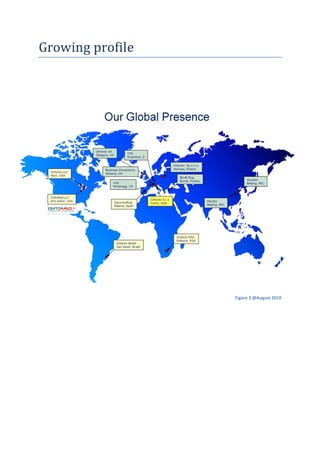
The company has offices and representatives in Europe, United States, South America, South Africa,
Asia and in the Middle East. In 2007 the company was featured as Gartner's “Cool Vendor”.


In 2009 Ontonix spun-off, US-based,                       - a company dedicated to developing its
quantitative complexity technology specifically in the medical field. Visit the Ontomed website.

In 2010 engineering-focused spin-off                      was launched in the USA. Visit the Oensys
website.

                        In 2010 Ontonix UK Ltd was formed by David G Wilson.
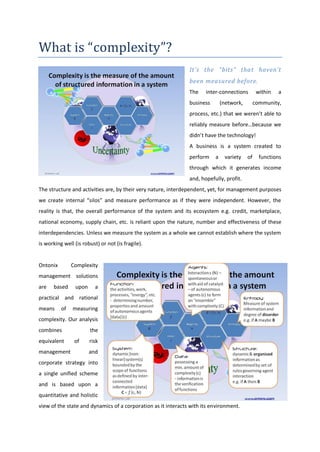
What is “complexity”?
                                                               It’s the “bits” that haven’t
                                                               been measured before.
                                                               The    inter-connections         within   a
                                                               business       (network,        community,
                                                               process, etc.) that we weren’t able to
                                                               reliably measure before…because we
                                                               didn’t have the technology!
                                                               A business is a system created to
                                                               perform    a    variety    of     functions
                                                               through which it generates income
                                                               and, hopefully, profit.
The structure and activities are, by their very nature, interdependent, yet, for management purposes
we create internal “silos” and measure performance as if they were independent. However, the
reality is that, the overall performance of the system and its ecosystem e.g. credit, marketplace,
national economy, supply chain, etc. is reliant upon the nature, number and effectiveness of these
interdependencies. Unless we measure the system as a whole we cannot establish where the system
is working well (is robust) or not (is fragile).


Ontonix        Complexity
management solutions
are   based     upon      a
practical and rational
means     of   measuring
complexity. Our analysis
combines               the
equivalent      of     risk
management             and
corporate strategy into
a single unified scheme
and is based upon a
quantitative and holistic
view of the state and dynamics of a corporation as it interacts with its environment.
Why manage complexity?
Simple...Complexity can seriously damage your wealth!
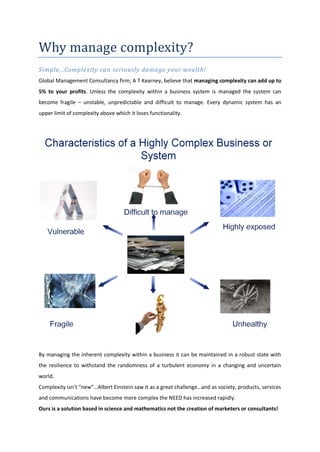
Global Management Consultancy firm, A T Kearney, believe that managing complexity can add up to
5% to your profits. Unless the complexity within a business system is managed the system can
become fragile – unstable, unpredictable and difficult to manage. Every dynamic system has an
upper limit of complexity above which it loses functionality.


By managing the inherent complexity within a business it can be maintained in a robust state with
the resilience to withstand the randomness of a turbulent economy in a changing and uncertain
world.
Complexity isn’t “new”…Albert Einstein saw it as a great challenge…and as society, products, services
and communications have become more complex the NEED has increased rapidly.
Ours is a solution based in science and mathematics not the creation of marketers or consultants!
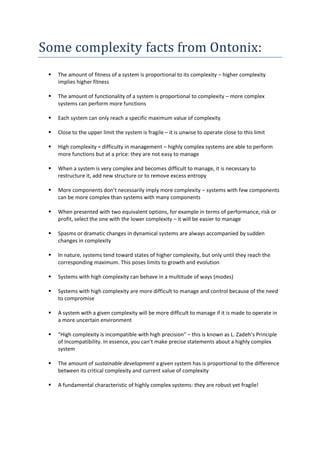
Some complexity facts from Ontonix:
    The amount of fitness of a system is proportional to its complexity – higher complexity
     implies higher fitness

    The amount of functionality of a system is proportional to complexity – more complex
     systems can perform more functions

    Each system can only reach a specific maximum value of complexity

    Close to the upper limit the system is fragile – it is unwise to operate close to this limit

    High complexity = difficulty in management – highly complex systems are able to perform
     more functions but at a price: they are not easy to manage

    When a system is very complex and becomes difficult to manage, it is necessary to
     restructure it, add new structure or to remove excess entropy

    More components don’t necessarily imply more complexity – systems with few components
     can be more complex than systems with many components

    When presented with two equivalent options, for example in terms of performance, risk or
     profit, select the one with the lower complexity – it will be easier to manage

    Spasms or dramatic changes in dynamical systems are always accompanied by sudden
     changes in complexity

    In nature, systems tend toward states of higher complexity, but only until they reach the
     corresponding maximum. This poses limits to growth and evolution

    Systems with high complexity can behave in a multitude of ways (modes)

    Systems with high complexity are more difficult to manage and control because of the need
     to compromise

    A system with a given complexity will be more difficult to manage if it is made to operate in
     a more uncertain environment

    "High complexity is incompatible with high precision" – this is known as L. Zadeh’s Principle
     of Incompatibility. In essence, you can’t make precise statements about a highly complex
     system

    The amount of sustainable development a given system has is proportional to the difference
     between its critical complexity and current value of complexity

    A fundamental characteristic of highly complex systems: they are robust yet fragile!
How do you measure the complexity of
a business?
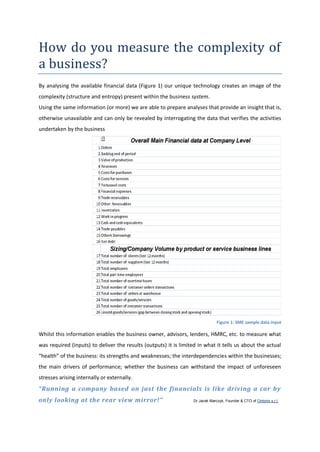
By analysing the available financial data (Figure 1) our unique technology creates an image of the
complexity (structure and entropy) present within the business system.
Using the same information (or more) we are able to prepare analyses that provide an insight that is,
otherwise unavailable and can only be revealed by interrogating the data that verifies the activities
undertaken by the business


                                                                                Figure 1: SME sample data input

Whilst this information enables the business owner, advisors, lenders, HMRC, etc. to measure what
was required (inputs) to deliver the results (outputs) it is limited in what it tells us about the actual
“health” of the business: its strengths and weaknesses; the interdependencies within the businesses;
the main drivers of performance; whether the business can withstand the impact of unforeseen
stresses arising internally or externally.
“Running a company based on just the financials is like driving a car by
only looking at the rear view mirror!”                             Dr Jacek Marczyk, Founder & CTO of Ontonix s.r.l.
How do you rate the structure of a
business?


Conventional ratings, such as those issued by rating agencies, focus on the financial aspects of a
business. While this is important, it is not sufficient to provide a global idea of the overall state of
health of a corporation.

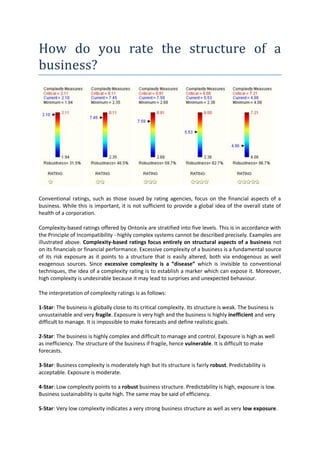
Complexity-based ratings offered by Ontonix are stratified into five levels. This is in accordance with
the Principle of Incompatibility - highly complex systems cannot be described precisely. Examples are
illustrated above. Complexity-based ratings focus entirely on structural aspects of a business not
on its financials or financial performance. Excessive complexity of a business is a fundamental source
of its risk exposure as it points to a structure that is easily altered, both via endogenous as well
exogenous sources. Since excessive complexity is a “disease” which is invisible to conventional
techniques, the idea of a complexity rating is to establish a marker which can expose it. Moreover,
high complexity is undesirable because it may lead to surprises and unexpected behaviour.

The interpretation of complexity ratings is as follows:

1-Star: The business is globally close to its critical complexity. Its structure is weak. The business is
unsustainable and very fragile. Exposure is very high and the business is highly inefficient and very
difficult to manage. It is impossible to make forecasts and define realistic goals.

2-Star: The business is highly complex and difficult to manage and control. Exposure is high as well
as inefficiency. The structure of the business if fragile, hence vulnerable. It is difficult to make
forecasts.

3-Star: Business complexity is moderately high but its structure is fairly robust. Predictability is
acceptable. Exposure is moderate.

4-Star: Low complexity points to a robust business structure. Predictability is high, exposure is low.
Business sustainability is quite high. The same may be said of efficiency.

5-Star: Very low complexity indicates a very strong business structure as well as very low exposure.
The business is manageable and it is possible to make credible forecasts. The business is potentially
highly sustainable and efficient.

In the case of businesses with 1 to 3 star ratings complexity reduction is a must. In those cases,
Complexity Profiling is the tool to adopt. It helps identify the sources of high complexity and points
to potential solutions.

For 4 and 5 star businesses, Complexity Profiling should be used from a monitoring perspective in
order to keep the business at a safe distance from critical complexity.

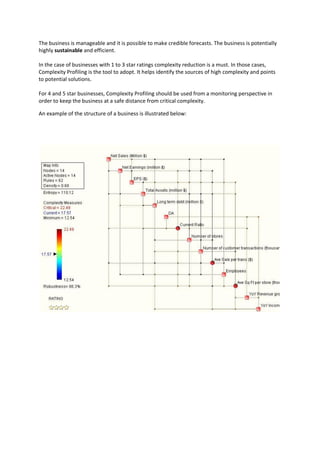
An example of the structure of a business is illustrated below:
When & where can OntoSpace™ help?
Applications:
Quantitative Complexity analysis services for:
Systems – Processes – Networks – Operations – Organisations – Portfolios


       Complexity Management (aiding quantitative decision-making)

              Advanced risk identification, analysis & management

              Risk rating (credit, financial, operational)

              Structural & Operational robustness

              Systemic risk assessment

              Due Diligence – Mergers & Acquisition

              Forensic financial audit incl. post loss

              Asset performance

              Portfolio (diversification strategy tool)

              Conflict and crisis anticipation (identification of failing states)

              Healthcare

              Project Management


       Research & Studies

              Social, economic, environmental & political

              Medical – Research & Clinical trials

              Product, system, process development
Monitoring & analysis (incl. “real time” crisis anticipation)

      Industrial and critical process monitoring

      Medicine, patient monitoring & diagnosis

      Financial markets

      Engineering design (CAD/CAE verification & testing)

      IT infrastructure & networks

      Communication systems

      Air traffic

      Supply chain

      Sustainability

      Defence/Homeland Security


Business Intelligence & Corporate Performance Management (BI & CPM)

      Mapping: Interdependence – Structure – Organisation – Process – Network
       – System – Operation

      Change management & alignment:

                “i2o” [inside to out] business re-modelling

      Robustness

      Operational effectiveness

      Benchmarking (Competition, Division, Office, Branch)
Case studies & client references
Business Intelligence and Corporate Performance Management


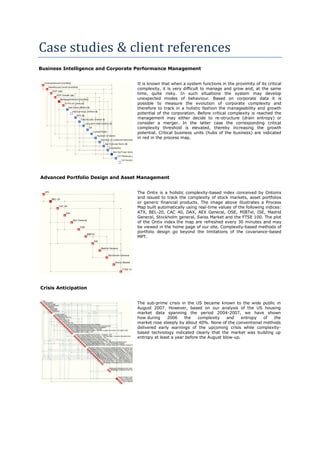
                                   It is known that when a system functions in the proximity of its critical
                                   complexity, it is very difficult to manage and grow and, at the same
                                   time, quite risky. In such situations the system may develop
                                   unexpected modes of behaviour. Based on corporate data it is
                                   possible to measure the evolution of corporate complexity and
                                   therefore to track in a holistic fashion the manageability and growth
                                   potential of the corporation. Before critical complexity is reached the
                                   management may either decide to re-structure (drain entropy) or
                                   consider a merger. In the latter case the corresponding critical
                                   complexity threshold is elevated, thereby increasing the growth
                                   potential. Critical business units (hubs of the business) are indicated
                                   in red in the process map.


Advanced Portfolio Design and Asset Management


                                   The Ontix is a holistic complexity-based index conceived by Ontonix
                                   and issued to track the complexity of stock markets, asset portfolios
                                   or generic financial products. The image above illustrates a Process
                                   Map built automatically using real-time values of the following indices:
                                   ATX, BEL-20, CAC 40, DAX, AEX General, OSE, MIBTel, ISE, Madrid
                                   General, Stockholm general, Swiss Market and the FTSE 100. The plot
                                   of the Ontix index the map are refreshed every 30 minutes and may
                                   be viewed in the home page of our site. Complexity-based methods of
                                   portfolio design go beyond the limitations of the covariance-based
                                   MPT.


Crisis Anticipation


                                   The sub-prime crisis in the US became known to the wide public in
                                   August 2007. However, based on our analysis of the US housing
                                   market data spanning the period 2004-2007, we have shown
                                   how during     2006    the    complexity    and    entropy of  the
                                   market rose steeply by about 40%. None of the conventional methods
                                   delivered early warnings of the upcoming crisis while complexity-
                                   based technology indicated clearly that the market was building up
                                   entropy at least a year before the August blow-up.
Real-time Monitoring of IT Systems
(Bank)
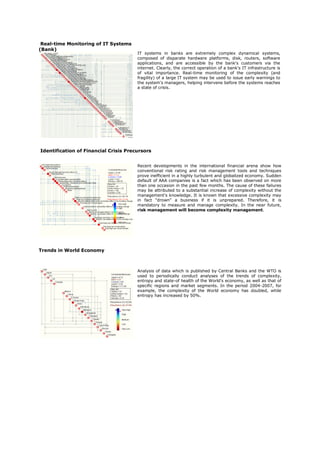
                                       IT systems in banks are extremely complex dynamical systems,
                                       composed of disparate hardware platforms, disk, routers, software
                                       applications, and are accessible by the bank's customers via the
                                       internet. Clearly, the correct operation of a bank's IT infrastructure is
                                       of vital importance. Real-time monitoring of the complexity (and
                                       fragility) of a large IT system may be used to issue early warnings to
                                       the system's managers, helping intervene before the systems reaches
                                       a state of crisis.


Identification of Financial Crisis Precursors


                                       Recent developments in the international financial arena show how
                                       conventional risk rating and risk management tools and techniques
                                       prove inefficient in a highly turbulent and globalized economy. Sudden
                                       default of AAA companies is a fact which has been observed on more
                                       than one occasion in the past few months. The cause of these failures
                                       may be attributed to a substantial increase of complexity without the
                                       management's knowledge. It is known that excessive complexity may
                                       in fact “drown" a business if it is unprepared. Therefore, it is
                                       mandatory to measure and manage complexity. In the near future,
                                       risk management will become complexity management.


Trends in World Economy


                                       Analysis of data which is published by Central Banks and the WTO is
                                       used to periodically conduct analyses of the trends of complexity,
                                       entropy and state-of health of the World's economy, as well as that of
                                       specific regions and market segments. In the period 2004-2007, for
                                       example, the complexity of the World economy has doubled, while
                                       entropy has increased by 50%.
Conflicts and Failing States


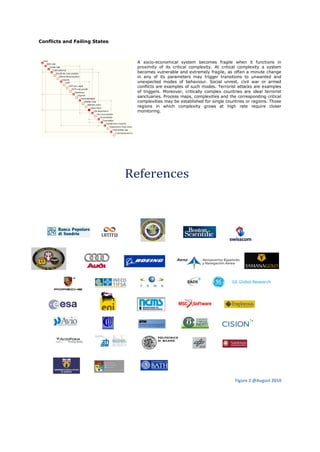
                               A socio-economical system becomes fragile when it functions in
                               proximity of its critical complexity. At critical complexity a system
                               becomes vulnerable and extremely fragile, as often a minute change
                               in any of its parameters may trigger transitions to unwanted and
                               unexpected modes of behaviour. Social unrest, civil war or armed
                               conflicts are examples of such modes. Terrorist attacks are examples
                               of triggers. Moreover, critically complex countries are ideal terrorist
                               sanctuaries. Process maps, complexities and the corresponding critical
                               complexities may be established for single countries or regions. Those
                               regions in which complexity grows at high rate require closer
                               monitoring.


                                                                               Figure 2 @August 2010
Growing profile


                  Figure 3 @August 2010

What Is Complexity?

  • 1.
    Who are Ontonix& what do you do? Ontonix is a privately held software and services firm. The international management team collectively holds over sixty years of experience in unconventional risk and complexity management. Established originally in 2005 in the USA, Ontonix is headquartered in Como, Italy, and develops OntoSpace™ the World’s first system which allows one to measure and manage the complexity of a business or a dynamic process. Through our exclusive services we help our clients view business strategy and risk management from a radically innovative and holistic perspective. Based on the fact that excessive complexity is the source of exposure, we have devised a new theory of risk which is particularly suited for a turbulent global economy. Ontonix offers an innovative on-line self-rating capability, OntoNet™, which allows one to perform a real-time check of the structural resilience of a business or corporation. The on-line service generates intuitive Complexity & Risk Maps™ which pinpoint the sources of complexity and fragility within a business process. The solution breaks new grounds and allows corporations to go beyond conventional risk rating. With the Internet as the backbone of this global service, our goal is to deliver complexity management to every corner of the economy, helping our customers cope better with our turbulent times. OntoDyn™ is a specific product for customer-retention analysis at banks or insurance companies. It processes batches of customers and measures their stability, signalling those that may be at risk of being lost. The driving idea behind OntoDyn™ is to provide an early-warning system on a weekly/monthly basis. The kind of analysis that OntoDyn™ performs is unique in that it measures the stability of each client over a given period of time. Clients with a low value of stability are indicated as those at risk of being lost. Ontonix is strongly committed to innovation and interdisciplinary R&D. The company's underlying philosophy is to research and identify the dynamic patterns occurring in Nature which manifest themselves in diverse and often disjoint fields. This is done without resorting to traditional mathematical modelling techniques and using the concept of complexity as a bridge between disciplines. As a result, we are able to quickly transfer knowledge from one discipline to another with a remarkable multiplier effect. The company has offices and representatives in Europe, United States, South America, South Africa, Asia and in the Middle East. In 2007 the company was featured as Gartner's “Cool Vendor”. In 2009 Ontonix spun-off, US-based, - a company dedicated to developing its quantitative complexity technology specifically in the medical field. Visit the Ontomed website. In 2010 engineering-focused spin-off was launched in the USA. Visit the Oensys website. In 2010 Ontonix UK Ltd was formed by David G Wilson.
  • 2.
    What is “complexity”? It’s the “bits” that haven’t been measured before. The inter-connections within a business (network, community, process, etc.) that we weren’t able to reliably measure before…because we didn’t have the technology! A business is a system created to perform a variety of functions through which it generates income and, hopefully, profit. The structure and activities are, by their very nature, interdependent, yet, for management purposes we create internal “silos” and measure performance as if they were independent. However, the reality is that, the overall performance of the system and its ecosystem e.g. credit, marketplace, national economy, supply chain, etc. is reliant upon the nature, number and effectiveness of these interdependencies. Unless we measure the system as a whole we cannot establish where the system is working well (is robust) or not (is fragile). Ontonix Complexity management solutions are based upon a practical and rational means of measuring complexity. Our analysis combines the equivalent of risk management and corporate strategy into a single unified scheme and is based upon a quantitative and holistic view of the state and dynamics of a corporation as it interacts with its environment.
  • 3.
    Why manage complexity? Simple...Complexitycan seriously damage your wealth! Global Management Consultancy firm, A T Kearney, believe that managing complexity can add up to 5% to your profits. Unless the complexity within a business system is managed the system can become fragile – unstable, unpredictable and difficult to manage. Every dynamic system has an upper limit of complexity above which it loses functionality. By managing the inherent complexity within a business it can be maintained in a robust state with the resilience to withstand the randomness of a turbulent economy in a changing and uncertain world. Complexity isn’t “new”…Albert Einstein saw it as a great challenge…and as society, products, services and communications have become more complex the NEED has increased rapidly. Ours is a solution based in science and mathematics not the creation of marketers or consultants!
  • 4.
    Some complexity factsfrom Ontonix:  The amount of fitness of a system is proportional to its complexity – higher complexity implies higher fitness  The amount of functionality of a system is proportional to complexity – more complex systems can perform more functions  Each system can only reach a specific maximum value of complexity  Close to the upper limit the system is fragile – it is unwise to operate close to this limit  High complexity = difficulty in management – highly complex systems are able to perform more functions but at a price: they are not easy to manage  When a system is very complex and becomes difficult to manage, it is necessary to restructure it, add new structure or to remove excess entropy  More components don’t necessarily imply more complexity – systems with few components can be more complex than systems with many components  When presented with two equivalent options, for example in terms of performance, risk or profit, select the one with the lower complexity – it will be easier to manage  Spasms or dramatic changes in dynamical systems are always accompanied by sudden changes in complexity  In nature, systems tend toward states of higher complexity, but only until they reach the corresponding maximum. This poses limits to growth and evolution  Systems with high complexity can behave in a multitude of ways (modes)  Systems with high complexity are more difficult to manage and control because of the need to compromise  A system with a given complexity will be more difficult to manage if it is made to operate in a more uncertain environment  "High complexity is incompatible with high precision" – this is known as L. Zadeh’s Principle of Incompatibility. In essence, you can’t make precise statements about a highly complex system  The amount of sustainable development a given system has is proportional to the difference between its critical complexity and current value of complexity  A fundamental characteristic of highly complex systems: they are robust yet fragile!
  • 5.
    How do youmeasure the complexity of a business? By analysing the available financial data (Figure 1) our unique technology creates an image of the complexity (structure and entropy) present within the business system. Using the same information (or more) we are able to prepare analyses that provide an insight that is, otherwise unavailable and can only be revealed by interrogating the data that verifies the activities undertaken by the business Figure 1: SME sample data input Whilst this information enables the business owner, advisors, lenders, HMRC, etc. to measure what was required (inputs) to deliver the results (outputs) it is limited in what it tells us about the actual “health” of the business: its strengths and weaknesses; the interdependencies within the businesses; the main drivers of performance; whether the business can withstand the impact of unforeseen stresses arising internally or externally. “Running a company based on just the financials is like driving a car by only looking at the rear view mirror!” Dr Jacek Marczyk, Founder & CTO of Ontonix s.r.l.
  • 6.
    How do yourate the structure of a business? Conventional ratings, such as those issued by rating agencies, focus on the financial aspects of a business. While this is important, it is not sufficient to provide a global idea of the overall state of health of a corporation. Complexity-based ratings offered by Ontonix are stratified into five levels. This is in accordance with the Principle of Incompatibility - highly complex systems cannot be described precisely. Examples are illustrated above. Complexity-based ratings focus entirely on structural aspects of a business not on its financials or financial performance. Excessive complexity of a business is a fundamental source of its risk exposure as it points to a structure that is easily altered, both via endogenous as well exogenous sources. Since excessive complexity is a “disease” which is invisible to conventional techniques, the idea of a complexity rating is to establish a marker which can expose it. Moreover, high complexity is undesirable because it may lead to surprises and unexpected behaviour. The interpretation of complexity ratings is as follows: 1-Star: The business is globally close to its critical complexity. Its structure is weak. The business is unsustainable and very fragile. Exposure is very high and the business is highly inefficient and very difficult to manage. It is impossible to make forecasts and define realistic goals. 2-Star: The business is highly complex and difficult to manage and control. Exposure is high as well as inefficiency. The structure of the business if fragile, hence vulnerable. It is difficult to make forecasts. 3-Star: Business complexity is moderately high but its structure is fairly robust. Predictability is acceptable. Exposure is moderate. 4-Star: Low complexity points to a robust business structure. Predictability is high, exposure is low. Business sustainability is quite high. The same may be said of efficiency. 5-Star: Very low complexity indicates a very strong business structure as well as very low exposure.
  • 7.
    The business ismanageable and it is possible to make credible forecasts. The business is potentially highly sustainable and efficient. In the case of businesses with 1 to 3 star ratings complexity reduction is a must. In those cases, Complexity Profiling is the tool to adopt. It helps identify the sources of high complexity and points to potential solutions. For 4 and 5 star businesses, Complexity Profiling should be used from a monitoring perspective in order to keep the business at a safe distance from critical complexity. An example of the structure of a business is illustrated below:
  • 8.
    When & wherecan OntoSpace™ help? Applications: Quantitative Complexity analysis services for: Systems – Processes – Networks – Operations – Organisations – Portfolios Complexity Management (aiding quantitative decision-making)  Advanced risk identification, analysis & management  Risk rating (credit, financial, operational)  Structural & Operational robustness  Systemic risk assessment  Due Diligence – Mergers & Acquisition  Forensic financial audit incl. post loss  Asset performance  Portfolio (diversification strategy tool)  Conflict and crisis anticipation (identification of failing states)  Healthcare  Project Management Research & Studies  Social, economic, environmental & political  Medical – Research & Clinical trials  Product, system, process development
  • 9.
    Monitoring & analysis(incl. “real time” crisis anticipation)  Industrial and critical process monitoring  Medicine, patient monitoring & diagnosis  Financial markets  Engineering design (CAD/CAE verification & testing)  IT infrastructure & networks  Communication systems  Air traffic  Supply chain  Sustainability  Defence/Homeland Security Business Intelligence & Corporate Performance Management (BI & CPM)  Mapping: Interdependence – Structure – Organisation – Process – Network – System – Operation  Change management & alignment: “i2o” [inside to out] business re-modelling  Robustness  Operational effectiveness  Benchmarking (Competition, Division, Office, Branch)
  • 10.
    Case studies &client references Business Intelligence and Corporate Performance Management It is known that when a system functions in the proximity of its critical complexity, it is very difficult to manage and grow and, at the same time, quite risky. In such situations the system may develop unexpected modes of behaviour. Based on corporate data it is possible to measure the evolution of corporate complexity and therefore to track in a holistic fashion the manageability and growth potential of the corporation. Before critical complexity is reached the management may either decide to re-structure (drain entropy) or consider a merger. In the latter case the corresponding critical complexity threshold is elevated, thereby increasing the growth potential. Critical business units (hubs of the business) are indicated in red in the process map. Advanced Portfolio Design and Asset Management The Ontix is a holistic complexity-based index conceived by Ontonix and issued to track the complexity of stock markets, asset portfolios or generic financial products. The image above illustrates a Process Map built automatically using real-time values of the following indices: ATX, BEL-20, CAC 40, DAX, AEX General, OSE, MIBTel, ISE, Madrid General, Stockholm general, Swiss Market and the FTSE 100. The plot of the Ontix index the map are refreshed every 30 minutes and may be viewed in the home page of our site. Complexity-based methods of portfolio design go beyond the limitations of the covariance-based MPT. Crisis Anticipation The sub-prime crisis in the US became known to the wide public in August 2007. However, based on our analysis of the US housing market data spanning the period 2004-2007, we have shown how during 2006 the complexity and entropy of the market rose steeply by about 40%. None of the conventional methods delivered early warnings of the upcoming crisis while complexity- based technology indicated clearly that the market was building up entropy at least a year before the August blow-up.
  • 11.
    Real-time Monitoring ofIT Systems (Bank) IT systems in banks are extremely complex dynamical systems, composed of disparate hardware platforms, disk, routers, software applications, and are accessible by the bank's customers via the internet. Clearly, the correct operation of a bank's IT infrastructure is of vital importance. Real-time monitoring of the complexity (and fragility) of a large IT system may be used to issue early warnings to the system's managers, helping intervene before the systems reaches a state of crisis. Identification of Financial Crisis Precursors Recent developments in the international financial arena show how conventional risk rating and risk management tools and techniques prove inefficient in a highly turbulent and globalized economy. Sudden default of AAA companies is a fact which has been observed on more than one occasion in the past few months. The cause of these failures may be attributed to a substantial increase of complexity without the management's knowledge. It is known that excessive complexity may in fact “drown" a business if it is unprepared. Therefore, it is mandatory to measure and manage complexity. In the near future, risk management will become complexity management. Trends in World Economy Analysis of data which is published by Central Banks and the WTO is used to periodically conduct analyses of the trends of complexity, entropy and state-of health of the World's economy, as well as that of specific regions and market segments. In the period 2004-2007, for example, the complexity of the World economy has doubled, while entropy has increased by 50%.
  • 12.
    Conflicts and FailingStates A socio-economical system becomes fragile when it functions in proximity of its critical complexity. At critical complexity a system becomes vulnerable and extremely fragile, as often a minute change in any of its parameters may trigger transitions to unwanted and unexpected modes of behaviour. Social unrest, civil war or armed conflicts are examples of such modes. Terrorist attacks are examples of triggers. Moreover, critically complex countries are ideal terrorist sanctuaries. Process maps, complexities and the corresponding critical complexities may be established for single countries or regions. Those regions in which complexity grows at high rate require closer monitoring. Figure 2 @August 2010
  • 13.
    Growing profile Figure 3 @August 2010