The Next Billions:
Business Strategies to Enhance Food
Value Chains and Empower the Poor
COMMITTED TO
IMPROVING THE STATE
OF THE WORLD
Prepared in collaboration with The Boston Consulting Group
World Economic Forum
January 2009
The views expressed in this publication
do not necessarily reflect those of
the World Economic Forum.
World Economic Forum
91-93 route de la Capite
CH-1223 Cologny/Geneva
Switzerland
Tel.: +41 (0)22 869 1212
Fax: +41 (0)22 786 2744
E-mail: contact@weforum.org
www.weforum.org
© 2009 World Economic Forum
All rights reserved.
No part of this publication may be reproduced or transmitted
in any form or by any means, including photocopying and
recording, or by any information storage and retrieval system.
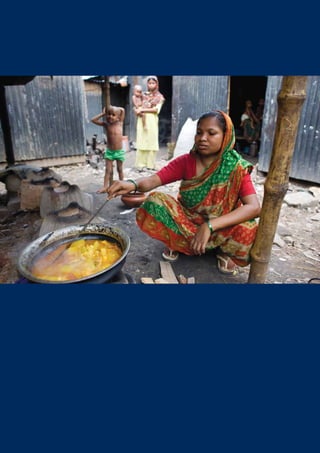
All photographs by Brent Stirton, courtesy of Getty Images.
REF: 150109
Contents
Preface 4
Executive Summary 6
Chapter 1 – Introduction 9
Chapter 2 – Understanding the Food Value Chain 11
2.1 A major opportunity 11
2.2 Overview of the food value chain 12
2.3 Diversity in food value chains 13
2.4 Turning a vicious cycle into a virtuous cycle 13
2.5 Business opportunities along the food value chain 15
Chapter 3 – Solutions to Unleash the Potential of Producers and Consumers 17
3.1 Business solutions for producers 18
3.2 Business solutions for consumers 25
3.3 The case for holistic solutions 28
Chapter 4 – Empowering Entrepreneurs through Business-enabling Products and Services 30
4.1 Providing Market Information 30
4.2 Increasing Access to Financial Services 32
4.3 Overcoming Infrastructure Gaps 36
Chapter 5 – Unleashing Potential: Design Principles for Success 39
5.1 Create life-enhancing offerings 40
5.2 Reconfigure the product supply chain 41
5.3 Educate through marketing communication 42
5.4 Collaborate to form non-traditional partnerships 43
5.5 Unshackle the organization 45
Chapter 6 – Conclusion: Key Actions for Scaling up 47
6.1 Strengthening incentives for business engagement 47
6.2 Prioritizing and sequencing business initiatives 48
6.3 Providing complementary funding and capacity 48
6.4 Facilitating corporate engagement 48
6.5 Establishing models and building momentum 49
6.6 Collaborating to accelerate progress 49
Terminology 51
References 52
Appendix 1: Methodology for Estimations of Population and Income 55
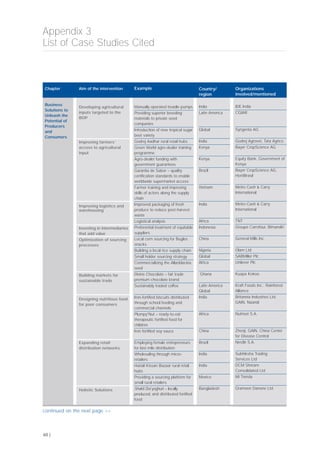
Appendix 2: Case Study Selection Process 59
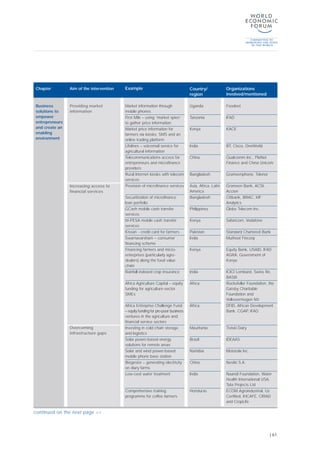
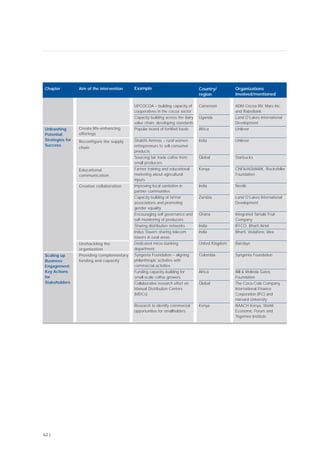
Appendix 3: List of Case Studies Cited 60
Appendix 4: Actions for Scaling Up Business Models 63
The World Economic Forum is pleased to present
this report on innovative business models that can
improve sustainable food production and help to
reduce poverty in developing countries.
For the past four years, the Forum has served as a
platform for leaders to define and work together on
business-led and multi-stakeholder solutions for
sustainable food production. Our activities include
facilitating multi-stakeholder leadership action
through the Global Agenda Council on Food
Security; undertaking the research and thought
leadership seen in this and other reports; and
facilitating the Business Alliance Against Chronic
Hunger which is implementing on-the-ground
solutions in Kenya. This portfolio of work is
championed by the Forum’s Consumer Industries
community with support from the Bill & Melinda
Gates Foundation. We greatly appreciate the Gates
Foundation’s support for preparation of this report.
This project was based on a broad research survey
plus three cross-industry, multistakeholder
roundtables conducted in Latin America, Africa and
Asia during 2008. The research survey included
review of 60 reports and collection of 200 case
studies from primary and secondary sources. The
roundtables provided ground-level insights from
practitioners – ranging from multinational and
regional companies to social entrepreneurs – who
are pioneering these business models on the
ground.
The report documents a series of commercially
viable business models that have proven effective at
strengthening food value chains in developing
countries, and offers recommendations for scaling
them up. It presents examples of specific business
approaches that can engage poor producers,
consumers and entrepreneurs along the food value
chain. It outlines design principles for companies
interested in developing such initiatives, and
suggests actions that all stakeholders can take to
facilitate expansion of these business approaches.
Preface
4 |
Our conclusion is that the kinds of business models
outlined in this report offer substantial potential for
driving economic growth and food production,
benefiting both companies and poor communities.
Undertaken by global and local companies – often in
partnership with other organizations – they represent
the highly dynamic business innovation and growth
which is rapidly evolving in “base of the pyramid”
(BOP) markets. The report builds on and intends to
complement the work of thought leaders in this
arena such as C.K. Prahalad’s Fortune at the
Bottom of the Pyramid, the World Resources
Institute and IFC’s Next 4 Billion report, Harvard
University’s industry-specific Economic Opportunity
reports, and the United Nations Development
Programme’s Growing Inclusive Markets initiative. It
also draws from leading works in the agricultural
arena by the World Bank, the International Food
Policy Research Institute (IFPRI), and the United
Nations Food and Agriculture Organization (FAO).
This report project was prepared by the World
Economic Forum in partnership with the Boston
Consulting Group. Lisa Dreier led the initiative at the
Forum together with Jennifer Baarn and Pial Islam,
with input from Helena Leurent, Sarita Nayyar,
Cornelia Roettger and Rick Samans. The Forum
wishes to thank the Boston Consulting Group for its
work, which was led by Arvind Subramanian, Anand
Raghuraman and Nimisha Jain with Neetu Vasantu,
S. Rajagopal and Marije van Mens.
The report reflects extensive inputs, discussion and
review by a number of Forum partners and experts,
to whom we are greatly indebted. Corporate
reviewers include: Marco Ferroni of Syngenta
Foundation, Willem Jan Laan of Unilever, Christian
Maas of Metro Cash & Carry International, Susan
Morgan of BT, Herbert Oberhaensli of Nestlé S.A.,
Mara Russell of Land O’Lakes, Chris Shea of
General Mills, Gabriel Solomon of the GSM
Association, Christina Ulardic of Swiss Reinsurance
Company, and Steve Yucknut of Kraft Foods. Non-
business and expert reviewers include: Marc van
Ameringen and Bérangère Magarinos of the Global
Alliance for Improved Nutrition (GAIN), Andrew Aulisi
of the World Resources Institute (WRI), Alain de
Janvry of the University of California at Berkeley,
Jane Nelson of Harvard University, Richard Rogers
of the Bill & Melinda Gates Foundation, Mirjam
Schoening of the Schwab Foundation for Social
Entrepreneurship, and David Spielman of the
International Food Policy Research Institute (IFPRI).
Harvard University, the World Resources Institute
and the Schwab Foundation for Social
Entrepreneurship also served as independent
reviewers of the case study selections for the report.
During 2008, the global food crisis starkly illustrated
the urgent need to develop sustainable solutions for
food security and economic growth benefiting all
stakeholders, including the poorest. The ideas in this
report intend to contribute toward that larger goal.
| 5
Richard Samans
Managing Director
World Economic Forum
Sarita Nayyar
Senior Director, Consumer Industries
World Economic Forum
Overview
Business actions to strengthen food value chains in
developing countries fulfil two vital goals. For the
private sector, they open up opportunities in a
growing, profitable and largely untapped market. For
poor communities, innovative approaches can
improve livelihoods. Challenges in the business
operating environment have historically limited
business incentives to engage in poor regions. But
many companies are discovering new approaches
which can overcome such challenges and even
transform them into opportunities.
This report focuses on business models that are
proving effective along the food value chain in poor
regions. It presents an array of specific examples,
outlines design principles that companies and
partners can use to guide new initiatives, and
recommends actions that all stakeholders can take
to scale up effective models.
The Opportunity
Globally, 3.7 billion people are largely excluded from
formal markets. This group, earning US$ 8
a
per day
or less, comprises the “base of the pyramid” (BOP)
in terms of income levels. With an annual income of
US$ 2.3 trillion a year that has grown at 8% in
recent years, this market spends US$ 1.3 trillion a
year on food. Around 70% of the BOP (2.5 billion
people) depends on the food value chain for their
incomes, either directly as small-scale farmers and
farm labourers, or indirectly as small-scale
entrepreneurs.
While it is highly diversified, much of the BOP
represents a fast-growing consumer market, an
underutilized farming sector, and a source of
untapped entrepreneurial energy. Engaging the BOP
as producers, consumers and entrepreneurs is
therefore key to both reducing poverty and driving
broader economic growth along the food value
chain.
Understanding Food Value Chains
The process of growing, producing and marketing
food involves a variety of industries and stakeholders
along multiple steps, forming the food value chain.
• Private-sector actors in the food value chain
include agricultural input companies, farmers
(particularly smallholders and women),
intermediaries, processors and retailers. Business-
enabling services such as telecommunications,
financial services, energy and logistics play a vital
role throughout the chain. Non-business
stakeholders are central to food value chain
operations; these include governments, NGOs,
donor agencies and international organizations.
• In developing regions, food value chains are
constrained by limitations related to infrastructure,
producer capacity, availability of finance, public-
sector capacity, and other factors. These
problems often create a “vicious cycle”, in which
low productivity and a lack of access to capital
depresses income and consumption, trapping the
BOP in a downward spiral of deepening poverty.
Coordinated engagement by business and other
stakeholders can reverse this dynamic, creating a
mutually reinforcing “virtuous cycle” of increased
production, consumption and entrepreneurship at
the local level.
Innovative Business Solutions
Businesses can take a holistic approach to the food
value chain with specific interventions at three stages:
producers, consumers and entrepreneurs.
Business solutions for producers
Companies can deploy a range of innovative
strategies to provide opportunities to BOP
producers. These include:
• Develop agricultural inputs targeted to BOP
needs. New product design, and targeted
research and development, can create offerings
suited to poor producers’ needs and budgets
Executive Summary
6 |
a
The US$ 8/day income threshold is in Purchasing Power
Parity (PPP) dollars, and was defined by the World
Resources Institute report, The Next 4 Billions.
| 7
• Improve farmers’ access to inputs by
expanding and strengthening rural retail networks,
and offering financial services to farmers.
Companies can also empower retailers to expand
their product and service offerings
• Strengthen farmer capacity through training
and outreach. Input companies can strengthen
farmer awareness of new products and
techniques. Buyers can work with farmers to
improve production and meet quality standards
• Improve supply-chain efficiency through
streamlined logistics and warehousing, and
working with value-adding intermediaries
• Optimize sourcing processes by sourcing from
local producers, commercializing local raw
materials and creating markets for sustainable
trade in high-value products
Business solutions for consumers
Companies can meet growing consumer demand in
the BOP market through several key strategies:
• Design nutritious food for poor consumers,
by offering nutritionally fortified, affordable foods
that meet the preferences of the BOP
• Expand retail distribution networks by
leveraging informal retail and distribution channels
to empower entrepreneurs and expand reach.
Reduce delivery costs by partnering with other
businesses
• Strengthen consumer demand through
educational marketing strategies, partnerships
with trusted parties, and using certification and
labelling to build consumer trust
Business solutions to empower entrepreneurs
Industries such as financial services,
telecommunications, energy and transportation are
important enablers of business activity along food
value chains. Companies can develop innovative
strategies to provide needed services in such
markets, such as:
• Provide market information through
telecommunications applications that help
farmers access information on market prices and
good farming practices
• Increase access to financial services by
adopting innovative strategies to provide credit,
savings and insurance for individual farmers;
creating mobile cash transfer systems; developing
new novel risk-mitigation instruments; and
providing capital funding for small business
• Overcome infrastructure gaps through
business-led solutions targeted at both hard
infrastructure (storage and transportation, energy,
water infrastructure) and soft infrastructure
(organizations, policies and regulations that
strengthen business operations)
Design Principles for Successful
Business Models
While BOP markets vary widely, companies can
adapt successful strategies to specific regions or
income segments. This report identifies a set of
design principles that companies and partners can
use in developing effective business models to
strengthen food value chains:
• Create life-enhancing offerings: Develop new
products and services that improve livelihoods
and trigger economic multipliers at the BOP
• Reconfigure the product supply chain: Create
cost-efficient distribution systems by sourcing
from local producers and leveraging existing local
distribution channels
• Educate through marketing communication:
Design marketing programmes that contain
educational as well as persuasive messages
• Collaborate to form non-traditional
partnerships: To lower costs and broaden
distribution, move beyond traditional roles to
partner with communities, invest in skill building,
and create incentives for self-governance among
BOP business partners
• Unshackle the organization: Design corporate
organizational structures – including metrics,
incentives and accountability systems – to
support, measure and reward long-term success
in business initiatives targeting the BOP
8 |
Scaling Up: Key Actions for
Stakeholders
Scaling up BOP business strategies requires a
decentralized and localized approach, in which
successful concepts are adapted for transfer from
one region to another, often with a new set of
partners and collaborators. Achieving scale in these
business models, therefore, often requires
cooperation among many actors including
companies, governments, NGOs, donor agencies
and international institutions. Partners can work
together on several fronts:
• Strengthen incentives for business
engagement through boosting incentives,
removing barriers and reducing costs that impede
commercial activity. This includes establishing
financial or market incentives, and improving the
enabling environment (policy, infrastructure and
services)
• Prioritize and sequence business initiatives,
working with partners to develop key capacities
required for specific business models, and
prioritizing high-impact and essential initiatives
• Provide complementary funding and
capacity to overcome gaps (for example in R&D
funding) and strengthen hard and soft
infrastructure required for business models to
succeed
• Facilitate corporate engagement among
diverse industries and stakeholders, uniting
partners’ complementary capacities around
common goals to reach the BOP
• Establish effective models and build
momentum, sharing knowledge and highlighting
successes to accelerate learning and encourage
broad adoption
• Collaborate to accelerate progress, engaging
leaders and “orchestrators” to catalyse and
support multistakeholder cooperation
The business models discussed in this report have
the potential to create substantial value for poor
consumers, producers and entrepreneurs as well as
for companies. They represent a roadmap for
organizations seeking to take a win-win approach in
emerging markets. Companies that establish
workable, profitable and scalable business models
to include the BOP will secure a strong advantage,
both commercially and in terms of community and
partner relationships. Success in the end will require
new thinking, close coordination and alliances
among unconventional partners – governments, civil
society organizations and the BOP communities
themselves.
The private sector can play a pivotal role in the food
and agriculture sector. However, in developing
regions, where both the need and the potential for
increased production are greatest, it is often
engaged only peripherally. Expanding sustainable
business engagement in these areas could bring
sizeable gains to both poor, food-insecure
communities and the private sector itself.
Globally, 3.7 billion people are largely excluded from
formal food markets. This group, earning US$ 8b
per
day or less, comprises the “base of the pyramid”
(BOP) in terms of income levels. Around 70% of the
BOP (2.5 billion) depends on the food value chain
for their incomes, either directly as small-scale
farmers and farm labourers, or indirectly as small-
scale entrepreneurs.[1-3]
(For a detailed account of the
methodology used to reach the estimates in this
chapter, see Appendix 1). While it is highly
diversified, much of the BOP represents a fast-
growing consumer market, an underutilized farming
sector, and a source of untapped entrepreneurial
energy. Engaging the BOP as producers,
consumers, and entrepreneurs is therefore the key
to both reducing poverty and driving broader
economic growth along the food value chain.
The total income of the BOP is US$ 2.3 trillion (in
2008 real terms),c
and has been growing rapidly at
8% annually in recent years [1-3]
. The group spends
over 50% of their income – an estimated US$ 1.3
trillion annually – on food. As their income grows,
BOP consumers are demanding higher value and
more diverse food, as well as other goods and
services. Many poor producers have the potential to
substantially increase their production, given access
to inputs and training. The BOP is also host to a
young and growing population of potential
entrepreneurs, many of whom currently lack the
essential tools – such as bank accounts, mobile
phones or electricity – needed to start a small
business. These trends represent a set of business
opportunities that cut across industry sectors, from
food, beverage and agribusiness to retail and
consumer goods, financial and telecommunications
services, and others. Those at the BOP who can be
profitably engaged by business – referred to here as
the “next billions” – represent a large, untapped market.
Early movers can establish several advantages in
this growing market. By being first to develop new
offerings and innovative delivery channels, companies
can gain valuable insights, secure greater market
share and win the loyalty of BOP consumers and
producers – a key success factor in this market. By
creating opportunities for sustainable economic and
social gains at the BOP, they will contribute to long-
term market growth that benefits their investments.
In fact, the BOP market offers an attractive meeting
ground where corporate economic benefit and social
impact can be realized together.
Chapter 1 – Introduction
| 9
• 3.7 billion people around the world live on annual incomes of less than US$ 3,000 (2002 PPP$). 70% of
them, or 2.5 billion, live in rural areas where agriculture is often the primary economic activity
• Companies, which often play a limited role in the food value chains of developing countries, can enter this
market in a way that both meets a social need and creates profitable business opportunities
• This report explores how businesses can achieve this potential, outlining examples of successful business
models and basic design principles for operating along food value chains at the base of the pyramid (BOP)
The “BOP” and the “Next Billions”
“Base of the Pyramid” (BOP) is a collective
reference to 3.7 billion people populating the
lowest income strata in the world. The income
levels for this group range from 0 to a maximum
of US$ 3,000 per person per year (in 2002
PPP$), or roughly US$ 8 per person per day.
Within this group are the “next billions” – a large
group of consumers, producers and
entrepreneurs who can be profitably engaged or
served by business, albeit with new and
innovative approaches.
b
The threshold for BOP incomes was defined by the World
Resources Institute report, The Next 4 Billions.[1]
c
All numbers related to income, expenditure and price in
this report are in current US$, unless stated otherwise.
Despite this potential, the business opportunities
embedded within the food value chains of poor
regions remain largely untapped. A host of issues
combine to prevent, discourage or derail business
engagement. These include fragmented and poor
quality food production; difficulty in tapping
consumer demand; and poor infrastructure and
governance. Surveying this landscape, many
companies have concluded that their standard
business models would not be profitable in such a
setting, and they may be right. But the story should
not end there.
While many remain on the sidelines, an increasing
number of companies are developing innovative
strategies to tap into the economic potential that
exists throughout the food value chain. Whether
supplying inputs to farmers, sourcing high-value
products from small-scale producers, or developing
and retailing an array of new products and services
that meet the needs of poor consumers and
entrepreneurs along the chain, these companies are
finding approaches that work. Those that are
successful are establishing viable business models
for an untapped market, while also improving the
livelihoods of the BOP.
What are these companies doing right? And how
can other companies tap the potential of this
market, while also benefiting the poor? More
importantly, how can successful business
approaches be mainstreamed and scaled up, to
help drive sustainable economic growth in the
regions that need it most?
This report attempts to answer these questions. It
presents a series of specific business models that
are proving effective along the food value chain;
outlines design principles for companies seeking to
develop new models; and recommends priority
actions for all stakeholders interested in catalysing
such pro-poor business engagement.
Chapter 2 provides an overview of the food value
chain, and maps out the role of business and other
actors in making it work. Chapter 3 presents specific
business models that target both producers and
consumers along the food value chain. Chapter 4
outlines innovative private-sector approaches that
provide entrepreneurs and small business at the
BOP with the key tools – such as finance,
communications and infrastructure – that are
needed to create an enabling environment for
efficient marketing. Chapter 5 presents design
principles to guide the development of effective
business models in these markets; and Chapter 6
recommends ways in which these models can be
adapted and scaled more broadly, through
concerted action by all stakeholders.
This report is a companion to The Next Billions:
Unleashing the Business Potential of Poor
Communities, published by the World Economic
Forum and The Boston Consulting Group. That
publication outlines strategies for “win-win”
approaches to poor markets that cut across all industry
sectors and regions. Both volumes address the
business strategies that can be effective at the BOP,
often requiring collaboration or partnership with other
actors. While recognizing that the public sector plays a
vital role in establishing and managing the enabling
environment for business operations, both reports
limit their discussion of public sector actions to those
directly related to the targeted business models.
The need for both public and private sector action to
improve global food production and food security
has never been greater. In 2008, as economic
growth slowed, food shortages and price increases
had a dramatic effect on the world’s poor. Tens of
millions of additional people were driven into hunger,
bringing the global total close to one billion.
Establishing sustainable solutions to this problem will
require innovation, leadership and cooperation
among all sectors. Through the types of business
models outlined in this report, business can become
a catalyst and core partner in advancing sustainable
growth that benefits poor communities as well as
the bottom line.
10 |
In most developing countries, the agriculture sector
is the largest source of employment and a driver of
economic growth. Almost 70% of the poor in
developing countries – over 2.5 billion people – live
in rural areas where agriculture is the main economic
activity[1-3]
(for a detailed account of the methodology
used to reach the numerical estimates in this
chapter, see Appendix 1). Either directly or indirectly,
the rural poor are dependent on the food value
chain. The complexities of the food value chain, and
the inter-dependence of its different components,
present both a challenge and an opportunity. At
present, food value chains in many poor regions are
fragmented and inefficient, making them unprofitable
and risky for both the people who depend upon
them for survival, and the companies that could
drive improvements. As discussed below, a
coordinated set of business-led interventions to
strengthen operations throughout the chain can
activate a “virtuous cycle” of mutually reinforcing
gains in productivity and consumption, resulting in
substantial income gains for the BOP.
2.1 A major opportunity
The current income of the BOP totals US$ 2.3 trillion
and has historically been growing at 8% per year[1-3]
.
The group spends over half of this income – an
estimated US$ 1.3 trillion annually – on food. Of the
2.5 billion members of the BOP who live in rural
areas, about 60% are directly dependent on a small
farm for their household income. The other 40% are
often closely linked to the food value chain, either
through business linkages (e.g. as agricultural input
retailers or small traders), or through other means[1-3]
.
Together, these rural members of the BOP account
for between US$ 850 billion and US$ 1.1 trillion in
income, nearly half of the total BOP income[4-10]
.
Chapter 2 – Understanding
the Food Value Chain
| 11
• The food value chain involves multiple steps and engages diverse actors; its complexity and inter-
dependence is both a challenge and an opportunity for business
• A coordinated set of business-led interventions can activate a “virtuous cycle” of productivity and
consumption along the chain, resulting in substantial income gains for the BOP and broad-based
economic growth
• With a current income pool of US$ 2.3 trillion and food expenditure of US$ 1.3 trillion annually, the base of
the pyramid has the potential to significantly grow their incomes over the next decade, given the right set
of initiatives
Exhibit 1: 2.5 billion people in rural areas are part of the BOP
World
population
Rest of the
world
High-income
countries
Income >
US$ 3,000
PPP*
Income
US$ 3,000
PPP*
the BOP
Urban
BOP
Rural
BOP
Rural BOP
non-
smallholder
household**
Rural BOP
smallholder
household**
Population(bn)
*Income based on annual income per person per year in 2002 PPP$
**Smallholder farming households are households of farmers and rural labourers working on a farm of 2 ha or smaller
Source: United Nations, World Bank, WRI.
1.7
0.9
3.7
1.2
2.5
1.0
1.5
6.3
4.6
0
2
4
6
8
2.2 Overview of the food value chain
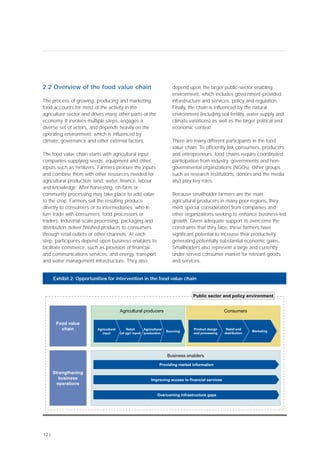
The process of growing, producing and marketing
food accounts for most of the activity in the
agriculture sector and drives many other parts of the
economy. It involves multiple steps, engages a
diverse set of actors, and depends heavily on the
operating environment, which is influenced by
climate, governance and other external factors.
The food value chain starts with agricultural input
companies supplying seeds, equipment and other
inputs such as fertilizers. Farmers procure the inputs
and combine them with other resources needed for
agricultural production: land, water, finance, labour
and knowledge. After harvesting, on-farm or
community processing may take place to add value
to the crop. Farmers sell the resulting produce
directly to consumers or to intermediaries, who in
turn trade with consumers, food processors or
traders. Industrial-scale processing, packaging and
distribution deliver finished products to consumers
through retail outlets or other channels. At each
step, participants depend upon business enablers to
facilitate commerce, such as provision of financial
and communications services, and energy, transport
and water management infrastructure. They also
depend upon the larger public-sector enabling
environment, which includes government-provided
infrastructure and services, policy and regulation.
Finally, the chain is influenced by the natural
environment (including soil fertility, water supply and
climate variations) as well as the larger political and
economic context.
There are many different participants in the food
value chain. To efficiently link consumers, producers
and entrepreneurs, food chains require coordinated
participation from industry, governments and non-
governmental organizations (NGOs). Other groups
such as research institutions, donors and the media
also play key roles.
Because smallholder farmers are the main
agricultural producers in many poor regions, they
merit special consideration from companies and
other organizations seeking to enhance business-led
growth. Given adequate support to overcome the
constraints that they face, these farmers have
significant potential to increase their productivity,
generating potentially substantial economic gains.
Smallholders also represent a large and currently
under-served consumer market for relevant goods
and services.
12 |
Exhibit 2: Opportunities for intervention in the food value chain
Business enablers
ConsumersAgricultural producers
Food value
chain
Strengthening
business
operations
Providing market information
Improving access to financial services
Overcoming infrastructure gaps
Agricultural
input
Retail
(of agri input)
Agricultural
production
Sourcing
Product design
and processing
Retail and
distribution
Marketing
Public sector and policy environment
Gender is another important aspect of the food value
chain, since in most developing countries women
undertake the majority of food production, processing
and preparation. In the developing world as a whole,
women produce 60-80% of food[11]
but earn 22%
less than men and have more limited access to credit,
training and land rights[12]
. Yet, there is compelling
evidence from Burkina Faso and Kenya that
agricultural productivity could be raised by as much
as 20%, simply by reallocating existing agricultural
assets more equally between men and women[13]
.
2.3 Diversity in food value chains
Food value chains, and the value captured at each
step, can vary widely depending on the product and
the region. For example, maize grown primarily for
family consumption has a relatively short value chain,
whereas fruit that is harvested, processed and then
exported involves a more complex chain. Value
chains for the same product can also look quite
distinct in different regions.
The diversity of food value chains is driven partly by
the difference between staple crops, high-value and
perishable products – since each has different
transport, storage and processing requirements.
Value chains also vary depending on whether the
product is for commercial or subsistence use and for
local or international markets. Lastly, the assets and
capacities of the farmer and the intermediaries within
the chain heavily influence the value that is captured
at each step. The graph below illustrates the variety
of value capture in several food value chains.
This report discusses the basic steps in food value
chains in broad terms, but does not discuss differentiation
in great detail. Instead it focuses on business-led
solutions to constraints that are common across a
wide range of food value chains involving the BOP.
2.4 Turning a vicious cycle into a
virtuous cycle
Communities in poor, rural regions face numerous
challenges and constraints to increase their incomes
and engage with the private sector. These include a
lack of basic or efficient infrastructure, essential
services, education systems and regulatory regimes.
These constraints affect the livelihoods of the BOP
as they participate in the food value chain as
agricultural producers, consumers and
entrepreneurs, often acting in two or more of these
roles simultaneously.
| 13
Exhibit 3: Examples of diversity in food value chains
Yam value chain, Ghana
Kaja Apple value chain, Pakistan
* Value added = price received by actor – price paid by actor.
Source: Yam value chain, Ghana: KIT + IIRR; Kaja apple value chain, Pakistan: Asian Journal of Plant Sciences; Cocoa value chain,
Ivory Coast: Department of Agricultural Economics, Purdue University
*
Cocoa value chain, Ivory Coast
Producers often lack access to inputs and input
retailers, support services, credit and the knowledge
they need to boost production. They are also highly
vulnerable to risk, such as climate shocks (floods
and droughts) or pests and disease outbreaks, and
have limited access to risk reduction strategies or
“safety nets”. They are therefore cautious about
investing in new ventures. In many areas they cannot
access storage, processing and distribution facilities
and suffer high transaction costs and large post-
harvest losses. With little information, resources, or
bargaining power, they face substantial barriers to
accessing markets and securing fair prices. As a
result, many small-scale farmers are trapped in low-
input, labour intensive, low-yielding farming systems.
Consumers at the BOP also present a challenge to
business investment. They have low and volatile
incomes and little access to credit facilities. As a
result, they are highly price sensitive and risk averse.
They spend upwards of 50% of their household
budget on food. Their choices are constrained by a
lack of information and the cost or lack of access to
needed inputs. Similar challenges face potential
entrepreneurs at the BOP, who generally have little
access to the training, information and finance they
need to realize their business goals.
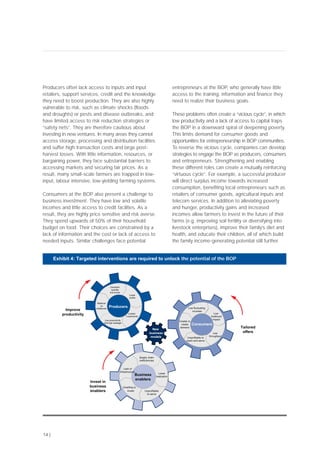
These problems often create a “vicious cycle”, in which
low productivity and a lack of access to capital traps
the BOP in a downward spiral of deepening poverty.
This limits demand for consumer goods and
opportunities for entrepreneurship in BOP communities.
To reverse the vicious cycle, companies can develop
strategies to engage the BOP as producers, consumers
and entrepreneurs. Strengthening and enabling
these different roles can create a mutually reinforcing
“virtuous cycle”. For example, a successful producer
will direct surplus income towards increased
consumption, benefiting local entrepreneurs such as
retailers of consumer goods, agricultural inputs and
telecom services. In addition to alleviating poverty
and hunger, productivity gains and increased
incomes allow farmers to invest in the future of their
farms (e.g. improving soil fertility or diversifying into
livestock enterprises), improve their family’s diet and
health, and educate their children, all of which build
the family income-generating potential still further.
14 |
Exhibit 4: Targeted interventions are required to unlock the potential of the BOP
New
business
models
Tailored
offers
Improve
productivity
Reliance
on
middlemen
Limited
investments
Uncertain
quantity
and prices
Lower
profits
Producers
Low productivity
and high wastage
Consumers
Low
livelihood
impact
Unprofitable to
reach and serve
Unable to
create
demand
Low fluctuating
incomes
Low
throughput
Business
enablers
Unwilling to
invest
Lack of
infrastructure
Lower
realization
Supply chain
inefficiencies
Unprofitable
to serve
Invest in
business
enablers
2.5 Business opportunities along the
food value chain
Engaging with the BOP in business activities related
to the food value chain can generate value for
companies in a variety of ways. This value may be
found through commercial returns; expanded market
access; increased quality, reliability or cost-efficiency
of a company’s supply base; or new business
linkages to local entrepreneurs. Despite the evident
challenges, many companies are adopting innovative
approaches to reap the benefits. Although they
employ different models, their collective experiences
provide valuable insights into how companies can
unlock the potential of the next billions. These
businesses have uncovered opportunities all along
the food value chain, working with agricultural
suppliers and farmers, intermediaries (traders,
wholesalers and other middlemen) and processors.
They have also uncovered related opportunities in
retailing, telecom and financial services. Examples of
these strategies and their effects on business and
the BOP are discussed in Chapters 3 and 4.
While the strategies deployed for one product or
area are not uniformly applicable to other markets,
specific examples discussed in this report have
succeeded in boosting the income of BOP
participants substantially, for example a tripling of
agricultural yields within a year. When taken together,
the business strategies outlined in this report could
have an enormous impact on BOP income if they
were scaled up broadly. Within the BOP, the greatest
gains are likely to be captured by farmers and
entrepreneurs active in business-enabling sectors
such as telecommunications and finance. Farmers
stand to benefit most from multiple value-chain
interventions (i.e. the combined effects of new
technologies, policies and institutions) and are the
largest BOP group operating within the food value
chain. Business-enabling sectors currently have a
small presence in rural areas but can grow rapidly in
what is currently a large and virtually untapped market.
The following chapters present a systematic analysis
of the untapped business opportunities that lie along
the food value chain, which can be important drivers
| 15
16 |
and contributors to mutually reinforcing growth. The
focus is on models that serve, engage or benefit the
BOP in their various roles along the chain. For
companies and partner organizations seeking to
develop or broaden their approaches in such
markets, the report also distils key insights on what
is needed to create sustainable, scalable business
models to develop these opportunities.
Hellen Awuor, farmer and entrepreneur, Kenya
Siaya is the poorest district in Kenya, with 64% of
its 500,000 inhabitants living below the national
rural poverty line. Most of the district’s inhabitants
are subsistence farmers growing maize, and
many experience seasonal hunger. The district
has limited market-related infrastructure and
access, further restricting farmer incomes.
Diversifying into high-value crops is one way
farmers can increase their incomes from small
plots of land.
Hellen Awuor, a farmer and entrepreneur in Siaya
district, has successfully diversified her farm
production and income sources. In addition to
growing maize and beans for home consumption,
she has expanded into horticulture (onions,
tomatoes, spinach, avocados and bananas)
which she sells in the local market. She spends
the resulting earnings (which range from US$ 2 to
12 per week) on processed goods like sugar, as
well as children's school fees and medicine. A
cow and 10 chickens provide additional family
nutrition. Through training received from a local
agricultural extension officer, Hellen plans to
expand her chicken brood for sale in the local
market. Hellen also buys and sells used clothing
to local residents, and describes herself as "a
businesswoman". Her son, Carlos, recently
started beekeeping on the land, producing honey
for a local company which provided training and
equipment.
Source: World Economic Forum, BAACH Kenya
2007[14]
In an era of rising food demand, companies are
increasingly seeking ways to expand their supply
base and meet the needs of new consumers. Doing
so effectively will require companies to develop
strategies for working effectively with smallholder
farmers – who form the majority of the farm sector in
most developing countries – as well as the poor in
their capacity as consumers and entrepreneurs.
Companies can work with local farmers to
substantially increase the volume and quality of their
production by facilitating access to inputs and
training, and by establishing local and international
market linkages. Demand-driven business models
are highly effective in justifying front-end investments
in the food value chain.
As BOP incomes grow, companies are also seeking
new ways of meeting the rising demand for food
and other products from BOP consumers. Innovative
approaches, such as designing affordable,
nutritionally fortified foods and extending retail
distribution networks deep into poor communities
through unconventional partnerships, are proving
effective for meeting the needs of BOP consumers
while also contributing to their health and livelihoods.
This chapter describes specific interventions that
have reached the BOP at different points along the
food value chain. The business models presented
here are aimed at both BOP producers and
consumers, and can have a substantial impact on
improving the livelihoods of the poor while also
Chapter 3 – Solutions to Unleash the
Potential of Producers and Consumers
| 17
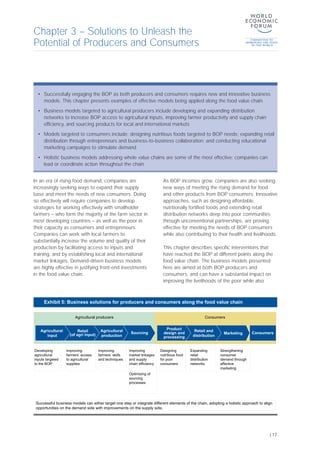
• Successfully engaging the BOP as both producers and consumers requires new and innovative business
models. This chapter presents examples of effective models being applied along the food value chain
• Business models targeted to agricultural producers include developing and expanding distribution
networks to increase BOP access to agricultural inputs, improving farmer productivity and supply chain
efficiency, and sourcing products for local and international markets
• Models targeted to consumers include: designing nutritious foods targeted to BOP needs; expanding retail
distribution through entrepreneurs and business-to-business collaboration; and conducting educational
marketing campaigns to stimulate demand
• Holistic business models addressing whole value chains are some of the most effective; companies can
lead or coordinate action throughout the chain
Exhibit 5: Business solutions for producers and consumers along the food value chain
Developing
agricultural
inputs targeted
to the BOP
Improving
farmers’ access
to agricultural
supplies
Improving
farmers’ skills
and techniques
Improving
market linkages
and supply
chain efficiency
Optimizing of
sourcing
processes
Designing
nutritious food
for poor
consumers
Expanding
retail
distribution
networks
Strengthening
consumer
demand through
effective
marketing
ConsumersAgricultural producers
Agricultural
input
Retail
(of agri input)
Agricultural
production
Marketing ConsumersSourcing
Product
design and
processing
Retail and
distribution
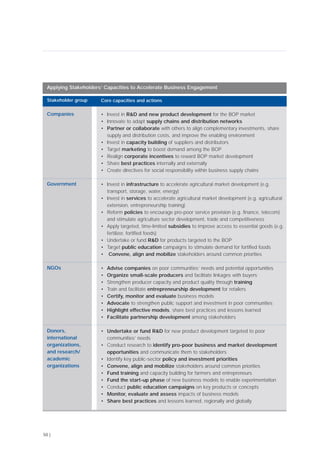
Successful business models can either target one step or integrate different elements of the chain, adopting a holistic approach to align
opportunities on the demand side with improvements on the supply side.
providing financial returns to farmers and
commercial enterprises. However, it should be noted
that adopting such models is a deliberate choice
and requires innovations and commitment from all
partners.
3.1 Business solutions for producers
Companies seeking to expand their market share
and distribution networks for agricultural inputs, their
supply base for agricultural products, and their
business linkages in new markets can find significant
untapped potential and unmet demand in poor
regions. However, effectively engaging the potential
of these markets often requires entirely new
business approaches that involve working with
farmers and entrepreneurs at the BOP.
Companies can adapt their business approaches to
serve and empower BOP producers. The following
sections outline business models that are proving
effective in developing targeted products, expanding
distribution and spurring demand-driven production
for local and international markets.
Developing agricultural inputs targeted
to the BOP
Traditionally, agricultural suppliers have targeted
more affluent farmers. Companies that have
ventured into BOP markets have done so through
re-packaging existing products to make them more
affordable, or through adapting products for local
conditions and needs. They have also offered farm
equipment, such as processing and storage
facilities, for lease rather than for purchase to reduce
farmers’ upfront investment costs.
Tailored new product design and R&D. A new
generation of agricultural technologies is emerging,
focused on the practical needs and constraints faced
by the BOP, to deliver near-term benefits for farmers.
International Development Enterprises India (IDE
India), a social enterprise, shows how treadle pump
suppliers can actively engage farmers and other actors
in the chain to achieve profitable results. (See box 1).
Syngenta, a global seed and crop protection
company, has demonstrated the payoff of long-term
commitment to developing locally-targeted solutions.
The company has spent 11 years developing sugar
beet varieties suitable for tropical climates. By
switching to the new sugar beet variety, farmers can
obtain the same quantity of sugar (or alcohol or
ethanol) per unit of land, in half the time. This
significantly improves productivity and the efficiency
of land use. Using almost 30% less water than
typically required for sugar cane, the sugar beet can
serve as a raw material for both the food and the
biofuel sectors. Almost 2,000 farmers in India and
up to 1,000 in Colombia have participated in the
pilot project. The goal is to bring 100,000 ha under
production in the medium term in Asia, Africa and
Latin America, while also improving the technology
transfer methodology to facilitate replication.
[16]
18 |
• By adopting innovative business models,
companies can work with BOP producers to
significantly boost the quality and quantity of
their agricultural production, thus expanding
the company’s supply base and the farmer’s
income
• Companies can expand and deepen markets
for agricultural inputs by developing products
targeted to BOP producers’ needs, adopting
new retail distribution strategies combined with
credit access and other services, and
extending training and information to farmers
• Demand-driven models are most effective for
boosting production; agricultural, food and
beverage companies that support BOP
producers at each step of the farming and
marketing process can secure the best results
For many companies, financing a long-term R&D
effort to develop products for a low-margin market
poses a financial challenge. In some cases, public
financing or private donor funding can help catalyse
R&D focused on BOP needs. The Consultative
Group on International Agricultural Research
(CGIAR), for example, is a donor-funded organization
that works with governments, private enterprises
and NGOs. The organization conducts research on
crops and other commodities that benefit poor
farmers. The CGIAR provides genetic and breeding
materials to other research organizations, which
adapt them to local conditions and make them
available to private seed companies. This approach
has produced hybrid maize breeding lines in Mexico
and other parts of Latin America through the work of
Centro International de Mejoramiento de Maíz y
Trigo (CIMMYT), and hybrid millet, sorghum and
pigeon pea lines in parts of India and Africa through
the work of the International Crops Research
Institute for the Semi-Arid Tropics, (ICRISAT)
[17]
. The
adoption of these technologies varies widely
between countries and regions, and faces greater
limitations in Africa.
Improving farmers’ access to agricultural inputs
Even when appropriate inputs are available in-country,
poor farmers have to overcome both logistical and
financial hurdles to access them. In sub-Saharan
Africa, farmers face some of the highest fertilizer prices
worldwide, a trend that worsened as global fertilizer
prices nearly doubled in 2007-2008. Distance is also
a barrier: 40% of African farmers live four hours or
more from the nearest input retailer.
[2]
A lack of financial
services and fertilizer subsidies makes purchases
impossible for many at the start of the planting season,
when cash supplies are low. As a result, African
farmers have the lowest rates of fertilizer use
worldwide, using only 13 kg per hectare compared to
190 kg per hectare in East Asia.
[2]
Some companies
are introducing innovative approaches to extend
their distribution networks to small-scale farmers
through direct investment or partnerships with
intermediaries. These models have several common
elements: a) they aggregate both farmers’ goods
and buyers’ demand to create critical mass; b) they
act as a two-way trading platform; and c) they bundle
services and products to enhance their appeal.
| 19
International Development Enterprises India (IDE
India) is a social enterprise that engages with small-
scale farmers by supplying manually operated
treadle pumps. The pumps help farmers to boost
their productivity, increasing their earnings by
around US$ 400 per annum. The cost of the pump
can be recovered within three months from the first
harvest. In order to build awareness of the benefits
of irrigation pumps, IDE India conducts live and
video demonstrations and distributes flyers. They
also engage the support of village opinion leaders –
influential farmers who are trained to market the
product to their peers.
IDE India trains farmers to use and repair the
pumps; select crops, planting material and fertilizer;
and utilize market information. To keep retail prices
low, product manufacturing is outsourced to local
manufacturers, who follow a stringent quality
assurance program and participate in IDE India’s
warranty scheme. The enterprise has also facilitated
partnerships in service hubs that provide processing
facilities and allow for intermediary sales of produce.
In addition, IDE India facilitates an innovative
financing mechanism, where the agricultural input
companies directly finance the farmers, thus
bypassing the need for external financiers.
This broad-based support has helped farmers
increase their productivity; many have doubled their
income within two years of purchase. IDE India has
also created jobs by establishing and training local
distributors. This multi-pronged approach has
proven highly successful for the commercial pump
suppliers and, to date, more than 650,000 treadle
pumps have been sold through IDE India’s network
of dealers and distributors.
Source: International Development Enterprises,
India[15]
Box 1 – International Development Enterprises, India:
A coordinated approach to servicing small-scale farmers
Retail hubs in high-density areas. In rural India,
Godrej Agrovet Ltd, a leading agribusinesses player,
has established a chain of rural outlets, each serving
approximately 20 villages and 20,000 farming
families. These outlets offer one-stop shops,
providing agricultural equipment and useful services
such as soil and water testing, veterinary and
financial services, post offices and pharmacies. The
company has partnered with other companies, such
as Tata Agrico (a subsidiary of Tata Steel) to expand
its offering of services
[18]
. Other farm outlets in India
are starting to provide weather and commodity price
information and even trading services. Some retail
hubs offer post-harvest services such as processing
and warehousing.
Empowerment of retailers in low-density areas.
In low population density or remote rural areas,
companies can link to micro retail networks to
deliver supplies and to disseminate knowledge to
farmers. Some companies have empowered local
retailers to become their dealers and to educate
farmers on the use and benefits of their products.
The dealers receive training in both technical
knowledge and retail management skills. Bayer
CropScience introduced practical, small package
sizes of fertilizer and pesticides in Kenya while
simultaneously running its Green World training
programme,
[19]
which also provided training for more
than 2,000 dealers on crop protection and
agricultural practices. Such agro-dealer networks
can provide both dealers and farmers with access to
funding. In another Kenyan example, Equity Bank
launched a US$ 50 million credit line for 15,000
agro-dealers and other small-scale enterprises
operating along the food value chain. In complement
to this initiative, the Government of Kenya launched
a subsidy programme through which farmers can
redeem vouchers at agro-dealer stores to expand
access to and demand for inputs
[20]
.
Strengthening farmer capacity
Farmers in developing countries often lack technical
information on new products and farming techniques
and, given the limitations of government-sponsored
agricultural extension services, have few
opportunities to access training. Smallholders often
have many dependents and limited income, with no
risk protection or safety net. Given their high
exposure to risk, they are understandably cautious
about trying new products and techniques. Private
companies, which trade with farmers as either
buyers or suppliers, can bridge this gap by offering
farmer training programmes – so-called outgrower
schemes – increase farmers’ knowledge and
willingness to adopt the new technology.
Training and outreach by agricultural suppliers.
Seed and fertilizer companies have taken the lead in
providing coordinated educational and training
services to farmers. Both sides benefit from these
programmes. Farmers gain know-how and the
means to improve their productivity, while suppliers
benefit from feedback and customer loyalty.
Suppliers can take these programmes a step further
by adding services that will not only improve
productivity but also enable farmers to enter new
markets or to meet more stringent quality
requirements.
In Brazil, seed company Bayer CropScience has
collaborated with HortiBrasil, an NGO, to enable 500
small-scale fruit producers obtain an international
certification through the Garantia de Sabor – the
“good flavour guarantee” – label. Bayer supplies
seeds and education to farmers through an
outgrower programme,
[21]
while third-party monitors
regularly review their adherence to sustainable
farming techniques and certify the quality standards
of the fruit. In parallel, Bayer builds market
acceptance by educating wholesale traders about
the new label. The produce sold under the label is
priced at a premium in retail markets and is suitable
for export, providing a considerable opportunity for
farmers to improve their productivity and incomes.
By investing in the brand, the partners hope to
create regular consumer demand for the products in
local and international markets.
Training and capacity-building by buyers.
Buyers or traders who want to ensure adequate
supply and quality often develop outgrower
programmes with farmers. These programmes can
range from supplying seeds and fertilizers to
providing training and monitoring programmes.
Under these programmes, buyers will guarantee
purchase of certain volumes at specified prices.
They will sometimes make payments in advance of
the harvest, smoothing out cash flow and creating
20 |
stability that can give farmers the confidence to
invest in goods and services that will further improve
their incomes. Such advance-payment schemes
must be structured equitably to ensure a competitive
price at harvest time.
Buyers can also take an extra step and ensure that
post-harvest loss is minimized between farm and
factory, thereby increasing profitability for both
farmers and wholesalers. Metro Cash & Carry, one
of the largest food wholesalers in Vietnam, buys
fresh produce from several smallholders in the Lam
Dong province, a vegetable-growing region. In
partnership with local authorities and NGOs, Metro
has invested in training programmes for farmers and
other small-scale service providers along the food
supply chain. So far the company and its local
partners have trained 18,000 farmers in Vietnam and
are running similar programmes in other countries.
[22]
Improving market linkages and supply chain
efficiency
Inefficient supply chains raise costs and reduce
profits for companies and farmers alike. Investments
in better transportation, warehousing, infrastructure,
storage and intermediaries can boost returns over
the long term for all participants in the supply chain.
Improving logistics and warehousing. Post-harvest
losses in developing regions can be significant. For
perishable products, such as milk and vegetables,
50% of the product may be spoiled before it reaches
the consumer market. Losses affect farmers both
directly (when their products spoil before sale) and
indirectly (by lowering prices paid by traders and
processors, who are also affected by wastage).
Investing in on-farm processing, warehouse systems,
logistics and training can increase the speed and
| 21
efficiency of delivery to market. Sometimes, simple
means are sufficient. Metro’s Cash & Carry outlet in
India suffered losses in its tomato supply as high as
40%. It turned out that during their breaks, handlers
sat or slept on top of bagged tomatoes. By
changing its packaging to crates, Metro was able to
reduce waste to 15%.
[23]
TNT, a global mail, express
and logistics provider, has provided analyses and
recommendations to public agencies and partnerships
with a goal of improving efficiency of transport and
supply chain networks in several African countries to
reduce transport costs and travel time.
[24]
Investing in intermediaries that add value. While
intermediaries in developing markets are often seen
as one of the main causes of supply chain
inefficiency, they can be useful in providing funding,
marketing, logistics and other goods or services that
would be otherwise unavailable to farmers. They
may also hold valuable knowledge about producer
communities that they can communicate to buyers.
Moreover, they help aggregate a highly fragmented
supply base, increasing efficiency for buyers who
want to buy larger volumes of produce. Companies
need to determine which intermediaries add value,
so that they can then be supported. Retailer PT
Carrefour Indonesia has done this with fresh
produce wholesaler Bimandiri. The wholesaler helps
Carrefour establish and enforce quality and quantity
standards and, at the same time, helps smallholders
to receive a negotiated and fair price.
[25]
Optimizing of sourcing processes
Local procurement systems can benefit poor farmers
as well as processing and retail companies.
Initiatives to establish such systems are often the
result of commercial incentives to reduce costs.
These can entail replacing high-cost imports with
low-cost local goods or new products developed
locally.
Switching from imports to local sourcing. Rising
demand for processed foods, combined with high
tariffs and increasing production costs, are driving
companies to view local small-scale farm produce
as a viable alternative to imports. For example, to
increase its supply of high-quality corn in China,
General Mills switched from imports to local sourcing
and reduced procurement costs by 25% in the
process. The company currently sources corn for
the Chinese version of its Bugles snack from 528
22 |
small farms in Yongqing Village, in the Heilongjiang
province. General Mills partnered with a local miller,
Xingda, which provided logistical support and
managed local relationships.
[26]
Such partnerships
are essential in improving farmers’ efficiency and to
tap the benefits these farmers can add in terms of
costs, reliability and quality. Likewise, Olam, one of
Nigeria’s largest food processing companies, has
partnered with the United States Agency for
International Development (USAID) to procure rice
from small-scale farmers after an increase in tariffs
made imports less attractive. Olam provided farmers
with inputs, technical assistance and access to
processing facilities. Because the farmers needed to
produce a better and more consistent quality, Olam
and USAID also established model farms, used for
extensive training and research. In addition, Olam
launched a high-quality branded rice product to
ensure it would capture sufficient margins. Collaboration
with Olam resulted in an average yield increase of
75% in the first two years and a net income growth
of over 155%. The programme currently involves
over 8,000 farmers.
[27]
Such local-supply
programmes can maximize value capture when
focused on premium products. However, as SAB
Miller has proven (see Box 2), sourcing for lower-
priced products can benefit smallholders as well.
Commercializing local raw material. Local staple
crops or raw materials often hold untapped potential
for commercialization. Unilever has cooperated with
a wide range of partners to unlock hidden value in
processing the Allanblackia seed, a traditional
source of cooking oil in a number of African
countries. The resulting Novella Africa project has
designed a supply and processing chain to procure,
extract and market the oil as an alternative to other
vegetable oils in soap and processed foods. In the
project’s second commercial phase, farmers are
supplying several additional processing companies.
One of the key success factors is cooperation
among the private sector, government and NGO
partners, which provided an international perspective
and on-the-ground experience. This enabled the
initiative to be scaled out from Ghana to Tanzania,
Nigeria, Liberia and Cameroon.[29]
| 23
Liu Fuyou, farmer, People’s Republic of China
Liu Fuyou lives in Yongqing Village in Heilongjiang
province in China. For generations, his family has
been growing corn on 2.5 acres of land. In 2003,
Fuyou signed a contract farming agreement with
General Mills, which guaranteed an above-market
price for 100% purchase of his crop. General
Mills provides technical assistance, quality seeds
and financing for purchasing inputs such as
fertilizers. Liu Fuyou previously had no access to
such services, and his income varied unpredictably
based on weather and market prices.
Since becoming a contract farmer, Liu Fuyou’s
yields have tripled. His household income has
more than tripled, from a range of US$ 680-800
to US$ 3,300. Liu Fuyou has invested the
increased income in improving the life of his
family. He built a new house to replace their
previous mud and grass structure, and installed
storage buildings and a perimeter wall. He also
bought a small tractor, a television, radio, mobile
phones and other household appliances. The
family has improved its diet, buying more meat
and varied foodstuffs.
Similar impacts are visible in the livelihoods of
other contract farmers in the community. Many
families have invested in housing improvements,
tractors and motorcycles, and other items.
Increased spending has catalysed the growth of
local micro-enterprises such as small shops and
restaurants. The village road has been paved,
improving the community’s access to nearby
towns and markets.
Source: General Mills 2008[28]
Building markets for high-value sustainable
trade. Trade barriers, inadequate logistics and a
lack of agents to advocate and promote products
generally restrict or prevent small-scale farmers from
accessing high-end markets. Sustainable trade
practices, partly based on principles of the fair trade
movement, help farmers circumvent such roadblocks.
The main aim is to provide consumers with food that
has been grown in accordance with environmental,
health, safety and fair-wage or pricing standards.
Sustainable trade practices also make the sourcing
and certification process an essential part of the final
consumer product, justifying a price premium. For
example, the cooperative Kuapa Kokoo, representing
40,000 cocoa farmers in Ghana, partly owns Divine
Chocolate Ltd, a trading company that markets a
premium chocolate made with Kuapa Kokoo
members’ products.[31]
Although adhering to
sustainable trade practices, the brand also targets
the broader market for high-quality chocolate.
Large companies are increasingly applying these
ideas in their international supply chains. For
example, Kraft Foods sources several key
commodities from developing countries facing
unique environmental, economic and social
concerns. In the early 1990s, the company began
adopting sustainable practices in procuring coffee. In
2003, the company sought certification from the
Rainforest Alliance certification. Certified products
comply with the Sustainable Agriculture Networkd
standards for protecting wildlife, wild lands, workers’
rights and local communities. Today, with eight
coffee brands in more than 20 countries carrying the
Rainforest Alliance seal, Kraft is the largest buyer of
Rainforest Alliance Certified beans.[32]
24 |
Brewer SABMiller has rolled out several new
product innovation, quality improvement and import
substitution projects in Africa and India. When
identifying suitable regions, SABMiller looks at
growing markets with an undersupply in agricultural
products, supportive partners, and existing
infrastructure in critical areas such as water supply
and transportation. One of the key challenges is
identifying and managing relationships with
government, NGO partners and other stakeholders.
Currently over 10,000 smallholder farmers are
involved in projects in India, Tanzania, South Africa,
Uganda and Zambia. The company expects to
increase the number of participating farmers to
30,000 by 2012. In most cases, the business
benefits have already exceeded the initial investment
and farmers have seen a significant increase in their
incomes.
With the introduction of the Eagle Lager brand in
Uganda, SABMiller expanded its import substitution
model and redesigned its products to accommodate
the availability of local supplies of sorghum. The
brewer participated with the local government in
research on sorghum and designed a supply chain
that accommodates small-scale farmers. While
SABMiller also works with commercial farmers, for
the Eagle brand it is committed to buying from
subsistence and more vulnerable producers. The
brand is expected to provide direct financial benefits
to more than 5,000 farming families in 2009.
Source: SABMiller Company Information 2008[30]
Box 2 – SABMiller: Global smallholder sourcing strategy
d
The Sustainable Agriculture network is an international
coalition of leading conservation groups
3.2 Business solutions for consumers
Companies often find it difficult to access the BOP
as a consumer market, since they generally have
low and fluctuating incomes and are often located at
the end of informal and inefficient market chains. In
addition, there is little information available on their
behaviour and preferences, and marketing strategies
devised for higher-income markets are often
ineffective in creating or strengthening consumer
demand. Companies can overcome these obstacles
and launch successful products by introducing new
products developed through well-targeted design,
cost-efficient processing and effective marketing.
Executing such business models effectively often
requires partnerships with other organizations.
Designing nutritious food for poor consumers
Nutritional deficiencies cause substantial damage to
human health and economic productivity. Providing
food enriched with micronutrients such as iron and
vitamin A is recognized as one of the most cost-
effective solutions. Fortified foods in the form of
enriched staples, such as flour and salt, or
processed foods with nutritional supplements are an
effective delivery mechanism for such micronutrients.
Although fortifying food is technically a relatively
straightforward process, large-scale fortification
efforts have to overcome a number of hurdles. Many
developed countries lack regulation, leaving food
companies to introduce fortification on a voluntary
basis, often at added cost. Consumers may be
willing to prioritize fortified foods once aware of their
benefits, but reaching them with the information is a
challenge. Companies seeking to provide fortified
foods to the BOP must therefore invest in effective
and affordable products, establish cost-effective
local processing capacity and undertake well
designed and targeted marketing campaigns.
For these reasons, many food fortification
programmes still involve donor funding, at least in
the development or transitional phases. Donor
funding often focuses on supporting fortification of
staple foods, due to their broader reach and lower
cost. Processed foods, by comparison, are more
often sold at a premium. However, several food
companies have achieved commercial success with
fortified products, based on transitional or no donor
funding. As income levels rise among the BOP,
those with discretionary income can become a strong
market for nutritionally enhanced products. Success
requires creating low-cost products that meet market
conditions and have durable packaging, a long shelf
life and little need for clean water or electricity.
Brittania Industries, the Naandi Foundation and the
Global Alliance for Improved Nutrition (GAIN) recently
cooperated to make fortified foods more widely
available for lower-income groups in India. Britannia
is a leading Indian food manufacturer and its biscuits
reach more than 70% and 45% of urban and rural
markets, respectively. The Naandi Foundation is a
public trust that focuses on the protection of child
rights, particularly in education and nutrition. GAIN is
a Swiss foundation that works to catalyse
partnerships and create an enabling environment for
fortification. The partners utilized Naandi’s
established infrastructure of school feeding
programmes in Andhra Pradesh to distribute iron-
fortified biscuits to over 150,000 children. Britannia
has now launched commercially an iron-fortified
version of its popular Tiger biscuits called Banana
biscuits. Over 2 billion packets of Banana biscuits
have been sold to date using traditional market
channels to reach the general population. In addition
to improving children’s nutritional status, the initiative
helped Britannia to gain insight into the BOP
consumer market and position itself as a food
company with a nutritional focus. Furthermore, it
created opportunities to explore the development of
additional lines of fortified food products for both
low-income and affluent consumers.[33]
| 25
The French company Nutriset developed a ready-to-
use peanut-based paste, Plumpy’Nut, to provide
nutritional support to malnourished children in
developing countries. In addition to tasting good, the
paste is packaged in foil packets so that it can be
distributed easily throughout relief camps and other
challenging environments. To reduce cost and
expand distribution, the company has set up a
franchise system in Central and Eastern Africa to
license Plumpy’Nut to local producers.[34]
Expanding retail distribution networks
One of the main challenges to commercial enterprise
in BOP markets is reaching consumers. While all
poor consumers tap into retail networks to purchase
essential goods, these mostly informal systems are
often comprised of multiple small-scale
intermediaries with limited incentive or opportunity to
create economies of scale. Poor infrastructure, such
as roads and warehousing, compounds existing
inefficiencies and raises costs. As a result, the poor
often pay higher costs per unit for essential services
than wealthier members of the community, the so-
called “BOP penalty”. Companies can reduce
delivery costs and make goods more affordable to
consumers through both conventional and
unconventional means. Effective strategies include
working with existing informal channels, training
entrepreneurs and collaborating with other
companies.
Leverage informal retail and distribution
networks. Providing small-scale retailers with tools
and information can allow companies to utilize
existing informal trading channels and turn small-
scale retailers into product agents, thereby
expanding their reach. Given the right training and
tools, many poor consumers themselves can
become successful small-scale retailers, assisting
companies providing last-mile access to the
consumers that are hardest to reach. In Brazil,
Nestlé engages rural women to operate as
distributors. They travel door-to-door demonstrating
product benefits and selling directly to consumers.
By creating incentives for local retail entrepreneurs
rather than hiring salaried employees or franchise
holders, the company reduces its need to monitor
individual sales performance. Once a company has
established a critical mass of micro-retailers, it can
start to provide additional services such as credit or
portfolio expansion. These arrangements help
companies build trust within a community and reach
the target segment efficiently.
Organized retail is one of the fastest growing sectors
in developing countries. For example, in Thailand,
the US$ 56 billion retail market has grown annually
by 12% since 2002.[36]
While they are sometimes
seen as a threat, large-scale retailers can also
provide commercial opportunities for small-scale
entrepreneurs. Instead of striving to replace micro-
retailers, some of these large players are partnering
with them to extend their own footprint. India’s
Subhiksha Trading, an arm of Subhiksha, an urban
26 |
supermarket, pharmacy and telecom chain, for
example, is becoming a wholesaler to micro-retailers
in urban and suburban areas.[37]
Business-to-business collaboration to extend
and improve distribution networks. Collaboration
with other companies can help reduce delivery costs
to the BOP. Hariyali Kisaan Bazaar, a rural retail
chain managed by DCM Shriram Consolidated Ltd
in India, bundles the services and products of 80
different suppliers into one single store.[38]
Mi Tienda,
a Mexican retail association, helps small rural shops
maintain a diversified and current inventory. The
organization’s network of regional buyers acts as an
intermediary between large wholesalers and the
small shops. They deliver fresh produce daily, even
in small quantities.[39]
Such initiatives save costs,
diversify inventory and expand distribution networks.
Strengthening consumer demand through
effective marketing
Educational marketing. Since they are unfamiliar
with many commercial products, BOP consumers
commonly look to trusted sources such as friends
and family for advice in making purchasing
decisions, rather than relying on messages from the
media. Numerous companies have developed
innovative pathways of communication, often
borrowing from social marketing models to use
word-of-mouth advocacy, peer marketing, village
meetings and performance art.
Creation of partnerships with “trusted parties”.
Successful marketing strategies often depend on
partnerships, especially with organizations and
brands that are deemed trustworthy. In China, a
| 27
In launching a national campaign to combat iron
deficiency, China’s Center for Disease Control (CDC)
partnered with GAIN and Zhenji (Shijiazhuang Zhenji
Brew Group Co., Ltd), a leading soy manufacturer,
to introduce an affordable soy product fortified with
iron. The campaign has been a major success for all
players. Sales of the fortified soy sauce increased
from 1,500 to 20,000 tons per year over two years,
reaching sales of nearly US$ 5 million. The product
is marketed in nearly 90% of Chinese stores that sell
soy sauces. Zhenji increased production capacity to
100,000 tons per year to meet growing demand.
Awareness levels among high-risk individuals in
many provinces was close to 100%, and anaemia
rates fell from 20% to approximately 8%.
Several key strategies helped drive this success:
• Aligning public and private incentives: CDC
provided the fortification formula and manufacturing
technology to Zhenji for free and conducted a
nationwide educational campaign. In return, the
company agreed to keep the price affordable.
• Leveraging public-sector resources: CDC created
teams at national and local levels to manage
relationships with various government agencies,
including coordination with the health department
on quality control.
• Clear value proposition to consumers: The
campaign offered consumers a superior product
with health benefits priced at only 1 cent more per
bottle than traditional soy products, which was far
cheaper than medicinal treatments for iron-
deficiency anaemia (IDA).
• Combined marketing efforts: The CDC
spearheaded an educational media campaign
through TV, newspapers, flyers, and other media
that targeted consumers directly. It was able to
promote the product on television through its
access to free “educational” airtime. This lent
government credibility and raised awareness of the
product, while lowering costs for Zhenji. Zhenji
focused its marketing efforts on retailers and rural
doctors, using promotions and discounts to drive
traffic to stores and garner support for the product
Source: Global Alliance for Improved Nutrition, 2008[35]
Box 3 – Zhenji: Fortifying soy sauce in China
successful marketing campaign for a fortified soy
sauce involved China’s Center for Disease Control
(CDC), a governmental institution that is viewed by
local consumers and medical professionals as the
leading authority on nutrition. (See box 3)
Certification and labelling. Certified labels help to
differentiate products and increase consumer trust.
When the South African government introduced
large-scale fortification of maize flour, it developed a
distinctive logo to set the product apart. One of the
key lessons of this project, however, was that
certified labels require a level of investment and
marketing similar to that required for branded
products. After initial donor funding for the start-up
phase, the maize fortification project is fully
commercially viable.[40]
3.3 The case for holistic solutions
While many companies engage in just one stage of
the food value chain, holistic approaches can unlock
even greater value. Holistic business models take
into account all three roles played by the BOP – that
of producers, consumers and entrepreneurs – and
rely on a coordinated approach to address multiple
stages of the food supply chain. In the Novella Africa
project, Unilever and its partners strove to involve
both small-scale farmers and micro-entrepreneurs in
the food value chain, reducing costs for consumers
at the same time. A key insight from projects that
address the full supply chain is that interventions
linking farm production with market demand have
the strongest potential to provide sustainable
economic growth and lift large numbers of people
out of poverty. The introduction of Shokti Doi
yoghurt by Grameen Danone Foods Ltd is a prime
example (See box 4).
Undoubtedly, private enterprises have stronger
bargaining power and greater resources than most
micro-entrepreneurs, farmers and consumers. While
companies could take advantage of this imbalance,
leveraging their position or engaging in monopolistic
behaviour, that approach would be short-sighted. To
the contrary,, some companies have adopted
successful BOP strategies that require investments
in community-scale infrastructure or capacity-
building which could conceivably benefit the
company’s competitors. While this represents a
28 |
Exhibit 6: Approaches to improving food value chains
Food value chain
Micro-irrigation
IDE India
Fortified soy sauce
Zhenji
Nutritional yoghurt
Grameen Danone Foods
Agricultural
input
Retail
(of agri input)
Retail and
distribution
Marketing
Product
design and
processing
Sourcing
Agricultural
production
Consumers
Tailored
innovation
Empower
dealers
Retail &
Intermediaries
Facilitate
market links
ConsumptionProcessing
Training
farmers
Consumers
Provision of
agricultural
services and input
Distribution to
suppliers
Establish micro-
retail network
Educational
marketing
Localized
processing
Product
design
Preferential sourcing
Improved logistics
Local distribution
• Integrated farms
• Train suppliers
Consumers
Break into
new channels
Agricultural
Input
Retail &
Intermediaries
Educational
marketing
Leverage
purchasing
power
Agricultural
Production
Consumers
Tailor product
design
departure from traditional practice, it can be seen as
necessary and increasingly common practice in BOP
markets. Companies can view these investments as
benefiting the BOP and broader business
community as a whole.
Not all companies have the full array of resources
and competencies required to remodel entire supply
chains, or engage the poor effectively in their
different roles. Partnering with other companies and
stakeholders can provide such capacity. When
engaging partners in a multi-stage project, however,
companies should place special attention on
prioritizing and sequencing interventions. Companies
will need to gain insight into smallholders’ supply
chains, identify the key issues and determine where
best to start.
| 29
In 2006, Groupe Danone and Grameen Bank
created Grameen Danone Foods Ltd, Bangladesh
to develop a healthy, affordable yoghurt-based
product that would be marketed to and provide
income for poor families. Two years later, Grameen
Danone is selling Shokti Doi (“energy yoghurt”) at 6
cents for a 60 g cup, which is substantially less than
other products in the market. A single cup is
fortified with sufficient nutrients to meet up to 30%
of a child’s daily requirements. Grameen Danone
currently has 100 full-time employees.
To keep costs low, Grameen Danone decided to
create a local supply chain from scratch. The
company established microfarms for milk
production, working with NGOs to train framers. It
set up a milk processing factory that relied on
human labour more than technology. It developed a
unique distribution model by training women to
market the yogurt door-to-door; currently 1,600 of
these “Grameen Ladies” are selling products. The
model has garnered substantial attention for its
innovation and potential for scaling. Key elements of
success included:
• Environmental sustainability: Grameen Danone
worked to minimize environmental impact. The
factory was designed to use harvested rainwater,
solar power and biogas. Milk was collected
within 30 kilometres of factories to minimize
transport costs. Yoghurt cups were made from
biodegradable cornstarch.
• Holistic value chain approach: Grameen
Danone’s local supply chain model benefits both
the community and the company by empowering
producers and entrepreneurs while keeping
production and distribution costs low.
Source: Harvard Corporate Social Responsibility
Initiative, 2007[41]
Box 4 – Grameen Danone Foods Ltd, Bangladesh: A holistic value chain approach
A functioning food value chain is a market-based
system, with business activities taking place at each
step. The people and enterprises operating along
the chain need certain tools, services and capacities
to conduct business efficiently. Industries such as
financial services, telecommunications, energy and
transport are powerful enablers of business activity
and are therefore essential for improving the
efficiency of the food value chain. In addition to
providing goods and services, entrepreneurs
themselves are central to making the system work.
Taken together, we call these actors “business
enablers”. Although not part of the food and
agriculture sector directly, they enable and stimulate
many of the functions of the food value chain, while
driving economic growth by harnessing and enabling
latent entrepreneurship.
Public-sector investments and services are crucial to
the smooth functioning of the food value chain, but
in many BOP communities they are highly limited.
This chapter will focus on specific solutions that
companies themselves can put forward to
strengthen business operations in such
environments. It highlights three key gaps that
currently restrict food value chains and can be
addressed by private-sector operators: access to
market information; access to financial services; and
access to soft and hard infrastructure.
4.1 Providing Market Information
Most small-scale farmers have little or no access to
information on what products are in demand, how to
tailor production to the market and what price
buyers are willing to pay. Because they lack
information and adequate storage facilities, farmers
are often forced to sell surplus produce immediately
after the harvest, when prices are typically lowest. In
addition, because they lack adequate access to
markets, they often must rely on middlemen, which
reduces farmers’ profits and raises cost to the
consumer. A study by the Pakistan Institute of
Development Economics estimates that middlemen
pocket as much as 50 to 60% of the profits in the
value chain from farm to consumer. By contrast,
when farmers can access market- and agriculture-
related information, they can produce and sell their
goods based on the best economic opportunities,
thus maximizing their gains.
Historically, this information gap has not been easy
to bridge. Farmers are scattered across rural areas
without access to conventional channels of
communication. Agricultural suppliers and buyers
have been reluctant to invest in developing these
channels because of the costs involved. Today,
however, new technologies are providing some
innovative solutions. Simply connecting people in
distant locations by mobile phone has powerful
market effects. Off the coast of Kerala in India, for
example, fishermen now call potential buyers while
still at sea and then dock their boat directly at the
site of the buyer offering the best price. Before the
advent of mobile phones, the same buyers often
returned empty-handed from the marketplace closest
Chapter 4 – Empowering Entrepreneurs through
Business-enabling Products and Services
30 |
• Business sectors that enable entrepreneurship play an important role in bridging three gaps that currently
restrict the food value chain: access to information, financial services and infrastructure
• Telecommunications access and applications can provide key market information, enable trading and
facilitate mobile cash transfers
• Financial services can enable investment and growth at each step of the food value chain, whether
provided to individuals, communities or producer groups, or small and medium enterprises
• Infrastructure shortages can be overcome in some cases through business innovation – addressing “hard”
infrastructure for energy, water and logistics; and “soft” infrastructure related to producer organizations,
policies and standards
to them, unaware of a big haul a few kilometres away.
In China, Qualcomm helped to empower
entrepreneurs with mobile handsets through its
Wireless Reach programme. The company
partnered with PlaNet Finance and China Unicom to
donate 2,000 handsets, precharged with service
vouchers valid for two years, to microfinance
borrowers and officers. PlaNet Finance provided key
price and loan information to recipients through SMS
messages. The mobile access helped increase the
efficiency of entrepreneurs’ small enterprises, while
improving their access to markets. The increased
access to communications also helped farmers stay
abreast of relevant news such as impending weather
changes.[42]
Pricing information systems. New technology in
Uganda is helping farmers to get the best price for
their crops and avoid being cheated by
unscrupulous middlemen. Foodnet, an organization
that helps improve market efficiency and processing
in the agricultural sector, has introduced a system
allowing farmers to use their mobile phones to learn,
within seconds, the current price of maize at
markets throughout the country.[43]
Technology, however, is not the only way to get
information to and from farmers. The First Mile
Project in Tanzania has had great success in
bringing market information to farmers with kalmia
shu shu shus, or market spies. These market spies
roam the markets, chatting with traders, wholesalers
and transporters to get the latest news. They then
deliver information via mobile phone text messages
and also share their insights on community billboard
postings. Although funding for the project ceases in
| 31
Exhibit 7: Key business enablers in the food value chain
Strengthening
business operations
Providing market information
Improving access to financial services
Overcoming infrastructure gaps
• Pricing information systems
• Information on good agricultural practices
• Credit for individual farmers
• Mobile cash transfer services
• Offering monetary stability through savings and investment
• Downside protection through novel risk mitigation instruments
• Capital funding for small businesses
• Hard infrastructure
– Enhancing storage and transport facilities to improve logistics
– Overcoming energy gaps
– Providing access to water
• Soft infrastructure
– Improving farmers “technical and commercial” capabilities
– Strengthening organizational capacity of farmers
– Establishing standards and guidelines to expand market access
2009, the spies are already charging commissions
for their services. While it remains to be seen if the
commission fees will cover their costs, many are
confident that both buyers and sellers will be willing
to pay, as the benefits of their service outweigh the
costs.[44]
Information on good agricultural practices.
Providing farmers with information on good
agricultural practices is a “quick win” solution that
has shown impressive results. In a partnership
between BT, Cisco and OneWorld, the LifeLines
India project has already demonstrated a 20 to 30%
increase in productivity among users. The service is
simple: farmers can dial a fixed voicemail number
where they can record their queries. A dedicated
knowledge worker then finds the answer through a
panel of agricultural and veterinary experts, using an
innovative Internet-based application. Farmers can
retrieve the answer by voicemail at a cost of Rest. 5
(11 cents). After 2.5 years of operation, the service is
receiving over 12,000 calls per month[47]
.
4.2 Increasing Access to Financial
Services
Financial services such as credit, savings and
insurance are essential tools for investing in
enhanced production, managing price and income
volatility, and mitigating risks such as drought or
crop failure. However, most small-scale farmers have
little or no access to such services, a constraint to
investment that affects the majority of the BOP.
Nearly half the poor households in Brazil do not
have a formal bank account, while in China the
share of households without access is about three
quarters.[49]
Most BOP communities are
uneconomical to reach through conventional
banking methods such as centralized branches.
Even if BOP communities can be reached, banks
lack information about individuals’ credit and risk
profiles (such as transactional history and future
cash flows), which hinders their ability to construct
suitable financial products. To tap the unmet
demand for financial services at the BOP effectively,
financial institutions need to address the barriers
related to both access and information.
32 |
KACE, an agricultural service provider founded in
1997, facilitates trade by communicating the prices
of more than 42 commodities in 10 regional markets
through several channels. It provides kiosks where
buyers and sellers can place offers and bids for a
fee. These kiosks are used by about 24,000 farmers
and generate US$ 5,000 a month in trading volume.
At one of the markets (Bungoma, in Nyanza
Province), farmers who sold through the kiosk
received 22% higher prices than those who sold
outside.
KACE also provides an SMS-based price
information service, accessed via the Safaricom
mobile phone network. Users, including farmers,
can discover prices of products in 10 regional
markets, thus strengthening their bargaining power
with local traders. To date, 1.2 million messages
have been delivered.
Lastly, KACE also offers an online trading platform
for agricultural products, as well as information
through mass media, such as television and FM
radio. The online platform allows users to place
commodity offers and bids for electronic trading
through the internet. This widens the market reach
beyond local markets to regional and even global
markets. Mass-media channels bring the market to
the doorsteps of the farmer in remote areas, often in
local languages. To date, fees cover only 60% of
operating costs, with USAID filling the funding gap.
But given the growth in usage, sponsors expect the
program to become self-sustaining in the near
future.
Source: KACE, 2004[45]
, Kenya BDS, 2007[46]
Box 5 – Kenya Agricultural Commodity Exchange (KACE): Providing market information to farmers
Credit for individual farmers. Lack of access to
credit is a major barrier preventing the BOP from
improving economic conditions. Many rely on informal
lenders who charge extremely high interest rates,
placing a heavy burden on the limited resources of the
poor. This is another example of the “BOP penalty”
phenomenon, where the poor pay higher prices for
basic services than their wealthier neighbours.
Micro-finance institutions (MFIs) work at the
community level, lending small amounts of money to
customers whose businesses and needs they
understand well. This popular model is striking for its
low number of defaults, often securing repayment
rates above 90%. MFIs rely on community influence
to establish creditworthiness, prevent default and
arbitrate conflicts. Successful models have been
demonstrated by the Grameen Bank in Asia,
Amhara Credit and Savings Institution (ACSI) in
Africa, and Accion in Latin America.
The MFI model has evolved in the last 25 to 30 years,
with institutions tapping global financial markets to
overcome capital constraints and expand the scale of
their operations, thereby benefiting more borrowers.
The Bangladesh Rural Advancement Committee
(BRAC) recently securitized and sold a portion of a
US$ 180 million loan portfolio to an investor
consortium led by Citibank. The deal was structured
by MF Analytics Ltd. This marks the first ever such
transaction by an MFI, setting a new precedent for
the sector and potentially encouraging other MFIs
that have achieved a sizeable loan portfolio to tap
into capital markets and expand their operations.[50]
Mobile cash transfer services. Cash transfers
through mobile phones have grown rapidly, as
telecom companies begin to offer the service in
specific countries. Cash transfers are highly
appealing to the BOP because they enable secure
transfer of small amounts of money between
individuals or small businesses, for a low fee,
without requiring either individual to have a bank
account. Globe Telecom Inc.’s GCash initiative in the
| 33
Grameenphone, a joint venture between Telenor and
Grameen Telecom of Bangladesh, started the
Grameenphone Community Information Center
(GCIS) program in 2006 with 16 centres. Each GCIC
provides Web access, a printer-scanner, a Webcam
and both fixed and mobile pay phones.
Rather than own the facility itself, Grameenphone
collaborates with local entrepreneurs, who share in
the profits. In addition to providing access to
telecommunications, the program provides locally
relevant online content on such topics as health and
agriculture, with information sourced from partners
including Anovatec (a healthcare service provider),
Noakhali Web (an online newspaper), and other
non-governmental development organizations. The
initiative has now established over 500 GCICs.
Source: Grameenphone, 2006[48]
Box 6 – Grameenphone Community Information Centers, Bangladesh:
Encouraging rural entrepreneurs to bridge the digital divide
Philippines allows Globe’s subscribers to use their
mobile phones to pay bills and make loan payments
at a nominal fee. In order to expand coverage,
Globe has developed a network of locations where
cash can be converted into “mobile currency”. In
addition to its existing stores, it has partnered with
leading department stores and banks in around
1,800 locations to gain access to their ATM
networks. Globe's GCash service is also used by
overseas Philippino workers to send remittances to
their families with great success. Total remittances to
the Philippines hit US$ 9 billion in 2005, trailing only
India and Mexico in total value.[51]
Offering monetary stability through savings and
investments. Self-help groups and microfinance
organizations have successfully brought financial
services to remote places in many developing
countries. Self-help groups are community-based
organizations, often consisting mainly of women,
who act as intermediaries between development
organizations and/or companies and individuals.
One common self-help model requires members to
deposit small sums in a bank, building a group credit
history to qualify for loans. Muthoot Fincorp, a non-
banking financial corporation in southern India, has
been able to tap this customer segment effectively.
Their product, Swarnavarsham, allows customers to
buy gold and make instalments monthly, weekly, or
even daily basis, providing flexibility to allow for the
income volatility of poor customers.
Downside protection through novel risk
mitigation instruments. The poor are highly
vulnerable to economic shocks such as crop failure.
Historically, insurance has not been available to
these customers and both the concept and the cost
of insurance are unfamiliar. There is, however, unmet
demand for these services, as evidenced in an
initiative driven by insurers Swiss Re, ICICI Lombard
and BASIX, to offer weather insurance to small-scale
farmers in India. Within three years of start-up, the
association had sold insurance to more than 6,700
farmers in four Indian states. Payouts are triggered
automatically, based on the weather rather than actual
crop damage. The system is easy to use both for
farmers, because they do not need to file a claim,
and for insurers, because they do not need to make
claim visits.[53]
34 |
Standard Chartered Bank introduced the Kissan
credit card in Pakistan in 2003 in conjunction with
the Financial Deepening Challenge Fund. The card
enables 20,000 farmers in the provinces of Sindh
and Punjab to purchase farm inputs and repay them
at harvest time. Some of its best practices are
worth noting:
• Rule-based lending: The bank developed clear
rules to identify potential customers. The rules
covered the size of land holding, the level of the
borrower’s farming experience, the types of crops
grown, and whether the farmer owns his or her
land. These rules were defined based on an
understanding of local market conditions.
• Group lending: Approved farmers join a group
created by the bank. If one person fails to pay, all
members’ cards are cancelled. The resulting peer
pressure encourages a high repayment rate.
• Wide merchant coverage: To increase the
usefulness of the card, Standard Chartered made
deals with almost 325 merchants and suppliers,
including such large companies as Syngenta,
Fauji Fertilizer, Engro, and Pakistan State Oil.
• Active education of farmers: Most of Pakistan’s
farmers low levels of formal education and little
exposure to traditional financial institutions. Many
are suspicious of banks. The bank created a
well-trained sales force that actively
communicates the benefits of products and
builds trust with farmers before beginning to sell
them.
Source: Harvard Corporate Social Responsibility
Initiative, 2007[52]
Box 7 – Standard Chartered Bank, Pakistan: Providing credit cards for farmers
Capital funding for small business. Small and
medium enterprises (SMEs) in the agriculture sector
often have high potential for business and
employment growth, but are constrained by limited
access to capital. To address this gap, some
organizations are exploring equity investments in
SMEs that operate along the food value chain
serving the BOP. These investors place less
emphasis on collateral or creditworthiness and more
on the capabilities of the entrepreneurs and viability
of their business plans. Two such initiatives are
African Agricultural Capital (AAC) and the Africa
Enterprise Challenge Fund (AECF). AAC is backed
by US$ 7 million from the Rockefeller Foundation
and other private donors. The fund has made 15
investments in small- and medium-sized agricultural
ventures in East Africa.[54]
The AECF is a US$ 100
million pool established by several donor agencies.
AECF funds private companies to develop innovative
business models in the agriculture and financial
services sectors. It is expected to stimulate US$ 200
million in additional private-sector investment over
the next seven years.[55]
| 35
Equity Bank of Kenya, one of Kenya’s largest banks,
launched a project in 2007 aimed at providing US$
50 million in credit and other financial services to
Kenya’s farmers, agricultural input dealers, and
other players in the agricultural value chain. Two
project partners, the International Fund for
Agricultural Development (IFAD) and the Alliance for
a Green Revolution in Africa (AGRA), provided a
US$ 5 million cash guarantee fund to reduce Equity
Bank’s risk.
The Kenyan Ministry of Agriculture is also a partner
in the project, which provides targeted subsidies to
poor farmers in the form of vouchers, which they
can use to purchase inputs from agricultural input
dealers. The Ministry also conducts outreach to
build awareness of the program, and helps monitor
its results. If successful, project partners plan to
replicate this approach more broadly in Africa.
Source: International Fund for Agricultural
Development, 2008[20]
Box 8 - Equity Bank, Kenya: Financing farmers and enterprises along the food value chain
Veronica Odongo, agro-dealer, Kenya
Veronica Odongo runs Yala Farmland Stores in
Yala, a small town in western Kenya. She has
worked for the past 10 years as an agro-dealer
selling seeds, fertilizer and other farm inputs. She
serves about 1,000 customers a week during the
busy planting season. She does not track the
profits from her business, but as a widow with
four children finds that they are sufficient to
support her family. Veronica’s business has
increased since the Millennium Village Project,
which operates in the area, initiated a fertilizer
subsidy programme with local companies,
enabling farmers to redeem their vouchers
through local agro-dealers. Voucher programmes
using agro-dealers, coupled with credit from
banks and micro-finance institutions, have
attracted attention throughout the region with
national programmes currently underway in
Kenya, Malawi, Rwanda and Tanzania.
Source: World Economic Forum and Millennium
Village Project, 2007[56]
4.3 Overcoming Infrastructure Gaps
Infrastructure is a major constraint in the operation
of the food value chain. It includes both “hard”
infrastructure such as transport, energy and water
facilities and networks; and “soft” infrastructure,
which forms the organizational basis of many
business models, such as producer organizations,
regulations and standards.
Large-scale infrastructure projects traditionally require
government funding, often with backing from
international lenders, and take time to complete,
placing them outside the domain of most individual
companies. However, to meet specific infrastructural
needs in the near term, companies can adopt
strategies to overcome gaps in both “hard” and “soft”
infrastructure through new technologies, investments
or partnerships. This section focuses on business-
led solutions that can be applied at community level,
rather than national or individual farm-level.
Hard infrastructure. Three types of hard infrastructure
are especially relevant to food value chains. The first
is storage and transportation infrastructure, which
has a direct bearing on efficient supply chain logistics.
The second is energy, which helps improve the quality
of life of the BOP and enhances the productivity of
farmers and entrepreneurs and their capacity for
value capture. The third is water infrastructure for
irrigation, drinking and sanitation. Each of these
continues to be a problem in the majority of
developing countries. In many areas, almost 30% of
all fresh produce is lost before reaching the market
because of inadequate storage. Only 7% of arable
land in Africa is irrigated; the remainder depends on
rainfall.[57]
Irrigation can substantially raise agricultural
yields, but establishing cost-effective irrigation
systems for poor farmers is a challenge. Africa is
similarly challenged for electricity access, with only
35% of the population supplied with electricity
compared with an average of 68% in other
developing countries[58]
.
Enhancing storage and transport facilities is one way
to improve logistics. Food and beverage companies
can make investments in storage infrastructure that
benefits both producers and themselves. Tiviski Dairy, a
dairy for camel milk in Mauritania, has invested in
storage and logistics infrastructure in order to raise
the quality of the milk it buys from local herders.
These steps have been so successful that the dairy
is now targeting Europe as an export market.[59]
The lack of energy services in rural areas is a major
constraint to growing, processing, storing and
marketing agricultural products. The Institute for the
Development of Natural Energy and Sustainability
36 |
Nestlé participates in a pilot initiative in the
Shuangcheng district in China to construct small
farm-based “biogesters” that convert cow manure
to biogas. The scheme was initiated to address the
issue of animal waste, driven by growing consumer
demand for dairy products. The biogesters provide
a sustainable way to deal with manure storage, while
providing low-cost energy for farm households. Nestlé
identified cheap, adequately sized biogas digesters,
and by 2007, close to 4,000 units had been installed
at 74 farms. Farmers using the biogesters benefit by
saving energy and waste management costs. Although
the project targeted only Nestlé suppliers initially,
non-supplier farms are now also participants.
Several elements drive the project’s success:
• The biogesters were designed to keep upfront
investments low with tangible, near-term financial
benefits so that farmers would be willing to adopt
them
• The active participation and endorsement of local
government officials lent credibility to the program
• Nestlé’s network of dairy farmers provided the
initial market for the project
• The company provided support to farmers in
interacting with other service providers. For
example, Nestlé connected farmers with local
banks for credit and helped them investigate
opportunities to trade carbon credits
Source: Nestlé CT Agriculture, 2006[62]
Box 9 – Nestlé, China: Combining sustainable waste management with energy production
(IDEAAS) has successfully implemented solar
projects in remote areas of Brazil. The IDEAAS
solution is priced competitively with household
monthly expenditures on other sources of energy,
such as kerosene, wood and candles.[60]
In Namibia,
Motorola Inc. has pioneered a low-maintenance
design for operating a mobile phone base station
based on solar and wind power, allowing placement
of transmission towers in remote areas and
increasing mobile phone usage[61]
.
Water for drinking, sanitation, and irrigation is fast
becoming a precious commodity for the BOP.
Although this is a global problem, many companies
have been addressing this issue at a local level. The
Naandi Foundation in India has partnered with
organizations such as WaterHealth International USA
and Tata Projects Limited, India to develop low-cost
water-treatment systems. After studying the issues
plaguing safe water access in individual communities,
the partnership deployed community-scale treatment
systems. More than 300 plants are in operation and
directly benefiting close to 2 million people.[63]
Soft infrastructure. Soft infrastructure consists of
the capabilities, organizations, and policies or
regulations that enable or strengthen business
operations. Capabilities range from basic education
to specific skills such as technical know-how about
production and processing techniques, market
insights, management and financial skills. Effective
organizational structures such as cooperatives and
producers’ associations increase the bargaining
power of producers and can act as catalysts for
commerce. Policies and regulations include both
industry-specific standards and laws governing
business operations. These instruments are largely
within the domain of the public sector, which in
many countries suffers from weak governance and
enforcement capacity. Standards and guidelines
relating to food quality and safety, for example, are
essential for successful functioning of the food
chain, especially as urban and export markets grow.
While gaps in soft infrastructure pose significant
challenges to business, companies can put forward
several solutions to address them.
Many companies are bridging gaps in producers’
capacity by investing in direct training initiatives
throughout the supply chain. ECOM Agroindustrial
Corporation in Honduras provides technical
assistance to farmers, which includes training in
sustainable farming techniques. ECOM and its
customers are willing to pay a premium price for
crops due to the full traceability, quality and
consistency of the coffee. [64]
Cooperatives often act as a bridge between large
companies and BOP producers, creating economies
of scale unavailable to individual farmers.
Cooperatives can serve as a two-way channel for
exchanging information on trade, training and
marketing with farmers. Ghana’s Kuapa Kokoo
cooperative has acquired an ownership stake in a
premium chocolate brand targeting high-end
consumer markets. However, other cooperatives are
constrained by a lack of management expertise,
resources and incentive structures. The UPCOCOA
initiative in Cameroon demonstrates how
stakeholders can join forces to enhance the
management skills of cocoa cooperatives and
encourage entrepreneurship. The initiative, which is
supported by companies active in the non-farm part
of the cocoa supply chain (including Archer Daniel
Midland Cocoa BV, Mars and Rabobank), focuses
| 37
on marketing, quality, productivity, and pest
management. A milestone was reached with the
launch of UcoProc, a consortium of cooperatives
that acts as an umbrella group, strengthening
marketing and accounting at the individual
cooperative and farm levels. The initiative was
designed with broad implementation in mind and the
second phase will focus on spreading knowledge
and best practices throughout the cocoa sector in
Cameroon. Additional aspects will also be
enhanced, for example by improving the quality and
quantity of the crop, streamlining logistics, and
increasing farmers’ earning capacity and
creditworthiness.[65]
Private enterprises can improve market access by
applying their expertise on standards to address the
deficiencies that exist in food safety and quality
standards in many emerging economies. Bayer
CropScience’s “Flavour Guarantee” project in Brazil,
for example, enables produce from small farmers to
be sold to supermarkets worldwide. It has linked up
with a local NGO, HortiBrasil, to train farmers on
meeting its standards so they can obtain a
certification label for their produce.
As the examples in this chapter have shown,
business enablers can drive substantial value
creation and bridge important gaps along the food
value chain. Telecom companies can facilitate
communication and cash transfers. Financial
institutions can help small-scale farmers manage
scarcity and volatility by providing credit, insurance,
savings and growth capital. Other industries can
devise innovative solutions that bridge gaps in
transportation, energy or water services. Such
initiatives create valuable opportunities for cross-
industry collaboration, enabling companies to
capture synergies and enhance value creation along
the food value chain. For example, food and
beverage companies can partner with telecoms and
banks to serve the needs of farmers. Retailers and
logistics companies can collaborate to strengthen
distribution networks, partnering with other
companies, such as finance, telecom and
agribusiness that wish to extend the reach of their
products. Such collaboration is often the key to
reducing the costs of market access and rural
operations in rural areas, and has major potential
value that has been little explored.
38 |
The International Development Division (IDD) of
Land O’Lakes, a farmer-owned dairy cooperative
and the leading livestock feed company in North
America, assists smallholder livestock farmers and
governments in Africa through various initiatives
focused on dairy value chains. Land O’Lakes has
collaborated with the Uganda National Bureau of
Standards (UNBS) on minimum quality standards for
milk and milk products. In addition, it is working to
harmonize standards across countries in eastern
and southern Africa. Such an initiative is crucial,
given the varying climatic and farm conditions under
which milk is produced in the region. For this
initiative, Land O’Lakes IDD focused on products
with strong potential for intra-regional trade and
export growth. The cooperative is playing a key role
in facilitating meetings and helping government
representatives to work together.
Source: ESADA 4th African Dairy Conference, 2008[66]
Box 10 – Land O’Lakes International, Africa: Improving Dairy Standards
The preceding chapters illustrate how many
organizations are challenging conventional thinking
and are developing inclusive, financially viable,
innovative, and scalable business models to serve
the BOP. However, it is important to note that what
works for one company or region will not necessarily
work for another. The high degree of variation and
localization means that companies considering
entering the BOP market need to develop a set of
strategic tools that can be adapted and applied to
specific settings. This chapter presents a set of
design principles that can help companies tailor their
own solutions.
The design principles are structured along the lines
of a typical business model, are targeted to the
circumstances of the BOP, and present a framework
for innovation. The framework’s four main principles
are: create life-enhancing offerings, reconfigure the
product supply chain, educate through marketing,
and collaborate in non-traditional partnerships, and
“unshackling the organization” to help new business
models succeed (See Exhibit 8.). It should be noted,
however, that there is no “silver bullet” in this market;
experience shows that organizations need to
consider many kinds of innovations in approaching
the BOP market.
Chapter 5 – Unleashing Potential:
Design Principles for Success
| 39
This chapter presents a set of five design principles that companies can use in tailoring their own solutions to
enter the BOP market. These principles are relevant across multiple sectors, value chains and regions. They
include:
• Create life-enhancing offerings, designing product offerings and income opportunities that meet the
needs of the BOP
• Reconfigure the product supply chain by sourcing from local producers; leveraging local distribution
channels; and overcoming infrastructure constraints
• Educate through marketing and communication to build awareness of product benefits and brand loyalty
• Collaborate in non-traditional partnerships by partnering and investing in communities; sharing
capabilities and assets among partners; and aligning incentives for mutual gain
• Unshackle the organization to align top-down commitment, bottom-up innovation, and systemic
support within the company to facilitate BOP business engagement
Exhibit 8: Framework for innovation:
Design principles for success
Unshackled
organization
Educational
marketing and
communication
Reconfigured
productsupply
chains
Life-enhancing
offerings
Creative
collaboration
5.1 Create life-enhancing offerings
The BOP often have to make difficult compromises:
their incomes are limited and variable, yet they need
many products and services; they require
information or training, yet are cautious about
trusting new information sources; they are eager to
improve their livelihoods, yet wary of taking risks on
new ventures or products; they live in dispersed
towns and rural villages, yet they must often deliver
their wares to distant markets. Companies will need
to construct their offers in ways that allow
consumers and producers to overcome these
common constraints.
Whether they are producers or consumers, the BOP
have different needs from those in the mainstream
segments of developed markets. To target new
products appropriately, the following practical
guidelines can be followed:
• Price for the budgets of low incomes: To lower
prices, consider reducing costs along the supply
chain. Grameen Danone in Bangladesh and
Nestlé’s “Ideal” initiative in South America cut
costs by using local sourcing and manufacturing,
and employing a local door-to-door sales force.
Companies may also be able to offer credit terms
that make their products more affordable to BOP
consumers.
• Tailor products to meet local needs and
preferences: Products that break down or
depend on scarce resources are impractical for
the BOP. An electric pump that requires
uninterrupted power, for instance, is not suited to
an environment with an unpredictable or
intermittent supply of electricity. IDE India
introduced a variety of micro-irrigation pumps that
are simple and operated by manual labour, and
are therefore tailored to the conditions in which
many smallholder farmers operate.[15]
Manufacturers can introduce products and
services with features that will be useful to the
BOP. For example, Unilever’s Popular Foods
initiative in Africa, which offers Annapurna iodized
salt and Krrunchy iron-fortified biscuits, has been
highly successful.[67]
Another example is mobile
cash-transfer services such as M-PESA,
developed and launched by Vodafone through
Kenyan-based Safaricom. After quickly capturing
a large market in Kenya, Safaricom is now rolling
out the initiative in other African and Asian
countries.[68]
Products with a high degree of
reliability are also required at the BOP, since
securing spare parts or repairs is difficult.
Manufacturers can engage local distributors to
demonstrate the practicality of their products in a
given environment have been successful in
generating word-of-mouth promotion.
• Develop environmentally sustainable approaches:
Rising incomes among the BOP will spur
additional consumption and commercial activities,
putting immense pressure on natural resources
such as land, water and energy. The costs of
growing food and manufacturing products are
likely to rise, making the need for sustainable
solutions all the more urgent. By introducing
strategies that seek to minimize environmental
impact, companies can reduce their costs and
establish a socially responsible reputation, while
protecting their future sources of raw materials.
Renewable energy technologies, such as the
IDEAAS solar-power-based project in Brazil[60]
or
Nestlé’s manure-based power generation
technology in China[62]
are two examples of
successful programmes. The need to produce
more food without damaging the environment
also increases the demand for sustainable
farming technologies that can increase
productivity without negative impacts. Similarly,
innovative packaging and delivery methods
designed for the poor can be more cost-effective
and environmentally sustainable than conventional
strategies.
40 |
5.2 Reconfigure the product supply
chain
BOP distribution networks need to reach distant
neighbourhoods and villages, while remaining viable
at low volumes and prices and maintaining adequate
control over pricing, stocking and service. Food
sourced from local producers needs to meet quality
and safety standards as well as being offered at a
suitable price. Cost-efficient distribution often relies
on making a trade-off between cost and coverage,
as well as the level of control. Food products with
limited shelf lives are especially problematic. The
following recommendations will help companies
design supply chains and distribution networks
appropriate to the BOP:
• Source from local producers. Both companies
and the poor can benefit greatly by uncovering
“hidden assets” related to food production within
local communities. Sourcing locally can reduce
the cost of reaching the BOP and can provide
customized products matched to local
preferences. Most importantly, local sourcing
provides income for local farmers, expanding the
supply base and giving trust and credibility to the
company brand. Both Unilever’s Allanblackia
initiative and SAB Miller’s sorghum lager helped to
commercialize a local crop which also benefited
local markets. Grameen Danone’s Shokti Doi
yoghurt is sourced from, partly processed by,
distributed, and consumed by the BOP.[41]
• Broaden reach and save costs by leveraging local
distribution channels. Small-scale entrepreneurs
can broaden the reach of distribution networks.
Hindustan Unilever outsources the last mile of its
distribution network to Shakti Ammas, women
entrepreneurs in small villages. They receive the
company’s products through the mail and sell
them throughout the neighbourhood.[69]
Service
providers can also create partnerships that make
the most of low-cost and well-established
channels in poor communities. Companies can
also distribute their products alongside those of
other businesses targeting poor consumers in the
same locations. Agricultural suppliers can share
storage and retail space to bring down supply
chain costs. Godrej Aadhar, the rural retail venture
of Godrej Agrovet in India, successfully bundles
multiple products and services into a rural hub,
thereby reducing the cost of reaching Indian
small-scale farmers.[18]
Companies can capture
discretionary spending by offering their products
where low-income consumers shop and work.
Local retailers often have loyal followings and are
accustomed to selling small volumes at low
prices. Standard Chartered Bank’s Kissan credit
card in Pakistan, for example, was designed for
the use of farmers buying agricultural supplies,
but it is also accepted at retail grocery stores and
fuel stations owned by Pakistan Oil.[52]
• Find creative ways to overcome infrastructure
constraints. Companies can collaborate to share
distribution costs and assets such as
warehouses. New offers such as telecom-based
mobile cash transfer services can enable
transactions without formal bank branches.
Safaricom’s M-PESA service, for example,
licenses small retailers to serve as local agents.
• Bring sustainable trade into the mainstream.
Consumers in developed markets are increasingly
willing to pay a premium for fair-trade or
sustainable trade products, to benefit BOP
producers. For example, in 2009 Starbucks
became the world’s largest buyer of Fair Trade
Certified coffee, which it sells in 43 countries
worldwide.[70]
In such a case, companies’
branding and marketing efforts should translate
the added value from sustainable procurement
into brand equity, to enable premium pricing.
| 41
5.3 Educate through marketing
communication
Because BOP consumers are often unfamiliar with
new products and their benefits, marketing
programmes are more effective if they contain
educational as well as persuasive messages.
• Educate about product benefits. Educating
farmers and input retailers on using new products
or technologies not only raises awareness of the
benefits, but also ensure that farmers reap the full
rewards, thereby raising incomes and demand for
the products. Free trials and clear instructions are
useful marketing tools, while individual training is
even better. In Kenya for example, Bayer
CropScience trains agricultural input retailers on
the benefits of new fertilizer kits. The company
has set up special demonstrations, exhibitions
and field days on model farms. Similarly, in the
programme run by CNFA/AGMARK (Agricultural
Market Development Trust), farmers receive
training on how to get the best results from
agricultural inputs and farming techniques.[71]
• Create word-of-mouth advocacy networks.
Advocacy networks are powerful sales tools in
this market. Nestlé’s success with its biogester
installation programme in China, for example, is
due largely to the participation of local champions
who educate farmers about the benefits of the
programme and secure their cooperation.[62]
• Aim for trust and identity in branding. Another
constraint on demand, from a rural consumer’s
perspective, is the lack of information about
product usage and benefits for first-time users.
There are very few established brands in these
markets, and few consumer-protection regulation
of truth in advertising or labelling. As a result,
poor consumers are generally more willing to
accept an unfamiliar product if it carries a well-
known brand. New products can therefore benefit
from being launched under a familiar brand name
or endorsed by a trusted institution.
42 |
Successful partnership strategies rely on first making
an effort to understand the local context and earn the
community’s goodwill. Unilever in India, for instance,
insists on all its managers spending time each year
in BOP homes and villages. Nestlé has invested in
improving basic facilities, such as clean drinking
water and latrines in schools, in the Indian villages
where it procures milk. Although the facilities are not
directly related to the actual procurement of milk, they
address local needs and strengthen the relationship.[72]
Given the key role that women play in food production,
including local women in the value chain is another
approach to partnering with communities. Land
O’Lakes International Development (IDD), for example,
insists that women make up at least 30% of the members
of its partner dairy associations in Zambia. This has
resulted in more women moving into the formal sector.
The next step is to align the community’s interests
with those of the company to minimize oversight to
ensure compliance with standards. Land O’Lakes
International Development works with the Zambian
government extension system to organize small-
holder milk producers into dairy associations
through which they can access the technical
support they need to enhance their milk production
and ensure quality. Land O’Lakes IDD ensures the
associations are accountable to their members and
viable as business units, so that they can continue
to provide consistent quality over time.[73]
Aggregating production can also help guarantee a
consistent flow of goods, despite individual
variations within the group. For instance, women
often need to balance farm labour with domestic
responsibilities; households also face varying shocks
and demands (for example, funeral or marriage costs)
which affect their productivity. By working collectively,
producers can organize their workflow to meet
production commitments as a group.
Box 11 – Successful partnering with local communities
5.4 Collaborate to form non-traditional
partnerships
Serving the BOP requires companies to go beyond
traditional “we-make-it-and-you-buy-it” relationships
to include the BOP in production and distribution as
well as consumption. This approach has potential to
lower costs and expand distribution. Collaboration is
needed on two levels: partnering with local
communities, and collaborating with other
unconventional partners. Collaboration with local
communities captures “hidden” assets in the form of
untapped resources and local knowledge. In
addition, by increasing local incomes, companies
can enhance the ability of BOP consumers to
purchase goods and services, thereby generating a
virtuous economic cycle with built-in sustainability.
Additional non-traditional partners include other
companies (even competitors), civil society
organizations and government. Such collaboration
helps to share marketing and distribution costs and
overcome gaps in market infrastructure.
Unlock local potential by engaging with
communities
Partner with communities rather than individuals.
One of the biggest challenges facing companies
sourcing from local producers is the expense of
collecting small quantities from widely dispersed
sources. One solution is to source products from
community aggregators rather than from individual
producers (see Box 11).
• Invest in talent and expertise building. Another
drawback to using local producers is their lack of
training. However, most companies are reluctant
to invest in training a talent pool that could be
employed by its competitors. Such investments
are therefore often unprofitable for a single
company. One solution is to set up training
consortiums with government organizations,
competitors, NGOs and companies from other
industries. ECOM Agroindustrial Corporation’s
sustainable high-grade coffee procurement
initiative in Honduras exemplifies this approach.
ECOM developed a certification programme for
coffee growers with Utz Certified and others, and
engaged the Coffee Support Network to help pilot
the programme. The company created and
funded a local NGO, Alianza para la
Sostenibilidad (APS) to provide technical
assistance and promote best practices among
farmers. Several other organizations, such as El
Instituto Hondureño del Café (IHCAFE), Centre de
cooperation Internationale en Recherche
Agronomique pour le Développement (CIRAD),
and CropLife, pitched in with their expertise in
such areas as soil testing, fertilizer training and
farming practices. The government’s Secretariat
of Labour also helped to educate farmers on
relevant labour laws.[64]
• Create incentives that encourage self-governance.
Many firms are reluctant to source from the BOP
because they believe the quality of produce will
be sub-standard. While quality control systems
are costly to establish and maintain, it is possible
to set up low-cost local checkpoints by aligning
the interests of co-producers. This might involve
including them as shareholders, rather than just
salaried employees. Companies can achieve best
results by adopting a systematic approach. Firstly,
they need to design processes and products that
can easily accommodate local participation.
Secondly, co-producers must be given the
necessary skills. Finally, companies should bring
in other players to collaborate on solutions and
harness hidden assets to make it possible for co-
producers to be self-monitoring.
The Integrated Tamale Fruit Company’s approach
in Ghana is illustrative. Instead of acquiring a very
large piece of land, which is physically and
financially impractical, the company generates
high volumes through an out-grower scheme,
which started in 2001 and today includes 1,300
| 43
farmers. The company provides the out-growers
with farm supplies and technical services and
offers bridge loans that can be repaid when the
farmers sell their produce. The arrangement
allows the company to source a reliably large
volume of good quality organic mangoes, and
farmers can enter mango production knowing
they have a ready market for the crop.[74]
Form deep collaborations with
unconventional partners
• Share products and assets. Some companies
have formed partnerships to bundle products for
sale, share distribution and retail networks, and
access common logistics and facilities. Consider
the partnership of Indian Farmers Fertilizer
Cooperative Limited (IFFCO) and Bharti Airtel, a
telecommunications company. Airtel realized that
IFFCO had established an efficient channel
reaching widely dispersed rural farmers, so it
partnered with the cooperative to market and
distribute its own products to Indian farmers.[75]
Another form of channel sharing might involve a
global food and beverage company sharing R&D
expertise with more local companies to make
improved nutrition foods available at affordable
prices. The local companies provide a deeper
reach and more efficient sales force, while the
global company brings superior R&D expertise.
The global company might even be able to
receive government benefits for such initiatives.
Nutriset, French producer of the fortified
Plumpy’Nut paste, is rolling out licensing to local
operators located closer to its customers.
Nutriset is also transferring production know-how
and expertise as part of these licensing
arrangements.[32]
Partnering with competitors can also have
advantages. The mobile phone industry is highly
competitive; yet, in India, three of the largest
players – Bharti, Vodafone and Idea – have
created a joint entity through which they share
telecom towers in rural areas. That has made it
possible for them to reach over 400,000 villages
across the country, achieving a quicker rollout on
a more cost-effective basis.[76]
• Share capabilities and knowledge. Organizations
can collaborate in more complex ways: sharing
knowledge for product innovation, processing
information, and increasing efficiency. For
example, farm equipment makers can extend
credit if they have access to the knowledge of
micro-finance institutions about the
creditworthiness of groups of individuals. An
insurance company might enter the low-income
agricultural market through the sales channel of
local producers or distributors. Such practices
help to eliminate market inefficiencies and give
companies access to critical knowledge on
market movements and local consumer
behaviour.
• Make partnerships work. Non-traditional
partnerships can help producers, partners, and
consumers develop valuable skills that generate
long-term profits. They also help to build mutually
beneficial infrastructure for all stakeholders,
including governments. To make them work,
companies need to assess their own capabilities,
assets, and knowledge base; then identify
potential partners based on the resources they
need. The potential for collaborating with available
partners can be analysed with a long-term view of
profits. Partners need to establish clear
governance structures, define responsibilities and
agree on the distribution of outcomes so that
everyone benefits. Finally, before work begins,
they need to ensure that their systems and
performance measures are aligned. One of the
most important considerations when partnering in
the BOP market is that some companies have a
head start. These leaders could be active drivers
or facilitators, and not merely participators. Such
companies can orchestrate partnership
arrangements in which it is easy for new players
to enter and old ones to leave, maintaining
flexibility to adapt to changing conditions.
44 |
5.5 Unshackle the organization
One of the largest stumbling blocks encountered in
the BOP market is the lack of incentives or support
that would enable BOP initiatives to succeed. When
they first enter emerging markets, most multinational
companies focus on sourcing from or serving the
more affluent segment. As a result, their cultures,
organizational structures, and metrics may need to
be substantially revised to enable effective
operations in BOP markets. Companies can
consider several strategies:
• Demonstrate top-down commitment. Success in
BOP markets requires strong top-down
commitment and active advocacy within the
organization. These initiatives should be on senior
management’s radar and receive disproportional
recognition, in order to motivate employees to be
a part of the effort.
• Create focus and accountability. In addition to
strong top-down commitment, success requires
the presence of a few internal “champions” to
drive the initiatives. Organizations will need to
look out for champions from both within and
outside the company, finding people who are
passionate and have the drive and conviction to
succeed. Some companies establish a separate
unit for innovation led by a senior executive.
Several large financial institutions, such as
Barclays, have departments focusing on micro-
finance opportunities to tap the low-income
segment.
• Provide decision rights, autonomy and flexibility.
A centralized, top-down approach can sometimes
inhibit the initiative required to develop innovative
approaches. Therefore, it is important to
empower the separate departments and
champions so they are not constrained by the
norms and processes that govern developed
markets. Business units targeting the BOP should
be lean and agile, minimizing costs while
maintaining flexibility to adapt and innovate.
• Establish objective metrics. BOP business
initiatives require time and resources, and often
generate lower returns or require a longer initial
payback. Companies may need to re-evaluate the
metrics they use to make business decisions. For
example, it may be helpful to define different
metrics for the short and long term. In the short
term, when companies are investing in a product
or market – selling processed foods in a market
where they are considered a luxury, for example –
volume and market growth could be key metrics
of performance. In later years, profitability and
return on investment could become more
important measures.
• Provide access to capabilities and knowledge.
Developing cross-organizational networks can
help to design new offerings, distribution channels
and marketing programmes. Organizations can
accelerate the innovation process by exchanging
best practices with business units already serving
low-income consumers. Global companies can
increase their presence in emerging markets to
achieve economies of scale. Acquiring or
partnering with local companies can speed the
development of appropriate brands and business
models for the BOP market. Creating synergies
between a company’s core business, CSR, and
philanthropic activities can also yield benefits.
| 45
Agricultural input company Syngenta's
philanthropic activities are consolidated in the
Syngenta Foundation, an institution focused on
increasing opportunities for subsistence rural
communities through innovative science.
Although operating on an independent mandate,
the Syngenta Foundation can tap into the
knowledge, technology and human resource base
of the parent company Syngenta AG. This
increases the benefits on the ground while
infusing insight on low-income farmers into the
commercial operations of the company.[77]
46 |
1. Create life-enhancing offerings
• Price for the budgets of low incomes
• Tailor products to meet local needs and
preferences
• Develop environmentally sustainable
approaches
2. Reconfigure the product supply chain
• Source from local producers
• Broaden reach and save costs by leveraging
local distribution channels
• Find creative ways to overcome infrastructure
constraints
• Bring sustainable trade into the mainstream
3. Educate through marketing communication
• Educate about product benefits
• Create word-of-mouth advocacy networks
• Aim for trust and identity in branding
4. Collaborate to form non-traditional
partnerships
• Partner with communities rather than
individuals
• Invest in talent and expertise building
• Create incentives that encourage self-
governance
• Share products and assets
• Share capabilities and knowledge
• Make partnerships work
5. Unshackle the organization
• Demonstrate top-down commitment
• Create focus and accountability
• Provide decision rights, autonomy and
flexibility
• Establish objective metrics
• Provide access to capabilities and knowledge
Box 12 – Five Strategies for Success: Designing Business Models to Include the Next Billions
The business models discussed in this report have
significant potential to both benefit the poor, and
create new business opportunities for companies.
They present opportunities for the poor to improve
food production and food security, raise incomes,
increase access to essential goods and services,
and empower small-scale entrepreneurs. At the
same time, they offer the prospect of generating
commercial returns and driving economic growth,
essential factors in the sustainability and scalability
of any initiative. Yet, despite this seemingly “win-win”
situation, many of the initiatives remain limited in
their scope, either because they are at an early
stage of pilot testing, or because they have proved
successful in one setting but have not been adapted
to others. Given the broad range of BOP needs and
opportunities that could be addressed by these
models, the major question is how to scale them up.
The key challenge for companies is to mainstream
BOP inclusion into standard business operations
and to work with other stakeholders to apply effective
models across many different geographical settings.
Scaling up BOP business strategies requires a
decentralized and localized approach, in which
successful concepts are adapted for transfer from
one region to another, often with a new set of
partners and collaborators. Maintaining a strong
local focus helps to target opportunities and reduces
risks among markets that may appear similar but in
fact are highly diverse in their needs. However,
localization makes companies highly dependent on
local conditions and actors to reach their goals.
Achieving scale in these business models, therefore,
often requires cooperation among many actors.
Governments, NGOs, donor agencies, and
international research organizations can play key
roles in supporting private-sector growth in BOP
markets through strengthening the incentives for
business engagement, providing complementary
funding, sharing experiences and building capacity.
6.1 Strengthening incentives for
business engagement
The economic value locked within BOP communities
is not easy to access. Over the past decade, due to
a perceived lack of short-term financial rewards,
many BOP projects have been funded through
corporate social responsibility (CSR) initiatives or
external funding, and this tends to constrain their
scalability. The most direct route to strengthen profit
incentives is for companies to develop broader and
better strategies for generating commercial returns
at the BOP. A number of examples have been
presented in this report. However other stakeholders
can also take specific actions to boost incentives,
remove barriers, and reduce the costs that impede
commercial activity. By aligning incentive structures
and combining capacities, the various actors involved
in food value chains can strengthen the business
case for larger-scale pro-poor engagement.
Governments, for example, can play a key role in
establishing incentives for pro-poor and
environmentally responsible corporate behaviour
through enabling policies and regulations. Public
policy determines the conditions for operations
along the entire food value chain, both locally and
globally. On a macro level, international trade policy
greatly affects the viability of export and import
business models. Nationally, government regulations
on product safety, commodity pricing, labour and
land rights, contract enforcement, cross-border trade,
and many other issues affect business operations
directly along the food value chain. India’s
deregulation of the retail sector, for example, has
enabled the growth of rural retail hubs, such as
Godrej Aadhar and DCM Shriram Consolidated
Limited (DSCL) Hariyali; while in Nigeria, increased
tariffs on rice imports has provided an incentive for
local production. In Kenya and Malawi, targeted
fertilizer subsidies and credit services for poor
farmers have strengthened private-sector agro-
dealer networks. In many BOP markets, ineffective
or poorly implemented policies and regulations
Chapter 6 – Conclusion:
Key Actions for Scaling up
| 47
constrain or discourage business activity. However,
by structuring targeted incentives within an effective
enabling environment, governments can accelerate
pro-poor business growth.
6.2 Prioritizing and sequencing
business initiatives
Companies considering initiating or expanding their
engagement with the BOP should prioritize
opportunities based on their own capabilities, their
long-term strategic goals, and the market potential.
Defining metrics tailored to BOP market
characteristics will allow the company to assess the
value of new models in both commercial and social
terms. Advance planning is key to allow sequencing
of initiatives and partner involvement in order to
bridge the gaps in food value chains. For example,
companies considering sourcing products at large
scale in specific regions may need to begin building
local capacity and organizations – with government,
NGO or university partners – far in advance of
initiating production. Non-business organizations can
support such planning processes, or bring business
into ongoing public-sector planning efforts.
6.3 Providing complementary funding
and capacity
Essential hard and soft infrastructure – from roads
and electricity to farmers’ organizations – is often
missing in the BOP environment. In some settings,
companies themselves can fill these gaps, as
discussed in Chapter 4. However companies must
often rely on other stakeholders, including
governments and NGOs, to provide the missing links
that would make the business models work. Those
stakeholders, in turn, require public or donor
financing to execute their roles.
Public-sector investment in key services is critical for
food value chain business models. In addition, publicly
funded agricultural research can play a powerful role.
To secure such resources, political will is essential,
especially when governments face resource constraints.
In 2003, African governments committed themselves
to dedicating 10% of national budgets to the
agriculture sector, but today the regional average is
still only 4%.[78]
Development assistance therefore
plays a key role in enabling public-sector investment
in the food value chain. In 2007, after 20 years of
declining investments, the World Bank pledged to a
substantial increase in its commitment to agriculture
sector finance, and encouraged bilateral donor
agencies to do the same.
Both private- and public-sector donors – including
charitable foundations, individuals and bilateral aid
agencies – play a key role in funding NGOs that enable
business linkages with the BOP. NGOs bring expertise
in organizing and capacity building at the local level,
and can create the trust needed to work effectively
with local communities. NGOs often act as facilitators
among the groups of farmers, entrepreneurs, or
even consumers who will determine the success of
a business model, particularly in its early stages.
Companies partnering with NGOs will need either to
provide the necessary financing directly or, more often,
to find a funding partner. For example, the Bill &
Melinda Gates Foundation made a US$ 47 million
grant to Technoserve Inc. to assist coffee growers in
three East African countries in securing premium prices
for high-quality Arabica coffee. This grant was part
of the foundation’s US$ 306 million commitment to
agricultural development announced in early 2008.[79]
6.4 Facilitating corporate engagement
Companies can initiate cross-industry and
multistakeholder collaboration through business
alliances or individual partnerships. However,
coalescing around common interests or finding the
right partners often requires facilitation by a third
party. Experts and intermediary organizations can
assist companies in forming the necessary
partnerships and business strategies. GAIN’s work
with companies, governments and other
stakeholders on food fortification initiatives is an
example of such facilitation. Companies can also
play a convening and catalyzing role. Yara
International, a leading fertilizer company, hosts an
annual conference on the African Green Revolution,
engaging companies, government officials, donors
and civil society representatives. The company
awards a Yara Prize to one or more individuals each
year for outstanding contributions towards the
African Green Revolution in support of the
Millennium Development Goals (MDGs). The event
has helped expand links and catalyse joint efforts
between public and private-sector actors.[80]
48 |
Research organizations and NGOs can also help
identify viable market opportunities among the BOP
and bring them to the attention of the private sector.
For instance, the World Resources Institute’s Next 4
Billion report estimated the size of the BOP market.
The Coca-Cola Company conducted a collaborative
research project with the International Finance
Corporation (IFC) and Harvard University to
investigate ways of augmenting the economic and
social impact of its “manual distribution centres”
(MDCs), which are run by local entrepreneurs. The
company invited partners to participate in an “in-
market learning laboratory” to define improvements
on the ground. The result will be an upgraded model
applied for up to 2,000 new independent distributors
(employing up to 8,400 people) in Africa by 2010[81]
.
At a local level, the Tegemeo Institute in Kenya
conducted a study to identify commercially viable
opportunities in the food sector for the World
Economic Forum’s Business Alliance Against
Chronic Hunger, which catalysed corporate
investments to develop those opportunities.[82]
6.5 Establishing models and building
momentum
Success breeds success. Proven business models
are often adapted by other companies. The success
of Danone’s dairy initiative with the Grameen Bank
has prompted other large food companies to initiate
similar enterprises. The success of companies such
as Unilever and Nestlé has encouraged others to
distribute their products through micro-entrepreneurs.
The Grameen Bank is widely credited for establishing
the viability of microfinance provision for the poor.
Stakeholders, such as government, academia,
international organizations, NGOs and the media,
can accelerate this process by highlighting effective
models, facilitating learning and knowledge-sharing,
and monitoring and evaluating results. Raising the
visibility of successful emerging-market business
initiatives creates both learning and goodwill for
companies. The Business Call to Action (BCtA), for
example, initiated by United Kingdom Prime Minister
Gordon Brown, encourages companies to implement
innovative business models that support the MDGs
on reducing hunger and poverty. Corporations have
announced BCtA commitments at high-profile global
events, attracting substantial media coverage.
Changing consumer preferences can be an
important driving force. Growing awareness of
poverty issues has raised consumers’ willingness to
pay a premium for locally sourced, fair trade, or
environmentally sustainable products, encouraging
more companies to enter these markets.
6.6 Collaborating to accelerate progress
Most of the business models discussed in this report
were neither conventional nor easy to initiate in their
early stages. To unleash the large potential that exists
for both the BOP as well as for businesses, commitment
is required not only from companies, but also from
governments, NGOs, donor agencies, international
organizations, research institutions and universities,
as well as the general public. Each stakeholder has
a unique set of capacities and mandates that can
often be enhanced or extended through effective
collaboration with others. Therefore, an “orchestrator”
is often needed to understand their complementary
roles and capacities, promote the potential value of
collaboration, and facilitate collaborative efforts.
The following table outlines actions that can be
taken by different stakeholders to enable further
expansion of the business models discussed in this
report. A more detailed set of actions targeted to
specific business models is included in Appendix 4.
The innovative approaches described in this report
can open up avenues of new growth opportunities
for companies that are moving into BOP markets.
When undertaken in partnership with poor
communities, such ventures can catalyse new
opportunities that hold the potential to transform the
livelihoods of the poor. Companies that establish
workable, profitable and scalable business models
to include the BOP will secure a strong advantage
both commercially, and in terms of community and
partner relationships. Success in the end will require
new thinking, close coordination, and alliances
among unconventional partners – government, civil
society organizations and BOP communities
themselves.
| 49
50 |
Applying Stakeholders’ Capacities to Accelerate Business Engagement
Stakeholder group
Companies
Government
NGOs
Donors,
international
organizations,
and research/
academic
organizations
Core capacities and actions
• Invest in R&D and new product development for the BOP market
• Innovate to adapt supply chains and distribution networks
• Partner or collaborate with others to align complementary investments, share
supply and distribution costs, and improve the enabling environment
• Invest in capacity building of suppliers and distributors
• Target marketing to boost demand among the BOP
• Realign corporate incentives to reward BOP market development
• Share best practices internally and externally
• Create directives for social responsibility within business supply chains
• Invest in infrastructure to accelerate agricultural market development (e.g.
transport, storage, water, energy)
• Invest in services to accelerate agricultural market development (e.g. agricultural
extension, entrepreneurship training)
• Reform policies to encourage pro-poor service provision (e.g. finance, telecom)
and stimulate agriculture sector development, trade and competitiveness
• Apply targeted, time-limited subsidies to improve access to essential goods (e.g.
fertilizer, fortified foods)
• Undertake or fund R&D for products targeted to the BOP
• Target public education campaigns to stimulate demand for fortified foods
• Convene, align and mobilize stakeholders around common priorities
• Advise companies on poor communities’ needs and potential opportunities
• Organize small-scale producers and facilitate linkages with buyers
• Strengthen producer capacity and product quality through training
• Train and facilitate entrepreneurship development for retailers
• Certify, monitor and evaluate business models
• Advocate to strengthen public support and investment in poor communities
• Highlight effective models, share best practices and lessons learned
• Facilitate partnership development among stakeholders
• Undertake or fund R&D for new product development targeted to poor
communities’ needs
• Conduct research to identify pro-poor business and market development
opportunities and communicate them to stakeholders
• Identify key public-sector policy and investment priorities
• Convene, align and mobilize stakeholders around common priorities
• Fund training and capacity building for farmers and entrepreneurs
• Fund the start-up phase of new business models to enable experimentation
• Conduct public education campaigns on key products or concepts
• Monitor, evaluate and assess impacts of business models
• Share best practices and lessons learned, regionally and globally
Base of the pyramid (BOP)
The 3.7 billion people populating the lowest income
strata in the world, who earn up to US$ 3,000 per
person per year (in 2002 PPP$), or roughly US$ 8
per person per day (in 2002 PPP$).
BOP Entrepreneurs
Sometimes referred to as entrepreneurs. These are
individuals at the BOP who are conducting a
business activity of some kind (selling, trading, etc).
In this report, we refer to entrepreneurs as distinct
from producers or farmers, even though the same
individual may occupy both roles simultaneously.
BOP Penalty
The additional costs for basic goods and services
that BOP customers often pay, compared to higher-
income customers. For example, water trucked into
slums and sold to households often has a higher
unit price, and lower quality, than water provided to
central neighbourhoods through municipal water
systems.
BOP Producers
Sometimes referred to as producers. Refers to
farmers who can be classified as part of the BOP
due to their income levels.
Business enablers
Companies providing goods and services which
enable commercial and market-based activity. These
can include financial services, telecom, energy,
transport and logistics products and services,
among others.
Business model
The product or service offering, as well as the
operational processes and financial arrangements,
which comprise a specific private-sector activity or
programme. “Operational processes” include
preparation and delivery of the product to the
customer. “Financial arrangements” include
investments, credit, costs and revenue that lead to
value creation. “Business model innovation” involves
significant changes in two or more components of
the business model to redefine a company’s position
in the market and create superior value.
Civil society organizations
Nongovernmental, not-for-profit organizations whose
activities are dedicated to the public interest in some
way. These can include NGOs, cooperatives, citizen
groups, charitable foundations and international
donor organizations.
Discretionary income
Surplus income left after individual or household
spending on essentials such as food, fuel, housing,
medicines and transport. Also called “disposable
income”, it is often spent on information and
communication services (ICT), higher education,
packaged goods, durables, and lifestyle and
entertainment goods and services.
Food Fortification
The process of adding micronutrients to food
products – either staple foods such as salt and flour,
or packaged products such as biscuits. This is done
to prevent or remedy nutritional deficiencies in the
target population.
Next billions
Consumers, producers and entrepreneurs within the
BOP who are currently excluded from formal
markets, but could be engaged profitably by
companies through innovative business models.
Purchasing power parity (PPP)
The value of a given amount of foreign currency,
expressed in terms of the US dollar value of a similar
basket of goods. PPP is based on the theory of
long-term equilibrium exchange rates, which states
that exchange rates of any two countries tend to
equalize their purchasing power in the long term. In
2005 for example, US$ 1 could be exchanged for
7.6 Chinese Yuan. However, the PPP value of US$ 1
in China was 1.8 Yuan, meaning that it would take
1.8 Yuan to purchase goods and services valued at
US$ 1 by the World Bank.
Smallholders
Also referred to as small farmers or producers.
Refers to farmers whose livelihood depends on a
farm plot of 2 hectares or less.
Terminology
| 51
[1]
Hammond, Allen, Kramer, William, Katz, Robert et
al. “The Next 4 Billion. 2007,” World Resources
Institute and International Finance Corporation,
Washington DC, 2007.
[2]
The International Bank for Reconstruction and
Development, “World Development Report:
Agriculture for Development, 2008,” 2007.
[3]
Economist Intelligence Unit, Population Statistics
Database, 2008.
[4]
Deshpande, Ravindra, Toppo, Jagdishwar, “Indian
Fertilizer Sector,” ENAM India Research, Mumbai,
2007.
[5]
Royal Tropical Institute (KIT), Amsterdam and
International Institute of Rural Reconstruction
(IIRR), Nairobi, “Trading up – Building cooperation
between farmers and traders in Africa,” 2008.
[6]
International Fund for Agricultural Development,
“Rural poverty in Brazil,”
http://www.ruralpovertyportal.org/english/regions/
americas/bra/index.htm, 2008.
[7]
Goscomstat, the Russian Federation State
Committee on Statistics, “Rural Poverty in
Russia,” www.dfid.gov.uk/pubs/files/russia-
ruralpov.pdf, 1999.
[8]
Food and Agricultural Organization, “A synthesis
report on the African region – Women, Agriculture
and Rural Development,“ 1995.
[9]
Govindan, A., “India: Food Processing Ingredients
report,” Global Agriculture Information Network,
Foreign Agricultural Service, United States
Department of Agriculture, Washington DC, 2005.
[10]
Taylor, Daniel, “China: Food Processing
Ingredients report,” Global Agriculture Information
Network, Foreign Agricultural Service, United
States Department of Agriculture, Washington
DC, 2005.
[11]
Food and Agricultural Organization, “Focus on
Women and Food Security,”
http://fao.org/focus/e/women/sustin-e.htm, 2008.
[12]
World Bank, World Bank Country Databases,
2007.
[13]
World Bank, “Gender: Working towards Greater
Equality, in Gender Equality as Smart
Economics,” 2007.
[14]
World Economic Forum, Internal database of the
Business Alliance Against Chronic Hunger
(BAACH) Kenya, 2007.
[15]
International Development Enterprises India,
“Treadle Pump Programme,” http://www.ide-
india.org/ide/treadlepump.shtml, 2007.
[16]
Syngenta Foundation, Company Information,
Switzerland 2008.
[17]
Consultative Group on Agricultural Research,
“Good News on the CGIAR,” 2005.
[18]
Roy, Mithun, “Godrej Aadhar will be 1,000-outlet
strong,” Diligent Media Corporation Pvt. Ltd,
http://www.dnaindia.com/report.asp?NewsID=10
39703, 2006.
[19]
Bayer CropScience AG, “The “Green World”
project in Kenya,”
http://www.bayercropscience.com/bcsweb/cropp
rotection.nsf/id/KenyaProject, 2008.
[20]
International Fund for Agricultural Development,
“Innovative Financial Instruments for Agriculture,”
2008.
[21]
Bayer CropScience AG, “Bayer CropScience’s
new food chain partnership project in Brazil,”
http://www.bayercropscience.com/BCSWeb/Cro
pProtection.nsf/id/20080208_EN, 2008.
[22]
METRO AG, Company information, Germany
2008.
[23]
Sehgal, Vishal representative METRO AG, “World
Economic Forum Round Table Conference
Proceedings,” World Economic Forum, New
Delhi, India, 2008.
[24]
TNT, Company Information from
http://www.movingtheworld.org, 2007.
[25]
Vorely, B., Proctor, F, “Inclusive Business in
Agrifood Markets: Evidence and Action,” Online
Journal of Regoverning Markets,
http://www.regoverningmarkets.org/en/resources/
global/inclusive_business_in_agrifood_markets_ev
idence_and_action, 2008.
[26]
General Mills Inc., Company information, USA
2008.
[27]
Olam ltd, Company information, Nigeria 2008.
[28]
General Mills Inc., USA, Personal Interview, 2008.
[29]
Novella Africa Partnership, “Novella Africa
Initiative,” http://www.allanblackia.info/?q=node/27,
2008.
[30]
SABMiller, Company Information, United Kingdom
2008.
[31]
Divine Chocolate Ltd, “The Divine Story,”
http://www.divinechocolate.com/about/story.aspx
, 2007.
[32]
Ray, Abby, “Yuban and Other Kraft Coffee Brands
Bring Rainforest Alliance Certified Beans to
Mainstream,” Rainforest Alliance,
http://www.rainforest-alliance.org_news.pdf, 2006.
[33]
Jarvis, M., Magarinos, B. (eds). “Britannia, Naandi
and GAIN: A Public-Private Partnership for
Delivering Nutrition through Fortification in India,”
Global Alliance for Improved Nutrition, 2007.
[34]
Nutriset S.A., “Plumpy’Nut in the Field,”
http://www.nutriset.fr/index.php?option=com_con
tent&task=view&id=41&Itemid=33, 2006.
[35]
Lane, D., Isabel-Knoop, C., “Two Wheels Turning:
Partnership in China’s Soy Sauce Fortification
Program,” Global Alliance for Improved Nutrition,
2008.
References
52 |
[36]
Euromonitor, National Statistics Database, 2008.
[37]
Phakey, Ashu representative Subhiksha Trading,
“World Economic Forum Round Table Conference
Proceedings,” World Economic Forum, New
Delhi, India, 2008.
[38]
DCM Shriram Consolidated Limited, “Hariyali
Kisaan Bazaar,” http://www.dscl.com/Business
_Agree_HarKisBzr.aspx?PID=27, 2005.
[39]
Elkington, J., Hartigan, P., “Hot Spots: A whistle-
stop tour of social enterprise around the world,”
Skoll Foundation,
www.sustainability.com/downloads_public/skoll_r
eports/Hot_Spots_of_Social_Enterprise.pdf, 2006.
[40]
The Department of Health South Africa and
UNICEF South Africa, “A Reflection of the South
African Maize Meal and Wheat Flour Fortification
Programme,”
www.unicef.org/southafrica/SAF_resources_whea
tfortification.pdf, 2007.
[41]
Pfitzer, M., Krishnaswamy, R., “Role of the Food
& Beverage Sector in Expanding Economic
Opportunity, p 31-32,” Corporate Social
Responsibility Initiative Report No. 20, Kennedy
School of Government, Harvard University,
Cambridge, MA, 2007.
[42]
Qualcomm, Company Information, USA 2008.
[43]
FOODNET, “Market Information,”
http://www.foodnet.cgiar.org/market/mis/misrepor
ts.htm, 2005.
[44]
International Fund for Agricultural Development,
“The First Mile Project,”
www.ifad.org/rural/firstmile/FM_2.pdf, 2006.
[45]
Mukhebi, Adrian, “Reaching the Poor in Rural
Kenya with Market Information: A Case Study of
a Market Information System,” CTA Seminar on
the Role of Information Tools in Food Security,
Maputo, Mozambique, 2004.
[46]
Kenya Business Development Services Program,
“Facilitation of Market Information for the Rural
Smallholder Farmer through Information and
Communication Technologies,”
www.bdsknowledge.org/dyn/bds/docs/275/Keny
aBDS%20Info%20through%20ICTs%20KACE.pdf,
2008.
[47]
British Telecom, “Communications technology
bridges the digital divide in India,”
www.btglobalservices.com/business/global/en/do
cs/case_studies/lifelines_oneworld_india_case_st
udy_en.pdf, 2007.
[48]
Grameen Phone, “Grameenphone Community
Information Center,”
http://www.grameenphone.com/index.php?id=86,
2006.
[49]
Sinha, Janmejaya, Subramanian, Arvind, “The
Next Billion Consumers: A Road Map for
Expanding Financial Inclusion in India,” Boston
Consulting Group, Mumbai, 2006.
[50]
Bangladesh Rural Advancement Committee,
“BRAC Launches World’s First Micro-credit
Securitisation,”
www.brac.net/pressreleases_files/pr09.htm,
2006.
[51]
World Resources Institute, “G-Cash: Remittances
Find a New Vehicle in Mobile Phones,”
http://www.nextbillion.net/remittances-mobile-
globe-cash, 2008.
[52]
Sutton, C., Jenkins, B., “Role of the Financial
Services Sector in Expanding Economic
Opportunity p 35-36,” Corporate Social
Responsibility Initiative Report No. 19, Kennedy
School of Government, Harvard University,
Cambridge, MA, 2007
[53]
Sutton, C., Jenkins, B., “Role of the Financial
Services Sector in Expanding Economic
Opportunity p 21-22,” Corporate Social
Responsibility Initiative Report No. 19, Kennedy
School of Government, Harvard University,
Cambridge, MA, 2007
[54]
Africa Agricultural Capital, “Investing in small and
medium-sized agricultural enterprises in East
Africa,” http://www.aac.co.ke/, 2007.
[55]
Africa Enterprise Challenge Fund, “Great Business
Ideas deserve serious investment,”
http://www.aecfafrica.org/index.php, 2008.
[56]
World Economic Forum, Internal database of the
Business Alliance Against Chronic Hunger
(BAACH) Kenya, 2007.
[57]
Food and Agricultural Organization of the United
Nations, Aquastat Information, 2008.
[58]
World Energy Outlook, “Electricity Access,”
www.worldenergyoutlook.org/docs/weo2006/Elec
tricity.pdf, 2006.
[59]
United Nations Development Programme, “Tiviski:
Money Well Spent,” Creating Value for All:
Strategies for Doing Business with the Poor p.
56, Growing Inclusive Markets Initiative, 2008.
[60]
Mugica, Y., London, T., “Distributed Solar Energy
in Brazil: Fabio Rosa’s Approach to Social
Entrepreneurship,” Kenan-Flagler Business
School Cases, University of North Carolina-
Kenan-Flagler Business School, Chapel Hill, NC,
2005.
[61]
Motorola Inc., “Bringing Mobile Communications
Technology to Remote Areas with the Wind- and
Solar-Powered Motorola Base Station Stimulates
Economic Development,” www.motorola.com,
2007.
| 53
[62]
Nestlé S.A., “Nestlé’s Sustainable Agriculture
Initiatives,” Nestlé CT Agriculture, 2006.
[63]
Naandi Foundation, “Naandi Foundation’s
Community-based Safe Drinking Water Systems
(CSWS),”
http://www.changemakers.net/node/6860, 2008.
[64]
Pfitzer, M., Krishnaswamy, R., “Role of the Food
& Beverage Sector in Expanding Economic
Opportunity, p 33-35,” Corporate Social
Responsibility Initiative Report No. 20, Kennedy
School of Government, Harvard University,
Cambridge, MA, 2007.
[65]
Archer Daniels Midland Company, Company
information, USA 2008.
[66]
Sayers, P., “Harmonizing Dairy Product Standards
within the COMESA Region,” ESADA 4th African
Dairy Conference & Exhibition, 2008.
[67]
Unilever Plc., “Providing support, building
networks, providing communication & education
materials,”
http://www.unilever.com/ourvalues/sciandtech/Ho
w_where/ufhri/our_nutrition_network/africa, 2008.
[68]
Vodafone, “Safaricom and Vodafone launch M-
PESA, a new mobile payment service,”
http://www.vodafone.com/start/media_relations/n
ews/group_press_releases/2007/safaricom_and_v
odafone.html, 2007.
[69]
Hindustan Unilever India Ltd., “HUL Shakti –
Changing Lives in Rural India,”
www.hllshakti.com, 2008.
[70]
Starbucks Inc., “Starbucks UK and Fairtrade
Foundation Announce Industry Leading Support
for Small-Scale Coffee Farmers,”
http://www.starbucks.com/aboutus/pressdesc.as
p?id=956, 2008.
[71]
World Economic Forum, Africa Round Table
Briefing, Cape Town 2008.
[72]
Nestlé S.A, Company Information, Switzerland,
2008.
[73]
Land O’Lakes, Company Information, USA 2008.
[74]
United Nations Development Programme,
“Integrated Tamale Fruit Company: investing to
remove market constraints and ensure quality
crops,” Creating Value for All: Strategies for Doing
Business with the Poor, p. 59, Growing Inclusive
Markets Initiative, 2008.
[75]
World Economic Forum, Roundtable Conference
New Delhi, India, “Project Sampark”, 2008
[76]
The Hindu Business Line, “Bharti, Vodafone, Idea
may merge tower biz,”
http://www.thehindubusinessline.com/2007/10/0
6/stories/2007100651960100.htm, 2007.
[77]
Syngenta Foundation, Company information,
Switzerland 2008.
[78]
Odhiambo, W., “Financing African Agriculture:
Issues and Challenges,” Second African
Economic Conference at the United Nations
Conference Centre (UNCC), Addis Ababa,
Ethiopia,
www.afdb.org/pls/portal/url/ITEM/3DCD3FFB80F
681C7E040C00A0C3D4DF5, 2007.
[79]
Bill & Melinda Gates Foundation, “Business
Training for Coffee Farm Households in East
Africa,”
http://www.gatesfoundation.org/learning/Pages/af
rica-coffee-farmers-progress-report.aspx, 2008.
[80]
Yara International ASA, “The Yara Prize for an
African Green Revolution,”
http://www.yara.com/en/sustaining_growth/societ
al_responsibility/green_rev_africa/yara_prize/index
.html, 2008.
[81]
The Coca Cola Company, Company information,
2008
[82]
Business Alliance Against Chronic Hunger, World
Economic Forum, “The Business Role in
Achieving a Green Revolution for Africa,”
www.weforum.org/pdf/BAACH/Business_Role_in
_Achieving_a_Green_Revolution_for_Africa.pdf,
2008.
54 |
This reports quotes existing data from secondary
sources, and also provides new estimates using
inputs from various sources. This appendix
discusses calculation methods and sources used for
the following estimates presented in this report:
1. Size of the BOP population: This was
estimated at 3.7 billion in 2002. Data is derived
from 2002 data sources, based on data in two
leading reports (The Next 4 Billion by the World
Resources Institute, 2007[1]
, and the 2007 World
Development Report by the World Bank[2]
) .
2. Total BOP income: This was estimated at US$
2.3 trillion in 2008. In this case, 2008 data was
estimated since no comparable, widely
recognized data on aggregate income and
expenditure data of the BOP are available. The
estimate is based on extrapolation from income
statistics of the BOP for 2002.
3. BOP income growth rates: We calculated 8%
growth rates in the BOP market (based on 2002-
2008 data) which, if projected forward to 2015,
lead to a total market of US$ 4.0 trillion.
4. Population breakdown: Starting with a world
population of 6.3 billion, the total number of rural
BOP living on smallholder farms is calculated to
be 1.5 billion in 2002.
5. Food expenditure of the BOP: This was
estimated at US$ 1.3 trillion in 2008.
6. Total income of the rural BOP population:
US$ 850 billion-1.1 trillion. Data is presented for
2008.
All statements made within this report refer to
nominal US$ unless otherwise mentioned.
1. Size of the BOP population
The following steps were taken to arrive at an overall
population estimate of the BOP:
1. Starting point: Database of The Economist
Intelligence Unit (EIU) 20023
, which presents
household population numbers distributed over
nominal household income levels.
2. Establishing upper income threshold for the BOP:
The income threshold of US$ 3,000 per person
per year equivalent to US$ 8 per day (in 2002
PPP$) was used, presented in the World
Resource Institute’s 2007 report, The Next 4
Billion. WRI determined this threshold based on
global income-expenditure surveys.
3. Conversion of PPP income per country/region to
income in nominal US$: US$ 3,000 PPP was
converted to nominal US$ for each country,
based on the PPP to local currency factors from
the International Monetary Fund and exchange
rates from US$ to local currency for 2002. This
was done in order to compare EIU income strata
(presented in nominal US$) to income thresholds
for countries/regions (presented in US$ PPP).
Conversion factors for entire regions such as
Africa were obtained from secondary research.
4. Conversion of WRI individual incomes to
household incomes: Adjustment of income
thresholds from individual to household levels
were conducted to compare EIU income strata
(presented for households) to income data for
countries/regions (presented for individuals).
5. Total BOP population: BOP population from each
country/region were summed to create an
aggregate total. BOP population from each
country/region is calculated by comparing the
adjusted WRI income data to the EIU income
strata database. If income levels were between
pre-specified income strata (e.g. US$ 1,000-
2,000), the population within the strata was
assumed to have a uniform distribution to
determine the population within that level.
This analysis does not utilize the World Bank’s latest
revised definitions of the poverty line (Source: Policy
Research Working Paper of the World Bank
Development Research Group, August 2008 4). This
is largely due to lack of information on PPP
adjustments made on a regional basis (which the
World Bank states are a departure from past
methods of calculating populations below the
poverty line). Hence, our population estimates differ
from the latest published World Bank report.
Appendix 1
Methodology for Estimations of Population
and Income
| 55
2. Total BOP income
The following steps were taken to arrive at an overall
income estimate of the BOP:
1. Starting point income of 2002: Database of the
Economist Intelligence Unit (EIU) 2002 3. Total
BOP income of each region/country was
computed as the weighted sum of the average
income for each income bracket (e.g. average
income of the bracket US$ 1,000-2,000 is US$
1,500) and the population within that income
bracket. This assumes, however, that the
population within an income bracket is uniformly
distributed, an assumption consistent with Step 5
in Section 1 in interpolating populations for given
cut-offs. This results in an income pool of US$
1.7 trillion in 2002.
2. Computing income growth figures: Average
income growth for the BOP income brackets in
each country were computed from 2002 to 2008.
The resultant growth figure was determined to be
5% nominal rate per annum. Note that this is a
different figure from the 8% historic growth 2002-
2008 (explained below), which also captures the
“wealth effect”, e.g. upward migration of the BOP
to higher income brackets, as explained below.
3. Computing 2008 income figures: The growth of
the aggregated/total income of each segment for
a specific region/country was used to extrapolate
the total BOP income of 2002. Subsequently, this
data was used to calculate today’s (2008) income
pool of US$ 2.3 trillion.
3. BOP income growth rates
To project the potential growth of BOP income over
time, the historic growth rates were calculated
based on 2002-2008 data and then applied forward,
as follows:
1. It was assumed that BOP incomes would migrate
upward only, into higher income brackets, over
time. The potential for downward migration was
not factored into the estimate.
2. The aggregated wealth of the migrators was
determined over time for each region. This was
done by computing the number of people leaving
the BOP income bracket every year using the EIU’s
population statistics from the years 2002 to 2008.
3. The aggregated wealth of migrators was added to
the aggregated wealth of the non-migratory BOP
population. This was done knowing the number
of migrators every year and assuming that the
average income of these migrators is the income
bracket immediately above the BOP.
4. The resulting growth rate of 8% per year was
used to project the combined wealth of the BOP
population from 2008 to 2015.
Given that the food and economic crises of 2008
have negatively impacted the livelihoods of the poor
and emerging market growth rates to a degree not
yet fully quantified, the projected continued 8%
growth rate should be considered as a potential
scenario but not a definitive prediction. As of
December 2008, the World Bank was projecting
continued growth in emerging markets for 2009,
albeit at lower levels than previously expected.[30]
56 |
4. Population breakdown: Estimating rural BOP smallholders and their families
The table below provides an overview of sources and the calculation method used to estimate the total
population of rural BOP smallholders and their families, from a starting point of world population. All numbers are
for 2002.
| 57
Source
• United Nations population
division “World population” (2002)
• World Bank “Agriculture for
Development”, 2008, see list
below[2]
• World Resources Institute, The
Next 4 Billions, 2007[1]
• The Economist Intelligence Unit,
2008 [3]
• World Bank, Agriculture for
Development, 2008[2]
• World Bank, Agriculture for
Development, 2008[2]
Method of classification
–
• Classification of developing
countries as used by the World
Bank, “Agriculture for
Development”, 2008 report
• BOP income threshold of US$
3,000 (2002 PPP$)
• 74% rural poor of total poor
• Estimation of 56% rural of BOP
excluding poor (based on
triangulation of numbers for rural
poor and rural “Rest of the world”)
–
Category
World Population
– 6.3 billion
Rest of the world
– 4.6 billion
(non high-income countries)
Base of the Pyramid
– 3.7 billion
Rural Base of the Pyramid
– 2.5 billion
Rural BOP smallholders and
their families
– 1.5 billion
5. Food expenditure of the BOP
To calculate the total spending on food by individuals at the Base of the Pyramid, percentages of average
household expenditure on food for the three subcategories of the BOP have been determined:
Population (Billion)
1.0
1.6
1.1
3.7
Portion of household expenditure
spent on food
73%
59%
41%
57%
Category
Lowest segment
Middle segment
Top segment
Total
The average household food expenditure (57%) was multiplied with the BOP total income of US$ 2.3 trillion to
generate a total estimated food expenditure of US$ 1.3 trillion.
Sources: World Resources Institute, The Next 4 Billion, 2007[1]
and The Economist Intelligence Unit Population
Statistics Database, 2008.[3]
6. Total income of the rural BOP
population
The total income of the rural BOP population is
based on the net income of individuals. This
consists of labour income and/or margin.
The income of the rural BOP varies largely across
regions and type of products. Extensive bottom-up
research will have to be performed to determine a
more precise estimate of rural BOP income. The
estimation of rural BOP income presented in this
report (US$ 850 billion-1.1 trillion) is based on a top-
down calculation method. The main data sources
used for this calculation are The Next 4 Billions,
World Resource Institute, 2007[1]
; Agriculture for
Development, World Bank, 2008[2]
; the FAO
databases[8],[11]
; and the Trading Up Report from the
Royal Tropical Institute.[5]
The following steps were taken to arrive at the total
income of the rural BOP population:
1. Total BOP population was categorized based on
geography (countries/regions) and source of income
(e.g. agricultural production, retail, trade, etc.)
2. For each subcategory, income was estimated on
the basis of input numbers from the sources
above from local databanks for each
country/region, such as IRS, IFAD [6],
Goscomstat[7]
, USDA Reports[9]
, and the China
Bureau of Statistics[10]
3. Income from each subcategory was summed to
estimate total income of the rural BOP population
58 |
This report features several examples and case
studies of BOP business models. These case
studies represent a wide array of geographic
regions, industry sectors, partners, and business
models. They are intended to illustrate high-quality
and innovative business approaches.
The case studies were selected through a rigorous
screening process. The report team conducted
research of secondary sources (60 published
reports, several organizational databases and Web
research) and primary sources (company and
organizational interviews and submissions) and
created a database of 200 case studies with the
following characteristics:
1. Business-led initiatives (or those featuring strong
private-enterprise engagement) that are proven or
intended to be commercially viable, and do not
depend on donor funding or subsidies for the
long term
2. Targeted to BOP consumers, producers and
entrepreneurs
3. Demonstrable social benefits, such as increased
income; creation of new market opportunities; or
provision of access to needed goods and services
4. Strong potential for scaling across multiple
geographies, based on existing record or
potential for replication
5. Relevant to the food value chain, or offering
strategies or insights (such as retail franchising)
that could be applied to food value chain
business initiatives
To determine which case studies to include in the
report, the team (comprised of employees of the
World Economic Forum and The Boston Consulting
Group), applied a second filter to select cases with
the following characteristics:
1. Innovation in the business model, for example, a
new product design; alternate go-to-market
strategy; unusual partnerships
2. Relevance to the themes or ideas discussed in
the report
3. Novelty within the public sphere; initiatives that
had already received heavy international publicity
were de-emphasized in favour of lesser-known
but equally valid examples
4. Partner involvement, illustrating collaboration
between sectors; government engagement; or
other actors
As a final step, selected case studies were evaluated
by an impartial team of expert reviewers from the
following institutions: The John F. Kennedy School of
Government at Harvard University; the World
Resources Institute, and The Schwab Foundation for
Social Entrepreneurship.
Case study reviewers were asked to evaluate the
case study selections according to the above
criteria, taking into consideration additional factors
such as regional balance. Feedback and
recommended additions from the expert review
group determined the final selection of cases
incorporated into the report.
While some of the case studies featured in this
report have been independently evaluated, many
have not. The authors themselves did not
independently evaluate the accuracy of case
studies. Future studies that independently quantify
the commercial and social outcomes of BOP
business models would be valuable to the broader
community of stakeholders interested in such
initiatives. At present, there is limited availability of
such data.
Appendix 2
Case Study Selection Process
| 59
Appendix 3
List of Case Studies Cited
60 |
Aim of the intervention
Developing agricultural
inputs targeted to the
BOP
Improving farmers’
access to agricultural
input
Improving logistics and
warehousing
Investing in intermediaries
that add value
Optimization of sourcing
processes
Building markets for
sustainable trade
Designing nutritious food
for poor consumers
Expanding retail
distribution networks
Holistic Solutions
Organizations
involved/mentioned
IDE India
CGIAR
Syngenta AG
Godrej Agrovet, Tata Agrico
Bayer CropScience AG
Equity Bank, Government of
Kenya
Bayer CropScience AG,
HortiBrasil
Metro Cash & Carry
International
Metro Cash & Carry
International
TNT
Groupe Carrefour, Bimandiri
General Mills Inc.
Olam Ltd
SABMiller Plc
Unilever Plc
Kuapa Kokoo
Kraft Foods Inc.; Rainforest
Alliance
Britannia Industries Ltd,
GAIN, Naandi
Nutriset S.A.
Zhenji, GAIN, China Center
for Disease Control
Nestlé S.A.
Subhiksha Trading
Services Ltd
DCM Shriram
Consolidated Ltd
Mi Tienda
Grameen Danone Ltd
Chapter
Business
Solutions to
Unleash the
Potential of
Producers
and
Consumers
Country/
region
India
Latin America
Global
India
Kenya
Kenya
Brazil
Vietnam
India
Africa
Indonesia
China
Nigeria
Global
Africa
Ghana
Latin America
Global
India
Africa
China
Brazil
India
India
Mexico
Bangladesh
Example
Manually operated treadle pumps
Providing superior breeding
materials to private seed
companies
Introduction of new tropical sugar
beet variety
Godrej Aadhar rural retail hubs
Green World agro-dealer training
programme
Agro-dealer funding with
government guarantees
Garantia de Sabor – quality
certification standards to enable
worldwide supermarket access
Farmer training and improving
skills of actors along the supply
chain
Improved packaging of fresh
produce to reduce post-harvest
waste
Logistical analysis
Preferential treatment of equitable
suppliers
Local corn sourcing for Bugles
snacks
Building a local rice supply chain
Small holder sourcing strategy
Commercializing the Allanblackia
seed
Divine Chocolate – fair trade
premium chocolate brand
Sustainably traded coffee
Iron-fortified biscuits distributed
through school feeding and
commercial channels
Plumpy'Nut – ready-to-eat
therapeutic fortified food for
children
Iron fortified soy sauce
Employing female entrepreneurs
for last-mile distribution
Wholesaling through micro-
retailers
Hariali Kissan Bazaar rural retail
hubs
Providing a sourcing platform for
small rural retailers
Shakti Doi yoghurt – locally
produced, and distributed fortified
food
continued on the next page >>
| 61
Providing market
information
Increasing access to
financial services
Overcoming
infrastructure gaps
Foodnet
IFAD
KACE
BT, Cisco, OneWorld
Qualcomm Inc., PlaNet
Finance and China Unicom
Grameenphone, Telenor
Grameen Bank, ACSI,
Accion
Citibank, BRAC, MF
Analytics
Globe Telecom Inc.
Safaricom, Vodafone
Standard Chartered Bank
Muthoot Fincorp
Equity Bank, USAID, IFAD
AGRA, Government of
Kenya
ICICI Lombard, Swiss Re,
BASIX
Rockefeller Foundation, the
Gatsby Charitable
Foundation and
Volksvermogen NV
DFID, African Development
Bank, CGAP, IFAD
Tiviski Dairy
IDEAAS
Motorola Inc.
Nestlé S.A.
Naandi Foundation, Water
Health International USA,
Tata Projects Ltd
ECOM Agroindustrial, Uz
Certified, IHCAFE, CIRAD
and CropLife
Business
solutions to
empower
entrepreneurs
and create an
enabling
environment
Uganda
Tanzania
Kenya
India
China
Bangladesh
Asia, Africa, Latin
America
Bangladesh
Philippines
Kenya
Pakistan
India
Kenya
India
Africa
Africa
Mauritania
Brazil
Namibia
China
India
Honduras
Market information through
mobile phones
First Mile – using “market spies”
to gather price information
Market price information for
farmers via kiosks, SMS and an
online trading platform
Lifelines – voicemail service for
agricultural information
Telecommunications access for
entrepreneurs and microfinance
providers
Rural Internet kiosks with telecom
services
Provision of microfinance services
Securitization of microfinance
loan portfolio
GCash mobile cash transfer
services
M-PESA mobile cash transfer
services
Kissan - credit card for farmers
Swarnavarsham – consumer
financing scheme
Financing farmers and micro-
enterprises (particularly agro-
dealers) along the food value
chain
Rainfall indexed crop insurance
Africa Agriculture Capital – equity
funding for agriculture-sector
SMEs
Africa Enterprise Challenge Fund
– equity funding for pro-poor business
ventures in the agriculture and
financial service sectors
Investing in cold chain storage
and logistics
Solar power-based energy
solutions for remote areas
Solar and wind power-based
mobile phone base station
Biogester – generating electricity
on diary farms
Low-cost water treatment
Comprehensive training
programme for coffee farmers
Aim of the intervention Organizations
involved/mentioned
Chapter Country/
region
Example
continued on the next page >>
62 |
Create life-enhancing
offerings
Reconfigure the supply
chain
Educational
communication
Creative collaboration
Unshackling the
organization
Providing complementary
funding and capacity
ADM Cocoa BV, Mars Inc.
and RaboBank
Land O’Lakes International
Development
Unilever
Unilever
Starbucks
CNFA/AGMARK, Rockefeller
Foundation
Nestlé
Land O’Lakes International
Development
Integrated Tamale Fruit
Company
IFFCO, Bharti Airtel
Bharti, Vodafone, Idea
Barclays
Syngenta Foundation
Bill & Melinda Gates
Foundation
The Coca-Cola Company,
International Finance
Corporation (IFC) and
Harvard University
BAACH Kenya, World
Economic Forum and
Tegemeo Institute
Unleashing
Potential:
Strategies for
Success
Scaling up
Business
Engagement:
Key Actions
for
Stakeholders
Cameroon
Uganda
Africa
India
Global
Kenya
India
Zambia
Ghana
India
India
United Kingdom
Colombia
Africa
Global
Kenya
UPCOCOA – building capacity of
cooperatives in the cocoa sector
Capacity building across the dairy
value chain; developing standards
Popular brand of fortified foods
Shakthi Ammas – rural women
entrepreneurs to sell consumer
products
Sourcing fair trade coffee from
small producers
Farmer training and educational
marketing about agricultural
inputs
Improving local sanitation in
partner communities
Capacity building of farmer
associations and promoting
gender equality
Encouraging self governance and
self-monitoring of producers
Sharing distribution networks
Indus Towers sharing telecom
towers in rural areas
Dedicated micro-banking
department
Syngenta Foundation – aligning
philanthropic activities with
commercial activities
Funding capacity-building for
small-scale coffee growers
Collaborative research effort on
Manual Distribution Centers
(MDCs)
Research to identify commercial
opportunities for smallholders
Aim of the intervention Organizations
involved/mentioned
Chapter Country/
region
Example
Business Models for Producers: Actions to Enable Scaling Up
Appendix 4
Actions for Scaling Up Business Models
Business
Model
Companies Governments NGOs
Donors, international
organizations and
academia
Developing
agricultural
inputs
targeted to
the BOP
• Build insight into constraints
and opportunities of BOP
farmers
• Invest in R&D of agricultural
inputs-focused on BOP needs
• Collaborate with others to
reduce costs and share
knowledge
• Public funding for local
agricultural research institutes
• Improve education and
training of agricultural
scientists
• Provide tax incentives for
research
• Advise on community
needs and identifying
appropriate target
groups
• Facilitate introduction of
new techniques and
products
• Undertake or fund R&D;
evaluate impact
• Disseminate information
on new products and
best practices
• Share data and best
practices; highlight
successful models
Improving
farmers’
access to
agricultural
inputs
• Establish or extend retail
distribution networks for
inputs
• Empower agro-dealers
• Provide credit to farmers
buying inputs and agro-
dealers
• Minimize duties on essential
inputs
• Provide targeted, time-limited
fertilizer subsidies for poor
farmers
• Leverage existing institutions
and networks to reach
underserved areas
• Train agro-dealers and
retailers on product
information and
business skills
• Support impact
evaluation process
• Fund retailer training and
financial services
• Share data and best
practices; highlight
successful models
Strengthening
farmer
capacity
• Train farmers on input usage;
quality and safety standards
and market-focused
production
• Train “trainers” who can teach
farmers and others
• Strengthen and expand
market-focused agricultural
extension services
• Collaborate existing
agricultural extension
services
• Conduct farmer training
• Support impact
evaluation
• Fund and conduct
training
• Support set up of model
farms
• Share data and best
practices
Building
markets for
high-value
sustainable
trade
• Develop and contract for
high-value products
• Train and support farmers
• Monitor standards compliance
• Develop branding and
consumer awareness
marketing plan
• Boost sectoral
competitiveness
• Incentivize local production
• Build processing facilities and
necessary infrastructure
• Secure IP rights for products
• Farmer organizing,
training and facilitation
• Certification and
monitoring
• Monitor compliance;
assess impacts
• Fund training and
certification for local
value capture
• Share data and best
practices; highlight
successful models
Switching
from imports
to local
sourcing
• Develop local supply chains
• Commit to smallholder
sourcing
• Create branded products
• Incentivize local production
• Collaborate with companies
• Promote locally grown
products
• Scale up production
• Link farmers with
markets
• Establish farmer training
and organize farmers
• Share data and best
practices
• Identify market
opportunities
• Fund the start-up phase
of new production
schemes
• Share data and best
practices
Commercial-
izing local
raw material
• Conduct research and
identification
• Commercialize, brand and
distribute new products
• Build local businesses or
subsidiaries to formulate
quality products
• Regulate and certify new
products
• Conduct social marketing to
strengthen demand for new
products
• Access community
knowledge on local
products and resources
• Serve as an honest
broker to help farmers
capture value
• Train and organize
farmers
• Research and evaluate
new products
• Use media channels to
advocate product
benefits
• Share information on
findings
Improving
market
linkages and
supply chain
efficiency
• Commit to interact with value-
added intermediaries
• Invest in building capacity
• Incentivize value-added
activities
• Create an effective business
enabling environment
• Act as an intermediary
between companies,
farmers and
entrepreneurs
• Fund intermediaries
networks and models
• Share data and best
practices; highlight
successful models
| 63
64 |
Business Models for Consumers: Actions to Enable Scaling Up
Business
Model
Companies Governments NGOs
Donors,
international
organizations and
academia
Designing
nutritious
food for poor
consumers
• Commit resources for
tailored product design
• Cross-subsidize within
established product
portfolio
• Partner with peers and
suppliers to seek cost
efficiencies
• Partner with local
research institutes
• Participate in PPPs
• Market into multiple
channels: humanitarian,
institutional, and
commercial
• Introduce mandatory
fortification policy
• Introduce IP regulation
• Strengthen food safety
standards and regulation
• Support data
collection on the
BOP to feed into
R&D processes
• Support distribution
of fortified products
• Participate in pilot
projects
• Assist in impact
evaluation
• Provide funds for
R&D and data
collection
• Strengthen food
safety standards
• Support
coordination of
public-private
partnerships
• Share knowledge
on design/impact/
evaluation
• Fund impact
evaluation
Strengthening
consumer
demand
through
effective
marketing
• Partner with local entities
that can ensure effective
outreach
• Use brand building
expertise to create brand
loyalty
• Make government media
platforms available for
social marketing
• Use government health
agencies to partner with
private sector
• Support creation and
marketing of certified
labelling
• Support outreach by
leveraging NGO
footprint and
platforms
• Participate in PPPs
to secure
consumers’ trust
• Manage community-
based marketing
• Advise on and
evaluate product
health benefits
• Fund marketing
campaigns
• Share best
practices and
introduce alternative
marketing models
• Participate to
establish credibility
Expanding
retail
distribution
networks
• Set up tailored service
and training for micro-
retailers with mutual
benefits
• Share best practices
internally and externally
• Partner with entities who
have local footprint
• Seek business-to-
business partnerships to
bundle services and
aggregate supply and
distribution
• Support set up of trade
unions for micro-retailers
• Provide tax incentives for
retail support schemes
• Support legislation that
allows cross-industry
synergies
• Provide policy incentives
for retail innovation
• Support set up of
co-operatives for
micro-retailers
• Support training and
educational
programmes
• Support outreach by
leveraging NGO
footprint and
platforms
• Make investment
funds available for
micro-entrepreneurs
and innovative
models
• Share data and best
practices
| 65
Models for Business Enablers: Actions to Enable Scaling Up
Business
Model
Companies Governments NGOs
Donors, international
organizations and
academia
Pricing
information
systems
through
mobile
technology
• Re-engineer products and
services for usability and
affordability
• Lower first-purchase
threshold for mobile
phones
• Sponsor education and
marketing campaigns
• Partner with institutions
and entities who can
contribute either content
or technology
• Lower import barriers for
handsets and equipment
• Lower regulatory barriers
• Harmonize and lower call
tariffs for cross-border
communication in the
region
• Support expansion of
coverage
• Support education
programmes
• Monitor and report
on programmes
• Provide funding to
develop pro-poor
applications
• Set up information
systems and
databases
• Share data and best
practices
Information
on good
agricultural
practices
• Lower first purchase
threshold
• Sponsor educational
marketing campaigns
• Partner with institutions
and entities who can
contribute either content
or technology
• Provide funding and
knowledge to help set up
local entrepreneurial
ventures
• Lower import barriers for
handsets and equipment
• Lower regulatory barriers
• Harmonize and lower call
tariffs for cross-border
communication in the
region
• Provide tax incentives to
companies that work with
local entrepreneurs
• Provide agricultural
expertise
• Support education
programmes
• Help identify
appropriate target
groups
• Provide agricultural
expertise
• Set up information
systems and
databases
• Share data and best
practices
Credit for
individual
farmers
• Provide financial services
directly to farmers
• Partner with institutions
and entities which provide
credit
• Explore ways to support
the creation and operation
of credit rating agencies
• Streamline regulations to
expedite approval
processes for credit-
granting schemes
• Monitor impact
• Explore ways to support
the creation and
operation of credit rating
agencies
• Support education
programmes
• Help identify
appropriate target
groups
• Provide technical
assistance to help
farmers use credit
for income
generation activities
• Provide financing to
support financial
services to the poor
• Provide loan
guarantees or seed
financing to SMEs
• Explore ways to
support the creation
and operation of
credit rating agencies
Mobile cash
transfer
services
• Design cost-effective
open platforms for mobile
payments
• Develop cross-sector
collaboration, for example
between telecom and
finance companies
• Establish policies and
regulations to allow
mobile payments
• Ensure that policies are
fair and equitable for
companies and end
users
• Support education
programmes
• Monitor and report
on government and
company
interventions
• Share best practices
and knowledge
• Monitor and evaluate
effectiveness
• Provide start-up
financing to catalyse
innovations
Monetary
stability
through
savings and
investments
• Design tailored products
and offerings that address
local needs
• Encourage specialized
savings and investment
products through policy
and regulation
• Provide guarantees for
such products if
necessary
• Support education
programmes on the
importance of
savings and
investments
• Provide funding
• Develop mechanisms
to facilitate replication
across regions
continued on the next page >>
66 |
Business
Model
Companies Governments NGOs
Donors,
international
organizations and
academia
Downside
protection
through novel
risk
mitigation
instruments
• Design tailored products
and offerings that address
local needs
• Create localized
databases and tracking
tools for continuous
improvement in risk
mitigation strategies to
lower cost to the end user
• Establish policy measures
for specialized insurance
products, and risk
management
• Ensure protection of the
public interest through
effective policy
mechanisms
• Support education
programmes
• Monitor and report
on programmes
• Share best
practices and
knowledge
• Develop
mechanisms to
facilitate replication
across regions
Capital
funding for
small
businesses
• Contribute investment
funds set up by inter-
governmental
organizations
• Provide technical
assistance with regards to
risk management,
process efficiencies and
management structures
• Set up investment funds
for micro-entrepreneurs
• Establish policies to
encourage SME finance
• Conduct training
programmes
• Monitor and report
on programmes
• Set up investment
funds for micro-
entrepreneurs
• Assess and report
on risks and returns
in poor regions
• Establish
transparent risk
monitoring systems
Hard
infrastructure
• Build partnerships to
create synergies and
bundle technologies and
competencies across
sectors
• Incorporate environmental
sustainability as a core
requirement
• Provide tax incentives to
encourage private-sector
investments in
infrastructure
• Promote PPP models
• Help identify BOP
needs and solutions
• Provide independent
evaluation of
environmental
sustainability
• Provide funding
• Identify and
disseminate best
practices
• Provide technical
assistance
Soft
infrastructure
• Conduct management
and commercial skill
building for cooperatives
• Help develop and
encourage compliance
with food standards and
norms
• Set up educational and
training programmes
• Partner with the private
sector to improve
producer capacity and
organization
• Establish and enforce
quality standards
• Support capacity
building
programmes
• Support
cooperatives and
farmer organizations
• Monitor standards
and implementation
• Provide funding for
producer capacity
building and
organization
• Share best
practices and
information
• Facilitate PPPs
The World Economic Forum is an independent
international organization committed to improving
the state of the world by engaging leaders in
partnerships to shape global, regional and
industry agendas.
Incorporated as a foundation in 1971, and based
in Geneva, Switzerland, the World Economic
Forum is impartial and not-for-profit; it is tied to
no political, partisan or national interests.
(www.weforum.org)

WEF_FB_FoodValueChainsAndPoor_Report_2009

  • 1.
    The Next Billions: BusinessStrategies to Enhance Food Value Chains and Empower the Poor COMMITTED TO IMPROVING THE STATE OF THE WORLD Prepared in collaboration with The Boston Consulting Group World Economic Forum January 2009
  • 2.
    The views expressedin this publication do not necessarily reflect those of the World Economic Forum. World Economic Forum 91-93 route de la Capite CH-1223 Cologny/Geneva Switzerland Tel.: +41 (0)22 869 1212 Fax: +41 (0)22 786 2744 E-mail: contact@weforum.org www.weforum.org © 2009 World Economic Forum All rights reserved. No part of this publication may be reproduced or transmitted in any form or by any means, including photocopying and recording, or by any information storage and retrieval system. All photographs by Brent Stirton, courtesy of Getty Images. REF: 150109
  • 3.
    Contents Preface 4 Executive Summary6 Chapter 1 – Introduction 9 Chapter 2 – Understanding the Food Value Chain 11 2.1 A major opportunity 11 2.2 Overview of the food value chain 12 2.3 Diversity in food value chains 13 2.4 Turning a vicious cycle into a virtuous cycle 13 2.5 Business opportunities along the food value chain 15 Chapter 3 – Solutions to Unleash the Potential of Producers and Consumers 17 3.1 Business solutions for producers 18 3.2 Business solutions for consumers 25 3.3 The case for holistic solutions 28 Chapter 4 – Empowering Entrepreneurs through Business-enabling Products and Services 30 4.1 Providing Market Information 30 4.2 Increasing Access to Financial Services 32 4.3 Overcoming Infrastructure Gaps 36 Chapter 5 – Unleashing Potential: Design Principles for Success 39 5.1 Create life-enhancing offerings 40 5.2 Reconfigure the product supply chain 41 5.3 Educate through marketing communication 42 5.4 Collaborate to form non-traditional partnerships 43 5.5 Unshackle the organization 45 Chapter 6 – Conclusion: Key Actions for Scaling up 47 6.1 Strengthening incentives for business engagement 47 6.2 Prioritizing and sequencing business initiatives 48 6.3 Providing complementary funding and capacity 48 6.4 Facilitating corporate engagement 48 6.5 Establishing models and building momentum 49 6.6 Collaborating to accelerate progress 49 Terminology 51 References 52 Appendix 1: Methodology for Estimations of Population and Income 55 Appendix 2: Case Study Selection Process 59 Appendix 3: List of Case Studies Cited 60 Appendix 4: Actions for Scaling Up Business Models 63
  • 4.
    The World EconomicForum is pleased to present this report on innovative business models that can improve sustainable food production and help to reduce poverty in developing countries. For the past four years, the Forum has served as a platform for leaders to define and work together on business-led and multi-stakeholder solutions for sustainable food production. Our activities include facilitating multi-stakeholder leadership action through the Global Agenda Council on Food Security; undertaking the research and thought leadership seen in this and other reports; and facilitating the Business Alliance Against Chronic Hunger which is implementing on-the-ground solutions in Kenya. This portfolio of work is championed by the Forum’s Consumer Industries community with support from the Bill & Melinda Gates Foundation. We greatly appreciate the Gates Foundation’s support for preparation of this report. This project was based on a broad research survey plus three cross-industry, multistakeholder roundtables conducted in Latin America, Africa and Asia during 2008. The research survey included review of 60 reports and collection of 200 case studies from primary and secondary sources. The roundtables provided ground-level insights from practitioners – ranging from multinational and regional companies to social entrepreneurs – who are pioneering these business models on the ground. The report documents a series of commercially viable business models that have proven effective at strengthening food value chains in developing countries, and offers recommendations for scaling them up. It presents examples of specific business approaches that can engage poor producers, consumers and entrepreneurs along the food value chain. It outlines design principles for companies interested in developing such initiatives, and suggests actions that all stakeholders can take to facilitate expansion of these business approaches. Preface 4 |
  • 5.
    Our conclusion isthat the kinds of business models outlined in this report offer substantial potential for driving economic growth and food production, benefiting both companies and poor communities. Undertaken by global and local companies – often in partnership with other organizations – they represent the highly dynamic business innovation and growth which is rapidly evolving in “base of the pyramid” (BOP) markets. The report builds on and intends to complement the work of thought leaders in this arena such as C.K. Prahalad’s Fortune at the Bottom of the Pyramid, the World Resources Institute and IFC’s Next 4 Billion report, Harvard University’s industry-specific Economic Opportunity reports, and the United Nations Development Programme’s Growing Inclusive Markets initiative. It also draws from leading works in the agricultural arena by the World Bank, the International Food Policy Research Institute (IFPRI), and the United Nations Food and Agriculture Organization (FAO). This report project was prepared by the World Economic Forum in partnership with the Boston Consulting Group. Lisa Dreier led the initiative at the Forum together with Jennifer Baarn and Pial Islam, with input from Helena Leurent, Sarita Nayyar, Cornelia Roettger and Rick Samans. The Forum wishes to thank the Boston Consulting Group for its work, which was led by Arvind Subramanian, Anand Raghuraman and Nimisha Jain with Neetu Vasantu, S. Rajagopal and Marije van Mens. The report reflects extensive inputs, discussion and review by a number of Forum partners and experts, to whom we are greatly indebted. Corporate reviewers include: Marco Ferroni of Syngenta Foundation, Willem Jan Laan of Unilever, Christian Maas of Metro Cash & Carry International, Susan Morgan of BT, Herbert Oberhaensli of Nestlé S.A., Mara Russell of Land O’Lakes, Chris Shea of General Mills, Gabriel Solomon of the GSM Association, Christina Ulardic of Swiss Reinsurance Company, and Steve Yucknut of Kraft Foods. Non- business and expert reviewers include: Marc van Ameringen and Bérangère Magarinos of the Global Alliance for Improved Nutrition (GAIN), Andrew Aulisi of the World Resources Institute (WRI), Alain de Janvry of the University of California at Berkeley, Jane Nelson of Harvard University, Richard Rogers of the Bill & Melinda Gates Foundation, Mirjam Schoening of the Schwab Foundation for Social Entrepreneurship, and David Spielman of the International Food Policy Research Institute (IFPRI). Harvard University, the World Resources Institute and the Schwab Foundation for Social Entrepreneurship also served as independent reviewers of the case study selections for the report. During 2008, the global food crisis starkly illustrated the urgent need to develop sustainable solutions for food security and economic growth benefiting all stakeholders, including the poorest. The ideas in this report intend to contribute toward that larger goal. | 5 Richard Samans Managing Director World Economic Forum Sarita Nayyar Senior Director, Consumer Industries World Economic Forum
  • 6.
    Overview Business actions tostrengthen food value chains in developing countries fulfil two vital goals. For the private sector, they open up opportunities in a growing, profitable and largely untapped market. For poor communities, innovative approaches can improve livelihoods. Challenges in the business operating environment have historically limited business incentives to engage in poor regions. But many companies are discovering new approaches which can overcome such challenges and even transform them into opportunities. This report focuses on business models that are proving effective along the food value chain in poor regions. It presents an array of specific examples, outlines design principles that companies and partners can use to guide new initiatives, and recommends actions that all stakeholders can take to scale up effective models. The Opportunity Globally, 3.7 billion people are largely excluded from formal markets. This group, earning US$ 8 a per day or less, comprises the “base of the pyramid” (BOP) in terms of income levels. With an annual income of US$ 2.3 trillion a year that has grown at 8% in recent years, this market spends US$ 1.3 trillion a year on food. Around 70% of the BOP (2.5 billion people) depends on the food value chain for their incomes, either directly as small-scale farmers and farm labourers, or indirectly as small-scale entrepreneurs. While it is highly diversified, much of the BOP represents a fast-growing consumer market, an underutilized farming sector, and a source of untapped entrepreneurial energy. Engaging the BOP as producers, consumers and entrepreneurs is therefore key to both reducing poverty and driving broader economic growth along the food value chain. Understanding Food Value Chains The process of growing, producing and marketing food involves a variety of industries and stakeholders along multiple steps, forming the food value chain. • Private-sector actors in the food value chain include agricultural input companies, farmers (particularly smallholders and women), intermediaries, processors and retailers. Business- enabling services such as telecommunications, financial services, energy and logistics play a vital role throughout the chain. Non-business stakeholders are central to food value chain operations; these include governments, NGOs, donor agencies and international organizations. • In developing regions, food value chains are constrained by limitations related to infrastructure, producer capacity, availability of finance, public- sector capacity, and other factors. These problems often create a “vicious cycle”, in which low productivity and a lack of access to capital depresses income and consumption, trapping the BOP in a downward spiral of deepening poverty. Coordinated engagement by business and other stakeholders can reverse this dynamic, creating a mutually reinforcing “virtuous cycle” of increased production, consumption and entrepreneurship at the local level. Innovative Business Solutions Businesses can take a holistic approach to the food value chain with specific interventions at three stages: producers, consumers and entrepreneurs. Business solutions for producers Companies can deploy a range of innovative strategies to provide opportunities to BOP producers. These include: • Develop agricultural inputs targeted to BOP needs. New product design, and targeted research and development, can create offerings suited to poor producers’ needs and budgets Executive Summary 6 | a The US$ 8/day income threshold is in Purchasing Power Parity (PPP) dollars, and was defined by the World Resources Institute report, The Next 4 Billions.
  • 7.
    | 7 • Improvefarmers’ access to inputs by expanding and strengthening rural retail networks, and offering financial services to farmers. Companies can also empower retailers to expand their product and service offerings • Strengthen farmer capacity through training and outreach. Input companies can strengthen farmer awareness of new products and techniques. Buyers can work with farmers to improve production and meet quality standards • Improve supply-chain efficiency through streamlined logistics and warehousing, and working with value-adding intermediaries • Optimize sourcing processes by sourcing from local producers, commercializing local raw materials and creating markets for sustainable trade in high-value products Business solutions for consumers Companies can meet growing consumer demand in the BOP market through several key strategies: • Design nutritious food for poor consumers, by offering nutritionally fortified, affordable foods that meet the preferences of the BOP • Expand retail distribution networks by leveraging informal retail and distribution channels to empower entrepreneurs and expand reach. Reduce delivery costs by partnering with other businesses • Strengthen consumer demand through educational marketing strategies, partnerships with trusted parties, and using certification and labelling to build consumer trust Business solutions to empower entrepreneurs Industries such as financial services, telecommunications, energy and transportation are important enablers of business activity along food value chains. Companies can develop innovative strategies to provide needed services in such markets, such as: • Provide market information through telecommunications applications that help farmers access information on market prices and good farming practices • Increase access to financial services by adopting innovative strategies to provide credit, savings and insurance for individual farmers; creating mobile cash transfer systems; developing new novel risk-mitigation instruments; and providing capital funding for small business • Overcome infrastructure gaps through business-led solutions targeted at both hard infrastructure (storage and transportation, energy, water infrastructure) and soft infrastructure (organizations, policies and regulations that strengthen business operations) Design Principles for Successful Business Models While BOP markets vary widely, companies can adapt successful strategies to specific regions or income segments. This report identifies a set of design principles that companies and partners can use in developing effective business models to strengthen food value chains: • Create life-enhancing offerings: Develop new products and services that improve livelihoods and trigger economic multipliers at the BOP • Reconfigure the product supply chain: Create cost-efficient distribution systems by sourcing from local producers and leveraging existing local distribution channels • Educate through marketing communication: Design marketing programmes that contain educational as well as persuasive messages • Collaborate to form non-traditional partnerships: To lower costs and broaden distribution, move beyond traditional roles to partner with communities, invest in skill building, and create incentives for self-governance among BOP business partners • Unshackle the organization: Design corporate organizational structures – including metrics, incentives and accountability systems – to support, measure and reward long-term success in business initiatives targeting the BOP
  • 8.
    8 | Scaling Up:Key Actions for Stakeholders Scaling up BOP business strategies requires a decentralized and localized approach, in which successful concepts are adapted for transfer from one region to another, often with a new set of partners and collaborators. Achieving scale in these business models, therefore, often requires cooperation among many actors including companies, governments, NGOs, donor agencies and international institutions. Partners can work together on several fronts: • Strengthen incentives for business engagement through boosting incentives, removing barriers and reducing costs that impede commercial activity. This includes establishing financial or market incentives, and improving the enabling environment (policy, infrastructure and services) • Prioritize and sequence business initiatives, working with partners to develop key capacities required for specific business models, and prioritizing high-impact and essential initiatives • Provide complementary funding and capacity to overcome gaps (for example in R&D funding) and strengthen hard and soft infrastructure required for business models to succeed • Facilitate corporate engagement among diverse industries and stakeholders, uniting partners’ complementary capacities around common goals to reach the BOP • Establish effective models and build momentum, sharing knowledge and highlighting successes to accelerate learning and encourage broad adoption • Collaborate to accelerate progress, engaging leaders and “orchestrators” to catalyse and support multistakeholder cooperation The business models discussed in this report have the potential to create substantial value for poor consumers, producers and entrepreneurs as well as for companies. They represent a roadmap for organizations seeking to take a win-win approach in emerging markets. Companies that establish workable, profitable and scalable business models to include the BOP will secure a strong advantage, both commercially and in terms of community and partner relationships. Success in the end will require new thinking, close coordination and alliances among unconventional partners – governments, civil society organizations and the BOP communities themselves.
  • 9.
    The private sectorcan play a pivotal role in the food and agriculture sector. However, in developing regions, where both the need and the potential for increased production are greatest, it is often engaged only peripherally. Expanding sustainable business engagement in these areas could bring sizeable gains to both poor, food-insecure communities and the private sector itself. Globally, 3.7 billion people are largely excluded from formal food markets. This group, earning US$ 8b per day or less, comprises the “base of the pyramid” (BOP) in terms of income levels. Around 70% of the BOP (2.5 billion) depends on the food value chain for their incomes, either directly as small-scale farmers and farm labourers, or indirectly as small- scale entrepreneurs.[1-3] (For a detailed account of the methodology used to reach the estimates in this chapter, see Appendix 1). While it is highly diversified, much of the BOP represents a fast- growing consumer market, an underutilized farming sector, and a source of untapped entrepreneurial energy. Engaging the BOP as producers, consumers, and entrepreneurs is therefore the key to both reducing poverty and driving broader economic growth along the food value chain. The total income of the BOP is US$ 2.3 trillion (in 2008 real terms),c and has been growing rapidly at 8% annually in recent years [1-3] . The group spends over 50% of their income – an estimated US$ 1.3 trillion annually – on food. As their income grows, BOP consumers are demanding higher value and more diverse food, as well as other goods and services. Many poor producers have the potential to substantially increase their production, given access to inputs and training. The BOP is also host to a young and growing population of potential entrepreneurs, many of whom currently lack the essential tools – such as bank accounts, mobile phones or electricity – needed to start a small business. These trends represent a set of business opportunities that cut across industry sectors, from food, beverage and agribusiness to retail and consumer goods, financial and telecommunications services, and others. Those at the BOP who can be profitably engaged by business – referred to here as the “next billions” – represent a large, untapped market. Early movers can establish several advantages in this growing market. By being first to develop new offerings and innovative delivery channels, companies can gain valuable insights, secure greater market share and win the loyalty of BOP consumers and producers – a key success factor in this market. By creating opportunities for sustainable economic and social gains at the BOP, they will contribute to long- term market growth that benefits their investments. In fact, the BOP market offers an attractive meeting ground where corporate economic benefit and social impact can be realized together. Chapter 1 – Introduction | 9 • 3.7 billion people around the world live on annual incomes of less than US$ 3,000 (2002 PPP$). 70% of them, or 2.5 billion, live in rural areas where agriculture is often the primary economic activity • Companies, which often play a limited role in the food value chains of developing countries, can enter this market in a way that both meets a social need and creates profitable business opportunities • This report explores how businesses can achieve this potential, outlining examples of successful business models and basic design principles for operating along food value chains at the base of the pyramid (BOP) The “BOP” and the “Next Billions” “Base of the Pyramid” (BOP) is a collective reference to 3.7 billion people populating the lowest income strata in the world. The income levels for this group range from 0 to a maximum of US$ 3,000 per person per year (in 2002 PPP$), or roughly US$ 8 per person per day. Within this group are the “next billions” – a large group of consumers, producers and entrepreneurs who can be profitably engaged or served by business, albeit with new and innovative approaches. b The threshold for BOP incomes was defined by the World Resources Institute report, The Next 4 Billions.[1] c All numbers related to income, expenditure and price in this report are in current US$, unless stated otherwise.
  • 10.
    Despite this potential,the business opportunities embedded within the food value chains of poor regions remain largely untapped. A host of issues combine to prevent, discourage or derail business engagement. These include fragmented and poor quality food production; difficulty in tapping consumer demand; and poor infrastructure and governance. Surveying this landscape, many companies have concluded that their standard business models would not be profitable in such a setting, and they may be right. But the story should not end there. While many remain on the sidelines, an increasing number of companies are developing innovative strategies to tap into the economic potential that exists throughout the food value chain. Whether supplying inputs to farmers, sourcing high-value products from small-scale producers, or developing and retailing an array of new products and services that meet the needs of poor consumers and entrepreneurs along the chain, these companies are finding approaches that work. Those that are successful are establishing viable business models for an untapped market, while also improving the livelihoods of the BOP. What are these companies doing right? And how can other companies tap the potential of this market, while also benefiting the poor? More importantly, how can successful business approaches be mainstreamed and scaled up, to help drive sustainable economic growth in the regions that need it most? This report attempts to answer these questions. It presents a series of specific business models that are proving effective along the food value chain; outlines design principles for companies seeking to develop new models; and recommends priority actions for all stakeholders interested in catalysing such pro-poor business engagement. Chapter 2 provides an overview of the food value chain, and maps out the role of business and other actors in making it work. Chapter 3 presents specific business models that target both producers and consumers along the food value chain. Chapter 4 outlines innovative private-sector approaches that provide entrepreneurs and small business at the BOP with the key tools – such as finance, communications and infrastructure – that are needed to create an enabling environment for efficient marketing. Chapter 5 presents design principles to guide the development of effective business models in these markets; and Chapter 6 recommends ways in which these models can be adapted and scaled more broadly, through concerted action by all stakeholders. This report is a companion to The Next Billions: Unleashing the Business Potential of Poor Communities, published by the World Economic Forum and The Boston Consulting Group. That publication outlines strategies for “win-win” approaches to poor markets that cut across all industry sectors and regions. Both volumes address the business strategies that can be effective at the BOP, often requiring collaboration or partnership with other actors. While recognizing that the public sector plays a vital role in establishing and managing the enabling environment for business operations, both reports limit their discussion of public sector actions to those directly related to the targeted business models. The need for both public and private sector action to improve global food production and food security has never been greater. In 2008, as economic growth slowed, food shortages and price increases had a dramatic effect on the world’s poor. Tens of millions of additional people were driven into hunger, bringing the global total close to one billion. Establishing sustainable solutions to this problem will require innovation, leadership and cooperation among all sectors. Through the types of business models outlined in this report, business can become a catalyst and core partner in advancing sustainable growth that benefits poor communities as well as the bottom line. 10 |
  • 11.
    In most developingcountries, the agriculture sector is the largest source of employment and a driver of economic growth. Almost 70% of the poor in developing countries – over 2.5 billion people – live in rural areas where agriculture is the main economic activity[1-3] (for a detailed account of the methodology used to reach the numerical estimates in this chapter, see Appendix 1). Either directly or indirectly, the rural poor are dependent on the food value chain. The complexities of the food value chain, and the inter-dependence of its different components, present both a challenge and an opportunity. At present, food value chains in many poor regions are fragmented and inefficient, making them unprofitable and risky for both the people who depend upon them for survival, and the companies that could drive improvements. As discussed below, a coordinated set of business-led interventions to strengthen operations throughout the chain can activate a “virtuous cycle” of mutually reinforcing gains in productivity and consumption, resulting in substantial income gains for the BOP. 2.1 A major opportunity The current income of the BOP totals US$ 2.3 trillion and has historically been growing at 8% per year[1-3] . The group spends over half of this income – an estimated US$ 1.3 trillion annually – on food. Of the 2.5 billion members of the BOP who live in rural areas, about 60% are directly dependent on a small farm for their household income. The other 40% are often closely linked to the food value chain, either through business linkages (e.g. as agricultural input retailers or small traders), or through other means[1-3] . Together, these rural members of the BOP account for between US$ 850 billion and US$ 1.1 trillion in income, nearly half of the total BOP income[4-10] . Chapter 2 – Understanding the Food Value Chain | 11 • The food value chain involves multiple steps and engages diverse actors; its complexity and inter- dependence is both a challenge and an opportunity for business • A coordinated set of business-led interventions can activate a “virtuous cycle” of productivity and consumption along the chain, resulting in substantial income gains for the BOP and broad-based economic growth • With a current income pool of US$ 2.3 trillion and food expenditure of US$ 1.3 trillion annually, the base of the pyramid has the potential to significantly grow their incomes over the next decade, given the right set of initiatives Exhibit 1: 2.5 billion people in rural areas are part of the BOP World population Rest of the world High-income countries Income > US$ 3,000 PPP* Income US$ 3,000 PPP* the BOP Urban BOP Rural BOP Rural BOP non- smallholder household** Rural BOP smallholder household** Population(bn) *Income based on annual income per person per year in 2002 PPP$ **Smallholder farming households are households of farmers and rural labourers working on a farm of 2 ha or smaller Source: United Nations, World Bank, WRI. 1.7 0.9 3.7 1.2 2.5 1.0 1.5 6.3 4.6 0 2 4 6 8
  • 12.
    2.2 Overview ofthe food value chain The process of growing, producing and marketing food accounts for most of the activity in the agriculture sector and drives many other parts of the economy. It involves multiple steps, engages a diverse set of actors, and depends heavily on the operating environment, which is influenced by climate, governance and other external factors. The food value chain starts with agricultural input companies supplying seeds, equipment and other inputs such as fertilizers. Farmers procure the inputs and combine them with other resources needed for agricultural production: land, water, finance, labour and knowledge. After harvesting, on-farm or community processing may take place to add value to the crop. Farmers sell the resulting produce directly to consumers or to intermediaries, who in turn trade with consumers, food processors or traders. Industrial-scale processing, packaging and distribution deliver finished products to consumers through retail outlets or other channels. At each step, participants depend upon business enablers to facilitate commerce, such as provision of financial and communications services, and energy, transport and water management infrastructure. They also depend upon the larger public-sector enabling environment, which includes government-provided infrastructure and services, policy and regulation. Finally, the chain is influenced by the natural environment (including soil fertility, water supply and climate variations) as well as the larger political and economic context. There are many different participants in the food value chain. To efficiently link consumers, producers and entrepreneurs, food chains require coordinated participation from industry, governments and non- governmental organizations (NGOs). Other groups such as research institutions, donors and the media also play key roles. Because smallholder farmers are the main agricultural producers in many poor regions, they merit special consideration from companies and other organizations seeking to enhance business-led growth. Given adequate support to overcome the constraints that they face, these farmers have significant potential to increase their productivity, generating potentially substantial economic gains. Smallholders also represent a large and currently under-served consumer market for relevant goods and services. 12 | Exhibit 2: Opportunities for intervention in the food value chain Business enablers ConsumersAgricultural producers Food value chain Strengthening business operations Providing market information Improving access to financial services Overcoming infrastructure gaps Agricultural input Retail (of agri input) Agricultural production Sourcing Product design and processing Retail and distribution Marketing Public sector and policy environment
  • 13.
    Gender is anotherimportant aspect of the food value chain, since in most developing countries women undertake the majority of food production, processing and preparation. In the developing world as a whole, women produce 60-80% of food[11] but earn 22% less than men and have more limited access to credit, training and land rights[12] . Yet, there is compelling evidence from Burkina Faso and Kenya that agricultural productivity could be raised by as much as 20%, simply by reallocating existing agricultural assets more equally between men and women[13] . 2.3 Diversity in food value chains Food value chains, and the value captured at each step, can vary widely depending on the product and the region. For example, maize grown primarily for family consumption has a relatively short value chain, whereas fruit that is harvested, processed and then exported involves a more complex chain. Value chains for the same product can also look quite distinct in different regions. The diversity of food value chains is driven partly by the difference between staple crops, high-value and perishable products – since each has different transport, storage and processing requirements. Value chains also vary depending on whether the product is for commercial or subsistence use and for local or international markets. Lastly, the assets and capacities of the farmer and the intermediaries within the chain heavily influence the value that is captured at each step. The graph below illustrates the variety of value capture in several food value chains. This report discusses the basic steps in food value chains in broad terms, but does not discuss differentiation in great detail. Instead it focuses on business-led solutions to constraints that are common across a wide range of food value chains involving the BOP. 2.4 Turning a vicious cycle into a virtuous cycle Communities in poor, rural regions face numerous challenges and constraints to increase their incomes and engage with the private sector. These include a lack of basic or efficient infrastructure, essential services, education systems and regulatory regimes. These constraints affect the livelihoods of the BOP as they participate in the food value chain as agricultural producers, consumers and entrepreneurs, often acting in two or more of these roles simultaneously. | 13 Exhibit 3: Examples of diversity in food value chains Yam value chain, Ghana Kaja Apple value chain, Pakistan * Value added = price received by actor – price paid by actor. Source: Yam value chain, Ghana: KIT + IIRR; Kaja apple value chain, Pakistan: Asian Journal of Plant Sciences; Cocoa value chain, Ivory Coast: Department of Agricultural Economics, Purdue University * Cocoa value chain, Ivory Coast
  • 14.
    Producers often lackaccess to inputs and input retailers, support services, credit and the knowledge they need to boost production. They are also highly vulnerable to risk, such as climate shocks (floods and droughts) or pests and disease outbreaks, and have limited access to risk reduction strategies or “safety nets”. They are therefore cautious about investing in new ventures. In many areas they cannot access storage, processing and distribution facilities and suffer high transaction costs and large post- harvest losses. With little information, resources, or bargaining power, they face substantial barriers to accessing markets and securing fair prices. As a result, many small-scale farmers are trapped in low- input, labour intensive, low-yielding farming systems. Consumers at the BOP also present a challenge to business investment. They have low and volatile incomes and little access to credit facilities. As a result, they are highly price sensitive and risk averse. They spend upwards of 50% of their household budget on food. Their choices are constrained by a lack of information and the cost or lack of access to needed inputs. Similar challenges face potential entrepreneurs at the BOP, who generally have little access to the training, information and finance they need to realize their business goals. These problems often create a “vicious cycle”, in which low productivity and a lack of access to capital traps the BOP in a downward spiral of deepening poverty. This limits demand for consumer goods and opportunities for entrepreneurship in BOP communities. To reverse the vicious cycle, companies can develop strategies to engage the BOP as producers, consumers and entrepreneurs. Strengthening and enabling these different roles can create a mutually reinforcing “virtuous cycle”. For example, a successful producer will direct surplus income towards increased consumption, benefiting local entrepreneurs such as retailers of consumer goods, agricultural inputs and telecom services. In addition to alleviating poverty and hunger, productivity gains and increased incomes allow farmers to invest in the future of their farms (e.g. improving soil fertility or diversifying into livestock enterprises), improve their family’s diet and health, and educate their children, all of which build the family income-generating potential still further. 14 | Exhibit 4: Targeted interventions are required to unlock the potential of the BOP New business models Tailored offers Improve productivity Reliance on middlemen Limited investments Uncertain quantity and prices Lower profits Producers Low productivity and high wastage Consumers Low livelihood impact Unprofitable to reach and serve Unable to create demand Low fluctuating incomes Low throughput Business enablers Unwilling to invest Lack of infrastructure Lower realization Supply chain inefficiencies Unprofitable to serve Invest in business enablers
  • 15.
    2.5 Business opportunitiesalong the food value chain Engaging with the BOP in business activities related to the food value chain can generate value for companies in a variety of ways. This value may be found through commercial returns; expanded market access; increased quality, reliability or cost-efficiency of a company’s supply base; or new business linkages to local entrepreneurs. Despite the evident challenges, many companies are adopting innovative approaches to reap the benefits. Although they employ different models, their collective experiences provide valuable insights into how companies can unlock the potential of the next billions. These businesses have uncovered opportunities all along the food value chain, working with agricultural suppliers and farmers, intermediaries (traders, wholesalers and other middlemen) and processors. They have also uncovered related opportunities in retailing, telecom and financial services. Examples of these strategies and their effects on business and the BOP are discussed in Chapters 3 and 4. While the strategies deployed for one product or area are not uniformly applicable to other markets, specific examples discussed in this report have succeeded in boosting the income of BOP participants substantially, for example a tripling of agricultural yields within a year. When taken together, the business strategies outlined in this report could have an enormous impact on BOP income if they were scaled up broadly. Within the BOP, the greatest gains are likely to be captured by farmers and entrepreneurs active in business-enabling sectors such as telecommunications and finance. Farmers stand to benefit most from multiple value-chain interventions (i.e. the combined effects of new technologies, policies and institutions) and are the largest BOP group operating within the food value chain. Business-enabling sectors currently have a small presence in rural areas but can grow rapidly in what is currently a large and virtually untapped market. The following chapters present a systematic analysis of the untapped business opportunities that lie along the food value chain, which can be important drivers | 15
  • 16.
    16 | and contributorsto mutually reinforcing growth. The focus is on models that serve, engage or benefit the BOP in their various roles along the chain. For companies and partner organizations seeking to develop or broaden their approaches in such markets, the report also distils key insights on what is needed to create sustainable, scalable business models to develop these opportunities. Hellen Awuor, farmer and entrepreneur, Kenya Siaya is the poorest district in Kenya, with 64% of its 500,000 inhabitants living below the national rural poverty line. Most of the district’s inhabitants are subsistence farmers growing maize, and many experience seasonal hunger. The district has limited market-related infrastructure and access, further restricting farmer incomes. Diversifying into high-value crops is one way farmers can increase their incomes from small plots of land. Hellen Awuor, a farmer and entrepreneur in Siaya district, has successfully diversified her farm production and income sources. In addition to growing maize and beans for home consumption, she has expanded into horticulture (onions, tomatoes, spinach, avocados and bananas) which she sells in the local market. She spends the resulting earnings (which range from US$ 2 to 12 per week) on processed goods like sugar, as well as children's school fees and medicine. A cow and 10 chickens provide additional family nutrition. Through training received from a local agricultural extension officer, Hellen plans to expand her chicken brood for sale in the local market. Hellen also buys and sells used clothing to local residents, and describes herself as "a businesswoman". Her son, Carlos, recently started beekeeping on the land, producing honey for a local company which provided training and equipment. Source: World Economic Forum, BAACH Kenya 2007[14]
  • 17.
    In an eraof rising food demand, companies are increasingly seeking ways to expand their supply base and meet the needs of new consumers. Doing so effectively will require companies to develop strategies for working effectively with smallholder farmers – who form the majority of the farm sector in most developing countries – as well as the poor in their capacity as consumers and entrepreneurs. Companies can work with local farmers to substantially increase the volume and quality of their production by facilitating access to inputs and training, and by establishing local and international market linkages. Demand-driven business models are highly effective in justifying front-end investments in the food value chain. As BOP incomes grow, companies are also seeking new ways of meeting the rising demand for food and other products from BOP consumers. Innovative approaches, such as designing affordable, nutritionally fortified foods and extending retail distribution networks deep into poor communities through unconventional partnerships, are proving effective for meeting the needs of BOP consumers while also contributing to their health and livelihoods. This chapter describes specific interventions that have reached the BOP at different points along the food value chain. The business models presented here are aimed at both BOP producers and consumers, and can have a substantial impact on improving the livelihoods of the poor while also Chapter 3 – Solutions to Unleash the Potential of Producers and Consumers | 17 • Successfully engaging the BOP as both producers and consumers requires new and innovative business models. This chapter presents examples of effective models being applied along the food value chain • Business models targeted to agricultural producers include developing and expanding distribution networks to increase BOP access to agricultural inputs, improving farmer productivity and supply chain efficiency, and sourcing products for local and international markets • Models targeted to consumers include: designing nutritious foods targeted to BOP needs; expanding retail distribution through entrepreneurs and business-to-business collaboration; and conducting educational marketing campaigns to stimulate demand • Holistic business models addressing whole value chains are some of the most effective; companies can lead or coordinate action throughout the chain Exhibit 5: Business solutions for producers and consumers along the food value chain Developing agricultural inputs targeted to the BOP Improving farmers’ access to agricultural supplies Improving farmers’ skills and techniques Improving market linkages and supply chain efficiency Optimizing of sourcing processes Designing nutritious food for poor consumers Expanding retail distribution networks Strengthening consumer demand through effective marketing ConsumersAgricultural producers Agricultural input Retail (of agri input) Agricultural production Marketing ConsumersSourcing Product design and processing Retail and distribution Successful business models can either target one step or integrate different elements of the chain, adopting a holistic approach to align opportunities on the demand side with improvements on the supply side.
  • 18.
    providing financial returnsto farmers and commercial enterprises. However, it should be noted that adopting such models is a deliberate choice and requires innovations and commitment from all partners. 3.1 Business solutions for producers Companies seeking to expand their market share and distribution networks for agricultural inputs, their supply base for agricultural products, and their business linkages in new markets can find significant untapped potential and unmet demand in poor regions. However, effectively engaging the potential of these markets often requires entirely new business approaches that involve working with farmers and entrepreneurs at the BOP. Companies can adapt their business approaches to serve and empower BOP producers. The following sections outline business models that are proving effective in developing targeted products, expanding distribution and spurring demand-driven production for local and international markets. Developing agricultural inputs targeted to the BOP Traditionally, agricultural suppliers have targeted more affluent farmers. Companies that have ventured into BOP markets have done so through re-packaging existing products to make them more affordable, or through adapting products for local conditions and needs. They have also offered farm equipment, such as processing and storage facilities, for lease rather than for purchase to reduce farmers’ upfront investment costs. Tailored new product design and R&D. A new generation of agricultural technologies is emerging, focused on the practical needs and constraints faced by the BOP, to deliver near-term benefits for farmers. International Development Enterprises India (IDE India), a social enterprise, shows how treadle pump suppliers can actively engage farmers and other actors in the chain to achieve profitable results. (See box 1). Syngenta, a global seed and crop protection company, has demonstrated the payoff of long-term commitment to developing locally-targeted solutions. The company has spent 11 years developing sugar beet varieties suitable for tropical climates. By switching to the new sugar beet variety, farmers can obtain the same quantity of sugar (or alcohol or ethanol) per unit of land, in half the time. This significantly improves productivity and the efficiency of land use. Using almost 30% less water than typically required for sugar cane, the sugar beet can serve as a raw material for both the food and the biofuel sectors. Almost 2,000 farmers in India and up to 1,000 in Colombia have participated in the pilot project. The goal is to bring 100,000 ha under production in the medium term in Asia, Africa and Latin America, while also improving the technology transfer methodology to facilitate replication. [16] 18 | • By adopting innovative business models, companies can work with BOP producers to significantly boost the quality and quantity of their agricultural production, thus expanding the company’s supply base and the farmer’s income • Companies can expand and deepen markets for agricultural inputs by developing products targeted to BOP producers’ needs, adopting new retail distribution strategies combined with credit access and other services, and extending training and information to farmers • Demand-driven models are most effective for boosting production; agricultural, food and beverage companies that support BOP producers at each step of the farming and marketing process can secure the best results
  • 19.
    For many companies,financing a long-term R&D effort to develop products for a low-margin market poses a financial challenge. In some cases, public financing or private donor funding can help catalyse R&D focused on BOP needs. The Consultative Group on International Agricultural Research (CGIAR), for example, is a donor-funded organization that works with governments, private enterprises and NGOs. The organization conducts research on crops and other commodities that benefit poor farmers. The CGIAR provides genetic and breeding materials to other research organizations, which adapt them to local conditions and make them available to private seed companies. This approach has produced hybrid maize breeding lines in Mexico and other parts of Latin America through the work of Centro International de Mejoramiento de Maíz y Trigo (CIMMYT), and hybrid millet, sorghum and pigeon pea lines in parts of India and Africa through the work of the International Crops Research Institute for the Semi-Arid Tropics, (ICRISAT) [17] . The adoption of these technologies varies widely between countries and regions, and faces greater limitations in Africa. Improving farmers’ access to agricultural inputs Even when appropriate inputs are available in-country, poor farmers have to overcome both logistical and financial hurdles to access them. In sub-Saharan Africa, farmers face some of the highest fertilizer prices worldwide, a trend that worsened as global fertilizer prices nearly doubled in 2007-2008. Distance is also a barrier: 40% of African farmers live four hours or more from the nearest input retailer. [2] A lack of financial services and fertilizer subsidies makes purchases impossible for many at the start of the planting season, when cash supplies are low. As a result, African farmers have the lowest rates of fertilizer use worldwide, using only 13 kg per hectare compared to 190 kg per hectare in East Asia. [2] Some companies are introducing innovative approaches to extend their distribution networks to small-scale farmers through direct investment or partnerships with intermediaries. These models have several common elements: a) they aggregate both farmers’ goods and buyers’ demand to create critical mass; b) they act as a two-way trading platform; and c) they bundle services and products to enhance their appeal. | 19 International Development Enterprises India (IDE India) is a social enterprise that engages with small- scale farmers by supplying manually operated treadle pumps. The pumps help farmers to boost their productivity, increasing their earnings by around US$ 400 per annum. The cost of the pump can be recovered within three months from the first harvest. In order to build awareness of the benefits of irrigation pumps, IDE India conducts live and video demonstrations and distributes flyers. They also engage the support of village opinion leaders – influential farmers who are trained to market the product to their peers. IDE India trains farmers to use and repair the pumps; select crops, planting material and fertilizer; and utilize market information. To keep retail prices low, product manufacturing is outsourced to local manufacturers, who follow a stringent quality assurance program and participate in IDE India’s warranty scheme. The enterprise has also facilitated partnerships in service hubs that provide processing facilities and allow for intermediary sales of produce. In addition, IDE India facilitates an innovative financing mechanism, where the agricultural input companies directly finance the farmers, thus bypassing the need for external financiers. This broad-based support has helped farmers increase their productivity; many have doubled their income within two years of purchase. IDE India has also created jobs by establishing and training local distributors. This multi-pronged approach has proven highly successful for the commercial pump suppliers and, to date, more than 650,000 treadle pumps have been sold through IDE India’s network of dealers and distributors. Source: International Development Enterprises, India[15] Box 1 – International Development Enterprises, India: A coordinated approach to servicing small-scale farmers
  • 20.
    Retail hubs inhigh-density areas. In rural India, Godrej Agrovet Ltd, a leading agribusinesses player, has established a chain of rural outlets, each serving approximately 20 villages and 20,000 farming families. These outlets offer one-stop shops, providing agricultural equipment and useful services such as soil and water testing, veterinary and financial services, post offices and pharmacies. The company has partnered with other companies, such as Tata Agrico (a subsidiary of Tata Steel) to expand its offering of services [18] . Other farm outlets in India are starting to provide weather and commodity price information and even trading services. Some retail hubs offer post-harvest services such as processing and warehousing. Empowerment of retailers in low-density areas. In low population density or remote rural areas, companies can link to micro retail networks to deliver supplies and to disseminate knowledge to farmers. Some companies have empowered local retailers to become their dealers and to educate farmers on the use and benefits of their products. The dealers receive training in both technical knowledge and retail management skills. Bayer CropScience introduced practical, small package sizes of fertilizer and pesticides in Kenya while simultaneously running its Green World training programme, [19] which also provided training for more than 2,000 dealers on crop protection and agricultural practices. Such agro-dealer networks can provide both dealers and farmers with access to funding. In another Kenyan example, Equity Bank launched a US$ 50 million credit line for 15,000 agro-dealers and other small-scale enterprises operating along the food value chain. In complement to this initiative, the Government of Kenya launched a subsidy programme through which farmers can redeem vouchers at agro-dealer stores to expand access to and demand for inputs [20] . Strengthening farmer capacity Farmers in developing countries often lack technical information on new products and farming techniques and, given the limitations of government-sponsored agricultural extension services, have few opportunities to access training. Smallholders often have many dependents and limited income, with no risk protection or safety net. Given their high exposure to risk, they are understandably cautious about trying new products and techniques. Private companies, which trade with farmers as either buyers or suppliers, can bridge this gap by offering farmer training programmes – so-called outgrower schemes – increase farmers’ knowledge and willingness to adopt the new technology. Training and outreach by agricultural suppliers. Seed and fertilizer companies have taken the lead in providing coordinated educational and training services to farmers. Both sides benefit from these programmes. Farmers gain know-how and the means to improve their productivity, while suppliers benefit from feedback and customer loyalty. Suppliers can take these programmes a step further by adding services that will not only improve productivity but also enable farmers to enter new markets or to meet more stringent quality requirements. In Brazil, seed company Bayer CropScience has collaborated with HortiBrasil, an NGO, to enable 500 small-scale fruit producers obtain an international certification through the Garantia de Sabor – the “good flavour guarantee” – label. Bayer supplies seeds and education to farmers through an outgrower programme, [21] while third-party monitors regularly review their adherence to sustainable farming techniques and certify the quality standards of the fruit. In parallel, Bayer builds market acceptance by educating wholesale traders about the new label. The produce sold under the label is priced at a premium in retail markets and is suitable for export, providing a considerable opportunity for farmers to improve their productivity and incomes. By investing in the brand, the partners hope to create regular consumer demand for the products in local and international markets. Training and capacity-building by buyers. Buyers or traders who want to ensure adequate supply and quality often develop outgrower programmes with farmers. These programmes can range from supplying seeds and fertilizers to providing training and monitoring programmes. Under these programmes, buyers will guarantee purchase of certain volumes at specified prices. They will sometimes make payments in advance of the harvest, smoothing out cash flow and creating 20 |
  • 21.
    stability that cangive farmers the confidence to invest in goods and services that will further improve their incomes. Such advance-payment schemes must be structured equitably to ensure a competitive price at harvest time. Buyers can also take an extra step and ensure that post-harvest loss is minimized between farm and factory, thereby increasing profitability for both farmers and wholesalers. Metro Cash & Carry, one of the largest food wholesalers in Vietnam, buys fresh produce from several smallholders in the Lam Dong province, a vegetable-growing region. In partnership with local authorities and NGOs, Metro has invested in training programmes for farmers and other small-scale service providers along the food supply chain. So far the company and its local partners have trained 18,000 farmers in Vietnam and are running similar programmes in other countries. [22] Improving market linkages and supply chain efficiency Inefficient supply chains raise costs and reduce profits for companies and farmers alike. Investments in better transportation, warehousing, infrastructure, storage and intermediaries can boost returns over the long term for all participants in the supply chain. Improving logistics and warehousing. Post-harvest losses in developing regions can be significant. For perishable products, such as milk and vegetables, 50% of the product may be spoiled before it reaches the consumer market. Losses affect farmers both directly (when their products spoil before sale) and indirectly (by lowering prices paid by traders and processors, who are also affected by wastage). Investing in on-farm processing, warehouse systems, logistics and training can increase the speed and | 21
  • 22.
    efficiency of deliveryto market. Sometimes, simple means are sufficient. Metro’s Cash & Carry outlet in India suffered losses in its tomato supply as high as 40%. It turned out that during their breaks, handlers sat or slept on top of bagged tomatoes. By changing its packaging to crates, Metro was able to reduce waste to 15%. [23] TNT, a global mail, express and logistics provider, has provided analyses and recommendations to public agencies and partnerships with a goal of improving efficiency of transport and supply chain networks in several African countries to reduce transport costs and travel time. [24] Investing in intermediaries that add value. While intermediaries in developing markets are often seen as one of the main causes of supply chain inefficiency, they can be useful in providing funding, marketing, logistics and other goods or services that would be otherwise unavailable to farmers. They may also hold valuable knowledge about producer communities that they can communicate to buyers. Moreover, they help aggregate a highly fragmented supply base, increasing efficiency for buyers who want to buy larger volumes of produce. Companies need to determine which intermediaries add value, so that they can then be supported. Retailer PT Carrefour Indonesia has done this with fresh produce wholesaler Bimandiri. The wholesaler helps Carrefour establish and enforce quality and quantity standards and, at the same time, helps smallholders to receive a negotiated and fair price. [25] Optimizing of sourcing processes Local procurement systems can benefit poor farmers as well as processing and retail companies. Initiatives to establish such systems are often the result of commercial incentives to reduce costs. These can entail replacing high-cost imports with low-cost local goods or new products developed locally. Switching from imports to local sourcing. Rising demand for processed foods, combined with high tariffs and increasing production costs, are driving companies to view local small-scale farm produce as a viable alternative to imports. For example, to increase its supply of high-quality corn in China, General Mills switched from imports to local sourcing and reduced procurement costs by 25% in the process. The company currently sources corn for the Chinese version of its Bugles snack from 528 22 |
  • 23.
    small farms inYongqing Village, in the Heilongjiang province. General Mills partnered with a local miller, Xingda, which provided logistical support and managed local relationships. [26] Such partnerships are essential in improving farmers’ efficiency and to tap the benefits these farmers can add in terms of costs, reliability and quality. Likewise, Olam, one of Nigeria’s largest food processing companies, has partnered with the United States Agency for International Development (USAID) to procure rice from small-scale farmers after an increase in tariffs made imports less attractive. Olam provided farmers with inputs, technical assistance and access to processing facilities. Because the farmers needed to produce a better and more consistent quality, Olam and USAID also established model farms, used for extensive training and research. In addition, Olam launched a high-quality branded rice product to ensure it would capture sufficient margins. Collaboration with Olam resulted in an average yield increase of 75% in the first two years and a net income growth of over 155%. The programme currently involves over 8,000 farmers. [27] Such local-supply programmes can maximize value capture when focused on premium products. However, as SAB Miller has proven (see Box 2), sourcing for lower- priced products can benefit smallholders as well. Commercializing local raw material. Local staple crops or raw materials often hold untapped potential for commercialization. Unilever has cooperated with a wide range of partners to unlock hidden value in processing the Allanblackia seed, a traditional source of cooking oil in a number of African countries. The resulting Novella Africa project has designed a supply and processing chain to procure, extract and market the oil as an alternative to other vegetable oils in soap and processed foods. In the project’s second commercial phase, farmers are supplying several additional processing companies. One of the key success factors is cooperation among the private sector, government and NGO partners, which provided an international perspective and on-the-ground experience. This enabled the initiative to be scaled out from Ghana to Tanzania, Nigeria, Liberia and Cameroon.[29] | 23 Liu Fuyou, farmer, People’s Republic of China Liu Fuyou lives in Yongqing Village in Heilongjiang province in China. For generations, his family has been growing corn on 2.5 acres of land. In 2003, Fuyou signed a contract farming agreement with General Mills, which guaranteed an above-market price for 100% purchase of his crop. General Mills provides technical assistance, quality seeds and financing for purchasing inputs such as fertilizers. Liu Fuyou previously had no access to such services, and his income varied unpredictably based on weather and market prices. Since becoming a contract farmer, Liu Fuyou’s yields have tripled. His household income has more than tripled, from a range of US$ 680-800 to US$ 3,300. Liu Fuyou has invested the increased income in improving the life of his family. He built a new house to replace their previous mud and grass structure, and installed storage buildings and a perimeter wall. He also bought a small tractor, a television, radio, mobile phones and other household appliances. The family has improved its diet, buying more meat and varied foodstuffs. Similar impacts are visible in the livelihoods of other contract farmers in the community. Many families have invested in housing improvements, tractors and motorcycles, and other items. Increased spending has catalysed the growth of local micro-enterprises such as small shops and restaurants. The village road has been paved, improving the community’s access to nearby towns and markets. Source: General Mills 2008[28]
  • 24.
    Building markets forhigh-value sustainable trade. Trade barriers, inadequate logistics and a lack of agents to advocate and promote products generally restrict or prevent small-scale farmers from accessing high-end markets. Sustainable trade practices, partly based on principles of the fair trade movement, help farmers circumvent such roadblocks. The main aim is to provide consumers with food that has been grown in accordance with environmental, health, safety and fair-wage or pricing standards. Sustainable trade practices also make the sourcing and certification process an essential part of the final consumer product, justifying a price premium. For example, the cooperative Kuapa Kokoo, representing 40,000 cocoa farmers in Ghana, partly owns Divine Chocolate Ltd, a trading company that markets a premium chocolate made with Kuapa Kokoo members’ products.[31] Although adhering to sustainable trade practices, the brand also targets the broader market for high-quality chocolate. Large companies are increasingly applying these ideas in their international supply chains. For example, Kraft Foods sources several key commodities from developing countries facing unique environmental, economic and social concerns. In the early 1990s, the company began adopting sustainable practices in procuring coffee. In 2003, the company sought certification from the Rainforest Alliance certification. Certified products comply with the Sustainable Agriculture Networkd standards for protecting wildlife, wild lands, workers’ rights and local communities. Today, with eight coffee brands in more than 20 countries carrying the Rainforest Alliance seal, Kraft is the largest buyer of Rainforest Alliance Certified beans.[32] 24 | Brewer SABMiller has rolled out several new product innovation, quality improvement and import substitution projects in Africa and India. When identifying suitable regions, SABMiller looks at growing markets with an undersupply in agricultural products, supportive partners, and existing infrastructure in critical areas such as water supply and transportation. One of the key challenges is identifying and managing relationships with government, NGO partners and other stakeholders. Currently over 10,000 smallholder farmers are involved in projects in India, Tanzania, South Africa, Uganda and Zambia. The company expects to increase the number of participating farmers to 30,000 by 2012. In most cases, the business benefits have already exceeded the initial investment and farmers have seen a significant increase in their incomes. With the introduction of the Eagle Lager brand in Uganda, SABMiller expanded its import substitution model and redesigned its products to accommodate the availability of local supplies of sorghum. The brewer participated with the local government in research on sorghum and designed a supply chain that accommodates small-scale farmers. While SABMiller also works with commercial farmers, for the Eagle brand it is committed to buying from subsistence and more vulnerable producers. The brand is expected to provide direct financial benefits to more than 5,000 farming families in 2009. Source: SABMiller Company Information 2008[30] Box 2 – SABMiller: Global smallholder sourcing strategy d The Sustainable Agriculture network is an international coalition of leading conservation groups
  • 25.
    3.2 Business solutionsfor consumers Companies often find it difficult to access the BOP as a consumer market, since they generally have low and fluctuating incomes and are often located at the end of informal and inefficient market chains. In addition, there is little information available on their behaviour and preferences, and marketing strategies devised for higher-income markets are often ineffective in creating or strengthening consumer demand. Companies can overcome these obstacles and launch successful products by introducing new products developed through well-targeted design, cost-efficient processing and effective marketing. Executing such business models effectively often requires partnerships with other organizations. Designing nutritious food for poor consumers Nutritional deficiencies cause substantial damage to human health and economic productivity. Providing food enriched with micronutrients such as iron and vitamin A is recognized as one of the most cost- effective solutions. Fortified foods in the form of enriched staples, such as flour and salt, or processed foods with nutritional supplements are an effective delivery mechanism for such micronutrients. Although fortifying food is technically a relatively straightforward process, large-scale fortification efforts have to overcome a number of hurdles. Many developed countries lack regulation, leaving food companies to introduce fortification on a voluntary basis, often at added cost. Consumers may be willing to prioritize fortified foods once aware of their benefits, but reaching them with the information is a challenge. Companies seeking to provide fortified foods to the BOP must therefore invest in effective and affordable products, establish cost-effective local processing capacity and undertake well designed and targeted marketing campaigns. For these reasons, many food fortification programmes still involve donor funding, at least in the development or transitional phases. Donor funding often focuses on supporting fortification of staple foods, due to their broader reach and lower cost. Processed foods, by comparison, are more often sold at a premium. However, several food companies have achieved commercial success with fortified products, based on transitional or no donor funding. As income levels rise among the BOP, those with discretionary income can become a strong market for nutritionally enhanced products. Success requires creating low-cost products that meet market conditions and have durable packaging, a long shelf life and little need for clean water or electricity. Brittania Industries, the Naandi Foundation and the Global Alliance for Improved Nutrition (GAIN) recently cooperated to make fortified foods more widely available for lower-income groups in India. Britannia is a leading Indian food manufacturer and its biscuits reach more than 70% and 45% of urban and rural markets, respectively. The Naandi Foundation is a public trust that focuses on the protection of child rights, particularly in education and nutrition. GAIN is a Swiss foundation that works to catalyse partnerships and create an enabling environment for fortification. The partners utilized Naandi’s established infrastructure of school feeding programmes in Andhra Pradesh to distribute iron- fortified biscuits to over 150,000 children. Britannia has now launched commercially an iron-fortified version of its popular Tiger biscuits called Banana biscuits. Over 2 billion packets of Banana biscuits have been sold to date using traditional market channels to reach the general population. In addition to improving children’s nutritional status, the initiative helped Britannia to gain insight into the BOP consumer market and position itself as a food company with a nutritional focus. Furthermore, it created opportunities to explore the development of additional lines of fortified food products for both low-income and affluent consumers.[33] | 25
  • 26.
    The French companyNutriset developed a ready-to- use peanut-based paste, Plumpy’Nut, to provide nutritional support to malnourished children in developing countries. In addition to tasting good, the paste is packaged in foil packets so that it can be distributed easily throughout relief camps and other challenging environments. To reduce cost and expand distribution, the company has set up a franchise system in Central and Eastern Africa to license Plumpy’Nut to local producers.[34] Expanding retail distribution networks One of the main challenges to commercial enterprise in BOP markets is reaching consumers. While all poor consumers tap into retail networks to purchase essential goods, these mostly informal systems are often comprised of multiple small-scale intermediaries with limited incentive or opportunity to create economies of scale. Poor infrastructure, such as roads and warehousing, compounds existing inefficiencies and raises costs. As a result, the poor often pay higher costs per unit for essential services than wealthier members of the community, the so- called “BOP penalty”. Companies can reduce delivery costs and make goods more affordable to consumers through both conventional and unconventional means. Effective strategies include working with existing informal channels, training entrepreneurs and collaborating with other companies. Leverage informal retail and distribution networks. Providing small-scale retailers with tools and information can allow companies to utilize existing informal trading channels and turn small- scale retailers into product agents, thereby expanding their reach. Given the right training and tools, many poor consumers themselves can become successful small-scale retailers, assisting companies providing last-mile access to the consumers that are hardest to reach. In Brazil, Nestlé engages rural women to operate as distributors. They travel door-to-door demonstrating product benefits and selling directly to consumers. By creating incentives for local retail entrepreneurs rather than hiring salaried employees or franchise holders, the company reduces its need to monitor individual sales performance. Once a company has established a critical mass of micro-retailers, it can start to provide additional services such as credit or portfolio expansion. These arrangements help companies build trust within a community and reach the target segment efficiently. Organized retail is one of the fastest growing sectors in developing countries. For example, in Thailand, the US$ 56 billion retail market has grown annually by 12% since 2002.[36] While they are sometimes seen as a threat, large-scale retailers can also provide commercial opportunities for small-scale entrepreneurs. Instead of striving to replace micro- retailers, some of these large players are partnering with them to extend their own footprint. India’s Subhiksha Trading, an arm of Subhiksha, an urban 26 |
  • 27.
    supermarket, pharmacy andtelecom chain, for example, is becoming a wholesaler to micro-retailers in urban and suburban areas.[37] Business-to-business collaboration to extend and improve distribution networks. Collaboration with other companies can help reduce delivery costs to the BOP. Hariyali Kisaan Bazaar, a rural retail chain managed by DCM Shriram Consolidated Ltd in India, bundles the services and products of 80 different suppliers into one single store.[38] Mi Tienda, a Mexican retail association, helps small rural shops maintain a diversified and current inventory. The organization’s network of regional buyers acts as an intermediary between large wholesalers and the small shops. They deliver fresh produce daily, even in small quantities.[39] Such initiatives save costs, diversify inventory and expand distribution networks. Strengthening consumer demand through effective marketing Educational marketing. Since they are unfamiliar with many commercial products, BOP consumers commonly look to trusted sources such as friends and family for advice in making purchasing decisions, rather than relying on messages from the media. Numerous companies have developed innovative pathways of communication, often borrowing from social marketing models to use word-of-mouth advocacy, peer marketing, village meetings and performance art. Creation of partnerships with “trusted parties”. Successful marketing strategies often depend on partnerships, especially with organizations and brands that are deemed trustworthy. In China, a | 27 In launching a national campaign to combat iron deficiency, China’s Center for Disease Control (CDC) partnered with GAIN and Zhenji (Shijiazhuang Zhenji Brew Group Co., Ltd), a leading soy manufacturer, to introduce an affordable soy product fortified with iron. The campaign has been a major success for all players. Sales of the fortified soy sauce increased from 1,500 to 20,000 tons per year over two years, reaching sales of nearly US$ 5 million. The product is marketed in nearly 90% of Chinese stores that sell soy sauces. Zhenji increased production capacity to 100,000 tons per year to meet growing demand. Awareness levels among high-risk individuals in many provinces was close to 100%, and anaemia rates fell from 20% to approximately 8%. Several key strategies helped drive this success: • Aligning public and private incentives: CDC provided the fortification formula and manufacturing technology to Zhenji for free and conducted a nationwide educational campaign. In return, the company agreed to keep the price affordable. • Leveraging public-sector resources: CDC created teams at national and local levels to manage relationships with various government agencies, including coordination with the health department on quality control. • Clear value proposition to consumers: The campaign offered consumers a superior product with health benefits priced at only 1 cent more per bottle than traditional soy products, which was far cheaper than medicinal treatments for iron- deficiency anaemia (IDA). • Combined marketing efforts: The CDC spearheaded an educational media campaign through TV, newspapers, flyers, and other media that targeted consumers directly. It was able to promote the product on television through its access to free “educational” airtime. This lent government credibility and raised awareness of the product, while lowering costs for Zhenji. Zhenji focused its marketing efforts on retailers and rural doctors, using promotions and discounts to drive traffic to stores and garner support for the product Source: Global Alliance for Improved Nutrition, 2008[35] Box 3 – Zhenji: Fortifying soy sauce in China
  • 28.
    successful marketing campaignfor a fortified soy sauce involved China’s Center for Disease Control (CDC), a governmental institution that is viewed by local consumers and medical professionals as the leading authority on nutrition. (See box 3) Certification and labelling. Certified labels help to differentiate products and increase consumer trust. When the South African government introduced large-scale fortification of maize flour, it developed a distinctive logo to set the product apart. One of the key lessons of this project, however, was that certified labels require a level of investment and marketing similar to that required for branded products. After initial donor funding for the start-up phase, the maize fortification project is fully commercially viable.[40] 3.3 The case for holistic solutions While many companies engage in just one stage of the food value chain, holistic approaches can unlock even greater value. Holistic business models take into account all three roles played by the BOP – that of producers, consumers and entrepreneurs – and rely on a coordinated approach to address multiple stages of the food supply chain. In the Novella Africa project, Unilever and its partners strove to involve both small-scale farmers and micro-entrepreneurs in the food value chain, reducing costs for consumers at the same time. A key insight from projects that address the full supply chain is that interventions linking farm production with market demand have the strongest potential to provide sustainable economic growth and lift large numbers of people out of poverty. The introduction of Shokti Doi yoghurt by Grameen Danone Foods Ltd is a prime example (See box 4). Undoubtedly, private enterprises have stronger bargaining power and greater resources than most micro-entrepreneurs, farmers and consumers. While companies could take advantage of this imbalance, leveraging their position or engaging in monopolistic behaviour, that approach would be short-sighted. To the contrary,, some companies have adopted successful BOP strategies that require investments in community-scale infrastructure or capacity- building which could conceivably benefit the company’s competitors. While this represents a 28 | Exhibit 6: Approaches to improving food value chains Food value chain Micro-irrigation IDE India Fortified soy sauce Zhenji Nutritional yoghurt Grameen Danone Foods Agricultural input Retail (of agri input) Retail and distribution Marketing Product design and processing Sourcing Agricultural production Consumers Tailored innovation Empower dealers Retail & Intermediaries Facilitate market links ConsumptionProcessing Training farmers Consumers Provision of agricultural services and input Distribution to suppliers Establish micro- retail network Educational marketing Localized processing Product design Preferential sourcing Improved logistics Local distribution • Integrated farms • Train suppliers Consumers Break into new channels Agricultural Input Retail & Intermediaries Educational marketing Leverage purchasing power Agricultural Production Consumers Tailor product design
  • 29.
    departure from traditionalpractice, it can be seen as necessary and increasingly common practice in BOP markets. Companies can view these investments as benefiting the BOP and broader business community as a whole. Not all companies have the full array of resources and competencies required to remodel entire supply chains, or engage the poor effectively in their different roles. Partnering with other companies and stakeholders can provide such capacity. When engaging partners in a multi-stage project, however, companies should place special attention on prioritizing and sequencing interventions. Companies will need to gain insight into smallholders’ supply chains, identify the key issues and determine where best to start. | 29 In 2006, Groupe Danone and Grameen Bank created Grameen Danone Foods Ltd, Bangladesh to develop a healthy, affordable yoghurt-based product that would be marketed to and provide income for poor families. Two years later, Grameen Danone is selling Shokti Doi (“energy yoghurt”) at 6 cents for a 60 g cup, which is substantially less than other products in the market. A single cup is fortified with sufficient nutrients to meet up to 30% of a child’s daily requirements. Grameen Danone currently has 100 full-time employees. To keep costs low, Grameen Danone decided to create a local supply chain from scratch. The company established microfarms for milk production, working with NGOs to train framers. It set up a milk processing factory that relied on human labour more than technology. It developed a unique distribution model by training women to market the yogurt door-to-door; currently 1,600 of these “Grameen Ladies” are selling products. The model has garnered substantial attention for its innovation and potential for scaling. Key elements of success included: • Environmental sustainability: Grameen Danone worked to minimize environmental impact. The factory was designed to use harvested rainwater, solar power and biogas. Milk was collected within 30 kilometres of factories to minimize transport costs. Yoghurt cups were made from biodegradable cornstarch. • Holistic value chain approach: Grameen Danone’s local supply chain model benefits both the community and the company by empowering producers and entrepreneurs while keeping production and distribution costs low. Source: Harvard Corporate Social Responsibility Initiative, 2007[41] Box 4 – Grameen Danone Foods Ltd, Bangladesh: A holistic value chain approach
  • 30.
    A functioning foodvalue chain is a market-based system, with business activities taking place at each step. The people and enterprises operating along the chain need certain tools, services and capacities to conduct business efficiently. Industries such as financial services, telecommunications, energy and transport are powerful enablers of business activity and are therefore essential for improving the efficiency of the food value chain. In addition to providing goods and services, entrepreneurs themselves are central to making the system work. Taken together, we call these actors “business enablers”. Although not part of the food and agriculture sector directly, they enable and stimulate many of the functions of the food value chain, while driving economic growth by harnessing and enabling latent entrepreneurship. Public-sector investments and services are crucial to the smooth functioning of the food value chain, but in many BOP communities they are highly limited. This chapter will focus on specific solutions that companies themselves can put forward to strengthen business operations in such environments. It highlights three key gaps that currently restrict food value chains and can be addressed by private-sector operators: access to market information; access to financial services; and access to soft and hard infrastructure. 4.1 Providing Market Information Most small-scale farmers have little or no access to information on what products are in demand, how to tailor production to the market and what price buyers are willing to pay. Because they lack information and adequate storage facilities, farmers are often forced to sell surplus produce immediately after the harvest, when prices are typically lowest. In addition, because they lack adequate access to markets, they often must rely on middlemen, which reduces farmers’ profits and raises cost to the consumer. A study by the Pakistan Institute of Development Economics estimates that middlemen pocket as much as 50 to 60% of the profits in the value chain from farm to consumer. By contrast, when farmers can access market- and agriculture- related information, they can produce and sell their goods based on the best economic opportunities, thus maximizing their gains. Historically, this information gap has not been easy to bridge. Farmers are scattered across rural areas without access to conventional channels of communication. Agricultural suppliers and buyers have been reluctant to invest in developing these channels because of the costs involved. Today, however, new technologies are providing some innovative solutions. Simply connecting people in distant locations by mobile phone has powerful market effects. Off the coast of Kerala in India, for example, fishermen now call potential buyers while still at sea and then dock their boat directly at the site of the buyer offering the best price. Before the advent of mobile phones, the same buyers often returned empty-handed from the marketplace closest Chapter 4 – Empowering Entrepreneurs through Business-enabling Products and Services 30 | • Business sectors that enable entrepreneurship play an important role in bridging three gaps that currently restrict the food value chain: access to information, financial services and infrastructure • Telecommunications access and applications can provide key market information, enable trading and facilitate mobile cash transfers • Financial services can enable investment and growth at each step of the food value chain, whether provided to individuals, communities or producer groups, or small and medium enterprises • Infrastructure shortages can be overcome in some cases through business innovation – addressing “hard” infrastructure for energy, water and logistics; and “soft” infrastructure related to producer organizations, policies and standards
  • 31.
    to them, unawareof a big haul a few kilometres away. In China, Qualcomm helped to empower entrepreneurs with mobile handsets through its Wireless Reach programme. The company partnered with PlaNet Finance and China Unicom to donate 2,000 handsets, precharged with service vouchers valid for two years, to microfinance borrowers and officers. PlaNet Finance provided key price and loan information to recipients through SMS messages. The mobile access helped increase the efficiency of entrepreneurs’ small enterprises, while improving their access to markets. The increased access to communications also helped farmers stay abreast of relevant news such as impending weather changes.[42] Pricing information systems. New technology in Uganda is helping farmers to get the best price for their crops and avoid being cheated by unscrupulous middlemen. Foodnet, an organization that helps improve market efficiency and processing in the agricultural sector, has introduced a system allowing farmers to use their mobile phones to learn, within seconds, the current price of maize at markets throughout the country.[43] Technology, however, is not the only way to get information to and from farmers. The First Mile Project in Tanzania has had great success in bringing market information to farmers with kalmia shu shu shus, or market spies. These market spies roam the markets, chatting with traders, wholesalers and transporters to get the latest news. They then deliver information via mobile phone text messages and also share their insights on community billboard postings. Although funding for the project ceases in | 31 Exhibit 7: Key business enablers in the food value chain Strengthening business operations Providing market information Improving access to financial services Overcoming infrastructure gaps • Pricing information systems • Information on good agricultural practices • Credit for individual farmers • Mobile cash transfer services • Offering monetary stability through savings and investment • Downside protection through novel risk mitigation instruments • Capital funding for small businesses • Hard infrastructure – Enhancing storage and transport facilities to improve logistics – Overcoming energy gaps – Providing access to water • Soft infrastructure – Improving farmers “technical and commercial” capabilities – Strengthening organizational capacity of farmers – Establishing standards and guidelines to expand market access
  • 32.
    2009, the spiesare already charging commissions for their services. While it remains to be seen if the commission fees will cover their costs, many are confident that both buyers and sellers will be willing to pay, as the benefits of their service outweigh the costs.[44] Information on good agricultural practices. Providing farmers with information on good agricultural practices is a “quick win” solution that has shown impressive results. In a partnership between BT, Cisco and OneWorld, the LifeLines India project has already demonstrated a 20 to 30% increase in productivity among users. The service is simple: farmers can dial a fixed voicemail number where they can record their queries. A dedicated knowledge worker then finds the answer through a panel of agricultural and veterinary experts, using an innovative Internet-based application. Farmers can retrieve the answer by voicemail at a cost of Rest. 5 (11 cents). After 2.5 years of operation, the service is receiving over 12,000 calls per month[47] . 4.2 Increasing Access to Financial Services Financial services such as credit, savings and insurance are essential tools for investing in enhanced production, managing price and income volatility, and mitigating risks such as drought or crop failure. However, most small-scale farmers have little or no access to such services, a constraint to investment that affects the majority of the BOP. Nearly half the poor households in Brazil do not have a formal bank account, while in China the share of households without access is about three quarters.[49] Most BOP communities are uneconomical to reach through conventional banking methods such as centralized branches. Even if BOP communities can be reached, banks lack information about individuals’ credit and risk profiles (such as transactional history and future cash flows), which hinders their ability to construct suitable financial products. To tap the unmet demand for financial services at the BOP effectively, financial institutions need to address the barriers related to both access and information. 32 | KACE, an agricultural service provider founded in 1997, facilitates trade by communicating the prices of more than 42 commodities in 10 regional markets through several channels. It provides kiosks where buyers and sellers can place offers and bids for a fee. These kiosks are used by about 24,000 farmers and generate US$ 5,000 a month in trading volume. At one of the markets (Bungoma, in Nyanza Province), farmers who sold through the kiosk received 22% higher prices than those who sold outside. KACE also provides an SMS-based price information service, accessed via the Safaricom mobile phone network. Users, including farmers, can discover prices of products in 10 regional markets, thus strengthening their bargaining power with local traders. To date, 1.2 million messages have been delivered. Lastly, KACE also offers an online trading platform for agricultural products, as well as information through mass media, such as television and FM radio. The online platform allows users to place commodity offers and bids for electronic trading through the internet. This widens the market reach beyond local markets to regional and even global markets. Mass-media channels bring the market to the doorsteps of the farmer in remote areas, often in local languages. To date, fees cover only 60% of operating costs, with USAID filling the funding gap. But given the growth in usage, sponsors expect the program to become self-sustaining in the near future. Source: KACE, 2004[45] , Kenya BDS, 2007[46] Box 5 – Kenya Agricultural Commodity Exchange (KACE): Providing market information to farmers
  • 33.
    Credit for individualfarmers. Lack of access to credit is a major barrier preventing the BOP from improving economic conditions. Many rely on informal lenders who charge extremely high interest rates, placing a heavy burden on the limited resources of the poor. This is another example of the “BOP penalty” phenomenon, where the poor pay higher prices for basic services than their wealthier neighbours. Micro-finance institutions (MFIs) work at the community level, lending small amounts of money to customers whose businesses and needs they understand well. This popular model is striking for its low number of defaults, often securing repayment rates above 90%. MFIs rely on community influence to establish creditworthiness, prevent default and arbitrate conflicts. Successful models have been demonstrated by the Grameen Bank in Asia, Amhara Credit and Savings Institution (ACSI) in Africa, and Accion in Latin America. The MFI model has evolved in the last 25 to 30 years, with institutions tapping global financial markets to overcome capital constraints and expand the scale of their operations, thereby benefiting more borrowers. The Bangladesh Rural Advancement Committee (BRAC) recently securitized and sold a portion of a US$ 180 million loan portfolio to an investor consortium led by Citibank. The deal was structured by MF Analytics Ltd. This marks the first ever such transaction by an MFI, setting a new precedent for the sector and potentially encouraging other MFIs that have achieved a sizeable loan portfolio to tap into capital markets and expand their operations.[50] Mobile cash transfer services. Cash transfers through mobile phones have grown rapidly, as telecom companies begin to offer the service in specific countries. Cash transfers are highly appealing to the BOP because they enable secure transfer of small amounts of money between individuals or small businesses, for a low fee, without requiring either individual to have a bank account. Globe Telecom Inc.’s GCash initiative in the | 33 Grameenphone, a joint venture between Telenor and Grameen Telecom of Bangladesh, started the Grameenphone Community Information Center (GCIS) program in 2006 with 16 centres. Each GCIC provides Web access, a printer-scanner, a Webcam and both fixed and mobile pay phones. Rather than own the facility itself, Grameenphone collaborates with local entrepreneurs, who share in the profits. In addition to providing access to telecommunications, the program provides locally relevant online content on such topics as health and agriculture, with information sourced from partners including Anovatec (a healthcare service provider), Noakhali Web (an online newspaper), and other non-governmental development organizations. The initiative has now established over 500 GCICs. Source: Grameenphone, 2006[48] Box 6 – Grameenphone Community Information Centers, Bangladesh: Encouraging rural entrepreneurs to bridge the digital divide
  • 34.
    Philippines allows Globe’ssubscribers to use their mobile phones to pay bills and make loan payments at a nominal fee. In order to expand coverage, Globe has developed a network of locations where cash can be converted into “mobile currency”. In addition to its existing stores, it has partnered with leading department stores and banks in around 1,800 locations to gain access to their ATM networks. Globe's GCash service is also used by overseas Philippino workers to send remittances to their families with great success. Total remittances to the Philippines hit US$ 9 billion in 2005, trailing only India and Mexico in total value.[51] Offering monetary stability through savings and investments. Self-help groups and microfinance organizations have successfully brought financial services to remote places in many developing countries. Self-help groups are community-based organizations, often consisting mainly of women, who act as intermediaries between development organizations and/or companies and individuals. One common self-help model requires members to deposit small sums in a bank, building a group credit history to qualify for loans. Muthoot Fincorp, a non- banking financial corporation in southern India, has been able to tap this customer segment effectively. Their product, Swarnavarsham, allows customers to buy gold and make instalments monthly, weekly, or even daily basis, providing flexibility to allow for the income volatility of poor customers. Downside protection through novel risk mitigation instruments. The poor are highly vulnerable to economic shocks such as crop failure. Historically, insurance has not been available to these customers and both the concept and the cost of insurance are unfamiliar. There is, however, unmet demand for these services, as evidenced in an initiative driven by insurers Swiss Re, ICICI Lombard and BASIX, to offer weather insurance to small-scale farmers in India. Within three years of start-up, the association had sold insurance to more than 6,700 farmers in four Indian states. Payouts are triggered automatically, based on the weather rather than actual crop damage. The system is easy to use both for farmers, because they do not need to file a claim, and for insurers, because they do not need to make claim visits.[53] 34 | Standard Chartered Bank introduced the Kissan credit card in Pakistan in 2003 in conjunction with the Financial Deepening Challenge Fund. The card enables 20,000 farmers in the provinces of Sindh and Punjab to purchase farm inputs and repay them at harvest time. Some of its best practices are worth noting: • Rule-based lending: The bank developed clear rules to identify potential customers. The rules covered the size of land holding, the level of the borrower’s farming experience, the types of crops grown, and whether the farmer owns his or her land. These rules were defined based on an understanding of local market conditions. • Group lending: Approved farmers join a group created by the bank. If one person fails to pay, all members’ cards are cancelled. The resulting peer pressure encourages a high repayment rate. • Wide merchant coverage: To increase the usefulness of the card, Standard Chartered made deals with almost 325 merchants and suppliers, including such large companies as Syngenta, Fauji Fertilizer, Engro, and Pakistan State Oil. • Active education of farmers: Most of Pakistan’s farmers low levels of formal education and little exposure to traditional financial institutions. Many are suspicious of banks. The bank created a well-trained sales force that actively communicates the benefits of products and builds trust with farmers before beginning to sell them. Source: Harvard Corporate Social Responsibility Initiative, 2007[52] Box 7 – Standard Chartered Bank, Pakistan: Providing credit cards for farmers
  • 35.
    Capital funding forsmall business. Small and medium enterprises (SMEs) in the agriculture sector often have high potential for business and employment growth, but are constrained by limited access to capital. To address this gap, some organizations are exploring equity investments in SMEs that operate along the food value chain serving the BOP. These investors place less emphasis on collateral or creditworthiness and more on the capabilities of the entrepreneurs and viability of their business plans. Two such initiatives are African Agricultural Capital (AAC) and the Africa Enterprise Challenge Fund (AECF). AAC is backed by US$ 7 million from the Rockefeller Foundation and other private donors. The fund has made 15 investments in small- and medium-sized agricultural ventures in East Africa.[54] The AECF is a US$ 100 million pool established by several donor agencies. AECF funds private companies to develop innovative business models in the agriculture and financial services sectors. It is expected to stimulate US$ 200 million in additional private-sector investment over the next seven years.[55] | 35 Equity Bank of Kenya, one of Kenya’s largest banks, launched a project in 2007 aimed at providing US$ 50 million in credit and other financial services to Kenya’s farmers, agricultural input dealers, and other players in the agricultural value chain. Two project partners, the International Fund for Agricultural Development (IFAD) and the Alliance for a Green Revolution in Africa (AGRA), provided a US$ 5 million cash guarantee fund to reduce Equity Bank’s risk. The Kenyan Ministry of Agriculture is also a partner in the project, which provides targeted subsidies to poor farmers in the form of vouchers, which they can use to purchase inputs from agricultural input dealers. The Ministry also conducts outreach to build awareness of the program, and helps monitor its results. If successful, project partners plan to replicate this approach more broadly in Africa. Source: International Fund for Agricultural Development, 2008[20] Box 8 - Equity Bank, Kenya: Financing farmers and enterprises along the food value chain Veronica Odongo, agro-dealer, Kenya Veronica Odongo runs Yala Farmland Stores in Yala, a small town in western Kenya. She has worked for the past 10 years as an agro-dealer selling seeds, fertilizer and other farm inputs. She serves about 1,000 customers a week during the busy planting season. She does not track the profits from her business, but as a widow with four children finds that they are sufficient to support her family. Veronica’s business has increased since the Millennium Village Project, which operates in the area, initiated a fertilizer subsidy programme with local companies, enabling farmers to redeem their vouchers through local agro-dealers. Voucher programmes using agro-dealers, coupled with credit from banks and micro-finance institutions, have attracted attention throughout the region with national programmes currently underway in Kenya, Malawi, Rwanda and Tanzania. Source: World Economic Forum and Millennium Village Project, 2007[56]
  • 36.
    4.3 Overcoming InfrastructureGaps Infrastructure is a major constraint in the operation of the food value chain. It includes both “hard” infrastructure such as transport, energy and water facilities and networks; and “soft” infrastructure, which forms the organizational basis of many business models, such as producer organizations, regulations and standards. Large-scale infrastructure projects traditionally require government funding, often with backing from international lenders, and take time to complete, placing them outside the domain of most individual companies. However, to meet specific infrastructural needs in the near term, companies can adopt strategies to overcome gaps in both “hard” and “soft” infrastructure through new technologies, investments or partnerships. This section focuses on business- led solutions that can be applied at community level, rather than national or individual farm-level. Hard infrastructure. Three types of hard infrastructure are especially relevant to food value chains. The first is storage and transportation infrastructure, which has a direct bearing on efficient supply chain logistics. The second is energy, which helps improve the quality of life of the BOP and enhances the productivity of farmers and entrepreneurs and their capacity for value capture. The third is water infrastructure for irrigation, drinking and sanitation. Each of these continues to be a problem in the majority of developing countries. In many areas, almost 30% of all fresh produce is lost before reaching the market because of inadequate storage. Only 7% of arable land in Africa is irrigated; the remainder depends on rainfall.[57] Irrigation can substantially raise agricultural yields, but establishing cost-effective irrigation systems for poor farmers is a challenge. Africa is similarly challenged for electricity access, with only 35% of the population supplied with electricity compared with an average of 68% in other developing countries[58] . Enhancing storage and transport facilities is one way to improve logistics. Food and beverage companies can make investments in storage infrastructure that benefits both producers and themselves. Tiviski Dairy, a dairy for camel milk in Mauritania, has invested in storage and logistics infrastructure in order to raise the quality of the milk it buys from local herders. These steps have been so successful that the dairy is now targeting Europe as an export market.[59] The lack of energy services in rural areas is a major constraint to growing, processing, storing and marketing agricultural products. The Institute for the Development of Natural Energy and Sustainability 36 | Nestlé participates in a pilot initiative in the Shuangcheng district in China to construct small farm-based “biogesters” that convert cow manure to biogas. The scheme was initiated to address the issue of animal waste, driven by growing consumer demand for dairy products. The biogesters provide a sustainable way to deal with manure storage, while providing low-cost energy for farm households. Nestlé identified cheap, adequately sized biogas digesters, and by 2007, close to 4,000 units had been installed at 74 farms. Farmers using the biogesters benefit by saving energy and waste management costs. Although the project targeted only Nestlé suppliers initially, non-supplier farms are now also participants. Several elements drive the project’s success: • The biogesters were designed to keep upfront investments low with tangible, near-term financial benefits so that farmers would be willing to adopt them • The active participation and endorsement of local government officials lent credibility to the program • Nestlé’s network of dairy farmers provided the initial market for the project • The company provided support to farmers in interacting with other service providers. For example, Nestlé connected farmers with local banks for credit and helped them investigate opportunities to trade carbon credits Source: Nestlé CT Agriculture, 2006[62] Box 9 – Nestlé, China: Combining sustainable waste management with energy production
  • 37.
    (IDEAAS) has successfullyimplemented solar projects in remote areas of Brazil. The IDEAAS solution is priced competitively with household monthly expenditures on other sources of energy, such as kerosene, wood and candles.[60] In Namibia, Motorola Inc. has pioneered a low-maintenance design for operating a mobile phone base station based on solar and wind power, allowing placement of transmission towers in remote areas and increasing mobile phone usage[61] . Water for drinking, sanitation, and irrigation is fast becoming a precious commodity for the BOP. Although this is a global problem, many companies have been addressing this issue at a local level. The Naandi Foundation in India has partnered with organizations such as WaterHealth International USA and Tata Projects Limited, India to develop low-cost water-treatment systems. After studying the issues plaguing safe water access in individual communities, the partnership deployed community-scale treatment systems. More than 300 plants are in operation and directly benefiting close to 2 million people.[63] Soft infrastructure. Soft infrastructure consists of the capabilities, organizations, and policies or regulations that enable or strengthen business operations. Capabilities range from basic education to specific skills such as technical know-how about production and processing techniques, market insights, management and financial skills. Effective organizational structures such as cooperatives and producers’ associations increase the bargaining power of producers and can act as catalysts for commerce. Policies and regulations include both industry-specific standards and laws governing business operations. These instruments are largely within the domain of the public sector, which in many countries suffers from weak governance and enforcement capacity. Standards and guidelines relating to food quality and safety, for example, are essential for successful functioning of the food chain, especially as urban and export markets grow. While gaps in soft infrastructure pose significant challenges to business, companies can put forward several solutions to address them. Many companies are bridging gaps in producers’ capacity by investing in direct training initiatives throughout the supply chain. ECOM Agroindustrial Corporation in Honduras provides technical assistance to farmers, which includes training in sustainable farming techniques. ECOM and its customers are willing to pay a premium price for crops due to the full traceability, quality and consistency of the coffee. [64] Cooperatives often act as a bridge between large companies and BOP producers, creating economies of scale unavailable to individual farmers. Cooperatives can serve as a two-way channel for exchanging information on trade, training and marketing with farmers. Ghana’s Kuapa Kokoo cooperative has acquired an ownership stake in a premium chocolate brand targeting high-end consumer markets. However, other cooperatives are constrained by a lack of management expertise, resources and incentive structures. The UPCOCOA initiative in Cameroon demonstrates how stakeholders can join forces to enhance the management skills of cocoa cooperatives and encourage entrepreneurship. The initiative, which is supported by companies active in the non-farm part of the cocoa supply chain (including Archer Daniel Midland Cocoa BV, Mars and Rabobank), focuses | 37
  • 38.
    on marketing, quality,productivity, and pest management. A milestone was reached with the launch of UcoProc, a consortium of cooperatives that acts as an umbrella group, strengthening marketing and accounting at the individual cooperative and farm levels. The initiative was designed with broad implementation in mind and the second phase will focus on spreading knowledge and best practices throughout the cocoa sector in Cameroon. Additional aspects will also be enhanced, for example by improving the quality and quantity of the crop, streamlining logistics, and increasing farmers’ earning capacity and creditworthiness.[65] Private enterprises can improve market access by applying their expertise on standards to address the deficiencies that exist in food safety and quality standards in many emerging economies. Bayer CropScience’s “Flavour Guarantee” project in Brazil, for example, enables produce from small farmers to be sold to supermarkets worldwide. It has linked up with a local NGO, HortiBrasil, to train farmers on meeting its standards so they can obtain a certification label for their produce. As the examples in this chapter have shown, business enablers can drive substantial value creation and bridge important gaps along the food value chain. Telecom companies can facilitate communication and cash transfers. Financial institutions can help small-scale farmers manage scarcity and volatility by providing credit, insurance, savings and growth capital. Other industries can devise innovative solutions that bridge gaps in transportation, energy or water services. Such initiatives create valuable opportunities for cross- industry collaboration, enabling companies to capture synergies and enhance value creation along the food value chain. For example, food and beverage companies can partner with telecoms and banks to serve the needs of farmers. Retailers and logistics companies can collaborate to strengthen distribution networks, partnering with other companies, such as finance, telecom and agribusiness that wish to extend the reach of their products. Such collaboration is often the key to reducing the costs of market access and rural operations in rural areas, and has major potential value that has been little explored. 38 | The International Development Division (IDD) of Land O’Lakes, a farmer-owned dairy cooperative and the leading livestock feed company in North America, assists smallholder livestock farmers and governments in Africa through various initiatives focused on dairy value chains. Land O’Lakes has collaborated with the Uganda National Bureau of Standards (UNBS) on minimum quality standards for milk and milk products. In addition, it is working to harmonize standards across countries in eastern and southern Africa. Such an initiative is crucial, given the varying climatic and farm conditions under which milk is produced in the region. For this initiative, Land O’Lakes IDD focused on products with strong potential for intra-regional trade and export growth. The cooperative is playing a key role in facilitating meetings and helping government representatives to work together. Source: ESADA 4th African Dairy Conference, 2008[66] Box 10 – Land O’Lakes International, Africa: Improving Dairy Standards
  • 39.
    The preceding chaptersillustrate how many organizations are challenging conventional thinking and are developing inclusive, financially viable, innovative, and scalable business models to serve the BOP. However, it is important to note that what works for one company or region will not necessarily work for another. The high degree of variation and localization means that companies considering entering the BOP market need to develop a set of strategic tools that can be adapted and applied to specific settings. This chapter presents a set of design principles that can help companies tailor their own solutions. The design principles are structured along the lines of a typical business model, are targeted to the circumstances of the BOP, and present a framework for innovation. The framework’s four main principles are: create life-enhancing offerings, reconfigure the product supply chain, educate through marketing, and collaborate in non-traditional partnerships, and “unshackling the organization” to help new business models succeed (See Exhibit 8.). It should be noted, however, that there is no “silver bullet” in this market; experience shows that organizations need to consider many kinds of innovations in approaching the BOP market. Chapter 5 – Unleashing Potential: Design Principles for Success | 39 This chapter presents a set of five design principles that companies can use in tailoring their own solutions to enter the BOP market. These principles are relevant across multiple sectors, value chains and regions. They include: • Create life-enhancing offerings, designing product offerings and income opportunities that meet the needs of the BOP • Reconfigure the product supply chain by sourcing from local producers; leveraging local distribution channels; and overcoming infrastructure constraints • Educate through marketing and communication to build awareness of product benefits and brand loyalty • Collaborate in non-traditional partnerships by partnering and investing in communities; sharing capabilities and assets among partners; and aligning incentives for mutual gain • Unshackle the organization to align top-down commitment, bottom-up innovation, and systemic support within the company to facilitate BOP business engagement Exhibit 8: Framework for innovation: Design principles for success Unshackled organization Educational marketing and communication Reconfigured productsupply chains Life-enhancing offerings Creative collaboration
  • 40.
    5.1 Create life-enhancingofferings The BOP often have to make difficult compromises: their incomes are limited and variable, yet they need many products and services; they require information or training, yet are cautious about trusting new information sources; they are eager to improve their livelihoods, yet wary of taking risks on new ventures or products; they live in dispersed towns and rural villages, yet they must often deliver their wares to distant markets. Companies will need to construct their offers in ways that allow consumers and producers to overcome these common constraints. Whether they are producers or consumers, the BOP have different needs from those in the mainstream segments of developed markets. To target new products appropriately, the following practical guidelines can be followed: • Price for the budgets of low incomes: To lower prices, consider reducing costs along the supply chain. Grameen Danone in Bangladesh and Nestlé’s “Ideal” initiative in South America cut costs by using local sourcing and manufacturing, and employing a local door-to-door sales force. Companies may also be able to offer credit terms that make their products more affordable to BOP consumers. • Tailor products to meet local needs and preferences: Products that break down or depend on scarce resources are impractical for the BOP. An electric pump that requires uninterrupted power, for instance, is not suited to an environment with an unpredictable or intermittent supply of electricity. IDE India introduced a variety of micro-irrigation pumps that are simple and operated by manual labour, and are therefore tailored to the conditions in which many smallholder farmers operate.[15] Manufacturers can introduce products and services with features that will be useful to the BOP. For example, Unilever’s Popular Foods initiative in Africa, which offers Annapurna iodized salt and Krrunchy iron-fortified biscuits, has been highly successful.[67] Another example is mobile cash-transfer services such as M-PESA, developed and launched by Vodafone through Kenyan-based Safaricom. After quickly capturing a large market in Kenya, Safaricom is now rolling out the initiative in other African and Asian countries.[68] Products with a high degree of reliability are also required at the BOP, since securing spare parts or repairs is difficult. Manufacturers can engage local distributors to demonstrate the practicality of their products in a given environment have been successful in generating word-of-mouth promotion. • Develop environmentally sustainable approaches: Rising incomes among the BOP will spur additional consumption and commercial activities, putting immense pressure on natural resources such as land, water and energy. The costs of growing food and manufacturing products are likely to rise, making the need for sustainable solutions all the more urgent. By introducing strategies that seek to minimize environmental impact, companies can reduce their costs and establish a socially responsible reputation, while protecting their future sources of raw materials. Renewable energy technologies, such as the IDEAAS solar-power-based project in Brazil[60] or Nestlé’s manure-based power generation technology in China[62] are two examples of successful programmes. The need to produce more food without damaging the environment also increases the demand for sustainable farming technologies that can increase productivity without negative impacts. Similarly, innovative packaging and delivery methods designed for the poor can be more cost-effective and environmentally sustainable than conventional strategies. 40 |
  • 41.
    5.2 Reconfigure theproduct supply chain BOP distribution networks need to reach distant neighbourhoods and villages, while remaining viable at low volumes and prices and maintaining adequate control over pricing, stocking and service. Food sourced from local producers needs to meet quality and safety standards as well as being offered at a suitable price. Cost-efficient distribution often relies on making a trade-off between cost and coverage, as well as the level of control. Food products with limited shelf lives are especially problematic. The following recommendations will help companies design supply chains and distribution networks appropriate to the BOP: • Source from local producers. Both companies and the poor can benefit greatly by uncovering “hidden assets” related to food production within local communities. Sourcing locally can reduce the cost of reaching the BOP and can provide customized products matched to local preferences. Most importantly, local sourcing provides income for local farmers, expanding the supply base and giving trust and credibility to the company brand. Both Unilever’s Allanblackia initiative and SAB Miller’s sorghum lager helped to commercialize a local crop which also benefited local markets. Grameen Danone’s Shokti Doi yoghurt is sourced from, partly processed by, distributed, and consumed by the BOP.[41] • Broaden reach and save costs by leveraging local distribution channels. Small-scale entrepreneurs can broaden the reach of distribution networks. Hindustan Unilever outsources the last mile of its distribution network to Shakti Ammas, women entrepreneurs in small villages. They receive the company’s products through the mail and sell them throughout the neighbourhood.[69] Service providers can also create partnerships that make the most of low-cost and well-established channels in poor communities. Companies can also distribute their products alongside those of other businesses targeting poor consumers in the same locations. Agricultural suppliers can share storage and retail space to bring down supply chain costs. Godrej Aadhar, the rural retail venture of Godrej Agrovet in India, successfully bundles multiple products and services into a rural hub, thereby reducing the cost of reaching Indian small-scale farmers.[18] Companies can capture discretionary spending by offering their products where low-income consumers shop and work. Local retailers often have loyal followings and are accustomed to selling small volumes at low prices. Standard Chartered Bank’s Kissan credit card in Pakistan, for example, was designed for the use of farmers buying agricultural supplies, but it is also accepted at retail grocery stores and fuel stations owned by Pakistan Oil.[52] • Find creative ways to overcome infrastructure constraints. Companies can collaborate to share distribution costs and assets such as warehouses. New offers such as telecom-based mobile cash transfer services can enable transactions without formal bank branches. Safaricom’s M-PESA service, for example, licenses small retailers to serve as local agents. • Bring sustainable trade into the mainstream. Consumers in developed markets are increasingly willing to pay a premium for fair-trade or sustainable trade products, to benefit BOP producers. For example, in 2009 Starbucks became the world’s largest buyer of Fair Trade Certified coffee, which it sells in 43 countries worldwide.[70] In such a case, companies’ branding and marketing efforts should translate the added value from sustainable procurement into brand equity, to enable premium pricing. | 41
  • 42.
    5.3 Educate throughmarketing communication Because BOP consumers are often unfamiliar with new products and their benefits, marketing programmes are more effective if they contain educational as well as persuasive messages. • Educate about product benefits. Educating farmers and input retailers on using new products or technologies not only raises awareness of the benefits, but also ensure that farmers reap the full rewards, thereby raising incomes and demand for the products. Free trials and clear instructions are useful marketing tools, while individual training is even better. In Kenya for example, Bayer CropScience trains agricultural input retailers on the benefits of new fertilizer kits. The company has set up special demonstrations, exhibitions and field days on model farms. Similarly, in the programme run by CNFA/AGMARK (Agricultural Market Development Trust), farmers receive training on how to get the best results from agricultural inputs and farming techniques.[71] • Create word-of-mouth advocacy networks. Advocacy networks are powerful sales tools in this market. Nestlé’s success with its biogester installation programme in China, for example, is due largely to the participation of local champions who educate farmers about the benefits of the programme and secure their cooperation.[62] • Aim for trust and identity in branding. Another constraint on demand, from a rural consumer’s perspective, is the lack of information about product usage and benefits for first-time users. There are very few established brands in these markets, and few consumer-protection regulation of truth in advertising or labelling. As a result, poor consumers are generally more willing to accept an unfamiliar product if it carries a well- known brand. New products can therefore benefit from being launched under a familiar brand name or endorsed by a trusted institution. 42 | Successful partnership strategies rely on first making an effort to understand the local context and earn the community’s goodwill. Unilever in India, for instance, insists on all its managers spending time each year in BOP homes and villages. Nestlé has invested in improving basic facilities, such as clean drinking water and latrines in schools, in the Indian villages where it procures milk. Although the facilities are not directly related to the actual procurement of milk, they address local needs and strengthen the relationship.[72] Given the key role that women play in food production, including local women in the value chain is another approach to partnering with communities. Land O’Lakes International Development (IDD), for example, insists that women make up at least 30% of the members of its partner dairy associations in Zambia. This has resulted in more women moving into the formal sector. The next step is to align the community’s interests with those of the company to minimize oversight to ensure compliance with standards. Land O’Lakes International Development works with the Zambian government extension system to organize small- holder milk producers into dairy associations through which they can access the technical support they need to enhance their milk production and ensure quality. Land O’Lakes IDD ensures the associations are accountable to their members and viable as business units, so that they can continue to provide consistent quality over time.[73] Aggregating production can also help guarantee a consistent flow of goods, despite individual variations within the group. For instance, women often need to balance farm labour with domestic responsibilities; households also face varying shocks and demands (for example, funeral or marriage costs) which affect their productivity. By working collectively, producers can organize their workflow to meet production commitments as a group. Box 11 – Successful partnering with local communities
  • 43.
    5.4 Collaborate toform non-traditional partnerships Serving the BOP requires companies to go beyond traditional “we-make-it-and-you-buy-it” relationships to include the BOP in production and distribution as well as consumption. This approach has potential to lower costs and expand distribution. Collaboration is needed on two levels: partnering with local communities, and collaborating with other unconventional partners. Collaboration with local communities captures “hidden” assets in the form of untapped resources and local knowledge. In addition, by increasing local incomes, companies can enhance the ability of BOP consumers to purchase goods and services, thereby generating a virtuous economic cycle with built-in sustainability. Additional non-traditional partners include other companies (even competitors), civil society organizations and government. Such collaboration helps to share marketing and distribution costs and overcome gaps in market infrastructure. Unlock local potential by engaging with communities Partner with communities rather than individuals. One of the biggest challenges facing companies sourcing from local producers is the expense of collecting small quantities from widely dispersed sources. One solution is to source products from community aggregators rather than from individual producers (see Box 11). • Invest in talent and expertise building. Another drawback to using local producers is their lack of training. However, most companies are reluctant to invest in training a talent pool that could be employed by its competitors. Such investments are therefore often unprofitable for a single company. One solution is to set up training consortiums with government organizations, competitors, NGOs and companies from other industries. ECOM Agroindustrial Corporation’s sustainable high-grade coffee procurement initiative in Honduras exemplifies this approach. ECOM developed a certification programme for coffee growers with Utz Certified and others, and engaged the Coffee Support Network to help pilot the programme. The company created and funded a local NGO, Alianza para la Sostenibilidad (APS) to provide technical assistance and promote best practices among farmers. Several other organizations, such as El Instituto Hondureño del Café (IHCAFE), Centre de cooperation Internationale en Recherche Agronomique pour le Développement (CIRAD), and CropLife, pitched in with their expertise in such areas as soil testing, fertilizer training and farming practices. The government’s Secretariat of Labour also helped to educate farmers on relevant labour laws.[64] • Create incentives that encourage self-governance. Many firms are reluctant to source from the BOP because they believe the quality of produce will be sub-standard. While quality control systems are costly to establish and maintain, it is possible to set up low-cost local checkpoints by aligning the interests of co-producers. This might involve including them as shareholders, rather than just salaried employees. Companies can achieve best results by adopting a systematic approach. Firstly, they need to design processes and products that can easily accommodate local participation. Secondly, co-producers must be given the necessary skills. Finally, companies should bring in other players to collaborate on solutions and harness hidden assets to make it possible for co- producers to be self-monitoring. The Integrated Tamale Fruit Company’s approach in Ghana is illustrative. Instead of acquiring a very large piece of land, which is physically and financially impractical, the company generates high volumes through an out-grower scheme, which started in 2001 and today includes 1,300 | 43
  • 44.
    farmers. The companyprovides the out-growers with farm supplies and technical services and offers bridge loans that can be repaid when the farmers sell their produce. The arrangement allows the company to source a reliably large volume of good quality organic mangoes, and farmers can enter mango production knowing they have a ready market for the crop.[74] Form deep collaborations with unconventional partners • Share products and assets. Some companies have formed partnerships to bundle products for sale, share distribution and retail networks, and access common logistics and facilities. Consider the partnership of Indian Farmers Fertilizer Cooperative Limited (IFFCO) and Bharti Airtel, a telecommunications company. Airtel realized that IFFCO had established an efficient channel reaching widely dispersed rural farmers, so it partnered with the cooperative to market and distribute its own products to Indian farmers.[75] Another form of channel sharing might involve a global food and beverage company sharing R&D expertise with more local companies to make improved nutrition foods available at affordable prices. The local companies provide a deeper reach and more efficient sales force, while the global company brings superior R&D expertise. The global company might even be able to receive government benefits for such initiatives. Nutriset, French producer of the fortified Plumpy’Nut paste, is rolling out licensing to local operators located closer to its customers. Nutriset is also transferring production know-how and expertise as part of these licensing arrangements.[32] Partnering with competitors can also have advantages. The mobile phone industry is highly competitive; yet, in India, three of the largest players – Bharti, Vodafone and Idea – have created a joint entity through which they share telecom towers in rural areas. That has made it possible for them to reach over 400,000 villages across the country, achieving a quicker rollout on a more cost-effective basis.[76] • Share capabilities and knowledge. Organizations can collaborate in more complex ways: sharing knowledge for product innovation, processing information, and increasing efficiency. For example, farm equipment makers can extend credit if they have access to the knowledge of micro-finance institutions about the creditworthiness of groups of individuals. An insurance company might enter the low-income agricultural market through the sales channel of local producers or distributors. Such practices help to eliminate market inefficiencies and give companies access to critical knowledge on market movements and local consumer behaviour. • Make partnerships work. Non-traditional partnerships can help producers, partners, and consumers develop valuable skills that generate long-term profits. They also help to build mutually beneficial infrastructure for all stakeholders, including governments. To make them work, companies need to assess their own capabilities, assets, and knowledge base; then identify potential partners based on the resources they need. The potential for collaborating with available partners can be analysed with a long-term view of profits. Partners need to establish clear governance structures, define responsibilities and agree on the distribution of outcomes so that everyone benefits. Finally, before work begins, they need to ensure that their systems and performance measures are aligned. One of the most important considerations when partnering in the BOP market is that some companies have a head start. These leaders could be active drivers or facilitators, and not merely participators. Such companies can orchestrate partnership arrangements in which it is easy for new players to enter and old ones to leave, maintaining flexibility to adapt to changing conditions. 44 |
  • 45.
    5.5 Unshackle theorganization One of the largest stumbling blocks encountered in the BOP market is the lack of incentives or support that would enable BOP initiatives to succeed. When they first enter emerging markets, most multinational companies focus on sourcing from or serving the more affluent segment. As a result, their cultures, organizational structures, and metrics may need to be substantially revised to enable effective operations in BOP markets. Companies can consider several strategies: • Demonstrate top-down commitment. Success in BOP markets requires strong top-down commitment and active advocacy within the organization. These initiatives should be on senior management’s radar and receive disproportional recognition, in order to motivate employees to be a part of the effort. • Create focus and accountability. In addition to strong top-down commitment, success requires the presence of a few internal “champions” to drive the initiatives. Organizations will need to look out for champions from both within and outside the company, finding people who are passionate and have the drive and conviction to succeed. Some companies establish a separate unit for innovation led by a senior executive. Several large financial institutions, such as Barclays, have departments focusing on micro- finance opportunities to tap the low-income segment. • Provide decision rights, autonomy and flexibility. A centralized, top-down approach can sometimes inhibit the initiative required to develop innovative approaches. Therefore, it is important to empower the separate departments and champions so they are not constrained by the norms and processes that govern developed markets. Business units targeting the BOP should be lean and agile, minimizing costs while maintaining flexibility to adapt and innovate. • Establish objective metrics. BOP business initiatives require time and resources, and often generate lower returns or require a longer initial payback. Companies may need to re-evaluate the metrics they use to make business decisions. For example, it may be helpful to define different metrics for the short and long term. In the short term, when companies are investing in a product or market – selling processed foods in a market where they are considered a luxury, for example – volume and market growth could be key metrics of performance. In later years, profitability and return on investment could become more important measures. • Provide access to capabilities and knowledge. Developing cross-organizational networks can help to design new offerings, distribution channels and marketing programmes. Organizations can accelerate the innovation process by exchanging best practices with business units already serving low-income consumers. Global companies can increase their presence in emerging markets to achieve economies of scale. Acquiring or partnering with local companies can speed the development of appropriate brands and business models for the BOP market. Creating synergies between a company’s core business, CSR, and philanthropic activities can also yield benefits. | 45
  • 46.
    Agricultural input companySyngenta's philanthropic activities are consolidated in the Syngenta Foundation, an institution focused on increasing opportunities for subsistence rural communities through innovative science. Although operating on an independent mandate, the Syngenta Foundation can tap into the knowledge, technology and human resource base of the parent company Syngenta AG. This increases the benefits on the ground while infusing insight on low-income farmers into the commercial operations of the company.[77] 46 | 1. Create life-enhancing offerings • Price for the budgets of low incomes • Tailor products to meet local needs and preferences • Develop environmentally sustainable approaches 2. Reconfigure the product supply chain • Source from local producers • Broaden reach and save costs by leveraging local distribution channels • Find creative ways to overcome infrastructure constraints • Bring sustainable trade into the mainstream 3. Educate through marketing communication • Educate about product benefits • Create word-of-mouth advocacy networks • Aim for trust and identity in branding 4. Collaborate to form non-traditional partnerships • Partner with communities rather than individuals • Invest in talent and expertise building • Create incentives that encourage self- governance • Share products and assets • Share capabilities and knowledge • Make partnerships work 5. Unshackle the organization • Demonstrate top-down commitment • Create focus and accountability • Provide decision rights, autonomy and flexibility • Establish objective metrics • Provide access to capabilities and knowledge Box 12 – Five Strategies for Success: Designing Business Models to Include the Next Billions
  • 47.
    The business modelsdiscussed in this report have significant potential to both benefit the poor, and create new business opportunities for companies. They present opportunities for the poor to improve food production and food security, raise incomes, increase access to essential goods and services, and empower small-scale entrepreneurs. At the same time, they offer the prospect of generating commercial returns and driving economic growth, essential factors in the sustainability and scalability of any initiative. Yet, despite this seemingly “win-win” situation, many of the initiatives remain limited in their scope, either because they are at an early stage of pilot testing, or because they have proved successful in one setting but have not been adapted to others. Given the broad range of BOP needs and opportunities that could be addressed by these models, the major question is how to scale them up. The key challenge for companies is to mainstream BOP inclusion into standard business operations and to work with other stakeholders to apply effective models across many different geographical settings. Scaling up BOP business strategies requires a decentralized and localized approach, in which successful concepts are adapted for transfer from one region to another, often with a new set of partners and collaborators. Maintaining a strong local focus helps to target opportunities and reduces risks among markets that may appear similar but in fact are highly diverse in their needs. However, localization makes companies highly dependent on local conditions and actors to reach their goals. Achieving scale in these business models, therefore, often requires cooperation among many actors. Governments, NGOs, donor agencies, and international research organizations can play key roles in supporting private-sector growth in BOP markets through strengthening the incentives for business engagement, providing complementary funding, sharing experiences and building capacity. 6.1 Strengthening incentives for business engagement The economic value locked within BOP communities is not easy to access. Over the past decade, due to a perceived lack of short-term financial rewards, many BOP projects have been funded through corporate social responsibility (CSR) initiatives or external funding, and this tends to constrain their scalability. The most direct route to strengthen profit incentives is for companies to develop broader and better strategies for generating commercial returns at the BOP. A number of examples have been presented in this report. However other stakeholders can also take specific actions to boost incentives, remove barriers, and reduce the costs that impede commercial activity. By aligning incentive structures and combining capacities, the various actors involved in food value chains can strengthen the business case for larger-scale pro-poor engagement. Governments, for example, can play a key role in establishing incentives for pro-poor and environmentally responsible corporate behaviour through enabling policies and regulations. Public policy determines the conditions for operations along the entire food value chain, both locally and globally. On a macro level, international trade policy greatly affects the viability of export and import business models. Nationally, government regulations on product safety, commodity pricing, labour and land rights, contract enforcement, cross-border trade, and many other issues affect business operations directly along the food value chain. India’s deregulation of the retail sector, for example, has enabled the growth of rural retail hubs, such as Godrej Aadhar and DCM Shriram Consolidated Limited (DSCL) Hariyali; while in Nigeria, increased tariffs on rice imports has provided an incentive for local production. In Kenya and Malawi, targeted fertilizer subsidies and credit services for poor farmers have strengthened private-sector agro- dealer networks. In many BOP markets, ineffective or poorly implemented policies and regulations Chapter 6 – Conclusion: Key Actions for Scaling up | 47
  • 48.
    constrain or discouragebusiness activity. However, by structuring targeted incentives within an effective enabling environment, governments can accelerate pro-poor business growth. 6.2 Prioritizing and sequencing business initiatives Companies considering initiating or expanding their engagement with the BOP should prioritize opportunities based on their own capabilities, their long-term strategic goals, and the market potential. Defining metrics tailored to BOP market characteristics will allow the company to assess the value of new models in both commercial and social terms. Advance planning is key to allow sequencing of initiatives and partner involvement in order to bridge the gaps in food value chains. For example, companies considering sourcing products at large scale in specific regions may need to begin building local capacity and organizations – with government, NGO or university partners – far in advance of initiating production. Non-business organizations can support such planning processes, or bring business into ongoing public-sector planning efforts. 6.3 Providing complementary funding and capacity Essential hard and soft infrastructure – from roads and electricity to farmers’ organizations – is often missing in the BOP environment. In some settings, companies themselves can fill these gaps, as discussed in Chapter 4. However companies must often rely on other stakeholders, including governments and NGOs, to provide the missing links that would make the business models work. Those stakeholders, in turn, require public or donor financing to execute their roles. Public-sector investment in key services is critical for food value chain business models. In addition, publicly funded agricultural research can play a powerful role. To secure such resources, political will is essential, especially when governments face resource constraints. In 2003, African governments committed themselves to dedicating 10% of national budgets to the agriculture sector, but today the regional average is still only 4%.[78] Development assistance therefore plays a key role in enabling public-sector investment in the food value chain. In 2007, after 20 years of declining investments, the World Bank pledged to a substantial increase in its commitment to agriculture sector finance, and encouraged bilateral donor agencies to do the same. Both private- and public-sector donors – including charitable foundations, individuals and bilateral aid agencies – play a key role in funding NGOs that enable business linkages with the BOP. NGOs bring expertise in organizing and capacity building at the local level, and can create the trust needed to work effectively with local communities. NGOs often act as facilitators among the groups of farmers, entrepreneurs, or even consumers who will determine the success of a business model, particularly in its early stages. Companies partnering with NGOs will need either to provide the necessary financing directly or, more often, to find a funding partner. For example, the Bill & Melinda Gates Foundation made a US$ 47 million grant to Technoserve Inc. to assist coffee growers in three East African countries in securing premium prices for high-quality Arabica coffee. This grant was part of the foundation’s US$ 306 million commitment to agricultural development announced in early 2008.[79] 6.4 Facilitating corporate engagement Companies can initiate cross-industry and multistakeholder collaboration through business alliances or individual partnerships. However, coalescing around common interests or finding the right partners often requires facilitation by a third party. Experts and intermediary organizations can assist companies in forming the necessary partnerships and business strategies. GAIN’s work with companies, governments and other stakeholders on food fortification initiatives is an example of such facilitation. Companies can also play a convening and catalyzing role. Yara International, a leading fertilizer company, hosts an annual conference on the African Green Revolution, engaging companies, government officials, donors and civil society representatives. The company awards a Yara Prize to one or more individuals each year for outstanding contributions towards the African Green Revolution in support of the Millennium Development Goals (MDGs). The event has helped expand links and catalyse joint efforts between public and private-sector actors.[80] 48 |
  • 49.
    Research organizations andNGOs can also help identify viable market opportunities among the BOP and bring them to the attention of the private sector. For instance, the World Resources Institute’s Next 4 Billion report estimated the size of the BOP market. The Coca-Cola Company conducted a collaborative research project with the International Finance Corporation (IFC) and Harvard University to investigate ways of augmenting the economic and social impact of its “manual distribution centres” (MDCs), which are run by local entrepreneurs. The company invited partners to participate in an “in- market learning laboratory” to define improvements on the ground. The result will be an upgraded model applied for up to 2,000 new independent distributors (employing up to 8,400 people) in Africa by 2010[81] . At a local level, the Tegemeo Institute in Kenya conducted a study to identify commercially viable opportunities in the food sector for the World Economic Forum’s Business Alliance Against Chronic Hunger, which catalysed corporate investments to develop those opportunities.[82] 6.5 Establishing models and building momentum Success breeds success. Proven business models are often adapted by other companies. The success of Danone’s dairy initiative with the Grameen Bank has prompted other large food companies to initiate similar enterprises. The success of companies such as Unilever and Nestlé has encouraged others to distribute their products through micro-entrepreneurs. The Grameen Bank is widely credited for establishing the viability of microfinance provision for the poor. Stakeholders, such as government, academia, international organizations, NGOs and the media, can accelerate this process by highlighting effective models, facilitating learning and knowledge-sharing, and monitoring and evaluating results. Raising the visibility of successful emerging-market business initiatives creates both learning and goodwill for companies. The Business Call to Action (BCtA), for example, initiated by United Kingdom Prime Minister Gordon Brown, encourages companies to implement innovative business models that support the MDGs on reducing hunger and poverty. Corporations have announced BCtA commitments at high-profile global events, attracting substantial media coverage. Changing consumer preferences can be an important driving force. Growing awareness of poverty issues has raised consumers’ willingness to pay a premium for locally sourced, fair trade, or environmentally sustainable products, encouraging more companies to enter these markets. 6.6 Collaborating to accelerate progress Most of the business models discussed in this report were neither conventional nor easy to initiate in their early stages. To unleash the large potential that exists for both the BOP as well as for businesses, commitment is required not only from companies, but also from governments, NGOs, donor agencies, international organizations, research institutions and universities, as well as the general public. Each stakeholder has a unique set of capacities and mandates that can often be enhanced or extended through effective collaboration with others. Therefore, an “orchestrator” is often needed to understand their complementary roles and capacities, promote the potential value of collaboration, and facilitate collaborative efforts. The following table outlines actions that can be taken by different stakeholders to enable further expansion of the business models discussed in this report. A more detailed set of actions targeted to specific business models is included in Appendix 4. The innovative approaches described in this report can open up avenues of new growth opportunities for companies that are moving into BOP markets. When undertaken in partnership with poor communities, such ventures can catalyse new opportunities that hold the potential to transform the livelihoods of the poor. Companies that establish workable, profitable and scalable business models to include the BOP will secure a strong advantage both commercially, and in terms of community and partner relationships. Success in the end will require new thinking, close coordination, and alliances among unconventional partners – government, civil society organizations and BOP communities themselves. | 49
  • 50.
    50 | Applying Stakeholders’Capacities to Accelerate Business Engagement Stakeholder group Companies Government NGOs Donors, international organizations, and research/ academic organizations Core capacities and actions • Invest in R&D and new product development for the BOP market • Innovate to adapt supply chains and distribution networks • Partner or collaborate with others to align complementary investments, share supply and distribution costs, and improve the enabling environment • Invest in capacity building of suppliers and distributors • Target marketing to boost demand among the BOP • Realign corporate incentives to reward BOP market development • Share best practices internally and externally • Create directives for social responsibility within business supply chains • Invest in infrastructure to accelerate agricultural market development (e.g. transport, storage, water, energy) • Invest in services to accelerate agricultural market development (e.g. agricultural extension, entrepreneurship training) • Reform policies to encourage pro-poor service provision (e.g. finance, telecom) and stimulate agriculture sector development, trade and competitiveness • Apply targeted, time-limited subsidies to improve access to essential goods (e.g. fertilizer, fortified foods) • Undertake or fund R&D for products targeted to the BOP • Target public education campaigns to stimulate demand for fortified foods • Convene, align and mobilize stakeholders around common priorities • Advise companies on poor communities’ needs and potential opportunities • Organize small-scale producers and facilitate linkages with buyers • Strengthen producer capacity and product quality through training • Train and facilitate entrepreneurship development for retailers • Certify, monitor and evaluate business models • Advocate to strengthen public support and investment in poor communities • Highlight effective models, share best practices and lessons learned • Facilitate partnership development among stakeholders • Undertake or fund R&D for new product development targeted to poor communities’ needs • Conduct research to identify pro-poor business and market development opportunities and communicate them to stakeholders • Identify key public-sector policy and investment priorities • Convene, align and mobilize stakeholders around common priorities • Fund training and capacity building for farmers and entrepreneurs • Fund the start-up phase of new business models to enable experimentation • Conduct public education campaigns on key products or concepts • Monitor, evaluate and assess impacts of business models • Share best practices and lessons learned, regionally and globally
  • 51.
    Base of thepyramid (BOP) The 3.7 billion people populating the lowest income strata in the world, who earn up to US$ 3,000 per person per year (in 2002 PPP$), or roughly US$ 8 per person per day (in 2002 PPP$). BOP Entrepreneurs Sometimes referred to as entrepreneurs. These are individuals at the BOP who are conducting a business activity of some kind (selling, trading, etc). In this report, we refer to entrepreneurs as distinct from producers or farmers, even though the same individual may occupy both roles simultaneously. BOP Penalty The additional costs for basic goods and services that BOP customers often pay, compared to higher- income customers. For example, water trucked into slums and sold to households often has a higher unit price, and lower quality, than water provided to central neighbourhoods through municipal water systems. BOP Producers Sometimes referred to as producers. Refers to farmers who can be classified as part of the BOP due to their income levels. Business enablers Companies providing goods and services which enable commercial and market-based activity. These can include financial services, telecom, energy, transport and logistics products and services, among others. Business model The product or service offering, as well as the operational processes and financial arrangements, which comprise a specific private-sector activity or programme. “Operational processes” include preparation and delivery of the product to the customer. “Financial arrangements” include investments, credit, costs and revenue that lead to value creation. “Business model innovation” involves significant changes in two or more components of the business model to redefine a company’s position in the market and create superior value. Civil society organizations Nongovernmental, not-for-profit organizations whose activities are dedicated to the public interest in some way. These can include NGOs, cooperatives, citizen groups, charitable foundations and international donor organizations. Discretionary income Surplus income left after individual or household spending on essentials such as food, fuel, housing, medicines and transport. Also called “disposable income”, it is often spent on information and communication services (ICT), higher education, packaged goods, durables, and lifestyle and entertainment goods and services. Food Fortification The process of adding micronutrients to food products – either staple foods such as salt and flour, or packaged products such as biscuits. This is done to prevent or remedy nutritional deficiencies in the target population. Next billions Consumers, producers and entrepreneurs within the BOP who are currently excluded from formal markets, but could be engaged profitably by companies through innovative business models. Purchasing power parity (PPP) The value of a given amount of foreign currency, expressed in terms of the US dollar value of a similar basket of goods. PPP is based on the theory of long-term equilibrium exchange rates, which states that exchange rates of any two countries tend to equalize their purchasing power in the long term. In 2005 for example, US$ 1 could be exchanged for 7.6 Chinese Yuan. However, the PPP value of US$ 1 in China was 1.8 Yuan, meaning that it would take 1.8 Yuan to purchase goods and services valued at US$ 1 by the World Bank. Smallholders Also referred to as small farmers or producers. Refers to farmers whose livelihood depends on a farm plot of 2 hectares or less. Terminology | 51
  • 52.
    [1] Hammond, Allen, Kramer,William, Katz, Robert et al. “The Next 4 Billion. 2007,” World Resources Institute and International Finance Corporation, Washington DC, 2007. [2] The International Bank for Reconstruction and Development, “World Development Report: Agriculture for Development, 2008,” 2007. [3] Economist Intelligence Unit, Population Statistics Database, 2008. [4] Deshpande, Ravindra, Toppo, Jagdishwar, “Indian Fertilizer Sector,” ENAM India Research, Mumbai, 2007. [5] Royal Tropical Institute (KIT), Amsterdam and International Institute of Rural Reconstruction (IIRR), Nairobi, “Trading up – Building cooperation between farmers and traders in Africa,” 2008. [6] International Fund for Agricultural Development, “Rural poverty in Brazil,” http://www.ruralpovertyportal.org/english/regions/ americas/bra/index.htm, 2008. [7] Goscomstat, the Russian Federation State Committee on Statistics, “Rural Poverty in Russia,” www.dfid.gov.uk/pubs/files/russia- ruralpov.pdf, 1999. [8] Food and Agricultural Organization, “A synthesis report on the African region – Women, Agriculture and Rural Development,“ 1995. [9] Govindan, A., “India: Food Processing Ingredients report,” Global Agriculture Information Network, Foreign Agricultural Service, United States Department of Agriculture, Washington DC, 2005. [10] Taylor, Daniel, “China: Food Processing Ingredients report,” Global Agriculture Information Network, Foreign Agricultural Service, United States Department of Agriculture, Washington DC, 2005. [11] Food and Agricultural Organization, “Focus on Women and Food Security,” http://fao.org/focus/e/women/sustin-e.htm, 2008. [12] World Bank, World Bank Country Databases, 2007. [13] World Bank, “Gender: Working towards Greater Equality, in Gender Equality as Smart Economics,” 2007. [14] World Economic Forum, Internal database of the Business Alliance Against Chronic Hunger (BAACH) Kenya, 2007. [15] International Development Enterprises India, “Treadle Pump Programme,” http://www.ide- india.org/ide/treadlepump.shtml, 2007. [16] Syngenta Foundation, Company Information, Switzerland 2008. [17] Consultative Group on Agricultural Research, “Good News on the CGIAR,” 2005. [18] Roy, Mithun, “Godrej Aadhar will be 1,000-outlet strong,” Diligent Media Corporation Pvt. Ltd, http://www.dnaindia.com/report.asp?NewsID=10 39703, 2006. [19] Bayer CropScience AG, “The “Green World” project in Kenya,” http://www.bayercropscience.com/bcsweb/cropp rotection.nsf/id/KenyaProject, 2008. [20] International Fund for Agricultural Development, “Innovative Financial Instruments for Agriculture,” 2008. [21] Bayer CropScience AG, “Bayer CropScience’s new food chain partnership project in Brazil,” http://www.bayercropscience.com/BCSWeb/Cro pProtection.nsf/id/20080208_EN, 2008. [22] METRO AG, Company information, Germany 2008. [23] Sehgal, Vishal representative METRO AG, “World Economic Forum Round Table Conference Proceedings,” World Economic Forum, New Delhi, India, 2008. [24] TNT, Company Information from http://www.movingtheworld.org, 2007. [25] Vorely, B., Proctor, F, “Inclusive Business in Agrifood Markets: Evidence and Action,” Online Journal of Regoverning Markets, http://www.regoverningmarkets.org/en/resources/ global/inclusive_business_in_agrifood_markets_ev idence_and_action, 2008. [26] General Mills Inc., Company information, USA 2008. [27] Olam ltd, Company information, Nigeria 2008. [28] General Mills Inc., USA, Personal Interview, 2008. [29] Novella Africa Partnership, “Novella Africa Initiative,” http://www.allanblackia.info/?q=node/27, 2008. [30] SABMiller, Company Information, United Kingdom 2008. [31] Divine Chocolate Ltd, “The Divine Story,” http://www.divinechocolate.com/about/story.aspx , 2007. [32] Ray, Abby, “Yuban and Other Kraft Coffee Brands Bring Rainforest Alliance Certified Beans to Mainstream,” Rainforest Alliance, http://www.rainforest-alliance.org_news.pdf, 2006. [33] Jarvis, M., Magarinos, B. (eds). “Britannia, Naandi and GAIN: A Public-Private Partnership for Delivering Nutrition through Fortification in India,” Global Alliance for Improved Nutrition, 2007. [34] Nutriset S.A., “Plumpy’Nut in the Field,” http://www.nutriset.fr/index.php?option=com_con tent&task=view&id=41&Itemid=33, 2006. [35] Lane, D., Isabel-Knoop, C., “Two Wheels Turning: Partnership in China’s Soy Sauce Fortification Program,” Global Alliance for Improved Nutrition, 2008. References 52 |
  • 53.
    [36] Euromonitor, National StatisticsDatabase, 2008. [37] Phakey, Ashu representative Subhiksha Trading, “World Economic Forum Round Table Conference Proceedings,” World Economic Forum, New Delhi, India, 2008. [38] DCM Shriram Consolidated Limited, “Hariyali Kisaan Bazaar,” http://www.dscl.com/Business _Agree_HarKisBzr.aspx?PID=27, 2005. [39] Elkington, J., Hartigan, P., “Hot Spots: A whistle- stop tour of social enterprise around the world,” Skoll Foundation, www.sustainability.com/downloads_public/skoll_r eports/Hot_Spots_of_Social_Enterprise.pdf, 2006. [40] The Department of Health South Africa and UNICEF South Africa, “A Reflection of the South African Maize Meal and Wheat Flour Fortification Programme,” www.unicef.org/southafrica/SAF_resources_whea tfortification.pdf, 2007. [41] Pfitzer, M., Krishnaswamy, R., “Role of the Food & Beverage Sector in Expanding Economic Opportunity, p 31-32,” Corporate Social Responsibility Initiative Report No. 20, Kennedy School of Government, Harvard University, Cambridge, MA, 2007. [42] Qualcomm, Company Information, USA 2008. [43] FOODNET, “Market Information,” http://www.foodnet.cgiar.org/market/mis/misrepor ts.htm, 2005. [44] International Fund for Agricultural Development, “The First Mile Project,” www.ifad.org/rural/firstmile/FM_2.pdf, 2006. [45] Mukhebi, Adrian, “Reaching the Poor in Rural Kenya with Market Information: A Case Study of a Market Information System,” CTA Seminar on the Role of Information Tools in Food Security, Maputo, Mozambique, 2004. [46] Kenya Business Development Services Program, “Facilitation of Market Information for the Rural Smallholder Farmer through Information and Communication Technologies,” www.bdsknowledge.org/dyn/bds/docs/275/Keny aBDS%20Info%20through%20ICTs%20KACE.pdf, 2008. [47] British Telecom, “Communications technology bridges the digital divide in India,” www.btglobalservices.com/business/global/en/do cs/case_studies/lifelines_oneworld_india_case_st udy_en.pdf, 2007. [48] Grameen Phone, “Grameenphone Community Information Center,” http://www.grameenphone.com/index.php?id=86, 2006. [49] Sinha, Janmejaya, Subramanian, Arvind, “The Next Billion Consumers: A Road Map for Expanding Financial Inclusion in India,” Boston Consulting Group, Mumbai, 2006. [50] Bangladesh Rural Advancement Committee, “BRAC Launches World’s First Micro-credit Securitisation,” www.brac.net/pressreleases_files/pr09.htm, 2006. [51] World Resources Institute, “G-Cash: Remittances Find a New Vehicle in Mobile Phones,” http://www.nextbillion.net/remittances-mobile- globe-cash, 2008. [52] Sutton, C., Jenkins, B., “Role of the Financial Services Sector in Expanding Economic Opportunity p 35-36,” Corporate Social Responsibility Initiative Report No. 19, Kennedy School of Government, Harvard University, Cambridge, MA, 2007 [53] Sutton, C., Jenkins, B., “Role of the Financial Services Sector in Expanding Economic Opportunity p 21-22,” Corporate Social Responsibility Initiative Report No. 19, Kennedy School of Government, Harvard University, Cambridge, MA, 2007 [54] Africa Agricultural Capital, “Investing in small and medium-sized agricultural enterprises in East Africa,” http://www.aac.co.ke/, 2007. [55] Africa Enterprise Challenge Fund, “Great Business Ideas deserve serious investment,” http://www.aecfafrica.org/index.php, 2008. [56] World Economic Forum, Internal database of the Business Alliance Against Chronic Hunger (BAACH) Kenya, 2007. [57] Food and Agricultural Organization of the United Nations, Aquastat Information, 2008. [58] World Energy Outlook, “Electricity Access,” www.worldenergyoutlook.org/docs/weo2006/Elec tricity.pdf, 2006. [59] United Nations Development Programme, “Tiviski: Money Well Spent,” Creating Value for All: Strategies for Doing Business with the Poor p. 56, Growing Inclusive Markets Initiative, 2008. [60] Mugica, Y., London, T., “Distributed Solar Energy in Brazil: Fabio Rosa’s Approach to Social Entrepreneurship,” Kenan-Flagler Business School Cases, University of North Carolina- Kenan-Flagler Business School, Chapel Hill, NC, 2005. [61] Motorola Inc., “Bringing Mobile Communications Technology to Remote Areas with the Wind- and Solar-Powered Motorola Base Station Stimulates Economic Development,” www.motorola.com, 2007. | 53
  • 54.
    [62] Nestlé S.A., “Nestlé’sSustainable Agriculture Initiatives,” Nestlé CT Agriculture, 2006. [63] Naandi Foundation, “Naandi Foundation’s Community-based Safe Drinking Water Systems (CSWS),” http://www.changemakers.net/node/6860, 2008. [64] Pfitzer, M., Krishnaswamy, R., “Role of the Food & Beverage Sector in Expanding Economic Opportunity, p 33-35,” Corporate Social Responsibility Initiative Report No. 20, Kennedy School of Government, Harvard University, Cambridge, MA, 2007. [65] Archer Daniels Midland Company, Company information, USA 2008. [66] Sayers, P., “Harmonizing Dairy Product Standards within the COMESA Region,” ESADA 4th African Dairy Conference & Exhibition, 2008. [67] Unilever Plc., “Providing support, building networks, providing communication & education materials,” http://www.unilever.com/ourvalues/sciandtech/Ho w_where/ufhri/our_nutrition_network/africa, 2008. [68] Vodafone, “Safaricom and Vodafone launch M- PESA, a new mobile payment service,” http://www.vodafone.com/start/media_relations/n ews/group_press_releases/2007/safaricom_and_v odafone.html, 2007. [69] Hindustan Unilever India Ltd., “HUL Shakti – Changing Lives in Rural India,” www.hllshakti.com, 2008. [70] Starbucks Inc., “Starbucks UK and Fairtrade Foundation Announce Industry Leading Support for Small-Scale Coffee Farmers,” http://www.starbucks.com/aboutus/pressdesc.as p?id=956, 2008. [71] World Economic Forum, Africa Round Table Briefing, Cape Town 2008. [72] Nestlé S.A, Company Information, Switzerland, 2008. [73] Land O’Lakes, Company Information, USA 2008. [74] United Nations Development Programme, “Integrated Tamale Fruit Company: investing to remove market constraints and ensure quality crops,” Creating Value for All: Strategies for Doing Business with the Poor, p. 59, Growing Inclusive Markets Initiative, 2008. [75] World Economic Forum, Roundtable Conference New Delhi, India, “Project Sampark”, 2008 [76] The Hindu Business Line, “Bharti, Vodafone, Idea may merge tower biz,” http://www.thehindubusinessline.com/2007/10/0 6/stories/2007100651960100.htm, 2007. [77] Syngenta Foundation, Company information, Switzerland 2008. [78] Odhiambo, W., “Financing African Agriculture: Issues and Challenges,” Second African Economic Conference at the United Nations Conference Centre (UNCC), Addis Ababa, Ethiopia, www.afdb.org/pls/portal/url/ITEM/3DCD3FFB80F 681C7E040C00A0C3D4DF5, 2007. [79] Bill & Melinda Gates Foundation, “Business Training for Coffee Farm Households in East Africa,” http://www.gatesfoundation.org/learning/Pages/af rica-coffee-farmers-progress-report.aspx, 2008. [80] Yara International ASA, “The Yara Prize for an African Green Revolution,” http://www.yara.com/en/sustaining_growth/societ al_responsibility/green_rev_africa/yara_prize/index .html, 2008. [81] The Coca Cola Company, Company information, 2008 [82] Business Alliance Against Chronic Hunger, World Economic Forum, “The Business Role in Achieving a Green Revolution for Africa,” www.weforum.org/pdf/BAACH/Business_Role_in _Achieving_a_Green_Revolution_for_Africa.pdf, 2008. 54 |
  • 55.
    This reports quotesexisting data from secondary sources, and also provides new estimates using inputs from various sources. This appendix discusses calculation methods and sources used for the following estimates presented in this report: 1. Size of the BOP population: This was estimated at 3.7 billion in 2002. Data is derived from 2002 data sources, based on data in two leading reports (The Next 4 Billion by the World Resources Institute, 2007[1] , and the 2007 World Development Report by the World Bank[2] ) . 2. Total BOP income: This was estimated at US$ 2.3 trillion in 2008. In this case, 2008 data was estimated since no comparable, widely recognized data on aggregate income and expenditure data of the BOP are available. The estimate is based on extrapolation from income statistics of the BOP for 2002. 3. BOP income growth rates: We calculated 8% growth rates in the BOP market (based on 2002- 2008 data) which, if projected forward to 2015, lead to a total market of US$ 4.0 trillion. 4. Population breakdown: Starting with a world population of 6.3 billion, the total number of rural BOP living on smallholder farms is calculated to be 1.5 billion in 2002. 5. Food expenditure of the BOP: This was estimated at US$ 1.3 trillion in 2008. 6. Total income of the rural BOP population: US$ 850 billion-1.1 trillion. Data is presented for 2008. All statements made within this report refer to nominal US$ unless otherwise mentioned. 1. Size of the BOP population The following steps were taken to arrive at an overall population estimate of the BOP: 1. Starting point: Database of The Economist Intelligence Unit (EIU) 20023 , which presents household population numbers distributed over nominal household income levels. 2. Establishing upper income threshold for the BOP: The income threshold of US$ 3,000 per person per year equivalent to US$ 8 per day (in 2002 PPP$) was used, presented in the World Resource Institute’s 2007 report, The Next 4 Billion. WRI determined this threshold based on global income-expenditure surveys. 3. Conversion of PPP income per country/region to income in nominal US$: US$ 3,000 PPP was converted to nominal US$ for each country, based on the PPP to local currency factors from the International Monetary Fund and exchange rates from US$ to local currency for 2002. This was done in order to compare EIU income strata (presented in nominal US$) to income thresholds for countries/regions (presented in US$ PPP). Conversion factors for entire regions such as Africa were obtained from secondary research. 4. Conversion of WRI individual incomes to household incomes: Adjustment of income thresholds from individual to household levels were conducted to compare EIU income strata (presented for households) to income data for countries/regions (presented for individuals). 5. Total BOP population: BOP population from each country/region were summed to create an aggregate total. BOP population from each country/region is calculated by comparing the adjusted WRI income data to the EIU income strata database. If income levels were between pre-specified income strata (e.g. US$ 1,000- 2,000), the population within the strata was assumed to have a uniform distribution to determine the population within that level. This analysis does not utilize the World Bank’s latest revised definitions of the poverty line (Source: Policy Research Working Paper of the World Bank Development Research Group, August 2008 4). This is largely due to lack of information on PPP adjustments made on a regional basis (which the World Bank states are a departure from past methods of calculating populations below the poverty line). Hence, our population estimates differ from the latest published World Bank report. Appendix 1 Methodology for Estimations of Population and Income | 55
  • 56.
    2. Total BOPincome The following steps were taken to arrive at an overall income estimate of the BOP: 1. Starting point income of 2002: Database of the Economist Intelligence Unit (EIU) 2002 3. Total BOP income of each region/country was computed as the weighted sum of the average income for each income bracket (e.g. average income of the bracket US$ 1,000-2,000 is US$ 1,500) and the population within that income bracket. This assumes, however, that the population within an income bracket is uniformly distributed, an assumption consistent with Step 5 in Section 1 in interpolating populations for given cut-offs. This results in an income pool of US$ 1.7 trillion in 2002. 2. Computing income growth figures: Average income growth for the BOP income brackets in each country were computed from 2002 to 2008. The resultant growth figure was determined to be 5% nominal rate per annum. Note that this is a different figure from the 8% historic growth 2002- 2008 (explained below), which also captures the “wealth effect”, e.g. upward migration of the BOP to higher income brackets, as explained below. 3. Computing 2008 income figures: The growth of the aggregated/total income of each segment for a specific region/country was used to extrapolate the total BOP income of 2002. Subsequently, this data was used to calculate today’s (2008) income pool of US$ 2.3 trillion. 3. BOP income growth rates To project the potential growth of BOP income over time, the historic growth rates were calculated based on 2002-2008 data and then applied forward, as follows: 1. It was assumed that BOP incomes would migrate upward only, into higher income brackets, over time. The potential for downward migration was not factored into the estimate. 2. The aggregated wealth of the migrators was determined over time for each region. This was done by computing the number of people leaving the BOP income bracket every year using the EIU’s population statistics from the years 2002 to 2008. 3. The aggregated wealth of migrators was added to the aggregated wealth of the non-migratory BOP population. This was done knowing the number of migrators every year and assuming that the average income of these migrators is the income bracket immediately above the BOP. 4. The resulting growth rate of 8% per year was used to project the combined wealth of the BOP population from 2008 to 2015. Given that the food and economic crises of 2008 have negatively impacted the livelihoods of the poor and emerging market growth rates to a degree not yet fully quantified, the projected continued 8% growth rate should be considered as a potential scenario but not a definitive prediction. As of December 2008, the World Bank was projecting continued growth in emerging markets for 2009, albeit at lower levels than previously expected.[30] 56 |
  • 57.
    4. Population breakdown:Estimating rural BOP smallholders and their families The table below provides an overview of sources and the calculation method used to estimate the total population of rural BOP smallholders and their families, from a starting point of world population. All numbers are for 2002. | 57 Source • United Nations population division “World population” (2002) • World Bank “Agriculture for Development”, 2008, see list below[2] • World Resources Institute, The Next 4 Billions, 2007[1] • The Economist Intelligence Unit, 2008 [3] • World Bank, Agriculture for Development, 2008[2] • World Bank, Agriculture for Development, 2008[2] Method of classification – • Classification of developing countries as used by the World Bank, “Agriculture for Development”, 2008 report • BOP income threshold of US$ 3,000 (2002 PPP$) • 74% rural poor of total poor • Estimation of 56% rural of BOP excluding poor (based on triangulation of numbers for rural poor and rural “Rest of the world”) – Category World Population – 6.3 billion Rest of the world – 4.6 billion (non high-income countries) Base of the Pyramid – 3.7 billion Rural Base of the Pyramid – 2.5 billion Rural BOP smallholders and their families – 1.5 billion 5. Food expenditure of the BOP To calculate the total spending on food by individuals at the Base of the Pyramid, percentages of average household expenditure on food for the three subcategories of the BOP have been determined: Population (Billion) 1.0 1.6 1.1 3.7 Portion of household expenditure spent on food 73% 59% 41% 57% Category Lowest segment Middle segment Top segment Total The average household food expenditure (57%) was multiplied with the BOP total income of US$ 2.3 trillion to generate a total estimated food expenditure of US$ 1.3 trillion. Sources: World Resources Institute, The Next 4 Billion, 2007[1] and The Economist Intelligence Unit Population Statistics Database, 2008.[3]
  • 58.
    6. Total incomeof the rural BOP population The total income of the rural BOP population is based on the net income of individuals. This consists of labour income and/or margin. The income of the rural BOP varies largely across regions and type of products. Extensive bottom-up research will have to be performed to determine a more precise estimate of rural BOP income. The estimation of rural BOP income presented in this report (US$ 850 billion-1.1 trillion) is based on a top- down calculation method. The main data sources used for this calculation are The Next 4 Billions, World Resource Institute, 2007[1] ; Agriculture for Development, World Bank, 2008[2] ; the FAO databases[8],[11] ; and the Trading Up Report from the Royal Tropical Institute.[5] The following steps were taken to arrive at the total income of the rural BOP population: 1. Total BOP population was categorized based on geography (countries/regions) and source of income (e.g. agricultural production, retail, trade, etc.) 2. For each subcategory, income was estimated on the basis of input numbers from the sources above from local databanks for each country/region, such as IRS, IFAD [6], Goscomstat[7] , USDA Reports[9] , and the China Bureau of Statistics[10] 3. Income from each subcategory was summed to estimate total income of the rural BOP population 58 |
  • 59.
    This report featuresseveral examples and case studies of BOP business models. These case studies represent a wide array of geographic regions, industry sectors, partners, and business models. They are intended to illustrate high-quality and innovative business approaches. The case studies were selected through a rigorous screening process. The report team conducted research of secondary sources (60 published reports, several organizational databases and Web research) and primary sources (company and organizational interviews and submissions) and created a database of 200 case studies with the following characteristics: 1. Business-led initiatives (or those featuring strong private-enterprise engagement) that are proven or intended to be commercially viable, and do not depend on donor funding or subsidies for the long term 2. Targeted to BOP consumers, producers and entrepreneurs 3. Demonstrable social benefits, such as increased income; creation of new market opportunities; or provision of access to needed goods and services 4. Strong potential for scaling across multiple geographies, based on existing record or potential for replication 5. Relevant to the food value chain, or offering strategies or insights (such as retail franchising) that could be applied to food value chain business initiatives To determine which case studies to include in the report, the team (comprised of employees of the World Economic Forum and The Boston Consulting Group), applied a second filter to select cases with the following characteristics: 1. Innovation in the business model, for example, a new product design; alternate go-to-market strategy; unusual partnerships 2. Relevance to the themes or ideas discussed in the report 3. Novelty within the public sphere; initiatives that had already received heavy international publicity were de-emphasized in favour of lesser-known but equally valid examples 4. Partner involvement, illustrating collaboration between sectors; government engagement; or other actors As a final step, selected case studies were evaluated by an impartial team of expert reviewers from the following institutions: The John F. Kennedy School of Government at Harvard University; the World Resources Institute, and The Schwab Foundation for Social Entrepreneurship. Case study reviewers were asked to evaluate the case study selections according to the above criteria, taking into consideration additional factors such as regional balance. Feedback and recommended additions from the expert review group determined the final selection of cases incorporated into the report. While some of the case studies featured in this report have been independently evaluated, many have not. The authors themselves did not independently evaluate the accuracy of case studies. Future studies that independently quantify the commercial and social outcomes of BOP business models would be valuable to the broader community of stakeholders interested in such initiatives. At present, there is limited availability of such data. Appendix 2 Case Study Selection Process | 59
  • 60.
    Appendix 3 List ofCase Studies Cited 60 | Aim of the intervention Developing agricultural inputs targeted to the BOP Improving farmers’ access to agricultural input Improving logistics and warehousing Investing in intermediaries that add value Optimization of sourcing processes Building markets for sustainable trade Designing nutritious food for poor consumers Expanding retail distribution networks Holistic Solutions Organizations involved/mentioned IDE India CGIAR Syngenta AG Godrej Agrovet, Tata Agrico Bayer CropScience AG Equity Bank, Government of Kenya Bayer CropScience AG, HortiBrasil Metro Cash & Carry International Metro Cash & Carry International TNT Groupe Carrefour, Bimandiri General Mills Inc. Olam Ltd SABMiller Plc Unilever Plc Kuapa Kokoo Kraft Foods Inc.; Rainforest Alliance Britannia Industries Ltd, GAIN, Naandi Nutriset S.A. Zhenji, GAIN, China Center for Disease Control Nestlé S.A. Subhiksha Trading Services Ltd DCM Shriram Consolidated Ltd Mi Tienda Grameen Danone Ltd Chapter Business Solutions to Unleash the Potential of Producers and Consumers Country/ region India Latin America Global India Kenya Kenya Brazil Vietnam India Africa Indonesia China Nigeria Global Africa Ghana Latin America Global India Africa China Brazil India India Mexico Bangladesh Example Manually operated treadle pumps Providing superior breeding materials to private seed companies Introduction of new tropical sugar beet variety Godrej Aadhar rural retail hubs Green World agro-dealer training programme Agro-dealer funding with government guarantees Garantia de Sabor – quality certification standards to enable worldwide supermarket access Farmer training and improving skills of actors along the supply chain Improved packaging of fresh produce to reduce post-harvest waste Logistical analysis Preferential treatment of equitable suppliers Local corn sourcing for Bugles snacks Building a local rice supply chain Small holder sourcing strategy Commercializing the Allanblackia seed Divine Chocolate – fair trade premium chocolate brand Sustainably traded coffee Iron-fortified biscuits distributed through school feeding and commercial channels Plumpy'Nut – ready-to-eat therapeutic fortified food for children Iron fortified soy sauce Employing female entrepreneurs for last-mile distribution Wholesaling through micro- retailers Hariali Kissan Bazaar rural retail hubs Providing a sourcing platform for small rural retailers Shakti Doi yoghurt – locally produced, and distributed fortified food continued on the next page >>
  • 61.
    | 61 Providing market information Increasingaccess to financial services Overcoming infrastructure gaps Foodnet IFAD KACE BT, Cisco, OneWorld Qualcomm Inc., PlaNet Finance and China Unicom Grameenphone, Telenor Grameen Bank, ACSI, Accion Citibank, BRAC, MF Analytics Globe Telecom Inc. Safaricom, Vodafone Standard Chartered Bank Muthoot Fincorp Equity Bank, USAID, IFAD AGRA, Government of Kenya ICICI Lombard, Swiss Re, BASIX Rockefeller Foundation, the Gatsby Charitable Foundation and Volksvermogen NV DFID, African Development Bank, CGAP, IFAD Tiviski Dairy IDEAAS Motorola Inc. Nestlé S.A. Naandi Foundation, Water Health International USA, Tata Projects Ltd ECOM Agroindustrial, Uz Certified, IHCAFE, CIRAD and CropLife Business solutions to empower entrepreneurs and create an enabling environment Uganda Tanzania Kenya India China Bangladesh Asia, Africa, Latin America Bangladesh Philippines Kenya Pakistan India Kenya India Africa Africa Mauritania Brazil Namibia China India Honduras Market information through mobile phones First Mile – using “market spies” to gather price information Market price information for farmers via kiosks, SMS and an online trading platform Lifelines – voicemail service for agricultural information Telecommunications access for entrepreneurs and microfinance providers Rural Internet kiosks with telecom services Provision of microfinance services Securitization of microfinance loan portfolio GCash mobile cash transfer services M-PESA mobile cash transfer services Kissan - credit card for farmers Swarnavarsham – consumer financing scheme Financing farmers and micro- enterprises (particularly agro- dealers) along the food value chain Rainfall indexed crop insurance Africa Agriculture Capital – equity funding for agriculture-sector SMEs Africa Enterprise Challenge Fund – equity funding for pro-poor business ventures in the agriculture and financial service sectors Investing in cold chain storage and logistics Solar power-based energy solutions for remote areas Solar and wind power-based mobile phone base station Biogester – generating electricity on diary farms Low-cost water treatment Comprehensive training programme for coffee farmers Aim of the intervention Organizations involved/mentioned Chapter Country/ region Example continued on the next page >>
  • 62.
    62 | Create life-enhancing offerings Reconfigurethe supply chain Educational communication Creative collaboration Unshackling the organization Providing complementary funding and capacity ADM Cocoa BV, Mars Inc. and RaboBank Land O’Lakes International Development Unilever Unilever Starbucks CNFA/AGMARK, Rockefeller Foundation Nestlé Land O’Lakes International Development Integrated Tamale Fruit Company IFFCO, Bharti Airtel Bharti, Vodafone, Idea Barclays Syngenta Foundation Bill & Melinda Gates Foundation The Coca-Cola Company, International Finance Corporation (IFC) and Harvard University BAACH Kenya, World Economic Forum and Tegemeo Institute Unleashing Potential: Strategies for Success Scaling up Business Engagement: Key Actions for Stakeholders Cameroon Uganda Africa India Global Kenya India Zambia Ghana India India United Kingdom Colombia Africa Global Kenya UPCOCOA – building capacity of cooperatives in the cocoa sector Capacity building across the dairy value chain; developing standards Popular brand of fortified foods Shakthi Ammas – rural women entrepreneurs to sell consumer products Sourcing fair trade coffee from small producers Farmer training and educational marketing about agricultural inputs Improving local sanitation in partner communities Capacity building of farmer associations and promoting gender equality Encouraging self governance and self-monitoring of producers Sharing distribution networks Indus Towers sharing telecom towers in rural areas Dedicated micro-banking department Syngenta Foundation – aligning philanthropic activities with commercial activities Funding capacity-building for small-scale coffee growers Collaborative research effort on Manual Distribution Centers (MDCs) Research to identify commercial opportunities for smallholders Aim of the intervention Organizations involved/mentioned Chapter Country/ region Example
  • 63.
    Business Models forProducers: Actions to Enable Scaling Up Appendix 4 Actions for Scaling Up Business Models Business Model Companies Governments NGOs Donors, international organizations and academia Developing agricultural inputs targeted to the BOP • Build insight into constraints and opportunities of BOP farmers • Invest in R&D of agricultural inputs-focused on BOP needs • Collaborate with others to reduce costs and share knowledge • Public funding for local agricultural research institutes • Improve education and training of agricultural scientists • Provide tax incentives for research • Advise on community needs and identifying appropriate target groups • Facilitate introduction of new techniques and products • Undertake or fund R&D; evaluate impact • Disseminate information on new products and best practices • Share data and best practices; highlight successful models Improving farmers’ access to agricultural inputs • Establish or extend retail distribution networks for inputs • Empower agro-dealers • Provide credit to farmers buying inputs and agro- dealers • Minimize duties on essential inputs • Provide targeted, time-limited fertilizer subsidies for poor farmers • Leverage existing institutions and networks to reach underserved areas • Train agro-dealers and retailers on product information and business skills • Support impact evaluation process • Fund retailer training and financial services • Share data and best practices; highlight successful models Strengthening farmer capacity • Train farmers on input usage; quality and safety standards and market-focused production • Train “trainers” who can teach farmers and others • Strengthen and expand market-focused agricultural extension services • Collaborate existing agricultural extension services • Conduct farmer training • Support impact evaluation • Fund and conduct training • Support set up of model farms • Share data and best practices Building markets for high-value sustainable trade • Develop and contract for high-value products • Train and support farmers • Monitor standards compliance • Develop branding and consumer awareness marketing plan • Boost sectoral competitiveness • Incentivize local production • Build processing facilities and necessary infrastructure • Secure IP rights for products • Farmer organizing, training and facilitation • Certification and monitoring • Monitor compliance; assess impacts • Fund training and certification for local value capture • Share data and best practices; highlight successful models Switching from imports to local sourcing • Develop local supply chains • Commit to smallholder sourcing • Create branded products • Incentivize local production • Collaborate with companies • Promote locally grown products • Scale up production • Link farmers with markets • Establish farmer training and organize farmers • Share data and best practices • Identify market opportunities • Fund the start-up phase of new production schemes • Share data and best practices Commercial- izing local raw material • Conduct research and identification • Commercialize, brand and distribute new products • Build local businesses or subsidiaries to formulate quality products • Regulate and certify new products • Conduct social marketing to strengthen demand for new products • Access community knowledge on local products and resources • Serve as an honest broker to help farmers capture value • Train and organize farmers • Research and evaluate new products • Use media channels to advocate product benefits • Share information on findings Improving market linkages and supply chain efficiency • Commit to interact with value- added intermediaries • Invest in building capacity • Incentivize value-added activities • Create an effective business enabling environment • Act as an intermediary between companies, farmers and entrepreneurs • Fund intermediaries networks and models • Share data and best practices; highlight successful models | 63
  • 64.
    64 | Business Modelsfor Consumers: Actions to Enable Scaling Up Business Model Companies Governments NGOs Donors, international organizations and academia Designing nutritious food for poor consumers • Commit resources for tailored product design • Cross-subsidize within established product portfolio • Partner with peers and suppliers to seek cost efficiencies • Partner with local research institutes • Participate in PPPs • Market into multiple channels: humanitarian, institutional, and commercial • Introduce mandatory fortification policy • Introduce IP regulation • Strengthen food safety standards and regulation • Support data collection on the BOP to feed into R&D processes • Support distribution of fortified products • Participate in pilot projects • Assist in impact evaluation • Provide funds for R&D and data collection • Strengthen food safety standards • Support coordination of public-private partnerships • Share knowledge on design/impact/ evaluation • Fund impact evaluation Strengthening consumer demand through effective marketing • Partner with local entities that can ensure effective outreach • Use brand building expertise to create brand loyalty • Make government media platforms available for social marketing • Use government health agencies to partner with private sector • Support creation and marketing of certified labelling • Support outreach by leveraging NGO footprint and platforms • Participate in PPPs to secure consumers’ trust • Manage community- based marketing • Advise on and evaluate product health benefits • Fund marketing campaigns • Share best practices and introduce alternative marketing models • Participate to establish credibility Expanding retail distribution networks • Set up tailored service and training for micro- retailers with mutual benefits • Share best practices internally and externally • Partner with entities who have local footprint • Seek business-to- business partnerships to bundle services and aggregate supply and distribution • Support set up of trade unions for micro-retailers • Provide tax incentives for retail support schemes • Support legislation that allows cross-industry synergies • Provide policy incentives for retail innovation • Support set up of co-operatives for micro-retailers • Support training and educational programmes • Support outreach by leveraging NGO footprint and platforms • Make investment funds available for micro-entrepreneurs and innovative models • Share data and best practices
  • 65.
    | 65 Models forBusiness Enablers: Actions to Enable Scaling Up Business Model Companies Governments NGOs Donors, international organizations and academia Pricing information systems through mobile technology • Re-engineer products and services for usability and affordability • Lower first-purchase threshold for mobile phones • Sponsor education and marketing campaigns • Partner with institutions and entities who can contribute either content or technology • Lower import barriers for handsets and equipment • Lower regulatory barriers • Harmonize and lower call tariffs for cross-border communication in the region • Support expansion of coverage • Support education programmes • Monitor and report on programmes • Provide funding to develop pro-poor applications • Set up information systems and databases • Share data and best practices Information on good agricultural practices • Lower first purchase threshold • Sponsor educational marketing campaigns • Partner with institutions and entities who can contribute either content or technology • Provide funding and knowledge to help set up local entrepreneurial ventures • Lower import barriers for handsets and equipment • Lower regulatory barriers • Harmonize and lower call tariffs for cross-border communication in the region • Provide tax incentives to companies that work with local entrepreneurs • Provide agricultural expertise • Support education programmes • Help identify appropriate target groups • Provide agricultural expertise • Set up information systems and databases • Share data and best practices Credit for individual farmers • Provide financial services directly to farmers • Partner with institutions and entities which provide credit • Explore ways to support the creation and operation of credit rating agencies • Streamline regulations to expedite approval processes for credit- granting schemes • Monitor impact • Explore ways to support the creation and operation of credit rating agencies • Support education programmes • Help identify appropriate target groups • Provide technical assistance to help farmers use credit for income generation activities • Provide financing to support financial services to the poor • Provide loan guarantees or seed financing to SMEs • Explore ways to support the creation and operation of credit rating agencies Mobile cash transfer services • Design cost-effective open platforms for mobile payments • Develop cross-sector collaboration, for example between telecom and finance companies • Establish policies and regulations to allow mobile payments • Ensure that policies are fair and equitable for companies and end users • Support education programmes • Monitor and report on government and company interventions • Share best practices and knowledge • Monitor and evaluate effectiveness • Provide start-up financing to catalyse innovations Monetary stability through savings and investments • Design tailored products and offerings that address local needs • Encourage specialized savings and investment products through policy and regulation • Provide guarantees for such products if necessary • Support education programmes on the importance of savings and investments • Provide funding • Develop mechanisms to facilitate replication across regions continued on the next page >>
  • 66.
    66 | Business Model Companies GovernmentsNGOs Donors, international organizations and academia Downside protection through novel risk mitigation instruments • Design tailored products and offerings that address local needs • Create localized databases and tracking tools for continuous improvement in risk mitigation strategies to lower cost to the end user • Establish policy measures for specialized insurance products, and risk management • Ensure protection of the public interest through effective policy mechanisms • Support education programmes • Monitor and report on programmes • Share best practices and knowledge • Develop mechanisms to facilitate replication across regions Capital funding for small businesses • Contribute investment funds set up by inter- governmental organizations • Provide technical assistance with regards to risk management, process efficiencies and management structures • Set up investment funds for micro-entrepreneurs • Establish policies to encourage SME finance • Conduct training programmes • Monitor and report on programmes • Set up investment funds for micro- entrepreneurs • Assess and report on risks and returns in poor regions • Establish transparent risk monitoring systems Hard infrastructure • Build partnerships to create synergies and bundle technologies and competencies across sectors • Incorporate environmental sustainability as a core requirement • Provide tax incentives to encourage private-sector investments in infrastructure • Promote PPP models • Help identify BOP needs and solutions • Provide independent evaluation of environmental sustainability • Provide funding • Identify and disseminate best practices • Provide technical assistance Soft infrastructure • Conduct management and commercial skill building for cooperatives • Help develop and encourage compliance with food standards and norms • Set up educational and training programmes • Partner with the private sector to improve producer capacity and organization • Establish and enforce quality standards • Support capacity building programmes • Support cooperatives and farmer organizations • Monitor standards and implementation • Provide funding for producer capacity building and organization • Share best practices and information • Facilitate PPPs
  • 68.
    The World EconomicForum is an independent international organization committed to improving the state of the world by engaging leaders in partnerships to shape global, regional and industry agendas. Incorporated as a foundation in 1971, and based in Geneva, Switzerland, the World Economic Forum is impartial and not-for-profit; it is tied to no political, partisan or national interests. (www.weforum.org)