1
Workshop Questions for Week 5
Part I: Short answer questions
1. It is usual to divide markets into four categories. In ascending order of competitiveness
these are (fill in the missing three):
1. Monopoly
2. ...................
3. ...................
4. ...................
2. To which of the above four categories do the following apply to the member firms?
(There can be more than one market category in each case.)
(a) Firms face a downward sloping demand curve. .........................................................
(b) New firms can freely enter the industry. ....................................................................
(c) Firms produce a homogeneous product. .....................................................................
(d) Firms are price takers. .................................................................................................
(e) Firms face an elastic demand (but less than infinity) at the profit-maximising
output. ..........................................................................................................................
(f) Firms will produce where MR = MC if they wish to maximise profits. ......................
(g) There is perfect knowledge on the part of consumers of price and product
quality. .........................................................................................................................
3. In which of the four categories would you place each of the following? (It is possible in
some cases that part of the industry could be in one category and part in another: if so
name both.)
(a) A village post office..................................................................................................
(b) Restaurants in large town..........................................................................................
(c) Banks.........................................................................................................................
(d) Hi-fi manufacturers...................................................................................................
(e) Producers of barley...................................................................................................
(f) Water supply.............................................................................................................
2
(g) Local buses.............................................................................................................
(h) The market for foreign currency.............................................................................
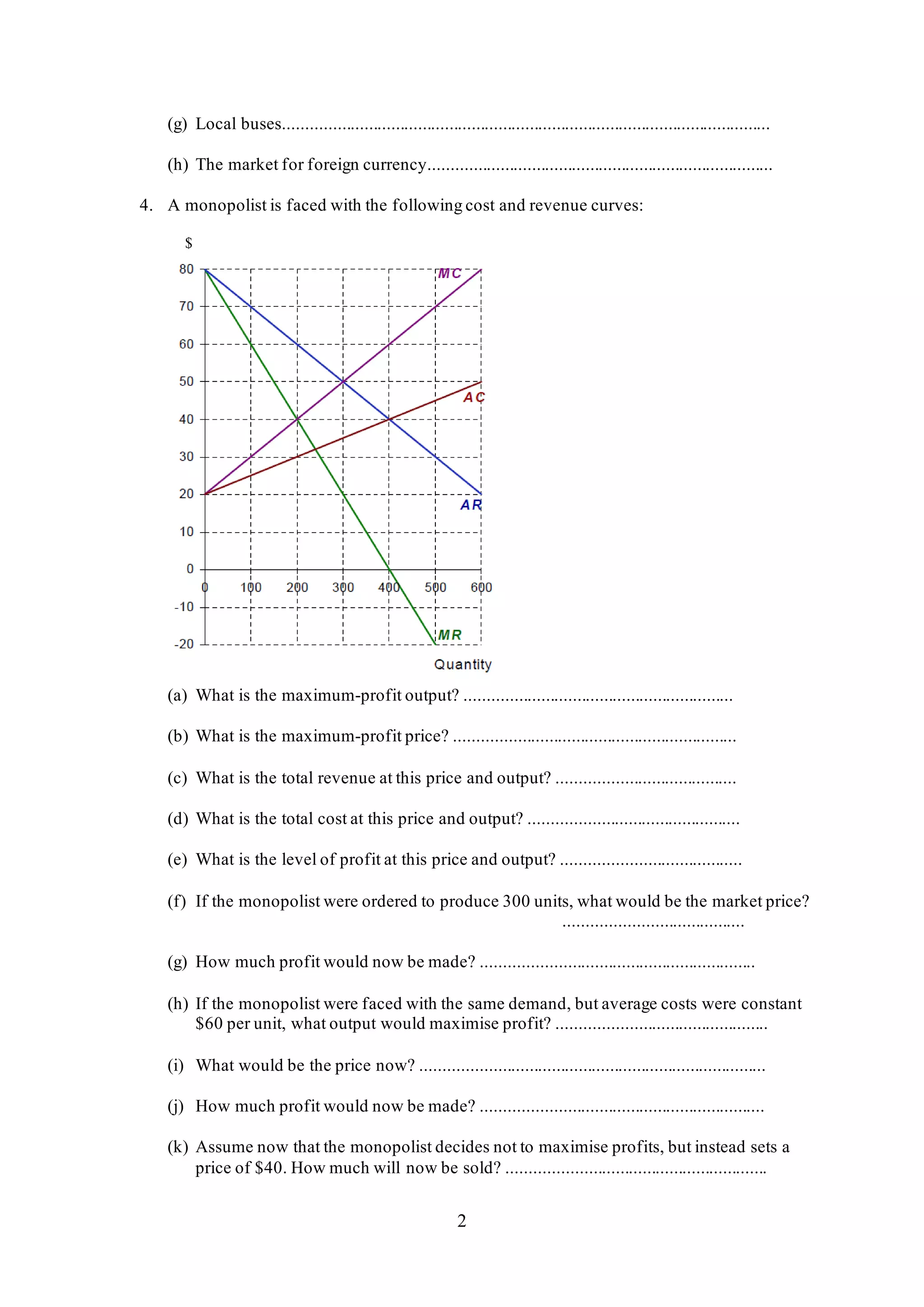
4. A monopolist is faced with the following cost and revenue curves:
(a) What is the maximum-profit output? ............................................................
(b) What is the maximum-profit price? ...............................................................
(c) What is the total revenue at this price and output? ........................................
(d) What is the total cost at this price and output? ...............................................
(e) What is the level of profit at this price and output? ........................................
(f) If the monopolist were ordered to produce 300 units, what would be the market price?
........................................
(g) How much profit would now be made? .............................................................
(h) If the monopolist were faced with the same demand, but average costs were constant
$60 per unit, what output would maximise profit? ...............................................
(i) What would be the price now? .............................................................................
(j) How much profit would now be made? ...............................................................
(k) Assume now that the monopolist decides not to maximise profits, but instead sets a
price of $40. How much will now be sold? ..........................................................
$
3
(l) What is the marginal revenue at this output? ..........................................................
(m)What does the answer to (l) indicate about total revenue at a price of $40? ...........
(n) What is the price elasticity of demand at a price of $40? (You do not need to do a
calculation to work this out: think about the relationship between MR and TR.)
..............
5. Which of the following are characteristics of oligopoly?
(a) There are just a few firms that dominate the industry. .................................... Yes / No
(b) There are few if any barriers to the entry of new firms into the industry. ....... Yes / No
(c) The firms may produce either a homogeneous or a differentiated product. .... Yes / No
(d) The firms face downward sloping demand curves. .......................................... Yes / No
(e) There is little point in advertising because there are so few firms. .................. Yes / No
(f) Oligopolists tend to take into account the actions and reactions of other firms.
Yes / No
6. Under which of the following circumstances is collusion likely to break down?
(a) There is a reduction in barriers to international trade........................................ Yes / No
(b) The market becomes more stable. .................................................................... Yes / No
(c) One of the firms develops a new cost-saving technique. ................................. Yes / No
(d) One of the firms becomes dominant in the industry. ...................................... Yes / No
(e) The number of firms in the industry decreases. ...............................................Yes / No
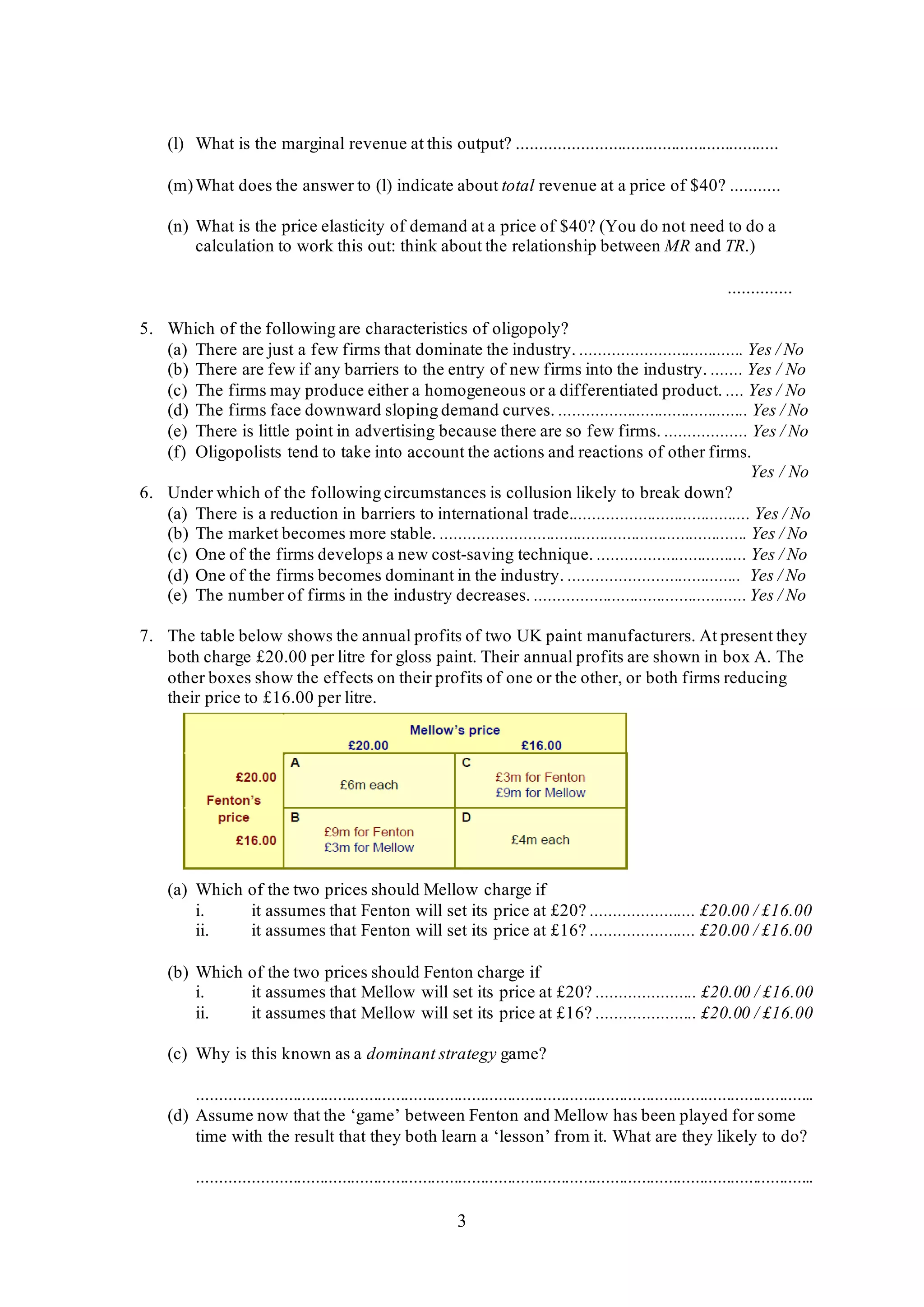
7. The table below shows the annual profits of two UK paint manufacturers. At present they
both charge £20.00 per litre for gloss paint. Their annual profits are shown in box A. The
other boxes show the effects on their profits of one or the other, or both firms reducing
their price to £16.00 per litre.
(a) Which of the two prices should Mellow charge if
i. it assumes that Fenton will set its price at £20? ....................... £20.00 / £16.00
ii. it assumes that Fenton will set its price at £16? ....................... £20.00 / £16.00
(b) Which of the two prices should Fenton charge if
i. it assumes that Mellow will set its price at £20? ...................... £20.00 / £16.00
ii. it assumes that Mellow will set its price at £16? ...................... £20.00 / £16.00
(c) Why is this known as a dominant strategy game?
..........................................................................................................................................
(d) Assume now that the ‘game’ between Fenton and Mellow has been played for some
time with the result that they both learn a ‘lesson’ from it. What are they likely to do?
..........................................................................................................................................
4
8. A fundamental criticism of the traditional theory of the firm is that the decision makers in
the firm may not even aim to maximise profits in the first place.
On which ONE of the following is this criticism based?
A. Many shareholders do not want to maximise profits.
B. Owners of firms are not ‘rational’.
C. Shareholders are not the decision makers and have different interests from them.
D. Managers prefer to maximise profits because this is usually in their own interest.
E. Shareholders are really utility maximisers.
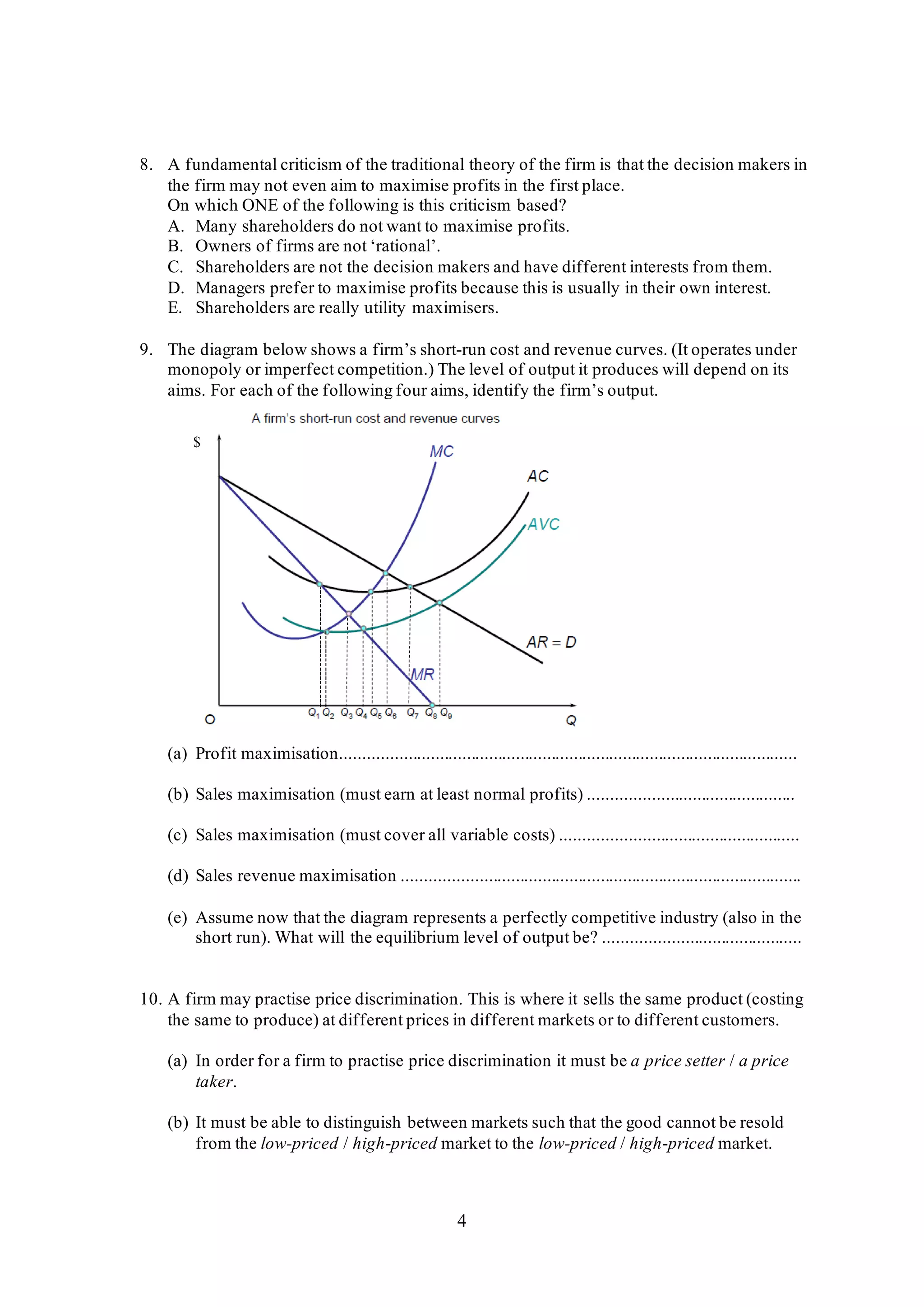
9. The diagram below shows a firm’s short-run cost and revenue curves. (It operates under
monopoly or imperfect competition.) The level of output it produces will depend on its
aims. For each of the following four aims, identify the firm’s output.
(a) Profit maximisation......................................................................................................
(b) Sales maximisation (must earn at least normal profits) ..............................................
(c) Sales maximisation (must cover all variable costs) .....................................................
(d) Sales revenue maximisation .........................................................................................
(e) Assume now that the diagram represents a perfectly competitive industry (also in the
short run). What will the equilibrium level of output be? ............................................
10. A firm may practise price discrimination. This is where it sells the same product (costing
the same to produce) at different prices in different markets or to different customers.
(a) In order for a firm to practise price discrimination it must be a price setter / a price
taker.
(b) It must be able to distinguish between markets such that the good cannot be resold
from the low-priced / high-priced market to the low-priced / high-priced market.
$
5
(c) In each market, price elasticity of demand will differ. In the low-priced market,
demand will be more elastic / less elastic than in the high-priced market.
11. Which of the following are advantages to the firm from practising price discrimination?
(a) Higher total revenue........................................................................ Yes / No / Possibly
(b) Lower costs. ....................................................................................Yes / No / Possibly
(c) Less advertising................................................................................ Yes / No / Possibly
(d) Helps to drive competitors out of business. ..................................... Yes / No / Possibly
(e) Increases sales................................................................................... Yes / No / Possibly
6
Part II: Case study
Cut Throat Competition
The UK razor market
The market for wet razors and their blades is worth approximately £400 million in the UK. It was
traditionally dominated by two producers, Gillette and Procter & Gamble, with more than two
thirds of sales between them. When they merged in 2007, the result was very substantial monopoly
power. Wilkinson Sword was the next largest manufacturer, with around 18 per cent of sales.
The market displays many of the characteristics we would expect of an oligopoly with high
levels of advertising and strong branding. There is also evidence of on-going innovation; where
once the twin-blade razor was a novelty, now five blades are the norm.
Yet, despite the barriers to entry presented by this dominance, a new player entered in 2008.
The King of Shaves razor was launched onto the market, with a view to building on the success of
the brand’s shaving gels and foams. The company, KMI, worked for five years to develop a lower-
cost, lighter-weight alternative to the products offered by Gillette and Wilkinson Sword.
It wasn’t only its design that challenged the existing companies; its approach to marketing also
differed somewhat. KMI has made much greater use of online advertising, email and social media
than the incumbent firms. It launched an iPhone app in 2011 and has a website with hundreds of
thousands of hits every month. It offers a number of innovations, such as a monthly subscription
service, halving the price of blades. It has also worked very closely with large retailers on special
offers from launch onwards, sacrificing early profits to build market share.
KMI’s stated intention was to take 25 per cent of market share within five years of launch.
This was described as highly ambitious by commentators at the time and proved to be the case. In
that period it had to spend over £1m in legal fights over patents, and suffered an abortive launch
in the USA.
By the end of 2013, Gillette had an 84 per cent share of the UK market for razors, whilst KMI
had just 3 per cent, with sales of around £10 million. It did, however, have 9 per cent of the shaving
products market, reflecting its origins in gels and foams. Given that, it is perhaps surprising that in
January 2014 it announced that its new foam-free Hyperblade was to be launched.
It has proved tough to break Gillette’s monopoly power, but KMI is not giving up yet.
Questions:
1. What are the characteristics of the razor market that presentbarriers to entry fornew firms?
How has KMI sought to overcome these?
2. High levels of innovation have been seen in the markets for wet razors. Does this always
benefit consumer?
3. It has been estimated that Gillette makes a profit of 3000 per cent on each razor blade sold.
Explain how this figure might have arisen.

week 5 question S1 2022(1).pdf

  • 1.
    1 Workshop Questions forWeek 5 Part I: Short answer questions 1. It is usual to divide markets into four categories. In ascending order of competitiveness these are (fill in the missing three): 1. Monopoly 2. ................... 3. ................... 4. ................... 2. To which of the above four categories do the following apply to the member firms? (There can be more than one market category in each case.) (a) Firms face a downward sloping demand curve. ......................................................... (b) New firms can freely enter the industry. .................................................................... (c) Firms produce a homogeneous product. ..................................................................... (d) Firms are price takers. ................................................................................................. (e) Firms face an elastic demand (but less than infinity) at the profit-maximising output. .......................................................................................................................... (f) Firms will produce where MR = MC if they wish to maximise profits. ...................... (g) There is perfect knowledge on the part of consumers of price and product quality. ......................................................................................................................... 3. In which of the four categories would you place each of the following? (It is possible in some cases that part of the industry could be in one category and part in another: if so name both.) (a) A village post office.................................................................................................. (b) Restaurants in large town.......................................................................................... (c) Banks......................................................................................................................... (d) Hi-fi manufacturers................................................................................................... (e) Producers of barley................................................................................................... (f) Water supply.............................................................................................................
  • 2.
    2 (g) Local buses............................................................................................................. (h)The market for foreign currency............................................................................. 4. A monopolist is faced with the following cost and revenue curves: (a) What is the maximum-profit output? ............................................................ (b) What is the maximum-profit price? ............................................................... (c) What is the total revenue at this price and output? ........................................ (d) What is the total cost at this price and output? ............................................... (e) What is the level of profit at this price and output? ........................................ (f) If the monopolist were ordered to produce 300 units, what would be the market price? ........................................ (g) How much profit would now be made? ............................................................. (h) If the monopolist were faced with the same demand, but average costs were constant $60 per unit, what output would maximise profit? ............................................... (i) What would be the price now? ............................................................................. (j) How much profit would now be made? ............................................................... (k) Assume now that the monopolist decides not to maximise profits, but instead sets a price of $40. How much will now be sold? .......................................................... $
  • 3.
    3 (l) What isthe marginal revenue at this output? .......................................................... (m)What does the answer to (l) indicate about total revenue at a price of $40? ........... (n) What is the price elasticity of demand at a price of $40? (You do not need to do a calculation to work this out: think about the relationship between MR and TR.) .............. 5. Which of the following are characteristics of oligopoly? (a) There are just a few firms that dominate the industry. .................................... Yes / No (b) There are few if any barriers to the entry of new firms into the industry. ....... Yes / No (c) The firms may produce either a homogeneous or a differentiated product. .... Yes / No (d) The firms face downward sloping demand curves. .......................................... Yes / No (e) There is little point in advertising because there are so few firms. .................. Yes / No (f) Oligopolists tend to take into account the actions and reactions of other firms. Yes / No 6. Under which of the following circumstances is collusion likely to break down? (a) There is a reduction in barriers to international trade........................................ Yes / No (b) The market becomes more stable. .................................................................... Yes / No (c) One of the firms develops a new cost-saving technique. ................................. Yes / No (d) One of the firms becomes dominant in the industry. ...................................... Yes / No (e) The number of firms in the industry decreases. ...............................................Yes / No 7. The table below shows the annual profits of two UK paint manufacturers. At present they both charge £20.00 per litre for gloss paint. Their annual profits are shown in box A. The other boxes show the effects on their profits of one or the other, or both firms reducing their price to £16.00 per litre. (a) Which of the two prices should Mellow charge if i. it assumes that Fenton will set its price at £20? ....................... £20.00 / £16.00 ii. it assumes that Fenton will set its price at £16? ....................... £20.00 / £16.00 (b) Which of the two prices should Fenton charge if i. it assumes that Mellow will set its price at £20? ...................... £20.00 / £16.00 ii. it assumes that Mellow will set its price at £16? ...................... £20.00 / £16.00 (c) Why is this known as a dominant strategy game? .......................................................................................................................................... (d) Assume now that the ‘game’ between Fenton and Mellow has been played for some time with the result that they both learn a ‘lesson’ from it. What are they likely to do? ..........................................................................................................................................
  • 4.
    4 8. A fundamentalcriticism of the traditional theory of the firm is that the decision makers in the firm may not even aim to maximise profits in the first place. On which ONE of the following is this criticism based? A. Many shareholders do not want to maximise profits. B. Owners of firms are not ‘rational’. C. Shareholders are not the decision makers and have different interests from them. D. Managers prefer to maximise profits because this is usually in their own interest. E. Shareholders are really utility maximisers. 9. The diagram below shows a firm’s short-run cost and revenue curves. (It operates under monopoly or imperfect competition.) The level of output it produces will depend on its aims. For each of the following four aims, identify the firm’s output. (a) Profit maximisation...................................................................................................... (b) Sales maximisation (must earn at least normal profits) .............................................. (c) Sales maximisation (must cover all variable costs) ..................................................... (d) Sales revenue maximisation ......................................................................................... (e) Assume now that the diagram represents a perfectly competitive industry (also in the short run). What will the equilibrium level of output be? ............................................ 10. A firm may practise price discrimination. This is where it sells the same product (costing the same to produce) at different prices in different markets or to different customers. (a) In order for a firm to practise price discrimination it must be a price setter / a price taker. (b) It must be able to distinguish between markets such that the good cannot be resold from the low-priced / high-priced market to the low-priced / high-priced market. $
  • 5.
    5 (c) In eachmarket, price elasticity of demand will differ. In the low-priced market, demand will be more elastic / less elastic than in the high-priced market. 11. Which of the following are advantages to the firm from practising price discrimination? (a) Higher total revenue........................................................................ Yes / No / Possibly (b) Lower costs. ....................................................................................Yes / No / Possibly (c) Less advertising................................................................................ Yes / No / Possibly (d) Helps to drive competitors out of business. ..................................... Yes / No / Possibly (e) Increases sales................................................................................... Yes / No / Possibly
  • 6.
    6 Part II: Casestudy Cut Throat Competition The UK razor market The market for wet razors and their blades is worth approximately £400 million in the UK. It was traditionally dominated by two producers, Gillette and Procter & Gamble, with more than two thirds of sales between them. When they merged in 2007, the result was very substantial monopoly power. Wilkinson Sword was the next largest manufacturer, with around 18 per cent of sales. The market displays many of the characteristics we would expect of an oligopoly with high levels of advertising and strong branding. There is also evidence of on-going innovation; where once the twin-blade razor was a novelty, now five blades are the norm. Yet, despite the barriers to entry presented by this dominance, a new player entered in 2008. The King of Shaves razor was launched onto the market, with a view to building on the success of the brand’s shaving gels and foams. The company, KMI, worked for five years to develop a lower- cost, lighter-weight alternative to the products offered by Gillette and Wilkinson Sword. It wasn’t only its design that challenged the existing companies; its approach to marketing also differed somewhat. KMI has made much greater use of online advertising, email and social media than the incumbent firms. It launched an iPhone app in 2011 and has a website with hundreds of thousands of hits every month. It offers a number of innovations, such as a monthly subscription service, halving the price of blades. It has also worked very closely with large retailers on special offers from launch onwards, sacrificing early profits to build market share. KMI’s stated intention was to take 25 per cent of market share within five years of launch. This was described as highly ambitious by commentators at the time and proved to be the case. In that period it had to spend over £1m in legal fights over patents, and suffered an abortive launch in the USA. By the end of 2013, Gillette had an 84 per cent share of the UK market for razors, whilst KMI had just 3 per cent, with sales of around £10 million. It did, however, have 9 per cent of the shaving products market, reflecting its origins in gels and foams. Given that, it is perhaps surprising that in January 2014 it announced that its new foam-free Hyperblade was to be launched. It has proved tough to break Gillette’s monopoly power, but KMI is not giving up yet. Questions: 1. What are the characteristics of the razor market that presentbarriers to entry fornew firms? How has KMI sought to overcome these? 2. High levels of innovation have been seen in the markets for wet razors. Does this always benefit consumer? 3. It has been estimated that Gillette makes a profit of 3000 per cent on each razor blade sold. Explain how this figure might have arisen.