Where do
research ideas
comefrom?
• Choosing a research topic is starting point and most exciting.
• —-choose something that will sustain your interest throughout the
months that you will need to complete it
• —-You need to have at least some idea of what you want to do
• —-being clear about this will ensure your ability to choose the
most appropriate research strategy and analysis techniques.
4.
• From theory?
•From imagination?
• From context?
• The most important thing is to find the
problem within the context
• -limitations of previous studies?
• -new context? Developing new measurements?
• -borrowing from other disciplines?
• -highlight how your research will extend our
understanding of the interested phenomenon.
5.
Some Commonly
Researched
Areas in
Business
•Employeebehaviors such as performance, absenteeism, and
turnover.
•Employee attitudes such as job satisfaction, loyalty, and
organizational commitment.
•
Supervisory performance, managerial leadership style, and
performance appraisal systems.
•Employee selection, recruitment, training, and retention.
•
Validation of performance appraisal systems.
•
Human resource management choices and organizational
strategy.
•
The dynamics of rating and rating errors in the judgment of
human performance.
Strategy formulation and implementation
6.
Some Commonly
Researched
Areas in
Marketing
•Cross-Cultural Marketing
• Researching how cultural differences impact marketing
strategies and consumer behavior in a global market.
• Sustainability and Green Marketing
• Investigating how environmental concerns influence consumer
preferences and the marketing of eco-friendly products.
• Branding and Brand Equity
• Exploring how brands are built, maintained, and perceived, as
well as the value a brand adds to a product or service.
• Digital Marketing
• Investigating strategies related to online marketing, social
media, search engine optimization (SEO), and digital
advertising.
• Consumer Behavior
• Understanding how consumers make purchasing decisions,
including psychological, social, and cultural factors that
influence behavior.
• Ethics and Social Responsibility in Marketing
• Exploring the ethical implications of marketing practices and
the importance of corporate social responsibility.
Think about yourown interests, strengths,
future career path and desires…
• Your interest: football and part-time working at the football club
• Strengths : marketing
• Ideas on future career path : sports goods manufacturer
• Research idea: some aspects of marketing, preferably linked to
football club
• Brainstorming
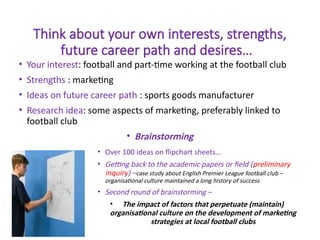
• Over 100 ideas on flipchart sheets…
• Getting back to the academic papers or field (preliminary
inquiry) –case study about English Premier League football club –
organisational culture maintained a long history of success
• Second round of brainstorming –
• The impact of factors that perpetuate (maintain)
organisational culture on the development of marketing
strategies at local football clubs
9.
Example: Relevance Treefor Consumer Behavior- Purchasing
Intention
• Factors Influencing
Purchasing Intention
• Psychological Factors
• Social Factors
• Cultural Factors
• Economic Factors
• Types of Products
• Eco-Friendly Products
• Luxury Products
• Necessity Items
• Impulse Purchases
• Consumer Segmentation
• Demographics (age, gender, income)
• Psychographics (lifestyle, values, attitudes)
• Behavioral Segmentation (purchase
frequency, brand loyalty)
• Purchase Decision Process
• Problem Recognition
• Information Search
• Evaluation of Alternatives
• Purchase Decision
• Post-Purchase Behavior
Main Branches:
E.g. "How do psychological factors influence the purchasing
intention of eco-friendly products among millennials?"
10.
Evaluate your
research topic:
Attributesof a
good research
topic (I)
• Capability: Is it feasible?
• Are you fascinated by the topic?
• Do you have the necessary research skills?
• Can you complete the project in the time available?
• Will the research still be current when you finish?
• Do you have sufficient financial or other resources?
• Will you be able to access to data?
Saunders et al. 2016
11.
Evaluate your
research topic:
Attributesof a
good research
topic (II)
• Appropriateness: Is it worthwhile?
• Will the examining institute's standards be met?
• Does the topic contain issues with clear links the theory?
• Are the research questions and objectives clearly stated?
• Will the proposed research provide fresh insights into the
topic?
• Are the findings likely to be symmetrical?
• Does the research topic match your career goals?
Saunders et al. 2016
12.
The RQ donot require a binary (yes/no) or numerical response
There are no pronouns such as you, they, we, us, etc. in the RQs
The RQs are broad enough to guide the entire study
The purpose statement explains how the RQs will be answered
Each RQ is answerable by the methodological tools available to
you.
The Independent Variable(s) (IV) and the Dependent Variable(s)
(DV) are delineated as is the relationship between them
(Durkheim, 1999)
Characteristics of good RQs
13.
Characteristics of goodRQs
The research questions should be well grounded in current
theoretical and empirical knowledge (the researcher should
know the current and germinal literature).
In quantitative studies the RQs should be amenable to the
formulation of clear hypotheses and operational definitions
The answer to the research questions should be important
in terms of theory and application (usually weighted toward
one) –Address to theoretical gap!!
(Durkheim, 1999)
14.
Example on
theoretical
gap statement
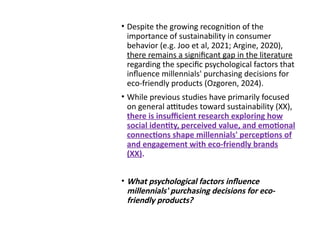
•Despite the growing recognition of the
importance of sustainability in consumer
behavior (e.g. Joo et al, 2021; Argine, 2020),
there remains a significant gap in the literature
regarding the specific psychological factors that
influence millennials' purchasing decisions for
eco-friendly products (Ozgoren, 2024).
• While previous studies have primarily focused
on general attitudes toward sustainability (XX),
there is insufficient research exploring how
social identity, perceived value, and emotional
connections shape millennials' perceptions of
and engagement with eco-friendly brands
(XX).
• What psychological factors influence
millennials' purchasing decisions for eco-
friendly products?
15.
Examples of well-definedresearch questions
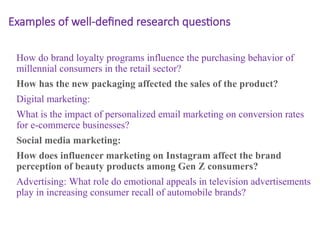
How do brand loyalty programs influence the purchasing behavior of
millennial consumers in the retail sector?
How has the new packaging affected the sales of the product?
Digital marketing:
What is the impact of personalized email marketing on conversion rates
for e-commerce businesses?
Social media marketing:
How does influencer marketing on Instagram affect the brand
perception of beauty products among Gen Z consumers?
Advertising: What role do emotional appeals in television advertisements
play in increasing consumer recall of automobile brands?
16.
RQ: How dobrand loyalty programs influence
the purchasing behavior of millennial consumers
in the retail sector?
17.
Difference of researchquestion, research aim and research objectives?
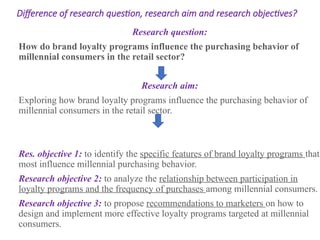
Research question:
How do brand loyalty programs influence the purchasing behavior of
millennial consumers in the retail sector?
Research aim:
Exploring how brand loyalty programs influence the purchasing behavior of
millennial consumers in the retail sector.
Res. objective 1: to identify the specific features of brand loyalty programs that
most influence millennial purchasing behavior.
Research objective 2: to analyze the relationship between participation in
loyalty programs and the frequency of purchases among millennial consumers.
Research objective 3: to propose recommendations to marketers on how to
design and implement more effective loyalty programs targeted at millennial
consumers.
18.
Difference of researchquestion, research aim
and research objectives?
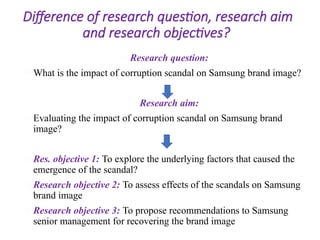
Research question:
What is the impact of corruption scandal on Samsung brand image?
Research aim:
Evaluating the impact of corruption scandal on Samsung brand
image?
Res. objective 1: To explore the underlying factors that caused the
emergence of the scandal?
Research objective 2: To assess effects of the scandals on Samsung
brand image
Research objective 3: To propose recommendations to Samsung
senior management for recovering the brand image
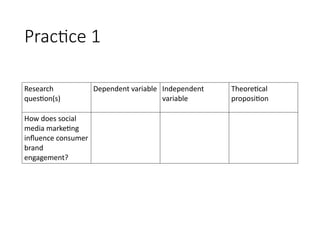
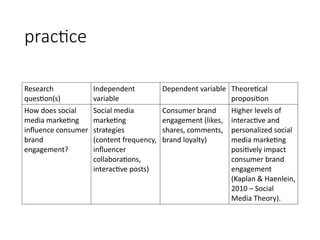
practice
Research
question(s)
Independent
variable
Dependent variable Theoretical
proposition
Howdoes social
media marketing
influence consumer
brand
engagement?
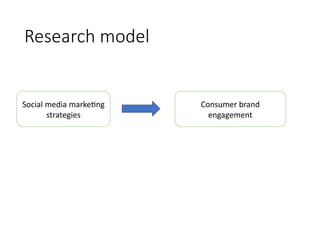
Social media
marketing
strategies
(content frequency,
influencer
collaborations,
interactive posts)
Consumer brand
engagement (likes,
shares, comments,
brand loyalty)
Higher levels of
interactive and
personalized social
media marketing
positively impact
consumer brand
engagement
(Kaplan & Haenlein,
2010 – Social
Media Theory).
23.
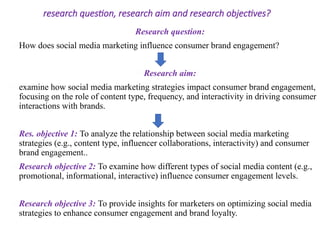
research question, researchaim and research objectives?
Research question:
How does social media marketing influence consumer brand engagement?
Research aim:
examine how social media marketing strategies impact consumer brand engagement,
focusing on the role of content type, frequency, and interactivity in driving consumer
interactions with brands.
Res. objective 1: To analyze the relationship between social media marketing
strategies (e.g., content type, influencer collaborations, interactivity) and consumer
brand engagement..
Research objective 2: To examine how different types of social media content (e.g.,
promotional, informational, interactive) influence consumer engagement levels.
Research objective 3: To provide insights for marketers on optimizing social media
strategies to enhance consumer engagement and brand loyalty.
research question, researchaim and research objectives?
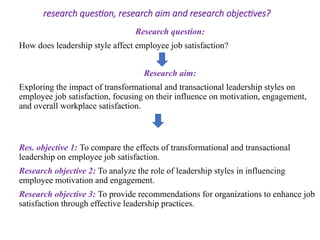
Research question:
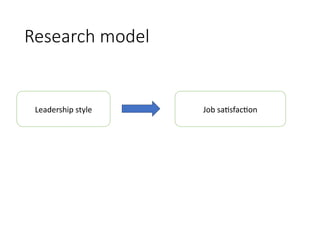
How does leadership style affect employee job satisfaction?
Research aim:
Exploring the impact of transformational and transactional leadership styles on
employee job satisfaction, focusing on their influence on motivation, engagement,
and overall workplace satisfaction.
Res. objective 1: To compare the effects of transformational and transactional
leadership on employee job satisfaction.
Research objective 2: To analyze the role of leadership styles in influencing
employee motivation and engagement.
Research objective 3: To provide recommendations for organizations to enhance job
satisfaction through effective leadership practices.
28.
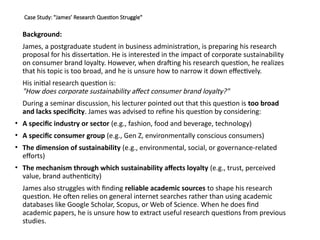
Case Study: "James’Research Question Struggle"
Background:
James, a postgraduate student in business administration, is preparing his research
proposal for his dissertation. He is interested in the impact of corporate sustainability
on consumer brand loyalty. However, when drafting his research question, he realizes
that his topic is too broad, and he is unsure how to narrow it down effectively.
His initial research question is:
"How does corporate sustainability affect consumer brand loyalty?"
During a seminar discussion, his lecturer pointed out that this question is too broad
and lacks specificity. James was advised to refine his question by considering:
• A specific industry or sector (e.g., fashion, food and beverage, technology)
• A specific consumer group (e.g., Gen Z, environmentally conscious consumers)
• The dimension of sustainability (e.g., environmental, social, or governance-related
efforts)
• The mechanism through which sustainability affects loyalty (e.g., trust, perceived
value, brand authenticity)
James also struggles with finding reliable academic sources to shape his research
question. He often relies on general internet searches rather than using academic
databases like Google Scholar, Scopus, or Web of Science. When he does find
academic papers, he is unsure how to extract useful research questions from previous
studies.
29.
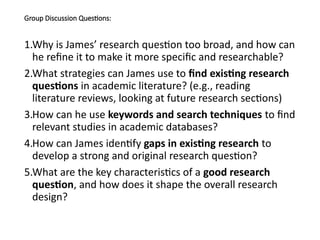
Group Discussion Questions:
1.Whyis James’ research question too broad, and how can
he refine it to make it more specific and researchable?
2.What strategies can James use to find existing research
questions in academic literature? (e.g., reading
literature reviews, looking at future research sections)
3.How can he use keywords and search techniques to find
relevant studies in academic databases?
4.How can James identify gaps in existing research to
develop a strong and original research question?
5.What are the key characteristics of a good research
question, and how does it shape the overall research
design?
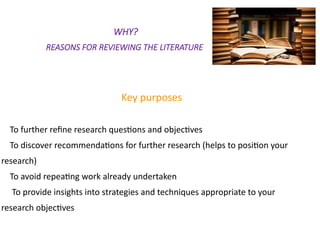
WHY?
REASONS FOR REVIEWINGTHE LITERATURE
Key purposes
To further refine research questions and objectives
To discover recommendations for further research (helps to position your
research)
To avoid repeating work already undertaken
To provide insights into strategies and techniques appropriate to your
research objectives
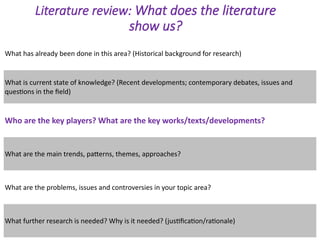
32.
Literature review: Whatdoes the literature
show us?
What has already been done in this area? (Historical background for research)
What is current state of knowledge? (Recent developments; contemporary debates, issues and
questions in the field)
Who are the key players? What are the key works/texts/developments?
What are the main trends, patterns, themes, approaches?
What are the problems, issues and controversies in your topic area?
What further research is needed? Why is it needed? (justification/rationale)
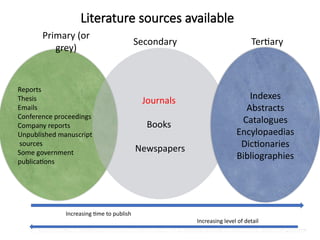
33.
Literature sources available
Reports
Thesis
Emails
Conferenceproceedings
Company reports
Unpublished manuscript
sources
Some government
publications
Journals
Books
Newspapers
Indexes
Abstracts
Catalogues
Encylopaedias
Dictionaries
Bibliographies
Primary (or
grey)
Secondary Tertiary
Increasing time to publish
Increasing level of detail
34.
How to accessliterature?
Check data bases from University account, ask librarian for help (write proQuest
thesis to university`s data base)
BAU library!!!
Check cited by list in Google Scholar
Check dissertations from your department, YOKSIS
How much literature do I need to know?
Feeling overwhelmed!!!
35.
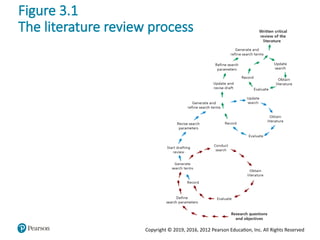
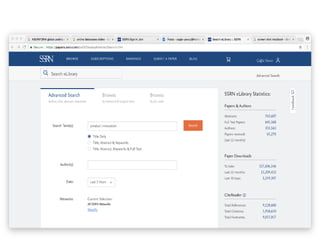
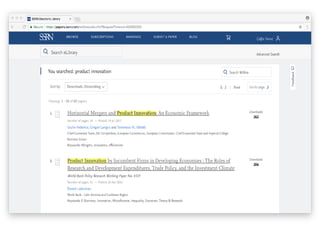
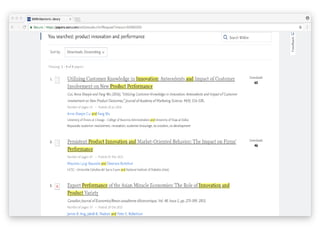
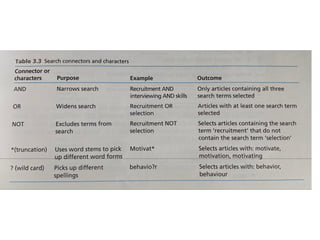
THE LITERATURE SEARCHSTRATEGY
parameters of your search (e.g. Language of publication, subject area,
geographical area, publication period, literature type)
key words and search terms to be used
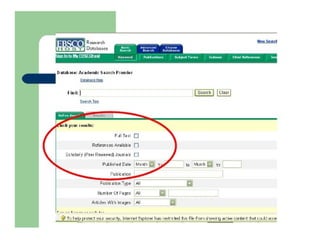
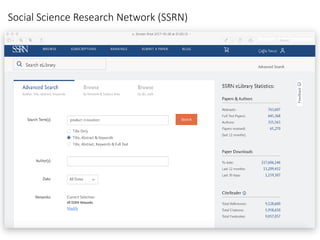
databases and search engines to be used
criteria for selection of relevant and useful studies
And Discuss these with a tutor (if possible)
How do Iknow that which journal
articles are methodologically
rigour?
Check ABS list!
45.
1. Assignment (handedby Week 4):
Search for databases in your field
of research and answer the
following questions:
• 1-Which databases would you
search for in your literature
review?
• 2-What are the best ranked
journals in your field of research,
how to access them?
46.
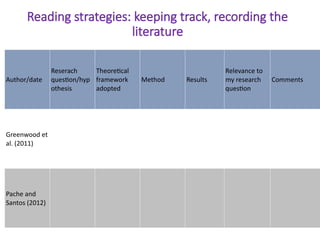
Reading strategies: keepingtrack, recording the
literature
Author/date
Reserach
question/hyp
othesis
Theoretical
framework
adopted
Method Results
Relevance to
my research
question
Comments
Greenwood et
al. (2011)
Pache and
Santos (2012)
47.
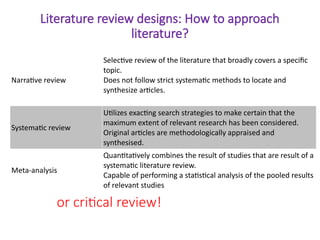
Literature review designs:How to approach
literature?
Narrative review
Selective review of the literature that broadly covers a specific
topic.
Does not follow strict systematic methods to locate and
synthesize articles.
Systematic review
Utilizes exacting search strategies to make certain that the
maximum extent of relevant research has been considered.
Original articles are methodologically appraised and
synthesised.
Meta-analysis
Quantitatively combines the result of studies that are result of a
systematic literature review.
Capable of performing a statistical analysis of the pooled results
of relevant studies
or critical review!
ADOPTING A CRITICALPERSPECTIVE (1) Where to start?
Have a rough idea before reading texts and then preview!
Annotate!
Summarize!
Compare and contrast!
50.
Five questions toemploy in critical reading:
Questions to ask yourself
Why am I reading this?
What is the author trying to do in writing this?
How convincing is this?
What use can I make of this reading?
51.
What renders yourliterature review critical?
(1) Identifies and includes the most relevant and significant research to the topic
(2) Identifies recognised experts (KEY ACADEMIC THEORIES)
(3) Includes research that has been published since the start of the project (RECENT
LITERATURE)
(4) Contextualises and justifies your aim(s) and objective(s)
(5) Discusses and evaluates research (DEMONSTRATE THAT YOU HAVE READ,
UNDERSTOOD AND EVALUATED) ,Distinguishes between fact and opinion
(6) Consider and discuss research that supports and opposes your ideas
(7) Justifies points made logically with valid evidence
(8) References all sources fully
52.
Avoid these traps
Tryingto read everything: try to read most relevant work
instead
Reading but not writing: writing is a way of thinking…write
many drafts
Failing to keep bibliographic information: Remember that
you will be writing a page entitled ‘References’ at some
point
Organizing your review chronologically: Organize your
paper by ideas!
53.
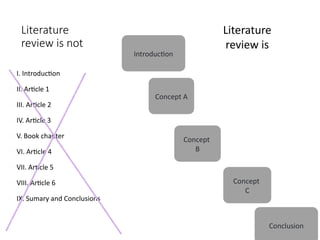
Literature
review is not
I.Introduction
II. Article 1
III. Article 2
IV. Article 3
V. Book chapter
VI. Article 4
VII. Article 5
VIII. Article 6
IX. Sumary and Conclusions
Literature
review is
Concept A
Concept
B
Concept
C
Introduction
Conclusion
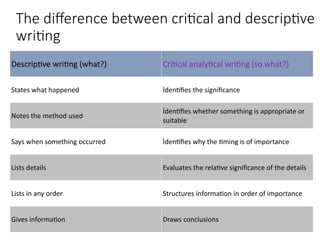
The difference betweencritical and descriptive
writing
Descriptive writing (what?) Critical analytical writing (so what?)
States what happened İdentifies the significance
Notes the method used
İdentifies whether something is appropriate or
suitable
Says when something occurred İdentifies why the timing is of importance
Lists details Evaluates the relative significance of the details
Lists in any order Structures information in order of importance
Gives information Draws conclusions
56.
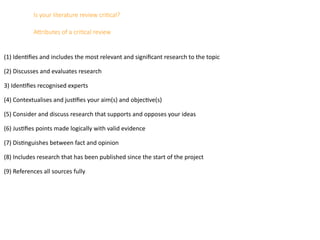
Is your literaturereview critical?
Attributes of a critical review
(1) Identifies and includes the most relevant and significant research to the topic
(2) Discusses and evaluates research
3) Identifies recognised experts
(4) Contextualises and justifies your aim(s) and objective(s)
(5) Consider and discuss research that supports and opposes your ideas
(6) Justifies points made logically with valid evidence
(7) Distinguishes between fact and opinion
(8) Includes research that has been published since the start of the project
(9) References all sources fully
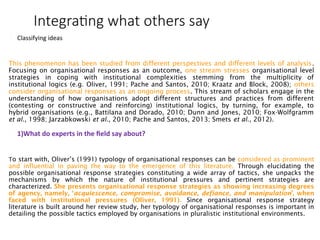
Integrating what otherssay
Classifying ideas
This phenomenon has been studied from different perspectives and different levels of analysis.
Focusing on organisational responses as an outcome, one stream stresses organisational level
strategies in coping with institutional complexities stemming from the multiplicity of
institutional logics (e.g. Oliver, 1991; Pache and Santos, 2010; Kraatz and Block, 2008); others
consider organisational responses as an ongoing process. This stream of scholars engage in the
understanding of how organisations adopt different structures and practices from different
(contesting or constructive and reinforcing) institutional logics, by turning, for example, to
hybrid organisations (e.g., Battilana and Dorado, 2010; Dunn and Jones, 2010; Fox-Wolfgramm
et al., 1998; Jarzabkowski et al., 2010; Pache and Santos, 2013; Smets et al., 2012).
1)What do experts in the field say about?
To start with, Oliver’s (1991) typology of organisational responses can be considered as prominent
and influential in paving the way to the emergence of this literature. Through elucidating the
possible organisational response strategies constituting a wide array of tactics, she unpacks the
mechanisms by which the nature of institutional pressures and pertinent strategies are
characterized. She presents organisational response strategies as showing increasing degrees
of agency, namely, ‘acquiescence, compromise, avoidance, defiance, and manipulation’, when
faced with institutional pressures (Oliver, 1991). Since organisational response strategy
literature is built around her review study, her typology of organisational responses is important in
detailing the possible tactics employed by organisations in pluralistic institutional environments.
59.
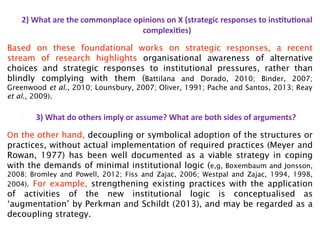
2) What arethe commonplace opinions on X (strategic responses to institutional
complexities)
Based on these foundational works on strategic responses, a recent
stream of research highlights organisational awareness of alternative
choices and strategic responses to institutional pressures, rather than
blindly complying with them (Battilana and Dorado, 2010; Binder, 2007;
Greenwood et al., 2010; Lounsbury, 2007; Oliver, 1991; Pache and Santos, 2013; Reay
et al., 2009).
3) What do others imply or assume? What are both sides of arguments?
On the other hand, decoupling or symbolical adoption of the structures or
practices, without actual implementation of required practices (Meyer and
Rowan, 1977) has been well documented as a viable strategy in coping
with the demands of minimal institutional logic (e,g, Boxembaum and Jonsson,
2008; Bromley and Powell, 2012; Fiss and Zajac, 2006; Westpal and Zajac, 1994, 1998,
2004). For example, strengthening existing practices with the application
of activities of the new institutional logic is conceptualised as
‘augmentation’ by Perkman and Schildt (2013), and may be regarded as a
decoupling strategy.
60.
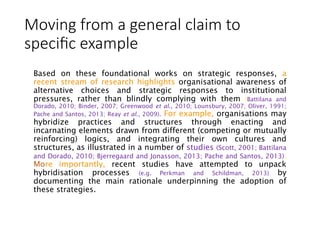
Moving from ageneral claim to
specific example
Based on these foundational works on strategic responses, a
recent stream of research highlights organisational awareness of
alternative choices and strategic responses to institutional
pressures, rather than blindly complying with them (Battilana and
Dorado, 2010; Binder, 2007; Greenwood et al., 2010; Lounsbury, 2007; Oliver, 1991;
Pache and Santos, 2013; Reay et al., 2009). For example, organisations may
hybridize practices and structures through enacting and
incarnating elements drawn from different (competing or mutually
reinforcing) logics, and integrating their own cultures and
structures, as illustrated in a number of studies (Scott, 2001; Battilana
and Dorado, 2010; Bjerregaard and Jonasson, 2013; Pache and Santos, 2013).
More importantly, recent studies have attempted to unpack
hybridisation processes (e.g. Perkman and Schildman, 2013) by
documenting the main rationale underpinning the adoption of
these strategies.
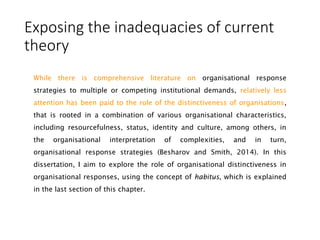
61.
Exposing the inadequaciesof current
theory
While there is comprehensive literature on organisational response
strategies to multiple or competing institutional demands, relatively less
attention has been paid to the role of the distinctiveness of organisations,
that is rooted in a combination of various organisational characteristics,
including resourcefulness, status, identity and culture, among others, in
the organisational interpretation of complexities, and in turn,
organisational response strategies (Besharov and Smith, 2014). In this
dissertation, I aim to explore the role of organisational distinctiveness in
organisational responses, using the concept of habitus, which is explained
in the last section of this chapter.
62.
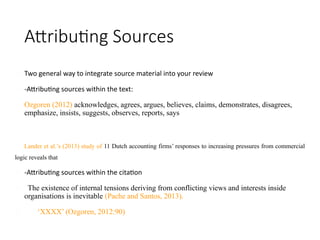
Attributing Sources
Two generalway to integrate source material into your review
-Attributing sources within the text:
Ozgoren (2012) acknowledges, agrees, argues, believes, claims, demonstrates, disagrees,
emphasize, insists, suggests, observes, reports, says
Lander et al.’s (2013) study of 11 Dutch accounting firms’ responses to increasing pressures from commercial
logic reveals that
-Attributing sources within the citation
The existence of internal tensions deriving from conflicting views and interests inside
organisations is inevitable (Pache and Santos, 2013).
‘XXXX’ (Ozgoren, 2012:90)
63.
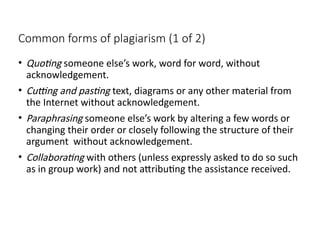
Common forms ofplagiarism (1 of 2)
• Quoting someone else’s work, word for word, without
acknowledgement.
• Cutting and pasting text, diagrams or any other material from
the Internet without acknowledgement.
• Paraphrasing someone else’s work by altering a few words or
changing their order or closely following the structure of their
argument without acknowledgement.
• Collaborating with others (unless expressly asked to do so such
as in group work) and not attributing the assistance received.
Editor's Notes
#56
(1) Identifies and includes the most relevant and significant research to the topic
In considering the content of our critical review, we need to be aware of the key academic theories within our chosen topic that are pertinent to or contextualise our research. Whilst we should have read the literature that is closely related to our research aim(s) and objective(s), that which is less closely related is more likely to cause us problems (Gall, Gall & Borg, 2006). For some research topics, particularly new research areas, there is unlikely to be much closely related literature and so we will have to review more broadly. For other topics where research has been undertaken over a number of years we may be able to focus on more closely related literature (Saunders et al., 2009).
It is, however, impossible to review every single piece of the literature. Fortunately, the purpose of the literature review is not to provide a summary of everything that has been written on the research topic, but to review the most relevant and significant research relating to our topic. If our review is effective, clear gaps in what is known will be identified that have not been researched previously (Corbin & Strauss, 2008). Discussing and explaining these will provide the academic context for our research, also allowing us to show how our findings and theories relate to earlier research.
Assessing the relevance of the literature in relation to our research depends on our aim(s) and objective(s). Initially we will be looking for relevance to the topic, not critically assessing the ideas contained within. When doing this, it helps to have thought about criteria for assessing the relevance of each item of literature. In contrast, assessing the value of literature is concerned with its theoretical and methodological rigour (Hodgkinson, Herriot & Anderson, 2001). Where we think ideas, arguments or research findings reported are unclear, biased or inconsistent with other work and need to be researched further, we need to justify why. This is not easy and requires careful thought and clear argument.
(2) Discusses and evaluates research
A common mistake with critical literature reviews is that they become uncritical listings or catalogues of previous research (Saunders & Lewis, 2011). Often they are little more than annotated bibliographies (Hart, 1998), individual items being selected because they fit with what the researcher is proposing (Greenhalgh, 1997). It is, however, not the purpose of a critical review to just describe what each author has written, one author after another. Rather, as we begin to read and evaluate the literature, we need to think how to combine the academic theories and ideas thematically to form the critical review. This review will need to evaluate research that has already been undertaken in the area of the study, show and explain the relationships between published research findings and reference the literature in which they were reported.
Sometimes we may be highly critical of the earlier research reported in the literature and seek to question or revise it through our research. However, we must still review this research, explain clearly why we consider it requires revision and justify our own ideas through clear argument and with reference to literature.
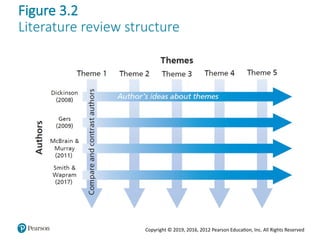
In discussing and evaluating the literature, the precise structure we use will depend on the research aim(s) and objective(s). It is helpful to think of our review as a thematic funnel in which we first provide a general overview of the key themes and ideas before narrowing down to our research aim(s) and objective(s). We then need to discuss each theme in turn comparing and contrasting what different authors say about them. As we compare and contrast researchers’ findings about each theme, we are writing critically (Saunders & Lewis, 2011).
(3) Identifies recognised experts
As we have mentioned, it is impossible to read everything. Yet we need to be sure that the critical review discusses the key research already undertaken and that we have positioned our study clearly within the wider context. This will inevitably mean being able to identify the relevant and significant theories and recognised experts in relation to the topic. For some research topics there will be a pre-existing, clearly developed theoretical base. For others we will need to integrate a number of different theoretical strands to develop our understanding.
(4) Contextualises and justifies your aim(s) and objective(s)
Creswell (2007) highlights three ways in which researchers use the literature. Firstly, they use it to explicitly frame their research aim(s) in the initial stages of the research. Secondly, they use it to provide the context and theoretical framework for the research and, finally, to help place the research findings within the wider body of knowledge. For the purposes of the critical review, the second of these ‘ways’ is crucial. To contextualise and justify our research aim(s) and objective(s), we need to integrate the different ideas from the literature to form a coherent and cohesive argument. However, it is worth remembering that the literature we read for our review should also inform our methodology, being referenced as appropriate. Similarly we will need to refer back to the literature when discussing our findings.
(5) Consider and discuss research that supports and opposes your ideas
Having identified research that is relevant to our study, we should be able to provide a reasonably detailed, constructively critical analysis of the key literature that relates to the aim(s) and objective(s). Within this we need to include research that corroborates our ideas, showing clear links from these supporting publications to the empirical work that will follow. It is also necessary to include and discuss research that is counter to our opinions. This is crucial to provide readers with a comprehensive picture of the extant literature. Indeed, within the critical review, we need to juxtapose different authors’ ideas and form our own views based on these (Saunders et al., 2009).
(6) Justifies points made logically with valid evidence
When reviewing critically, an important aspect to consider is how convincingly authors are arguing and if their conclusions can be justified by the evidence (Wallace & Wray, 2011). This assessment should be applied to our critical literature review as a whole, where we need to ensure that we provide a detailed analysis of, and commentary on, the merits and faults of the key literature in relation to our research, ensuring that our arguments and ideas are justified with appropriate evidence and in a logical manner.
(7) Distinguishes between fact and opinion
When reading and evaluating the literature, we need to distinguish clearly between facts (in other words presented information that is backed up by evidence, such as the findings from a study) and opinions (in other words subjective thoughts or beliefs about something that may be supported by an argument, but that can not necessarily be justified by evidence). Distinguishing between fact and opinion is important not only when we read and evaluate the literature, but possibly even more so when we write the review – care needs to be taken here to clearly distinguish between what has been demonstrated in previous research (facts) and how we consider this applies to our own research (opinions).
(8) Includes research that has been published since the start of the project
For most research projects, the literature search will be an early activity. Despite this early start, it is usually necessary to continue searching throughout the project’s life to ensure that our knowledge of the chosen area is up to date.
(9) References all sources fully
In considering the content of your critical review, we need to reference sources clearly and completely to enable those reading your article to find the original publications without difficulty. Within this we need to ensure that references are in the exact format required for the publication. Whilst most journals detail the precise format required other guides (for example: American Psychological Association, 2005; Neville, 2010) can also be helpful.








![Mr01 introduction[1]](https://cdn.slidesharecdn.com/ss_thumbnails/mr01introduction1-121213023720-phpapp02-thumbnail.jpg?width=640&height=640&fit=bounds)


