Daniel
Web Science: How is it different?
Daniel Tunkelang
Head of Query Understanding
tl;dr:
The scientific method is alive and well.
Big data has just changed the economics.
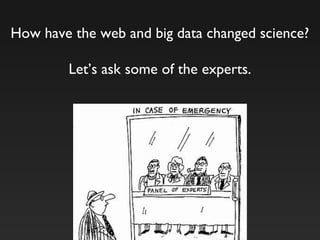
How have the web and big data changed science?
Let’s ask some of the experts.
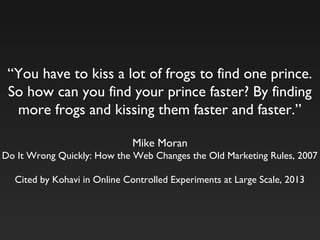
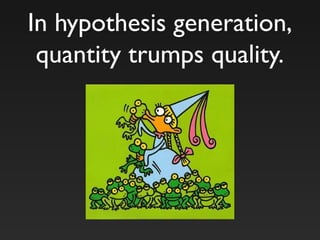
“You have to kiss a lot of frogs to find one prince.
So how can you find your prince faster? By finding
more frogs and kissing them faster and faster.”
Mike Moran
Do It Wrong Quickly: How the Web Changes the Old Marketing Rules, 2007
Cited by Kohavi in Online Controlled Experiments at Large Scale, 2013
Web Science = faster, cheaper experiments.
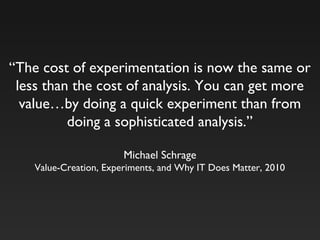
“The cost of experimentation is now the same or
less than the cost of analysis. You can get more
value…by doing a quick experiment than from
doing a sophisticated analysis.”
Michael Schrage
Value-Creation, Experiments, and Why IT Does Matter, 2010
Web Science = more experiments, less analysis?
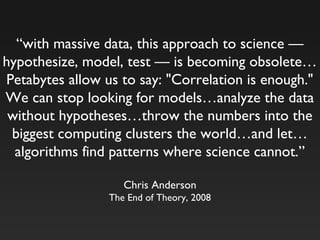
“with massive data, this approach to science —
hypothesize, model, test — is becoming obsolete…
Petabytes allow us to say: "Correlation is enough."
We can stop looking for models…analyze the data
without hypotheses…throw the numbers into the
biggest computing clusters the world…and let…
algorithms find patterns where science cannot.”
Chris Anderson
The End of Theory, 2008
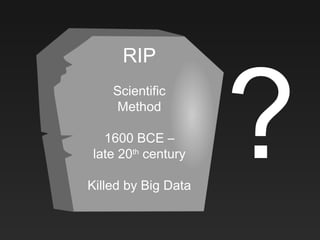
RIP
Scientific
Method
1600 BCE –
late 20th
century
Killed by Big Data
?
No.
Let’s rewind.
What makes it science?
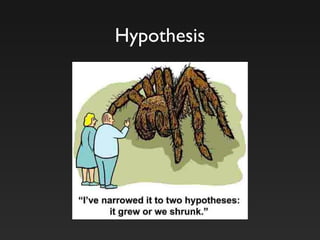
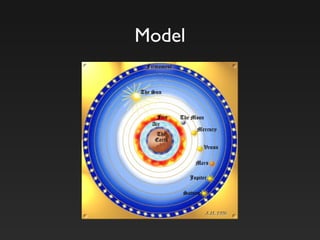
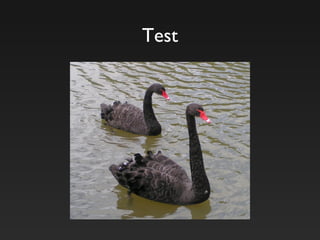
Hypothesis
Model
Test
The scientific method still works today.
What’s changed is the economics.
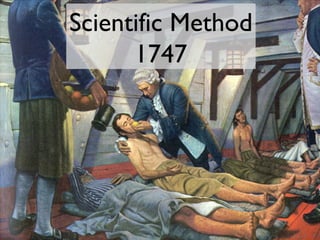
Scientific Method
1747
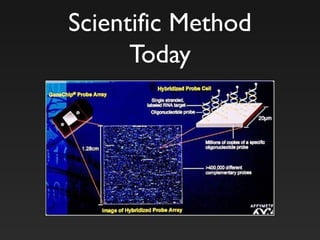
Scientific Method
Today
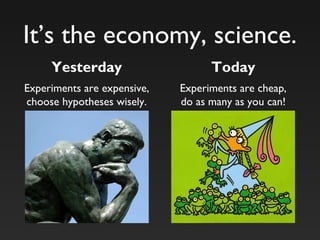
It’s the economy, science.
Yesterday
Experiments are expensive,
choose hypotheses wisely.
Today
Experiments are cheap,
do as many as you can!
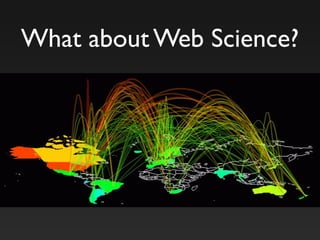
What about Web Science?
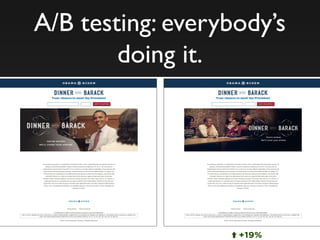
A/B testing: everybody’s
doing it.
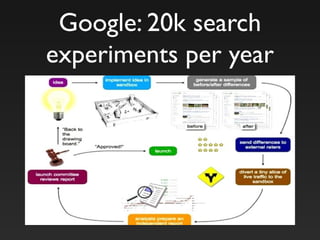
Google: 20k search
experiments per year
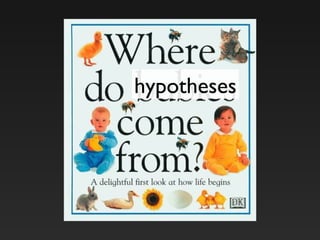
hypotheses
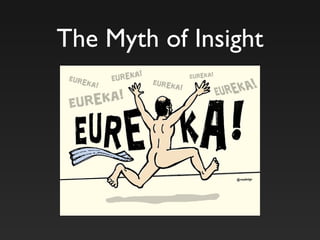
The Myth of Insight
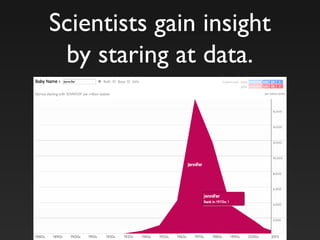
Scientists gain insight
by staring at data.
Big data tools improve
data exploration.
In hypothesis generation,
quantity trumps quality.
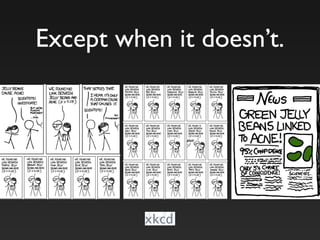
Except when it doesn’t.
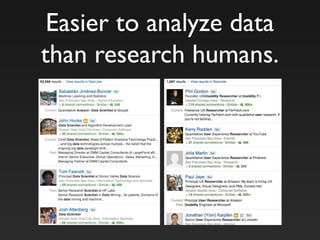
Easier to analyze data
than research humans.
But we pay the price.
Example: search engine improvements in batch
evaluations don’t always predict real user benefits.
[Hersh et al, 2000] Do Batch and User Evaluations Give the Same Results?
[Turpin & Hersh, 2001] Why Batch and User Evaluations do not Give the Same Results
[Turpin, Scholer, 2006] User Performance versus Precision Measures for Simple
Search Tasks
But also see…
[Smucker & Jethani, 2010] Human Performance and Retrieval Precision Revisited
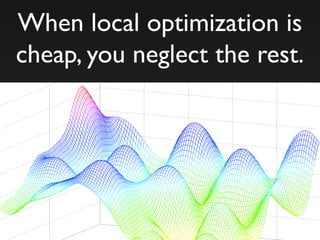
When local optimization is
cheap, you neglect the rest.
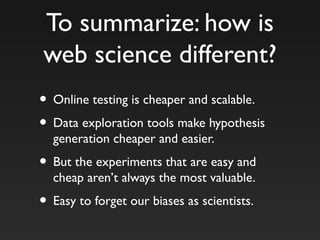
To summarize: how is
web science different?
• Online testing is cheaper and scalable.
• Data exploration tools make hypothesis
generation cheaper and easier.
• But the experiments that are easy and
cheap aren’t always the most valuable.
• Easy to forget our biases as scientists.
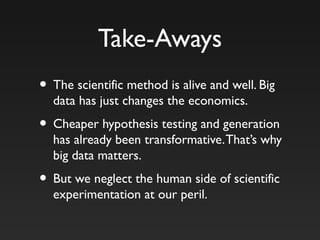
Take-Aways
• The scientific method is alive and well. Big
data has just changes the economics.
• Cheaper hypothesis testing and generation
has already been transformative.That’s why
big data matters.
• But we neglect the human side of scientific
experimentation at our peril.
Daniel Tunkelang
dtunkelang@linkedin.com
https://linkedin.com/in/dtunkelan
g

Web science - How is it different?

Editor's Notes

  • #19 James Lind thought that scurvy was due to putrefaction of the body which could be helped by acids, and thus included a dietary supplement of an acidic quality in the experiment. This began after two months at sea when the ship was afflicted with scurvy. He divided twelve scorbutic sailors into six groups of two. They all received the same diet but, in addition, group one was given a quart of cider daily, group two twenty-five drops of elixir of vitriol (sulfuric acid), group three six spoonfuls of vinegar, group four half a pint of seawater, group five received two oranges and one lemon, and the last group a spicy paste plus a drink of barley water. The treatment of group five stopped after six days when they ran out of fruit, but by that time one sailor was fit for duty while the other had almost recovered. Apart from that, only group one also showed some effect of its treatment.