Web Portal Development: Building Secure, Scalable, and Interactive Online Platforms
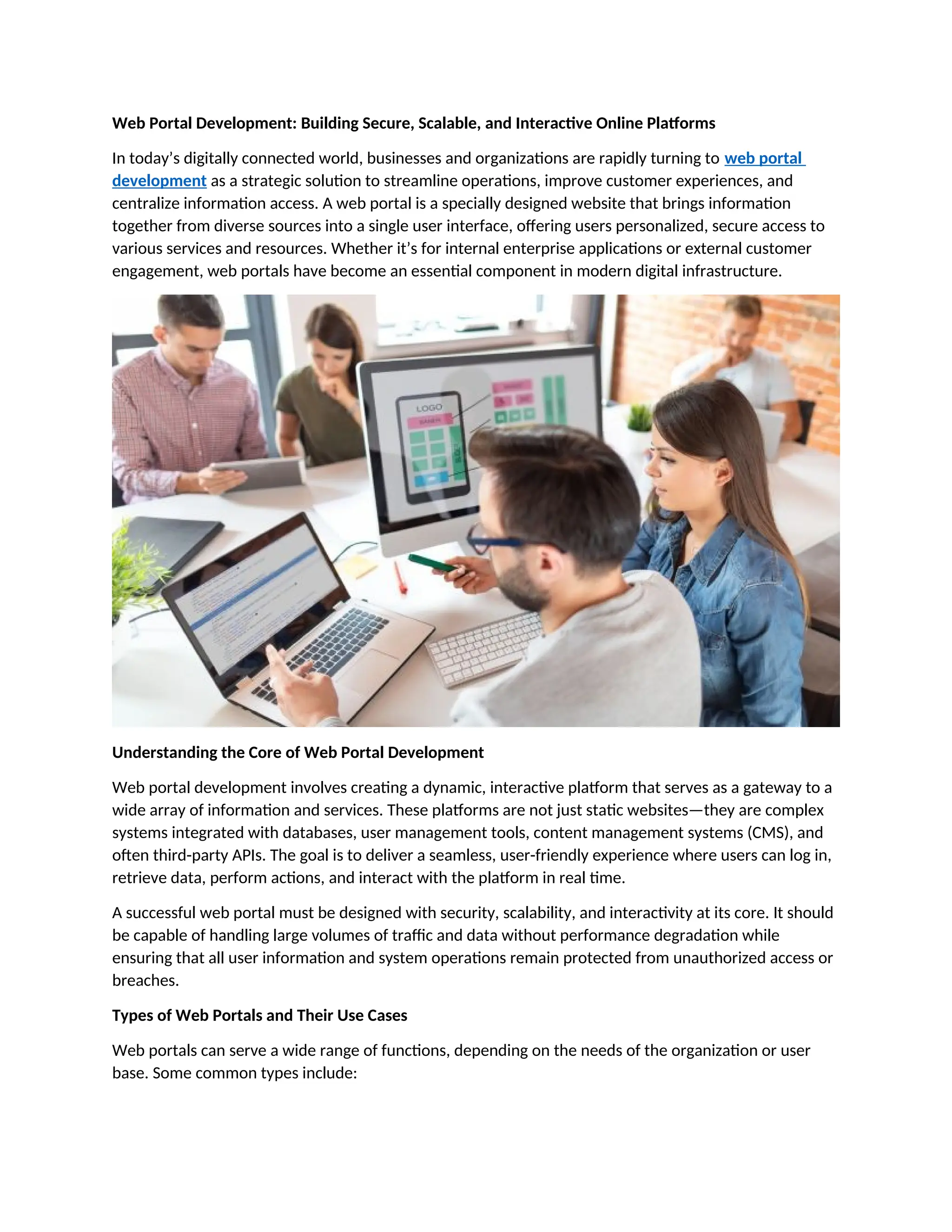
In today’s digitally connected world, businesses and organizations are rapidly turning to web portal development as a strategic solution to streamline operations, improve customer experiences, and centralize information access.
Web Portal Development: Building Secure, Scalable, and Interactive Online Platforms
1.
Web Portal Development:Building Secure, Scalable, and Interactive Online Platforms
In today’s digitally connected world, businesses and organizations are rapidly turning to web portal
development as a strategic solution to streamline operations, improve customer experiences, and
centralize information access. A web portal is a specially designed website that brings information
together from diverse sources into a single user interface, offering users personalized, secure access to
various services and resources. Whether it’s for internal enterprise applications or external customer
engagement, web portals have become an essential component in modern digital infrastructure.
Understanding the Core of Web Portal Development
Web portal development involves creating a dynamic, interactive platform that serves as a gateway to a
wide array of information and services. These platforms are not just static websites—they are complex
systems integrated with databases, user management tools, content management systems (CMS), and
often third-party APIs. The goal is to deliver a seamless, user-friendly experience where users can log in,
retrieve data, perform actions, and interact with the platform in real time.
A successful web portal must be designed with security, scalability, and interactivity at its core. It should
be capable of handling large volumes of traffic and data without performance degradation while
ensuring that all user information and system operations remain protected from unauthorized access or
breaches.
Types of Web Portals and Their Use Cases
Web portals can serve a wide range of functions, depending on the needs of the organization or user
base. Some common types include:
2.
Customer Portals:These platforms enable customers to access account information, submit
requests, track orders, and communicate with support teams.
Employee Portals: Designed for internal use, these portals provide access to HR services,
company news, work tools, and internal communications.
Vendor or Partner Portals: These allow external partners or vendors to manage transactions,
upload documents, and collaborate with internal teams.
Educational Portals: Used by educational institutions to offer students, faculty, and staff access
to course materials, grades, schedules, and announcements.
Healthcare Portals: Provide patients with access to their medical records, appointment
scheduling, and secure communication with providers.
Each type of portal demands a unique design and feature set, but they all share common development
principles grounded in security, performance, and usability.
Security in Web Portal Development
Security is a non-negotiable aspect of web portal development. Portals often store and transmit
sensitive user data, such as personal details, financial information, and business-critical documents. To
safeguard this data, developers must implement robust security measures from the ground up.
This includes:
Data encryption (both in transit and at rest) to prevent unauthorized access
Multi-factor authentication (MFA) to enhance user identity verification
Role-based access control (RBAC) to ensure users can only access relevant data and functions
Regular security audits and updates to address vulnerabilities and maintain compliance with
standards such as GDPR or HIPAA
Ensuring the portal's backend infrastructure is also protected with firewalls, intrusion detection systems,
and regular patches is vital for maintaining a secure environment.
Scalability for Growing Demands
A well-developed web portal should be scalable, meaning it can handle increased loads and user
demand without performance issues. Scalability is especially important for organizations expecting
growth or seasonal spikes in user activity.
Developers can build scalable portals by using:
Cloud-based infrastructure (e.g., AWS, Azure) to provide on-demand resources
Modular architecture that allows new features or components to be added without overhauling
the entire system
Load balancing and caching mechanisms to distribute user requests efficiently
3.
Database optimizationtechniques to ensure rapid data retrieval and storage
These strategies ensure that the portal can grow alongside the organization, offering continuous support
for users without sacrificing speed or reliability.
Enhancing Interactivity and User Experience
User engagement is a key factor in the success of any web portal. Interactive features such as
personalized dashboards, real-time chat support, discussion forums, and feedback tools keep users
connected and involved.
Modern web portal development emphasizes intuitive navigation, responsive design, and mobile
compatibility. This ensures users can access the portal across various devices, including smartphones,
tablets, and desktops, with a consistent and satisfying experience. Using frameworks like Angular, React,
or Vue.js helps create dynamic user interfaces that respond swiftly to input and changes.
Incorporating analytics tools is also beneficial, as it allows organizations to monitor user behavior, track
popular content, and continuously refine the portal based on real-world data.
Integrating with Existing Systems
Another crucial element of web portal development is seamless integration with existing enterprise
systems such as CRM platforms, ERP solutions, or third-party services. This ensures data consistency and
reduces redundancy by synchronizing information across platforms.
Developers achieve this by using APIs and middleware to connect disparate systems, allowing for real-
time data exchange and process automation. This integration not only improves efficiency but also
delivers a more cohesive user experience.
Conclusion: A Smart Investment for Digital Success
Investing in web portal development provides organizations with a powerful tool to centralize services,
foster engagement, and drive digital transformation. By focusing on the pillars of security, scalability,
and interactivity, businesses can create robust portals that serve both internal and external users
effectively.
As technology continues to evolve, so too will the expectations of portal users. Organizations that
embrace modern development practices, prioritize user experience, and maintain a forward-looking
strategy will be best positioned to leverage their web portals as key drivers of success.
Web:- https://cudedesign.co.uk/
#WebDesignSurrey, #WordPressAgencyLondon, #WebPortalDevelopment,
#wordpresssupportservices, #aiautomationagency, #wordpressmaintenanceservice