Wearable Textile Antenna
Contents
• Body centric wireless communication
• Design consideration and challenges
• Analysis Required For Wearable Antennas
• Textile antenna
• Fabrication of wearable textile antenna
• Applications of wearable e-textiles
• Conclusion
Body Centric Wireless Communication
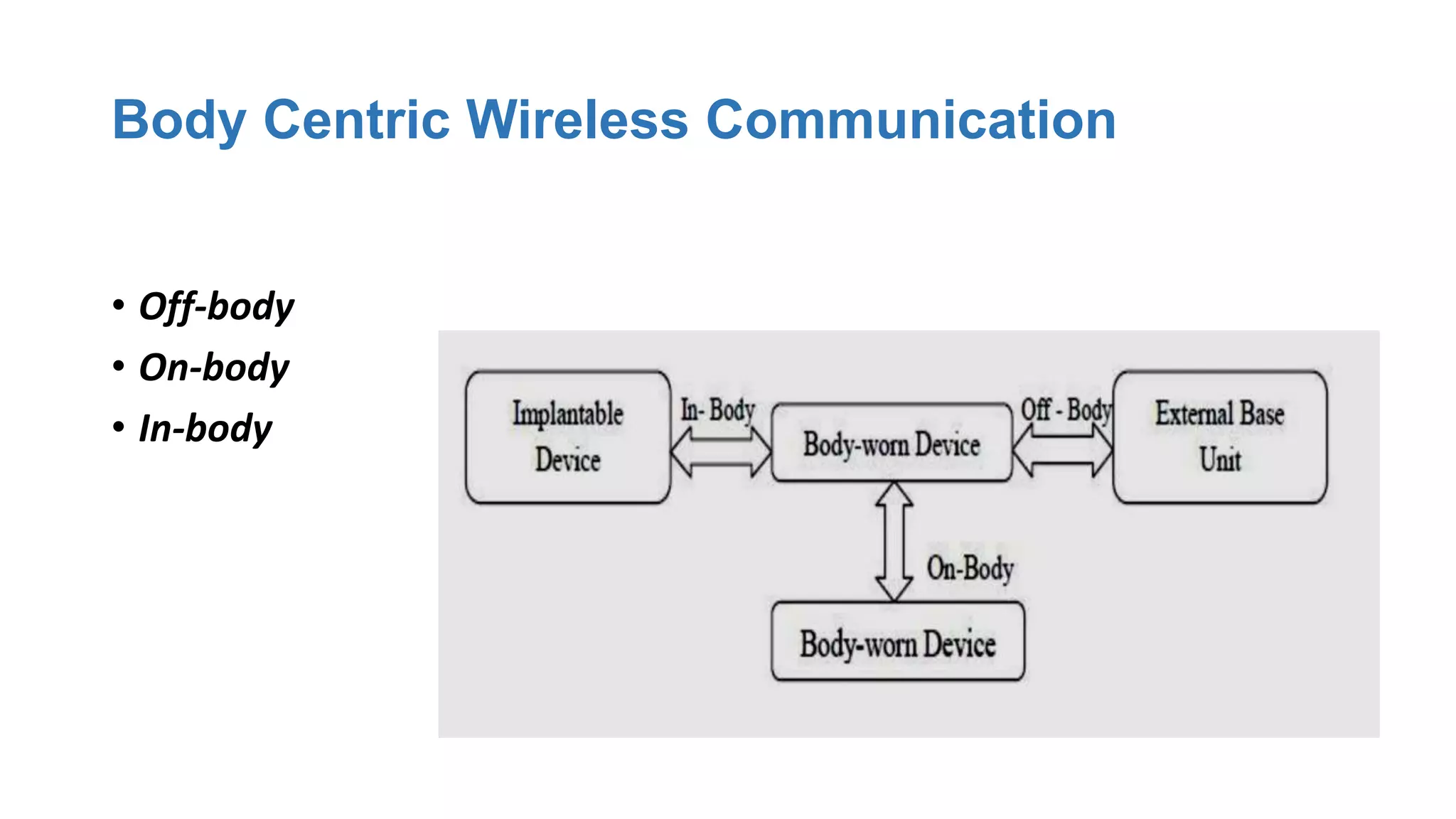
• Body centric wireless communication is now accepted as an
important part of 4th generation (and beyond) communications
systems.
• Body centric communications takes its place firmly within the sphere
of personal area networks and body area networks (PANs and BANs).
• The IEEE 802.15.6 standard is the latest international standard for
Wireless Body Area Network (WBAN).
“Short range, extremely low power wireless communication
within or in a vicinity of human body.”
Body Centric Wireless Communication
• Off-body
• On-body
• In-body
Applications
• Medical Heath Care
• Sports and Fitness Monitoring
• Military
• Security
• Gaming and entertainment
• Sports
Challenges of Wearable Antennas
• Compactness
• Desired radiation characteristics
• low cost
• Lightweight
• multi-band operation
• Stable performance under varying conditions.
DESIGN CONSIDERATIONS
• Antenna Detuning and Impedance Matching
 Detune due to the human body loading effect .
 Designer needs to consider the shift in operational frequency band due
to the human body effect.
• Radiation Characteristics
 On-body communications desire wide-beam or omnidirectional radiations
in the plane parallel to the human body surface to provide maximum
coverage over the body .
The ground plane makes a shield for human so the radiation won’t
transmit towards human body
DESIGN CONSIDERATIONS
• Size, Cost and Weight
 Light weight and compact for ease of mobility .
 Low cost solution can attract large number of customers.
• Bending & crumpling
 Bending has greater impact on antenna performance.
 Crumpling has greater detuning effect on the antenna resonant
frequency, bandwidth and reflection coefficient values.
DESIGN CONSIDERATIONS
• Positioning and Sensitivity
 Bending limitations and scenarios can be determined based on the
antenna placement and it need to be investigated.
 The other challenge is to make the antenna insensitive to the
variation of gap between the antenna and the human body.
SAFETY CONSIDERATIONS
• Specific Absorption Rate (SAR)
 Power absorbed per mass of tissue.
𝑆𝐴𝑅 = 𝜎𝐸2
/ρ
The two most commonly used SAR limit specified as IEEE 95.1
1.6W/kg for any 1g of tissue
ICNIRP (International Commission on Non-Ionizing Radiation
Protection ) 2W/kg for any 10g of tissue.
ANALYSIS REQUIRED FOR WEARABLE
ANTENNAS
• EFFECT OF HUMAN BODY INTERACTION
 Due to high permittivity of body tissues the antenna resonant
frequency will change and detune to a lower one.
Relative permittivity of skin decreases with the increase of frequency
whereas the conductivity of the skin increases with the increase of
frequency.
 Due to lossy human body, some part of radiating power of an antenna
will be absorbed by it and it will result in lower Gain.
ANALYSIS REQUIRED FOR WEARABLE
ANTENNAS
• SAR MODELLING
A torso model constructed from CT and MRI image of real human body
employed in the SAR modeling .
ANALYSIS REQUIRED FOR WEARABLE
ANTENNAS
• BENDING EFFECTS ON ANTENNA PERFORMANCE
To validate the performance and stability in bending conditions,
a study on bending effects should be performed.
Measurements for flexible wearable antenna have to be done
with different bending position
The resonance shifted towards the lower frequencies and the
bandwidth became smaller when bent, independent of the
bending direction.
One of the methods to overcome this was that the antenna had
to be designed with a wide frequency bandwidth
ANALYSIS REQUIRED FOR WEARABLE
ANTENNAS
• ON BODY MEASUREMENTS
Positions of wearable antennas will potentially differ, depending
on the application of the antenna.
Wearable antennas might be designed to be placed on the chest,
arm, back of the body and etc.
TEXTILE ANTENNA
• Textile materials are used as a substrate material or conductive
material that is part of cloths.
• Fabrics should be wearable, durable and flexible.
• The use of textiles requires characterisation of their properties.
• Textile materials generally have very low dielectric constant which
reduces the surface wave losses and improve the impedance
bandwidth of the antenna.
FACTORS INFLUENCING THE PERFORMANCE
OF TEXTILE ANTENNA
• Permittivity
𝜺 = 𝜺 𝟎 𝜺 𝒓 = 𝜺′
−𝒋𝜺"
• loss tangent
𝑻𝒂𝒏𝜹 = 𝛆"/𝜺′
the dielectric properties depend on the frequency, temperature,
and surface roughness, moisture content, purity and of the
material
FACTORS INFLUENCING THE
PERFORMANCE OF TEXTILE ANTENNA
FACTORS INFLUENCING THE
PERFORMANCE OF TEXTILE ANTENNA
THICKNESS OF THE DIELECTRIC FABRICS
Due to very low dielectric values, thickness mainly determine the
bandwidth as well as the input impedance of the antenna
𝑩𝑾~
𝟏
𝑸
thickness of the substrate also influences the geometric sizing of the
antenna.
FACTORS INFLUENCING THE
PERFORMANCE OF TEXTILE ANTENNA
• THE ELECTRICAL SURFACE RESISTIVITY OF THE CONDUCTIVE
FABRICS
𝝆s=
𝟏
࣌.𝒕
࣌=conductivity
𝝆s =surface resistivity
𝒕=thickness
• THE MOISTURE CONTENT OF THE FABRICS
Regain=mass of absorbed water/mass of dry specimen.
RH=moisture present in air /moisture needs to saturate air.
For 65% RH:- wool fibre -14.5%, cotton 7.5% & polyester 0.2%.
FACTORS INFLUENCING THE PERFORMANCE
OF TEXTILE ANTENNA
• MECHANICAL DEFORMATION OF THE DIELECTRIC AND CONDUCTING
FABRICS
 Bending & elongation.
 Elasticity of the fabrics is an inconvenience as it makes difficult
the precise definition and cut of the shape of the components
and also makes difficult the superposition of the several
materials without folds.
TEXTILE MATERIALS USED IN
WEARABLE ANTENNAS
• Dielectric fabrics
Felt
Cordura
Cotton
Polyester
Silk
Jeans
fleece
felt cordura
polyester silk
TEXTILE MATERIALS USED IN WEARABLE
ANTENNAS
• Conductive fabrics
Zelt
Flectron
Copper polyester fabrics
zelt flectron
Copper polyester fabric
Design of wearable textile antenna
• Why patch antenna?
 high directivity
 ease of construction
 cost effectiveness
 isolation between radiating element and body.
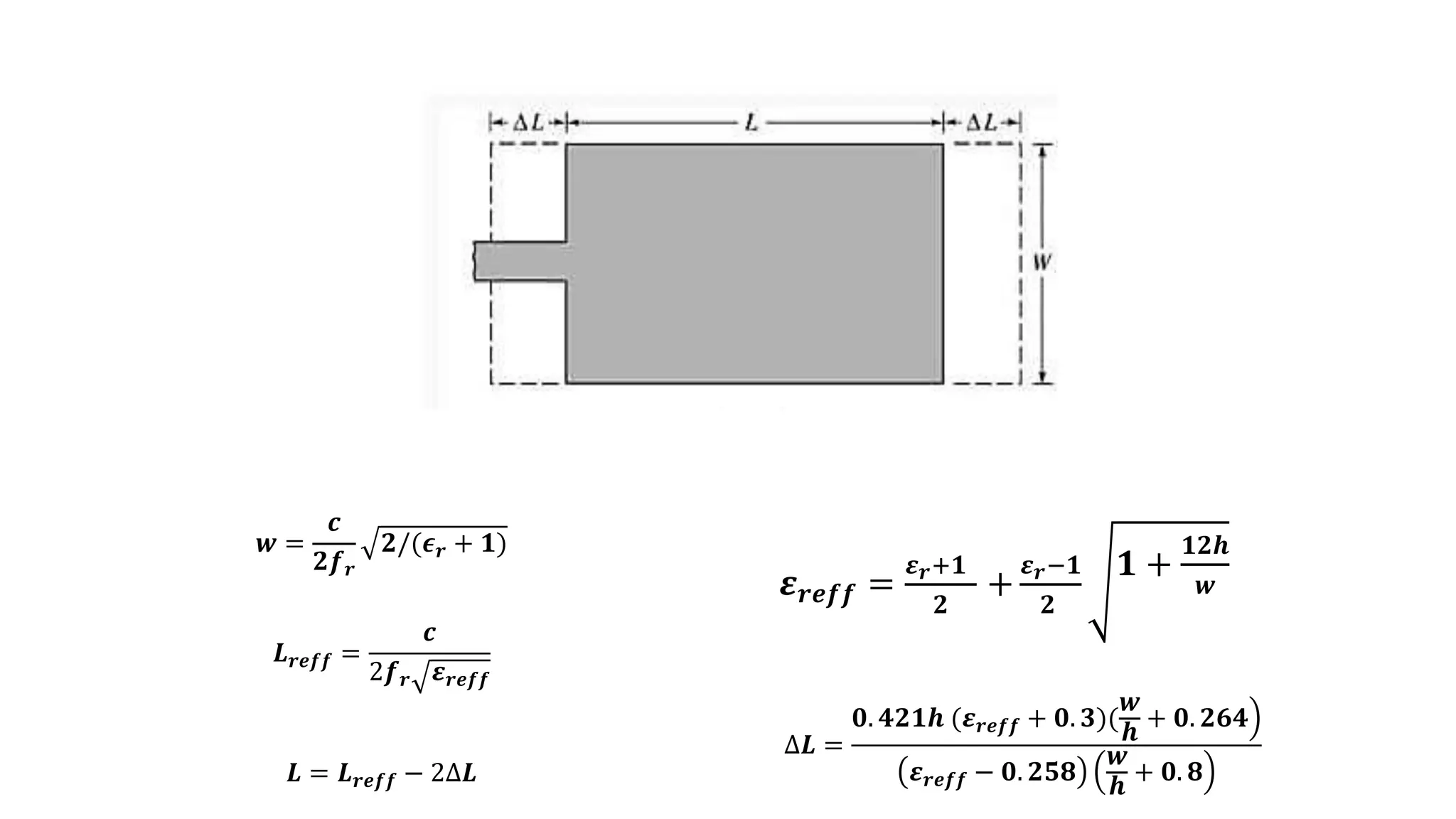
𝒘 =
𝒄
𝟐𝒇 𝒓
𝟐/(𝝐 𝒓 + 𝟏)
𝑳 𝒓𝒆𝒇𝒇 =
𝒄
2𝒇 𝒓 𝜺 𝒓𝒆𝒇𝒇
𝑳 = 𝑳 𝒓𝒆𝒇𝒇 − 2∆𝑳
∆𝑳 =
𝟎. 𝟒𝟐𝟏𝒉 (𝜺 𝒓𝒆𝒇𝒇 + 𝟎. 𝟑)(
𝒘
𝒉
+ 𝟎. 𝟐𝟔𝟒
𝜺 𝒓𝒆𝒇𝒇 − 𝟎. 𝟐𝟓𝟖
𝒘
𝒉
+ 𝟎. 𝟖
𝜺 𝒓𝒆𝒇𝒇 =
𝜺 𝒓+𝟏
𝟐
+
𝜺 𝒓−𝟏
𝟐
𝟏 +
𝟏𝟐𝒉
𝒘
Fabrication Methods
• Liquid Textile Adhesive
 Liquid textile adhesive applies on conductive layer of fabrics.
 This layer of the fabric should be evenly thin.
 This adhesive liquid works as insulating material in between
the conductive threads.
Fabrication Methods
• Conductive Spray Technique
 Most flexible and popular fabrication technique
 It can be applied to any type of textile material.
 In this method the spray is used on the fabric which is a
mixture of copper with gases under pressure.
 By this spray a conductive layer is generated on the textile
surfaces.
Fabrication Methods
• Point-wise Deposition of Conductive Adhesive
 Adhesive is placed at particular points only on the fabric.
 The mechanical stability is significantly worse as compared to
the textile adhesive.
 Second drawback of this method is the antenna patch is not
perfectly attached for preserving geometry.
Fabrication Methods
• Method of Sewing
 By the sewing some wrinkles can be
formed on the fabric surface.
 For minimizing wrinkling problem the
spacing between the seams should be less
than the 2 cm.
Fabrication Methods
• Layered Sheets by Ironing
 Most popular for achieving the best results
 This method deposits thin layer on the conductive textile by
ironing
 patch sheet resistance and substrate permittivity are not
changed.
Fabrication Methods
• Copper Tape Method
 Simplest technique of fabrication of the textile antenna.
 This copper tape is directly applied to the substrates so there is
no need of extra fabrication process in this method
 The copper tape can cut easily according to the geometry and
the shape of the patch of the textile antenna
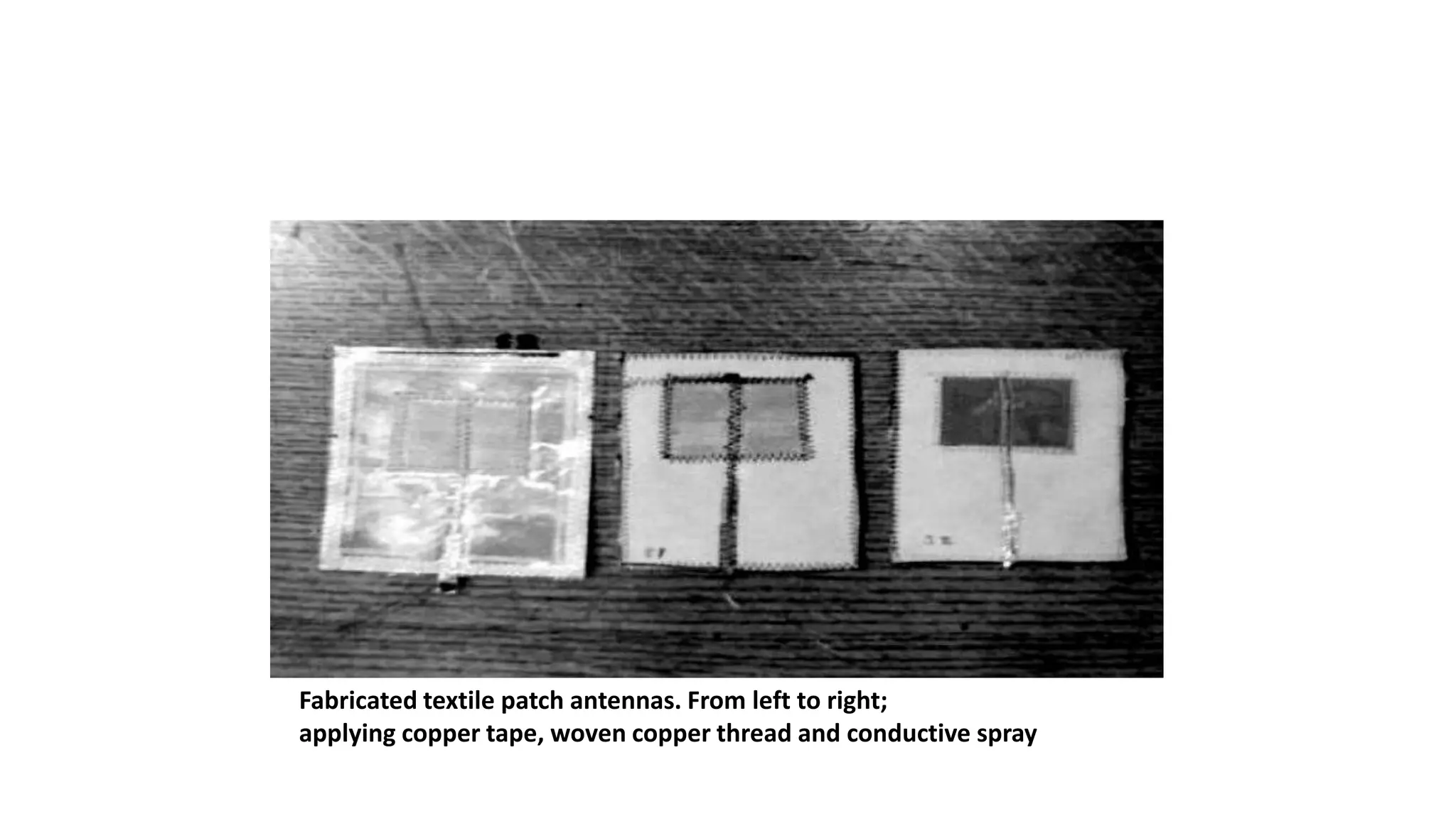
Fabricated textile patch antennas. From left to right;
applying copper tape, woven copper thread and conductive spray
APPLICATIONS OF WEARABLE E-TEXTILES
"what makes smart fabrics revolutionary is that they have the ability to
do many things that traditional fabrics cannot, including communicate,
transform, and conduct energy “
~ Pailes-Friedman
• There is a new class of textile-based electronics for wearable
applications that are flexible, robust, and completely complete to the
wearer.
• Conductive traces are realized via automated embroidery of
conductive E-threads, while batteries are directly “printed” on fabrics
via conductive inks.
• The proposed technology brings forward transformational
opportunities for a very wide range of applications, including
healthcare, sports, wireless communications, Radio Frequency
Identification
Prototypes
• FLEXIBLE CONDUCTIVE TRACES
Fabrication of conductive traces (antennas, transmission lines, etc.) relies
on digitization of the desired pattern in a computer simulation platform,
and stitching upon a fabric substrate via electrically conductive threads (E-
threads) and an automated embroidery machine.
• consist of twisted filament bundles
• Extreme robustness, high conductivity.
• STRETCHABLE AND FLEXIBLE PROTOTYPES
If stretch ability of the prototype is desired, besides flexibility, the
underlying non-conductive fabric substrate can be removed (e.g., via
melting), and the E-textile embroidered pattern can be embedded into
a stretchy polymer.
• COLOURFUL PROTOTYPES
To realize colourful prototypes, the embroidery process relies on unicolor
E-threads in the bobbin of the embroidery machine to stitch the antenna on
the back side of the garment. Concurrently, a colourful assistant yarn is
threaded through the embroidery needle of the embroidery machine and
used to secure or the E-thread.
• TEXTLE BASED BATTERIES
• Flexible textile-based batteries can be implemented by depositing
alternating regions of silver and zinc dots upon the fabric.
• When in contact with an aqueous solution or body fluids silver acts
as the positive electrode (cathode) which is reduced, while zinc acts
as the negative electrode (anode) and is oxidized.
APPLICATIONS
• SMART HATS FOR DEEP BRAIN NEUROSENSING
 Textile-based spiral antennas have been demonstrated for
integration into hats and reading of deep brain neuro potentials.
 opportunities on the treatment of epilepsy, tremor,
Parkinson’s, etc
APPLICATIONS
• WOUND DETECTION FABRICS
A battery less epidermal sensor that identifies open wounds
underneath its surface. Operation lies in an electrochemical fabric with
printed battery cells that generate power when exposed to the wound
fluid electrolyte.
APPLICATIONS
• ANTENNA-IMPREGNATED FABRICS FOR HEIGHT MONITORING
Contrary to conventional infantometer and stadiometer technologies
that restrict height monitoring to sporadic intervals, this technology
brings forward regular height monitoring with minimum impact to the
individual’s activity.
The operation principle lies on a series of dipole antennas placed at
known distances, some of which are “blocked” by the overlying baby.
Spacesuit applications
• Nickel–copper ripstop was selected as the best material for the patch
and ground.
• layered ultrafirm fabric stabilizer was used for the dielectric.
• Spray adhesive joined the patch to substrate to ground
The PC-controlled Epilog Helix laser engraving
system.
NDX1 Suit
EFFECT OF BENDING IN TEXTILE ANTENNA
For 2.4-GHz industrial, scientific, and medical (ISM) band.
Substrate: denim textile
ϵr = 1.6
loss tangent (tanδ)= 0.01 at 2.4 GHz
Thickness h=2mm
Conducting material: copper and nickel plated polyester fabric.
Surface resistivity (Rs) = 0.07 Ω/sq
Thickness (t)= 0.5 mm
The antenna bending scenarios: (a) width bent (b)length bent
• If the bending occurs across the antenna width both electric
fields and current flow would be marginally affected and affect
the resonant frequency .
• If bending is performed across the antenna length one should
expect a higher impact on performance.
• It is due to an equivalent slight reduction in current distance
travelled between opposing ends of the patch antenna which
could be seen has a slight reduction in patch length.
Effect of EBG on antenna to reduce SAR
• ELECTROMAGNETIC BANDGAP STRUCTURES
Electromagnetic Band Gap (EBG) always referred as photonic band gap
(PBG) surface or high impedance surface.
This structure is compact which has good potential to build low profile and
high efficiency antenna surface.
The main advantage of EBG structure is their ability to suppress the
surface wave current.
substrate: felt fabric
ε 𝑟 = 1.38
thickness= 1.1mm
The overall size of antenna is
57×68×1.1mm.
SAR value without EBG:13W/Kg for 1gm of tissue
SAR value with EBG :0.329W/Kg for 1gm of tissue at 2.1GHz
Conclusion
• wearable antennas play a pivotal role in wireless on-body centric
communications
• The fabrication techniques and materials used in designing textile
antennas play a significant role in defining and determining the
overall performance.
• Placing the textile antenna conformal to certain parts of the human
body degrade performance slightly by introducing frequency detuning
and hence pattern deformation at the resonance frequency .
References
• [1] Hall, P. S., and Hao, Y., “Antennas and Propagation for Body Centric Communications”,
European Conference on Antennas and Propagation (EuCAP), November 2006.
• [2] T. Rashid, S. Noghanian, R. Fazel-Rezai and P. de Leon, “Wearable antenna design for
spacesuit,” IEEE International Symposium on Antennas and Propagation & USNC/URSI
National Radio Science Meeting, pp. 1216-1217, 2015.
• [3] J.G. Santas, A. Alomainy, H. Yang, “Textile Antennas for On-Body Communications:
Techniques and Properties”. The Antennas andPropagation, 2007. EuCAP 2007.
• [4] P. Salonen, Y. Rahmat-Samii, and M. Kivikoski, “Wearable Antennas in the Vicinity of
Human Body”
• [5] M. Tanaka, J. H. Jang, “Wearable Microstrip Antenna”, 2003 IEEE AP-S Int. Symp. Dig.,
volume 2, pp. 704-707, (2003).
• [6] Y. Rahmat-Samii, “Wearable and Implantable Antennas in Body-Centric
Communications”. the Antennas and Propagation, 2007. EuCAP 2007.
• [7] Jaime G. Santas, Akram Alomainy and Yang Hao,” Textile Antennas for On-Body
Communications: Techniques and Properties”
• [8] P. O. Salonen, Y. Rahmat-Samii, H. Hurme, and M. Kivikoski, “Dualband wearable
textile antenna,” in Proc. IEEE Antennas Propag. Int. Symp., 2004, vol. 1, pp. 463–467.
• [9] Seema Dhupkariya*, Vinod Kumar Singh, Arun Shukla ” A Review of Textile Materials
for Wearable Antenna” Journal of Microwave Engineering & Technologies ISSN: 2349-
9001 (online) Volume 1, Issue 3
References
• [10] Tessa Haagenson, Sima Noghanian, Pablo de León, and Yi-hsiang Chang “Wearable
• Textile Antennas Examining the effect of bending on their performance.” IEEE antennas &
Propagation Magazine j u n e 2017
• [11] Tessa Haagenson, Sima Noghanian, Pablo de León, and Yi-hsiang Chang “Textile Antennas for
Spacesuit Applications Design, simulation, manufacturing, and testing of textile patch antennas
for spacesuit applications.” IEEE antennas & Propagation Magazine j u n e 2017
• [12] Rita Salvado, Caroline Loss, Ricardo Gonçalves, and Pedro Pinho “Textile Materials for the
Design of Wearable Antennas: A Survey” Sensors (Basel). 2012; 12(11): 15841–15857 Wearable
Textile Antenna
• [13] Syed Muzahir Abbas*, Karu P. Esselle*, Ladislau Matekovits*‡, Muhammad Rizwan†, Leena
Ukkonen “”On-body Antennas: Design Consideration and Challenges(Invited Paper)2016 URSI
International Symposium on Electromagnetic Theory (EMTS)
• [14] Changrong LiuYong-Xin Guo and Shaoqiu Xiao “A Review of Implantable Antennas for
Wireless Biomedical Devices” Forum for Electromagnetic Research Methods and Application
Technologies (FERMAT)
• [15] Asimina Kiourti “Textile-Based Flexible Electronics for Wearable Applications: from Antennas
to Batteries” 2nd URSI AT-RASC, Gran Canaria, 28 May – 1 June 2018
• [16] Ashok Yadav*, Vinod Kumar Singh, Manu Chaudhary, Himanshu Mohan
• “A Review on Wearable Textile Antenna” Journal of Telecommunication, Switching Systems and
Networks ISSN: 2454-6372
• [17] Amin Khan, Shahid Bashir, Faiz Ullah “Electromagnetic Bandgap Wearable Dipole
antennawith low Specific Absorption Rate” 2018 International Conference on Computing,
Mathematics and Engineering Technologies – iCoMET 2018
THANK YOU

Wearable textile antenna

  • 1.
  • 2.
    Contents • Body centricwireless communication • Design consideration and challenges • Analysis Required For Wearable Antennas • Textile antenna • Fabrication of wearable textile antenna • Applications of wearable e-textiles • Conclusion
  • 3.
    Body Centric WirelessCommunication • Body centric wireless communication is now accepted as an important part of 4th generation (and beyond) communications systems. • Body centric communications takes its place firmly within the sphere of personal area networks and body area networks (PANs and BANs). • The IEEE 802.15.6 standard is the latest international standard for Wireless Body Area Network (WBAN). “Short range, extremely low power wireless communication within or in a vicinity of human body.”
  • 4.
    Body Centric WirelessCommunication • Off-body • On-body • In-body
  • 5.
    Applications • Medical HeathCare • Sports and Fitness Monitoring • Military • Security • Gaming and entertainment • Sports
  • 6.
    Challenges of WearableAntennas • Compactness • Desired radiation characteristics • low cost • Lightweight • multi-band operation • Stable performance under varying conditions.
  • 7.
    DESIGN CONSIDERATIONS • AntennaDetuning and Impedance Matching  Detune due to the human body loading effect .  Designer needs to consider the shift in operational frequency band due to the human body effect. • Radiation Characteristics  On-body communications desire wide-beam or omnidirectional radiations in the plane parallel to the human body surface to provide maximum coverage over the body . The ground plane makes a shield for human so the radiation won’t transmit towards human body
  • 8.
    DESIGN CONSIDERATIONS • Size,Cost and Weight  Light weight and compact for ease of mobility .  Low cost solution can attract large number of customers. • Bending & crumpling  Bending has greater impact on antenna performance.  Crumpling has greater detuning effect on the antenna resonant frequency, bandwidth and reflection coefficient values.

  • 9.
    DESIGN CONSIDERATIONS • Positioningand Sensitivity  Bending limitations and scenarios can be determined based on the antenna placement and it need to be investigated.  The other challenge is to make the antenna insensitive to the variation of gap between the antenna and the human body.
  • 10.
    SAFETY CONSIDERATIONS • SpecificAbsorption Rate (SAR)  Power absorbed per mass of tissue. 𝑆𝐴𝑅 = 𝜎𝐸2 /ρ The two most commonly used SAR limit specified as IEEE 95.1 1.6W/kg for any 1g of tissue ICNIRP (International Commission on Non-Ionizing Radiation Protection ) 2W/kg for any 10g of tissue.
  • 11.
    ANALYSIS REQUIRED FORWEARABLE ANTENNAS • EFFECT OF HUMAN BODY INTERACTION  Due to high permittivity of body tissues the antenna resonant frequency will change and detune to a lower one. Relative permittivity of skin decreases with the increase of frequency whereas the conductivity of the skin increases with the increase of frequency.  Due to lossy human body, some part of radiating power of an antenna will be absorbed by it and it will result in lower Gain.
  • 12.
    ANALYSIS REQUIRED FORWEARABLE ANTENNAS • SAR MODELLING A torso model constructed from CT and MRI image of real human body employed in the SAR modeling .
  • 13.
    ANALYSIS REQUIRED FORWEARABLE ANTENNAS • BENDING EFFECTS ON ANTENNA PERFORMANCE To validate the performance and stability in bending conditions, a study on bending effects should be performed. Measurements for flexible wearable antenna have to be done with different bending position The resonance shifted towards the lower frequencies and the bandwidth became smaller when bent, independent of the bending direction. One of the methods to overcome this was that the antenna had to be designed with a wide frequency bandwidth
  • 14.
    ANALYSIS REQUIRED FORWEARABLE ANTENNAS • ON BODY MEASUREMENTS Positions of wearable antennas will potentially differ, depending on the application of the antenna. Wearable antennas might be designed to be placed on the chest, arm, back of the body and etc.
  • 15.
    TEXTILE ANTENNA • Textilematerials are used as a substrate material or conductive material that is part of cloths. • Fabrics should be wearable, durable and flexible. • The use of textiles requires characterisation of their properties. • Textile materials generally have very low dielectric constant which reduces the surface wave losses and improve the impedance bandwidth of the antenna.
  • 16.
    FACTORS INFLUENCING THEPERFORMANCE OF TEXTILE ANTENNA • Permittivity 𝜺 = 𝜺 𝟎 𝜺 𝒓 = 𝜺′ −𝒋𝜺" • loss tangent 𝑻𝒂𝒏𝜹 = 𝛆"/𝜺′ the dielectric properties depend on the frequency, temperature, and surface roughness, moisture content, purity and of the material
  • 17.
  • 18.
    FACTORS INFLUENCING THE PERFORMANCEOF TEXTILE ANTENNA THICKNESS OF THE DIELECTRIC FABRICS Due to very low dielectric values, thickness mainly determine the bandwidth as well as the input impedance of the antenna 𝑩𝑾~ 𝟏 𝑸 thickness of the substrate also influences the geometric sizing of the antenna.
  • 19.
    FACTORS INFLUENCING THE PERFORMANCEOF TEXTILE ANTENNA • THE ELECTRICAL SURFACE RESISTIVITY OF THE CONDUCTIVE FABRICS 𝝆s= 𝟏 ࣌.𝒕 ࣌=conductivity 𝝆s =surface resistivity 𝒕=thickness • THE MOISTURE CONTENT OF THE FABRICS Regain=mass of absorbed water/mass of dry specimen. RH=moisture present in air /moisture needs to saturate air. For 65% RH:- wool fibre -14.5%, cotton 7.5% & polyester 0.2%.
  • 20.
    FACTORS INFLUENCING THEPERFORMANCE OF TEXTILE ANTENNA • MECHANICAL DEFORMATION OF THE DIELECTRIC AND CONDUCTING FABRICS  Bending & elongation.  Elasticity of the fabrics is an inconvenience as it makes difficult the precise definition and cut of the shape of the components and also makes difficult the superposition of the several materials without folds.
  • 21.
    TEXTILE MATERIALS USEDIN WEARABLE ANTENNAS • Dielectric fabrics Felt Cordura Cotton Polyester Silk Jeans fleece felt cordura polyester silk
  • 22.
    TEXTILE MATERIALS USEDIN WEARABLE ANTENNAS • Conductive fabrics Zelt Flectron Copper polyester fabrics zelt flectron Copper polyester fabric
  • 23.
    Design of wearabletextile antenna • Why patch antenna?  high directivity  ease of construction  cost effectiveness  isolation between radiating element and body.
  • 24.
    𝒘 = 𝒄 𝟐𝒇 𝒓 𝟐/(𝝐𝒓 + 𝟏) 𝑳 𝒓𝒆𝒇𝒇 = 𝒄 2𝒇 𝒓 𝜺 𝒓𝒆𝒇𝒇 𝑳 = 𝑳 𝒓𝒆𝒇𝒇 − 2∆𝑳 ∆𝑳 = 𝟎. 𝟒𝟐𝟏𝒉 (𝜺 𝒓𝒆𝒇𝒇 + 𝟎. 𝟑)( 𝒘 𝒉 + 𝟎. 𝟐𝟔𝟒 𝜺 𝒓𝒆𝒇𝒇 − 𝟎. 𝟐𝟓𝟖 𝒘 𝒉 + 𝟎. 𝟖 𝜺 𝒓𝒆𝒇𝒇 = 𝜺 𝒓+𝟏 𝟐 + 𝜺 𝒓−𝟏 𝟐 𝟏 + 𝟏𝟐𝒉 𝒘
  • 25.
    Fabrication Methods • LiquidTextile Adhesive  Liquid textile adhesive applies on conductive layer of fabrics.  This layer of the fabric should be evenly thin.  This adhesive liquid works as insulating material in between the conductive threads.
  • 26.
    Fabrication Methods • ConductiveSpray Technique  Most flexible and popular fabrication technique  It can be applied to any type of textile material.  In this method the spray is used on the fabric which is a mixture of copper with gases under pressure.  By this spray a conductive layer is generated on the textile surfaces.
  • 27.
    Fabrication Methods • Point-wiseDeposition of Conductive Adhesive  Adhesive is placed at particular points only on the fabric.  The mechanical stability is significantly worse as compared to the textile adhesive.  Second drawback of this method is the antenna patch is not perfectly attached for preserving geometry.
  • 28.
    Fabrication Methods • Methodof Sewing  By the sewing some wrinkles can be formed on the fabric surface.  For minimizing wrinkling problem the spacing between the seams should be less than the 2 cm.
  • 29.
    Fabrication Methods • LayeredSheets by Ironing  Most popular for achieving the best results  This method deposits thin layer on the conductive textile by ironing  patch sheet resistance and substrate permittivity are not changed.
  • 30.
    Fabrication Methods • CopperTape Method  Simplest technique of fabrication of the textile antenna.  This copper tape is directly applied to the substrates so there is no need of extra fabrication process in this method  The copper tape can cut easily according to the geometry and the shape of the patch of the textile antenna
  • 31.
    Fabricated textile patchantennas. From left to right; applying copper tape, woven copper thread and conductive spray
  • 32.
    APPLICATIONS OF WEARABLEE-TEXTILES "what makes smart fabrics revolutionary is that they have the ability to do many things that traditional fabrics cannot, including communicate, transform, and conduct energy “ ~ Pailes-Friedman
  • 33.
    • There isa new class of textile-based electronics for wearable applications that are flexible, robust, and completely complete to the wearer. • Conductive traces are realized via automated embroidery of conductive E-threads, while batteries are directly “printed” on fabrics via conductive inks. • The proposed technology brings forward transformational opportunities for a very wide range of applications, including healthcare, sports, wireless communications, Radio Frequency Identification
  • 34.
    Prototypes • FLEXIBLE CONDUCTIVETRACES Fabrication of conductive traces (antennas, transmission lines, etc.) relies on digitization of the desired pattern in a computer simulation platform, and stitching upon a fabric substrate via electrically conductive threads (E- threads) and an automated embroidery machine. • consist of twisted filament bundles • Extreme robustness, high conductivity.
  • 35.
    • STRETCHABLE ANDFLEXIBLE PROTOTYPES If stretch ability of the prototype is desired, besides flexibility, the underlying non-conductive fabric substrate can be removed (e.g., via melting), and the E-textile embroidered pattern can be embedded into a stretchy polymer.
  • 36.
    • COLOURFUL PROTOTYPES Torealize colourful prototypes, the embroidery process relies on unicolor E-threads in the bobbin of the embroidery machine to stitch the antenna on the back side of the garment. Concurrently, a colourful assistant yarn is threaded through the embroidery needle of the embroidery machine and used to secure or the E-thread.
  • 37.
    • TEXTLE BASEDBATTERIES • Flexible textile-based batteries can be implemented by depositing alternating regions of silver and zinc dots upon the fabric. • When in contact with an aqueous solution or body fluids silver acts as the positive electrode (cathode) which is reduced, while zinc acts as the negative electrode (anode) and is oxidized.
  • 38.
    APPLICATIONS • SMART HATSFOR DEEP BRAIN NEUROSENSING  Textile-based spiral antennas have been demonstrated for integration into hats and reading of deep brain neuro potentials.  opportunities on the treatment of epilepsy, tremor, Parkinson’s, etc
  • 39.
    APPLICATIONS • WOUND DETECTIONFABRICS A battery less epidermal sensor that identifies open wounds underneath its surface. Operation lies in an electrochemical fabric with printed battery cells that generate power when exposed to the wound fluid electrolyte.
  • 40.
    APPLICATIONS • ANTENNA-IMPREGNATED FABRICSFOR HEIGHT MONITORING Contrary to conventional infantometer and stadiometer technologies that restrict height monitoring to sporadic intervals, this technology brings forward regular height monitoring with minimum impact to the individual’s activity. The operation principle lies on a series of dipole antennas placed at known distances, some of which are “blocked” by the overlying baby.
  • 41.
    Spacesuit applications • Nickel–copperripstop was selected as the best material for the patch and ground. • layered ultrafirm fabric stabilizer was used for the dielectric. • Spray adhesive joined the patch to substrate to ground The PC-controlled Epilog Helix laser engraving system. NDX1 Suit
  • 42.
    EFFECT OF BENDINGIN TEXTILE ANTENNA For 2.4-GHz industrial, scientific, and medical (ISM) band. Substrate: denim textile ϵr = 1.6 loss tangent (tanδ)= 0.01 at 2.4 GHz Thickness h=2mm Conducting material: copper and nickel plated polyester fabric. Surface resistivity (Rs) = 0.07 Ω/sq Thickness (t)= 0.5 mm
  • 43.
    The antenna bendingscenarios: (a) width bent (b)length bent
  • 45.
    • If thebending occurs across the antenna width both electric fields and current flow would be marginally affected and affect the resonant frequency . • If bending is performed across the antenna length one should expect a higher impact on performance. • It is due to an equivalent slight reduction in current distance travelled between opposing ends of the patch antenna which could be seen has a slight reduction in patch length.
  • 46.
    Effect of EBGon antenna to reduce SAR • ELECTROMAGNETIC BANDGAP STRUCTURES Electromagnetic Band Gap (EBG) always referred as photonic band gap (PBG) surface or high impedance surface. This structure is compact which has good potential to build low profile and high efficiency antenna surface. The main advantage of EBG structure is their ability to suppress the surface wave current.
  • 47.
    substrate: felt fabric ε𝑟 = 1.38 thickness= 1.1mm The overall size of antenna is 57×68×1.1mm.
  • 49.
    SAR value withoutEBG:13W/Kg for 1gm of tissue SAR value with EBG :0.329W/Kg for 1gm of tissue at 2.1GHz
  • 50.
    Conclusion • wearable antennasplay a pivotal role in wireless on-body centric communications • The fabrication techniques and materials used in designing textile antennas play a significant role in defining and determining the overall performance. • Placing the textile antenna conformal to certain parts of the human body degrade performance slightly by introducing frequency detuning and hence pattern deformation at the resonance frequency .
  • 51.
    References • [1] Hall,P. S., and Hao, Y., “Antennas and Propagation for Body Centric Communications”, European Conference on Antennas and Propagation (EuCAP), November 2006. • [2] T. Rashid, S. Noghanian, R. Fazel-Rezai and P. de Leon, “Wearable antenna design for spacesuit,” IEEE International Symposium on Antennas and Propagation & USNC/URSI National Radio Science Meeting, pp. 1216-1217, 2015. • [3] J.G. Santas, A. Alomainy, H. Yang, “Textile Antennas for On-Body Communications: Techniques and Properties”. The Antennas andPropagation, 2007. EuCAP 2007. • [4] P. Salonen, Y. Rahmat-Samii, and M. Kivikoski, “Wearable Antennas in the Vicinity of Human Body” • [5] M. Tanaka, J. H. Jang, “Wearable Microstrip Antenna”, 2003 IEEE AP-S Int. Symp. Dig., volume 2, pp. 704-707, (2003). • [6] Y. Rahmat-Samii, “Wearable and Implantable Antennas in Body-Centric Communications”. the Antennas and Propagation, 2007. EuCAP 2007. • [7] Jaime G. Santas, Akram Alomainy and Yang Hao,” Textile Antennas for On-Body Communications: Techniques and Properties” • [8] P. O. Salonen, Y. Rahmat-Samii, H. Hurme, and M. Kivikoski, “Dualband wearable textile antenna,” in Proc. IEEE Antennas Propag. Int. Symp., 2004, vol. 1, pp. 463–467. • [9] Seema Dhupkariya*, Vinod Kumar Singh, Arun Shukla ” A Review of Textile Materials for Wearable Antenna” Journal of Microwave Engineering & Technologies ISSN: 2349- 9001 (online) Volume 1, Issue 3
  • 52.
    References • [10] TessaHaagenson, Sima Noghanian, Pablo de León, and Yi-hsiang Chang “Wearable • Textile Antennas Examining the effect of bending on their performance.” IEEE antennas & Propagation Magazine j u n e 2017 • [11] Tessa Haagenson, Sima Noghanian, Pablo de León, and Yi-hsiang Chang “Textile Antennas for Spacesuit Applications Design, simulation, manufacturing, and testing of textile patch antennas for spacesuit applications.” IEEE antennas & Propagation Magazine j u n e 2017 • [12] Rita Salvado, Caroline Loss, Ricardo Gonçalves, and Pedro Pinho “Textile Materials for the Design of Wearable Antennas: A Survey” Sensors (Basel). 2012; 12(11): 15841–15857 Wearable Textile Antenna • [13] Syed Muzahir Abbas*, Karu P. Esselle*, Ladislau Matekovits*‡, Muhammad Rizwan†, Leena Ukkonen “”On-body Antennas: Design Consideration and Challenges(Invited Paper)2016 URSI International Symposium on Electromagnetic Theory (EMTS) • [14] Changrong LiuYong-Xin Guo and Shaoqiu Xiao “A Review of Implantable Antennas for Wireless Biomedical Devices” Forum for Electromagnetic Research Methods and Application Technologies (FERMAT) • [15] Asimina Kiourti “Textile-Based Flexible Electronics for Wearable Applications: from Antennas to Batteries” 2nd URSI AT-RASC, Gran Canaria, 28 May – 1 June 2018 • [16] Ashok Yadav*, Vinod Kumar Singh, Manu Chaudhary, Himanshu Mohan • “A Review on Wearable Textile Antenna” Journal of Telecommunication, Switching Systems and Networks ISSN: 2454-6372 • [17] Amin Khan, Shahid Bashir, Faiz Ullah “Electromagnetic Bandgap Wearable Dipole antennawith low Specific Absorption Rate” 2018 International Conference on Computing, Mathematics and Engineering Technologies – iCoMET 2018
  • 53.