TEL: Texas 281-345-9995, New Jersey 201-784-6878
FAX: Texas 281-345-9998, New Jersey 201-784-6887
www.wavealert.com
sales@wavealert.com
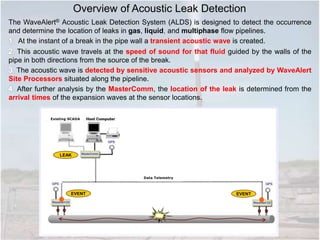
Overview of Acoustic Leak Detection
EVENT EVENT
LEAK
The WaveAlert® Acoustic Leak Detection System (ALDS) is designed to detect the occurrence
and determine the location of leaks in gas, liquid, and multiphase flow pipelines.
At the instant of a break in the pipe wall a transient acoustic wave is created.
This acoustic wave travels at the speed of sound for that fluid guided by the walls of the
pipe in both directions from the source of the break.
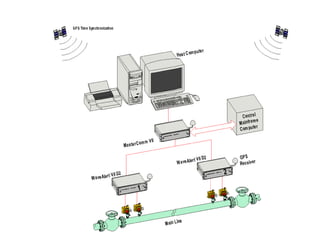
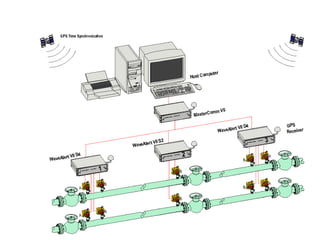
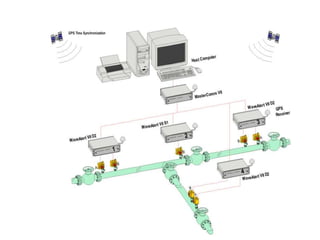
The acoustic wave is detected by sensitive acoustic sensors and analyzed by WaveAlert
Site Processors situated along the pipeline.
After further analysis by the MasterComm, the location of the leak is determined from the
arrival times of the expansion waves at the sensor locations.
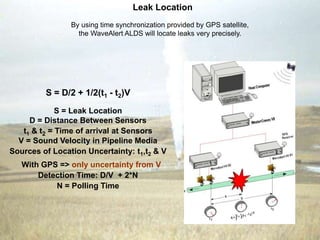
By using time synchronization provided by GPS satellite,
the WaveAlert ALDS will locate leaks very precisely.
Leak Location
S = D/2 + 1/2(t1 - t2)V
S = Leak Location
D = Distance Between Sensors
t1 & t2 = Time of arrival at Sensors
V = Sound Velocity in Pipeline Media
Sources of Location Uncertainty: t1,t2 & V
With GPS => only uncertainty from V
Detection Time: D/V + 2*N
N = Polling Time
WaveAlert ALDS
ON-LINE REAL-TIME
LEAK DETECTION SYSTEMS
QUICK
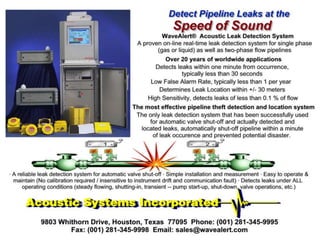
Detect Leak at the Speed of Sound
SENSITIVE
Detect Small size leak
PRECISE
Determine the Leak Location (Especially for underground pipe)
RELIABLE
Detect Leaks under All Operating Conditions with Minimum False Alarm
Rate (Steady State, Transients- pump start, valve closing, shut in flow...)
Easy to Use
(Minimum Maintenance & Calibration, work with lost
of communication)
Signals continuously scanned and analyzed by each site processor located
along the pipeline
OVER 15 different algorithms/filters analyze potential leak signals
If two or more local processors report potential leak  Central node process
performs further verification with additional algorithms/filters and determines leak
location.
Improved sensitivity, analysis and leak location accuracy, drastically reduces
false alarm. Less than less than one false alarm per year.
ASI ALDS Technology
Patented (US6389887,US6668,679,etc.) / State-of-the-Art
Proprietary Multi-Layer Data Processing Techniques
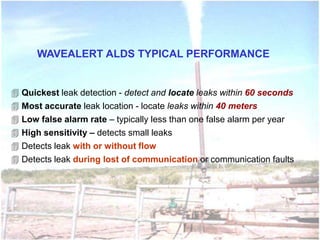
 Quickest leak detection - detect and locate leaks within 60 seconds
 Most accurate leak location - locate leaks within 40 meters
 Low false alarm rate – typically less than one false alarm per year
 High sensitivity – detects small leaks
 Detects leak with or without flow
 Detects leak during lost of communication or communication faults
WAVEALERT ALDS TYPICAL PERFORMANCE
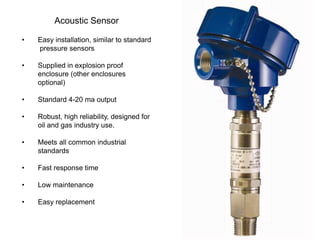
Acoustic Sensor
• Easy installation, similar to standard
pressure sensors
• Supplied in explosion proof
enclosure (other enclosures
optional)
• Standard 4-20 ma output
• Robust, high reliability, designed for
oil and gas industry use.
• Meets all common industrial
standards
• Fast response time
• Low maintenance
• Easy replacement
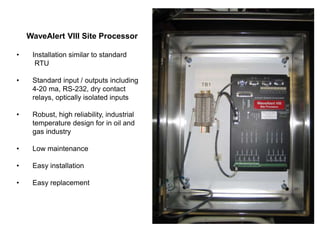
WaveAlert VIII Site Processor
• Installation similar to standard
RTU
• Standard input / outputs including
4-20 ma, RS-232, dry contact
relays, optically isolated inputs
• Robust, high reliability, industrial
temperature design for in oil and
gas industry
• Low maintenance
• Easy installation
• Easy replacement
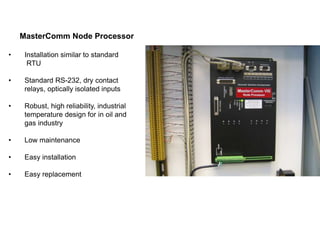
MasterComm Node Processor
• Installation similar to standard
RTU
• Standard RS-232, dry contact
relays, optically isolated inputs
• Robust, high reliability, industrial
temperature design for in oil and
gas industry
• Low maintenance
• Easy installation
• Easy replacement
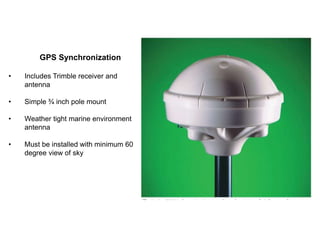
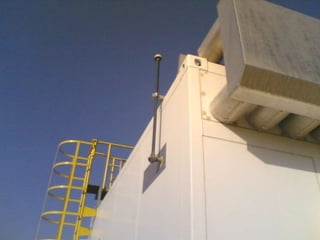
GPS Synchronization
• Includes Trimble receiver and
antenna
• Simple ¾ inch pole mount
• Weather tight marine environment
antenna
• Must be installed with minimum 60
degree view of sky
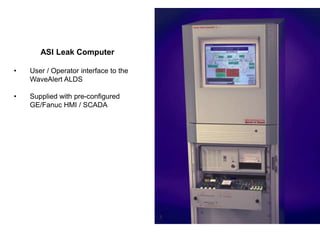
ASI Leak Computer
• User / Operator interface to the
WaveAlert ALDS
• Supplied with pre-configured
GE/Fanuc HMI / SCADA
ASI WAVEALERT SYSTEM HELPS PREVENT DISASTER
!! Once again, ASI’s ALDS detected leak and saved lives !!
In 1982, an early version WaveAlert ALDS (Acoustic Leak Detection System) was installed to monitor an ESSO 10 inch LPG pipeline in
Australia. In 1998, the system was upgraded to a WaveAlert VII ALDS. In this ESSO system, six WaveAlert VII Site Processors are used
to monitor the 188 km pipeline. Each WaveAlert Site Processor is designed to control an isolation valve. With control of isolation valves
the WaveAlert ALDS will automatically shut-in the pipeline when a leak is detected. This type of installation allows for the fastest
possible response to a leak and clearly demonstrates the level of false alarm rejection the WaveAlert ALDS has achieved.
On July 19, 1999, a leak occurred near
Westbury Station midway on the LPG
pipeline and was detected by the WaveAlert
system which automatically shut-in the
pipeline.
On Friday Nov. 24, 2000, a work crew
laying fiber optic cable punctured the LPG
pipeline approximately 4 km North of Moe.
Again, the WaveAlert ALDS immediately
(within 30 seconds) detected the leak and
automatically shut-in the pipeline. The
WaveAlert ALDS not only detected the leak
and shut off the valves, but also located the
leak within 100 meters providing a means of
quick verification and preventing a potential
disaster and possible casualties.
These are the only known occurrences of
any type of leak detection system locating a
leak and automatically shutting in a pipeline.
The WaveAlert ALDS is the only leak
detection system with a proven record,
achieving not only the low false alarm rate
required for automatic shut-in control but
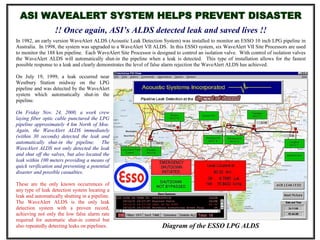
also repeatedly detecting leaks on pipelines. Diagram of the ESSO LPG ALDS
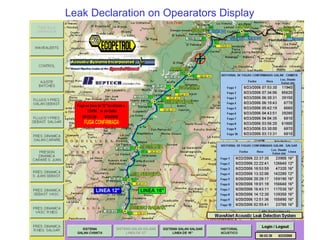
Leak Declaration on Opearators Display
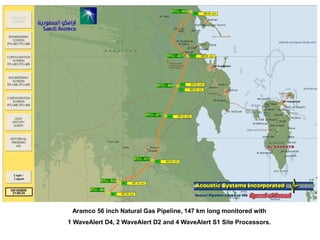
Aramco 56 inch Natural Gas Pipeline, 147 km long monitored with
1 WaveAlert D4, 2 WaveAlert D2 and 4 WaveAlert S1 Site Processors.
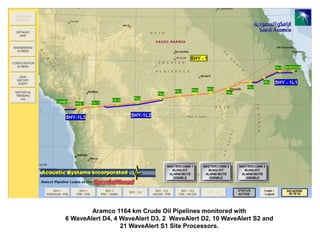
Aramco 1164 km Crude Oil Pipelines monitored with
6 WaveAlert D4, 4 WaveAlert D3, 2 WaveAlert D2, 10 WaveAlert S2 and
21 WaveAlert S1 Site Processors.
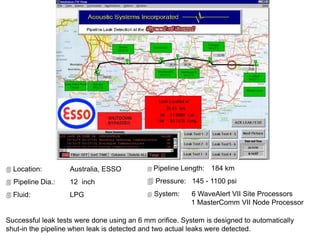
 Location: Australia, ESSO
 Pipeline Dia.: 12 inch
 Fluid: LPG
Successful leak tests were done using an 6 mm orifice. System is designed to automatically
shut-in the pipeline when leak is detected and two actual leaks were detected.
 Pipeline Length: 184 km
 Pressure: 145 - 1100 psi
 System: 6 WaveAlert VII Site Processors
1 MasterComm VII Node Processor
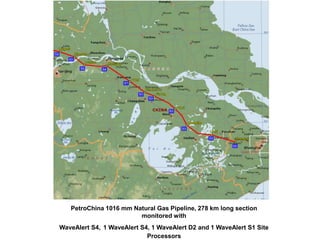
PetroChina 1016 mm Natural Gas Pipeline, 278 km long section
monitored with
WaveAlert S4, 1 WaveAlert S4, 1 WaveAlert D2 and 1 WaveAlert S1 Site
Processors
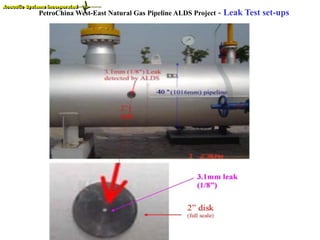
PetroChina West-East Natural Gas Pipeline ALDS Project - Leak Test set-ups
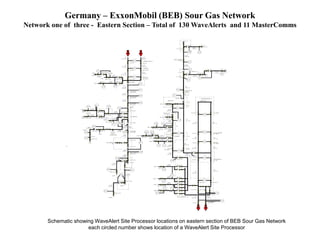
Schematic showing WaveAlert Site Processor locations on eastern section of BEB Sour Gas Network
each circled number shows location of a WaveAlert Site Processor
Germany – ExxonMobil (BEB) Sour Gas Network
Network one of three - Eastern Section – Total of 130 WaveAlerts and 11 MasterComms
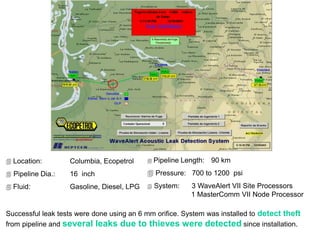
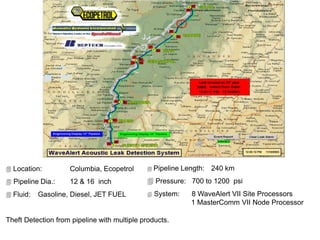
 Location: Columbia, Ecopetrol
 Pipeline Dia.: 16 inch
 Fluid: Gasoline, Diesel, LPG
Successful leak tests were done using an 6 mm orifice. System was installed to detect theft
from pipeline and several leaks due to thieves were detected since installation.
 Pipeline Length: 90 km
 Pressure: 700 to 1200 psi
 System: 3 WaveAlert VII Site Processors
1 MasterComm VII Node Processor
 Location: Columbia, Ecopetrol
 Pipeline Dia.: 12 & 16 inch
 Fluid: Gasoline, Diesel, JET FUEL
Theft Detection from pipeline with multiple products.
 Pipeline Length: 240 km
 Pressure: 700 to 1200 psi
 System: 8 WaveAlert VII Site Processors
1 MasterComm VII Node Processor
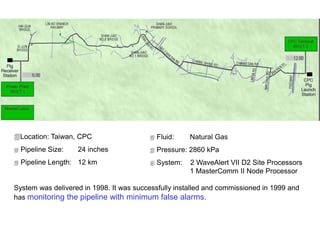
Location: Taiwan, CPC
 Pipeline Size: 24 inches
 Pipeline Length: 12 km
System was delivered in 1998. It was successfully installed and commissioned in 1999 and
has monitoring the pipeline with minimum false alarms.
 Fluid: Natural Gas
 Pressure: 2860 kPa
 System: 2 WaveAlert VII D2 Site Processors
1 MasterComm II Node Processor
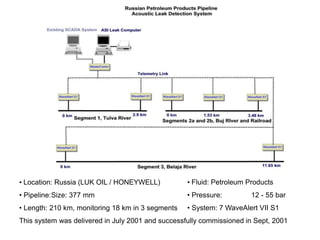
• Location: Russia (LUK OIL / HONEYWELL)
• Pipeline:Size: 377 mm
• Length: 210 km, monitoring 18 km in 3 segments
This system was delivered in July 2001 and successfully commissioned in Sept, 2001
• Fluid: Petroleum Products
• Pressure: 12 - 55 bar
• System: 7 WaveAlert VII S1
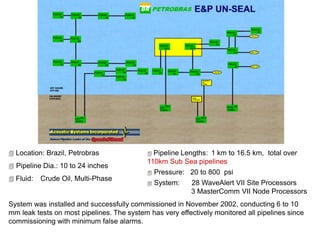
 Location: Brazil, Petrobras
 Pipeline Dia.: 10 to 24 inches
 Fluid: Crude Oil, Multi-Phase
System was installed and successfully commissioned in November 2002, conducting 6 to 10
mm leak tests on most pipelines. The system has very effectively monitored all pipelines since
commissioning with minimum false alarms.
 Pipeline Lengths: 1 km to 16.5 km, total over
110km Sub Sea pipelines
 Pressure: 20 to 800 psi
 System: 28 WaveAlert VII Site Processors
3 MasterComm VII Node Processors
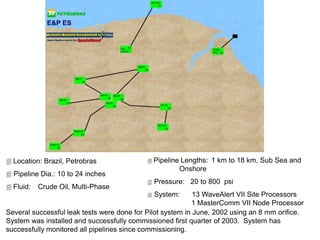
 Location: Brazil, Petrobras
 Pipeline Dia.: 10 to 24 inches
 Fluid: Crude Oil, Multi-Phase
Several successful leak tests were done for Pilot system in June, 2002 using an 8 mm orifice.
System was installed and successfully commissioned first quarter of 2003. System has
successfully monitored all pipelines since commissioning.
 Pipeline Lengths: 1 km to 18 km, Sub Sea and
Onshore
 Pressure: 20 to 800 psi
 System: 13 WaveAlert VII Site Processors
1 MasterComm VII Node Processor
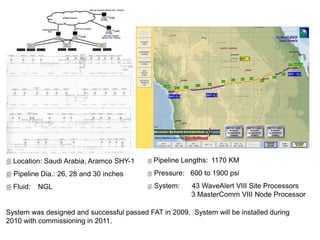
 Location: Saudi Arabia, Aramco SHY-1
 Pipeline Dia.: 26, 28 and 30 inches
 Fluid: NGL
System was designed and successful passed FAT in 2009. System will be installed during
2010 with commissioning in 2011.
 Pipeline Lengths: 1170 KM
 Pressure: 600 to 1900 psi
 System: 43 WaveAlert VIII Site Processors
3 MasterComm VIII Node Processor
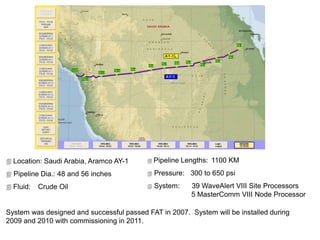
 Location: Saudi Arabia, Aramco AY-1
 Pipeline Dia.: 48 and 56 inches
 Fluid: Crude Oil
System was designed and successful passed FAT in 2007. System will be installed during
2009 and 2010 with commissioning in 2011.
 Pipeline Lengths: 1100 KM
 Pressure: 300 to 650 psi
 System: 39 WaveAlert VIII Site Processors
5 MasterComm VIII Node Processor
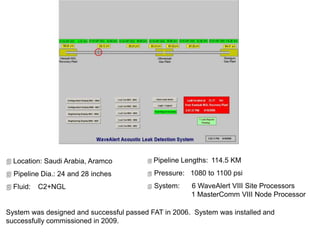
 Location: Saudi Arabia, Aramco
 Pipeline Dia.: 24 and 28 inches
 Fluid: C2+NGL
System was designed and successful passed FAT in 2006. System was installed and
successfully commissioned in 2009.
 Pipeline Lengths: 114.5 KM
 Pressure: 1080 to 1100 psi
 System: 6 WaveAlert VIII Site Processors
1 MasterComm VIII Node Processor
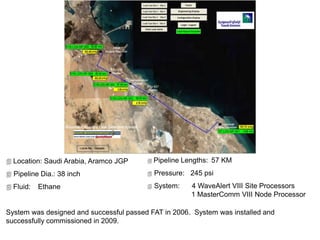
 Location: Saudi Arabia, Aramco JGP
 Pipeline Dia.: 38 inch
 Fluid: Ethane
System was designed and successful passed FAT in 2006. System was installed and
successfully commissioned in 2009.
 Pipeline Lengths: 57 KM
 Pressure: 245 psi
 System: 4 WaveAlert VIII Site Processors
1 MasterComm VIII Node Processor
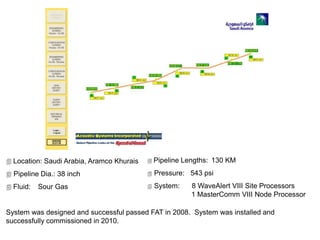
 Location: Saudi Arabia, Aramco Khurais
 Pipeline Dia.: 38 inch
 Fluid: Sour Gas
System was designed and successful passed FAT in 2008. System was installed and
successfully commissioned in 2010.
 Pipeline Lengths: 130 KM
 Pressure: 543 psi
 System: 8 WaveAlert VIII Site Processors
1 MasterComm VIII Node Processor
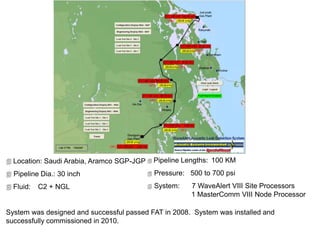
 Location: Saudi Arabia, Aramco SGP-JGP
 Pipeline Dia.: 30 inch
 Fluid: C2 + NGL
System was designed and successful passed FAT in 2008. System was installed and
successfully commissioned in 2010.
 Pipeline Lengths: 100 KM
 Pressure: 500 to 700 psi
 System: 7 WaveAlert VIII Site Processors
1 MasterComm VIII Node Processor
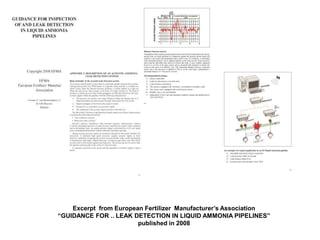
Excerpt from European Fertilizer Manufacturer’s Association
“GUIDANCE FOR .. LEAK DETECTION IN LIQUID AMMONIA PIPELINES”
published in 2008
Northwest Pipeline, Natural Gas Pipeline, 1980’s, Colorado
In the early 80’s a WaveAlert Leak Detection System was installed on a natural gas pipeline located in
Colorado. The system was set up to shut in the pipeline if a leak was detected. Within a few years a
landslide cause the pipe to rupture, the WaveAlert equipment immediately shut in the pipe, limiting the
loss of natural gas and greatly reducing the potential for disaster.
BEB (Shell / ESSO Company) Sour Gas Pipeline Network, 1990, Germany
In 1990 a WaveAlert Leak Detection was installed on a BEB (Shell / ESSO company) sour gas gathering
field. During system commissioning a pipe leading to a flare burst, the WaveAlert Leak Detection System
detected this leak.
ESSO, LPG Pipeline, July 19, 1999, Australia
In August 1998 a WaveAlert Leak Detection was installed on an Australian ESSO LPG pipeline. The
system was designed to automatically shut in the pipeline when a leak is detected. On July 19, 1999 a leak
occurred. The leak was caused when an inlet valve was closed and then opened suddenly at the
receiving end (Long Island Point). This generated a shock wave which caused a leak due to a seal failure
on a LPG pump near the mid section of the pipeline (Westbury) and was detected as a leak by the
WaveAlert System. The WaveAlert System immediately shut the isolation valves along the pipeline
which prevented potential casualties and financial loss.
ESSO, LPG Pipeline, November 24, 2000, Australia
On Nov. 24, 2000, a work crew laying fiber optic cable near Moe, 80.5 km from Sale, punctured the LPG
pipeline. The WaveAlert Leak Detection System immediately (within 60 seconds) detected the small leak
and automatically shut-in the pipeline. The WaveAlert Leak Detection System not only detected the leak
and shut-off the valves, but also located the leaked within 100 meters. This provided a means of instant
leak verification and prevented a potential disaster and possible casualties. These are the only known
occurrences of any type of leak detection system automatically shutting in a pipeline on the
occurrence of a leak.
Some Examples of Actual Leaks Detected by ASI-ALDS
FAT Test &
In-house Inspection
Training and Education
Site Survey
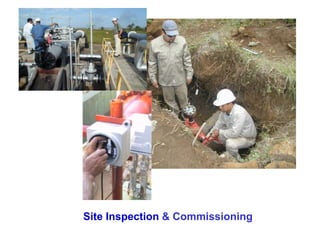
Site Inspection & Commissioning
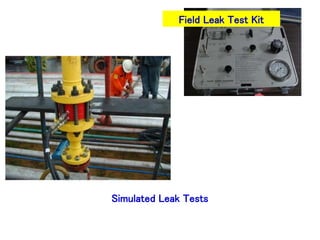
Simulated Leak Tests
Field Leak Test Kit
WaveAlert Acoustic Pipeline Leak Detection

WaveAlert Acoustic Pipeline Leak Detection

  • 1.
    TEL: Texas 281-345-9995,New Jersey 201-784-6878 FAX: Texas 281-345-9998, New Jersey 201-784-6887 www.wavealert.com sales@wavealert.com
  • 3.
    Overview of AcousticLeak Detection EVENT EVENT LEAK The WaveAlert® Acoustic Leak Detection System (ALDS) is designed to detect the occurrence and determine the location of leaks in gas, liquid, and multiphase flow pipelines. At the instant of a break in the pipe wall a transient acoustic wave is created. This acoustic wave travels at the speed of sound for that fluid guided by the walls of the pipe in both directions from the source of the break. The acoustic wave is detected by sensitive acoustic sensors and analyzed by WaveAlert Site Processors situated along the pipeline. After further analysis by the MasterComm, the location of the leak is determined from the arrival times of the expansion waves at the sensor locations.
  • 4.
    By using timesynchronization provided by GPS satellite, the WaveAlert ALDS will locate leaks very precisely. Leak Location S = D/2 + 1/2(t1 - t2)V S = Leak Location D = Distance Between Sensors t1 & t2 = Time of arrival at Sensors V = Sound Velocity in Pipeline Media Sources of Location Uncertainty: t1,t2 & V With GPS => only uncertainty from V Detection Time: D/V + 2*N N = Polling Time
  • 5.
    WaveAlert ALDS ON-LINE REAL-TIME LEAKDETECTION SYSTEMS QUICK Detect Leak at the Speed of Sound SENSITIVE Detect Small size leak PRECISE Determine the Leak Location (Especially for underground pipe) RELIABLE Detect Leaks under All Operating Conditions with Minimum False Alarm Rate (Steady State, Transients- pump start, valve closing, shut in flow...) Easy to Use (Minimum Maintenance & Calibration, work with lost of communication)
  • 6.
    Signals continuously scannedand analyzed by each site processor located along the pipeline OVER 15 different algorithms/filters analyze potential leak signals If two or more local processors report potential leak  Central node process performs further verification with additional algorithms/filters and determines leak location. Improved sensitivity, analysis and leak location accuracy, drastically reduces false alarm. Less than less than one false alarm per year. ASI ALDS Technology Patented (US6389887,US6668,679,etc.) / State-of-the-Art Proprietary Multi-Layer Data Processing Techniques
  • 7.
     Quickest leakdetection - detect and locate leaks within 60 seconds  Most accurate leak location - locate leaks within 40 meters  Low false alarm rate – typically less than one false alarm per year  High sensitivity – detects small leaks  Detects leak with or without flow  Detects leak during lost of communication or communication faults WAVEALERT ALDS TYPICAL PERFORMANCE
  • 8.
    Acoustic Sensor • Easyinstallation, similar to standard pressure sensors • Supplied in explosion proof enclosure (other enclosures optional) • Standard 4-20 ma output • Robust, high reliability, designed for oil and gas industry use. • Meets all common industrial standards • Fast response time • Low maintenance • Easy replacement
  • 9.
    WaveAlert VIII SiteProcessor • Installation similar to standard RTU • Standard input / outputs including 4-20 ma, RS-232, dry contact relays, optically isolated inputs • Robust, high reliability, industrial temperature design for in oil and gas industry • Low maintenance • Easy installation • Easy replacement
  • 10.
    MasterComm Node Processor •Installation similar to standard RTU • Standard RS-232, dry contact relays, optically isolated inputs • Robust, high reliability, industrial temperature design for in oil and gas industry • Low maintenance • Easy installation • Easy replacement
  • 11.
    GPS Synchronization • IncludesTrimble receiver and antenna • Simple ¾ inch pole mount • Weather tight marine environment antenna • Must be installed with minimum 60 degree view of sky
  • 13.
    ASI Leak Computer •User / Operator interface to the WaveAlert ALDS • Supplied with pre-configured GE/Fanuc HMI / SCADA
  • 17.
    ASI WAVEALERT SYSTEMHELPS PREVENT DISASTER !! Once again, ASI’s ALDS detected leak and saved lives !! In 1982, an early version WaveAlert ALDS (Acoustic Leak Detection System) was installed to monitor an ESSO 10 inch LPG pipeline in Australia. In 1998, the system was upgraded to a WaveAlert VII ALDS. In this ESSO system, six WaveAlert VII Site Processors are used to monitor the 188 km pipeline. Each WaveAlert Site Processor is designed to control an isolation valve. With control of isolation valves the WaveAlert ALDS will automatically shut-in the pipeline when a leak is detected. This type of installation allows for the fastest possible response to a leak and clearly demonstrates the level of false alarm rejection the WaveAlert ALDS has achieved. On July 19, 1999, a leak occurred near Westbury Station midway on the LPG pipeline and was detected by the WaveAlert system which automatically shut-in the pipeline. On Friday Nov. 24, 2000, a work crew laying fiber optic cable punctured the LPG pipeline approximately 4 km North of Moe. Again, the WaveAlert ALDS immediately (within 30 seconds) detected the leak and automatically shut-in the pipeline. The WaveAlert ALDS not only detected the leak and shut off the valves, but also located the leak within 100 meters providing a means of quick verification and preventing a potential disaster and possible casualties. These are the only known occurrences of any type of leak detection system locating a leak and automatically shutting in a pipeline. The WaveAlert ALDS is the only leak detection system with a proven record, achieving not only the low false alarm rate required for automatic shut-in control but also repeatedly detecting leaks on pipelines. Diagram of the ESSO LPG ALDS
  • 18.
    Leak Declaration onOpearators Display
  • 19.
    Aramco 56 inchNatural Gas Pipeline, 147 km long monitored with 1 WaveAlert D4, 2 WaveAlert D2 and 4 WaveAlert S1 Site Processors.
  • 20.
    Aramco 1164 kmCrude Oil Pipelines monitored with 6 WaveAlert D4, 4 WaveAlert D3, 2 WaveAlert D2, 10 WaveAlert S2 and 21 WaveAlert S1 Site Processors.
  • 21.
     Location: Australia,ESSO  Pipeline Dia.: 12 inch  Fluid: LPG Successful leak tests were done using an 6 mm orifice. System is designed to automatically shut-in the pipeline when leak is detected and two actual leaks were detected.  Pipeline Length: 184 km  Pressure: 145 - 1100 psi  System: 6 WaveAlert VII Site Processors 1 MasterComm VII Node Processor
  • 22.
    PetroChina 1016 mmNatural Gas Pipeline, 278 km long section monitored with WaveAlert S4, 1 WaveAlert S4, 1 WaveAlert D2 and 1 WaveAlert S1 Site Processors
  • 23.
    PetroChina West-East NaturalGas Pipeline ALDS Project - Leak Test set-ups
  • 24.
    Schematic showing WaveAlertSite Processor locations on eastern section of BEB Sour Gas Network each circled number shows location of a WaveAlert Site Processor Germany – ExxonMobil (BEB) Sour Gas Network Network one of three - Eastern Section – Total of 130 WaveAlerts and 11 MasterComms
  • 25.
     Location: Columbia,Ecopetrol  Pipeline Dia.: 16 inch  Fluid: Gasoline, Diesel, LPG Successful leak tests were done using an 6 mm orifice. System was installed to detect theft from pipeline and several leaks due to thieves were detected since installation.  Pipeline Length: 90 km  Pressure: 700 to 1200 psi  System: 3 WaveAlert VII Site Processors 1 MasterComm VII Node Processor
  • 26.
     Location: Columbia,Ecopetrol  Pipeline Dia.: 12 & 16 inch  Fluid: Gasoline, Diesel, JET FUEL Theft Detection from pipeline with multiple products.  Pipeline Length: 240 km  Pressure: 700 to 1200 psi  System: 8 WaveAlert VII Site Processors 1 MasterComm VII Node Processor
  • 27.
    Location: Taiwan, CPC Pipeline Size: 24 inches  Pipeline Length: 12 km System was delivered in 1998. It was successfully installed and commissioned in 1999 and has monitoring the pipeline with minimum false alarms.  Fluid: Natural Gas  Pressure: 2860 kPa  System: 2 WaveAlert VII D2 Site Processors 1 MasterComm II Node Processor
  • 28.
    • Location: Russia(LUK OIL / HONEYWELL) • Pipeline:Size: 377 mm • Length: 210 km, monitoring 18 km in 3 segments This system was delivered in July 2001 and successfully commissioned in Sept, 2001 • Fluid: Petroleum Products • Pressure: 12 - 55 bar • System: 7 WaveAlert VII S1
  • 29.
     Location: Brazil,Petrobras  Pipeline Dia.: 10 to 24 inches  Fluid: Crude Oil, Multi-Phase System was installed and successfully commissioned in November 2002, conducting 6 to 10 mm leak tests on most pipelines. The system has very effectively monitored all pipelines since commissioning with minimum false alarms.  Pipeline Lengths: 1 km to 16.5 km, total over 110km Sub Sea pipelines  Pressure: 20 to 800 psi  System: 28 WaveAlert VII Site Processors 3 MasterComm VII Node Processors
  • 30.
     Location: Brazil,Petrobras  Pipeline Dia.: 10 to 24 inches  Fluid: Crude Oil, Multi-Phase Several successful leak tests were done for Pilot system in June, 2002 using an 8 mm orifice. System was installed and successfully commissioned first quarter of 2003. System has successfully monitored all pipelines since commissioning.  Pipeline Lengths: 1 km to 18 km, Sub Sea and Onshore  Pressure: 20 to 800 psi  System: 13 WaveAlert VII Site Processors 1 MasterComm VII Node Processor
  • 31.
     Location: SaudiArabia, Aramco SHY-1  Pipeline Dia.: 26, 28 and 30 inches  Fluid: NGL System was designed and successful passed FAT in 2009. System will be installed during 2010 with commissioning in 2011.  Pipeline Lengths: 1170 KM  Pressure: 600 to 1900 psi  System: 43 WaveAlert VIII Site Processors 3 MasterComm VIII Node Processor
  • 32.
     Location: SaudiArabia, Aramco AY-1  Pipeline Dia.: 48 and 56 inches  Fluid: Crude Oil System was designed and successful passed FAT in 2007. System will be installed during 2009 and 2010 with commissioning in 2011.  Pipeline Lengths: 1100 KM  Pressure: 300 to 650 psi  System: 39 WaveAlert VIII Site Processors 5 MasterComm VIII Node Processor
  • 33.
     Location: SaudiArabia, Aramco  Pipeline Dia.: 24 and 28 inches  Fluid: C2+NGL System was designed and successful passed FAT in 2006. System was installed and successfully commissioned in 2009.  Pipeline Lengths: 114.5 KM  Pressure: 1080 to 1100 psi  System: 6 WaveAlert VIII Site Processors 1 MasterComm VIII Node Processor
  • 34.
     Location: SaudiArabia, Aramco JGP  Pipeline Dia.: 38 inch  Fluid: Ethane System was designed and successful passed FAT in 2006. System was installed and successfully commissioned in 2009.  Pipeline Lengths: 57 KM  Pressure: 245 psi  System: 4 WaveAlert VIII Site Processors 1 MasterComm VIII Node Processor
  • 35.
     Location: SaudiArabia, Aramco Khurais  Pipeline Dia.: 38 inch  Fluid: Sour Gas System was designed and successful passed FAT in 2008. System was installed and successfully commissioned in 2010.  Pipeline Lengths: 130 KM  Pressure: 543 psi  System: 8 WaveAlert VIII Site Processors 1 MasterComm VIII Node Processor
  • 36.
     Location: SaudiArabia, Aramco SGP-JGP  Pipeline Dia.: 30 inch  Fluid: C2 + NGL System was designed and successful passed FAT in 2008. System was installed and successfully commissioned in 2010.  Pipeline Lengths: 100 KM  Pressure: 500 to 700 psi  System: 7 WaveAlert VIII Site Processors 1 MasterComm VIII Node Processor
  • 37.
    Excerpt from EuropeanFertilizer Manufacturer’s Association “GUIDANCE FOR .. LEAK DETECTION IN LIQUID AMMONIA PIPELINES” published in 2008
  • 38.
    Northwest Pipeline, NaturalGas Pipeline, 1980’s, Colorado In the early 80’s a WaveAlert Leak Detection System was installed on a natural gas pipeline located in Colorado. The system was set up to shut in the pipeline if a leak was detected. Within a few years a landslide cause the pipe to rupture, the WaveAlert equipment immediately shut in the pipe, limiting the loss of natural gas and greatly reducing the potential for disaster. BEB (Shell / ESSO Company) Sour Gas Pipeline Network, 1990, Germany In 1990 a WaveAlert Leak Detection was installed on a BEB (Shell / ESSO company) sour gas gathering field. During system commissioning a pipe leading to a flare burst, the WaveAlert Leak Detection System detected this leak. ESSO, LPG Pipeline, July 19, 1999, Australia In August 1998 a WaveAlert Leak Detection was installed on an Australian ESSO LPG pipeline. The system was designed to automatically shut in the pipeline when a leak is detected. On July 19, 1999 a leak occurred. The leak was caused when an inlet valve was closed and then opened suddenly at the receiving end (Long Island Point). This generated a shock wave which caused a leak due to a seal failure on a LPG pump near the mid section of the pipeline (Westbury) and was detected as a leak by the WaveAlert System. The WaveAlert System immediately shut the isolation valves along the pipeline which prevented potential casualties and financial loss. ESSO, LPG Pipeline, November 24, 2000, Australia On Nov. 24, 2000, a work crew laying fiber optic cable near Moe, 80.5 km from Sale, punctured the LPG pipeline. The WaveAlert Leak Detection System immediately (within 60 seconds) detected the small leak and automatically shut-in the pipeline. The WaveAlert Leak Detection System not only detected the leak and shut-off the valves, but also located the leaked within 100 meters. This provided a means of instant leak verification and prevented a potential disaster and possible casualties. These are the only known occurrences of any type of leak detection system automatically shutting in a pipeline on the occurrence of a leak. Some Examples of Actual Leaks Detected by ASI-ALDS
  • 39.
  • 40.
  • 41.
  • 42.
    Site Inspection &Commissioning
  • 43.