Many emerging markets were adversely 
affected by a change in international investor 
sentiment in 2013, as a result of the announced 
change in US monetary policy conditions. Some 
emerging markets are today still vulnerable to 
further shifts in sentiment. 
Tapering: introduction 
The United States Federal Reserve (the Fed) started to 
reduce its monthly purchase of financial assets – the so-called 
‘tapering’ - in January this year and is expected to 
reduce its purchasing to zero this month. This will, 
however, be just the start of the reduction of the US’s 
expansionary monetary policy, designed to return it to 
more normal levels. If the US economy continues to 
perform well, an interest hike is to be expected next year. 
We have already seen a rise in the long-term yield curve on 
US government bonds. This implies that the US has is 
already becoming a more attractive destination for foreign 
financial investors and, in contrast, that other markets will 
continue to become relatively less attractive for investors. 
In the summer of 2013 there was some significant ‘taper 
turbulence’ in several emerging markets. Brazil, India, 
Indonesia, South Africa and Turkey were coined the ‘fragile 
five’ countries and their currencies suffered significant 
depreciations. 
Taper turbulence: the mechanism 
The ‘taper turbulence’ is associated with an outflow of 
capital and drop in investor confidence, with the following 
consequences: 
(1) Depreciating exchange rates of Emerging Market 
(EM) currencies; 
(2) Rising yields of sovereign and private debt in EMs; 
(3) Decreasing stock indices of EMs; 
(4) Deterioration in the balance of payments due to 
capital outflows from EMs. 
Vulnerable Emerging Markets 
Economic Research - October 2014
2 Economic Research Note 
The payment capacity of emerging markets is, in principle, 
negatively affected by all of these, in the following ways: 
(1) Financing costs of existing foreign currency debt will 
increase. Companies, households and governments 
with high (unhedged) foreign currency obligations 
will find themselves in dire straits. 
(2) Companies and governments are confronted with 
higher interest costs on new to be issued bonds. 
(3) The required return on EM equity will rise and this 
increases financing costs for private enterprises in 
EMs. 
(4) The conversion and transfer of capital (due to the 
sell-off of financial assets by foreign investors) 
results in a deficit on the capital account and possibly 
a reduction of foreign exchange reserves: ultimately 
leading to a balance of payments crisis. 
It is worth considering whether the currency depreciations 
are the cause or the result of the turbulence on financial 
markets that we saw in 2013. Although the trigger for the 
changing behaviour of international financial markets was 
obviously the US tapering policy, this does not explain why 
some emerging markets were hit badly and others proved 
to be resilient. Moreover, it seems unlikely that global risk 
appetite has decreased to an extent that investors would 
immediately be prepared to swap high yield EM bonds for a 
still low yielding US government bond. 
It seems more plausible that the tapering policy has 
opened investors’ eyes to structural weaknesses in 
emerging market economies and made them re-assess 
their asset allocation. If this is true, a solid political and 
macro-economic risk analysis of individual emerging 
markets could point to those countries that are most 
vulnerable to further actions by the Fed. 
What countries are vulnerable for capital flight? 
A first step in this analysis is to list the countries with a 
large quantity of foreign capital within its borders. This is, 
after all, the amount of capital that could potentially be 
withdrawn from the country in times of financial panic. 
The IMF provides data on the International Investment 
Position (IIP) of many countries. If we take the liabilities 
side of the portfolio investment IIP and divide this by the 
foreign exchange reserves, we have a good indicator of the 
potential vulnerability to capital flight. 
Examples of emerging markets with a high IIP/reserves 
ratio are: Brazil, South Africa, Mexico, Poland and Turkey. 
What countries are vulnerable for a change in investor’s 
sentiment? 
As already said, the tapering policy could be the trigger for 
a renewed assessment of financial investment. It will then 
be very apparent which countries have inherent macro-economic 
weaknesses. We have selected two macro-economic 
indicators that may worry international financial 
investors: the external financing requirement (EFR) and 
the economic policy effectiveness indicator. 
The external financing requirement is the sum of the 
current account balance, the short-term debt and the 
obligations on long-term debt (interest and repayments). 
This is the total amount denominated in foreign currency 
denominated that a country needs to pay within 12 
months. If we divide this, again, by the foreign exchange 
reserves we have an indicator of the short-term 
vulnerability for a balance of payment crisis. 
Examples of emerging markets with a ratio of >100% are 
Chile, Indonesia, South Africa and Turkey. 
A proxy for economic policy effectiveness can be obtained 
by taking the five years cumulative real economic growth 
minus the five years cumulative inflation: in particular, 
when this indicator turns out to be significantly lower than 
earlier expected. From a financial investor’s view this 
makes sense. Real economic growth is an important 
determinant of demand for almost all goods and services, 
while high inflation increases the chance of currency 
depreciations and also results in the erosion of consumer 
purchasing power. 
Examples of emerging economies with a strongly negative 
economic policy effectiveness indicator are: Brazil, 
Hungary, India, Romania, Russia, South Africa and Turkey. 
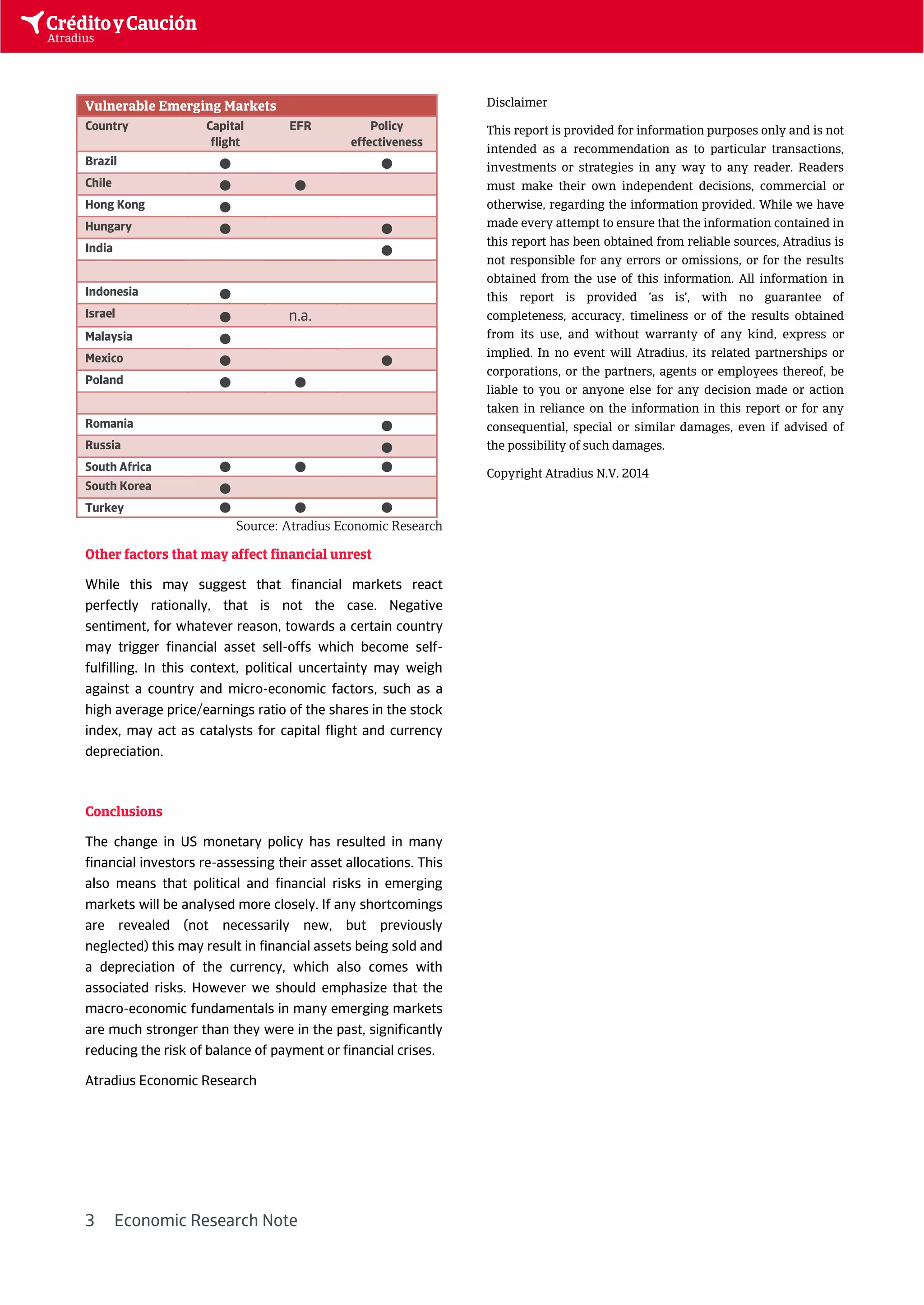
The following table shows emerging markets that are 
particularly vulnerable according to the three criteria 
mentioned above.
3 Economic Research Note 
Vulnerable Emerging Markets 
Country Capital 
flight 
EFR Policy 
effectiveness 
Brazil ● ● 
Chile ● ● 
Hong Kong ● 
Hungary ● ● 
India ● 
Indonesia ● 
Israel ● n.a. 
Malaysia ● 
Mexico ● ● 
Poland ● ● 
Romania ● 
Russia ● 
South Africa ● ● ● 
South Korea ● 
Turkey ● ● ● 
Source: Atradius Economic Research 
Other factors that may affect financial unrest 
While this may suggest that financial markets react 
perfectly rationally, that is not the case. Negative 
sentiment, for whatever reason, towards a certain country 
may trigger financial asset sell-offs which become self-fulfilling. 
In this context, political uncertainty may weigh 
against a country and micro-economic factors, such as a 
high average price/earnings ratio of the shares in the stock 
index, may act as catalysts for capital flight and currency 
depreciation. 
Conclusions 
The change in US monetary policy has resulted in many 
financial investors re-assessing their asset allocations. This 
also means that political and financial risks in emerging 
markets will be analysed more closely. If any shortcomings 
are revealed (not necessarily new, but previously 
neglected) this may result in financial assets being sold and 
a depreciation of the currency, which also comes with 
associated risks. However we should emphasize that the 
macro-economic fundamentals in many emerging markets 
are much stronger than they were in the past, significantly 
reducing the risk of balance of payment or financial crises. 
Atradius Economic Research 
Disclaimer 
This report is provided for information purposes only and is not 
intended as a recommendation as to particular transactions, 
investments or strategies in any way to any reader. Readers 
must make their own independent decisions, commercial or 
otherwise, regarding the information provided. While we have 
made every attempt to ensure that the information contained in 
this report has been obtained from reliable sources, Atradius is 
not responsible for any errors or omissions, or for the results 
obtained from the use of this information. All information in 
this report is provided ’as is’, with no guarantee of 
completeness, accuracy, timeliness or of the results obtained 
from its use, and without warranty of any kind, express or 
implied. In no event will Atradius, its related partnerships or 
corporations, or the partners, agents or employees thereof, be 
liable to you or anyone else for any decision made or action 
taken in reliance on the information in this report or for any 
consequential, special or similar damages, even if advised of 
the possibility of such damages. 
Copyright Atradius N.V. 2014

Vulnerable emerging markets

  • 1.
    Many emerging marketswere adversely affected by a change in international investor sentiment in 2013, as a result of the announced change in US monetary policy conditions. Some emerging markets are today still vulnerable to further shifts in sentiment. Tapering: introduction The United States Federal Reserve (the Fed) started to reduce its monthly purchase of financial assets – the so-called ‘tapering’ - in January this year and is expected to reduce its purchasing to zero this month. This will, however, be just the start of the reduction of the US’s expansionary monetary policy, designed to return it to more normal levels. If the US economy continues to perform well, an interest hike is to be expected next year. We have already seen a rise in the long-term yield curve on US government bonds. This implies that the US has is already becoming a more attractive destination for foreign financial investors and, in contrast, that other markets will continue to become relatively less attractive for investors. In the summer of 2013 there was some significant ‘taper turbulence’ in several emerging markets. Brazil, India, Indonesia, South Africa and Turkey were coined the ‘fragile five’ countries and their currencies suffered significant depreciations. Taper turbulence: the mechanism The ‘taper turbulence’ is associated with an outflow of capital and drop in investor confidence, with the following consequences: (1) Depreciating exchange rates of Emerging Market (EM) currencies; (2) Rising yields of sovereign and private debt in EMs; (3) Decreasing stock indices of EMs; (4) Deterioration in the balance of payments due to capital outflows from EMs. Vulnerable Emerging Markets Economic Research - October 2014
  • 2.
    2 Economic ResearchNote The payment capacity of emerging markets is, in principle, negatively affected by all of these, in the following ways: (1) Financing costs of existing foreign currency debt will increase. Companies, households and governments with high (unhedged) foreign currency obligations will find themselves in dire straits. (2) Companies and governments are confronted with higher interest costs on new to be issued bonds. (3) The required return on EM equity will rise and this increases financing costs for private enterprises in EMs. (4) The conversion and transfer of capital (due to the sell-off of financial assets by foreign investors) results in a deficit on the capital account and possibly a reduction of foreign exchange reserves: ultimately leading to a balance of payments crisis. It is worth considering whether the currency depreciations are the cause or the result of the turbulence on financial markets that we saw in 2013. Although the trigger for the changing behaviour of international financial markets was obviously the US tapering policy, this does not explain why some emerging markets were hit badly and others proved to be resilient. Moreover, it seems unlikely that global risk appetite has decreased to an extent that investors would immediately be prepared to swap high yield EM bonds for a still low yielding US government bond. It seems more plausible that the tapering policy has opened investors’ eyes to structural weaknesses in emerging market economies and made them re-assess their asset allocation. If this is true, a solid political and macro-economic risk analysis of individual emerging markets could point to those countries that are most vulnerable to further actions by the Fed. What countries are vulnerable for capital flight? A first step in this analysis is to list the countries with a large quantity of foreign capital within its borders. This is, after all, the amount of capital that could potentially be withdrawn from the country in times of financial panic. The IMF provides data on the International Investment Position (IIP) of many countries. If we take the liabilities side of the portfolio investment IIP and divide this by the foreign exchange reserves, we have a good indicator of the potential vulnerability to capital flight. Examples of emerging markets with a high IIP/reserves ratio are: Brazil, South Africa, Mexico, Poland and Turkey. What countries are vulnerable for a change in investor’s sentiment? As already said, the tapering policy could be the trigger for a renewed assessment of financial investment. It will then be very apparent which countries have inherent macro-economic weaknesses. We have selected two macro-economic indicators that may worry international financial investors: the external financing requirement (EFR) and the economic policy effectiveness indicator. The external financing requirement is the sum of the current account balance, the short-term debt and the obligations on long-term debt (interest and repayments). This is the total amount denominated in foreign currency denominated that a country needs to pay within 12 months. If we divide this, again, by the foreign exchange reserves we have an indicator of the short-term vulnerability for a balance of payment crisis. Examples of emerging markets with a ratio of >100% are Chile, Indonesia, South Africa and Turkey. A proxy for economic policy effectiveness can be obtained by taking the five years cumulative real economic growth minus the five years cumulative inflation: in particular, when this indicator turns out to be significantly lower than earlier expected. From a financial investor’s view this makes sense. Real economic growth is an important determinant of demand for almost all goods and services, while high inflation increases the chance of currency depreciations and also results in the erosion of consumer purchasing power. Examples of emerging economies with a strongly negative economic policy effectiveness indicator are: Brazil, Hungary, India, Romania, Russia, South Africa and Turkey. The following table shows emerging markets that are particularly vulnerable according to the three criteria mentioned above.
  • 3.
    3 Economic ResearchNote Vulnerable Emerging Markets Country Capital flight EFR Policy effectiveness Brazil ● ● Chile ● ● Hong Kong ● Hungary ● ● India ● Indonesia ● Israel ● n.a. Malaysia ● Mexico ● ● Poland ● ● Romania ● Russia ● South Africa ● ● ● South Korea ● Turkey ● ● ● Source: Atradius Economic Research Other factors that may affect financial unrest While this may suggest that financial markets react perfectly rationally, that is not the case. Negative sentiment, for whatever reason, towards a certain country may trigger financial asset sell-offs which become self-fulfilling. In this context, political uncertainty may weigh against a country and micro-economic factors, such as a high average price/earnings ratio of the shares in the stock index, may act as catalysts for capital flight and currency depreciation. Conclusions The change in US monetary policy has resulted in many financial investors re-assessing their asset allocations. This also means that political and financial risks in emerging markets will be analysed more closely. If any shortcomings are revealed (not necessarily new, but previously neglected) this may result in financial assets being sold and a depreciation of the currency, which also comes with associated risks. However we should emphasize that the macro-economic fundamentals in many emerging markets are much stronger than they were in the past, significantly reducing the risk of balance of payment or financial crises. Atradius Economic Research Disclaimer This report is provided for information purposes only and is not intended as a recommendation as to particular transactions, investments or strategies in any way to any reader. Readers must make their own independent decisions, commercial or otherwise, regarding the information provided. While we have made every attempt to ensure that the information contained in this report has been obtained from reliable sources, Atradius is not responsible for any errors or omissions, or for the results obtained from the use of this information. All information in this report is provided ’as is’, with no guarantee of completeness, accuracy, timeliness or of the results obtained from its use, and without warranty of any kind, express or implied. In no event will Atradius, its related partnerships or corporations, or the partners, agents or employees thereof, be liable to you or anyone else for any decision made or action taken in reliance on the information in this report or for any consequential, special or similar damages, even if advised of the possibility of such damages. Copyright Atradius N.V. 2014