Gemeente
Amsterdam
Amsterdam Open
Source
Samen een Open Source ecosysteem
voor steden voeden
Boris van Hoytema
“Grow an Open Source ecosystem for cities”
boris@publiccode.net
@bvhme
Open Source Adviseur (extern)
Consortium Open Source Development Manager
Director
The Foundation
For Public Code
Doelen van deze presentatie
● Vertellen over hoe we in Amsterdam Open Source ontwikkelen en waarom
dat eigenlijk niet anders kan
● Het Interreg SCORE project (waar Amsterdam en Dordrecht onderdeel van
zijn) over Open Samenwerkingen
Waarom Open Source?
● Collaboration
● Security
● Transparency
● Support, reliability and
maintainability
● Agility
● Reusability
● Attractiveness
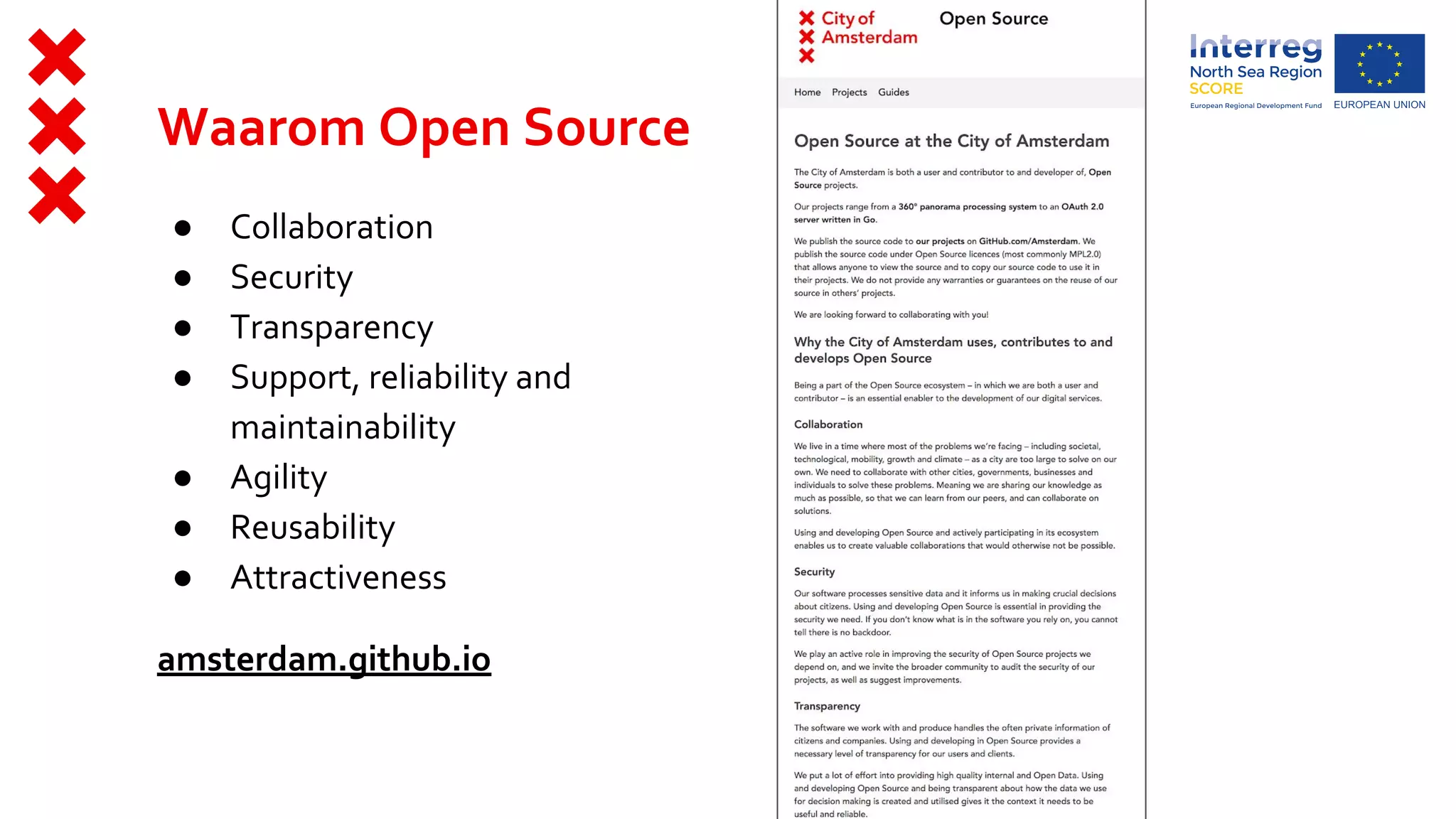
amsterdam.github.io
Waarom Open Source
Collaboration
We live in a time where most of the problems we’re facing – including
societal, technological, mobility, growth and climate – as a city are too large
to solve on our own. We need to collaborate with other cities, governments,
businesses and individuals to solve these problems. Meaning we are
sharing our knowledge as much as possible, so that we can learn from our
peers, and can collaborate on solutions.
Using and developing Open Source and actively participating in its
ecosystem enables us to create valuable collaborations that would otherwise
not be possible.
Waarom Open Source
Security
Our software processes sensitive data and it informs us in making crucial
decisions about citizens. Using and developing Open Source is essential in
providing the security we need. If you don’t know what is in the software you
rely on, you cannot tell there is no backdoor.
We play an active role in improving the security of Open Source projects we
depend on, and we invite the broader community to audit the security of our
projects, as well as suggest improvements.
Waarom Open Source
Transparency
The software we work with and produce handles the often private
information of citizens and companies. Using and developing in Open
Source provides a necessary level of transparency for our users and clients.
We put a lot of effort into providing high quality internal and Open Data.
Using and developing Open Source and being transparent about how the
data we use for decision making is created and utilised gives it the context it
needs to be useful and reliable.
Waarom Open Source
Support
Participating in the Open Source ecosystem, both as a user and as a
developer, means that finding solutions to problems is always a community
affair that involves users, contributors and the core developers of a project.
The community helps by quickly resolving simple issues as well as adapting
the code to solve more complex issues. Fixing problems together means
every problem and its solution leads to better code for every user.
Waarom Open Source
Reliability and Maintainability
Using and developing Open Source means working with a diverse
community in different circumstances to review, test and maintain the code
at the core of our services.
Waarom Open Source
Agility
Using and developing Open Source software enables us to have flexible
control over our processes and full access to our data. The flexibility and
access enable a more flexible process in which we can develop new
solutions quicker and with higher effectivity.
Open Source enables us to work with a wider variety of suppliers and
freelance developers, meaning we can eliminate vendor lock-in as well as
work with better, smaller or more specialised suppliers.
Waarom Open Source
Reusability
Developing Open Source projects means developing for reuse. Open Source projects
are scalable and interoperable.
Developing in the open also allows for other opinions – inside of our organisation and
outside – to help adjust the direction of a product to maximise its usefulness to the
community it serves.
If one of our projects is successful it can, relatively easily, be replicated or changed to
be implemented in a different circumstance.
If one of our projects or parts of one of our projects is reliant on another project we
want to replace, the principles of reusability make sure we can easily switch.
Waarom Open Source
Attractiveness
Many developers prefer developing an Open Source project over a closed
source project. Using, contributing to and developing Open Source projects
means working at the City of Amsterdam is a lot more attractive for those
brilliant, civic-minded, career developers out there.
Waarom Open Source
amsterdam.github.io
● Showcase van projecten
● Alle kennis die we rondom
Open Source hebben
github.com/amsterdam
Al onze code staat op GitHub
● Models
● City Data Portal
● Data pipelines
● APIs
● Infrastructure
…
(althans bijna alles)
Projecten
● 9 Steden, 15 partners
● Transnationaal ‘Solutions’ ontwikkelen, testen,
implementeren en verspreiden
● Agile & Open
● Best practices ontwikkelen
● Vorige week kick-off
SCORE
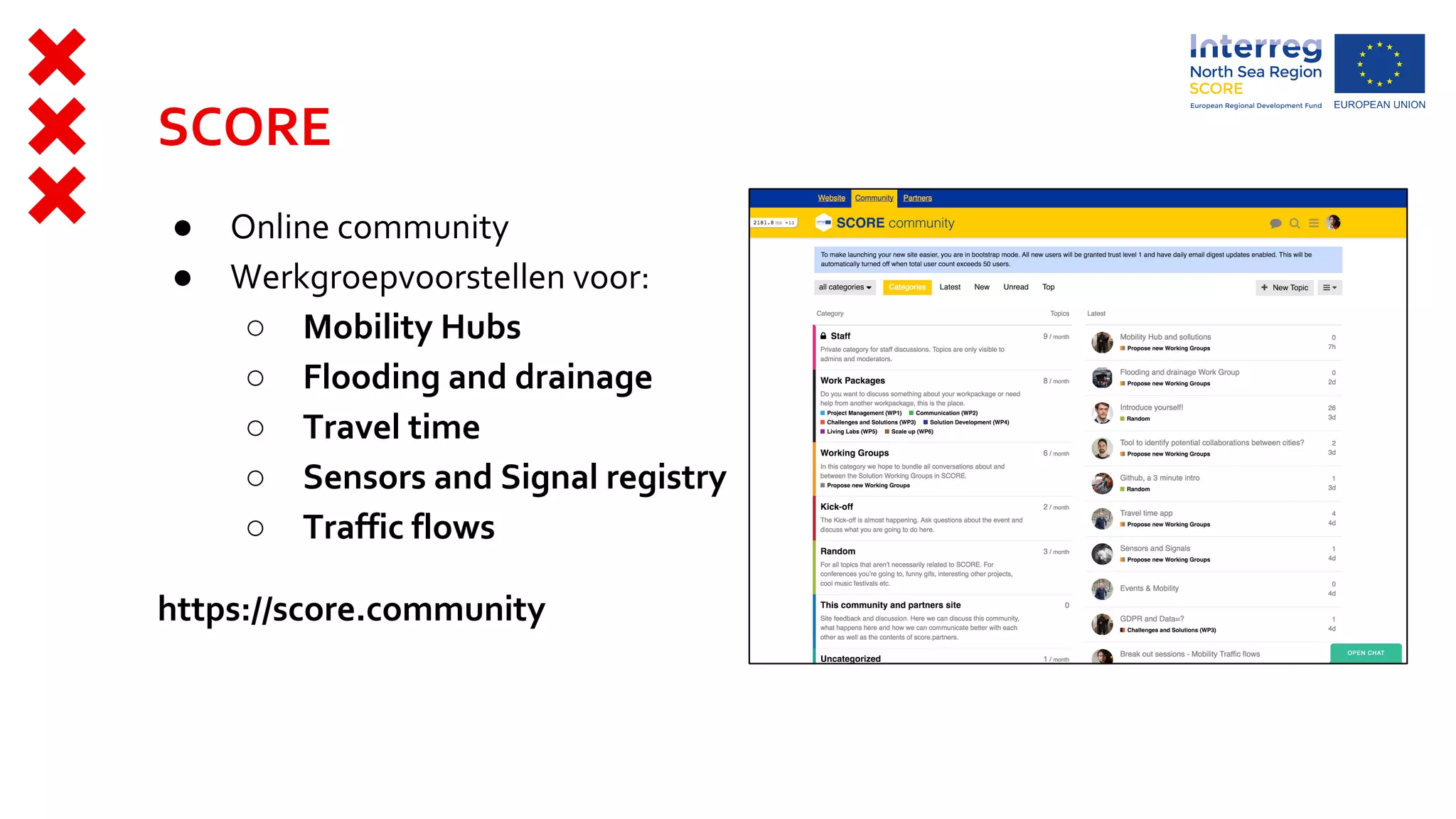
● Online community
● Werkgroepvoorstellen voor:
○ Mobility Hubs
○ Flooding and drainage
○ Travel time
○ Sensors and Signal registry
○ Traffic flows
https://score.community
SCORE
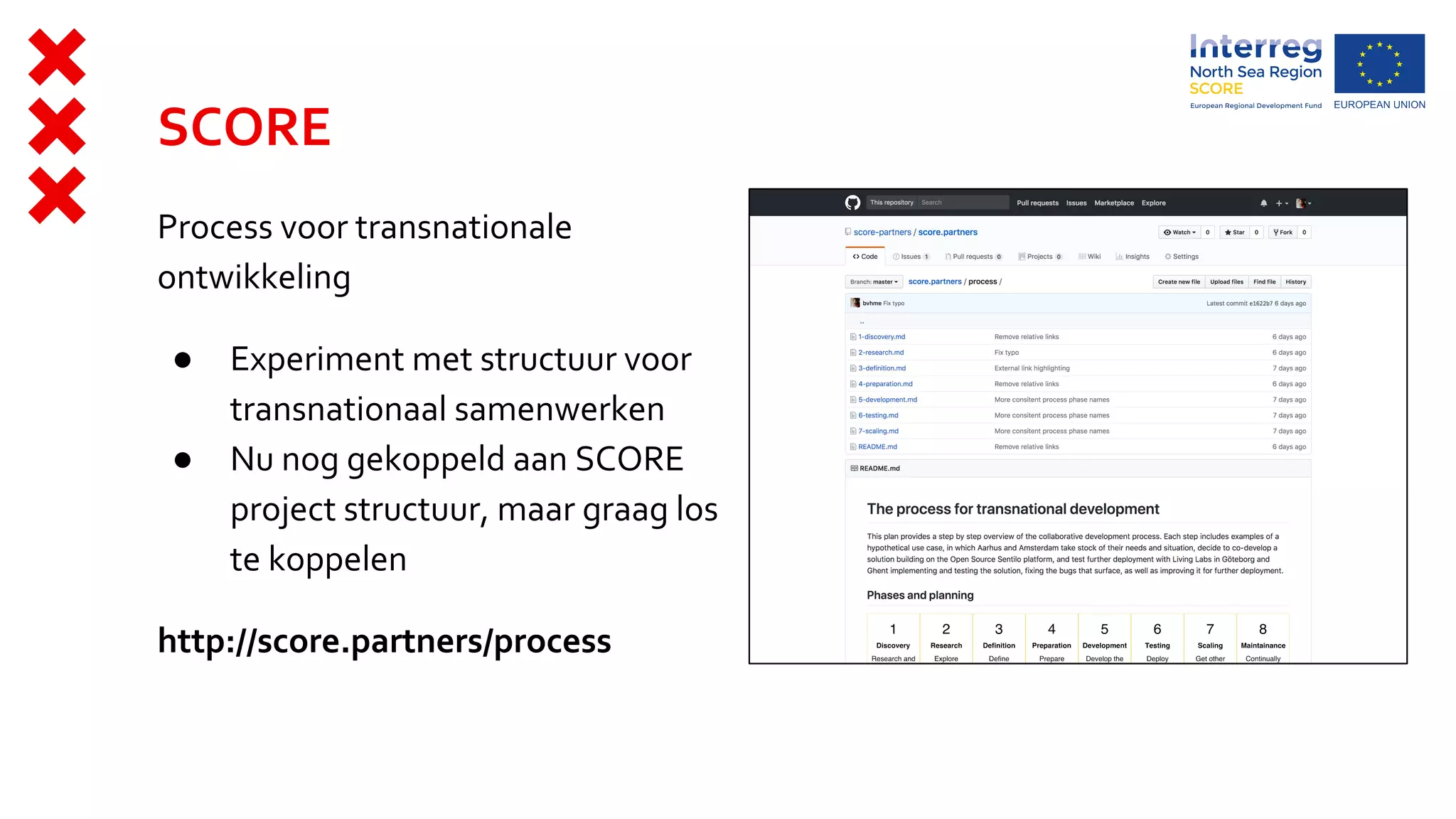
Process voor transnationale
ontwikkeling
● Experiment met structuur voor
transnationaal samenwerken
● Nu nog gekoppeld aan SCORE
project structuur, maar graag los
te koppelen
http://score.partners/process
SCORE
Standaard voor herbruikbare en
community ontwikkelde code:
● Documentatie
● Techniek
● Herbruikbaarheid
Help mee ontwikkelen:
GitHub: score-partners/quality-code
Een Open Source Ecosysteem
voor steden
Een Open Source voor steden community
We willen uitvinden hoe we:
● “Challenges” en “solutions”
kunnen delen om
samenwerkingen te kunnen
vinden
● Governance modellen voor Open
Source te vinden
● Een internationale community
van stedelijke developers en
developer management groeien
With:
● Barcelona
● Helsinki
● Ghent
● Aarhus
● Hamburg
● Dordrecht
● Bergen
● Bradford
● Aberdeen
And:
● OASC
● OS2
● FFPC
● SCORE
● Mozilla
● Dyne
● AUAS
...
Gemeente
Amsterdam
Thanks
boris@publiccode.net
@bvhme
Foundation For
Public Code

VNG Realisatie common ground field day 2018 Amsterdam Open Source

  • 1.
    Gemeente Amsterdam Amsterdam Open Source Samen eenOpen Source ecosysteem voor steden voeden
  • 2.
    Boris van Hoytema “Growan Open Source ecosystem for cities” boris@publiccode.net @bvhme Open Source Adviseur (extern) Consortium Open Source Development Manager Director The Foundation For Public Code
  • 3.
    Doelen van dezepresentatie ● Vertellen over hoe we in Amsterdam Open Source ontwikkelen en waarom dat eigenlijk niet anders kan ● Het Interreg SCORE project (waar Amsterdam en Dordrecht onderdeel van zijn) over Open Samenwerkingen
  • 4.
  • 5.
    ● Collaboration ● Security ●Transparency ● Support, reliability and maintainability ● Agility ● Reusability ● Attractiveness amsterdam.github.io Waarom Open Source
  • 6.
    Collaboration We live ina time where most of the problems we’re facing – including societal, technological, mobility, growth and climate – as a city are too large to solve on our own. We need to collaborate with other cities, governments, businesses and individuals to solve these problems. Meaning we are sharing our knowledge as much as possible, so that we can learn from our peers, and can collaborate on solutions. Using and developing Open Source and actively participating in its ecosystem enables us to create valuable collaborations that would otherwise not be possible. Waarom Open Source
  • 7.
    Security Our software processessensitive data and it informs us in making crucial decisions about citizens. Using and developing Open Source is essential in providing the security we need. If you don’t know what is in the software you rely on, you cannot tell there is no backdoor. We play an active role in improving the security of Open Source projects we depend on, and we invite the broader community to audit the security of our projects, as well as suggest improvements. Waarom Open Source
  • 8.
    Transparency The software wework with and produce handles the often private information of citizens and companies. Using and developing in Open Source provides a necessary level of transparency for our users and clients. We put a lot of effort into providing high quality internal and Open Data. Using and developing Open Source and being transparent about how the data we use for decision making is created and utilised gives it the context it needs to be useful and reliable. Waarom Open Source
  • 9.
    Support Participating in theOpen Source ecosystem, both as a user and as a developer, means that finding solutions to problems is always a community affair that involves users, contributors and the core developers of a project. The community helps by quickly resolving simple issues as well as adapting the code to solve more complex issues. Fixing problems together means every problem and its solution leads to better code for every user. Waarom Open Source
  • 10.
    Reliability and Maintainability Usingand developing Open Source means working with a diverse community in different circumstances to review, test and maintain the code at the core of our services. Waarom Open Source
  • 11.
    Agility Using and developingOpen Source software enables us to have flexible control over our processes and full access to our data. The flexibility and access enable a more flexible process in which we can develop new solutions quicker and with higher effectivity. Open Source enables us to work with a wider variety of suppliers and freelance developers, meaning we can eliminate vendor lock-in as well as work with better, smaller or more specialised suppliers. Waarom Open Source
  • 12.
    Reusability Developing Open Sourceprojects means developing for reuse. Open Source projects are scalable and interoperable. Developing in the open also allows for other opinions – inside of our organisation and outside – to help adjust the direction of a product to maximise its usefulness to the community it serves. If one of our projects is successful it can, relatively easily, be replicated or changed to be implemented in a different circumstance. If one of our projects or parts of one of our projects is reliant on another project we want to replace, the principles of reusability make sure we can easily switch. Waarom Open Source
  • 13.
    Attractiveness Many developers preferdeveloping an Open Source project over a closed source project. Using, contributing to and developing Open Source projects means working at the City of Amsterdam is a lot more attractive for those brilliant, civic-minded, career developers out there. Waarom Open Source
  • 14.
    amsterdam.github.io ● Showcase vanprojecten ● Alle kennis die we rondom Open Source hebben
  • 15.
    github.com/amsterdam Al onze codestaat op GitHub ● Models ● City Data Portal ● Data pipelines ● APIs ● Infrastructure … (althans bijna alles)
  • 16.
  • 17.
    ● 9 Steden,15 partners ● Transnationaal ‘Solutions’ ontwikkelen, testen, implementeren en verspreiden ● Agile & Open ● Best practices ontwikkelen ● Vorige week kick-off
  • 18.
    SCORE ● Online community ●Werkgroepvoorstellen voor: ○ Mobility Hubs ○ Flooding and drainage ○ Travel time ○ Sensors and Signal registry ○ Traffic flows https://score.community
  • 19.
    SCORE Process voor transnationale ontwikkeling ●Experiment met structuur voor transnationaal samenwerken ● Nu nog gekoppeld aan SCORE project structuur, maar graag los te koppelen http://score.partners/process
  • 20.
    SCORE Standaard voor herbruikbareen community ontwikkelde code: ● Documentatie ● Techniek ● Herbruikbaarheid Help mee ontwikkelen: GitHub: score-partners/quality-code
  • 21.
    Een Open SourceEcosysteem voor steden
  • 22.
    Een Open Sourcevoor steden community We willen uitvinden hoe we: ● “Challenges” en “solutions” kunnen delen om samenwerkingen te kunnen vinden ● Governance modellen voor Open Source te vinden ● Een internationale community van stedelijke developers en developer management groeien With: ● Barcelona ● Helsinki ● Ghent ● Aarhus ● Hamburg ● Dordrecht ● Bergen ● Bradford ● Aberdeen And: ● OASC ● OS2 ● FFPC ● SCORE ● Mozilla ● Dyne ● AUAS ...
  • 23.