Variable Message Format
Training Bootcamp
The VMF protocol is used to swap information
between multiple different tactical systems, thereby
providing a rich and flexible messaging context
VMF uses the K series messages defined in MIL-
STD-6017 (VMF). There are more than 100
messages, and the catalog is constantly growing.
They are arranged in a collection of 11 functional
areas (FA).
In fact, although VMF is generally considered to be
the TDL for ground forces, many messages are used
in the theater, and it can support any environment
required. This is a "joint force" tactical data link.
Swap operational and tactical data between
connected systems and nodes through VMF, such as:
• Position
• Trajectory
• Map
• Navigation data
• Mission data
• Surveillance and Intelligence.
VMF is very suitable for deployment and use of
Combat Net Radio (CNR) network with limited
communication bandwidth.
VMF and Joint Range Extension Application
Protocol (JREAP) realize the exchange of voice,
mission, tactical data and images by connecting to
the network of each participant node, platform and
unit in the vertical and horizontal directions.
Tonex offers Variable Message Format (VMF)
Training Bootcamp. The training crash course style
covering:
• VMF message standard
• VMF data protocol
• Use cases in tactical radios
Understand the basics, advanced tactical radio and
variable message format (VMF), message standards
using K series messages, and all communication
protocols that have nothing to do with transmission
media.
The Variable Message Format (VMF) training course
provides participants with the necessary
knowledge and skills to analyze, specify, design,
implement, test, V&V, and operating systems and
nodes using the VMF protocol, VMF message
standard, and VMF operating environment.
Elements and Signs of VMF include:
• Field Presence Indicator (FPI)
• Field Recurrence Indicator (FRI)
• Group Presence Indicator (GPI)
• Group Recurrence Indicator (GRI)
Audience:
• TDL operators
• TDL certification and testing professionals
• Engineers and technicians
• Analysts
• Other military and defense professionals
Objectives:
• Differentiate among Link 11, Link 16, Link 22, JREAP,
SADIL, VMF, EPLRS, IFDL MADL and other TDLs
• Explain key design considerations for a VMF enabled
system or node
• Sum up the VMF changes required in traditional TDL
systems
• Review VMF message structure, syntax, formats, protocol
and VMF Data Element Dictionary (DED)
• Review VMF considerations in terminals, interfaces,
network communications and protocols
• Test, verify, validate and certify VMF nodes and systems
Objectives:
• Variable Message Format (VMF) history and
background
• Explain the key concepts, features and
mechanisms behind VMF
• Clarify the motivation behind the use of VMF
• List relevant VMF standards and benefits
• Show potential VMF deployment scenarios
• Give details how VMF facilitates Tactical Data
Links (TDLs) enabled systems
• VMF design considerations examples
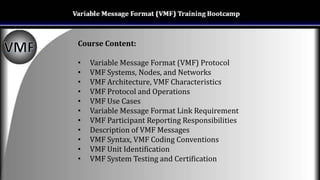
Course Content:
• Variable Message Format (VMF) Protocol
• VMF Systems, Nodes, and Networks
• VMF Architecture, VMF Characteristics
• VMF Protocol and Operations
• VMF Use Cases
• Variable Message Format Link Requirement
• VMF Participant Reporting Responsibilities
• Description of VMF Messages
• VMF Syntax, VMF Coding Conventions
• VMF Unit Identification
• VMF System Testing and Certification
Want To Learn More?
Variable Message Format (VMF) Training Bootcamp
https://www.tonex.com/training-courses/variable-
message-format-vmf-training-bootcamp/

VMF Message Standard, VMF Data Protocol and Use Cases in Tactical Radios

  • 1.
  • 2.
    The VMF protocolis used to swap information between multiple different tactical systems, thereby providing a rich and flexible messaging context
  • 3.
    VMF uses theK series messages defined in MIL- STD-6017 (VMF). There are more than 100 messages, and the catalog is constantly growing. They are arranged in a collection of 11 functional areas (FA). In fact, although VMF is generally considered to be the TDL for ground forces, many messages are used in the theater, and it can support any environment required. This is a "joint force" tactical data link.
  • 4.
    Swap operational andtactical data between connected systems and nodes through VMF, such as: • Position • Trajectory • Map • Navigation data • Mission data • Surveillance and Intelligence.
  • 5.
    VMF is verysuitable for deployment and use of Combat Net Radio (CNR) network with limited communication bandwidth. VMF and Joint Range Extension Application Protocol (JREAP) realize the exchange of voice, mission, tactical data and images by connecting to the network of each participant node, platform and unit in the vertical and horizontal directions.
  • 6.
    Tonex offers VariableMessage Format (VMF) Training Bootcamp. The training crash course style covering: • VMF message standard • VMF data protocol • Use cases in tactical radios
  • 7.
    Understand the basics,advanced tactical radio and variable message format (VMF), message standards using K series messages, and all communication protocols that have nothing to do with transmission media.
  • 8.
    The Variable MessageFormat (VMF) training course provides participants with the necessary knowledge and skills to analyze, specify, design, implement, test, V&V, and operating systems and nodes using the VMF protocol, VMF message standard, and VMF operating environment.
  • 9.
    Elements and Signsof VMF include: • Field Presence Indicator (FPI) • Field Recurrence Indicator (FRI) • Group Presence Indicator (GPI) • Group Recurrence Indicator (GRI)
  • 10.
    Audience: • TDL operators •TDL certification and testing professionals • Engineers and technicians • Analysts • Other military and defense professionals
  • 11.
    Objectives: • Differentiate amongLink 11, Link 16, Link 22, JREAP, SADIL, VMF, EPLRS, IFDL MADL and other TDLs • Explain key design considerations for a VMF enabled system or node • Sum up the VMF changes required in traditional TDL systems • Review VMF message structure, syntax, formats, protocol and VMF Data Element Dictionary (DED) • Review VMF considerations in terminals, interfaces, network communications and protocols • Test, verify, validate and certify VMF nodes and systems
  • 12.
    Objectives: • Variable MessageFormat (VMF) history and background • Explain the key concepts, features and mechanisms behind VMF • Clarify the motivation behind the use of VMF • List relevant VMF standards and benefits • Show potential VMF deployment scenarios • Give details how VMF facilitates Tactical Data Links (TDLs) enabled systems • VMF design considerations examples
  • 13.
    Course Content: • VariableMessage Format (VMF) Protocol • VMF Systems, Nodes, and Networks • VMF Architecture, VMF Characteristics • VMF Protocol and Operations • VMF Use Cases • Variable Message Format Link Requirement • VMF Participant Reporting Responsibilities • Description of VMF Messages • VMF Syntax, VMF Coding Conventions • VMF Unit Identification • VMF System Testing and Certification
  • 14.
    Want To LearnMore? Variable Message Format (VMF) Training Bootcamp https://www.tonex.com/training-courses/variable- message-format-vmf-training-bootcamp/