Introduction to VHDL M. Balakrishnan Dept of Computer Science & Engg. I.I.T. Delhi
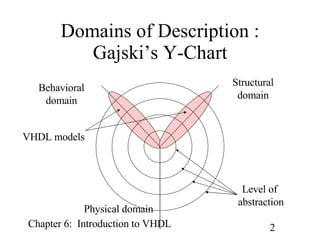
Domains of Description : Gajski’s Y-Chart Behavioral domain Structural domain Physical domain Level of  abstraction VHDL models
VHDL Development US DoD initiated in 80’s V ery  H igh Speed ASIC  D escription  L anguage Initial objective was modeling only and thus only a simulator was envisaged Subsequently tools for VHDL synthesis were developed
HDL Requirements Abstraction Modularity Concurrency Hierarchy
Abstraction VHDL supports description of components as well as systems at various levels of abstraction Gate and component delays Clock cycles Abstract behavior without any notion of delays
Modularity Every component in VHDL is referred to as an entity and has a clear interface The interface is called an entity declaration  The “internals” of the component are referred to as the architecture declaration There can be multiple architectures at even different levels of abstraction associated with the same entity
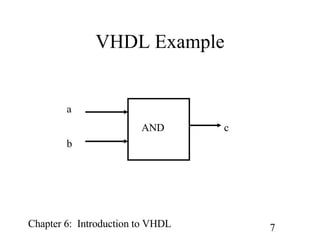
VHDL Example a b c AND
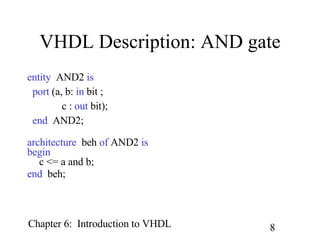
VHDL Description: AND gate entity   AND2  is port  (a, b:  in  bit ;   c :  out  bit); end   AND2; architecture  beh  of  AND2  is begin c <= a and b; end   beh;
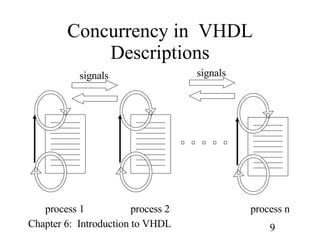
Concurrency in  VHDL Descriptions signals process 1 process 2 process n signals
Concurrent and Sequential Computations Processes are concurrent Sequential activity within each process Nesting of statements : Concurrent statements in a concurrent statement Sequential statements in a concurrent statement Sequential statements in a sequential statement
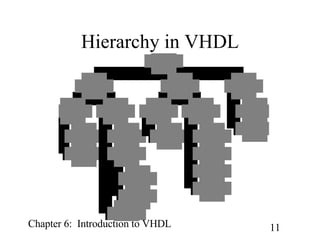
Hierarchy in VHDL
Modeling Styles in VHDL   M. Balakrishnan Dept. of Comp. Sci. & Engg. I.I.T. Delhi
Modeling Styles Semantic model of VHDL Structural description Data Flow description Algorithmic description RTL description
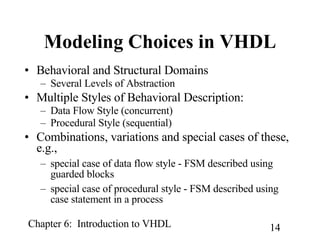
Modeling Choices in VHDL Behavioral and Structural Domains Several Levels of Abstraction Multiple Styles of Behavioral Description: Data Flow Style (concurrent) Procedural Style (sequential) Combinations, variations and special cases of these, e.g., special case of data flow style - FSM described using guarded blocks special case of procedural style - FSM described using case statement in a process
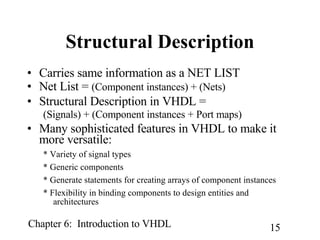
Structural Description Carries same information as a NET LIST Net List =  (Component instances) + (Nets) Structural Description in VHDL =  (Signals) + (Component instances + Port maps) Many sophisticated features in VHDL to make it more versatile: * Variety of signal types * Generic components * Generate statements for creating arrays of component instances * Flexibility in binding components to design entities and architectures
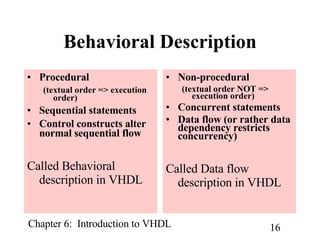
Behavioral Description Procedural  (textual order => execution order) Sequential statements Control constructs alter normal sequential flow Called Behavioral description in VHDL Non-procedural  (textual order NOT => execution order) Concurrent statements Data flow (or rather data dependency restricts concurrency) Called Data flow description in VHDL
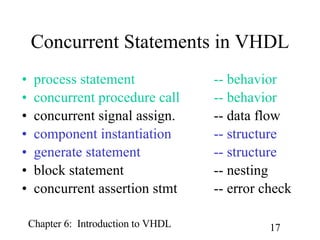
Concurrent Statements in VHDL process statement -- behavior concurrent procedure call -- behavior concurrent signal assign. -- data flow component instantiation -- structure generate statement -- structure block statement -- nesting concurrent assertion stmt -- error check
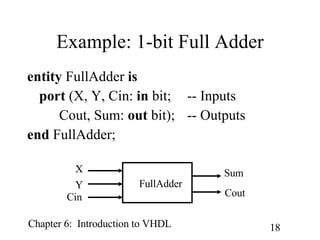
Example: 1-bit Full Adder entity  FullAdder  is port  (X, Y, Cin:  in  bit; -- Inputs Cout, Sum:  out  bit); -- Outputs end  FullAdder; X Y Cin Sum Cout FullAdder
Example: 1-bit Full Adder (contd.) Architecture  Equations  of  FullAdder  is begin -- Concurrent Assignment Sum <= X  xor  Y  xor  Cin  after  10 ns; Cout <= (X  and  Y)  or  (X  and  Cin)  or  (Y  and  Cin)  after  15 ns; end  Equations;
Example: 4-bit Adder entity   Adder4  is port   (A, B:  in  bit_vector(3  downto  0); Ci:  in  bit; -- Inputs S:  out  bit_vector(3  downto  0); Co:  out  bit); -- Outputs end  Adder4;
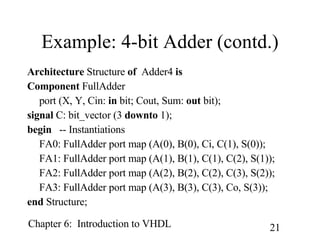
Example: 4-bit Adder (contd.) Architecture  Structure  of   Adder4  is Component  FullAdder port (X, Y, Cin:  in  bit; Cout, Sum:  out  bit); signal  C:   bit_vector   (3  downto  1); begin -- Instantiations FA0: FullAdder port map (A(0), B(0), Ci, C(1), S(0)); FA1: FullAdder port map (A(1), B(1), C(1), C(2), S(1)); FA2: FullAdder port map (A(2), B(2), C(2), C(3), S(2)); FA3: FullAdder port map (A(3), B(3), C(3), Co, S(3)); end  Structure;
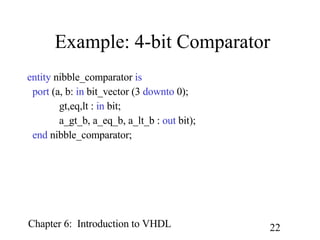
Example: 4-bit Comparator entity  nibble_comparator  is port  (a, b:  in  bit_vector (3  downto  0); gt,eq,lt :  in  bit; a_gt_b, a_eq_b, a_lt_b :  out  bit); end  nibble_comparator;
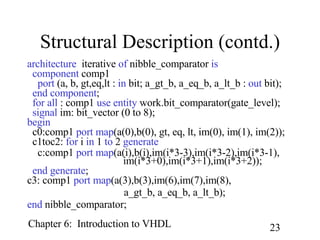
Structural Description (contd.) architecture  iterative  of  nibble_comparator  is component  comp1 port  (a, b, gt,eq,lt :  in  bit; a_gt_b, a_eq_b, a_lt_b :  out  bit); end component ; for all  : comp1  use entity  work.bit_comparator(gate_level); signal  im: bit_vector (0 to 8); begin c0:comp1  port map (a(0),b(0), gt, eq, lt, im(0), im(1), im(2)); c1toc2:  for  i  in  1  to  2  generate c:comp1  port map (a(i),b(i),im(i*3-3),im(i*3-2),im(i*3-1),  im(i*3+0),im(i*3+1),im(i*3+2)); end generate ; c3: comp1  port map (a(3),b(3),im(6),im(7),im(8), a_gt_b, a_eq_b, a_lt_b); end  nibble_comparator;
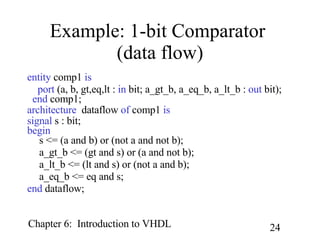
Example: 1-bit Comparator  (data flow) entity  comp1  is port  (a, b, gt,eq,lt :  in  bit; a_gt_b, a_eq_b, a_lt_b :  out  bit); end  comp1; architecture  dataflow  of  comp1  is signal  s : bit; begin s <= (a and b) or (not a and not b); a_gt_b <= (gt and s) or (a and not b); a_lt_b <= (lt and s) or (not a and b); a_eq_b <= eq and s; end  dataflow;
References Digital Systems Design Using VHDL Charles H. Roth, Jr., PWS Publishing Co. Chapter 2 (pp. 44 to 84) The Designer’s Guide to VHDL Peter J. Ashenden, Morgon Kaufmann
Behavioral Description in VHDL   M. Balakrishnan Dept. of Comp. Sci. & Engg. I.I.T. Delhi
Modeling Styles Semantic model of VHDL Structural description Data Flow description Algorithmic description RTL description
Concurrent Statements in VHDL process statement -- behavior concurrent procedure call -- behavior concurrent signal assign. -- data flow component instantiation -- structure generate statement -- structure block statement -- nesting concurrent assertion stmt -- error check
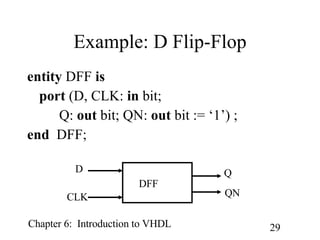
Example: D Flip-Flop entity  DFF  is port  (D, CLK:  in  bit;   Q:  out  bit; QN:  out  bit := ‘1’) ;  end   DFF; D CLK Q QN DFF
Example: DFF (contd.) Architecture  Beh  of  DFF  is begin   process  (CLK) begin if  (CLK = ‘1’  then Q <= D  after  10 ns; QN <=  not  D  after  10 ns; endif; endprocess; end  Beh;
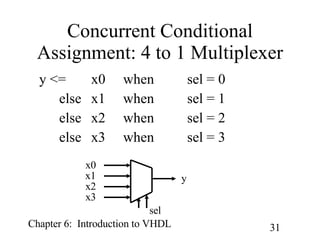
Concurrent Conditional Assignment: 4 to 1 Multiplexer y <= x0 when sel = 0 else x1 when sel = 1 else x2 when sel = 2 else x3 when sel = 3 x0 x1 x2 x3 sel y
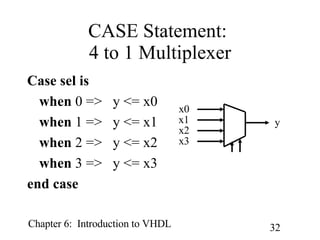
CASE Statement:  4 to 1 Multiplexer Case sel is   when  0 =>  y <= x0 when  1 =>  y <= x1 when  2 =>  y <= x2 when  3 =>  y <= x3 end case   x0 x1 x2 x3 y
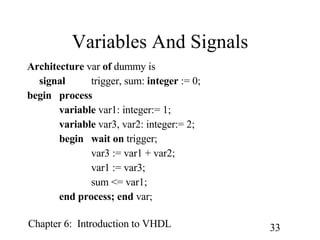
Variables And Signals Architecture  var  of  dummy is signal trigger, sum:  integer  := 0; begin process variable  var1: integer:= 1; variable  var3, var2: integer:= 2; begin wait on  trigger; var3 := var1 + var2; var1 := var3; sum <= var1; end process; end  var;
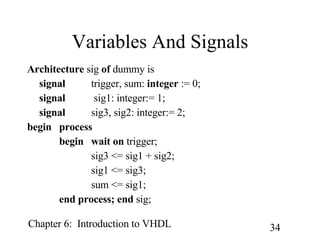
Variables And Signals Architecture  sig  of  dummy is signal trigger, sum:  integer  := 0; signal  sig1: integer:= 1; signal   sig3, sig2: integer:= 2; begin process begin wait on  trigger; sig3 <= sig1 + sig2; sig1 <= sig3; sum <= sig1; end process; end  sig;

VHDL

  • 1.
    Introduction to VHDLM. Balakrishnan Dept of Computer Science & Engg. I.I.T. Delhi
  • 2.
    Domains of Description: Gajski’s Y-Chart Behavioral domain Structural domain Physical domain Level of abstraction VHDL models
  • 3.
    VHDL Development USDoD initiated in 80’s V ery H igh Speed ASIC D escription L anguage Initial objective was modeling only and thus only a simulator was envisaged Subsequently tools for VHDL synthesis were developed
  • 4.
    HDL Requirements AbstractionModularity Concurrency Hierarchy
  • 5.
    Abstraction VHDL supportsdescription of components as well as systems at various levels of abstraction Gate and component delays Clock cycles Abstract behavior without any notion of delays
  • 6.
    Modularity Every componentin VHDL is referred to as an entity and has a clear interface The interface is called an entity declaration The “internals” of the component are referred to as the architecture declaration There can be multiple architectures at even different levels of abstraction associated with the same entity
  • 7.
  • 8.
    VHDL Description: ANDgate entity AND2 is port (a, b: in bit ; c : out bit); end AND2; architecture beh of AND2 is begin c <= a and b; end beh;
  • 9.
    Concurrency in VHDL Descriptions signals process 1 process 2 process n signals
  • 10.
    Concurrent and SequentialComputations Processes are concurrent Sequential activity within each process Nesting of statements : Concurrent statements in a concurrent statement Sequential statements in a concurrent statement Sequential statements in a sequential statement
  • 11.
  • 12.
    Modeling Styles inVHDL M. Balakrishnan Dept. of Comp. Sci. & Engg. I.I.T. Delhi
  • 13.
    Modeling Styles Semanticmodel of VHDL Structural description Data Flow description Algorithmic description RTL description
  • 14.
    Modeling Choices inVHDL Behavioral and Structural Domains Several Levels of Abstraction Multiple Styles of Behavioral Description: Data Flow Style (concurrent) Procedural Style (sequential) Combinations, variations and special cases of these, e.g., special case of data flow style - FSM described using guarded blocks special case of procedural style - FSM described using case statement in a process
  • 15.
    Structural Description Carriessame information as a NET LIST Net List = (Component instances) + (Nets) Structural Description in VHDL = (Signals) + (Component instances + Port maps) Many sophisticated features in VHDL to make it more versatile: * Variety of signal types * Generic components * Generate statements for creating arrays of component instances * Flexibility in binding components to design entities and architectures
  • 16.
    Behavioral Description Procedural (textual order => execution order) Sequential statements Control constructs alter normal sequential flow Called Behavioral description in VHDL Non-procedural (textual order NOT => execution order) Concurrent statements Data flow (or rather data dependency restricts concurrency) Called Data flow description in VHDL
  • 17.
    Concurrent Statements inVHDL process statement -- behavior concurrent procedure call -- behavior concurrent signal assign. -- data flow component instantiation -- structure generate statement -- structure block statement -- nesting concurrent assertion stmt -- error check
  • 18.
    Example: 1-bit FullAdder entity FullAdder is port (X, Y, Cin: in bit; -- Inputs Cout, Sum: out bit); -- Outputs end FullAdder; X Y Cin Sum Cout FullAdder
  • 19.
    Example: 1-bit FullAdder (contd.) Architecture Equations of FullAdder is begin -- Concurrent Assignment Sum <= X xor Y xor Cin after 10 ns; Cout <= (X and Y) or (X and Cin) or (Y and Cin) after 15 ns; end Equations;
  • 20.
    Example: 4-bit Adderentity Adder4 is port (A, B: in bit_vector(3 downto 0); Ci: in bit; -- Inputs S: out bit_vector(3 downto 0); Co: out bit); -- Outputs end Adder4;
  • 21.
    Example: 4-bit Adder(contd.) Architecture Structure of Adder4 is Component FullAdder port (X, Y, Cin: in bit; Cout, Sum: out bit); signal C: bit_vector (3 downto 1); begin -- Instantiations FA0: FullAdder port map (A(0), B(0), Ci, C(1), S(0)); FA1: FullAdder port map (A(1), B(1), C(1), C(2), S(1)); FA2: FullAdder port map (A(2), B(2), C(2), C(3), S(2)); FA3: FullAdder port map (A(3), B(3), C(3), Co, S(3)); end Structure;
  • 22.
    Example: 4-bit Comparatorentity nibble_comparator is port (a, b: in bit_vector (3 downto 0); gt,eq,lt : in bit; a_gt_b, a_eq_b, a_lt_b : out bit); end nibble_comparator;
  • 23.
    Structural Description (contd.)architecture iterative of nibble_comparator is component comp1 port (a, b, gt,eq,lt : in bit; a_gt_b, a_eq_b, a_lt_b : out bit); end component ; for all : comp1 use entity work.bit_comparator(gate_level); signal im: bit_vector (0 to 8); begin c0:comp1 port map (a(0),b(0), gt, eq, lt, im(0), im(1), im(2)); c1toc2: for i in 1 to 2 generate c:comp1 port map (a(i),b(i),im(i*3-3),im(i*3-2),im(i*3-1), im(i*3+0),im(i*3+1),im(i*3+2)); end generate ; c3: comp1 port map (a(3),b(3),im(6),im(7),im(8), a_gt_b, a_eq_b, a_lt_b); end nibble_comparator;
  • 24.
    Example: 1-bit Comparator (data flow) entity comp1 is port (a, b, gt,eq,lt : in bit; a_gt_b, a_eq_b, a_lt_b : out bit); end comp1; architecture dataflow of comp1 is signal s : bit; begin s <= (a and b) or (not a and not b); a_gt_b <= (gt and s) or (a and not b); a_lt_b <= (lt and s) or (not a and b); a_eq_b <= eq and s; end dataflow;
  • 25.
    References Digital SystemsDesign Using VHDL Charles H. Roth, Jr., PWS Publishing Co. Chapter 2 (pp. 44 to 84) The Designer’s Guide to VHDL Peter J. Ashenden, Morgon Kaufmann
  • 26.
    Behavioral Description inVHDL M. Balakrishnan Dept. of Comp. Sci. & Engg. I.I.T. Delhi
  • 27.
    Modeling Styles Semanticmodel of VHDL Structural description Data Flow description Algorithmic description RTL description
  • 28.
    Concurrent Statements inVHDL process statement -- behavior concurrent procedure call -- behavior concurrent signal assign. -- data flow component instantiation -- structure generate statement -- structure block statement -- nesting concurrent assertion stmt -- error check
  • 29.
    Example: D Flip-Flopentity DFF is port (D, CLK: in bit; Q: out bit; QN: out bit := ‘1’) ; end DFF; D CLK Q QN DFF
  • 30.
    Example: DFF (contd.)Architecture Beh of DFF is begin process (CLK) begin if (CLK = ‘1’ then Q <= D after 10 ns; QN <= not D after 10 ns; endif; endprocess; end Beh;
  • 31.
    Concurrent Conditional Assignment:4 to 1 Multiplexer y <= x0 when sel = 0 else x1 when sel = 1 else x2 when sel = 2 else x3 when sel = 3 x0 x1 x2 x3 sel y
  • 32.
    CASE Statement: 4 to 1 Multiplexer Case sel is when 0 => y <= x0 when 1 => y <= x1 when 2 => y <= x2 when 3 => y <= x3 end case x0 x1 x2 x3 y
  • 33.
    Variables And SignalsArchitecture var of dummy is signal trigger, sum: integer := 0; begin process variable var1: integer:= 1; variable var3, var2: integer:= 2; begin wait on trigger; var3 := var1 + var2; var1 := var3; sum <= var1; end process; end var;
  • 34.
    Variables And SignalsArchitecture sig of dummy is signal trigger, sum: integer := 0; signal sig1: integer:= 1; signal sig3, sig2: integer:= 2; begin process begin wait on trigger; sig3 <= sig1 + sig2; sig1 <= sig3; sum <= sig1; end process; end sig;