Mobile Communications Chapter 5: Satellite Systems History Basics Localization Handover Routing Systems
History of satellite communication 1945 Arthur C. Clarke publishes an essay about „Extra  Terrestrial Relays“ 1957  first satellite SPUTNIK 1960 first reflecting communication satellite ECHO 1963  first geostationary satellite SYNCOM 1965  first commercial geostationary satellite Satellit „Early Bird“    (INTELSAT I): 240 duplex telephone channels or 1 TV  channel, 1.5 years lifetime  1976 three MARISAT satellites for maritime communication 1982  first mobile satellite telephone system INMARSAT-A 1988  first satellite system for mobile phones and data  communication INMARSAT-C 1993 first digital satellite telephone system  1998  global satellite systems for small mobile phones
Applications Traditionally  weather satellites radio and TV broadcast satellites  military satellites satellites for navigation and localization (e.g., GPS) Telecommunication global telephone connections backbone for global networks connections for communication in remote places or underdeveloped areas global mobile communication  satellite systems to extend cellular phone systems (e.g., GSM or AMPS) replaced by fiber optics
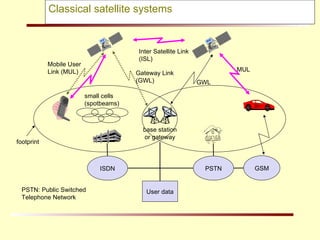
Classical satellite systems base station or gateway Inter Satellite Link  (ISL) Mobile User Link (MUL) Gateway Link (GWL) footprint small cells (spotbeams) User data PSTN ISDN GSM GWL MUL PSTN: Public Switched  Telephone Network
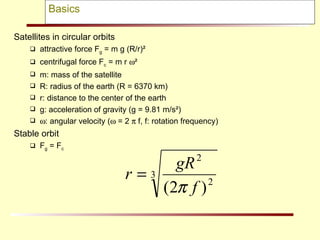
Basics Satellites in circular orbits attractive force F g  = m g (R/r)² centrifugal force F c  = m r   ² m: mass of the satellite R: radius of the earth (R = 6370 km) r: distance to the center of the earth g: acceleration of gravity (g = 9.81 m/s²)  : angular velocity (   = 2    f, f: rotation frequency) Stable orbit F g  = F c
Satellite period and orbits 10 20 30 40  x10 6  m 24 20 16 12 8 4 radius satellite  period [h] velocity [ x1000 km/h] synchronous distance 35,786 km
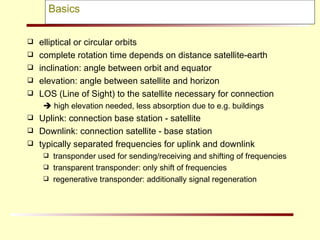
Basics elliptical or circular orbits complete rotation time depends on distance satellite-earth inclination: angle between orbit and equator elevation: angle between satellite and horizon LOS (Line of Sight) to the satellite necessary for connection    high elevation needed, less absorption due to e.g. buildings Uplink: connection base station - satellite Downlink: connection satellite - base station typically separated frequencies for uplink and downlink transponder used for sending/receiving and shifting of frequencies transparent transponder: only shift of frequencies regenerative transponder: additionally signal regeneration
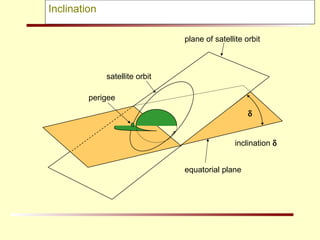
Inclination inclination    satellite orbit perigee plane of satellite orbit equatorial plane
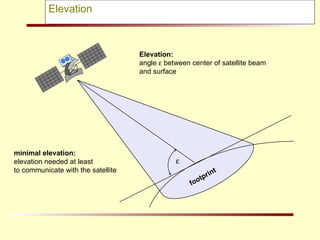
Elevation Elevation: angle    between center of satellite beam  and surface  minimal elevation: elevation needed at least to communicate with the satellite footprint
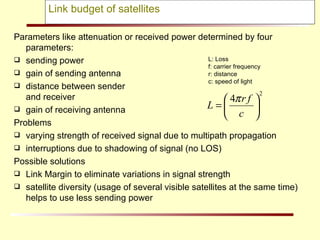
Link budget of satellites Parameters like attenuation or received power determined by four parameters: sending power gain of sending antenna distance between sender  and receiver gain of receiving antenna Problems varying strength of received signal due to multipath propagation  interruptions due to shadowing of signal (no LOS) Possible solutions Link Margin to eliminate variations in signal strength  satellite diversity (usage of several visible satellites at the same time) helps to use less sending power L: Loss f: carrier frequency r: distance c: speed of light
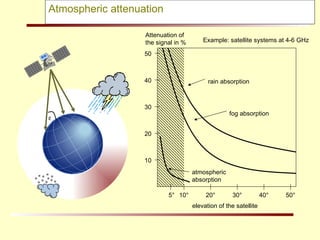
Atmospheric attenuation Example: satellite systems at 4-6 GHz elevation of the satellite 5° 10° 20° 30° 40° 50° Attenuation of  the signal in % 10 20 30 40 50 rain absorption fog absorption atmospheric absorption 
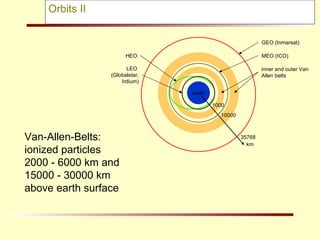
Four different types of satellite orbits can be identified depending on the shape and diameter of the orbit: GEO: geostationary orbit,  36000 km above earth surface  LEO (Low Earth Orbit):  500 - 1500 km MEO (Medium Earth Orbit) or ICO (Intermediate Circular Orbit):  6000 - 20000 km HEO (Highly Elliptical Orbit) elliptical orbits Orbits I
Orbits II earth km 35768 10000 1000 LEO  (Globalstar, Irdium) HEO inner and outer Van Allen belts MEO (ICO) GEO (Inmarsat) Van-Allen-Belts: ionized particles 2000 - 6000 km and 15000 - 30000 km above earth surface
Geostationary satellites Orbit 35.786 km distance to earth surface, orbit in equatorial plane (inclination 0°)    complete rotation exactly one day, satellite is synchronous to earth rotation fix antenna positions, no adjusting necessary satellites typically have a large footprint (up to 34% of earth surface!), therefore difficult to reuse frequencies  bad elevations in areas with latitude above 60° due to fixed position above the equator high transmit power needed high latency due to long distance ( 275 ms)    not useful for global coverage for small mobile phones and data transmission, typically used for radio and TV transmission
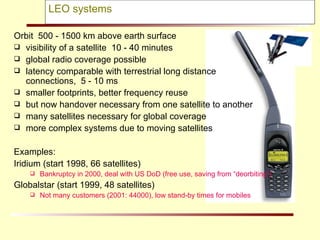
LEO systems Orbit  500 - 1500 km above earth surface visibility of a satellite  10 - 40 minutes global radio coverage possible  latency comparable with terrestrial long distance  connections,  5 - 10 ms smaller footprints, better frequency reuse but now handover necessary from one satellite to another  many satellites necessary for global coverage  more complex systems due to moving satellites Examples:  Iridium (start 1998, 66 satellites) Bankruptcy in 2000, deal with US DoD (free use, saving from “deorbiting”)  Globalstar (start 1999, 48 satellites) Not many customers (2001: 44000), low stand-by times for mobiles
MEO systems Orbit ca. 5000 - 12000 km above earth surface comparison with LEO systems: slower moving satellites  less satellites needed simpler system design for many connections no hand-over needed higher latency,  70 - 80 ms higher sending power needed special antennas for small footprints needed Example:  ICO (Intermediate Circular Orbit, Inmarsat) start  2000 Bankruptcy, planned joint ventures with Teledesic, Ellipso – cancelled again, start planned for 2003
Routing One solution: inter satellite links (ISL) reduced number of gateways needed  forward connections or data packets within the satellite network as long as possible only one uplink and one downlink per direction needed for the connection of two mobile phones  Problems: more complex focusing of antennas between satellites  high system complexity due to moving routers higher fuel consumption thus shorter lifetime Iridium and Teledesic planned with ISL Other systems use gateways and additionally terrestrial networks
Localization of mobile stations Mechanisms similar to GSM Gateways maintain registers with user data HLR (Home Location Register): static user data VLR (Visitor Location Register): (last known) location of the mobile station SUMR (Satellite User Mapping Register):  satellite assigned to a mobile station positions of all satellites Registration of mobile stations Localization of the mobile station via the satellite’s position requesting user data from HLR updating VLR and SUMR Calling a mobile station localization using HLR/VLR similar to GSM connection setup using the appropriate satellite
Handover in satellite systems Several additional situations for handover in satellite systems compared to cellular terrestrial mobile phone networks caused by the movement of the satellites Intra satellite handover handover from one spot beam to another mobile station still in the footprint of the satellite, but in another cell Inter satellite handover handover from one satellite to another satellite mobile station leaves the footprint of one satellite Gateway handover Handover from one gateway to another mobile station still in the footprint of a satellite, but gateway leaves the footprint Inter system handover Handover from the satellite network to a terrestrial cellular network mobile station can reach a terrestrial network again which might be cheaper, has a lower latency etc.
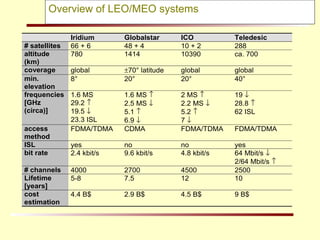
Overview of LEO/MEO systems

MSAT

  • 1.
    Mobile Communications Chapter5: Satellite Systems History Basics Localization Handover Routing Systems
  • 2.
    History of satellitecommunication 1945 Arthur C. Clarke publishes an essay about „Extra Terrestrial Relays“ 1957 first satellite SPUTNIK 1960 first reflecting communication satellite ECHO 1963 first geostationary satellite SYNCOM 1965 first commercial geostationary satellite Satellit „Early Bird“ (INTELSAT I): 240 duplex telephone channels or 1 TV channel, 1.5 years lifetime 1976 three MARISAT satellites for maritime communication 1982 first mobile satellite telephone system INMARSAT-A 1988 first satellite system for mobile phones and data communication INMARSAT-C 1993 first digital satellite telephone system 1998 global satellite systems for small mobile phones
  • 3.
    Applications Traditionally weather satellites radio and TV broadcast satellites military satellites satellites for navigation and localization (e.g., GPS) Telecommunication global telephone connections backbone for global networks connections for communication in remote places or underdeveloped areas global mobile communication  satellite systems to extend cellular phone systems (e.g., GSM or AMPS) replaced by fiber optics
  • 4.
    Classical satellite systemsbase station or gateway Inter Satellite Link (ISL) Mobile User Link (MUL) Gateway Link (GWL) footprint small cells (spotbeams) User data PSTN ISDN GSM GWL MUL PSTN: Public Switched Telephone Network
  • 5.
    Basics Satellites incircular orbits attractive force F g = m g (R/r)² centrifugal force F c = m r  ² m: mass of the satellite R: radius of the earth (R = 6370 km) r: distance to the center of the earth g: acceleration of gravity (g = 9.81 m/s²)  : angular velocity (  = 2  f, f: rotation frequency) Stable orbit F g = F c
  • 6.
    Satellite period andorbits 10 20 30 40 x10 6 m 24 20 16 12 8 4 radius satellite period [h] velocity [ x1000 km/h] synchronous distance 35,786 km
  • 7.
    Basics elliptical orcircular orbits complete rotation time depends on distance satellite-earth inclination: angle between orbit and equator elevation: angle between satellite and horizon LOS (Line of Sight) to the satellite necessary for connection  high elevation needed, less absorption due to e.g. buildings Uplink: connection base station - satellite Downlink: connection satellite - base station typically separated frequencies for uplink and downlink transponder used for sending/receiving and shifting of frequencies transparent transponder: only shift of frequencies regenerative transponder: additionally signal regeneration
  • 8.
    Inclination inclination   satellite orbit perigee plane of satellite orbit equatorial plane
  • 9.
    Elevation Elevation: angle  between center of satellite beam and surface  minimal elevation: elevation needed at least to communicate with the satellite footprint
  • 10.
    Link budget ofsatellites Parameters like attenuation or received power determined by four parameters: sending power gain of sending antenna distance between sender and receiver gain of receiving antenna Problems varying strength of received signal due to multipath propagation interruptions due to shadowing of signal (no LOS) Possible solutions Link Margin to eliminate variations in signal strength satellite diversity (usage of several visible satellites at the same time) helps to use less sending power L: Loss f: carrier frequency r: distance c: speed of light
  • 11.
    Atmospheric attenuation Example:satellite systems at 4-6 GHz elevation of the satellite 5° 10° 20° 30° 40° 50° Attenuation of the signal in % 10 20 30 40 50 rain absorption fog absorption atmospheric absorption 
  • 12.
    Four different typesof satellite orbits can be identified depending on the shape and diameter of the orbit: GEO: geostationary orbit, 36000 km above earth surface LEO (Low Earth Orbit): 500 - 1500 km MEO (Medium Earth Orbit) or ICO (Intermediate Circular Orbit): 6000 - 20000 km HEO (Highly Elliptical Orbit) elliptical orbits Orbits I
  • 13.
    Orbits II earthkm 35768 10000 1000 LEO (Globalstar, Irdium) HEO inner and outer Van Allen belts MEO (ICO) GEO (Inmarsat) Van-Allen-Belts: ionized particles 2000 - 6000 km and 15000 - 30000 km above earth surface
  • 14.
    Geostationary satellites Orbit35.786 km distance to earth surface, orbit in equatorial plane (inclination 0°)  complete rotation exactly one day, satellite is synchronous to earth rotation fix antenna positions, no adjusting necessary satellites typically have a large footprint (up to 34% of earth surface!), therefore difficult to reuse frequencies bad elevations in areas with latitude above 60° due to fixed position above the equator high transmit power needed high latency due to long distance ( 275 ms)  not useful for global coverage for small mobile phones and data transmission, typically used for radio and TV transmission
  • 15.
    LEO systems Orbit 500 - 1500 km above earth surface visibility of a satellite 10 - 40 minutes global radio coverage possible latency comparable with terrestrial long distance connections, 5 - 10 ms smaller footprints, better frequency reuse but now handover necessary from one satellite to another many satellites necessary for global coverage more complex systems due to moving satellites Examples: Iridium (start 1998, 66 satellites) Bankruptcy in 2000, deal with US DoD (free use, saving from “deorbiting”) Globalstar (start 1999, 48 satellites) Not many customers (2001: 44000), low stand-by times for mobiles
  • 16.
    MEO systems Orbitca. 5000 - 12000 km above earth surface comparison with LEO systems: slower moving satellites less satellites needed simpler system design for many connections no hand-over needed higher latency, 70 - 80 ms higher sending power needed special antennas for small footprints needed Example: ICO (Intermediate Circular Orbit, Inmarsat) start 2000 Bankruptcy, planned joint ventures with Teledesic, Ellipso – cancelled again, start planned for 2003
  • 17.
    Routing One solution:inter satellite links (ISL) reduced number of gateways needed forward connections or data packets within the satellite network as long as possible only one uplink and one downlink per direction needed for the connection of two mobile phones Problems: more complex focusing of antennas between satellites high system complexity due to moving routers higher fuel consumption thus shorter lifetime Iridium and Teledesic planned with ISL Other systems use gateways and additionally terrestrial networks
  • 18.
    Localization of mobilestations Mechanisms similar to GSM Gateways maintain registers with user data HLR (Home Location Register): static user data VLR (Visitor Location Register): (last known) location of the mobile station SUMR (Satellite User Mapping Register): satellite assigned to a mobile station positions of all satellites Registration of mobile stations Localization of the mobile station via the satellite’s position requesting user data from HLR updating VLR and SUMR Calling a mobile station localization using HLR/VLR similar to GSM connection setup using the appropriate satellite
  • 19.
    Handover in satellitesystems Several additional situations for handover in satellite systems compared to cellular terrestrial mobile phone networks caused by the movement of the satellites Intra satellite handover handover from one spot beam to another mobile station still in the footprint of the satellite, but in another cell Inter satellite handover handover from one satellite to another satellite mobile station leaves the footprint of one satellite Gateway handover Handover from one gateway to another mobile station still in the footprint of a satellite, but gateway leaves the footprint Inter system handover Handover from the satellite network to a terrestrial cellular network mobile station can reach a terrestrial network again which might be cheaper, has a lower latency etc.
  • 20.

Editor's Notes

  • #2 Universität Karlsruhe Institut für Telematik Mobilkommunikation SS 1998 Prof. Dr. Dr. h.c. G. Krüger E. Dorner / Dr. J. Schiller